



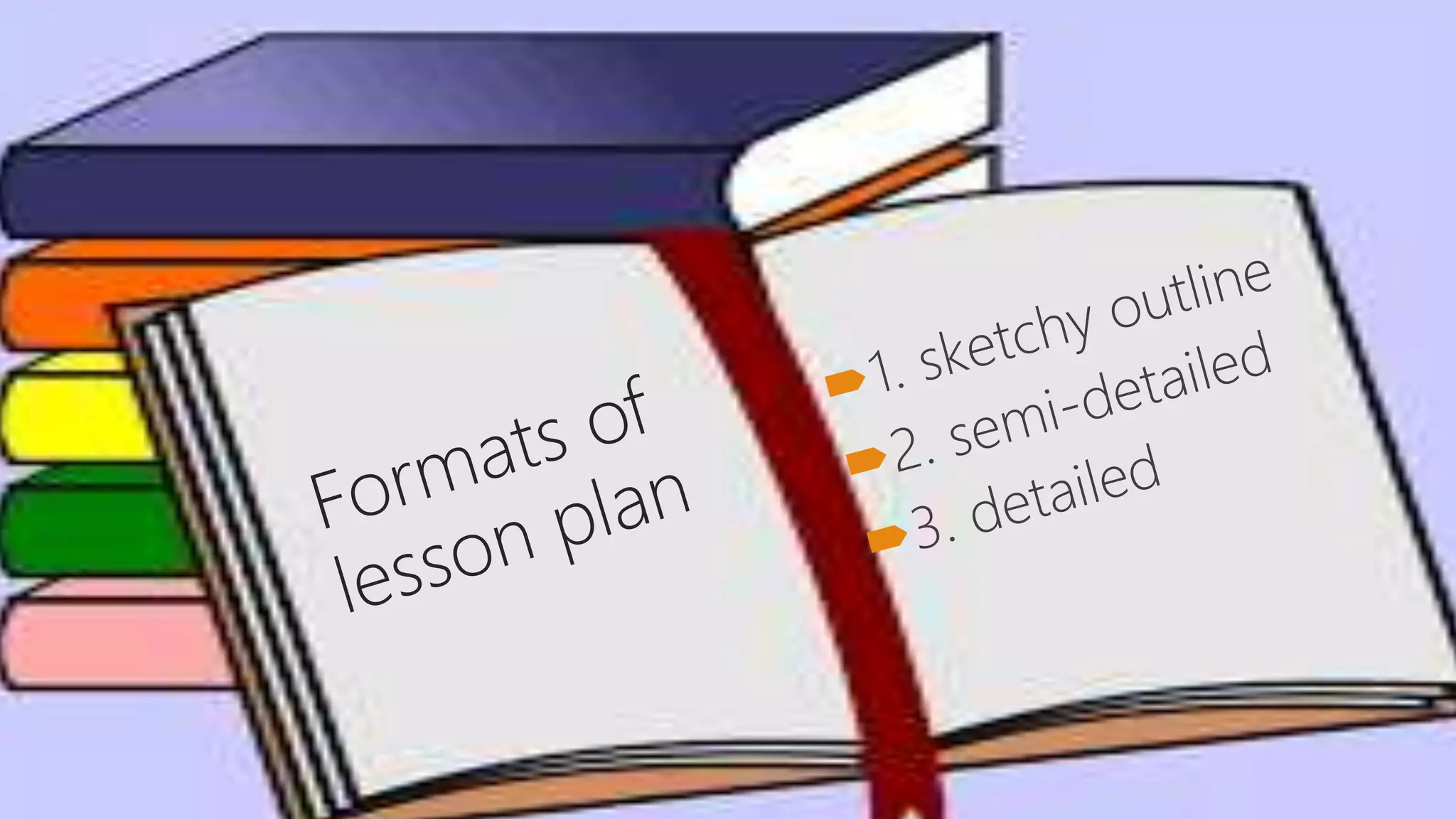

1. Yearly Instructional/Lesson
Plan
Example:
Philippine Elementary Learning
Competencies (PELCs) and the
Philippine Secondary Learning
Competencies (PSLCs)
2.Term plan for those in
the Tertiary level
- Course syllabus also called
a course plan or course
study.
3. Unit plan
-is a segment of the unit
plan.
4. Weekly and daily plan
- Lesson plan
1. OBJECTIVE(S)
Example:
Recognize the fundamental position of the arms and feet in folk
dance.
Perform the fundamental position of the arms and feet in folk dance.
Appreciate fundamental position of the arms and feet in folk dance.
2. Topic or subject matter
 Fundamental position of the arms and feet in folk
dance.
• 3. Materials
• Textbook, references, workbooks, teacher’s manuals,
journals, magazines, newspapers, simulations, games,
puzzles, films, filmstrips, filmslides, computer software,
chalkboard, display board and equipment like audio-radio
cassette, television, overhead projector (OHP), opaque
projector, computer and others.
4. Procedure
 consist of an outline of the development of
the lesson.
How will I treat the topic or subject matter?
What strategies and techniques shall I
employ?
What questions shall I ask?
What activities shall I give to my students?
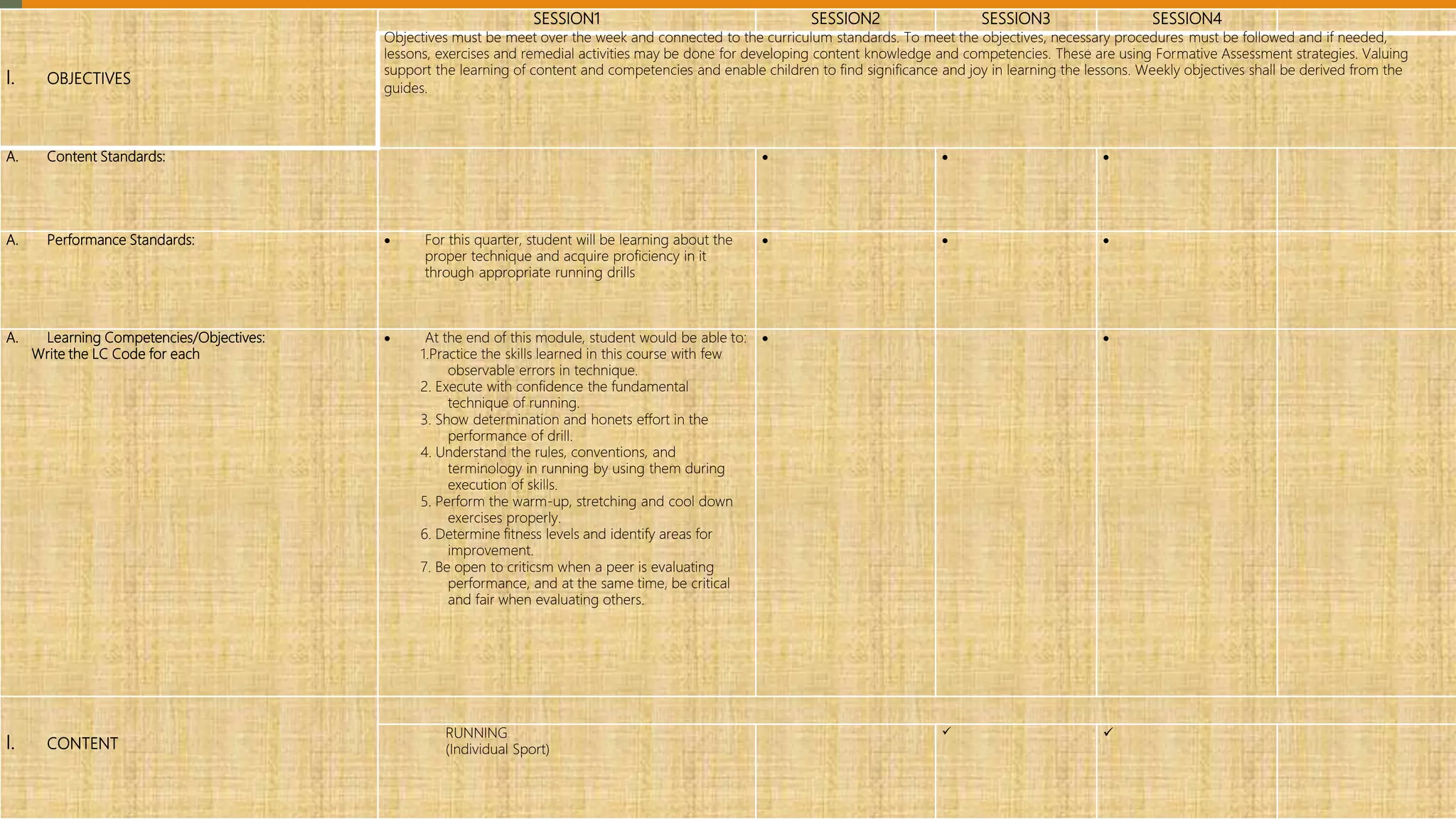
I. OBJECTIVES
SESSION1 SESSION2 SESSION3 SESSION4
Objectives must be meet over the week and connected to the curriculum standards. To meet the objectives, necessary procedures must be followed and if needed,
lessons, exercises and remedial activities may be done for developing content knowledge and competencies. These are using Formative Assessment strategies. Valuing
support the learning of content and competencies and enable children to find significance and joy in learning the lessons. Weekly objectives shall be derived from the
guides.
A. Content Standards:   
A. Performance Standards:  For this quarter, student will be learning about the
proper technique and acquire proficiency in it
through appropriate running drills
  
A. Learning Competencies/Objectives:
Write the LC Code for each
 At the end of this module, student would be able to:
1.Practice the skills learned in this course with few
observable errors in technique.
2. Execute with confidence the fundamental
technique of running.
3. Show determination and honets effort in the
performance of drill.
4. Understand the rules, conventions, and
terminology in running by using them during
execution of skills.
5. Perform the warm-up, stretching and cool down
exercises properly.
6. Determine fitness levels and identify areas for
improvement.
7. Be open to criticsm when a peer is evaluating
performance, and at the same time, be critical
and fair when evaluating others.
 
I. CONTENT
RUNNING
(Individual Sport)
 
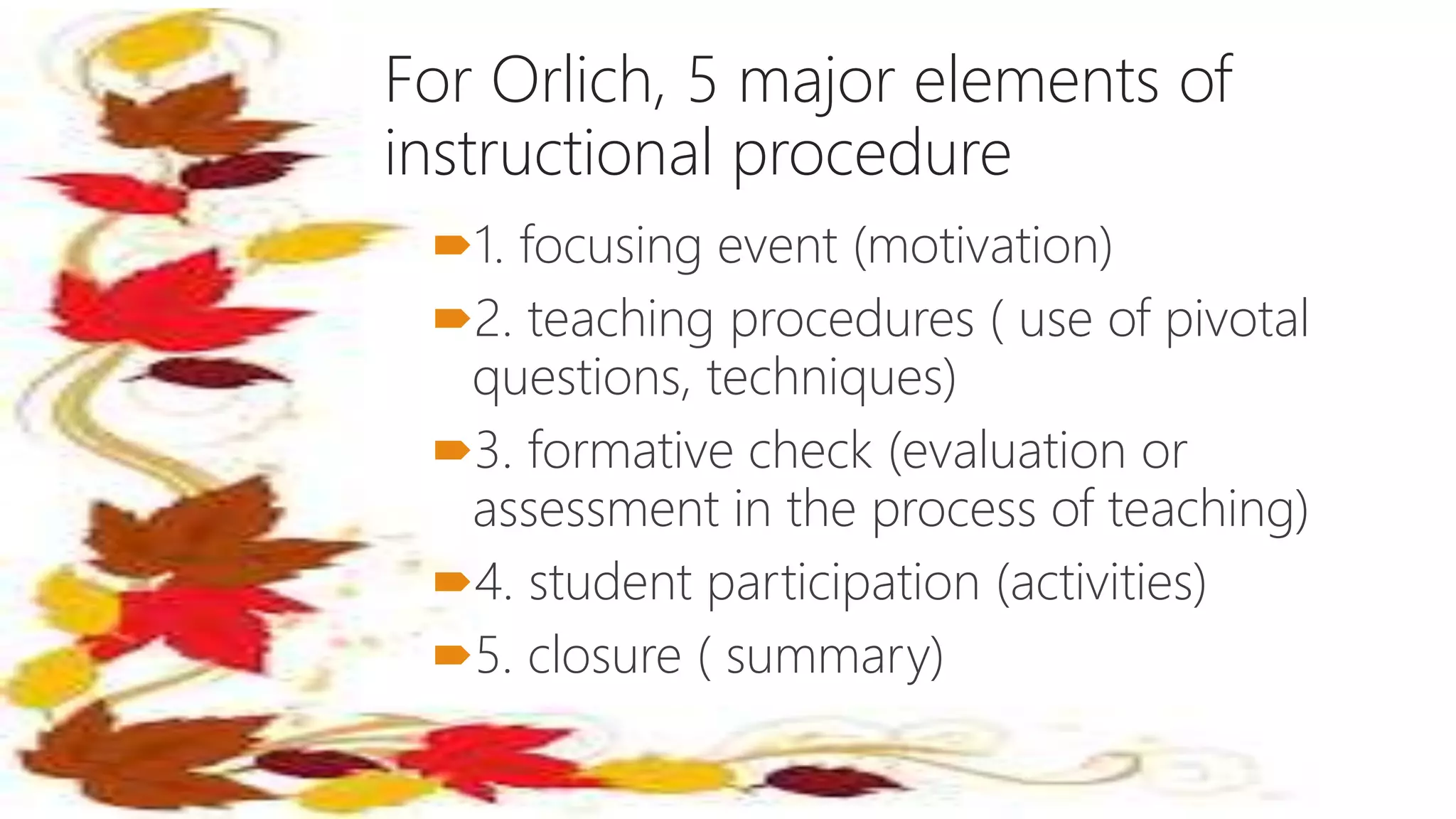
For Orlich, 5 major elements of
instructional procedure
1. focusing event (motivation)
2. teaching procedures ( use of pivotal
questions, techniques)
3. formative check (evaluation or
assessment in the process of teaching)
4. student participation (activities)
5. closure ( summary)
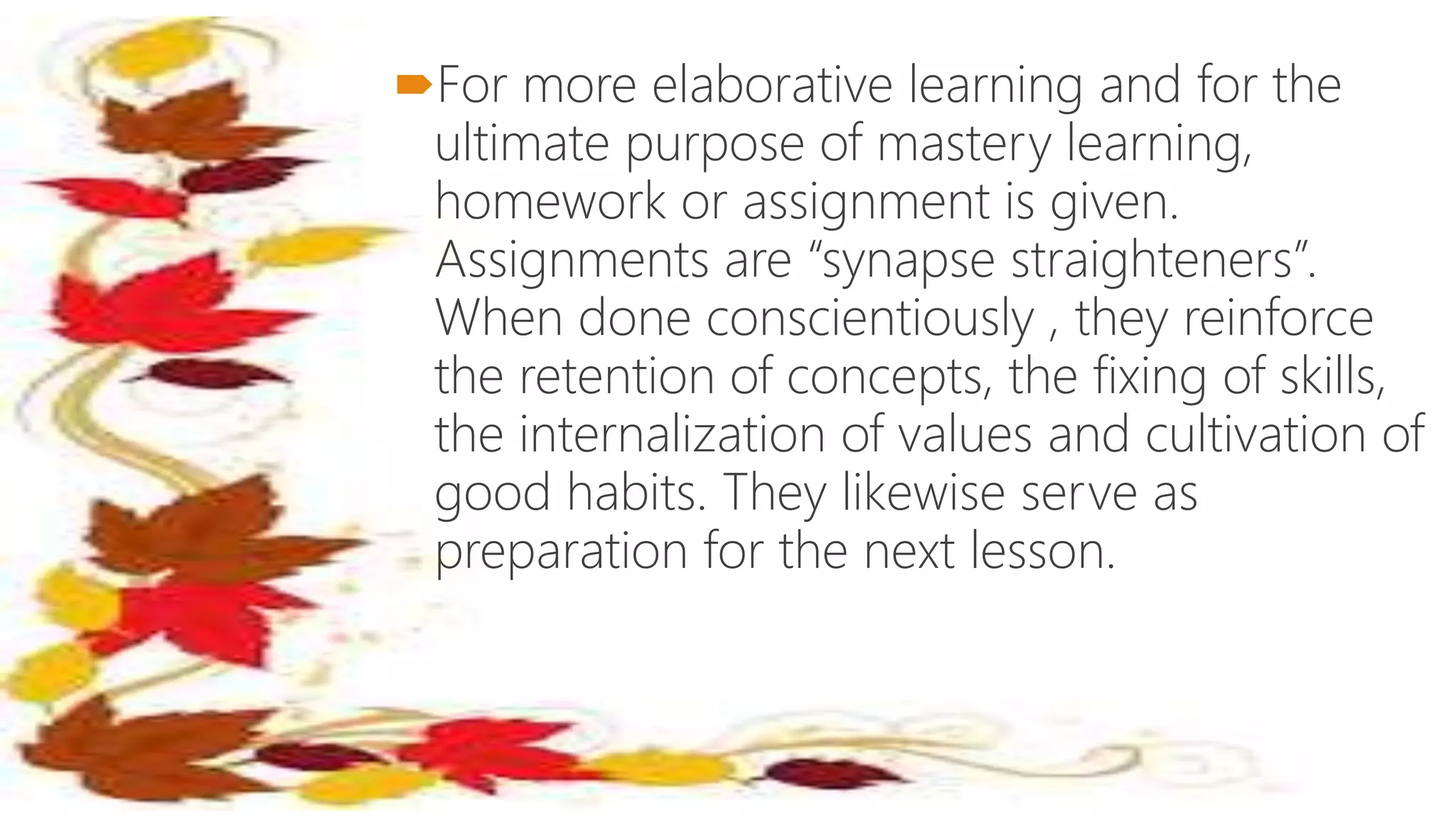
For more elaborative learning and for the
ultimate purpose of mastery learning,
homework or assignment is given.
Assignments are “synapse straighteners”.
When done conscientiously , they reinforce
the retention of concepts, the fixing of skills,
the internalization of values and cultivation of
good habits. They likewise serve as
preparation for the next lesson.
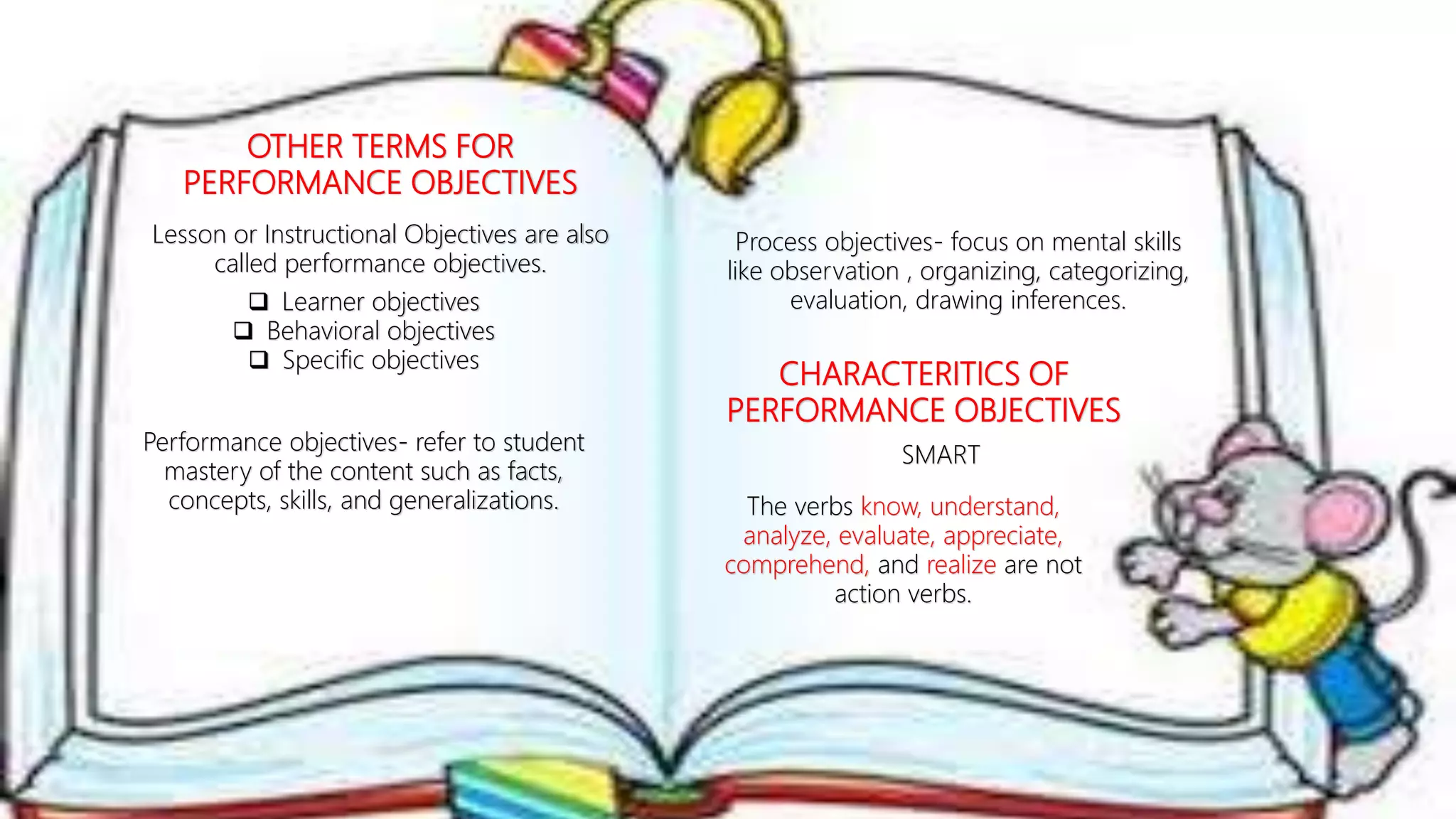
OTHER TERMS FOR
PERFORMANCE OBJECTIVES
Lesson or Instructional Objectives are also
called performance objectives.
 Learner objectives
 Behavioral objectives
 Specific objectives
Performance objectives- refer to student
mastery of the content such as facts,
concepts, skills, and generalizations.
Process objectives- focus on mental skills
like observation , organizing, categorizing,
evaluation, drawing inferences.
CHARACTERITICS OF
PERFORMANCE OBJECTIVES
SMART
The verbs know, understand,
analyze, evaluate, appreciate,
comprehend, and realize are not
action verbs.
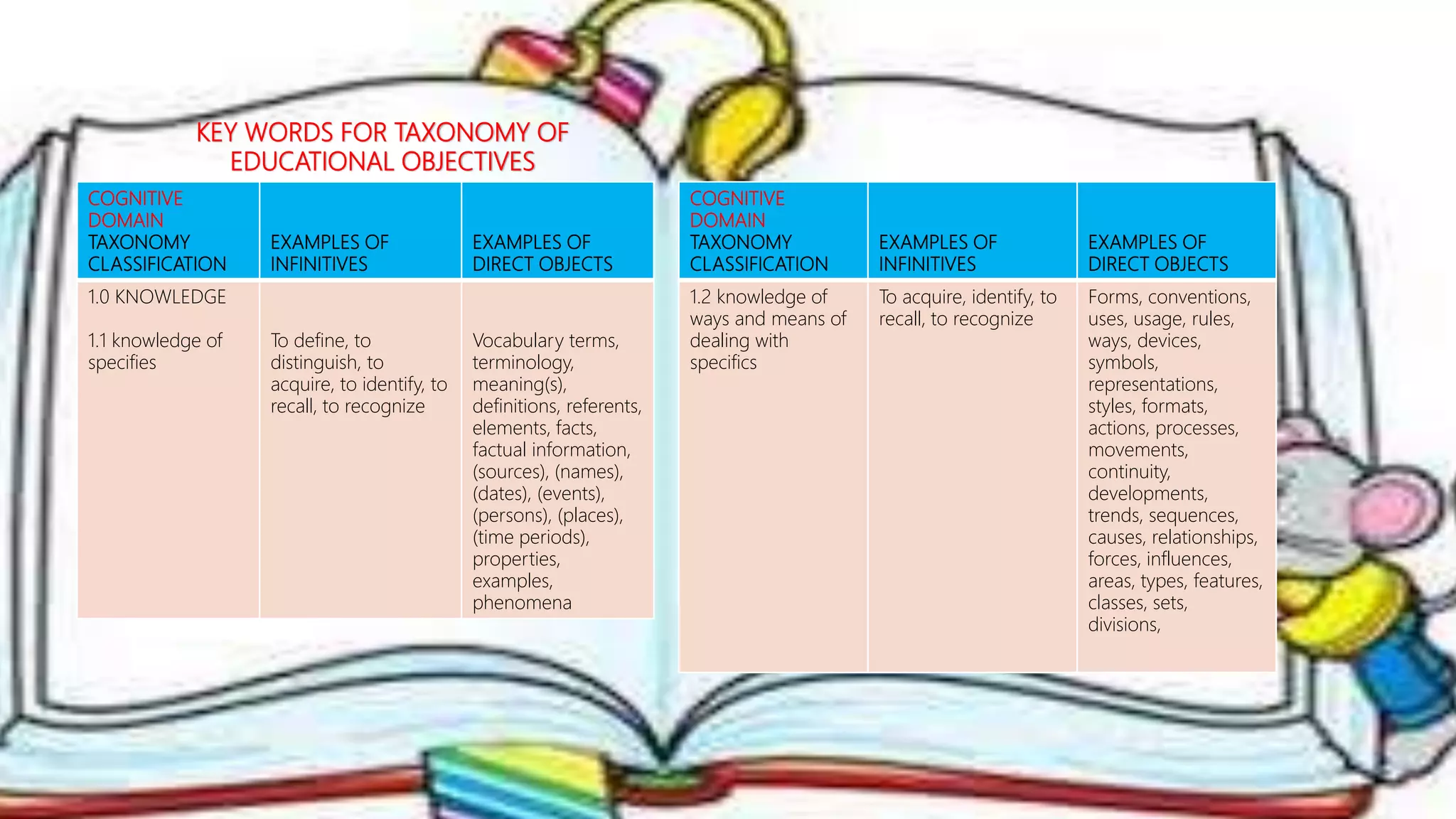
KEY WORDS FOR TAXONOMY OF
EDUCATIONAL OBJECTIVES
COGNITIVE
DOMAIN
TAXONOMY
CLASSIFICATION
EXAMPLES OF
INFINITIVES
EXAMPLES OF
DIRECT OBJECTS
1.0 KNOWLEDGE
1.1 knowledge of
specifies
To define, to
distinguish, to
acquire, to identify, to
recall, to recognize
Vocabulary terms,
terminology,
meaning(s),
definitions, referents,
elements, facts,
factual information,
(sources), (names),
(dates), (events),
(persons), (places),
(time periods),
properties,
examples,
phenomena
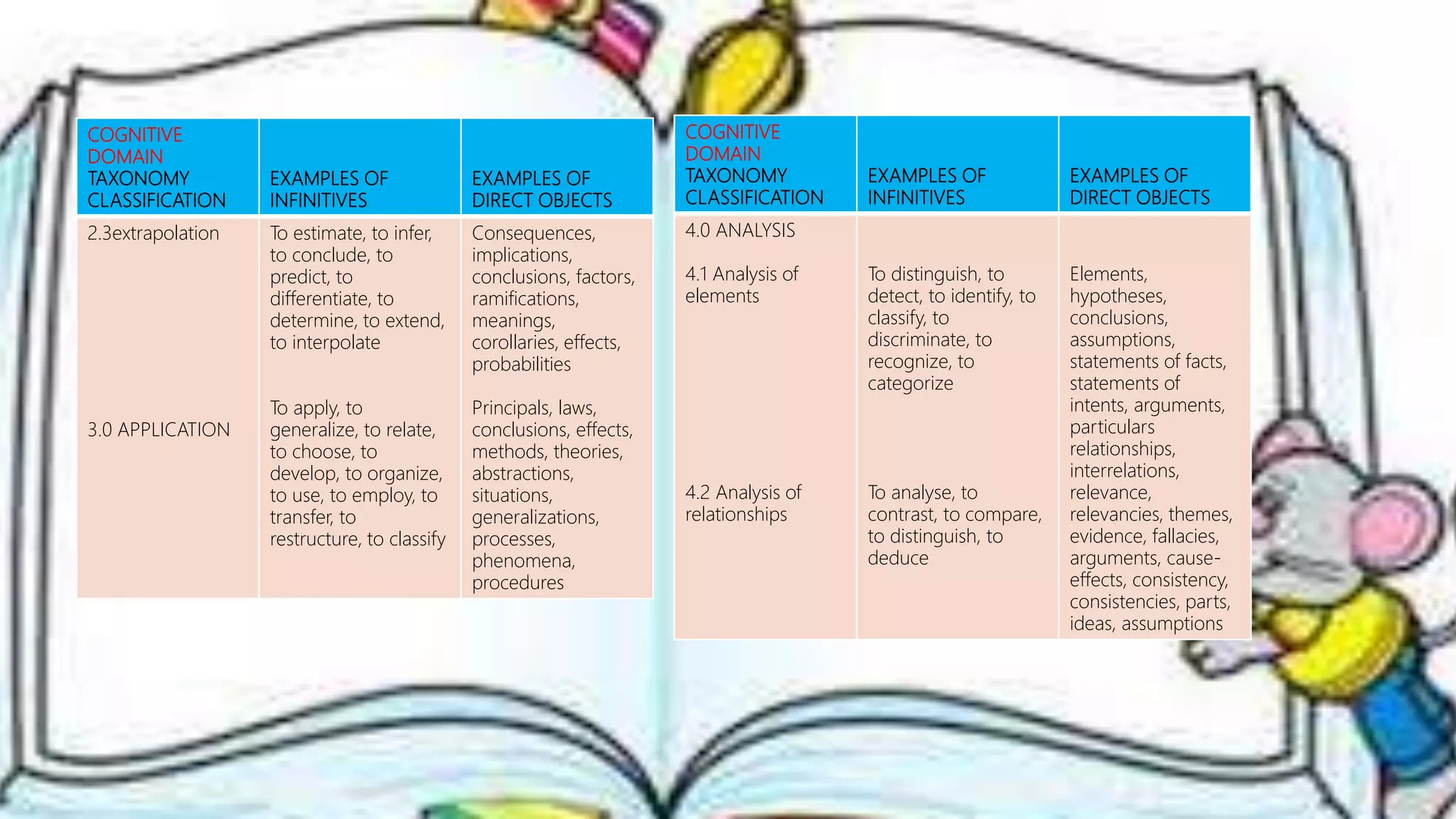
COGNITIVE
DOMAIN
TAXONOMY
CLASSIFICATION
EXAMPLES OF
INFINITIVES
EXAMPLES OF
DIRECT OBJECTS
1.2 knowledge of
ways and means of
dealing with
specifics
To acquire, identify, to
recall, to recognize
Forms, conventions,
uses, usage, rules,
ways, devices,
symbols,
representations,
styles, formats,
actions, processes,
movements,
continuity,
developments,
trends, sequences,
causes, relationships,
forces, influences,
areas, types, features,
classes, sets,
divisions,
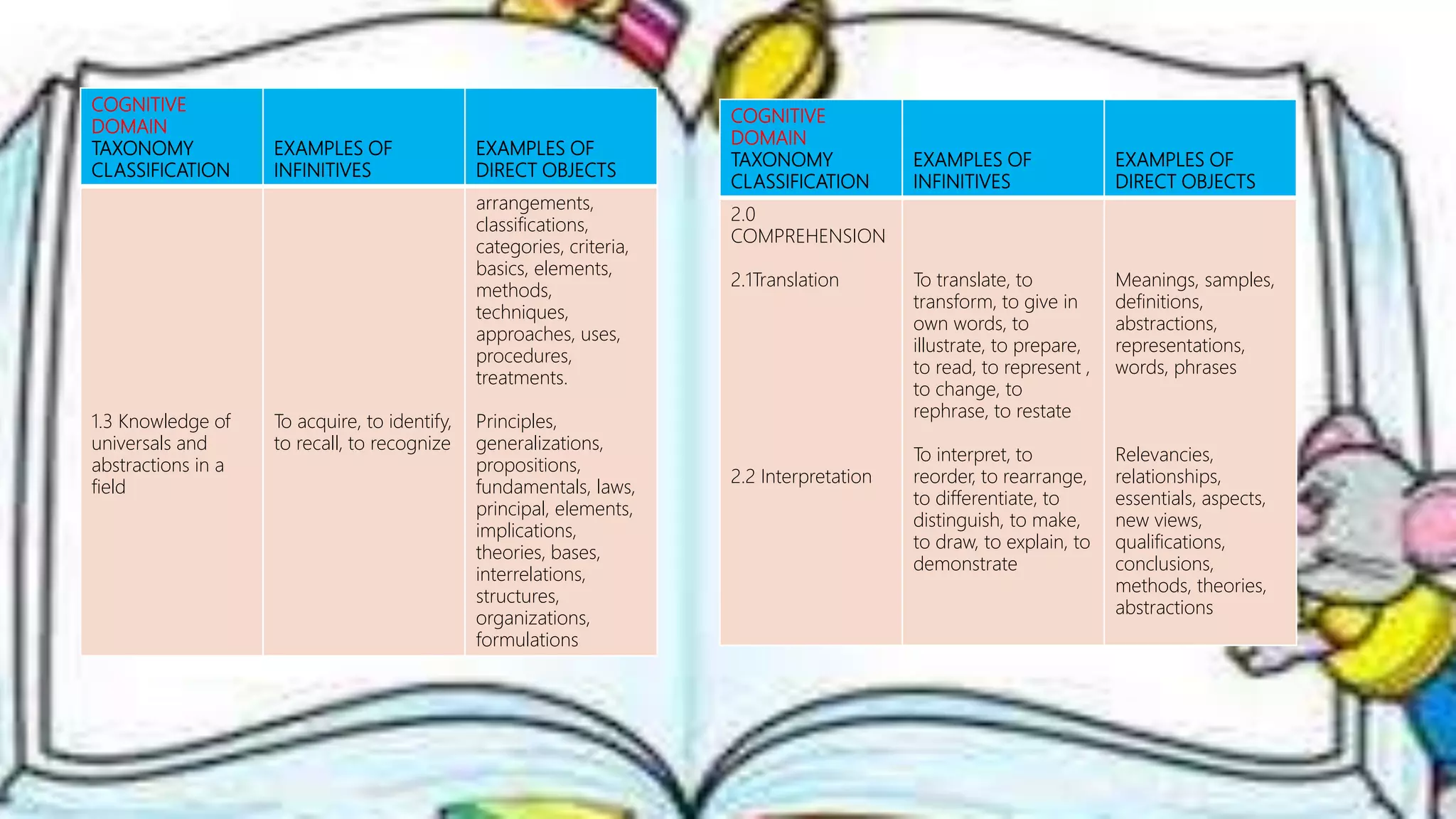
COGNITIVE
DOMAIN
TAXONOMY
CLASSIFICATION
EXAMPLES OF
INFINITIVES
EXAMPLES OF
DIRECT OBJECTS
1.3 Knowledge of
universals and
abstractions in a
field
To acquire, to identify,
to recall, to recognize
arrangements,
classifications,
categories, criteria,
basics, elements,
methods,
techniques,
approaches, uses,
procedures,
treatments.
Principles,
generalizations,
propositions,
fundamentals, laws,
principal, elements,
implications,
theories, bases,
interrelations,
structures,
organizations,
formulations
COGNITIVE
DOMAIN
TAXONOMY
CLASSIFICATION
EXAMPLES OF
INFINITIVES
EXAMPLES OF
DIRECT OBJECTS
2.0
COMPREHENSION
2.1Translation
2.2 Interpretation
To translate, to
transform, to give in
own words, to
illustrate, to prepare,
to read, to represent ,
to change, to
rephrase, to restate
To interpret, to
reorder, to rearrange,
to differentiate, to
distinguish, to make,
to draw, to explain, to
demonstrate
Meanings, samples,
definitions,
abstractions,
representations,
words, phrases
Relevancies,
relationships,
essentials, aspects,
new views,
qualifications,
conclusions,
methods, theories,
abstractions
COGNITIVE
DOMAIN
TAXONOMY
CLASSIFICATION
EXAMPLES OF
INFINITIVES
EXAMPLES OF
DIRECT OBJECTS
4.0 ANALYSIS
4.1 Analysis of
elements
4.2 Analysis of
relationships
To distinguish, to
detect, to identify, to
classify, to
discriminate, to
recognize, to
categorize
To analyse, to
contrast, to compare,
to distinguish, to
deduce
Elements,
hypotheses,
conclusions,
assumptions,
statements of facts,
statements of
intents, arguments,
particulars
relationships,
interrelations,
relevance,
relevancies, themes,
evidence, fallacies,
arguments, cause-
effects, consistency,
consistencies, parts,
ideas, assumptions
COGNITIVE
DOMAIN
TAXONOMY
CLASSIFICATION
EXAMPLES OF
INFINITIVES
EXAMPLES OF
DIRECT OBJECTS
2.3extrapolation
3.0 APPLICATION
To estimate, to infer,
to conclude, to
predict, to
differentiate, to
determine, to extend,
to interpolate
To apply, to
generalize, to relate,
to choose, to
develop, to organize,
to use, to employ, to
transfer, to
restructure, to classify
Consequences,
implications,
conclusions, factors,
ramifications,
meanings,
corollaries, effects,
probabilities
Principals, laws,
conclusions, effects,
methods, theories,
abstractions,
situations,
generalizations,
processes,
phenomena,
procedures
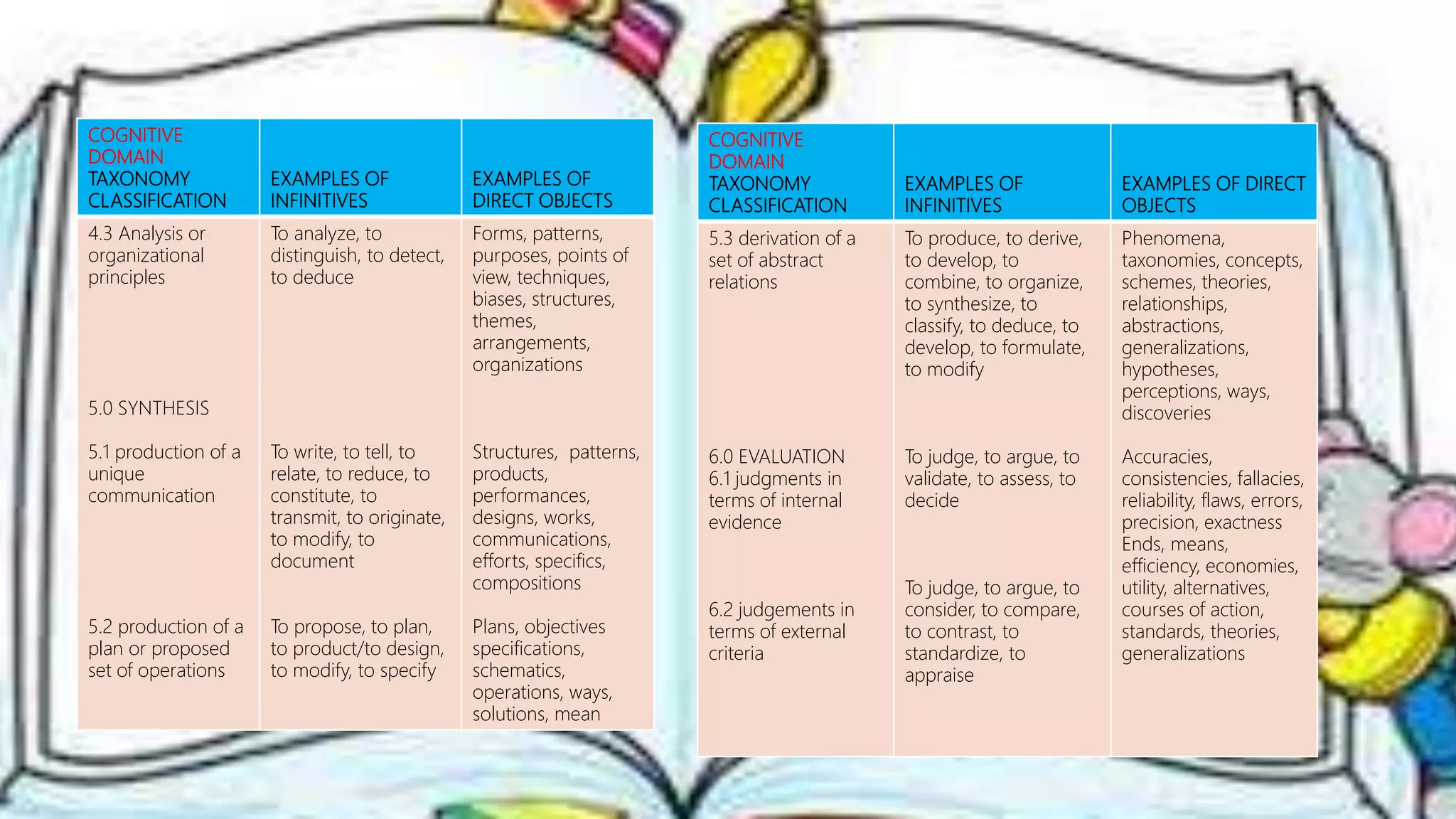
COGNITIVE
DOMAIN
TAXONOMY
CLASSIFICATION
EXAMPLES OF
INFINITIVES
EXAMPLES OF
DIRECT OBJECTS
4.3 Analysis or
organizational
principles
5.0 SYNTHESIS
5.1 production of a
unique
communication
5.2 production of a
plan or proposed
set of operations
To analyze, to
distinguish, to detect,
to deduce
To write, to tell, to
relate, to reduce, to
constitute, to
transmit, to originate,
to modify, to
document
To propose, to plan,
to product/to design,
to modify, to specify
Forms, patterns,
purposes, points of
view, techniques,
biases, structures,
themes,
arrangements,
organizations
Structures, patterns,
products,
performances,
designs, works,
communications,
efforts, specifics,
compositions
Plans, objectives
specifications,
schematics,
operations, ways,
solutions, mean
COGNITIVE
DOMAIN
TAXONOMY
CLASSIFICATION
EXAMPLES OF
INFINITIVES
EXAMPLES OF DIRECT
OBJECTS
5.3 derivation of a
set of abstract
relations
6.0 EVALUATION
6.1 judgments in
terms of internal
evidence
6.2 judgements in
terms of external
criteria
To produce, to derive,
to develop, to
combine, to organize,
to synthesize, to
classify, to deduce, to
develop, to formulate,
to modify
To judge, to argue, to
validate, to assess, to
decide
To judge, to argue, to
consider, to compare,
to contrast, to
standardize, to
appraise
Phenomena,
taxonomies, concepts,
schemes, theories,
relationships,
abstractions,
generalizations,
hypotheses,
perceptions, ways,
discoveries
Accuracies,
consistencies, fallacies,
reliability, flaws, errors,
precision, exactness
Ends, means,
efficiency, economies,
utility, alternatives,
courses of action,
standards, theories,
generalizations
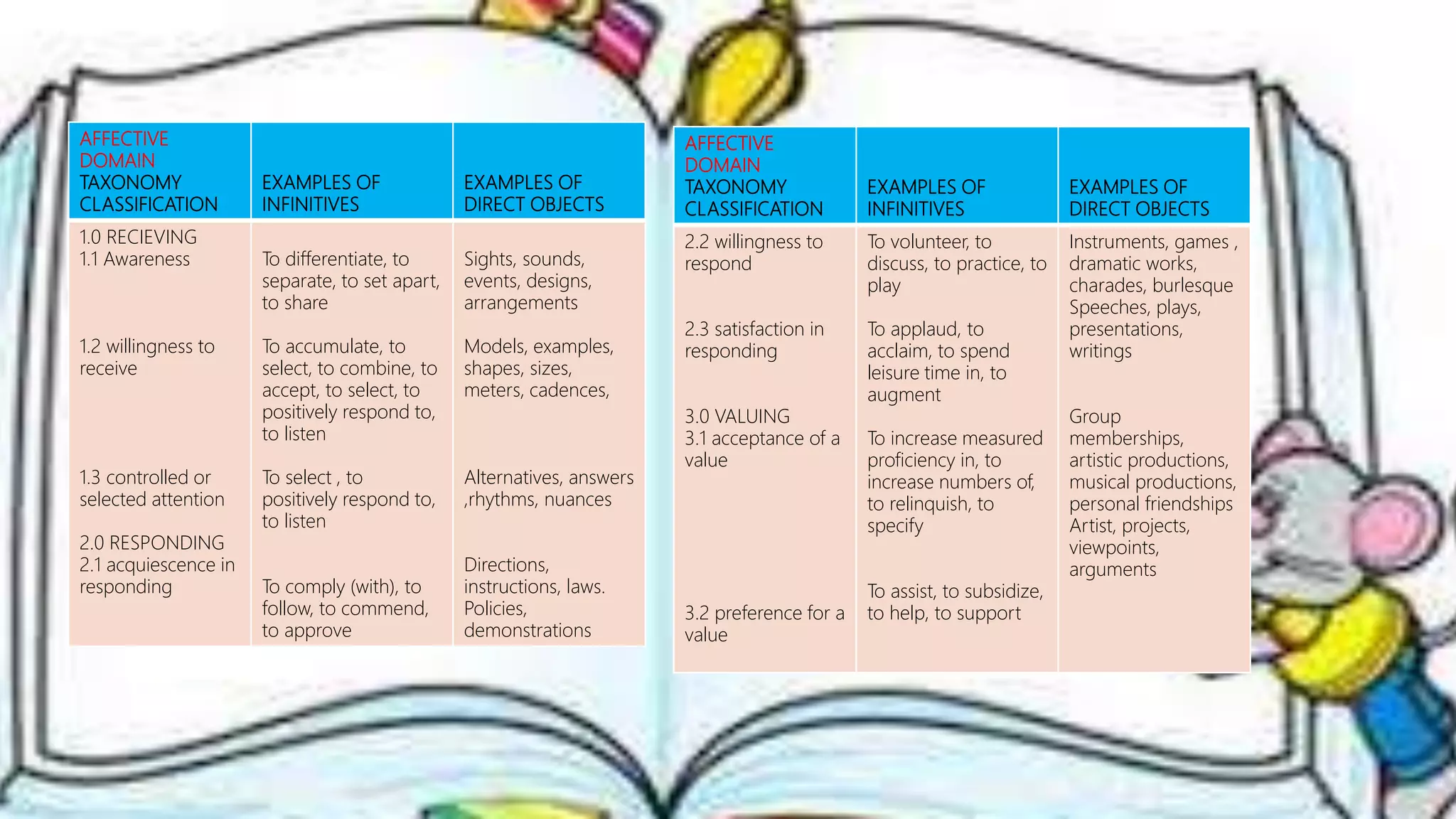
AFFECTIVE
DOMAIN
TAXONOMY
CLASSIFICATION
EXAMPLES OF
INFINITIVES
EXAMPLES OF
DIRECT OBJECTS
1.0 RECIEVING
1.1 Awareness
1.2 willingness to
receive
1.3 controlled or
selected attention
2.0 RESPONDING
2.1 acquiescence in
responding
To differentiate, to
separate, to set apart,
to share
To accumulate, to
select, to combine, to
accept, to select, to
positively respond to,
to listen
To select , to
positively respond to,
to listen
To comply (with), to
follow, to commend,
to approve
Sights, sounds,
events, designs,
arrangements
Models, examples,
shapes, sizes,
meters, cadences,
Alternatives, answers
,rhythms, nuances
Directions,
instructions, laws.
Policies,
demonstrations
AFFECTIVE
DOMAIN
TAXONOMY
CLASSIFICATION
EXAMPLES OF
INFINITIVES
EXAMPLES OF
DIRECT OBJECTS
2.2 willingness to
respond
2.3 satisfaction in
responding
3.0 VALUING
3.1 acceptance of a
value
3.2 preference for a
value
To volunteer, to
discuss, to practice, to
play
To applaud, to
acclaim, to spend
leisure time in, to
augment
To increase measured
proficiency in, to
increase numbers of,
to relinquish, to
specify
To assist, to subsidize,
to help, to support
Instruments, games ,
dramatic works,
charades, burlesque
Speeches, plays,
presentations,
writings
Group
memberships,
artistic productions,
musical productions,
personal friendships
Artist, projects,
viewpoints,
arguments
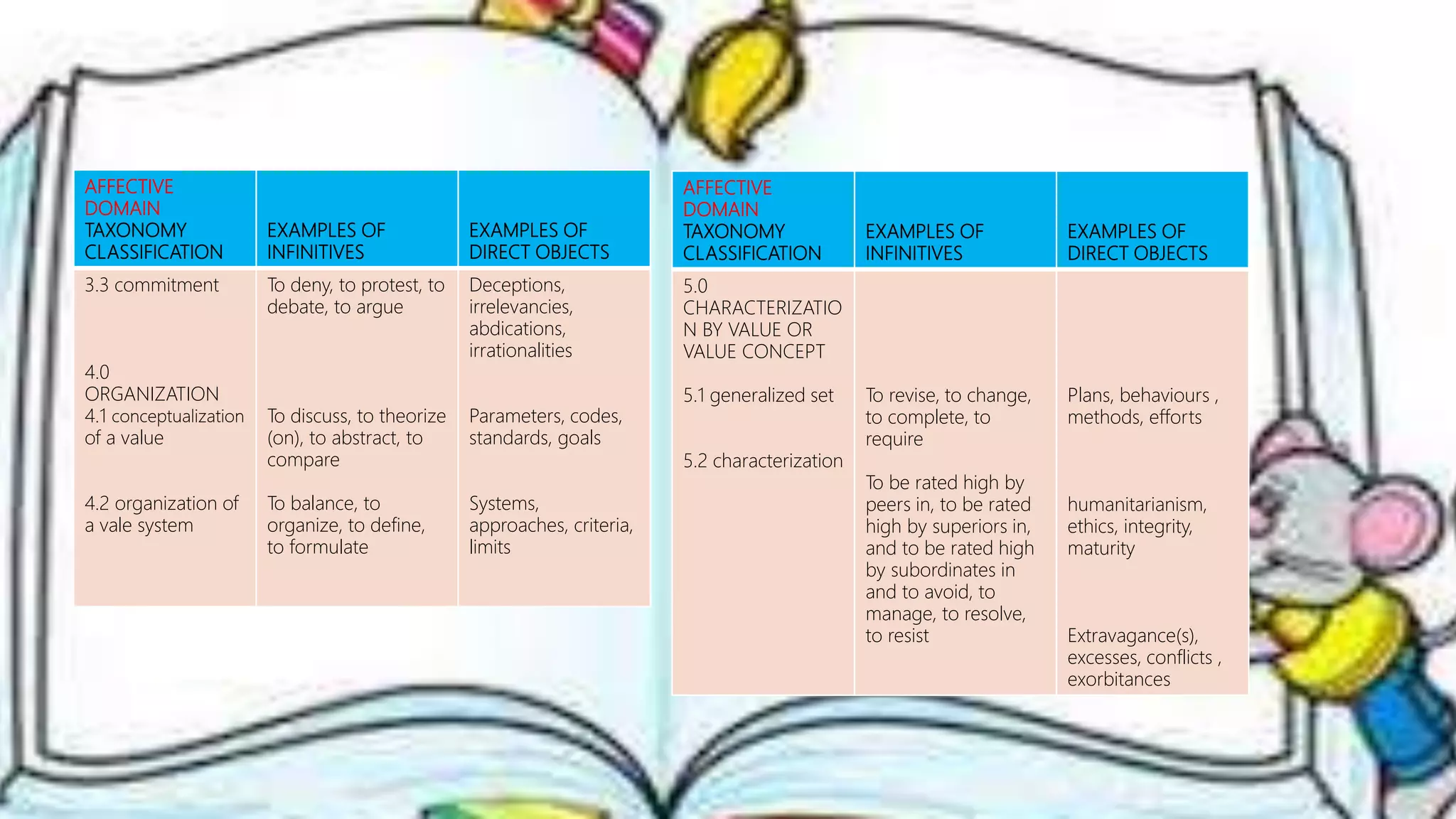
AFFECTIVE
DOMAIN
TAXONOMY
CLASSIFICATION
EXAMPLES OF
INFINITIVES
EXAMPLES OF
DIRECT OBJECTS
3.3 commitment
4.0
ORGANIZATION
4.1 conceptualization
of a value
4.2 organization of
a vale system
To deny, to protest, to
debate, to argue
To discuss, to theorize
(on), to abstract, to
compare
To balance, to
organize, to define,
to formulate
Deceptions,
irrelevancies,
abdications,
irrationalities
Parameters, codes,
standards, goals
Systems,
approaches, criteria,
limits
AFFECTIVE
DOMAIN
TAXONOMY
CLASSIFICATION
EXAMPLES OF
INFINITIVES
EXAMPLES OF
DIRECT OBJECTS
5.0
CHARACTERIZATIO
N BY VALUE OR
VALUE CONCEPT
5.1 generalized set
5.2 characterization
To revise, to change,
to complete, to
require
To be rated high by
peers in, to be rated
high by superiors in,
and to be rated high
by subordinates in
and to avoid, to
manage, to resolve,
to resist
Plans, behaviours ,
methods, efforts
humanitarianism,
ethics, integrity,
maturity
Extravagance(s),
excesses, conflicts ,
exorbitances
ENABLING OBJECTIVES
GAGNE introduced a system of
formulating objectives:
1. Task analysis- breaking down into
logical sequence of steps to achieve
the intended outcome
2. Enabling objectives- subtasks
TAXONOMY OF OBJECTIVES (lowest-
highest level)
1. Knowledge or recall
2. Comprehension
3. Application
4. Analysis
5. Synthesis
6. Evaluation
David Krathwohl and associate’s
Instructional Objectives related to interest,
attitudes and feelings (lowest –highest)
1. Receiving
2. Responding
3. Valuing
4. Organization
5. Characterization
Anita Harlow’s objectives in the
psychomotor domain
1. Reflex movements
2. Fundamental movements
3. Perceptual abilities
4. Physical abilities
5. Skilled movements
6. Non discursive communication
MAGER’S APPROACH IN WRITING
OBJECTIVES
(3 ELEMENTS)
1. Performance
2. The condition(s) under which the
behavior is to occur
3. The criterion of success
Example:
Within thirty minutes, the students must
be able to perform the fundamental steps
in folkdance using the rubrics given.
CHAPTER 3- SELECTING EFFECTIVE
TEACHING STRATEGIES
 Need for a repertoire of teaching
strategies
 No single best method
 Factors to consider in the choice of
method
 1. the instructional objectives
 2. the nature of the subject matter
 3. the learners
 4. the teacher
 5. school policies
Two main methods in teaching
1. Deductive method
2. Inductive method
Direct method- deductive method
demonstrative method- deductive
method
Inquiry method- inductive method
Problem-solving method-inductive
method
Project method- inductive method

Instructional plan (unit 3) ; teaching strategies.

  • 4.
    1. Yearly Instructional/Lesson Plan Example: PhilippineElementary Learning Competencies (PELCs) and the Philippine Secondary Learning Competencies (PSLCs)
  • 5.
    2.Term plan forthose in the Tertiary level - Course syllabus also called a course plan or course study. 3. Unit plan -is a segment of the unit plan.
  • 6.
    4. Weekly anddaily plan - Lesson plan
  • 7.
    1. OBJECTIVE(S) Example: Recognize thefundamental position of the arms and feet in folk dance. Perform the fundamental position of the arms and feet in folk dance. Appreciate fundamental position of the arms and feet in folk dance.
  • 8.
    2. Topic orsubject matter  Fundamental position of the arms and feet in folk dance. • 3. Materials • Textbook, references, workbooks, teacher’s manuals, journals, magazines, newspapers, simulations, games, puzzles, films, filmstrips, filmslides, computer software, chalkboard, display board and equipment like audio-radio cassette, television, overhead projector (OHP), opaque projector, computer and others.
  • 9.
    4. Procedure  consistof an outline of the development of the lesson. How will I treat the topic or subject matter? What strategies and techniques shall I employ? What questions shall I ask? What activities shall I give to my students?
  • 10.
    I. OBJECTIVES SESSION1 SESSION2SESSION3 SESSION4 Objectives must be meet over the week and connected to the curriculum standards. To meet the objectives, necessary procedures must be followed and if needed, lessons, exercises and remedial activities may be done for developing content knowledge and competencies. These are using Formative Assessment strategies. Valuing support the learning of content and competencies and enable children to find significance and joy in learning the lessons. Weekly objectives shall be derived from the guides. A. Content Standards:    A. Performance Standards:  For this quarter, student will be learning about the proper technique and acquire proficiency in it through appropriate running drills    A. Learning Competencies/Objectives: Write the LC Code for each  At the end of this module, student would be able to: 1.Practice the skills learned in this course with few observable errors in technique. 2. Execute with confidence the fundamental technique of running. 3. Show determination and honets effort in the performance of drill. 4. Understand the rules, conventions, and terminology in running by using them during execution of skills. 5. Perform the warm-up, stretching and cool down exercises properly. 6. Determine fitness levels and identify areas for improvement. 7. Be open to criticsm when a peer is evaluating performance, and at the same time, be critical and fair when evaluating others.   I. CONTENT RUNNING (Individual Sport)  
  • 11.
    For Orlich, 5major elements of instructional procedure 1. focusing event (motivation) 2. teaching procedures ( use of pivotal questions, techniques) 3. formative check (evaluation or assessment in the process of teaching) 4. student participation (activities) 5. closure ( summary)
  • 12.
    For more elaborativelearning and for the ultimate purpose of mastery learning, homework or assignment is given. Assignments are “synapse straighteners”. When done conscientiously , they reinforce the retention of concepts, the fixing of skills, the internalization of values and cultivation of good habits. They likewise serve as preparation for the next lesson.
  • 15.
    OTHER TERMS FOR PERFORMANCEOBJECTIVES Lesson or Instructional Objectives are also called performance objectives.  Learner objectives  Behavioral objectives  Specific objectives Performance objectives- refer to student mastery of the content such as facts, concepts, skills, and generalizations. Process objectives- focus on mental skills like observation , organizing, categorizing, evaluation, drawing inferences. CHARACTERITICS OF PERFORMANCE OBJECTIVES SMART The verbs know, understand, analyze, evaluate, appreciate, comprehend, and realize are not action verbs.
  • 16.
    KEY WORDS FORTAXONOMY OF EDUCATIONAL OBJECTIVES COGNITIVE DOMAIN TAXONOMY CLASSIFICATION EXAMPLES OF INFINITIVES EXAMPLES OF DIRECT OBJECTS 1.0 KNOWLEDGE 1.1 knowledge of specifies To define, to distinguish, to acquire, to identify, to recall, to recognize Vocabulary terms, terminology, meaning(s), definitions, referents, elements, facts, factual information, (sources), (names), (dates), (events), (persons), (places), (time periods), properties, examples, phenomena COGNITIVE DOMAIN TAXONOMY CLASSIFICATION EXAMPLES OF INFINITIVES EXAMPLES OF DIRECT OBJECTS 1.2 knowledge of ways and means of dealing with specifics To acquire, identify, to recall, to recognize Forms, conventions, uses, usage, rules, ways, devices, symbols, representations, styles, formats, actions, processes, movements, continuity, developments, trends, sequences, causes, relationships, forces, influences, areas, types, features, classes, sets, divisions,
  • 17.
    COGNITIVE DOMAIN TAXONOMY CLASSIFICATION EXAMPLES OF INFINITIVES EXAMPLES OF DIRECTOBJECTS 1.3 Knowledge of universals and abstractions in a field To acquire, to identify, to recall, to recognize arrangements, classifications, categories, criteria, basics, elements, methods, techniques, approaches, uses, procedures, treatments. Principles, generalizations, propositions, fundamentals, laws, principal, elements, implications, theories, bases, interrelations, structures, organizations, formulations COGNITIVE DOMAIN TAXONOMY CLASSIFICATION EXAMPLES OF INFINITIVES EXAMPLES OF DIRECT OBJECTS 2.0 COMPREHENSION 2.1Translation 2.2 Interpretation To translate, to transform, to give in own words, to illustrate, to prepare, to read, to represent , to change, to rephrase, to restate To interpret, to reorder, to rearrange, to differentiate, to distinguish, to make, to draw, to explain, to demonstrate Meanings, samples, definitions, abstractions, representations, words, phrases Relevancies, relationships, essentials, aspects, new views, qualifications, conclusions, methods, theories, abstractions
  • 18.
    COGNITIVE DOMAIN TAXONOMY CLASSIFICATION EXAMPLES OF INFINITIVES EXAMPLES OF DIRECTOBJECTS 4.0 ANALYSIS 4.1 Analysis of elements 4.2 Analysis of relationships To distinguish, to detect, to identify, to classify, to discriminate, to recognize, to categorize To analyse, to contrast, to compare, to distinguish, to deduce Elements, hypotheses, conclusions, assumptions, statements of facts, statements of intents, arguments, particulars relationships, interrelations, relevance, relevancies, themes, evidence, fallacies, arguments, cause- effects, consistency, consistencies, parts, ideas, assumptions COGNITIVE DOMAIN TAXONOMY CLASSIFICATION EXAMPLES OF INFINITIVES EXAMPLES OF DIRECT OBJECTS 2.3extrapolation 3.0 APPLICATION To estimate, to infer, to conclude, to predict, to differentiate, to determine, to extend, to interpolate To apply, to generalize, to relate, to choose, to develop, to organize, to use, to employ, to transfer, to restructure, to classify Consequences, implications, conclusions, factors, ramifications, meanings, corollaries, effects, probabilities Principals, laws, conclusions, effects, methods, theories, abstractions, situations, generalizations, processes, phenomena, procedures
  • 19.
    COGNITIVE DOMAIN TAXONOMY CLASSIFICATION EXAMPLES OF INFINITIVES EXAMPLES OF DIRECTOBJECTS 4.3 Analysis or organizational principles 5.0 SYNTHESIS 5.1 production of a unique communication 5.2 production of a plan or proposed set of operations To analyze, to distinguish, to detect, to deduce To write, to tell, to relate, to reduce, to constitute, to transmit, to originate, to modify, to document To propose, to plan, to product/to design, to modify, to specify Forms, patterns, purposes, points of view, techniques, biases, structures, themes, arrangements, organizations Structures, patterns, products, performances, designs, works, communications, efforts, specifics, compositions Plans, objectives specifications, schematics, operations, ways, solutions, mean COGNITIVE DOMAIN TAXONOMY CLASSIFICATION EXAMPLES OF INFINITIVES EXAMPLES OF DIRECT OBJECTS 5.3 derivation of a set of abstract relations 6.0 EVALUATION 6.1 judgments in terms of internal evidence 6.2 judgements in terms of external criteria To produce, to derive, to develop, to combine, to organize, to synthesize, to classify, to deduce, to develop, to formulate, to modify To judge, to argue, to validate, to assess, to decide To judge, to argue, to consider, to compare, to contrast, to standardize, to appraise Phenomena, taxonomies, concepts, schemes, theories, relationships, abstractions, generalizations, hypotheses, perceptions, ways, discoveries Accuracies, consistencies, fallacies, reliability, flaws, errors, precision, exactness Ends, means, efficiency, economies, utility, alternatives, courses of action, standards, theories, generalizations
  • 20.
    AFFECTIVE DOMAIN TAXONOMY CLASSIFICATION EXAMPLES OF INFINITIVES EXAMPLES OF DIRECTOBJECTS 1.0 RECIEVING 1.1 Awareness 1.2 willingness to receive 1.3 controlled or selected attention 2.0 RESPONDING 2.1 acquiescence in responding To differentiate, to separate, to set apart, to share To accumulate, to select, to combine, to accept, to select, to positively respond to, to listen To select , to positively respond to, to listen To comply (with), to follow, to commend, to approve Sights, sounds, events, designs, arrangements Models, examples, shapes, sizes, meters, cadences, Alternatives, answers ,rhythms, nuances Directions, instructions, laws. Policies, demonstrations AFFECTIVE DOMAIN TAXONOMY CLASSIFICATION EXAMPLES OF INFINITIVES EXAMPLES OF DIRECT OBJECTS 2.2 willingness to respond 2.3 satisfaction in responding 3.0 VALUING 3.1 acceptance of a value 3.2 preference for a value To volunteer, to discuss, to practice, to play To applaud, to acclaim, to spend leisure time in, to augment To increase measured proficiency in, to increase numbers of, to relinquish, to specify To assist, to subsidize, to help, to support Instruments, games , dramatic works, charades, burlesque Speeches, plays, presentations, writings Group memberships, artistic productions, musical productions, personal friendships Artist, projects, viewpoints, arguments
  • 21.
    AFFECTIVE DOMAIN TAXONOMY CLASSIFICATION EXAMPLES OF INFINITIVES EXAMPLES OF DIRECTOBJECTS 3.3 commitment 4.0 ORGANIZATION 4.1 conceptualization of a value 4.2 organization of a vale system To deny, to protest, to debate, to argue To discuss, to theorize (on), to abstract, to compare To balance, to organize, to define, to formulate Deceptions, irrelevancies, abdications, irrationalities Parameters, codes, standards, goals Systems, approaches, criteria, limits AFFECTIVE DOMAIN TAXONOMY CLASSIFICATION EXAMPLES OF INFINITIVES EXAMPLES OF DIRECT OBJECTS 5.0 CHARACTERIZATIO N BY VALUE OR VALUE CONCEPT 5.1 generalized set 5.2 characterization To revise, to change, to complete, to require To be rated high by peers in, to be rated high by superiors in, and to be rated high by subordinates in and to avoid, to manage, to resolve, to resist Plans, behaviours , methods, efforts humanitarianism, ethics, integrity, maturity Extravagance(s), excesses, conflicts , exorbitances
  • 22.
    ENABLING OBJECTIVES GAGNE introduceda system of formulating objectives: 1. Task analysis- breaking down into logical sequence of steps to achieve the intended outcome 2. Enabling objectives- subtasks TAXONOMY OF OBJECTIVES (lowest- highest level) 1. Knowledge or recall 2. Comprehension 3. Application 4. Analysis 5. Synthesis 6. Evaluation David Krathwohl and associate’s Instructional Objectives related to interest, attitudes and feelings (lowest –highest) 1. Receiving 2. Responding 3. Valuing 4. Organization 5. Characterization Anita Harlow’s objectives in the psychomotor domain 1. Reflex movements 2. Fundamental movements 3. Perceptual abilities 4. Physical abilities 5. Skilled movements 6. Non discursive communication
  • 23.
    MAGER’S APPROACH INWRITING OBJECTIVES (3 ELEMENTS) 1. Performance 2. The condition(s) under which the behavior is to occur 3. The criterion of success Example: Within thirty minutes, the students must be able to perform the fundamental steps in folkdance using the rubrics given. CHAPTER 3- SELECTING EFFECTIVE TEACHING STRATEGIES  Need for a repertoire of teaching strategies  No single best method  Factors to consider in the choice of method  1. the instructional objectives  2. the nature of the subject matter  3. the learners  4. the teacher  5. school policies
  • 24.
    Two main methodsin teaching 1. Deductive method 2. Inductive method Direct method- deductive method demonstrative method- deductive method Inquiry method- inductive method Problem-solving method-inductive method Project method- inductive method