Group 2:
Khánh Minh Thanh Thư
Hoài Phương Bạch Vân
Phương Thành Thảo Vy
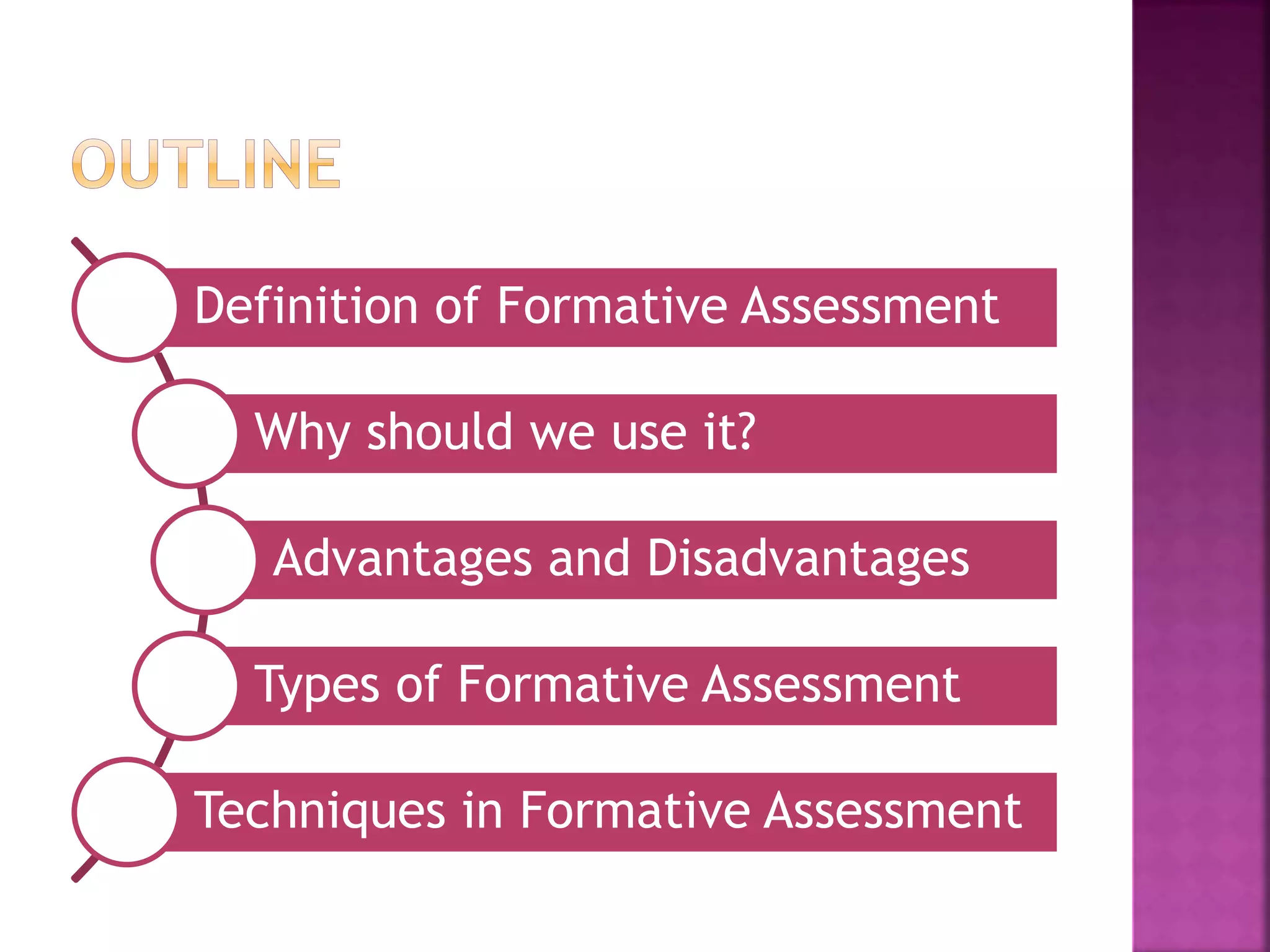
Definition of Formative Assessment
Why should we use it?
Advantages and Disadvantages
Types of Formative Assessment
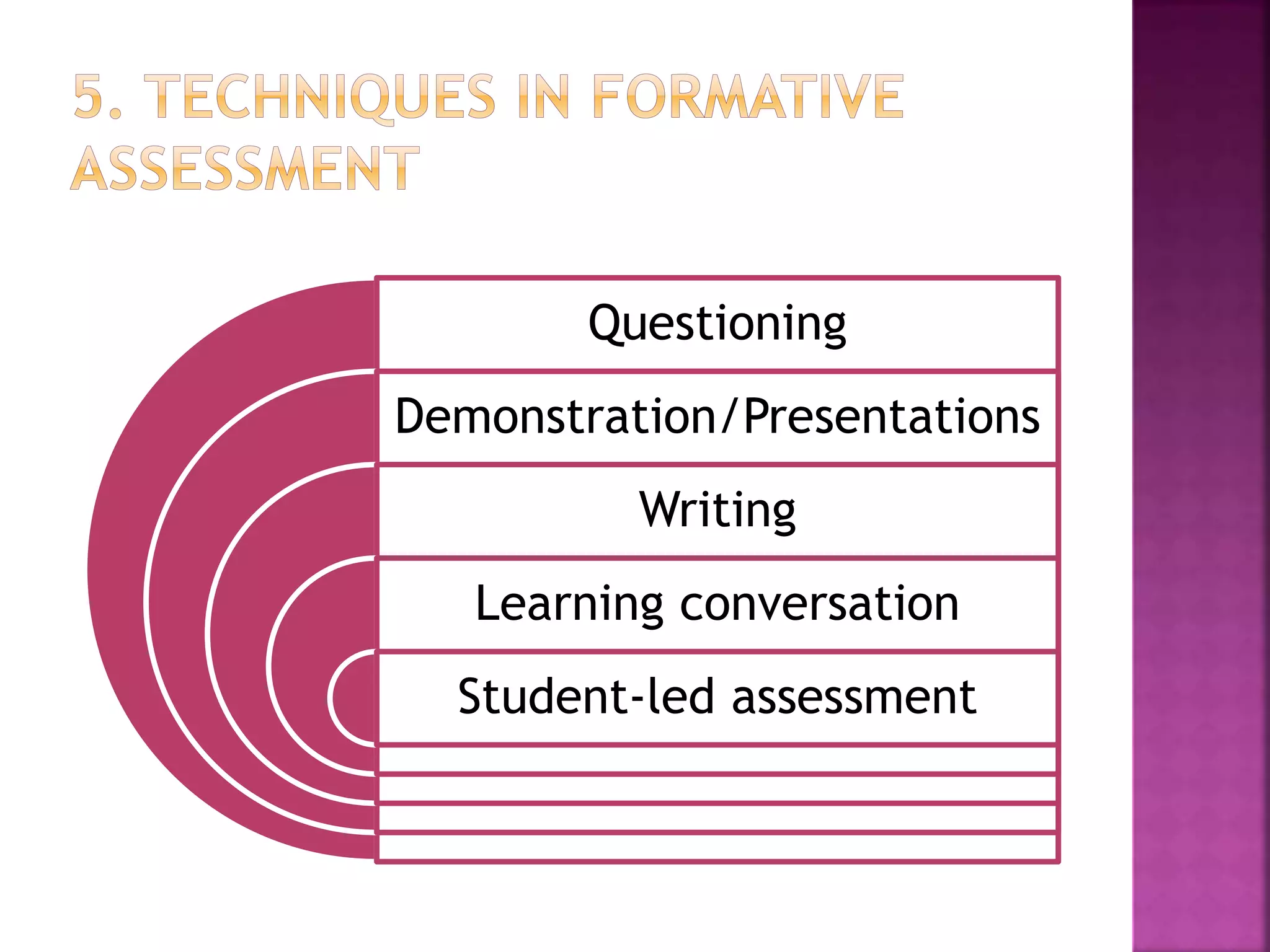
Techniques in Formative Assessment
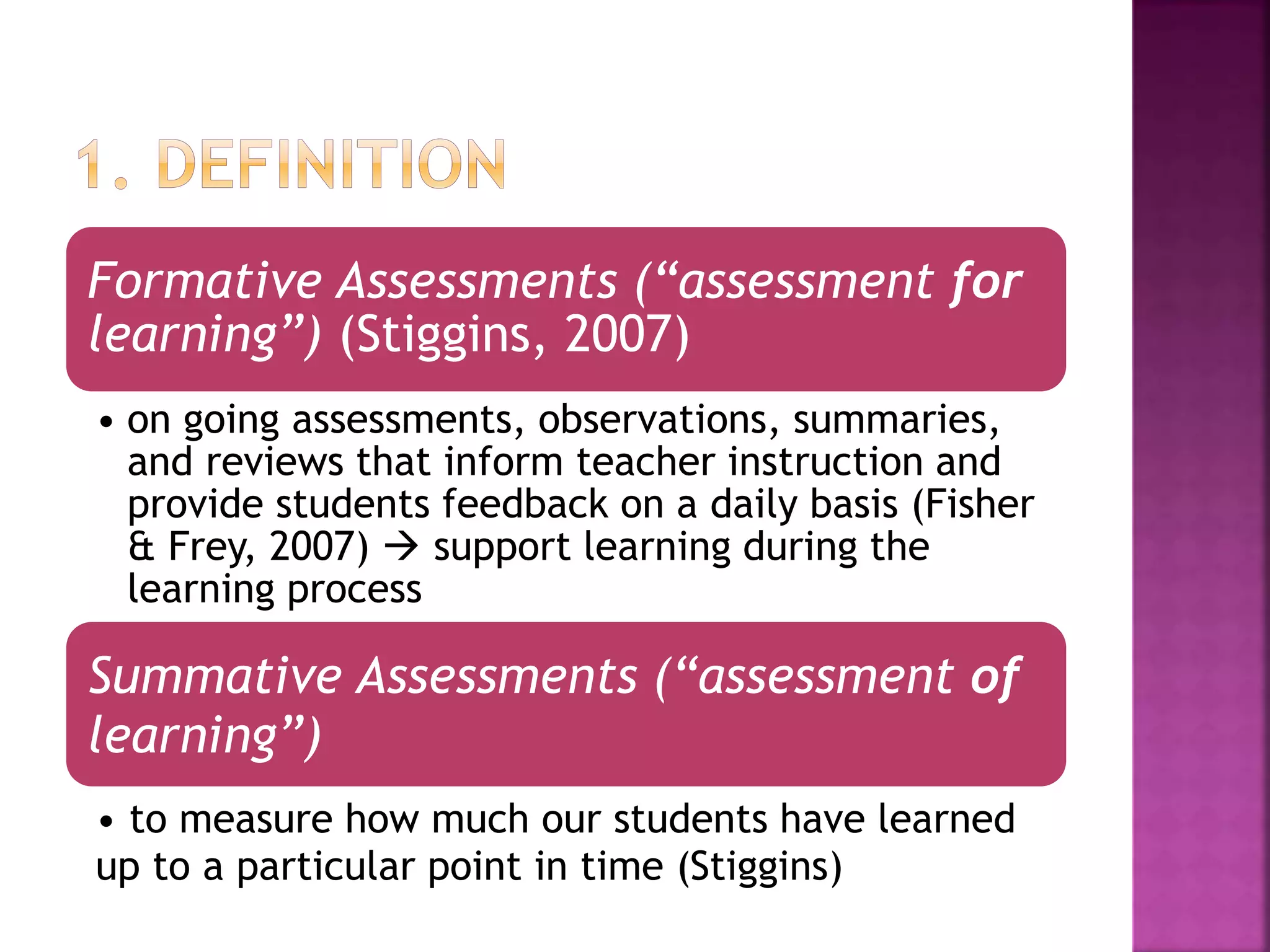
Formative Assessments (“assessment for
learning”) (Stiggins, 2007)
• on going assessments, observations, summaries,
and reviews that inform teacher instruction and
provide students feedback on a daily basis (Fisher
& Frey, 2007)  support learning during the
learning process
Summative Assessments (“assessment of
learning”)
• to measure how much our students have learned
up to a particular point in time (Stiggins)
 Formative assessments:
 check for understanding along the way
 guide teacher decision making about future
instructions
 provide feedback to students so they can
improve their performance
 help teachers differentiate instructions and
thus improve student achievement.
 The most powerful moderator in the
enhancement of achievement:
 helps teachers identify the current state of
learners’ knowledge and skills
 create appropriate lessons, activities
and groupings
 inform students about their progress to
help them set goals
 Results of formative assessment  adjust their
teaching strategies and match students with
appropriate materials and learning conditions.
 Help a teacher determine:
 how to group students
 whether students need alternative materials
 how much time to allocate to specific learning activities
 which concepts need to be re-taught to
specific students, and
 which students are ready to advance.
1. Advantages:
 For teachers:
 helps identify students who are struggling with
particular tasks or operating under misconceptions
 improved instruction that addresses student learning
 fosters student motivation, on-task behavior, and self-
awareness
1. Advantages:
 For students:
 offers increased feelings of confidence and control
 encourages students to engage in more complex thinking
and problem solving and to hold higher expectations for
their own learning
 help students spend more time on challenging tasks,
develop an ability to assess their own work, and become
effective evaluators of the work of their peers
2. Disadvantages:
 Be hugely time–consuming
 Be likely to need different kinds of formative
assessment at different stages in students’
“learning journeys”
 Be difficult to measure how best to do it
with groups of students who may be at
different stages of development
1. Observation of Performance
2. Homework Exercises
3. Learning/ Response logs
4. Projects
5. Self/peer assessment
6. Writer’s notebook
- Address a specific skill
- Used in skill assessment such as team and leadership exercises
- The teacher may walk around the room as students are engaged in
an activity
 Record on informal notes
For example: Students are working on a writing challenge
 The teacher may record what is observed
- Vary in purpose, design and complexity
- Focus on “Purpose”
 Students maintain a log where they record their
learning, or respond to a lesson regarding their
understanding.
 The teacher collects all or some of the logs after
students have completed a task.
 Students will comment on their level of comfort
with the information, as well as what was learned
and what questions they may still have.
 Students demonstrate knowledge on a specific
set of standards by presenting information to
the entire group.
 A rubric is given prior to the creation of the
presentation and the student/group is evaluated
via this document.
 Further small group lessons will be created as a
result of this information.
 Students reflect on their learning, and assess
where they are in the continuum.
 Students can also be used a peer evaluators,
explaining how they feel a product reflects what
was expected.
 Students have a 3 ring binder where they keep all their
writing, informal and final drafts. The teacher periodically
reviews select writing and has a discussion of strengths and
weaknesses.
 In the back there is a two column response page. The
teacher can indicate what the student needs to work on and
then the student indicates in future writing where this is
demonstrated.
Questioning
Demonstration/Presentations
Writing
Learning conversation
Student-led assessment
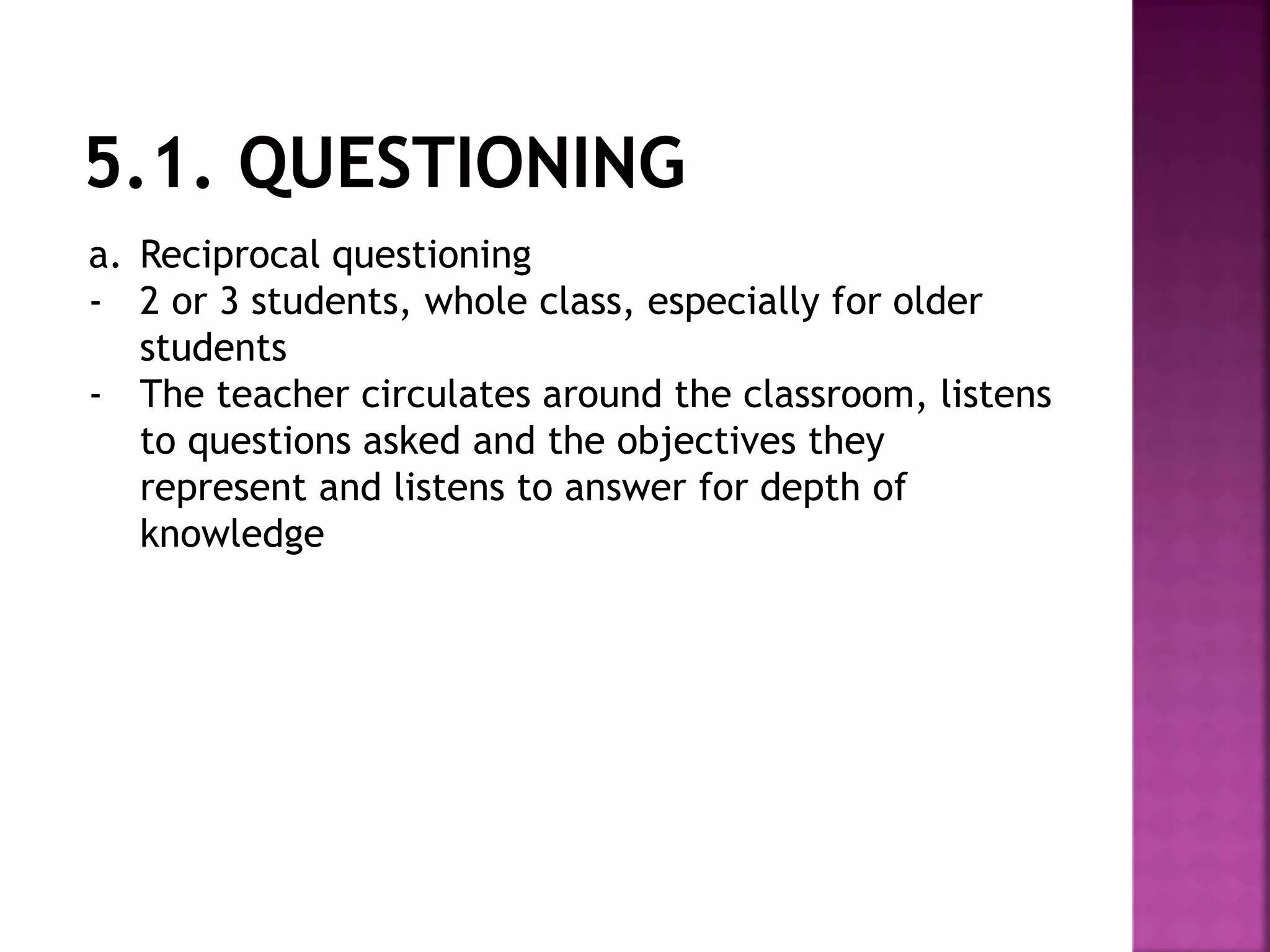
a. Reciprocal questioning
- 2 or 3 students, whole class, especially for older
students
- The teacher circulates around the classroom, listens
to questions asked and the objectives they
represent and listens to answer for depth of
knowledge
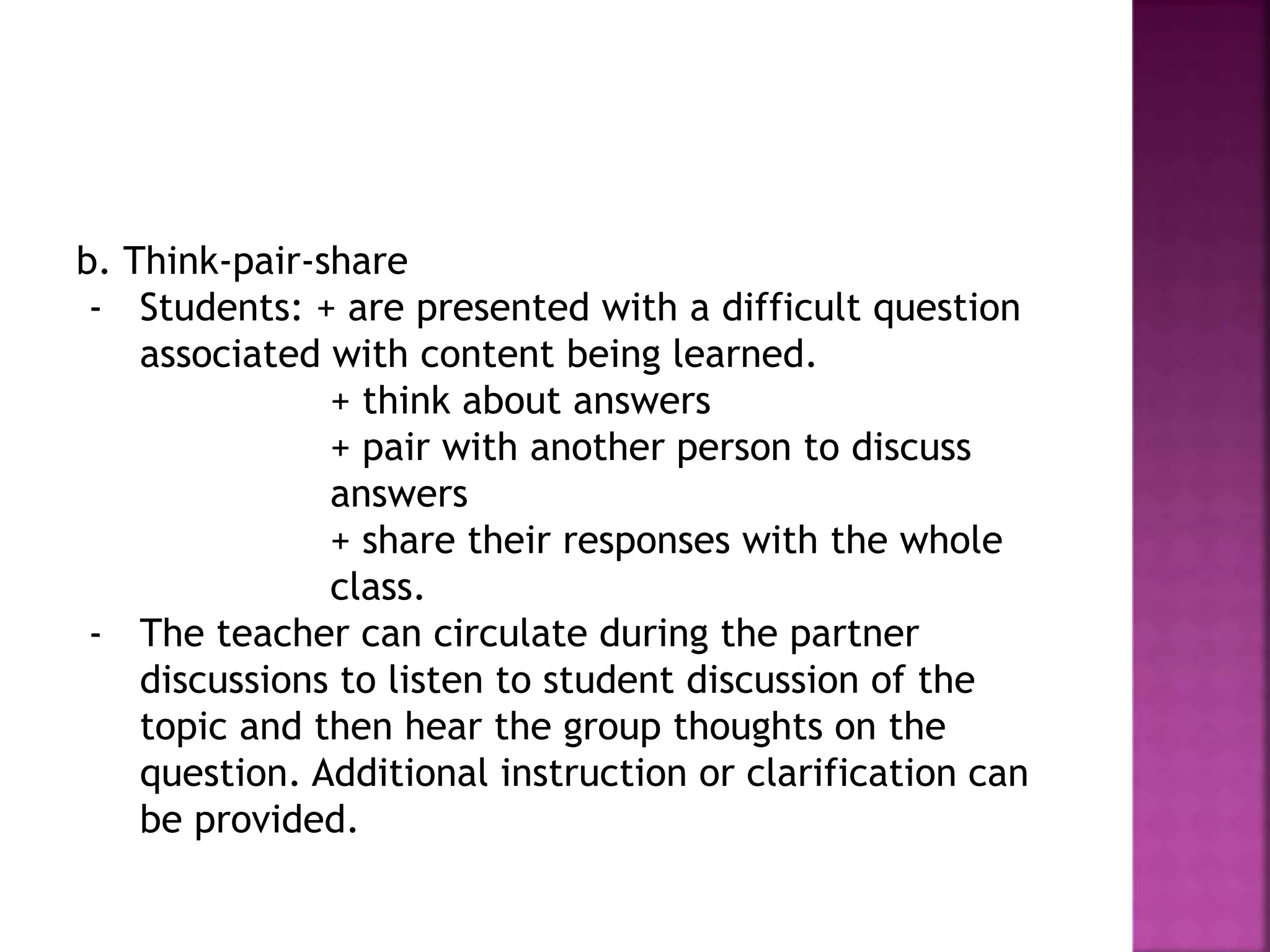
b. Think-pair-share
- Students: + are presented with a difficult question
associated with content being learned.
+ think about answers
+ pair with another person to discuss
answers
+ share their responses with the whole
class.
- The teacher can circulate during the partner
discussions to listen to student discussion of the
topic and then hear the group thoughts on the
question. Additional instruction or clarification can
be provided.
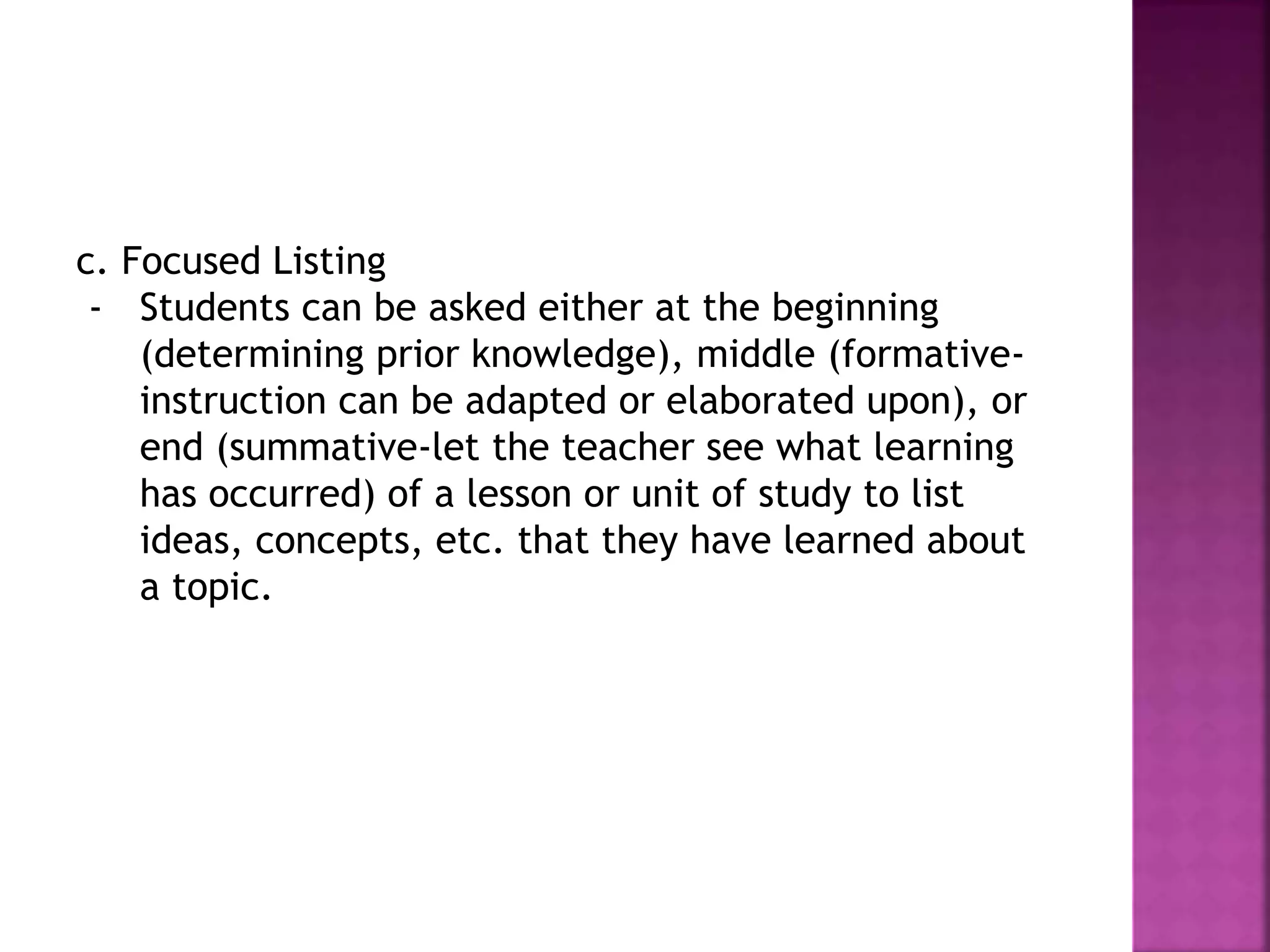
c. Focused Listing
- Students can be asked either at the beginning
(determining prior knowledge), middle (formative-
instruction can be adapted or elaborated upon), or
end (summative-let the teacher see what learning
has occurred) of a lesson or unit of study to list
ideas, concepts, etc. that they have learned about
a topic.
d. Anticipation Guides
- Students complete the first section of this guide
prior to reading and/or instruction.
- Students’ responses to the items are discussed in
class.
- Reading and/or instruction follows the discussion.
- Students complete the second section of the guide
after instruction.
- Responses are checked and changes in response are
discussed.
-> This activity provides a great deal of information to
the teacher, i.e. depth of student prior knowledge and
level of knowledge following reading and instruction.
e. Listening Center - Stories on Tape
- Students tape record their version of what they
learned within a specific topic.
- Students can be assigned small sections of a unit, or
volunteer to write about and tape a certain section
of what was studied in class.
- Teachers can select the best tapes on a topic to be
placed within the listening center; students who
have not mastered those learning objectives can
listen to the tape.
-> This activity allows the teacher to know who has
learned what information.
a. Podcasting
- Podcasting is a Web-based broadcast that shares
audio content. It provides an avenue for learners to
take control of their own learning.
- Students develop/create a podcast that presents in
a unique fashion what has been learned about a
specific topic.
- Teachers, peers, and the general public can listen
to these podcasts and teachers can determine what
objectives might need additional instruction.
b. Classroom Debates
- Students choose (or are selected) sides to take on
an issue. They must know the topic well in order to
defend/argue their position.
- Teachers can listen to the debate to gauge the
depth of student knowledge on a topic.
c. Puppet Show
- Especially useful with younger students
- Students write and present a puppet show that
demonstrates in a novel way what was learned
about a specific topic.
- Teachers could view the show or read the scripts to
determine which learning objectives had been
mastered and which ones needed additional
attention.
d. Quiz Game
- Students develop questions to go along with
specified categories. Teams attempt to answer the
questions and earn the most points.
- Teachers can look at the types of questions asked
and listen to the students’ answers to learn about
depth of knowledge and areas that might need
additional instruction.
e. Student-Created, Interactive Bulletin Boards
- Students develop an interactive bulletin board
display that showcases what they have learned
about a specific topic.
- The teacher can examine the bulletin board display
and activity to gauge depth of learning and to
suggest additional learning activities.
f. Mock Interviews
- Students act as news reporters/journalists and
interview classmates concerning aspects of topics
studied.
- Students develop varying difficulty level questions
and conduct mock interviews which can be tape
recorded for later listening or transcribing.
- Teachers can observe the interview/answer process
and/or listen to taped interview to see the level of
student learning/engagement with the content.
- Areas needing additional instruction or clarification
can be noted and developed.
g. Role Play
- Students can be assigned, or volunteer for, roles
that allow them to act out information that has
been learned about a specific topic.
- The teacher can view and listen carefully for
important concepts, vocabulary, etc. related to
what has been learned.
h. Student-Generated Diagrams/Drawings
- Students are asked to draw diagrams related to
what they are reading and learning in class.
- Teachers can view the diagrams to see if key
concepts are correctly portrayed.
i. Student-Generated Venn Diagrams
- Students can create Venn Diagrams comparing and
contrasting specific concepts or ideas being
learned.
- Teachers can view these diagrams for evidence of
student understanding.
a. Buddy Journals
- Students are assigned a partner for journal writing
activities. They can write daily to one another
about what is being studied/learned about a
specific topic.
- The teacher can read these buddy journals and then
respond to each student about what has been
learned, how it has been learned, and areas that
need additional instruction or
explanation/clarification.
b. Poems
- Students can create a unique poem that
demonstrates what was learned about a specific
topic/area.
- The teacher can read the poem and ask the student
to explain how s/he wrote the poem and what it
means to him/her.
- Poems can take a variety of forms/styles.
c. Quick-writes
- Students write, or draw, ideas, thoughts, feelings,
etc. on information that has been taught (5-10
minutes).
-> This short activity can enable the teacher to see
what information might need to be re-taught or
elaborated upon.
d. Focused Listing
- Students can be asked either at the beginning
(determining prior knowledge), middle (formative-
instruction can be adapted or elaborated upon), or
end (summative-let the teacher see what learning
has occurred) of a lesson or unit of study to list
ideas, concepts, etc. that they have learned about
a topic.
e. Two-Minute Paper
- Usually used at the end of a lesson.
- The teacher can ask the students to write for two
minutes about what they have learned that day, or
they can be asked to summarize the lesson.
f. Muddiest Point
- Students are asked at the end of a lesson or before
moving to a new topic to write down the one thing
that they least understood from what was taught.
-> This activity gives the teacher tremendous be re-
taught or elaborated upon.
g. Application Cards
- After teaching a topic, idea, or concept ask
students to write down one real-world application
for that topic or idea.
h. One-Sentence Summary
- After instruction, ask students to write about what
they have learned in one complete sentence.
i. RSQC2
- Within a two-minute time period, students must
recall and list in rank order the most important
points from the previous day’s lesson.
- Then in two additional minutes students write one
sentence summarizing those important points.
- Next, they write one major question that they
would like to have answered
- Then they identify two threads/components to
connect what they listed to the overall unit/course
goal.
 Classroom debates
 Mock interviews
 Jigsaw groups
 Discussion questions/ prompts
 Anticipation guides
 Concepts tests/ maps
 Gallery walk
 Assessment conversations
 Classroom debates
 Choose (or are selected) sides to take on an issue
 Defend/ argue their position
 Mock interviews
 Act as news reporters/ journalists and interview
classmates concerning aspects of topics studied
 Conduct mock interviews which can be tape
recorded for later listening or transcribing
 Jigsaw groups
 Arranged in groups to learn about, read, and discuss a
learning topic
 Discussion Questions/Prompts
 The teacher can initiate class discussion to aid
comprehension of written materials by modeling how
to ask and answer questions such as:
(1) clarifying questions;
(2) verifying questions;
(3) refocusing questions;
(4) redirecting questions;
(5) narrowing the focus questions.
 Helpful with older students and with struggling
readers
 Anticipation Guides
 Complete the first section of this guide prior to
reading and/or instruction
 Complete the second section of the guide after
instruction
 Provides a great deal of information to the
teacher, i.e. depth of student prior knowledge
and level of knowledge following reading and
instruction.
 Concept Tests or Maps
 Asked to vote with a show of hands on the correct
answer to a specific question that covers key concepts
posed
 get the answer correct  provided with a brief
explanation of the correct answer by the teacher
 not get the answer correct  given a few minutes so
that “neighbors” can discuss and try to convince the
other person to vote for their answer choice
 Gallery Walk
 Questions related to key concepts are written on either
poster paper or large sheets of writing paper and
placed at stations around the classroom.
 sit at tables or stand at a station  discuss possible
answers to the question  write down key ideas or
thoughts
 move to the next station in the room  read the question
at that station and the written comments of the previous
group  discuss those ideas and jot down their thoughts
related to that question for the next group to read and
respond to
 return to the station where it started  synthesize
comments  make an oral report
 a chance to gauge the depth of student
understanding of particular concepts and to
challenge misconceptions
 Assessment Conversations
 Classroom conversations between students and
the teacher that have the characteristics of
eliciting, recognizing, and using information:
 Eliciting allows students to share as much as possible
of what they know or have learned about a topic.
 Recognizing requires the teacher to make judgments
about the differences among student responses
 Using this information is mainly meant to help
students achieve consensus on the information about a
topic.
 Self-Assessment and/or Peer Assessment
 Rubrics
 Click—Clunk Response Cards/Sticks
 Mini-Lessons
 Case-Based Instruction
 Self-Assessment and/or Peer Assessment
 Teachers can guide students in how to effectively
self assess their own learning and effectively use
peer assessment in grading group activities and
projects.
 Rubrics
 Students can use teacher-created rubrics covering
the grading of learning products/assessments to help
them:
 (1) know what they should learn from a particular
lesson/unit of study
 (2) plan how they will approach an assignment
 (3) how they will assess their completion of a specific
learning activity and overall content learning
 Click—Clunk Response Cards/Sticks
 Students are given two index cards or two small
colored stock cards attached to popsicle sticks.
 “Click” is raised when the student completely
understands what is being taught or read.
 “Clunk” is raised when the child is confused, or
doesn’t understand what is being presented.
 Work especially well with younger students
 Mini-Lessons
 Students prepare sections of topic lessons to
teach to peers, or to younger grade-level
students.
 read, question, prepare activities and learning
materials associated with specific content in order to
learn the concepts themselves and to teach the
information to others.
This process can be completed individually
or in small groups.
 Case-Based Instruction
 Students structure their own learning using
the "story" of the case.
 generate questions based both on their interests
and prior knowledge that relates to the topic of
study
Investigative cases are useful for lifelong
learning because they are open-ended and
draw from a broad range of situations in
which various thinking skill levels can be
applied.
Formative assessment

Formative assessment

  • 1.
    Group 2: Khánh MinhThanh Thư Hoài Phương Bạch Vân Phương Thành Thảo Vy
  • 2.
    Definition of FormativeAssessment Why should we use it? Advantages and Disadvantages Types of Formative Assessment Techniques in Formative Assessment
  • 3.
    Formative Assessments (“assessmentfor learning”) (Stiggins, 2007) • on going assessments, observations, summaries, and reviews that inform teacher instruction and provide students feedback on a daily basis (Fisher & Frey, 2007)  support learning during the learning process Summative Assessments (“assessment of learning”) • to measure how much our students have learned up to a particular point in time (Stiggins)
  • 4.
     Formative assessments: check for understanding along the way  guide teacher decision making about future instructions  provide feedback to students so they can improve their performance  help teachers differentiate instructions and thus improve student achievement.
  • 5.
     The mostpowerful moderator in the enhancement of achievement:  helps teachers identify the current state of learners’ knowledge and skills  create appropriate lessons, activities and groupings  inform students about their progress to help them set goals
  • 6.
     Results offormative assessment  adjust their teaching strategies and match students with appropriate materials and learning conditions.  Help a teacher determine:  how to group students  whether students need alternative materials  how much time to allocate to specific learning activities  which concepts need to be re-taught to specific students, and  which students are ready to advance.
  • 7.
    1. Advantages:  Forteachers:  helps identify students who are struggling with particular tasks or operating under misconceptions  improved instruction that addresses student learning  fosters student motivation, on-task behavior, and self- awareness
  • 8.
    1. Advantages:  Forstudents:  offers increased feelings of confidence and control  encourages students to engage in more complex thinking and problem solving and to hold higher expectations for their own learning  help students spend more time on challenging tasks, develop an ability to assess their own work, and become effective evaluators of the work of their peers
  • 9.
    2. Disadvantages:  Behugely time–consuming  Be likely to need different kinds of formative assessment at different stages in students’ “learning journeys”  Be difficult to measure how best to do it with groups of students who may be at different stages of development
  • 10.
    1. Observation ofPerformance 2. Homework Exercises 3. Learning/ Response logs 4. Projects 5. Self/peer assessment 6. Writer’s notebook
  • 11.
    - Address aspecific skill - Used in skill assessment such as team and leadership exercises - The teacher may walk around the room as students are engaged in an activity  Record on informal notes For example: Students are working on a writing challenge  The teacher may record what is observed
  • 12.
    - Vary inpurpose, design and complexity - Focus on “Purpose”
  • 13.
     Students maintaina log where they record their learning, or respond to a lesson regarding their understanding.  The teacher collects all or some of the logs after students have completed a task.  Students will comment on their level of comfort with the information, as well as what was learned and what questions they may still have.
  • 14.
     Students demonstrateknowledge on a specific set of standards by presenting information to the entire group.  A rubric is given prior to the creation of the presentation and the student/group is evaluated via this document.  Further small group lessons will be created as a result of this information.
  • 15.
     Students reflecton their learning, and assess where they are in the continuum.  Students can also be used a peer evaluators, explaining how they feel a product reflects what was expected.
  • 16.
     Students havea 3 ring binder where they keep all their writing, informal and final drafts. The teacher periodically reviews select writing and has a discussion of strengths and weaknesses.  In the back there is a two column response page. The teacher can indicate what the student needs to work on and then the student indicates in future writing where this is demonstrated.
  • 17.
  • 18.
    a. Reciprocal questioning -2 or 3 students, whole class, especially for older students - The teacher circulates around the classroom, listens to questions asked and the objectives they represent and listens to answer for depth of knowledge
  • 19.
    b. Think-pair-share - Students:+ are presented with a difficult question associated with content being learned. + think about answers + pair with another person to discuss answers + share their responses with the whole class. - The teacher can circulate during the partner discussions to listen to student discussion of the topic and then hear the group thoughts on the question. Additional instruction or clarification can be provided.
  • 20.
    c. Focused Listing -Students can be asked either at the beginning (determining prior knowledge), middle (formative- instruction can be adapted or elaborated upon), or end (summative-let the teacher see what learning has occurred) of a lesson or unit of study to list ideas, concepts, etc. that they have learned about a topic.
  • 21.
    d. Anticipation Guides -Students complete the first section of this guide prior to reading and/or instruction. - Students’ responses to the items are discussed in class. - Reading and/or instruction follows the discussion. - Students complete the second section of the guide after instruction. - Responses are checked and changes in response are discussed. -> This activity provides a great deal of information to the teacher, i.e. depth of student prior knowledge and level of knowledge following reading and instruction.
  • 22.
    e. Listening Center- Stories on Tape - Students tape record their version of what they learned within a specific topic. - Students can be assigned small sections of a unit, or volunteer to write about and tape a certain section of what was studied in class. - Teachers can select the best tapes on a topic to be placed within the listening center; students who have not mastered those learning objectives can listen to the tape. -> This activity allows the teacher to know who has learned what information.
  • 23.
    a. Podcasting - Podcastingis a Web-based broadcast that shares audio content. It provides an avenue for learners to take control of their own learning. - Students develop/create a podcast that presents in a unique fashion what has been learned about a specific topic. - Teachers, peers, and the general public can listen to these podcasts and teachers can determine what objectives might need additional instruction.
  • 24.
    b. Classroom Debates -Students choose (or are selected) sides to take on an issue. They must know the topic well in order to defend/argue their position. - Teachers can listen to the debate to gauge the depth of student knowledge on a topic. c. Puppet Show - Especially useful with younger students - Students write and present a puppet show that demonstrates in a novel way what was learned about a specific topic. - Teachers could view the show or read the scripts to determine which learning objectives had been mastered and which ones needed additional attention.
  • 25.
    d. Quiz Game -Students develop questions to go along with specified categories. Teams attempt to answer the questions and earn the most points. - Teachers can look at the types of questions asked and listen to the students’ answers to learn about depth of knowledge and areas that might need additional instruction.
  • 26.
    e. Student-Created, InteractiveBulletin Boards - Students develop an interactive bulletin board display that showcases what they have learned about a specific topic. - The teacher can examine the bulletin board display and activity to gauge depth of learning and to suggest additional learning activities.
  • 27.
    f. Mock Interviews -Students act as news reporters/journalists and interview classmates concerning aspects of topics studied. - Students develop varying difficulty level questions and conduct mock interviews which can be tape recorded for later listening or transcribing. - Teachers can observe the interview/answer process and/or listen to taped interview to see the level of student learning/engagement with the content. - Areas needing additional instruction or clarification can be noted and developed.
  • 28.
    g. Role Play -Students can be assigned, or volunteer for, roles that allow them to act out information that has been learned about a specific topic. - The teacher can view and listen carefully for important concepts, vocabulary, etc. related to what has been learned.
  • 29.
    h. Student-Generated Diagrams/Drawings -Students are asked to draw diagrams related to what they are reading and learning in class. - Teachers can view the diagrams to see if key concepts are correctly portrayed.
  • 30.
    i. Student-Generated VennDiagrams - Students can create Venn Diagrams comparing and contrasting specific concepts or ideas being learned. - Teachers can view these diagrams for evidence of student understanding.
  • 31.
    a. Buddy Journals -Students are assigned a partner for journal writing activities. They can write daily to one another about what is being studied/learned about a specific topic. - The teacher can read these buddy journals and then respond to each student about what has been learned, how it has been learned, and areas that need additional instruction or explanation/clarification.
  • 32.
    b. Poems - Studentscan create a unique poem that demonstrates what was learned about a specific topic/area. - The teacher can read the poem and ask the student to explain how s/he wrote the poem and what it means to him/her. - Poems can take a variety of forms/styles.
  • 33.
    c. Quick-writes - Studentswrite, or draw, ideas, thoughts, feelings, etc. on information that has been taught (5-10 minutes). -> This short activity can enable the teacher to see what information might need to be re-taught or elaborated upon.
  • 34.
    d. Focused Listing -Students can be asked either at the beginning (determining prior knowledge), middle (formative- instruction can be adapted or elaborated upon), or end (summative-let the teacher see what learning has occurred) of a lesson or unit of study to list ideas, concepts, etc. that they have learned about a topic.
  • 35.
    e. Two-Minute Paper -Usually used at the end of a lesson. - The teacher can ask the students to write for two minutes about what they have learned that day, or they can be asked to summarize the lesson. f. Muddiest Point - Students are asked at the end of a lesson or before moving to a new topic to write down the one thing that they least understood from what was taught. -> This activity gives the teacher tremendous be re- taught or elaborated upon.
  • 36.
    g. Application Cards -After teaching a topic, idea, or concept ask students to write down one real-world application for that topic or idea. h. One-Sentence Summary - After instruction, ask students to write about what they have learned in one complete sentence.
  • 37.
    i. RSQC2 - Withina two-minute time period, students must recall and list in rank order the most important points from the previous day’s lesson. - Then in two additional minutes students write one sentence summarizing those important points. - Next, they write one major question that they would like to have answered - Then they identify two threads/components to connect what they listed to the overall unit/course goal.
  • 38.
     Classroom debates Mock interviews  Jigsaw groups  Discussion questions/ prompts  Anticipation guides  Concepts tests/ maps  Gallery walk  Assessment conversations
  • 39.
     Classroom debates Choose (or are selected) sides to take on an issue  Defend/ argue their position  Mock interviews  Act as news reporters/ journalists and interview classmates concerning aspects of topics studied  Conduct mock interviews which can be tape recorded for later listening or transcribing
  • 40.
     Jigsaw groups Arranged in groups to learn about, read, and discuss a learning topic  Discussion Questions/Prompts  The teacher can initiate class discussion to aid comprehension of written materials by modeling how to ask and answer questions such as: (1) clarifying questions; (2) verifying questions; (3) refocusing questions; (4) redirecting questions; (5) narrowing the focus questions.  Helpful with older students and with struggling readers
  • 41.
     Anticipation Guides Complete the first section of this guide prior to reading and/or instruction  Complete the second section of the guide after instruction  Provides a great deal of information to the teacher, i.e. depth of student prior knowledge and level of knowledge following reading and instruction.
  • 42.
     Concept Testsor Maps  Asked to vote with a show of hands on the correct answer to a specific question that covers key concepts posed  get the answer correct  provided with a brief explanation of the correct answer by the teacher  not get the answer correct  given a few minutes so that “neighbors” can discuss and try to convince the other person to vote for their answer choice
  • 43.
     Gallery Walk Questions related to key concepts are written on either poster paper or large sheets of writing paper and placed at stations around the classroom.  sit at tables or stand at a station  discuss possible answers to the question  write down key ideas or thoughts  move to the next station in the room  read the question at that station and the written comments of the previous group  discuss those ideas and jot down their thoughts related to that question for the next group to read and respond to  return to the station where it started  synthesize comments  make an oral report  a chance to gauge the depth of student understanding of particular concepts and to challenge misconceptions
  • 44.
     Assessment Conversations Classroom conversations between students and the teacher that have the characteristics of eliciting, recognizing, and using information:  Eliciting allows students to share as much as possible of what they know or have learned about a topic.  Recognizing requires the teacher to make judgments about the differences among student responses  Using this information is mainly meant to help students achieve consensus on the information about a topic.
  • 45.
     Self-Assessment and/orPeer Assessment  Rubrics  Click—Clunk Response Cards/Sticks  Mini-Lessons  Case-Based Instruction
  • 46.
     Self-Assessment and/orPeer Assessment  Teachers can guide students in how to effectively self assess their own learning and effectively use peer assessment in grading group activities and projects.
  • 47.
     Rubrics  Studentscan use teacher-created rubrics covering the grading of learning products/assessments to help them:  (1) know what they should learn from a particular lesson/unit of study  (2) plan how they will approach an assignment  (3) how they will assess their completion of a specific learning activity and overall content learning
  • 48.
     Click—Clunk ResponseCards/Sticks  Students are given two index cards or two small colored stock cards attached to popsicle sticks.  “Click” is raised when the student completely understands what is being taught or read.  “Clunk” is raised when the child is confused, or doesn’t understand what is being presented.  Work especially well with younger students
  • 49.
     Mini-Lessons  Studentsprepare sections of topic lessons to teach to peers, or to younger grade-level students.  read, question, prepare activities and learning materials associated with specific content in order to learn the concepts themselves and to teach the information to others. This process can be completed individually or in small groups.
  • 50.
     Case-Based Instruction Students structure their own learning using the "story" of the case.  generate questions based both on their interests and prior knowledge that relates to the topic of study Investigative cases are useful for lifelong learning because they are open-ended and draw from a broad range of situations in which various thinking skill levels can be applied.