Assessment Methods a presentation by Anita Kumari MGT 359, SP09 SJ1 Professor; Christine Chojnacki
What is assessment Different kinds of assessment methods Usefulness of assessment methods Developing assessment Methods Benefits & Limitations Agenda
What is assessment? An assessment is a diagnostic process that measures an individual’s behaviors, motivators, attitudes, or other selected qualities.  Assessment gives organizations more than just data and information — it opens doors to strategic change and helps measure progress.
Why individuals or groups are succeeding or struggling in their work What leaders must do to successfully execute a strategy Critical success factors for sales excellence Specific behaviors needed to perform in a new role How to best invest your training and development funds A more effective set of management practices at work in your organization How to coach people in a meaningful and inspiring way Ways to make change occur A higher level of job morale and satisfaction How assessment can help you?
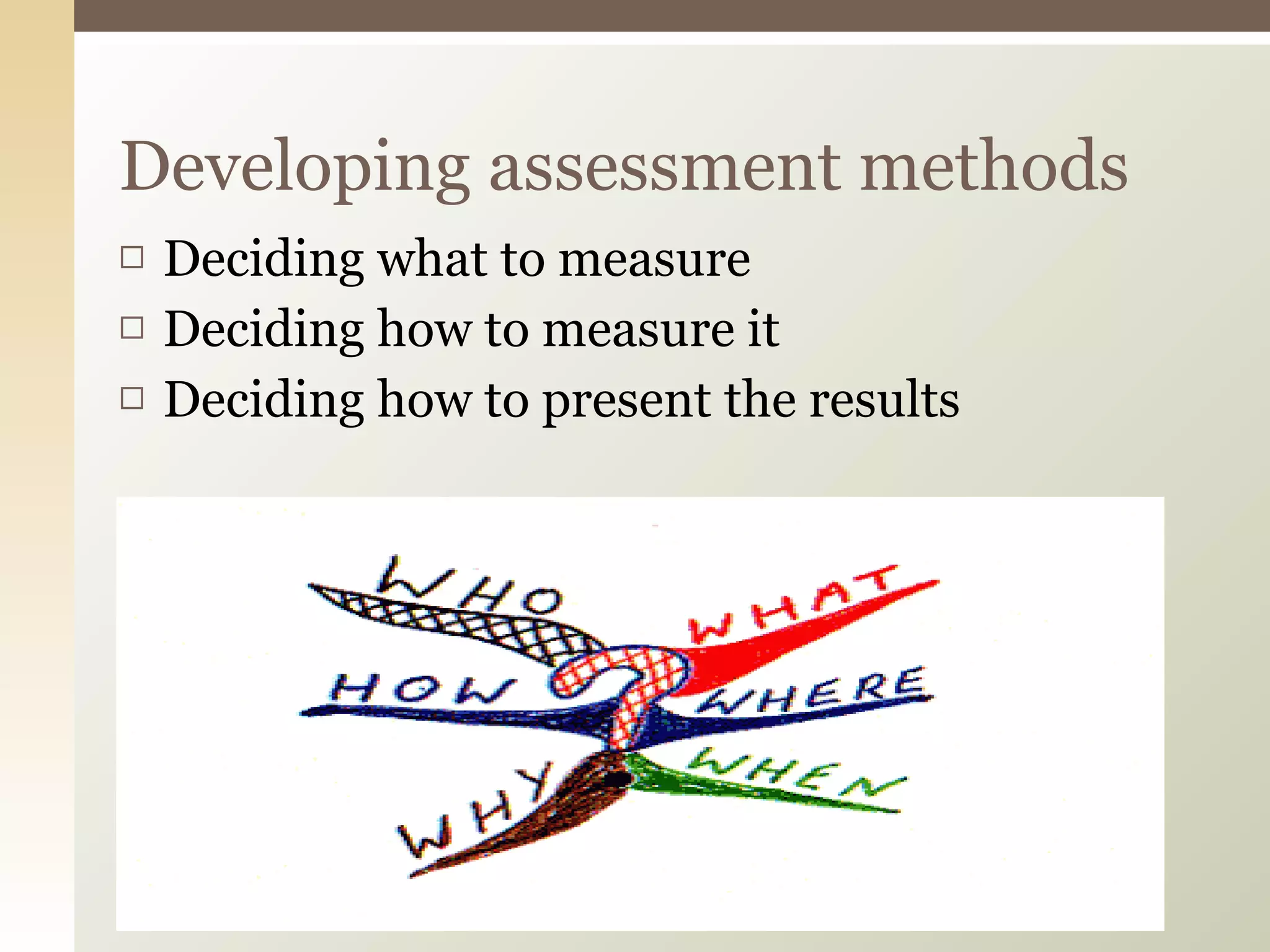
Deciding what to measure Deciding how to measure it Deciding how to present the results Developing assessment methods
Self Assessment Assessment by  Supervisor Types of Assessment Methods
Personnel Selection Performance  Evaluation Assessment Method Utilization
Purpose What they are designed to measure What they are designed to predict Format Level of Standardization, objectivity & quantifiability Personnel Assessment Tools
Observations  Resume evaluations  Application banks/questionnaires  Biodata inventories  Interviews  Work samples/performance tests  Achievement tests  General ability tests  Specific ability tests  Source: http://www.hr-guide.com Methods for Personnel Selection  cntd….
Physical ability tests  Personality inventories  Honesty/integrity inventories  Interest inventories  Work values inventories  Assessment centers  Drug tests  Medical tests Methods of Personnel Selection
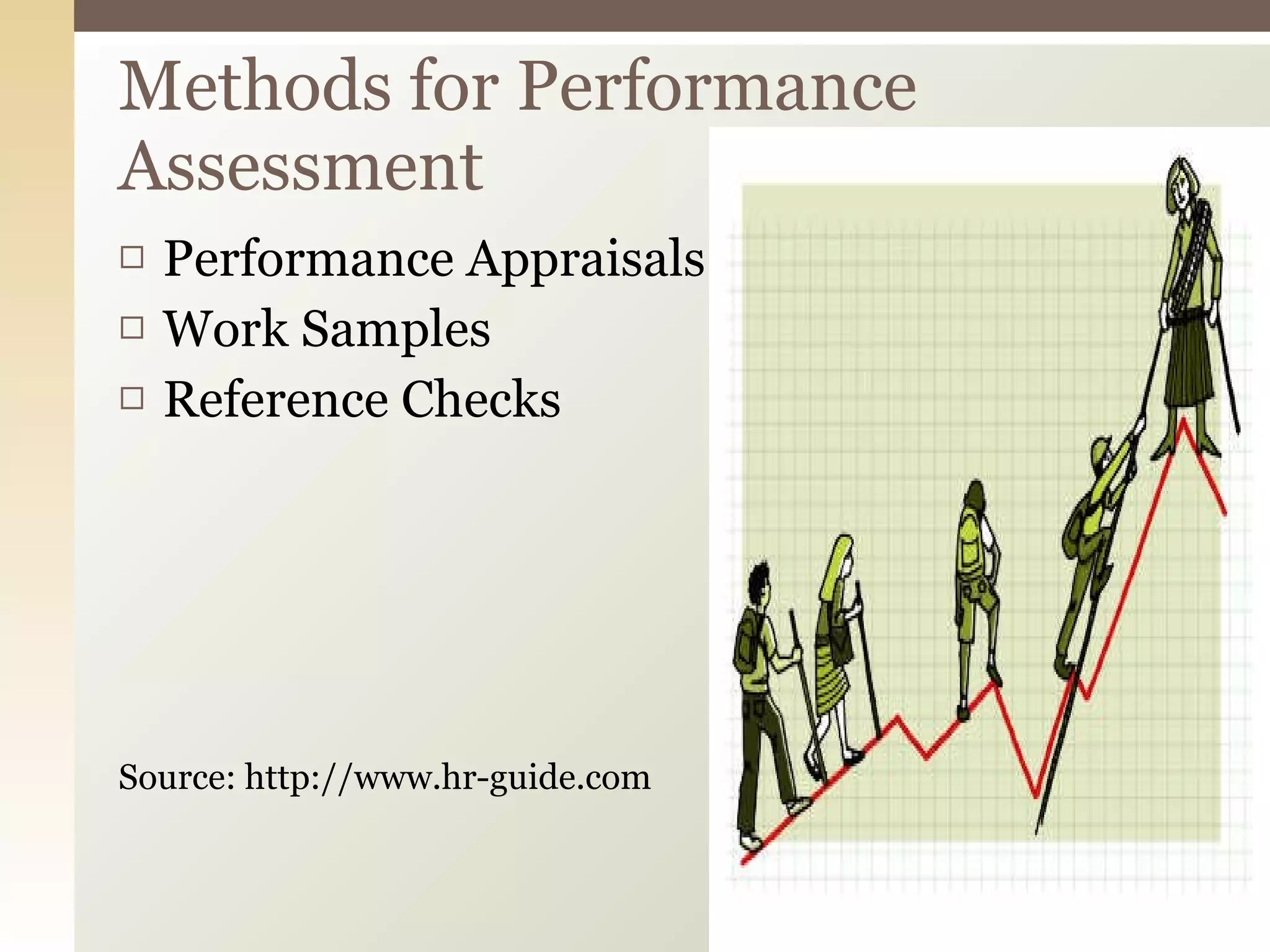
Performance Appraisals Work Samples Reference Checks Source: http://www.hr-guide.com Methods for Performance Assessment
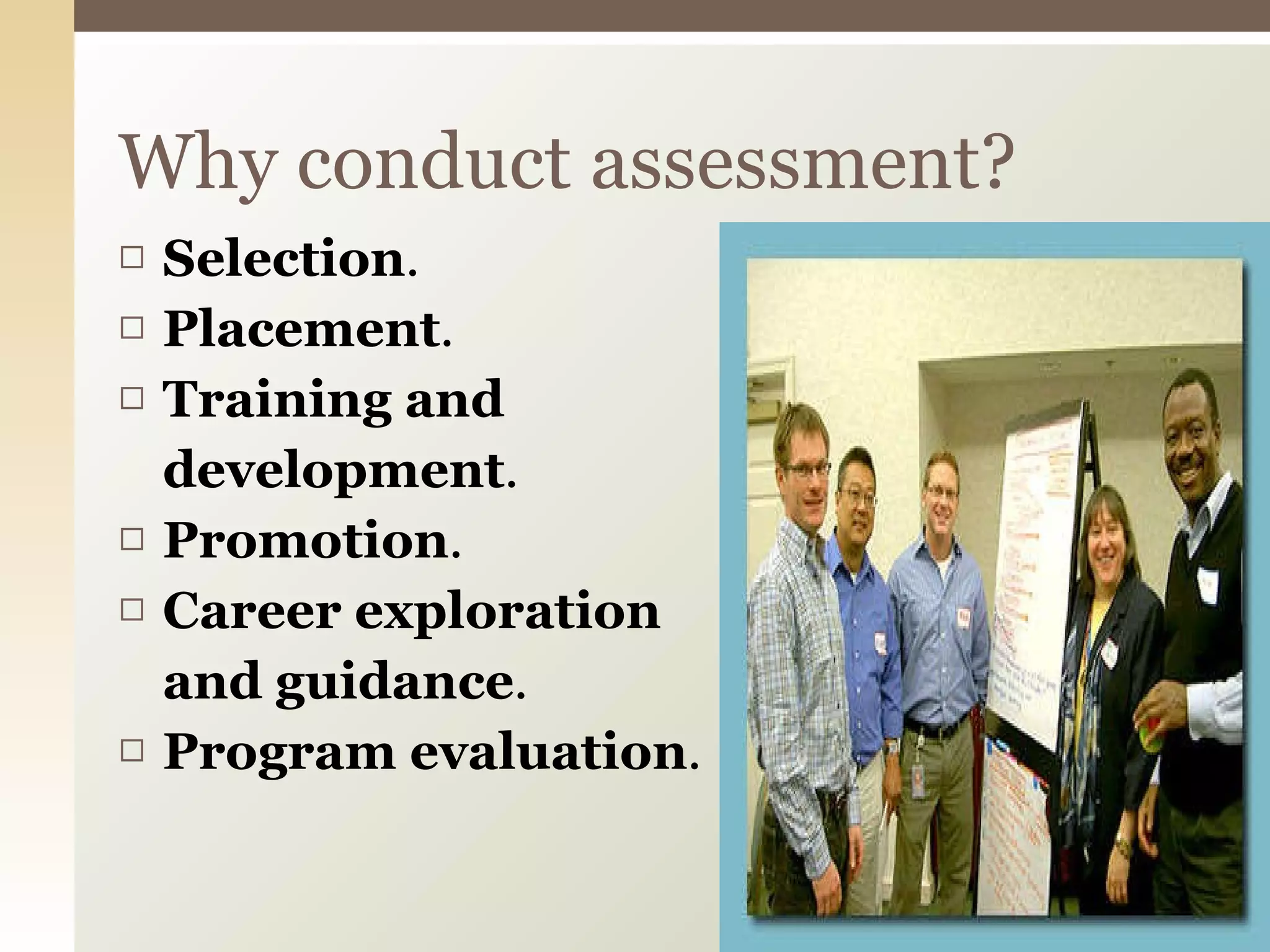
Selection .  Placement .  Training and  development .  Promotion .  Career exploration  and guidance .  Program evaluation .  Why conduct assessment?
Hire The Right People Reduce Absenteeism Reduce Employee Turnover Improve Productivity Reduce Employee error Be compliant with latest legal laws Benefits of assessment tests
Do not  expect any test or procedure to measure a personal trait or ability with perfect accuracy for every single person.  Do not  expect any test or procedure to be completely accurate in predicting performance.  Limitations
Lack of expectation to engage in assessment Lack of evaluation expertise or lack of knowledge in how to conduct assessment Lack of resources to conduct assessment Lack of time Lack of understanding what improvement is needed  Why do people resist assessments?
Provide a clear expectation about the assessment Provide education about how to engage in assessment in a meaningful manner Provide resources for the administration of quality evaluation Allocate some time for assessments Tools to overcome resistance
Appropriate use of professionally developed assessment tools on average enables organizations to make more effective employment-related decisions than use of simple observations or random decision making.  Conclusion
 

Assessment Methods

  • 1.
    Assessment Methods apresentation by Anita Kumari MGT 359, SP09 SJ1 Professor; Christine Chojnacki
  • 2.
    What is assessmentDifferent kinds of assessment methods Usefulness of assessment methods Developing assessment Methods Benefits & Limitations Agenda
  • 3.
    What is assessment?An assessment is a diagnostic process that measures an individual’s behaviors, motivators, attitudes, or other selected qualities. Assessment gives organizations more than just data and information — it opens doors to strategic change and helps measure progress.
  • 4.
    Why individuals orgroups are succeeding or struggling in their work What leaders must do to successfully execute a strategy Critical success factors for sales excellence Specific behaviors needed to perform in a new role How to best invest your training and development funds A more effective set of management practices at work in your organization How to coach people in a meaningful and inspiring way Ways to make change occur A higher level of job morale and satisfaction How assessment can help you?
  • 5.
    Deciding what tomeasure Deciding how to measure it Deciding how to present the results Developing assessment methods
  • 6.
    Self Assessment Assessmentby Supervisor Types of Assessment Methods
  • 7.
    Personnel Selection Performance Evaluation Assessment Method Utilization
  • 8.
    Purpose What theyare designed to measure What they are designed to predict Format Level of Standardization, objectivity & quantifiability Personnel Assessment Tools
  • 9.
    Observations Resumeevaluations Application banks/questionnaires Biodata inventories Interviews Work samples/performance tests Achievement tests General ability tests Specific ability tests Source: http://www.hr-guide.com Methods for Personnel Selection cntd….
  • 10.
    Physical ability tests Personality inventories Honesty/integrity inventories Interest inventories Work values inventories Assessment centers Drug tests Medical tests Methods of Personnel Selection
  • 11.
    Performance Appraisals WorkSamples Reference Checks Source: http://www.hr-guide.com Methods for Performance Assessment
  • 12.
    Selection . Placement . Training and development . Promotion . Career exploration and guidance . Program evaluation . Why conduct assessment?
  • 13.
    Hire The RightPeople Reduce Absenteeism Reduce Employee Turnover Improve Productivity Reduce Employee error Be compliant with latest legal laws Benefits of assessment tests
  • 14.
    Do not expect any test or procedure to measure a personal trait or ability with perfect accuracy for every single person. Do not expect any test or procedure to be completely accurate in predicting performance. Limitations
  • 15.
    Lack of expectationto engage in assessment Lack of evaluation expertise or lack of knowledge in how to conduct assessment Lack of resources to conduct assessment Lack of time Lack of understanding what improvement is needed Why do people resist assessments?
  • 16.
    Provide a clearexpectation about the assessment Provide education about how to engage in assessment in a meaningful manner Provide resources for the administration of quality evaluation Allocate some time for assessments Tools to overcome resistance
  • 17.
    Appropriate use ofprofessionally developed assessment tools on average enables organizations to make more effective employment-related decisions than use of simple observations or random decision making. Conclusion
  • 18.

Editor's Notes

  • #2 Systematic approach to combining and evaluating all the information gained from testing and using it to make career or employment-related decisions.
  • #4 In order to be valuable to individuals and organizations, an assessment must be accurate and objective. In addition, it must meet scientific criteria, as well as provide meaningful insight. Assessment can lead to increased self-awareness and inspire people to learn and grow.
  • #6 The goal of developing any assessment method is to carefully measure a specific area of interest in a way that will produce accurate, meaningful and relevant data.
  • #7 Assessment methods are mainly of two types: self
  • #8 All assessment tools used to make employment decisions, regardless of their format, level of standardization, or objectivity, are subject to professional and legal standards. For example, both the evaluation of a resume and the use of a highly standardized achievement test must comply with applicable laws. Assessment tools used solely for career exploration or counseling are usually not held to the same legal standards.
  • #9 Purpose , e.g., selection, placement, promotion, career counseling, or training What they are designed to measure , e.g., abilities, skills, work styles, work values, or vocational interests What they are designed to predict , e.g., job performance, managerial potential, career success, job satisfaction, or tenure Format , e.g., paper-and-pencil, work-sample, or computer simulation Level of standardization, objectivity, and quantifiability -Assessment tools and procedures vary greatly on these factors. For example, there are subjective evaluations of resumes, highly structured achievement tests, interviews having varying degrees of structure, and personality inventories with no specific right or wrong answers.
  • #12 Past work performance checks serve several purposes: gathering evidence of past achievements to indicate the probability of future performance; confirming employment history by verifying factual data, such as dates of previous jobs and reason for leaving; confirming perceptions or clarifying concerns that arose throughout the selection process; and validating the results of other assessment methods (e.g. tests, interviews). Performance appraisals may be used to confirm past work performance where all applicants being considered have been appraised using a common format and set of standards. This degree of consistency seldom occurs unless the staffing action is restricted to an internal pool of applicants. When requesting work samples, it is important to provide very clear instructions to applicants about the type of work sample you are looking for, The assessment team should have a set of pre-determined criteria for assessing the work samples because it is unlikely that any two samples will be similar. Reference Checks Reference checking involves seeking factual evidence from third parties who have observed the applicant at work (paid or volunteer) and then rating that factual evidence against a pre-determined marking guide. Checking references is one of the most useful sources of information about an applicant's past performance
  • #13 Selection . Organizations want to be able to identify and hire the best people for the job and the organization in a fair and efficient manner. A properly developed assessment tool may provide a way to select successful sales people, concerned customer service representatives, and effective workers in many other occupations. Placement . Organizations also want to be able to assign people to the appropriate job level. For example, an organization may have several managerial positions, each having a different level of responsibility. Assessment may provide information that helps organizations achieve the best fit between employees and jobs. Training and development . Tests are used to find out whether employees have mastered training materials. They can help identify those applicants and employees who might benefit from either remedial or advanced training. Promotion . Organizations may use tests to identify employees who possess managerial potential or higher level capabilities, so that these employees can be promoted to assume greater duties and responsibilities. Career exploration and guidance . Tests are sometimes used to help people make educational and vocational choices. Tests may provide information that helps individuals choose occupations in which they are likely to be successful and satisfied. Program evaluation . Tests may provide information that the organization can use to determine whether employees are benefiting from training and development programs.
  • #14 Importance of using tests in a purposeful manner Assessment instruments, like other tools, can be extremely helpful when used properly, but counter-productive when used inappropriately. Often inappropriate use stems from not having a clear understanding of what you want to measure and why you want to measure it. Having a clear understanding of the purpose of your assessment system is important in selecting the appropriate assessment tools to meet that purpose. This brings us to an important principle of assessment.
  • #15 Professionally developed tests and procedures that are used as part of a planned assessment program may help you select and hire more qualified and productive employees. However, it is essential to understand that all assessment tools are subject to errors , both in measuring a characteristic, such as verbal ability, and in predicting performance criteria, such as success on the job. This is true for all tests and procedures, regardless of how objective or standardized they might be.
  • #17 Since there is no such thing as more time. Time has to be reallocated. Ask how you can re-allocate time so that meaningful assessment can take place.
  • #18 Using a single test or procedure will provide you with a limited view of a person's employment or career-related qualifications. Moreover, you may reach a mistaken conclusion by giving too much weight to a single test result. On the other hand, using a variety of assessment tools enables you to get a more complete picture of the individual. The practice of using a variety of tests and procedures to more fully assess people is referred to as the whole-person approach to personnel assessment. This will help reduce the number of selection errors made and will boost the effectiveness of your decision making. This leads to an important principle of assessment.