Objective Benchmarking for
Improved Analytics Health
and Effectiveness
Denny Lengkong and Bill Connell
2
Our Speakers
Denny Lengkong
President, IntelliData
dlengkong@intellidata.tech
1-844-237-DATA (3282) X700
Bill Connell
Solutions Director, Personify
wconnell@personifycorp.com
571.758.4907
3
IntelliData
• Northern Virginia based IT consulting company
• Personify implementation partner
• Specializes in association and not-for-profit implementations
• Focused on business intelligence and analytics
Data ► Information ► Knowledge ► Decision
4
Benefits of Good Data Quality
• Reduced cost
 Bad data costs companies $3.1 trillion/year (1)
 Salespeople wasting time dealing with erred prospect data
 Service delivery people wasting time correcting flawed customer orders received
from sales
 Data scientists spend an inordinate amount of time cleaning data
 IT spends enormous effort lining up systems that “don’t talk”
 Senior executives hedge their plans because they don’t trust the numbers
(1) Harvard Business Review
5
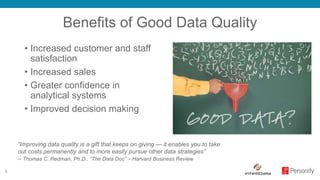
Benefits of Good Data Quality
• Increased customer and staff
satisfaction
• Increased sales
• Greater confidence in
analytical systems
• Improved decision making
“Improving data quality is a gift that keeps on giving — it enables you to take
out costs permanently and to more easily pursue other data strategies”
– Thomas C. Redman, Ph.D., “The Data Doc” – Harvard Business Review
6
What Does Good Data Look Like
• Complete
• Accurate
• Available
• Trusted/reliable
• Consistent
• Up to date
7
Companies with Sophisticated Data & Analytics
• Better business performance
• 8% higher operating margins (1)
• Able to develop a “single version of the truth” about their
business
• Use real-time data to anticipate changes in their business
and take corrective action
“The goal is to turn data into information, and information into insight.”
– Carly Fiorina, former executive, president, and chair of Hewlett-Packard Co.
(1) Gartner: Measuring the business value of data quality
8
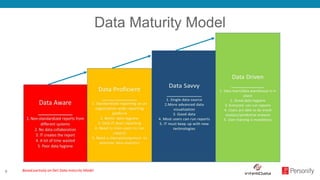
Data Maturity Model
9
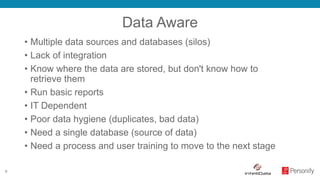
Data Aware
• Multiple data sources and databases (silos)
• Lack of integration
• Know where the data are stored, but don't know how to
retrieve them
• Run basic reports
• IT Dependent
• Poor data hygiene (duplicates, bad data)
• Need a single database (source of data)
• Need a process and user training to move to the next stage
10
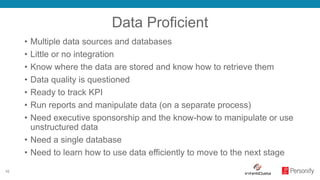
Data Proficient
• Multiple data sources and databases
• Little or no integration
• Know where the data are stored and know how to retrieve them
• Data quality is questioned
• Ready to track KPI
• Run reports and manipulate data (on a separate process)
• Need executive sponsorship and the know-how to manipulate or use
unstructured data
• Need a single database
• Need to learn how to use data efficiently to move to the next stage
11
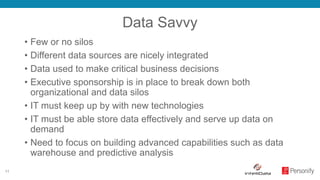
Data Savvy
• Few or no silos
• Different data sources are nicely integrated
• Data used to make critical business decisions
• Executive sponsorship is in place to break down both
organizational and data silos
• IT must keep up by with new technologies
• IT must be able store data effectively and serve up data on
demand
• Need to focus on building advanced capabilities such as data
warehouse and predictive analysis
12
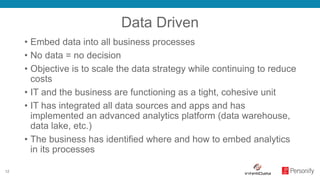
Data Driven
• Embed data into all business processes
• No data = no decision
• Objective is to scale the data strategy while continuing to reduce
costs
• IT and the business are functioning as a tight, cohesive unit
• IT has integrated all data sources and apps and has
implemented an advanced analytics platform (data warehouse,
data lake, etc.)
• The business has identified where and how to embed analytics
in its processes
13
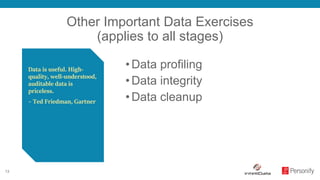
Other Important Data Exercises
(applies to all stages)
•Data profiling
•Data integrity
•Data cleanup
Data is useful. High-
quality, well-understood,
auditable data is
priceless.
– Ted Friedman, Gartner
14
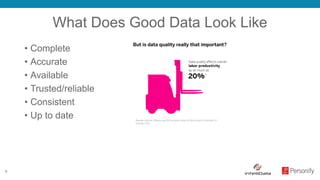
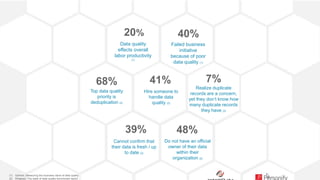
Data quality
effects overall
labor productivity
(1)
20%
Realize duplicate
records are a concern,
yet they don’t know how
many duplicate records
they have (2)
7%
Top data quality
priority is
deduplication (2)
68%
Failed business
initiative
because of poor
data quality (1)
40%
Cannot confirm that
their data is fresh / up
to date (2)
39%
Do not have an official
owner of their data
within their
organization (2)
48%
Hire someone to
handle data
quality (2)
41%
(1) Gartner, Measuring the business value of data quality
(2) Ringlead, The state of data quality benchmark report
15
Questions?

Objective Benchmarking for Improved Analytics Health and Effectiveness

  • 1.
    Objective Benchmarking for ImprovedAnalytics Health and Effectiveness Denny Lengkong and Bill Connell
  • 2.
    2 Our Speakers Denny Lengkong President,IntelliData dlengkong@intellidata.tech 1-844-237-DATA (3282) X700 Bill Connell Solutions Director, Personify wconnell@personifycorp.com 571.758.4907
  • 3.
    3 IntelliData • Northern Virginiabased IT consulting company • Personify implementation partner • Specializes in association and not-for-profit implementations • Focused on business intelligence and analytics Data ► Information ► Knowledge ► Decision
  • 4.
    4 Benefits of GoodData Quality • Reduced cost  Bad data costs companies $3.1 trillion/year (1)  Salespeople wasting time dealing with erred prospect data  Service delivery people wasting time correcting flawed customer orders received from sales  Data scientists spend an inordinate amount of time cleaning data  IT spends enormous effort lining up systems that “don’t talk”  Senior executives hedge their plans because they don’t trust the numbers (1) Harvard Business Review
  • 5.
    5 Benefits of GoodData Quality • Increased customer and staff satisfaction • Increased sales • Greater confidence in analytical systems • Improved decision making “Improving data quality is a gift that keeps on giving — it enables you to take out costs permanently and to more easily pursue other data strategies” – Thomas C. Redman, Ph.D., “The Data Doc” – Harvard Business Review
  • 6.
    6 What Does GoodData Look Like • Complete • Accurate • Available • Trusted/reliable • Consistent • Up to date
  • 7.
    7 Companies with SophisticatedData & Analytics • Better business performance • 8% higher operating margins (1) • Able to develop a “single version of the truth” about their business • Use real-time data to anticipate changes in their business and take corrective action “The goal is to turn data into information, and information into insight.” – Carly Fiorina, former executive, president, and chair of Hewlett-Packard Co. (1) Gartner: Measuring the business value of data quality
  • 8.
  • 9.
    9 Data Aware • Multipledata sources and databases (silos) • Lack of integration • Know where the data are stored, but don't know how to retrieve them • Run basic reports • IT Dependent • Poor data hygiene (duplicates, bad data) • Need a single database (source of data) • Need a process and user training to move to the next stage
  • 10.
    10 Data Proficient • Multipledata sources and databases • Little or no integration • Know where the data are stored and know how to retrieve them • Data quality is questioned • Ready to track KPI • Run reports and manipulate data (on a separate process) • Need executive sponsorship and the know-how to manipulate or use unstructured data • Need a single database • Need to learn how to use data efficiently to move to the next stage
  • 11.
    11 Data Savvy • Fewor no silos • Different data sources are nicely integrated • Data used to make critical business decisions • Executive sponsorship is in place to break down both organizational and data silos • IT must keep up by with new technologies • IT must be able store data effectively and serve up data on demand • Need to focus on building advanced capabilities such as data warehouse and predictive analysis
  • 12.
    12 Data Driven • Embeddata into all business processes • No data = no decision • Objective is to scale the data strategy while continuing to reduce costs • IT and the business are functioning as a tight, cohesive unit • IT has integrated all data sources and apps and has implemented an advanced analytics platform (data warehouse, data lake, etc.) • The business has identified where and how to embed analytics in its processes
  • 13.
    13 Other Important DataExercises (applies to all stages) •Data profiling •Data integrity •Data cleanup Data is useful. High- quality, well-understood, auditable data is priceless. – Ted Friedman, Gartner
  • 14.
    14 Data quality effects overall laborproductivity (1) 20% Realize duplicate records are a concern, yet they don’t know how many duplicate records they have (2) 7% Top data quality priority is deduplication (2) 68% Failed business initiative because of poor data quality (1) 40% Cannot confirm that their data is fresh / up to date (2) 39% Do not have an official owner of their data within their organization (2) 48% Hire someone to handle data quality (2) 41% (1) Gartner, Measuring the business value of data quality (2) Ringlead, The state of data quality benchmark report
  • 15.

Editor's Notes

  • #3 But they’re also faced with increased changes in demographics, more than just which gender, ethnicity or education level, increases in life expectancy widen the gap between the young & the experienced, the world is flat with increasing ability to expand beyond the local to the international. And their expectations around service, engagement, and user experience are increasing. They expect the types of interactions they can find in Amazon, Facebook, Quora, and Office365 from you as they engage with your organization They, and you may find this to be true for yourselves, are competing for their constituent’s attention. They are competing with self-service and self-organizing options to connect, engage, self-educate, and earn recognition [OPTIONAL EXAMPLES] Organize (e.g., LinkedIn & Facebook groups) Mobilize (e.g., GoFundMe, Change.org) Self-educate (e.g., Quora, Yahoo Answers) Gain industry recognition (e.g., Six Sigma, Microsoft Certification) Find options/your competitors (e.g., VolunteerMatch, Charity Navigator) And doing so with limited resources. And with that I’ll pause for a minute. Do you find your organization has been facing any of these same challenges? Any of these stand out for you? Managing the complexities of managing & engaging with multiple constituent types, serving a changing demographic base, increased expections, competition for attention, limited resources? [OPTIONAL] Draw from actual examples involving the client or prospect to demonstrate your knowledge of their organization