Kenneth J. Malmberg, PhD
COGNITIVE PSYCHOLOGY
Kenneth J. Malmberg, PhD
OBJECT RECOGNITION
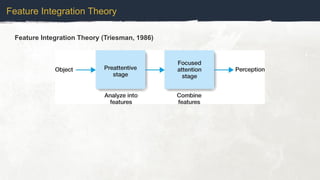
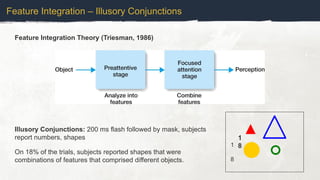
Feature Integration Theory (Triesman, 1986)
Feature Integration Theory
Feature Integration Theory (Triesman, 1986)
Feature Integration – Illusory Conjunctions
1
8
1
8
Illusory Conjunctions: 200 ms flash followed by mask, subjects
report numbers, shapes
On 18% of the trials, subjects reported shapes that were
combinations of features that comprised different objects.
Object Recognition - Geons
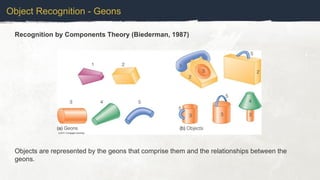
Recognition by Components Theory (Biederman, 1987)
Objects are represented by the geons that comprise them and the relationships between the
geons.
Object Recognition – View Invariance
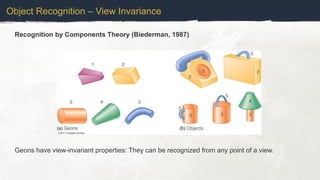
Recognition by Components Theory (Biederman, 1987)
Geons have view-invariant properties: They can be recognized from any point of a view.
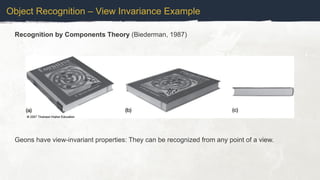
Recognition by Components Theory (Biederman, 1987)
Object Recognition – View Invariance Example
Geons have view-invariant properties: They can be recognized from any point of a view.
Study Guide 1
True or False?
Object recognition involves the dorsal visual processing pathway.
True
False
Study Guide 1
True or False?
Object recognition involves the dorsal visual processing pathway.
True
False
Study Guide 2
True or False?
The earliest stage of visual processing involves detecting the lines and curves that comprise an
object.
True
False
Study Guide 2
True or False?
The earliest stage of visual processing involves detecting the lines and curves that comprise an
object.
True
False
Study Guide 3
True or False?
Feature Integration Theory assumes that the focused-attention stage of processing puts the lines and
curves of an object back together again.
True
False
Study Guide 3
True or False?
Feature Integration Theory assumes that the focused-attention stage of processing puts the lines and
curves of an object back together again.
True
False
Study Guide 4
True or False?
Processing a stimulus in terms of it features requires focused attention according to feature
integration theory.
True
False
Study Guide 4
True or False?
Processing a stimulus in terms of it features requires focused attention according to feature
integration theory.
True
False
Study Guide 5
True or False?
According to the Recognition By Components Theory (RBC) objects are represented by geons and
their spatial relationships.
True
False
Study Guide 5
True or False?
According to the Recognition By Components Theory (RBC) objects are represented by geons and
their spatial relationships.
True
False
You have reached the end of the presentation.

object recognition theories cognitive psychology

  • 1.
    Kenneth J. Malmberg,PhD COGNITIVE PSYCHOLOGY
  • 2.
    Kenneth J. Malmberg,PhD OBJECT RECOGNITION
  • 3.
    Feature Integration Theory(Triesman, 1986) Feature Integration Theory
  • 4.
    Feature Integration Theory(Triesman, 1986) Feature Integration – Illusory Conjunctions 1 8 1 8 Illusory Conjunctions: 200 ms flash followed by mask, subjects report numbers, shapes On 18% of the trials, subjects reported shapes that were combinations of features that comprised different objects.
  • 5.
    Object Recognition -Geons Recognition by Components Theory (Biederman, 1987) Objects are represented by the geons that comprise them and the relationships between the geons.
  • 6.
    Object Recognition –View Invariance Recognition by Components Theory (Biederman, 1987) Geons have view-invariant properties: They can be recognized from any point of a view.
  • 7.
    Recognition by ComponentsTheory (Biederman, 1987) Object Recognition – View Invariance Example Geons have view-invariant properties: They can be recognized from any point of a view.
  • 8.
    Study Guide 1 Trueor False? Object recognition involves the dorsal visual processing pathway. True False
  • 9.
    Study Guide 1 Trueor False? Object recognition involves the dorsal visual processing pathway. True False
  • 10.
    Study Guide 2 Trueor False? The earliest stage of visual processing involves detecting the lines and curves that comprise an object. True False
  • 11.
    Study Guide 2 Trueor False? The earliest stage of visual processing involves detecting the lines and curves that comprise an object. True False
  • 12.
    Study Guide 3 Trueor False? Feature Integration Theory assumes that the focused-attention stage of processing puts the lines and curves of an object back together again. True False
  • 13.
    Study Guide 3 Trueor False? Feature Integration Theory assumes that the focused-attention stage of processing puts the lines and curves of an object back together again. True False
  • 14.
    Study Guide 4 Trueor False? Processing a stimulus in terms of it features requires focused attention according to feature integration theory. True False
  • 15.
    Study Guide 4 Trueor False? Processing a stimulus in terms of it features requires focused attention according to feature integration theory. True False
  • 16.
    Study Guide 5 Trueor False? According to the Recognition By Components Theory (RBC) objects are represented by geons and their spatial relationships. True False
  • 17.
    Study Guide 5 Trueor False? According to the Recognition By Components Theory (RBC) objects are represented by geons and their spatial relationships. True False
  • 18.
    You have reachedthe end of the presentation.

Editor's Notes

  • #2 When we first discussed brain areas, we talked about two paths of visual processing. A dorsal path that determines where objects are and a ventral path that determined what objects are. We also said that that there are various disorders associated with brain damage that impair the identification of certain objects. Here we will discuss a prominent theory that describes how objects are identified.
  • #3 The first thing that we need to appreciate it that early during visual processing the brain is simply detecting the presence of lines, curves, and their orientations. For instance, a book lying on your desk when viewed from directly overhead would consist of four lines. There are two sets of lines with the members of each set being parallel to each other and perpendicular to the other set of lines. These lines can be referred to as features. When first processed, they are processed individually, and what the visual system needs to do is put these features back together in order for the object to be identified. According to the Feature Integration Theory, the first processing stage that decomposes objects into features is referred to as the Preattentive Stage of processing. The second stage that put the features back together is referred to as the Focused Attention Stage. Analyzing the objects in terms of their features is thought to take place automatically and therefore it does not require the subject to attend to the object that is being decomposed. On the other hand, putting the features back together again – or integrating the features – is thought to require the subject to attend to the particular object.
  • #4 These assumptions were tested with a clever experiment. Here is how it went. On a given trial, a display consisting of several different colored shapes and numbers – like the one on the right – was flashed for 200 ms. Next a mask was presented. A mask is simply a visual pattern designed to disrupt visual processing. The subjects’ memory for the display was then tested in two ways. First, they needed to report the numbers that were flashed. The combination of the mask and number report was designed to disrupt the Focused Attention Stage of processing but not the preattentive stage. The fact that subjects could easily report the numbers confirmed the assumption that the preattentive stage was not disrupted. Next, subjects were asked to report the shapes in the display AND their colors. To do this, the shape and color features of the objects would have to be put back to together, which according to Feature Integration Theory requires attention. However, the mask and the number report phase of the experiment were designed to disrupt the focused attention stage of processing. Hence, we would expect that subjects may report the correct shapes and the correct colors due to the preattentive stage, but get the colors and the shapes mixed up due to the disruption of the focused-attention stage. For instance, subjects might report seeing a blue circle or a green triangle. This is indeed what occurred.
  • #5 The Recognition by Components Theory was designed to explain how people identify objects. This is indeed a very difficult problem to solve since objects can be viewed from an infinite number of points of view, when they are occluded by another object, or when they are experienced in a never before seen color. What Biederman proposed was that the mental representation of objects was in terms of Geons. Geons can be thought of primitive shapes from which all more complex objects can be formed. Thus, an object is represented as a set of geons and relationships between them. For instance the coffee cup and the pail on the right are represented by the same two geons, but the relationship between the geons are different. For the cup, the curve is to the side of the cylinder, and for the pail the curve is on top of the cylinder.
  • #6 The key assumption of RBC Theory is that geons can be recognized from any point of view. That is, they have view-invariant properties.
  • #7 This allows us to recognize a book from any point of view.