The Impact of  Household Sewage Treatment Systems (HSTS) on Storm Water Pollution Northwest Community Meeting Thursday, October 6, 2011
Welcome and Introductions Joe Durham, Attorney at Law Eastman & Smith, LTD.
Overview of the National Pollutant Discharge Elimination System (NPDES)  Storm Water Permit for Franklin County and the Townships Jennifer Fish, Director Franklin Soil and Water Conservation District
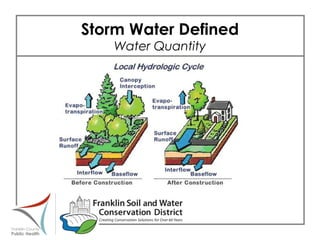
Storm Water Defined Water Quantity
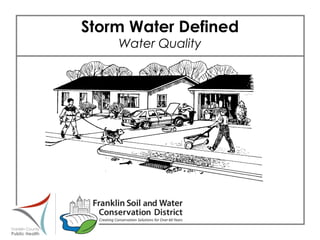
Storm Water Defined Water Quality
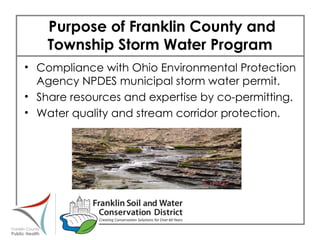
Purpose of Franklin County and Township Storm Water Program Compliance with Ohio Environmental Protection Agency NPDES municipal storm water permit.  Share resources and expertise by co-permitting. Water quality and stream corridor protection.
Franklin County and Township Storm Water Program Participants Franklin County Townships Franklin County Drainage Engineer Franklin County Economic Development and Planning Franklin County Sanitary Engineer Franklin County Public Health Franklin Soil and Water Conservation District Residents and businesses in unincorporated Franklin County Developers , contractors and consultants working in  unincorporated Franklin County
Franklin County and Township  Storm Water Community Benefits Public health Drinking water Recreation Wildlife Reduced infrastructure costs Quality of life
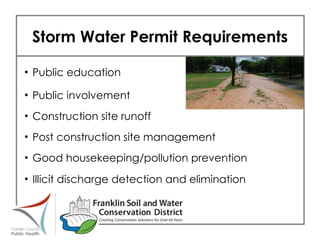
Public education Public involvement Construction site runoff Post construction site management Good housekeeping/pollution prevention Illicit discharge detection and elimination Storm Water Permit Requirements
Storm Water Program Highlights Storm water education efforts. Mapping of storm sewers to be added to existing drainage and stream resource maps.  Enhanced county regulations for construction site and post-construction management. Participation of county and townships in pollution prevention programs. Continued resolution of illicit discharges including failing HSTS.
Report Pollution! Failing Household Sewage Treatment Systems Franklin County Public Health (614) 525-HSTS (4787) or failingHSTS@franklincountyohio.gov Report Emergency Spills   Ohio EPA 24-Hour Emergency Hotline 1 (800) 282-9378 Report any other water pollution related complaint or concern to: Franklin Soil and Water Conservation District  (614) 486-9613
General Overview of the  Storm Water Permit Terminology Jennifer Fish, Director Franklin Soil and Water Conservation District
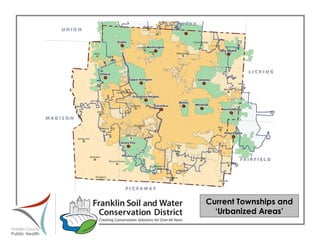
Current Townships and ‘Urbanized Areas’
Definitions National Pollutant Discharge Elimination System  (NPDES) Municipal Separate Storm Sewer System (MS4) Household Sewage Treatment Systems (HSTS) Illicit Discharge Detection and Elimination (IDDE)
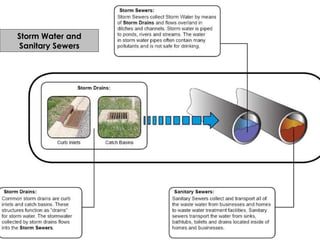
Storm Water and Sanitary Sewers
Questions?
Overview of Illicit Discharge and Elimination (IDDE) Paul Rosile, Director of Environmental Health  & Assistant Health Commissioner  Franklin County Public Health
IDDE Topics Include Explanation of public health risks Requirements of homeowners with HSTS Identify and eliminate failing HSTS Where are the public health risks When to expect these requirements
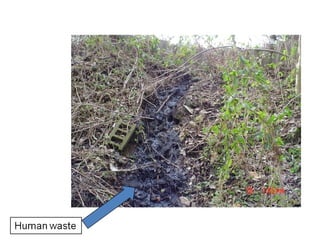
What are the Public Health Risks? Untreated or improperly treated sewage can contaminate: drinking water supply drainage ditches streams, rivers and lakes When household sewage treatment systems fail, untreated sewage is discharged into the environment.
What are the Public Health Risks? Contact with human waste can pose health risks because it can carry disease-causing organisms. Health risks are directly tied to exposure and ingestion of untreated sewage. The young, the old and those with chronic conditions are at higher risk.
Avoid Exposure Do not allow kids and pets to play in water that looks and smells like sewage. Do not swallow or get water from ditches or streams in your mouth or nose. If you are in those types of areas, wash hands thoroughly with soap and water.
 
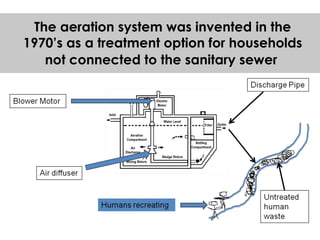
The aeration system was invented in the 1970’s as a treatment option for households not connected to the sanitary sewer
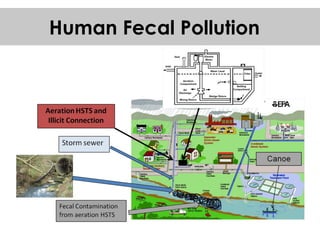
Human Fecal Pollution
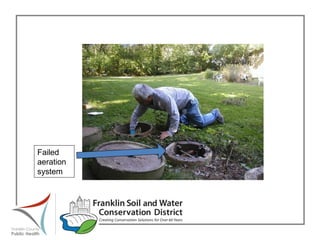
Failed aeration system
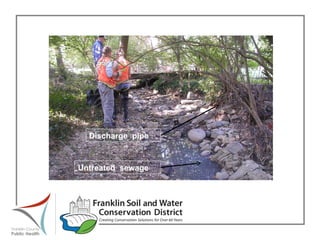
Discharge  pipe Untreated  sewage
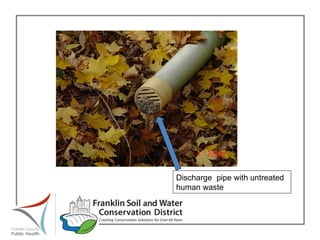
Discharge  pipe with untreated human waste
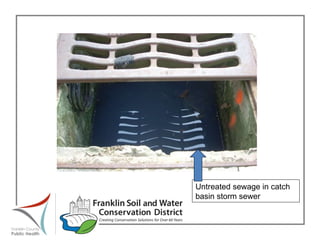
Untreated sewage in catch basin storm sewer
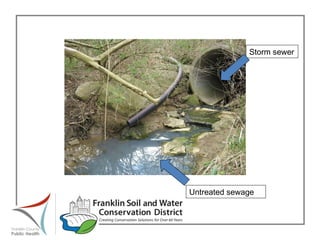
Untreated sewage Storm sewer
Questions?
Requirements of Homeowners with Household Sewage Treatment Systems   Paul Rosile, Director of Environmental Health  & Assistant Health Commissioner  Franklin County Public Health
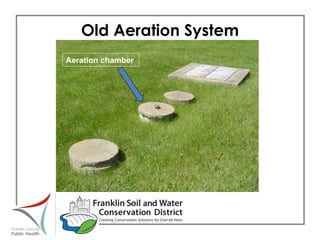
Old Aeration System Aeration chamber
Maintaining Aeration Systems Annual inspection by Franklin County Public Health (FCPH) or a maintenance contract. Properly operating motor. Properly operating air intake. Tank pumped based on manufacturers recommendations.
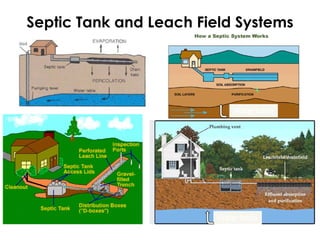
Septic Tank and Leach Field Systems
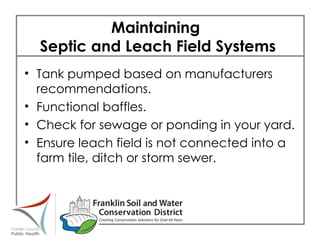
Maintaining  Septic and Leach Field Systems  Tank pumped based on manufacturers recommendations. Functional baffles. Check for sewage or ponding in your yard. Ensure leach field is not connected into a farm tile, ditch or storm sewer.
Why HSTS Fail Aeration, septic and leach systems fail because:  Unsuitable soil conditions Improper design and installation Inadequate maintenance Age of the system Amount of water use
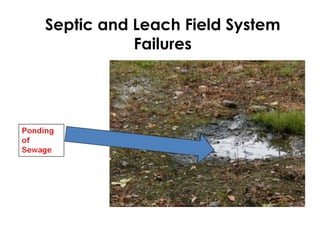
Septic and Leach Field System Failures
Identify and Eliminate Failing HSTS  Paul Rosile, Director of Environmental Health  & Assistant Health Commissioner  Franklin County Public Health
Priority 1 If sanitary sewer is available and accessible, homeowners will be ordered to abandon their HSTS and connect. Whether the system is operating correctly or not, the homeowner will be required to connect. Required by FCPH regulations and state law.
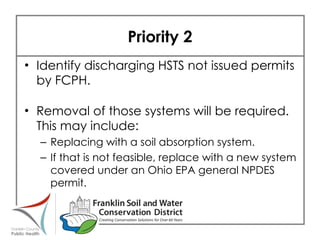
Priority 2 Identify discharging HSTS not issued permits by FCPH. Removal of those systems will be required.  This may include: Replacing with a soil absorption system. If that is not feasible, replace with a new system covered under an Ohio EPA general NPDES permit.
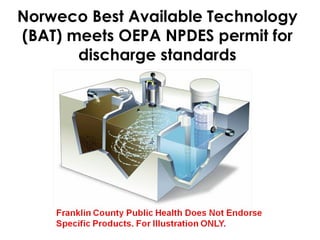
Norweco Best Available Technology (BAT) meets OEPA NPDES permit for discharge standards
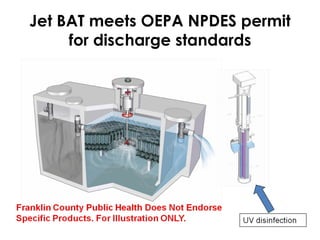
Jet BAT meets OEPA NPDES permit for discharge standards
Priority 3 and 4 Identify HSTS discharges causing “obvious” or “suspicious” pollution. Verified evidence that sewage pollution is causing a public health nuisance. Identified conditions that could have been caused by contamination. FCPH will determine if a failed HSTS is causing a nuisance.
Definition of a  Public Health Nuisance  1) HSTS cause a public health nuisance when any of the following situations occur: Not operating properly due to a missing component. Incorrect settings. Mechanical or electrical failure ( motor not running). AND,  timely repairs of these situations are not made after notice to the property owner by the Board of Health.
Definition of a  Public Health Nuisance  2) There is a blockage in a known sewage treatment system component or pipe that causes a backup of sewage or effluent affecting the treatment process or inhibiting proper plumbing drainage.
Definition of a  Public Health Nuisance  3) There is ponding or bleeding of liquid onto the surface of the ground or into surface water.  The liquid has a distinct sewage odor, a black or grey coloration, or the presence of organic matter  and  any of the following: a dye test identifying effluent from an HSTS samples show fecal coliform at a level that is equal or greater than five thousand colonies per one hundred milliliters of liquid c)  samples show more than one thousand thirty e.coli counts per one hundred milliliters of liquid
Current Annual Inspection Program We inspect  individual aeration system  for a nuisance:  - if the system is not operating properly due to a missing component, incorrect settings, or a mechanical or electrical failure. - if there is a blockage in a known sewage treatment system pipe that causes a backup of sewage or inhibits drainage.
New Stormwater Pollution Investigations FCPH will inspect storm sewer  outfalls   for the presence of sewage during our dry weather screening.  If  there are "obvious" or “suspicious” signs of sewage pollution, FCPH will investigate the aeration or septic systems connected to the storm sewer for nuisance conditions, and will abate the nuisance if found.
Priority 3 and 4, continued If the system is causing a nuisance, homeowners will be required to abate the nuisance. This may include: Replacing with a soil absorption system. Repairing existing system. If that is not feasible, replace with a new system covered under an Ohio EPA general NPDES permit. If there is no nuisance, no further action is needed.
Where are the Public Health Risks? Every township in Franklin County. In urban areas.   In rural areas. Along roadways. Along streams.
How Do We Know the Risks Exist? Nuisance and pollution complaints. Maintenance reports by HSTS owners. Annual inspections performed by FCPH. Observation during roadway construction. Dry Weather Screening for NPDES permit.
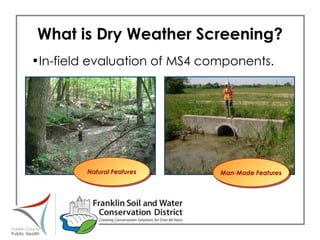
What is Dry Weather Screening? In-field evaluation of MS4 components. Man-Made Features Natural Features
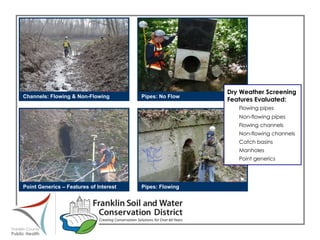
Dry Weather Screening Features Evaluated: Flowing pipes Non-flowing pipes Flowing channels Non-flowing channels Catch basins Manholes Point generics Channels: Flowing & Non-Flowing Pipes: No Flow Pipes: Flowing Point Generics – Features of Interest
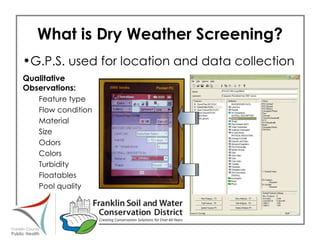
What is Dry Weather Screening? G.P.S. used for location and data collection Qualitative Observations: Feature type Flow condition Material Size Odors Colors Turbidity Floatables Pool quality
How We Summarized Health Risks? Use of existing records. Use of existing data sets. Development of new data sets. Extensive use of G.I.S. GIS: ( G eographic  I nformation  S ystem) GIS is a computer-based technology developed around geo-spatial information (having a location on the earth's surface). GIS allows for data development, management, and analysis as well as the presentation of the data in a variety of visual formats including maps, database tables and charts.
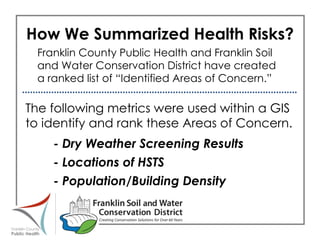
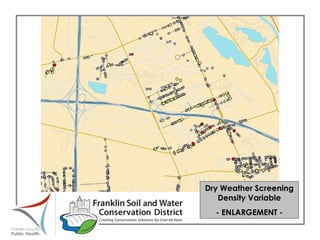
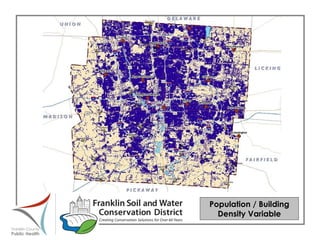
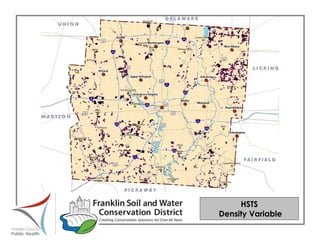
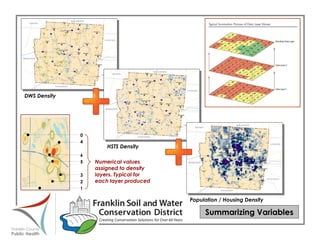
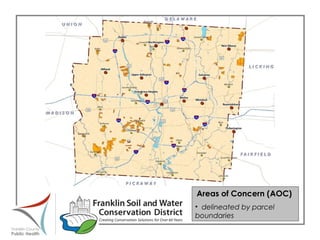
How We Summarized Health Risks? Franklin County Public Health and Franklin Soil and Water Conservation District have created a ranked list of “Identified Areas of Concern.” The following metrics were used within a GIS to identify and rank these Areas of Concern. - Dry Weather Screening Results - Locations of HSTS - Population/Building Density
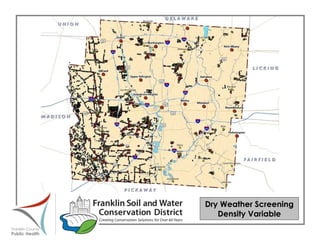
Dry Weather Screening Density Variable
Dry Weather Screening Density Variable - ENLARGEMENT -
Population / Building Density Variable
HSTS  Density Variable
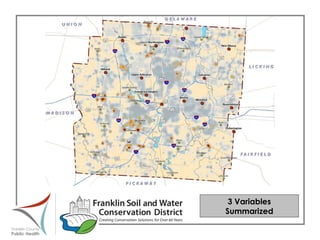
Summarizing Variables DWS Density HSTS Density Population / Housing Density Numerical values assigned to density layers. Typical for each layer produced 0 4 6 5 3 2 1
Highest Ranking Areas Extracted / Highlighted 3 Variables Summarized
Areas of Concern (AOC)  delineated by parcel boundaries
How Long Will It Take For FCPH To Identify and Eliminate Failing HSTS Causing Public Health Nuisances?  Paul Rosile, Director of Environmental Health  & Assistant Health Commissioner  Franklin County Public Health
How Long Will It Take? It will take years. FCPH will begin investigations in the first quarter of 2012. Start with the highest ranked identified areas of concern. Work through to the lowest ranked area. Use the prioritized approach in each area.
What Will It Cost? Repair - $2,000 – $8,000. Replace - $15,000 - $20,000, depending on the type of system. Tap into sanitary sewer - $5,000 - $10,000, depending on the distance from the home to the tap and other constriction costs.
Financial  Resources Available  to Qualified Residents HUD Community Development Block Grant Grant provided by the Franklin County Board of Commissioners.  $100,000 total, deferred lien. For repairing or replacing HSTS or connecting to sanitary sewer. Contact the Mid-Ohio Regional Planning Commission (MORPC) at (614) 233-4171.
Financial  Resources Available  to Qualified Residents Ohio EPA Grant  Grant provided through the Franklin County Board of Commissioners. $160,000 total grant. For repairing or replacing HSTS. Contact Franklin County Public Health at (614) 525-4261.
Financial  Resources Available  to Qualified Residents Ohio EPA  Potential grant through the Franklin County Board of Commissioners. Application in process :   requested   $1.5 million linked deposit low interest loan.  For connecting to sanitary sewer. Contact Franklin County Public Health at (614)525-4261.
Comments on IDDE Plan Complete plan is available for review at www.myfcph.org. Plan is open for a public comment period that will end at the close of business on October 28, 2011. Comments will be accepted in writing, and by phone or by email to: FCPH, Attention: Paul Rosile 280 East Broad Street, Columbus, OH 43215 Phone: (614) 525-4787 Email: failingHSTS@franklincountyohio.gov
Additional Information Interactive maps of the Identified Areas of Concern are available at www.myfcph.org. Follow-up questions? Phone: (614) 525-4787 Email: failingHSTS@franklincountyohio.gov
Questions and  Wrap-Up?

Community Meeting Presentation for Northwest Franklin County

  • 1.
    The Impact of Household Sewage Treatment Systems (HSTS) on Storm Water Pollution Northwest Community Meeting Thursday, October 6, 2011
  • 2.
    Welcome and IntroductionsJoe Durham, Attorney at Law Eastman & Smith, LTD.
  • 3.
    Overview of theNational Pollutant Discharge Elimination System (NPDES) Storm Water Permit for Franklin County and the Townships Jennifer Fish, Director Franklin Soil and Water Conservation District
  • 4.
    Storm Water DefinedWater Quantity
  • 5.
    Storm Water DefinedWater Quality
  • 6.
    Purpose of FranklinCounty and Township Storm Water Program Compliance with Ohio Environmental Protection Agency NPDES municipal storm water permit. Share resources and expertise by co-permitting. Water quality and stream corridor protection.
  • 7.
    Franklin County andTownship Storm Water Program Participants Franklin County Townships Franklin County Drainage Engineer Franklin County Economic Development and Planning Franklin County Sanitary Engineer Franklin County Public Health Franklin Soil and Water Conservation District Residents and businesses in unincorporated Franklin County Developers , contractors and consultants working in unincorporated Franklin County
  • 8.
    Franklin County andTownship Storm Water Community Benefits Public health Drinking water Recreation Wildlife Reduced infrastructure costs Quality of life
  • 9.
    Public education Publicinvolvement Construction site runoff Post construction site management Good housekeeping/pollution prevention Illicit discharge detection and elimination Storm Water Permit Requirements
  • 10.
    Storm Water ProgramHighlights Storm water education efforts. Mapping of storm sewers to be added to existing drainage and stream resource maps. Enhanced county regulations for construction site and post-construction management. Participation of county and townships in pollution prevention programs. Continued resolution of illicit discharges including failing HSTS.
  • 11.
    Report Pollution! FailingHousehold Sewage Treatment Systems Franklin County Public Health (614) 525-HSTS (4787) or failingHSTS@franklincountyohio.gov Report Emergency Spills Ohio EPA 24-Hour Emergency Hotline 1 (800) 282-9378 Report any other water pollution related complaint or concern to: Franklin Soil and Water Conservation District (614) 486-9613
  • 12.
    General Overview ofthe Storm Water Permit Terminology Jennifer Fish, Director Franklin Soil and Water Conservation District
  • 13.
    Current Townships and‘Urbanized Areas’
  • 14.
    Definitions National PollutantDischarge Elimination System (NPDES) Municipal Separate Storm Sewer System (MS4) Household Sewage Treatment Systems (HSTS) Illicit Discharge Detection and Elimination (IDDE)
  • 15.
    Storm Water andSanitary Sewers
  • 16.
  • 17.
    Overview of IllicitDischarge and Elimination (IDDE) Paul Rosile, Director of Environmental Health & Assistant Health Commissioner Franklin County Public Health
  • 18.
    IDDE Topics IncludeExplanation of public health risks Requirements of homeowners with HSTS Identify and eliminate failing HSTS Where are the public health risks When to expect these requirements
  • 19.
    What are thePublic Health Risks? Untreated or improperly treated sewage can contaminate: drinking water supply drainage ditches streams, rivers and lakes When household sewage treatment systems fail, untreated sewage is discharged into the environment.
  • 20.
    What are thePublic Health Risks? Contact with human waste can pose health risks because it can carry disease-causing organisms. Health risks are directly tied to exposure and ingestion of untreated sewage. The young, the old and those with chronic conditions are at higher risk.
  • 21.
    Avoid Exposure Donot allow kids and pets to play in water that looks and smells like sewage. Do not swallow or get water from ditches or streams in your mouth or nose. If you are in those types of areas, wash hands thoroughly with soap and water.
  • 22.
  • 23.
    The aeration systemwas invented in the 1970’s as a treatment option for households not connected to the sanitary sewer
  • 24.
  • 25.
  • 26.
    Discharge pipeUntreated sewage
  • 27.
    Discharge pipewith untreated human waste
  • 28.
    Untreated sewage incatch basin storm sewer
  • 29.
  • 30.
  • 31.
    Requirements of Homeownerswith Household Sewage Treatment Systems Paul Rosile, Director of Environmental Health & Assistant Health Commissioner Franklin County Public Health
  • 32.
    Old Aeration SystemAeration chamber
  • 33.
    Maintaining Aeration SystemsAnnual inspection by Franklin County Public Health (FCPH) or a maintenance contract. Properly operating motor. Properly operating air intake. Tank pumped based on manufacturers recommendations.
  • 34.
    Septic Tank andLeach Field Systems
  • 35.
    Maintaining Septicand Leach Field Systems Tank pumped based on manufacturers recommendations. Functional baffles. Check for sewage or ponding in your yard. Ensure leach field is not connected into a farm tile, ditch or storm sewer.
  • 36.
    Why HSTS FailAeration, septic and leach systems fail because: Unsuitable soil conditions Improper design and installation Inadequate maintenance Age of the system Amount of water use
  • 37.
    Septic and LeachField System Failures
  • 38.
    Identify and EliminateFailing HSTS Paul Rosile, Director of Environmental Health & Assistant Health Commissioner Franklin County Public Health
  • 39.
    Priority 1 Ifsanitary sewer is available and accessible, homeowners will be ordered to abandon their HSTS and connect. Whether the system is operating correctly or not, the homeowner will be required to connect. Required by FCPH regulations and state law.
  • 40.
    Priority 2 Identifydischarging HSTS not issued permits by FCPH. Removal of those systems will be required. This may include: Replacing with a soil absorption system. If that is not feasible, replace with a new system covered under an Ohio EPA general NPDES permit.
  • 41.
    Norweco Best AvailableTechnology (BAT) meets OEPA NPDES permit for discharge standards
  • 42.
    Jet BAT meetsOEPA NPDES permit for discharge standards
  • 43.
    Priority 3 and4 Identify HSTS discharges causing “obvious” or “suspicious” pollution. Verified evidence that sewage pollution is causing a public health nuisance. Identified conditions that could have been caused by contamination. FCPH will determine if a failed HSTS is causing a nuisance.
  • 44.
    Definition of a Public Health Nuisance 1) HSTS cause a public health nuisance when any of the following situations occur: Not operating properly due to a missing component. Incorrect settings. Mechanical or electrical failure ( motor not running). AND, timely repairs of these situations are not made after notice to the property owner by the Board of Health.
  • 45.
    Definition of a Public Health Nuisance 2) There is a blockage in a known sewage treatment system component or pipe that causes a backup of sewage or effluent affecting the treatment process or inhibiting proper plumbing drainage.
  • 46.
    Definition of a Public Health Nuisance 3) There is ponding or bleeding of liquid onto the surface of the ground or into surface water. The liquid has a distinct sewage odor, a black or grey coloration, or the presence of organic matter and any of the following: a dye test identifying effluent from an HSTS samples show fecal coliform at a level that is equal or greater than five thousand colonies per one hundred milliliters of liquid c) samples show more than one thousand thirty e.coli counts per one hundred milliliters of liquid
  • 47.
    Current Annual InspectionProgram We inspect individual aeration system for a nuisance: - if the system is not operating properly due to a missing component, incorrect settings, or a mechanical or electrical failure. - if there is a blockage in a known sewage treatment system pipe that causes a backup of sewage or inhibits drainage.
  • 48.
    New Stormwater PollutionInvestigations FCPH will inspect storm sewer outfalls for the presence of sewage during our dry weather screening. If there are "obvious" or “suspicious” signs of sewage pollution, FCPH will investigate the aeration or septic systems connected to the storm sewer for nuisance conditions, and will abate the nuisance if found.
  • 49.
    Priority 3 and4, continued If the system is causing a nuisance, homeowners will be required to abate the nuisance. This may include: Replacing with a soil absorption system. Repairing existing system. If that is not feasible, replace with a new system covered under an Ohio EPA general NPDES permit. If there is no nuisance, no further action is needed.
  • 50.
    Where are thePublic Health Risks? Every township in Franklin County. In urban areas. In rural areas. Along roadways. Along streams.
  • 51.
    How Do WeKnow the Risks Exist? Nuisance and pollution complaints. Maintenance reports by HSTS owners. Annual inspections performed by FCPH. Observation during roadway construction. Dry Weather Screening for NPDES permit.
  • 52.
    What is DryWeather Screening? In-field evaluation of MS4 components. Man-Made Features Natural Features
  • 53.
    Dry Weather ScreeningFeatures Evaluated: Flowing pipes Non-flowing pipes Flowing channels Non-flowing channels Catch basins Manholes Point generics Channels: Flowing & Non-Flowing Pipes: No Flow Pipes: Flowing Point Generics – Features of Interest
  • 54.
    What is DryWeather Screening? G.P.S. used for location and data collection Qualitative Observations: Feature type Flow condition Material Size Odors Colors Turbidity Floatables Pool quality
  • 55.
    How We SummarizedHealth Risks? Use of existing records. Use of existing data sets. Development of new data sets. Extensive use of G.I.S. GIS: ( G eographic I nformation S ystem) GIS is a computer-based technology developed around geo-spatial information (having a location on the earth's surface). GIS allows for data development, management, and analysis as well as the presentation of the data in a variety of visual formats including maps, database tables and charts.
  • 56.
    How We SummarizedHealth Risks? Franklin County Public Health and Franklin Soil and Water Conservation District have created a ranked list of “Identified Areas of Concern.” The following metrics were used within a GIS to identify and rank these Areas of Concern. - Dry Weather Screening Results - Locations of HSTS - Population/Building Density
  • 57.
    Dry Weather ScreeningDensity Variable
  • 58.
    Dry Weather ScreeningDensity Variable - ENLARGEMENT -
  • 59.
    Population / BuildingDensity Variable
  • 60.
    HSTS DensityVariable
  • 61.
    Summarizing Variables DWSDensity HSTS Density Population / Housing Density Numerical values assigned to density layers. Typical for each layer produced 0 4 6 5 3 2 1
  • 62.
    Highest Ranking AreasExtracted / Highlighted 3 Variables Summarized
  • 63.
    Areas of Concern(AOC) delineated by parcel boundaries
  • 64.
    How Long WillIt Take For FCPH To Identify and Eliminate Failing HSTS Causing Public Health Nuisances? Paul Rosile, Director of Environmental Health & Assistant Health Commissioner Franklin County Public Health
  • 65.
    How Long WillIt Take? It will take years. FCPH will begin investigations in the first quarter of 2012. Start with the highest ranked identified areas of concern. Work through to the lowest ranked area. Use the prioritized approach in each area.
  • 66.
    What Will ItCost? Repair - $2,000 – $8,000. Replace - $15,000 - $20,000, depending on the type of system. Tap into sanitary sewer - $5,000 - $10,000, depending on the distance from the home to the tap and other constriction costs.
  • 67.
    Financial  Resources Available to Qualified Residents HUD Community Development Block Grant Grant provided by the Franklin County Board of Commissioners. $100,000 total, deferred lien. For repairing or replacing HSTS or connecting to sanitary sewer. Contact the Mid-Ohio Regional Planning Commission (MORPC) at (614) 233-4171.
  • 68.
    Financial  Resources Available to Qualified Residents Ohio EPA Grant Grant provided through the Franklin County Board of Commissioners. $160,000 total grant. For repairing or replacing HSTS. Contact Franklin County Public Health at (614) 525-4261.
  • 69.
    Financial  Resources Available to Qualified Residents Ohio EPA Potential grant through the Franklin County Board of Commissioners. Application in process :  requested $1.5 million linked deposit low interest loan.  For connecting to sanitary sewer. Contact Franklin County Public Health at (614)525-4261.
  • 70.
    Comments on IDDEPlan Complete plan is available for review at www.myfcph.org. Plan is open for a public comment period that will end at the close of business on October 28, 2011. Comments will be accepted in writing, and by phone or by email to: FCPH, Attention: Paul Rosile 280 East Broad Street, Columbus, OH 43215 Phone: (614) 525-4787 Email: failingHSTS@franklincountyohio.gov
  • 71.
    Additional Information Interactivemaps of the Identified Areas of Concern are available at www.myfcph.org. Follow-up questions? Phone: (614) 525-4787 Email: failingHSTS@franklincountyohio.gov
  • 72.