Disorders of Fat Metabolism
(Nutrition therapy)
Course Code: HND-502
Course Title: Clinical and Therapeutic Nutrition
BS Human Nutrition and Dietetics
Dept. of Nutritional Sciences, GCUF
By
Dr. Huma Umbreen
Acute nutrition intervention
• Acute treatment is aimed at stopping catabolism
and the subsequent release of free fatty acids.
• Use of antipyretic and antiemetic medications to
reduce fever and vomiting is helpful.
• Intravenous dextrose is used to provide a
constant source of glucose.
• The high-glucose feedings used in order to
prevent or recover from hypoglycemia may
necessitate the use of insulin
• The dextrose should not be discontinued until the
patient is able to maintain his/her blood sugar
and to tolerate enteral feedings.
Cont….
• The use of medium-chain triglycerides in
treatment of disorders besides MCAD is an
effective way to provide additional calories
without increasing the load on the enzymatic
block.
• Fluids should be provided at a rate of 1.5–2
times maintenance requirements in order to
flush out the metabolites.
• Carnitine can be given either intravenously or
by mouth to help conjugate the excess fatty
acids.
Chronic Nutrition Intervention
• Aims
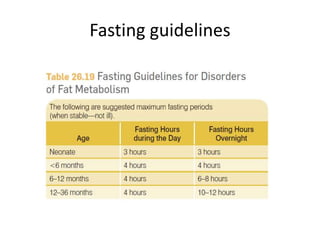
• prevention of fasting
• limiting intake of fatty acids
• providing an alternate substrate for
metabolism
Fasting guidelines
Carnitine transport disorder
• Dietary intake of fatty acids may be mildly
restricted (<30% of kcal) in some disorders
such as carnitine transport disorders, since all
types of fatty acids are not transported
appropriately into the mitochondria and
cannot be used as efficiently as an energy
source.
Specific fatty acid issues
• When there is a specific fatty acid that is not
metabolized correctly there is an increased
production of acylated fatty acids, which can
build up within the mitochondria; in these
cases, a more severe fat restriction is usually
recommended.
long-chain 3 hydroxy acyl-CoA dehydrogenase deficiency
(LCHADD)
• Patients with LCHADD have been reported to have
problems ranging from retinopathy to neuropathy.
• For this reason, diet recommendations for fat restriction
are stricter than in other disorders.
• Total fat is restricted to no more than 25% to 30% of total
kcal consumed, distributed as 20% to 25% MCTs and only
5% to 10% long-chain fatty acids.
• In this disorder, medium chain triglycerides (MCT),
containing fatty acids of 6 to 10 carbons in length, can be
used as an alternative substrate since they can bypass the
enzymatic block and be used for energy production.
• It is recommended that the MCT be administered three to
four times throughout the day in order to provide a steady
source of energy.
very-long-chain acyl-CoA dehydrogenase deficiency
(VLCADD),
• The dietary recommendations for VLCADD are
similar to those for LCHADD, but are not as
restrictive.
• Fat recommendations are less restrictive, with
15% to 20% of the calories coming from long
chain fatty acid sources.
• MCT are recommended at 10% to 15% of
calories, but in some cases are only provided
during periods of higher energy needs such as
exercise or fever
medium-chain acyl-CoA dehydrogenase
deficiency (MCADD)
• The mainstay of treatment for MCADD is the
avoidance of fasting.
• Infants with MCADD are initially fed every 3
hours.
• Parents are instructed to wake the infants for
the feeding.
• The parents are also instructed on monitoring
blood glucose levels.
Alternative energy source
• Since fasting leads to the release of free fatty
acids, uncooked cornstarch has been suggested
as a therapeutic option in many of the disorders
of fat metabolism.
• It provides a steady release of glucose over a long
period of time, which is beneficial during
extended periods of strenuous activity or before
bedtime.
• The use of continuous enteral feeding is another
method of providing a steady source of energy
substrate in order to minimize catabolism.

nutrition therapy fat disorders.pptx

  • 1.
    Disorders of FatMetabolism (Nutrition therapy) Course Code: HND-502 Course Title: Clinical and Therapeutic Nutrition BS Human Nutrition and Dietetics Dept. of Nutritional Sciences, GCUF By Dr. Huma Umbreen
  • 2.
    Acute nutrition intervention •Acute treatment is aimed at stopping catabolism and the subsequent release of free fatty acids. • Use of antipyretic and antiemetic medications to reduce fever and vomiting is helpful. • Intravenous dextrose is used to provide a constant source of glucose. • The high-glucose feedings used in order to prevent or recover from hypoglycemia may necessitate the use of insulin • The dextrose should not be discontinued until the patient is able to maintain his/her blood sugar and to tolerate enteral feedings.
  • 3.
    Cont…. • The useof medium-chain triglycerides in treatment of disorders besides MCAD is an effective way to provide additional calories without increasing the load on the enzymatic block. • Fluids should be provided at a rate of 1.5–2 times maintenance requirements in order to flush out the metabolites. • Carnitine can be given either intravenously or by mouth to help conjugate the excess fatty acids.
  • 4.
    Chronic Nutrition Intervention •Aims • prevention of fasting • limiting intake of fatty acids • providing an alternate substrate for metabolism
  • 5.
  • 6.
    Carnitine transport disorder •Dietary intake of fatty acids may be mildly restricted (<30% of kcal) in some disorders such as carnitine transport disorders, since all types of fatty acids are not transported appropriately into the mitochondria and cannot be used as efficiently as an energy source.
  • 7.
    Specific fatty acidissues • When there is a specific fatty acid that is not metabolized correctly there is an increased production of acylated fatty acids, which can build up within the mitochondria; in these cases, a more severe fat restriction is usually recommended.
  • 8.
    long-chain 3 hydroxyacyl-CoA dehydrogenase deficiency (LCHADD) • Patients with LCHADD have been reported to have problems ranging from retinopathy to neuropathy. • For this reason, diet recommendations for fat restriction are stricter than in other disorders. • Total fat is restricted to no more than 25% to 30% of total kcal consumed, distributed as 20% to 25% MCTs and only 5% to 10% long-chain fatty acids. • In this disorder, medium chain triglycerides (MCT), containing fatty acids of 6 to 10 carbons in length, can be used as an alternative substrate since they can bypass the enzymatic block and be used for energy production. • It is recommended that the MCT be administered three to four times throughout the day in order to provide a steady source of energy.
  • 9.
    very-long-chain acyl-CoA dehydrogenasedeficiency (VLCADD), • The dietary recommendations for VLCADD are similar to those for LCHADD, but are not as restrictive. • Fat recommendations are less restrictive, with 15% to 20% of the calories coming from long chain fatty acid sources. • MCT are recommended at 10% to 15% of calories, but in some cases are only provided during periods of higher energy needs such as exercise or fever
  • 10.
    medium-chain acyl-CoA dehydrogenase deficiency(MCADD) • The mainstay of treatment for MCADD is the avoidance of fasting. • Infants with MCADD are initially fed every 3 hours. • Parents are instructed to wake the infants for the feeding. • The parents are also instructed on monitoring blood glucose levels.
  • 11.
    Alternative energy source •Since fasting leads to the release of free fatty acids, uncooked cornstarch has been suggested as a therapeutic option in many of the disorders of fat metabolism. • It provides a steady release of glucose over a long period of time, which is beneficial during extended periods of strenuous activity or before bedtime. • The use of continuous enteral feeding is another method of providing a steady source of energy substrate in order to minimize catabolism.