
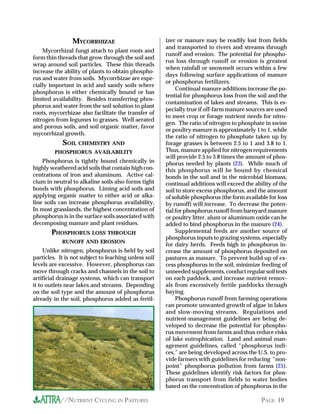
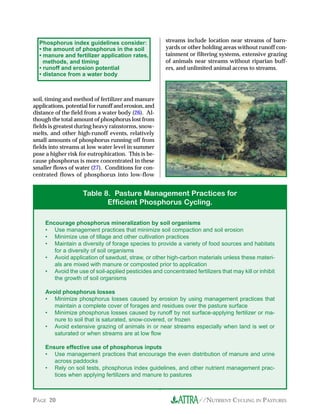
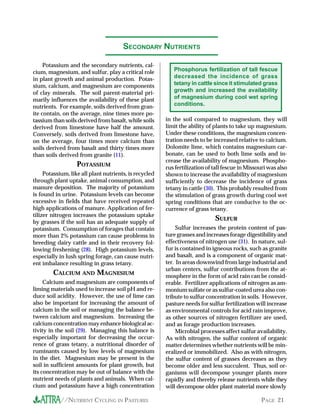
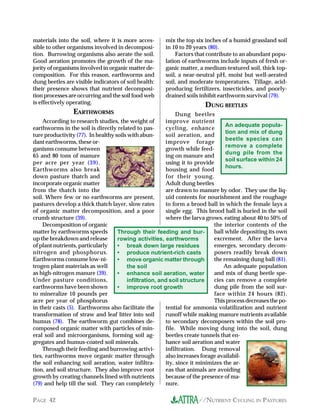
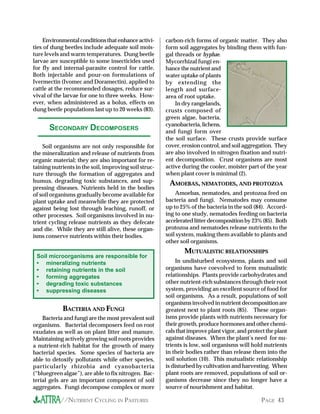
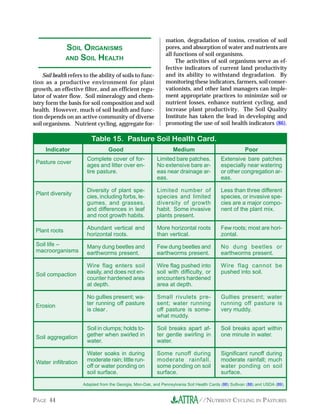
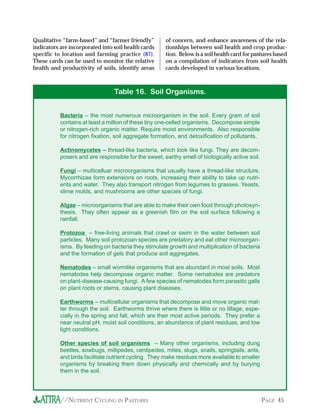
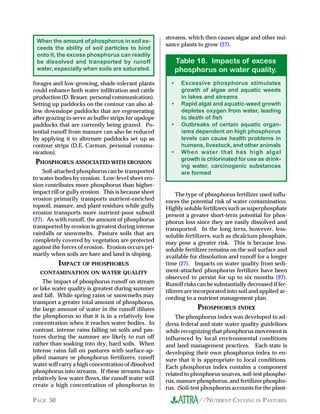
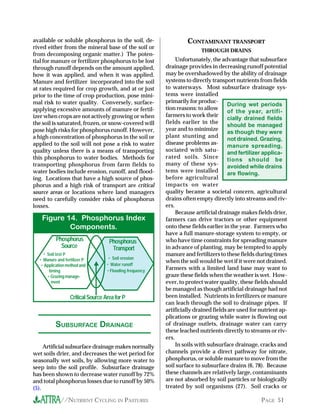
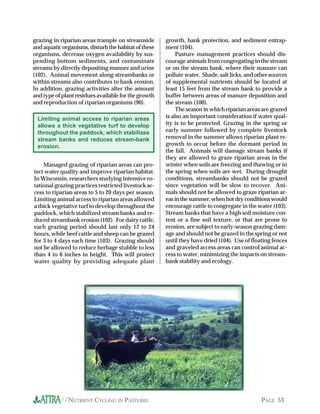
NUTRIENT CYCLING IN PASTURES
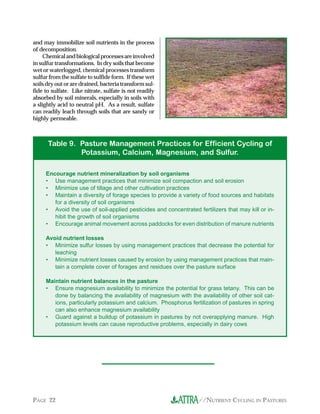
                                                                   LIVESTOCK SYSTEMS GUIDE
                                                                By Barbara Bellows
                                                                NCAT Agriculture Specialist
                                                                December 2001

                                                                             Table of Contents
                                             Introduction and Summary ........................................................... 2
                                             Publication Overview ................................................................... 5
                                             Chapter 1. Nutrient Cycle Components, Interactions, and .............
                                              Transformations ........................................................................ 6
                                                 Water Cycle ........................................................................... 6
                                                 Carbon Cycle ....................................................................... 10
                                                 Nitrogen Cycle ..................................................................... 13
                                                 Phosphorus Cycle ................................................................ 18
                                                 Secondary Nutrients ............................................................ 21
Abstract: Good pasture management            Chapter 2. Nutrient Availability in Pastures ................................ 23
practices foster effective use and               Soil Parent Material .............................................................. 23
recycling of nutrients. Nutrient cycles          Soil Chemistry ...................................................................... 23
important in pasture systems are the             Prior Management Practices ................................................ 24
water, carbon, nitrogen, and phosphorus          Soil Compaction ................................................................... 24
cycles. This publication provides basic          Organic Matter ..................................................................... 25
descriptions of these cycles, and presents       Soil pH ................................................................................. 27
guidelines for managing pastures to              Timing of Nutrient Additions ................................................. 27
enhance nutrient cycling efficiency —        Chapter 3. Nutrient Distribution and Movement in Pastures ...... 30
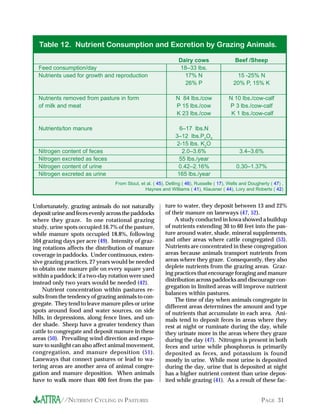
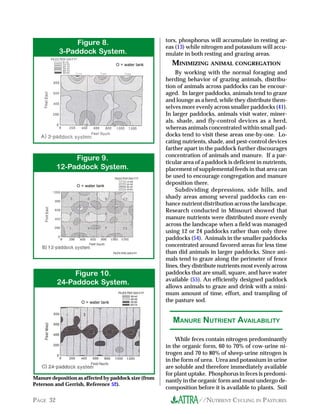
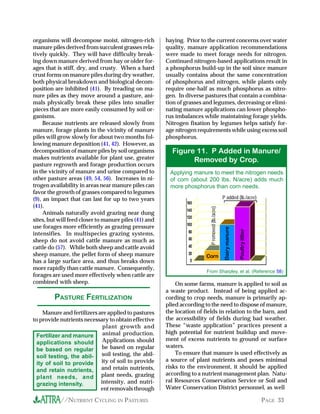
with the goal of optimizing forage and           Pasture Nutrient Inputs and Outputs .................................... 30
livestock growth, soil health, and water         Manure Nutrient Availability .................................................. 32
quality. Includes 19 Tables and 14               Pasture Fertilization ............................................................. 33
Figures.                                         Grazing Intensity .................................................................. 34
                                                 Diversity and Density of Pasture Plants ............................... 36
                                             Chapter 4. The Soil Food Web and Pasture Soil Quality ........... 40
                                                 Diversity of the Soil Food Web ............................................. 40
                                                 Organic Matter Decomposition............................................. 40
                                                 Primary Decomposers ......................................................... 41
                                                 Secondary Decomposers ..................................................... 43
                                                 Soil Organisms and Soil Health ........................................... 44
                                             Chapter 5. Pasture Management and Water Quality ................ 47
                                                 Risk Factors for Nutrient Losses .......................................... 47
                                                 Pathogens ............................................................................ 48
                                                 Nitrate Contamination .......................................................... 49
                                                 Phosphorus Contamination .................................................. 49
                                                 Subsurface Drainage ........................................................... 51
                                                 Riparian Buffers ................................................................... 52
                                                 Riparian Grazing .................................................................. 53
                                             References ................................................................................ 55
                                             Resource List ............................................................................ 61
                                                 Agencies and Organizations ................................................ 61
                                                 Publications in Print ............................................................. 61
                                             Web Resources ......................................................................... 63


 ATTRA is the national sustainable agriculture information service operated by the National Center
 for Appropriate Technology under a grant from the Rural Business-Cooperative Service, U.S.
 Department of Agriculture. These organizations do not recommend or endorse products,
 companies, or individuals. ATTRA is headquartered in Fayetteville, Arkansas (P.O. Box 3657,
 Fayetteville, AR 72702), with offices in Butte, Montana and Davis, California.
Introduction and Summary
    As a pasture manager, what factors do you look at as indicators of high production and maximum
profitability? You probably look at the population of animals stocked within the pasture. You probably
look at the vigor of plant regrowth. You probably also look at the diversity of plant species growing in the
pasture and whether the plants are being grazed uniformly. But do you know how much water seeps
into your soil or how much runs off the land into gullies or streams? Do you monitor how efficiently your
plants are taking in carbon and forming new leaves, stems, and roots through photosynthesis? Do you
know how effectively nitrogen and phosphorus are being used, cycled, and conserved on your farm? Are
most of these nutrients being used for plant and animal growth? Or are they being leached into the
groundwater or transported through runoff or erosion into lakes, rivers, and streams? Do you know how
to change your pasture management practices to decrease these losses and increase the availability of
nutrients to your forages and animals?

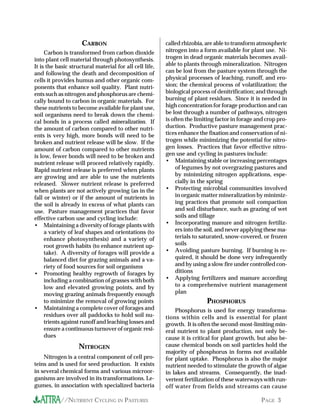
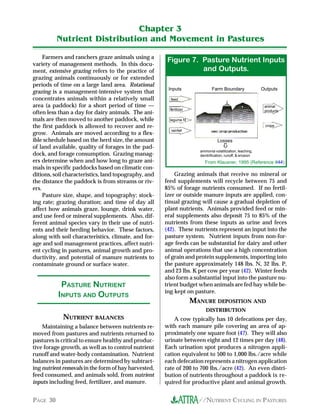
                            .igure 1. Nutrient Cycles in Pastures.

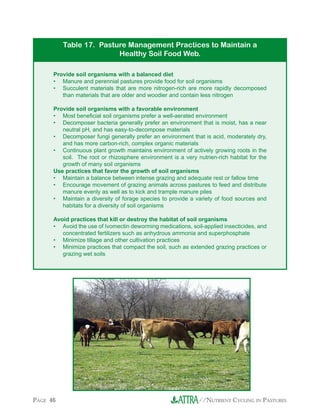
                       Animal Production                                T Manure Production
                     T
                                                                                           T


                                                                                       T
                                                                    Water Infiltration
                                                            TT
                 T


                                                                                T
   Plant Vigor                                                                                 Minimal Soil
                 T               Water Availability T                                       T
          T


                                                                T
                                                     TSoil Organisms
                                                                                                 Erosion
                                                 T


                                                                                                         T
                                                                                                  T
                                      T


                          Nutrient Availability       T       T T
                                                              T
                                                                                                          T


                                                                                T
                                               T
                                   T


                                                                                   Soil Organic Matter
                                                               T


                                                                                                T
                                           T              Legumes            T
                                Nutrient
                             Mineralization                           T                  T Plant Cover
                                                   Soil Porosity/


                                                                                             T
                                                Minimal Compaction


Healthy plant growth provides plant cover over the entire pasture. Cover from growing plants and plant residues protects
the soil against erosion while returning organic matter to the soil. Organic matter provides food for soil organisms that
mineralize nutrients from these materials and produce gels and other substances that enhance water infiltration and the
capacity of soil to hold water and nutrients.

     Effective use and cycling of nutrients is                 practices that facilitate water movement into the
critical for pasture productivity. As indicated in             soil and build the soil’s water holding capacity
Figure 1 above, nutrient cycles are complex and                will conserve water for plant growth and ground-
interrelated. This document is designed to help                water recharge, while minimizing water's poten-
you understand the unique components of wa-                    tial to cause nutrient losses. Water-conserving
ter, carbon, nitrogen, and phosphorus cycles and               pasture management practices include:
how these cycles interact with one another. This               • Minimizing soil compaction by not overgraz-
information will help you to monitor your pas-                      ing pastures or using paddocks that have wet
tures for breakdowns in nutrient cycling pro-                       or saturated soils
cesses, and identify and implement pasture man-                • Maintaining a complete cover of forages and
agement practices to optimize the efficiency of                     residues over all paddocks by not overgraz-
nutrient cycling.                                                   ing pastures and by implementing practices
                         WATER                                      that encourage animal movement across each
    Water is necessary for plant growth, for dis-                   paddock
solving and transporting plant nutrients, and for              • Ensuring that forage plants include a diver-
the survival of soil organisms. Water can also be a                 sity of grass and legume species with a vari-
destructive force, causing soil compaction, nutri-                  ety of root systems capable of obtaining wa-
ent leaching, runoff, and erosion. Management                       ter and nutrients throughout the soil profile


PAGE 2                                                                        //NUTRIENT CYCLING IN PASTURES
CARBON                              called rhizobia, are able to transform atmospheric
     Carbon is transformed from carbon dioxide           nitrogen into a form available for plant use. Ni-
into plant cell material through photosynthesis.         trogen in dead organic materials becomes avail-
It is the basic structural material for all cell life,   able to plants through mineralization. Nitrogen
and following the death and decomposition of             can be lost from the pasture system through the
cells it provides humus and other organic com-           physical processes of leaching, runoff, and ero-
ponents that enhance soil quality. Plant nutri-          sion; the chemical process of volatilization; the
ents such as nitrogen and phosphorus are chemi-          biological process of denitrification; and through
cally bound to carbon in organic materials. For          burning of plant residues. Since it is needed in
these nutrients to become available for plant use,       high concentration for forage production and can
soil organisms need to break down the chemi-             be lost through a number of pathways, nitrogen
cal bonds in a process called mineralization. If         is often the limiting factor in forage and crop pro-
the amount of carbon compared to other nutri-            duction. Productive pasture management prac-
ents is very high, more bonds will need to be            tices enhance the fixation and conservation of ni-
broken and nutrient release will be slow. If the         trogen while minimizing the potential for nitro-
amount of carbon compared to other nutrients             gen losses. Practices that favor effective nitro-
is low, fewer bonds will need to be broken and           gen use and cycling in pastures include:
nutrient release will proceed relatively rapidly.        • Maintaining stable or increasing percentages
Rapid nutrient release is preferred when plants               of legumes by not overgrazing pastures and
are growing and are able to use the nutrients                 by minimizing nitrogen applications, espe-
released. Slower nutrient release is preferred                cially in the spring
when plants are not actively growing (as in the          • Protecting microbial communities involved
fall or winter) or if the amount of nutrients in              in organic matter mineralization by minimiz-
the soil is already in excess of what plants can              ing practices that promote soil compaction
use. Pasture management practices that favor                  and soil disturbance, such as grazing of wet
effective carbon use and cycling include:                     soils and tillage
• Maintaining a diversity of forage plants with          • Incorporating manure and nitrogen fertiliz-
     a variety of leaf shapes and orientations (to            ers into the soil, and never applying these ma-
     enhance photosynthesis) and a variety of                 terials to saturated, snow-covered, or frozen
     root growth habits (to enhance nutrient up-              soils
     take). A diversity of forages will provide a        • Avoiding pasture burning. If burning is re-
     balanced diet for grazing animals and a va-              quired, it should be done very infrequently
     riety of food sources for soil organisms                 and by using a slow fire under controlled con-
• Promoting healthy regrowth of forages by                    ditions
     including a combination of grasses with both        • Applying fertilizers and manure according
     low and elevated growing points, and by                  to a comprehensive nutrient management
     moving grazing animals frequently enough                 plan
     to minimize the removal of growing points                            PHOSPHORUS
• Maintaining a complete cover of forages and                Phosphorus is used for energy transforma-
     residues over all paddocks to hold soil nu-         tions within cells and is essential for plant
     trients against runoff and leaching losses and      growth. It is often the second-most-limiting min-
     ensure a continuous turnover of organic resi-       eral nutrient to plant production, not only be-
     dues                                                cause it is critical for plant growth, but also be-
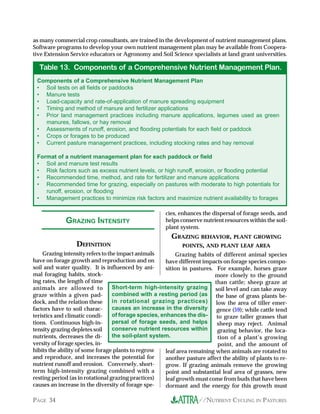
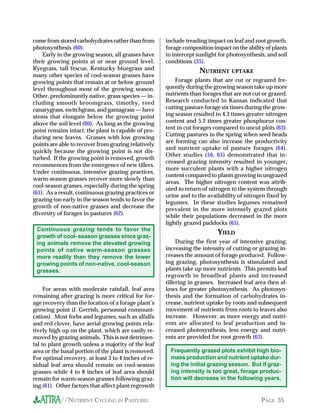
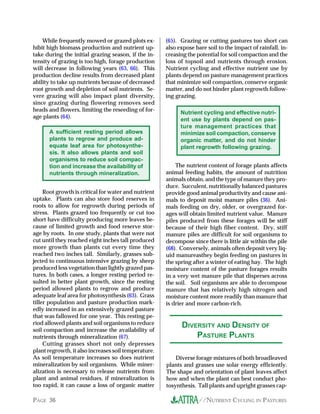
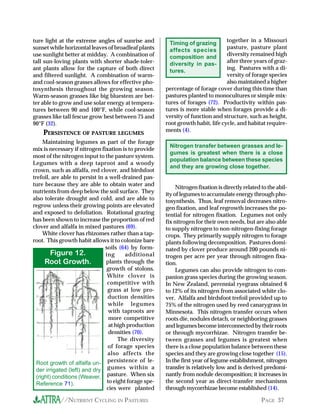
                   NITROGEN                              cause chemical bonds on soil particles hold the
                                                         majority of phosphorus in forms not available
    Nitrogen is a central component of cell pro-         for plant uptake. Phosphorus is also the major
teins and is used for seed production. It exists         nutrient needed to stimulate the growth of algae
in several chemical forms and various microor-           in lakes and streams. Consequently, the inad-
ganisms are involved in its transformations. Le-         vertent fertilization of these waterways with run-
gumes, in association with specialized bacteria          off water from fields and streams can cause

           //NUTRIENT CYCLING IN PASTURES                                                        PAGE 3
degradation of water quality for drinking, recre-
ational, or wildlife habitat uses. Regulations on
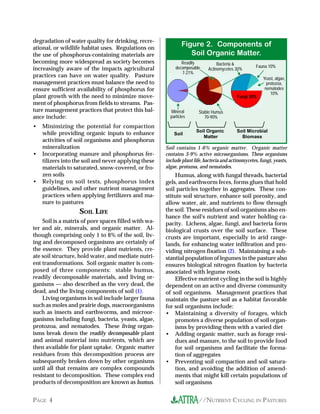
                                                              .igure 2. Components of
the use of phosphorus-containing materials are                   Soil Organic Matter.
becoming more widespread as society becomes                   Readily           Bacteria &
                                                           decomposable                             Fauna 10%
increasingly aware of the impacts agricultural                             Actinomycetes 30%
                                                              7-21%
practices can have on water quality. Pasture


                                                                                         T


                                                                                                    T
                                                                                                        Yeast, algae,


                                                                           T
                                                                           T
management practices must balance the need to                                                       T     protozoa,
ensure sufficient availability of phosphorus for                                                         nematodes
                                                                                                            10%
plant growth with the need to minimize move-                                              Fungi 50%
ment of phosphorus from fields to streams. Pas-


                                                                               T
                                                           T
ture management practices that protect this bal-        Mineral       Stable Humus
ance include:                                           particles        70-90%

•   Minimizing the potential for compaction
                                                                     Soil Organic         Soil Microbial
    while providing organic inputs to enhance             Soil
                                                                        Matter              Biomass
    activities of soil organisms and phosphorus
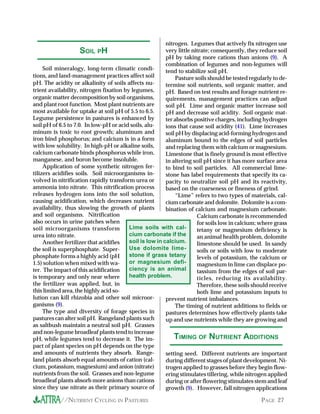
    mineralization                                    Soil contains 1-6% organic matter. Organic matter
•   Incorporating manure and phosphorus fer-          contains 3-9% active microorganisms. These organisms
    tilizers into the soil and never applying these   include plant life, bacteria and actinomycetes, fungi, yeasts,
    materials to saturated, snow-covered, or fro-     algae, protozoa, and nematodes.
    zen soils                                             Humus, along with fungal threads, bacterial
•   Relying on soil tests, phosphorus index           gels, and earthworm feces, forms glues that hold
    guidelines, and other nutrient management         soil particles together in aggregates. These con-
    practices when applying fertilizers and ma-       stitute soil structure, enhance soil porosity, and
    nure to pastures                                  allow water, air, and nutrients to flow through
                   SOIL LIFE                          the soil. These residues of soil organisms also en-
                                                      hance the soil's nutrient and water holding ca-
    Soil is a matrix of pore spaces filled with wa-   pacity. Lichens, algae, fungi, and bacteria form
ter and air, minerals, and organic matter. Al-        biological crusts over the soil surface. These
though comprising only 1 to 6% of the soil, liv-      crusts are important, especially in arid range-
ing and decomposed organisms are certainly of         lands, for enhancing water infiltration and pro-
the essence. They provide plant nutrients, cre-       viding nitrogen fixation (2). Maintaining a sub-
ate soil structure, hold water, and mediate nutri-    stantial population of legumes in the pasture also
ent transformations. Soil organic matter is com-      ensures biological nitrogen fixation by bacteria
posed of three components: stable humus,              associated with legume roots.
readily decomposable materials, and living or-            Effective nutrient cycling in the soil is highly
ganisms — also described as the very dead, the        dependent on an active and diverse community
dead, and the living components of soil (1).          of soil organisms. Management practices that
    Living organisms in soil include larger fauna     maintain the pasture soil as a habitat favorable
such as moles and prairie dogs, macroorganisms        for soil organisms include:
such as insects and earthworms, and microor-          • Maintaining a diversity of forages, which
ganisms including fungi, bacteria, yeasts, algae,         promotes a diverse population of soil organ-
protozoa, and nematodes. These living organ-              isms by providing them with a varied diet
isms break down the readily decomposable plant        • Adding organic matter, such as forage resi-
and animal material into nutrients, which are             dues and manure, to the soil to provide food
then available for plant uptake. Organic matter           for soil organisms and facilitate the forma-
residues from this decomposition process are              tion of aggregates
subsequently broken down by other organisms           • Preventing soil compaction and soil satura-
until all that remains are complex compounds              tion, and avoiding the addition of amend-
resistant to decomposition. These complex end             ments that might kill certain populations of
products of decomposition are known as humus.             soil organisms


PAGE 4                                                                //NUTRIENT CYCLING IN PASTURES
Publication Overview
This publication is divided into five chapters:

1.   Nutrient cycle components, interactions, and transformations
2.   Nutrient availability in pastures
3.   Nutrient distribution and movement in pastures
4.   The soil food web and pasture soil quality
5.   Pasture management and water quality

    The first chapter provides an overview of nutrient cycles critical to plant production and water-
quality protection: the water, carbon, nitrogen, phosphorus, and secondary-nutrient cycles. The
components of each cycle are explained, with emphasis on how these components are affected by
pasture management practices. The description of each cycle concludes with a summary of pasture
management practices to enhance efficient cycling of that nutrient.
    The second chapter focuses on the effects of soil chemistry, mineralogy, and land-management
practices on nutrient cycle transformations and nutrient availability. Management impacts discussed
include soil compaction, organic matter additions and losses, effects on soil pH, and consequences of
the method and timing of nutrient additions. The chapter concludes with a summary of pasture
management practices for enhancing nutrient availability in pastures.
    The third chapter discusses nutrient balances in grazed pastures and the availability of manure,
residue, and fertilizer nutrients to forage growth. Factors affecting nutrient availability include nutri-
ent content and consistency of manure; manure distribution as affected by paddock location and
layout; and forage diversity. These factors, in turn, affect grazing intensity and pasture regrowth. A
graph at the end of the chapter illustrates the interactions among these factors.
    The fourth chapter describes the diversity of organisms involved in decomposing plant residues
and manure in pastures, and discusses the impact of soil biological activity on nutrient cycles and
forage production. The impacts of pasture management on the activity of soil organisms are ex-
plained. A soil health card developed for pastures provides a tool for qualitatively assessing the
soil’s ability to support healthy populations of soil organisms.
    The publication concludes with a discussion of pasture management practices and their effects on
water quality, soil erosion, water runoff, and water infiltration. Several topical water concerns are
discussed: phosphorus runoff and eutrophication, nutrient and pathogen transport through subsur-
face drains, buffer management, and riparian grazing practices. A guide for assessing potential wa-
ter-quality impacts from pasture-management practices concludes this final chapter.


           //NUTRIENT CYCLING IN PASTURES                                                      PAGE 5
Chapter 1
                        Nutrient Cycle Components,
                     Interactions, and Transformations
    The water, carbon, nitrogen, phosphorus, and sulfur cycles are the most important nutrient cycles
operating in pasture systems. Each cycle has its complex set of interactions and transformations as
well as interactions with the other cycles. The water cycle is essential for photosynthesis and the
transport of nutrients to plant roots and through plant stems. It also facilitates nutrient loss through
leaching, runoff, and erosion. The carbon cycle forms the basis for cell formation and soil quality. It
begins with photosynthesis and includes respiration, mineralization, immobilization, and humus
formation. Atmospheric nitrogen is fixed into plant-available nitrate by one type of bacteria, con-
verted from ammonia to nitrate by another set of bacteria, and released back to the atmosphere by yet
another group. A variety of soil organisms are involved in decomposition processes that release or
mineralize nitrogen, phosphorus, sulfur, and other nutrients from plant residues and manure. Bal-
ances in the amount of these nutrients within organic materials, along with temperature and mois-
ture conditions, determine which organisms are involved in the decomposition process and the rate
at which it proceeds.
    Pasture management practices influence the interactions and transformations occurring within
nutrient cycles. The efficiency of these cycles, in turn, influences the productivity of forage growth
and the productivity of animals feeding on the forage. This chapter examines each of these cycles in
detail and provides management guidelines for enhancing their efficiency.


                                           WATER CYCLE

    Water is critical for pasture productivity. It    small, these soils can easily become compacted.
dissolves soil nutrients and moves them to plant      Sandy soils are porous and allow water to enter
roots. Inside plants, water and the dissolved nu-     easily, but do not hold water and nutrients
trients support cell growth and photosynthesis.       against leaching. Organic matter in soil absorbs
In the soil, water supports the growth and re-        water and nutrients, reduces soil compaction,
production of insects and microorganisms that         and increases soil porosity. A relatively small
decompose organic matter. Water also can de-          increase in the amount of organic matter in soil
grade pastures through runoff, erosion, and           can cause a large increase in the ability of soils to
leaching, which cause nutrient loss and water         use water effectively to support plant produc-
pollution. Pro-                                       tion.
ductive pastures        A forage cover over
                                                                    INFILTRATION AND
are able to absorb      the entire paddock pro-                WATER HOLDING CAPACITY
and use water ef-       motes water infiltration            Water soaks into soils that have a plant or
fectively for plant     and minimizes soil            residue cover over the soil surface. This cover
growth. Good            compaction.                   cushions the fall of raindrops and allows them
pasture manage-                                       to slowly soak into the soil. Roots create pores
ment practices promote water absorption by            that increase the rate at which water can enter
maintaining forage cover over the entire soil sur-    the soil. Long-lived perennial bunch-grass forms
face and by minimizing soil compaction by ani-        deep roots that facilitate water infiltration by con-
mals or equipment.                                    ducting water into the soil (3). Other plant char-
    Geology, soil type, and landscape orientation     acteristics that enhance water infiltration are sig-
affect water absorption by soils and water move-      nificant litter production and large basal cover-
ment through soils. Sloping land encourages           age (4). In northern climates where snow pro-
water runoff and erosion; depressions and             vides a substantial portion of the annual water
footslopes are often wet since water from upslope     budget, maintaining taller grasses and shrubs
collects in these areas. Clay soils absorb water      that can trap and hold snow will enhance water
and nutrients, but since clay particles are very      infiltration.

PAGE 6                                                              //NUTRIENT CYCLING IN PASTURES
.igure 3. Water Cycle.
                                   Rainfall
                                              T
                                                         Water vapor


                                                         T
                                               T
                                                              Evaporation

                                              Transpiration
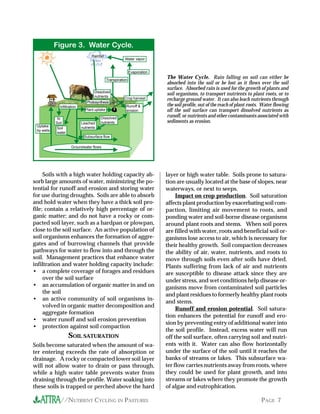
                                                                            The Water Cycle. Rain falling on soil can either be
                                                                            absorbed into the soil or be lost as it flows over the soil
                                                                            surface. Absorbed rain is used for the growth of plants and
                                                             T
                                     Dissolved
                                     nutrients
                                                                            soil organisms, to transport nutrients to plant roots, or to
                             T Photosynthesis T Crop harvest T
                                                  TRunoff &
                                                                            recharge ground water. It can also leach nutrients through
                                                                            the soil profile, out of the reach of plant roots. Water flowing
                             TPlant uptake T
              Infiltration
      T


                                                   erosion                  off the soil surface can transport dissolved nutrients as
            T


                                   T Dissolved T
             to
                                                                            runoff, or nutrients and other contaminants associated with
               T


            Soil             Leached T  nutrients                           sediments as erosion.
 Uptake                      nutrients
             Soil
 by wells
             water
                      T


                                                 T
                               Subsurface flow
                       T


                                                 T
                      Groundwater flows


     Soils with a high water holding capacity ab-                           layer or high water table. Soils prone to satura-
sorb large amounts of water, minimizing the po-                             tion are usually located at the base of slopes, near
tential for runoff and erosion and storing water                            waterways, or next to seeps.
for use during droughts. Soils are able to absorb                                Impact on crop production. Soil saturation
and hold water when they have a thick soil pro-                             affects plant production by exacerbating soil com-
file; contain a relatively high percentage of or-                           paction, limiting air movement to roots, and
ganic matter; and do not have a rocky or com-                               ponding water and soil-borne disease organisms
pacted soil layer, such as a hardpan or plowpan,                            around plant roots and stems. When soil pores
close to the soil surface. An active population of                          are filled with water, roots and beneficial soil or-
soil organisms enhances the formation of aggre-                             ganisms lose access to air, which is necessary for
gates and of burrowing channels that provide                                their healthy growth. Soil compaction decreases
pathways for water to flow into and through the                             the ability of air, water, nutrients, and roots to
soil. Management practices that enhance water                               move through soils even after soils have dried.
infiltration and water holding capacity include:                            Plants suffering from lack of air and nutrients
• a complete coverage of forages and residues                               are susceptible to disease attack since they are
     over the soil surface                                                  under stress, and wet conditions help disease or-
• an accumulation of organic matter in and on                               ganisms move from contaminated soil particles
     the soil                                                               and plant residues to formerly healthy plant roots
• an active community of soil organisms in-
                                                                            and stems.
     volved in organic matter decomposition and
                                                                                 Runoff and erosion potential. Soil satura-
     aggregate formation
                                                                            tion enhances the potential for runoff and ero-
• water runoff and soil erosion prevention
                                                                            sion by preventing entry of additional water into
• protection against soil compaction
                                                                            the soil profile. Instead, excess water will run
                     SOIL SATURATION                                        off the soil surface, often carrying soil and nutri-
Soils become saturated when the amount of wa-                               ents with it. Water can also flow horizontally
ter entering exceeds the rate of absorption or                              under the surface of the soil until it reaches the
drainage. A rocky or compacted lower soil layer                             banks of streams or lakes. This subsurface wa-
will not allow water to drain or pass through,                              ter flow carries nutrients away from roots, where
while a high water table prevents water from                                they could be used for plant growth, and into
draining through the profile. Water soaking into                            streams or lakes where they promote the growth
these soils is trapped or perched above the hard                            of algae and eutrophication.

              //NUTRIENT CYCLING IN PASTURES                                                                                 PAGE 7
Artificial drainage practices are often used      tures is remediated by root growth, aggregate
on soils with a hardpan or a high water table to       formation, and activities of burrowing soil organ-
decrease the duration of soil saturation follow-       isms. In colder climates, frost heaving is an im-
ing rainfalls or snowmelts. This practice can in-      portant recovery process for compacted soils (8).
crease water infiltration and decrease the poten-                  RUNOFF AND EROSION
tial for water runoff (5). Unfortunately, most sub-
surface drains were installed before water pollu-           Runoff water dissolves nutrients and removes
tion from agriculture became a concern and thus        them from the pasture as it flows over the soil
empty directly into drainage ways. Nutrients,          surface. Soil erosion transports nutrients and any
pathogens, and other contaminants on the soil          contaminants, such as pesticides and pathogens,
surface can move through large cracks or chan-         attached to soil particles. Because nutrient-rich
nels in the soil to drainage pipes where they are      clay and organic matter particles are small and
carried to surface water bodies (6).                   lightweight, they are more readily picked up and
                                                       moved by water than the nutrient-poor, but
              SOIL COMPACTION                          heavier, sand particles. Besides depleting pas-
      Soil compaction occurs when animals or           tures of nutrients that could be used for forage
equipment move across soils that are wet or satu-      production, runoff water and erosion carry nu-
rated, with moist soils being more easily com-         trients and sediments that contaminate lakes,
pacted than saturated soils (7). Compaction can        streams, and rivers.
also occur when animals or equipment continu-               Landscape condi- Runoff water and ero-
ally move across a laneway or stand around wa-         tions and manage- sion carry nutrients
tering tanks and headlands or under shade. Ani-        ment practices that and sediments that
mals trampling over the ground press down on           favor runoff and ero- contaminate lakes,
soils, squeezing soil pore spaces together. Tram-      sion include sloping streams, and rivers.
pling also increases the potential for compaction      areas, minimal soil
by disturbing and killing vegetation.                  protection by forage or residues, intense rainfall,
     Soils not covered by forages or residues are      and saturated soils. While pasture managers
easily compacted by the impact of raindrops.           should strive to maintain a complete forage cover
When raindrops fall on bare soil, their force causes   over the soil surface, this is not feasible in prac-
fine soil particles to splash or disperse. These       tice because of plant growth habits and land-
splash particles land on the soil surface, clog sur-   scape characteristics. Plant residues from die-
                                  face soil pores,     back and animal wastage during grazing provide
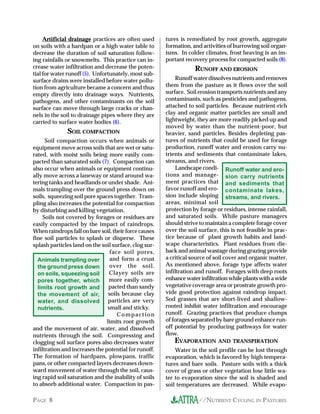
  Animals trampling over          and form a crust     a critical source of soil cover and organic matter.
  the ground press down          over the soil.        As mentioned above, forage type affects water
  on soils, squeezing soil       Clayey soils are      infiltration and runoff. Forages with deep roots
  pores together, which          more easily com-      enhance water infiltration while plants with a wide
  limits root growth and         pacted than sandy     vegetative coverage area or prostrate growth pro-
  the movement of air,           soils because clay    vide good protection against raindrop impact.
  water, and dissolved particles are very              Sod grasses that are short-lived and shallow-
  nutrients.                    small and sticky.      rooted inhibit water infiltration and encourage
                                     Compaction        runoff. Grazing practices that produce clumps
                                limits root growth     of forages separated by bare ground enhance run-
and the movement of air, water, and dissolved          off potential by producing pathways for water
nutrients through the soil. Compressing and            flow.
clogging soil surface pores also decreases water          EVAPORATION AND TRANSPIRATION
infiltration and increases the potential for runoff.       Water in the soil profile can be lost through
The formation of hardpans, plowpans, traffic           evaporation, which is favored by high tempera-
pans, or other compacted layers decreases down-        tures and bare soils. Pasture soils with a thick
ward movement of water through the soil, caus-         cover of grass or other vegetation lose little wa-
ing rapid soil saturation and the inability of soils   ter to evaporation since the soil is shaded and
to absorb additional water. Compaction in pas-         soil temperatures are decreased. While evapo-

PAGE 8                                                               //NUTRIENT CYCLING IN PASTURES
ration affects only the top few inches of pasture     This is because forage species differ in their abil-
soils, transpiration can drain water from the en-     ity to extract water from the soil and conserve it
tire soil profile. Transpiration is the loss of wa-   against transpiration (9). Some invasive plant
ter from plants through stomata in their leaves.      species, however, can deplete water stores
Especially on sunny and breezy days, significant      through their high water use (4). Water not used
amounts of water can be absorbed from the soil        for immediate plant uptake is held within the soil
by plant roots, taken up through the plant, and       profile or is transported to groundwater reserves,
lost to the atmosphere through transpiration. A       which supply wells with water and decrease the
diversity of forage plants will decrease transpi-     impacts of drought.
ration losses and increase water-use efficiency.


                            Table 1. Water Cycle Monitoring.
  If you answer no to all the questions, you have soils with high water-use efficiency. If
  you answer yes to some of the questions, water cycle efficiency of your soil will likely
  respond to improved pasture management practices. See Table 2, next page.

                                                                                           YES      NO

   Water infiltration / Water runoff
   1. Do patches of bare ground separate forage coverage?
________________________________________________________________________________
   2. Are shallow-rooted sod grasses the predominant forage cover?
________________________________________________________________________________
   3. Can you see small waterways during heavy rainfalls or sudden snowmelts?
________________________________________________________________________________
   4. Are rivulets and gullies present on the land?
________________________________________________________________________________
   Soil saturation
   5. Following a rainfall, is soil muddy or are you able to squeeze water
      out of a handful of soil?
________________________________________________________________________________
   6. Following a rainfall or snowmelt, does it take several days before the
      soil is no longer wet and muddy?
________________________________________________________________________________
   7. Do forages turn yellow or die during wet weather?
________________________________________________________________________________
   Soil compaction
   8. Do you graze animals on wet pastures?
________________________________________________________________________________
   9. Are some soils in the pasture bare, hard, and crusty?
________________________________________________________________________________
   10. Do you have difficulty driving a post into (non-rocky) soils?
________________________________________________________________________________
   Water retention /Water evaporation and transpiration
   11. Do you have a monoculture of forages or are invasive species prominent
       components of the pasture?
________________________________________________________________________________
   12. Do soils dry out quickly following a rainstorm?
________________________________________________________________________________
   13. During a drought, do plants dry up quickly?


           //NUTRIENT CYCLING IN PASTURES                                                     PAGE 9
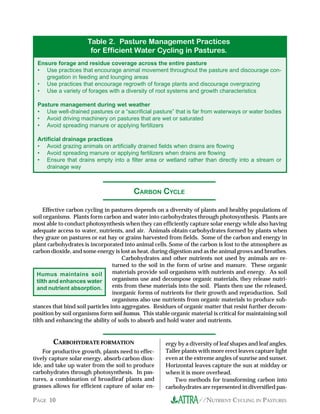
Table 2. Pasture Management Practices
                       for Efficient Water Cycling in Pastures.
 Ensure forage and residue coverage across the entire pasture
 • Use practices that encourage animal movement throughout the pasture and discourage con-
    gregation in feeding and lounging areas
 • Use practices that encourage regrowth of forage plants and discourage overgrazing
 • Use a variety of forages with a diversity of root systems and growth characteristics

 Pasture management during wet weather
 • Use well-drained pastures or a “sacrificial pasture” that is far from waterways or water bodies
 • Avoid driving machinery on pastures that are wet or saturated
 • Avoid spreading manure or applying fertilizers

 Artificial drainage practices
 • Avoid grazing animals on artificially drained fields when drains are flowing
 • Avoid spreading manure or applying fertilizers when drains are flowing
 • Ensure that drains empty into a filter area or wetland rather than directly into a stream or
     drainage way


                                         CARBON CYCLE

     Effective carbon cycling in pastures depends on a diversity of plants and healthy populations of
soil organisms. Plants form carbon and water into carbohydrates through photosynthesis. Plants are
most able to conduct photosynthesis when they can efficiently capture solar energy while also having
adequate access to water, nutrients, and air. Animals obtain carbohydrates formed by plants when
they graze on pastures or eat hay or grains harvested from fields. Some of the carbon and energy in
plant carbohydrates is incorporated into animal cells. Some of the carbon is lost to the atmosphere as
carbon dioxide, and some energy is lost as heat, during digestion and as the animal grows and breathes.
                                      Carbohydrates and other nutrients not used by animals are re-
                                  turned to the soil in the form of urine and manure. These organic
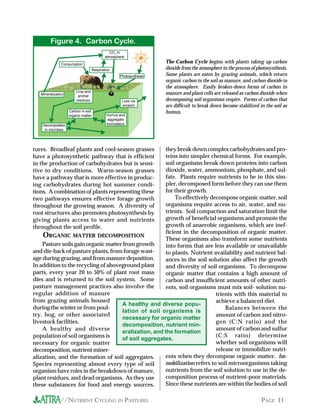
  Humus maintains soil            materials provide soil organisms with nutrients and energy. As soil
  tilth and enhances water        organisms use and decompose organic materials, they release nutri-
  and nutrient absorption.        ents from these materials into the soil. Plants then use the released,
                                  inorganic forms of nutrients for their growth and reproduction. Soil
                                  organisms also use nutrients from organic materials to produce sub-
stances that bind soil particles into aggregates. Residues of organic matter that resist further decom-
position by soil organisms form soil humus. This stable organic material is critical for maintaining soil
tilth and enhancing the ability of soils to absorb and hold water and nutrients.


        CARBOHYDRATE FORMATION                        ergy by a diversity of leaf shapes and leaf angles.
    For productive growth, plants need to effec-      Taller plants with more erect leaves capture light
tively capture solar energy, absorb carbon diox-      even at the extreme angles of sunrise and sunset.
ide, and take up water from the soil to produce       Horizontal leaves capture the sun at midday or
carbohydrates through photosynthesis. In pas-         when it is more overhead.
tures, a combination of broadleaf plants and              Two methods for transforming carbon into
grasses allows for efficient capture of solar en-     carbohydrates are represented in diversified pas-

PAGE 10                                                             //NUTRIENT CYCLING IN PASTURES
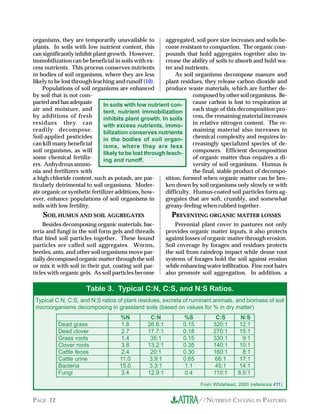
.igure 4. Carbon Cycle.
                                       T      CO2 in
                                            atmosphere


                                        T T
               Consumption
                                                                     The Carbon Cycle begins with plants taking up carbon
                                                                     dioxide from the atmosphere in the process of photosynthesis.


                                                             T
                                    Respiration


                           T
                                                    Photosynthesis   Some plants are eaten by grazing animals, which return


                                              T
                                                  T                  organic carbon to the soil as manure, and carbon dioxide to
                                                                     the atmosphere. Easily broken-down forms of carbon in
                         Crop and
   Mineralization         animal
                                                                     manure and plant cells are released as carbon dioxide when
                         residues                     Loss via   T   decomposing soil organisms respire. Forms of carbon that

                    Carbon in soil
                                                  T   erosion        are difficult to break down become stabilized in the soil as
                                                                     humus.
                    organic matter
                     T              T       Humus and
      T


                                             aggregate
                                      T
                     T


    Decomposition                           formulation
                    T


                                        T
     in microbes


tures. Broadleaf plants and cool-season grasses        they break down complex carbohydrates and pro-
have a photosynthetic pathway that is efficient        teins into simpler chemical forms. For example,
in the production of carbohydrates but is sensi-       soil organisms break down proteins into carbon
tive to dry conditions. Warm-season grasses            dioxide, water, ammonium, phosphate, and sul-
have a pathway that is more effective in produc-       fate. Plants require nutrients to be in this sim-
ing carbohydrates during hot summer condi-             pler, decomposed form before they can use them
tions. A combination of plants representing these      for their growth.
two pathways ensures effective forage growth                To effectively decompose organic matter, soil
throughout the growing season. A diversity of          organisms require access to air, water, and nu-
root structures also promotes photosynthesis by        trients. Soil compaction and saturation limit the
giving plants access to water and nutrients            growth of beneficial organisms and promote the
throughout the soil profile.                           growth of anaerobic organisms, which are inef-
                                                       ficient in the decomposition of organic matter.
    ORGANIC MATTER DECOMPOSITION                       These organisms also transform some nutrients
    Pasture soils gain organic matter from growth      into forms that are less available or unavailable
and die-back of pasture plants, from forage wast-      to plants. Nutrient availability and nutrient bal-
age during grazing, and from manure deposition.        ances in the soil solution also affect the growth
In addition to the recycling of aboveground plant      and diversity of soil organisms. To decompose
parts, every year 20 to 50% of plant root mass         organic matter that contains a high amount of
dies and is returned to the soil system. Some          carbon and insufficient amounts of other nutri-
pasture management practices also involve the          ents, soil organisms must mix soil- solution nu-
regular addition of manure                                                   trients with this material to
from grazing animals housed                                                  achieve a balanced diet.
                                     A healthy and diverse popu-
during the winter or from poul-                                                  Balances between the
                                     lation of soil organisms is
try, hog, or other associated                                                amount of carbon and nitro-
                                     necessary for organic matter
livestock facilities.                                                        gen (C:N ratio) and the
                                     decomposition, nutrient min-
    A healthy and diverse                                                    amount of carbon and sulfur
                                     eralization, and the formation
population of soil organisms is                                              (C:S ratio) determine
                                     of soil aggregates.
necessary for organic matter                                                 whether soil organisms will
decomposition, nutrient miner-                                               release or immobilize nutri-
alization, and the formation of soil aggregates.       ents when they decompose organic matter. Im-
Species representing almost every type of soil         mobilization refers to soil microorganisms taking
organism have roles in the breakdown of manure,        nutrients from the soil solution to use in the de-
plant residues, and dead organisms. As they use        composition process of nutrient-poor materials.
these substances for food and energy sources,          Since these nutrients are within the bodies of soil

               //NUTRIENT CYCLING IN PASTURES                                                                        PAGE 11
organisms, they are temporarily unavailable to          aggregated, soil pore size increases and soils be-
plants. In soils with low nutrient content, this        come resistant to compaction. The organic com-
can significantly inhibit plant growth. However,        pounds that hold aggregates together also in-
immobilization can be beneficial in soils with ex-      crease the ability of soils to absorb and hold wa-
cess nutrients. This process conserves nutrients        ter and nutrients.
in bodies of soil organisms, where they are less             As soil organisms decompose manure and
likely to be lost through leaching and runoff (10).     plant residues, they release carbon dioxide and
    Populations of soil organisms are enhanced          produce waste materials, which are further de-
by soil that is not com-                                            composed by other soil organisms. Be-
pacted and has adequate        In soils with low nutrient con-      cause carbon is lost to respiration at
air and moisture, and          tent, nutrient immobilization        each stage of this decomposition pro-
by additions of fresh          inhibits plant growth. In soils      cess, the remaining material increases
residues they can              with excess nutrients, immo-         in relative nitrogen content. The re-
readily decompose.             bilization conserves nutrients       maining material also increases in
Soil-applied pesticides        in the bodies of soil organ-         chemical complexity and requires in-
can kill many beneficial       isms, where they are less            creasingly specialized species of de-
soil organisms, as will        likely to be lost through leach-     composers. Efficient decomposition
some chemical fertiliz-        ing and runoff.                      of organic matter thus requires a di-
ers. Anhydrous ammo-                                                versity of soil organisms. Humus is
nia and fertilizers with                                            the final, stable product of decompo-
a high chloride content, such as potash, are par-       sition, formed when organic matter can be bro-
ticularly detrimental to soil organisms. Moder-         ken down by soil organisms only slowly or with
ate organic or synthetic fertilizer additions, how-     difficulty. Humus-coated soil particles form ag-
ever, enhance populations of soil organisms in          gregates that are soft, crumbly, and somewhat
soils with low fertility.                               greasy-feeling when rubbed together.
    SOIL HUMUS AND SOIL AGGREGATES                       PREVENTING ORGANIC MATTER LOSSES
     Besides decomposing organic materials, bac-           Perennial plant cover in pastures not only
teria and fungi in the soil form gels and threads      provides organic matter inputs, it also protects
that bind soil particles together. These bound         against losses of organic matter through erosion.
particles are called soil aggregates. Worms,           Soil coverage by forages and residues protects
beetles, ants, and other soil organisms move par-      the soil from raindrop impact while dense root
tially decomposed organic matter through the soil      systems of forages hold the soil against erosion
or mix it with soil in their gut, coating soil par-    while enhancing water infiltration. Fine root hairs
ticles with organic gels. As soil particles become     also promote soil aggregation. In addition, a

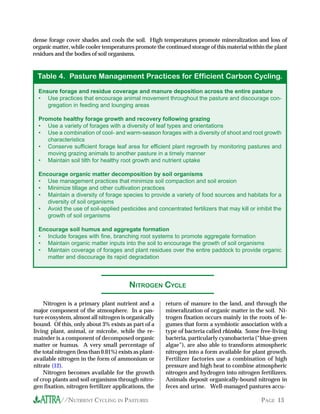
                      Table 3. Typical C:N, C:S, and N:S Ratios.
 Typical C:N, C:S, and N:S ratios of plant residues, excreta of ruminant animals, and biomass of soil
 microorganisms decomposing in grassland soils (based on values for % in dry matter)
                              %N        C:N       %S        C:S     N:S
          ______________________________________________________________
           Dead grass         1.8      26.6:1     0.15     320:1   12:1
          ______________________________________________________________
           Dead clover         2.7     17.7:1     0.18     270:1   15:1
          ______________________________________________________________
           Grass roots        1.4       35:1      0.15     330:1     9:1
          ______________________________________________________________
           Clover roots        3.8     13.2:1     0.35     140:1   10:1
          ______________________________________________________________
           Cattle feces       2.4       20:1      0.30     160:1     8:1
          ______________________________________________________________
           Cattle urine       11.0      3.9:1     0.65      66:1   17:1
          ______________________________________________________________
           Bacteria           15.0     3.3:1      1.1       45:1   14:1
          ______________________________________________________________
           Fungi              3.4      12.9:1     0.4      110:1   8.5:1
                                                                     From Whitehead, 2000 (reference #11)


PAGE 12                                                              //NUTRIENT CYCLING IN PASTURES
dense forage cover shades and cools the soil. High temperatures promote mineralization and loss of
organic matter, while cooler temperatures promote the continued storage of this material within the plant
residues and the bodies of soil organisms.


 Table 4. Pasture Management Practices for Efficient Carbon Cycling.
  Ensure forage and residue coverage and manure deposition across the entire pasture
  • Use practices that encourage animal movement throughout the pasture and discourage con-
     gregation in feeding and lounging areas

  Promote healthy forage growth and recovery following grazing
  • Use a variety of forages with a diversity of leaf types and orientations
  • Use a combination of cool- and warm-season forages with a diversity of shoot and root growth
     characteristics
  • Conserve sufficient forage leaf area for efficient plant regrowth by monitoring pastures and
     moving grazing animals to another pasture in a timely manner
  • Maintain soil tilth for healthy root growth and nutrient uptake

  Encourage organic matter decomposition by soil organisms
  • Use management practices that minimize soil compaction and soil erosion
  • Minimize tillage and other cultivation practices
  • Maintain a diversity of forage species to provide a variety of food sources and habitats for a
     diversity of soil organisms
  • Avoid the use of soil-applied pesticides and concentrated fertilizers that may kill or inhibit the
     growth of soil organisms

  Encourage soil humus and aggregate formation
  • Include forages with fine, branching root systems to promote aggregate formation
  • Maintain organic matter inputs into the soil to encourage the growth of soil organisms
  • Maintain coverage of forages and plant residues over the entire paddock to provide organic
     matter and discourage its rapid degradation


                                         NITROGEN CYCLE

    Nitrogen is a primary plant nutrient and a          return of manure to the land, and through the
major component of the atmosphere. In a pas-            mineralization of organic matter in the soil. Ni-
ture ecosystem, almost all nitrogen is organically      trogen fixation occurs mainly in the roots of le-
bound. Of this, only about 3% exists as part of a       gumes that form a symbiotic association with a
living plant, animal, or microbe, while the re-         type of bacteria called rhizobia. Some free-living
mainder is a component of decomposed organic            bacteria, particularly cyanobacteria (“blue-green
matter or humus. A very small percentage of             algae”), are also able to transform atmospheric
the total nitrogen (less than 0.01%) exists as plant-   nitrogen into a form available for plant growth.
available nitrogen in the form of ammonium or           Fertilizer factories use a combination of high
nitrate (12).                                           pressure and high heat to combine atmospheric
    Nitrogen becomes available for the growth           nitrogen and hydrogen into nitrogen fertilizers.
of crop plants and soil organisms through nitro-        Animals deposit organically-bound nitrogen in
gen fixation, nitrogen fertilizer applications, the     feces and urine. Well-managed pastures accu-

           //NUTRIENT CYCLING IN PASTURES                                                      PAGE 13
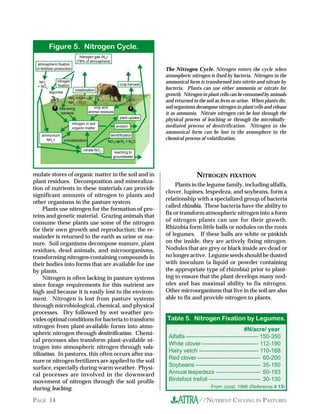
.igure 5. Nitrogen Cycle.
                                Nitrogen gas (N2)
                              (78% of atmosphere)


                                                                         T
  atmospheric fixation
 or fertilizer production                                                    The Nitrogen Cycle. Nitrogen enters the cycle when


                                                             T
                                 T
                                                                             atmospheric nitrogen is fixed by bacteria. Nitrogen in the
   T


   NH4+        nitrogen
                                                          crop harvest
                                                                             ammonical form is transformed into nitrite and nitrate by
               fixation
           T


  + NO3-


                                                                 T
                             volatilization                                  bacteria. Plants can use either ammonia or nitrate for
           legumes
                                                            T                growth. Nitrogen in plant cells can be consumed by animals
                       NH4++ OH-      T                                      and returned to the soil as feces or urine. When plants die,
                                       T
                       NH3 + H2O                     T
              T


                                         crop and                            soil organisms decompose nitrogen in plant cells and release


                                                                   T
                free-living
                 bacteria             animal residues
                                      T                                      it as ammonia. Nitrate nitrogen can be lost through the
                  T T in soil                             plant uptake
                                                                             physical process of leaching or through the microbially-
                                                 T
                                                                      T
               T    nitrogen
                            organic matter              erosion              mediated process of denitrification. Nitrogen in the
   T


                                                                             ammonical form can be lost to the atmosphere in the
                                  T


    ammonium           T                            denitrification
                                                                             chemical process of volatilization.
                                                        TN
      NH4+           immobilization              NO3-            + N2O
                             T
                                                             2
                             T


                                  nitrate NO3-
                                                      leaching to
                                                     groundwater
                                                                         T

mulate stores of organic matter in the soil and in                                          NITROGEN FIXATION
plant residues. Decomposition and mineraliza-
                                                                                  Plants in the legume family, including alfalfa,
tion of nutrients in these materials can provide
                                                                             clover, lupines, lespedeza, and soybeans, form a
significant amounts of nitrogen to plants and
                                                                             relationship with a specialized group of bacteria
other organisms in the pasture system.
                                                                             called rhizobia. These bacteria have the ability to
     Plants use nitrogen for the formation of pro-
                                                                             fix or transform atmospheric nitrogen into a form
teins and genetic material. Grazing animals that
consume these plants use some of the nitrogen                                of nitrogen plants can use for their growth.
for their own growth and reproduction; the re-                               Rhizobia form little balls or nodules on the roots
mainder is returned to the earth as urine or ma-                             of legumes. If these balls are white or pinkish
nure. Soil organisms decompose manure, plant                                 on the inside, they are actively fixing nitrogen.
residues, dead animals, and microorganisms,                                  Nodules that are grey or black inside are dead or
transforming nitrogen-containing compounds in                                no longer active. Legume seeds should be dusted
their bodies into forms that are available for use                           with inoculum (a liquid or powder containing
by plants.                                                                   the appropriate type of rhizobia) prior to plant-
     Nitrogen is often lacking in pasture systems                            ing to ensure that the plant develops many nod-
since forage requirements for this nutrient are                              ules and has maximal ability to fix nitrogen.
high and because it is easily lost to the environ-                           Other microorganisms that live in the soil are also
ment. Nitrogen is lost from pasture systems                                  able to fix and provide nitrogen to plants.
through microbiological, chemical, and physical
processes. Dry followed by wet weather pro-
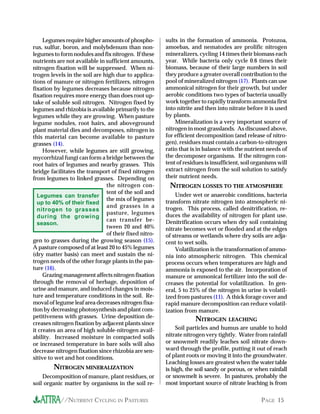
vides optimal conditions for bacteria to transform                           Table 5. Nitrogen .ixation by Legumes.
nitrogen from plant-available forms into atmo-
                                                                                                                    #N/acre/ year
spheric nitrogen through denitrification. Chemi-
                                                                              Alfalfa -------------------------------------- 150-350
cal processes also transform plant-available ni-
                                                                              White clover ------------------------------ 112-190
trogen into atmospheric nitrogen through vola-
                                                                              Hairy vetch ------------------------------- 110-168
tilization. In pastures, this often occurs after ma-
                                                                              Red clover --------------------------------- 60-200
nure or nitrogen fertilizers are applied to the soil
surface, especially during warm weather. Physi-                               Soybeans ---------------------------------- 35-150
cal processes are involved in the downward                                    Annual lespedeza ----------------------- 50-193
movement of nitrogen through the soil profile                                 Birdsfoot trefoil --------------------------- 30-130
during leaching.                                                                                   From Joost, 1996 (Reference # 13)

PAGE 14                                                                                      //NUTRIENT CYCLING IN PASTURES
Legumes require higher amounts of phospho-        sults in the formation of ammonia. Protozoa,
rus, sulfur, boron, and molybdenum than non-           amoebas, and nematodes are prolific nitrogen
legumes to form nodules and fix nitrogen. If these     mineralizers, cycling 14 times their biomass each
nutrients are not available in sufficient amounts,     year. While bacteria only cycle 0.6 times their
nitrogen fixation will be suppressed. When ni-         biomass, because of their large numbers in soil
trogen levels in the soil are high due to applica-     they produce a greater overall contribution to the
tions of manure or nitrogen fertilizers, nitrogen      pool of mineralized nitrogen (17). Plants can use
fixation by legumes decreases because nitrogen         ammonical nitrogen for their growth, but under
fixation requires more energy than does root up-       aerobic conditions two types of bacteria usually
take of soluble soil nitrogen. Nitrogen fixed by       work together to rapidly transform ammonia first
legumes and rhizobia is available primarily to the     into nitrite and then into nitrate before it is used
legumes while they are growing. When pasture           by plants.
legume nodules, root hairs, and aboveground                Mineralization is a very important source of
plant material dies and decomposes, nitrogen in        nitrogen in most grasslands. As discussed above,
this material can become available to pasture          for efficient decomposition (and release of nitro-
grasses (14).                                          gen), residues must contain a carbon-to-nitrogen
     However, while legumes are still growing,         ratio that is in balance with the nutrient needs of
mycorrhizal fungi can form a bridge between the        the decomposer organisms. If the nitrogen con-
root hairs of legumes and nearby grasses. This         tent of residues is insufficient, soil organisms will
bridge facilitates the transport of fixed nitrogen     extract nitrogen from the soil solution to satisfy
from legumes to linked grasses. Depending on           their nutrient needs.
                               the nitrogen con-        NITROGEN LOSSES TO THE ATMOSPHERE
                               tent of the soil and        Under wet or anaerobic conditions, bacteria
  Legumes can transfer
                               the mix of legumes      transform nitrate nitrogen into atmospheric ni-
  up to 40% of their fixed
                               and grasses in a        trogen. This process, called denitrification, re-
  nitrogen to grasses
                               pasture, legumes        duces the availability of nitrogen for plant use.
  during the growing
                               can transfer be-        Denitrification occurs when dry soil containing
  season.
                               tween 20 and 40%        nitrate becomes wet or flooded and at the edges
                               of their fixed nitro-   of streams or wetlands where dry soils are adja-
gen to grasses during the growing season (15).         cent to wet soils.
A pasture composed of at least 20 to 45% legumes           Volatilization is the transformation of ammo-
(dry matter basis) can meet and sustain the ni-        nia into atmospheric nitrogen. This chemical
trogen needs of the other forage plants in the pas-    process occurs when temperatures are high and
ture (16).                                             ammonia is exposed to the air. Incorporation of
     Grazing management affects nitrogen fixation      manure or ammonical fertilizer into the soil de-
through the removal of herbage, deposition of          creases the potential for volatilization. In gen-
urine and manure, and induced changes in mois-         eral, 5 to 25% of the nitrogen in urine is volatil-
ture and temperature conditions in the soil. Re-       ized from pastures (11). A thick forage cover and
moval of legume leaf area decreases nitrogen fixa-     rapid manure decomposition can reduce volatil-
tion by decreasing photosynthesis and plant com-       ization from manure.
petitiveness with grasses. Urine deposition de-
                                                                    NITROGEN LEACHING
creases nitrogen fixation by adjacent plants since
it creates an area of high soluble-nitrogen avail-         Soil particles and humus are unable to hold
ability. Increased moisture in compacted soils         nitrate nitrogen very tightly. Water from rainfall
or increased temperature in bare soils will also       or snowmelt readily leaches soil nitrate down-
decrease nitrogen fixation since rhizobia are sen-     ward through the profile, putting it out of reach
sitive to wet and hot conditions.                      of plant roots or moving it into the groundwater.
                                                       Leaching losses are greatest when the water table
        NITROGEN MINERALIZATION                        is high, the soil sandy or porous, or when rainfall
    Decomposition of manure, plant residues, or        or snowmelt is severe. In pastures, probably the
soil organic matter by organisms in the soil re-       most important source of nitrate leaching is from


           //NUTRIENT CYCLING IN PASTURES                                                       PAGE 15
urine patches (18). Cattle urine typically leaches to       Nitrate levels in excess of 10 ppm in drinking
a depth of 16 inches, while sheep urine leaches only    water can cause health problems for human infants,
six inches into the ground (19). Leaching may also      infant chickens and pigs, and both infant and adult
be associated with the death of legume nodules          sheep, cattle, and horses (21). Pasture forages can
during dry conditions (20).                             also accumulate nitrate levels high enough to cause
     Methods for reducing nitrate leaching include      health problems. Conditions conducive for nitrate
maintaining an actively growing plant cover over        accumulation by plants include acid soils; low mo-
the soil surface, coordinating nitrogen applications    lybdenum, sulfur, and phosphorus content; soil
with the period of early plant growth, not applying     temperatures lower than 550 F; and good soil aera-
excess nitrogen to soils, and encouraging animal        tion (22).
movement and distribution of manure across pad-             Nitrate poisoning is called methemoglobinemia,
docks. Actively growing plant roots take up ni-         commonly known as “blue baby syndrome” when
trate from the soil and prevent it from leaching. If    seen in human infants. In this syndrome, nitrate
the amount of nitrogen applied to the soil is in ex-    binds to hemoglobin in the blood, reducing the
cess of what plants need or is applied when plants      blood’s ability to carry oxygen through the body.
are not actively growing, nitrate not held by plants    Symptoms in human infants and young animals
can leach through the soil. Spring additions of ni-     include difficulty breathing. Pregnant animals that
trogen to well-managed pastures can cause exces-        recover may abort within a few days. Personnel
sive plant growth and increase the potential for        from the Department of Health can test wells to
leaching. This is because significant amounts of        determine whether nitrate levels are dangerously
nitrogen are also being mineralized from soil or-       high.
ganic matter as warmer temperatures increase the
activity of soil organisms.


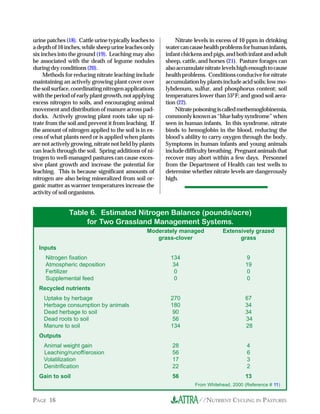
               Table 6. Estimated Nitrogen Balance (pounds/acre)
                    for Two Grassland Management Systems.
                                                 Moderately managed             Extensively grazed
                                                    grass-clover                      grass
  Inputs
     Nitrogen fixation                                    134                            9
     Atmospheric deposition                                34                            19
     Fertilizer                                            0                             0
     Supplemental feed                                     0                             0
  Recycled nutrients
    Uptake by herbage                                     270                            67
    Herbage consumption by animals                        180                            34
    Dead herbage to soil                                   90                            34
    Dead roots to soil                                     56                            34
    Manure to soil                                        134                            28
  Outputs
    Animal weight gain                                    28                              4
    Leaching/runoff/erosion                               56                              6
    Volatilization                                        17                              3
    Denitrification                                       22                              2
  Gain to soil                                            56                             13
                                                                    From Whitehead, 2000 (Reference # 11)


PAGE 16                                                              //NUTRIENT CYCLING IN PASTURES
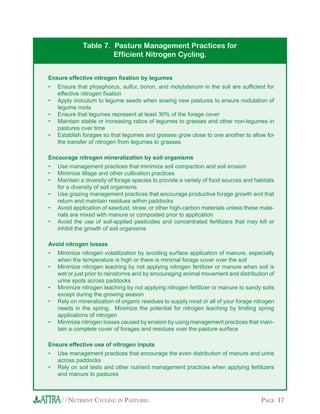
Table 7. Pasture Management Practices for
                       Efficient Nitrogen Cycling.


Ensure effective nitrogen fixation by legumes
•   Ensure that phosphorus, sulfur, boron, and molybdenum in the soil are sufficient for
    effective nitrogen fixation
•   Apply inoculum to legume seeds when sowing new pastures to ensure nodulation of
    legume roots
•   Ensure that legumes represent at least 30% of the forage cover
•   Maintain stable or increasing ratios of legumes to grasses and other non-legumes in
    pastures over time
•   Establish forages so that legumes and grasses grow close to one another to allow for
    the transfer of nitrogen from legumes to grasses

Encourage nitrogen mineralization by soil organisms
•   Use management practices that minimize soil compaction and soil erosion
•   Minimize tillage and other cultivation practices
•   Maintain a diversity of forage species to provide a variety of food sources and habitats
    for a diversity of soil organisms
•   Use grazing management practices that encourage productive forage growth and that
    return and maintain residues within paddocks
•   Avoid application of sawdust, straw, or other high-carbon materials unless these mate-
    rials are mixed with manure or composted prior to application
•   Avoid the use of soil-applied pesticides and concentrated fertilizers that may kill or
    inhibit the growth of soil organisms

Avoid nitrogen losses
•   Minimize nitrogen volatilization by avoiding surface application of manure, especially
    when the temperature is high or there is minimal forage cover over the soil
•   Minimize nitrogen leaching by not applying nitrogen fertilizer or manure when soil is
    wet or just prior to rainstorms and by encouraging animal movement and distribution of
    urine spots across paddocks
•   Minimize nitrogen leaching by not applying nitrogen fertilizer or manure to sandy soils
    except during the growing season
•   Rely on mineralization of organic residues to supply most or all of your forage nitrogen
    needs in the spring. Minimize the potential for nitrogen leaching by limiting spring
    applications of nitrogen
•   Minimize nitrogen losses caused by erosion by using management practices that main-
    tain a complete cover of forages and residues over the pasture surface

Ensure effective use of nitrogen inputs
•   Use management practices that encourage the even distribution of manure and urine
    across paddocks
•   Rely on soil tests and other nutrient management practices when applying fertilizers
    and manure to pastures


     //NUTRIENT CYCLING IN PASTURES                                                   PAGE 17
NITROGEN LOSS THROUGH                                         of forages and plant residues should be main-
                                                                          tained over the soil surface to minimize raindrop
                 RUNOFF AND EROSION
                                                                          impact on the soil, enhance water infiltration,
    Runoff and erosion caused by rainwater or                             help trap sediments and manure particles, and
snowmelt can transport nitrogen on the soil sur-                          reduce the potential for runoff and erosion. A
face. Erosion removes soil particles and organic                          healthy and diverse population of soil organisms,
matter containing nitrogen; runoff transports dis-                        including earthworms and dung beetles that rap-
solved ammonia and nitrate. Incorporation of                              idly incorporate manure nitrogen into the soil
manure and fertilizers into the soil reduces the                          and into their cells, can further reduce the risk of
exposure of these nitrogen sources to rainfall or                         nitrogen runoff from manure. Since increased
snowmelt, thus reducing the potential for ero-                            water infiltration decreases the potential for run-
sion. In pasture systems, however, incorpora-                             off but increases the potential for leaching, risks
tion is usually impractical and can increase the                          of nitrate losses from runoff need to be balanced
potential for erosion. Instead, a complete cover                          against leaching risks.


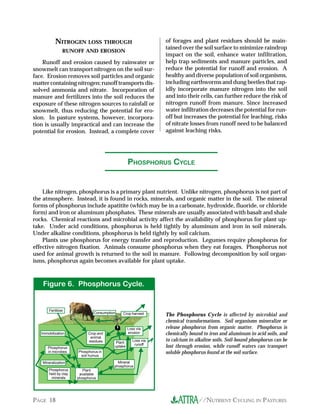
                                                       PHOSPHORUS CYCLE


    Like nitrogen, phosphorus is a primary plant nutrient. Unlike nitrogen, phosphorus is not part of
the atmosphere. Instead, it is found in rocks, minerals, and organic matter in the soil. The mineral
forms of phosphorus include apatitite (which may be in a carbonate, hydroxide, fluoride, or chloride
form) and iron or aluminum phosphates. These minerals are usually associated with basalt and shale
rocks. Chemical reactions and microbial activity affect the availability of phosphorus for plant up-
take. Under acid conditions, phosphorus is held tightly by aluminum and iron in soil minerals.
Under alkaline conditions, phosphorus is held tightly by soil calcium.
    Plants use phosphorus for energy transfer and reproduction. Legumes require phosphorus for
effective nitrogen fixation. Animals consume phosphorus when they eat forages. Phosphorus not
used for animal growth is returned to the soil in manure. Following decomposition by soil organ-
isms, phosphorus again becomes available for plant uptake.


    .igure 6. Phosphorus Cycle.


        Fertilizer                                                T
                                  Consumption     Crop harvest
                                   T                                      The Phosphorus Cycle is affected by microbial and
                                                                          chemical transformations. Soil organisms mineralize or
                           T              T            Loss via       T   release phosphorus from organic matter. Phosphorus is
                                                  T
                                              T


   Immobilization              Crop and                erosion            chemically bound to iron and aluminum in acid soils, and
                                                  T


                                animal
                                                                      T
                 T             residues                   Loss via        to calcium in alkaline soils. Soil-bound phosphorus can be
                                               Plant
                                                           runoff
                                              uptake                      lost through erosion, while runoff waters can transport
                                                       T


       Phosphorus
                                                            T
  T


                                              T
                     T
                      T                                                   soluble phosphorus found at the soil surface.
       in microbes        Phosphorus in
                           soil humus
    Mineralization
                      T                         Mineral
                          T


                                              T
                                              phosphorus
       Phosphorus            Plant
                                  T


       held by clay        available
        minerals     T    phosphorus
                     T


PAGE 18                                                                                  //NUTRIENT CYCLING IN PASTURES
MYCORRHIZAE                            izer or manure may be readily lost from fields
                                                       and transported to rivers and streams through
    Mycorrhizal fungi attach to plant roots and
                                                       runoff and erosion. The potential for phospho-
form thin threads that grow through the soil and
                                                       rus loss through runoff or erosion is greatest
wrap around soil particles. These thin threads
                                                       when rainfall or snowmelt occurs within a few
increase the ability of plants to obtain phospho-
                                                       days following surface applications of manure
rus and water from soils. Mycorrhizae are espe-
                                                       or phosphorus fertilizers.
cially important in acid and sandy soils where
                                                            Continual manure additions increase the po-
phosphorus is either chemically bound or has
                                                       tential for phosphorus loss from the soil and the
limited availability. Besides transferring phos-
                                                       contamination of lakes and streams. This is es-
phorus and water from the soil solution to plant
                                                       pecially true if off-farm manure sources are used
roots, mycorrhizae also facilitate the transfer of
                                                       to meet crop or forage nutrient needs for nitro-
nitrogen from legumes to grasses. Well aerated
                                                       gen. The ratio of nitrogen to phosphate in swine
and porous soils, and soil organic matter, favor
                                                       or poultry manure is approximately 1 to 1, while
mycorrhizal growth.
                                                       the ratio of nitrogen to phosphate taken up by
            SOIL CHEMISTRY AND                         forage grasses is between 2.5 to 1 and 3.8 to 1.
         PHOSPHORUS AVAILABILITY                       Thus, manure applied for nitrogen requirements
                                                       will provide 2.5 to 3.8 times the amount of phos-
    Phosphorus is tightly bound chemically in          phorus needed by plants (23). While much of
highly weathered acid soils that contain high con-     this phosphorus will be bound by chemical
centrations of iron and aluminum. Active cal-          bonds in the soil and in the microbial biomass,
cium in neutral to alkaline soils also forms tight     continual additions will exceed the ability of the
bonds with phosphorus. Liming acid soils and           soil to store excess phosphorus, and the amount
applying organic matter to either acid or alka-        of soluble phosphorus (the form available for loss
line soils can increase phosphorus availability.       by runoff) will increase. To decrease the poten-
In most grasslands, the highest concentration of       tial for phosphorus runoff from barnyard manure
phosphorus is in the surface soils associated with     or poultry litter, alum or aluminum oxide can be
decomposing manure and plant residues.                 added to bind phosphorus in the manure (24).
       PHOSPHORUS LOSS THROUGH                              Supplemental feeds are another source of
                                                       phosphorus inputs to grazing systems, especially
            RUNOFF AND EROSION
                                                       for dairy herds. Feeds high in phosphorus in-
     Unlike nitrogen, phosphorus is held by soil       crease the amount of phosphorus deposited on
particles. It is not subject to leaching unless soil   pastures as manure. To prevent build up of ex-
levels are excessive. However, phosphorus can          cess phosphorus in the soil, minimize feeding of
move through cracks and channels in the soil to        unneeded supplements, conduct regular soil tests
artificial drainage systems, which can transport       on each paddock, and increase nutrient remov-
it to outlets near lakes and streams. Depending        als from excessively fertile paddocks through
on the soil type and the amount of phosphorus          haying.
already in the soil, phosphorus added as fertil-            Phosphorus runoff from farming operations
                                                       can promote unwanted growth of algae in lakes
                                                       and slow-moving streams. Regulations and
                                                       nutrient-management guidelines are being de-
                                                       veloped to decrease the potential for phospho-
                                                       rus movement from farms and thus reduce risks
                                                       of lake eutrophication. Land and animal man-
                                                       agement guidelines, called “phosphorus indi-
                                                       ces,” are being developed across the U.S. to pro-
                                                       vide farmers with guidelines for reducing “non-
                                                       point” phosphorus pollution from farms (25).
                                                       These guidelines identify risk factors for phos-
                                                       phorus transport from fields to water bodies
                                                       based on the concentration of phosphorus in the

           //NUTRIENT CYCLING IN PASTURES                                                     PAGE 19
Phosphorus index guidelines consider:                streams include location near streams of barn-
  • the amount of phosphorus in the soil               yards or other holding areas without runoff con-
  • manure and fertilizer application rates,           tainment or filtering systems, extensive grazing
    methods, and timing                                of animals near streams without riparian buff-
  • runoff and erosion potential                       ers, and unlimited animal access to streams.
  • distance from a water body


soil, timing and method of fertilizer and manure
applications, potential for runoff and erosion, and
distance of the field from a water body (26). Al-
though the total amount of phosphorus lost from
fields is greatest during heavy rainstorms, snow-
melts, and other high-runoff events, relatively
small amounts of phosphorus running off from
fields into streams at low water level in summer
pose a higher risk for eutrophication. This is be-
cause phosphorus is more concentrated in these
smaller flows of water (27). Conditions for con-
centrated flows of phosphorus into low-flow


                    Table 8. Pasture Management Practices for
                           Efficient Phosphorus Cycling.

     Encourage phosphorus mineralization by soil organisms
     • Use management practices that minimize soil compaction and soil erosion
     • Minimize use of tillage and other cultivation practices
     • Maintain a diversity of forage species to provide a variety of food sources and habitats
        for a diversity of soil organisms
     • Avoid application of sawdust, straw, or other high-carbon materials unless these materi-
        als are mixed with manure or composted prior to application
     • Avoid the use of soil-applied pesticides and concentrated fertilizers that may kill or inhibit
        the growth of soil organisms

     Avoid phosphorus losses
     • Minimize phosphorus losses caused by erosion by using management practices that
        maintain a complete cover of forages and residues over the pasture surface
     • Minimize phosphorus losses caused by runoff by not surface-applying fertilizer or ma-
        nure to soil that is saturated, snow-covered, or frozen
     • Avoid extensive grazing of animals in or near streams especially when land is wet or
        saturated or when streams are at low flow

     Ensure effective use of phosphorus inputs
     • Use management practices that encourage the even distribution of manure and urine
        across paddocks
     • Rely on soil tests, phosphorus index guidelines, and other nutrient management prac-
        tices when applying fertilizers and manure to pastures


PAGE 20                                                              //NUTRIENT CYCLING IN PASTURES
SECONDARY NUTRIENTS

     Potassium and the secondary nutrients, cal-
cium, magnesium, and sulfur, play a critical role          Phosphorus fertilization of tall fescue
in plant growth and animal production. Potas-              decreased the incidence of grass
sium, calcium, and magnesium are components                tetany in cattle since it stimulated grass
of clay minerals. The soil parent-material pri-            growth and increased the availability
marily influences the availability of these plant          of magnesium during cool wet spring
nutrients. For example, soils derived from gran-           conditions.
ite contain, on the average, nine times more po-
tassium than soils derived from basalt, while soils     in the soil compared to magnesium, they will
derived from limestone have half the amount.            limit the ability of plants to take up magnesium.
Conversely, soils derived from limestone have,          Under these conditions, the magnesium concen-
on the average, four times more calcium than            tration needs to be increased relative to calcium.
soils derived from basalt and thirty times more         Dolomite lime, which contains magnesium car-
than soils derived from granite (11).                   bonate, can be used to both lime soils and in-
                                                        crease the availability of magnesium. Phospho-
                   POTASSIUM                            rus fertilization of tall fescue in Missouri was also
     Potassium, like all plant nutrients, is recycled   shown to increase the availability of magnesium
through plant uptake, animal consumption, and           sufficiently to decrease the incidence of grass
manure deposition. The majority of potassium            tetany in cattle (30). This probably resulted from
is found in urine. Potassium levels can become          the stimulation of grass growth during cool wet
excessive in fields that have received repeated         spring conditions that are conducive to the oc-
high applications of manure. Application of fer-        currence of grass tetany.
tilizer nitrogen increases the potassium uptake
by grasses if the soil has an adequate supply of
                                                                             SULFUR
potassium. Consumption of forages that contain               Sulfur increases the protein content of pas-
more than 2% potassium can cause problems in            ture grasses and increases forage digestibility and
breeding dairy cattle and in their recovery fol-        effectiveness of nitrogen use (31). In nature, sul-
lowing freshening (28). High potassium levels,          fur is contained in igneous rocks, such as granite
especially in lush spring forage, can cause nutri-      and basalt, and is a component of organic mat-
ent imbalance resulting in grass tetany.                ter. In areas downwind from large industrial and
                                                        urban centers, sulfur contributions from the at-
        CALCIUM AND MAGNESIUM                           mosphere in the form of acid rain can be consid-
     Calcium and magnesium are components of            erable. Fertilizer applications of nitrogen as am-
liming materials used to increase soil pH and re-       monium sulfate or as sulfur-coated urea also con-
duce soil acidity. However, the use of lime can         tribute to sulfur concentration in soils. However,
also be important for increasing the amount of          pasture needs for sulfur fertilization will increase
calcium in the soil or managing the balance be-         as environmental controls for acid rain improve,
tween calcium and magnesium. Increasing the             as other sources of nitrogen fertilizer are used,
calcium concentration may enhance biological ac-        and as forage production increases.
tivity in the soil (29). Managing this balance is            Microbial processes affect sulfur availability.
especially important for decreasing the occur-          As with nitrogen, the sulfur content of organic
rence of grass tetany, a nutritional disorder of        matter determines whether nutrients will be min-
ruminants caused by low levels of magnesium             eralized or immobilized. Also as with nitrogen,
in the diet. Magnesium may be present in the            the sulfur content of grasses decreases as they
soil in sufficient amounts for plant growth, but        become older and less succulent. Thus, soil or-
its concentration may be out of balance with the        ganisms will decompose younger plants more
nutrient needs of plants and animals. When cal-         rapidly and thereby release nutrients while they
cium and potassium have a high concentration            will decompose older plant material more slowly

            //NUTRIENT CYCLING IN PASTURES                                                       PAGE 21
and may immobilize soil nutrients in the process
of decomposition.
     Chemical and biological processes are involved
in sulfur transformations. In dry soils that become
wet or waterlogged, chemical processes transform
sulfur from the sulfate to sulfide form. If these wet
soils dry out or are drained, bacteria transform sul-
fide to sulfate. Like nitrate, sulfate is not readily
absorbed by soil minerals, especially in soils with
a slightly acid to neutral pH. As a result, sulfate
can readily leach through soils that are sandy or
highly permeable.


      Table 9. Pasture Management Practices for Efficient Cycling of
               Potassium, Calcium, Magnesium, and Sulfur.

     Encourage nutrient mineralization by soil organisms
     • Use management practices that minimize soil compaction and soil erosion
     • Minimize use of tillage and other cultivation practices
     • Maintain a diversity of forage species to provide a variety of food sources and habitats
        for a diversity of soil organisms
     • Avoid the use of soil-applied pesticides and concentrated fertilizers that may kill or in-
        hibit the growth of soil organisms
     • Encourage animal movement across paddocks for even distribution of manure nutrients

     Avoid nutrient losses
     • Minimize sulfur losses by using management practices that decrease the potential for
        leaching
     • Minimize nutrient losses caused by erosion by using management practices that main-
        tain a complete cover of forages and residues over the pasture surface

     Maintain nutrient balances in the pasture
     • Ensure magnesium availability to minimize the potential for grass tetany. This can be
        done by balancing the availability of magnesium with the availability of other soil cat-
        ions, particularly potassium and calcium. Phosphorus fertilization of pastures in spring
        can also enhance magnesium availability
     • Guard against a buildup of potassium in pastures by not overapplying manure. High
        potassium levels can cause reproductive problems, especially in dairy cows


PAGE 22                                                           //NUTRIENT CYCLING IN PASTURES
Chapter 2
                        Nutrient Availability in Pastures

     Nutrient balances and nutrient availability     source of calcium and magnesium. Some clay
determine the fate of nutrients in pastures. In      soils and soils with high percentages of organic
the simplest of grazing sys-                                                 matter contain a native store
tems, forage crops take up                                                   of nutrients in addition to
nutrients from the soil;           Nutrient-depleted soils produce           having the capacity to hold
haying and grazing remove          low-yielding forages and unthrifty        nutrients added by manure,
forage crops and their asso-       animals.                                  crop residues, or fertilizers.
ciated nutrients; and animal       Excess soil nutrients can be dan-         Soils formed under temper-
manure deposition returns          gerous to animal health and in-           ate prairies or in flood plains
nutrients to the soil. Con-        crease the potential for contami-         have built up fertility
tinual nutrient removals de-       nation of wells, springs, rivers,         through a long history of or-
plete soil fertility unless fer-   and streams.                              ganic matter deposition and
tilizers, whether organic or                                                 nutrient accumulation.
synthetic, are added to re-                                                  Sandy soils and weathered,
plenish nutrients. Nutrients may be added to         reddish clay soils contain few plant nutrients and
pastures by providing animals with feed supple-      have a limited ability to hold added nutrients.
ments produced off-farm.                             Soils formed under desert conditions are often
     Chemical and biological interactions deter-     saline, since water evaporating off the soil sur-
mine the availability of nutrients for plant use.    face draws water in the soil profile upward. This
Both native soil characteristics and land manage-    water carries nutrients and salts, which are de-
ment practices affect these interactions. Phos-      posited on the soil surface when water evapo-
phorus can be held chemically by iron or alumi-      rates. Tropical soils generally have low fertility
num bonds while potassium can be held within         since they were formed under conditions of high
soil minerals. Practices that erode topsoil and      temperatures, high biological activity, and high
deplete soil organic matter decrease the ability     rainfall that caused rapid organic matter decom-
of soils to hold or retain nutrients. All crop nu-   position and nutrient leaching.
trients can be components of plant residues or
soil organic matter. The type of organic matter
available and the activity of soil organisms de-                    SOIL CHEMISTRY
termine the rate and amount of nutrients miner-
alized from these materials. Nutrient availabil-
ity and balance in forage plants affect the health       Many clay minerals are able to hold onto
of grazing animals. Depleted soils produce un-       water and nutrients and make them available for
healthy, low-yielding forages and unthrifty ani-     plant growth. The pH, or level of acidity or al-
mals; excess soil nutrients can be dangerous to      kalinity of the soil solution, strongly influences
animal health and increase the potential for con-    the strength and type of bonds formed between
tamination of wells, springs, rivers, and streams.   soil minerals and plant nutrients. Soil pH also
                                                     affects activities of soil organisms involved in the
                                                     decomposition of organic matter and the disso-
          SOIL PARENT MATERIAL                       lution of plant nutrients from soil minerals.
                                                     Many clay soil particles are able to bind large
                                                     amounts of nutrients because of their chemical
     Chemical, physical, geological, and biologi-    composition and because they are very small and
cal processes affect nutrient content and avail-     have a large surface area for forming bonds.
ability in soils. As discussed in the previous       Unfortunately, this small size also makes clay
chapter, soils derived from basalt and shale pro-    particles prone to compaction, which can reduce
vide phosphorus to soils, granite contains high      nutrient and water availability. Sandy soils are
concentrations of potassium, and limestone is a      porous and allow water to enter the soil rapidly.

           //NUTRIENT CYCLING IN PASTURES                                                        PAGE 23
But these soils are unable to hold water or nutri-
ents against leaching. Organic matter has a high                      SOIL COMPACTION
capacity to hold both nutrients and water. Soil
aggregates, formed by plant roots and soil organ-
isms, consist of mineral and organic soil compo-            Animal movement compacts soil pores, es-
nents bound together in soft clumps. Aggregates         pecially when soils are wet or saturated. Con-
enhance soil porosity, facilitate root growth, al-      tinual trampling and foraging, especially in con-
low for better infiltration and movement of wa-         gregation areas and laneways, also depletes plant
ter and nutrients through soil, and help soils re-      growth and produces bare spots.
sist compaction.
                                                           Soil compaction increases as soil mois-
                                                           ture, animal weight, animal numbers,
   PRIOR MANAGEMENT PRACTICES                              and the length of stay in the paddock in-
                                                           crease.
    In pastures, continual removal of nutrients               Resistance to compaction increases as
through harvests or heavy grazing without re-                 forage establishment and the percentage
turn or addition of nutrients depletes the soil.              of plants with fibrous roots increase.
Land management practices that encourage soil
erosion — such as heavy grazing pressure,
                                                                Soil compaction reduces nutrient availabil-
plowing up and down a slope, or leaving a field
                                                           ity for plant uptake by blocking nutrient trans-
bare of vegetation during times of heavy rains
                                                           port to roots and restricting root growth through
or strong winds — also result in depletion of
                                                           the soil profile. Treading and compaction can
soil fertility. Some pasture management prac-
                                                           substantially reduce forage yields. One study
tices involve the use of fire to stimulate growth
                                                           showed that the equivalent of 12 sheep treading
of native forages (32). Burning readily miner-
                                                           on mixed ryegrass, white clover, and red clover
alizes phosphorus, potassium, and other nu-
                                                           pasture reduced yields by 25% on dry soil, 30%
trients in surface crop residues. It also volatil-
                                                           on moist soil, and 40% on wet soil compared to
izes carbon and nitrogen from residues and re-
                                                           no treading. On wet soils, root growth was re-
leases these nutrients into the atmosphere, thus
                                                           duced 23% (35).
minimizing the ability of organic matter to ac-
                                                                Compaction also decreases the rate of organic
cumulate in the soil. Loss of residues also ex-
poses soil to raindrop impact and erosion. Hot             matter decomposition by limiting the access soil
uncontrolled fires increase the potential for ero-         organisms have to air, water, or nutrients. In ad-
sion by degrading natural bio-                             dition, compacted soils limit water infiltration
logical crusts formed by li-                                               and increase the potential for
chens, algae, and other soil or-                                           water runoff and soil erosion. In
ganisms, and by promoting the                                              Arkansas, observers of over-
formation of physical crusts                                               grazed pastures found that ma-
formed from melted soil min-                                               nure piles on or near bare, com-
erals (33, 34). The continual                                              pacted laneways were more
high application of manure,                                                readily washed away by runoff
whey, sludge, or other organic                                             than were manure piles in more
waste products to soils can                                                vegetated areas of the pasture
cause nutrients to build up to                                             (24).
excessive levels. Pasture man-                                                 The potential for animals to
agement practices that influ-                                              cause soil compaction increases
ence soil compaction, soil satu-                                           with soil moisture, the weight of
ration, the activity of soil or-         Compacted soils do not allow for  the animal, the number of ani-
ganisms, and soil pH affect              normal root growth. This root     mals in the paddock, and the
both soil nutrient content and           grew horizontally when it         amount of time animals stay in
availability.                            encountered a compacted layer.    the paddock. The potential for a

PAGE 24                                                                //NUTRIENT CYCLING IN PASTURES
paddock to resist compaction depends on the du-          slow. Periods of wet weather alternating with
ration of forage establishment and the type of           periods of dry weather can reduce compaction
forage root system. Established forages with             in some clay soils. Freezing and thawing de-
strong and prolific root growth in the top six to        creases compaction in soils subjected to cold
10 inches of the soil profile are able to withstand      weather. Taproots are effective in breaking
treading by grazing animals. Grasses with ex-            down compacted layers deep in the soil profile
tensive fibrous root systems, such as bermuda            while shallow, fibrous roots break up compacted
grass, are able to withstand trampling better than       layers near the soil surface (37). Active popula-
grasses like orchardgrass that have non-branch-          tions of soil organisms also reduce soil compac-
ing roots or legumes like white clover that have         tion by forming soil aggregates and burrowing
taproots (36). Bunch grasses expose more soil to         into the soil.
raindrop impact than closely seeded non-bunch
grasses or spreading herbaceous plants. How-
ever, these grasses enhance water infiltration by                       ORGANIC MATTER
creating deep soil pores with their roots (3). Com-
bining bunch grasses with other plant varieties
                                                                   NUTRIENT RELEASE FROM
can increase water infiltration while decreasing
the potential for soil compaction and water run-              ORGANIC MATTER DECOMPOSITION
off.                                                         Manure and plant residues must be decom-
     The risk of soil compaction can also                                          posed by soil organ-
be reduced by not grazing animals on                                               isms before nutrients in
                                                 Time required for organic
paddocks that are wet or have poorly-                                              these materials are
                                                 matter decomposition is
drained soils. Instead, during wet con-                                            available for plant up-
                                                 affected by:
ditions, graze animals on paddocks that                                            take. Soil organisms in-
                                                 • the carbon to nitrogen
have drier soils and are not adjacent to                                           volved in nutrient de-
                                                    ratio of organic matter
streams, rivers, seeps, or drainage ways.                                          composition require a
                                                 • temperature
Soils that are poorly drained should be                                            balance of nutrients to
                                                 • moisture
used only in the summer when the cli-                                              break down organic
                                                 • pH
mate and the soil are relatively dry.                                              matter efficiently. Ma-
                                                 • diversity of soil organ-
     Compacted soils can recover from the                                          nure and wasted for-
                                                    isms
impacts of compaction, but recovery is                                             ages are succulent ma-


  Table 10. Effects of 11 Years of Manure Additions on Soil Properties.

                                       Manure application rate (tons/acre/year)
                                     None            10 tons          20 tons           30 tons

  Organic Matter (%)                   4.3             4.8               5.2               5.5

  CEC (me/100g)                       15.8            17.0             17.8              18.9

  PH                                   6.0             6.2               6.3               6.4

  Phosphorus (ppm)                     6.0             7.0             14.0              17.0

  Potassium (ppm)                   121.0            159.0            191.0             232.0

  Total pore space (%)                44.0            45.0             47.0              50.0


                                                               From Magdoff and van Es, 2000 (Reference #1)


           //NUTRIENT CYCLING IN PASTURES                                                         PAGE 25
terials that have high nitrogen content and a good     Soil aggregates are
balance of nutrients for rapid decomposition.          small, soft, water-
     Dried grasses, such as forages that died back     stable clumps of soil
over winter or during a drought, or manure             held together by fine
mixed with wood bedding, have lower nitrogen           plant-root hairs, fun-
contents and require more time for decomposi-          gal threads, humus,
tion. In addition, soil organisms may need to          and microbial gels.
extract nitrogen and other nutrients from the soil     Aggregates are also
to balance their diet and obtain nutrients not         formed through the
available in the organic matter they are decom-        activities of earth-
posing. Composting these materials increases the       worms. Research has shown that several spe-
availability of nutrients and decreases the poten-     cies of North American earthworms annually
tial for nutrient immobilization when materials        consume 4 to 10% of the soil and 10% of the total
are added to the soil. Tem-                                     organic matter in the top 7 inches of soil
perature, moisture, pH,                                         (39). This simultaneous consumption of
and diversity of soil organ-                                    organic and mineral matter by earth-
isms affect how rapidly or-                                     worms results in casts composed of as-
ganic matter is decom-                                          sociations of these two materials. Earth-
posed in the soil.                                              worms, as well as dung beetles, incor-
     Nutrient release from                                      porate organic matter into the soil as they
organic matter is slow in                                      burrow.
the spring when soils are                                           Besides enhancing the nutrient and
cold and soil organisms                                        water holding capacity, well-aggregated
are relatively inactive.                                       soils facilitate water infiltration, guard
Many farmers apply phos-                                       against runoff and erosion, protect
phorus as a starter fertil-                                    against drought conditions, and are bet-
izer in the spring to stimulate seedling growth.       ter able to withstand compaction than less ag-
Even though soil tests may indicate there is suf-      gregated soils. Since aggregated soils are more
ficient phosphorus in the soil, it may not be          granular and less compacted, plant roots grow
readily available from organic matter during cool      more freely in them, and air, water, and dissolved
springs.                                               plant nutrients are better able to flow through
                                                       them. These factors increase plant access to soil
     NUTRIENT HOLDING CAPACITY OF                      nutrients.
                                                           To enhance aggregation within pasture soils,
               ORGANIC MATTER
                                                       maintain an optimum amount of forages and
    Besides being a source of nutrients, soil or-      residues across paddocks, avoid the formation
ganic matter is critical for holding nutrients         of bare areas, and minimize soil disturbance.
against leaching or nutrient runoff. Stabilized        Grazing can degrade soil aggregates by encour-
organic matter or humus chemically holds posi-         aging mineralization of the organic glues that
tively-charged plant nutrients (cations). The                                         hold aggregates to-
ability of soil particles to hold these plant nutri-                                  gether. In areas
ents is called cation exchance capacity or CEC. Con-                                  with a good cover
tinual application of organic materials to soils in-
                                                                                      of plant residues,
creases soil humus (38) and enhances nutrient
                                                                                      animal movement
availability, nutrient holding capacity, and soil
                                                                                      across pastures can
pore space.
                                                                                      enhance aggregate
              SOIL AGGREGATES                                                         formation by incor-
    Soil humus is most effective in holding wa-                                       porating standing
ter and nutrients when it is associated with min-                                     dead plant materi-
eral soil particles in the form of soil aggregates.                                   als into the soil (40).

PAGE 26                                                              //NUTRIENT CYCLING IN PASTURES
nitrogen. Legumes that actively fix nitrogen use
                     SOIL PH                             very little nitrate; consequently, they reduce soil
                                                         pH by taking more cations than anions (9). A
                                                         combination of legumes and non-legumes will
     Soil mineralogy, long-term climatic condi-          tend to stabilize soil pH.
tions, and land-management practices affect soil              Pasture soils should be tested regularly to de-
pH. The acidity or alkalinity of soils affects nu-       termine soil nutrients, soil organic matter, and
trient availability, nitrogen fixation by legumes,       pH. Based on test results and forage nutrient re-
organic matter decomposition by soil organisms,          quirements, management practices can adjust
and plant root function. Most plant nutrients are        soil pH. Lime and organic matter increase soil
most available for uptake at soil pH of 5.5 to 6.5.      pH and decrease soil acidity. Soil organic mat-
Legume persistence in pastures is enhanced by            ter absorbs positive charges, including hydrogen
soil pH of 6.5 to 7.0. In low-pH or acid soils, alu-     ions that cause soil acidity (41). Lime increases
minum is toxic to root growth; aluminum and              soil pH by displacing acid-forming hydrogen and
iron bind phosphorus; and calcium is in a form           aluminum bound to the edges of soil particles
with low solubility. In high-pH or alkaline soils,       and replacing them with calcium or magnesium.
calcium carbonate binds phosphorus while iron,           Limestone that is finely ground is most effective
manganese, and boron become insoluble.                   in altering soil pH since it has more surface area
     Application of some synthetic nitrogen fer-         to bind to soil particles. All commercial lime-
tilizers acidifies soils. Soil microorganisms in-        stone has label requirements that specify its ca-
volved in nitrification rapidly transform urea or        pacity to neutralize soil pH and its reactivity,
ammonia into nitrate. This nitrification process         based on the coarseness or fineness of grind.
releases hydrogen ions into the soil solution,                “Lime” refers to two types of materials, cal-
causing acidification, which decreases nutrient          cium carbonate and dolomite. Dolomite is a com-
availability, thus slowing the growth of plants          bination of calcium and magnesium carbonate.
and soil organisms. Nitrification                                      Calcium carbonate is recommended
also occurs in urine patches when                                      for soils low in calcium; where grass
soil microorganisms transform            Lime soils with cal-          tetany or magnesium deficiency is
urea into nitrate.                       cium carbonate if the         an animal health problem, dolomite
     Another fertilizer that acidifies   soil is low in calcium.       limestone should be used. In sandy
the soil is superphosphate. Super-       Use dolomite lime-            soils or soils with low to moderate
phosphate forms a highly acid (pH        stone if grass tetany         levels of potassium, the calcium or
1.5) solution when mixed with wa-        or magnesium defi-            magnesium in lime can displace po-
ter. The impact of this acidification    ciency is an animal           tassium from the edges of soil par-
is temporary and only near where         health problem.               ticles, reducing its availability.
the fertilizer was applied, but, in                                    Therefore, these soils should receive
this limited area, the highly acid so-                                 both lime and potassium inputs to
lution can kill rhizobia and other soil microor-         prevent nutrient imbalances.
ganisms (9).                                                  The timing of nutrient additions to fields or
     The type and diversity of forage species in         pastures determines how effectively plants take
pastures can alter soil pH. Rangeland plants such        up and use nutrients while they are growing and
as saltbush maintain a neutral soil pH. Grasses
and non-legume broadleaf plants tend to increase
pH, while legumes tend to decrease it. The im-               TIMING O. NUTRIENT ADDITIONS
pact of plant species on pH depends on the type
and amounts of nutrients they absorb. Range-            setting seed. Different nutrients are important
land plants absorb equal amounts of cation (cal-        during different stages of plant development. Ni-
cium, potassium, magnesium) and anion (nitrate)         trogen applied to grasses before they begin flow-
nutrients from the soil. Grasses and non-legume         ering stimulates tillering, while nitrogen applied
broadleaf plants absorb more anions than cations        during or after flowering stimulates stem and leaf
since they use nitrate as their primary source of       growth (9). However, fall nitrogen applications

           //NUTRIENT CYCLING IN PASTURES                                                        PAGE 27
for cool-season grasses are more effective and            tive nodule formation and nitrogen fixation. In
economical than spring applications. In most              acid soils, liming may make phosphorus already
years, nutrient releases through mineralization           in the soil more available, thereby decreasing the
are sufficient to stimulate forage growth in the          need for fertilization.
spring. Applications of nitrogen in the late sum-              As discussed above, the type of organic ma-
mer and fall allow cool-season grasses to grow            terial added to the soil, as well as temperature,
and accumulate nutrients until a killing frost.           moisture, pH, and diversity of soil organisms,
This provides stockpiled growth for winter graz-          determines how rapidly soil organisms decom-
ing (42).                                                 pose and release nutrients from organic matter.
     Both potassium and phosphorus are impor-             Synthetic fertilizers are soluble and immediately
tant for increasing the nutrient quality of forages,      available for plant uptake. Therefore, these fer-
extending stand life, and enhancing the persis-           tilizers should be applied during periods when
tence of desirable species in the forage stand (42).      plants can actually use nutrients for growth. A
Phosphorus is critical for early root growth, for         lag time of two to 21 days may pass after fertiliz-
seed production, and for effective nitrogen fixa-         ers are applied before increased forage produc-
tion by legume nodules. Potassium is important            tion is observed.
during the mid-to-late growing season. It in-                  Organic material releases nutrients over a
creases the ability of plants to survive winter con-      period of several years. On average, only 25 to
ditions, by stimulating root growth and reduc-            35% of the nitrogen in
ing water loss through stomata or leaf pores (43).        manure is mineral-
It also is important for legume vigor and for en-         ized and available        A lag time of two to 21
hancing plant disease resistance (42).                    for plant use during      days may pass after
     Nutrient uptake by plants corresponds to             the year of applica-      fertilizers are applied
their growth cycle. Warm-season forages exhibit           tion. Another 12%         before increased for-
maximum growth during the summer, whereas                 is available in the       age production is ob-
cool-season forages exhibit maximum growth                following year, 5%        served.
during the spring and early fall (32). Pastures           in the second year
containing a diverse combination of forages will          following application, and 2% in the third year
use nutrients more evenly across the growing              (44). Manure deposited in pastures causes an in-
season while less-diverse pastures will show              crease in forage growth approximately 2 to 3
spikes in nutrient uptake requirements.                   months after deposition, with positive effects on
     Legumes provide nitrogen to the pasture sys-         growth extending for up to two years (11). Al-
tem through their relationship with the nitrogen-         falfa can supply approximately 120 pounds of
fixing bacteria, rhizobia. If nitrogen levels in the      nitrogen to crops and forages in the year after it
                                  soil are low, newly     is grown, 80 pounds of nitrogen during the fol-
                                  planted legumes         lowing year, and 10 to 20 pounds in the third
   Nitrogen fertilization require nitrogen                year (44). Because of this gradual release of nu-
   depresses fixation by fertilization until              trients from organic materials, continual addi-
   legumes since they re- rhizobia have de-               tions of manure or legumes will compound the
   quire less energy to veloped nodules                   availability of nutrients over time. Accounting
   take up nitrogen from and are able to fix              for nutrients available from previous years is
   the soil than they need nitrogen. Once                 critical for developing appropriate applications
   to fix nitrogen.               they start fixing ni-   rates for manure and fertilizers during each
                                  trogen, nitrogen        growing season. Not accounting for these nutri-
                                  fertilization de-       ents can result in unnecessary fertilizer expenses
presses fixation by legumes since they require            and risks of nutrient losses to the environment.
less energy to take up nitrogen from the soil than             Nutrients from both organic and synthetic
they need to fix nitrogen. Legumes can fix up to          fertilizers can be lost through leaching, runoff,
200 pounds of nitrogen per year, most of which            or erosion. The potential for nutrient losses is
becomes available to forage grasses in the fol-           greatest if these materials are applied in the fall
lowing years. Phosphorus is essential for effec-          or winter, when plants are not actively growing

PAGE 28                                                                //NUTRIENT CYCLING IN PASTURES
or during times when soils are frozen, snow-covered, or saturated. During times of high rainfall,
nitrate may leach through the soil since it does not bind to soil particles. Rainfall also facilitates the
transport of phosphorus to water bodies in runoff water or through artificial drainage tiles. Rainfall
or snowmelt water flowing over bare soil causes soil erosion and the transport of nutrients attached
to soil particles.


                Table 11. Pasture Management Practices for
                       Enhancing Nutrient Availability.

      Ensure plant cover and diversity across pastures
      •   Use management practices that maintain a complete cover of forages and residues
          across pastures
      •   Combine bunch-grass species with a diversity of forage species, including plants
          with prostrate growth habit, to provide both good water infiltration and protection
          against erosion and soil compaction


      Grazing management practices during wet weather
      •   Use well-drained pastures or a “sacrificial pasture” that is far from waterways or
          water bodies
      •   Avoid driving machinery on pastures that are wet or saturated
      •   Avoid spreading manure or applying fertilizers on soil that is saturated, snow-cov-
          ered, or frozen


      Ensure effective use of nutrient inputs
      •   Use management practices that encourage the even distribution of manure and urine
          across paddocks
      •   Rely on soil tests and other nutrient management practices when applying fertilizers
          and manure to pastures
      •   Account for nutrients available form manure and legume applications during prior
          years when developing fertilizer or manure application rates for the current year
      •   Sample the nutrient content of added manure to determine appropriate rates of ap-
          plication
      •   Choose the appropriate type of limestone to apply for pH adjustment based on cal-
          cium and magnesium needs and balances in pastures
      •   Either avoid the use of fertilizers that decrease soil pH or use lime to neutralize soils
          acidified by these fertilizers
      •   Apply nitrogen fertilizer in the fall to enhance the amount of forages stockpiled for
          winter grazing
      •   Apply sufficient phosphorus and potassium while limiting additions of nitrogen in or-
          der to favor growth of legumes in your pastures


           //NUTRIENT CYCLING IN PASTURES                                                      PAGE 29
Chapter 3
          Nutrient Distribution and Movement in Pastures

     Farmers and ranchers graze animals using a
variety of management methods. In this docu-
                                                       .igure 7. Pasture Nutrient Inputs
ment, extensive grazing refers to the practice of                and Outputs.
grazing animals continuously or for extended
periods of time on a large land area. Rotational
                                                       Inputs                 Farm Boundary                 Outputs
grazing is a management-intensive system that
concentrates animals within a relatively small          feed
area (a paddock) for a short period of time —                                                                animal
                                                        fertilizer                                           products
often less than a day for dairy animals. The ani-
mals are then moved to another paddock, while           legume N
the first paddock is allowed to recover and re-                                                              crops
                                                        rainfall
grow. Animals are moved according to a flex-
ible schedule based on the herd size, the amount                                  Losses
of land available, quality of forages in the pad-
                                                                       ammonia volatilization, leaching,
dock, and forage consumption. Grazing manag-                           denitrification, runoff, & erosion
ers determine when and how long to graze ani-                             From Klausner, 1995 (Reference #44)
mals in specific paddocks based on climatic con-
ditions, soil characteristics, land topography, and       Grazing animals that receive no mineral or
the distance the paddock is from streams or riv-      feed supplements will recycle between 75 and
ers.                                                  85% of forage nutrients consumed. If no fertil-
     Pasture size, shape, and topography; stock-      izer or outside manure inputs are applied, con-
ing rate; grazing duration; and time of day all       tinual grazing will cause a gradual depletion of
affect how animals graze, lounge, drink water,        plant nutrients. Animals provided feed or min-
and use feed or mineral supplements. Also, dif-       eral supplements also deposit 75 to 85% of the
ferent animal species vary in their use of nutri-     nutrients from these inputs as urine and feces
ents and their herding behavior. These factors,       (42). These nutrients represent an input into the
along with soil characteristics, climate, and for-    pasture system. Nutrient inputs from non-for-
age and soil management practices, affect nutri-      age feeds can be substantial for dairy and other
ent cycling in pastures, animal growth and pro-       animal operations that use a high concentration
ductivity, and potential of manure nutrients to       of grain and protein supplements, importing into
contaminate ground or surface water.                  the pasture approximately 148 lbs. N, 32 lbs. P,
                                                      and 23 lbs. K per cow per year (42). Winter feeds
                                                      also form a substantial input into the pasture nu-
           PASTURE NUTRIENT                           trient budget when animals are fed hay while be-
                                                      ing kept on pasture.
          INPUTS AND OUTPUTS
                                                                     MANURE DEPOSITION AND
                                                                          DISTRIBUTION
            NUTRIENT BALANCES                             A cow typically has 10 defecations per day,
    Maintaining a balance between nutrients re-       with each manure pile covering an area of ap-
moved from pastures and nutrients returned to         proximately one square foot (47). They will also
pastures is critical to ensure healthy and produc-    urinate between eight and 12 times per day (48).
tive forage growth, as well as to control nutrient    Each urination spot produces a nitrogen appli-
runoff and water-body contamination. Nutrient         cation equivalent to 500 to 1,000 lbs./acre while
balances in pastures are determined by subtract-      each defecation represents a nitrogen application
ing nutrient removals in the form of hay harvested,   rate of 200 to 700 lbs./acre (42). An even distri-
feed consumed, and animals sold, from nutrient        bution of nutrients throughout a paddock is re-
inputs including feed, fertilizer, and manure.        quired for productive plant and animal growth.


PAGE 30                                                                //NUTRIENT CYCLING IN PASTURES
Table 12. Nutrient Consumption and Excretion by Grazing Animals.

                                              Dairy cows         Beef /Sheep
________________________________________________________________________________
  Feed consumption/day                         18–33 lbs.
________________________________________________________________________________
  Nutrients used for growth and reproduction    17% N             15 -25% N
                                                 26% P          20% P, 15% K
________________________________________________________________________________
  Nutrients removed from pasture in form     N 84 lbs./cow    N 10 lbs./cow-calf
  of milk and meat                           P 15 lbs./cow    P 3 lbs./cow-calf
                                             K 23 lbs./cow     K 1 lbs./cow-calf
________________________________________________________________________________

  Nutrients/ton manure                         6–17 lbs.N
                                             3–12 lbs.P2O5
________________________________________________________________________________
                                             2-15 lbs. K2O
________________________________________________________________________________
  Nitrogen content of feces                     2.0–3.6%         3.4–3.6%
________________________________________________________________________________
  Nitrogen excreted as feces                   55 lbs./year
________________________________________________________________________________
  Nitrogen content of urine                   0.42–2.16%        0.30–1.37%
________________________________________________________________________________
  Nitrogen excreted as urine                  165 lbs./year
________________________________________________________________________________
                                 From Stout, et al. ( 45), Detling ( 46), Russelle ( 17), Wells and Dougherty ( 47) ,
                                               Haynes and Williams ( 41), Klausner ( 44), Lory and Roberts ( 42)


Unfortunately, grazing animals do not naturally           ture to water, they deposit between 13 and 22%
deposit urine and feces evenly across the paddocks        of their manure on laneways (47, 52).
where they graze. In one rotational grazing                   A study conducted in Iowa showed a buildup
study, urine spots occupied 16.7% of the pasture,         of nutrients extending 30 to 60 feet into the pas-
while manure spots occupied 18.8%, following              ture around water, shade, mineral supplements,
504 grazing days per acre (49). Intensity of graz-        and other areas where cattle congregated (53).
ing rotations affects the distribution of manure          Nutrients are concentrated in these congregation
coverage in paddocks. Under continuous, exten-            areas because animals transport nutrients from
sive grazing practices, 27 years would be needed          areas where they graze. Consequently, they also
to obtain one manure pile on every square yard            deplete nutrients from the grazing areas. Graz-
within a paddock; if a two-day rotation were used         ing practices that encourage foraging and manure
                                                          distribution across paddocks and discourage con-
instead only two years would be needed (42).
                                                          gregation in limited areas will improve nutrient
    Nutrient concentration within pastures re-
                                                          balances within pastures.
sults from the tendency of grazing animals to con-
                                                              The time of day when animals congregate in
gregate. They tend to leave manure piles or urine
                                                          different areas determines the amount and type
spots around food and water sources, on side              of nutrients that accumulate in each area. Ani-
hills, in depressions, along fence lines, and un-         mals tend to deposit feces in areas where they
der shade. Sheep have a greater tendency than             rest at night or ruminate during the day, while
cattle to congregate and deposit manure in these          they urinate more in the areas where they graze
areas (50). Prevailing wind direction and expo-           during the day (47). Nitrogen is present in both
sure to sunlight can also affect animal movement,         feces and urine while phosphorus is primarily
congregation, and manure deposition (51).                 deposited as feces, and potassium is found
Laneways that connect pastures or lead to wa-             mostly in urine. While most urine is deposited
tering areas are another area of animal congre-           during the day, urine that is deposited at night
gation and manure deposition. When animals                has a higher nutrient content than urine depos-
have to walk more than 400 feet from the pas-             ited while grazing (41). As a result of these fac-


           //NUTRIENT CYCLING IN PASTURES                                                                 PAGE 31
tors, phosphorus will accumulate in resting ar-
               .igure 8.
                                                      eas (13) while nitrogen and potassium will accu-
          3-Paddock System.                           mulate in both resting and grazing areas.
                                     O = water tank     MINIMIZING ANIMAL CONGREGATION
                                                          By working with the normal foraging and
                                                      herding behavior of grazing animals, distribu-
                                                      tion of animals across paddocks can be encour-
                                                      aged. In larger paddocks, animals tend to graze
                                                      and lounge as a herd, while they distribute them-
                                                      selves more evenly across smaller paddocks (41).
                                                      In larger paddocks, animals visit water, miner-
                                                      als, shade, and fly-control devices as a herd,
                                                      whereas animals concentrated within small pad-
                                                      docks tend to visit these areas one-by-one. Lo-
                                                      cating nutrients, shade, and pest-control devices
                                                      farther apart in the paddock further discourages
                                                      concentration of animals and manure. If a par-
               .igure 9.                              ticular area of a paddock is deficient in nutrients,
          12-Paddock System.                          placement of supplemental feeds in that area can
                                                      be used to encourage congregation and manure
                  O = water tank
                                                      deposition there.
                                                          Subdividing depressions, side hills, and
                                                      shady areas among several paddocks can en-
                                                      hance nutrient distribution across the landscape.
                                                      Research conducted in Missouri showed that
                                                      manure nutrients were distributed more evenly
                                                      across the landscape when a field was managed
                                                      using 12 or 24 paddocks rather than only three
                                                      paddocks (54). Animals in the smaller paddocks
                                                      concentrated around favored areas for less time
                                                      than did animals in larger paddocks. Since ani-
                                                      mals tend to graze along the perimeter of fence
                                                      lines, they distribute nutrients most evenly across
               .igure 10.                             paddocks that are small, square, and have water
                                                      available (55). An efficiently designed paddock
          24-Paddock System.
                                                      allows animals to graze and drink with a mini-
                                                      mum amount of time, effort, and trampling of
                    O = water tank                    the pasture sod.


                                                         MANURE NUTRIENT AVAILABILITY

                                                          While feces contain nitrogen predominantly
                                                      in the organic form, 60 to 70% of cow-urine ni-
                                                      trogen and 70 to 80% of sheep-urine nitrogen is
                                                      in the form of urea. Urea and potassium in urine
                                                      are soluble and therefore immediately available
                                                      for plant uptake. Phosphorus in feces is predomi-
Manure deposition as affected by paddock size (from
                                                      nantly in the organic form and must undergo de-
Peterson and Gerrish, Reference 52).
                                                      composition before it is available to plants. Soil

PAGE 32                                                             //NUTRIENT CYCLING IN PASTURES
organisms will decompose moist, nitrogen-rich          haying. Prior to the current concerns over water
manure piles derived from succulent grasses rela-      quality, manure application recommendations
tively quickly. They will have difficulty break-       were made to meet forage needs for nitrogen.
ing down manure derived from hay or older for-         Continued nitrogen-based applications result in
ages that is stiff, dry, and crusty. When a hard       a phosphorus build-up in the soil since manure
crust forms on manure piles during dry weather,        usually contains about the same concentration
both physical breakdown and biological decom-          of phosphorus and nitrogen, while plants only
position are inhibited (41). By treading on ma-        require one-half as much phosphorus as nitro-
nure piles as they move around a pasture, ani-         gen. In diverse pastures that contain a combina-
mals physically break these piles into smaller         tion of grasses and legumes, decreasing or elimi-
pieces that are more easily consumed by soil or-       nating manure applications can lower phospho-
ganisms.                                               rus imbalances while maintaining forage yields.
     Because nutrients are released slowly from        Nitrogen fixation by legumes helps satisfy for-
manure, forage plants in the vicinity of manure        age nitrogen requirements while using excess soil
piles will grow slowly for about two months fol-       phosphorus.
lowing manure deposition (41, 42). However, as
decomposition of manure piles by soil organisms          .igure 11. P Added in Manure/
makes nutrients available for plant use, greater               Removed by Crop.
pasture regrowth and forage production occurs
in the vicinity of manure and urine compared to         Applying manure to meet the nitrogen needs
other pasture areas (49, 54, 56). Increases in ni-      of corn (about 200 lbs. N/acre) adds much
trogen availability in areas near manure piles can      more phosphorus than corn needs.
favor the growth of grasses compared to legumes
(9), an impact that can last for up to two years                                                 P added (lb./acre)
(41).
     Animals naturally avoid grazing near dung                            P removed (lb./acre)
sites, but will feed closer to manure piles (41) and
use forages more efficiently as grazing pressure                                                 Dairy manure

                                                                                                                Poultry litter
intensifies. In multispecies grazing systems,
sheep do not avoid cattle manure as much as
cattle do (57). While both sheep and cattle avoid
sheep manure, the pellet form of sheep manure                           Corn
has a large surface area, and thus breaks down
more rapidly than cattle manure. Consequently,
                                                                        From Sharpley, et al. (Reference 58)
forages are used more effectively when cattle are
combined with sheep.                                       On some farms, manure is applied to soil as
                                                       a waste product. Instead of being applied ac-
         PASTURE .ERTILIZATION                         cording to crop needs, manure is primarily ap-
                                                       plied according to the need to dispose of manure,
     Manure and fertilizers are applied to pastures    the location of fields in relation to the barn, and
to provide nutrients necessary to obtain effective     the accessibility of fields during bad weather.
                              plant growth and         These “waste application” practices present a
                              animal production.       high potential for nutrient buildup and move-
  Fertilizer and manure
                              Applications should      ment of excess nutrients to ground or surface
  applications should
                                                       waters.
  be based on regular be based on regular
                                                           To ensure that manure is used effectively as
  soil testing, the abil- soil testing, the abil-
                                                       a source of plant nutrients and poses minimal
  ity of soil to provide ity of soil to provide
                                                       risks to the environment, it should be applied
  and retain nutrients, and retain nutrients,
                                                       according to a nutrient management plan. Natu-
  plant needs, and plant needs, grazing
                             intensity, and nutri-     ral Resources Conservation Service or Soil and
  grazing intensity.
                             ent removals through      Water Conservation District personnel, as well

           //NUTRIENT CYCLING IN PASTURES                                                                                        PAGE 33
as many commercial crop consultants, are trained in the development of nutrient management plans.
Software programs to develop your own nutrient management plan may be available from Coopera-
tive Extension Service educators or Agronomy and Soil Science specialists at land grant universities.

  Table 13. Components of a Comprehensive Nutrient Management Plan.
 Components of a Comprehensive Nutrient Management Plan
 • Soil tests on all fields or paddocks
 • Manure tests
 • Load-capacity and rate-of-application of manure spreading equipment
 • Timing and method of manure and fertilizer applications
 • Prior land management practices including manure applications, legumes used as green
   manures, fallows, or hay removal
 • Assessments of runoff, erosion, and flooding potentials for each field or paddock
 • Crops or forages to be produced
 • Current pasture management practices, including stocking rates and hay removal

 Format of a nutrient management plan for each paddock or field
 • Soil and manure test results
 • Risk factors such as excess nutrient levels, or high runoff, erosion, or flooding potential
 • Recommended time, method, and rate for fertilizer and manure applications
 • Recommended time for grazing, especially on pastures with moderate to high potentials for
    runoff, erosion, or flooding
 • Management practices to minimize risk factors and maximize nutrient availability to forages

                                                       cies, enhances the dispersal of forage seeds, and
             GRAZING INTENSITY                         helps conserve nutrient resources within the soil-
                                                       plant system.
                                                         GRAZING BEHAVIOR, PLANT GROWING
                  DEFINITION                               POINTS, AND PLANT LEAF AREA
    Grazing intensity refers to the impact animals         Grazing habits of different animal species
have on forage growth and reproduction and on          have different impacts on forage species compo-
soil and water quality. It is influenced by ani-       sition in pastures. For example, horses graze
mal foraging habits, stock-                                               more closely to the ground
ing rates, the length of time                                             than cattle; sheep graze at
animals are allowed to            Short-term high-intensity grazing soil level and can take away
graze within a given pad-         combined with a resting period (as the base of grass plants be-
dock, and the relation these      in rotational grazing practices) low the area of tiller emer-
factors have to soil charac-      causes an increase in the diversity      gence (59); while cattle tend
teristics and climatic condi-     of forage species, enhances the dis-     to graze taller grasses that
tions. Continuous high-in-        persal of forage seeds, and helps        sheep may reject. Animal
tensity grazing depletes soil     conserve nutrient resources within       grazing behavior, the loca-
nutrients, decreases the di-      the soil-plant system.                   tion of a plant’s growing
versity of forage species, in-                                             point, and the amount of
hibits the ability of some forage plants to regrow     leaf area remaining when animals are rotated to
and reproduce, and increases the potential for         another pasture affect the ability of plants to re-
nutrient runoff and erosion. Conversely, short-        grow. If grazing animals remove the growing
term high-intensity grazing combined with a            point and substantial leaf area of grasses, new
resting period (as in rotational grazing practices)    leaf growth must come from buds that have been
causes an increase in the diversity of forage spe-     dormant and the energy for this growth must

PAGE 34                                                              //NUTRIENT CYCLING IN PASTURES
come from stored carbohydrates rather than from       include treading impact on leaf and root growth,
photosynthesis (60).                                  forage composition impact on the ability of plants
    Early in the growing season, all grasses have     to intercept sunlight for photosynthesis, and soil
their growing points at or near ground level.         conditions (35).
Ryegrass, tall fescue, Kentucky bluegrass and                      NUTRIENT      UPTAKE
many other species of cool-season grasses have
growing points that remain at or below ground             Forage plants that are cut or regrazed fre-
level throughout most of the growing season.          quently during the growing season take up more
Other, predominantly native, grass species — in-      nutrients than forages that are not cut or grazed.
cluding smooth broomgrass, timothy, reed              Research conducted in Kansas indicated that
canarygrass, switchgrass, and gamagrass — have        cutting pasture forage six times during the grow-
stems that elongate below the growing point           ing season resulted in 4.3 times greater nitrogen
above the soil level (60). As long as the growing     content and 5.2 times greater phosphorus con-
point remains intact, the plant is capable of pro-    tent in cut forages compared to uncut plots (63).
                                                      Cutting pastures in the spring when seed heads
ducing new leaves. Grasses with low growing
                                                      are forming can also increase the productivity
points are able to recover from grazing relatively
                                                      and nutrient uptake of pasture forages (64).
quickly because the growing point is not dis-
                                                      Other studies (56, 65) demonstrated that in-
turbed. If the growing point is removed, growth
                                                      creased grazing intensity resulted in younger,
recommences from the emergence of new tillers.
                                                      more succulent plants with a higher nitrogen
Under continuous, intensive grazing practices,
                                                      content compared to plants growing in ungrazed
warm-season grasses recover more slowly than
                                                      areas. The higher nitrogen content was attrib-
cool-season grasses, especially during the spring
                                                      uted to return of nitrogen to the system through
(61). As a result, continuous grazing practices or
                                                      urine and to the availability of nitrogen fixed by
grazing too early in the season tends to favor the
                                                      legumes. In these studies legumes remained
growth of non-native grasses and decrease the         prevalent in the more intensely grazed plots
diversity of forages in pastures (62).                while their populations decreased in the more
                                                      lightly grazed paddocks (65).
 Continuous grazing tends to favor the
                                                                           YIELD
 growth of cool- season grasses since graz-
 ing animals remove the elevated growing                   During the first year of intensive grazing,
 points of native warm-season grasses                 increasing the intensity of cutting or grazing in-
 more readily than they remove the lower              creases the amount of forage produced. Follow-
 growing points of non-native, cool-season            ing grazing, photosynthesis is stimulated and
 grasses.                                             plants take up more nutrients. This permits leaf
                                                      regrowth in broadleaf plants and increased
                                                      tillering in grasses. Increased leaf area then al-
     For areas with moderate rainfall, leaf area      lows for greater photosynthesis. As photosyn-
remaining after grazing is more critical for for-     thesis and the formation of carbohydrates in-
age recovery than the location of a forage plant’s    crease, nutrient uptake by roots and subsequent
growing point (J. Gerrish, personnal communi-         movement of nutrients from roots to leaves also
cation). Most forbs and legumes, such as alfalfa      increase. However, as more energy and nutri-
and red clover, have aerial growing points rela-      ents are allocated to leaf production and in-
tively high up on the plant, which are easily re-     creased photosynthesis, less energy and nutri-
moved by grazing animals. This is not detrimen-       ents are provided for root growth (63).
tal to plant growth unless a majority of the leaf
area or the basal portion of the plant is removed.      Frequently grazed plots exhibit high bio-
For optimal recovery, at least 3 to 4 inches of re-     mass production and nutrient uptake dur-
sidual leaf area should remain on cool-season           ing the initial grazing season. But if graz-
grasses while 4 to 8 inches of leaf area should         ing intensity is too great, forage produc-
remain for warm-season grasses following graz-          tion will decrease in the following years.
ing (61). Other factors that affect plant regrowth

           //NUTRIENT CYCLING IN PASTURES                                                    PAGE 35
While frequently mowed or grazed plots ex-        (65). Grazing or cutting pastures too short can
hibit high biomass production and nutrient up-        also expose bare soil to the impact of rainfall, in-
take during the initial grazing season, if the in-    creasing the potential for soil compaction and the
tensity of grazing is too high, forage production     loss of topsoil and nutrients through erosion.
will decrease in following years (63, 66). This       Nutrient cycling and effective nutrient use by
production decline results from decreased plant       plants depend on pasture management practices
ability to take up nutrients because of decreased     that minimize soil compaction, conserve organic
root growth and depletion of soil nutrients. Se-      matter, and do not hinder plant regrowth follow-
vere grazing will also impact plant diversity,        ing grazing.
since grazing during flowering removes seed
heads and flowers, limiting the reseeding of for-
                                                            Nutrient cycling and effective nutri-
age plants (64).
                                                            ent use by plants depend on pas-
                                                            ture management practices that
      A sufficient resting period allows                    minimize soil compaction, conserve
      plants to regrow and produce ad-                      organic matter, and do not hinder
      equate leaf area for photosynthe-                     plant regrowth following grazing.
      sis. It also allows plants and soil
      organisms to reduce soil compac-
      tion and increase the availability of               The nutrient content of forage plants affects
      nutrients through mineralization.               animal feeding habits, the amount of nutrition
                                                      animals obtain, and the type of manure they pro-
                                                      duce. Succulent, nutritionally balanced pastures
     Root growth is critical for water and nutrient   provide good animal productivity and cause ani-
uptake. Plants can also store food reserves in        mals to deposit moist manure piles (36). Ani-
roots to allow for regrowth during periods of         mals feeding on dry, older, or overgrazed for-
stress. Plants grazed too frequently or cut too       ages will obtain limited nutrient value. Manure
short have difficulty producing more leaves be-       piles produced from these forages will be stiff
cause of limited growth and food reserve stor-        because of their high fiber content. Dry, stiff
age by roots. In one study, plants that were not      manure piles are difficult for soil organisms to
cut until they reached eight inches tall produced     decompose since there is little air within the pile
more growth than plants cut every time they           (68). Conversely, animals often deposit very liq-
reached two inches tall. Similarly, grasses sub-      uid manureasthey begin feeding on pastures in
jected to continuous intensive grazing by sheep       the spring after a winter of eating hay. The high
produced less vegetation than lightly grazed pas-     moisture content of the pasture forages results
tures. In both cases, a longer resting period re-     in a very wet manure pile that disperses across
sulted in better plant growth, since the resting      the soil. Soil organisms are able to decompose
period allowed plants to regrow and produce           manure that has relatively high nitrogen and
adequate leaf area for photosynthesis (63). Grass     moisture content more readily than manure that
tiller population and pasture production mark-        is drier and more carbon-rich.
edly increased in an extensively grazed pasture
that was fallowed for one year. This resting pe-
riod allowed plants and soil organisms to reduce            DIVERSITY AND DENSITY O.
soil compaction and increase the availability of
nutrients through mineralization (67).                          PASTURE PLANTS
     Cutting grasses short not only depresses
plant regrowth, it also increases soil temperature.
As soil temperature increases so does nutrient            Diverse forage mixtures of both broadleaved
mineralization by soil organisms. While miner-        plants and grasses use solar energy efficiently.
alization is necessary to release nutrients from      The shape and orientation of plant leaves affect
plant and animal residues, if mineralization is       how and when the plant can best conduct pho-
too rapid, it can cause a loss of organic matter      tosynthesis. Tall plants and upright grasses cap-

PAGE 36                                                             //NUTRIENT CYCLING IN PASTURES
ture light at the extreme angles of sunrise and                                   together in a Missouri
                                                         Timing of grazing
sunset while horizontal leaves of broadleaf plants                                pasture, pasture plant
                                                         affects species
use sunlight better at midday. A combination of                                   diversity remained high
                                                         composition and
tall sun-loving plants with shorter shade-toler-                                  after three years of graz-
                                                         diversity in pas-
ant plants allow for the capture of both direct                                   ing. Pastures with a di-
                                                         tures.
and filtered sunlight. A combination of warm-                                     versity of forage species
and cool-season grasses allows for effective pho-                                 also maintained a higher
tosynthesis throughout the growing season.              percentage of forage cover during this time than
Warm-season grasses like big bluestem are bet-          pastures planted to monocultures or simple mix-
ter able to grow and use solar energy at tempera-       tures of forages (72). Productivity within pas-
tures between 90 and 100°F, while cool-season           tures is more stable when forages provide a di-
grasses like tall fescue grow best between 75 and       versity of function and structure, such as height,
90°F (32).                                              root growth habit, life cycle, and habitat require-
                                                        ments (4).
    PERSISTENCE OF PASTURE LEGUMES
     Maintaining legumes as part of the forage
                                                         Nitrogen transfer between grasses and le-
mix is necessary if nitrogen fixation is to provide
                                                         gumes is greatest when there is a close
most of the nitrogen input to the pasture system.
                                                         population balance between these species
Legumes with a deep taproot and a woody
                                                         and they are growing close together.
crown, such as alfalfa, red clover, and birdsfoot
trefoil, are able to persist in a well-drained pas-
ture because they are able to obtain water and
                                                             Nitrogen fixation is directly related to the abil-
nutrients from deep below the soil surface. They        ity of legumes to accumulate energy through pho-
also tolerate drought and cold, and are able to         tosynthesis. Thus, leaf removal decreases nitro-
regrow unless their growing points are elevated         gen fixation, and leaf regrowth increases the po-
and exposed to defoliation. Rotational grazing          tential for nitrogen fixation. Legumes not only
has been shown to increase the proportion of red        fix nitrogen for their own needs, but are also able
clover and alfalfa in mixed pastures (69).              to supply nitrogen to non-nitrogen-fixing forage
     White clover has rhizomes rather than a tap-       crops. They primarily supply nitrogen to forage
root. This growth habit allows it to colonize bare      plants following decomposition. Pastures domi-
                                soils (64) by form-     nated by clover produce around 200 pounds ni-
         .igure 12.             ing      additional     trogen per acre per year through nitrogen fixa-
      Root Growth.              plants through the      tion.
                                 growth of stolons.          Legumes can also provide nitrogen to com-
                                 White clover is        panion grass species during the growing season.
                                 competitive with       In New Zealand, perennial ryegrass obtained 6
                                 grass at low pro-      to 12% of its nitrogen from associated white clo-
                                 duction densities      ver. Alfalfa and birdsfoot trefoil provided up to
                                  while legumes         75% of the nitrogen used by reed canarygrass in
                                  with taproots are     Minnesota. This nitrogen transfer occurs when
                                  more competitive      roots die, nodules detach, or neighboring grasses
                                  at high production    and legumes become interconnected by their roots
                                  densities (70).       or through mycorrhizae. Nitrogen transfer be-
                                      The diversity     tween grasses and legumes is greatest when
                                 of forage species      there is a close population balance between these
                                 also affects the       species and they are growing close together (15).
  Root growth of alfalfa un- persistence of le-         In the first year of legume establishment, nitrogen
  der irrigated (left) and dry gumes within a           transfer is relatively low and is derived predomi-
  (right) conditions (Weaver, pasture. When six         nantly from nodule decomposition; it increases in
  Reference 71).                 to eight forage spe-   the second year as direct-transfer mechanisms
                                 cies were planted      through mycorrhizae become established (14).

            //NUTRIENT CYCLING IN PASTURES                                                         PAGE 37
NUTRIENT USE EFFICIENCY                      (73). Due to their high nitrogen content, decom-
                                                       position of residues from these plants stimulates
    A diverse plant community uses soil nutri-
                                                       the mineralization or release of nutrients into the
ents more effectively than a monoculture or
                                                       soil solution. Cool-season and warm-season for-
simple plant mixtures. Native grasses have a
                                                       ages grow and take up nutrients at different times
lower requirement for nitrogen and subsequently
                                                       of the year. A combination of cool- and warm-
a lower concentration of nitrogen in their leaf tis-
                                                       season forages ensures a relatively even uptake
sue compared to non-native cool-season grasses.
                                                       of nutrients throughout the growing season.
As a result, these grasses thrive under low nutri-
                                                            Just as a diverse plant canopy covers the en-
ent conditions but they provide lower-quality
                                                       tire soil surface, a diversity of root systems occu-
feed and recycle nutrients more slowly back to
                                                       pies the entire soil profile, from the soil surface
the soil system. The low nitrogen content of the
                                                       down as far as 15 feet. Grasses generally have
plant litter results in slow decomposition, immo-
                                                       fine bushy roots. Legumes such as alfalfa or red
bilization of nitrogen by organisms involved in
                                                       clover have taproots. Some plants have longer
decomposition, and a decrease in the nitrogen
                                                       or deeper root systems while other plants have a
available for plant uptake.
                                                       root system that grows primarily in the surface
                                                       soil. Pastures that contain plants with a diver-
  Just as a diverse plant canopy covers the            sity of root systems will be better able to harvest
  entire soil surface, a diversity of root sys-        and use nutrients from the soil than a less di-
  tems occupies the entire soil profile.               verse community. Plants with more shallow
                                                       roots are effective in recycling nutrients released
                                                       through the decomposition of thatch and manure
    Broadleaf plants require higher nitrogen in-       on the soil surface, while deep-rooted plants are
puts for productive growth and have higher ni-         able to scavenge nutrients that have been leached
trogen content in their plant tissues than grasses     down through the soil profile.


                                                                           Manure is unevenly distributed,
                                                                           concentrated near the fenceline


PAGE 38                                                              //NUTRIENT CYCLING IN PASTURES
Table 14. Enhance Nutrient Balances within the .arm
                    and across Paddocks.

Balance nutrient inputs and outputs
• Replenish nutrients removed by grazing animals
• Recognize that feed supplements, particularly for dairy cows, represent significant nutri-
   ent inputs onto farms
• Replace nutrients based on a comprehensive nutrient management plan that takes into
   account prior manure additions, nitrogen contributions from legumes, and soil tests
• Apply manure based on the phosphorus needs of forages in order to avoid phosphorus
   build up on pastures; rely on legumes to supply much of the nitrogen needed for forage
   growth

Promote even distribution of manure nutrients across paddocks
• Subdivide pastures to distribute congregation areas among several paddocks
• Keep paddock dimensions as close to square as possible
• Provide animals with water in every paddock; avoid use of laneways to access water
• Locate nutrient supplements, shade, water, and pest-control devices far apart from one
   another

Enhance nutrient availability
• Enhance growth of soil organisms involved in the decomposition of manure by maintain-
   ing good soil quality and minimizing use of soil-applied insecticides and high-salt fertiliz-
   ers
• A combination of cattle and sheep enhances the amount of land available for grazing
   since sheep graze closer to cattle manure than cattle do and feed on coarser vegetation
   than cattle will use

Encourage a diversity of forage species within paddocks
• Maintain a diversity of forages representing a variety of leaf and root growth habits, life
   cycles, and habitat preferences
• Rotate pastures while at least 4 inches of the leaf area remains. This allows plants to
   regrow rapidly and roots to recover
• Maintain a high percentage of legumes in the forage mix by not overgrazing and by
   minimizing nitrogen fertilizer additions
• Provide paddocks with sufficient rest time to allow forages to regrow


    //NUTRIENT CYCLING IN PASTURES                                                         PAGE 39
Chapter 4:
              The Soil .ood Web and Pasture Soil Quality

                                                         ganisms, ranging from visible insects and earth-
             DIVERSITY O. THE                            worms to microscopic bacteria and fungi. An
                                                         acre of living soil may contain 900 pounds of
             SOIL .OOD WEB                               earthworms, 2400 pounds of fungi, 1500 pounds
                                                         of bacteria, 133 pounds of protozoa, and 890
    Soil organisms play a critical role in nutrient      pounds of arthropods and algae, as well as small
cycling. Not only are they responsible for de-           mammals. The term soil food web refers to the
composing organic matter, forming soil aggre-            network of dynamic interactions among these or-
                         gates, solubilizing min-        ganisms as they decompose organic materials
                         eral nutrients, and ad-         and transform nutrients.
  Soil food web
                         justing soil pH; they are            While some of the organisms in this diverse
  refers to the net-
                         also responsible for ni-        community are plant pests, many more serve as
  work of dynamic
                         trogen fixation, nitrifi-       antagonists of plant pests and diseases. Other
  interactions
                         cation, phosphorus up-          soil organisms, particularly bacteria, are able to
  among these or-
                         take through my-                use toxic chemicals, such as pesticides, as a source
  ganisms as they
                         chorrizae, degradation          of food. As they consume these toxic chemicals,
  decompose or-
                         of soil minerals, and           they break them down into substances, such as
  ganic materials
                         formation of plant hor-         carbon dioxide, water, and atmospheric nitrogen,
  and transform
                         mones. A healthy soil           that are either non-toxic or less-toxic to plants,
  nutrients.
                         contains millions of or-        animals, and humans.


                        .igure 13. .oodweb of Grassland Soil.

                    T   Root-feeding                  Springtails
                                                 T


                         nematodes
        Roots                                 TT Fungus-feeding                     T
                                                                                    T   T
                    T                                mites
                                                                                        Predatory mites
                                                                                         T


                                                                                                   T
                        Mycorrhizae
                                           T Fungus-feeding            T
                                                                            TT


     Soil organic
      matter &          T Fungi                  nematodes
                                                                      T Predatory nematodes
                                                                       T
                                          T
                                                                                   T


      residues
                                          T
                        T   Bacteria
                                              Flagellates
                                                               T Amoebas
                                          T   Bacteria-feeding
                                                nematodes
                                                                    From Killham, 1994 (Reference #74)


                                                         ents. Primary decomposers make greater use of
 ORGANIC MATTER DECOMPOSITION                            carbon than of nitrogen in their growth and res-
                                                         piration processes. As a result, the feces and casts
                                                         deposited by them have a lower carbon content
              SOIL ORGANISMS                             and a lower ratio of carbon to nitrogen than the
    Many soil organisms are involved in the de-          original organic matter. By transforming organic
composition of organic matter. Larger soil or-           matter into a simpler chemical form as well as
ganisms, including small mammals, insects, and           physically breaking it down into smaller pieces,
earthworms, are primary decomposers, involved in         primary decomposers make these materials more
the initial decomposition and cycling of nutri-          available to microorganisms or secondary decom-

PAGE 40                                                                //NUTRIENT CYCLING IN PASTURES
posers for further breakdown. Because the dead               The type of organic matter will influence the
bodies of earthworms and insects are high in ni-        type of soil organisms involved in the decompo-
trogen, they are easily decomposed by soil mi-          sition process. As each decomposer feeds, it uses
croorganisms (75). Fungi and bacteria are pre-          some nutrients for its own growth and reproduc-
dominant secondary decomposers, but algae,              tion and releases other nutrients into the soil so-
protozoa, amoebas, actinomycetes, and nema-             lution where they are available for plant growth
todes also play important roles in transforming         and production. Decomposer organisms may
soil nutrients.                                         also excrete organic materials that can either be
     The chemistry of organic                                                    further broken down by
materials and environmental                                                      other soil organisms or
conditions determines how            The chemistry of organic materials          become part of the soil
rapidly organic matter is bro-       and environmental conditions deter-         humus.
ken down, which soil organ-          mines:                                          In general, bacteria
isms are involved in the de-         • how rapidly organic matter is             require more nitrogen in
composition process, and                 broken down                             order to break down or-
whether organic matter de-           • which soil organisms are in-              ganic matter than do
composition will cause an ini-           volved in the decomposition pro-        most fungi. Fungi are
tial decrease or increase in             cess                                    the dominant decom-
available nutrients. The soil        • whether nutrient availability will        poser in forest environ-
environment determines                   increase or decrease in the short       ments since they require
which soil organisms are                 term                                    less nitrogen in their diet
dominant and which soil or-                                                      and are able to feed on
ganisms are less active. Some                                                    woody, older, or more
bacterial species thrive under flooded, anaero-         fibrous materials. They are also able to survive
bic conditions but most soil organisms require          and replicate in environments that are less moist
access to oxygen. Earthworms and some soil in-          than those required by bacteria. Bacteria are more
sects require soil that is aggregated and relatively    prevalent in garden and pasture environments
uncompacted so they can burrow through it.              because they require higher amounts of nitrogen
Environments with limited nitrogen availability         and moisture, and because they feed readily on
are dominated by organisms that are able to fix         fresh manure, young grasses, legumes, and other
nitrogen from the atmosphere, such as algae, li-        easy-to-decompose materials (10).
chens, and rhizobia associated with legumes.
Many soil organisms are killed by non-specific
insecticides as well as by highly concentrated fer-              PRIMARY DECOMPOSERS
tilizers such as anhydrous ammonia.
     As discussed previously, organic materials              Earthworms are primary decomposers of leaf
that are old or woody, such as tree branches, old       litter and manure piles. Research conducted in
roots, or dried grass, contain a large amount of        Denmark showed that earthworms were respon-
carbon compared to nitrogen. To decompose               sible for 50% of the breakdown and disappear-
these materials, soil organisms may need to ex-         ance of cow manure, while dung beetle larvae
tract nitrogen from the soil solution in order to       accounted for between 14 and 20% (76). These
balance their carbon-rich diet, thus temporarily        organisms also consume fresh organic materials,
reducing the amount of nitrogen available for           then deposit their feces in the soil. When they
plant use. Young, succulent, “first-growth” plant       burrow, they move manure and other organic
materials, fresh manure, and materials that have
gone through primary decomposition processes
                                                            Earthworms and dung beetles are visible
by larger soil organisms contain a higher con-
                                                            indicators of soil health: their presence
centration of nitrogen in relation to carbon. Soil
                                                            shows that nutrient decomposition pro-
organisms more readily decompose these mate-
                                                            cesses are occurring and the soil food
rials and make the nutrients in them available
                                                            web is effectively operating.
for plant uptake.

           //NUTRIENT CYCLING IN PASTURES                                                        PAGE 41
materials into the soil, where it is more acces-       mix the top six inches of a humid grassland soil
sible to other organisms involved in decomposi-        in 10 to 20 years (80).
tion. Burrowing organisms also aerate the soil.            Factors that contribute to an abundant popu-
Good aeration promotes the growth of the ma-           lation of earthworms include inputs of fresh or-
jority of organisms involved in organic matter de-     ganic matter, a medium-textured soil, thick top-
composition. For this reason, earthworms and           soil, a near-neutral pH, moist but well-aerated
dung beetles are visible indicators of soil health:    soil, and moderate temperatures. Tillage, acid-
their presence shows that nutrient decomposi-          producing fertilizers, insecticides, and poorly-
tion processes are occurring and the soil food web     drained soils inhibit earthworm survival (79).
is effectively operating.                                              DUNG BEETLES
                EARTHWORMS                                   Dung beetles
    According to research studies, the weight of        improve nutrient
                                                                                 An adequate popula-
earthworms in the soil is directly related to pas-      cycling, enhance
                                                                                 tion and mix of dung
ture productivity (77). In healthy soils with abun-     soil aeration, and
                                                                                 beetle species can
dant earthworms, these or-                              improve forage
                                                                                 remove a complete
ganisms consume between                                 growth while feed-
                                                                                 dung pile from the
65 and 80 tons of manure                                ing on manure and
                                                                                 soil surface within 24
per acre per year (39).                                 using it to provide
                                                                                 hours.
Earthworms also break                                   housing and food
down pasture thatch and                                 for their young.
incorporate organic matter                              Adult dung beetles
from the thatch into the                                are drawn to manure by odor. They use the liq-
soil. Where few or no earthworms are present,           uid contents for nourishment and the roughage
pastures develop a thick thatch layer, slow rates       to form a brood ball in which the female lays a
of organic matter decomposition, and a poor             single egg. This brood ball is buried in the soil
crumb structure (39).                                   where the larva grows, eating about 40 to 50% of
    Decomposition of organic                                                the interior contents of the
matter by earthworms speeds         Through their feeding and bur-          ball while depositing its own
up the breakdown and release        rowing activities, earthworms           excrement. After the larva
of plant nutrients, particularly    • break down large residues             emerges, secondary decom-
nitrogen and phosphorus.            • produce nutrient-rich casts           posers readily break down
Earthworms consume low-ni-          • move organic matter through           the remaining dung ball (81).
trogen plant materials as well          the soil                                An adequate population
as high-nitrogen manure (39).       • enhance soil aeration, water          and mix of dung beetle spe-
Under pasture conditions,               infiltration, and soil structure    cies can remove a complete
earthworms have been shown          • improve root growth                   dung pile from the soil sur-
to mineralize 10 pounds per                                                 face within 24 hours (82).
acre per year of phosphorus                                                 This process decreases the po-
in their casts (5). Earthworms also facilitate the      tential for ammonia volatilization and nutrient
transformation of straw and leaf litter into soil       runoff while making manure nutrients available
humus (78). The earthworm gut combines de-              to secondary decomposers within the soil pro-
composed organic matter with particles of min-          file. While moving dung into the soil, dung
eral soil and microorganisms, forming soil ag-          beetles create tunnels that en-
gregates and humus-coated soil minerals.                hance soil aeration and water
    Through their feeding and burrowing activi-         infiltration. Dung removal
ties, earthworms move organic matter through            also increases forage availabil-
the soil enhancing soil aeration, water infiltra-       ity, since it minimizes the ar-
tion, and soil structure. They also improve root        eas that animals are avoiding
growth by creating channels lined with nutrients        because of the presence of ma-
(79) and help till the soil. They can completely        nure.

PAGE 42                                                              //NUTRIENT CYCLING IN PASTURES
Environmental conditions that enhance activi-      carbon-rich forms of organic matter. They also
ties of dung beetles include adequate soil mois-       form soil aggregates by binding them with fun-
ture levels and warm temperatures. Dung beetle         gal threads or hyphae.
larvae are susceptible to some insecticides used       Mycorrhizal fungi en-
for fly and internal-parasite control for cattle.      hance the nutrient and
Both injectable and pour-on formulations of            water uptake of plants
Ivermectin (Ivomec and Doramectin), applied to         by extending the
cattle at the recommended dosages, reduce sur-         length and surface-
vival of the larvae for one to three weeks. How-       area of root uptake.
ever, when administered as a bolus, effects on             In dry rangelands,
dung beetle populations last up to 20 weeks (83).      crusts composed of
                                                       green algae, bacteria,
                                                       cyanobacteria, lichens,
      SECONDARY DECOMPOSERS                            and fungi form over
                                                       the soil surface. These crusts provide surface
    Soil organisms are not only responsible for        cover, erosion control, and soil aggregation. They
the mineralization and release of nutrients from       are also involved in nitrogen fixation and nutri-
organic material; they are also important for re-      ent decomposition. Crust organisms are most
taining nutrients in the soil, improving soil struc-   active during the cooler, moister part of the year
ture through the formation of aggregates and           when plant cover is minimal (2).
humus, degrading toxic substances, and sup-             AMOEBAS, NEMATODES, AND PROTOZOA
pressing diseases. Nutrients held in the bodies
of soil organisms gradually become available for           Amoebas, nematodes, and protozoa feed on
plant uptake and meanwhile they are protected          bacteria and fungi. Nematodes may consume
against being lost through leaching, runoff, or        up to 25% of the bacteria in the soil (84). Accord-
other processes. Soil organisms involved in nu-        ing to one study, nematodes feeding on bacteria
trient cycling release nutrients as they defecate      accelerated litter decomposition by 23% (85). Both
and die. While they are still alive, these organ-      protozoa and nematodes release nutrients to the
isms conserve nutrients within their bodies.           soil system, making them available to plants and
                                                       other soil organisms.
                                                               MUTUALISTIC RELATIONSHIPS
 Soil microorganisms are responsible for
 • mineralizing nutrients                                   In undisturbed ecosystems, plants and soil
 • retaining nutrients in the soil                     organisms have coevolved to form mutualistic
 • forming aggregates                                  relationships. Plants provide carbohydrates and
 • degrading toxic substances                          other nutrient-rich substances through their root
 • suppressing diseases                                system, providing an excellent source of food for
                                                       soil organisms. As a result, populations of soil
                                                       organisms involved in nutrient decomposition are
            BACTERIA AND FUNGI                         greatest next to plant roots (85). These organ-
    Bacteria and fungi are the most prevalent soil     isms provide plants with nutrients necessary for
organisms. Bacterial decomposers feed on root          their growth, produce hormones and other chemi-
exudates as well as on plant litter and manure.        cals that improve plant vigor, and protect the plant
Maintaining actively growing soil roots provides       against diseases. When the plant’s need for nu-
a nutrient-rich habitat for the growth of many         trients is low, soil organisms will hold nutrients
bacterial species. Some species of bacteria are        in their bodies rather than release them into the
able to detoxify pollutants while other species,       soil solution (10). This mutualistic relationship
particularly rhizobia and cyanobacteria                is disturbed by cultivation and harvesting. When
(“bluegreen algae”), are able to fix nitrogen. Bac-    plant roots are removed, populations of soil or-
terial gels are an important component of soil         ganisms decrease since they no longer have a
aggregates. Fungi decompose complex or more            source of nourishment and habitat.

           //NUTRIENT CYCLING IN PASTURES                                                      PAGE 43
mation, degradation of toxins, creation of soil
               SOIL ORGANISMS                                   pores, and absorption of water and nutrients are
                                                                all functions of soil organisms.
               AND SOIL HEALTH                                       The activities of soil organisms serve as ef-
                                                                fective indicators of current land productivity
    Soil health refers to the ability of soils to func-         and its ability to withstand degradation. By
tion as a productive environment for plant                      monitoring these indicators, farmers, soil conser-
growth, an effective filter, and an efficient regu-             vationists, and other land managers can imple-
lator of water flow. Soil mineralogy and chem-                  ment appropriate practices to minimize soil or
istry form the basis for soil composition and soil              nutrient losses, enhance nutrient cycling, and
health. However, much of soil health and func-                  increase plant productivity. The Soil Quality
tion depends on an active community of diverse                  Institute has taken the lead in developing and
soil organisms. Nutrient cycling, aggregate for-                promoting the use of soil health indicators (86).

                          Table 15. Pasture Soil Health Card.
     Indicator                    Good                              Medium                              Poor
                        Complete cover of for-             Limited bare patches.            Extensive bare patches
 Pasture cover
                        ages and litter over en-           No extensive bare ar-            especially near watering
                        tire pasture.                      eas near drainage ar-            or other congregation ar-
                                                           eas.                             eas.

                        Diversity of plant spe-            Limited number of                Less than three different
 Plant diversity
                        cies, including forbs, le-         species and limited              species, or invasive spe-
                        gumes, and grasses,                diversity of growth              cies are a major compo-
                        and differences in leaf            habit. Some invasive             nent of the plant mix.
                        and root growth habits.            plants present.

 Plant roots            Abundant vertical and              More horizontal roots            Few roots; most are hori-
                        horizontal roots.                  than vertical.                   zontal.
 Soil life –            Many dung beetles and              Few dung beetles and             No dung beetles or
 macroorganisms         earthworms present.                earthworms present.              earthworms present.

                        Wire flag enters soil              Wire flag pushed into            Wire flag cannot be
 Soil compaction        easily, and does not en-           soil with difficulty, or         pushed into soil.
                        counter hardened area              encounters hardened
                        at depth.                          area at depth.

                        No gullies present; wa-            Small rivulets pre-              Gullies present; water
 Erosion                ter running off pasture            sent; water running              running off pasture is
                        is clear .                         off pasture is some-             very muddy.
                                                           what muddy.

                        Soil in clumps; holds to-          Soil breaks apart af-            Soil breaks apart within
 Soil aggregation       gether when swirled in             ter gentle swirling in           one minute in water.
                        water.                             water.

                        Water soaks in during              Some runoff during               Significant runoff during
 Water infiltration     moderate rain; little run-         moderate rainfall,               moderate rainfall; much
                        off or water ponding on            some ponding on soil             water ponding on soil
                        soil surface.                      surface.                         surface.

                      Adapted from the Georgia, Mon-Dak, and Pennsylvania Soil Health Cards (86) Sullivan (88) and USDA (89).


PAGE 44                                                                          //NUTRIENT CYCLING IN PASTURES
Qualitative “farm-based” and “farmer friendly”        of concern, and enhance awareness of the rela-
indicators are incorporated into soil health cards    tionships between soil health and crop produc-
specific to location and farming practice (87).       tion. Below is a soil health card for pastures based
These cards can be used to monitor the relative       on a compilation of indicators from soil health
health and productivity of soils, identify areas      cards developed in various locations.


                                 Table 16. Soil Organisms.


           Bacteria – the most numerous microorganism in the soil. Every gram of soil
           contains at least a million of these tiny one-celled organisms. Decompose simple
           or nitrogen-rich organic matter. Require moist environments. Also responsible
           for nitrogen fixation, soil aggregate formation, and detoxification of pollutants.

           Actinomycetes – thread-like bacteria, which look like fungi. They are decom-
           posers and are responsible for the sweet, earthy smell of biologically active soil.

           Fungi – multicelluar microorganisms that usually have a thread-like structure.
           Mycorrhizae form extensions on roots, increasing their ability to take up nutri-
           ents and water. They also transport nitrogen from legumes to grasses. Yeasts,
           slime molds, and mushrooms are other species of fungi.

           Algae – microorganisms that are able to make their own food through photosyn-
           thesis. They often appear as a greenish film on the soil surface following a
           rainfall.

           Protozoa – free-living animals that crawl or swim in the water between soil
           particles. Many soil protozoan species are predatory and eat other microorgan-
           isms. By feeding on bacteria they stimulate growth and multiplication of bacteria
           and the formation of gels that produce soil aggregates.

           Nematodes – small wormlike organisms that are abundant in most soils. Most
           nematodes help decompose organic matter. Some nematodes are predators
           on plant-disease-causing fungi. A few species of nematodes form parasitic galls
           on plant roots or stems, causing plant diseases.

           Earthworms – multicellular organisms that decompose and move organic mat-
           ter through the soil. Earthworms thrive where there is little or no tillage, espe-
           cially in the spring and fall, which are their most active periods. They prefer a
           near neutral pH, moist soil conditions, an abundance of plant residues, and low
           light conditions.

           Other species of soil organisms – Many other organisms, including dung
           beetles, sowbugs, millipedes, centipedes, mites, slugs, snails, springtails, ants,
           and birds facilitate nutrient cycling. They make residues more available to smaller
           organisms by breaking them down physically and chemically and by burying
           them in the soil.


           //NUTRIENT CYCLING IN PASTURES                                                        PAGE 45
Table 17. Pasture Management Practices to Maintain a
                         Healthy Soil .ood Web.

      Provide soil organisms with a balanced diet
      • Manure and perennial pastures provide food for soil organisms
      • Succulent materials that are more nitrogen-rich are more rapidly decomposed
         than materials that are older and woodier and contain less nitrogen

      Provide soil organisms with a favorable environment
      • Most beneficial soil organisms prefer a well-aerated environment
      • Decomposer bacteria generally prefer an environment that is moist, has a near
         neutral pH, and has easy-to-decompose materials
      • Decomposer fungi generally prefer an environment that is acid, moderately dry,
         and has more carbon-rich, complex organic materials
      • Continuous plant growth maintains environment of actively growing roots in the
         soil. The root or rhizosphere environment is a very nutrien-rich habitat for the
         growth of many soil organisms
      Use practices that favor the growth of soil organisms
      • Maintain a balance between intense grazing and adequate rest or fallow time
      • Encourage movement of grazing animals across pastures to feed and distribute
         manure evenly as well as to kick and trample manure piles
      • Maintain a diversity of forage species to provide a variety of food sources and
         habitats for a diversity of soil organisms

      Avoid practices that kill or destroy the habitat of soil organisms
      • Avoid the use of Ivomectin deworming medications, soil-applied insecticides, and
         concentrated fertilizers such as anhydrous ammonia and superphosphate
      • Minimize tillage and other cultivation practices
      • Minimize practices that compact the soil, such as extended grazing practices or
         grazing wet soils


PAGE 46                                                       //NUTRIENT CYCLING IN PASTURES
Chapter 5: Pasture Management and Water Quality

     Judicious applications of fertilizers and ma-     off. High levels of phosphorus in surface water
nure enhance plant growth. However, if nutri-          cause eutrophication and algal blooms. When
ents are applied at the wrong time or in excess of     sources of drinking water have significant algal
what plants can use, they increase the potential       growth, chlorine in the water-treatment process
contamination of nearby rivers and lakes. Simi-        reacts with compounds in the algae to produce
larly, grazing practices can degrade water qual-       substances that can increase cancer risks.
ity if grazing intensity is too great, if paddocks          Unlike phosphorus, nitrogen does not readily
are used when the soil is too wet, or if the dura-     bind to soil minerals or organic matter. As a re-
tion of rest periods is too short. Long-term in-       sult, it easily leaches through the soil, especially
tensive grazing practices can negatively affect        if high rainfall follows manure or nitrogen fertil-
water quality, especially when combined with           izer applications and the soil is sandy or grav-
heavy fertilization with either mineral or manure      elly. High levels of nitrate in ground water used
nutrients. Likely impacts include contamination        for drinking can cause health problems for hu-
of groundwater with nitrates and contamination         man babies and immature animals. Management
of surface water with phosphate, sediments, and        practices that minimize the potential for nitrogen
pathogens (90, 91).                                    leaching include not applying excessive nitrogen
                                                       and avoiding manure or nitrogen fertilizer appli-
            RISK .ACTORS                               cations during times when plants are not actively
                                                       growing.
         .OR NUTRIENT LOSSES                                Erosion occurs when water or wind moves
                                                       soil particles, resulting in the loss of topsoil and
                                                       of the nutrients, toxins, and pathogens attached
         NUTRIENT LOSS PATHWAYS                        to these particles. Erosion by water can also trans-
     If more manure or fertilizer nutrients are ap-    port surface-applied manure into lakes, rivers,
plied to pastures than are used in the growth of       and streams. Water quality concerns associated
forage crops, excess nutrients will either accu-       with erosion include siltation, fish kills, eutrophi-
mulate in the soil or be lost through leaching,        cation, and degraded quality for recreational and
runoff, or erosion. Nutrient accumulation occurs       drinking-water uses.
when minerals in the soil have the ability to bind                  NUTRIENT BALANCES
or hold particular nutrients. Sandy or silty soils
or soils with a near-neutral pH do not bind phos-          Water contamination problems associated
phorus well. When more phosphorus is applied           with farming are becoming an increasing societal
to these soils than is used for plant growth, the      and political concern. The Federal Clean Water
excess phosphorus can easily be dissolved and          Act mandates states to minimize non-point-source
carried away by runoff water to lakes and              pollution or pollution associated with runoff and
streams. Both acid clay soils and soils with a         erosion, much of this originating from agricul-
high calcium carbonate content have a strong abil-     tural lands (92). Currently, water quality regu-
ity to bind large amounts of phosphorus. If only       lations are primarily focused on larger farms that
moderate excesses of phosphorus are applied to         have a high concentration of animals and use high
these soils or if excess phosphorus is applied to      inputs of purchased feeds. Societal concerns
the soil only occasionally, these soils will be able   about farming operations are increasing as more
to bind the excess phosphorus and hold it against      non-farm families move into rural areas and ur-
leaching. However, if phosphorus fertilizers or        ban growth decreases the distance between farm
manure are continually applied at high rates,          and non-farm community members.
phosphorus levels will eventually build up in the          On farms that have high numbers of animals,
soil to the extent that soils will no longer be able   a limited land area, and high use of feeds that
to hold onto the additional phosphorus and these       are not grown on the farm, nutrient imbalances
excesses will be susceptible to loss through run-      exist. This is because the amount of nutrients

           //NUTRIENT CYCLING IN PASTURES                                                       PAGE 47
that accumulate in the animal manure is             cern associated with manure management. Ani-
greater than the needs of all crops being grown         mal grazing and manure applications can con-
on the farm. Maintaining a balance between the          taminate water bodies not only with excess nu-
amount of nutrients added to the soil as manure         trients but also with parasites in feces. Parasites
and fertilizer and the amount of nutrients removed      of greatest concern are E. coli, Giardia, and
as forages, hay, crops, or livestock is critical for    Cryptosporidium. E. coli is of most concern to ru-
productive crop growth and water quality pro-           ral residents dependent on well water and of lim-
tection. If more nutrients are removed than are         ited concern to public water users since this para-
returned to the system, crop production will de-        site is killed by municipal water purification and
cline. If more nutrients are added than can be          treatment processes. Typically, this parasite
used for productive crop growth, nutrients will         causes mild to moderate gastrointestinal prob-
build up in the soil, creating a high risk for leach-   lems. However, new strains of E. coli have killed
ing, runoff, and water contamination.                   people who are very young, very old, or have
    While environmental regulations primarily           weakened immune systems. Giardia and
target large farms, these are not the only live-        Cryptospordium are pathogens with a dormant
stock operations at risk for contaminating water        stage that is very resistant to purification treat-
quality. Often, smaller livestock farms pose more       ment. Almost all municipal water treatment fa-
risk than larger operations. For instance, on           cilities are required to use secondary filtration
smaller dairy farms the barn is commonly located        processes that remove these resistant forms from
near a stream because it was built prior to rural       the water supply. Most private wells, however,
electrification and the ability to pump water from      do not have the capability of filtering out these
wells or streams to watering troughs. On many           pathogens. Like the virulent strain of E. coli, Gia-
small livestock operations, animals have access         rdia and Cryptospordium cause gastrointestinal
to paddocks located near a well head or over            problems that can be fatal for people with weak
highly permeable soils because land area is lim-        or undeveloped immune systems.
ited. Riparian areas are less likely to be protected         Minimizing the risk of pathogen movement
by fencing or buffer areas. On farms without            into water bodies involves ensuring that animals,
adequate manure storage facilities, manure is of-       especially young calves, are not exposed to, or
ten applied to poorly drained or frozen fields          kept in conditions that make them susceptible
during the winter, resulting in a high potential        to, these diseases. Any manure that potentially
for surface water contamination. In addition, on        contains pathogens should either be completely
smaller farms, necessary equipment or labor is          composted before application, or applied to land
often not available to properly apply manure ac-        far from streams and at low risk of erosion or
cording to a nutrient management plan. Careful          runoff (93).
management of grazing and manure-handling                 PASTURE MANAGEMENT PRACTICES TO
practices is critical on all farms in order to pro-
tect water resources.                                           REDUCE RISKS OF PATHOGEN
                                                                       CONTAMINATION
  Manure or fertilizers should be applied                   Manure or fertilizers should be applied when
  when the nutrients in these materials can             the nutrients in these materials can be most ef-
  be most effectively used for plant growth             fectively used for plant growth and production,
  and production, and never to ground that              and never to ground that is snow-covered, fro-
  is snow-covered, frozen, or saturated.                zen, or saturated. Under such wet or frozen con-
                                                        ditions, manure or fertilizer nutrients are not
                                                        bound by soil particles. Instead, these nutrients
                 PATHOGENS                              are lying unbound on the soil surface where they
                                                        have a high potential to be carried away by run-
                                                        off into lakes or streams. Pathogens in manure
           PATHOGENS IN MANURE                          applied to frozen or snow-covered soil will not
    Although not directly related to nutrient cy-       be in contact with other soil organisms. In addi-
cling, pathogens are a critical water quality con-      tion, most predatory soil organisms will be in a

PAGE 48                                                               //NUTRIENT CYCLING IN PASTURES
dormant state and unable to decrease pathogen          local health departments can test wells to deter-
numbers before snowmelts or heavy rainfalls            mine nitrate concentrations.
cause runoff.
    Areas that need to be protected from con-
tamination by nutrients and parasites in animal            PHOSPHORUS CONTAMINATION
feces include well heads, depressions at the base
of hills, drainage ways, rivers, streams, and lakes.
                                                            Phosphorus can be transported from fields
Well heads and water bodies need protection
                                                       or pastures into lakes or streams either as a com-
because they serve as drinking and recreational
                                                       ponent of erosion or within runoff water. Phos-
water sources, while foot slopes and drainage
                                                       phorus that is dissolved in runoff water has a
ways have a high potential for nutrient runoff
                                                       greater effect on water quality than phosphorus
and transport of contaminants to water bodies.
                                                       that is attached to soil particles transported to
                                                       water bodies by erosion (94). This is because the
        NITRATE CONTAMINATION                          dissolved phosphorus is more available for use
                                                       by algae and other aquatic organisms that cause
                                                       eutrophication, noxious greening of water bod-
     Nitrate is not held by soil particles and is eas- ies, and fish kills. Phosphorus associated with
ily leached, especially through porous soils, such     soil particles tends to settle to the lake or river
as sandy soils or soils with cracks or fissures that   bottom where it remains biologically stable or
allow for rapid movement of excess nitrogen            only slowly available for use by aquatic organ-
through the soil profile. Where excess nitrogen        isms.
is not applied, nitrate leaching in pastures is mini-
mal. High nitrate leaching losses were observed,                  DISSOLVED PHOSPHORUS
however, when orchard-grass pastures in Penn-               In pastures, sources of dissolved phospho-
sylvania were fertilized with 200 pounds per acre      rus include manure or phosphorus fertilizers ly-
of nitrogen as ammo-                                                             ing on the soil surface,
nium nitrate (45). These                                                         and wet soils that have a
researchers also calcu-       High nitrate leaching occurs when a severe         high phosphorus concen-
lated that a stocking rate    drought follows good growing conditions,           tration. Runoff water
for Holstein dairy cows       causing legume nodules to die and release          can readily dissolve
of 200 animal days            nitrogen into the soil.                            soluble phosphorus in
would result in nitrate                                                          manure or phosphorus
leaching from urine in                                                           fertilizers. When the
excess of drinking-water standards (10 mg/liter)       amount of phosphorus in soil exceeds the ability
(45). In pastures where nitrogen was provided          of soil particles to bind onto it, the excess phos-
by nitrogen-fixing legumes, nitrate leaching was       phorus can readily be dissolved and transported
minimal when environmental conditions were             by runoff water, especially when soils are satu-
normal. But high nitrate leaching was observed         rated. Dissolved phosphorus has the greatest
when a severe drought followed good growing            potential for being transported from pastures into
conditions, causing legume nodules to die and          water bodies when rainfall is heavy, when high
release nitrogen into the soil (20).                   levels of phosphorus are present either on the
     Nitrate concentrations greater than 10 ppm        surface of the soil or within the soil, and when
in well water may cause nitrate toxicity or meth-      pastures are located within 350 feet of water bod-
emoglobinemia. This ailment, which affects in-         ies (95).
fant children as well as young chickens and pigs,           Increasing forage diversity generally de-
and both infant and adult sheep, cattle, and           creases runoff potential. Care should be taken
horses, increases nitrate concentration in the         to combine species, such as bunch-grasses, that
bloodstream and prevents the uptake and use of         enhance water infiltration but expose the soil sur-
oxygen, thus causing suffocation. Pregnant ani-        face between clumps (96), with closer-growing
mals that are affected may recover, then abort         species such as tall fescue or prostrate species
within a few days (21). Personnel associated with      such as white clover. A combination of native

           //NUTRIENT CYCLING IN PASTURES                                                      PAGE 49
streams, which then causes algae and other nui-
 When the amount of phosphorus in soil ex-
                                                      sance plants to grow (27).
 ceeds the ability of soil particles to bind
 onto it, the excess phosphorus can readily
 be dissolved and transported by runoff                     Table 18. Impacts of excess
 water, especially when soils are saturated.                phosphorus on water quality.
forages and low-growing, shade-tolerant plants          •    Excessive phosphorus stimulates
could enhance both water infiltration and cattle             growth of algae and aquatic weeds
production (D. Brauer, personal communication).              in lakes and streams
Setting up paddocks on the contour can also al-         •    Rapid algal and aquatic-weed growth
low downslope paddocks that are regenerating                 depletes oxygen from water, leading
after grazing to serve as buffer strips for upslope          to death of fish
paddocks that are currently being grazed. Po-           •    Outbreaks of certain aquatic organ-
tential runoff from manure can also be reduced               isms dependent on high phosphorus
by applying it to alternate paddocks set up as               levels can cause health problems in
contour strips (D.E. Carman, personal commu-                 humans, livestock, and other animals
nication).                                              •    When water that has high algal
                                                             growth is chlorinated for use as drink-
 PHOSPHORUS ASSOCIATED WITH EROSION
                                                             ing water, carcinogenic substances
    Soil-attached phosphorus can be transported              are formed
to water bodies by erosion. Low-level sheet ero-
sion contributes more phosphorus than higher-
impact rill or gully erosion. This is because sheet        The type of phosphorus fertilizer used influ-
erosion primarily transports nutrient-enriched        ences the potential risk of water contamination.
topsoil, manure, and plant residues while gully       Highly soluble fertilizers such as superphosphate
erosion transports more nutrient-poor subsoil         present a greater short-term potential for phos-
(27). As with runoff, the amount of phosphorus        phorus loss since they are easily dissolved and
transported by erosion is greatest during intense     transported. In the long term, however, less-
rainfalls or snowmelts. Pasture soils that are        soluble fertilizers, such as dicalcium phosphate,
completely covered by vegetation are protected        may pose a greater risk. This is because less-
against the forces of erosion. Erosion occurs pri-    soluble fertilizer remains on the soil surface and
marily when soils are bare and land is sloping.       available for dissolution and runoff for a longer
          IMPACT OF PHOSPHORUS                        time (27). Impacts on water quality from sedi-
   CONTAMINATION ON WATER QUALITY                     ment-attached phosphorus fertilizer have been
                                                      observed to persist for up to six months (97).
    The impact of phosphorus runoff on stream         Runoff risks can be substantially decreased if fer-
or lake water quality is greatest during summer       tilizers are incorporated into soil and applied ac-
and fall. While spring rains or snowmelts may         cording to a nutrient management plan.
transport a greater total amount of phosphorus,
the large amount of water in the runoff dilutes                    PHOSPHORUS INDEX
the phosphorus so that it is in a relatively low          The phosphorus index was developed to ad-
concentration when it reaches water bodies. In        dress federal and state water quality guidelines
contrast, intense rains falling on soils and pas-     while recognizing that phosphorus movement is
tures during the summer are likely to run off         influenced by local environmental conditions
rather than soaking into dry, hard soils. When        and land management practices. Each state is
intense rains fall on pastures with surface-ap-       developing their own phosphorus index to en-
plied manure or phosphorus fertilizers, runoff        sure that it is appropriate to local conditions.
water will carry a high concentration of dissolved    Each phosphorus index contains a component
phosphorus into streams. If these streams have        related to phosphorus sources, soil-test phospho-
relatively low water flows, the runoff water will     rus, manure phosphorus, and fertilizer phospho-
create a high concentration of phosphorus in          rus. (Soil-test phosphorus accounts for the plant-

PAGE 50                                                            //NUTRIENT CYCLING IN PASTURES
available or soluble phosphorus in the soil, de-                   CONTAMINANT TRANSPORT
rived either from the mineral base of the soil or
                                                                         THROUGH DRAINS
from decomposing organic matter.) The poten-
tial for manure or fertilizer phosphorus to be lost            Unfortunately, the advantage that subsurface
through runoff depends on the amount applied,             drainage provides in decreasing runoff potential
how it was applied, and when it was applied.              may be overshadowed by the ability of drainage
Manure and fertilizer incorporated into the soil          systems to directly transport nutrients from fields
at rates required for crop growth, and at or just         to waterways. Most subsurface drainage sys-
prior to the time of crop production, pose mini-          tems were installed
mal risk to water quality. Conversely, surface-           primarily for produc-
                                                                                      During wet periods
applying excessive amounts of manure or fertil-           tion reasons: to allow
                                                                                      of the year, artifi-
izer when crops are not actively growing or when          farmers to work their
                                                                                      cially drained fields
the soil is saturated, frozen, or snow-covered will       fields earlier in the
                                                                                      should be managed
pose high risks for phosphorus runoff. However,           year and to minimize
                                                                                      as though they were
a high concentration of phosphorus in the soil or         plant stunting and
                                                                                      not drained. Grazing,
applied to the soil will not pose a risk to water         disease problems as-
                                                                                      manure spreading,
quality unless there is a means of transporting           sociated with satu-
                                                                                      and fertilizer applica-
this phosphorus to water bodies. Methods for              rated soils. Since          tions should be
transporting phosphorus from farm fields to               many of these sys-          avoided while drains
water bodies include erosion, runoff, and flood-          tems were installed         are flowing.
ing. Locations that have a high source of phos-           before agricultural
phorus and a high risk of transport are critical          impacts on water
source areas or locations where land managers             quality became a societal concern, agricultural
need to carefully consider risks of phosphorus            drains often empty directly into streams and riv-
losses.                                                   ers.
                                                               Because artificial drainage makes fields drier,
   .igure 14. Phosphorus Index                            farmers can drive tractors or other equipment
           Components.                                    onto these fields earlier in the year. Farmers who
                                                          have a full manure-storage system to empty, or
          Phosphorus                Phosphorus            who have time constraints for spreading manure
            Source                   Transport            in advance of planting, may be tempted to apply
     • Soil test P                                        manure and fertilizers to these fields during times
  • Manure and fertilizer P         • Soil erosion
                                                          when the soil would be wet if it were not drained.
                              T


   • Application method and        • Water runoff
        timing                     • Flooding frequency
                                                          Farmers with a limited land base may want to
       • Grazing manage-                                  graze these fields when the weather is wet. How-
          ment                                            ever, to protect water quality, these fields should
                                                          be managed as though artificial drainage had not
                  Critical Source Area for P              been installed. Nutrients in fertilizers or manure
                                                          can leach through the soil to drainage pipes. If
                                                          artificially drained fields are used for nutrient ap-
                                                          plications or grazing while water is flowing out
          SUBSUR.ACE DRAINAGE                             of drainage outlets, drainage water can carry
                                                          these leached nutrients directly to streams or riv-
                                                          ers.
     Artificial subsurface drainage makes normally             In soils with subsurface drainage, cracks and
wet soils drier, and decreases the wet period for         channels provide a direct pathway for nitrate,
seasonally wet soils, by allowing more water to           phosphorus, or soluble manure to move from the
seep into the soil profile. Subsurface drainage           soil surface to subsurface drains (6, 78). Because
has been shown to decrease water runoff by 72%            these channels are relatively large, contaminants
and total phosphorus losses due to runoff by 50%          are not absorbed by soil particles or biologically
(5).                                                      treated by soil organisms (27). Soil cracks or

             //NUTRIENT CYCLING IN PASTURES                                                        PAGE 51
ers to capture sediments and absorb runoff wa-
 Tile drainage water should be directed to a
                                                        ter.
 grassed filter or buffer area, or treated in a
                                                             Riparian buffers are limited in their ability to
 wetlands area where biological and
                                                        remove soluble phosphorus and nitrate from run-
 chemical processes lower contaminant
                                                        off water, especially if flows are intense (98).
 levels.
                                                        During heavy rainstorms or rapid snowmelts,
channels develop through earthworm burrowing,           buffers generally have limited effectiveness for
death and decomposition of taproots, and soil           controlling the movement of runoff-borne nutri-
drying. The direct connection of cracks or chan-        ents into water bodies. This is because water
nels in soils to artificial drainage pipes can trans-   from these heavy flows concentrates into rapidly
port phosphorus and pathogens from manure ap-           moving channels that can flow over or through
plications directly to drainage outlets within an       buffer areas.
hour after the onset of a heavy rain (6). One re-
search study showed that a single rotational graz-       As phosphorus is continually transported
ing event doubled the amount of sediment and             into buffers, soils in the buffer area will
increased the amount of dissolved phosphorus             eventually lose their ability to hold addi-
in tile drainage water 15-fold compared to an            tional phosphorus, thus limiting their ef-
ungrazed site (5).                                       fectiveness to control phosphorus move-
                                                         ment into streams.
          MANAGEMENT PRACTICES
    To minimize the potential for water contami-
                                                            The continual transport of phosphorus-rich
nation, land that is artificially drained should not
                                                        sediments into buffers will cause a buildup of
be grazed or have fertilizer or manure applied
                                                        high concentrations of phosphorus in buffer ar-
during times when drainage water is flowing from
                                                        eas. Eventually, these areas will lose their ability
the field or just prior to a rainstorm. Alterna-
                                                        to hold additional phosphorus. Buffer areas can
tively, contaminated water flowing out of tile
                                                        actually become a source of phosphorus entering
drains should not be allowed to empty directly
                                                        water bodies, rather than an area that captures
into rivers or streams. Instead, it should be di-
                                                        phosphorus before it enters water bodies (99).
rected to a grassed filter or buffer area, or treated
in a wetlands area where biological and chemical
processes lower contaminant levels through sedi-                    RIPARIAN GRAZING
mentation and absorption (27).
                                                            When grazing animals have continuous, un-
            RIPARIAN BU..ERS                            limited access to riparian areas, their activities
                                                        break down stream banks, alter stream flow,
    A well-designed buffer with a combination           cause decreased vigor of stream-bank vegetation,
of trees, shrubs, and herbaceous plants has the         and diminish the species diversity and popula-
ability to trap sediments and nutrients associated      tions of fish and aquatic wildlife (100, 101). Cattle
with the sediments. Buffers also provide habitat
for river-bank and aquatic animals. An effective
buffer for trapping sediments contains a combi-
nation of grasses and herbaceous plants that are
able to catch sediments in their foliage or resi-
dues. The root channels around actively grow-
ing plants will also absorb slow-moving runoff
water and plants in the buffer area will use trans-
ported nutrients for their growth. Regular har-
vest and removal of buffer vegetation can delay
or prevent the buildup of nutrients in the buffer
area. However, harvests must be conducted in a
manner that does not decrease the ability of buff-

PAGE 52                                                               //NUTRIENT CYCLING IN PASTURES
grazing in riparian areas trample on streamside       growth, bank protection, and sediment entrap-
and aquatic organisms, disturb the habitat of these   ment (104).
organisms, decrease oxygen availability by sus-            Pasture management practices should dis-
pending bottom sediments, and contaminate             courage animals from congregating in the stream
streams by directly depositing manure and urine       or on the stream bank, where their manure can
(102). Animal movement along streambanks or           pollute water. Shade, salt licks, and other sources
within streams also contributes to bank erosion.      of supplemental nutrients should be located at
In addition, grazing activities alter the amount      least 15 feet from the stream bank to provide a
and type of plant residues available for the growth   buffer between areas of manure deposition and
and reproduction of riparian organisms (90).          the stream (100).
                                                           The season in which riparian areas are grazed
 Limiting animal access to riparian areas             is also an important consideration if water qual-
 allows a thick vegetative turf to develop            ity is to be protected. Grazing in the spring or
 throughout the paddock, which stabilizes             early summer followed by complete livestock
 stream banks and reduces stream-bank                 removal in the summer allows riparian plant re-
 erosion.                                             growth to occur before the dormant period in
                                                      the fall. Animals will damage stream banks if
                                                      they are allowed to graze riparian areas in the
    Managed grazing of riparian areas can pro-        winter when soils are freezing and thawing or in
tect water quality and improve riparian habitat.      the spring when soils are wet. During drought
In Wisconsin, researchers studying intensive ro-      conditions, streambanks should not be grazed
tational grazing practices restricted livestock ac-   since vegetation will be slow to recover. Ani-
cess to riparian areas to 5 to 20 days per season.    mals should not be allowed to graze riparian ar-
Limiting animal access to riparian areas allowed      eas in the summer, when hot dry conditions would
a thick vegetative turf to develop throughout the     encourage cattle to congregate in the water (103).
paddock, which stabilized stream banks and re-        Stream banks that have a high soil moisture con-
duced streambank erosion (102). For dairy cattle,     tent or a fine soil texture, or that are prone to
each grazing period should last only 12 to 24         erosion, are subject to early-season grazing dam-
hours, while beef cattle and sheep can be grazed      age and should not be grazed in the spring or not
for 3 to 4 days each time (103). Grazing should       until they have dried (104). Use of floating fences
not be allowed to reduce herbage stubble to less      and graveled access areas can control animal ac-
than 4 to 6 inches in height. This will protect       cess to water, minimizing the impacts on stream-
water quality by providing adequate plant             bank stability and ecology.


           //NUTRIENT CYCLING IN PASTURES                                                     PAGE 53
Table 19.
          Pasture Management Practices to Protect Water Quality.

    Minimize congregation of animals in pastures
    • Use practices that encourage the movement of animals across paddocks
    • Avoid overgrazing of pastures

    Minimize the potential for nitrate leaching
    • Encourage animal movement across paddocks
    • Maintain a healthy cover of actively growing forages across paddocks
    • Rotate pastures to maximize nutrient uptake by plants

    Minimize the potential for nutrient runoff
    • Do not apply fertilizers or manure to saturated, snow-covered, or frozen ground
    • If possible, compost manure before applying it to soil. This will minimize pathogen
       populations while transforming nutrients into more stable compounds
    • Do not use pastures that are wet, flooded, or saturated
    • Use practices that favor populations of soil organisms that rapidly incorporate ma-
       nure into the soil
    • During cold or wet weather, do not use pastures that are located next to a river,
       stream, or waterway
    • Recognize that buffers are not effective in controlling the movement of nutrients car-
       ried by runoff water, especially when flows are intense

    Minimize the potential for erosion
    • Maintain a complete cover of forages and residues across the surface of all pad-
       docks
    • Use practices that minimize the congregation of animals or the repeated trampling of
       animals on the same lounging area or pathway
    • Riparian areas should only be grazed using short-term intensive grazing practices,
       and then only during spring and early summer
    • Maintain riparian buffers (including a combination of herbaceous plants, trees, and
       shrubs) adjacent to rivers, streams, and lakes to act as a filter for eroded soil and
       other contaminants

    Minimize water contamination from artificial drainage systems
    • During wet weather, do not use pastures that are on artificially-drained land
    • Modify outlets from drainage ways to treat drainage water in wetlands or on filter
       areas before it flows into streams or other water bodies


PAGE 54                                                         //NUTRIENT CYCLING IN PASTURES
References

1.    Magdoff, F. and H. van Es. 2000. Building          10.    Ingham, E. 1996. The soil foodweb: Its
     Soils for Better Crops, Second Edition. Sus-              importance in ecosystem health. Home page.
     tainable Agriculture Network. Handbook                    Accessed at <http://rain.org:80/~sals/
     Series Book 4. Beltsville, MD.                            ingham.html>.

2.    Belnap, J., H.H. Kaltenecker, R. Rosentreter, J.   11.   Whitehead, D.C. 2000. Nutrient Elements in
     Williams, S. Leonard, and D. Eldridge. 2001.              Grassland Soil-Plant-Animal Relationships.
     Biological Soil Crusts: Ecology and Manage-               CAB International Publishing. Wallingford,
     ment. Technical Reference 1730-2. United                  Oxon, UK.
     States Department of the Interior. Bureau of        12.   Woodmansee, R.G., I. Vallis, and J.J. Mott.
     Land Management. Denver, CO.                              1981. Grassland Nitrogen. In: F.E. Clark and
     Accessed at < http://www.blm.gov:80/nstc/                 T. Rosswall. (eds.) Terrestrial Nitrogen
     library/techref.htm>.                                     Cycles: Processes, Ecosystem Strategies and
3.    Welch, T.G., R.W. Knight, D. Caudle, A.                  Management Impacts. Ecological Bulletins.
     Garza, and J.M. Sweeten. 1991. Impact of                  Stockholm. Vol. 33. p. 443-462.
     Grazing Management on Nonpoint Source               13.    Joost, R. 1996. Pasture Soil Fertility Manage-
     Pollution. Texas Agricultural Extension                   ment. p. 35-46. In: J. Gerrish and C. Roberts
     Service. Extension Resource Center. Docu-                 (eds.) 1996 Missouri Grazing Manual. Uni-
     ment L-5002. Accessed at <http://                         versity of Missouri. Columbia, MO.
     texaserc.tamu.edu/catalog/
     query.cgi?id=433>.                                  14.    West, C.P. and A.P. Mallarino. 1996. Nitro-
                                                               gen transfer from legumes to grasses. In: R.E.
4.    Pellant, M., P. Shaver, D.A. Pyke, and J.E.              Joost and C.A. Roberts (eds.) Nutrient
     Herrick. 2000. Interpreting Indicators of                 Cycling in Forage Systems. Potash and
     Rangeland Health. Version 3. Technical                    Phosphate Institute and Foundation of
     Reference 1734-6. United States Department                Agronomic Research. Manhattan, KS.
     of Agriculture. Bureau of Land Management.
     National Science and Technology Center              15.    Brophy, L.S., G.H. Hiechel, and M.P. Russelle.
     Information and Communications Group.                     1987. Nitrogen transfer from forage legumes
     Denver, CO. Accessed at <http://                          to grasses in a systematic planting design.
     www.ftw.nrcs.usda.gov/glti/pubs.html>.                    Crop Science. Vol. 27. p. 753-758.

5.    Sharpley, A.N. and J.K. Syers. 1979. Loss of       16.    Thomas, R.J. 1992. The role of the legume in
     nitrogen and phosphorus in tile drainage as               the nitrogen cycle of productive and sustain-
     influenced by urea application and grazing                able pastures. Grass Forage Science. Vol. 47.
     animals. New Zealand Journal of Agricul-                  p. 133-142.
     tural Research. Volume 22. p. 127-131.              17.   Russelle, M.P. 1992. Nitrogen cycling in
6.   van Es, H. and L. Geohring. 1993. Rapid                   pasture and range. Journal of Production
     movement of manure to tile drainage lines:                Agriculture. Vol. 5, No. 1 p. 13-23.
     Should we be concerned? What’s Cropping             18.   Clough, T.J., R.R. Sherlock, K.C. Carmeron,
     Up? Vol. 3, No. 4. p. 5, 7.                               and S.F. Ledgard. 1996. Fate of urine nitro-
7.   Hillel, D. 1998. Environmental Soil Physics.              gen on mineral and peat soils in New
     Academic Press. San Diego, CA.                            Zealand. Plant and Soil. Vol. 178. p. 141-
                                                               152.
8.    Thurow, T.L., W.H. Blackburn, and C.A.
     Taylor, Jr. 1988. Infitration and interrill         19.    Williams, P.H. and R.J. Haynes. 1994.
     erosion responses to selected livestock                   Comparison of initial wetting pattern,
     grazing strategies, Edwards Plateau, TX.                  nutrient concentrations in soil solution and
     Journal of Range Management. Vol. 41. p.                  the fate of 15N-labelled urine in sheep and
     296-302.                                                  cattle urine patch areas of pasture soil. Plant
                                                               and Soil. Vol. 162.    p. 49-59.
9.   Pearson, C.J. and R.L. Ison. 1987. Agronomy
     of Grassland Systems. Cambridge University
     Press, Cambridge. p. 62-78.

           //NUTRIENT CYCLING IN PASTURES                                                           PAGE 55
20.    Stout, W.L., S.L. Fales, L.D. Muller, R.R.     30.    Lock, T.R., R.L. Kallenbach, D.G. Blevins, T.M.
      Schnabel, and S.R. Weaver. 2000. Water                Reinbott, G.J. Bishop-Hurley, R.J. Crawford,
      quality implications of nitrate leaching from         Jr. and M.D. Massie. 2001. Fertilizing tall
      intensively grazed pasture swards in the              fescue pastures with phosphorus to prevent
      northeast US. Agriculture, Ecosystems, and            grass tetany in grazing beef cows. In: T.
      Environment. Vol. 77. p. 203-210.                     Terrill and K. Cassida (eds.) American
                                                            Forage and Grassland Council Proceedings.
21.    Eubank, W., J.D. Carpenter, B.A. Maltberger,
                                                            American Grassland Council. Georgetown,
      N. Anderson, and K. Mancl. 1998. Nitrate
                                                            TX.
      in Drinking Water. Water quality Initiative
      publication WQ103. Available at <http://        31.   Manning, E. 2000. Sulfur’s big boost. Pro-
      muextension.missouri.edu/xplor/waterq/                gressive Farmer. Vol. 15, No. 11. p. 74.
      wq0103.htm>.
                                                      32.    Kallenbach, R., R. Mammen, T. Hansen.
22.   Anon. 1988. Watch out for nitrate toxicity.           2000. Forage crops for pasture-based dairies.
      Wallace’s Farmer. August 9, 1988. p. 48.              In: J. Bishop-Hurley, S.A. Hamilton, and R.
                                                            Kallenbach (eds.) Missouri Dairy Grazing
23.   Daniels, M., T. Daniel, D. Carman, R.
                                                            Manual. Missouri University Extension.
      Morgan, J. Langston, and K. VanDevender.
                                                            University of Missouri, Columbia, MO.
      1998. Soil Phosphorus Levels: Concerns and
      Recommendations. University of Arkansas.        33.   Evans, R.D. and J.R. Johansen. 1999. Micro-
      Division of Agriculture. Cooperative                  biotic crusts and ecosystem processes. Criti-
      Extension Service. Accessed at <http://               cal Reviews in Plant Sciences. Vol. 18, No. 2.
      www.soil.ncsu.edu/sera17/publicat.htm>.               p. 183-225.
24.   Moore, P.A. Jr. and P.R. DeLaune. 2000.         34.    United States Department of Agriculture/
      Development of a phosphorus index for                 Natural Resources Conservation Service.
      pastures: I. Rainfall simulation data. Pro-           2001. Rangeland Soil Quality-Physical and
      ceedings of the Southern American Society             Biological Soil Crusts. Soil Quality Informa-
      of Agronomy Meeting.                                  tion Sheet. Rangeland Sheet 7. Accessed at
                                                            <http://www.statlab.iastate.edu/survey/
25.    Lemunyon, J.L. and R. G. Gilbert. 1993. The
                                                            SQI/range.html#SQIS>.
      concept and need for a phosphorus assess-
      ment tool. Journal of Production Agricul-       35.   Matches, A.G. 1992. Plant response to
      ture. 6: 483-486.                                     grazing: A review. Journal of Production
                                                            Agriculture. Vol. 5. p. 1-7.
26.    Snyder, C.S., T.W. Bruulsema, A.N.
      Sharpley, and D.B. Beegle. 1998. Site-          36.   Gerrish, J.R. 1993. Management intensive
      specific use of the environmental phospho-            grazing: principles and techniques. In:
      rus index concept. Site-Specific Manage-              Stockman Grass Farmer North American
      ment Guideline-1. Potash and Phosphate                Grazing Conference. Jackson, MS.
      Institute. Conway, AR.
                                                      37.   United States Department of Agriculture/
27.    Gillingham, A.G. and B.S. Thorrold. 2000.            Natural Resources Conservation Service.
      A review of New Zealand research measur-              2001. Rangeland Soil Quality-Compaction.
      ing phosphorus in runoff from pasture.                Soil Quality Information Sheet. Rangeland
      Journal of Environmental Quality. Vol. 29.            Sheet 4. Accessed at <http://
      p. 88-96.                                             www.statlab.iastate.edu/survey/SQI/
                                                            range.html#SQIS>.
28.   Cherney, J.H. 1996. Potassium content of
      grasses for dairy cattle. What’s Cropping       38.    Zinati, G.M., Y.C. Li, and H.H. Bryan. 2001.
      Up? Vol. 6. No. 3. p. 6-7.                            Utilization of compost increases organic
                                                            carbon and its humin, humic and fulvic acid
29.   Albrecht, W.A. and C. Walters, Jr. (eds.)
                                                            fractions in calcareous soil. Compost Science
      1975. The Albrecht Papers (Vols. I-IV).
                                                            and Utilization. Vol. 9. No. 2. p. 156-162.
      Acres U.S.A., Kansas, MO.


PAGE 56                                                             //NUTRIENT CYCLING IN PASTURES
39.   Edwards, C.A. and P.J. Bohlen. 1996. Biology      50.    Wilkinson, S.R. and R.W. Lowrey. 1973.
      and Ecology of Earthworms. Chapman &                    Cycling of mineral nutrients in pasture
      Hall, New York.                                         ecosystems. In: G.W. Butler and R.W. Bailey
                                                              (eds.) Chemistry and Biochemistry of Herb-
40.   United States Department of Agriculture/
                                                              age. Vol. 2. Academic Press. London.
      Natural Resources Conservation Service.
      2001. Rangeland Soil Quality-Aggregate            51.    Blanchet, K., H. Moechnig, and J. DeJong-
      Stability. Soil Quality Information Sheet.              Hughes. 1999. Grazing Systems Planning
      Rangeland Sheet 3. Accessed at <http://                 Guide. University of Minnesota Extension
      www.statlab.iastate.edu/survey/SQI/                     Service. United States Department of Agri-
      range.html#SQIS>.                                       culture. Natural Resources Conservation
                                                              Service. Accessed at <http://
41.   Haynes, R.J. and P.H. Williams. 1993. Nutri-
                                                              www.extension.umn.edu/distribution/
      ent Cycling and Soil Fertility in the Grazed
                                                              livestocksystems/DI7606.html>.
      Pasture Ecosystem. Academic Press Inc.
                                                        52.    Peterson, P.R. and J.R. Gerrish. 1996. Graz-
42.   Lory, J. and C. Roberts. 2000. Managing
                                                              ing systems and spatial distribution of
      nutrients in pastures to improve profitability
                                                              nutrients in pastures: Livestock management
      and water quality. In: G. J. Bishop-Hurley,
                                                              considerations. In: R.E. Joost and C.A.
      S.A. Hamilton, and R. Kallenbach (eds.)
                                                              Roberts (eds.) Nutrient Cycling in Forage
      Missouri Dairy Grazing Manual. Missouri
                                                              Systems. Potash and Phosphate Institute and
      University Extension. University of Missouri.
                                                              Foundation of Agronomic Research. Manhat-
      Columbia, MO.
                                                              tan, KS.
43.   Horne, J. 1992. Soil fertility affects pasture
                                                        53.   West, C.P., A.P. Mallanrino, W.F. Wedin, and
      winter hardiness and moisture use efficiency.
                                                              D.B. Marx. 1989. Spatial variability of soil
      KCSA Newsletter. Vol. 18, No. 11. p. 1.
                                                              chemical properties in grazed pastures. Soil
44.   Klausner, S. 1995. Nutrient management:                 Science Society of America Journal. Vol. 53.
      Crop production and water quality. Cornell              No. 3. p. 784-789.
      Cooperative Extension, Ithaca, NY.
                                                        54.   Gerrish, J.R., P.R. Peterson, and J.R. Brown.
45.    Stout, W.L., S.L. Fales, L.D. Muller, R.R.             1994. Planned Grazing Systems for Sustain-
      Schnabel, G.F. Elwinger, and S.R. Weaver.               able Livestock Production. Project 9111031-1.
      2000. Assessing the effect of management
                                                        55.    Mueller, J.P. and J.T. Green, Jr. 1995. Con-
      intensive grazing on water quality in the
                                                              trolled grazing. Forage-Livestock Systems.
      northeast US. Journal of Soil and Water
                                                              West Virginia University Extension Service.
      Conservation. Vol. 55, No. 2. p. 238-243.
                                                              Accessed at <http://www.caf.wvu.edu/
46.    Detling, J.K., 1988. Grasslands and savannas:          ~forage/controlgrazenc/fctrl.htm>.
      regulation of energy flow and nutrient
                                                        56.   Cid, M.S. and M.A. Brizuela. 1998. Heteroge-
      cycling by herbivores. In: L. R. Pomeroy and J.
                                                              neity in tall fescue pastures created and
      J. Alberts (eds.) Concepts of Ecosystem
                                                              sustained by cattle grazing. Journal of Range
      Ecology. Springer-Verlag Inc., New York, NY.
                                                              Management. Vol. 51. p. 644-649.
47.    Wells, K.L. and C.T. Dougherty. 1997. Soil
                                                        57.   Forbes, T.D.A. and J. Hodgson. 1985. The
      Management for Intensive Grazing. Vol.
                                                              reaction of grazing sheep and cattle to the
      18, No. 2. 6 p. Accessed at <http://
                                                              presence of dung from the same or the other
      www.uky.edu/Agriculture/Agronomy/
                                                              species. Grass and Forage Science. Vol. 40. p.
      files/soils/ssvl182.htm>.
                                                              177-182.
48.    Whitehead, D.C. 1995. Nitrogen leaching
                                                        58.   Sharpley, A.N., T. Daniel, T. Sims, J.
      from soils. In: D.C. Whitehead (ed.) Grass-
                                                              Lemunyon, R. Stevens, and R. Parry. 1999.
      land Nitrogen. CAB International, Oxon,
                                                              Agricultural Phosphorus and Eutrophication.
      UK.
                                                              ARS-149. United States Department of
49.   Dalrymple, R.L. 1994. Nutrient recycling.               Agriculture / Agricultural Research Service.
      Agricultural News and Views. Vol. 12, No. 4.            Washington, D.C.
      p. 3.


            //NUTRIENT CYCLING IN PASTURES                                                       PAGE 57
59.    Voisin, A. 1960. The different actions of         68.    Russelle, M.P. 1996. Nitrogen cycling in
      various animal species. In: C.T. Herriott                pasture systems. In: R.E. Joost and C.A.
      (trans.) Better Grassland Sward. Crosby                  Roberts (eds.) Nutrient Cycling in Forage
      Lockwood & Son, London.                                  Systems. Potash and Phosphate Institute and
                                                               Foundation of Agronomic Research. Manhat-
60.   Bishop-Hurley, G.J. 2000. Growth of pasture
                                                               tan, KS.
      plants. In: G. J. Bishop-Hurley, S.A.
      Hamilton, and R. Kallenbach (eds.) Missouri        69.   Henning, J.C. 2001. Managing Pasture
      Dairy Grazing Manual. Missouri University                Quality. In: T. Terrill and K. Cassida (eds.)
      Extension. University of Missouri, Columbia,             American Forage and Grassland Council
      MO.                                                      Proceedings. American Grassland Council.
                                                               Georgetown, TX.
61.   Barnhart, S.K. 1999. How pasture plants
      grow. Iowa State University. University            70.   Johnson, T.J. 2001. How Four Legumes
      Extension. Accessed at <http://                          Respond to Grazing. Accessed at <http://
      www.extension.iastate.edu/Publications/                  www.agron.iastate.edu/moore/434/
      PM1791.pdf>.                                             chapter2.htm> .
62.    Wienhold, B.J., J.R. Hendrickson, and J.F.        71.   Weaver, J.E. 1926. Root development of field
      Karn. 2001. Pasture management influences                crops. McGraw-Hill Book Company, Inc.,
      on soil properties in the northern great plains.         New York. Accessed at <http://
      Journal of Soil and Water Conservation. Vol.             www.soilandhealth.org/01aglibrary/
      56, No. 1. p. 27-31.                                     010139fieldcroproots/010139ch14.html>.
63.    Turner, C.L., T.R. Seastdt, and M.I. Dyer.        72.    Gerrish, J. 2001. Species stability in diverse
      1993. Maximization of aboveground grass-                 pasture mixtures. In: T. Terrill and K. Cassida
      land production: The role of defoliation                 (eds.) American Forage and Grassland
      frequency, intensity, and history. Ecological            Council Proceedings. American Grassland
      Applications. February. p. 175.                          Council. Georgetown, TX.
64.    Sheath, G.W. and D.A. Clark. 1996. Manage-        73.    Wedin, D.A. 1995. Species, nitrogen, and
      ment of grazing systems: Temperate pas-                  grassland dynamics: the constraints of stuff.
      tures. In: J. Hodgson and A.W. Illus (eds.)              In: C.G. Jones and J.H. Lawton (ed.) Linking
      The Ecology and Management of Grazing                    Species & Ecosystems. Chapman & Hall Inc.,
      Systems. CAB International. Wallingford,                 New York.
      Oxon, UK.
                                                         74.   Killham, K. 1994. Soil Ecology. Cambridge
65.    Unkovich, M., P. Sandord, J. Pate, and M.               University Press, Cambridge, U.K.
      Hyder. 1998. Effects of grazing on plant and
                                                         75.    Hunt, H.W., D.C. Coleman, E.R. Ingham, R.E.
      soil nitrogen relations of pasture-crop rota-
                                                               Ingham, E.T. Elliot, J.C. Moore, S.L. Rose,
      tions. Australian Journal of Agricultural
                                                               C.P.P. Reid, and C.R. Moreley. 1987. The
      Research. Vol. 49. p. 475-85.
                                                               detrital food web in a shortgrass prairie.
66.   Aldous, A.E. 1930. Effect of different clip-             Biology and Fertility of Soils. Volume 3. p. 57-
      ping treatments on the yield and vigor of                68.
      prairie grass vegetation. Ecology. Vol. 11. p.
                                                         76.   Holter, P. 1979. Oikos. Volume 32.         p.
      752-759.
                                                               393-402.
67.   Nie, Z.N., A.D. Mackey, I. Valentine, D.J.
                                                         77.   Suckling, F.E.T. 1975. New Zealand Journal
      Barker, and J. Hodgson. 1997. Influence of
                                                               of Experimental Agriculture. Vol. 3. p. 351-
      pastoral fallow on plant root growth and soil
                                                               436.
      physical and chemical characteristics in a hill
      pasture. Plant and Soil. Kluwer Academic           78.   Edwards, C. 1999. Soil Biology Primer.
      Publishers. Netherlands.    Vol. 197. p. 201-            United States Department of Agriculture,
      208.                                                     Natural Resources Conservation Service.
                                                               Washington, D.C.


PAGE 58                                                                 //NUTRIENT CYCLING IN PASTURES
79.    Soil Quality Institute. 2001. Agricultural       88.   Sullivan, P.G. 2001. Assessing the Pasture
      management effects on earthworm popula-                 Soil Resource. ATTRA. Fayetteville. AR.
      tions. Soil Quality Technical Note No. 11.
                                                        89.    United States Department of Agriculture/
      United States Department of Agriculture.
                                                              Natural Resources Conservation Service.
      Natural Resources Conservation Service. Soil
                                                              Rangeland Soil Quality-Indicators for Assess-
      Quality Institue. Auburn, AL. Accessed at
                                                              ment and Monitoring. Soil Quality Informa-
      <http://www.statlab.iastate.edu/survey/
                                                              tion Sheet. Rangeland Sheet 2. Accessed at
      SQI/>.
                                                              <http://www.statlab.iastate.edu/survey/
80.   United States Department of Agriculture/                SQI/range.html>.
      Natural Resources Conservation Service.
                                                        90.   Correll, D.L. 1996. Environmental impact of
      Rangeland Soil Quality-Soil Biota. Soil
                                                              pasture systems on surface water quality. In:
      Quality Information Sheet. Rangeland Sheet
                                                              R.E. Joost and C.A. Roberts (eds.) Nutrient
      8. Accessed at < http://
                                                              Cycling in Forage Systems. Potash and
      www.statlab.iastate.edu/survey/SQI/
                                                              Phosphate Institute and Foundation of
      range.html>.
                                                              Agronomic Research, Manhattan, KS.
81.   Fincher, G.T. 1981. The potential value of
                                                        91.    Beegle, D.B., A.N. Sharpley, W.L. Stout, and
      dung beetles in pasture ecosystems. Journal
                                                              D.K Bhumbla. 1998. Water quality and land
      of Georgia Entomological Society. Vol. 16.
                                                              resource protection: Nutrient and manure
      1st Supplement. p. 316-333.
                                                              management in pasture systems. In: C.R.
82.    Richardson, P. Q. and R.H. Richardson.                 Krueger (ed.) Grazing in the Northeast:
      September 1999. Factsheet: Dung beetles                 Assessing Current Technologies, Research
      (Work for free, love their work). p. 1-3.               Directions, and Education Needs. Northeast
                                                              Regional Agricultural Engineering Service.
83.   Knutson, Allen. 2000. Dung beetles—
                                                              Ithaca, NY.
      Biological control agents of horn flies. Texas
      Biological Control News. Texas Agricultural       92.    United States Environmental Protection
      Extension Service, Texas A&M University                 Agency Department of Water. 1999. Laws
      System. Winter 2000.                                    and Regulations, Policy and Guidance
                                                              Documents, and Legislation. Web page.
84.   Yeats, G.W. 1981. Nematode populations in
                                                              Accessed at <http://www.epa.gov/OW/
      relation to soil environmental factors: a
                                                              laws.html>.
      review. Pedobiologia. Vol. 22. p. 312-338.
                                                        93.    Stehman, S.M., C. Rossiter, P. McDonough,
85.    Elliott, E.T., D.C. Coleman, R.E. Ingham, and
                                                              and S. Wade. 1996. Potential pathogens in
      J.A. Trofymow. 1984. Carbon and energy flow
                                                              manure. In: J.S. Popow (ed.) Animal Agricul-
      through microflora and microfauna in the
                                                              ture and the Environment: Nutrients, Patho-
      soil subsystem of terrestrial ecosystems. In:
                                                              gens, and Community Relations. Northeast
      M. J. Klug and C. A. Reddy (eds.) Proceedings
                                                              Regional Agricultural Engineering Service.
      of the Third International Symposium on
                                                              Ithaca, NY.
      Microbial Ecology. American Society for
      Microbiology. Washington, D.C.                    94.   Sharpley, A., T.C. Daniel, J.T. Sims, and D.H.
                                                              Pote. 1996. Determining environmentally
86.   Soil Quality Institute. Soil Quality-Managing
                                                              sound soil phosphorus levels. Journal of Soil
      Soil for Today and Tomorrow. Web Page.
                                                              and Water Conservation. Vol. 51, No. 2. p.
      United States Department of Agriculture,
                                                              160-166.
      Natural Resources Conservation Service.
      Accessed at <http://                              95.   Heathwaite, L, A. Sharpley, and W. Gburek.
      www.statlab.iastate.edu/survey/SQI/>.                   2000. A conceptual approach for integrating
                                                              phosphorus and nitrogen management at
87.    Garlynd, M.J., A.V. Karakov, D.E. Romig, and
                                                              watershed scales. Journal of Environmental
      R.F. Harris. 1994. Descriptive and analytical
                                                              Quality. Vol. 29. p. 158-166.
      characterization of soil quality/health. In:
      J.W. Doran, D.C. Coleman, D.F. Bezdicek, and
      B.A. Stewart (eds.) Defining Soil Quality for a
      Sustainable Environment. Soil Science Society
      of America, Inc. Madison, WI.


            //NUTRIENT CYCLING IN PASTURES                                                       PAGE 59
96.    Self-Davis, M.L., M.S. Miller, R.L. Raper, and
      D.W. Reeves. 1996. Pasture soil and vegeta-
      tion response to renovation tillage. p. 131-
      136. In: New technology and conservation
      tillage. Proceedings of the Southern Conser-
      vation Tillage Conference for Sustainable
      Agriculture. Jackson, TN. 23-25 July 1996.
97.   Cooke, J.G. 1988. Sources and sinks of
      nutrients in a New Zealand hill pasture
      catchment: II. Phosphorus. Hydrology
      Proceedings. Vol. 2. p. 123-133.
98.    Tate, K.W., G.A. Nader, D.J. Lewis, E.R.
      Atwil, and J.M. Connor. 2000. Evaluation of
      buffers to improve the quality of runoff from
      irrigated pastures. Journal of Soil and Water
      Conservation. Vol. 55, No. 4. p. 473-478.
99.   Uusi-Kamppa, J., E. Tutola, H. Hartikainen,
      and T. Ylaranta. 1997. The interactions of
      buffer zones and phosphorus runoff. In: N.E.
      Haycock, T.P. Burt, KW.T. Goulding, and G.
      Pinay (eds.)Buffer Zones: Their Processes and
      Potential in Water Protection. Qwest Envi-
      ronmental. Hertfordshire, UK.
100. Mosley, J.C., P.S. Cook, A.J. Griffis, and J.
     O’Laughlin. 1998. Guidelines for Managing
     Cattle Grazing in Riparian Areas to Protect
     Water Quality: Review of Research and Best
     Management Practices Policy. Accessed at
     <http://www.uidaho.edu/cfwr/[ag/
     pag15es.html>.
101. Clark, E.A. and R.P. Poincelot. 1996. The
     Contribution of Managed Grasslands to
     Sustainable Agriculture in the Great Lakes
     Basin. The Haworth Press Inc., New York.
102. Lyons, J., B.M. Weigel, L.K. Paine, and D.J.
     Undersander. 2000. Influence of intensive
     rotational grazing on bank erosion, fish
     habitat quality, and fish communities in
     southwestern Wisconsin trout streams.
     Journal of Soil and Water Conservation. Vol.
     55, No. 3. p. 271-276.
103. Undersander, D. and B. Pillsbury. 1999.
     Grazing Streamside Pastures. University of
     Wisconsin Extension. Madison, WI.
104. Clary, W.P. and B.F. Webster. 1989. Manag-
     ing grazing of riparian areas in the Inter-
     mountain Region. Gen. Tech. Rep. INT-263.
     Ogden, UT: U.S. Department of Agriculture,
     Forest Service, Intermountain Research
     Station.


PAGE 60                                                 //NUTRIENT CYCLING IN PASTURES
Resource List

                                                       General Grazing

   AGENCIES AND ORGANIZATIONS                          Clark, E.A. and R.P. Poincelot. 1996. The Contri-
                                                       bution of Managed Grasslands to Sustainable
                                                       Agriculture in the Great Lakes Basin. The
American Forage and Grassland Council.
                                                       Haworth Press Inc., New York.
Gerorgetown, TX.
                                                          An easy-to-read but technically-based discus-
   Mission statement: “To promote the use of              sion of the relations between grazing manage-
   forages as economically and environmentally            ment, forage production, and soil quality.
   sound agriculture through education, commu-
   nication, and professional development of
   producers, scientists, educators and commercial             PUBLICATIONS IN PRINT
   representatives and through communication
   with policy makers and consumers in North
   America” <http://www.afgc.org>.                     Emmick, D.L. and D.G. Fox. 1993. Prescribed
Grazing Lands Conservation Initiative                  Grazing Management to Improve Pasture
                                                       Productivity in New York. United States
   A national effort to provide high-quality techni-   Department of Agriculture Soil Conservation
   cal assistance on privately owned grazing lands     Service and Cornell University. <http://
   and increase the awareness of the importance of     wwwscas.cit.cornell.edu/forage/pasture/
   grazing land resources. <http://www.glci.org/>.     index.html>.
   Grazing Lands Technology Institute (GLTI)           Gerrish, J. and C. Roberts (eds.) 1996 Missouri
   Provides technical excellence to the Natural        Grazing Manual. University of Missouri.
   Resources Conservation Service (NRCS) and           Columbia, MO.
   other appropriate customers in the acquisition,
   development, coordination, and transfer of             Short papers addressing forage production and
   technology that meets the needs of grazing land        nutrient management in pastures.
   resources, landowners and managers, and the         Pearson, C.J. and R.L. Ison. 1987. Agronomy of
   public. <http://www.ncg.nrcs.usda.gov/glti/         Grassland Systems. Cambridge University
   homepage.html>, or contact your county or           Press. Cambridge.
   regional NRCS office.
                                                          Technical discussion of forage biology and
Cooperative Extension Service.                            production, nutrient availability, and animal
                                                          nutrition on forages.
   Educational and technical assistance that links
   farmers and ranchers with university research       Stockman Grass Farmer Magazine
   expertise. Many county or regional offices
                                                          The nation’s leading publication on grass-based
   address grazing practices. To identify your
                                                          livestock systems. Order information <http://
   local office see <http://www.reeusda.gov/1700/
                                                          stockmangrassfarmer.com/>.
   statepartners/usa.htm>.
                                                       Terrill, T. and K. Cassida. 2001. American
Natural Resource, Agriculture, and Engineer-
                                                       Forage and Grassland Council Proceedings.
ing Service. Ithaca, NY.
                                                       American Forage and Grassland Council.
   Coordinates and publishes proceedings from          Gerorgetown, TX.
   conferences on agricultural and environmental
   issues. Also publishes technical and practical
   documents on manure management,
   composting, and animal housing. <http://
   www.nraes.org>.

           //NUTRIENT CYCLING IN PASTURES                                                      PAGE 61
Unsander, D., B. Albert, P. Porter, A. Crossley,       Whitehead, D.C. 2000. Nutrient Elements in
and N. Martin. No date. Pastures for Profit. A         Grassland Soil-Plant-Animal Relationships.
Guide to Rotational Grazing. University of             CAB International Publishing. Wallingford,
Wisconsin Extension. Madison, WI. Available            Oxon, UK.
at <http://www.uwrf.edu/grazing/>.                        An excellent technical resource on nutrient cycle
     Soil Quality and Soil Conservation                   components and interactions in grazing systems.
Magdoff, F. and H. van Es. 2000. Building              Undersander, D. and B. Pillsbury. 1999. Graz-
Soils for Better Crops, Second Edition. Sus-           ing Streamside Pastures. University of Wis-
tainable Agriculture Network. Handbook                 consin Extension. Madison, WI.
Series Book 4. Beltsville, MD.                            An easy-to-read overview of the potential risks
                                                          and benefits associated with riparian grazing
   Easy-to-read descriptions of concepts regarding        practices.
   soil quality and agricultural management
   practices to enhance soil quality. Although                    Water Quality Protection
   many of the practical management descriptions
   are oriented more towards field crops than to       Sharpley, A.N., T. Daniel, T. Sims, J.
   grazing systems, the concepts of soil quality       Lemunyon, R. Stevens, and R. Parry. 1999.
   protection and management are the same.             Agricultural Phosphorus and Eutrophication.
                                                       ARS-149. United State Department of Agricul-
Edwards, C. 1999. Soil Biology Primer.                 ture / Agricultural Research Service. Washing-
United States Department of Agriculture,               ton, D.C. Order information: <http://
Natural Resources Conservation Service.                www.soil.ncsu.edu/sera17/publicat.htm>.
Washington, D.C. Order information <http://
                                                          An illustrated, easy-to-read discussion describ-
www.statlab.iastate.edu/survey/SQI/
                                                          ing the impact of environmental conditions and
soil_biology.htm>
                                                          land management practices on the risk for
   A well-illustrated overview of soil organisms          phosphorus runoff from agricultural lands.
   and their impact on soil quality.
                                                       Daniels, M., T. Daniel, D. Carman, R. Morgan,
Cavigelli, M.A., S.R. Deming, L.K. Probyn, and         J. Langston, and K. VanDevender. 1998. Soil
R.R. Harwood (eds). 1998. Michigan Field               Phosphorus Levels: Concerns and Recommen-
Crop Ecology: Managing biological processes            dations. University of Arkansas. Division of
for productivity and environmental quality.            Agriculture. Cooperative Extension Service.
MSU Extension Bulletin E-2646. Michigan State          Accessed at: <http://www.soil.ncsu.edu/
University Extension Service, East Lansing, MI.        sera17/publicat.htm>.
   A well-illustrated overview of nutrient cycles in   NRAES. 2000. Managing Nutrients and
   agricultural systems, the organisms that affect     Pathogens from Animal Agriculture. Natural
   these systems, and the impact of environmental      Resource, Agriculture, and Engineering Ser-
   conditions and management practices on the          vice. Ithaca, NY.
   activities of these organisms.                         Proceedings from a conference that included
Journal of Soil and Water Conservation.                   research reports, field experience, and policy
Technical articles on soil conservation research          discussions. Available from <http://
and practices. Many articles pertain to grazing           www.nraes.org>.
systems. Order information: <http://
www.swcs.org/f_pubs_journal.htm>


PAGE 62                                                             //NUTRIENT CYCLING IN PASTURES
Stockman Grass Farmer Magazine - The
            WEB RESOURCES                            nation’s leading publication on grass-based
                                                     livestock systems <http://
                                                     stockmangrassfarmer.com/>.
 Rotational Grazing – University Programs
Center for Grassland Studies - University of         American Farmland Trust information site on
Nebraska-Lincoln <http://                            grass-based farming systems <http://
www.grassland.unl.edu/index.htm>.                    grassfarmer.com/>.

Purdue Pasture Management Page- Purdue               Sustainable Farming Connection’s Grazing
University Cooperative Extension <http://            Menu- good links to grazing sites <http://
www.agry.purdue.edu/ext/forages/rota-                www.ibiblio.org/farming-connection/graz-
tional/>.                                            ing/home.htm>.
Texas Agricultural Extension Service. Extension      Why Grassfed Is Best - Jo Robinson explores the
Resource Center <http://texaserc.tamu.edu/           many benefits of grassfed meat, eggs, and dairy
catalog/query.cgi?id=433>.                           products <http://www.eatwild.com/>.
Controlled Grazing of Virginia’s Pastures –          Archived listings from Graze-L, an international
Virginia Cooperative Extension <http://              forum for the discussion of rotational grazing
www.ext.vt.edu/pubs/livestock/418-012/418-           and seasonal dairying <http://
012.html>.                                           grazel.taranaki.ac.nz/>.
Grazing Dairy Systems at the Center for Inte-                          Soil Quality
grated Agricultural Systems – University of
                                                     Soil Quality Institute. United States Department
Wisconsin – Madison <http://www.wisc.edu/
                                                     of Agriculture. Natural Resources Conservation
cias/research/livestoc.html#grazing>.
                                                     Service. <http://www.statlab.iastate.edu/
Pasture Management & Grazing – University of         survey/SQI/>.
Wisconsin Extension <http://www.uwrf.edu/
grazing/>.                                              Soil quality information sheets, soil quality
                                                        indicators, and soil quality assessment methods
Grasslands Watershed Management – Clemson
University <http://grasslands.clemson.edu/>.         Rangeland Soil Quality. Soil Quality Institute.
                                                     United States Department of Agriculture
   Focuses on the role pasture and forage crop       Natural Resources Conservation Service.
   production can play in helping insure a clean,    <http://www.statlab.iastate.edu/survey/SQI/
   safe water supply.                                range.html>.
           Rotational Grazing –                         Information sheets on rangeland soil quality
        Organizations and Agencies
                                                     Soil Biological Communities. United States
Grazing Lands Conservation Initiative                Department of Agriculture Bureau of Land
   A national effort to provide high-quality         Management. Information sheets. <http://
   technical assistance on privately owned grazing   www.blm.gov/nstc/soil/index.html>.
   lands and increase the awareness of the impor-    Ingham, E. 1996. The soil foodweb: Its impor-
   tance of grazing land resourses <http://          tance in ecosystem health. Accessed at <http:/
   www.glci.org/>.                                   /rain.org:80/~sals/ingham.html>.
Grazing Lands Technology Institute - Grazing         The Soil Foodweb Incorporated. <http://
information from the Natural Resources Con-          www.soilfoodweb.com/index.html>.
servation Service. <http://www.ncg.nrcs.usda.
gov/glti/homepage.html>.                                Soil microbiology, soil ecology information and
                                                        laboratory analyses of soil biology.


          //NUTRIENT CYCLING IN PASTURES                                                     PAGE 63
SoilFacts. Soil science related publications from   EPA’s National Agriculture Compliance Assis-
North Carolina State University. Includes:          tance Center. <http://es.epa.gov/oeca/ag/>.
Poultry Manure as a Fertilizer Source, Good
                                                       Information on environmental laws affecting
Soil Management Helps Protect Groundwater,
                                                       agricultural operations.
Nitrogen Management and Water Quality, and
Soils and Water Quality <http://                                    Riparian Grazing
ces.soil.ncsu.edu/soilscience/publications/         Riparian Grazing Project - University of Califor-
Soilfacts/AG-439-05/>.                              nia Cooperative Extension <http://
United States Department of Agriculture –           www.calcattlemen.org/
Agricultural Research Service. <http://             riparian_grazing_project.htm>.
www.nps.ars.usda.gov/>.                             Effects of Cattle Grazing in Riparian Areas of
   Research programs addressing soil and water      the Southwestern United States <http://
   quality, rangeland, pastures, and forests, and   www.earlham.edu/~biol/desert/
   integrated agricultural systems.                 riparian.htm>.
                                                    Managed Grazing and Stream Ecosystems.
                 Water Quality
                                                    Laura Paine and John Lyons. < http://
Pellant, M., P. Shaver, D.A. Pyke, and J.E.         www.uwrf.edu/grazing/>.
Herrick. 2000. Interpreting Indicators of
                                                    Driscoll, M. and B. Vondracek. 2001. An
Rangeland Health. Version 3. Technical Refer-
                                                    Annotated Bibliography of Riparian Grazing
ence 1734-6. National Sciene and Technology
                                                    Publications. The Land Stewardship Project.
Center Information and Communications
                                                    <http://www.landstewardshipproject.org/
Group. Denver, CO. <http://
                                                    resources-main.html>.
www.ftw.nrcs.usda.gov/glti/pubs.html>.
SERA-17. Minimizing Phosphorus Losses from
Agriculture. <http://www.soil.ncsu.edu/             By Barbara Bellows
sera17/publicat.htm>.                               NCAT Agriculture Specialist
   National, multi-agency information on phospho-
   rus fate and transport, including the develop-   Edited by Richard Earles
   ment of the phosphorus index.                    Formatted by Gail M. Hardy
United States Environmental Protection Agency
Department of Water. 1999. Laws and Regula-         December 2001
tions, Policy and Guidance Documents, and
Legislation. Accessed at: <http://
www.epa.gov/OW/laws.html>.
Concentrated Animal Feeding Operations
(CAFOs) Effluent Guidelines for larger scale
farms. <http://www.epa.gov/ost/guide/               IP136
cafo/index.html>.
   Focuses on confinement systems but many of the
   nutrient management planning guidelines may         The electronic version of Nutrient Cycling in
   also be appropriate for grazing systems.            Pastures is located at:
                                                       HTML
Animal Feeding Operations. US EPA Office of            http://www.attra.ncat.org/attra-pub/
Water. <http://cfpub.epa.gov/npdes/                    nutrientcycling.html
home.cfm?program_id=7>.                                PDF
                                                       http://www.attra.ncat.org/attra-pub/
                                                       PDF/nutrientcycling.pdf


PAGE 64                                                           //NUTRIENT CYCLING IN PASTURES

Nutrient Cycling in Pastures

  • 1.
    NUTRIENT CYCLING INPASTURES LIVESTOCK SYSTEMS GUIDE By Barbara Bellows NCAT Agriculture Specialist December 2001 Table of Contents Introduction and Summary ........................................................... 2 Publication Overview ................................................................... 5 Chapter 1. Nutrient Cycle Components, Interactions, and ............. Transformations ........................................................................ 6 Water Cycle ........................................................................... 6 Carbon Cycle ....................................................................... 10 Nitrogen Cycle ..................................................................... 13 Phosphorus Cycle ................................................................ 18 Secondary Nutrients ............................................................ 21 Abstract: Good pasture management Chapter 2. Nutrient Availability in Pastures ................................ 23 practices foster effective use and Soil Parent Material .............................................................. 23 recycling of nutrients. Nutrient cycles Soil Chemistry ...................................................................... 23 important in pasture systems are the Prior Management Practices ................................................ 24 water, carbon, nitrogen, and phosphorus Soil Compaction ................................................................... 24 cycles. This publication provides basic Organic Matter ..................................................................... 25 descriptions of these cycles, and presents Soil pH ................................................................................. 27 guidelines for managing pastures to Timing of Nutrient Additions ................................................. 27 enhance nutrient cycling efficiency — Chapter 3. Nutrient Distribution and Movement in Pastures ...... 30 with the goal of optimizing forage and Pasture Nutrient Inputs and Outputs .................................... 30 livestock growth, soil health, and water Manure Nutrient Availability .................................................. 32 quality. Includes 19 Tables and 14 Pasture Fertilization ............................................................. 33 Figures. Grazing Intensity .................................................................. 34 Diversity and Density of Pasture Plants ............................... 36 Chapter 4. The Soil Food Web and Pasture Soil Quality ........... 40 Diversity of the Soil Food Web ............................................. 40 Organic Matter Decomposition............................................. 40 Primary Decomposers ......................................................... 41 Secondary Decomposers ..................................................... 43 Soil Organisms and Soil Health ........................................... 44 Chapter 5. Pasture Management and Water Quality ................ 47 Risk Factors for Nutrient Losses .......................................... 47 Pathogens ............................................................................ 48 Nitrate Contamination .......................................................... 49 Phosphorus Contamination .................................................. 49 Subsurface Drainage ........................................................... 51 Riparian Buffers ................................................................... 52 Riparian Grazing .................................................................. 53 References ................................................................................ 55 Resource List ............................................................................ 61 Agencies and Organizations ................................................ 61 Publications in Print ............................................................. 61 Web Resources ......................................................................... 63 ATTRA is the national sustainable agriculture information service operated by the National Center for Appropriate Technology under a grant from the Rural Business-Cooperative Service, U.S. Department of Agriculture. These organizations do not recommend or endorse products, companies, or individuals. ATTRA is headquartered in Fayetteville, Arkansas (P.O. Box 3657, Fayetteville, AR 72702), with offices in Butte, Montana and Davis, California.
  • 2.
    Introduction and Summary As a pasture manager, what factors do you look at as indicators of high production and maximum profitability? You probably look at the population of animals stocked within the pasture. You probably look at the vigor of plant regrowth. You probably also look at the diversity of plant species growing in the pasture and whether the plants are being grazed uniformly. But do you know how much water seeps into your soil or how much runs off the land into gullies or streams? Do you monitor how efficiently your plants are taking in carbon and forming new leaves, stems, and roots through photosynthesis? Do you know how effectively nitrogen and phosphorus are being used, cycled, and conserved on your farm? Are most of these nutrients being used for plant and animal growth? Or are they being leached into the groundwater or transported through runoff or erosion into lakes, rivers, and streams? Do you know how to change your pasture management practices to decrease these losses and increase the availability of nutrients to your forages and animals? .igure 1. Nutrient Cycles in Pastures. Animal Production T Manure Production T T T Water Infiltration TT T T Plant Vigor Minimal Soil T Water Availability T T T T TSoil Organisms Erosion T T T T Nutrient Availability T T T T T T T T Soil Organic Matter T T T Legumes T Nutrient Mineralization T T Plant Cover Soil Porosity/ T Minimal Compaction Healthy plant growth provides plant cover over the entire pasture. Cover from growing plants and plant residues protects the soil against erosion while returning organic matter to the soil. Organic matter provides food for soil organisms that mineralize nutrients from these materials and produce gels and other substances that enhance water infiltration and the capacity of soil to hold water and nutrients. Effective use and cycling of nutrients is practices that facilitate water movement into the critical for pasture productivity. As indicated in soil and build the soil’s water holding capacity Figure 1 above, nutrient cycles are complex and will conserve water for plant growth and ground- interrelated. This document is designed to help water recharge, while minimizing water's poten- you understand the unique components of wa- tial to cause nutrient losses. Water-conserving ter, carbon, nitrogen, and phosphorus cycles and pasture management practices include: how these cycles interact with one another. This • Minimizing soil compaction by not overgraz- information will help you to monitor your pas- ing pastures or using paddocks that have wet tures for breakdowns in nutrient cycling pro- or saturated soils cesses, and identify and implement pasture man- • Maintaining a complete cover of forages and agement practices to optimize the efficiency of residues over all paddocks by not overgraz- nutrient cycling. ing pastures and by implementing practices WATER that encourage animal movement across each Water is necessary for plant growth, for dis- paddock solving and transporting plant nutrients, and for • Ensuring that forage plants include a diver- the survival of soil organisms. Water can also be a sity of grass and legume species with a vari- destructive force, causing soil compaction, nutri- ety of root systems capable of obtaining wa- ent leaching, runoff, and erosion. Management ter and nutrients throughout the soil profile PAGE 2 //NUTRIENT CYCLING IN PASTURES
  • 3.
    CARBON called rhizobia, are able to transform atmospheric Carbon is transformed from carbon dioxide nitrogen into a form available for plant use. Ni- into plant cell material through photosynthesis. trogen in dead organic materials becomes avail- It is the basic structural material for all cell life, able to plants through mineralization. Nitrogen and following the death and decomposition of can be lost from the pasture system through the cells it provides humus and other organic com- physical processes of leaching, runoff, and ero- ponents that enhance soil quality. Plant nutri- sion; the chemical process of volatilization; the ents such as nitrogen and phosphorus are chemi- biological process of denitrification; and through cally bound to carbon in organic materials. For burning of plant residues. Since it is needed in these nutrients to become available for plant use, high concentration for forage production and can soil organisms need to break down the chemi- be lost through a number of pathways, nitrogen cal bonds in a process called mineralization. If is often the limiting factor in forage and crop pro- the amount of carbon compared to other nutri- duction. Productive pasture management prac- ents is very high, more bonds will need to be tices enhance the fixation and conservation of ni- broken and nutrient release will be slow. If the trogen while minimizing the potential for nitro- amount of carbon compared to other nutrients gen losses. Practices that favor effective nitro- is low, fewer bonds will need to be broken and gen use and cycling in pastures include: nutrient release will proceed relatively rapidly. • Maintaining stable or increasing percentages Rapid nutrient release is preferred when plants of legumes by not overgrazing pastures and are growing and are able to use the nutrients by minimizing nitrogen applications, espe- released. Slower nutrient release is preferred cially in the spring when plants are not actively growing (as in the • Protecting microbial communities involved fall or winter) or if the amount of nutrients in in organic matter mineralization by minimiz- the soil is already in excess of what plants can ing practices that promote soil compaction use. Pasture management practices that favor and soil disturbance, such as grazing of wet effective carbon use and cycling include: soils and tillage • Maintaining a diversity of forage plants with • Incorporating manure and nitrogen fertiliz- a variety of leaf shapes and orientations (to ers into the soil, and never applying these ma- enhance photosynthesis) and a variety of terials to saturated, snow-covered, or frozen root growth habits (to enhance nutrient up- soils take). A diversity of forages will provide a • Avoiding pasture burning. If burning is re- balanced diet for grazing animals and a va- quired, it should be done very infrequently riety of food sources for soil organisms and by using a slow fire under controlled con- • Promoting healthy regrowth of forages by ditions including a combination of grasses with both • Applying fertilizers and manure according low and elevated growing points, and by to a comprehensive nutrient management moving grazing animals frequently enough plan to minimize the removal of growing points PHOSPHORUS • Maintaining a complete cover of forages and Phosphorus is used for energy transforma- residues over all paddocks to hold soil nu- tions within cells and is essential for plant trients against runoff and leaching losses and growth. It is often the second-most-limiting min- ensure a continuous turnover of organic resi- eral nutrient to plant production, not only be- dues cause it is critical for plant growth, but also be- NITROGEN cause chemical bonds on soil particles hold the majority of phosphorus in forms not available Nitrogen is a central component of cell pro- for plant uptake. Phosphorus is also the major teins and is used for seed production. It exists nutrient needed to stimulate the growth of algae in several chemical forms and various microor- in lakes and streams. Consequently, the inad- ganisms are involved in its transformations. Le- vertent fertilization of these waterways with run- gumes, in association with specialized bacteria off water from fields and streams can cause //NUTRIENT CYCLING IN PASTURES PAGE 3
  • 4.
    degradation of waterquality for drinking, recre- ational, or wildlife habitat uses. Regulations on .igure 2. Components of the use of phosphorus-containing materials are Soil Organic Matter. becoming more widespread as society becomes Readily Bacteria & decomposable Fauna 10% increasingly aware of the impacts agricultural Actinomycetes 30% 7-21% practices can have on water quality. Pasture T T Yeast, algae, T T management practices must balance the need to T protozoa, ensure sufficient availability of phosphorus for nematodes 10% plant growth with the need to minimize move- Fungi 50% ment of phosphorus from fields to streams. Pas- T T ture management practices that protect this bal- Mineral Stable Humus ance include: particles 70-90% • Minimizing the potential for compaction Soil Organic Soil Microbial while providing organic inputs to enhance Soil Matter Biomass activities of soil organisms and phosphorus mineralization Soil contains 1-6% organic matter. Organic matter • Incorporating manure and phosphorus fer- contains 3-9% active microorganisms. These organisms tilizers into the soil and never applying these include plant life, bacteria and actinomycetes, fungi, yeasts, materials to saturated, snow-covered, or fro- algae, protozoa, and nematodes. zen soils Humus, along with fungal threads, bacterial • Relying on soil tests, phosphorus index gels, and earthworm feces, forms glues that hold guidelines, and other nutrient management soil particles together in aggregates. These con- practices when applying fertilizers and ma- stitute soil structure, enhance soil porosity, and nure to pastures allow water, air, and nutrients to flow through SOIL LIFE the soil. These residues of soil organisms also en- hance the soil's nutrient and water holding ca- Soil is a matrix of pore spaces filled with wa- pacity. Lichens, algae, fungi, and bacteria form ter and air, minerals, and organic matter. Al- biological crusts over the soil surface. These though comprising only 1 to 6% of the soil, liv- crusts are important, especially in arid range- ing and decomposed organisms are certainly of lands, for enhancing water infiltration and pro- the essence. They provide plant nutrients, cre- viding nitrogen fixation (2). Maintaining a sub- ate soil structure, hold water, and mediate nutri- stantial population of legumes in the pasture also ent transformations. Soil organic matter is com- ensures biological nitrogen fixation by bacteria posed of three components: stable humus, associated with legume roots. readily decomposable materials, and living or- Effective nutrient cycling in the soil is highly ganisms — also described as the very dead, the dependent on an active and diverse community dead, and the living components of soil (1). of soil organisms. Management practices that Living organisms in soil include larger fauna maintain the pasture soil as a habitat favorable such as moles and prairie dogs, macroorganisms for soil organisms include: such as insects and earthworms, and microor- • Maintaining a diversity of forages, which ganisms including fungi, bacteria, yeasts, algae, promotes a diverse population of soil organ- protozoa, and nematodes. These living organ- isms by providing them with a varied diet isms break down the readily decomposable plant • Adding organic matter, such as forage resi- and animal material into nutrients, which are dues and manure, to the soil to provide food then available for plant uptake. Organic matter for soil organisms and facilitate the forma- residues from this decomposition process are tion of aggregates subsequently broken down by other organisms • Preventing soil compaction and soil satura- until all that remains are complex compounds tion, and avoiding the addition of amend- resistant to decomposition. These complex end ments that might kill certain populations of products of decomposition are known as humus. soil organisms PAGE 4 //NUTRIENT CYCLING IN PASTURES
  • 5.
    Publication Overview This publicationis divided into five chapters: 1. Nutrient cycle components, interactions, and transformations 2. Nutrient availability in pastures 3. Nutrient distribution and movement in pastures 4. The soil food web and pasture soil quality 5. Pasture management and water quality The first chapter provides an overview of nutrient cycles critical to plant production and water- quality protection: the water, carbon, nitrogen, phosphorus, and secondary-nutrient cycles. The components of each cycle are explained, with emphasis on how these components are affected by pasture management practices. The description of each cycle concludes with a summary of pasture management practices to enhance efficient cycling of that nutrient. The second chapter focuses on the effects of soil chemistry, mineralogy, and land-management practices on nutrient cycle transformations and nutrient availability. Management impacts discussed include soil compaction, organic matter additions and losses, effects on soil pH, and consequences of the method and timing of nutrient additions. The chapter concludes with a summary of pasture management practices for enhancing nutrient availability in pastures. The third chapter discusses nutrient balances in grazed pastures and the availability of manure, residue, and fertilizer nutrients to forage growth. Factors affecting nutrient availability include nutri- ent content and consistency of manure; manure distribution as affected by paddock location and layout; and forage diversity. These factors, in turn, affect grazing intensity and pasture regrowth. A graph at the end of the chapter illustrates the interactions among these factors. The fourth chapter describes the diversity of organisms involved in decomposing plant residues and manure in pastures, and discusses the impact of soil biological activity on nutrient cycles and forage production. The impacts of pasture management on the activity of soil organisms are ex- plained. A soil health card developed for pastures provides a tool for qualitatively assessing the soil’s ability to support healthy populations of soil organisms. The publication concludes with a discussion of pasture management practices and their effects on water quality, soil erosion, water runoff, and water infiltration. Several topical water concerns are discussed: phosphorus runoff and eutrophication, nutrient and pathogen transport through subsur- face drains, buffer management, and riparian grazing practices. A guide for assessing potential wa- ter-quality impacts from pasture-management practices concludes this final chapter. //NUTRIENT CYCLING IN PASTURES PAGE 5
  • 6.
    Chapter 1 Nutrient Cycle Components, Interactions, and Transformations The water, carbon, nitrogen, phosphorus, and sulfur cycles are the most important nutrient cycles operating in pasture systems. Each cycle has its complex set of interactions and transformations as well as interactions with the other cycles. The water cycle is essential for photosynthesis and the transport of nutrients to plant roots and through plant stems. It also facilitates nutrient loss through leaching, runoff, and erosion. The carbon cycle forms the basis for cell formation and soil quality. It begins with photosynthesis and includes respiration, mineralization, immobilization, and humus formation. Atmospheric nitrogen is fixed into plant-available nitrate by one type of bacteria, con- verted from ammonia to nitrate by another set of bacteria, and released back to the atmosphere by yet another group. A variety of soil organisms are involved in decomposition processes that release or mineralize nitrogen, phosphorus, sulfur, and other nutrients from plant residues and manure. Bal- ances in the amount of these nutrients within organic materials, along with temperature and mois- ture conditions, determine which organisms are involved in the decomposition process and the rate at which it proceeds. Pasture management practices influence the interactions and transformations occurring within nutrient cycles. The efficiency of these cycles, in turn, influences the productivity of forage growth and the productivity of animals feeding on the forage. This chapter examines each of these cycles in detail and provides management guidelines for enhancing their efficiency. WATER CYCLE Water is critical for pasture productivity. It small, these soils can easily become compacted. dissolves soil nutrients and moves them to plant Sandy soils are porous and allow water to enter roots. Inside plants, water and the dissolved nu- easily, but do not hold water and nutrients trients support cell growth and photosynthesis. against leaching. Organic matter in soil absorbs In the soil, water supports the growth and re- water and nutrients, reduces soil compaction, production of insects and microorganisms that and increases soil porosity. A relatively small decompose organic matter. Water also can de- increase in the amount of organic matter in soil grade pastures through runoff, erosion, and can cause a large increase in the ability of soils to leaching, which cause nutrient loss and water use water effectively to support plant produc- pollution. Pro- tion. ductive pastures A forage cover over INFILTRATION AND are able to absorb the entire paddock pro- WATER HOLDING CAPACITY and use water ef- motes water infiltration Water soaks into soils that have a plant or fectively for plant and minimizes soil residue cover over the soil surface. This cover growth. Good compaction. cushions the fall of raindrops and allows them pasture manage- to slowly soak into the soil. Roots create pores ment practices promote water absorption by that increase the rate at which water can enter maintaining forage cover over the entire soil sur- the soil. Long-lived perennial bunch-grass forms face and by minimizing soil compaction by ani- deep roots that facilitate water infiltration by con- mals or equipment. ducting water into the soil (3). Other plant char- Geology, soil type, and landscape orientation acteristics that enhance water infiltration are sig- affect water absorption by soils and water move- nificant litter production and large basal cover- ment through soils. Sloping land encourages age (4). In northern climates where snow pro- water runoff and erosion; depressions and vides a substantial portion of the annual water footslopes are often wet since water from upslope budget, maintaining taller grasses and shrubs collects in these areas. Clay soils absorb water that can trap and hold snow will enhance water and nutrients, but since clay particles are very infiltration. PAGE 6 //NUTRIENT CYCLING IN PASTURES
  • 7.
    .igure 3. WaterCycle. Rainfall T Water vapor T T Evaporation Transpiration The Water Cycle. Rain falling on soil can either be absorbed into the soil or be lost as it flows over the soil surface. Absorbed rain is used for the growth of plants and T Dissolved nutrients soil organisms, to transport nutrients to plant roots, or to T Photosynthesis T Crop harvest T TRunoff & recharge ground water. It can also leach nutrients through the soil profile, out of the reach of plant roots. Water flowing TPlant uptake T Infiltration T erosion off the soil surface can transport dissolved nutrients as T T Dissolved T to runoff, or nutrients and other contaminants associated with T Soil Leached T nutrients sediments as erosion. Uptake nutrients Soil by wells water T T Subsurface flow T T Groundwater flows Soils with a high water holding capacity ab- layer or high water table. Soils prone to satura- sorb large amounts of water, minimizing the po- tion are usually located at the base of slopes, near tential for runoff and erosion and storing water waterways, or next to seeps. for use during droughts. Soils are able to absorb Impact on crop production. Soil saturation and hold water when they have a thick soil pro- affects plant production by exacerbating soil com- file; contain a relatively high percentage of or- paction, limiting air movement to roots, and ganic matter; and do not have a rocky or com- ponding water and soil-borne disease organisms pacted soil layer, such as a hardpan or plowpan, around plant roots and stems. When soil pores close to the soil surface. An active population of are filled with water, roots and beneficial soil or- soil organisms enhances the formation of aggre- ganisms lose access to air, which is necessary for gates and of burrowing channels that provide their healthy growth. Soil compaction decreases pathways for water to flow into and through the the ability of air, water, nutrients, and roots to soil. Management practices that enhance water move through soils even after soils have dried. infiltration and water holding capacity include: Plants suffering from lack of air and nutrients • a complete coverage of forages and residues are susceptible to disease attack since they are over the soil surface under stress, and wet conditions help disease or- • an accumulation of organic matter in and on ganisms move from contaminated soil particles the soil and plant residues to formerly healthy plant roots • an active community of soil organisms in- and stems. volved in organic matter decomposition and Runoff and erosion potential. Soil satura- aggregate formation tion enhances the potential for runoff and ero- • water runoff and soil erosion prevention sion by preventing entry of additional water into • protection against soil compaction the soil profile. Instead, excess water will run SOIL SATURATION off the soil surface, often carrying soil and nutri- Soils become saturated when the amount of wa- ents with it. Water can also flow horizontally ter entering exceeds the rate of absorption or under the surface of the soil until it reaches the drainage. A rocky or compacted lower soil layer banks of streams or lakes. This subsurface wa- will not allow water to drain or pass through, ter flow carries nutrients away from roots, where while a high water table prevents water from they could be used for plant growth, and into draining through the profile. Water soaking into streams or lakes where they promote the growth these soils is trapped or perched above the hard of algae and eutrophication. //NUTRIENT CYCLING IN PASTURES PAGE 7
  • 8.
    Artificial drainage practicesare often used tures is remediated by root growth, aggregate on soils with a hardpan or a high water table to formation, and activities of burrowing soil organ- decrease the duration of soil saturation follow- isms. In colder climates, frost heaving is an im- ing rainfalls or snowmelts. This practice can in- portant recovery process for compacted soils (8). crease water infiltration and decrease the poten- RUNOFF AND EROSION tial for water runoff (5). Unfortunately, most sub- surface drains were installed before water pollu- Runoff water dissolves nutrients and removes tion from agriculture became a concern and thus them from the pasture as it flows over the soil empty directly into drainage ways. Nutrients, surface. Soil erosion transports nutrients and any pathogens, and other contaminants on the soil contaminants, such as pesticides and pathogens, surface can move through large cracks or chan- attached to soil particles. Because nutrient-rich nels in the soil to drainage pipes where they are clay and organic matter particles are small and carried to surface water bodies (6). lightweight, they are more readily picked up and moved by water than the nutrient-poor, but SOIL COMPACTION heavier, sand particles. Besides depleting pas- Soil compaction occurs when animals or tures of nutrients that could be used for forage equipment move across soils that are wet or satu- production, runoff water and erosion carry nu- rated, with moist soils being more easily com- trients and sediments that contaminate lakes, pacted than saturated soils (7). Compaction can streams, and rivers. also occur when animals or equipment continu- Landscape condi- Runoff water and ero- ally move across a laneway or stand around wa- tions and manage- sion carry nutrients tering tanks and headlands or under shade. Ani- ment practices that and sediments that mals trampling over the ground press down on favor runoff and ero- contaminate lakes, soils, squeezing soil pore spaces together. Tram- sion include sloping streams, and rivers. pling also increases the potential for compaction areas, minimal soil by disturbing and killing vegetation. protection by forage or residues, intense rainfall, Soils not covered by forages or residues are and saturated soils. While pasture managers easily compacted by the impact of raindrops. should strive to maintain a complete forage cover When raindrops fall on bare soil, their force causes over the soil surface, this is not feasible in prac- fine soil particles to splash or disperse. These tice because of plant growth habits and land- splash particles land on the soil surface, clog sur- scape characteristics. Plant residues from die- face soil pores, back and animal wastage during grazing provide Animals trampling over and form a crust a critical source of soil cover and organic matter. the ground press down over the soil. As mentioned above, forage type affects water on soils, squeezing soil Clayey soils are infiltration and runoff. Forages with deep roots pores together, which more easily com- enhance water infiltration while plants with a wide limits root growth and pacted than sandy vegetative coverage area or prostrate growth pro- the movement of air, soils because clay vide good protection against raindrop impact. water, and dissolved particles are very Sod grasses that are short-lived and shallow- nutrients. small and sticky. rooted inhibit water infiltration and encourage Compaction runoff. Grazing practices that produce clumps limits root growth of forages separated by bare ground enhance run- and the movement of air, water, and dissolved off potential by producing pathways for water nutrients through the soil. Compressing and flow. clogging soil surface pores also decreases water EVAPORATION AND TRANSPIRATION infiltration and increases the potential for runoff. Water in the soil profile can be lost through The formation of hardpans, plowpans, traffic evaporation, which is favored by high tempera- pans, or other compacted layers decreases down- tures and bare soils. Pasture soils with a thick ward movement of water through the soil, caus- cover of grass or other vegetation lose little wa- ing rapid soil saturation and the inability of soils ter to evaporation since the soil is shaded and to absorb additional water. Compaction in pas- soil temperatures are decreased. While evapo- PAGE 8 //NUTRIENT CYCLING IN PASTURES
  • 9.
    ration affects onlythe top few inches of pasture This is because forage species differ in their abil- soils, transpiration can drain water from the en- ity to extract water from the soil and conserve it tire soil profile. Transpiration is the loss of wa- against transpiration (9). Some invasive plant ter from plants through stomata in their leaves. species, however, can deplete water stores Especially on sunny and breezy days, significant through their high water use (4). Water not used amounts of water can be absorbed from the soil for immediate plant uptake is held within the soil by plant roots, taken up through the plant, and profile or is transported to groundwater reserves, lost to the atmosphere through transpiration. A which supply wells with water and decrease the diversity of forage plants will decrease transpi- impacts of drought. ration losses and increase water-use efficiency. Table 1. Water Cycle Monitoring. If you answer no to all the questions, you have soils with high water-use efficiency. If you answer yes to some of the questions, water cycle efficiency of your soil will likely respond to improved pasture management practices. See Table 2, next page. YES NO Water infiltration / Water runoff 1. Do patches of bare ground separate forage coverage? ________________________________________________________________________________ 2. Are shallow-rooted sod grasses the predominant forage cover? ________________________________________________________________________________ 3. Can you see small waterways during heavy rainfalls or sudden snowmelts? ________________________________________________________________________________ 4. Are rivulets and gullies present on the land? ________________________________________________________________________________ Soil saturation 5. Following a rainfall, is soil muddy or are you able to squeeze water out of a handful of soil? ________________________________________________________________________________ 6. Following a rainfall or snowmelt, does it take several days before the soil is no longer wet and muddy? ________________________________________________________________________________ 7. Do forages turn yellow or die during wet weather? ________________________________________________________________________________ Soil compaction 8. Do you graze animals on wet pastures? ________________________________________________________________________________ 9. Are some soils in the pasture bare, hard, and crusty? ________________________________________________________________________________ 10. Do you have difficulty driving a post into (non-rocky) soils? ________________________________________________________________________________ Water retention /Water evaporation and transpiration 11. Do you have a monoculture of forages or are invasive species prominent components of the pasture? ________________________________________________________________________________ 12. Do soils dry out quickly following a rainstorm? ________________________________________________________________________________ 13. During a drought, do plants dry up quickly? //NUTRIENT CYCLING IN PASTURES PAGE 9
  • 10.
    Table 2. PastureManagement Practices for Efficient Water Cycling in Pastures. Ensure forage and residue coverage across the entire pasture • Use practices that encourage animal movement throughout the pasture and discourage con- gregation in feeding and lounging areas • Use practices that encourage regrowth of forage plants and discourage overgrazing • Use a variety of forages with a diversity of root systems and growth characteristics Pasture management during wet weather • Use well-drained pastures or a “sacrificial pasture” that is far from waterways or water bodies • Avoid driving machinery on pastures that are wet or saturated • Avoid spreading manure or applying fertilizers Artificial drainage practices • Avoid grazing animals on artificially drained fields when drains are flowing • Avoid spreading manure or applying fertilizers when drains are flowing • Ensure that drains empty into a filter area or wetland rather than directly into a stream or drainage way CARBON CYCLE Effective carbon cycling in pastures depends on a diversity of plants and healthy populations of soil organisms. Plants form carbon and water into carbohydrates through photosynthesis. Plants are most able to conduct photosynthesis when they can efficiently capture solar energy while also having adequate access to water, nutrients, and air. Animals obtain carbohydrates formed by plants when they graze on pastures or eat hay or grains harvested from fields. Some of the carbon and energy in plant carbohydrates is incorporated into animal cells. Some of the carbon is lost to the atmosphere as carbon dioxide, and some energy is lost as heat, during digestion and as the animal grows and breathes. Carbohydrates and other nutrients not used by animals are re- turned to the soil in the form of urine and manure. These organic Humus maintains soil materials provide soil organisms with nutrients and energy. As soil tilth and enhances water organisms use and decompose organic materials, they release nutri- and nutrient absorption. ents from these materials into the soil. Plants then use the released, inorganic forms of nutrients for their growth and reproduction. Soil organisms also use nutrients from organic materials to produce sub- stances that bind soil particles into aggregates. Residues of organic matter that resist further decom- position by soil organisms form soil humus. This stable organic material is critical for maintaining soil tilth and enhancing the ability of soils to absorb and hold water and nutrients. CARBOHYDRATE FORMATION ergy by a diversity of leaf shapes and leaf angles. For productive growth, plants need to effec- Taller plants with more erect leaves capture light tively capture solar energy, absorb carbon diox- even at the extreme angles of sunrise and sunset. ide, and take up water from the soil to produce Horizontal leaves capture the sun at midday or carbohydrates through photosynthesis. In pas- when it is more overhead. tures, a combination of broadleaf plants and Two methods for transforming carbon into grasses allows for efficient capture of solar en- carbohydrates are represented in diversified pas- PAGE 10 //NUTRIENT CYCLING IN PASTURES
  • 11.
    .igure 4. CarbonCycle. T CO2 in atmosphere T T Consumption The Carbon Cycle begins with plants taking up carbon dioxide from the atmosphere in the process of photosynthesis. T Respiration T Photosynthesis Some plants are eaten by grazing animals, which return T T organic carbon to the soil as manure, and carbon dioxide to the atmosphere. Easily broken-down forms of carbon in Crop and Mineralization animal manure and plant cells are released as carbon dioxide when residues Loss via T decomposing soil organisms respire. Forms of carbon that Carbon in soil T erosion are difficult to break down become stabilized in the soil as humus. organic matter T T Humus and T aggregate T T Decomposition formulation T T in microbes tures. Broadleaf plants and cool-season grasses they break down complex carbohydrates and pro- have a photosynthetic pathway that is efficient teins into simpler chemical forms. For example, in the production of carbohydrates but is sensi- soil organisms break down proteins into carbon tive to dry conditions. Warm-season grasses dioxide, water, ammonium, phosphate, and sul- have a pathway that is more effective in produc- fate. Plants require nutrients to be in this sim- ing carbohydrates during hot summer condi- pler, decomposed form before they can use them tions. A combination of plants representing these for their growth. two pathways ensures effective forage growth To effectively decompose organic matter, soil throughout the growing season. A diversity of organisms require access to air, water, and nu- root structures also promotes photosynthesis by trients. Soil compaction and saturation limit the giving plants access to water and nutrients growth of beneficial organisms and promote the throughout the soil profile. growth of anaerobic organisms, which are inef- ficient in the decomposition of organic matter. ORGANIC MATTER DECOMPOSITION These organisms also transform some nutrients Pasture soils gain organic matter from growth into forms that are less available or unavailable and die-back of pasture plants, from forage wast- to plants. Nutrient availability and nutrient bal- age during grazing, and from manure deposition. ances in the soil solution also affect the growth In addition to the recycling of aboveground plant and diversity of soil organisms. To decompose parts, every year 20 to 50% of plant root mass organic matter that contains a high amount of dies and is returned to the soil system. Some carbon and insufficient amounts of other nutri- pasture management practices also involve the ents, soil organisms must mix soil- solution nu- regular addition of manure trients with this material to from grazing animals housed achieve a balanced diet. A healthy and diverse popu- during the winter or from poul- Balances between the lation of soil organisms is try, hog, or other associated amount of carbon and nitro- necessary for organic matter livestock facilities. gen (C:N ratio) and the decomposition, nutrient min- A healthy and diverse amount of carbon and sulfur eralization, and the formation population of soil organisms is (C:S ratio) determine of soil aggregates. necessary for organic matter whether soil organisms will decomposition, nutrient miner- release or immobilize nutri- alization, and the formation of soil aggregates. ents when they decompose organic matter. Im- Species representing almost every type of soil mobilization refers to soil microorganisms taking organism have roles in the breakdown of manure, nutrients from the soil solution to use in the de- plant residues, and dead organisms. As they use composition process of nutrient-poor materials. these substances for food and energy sources, Since these nutrients are within the bodies of soil //NUTRIENT CYCLING IN PASTURES PAGE 11
  • 12.
    organisms, they aretemporarily unavailable to aggregated, soil pore size increases and soils be- plants. In soils with low nutrient content, this come resistant to compaction. The organic com- can significantly inhibit plant growth. However, pounds that hold aggregates together also in- immobilization can be beneficial in soils with ex- crease the ability of soils to absorb and hold wa- cess nutrients. This process conserves nutrients ter and nutrients. in bodies of soil organisms, where they are less As soil organisms decompose manure and likely to be lost through leaching and runoff (10). plant residues, they release carbon dioxide and Populations of soil organisms are enhanced produce waste materials, which are further de- by soil that is not com- composed by other soil organisms. Be- pacted and has adequate In soils with low nutrient con- cause carbon is lost to respiration at air and moisture, and tent, nutrient immobilization each stage of this decomposition pro- by additions of fresh inhibits plant growth. In soils cess, the remaining material increases residues they can with excess nutrients, immo- in relative nitrogen content. The re- readily decompose. bilization conserves nutrients maining material also increases in Soil-applied pesticides in the bodies of soil organ- chemical complexity and requires in- can kill many beneficial isms, where they are less creasingly specialized species of de- soil organisms, as will likely to be lost through leach- composers. Efficient decomposition some chemical fertiliz- ing and runoff. of organic matter thus requires a di- ers. Anhydrous ammo- versity of soil organisms. Humus is nia and fertilizers with the final, stable product of decompo- a high chloride content, such as potash, are par- sition, formed when organic matter can be bro- ticularly detrimental to soil organisms. Moder- ken down by soil organisms only slowly or with ate organic or synthetic fertilizer additions, how- difficulty. Humus-coated soil particles form ag- ever, enhance populations of soil organisms in gregates that are soft, crumbly, and somewhat soils with low fertility. greasy-feeling when rubbed together. SOIL HUMUS AND SOIL AGGREGATES PREVENTING ORGANIC MATTER LOSSES Besides decomposing organic materials, bac- Perennial plant cover in pastures not only teria and fungi in the soil form gels and threads provides organic matter inputs, it also protects that bind soil particles together. These bound against losses of organic matter through erosion. particles are called soil aggregates. Worms, Soil coverage by forages and residues protects beetles, ants, and other soil organisms move par- the soil from raindrop impact while dense root tially decomposed organic matter through the soil systems of forages hold the soil against erosion or mix it with soil in their gut, coating soil par- while enhancing water infiltration. Fine root hairs ticles with organic gels. As soil particles become also promote soil aggregation. In addition, a Table 3. Typical C:N, C:S, and N:S Ratios. Typical C:N, C:S, and N:S ratios of plant residues, excreta of ruminant animals, and biomass of soil microorganisms decomposing in grassland soils (based on values for % in dry matter) %N C:N %S C:S N:S ______________________________________________________________ Dead grass 1.8 26.6:1 0.15 320:1 12:1 ______________________________________________________________ Dead clover 2.7 17.7:1 0.18 270:1 15:1 ______________________________________________________________ Grass roots 1.4 35:1 0.15 330:1 9:1 ______________________________________________________________ Clover roots 3.8 13.2:1 0.35 140:1 10:1 ______________________________________________________________ Cattle feces 2.4 20:1 0.30 160:1 8:1 ______________________________________________________________ Cattle urine 11.0 3.9:1 0.65 66:1 17:1 ______________________________________________________________ Bacteria 15.0 3.3:1 1.1 45:1 14:1 ______________________________________________________________ Fungi 3.4 12.9:1 0.4 110:1 8.5:1 From Whitehead, 2000 (reference #11) PAGE 12 //NUTRIENT CYCLING IN PASTURES
  • 13.
    dense forage covershades and cools the soil. High temperatures promote mineralization and loss of organic matter, while cooler temperatures promote the continued storage of this material within the plant residues and the bodies of soil organisms. Table 4. Pasture Management Practices for Efficient Carbon Cycling. Ensure forage and residue coverage and manure deposition across the entire pasture • Use practices that encourage animal movement throughout the pasture and discourage con- gregation in feeding and lounging areas Promote healthy forage growth and recovery following grazing • Use a variety of forages with a diversity of leaf types and orientations • Use a combination of cool- and warm-season forages with a diversity of shoot and root growth characteristics • Conserve sufficient forage leaf area for efficient plant regrowth by monitoring pastures and moving grazing animals to another pasture in a timely manner • Maintain soil tilth for healthy root growth and nutrient uptake Encourage organic matter decomposition by soil organisms • Use management practices that minimize soil compaction and soil erosion • Minimize tillage and other cultivation practices • Maintain a diversity of forage species to provide a variety of food sources and habitats for a diversity of soil organisms • Avoid the use of soil-applied pesticides and concentrated fertilizers that may kill or inhibit the growth of soil organisms Encourage soil humus and aggregate formation • Include forages with fine, branching root systems to promote aggregate formation • Maintain organic matter inputs into the soil to encourage the growth of soil organisms • Maintain coverage of forages and plant residues over the entire paddock to provide organic matter and discourage its rapid degradation NITROGEN CYCLE Nitrogen is a primary plant nutrient and a return of manure to the land, and through the major component of the atmosphere. In a pas- mineralization of organic matter in the soil. Ni- ture ecosystem, almost all nitrogen is organically trogen fixation occurs mainly in the roots of le- bound. Of this, only about 3% exists as part of a gumes that form a symbiotic association with a living plant, animal, or microbe, while the re- type of bacteria called rhizobia. Some free-living mainder is a component of decomposed organic bacteria, particularly cyanobacteria (“blue-green matter or humus. A very small percentage of algae”), are also able to transform atmospheric the total nitrogen (less than 0.01%) exists as plant- nitrogen into a form available for plant growth. available nitrogen in the form of ammonium or Fertilizer factories use a combination of high nitrate (12). pressure and high heat to combine atmospheric Nitrogen becomes available for the growth nitrogen and hydrogen into nitrogen fertilizers. of crop plants and soil organisms through nitro- Animals deposit organically-bound nitrogen in gen fixation, nitrogen fertilizer applications, the feces and urine. Well-managed pastures accu- //NUTRIENT CYCLING IN PASTURES PAGE 13
  • 14.
    .igure 5. NitrogenCycle. Nitrogen gas (N2) (78% of atmosphere) T atmospheric fixation or fertilizer production The Nitrogen Cycle. Nitrogen enters the cycle when T T atmospheric nitrogen is fixed by bacteria. Nitrogen in the T NH4+ nitrogen crop harvest ammonical form is transformed into nitrite and nitrate by fixation T + NO3- T volatilization bacteria. Plants can use either ammonia or nitrate for legumes T growth. Nitrogen in plant cells can be consumed by animals NH4++ OH- T and returned to the soil as feces or urine. When plants die, T NH3 + H2O T T crop and soil organisms decompose nitrogen in plant cells and release T free-living bacteria animal residues T it as ammonia. Nitrate nitrogen can be lost through the T T in soil plant uptake physical process of leaching or through the microbially- T T T nitrogen organic matter erosion mediated process of denitrification. Nitrogen in the T ammonical form can be lost to the atmosphere in the T ammonium T denitrification chemical process of volatilization. TN NH4+ immobilization NO3- + N2O T 2 T nitrate NO3- leaching to groundwater T mulate stores of organic matter in the soil and in NITROGEN FIXATION plant residues. Decomposition and mineraliza- Plants in the legume family, including alfalfa, tion of nutrients in these materials can provide clover, lupines, lespedeza, and soybeans, form a significant amounts of nitrogen to plants and relationship with a specialized group of bacteria other organisms in the pasture system. called rhizobia. These bacteria have the ability to Plants use nitrogen for the formation of pro- fix or transform atmospheric nitrogen into a form teins and genetic material. Grazing animals that consume these plants use some of the nitrogen of nitrogen plants can use for their growth. for their own growth and reproduction; the re- Rhizobia form little balls or nodules on the roots mainder is returned to the earth as urine or ma- of legumes. If these balls are white or pinkish nure. Soil organisms decompose manure, plant on the inside, they are actively fixing nitrogen. residues, dead animals, and microorganisms, Nodules that are grey or black inside are dead or transforming nitrogen-containing compounds in no longer active. Legume seeds should be dusted their bodies into forms that are available for use with inoculum (a liquid or powder containing by plants. the appropriate type of rhizobia) prior to plant- Nitrogen is often lacking in pasture systems ing to ensure that the plant develops many nod- since forage requirements for this nutrient are ules and has maximal ability to fix nitrogen. high and because it is easily lost to the environ- Other microorganisms that live in the soil are also ment. Nitrogen is lost from pasture systems able to fix and provide nitrogen to plants. through microbiological, chemical, and physical processes. Dry followed by wet weather pro- vides optimal conditions for bacteria to transform Table 5. Nitrogen .ixation by Legumes. nitrogen from plant-available forms into atmo- #N/acre/ year spheric nitrogen through denitrification. Chemi- Alfalfa -------------------------------------- 150-350 cal processes also transform plant-available ni- White clover ------------------------------ 112-190 trogen into atmospheric nitrogen through vola- Hairy vetch ------------------------------- 110-168 tilization. In pastures, this often occurs after ma- Red clover --------------------------------- 60-200 nure or nitrogen fertilizers are applied to the soil surface, especially during warm weather. Physi- Soybeans ---------------------------------- 35-150 cal processes are involved in the downward Annual lespedeza ----------------------- 50-193 movement of nitrogen through the soil profile Birdsfoot trefoil --------------------------- 30-130 during leaching. From Joost, 1996 (Reference # 13) PAGE 14 //NUTRIENT CYCLING IN PASTURES
  • 15.
    Legumes require higheramounts of phospho- sults in the formation of ammonia. Protozoa, rus, sulfur, boron, and molybdenum than non- amoebas, and nematodes are prolific nitrogen legumes to form nodules and fix nitrogen. If these mineralizers, cycling 14 times their biomass each nutrients are not available in sufficient amounts, year. While bacteria only cycle 0.6 times their nitrogen fixation will be suppressed. When ni- biomass, because of their large numbers in soil trogen levels in the soil are high due to applica- they produce a greater overall contribution to the tions of manure or nitrogen fertilizers, nitrogen pool of mineralized nitrogen (17). Plants can use fixation by legumes decreases because nitrogen ammonical nitrogen for their growth, but under fixation requires more energy than does root up- aerobic conditions two types of bacteria usually take of soluble soil nitrogen. Nitrogen fixed by work together to rapidly transform ammonia first legumes and rhizobia is available primarily to the into nitrite and then into nitrate before it is used legumes while they are growing. When pasture by plants. legume nodules, root hairs, and aboveground Mineralization is a very important source of plant material dies and decomposes, nitrogen in nitrogen in most grasslands. As discussed above, this material can become available to pasture for efficient decomposition (and release of nitro- grasses (14). gen), residues must contain a carbon-to-nitrogen However, while legumes are still growing, ratio that is in balance with the nutrient needs of mycorrhizal fungi can form a bridge between the the decomposer organisms. If the nitrogen con- root hairs of legumes and nearby grasses. This tent of residues is insufficient, soil organisms will bridge facilitates the transport of fixed nitrogen extract nitrogen from the soil solution to satisfy from legumes to linked grasses. Depending on their nutrient needs. the nitrogen con- NITROGEN LOSSES TO THE ATMOSPHERE tent of the soil and Under wet or anaerobic conditions, bacteria Legumes can transfer the mix of legumes transform nitrate nitrogen into atmospheric ni- up to 40% of their fixed and grasses in a trogen. This process, called denitrification, re- nitrogen to grasses pasture, legumes duces the availability of nitrogen for plant use. during the growing can transfer be- Denitrification occurs when dry soil containing season. tween 20 and 40% nitrate becomes wet or flooded and at the edges of their fixed nitro- of streams or wetlands where dry soils are adja- gen to grasses during the growing season (15). cent to wet soils. A pasture composed of at least 20 to 45% legumes Volatilization is the transformation of ammo- (dry matter basis) can meet and sustain the ni- nia into atmospheric nitrogen. This chemical trogen needs of the other forage plants in the pas- process occurs when temperatures are high and ture (16). ammonia is exposed to the air. Incorporation of Grazing management affects nitrogen fixation manure or ammonical fertilizer into the soil de- through the removal of herbage, deposition of creases the potential for volatilization. In gen- urine and manure, and induced changes in mois- eral, 5 to 25% of the nitrogen in urine is volatil- ture and temperature conditions in the soil. Re- ized from pastures (11). A thick forage cover and moval of legume leaf area decreases nitrogen fixa- rapid manure decomposition can reduce volatil- tion by decreasing photosynthesis and plant com- ization from manure. petitiveness with grasses. Urine deposition de- NITROGEN LEACHING creases nitrogen fixation by adjacent plants since it creates an area of high soluble-nitrogen avail- Soil particles and humus are unable to hold ability. Increased moisture in compacted soils nitrate nitrogen very tightly. Water from rainfall or increased temperature in bare soils will also or snowmelt readily leaches soil nitrate down- decrease nitrogen fixation since rhizobia are sen- ward through the profile, putting it out of reach sitive to wet and hot conditions. of plant roots or moving it into the groundwater. Leaching losses are greatest when the water table NITROGEN MINERALIZATION is high, the soil sandy or porous, or when rainfall Decomposition of manure, plant residues, or or snowmelt is severe. In pastures, probably the soil organic matter by organisms in the soil re- most important source of nitrate leaching is from //NUTRIENT CYCLING IN PASTURES PAGE 15
  • 16.
    urine patches (18).Cattle urine typically leaches to Nitrate levels in excess of 10 ppm in drinking a depth of 16 inches, while sheep urine leaches only water can cause health problems for human infants, six inches into the ground (19). Leaching may also infant chickens and pigs, and both infant and adult be associated with the death of legume nodules sheep, cattle, and horses (21). Pasture forages can during dry conditions (20). also accumulate nitrate levels high enough to cause Methods for reducing nitrate leaching include health problems. Conditions conducive for nitrate maintaining an actively growing plant cover over accumulation by plants include acid soils; low mo- the soil surface, coordinating nitrogen applications lybdenum, sulfur, and phosphorus content; soil with the period of early plant growth, not applying temperatures lower than 550 F; and good soil aera- excess nitrogen to soils, and encouraging animal tion (22). movement and distribution of manure across pad- Nitrate poisoning is called methemoglobinemia, docks. Actively growing plant roots take up ni- commonly known as “blue baby syndrome” when trate from the soil and prevent it from leaching. If seen in human infants. In this syndrome, nitrate the amount of nitrogen applied to the soil is in ex- binds to hemoglobin in the blood, reducing the cess of what plants need or is applied when plants blood’s ability to carry oxygen through the body. are not actively growing, nitrate not held by plants Symptoms in human infants and young animals can leach through the soil. Spring additions of ni- include difficulty breathing. Pregnant animals that trogen to well-managed pastures can cause exces- recover may abort within a few days. Personnel sive plant growth and increase the potential for from the Department of Health can test wells to leaching. This is because significant amounts of determine whether nitrate levels are dangerously nitrogen are also being mineralized from soil or- high. ganic matter as warmer temperatures increase the activity of soil organisms. Table 6. Estimated Nitrogen Balance (pounds/acre) for Two Grassland Management Systems. Moderately managed Extensively grazed grass-clover grass Inputs Nitrogen fixation 134 9 Atmospheric deposition 34 19 Fertilizer 0 0 Supplemental feed 0 0 Recycled nutrients Uptake by herbage 270 67 Herbage consumption by animals 180 34 Dead herbage to soil 90 34 Dead roots to soil 56 34 Manure to soil 134 28 Outputs Animal weight gain 28 4 Leaching/runoff/erosion 56 6 Volatilization 17 3 Denitrification 22 2 Gain to soil 56 13 From Whitehead, 2000 (Reference # 11) PAGE 16 //NUTRIENT CYCLING IN PASTURES
  • 17.
    Table 7. PastureManagement Practices for Efficient Nitrogen Cycling. Ensure effective nitrogen fixation by legumes • Ensure that phosphorus, sulfur, boron, and molybdenum in the soil are sufficient for effective nitrogen fixation • Apply inoculum to legume seeds when sowing new pastures to ensure nodulation of legume roots • Ensure that legumes represent at least 30% of the forage cover • Maintain stable or increasing ratios of legumes to grasses and other non-legumes in pastures over time • Establish forages so that legumes and grasses grow close to one another to allow for the transfer of nitrogen from legumes to grasses Encourage nitrogen mineralization by soil organisms • Use management practices that minimize soil compaction and soil erosion • Minimize tillage and other cultivation practices • Maintain a diversity of forage species to provide a variety of food sources and habitats for a diversity of soil organisms • Use grazing management practices that encourage productive forage growth and that return and maintain residues within paddocks • Avoid application of sawdust, straw, or other high-carbon materials unless these mate- rials are mixed with manure or composted prior to application • Avoid the use of soil-applied pesticides and concentrated fertilizers that may kill or inhibit the growth of soil organisms Avoid nitrogen losses • Minimize nitrogen volatilization by avoiding surface application of manure, especially when the temperature is high or there is minimal forage cover over the soil • Minimize nitrogen leaching by not applying nitrogen fertilizer or manure when soil is wet or just prior to rainstorms and by encouraging animal movement and distribution of urine spots across paddocks • Minimize nitrogen leaching by not applying nitrogen fertilizer or manure to sandy soils except during the growing season • Rely on mineralization of organic residues to supply most or all of your forage nitrogen needs in the spring. Minimize the potential for nitrogen leaching by limiting spring applications of nitrogen • Minimize nitrogen losses caused by erosion by using management practices that main- tain a complete cover of forages and residues over the pasture surface Ensure effective use of nitrogen inputs • Use management practices that encourage the even distribution of manure and urine across paddocks • Rely on soil tests and other nutrient management practices when applying fertilizers and manure to pastures //NUTRIENT CYCLING IN PASTURES PAGE 17
  • 18.
    NITROGEN LOSS THROUGH of forages and plant residues should be main- tained over the soil surface to minimize raindrop RUNOFF AND EROSION impact on the soil, enhance water infiltration, Runoff and erosion caused by rainwater or help trap sediments and manure particles, and snowmelt can transport nitrogen on the soil sur- reduce the potential for runoff and erosion. A face. Erosion removes soil particles and organic healthy and diverse population of soil organisms, matter containing nitrogen; runoff transports dis- including earthworms and dung beetles that rap- solved ammonia and nitrate. Incorporation of idly incorporate manure nitrogen into the soil manure and fertilizers into the soil reduces the and into their cells, can further reduce the risk of exposure of these nitrogen sources to rainfall or nitrogen runoff from manure. Since increased snowmelt, thus reducing the potential for ero- water infiltration decreases the potential for run- sion. In pasture systems, however, incorpora- off but increases the potential for leaching, risks tion is usually impractical and can increase the of nitrate losses from runoff need to be balanced potential for erosion. Instead, a complete cover against leaching risks. PHOSPHORUS CYCLE Like nitrogen, phosphorus is a primary plant nutrient. Unlike nitrogen, phosphorus is not part of the atmosphere. Instead, it is found in rocks, minerals, and organic matter in the soil. The mineral forms of phosphorus include apatitite (which may be in a carbonate, hydroxide, fluoride, or chloride form) and iron or aluminum phosphates. These minerals are usually associated with basalt and shale rocks. Chemical reactions and microbial activity affect the availability of phosphorus for plant up- take. Under acid conditions, phosphorus is held tightly by aluminum and iron in soil minerals. Under alkaline conditions, phosphorus is held tightly by soil calcium. Plants use phosphorus for energy transfer and reproduction. Legumes require phosphorus for effective nitrogen fixation. Animals consume phosphorus when they eat forages. Phosphorus not used for animal growth is returned to the soil in manure. Following decomposition by soil organ- isms, phosphorus again becomes available for plant uptake. .igure 6. Phosphorus Cycle. Fertilizer T Consumption Crop harvest T The Phosphorus Cycle is affected by microbial and chemical transformations. Soil organisms mineralize or T T Loss via T release phosphorus from organic matter. Phosphorus is T T Immobilization Crop and erosion chemically bound to iron and aluminum in acid soils, and T animal T T residues Loss via to calcium in alkaline soils. Soil-bound phosphorus can be Plant runoff uptake lost through erosion, while runoff waters can transport T Phosphorus T T T T T soluble phosphorus found at the soil surface. in microbes Phosphorus in soil humus Mineralization T Mineral T T phosphorus Phosphorus Plant T held by clay available minerals T phosphorus T PAGE 18 //NUTRIENT CYCLING IN PASTURES
  • 19.
    MYCORRHIZAE izer or manure may be readily lost from fields and transported to rivers and streams through Mycorrhizal fungi attach to plant roots and runoff and erosion. The potential for phospho- form thin threads that grow through the soil and rus loss through runoff or erosion is greatest wrap around soil particles. These thin threads when rainfall or snowmelt occurs within a few increase the ability of plants to obtain phospho- days following surface applications of manure rus and water from soils. Mycorrhizae are espe- or phosphorus fertilizers. cially important in acid and sandy soils where Continual manure additions increase the po- phosphorus is either chemically bound or has tential for phosphorus loss from the soil and the limited availability. Besides transferring phos- contamination of lakes and streams. This is es- phorus and water from the soil solution to plant pecially true if off-farm manure sources are used roots, mycorrhizae also facilitate the transfer of to meet crop or forage nutrient needs for nitro- nitrogen from legumes to grasses. Well aerated gen. The ratio of nitrogen to phosphate in swine and porous soils, and soil organic matter, favor or poultry manure is approximately 1 to 1, while mycorrhizal growth. the ratio of nitrogen to phosphate taken up by SOIL CHEMISTRY AND forage grasses is between 2.5 to 1 and 3.8 to 1. PHOSPHORUS AVAILABILITY Thus, manure applied for nitrogen requirements will provide 2.5 to 3.8 times the amount of phos- Phosphorus is tightly bound chemically in phorus needed by plants (23). While much of highly weathered acid soils that contain high con- this phosphorus will be bound by chemical centrations of iron and aluminum. Active cal- bonds in the soil and in the microbial biomass, cium in neutral to alkaline soils also forms tight continual additions will exceed the ability of the bonds with phosphorus. Liming acid soils and soil to store excess phosphorus, and the amount applying organic matter to either acid or alka- of soluble phosphorus (the form available for loss line soils can increase phosphorus availability. by runoff) will increase. To decrease the poten- In most grasslands, the highest concentration of tial for phosphorus runoff from barnyard manure phosphorus is in the surface soils associated with or poultry litter, alum or aluminum oxide can be decomposing manure and plant residues. added to bind phosphorus in the manure (24). PHOSPHORUS LOSS THROUGH Supplemental feeds are another source of phosphorus inputs to grazing systems, especially RUNOFF AND EROSION for dairy herds. Feeds high in phosphorus in- Unlike nitrogen, phosphorus is held by soil crease the amount of phosphorus deposited on particles. It is not subject to leaching unless soil pastures as manure. To prevent build up of ex- levels are excessive. However, phosphorus can cess phosphorus in the soil, minimize feeding of move through cracks and channels in the soil to unneeded supplements, conduct regular soil tests artificial drainage systems, which can transport on each paddock, and increase nutrient remov- it to outlets near lakes and streams. Depending als from excessively fertile paddocks through on the soil type and the amount of phosphorus haying. already in the soil, phosphorus added as fertil- Phosphorus runoff from farming operations can promote unwanted growth of algae in lakes and slow-moving streams. Regulations and nutrient-management guidelines are being de- veloped to decrease the potential for phospho- rus movement from farms and thus reduce risks of lake eutrophication. Land and animal man- agement guidelines, called “phosphorus indi- ces,” are being developed across the U.S. to pro- vide farmers with guidelines for reducing “non- point” phosphorus pollution from farms (25). These guidelines identify risk factors for phos- phorus transport from fields to water bodies based on the concentration of phosphorus in the //NUTRIENT CYCLING IN PASTURES PAGE 19
  • 20.
    Phosphorus index guidelinesconsider: streams include location near streams of barn- • the amount of phosphorus in the soil yards or other holding areas without runoff con- • manure and fertilizer application rates, tainment or filtering systems, extensive grazing methods, and timing of animals near streams without riparian buff- • runoff and erosion potential ers, and unlimited animal access to streams. • distance from a water body soil, timing and method of fertilizer and manure applications, potential for runoff and erosion, and distance of the field from a water body (26). Al- though the total amount of phosphorus lost from fields is greatest during heavy rainstorms, snow- melts, and other high-runoff events, relatively small amounts of phosphorus running off from fields into streams at low water level in summer pose a higher risk for eutrophication. This is be- cause phosphorus is more concentrated in these smaller flows of water (27). Conditions for con- centrated flows of phosphorus into low-flow Table 8. Pasture Management Practices for Efficient Phosphorus Cycling. Encourage phosphorus mineralization by soil organisms • Use management practices that minimize soil compaction and soil erosion • Minimize use of tillage and other cultivation practices • Maintain a diversity of forage species to provide a variety of food sources and habitats for a diversity of soil organisms • Avoid application of sawdust, straw, or other high-carbon materials unless these materi- als are mixed with manure or composted prior to application • Avoid the use of soil-applied pesticides and concentrated fertilizers that may kill or inhibit the growth of soil organisms Avoid phosphorus losses • Minimize phosphorus losses caused by erosion by using management practices that maintain a complete cover of forages and residues over the pasture surface • Minimize phosphorus losses caused by runoff by not surface-applying fertilizer or ma- nure to soil that is saturated, snow-covered, or frozen • Avoid extensive grazing of animals in or near streams especially when land is wet or saturated or when streams are at low flow Ensure effective use of phosphorus inputs • Use management practices that encourage the even distribution of manure and urine across paddocks • Rely on soil tests, phosphorus index guidelines, and other nutrient management prac- tices when applying fertilizers and manure to pastures PAGE 20 //NUTRIENT CYCLING IN PASTURES
  • 21.
    SECONDARY NUTRIENTS Potassium and the secondary nutrients, cal- cium, magnesium, and sulfur, play a critical role Phosphorus fertilization of tall fescue in plant growth and animal production. Potas- decreased the incidence of grass sium, calcium, and magnesium are components tetany in cattle since it stimulated grass of clay minerals. The soil parent-material pri- growth and increased the availability marily influences the availability of these plant of magnesium during cool wet spring nutrients. For example, soils derived from gran- conditions. ite contain, on the average, nine times more po- tassium than soils derived from basalt, while soils in the soil compared to magnesium, they will derived from limestone have half the amount. limit the ability of plants to take up magnesium. Conversely, soils derived from limestone have, Under these conditions, the magnesium concen- on the average, four times more calcium than tration needs to be increased relative to calcium. soils derived from basalt and thirty times more Dolomite lime, which contains magnesium car- than soils derived from granite (11). bonate, can be used to both lime soils and in- crease the availability of magnesium. Phospho- POTASSIUM rus fertilization of tall fescue in Missouri was also Potassium, like all plant nutrients, is recycled shown to increase the availability of magnesium through plant uptake, animal consumption, and sufficiently to decrease the incidence of grass manure deposition. The majority of potassium tetany in cattle (30). This probably resulted from is found in urine. Potassium levels can become the stimulation of grass growth during cool wet excessive in fields that have received repeated spring conditions that are conducive to the oc- high applications of manure. Application of fer- currence of grass tetany. tilizer nitrogen increases the potassium uptake by grasses if the soil has an adequate supply of SULFUR potassium. Consumption of forages that contain Sulfur increases the protein content of pas- more than 2% potassium can cause problems in ture grasses and increases forage digestibility and breeding dairy cattle and in their recovery fol- effectiveness of nitrogen use (31). In nature, sul- lowing freshening (28). High potassium levels, fur is contained in igneous rocks, such as granite especially in lush spring forage, can cause nutri- and basalt, and is a component of organic mat- ent imbalance resulting in grass tetany. ter. In areas downwind from large industrial and urban centers, sulfur contributions from the at- CALCIUM AND MAGNESIUM mosphere in the form of acid rain can be consid- Calcium and magnesium are components of erable. Fertilizer applications of nitrogen as am- liming materials used to increase soil pH and re- monium sulfate or as sulfur-coated urea also con- duce soil acidity. However, the use of lime can tribute to sulfur concentration in soils. However, also be important for increasing the amount of pasture needs for sulfur fertilization will increase calcium in the soil or managing the balance be- as environmental controls for acid rain improve, tween calcium and magnesium. Increasing the as other sources of nitrogen fertilizer are used, calcium concentration may enhance biological ac- and as forage production increases. tivity in the soil (29). Managing this balance is Microbial processes affect sulfur availability. especially important for decreasing the occur- As with nitrogen, the sulfur content of organic rence of grass tetany, a nutritional disorder of matter determines whether nutrients will be min- ruminants caused by low levels of magnesium eralized or immobilized. Also as with nitrogen, in the diet. Magnesium may be present in the the sulfur content of grasses decreases as they soil in sufficient amounts for plant growth, but become older and less succulent. Thus, soil or- its concentration may be out of balance with the ganisms will decompose younger plants more nutrient needs of plants and animals. When cal- rapidly and thereby release nutrients while they cium and potassium have a high concentration will decompose older plant material more slowly //NUTRIENT CYCLING IN PASTURES PAGE 21
  • 22.
    and may immobilizesoil nutrients in the process of decomposition. Chemical and biological processes are involved in sulfur transformations. In dry soils that become wet or waterlogged, chemical processes transform sulfur from the sulfate to sulfide form. If these wet soils dry out or are drained, bacteria transform sul- fide to sulfate. Like nitrate, sulfate is not readily absorbed by soil minerals, especially in soils with a slightly acid to neutral pH. As a result, sulfate can readily leach through soils that are sandy or highly permeable. Table 9. Pasture Management Practices for Efficient Cycling of Potassium, Calcium, Magnesium, and Sulfur. Encourage nutrient mineralization by soil organisms • Use management practices that minimize soil compaction and soil erosion • Minimize use of tillage and other cultivation practices • Maintain a diversity of forage species to provide a variety of food sources and habitats for a diversity of soil organisms • Avoid the use of soil-applied pesticides and concentrated fertilizers that may kill or in- hibit the growth of soil organisms • Encourage animal movement across paddocks for even distribution of manure nutrients Avoid nutrient losses • Minimize sulfur losses by using management practices that decrease the potential for leaching • Minimize nutrient losses caused by erosion by using management practices that main- tain a complete cover of forages and residues over the pasture surface Maintain nutrient balances in the pasture • Ensure magnesium availability to minimize the potential for grass tetany. This can be done by balancing the availability of magnesium with the availability of other soil cat- ions, particularly potassium and calcium. Phosphorus fertilization of pastures in spring can also enhance magnesium availability • Guard against a buildup of potassium in pastures by not overapplying manure. High potassium levels can cause reproductive problems, especially in dairy cows PAGE 22 //NUTRIENT CYCLING IN PASTURES
  • 23.
    Chapter 2 Nutrient Availability in Pastures Nutrient balances and nutrient availability source of calcium and magnesium. Some clay determine the fate of nutrients in pastures. In soils and soils with high percentages of organic the simplest of grazing sys- matter contain a native store tems, forage crops take up of nutrients in addition to nutrients from the soil; Nutrient-depleted soils produce having the capacity to hold haying and grazing remove low-yielding forages and unthrifty nutrients added by manure, forage crops and their asso- animals. crop residues, or fertilizers. ciated nutrients; and animal Excess soil nutrients can be dan- Soils formed under temper- manure deposition returns gerous to animal health and in- ate prairies or in flood plains nutrients to the soil. Con- crease the potential for contami- have built up fertility tinual nutrient removals de- nation of wells, springs, rivers, through a long history of or- plete soil fertility unless fer- and streams. ganic matter deposition and tilizers, whether organic or nutrient accumulation. synthetic, are added to re- Sandy soils and weathered, plenish nutrients. Nutrients may be added to reddish clay soils contain few plant nutrients and pastures by providing animals with feed supple- have a limited ability to hold added nutrients. ments produced off-farm. Soils formed under desert conditions are often Chemical and biological interactions deter- saline, since water evaporating off the soil sur- mine the availability of nutrients for plant use. face draws water in the soil profile upward. This Both native soil characteristics and land manage- water carries nutrients and salts, which are de- ment practices affect these interactions. Phos- posited on the soil surface when water evapo- phorus can be held chemically by iron or alumi- rates. Tropical soils generally have low fertility num bonds while potassium can be held within since they were formed under conditions of high soil minerals. Practices that erode topsoil and temperatures, high biological activity, and high deplete soil organic matter decrease the ability rainfall that caused rapid organic matter decom- of soils to hold or retain nutrients. All crop nu- position and nutrient leaching. trients can be components of plant residues or soil organic matter. The type of organic matter available and the activity of soil organisms de- SOIL CHEMISTRY termine the rate and amount of nutrients miner- alized from these materials. Nutrient availabil- ity and balance in forage plants affect the health Many clay minerals are able to hold onto of grazing animals. Depleted soils produce un- water and nutrients and make them available for healthy, low-yielding forages and unthrifty ani- plant growth. The pH, or level of acidity or al- mals; excess soil nutrients can be dangerous to kalinity of the soil solution, strongly influences animal health and increase the potential for con- the strength and type of bonds formed between tamination of wells, springs, rivers, and streams. soil minerals and plant nutrients. Soil pH also affects activities of soil organisms involved in the decomposition of organic matter and the disso- SOIL PARENT MATERIAL lution of plant nutrients from soil minerals. Many clay soil particles are able to bind large amounts of nutrients because of their chemical Chemical, physical, geological, and biologi- composition and because they are very small and cal processes affect nutrient content and avail- have a large surface area for forming bonds. ability in soils. As discussed in the previous Unfortunately, this small size also makes clay chapter, soils derived from basalt and shale pro- particles prone to compaction, which can reduce vide phosphorus to soils, granite contains high nutrient and water availability. Sandy soils are concentrations of potassium, and limestone is a porous and allow water to enter the soil rapidly. //NUTRIENT CYCLING IN PASTURES PAGE 23
  • 24.
    But these soilsare unable to hold water or nutri- ents against leaching. Organic matter has a high SOIL COMPACTION capacity to hold both nutrients and water. Soil aggregates, formed by plant roots and soil organ- isms, consist of mineral and organic soil compo- Animal movement compacts soil pores, es- nents bound together in soft clumps. Aggregates pecially when soils are wet or saturated. Con- enhance soil porosity, facilitate root growth, al- tinual trampling and foraging, especially in con- low for better infiltration and movement of wa- gregation areas and laneways, also depletes plant ter and nutrients through soil, and help soils re- growth and produces bare spots. sist compaction. Soil compaction increases as soil mois- ture, animal weight, animal numbers, PRIOR MANAGEMENT PRACTICES and the length of stay in the paddock in- crease. In pastures, continual removal of nutrients Resistance to compaction increases as through harvests or heavy grazing without re- forage establishment and the percentage turn or addition of nutrients depletes the soil. of plants with fibrous roots increase. Land management practices that encourage soil erosion — such as heavy grazing pressure, Soil compaction reduces nutrient availabil- plowing up and down a slope, or leaving a field ity for plant uptake by blocking nutrient trans- bare of vegetation during times of heavy rains port to roots and restricting root growth through or strong winds — also result in depletion of the soil profile. Treading and compaction can soil fertility. Some pasture management prac- substantially reduce forage yields. One study tices involve the use of fire to stimulate growth showed that the equivalent of 12 sheep treading of native forages (32). Burning readily miner- on mixed ryegrass, white clover, and red clover alizes phosphorus, potassium, and other nu- pasture reduced yields by 25% on dry soil, 30% trients in surface crop residues. It also volatil- on moist soil, and 40% on wet soil compared to izes carbon and nitrogen from residues and re- no treading. On wet soils, root growth was re- leases these nutrients into the atmosphere, thus duced 23% (35). minimizing the ability of organic matter to ac- Compaction also decreases the rate of organic cumulate in the soil. Loss of residues also ex- poses soil to raindrop impact and erosion. Hot matter decomposition by limiting the access soil uncontrolled fires increase the potential for ero- organisms have to air, water, or nutrients. In ad- sion by degrading natural bio- dition, compacted soils limit water infiltration logical crusts formed by li- and increase the potential for chens, algae, and other soil or- water runoff and soil erosion. In ganisms, and by promoting the Arkansas, observers of over- formation of physical crusts grazed pastures found that ma- formed from melted soil min- nure piles on or near bare, com- erals (33, 34). The continual pacted laneways were more high application of manure, readily washed away by runoff whey, sludge, or other organic than were manure piles in more waste products to soils can vegetated areas of the pasture cause nutrients to build up to (24). excessive levels. Pasture man- The potential for animals to agement practices that influ- cause soil compaction increases ence soil compaction, soil satu- with soil moisture, the weight of ration, the activity of soil or- Compacted soils do not allow for the animal, the number of ani- ganisms, and soil pH affect normal root growth. This root mals in the paddock, and the both soil nutrient content and grew horizontally when it amount of time animals stay in availability. encountered a compacted layer. the paddock. The potential for a PAGE 24 //NUTRIENT CYCLING IN PASTURES
  • 25.
    paddock to resistcompaction depends on the du- slow. Periods of wet weather alternating with ration of forage establishment and the type of periods of dry weather can reduce compaction forage root system. Established forages with in some clay soils. Freezing and thawing de- strong and prolific root growth in the top six to creases compaction in soils subjected to cold 10 inches of the soil profile are able to withstand weather. Taproots are effective in breaking treading by grazing animals. Grasses with ex- down compacted layers deep in the soil profile tensive fibrous root systems, such as bermuda while shallow, fibrous roots break up compacted grass, are able to withstand trampling better than layers near the soil surface (37). Active popula- grasses like orchardgrass that have non-branch- tions of soil organisms also reduce soil compac- ing roots or legumes like white clover that have tion by forming soil aggregates and burrowing taproots (36). Bunch grasses expose more soil to into the soil. raindrop impact than closely seeded non-bunch grasses or spreading herbaceous plants. How- ever, these grasses enhance water infiltration by ORGANIC MATTER creating deep soil pores with their roots (3). Com- bining bunch grasses with other plant varieties NUTRIENT RELEASE FROM can increase water infiltration while decreasing the potential for soil compaction and water run- ORGANIC MATTER DECOMPOSITION off. Manure and plant residues must be decom- The risk of soil compaction can also posed by soil organ- be reduced by not grazing animals on isms before nutrients in Time required for organic paddocks that are wet or have poorly- these materials are matter decomposition is drained soils. Instead, during wet con- available for plant up- affected by: ditions, graze animals on paddocks that take. Soil organisms in- • the carbon to nitrogen have drier soils and are not adjacent to volved in nutrient de- ratio of organic matter streams, rivers, seeps, or drainage ways. composition require a • temperature Soils that are poorly drained should be balance of nutrients to • moisture used only in the summer when the cli- break down organic • pH mate and the soil are relatively dry. matter efficiently. Ma- • diversity of soil organ- Compacted soils can recover from the nure and wasted for- isms impacts of compaction, but recovery is ages are succulent ma- Table 10. Effects of 11 Years of Manure Additions on Soil Properties. Manure application rate (tons/acre/year) None 10 tons 20 tons 30 tons Organic Matter (%) 4.3 4.8 5.2 5.5 CEC (me/100g) 15.8 17.0 17.8 18.9 PH 6.0 6.2 6.3 6.4 Phosphorus (ppm) 6.0 7.0 14.0 17.0 Potassium (ppm) 121.0 159.0 191.0 232.0 Total pore space (%) 44.0 45.0 47.0 50.0 From Magdoff and van Es, 2000 (Reference #1) //NUTRIENT CYCLING IN PASTURES PAGE 25
  • 26.
    terials that havehigh nitrogen content and a good Soil aggregates are balance of nutrients for rapid decomposition. small, soft, water- Dried grasses, such as forages that died back stable clumps of soil over winter or during a drought, or manure held together by fine mixed with wood bedding, have lower nitrogen plant-root hairs, fun- contents and require more time for decomposi- gal threads, humus, tion. In addition, soil organisms may need to and microbial gels. extract nitrogen and other nutrients from the soil Aggregates are also to balance their diet and obtain nutrients not formed through the available in the organic matter they are decom- activities of earth- posing. Composting these materials increases the worms. Research has shown that several spe- availability of nutrients and decreases the poten- cies of North American earthworms annually tial for nutrient immobilization when materials consume 4 to 10% of the soil and 10% of the total are added to the soil. Tem- organic matter in the top 7 inches of soil perature, moisture, pH, (39). This simultaneous consumption of and diversity of soil organ- organic and mineral matter by earth- isms affect how rapidly or- worms results in casts composed of as- ganic matter is decom- sociations of these two materials. Earth- posed in the soil. worms, as well as dung beetles, incor- Nutrient release from porate organic matter into the soil as they organic matter is slow in burrow. the spring when soils are Besides enhancing the nutrient and cold and soil organisms water holding capacity, well-aggregated are relatively inactive. soils facilitate water infiltration, guard Many farmers apply phos- against runoff and erosion, protect phorus as a starter fertil- against drought conditions, and are bet- izer in the spring to stimulate seedling growth. ter able to withstand compaction than less ag- Even though soil tests may indicate there is suf- gregated soils. Since aggregated soils are more ficient phosphorus in the soil, it may not be granular and less compacted, plant roots grow readily available from organic matter during cool more freely in them, and air, water, and dissolved springs. plant nutrients are better able to flow through them. These factors increase plant access to soil NUTRIENT HOLDING CAPACITY OF nutrients. To enhance aggregation within pasture soils, ORGANIC MATTER maintain an optimum amount of forages and Besides being a source of nutrients, soil or- residues across paddocks, avoid the formation ganic matter is critical for holding nutrients of bare areas, and minimize soil disturbance. against leaching or nutrient runoff. Stabilized Grazing can degrade soil aggregates by encour- organic matter or humus chemically holds posi- aging mineralization of the organic glues that tively-charged plant nutrients (cations). The hold aggregates to- ability of soil particles to hold these plant nutri- gether. In areas ents is called cation exchance capacity or CEC. Con- with a good cover tinual application of organic materials to soils in- of plant residues, creases soil humus (38) and enhances nutrient animal movement availability, nutrient holding capacity, and soil across pastures can pore space. enhance aggregate SOIL AGGREGATES formation by incor- Soil humus is most effective in holding wa- porating standing ter and nutrients when it is associated with min- dead plant materi- eral soil particles in the form of soil aggregates. als into the soil (40). PAGE 26 //NUTRIENT CYCLING IN PASTURES
  • 27.
    nitrogen. Legumes thatactively fix nitrogen use SOIL PH very little nitrate; consequently, they reduce soil pH by taking more cations than anions (9). A combination of legumes and non-legumes will Soil mineralogy, long-term climatic condi- tend to stabilize soil pH. tions, and land-management practices affect soil Pasture soils should be tested regularly to de- pH. The acidity or alkalinity of soils affects nu- termine soil nutrients, soil organic matter, and trient availability, nitrogen fixation by legumes, pH. Based on test results and forage nutrient re- organic matter decomposition by soil organisms, quirements, management practices can adjust and plant root function. Most plant nutrients are soil pH. Lime and organic matter increase soil most available for uptake at soil pH of 5.5 to 6.5. pH and decrease soil acidity. Soil organic mat- Legume persistence in pastures is enhanced by ter absorbs positive charges, including hydrogen soil pH of 6.5 to 7.0. In low-pH or acid soils, alu- ions that cause soil acidity (41). Lime increases minum is toxic to root growth; aluminum and soil pH by displacing acid-forming hydrogen and iron bind phosphorus; and calcium is in a form aluminum bound to the edges of soil particles with low solubility. In high-pH or alkaline soils, and replacing them with calcium or magnesium. calcium carbonate binds phosphorus while iron, Limestone that is finely ground is most effective manganese, and boron become insoluble. in altering soil pH since it has more surface area Application of some synthetic nitrogen fer- to bind to soil particles. All commercial lime- tilizers acidifies soils. Soil microorganisms in- stone has label requirements that specify its ca- volved in nitrification rapidly transform urea or pacity to neutralize soil pH and its reactivity, ammonia into nitrate. This nitrification process based on the coarseness or fineness of grind. releases hydrogen ions into the soil solution, “Lime” refers to two types of materials, cal- causing acidification, which decreases nutrient cium carbonate and dolomite. Dolomite is a com- availability, thus slowing the growth of plants bination of calcium and magnesium carbonate. and soil organisms. Nitrification Calcium carbonate is recommended also occurs in urine patches when for soils low in calcium; where grass soil microorganisms transform Lime soils with cal- tetany or magnesium deficiency is urea into nitrate. cium carbonate if the an animal health problem, dolomite Another fertilizer that acidifies soil is low in calcium. limestone should be used. In sandy the soil is superphosphate. Super- Use dolomite lime- soils or soils with low to moderate phosphate forms a highly acid (pH stone if grass tetany levels of potassium, the calcium or 1.5) solution when mixed with wa- or magnesium defi- magnesium in lime can displace po- ter. The impact of this acidification ciency is an animal tassium from the edges of soil par- is temporary and only near where health problem. ticles, reducing its availability. the fertilizer was applied, but, in Therefore, these soils should receive this limited area, the highly acid so- both lime and potassium inputs to lution can kill rhizobia and other soil microor- prevent nutrient imbalances. ganisms (9). The timing of nutrient additions to fields or The type and diversity of forage species in pastures determines how effectively plants take pastures can alter soil pH. Rangeland plants such up and use nutrients while they are growing and as saltbush maintain a neutral soil pH. Grasses and non-legume broadleaf plants tend to increase pH, while legumes tend to decrease it. The im- TIMING O. NUTRIENT ADDITIONS pact of plant species on pH depends on the type and amounts of nutrients they absorb. Range- setting seed. Different nutrients are important land plants absorb equal amounts of cation (cal- during different stages of plant development. Ni- cium, potassium, magnesium) and anion (nitrate) trogen applied to grasses before they begin flow- nutrients from the soil. Grasses and non-legume ering stimulates tillering, while nitrogen applied broadleaf plants absorb more anions than cations during or after flowering stimulates stem and leaf since they use nitrate as their primary source of growth (9). However, fall nitrogen applications //NUTRIENT CYCLING IN PASTURES PAGE 27
  • 28.
    for cool-season grassesare more effective and tive nodule formation and nitrogen fixation. In economical than spring applications. In most acid soils, liming may make phosphorus already years, nutrient releases through mineralization in the soil more available, thereby decreasing the are sufficient to stimulate forage growth in the need for fertilization. spring. Applications of nitrogen in the late sum- As discussed above, the type of organic ma- mer and fall allow cool-season grasses to grow terial added to the soil, as well as temperature, and accumulate nutrients until a killing frost. moisture, pH, and diversity of soil organisms, This provides stockpiled growth for winter graz- determines how rapidly soil organisms decom- ing (42). pose and release nutrients from organic matter. Both potassium and phosphorus are impor- Synthetic fertilizers are soluble and immediately tant for increasing the nutrient quality of forages, available for plant uptake. Therefore, these fer- extending stand life, and enhancing the persis- tilizers should be applied during periods when tence of desirable species in the forage stand (42). plants can actually use nutrients for growth. A Phosphorus is critical for early root growth, for lag time of two to 21 days may pass after fertiliz- seed production, and for effective nitrogen fixa- ers are applied before increased forage produc- tion by legume nodules. Potassium is important tion is observed. during the mid-to-late growing season. It in- Organic material releases nutrients over a creases the ability of plants to survive winter con- period of several years. On average, only 25 to ditions, by stimulating root growth and reduc- 35% of the nitrogen in ing water loss through stomata or leaf pores (43). manure is mineral- It also is important for legume vigor and for en- ized and available A lag time of two to 21 hancing plant disease resistance (42). for plant use during days may pass after Nutrient uptake by plants corresponds to the year of applica- fertilizers are applied their growth cycle. Warm-season forages exhibit tion. Another 12% before increased for- maximum growth during the summer, whereas is available in the age production is ob- cool-season forages exhibit maximum growth following year, 5% served. during the spring and early fall (32). Pastures in the second year containing a diverse combination of forages will following application, and 2% in the third year use nutrients more evenly across the growing (44). Manure deposited in pastures causes an in- season while less-diverse pastures will show crease in forage growth approximately 2 to 3 spikes in nutrient uptake requirements. months after deposition, with positive effects on Legumes provide nitrogen to the pasture sys- growth extending for up to two years (11). Al- tem through their relationship with the nitrogen- falfa can supply approximately 120 pounds of fixing bacteria, rhizobia. If nitrogen levels in the nitrogen to crops and forages in the year after it soil are low, newly is grown, 80 pounds of nitrogen during the fol- planted legumes lowing year, and 10 to 20 pounds in the third Nitrogen fertilization require nitrogen year (44). Because of this gradual release of nu- depresses fixation by fertilization until trients from organic materials, continual addi- legumes since they re- rhizobia have de- tions of manure or legumes will compound the quire less energy to veloped nodules availability of nutrients over time. Accounting take up nitrogen from and are able to fix for nutrients available from previous years is the soil than they need nitrogen. Once critical for developing appropriate applications to fix nitrogen. they start fixing ni- rates for manure and fertilizers during each trogen, nitrogen growing season. Not accounting for these nutri- fertilization de- ents can result in unnecessary fertilizer expenses presses fixation by legumes since they require and risks of nutrient losses to the environment. less energy to take up nitrogen from the soil than Nutrients from both organic and synthetic they need to fix nitrogen. Legumes can fix up to fertilizers can be lost through leaching, runoff, 200 pounds of nitrogen per year, most of which or erosion. The potential for nutrient losses is becomes available to forage grasses in the fol- greatest if these materials are applied in the fall lowing years. Phosphorus is essential for effec- or winter, when plants are not actively growing PAGE 28 //NUTRIENT CYCLING IN PASTURES
  • 29.
    or during timeswhen soils are frozen, snow-covered, or saturated. During times of high rainfall, nitrate may leach through the soil since it does not bind to soil particles. Rainfall also facilitates the transport of phosphorus to water bodies in runoff water or through artificial drainage tiles. Rainfall or snowmelt water flowing over bare soil causes soil erosion and the transport of nutrients attached to soil particles. Table 11. Pasture Management Practices for Enhancing Nutrient Availability. Ensure plant cover and diversity across pastures • Use management practices that maintain a complete cover of forages and residues across pastures • Combine bunch-grass species with a diversity of forage species, including plants with prostrate growth habit, to provide both good water infiltration and protection against erosion and soil compaction Grazing management practices during wet weather • Use well-drained pastures or a “sacrificial pasture” that is far from waterways or water bodies • Avoid driving machinery on pastures that are wet or saturated • Avoid spreading manure or applying fertilizers on soil that is saturated, snow-cov- ered, or frozen Ensure effective use of nutrient inputs • Use management practices that encourage the even distribution of manure and urine across paddocks • Rely on soil tests and other nutrient management practices when applying fertilizers and manure to pastures • Account for nutrients available form manure and legume applications during prior years when developing fertilizer or manure application rates for the current year • Sample the nutrient content of added manure to determine appropriate rates of ap- plication • Choose the appropriate type of limestone to apply for pH adjustment based on cal- cium and magnesium needs and balances in pastures • Either avoid the use of fertilizers that decrease soil pH or use lime to neutralize soils acidified by these fertilizers • Apply nitrogen fertilizer in the fall to enhance the amount of forages stockpiled for winter grazing • Apply sufficient phosphorus and potassium while limiting additions of nitrogen in or- der to favor growth of legumes in your pastures //NUTRIENT CYCLING IN PASTURES PAGE 29
  • 30.
    Chapter 3 Nutrient Distribution and Movement in Pastures Farmers and ranchers graze animals using a variety of management methods. In this docu- .igure 7. Pasture Nutrient Inputs ment, extensive grazing refers to the practice of and Outputs. grazing animals continuously or for extended periods of time on a large land area. Rotational Inputs Farm Boundary Outputs grazing is a management-intensive system that concentrates animals within a relatively small feed area (a paddock) for a short period of time — animal fertilizer products often less than a day for dairy animals. The ani- mals are then moved to another paddock, while legume N the first paddock is allowed to recover and re- crops rainfall grow. Animals are moved according to a flex- ible schedule based on the herd size, the amount Losses of land available, quality of forages in the pad- ammonia volatilization, leaching, dock, and forage consumption. Grazing manag- denitrification, runoff, & erosion ers determine when and how long to graze ani- From Klausner, 1995 (Reference #44) mals in specific paddocks based on climatic con- ditions, soil characteristics, land topography, and Grazing animals that receive no mineral or the distance the paddock is from streams or riv- feed supplements will recycle between 75 and ers. 85% of forage nutrients consumed. If no fertil- Pasture size, shape, and topography; stock- izer or outside manure inputs are applied, con- ing rate; grazing duration; and time of day all tinual grazing will cause a gradual depletion of affect how animals graze, lounge, drink water, plant nutrients. Animals provided feed or min- and use feed or mineral supplements. Also, dif- eral supplements also deposit 75 to 85% of the ferent animal species vary in their use of nutri- nutrients from these inputs as urine and feces ents and their herding behavior. These factors, (42). These nutrients represent an input into the along with soil characteristics, climate, and for- pasture system. Nutrient inputs from non-for- age and soil management practices, affect nutri- age feeds can be substantial for dairy and other ent cycling in pastures, animal growth and pro- animal operations that use a high concentration ductivity, and potential of manure nutrients to of grain and protein supplements, importing into contaminate ground or surface water. the pasture approximately 148 lbs. N, 32 lbs. P, and 23 lbs. K per cow per year (42). Winter feeds also form a substantial input into the pasture nu- PASTURE NUTRIENT trient budget when animals are fed hay while be- ing kept on pasture. INPUTS AND OUTPUTS MANURE DEPOSITION AND DISTRIBUTION NUTRIENT BALANCES A cow typically has 10 defecations per day, Maintaining a balance between nutrients re- with each manure pile covering an area of ap- moved from pastures and nutrients returned to proximately one square foot (47). They will also pastures is critical to ensure healthy and produc- urinate between eight and 12 times per day (48). tive forage growth, as well as to control nutrient Each urination spot produces a nitrogen appli- runoff and water-body contamination. Nutrient cation equivalent to 500 to 1,000 lbs./acre while balances in pastures are determined by subtract- each defecation represents a nitrogen application ing nutrient removals in the form of hay harvested, rate of 200 to 700 lbs./acre (42). An even distri- feed consumed, and animals sold, from nutrient bution of nutrients throughout a paddock is re- inputs including feed, fertilizer, and manure. quired for productive plant and animal growth. PAGE 30 //NUTRIENT CYCLING IN PASTURES
  • 31.
    Table 12. NutrientConsumption and Excretion by Grazing Animals. Dairy cows Beef /Sheep ________________________________________________________________________________ Feed consumption/day 18–33 lbs. ________________________________________________________________________________ Nutrients used for growth and reproduction 17% N 15 -25% N 26% P 20% P, 15% K ________________________________________________________________________________ Nutrients removed from pasture in form N 84 lbs./cow N 10 lbs./cow-calf of milk and meat P 15 lbs./cow P 3 lbs./cow-calf K 23 lbs./cow K 1 lbs./cow-calf ________________________________________________________________________________ Nutrients/ton manure 6–17 lbs.N 3–12 lbs.P2O5 ________________________________________________________________________________ 2-15 lbs. K2O ________________________________________________________________________________ Nitrogen content of feces 2.0–3.6% 3.4–3.6% ________________________________________________________________________________ Nitrogen excreted as feces 55 lbs./year ________________________________________________________________________________ Nitrogen content of urine 0.42–2.16% 0.30–1.37% ________________________________________________________________________________ Nitrogen excreted as urine 165 lbs./year ________________________________________________________________________________ From Stout, et al. ( 45), Detling ( 46), Russelle ( 17), Wells and Dougherty ( 47) , Haynes and Williams ( 41), Klausner ( 44), Lory and Roberts ( 42) Unfortunately, grazing animals do not naturally ture to water, they deposit between 13 and 22% deposit urine and feces evenly across the paddocks of their manure on laneways (47, 52). where they graze. In one rotational grazing A study conducted in Iowa showed a buildup study, urine spots occupied 16.7% of the pasture, of nutrients extending 30 to 60 feet into the pas- while manure spots occupied 18.8%, following ture around water, shade, mineral supplements, 504 grazing days per acre (49). Intensity of graz- and other areas where cattle congregated (53). ing rotations affects the distribution of manure Nutrients are concentrated in these congregation coverage in paddocks. Under continuous, exten- areas because animals transport nutrients from sive grazing practices, 27 years would be needed areas where they graze. Consequently, they also to obtain one manure pile on every square yard deplete nutrients from the grazing areas. Graz- within a paddock; if a two-day rotation were used ing practices that encourage foraging and manure distribution across paddocks and discourage con- instead only two years would be needed (42). gregation in limited areas will improve nutrient Nutrient concentration within pastures re- balances within pastures. sults from the tendency of grazing animals to con- The time of day when animals congregate in gregate. They tend to leave manure piles or urine different areas determines the amount and type spots around food and water sources, on side of nutrients that accumulate in each area. Ani- hills, in depressions, along fence lines, and un- mals tend to deposit feces in areas where they der shade. Sheep have a greater tendency than rest at night or ruminate during the day, while cattle to congregate and deposit manure in these they urinate more in the areas where they graze areas (50). Prevailing wind direction and expo- during the day (47). Nitrogen is present in both sure to sunlight can also affect animal movement, feces and urine while phosphorus is primarily congregation, and manure deposition (51). deposited as feces, and potassium is found Laneways that connect pastures or lead to wa- mostly in urine. While most urine is deposited tering areas are another area of animal congre- during the day, urine that is deposited at night gation and manure deposition. When animals has a higher nutrient content than urine depos- have to walk more than 400 feet from the pas- ited while grazing (41). As a result of these fac- //NUTRIENT CYCLING IN PASTURES PAGE 31
  • 32.
    tors, phosphorus willaccumulate in resting ar- .igure 8. eas (13) while nitrogen and potassium will accu- 3-Paddock System. mulate in both resting and grazing areas. O = water tank MINIMIZING ANIMAL CONGREGATION By working with the normal foraging and herding behavior of grazing animals, distribu- tion of animals across paddocks can be encour- aged. In larger paddocks, animals tend to graze and lounge as a herd, while they distribute them- selves more evenly across smaller paddocks (41). In larger paddocks, animals visit water, miner- als, shade, and fly-control devices as a herd, whereas animals concentrated within small pad- docks tend to visit these areas one-by-one. Lo- cating nutrients, shade, and pest-control devices farther apart in the paddock further discourages concentration of animals and manure. If a par- .igure 9. ticular area of a paddock is deficient in nutrients, 12-Paddock System. placement of supplemental feeds in that area can be used to encourage congregation and manure O = water tank deposition there. Subdividing depressions, side hills, and shady areas among several paddocks can en- hance nutrient distribution across the landscape. Research conducted in Missouri showed that manure nutrients were distributed more evenly across the landscape when a field was managed using 12 or 24 paddocks rather than only three paddocks (54). Animals in the smaller paddocks concentrated around favored areas for less time than did animals in larger paddocks. Since ani- mals tend to graze along the perimeter of fence lines, they distribute nutrients most evenly across .igure 10. paddocks that are small, square, and have water available (55). An efficiently designed paddock 24-Paddock System. allows animals to graze and drink with a mini- mum amount of time, effort, and trampling of O = water tank the pasture sod. MANURE NUTRIENT AVAILABILITY While feces contain nitrogen predominantly in the organic form, 60 to 70% of cow-urine ni- trogen and 70 to 80% of sheep-urine nitrogen is in the form of urea. Urea and potassium in urine are soluble and therefore immediately available for plant uptake. Phosphorus in feces is predomi- Manure deposition as affected by paddock size (from nantly in the organic form and must undergo de- Peterson and Gerrish, Reference 52). composition before it is available to plants. Soil PAGE 32 //NUTRIENT CYCLING IN PASTURES
  • 33.
    organisms will decomposemoist, nitrogen-rich haying. Prior to the current concerns over water manure piles derived from succulent grasses rela- quality, manure application recommendations tively quickly. They will have difficulty break- were made to meet forage needs for nitrogen. ing down manure derived from hay or older for- Continued nitrogen-based applications result in ages that is stiff, dry, and crusty. When a hard a phosphorus build-up in the soil since manure crust forms on manure piles during dry weather, usually contains about the same concentration both physical breakdown and biological decom- of phosphorus and nitrogen, while plants only position are inhibited (41). By treading on ma- require one-half as much phosphorus as nitro- nure piles as they move around a pasture, ani- gen. In diverse pastures that contain a combina- mals physically break these piles into smaller tion of grasses and legumes, decreasing or elimi- pieces that are more easily consumed by soil or- nating manure applications can lower phospho- ganisms. rus imbalances while maintaining forage yields. Because nutrients are released slowly from Nitrogen fixation by legumes helps satisfy for- manure, forage plants in the vicinity of manure age nitrogen requirements while using excess soil piles will grow slowly for about two months fol- phosphorus. lowing manure deposition (41, 42). However, as decomposition of manure piles by soil organisms .igure 11. P Added in Manure/ makes nutrients available for plant use, greater Removed by Crop. pasture regrowth and forage production occurs in the vicinity of manure and urine compared to Applying manure to meet the nitrogen needs other pasture areas (49, 54, 56). Increases in ni- of corn (about 200 lbs. N/acre) adds much trogen availability in areas near manure piles can more phosphorus than corn needs. favor the growth of grasses compared to legumes (9), an impact that can last for up to two years P added (lb./acre) (41). Animals naturally avoid grazing near dung P removed (lb./acre) sites, but will feed closer to manure piles (41) and use forages more efficiently as grazing pressure Dairy manure Poultry litter intensifies. In multispecies grazing systems, sheep do not avoid cattle manure as much as cattle do (57). While both sheep and cattle avoid sheep manure, the pellet form of sheep manure Corn has a large surface area, and thus breaks down more rapidly than cattle manure. Consequently, From Sharpley, et al. (Reference 58) forages are used more effectively when cattle are combined with sheep. On some farms, manure is applied to soil as a waste product. Instead of being applied ac- PASTURE .ERTILIZATION cording to crop needs, manure is primarily ap- plied according to the need to dispose of manure, Manure and fertilizers are applied to pastures the location of fields in relation to the barn, and to provide nutrients necessary to obtain effective the accessibility of fields during bad weather. plant growth and These “waste application” practices present a animal production. high potential for nutrient buildup and move- Fertilizer and manure Applications should ment of excess nutrients to ground or surface applications should waters. be based on regular be based on regular To ensure that manure is used effectively as soil testing, the abil- soil testing, the abil- a source of plant nutrients and poses minimal ity of soil to provide ity of soil to provide risks to the environment, it should be applied and retain nutrients, and retain nutrients, according to a nutrient management plan. Natu- plant needs, and plant needs, grazing intensity, and nutri- ral Resources Conservation Service or Soil and grazing intensity. ent removals through Water Conservation District personnel, as well //NUTRIENT CYCLING IN PASTURES PAGE 33
  • 34.
    as many commercialcrop consultants, are trained in the development of nutrient management plans. Software programs to develop your own nutrient management plan may be available from Coopera- tive Extension Service educators or Agronomy and Soil Science specialists at land grant universities. Table 13. Components of a Comprehensive Nutrient Management Plan. Components of a Comprehensive Nutrient Management Plan • Soil tests on all fields or paddocks • Manure tests • Load-capacity and rate-of-application of manure spreading equipment • Timing and method of manure and fertilizer applications • Prior land management practices including manure applications, legumes used as green manures, fallows, or hay removal • Assessments of runoff, erosion, and flooding potentials for each field or paddock • Crops or forages to be produced • Current pasture management practices, including stocking rates and hay removal Format of a nutrient management plan for each paddock or field • Soil and manure test results • Risk factors such as excess nutrient levels, or high runoff, erosion, or flooding potential • Recommended time, method, and rate for fertilizer and manure applications • Recommended time for grazing, especially on pastures with moderate to high potentials for runoff, erosion, or flooding • Management practices to minimize risk factors and maximize nutrient availability to forages cies, enhances the dispersal of forage seeds, and GRAZING INTENSITY helps conserve nutrient resources within the soil- plant system. GRAZING BEHAVIOR, PLANT GROWING DEFINITION POINTS, AND PLANT LEAF AREA Grazing intensity refers to the impact animals Grazing habits of different animal species have on forage growth and reproduction and on have different impacts on forage species compo- soil and water quality. It is influenced by ani- sition in pastures. For example, horses graze mal foraging habits, stock- more closely to the ground ing rates, the length of time than cattle; sheep graze at animals are allowed to Short-term high-intensity grazing soil level and can take away graze within a given pad- combined with a resting period (as the base of grass plants be- dock, and the relation these in rotational grazing practices) low the area of tiller emer- factors have to soil charac- causes an increase in the diversity gence (59); while cattle tend teristics and climatic condi- of forage species, enhances the dis- to graze taller grasses that tions. Continuous high-in- persal of forage seeds, and helps sheep may reject. Animal tensity grazing depletes soil conserve nutrient resources within grazing behavior, the loca- nutrients, decreases the di- the soil-plant system. tion of a plant’s growing versity of forage species, in- point, and the amount of hibits the ability of some forage plants to regrow leaf area remaining when animals are rotated to and reproduce, and increases the potential for another pasture affect the ability of plants to re- nutrient runoff and erosion. Conversely, short- grow. If grazing animals remove the growing term high-intensity grazing combined with a point and substantial leaf area of grasses, new resting period (as in rotational grazing practices) leaf growth must come from buds that have been causes an increase in the diversity of forage spe- dormant and the energy for this growth must PAGE 34 //NUTRIENT CYCLING IN PASTURES
  • 35.
    come from storedcarbohydrates rather than from include treading impact on leaf and root growth, photosynthesis (60). forage composition impact on the ability of plants Early in the growing season, all grasses have to intercept sunlight for photosynthesis, and soil their growing points at or near ground level. conditions (35). Ryegrass, tall fescue, Kentucky bluegrass and NUTRIENT UPTAKE many other species of cool-season grasses have growing points that remain at or below ground Forage plants that are cut or regrazed fre- level throughout most of the growing season. quently during the growing season take up more Other, predominantly native, grass species — in- nutrients than forages that are not cut or grazed. cluding smooth broomgrass, timothy, reed Research conducted in Kansas indicated that canarygrass, switchgrass, and gamagrass — have cutting pasture forage six times during the grow- stems that elongate below the growing point ing season resulted in 4.3 times greater nitrogen above the soil level (60). As long as the growing content and 5.2 times greater phosphorus con- point remains intact, the plant is capable of pro- tent in cut forages compared to uncut plots (63). Cutting pastures in the spring when seed heads ducing new leaves. Grasses with low growing are forming can also increase the productivity points are able to recover from grazing relatively and nutrient uptake of pasture forages (64). quickly because the growing point is not dis- Other studies (56, 65) demonstrated that in- turbed. If the growing point is removed, growth creased grazing intensity resulted in younger, recommences from the emergence of new tillers. more succulent plants with a higher nitrogen Under continuous, intensive grazing practices, content compared to plants growing in ungrazed warm-season grasses recover more slowly than areas. The higher nitrogen content was attrib- cool-season grasses, especially during the spring uted to return of nitrogen to the system through (61). As a result, continuous grazing practices or urine and to the availability of nitrogen fixed by grazing too early in the season tends to favor the legumes. In these studies legumes remained growth of non-native grasses and decrease the prevalent in the more intensely grazed plots diversity of forages in pastures (62). while their populations decreased in the more lightly grazed paddocks (65). Continuous grazing tends to favor the YIELD growth of cool- season grasses since graz- ing animals remove the elevated growing During the first year of intensive grazing, points of native warm-season grasses increasing the intensity of cutting or grazing in- more readily than they remove the lower creases the amount of forage produced. Follow- growing points of non-native, cool-season ing grazing, photosynthesis is stimulated and grasses. plants take up more nutrients. This permits leaf regrowth in broadleaf plants and increased tillering in grasses. Increased leaf area then al- For areas with moderate rainfall, leaf area lows for greater photosynthesis. As photosyn- remaining after grazing is more critical for for- thesis and the formation of carbohydrates in- age recovery than the location of a forage plant’s crease, nutrient uptake by roots and subsequent growing point (J. Gerrish, personnal communi- movement of nutrients from roots to leaves also cation). Most forbs and legumes, such as alfalfa increase. However, as more energy and nutri- and red clover, have aerial growing points rela- ents are allocated to leaf production and in- tively high up on the plant, which are easily re- creased photosynthesis, less energy and nutri- moved by grazing animals. This is not detrimen- ents are provided for root growth (63). tal to plant growth unless a majority of the leaf area or the basal portion of the plant is removed. Frequently grazed plots exhibit high bio- For optimal recovery, at least 3 to 4 inches of re- mass production and nutrient uptake dur- sidual leaf area should remain on cool-season ing the initial grazing season. But if graz- grasses while 4 to 8 inches of leaf area should ing intensity is too great, forage produc- remain for warm-season grasses following graz- tion will decrease in the following years. ing (61). Other factors that affect plant regrowth //NUTRIENT CYCLING IN PASTURES PAGE 35
  • 36.
    While frequently mowedor grazed plots ex- (65). Grazing or cutting pastures too short can hibit high biomass production and nutrient up- also expose bare soil to the impact of rainfall, in- take during the initial grazing season, if the in- creasing the potential for soil compaction and the tensity of grazing is too high, forage production loss of topsoil and nutrients through erosion. will decrease in following years (63, 66). This Nutrient cycling and effective nutrient use by production decline results from decreased plant plants depend on pasture management practices ability to take up nutrients because of decreased that minimize soil compaction, conserve organic root growth and depletion of soil nutrients. Se- matter, and do not hinder plant regrowth follow- vere grazing will also impact plant diversity, ing grazing. since grazing during flowering removes seed heads and flowers, limiting the reseeding of for- Nutrient cycling and effective nutri- age plants (64). ent use by plants depend on pas- ture management practices that A sufficient resting period allows minimize soil compaction, conserve plants to regrow and produce ad- organic matter, and do not hinder equate leaf area for photosynthe- plant regrowth following grazing. sis. It also allows plants and soil organisms to reduce soil compac- tion and increase the availability of The nutrient content of forage plants affects nutrients through mineralization. animal feeding habits, the amount of nutrition animals obtain, and the type of manure they pro- duce. Succulent, nutritionally balanced pastures Root growth is critical for water and nutrient provide good animal productivity and cause ani- uptake. Plants can also store food reserves in mals to deposit moist manure piles (36). Ani- roots to allow for regrowth during periods of mals feeding on dry, older, or overgrazed for- stress. Plants grazed too frequently or cut too ages will obtain limited nutrient value. Manure short have difficulty producing more leaves be- piles produced from these forages will be stiff cause of limited growth and food reserve stor- because of their high fiber content. Dry, stiff age by roots. In one study, plants that were not manure piles are difficult for soil organisms to cut until they reached eight inches tall produced decompose since there is little air within the pile more growth than plants cut every time they (68). Conversely, animals often deposit very liq- reached two inches tall. Similarly, grasses sub- uid manureasthey begin feeding on pastures in jected to continuous intensive grazing by sheep the spring after a winter of eating hay. The high produced less vegetation than lightly grazed pas- moisture content of the pasture forages results tures. In both cases, a longer resting period re- in a very wet manure pile that disperses across sulted in better plant growth, since the resting the soil. Soil organisms are able to decompose period allowed plants to regrow and produce manure that has relatively high nitrogen and adequate leaf area for photosynthesis (63). Grass moisture content more readily than manure that tiller population and pasture production mark- is drier and more carbon-rich. edly increased in an extensively grazed pasture that was fallowed for one year. This resting pe- riod allowed plants and soil organisms to reduce DIVERSITY AND DENSITY O. soil compaction and increase the availability of nutrients through mineralization (67). PASTURE PLANTS Cutting grasses short not only depresses plant regrowth, it also increases soil temperature. As soil temperature increases so does nutrient Diverse forage mixtures of both broadleaved mineralization by soil organisms. While miner- plants and grasses use solar energy efficiently. alization is necessary to release nutrients from The shape and orientation of plant leaves affect plant and animal residues, if mineralization is how and when the plant can best conduct pho- too rapid, it can cause a loss of organic matter tosynthesis. Tall plants and upright grasses cap- PAGE 36 //NUTRIENT CYCLING IN PASTURES
  • 37.
    ture light atthe extreme angles of sunrise and together in a Missouri Timing of grazing sunset while horizontal leaves of broadleaf plants pasture, pasture plant affects species use sunlight better at midday. A combination of diversity remained high composition and tall sun-loving plants with shorter shade-toler- after three years of graz- diversity in pas- ant plants allow for the capture of both direct ing. Pastures with a di- tures. and filtered sunlight. A combination of warm- versity of forage species and cool-season grasses allows for effective pho- also maintained a higher tosynthesis throughout the growing season. percentage of forage cover during this time than Warm-season grasses like big bluestem are bet- pastures planted to monocultures or simple mix- ter able to grow and use solar energy at tempera- tures of forages (72). Productivity within pas- tures between 90 and 100°F, while cool-season tures is more stable when forages provide a di- grasses like tall fescue grow best between 75 and versity of function and structure, such as height, 90°F (32). root growth habit, life cycle, and habitat require- ments (4). PERSISTENCE OF PASTURE LEGUMES Maintaining legumes as part of the forage Nitrogen transfer between grasses and le- mix is necessary if nitrogen fixation is to provide gumes is greatest when there is a close most of the nitrogen input to the pasture system. population balance between these species Legumes with a deep taproot and a woody and they are growing close together. crown, such as alfalfa, red clover, and birdsfoot trefoil, are able to persist in a well-drained pas- ture because they are able to obtain water and Nitrogen fixation is directly related to the abil- nutrients from deep below the soil surface. They ity of legumes to accumulate energy through pho- also tolerate drought and cold, and are able to tosynthesis. Thus, leaf removal decreases nitro- regrow unless their growing points are elevated gen fixation, and leaf regrowth increases the po- and exposed to defoliation. Rotational grazing tential for nitrogen fixation. Legumes not only has been shown to increase the proportion of red fix nitrogen for their own needs, but are also able clover and alfalfa in mixed pastures (69). to supply nitrogen to non-nitrogen-fixing forage White clover has rhizomes rather than a tap- crops. They primarily supply nitrogen to forage root. This growth habit allows it to colonize bare plants following decomposition. Pastures domi- soils (64) by form- nated by clover produce around 200 pounds ni- .igure 12. ing additional trogen per acre per year through nitrogen fixa- Root Growth. plants through the tion. growth of stolons. Legumes can also provide nitrogen to com- White clover is panion grass species during the growing season. competitive with In New Zealand, perennial ryegrass obtained 6 grass at low pro- to 12% of its nitrogen from associated white clo- duction densities ver. Alfalfa and birdsfoot trefoil provided up to while legumes 75% of the nitrogen used by reed canarygrass in with taproots are Minnesota. This nitrogen transfer occurs when more competitive roots die, nodules detach, or neighboring grasses at high production and legumes become interconnected by their roots densities (70). or through mycorrhizae. Nitrogen transfer be- The diversity tween grasses and legumes is greatest when of forage species there is a close population balance between these also affects the species and they are growing close together (15). Root growth of alfalfa un- persistence of le- In the first year of legume establishment, nitrogen der irrigated (left) and dry gumes within a transfer is relatively low and is derived predomi- (right) conditions (Weaver, pasture. When six nantly from nodule decomposition; it increases in Reference 71). to eight forage spe- the second year as direct-transfer mechanisms cies were planted through mycorrhizae become established (14). //NUTRIENT CYCLING IN PASTURES PAGE 37
  • 38.
    NUTRIENT USE EFFICIENCY (73). Due to their high nitrogen content, decom- position of residues from these plants stimulates A diverse plant community uses soil nutri- the mineralization or release of nutrients into the ents more effectively than a monoculture or soil solution. Cool-season and warm-season for- simple plant mixtures. Native grasses have a ages grow and take up nutrients at different times lower requirement for nitrogen and subsequently of the year. A combination of cool- and warm- a lower concentration of nitrogen in their leaf tis- season forages ensures a relatively even uptake sue compared to non-native cool-season grasses. of nutrients throughout the growing season. As a result, these grasses thrive under low nutri- Just as a diverse plant canopy covers the en- ent conditions but they provide lower-quality tire soil surface, a diversity of root systems occu- feed and recycle nutrients more slowly back to pies the entire soil profile, from the soil surface the soil system. The low nitrogen content of the down as far as 15 feet. Grasses generally have plant litter results in slow decomposition, immo- fine bushy roots. Legumes such as alfalfa or red bilization of nitrogen by organisms involved in clover have taproots. Some plants have longer decomposition, and a decrease in the nitrogen or deeper root systems while other plants have a available for plant uptake. root system that grows primarily in the surface soil. Pastures that contain plants with a diver- Just as a diverse plant canopy covers the sity of root systems will be better able to harvest entire soil surface, a diversity of root sys- and use nutrients from the soil than a less di- tems occupies the entire soil profile. verse community. Plants with more shallow roots are effective in recycling nutrients released through the decomposition of thatch and manure Broadleaf plants require higher nitrogen in- on the soil surface, while deep-rooted plants are puts for productive growth and have higher ni- able to scavenge nutrients that have been leached trogen content in their plant tissues than grasses down through the soil profile. Manure is unevenly distributed, concentrated near the fenceline PAGE 38 //NUTRIENT CYCLING IN PASTURES
  • 39.
    Table 14. EnhanceNutrient Balances within the .arm and across Paddocks. Balance nutrient inputs and outputs • Replenish nutrients removed by grazing animals • Recognize that feed supplements, particularly for dairy cows, represent significant nutri- ent inputs onto farms • Replace nutrients based on a comprehensive nutrient management plan that takes into account prior manure additions, nitrogen contributions from legumes, and soil tests • Apply manure based on the phosphorus needs of forages in order to avoid phosphorus build up on pastures; rely on legumes to supply much of the nitrogen needed for forage growth Promote even distribution of manure nutrients across paddocks • Subdivide pastures to distribute congregation areas among several paddocks • Keep paddock dimensions as close to square as possible • Provide animals with water in every paddock; avoid use of laneways to access water • Locate nutrient supplements, shade, water, and pest-control devices far apart from one another Enhance nutrient availability • Enhance growth of soil organisms involved in the decomposition of manure by maintain- ing good soil quality and minimizing use of soil-applied insecticides and high-salt fertiliz- ers • A combination of cattle and sheep enhances the amount of land available for grazing since sheep graze closer to cattle manure than cattle do and feed on coarser vegetation than cattle will use Encourage a diversity of forage species within paddocks • Maintain a diversity of forages representing a variety of leaf and root growth habits, life cycles, and habitat preferences • Rotate pastures while at least 4 inches of the leaf area remains. This allows plants to regrow rapidly and roots to recover • Maintain a high percentage of legumes in the forage mix by not overgrazing and by minimizing nitrogen fertilizer additions • Provide paddocks with sufficient rest time to allow forages to regrow //NUTRIENT CYCLING IN PASTURES PAGE 39
  • 40.
    Chapter 4: The Soil .ood Web and Pasture Soil Quality ganisms, ranging from visible insects and earth- DIVERSITY O. THE worms to microscopic bacteria and fungi. An acre of living soil may contain 900 pounds of SOIL .OOD WEB earthworms, 2400 pounds of fungi, 1500 pounds of bacteria, 133 pounds of protozoa, and 890 Soil organisms play a critical role in nutrient pounds of arthropods and algae, as well as small cycling. Not only are they responsible for de- mammals. The term soil food web refers to the composing organic matter, forming soil aggre- network of dynamic interactions among these or- gates, solubilizing min- ganisms as they decompose organic materials eral nutrients, and ad- and transform nutrients. Soil food web justing soil pH; they are While some of the organisms in this diverse refers to the net- also responsible for ni- community are plant pests, many more serve as work of dynamic trogen fixation, nitrifi- antagonists of plant pests and diseases. Other interactions cation, phosphorus up- soil organisms, particularly bacteria, are able to among these or- take through my- use toxic chemicals, such as pesticides, as a source ganisms as they chorrizae, degradation of food. As they consume these toxic chemicals, decompose or- of soil minerals, and they break them down into substances, such as ganic materials formation of plant hor- carbon dioxide, water, and atmospheric nitrogen, and transform mones. A healthy soil that are either non-toxic or less-toxic to plants, nutrients. contains millions of or- animals, and humans. .igure 13. .oodweb of Grassland Soil. T Root-feeding Springtails T nematodes Roots TT Fungus-feeding T T T T mites Predatory mites T T Mycorrhizae T Fungus-feeding T TT Soil organic matter & T Fungi nematodes T Predatory nematodes T T T residues T T Bacteria Flagellates T Amoebas T Bacteria-feeding nematodes From Killham, 1994 (Reference #74) ents. Primary decomposers make greater use of ORGANIC MATTER DECOMPOSITION carbon than of nitrogen in their growth and res- piration processes. As a result, the feces and casts deposited by them have a lower carbon content SOIL ORGANISMS and a lower ratio of carbon to nitrogen than the Many soil organisms are involved in the de- original organic matter. By transforming organic composition of organic matter. Larger soil or- matter into a simpler chemical form as well as ganisms, including small mammals, insects, and physically breaking it down into smaller pieces, earthworms, are primary decomposers, involved in primary decomposers make these materials more the initial decomposition and cycling of nutri- available to microorganisms or secondary decom- PAGE 40 //NUTRIENT CYCLING IN PASTURES
  • 41.
    posers for furtherbreakdown. Because the dead The type of organic matter will influence the bodies of earthworms and insects are high in ni- type of soil organisms involved in the decompo- trogen, they are easily decomposed by soil mi- sition process. As each decomposer feeds, it uses croorganisms (75). Fungi and bacteria are pre- some nutrients for its own growth and reproduc- dominant secondary decomposers, but algae, tion and releases other nutrients into the soil so- protozoa, amoebas, actinomycetes, and nema- lution where they are available for plant growth todes also play important roles in transforming and production. Decomposer organisms may soil nutrients. also excrete organic materials that can either be The chemistry of organic further broken down by materials and environmental other soil organisms or conditions determines how The chemistry of organic materials become part of the soil rapidly organic matter is bro- and environmental conditions deter- humus. ken down, which soil organ- mines: In general, bacteria isms are involved in the de- • how rapidly organic matter is require more nitrogen in composition process, and broken down order to break down or- whether organic matter de- • which soil organisms are in- ganic matter than do composition will cause an ini- volved in the decomposition pro- most fungi. Fungi are tial decrease or increase in cess the dominant decom- available nutrients. The soil • whether nutrient availability will poser in forest environ- environment determines increase or decrease in the short ments since they require which soil organisms are term less nitrogen in their diet dominant and which soil or- and are able to feed on ganisms are less active. Some woody, older, or more bacterial species thrive under flooded, anaero- fibrous materials. They are also able to survive bic conditions but most soil organisms require and replicate in environments that are less moist access to oxygen. Earthworms and some soil in- than those required by bacteria. Bacteria are more sects require soil that is aggregated and relatively prevalent in garden and pasture environments uncompacted so they can burrow through it. because they require higher amounts of nitrogen Environments with limited nitrogen availability and moisture, and because they feed readily on are dominated by organisms that are able to fix fresh manure, young grasses, legumes, and other nitrogen from the atmosphere, such as algae, li- easy-to-decompose materials (10). chens, and rhizobia associated with legumes. Many soil organisms are killed by non-specific insecticides as well as by highly concentrated fer- PRIMARY DECOMPOSERS tilizers such as anhydrous ammonia. As discussed previously, organic materials Earthworms are primary decomposers of leaf that are old or woody, such as tree branches, old litter and manure piles. Research conducted in roots, or dried grass, contain a large amount of Denmark showed that earthworms were respon- carbon compared to nitrogen. To decompose sible for 50% of the breakdown and disappear- these materials, soil organisms may need to ex- ance of cow manure, while dung beetle larvae tract nitrogen from the soil solution in order to accounted for between 14 and 20% (76). These balance their carbon-rich diet, thus temporarily organisms also consume fresh organic materials, reducing the amount of nitrogen available for then deposit their feces in the soil. When they plant use. Young, succulent, “first-growth” plant burrow, they move manure and other organic materials, fresh manure, and materials that have gone through primary decomposition processes Earthworms and dung beetles are visible by larger soil organisms contain a higher con- indicators of soil health: their presence centration of nitrogen in relation to carbon. Soil shows that nutrient decomposition pro- organisms more readily decompose these mate- cesses are occurring and the soil food rials and make the nutrients in them available web is effectively operating. for plant uptake. //NUTRIENT CYCLING IN PASTURES PAGE 41
  • 42.
    materials into thesoil, where it is more acces- mix the top six inches of a humid grassland soil sible to other organisms involved in decomposi- in 10 to 20 years (80). tion. Burrowing organisms also aerate the soil. Factors that contribute to an abundant popu- Good aeration promotes the growth of the ma- lation of earthworms include inputs of fresh or- jority of organisms involved in organic matter de- ganic matter, a medium-textured soil, thick top- composition. For this reason, earthworms and soil, a near-neutral pH, moist but well-aerated dung beetles are visible indicators of soil health: soil, and moderate temperatures. Tillage, acid- their presence shows that nutrient decomposi- producing fertilizers, insecticides, and poorly- tion processes are occurring and the soil food web drained soils inhibit earthworm survival (79). is effectively operating. DUNG BEETLES EARTHWORMS Dung beetles According to research studies, the weight of improve nutrient An adequate popula- earthworms in the soil is directly related to pas- cycling, enhance tion and mix of dung ture productivity (77). In healthy soils with abun- soil aeration, and beetle species can dant earthworms, these or- improve forage remove a complete ganisms consume between growth while feed- dung pile from the 65 and 80 tons of manure ing on manure and soil surface within 24 per acre per year (39). using it to provide hours. Earthworms also break housing and food down pasture thatch and for their young. incorporate organic matter Adult dung beetles from the thatch into the are drawn to manure by odor. They use the liq- soil. Where few or no earthworms are present, uid contents for nourishment and the roughage pastures develop a thick thatch layer, slow rates to form a brood ball in which the female lays a of organic matter decomposition, and a poor single egg. This brood ball is buried in the soil crumb structure (39). where the larva grows, eating about 40 to 50% of Decomposition of organic the interior contents of the matter by earthworms speeds Through their feeding and bur- ball while depositing its own up the breakdown and release rowing activities, earthworms excrement. After the larva of plant nutrients, particularly • break down large residues emerges, secondary decom- nitrogen and phosphorus. • produce nutrient-rich casts posers readily break down Earthworms consume low-ni- • move organic matter through the remaining dung ball (81). trogen plant materials as well the soil An adequate population as high-nitrogen manure (39). • enhance soil aeration, water and mix of dung beetle spe- Under pasture conditions, infiltration, and soil structure cies can remove a complete earthworms have been shown • improve root growth dung pile from the soil sur- to mineralize 10 pounds per face within 24 hours (82). acre per year of phosphorus This process decreases the po- in their casts (5). Earthworms also facilitate the tential for ammonia volatilization and nutrient transformation of straw and leaf litter into soil runoff while making manure nutrients available humus (78). The earthworm gut combines de- to secondary decomposers within the soil pro- composed organic matter with particles of min- file. While moving dung into the soil, dung eral soil and microorganisms, forming soil ag- beetles create tunnels that en- gregates and humus-coated soil minerals. hance soil aeration and water Through their feeding and burrowing activi- infiltration. Dung removal ties, earthworms move organic matter through also increases forage availabil- the soil enhancing soil aeration, water infiltra- ity, since it minimizes the ar- tion, and soil structure. They also improve root eas that animals are avoiding growth by creating channels lined with nutrients because of the presence of ma- (79) and help till the soil. They can completely nure. PAGE 42 //NUTRIENT CYCLING IN PASTURES
  • 43.
    Environmental conditions thatenhance activi- carbon-rich forms of organic matter. They also ties of dung beetles include adequate soil mois- form soil aggregates by binding them with fun- ture levels and warm temperatures. Dung beetle gal threads or hyphae. larvae are susceptible to some insecticides used Mycorrhizal fungi en- for fly and internal-parasite control for cattle. hance the nutrient and Both injectable and pour-on formulations of water uptake of plants Ivermectin (Ivomec and Doramectin), applied to by extending the cattle at the recommended dosages, reduce sur- length and surface- vival of the larvae for one to three weeks. How- area of root uptake. ever, when administered as a bolus, effects on In dry rangelands, dung beetle populations last up to 20 weeks (83). crusts composed of green algae, bacteria, cyanobacteria, lichens, SECONDARY DECOMPOSERS and fungi form over the soil surface. These crusts provide surface Soil organisms are not only responsible for cover, erosion control, and soil aggregation. They the mineralization and release of nutrients from are also involved in nitrogen fixation and nutri- organic material; they are also important for re- ent decomposition. Crust organisms are most taining nutrients in the soil, improving soil struc- active during the cooler, moister part of the year ture through the formation of aggregates and when plant cover is minimal (2). humus, degrading toxic substances, and sup- AMOEBAS, NEMATODES, AND PROTOZOA pressing diseases. Nutrients held in the bodies of soil organisms gradually become available for Amoebas, nematodes, and protozoa feed on plant uptake and meanwhile they are protected bacteria and fungi. Nematodes may consume against being lost through leaching, runoff, or up to 25% of the bacteria in the soil (84). Accord- other processes. Soil organisms involved in nu- ing to one study, nematodes feeding on bacteria trient cycling release nutrients as they defecate accelerated litter decomposition by 23% (85). Both and die. While they are still alive, these organ- protozoa and nematodes release nutrients to the isms conserve nutrients within their bodies. soil system, making them available to plants and other soil organisms. MUTUALISTIC RELATIONSHIPS Soil microorganisms are responsible for • mineralizing nutrients In undisturbed ecosystems, plants and soil • retaining nutrients in the soil organisms have coevolved to form mutualistic • forming aggregates relationships. Plants provide carbohydrates and • degrading toxic substances other nutrient-rich substances through their root • suppressing diseases system, providing an excellent source of food for soil organisms. As a result, populations of soil organisms involved in nutrient decomposition are BACTERIA AND FUNGI greatest next to plant roots (85). These organ- Bacteria and fungi are the most prevalent soil isms provide plants with nutrients necessary for organisms. Bacterial decomposers feed on root their growth, produce hormones and other chemi- exudates as well as on plant litter and manure. cals that improve plant vigor, and protect the plant Maintaining actively growing soil roots provides against diseases. When the plant’s need for nu- a nutrient-rich habitat for the growth of many trients is low, soil organisms will hold nutrients bacterial species. Some species of bacteria are in their bodies rather than release them into the able to detoxify pollutants while other species, soil solution (10). This mutualistic relationship particularly rhizobia and cyanobacteria is disturbed by cultivation and harvesting. When (“bluegreen algae”), are able to fix nitrogen. Bac- plant roots are removed, populations of soil or- terial gels are an important component of soil ganisms decrease since they no longer have a aggregates. Fungi decompose complex or more source of nourishment and habitat. //NUTRIENT CYCLING IN PASTURES PAGE 43
  • 44.
    mation, degradation oftoxins, creation of soil SOIL ORGANISMS pores, and absorption of water and nutrients are all functions of soil organisms. AND SOIL HEALTH The activities of soil organisms serve as ef- fective indicators of current land productivity Soil health refers to the ability of soils to func- and its ability to withstand degradation. By tion as a productive environment for plant monitoring these indicators, farmers, soil conser- growth, an effective filter, and an efficient regu- vationists, and other land managers can imple- lator of water flow. Soil mineralogy and chem- ment appropriate practices to minimize soil or istry form the basis for soil composition and soil nutrient losses, enhance nutrient cycling, and health. However, much of soil health and func- increase plant productivity. The Soil Quality tion depends on an active community of diverse Institute has taken the lead in developing and soil organisms. Nutrient cycling, aggregate for- promoting the use of soil health indicators (86). Table 15. Pasture Soil Health Card. Indicator Good Medium Poor Complete cover of for- Limited bare patches. Extensive bare patches Pasture cover ages and litter over en- No extensive bare ar- especially near watering tire pasture. eas near drainage ar- or other congregation ar- eas. eas. Diversity of plant spe- Limited number of Less than three different Plant diversity cies, including forbs, le- species and limited species, or invasive spe- gumes, and grasses, diversity of growth cies are a major compo- and differences in leaf habit. Some invasive nent of the plant mix. and root growth habits. plants present. Plant roots Abundant vertical and More horizontal roots Few roots; most are hori- horizontal roots. than vertical. zontal. Soil life – Many dung beetles and Few dung beetles and No dung beetles or macroorganisms earthworms present. earthworms present. earthworms present. Wire flag enters soil Wire flag pushed into Wire flag cannot be Soil compaction easily, and does not en- soil with difficulty, or pushed into soil. counter hardened area encounters hardened at depth. area at depth. No gullies present; wa- Small rivulets pre- Gullies present; water Erosion ter running off pasture sent; water running running off pasture is is clear . off pasture is some- very muddy. what muddy. Soil in clumps; holds to- Soil breaks apart af- Soil breaks apart within Soil aggregation gether when swirled in ter gentle swirling in one minute in water. water. water. Water soaks in during Some runoff during Significant runoff during Water infiltration moderate rain; little run- moderate rainfall, moderate rainfall; much off or water ponding on some ponding on soil water ponding on soil soil surface. surface. surface. Adapted from the Georgia, Mon-Dak, and Pennsylvania Soil Health Cards (86) Sullivan (88) and USDA (89). PAGE 44 //NUTRIENT CYCLING IN PASTURES
  • 45.
    Qualitative “farm-based” and“farmer friendly” of concern, and enhance awareness of the rela- indicators are incorporated into soil health cards tionships between soil health and crop produc- specific to location and farming practice (87). tion. Below is a soil health card for pastures based These cards can be used to monitor the relative on a compilation of indicators from soil health health and productivity of soils, identify areas cards developed in various locations. Table 16. Soil Organisms. Bacteria – the most numerous microorganism in the soil. Every gram of soil contains at least a million of these tiny one-celled organisms. Decompose simple or nitrogen-rich organic matter. Require moist environments. Also responsible for nitrogen fixation, soil aggregate formation, and detoxification of pollutants. Actinomycetes – thread-like bacteria, which look like fungi. They are decom- posers and are responsible for the sweet, earthy smell of biologically active soil. Fungi – multicelluar microorganisms that usually have a thread-like structure. Mycorrhizae form extensions on roots, increasing their ability to take up nutri- ents and water. They also transport nitrogen from legumes to grasses. Yeasts, slime molds, and mushrooms are other species of fungi. Algae – microorganisms that are able to make their own food through photosyn- thesis. They often appear as a greenish film on the soil surface following a rainfall. Protozoa – free-living animals that crawl or swim in the water between soil particles. Many soil protozoan species are predatory and eat other microorgan- isms. By feeding on bacteria they stimulate growth and multiplication of bacteria and the formation of gels that produce soil aggregates. Nematodes – small wormlike organisms that are abundant in most soils. Most nematodes help decompose organic matter. Some nematodes are predators on plant-disease-causing fungi. A few species of nematodes form parasitic galls on plant roots or stems, causing plant diseases. Earthworms – multicellular organisms that decompose and move organic mat- ter through the soil. Earthworms thrive where there is little or no tillage, espe- cially in the spring and fall, which are their most active periods. They prefer a near neutral pH, moist soil conditions, an abundance of plant residues, and low light conditions. Other species of soil organisms – Many other organisms, including dung beetles, sowbugs, millipedes, centipedes, mites, slugs, snails, springtails, ants, and birds facilitate nutrient cycling. They make residues more available to smaller organisms by breaking them down physically and chemically and by burying them in the soil. //NUTRIENT CYCLING IN PASTURES PAGE 45
  • 46.
    Table 17. PastureManagement Practices to Maintain a Healthy Soil .ood Web. Provide soil organisms with a balanced diet • Manure and perennial pastures provide food for soil organisms • Succulent materials that are more nitrogen-rich are more rapidly decomposed than materials that are older and woodier and contain less nitrogen Provide soil organisms with a favorable environment • Most beneficial soil organisms prefer a well-aerated environment • Decomposer bacteria generally prefer an environment that is moist, has a near neutral pH, and has easy-to-decompose materials • Decomposer fungi generally prefer an environment that is acid, moderately dry, and has more carbon-rich, complex organic materials • Continuous plant growth maintains environment of actively growing roots in the soil. The root or rhizosphere environment is a very nutrien-rich habitat for the growth of many soil organisms Use practices that favor the growth of soil organisms • Maintain a balance between intense grazing and adequate rest or fallow time • Encourage movement of grazing animals across pastures to feed and distribute manure evenly as well as to kick and trample manure piles • Maintain a diversity of forage species to provide a variety of food sources and habitats for a diversity of soil organisms Avoid practices that kill or destroy the habitat of soil organisms • Avoid the use of Ivomectin deworming medications, soil-applied insecticides, and concentrated fertilizers such as anhydrous ammonia and superphosphate • Minimize tillage and other cultivation practices • Minimize practices that compact the soil, such as extended grazing practices or grazing wet soils PAGE 46 //NUTRIENT CYCLING IN PASTURES
  • 47.
    Chapter 5: PastureManagement and Water Quality Judicious applications of fertilizers and ma- off. High levels of phosphorus in surface water nure enhance plant growth. However, if nutri- cause eutrophication and algal blooms. When ents are applied at the wrong time or in excess of sources of drinking water have significant algal what plants can use, they increase the potential growth, chlorine in the water-treatment process contamination of nearby rivers and lakes. Simi- reacts with compounds in the algae to produce larly, grazing practices can degrade water qual- substances that can increase cancer risks. ity if grazing intensity is too great, if paddocks Unlike phosphorus, nitrogen does not readily are used when the soil is too wet, or if the dura- bind to soil minerals or organic matter. As a re- tion of rest periods is too short. Long-term in- sult, it easily leaches through the soil, especially tensive grazing practices can negatively affect if high rainfall follows manure or nitrogen fertil- water quality, especially when combined with izer applications and the soil is sandy or grav- heavy fertilization with either mineral or manure elly. High levels of nitrate in ground water used nutrients. Likely impacts include contamination for drinking can cause health problems for hu- of groundwater with nitrates and contamination man babies and immature animals. Management of surface water with phosphate, sediments, and practices that minimize the potential for nitrogen pathogens (90, 91). leaching include not applying excessive nitrogen and avoiding manure or nitrogen fertilizer appli- RISK .ACTORS cations during times when plants are not actively growing. .OR NUTRIENT LOSSES Erosion occurs when water or wind moves soil particles, resulting in the loss of topsoil and of the nutrients, toxins, and pathogens attached NUTRIENT LOSS PATHWAYS to these particles. Erosion by water can also trans- If more manure or fertilizer nutrients are ap- port surface-applied manure into lakes, rivers, plied to pastures than are used in the growth of and streams. Water quality concerns associated forage crops, excess nutrients will either accu- with erosion include siltation, fish kills, eutrophi- mulate in the soil or be lost through leaching, cation, and degraded quality for recreational and runoff, or erosion. Nutrient accumulation occurs drinking-water uses. when minerals in the soil have the ability to bind NUTRIENT BALANCES or hold particular nutrients. Sandy or silty soils or soils with a near-neutral pH do not bind phos- Water contamination problems associated phorus well. When more phosphorus is applied with farming are becoming an increasing societal to these soils than is used for plant growth, the and political concern. The Federal Clean Water excess phosphorus can easily be dissolved and Act mandates states to minimize non-point-source carried away by runoff water to lakes and pollution or pollution associated with runoff and streams. Both acid clay soils and soils with a erosion, much of this originating from agricul- high calcium carbonate content have a strong abil- tural lands (92). Currently, water quality regu- ity to bind large amounts of phosphorus. If only lations are primarily focused on larger farms that moderate excesses of phosphorus are applied to have a high concentration of animals and use high these soils or if excess phosphorus is applied to inputs of purchased feeds. Societal concerns the soil only occasionally, these soils will be able about farming operations are increasing as more to bind the excess phosphorus and hold it against non-farm families move into rural areas and ur- leaching. However, if phosphorus fertilizers or ban growth decreases the distance between farm manure are continually applied at high rates, and non-farm community members. phosphorus levels will eventually build up in the On farms that have high numbers of animals, soil to the extent that soils will no longer be able a limited land area, and high use of feeds that to hold onto the additional phosphorus and these are not grown on the farm, nutrient imbalances excesses will be susceptible to loss through run- exist. This is because the amount of nutrients //NUTRIENT CYCLING IN PASTURES PAGE 47
  • 48.
    that accumulate inthe animal manure is cern associated with manure management. Ani- greater than the needs of all crops being grown mal grazing and manure applications can con- on the farm. Maintaining a balance between the taminate water bodies not only with excess nu- amount of nutrients added to the soil as manure trients but also with parasites in feces. Parasites and fertilizer and the amount of nutrients removed of greatest concern are E. coli, Giardia, and as forages, hay, crops, or livestock is critical for Cryptosporidium. E. coli is of most concern to ru- productive crop growth and water quality pro- ral residents dependent on well water and of lim- tection. If more nutrients are removed than are ited concern to public water users since this para- returned to the system, crop production will de- site is killed by municipal water purification and cline. If more nutrients are added than can be treatment processes. Typically, this parasite used for productive crop growth, nutrients will causes mild to moderate gastrointestinal prob- build up in the soil, creating a high risk for leach- lems. However, new strains of E. coli have killed ing, runoff, and water contamination. people who are very young, very old, or have While environmental regulations primarily weakened immune systems. Giardia and target large farms, these are not the only live- Cryptospordium are pathogens with a dormant stock operations at risk for contaminating water stage that is very resistant to purification treat- quality. Often, smaller livestock farms pose more ment. Almost all municipal water treatment fa- risk than larger operations. For instance, on cilities are required to use secondary filtration smaller dairy farms the barn is commonly located processes that remove these resistant forms from near a stream because it was built prior to rural the water supply. Most private wells, however, electrification and the ability to pump water from do not have the capability of filtering out these wells or streams to watering troughs. On many pathogens. Like the virulent strain of E. coli, Gia- small livestock operations, animals have access rdia and Cryptospordium cause gastrointestinal to paddocks located near a well head or over problems that can be fatal for people with weak highly permeable soils because land area is lim- or undeveloped immune systems. ited. Riparian areas are less likely to be protected Minimizing the risk of pathogen movement by fencing or buffer areas. On farms without into water bodies involves ensuring that animals, adequate manure storage facilities, manure is of- especially young calves, are not exposed to, or ten applied to poorly drained or frozen fields kept in conditions that make them susceptible during the winter, resulting in a high potential to, these diseases. Any manure that potentially for surface water contamination. In addition, on contains pathogens should either be completely smaller farms, necessary equipment or labor is composted before application, or applied to land often not available to properly apply manure ac- far from streams and at low risk of erosion or cording to a nutrient management plan. Careful runoff (93). management of grazing and manure-handling PASTURE MANAGEMENT PRACTICES TO practices is critical on all farms in order to pro- tect water resources. REDUCE RISKS OF PATHOGEN CONTAMINATION Manure or fertilizers should be applied Manure or fertilizers should be applied when when the nutrients in these materials can the nutrients in these materials can be most ef- be most effectively used for plant growth fectively used for plant growth and production, and production, and never to ground that and never to ground that is snow-covered, fro- is snow-covered, frozen, or saturated. zen, or saturated. Under such wet or frozen con- ditions, manure or fertilizer nutrients are not bound by soil particles. Instead, these nutrients PATHOGENS are lying unbound on the soil surface where they have a high potential to be carried away by run- off into lakes or streams. Pathogens in manure PATHOGENS IN MANURE applied to frozen or snow-covered soil will not Although not directly related to nutrient cy- be in contact with other soil organisms. In addi- cling, pathogens are a critical water quality con- tion, most predatory soil organisms will be in a PAGE 48 //NUTRIENT CYCLING IN PASTURES
  • 49.
    dormant state andunable to decrease pathogen local health departments can test wells to deter- numbers before snowmelts or heavy rainfalls mine nitrate concentrations. cause runoff. Areas that need to be protected from con- tamination by nutrients and parasites in animal PHOSPHORUS CONTAMINATION feces include well heads, depressions at the base of hills, drainage ways, rivers, streams, and lakes. Phosphorus can be transported from fields Well heads and water bodies need protection or pastures into lakes or streams either as a com- because they serve as drinking and recreational ponent of erosion or within runoff water. Phos- water sources, while foot slopes and drainage phorus that is dissolved in runoff water has a ways have a high potential for nutrient runoff greater effect on water quality than phosphorus and transport of contaminants to water bodies. that is attached to soil particles transported to water bodies by erosion (94). This is because the NITRATE CONTAMINATION dissolved phosphorus is more available for use by algae and other aquatic organisms that cause eutrophication, noxious greening of water bod- Nitrate is not held by soil particles and is eas- ies, and fish kills. Phosphorus associated with ily leached, especially through porous soils, such soil particles tends to settle to the lake or river as sandy soils or soils with cracks or fissures that bottom where it remains biologically stable or allow for rapid movement of excess nitrogen only slowly available for use by aquatic organ- through the soil profile. Where excess nitrogen isms. is not applied, nitrate leaching in pastures is mini- mal. High nitrate leaching losses were observed, DISSOLVED PHOSPHORUS however, when orchard-grass pastures in Penn- In pastures, sources of dissolved phospho- sylvania were fertilized with 200 pounds per acre rus include manure or phosphorus fertilizers ly- of nitrogen as ammo- ing on the soil surface, nium nitrate (45). These and wet soils that have a researchers also calcu- High nitrate leaching occurs when a severe high phosphorus concen- lated that a stocking rate drought follows good growing conditions, tration. Runoff water for Holstein dairy cows causing legume nodules to die and release can readily dissolve of 200 animal days nitrogen into the soil. soluble phosphorus in would result in nitrate manure or phosphorus leaching from urine in fertilizers. When the excess of drinking-water standards (10 mg/liter) amount of phosphorus in soil exceeds the ability (45). In pastures where nitrogen was provided of soil particles to bind onto it, the excess phos- by nitrogen-fixing legumes, nitrate leaching was phorus can readily be dissolved and transported minimal when environmental conditions were by runoff water, especially when soils are satu- normal. But high nitrate leaching was observed rated. Dissolved phosphorus has the greatest when a severe drought followed good growing potential for being transported from pastures into conditions, causing legume nodules to die and water bodies when rainfall is heavy, when high release nitrogen into the soil (20). levels of phosphorus are present either on the Nitrate concentrations greater than 10 ppm surface of the soil or within the soil, and when in well water may cause nitrate toxicity or meth- pastures are located within 350 feet of water bod- emoglobinemia. This ailment, which affects in- ies (95). fant children as well as young chickens and pigs, Increasing forage diversity generally de- and both infant and adult sheep, cattle, and creases runoff potential. Care should be taken horses, increases nitrate concentration in the to combine species, such as bunch-grasses, that bloodstream and prevents the uptake and use of enhance water infiltration but expose the soil sur- oxygen, thus causing suffocation. Pregnant ani- face between clumps (96), with closer-growing mals that are affected may recover, then abort species such as tall fescue or prostrate species within a few days (21). Personnel associated with such as white clover. A combination of native //NUTRIENT CYCLING IN PASTURES PAGE 49
  • 50.
    streams, which thencauses algae and other nui- When the amount of phosphorus in soil ex- sance plants to grow (27). ceeds the ability of soil particles to bind onto it, the excess phosphorus can readily be dissolved and transported by runoff Table 18. Impacts of excess water, especially when soils are saturated. phosphorus on water quality. forages and low-growing, shade-tolerant plants • Excessive phosphorus stimulates could enhance both water infiltration and cattle growth of algae and aquatic weeds production (D. Brauer, personal communication). in lakes and streams Setting up paddocks on the contour can also al- • Rapid algal and aquatic-weed growth low downslope paddocks that are regenerating depletes oxygen from water, leading after grazing to serve as buffer strips for upslope to death of fish paddocks that are currently being grazed. Po- • Outbreaks of certain aquatic organ- tential runoff from manure can also be reduced isms dependent on high phosphorus by applying it to alternate paddocks set up as levels can cause health problems in contour strips (D.E. Carman, personal commu- humans, livestock, and other animals nication). • When water that has high algal growth is chlorinated for use as drink- PHOSPHORUS ASSOCIATED WITH EROSION ing water, carcinogenic substances Soil-attached phosphorus can be transported are formed to water bodies by erosion. Low-level sheet ero- sion contributes more phosphorus than higher- impact rill or gully erosion. This is because sheet The type of phosphorus fertilizer used influ- erosion primarily transports nutrient-enriched ences the potential risk of water contamination. topsoil, manure, and plant residues while gully Highly soluble fertilizers such as superphosphate erosion transports more nutrient-poor subsoil present a greater short-term potential for phos- (27). As with runoff, the amount of phosphorus phorus loss since they are easily dissolved and transported by erosion is greatest during intense transported. In the long term, however, less- rainfalls or snowmelts. Pasture soils that are soluble fertilizers, such as dicalcium phosphate, completely covered by vegetation are protected may pose a greater risk. This is because less- against the forces of erosion. Erosion occurs pri- soluble fertilizer remains on the soil surface and marily when soils are bare and land is sloping. available for dissolution and runoff for a longer IMPACT OF PHOSPHORUS time (27). Impacts on water quality from sedi- CONTAMINATION ON WATER QUALITY ment-attached phosphorus fertilizer have been observed to persist for up to six months (97). The impact of phosphorus runoff on stream Runoff risks can be substantially decreased if fer- or lake water quality is greatest during summer tilizers are incorporated into soil and applied ac- and fall. While spring rains or snowmelts may cording to a nutrient management plan. transport a greater total amount of phosphorus, the large amount of water in the runoff dilutes PHOSPHORUS INDEX the phosphorus so that it is in a relatively low The phosphorus index was developed to ad- concentration when it reaches water bodies. In dress federal and state water quality guidelines contrast, intense rains falling on soils and pas- while recognizing that phosphorus movement is tures during the summer are likely to run off influenced by local environmental conditions rather than soaking into dry, hard soils. When and land management practices. Each state is intense rains fall on pastures with surface-ap- developing their own phosphorus index to en- plied manure or phosphorus fertilizers, runoff sure that it is appropriate to local conditions. water will carry a high concentration of dissolved Each phosphorus index contains a component phosphorus into streams. If these streams have related to phosphorus sources, soil-test phospho- relatively low water flows, the runoff water will rus, manure phosphorus, and fertilizer phospho- create a high concentration of phosphorus in rus. (Soil-test phosphorus accounts for the plant- PAGE 50 //NUTRIENT CYCLING IN PASTURES
  • 51.
    available or solublephosphorus in the soil, de- CONTAMINANT TRANSPORT rived either from the mineral base of the soil or THROUGH DRAINS from decomposing organic matter.) The poten- tial for manure or fertilizer phosphorus to be lost Unfortunately, the advantage that subsurface through runoff depends on the amount applied, drainage provides in decreasing runoff potential how it was applied, and when it was applied. may be overshadowed by the ability of drainage Manure and fertilizer incorporated into the soil systems to directly transport nutrients from fields at rates required for crop growth, and at or just to waterways. Most subsurface drainage sys- prior to the time of crop production, pose mini- tems were installed mal risk to water quality. Conversely, surface- primarily for produc- During wet periods applying excessive amounts of manure or fertil- tion reasons: to allow of the year, artifi- izer when crops are not actively growing or when farmers to work their cially drained fields the soil is saturated, frozen, or snow-covered will fields earlier in the should be managed pose high risks for phosphorus runoff. However, year and to minimize as though they were a high concentration of phosphorus in the soil or plant stunting and not drained. Grazing, applied to the soil will not pose a risk to water disease problems as- manure spreading, quality unless there is a means of transporting sociated with satu- and fertilizer applica- this phosphorus to water bodies. Methods for rated soils. Since tions should be transporting phosphorus from farm fields to many of these sys- avoided while drains water bodies include erosion, runoff, and flood- tems were installed are flowing. ing. Locations that have a high source of phos- before agricultural phorus and a high risk of transport are critical impacts on water source areas or locations where land managers quality became a societal concern, agricultural need to carefully consider risks of phosphorus drains often empty directly into streams and riv- losses. ers. Because artificial drainage makes fields drier, .igure 14. Phosphorus Index farmers can drive tractors or other equipment Components. onto these fields earlier in the year. Farmers who have a full manure-storage system to empty, or Phosphorus Phosphorus who have time constraints for spreading manure Source Transport in advance of planting, may be tempted to apply • Soil test P manure and fertilizers to these fields during times • Manure and fertilizer P • Soil erosion when the soil would be wet if it were not drained. T • Application method and • Water runoff timing • Flooding frequency Farmers with a limited land base may want to • Grazing manage- graze these fields when the weather is wet. How- ment ever, to protect water quality, these fields should be managed as though artificial drainage had not Critical Source Area for P been installed. Nutrients in fertilizers or manure can leach through the soil to drainage pipes. If artificially drained fields are used for nutrient ap- plications or grazing while water is flowing out SUBSUR.ACE DRAINAGE of drainage outlets, drainage water can carry these leached nutrients directly to streams or riv- ers. Artificial subsurface drainage makes normally In soils with subsurface drainage, cracks and wet soils drier, and decreases the wet period for channels provide a direct pathway for nitrate, seasonally wet soils, by allowing more water to phosphorus, or soluble manure to move from the seep into the soil profile. Subsurface drainage soil surface to subsurface drains (6, 78). Because has been shown to decrease water runoff by 72% these channels are relatively large, contaminants and total phosphorus losses due to runoff by 50% are not absorbed by soil particles or biologically (5). treated by soil organisms (27). Soil cracks or //NUTRIENT CYCLING IN PASTURES PAGE 51
  • 52.
    ers to capturesediments and absorb runoff wa- Tile drainage water should be directed to a ter. grassed filter or buffer area, or treated in a Riparian buffers are limited in their ability to wetlands area where biological and remove soluble phosphorus and nitrate from run- chemical processes lower contaminant off water, especially if flows are intense (98). levels. During heavy rainstorms or rapid snowmelts, channels develop through earthworm burrowing, buffers generally have limited effectiveness for death and decomposition of taproots, and soil controlling the movement of runoff-borne nutri- drying. The direct connection of cracks or chan- ents into water bodies. This is because water nels in soils to artificial drainage pipes can trans- from these heavy flows concentrates into rapidly port phosphorus and pathogens from manure ap- moving channels that can flow over or through plications directly to drainage outlets within an buffer areas. hour after the onset of a heavy rain (6). One re- search study showed that a single rotational graz- As phosphorus is continually transported ing event doubled the amount of sediment and into buffers, soils in the buffer area will increased the amount of dissolved phosphorus eventually lose their ability to hold addi- in tile drainage water 15-fold compared to an tional phosphorus, thus limiting their ef- ungrazed site (5). fectiveness to control phosphorus move- ment into streams. MANAGEMENT PRACTICES To minimize the potential for water contami- The continual transport of phosphorus-rich nation, land that is artificially drained should not sediments into buffers will cause a buildup of be grazed or have fertilizer or manure applied high concentrations of phosphorus in buffer ar- during times when drainage water is flowing from eas. Eventually, these areas will lose their ability the field or just prior to a rainstorm. Alterna- to hold additional phosphorus. Buffer areas can tively, contaminated water flowing out of tile actually become a source of phosphorus entering drains should not be allowed to empty directly water bodies, rather than an area that captures into rivers or streams. Instead, it should be di- phosphorus before it enters water bodies (99). rected to a grassed filter or buffer area, or treated in a wetlands area where biological and chemical processes lower contaminant levels through sedi- RIPARIAN GRAZING mentation and absorption (27). When grazing animals have continuous, un- RIPARIAN BU..ERS limited access to riparian areas, their activities break down stream banks, alter stream flow, A well-designed buffer with a combination cause decreased vigor of stream-bank vegetation, of trees, shrubs, and herbaceous plants has the and diminish the species diversity and popula- ability to trap sediments and nutrients associated tions of fish and aquatic wildlife (100, 101). Cattle with the sediments. Buffers also provide habitat for river-bank and aquatic animals. An effective buffer for trapping sediments contains a combi- nation of grasses and herbaceous plants that are able to catch sediments in their foliage or resi- dues. The root channels around actively grow- ing plants will also absorb slow-moving runoff water and plants in the buffer area will use trans- ported nutrients for their growth. Regular har- vest and removal of buffer vegetation can delay or prevent the buildup of nutrients in the buffer area. However, harvests must be conducted in a manner that does not decrease the ability of buff- PAGE 52 //NUTRIENT CYCLING IN PASTURES
  • 53.
    grazing in riparianareas trample on streamside growth, bank protection, and sediment entrap- and aquatic organisms, disturb the habitat of these ment (104). organisms, decrease oxygen availability by sus- Pasture management practices should dis- pending bottom sediments, and contaminate courage animals from congregating in the stream streams by directly depositing manure and urine or on the stream bank, where their manure can (102). Animal movement along streambanks or pollute water. Shade, salt licks, and other sources within streams also contributes to bank erosion. of supplemental nutrients should be located at In addition, grazing activities alter the amount least 15 feet from the stream bank to provide a and type of plant residues available for the growth buffer between areas of manure deposition and and reproduction of riparian organisms (90). the stream (100). The season in which riparian areas are grazed Limiting animal access to riparian areas is also an important consideration if water qual- allows a thick vegetative turf to develop ity is to be protected. Grazing in the spring or throughout the paddock, which stabilizes early summer followed by complete livestock stream banks and reduces stream-bank removal in the summer allows riparian plant re- erosion. growth to occur before the dormant period in the fall. Animals will damage stream banks if they are allowed to graze riparian areas in the Managed grazing of riparian areas can pro- winter when soils are freezing and thawing or in tect water quality and improve riparian habitat. the spring when soils are wet. During drought In Wisconsin, researchers studying intensive ro- conditions, streambanks should not be grazed tational grazing practices restricted livestock ac- since vegetation will be slow to recover. Ani- cess to riparian areas to 5 to 20 days per season. mals should not be allowed to graze riparian ar- Limiting animal access to riparian areas allowed eas in the summer, when hot dry conditions would a thick vegetative turf to develop throughout the encourage cattle to congregate in the water (103). paddock, which stabilized stream banks and re- Stream banks that have a high soil moisture con- duced streambank erosion (102). For dairy cattle, tent or a fine soil texture, or that are prone to each grazing period should last only 12 to 24 erosion, are subject to early-season grazing dam- hours, while beef cattle and sheep can be grazed age and should not be grazed in the spring or not for 3 to 4 days each time (103). Grazing should until they have dried (104). Use of floating fences not be allowed to reduce herbage stubble to less and graveled access areas can control animal ac- than 4 to 6 inches in height. This will protect cess to water, minimizing the impacts on stream- water quality by providing adequate plant bank stability and ecology. //NUTRIENT CYCLING IN PASTURES PAGE 53
  • 54.
    Table 19. Pasture Management Practices to Protect Water Quality. Minimize congregation of animals in pastures • Use practices that encourage the movement of animals across paddocks • Avoid overgrazing of pastures Minimize the potential for nitrate leaching • Encourage animal movement across paddocks • Maintain a healthy cover of actively growing forages across paddocks • Rotate pastures to maximize nutrient uptake by plants Minimize the potential for nutrient runoff • Do not apply fertilizers or manure to saturated, snow-covered, or frozen ground • If possible, compost manure before applying it to soil. This will minimize pathogen populations while transforming nutrients into more stable compounds • Do not use pastures that are wet, flooded, or saturated • Use practices that favor populations of soil organisms that rapidly incorporate ma- nure into the soil • During cold or wet weather, do not use pastures that are located next to a river, stream, or waterway • Recognize that buffers are not effective in controlling the movement of nutrients car- ried by runoff water, especially when flows are intense Minimize the potential for erosion • Maintain a complete cover of forages and residues across the surface of all pad- docks • Use practices that minimize the congregation of animals or the repeated trampling of animals on the same lounging area or pathway • Riparian areas should only be grazed using short-term intensive grazing practices, and then only during spring and early summer • Maintain riparian buffers (including a combination of herbaceous plants, trees, and shrubs) adjacent to rivers, streams, and lakes to act as a filter for eroded soil and other contaminants Minimize water contamination from artificial drainage systems • During wet weather, do not use pastures that are on artificially-drained land • Modify outlets from drainage ways to treat drainage water in wetlands or on filter areas before it flows into streams or other water bodies PAGE 54 //NUTRIENT CYCLING IN PASTURES
  • 55.
    References 1. Magdoff, F. and H. van Es. 2000. Building 10. Ingham, E. 1996. The soil foodweb: Its Soils for Better Crops, Second Edition. Sus- importance in ecosystem health. Home page. tainable Agriculture Network. Handbook Accessed at <http://rain.org:80/~sals/ Series Book 4. Beltsville, MD. ingham.html>. 2. Belnap, J., H.H. Kaltenecker, R. Rosentreter, J. 11. Whitehead, D.C. 2000. Nutrient Elements in Williams, S. Leonard, and D. Eldridge. 2001. Grassland Soil-Plant-Animal Relationships. Biological Soil Crusts: Ecology and Manage- CAB International Publishing. Wallingford, ment. Technical Reference 1730-2. United Oxon, UK. States Department of the Interior. Bureau of 12. Woodmansee, R.G., I. Vallis, and J.J. Mott. Land Management. Denver, CO. 1981. Grassland Nitrogen. In: F.E. Clark and Accessed at < http://www.blm.gov:80/nstc/ T. Rosswall. (eds.) Terrestrial Nitrogen library/techref.htm>. Cycles: Processes, Ecosystem Strategies and 3. Welch, T.G., R.W. Knight, D. Caudle, A. Management Impacts. Ecological Bulletins. Garza, and J.M. Sweeten. 1991. Impact of Stockholm. Vol. 33. p. 443-462. Grazing Management on Nonpoint Source 13. Joost, R. 1996. Pasture Soil Fertility Manage- Pollution. Texas Agricultural Extension ment. p. 35-46. In: J. Gerrish and C. Roberts Service. Extension Resource Center. Docu- (eds.) 1996 Missouri Grazing Manual. Uni- ment L-5002. Accessed at <http:// versity of Missouri. Columbia, MO. texaserc.tamu.edu/catalog/ query.cgi?id=433>. 14. West, C.P. and A.P. Mallarino. 1996. Nitro- gen transfer from legumes to grasses. In: R.E. 4. Pellant, M., P. Shaver, D.A. Pyke, and J.E. Joost and C.A. Roberts (eds.) Nutrient Herrick. 2000. Interpreting Indicators of Cycling in Forage Systems. Potash and Rangeland Health. Version 3. Technical Phosphate Institute and Foundation of Reference 1734-6. United States Department Agronomic Research. Manhattan, KS. of Agriculture. Bureau of Land Management. National Science and Technology Center 15. Brophy, L.S., G.H. Hiechel, and M.P. Russelle. Information and Communications Group. 1987. Nitrogen transfer from forage legumes Denver, CO. Accessed at <http:// to grasses in a systematic planting design. www.ftw.nrcs.usda.gov/glti/pubs.html>. Crop Science. Vol. 27. p. 753-758. 5. Sharpley, A.N. and J.K. Syers. 1979. Loss of 16. Thomas, R.J. 1992. The role of the legume in nitrogen and phosphorus in tile drainage as the nitrogen cycle of productive and sustain- influenced by urea application and grazing able pastures. Grass Forage Science. Vol. 47. animals. New Zealand Journal of Agricul- p. 133-142. tural Research. Volume 22. p. 127-131. 17. Russelle, M.P. 1992. Nitrogen cycling in 6. van Es, H. and L. Geohring. 1993. Rapid pasture and range. Journal of Production movement of manure to tile drainage lines: Agriculture. Vol. 5, No. 1 p. 13-23. Should we be concerned? What’s Cropping 18. Clough, T.J., R.R. Sherlock, K.C. Carmeron, Up? Vol. 3, No. 4. p. 5, 7. and S.F. Ledgard. 1996. Fate of urine nitro- 7. Hillel, D. 1998. Environmental Soil Physics. gen on mineral and peat soils in New Academic Press. San Diego, CA. Zealand. Plant and Soil. Vol. 178. p. 141- 152. 8. Thurow, T.L., W.H. Blackburn, and C.A. Taylor, Jr. 1988. Infitration and interrill 19. Williams, P.H. and R.J. Haynes. 1994. erosion responses to selected livestock Comparison of initial wetting pattern, grazing strategies, Edwards Plateau, TX. nutrient concentrations in soil solution and Journal of Range Management. Vol. 41. p. the fate of 15N-labelled urine in sheep and 296-302. cattle urine patch areas of pasture soil. Plant and Soil. Vol. 162. p. 49-59. 9. Pearson, C.J. and R.L. Ison. 1987. Agronomy of Grassland Systems. Cambridge University Press, Cambridge. p. 62-78. //NUTRIENT CYCLING IN PASTURES PAGE 55
  • 56.
    20. Stout, W.L., S.L. Fales, L.D. Muller, R.R. 30. Lock, T.R., R.L. Kallenbach, D.G. Blevins, T.M. Schnabel, and S.R. Weaver. 2000. Water Reinbott, G.J. Bishop-Hurley, R.J. Crawford, quality implications of nitrate leaching from Jr. and M.D. Massie. 2001. Fertilizing tall intensively grazed pasture swards in the fescue pastures with phosphorus to prevent northeast US. Agriculture, Ecosystems, and grass tetany in grazing beef cows. In: T. Environment. Vol. 77. p. 203-210. Terrill and K. Cassida (eds.) American Forage and Grassland Council Proceedings. 21. Eubank, W., J.D. Carpenter, B.A. Maltberger, American Grassland Council. Georgetown, N. Anderson, and K. Mancl. 1998. Nitrate TX. in Drinking Water. Water quality Initiative publication WQ103. Available at <http:// 31. Manning, E. 2000. Sulfur’s big boost. Pro- muextension.missouri.edu/xplor/waterq/ gressive Farmer. Vol. 15, No. 11. p. 74. wq0103.htm>. 32. Kallenbach, R., R. Mammen, T. Hansen. 22. Anon. 1988. Watch out for nitrate toxicity. 2000. Forage crops for pasture-based dairies. Wallace’s Farmer. August 9, 1988. p. 48. In: J. Bishop-Hurley, S.A. Hamilton, and R. Kallenbach (eds.) Missouri Dairy Grazing 23. Daniels, M., T. Daniel, D. Carman, R. Manual. Missouri University Extension. Morgan, J. Langston, and K. VanDevender. University of Missouri, Columbia, MO. 1998. Soil Phosphorus Levels: Concerns and Recommendations. University of Arkansas. 33. Evans, R.D. and J.R. Johansen. 1999. Micro- Division of Agriculture. Cooperative biotic crusts and ecosystem processes. Criti- Extension Service. Accessed at <http:// cal Reviews in Plant Sciences. Vol. 18, No. 2. www.soil.ncsu.edu/sera17/publicat.htm>. p. 183-225. 24. Moore, P.A. Jr. and P.R. DeLaune. 2000. 34. United States Department of Agriculture/ Development of a phosphorus index for Natural Resources Conservation Service. pastures: I. Rainfall simulation data. Pro- 2001. Rangeland Soil Quality-Physical and ceedings of the Southern American Society Biological Soil Crusts. Soil Quality Informa- of Agronomy Meeting. tion Sheet. Rangeland Sheet 7. Accessed at <http://www.statlab.iastate.edu/survey/ 25. Lemunyon, J.L. and R. G. Gilbert. 1993. The SQI/range.html#SQIS>. concept and need for a phosphorus assess- ment tool. Journal of Production Agricul- 35. Matches, A.G. 1992. Plant response to ture. 6: 483-486. grazing: A review. Journal of Production Agriculture. Vol. 5. p. 1-7. 26. Snyder, C.S., T.W. Bruulsema, A.N. Sharpley, and D.B. Beegle. 1998. Site- 36. Gerrish, J.R. 1993. Management intensive specific use of the environmental phospho- grazing: principles and techniques. In: rus index concept. Site-Specific Manage- Stockman Grass Farmer North American ment Guideline-1. Potash and Phosphate Grazing Conference. Jackson, MS. Institute. Conway, AR. 37. United States Department of Agriculture/ 27. Gillingham, A.G. and B.S. Thorrold. 2000. Natural Resources Conservation Service. A review of New Zealand research measur- 2001. Rangeland Soil Quality-Compaction. ing phosphorus in runoff from pasture. Soil Quality Information Sheet. Rangeland Journal of Environmental Quality. Vol. 29. Sheet 4. Accessed at <http:// p. 88-96. www.statlab.iastate.edu/survey/SQI/ range.html#SQIS>. 28. Cherney, J.H. 1996. Potassium content of grasses for dairy cattle. What’s Cropping 38. Zinati, G.M., Y.C. Li, and H.H. Bryan. 2001. Up? Vol. 6. No. 3. p. 6-7. Utilization of compost increases organic carbon and its humin, humic and fulvic acid 29. Albrecht, W.A. and C. Walters, Jr. (eds.) fractions in calcareous soil. Compost Science 1975. The Albrecht Papers (Vols. I-IV). and Utilization. Vol. 9. No. 2. p. 156-162. Acres U.S.A., Kansas, MO. PAGE 56 //NUTRIENT CYCLING IN PASTURES
  • 57.
    39. Edwards, C.A. and P.J. Bohlen. 1996. Biology 50. Wilkinson, S.R. and R.W. Lowrey. 1973. and Ecology of Earthworms. Chapman & Cycling of mineral nutrients in pasture Hall, New York. ecosystems. In: G.W. Butler and R.W. Bailey (eds.) Chemistry and Biochemistry of Herb- 40. United States Department of Agriculture/ age. Vol. 2. Academic Press. London. Natural Resources Conservation Service. 2001. Rangeland Soil Quality-Aggregate 51. Blanchet, K., H. Moechnig, and J. DeJong- Stability. Soil Quality Information Sheet. Hughes. 1999. Grazing Systems Planning Rangeland Sheet 3. Accessed at <http:// Guide. University of Minnesota Extension www.statlab.iastate.edu/survey/SQI/ Service. United States Department of Agri- range.html#SQIS>. culture. Natural Resources Conservation Service. Accessed at <http:// 41. Haynes, R.J. and P.H. Williams. 1993. Nutri- www.extension.umn.edu/distribution/ ent Cycling and Soil Fertility in the Grazed livestocksystems/DI7606.html>. Pasture Ecosystem. Academic Press Inc. 52. Peterson, P.R. and J.R. Gerrish. 1996. Graz- 42. Lory, J. and C. Roberts. 2000. Managing ing systems and spatial distribution of nutrients in pastures to improve profitability nutrients in pastures: Livestock management and water quality. In: G. J. Bishop-Hurley, considerations. In: R.E. Joost and C.A. S.A. Hamilton, and R. Kallenbach (eds.) Roberts (eds.) Nutrient Cycling in Forage Missouri Dairy Grazing Manual. Missouri Systems. Potash and Phosphate Institute and University Extension. University of Missouri. Foundation of Agronomic Research. Manhat- Columbia, MO. tan, KS. 43. Horne, J. 1992. Soil fertility affects pasture 53. West, C.P., A.P. Mallanrino, W.F. Wedin, and winter hardiness and moisture use efficiency. D.B. Marx. 1989. Spatial variability of soil KCSA Newsletter. Vol. 18, No. 11. p. 1. chemical properties in grazed pastures. Soil 44. Klausner, S. 1995. Nutrient management: Science Society of America Journal. Vol. 53. Crop production and water quality. Cornell No. 3. p. 784-789. Cooperative Extension, Ithaca, NY. 54. Gerrish, J.R., P.R. Peterson, and J.R. Brown. 45. Stout, W.L., S.L. Fales, L.D. Muller, R.R. 1994. Planned Grazing Systems for Sustain- Schnabel, G.F. Elwinger, and S.R. Weaver. able Livestock Production. Project 9111031-1. 2000. Assessing the effect of management 55. Mueller, J.P. and J.T. Green, Jr. 1995. Con- intensive grazing on water quality in the trolled grazing. Forage-Livestock Systems. northeast US. Journal of Soil and Water West Virginia University Extension Service. Conservation. Vol. 55, No. 2. p. 238-243. Accessed at <http://www.caf.wvu.edu/ 46. Detling, J.K., 1988. Grasslands and savannas: ~forage/controlgrazenc/fctrl.htm>. regulation of energy flow and nutrient 56. Cid, M.S. and M.A. Brizuela. 1998. Heteroge- cycling by herbivores. In: L. R. Pomeroy and J. neity in tall fescue pastures created and J. Alberts (eds.) Concepts of Ecosystem sustained by cattle grazing. Journal of Range Ecology. Springer-Verlag Inc., New York, NY. Management. Vol. 51. p. 644-649. 47. Wells, K.L. and C.T. Dougherty. 1997. Soil 57. Forbes, T.D.A. and J. Hodgson. 1985. The Management for Intensive Grazing. Vol. reaction of grazing sheep and cattle to the 18, No. 2. 6 p. Accessed at <http:// presence of dung from the same or the other www.uky.edu/Agriculture/Agronomy/ species. Grass and Forage Science. Vol. 40. p. files/soils/ssvl182.htm>. 177-182. 48. Whitehead, D.C. 1995. Nitrogen leaching 58. Sharpley, A.N., T. Daniel, T. Sims, J. from soils. In: D.C. Whitehead (ed.) Grass- Lemunyon, R. Stevens, and R. Parry. 1999. land Nitrogen. CAB International, Oxon, Agricultural Phosphorus and Eutrophication. UK. ARS-149. United States Department of 49. Dalrymple, R.L. 1994. Nutrient recycling. Agriculture / Agricultural Research Service. Agricultural News and Views. Vol. 12, No. 4. Washington, D.C. p. 3. //NUTRIENT CYCLING IN PASTURES PAGE 57
  • 58.
    59. Voisin, A. 1960. The different actions of 68. Russelle, M.P. 1996. Nitrogen cycling in various animal species. In: C.T. Herriott pasture systems. In: R.E. Joost and C.A. (trans.) Better Grassland Sward. Crosby Roberts (eds.) Nutrient Cycling in Forage Lockwood & Son, London. Systems. Potash and Phosphate Institute and Foundation of Agronomic Research. Manhat- 60. Bishop-Hurley, G.J. 2000. Growth of pasture tan, KS. plants. In: G. J. Bishop-Hurley, S.A. Hamilton, and R. Kallenbach (eds.) Missouri 69. Henning, J.C. 2001. Managing Pasture Dairy Grazing Manual. Missouri University Quality. In: T. Terrill and K. Cassida (eds.) Extension. University of Missouri, Columbia, American Forage and Grassland Council MO. Proceedings. American Grassland Council. Georgetown, TX. 61. Barnhart, S.K. 1999. How pasture plants grow. Iowa State University. University 70. Johnson, T.J. 2001. How Four Legumes Extension. Accessed at <http:// Respond to Grazing. Accessed at <http:// www.extension.iastate.edu/Publications/ www.agron.iastate.edu/moore/434/ PM1791.pdf>. chapter2.htm> . 62. Wienhold, B.J., J.R. Hendrickson, and J.F. 71. Weaver, J.E. 1926. Root development of field Karn. 2001. Pasture management influences crops. McGraw-Hill Book Company, Inc., on soil properties in the northern great plains. New York. Accessed at <http:// Journal of Soil and Water Conservation. Vol. www.soilandhealth.org/01aglibrary/ 56, No. 1. p. 27-31. 010139fieldcroproots/010139ch14.html>. 63. Turner, C.L., T.R. Seastdt, and M.I. Dyer. 72. Gerrish, J. 2001. Species stability in diverse 1993. Maximization of aboveground grass- pasture mixtures. In: T. Terrill and K. Cassida land production: The role of defoliation (eds.) American Forage and Grassland frequency, intensity, and history. Ecological Council Proceedings. American Grassland Applications. February. p. 175. Council. Georgetown, TX. 64. Sheath, G.W. and D.A. Clark. 1996. Manage- 73. Wedin, D.A. 1995. Species, nitrogen, and ment of grazing systems: Temperate pas- grassland dynamics: the constraints of stuff. tures. In: J. Hodgson and A.W. Illus (eds.) In: C.G. Jones and J.H. Lawton (ed.) Linking The Ecology and Management of Grazing Species & Ecosystems. Chapman & Hall Inc., Systems. CAB International. Wallingford, New York. Oxon, UK. 74. Killham, K. 1994. Soil Ecology. Cambridge 65. Unkovich, M., P. Sandord, J. Pate, and M. University Press, Cambridge, U.K. Hyder. 1998. Effects of grazing on plant and 75. Hunt, H.W., D.C. Coleman, E.R. Ingham, R.E. soil nitrogen relations of pasture-crop rota- Ingham, E.T. Elliot, J.C. Moore, S.L. Rose, tions. Australian Journal of Agricultural C.P.P. Reid, and C.R. Moreley. 1987. The Research. Vol. 49. p. 475-85. detrital food web in a shortgrass prairie. 66. Aldous, A.E. 1930. Effect of different clip- Biology and Fertility of Soils. Volume 3. p. 57- ping treatments on the yield and vigor of 68. prairie grass vegetation. Ecology. Vol. 11. p. 76. Holter, P. 1979. Oikos. Volume 32. p. 752-759. 393-402. 67. Nie, Z.N., A.D. Mackey, I. Valentine, D.J. 77. Suckling, F.E.T. 1975. New Zealand Journal Barker, and J. Hodgson. 1997. Influence of of Experimental Agriculture. Vol. 3. p. 351- pastoral fallow on plant root growth and soil 436. physical and chemical characteristics in a hill pasture. Plant and Soil. Kluwer Academic 78. Edwards, C. 1999. Soil Biology Primer. Publishers. Netherlands. Vol. 197. p. 201- United States Department of Agriculture, 208. Natural Resources Conservation Service. Washington, D.C. PAGE 58 //NUTRIENT CYCLING IN PASTURES
  • 59.
    79. Soil Quality Institute. 2001. Agricultural 88. Sullivan, P.G. 2001. Assessing the Pasture management effects on earthworm popula- Soil Resource. ATTRA. Fayetteville. AR. tions. Soil Quality Technical Note No. 11. 89. United States Department of Agriculture/ United States Department of Agriculture. Natural Resources Conservation Service. Natural Resources Conservation Service. Soil Rangeland Soil Quality-Indicators for Assess- Quality Institue. Auburn, AL. Accessed at ment and Monitoring. Soil Quality Informa- <http://www.statlab.iastate.edu/survey/ tion Sheet. Rangeland Sheet 2. Accessed at SQI/>. <http://www.statlab.iastate.edu/survey/ 80. United States Department of Agriculture/ SQI/range.html>. Natural Resources Conservation Service. 90. Correll, D.L. 1996. Environmental impact of Rangeland Soil Quality-Soil Biota. Soil pasture systems on surface water quality. In: Quality Information Sheet. Rangeland Sheet R.E. Joost and C.A. Roberts (eds.) Nutrient 8. Accessed at < http:// Cycling in Forage Systems. Potash and www.statlab.iastate.edu/survey/SQI/ Phosphate Institute and Foundation of range.html>. Agronomic Research, Manhattan, KS. 81. Fincher, G.T. 1981. The potential value of 91. Beegle, D.B., A.N. Sharpley, W.L. Stout, and dung beetles in pasture ecosystems. Journal D.K Bhumbla. 1998. Water quality and land of Georgia Entomological Society. Vol. 16. resource protection: Nutrient and manure 1st Supplement. p. 316-333. management in pasture systems. In: C.R. 82. Richardson, P. Q. and R.H. Richardson. Krueger (ed.) Grazing in the Northeast: September 1999. Factsheet: Dung beetles Assessing Current Technologies, Research (Work for free, love their work). p. 1-3. Directions, and Education Needs. Northeast Regional Agricultural Engineering Service. 83. Knutson, Allen. 2000. Dung beetles— Ithaca, NY. Biological control agents of horn flies. Texas Biological Control News. Texas Agricultural 92. United States Environmental Protection Extension Service, Texas A&M University Agency Department of Water. 1999. Laws System. Winter 2000. and Regulations, Policy and Guidance Documents, and Legislation. Web page. 84. Yeats, G.W. 1981. Nematode populations in Accessed at <http://www.epa.gov/OW/ relation to soil environmental factors: a laws.html>. review. Pedobiologia. Vol. 22. p. 312-338. 93. Stehman, S.M., C. Rossiter, P. McDonough, 85. Elliott, E.T., D.C. Coleman, R.E. Ingham, and and S. Wade. 1996. Potential pathogens in J.A. Trofymow. 1984. Carbon and energy flow manure. In: J.S. Popow (ed.) Animal Agricul- through microflora and microfauna in the ture and the Environment: Nutrients, Patho- soil subsystem of terrestrial ecosystems. In: gens, and Community Relations. Northeast M. J. Klug and C. A. Reddy (eds.) Proceedings Regional Agricultural Engineering Service. of the Third International Symposium on Ithaca, NY. Microbial Ecology. American Society for Microbiology. Washington, D.C. 94. Sharpley, A., T.C. Daniel, J.T. Sims, and D.H. Pote. 1996. Determining environmentally 86. Soil Quality Institute. Soil Quality-Managing sound soil phosphorus levels. Journal of Soil Soil for Today and Tomorrow. Web Page. and Water Conservation. Vol. 51, No. 2. p. United States Department of Agriculture, 160-166. Natural Resources Conservation Service. Accessed at <http:// 95. Heathwaite, L, A. Sharpley, and W. Gburek. www.statlab.iastate.edu/survey/SQI/>. 2000. A conceptual approach for integrating phosphorus and nitrogen management at 87. Garlynd, M.J., A.V. Karakov, D.E. Romig, and watershed scales. Journal of Environmental R.F. Harris. 1994. Descriptive and analytical Quality. Vol. 29. p. 158-166. characterization of soil quality/health. In: J.W. Doran, D.C. Coleman, D.F. Bezdicek, and B.A. Stewart (eds.) Defining Soil Quality for a Sustainable Environment. Soil Science Society of America, Inc. Madison, WI. //NUTRIENT CYCLING IN PASTURES PAGE 59
  • 60.
    96. Self-Davis, M.L., M.S. Miller, R.L. Raper, and D.W. Reeves. 1996. Pasture soil and vegeta- tion response to renovation tillage. p. 131- 136. In: New technology and conservation tillage. Proceedings of the Southern Conser- vation Tillage Conference for Sustainable Agriculture. Jackson, TN. 23-25 July 1996. 97. Cooke, J.G. 1988. Sources and sinks of nutrients in a New Zealand hill pasture catchment: II. Phosphorus. Hydrology Proceedings. Vol. 2. p. 123-133. 98. Tate, K.W., G.A. Nader, D.J. Lewis, E.R. Atwil, and J.M. Connor. 2000. Evaluation of buffers to improve the quality of runoff from irrigated pastures. Journal of Soil and Water Conservation. Vol. 55, No. 4. p. 473-478. 99. Uusi-Kamppa, J., E. Tutola, H. Hartikainen, and T. Ylaranta. 1997. The interactions of buffer zones and phosphorus runoff. In: N.E. Haycock, T.P. Burt, KW.T. Goulding, and G. Pinay (eds.)Buffer Zones: Their Processes and Potential in Water Protection. Qwest Envi- ronmental. Hertfordshire, UK. 100. Mosley, J.C., P.S. Cook, A.J. Griffis, and J. O’Laughlin. 1998. Guidelines for Managing Cattle Grazing in Riparian Areas to Protect Water Quality: Review of Research and Best Management Practices Policy. Accessed at <http://www.uidaho.edu/cfwr/[ag/ pag15es.html>. 101. Clark, E.A. and R.P. Poincelot. 1996. The Contribution of Managed Grasslands to Sustainable Agriculture in the Great Lakes Basin. The Haworth Press Inc., New York. 102. Lyons, J., B.M. Weigel, L.K. Paine, and D.J. Undersander. 2000. Influence of intensive rotational grazing on bank erosion, fish habitat quality, and fish communities in southwestern Wisconsin trout streams. Journal of Soil and Water Conservation. Vol. 55, No. 3. p. 271-276. 103. Undersander, D. and B. Pillsbury. 1999. Grazing Streamside Pastures. University of Wisconsin Extension. Madison, WI. 104. Clary, W.P. and B.F. Webster. 1989. Manag- ing grazing of riparian areas in the Inter- mountain Region. Gen. Tech. Rep. INT-263. Ogden, UT: U.S. Department of Agriculture, Forest Service, Intermountain Research Station. PAGE 60 //NUTRIENT CYCLING IN PASTURES
  • 61.
    Resource List General Grazing AGENCIES AND ORGANIZATIONS Clark, E.A. and R.P. Poincelot. 1996. The Contri- bution of Managed Grasslands to Sustainable Agriculture in the Great Lakes Basin. The American Forage and Grassland Council. Haworth Press Inc., New York. Gerorgetown, TX. An easy-to-read but technically-based discus- Mission statement: “To promote the use of sion of the relations between grazing manage- forages as economically and environmentally ment, forage production, and soil quality. sound agriculture through education, commu- nication, and professional development of producers, scientists, educators and commercial PUBLICATIONS IN PRINT representatives and through communication with policy makers and consumers in North America” <http://www.afgc.org>. Emmick, D.L. and D.G. Fox. 1993. Prescribed Grazing Lands Conservation Initiative Grazing Management to Improve Pasture Productivity in New York. United States A national effort to provide high-quality techni- Department of Agriculture Soil Conservation cal assistance on privately owned grazing lands Service and Cornell University. <http:// and increase the awareness of the importance of wwwscas.cit.cornell.edu/forage/pasture/ grazing land resources. <http://www.glci.org/>. index.html>. Grazing Lands Technology Institute (GLTI) Gerrish, J. and C. Roberts (eds.) 1996 Missouri Provides technical excellence to the Natural Grazing Manual. University of Missouri. Resources Conservation Service (NRCS) and Columbia, MO. other appropriate customers in the acquisition, development, coordination, and transfer of Short papers addressing forage production and technology that meets the needs of grazing land nutrient management in pastures. resources, landowners and managers, and the Pearson, C.J. and R.L. Ison. 1987. Agronomy of public. <http://www.ncg.nrcs.usda.gov/glti/ Grassland Systems. Cambridge University homepage.html>, or contact your county or Press. Cambridge. regional NRCS office. Technical discussion of forage biology and Cooperative Extension Service. production, nutrient availability, and animal nutrition on forages. Educational and technical assistance that links farmers and ranchers with university research Stockman Grass Farmer Magazine expertise. Many county or regional offices The nation’s leading publication on grass-based address grazing practices. To identify your livestock systems. Order information <http:// local office see <http://www.reeusda.gov/1700/ stockmangrassfarmer.com/>. statepartners/usa.htm>. Terrill, T. and K. Cassida. 2001. American Natural Resource, Agriculture, and Engineer- Forage and Grassland Council Proceedings. ing Service. Ithaca, NY. American Forage and Grassland Council. Coordinates and publishes proceedings from Gerorgetown, TX. conferences on agricultural and environmental issues. Also publishes technical and practical documents on manure management, composting, and animal housing. <http:// www.nraes.org>. //NUTRIENT CYCLING IN PASTURES PAGE 61
  • 62.
    Unsander, D., B.Albert, P. Porter, A. Crossley, Whitehead, D.C. 2000. Nutrient Elements in and N. Martin. No date. Pastures for Profit. A Grassland Soil-Plant-Animal Relationships. Guide to Rotational Grazing. University of CAB International Publishing. Wallingford, Wisconsin Extension. Madison, WI. Available Oxon, UK. at <http://www.uwrf.edu/grazing/>. An excellent technical resource on nutrient cycle Soil Quality and Soil Conservation components and interactions in grazing systems. Magdoff, F. and H. van Es. 2000. Building Undersander, D. and B. Pillsbury. 1999. Graz- Soils for Better Crops, Second Edition. Sus- ing Streamside Pastures. University of Wis- tainable Agriculture Network. Handbook consin Extension. Madison, WI. Series Book 4. Beltsville, MD. An easy-to-read overview of the potential risks and benefits associated with riparian grazing Easy-to-read descriptions of concepts regarding practices. soil quality and agricultural management practices to enhance soil quality. Although Water Quality Protection many of the practical management descriptions are oriented more towards field crops than to Sharpley, A.N., T. Daniel, T. Sims, J. grazing systems, the concepts of soil quality Lemunyon, R. Stevens, and R. Parry. 1999. protection and management are the same. Agricultural Phosphorus and Eutrophication. ARS-149. United State Department of Agricul- Edwards, C. 1999. Soil Biology Primer. ture / Agricultural Research Service. Washing- United States Department of Agriculture, ton, D.C. Order information: <http:// Natural Resources Conservation Service. www.soil.ncsu.edu/sera17/publicat.htm>. Washington, D.C. Order information <http:// An illustrated, easy-to-read discussion describ- www.statlab.iastate.edu/survey/SQI/ ing the impact of environmental conditions and soil_biology.htm> land management practices on the risk for A well-illustrated overview of soil organisms phosphorus runoff from agricultural lands. and their impact on soil quality. Daniels, M., T. Daniel, D. Carman, R. Morgan, Cavigelli, M.A., S.R. Deming, L.K. Probyn, and J. Langston, and K. VanDevender. 1998. Soil R.R. Harwood (eds). 1998. Michigan Field Phosphorus Levels: Concerns and Recommen- Crop Ecology: Managing biological processes dations. University of Arkansas. Division of for productivity and environmental quality. Agriculture. Cooperative Extension Service. MSU Extension Bulletin E-2646. Michigan State Accessed at: <http://www.soil.ncsu.edu/ University Extension Service, East Lansing, MI. sera17/publicat.htm>. A well-illustrated overview of nutrient cycles in NRAES. 2000. Managing Nutrients and agricultural systems, the organisms that affect Pathogens from Animal Agriculture. Natural these systems, and the impact of environmental Resource, Agriculture, and Engineering Ser- conditions and management practices on the vice. Ithaca, NY. activities of these organisms. Proceedings from a conference that included Journal of Soil and Water Conservation. research reports, field experience, and policy Technical articles on soil conservation research discussions. Available from <http:// and practices. Many articles pertain to grazing www.nraes.org>. systems. Order information: <http:// www.swcs.org/f_pubs_journal.htm> PAGE 62 //NUTRIENT CYCLING IN PASTURES
  • 63.
    Stockman Grass FarmerMagazine - The WEB RESOURCES nation’s leading publication on grass-based livestock systems <http:// stockmangrassfarmer.com/>. Rotational Grazing – University Programs Center for Grassland Studies - University of American Farmland Trust information site on Nebraska-Lincoln <http:// grass-based farming systems <http:// www.grassland.unl.edu/index.htm>. grassfarmer.com/>. Purdue Pasture Management Page- Purdue Sustainable Farming Connection’s Grazing University Cooperative Extension <http:// Menu- good links to grazing sites <http:// www.agry.purdue.edu/ext/forages/rota- www.ibiblio.org/farming-connection/graz- tional/>. ing/home.htm>. Texas Agricultural Extension Service. Extension Why Grassfed Is Best - Jo Robinson explores the Resource Center <http://texaserc.tamu.edu/ many benefits of grassfed meat, eggs, and dairy catalog/query.cgi?id=433>. products <http://www.eatwild.com/>. Controlled Grazing of Virginia’s Pastures – Archived listings from Graze-L, an international Virginia Cooperative Extension <http:// forum for the discussion of rotational grazing www.ext.vt.edu/pubs/livestock/418-012/418- and seasonal dairying <http:// 012.html>. grazel.taranaki.ac.nz/>. Grazing Dairy Systems at the Center for Inte- Soil Quality grated Agricultural Systems – University of Soil Quality Institute. United States Department Wisconsin – Madison <http://www.wisc.edu/ of Agriculture. Natural Resources Conservation cias/research/livestoc.html#grazing>. Service. <http://www.statlab.iastate.edu/ Pasture Management & Grazing – University of survey/SQI/>. Wisconsin Extension <http://www.uwrf.edu/ grazing/>. Soil quality information sheets, soil quality indicators, and soil quality assessment methods Grasslands Watershed Management – Clemson University <http://grasslands.clemson.edu/>. Rangeland Soil Quality. Soil Quality Institute. United States Department of Agriculture Focuses on the role pasture and forage crop Natural Resources Conservation Service. production can play in helping insure a clean, <http://www.statlab.iastate.edu/survey/SQI/ safe water supply. range.html>. Rotational Grazing – Information sheets on rangeland soil quality Organizations and Agencies Soil Biological Communities. United States Grazing Lands Conservation Initiative Department of Agriculture Bureau of Land A national effort to provide high-quality Management. Information sheets. <http:// technical assistance on privately owned grazing www.blm.gov/nstc/soil/index.html>. lands and increase the awareness of the impor- Ingham, E. 1996. The soil foodweb: Its impor- tance of grazing land resourses <http:// tance in ecosystem health. Accessed at <http:/ www.glci.org/>. /rain.org:80/~sals/ingham.html>. Grazing Lands Technology Institute - Grazing The Soil Foodweb Incorporated. <http:// information from the Natural Resources Con- www.soilfoodweb.com/index.html>. servation Service. <http://www.ncg.nrcs.usda. gov/glti/homepage.html>. Soil microbiology, soil ecology information and laboratory analyses of soil biology. //NUTRIENT CYCLING IN PASTURES PAGE 63
  • 64.
    SoilFacts. Soil sciencerelated publications from EPA’s National Agriculture Compliance Assis- North Carolina State University. Includes: tance Center. <http://es.epa.gov/oeca/ag/>. Poultry Manure as a Fertilizer Source, Good Information on environmental laws affecting Soil Management Helps Protect Groundwater, agricultural operations. Nitrogen Management and Water Quality, and Soils and Water Quality <http:// Riparian Grazing ces.soil.ncsu.edu/soilscience/publications/ Riparian Grazing Project - University of Califor- Soilfacts/AG-439-05/>. nia Cooperative Extension <http:// United States Department of Agriculture – www.calcattlemen.org/ Agricultural Research Service. <http:// riparian_grazing_project.htm>. www.nps.ars.usda.gov/>. Effects of Cattle Grazing in Riparian Areas of Research programs addressing soil and water the Southwestern United States <http:// quality, rangeland, pastures, and forests, and www.earlham.edu/~biol/desert/ integrated agricultural systems. riparian.htm>. Managed Grazing and Stream Ecosystems. Water Quality Laura Paine and John Lyons. < http:// Pellant, M., P. Shaver, D.A. Pyke, and J.E. www.uwrf.edu/grazing/>. Herrick. 2000. Interpreting Indicators of Driscoll, M. and B. Vondracek. 2001. An Rangeland Health. Version 3. Technical Refer- Annotated Bibliography of Riparian Grazing ence 1734-6. National Sciene and Technology Publications. The Land Stewardship Project. Center Information and Communications <http://www.landstewardshipproject.org/ Group. Denver, CO. <http:// resources-main.html>. www.ftw.nrcs.usda.gov/glti/pubs.html>. SERA-17. Minimizing Phosphorus Losses from Agriculture. <http://www.soil.ncsu.edu/ By Barbara Bellows sera17/publicat.htm>. NCAT Agriculture Specialist National, multi-agency information on phospho- rus fate and transport, including the develop- Edited by Richard Earles ment of the phosphorus index. Formatted by Gail M. Hardy United States Environmental Protection Agency Department of Water. 1999. Laws and Regula- December 2001 tions, Policy and Guidance Documents, and Legislation. Accessed at: <http:// www.epa.gov/OW/laws.html>. Concentrated Animal Feeding Operations (CAFOs) Effluent Guidelines for larger scale farms. <http://www.epa.gov/ost/guide/ IP136 cafo/index.html>. Focuses on confinement systems but many of the nutrient management planning guidelines may The electronic version of Nutrient Cycling in also be appropriate for grazing systems. Pastures is located at: HTML Animal Feeding Operations. US EPA Office of http://www.attra.ncat.org/attra-pub/ Water. <http://cfpub.epa.gov/npdes/ nutrientcycling.html home.cfm?program_id=7>. PDF http://www.attra.ncat.org/attra-pub/ PDF/nutrientcycling.pdf PAGE 64 //NUTRIENT CYCLING IN PASTURES