© 2010 Pearson Education, Inc.
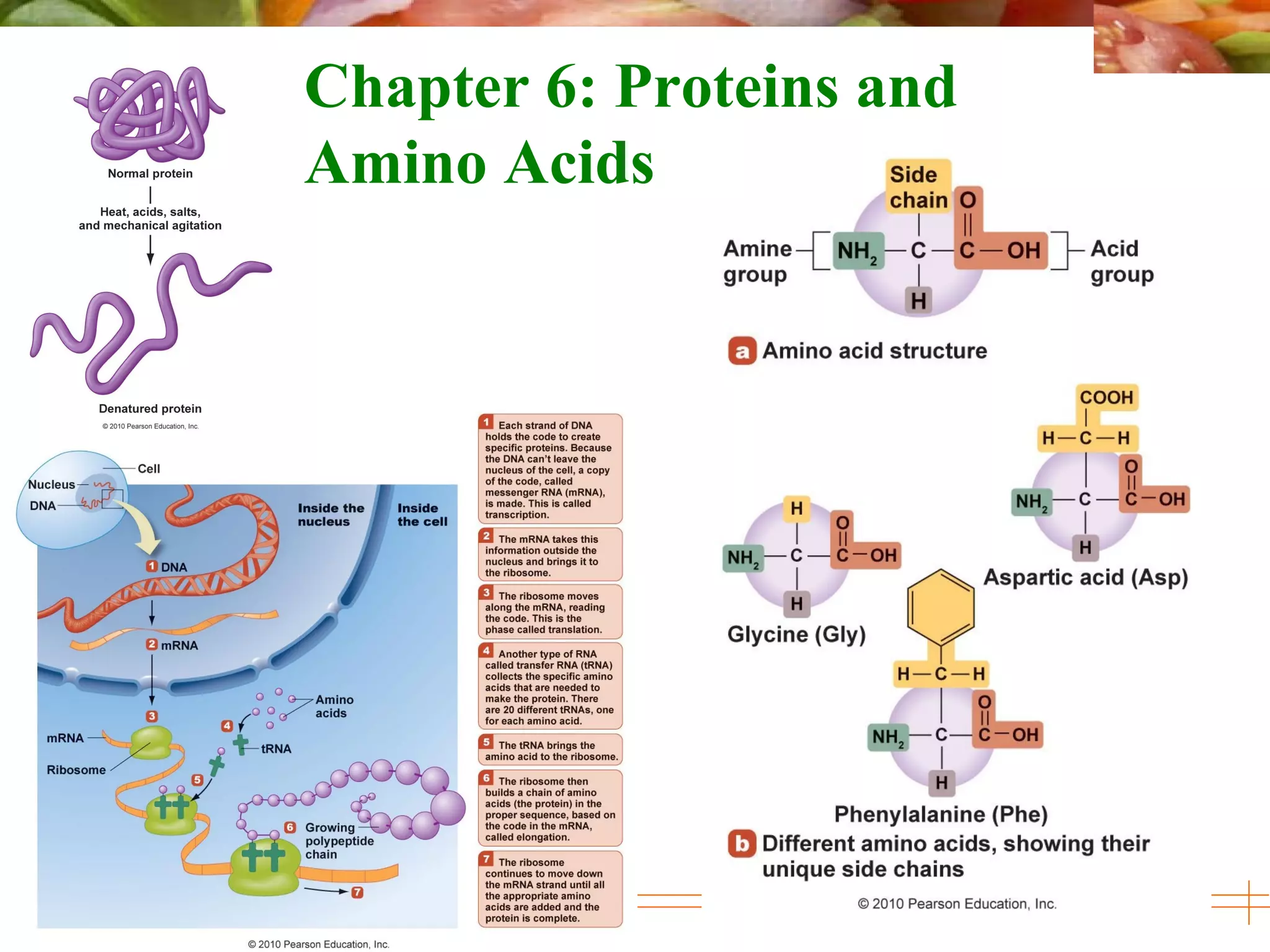
Chapter 6: Proteins and
Amino Acids
© 2010 Pearson Education, Inc.
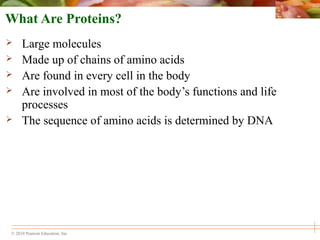
What Are Proteins?
 Large molecules
 Made up of chains of amino acids
 Are found in every cell in the body
 Are involved in most of the body’s functions and life
processes
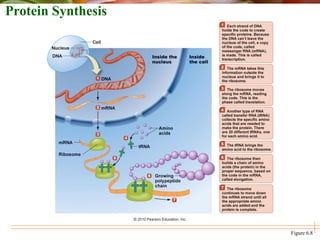
 The sequence of amino acids is determined by DNA
© 2010 Pearson Education, Inc.
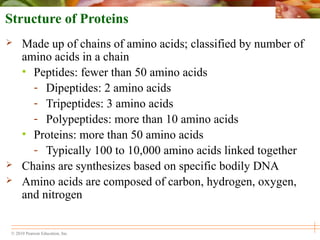
Structure of Proteins
 Made up of chains of amino acids; classified by number of
amino acids in a chain
• Peptides: fewer than 50 amino acids
- Dipeptides: 2 amino acids
- Tripeptides: 3 amino acids
- Polypeptides: more than 10 amino acids
• Proteins: more than 50 amino acids
- Typically 100 to 10,000 amino acids linked together
 Chains are synthesizes based on specific bodily DNA
 Amino acids are composed of carbon, hydrogen, oxygen,
and nitrogen
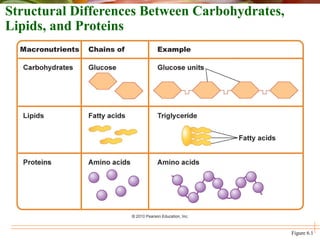
Structural Differences Between Carbohydrates,
Lipids, and Proteins
Figure 6.1
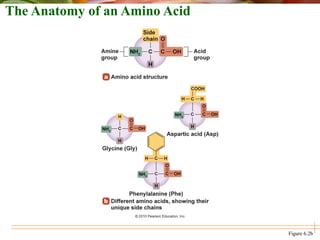
The Anatomy of an Amino Acid
Figure 6.2b
© 2010 Pearson Education, Inc.
Peptide Bonds Link Amino Acids
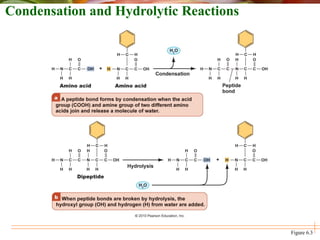
 Form when the acid group (COOH) of one amino acid joins
with the amine group (NH2) of a second amino acid
 Formed through condensation
 Broken through hydrolysis
Condensation and Hydrolytic Reactions
Figure 6.3
© 2010 Pearson Education, Inc.
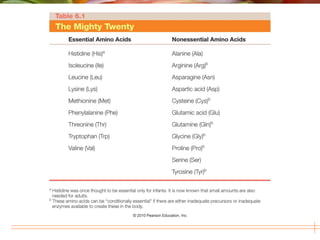
Essential, Nonessential, and Conditional
 Essential – must be consumed in the diet
 Nonessential – can be synthesized in the body
 Conditionally essential – cannot be synthesized due to
illness or lack of necessary precursors
• Premature infants lack sufficient enzymes needed to
create arginine
© 2010 Pearson Education, Inc.
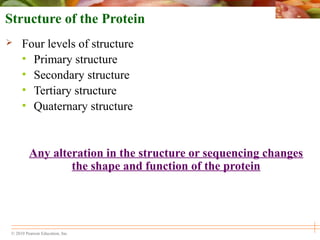
Structure of the Protein
 Four levels of structure
• Primary structure
• Secondary structure
• Tertiary structure
• Quaternary structure
Any alteration in the structure or sequencing changes
the shape and function of the protein
© 2010 Pearson Education, Inc.
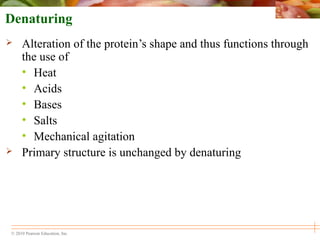
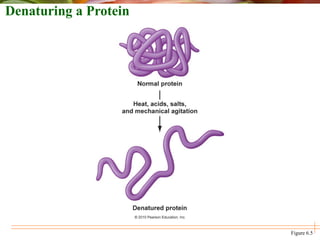
Denaturing
 Alteration of the protein’s shape and thus functions through
the use of
• Heat
• Acids
• Bases
• Salts
• Mechanical agitation
 Primary structure is unchanged by denaturing
Denaturing a Protein
Figure 6.5
© 2010 Pearson Education, Inc.
Quick Review
 Proteins are chains of combination of amino acids
 Amino acids contain carbon, hydrogen, oxygen, nitrogen,
and sometimes sulfur
 Unique amino acids consist of a central carbon with a
carboxyl group, a hydrogen, a nitrogen-containing amine
group, and a unique side chain
 There are 20 side chains and 20 unique amino acids
• 9 essential amino acids
• 11 nonessential amino acids
- At time these become conditionally essential
 Amino acids link together with peptide bonds by
condensation and break apart by hydrolysis
© 2010 Pearson Education, Inc.
Quick Review
 Attractions and interactions between the side chains cause
the proteins to fold into precise three-dimensional shapes
 Protein shape determines its function
 Proteins are denatured and their shapes changed by
• Heat
• Acids
• Bases
• Salts
• Mechanical agitation
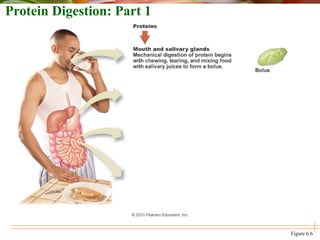
Protein Digestion: Part 1
Figure 6.6
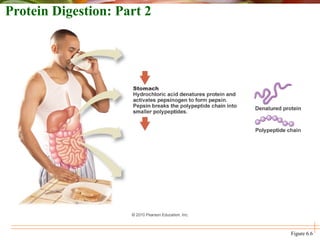
Protein Digestion: Part 2
Figure 6.6
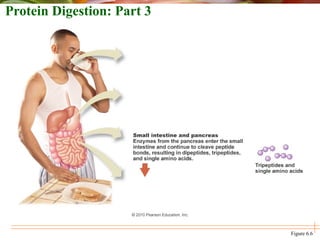
Protein Digestion: Part 3
Figure 6.6
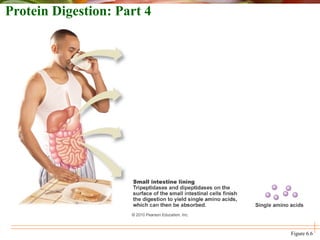
Protein Digestion: Part 4
Figure 6.6
© 2010 Pearson Education, Inc.
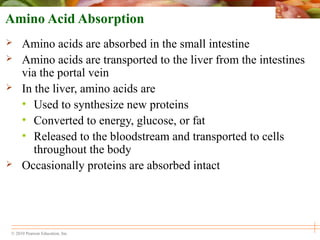
Amino Acid Absorption
 Amino acids are absorbed in the small intestine
 Amino acids are transported to the liver from the intestines
via the portal vein
 In the liver, amino acids are
• Used to synthesize new proteins
• Converted to energy, glucose, or fat
• Released to the bloodstream and transported to cells
throughout the body
 Occasionally proteins are absorbed intact
© 2010 Pearson Education, Inc.
Amino Acid Metabolism
 Liver metabolizes amino acids, depending on bodily needs
 Most amino acids are sent into the blood to be picked up
and used by the cells
• Amino acid pool is limited but has many uses
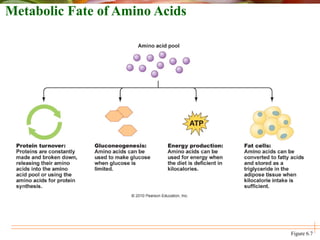
 Protein turnover – the continual degradation and
synthesizing of protein
Protein Synthesis
Figure 6.8
© 2010 Pearson Education, Inc.
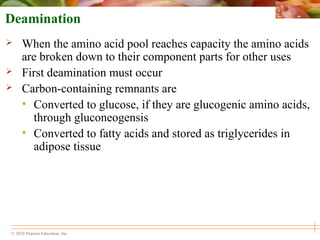
Deamination
 When the amino acid pool reaches capacity the amino acids
are broken down to their component parts for other uses
 First deamination must occur
 Carbon-containing remnants are
• Converted to glucose, if they are glucogenic amino acids,
through gluconeogensis
• Converted to fatty acids and stored as triglycerides in
adipose tissue
Metabolic Fate of Amino Acids
Figure 6.7
© 2010 Pearson Education, Inc.
Quick Review
 During digestion
• Proteins are broken down to amino acids with the help of
- Gastric juices
- Enzymes in the stomach and small intestine
- Enzymes from the pancreas and small intestine lining
 Limited supply of amino acids exist in the amino acid pool
 The amino acid pool acts as a reservoir for protein
synthesis
 Surplus amino acids are
• Deaminated
- Used for glucose or energy
- Stored as fat
- Nitrogen is converted to urea and excreted in urine
© 2010 Pearson Education, Inc.
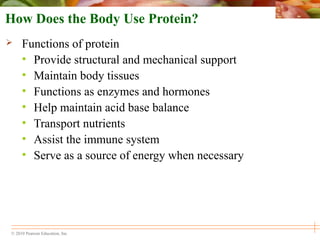
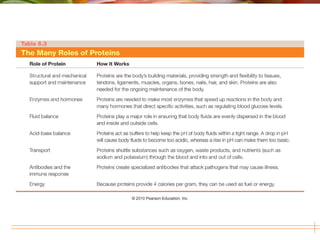
How Does the Body Use Protein?
 Functions of protein
• Provide structural and mechanical support
• Maintain body tissues
• Functions as enzymes and hormones
• Help maintain acid base balance
• Transport nutrients
• Assist the immune system
• Serve as a source of energy when necessary
© 2010 Pearson Education, Inc.
Quick Review
 Protein plays many important roles in the body, including:
• Helping facilitate muscular contraction
• Promoting satiety and appetite control
© 2010 Pearson Education, Inc.
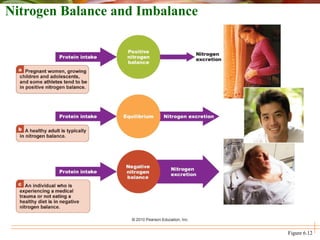
How Much Protein Do You Need?
 Healthy, nonpregnant adults
• Should consume enough to replace what is used every
day
• The goal is nitrogen balance
 Pregnant woman, people recovering from surgery or injury,
and growing children
• Should consume enough to build new tissue
Nitrogen Balance and Imbalance
Figure 6.12
© 2010 Pearson Education, Inc.
Not All Protein Is Created Equal
 High quality protein
• Is digestible
• Contains all essential amino acids
• Provides sufficient protein to synthesize nonessential
amino acids
 It helps to be aware of:
• Amino acid score
• Limiting protein
• Protein digestibility corrected amino acid score
(PDCAAS)
• Biological value of protein rates absorption and retention
of protein for use
© 2010 Pearson Education, Inc.
Protein Quality
 Complete proteins
• Contain all nine essential amino acids
• Usually animal source are complete proteins
• Are considered higher quality
 Incomplete proteins
• Low in one or more essential amino acid
• Usually plant sources are incomplete
© 2010 Pearson Education, Inc.
Protein Needs
 Protein intake recommendations
• 10–35% of total daily kilocalories
• Adults over 18
- 0.8 g/kg daily
 American College of Sports Medicine, the American
Dietetic Association, and other experts advocate
• 50–100% more protein for competitive athletes
participating in endurance exercise or resistance exercise
• Typically this population eats more and therefore gets
additional protein
© 2010 Pearson Education, Inc.
Quick Review
 Protein quality is determined by digestibility and types and
amounts of amino acids
 Animal protein is more easily digested and complete
 Plant proteins are typically incomplete, except soy
 Plant proteins can be complemented with proteins from
other plant sources or animal source to improve their
quality
 Adults should consume 0.8 g/kg/d of protein
 Men and women in the United States tend to over consume
protein
© 2010 Pearson Education, Inc.
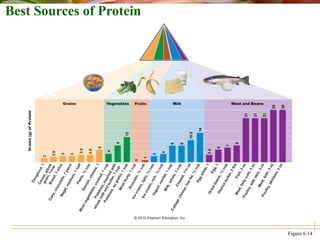
Best Sources of Protein
 Proteins are abundant in
• Dairy foods
• Meats
• Poultry
• Meat alternatives such as dried beans, peanut butter,
nuts, and soy
 3 oz serving of cooked meat, poultry, or fish
• Provides 21–25 grams of protein
• About 7 g/oz
• About the size of a deck of cards
• Adequate amount for one meal
Best Sources of Protein
Figure 6.14
© 2010 Pearson Education, Inc.
Quick Review
 A well-balanced diet can meet daily protein needs
 Best source of protein are animal products
• Eggs
• Lean meats
• Low-fat or fat-free dairy products
 Plant proteins such as soy, grains, and vegetables supply
substantial proteins
 Most people consume adequate protein from their diet and
do not need protein supplements
© 2010 Pearson Education, Inc.
Protein Bars
 Are marketed as convenient and portable
 Can be
• High in saturated fat and/or sugar
• Low in fiber
• Expensive
 A peanut butter sandwich is portable and lower in saturated
fat and sugar and higher in fiber than some protein bars
© 2010 Pearson Education, Inc.
Eating Too Much Protein
 Risk of heart disease
 Risk of kidney stones
 Risk of calcium loss from bones
 Risk of colon cancer
 Displacement of other nutrient-rich, disease preventing
foods
© 2010 Pearson Education, Inc.
Eating Too Little Protein
 Protein-energy malnutrition (PEM)
• Protein is used for energy rather than its other functions
in the body
• Other important nutrients are in short supply
• More prevalent in infants and children
- 17,000 children die each day as a result
© 2010 Pearson Education, Inc.
Too Little Protein
 Without adequate protein
• Cells lining the GI tract are not sufficiently replaced as
they slough off
• Digestive function is inhibited
• Absorption of food is reduced
• Intestinal bacteria gets into the blood and causes
septicemia
• Immune system is compromised due to malnutrition and
cannot fight infection
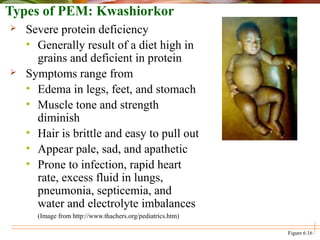
Types of PEM: Kwashiorkor
 Severe protein deficiency
• Generally result of a diet high in
grains and deficient in protein
 Symptoms range from
• Edema in legs, feet, and stomach
• Muscle tone and strength
diminish
• Hair is brittle and easy to pull out
• Appear pale, sad, and apathetic
• Prone to infection, rapid heart
rate, excess fluid in lungs,
pneumonia, septicemia, and
water and electrolyte imbalances
(Image from http://www.thachers.org/pediatrics.htm)
Figure 6.16
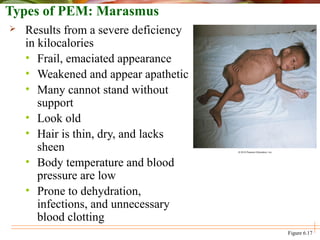
Types of PEM: Marasmus
 Results from a severe deficiency
in kilocalories
• Frail, emaciated appearance
• Weakened and appear apathetic
• Many cannot stand without
support
• Look old
• Hair is thin, dry, and lacks
sheen
• Body temperature and blood
pressure are low
• Prone to dehydration,
infections, and unnecessary
blood clotting
Figure 6.17
© 2010 Pearson Education, Inc.
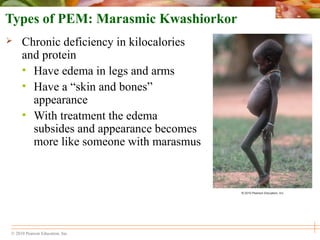
Types of PEM: Marasmic Kwashiorkor
 Chronic deficiency in kilocalories
and protein
• Have edema in legs and arms
• Have a “skin and bones”
appearance
• With treatment the edema
subsides and appearance becomes
more like someone with marasmus
© 2010 Pearson Education, Inc.
Treatment for PEM
 Medical and nutritional treatment can dramatically reduce
mortality rate
 Should be carefully and slowly implemented
• Step 1 – Address life-threatening factors
- Severe dehydration
- Fluid and nutrient imbalances
• Step 2 – Restore depleted tissue
- Gradually provide nutritionally dense kilocalories and
high-quality protein
• Step 3 – Transition to foods and introduce physical
activity
© 2010 Pearson Education, Inc.
Quick Review
 High-protein diet may play a role in increasing risk of heart
disease, kidney problems, and calcium loss from bones
 Consuming too much protein from animal sources increase
saturated fat intake
 Too much protein can displace whole grains, fruits, and
vegetables, which have been shown to reduce many chronic
diseases
 Low-protein diet can lead to loss of bone mass
 PEM is caused by inadequate protein and/or kilocalorie
intake
• Kwashiorkor – severe protein deficiency
• Marasmus – severe kilocalorie deficiency
© 2010 Pearson Education, Inc.
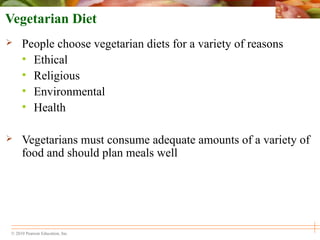
Vegetarian Diet
 People choose vegetarian diets for a variety of reasons
• Ethical
• Religious
• Environmental
• Health
 Vegetarians must consume adequate amounts of a variety of
food and should plan meals well
© 2010 Pearson Education, Inc.
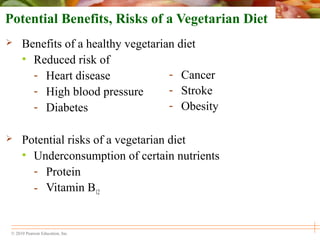
- Cancer
- Stroke
- Obesity
Potential Benefits, Risks of a Vegetarian Diet
 Benefits of a healthy vegetarian diet
• Reduced risk of
- Heart disease
- High blood pressure
- Diabetes
 Potential risks of a vegetarian diet
• Underconsumption of certain nutrients
- Protein
- Vitamin B12
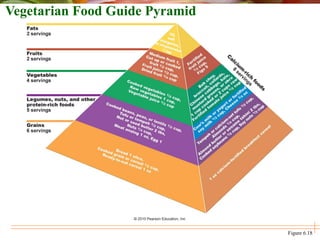
Vegetarian Food Guide Pyramid
Figure 6.18
© 2010 Pearson Education, Inc.
Soy
 Soy is increasing in popularity in the United States
• High-quality protein source
• Low in saturated fat
• Contains isoflavones
• Phytoestrogens
• May reduce risk of heart disease
• Some research suggests it may reduce the risk of cancer
• Some concern it may promote breast cancer
© 2010 Pearson Education, Inc.
• Riboflavin
• Vitamin B12
• Vitamin A
• Omega-3 fatty acids
Quick Review
 Vegetarian diets can be a healthy eating style that may help
reduce the risk of some chronic disease
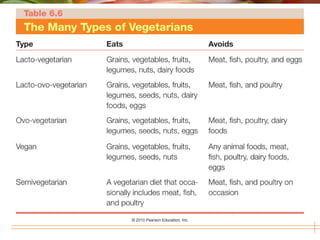
 Some vegetarians abstain from all animal products
 Some vegetarians eat eggs and dairy in limited amounts
 Vegetarians must plan their diets carefully to meet their
nutrient needs, especially
• Protein
• Iron
• Zinc
• Calcium
• Vitamin D
© 2010 Pearson Education, Inc.
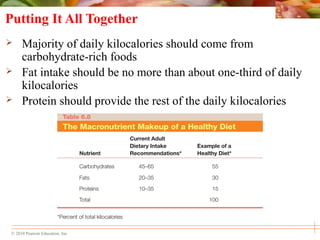
Putting It All Together
 Majority of daily kilocalories should come from
carbohydrate-rich foods
 Fat intake should be no more than about one-third of daily
kilocalories
 Protein should provide the rest of the daily kilocalories
© 2010 Pearson Education, Inc.
Putting It All Together
 Best plan for a healthful diet
• Eat an abundance of
- Grains (at least ½ whole grains)
- Vegetables
- Fruits
• Eat modest amounts of
- Commercially made bakery and snack items
- Vegetables with creamy sauces or added butter
- Sweets
• Choose low-fat dairy products, lean meat, poultry, and
fish to minimize the intake of heart-unhealthy saturated
fats

Nut chapter 6_lecture

  • 1.
    © 2010 PearsonEducation, Inc. Chapter 6: Proteins and Amino Acids
  • 2.
    © 2010 PearsonEducation, Inc. What Are Proteins?  Large molecules  Made up of chains of amino acids  Are found in every cell in the body  Are involved in most of the body’s functions and life processes  The sequence of amino acids is determined by DNA
  • 3.
    © 2010 PearsonEducation, Inc. Structure of Proteins  Made up of chains of amino acids; classified by number of amino acids in a chain • Peptides: fewer than 50 amino acids - Dipeptides: 2 amino acids - Tripeptides: 3 amino acids - Polypeptides: more than 10 amino acids • Proteins: more than 50 amino acids - Typically 100 to 10,000 amino acids linked together  Chains are synthesizes based on specific bodily DNA  Amino acids are composed of carbon, hydrogen, oxygen, and nitrogen
  • 4.
    Structural Differences BetweenCarbohydrates, Lipids, and Proteins Figure 6.1
  • 5.
    The Anatomy ofan Amino Acid Figure 6.2b
  • 6.
    © 2010 PearsonEducation, Inc. Peptide Bonds Link Amino Acids  Form when the acid group (COOH) of one amino acid joins with the amine group (NH2) of a second amino acid  Formed through condensation  Broken through hydrolysis
  • 7.
    Condensation and HydrolyticReactions Figure 6.3
  • 8.
    © 2010 PearsonEducation, Inc. Essential, Nonessential, and Conditional  Essential – must be consumed in the diet  Nonessential – can be synthesized in the body  Conditionally essential – cannot be synthesized due to illness or lack of necessary precursors • Premature infants lack sufficient enzymes needed to create arginine
  • 10.
    © 2010 PearsonEducation, Inc. Structure of the Protein  Four levels of structure • Primary structure • Secondary structure • Tertiary structure • Quaternary structure Any alteration in the structure or sequencing changes the shape and function of the protein
  • 11.
    © 2010 PearsonEducation, Inc. Denaturing  Alteration of the protein’s shape and thus functions through the use of • Heat • Acids • Bases • Salts • Mechanical agitation  Primary structure is unchanged by denaturing
  • 12.
  • 13.
    © 2010 PearsonEducation, Inc. Quick Review  Proteins are chains of combination of amino acids  Amino acids contain carbon, hydrogen, oxygen, nitrogen, and sometimes sulfur  Unique amino acids consist of a central carbon with a carboxyl group, a hydrogen, a nitrogen-containing amine group, and a unique side chain  There are 20 side chains and 20 unique amino acids • 9 essential amino acids • 11 nonessential amino acids - At time these become conditionally essential  Amino acids link together with peptide bonds by condensation and break apart by hydrolysis
  • 14.
    © 2010 PearsonEducation, Inc. Quick Review  Attractions and interactions between the side chains cause the proteins to fold into precise three-dimensional shapes  Protein shape determines its function  Proteins are denatured and their shapes changed by • Heat • Acids • Bases • Salts • Mechanical agitation
  • 15.
  • 16.
  • 17.
  • 18.
  • 19.
    © 2010 PearsonEducation, Inc. Amino Acid Absorption  Amino acids are absorbed in the small intestine  Amino acids are transported to the liver from the intestines via the portal vein  In the liver, amino acids are • Used to synthesize new proteins • Converted to energy, glucose, or fat • Released to the bloodstream and transported to cells throughout the body  Occasionally proteins are absorbed intact
  • 20.
    © 2010 PearsonEducation, Inc. Amino Acid Metabolism  Liver metabolizes amino acids, depending on bodily needs  Most amino acids are sent into the blood to be picked up and used by the cells • Amino acid pool is limited but has many uses  Protein turnover – the continual degradation and synthesizing of protein
  • 21.
  • 22.
    © 2010 PearsonEducation, Inc. Deamination  When the amino acid pool reaches capacity the amino acids are broken down to their component parts for other uses  First deamination must occur  Carbon-containing remnants are • Converted to glucose, if they are glucogenic amino acids, through gluconeogensis • Converted to fatty acids and stored as triglycerides in adipose tissue
  • 23.
    Metabolic Fate ofAmino Acids Figure 6.7
  • 24.
    © 2010 PearsonEducation, Inc. Quick Review  During digestion • Proteins are broken down to amino acids with the help of - Gastric juices - Enzymes in the stomach and small intestine - Enzymes from the pancreas and small intestine lining  Limited supply of amino acids exist in the amino acid pool  The amino acid pool acts as a reservoir for protein synthesis  Surplus amino acids are • Deaminated - Used for glucose or energy - Stored as fat - Nitrogen is converted to urea and excreted in urine
  • 25.
    © 2010 PearsonEducation, Inc. How Does the Body Use Protein?  Functions of protein • Provide structural and mechanical support • Maintain body tissues • Functions as enzymes and hormones • Help maintain acid base balance • Transport nutrients • Assist the immune system • Serve as a source of energy when necessary
  • 27.
    © 2010 PearsonEducation, Inc. Quick Review  Protein plays many important roles in the body, including: • Helping facilitate muscular contraction • Promoting satiety and appetite control
  • 28.
    © 2010 PearsonEducation, Inc. How Much Protein Do You Need?  Healthy, nonpregnant adults • Should consume enough to replace what is used every day • The goal is nitrogen balance  Pregnant woman, people recovering from surgery or injury, and growing children • Should consume enough to build new tissue
  • 29.
    Nitrogen Balance andImbalance Figure 6.12
  • 30.
    © 2010 PearsonEducation, Inc. Not All Protein Is Created Equal  High quality protein • Is digestible • Contains all essential amino acids • Provides sufficient protein to synthesize nonessential amino acids  It helps to be aware of: • Amino acid score • Limiting protein • Protein digestibility corrected amino acid score (PDCAAS) • Biological value of protein rates absorption and retention of protein for use
  • 31.
    © 2010 PearsonEducation, Inc. Protein Quality  Complete proteins • Contain all nine essential amino acids • Usually animal source are complete proteins • Are considered higher quality  Incomplete proteins • Low in one or more essential amino acid • Usually plant sources are incomplete
  • 32.
    © 2010 PearsonEducation, Inc. Protein Needs  Protein intake recommendations • 10–35% of total daily kilocalories • Adults over 18 - 0.8 g/kg daily  American College of Sports Medicine, the American Dietetic Association, and other experts advocate • 50–100% more protein for competitive athletes participating in endurance exercise or resistance exercise • Typically this population eats more and therefore gets additional protein
  • 33.
    © 2010 PearsonEducation, Inc. Quick Review  Protein quality is determined by digestibility and types and amounts of amino acids  Animal protein is more easily digested and complete  Plant proteins are typically incomplete, except soy  Plant proteins can be complemented with proteins from other plant sources or animal source to improve their quality  Adults should consume 0.8 g/kg/d of protein  Men and women in the United States tend to over consume protein
  • 34.
    © 2010 PearsonEducation, Inc. Best Sources of Protein  Proteins are abundant in • Dairy foods • Meats • Poultry • Meat alternatives such as dried beans, peanut butter, nuts, and soy  3 oz serving of cooked meat, poultry, or fish • Provides 21–25 grams of protein • About 7 g/oz • About the size of a deck of cards • Adequate amount for one meal
  • 35.
    Best Sources ofProtein Figure 6.14
  • 36.
    © 2010 PearsonEducation, Inc. Quick Review  A well-balanced diet can meet daily protein needs  Best source of protein are animal products • Eggs • Lean meats • Low-fat or fat-free dairy products  Plant proteins such as soy, grains, and vegetables supply substantial proteins  Most people consume adequate protein from their diet and do not need protein supplements
  • 37.
    © 2010 PearsonEducation, Inc. Protein Bars  Are marketed as convenient and portable  Can be • High in saturated fat and/or sugar • Low in fiber • Expensive  A peanut butter sandwich is portable and lower in saturated fat and sugar and higher in fiber than some protein bars
  • 38.
    © 2010 PearsonEducation, Inc. Eating Too Much Protein  Risk of heart disease  Risk of kidney stones  Risk of calcium loss from bones  Risk of colon cancer  Displacement of other nutrient-rich, disease preventing foods
  • 39.
    © 2010 PearsonEducation, Inc. Eating Too Little Protein  Protein-energy malnutrition (PEM) • Protein is used for energy rather than its other functions in the body • Other important nutrients are in short supply • More prevalent in infants and children - 17,000 children die each day as a result
  • 40.
    © 2010 PearsonEducation, Inc. Too Little Protein  Without adequate protein • Cells lining the GI tract are not sufficiently replaced as they slough off • Digestive function is inhibited • Absorption of food is reduced • Intestinal bacteria gets into the blood and causes septicemia • Immune system is compromised due to malnutrition and cannot fight infection
  • 41.
    Types of PEM:Kwashiorkor  Severe protein deficiency • Generally result of a diet high in grains and deficient in protein  Symptoms range from • Edema in legs, feet, and stomach • Muscle tone and strength diminish • Hair is brittle and easy to pull out • Appear pale, sad, and apathetic • Prone to infection, rapid heart rate, excess fluid in lungs, pneumonia, septicemia, and water and electrolyte imbalances (Image from http://www.thachers.org/pediatrics.htm) Figure 6.16
  • 42.
    Types of PEM:Marasmus  Results from a severe deficiency in kilocalories • Frail, emaciated appearance • Weakened and appear apathetic • Many cannot stand without support • Look old • Hair is thin, dry, and lacks sheen • Body temperature and blood pressure are low • Prone to dehydration, infections, and unnecessary blood clotting Figure 6.17
  • 43.
    © 2010 PearsonEducation, Inc. Types of PEM: Marasmic Kwashiorkor  Chronic deficiency in kilocalories and protein • Have edema in legs and arms • Have a “skin and bones” appearance • With treatment the edema subsides and appearance becomes more like someone with marasmus
  • 44.
    © 2010 PearsonEducation, Inc. Treatment for PEM  Medical and nutritional treatment can dramatically reduce mortality rate  Should be carefully and slowly implemented • Step 1 – Address life-threatening factors - Severe dehydration - Fluid and nutrient imbalances • Step 2 – Restore depleted tissue - Gradually provide nutritionally dense kilocalories and high-quality protein • Step 3 – Transition to foods and introduce physical activity
  • 45.
    © 2010 PearsonEducation, Inc. Quick Review  High-protein diet may play a role in increasing risk of heart disease, kidney problems, and calcium loss from bones  Consuming too much protein from animal sources increase saturated fat intake  Too much protein can displace whole grains, fruits, and vegetables, which have been shown to reduce many chronic diseases  Low-protein diet can lead to loss of bone mass  PEM is caused by inadequate protein and/or kilocalorie intake • Kwashiorkor – severe protein deficiency • Marasmus – severe kilocalorie deficiency
  • 46.
    © 2010 PearsonEducation, Inc. Vegetarian Diet  People choose vegetarian diets for a variety of reasons • Ethical • Religious • Environmental • Health  Vegetarians must consume adequate amounts of a variety of food and should plan meals well
  • 48.
    © 2010 PearsonEducation, Inc. - Cancer - Stroke - Obesity Potential Benefits, Risks of a Vegetarian Diet  Benefits of a healthy vegetarian diet • Reduced risk of - Heart disease - High blood pressure - Diabetes  Potential risks of a vegetarian diet • Underconsumption of certain nutrients - Protein - Vitamin B12
  • 49.
    Vegetarian Food GuidePyramid Figure 6.18
  • 50.
    © 2010 PearsonEducation, Inc. Soy  Soy is increasing in popularity in the United States • High-quality protein source • Low in saturated fat • Contains isoflavones • Phytoestrogens • May reduce risk of heart disease • Some research suggests it may reduce the risk of cancer • Some concern it may promote breast cancer
  • 51.
    © 2010 PearsonEducation, Inc. • Riboflavin • Vitamin B12 • Vitamin A • Omega-3 fatty acids Quick Review  Vegetarian diets can be a healthy eating style that may help reduce the risk of some chronic disease  Some vegetarians abstain from all animal products  Some vegetarians eat eggs and dairy in limited amounts  Vegetarians must plan their diets carefully to meet their nutrient needs, especially • Protein • Iron • Zinc • Calcium • Vitamin D
  • 52.
    © 2010 PearsonEducation, Inc. Putting It All Together  Majority of daily kilocalories should come from carbohydrate-rich foods  Fat intake should be no more than about one-third of daily kilocalories  Protein should provide the rest of the daily kilocalories
  • 53.
    © 2010 PearsonEducation, Inc. Putting It All Together  Best plan for a healthful diet • Eat an abundance of - Grains (at least ½ whole grains) - Vegetables - Fruits • Eat modest amounts of - Commercially made bakery and snack items - Vegetables with creamy sauces or added butter - Sweets • Choose low-fat dairy products, lean meat, poultry, and fish to minimize the intake of heart-unhealthy saturated fats