Presentation
    on
BIBLIOGRAPHY


By: Pankaj kumar.
• The word bibliographiya was used by
  Greek writers which mean- “the copying
  of books by hand.”
• In the 12th century, the word started being
  used for "the intellectual activity of
  composing books".
• The 17th century then saw the emergence
  of the modern meaning, that of description
  of books.
• Currently, the field of bibliography has
  expanded to include studies that consider
  the book as a material object.
What is Bibliography?
Carter and Barker describe bibliography as-

“ the organized listing of books and the
   systematic, detailed description of books
   as physical objects.”
“Bibliography is a list of books in some way
   pertinent to the research which has been
   done”
The bibliography should be arranged
 alphabetically and may be divided in two
 parts-
  First part may contain the name of books,
 and pamphlets, and
 The second part may contain the name of
 magazines, newspaper articles.
Importance of Bibliography
• A mandatory requirement of copyright
  laws and academic conventions is that
  whenever a research report is written,
  there should be a section at the end of it
  where you acknowledge the sources used.
• So, bibliography means listing all the
sources which you have consulted while
writing the research article.
• The sources may be in the form of printed
and online books, websites, web documents,
web blogs, newspaper articles, journals,
unpublished material, maps etc.
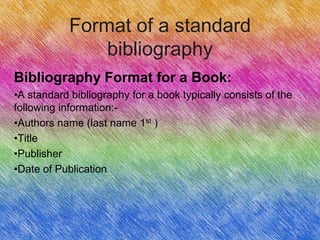
Format of a standard
                bibliography
Bibliography Format for a Book:
•A standard bibliography for a book typically consists of the
following information:-
•Authors name (last name 1st )
•Title
•Publisher
•Date of Publication
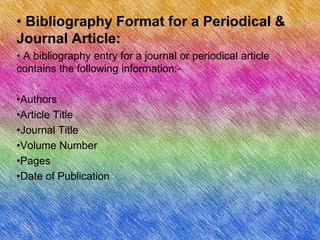
• Bibliography Format for a Periodical &
Journal Article:
• A bibliography entry for a journal or periodical article
contains the following information:-

•Authors
•Article Title
•Journal Title
•Volume Number
•Pages
•Date of Publication
Types of bibliography
          1. Analytical Bibliography:

Analytical bibliographies refer to the collection of sources
   and material for the purpose of critical study and
   evaluation.
2. Enumerative(Systematic) Bibliography:

An enumerative bibliography provides a list of the books
   according to some system, common theme or
   reference plan and includes information on by author,
   by subject, or by date.
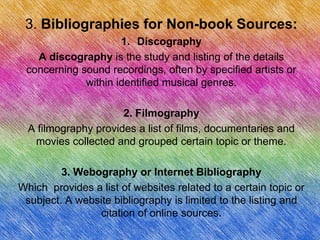
3. Bibliographies for Non-book Sources:
                     1. Discography
   A discography is the study and listing of the details
 concerning sound recordings, often by specified artists or
             within identified musical genres.

                      2. Filmography
  A filmography provides a list of films, documentaries and
   movies collected and grouped certain topic or theme.

         3. Webography or Internet Bibliography
Which provides a list of websites related to a certain topic or
 subject. A website bibliography is limited to the listing and
                citation of online sources.
Thanks

Presentation

  • 1.
    Presentation on BIBLIOGRAPHY By: Pankaj kumar.
  • 2.
    • The wordbibliographiya was used by Greek writers which mean- “the copying of books by hand.” • In the 12th century, the word started being used for "the intellectual activity of composing books".
  • 3.
    • The 17thcentury then saw the emergence of the modern meaning, that of description of books. • Currently, the field of bibliography has expanded to include studies that consider the book as a material object.
  • 4.
    What is Bibliography? Carterand Barker describe bibliography as- “ the organized listing of books and the systematic, detailed description of books as physical objects.” “Bibliography is a list of books in some way pertinent to the research which has been done”
  • 5.
    The bibliography shouldbe arranged alphabetically and may be divided in two parts- First part may contain the name of books, and pamphlets, and The second part may contain the name of magazines, newspaper articles.
  • 6.
    Importance of Bibliography •A mandatory requirement of copyright laws and academic conventions is that whenever a research report is written, there should be a section at the end of it where you acknowledge the sources used.
  • 7.
    • So, bibliographymeans listing all the sources which you have consulted while writing the research article. • The sources may be in the form of printed and online books, websites, web documents, web blogs, newspaper articles, journals, unpublished material, maps etc.
  • 8.
    Format of astandard bibliography Bibliography Format for a Book: •A standard bibliography for a book typically consists of the following information:- •Authors name (last name 1st ) •Title •Publisher •Date of Publication
  • 9.
    • Bibliography Formatfor a Periodical & Journal Article: • A bibliography entry for a journal or periodical article contains the following information:- •Authors •Article Title •Journal Title •Volume Number •Pages •Date of Publication
  • 10.
    Types of bibliography 1. Analytical Bibliography: Analytical bibliographies refer to the collection of sources and material for the purpose of critical study and evaluation. 2. Enumerative(Systematic) Bibliography: An enumerative bibliography provides a list of the books according to some system, common theme or reference plan and includes information on by author, by subject, or by date.
  • 11.
    3. Bibliographies forNon-book Sources: 1. Discography A discography is the study and listing of the details concerning sound recordings, often by specified artists or within identified musical genres. 2. Filmography A filmography provides a list of films, documentaries and movies collected and grouped certain topic or theme. 3. Webography or Internet Bibliography Which provides a list of websites related to a certain topic or subject. A website bibliography is limited to the listing and citation of online sources.
  • 12.