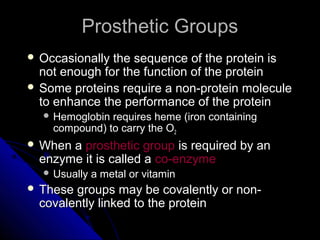
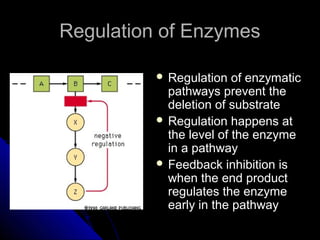
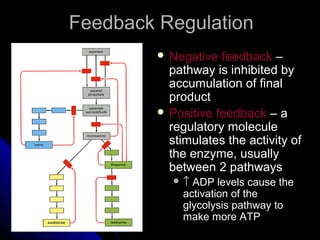
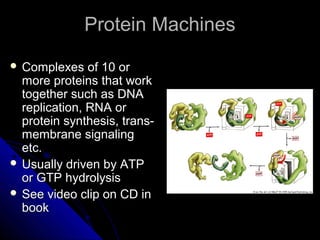
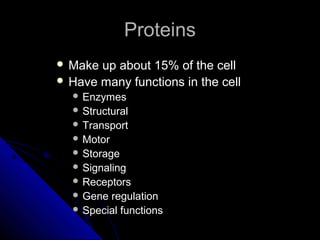
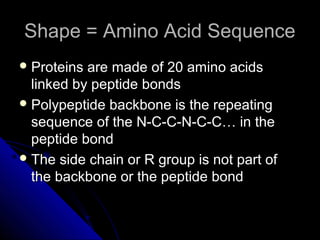
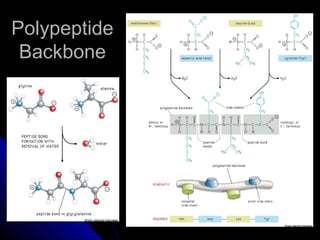
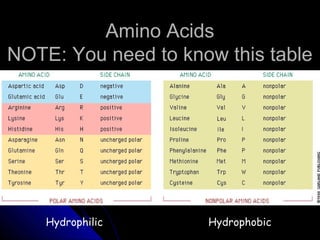
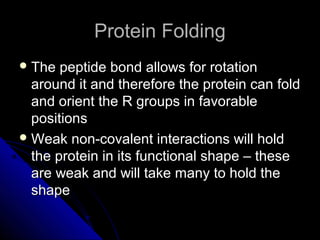
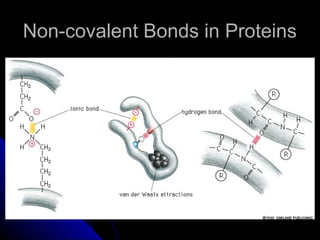
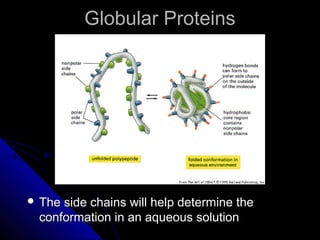
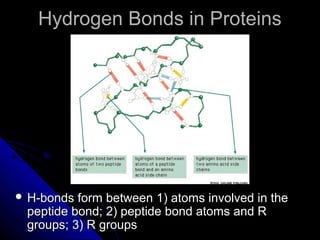
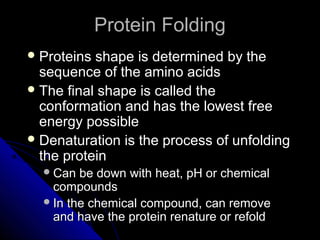
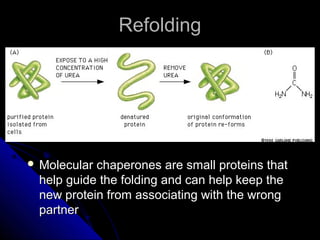
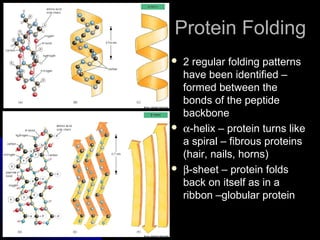
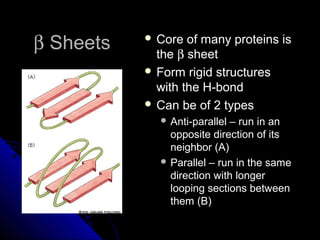
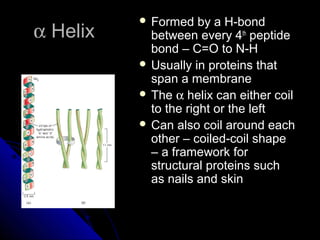
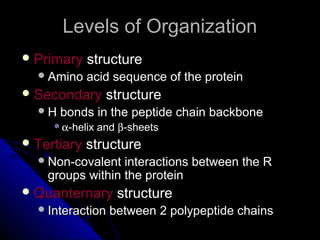
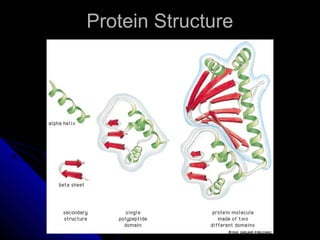
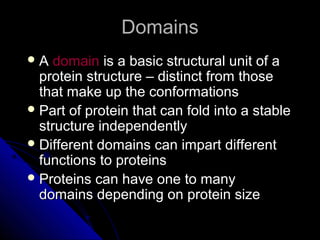
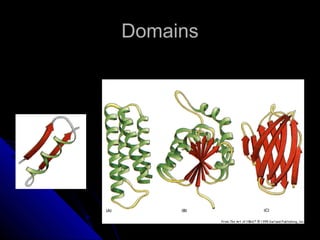
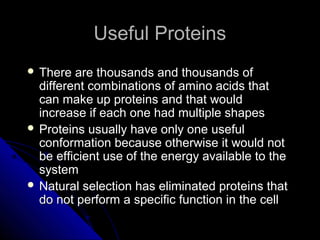
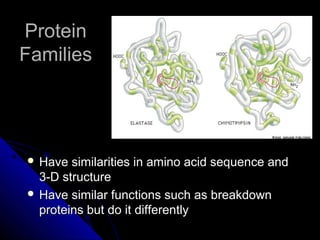
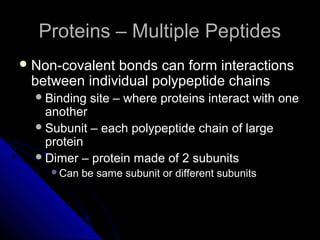
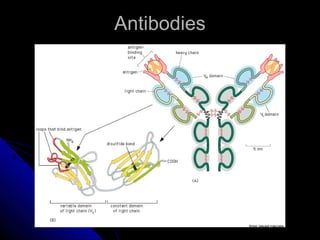
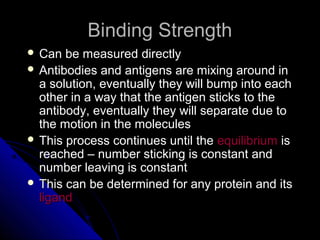
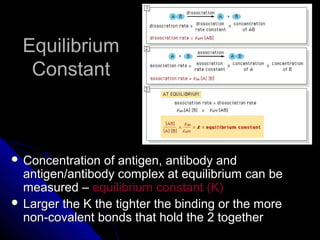
Proteins make up about 15% of cells and have many important functions like enzymes, structure, transport, motors, storage, signaling, and gene regulation. A protein's shape and function are determined by its amino acid sequence. The peptide backbone forms secondary structures like alpha helices and beta sheets held together by hydrogen bonds and other weak interactions. Chaperone proteins help guide proper protein folding. Proteins fold into complex 3D structures and can have multiple subunits that interact.

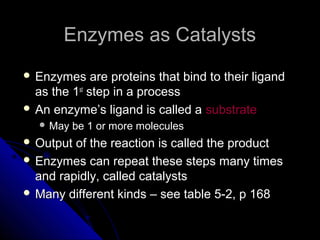
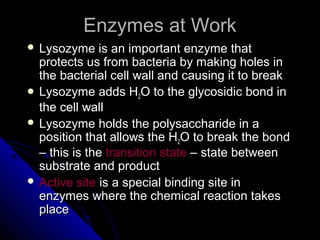
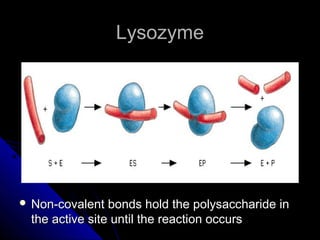
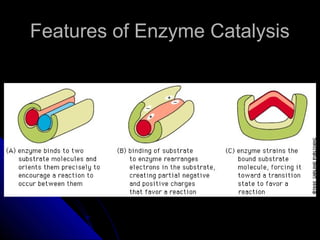
![Enzyme PerformanceEnzyme Performance
E + SE + S ↔↔ ESES ↔↔ EPEP ↔↔ E + PE + P
Step 1 – binding of the substrateStep 1 – binding of the substrate
Limiting step depending on [S] and/or [E]Limiting step depending on [S] and/or [E]
VVmaxmax – maximum rate of the reaction– maximum rate of the reaction
Turnover number determines how fast theTurnover number determines how fast the
substrate can be processed = rate of rxnsubstrate can be processed = rate of rxn ÷÷ [E][E]
Step 2 – stabilize the transition stateStep 2 – stabilize the transition state
State of substrate prior to becoming productState of substrate prior to becoming product
Enzymes lowers the energy of transition state andEnzymes lowers the energy of transition state and
therefore accelerates the reactiontherefore accelerates the reaction](https://image.slidesharecdn.com/proteinstructurefunction-170302071022/85/Protein-structure-amp-function-43-320.jpg)
![Reaction RatesReaction Rates
KKMM – [S] that allows rxn to proceed at ½ it– [S] that allows rxn to proceed at ½ it
maximum ratemaximum rate](https://image.slidesharecdn.com/proteinstructurefunction-170302071022/85/Protein-structure-amp-function-44-320.jpg)