Assessment
for Numeracy
Assessment for Numeracy
unit standards
26623 Use number to solve problems
26626 Interpret statistical information
for a purpose
26627 Use measurement to solve
problems
Numeracy - definition
Being competent, confident, and able to judge in
everyday contexts whether to use mathematics in a
particular situation and if so, what mathematics to use,
how to use it, what degree of accuracy is appropriate,
and what the answer means in relation to the context.
Numeracy knowledge and skills are essential for
mathematics in everyday family and financial matters,
learning, work and community tasks, social and leisure
activities.
Numeracy is different from Mathematics.
These unit standards focus
explicitly on numeracy in our
everyday lives.
“ongoing transferable competence”
Therefore assessment evidence
must be:
− naturally occurring
− over a range of contexts
− and over time.
Naturally Occurring Evidence
(NOE)
NOE occurs when it is produced in the
natural course of a person’s life – in work,
at school, anywhere else.
NOE excludes evidence from assessments
specifically designed for generating
evidence of numeracy competence – this is
not naturally occurring.
Evidence must be collected
over at least one month to
ensure the numeracy
competence is ‘ongoing’
and not just a one-off.
Evidence must be collected
from different contexts
to demonstrate transferability.
The Learning Progressions
The unit standards are based on the Learning
Progressions http://nclana-
archive.ako.ac.nz/resources/354426.html.
These help set the criteria for assessment
evidence at koru/step 5 of the relevant
numeracy strand.
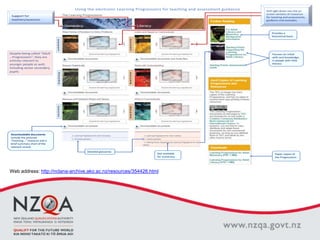
Using the electronic Learning Progressions for teaching and assessment guidance
Downloadable documents
include the pictured
‘Teaching…” resource and a
brief summary chart of the
relevant strand.
Not available
for numeracy.
Paper copies of
the Progressions
Detailed glossaries
Focuses on initial
skills and knowledge,
in people with little
literacy
Provides a
theoretical basis
Web address: http://www.literacyandnumeracyforadults.com/resources/354426
Despite being called “Adult
…Progressions”, they are
entirely relevant to
younger people as well,
including senior secondary
pupils.
Web address: http://nclana-archive.ako.ac.nz/resources/354426.html
Visit http://nclana-
archive.ako.ac.nz/resources/354426.html
for the six Learning Progressions, to
access further detail and examples.
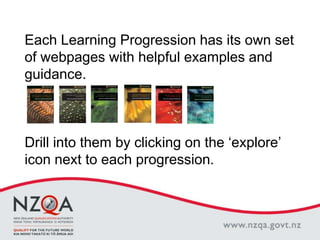
Each Learning Progression has its own set
of webpages with helpful examples and
guidance.
Drill into them by clicking on the ‘explore’
icon next to each progression.
A note about “adult”
Despite the frequent use of
this label the Learning
Progressions are also entirely
relevant to young people.
26623 Use number to solve
problems
Three instances each of addition, subtraction,
multiplication, and division need to be
demonstrated. Each instance must be different
enough to show transferability of skills (ER 1.1
range).
There must be evidence that the learner has
determined that their solution is appropriate to
the problem (ER 1.2).
26626 Interpret statistical
information for a purpose
The conclusions drawn from the statistical
data must relate back to the statistical
information and must use appropriate
general features in the information.
There must be evidence that the learner has
determined that their conclusion is
appropriate to the purpose (ER 1.2).
26627 Use measurement to solve
problems
There must be evidence of students using
calculations to solve the problems (Outcome 1).
Location must be included in terms of directions
and distances (Outcome 1).
The method to the solution of problems must not be
given by the assessor (ER 1.2).
There must be evidence that the learner has
determined that their solution is appropriate to the
problem (ER 1.3).
Remember always that
assessment evidence must be:
− naturally occurring
− over a range of contexts
− and over time.
Other PowerPoint presentations in
this series:
• The unit standards (a general
introduction)
• Assessment for Literacy
• Moderation
Discussion/questions
For further information about:
• the unit standards themselves or to
comment on this presentation,
contact nqs@nzqa.govt.nz
• assessment or moderation, contact
ams@nzqa.govt.nz

Numeracy.pptx

  • 1.
  • 2.
    Assessment for Numeracy unitstandards 26623 Use number to solve problems 26626 Interpret statistical information for a purpose 26627 Use measurement to solve problems
  • 3.
    Numeracy - definition Beingcompetent, confident, and able to judge in everyday contexts whether to use mathematics in a particular situation and if so, what mathematics to use, how to use it, what degree of accuracy is appropriate, and what the answer means in relation to the context. Numeracy knowledge and skills are essential for mathematics in everyday family and financial matters, learning, work and community tasks, social and leisure activities. Numeracy is different from Mathematics.
  • 4.
    These unit standardsfocus explicitly on numeracy in our everyday lives. “ongoing transferable competence”
  • 5.
    Therefore assessment evidence mustbe: − naturally occurring − over a range of contexts − and over time.
  • 6.
    Naturally Occurring Evidence (NOE) NOEoccurs when it is produced in the natural course of a person’s life – in work, at school, anywhere else. NOE excludes evidence from assessments specifically designed for generating evidence of numeracy competence – this is not naturally occurring.
  • 7.
    Evidence must becollected over at least one month to ensure the numeracy competence is ‘ongoing’ and not just a one-off.
  • 8.
    Evidence must becollected from different contexts to demonstrate transferability.
  • 9.
    The Learning Progressions Theunit standards are based on the Learning Progressions http://nclana- archive.ako.ac.nz/resources/354426.html. These help set the criteria for assessment evidence at koru/step 5 of the relevant numeracy strand.
  • 10.
    Using the electronicLearning Progressions for teaching and assessment guidance Downloadable documents include the pictured ‘Teaching…” resource and a brief summary chart of the relevant strand. Not available for numeracy. Paper copies of the Progressions Detailed glossaries Focuses on initial skills and knowledge, in people with little literacy Provides a theoretical basis Web address: http://www.literacyandnumeracyforadults.com/resources/354426 Despite being called “Adult …Progressions”, they are entirely relevant to younger people as well, including senior secondary pupils. Web address: http://nclana-archive.ako.ac.nz/resources/354426.html
  • 11.
    Visit http://nclana- archive.ako.ac.nz/resources/354426.html for thesix Learning Progressions, to access further detail and examples.
  • 12.
    Each Learning Progressionhas its own set of webpages with helpful examples and guidance. Drill into them by clicking on the ‘explore’ icon next to each progression.
  • 13.
    A note about“adult” Despite the frequent use of this label the Learning Progressions are also entirely relevant to young people.
  • 14.
    26623 Use numberto solve problems Three instances each of addition, subtraction, multiplication, and division need to be demonstrated. Each instance must be different enough to show transferability of skills (ER 1.1 range). There must be evidence that the learner has determined that their solution is appropriate to the problem (ER 1.2).
  • 15.
    26626 Interpret statistical informationfor a purpose The conclusions drawn from the statistical data must relate back to the statistical information and must use appropriate general features in the information. There must be evidence that the learner has determined that their conclusion is appropriate to the purpose (ER 1.2).
  • 16.
    26627 Use measurementto solve problems There must be evidence of students using calculations to solve the problems (Outcome 1). Location must be included in terms of directions and distances (Outcome 1). The method to the solution of problems must not be given by the assessor (ER 1.2). There must be evidence that the learner has determined that their solution is appropriate to the problem (ER 1.3).
  • 17.
    Remember always that assessmentevidence must be: − naturally occurring − over a range of contexts − and over time.
  • 18.
    Other PowerPoint presentationsin this series: • The unit standards (a general introduction) • Assessment for Literacy • Moderation
  • 19.
    Discussion/questions For further informationabout: • the unit standards themselves or to comment on this presentation, contact nqs@nzqa.govt.nz • assessment or moderation, contact ams@nzqa.govt.nz