NUMBERS
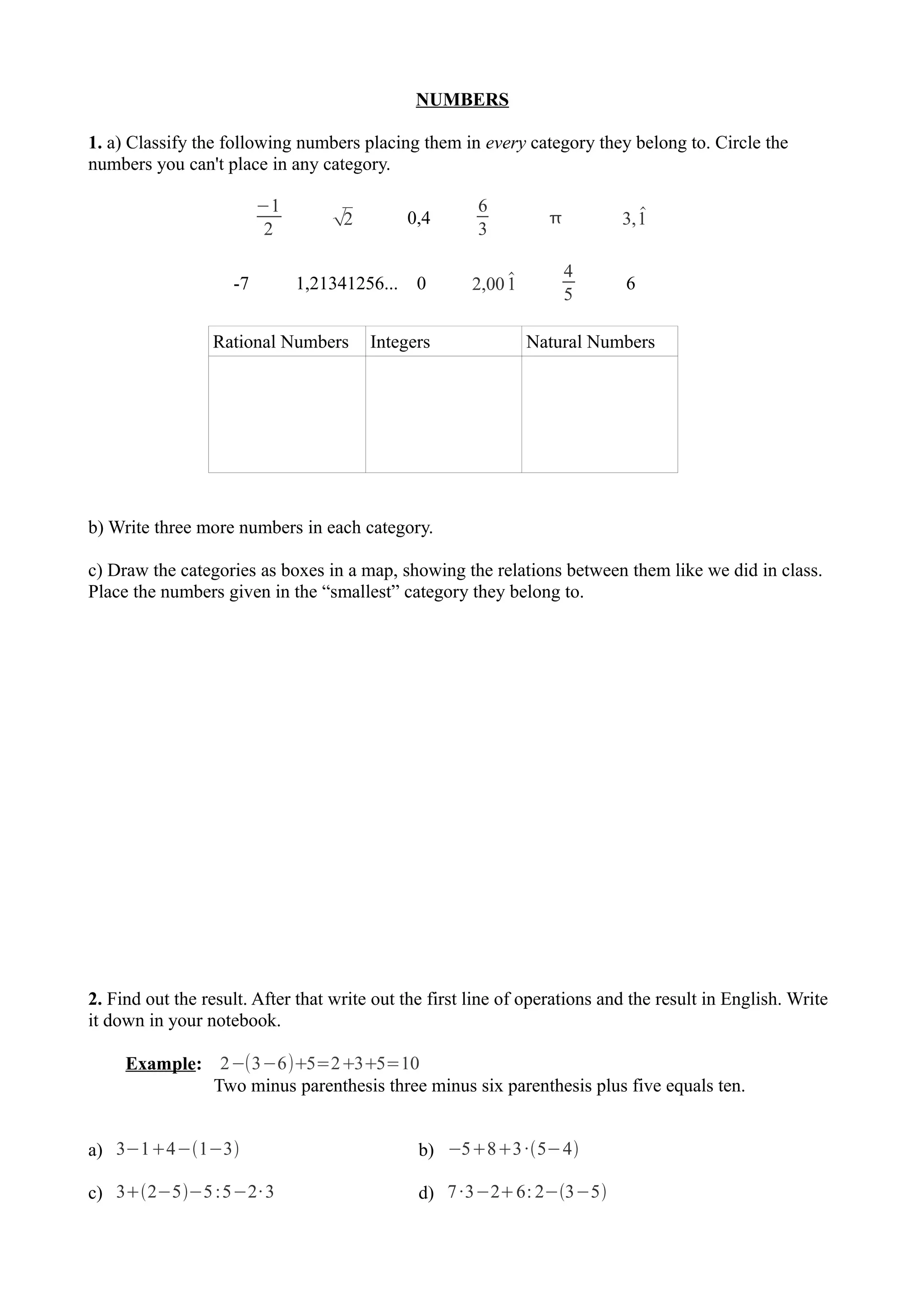
1. a) Classify the following numbers placing them in every category they belong to. Circle the
numbers you can't place in any category.
−1
2 2 0,4
6
3
 3, 1
-7 1,21341256... 0 2,00 1
4
5
6
Rational Numbers Integers Natural Numbers
b) Write three more numbers in each category.
c) Draw the categories as boxes in a map, showing the relations between them like we did in class.
Place the numbers given in the “smallest” category they belong to.
2. Find out the result. After that write out the first line of operations and the result in English. Write
it down in your notebook.
Example: 2−(3−6)+5=2+3+5=10
Two minus parenthesis three minus six parenthesis plus five equals ten.
a) 3−14−1−3 b) −583·5−4
c) 32−5−5:5−2·3 d) 7·3−26: 2−3−5

Numbers 1º eso

  • 1.
    NUMBERS 1. a) Classifythe following numbers placing them in every category they belong to. Circle the numbers you can't place in any category. −1 2 2 0,4 6 3  3, 1 -7 1,21341256... 0 2,00 1 4 5 6 Rational Numbers Integers Natural Numbers b) Write three more numbers in each category. c) Draw the categories as boxes in a map, showing the relations between them like we did in class. Place the numbers given in the “smallest” category they belong to. 2. Find out the result. After that write out the first line of operations and the result in English. Write it down in your notebook. Example: 2−(3−6)+5=2+3+5=10 Two minus parenthesis three minus six parenthesis plus five equals ten. a) 3−14−1−3 b) −583·5−4 c) 32−5−5:5−2·3 d) 7·3−26: 2−3−5