First Announcement of
23rd International Seminar
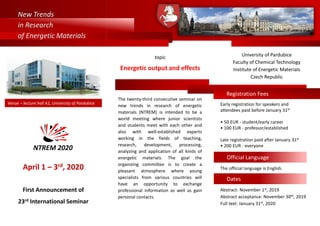
Venue – lecture hall A1, University of Pardubice
April 1 – 3rd, 2020
The twenty-third consecutive seminar on
new trends in research of energetic
materials (NTREM) is intended to be a
world meeting where junior scientists
and students meet with each other and
also with well-established experts
working in the fields of teaching,
research, development, processing,
analyzing and application of all kinds of
energetic materials. The goal the
organizing committee is to create a
pleasant atmosphere where young
specialists from various countries will
have an opportunity to exchange
professional information as well as gain
personal contacts.
New Trends
in Research
of Energetic Materials
topic
Energetic output and effects
University of Pardubice
Faculty of Chemical Technology
Institute of Energetic Materials
Czech Republic
Early registration for speakers and
attendees paid before January 31st
• 50 EUR - student/early career
• 100 EUR - professor/established
Late registration paid after January 31st
• 200 EUR - everyone
Official Language
The official language is English.
DatesAbstract: November 1st, 2019
Abstract acceptance: November 30th, 2019
Full text: January 31st, 2020
Dates
Official Language
Registration Fees
Litomyšl
Adršpach
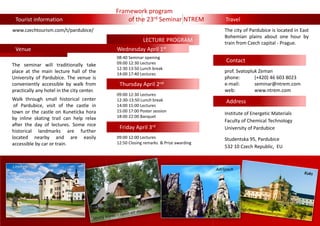
The seminar will traditionally take
place at the main lecture hall of the
University of Pardubice. The venue is
conveniently accessible by walk from
practically any hotel in the city center.
Walk through small historical center
of Pardubice, visit of the castle in
town or the castle on Kuneticka hora
by inline skating trail can help relax
after the day of lectures. Some nice
historical landmarks are further
located nearby and are easily
accessible by car or train.
LECTURE PROGRAM
Venue Wednesday April 1st
Address
08:40 Seminar opening
09:00 12:30 Lectures
12:30 13:50 Lunch break
14:00 17:40 Lectures
09:00 12:30 Lectures
12:30-13:50 Lunch break
14:00 15:00 Lectures
15:00 17:00 Poster session
18:00 22:00 Banquet
Institute of Energetic Materials
Faculty of Chemical Technology
University of Pardubice
Studentska 95, Pardubice
532 10 Czech Republic, EU
Friday April 3rd
09:00 12:00 Lectures
12:50 Closing remarks & Prize awarding
prof. Svatopluk Zeman
phone: (+420) 46 603 8023
e-mail: seminar@ntrem.com
web: www.ntrem.com
Contact
The city of Pardubice is located in East
Bohemian plains about one hour by
train from Czech capital - Prague.
TravelTourist information
Framework program
of the 23rd Seminar NTREM
www.czechtourism.com/t/pardubice/
Thursday April 2nd
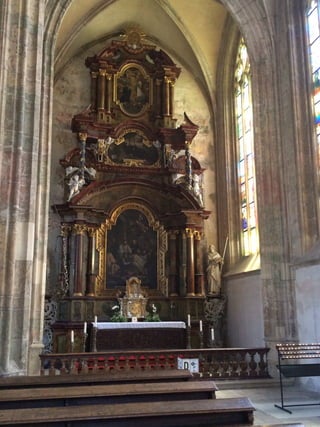
SAINT BARBARA'S CHURCH
KUTNA HORA
PRAGUE, CZECH REPUBLIC
Saint Barbara is often portrayed with miniature chains and a tower. As one of the Fourteen Holy
Helpers, Barbara continues to be a popular saint in modern times, perhaps best known as the
patron saint of armourers, artillerymen, military engineers, miners and others who work
with explosives because of her legend's association with lightning, and also of mathematicians.
https://en.wikipedia.org/wiki/Saint_Barbara
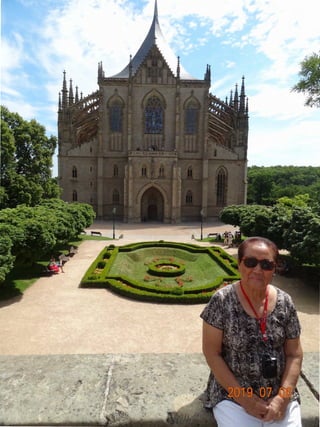
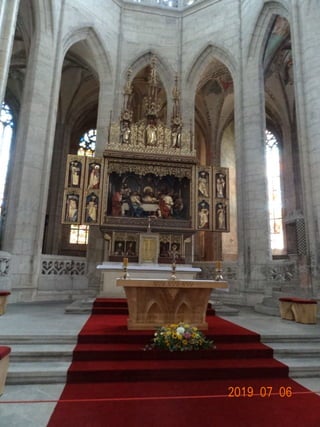
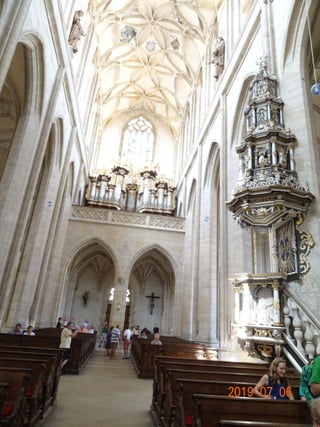
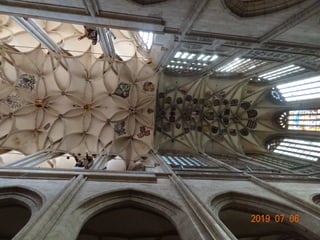
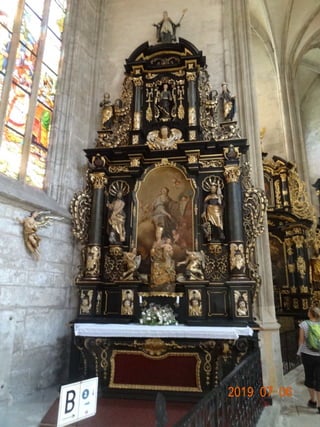
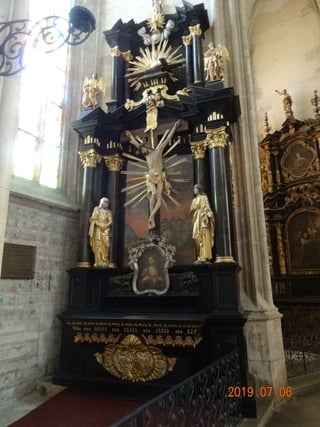
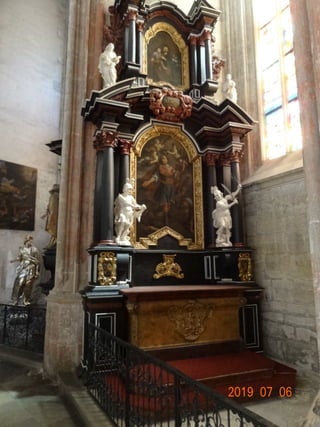
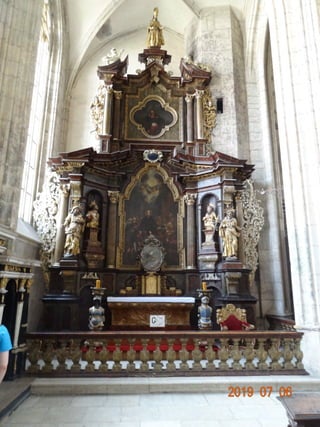
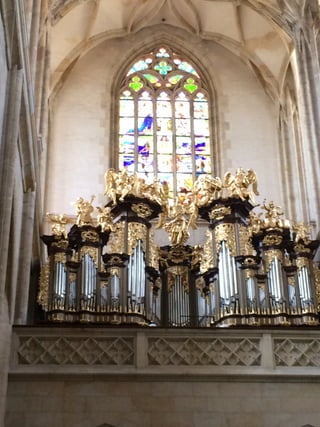
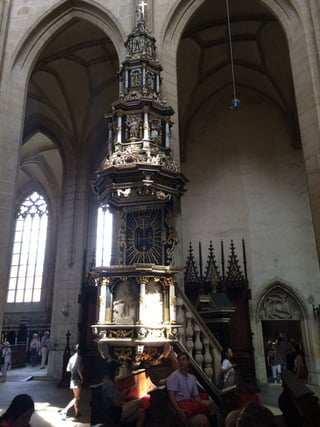
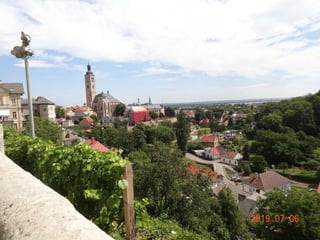
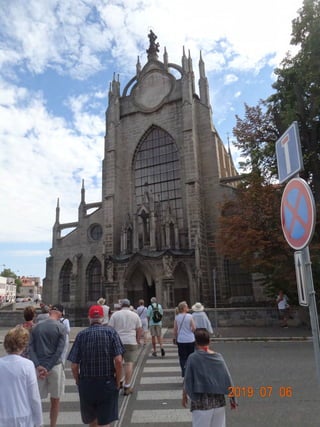
SAINT BARBARA'S CHURCH is a Roman Catholic church in Kutná Hora in the style of a
cathedral and is sometimes referred to as the Cathedral of St Barbara. It is one of the most
famous Gothic churches in central Europe and it is a UNESCO world heritage site.
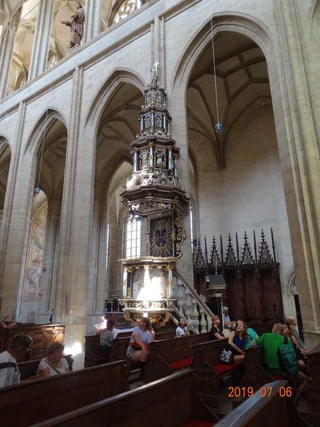
The UNESCO-listed Church of St. Barbara (also called St. Barbara's Cathedral) is a
monumental Gothic church consecrated to St. Barbara, patron saint of miners. Its unique design
with a three-tent roof and intricate flying buttresses make it an unmistakable Kutná Hora
landmark and the town's most significant monument.
The construction took over 500 years, beginning in 1388 and ending in 1905 with a Neo-Gothic
restoration. Building was interrupted several times, either due to the Hussite wars or for lack of
financial resources. Several prominent architects took part in the project over the centuries: Jan
Parléř (son of Petr Parléř, architect of Prague's St. Vitus Cathedral), Matyáš Rejsek (designer of
Prague's Powder Tower), Benedikt Rejt (author of the Wladislaw Hall at the Prague Castle), and
Josef Mocker (restorer of many Czech castles including Karlštejn).
St. Barbara's Church was originally planned to be twice its today's size. The church was
consecrated in 1403 and was used for prayers throughout its construction despite being
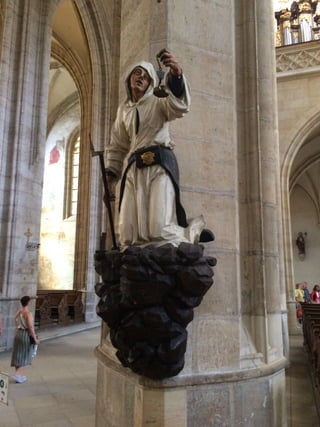
unfinished, even before the roof was put up. As a sort of "miners' church", it was perceived as an
important symbol of protection of the town's miners, and of the town itself. Just like the church
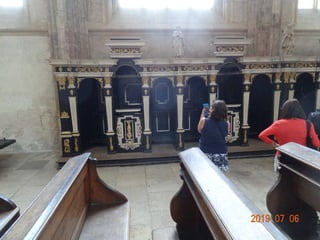
exterior, its interior is stunning and quite complex. Lots of the interior imagery depict scenes from
Kutná Hora's mining life.
PRAGUE, CZECH REPUBLIC
KUTNA HORA
Sedlec Ossuary
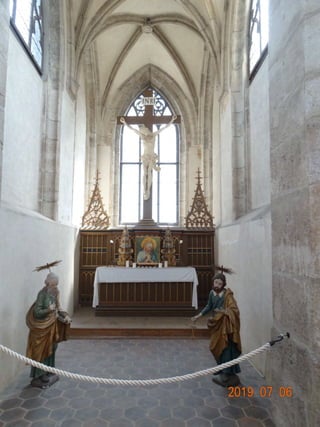
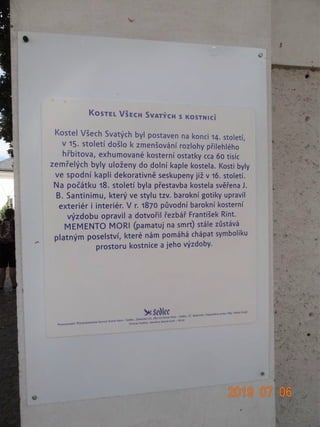
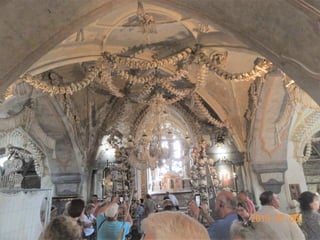
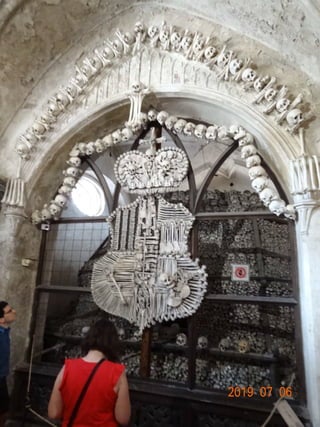
The Sedlec Ossuary also known as the Church of Bones is one of the most unusual chapels you
will ever see.
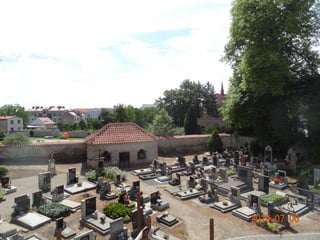
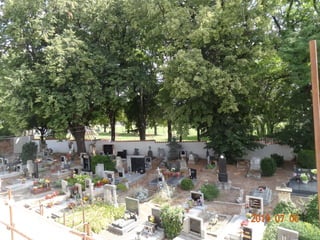
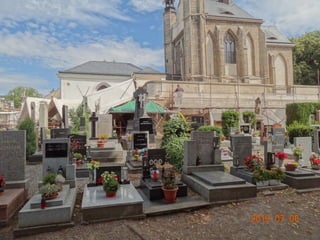
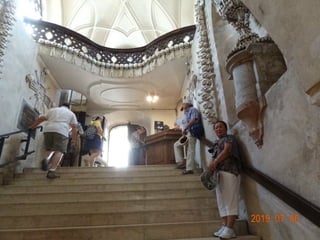
The Sedlec Ossuary is nothing spectacular in the outside. It is a small chapel located in Sedlec, in
the suburbs of Kutna Hora, in the Czech Republic. You would think that it is just an average old
medieval gothic church.
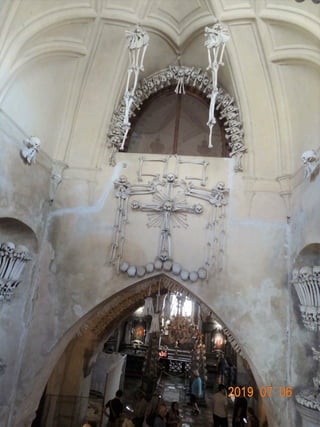
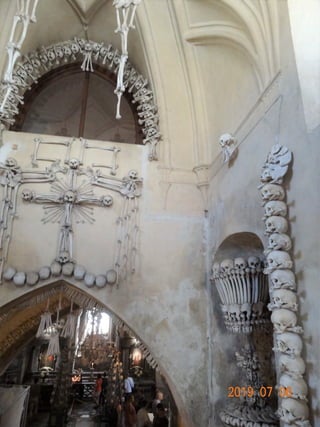
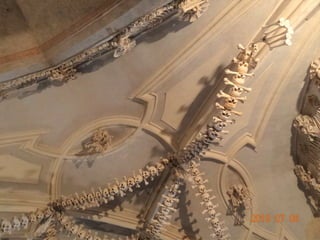
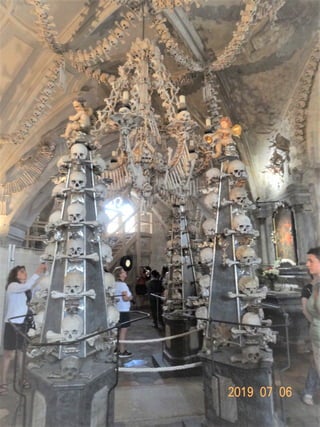
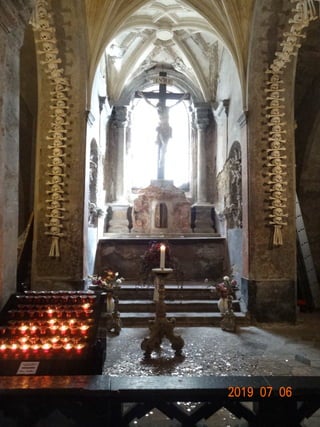
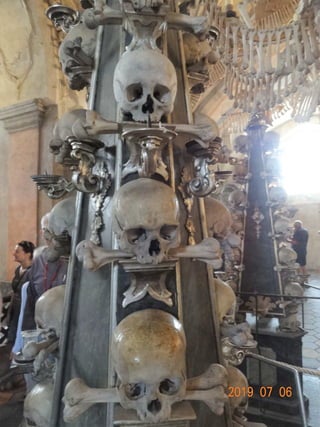
As you enter the Sedlec Ossuary though, you will soon realize why it is one of the most amazing
and unique churches in the world. The Sedlec Ossuary is artistically decorated by more than 40.000
human skeletons.
Thus it is also known as the Church of Bones or as the Bone Church.
One of the most fascinating artistic works inside the Sedlec Ossuary is the big chandelier of bones
that lies in the center of the Church of Bones. The immense chandelier contains at least one of
every human bone.
Another impressive artwork is the coat of arms of the Schwarzenberg family that is also made of
human bones. While there are other macabre places to visit in Europe like the Paris Catacombe,
the Sedlec Ossuary is unique in nature.
You may wonder how all these bones ended up being craved in a small chapel located in the Czech
Republic. It all goes back to 1278 when the King of Bohemia sent the abbot of the Sedlec Cistercian
Monastery to Jerusalem.
When the abbot came back, he brought with himself a jar of soil from the Golgotha, that was known
as the “Holy Soil”. Soon people from all over the places desired to be buried in Sedlec, thus the
cemetery there had to be expanded.
In the 15th century a Gothic church was built near the cemetery and its basement was used as an
ossuary. The bones stayed there for centuries till 1870 when a woodcarver named Frantisek Rint
was appointed to place the bones in order. The result was impressively shocking.
Finally, the Sedlec Ossuary may seem a macabre place, but while visiting it, you will most likely not
find it to be scary, but peaceful.
Those 40.000 dead people wished to be buried in a holy place, that is why they went to Sedlec in
the first place, and now their bones are right in the middle of the chapel.
SEE:   
https://en.wikipedia.org/wiki/Sedlec_Ossuary 
https://en.wikipedia.org/wiki/Kutn%C3%A1_Hora, 
https://en.wikipedia.org/wiki/St._Barbara%27s_Church,_Kutn%C3%A1_Hora,  
NTREM Symposium 1-3 April 2020

NTREM Symposium 1-3 April 2020

  • 1.
    First Announcement of 23rdInternational Seminar Venue – lecture hall A1, University of Pardubice April 1 – 3rd, 2020 The twenty-third consecutive seminar on new trends in research of energetic materials (NTREM) is intended to be a world meeting where junior scientists and students meet with each other and also with well-established experts working in the fields of teaching, research, development, processing, analyzing and application of all kinds of energetic materials. The goal the organizing committee is to create a pleasant atmosphere where young specialists from various countries will have an opportunity to exchange professional information as well as gain personal contacts. New Trends in Research of Energetic Materials topic Energetic output and effects University of Pardubice Faculty of Chemical Technology Institute of Energetic Materials Czech Republic Early registration for speakers and attendees paid before January 31st • 50 EUR - student/early career • 100 EUR - professor/established Late registration paid after January 31st • 200 EUR - everyone Official Language The official language is English. DatesAbstract: November 1st, 2019 Abstract acceptance: November 30th, 2019 Full text: January 31st, 2020 Dates Official Language Registration Fees
  • 2.
    Litomyšl Adršpach The seminar willtraditionally take place at the main lecture hall of the University of Pardubice. The venue is conveniently accessible by walk from practically any hotel in the city center. Walk through small historical center of Pardubice, visit of the castle in town or the castle on Kuneticka hora by inline skating trail can help relax after the day of lectures. Some nice historical landmarks are further located nearby and are easily accessible by car or train. LECTURE PROGRAM Venue Wednesday April 1st Address 08:40 Seminar opening 09:00 12:30 Lectures 12:30 13:50 Lunch break 14:00 17:40 Lectures 09:00 12:30 Lectures 12:30-13:50 Lunch break 14:00 15:00 Lectures 15:00 17:00 Poster session 18:00 22:00 Banquet Institute of Energetic Materials Faculty of Chemical Technology University of Pardubice Studentska 95, Pardubice 532 10 Czech Republic, EU Friday April 3rd 09:00 12:00 Lectures 12:50 Closing remarks & Prize awarding prof. Svatopluk Zeman phone: (+420) 46 603 8023 e-mail: seminar@ntrem.com web: www.ntrem.com Contact The city of Pardubice is located in East Bohemian plains about one hour by train from Czech capital - Prague. TravelTourist information Framework program of the 23rd Seminar NTREM www.czechtourism.com/t/pardubice/ Thursday April 2nd
  • 25.
    SAINT BARBARA'S CHURCH KUTNAHORA PRAGUE, CZECH REPUBLIC Saint Barbara is often portrayed with miniature chains and a tower. As one of the Fourteen Holy Helpers, Barbara continues to be a popular saint in modern times, perhaps best known as the patron saint of armourers, artillerymen, military engineers, miners and others who work with explosives because of her legend's association with lightning, and also of mathematicians. https://en.wikipedia.org/wiki/Saint_Barbara SAINT BARBARA'S CHURCH is a Roman Catholic church in Kutná Hora in the style of a cathedral and is sometimes referred to as the Cathedral of St Barbara. It is one of the most famous Gothic churches in central Europe and it is a UNESCO world heritage site. The UNESCO-listed Church of St. Barbara (also called St. Barbara's Cathedral) is a monumental Gothic church consecrated to St. Barbara, patron saint of miners. Its unique design with a three-tent roof and intricate flying buttresses make it an unmistakable Kutná Hora landmark and the town's most significant monument. The construction took over 500 years, beginning in 1388 and ending in 1905 with a Neo-Gothic restoration. Building was interrupted several times, either due to the Hussite wars or for lack of financial resources. Several prominent architects took part in the project over the centuries: Jan Parléř (son of Petr Parléř, architect of Prague's St. Vitus Cathedral), Matyáš Rejsek (designer of Prague's Powder Tower), Benedikt Rejt (author of the Wladislaw Hall at the Prague Castle), and Josef Mocker (restorer of many Czech castles including Karlštejn). St. Barbara's Church was originally planned to be twice its today's size. The church was consecrated in 1403 and was used for prayers throughout its construction despite being unfinished, even before the roof was put up. As a sort of "miners' church", it was perceived as an important symbol of protection of the town's miners, and of the town itself. Just like the church exterior, its interior is stunning and quite complex. Lots of the interior imagery depict scenes from Kutná Hora's mining life.
  • 53.
    PRAGUE, CZECH REPUBLIC KUTNAHORA Sedlec Ossuary The Sedlec Ossuary also known as the Church of Bones is one of the most unusual chapels you will ever see. The Sedlec Ossuary is nothing spectacular in the outside. It is a small chapel located in Sedlec, in the suburbs of Kutna Hora, in the Czech Republic. You would think that it is just an average old medieval gothic church. As you enter the Sedlec Ossuary though, you will soon realize why it is one of the most amazing and unique churches in the world. The Sedlec Ossuary is artistically decorated by more than 40.000 human skeletons. Thus it is also known as the Church of Bones or as the Bone Church. One of the most fascinating artistic works inside the Sedlec Ossuary is the big chandelier of bones that lies in the center of the Church of Bones. The immense chandelier contains at least one of every human bone. Another impressive artwork is the coat of arms of the Schwarzenberg family that is also made of human bones. While there are other macabre places to visit in Europe like the Paris Catacombe, the Sedlec Ossuary is unique in nature. You may wonder how all these bones ended up being craved in a small chapel located in the Czech Republic. It all goes back to 1278 when the King of Bohemia sent the abbot of the Sedlec Cistercian Monastery to Jerusalem. When the abbot came back, he brought with himself a jar of soil from the Golgotha, that was known as the “Holy Soil”. Soon people from all over the places desired to be buried in Sedlec, thus the cemetery there had to be expanded. In the 15th century a Gothic church was built near the cemetery and its basement was used as an ossuary. The bones stayed there for centuries till 1870 when a woodcarver named Frantisek Rint was appointed to place the bones in order. The result was impressively shocking. Finally, the Sedlec Ossuary may seem a macabre place, but while visiting it, you will most likely not find it to be scary, but peaceful. Those 40.000 dead people wished to be buried in a holy place, that is why they went to Sedlec in the first place, and now their bones are right in the middle of the chapel. SEE:    https://en.wikipedia.org/wiki/Sedlec_Ossuary  https://en.wikipedia.org/wiki/Kutn%C3%A1_Hora,  https://en.wikipedia.org/wiki/St._Barbara%27s_Church,_Kutn%C3%A1_Hora,