Tertiary
History(10)
NS MAZIBUKO
PRESENTATION
19 FEBRUARY
2024
What is history?
History can be defined as the study of the past events that are interconnected
with the present.
History the study of change and development in society overtime and
space(Rogers, 2015)
History is a record of events pertaining to human activities, social economic and
political developments from the past, the present and the future(Nicksonhassan,
2018)
Why do we study History?
History helps to build the capacity of people to make informed choice in order to
contribute the society and to advance democracy(Pillay et al, 2012).
Learning history keeps us aware of our past and gives us an understanding of the
events that shaped the world.
To learn about human nature in general by looking at the rends that repeat
through history (Rogers, 2015).
To learn from mistakes and not to repeat them (Ssclasstorremar, 2012).
Categories of history(Elaine, 2012)
• Political
• Economic
• Social
• Religious
• Scientific
• Cultural
History
• History creates independent thinkers.
• History develops open minded people.
• History creates people who are good at solving problems.
• History creates people who are able to pick out the
essential from trivial.
• History trains people to assemble, organize, present
information and opinions.
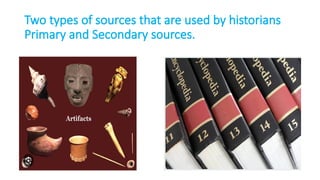
Two types of sources that are used by historians
Primary and Secondary sources.
Primary sources
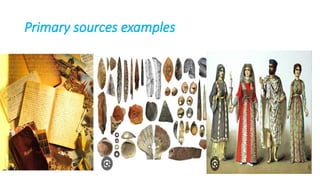
• Primary sources are sources that are written at the time of the
event(Kholland, 2013).
• Primary sources are considered to be more realible as they offer
original thought and artifacts that are not modified by interpretation
of authors.
• Can be proven by (artifacts) Letters, diaries, tools and clothing.
Primary sources examples
Secondary sources
• These sources are written after the time of an event.
• Secondary sources are less realible as they do not offer originals thoughts
and artifacts that have been modified by interpretation of two different
authors(Kholland, 2013).
• Secondary Sources are considered to be less realible as two different
another can interpret the same piece of original material in a two wildy
different ways.
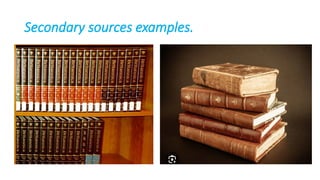
• Can be proven by the use of textbooks and encyclopedias.
Secondary sources examples.
Concepts of History
Historical sources and evidence:
• History is not “the past” itself. It is the interpretation and explanation
of information from various sources.
• Evidence is created when the sources are used to answer the
questions about the past.
Continued
Multiperspectivity:
• There are too many ways of looking at the same thing in the past.
• They may involve the different points of view of people in the past according
to their position in society.
• The different ways in which the historians have written about them.
• The different ways in which people today see the actions and behaviour of
people in the past.
Continued
Cause and effect:
• The reasons for events and the results of them. The consequences of something
drive future events and help explain human behaviour.
Change and continuity:
• Over the period of time it is possible to contrast what has changed and what has
remained the same. Closely related contrasts that are used to teach history are
similarity and different and then now, which to help make sense of the past and
the present.
Continued
Time and chronology:
• History is studied and written in sequence.
• It is important to be to place events in the order in which they
happened in time.
• Timelines are often used to develop the concept.
References
• Elaine, (2014). What is History. Available from slideshare at
https://www.slideshare.net/Elaine1975/what-is-history-14276326 (Accessed 20
August 2023).
• Kholland, J. (2013). PowerPoint what is History. Available from slideshare at
https://www.slideshare.net/jkholland1/powerpoint-what-is-history ( Accessed 19
August 2023)
• Nicksonhassan, (2018). Sources and importance of History. Available
from slideshare at
https://www.slideshare.net/nicksonhassan/sources-and-importance-of-history
(Accessed 20 August 2023)
• Rogers, E. (2015). What is History? Available from slideshare at
https://www.slideshare.net/EKentRogers/what-is-history-49156704 (Accessed 19
August 2023)
• Ssclasstorremar, (2012). Introduction to History. Available from slideshare at
https://www.slideshare.net/ssclasstorremar/introduction-to-history (accessed 19
August 2023)
NS Mazibuko SLIDESHARE PRESENTATION.pptx

NS Mazibuko SLIDESHARE PRESENTATION.pptx

  • 1.
  • 3.
    What is history? Historycan be defined as the study of the past events that are interconnected with the present. History the study of change and development in society overtime and space(Rogers, 2015) History is a record of events pertaining to human activities, social economic and political developments from the past, the present and the future(Nicksonhassan, 2018)
  • 4.
    Why do westudy History? History helps to build the capacity of people to make informed choice in order to contribute the society and to advance democracy(Pillay et al, 2012). Learning history keeps us aware of our past and gives us an understanding of the events that shaped the world. To learn about human nature in general by looking at the rends that repeat through history (Rogers, 2015). To learn from mistakes and not to repeat them (Ssclasstorremar, 2012).
  • 5.
    Categories of history(Elaine,2012) • Political • Economic • Social • Religious • Scientific • Cultural
  • 6.
    History • History createsindependent thinkers. • History develops open minded people. • History creates people who are good at solving problems. • History creates people who are able to pick out the essential from trivial. • History trains people to assemble, organize, present information and opinions.
  • 7.
    Two types ofsources that are used by historians Primary and Secondary sources.
  • 8.
    Primary sources • Primarysources are sources that are written at the time of the event(Kholland, 2013). • Primary sources are considered to be more realible as they offer original thought and artifacts that are not modified by interpretation of authors. • Can be proven by (artifacts) Letters, diaries, tools and clothing.
  • 9.
  • 10.
    Secondary sources • Thesesources are written after the time of an event. • Secondary sources are less realible as they do not offer originals thoughts and artifacts that have been modified by interpretation of two different authors(Kholland, 2013). • Secondary Sources are considered to be less realible as two different another can interpret the same piece of original material in a two wildy different ways. • Can be proven by the use of textbooks and encyclopedias.
  • 11.
  • 12.
    Concepts of History Historicalsources and evidence: • History is not “the past” itself. It is the interpretation and explanation of information from various sources. • Evidence is created when the sources are used to answer the questions about the past.
  • 13.
    Continued Multiperspectivity: • There aretoo many ways of looking at the same thing in the past. • They may involve the different points of view of people in the past according to their position in society. • The different ways in which the historians have written about them. • The different ways in which people today see the actions and behaviour of people in the past.
  • 14.
    Continued Cause and effect: •The reasons for events and the results of them. The consequences of something drive future events and help explain human behaviour. Change and continuity: • Over the period of time it is possible to contrast what has changed and what has remained the same. Closely related contrasts that are used to teach history are similarity and different and then now, which to help make sense of the past and the present.
  • 15.
    Continued Time and chronology: •History is studied and written in sequence. • It is important to be to place events in the order in which they happened in time. • Timelines are often used to develop the concept.
  • 16.
    References • Elaine, (2014).What is History. Available from slideshare at https://www.slideshare.net/Elaine1975/what-is-history-14276326 (Accessed 20 August 2023). • Kholland, J. (2013). PowerPoint what is History. Available from slideshare at https://www.slideshare.net/jkholland1/powerpoint-what-is-history ( Accessed 19 August 2023)
  • 17.
    • Nicksonhassan, (2018).Sources and importance of History. Available from slideshare at https://www.slideshare.net/nicksonhassan/sources-and-importance-of-history (Accessed 20 August 2023) • Rogers, E. (2015). What is History? Available from slideshare at https://www.slideshare.net/EKentRogers/what-is-history-49156704 (Accessed 19 August 2023) • Ssclasstorremar, (2012). Introduction to History. Available from slideshare at https://www.slideshare.net/ssclasstorremar/introduction-to-history (accessed 19 August 2023)