42
1
Fun with numbers
Breaking the NRIC check digit algorithm
42
1
Introduction
• The algorithm for computing the check digit for
Singapore identity card numbers is unpublished
• Algorithm is partially described in various open
sources
• Objective of this exercise is to elucidate the complete
algorithm from internet resources and “virtual
experimentation”
42
1
UIN/FIN structure
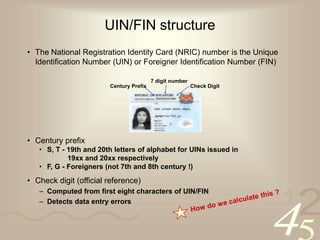
• The National Registration Identity Card (NRIC) number is the Unique
Identification Number (UIN) or Foreigner Identification Number (FIN)
• Century prefix
• S, T - 19th and 20th letters of alphabet for UINs issued in
19xx and 20xx respectively
• F, G - Foreigners (not 7th and 8th century !)
• Check digit (official reference)
– Computed from first eight characters of UIN/FIN
– Detects data entry errors
Century Prefix
7 digit number
Check Digit
42
1
UIN/FIN algorithm
• Government will release UIN/FIN algorithm for computing check
digit, BUT
– “Application is open ONLY to Singapore-based
organisations with the legitimate need for the UIN/FIN
validation.”
– “Your application is subject to our final approval and our
decision shall be final”
– License agreement requires:
• “The Licensee agrees to take all reasonable steps to
protect the Licensed Material from unauthorised copying,
adaptation or use.”
– License fee
• Algorithm $200
• Sample code $400
Source: ICA website (http://app.ica.gov.sg/related_links/uin_fin/unifin_faq.asp)
42
1
IP Analysis
Can the government really prohibit unauthorised use ?
• Copyright
– Source code is subject to copyright
– Algorithms are not subject to copyright
• Patent
– Algorithms are patentable, but
• Patent must be published
• Prior art probably exists in this case
• Patent, if any is long expired (> 20 yrs)
• Trade Secret
– May be protectable under the license agreement
– BUT, no secret if the information is already publicly available or
obtained via a different route
42
1
Modulo 11 checksum
• Algorithm for S-series (old-style) NRIC numbers is well-known*
d = [(d1 d2 d3 d4 d5 d6 d7) • (2 7 6 5 4 3 2 )] mod 11
= ( 2d1 + 7d2 + 6d3 + 5d4 + 4d5 + 3d6 + 2d7 ) mod 11
Lookup d:
d 10 9 8 7 6 5 4 3 2 1 0
Check digit A B C D E F G H I Z J
Weights
7-digit NRIC number
• Does this work for F, G, T-prefix UIN/FINs ?
* e.g. soc.culture.singapore newgroup postings (1995)
1
42
1
Reverse Engineering the FIN algorithm
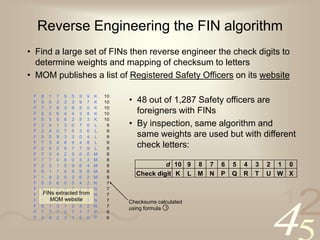
• Find a large set of FINs then reverse engineer the check digits to
determine weights and mapping of checksum to letters
• MOM publishes a list of Registered Safety Officers on its website
• 48 out of 1,287 Safety officers are
foreigners with FINs
• By inspection, same algorithm and
same weights are used but with different
check letters:
F 8 1 7 9 5 9 9 K 10
F 5 5 3 3 3 9 7 K 10
F 7 7 8 3 9 8 0 K 10
F 5 5 6 4 4 3 8 K 10
F 5 5 5 8 2 8 3 K 10
F 2 4 1 3 0 7 6 L 9
F 2 4 0 7 5 3 6 L 9
F 5 5 9 3 2 0 4 L 9
F 7 3 4 8 9 4 8 L 9
F 2 5 2 9 7 7 9 L 9
F 7 3 4 2 5 6 0 M 8
F 7 7 0 8 0 3 3 M 8
F 2 3 1 5 9 6 4 M 8
F 8 1 7 9 5 9 8 M 8
F 1 9 2 0 2 6 2 M 8
F 5 5 6 0 5 4 2 N 7
F 8 1 0 4 0 4 9 N 7
F 8 3 2 0 1 9 2 N 7
F 1 9 2 1 7 4 3 N 7
F 8 1 3 1 2 5 2 N 7
F 7 7 7 2 7 1 7 P 6
F 0 8 2 3 1 6 0 P 6
FINs extracted from
MOM website
d 10 9 8 7 6 5 4 3 2 1 0
Check digit K L M N P Q R T U W X
Checksums calculated
using formula 1
42
1
21st century UINs - T & G prefix
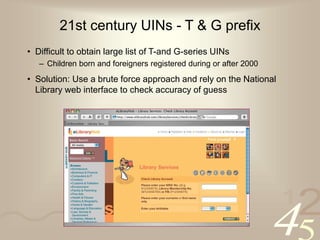
• Difficult to obtain large list of T-and G-series UINs
– Children born and foreigners registered during or after 2000
• Solution: Use a brute force approach and rely on the National
Library web interface to check accuracy of guess
42
1
Virtual Experiment
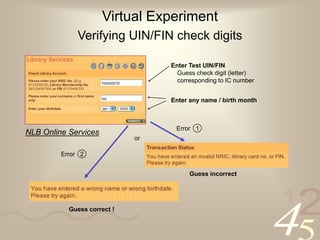
Verifying UIN/FIN check digits
Enter Test UIN/FIN
Guess check digit (letter)
corresponding to IC number
Guess incorrect
Guess correct !
Enter any name / birth month
Error 2
Error 1
NLB Online Services
or
42
1
21st century UIN/FIN check digit
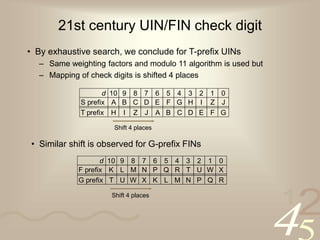
• By exhaustive search, we conclude for T-prefix UINs
– Same weighting factors and modulo 11 algorithm is used but
– Mapping of check digits is shifted 4 places
• Similar shift is observed for G-prefix FINs
d 10 9 8 7 6 5 4 3 2 1 0
S prefix A B C D E F G H I Z J
T prefix H I Z J A B C D E F G
Shift 4 places
d 10 9 8 7 6 5 4 3 2 1 0
F prefix K L M N P Q R T U W X
G prefix T U W X K L M N P Q R
Shift 4 places
42
1
Universal UIN/FIN Check Digit Algorithm
• For any UIN/FIN of format
P d1d2d3d4d5d6d7 C where P = Century prefix {S, T, F or G}
di = Number, i = 1..7
C = Check Digit (letter)
d = { d0 + [(d1 d2 d3 d4 d5 d6 d7) • (2 7 6 5 4 3 2 )] } mod 11
d0 = 0 for P = S or F
= 4 for P = T or G
d 10 9 8 7 6 5 4 3 2 1 0
UIN (S,T prefix) A B C D E F G H I Z J
FIN (F,G prefix) K L M N P Q R T U W X
Check digit is determined by prefix and value of d
42
1
References
• UIN algorithm described in chapter 3 of course notes for NUS
Coding Theory course (http://www.math.nus.edu.sg/~ma3218)
– S & T prefix algorithm confirmed
• No known public references to F, G-prefix FIN algorithm
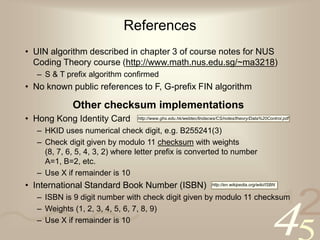
Other checksum implementations
• Hong Kong Identity Card
– HKID uses numerical check digit, e.g. B255241(3)
– Check digit given by modulo 11 checksum with weights
(8, 7, 6, 5, 4, 3, 2) where letter prefix is converted to number
A=1, B=2, etc.
– Use X if remainder is 10
• International Standard Book Number (ISBN)
– ISBN is 9 digit number with check digit given by modulo 11 checksum
– Weights (1, 2, 3, 4, 5, 6, 7, 8, 9)
– Use X if remainder is 10
http://www.ghs.edu.hk/webtec/lindacws/CS/notes/theory/Data%20Control.pdf
http://en.wikipedia.org/wiki/ISBN
42
1
Points to Ponder
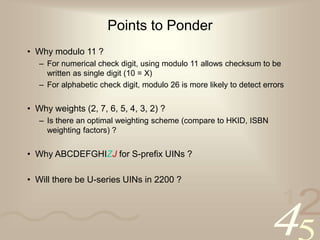
• Why modulo 11 ?
– For numerical check digit, using modulo 11 allows checksum to be
written as single digit (10 = X)
– For alphabetic check digit, modulo 26 is more likely to detect errors
• Why weights (2, 7, 6, 5, 4, 3, 2) ?
– Is there an optimal weighting scheme (compare to HKID, ISBN
weighting factors) ?
• Why ABCDEFGHIZJ for S-prefix UINs ?
• Will there be U-series UINs in 2200 ?

NRIC_numbers.ppt

  • 1.
    42 1 Fun with numbers Breakingthe NRIC check digit algorithm
  • 2.
    42 1 Introduction • The algorithmfor computing the check digit for Singapore identity card numbers is unpublished • Algorithm is partially described in various open sources • Objective of this exercise is to elucidate the complete algorithm from internet resources and “virtual experimentation”
  • 3.
    42 1 UIN/FIN structure • TheNational Registration Identity Card (NRIC) number is the Unique Identification Number (UIN) or Foreigner Identification Number (FIN) • Century prefix • S, T - 19th and 20th letters of alphabet for UINs issued in 19xx and 20xx respectively • F, G - Foreigners (not 7th and 8th century !) • Check digit (official reference) – Computed from first eight characters of UIN/FIN – Detects data entry errors Century Prefix 7 digit number Check Digit
  • 4.
    42 1 UIN/FIN algorithm • Governmentwill release UIN/FIN algorithm for computing check digit, BUT – “Application is open ONLY to Singapore-based organisations with the legitimate need for the UIN/FIN validation.” – “Your application is subject to our final approval and our decision shall be final” – License agreement requires: • “The Licensee agrees to take all reasonable steps to protect the Licensed Material from unauthorised copying, adaptation or use.” – License fee • Algorithm $200 • Sample code $400 Source: ICA website (http://app.ica.gov.sg/related_links/uin_fin/unifin_faq.asp)
  • 5.
    42 1 IP Analysis Can thegovernment really prohibit unauthorised use ? • Copyright – Source code is subject to copyright – Algorithms are not subject to copyright • Patent – Algorithms are patentable, but • Patent must be published • Prior art probably exists in this case • Patent, if any is long expired (> 20 yrs) • Trade Secret – May be protectable under the license agreement – BUT, no secret if the information is already publicly available or obtained via a different route
  • 6.
    42 1 Modulo 11 checksum •Algorithm for S-series (old-style) NRIC numbers is well-known* d = [(d1 d2 d3 d4 d5 d6 d7) • (2 7 6 5 4 3 2 )] mod 11 = ( 2d1 + 7d2 + 6d3 + 5d4 + 4d5 + 3d6 + 2d7 ) mod 11 Lookup d: d 10 9 8 7 6 5 4 3 2 1 0 Check digit A B C D E F G H I Z J Weights 7-digit NRIC number • Does this work for F, G, T-prefix UIN/FINs ? * e.g. soc.culture.singapore newgroup postings (1995) 1
  • 7.
    42 1 Reverse Engineering theFIN algorithm • Find a large set of FINs then reverse engineer the check digits to determine weights and mapping of checksum to letters • MOM publishes a list of Registered Safety Officers on its website • 48 out of 1,287 Safety officers are foreigners with FINs • By inspection, same algorithm and same weights are used but with different check letters: F 8 1 7 9 5 9 9 K 10 F 5 5 3 3 3 9 7 K 10 F 7 7 8 3 9 8 0 K 10 F 5 5 6 4 4 3 8 K 10 F 5 5 5 8 2 8 3 K 10 F 2 4 1 3 0 7 6 L 9 F 2 4 0 7 5 3 6 L 9 F 5 5 9 3 2 0 4 L 9 F 7 3 4 8 9 4 8 L 9 F 2 5 2 9 7 7 9 L 9 F 7 3 4 2 5 6 0 M 8 F 7 7 0 8 0 3 3 M 8 F 2 3 1 5 9 6 4 M 8 F 8 1 7 9 5 9 8 M 8 F 1 9 2 0 2 6 2 M 8 F 5 5 6 0 5 4 2 N 7 F 8 1 0 4 0 4 9 N 7 F 8 3 2 0 1 9 2 N 7 F 1 9 2 1 7 4 3 N 7 F 8 1 3 1 2 5 2 N 7 F 7 7 7 2 7 1 7 P 6 F 0 8 2 3 1 6 0 P 6 FINs extracted from MOM website d 10 9 8 7 6 5 4 3 2 1 0 Check digit K L M N P Q R T U W X Checksums calculated using formula 1
  • 8.
    42 1 21st century UINs- T & G prefix • Difficult to obtain large list of T-and G-series UINs – Children born and foreigners registered during or after 2000 • Solution: Use a brute force approach and rely on the National Library web interface to check accuracy of guess
  • 9.
    42 1 Virtual Experiment Verifying UIN/FINcheck digits Enter Test UIN/FIN Guess check digit (letter) corresponding to IC number Guess incorrect Guess correct ! Enter any name / birth month Error 2 Error 1 NLB Online Services or
  • 10.
    42 1 21st century UIN/FINcheck digit • By exhaustive search, we conclude for T-prefix UINs – Same weighting factors and modulo 11 algorithm is used but – Mapping of check digits is shifted 4 places • Similar shift is observed for G-prefix FINs d 10 9 8 7 6 5 4 3 2 1 0 S prefix A B C D E F G H I Z J T prefix H I Z J A B C D E F G Shift 4 places d 10 9 8 7 6 5 4 3 2 1 0 F prefix K L M N P Q R T U W X G prefix T U W X K L M N P Q R Shift 4 places
  • 11.
    42 1 Universal UIN/FIN CheckDigit Algorithm • For any UIN/FIN of format P d1d2d3d4d5d6d7 C where P = Century prefix {S, T, F or G} di = Number, i = 1..7 C = Check Digit (letter) d = { d0 + [(d1 d2 d3 d4 d5 d6 d7) • (2 7 6 5 4 3 2 )] } mod 11 d0 = 0 for P = S or F = 4 for P = T or G d 10 9 8 7 6 5 4 3 2 1 0 UIN (S,T prefix) A B C D E F G H I Z J FIN (F,G prefix) K L M N P Q R T U W X Check digit is determined by prefix and value of d
  • 12.
    42 1 References • UIN algorithmdescribed in chapter 3 of course notes for NUS Coding Theory course (http://www.math.nus.edu.sg/~ma3218) – S & T prefix algorithm confirmed • No known public references to F, G-prefix FIN algorithm Other checksum implementations • Hong Kong Identity Card – HKID uses numerical check digit, e.g. B255241(3) – Check digit given by modulo 11 checksum with weights (8, 7, 6, 5, 4, 3, 2) where letter prefix is converted to number A=1, B=2, etc. – Use X if remainder is 10 • International Standard Book Number (ISBN) – ISBN is 9 digit number with check digit given by modulo 11 checksum – Weights (1, 2, 3, 4, 5, 6, 7, 8, 9) – Use X if remainder is 10 http://www.ghs.edu.hk/webtec/lindacws/CS/notes/theory/Data%20Control.pdf http://en.wikipedia.org/wiki/ISBN
  • 13.
    42 1 Points to Ponder •Why modulo 11 ? – For numerical check digit, using modulo 11 allows checksum to be written as single digit (10 = X) – For alphabetic check digit, modulo 26 is more likely to detect errors • Why weights (2, 7, 6, 5, 4, 3, 2) ? – Is there an optimal weighting scheme (compare to HKID, ISBN weighting factors) ? • Why ABCDEFGHIZJ for S-prefix UINs ? • Will there be U-series UINs in 2200 ?