Other Educational Products from Nova Press:
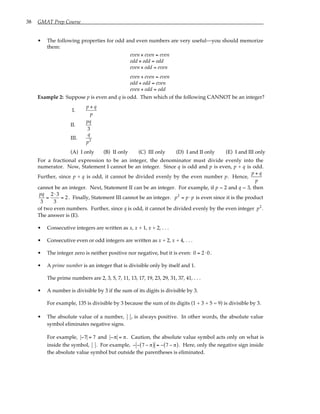
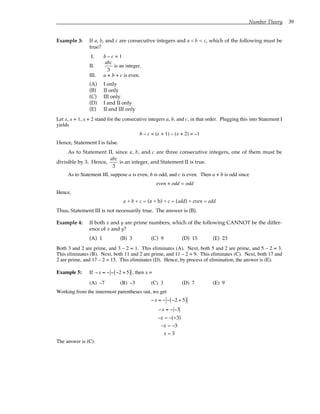
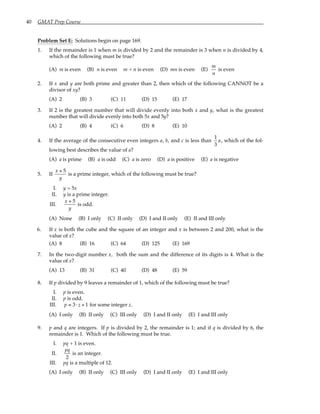
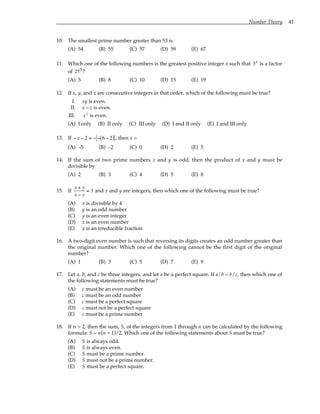
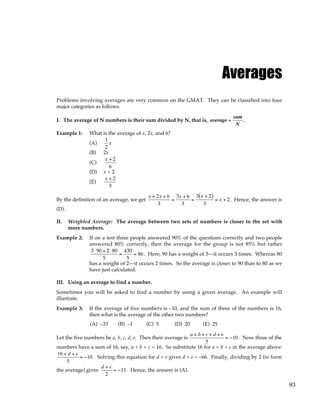
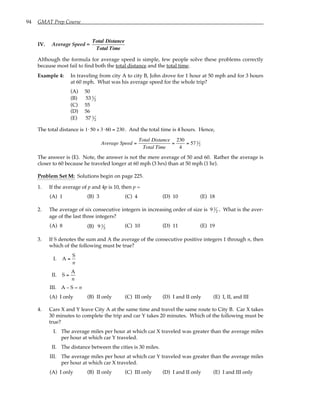
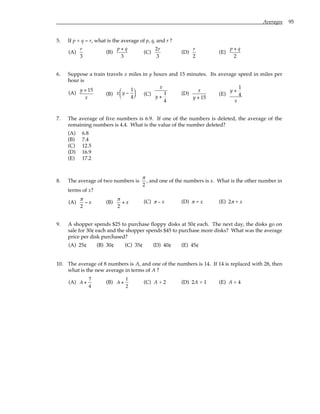
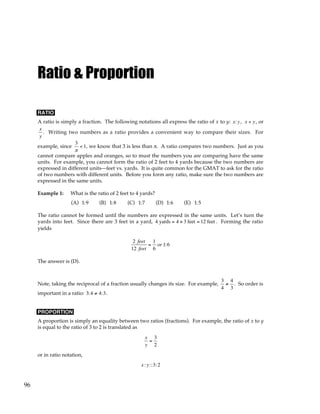
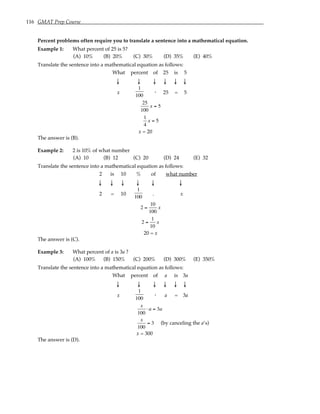
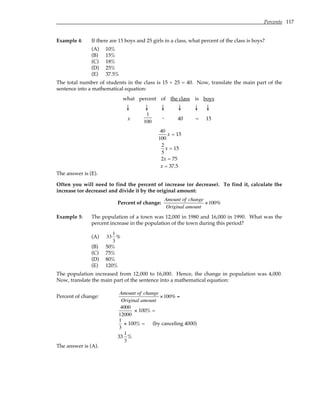
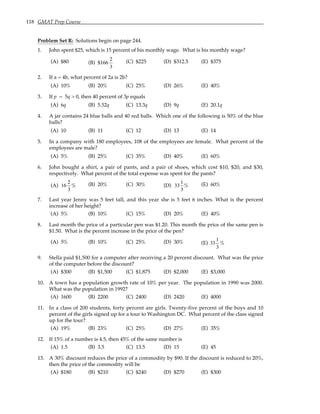
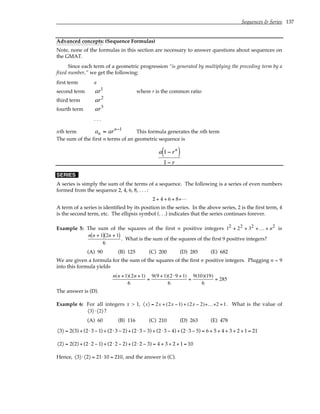
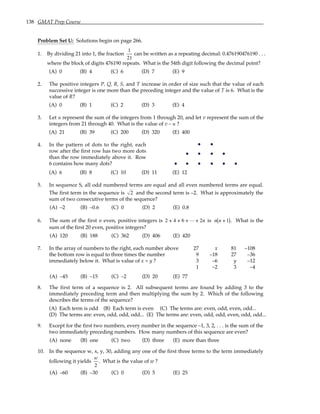
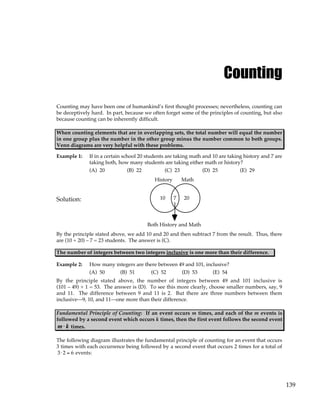
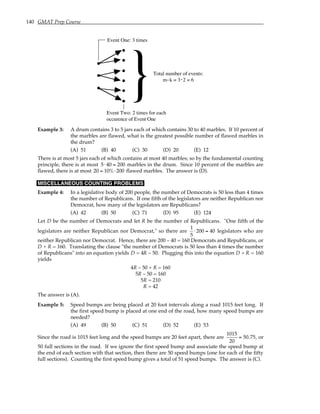
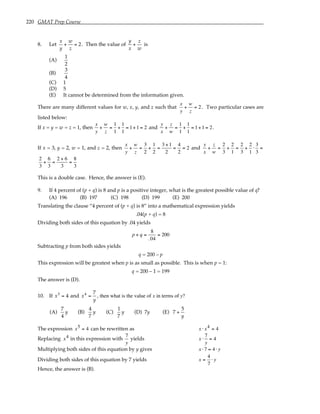
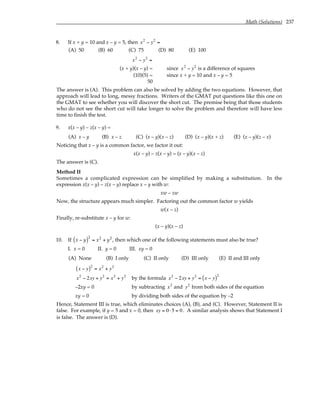
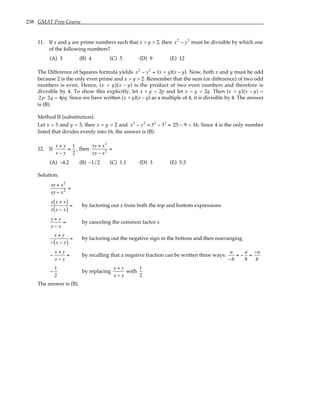
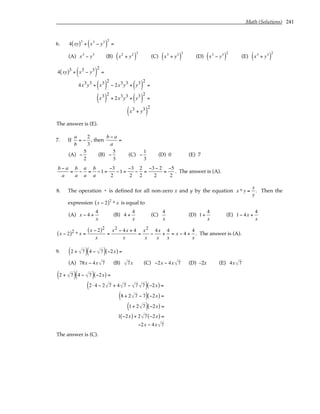
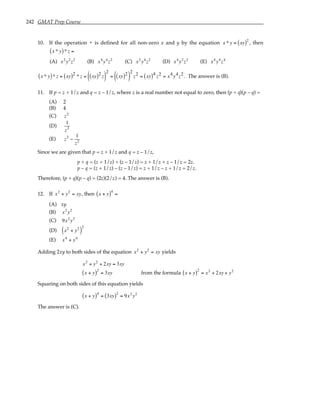
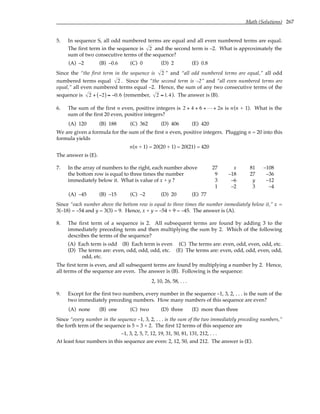
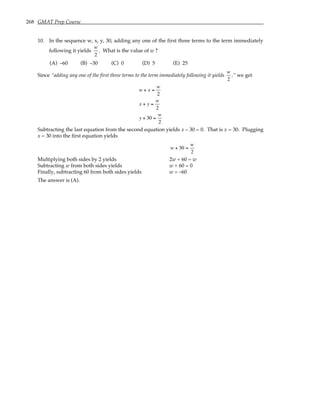
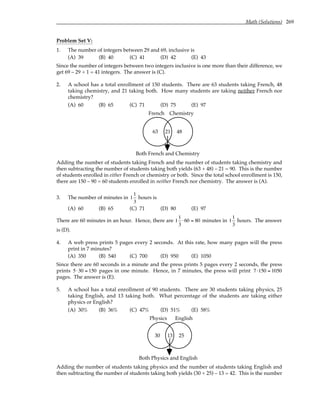
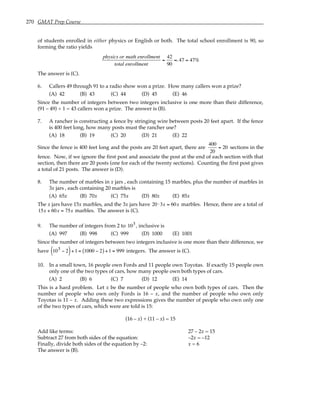
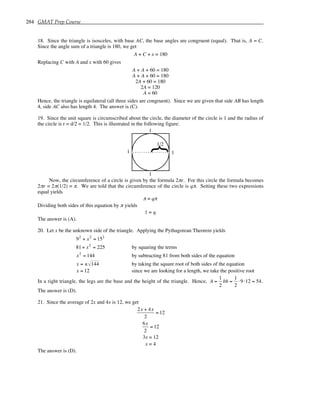
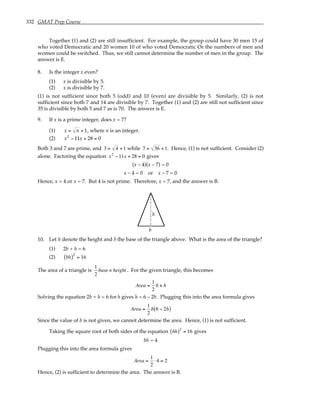
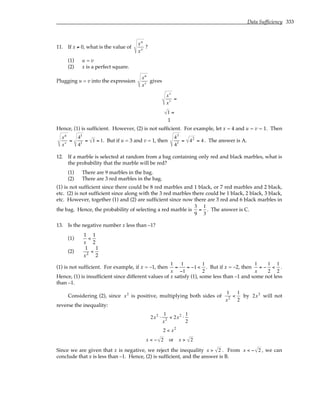
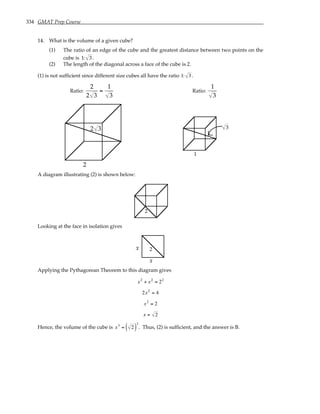
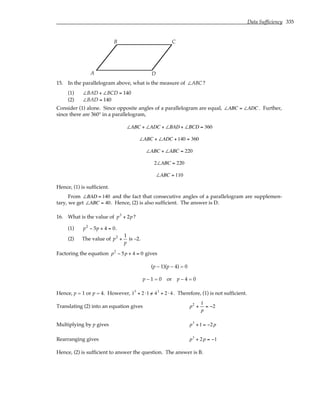
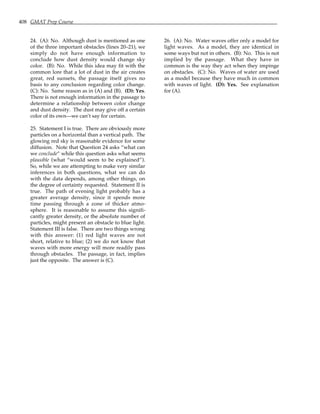
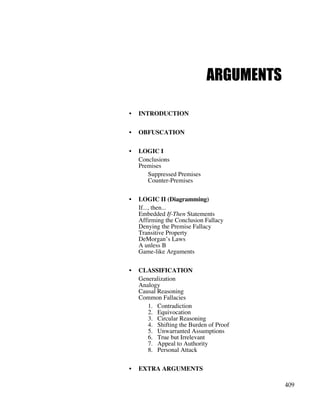
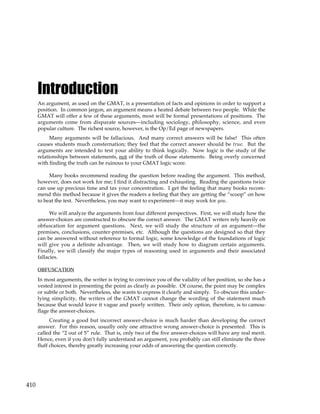
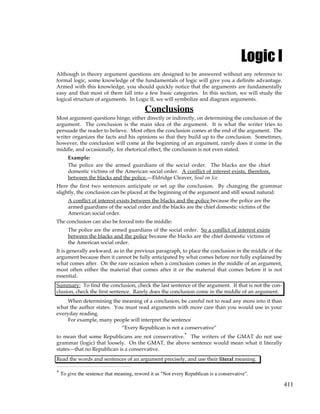
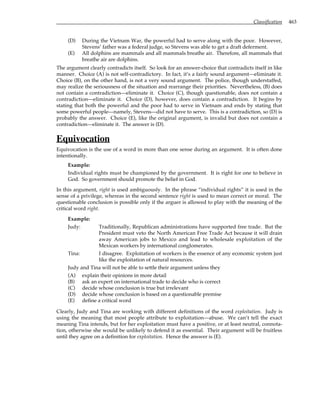
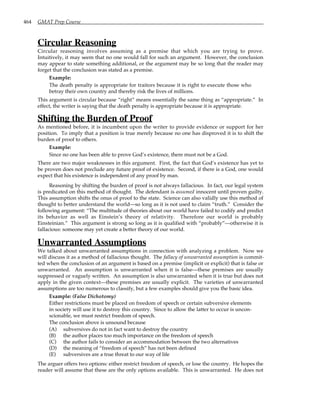
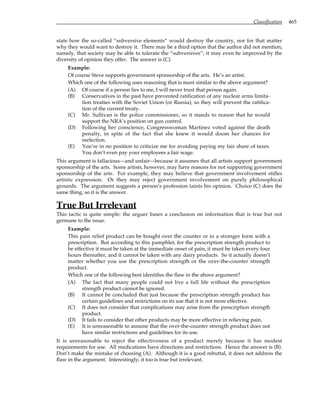
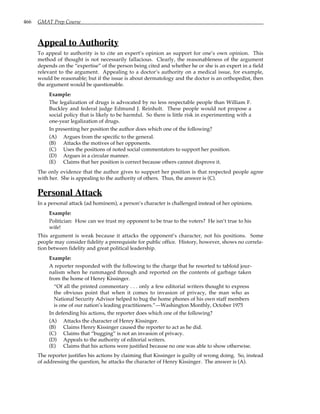
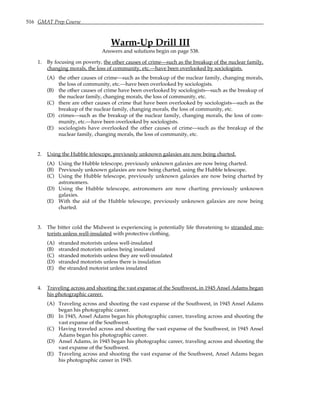
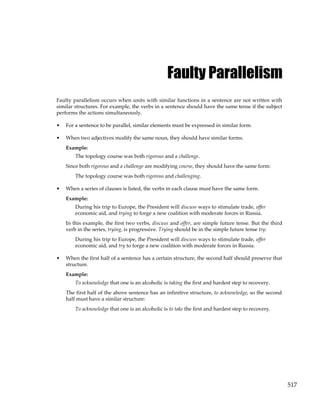
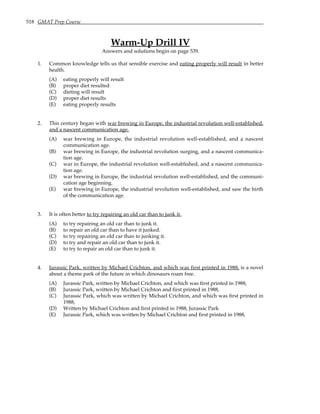
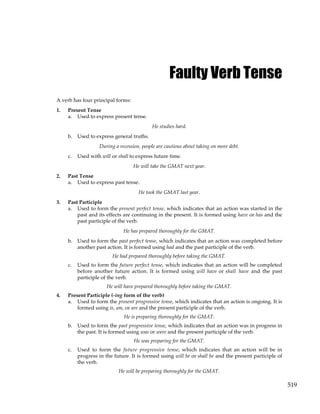
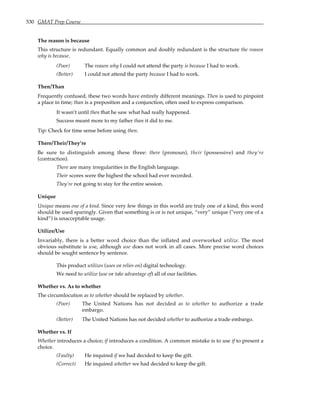
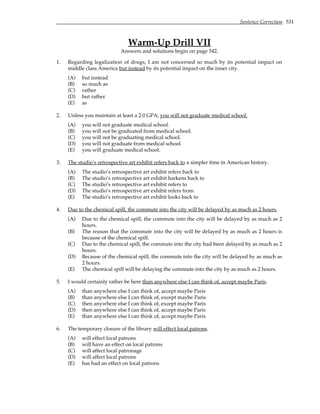
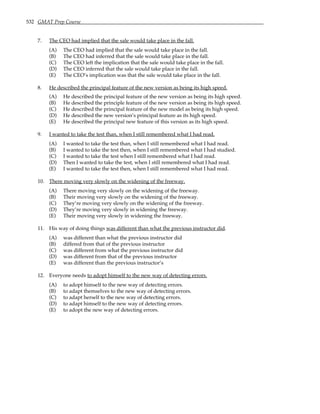
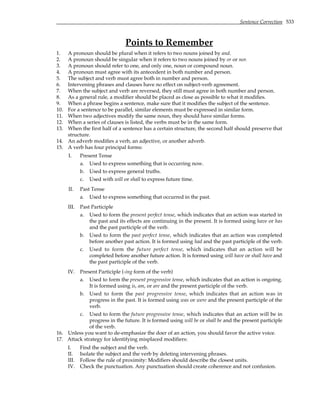
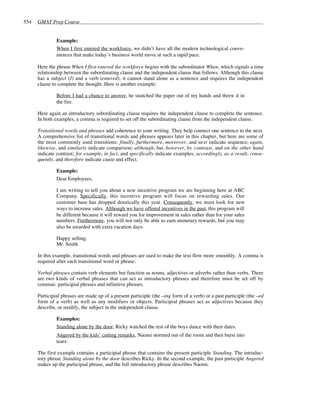
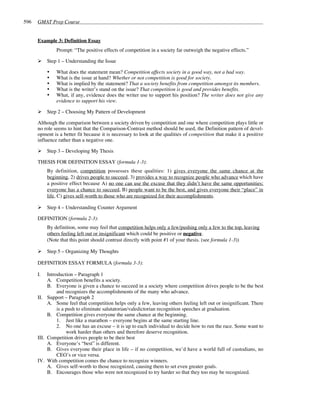
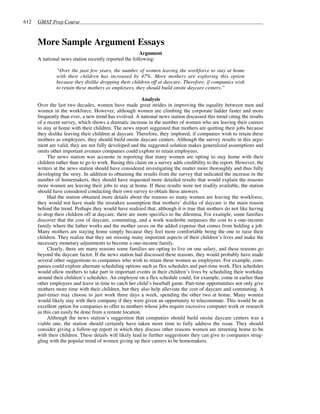
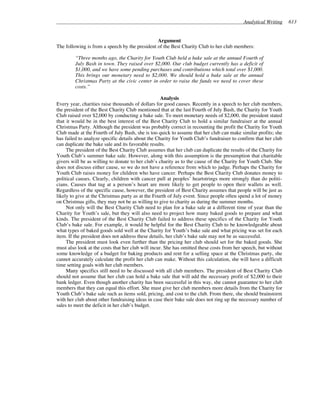
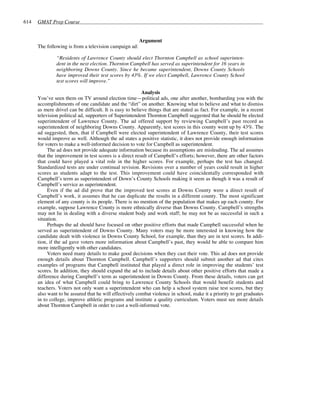
GRE Prep Course (624 pages)
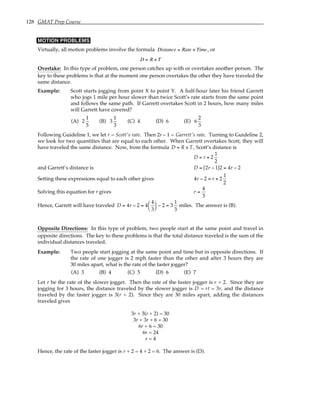
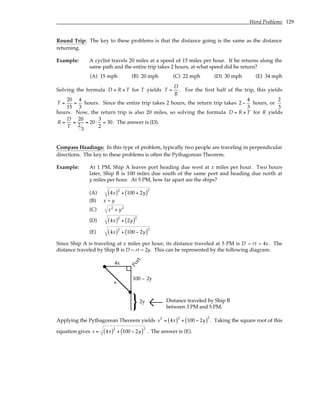
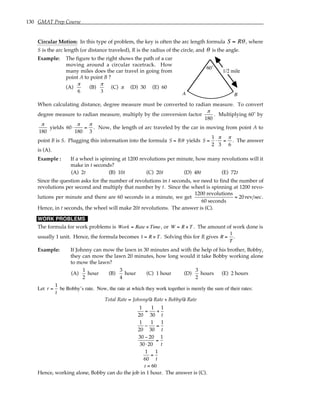
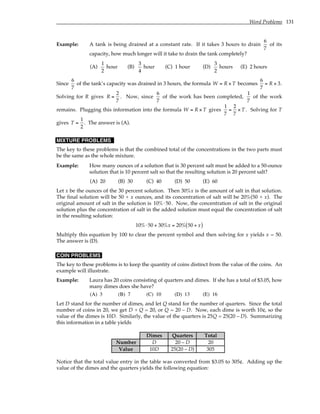
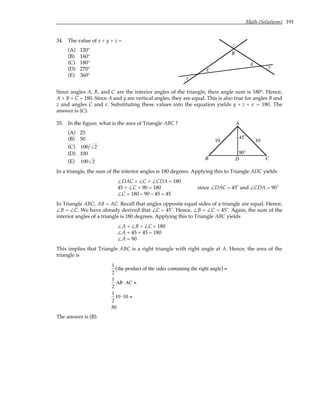
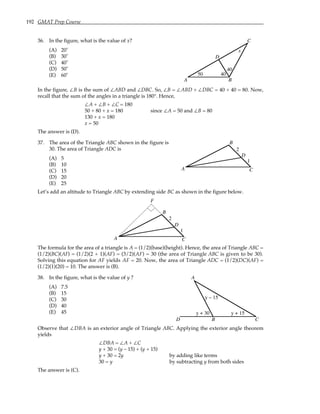
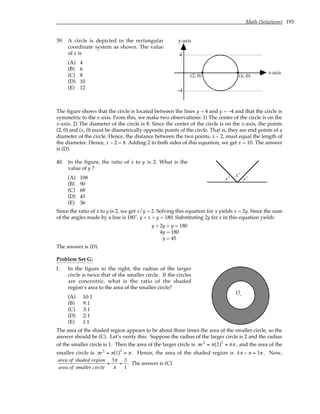
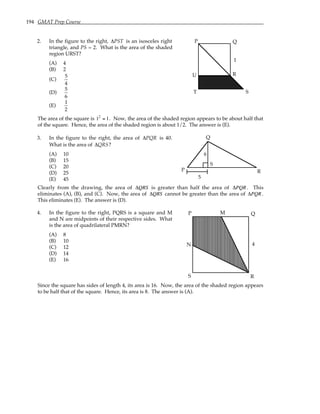
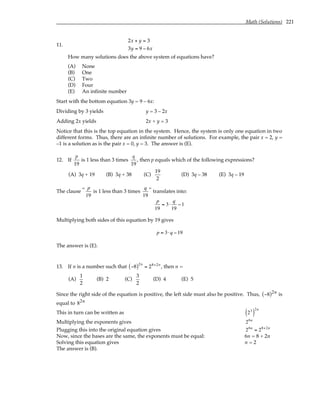
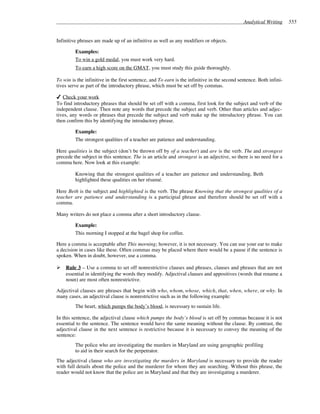
Master the LSAT (560 pages, includes an official LSAT exam!)
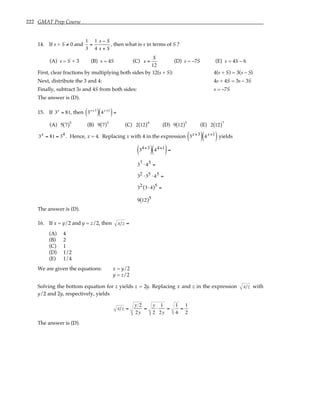
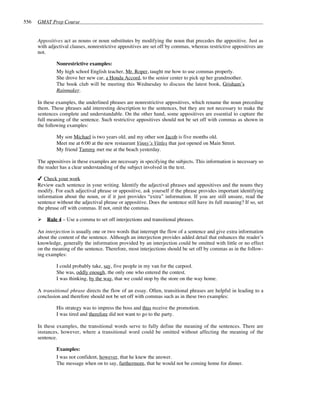
The MCAT Biology Book (416 pages)
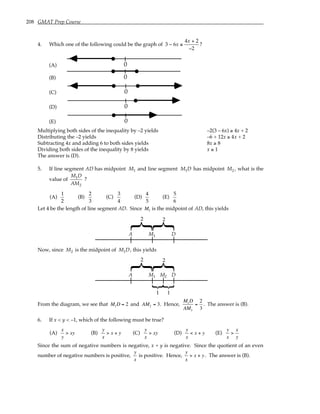
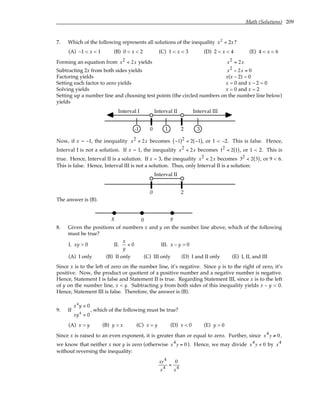
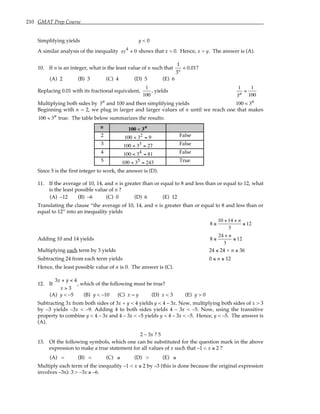
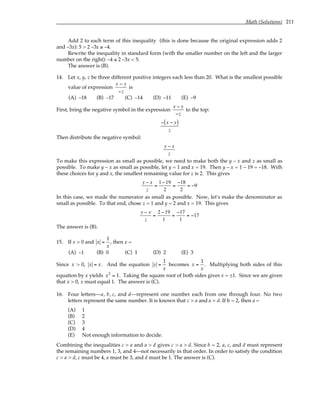
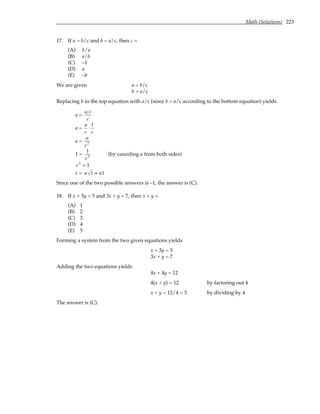
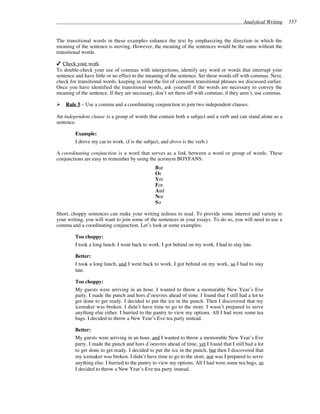
SAT Prep Course (624 pages)
Law School Basics: A Preview of Law School and Legal Reasoning (224 pages)
Vocabulary 4000: The 4000 Words Essential for an Educated Vocabulary (160 pages)
Copyright © 2004 by Nova Press
Previous editions: 2003, 2002, 2001, 2000, 1999, 1998, 1996, 1994
All rights reserved.
Duplication, distribution, or data base storage of any part of this work is prohibited without prior
written approval from the publisher.
ISBN 1–889057–27–4
GMAT is a service mark of Educational Testing Service, which does not endorse this book.
Nova Press
11659 Mayfield Avenue
Los Angeles, CA 90049
Phone: 1-800-949-6175
E-mail: info@novapress.net
Website: www.novapress.net
iii
ABOUT THIS BOOK
If you don’t have a pencil in your hand, get one now! Don’t just read this book—write on it,
study it, scrutinize it! In short, for the next six weeks, this book should be a part of your life.
When you have finished the book, it should be marked-up, dog-eared, tattered and torn.
Although the GMAT is a difficult test, it is a very learnable test. This is not to say that the
GMAT is “beatable.” There is no bag of tricks that will show you how to master it overnight.
You probably have already realized this. Some books, nevertheless, offer "inside stuff" or "tricks"
which they claim will enable you to beat the test. These include declaring that answer-choices B,
C, or D are more likely to be correct than choices A or E. This tactic, like most of its type, does not
work. It is offered to give the student the feeling that he or she is getting the scoop on the test.
The GMAT cannot be “beaten.” But it can be mastered—through hard work, analytical
thought, and by training yourself to think like a test writer.
This book will introduce you to numerous analytic techniques that will help you immensely,
not only on the GMAT but in business school as well. For this reason, studying for the GMAT
can be a rewarding and satisfying experience.
Although the quick-fix method is not offered in this book, about 15% of the material is
dedicated to studying how the questions are constructed. Knowing how the problems are
written and how the test writers think will give you useful insight into the problems and make
them less mysterious. Moreover, familiarity with the GMAT’s structure will help reduce your
anxiety. The more you know about this test, the less anxious you will be the day you take it.
v
ACKNOWLEDGMENT
Behind any successful test-prep book, there is more than just the author’s efforts.
I would like to thank Scott Thornburg for his meticulous editing of the manuscript and for
his continued support and inspiration. I would also like to thank Kathleen Pierce for contributing
the Writing Assessment section.
This book is dedicated to my parents
David and Mary Kolby
To whom I owe more than words can express.
Reading passages were drawn from the following sources:
The Two Faces of Eastern Europe, © 1990 Adam Michnik.
Deschooling Society, © 1971 Harper & Row, by Ivan Illich.
The Cult of Multiculturalism, © 1991 Fred Siegel.
Ways of Seeing, © 1972 Penguin Books Limited, by John Berger.
Placebo Cures for the Incurable, Journal of Irreproducible Results, © 1985 Thomas G. Kyle.
Women, Fire, and Dangerous Things, © George Lakoff.
Screening Immigrants and International Travelers for the Human Immunodeficiency Virus, © 1990 New
England Journal of Medicine.
The Perry Scheme and the Teaching of Writing, © 1986 Christopher Burnham.
Man Bites Shark, © 1990 Scientific American.
Hemingway: The Writer as Artist, © 1952 Carlos Baker.
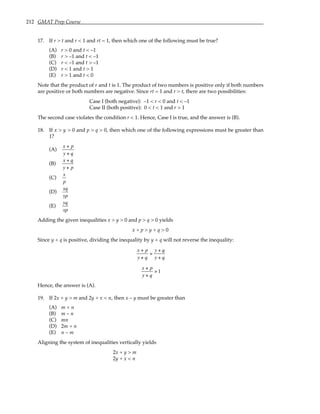
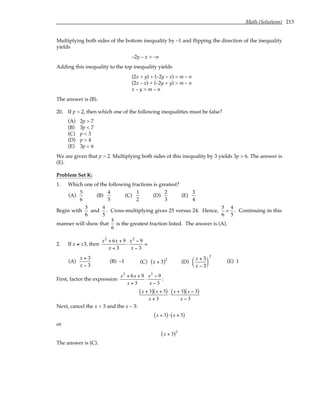
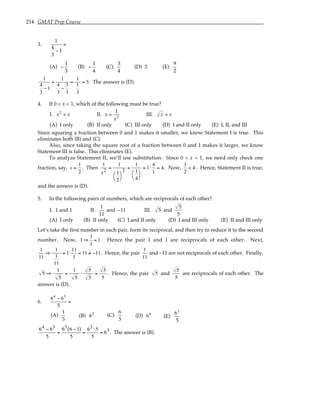
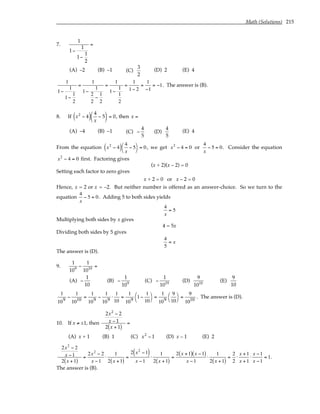
The Stars in Their Courses, © 1931 James Jeans.
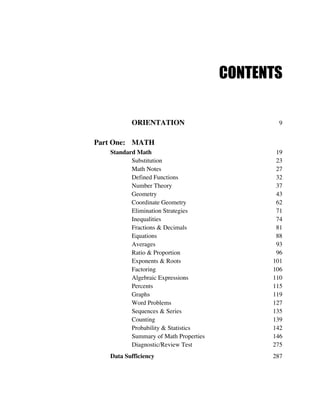
CONTENTS
ORIENTATION 9
Part One: MATH
Standard Math 19
Substitution 23
Math Notes 27
Defined Functions 32
Number Theory 37
Geometry 43
Coordinate Geometry 62
Elimination Strategies 71
Inequalities 74
Fractions & Decimals 81
Equations 88
Averages 93
Ratio & Proportion 96
Exponents & Roots 101
Factoring 106
Algebraic Expressions 110
Percents 115
Graphs 119
Word Problems 127
Sequences & Series 135
Counting 139
Probability & Statistics 142
Summary of Math Properties 146
Diagnostic/Review Test 275
Data Sufficiency 287
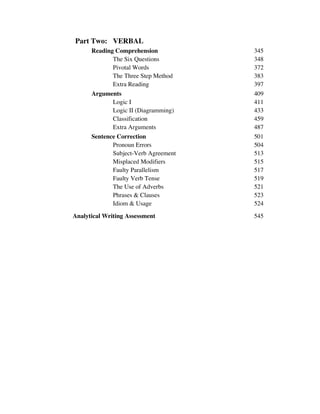
Part Two: VERBAL
Reading Comprehension 345
The Six Questions 348
Pivotal Words 372
The Three Step Method 383
Extra Reading 397
Arguments 409
Logic I 411
Logic II (Diagramming) 433
Classification 459
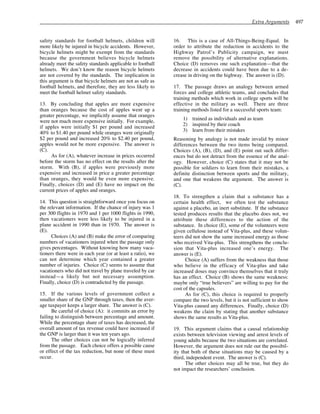
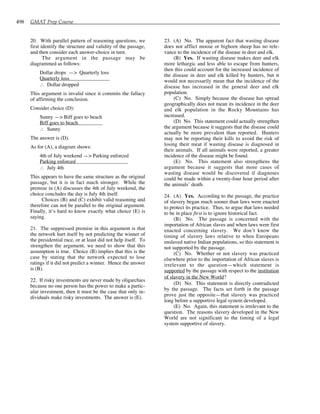
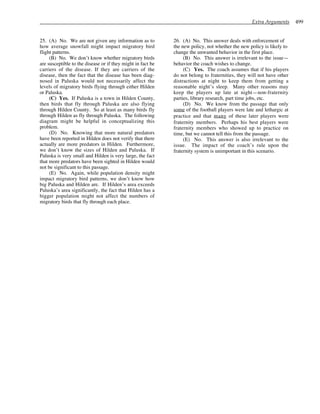
Extra Arguments 487
Sentence Correction 501
Pronoun Errors 504
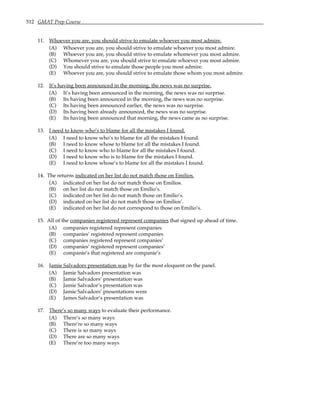
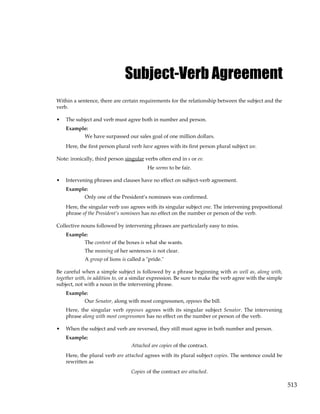
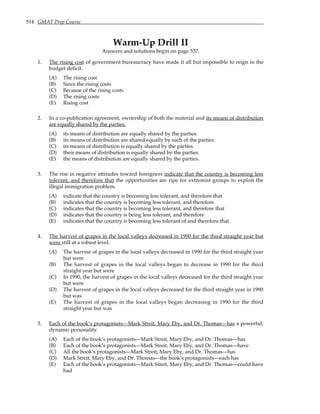
Subject-Verb Agreement 513
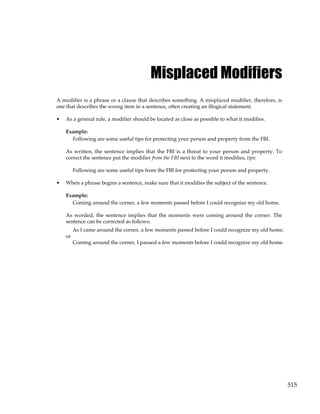
Misplaced Modifiers 515
Faulty Parallelism 517
Faulty Verb Tense 519
The Use of Adverbs 521
Phrases & Clauses 523
Idiom & Usage 524
Analytical Writing Assessment 545
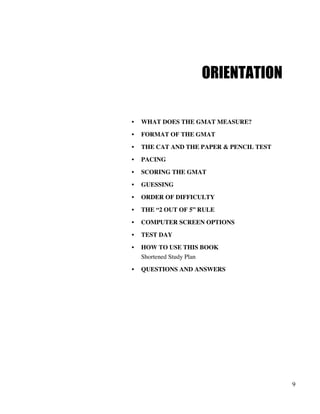
9
ORIENTATION
• WHAT DOES THE GMAT MEASURE?
• FORMAT OF THE GMAT
• THE CAT AND THE PAPER & PENCIL TEST
• PACING
• SCORING THE GMAT
• GUESSING
• ORDER OF DIFFICULTY
• THE “2 OUT OF 5” RULE
• COMPUTER SCREEN OPTIONS
• TEST DAY
• HOW TO USE THIS BOOK
Shortened Study Plan
• QUESTIONS AND ANSWERS
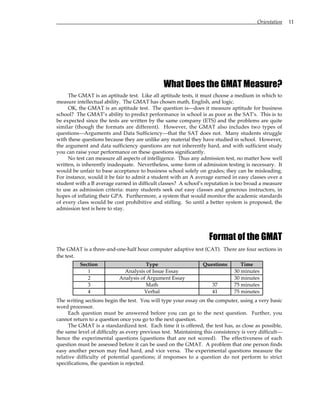
Orientation 11
What Does the GMAT Measure?
The GMAT is an aptitude test. Like all aptitude tests, it must choose a medium in which to
measure intellectual ability. The GMAT has chosen math, English, and logic.
OK, the GMAT is an aptitude test. The question is—does it measure aptitude for business
school? The GMAT’s ability to predict performance in school is as poor as the SAT's. This is to
be expected since the tests are written by the same company (ETS) and the problems are quite
similar (though the formats are different). However, the GMAT also includes two types of
questions—Arguments and Data Sufficiency—that the SAT does not. Many students struggle
with these questions because they are unlike any material they have studied in school. However,
the argument and data sufficiency questions are not inherently hard, and with sufficient study
you can raise your performance on these questions significantly.
No test can measure all aspects of intelligence. Thus any admission test, no matter how well
written, is inherently inadequate. Nevertheless, some form of admission testing is necessary. It
would be unfair to base acceptance to business school solely on grades; they can be misleading.
For instance, would it be fair to admit a student with an A average earned in easy classes over a
student with a B average earned in difficult classes? A school’s reputation is too broad a measure
to use as admission criteria: many students seek out easy classes and generous instructors, in
hopes of inflating their GPA. Furthermore, a system that would monitor the academic standards
of every class would be cost prohibitive and stifling. So until a better system is proposed, the
admission test is here to stay.
Format of the GMAT
The GMAT is a three-and-one-half hour computer adaptive test (CAT). There are four sections in
the test.
Section Type Questions Time
1 Analysis of Issue Essay 30 minutes
2 Analysis of Argument Essay 30 minutes
3 Math 37 75 minutes
4 Verbal 41 75 minutes
The writing sections begin the test. You will type your essay on the computer, using a very basic
word processor.
Each question must be answered before you can go to the next question. Further, you
cannot return to a question once you go to the next question.
The GMAT is a standardized test. Each time it is offered, the test has, as close as possible,
the same level of difficulty as every previous test. Maintaining this consistency is very difficult—
hence the experimental questions (questions that are not scored). The effectiveness of each
question must be assessed before it can be used on the GMAT. A problem that one person finds
easy another person may find hard, and vice versa. The experimental questions measure the
relative difficulty of potential questions; if responses to a question do not perform to strict
specifications, the question is rejected.
12 GMAT Prep Course
About one quarter of the questions are experimental. The experimental questions can be
standard math, data sufficiency, reading comprehension, arguments, or sentence correction. You
won’t know which questions are experimental.
Because the “bugs” have not been worked out of the experimental questions—or, to put it
more directly, because you are being used as a guinea pig to work out the “bugs”—these
unscored questions are often more difficult and confusing than the scored questions.
This brings up an ethical issue: How many students have run into experimental questions
early in the test and have been confused and discouraged by them? Crestfallen by having done
poorly on a few experimental questions, they lose confidence and perform below their ability on
the other parts of the test. Some testing companies are becoming more enlightened in this regard
and are administering experimental questions as separate practice tests. Unfortunately, ETS has
yet to see the light.
Knowing that the experimental questions can be disproportionately difficult, if you do
poorly on a particular question you can take some solace in the hope that it may have been
experimental. In other words, do not allow a few difficult questions to discourage your
performance on the rest of the test.
The CAT and the Paper & Pencil Test
The computerized GMAT uses the same type of questions as did the old Paper & Pencil Test.
The only thing that has changed is medium, that is the way the questions are presented.
There are advantages and disadvantages to the CAT. Probably the biggest advantages are
that you can take the CAT just about any time and you can take it in a small room with just a few
other people—instead of in a large auditorium with hundreds of other stressed people. One the
other hand, you cannot return to previous questions, it is easier to misread a computer screen
than it is to misread printed material, and it can be distracting looking back and forth from the
computer screen to your scratch paper.
Pacing
Although time is limited on the GMAT, working too quickly can damage your score. Many
problems hinge on subtle points, and most require careful reading of the setup. Because
undergraduate school puts such heavy reading loads on students, many will follow their
academic conditioning and read the questions quickly, looking only for the gist of what the
question is asking. Once they have found it, they mark their answer and move on, confident they
have answered it correctly. Later, many are startled to discover that they missed questions
because they either misread the problems or overlooked subtle points.
To do well in your undergraduate classes, you had to attempt to solve every, or nearly
every, problem on a test. Not so with the GMAT. For the vast majority of people, the key to
performing well on the GMAT is not the number of questions they solve, within reason, but the
percentage they solve correctly.
Scoring the GMAT
The two major parts of the test are scored independently. You will receive a verbal score (0 to 60)
and a math score (0 to 60). You will also receive a total score (200 to 800), and a writing score (0
to 6). The average Verbal score is about 27, the average Math score is about 31, and the average
total score is about 500.
In addition, you will be assigned a percentile ranking, which gives the percentage of
students with scores below yours.
Orientation 13
Guessing
On the CAT, you cannot skip questions; each question must be answered before moving on to the
next question. However, if you can eliminate even one of the answer-choices, guessing can be
advantageous. We’ll talk more about this later. Unfortunately, you cannot return to previously
answered questions.
On the test, your first question will be of medium difficulty. If you answer it correctly, the
next question will be a little harder. If you again answer it correctly, the next question will be
harder still, and so on. If your GMAT skills are strong and you are not making any mistakes, you
should reach the medium-hard or hard problems by about the fifth problem. Although this is not
very precise, it can be quite helpful. Once you have passed the fifth question, you should be alert
to subtleties in any seemingly simple problems.
Often students become obsessed with a particular problem and waste time trying to solve it.
To get a top score, learn to cut your losses and move on. The exception to this rule is the first five
questions of each section. Because of the importance of the first five questions to your score, you
should read and solve these questions slowly and carefully.
Because the total number of questions answered contributes to the calculation of your score,
you should answer ALL the questions—even if this means guessing randomly before time runs
out.
Order of Difficulty
Most standardized paper-&-pencil tests list problems in ascending order of difficulty. However,
on a CAT, the first question will be of medium difficulty. If you answer it correctly, the next
question will be a little harder. If you answer it incorrectly, the next question will be a little
easier. Because the GMAT “adapts” to your performance, early questions are more important
than later ones.
The “2 out of 5” Rule
It is significantly harder to create a good but incorrect answer-choice than it is to produce the
correct answer. For this reason usually only two attractive answer-choices are offered. One
correct; the other either intentionally misleading or only partially correct. The other three
answer-choices are usually fluff. This makes educated guessing on the GMAT immensely
effective. If you can dismiss the three fluff choices, your probability of answering the question
successfully will increase from 20% to 50%.
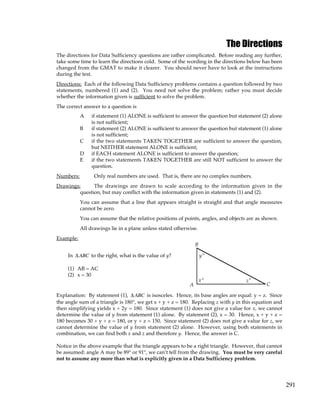
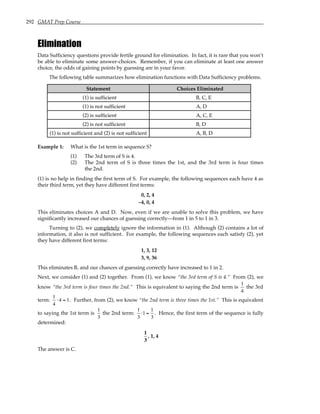
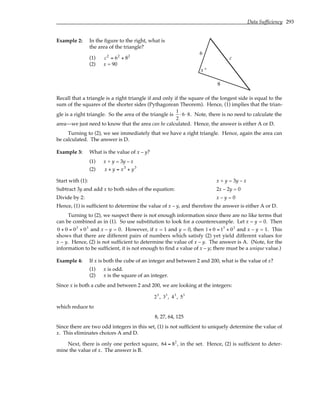
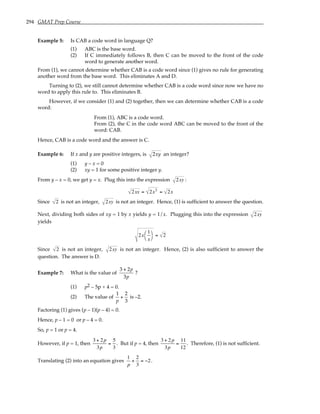
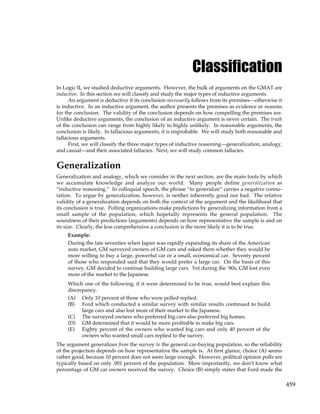
Example: “2 out of 5” rule
During the late seventies when Japan was rapidly expanding its share of the American auto
market, GM surveyed owners of GM cars and asked, “Would you be more willing to buy a
large, powerful car or a small, economical car?” Seventy percent of those who responded
said that they would prefer a large car. On the basis of this survey, GM decided to continue
building large cars. Yet during the ‘80s, GM lost even more of the market to the Japanese.
Which one of the following, if it were determined to be true, would best explain this
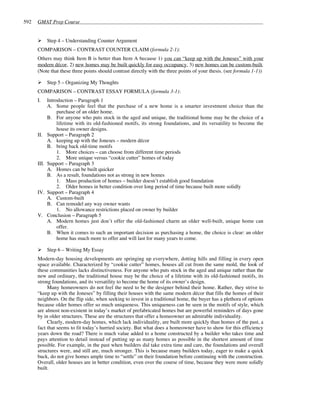
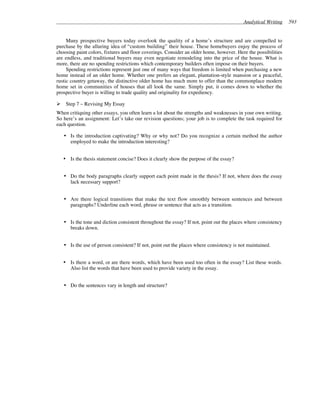
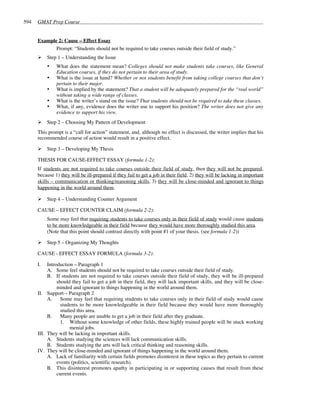
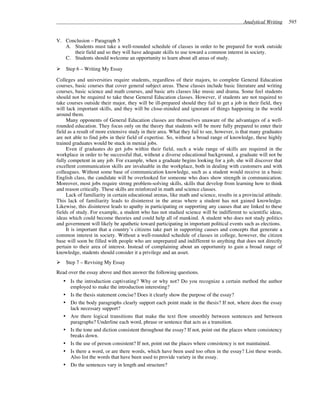
discrepancy?
(A) Only 10 percent of those who were polled replied.
(B) Ford which conducted a similar survey with similar results continued to build large
cars and also lost more of their market to the Japanese.
(C) The surveyed owners who preferred big cars also preferred big homes.
(D) GM determined that it would be more profitable to make big cars.
(E) Eighty percent of the owners who wanted big cars and only 40 percent of the owners
who wanted small cars replied to the survey.
14 GMAT Prep Course
Only two answer-choices have any real merit—(A) and (E). The argument generalizes from the
survey to the general car-buying population, so the reliability of the projection depends on how
representative the sample is. At first glance choice (A) seems rather good, because 10 percent
does not seem large enough. However, political opinion polls typically are based on only .001
percent of the population. More importantly, we don’t know what percentage of GM car owners
received the survey. Choice (E), on the other hand, points out that the survey did not represent
the entire public, so it is the answer.
The other choices can be quickly dismissed. Choice (B) simply states that Ford made the
same mistake that GM did. Choice (C) is irrelevant. Finally, choice (D), rather than explaining
the discrepancy, would give even more reason for GM to continue making large cars.
Computer Screen Options
When taking the test, you will have six on-screen options/buttons:
Quit Section Time Help Next Confirm
Unless you just cannot stand it any longer, never select Quit or Section. If you finish a section
early, just relax while the time runs out. If you’re not pleased with your performance on the test,
you can always cancel it at the end.
The Time button allows you to display or hide the time. During the last five minutes, the time
display cannot be hidden and it will also display the seconds remaining.
The Help button will present a short tutorial showing how to use the program.
You select an answer-choice by clicking the small oval next to it.
To go to the next question, click the Next button. You will then be asked to confirm your answer
by clicking the Confirm button. Then the next question will be presented.
Test Day
• Bring a photo ID.
• Bring a list of schools that you wish to send your scores to.
• Arrive at the test center 30 minutes before your test appointment. If you arrive late, you
might not be admitted and your fee will be forfeited.
• You will be provided with scratch paper. Do not bring your own, and do not remove scratch
paper from the testing room.
• You cannot bring testing aids in to the testing room. This includes pens, calculators, watch
calculators, books, rulers, cellular phones, watch alarms, and any electronic or photographic
devices.
• You may be photographed and videotaped at the test center.
How to Use this Book
The six parts of this book—(1) Standard Math, (2) Data Sufficiency, (3) Reading
Comprehension, (4) Arguments, (5) Sentence Correction, and (6) Writing Assessment—are
independent of one another. However, to take full advantage of the system presented in the
book, it is best to tackle each part in the order given.
Orientation 15
This book contains the equivalent of a six-week, 50-hour course. Ideally you have bought
the book at least four weeks before your scheduled test date. However, if the test is only a week
or two away, there is still a truncated study plan that will be useful.
Shortened Study Plan
Standard Math
Study: Substitution
Math Notes
Number Theory
Geometry
Elimination Strategies
Data Sufficiency
Study: All
Reading Comprehension
Study: The Six Questions
Pivotal Words
Arguments
Study: Logic I
Logic II (Diagramming)
Classification
Sentence Correction
Study: All
The GMAT is not easy—nor is this book. To improve your GMAT score, you must be willing to
work; if you study hard and master the techniques in this book, your score will improve—
significantly.
Questions and Answers
When is the GMAT given?
The test is given year round during normal business hours. There is often one week during each
month in which the test is not offered.
How important is the GMAT and how is it used?
It is crucial! Although business schools may consider other factors, the vast majority of
admission decisions are based on only two criteria: your GMAT score and your GPA.
How many times should I take the GMAT?
Most people are better off preparing thoroughly for the test, taking it once and getting their top
score. You can take the test at most once a month and at most five times in any one year period,
but some business schools will average your scores. You should call the schools to which you are
applying to find out their policy. Then plan your strategy accordingly.
Can I cancel my score?
Yes. When you finish the test, the computer will offer the option of canceling the test or accepting
it. If you cancel the test, neither you nor any school will see your score. If you accept the test, the
computer will display your score and it will be available to all schools.
16 GMAT Prep Course
Where can I get the registration forms?
Most colleges and universities have the forms. You can also get them directly from ETS by
writing to:
Graduate Management Admission Test
Educational Testing Service
P. O. Box 6103
Princeton, NJ 08541
Or calling, (609) 771-7330
Or online: www.ets.org
Part One
MATH
19
STANDARD
MATH
• TYPES OF MATH QUESTIONS
• GMAT VS. SAT
• SUBSTITUTION
• MATH NOTES
• DEFINED FUNCTIONS
• NUMBER THEORY
• GEOMETRY
• COORDINATE GEOMETRY
• ELIMINATION STRATEGIES
• INEQUALITIES
• FRACTIONS & DECIMALS
• EQUATIONS
• AVERAGES
• RATIO & PROPORTION
• EXPONENTS & ROOTS
• FACTORING
• ALGEBRAIC EXPRESSIONS
• PERCENTS
• GRAPHS
• WORD PROBLEMS
• SEQUENCES & SERIES
• COUNTING
• PROBABILITY & STATISTICS
• SUMMARY OF MATH PROPERTIES
Standard Math 21
Types of Math Questions
The Math section consists of 37 multiple-choice questions. The questions come in two formats:
the standard multiple-choice question which we will study in this section and the Data
Sufficiency question which we will study in the next section. The math section is designed to test
your ability to solve problems, not to test your mathematical knowledge.
GMAT VS. SAT
GMAT math is very similar to SAT math, though slightly harder. The mathematical skills
tested are very basic: only first year high school algebra and geometry (no proofs). However, this
does not mean that the math section is easy. The medium of basic mathematics is chosen so that
everyone taking the test will be on a fairly even playing field. Although the questions require
only basic mathematics and all have simple solutions, it can require considerable ingenuity to
find the simple solution. If you have taken a course in calculus or another advanced math topic,
don’t assume that you will find the math section easy. Other than increasing your mathematical
maturity, little you learned in calculus will help on the GMAT.
As mentioned above, every GMAT math problem has a simple solution, but finding that
simple solution may not be easy. The intent of the math section is to test how skilled you are at
finding the simple solutions. The premise is that if you spend a lot of time working out long
solutions you will not finish as much of the test as students who spot the short, simple solutions.
So if you find yourself performing long calculations or applying advanced mathematics—stop.
You’re heading in the wrong direction.
To insure that you perform at your expected level on the actual GMAT, you need to develop a
level of mathematical skill that is greater than what is tested on the GMAT. Hence, about 10% of
the math problems in this book are harder than actual GMAT math problems.
23
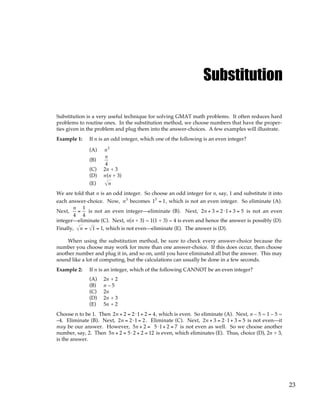
Substitution
Substitution is a very useful technique for solving GMAT math problems. It often reduces hard
problems to routine ones. In the substitution method, we choose numbers that have the proper-
ties given in the problem and plug them into the answer-choices. A few examples will illustrate.
Example 1: If n is an odd integer, which one of the following is an even integer?
(A) n3
(B)
n
4
(C) 2n + 3
(D) n(n + 3)
(E) n
We are told that n is an odd integer. So choose an odd integer for n, say, 1 and substitute it into
each answer-choice. Now, n3
becomes 13
= 1, which is not an even integer. So eliminate (A).
Next,
n
4
=
1
4
is not an even integer—eliminate (B). Next, 2n + 3 = 2⋅1+ 3 = 5 is not an even
integer—eliminate (C). Next, n(n + 3) = 1(1 + 3) = 4 is even and hence the answer is possibly (D).
Finally, n = 1 = 1, which is not even—eliminate (E). The answer is (D).
When using the substitution method, be sure to check every answer-choice because the
number you choose may work for more than one answer-choice. If this does occur, then choose
another number and plug it in, and so on, until you have eliminated all but the answer. This may
sound like a lot of computing, but the calculations can usually be done in a few seconds.
Example 2: If n is an integer, which of the following CANNOT be an even integer?
(A) 2n + 2
(B) n – 5
(C) 2n
(D) 2n + 3
(E) 5n + 2
Choose n to be 1. Then 2n + 2 = 2⋅1+ 2 = 4, which is even. So eliminate (A). Next, n – 5 = 1 – 5 =
–4. Eliminate (B). Next, 2n = 2⋅1 = 2. Eliminate (C). Next, 2n + 3 = 2⋅1+ 3 = 5 is not even—it
may be our answer. However, 5n + 2 = 5⋅1+ 2 = 7 is not even as well. So we choose another
number, say, 2. Then 5n + 2 = 5⋅ 2 + 2 = 12 is even, which eliminates (E). Thus, choice (D), 2n + 3,
is the answer.
24 GMAT Prep Course
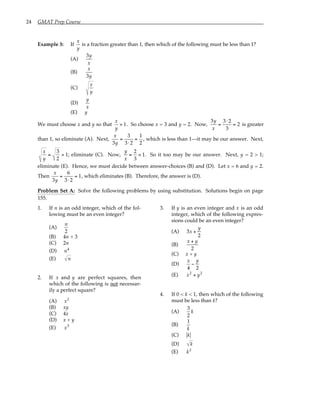
Example 3: If
x
y
is a fraction greater than 1, then which of the following must be less than 1?
(A)
3y
x
(B)
x
3y
(C)
x
y
(D)
y
x
(E) y
We must choose x and y so that
x
y
> 1. So choose x = 3 and y = 2. Now,
3y
x
=
3⋅ 2
3
= 2 is greater
than 1, so eliminate (A). Next,
x
3y
=
3
3⋅ 2
=
1
2
, which is less than 1—it may be our answer. Next,
x
y
=
3
2
> 1; eliminate (C). Now,
y
x
=
2
3
< 1. So it too may be our answer. Next, y = 2 > 1;
eliminate (E). Hence, we must decide between answer-choices (B) and (D). Let x = 6 and y = 2.
Then
x
3y
=
6
3⋅ 2
= 1, which eliminates (B). Therefore, the answer is (D).
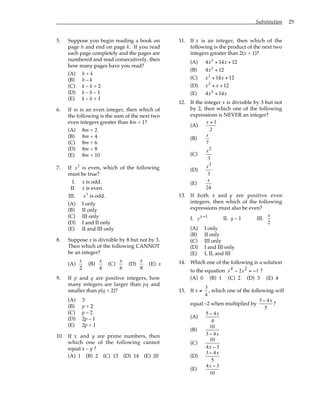
Problem Set A: Solve the following problems by using substitution. Solutions begin on page
155.
1. If n is an odd integer, which of the fol-
lowing must be an even integer?
(A)
n
2
(B) 4n + 3
(C) 2n
(D) n4
(E) n
2. If x and y are perfect squares, then
which of the following is not necessar-
ily a perfect square?
(A) x2
(B) xy
(C) 4x
(D) x + y
(E) x5
3. If y is an even integer and x is an odd
integer, which of the following expres-
sions could be an even integer?
(A) 3x +
y
2
(B)
x + y
2
(C) x + y
(D)
x
4
−
y
2
(E) x2
+ y2
4. If 0 < k < 1, then which of the following
must be less than k?
(A)
3
2
k
(B)
1
k
(C) k
(D) k
(E) k2
Substitution 25
5. Suppose you begin reading a book on
page h and end on page k. If you read
each page completely and the pages are
numbered and read consecutively, then
how many pages have you read?
(A) h + k
(B) h – k
(C) k – h + 2
(D) k – h – 1
(E) k – h + 1
6. If m is an even integer, then which of
the following is the sum of the next two
even integers greater than 4m + 1?
(A) 8m + 2
(B) 8m + 4
(C) 8m + 6
(D) 8m + 8
(E) 8m + 10
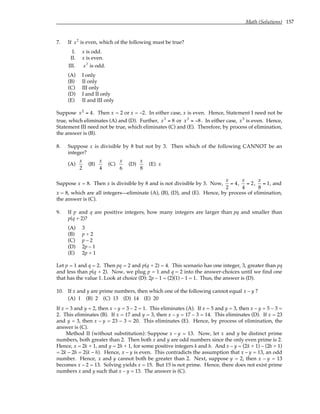
7. If x2
is even, which of the following
must be true?
I. x is odd.
II. x is even.
III. x3
is odd.
(A) I only
(B) II only
(C) III only
(D) I and II only
(E) II and III only
8. Suppose x is divisible by 8 but not by 3.
Then which of the following CANNOT
be an integer?
(A)
x
2
(B)
x
4
(C)
x
6
(D)
x
8
(E) x
9. If p and q are positive integers, how
many integers are larger than pq and
smaller than p(q + 2)?
(A) 3
(B) p + 2
(C) p – 2
(D) 2p – 1
(E) 2p + 1
10. If x and y are prime numbers, then
which one of the following cannot
equal x – y ?
(A) 1 (B) 2 (C) 13 (D) 14 (E) 20
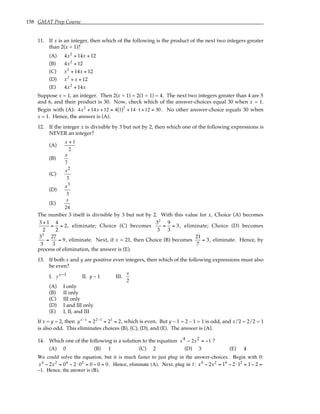
11. If x is an integer, then which of the
following is the product of the next two
integers greater than 2(x + 1)?
(A) 4x2
+ 14x + 12
(B) 4x2
+ 12
(C) x2
+ 14x + 12
(D) x2
+ x + 12
(E) 4x2
+ 14x
12. If the integer x is divisible by 3 but not
by 2, then which one of the following
expressions is NEVER an integer?
(A)
x + 1
2
(B)
x
7
(C)
x2
3
(D)
x3
3
(E)
x
24
13. If both x and y are positive even
integers, then which of the following
expressions must also be even?
I. yx−1 II. y – 1 III.
x
2
(A) I only
(B) II only
(C) III only
(D) I and III only
(E) I, II, and III
14. Which one of the following is a solution
to the equation x x
4 2
2 1
− = − ?
(A) 0 (B) 1 (C) 2 (D) 3 (E) 4
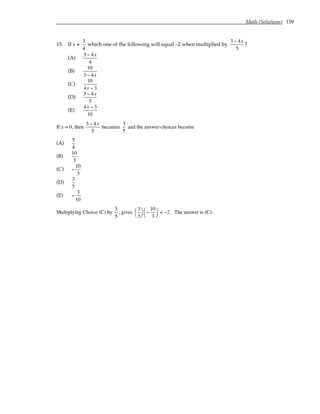
15. If x ≠
3
4
, which one of the following will
equal –2 when multiplied by
3 − 4x
5
?
(A)
5 − 4x
4
(B)
10
3 − 4x
(C)
10
4x − 3
(D)
3 − 4x
5
(E)
4x − 3
10
26 GMAT Prep Course
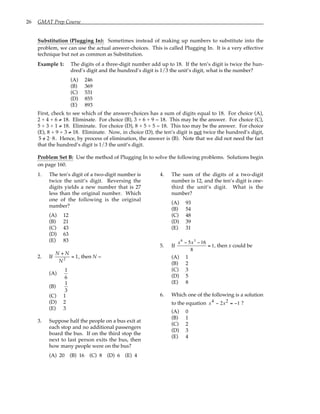
Substitution (Plugging In): Sometimes instead of making up numbers to substitute into the
problem, we can use the actual answer-choices. This is called Plugging In. It is a very effective
technique but not as common as Substitution.
Example 1: The digits of a three-digit number add up to 18. If the ten’s digit is twice the hun-
dred’s digit and the hundred’s digit is 1/3 the unit’s digit, what is the number?
(A) 246
(B) 369
(C) 531
(D) 855
(E) 893
First, check to see which of the answer-choices has a sum of digits equal to 18. For choice (A),
2 + 4 + 6 ≠ 18. Eliminate. For choice (B), 3 + 6 + 9 = 18. This may be the answer. For choice (C),
5 + 3 + 1 ≠ 18. Eliminate. For choice (D), 8 + 5 + 5 = 18. This too may be the answer. For choice
(E), 8 + 9 + 3 ≠ 18. Eliminate. Now, in choice (D), the ten’s digit is not twice the hundred’s digit,
5 /
= 2⋅8. Hence, by process of elimination, the answer is (B). Note that we did not need the fact
that the hundred’s digit is 1/3 the unit’s digit.
Problem Set B: Use the method of Plugging In to solve the following problems. Solutions begin
on page 160.
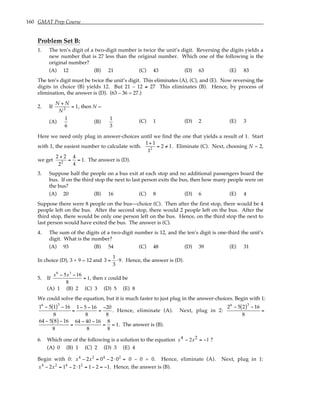
1. The ten’s digit of a two-digit number is
twice the unit’s digit. Reversing the
digits yields a new number that is 27
less than the original number. Which
one of the following is the original
number?
(A) 12
(B) 21
(C) 43
(D) 63
(E) 83
2. If
N + N
N2
= 1, then N =
(A)
1
6
(B)
1
3
(C) 1
(D) 2
(E) 3
3. Suppose half the people on a bus exit at
each stop and no additional passengers
board the bus. If on the third stop the
next to last person exits the bus, then
how many people were on the bus?
(A) 20 (B) 16 (C) 8 (D) 6 (E) 4
4. The sum of the digits of a two-digit
number is 12, and the ten’s digit is one-
third the unit’s digit. What is the
number?
(A) 93
(B) 54
(C) 48
(D) 39
(E) 31
5. If
x6
− 5x3
−16
8
= 1, then x could be
(A) 1
(B) 2
(C) 3
(D) 5
(E) 8
6. Which one of the following is a solution
to the equation x x
4 2
2 1
− = − ?
(A) 0
(B) 1
(C) 2
(D) 3
(E) 4
27
Math Notes
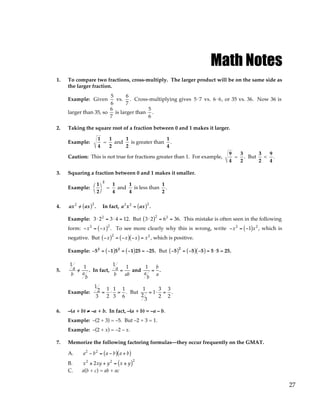
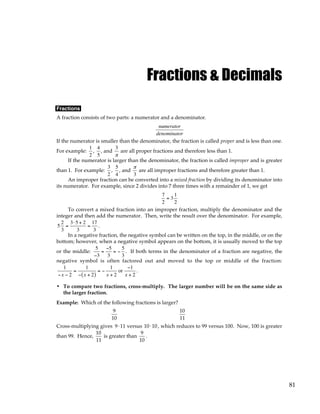
1. To compare two fractions, cross-multiply. The larger product will be on the same side as
the larger fraction.
Example: Given
5
6
vs.
6
7
. Cross-multiplying gives 5⋅7 vs. 6⋅6, or 35 vs. 36. Now 36 is
larger than 35, so
6
7
is larger than
5
6
.
2. Taking the square root of a fraction between 0 and 1 makes it larger.
Example:
1
4
=
1
2
and
1
2
is greater than
1
4
.
Caution: This is not true for fractions greater than 1. For example,
9
4
=
3
2
. But
3
2
<
9
4
.
3. Squaring a fraction between 0 and 1 makes it smaller.
Example:
1
2




2
=
1
4
and
1
4
is less than
1
2
.
4. ax2
/
= ax
( )2
. In fact, a2
x2
= ax
( )2
.
Example: 3⋅ 22
= 3⋅ 4 = 12. But 3⋅ 2
( )2
= 62
= 36. This mistake is often seen in the following
form: −x2
= −x
( )2
. To see more clearly why this is wrong, write −x2
= −1
( )x2
, which is
negative. But −x
( )2
= −x
( ) −x
( ) = x2
, which is positive.
Example: −52
= −1
( )52
= −1
( )25 = −25. But −5
( )2
= −5
( ) −5
( ) = 5 ⋅5 = 25.
5.
1
a
b
/
=
1
a
b
. In fact,
1
a
b
=
1
ab
and
1
a
b
=
b
a
.
Example:
1
2
3
=
1
2
⋅
1
3
=
1
6
. But
1
2
3
= 1⋅
3
2
=
3
2
.
6. –(a + b) ≠
≠
≠
≠ –a + b. In fact, –(a + b) = –a – b.
Example: –(2 + 3) = –5. But –2 + 3 = 1.
Example: –(2 + x) = –2 – x.
7. Memorize the following factoring formulas—they occur frequently on the GMAT.
A. a2
− b2
= a − b
( ) a + b
( )
B. x2
± 2xy + y2
= x ± y
( )2
C. a(b + c) = ab + ac
28 GMAT Prep Course
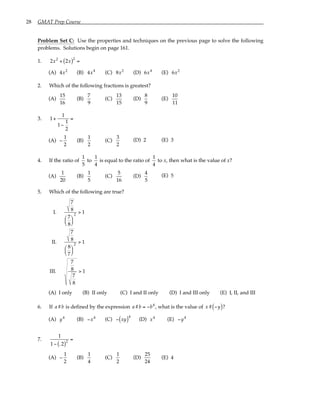
Problem Set C: Use the properties and techniques on the previous page to solve the following
problems. Solutions begin on page 161.
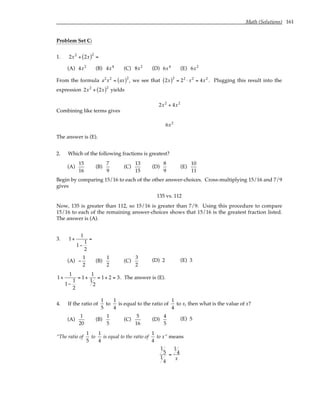
1. 2x2
+ 2x
( )2
=
(A) 4x2
(B) 4x4
(C) 8x2
(D) 6x4
(E) 6x2
2. Which of the following fractions is greatest?
(A)
15
16
(B)
7
9
(C)
13
15
(D)
8
9
(E)
10
11
3. 1+
1
1−
1
2
=
(A) −
1
2
(B)
1
2
(C)
3
2
(D) 2 (E) 3
4. If the ratio of
1
5
to
1
4
is equal to the ratio of
1
4
to x, then what is the value of x?
(A)
1
20
(B)
1
5
(C)
5
16
(D)
4
5
(E) 5
5. Which of the following are true?
I.
7
8
7
8






2
> 1
II.
7
8
8
7






2
> 1
III.
7
8
7
8
> 1
(A) I only (B) II only (C) I and II only (D) I and III only (E) I, II, and III
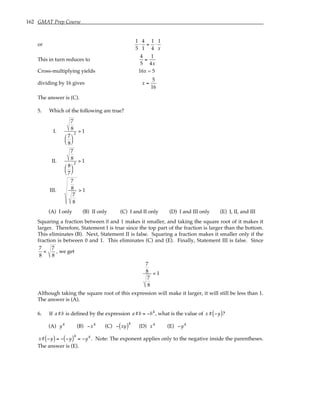
6. If a#b is defined by the expression a#b = −b4
, what is the value of x# −y
( )?
(A) y4
(B) −x4
(C) − xy
( )4
(D) x4
(E) −y4
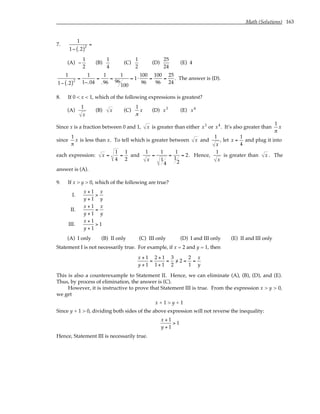
7.
1
1− .2
( )2
=
(A) −
1
2
(B)
1
4
(C)
1
2
(D)
25
24
(E) 4
Math Notes 29
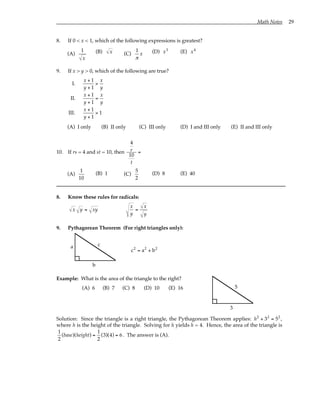
8. If 0 < x < 1, which of the following expressions is greatest?
(A)
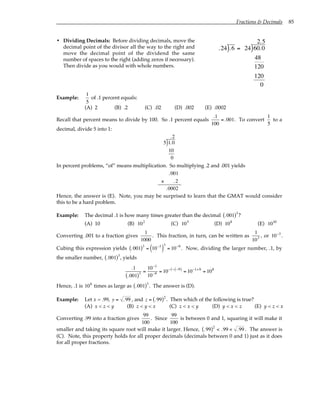
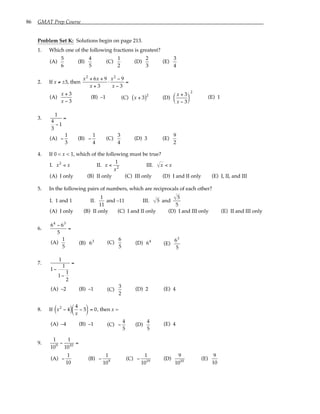
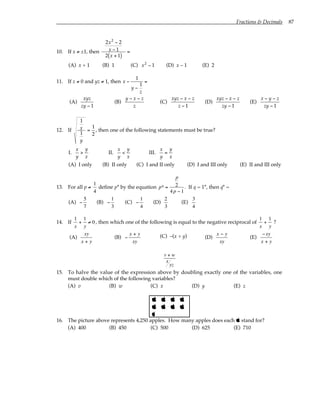
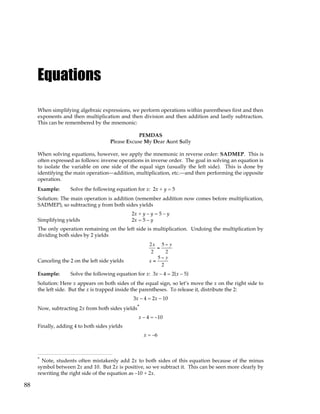
1
x
(B) x (C)
1
π
x (D) x3
(E) x4
9. If x > y > 0, which of the following are true?
I.
x + 1
y + 1
>
x
y
II.
x + 1
y + 1
=
x
y
III.
x + 1
y + 1
> 1
(A) I only (B) II only (C) III only (D) I and III only (E) II and III only
10. If rs = 4 and st = 10, then
4
r
10
t
=
(A)
1
10
(B) 1 (C)
5
2
(D) 8 (E) 40
8. Know these rules for radicals:
x y = xy
x
y
=
x
y
9. Pythagorean Theorem (For right triangles only):
a
b
c
c2
= a2
+ b2
Example: What is the area of the triangle to the right?
(A) 6 (B) 7 (C) 8 (D) 10 (E) 16
3
5
Solution: Since the triangle is a right triangle, the Pythagorean Theorem applies: h2
+ 32
= 52
,
where h is the height of the triangle. Solving for h yields h = 4. Hence, the area of the triangle is
1
2
(base)(height) =
1
2
(3)(4) = 6. The answer is (A).
30 GMAT Prep Course
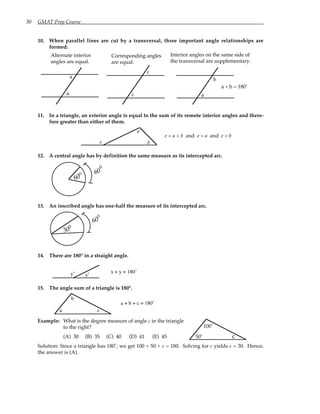
10. When parallel lines are cut by a transversal, three important angle relationships are
formed:
Alternate interior
angles are equal.
a
a
Corresponding angles
are equal.
c
c
Interior angles on the same side of
the transversal are supplementary.
a
a + b = 180˚
b
11. In a triangle, an exterior angle is equal to the sum of its remote interior angles and there-
fore greater than either of them.
e
a
b
e = a + b and e > a and e > b
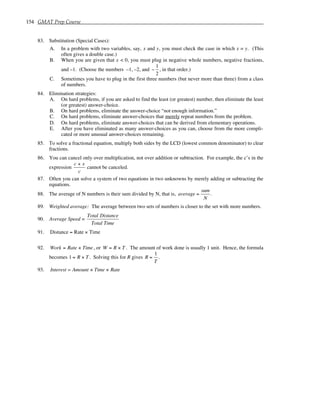
12. A central angle has by definition the same measure as its intercepted arc.
60
60
°
°
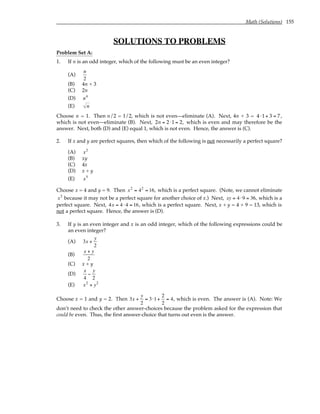
13. An inscribed angle has one-half the measure of its intercepted arc.
60
30
°
°
14. There are 180° in a straight angle.
y˚ x˚
x + y = 180˚
15. The angle sum of a triangle is 180°.
a
b
c
a + b + c = 180˚
Example: What is the degree measure of angle c in the triangle
to the right?
(A) 30 (B) 35 (C) 40 (D) 41 (E) 45 50˚ c
100˚
Solution: Since a triangle has 180˚, we get 100 + 50 + c = 180. Solving for c yields c = 30. Hence,
the answer is (A).
Math Notes 31
16. Consecutive integers are written x, x + 1, x + 2, . . . . Consecutive even or odd integers are
written x, x + 2, x + 4, . . . .
17. To find the percentage increase, find the absolute increase and divide by the original
amount.
Example: If a shirt selling for $18 is marked up to $20, then the absolute increase is 20 – 18 =
2. Thus, the percentage increase is
increase
original amount
=
2
18
=
1
9
≈ 11%.
18. Systems of simultaneous equations can most often be solved by merely adding or
subtracting the equations.
Example: If 4x + y = 14 and 3x + 2y = 13, then x – y =
Solution: We merely subtract the second equation from the first:
4x + y = 14
3x + 2y = 13
x – y = 1
(–)
19. When counting elements that are in overlapping sets, the total number will equal the
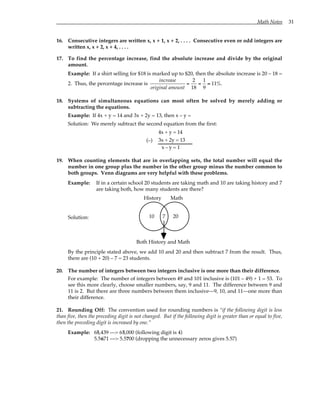
number in one group plus the number in the other group minus the number common to
both groups. Venn diagrams are very helpful with these problems.
Example: If in a certain school 20 students are taking math and 10 are taking history and 7
are taking both, how many students are there?
Solution:
History Math
10 7 20
Both History and Math
By the principle stated above, we add 10 and 20 and then subtract 7 from the result. Thus,
there are (10 + 20) – 7 = 23 students.
20. The number of integers between two integers inclusive is one more than their difference.
For example: The number of integers between 49 and 101 inclusive is (101 – 49) + 1 = 53. To
see this more clearly, choose smaller numbers, say, 9 and 11. The difference between 9 and
11 is 2. But there are three numbers between them inclusive—9, 10, and 11—one more than
their difference.
21. Rounding Off: The convention used for rounding numbers is “if the following digit is less
than five, then the preceding digit is not changed. But if the following digit is greater than or equal to five,
then the preceding digit is increased by one.”
Example: 65,439 —> 65,000 (following digit is 4)
5.5671 —> 5.5700 (dropping the unnecessary zeros gives 5.57)
32
Defined Functions
Defined functions are common on the GMAT, and most students struggle with them. Yet once
you get used to them, defined functions can be some of the easiest problems on the test. In these
problems, you are given a symbol and a mathematical expression or description that defines the
symbol. Some examples will illustrate.
Example 1: Define x∇y by the equation x∇y = xy − y . Then 2∇ 3 =
(A) 1 (B) 3 (C) 12 (D) 15 (E) 18
From the above definition, we know that x∇y = xy − y . So we merely replace x with 2 and y with
3 in the definition: 2∇3 = 2⋅ 3 − 3 = 3 . Hence, the answer is (B).
Example 2: If a ∆ b is defined to be a2
, then what is the value of
z ∆ 2
z ∆ 3
?
(A)
2
3
(B) 1 (C)
3
2
(D) 2 (E) 3
Most students who are unfamiliar with defined functions are unable to solve this problem. Yet it
is actually quite easy. By the definition above, ∆ merely squares the first term. So z ∆ 2 = z2
,
and z ∆ 3 = z2
. Forming the fraction yields
z ∆ 2
z ∆ 3
=
z2
z2
= 1. Hence, the answer is (B).
Example 3: The operation @ is defined for all non-zero x and y by the equation x@ y = xy
.
Then the expression x@ y
( )@ z is equal to
(A) xyz
(B) xyz
(C) xy
( )z
(D) xy
z
(E) xy
( )
z
x@ y
( )@ z = xy
( )@ z = xy
( )
z
. Hence, the answer is (E). Note, though it may appear that choices
(A) and (E) are equivalent, they are not: xy
( )
z
= xyz
, which is not equal to xyz
.
Defined Functions 33
Example 4: For all real numbers x and y, let x#y = xy
( )2
− x + y2
. What is the value of y that
makes x # y equal to –x for all values of x ?
(A) 0 (B) 2 (C) 5 (D) 7 (E) 10
Setting x # y equal to –x yields xy
( )2
− x + y2
= −x
Canceling –x from both sides of the equation yields xy
( )2
+ y2
= 0
Expanding the first term yields x2
y2
+ y2
= 0
Factoring out y2
yields y2
x2
+ 1
( )= 0
Setting each factor equal to zero yields y2
= 0 or x2
+ 1 = 0
Now, x2
+ 1 is greater than or equal to 1 (why?). Hence, y2
= 0
Taking the square root of both sides of this equation yields y = 0
Hence, the answer is (A).
Example 5: If x denotes the area of a square with sides of length x, then which of the
following is equal to 9 3
÷ ?
(A) 3 (B) 3 (C) 27 (D) 27 (E) 81
The area of a square with sides of length x is x2
. This formula yields
9 3
÷ = 92
÷ 32
= 81÷ 9 = 9. Now, 3 = 32
= 9. Hence, the answer is (B).
Example 6: If x is a positive integer, define: x = x , if x is even;
x = 4x, if x is odd.
If k is a positive integer, which of the following equals 2k − 1 ?
(A) 2k − 1
(B) k – 1
(C) 8k – 4
(D) 8k − 4
(E) 8k – 1
First, we must determine whether 2k – 1 is odd or even. (It cannot be both—why?) To this end,
let k = 1. Then 2k − 1 = 2⋅1− 1 = 1, which is an odd number. Therefore, we use the bottom-half of
the definition given above. That is, 2k − 1 = 4(2k – 1) = 8k – 4. The answer is (C).
You may be wondering how defined functions differ from the functions, f(x), you studied in
Intermediate Algebra and more advanced math courses. They don’t differ. They are the same old
concept you dealt with in your math classes. The function in Example 6 could just as easily be
written f(x) = x and f(x) = 4x. The purpose of defined functions is to see how well you can
adapt unusual structures. Once you realize that defined functions are evaluated and manipu-
lated just as regular functions, they become much less daunting.
34 GMAT Prep Course
Example 7: Define x* by the equation x* = π – x. Then ((–π)*)* =
(A) –2π (B) –1 (C) –π (D) 2π (E) 4π
Working from the inner parentheses out, we get
((–π)*)* = (π – (–π))* = (π + π)* = (2π)* = π – 2π = –π.
Hence, the answer is (C).
Method II: We can rewrite this problem using ordinary function notation. Replacing the odd
symbol x* with f(x) gives f(x) = π − x . Now, the expression ((–π)*)* becomes the ordinary
composite function f(f(−π)) = f(π − (−π)) = f(π + π) = f(2π) = π − 2π = −π.
Example 8: If x is an integer, define: x = 5, if x is odd;
x = 10, if x is even.
If u and v are integers, and both 3u and 7 – v are odd, then u – v =
(A) –5 (B) 0 (C) 5 (D) 10 (E) 15
Since 3u is odd, u is odd. (Proof: Suppose u were even, then 3u would be even as well. But we
are given that 3u is odd. Hence, u must be odd.) Since 7 – v is odd, v must be even. (Proof:
Suppose v were odd, then 7 – v would be even [the difference of two odd numbers is an even
number]. But we are given that 7 – v is odd. Hence, v must be even.)
Since u is odd, the top part of the definition gives u = 5. Since v is even, the bottom part of
the definition gives v = 10. Hence, u – v = 5 – 10 = –5. The answer is (A).
Example 9: For all real numbers a and b, where a⋅b /
= 0, let a◊b = ab. Then which of the
following must be true?
I. a◊b = b◊a
II. −a
( )◊ −a
( ) =
−1
( )−a
aa
III. a◊b
( )◊c = a◊ b◊c
( )
(A) I only
(B) II only
(C) III only
(D) I and II only
(E) II and III only
Statement I is false. For instance, 1◊2 = 12
= 1, but 2◊1 = 21
= 2. This eliminates (A) and (D).
Statement II is true: −a
( )◊ −a
( ) = −a
( )−a
= −1⋅ a
( )−a
= −1
( )−a
a
( )−a
=
−1
( )−a
aa
. This eliminates (C).
Unfortunately, we have to check Statement III. It is false: 2◊2
( )◊3 = 22
◊3 = 4◊3 = 43
= 64 and
2◊ 2◊3
( ) = 2◊23
= 2◊8 = 28
= 256. This eliminates (E), and the answer is (B). Note: The expression
a ⋅b /
= 0 insures that neither a nor b equals 0: if a⋅b = 0, then either a = 0 or b = 0, or both. This
prevents division by zero from occurring in the problem, otherwise if a = 0 and b = –1, then
0◊ −1
( ) = 0−1
=
1
0
.
Defined Functions 35
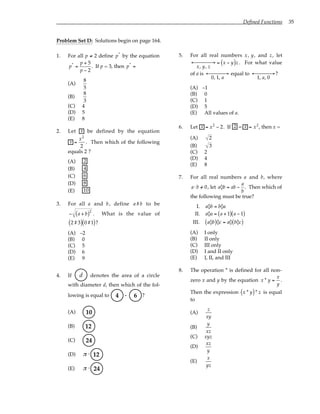
Problem Set D: Solutions begin on page 164.
1. For all p ≠ 2 define p*
by the equation
p*
=
p + 5
p − 2
. If p = 3, then p*
=
(A)
8
5
(B)
8
3
(C) 4
(D) 5
(E) 8
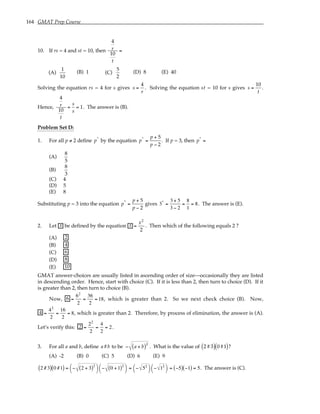
2. Let x be defined by the equation
x =
x2
2
. Then which of the following
equals 2 ?
(A) 2
(B) 4
(C) 6
(D) 8
(E) 10
3. For all a and b, define a#b to be
− a + b
( )2
. What is the value of
2#3
( ) 0#1
( )?
(A) –2
(B) 0
(C) 5
(D) 6
(E) 9
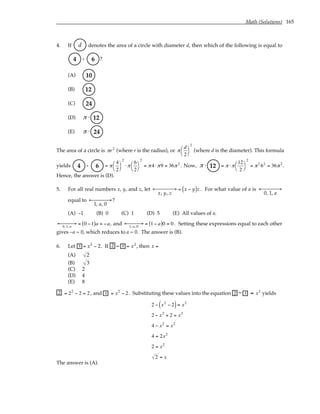
4. If d denotes the area of a circle
with diameter d, then which of the fol-
lowing is equal to .
4 6 ?
(A) 10
(B) 12
(C) 24
(D) π ⋅ 12
(E) π ⋅ 24
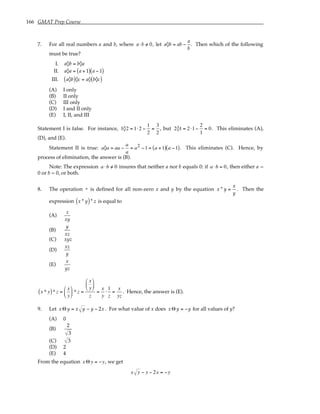
5. For all real numbers x, y, and z, let
x, y, z
← →

 = x − y
( )z . For what value
of a is
0, 1, a
← →

 equal to
1, a, 0
← →

 ?
(A) –1
(B) 0
(C) 1
(D) 5
(E) All values of a.
6. Let x = x2
− 2. If 2 − x = x2
, then x =
(A) 2
(B) 3
(C) 2
(D) 4
(E) 8
7. For all real numbers a and b, where
a⋅b /
= 0, let a◊b = ab −
a
b
. Then which of
the following must be true?
I. a◊b = b◊a
II. a◊a = a + 1
( ) a − 1
( )
III. a◊b
( )◊c = a◊ b◊c
( )
(A) I only
(B) II only
(C) III only
(D) I and II only
(E) I, II, and III
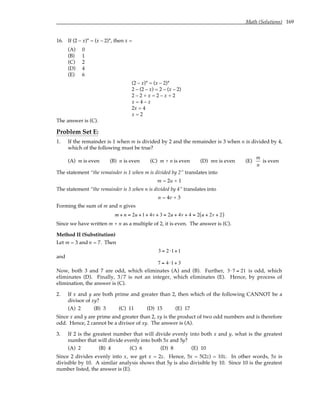
8. The operation * is defined for all non-
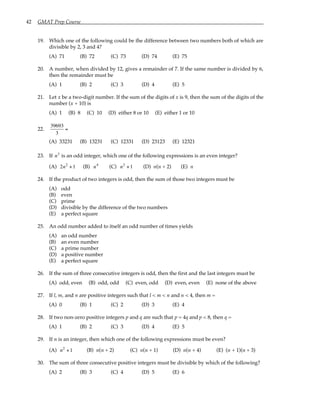
zero x and y by the equation x * y =
x
y
.
Then the expression x * y
( )* z is equal
to
(A)
z
xy
(B)
y
xz
(C) xyz
(D)
xz
y
(E)
x
yz
36 GMAT Prep Course
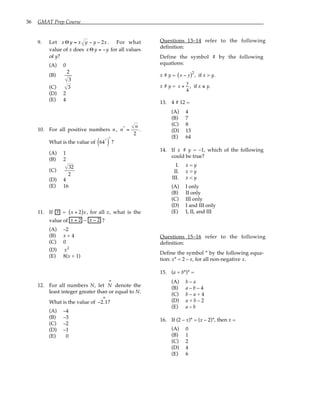
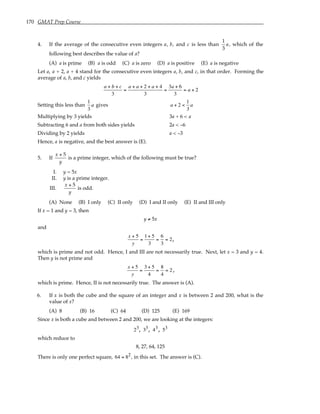
9. Let xΘ y = x y − y − 2x . For what
value of x does xΘ y = −y for all values
of y?
(A) 0
(B)
2
3
(C) 3
(D) 2
(E) 4
10. For all positive numbers n, n*
=
n
2
.
What is the value of 64*
( )
*
?
(A) 1
(B) 2
(C)
32
2
(D) 4
(E) 16
11. If x = x + 2
( )x , for all x, what is the
value of x + 2 – x − 2 ?
(A) –2
(B) x + 4
(C) 0
(D) x2
(E) 8(x + 1)
12. For all numbers N, let N
∞
denote the
least integer greater than or equal to N.
What is the value of −2.1
∞
?
(A) –4
(B) –3
(C) –2
(D) –1
(E) 0
Questions 13–14 refer to the following
definition:
Define the symbol # by the following
equations:
x # y = x − y
( )2
, if x > y.
x # y = x +
y
4
, if x ≤ y.
13. 4 # 12 =
(A) 4
(B) 7
(C) 8
(D) 13
(E) 64
14. If x # y = –1, which of the following
could be true?
I. x = y
II. x > y
III. x < y
(A) I only
(B) II only
(C) III only
(D) I and III only
(E) I, II, and III
Questions 15–16 refer to the following
definition:
Define the symbol * by the following equa-
tion: x* = 2 – x, for all non-negative x.
15. (a + b*)* =
(A) b – a
(B) a – b – 4
(C) b – a + 4
(D) a + b – 2
(E) a – b
16. If (2 – x)* = (x – 2)*, then x =
(A) 0
(B) 1
(C) 2
(D) 4
(E) 6
37
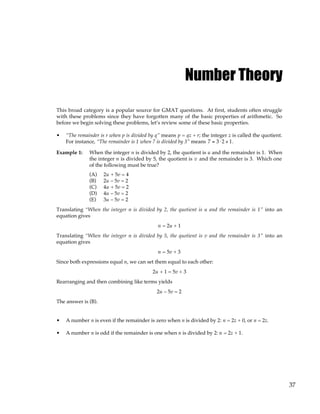
Number Theory
This broad category is a popular source for GMAT questions. At first, students often struggle
with these problems since they have forgotten many of the basic properties of arithmetic. So
before we begin solving these problems, let’s review some of these basic properties.
• “The remainder is r when p is divided by q” means p = qz + r; the integer z is called the quotient.
For instance, “The remainder is 1 when 7 is divided by 3” means 7 = 3⋅ 2 + 1.
Example 1: When the integer n is divided by 2, the quotient is u and the remainder is 1. When
the integer n is divided by 5, the quotient is v and the remainder is 3. Which one
of the following must be true?
(A) 2u + 5v = 4
(B) 2u – 5v = 2
(C) 4u + 5v = 2
(D) 4u – 5v = 2
(E) 3u – 5v = 2
Translating “When the integer n is divided by 2, the quotient is u and the remainder is 1” into an
equation gives
n = 2u + 1
Translating “When the integer n is divided by 5, the quotient is v and the remainder is 3” into an
equation gives
n = 5v + 3
Since both expressions equal n, we can set them equal to each other:
2u + 1 = 5v + 3
Rearranging and then combining like terms yields
2u – 5v = 2
The answer is (B).
• A number n is even if the remainder is zero when n is divided by 2: n = 2z + 0, or n = 2z.
• A number n is odd if the remainder is one when n is divided by 2: n = 2z + 1.
38 GMAT Prep Course
• The following properties for odd and even numbers are very useful—you should memorize
them:
even × even = even
odd × odd = odd
even × odd = even
even + even = even
odd + odd = even
even + odd = odd
Example 2: Suppose p is even and q is odd. Then which of the following CANNOT be an integer?
I.
p + q
p
II.
pq
3
III.
q
p2
(A) I only (B) II only (C) III only (D) I and II only (E) I and III only
For a fractional expression to be an integer, the denominator must divide evenly into the
numerator. Now, Statement I cannot be an integer. Since q is odd and p is even, p + q is odd.
Further, since p + q is odd, it cannot be divided evenly by the even number p. Hence,
p + q
p
cannot be an integer. Next, Statement II can be an integer. For example, if p = 2 and q = 3, then
pq
3
=
2⋅ 3
3
= 2. Finally, Statement III cannot be an integer. p2
= p ⋅ p is even since it is the product
of two even numbers. Further, since q is odd, it cannot be divided evenly by the even integer p2
.
The answer is (E).
• Consecutive integers are written as x, x + 1, x + 2, . . .
• Consecutive even or odd integers are written as x + 2, x + 4, . . .
• The integer zero is neither positive nor negative, but it is even: 0 = 2⋅0.
• A prime number is an integer that is divisible only by itself and 1.
The prime numbers are 2, 3, 5, 7, 11, 13, 17, 19, 23, 29, 31, 37, 41, . . .
• A number is divisible by 3 if the sum of its digits is divisible by 3.
For example, 135 is divisible by 3 because the sum of its digits (1 + 3 + 5 = 9) is divisible by 3.
• The absolute value of a number, , is always positive. In other words, the absolute value
symbol eliminates negative signs.
For example, −7 = 7 and −π = π. Caution, the absolute value symbol acts only on what is
inside the symbol, . For example, − − 7 − π
( ) = − 7 − π
( ). Here, only the negative sign inside
the absolute value symbol but outside the parentheses is eliminated.
Number Theory 39
Example 3: If a, b, and c are consecutive integers and a < b < c, which of the following must be
true?
I. b – c = 1
II.
abc
3
is an integer.
III. a + b + c is even.
(A) I only
(B) II only
(C) III only
(D) I and II only
(E) II and III only
Let x, x + 1, x + 2 stand for the consecutive integers a, b, and c, in that order. Plugging this into Statement I
yields
b – c = (x + 1) – (x + 2) = –1
Hence, Statement I is false.
As to Statement II, since a, b, and c are three consecutive integers, one of them must be
divisible by 3. Hence,
abc
3
is an integer, and Statement II is true.
As to Statement III, suppose a is even, b is odd, and c is even. Then a + b is odd since
even + odd = odd
Hence,
a + b + c = (a + b) + c = (odd) + even = odd
Thus, Statement III is not necessarily true. The answer is (B).
Example 4: If both x and y are prime numbers, which of the following CANNOT be the differ-
ence of x and y?
(A) 1 (B) 3 (C) 9 (D) 15 (E) 23
Both 3 and 2 are prime, and 3 – 2 = 1. This eliminates (A). Next, both 5 and 2 are prime, and 5 – 2 = 3.
This eliminates (B). Next, both 11 and 2 are prime, and 11 – 2 = 9. This eliminates (C). Next, both 17 and
2 are prime, and 17 – 2 = 15. This eliminates (D). Hence, by process of elimination, the answer is (E).
Example 5: If −x = − − −2 + 5
( ) , then x =
(A) –7 (B) –3 (C) 3 (D) 7 (E) 9
Working from the innermost parentheses out, we get
−x = − − −2 + 5
( )
−x = − −3
–x = –(+3)
–x = –3
x = 3
The answer is (C).
40 GMAT Prep Course
Problem Set E: Solutions begin on page 169.
1. If the remainder is 1 when m is divided by 2 and the remainder is 3 when n is divided by 4,
which of the following must be true?
(A) m is even (B) n is even m + n is even (D) mn is even (E)
m
n
is even
2. If x and y are both prime and greater than 2, then which of the following CANNOT be a
divisor of xy?
(A) 2 (B) 3 (C) 11 (D) 15 (E) 17
3. If 2 is the greatest number that will divide evenly into both x and y, what is the greatest
number that will divide evenly into both 5x and 5y?
(A) 2 (B) 4 (C) 6 (D) 8 (E) 10
4. If the average of the consecutive even integers a, b, and c is less than
1
3
a, which of the fol-
lowing best describes the value of a?
(A) a is prime (B) a is odd (C) a is zero (D) a is positive (E) a is negative
5. If
x + 5
y
is a prime integer, which of the following must be true?
I. y = 5x
II. y is a prime integer.
III.
x + 5
y
is odd.
(A) None (B) I only (C) II only (D) I and II only (E) II and III only
6. If x is both the cube and the square of an integer and x is between 2 and 200, what is the
value of x?
(A) 8 (B) 16 (C) 64 (D) 125 (E) 169
7. In the two-digit number x, both the sum and the difference of its digits is 4. What is the
value of x?
(A) 13 (B) 31 (C) 40 (D) 48 (E) 59
8. If p divided by 9 leaves a remainder of 1, which of the following must be true?
I. p is even.
II. p is odd.
III. p = 3⋅ z + 1 for some integer z.
(A) I only (B) II only (C) III only (D) I and II only (E) I and III only
9. p and q are integers. If p is divided by 2, the remainder is 1; and if q is divided by 6, the
remainder is 1. Which of the following must be true.
I. pq + 1 is even.
II.
pq
2
is an integer.
III. pq is a multiple of 12.
(A) I only (B) II only (C) III only (D) I and II only (E) I and III only
Number Theory 41
10. The smallest prime number greater than 53 is
(A) 54 (B) 55 (C) 57 (D) 59 (E) 67
11. Which one of the following numbers is the greatest positive integer x such that 3x
is a factor
of 275
?
(A) 5 (B) 8 (C) 10 (D) 15 (E) 19
12. If x, y, and z are consecutive integers in that order, which of the following must be true?
I. xy is even.
II. x – z is even.
III. xz
is even.
(A) I only (B) II only (C) III only (D) I and II only (E) I and III only
13. If −x − 2 = − − 6 − 2
( ) , then x =
(A) –5 (B) –2 (C) 0 (D) 2 (E) 5
14. If the sum of two prime numbers x and y is odd, then the product of x and y must be
divisible by
(A) 2 (B) 3 (C) 4 (D) 5 (E) 8
15. If
x + y
x − y
= 3 and x and y are integers, then which one of the following must be true?
(A) x is divisible by 4
(B) y is an odd number
(C) y is an even integer
(D) x is an even number
(E) x is an irreducible fraction
16. A two-digit even number is such that reversing its digits creates an odd number greater than
the original number. Which one of the following cannot be the first digit of the original
number?
(A) 1 (B) 3 (C) 5 (D) 7 (E) 9
17. Let a, b, and c be three integers, and let a be a perfect square. If a/b = b/c, then which one of
the following statements must be true?
(A) c must be an even number
(B) c must be an odd number
(C) c must be a perfect square
(D) c must not be a perfect square
(E) c must be a prime number
18. If n > 2, then the sum, S, of the integers from 1 through n can be calculated by the following
formula: S = n(n + 1)/2. Which one of the following statements about S must be true?
(A) S is always odd.
(B) S is always even.
(C) S must be a prime number.
(D) S must not be a prime number.
(E) S must be a perfect square.
42 GMAT Prep Course
19. Which one of the following could be the difference between two numbers both of which are
divisible by 2, 3 and 4?
(A) 71 (B) 72 (C) 73 (D) 74 (E) 75
20. A number, when divided by 12, gives a remainder of 7. If the same number is divided by 6,
then the remainder must be
(A) 1 (B) 2 (C) 3 (D) 4 (E) 5
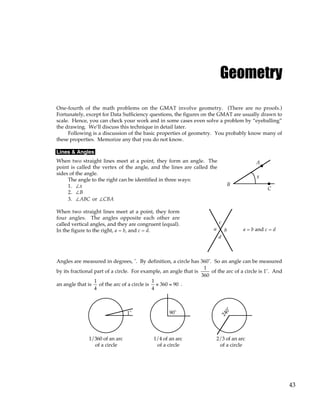
21. Let x be a two-digit number. If the sum of the digits of x is 9, then the sum of the digits of the
number (x + 10) is
(A) 1 (B) 8 (C) 10 (D) either 8 or 10 (E) either 1 or 10
22.
39693
3
=
(A) 33231 (B) 13231 (C) 12331 (D) 23123 (E) 12321
23. If n3
is an odd integer, which one of the following expressions is an even integer?
(A) 2n2
+1 (B) n4
(C) n2
+1 (D) n(n + 2) (E) n
24. If the product of two integers is odd, then the sum of those two integers must be
(A) odd
(B) even
(C) prime
(D) divisible by the difference of the two numbers
(E) a perfect square
25. An odd number added to itself an odd number of times yields
(A) an odd number
(B) an even number
(C) a prime number
(D) a positive number
(E) a perfect square
26. If the sum of three consecutive integers is odd, then the first and the last integers must be
(A) odd, even (B) odd, odd (C) even, odd (D) even, even (E) none of the above
27. If l, m, and n are positive integers such that l < m < n and n < 4, then m =
(A) 0 (B) 1 (C) 2 (D) 3 (E) 4
28. If two non-zero positive integers p and q are such that p = 4q and p < 8, then q =
(A) 1 (B) 2 (C) 3 (D) 4 (E) 5
29. If n is an integer, then which one of the following expressions must be even?
(A) n2
+1 (B) n(n + 2) (C) n(n + 1) (D) n(n + 4) (E) (n + 1)(n + 3)
30. The sum of three consecutive positive integers must be divisible by which of the following?
(A) 2 (B) 3 (C) 4 (D) 5 (E) 6
43
Geometry
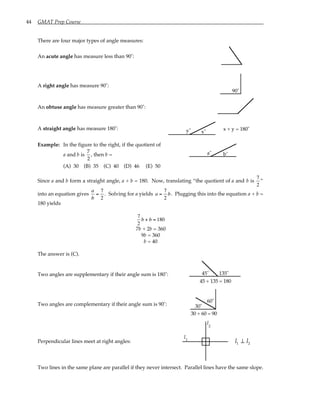
One-fourth of the math problems on the GMAT involve geometry. (There are no proofs.)
Fortunately, except for Data Sufficiency questions, the figures on the GMAT are usually drawn to
scale. Hence, you can check your work and in some cases even solve a problem by “eyeballing”
the drawing. We’ll discuss this technique in detail later.
Following is a discussion of the basic properties of geometry. You probably know many of
these properties. Memorize any that you do not know.
Lines & Angles
When two straight lines meet at a point, they form an angle. The
point is called the vertex of the angle, and the lines are called the
sides of the angle.
The angle to the right can be identified in three ways:
1. ∠x
2. ∠B
3. ∠ABC or ∠CBA
x
A
B
C
When two straight lines meet at a point, they form
four angles. The angles opposite each other are
called vertical angles, and they are congruent (equal).
In the figure to the right, a = b, and c = d. a
c
b
d
a = b and c = d
Angles are measured in degrees, ˚. By definition, a circle has 360˚. So an angle can be measured
by its fractional part of a circle. For example, an angle that is
1
360
of the arc of a circle is 1˚. And
an angle that is
1
4
of the arc of a circle is
1
4
× 360 = 90 .
1˚ 90˚
1/360 of an arc
of a circle
1/4 of an arc
of a circle
2/3 of an arc
of a circle
2
4
0
˚
44 GMAT Prep Course
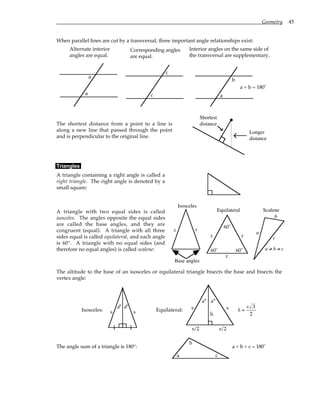
There are four major types of angle measures:
An acute angle has measure less than 90˚:
A right angle has measure 90˚:
90˚
An obtuse angle has measure greater than 90˚:
A straight angle has measure 180˚: y˚ x˚
x + y = 180˚
Example: In the figure to the right, if the quotient of
a and b is
7
2
, then b =
(A) 30 (B) 35 (C) 40 (D) 46 (E) 50
a˚ b˚
Since a and b form a straight angle, a + b = 180. Now, translating “the quotient of a and b is
7
2
”
into an equation gives
a
b
=
7
2
. Solving for a yields a =
7
2
b. Plugging this into the equation a + b =
180 yields
7
2
b + b = 180
7b + 2b = 360
9b = 360
b = 40
The answer is (C).
Two angles are supplementary if their angle sum is 180˚: 45˚ 135˚
45 + 135 = 180
Two angles are complementary if their angle sum is 90˚: 30˚
30 + 60 = 90
60˚
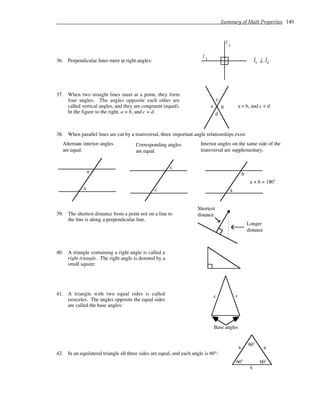
Perpendicular lines meet at right angles:
l
l
1
2
l l
1 2
⊥
Two lines in the same plane are parallel if they never intersect. Parallel lines have the same slope.
Geometry 45
When parallel lines are cut by a transversal, three important angle relationships exist:
Alternate interior
angles are equal.
a
a
Corresponding angles
are equal.
c
c
Interior angles on the same side of
the transversal are supplementary.
a
a + b = 180˚
b
The shortest distance from a point to a line is
along a new line that passed through the point
and is perpendicular to the original line.
Shortest
distance
Longer
distance
Triangles
A triangle containing a right angle is called a
right triangle. The right angle is denoted by a
small square:
A triangle with two equal sides is called
isosceles. The angles opposite the equal sides
are called the base angles, and they are
congruent (equal). A triangle with all three
sides equal is called equilateral, and each angle
is 60°. A triangle with no equal sides (and
therefore no equal angles) is called scalene:
Base angles
x x
Isosceles
Equilateral
x
x
x
60˚
60˚
60˚
Scalene
a
b
c
a ≠ b ≠ c
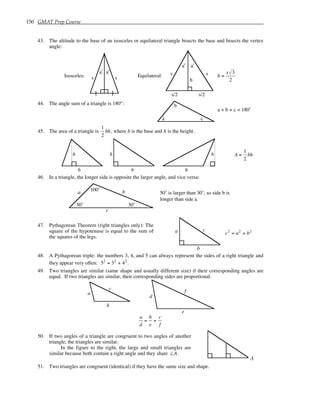
The altitude to the base of an isosceles or equilateral triangle bisects the base and bisects the
vertex angle:
Isosceles: s s
° °
a a
Equilateral:
s/2 s/2
s s
h
°
° a
a
h =
s 3
2
The angle sum of a triangle is 180°:
a
b
c
a + b + c = 180˚
46 GMAT Prep Course
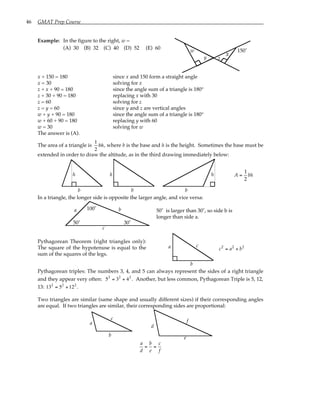
Example: In the figure to the right, w =
(A) 30 (B) 32 (C) 40 (D) 52 (E) 60
150˚
x
y
w
z
x + 150 = 180 since x and 150 form a straight angle
x = 30 solving for x
z + x + 90 = 180 since the angle sum of a triangle is 180°
z + 30 + 90 = 180 replacing x with 30
z = 60 solving for z
z = y = 60 since y and z are vertical angles
w + y + 90 = 180 since the angle sum of a triangle is 180°
w + 60 + 90 = 180 replacing y with 60
w = 30 solving for w
The answer is (A).
The area of a triangle is
1
2
bh, where b is the base and h is the height. Sometimes the base must be
extended in order to draw the altitude, as in the third drawing immediately below:
h
b
h h
b b
A =
1
2
bh
In a triangle, the longer side is opposite the larger angle, and vice versa:
100˚
50˚ 30˚
a
c
b 50˚ is larger than 30˚, so side b is
longer than side a.
Pythagorean Theorem (right triangles only):
The square of the hypotenuse is equal to the
sum of the squares of the legs.
a
b
c
c2
= a2
+ b2
Pythagorean triples: The numbers 3, 4, and 5 can always represent the sides of a right triangle
and they appear very often: 52
= 32
+ 42
. Another, but less common, Pythagorean Triple is 5, 12,
13: 132
= 52
+122
.
Two triangles are similar (same shape and usually different sizes) if their corresponding angles
are equal. If two triangles are similar, their corresponding sides are proportional:
a
b
c
d
e
f
a
d
=
b
e
=
c
f
Geometry 47
If two angles of a triangle are congruent to two angles of
another triangle, the triangles are similar.
In the figure to the right, the large and small triangles are
similar because both contain a right angle and they share ∠A.
A
Two triangles are congruent (identical) if they have the same size and shape.
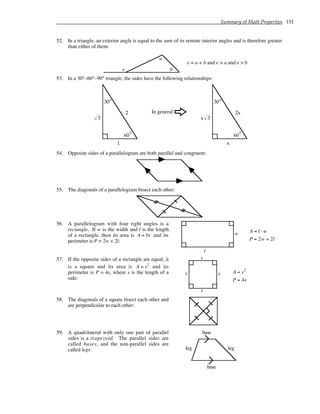
In a triangle, an exterior angle is equal to the sum of its remote interior angles and is therefore
greater than either of them:
e
a
b
e = a + b and e > a and e > b
In a triangle, the sum of the lengths of any two sides is greater than the length of the remaining
side:
x y
z
x + y > z
y + z > x
x + z > y
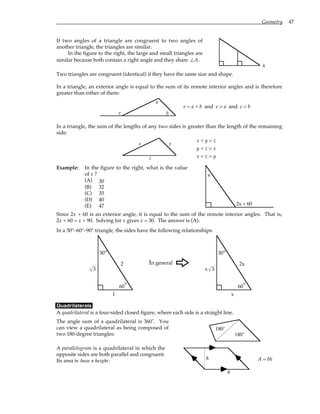
Example: In the figure to the right, what is the value
of x ?
(A) 30
(B) 32
(C) 35
(D) 40
(E) 47
x
2x + 60
Since 2x + 60 is an exterior angle, it is equal to the sum of the remote interior angles. That is,
2x + 60 = x + 90. Solving for x gives x = 30. The answer is (A).
In a 30°–60°–90° triangle, the sides have the following relationships:
60°
2
30°
1
3
In general
F
60°
2x
30°
x
3
x
Quadrilaterals
A quadrilateral is a four-sided closed figure, where each side is a straight line.
The angle sum of a quadrilateral is 360˚. You
can view a quadrilateral as being composed of
two 180-degree triangles:
180˚
180˚
A parallelogram is a quadrilateral in which the
opposite sides are both parallel and congruent.
Its area is base × height:
h
b
A = bh
48 GMAT Prep Course
The diagonals of a parallelogram bisect each
other:
A parallelogram with four right angles is a
rectangle. If w is the width and l is the length of
a rectangle, then its area is A = l ⋅ w and its
perimeter is P = 2w + 2l.
l
w
A = l ⋅ w
P = 2w + 2l
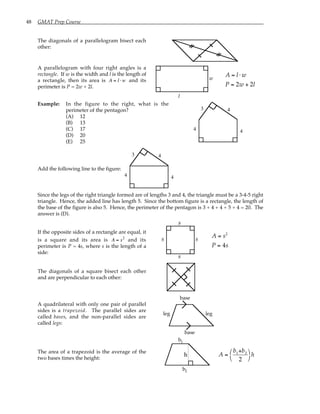
Example: In the figure to the right, what is the
perimeter of the pentagon?
(A) 12
(B) 13
(C) 17
(D) 20
(E) 25
3 4
4 4
Add the following line to the figure:
3 4
4 4
Since the legs of the right triangle formed are of lengths 3 and 4, the triangle must be a 3-4-5 right
triangle. Hence, the added line has length 5. Since the bottom figure is a rectangle, the length of
the base of the figure is also 5. Hence, the perimeter of the pentagon is 3 + 4 + 4 + 5 + 4 = 20. The
answer is (D).
If the opposite sides of a rectangle are equal, it
is a square and its area is A = s2
and its
perimeter is P = 4s, where s is the length of a
side:
s
s
s
s
A = s2
P = 4s
The diagonals of a square bisect each other
and are perpendicular to each other:
A quadrilateral with only one pair of parallel
sides is a trapezoid. The parallel sides are
called bases, and the non-parallel sides are
called legs:
base
base
leg leg
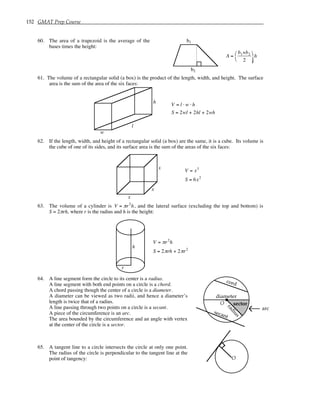
The area of a trapezoid is the average of the
two bases times the height:
b
b
1
2
h A =
b1+b2
2




h
Geometry 49
Volume
The volume of a rectangular solid (a box) is the product of the length, width, and height. The
surface area is the sum of the area of the six faces:
w
l
h
V l w h
S wl hl wh
= ⋅ ⋅
= + +
2 2 2
If the length, width, and height of a rectangular solid (a box) are the same, it is a cube. Its volume
is the cube of one of its sides, and its surface area is the sum of the areas of the six faces:
x
x
x
V x
S x
=
=
3
2
6
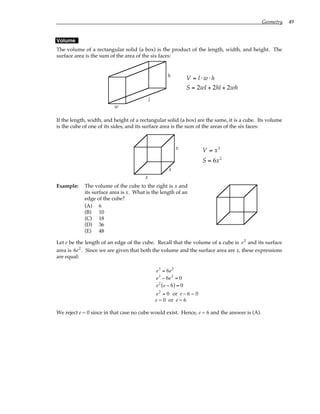
Example: The volume of the cube to the right is x and
its surface area is x. What is the length of an
edge of the cube?
(A) 6
(B) 10
(C) 18
(D) 36
(E) 48
Let e be the length of an edge of the cube. Recall that the volume of a cube is e3
and its surface
area is 6e2
. Since we are given that both the volume and the surface area are x, these expressions
are equal:
e3
= 6e2
e3
− 6e2
= 0
e2
e − 6
( ) = 0
e2
= 0 or e – 6 = 0
e = 0 or e = 6
We reject e = 0 since in that case no cube would exist. Hence, e = 6 and the answer is (A).
50 GMAT Prep Course
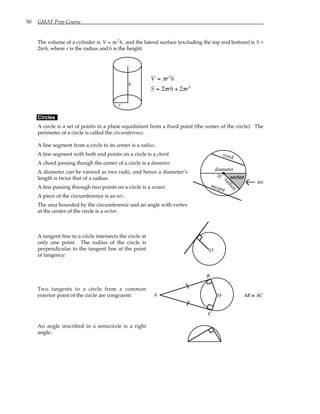
The volume of a cylinder is V = πr2
h, and the lateral surface (excluding the top and bottom) is S =
2πrh, where r is the radius and h is the height:
r
h
V r h
S rh r
=
= +
π
π π
2
2
2 2
Circles
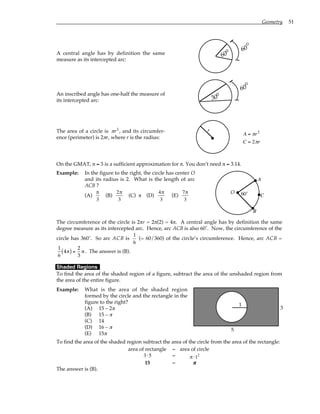
A circle is a set of points in a plane equidistant from a fixed point (the center of the circle). The
perimeter of a circle is called the circumference.
A line segment from a circle to its center is a radius.
A line segment with both end points on a circle is a chord.
A chord passing though the center of a circle is a diameter.
A diameter can be viewed as two radii, and hence a diameter’s
length is twice that of a radius.
A line passing through two points on a circle is a secant.
A piece of the circumference is an arc.
The area bounded by the circumference and an angle with vertex
at the center of the circle is a sector.
O
diameter
cord
secant
sector
r
a
d
i
u
s
arc
A tangent line to a circle intersects the circle at
only one point. The radius of the circle is
perpendicular to the tangent line at the point
of tangency:
O
Two tangents to a circle from a common
exterior point of the circle are congruent: O
A
B
C
AB ≅ AC
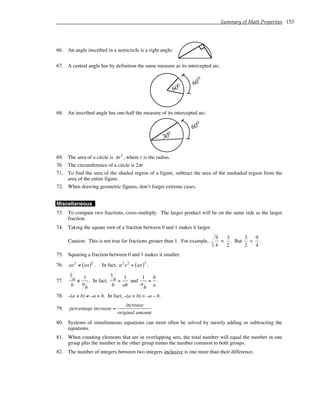
An angle inscribed in a semicircle is a right
angle:
Geometry 51
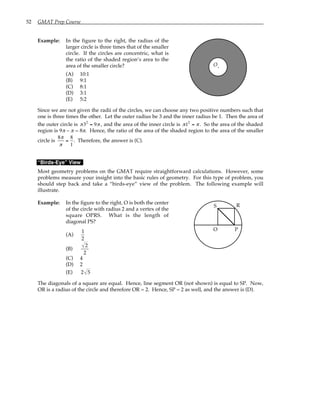
A central angle has by definition the same
measure as its intercepted arc:
60
60
°
°
An inscribed angle has one-half the measure of
its intercepted arc:
60
30
°
°
The area of a circle is πr2
, and its circumfer-
ence (perimeter) is 2πr, where r is the radius:
r
A = πr2
C = 2πr
On the GMAT, π ≈ 3 is a sufficient approximation for π. You don’t need π ≈ 3.14.
Example: In the figure to the right, the circle has center O
and its radius is 2. What is the length of arc
ACB ?
(A)
π
3
(B)
2π
3
(C) π (D)
4π
3
(E)
7π
3
O 60˚
A
B
C
The circumference of the circle is 2πr = 2π(2) = 4π. A central angle has by definition the same
degree measure as its intercepted arc. Hence, arc ACB is also 60˚. Now, the circumference of the
circle has 360˚. So arc ACB is
1
6
(= 60/360) of the circle’s circumference. Hence, arc ACB =
1
6
4π
( ) =
2
3
π . The answer is (B).
Shaded Regions
To find the area of the shaded region of a figure, subtract the area of the unshaded region from
the area of the entire figure.
Example: What is the area of the shaded region
formed by the circle and the rectangle in the
figure to the right?
(A) 15 – 2π
(B) 15 – π
(C) 14
(D) 16 – π
(E) 15π
1 3
5
1
To find the area of the shaded region subtract the area of the circle from the area of the rectangle:
area of rectangle – area of circle
3⋅5 – π ⋅12
15 – π
π
π
π
The answer is (B).
52 GMAT Prep Course
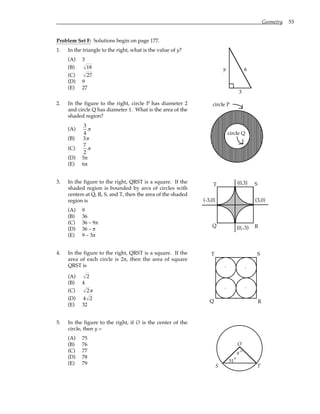
Example: In the figure to the right, the radius of the
larger circle is three times that of the smaller
circle. If the circles are concentric, what is
the ratio of the shaded region’s area to the
area of the smaller circle?
(A) 10:1
(B) 9:1
(C) 8:1
(D) 3:1
(E) 5:2
O.
Since we are not given the radii of the circles, we can choose any two positive numbers such that
one is three times the other. Let the outer radius be 3 and the inner radius be 1. Then the area of
the outer circle is π32
= 9π , and the area of the inner circle is π12
= π . So the area of the shaded
region is 9π – π = 8π. Hence, the ratio of the area of the shaded region to the area of the smaller
circle is
8π
π
=
8
1
. Therefore, the answer is (C).
“Birds-Eye” View
Most geometry problems on the GMAT require straightforward calculations. However, some
problems measure your insight into the basic rules of geometry. For this type of problem, you
should step back and take a “birds-eye” view of the problem. The following example will
illustrate.
Example: In the figure to the right, O is both the center
of the circle with radius 2 and a vertex of the
square OPRS. What is the length of
diagonal PS?
(A)
1
2
(B)
2
2
(C) 4
(D) 2
(E) 2 5
O P
R
S
The diagonals of a square are equal. Hence, line segment OR (not shown) is equal to SP. Now,
OR is a radius of the circle and therefore OR = 2. Hence, SP = 2 as well, and the answer is (D).
Geometry 53
Problem Set F: Solutions begin on page 177.
1. In the triangle to the right, what is the value of y?
(A) 3
(B) 18
(C) 27
(D) 9
(E) 27
3
y 6
2. In the figure to the right, circle P has diameter 2
and circle Q has diameter 1. What is the area of the
shaded region?
(A)
3
4
π
(B) 3π
(C)
7
2
π
(D) 5π
(E) 6π
circle P
circle Q
3. In the figure to the right, QRST is a square. If the
shaded region is bounded by arcs of circles with
centers at Q, R, S, and T, then the area of the shaded
region is
(A) 9
(B) 36
(C) 36 – 9π
(D) 36 – π
(E) 9 – 3π
Q
T S
R
(0,3)
(3,0)
(0,-3)
(-3,0)
4. In the figure to the right, QRST is a square. If the
area of each circle is 2π, then the area of square
QRST is
(A) 2
(B) 4
(C) 2π
(D) 4 2
(E) 32
.
.
.
.
Q R
S
T
5. In the figure to the right, if O is the center of the
circle, then y =
(A) 75
(B) 76
(C) 77
(D) 78
(E) 79
O
y
51
S T
°
°
54 GMAT Prep Course
6. In the figure to the right, the value of a + b is
(A) 118
(B) 119
(C) 120
(D) 121
(E) 122
29
b
a
7. If l1 l2 in the figure to the right, what is the value of
x?
(A) 30
(B) 45
(C) 60
(D) 72
(E) 90
l l
1 2
5x
x
s
8. For the figure to the right, which of the following
are true?
I. OP = OQ
II. PQ < OP
III. PQ > OQ
(A) I only
(B) II only
(C) III only
(D) I and II only
(E) I and III only
59
O
P Q
°
O is the center of the circle.
s 4s
2s
x
x x
9. From the two figures above, which of the following can be determined?
I. x = 60˚
II. 7s = 180˚
III. 2s < x
(A) I only (B) II only (C) III only (D) I and II only (E) I, II, and III
10. In the figure to the right, x is both the radius of the
larger circle and the diameter of the smaller circle.
The area of the shaded region is
(A)
3
4
πx2
(B)
π
3
(C)
4
3
πx2
(D)
3
5
πx2
(E) πx2
x
Geometry 55
11. In the figure to the right, the circle with center O is
inscribed in the square PQRS. The combined area
of the shaded regions is
(A) 36 – 9π
(B) 36 −
9
2
π
(C)
36 − 9π
2
(D) 18 – 9π
(E) 9 −
9
4
π
P Q
R
S
O
6
12. In the figure to the right, the length of QS is
(A) 51
(B) 61
(C) 69
(D) 77
(E) 89
10
5
3
P
Q
R
S
13. For the figure to the right, which of the following
best describes the value of y?
(A) y < 50
(B) y < 55
(C) y > 35
(D) y > 55
(E) y < 35
O
20
x
y
P
Q
POQ = 70 and x > 15
°
°
14. In the figure to the right, if l k, then what is the
value of y ?
(A) 20
(B) 45
(C) 55
(D) 75
(E) 110
y 2y-75
l k
15. In the figure to the right, both triangles are right
triangles. The area of the shaded region is
(A) 1/2
(B) 2/3
(C) 7/8
(D) 3/2
(E) 5/2
2
2
3/2
56 GMAT Prep Course
16. In the figure to the right, the radius of the larger
circle is twice that of the smaller circle. If the circles
are concentric, what is the ratio of the shaded
region’s area to the area of the smaller circle?
(A) 10:1
(B) 9:1
(C) 3:1
(D) 2:1
(E) 1:1
O.
17. In the figure to the right, ∆PST is an isosceles right
triangle, and PS = 2. What is the area of the shaded
region URST?
(A) 4
(B) 2
(C)
5
4
(D)
5
6
(E)
1
2
P Q
R
S
T
U
1
18. In the figure to the right, the area of ∆PQR is 40.
What is the area of ∆QRS?
(A) 10
(B) 15
(C) 20
(D) 25
(E) 45 5
P
Q
R
S
6
19. In the figure to the right, PQRS is a square and M
and N are midpoints of their respective sides. What
is the area of quadrilateral PMRN?
(A) 8
(B) 10
(C) 12
(D) 14
(E) 16
P Q
R
S
M
N 4
20. In the figure to the right, what is the greatest number
of regions into which two straight lines will divide
the shaded region?
(A) 1
(B) 2
(C) 3
(D) 4
(E) 5
Geometry 57
21. In the figure to the right, O is the center of the circle.
If the area of the circle is 9π, then the perimeter of the
sector PRQO is
(A)
π
2
+ 18
(B)
π
2
+ 6
(C)
3
4
π + 6
(D)
3
4
π + 18
(E)
π
2
− 6
O
P Q
°
30
R
22. Let A denote the area of a circular region. Which of the following denotes the circumference
of that circular region?
(A)
A
π
(B) 2
A
π
(C) 2π A (D) 2
A
π
(E) 2π
A
π
23. Ship X and ship Y are 5 miles apart and are on a collision course. Ship X is sailing directly
north, and ship Y is sailing directly east. If the point of impact is 1 mile closer to the current
position of ship X than to the current position of ship Y, how many miles away from the
point of impact is ship Y at this time?
(A) 1 (B) 2 (C) 3 (D) 4 (E) 5
24. The figure to the right represents a square with sides
of length 4 surmounted by a circle with center O.
What is the outer perimeter of the figure?
(A)
49
9
π + 12
(B)
20
3
π + 12
(C)
5
6
π + 12
(D) π + 12
(E) 9π + 12
O
°
60
25. The perimeter of a square is equal to the perimeter of a rectangle whose length and width
are 6m and 4m, respectively. The side of the square is
(A) 3m (B) 4m (C) 5m (D) 6m (E) 7m
26. If the circumference of a circle is 4m, then the ratio of circumference of the circle to the
diameter of the circle is
(A) π (B) 4 (C) 2π (D) 4π (E) 16
27. In Triangle ABC, ∠A is 10 degrees greater than ∠B, and ∠B is 10 degrees greater than ∠C.
The value of angle B is
(A) 30 (B) 40 (C) 50 (D) 60 (E) 70
28. Two squares each with sides of length s are joined to form a rectangle. The area of the
rectangle is
(A) s2
(B) 2s2
(C) 4s2
(D) 8s2
(E) 16s2
58 GMAT Prep Course
29. A person travels 16 miles due north and then 12 miles due east. How far is the person from
his initial location?
(A) 4 miles (B) 8 miles (C) 14 miles (D) 20 miles (E) 28 miles
30. The area of Triangle PQR is 6. If PR = 4, then the
length of the hypotenuse QR is
(A) 1
(B) 2
(C) 3
(D) 4
(E) 5
P
Q
R
4
31. In the figure, the equation of line A B is
y = −
5
3
x +10. The area of the shaded portion is
(A) 12
(B) 30
(C) 100/3
(D) 60
(E) 100
A
B
O
x-axis
y-axis
32. In the figure, if x = 54˚ and y = 72˚, then z =
(A) 54˚
(B) 56˚
(C) 72˚
(D) 76˚
(E) 98˚
x
z
y
A
B
C
D
E
F
O
O is the point of intersection
of the three lines in the figure.
33. If one of the sides of the rectangle shown in the
figure has a length of 3, then the area of the
rectangle is
(A) 9
(B) 13.5
(C) 18
(D) 27
(E) 54
A B
C
D
x
x + 6
34. The value of x + y + z =
(A) 120°
(B) 160°
(C) 180°
(D) 270°
(E) 360°
x
y
z
A
B
C
Geometry 59
35. In the figure, what is the area of Triangle ABC ?
(A) 25
(B) 50
(C) 100 2
(D) 100
(E) 100 2
10 10
A
B C
D
90˚
45˚
36. In the figure, what is the value of x?
(A) 20˚
(B) 30˚
(C) 40˚
(D) 50˚
(E) 60˚
A B
C
D
x
50 40
40
37. The area of the Triangle ABC shown in the figure is
30. The area of Triangle ADC is
(A) 5
(B) 10
(C) 15
(D) 20
(E) 25
A
B
C
D
2
1
38. In the figure, what is the value of y ?
(A) 7.5
(B) 15
(C) 30
(D) 40
(E) 45
A
B C
D
y + 30
y – 15
y + 15
39. A circle is depicted in the rectangular
coordinate system as shown. The value of x
is
(A) 4
(B) 6
(C) 8
(D) 10
(E) 12
4
–4
y-axis
x-axis
(2, 0) (x, 0)
40. In the figure, the ratio of x to y is 2. What is the
value of y ?
(A) 108
(B) 90
(C) 68
(D) 45
(E) 36
y˚
x˚
y˚
60 GMAT Prep Course
EYE-BALLING
Surprisingly, on the GMAT you can often solve geometry problems by merely “eye-balling” the
given drawing. Even on problems whose answers you can’t get directly by looking, you often
can eliminate a couple of the answer-choices.
Unless stated otherwise, all figures on Standard Math questions are drawn exactly to scale.
Hence, if an angle looks like it’s about 90°, it is; if a line segment looks like it’s about 2 units long,
it is; if one figure looks like it’s about twice as large as another figure, it is. Caution: The figures
in Data Sufficiency questions are not necessarily drawn to scale. Hence, you cannot use the
methods of this section on Data Sufficiency problems. All the problems in this section were
solved before. Now, we will solve them by eye-balling the drawings.
Example 1: In the figure to the right, if l k, then what
is the value of y?
(A) 20
(B) 45
(C) 55
(D) 75
(E) 110
y 2y-75
l k
By eye-balling the drawing, we can see that y is less than 90˚. It appears to be somewhere
between 65˚ and 85˚. But 75° is the only answer-choice in that range. Hence, the answer is (D).
Example 2: In the figure to the right, the area of the
shaded region is
(A)
1
2
(B)
2
3
(C)
7
8
(D)
3
2
(E)
5
2
2
2
3/2
The area of the larger triangle is A =
1
2
bh =
1
2
⋅ 2⋅ 2 = 2 . Now, by eye-balling the drawing, the area
of the shaded region looks to be about half that of the larger triangle. Therefore, the answer
should be about
1
2
⋅ 2 = 1. The closest answer-choice to 1 is
7
8
. The answer is (C).
Note: On the GMAT, answer-choices are listed in order of size: usually from smallest to largest
(unless the question asks for the smallest or largest). Hence, in the previous example,
2
3
is
smaller than
7
8
because it comes before
7
8
.
Geometry 61
Problem Set G: Solutions begin on page 193.
1. In the figure to the right, the radius of the larger
circle is twice that of the smaller circle. If the circles
are concentric, what is the ratio of the shaded
region’s area to the area of the smaller circle?
(A) 10:1
(B) 9:1
(C) 3:1
(D) 2:1
(E) 1:1
O.
2. In the figure to the right, ∆PST is an isosceles right
triangle, and PS = 2. What is the area of the shaded
region URST?
(A) 4
(B) 2
(C)
5
4
(D)
5
6
(E)
1
2
P Q
R
S
T
U
1
3. In the figure to the right, the area of ∆PQR is 40.
What is the area of ∆QRS?
(A) 10
(B) 15
(C) 20
(D) 25
(E) 45 5
P
Q
R
S
6
4. In the figure to the right, PQRS is a square and M
and N are midpoints of their respective sides. What
is the area of quadrilateral PMRN?
(A) 8
(B) 10
(C) 12
(D) 14
(E) 16
P Q
R
S
M
N 4
62
Coordinate Geometry
On a number line, the numbers increase in size to the right and decrease to the left:
0 1 2 3 4 5
–1
–2
–3
–4
–5
larger
smaller
If we draw a line through the point 0 perpendicular to the number line, we will form a grid:
2 4
–2
–4 (0,0)
4
–2
–4
I
II
III IV
}
x
}
y
(x,y)
The thick horizontal line in the above diagram is called the x-axis, and the thick vertical line is
called the y-axis. The point at which the axes meet, (0, 0), is called the origin. On the x-axis,
positive numbers are to the right of the origin and increase in size to the right; further, negative
numbers are to the left of the origin and decrease in size to the left. On the y-axis, positive
numbers are above the origin and ascend in size; further, negative numbers are below the origin
and descend in size. As shown in the diagram, the point represented by the ordered pair (x, y) is
reached by moving x units along the x-axis from the origin and then moving y units vertically. In
the ordered pair (x, y), x is called the abscissa and y is called the ordinate; collectively they are
called coordinates. The x and y axes divide the plane into four quadrants, numbered I, II, III, and
IV counterclockwise. Note, if x ≠ y, then (x, y) and (y, x) represent different points on the coordi-
nate system. The points (2, 3), (–3, 1), (–4, –4), and (4, –2) are plotted in the following coordinate
system:
Coordinate Geometry 63
(0,0)
(2,3)
(–4,–4)
(–3,1)
(4,–2)
Example: In the figure to the right, polygon ABCO
is a square. If the coordinates of B are
(h, 4), what is the value of h ?
(A) 4
(B) 4 2
(C) −4 2
(D) –4
(E) not enough information
A
B C
O
y
x
Since the y-coordinate of point B is 4, line segment CO has length 4. Since figure ABCO is a
square, line segment AO also has length 4. Since point B is in the second quadrant, the x-
coordinate of B is –4. The answer is (D). Be careful not to choose 4. h is the x-coordinate of point
B, not the length of the square’s side.
Distance Formula:
The distance formula is derived by using the Pythagorean theorem. Notice in the figure below
that the distance between the points (x, y) and (a, b) is the hypotenuse of a right triangle. The
difference y–b is the measure of the height of the triangle, and the difference x–a is the length of
base of the triangle. Applying the Pythagorean theorem yields
d x a y b
2 2 2
= −
( ) + −
( )
Taking the square root of both sides this equation yields
d x a y b
= −
( ) + −
( )
2 2
(x,y)
(a,b)
x–a
y–b
(x,b)
d
64 GMAT Prep Course
Example: In the figure to the right, the circle is
centered at the origin and passes through
point P. Which of the following points
does it also pass through?
(A) (3, 3)
(B) ( , )
− −
2 2 1
(C) (2, 6)
(D) ( , )
− 3 3
(E) (–3, 4)
y
x
P (0,–3)
Since the circle is centered at the origin and passes through the point (0, –3), the radius of the
circle is 3. Now, if any other point is on the circle, the distance from that point to the center of the
circle (the radius) must also be 3. Look at choice (B). Using the distance formula to calculate the
distance between −2 2,−1
( ) and (0, 0) (the origin) yields
d = −2 2 − 0
( )
2
+ −1− 0
( )2
= −2 2
( )
2
+ −1
( )2
= 8 +1 = 9 = 3
Hence, −2 2,−1
( ) is on the circle, and the answer is (B).
Midpoint Formula:
The midpoint M between points (x, y) and (a, b) is given by
M
x a y b
=
+ +






2 2
,
In other words, to find the midpoint, simply average the corresponding coordinates of the two
points.
Example: In the figure to the right, polygon PQRO is
a square and T is the midpoint of side QR.
What are the coordinates of T ?
(A) (1, 1)
(B) (1, 2)
(C) (1.5, 1.5)
(D) (2, 1)
(E) (2, 3)
y
x
(2,2)
Q
T
P
R
O
Since point R is on the x-axis, its y-coordinate is 0. Further, since PQRO is a square and the
x-coordinate of Q is 2, the x-coordinate of R is also 2. Since T is the midpoint of side QR, the
midpoint formula yields
T =
2 + 2
2
,
2 + 0
2




=
4
2
,
2
2




= 2,1
( )
The answer is (D).
Coordinate Geometry 65
Slope Formula:
The slope of a line measures the inclination of the line. By definition, it is the ratio of the vertical
change to the horizontal change (see figure below). The vertical change is called the rise, and the
horizontal change is called the run. Thus, the slope is the rise over the run.
(x,y)
(a,b)
x–a
y–b
Forming the rise over the run in the above figure yields
m
y b
x a
=
−
−
Example: In the figure to the right, what is the slope of
line passing through the two points?
(A)
1
4
(B) 1 (C)
1
2
(D)
3
2
(E) 2
(5,4)
(1,2)
The slope formula yields m =
4 − 2
5 −1
=
2
4
=
1
2
. The answer is (C).
Slope-Intercept Form:
Multiplying both sides of the equation m =
y − b
x − a
by x–a yields
y – b = m(x – a)
Now, if the line passes through the y-axis at (0, b), then the equation becomes
y – b = m(x – 0)
or y – b = mx
or y = mx + b
This is called the slope-intercept form of the equation of a line, where m is the slope and b is the
y-intercept. This form is convenient because it displays the two most important bits of informa-
tion about a line: its slope and its y-intercept.
66 GMAT Prep Course
A
B
O
Example: The equation of the line in the figure above is y x k
= +
9
10
. Which one of the following
is true?
(A) AO > BO (B) AO < BO (C) AO = BO (D) AO = 2 (E) BO =2
Since y =
9
10
x + k is in slope-intercept form, we know the slope of the line is 9/10. Now, the ratio
of BO to AO is the slope of the line (rise over run). Hence,
BO
AO
=
9
10
. Multiplying both sides of
this equation by AO yields BO =
9
10
AO. In other words, BO is 9/10 the length of AO. Hence, AO
is longer. The answer is (A).
Intercepts:
The x-intercept is the point where the line crosses the x-axis. It is found by setting y = 0 and
solving the resulting equation. The y-intercept is the point where the line crosses the y-axis. It is
found by setting x = 0 and solving the resulting equation.
y-intercept
x-intercept
y
x
Example: Graph the equation x – 2y = 4.
Solution: To find the x-intercept, set y = 0. This yields x − 2 ⋅0 = 4, or x = 4. So the x-intercept is
(4, 0). To find the y-intercept, set x = 0. This yields 0 – 2y = 4, or y = –2. So the y-intercept is (0, –2).
Plotting these two points and connecting them with a straight line yields
(4,0)
(0,-2)
Coordinate Geometry 67
Areas and Perimeters:
Often, you will be given a geometric figure drawn on a coordinate system and will be asked to
find its area or perimeter. In these problems, use the properties of the coordinate system to
deduce the dimensions of the figure and then calculate the area or perimeter. For complicated
figures, you may need to divide the figure into simpler forms, such as squares and triangles. A
couple examples will illustrate:
Example: What is the area of the quadrilateral in the
coordinate system to the right?
(A) 2
(B) 4
(C) 6
(D) 8
(E) 11
O
1
1
y
x
If the quadrilateral is divided horizontally through the
line y = 2, two congruent triangles are formed. As the
figure to the right shows, the top triangle has height 2
and base 4. Hence, its area is
A =
1
2
bh =
1
2
⋅ 4 ⋅2 = 4
The area of the bottom triangle is the same, so the area
of the quadrilateral is 4 + 4 = 8. The answer is (D).
O
1
1
y
x
2
4
}
}
Example: What is the perimeter of Triangle ABC in the
figure to the right?
(A) 5 + 5 + 34
(B) 10 + 34
(C) 5 + 5 + 28
(D) 2 5 + 34
(E) 5 + 28 O
1
1
y
x
A
B
C
Point A has coordinates (0, 4), point B has coordinates (3, 0), and point C has coordinates (5, 1).
Using the distance formula to calculate the distances between points A and B, A and C, and B and
C yields
AB = 0 − 3
( )2
+ 4 − 0
( )2
= 9 +16 = 25 = 5
AC = 0 − 5
( )2
+ 4 −1
( )2
= 25 + 9 = 34
BC = 5 − 3
( )2
+ 1− 0
( )2
= 4 +1 = 5
Adding these lengths gives the perimeter of Triangle ABC:
AB + AC + BC = 5 + 34 + 5
The answer is (A).
68 GMAT Prep Course
Problem Set H: Solutions begin on page 195.
1. In the figure to the right, O is the center of the
circle. What is the area of the circle?
(A) 2π
(B) 3π
(C) 5.5π
(D) 7π
(E) 9π
y
x
P (–3,0)
O
2. In the figure to the right, P is a point in the coordi-
nate system and OP = 6. The y-coordinate of point
P is
(A) less than OP
(B) greater than OP
(C) equal to OP
(D) equal to 5
(E) there is not enough information to decide
y
x
O
P
3. In the figure to the right, if the equation of the line
is y = px + a, then p =
(A)
b
a
(B)
−b
a
(C)
−a
b
(D)
a
b
(E) there is not enough information to decide
y
x
O
(0,a)
(b,0)
4. For the figure to the right, which of the following
must be true?
(A) x > y
(B) y > x
(C) x = y
(D) x = 2
(E) there is not enough information to decide
y
x
O
(x,y)
(–4,–5)
5. In the figure to the right, a is the x-coordinate of point P
and b is the y-coordinate of point Q. In which quadrant
is the point (a, b) ?
(A) I
(B) II
(C) III
(D) IV
(E) cannot be determined from the information given
y
x
O
I
II
III IV
P
Q
Coordinate Geometry 69
6. In the figure to the right, if x = 4, then y =
(A) 1
(B) 2
(C) 3
(D) 4
(E) 5.1
y
x
O
(x,y)
(2,1)
7. In the figure to the right, which of the following
could be the coordinates of a point in the shaded
region?
(A) (1, 2)
(B) (–2, 3)
(C) (3, –5)
(D) (–5, 1)
(E) (–1, –6)
y
x
O
8. In the figure to the right, which of the following
points lies within the circle?
(A) (3.5, 9.5)
(B) (–7, 7)
(C) (–10, 1)
(D) (0, 11)
(E) (5.5, 8.5)
y
x
(6,8)
O
9. For the figure to the right, which of the following
statements about –3a and 3b must be true?
(A) –3a = 3b
(B) –3a > 3b
(C) –3a < 3b
(D) –3a ≠ 3b
(E) there is not enough information to decide
y
x
O
(3,a)
(–3,b)
Note: Figure not drawn to scale
10. In the figure to the right, the grid consists of unit
squares. What is the area of the polygon?
(A) 7
(B) 9
(C) 10
(D) 12
(E) 15
70 GMAT Prep Course
11. In the figure to the right, which of the following
points is three times as far from P as from Q?
(A) (0, 3)
(B) (1, 1)
(C) (4, 5)
(D) (2, 3)
(E) (4, 1)
O
1
1
y
x
2 3 4 5
2
3
4
5
P
Q
12. In the figure to the right, what is the area of
quadrilateral ABCO ?
(A) 3
(B) 5
(C) 6.5
(D) 8
(E) 13 O
y
x
(3, 0)
B
45
(2, 2)
A
C
13. In the figure to the right, which quadrants contain
points (x,y) such that xy = –2 ?
(A) I only
(B) II only
(C) III and IV only
(D) II and IV only
(E) II, III, and IV
O
y
x
I
II
III IV
14. If the square in the figure to the right is rotated
clockwise about the origin until vertex V is on the
negative y-axis, then the new y-coordinate of V is
(A) –2
(B) −2 2
(C) –4
(D) −3 2
(E) –8
O
y
x
V (2, –2)
15. In the standard coordinate system, which of the following points is the greatest distance
from the origin:
(A) (–4, –1)
(B) (–3, 3)
(C) (4, 0)
(D) (2, 3)
(E) (0, 4)
16. What is the perimeter of Triangle ABC in the figure
to the right?
(A) 5 + 2 + 29
(B) 5 + 2 2 + 29
(C) 5 + 4 2 + 29
(D) 3 2 + 34
(E) 4 2 + 34 O
1
1
y
x
A
B
C
71
Elimination Strategies
1. On hard problems, if you are asked to find the least (or greatest) number, then eliminate
the least (or greatest) answer-choice.
This rule also applies to easy and medium problems. When people guess on these types of
problems, they most often choose either the least or the greatest number. But if the least or the
greatest number were the answer, most people would answer the problem correctly, and it
therefore would not be a hard problem.
Example: What is the maximum number of points common to the intersection of a square
and a triangle if no two sides coincide?
(A) 4 (B) 5 (C) 6 (D) 8 (E) 9
By the above rule, we eliminate answer-choice (E).
2. On hard problems, eliminate the answer-choice “not enough information.”
When people cannot solve a problem, they most often choose the answer-choice “not enough
information.” But if this were the answer, then it would not be a “hard” problem.
3. On hard problems, eliminate answer-choices that merely repeat numbers from the
problem.
Example: If the sum of x and 20 is 8 more than the difference of 10 and y, what is the value of
x + y?
(A) –2
(B) 8
(C) 9
(D) 28
(E) not enough information
By the above rule, we eliminate choice (B) since it merely repeats the number 8 from the problem.
By Strategy 2, we would also eliminate choice (E). Caution: If choice (B) contained more than the
number 8, say, 8 + 2 , then it would not be eliminated by the above rule.
72 GMAT Prep Course
4. On hard problems, eliminate answer-choices that can be derived from elementary
operations.
Example: In the figure to the right, what is the
perimeter of parallelogram ABCD?
(A) 12
(B) 10 + 6 2
(C) 20 + 2
(D) 24
(E) not enough information
45
A
B
C
D
(8,3)
°
Using the above rule, we eliminate choice (D) since 24 = 8⋅ 3. Further, using Strategy 2, eliminate
choice (E). Note, 12 was offered as an answer-choice because some people will interpret the
drawing as a rectangle tilted halfway on its side and therefore expect it to have one-half its
original area.
5. After you have eliminated as many answer-choices as you can, choose from the more
complicated or more unusual answer-choices remaining.
Example: Suppose you were offered the following answer-choices:
(A) 4 + 3 (B) 4 + 2 3 (C) 8 (D) 10 (E) 12
Then you would choose either (A) or (B).
We have been discussing hard problems but have not mentioned how to identify a hard problem.
Most of the time, we have an intuitive feel for whether a problem is hard or easy. But on tricky
problems (problems that appear easy but are actually hard) our intuition can fail us.
On the test, your first question will be of medium difficulty. If you answer it correctly, the
next question will be a little harder. If you again answer it correctly, the next question will be
harder still, and so on. If your math skills are strong and you are not making any mistakes, you
should reach the medium-hard or hard problems by about the fifth problem. Although this is not
very precise, it can be quite helpful. Once you have passed the fifth question, you should be alert
to subtleties in any seemingly simple problems.
Problem Set I: Solutions begin on page 201.
1. What is the maximum number of 3x3 squares
that can be formed from the squares in the
6x6 checker board to the right?
(A) 4
(B) 6
(C) 12
(D) 16
(E) 24
2. Let P stand for the product of the first 5 positive integers. What is the greatest possible value
of m if
P
10m
is an integer?
(A) 1 (B) 2 (C) 3 (D) 5 (E) 10
Elimination Strategies 73
3. After being marked down 20 percent, a calculator sells for $10. The original selling price
was
(A) $20 (B) $12.5 (C) $12 (D) $9 (E) $7
4. The distance between cities A and B is 120 miles. A car travels from A to B at 60 miles per
hour and returns from B to A along the same route at 40 miles per hour. What is the average
speed for the round trip?
(A) 48 (B) 50 (C) 52 (D) 56 (E) 58
5. If w is 10 percent less than x, and y is 30 percent less than z, then wy is what percent less
than xz?
(A) 10% (B) 20% (C) 37% (D) 40% (E) 100%
6. In the game of chess, the Knight can make
any of the moves displayed in the diagram to
the right. If a Knight is the only piece on the
board, what is the greatest number of spaces
from which not all 8 moves are possible?
(A) 8
(B) 24
(C) 38
(D) 48
(E) 56
7. How many different ways can 3 cubes be painted if each cube is painted one color and only
the 3 colors red, blue, and green are available? (Order is not considered, for example, green,
green, blue is considered the same as green, blue, green.)
(A) 2 (B) 3 (C) 9 (D) 10 (E) 27
8. What is the greatest prime factor of 24
( )
2
− 1?
(A) 3 (B) 5 (C) 11 (D) 17 (E) 19
9. Suppose five circles, each 4 inches in diameter, are cut from a rectangular strip of paper
12 inches long. If the least amount of paper is to be wasted, what is the width of the paper
strip?
(A) 5 (B) 4 + 2 3 (C) 8 (D) 4 1+ 3
( ) (E) not enough information
10. Let C and K be constants. If x2
+ Kx + 5 factors into x + 1
( ) x + C
( ), the value of K is
(A) 0 (B) 5 (C) 6 (D) 8 (E) not enough information
74
Inequalities
Inequalities are manipulated algebraically the same way as equations with one exception:
Multiplying or dividing both sides of an inequality by a negative number reverses the
inequality. That is, if x > y and c < 0, then cx < cy.
Example: For which values of x is 4x + 3 > 6x – 8?
As with equations, our goal is to isolate x on one side:
Subtracting 6x from both sides yields –2x + 3 > – 8
Subtracting 3 from both sides yields –2x > – 11
Dividing both sides by –2 and reversing the inequality yields x <
11
2
Positive & Negative Numbers
A number greater than 0 is positive. On the number line, positive numbers are to the right of 0.
A number less than 0 is negative. On the number line, negative numbers are to the left of 0. Zero
is the only number that is neither positive nor negative; it divides the two sets of numbers. On
the number line, numbers increase to the right and decrease to the left.
The expression x > y means that x is greater than y. In other words, x is to the right of y on
the number line:
y x
0 1 2 3 4 5
–1
–2
–3
–4
–5
larger
smaller
We usually have no trouble determining which of two numbers is larger when both are positive
or one is positive and the other negative (e.g., 5 > 2 and 3.1 > –2). However, we sometimes
hesitate when both numbers are negative (e.g., –2 > –4.5). When in doubt, think of the number
line: if one number is to the right of the number, then it is larger. As the number line below
illustrates, –2 is to the right of –4.5. Hence, –2 is larger than –4.5.
0
–2
–4.5
larger
smaller
Inequalities 75
Miscellaneous Properties of Positive and Negative Numbers
1. The product (quotient) of positive numbers is positive.
2. The product (quotient) of a positive number and a negative number is negative.
3. The product (quotient) of an even number of negative numbers is positive.
4. The product (quotient) of an odd number of negative numbers is negative.
5. The sum of negative numbers is negative.
6. A number raised to an even exponent is greater than or equal to zero.
Example: If xy z
2
0
< , then which one of the following statements must also be true?
I. xz < 0
II. z < 0
III. xyz < 0
(A) None (B) I only (C) III only (D) I and II (E) II and III
Since a number raised to an even exponent is greater than or equal to zero, we know that y2
is
positive (it cannot be zero because the product xy z
2
would then be zero). Hence, we can divide
both sides of the inequality xy z
2
0
< by y2
:
xy z
y y
2
2
0
2
<
Simplifying yields xz < 0
Therefore, I is true, which eliminates (A), (C), and (E). Now, the following illustrates that z < 0 is
not necessarily true:
− ⋅ ⋅ = − <
1 2 3 12 0
2
This eliminates (D). Hence, the answer is (B).
Absolute Value
The absolute value of a number is its distance on the number line from 0. Since distance is a
positive number, absolute value of a number is positive. Two vertical bars denote the absolute
value of a number: x . For example, 3 = 3 and − 3 = 3. This can be illustrated on the number
line:
0 1 2 3 4 5
–1
–2
–3
–4
–5
}
}
− =
3 3 3 3
=
Students rarely struggle with the absolute value of numbers: if the number is negative, simply
make it positive; and if it is already positive, leave it as is. For example, since –2.4 is negative,
− 24 = 2.4 and since 5.01 is positive 5.01 = 5.01.
Further, students rarely struggle with the absolute value of positive variables: if the variable
is positive, simply drop the absolute value symbol. For example, if x > 0, then x = x.
However, negative variables can cause students much consternation. If x is negative, then
x = −x . This often confuses students because the absolute value is positive but the –x appears
to be negative. It is actually positive—it is the negative of a negative number, which is positive.
To see this more clearly let x = –k, where k is a positive number. Then x is a negative number. So
76 GMAT Prep Course
x = −x = −(−k) = k . Since k is positive so is –x . Another way to view this is
x = −x = (−1)⋅ x = (–1)(a negative number) = a positive number.
Example: If x = ± x , then which one of the following statements could be true?
I. x = 0
II. x < 0
III. x > 0
(A) None (B) I only (C) III only (D) I and II (E) II and III
Statement I could be true because ± 0 = − +0
( ) = − 0
( ) = 0. Statement II could be true because the
right side of the equation is always negative [ ± x = –(a positive number) = a negative number].
Now, if one side of an equation is always negative, then the other side must always be negative,
otherwise the opposite sides of the equation would not be equal. Since Statement III is the
opposite of Statement II, it must be false. But let’s show this explicitly: Suppose x were positive.
Then x = x, and the equation x = ± x becomes x = –x. Dividing both sides of this equation by x
yields 1 = –1. This is contradiction. Hence, x cannot be positive. The answer is (D).
Higher Order Inequalities
These inequalities have variables whose exponents are greater than 1. For example, x2
+ 4 < 2
and x3
− 9 > 0. The number line is often helpful in solving these types of inequalities.
Example: For which values of x is x x
2
6 5
> − − ?
First, replace the inequality symbol with an equal symbol: x x
2
6 5
= − −
Adding 6x and 5 to both sides yields x x
2
6 5 0
+ + =
Factoring yields (see General Trinomials in the chapter Factoring) (x + 5)(x + 1) = 0
Setting each factor to 0 yields x + 5 = 0 and x + 1 = 0
Or x = –5 and x = –1
Now, the only numbers at which the expression can change sign are –5 and –1. So –5 and –1
divide the number line into three intervals. Let’s set up a number line and choose test points in
each interval:
0
–1
–3
–5
–6
Interval I Interval III
Interval II
When x = –6, x x
2
6 5
> − − becomes 36 > 31. This is true. Hence, all numbers in Interval I satisfy
the inequality. That is, x < –5. When x = –3, x x
2
6 5
> − − becomes 9 > 13. This is false. Hence, no
numbers in Interval II satisfy the inequality. When x = 0, x x
2
6 5
> − − becomes 0 > –5. This is
true. Hence, all numbers in Interval III satisfy the inequality. That is, x > –1. The graph of the
solution follows:
–1
–5
Note, if the original inequality had included the greater-than-or-equal symbol, ≥, the solution set
would have included both –5 and –1. On the graph, this would have been indicated by filling in
the circles above –5 and –1. The open circles indicate that –5 and –1 are not part of the solution.
Inequalities 77
Summary of steps for solving higher order inequalities:
1. Replace the inequality symbol with an equal symbol.
2. Move all terms to one side of the equation (usually the left side).
3. Factor the equation.
4. Set the factors equal to 0 to find zeros.
5. Choose test points on either side of the zeros.
6. If a test point satisfies the original inequality, then all numbers in that interval satisfy the
inequality. Similarly, if a test point does not satisfy the inequality, then no numbers in that
interval satisfy the inequality.
Transitive Property
If x < y and y < z, then x < z.
Example: If
1
1
Q
> , which of the following must be true?
(A) 1 < Q2
(B)
1
Q2
> 2 (C) 1 > Q2
(D)
1
Q2
< 1 (E) Q < Q2
Since
1
1
Q
> and 1 > 0, we know from the transitive property that
1
Q
is positive. Hence, Q is
positive. Therefore, we can multiply both sides of
1
1
Q
> by Q without reversing the inequality:
Q
Q
Q
⋅ > ⋅
1
1
Reducing yields 1 > Q
Multiplying both sides again by Q yields Q Q
> 2
Using the transitive property to combine the last two inequalities yields 1 2
> Q
The answer is (C).
Like Inequalities Can Be Added
If x < y and w < z, then x + w < y + z
Example: If 2 < x < 5 and 3 < y < 5, which of the following best describes x – y?
(A) –3 < x – y < 2
(B) –3 < x – y < 5
(C) 0 < x – y < 2
(D) 3 < x – y < 5
(E) 2 < x – y < 5
Multiplying both sides of 3 < y < 5 by –1 yields –3 > –y > –5. Now, we usually write the smaller
number on the left side of the inequality. So –3 > –y > –5 becomes –5 < –y < –3. Add this
inequality to the like inequality 2 < x < 5:
2 5
5 3
3 2
< <
+
( ) − < − < −
− < − <
x
y
x y
The answer is (A).
78 GMAT Prep Course
Problem Set J: Solutions begin on page 207.
1. If 1 < x < y, which of the following must be true?
(A) −x2
< −y2
(B)
x
y
<
y
x
(C)
y
x
<
x
y
(D)
−x
y
<
−y
x
(E) x2
> y2
2. If –3 < x < –1 and 3 < y < 7, which of the following best describes
x y
−
2
?
(A) − <
−
< −
5
2
2
x y
(B) − <
−
< −
3
2
1
x y
(C) − <
−
<
2
2
0
x y
(D) 2
2
5
<
−
<
x y
(E) 3
2
7
<
−
<
x y
3. If x is an integer and y = –2x – 8, what is the least value of x for which y is less than 9?
(A) –9 (B) –8 (C) –7 (D) –6 (E) –5
4. Which one of the following could be the graph of 3 6
4 2
2
− ≤
+
−
x
x
?
(A)
0
(B)
0
(C)
0
(D)
0
(E)
0
5. If line segment AD has midpoint M1 and line segment M D
1 has midpoint M2 , what is the
value of
M D
AM
1
2
?
(A)
1
2
(B)
2
3
(C)
3
4
(D)
4
5
(E)
5
6
6. If x < y < –1, which of the following must be true?
(A)
x
y
> xy (B)
y
x
> x + y (C)
y
x
> xy (D)
y
x
< x + y (E)
y
x
>
x
y
7. Which of the following represents all solutions of the inequality x x
2
2
< ?
(A) –1 < x < 1 (B) 0 < x < 2 (C) 1 < x < 3 (D) 2 < x < 4 (E) 4 < x < 6
Inequalities 79
y
0
x
8. Given the positions of numbers x and y on the number line above, which of the following
must be true?
I. xy > 0
II.
x
y
< 0
III. x – y > 0
(A) I only (B) II only (C) III only (D) I and II only (E) I, II, and III
9. If
x y
xy
4
4
0
0
<
>
, which of the following must be true?
(A) x > y (B) y > x (C) x = y (D) x < 0 (E) y > 0
10. If n is an integer, what is the least value of n such that
1
3
0 01
n
< . ?
(A) 2 (B) 3 (C) 4 (D) 5 (E) 6
11. If the average of 10, 14, and n is greater than or equal to 8 and less than or equal to 12, what
is the least possible value of n ?
(A) –12 (B) –6 (C) 0 (D) 6 (E) 12
12. If
3 4
3
x y
x
+ <
>
, which of the following must be true?
(A) y < –5 (B) y < –10 (C) x = y (D) x < 3 (E) y > 0
2 – 3x ? 5
13. Of the following symbols, which one can be substituted for the question mark in the above
expression to make a true statement for all values of x such that –1 < x ≤ 2 ?
(A) = (B) < (C) ≥ (D) > (E) ≤
14. Let x, y, z be three different positive integers each less than 20. What is the smallest possible
value of expression
x − y
−z
?
(A) –18 (B) –17 (C) –14 (D) –11 (E) –9
15. If x > 0 and x =
1
x
, then x =
(A) –1 (B) 0 (C) 1 (D) 2 (E) 3
16. Four letters—a, b, c, and d—represent one number each from one through four. No two
letters represent the same number. It is known that c > a and a > d. If b = 2, then a =
(A) 1
(B) 2
(C) 3
(D) 4
(E) Not enough information to decide.
80 GMAT Prep Course
17. If r > t and r < 1 and rt = 1, then which one of the following must be true?
(A) r > 0 and t < –1
(B) r > –1 and t < –1
(C) r < –1 and t > –1
(D) r < 1 and t > 1
(E) r > 1 and t < 0
18. If x > y > 0 and p > q > 0, then which one of the following expressions must be greater than
1?
(A)
x + p
y + q
(B)
x + q
y + p
(C)
x
p
(D)
xq
yp
(E)
yq
xp
19. If 2x + y > m and 2y + x < n, then x – y must be greater than
(A) m + n
(B) m – n
(C) mn
(D) 2m + n
(E) n – m
20. If p > 2, then which one of the following inequalities must be false?
(A) 2p > 7
(B) 3p < 7
(C) p < 3
(D) p > 4
(E) 3p < 6
81
Fractions & Decimals
Fractions
A fraction consists of two parts: a numerator and a denominator.
numerator
denominator
If the numerator is smaller than the denominator, the fraction is called proper and is less than one.
For example:
1
2
,
4
5
, and
3
π
are all proper fractions and therefore less than 1.
If the numerator is larger than the denominator, the fraction is called improper and is greater
than 1. For example:
3
2
,
5
4
, and
π
3
are all improper fractions and therefore greater than 1.
An improper fraction can be converted into a mixed fraction by dividing its denominator into
its numerator. For example, since 2 divides into 7 three times with a remainder of 1, we get
7
2
= 3
1
2
To convert a mixed fraction into an improper fraction, multiply the denominator and the
integer and then add the numerator. Then, write the result over the denominator. For example,
5
2
3
=
3⋅5 + 2
3
=
17
3
.
In a negative fraction, the negative symbol can be written on the top, in the middle, or on the
bottom; however, when a negative symbol appears on the bottom, it is usually moved to the top
or the middle:
5
−3
=
−5
3
= −
5
3
. If both terms in the denominator of a fraction are negative, the
negative symbol is often factored out and moved to the top or middle of the fraction:
1
−x − 2
=
1
− x + 2
( )
= −
1
x + 2
or
−1
x + 2
.
• To compare two fractions, cross-multiply. The larger number will be on the same side as
the larger fraction.
Example: Which of the following fractions is larger?
9
10
10
11
Cross-multiplying gives 9⋅11 versus 10⋅10 , which reduces to 99 versus 100. Now, 100 is greater
than 99. Hence,
10
11
is greater than
9
10
.
82 GMAT Prep Course
• Always reduce a fraction to its lowest terms.
Example: If x ≠ –1, then
2x2
+ 4x + 2
x + 1
( )2
=
(A) 0 (B) 1 (C) 2 (D) 4 (E) 6
Factor out the 2 in the expression:
2 x2
+ 2x + 1
( )
x + 1
( )2
Factor the quadratic expressions:
2 x + 1
( ) x + 1
( )
x + 1
( ) x + 1
( )
Finally, canceling the (x + 1)’s gives 2. The answer is (C).
• To solve a fractional equation, multiply both sides by the LCD (lowest common
denominator) to clear fractions.
Example: If
x + 3
x − 3
= y, what is the value of x in terms of y?
(A) 3 – y (B) 3
y
(C) y + 12 (D) −3y − 3
1− y
(E) 3y2
First, multiply both sides of the equation by x –3: x − 3
( )
x + 3
x − 3
= x − 3
( )y
Cancel the (x – 3)'s on the left side of the equation: x + 3 = (x – 3)y
Distribute the y: x + 3 = xy – 3y
Subtract xy and 3 from both sides: x – xy = –3y – 3
Factor out the x on the left side of the equation: x(1 – y)= –3y – 3
Finally, divide both sides of the equation by 1 – y: x =
−3y − 3
1− y
Hence, the answer is (D).
• Complex Fractions: When dividing a fraction by a whole number (or vice versa), you must
keep track of the main division bar:
a
b
c
= a ⋅
c
b
=
ac
b
. But
a
b
c
=
a
b
⋅
1
c
=
a
bc
.
Example:
1−
1
2
3
=
(A) 6 (B) 3 (C)
1
3
(D)
1
6
(E)
1
8
Solution:
1−
1
2
3
=
2
2
−
1
2
3
=
2 − 1
2
3
=
1
2
3
=
1
2
⋅
1
3
=
1
6
. The answer is (D).
Example: If z ≠ 0 and yz ≠ 1, then
1
y −
1
z
=
(A)
yz
zy −1
(B)
y − z
z
(C)
yz − z
z −1
(D)
z
zy −1
(E)
y − z
zy −1
Solution:
1
y −
1
z
=
1
z
z
y −
1
z
=
1
zy − 1
z
= 1⋅
z
zy − 1
=
z
zy − 1
. The answer is (D).
Fractions & Decimals 83
• Multiplying fractions is routine: merely multiply the numerators and multiply the
denominators:
a
b
⋅
c
d
=
ac
bd
. For example,
1
2
⋅
3
4
=
1⋅3
2 ⋅ 4
=
3
8
.
• Two fractions can be added quickly by cross-multiplying:
a
b
±
c
d
=
ad ± bc
bd
Example:
1
2
−
3
4
=
(A) −
5
4
(B) −
2
3
(C) −
1
4
(D)
1
2
(E)
2
3
Cross multiplying the expression
1
2
−
3
4
yields
1⋅ 4 − 2⋅ 3
2⋅ 4
=
4 − 6
8
=
−2
8
= −
1
4
. Hence, the answer is
(C).
Example: Which of the following equals the average of x and
1
x
?
(A)
x + 2
x
(B)
x2
+ 1
2x
(C)
x + 1
x2 (D)
2x2
+ 1
x
(E)
x + 1
x
The average of x and
1
x
is
x +
1
x
2
=
x2
+ 1
x
2
=
x2
+ 1
x
⋅
1
2
=
x2
+ 1
2x
. Hence, the answer is (B).
• To add three or more fractions with different denominators, you need to form a common
denominator of all the fractions.
For example, to add the fractions in the expression
1
3
+
1
4
+
1
18
, we have to change the denomina-
tor of each fraction into the common denominator 36 (note, 36 is a common denominator because
3, 4, and 18 all divide into it evenly). This is done by multiply the top and bottom of each fraction
by an appropriate number (this does not change the value of the expression because any number
divided by itself equals 1):
1
3
12
12




+
1
4
9
9




+
1
18
2
2




=
12
36
+
9
36
+
2
36
=
12 + 9 + 2
36
=
23
36
You may remember from algebra that to find a common denominator of a set of fractions, you
prime factor the denominators and then select each factor the greatest number of times it occurs
in any of the factorizations. That is too cumbersome, however. A better way is to simply add the
largest denominator to itself until all the other denominators divide into it evenly. In the above
example, we just add 18 to itself to get the common denominator 36.
• To find a common denominator of a set of fractions, simply add the largest denominator to
itself until all the other denominators divide into it evenly.
• Fractions often behave in unusual ways: Squaring a fraction makes it smaller, and taking
the square root of a fraction makes it larger. (Caution: This is true only for proper fractions,
that is, fractions between 0 and 1.)
Example:
1
3






2
=
1
9
and
1
9
is less than
1
3
. Also
1
4
=
1
2
and
1
2
is greater than
1
4
.
84 GMAT Prep Course
• You can cancel only over multiplication, not over addition or subtraction.
For example, the c’s in the expression
c + x
c
cannot be canceled. However, the c’s in the
expression
cx + c
c
can be canceled as follows:
cx + c
c
=
/
c x +1
( )
/
c
= x +1.
Decimals
If a fraction’s denominator is a power of 10, it can be written in a special form called a decimal
fraction. Some common decimals are
1
10
=.1,
2
100
=.02,
3
1000
=.003. Notice that the number of
decimal places corresponds to the number of zeros in the denominator of the fraction. Also note
that the value of the decimal place decreases to the right of the decimal point:
thousandths
hundredths
tenths
ten-thousandths
. 1 2 3 4
This decimal can be written in expanded form as follows:
.1234 =
1
10
+
2
100
+
3
1000
+
4
10000
Sometimes a zero is placed before the decimal point to prevent misreading the decimal as a
whole number. The zero has no affect on the value of the decimal. For example, .2 = 0.2.
Fractions can be converted to decimals by dividing the
denominator into the numerator. For example, to
convert 5/8 to a decimal, divide 8 into 5 (note, a decimal
point and as many zeros as necessary are added after the
5):
8 5.000
.625
)
48
20
16
40
40
0
The procedures for adding, subtracting, multiplying, and dividing decimals are the same as for
whole numbers, except for a few small adjustments.
• Adding and Subtracting Decimals: To add or
subtract decimals, merely align the decimal points
and then add or subtract as you would with whole
numbers.
1.369
+ 9.7
11.069
12.45
− 6.367
6.083
• Multiplying Decimals: Multiply decimals as you would
with whole numbers. The answer will have as many
decimal places as the sum of the number of decimal
places in the numbers being multiplied.
2 decimal places
1.23
× 2.4
492
246
2.952
1 decimal place
3 decimal places
Fractions & Decimals 85
• Dividing Decimals: Before dividing decimals, move the
decimal point of the divisor all the way to the right and
move the decimal point of the dividend the same
number of spaces to the right (adding zeros if necessary).
Then divide as you would with whole numbers.
.24 .6
) = 24 60.0
48
120
120
0
2.5
)
Example:
1
5
of .1 percent equals:
(A) 2 (B) .2 (C) .02 (D) .002 (E) .0002
Recall that percent means to divide by 100. So .1 percent equals
.1
100
=.001. To convert
1
5
to a
decimal, divide 5 into 1:
5 1.0
10
0
.2
)
In percent problems, “of” means multiplication. So multiplying .2 and .001 yields
.001
× .2
.0002
Hence, the answer is (E). Note, you may be surprised to learn that the GMAT would consider
this to be a hard problem.
Example: The decimal .1 is how many times greater than the decimal .001
( )3
?
(A) 10 (B) 102
(C) 105
(D) 108
(E) 1010
Converting .001 to a fraction gives
1
1000
. This fraction, in turn, can be written as
1
103 , or 10−3
.
Cubing this expression yields .001
( )3
= 10−3
( )
3
= 10−9
. Now, dividing the larger number, .1, by
the smaller number, .001
( )3
, yields
.1
.001
( )3 =
10−1
10−9 = 10−1− −9
( )
= 10−1+9
= 108
Hence, .1 is 108
times as large as .001
( )3
. The answer is (D).
Example: Let x = .99, y = .99 , and z = .99
( )2
. Then which of the following is true?
(A) x < z < y (B) z < y < x (C) z < x < y (D) y < x < z (E) y < z < x
Converting .99 into a fraction gives
99
100
. Since
99
100
is between 0 and 1, squaring it will make it
smaller and taking its square root will make it larger. Hence, .99
( )2
< .99 < .99 . The answer is
(C). Note, this property holds for all proper decimals (decimals between 0 and 1) just as it does
for all proper fractions.
86 GMAT Prep Course
Problem Set K: Solutions begin on page 213.
1. Which one of the following fractions is greatest?
(A)
5
6
(B)
4
5
(C)
1
2
(D)
2
3
(E)
3
4
2. If x ≠ ±3, then
x2
+ 6x + 9
x + 3
⋅
x2
− 9
x − 3
=
(A)
x + 3
x − 3
(B) –1 (C) x + 3
( )2
(D)
x + 3
x − 3






2
(E) 1
3.
1
4
3
− 1
=
(A) −
1
3
(B) −
1
4
(C)
3
4
(D) 3 (E)
9
2
4. If 0 < x < 1, which of the following must be true?
I. x2
< x II. x <
1
x2
III. x < x
(A) I only (B) II only (C) III only (D) I and II only (E) I, II, and III
5. In the following pairs of numbers, which are reciprocals of each other?
I. 1 and 1 II.
1
11
and –11 III. 5 and
5
5
(A) I only (B) II only (C) I and II only (D) I and III only (E) II and III only
6.
64
− 63
5
=
(A)
1
5
(B) 63 (C)
6
5
(D) 64
(E)
63
5
7.
1
1−
1
1−
1
2
=
(A) –2 (B) –1 (C)
3
2
(D) 2 (E) 4
8. If x2
− 4
( ) 4
x
− 5





 = 0, then x =
(A) –4 (B) –1 (C) −
4
5
(D)
4
5
(E) 4
9.
1
109
−
1
1010
=
(A) −
1
10
(B) −
1
109
(C) −
1
1019
(D)
9
1010
(E)
9
10
Fractions & Decimals 87
10. If x ≠ ±1, then
2x2
− 2
x − 1
2 x + 1
( )
=
(A) x + 1 (B) 1 (C) x2
− 1 (D) x – 1 (E) 2
11. If z ≠ 0 and yz ≠ 1, then x −
1
y −
1
z
=
(A)
xyz
zy − 1
(B)
y − x − z
z
(C)
xyz − x − z
z − 1
(D)
xyz − x − z
zy − 1
(E)
x − y − z
zy − 1
12. If
1
x
1
y
=
1
2
, then one of the following statements must be true?
I.
x
y
>
y
x
II.
x
y
<
y
x
III.
x
y
=
y
x
(A) I only (B) II only (C) I and II only (D) I and III only (E) II and III only
13. For all p ≠
1
4
define p* by the equation p* =
p
2
4p − 1
. If q = 1*, then q* =
(A) −
5
7
(B) −
1
3
(C) −
1
4
(D)
2
3
(E)
3
4
14. If
1
x
+
1
y
≠ 0, then which one of the following is equal to the negative reciprocal of
1
x
+
1
y
?
(A)
xy
x + y
(B) −
x + y
xy
(C) –(x + y) (D)
x − y
xy
(E)
−xy
x + y
v + w
x
yz
15. To halve the value of the expression above by doubling exactly one of the variables, one
must double which of the following variables?
(A) v (B) w (C) x (D) y (E) z
   
   

16. The picture above represents 4,250 apples. How many apples does each  stand for?
(A) 400 (B) 450 (C) 500 (D) 625 (E) 710
88
Equations
When simplifying algebraic expressions, we perform operations within parentheses first and then
exponents and then multiplication and then division and then addition and lastly subtraction.
This can be remembered by the mnemonic:
PEMDAS
Please Excuse My Dear Aunt Sally
When solving equations, however, we apply the mnemonic in reverse order: SADMEP. This is
often expressed as follows: inverse operations in inverse order. The goal in solving an equation is
to isolate the variable on one side of the equal sign (usually the left side). This is done by
identifying the main operation—addition, multiplication, etc.—and then performing the opposite
operation.
Example: Solve the following equation for x: 2x + y = 5
Solution: The main operation is addition (remember addition now comes before multiplication,
SADMEP), so subtracting y from both sides yields
2x + y – y = 5 – y
Simplifying yields 2x = 5 – y
The only operation remaining on the left side is multiplication. Undoing the multiplication by
dividing both sides by 2 yields
2x
2
=
5 − y
2
Canceling the 2 on the left side yields x =
5 − y
2
Example: Solve the following equation for x: 3x – 4 = 2(x – 5)
Solution: Here x appears on both sides of the equal sign, so let’s move the x on the right side to
the left side. But the x is trapped inside the parentheses. To release it, distribute the 2:
3x – 4 = 2x – 10
Now, subtracting 2x from both sides yields*
x – 4 = –10
Finally, adding 4 to both sides yields
x = –6
* Note, students often mistakenly add 2x to both sides of this equation because of the minus
symbol between 2x and 10. But 2x is positive, so we subtract it. This can be seen more clearly by
rewriting the right side of the equation as –10 + 2x.
Equations 89
We often manipulate equations without thinking about what the equations actually say. The
GMAT likes to test this oversight. Equations are packed with information. Take for example the
simple equation 3x + 2 = 5. Since 5 is positive, the expression 3x + 2 must be positive as well.
And since 5 is prime, the expression 3x + 2 must be prime as well. An equation means that the
terms on either side of the equal sign are equal in every way. Hence, any property one side of an
equation has the other side will have as well. Following are some immediate deductions that can
be made from simple equations.
Equation Deduction
y – x = 1 y > x
y2
= x2 y = ±x, or y = x . That is, x and y can differ
only in sign.
y3
= x3 y = x
y = x2 y ≥ 0
y
x2
= 1 y > 0
y
x3
= 2 Both x and y are positive or both x and y are
negative.
x2
+ y2
= 0 y = x = 0
3y = 4x and x > 0 y > x and y is positive.
3y = 4x and x < 0 y < x and y is negative.
y = x + 2 y ≥ 0 and x ≥ –2
y = 2x y is even
y = 2x + 1 y is odd
yx = 0 y = 0 or x = 0, or both
In Algebra, you solve an equation for, say, y by isolating y on one side of the equality symbol. On
the GMAT, however, you are often asked to solve for an entire term, say, 3 – y by isolating it on
one side.
Example 1: If a + 3a is 4 less than b + 3b, then a – b =
(A) –4 (B) –1 (C) 1/5 (D) 1/3 (E) 2
Translating the sentence into an equation gives a + 3a = b + 3b – 4
Combining like terms gives 4a = 4b – 4
Subtracting 4b from both sides gives 4a – 4b = –4
Finally, dividing by 4 gives a – b = –1
Hence, the answer is (B).
Sometimes on the GMAT, a system of 3 equations will be written as one long “triple” equation.
For example, the three equations x = y, y = z, x = z, can be written more compactly as x = y = z.
Example 2: If w ≠ 0 and w = 2x = 2y, what is the value of w – x in terms of y ?
(A) 2y (B)
2
2
y (C) 2y (D)
4
2
y (E) y
The equation w = 2x = 2y stands for three equations: w = 2x, 2x = 2y, and w = 2y. From the
last equation, we get w = 2y, and from the second equation we get x =
2
2
y. Hence,
w − x = 2y −
2
2
y =
2
2
2y −
2
2
y =
2 2y − 2y
2
=
2y
2
. Hence, the answer is (B).
90 GMAT Prep Course
Often on the GMAT, you can solve a system of two equations in two unknowns by merely
adding or subtracting the equations—instead of solving for one of the variables and then
substituting it into the other equation.
Example 3: If p and q are positive, p2
+ q2
= 16, and p2
− q2
= 8, then q =
(A) 2 (B) 4 (C) 8 (D) 2 2 (E) 2 6
Subtract the second equation from the first: p2
+ q2
= 16
(–) p2
− q2
= 8
2q2
= 8
Dividing both sides of the equation by 2 gives q2
= 4
Finally, taking the square root of both sides gives q = ±2
Hence, the answer is (A).
METHOD OF SUBSTITUTION (Four-Step Method)
Although on the GMAT you can usually solve a system of two equations in two unknowns by
merely adding or subtracting the equations, you still need to know a standard method for solving
these types of systems.
The four-step method will be illustrated with the following system:
2x + y = 10
5x – 2y = 7
1) Solve one of the equations for one of the variables:
Solving the top equation for y yields y = 10 – 2x.
2) Substitute the result from Step 1 into the other equation:
Substituting y = 10 – 2x into the bottom equation yields 5x – 2(10 – 2x) = 7.
3) Solve the resulting equation:
5x – 2(10 – 2x) = 7
5x – 20 + 4x = 7
9x – 20 = 7
9x = 27
x = 3
4) Substitute the result from Step 3 into the equation derived in Step 1:
Substituting x = 3 into y = 10 – 2x yields y = 10 – 2(3) = 10 – 6 = 4.
Hence, the solution of the system of equations is the ordered pair (3, 4).
Equations 91
Problem Set L: Solutions begin on page 218.
1. If a > 0 and 6a = 5b, which of the following must be true?
(A) a =
6
5
b (B) ab < 0 (C) a > b (D) b =
5
6
a (E) b > a
2. If p – q + r = 4 and p + q + r = 8, then p + r =
(A) 2 (B) 4 (C) 6 (D) 8 (E) 10
3. Suppose x = y − 2 =
y + 5
2
. Then x equals
(A)
1
3
(B) 1 (C)
7
6
(D) 2 (E) 7
4. Let p = 3q+1
and q = 2r. Then
p
32
=
(A) 32r−1
(B) 32r (C) 3 (D) r (E) 32r+1
5. k is a constant in the equation
u − v
k
= 8. If u = 18 when v = 2, then what is the value of u
when v = 4?
(A) –3 (B) 0 (C) 10 (D)
23
2
(E) 20
6. If x = 3y = 4z, which of the following must equal 6x ?
I. 18y II. 3y + 20z III.
4y + 10z
3
(A) I only (B) II only (C) III only (D) I and II only (E) I and III only
7. Let P = (x + y)k. If P = 10 and k = 3, what is the average of x and y?
(A) 0 (B)
1
2
(C)
5
3
(D)
10
3
(E)
7
2
8. Let
x
y
+
w
z
= 2. Then the value of
y
x
+
z
w
is
(A)
1
2
(B)
3
4
(C) 1
(D) 5
(E) It cannot be determined from the information given.
9. If 4 percent of (p + q) is 8 and p is a positive integer, what is the greatest possible value of q?
(A) 196 (B) 197 (C) 198 (D) 199 (E) 200
10. If x5
= 4 and x4
=
7
y
, then what is the value of x in terms of y?
(A)
7
4
y (B)
4
7
y (C)
1
7
y (D) 7y (E) 7 +
5
y
92 GMAT Prep Course
11. 2x + y = 3
3y = 9 – 6x
How many solutions does the above system of equations have?
(A) None
(B) One
(C) Two
(D) Four
(E) An infinite number
12. If
p
19
is 1 less than 3 times
q
19
, then p equals which of the following expressions?
(A) 3q + 19 (B) 3q + 38 (C)
19
2
(D) 3q – 38 (E) 3q – 19
13. If n is a number such that −8
( )2n
= 28+2n
, then n =
(A)
1
2
(B) 2 (C)
3
2
(D) 4 (E) 5
14. If s + S ≠ 0 and
1
3
=
1
4
s − S
s + S
, then what is s in terms of S ?
(A) s = S + 3 (B) s = 4S (C) s =
S
12
(D) s = –7S (E) s = 4S – 6
15. If 3x
= 81, then 3x+3
( ) 4x+1
( )=
(A) 5 7
( )5
(B) 9 7
( )5
(C) 2 12
( )4
(D) 9 12
( )5
(E) 2 12
( )7
16. If x = y/2 and y = z/2, then x z =
(A) 4 (B) 2 (C) 1 (D) 1/2 (E) 1/4
17. If a = b/c and b = a/c, then c =
(A) b/a (B) a/b (C) –1 (D) a (E) –b
18. If x + 3y = 5 and 3x + y = 7, then x + y =
(A) 1 (B) 2 (C) 3 (D) 4 (E) 5
19. If 7x – y = 23 and 7y – x = 31, then x + y =
(A) 4 (B) 6 (C) 7 (D) 8 (E) 9
20. If x + y = 4a/5, y + z = 7a/5 and z + x = 9a/5, then x + y + z =
(A) 7a/15 (B) a (C) 2a (D) 3a (E) 4a
93
Averages
Problems involving averages are very common on the GMAT. They can be classified into four
major categories as follows.
I. The average of N numbers is their sum divided by N, that is, average =
sum
N
.
Example 1: What is the average of x, 2x, and 6?
(A)
1
2
x
(B) 2x
(C)
x + 2
6
(D) x + 2
(E)
x + 2
3
By the definition of an average, we get
x + 2x + 6
3
=
3x + 6
3
=
3 x + 2
( )
3
= x + 2. Hence, the answer is
(D).
II. Weighted Average: The average between two sets of numbers is closer to the set with
more numbers.
Example 2: If on a test three people answered 90% of the questions correctly and two people
answered 80% correctly, then the average for the group is not 85% but rather
3⋅90 + 2⋅80
5
=
430
5
= 86. Here, 90 has a weight of 3—it occurs 3 times. Whereas 80
has a weight of 2—it occurs 2 times. So the average is closer to 90 than to 80 as we
have just calculated.
III. Using an average to find a number.
Sometimes you will be asked to find a number by using a given average. An example will
illustrate.
Example 3: If the average of five numbers is –10, and the sum of three of the numbers is 16,
then what is the average of the other two numbers?
(A) –33 (B) –1 (C) 5 (D) 20 (E) 25
Let the five numbers be a, b, c, d, e. Then their average is
a + b + c + d + e
5
= −10. Now three of the
numbers have a sum of 16, say, a + b + c = 16. So substitute 16 for a + b + c in the average above:
16 + d + e
5
= −10. Solving this equation for d + e gives d + e = –66. Finally, dividing by 2 (to form
the average) gives
d + e
2
= −33. Hence, the answer is (A).
94 GMAT Prep Course
IV. Average Speed =
Total Distance
Total Time
Although the formula for average speed is simple, few people solve these problems correctly
because most fail to find both the total distance and the total time.
Example 4: In traveling from city A to city B, John drove for 1 hour at 50 mph and for 3 hours
at 60 mph. What was his average speed for the whole trip?
(A) 50
(B) 53 1
2
(C) 55
(D) 56
(E) 57 1
2
The total distance is 1⋅50 + 3⋅60 = 230. And the total time is 4 hours. Hence,
Average Speed =
Total Distance
Total Time
=
230
4
= 57 1
2
The answer is (E). Note, the answer is not the mere average of 50 and 60. Rather the average is
closer to 60 because he traveled longer at 60 mph (3 hrs) than at 50 mph (1 hr).
Problem Set M: Solutions begin on page 225.
1. If the average of p and 4p is 10, then p =
(A) 1 (B) 3 (C) 4 (D) 10 (E) 18
2. The average of six consecutive integers in increasing order of size is 9 1
2 . What is the aver-
age of the last three integers?
(A) 8 (B) 9 1
2 (C) 10 (D) 11 (E) 19
3. If S denotes the sum and A the average of the consecutive positive integers 1 through n, then
which of the following must be true?
I. A =
S
n
II. S =
A
n
III. A – S = n
(A) I only (B) II only (C) III only (D) I and II only (E) I, II, and III
4. Cars X and Y leave City A at the same time and travel the same route to City B. Car X takes
30 minutes to complete the trip and car Y takes 20 minutes. Which of the following must be
true?
I. The average miles per hour at which car X traveled was greater than the average miles
per hour at which car Y traveled.
II. The distance between the cities is 30 miles.
III. The average miles per hour at which car Y traveled was greater than the average miles
per hour at which car X traveled.
(A) I only (B) II only (C) III only (D) I and II only (E) I and III only
Averages 95
5. If p + q = r, what is the average of p, q, and r ?
(A)
r
3
(B)
p + q
3
(C)
2r
3
(D)
r
2
(E)
p + q
2
6. Suppose a train travels x miles in y hours and 15 minutes. Its average speed in miles per
hour is
(A)
y + 15
x
(B) x y −
1
4





 (C)
x
y +
1
4
(D)
x
y + 15
(E)
y +
1
4
x
7. The average of five numbers is 6.9. If one of the numbers is deleted, the average of the
remaining numbers is 4.4. What is the value of the number deleted?
(A) 6.8
(B) 7.4
(C) 12.5
(D) 16.9
(E) 17.2
8. The average of two numbers is
π
2
, and one of the numbers is x. What is the other number in
terms of x?
(A)
π
2
− x (B)
π
2
+ x (C) π – x (D) π + x (E) 2π + x
9. A shopper spends $25 to purchase floppy disks at 50¢ each. The next day, the disks go on
sale for 30¢ each and the shopper spends $45 to purchase more disks? What was the average
price per disk purchased?
(A) 25¢ (B) 30¢ (C) 35¢ (D) 40¢ (E) 45¢
10. The average of 8 numbers is A, and one of the numbers is 14. If 14 is replaced with 28, then
what is the new average in terms of A ?
(A) A +
7
4
(B) A +
1
2
(C) A + 2 (D) 2A + 1 (E) A + 4
96
Ratio & Proportion
RATIO
A ratio is simply a fraction. The following notations all express the ratio of x to y: x:y, x ÷ y, or
x
y
. Writing two numbers as a ratio provides a convenient way to compare their sizes. For
example, since
3
π
< 1, we know that 3 is less than π. A ratio compares two numbers. Just as you
cannot compare apples and oranges, so to must the numbers you are comparing have the same
units. For example, you cannot form the ratio of 2 feet to 4 yards because the two numbers are
expressed in different units—feet vs. yards. It is quite common for the GMAT to ask for the ratio
of two numbers with different units. Before you form any ratio, make sure the two numbers are
expressed in the same units.
Example 1: What is the ratio of 2 feet to 4 yards?
(A) 1:9 (B) 1:8 (C) 1:7 (D) 1:6 (E) 1:5
The ratio cannot be formed until the numbers are expressed in the same units. Let’s turn the
yards into feet. Since there are 3 feet in a yard, 4 yards = 4 × 3 feet = 12 feet . Forming the ratio
yields
2 feet
12 feet
=
1
6
or 1:6
The answer is (D).
Note, taking the reciprocal of a fraction usually changes its size. For example,
3
4
≠
4
3
. So order is
important in a ratio: 3:4 ≠ 4:3.
PROPORTION
A proportion is simply an equality between two ratios (fractions). For example, the ratio of x to y
is equal to the ratio of 3 to 2 is translated as
x
y
=
3
2
or in ratio notation,
x:y::3:2
Ratio & Proportion 97
Two variables are directly proportional if one is a constant multiple of the other:
y = kx
where k is a constant.
The above equation shows that as x increases (or decreases) so does y. This simple concept has
numerous applications in mathematics. For example, in constant velocity problems, distance is
directly proportional to time: d = vt, where v is a constant. Note, sometimes the word directly is
suppressed.
Example 2: If the ratio of y to x is equal to 3 and the sum of y and x is 80, what is the value of y?
(A) –10 (B) –2 (C) 5 (D) 20 (E) 60
Translating “the ratio of y to x is equal to 3” into an equation yields
y
x
= 3
Translating “the sum of y and x is 80” into an equation yields
y + x = 80
Solving the first equation for y gives y = 3x. Substituting this into the second equation yields
3x + x = 80
4x = 80
x = 20
Hence, y = 3x = 3(20) = 60. The answer is (E).
In many word problems, as one quantity increases (decreases), another quantity also increases
(decreases). This type of problem can be solved by setting up a direct proportion.
Example 3: If Biff can shape 3 surfboards in 50 minutes, how many surfboards can he shape in
5 hours?
(A) 16 (B) 17 (C) 18 (D) 19 (E) 20
As time increases so does the number of shaped surfboards. Hence, we set up a direct
proportion. First, convert 5 hours into minutes: 5 hours = 5 × 60 minutes = 300 minutes. Next, let x
be the number of surfboards shaped in 5 hours. Finally, forming the proportion yields
3
50
=
x
300
3⋅300
50
= x
18 =x
The answer is (C).
98 GMAT Prep Course
Example 4: On a map, 1 inch represents 150 miles. What is the actual distance between two
cities if they are 3
1
2
inches apart on the map?
(A) 225 (B) 300 (C) 450 (D) 525 (E) 600
As the distance on the map increases so does the actual distance. Hence, we set up a direct
proportion. Let x be the actual distance between the cities. Forming the proportion yields
1in
150 mi
=
3 1
2in
x mi
x = 3 1
2
× 150
x = 525
The answer is (D).
Note, you need not worry about how you form the direct proportion so long as the order is the
same on both sides of the equal sign. The proportion in Example 4 could have been written as
1in
3 1
2in
=
150 mi
x mi
. In this case, the order is inches to inches and miles to miles. However, the
following is not a direct proportion because the order is not the same on both sides of the equal
sign:
1in
150 mi
=
x mi
3 1
2in
. In this case, the order is inches to miles on the left side of the equal sign
but miles to inches on the right side.
If one quantity increases (or decreases) while another quantity decreases (or increases), the
quantities are said to be inversely proportional. The statement “y is inversely proportional to x” is
written as
y =
k
x
where k is a constant.
Multiplying both sides of y =
k
x
by x yields
yx = k
Hence, in an inverse proportion, the product of the two quantities is constant. Therefore, instead
of setting ratios equal, we set products equal.
In many word problems, as one quantity increases (decreases), another quantity decreases
(increases). This type of problem can be solved by setting up a product of terms.
Ratio & Proportion 99
Example 5: If 7 workers can assemble a car in 8 hours, how long would it take 12 workers to
assemble the same car?
(A) 3hrs (B) 3 1
2
hrs (C) 4 2
3
hrs (D) 5hrs (E) 6 1
3
hrs
As the number of workers increases, the amount time required to assemble the car decreases.
Hence, we set the products of the terms equal. Let x be the time it takes the 12 workers to
assemble the car. Forming the equation yields
7⋅8 = 12 ⋅ x
56
12
= x
4 2
3 = x
The answer is (C).
To summarize: if one quantity increases (decreases) as another quantity also increases
(decreases), set ratios equal. If one quantity increases (decreases) as another quantity decreases
(increases), set products equal.
The concept of proportion can be generalized to three or more ratios. A, B, and C are in the ratio
3:4:5 means
A
B
=
3
4
,
A
C
=
3
5
, and
B
C
=
4
5
.
Example 6: In the figure to the right, the angles A, B, C
of the triangle are in the ratio 5:12:13.
What is the measure of angle A?
(A) 15
(B) 27
(C) 30
(D) 34
(E) 40
A
B
C
Since the angle sum of a triangle is 180°, A + B + C = 180. Forming two of the ratios yields
A
B
=
5
12
A
C
=
5
13
Solving the first equation for B yields B =
12
5
A
Solving the second equation for C yields C =
13
5
A
Hence, 180 = A + B + C = A +
12
5
A +
13
5
A = 6A. Therefore, 180 = 6A, or A = 30. The answer is (C).
100 GMAT Prep Course
Problem Set N: Solutions begin on page 229.
1. What is the ratio of 2 ft. 3 in. to 2 yds?
(A)
1
4
(B)
1
3
(C)
3
8
(D)
1
2
(E)
3
4
2. The ratio of two numbers is 10 and their difference is 18. What is the value of the smaller
number?
(A) 2 (B) 5 (C) 10 (D) 21 (E) 27
3. If the degree measures of two angles of an isosceles triangle are in the ratio 1:3, what is the
degree measure of the largest angle if it is not a base angle?
(A) 26° (B) 36° (C) 51° (D) 92° (E) 108°
4. A jet uses 80 gallons of fuel to fly 320 miles. At this rate, how many gallons of fuel are
needed for a 700 mile flight?
(A) 150 (B) 155 (C) 160 (D) 170 (E) 175
5. Two boys can mow a lawn in 2 hours and 30 minutes If they are joined by three other boys,
how many hours will it take to mow the lawn?
(A) 1 hr. (B) 1 1
4 hrs. (C) 1 1
2 hrs. (D) 13
4 hrs. (E) 2 hrs.
6. A recipe requires
1
2
lb. of shortening and 14 oz. of flour. If the chef accidentally pours in
21 oz. of flour, how many ounces of shortening should be added?
(A) 9 (B) 10 (C) 11 (D) 12 (E) 13
7. If w widgets cost d dollars, then at this rate how many dollars will 2000 widgets cost?
(A)
wd
2000
(B)
2000w
d
(C)
2000d
w
(D)
d
2000w
(E)
2000
wd
8. In the system of equations to the right, z ≠ 0. What is ratio of x to z?
x + 2y − z = 1
3x − 2y − 8z = −1
(A) −
9
4
(B) −
1
3
(C)
1
3
(D)
4
9
(E)
9
4
9. If a sprinter takes 30 steps in 9 seconds, how many steps does he take in 54 seconds?
(A) 130 (B) 170 (C) 173 (D) 180 (E) 200
10. If 5x = 6y, then the ratio of x to y is
(A) 5:11 (B) 5:6 (C) 1:1 (D) 6:5 (E) 11:6
101
Exponents & Roots
EXPONENTS
Exponents afford a convenient way of expressing long products of the same number. The
expression bn
is called a power and it stands for b × b × b×L×b, where there are n factors of b. b
is called the base, and n is called the exponent. By definition, b0
= 1*
There are six rules that govern the behavior of exponents:
Rule 1: xa
⋅ xb
= xa+b
Example, 23
⋅22
= 23+2
= 25
= 32 . Caution, xa
+ xb
≠ xa+b
Rule 2: xa
( )
b
= xab
Example, 23
( )
2
= 23⋅2
= 26
= 64
Rule 3: xy
( )a
= xa
⋅ ya
Example, 2y
( )3
= 23
⋅ y3
= 8y3
Rule 4:
x
y






a
=
xa
ya Example,
x
3




2
=
x2
32 =
x2
9
Rule 5:
xa
xb = xa−b
, if a > b. Example,
26
23 = 26−3
= 23
= 8
xa
xb =
1
xb−a , if b > a. Example,
23
26 =
1
26−3 =
1
23 =
1
8
Rule 6: x−a
=
1
xa Example, z−3
=
1
z3 Caution, a negative exponent does not make
the number negative; it merely indicates that the base should be
reciprocated. For example, 3−2
≠ −
1
32 or −
1
9
.
Problems involving these six rules are common on the GMAT, and they are often listed as hard
problems. However, the process of solving these problems is quite mechanical: simply apply the
six rules until they can no longer be applied.
Example 1: If x ≠ 0,
x x5
( )
2
x4
=
(A) x5
(B) x6
(C) x7
(D) x8
(E) x9
First, apply the rule xa
( )
b
= xab
to the expression
x x5
( )
2
x4 :
* Any term raised to the zero power equals 1, no matter complex the term is. For example,
x + 5π
y






0
= 1.
102 GMAT Prep Course
x ⋅ x5⋅2
x4 =
x ⋅ x10
x4
Next, apply the rule xa
⋅ xb
= xa+b
:
x ⋅ x10
x4 =
x11
x4
Finally, apply the rule
xa
xb = xa−b
:
x11
x4 = x11−4
= x7
The answer is (C).
Note: Typically, there are many ways of solving these types of problems. For this example, we
could have begun with Rule 5,
xa
xb =
1
xb−a :
x x5
( )
2
x4 =
x5
( )
2
x4−1 =
x5
( )
2
x3
Then apply Rule 2, xa
( )
b
= xab
:
x5
( )
2
x3 =
x10
x3
Finally, apply the other version of Rule 5,
xa
xb = xa−b
:
x10
x3 = x7
Example 2:
3⋅ 3⋅ 3⋅ 3
9⋅9⋅9⋅9
=
(A)
1
3






4
(B)
1
3






3
(C)
1
3
(D)
4
9
(E)
4
3
Canceling the common factor 3 yields
1⋅1⋅1⋅1
3⋅3⋅3⋅3
, or
1
3
⋅
1
3
⋅
1
3
⋅
1
3
. Now, by the definition of a power,
1
3
⋅
1
3
⋅
1
3
⋅
1
3
=
1
3




4
Hence, the answer is (A).
Example 3:
64
32
=
(A) 24
(B) 23
⋅ 3 (C) 62
(D) 24
⋅ 32
(E) 22
⋅ 34
First, factor the top of the fraction:
2 ⋅3
( )4
32
Next, apply the rule xy
( )a
= xa
⋅ ya
:
24
⋅34
32
Finally, apply the rule
xa
xb = xa−b
: 24
⋅32
Hence, the answer is (D).
Exponents & Roots 103
ROOTS
The symbol b
n
is read the nth root of b, where n is called the index, b is called the base, and
is called the radical. b
n
denotes that number which raised to the nth power yields b. In other
words, a is the nth root of b if an
= b. For example, 9 = 3* because 32
= 9, and −8
3
= −2
because −2
( )3
= −8. Even roots occur in pairs: both a positive root and a negative root. For
example, 16
4 = 2 since 24
= 16, and 16
4 = −2 since −2
( )4
= 16 . Odd roots occur alone and have
the same sign as the base: −27
3
= −3 since −3
( )3
= −27. If given an even root, you are to assume
it is the positive root. However, if you introduce even roots by solving an equation, then you
must consider both the positive and negative roots:
x2
= 9
x2
= ± 9
x = ±3
Square roots and cube roots can be simplified by removing perfect squares and perfect cubes,
respectively. For example,
8 = 4 ⋅2 = 4 2 = 2 2
54
3
= 27⋅2
3
= 27
3
2
3
= 3 2
3
There are only two rules for roots that you need to know for the GMAT:
xy
n = x
n
y
n For example, 3x = 3 x .
x
y
n =
x
n
y
n
For example,
x
8
3 =
x
3
8
3
=
x
3
2
.
Caution: x + y
n ≠ x
n
+ y
n . For example, x + 5 ≠ x + 5 . Also, x2
+ y2
≠ x + y. This
common mistake occurs because it is similar to the following valid property: x + y
( )2
= x + y
(If x + y can be negative, then it must be written with the absolute value symbol: x + y ). Note, in
the valid formula, it’s the whole term, x + y, that is squared, not the individual x and y.
To add two roots, both the index and the base must be the same. For example, 2
3
+ 2
4
cannot
be added because the indices are different, nor can 2 + 3 be added because the bases are
different. However, 2
3
+ 2
3
= 2 2
3
. In this case, the roots can be added because both the indices
and bases are the same. Sometimes radicals with different bases can actually be added once they
have been simplified to look alike. For example, 28 + 7 = 4 ⋅7 + 7 = 4 7 + 7 =
2 7 + 7 = 3 7 .
You need to know the approximations of the following roots:
2 ≈ 1.4 3 ≈ 1.7 5 ≈ 2.2
* With square roots, the index is not written, 9
2 = 9 .
104 GMAT Prep Course
Example 4: Given the system
x2
= 4
y3
= −8
, which of the following is NOT necessarily true?
(A) y < 0 (B) x < 5 (C) y is an integer (D) x > y (E)
x
y
is an integer
y3
= −8 yields one cube root, y = –2. However, x2
= 4 yields two square roots,
x = ±2. Now, if x = 2, then x > y; but if x = –2, then x = y. Hence, choice (D) is not necessarily true.
The answer is (D).
Example 5: If x < 0 and y is 5 more than the square of x, which one of the following expresses x
in terms of y?
(A) x = y − 5 (B) x = − y − 5 (C) x = y + 5 (D) x = y2
− 5 (E) x = − y2
− 5
Translating the expression “y is 5 more than the square of x” into an equation yields:
y = x2
+ 5
y − 5 = x2
± y − 5 = x
Since we are given that x < 0, we take the negative root, − y − 5 = x . The answer is (B).
RATIONALIZING
A fraction is not considered simplified until all the radicals have been removed from the
denominator. If a denominator contains a single term with a square root, it can be rationalized by
multiplying both the numerator and denominator by that square root. If the denominator
contains square roots separated by a plus or minus sign, then multiply both the numerator and
denominator by the conjugate, which is formed by merely changing the sign between the roots.
Example : Rationalize the fraction
2
3 5
.
Multiply top and bottom of the fraction by 5 :
2
3 5
⋅
5
5
=
2 5
3⋅ 25
=
2 5
3⋅5
=
2 5
15
Example : Rationalize the fraction
2
3 − 5
.
Multiply top and bottom of the fraction by the conjugate 3 + 5 :
2
3 − 5
⋅
3 + 5
3 + 5
=
2 3 + 5
( )
32
+ 3 5 − 3 5 − 5
( )
2 =
2 3 + 5
( )
9 − 5
=
2 3 + 5
( )
4
=
3 + 5
2
Exponents & Roots 105
Problem Set O: Solutions begin on page 232.
1. If x ≠ 0,
2y3
x2






4
⋅ x10
=
(A) 16y12
x2
(B) 8y7
x2
(C) 16
y12
x8
(D) 8
y12
x8
(E)
y12
16x8
2. 31− 6
( ) 16 + 9
( ) =
(A) 5 (B) 10 (C) 25 (D) 50 (E) 625
3. What is the largest integer n such that 2n
is a factor of 208
?
(A) 1 (B) 2 (C) 4 (D) 8 (E) 16
4.
555
555
=
(A)
11
550
(B)
11
555 (C)
115
550
(D)
115
55
(E)
115
5
5. If x =
1
9
, then x − x2
=
(A) 0 (B)
1
9
(C)
26
81
(D)
1
3
(E) 1
6. 9x
( )
3
=
(A) 33x
(B) 32+3x
(C) 36x
(D) 729x3
(E) 9x3
7. If x = 4, then −22 x
+ 2 =
(A) –14 (B) –8 (C) –2 (D) 0 (E) 18
8.
25 + 10x + x2
2
=
(A)
2 5 − x
( )
2
(B)
5 + x
2
(C)
2 5 + x
( )
2
(D)
5 + x
2
(E)
5 − x
2
9.
2 + 5
2 − 5
=
(A) −9 − 4 5 (B) −1−
4
9
5 (C) 1+
4
9
5 (D) 9 + 4 5 (E) 20
10. 212
+ 212
+ 212
+ 212
=
(A) 412
(B) 214
(C) 216
(D) 416
(E) 248
11.
x2
y
( )
3
z
xyz








3
=
(A) x8
y5
(B) xy6
(C) x15
y6
z (D) x3
y6
(E) x15
y6
106
Factoring
To factor an algebraic expression is to rewrite it as a product of two or more expressions, called
factors. In general, any expression on the GMAT that can be factored should be factored, and any
expression that can be unfactored (multiplied out) should be unfactored.
DISTRIBUTIVE RULE
The most basic type of factoring involves the distributive rule:
ax + ay = a(x + y)
For example, 3h + 3k = 3(h + k), and 5xy + 45x = 5xy + 9⋅5x = 5x y + 9
( ). The distributive rule can
be generalized to any number of terms. For three terms, it looks like ax + ay + az = a(x + y + z).
For example, 2x + 4y + 8 = 2x + 2 ⋅2y + 2 ⋅ 4 = 2 x + 2y + 4
( ). For another example, x2
y2
+ xy3
+ y5
=
y2
x2
+ xy + y3
( ).
Example 1: If x – y = 9, then x −
y
3





 − y −
x
3





 =
(A) –4 (B) –3 (C) 0 (D) 12 (E) 27
x −
y
3




− y −
x
3




=
x −
y
3
− y +
x
3
= by distributing the negative sign
4
3
x −
4
3
y = by combining the fractions
4
3
x − y
( ) = by factoring out the common factor
4
3
4
3
9
( ) = since x – y = 9
12
The answer is (D).
Factoring 107
Example 2:
220
− 219
211
=
(A) 29
− 219
(B)
1
211
(C) 28
(D) 210
(E) 228
220
− 219
211 =
219+1
− 219
211 =
219
⋅21
− 219
211 = by the rule xa
⋅ xb
= xa+b
219
2 −1
( )
211 = by the distributive property ax + ay = a(x + y)
219
211 =
28
by the rule
xa
xb = xa−b
The answer is (C).
DIFFERENCE OF SQUARES
One of the most important formulas on the GMAT is the difference of squares:
x2
− y2
= x + y
( ) x − y
( )
Example 3: If x ≠ –2, then
8x2
− 32
4x + 8
=
(A) 2(x – 2) (B) 2(x – 4) (C) 8(x + 2) (D) x – 2 (E) x + 4
In most algebraic expressions involving multiplication or division, you won’t actually multiply or
divide, rather you will factor and cancel, as in this problem.
8x2
− 32
4x + 8
=
8 x2
− 4
( )
4 x + 2
( )
= by the distributive property ax + ay = a(x + y)
8 x + 2
( ) x − 2
( )
4 x + 2
( )
= by the difference of squares x2
− y2
= x + y
( ) x − y
( )
2(x – 2) by canceling common factors
The answer is (A).
108 GMAT Prep Course
PERFECT SQUARE TRINOMIALS
Like the difference of squares formula, perfect square trinomial formulas are very common on the
GMAT.
x2
+ 2xy + y2
= x + y
( )2
x2
− 2xy + y2
= x − y
( )2
For example, x2
+ 6x + 9 = x2
+ 2 3x
( ) + 32
= x + 3
( )2
. Note, in a perfect square trinomial, the
middle term is twice the product of the square roots of the outer terms.
Example 4: If r2
− 2rs + s2
= 4, then r − s
( )6
=
(A) −4 (B) 4 (C) 8 (D) 16 (E) 64
r2
− 2rs + s2
= 4
r − s
( )2
= 4 by the formula x2
− 2xy + y2
= x − y
( )2
r − s
( )2
[ ]
3
= 43
by cubing both sides of the equation
r − s
( )6
= 64 by the rule xa
( )
b
= xab
The answer is (E).
GENERAL TRINOMIALS
x2
+ a + b
( )x + ab = x + a
( ) x + b
( )
The expression x2
+ a + b
( )x + ab tells us that we need two numbers whose product is the last
term and whose sum is the coefficient of the middle term. Consider the trinomial x2
+ 5x + 6.
Now, two factors of 6 are 1 and 6, but 1 + 6 ≠ 5. However, 2 and 3 are also factors of 6, and 2 + 3 =
5. Hence, x2
+ 5x + 6 = x + 2
( ) x + 3
( ).
Example 5: Which of the following could be a solution of the equation x2
− 7x − 18 = 0?
(A) −1 (B) 0 (C) 2 (D) 7 (E) 9
Now, both 2 and –9 are factors of 18, and 2 + (–9) = –7. Hence, x2
− 7x −18 = x + 2
( ) x − 9
( ) = 0.
Setting each factor equal to zero yields x + 2 = 0 and x – 9 = 0. Solving these equations yields x =
–2 and 9. The answer is (E).
COMPLETE FACTORING
When factoring an expression, first check for a common factor, then check for a difference of
squares, then for a perfect square trinomial, and then for a general trinomial.
Example 6: Factor the expression 2x3
− 2x2
−12x completely.
Solution: First check for a common factor: 2x is common to each term. Factoring 2x out of each
term yields 2x x2
− x − 6
( ). Next, there is no difference of squares, and x2
− x − 6 is not a perfect
square trinomial since x does not equal twice the product of the square roots of x2
and 6. Now,
–3 and 2 are factors of –6 whose sum is –1. Hence, 2x x2
− x − 6
( ) factors into 2x(x – 3)(x + 2).
Factoring 109
Problem Set P: Solutions begin on page 235.
1. If 3y + 5 = 7x, then 21y – 49x =
(A) −40 (B) −35 (C) −10 (D) 0 (E) 15
2. If x – y = p, then 2x2
− 4xy + 2y2
=
(A) p (B) 2p (C) 4p (D) p2
(E) 2p2
3. If p ≠ 0 and p = 2pq − q2
, then in terms of q, p =
(A) q (B) q2
(C) 2q (D) –2q (E)
q
4
4. If
x2
+ 2x − 10
5
= 1, then x could equal
(A) –5 (B) –3 (C) 0 (D) 10 (E) 15
5. What is the absolute value of twice the difference of the roots of the equation
5y2
− 20y + 15 = 0 ?
(A) 0 (B) 1 (C) 2 (D) 3 (E) 4
6. If x ≠ –2, then
7x2
+ 28x + 28
x + 2
( )2
=
(A) 7 (B) 8 (C) 9 (D) 10 (E) 11
7.
79
+ 78
8
=
(A)
1
8
(B)
7
8
(C)
77
8
(D) 78
(E) 79
8. If x + y = 10 and x – y = 5, then x2
− y2
=
(A) 50 (B) 60 (C) 75 (D) 80 (E) 100
9. x(x – y) – z(x – y) =
(A) x – y (B) x – z (C) (x – y)(x – z) (D) (x – y)(x + z) (E) (x – y)(z – x)
10. If x − y
( )2
= x2
+ y2
, then which one of the following statements must also be true?
I. x = 0 II. y = 0 III. xy = 0
(A) None (B) I only (C) II only (D) III only (E) II and III only
11. If x and y are prime numbers such that x > y > 2, then x2
− y2
must be divisible by which one
of the following numbers?
(A) 3 (B) 4 (C) 5 (D) 9 (E) 12
12. If
x + y
x − y
=
1
2
, then
xy + x2
xy − x2 =
(A) –4.2 (B) –1/2 (C) 1.1 (D) 3 (E) 5.3
110
Algebraic Expressions
A mathematical expression that contains a variable is called an algebraic expression. Some
examples of algebraic expressions are x2
, 3x – 2y, 2z( y3
−
1
z2 ). Two algebraic expressions are
called like terms if both the variable parts and the exponents are identical. That is, the only parts
of the expressions that can differ are the coefficients. For example, 5y3
and
3
2
y3
are like terms, as
are x + y2
and −7 x + y2
( ). However, x3
and y3
are not like terms, nor are x – y and 2 – y.
ADDING & SUBTRACTING ALGEBRAIC EXPRESSIONS
Only like terms may be added or subtracted. To add or subtract like terms, merely add or
subtract their coefficients:
x2
+ 3x2
= (1+ 3)x2
= 4x2
2 x − 5 x = (2 − 5) x = −3 x
.5 x +
1
y






2
+.2 x +
1
y






2
= .5+.2
( ) x +
1
y






2
=.7 x +
1
y






2
3x3
+ 7x2
+ 2x + 4
( )+ 2x2
− 2x − 6
( )= 3x3
+ 7 + 2
( )x2
+ 2 − 2
( )x + 4 − 6
( ) = 3x3
+ 9x2
− 2
You may add or multiply algebraic expressions in any order. This is called the commutative
property:
x + y = y + x
xy = yx
For example, –2x + 5x = 5x + (–2x) = (5 – 2)x = – 3x and (x – y)(–3) = (–3)(x – y) = (–3)x – (–3)y =
–3x + 3y.
Caution: the commutative property does not apply to division or subtraction: 2 = 6 ÷ 3 ≠ 3 ÷ 6 =
1
2
and −1 = 2 − 3 ≠ 3 − 2 = 1.
When adding or multiplying algebraic expressions, you may regroup the terms. This is called the
associative property:
x + (y + z) = (x + y ) + z
x(yz) = (xy)z
Notice in these formulas that the variables have not been moved, only the way they are grouped
has changed: on the left side of the formulas the last two variables are grouped together, and on
the right side of the formulas the first two variables are grouped together.
Algebraic Expressions 111
For example, (x – 2x ) + 5x = (x + [–2x]) + 5x = x + (–2x + 5x ) = x + 3x = 4x and
24x = 2x(12x) = 2x(3x4x) = (2x3x)4x = 6x4x = 24x.
The associative property doesn't apply to division or subtraction: 4 = 8 ÷ 2 = 8 ÷ (4 ÷ 2) ≠
8 ÷ 4
( )÷ 2 = 2 ÷ 2 = 1 and −6 = −3 − 3 = −1− 2
( )− 3 ≠ −1− 2 − 3
( ) = −1− −1
( ) = −1+ 1 = 0.
Notice in the first example that we changed the subtraction into negative addition: (x – 2x) = (x +
[– 2x]). This allowed us to apply the associative property over addition.
PARENTHESES
When simplifying expressions with nested parentheses, work from the inner most parentheses
out:
5x + (y – (2x – 3x)) = 5x + (y – (–x)) = 5x + (y + x) = 6x + y
Sometimes when an expression involves several pairs of parentheses, one or more pairs are
written as brackets. This makes the expression easier to read:
2x(x – [y + 2(x – y)]) =
2x(x – [y + 2x – 2y]) =
2x(x – [2x – y]) =
2x(x – 2x + y) =
2x(–x + y) =
−2x2
+ 2xy
ORDER OF OPERATIONS: (PEMDAS)
When simplifying algebraic expressions, perform operations within parentheses first and then
exponents and then multiplication and then division and then addition and lastly subtraction.
This can be remembered by the mnemonic:
PEMDAS
Please Excuse My Dear Aunt Sally
Example 1: 2 − 5 − 33
4 ÷ 2 +1
[ ]
( )=
(A) –21 (B) 32 (C) 45 (D) 60 (E) 78
2 − 5 − 33
4 ÷ 2 +1
[ ]
( )=
2 − 5 − 33
2 +1
[ ]
( )= By performing the division within the innermost parentheses
2 − 5 − 33
3
[ ]
( )= By performing the addition within the innermost parentheses
2 – (5 – 27[3]) = By performing the exponentiation
2 – (5 – 81) = By performing the multiplication within the parentheses
2 – (–76) = By performing the subtraction within the parentheses
2 + 76 = By multiplying the two negatives
78
The answer is (E).
112 GMAT Prep Course
FOIL MULTIPLICATION
You may recall from algebra that when multiplying two expressions you use the FOIL method:
First, Outer, Inner, Last:
(x + y)(x + y) = xx + xy + xy + yy
F
L
O
I
Simplifying the right side yields x + y
( ) x + y
( ) = x2
+ 2xy + y2
. For the product (x – y)(x – y) we get
x − y
( ) x − y
( ) = x2
− 2xy + y2
. These types of products occur often, so it is worthwhile to memorize
the formulas. Nevertheless, you should still learn the FOIL method of multiplying because the
formulas do not apply in all cases.
Examples (FOIL):
2 − y
( ) x − y2
( )= 2x − 2y2
− xy + yy2
= 2x − 2y2
− xy + y3
1
x
− y




x −
1
y





 =
1
x
x −
1
x
1
y
− xy + y
1
y
= 1−
1
xy
− xy +1 = 2 −
1
xy
− xy
1
2
− y




2
=
1
2
− y




1
2
− y




=
1
2




2
− 2
1
2




y + y2
=
1
4
− y + y2
DIVISION OF ALGEBRAIC EXPRESSIONS
When dividing algebraic expressions, the following formula is useful:
x + y
z
=
x
z
+
y
z
This formula generalizes to any number of terms.
Examples:
x2
+ y
x
=
x2
x
+
y
x
= x2−1
+
y
x
= x +
y
x
x2
+ 2y − x3
x2 =
x2
x2 +
2y
x2 −
x3
x2 = x2−2
+
2y
x2 − x3−2
= x0
+
2y
x2 − x = 1+
2y
x2 − x
When there is more than a single variable in the denominator, we usually factor the expression
and then cancel, instead of using the above formula.
Example 2:
x2
− 2x +1
x −1
=
(A) x + 1 (B) –x – 1 (C) –x + 1 (D) x – 1 (E) x – 2
x2
− 2x +1
x −1
=
x −1
( ) x −1
( )
x −1
= x −1. The answer is (D).
Algebraic Expressions 113
Problem Set Q: Solutions begin on page 239.
1. If x2
+ 2
( ) x − x3
( )=
(A) x4
− x2
+ 2 (B) −x5
− x3
+ 2x (C) x5
− 2x (D) 3x3
+ 2x (E) x5
+ x3
+ 2x
2. −2 3 − x
5 + y − 2
x





 − 7 + 2 ⋅32





 =
(A) 2y – 11 (B) 2y + 1 (C) x – 2 (D) x + 22 (E) 2y – 22
3. For all real numbers a and b, a⋅b /
= 0, let a◊b = ab −1. Which of the following must be true?
I. a◊b = b◊a
II.
a◊a
a
= 1◊1
III. a◊b
( )◊c = a◊ b◊c
( )
(A) I only (B) II only (C) III only (D) I and II only (E) I and III only
4. x +
1
2




2
− 2x − 4
( )2
=
(A) −3x2
−15x +
65
4
(B) 3x2
+16x (C) −3x2
+17x −
63
4
(D) 5x2
+
65
4
(E) 3x2
5. If x = 2 and y = –3, then y2
− x − y +
1
2











 − 2 ⋅3 =
(A) −
39
2
(B) −
3
2
(C) 0 (D) 31 (E) 43
6. 4 xy
( )3
+ x3
− y3
( )
2
=
(A) x3
− y3
(B) x2
+ y2
( )
3
(C) x3
+ y3
( )
3
(D) x3
− y3
( )
2
(E) x3
+ y3
( )
2
7. If
a
b
= −
2
3
, then
b − a
a
=
(A) −
5
2
(B) −
5
3
(C) −
1
3
(D) 0 (E) 7
8. The operation * is defined for all non-zero x and y by the equation x * y =
x
y
. Then the
expression x − 2
( )2
* x is equal to
(A) x − 4 +
4
x
(B) 4 +
4
x
(C)
4
x
(D) 1+
4
x
(E) 1− 4x +
4
x
9. 2 + 7
( ) 4 − 7
( ) −2x
( ) =
(A) 78x − 4x 7 (B) 7x (C) −2x − 4x 7 (D) –2x (E) 4x 7
10. If the operation * is defined for all non-zero x and y by the equation x * y = xy
( )2
, then
x * y
( )* z =
(A) x2
y2
z2
(B) x4
y4
z2
(C) x2
y4
z2
(D) x4
y2
z2
(E) x4
y4
z4
114 GMAT Prep Course
11. If p = z + 1/z and q = z – 1/z, where z is a real number not equal to zero, then (p + q)(p – q) =
(A) 2
(B) 4
(C) z2
(D)
1
z2
(E) z2
−
1
z2
12. If x2
+ y2
= xy, then x + y
( )4
=
(A) xy
(B) x2
y2
(C) 9x2
y2
(D) x2
+ y2
( )
2
(E) x4
+ y4
13. (2 + x)(2 + y) – (2 + x) – (2 + y) =
(A) 2y
(B) xy
(C) x + y
(D) x – y
(E) x + y + xy
14. If x2
+ y2
= 2ab and 2xy = a2
+ b2
, with a, b, x, y > 0, then x + y =
(A) ab
(B) a – b
(C) a + b
(D) a2
+ b2
(E) a2
− b2
115
Percents
Problems involving percent are common on the GMAT. The word percent means “divided by one
hundred.” When you see the word “percent,” or the symbol %, remember it means 1/100. For
example,
25 percent
↓ ↓
25 ×
1
100
=
1
4
To convert a decimal into a percent, move the decimal point two places to the right. For example,
0.25 = 25%
0.023 = 2.3%
1.3 = 130%
Conversely, to convert a percent into a decimal, move the decimal point two places to the left.
For example,
47% = .47
3.4% = .034
175% = 1.75
To convert a fraction into a percent, first change it into a decimal (by dividing the denominator
[bottom] into the numerator [top]) and then move the decimal point two places to the right. For
example,
7
8
= 0.875 = 87.5%
Conversely, to convert a percent into a fraction, first change it into a decimal and then change the
decimal into a fraction. For example,
80% =.80 =
80
100
=
4
5
Following are the most common fractional equivalents of percents:
33
1
3
1
3
66
1
3
2
3
25
1
4
50
1
2
%
%
%
%
=
=
=
=
20
1
5
40
2
5
60
3
5
80
4
5
%
%
%
%
=
=
=
=
116 GMAT Prep Course
Percent problems often require you to translate a sentence into a mathematical equation.
Example 1: What percent of 25 is 5?
(A) 10% (B) 20% (C) 30% (D) 35% (E) 40%
Translate the sentence into a mathematical equation as follows:
What percent of 25 is 5
↓ ↓ ↓ ↓ ↓ ↓
x
1
100
. 25 = 5
25
100
x = 5
1
4
x = 5
x = 20
The answer is (B).
Example 2: 2 is 10% of what number
(A) 10 (B) 12 (C) 20 (D) 24 (E) 32
Translate the sentence into a mathematical equation as follows:
2 is 10 % of what number
↓ ↓ ↓ ↓ ↓ ↓
2 = 10
1
100
. x
2 =
10
100
x
2 =
1
10
x
20 = x
The answer is (C).
Example 3: What percent of a is 3a ?
(A) 100% (B) 150% (C) 200% (D) 300% (E) 350%
Translate the sentence into a mathematical equation as follows:
What percent of a is 3a
↓ ↓ ↓ ↓ ↓ ↓
x
1
100
. a = 3a
x
100
⋅ a = 3a
x
100
= 3 (by canceling the a’s)
x = 300
The answer is (D).
Percents 117
Example 4: If there are 15 boys and 25 girls in a class, what percent of the class is boys?
(A) 10%
(B) 15%
(C) 18%
(D) 25%
(E) 37.5%
The total number of students in the class is 15 + 25 = 40. Now, translate the main part of the
sentence into a mathematical equation:
what percent of the class is boys
↓ ↓ ↓ ↓ ↓ ↓
x
1
100
. 40 = 15
40
100
x = 15
2
5
x = 15
2x = 75
x = 37.5
The answer is (E).
Often you will need to find the percent of increase (or decrease). To find it, calculate the
increase (or decrease) and divide it by the original amount:
Percent of change:
Amount of change
Original amount
×100%
Example 5: The population of a town was 12,000 in 1980 and 16,000 in 1990. What was the
percent increase in the population of the town during this period?
(A) 33
1
3
%
(B) 50%
(C) 75%
(D) 80%
(E) 120%
The population increased from 12,000 to 16,000. Hence, the change in population was 4,000.
Now, translate the main part of the sentence into a mathematical equation:
Percent of change:
Amount of change
Original amount
×100% =
4000
12000
× 100% =
1
3
× 100% = (by canceling 4000)
33
1
3
%
The answer is (A).
118 GMAT Prep Course
Problem Set R: Solutions begin on page 244.
1. John spent $25, which is 15 percent of his monthly wage. What is his monthly wage?
(A) $80 (B) $166
2
3
(C) $225 (D) $312.5 (E) $375
2. If a = 4b, what percent of 2a is 2b?
(A) 10% (B) 20% (C) 25% (D) 26% (E) 40%
3. If p = 5q > 0, then 40 percent of 3p equals
(A) 6q (B) 5.52q (C) 13.3q (D) 9q (E) 20.1q
4. A jar contains 24 blue balls and 40 red balls. Which one of the following is 50% of the blue
balls?
(A) 10 (B) 11 (C) 12 (D) 13 (E) 14
5. In a company with 180 employees, 108 of the employees are female. What percent of the
employees are male?
(A) 5% (B) 25% (C) 35% (D) 40% (E) 60%
6. John bought a shirt, a pair of pants, and a pair of shoes, which cost $10, $20, and $30,
respectively. What percent of the total expense was spent for the pants?
(A) 16
2
3
% (B) 20% (C) 30% (D) 33
1
3
% (E) 60%
7. Last year Jenny was 5 feet tall, and this year she is 5 feet 6 inches. What is the percent
increase of her height?
(A) 5% (B) 10% (C) 15% (D) 20% (E) 40%
8. Last month the price of a particular pen was $1.20. This month the price of the same pen is
$1.50. What is the percent increase in the price of the pen?
(A) 5% (B) 10% (C) 25% (D) 30% (E) 33
1
3
%
9. Stella paid $1,500 for a computer after receiving a 20 percent discount. What was the price
of the computer before the discount?
(A) $300 (B) $1,500 (C) $1,875 (D) $2,000 (E) $3,000
10. A town has a population growth rate of 10% per year. The population in 1990 was 2000.
What was the population in 1992?
(A) 1600 (B) 2200 (C) 2400 (D) 2420 (E) 4000
11. In a class of 200 students, forty percent are girls. Twenty-five percent of the boys and 10
percent of the girls signed up for a tour to Washington DC. What percent of the class signed
up for the tour?
(A) 19% (B) 23% (C) 25% (D) 27% (E) 35%
12. If 15% of a number is 4.5, then 45% of the same number is
(A) 1.5 (B) 3.5 (C) 13.5 (D) 15 (E) 45
13. A 30% discount reduces the price of a commodity by $90. If the discount is reduced to 20%,
then the price of the commodity will be
(A) $180 (B) $210 (C) $240 (D) $270 (E) $300
119
Graphs
Questions involving graphs rarely involve any significant calculating. Usually, the solution is
merely a matter of interpreting the graph.
Questions 1-4 refer to the following graphs.
SALES AND EARNINGS OF CONSOLIDATED CONGLOMERATE
Sales Earnings
(in millions of dollars) (in millions of dollars)
0
1 0
2 0
3 0
4 0
5 0
6 0
7 0
8 0
9 0
100
8 5 8 6 8 7 8 8 8 9 9 0
0
2
4
6
8
1 0
1 2
8 5 8 6 8 7 8 8 8 9 9 0
Note: Figure drawn to scale.
1. During what two-year period did the company’s earnings increase the greatest?
(A) 85–87 (B) 86–87 (C) 86–88 (D) 87–89 (E) 88–90
Reading from the graph, the company’s earnings increased from $5 million in 1986 to $10 million
in 1987, and then to $12 million in 1988. The two-year increase from ‘86 to ‘88 was $7 million—
clearly the largest on the graph. The answer is (C).
2. During the years 1986 through 1988, what were the average earnings per year?
(A) 6 million (B) 7.5 million (C) 9 million (D) 10 million (E) 27 million
The graph yields the following information:
120 GMAT Prep Course
Year Earnings
1986 $5 million
1987 $10 million
1988 $12 million
Forming the average yields
5 +10 +12
3
=
27
3
= 9. The answer is (C).
3. In which year did sales increase by the greatest percentage over the previous year?
(A) 86 (B) 87 (C) 88 (D) 89 (E) 90
To find the percentage increase (or decrease), divide the numerical change by the original
amount. This yields
Year Percentage increase
86
70 − 80
80
=
−10
80
=
−1
8
= −12.5%
87
50 − 70
70
=
−20
70
=
−2
7
≈ −29%
88
80 − 50
50
=
30
50
=
3
5
= 60%
89
90 − 80
80
=
10
80
=
1
8
= 12.5%
90
100 − 90
90
=
10
90
=
1
9
≈ 11%
The largest number in the right-hand column, 60%, corresponds to the year 1988. The answer is
(C).
4. If Consolidated Conglomerate’s earnings are less than or equal to 10 percent of sales during
a year, then the stockholders must take a dividend cut at the end of the year. In how many
years did the stockholders of Consolidated Conglomerate suffer a dividend cut?
(A) None (B) One (C) Two (D) Three (E) Four
Calculating 10 percent of the sales for each year yields
Year 10% of Sales (millions) Earnings (millions)
85 .10 × 80 = 8 8
86 .10 × 70 = 7 5
87 .10 × 50 = 5 10
88 .10 × 80 = 8 12
89 .10 × 90 = 9 11
90 .10 × 100 = 10 8
Comparing the right columns shows that earnings were 10 percent or less of sales in 1985, 1986,
and 1990. The answer is (D).
Graphs 121
Problem Set S: Solutions begin on page 250.
Questions 1–5 refer to the following graphs.
PROFIT AND REVENUE DISTRIBUTION FOR ZIPPY PRINTING, 1990–1993, COPYING AND
PRINTING.
Total Profit Total Revenue
(in thousands of dollars) (in millions of dollars)
0
100
200
300
400
500
600
700
9 0 9 1 9 2 9 3
Copying
Printing
0
1
2
3
4
5
6
7
9 0 9 1 9 2 9 3
Distribution of Profit from Copying, 1992
(in thousands of dollars)
Corporate
35%
Individual
45%
Government
20%
1. In 1993, the total profit was approximately how much greater than the total profit in 1990?
(A) 50 thousand
(B) 75 thousand
(C) 120 thousand
(D) 200 thousand
(E) 350 thousand
122 GMAT Prep Course
2. In 1990, the profit from copying was approximately what percent of the revenue from
copying?
(A) 2%
(B) 10%
(C) 20%
(D) 35%
(E) 50%
3. In 1992, the profit from copying for corporate customers was approximately how much
greater than the profit from copying for government customers?
(A) 50 thousand
(B) 80 thousand
(C) 105 thousand
(D) 190 thousand
(E) 260 thousand
4. During the two years in which total profit was most nearly equal, the combined revenue
from printing was closest to
(A) 1 million
(B) 2 million
(C) 4.5 million
(D) 6 million
(E) 6.5 million
5. The amount of profit made from government copy sales in 1992 was
(A) 70 thousand
(B) 100 thousand
(C) 150 thousand
(D) 200 thousand
(E) 350 thousand
Graphs 123
Questions 6–10 refer to the following graphs.
DISTRIBUTION OF CRIMINAL ACTIVITY BY CATEGORY OF CRIME FOR COUNTRY X IN
1990 AND PROJECTED FOR 2000.
Criminal Population: 10 million Criminal Population: 20 million
Murder
5%
Assault
20%
Robbery
20%
White
Collar
38%
Vice
17%
Murder
10%
Assault
20%
Robbery
25%
White
Collar
30%
Vice
15%
1990 2000 (Projected)
6. What is the projected number of white-collar criminals in 2000?
(A) 1 million
(B) 3.8 million
(C) 6 million
(D) 8 million
(E) 10 million
7. The ratio of the number of robbers in 1990 to the number of projected robbers in 2000 is
(A)
2
5
(B)
3
5
(C) 1 (D)
3
2
(E)
5
2
8. From 1990 to 2000, there is a projected decrease in the number of criminals for which of the
following categories?
I. Vice
II. Assault
III. White Collar
(A) None
(B) I only
(C) II only
(D) II and III only
(E) I, II, and III
9. What is the approximate projected percent increase between 1990 and 2000 in the number of
criminals involved in vice?
(A) 25% (B) 40% (C) 60% (D) 75% (E) 85%
10. The projected number of Robbers in 2000 will exceed the number of white-collar criminals in
1990 by
(A) 1.2 million (B) 2.3 million (C) 3.4 million (D) 5.8 million (E) 7.2 million
124 GMAT Prep Course
Questions 11–15 refer to the following graph.
SALES BY CATEGORY FOR GRAMMERCY PRESS, 1980–1989
(in thousands of books)
0
1 0
2 0
3 0
4 0
5 0
6 0
7 0
8 0
9 0
100
1980 1981 1982 1983 1984 1985 1986 1987 1988 1989
Fiction
Nonfiction
11. In how many years did the sales of nonfiction titles exceed the sales of fiction titles ?
(A) 2 (B) 3 (C) 4 (D) 5 (E) 6
12. Which of the following best approximates the amount by which the increase in sales of fiction
titles from 1985 to 1986 exceeded the increase in sales of fiction titles from 1983 to 1984?
(A) 31.5 thousand
(B) 40 thousand
(C) 49.3 thousand
(D) 50.9 thousand
(E) 68 thousand
13. Which of the following periods showed a continual increase in the sales of fiction titles?
(A) 1980–1982 (B) 1982–1984 (C) 1984–1986 (D) 1986–1988 (E) 1987–1989
14. What was the approximate average number of sales of fiction titles from 1984 to 1988?
(A) 15 thousand (B) 30 thousand (C) 40 thousand (D) 48 thousand (E) 60 thousand
15. By approximately what percent did the sale of nonfiction titles increase from 1984 to 1987?
(A) 42% (B) 50% (C) 70% (D) 90% (E) 110%
Graphs 125
Questions 16–20 refer to the following graph.
AUTOMOBILE ACCIDENTS IN COUNTRY X: 1990 TO 1994
(in ten thousands)
0 10 20 30 40 50
1990
1991
1992
1993
1994
CARS IN COUNTRY X
(in millions)
0 5 10 15 20
1990
1991
1992
1993
1994
16. Approximately how many millions of cars were in Country X in 1994?
(A) 1.0 (B) 4.7 (C) 9.0 (D) 15.5 (E) 17.5
17. The amount by which the number of cars in 1990 exceeded the number of accidents in 1991
was approximately
(A) 0.3 million (B) 0.7 million (C) 1.0 million (D) 1.7 million (E) 2.5 million
18. The number of accidents in 1993 was approximately what percentage of the number of cars?
(A) 1% (B) 1.5% (C) 3% (D) 5% (E) 10%
19. In which of the following years will the number of accidents exceed 500 thousand?
(A) 1994
(B) 1995
(C) 1998
(D) 2000
(E) It cannot be determined from the information given.
20. If no car in 1993 was involved in more than four accidents, what is the minimum number of
cars that could have been in accidents in 1993?
(A) 50 thousand (B) 60 thousand (C) 70 thousand (D) 80 thousand (E) 90 thousand
126 GMAT Prep Course
Questions 21–25 refer to the following graphs.
DISTRIBUTION OF IMPORTS AND EXPORTS FOR COUNTRY X IN 1994.
Imports Exports
200 million items 100 million items
Autos 50%
Textiles 30%
Food 5%
Tech 15%
Autos 10%
Textiles 20%
Food 40%
Tech 30%
21. How many autos did Country X export in 1994?
(A) 10 million
(B) 15 million
(C) 16 million
(D) 20 million
(E) 30 million
22. In how many categories did the total number of items (import and export) exceed
75 million?
(A) 1 (B) 2 (C) 3 (D) 4 (E) none
23. The ratio of the number of technology items imported in 1994 to the number of textile items
exported in 1994 is
(A)
1
3
(B)
3
5
(C) 1 (D)
6
5
(E)
3
2
24. If in 1995 the number of autos exported was 16 million, then the percent increase from 1994
in the number of autos exported is
(A) 40% (B) 47% (C) 50% (D) 60% (E) 65%
25. In 1994, if twice as many autos imported to Country X broke down as autos exported from
Country X and 20 percent of the exported autos broke down, what percent of the imported
autos broke down?
(A) 1% (B) 1.5% (C) 2% (D) 4% (E) 5.5%
127
Word Problems
TRANSLATING WORDS INTO MATHEMATICAL SYMBOLS
Before we begin solving word problems, we need to be very comfortable with translating words
into mathematical symbols. Following is a partial list of words and their mathematical
equivalents.
Concept Symbol Words Example Translation
equality = is 2 plus 2 is 4 2 + 2 = 4
equals x minus 5 equals 2 x – 5 = 2
is the same as multiplying x by 2 is the same as dividing x by 7 2x = x/7
addition + sum the sum of y and π is 20 y + π = 20
plus x plus y equals 5 x + y = 5
add how many marbles must John add to collection P
so that he has 13 marbles
x + P = 13
increase a number is increased by 10% x + 10%x
more the perimeter of the square is 3 more than the area P = 3 + A
subtraction – minus x minus y x – y
difference the difference of x and y is 8 x − y = 8
subtracted x subtracted from y y – x
less than the circumference is 5 less than the area C = A – 5
multiplication × or • times the acceleration is 5 times the velocity a = 5v
product the product of two consecutive integers x(x + 1)
of x is 125% of y x = 125%y
division ÷ quotient the quotient of x and y is 9 x ÷ y = 9
divided if x is divided by y, the result is 4 x ÷ y = 4
Although exact steps for solving word problems cannot be given, the following guidelines will
help:
(1) First, choose a variable to stand for the least unknown quantity, and then try to write
the other unknown quantities in terms of that variable.
For example, suppose we are given that Sue’s age is 5 years less than twice Jane’s
and the sum of their ages is 16. Then Jane’s age would be the least unknown, and
we let x = Jane's age. Expressing Sue’s age in terms of x gives Sue's age = 2x – 5.
(2) Second, write an equation that involves the expressions in Step 1. Most (though not all)
word problems pivot on the fact that two quantities in the problem are equal. Deciding
which two quantities should be set equal is usually the hardest part in solving a word
problem since it can require considerable ingenuity to discover which expressions are
equal.
For the example above, we would get (2x – 5) + x = 16.
(3) Third, solve the equation in Step 2 and interpret the result.
For the example above, we would get by adding the x’s: 3x – 5 = 16
Then adding 5 to both sides gives 3x = 21
Finally, dividing by 3 gives x = 7
Hence, Jane is 7 years old and Sue is 2x − 5 = 2⋅7 − 5 = 9 years old.
128 GMAT Prep Course
MOTION PROBLEMS
Virtually, all motion problems involve the formula Distance = Rate × Time, or
D = R × T
Overtake: In this type of problem, one person catches up with or overtakes another person. The
key to these problems is that at the moment one person overtakes the other they have traveled the
same distance.
Example: Scott starts jogging from point X to point Y. A half-hour later his friend Garrett
who jogs 1 mile per hour slower than twice Scott’s rate starts from the same point
and follows the same path. If Garrett overtakes Scott in 2 hours, how many miles
will Garrett have covered?
(A) 2
1
5
(B) 3
1
3
(C) 4 (D) 6 (E) 6
2
3
Following Guideline 1, we let r = Scott's rate. Then 2r – 1 = Garrett's rate. Turning to Guideline 2,
we look for two quantities that are equal to each other. When Garrett overtakes Scott, they will
have traveled the same distance. Now, from the formula D = R × T , Scott’s distance is
D = r × 2
1
2
and Garrett’s distance is D = 2r − 1
( )2 = 4r − 2
Setting these expressions equal to each other gives 4r − 2 = r × 2
1
2
Solving this equation for r gives r =
4
3
Hence, Garrett will have traveled D = 4r − 2 = 4
4
3





 − 2 = 3
1
3
miles. The answer is (B).
Opposite Directions: In this type of problem, two people start at the same point and travel in
opposite directions. The key to these problems is that the total distance traveled is the sum of the
individual distances traveled.
Example: Two people start jogging at the same point and time but in opposite directions. If
the rate of one jogger is 2 mph faster than the other and after 3 hours they are
30 miles apart, what is the rate of the faster jogger?
(A) 3 (B) 4 (C) 5 (D) 6 (E) 7
Let r be the rate of the slower jogger. Then the rate of the faster jogger is r + 2. Since they are
jogging for 3 hours, the distance traveled by the slower jogger is D = rt = 3r, and the distance
traveled by the faster jogger is 3(r + 2). Since they are 30 miles apart, adding the distances
traveled gives
3r + 3(r + 2) = 30
3r + 3r + 6 = 30
6r + 6 = 30
6r = 24
r = 4
Hence, the rate of the faster jogger is r + 2 = 4 + 2 = 6. The answer is (D).
Word Problems 129
Round Trip: The key to these problems is that the distance going is the same as the distance
returning.
Example: A cyclist travels 20 miles at a speed of 15 miles per hour. If he returns along the
same path and the entire trip takes 2 hours, at what speed did he return?
(A) 15 mph (B) 20 mph (C) 22 mph (D) 30 mph (E) 34 mph
Solving the formula D = R × T for T yields T =
D
R
. For the first half of the trip, this yields
T =
20
15
=
4
3
hours. Since the entire trip takes 2 hours, the return trip takes 2 −
4
3
hours, or
2
3
hours. Now, the return trip is also 20 miles, so solving the formula D = R × T for R yields
R =
D
T
=
20
2
3
= 20⋅
3
2
= 30. The answer is (D).
Compass Headings: In this type of problem, typically two people are traveling in perpendicular
directions. The key to these problems is often the Pythagorean Theorem.
Example: At 1 PM, Ship A leaves port heading due west at x miles per hour. Two hours
later, Ship B is 100 miles due south of the same port and heading due north at
y miles per hour. At 5 PM, how far apart are the ships?
(A) 4x
( )2
+ 100 + 2y
( )2
(B) x + y
(C) x2
+ y2
(D) 4x
( )2
+ 2y
( )2
(E) 4x
( )2
+ 100 − 2y
( )2
Since Ship A is traveling at x miles per hour, its distance traveled at 5 PM is D = rt = 4x. The
distance traveled by Ship B is D = rt = 2y. This can be represented by the following diagram:
2y
4x
}
100 – 2y
s
P
o
r
t
Distance traveled by Ship B
between 3 PM and 5 PM.
Applying the Pythagorean Theorem yields s2
= 4x
( )2
+ 100 − 2y
( )2
. Taking the square root of this
equation gives s = 4x
( )2
+ 100 − 2y
( )2
. The answer is (E).
130 GMAT Prep Course
Circular Motion: In this type of problem, the key is often the arc length formula S = Rθ , where
S is the arc length (or distance traveled), R is the radius of the circle, and θ is the angle.
Example: The figure to the right shows the path of a car
moving around a circular racetrack. How
many miles does the car travel in going from
point A to point B ?
(A)
π
6
(B)
π
3
(C) π (D) 30 (E) 60
60˚
A B
1/2 mile
When calculating distance, degree measure must be converted to radian measure. To convert
degree measure to radian measure, multiply by the conversion factor
π
180
. Multiplying 60˚ by
π
180
yields 60⋅
π
180
=
π
3
. Now, the length of arc traveled by the car in moving from point A to
point B is S. Plugging this information into the formula S = Rθ yields S =
1
2
⋅
π
3
=
π
6
. The answer
is (A).
Example : If a wheel is spinning at 1200 revolutions per minute, how many revolutions will it
make in t seconds?
(A) 2t (B) 10t (C) 20t (D) 48t (E) 72t
Since the question asks for the number of revolutions in t seconds, we need to find the number of
revolutions per second and multiply that number by t. Since the wheel is spinning at 1200 revo-
lutions per minute and there are 60 seconds in a minute, we get
1200 revolutions
60 seconds
= 20rev sec.
Hence, in t seconds, the wheel will make 20t revolutions. The answer is (C).
WORK PROBLEMS
The formula for work problems is Work = Rate × Time, or W = R × T . The amount of work done is
usually 1 unit. Hence, the formula becomes 1 = R × T . Solving this for R gives R =
1
T
.
Example: If Johnny can mow the lawn in 30 minutes and with the help of his brother, Bobby,
they can mow the lawn 20 minutes, how long would it take Bobby working alone
to mow the lawn?
(A)
1
2
hour (B)
3
4
hour (C) 1 hour (D)
3
2
hours (E) 2 hours
Let r =
1
t
be Bobby’s rate. Now, the rate at which they work together is merely the sum of their rates:
Total Rate = Johnny©
s Rate + Bobby©
s Rate
1
20
=
1
30
+
1
t
1
20
−
1
30
=
1
t
30 − 20
30⋅ 20
=
1
t
1
60
=
1
t
t = 60
Hence, working alone, Bobby can do the job in 1 hour. The answer is (C).
Word Problems 131
Example: A tank is being drained at a constant rate. If it takes 3 hours to drain
6
7
of its
capacity, how much longer will it take to drain the tank completely?
(A)
1
2
hour (B)
3
4
hour (C) 1 hour (D)
3
2
hours (E) 2 hours
Since
6
7
of the tank’s capacity was drained in 3 hours, the formula W = R × T becomes
6
7
= R × 3.
Solving for R gives R =
2
7
. Now, since
6
7
of the work has been completed,
1
7
of the work
remains. Plugging this information into the formula W = R × T gives
1
7
=
2
7
× T . Solving for T
gives T =
1
2
. The answer is (A).
MIXTURE PROBLEMS
The key to these problems is that the combined total of the concentrations in the two parts must
be the same as the whole mixture.
Example: How many ounces of a solution that is 30 percent salt must be added to a 50-ounce
solution that is 10 percent salt so that the resulting solution is 20 percent salt?
(A) 20 (B) 30 (C) 40 (D) 50 (E) 60
Let x be the ounces of the 30 percent solution. Then 30%x is the amount of salt in that solution.
The final solution will be 50 + x ounces, and its concentration of salt will be 20%(50 + x). The
original amount of salt in the solution is 10%⋅ 50. Now, the concentration of salt in the original
solution plus the concentration of salt in the added solution must equal the concentration of salt
in the resulting solution:
10%⋅ 50 + 30%x = 20% 50 + x
( )
Multiply this equation by 100 to clear the percent symbol and then solving for x yields x = 50.
The answer is (D).
COIN PROBLEMS
The key to these problems is to keep the quantity of coins distinct from the value of the coins. An
example will illustrate.
Example: Laura has 20 coins consisting of quarters and dimes. If she has a total of $3.05, how
many dimes does she have?
(A) 3 (B) 7 (C) 10 (D) 13 (E) 16
Let D stand for the number of dimes, and let Q stand for the number of quarters. Since the total
number of coins in 20, we get D + Q = 20, or Q = 20 – D. Now, each dime is worth 10¢, so the
value of the dimes is 10D. Similarly, the value of the quarters is 25Q = 25(20 – D). Summarizing
this information in a table yields
Dimes Quarters Total
Number D 20 – D 20
Value 10D 25(20 – D) 305
Notice that the total value entry in the table was converted from $3.05 to 305¢. Adding up the
value of the dimes and the quarters yields the following equation:
132 GMAT Prep Course
10D + 25(20 – D) = 305
10D + 500 – 25D = 305
–15D = –195
D = 13
Hence, there are 13 dimes, and the answer is (D).
AGE PROBLEMS
Typically, in these problems, we start by letting x be a person's current age and then the person's
age a years ago will be x – a and the person's age a years in future will be x + a. An example will
illustrate.
Example : John is 20 years older than Steve. In 10 years, Steve's age will be half that of John's.
What is Steve's age?
(A) 2 (B) 8 (C) 10 (D) 20 (E) 25
Steve's age is the most unknown quantity. So we let x = Steve's age and then x + 20 is John's age.
Ten years from now, Steve and John's ages will be x + 10 and x + 30, respectively. Summarizing
this information in a table yields
Age now Age in 10 years
Steve x x + 10
John x + 20 x + 30
Since "in 10 years, Steve's age will be half that of John's," we get
1
2
x + 30
( ) = x +10
x + 30 = 2(x + 10)
x + 30 = 2x + 20
x = 10
Hence, Steve is 10 years old, and the answer is (C).
INTEREST PROBLEMS
These problems are based on the formula
INTEREST = AMOUNT × TIME × RATE
Often, the key to these problems is that the interest earned from one account plus the interest
earned from another account equals the total interest earned:
Total Interest = (Interest from first account) + (Interest from second account)
An example will illustrate.
Example : A total of $1200 is deposited in two savings accounts for one year, part at 5% and
the remainder at 7%. If $72 was earned in interest, how much was deposited at
5%?
(A) 410 (B) 520 (C) 600 (D) 650 (E) 760
Let x be the amount deposited at 5%. Then 1200 – x is the amount deposited at 7%. The interest
on these investments is .05x and .07(1200 – x). Since the total interest is $72, we get
.05x + .07(1200 – x) = 72
.05x + 84 – .07x = 72
–.02x + 84 = 72
–.02x = –12
x = 600
The answer is (C).
Word Problems 133
Problem Set T: Solutions begin on page 260.
1. Jennifer and Alice are 4 miles apart. If Jennifer starts walking toward Alice at 3 miles per
hour and at the same time Alice starts walking toward Jennifer at 2 miles per hour, how
much time will pass before they meet?
(A) 20 minutes (B) 28 minutes (C) 43 minutes (D) 48 minutes (E) 60 minutes
2. If Robert can assemble a model car in 30 minutes and Craig can assemble the same model
car in 20 minutes, how long would it take them, working together, to assemble the model
car?
(A) 12 minutes (B) 13 minutes (C) 14 minutes (D) 15 minutes (E) 16 minutes
3. How many ounces of nuts costing 80 cents a pound must be mixed with nuts costing
60 cents a pound to make a 10-ounce mixture costing 70 cents a pound?
(A) 3 (B) 4 (C) 5 (D) 7 (E) 8
4. Tom is 10 years older than Carrie. However, 5 years ago Tom was twice as old as Carrie.
How old is Carrie?
(A) 5 (B) 10 (C) 12 (D) 15 (E) 25
5. Two cars start at the same point and travel in opposite directions. If one car travels at
45 miles per hour and the other at 60 miles per hour, how much time will pass before they
are 210 miles apart?
(A) .5 hours (B) 1 hour (C) 1.5 hours (D) 2 hours (E) 2.5 hours
6. If the value of x quarters is equal to the value of x + 32 nickels, x =
(A) 8 (B) 11 (C) 14 (D) 17 (E) 20
7. Steve has $5.25 in nickels and dimes. If he has 15 more dimes than nickels, how many
nickels does he have?
(A) 20 (B) 25 (C) 27 (D) 30 (E) 33
8. Cathy has equal numbers of nickels and quarters worth a total of $7.50. How many coins
does she have?
(A) 20 (B) 25 (C) 50 (D) 62 (E) 70
9. Richard leaves to visit his friend who lives 200 miles down Interstate 10. One hour later his
friend Steve leaves to visit Richard via Interstate 10. If Richard drives at 60 mph and Steve
drives at 40 mph, how many miles will Steve have driven when they cross paths?
(A) 56 (B) 58 (C) 60 (D) 65 (E) 80
10. At 1 PM, Ship A leaves port traveling 15 mph. Three hours later, Ship B leaves the same
port in the same direction traveling 25 mph. At what time does Ship B pass Ship A?
(A) 8:30 PM (B) 8:35 PM (C) 9 PM (D) 9:15 PM (E) 9:30 PM
11. In x hours and y minutes a car traveled z miles. What is the car's speed in miles per hour?
(A)
z
60 + y
(B)
60z
60x + y
(C)
60
60 + y
(D)
z
x + y
(E)
60 + y
60z
134 GMAT Prep Course
12. In a class of 40 students, the number of students who passed the math exam is equal to half
the number of students who passed the science exam. Each student in the class passed at
least one of the two exams. If 5 students passed both exams, then the number of students
who passed the math exam is
(A) 5
(B) 10
(C) 15
(D) 20
(E) 25
13. A train of length l, traveling at a constant velocity, passes a pole in t seconds. If the same
train traveling at the same velocity passes a platform in 3t seconds, then the length of the
platform is
(A) 0.5l
(B) l
(C) 1.5l
(D) 2l
(E) 3l
14. If two workers can assemble a car in 8 hours and a third worker can assemble the same car
in 12 hours, then how long would it take the three workers together to assemble the car?
(A)
5
12
hrs
(B) 2
2
5
hrs
(C) 2
4
5
hrs
(D) 3
1
2
hrs
(E) 4
4
5
hrs
15. The age of B is half the sum of the ages of A and C. If B is 2 years younger than A and C is
32 years old, then the age of B must be
(A) 28
(B) 30
(C) 32
(D) 34
(E) 36
16. The ages of three people are such that the age of one person is twice the age of the second
person and three times the age of the third person. If the sum of the ages of the three people
is 33, then the age of the youngest person is
(A) 3
(B) 6
(C) 9
(D) 11
(E) 18
135
Sequences & Series
SEQUENCES
A sequence is an ordered list of numbers. The following is a sequence of odd numbers:
1, 3, 5, 7, . . .
A term of a sequence is identified by its position in the sequence. In the above sequence, 1 is the
first term, 3 is the second term, etc. The ellipsis symbol (. . .) indicates that the sequence continues
forever.
Example 1: In sequence S, the 3rd term is 4, the 2nd term is three times the 1st, and the 3rd term
is four times the 2nd. What is the 1st term in sequence S?
(A) 0 (B)
1
3
(C) 1 (D)
3
2
(E) 4
We know “the 3rd term of S is 4,” and that “the 3rd term is four times the 2nd.” This is equivalent to
saying the 2nd term is 1/4 the 3rd term:
1
4
⋅ 4 = 1. Further, we know “the 2nd term is three times the
1st.” This is equivalent to saying the 1st term is 1/3 the 2nd term:
1
3
⋅1 =
1
3
. Hence, the first term
of the sequence is fully determined:
1
3
, 1, 4
The answer is (B).
Example 2: Except for the first two numbers, every number in the sequence –1, 3, –3, . . . is the
product of the two immediately preceding numbers. How many numbers of this
sequence are odd?
(A) one (B) two (C) three (D) four (E) more than four
Since “every number in the sequence –1, 3, –3, . . . is the product of the two immediately preceding
numbers,” the forth term of the sequence is –9 = 3(–3). The first 6 terms of this sequence are
–1, 3, –3, –9, 27, –243, . . .
At least six numbers in this sequence are odd: –1, 3, –3, –9, 27, –243. The answer is (E).
Arithmetic Progressions
An arithmetic progression is a sequence in which the difference between any two consecutive
terms is the same. This is the same as saying: each term exceeds the previous term by a fixed
amount. For example, 0, 6, 12, 18, . . . is an arithmetic progression in which the common
difference is 6. The sequence 8, 4, 0, –4, . . . is arithmetic with a common difference of –4.
136 GMAT Prep Course
Example 3: The seventh number in a sequence of numbers is 31 and each number after the first
number in the sequence is 4 less than the number immediately preceding it. What is
the fourth number in the sequence?
(A) 15 (B) 19 (C) 35 (D) 43 (E) 51
Since each number “in the sequence is 4 less than the number immediately preceding it,” the sixth term
is 31 + 4 = 35; the fifth number in the sequence is 35 + 4 = 39; and the fourth number in the
sequence is 39 + 4 = 43. The answer is (D). Following is the sequence written out:
55, 51, 47, 43, 39, 35, 31, 27, 23, 19, 15, 11, . . .
Advanced concepts: (Sequence Formulas)
Students with strong backgrounds in mathematics may prefer to solve sequence problems by
using formulas. Note, none of the formulas in this section are necessary to answer questions
about sequences on the GMAT.
Since each term of an arithmetic progression “exceeds the previous term by a fixed amount,” we
get the following:
first term a + 0d where a is the first term and d is the common difference
second term a + 1d
third term a + 2d
fourth term a + 3d
. . .
nth term a + (n – 1)d This formula generates the nth term
The sum of the first n terms of an arithmetic sequence is
n
2
2a + n −1
( )d
[ ]
Geometric Progressions
A geometric progression is a sequence in which the ratio of any two consecutive terms is the
same. Thus, each term is generated by multiplying the preceding term by a fixed number. For
example, –3, 6, –12, 24, . . . is a geometric progression in which the common ratio is –2. The
sequence 32, 16, 8, 4, . . . is geometric with common ratio 1/2.
Example 4: What is the sixth term of the sequence 90, –30, 10, −
10
3
, . . . ?
(A)
1
3
(B) 0 (C) −
10
27
(D) –3 (E) −
100
3
Since the common ratio between any two consecutive terms is −
1
3
, the fifth term is
10
9
= −
1
3




⋅ −
10
3




. Hence, the sixth number in the sequence is −
10
27
= −
1
3




⋅
10
9




. The answer is
(C).
Sequences & Series 137
Advanced concepts: (Sequence Formulas)
Note, none of the formulas in this section are necessary to answer questions about sequences on
the GMAT.
Since each term of a geometric progression “is generated by multiplying the preceding term by a
fixed number,” we get the following:
first term a
second term ar1
where r is the common ratio
third term ar2
fourth term ar3
. . .
nth term a ar
n
n
= −1
This formula generates the nth term
The sum of the first n terms of an geometric sequence is
a r
r
n
1
1
−
( )
−
SERIES
A series is simply the sum of the terms of a sequence. The following is a series of even numbers
formed from the sequence 2, 4, 6, 8, . . . :
2 + 4 + 6 + 8+L
A term of a series is identified by its position in the series. In the above series, 2 is the first term, 4
is the second term, etc. The ellipsis symbol (. . .) indicates that the series continues forever.
Example 5: The sum of the squares of the first n positive integers 1 2 3
2 2 2 2
+ + + +
K n is
n n n
+
( ) +
( )
1 2 1
6
. What is the sum of the squares of the first 9 positive integers?
(A) 90 (B) 125 (C) 200 (D) 285 (E) 682
We are given a formula for the sum of the squares of the first n positive integers. Plugging n = 9
into this formula yields
n(n +1)(2n +1)
6
=
9(9 +1)(2 ⋅9 +1)
6
=
9(10)(19)
6
= 285
The answer is (D).
Example 6: For all integers x > 1, 〈x〉 = 2x + (2x −1) + (2x − 2)+K+2 +1. What is the value of
〈3〉 ⋅〈2〉?
(A) 60 (B) 116 (C) 210 (D) 263 (E) 478
〈3〉 = 2(3) + (2⋅ 3 − 1) + (2⋅ 3 − 2) + (2⋅ 3 − 3) + (2⋅ 3 − 4) + (2⋅ 3 − 5) = 6 + 5 + 4 + 3 + 2 + 1 = 21
〈2〉 = 2(2) + (2⋅ 2 − 1) + (2⋅ 2 − 2) + (2⋅ 2 − 3) = 4 + 3 + 2 + 1 = 10
Hence, 〈3〉 ⋅〈2〉 = 21⋅10 = 210, and the answer is (C).
138 GMAT Prep Course
Problem Set U: Solutions begin on page 266.
1. By dividing 21 into 1, the fraction
1
21
can be written as a repeating decimal: 0.476190476190 . . .
where the block of digits 476190 repeats. What is the 54th digit following the decimal point?
(A) 0 (B) 4 (C) 6 (D) 7 (E) 9
2. The positive integers P, Q, R, S, and T increase in order of size such that the value of each
successive integer is one more than the preceding integer and the value of T is 6. What is the
value of R?
(A) 0 (B) 1 (C) 2 (D) 3 (E) 4
3. Let u represent the sum of the integers from 1 through 20, and let v represent the sum of the
integers from 21 through 40. What is the value of v – u ?
(A) 21 (B) 39 (C) 200 (D) 320 (E) 400
4. In the pattern of dots to the right, each
row after the first row has two more dots
than the row immediately above it. Row
6 contains how many dots?
(A) 6 (B) 8 (C) 10 (D) 11 (E) 12
5. In sequence S, all odd numbered terms are equal and all even numbered terms are equal.
The first term in the sequence is 2 and the second term is –2. What is approximately the
sum of two consecutive terms of the sequence?
(A) –2 (B) –0.6 (C) 0 (D) 2 (E) 0.8
6. The sum of the first n even, positive integers is 2 4 6 2
+ + + +
L n is n n +
( )
1 . What is the
sum of the first 20 even, positive integers?
(A) 120 (B) 188 (C) 362 (D) 406 (E) 420
7. In the array of numbers to the right, each number above 27 x 81 –108
the bottom row is equal to three times the number 9 –18 27 –36
immediately below it. What is value of x + y ? 3 –6 y –12
1 –2 3 –4
(A) –45 (B) –15 (C) –2 (D) 20 (E) 77
8. The first term of a sequence is 2. All subsequent terms are found by adding 3 to the
immediately preceding term and then multiplying the sum by 2. Which of the following
describes the terms of the sequence?
(A) Each term is odd (B) Each term is even (C) The terms are: even, odd, even, odd...
(D) The terms are: even, odd, odd, odd... (E) The terms are: even, odd, odd, even, odd, odd...
9. Except for the first two numbers, every number in the sequence –1, 3, 2, . . . is the sum of the
two immediately preceding numbers. How many numbers of this sequence are even?
(A) none (B) one (C) two (D) three (E) more than three
10. In the sequence w, x, y, 30, adding any one of the first three terms to the term immediately
following it yields
w
2
. What is the value of w ?
(A) –60 (B) –30 (C) 0 (D) 5 (E) 25
139
Counting
Counting may have been one of humankind’s first thought processes; nevertheless, counting can
be deceptively hard. In part, because we often forget some of the principles of counting, but also
because counting can be inherently difficult.
When counting elements that are in overlapping sets, the total number will equal the number
in one group plus the number in the other group minus the number common to both groups.
Venn diagrams are very helpful with these problems.
Example 1: If in a certain school 20 students are taking math and 10 are taking history and 7 are
taking both, how many students are taking either math or history?
(A) 20 (B) 22 (C) 23 (D) 25 (E) 29
Solution:
History Math
10 7 20
Both History and Math
By the principle stated above, we add 10 and 20 and then subtract 7 from the result. Thus, there
are (10 + 20) – 7 = 23 students. The answer is (C).
The number of integers between two integers inclusive is one more than their difference.
Example 2: How many integers are there between 49 and 101, inclusive?
(A) 50 (B) 51 (C) 52 (D) 53 (E) 54
By the principle stated above, the number of integers between 49 and 101 inclusive is
(101 – 49) + 1 = 53. The answer is (D). To see this more clearly, choose smaller numbers, say, 9
and 11. The difference between 9 and 11 is 2. But there are three numbers between them
inclusive—9, 10, and 11—one more than their difference.
Fundamental Principle of Counting: If an event occurs m times, and each of the m events is
followed by a second event which occurs k times, then the first event follows the second event
m k
⋅ times.
The following diagram illustrates the fundamental principle of counting for an event that occurs
3 times with each occurrence being followed by a second event that occurs 2 times for a total of
3⋅ 2 = 6 events:
140 GMAT Prep Course
}
Event One: 3 times
Event Two: 2 times for each
occurence of Event One
Total number of events:
m k = 3 2 = 6
. .
Example 3: A drum contains 3 to 5 jars each of which contains 30 to 40 marbles. If 10 percent of
the marbles are flawed, what is the greatest possible number of flawed marbles in
the drum?
(A) 51 (B) 40 (C) 30 (D) 20 (E) 12
There is at most 5 jars each of which contains at most 40 marbles; so by the fundamental counting
principle, there is at most 5⋅ 40 = 200 marbles in the drum. Since 10 percent of the marbles are
flawed, there is at most 20 = 10%⋅ 200 flawed marbles. The answer is (D).
MISCELLANEOUS COUNTING PROBLEMS
Example 4: In a legislative body of 200 people, the number of Democrats is 50 less than 4 times
the number of Republicans. If one fifth of the legislators are neither Republican nor
Democrat, how many of the legislators are Republicans?
(A) 42 (B) 50 (C) 71 (D) 95 (E) 124
Let D be the number of Democrats and let R be the number of Republicans. "One fifth of the
legislators are neither Republican nor Democrat," so there are
1
5
⋅ 200 = 40 legislators who are
neither Republican nor Democrat. Hence, there are 200 – 40 = 160 Democrats and Republicans, or
D + R = 160. Translating the clause "the number of Democrats is 50 less than 4 times the number
of Republicans" into an equation yields D = 4R – 50. Plugging this into the equation D + R = 160
yields
4R – 50 + R = 160
5R – 50 = 160
5R = 210
R = 42
The answer is (A).
Example 5: Speed bumps are being placed at 20 foot intervals along a road 1015 feet long. If
the first speed bump is placed at one end of the road, how many speed bumps are
needed?
(A) 49 (B) 50 (C) 51 (D) 52 (E) 53
Since the road is 1015 feet long and the speed bumps are 20 feet apart, there are
1015
20
= 50.75, or
50 full sections in the road. If we ignore the first speed bump and associate the speed bump at
the end of each section with that section, then there are 50 speed bumps (one for each of the fifty
full sections). Counting the first speed bump gives a total of 51 speed bumps. The answer is (C).
Counting 141
Problem Set V: Solutions begin on page 269.
1. The number of integers between 29 and 69, inclusive is
(A) 39 (B) 40 (C) 41 (D) 42 (E) 43
2. A school has a total enrollment of 150 students. There are 63 students taking French, 48
taking chemistry, and 21 taking both. How many students are taking neither French nor
chemistry?
(A) 60 (B) 65 (C) 71 (D) 75 (E) 97
3. The number of minutes in 1
1
3
hours is
(A) 60 (B) 65 (C) 71 (D) 80 (E) 97
4. A web press prints 5 pages every 2 seconds. At this rate, how many pages will the press
print in 7 minutes?
(A) 350 (B) 540 (C) 700 (D) 950 (E) 1050
5. A school has a total enrollment of 90 students. There are 30 students taking physics, 25
taking English, and 13 taking both. What percentage of the students are taking either
physics or English?
(A) 30% (B) 36% (C) 47% (D) 51% (E) 58%
6. Callers 49 through 91 to a radio show won a prize. How many callers won a prize?
(A) 42 (B) 43 (C) 44 (D) 45 (E) 46
7. A rancher is constructing a fence by stringing wire between posts 20 feet apart. If the fence
is 400 feet long, how many posts must the rancher use?
(A) 18 (B) 19 (C) 20 (D) 21 (E) 22
8. The number of marbles in x jars , each containing 15 marbles, plus the number of marbles in
3x jars , each containing 20 marbles is
(A) 65x (B) 70x (C) 75x (D) 80x (E) 85x
9. The number of integers from 2 to 103, inclusive is
(A) 997 (B) 998 (C) 999 (D) 1000 (E) 1001
10. In a small town, 16 people own Fords and 11 people own Toyotas. If exactly 15 people own
only one of the two types of cars, how many people own both types of cars.
(A) 2 (B) 6 (C) 7 (D) 12 (E) 14
142
Probability & Statistics
PROBABILITY
We know what probability means, but what is its formal definition? Let’s use our intuition to
define it. If there is no chance that an event will occur, then its probability of occurring should be
0. On the other extreme, if an event is certain to occur, then its probability of occurring should be
100%, or 1. Hence, our probability should be a number between 0 and 1, inclusive. But what kind
of number? Suppose your favorite actor has a 1 in 3 chance of winning the Oscar for best actor.
This can be measured by forming the fraction 1/3. Hence, a probability is a fraction where the top
is the number of ways an event can occur and the bottom is the total number of possible events:
P =
Number of ways an event can occur
Number of total possible events
Example: Flipping a coin
What’s the probability of getting heads when flipping a coin?
There is only one way to get heads in a coin toss. Hence, the top of the probability fraction is 1.
There are two possible results: heads or tails. Forming the probability fraction gives 1/2.
Example: Tossing a die
What’s the probability of getting a 3 when tossing a die?
A die (a cube) has six faces, numbered 1 through 6. There is only one way to get a 3. Hence, the
top of the fraction is 1. There are 6 possible results: 1, 2, 3, 4, 5, and 6. Forming the probability
fraction gives 1/6.
Example: Drawing a card from a deck
What’s the probability of getting a king when drawing a card from a deck of cards?
A deck of cards has four kings, so there are 4 ways to get a king. Hence, the top of the fraction is
4. There are 52 total cards in a deck. Forming the probability fraction gives 4/52, which reduces
to 1/13. Hence, there is 1 chance in 13 of getting a king.
Example: Drawing marbles from a bowl
What’s the probability of drawing a blue marble from a bowl containing 4 red marbles, 5 blue
marbles, and 5 green marbles?
There are five ways of drawing a blue marble. Hence, the top of the fraction is 5. There are 14 (=
4 + 5 + 5) possible results. Forming the probability fraction gives 5/14.
Example: Drawing marbles from a bowl (second drawing)
What’s the probability of drawing a red marble from the same bowl, given that the first marble
drawn was blue and was not placed back in the bowl?
There are four ways of drawing a red marble. Hence, the top of the fraction is 4. Since the blue
marble from the first drawing was not replaced, there are only 4 blue marbles remaining. Hence,
there are 13 (= 4 + 4 + 5) possible results. Forming the probability fraction gives 4/13.
Probability & Statistics 143
Consecutive Probabilities
What’s the probability of getting heads twice in a row when flipping a coin twice? Previously we
calculated the probability for the first flip to be 1/2. Since the second flip is not affected by the
first (these are called mutually exclusive events), its probability is also 1/2. Forming the product
yields the probability of two heads in a row:
1
2
×
1
2
=
1
4
.
What’s the probability of drawing a blue marble and then a red marble from a bowl containing 4
red marbles, 5 blue marbles, and 5 green marbles? (Assume that the marbles are not replaced
after being selected.) As calculated before, there is a 5/14 likelihood of selecting a blue marble
first and a 4/13 likelihood of selecting a red marble second. Forming the product yields the
probability of a blue marble immediately followed by a red marble:
5
14
×
4
13
=
20
182
=
10
91
.
These two examples can be generalized into the following rule for calculating consecutive
probabilities:
To calculate consecutive probabilities, multiply the individual probabilities.
This rule applies to two, three, or any number of consecutive probabilities.
Either-Or Probabilities
What’s the probability of getting either heads or tails when flipping a coin once? Since the only
possible outcomes are heads or tails, we expect the probability to 100%, or 1:
1
2
+
1
2
= 1. Note that
the events heads and tails are mutually exclusive. That is, if heads occurs, then tails cannot (and
vice versa).
What’s the probability of drawing a red marble or a green marble from a bowl containing 4 red
marbles, 5 blue marbles, and 5 green marbles? There are 4 red marbles out of 14 total marbles. So
the probability of selecting a red marble is 4/14 = 2/7. Similarly, the probability of selecting a
green marble is 5/14. So the probability of selecting a red or green marble is
2
7
+
5
14
=
9
14
. Note
again that the events are mutually exclusive. For instance, if a red marble is selected, then neither
a blue marble nor a green marble is selected.
These two examples can be generalized into the following rule for calculating either-or
probabilities:
To calculate either-or probabilities, add the individual probabilities (only if the events are
mutually exclusive).
The probabilities in the two immediately preceding examples can be calculated more naturally by
adding up the events that occur and then dividing by the total number of possible events. For the
coin example, we get 2 events (heads or tails) divided by the total number of possible events, 2
(heads and tails): 2/2 = 1. For the marble example, we get 9 (= 4 + 5) ways the event can occur
divided by 14 (= 4 + 5 + 5) possible events: 9/14.
If it’s more natural to calculate the either-or probabilities above by adding up the events that occur
and then dividing by the total number of possible events, why did we introduce a second way of
calculating the probabilities? Because in some cases, you may have to add the individual
probabilities. For example, you may be given the individual probabilities of two mutually
exclusive events and be asked for the probability that either could occur. You now know to
merely add their individual probabilities.
144 GMAT Prep Course
STATISTICS
Statistics is the study of the patterns and relationships of numbers and data. There are four main
concepts that may appear on the test:
Median
When a set of numbers is arranged in order of size, the median is the middle number. For
example, the median of the set {8, 9, 10, 11, 12} is 10 because it is the middle number. In this case,
the median is also the mean (average). But this is usually not the case. For example, the median
of the set {8, 9, 10, 11, 17} is 10 because it is the middle number, but the mean is
11 =
8 + 9 +10 +11+17
5
. If a set contains an even number of elements, then the median is the
average of the two middle elements. For example, the median of the set {1, 5, 8, 20} is
6.5 =
5 + 8
2




.
Example: What is the median of 0, –2, 256 , 18, 2 ?
Arranging the numbers from smallest to largest (we could also arrange the numbers from the
largest to smallest; the answer would be the same), we get –2, 0, 2 , 18, 256. The median is the
middle number, 2 .
Mode
The mode is the number or numbers that appear most frequently in a set. Note that this definition
allows a set of numbers to have more than one mode.
Example: What is the mode of 3, –4, 3 , 7, 9, 7.5 ?
The number 3 is the mode because it is the only number that is listed more than once.
Example: What is the mode of 2, π, 2 , –9, π, 5 ?
Both 2 and π are modes because each occurs twice, which is the greatest number of occurrences
for any number in the list.
Range
The range is the distance between the smallest and largest numbers in a set. To calculate the
range, merely subtract the smallest number from the largest number.
Example: What is the range of 2, 8, 1 , –6, π, 1/2 ?
The largest number in this set is 8, and the smallest number is –6. Hence, the range is 8 – (–6) =
8 + 6 = 14.
Standard Deviation
On the test, you are not expected to know the definition of standard deviation. However, you
may be presented with the definition of standard deviation and then be asked a question based
on the definition. To make sure we cover all possible bases, we’ll briefly discuss this concept.
Standard deviation measures how far the numbers in a set vary from the set’s mean. If the
numbers are scattered far from the set’s mean, then the standard deviation is large. If the
numbers are bunched up near the set’s mean, then the standard deviation is small.
Example: Which of the following sets has the larger standard deviation?
A = {1, 2, 3, 4, 5}
B = {1, 4, 15, 21, 27}
All the numbers in Set A are within 2 units of the mean, 3. All the numbers in Set B are greater
than 5 units from the mean, 15. Hence, the standard deviation of Set B is greater.
Probability & Statistics 145
Problem Set W: Solutions begin on page 271.
1. The median is larger than the average for which one of the following sets of integers?
(A) {8, 9, 10, 11, 12}
(B) {8, 9, 10, 11, 13}
(C) {8, 10, 10, 10, 12}
(D) {10, 10, 10, 10, 10}
(E) {7, 9, 10, 11, 12}
2. A hat contains 15 marbles, and each marble is numbered with one and only one of the num-
bers 1, 2, 3. From a group of 15 people, each person selects exactly 1 marble from the hat.
Numbered Marble Number of People Who
Selected The Marble
1 4
2 5
3 6
What is the probability that a person selected at random picked a marble numbered 2 or
greater?
(A) 5/15 (B) 9/15 (C) 10/15 (D) 11/15 (E) 1
3. Sarah cannot completely remember her four-digit ATM pin number. She does remember the
first two digits, and she knows that each of the last two digits is greater than 5. The ATM
will allow her three tries before it blocks further access. If she randomly guesses the last two
digits, what is the probability that she will get access to her account?
(A) 1/2 (B) 1/4 (C) 3/16 (D) 3/18 (E) 1/32
4. If x < y < z, z = ky, x = 0, and the average of the numbers x, y, and z is 3 times the median,
what is the value of k?
(A) –2 (B) 3 (C) 5.5 (D) 6 (E) 8
5. Three positive numbers x, y, and z have the following relationships y = x + 2 and z = y + 2.
When the median of x, y, and z is subtracted from the product of the smallest number and
the median, the result is 0. What is the value of the largest number?
(A) –2 (B) π (C) 5 (D) 8 (E) 21/2
6. A jar contains only three types of objects: red, blue, and silver paper clips. The probability of
selecting a red paper clip is 1/4, and the probability of selecting a blue paper clip is 1/6.
What is the probability of selecting a silver paper clip?
(A) 5/12 (B) 1/2 (C) 7/12 (D) 3/4 (E) 11/12
7. A bowl contains one marble labeled 0, one marble labeled 1, one marble labeled 2, and one
marble labeled 3. The bowl contains no other objects. If two marbles are drawn randomly
without replacement, what is the probability that they will add up to 3?
(A) 1/12 (B) 1/8 (C) 1/6 (D) 1/4 (E) 1/3
8. A housing subdivision contains only two types of homes: ranch-style homes and
townhomes. There are twice as many townhomes as ranch-style homes. There are 3 times
as many townhomes with pools than without pools. What is the probability that a home
selected at random from the subdivision will be a townhome with a pool?
(A) 1/6 (B) 1/5 (C) 1/4 (D) 1/3 (E) 1/2
146
Summary of Math Properties
Arithmetic
1. A prime number is an integer that is divisible only by itself and 1.
2. An even number is divisible by 2, and can be written as 2x.
3. An odd number is not divisible by 2, and can be written as 2x + 1.
4. Division by zero is undefined.
5. Perfect squares: 1, 4, 9, 16, 25, 36, 49, 64, 81 . . .
6. Perfect cubes: 1, 8, 27, 64, 125 . . .
7. If the last digit of a integer is 0, 2, 4, 6, or 8, then it is divisible by 2.
8. An integer is divisible by 3 if the sum of its digits is divisible by 3.
9. If the last digit of a integer is 0 or 5, then it is divisible by 5.
10. Miscellaneous Properties of Positive and Negative Numbers:
A. The product (quotient) of positive numbers is positive.
B. The product (quotient) of a positive number and a negative number is negative.
C. The product (quotient) of an even number of negative numbers is positive.
D. The product (quotient) of an odd number of negative numbers is negative.
E. The sum of negative numbers is negative.
F. A number raised to an even exponent is greater than or equal to zero.
even × even = even
odd × odd = odd
even × odd = even
even + even = even
odd + odd = even
even + odd = odd
11. Consecutive integers are written as x, x + 1, x + 2,K
12. Consecutive even or odd integers are written as x, x + 2, x + 4,K
13. The integer zero is neither positive nor negative, but it is even: 0 = 2 ⋅ 0.
14. Commutative property: x + y = y + x. Example: 5 + 4 = 4 + 5.
15. Associative property: (x + y) + z = x + (y + z). Example: (1 + 2) + 3 = 1 + (2 + 3).
16. Order of operations: Parentheses, Exponents, Multiplication, Division, Addition, Subtraction.
17. −
x
y
=
−x
y
=
x
−y
. Example: −
2
3
=
−2
3
=
2
−3
18.
33
1
3
% =
1
3
66
2
3
% =
2
3
25% =
1
4
50% =
1
2
20% =
1
5
40% =
2
5
60% =
3
5
80% =
4
5
Summary of Math Properties 147
19.
1
100
=.01
1
50
=.02
1
25
=.04
1
20
=.05
1
10
=.1
1
5
=.2
1
4
=.25
1
3
=.333...
2
5
=.4
1
2
=.5
2
3
=.666...
3
4
=.75
20. Common measurements:
1 foot = 12 inches
1 yard = 3 feet
1 mile = 5,280 feet
1 quart = 2 pints
1 gallon = 4 quarts
1 pound = 16 ounces
1 ton = 2,000 pounds
1 year = 365 days
1 year = 52 weeks
21. Important approximations: 2 ≈ 1.4 3 ≈ 1.7 π ≈ 3.14
22. “The remainder is r when p is divided by q” means p = qz + r; the integer z is called the quotient. For
instance, “The remainder is 1 when 7 is divided by 3” means 7 = 3 ⋅ 2 + 1.
23. Probability =
number of outcomes
total number of possible outcomes
Algebra
24. Multiplying or dividing both sides of an inequality by a negative number reverses the inequality. That
is, if x > y and c < 0, then cx < cy.
25. Transitive Property: If x < y and y < z, then x < z.
26. Like Inequalities Can Be Added: If x < y and w < z, then x + w < y + z .
27. Rules for exponents:
xa
⋅ xb
= xa+b
Caution, xa
+ xb
≠ xa+b
xa
( )
b
= xab
xy
( )a
= xa
⋅ ya
x
y






a
=
xa
ya
xa
xb
= xa−b
, if a > b .
xa
xb
=
1
xb−a
, if b > a .
x0
= 1
28. There are only two rules for roots that you need to know for the test:
xy
n = x
n
y
n For example, 3x = 3 x .
x
y
n =
x
n
y
n
For example,
x
8
3 =
x
3
8
3
=
x
3
2
.
Caution: x + y
n ≠ x
n
+ y
n .
148 GMAT Prep Course
29. Factoring formulas:
x y z xy xz
x y x y x y
x y x xy y
x y x xy y
x y y x
+
( ) = +
− = +
( ) −
( )
−
( ) = − +
+
( ) = + +
− −
( ) = −
2 2
2 2 2
2 2 2
2
2
30. Adding, multiplying, and dividing fractions:
x
y
z
y
x z
y
x
y
z
y
x z
y
+ =
+
− =
−
and Example:
2
4
3
4
2 3
4
5
4
+ =
+
= .
w
x
y
z
wy
xz
⋅ = Example:
1
2
3
4
1 3
2 4
3
8
⋅ =
⋅
⋅
= .
w
x
y
z
w
x
z
y
÷ = ⋅ Example:
1
2
3
4
1
2
4
3
4
6
2
3
÷ = ⋅ = = .
31. x% =
x
100
32. Quadratic Formula: x =
−b ± b2
− 4ac
2a
are the solutions of the equation ax2
+ bx + c = 0.
Geometry
33. There are four major types of angle measures:
An acute angle has measure less than 90˚:
A right angle has measure 90˚:
90˚
An obtuse angle has measure greater than 90˚:
A straight angle has measure 180°: y˚ x˚
x + y = 180˚
34. Two angles are supplementary if their angle sum is 180˚: 45˚ 135˚
45 + 135 = 180
35. Two angles are complementary if their angle sum is 90˚: 30˚
30 + 60 = 90
60˚
Summary of Math Properties 149
36. Perpendicular lines meet at right angles:
l
l
1
2
l l
1 2
⊥
37. When two straight lines meet at a point, they form
four angles. The angles opposite each other are
called vertical angles, and they are congruent (equal).
In the figure to the right, a = b, and c = d.
a
c
b
d
a = b, and c = d
38. When parallel lines are cut by a transversal, three important angle relationships exist:
Alternate interior angles
are equal.
a
a
Corresponding angles
are equal.
c
c
Interior angles on the same side of the
transversal are supplementary.
a
a + b = 180˚
b
39. The shortest distance from a point not on a line to
the line is along a perpendicular line.
Shortest
distance
Longer
distance
40. A triangle containing a right angle is called a
right triangle. The right angle is denoted by a
small square:
41. A triangle with two equal sides is called
isosceles. The angles opposite the equal sides
are called the base angles:
Base angles
x x
42. In an equilateral triangle all three sides are equal, and each angle is 60°:
60˚
60˚ 60˚
s s
s
150 GMAT Prep Course
43. The altitude to the base of an isosceles or equilateral triangle bisects the base and bisects the vertex
angle:
Isosceles: s s
a˚ a˚
Equilateral:
s/2 s/2
s s
h
a˚
a˚
h =
s 3
2
44. The angle sum of a triangle is 180°:
a
b
c
a + b + c = 180˚
45. The area of a triangle is
1
2
bh, where b is the base and h is the height.
h
b
h h
b b
A =
1
2
bh
46. In a triangle, the longer side is opposite the larger angle, and vice versa:
100˚
50˚ 30˚
a
c
b 50˚ is larger than 30˚, so side b is
longer than side a.
47. Pythagorean Theorem (right triangles only): The
square of the hypotenuse is equal to the sum of
the squares of the legs.
a
b
c
c2
= a2
+ b2
48. A Pythagorean triple: the numbers 3, 4, and 5 can always represent the sides of a right triangle and
they appear very often: 52
= 32
+ 42
.
49. Two triangles are similar (same shape and usually different size) if their corresponding angles are
equal. If two triangles are similar, their corresponding sides are proportional:
a
b
c
d
e
f
a
d
=
b
e
=
c
f
50. If two angles of a triangle are congruent to two angles of another
triangle, the triangles are similar.
In the figure to the right, the large and small triangles are
similar because both contain a right angle and they share ∠A.
A
51. Two triangles are congruent (identical) if they have the same size and shape.
Summary of Math Properties 151
52. In a triangle, an exterior angle is equal to the sum of its remote interior angles and is therefore greater
than either of them:
e
a
b
e = a + b and e > a and e > b
53. In a 30°–60°–90° triangle, the sides have the following relationships:
60°
2
30°
1
3
In general
F
60°
2x
30°
x
3
x
54. Opposite sides of a parallelogram are both parallel and congruent:
55. The diagonals of a parallelogram bisect each other:
56. A parallelogram with four right angles is a
rectangle. If w is the width and l is the length
of a rectangle, then its area is A = lw and its
perimeter is P = 2w + 2l:
l
w A = l ⋅ w
P = 2w + 2l
57. If the opposite sides of a rectangle are equal, it
is a square and its area is A = s2
and its
perimeter is P = 4s, where s is the length of a
side:
s
s
s
s
A = s2
P = 4s
58. The diagonals of a square bisect each other and
are perpendicular to each other:
59. A quadrilateral with only one pair of parallel
sides is a trapezoid. The parallel sides are
called bases, and the non-parallel sides are
called legs:
base
base
leg leg
152 GMAT Prep Course
60. The area of a trapezoid is the average of the
bases times the height:
b
b
1
2
A =
b1+b2
2






h
61. The volume of a rectangular solid (a box) is the product of the length, width, and height. The surface
area is the sum of the area of the six faces:
w
l
h
V = l ⋅ w ⋅ h
S = 2wl + 2hl + 2wh
62. If the length, width, and height of a rectangular solid (a box) are the same, it is a cube. Its volume is
the cube of one of its sides, and its surface area is the sum of the areas of the six faces:
x
x
x
V = x3
S = 6x2
63. The volume of a cylinder is V = πr2
h, and the lateral surface (excluding the top and bottom) is
S = 2πrh, where r is the radius and h is the height:
r
h
V = πr2
h
S = 2πrh + 2πr2
64. A line segment form the circle to its center is a radius.
A line segment with both end points on a circle is a chord.
A chord passing though the center of a circle is a diameter.
A diameter can be viewed as two radii, and hence a diameter’s
length is twice that of a radius.
A line passing through two points on a circle is a secant.
A piece of the circumference is an arc.
The area bounded by the circumference and an angle with vertex
at the center of the circle is a sector.
O
diameter
cord
secant
sector
r
a
d
i
u
s
arc
65. A tangent line to a circle intersects the circle at only one point.
The radius of the circle is perpendicular to the tangent line at the
point of tangency: O
Summary of Math Properties 153
66. An angle inscribed in a semicircle is a right angle:
67. A central angle has by definition the same measure as its intercepted arc.
60
60
°
°
68. An inscribed angle has one-half the measure of its intercepted arc.
60
30
°
°
69. The area of a circle is πr2
, where r is the radius.
70. The circumference of a circle is 2πr.
71. To find the area of the shaded region of a figure, subtract the area of the unshaded region from the
area of the entire figure.
72. When drawing geometric figures, don’t forget extreme cases.
Miscellaneous
73. To compare two fractions, cross-multiply. The larger product will be on the same side as the larger
fraction.
74. Taking the square root of a fraction between 0 and 1 makes it larger.
Caution: This is not true for fractions greater than 1. For example,
9
4
=
3
2
. But
3
2
<
9
4
.
75. Squaring a fraction between 0 and 1 makes it smaller.
76. ax2
≠ ax
( )2
. In fact, a2
x2
= ax
( )2
.
77.
1
a
b
/
=
1
a
b
. In fact,
1
a
b
=
1
ab
and
1
a
b
=
b
a
.
78. –(a + b) ≠ –a + b. In fact, –(a + b) = –a – b.
79. percentage increase =
increase
original amount
80. Systems of simultaneous equations can most often be solved by merely adding or subtracting the
equations.
81. When counting elements that are in overlapping sets, the total number will equal the number in one
group plus the number in the other group minus the number common to both groups.
82. The number of integers between two integers inclusive is one more than their difference.
154 GMAT Prep Course
83. Substitution (Special Cases):
A. In a problem with two variables, say, x and y, you must check the case in which x = y. (This
often gives a double case.)
B. When you are given that x < 0, you must plug in negative whole numbers, negative fractions,
and –1. (Choose the numbers –1, –2, and −
1
2
, in that order.)
C. Sometimes you have to plug in the first three numbers (but never more than three) from a class
of numbers.
84. Elimination strategies:
A. On hard problems, if you are asked to find the least (or greatest) number, then eliminate the least
(or greatest) answer-choice.
B. On hard problems, eliminate the answer-choice “not enough information.”
C. On hard problems, eliminate answer-choices that merely repeat numbers from the problem.
D. On hard problems, eliminate answer-choices that can be derived from elementary operations.
E. After you have eliminated as many answer-choices as you can, choose from the more compli-
cated or more unusual answer-choices remaining.
85. To solve a fractional equation, multiply both sides by the LCD (lowest common denominator) to clear
fractions.
86. You can cancel only over multiplication, not over addition or subtraction. For example, the c’s in the
expression
c + x
c
cannot be canceled.
87. Often you can solve a system of two equations in two unknowns by merely adding or subtracting the
equations.
88. The average of N numbers is their sum divided by N, that is, average =
sum
N
.
89. Weighted average: The average between two sets of numbers is closer to the set with more numbers.
90. Average Speed =
Total Distance
Total Time
91. Distance = Rate × Time
92. Work = Rate × Time, or W = R × T . The amount of work done is usually 1 unit. Hence, the formula
becomes 1 = R × T . Solving this for R gives R =
1
T
.
93. Interest = Amount × Time × Rate
Math (Solutions) 155
SOLUTIONS TO PROBLEMS
Problem Set A:
1. If n is an odd integer, which of the following must be an even integer?
(A)
n
2
(B) 4n + 3
(C) 2n
(D) n4
(E) n
Choose n = 1. Then n/2 = 1/2, which is not even—eliminate (A). Next, 4n + 3 = 4 ⋅1+ 3 = 7,
which is not even—eliminate (B). Next, 2n = 2⋅1 = 2, which is even and may therefore be the
answer. Next, both (D) and (E) equal 1, which is not even. Hence, the answer is (C).
2. If x and y are perfect squares, then which of the following is not necessarily a perfect square?
(A) x2
(B) xy
(C) 4x
(D) x + y
(E) x5
Choose x = 4 and y = 9. Then x2
= 42
= 16, which is a perfect square. (Note, we cannot eliminate
x2
because it may not be a perfect square for another choice of x.) Next, xy = 4 ⋅9 = 36, which is a
perfect square. Next, 4x = 4 ⋅ 4 = 16, which is a perfect square. Next, x + y = 4 + 9 = 13, which is
not a perfect square. Hence, the answer is (D).
3. If y is an even integer and x is an odd integer, which of the following expressions could be
an even integer?
(A) 3x +
y
2
(B)
x + y
2
(C) x + y
(D)
x
4
−
y
2
(E) x2
+ y2
Choose x = 1 and y = 2. Then 3x +
y
2
= 3⋅1+
2
2
= 4, which is even. The answer is (A). Note: We
don’t need to check the other answer-choices because the problem asked for the expression that
could be even. Thus, the first answer-choice that turns out even is the answer.
156 GMAT Prep Course
4. If 0 < k < 1, then which of the following must be less than k?
(A)
3
2
k
(B)
1
k
(C) k
(D) k
(E) k2
Choose k = 1/4 . Then
3
2
k =
3
2
⋅
1
4
=
3
8
>
1
4
; eliminate (A). Next,
1
k
=
1
1 4
= 4 >
1
4
; eliminate (B).
Next, k =
1
4
=
1
4
; eliminate (C). Next, k =
1
4
=
1
2
>
1
4
; eliminate (D). Thus, by process of
elimination, the answer is (E).
5. Suppose you begin reading a book on page h and end on page k. If you read each page
completely and the pages are numbered and read consecutively, then how many pages have
you read?
(A) h + k
(B) h – k
(C) k – h + 2
(D) k – h – 1
(E) k – h + 1
Without substitution, this is a hard problem. With substitution, it’s quite easy. Suppose you
begin reading on page 1 and stop on page 2. Then you will have read 2 pages. Now, merely
substitute h = 1 and k = 2 into the answer-choices to see which one(s) equal 2. Only k – h + 1 =
2 – 1 + 1 = 2 does. (Verify this.) The answer is (E).
6. If m is an even integer, then which of the following is the sum of the next two even integers
greater than 4m + 1?
(A) 8m + 2
(B) 8m + 4
(C) 8m + 6
(D) 8m + 8
(E) 8m + 10
Suppose m = 2, an even integer. Then 4m + 1 = 9, which is odd. Hence, the next even integer
greater than 9 is 10. And the next even integer after 10 is 12. Now, 10 + 12 = 22. So look for an
answer-choice which equals 22 when m = 2.
Begin with choice (A). Since m = 2, 8m + 2 = 18—eliminate (A). Next, 8m + 4 = 20—eliminate
(B). Next, 8m + 6 = 22. Hence, the answer is (C).
Math (Solutions) 157
7. If x2
is even, which of the following must be true?
I. x is odd.
II. x is even.
III. x3
is odd.
(A) I only
(B) II only
(C) III only
(D) I and II only
(E) II and III only
Suppose x2
= 4. Then x = 2 or x = –2. In either case, x is even. Hence, Statement I need not be
true, which eliminates (A) and (D). Further, x3
= 8 or x3
= −8. In either case, x3
is even. Hence,
Statement III need not be true, which eliminates (C) and (E). Therefore, by process of elimination,
the answer is (B).
8. Suppose x is divisible by 8 but not by 3. Then which of the following CANNOT be an
integer?
(A)
x
2
(B)
x
4
(C)
x
6
(D)
x
8
(E) x
Suppose x = 8. Then x is divisible by 8 and is not divisible by 3. Now,
x
2
= 4,
x
4
= 2,
x
8
= 1, and
x = 8, which are all integers—eliminate (A), (B), (D), and (E). Hence, by process of elimination,
the answer is (C).
9. If p and q are positive integers, how many integers are larger than pq and smaller than
p(q + 2)?
(A) 3
(B) p + 2
(C) p – 2
(D) 2p – 1
(E) 2p + 1
Let p = 1 and q = 2. Then pq = 2 and p(q + 2) = 4. This scenario has one integer, 3, greater than pq
and less than p(q + 2). Now, we plug p = 1 and q = 2 into the answer-choices until we find one
that has the value 1. Look at choice (D): 2p – 1 = (2)(1) – 1 = 1. Thus, the answer is (D).
10. If x and y are prime numbers, then which one of the following cannot equal x – y ?
(A) 1 (B) 2 (C) 13 (D) 14 (E) 20
If x = 3 and y = 2, then x – y = 3 – 2 = 1. This eliminates (A). If x = 5 and y = 3, then x – y = 5 – 3 =
2. This eliminates (B). If x = 17 and y = 3, then x – y = 17 – 3 = 14. This eliminates (D). If x = 23
and y = 3, then x – y = 23 – 3 = 20. This eliminates (E). Hence, by process of elimination, the
answer is (C).
Method II (without substitution): Suppose x – y = 13. Now, let x and y be distinct prime
numbers, both greater than 2. Then both x and y are odd numbers since the only even prime is 2.
Hence, x = 2k + 1, and y = 2h + 1, for some positive integers k and h. And x – y = (2k + 1) – (2h + 1)
= 2k – 2h = 2(k – h). Hence, x – y is even. This contradicts the assumption that x – y = 13, an odd
number. Hence, x and y cannot both be greater than 2. Next, suppose y = 2, then x – y = 13
becomes x – 2 = 13. Solving yields x = 15. But 15 is not prime. Hence, there does not exist prime
numbers x and y such that x – y = 13. The answer is (C).
158 GMAT Prep Course
11. If x is an integer, then which of the following is the product of the next two integers greater
than 2(x + 1)?
(A) 4x2
+ 14x + 12
(B) 4x2
+ 12
(C) x2
+ 14x + 12
(D) x2
+ x + 12
(E) 4x2
+ 14x
Suppose x = 1, an integer. Then 2(x + 1) = 2(1 + 1) = 4. The next two integers greater than 4 are 5
and 6, and their product is 30. Now, check which of the answer-choices equal 30 when x = 1.
Begin with (A): 4x2
+14x +12 = 4 1
( )2
+14 ⋅1+12 = 30 . No other answer-choice equals 30 when
x = 1. Hence, the answer is (A).
12. If the integer x is divisible by 3 but not by 2, then which one of the following expressions is
NEVER an integer?
(A)
x + 1
2
(B)
x
7
(C)
x2
3
(D)
x3
3
(E)
x
24
The number 3 itself is divisible by 3 but not by 2. With this value for x, Choice (A) becomes
3 + 1
2
=
4
2
= 2, eliminate; Choice (C) becomes
32
3
=
9
3
= 3 , eliminate; Choice (D) becomes
33
3
=
27
3
= 9, eliminate. Next, if x = 21, then Choice (B) becomes
21
7
= 3, eliminate. Hence, by
process of elimination, the answer is (E).
13. If both x and y are positive even integers, then which of the following expressions must also
be even?
I. yx−1 II. y – 1 III.
x
2
(A) I only
(B) II only
(C) III only
(D) I and III only
(E) I, II, and III
If x = y = 2, then yx−1
= 22−1
= 21
= 2, which is even. But y – 1 = 2 – 1 = 1 is odd, and x/2 = 2/2 = 1
is also odd. This eliminates choices (B), (C), (D), and (E). The answer is (A).
14. Which one of the following is a solution to the equation x x
4 2
2 1
− = − ?
(A) 0 (B) 1 (C) 2 (D) 3 (E) 4
We could solve the equation, but it is much faster to just plug in the answer-choices. Begin with 0:
x4
− 2x2
= 04
− 2⋅02
= 0 − 0 = 0. Hence, eliminate (A). Next, plug in 1: x4
− 2x2
= 14
− 2⋅12
= 1− 2 =
–1. Hence, the answer is (B).
Math (Solutions) 159
15. If x ≠
3
4
which one of the following will equal –2 when multiplied by
3 − 4x
5
?
(A)
5 − 4x
4
(B)
10
3 − 4x
(C)
10
4x − 3
(D)
3 − 4x
5
(E)
4x − 3
10
If x = 0, then
3 − 4x
5
becomes
3
5
and the answer-choices become
(A)
5
4
(B)
10
3
(C) −
10
3
(D)
3
5
(E) −
3
10
Multiplying Choice (C) by
3
5
, gives
3
5




−
10
3




= −2 . The answer is (C).
160 GMAT Prep Course
Problem Set B:
1. The ten’s digit of a two-digit number is twice the unit’s digit. Reversing the digits yields a
new number that is 27 less than the original number. Which one of the following is the
original number?
(A) 12 (B) 21 (C) 43 (D) 63 (E) 83
The ten’s digit must be twice the unit’s digit. This eliminates (A), (C), and (E). Now reversing the
digits in choice (B) yields 12. But 21 – 12 ≠ 27 This eliminates (B). Hence, by process of
elimination, the answer is (D). (63 – 36 = 27.)
2. If
N + N
N2
= 1, then N =
(A)
1
6
(B)
1
3
(C) 1 (D) 2 (E) 3
Here we need only plug in answer-choices until we find the one that yields a result of 1. Start
with 1, the easiest number to calculate with.
1+ 1
12
= 2 /
= 1. Eliminate (C). Next, choosing N = 2,
we get
2 + 2
22
=
4
4
= 1. The answer is (D).
3. Suppose half the people on a bus exit at each stop and no additional passengers board the
bus. If on the third stop the next to last person exits the bus, then how many people were on
the bus?
(A) 20 (B) 16 (C) 8 (D) 6 (E) 4
Suppose there were 8 people on the bus—choice (C). Then after the first stop, there would be 4
people left on the bus. After the second stop, there would 2 people left on the bus. After the
third stop, there would be only one person left on the bus. Hence, on the third stop the next to
last person would have exited the bus. The answer is (C).
4. The sum of the digits of a two-digit number is 12, and the ten’s digit is one-third the unit’s
digit. What is the number?
(A) 93 (B) 54 (C) 48 (D) 39 (E) 31
In choice (D), 3 + 9 = 12 and 3 =
1
3
⋅9. Hence, the answer is (D).
5. If
x6
− 5x3
−16
8
= 1, then x could be
(A) 1 (B) 2 (C) 3 (D) 5 (E) 8
We could solve the equation, but it is much faster to just plug in the answer-choices. Begin with 1:
16
− 5 1
( )3
− 16
8
=
1− 5 − 16
8
=
−20
8
. Hence, eliminate (A). Next, plug in 2:
26
− 5 2
( )3
− 16
8
=
64 − 5 8
( )− 16
8
=
64 − 40 − 16
8
=
8
8
= 1. The answer is (B).
6. Which one of the following is a solution to the equation x x
4 2
2 1
− = − ?
(A) 0 (B) 1 (C) 2 (D) 3 (E) 4
Begin with 0: x4
− 2x2
= 04
− 2⋅02
= 0 – 0 = 0. Hence, eliminate (A). Next, plug in 1:
x4
− 2x2
= 14
− 2⋅12
= 1− 2 = −1. Hence, the answer is (B).
Math (Solutions) 161
Problem Set C:
1. 2x2
+ 2x
( )2
=
(A) 4x2
(B) 4x4
(C) 8x2
(D) 6x4
(E) 6x2
From the formula a2
x2
= ax
( )2
, we see that 2x
( )2
= 22
⋅ x2
= 4x2
. Plugging this result into the
expression 2x2
+ 2x
( )2
yields
2x2
+ 4x2
Combining like terms gives
6x2
The answer is (E).
2. Which of the following fractions is greatest?
(A)
15
16
(B)
7
9
(C)
13
15
(D)
8
9
(E)
10
11
Begin by comparing 15/16 to each of the other answer-choices. Cross-multiplying 15/16 and 7/9
gives
135 vs. 112
Now, 135 is greater than 112, so 15/16 is greater than 7/9. Using this procedure to compare
15/16 to each of the remaining answer-choices shows that 15/16 is the greatest fraction listed.
The answer is (A).
3. 1+
1
1−
1
2
=
(A) −
1
2
(B)
1
2
(C)
3
2
(D) 2 (E) 3
1+
1
1−
1
2
= 1+
1
1
2
= 1+ 2 = 3. The answer is (E).
4. If the ratio of
1
5
to
1
4
is equal to the ratio of
1
4
to x, then what is the value of x?
(A)
1
20
(B)
1
5
(C)
5
16
(D)
4
5
(E) 5
“The ratio of
1
5
to
1
4
is equal to the ratio of
1
4
to x” means
1
5
1
4
=
1
4
x
162 GMAT Prep Course
or
1
5
⋅
4
1
=
1
4
⋅
1
x
This in turn reduces to
4
5
=
1
4x
Cross-multiplying yields 16x = 5
dividing by 16 gives x =
5
16
The answer is (C).
5. Which of the following are true?
I.
7
8
7
8






2
> 1
II.
7
8
8
7






2
> 1
III.
7
8
7
8
> 1
(A) I only (B) II only (C) I and II only (D) I and III only (E) I, II, and III
Squaring a fraction between 0 and 1 makes it smaller, and taking the square root of it makes it
larger. Therefore, Statement I is true since the top part of the fraction is larger than the bottom.
This eliminates (B). Next, Statement II is false. Squaring a fraction makes it smaller only if the
fraction is between 0 and 1. This eliminates (C) and (E). Finally, Statement III is false. Since
7
8
<
7
8
, we get
7
8
7
8
< 1
Although taking the square root of this expression will make it larger, it will still be less than 1.
The answer is (A).
6. If a#b is defined by the expression a#b = −b4
, what is the value of x# −y
( )?
(A) y4
(B) −x4
(C) − xy
( )4
(D) x4
(E) −y4
x# −y
( ) = − −y
( )4
= −y4
. Note: The exponent applies only to the negative inside the parentheses.
The answer is (E).
Math (Solutions) 163
7.
1
1− .2
( )2
=
(A) −
1
2
(B)
1
4
(C)
1
2
(D)
25
24
(E) 4
1
1− .2
( )2
=
1
1−.04
=
1
.96
=
1
96
100
= 1⋅
100
96
=
100
96
=
25
24
. The answer is (D).
8. If 0 < x < 1, which of the following expressions is greatest?
(A)
1
x
(B) x (C)
1
π
x (D) x3
(E) x4
Since x is a fraction between 0 and 1, x is greater than either x3
or x4
. It’s also greater than
1
π
x
since
1
π
x is less than x. To tell which is greater between x and
1
x
, let x =
1
4
and plug it into
each expression: x =
1
4
=
1
2
and
1
x
=
1
1
4
=
1
1
2
= 2. Hence,
1
x
is greater than x . The
answer is (A).
9. If x > y > 0, which of the following are true?
I.
x + 1
y + 1
>
x
y
II.
x + 1
y + 1
=
x
y
III.
x + 1
y + 1
> 1
(A) I only (B) II only (C) III only (D) I and III only (E) II and III only
Statement I is not necessarily true. For example, if x = 2 and y = 1, then
x + 1
y + 1
=
2 + 1
1+ 1
=
3
2
/
> 2 =
2
1
=
x
y
This is also a counterexample to Statement II. Hence, we can eliminate (A), (B), (D), and (E).
Thus, by process of elimination, the answer is (C).
However, it is instructive to prove that Statement III is true. From the expression x > y > 0,
we get
x + 1 > y + 1
Since y + 1 > 0, dividing both sides of the above expression will not reverse the inequality:
x + 1
y + 1
> 1
Hence, Statement III is necessarily true.
164 GMAT Prep Course
10. If rs = 4 and st = 10, then
4
r
10
t
=
(A)
1
10
(B) 1 (C)
5
2
(D) 8 (E) 40
Solving the equation rs = 4 for s gives s =
4
r
. Solving the equation st = 10 for s gives s =
10
t
.
Hence,
4
r
10
t
=
s
s
= 1. The answer is (B).
Problem Set D:
1. For all p ≠ 2 define p*
by the equation p*
=
p + 5
p − 2
. If p = 3, then p*
=
(A)
8
5
(B)
8
3
(C) 4
(D) 5
(E) 8
Substituting p = 3 into the equation p*
=
p + 5
p − 2
gives 3*
=
3 + 5
3 − 2
=
8
1
= 8. The answer is (E).
2. Let x be defined by the equation x =
x2
2
. Then which of the following equals 2 ?
(A) 2
(B) 4
(C) 6
(D) 8
(E) 10
GMAT answer-choices are usually listed in ascending order of size—occasionally they are listed
in descending order. Hence, start with choice (C). If it is less than 2, then turn to choice (D). If it
is greater than 2, then turn to choice (B).
Now, 6 =
62
2
=
36
2
= 18, which is greater than 2. So we next check choice (B). Now,
4 =
42
2
=
16
2
= 8, which is greater than 2. Therefore, by process of elimination, the answer is (A).
Let’s verify this: 2 =
22
2
=
4
2
= 2.
3. For all a and b, define a#b to be − a + b
( )2
. What is the value of 2#3
( ) 0#1
( )?
(A) -2 (B) 0 (C) 5 (D) 6 (E) 9
2 #3
( ) 0 #1
( ) = − 2 + 3
( )2




− 0 +1
( )2




= − 52



 − 12



 = −5
( ) −1
( ) = 5. The answer is (C).
Math (Solutions) 165
4. If d denotes the area of a circle with diameter d, then which of the following is equal to
.
4 6 ?
(A) 10
(B) 12
(C) 24
(D) π ⋅ 12
(E) π ⋅ 24
The area of a circle is πr2
(where r is the radius), or π
d
2




2
(where d is the diameter). This formula
yields .
4 6 = π
4
2




2
⋅ π
6
2




2
= π4 ⋅ π9 = 36π2
. Now, π ⋅ 12 = π ⋅ π
12
2




2
= π2
62
= 36π2
.
Hence, the answer is (D).
5. For all real numbers x, y, and z, let
x, y, z
← →

 = x − y
( )z . For what value of a is
0, 1, a
← →


equal to
1, a, 0
← →

 ?
(A) –1 (B) 0 (C) 1 (D) 5 (E) All values of a.
0,1, a
← →
 = 0 −1
( )a = −a, and 1, a, 0
← →
 = 1− a
( )0 = 0. Setting these expressions equal to each other
gives –a = 0, which reduces to a = 0. The answer is (B).
6. Let x = x2
− 2. If 2 − x = x2
, then x =
(A) 2
(B) 3
(C) 2
(D) 4
(E) 8
2 = 22
− 2 = 2, and x = x2
− 2. Substituting these values into the equation 2 − x = x2
yields
2 − x2
− 2
( )= x2
2 − x2
+ 2 = x2
4 − x2
= x2
4 = 2x2
2 = x2
2 = x
The answer is (A).
166 GMAT Prep Course
7. For all real numbers a and b, where a⋅b /
= 0, let a◊b = ab −
a
b
. Then which of the following
must be true?
I. a◊b = b◊a
II. a◊a = a + 1
( ) a − 1
( )
III. a◊b
( )◊c = a◊ b◊c
( )
(A) I only
(B) II only
(C) III only
(D) I and II only
(E) I, II, and III
Statement I is false. For instance, 1◊2 = 1⋅2 −
1
2
=
3
2
, but 2◊1 = 2 ⋅1−
2
1
= 0. This eliminates (A),
(D), and (E).
Statement II is true: a◊a = aa −
a
a
= a2 −1 = a +1
( ) a −1
( ). This eliminates (C). Hence, by
process of elimination, the answer is (B).
Note: The expression a ⋅b /
= 0 insures that neither a nor b equals 0: if a ⋅b = 0, then either a =
0 or b = 0, or both.
8. The operation * is defined for all non-zero x and y by the equation x * y =
x
y
. Then the
expression x * y
( )* z is equal to
(A)
z
xy
(B)
y
xz
(C) xyz
(D)
xz
y
(E)
x
yz
x * y
( )* z =
x
y





 * z =
x
y






z
=
x
y
⋅
1
z
=
x
yz
. Hence, the answer is (E).
9. Let xΘ y = x y − y − 2x . For what value of x does xΘ y = −y for all values of y?
(A) 0
(B)
2
3
(C) 3
(D) 2
(E) 4
From the equation x Θ y = −y, we get
x y − y − 2x = −y
Math (Solutions) 167
x y − 2x = 0
x y − 2
( )= 0
Now, if x = 0, then x y − 2
( )= 0 will be true regardless the value of y since the product of zero
and any number is zero. The answer is (A).
10. For all positive numbers n, n*
=
n
2
. What is the value of 64*
( )
*
?
(A) 1
(B) 2
(C)
32
2
(D) 4
(E) 16
64*
( )
*
=
64
2






*
=
8
2




*
= 4* =
4
2
=
2
2
= 1. The answer is (A).
11. If x = x + 2
( )x , for all x, what is the value of x + 2 – x − 2 ?
(A) –2
(B) x + 4
(C) 0
(D) x2
(E) 8(x + 1)
x + 2 – x − 2 = x + 2
[ ]+ 2
( ) x + 2
[ ]− x − 2
[ ]+ 2
( ) x − 2
[ ]
= x + 4
( ) x + 2
[ ]− x x − 2
[ ]
= x2 + 6x + 8 − x2 − 2x
( )
= x2 + 6x + 8 − x2 + 2x
= 8x + 8
= 8(x + 1)
The answer is (E).
12. For all numbers N, let N
∞
denote the least integer greater than or equal to N. What is the
value of −2.1
∞
?
(A) –4
(B) –3
(C) –2
(D) –1
(E) 0
Following is the set of all integers greater than –2.1:
{–2, –1, 0, 1, 2, . . .}
The least integer in this set is –2. The answer is (C).
168 GMAT Prep Course
Questions 13–14 refer to the following definition:
Define the symbol # by the following equations:
x # y = x − y
( )2
, if x > y.
x # y = x +
y
4
, if x ≤ y.
13. 4 # 12 =
(A) 4
(B) 7
(C) 8
(D) 13
(E) 64
Since 4 < 12, we use the bottom half of the definition of #:
4 # 12 = 4 +
12
4
= 4 + 3 = 7
The answer is (B).
14. If x # y = –1, which of the following could be true?
I. x = y
II. x > y
III. x < y
(A) I only
(B) II only
(C) III only
(D) I and III only
(E) I, II, and III
Statement I is possible: −
4
5




# −
4
5




= −
4
5
+
−4 5
( )
4
= −
4
5
−
1
5
= −
5
5
= −1. Statement II is not
possible: since x > y, the top part of the definition of # applies. But a square cannot be negative
(i.e., cannot equal –1). Statement III is possible: –1 < 0. So by the bottom half of the definition,
−1 # 0 = −1+
0
4
= −1. The answer is (D).
15. (a + b*)* =
(A) b – a
(B) a – b – 4
(C) b – a + 4
(D) a + b – 2
(E) a – b
(a + b*)* = (a + [2 – b])* = (a + 2 – b)* = 2 – (a + 2 – b) = 2 – a – 2 + b = –a + b = b – a. The answer is
(A).
Math (Solutions) 169
16. If (2 – x)* = (x – 2)*, then x =
(A) 0
(B) 1
(C) 2
(D) 4
(E) 6
(2 – x)* = (x – 2)*
2 – (2 – x) = 2 – (x – 2)
2 – 2 + x = 2 – x + 2
x = 4 – x
2x = 4
x = 2
The answer is (C).
Problem Set E:
1. If the remainder is 1 when m is divided by 2 and the remainder is 3 when n is divided by 4,
which of the following must be true?
(A) m is even (B) n is even (C) m + n is even (D) mn is even (E)
m
n
is even
The statement “the remainder is 1 when m is divided by 2” translates into
m = 2u + 1
The statement “the remainder is 3 when n is divided by 4” translates into
n = 4v + 3
Forming the sum of m and n gives
m + n = 2u +1+ 4v + 3 = 2u + 4v + 4 = 2 u + 2v + 2
( )
Since we have written m + n as a multiple of 2, it is even. The answer is (C).
Method II (Substitution)
Let m = 3 and n = 7. Then
3 = 2 ⋅1+1
and
7 = 4 ⋅1+ 3
Now, both 3 and 7 are odd, which eliminates (A) and (B). Further, 3⋅7 = 21 is odd, which
eliminates (D). Finally, 3/7 is not an integer, which eliminates (E). Hence, by process of
elimination, the answer is (C).
2. If x and y are both prime and greater than 2, then which of the following CANNOT be a
divisor of xy?
(A) 2 (B) 3 (C) 11 (D) 15 (E) 17
Since x and y are prime and greater than 2, xy is the product of two odd numbers and is therefore
odd. Hence, 2 cannot be a divisor of xy. The answer is (A).
3. If 2 is the greatest number that will divide evenly into both x and y, what is the greatest
number that will divide evenly into both 5x and 5y?
(A) 2 (B) 4 (C) 6 (D) 8 (E) 10
Since 2 divides evenly into x, we get x = 2z. Hence, 5x = 5(2z) = 10z. In other words, 5x is
divisible by 10. A similar analysis shows that 5y is also divisible by 10. Since 10 is the greatest
number listed, the answer is (E).
170 GMAT Prep Course
4. If the average of the consecutive even integers a, b, and c is less than
1
3
a, which of the
following best describes the value of a?
(A) a is prime (B) a is odd (C) a is zero (D) a is positive (E) a is negative
Let a, a + 2, a + 4 stand for the consecutive even integers a, b, and c, in that order. Forming the
average of a, b, and c yields
a + b + c
3
=
a + a + 2 + a + 4
3
=
3a + 6
3
= a + 2
Setting this less than
1
3
a gives a + 2 <
1
3
a
Multiplying by 3 yields 3a + 6 < a
Subtracting 6 and a from both sides yields 2a < –6
Dividing by 2 yields a < –3
Hence, a is negative, and the best answer is (E).
5. If
x + 5
y
is a prime integer, which of the following must be true?
I. y = 5x
II. y is a prime integer.
III.
x + 5
y
is odd.
(A) None (B) I only (C) II only (D) I and II only (E) II and III only
If x = 1 and y = 3, then
y ≠ 5x
and
x + 5
y
=
1+ 5
3
=
6
3
= 2,
which is prime and not odd. Hence, I and III are not necessarily true. Next, let x = 3 and y = 4.
Then y is not prime and
x + 5
y
=
3 + 5
4
=
8
4
= 2 ,
which is prime. Hence, II is not necessarily true. The answer is (A).
6. If x is both the cube and the square of an integer and x is between 2 and 200, what is the
value of x?
(A) 8 (B) 16 (C) 64 (D) 125 (E) 169
Since x is both a cube and between 2 and 200, we are looking at the integers:
23, 33, 43, 53
which reduce to
8, 27, 64, 125
There is only one perfect square, 64 = 82, in this set. The answer is (C).
Math (Solutions) 171
7. In the two-digit number x, both the sum and the difference of its digits is 4. What is the
value of x?
(A) 13 (B) 31 (C) 40 (D) 48 (E) 59
Since the sum of the digits is 4, x must be 13, 22, 31, or 40. Further, since the difference of the
digits is 4, x must be 40, 51, 15, 62, 26, 73, 37, 84, 48, 95, or 59. We see that 40 and only 40 is
common to the two sets of choices for x. Hence, x must be 40. The answer is (C).
8. If p divided by 9 leaves a remainder of 1, which of the following must be true?
I. p is even.
II. p is odd.
III. p = 3⋅ z + 1 for some integer z.
(A) I only (B) II only (C) III only (D) I and II only (E) I and III only
First, let’s briefly review the concept of division. “Seven divided by 3 leaves a remainder of 1”
means that 7 = 3⋅2 +1. By analogy, “x divided by y leaves a remainder of 1” means that
x = y ⋅q +1, where q is an integer.
Hence, “p divided by 9 leaves a remainder of 1” translates into p = 9⋅q +1. If q = 1, then p = 10
which is even. But if q = 2, then p = 19 which is odd. Hence, neither Statement I nor Statement II
need be true. This eliminates (A), (B), (D), and (E). Hence, the answer is (C).
Let’s verify that Statement III is true. p = 9⋅q +1 = 3 3q
( )+1 = 3z +1, where z = 3q.
9. p and q are integers. If p is divided by 2, the remainder is 1; and if q is divided by 6, the
remainder is 1. Which of the following must be true.
I. pq + 1 is even.
II.
pq
2
is an integer.
III. pq is a multiple of 12.
(A) I only (B) II only (C) III only (D) I and II only (E) I and III only
Statement I is true: From “If p is divided by 2, the remainder is 1,” p = 2u + 1; and from “if q is divided
by 6, the remainder is 1,” q = 6v + 1. Hence, pq + 1 =
2u +1
( ) 6v +1
( ) +1 =
12uv + 2u + 6v +1+1 =
12uv + 2u + 6v + 2 =
2 6uv + u + 3v +1
( )
Since we have written pq + 1 as a multiple of 2, it is even.
Method II
Since p and q each leave a remainder of 1 when divided by an even number, both are odd. Now,
the product of two odd numbers is another odd number. Hence, pq is odd, and therefore pq + 1 is
even.
Now, since pq + 1 is even, pq is odd. Hence,
pq
2
is not an integer, and Statement II is not
necessarily true. Next, Statement III is not necessarily true. For example, if p = 3 and q = 7, then
pq = 21, which is not a multiple of 12. The answer is (A).
10. The smallest prime number greater than 53 is
(A) 54 (B) 55 (C) 57 (D) 59 (E) 67
Since the question asks for the smallest prime greater than 53, we start with the smallest answer-
choice. 54 is not prime since 54 = 2(27). 55 is not prime since 55 = 5(11). 57 is not prime since
57 = 3(19). Now, 59 is prime. Hence, the answer is (D).
172 GMAT Prep Course
11. Which one of the following numbers is the greatest positive integer x such that 3x
is a factor
of 275
?
(A) 5 (B) 8 (C) 10 (D) 15 (E) 19
275
= 33
( )
5
= 315
. Hence, x = 15 and the answer is (D).
12. If x, y, and z are consecutive integers in that order, which of the following must be true?
I. xy is even.
II. x – z is even.
III. xz
is even.
(A) I only (B) II only (C) III only (D) I and II only (E) I and III only
Since x and y are consecutive integers, one of them must be even. Hence, the product xy is even
and Statement I is true. As to Statement II, suppose z is odd, then x must be odd as well. Now,
the difference of two odd numbers is an even number. Next, suppose z is even, then x must be
even as well. Now, the difference of two even numbers is again an even number. Hence,
Statement II is true. As to Statement III, let x = 1, then z = 3 and xz
= 13
= 1, which is odd. Thus,
Statement III is not necessarily true. The answer is (D).
13. If −x − 2 = − − 6 − 2
( ) , then x =
(A) –5 (B) –2 (C) 0 (D) 2 (E) 5
Working from the innermost parentheses out, we get
−x − 2 = − − 6 − 2
( )
−x − 2 = − −4
–x – 2 = –(+4)
–x – 2 = –4
–x = –2
x = 2
The answer is (D).
14. If the sum of two prime numbers x and y is odd, then the product of x and y must be
divisible by
(A) 2 (B) 3 (C) 4 (D) 5 (E) 8
We are told that the sum of the prime numbers x and y is odd. For a sum of two numbers to be
odd, one number must be odd and another even. There is only one even prime number—2; all
others are odd. Hence, either x or y must be 2. Thus, the product of x and y is a multiple of 2 and
therefore is divisible by 2. The answer is (A).
Math (Solutions) 173
15. If
x + y
x − y
= 3 and x and y are integers, then which one of the following must be true?
(A) x is divisible by 4
(B) y is an odd number
(C) y is an even integer
(D) x is an even number
(E) x is an irreducible fraction
Solution:
x + y
x − y
= 3. Multiplying both sides of this equation by (x – y) yields
x + y = 3(x – y)
x + y = 3x – 3y
–2x = –4y
x = 2y
Since we have expressed x as 2 times an integer, it is even. The answer is (D).
16. A two-digit even number is such that reversing its digits creates an odd number greater than
the original number. Which one of the following cannot be the first digit of the original
number?
(A) 1 (B) 3 (C) 5 (D) 7 (E) 9
Let the original number be represented by xy. (Note: here xy does not denote multiplication, but
merely the position of the digits: x first, then y.). Reversing the digits of xy gives yx. We are told
that yx > xy. This implies that y > x. (For example, 73 > 69 because 7 > 6.) If x = 9, then the
condition y > x cannot be satisfied. Hence, x cannot equal 9. The answer is (E).
Method II:
Let the original number be represented by xy. In expanded form, xy can be written as 10x + y. For
example, 53 = 5(10) + 3. Similarly, yx = 10y + x. Since yx > xy, we get 10y + x > 10x + y. Subtracting
x and y from both sides of this equation yields 9y > 9x. Dividing this equation by 9 yields y > x.
Now, if x = 9, then the inequality y > x cannot be satisfied. The answer is (E).
17. Let a, b, and c be three integers, and let a be a perfect square. If a/b = b/c, then which one of
the following statements must be true?
(A) c must be an even number
(B) c must be an odd number
(C) c must be a perfect square
(D) c must not be a perfect square
(E) c must be a prime number
Cross multiplying the equation a/b = b/c yields
ac = b2
Dividing by a yields c = b2
a
We are given that a is a perfect square. Hence, a = k2
, for some number k. Replacing a in the
bottom equation with k2
, we get c = b2
k2
= b k
( )2
. Since we have written c as the square of a
number, it is a perfect square. The answer is (C).
174 GMAT Prep Course
18. If n > 2, then the sum, S, of the integers from 1 through n can be calculated by the following
formula: S = n(n + 1)/2. Which one of the following statements about S must be true?
(A) S is always odd.
(B) S is always even.
(C) S must be a prime number.
(D) S must not be a prime number.
(E) S must be a perfect square.
Observe that n and (n + 1) are consecutive integers. Hence, one of the numbers is even. Therefore,
the 2 in the denominator divides evenly into either n or (n + 1), eliminating 2 from the
denominator. Thus, S can be reduced to a product of two integers. Remember, a prime number
cannot be written as the product of two integers (other than itself and 1). Hence, S is not a prime
number, and the answer is (D).
19. Which one of the following could be the difference between two numbers both of which are
divisible by 2, 3 and 4?
(A) 71 (B) 72 (C) 73 (D) 74 (E) 75
A number divisible by all three numbers 2, 3, and 4 is also divisible by 12. Hence, each number
can be written as a multiple of 12. Let the first number be represented as 12a and the second
number as 12b. Assuming a > b, the difference between the two numbers is 12a – 12b = 12(a – b).
Observe that this number is also a multiple of 12. Hence, the answer must also be divisible by 12.
Since 72 is the only answer-choice divisible by 12, the answer is (B).
20. A number, when divided by 12, gives a remainder of 7. If the same number is divided by 6,
then the remainder must be
(A) 1 (B) 2 (C) 3 (D) 4 (E) 5
We are told that the remainder is 7 when the number is divided by 12. Hence, we can represent
the number as 12x + 7. Now, 7 can be written as 6 + 1. Plugging this into the expression yields
12x + (6 + 1) =
(12x + 6) + 1 = by regrouping
6(2x + 1) + 1 by factoring 6 out of the first two terms
This shows that the remainder is 1 when the expression 12x + 7 is divided by 6. The answer is (A).
Method II (Substitution):
Choose the number 19, which gives a remainder of 7 when divided by 12. Now, divide 19 by 6:
19
6
=
3
1
6
This shows that 6 divides into 19 with a remainder of 1. The answer is (A).
21. Let x be a two-digit number. If the sum of the digits of x is 9, then the sum of the digits of the
number (x + 10) is
(A) 1 (B) 8 (C) 10 (D) either 8 or 10 (E) either 1 or 10
Let's take a two-digit number whose digits add up to 9, say, 72. Adding 10 to this number gives
82. The sum of the digits of this number is 10. Now, let’s choose another two-digit number whose
digits add up to 9, say, 90. Then x + 10 = 90 + 10 = 100. The sum of the digits of this number is 1.
Hence, the sum of the numbers is either 1 or 10. The answer is (E).
Math (Solutions) 175
22.
39693
3
=
(A) 33231 (B) 13231 (C) 12331 (D) 23123 (E) 12321
Observe that all the digits of the dividend 39693 are divisible by 3. So 3 will divide the dividend
into such a number that each of its digits will be 1/3 the corresponding digit in the dividend
(i.e., 39693). For example, the third digit in the dividend is 6, and hence the third digit in the
quotient will be 2, which is 1/3 of 6. Applying the same process to all digits gives the quotient
13231. The answer is (B).
23. If n3
is an odd integer, which one of the following expressions is an even integer?
(A) 2n2
+1 (B) n4
(C) n2
+1 (D) n(n + 2) (E) n
Suppose n = 1. Then n3
= 13
= 1, which is odd. Now, we plug this value for n into each of the
answer-choices to see which ones are even. Thus, 2n2
+1 becomes 2 1
( )2
+1 = 3, which is not
even. So eliminate (A). Next, n4
= 14
= 1 is not even—eliminate (B). Next, n2
+1 = 12
+1 = 2 is
even, so the answer is possibly (C). Next, n(n + 2) = 1(1 + 2) = 3 is not even—eliminate (D).
Finally, n = 1, which is not even—eliminate (E). Hence, by the process of elimination, the answer
is (C).
24. If the product of two integers is odd, then the sum of those two integers must be
(A) odd
(B) even
(C) prime
(D) divisible by the difference of the two numbers
(E) a perfect square
If the product of the two numbers is odd, then each number in the product must be odd. Recall
that the sum of two odd numbers is an even number. The answer is (B).
25. An odd number added to itself an odd number of times yields
(A) an odd number
(B) an even number
(C) a prime number
(D) a positive number
(E) a perfect square
Suppose the odd number n is added to itself an odd number of times, say m times. The result
would be mn, which is the product of two odd numbers. Recall that the product of two odd
numbers is odd. The answer is (A).
26. If the sum of three consecutive integers is odd, then the first and the last integers must be
(A) odd, even (B) odd, odd (C) even, odd (D) even, even (E) none of the above
Let the three consecutive integers be x, x + 1, and x + 2. The sum of these integers is 3x + 3.
According to the question, this sum is odd. Hence 3x + 3 is odd. Recall that if the sum of two
integers is odd, then one of the integers is odd and the other one is even. Since 3 in the expression
3x + 3 is odd, 3x must be even. Now, recall that the product of two numbers is odd only when
one of the numbers is odd and the other is even. So x must be even. If x is an even number, then
x + 2 is also even. Thus, the first and the last integers must both be even. The answer is (D).
176 GMAT Prep Course
27. If l, m, and n are positive integers such that l < m < n and n < 4, then m =
(A) 0 (B) 1 (C) 2 (D) 3 (E) 4
We are given that l, m, and n are three positive integers such that l < m < n. This implies that l, m,
and n are each greater than zero and not equal to each other. Since n is less than 4, the numbers
l, m, and n must have the values 1, 2, and 3, respectively. Hence, the answer is (C).
28. If two non-zero positive integers p and q are such that p = 4q and p < 8, then q =
(A) 1 (B) 2 (C) 3 (D) 4 (E) 5
Dividing both sides of the equation p = 4q by 4, we get q = p/4. We are also given that p < 8.
Dividing both sides of this inequality by 4 yields, p/4 < 8/4. Simplifying it, we get p/4 < 2. But
q = p/4. Hence, q < 2. The only non-zero positive integer less than 2 is 1. Hence, q = 1. The answer
is (A).
29. If n is an integer, then which one of the following expressions must be even?
(A) n2
+1 (B) n(n + 2) (C) n(n + 1) (D) n(n + 4) (E) (n + 1)(n + 3)
Answer-choice (C) consists of the product of two consecutive integers. Now, of any two
consecutive integers, one of the integers must be even. Hence, their product must be even. The
answer is (C).
30. The sum of three consecutive positive integers must be divisible by which of the following?
(A) 2 (B) 3 (C) 4 (D) 5 (E) 6
Let the three consecutive positive integers be n, n + 1, and n + 2. The sum of these three positive
integers is
n + (n + 1) + (n + 2) =
3n + 3 =
3(n + 1)
Since we have written the sum as a multiple of 3, it is divisible by 3. The answer is (B).
Math (Solutions) 177
Problem Set F:
1. In the triangle to the right, what is the value of y?
(A) 3
(B) 18
(C) 27
(D) 9
(E) 27
3
y 6
Since we have a right triangle, the Pythagorean Theorem yields y2 + 32 = 62
Simplifying yields y2 + 9 = 36
Subtracting 9 from both sides yields y2 = 27
Taking the square root of both sides yields y = 27
The answer is (C).
2. In the figure to the right, circle P has diameter 2
and circle Q has diameter 1. What is the area of the
shaded region?
(A)
3
4
π
(B) 3π
(C)
7
2
π
(D) 5π
(E) 6π
circle P
circle Q
Since the diameter of circle P is 2, its radius is 1. So the area of circle P is π 1
( )2 = π . Since the
diameter of circle Q is 1, its radius is 1/2. So the area of circle Q is π
1
2




2
=
1
4
π. The area of the
shaded region is the difference between the area of circle P and the area of circle Q: π −
1
4
π =
3
4
π .
The answer is (A).
3. In the figure to the right, QRST is a square. If the
shaded region is bounded by arcs of circles with
centers at Q, R, S, and T, then the area of the shaded
region is
(A) 9
(B) 36
(C) 36 – 9π
(D) 36 – π
(E) 9 – 3π
Q
T S
R
(0,3)
(3,0)
(0,-3)
(-3,0)
Each arc forms a quarter of a circle. Taken together the four arcs constitute one whole circle.
From the drawing, we see that the radii of the arcs are each length 3, so the area of the four arcs
together is π 3
( )2 = 9π. Since the square has sides of length 6, its area is 36. Hence, the area of the
shaded region is 36 – 9π. The answer is (C).
178 GMAT Prep Course
4. In the figure to the right, QRST is a square. If the
area of each circle is 2π, then the area of square
QRST is
(A) 2
(B) 4
(C) 2π
(D) 4 2
(E) 32
.
.
.
.
Q R
S
T
Setting the area of a circle equal to 2π gives πr2 = 2π
Dividing both sides of this equation by π gives r2 = 2
Taking the square root of both sides gives r = 2
Hence, the diameter of each circle is d = 2r = 2 2
Adding the diameters to the diagram gives
.
.
Q R
S
T
2 2 2 2
Clearly, in this diagram, the sides of the square are length 2 2 + 2 2 = 4 2 . Hence, the area of
the square is 4 2 ⋅ 4 2 = 16⋅2 = 32 . The answer is (E).
5. In the figure to the right, if O is the center of the
circle, then y =
(A) 75
(B) 76
(C) 77
(D) 78
(E) 79
O
y
51
S T
°
°
OS and OT are equal since they are radii of the circle. Hence, ∆SOT is isosceles. Therefore, S =
T = 51˚. Recalling that the angle sum of a triangle is 180˚, we get S + T + y = 51°+51°+y = 180°.
Solving for y gives y = 78˚. The answer is (D).
6. In the figure to the right, the value of a + b is
(A) 118
(B) 119
(C) 120
(D) 121
(E) 122
29
b
a
Since the two horizontal lines are parallel (Why?), angle a and the angle with measure 29 are
alternate interior angles and therefore are equal. Further, from the drawing, angle b is 90˚.
Hence, a + b = 29 + 90 = 119. The answer is (B).
Math (Solutions) 179
7. If l1 l2 in the figure to the right, what is the value of
x?
(A) 30
(B) 45
(C) 60
(D) 72
(E) 90
l l
1 2
5x
x
s
Since l1 l2 , s and x are corresponding angles and therefore are congruent.
Now, about any point there are 360˚. Hence, 5x + s = 360
Substituting x for s in this equation gives 5x + x = 360
Combining like terms gives 6x = 360
Dividing by 6 gives x = 60
The answer is (C).
8. For the figure to the right, which of the following
are true?
I. OP = OQ
II. PQ < OP
III. PQ > OQ
(A) I only
(B) II only
(C) III only
(D) I and II only
(E) I and III only
59
O
P Q
°
∆OPQ is isosceles.
Since OP and OQ are radii of the circle, they are equal and Statement I is true. This eliminates (B)
and (C). Since 2 sides of ∆OPQ are equal, the triangle is isosceles with P = Q = 59˚. Now, the
angle sum of a triangle is 180. So
O + P + Q = 180.
Substituting P = Q = 59˚ into this equation gives O + 59 + 59 = 180.
Solving for O gives O = 62.
Now, since O is the largest angle in ∆OPQ, the side opposite it, PQ, is the longest side of the
triangle. Therefore, PQ > OQ and Statement III is true. This eliminates, (A) and (D). Hence, by
process of elimination, the answer is (E).
180 GMAT Prep Course
s 4s
2s
x
x x
9. From the two figures above, which of the following can be determined?
I. x = 60˚
II. 7s = 180˚
III. 2s < x
(A) I only
(B) II only
(C) III only
(D) I and II only
(E) I, II, and III
The second triangle is equilateral.
Hence, x = 60˚
Thus, Statement I is true.
The angle sum of the first triangle is s + 2s + 4s = 180˚
Combining like terms yields 7s = 180˚
Thus, Statement II is true.
Dividing the last equation by 7 gives s =
180°
7
< 30°
So 2s < 60˚ = x
Thus, Statement III is true, and the answer is (E).
10. In the figure to the right, x is both the radius of the
larger circle and the diameter of the smaller circle.
The area of the shaded region is
(A)
3
4
πx2
(B)
π
3
(C)
4
3
πx2
(D)
3
5
πx2
(E) πx2
x
Since x is the radius of the larger circle, the area of the larger circle is πx2 . Since x is the diameter
of the smaller circle, the radius of the smaller circle is
x
2
. Therefore, the area of the smaller circle
is π
x
2




2
= π
x2
4
. Subtracting the area of the smaller circle from the area of the larger circle gives
πx2 − π
x2
4
=
4
4
πx2 − π
x2
4
=
4πx2 − πx2
4
=
3πx2
4
The answer is (A).
Math (Solutions) 181
11. In the figure to the right, the circle with center O is
inscribed in the square PQRS. The combined area
of the shaded regions is
(A) 36 – 9π
(B) 36 −
9
2
π
(C)
36 − 9π
2
(D) 18 – 9π
(E) 9 −
9
4
π
P Q
R
S
O
6
The area of square PQRS is 62 = 36. Now, the radius of the circle is 3. (Why?) So the area of the
circle is π 3
( )2 = 9π. Subtracting the area of the circle from the area of the square yields 36 – 9π.
This is the combined area of the regions outside the circle and inside the square. Dividing this
quantity by 2 gives
36 − 9π
2
. The answer is (C).
12. In the figure to the right, the length of QS is
(A) 51
(B) 61
(C) 69
(D) 77
(E) 89
10
5
3
P
Q
R
S
The length of PR is PR = 3 + 5 = 8. Applying the Pythagorean Theorem to triangle PRS yields
82 + PS
( )2 = 102
Squaring yields 64 + PS
( )2 = 100
Subtracting 64 from both sides yields PS
( )2 = 36
Taking the square root of both sides yields PS = 36 = 6
Now, applying the Pythagorean Theorem to triangle PQS yields QS
( )2
= 52 + 62
Squaring and adding yields QS
( )2
= 61
Taking the square root of both sides yields QS = 61
The answer is (B).
182 GMAT Prep Course
13. For the figure to the right, which of the following
best describes the value of y?
(A) y < 50
(B) y < 55
(C) y > 35
(D) y > 55
(E) y < 35
O
20
x
y
P
Q
POQ = 70 and x > 15
°
°
Since POQ = 70° we get x + y + 20 = 70. Solving this equation for y yields y = 50 – x. Now, we
are given that x >15. Hence, the expression 50 – x must be less than 35. The answer is (E).
14. In the figure to the right, if l k, then what is the
value of y ?
(A) 20
(B) 45
(C) 55
(D) 75
(E) 110
y 2y-75
l k
Since lines l and k are parallel, we know that the corresponding angles are equal. Hence, y =
2y – 75. Solving this equation for y gives y = 75. The answer is (D).
15. In the figure to the right, both triangles are right
triangles. The area of the shaded region is
(A) 1/2
(B) 2/3
(C) 7/8
(D) 3/2
(E) 5/2
2
2
3/2
Since the height and base of the larger triangle are the same, the slope of the hypotenuse is 45°.
Hence, the base of the smaller triangle is the same as its height, 3/2. Thus, the area of the shaded
region = (area of the larger triangle) – (area of the smaller triangle) =
1
2
⋅2 ⋅2




−
1
2
⋅
3
2
⋅
3
2




= 2 −
9
8
=
7
8
The answer is (C).
Math (Solutions) 183
16. In the figure to the right, the radius of the larger
circle is twice that of the smaller circle. If the circles
are concentric, what is the ratio of the shaded
region’s area to the area of the smaller circle?
(A) 10:1
(B) 9:1
(C) 3:1
(D) 2:1
(E) 1:1
O.
Suppose the radius of the larger circle is 2 and the radius of the smaller circle is 1. Then the area
of the larger circle is πr2 = π 2
( )2 = 4π , and the area of the smaller circle is πr2 = π 1
( )2 = π .
Hence, the area of the shaded region is 4π – π = 3π. Now,
area of shaded region
area of smaller circle
=
3π
π
=
3
1
. The
answer is (C).
17. In the figure to the right, ∆PST is an isosceles right
triangle, and PS = 2. What is the area of the shaded
region URST?
(A) 4
(B) 2
(C)
5
4
(D)
5
6
(E)
1
2
P Q
R
S
T
U
1
Let x stand for the distances TP and TS. Applying the Pythagorean Theorem to the right triangle
PST gives
TP2 + TS2 = PS2
Substituting x for TP and TS and substituting 2 for PS gives
x2 + x2 = 22
Squaring and combining like terms gives
2x2 = 4
Dividing by 2 gives
x2 = 2
Finally, taking the square root gives
x = 2
Adding this information to the diagram gives
184 GMAT Prep Course
P Q
R
S
T
U
1
1
1
1
2
2
Now, the area of the shaded region equals (area of triangle PST) – (area of triangle PRU) =
1
2
⋅ 2 ⋅ 2




−
1
2
⋅1⋅1




=
1
2
⋅2




−
1
2




= 1−
1
2
=
1
2
. The answer is (E).
18. In the figure to the right, the area of ∆PQR is 40.
What is the area of ∆QRS?
(A) 10
(B) 15
(C) 20
(D) 25
(E) 45
5
P
Q
R
S
6
The area of triangle PQS is
1
2
⋅5⋅6 = 15. Now, (the area of ∆QRS ) = (the area of ∆PQR) – (the area
of ∆PQS ) = 40 – 15 = 25. The answer is (D).
19. In the figure to the right, PQRS is a square and M
and N are midpoints of their respective sides. What
is the area of quadrilateral PMRN?
(A) 8
(B) 10
(C) 12
(D) 14
(E) 16
P Q
R
S
M
N 4
Since M is the midpoint of side PQ, the length of MQ is 2. Hence, the area of triangle MQR is
1
2
⋅2 ⋅ 4 = 4. A similar analysis shows that the area of triangle NSR is 4. Thus, the unshaded area
of the figure is 4 + 4 = 8. Subtracting this from the area of the square gives 16 – 8 = 8. The answer
is (A).
Math (Solutions) 185
20. In the figure to the right, what is the greatest number
of regions into which two straight lines will divide
the shaded region?
(A) 1
(B) 2
(C) 3
(D) 4
(E) 5
Most people will draw one or the other of the two following drawings:
In each case, four separate shaded regions are formed. But these drawings are too ordinary, too
easy. There must be a way to draw the lines to form more than four regions. Try to draw it
before looking at the answer below.
The lines must intersect in the shaded region.
The answer is (E).
21. In the figure to the right, O is the center of the circle.
If the area of the circle is 9π, then the perimeter of the
sector PRQO is
(A)
π
2
+ 18
(B)
π
2
+ 6
(C)
3
4
π + 6
(D)
3
4
π + 18
(E)
π
2
− 6
O
P Q
°
30
R
Since the area of the circle is 9π, we get
πr2 = 9π
r2 = 9
r = 3
Now, the circumference of the circle is
C = 2πr = 2π3 = 6π
186 GMAT Prep Course
Since the central angle is 30°, the length of arc PRQ is
30
360
C =
1
12
⋅6π =
1
2
π
Hence, the perimeter of the sector is
1
2
π + 3 + 3 =
1
2
π + 6
The answer is (B).
22. Let A denote the area of a circular region. Which of the following denotes the circumference
of that circular region?
(A)
A
π
(B) 2
A
π
(C) 2π A (D) 2
A
π
(E) 2π
A
π
Since A denotes the area of the circular region, we get
A = πr2
A
π
= r2
A
π
= r
Hence, the circumference is C = 2πr = 2π
A
π
The answer is (E).
23. Ship X and ship Y are 5 miles apart and are on a collision course. Ship X is sailing directly
north, and ship Y is sailing directly east. If the point of impact is 1 mile closer to the current
position of ship X than to the current position of ship Y, how many miles away from the
point of impact is ship Y at this time?
(A) 1 (B) 2 (C) 3 (D) 4 (E) 5
Let d be the distance ship Y is from the point of collision. Then the distance ship X is from the
point of collision is d – 1. The following diagram depicts the situation:
Y
X
P
5
d
d–1
Applying the Pythagorean Theorem to the diagram yields
d2 + d −1
( )2 = 52
d2 + d2 − 2d +1 = 25
2d2 − 2d − 24 = 0
d2 − d −12 = 0
(d – 4)(d + 3) = 0
d = 4 or d = –3
Since d denotes distance, we reject d = –3. Hence, d = 4 and the answer is (D).
Math (Solutions) 187
24. The figure to the right represents a square with sides
of length 4 surmounted by a circle with center O.
What is the outer perimeter of the figure?
(A)
49
9
π + 12
(B)
20
3
π + 12
(C)
5
6
π + 12
(D) π + 12
(E) 9π + 12
O
°
60
Since two sides of the triangle are radii of the circle, they are equal. Hence, the triangle is
isosceles, and the base angles are equal:
°
60
x x
4
Since the angle sum of a triangle is 180, we get
x + x + 60 = 180
2x = 120
x = 60
Hence, the triangle is equilateral. Therefore, the radius of the circle is 4, and the circumference is
C = 2πr = 2π4 = 8π. Now, the portion of the perimeter formed by the circle has length
360 − 60
360
⋅C =
5
6
⋅8π =
20
3
π. Adding the three sides of the square to this expression gives
20
3
π +12 . The answer is (B).
25. The perimeter of a square is equal to the perimeter of a rectangle whose length and width
are 6m and 4m, respectively. The side of the square is
(A) 3m (B) 4m (C) 5m (D) 6m (E) 7m
The length of the rectangle is 6m and the width of the rectangle is 4m. From the standard formula
for the perimeter of a rectangle, we get
P = 2L + 2W = 2(6m) + 2(4m) = 20m
Now, the formula for the perimeter of a square is 4x, where x represents the length of a side of the
square. Since we are given that the perimeter of the square is equal to that of the rectangle, we
write
4x = 20m
x =
20m
4
= 5m
The answer is (C).
188 GMAT Prep Course
26. If the circumference of a circle is 4m, then the ratio of circumference of the circle to the
diameter of the circle is
(A) π (B) 4 (C) 2π (D) 4π (E) 16
The formula for the circumference of a circle with diameter d is C = 2πr = π(2r) = πd (since the
diameter is twice the radius, d = 2r). Hence, the ratio of the circumference of the circle to its
diameter is
C
d
=
πd
d
=
π
The answer is (A).
Note: The fact that the circumference of the circle is 4m was not used in solving the problem.
Thus, the answer is independent of the size of the circle. In other words, the ratio of the
circumference of a circle to its diameter is always π.
27. In Triangle ABC, ∠A is 10 degrees greater than ∠B, and ∠B is 10 degrees greater than ∠C.
The value of angle B is
(A) 30 (B) 40 (C) 50 (D) 60 (E) 70
We are given that ∠A is 10 degrees greater than ∠B. Expressing this as an equation gives
∠A = ∠B + 10
We are also given that ∠B is 10 degrees greater than ∠C. Expressing this as an equation gives
∠B = ∠C + 10
In a triangle, the sum of the three angles is 180 degrees. Expressing this as an equation gives
∠A + ∠B + ∠C = 180
Solving these three equations for ∠B, we get ∠B = 60 degrees. The answer is (D).
28. Two squares each with sides of length s are joined to form a rectangle. The area of the
rectangle is
(A) s2
(B) 2s2
(C) 4s2
(D) 8s2
(E) 16s2
The area of a square with side s is s2
. On joining two such squares, the resulting area will be
twice the area of either square: 2s2
. The answer is (B).
Math (Solutions) 189
29. A person travels 16 miles due north and then 12 miles due east. How far is the person from
his initial location?
(A) 4 miles (B) 8 miles (C) 14 miles (D) 20 miles (E) 28 miles
Solution:
A
B
C
A: Initial position
B: Second position
C: Final position
16
12
d
The path taken by the person can be represented diagrammatically as shown. Let d be the
distance between his initial location and his final location. Since a person traveling due north has
to turn 90 degrees to travel due east, the Angle ABC is a right angle. Hence, we can apply the
Pythagorean Theorem to the triangle, which yields
d2
= 122
+162
d2
= 400
d = 400
d = 20
The answer is (D).
30. The area of Triangle PQR is 6. If PR = 4, then the
length of the hypotenuse QR is
(A) 1
(B) 2
(C) 3
(D) 4
(E) 5
P
Q
R
4
Triangle PQR is a right triangle with the base PR equal to 4 and height PQ. The area of Triangle
PQR is
1
2
bh = 6. Substituting the known quantities into this formula yields
1
2
4
( ) PQ
( ) = 6. Solving
this equation for PQ yields PQ = 3. Applying the Pythagorean Theorem to the triangle yields
PQ
( )2
+ PR
( )2
= QR
( )2
32
+ 42
= QR
( )2
by substitution
25 = QR
( )2
5 = QR by taking the square root of both sides
The answer is (E).
190 GMAT Prep Course
31. In the figure, the equation of line A B is
y = −
5
3
x +10. The area of the shaded portion is
(A) 12
(B) 30
(C) 100/3
(D) 60
(E) 100
A
B
O
x-axis
y-axis
To find the y-intercept of a line, we set x = 0: y = −
5
3
0
( ) +10 = 10. Hence, the height of the triangle
is 10. To find the x-intercept of a line, we set y = 0: −
5
3
x +10 = 0. Solving this equation for x yields
x = 6. Hence, the base of the triangle is 6. Therefore, the area of shaded portion (which is a
triangle) is
1
2
⋅6⋅10 = 30. The answer is (B).
32. In the figure, if x = 54˚ and y = 72˚, then z =
(A) 54˚
(B) 56˚
(C) 72˚
(D) 76˚
(E) 98˚
x
z
y
A
B
C
D
E
F
O
O is the point of intersection
of the three lines in the figure.
From the figure, observe that ∠AOC and ∠BOD are vertical angles between the lines AB and CD.
Hence, ∠AOC = ∠BOD = x. Since a straight angle has 180˚, we get the following equation:
∠EOD + ∠BOD + ∠BOF = 180
z + x + y = 180 since ∠EOD = z, ∠BOD = x, ∠BOF = y
z + 54 + 72 = 180 since x = 54° and y = 72°
z = 180 – 54 – 72 = 54
The answer is (A)
33. If one of the sides of the rectangle shown in the
figure has a length of 3, then the area of the
rectangle is
(A) 9
(B) 13.5
(C) 18
(D) 27
(E) 54
A B
C
D
x
x + 6
We are given that one of the sides of the rectangle has length 3. This implies that either x or x + 6
equals 3. If x + 6 equals 3, then x must be –3, which is impossible since a length cannot be
negative. Hence, x = 3 and x + 6 = 3 + 6 = 9. The area of the rectangle, being the product of two
adjacent sides of the rectangle, is x(x + 6) = 3(9) = 27. The answer is (D).
Math (Solutions) 191
34. The value of x + y + z =
(A) 120°
(B) 160°
(C) 180°
(D) 270°
(E) 360°
x
y
z
A
B
C
Since angles A, B, and C are the interior angles of the triangle, their angle sum is 180°. Hence,
A + B + C = 180. Since A and y are vertical angles, they are equal. This is also true for angles B and
z and angles C and x. Substituting these values into the equation yields y + z + x = 180. The
answer is (C).
35. In the figure, what is the area of Triangle ABC ?
(A) 25
(B) 50
(C) 100 2
(D) 100
(E) 100 2
10 10
A
B C
D
90˚
45˚
In a triangle, the sum of the interior angles is 180 degrees. Applying this to Triangle ADC yields
∠DAC + ∠C + ∠CDA = 180
45 + ∠C + 90 = 180 since ∠DAC = 45˚ and ∠CDA = 90˚
∠C = 180 – 90 – 45 = 45
In Triangle ABC, AB = AC. Recall that angles opposite equal sides of a triangle are equal. Hence,
∠B = ∠C. We have already derived that ∠C = 45˚. Hence, ∠B = ∠C = 45˚. Again, the sum of the
interior angles of a triangle is 180 degrees. Applying this to Triangle ABC yields
∠A + ∠B + ∠C = 180
∠A + 45 + 45 = 180
∠A = 90
This implies that Triangle ABC is a right triangle with right angle at A. Hence, the area of the
triangle is
1
2
the product of the sides containing the right angle
( ) =
1
2
AB⋅ AC =
1
2
10 ⋅10 =
50
The answer is (B).
192 GMAT Prep Course
36. In the figure, what is the value of x?
(A) 20˚
(B) 30˚
(C) 40˚
(D) 50˚
(E) 60˚
A B
C
D
x
50 40
40
In the figure, ∠B is the sum of ∠ABD and ∠DBC. So, ∠B = ∠ABD + ∠DBC = 40 + 40 = 80. Now,
recall that the sum of the angles in a triangle is 180°. Hence,
∠A + ∠B + ∠C = 180
50 + 80 + x = 180 since ∠A = 50 and ∠B = 80
130 + x = 180
x = 50
The answer is (D).
37. The area of the Triangle ABC shown in the figure is
30. The area of Triangle ADC is
(A) 5
(B) 10
(C) 15
(D) 20
(E) 25
A
B
C
D
2
1
Let’s add an altitude to Triangle ABC by extending side BC as shown in the figure below.
A
B
C
D
2
1
F
The formula for the area of a triangle is A = (1/2)(base)(height). Hence, the area of Triangle ABC =
(1/2)(BC)(AF) = (1/2)(2 + 1)(AF) = (3/2)(AF) = 30 (the area of Triangle ABC is given to be 30).
Solving this equation for AF yields AF = 20. Now, the area of Triangle ADC = (1/2)(DC)(AF) =
(1/2)(1)(20) = 10. The answer is (B).
38. In the figure, what is the value of y ?
(A) 7.5
(B) 15
(C) 30
(D) 40
(E) 45
A
B C
D
y + 30
y – 15
y + 15
Observe that ∠DBA is an exterior angle of Triangle ABC. Applying the exterior angle theorem
yields
∠DBA = ∠A + ∠C
y + 30 = (y – 15) + (y + 15)
y + 30 = 2y by adding like terms
30 = y by subtracting y from both sides
The answer is (C).
Math (Solutions) 193
39. A circle is depicted in the rectangular
coordinate system as shown. The value
of x is
(A) 4
(B) 6
(C) 8
(D) 10
(E) 12
4
–4
y-axis
x-axis
(2, 0) (x, 0)
The figure shows that the circle is located between the lines y = 4 and y = –4 and that the circle is
symmetric to the x-axis. From this, we make two observations: 1) The center of the circle is on the
x-axis. 2) The diameter of the circle is 8. Since the center of the circle is on the x-axis, the points
(2, 0) and (x, 0) must be diametrically opposite points of the circle. That is, they are end points of a
diameter of the circle. Hence, the distance between the two points, x – 2, must equal the length of
the diameter. Hence, x – 2 = 8. Adding 2 to both sides of this equation, we get x = 10. The answer
is (D).
40. In the figure, the ratio of x to y is 2. What is the
value of y ?
(A) 108
(B) 90
(C) 68
(D) 45
(E) 36
y˚
x˚
y˚
Since the ratio of x to y is 2, we get x/y = 2. Solving this equation for x yields x = 2y. Since the sum
of the angles made by a line is 180˚, y + x + y = 180. Substituting 2y for x in this equation yields
y + 2y + y = 180
4y = 180
y = 45
The answer is (D).
Problem Set G:
1. In the figure to the right, the radius of the larger
circle is twice that of the smaller circle. If the circles
are concentric, what is the ratio of the shaded
region’s area to the area of the smaller circle?
(A) 10:1
(B) 9:1
(C) 3:1
(D) 2:1
(E) 1:1
O.
The area of the shaded region appears to be about three times the area of the smaller circle, so the
answer should be (C). Let’s verify this. Suppose the radius of the larger circle is 2 and the radius
of the smaller circle is 1. Then the area of the larger circle is πr2
= π 2
( )2
= 4π , and the area of the
smaller circle is πr2
= π 1
( )2
= π . Hence, the area of the shaded region is 4π − π = 3π . Now,
area of shaded region
area of smaller circle
=
3π
π
=
3
1
. The answer is (C).
194 GMAT Prep Course
2. In the figure to the right, ∆PST is an isosceles right
triangle, and PS = 2. What is the area of the shaded
region URST?
(A) 4
(B) 2
(C)
5
4
(D)
5
6
(E)
1
2
P Q
R
S
T
U
1
The area of the square is 12
= 1. Now, the area of the shaded region appears to be about half that
of the square. Hence, the area of the shaded region is about 1/2. The answer is (E).
3. In the figure to the right, the area of ∆PQR is 40.
What is the area of ∆QRS?
(A) 10
(B) 15
(C) 20
(D) 25
(E) 45 5
P
Q
R
S
6
Clearly from the drawing, the area of ∆QRS is greater than half the area of ∆PQR. This
eliminates (A), (B), and (C). Now, the area of ∆QRS cannot be greater than the area of ∆PQR.
This eliminates (E). The answer is (D).
4. In the figure to the right, PQRS is a square and M
and N are midpoints of their respective sides. What
is the area of quadrilateral PMRN?
(A) 8
(B) 10
(C) 12
(D) 14
(E) 16
P Q
R
S
M
N 4
Since the square has sides of length 4, its area is 16. Now, the area of the shaded region appears
to be half that of the square. Hence, its area is 8. The answer is (A).
Math (Solutions) 195
Problem Set H:
1. In the figure to the right, O is the center of the
circle. What is the area of the circle?
(A) 2π
(B) 3π
(C) 5.5π
(D) 7π
(E) 9π
y
x
P (–3,0)
O
Since the circle is centered at the origin and passes through the point (–3, 0), the radius of the
circle is 3. Hence, the area is A = πr2 = π32 = 9π. The answer is (E).
2. In the figure to the right, P is a point in the
coordinate system and OP = 6. The y-coordinate of
point P is
(A) less than OP
(B) greater than OP
(C) equal to OP
(D) equal to 5
(E) there is not enough information to decide
y
x
O
P
Whatever the coordinates of P are, the line OP is the hypotenuse of a right triangle with sides
being the absolute value of the x and y coordinates. Hence, OP is greater than the y-coordinate of
point P. The answer is (A).
This problem brings up the issue of how much you can assume when viewing a diagram.
We are told that P is a point in the coordinate system and that it appears in the second quadrant.
Could P be on one of the axes or in another quadrant? No. Although P could be anywhere in
Quadrant II (not necessarily where it is displayed), P could not be on the y-axis because the
“position of points, angles, regions, etc. can be assumed to be in the order shown.” If P were on
the y-axis, then it would not be to the left of the y-axis, as it is in the diagram. That is, the order
would be different. [By the way, if P could also be on the axes, the answer would be (E). Why?]
3. In the figure to the right, if the equation of the line
is y = px + a, then p =
(A)
b
a
(B)
−b
a
(C)
−a
b
(D)
a
b
(E) there is not enough information to decide
y
x
O
(0,a)
(b,0)
Since (b, 0) is the x-intercept of the line, it must satisfy the equation: 0 = pb + a
Subtracting a from both sides yields –a = pb
Dividing both sides by b yields
−a
b
= p
Hence, the answer is (C).
196 GMAT Prep Course
4. For the figure to the right, which of the following
must be true?
(A) x > y
(B) y > x
(C) x = y
(D) x = 2
(E) there is not enough information to decide
y
x
O
(x,y)
(–4,–5)
Since the line passes through (–4, –5) and (0, 0), its slope is m =
rise
run
=
−5 − 0
−4 − 0
=
5
4
. Notice that the
rise, 5, is larger than the run, 4. Hence, the y-coordinate will always be larger in absolute value
than the x-coordinate. The answer is (B).
5. In the figure to the right, a is the x-coordinate of point P
and b is the y-coordinate of point Q. In which quadrant
is the point (a, b)?
(A) I
(B) II
(C) III
(D) IV
(E) cannot be determined from the information given
y
x
O
I
II
III IV
P
Q
Since P is in Quadrant II, its x-coordinate is negative. That is, a is negative. Since Q is in
Quadrant IV, its y-coordinate is negative. That is, b is negative. Hence, (a, b) is in Quadrant III.
The answer is (C).
6. In the figure to the right, if x = 4, then y =
(A) 1
(B) 2
(C) 3
(D) 4
(E) 5.1
y
x
O
(x,y)
(2,1)
Let’s write the equation of the line, using the slope-intercept form, y = mx + b. Since the line
passes through the origin, b = 0. This reduces the equation to y = mx. Calculating the slope
between (2, 1) and (0, 0) yields m =
1− 0
2 − 0
=
1
2
. Plugging this into the equation yields y =
1
2
x.
Since x = 4, we get y =
1
2
⋅ 4 = 2. The answer is (B).
Math (Solutions) 197
7. In the figure to the right, which of the following
could be the coordinates of a point in the shaded
region?
(A) (1, 2)
(B) (–2, 3)
(C) (3, –5)
(D) (–5, 1)
(E) (–1, –6)
y
x
O
The shaded region is entirely within the third quadrant. Now, both coordinates of any point in
Quadrant III are negative. The only point listed with both coordinates negative is (–1, –6). The
answer is (E).
8. In the figure to the right, which of the following
points lies within the circle?
(A) (3.5, 9.5)
(B) (–7, 7)
(C) (–10, 1)
(D) (0, 11)
(E) (5.5, 8.5)
y
x
(6,8)
O
For a point to be within a circle, its distance from the center of the circle must be less than the
radius of the circle. The distance from (6, 8) to (0, 0) is the radius of the circle:
R = 6 − 0
( )2 + 8 − 0
( )2 = 36 + 64 = 100 = 10. Now, let’s calculate the distance between (–7, 7)
and (0, 0): R = −7 − 0
( )2 + 7 − 0
( )2 = 49 + 49 = 98 < 10. The answer is (B).
9. For the figure to the right, which of the following
statements about –3a and 3b must be true?
(A) –3a = 3b
(B) –3a > 3b
(C) –3a < 3b
(D) –3a ≠ 3b
(E) there is not enough information to decide
y
x
O
(3, a)
(–3, b)
Note: Figure not drawn to scale
Since b is the y-coordinate of a point in Quadrant II, it is positive. Since a is the y-coordinate of a
point in Quadrant IV, it is negative and therefore –3a is positive. However, since the point (–3, b)
could be anywhere in Quadrant II and the point (3, a) could be anywhere in Quadrant IV, we
cannot deduce anything more about the relative sizes of –3a and 3b. The answer is (E).
198 GMAT Prep Course
10. In the figure to the right, the grid consists of unit
squares. What is the area of the polygon?
(A) 7
(B) 9
(C) 10
(D) 12
(E) 15
Dividing the polygon into triangles and squares yields
2
}
}
2
}
2
}
1
The triangle furthest to the left has area A =
1
2
bh =
1
2
⋅2 ⋅2 = 2. The square has area
A = s2 = 22 = 4. The triangle furthest to the right has area A =
1
2
⋅1⋅2 = 1. The sum of the areas of
these three figures is 2 + 4 + 1 = 7. The answer is (A).
11. In the figure to the right, which of the following
points is three times as far from P as from Q ?
(A) (0, 3)
(B) (1, 1)
(C) (4, 5)
(D) (2, 3)
(E) (4, 1)
O
1
1
y
x
2 3 4 5
2
3
4
5
P
Q
From the distance formula, the distance between (4, 1) and Q is 2 , and the distance between
(4, 1) and P is 4 −1
( )2 + 1− 4
( )2 = 32 + −3
( )2 = 2 ⋅32 = 3 2 . The answer is (E).
12. In the figure to the right, what is the area of
quadrilateral ABCO ?
(A) 3
(B) 5
(C) 6.5
(D) 8
(E) 13 O
y
x
(3,0)
B
45
(2,2)
A
C
Dropping a vertical line from point B perpendicular to the x-axis will form a square and a
triangle:
Math (Solutions) 199
O
y
x
(3,0)
B (2,2)
A
C
2 1
2
From the figure, we see that the square has area s2 = 22 = 4 , and the triangle has area
1
2
bh =
1
2
⋅1⋅2 = 1. Hence, the area of the quadrilateral is 4 + 1 = 5. The answer is (B). Note, with
this particular solution, we did not need to use the properties of the diagonal line in the original
diagram.
13. In the figure to the right, which quadrants contain
points (x,y) such that xy = –2 ?
(A) I only
(B) II only
(C) III and IV only
(D) II and IV only
(E) II, III, and IV
O
y
x
I
II
III IV
If the product of two numbers is negative, the numbers must have opposite signs. Now, only the
coordinates of points in quadrants II and IV have opposite signs. The following diagram
illustrates the sign pattern of points for all four quadrants. The answer is (D).
O
y
x
(–,+)
(–,–)
(+,+)
(+,–)
14. If the square in the figure to the right is rotated
clockwise about the origin until vertex V is on the
negative y-axis, then the new y-coordinate of V is
(A) –2
(B) −2 2
(C) –4
(D) −3 2
(E) –8
O
y
x
V (2, –2)
Calculating the distance between V and the origin yields 2 − 0
( )2
+ −2 − 0
( )2
= 4 + 4 = 8 = 2 2 .
Since the square is rotated about the origin, the distance between the origin and V is fix. Hence,
the new y-coordinate of V is −2 2 . The following diagram illustrates the position of V after the
rotation. The answer is (B).
200 GMAT Prep Course
O
y
x
V
15. In the standard coordinate system, which of the following points is the greatest distance
from the origin:
(A) (–4, –1)
(B) (–3, 3)
(C) (4, 0)
(D) (2, 3)
(E) (0, 4)
Using the distance formula to calculate the distance of each point from the origin yields
d = −4
( )2 + −1
( )2 = 17
d = −3
( )2 + 3
( )2 = 18
d = 4
( )2 + 0
( )2 = 16
d = 2
( )2 + 3
( )2 = 13
d = 0
( )2 + 4
( )2 = 16
The answer is (B).
16. What is the perimeter of Triangle ABC in the figure
to the right?
(A) 5 + 2 + 29
(B) 5 + 2 2 + 29
(C) 5 + 4 2 + 29
(D) 3 2 + 34
(E) 4 2 + 34 O
1
1
y
x
A
B
C
Point A has coordinates (0, 2), point B has coordinates (2, 0), and point C has coordinates (5, 4).
Using the distance formula to calculate the distances between points A and B, A and C, and B and
C yields
AB = 0 − 2
( )2
+ 2 − 0
( )2
= 4 + 4 = 8 = 2 2
AC = 0 − 5
( )2
+ 2 − 4
( )2
= 25 + 4 = 29
BC = 2 − 5
( )2
+ 0 − 4
( )2
= 9 +16 = 5
Adding these lengths gives the perimeter of Triangle ABC:
AB + AC + BC = 2 2 + 29 + 5
The answer is (B).
Math (Solutions) 201
Problem Set I:
1. What is the maximum number of 3x3
squares that can be formed from the
squares in the 6x6 checker board to the
right?
(A) 4
(B) 6
(C) 12
(D) 16
(E) 24
Clearly, there are more than four 3x3 squares in the checker board—eliminate (A). Next,
eliminate (B) since it merely repeats a number from the problem. Further, eliminate (E) since it is
the greatest. This leaves choices (C) and (D). If you count carefully, you will find sixteen 3x3
squares in the checker board. The answer is (D).
2. Let P stand for the product of the first 5 positive integers. What is the greatest possible value
of m if
P
10m
is an integer?
(A) 1 (B) 2 (C) 3 (D) 5 (E) 10
Since we are to find the greatest value of m, we eliminate (E)—the greatest. Also, eliminate 5
because it is repeated from the problem. Now, since we are looking for the largest number, start
with the greatest number remaining and work toward the smallest number. The first number
that works will be the answer. To this end, let m = 3. Then
P
10m
=
1⋅2 ⋅3⋅ 4 ⋅5
103
=
120
1000
=
3
25
. This
is not an integer, so eliminate (C). Next, let m = 2. Then
P
10m
=
1⋅2 ⋅3⋅ 4 ⋅5
102
=
120
100
=
6
5
. This still is
not an integer, so eliminate (B). Hence, by process of elimination, the answer is (A).
3. After being marked down 20 percent, a calculator sells for $10. The original selling price
was
(A) $20 (B) $12.5 (C) $12 (D) $9 (E) $7
Twenty dollars is too large. The discount was only 20 percent—eliminate (A). Both (D) and (E)
are impossible since they are less than the selling price—eliminate. 12 is the eye-catcher: 20% of
10 is 2 and 10 + 2 = 12. This is too easy for a hard problem—eliminate. Thus, by process of
elimination, the answer is (B).
4. The distance between cities A and B is 120 miles. A car travels from A to B at 60 miles per
hour and returns from B to A along the same route at 40 miles per hour. What is the average
speed for the round trip?
(A) 48
(B) 50
(C) 52
(D) 56
(E) 58
We can eliminate 50 (the mere average of 40 and 60) since that would be too elementary. Now,
the average must be closer to 40 than to 60 because the car travels for a longer time at 40 mph.
But 48 is the only number given that is closer to 40 than to 60. The answer is (A).
202 GMAT Prep Course
It’s instructive to also calculate the answer. Average Speed =
Total Distance
Total Time
. Now, a car
traveling at 40 mph will cover 120 miles in 3 hours. And a car traveling at 60 mph will cover the
same 120 miles in 2 hours. So the total traveling time is 5 hours. Hence, for the round trip, the
average speed =
120 +120
5
= 48.
5. If w is 10 percent less than x, and y is 30 percent less than z, then wy is what percent less
than xz?
(A) 10%
(B) 20%
(C) 37%
(D) 40%
(E) 100%
We eliminate (A) since it repeats the number 10 from the problem. We can also eliminate choices
(B), (D), and (E) since they are derivable from elementary operations:
20 = 30 – 10
40 = 30 + 10
100 = 10 ⋅10
This leaves choice (C) as the answer.
Let’s also solve this problem directly. The clause
w is 10 percent less than x
translates into
w = x – .10x
Simplifying yields
1) w = .9x
Next, the clause
y is 30 percent less than z
translates into
y = z – .30z
Simplifying yields
2) y = .7z
Multiplying 1) and 2) gives
wy = .9x
( ) .7z
( ) =.63xz = xz−.37xz
Hence, wy is 37 percent less than xz. The answer is (C).
Math (Solutions) 203
6. In the game of chess, the Knight can make
any of the moves displayed in the diagram to
the right. If a Knight is the only piece on the
board, what is the greatest number of spaces
from which not all 8 moves are possible?
(A) 8
(B) 24
(C) 38
(D) 48
(E) 56
Since we are looking for the greatest number of spaces from which not all 8 moves are possible,
we can eliminate the greatest number, 56. Now, clearly not all 8 moves are possible from the
outer squares, and there are 28 outer squares—not 32. Also, not all 8 moves are possible from the
next to outer squares, and there are 20 of them—not 24. All 8 moves are possible from the
remaining squares. Hence, the answer is 28 + 20 = 48. The answer is (D). Notice that 56,
(32 + 24), is given as an answer-choice to catch those who don’t add carefully.
7. How many different ways can 3 cubes be painted if each cube is painted one color and only
the 3 colors red, blue, and green are available? (Order is not considered, for example, green,
green, blue is considered the same as green, blue, green.)
(A) 2 (B) 3 (C) 9 (D) 10 (E) 27
Clearly, there are more than 3 color combinations possible. This eliminates (A) and (B). We can
also eliminate (C) and (E) because they are both multiples of 3, and that would be too ordinary,
too easy, to be the answer. Hence, by process of elimination, the answer is (D).
Let’s also solve this problem directly. The following list displays all 27 (= 3⋅3⋅3) color
combinations possible (without restriction):
RRR BBB GGG
RRB BBR GGR
RRG BBG GGB
RBR BRB GRG
RBB BRR GRR
RBG BRG GRB
RGR BGB GBG
RGB BGR GBR
RGG BGG GBB
If order is not considered, then there are 10 distinct color
combinations in this list. You should count them.
204 GMAT Prep Course
8. What is the greatest prime factor of 24
( )
2
− 1?
(A) 3 (B) 5 (C) 11 (D) 17 (E) 19
24
( )
2
−1 = 16
( )2 −1 = 256 −1 = 255. Since the question asks for the greatest prime factor, we
eliminate 19, the greatest number. Now, we start with the next largest number and work our way
up the list; the first number that divides into 255 evenly will be the answer. Dividing 17 into 255
gives
17 255
) = 15
Hence, 17 is the largest prime factor of 24
( )
2
−1. The answer is (D).
9. Suppose five circles, each 4 inches in diameter, are cut from a rectangular strip of paper
12 inches long. If the least amount of paper is to be wasted, what is the width of the paper
strip?
(A) 5
(B) 4 + 2 3
(C) 8
(D) 4 1+ 3
( )
(E) not enough information
Since this is a hard problem, we can eliminate (E), “not enough information.” And because it is
too easily derived, we can eliminate (C), (8 = 4 + 4). Further, we can eliminate (A), 5, because
answer-choices (B) and (D) form a more complicated set. At this stage we cannot apply any more
elimination rules; so if we could not solve the problem, we would guess either (B) or (D).
Let’s solve the problem directly. The drawing below shows the position of the circles so that
the paper width is a minimum.
Now, take three of the circles in isolation, and connect the centers of these circles to form a
triangle:
Math (Solutions) 205
Since the triangle connects the centers of circles of diameter 4, the triangle is equilateral with
sides of length 4.
4
4
4
Drawing an altitude gives
4
4
h
2 2
Applying the Pythagorean Theorem to either right triangle gives h2 + 22 = 42
Squaring yields h2 + 4 = 16
Subtracting 4 from both sides of this equation yields h2 = 12
Taking the square root of both sides yields h = 12 = 4 ⋅3
Removing the perfect square 4 from the radical yields h = 2 3
Summarizing gives
h
2
2
Adding to the height, h = 2 3 , the distance above the triangle and the distance below the triangle
to the edges of the paper strip gives
206 GMAT Prep Course
width = 2 + 2
( ) + 2 3 = 4 + 2 3
The answer is (B).
10. Let C and K be constants. If x2
+ Kx + 5 factors into x + 1
( ) x + C
( ), the value of K is
(A) 0
(B) 5
(C) 6
(D) 8
(E) not enough information
Since the number 5 is merely repeated from the problem, we eliminate (B). Further, since this is a
hard problem, we eliminate (E), “not enough information.”
Now, since 5 is prime, its only factors are 1 and 5. So the constant C in the expression (x +
1)(x + C) must be 5:
(x + 1)(x + 5)
Multiplying out this expression yields
x +1
( ) x + 5
( ) = x2 + 5x + x + 5
Combining like terms yields
x +1
( ) x + 5
( ) = x2 + 6x + 5
Hence, K = 6, and the answer is (C).
Math (Solutions) 207
Problem Set J:
1. If 1 < x < y, which of the following must be true?
(A) −x2
< −y2
(B)
x
y
<
y
x
(C)
y
x
<
x
y
(D)
−x
y
<
−y
x
(E) x2
> y2
From 1 < x < y, we know that both x and y are positive. So dividing both sides of x < y by x yields
1 <
y
x
; and dividing both sides of x < y by y yields
x
y
< 1. Hence,
x
y
< 1 <
y
x
. By the transitive
property of inequalities,
x
y
<
y
x
. The answer is (B).
2. If –3 < x < –1 and 3 < y < 7, which of the following best describes
x y
−
2
?
(A) − <
−
< −
5
2
2
x y
(B) − <
−
< −
3
2
1
x y
(C) − <
−
<
2
2
0
x y
(D) 2
2
5
<
−
<
x y
(E) 3
2
7
<
−
<
x y
Multiplying both sides of 3 < y < 7 by –1 yields –3 > –y > –7. Now, we usually write the smaller
number on the left side of an inequality. So –3 > –y > –7 becomes –7 < –y < –3. Add this
inequality to the like inequality –3 < x < –1:
–3 < x < –1
(+) –7 < –y < –3
–10 < x – y < –4
Dividing –10 < x – y < –4 by 2 yields
−10
2
<
x − y
2
<
−4
2
, or −5 <
x − y
2
< −2. The answer is (A).
3. If x is an integer and y = –2x – 8, what is the least value of x for which y is less than 9?
(A) –9 (B) –8 (C) –7 (D) –6 (E) –5
Since y is less than 9 and y = –2x – 8, we get –2x – 8 < 9
Adding 8 to both sides of this inequality yields –2x < 17
Dividing by –2 and reversing the inequality yields x > −
17
2
= −8.5
Since x is an integer and is to be as small as possible, x = –8
The answer is (B).
208 GMAT Prep Course
4. Which one of the following could be the graph of 3 6
4 2
2
− ≤
+
−
x
x
?
(A) 0
(B) 0
(C) 0
(D) 0
(E) 0
Multiplying both sides of the inequality by –2 yields –2(3 – 6x) ≥ 4x + 2
Distributing the –2 yields –6 + 12x ≥ 4x + 2
Subtracting 4x and adding 6 to both sides yields 8x ≥ 8
Dividing both sides of the inequality by 8 yields x ≥ 1
The answer is (D).
5. If line segment AD has midpoint M1 and line segment M D
1 has midpoint M2 , what is the
value of
M D
AM
1
2
?
(A)
1
2
(B)
2
3
(C)
3
4
(D)
4
5
(E)
5
6
Let 4 be the length of line segment AD. Since M1 is the midpoint of AD, this yields
}
}
A D
2 2
M1
Now, since M2 is the midpoint of M D
1 , this yields
}
}
A D
2 2
M1 M2
1 1
From the diagram, we see that M1D = 2 and AM2 = 3. Hence,
M1D
AM2
=
2
3
. The answer is (B).
6. If x < y < –1, which of the following must be true?
(A)
x
y
> xy (B)
y
x
> x + y (C)
y
x
> xy (D)
y
x
< x + y (E)
y
x
>
x
y
Since the sum of negative numbers is negative, x + y is negative. Since the quotient of an even
number of negative numbers is positive,
y
x
is positive. Hence,
y
x
> x + y. The answer is (B).
Math (Solutions) 209
7. Which of the following represents all solutions of the inequality x x
2
2
< ?
(A) –1 < x < 1 (B) 0 < x < 2 (C) 1 < x < 3 (D) 2 < x < 4 (E) 4 < x < 6
Forming an equation from x2 < 2x yields x2 = 2x
Subtracting 2x from both sides yields x2 − 2x = 0
Factoring yields x(x – 2) = 0
Setting each factor to zero yields x = 0 and x – 2 = 0
Solving yields x = 0 and x = 2
Setting up a number line and choosing test points (the circled numbers on the number line below)
yields
2
0
Interval I Interval III
Interval II
-1 1 3
Now, if x = –1, the inequality x2 < 2x becomes −1
( )2 < 2 −1
( ), or 1 < –2. This is false. Hence,
Interval I is not a solution. If x = 1, the inequality x2 < 2x becomes 12 < 2 1
( ), or 1 < 2. This is
true. Hence, Interval II is a solution. If x = 3, the inequality x2 < 2x becomes 32 < 2 3
( ), or 9 < 6.
This is false. Hence, Interval III is not a solution. Thus, only Interval II is a solution:
2
0
Interval II
The answer is (B).
y
0
x
8. Given the positions of numbers x and y on the number line above, which of the following
must be true?
I. xy > 0 II.
x
y
< 0 III. x – y > 0
(A) I only (B) II only (C) III only (D) I and II only (E) I, II, and III
Since x is to the left of zero on the number line, it’s negative. Since y is to the right of zero, it’s
positive. Now, the product or quotient of a positive number and a negative number is negative.
Hence, Statement I is false and Statement II is true. Regarding Statement III, since x is to the left
of y on the number line, x < y. Subtracting y from both sides of this inequality yields x – y < 0.
Hence, Statement III is false. Therefore, the answer is (B).
9. If
x y
xy
4
4
0
0
<
>
, which of the following must be true?
(A) x > y (B) y > x (C) x = y (D) x < 0 (E) y > 0
Since x is raised to an even exponent, it is greater than or equal to zero. Further, since x4y ≠ 0 ,
we know that neither x nor y is zero (otherwise x4y = 0 ). Hence, we may divide x4y < 0 by x4
without reversing the inequality:
xy4
x4
<
0
x4
210 GMAT Prep Course
Simplifying yields y < 0
A similar analysis of the inequality xy4 > 0 shows that x > 0. Hence, x > y. The answer is (A).
10. If n is an integer, what is the least value of n such that
1
3
0 01
n
< . ?
(A) 2 (B) 3 (C) 4 (D) 5 (E) 6
Replacing 0.01 with its fractional equivalent,
1
100
, yields
1
3n
<
1
100
Multiplying both sides by 3n and 100 and then simplifying yields 100 < 3n
Beginning with n = 2, we plug in larger and larger values of n until we reach one that makes
100 < 3n true. The table below summarizes the results:
n 100 < 3n
2 100 < 32 = 9 False
3 100 < 33 = 27 False
4 100 < 34 = 81 False
5 100 < 35 = 243 True
Since 5 is the first integer to work, the answer is (D).
11. If the average of 10, 14, and n is greater than or equal to 8 and less than or equal to 12, what
is the least possible value of n ?
(A) –12 (B) –6 (C) 0 (D) 6 (E) 12
Translating the clause “the average of 10, 14, and n is greater than or equal to 8 and less than or
equal to 12” into an inequality yields
8 ≤
10 +14 + n
3
≤ 12
Adding 10 and 14 yields 8 ≤
24 + n
3
≤ 12
Multiplying each term by 3 yields 24 ≤ 24 + n ≤ 36
Subtracting 24 from each term yields 0 ≤ n ≤ 12
Hence, the least possible value of n is 0. The answer is (C).
12. If
3 4
3
x y
x
+ <
>
, which of the following must be true?
(A) y < –5 (B) y < –10 (C) x = y (D) x < 3 (E) y > 0
Subtracting 3x from both sides of 3x + y < 4 yields y < 4 – 3x. Now, multiplying both sides of x > 3
by –3 yields –3x < –9. Adding 4 to both sides yields 4 – 3x < –5. Now, using the transitive
property to combine y < 4 – 3x and 4 – 3x < –5 yields y < 4 – 3x < –5. Hence, y < –5. The answer is
(A).
2 – 3x ? 5
13. Of the following symbols, which one can be substituted for the question mark in the above
expression to make a true statement for all values of x such that –1 < x ≤ 2 ?
(A) = (B) < (C) ≥ (D) > (E) ≤
Multiply each term of the inequality –1 < x ≤ 2 by –3 (this is done because the original expression
involves –3x): 3 > –3x ≥ –6.
Math (Solutions) 211
Add 2 to each term of this inequality (this is done because the original expression adds 2
and –3x): 5 > 2 –3x ≥ –4.
Rewrite the inequality in standard form (with the smaller number on the left and the larger
number on the right): –4 ≤ 2 –3x < 5.
The answer is (B).
14. Let x, y, z be three different positive integers each less than 20. What is the smallest possible
value of expression
x − y
−z
is
(A) –18 (B) –17 (C) –14 (D) –11 (E) –9
First, bring the negative symbol in the expression
x − y
−z
to the top:
− x − y
( )
z
Then distribute the negative symbol:
y − x
z
To make this expression as small as possible, we need to make both the y – x and z as small as
possible. To make y – x as small as possible, let y = 1 and x = 19. Then y – x = 1 – 19 = –18. With
these choices for y and x, the smallest remaining value for z is 2. This gives
y − x
z
=
1−19
2
=
−18
2
= −9
In this case, we made the numerator as small as possible. Now, let's make the denominator as
small as possible. To that end, chose z = 1 and y = 2 and x = 19. This gives
y − x
z
=
2 −19
1
=
−17
1
= −17
The answer is (B).
15. If x > 0 and x =
1
x
, then x =
(A) –1 (B) 0 (C) 1 (D) 2 (E) 3
Since x > 0, x = x. And the equation x =
1
x
becomes x =
1
x
. Multiplying both sides of this
equation by x yields x2
= 1. Taking the square root of both sides gives x = ±1. Since we are given
that x > 0, x must equal 1. The answer is (C).
16. Four letters—a, b, c, and d—represent one number each from one through four. No two
letters represent the same number. It is known that c > a and a > d. If b = 2, then a =
(A) 1
(B) 2
(C) 3
(D) 4
(E) Not enough information to decide.
Combining the inequalities c > a and a > d gives c > a > d. Since b = 2, a, c, and d must represent
the remaining numbers 1, 3, and 4—not necessarily in that order. In order to satisfy the condition
c > a > d, c must be 4, a must be 3, and d must be 1. The answer is (C).
212 GMAT Prep Course
17. If r > t and r < 1 and rt = 1, then which one of the following must be true?
(A) r > 0 and t < –1
(B) r > –1 and t < –1
(C) r < –1 and t > –1
(D) r < 1 and t > 1
(E) r > 1 and t < 0
Note that the product of r and t is 1. The product of two numbers is positive only if both numbers
are positive or both numbers are negative. Since rt = 1 and r > t, there are two possibilities:
Case I (both negative): –1 < r < 0 and t < –1
Case II (both positive): 0 < t < 1 and r > 1
The second case violates the condition r < 1. Hence, Case I is true, and the answer is (B).
18. If x > y > 0 and p > q > 0, then which one of the following expressions must be greater than
1?
(A)
x + p
y + q
(B)
x + q
y + p
(C)
x
p
(D)
xq
yp
(E)
yq
xp
Adding the given inequalities x > y > 0 and p > q > 0 yields
x + p > y + q > 0
Since y + q is positive, dividing the inequality by y + q will not reverse the inequality:
x + p
y + q
>
y + q
y + q
x + p
y + q
> 1
Hence, the answer is (A).
19. If 2x + y > m and 2y + x < n, then x – y must be greater than
(A) m + n
(B) m – n
(C) mn
(D) 2m + n
(E) n – m
Aligning the system of inequalities vertically yields
2x + y > m
2y + x < n
Math (Solutions) 213
Multiplying both sides of the bottom inequality by –1 and flipping the direction of the inequality
yields
–2y – x > –n
Adding this inequality to the top inequality yields
(2x + y) + (–2y – x) > m – n
(2x – x) + (–2y + y) > m – n
x – y > m – n
The answer is (B).
20. If p > 2, then which one of the following inequalities must be false?
(A) 2p > 7
(B) 3p < 7
(C) p < 3
(D) p > 4
(E) 3p < 6
We are given that p > 2. Multiplying both sides of this inequality by 3 yields 3p > 6. The answer is
(E).
Problem Set K:
1. Which one of the following fractions is greatest?
(A)
5
6
(B)
4
5
(C)
1
2
(D)
2
3
(E)
3
4
Begin with
5
6
and
4
5
. Cross-multiplying gives 25 versus 24. Hence,
5
6
>
4
5
. Continuing in this
manner will show that
5
6
is the greatest fraction listed. The answer is (A).
2. If x ≠ ±3, then
x2
+ 6x + 9
x + 3
⋅
x2
− 9
x − 3
=
(A)
x + 3
x − 3
(B) –1 (C) x + 3
( )2
(D)
x + 3
x − 3






2
(E) 1
First, factor the expression
x2
+ 6x + 9
x + 3
⋅
x2
− 9
x − 3
:
x + 3
( ) x + 3
( )
x + 3
⋅
x + 3
( ) x − 3
( )
x − 3
Next, cancel the x + 3 and the x – 3:
x + 3
( )⋅ x + 3
( )
or
x + 3
( )2
The answer is (C).
214 GMAT Prep Course
3.
1
4
3
− 1
=
(A) −
1
3
(B) −
1
4
(C)
3
4
(D) 3 (E)
9
2
1
4
3
−1
=
1
4
3
−
3
3
=
1
1
3
= 3. The answer is (D).
4. If 0 < x < 1, which of the following must be true?
I. x2
< x II. x <
1
x2
III. x < x
(A) I only (B) II only (C) III only (D) I and II only (E) I, II, and III
Since squaring a fraction between 0 and 1 makes it smaller, we know Statement I is true. This
eliminates both (B) and (C).
Also, since taking the square root of a fraction between 0 and 1 makes it larger, we know
Statement III is false. This eliminates (E).
To analyze Statement II, we’ll use substitution. Since 0 < x < 1, we need only check one
fraction, say, x =
1
2
. Then
1
x2
=
1
1
2




2
=
1
1
4




= 1⋅
4
1
= 4. Now,
1
2
< 4 . Hence, Statement II is true,
and the answer is (D).
5. In the following pairs of numbers, which are reciprocals of each other?
I. 1 and 1 II.
1
11
and −11 III. 5 and
5
5
(A) I only (B) II only (C) I and II only (D) I and III only (E) II and III only
Let’s take the first number in each pair, form its reciprocal, and then try to reduce it to the second
number. Now, 1⇒
1
1
= 1. Hence the pair 1 and 1 are reciprocals of each other. Next,
1
11
⇒
1
1
11
= 1⋅
11
1
= 11 /
= −11. Hence, the pair
1
11
and –11 are not reciprocals of each other. Finally,
5 ⇒
1
5
=
1
5
⋅
5
5
=
5
5
. Hence, the pair 5 and
5
5
are reciprocals of each other. The
answer is (D).
6.
64
− 63
5
=
(A)
1
5
(B) 63 (C)
6
5
(D) 64
(E)
63
5
64 − 63
5
=
63 6 −1
( )
5
=
63 ⋅5
5
= 63. The answer is (B).
Math (Solutions) 215
7.
1
1−
1
1−
1
2
=
(A) –2 (B) –1 (C)
3
2
(D) 2 (E) 4
1
1−
1
1−
1
2
=
1
1−
1
2
2
−
1
2
=
1
1−
1
1
2
=
1
1− 2
=
1
−1
= −1. The answer is (B).
8. If x2
− 4
( ) 4
x
− 5





 = 0, then x =
(A) –4 (B) –1 (C) −
4
5
(D)
4
5
(E) 4
From the equation x2
− 4
( ) 4
x
− 5




= 0, we get x2
− 4 = 0 or
4
x
− 5 = 0. Consider the equation
x2
− 4 = 0 first. Factoring gives
(x + 2)(x – 2) = 0
Setting each factor to zero gives
x + 2 = 0 or x – 2 = 0
Hence, x = 2 or x = –2. But neither number is offered as an answer-choice. So we turn to the
equation
4
x
− 5 = 0. Adding 5 to both sides yields
4
x
= 5
Multiplying both sides by x gives
4 = 5x
Dividing both sides by 5 gives
4
5
= x
The answer is (D).
9.
1
109
−
1
1010
=
(A) −
1
10
(B) −
1
109
(C) −
1
1019
(D)
9
1010
(E)
9
10
1
109
−
1
1010
=
1
109
−
1
109
⋅
1
10
=
1
109
1−
1
10




=
1
109
9
10




=
9
1010
. The answer is (D).
10. If x ≠ ±1, then
2x2
− 2
x − 1
2 x + 1
( )
=
(A) x + 1 (B) 1 (C) x2
− 1 (D) x – 1 (E) 2
2x2
− 2
x −1
2 x +1
( )
=
2x2
− 2
x −1
⋅
1
2 x +1
( )
=
2 x2
−1
( )
x −1
⋅
1
2 x +1
( )
=
2 x +1
( ) x −1
( )
x −1
⋅
1
2 x +1
( )
=
2
2
⋅
x +1
x +1
⋅
x −1
x −1
= 1.
The answer is (B).
216 GMAT Prep Course
11. If z ≠ 0 and yz ≠ 1, then x −
1
y −
1
z
=
(A)
xyz
zy − 1
(B)
y − x − z
z
(C)
xyz − x − z
z − 1
(D)
xyz − x − z
zy − 1
(E)
x − y − z
zy − 1
x −
1
y −
1
z
= x −
1
z
z
y −
1
z
= x −
1
zy −1
z
= x −
z
zy −1
=
zy −1
zy −1
x −
z
zy −1
=
zy −1
( )x − z
zy −1
=
xyz − x − z
zy −1
The answer is (D).
12. If
1
x
1
y
=
1
2
, then one of the following statements must be true?
I.
x
y
>
y
x
II.
x
y
<
y
x
III.
x
y
=
y
x
(A) I only (B) II only (C) I and II only (D) I and III only (E) II and III only
1
x
1
y
=
1
2
1
x
⋅
y
1
=
1
2
y
x
=
1
2
y
x






2
=
1
2




2
y
x
=
1
4
Reciprocating both sides of this final equation yields
x
y
= 4. Hence, 4 =
x
y
>
y
x
=
1
4
. The answer is
(A).
Math (Solutions) 217
13. For all p ≠
1
4
define p* by the equation p* =
p
2
4p − 1
. If q = 1*, then q* =
(A) −
5
7
(B) −
1
3
(C) −
1
4
(D)
2
3
(E)
3
4
q = 1* =
1
2
4 ⋅1−1
=
1
2
3
=
1
2
⋅
1
3
=
1
6
Hence, q* =
1
6
2
4 ⋅
1
6
−1
=
1
6
⋅
1
2
2
3
−1
=
1
12
−
1
3
=
1
12
−
3
1




= −
3
12
= −
1
4
The answer is (C).
14. If
1
x
+
1
y
≠ 0, then which one of the following is equal to the negative reciprocal of
1
x
+
1
y
?
(A)
xy
x + y
(B) −
x + y
xy
(C) − x + y
( ) (D)
x − y
xy
(E)
−xy
x + y
Forming the negative reciprocal of
1
x
+
1
y
yields
−1
1
x
+
1
y
Adding the fractions in the denominator yields
−1
y + x
xy
Reciprocating the denominator yields −1⋅
xy
x + y
Or
−xy
x + y
The answer is (E).
v + w
x
yz
15. To halve the value of the expression above by doubling exactly one of the variables, one
must double which of the following variables?
(A) v (B) w (C) x (D) y (E) z
Doubling the x in the expression yields
v + w
2x
yz
=
1
2
v + w
x
yz








. Since we have written the expression
as 1/2 times the original expression, doubling the x halved the original expression. The answer is
(C).
   
   

16. The picture above represents 4,250 apples. How many apples does each  stand for?
(A) 400 (B) 450 (C) 500 (D) 625 (E) 710
There are 8.5 apples in the picture. Dividing the total number of apples by 8.5 yields
4,250
8.5
= 500 . The answer is (C).
218 GMAT Prep Course
Problem Set L:
1. If a > 0 and 6a = 5b, which of the following must be true?
(A) a =
6
5
b (B) ab < 0 (C) a > b (D) b =
5
6
a (E) b > a
Dividing both sides of the equation 6a = 5b by 6 gives a =
5
6
b. That is, a is a fraction of b. But b is
greater than zero and therefore b is greater than a. (Note, had we been given that a was less than
zero, then a would have been greater than b.) The answer is (E).
2. If p – q + r = 4 and p + q + r = 8, then p + r =
(A) 2 (B) 4 (C) 6 (D) 8 (E) 10
Adding the two equations
p − q + r = 4
p + q + r = 8
gives 2p + 2r = 12
Then dividing by 2 gives p +r = 6
Hence, the answer is (C).
3. Suppose x = y − 2 =
y + 5
2
. Then x equals
(A)
1
3
(B) 1 (C)
7
6
(D) 2 (E) 7
Clearing fractions in the equation y − 2 =
y + 5
2
gives 2(y – 2) = y + 5
Distributing the 2 gives 2y – 4 = y + 5
Subtracting y and adding 4 to both sides gives y = 9
Now, replacing y with 9 in the equation x = y – 2 gives x = y – 2 = 9 – 2 = 7
Hence, the answer is (E).
4. Let p = 3q+1
and q = 2r. Then
p
32
=
(A) 32r−1
(B) 32r (C) 3 (D) r (E) 32r+1
Replacing p with 3q+1 in the expression
p
32
gives
p
32
=
3q+1
32
= 3q+1−2 = 3q−1
Now, replacing q with 2r in the expression 3q−1 gives 3q−1 = 32r−1
Hence, the answer is (A).
Math (Solutions) 219
5. k is a constant in the equation
u − v
k
= 8. If u = 18 when v = 2, then what is the value of u
when v = 4?
(A) –3 (B) 0 (C) 10 (D)
23
2
(E) 20
Substituting u = 18 and v = 2 into the equation
u − v
k
= 8 gives
18 − 2
k
= 8
Subtracting gives
16
k
= 8
Multiplying both sides of this equation by k gives 16 = 8k
Dividing by 8 gives 2 = k
With this value for k, the original equation becomes
u − v
2
= 8
Now, we are asked to find u when v = 4.
Replacing v with 4 in the equation
u − v
2
= 8 gives
u − 4
2
= 8
Multiplying by 2 gives u – 4 = 16
Adding 4 gives u = 20
Hence, the answer is (E).
6. If x = 3y = 4z, which of the following must equal 6x ?
I. 18y II. 3y + 20z III.
4y + 10z
3
(A) I only (B) II only (C) III only (D) I and II only (E) I and III only
The equation x = 3y = 4z contains three equations:
x = 3y
3y = 4z
x = 4z
Multiplying both sides of the equation x = 3y by 6 gives 6x = 18y. Hence, Statement I is true. This
eliminates (B) and (C). Next, 3y + 20z = 3y + 5(4z). Substituting x for 3y and for 4z in this
equation gives 3y + 20z = 3y + 5(4z) = x + 5x = 6x. Hence, Statement II is true. This eliminates (A)
and (E). Hence, by process of elimination, the answer is (D).
7. Let P = (x + y)k. If P = 10 and k = 3, what is the average of x and y?
(A) 0 (B)
1
2
(C)
5
3
(D)
10
3
(E)
7
2
Plugging P = 10 and k = 3 into the equation P = (x + y)k gives 10 = (x + y)3. Dividing by 3 gives
x + y =
10
3
. Finally, to form the average, divide both sides of this equation by 2:
x + y
2
=
10
6
=
5
3
.
Hence, the answer is (C).
220 GMAT Prep Course
8. Let
x
y
+
w
z
= 2. Then the value of
y
x
+
z
w
is
(A)
1
2
(B)
3
4
(C) 1
(D) 5
(E) It cannot be determined from the information given.
There are many different values for w, x, y, and z such that
x
y
+
w
z
= 2 . Two particular cases are
listed below:
If x = y = w = z = 1, then
x
y
+
w
z
=
1
1
+
1
1
= 1+1 = 2 and
y
x
+
z
w
=
1
1
+
1
1
= 1+1 = 2.
If x = 3, y = 2, w = 1, and z = 2, then
x
y
+
w
z
=
3
2
+
1
2
=
3 +1
2
=
4
2
= 2 and
y
x
+
z
w
=
2
3
+
2
1
=
2
3
+
2
1
⋅
3
3
=
2
3
+
6
3
=
2 + 6
3
=
8
3
This is a double case. Hence, the answer is (E).
9. If 4 percent of (p + q) is 8 and p is a positive integer, what is the greatest possible value of q?
(A) 196 (B) 197 (C) 198 (D) 199 (E) 200
Translating the clause “4 percent of (p + q) is 8” into a mathematical expression yields
.04(p + q) = 8
Dividing both sides of this equation by .04 yields
p + q =
8
.04
= 200
Subtracting p from both sides yields
q = 200 – p
This expression will be greatest when p is as small as possible. This is when p = 1:
q = 200 – 1 = 199
The answer is (D).
10. If x5
= 4 and x4
=
7
y
, then what is the value of x in terms of y?
(A)
7
4
y (B)
4
7
y (C)
1
7
y (D) 7y (E) 7 +
5
y
The expression x5 = 4 can be rewritten as x ⋅ x4 = 4
Replacing x4 in this expression with
7
y
yields x ⋅
7
y
= 4
Multiplying both sides of this equation by y gives x ⋅7 = 4 ⋅ y
Dividing both sides of this equation by 7 yields x =
4
7
⋅ y
Hence, the answer is (B).
Math (Solutions) 221
11.
2x + y = 3
3y = 9 − 6x
How many solutions does the above system of equations have?
(A) None
(B) One
(C) Two
(D) Four
(E) An infinite number
Start with the bottom equation 3y = 9 – 6x:
Dividing by 3 yields y = 3 – 2x
Adding 2x yields 2x + y = 3
Notice that this is the top equation in the system. Hence, the system is only one equation in two
different forms. Thus, there are an infinite number of solutions. For example, the pair x = 2, y =
–1 is a solution as is the pair x = 0, y = 3. The answer is (E).
12. If
p
19
is 1 less than 3 times
q
19
, then p equals which of the following expressions?
(A) 3q + 19 (B) 3q + 38 (C)
19
2
(D) 3q – 38 (E) 3q – 19
The clause “ p
19
is 1 less than 3 times
q
19
” translates into:
p
19
= 3⋅
q
19
−1
Multiplying both sides of this equation by 19 gives
p = 3⋅q −19
The answer is (E).
13. If n is a number such that −8
( )2n
= 28+2n
, then n =
(A)
1
2
(B) 2 (C)
3
2
(D) 4 (E) 5
Since the right side of the equation is positive, the left side must also be positive. Thus, −8
( )2n is
equal to 82n
This in turn can be written as 23
( )
2n
Multiplying the exponents gives 26n
Plugging this into the original equation gives 26n
= 28+2n
Now, since the bases are the same, the exponents must be equal: 6n = 8 + 2n
Solving this equation gives n = 2
The answer is (B).
222 GMAT Prep Course
14. If s + S ≠ 0 and
1
3
=
1
4
s − S
s + S
, then what is s in terms of S ?
(A) s = S + 3 (B) s = 4S (C) s =
S
12
(D) s = –7S (E) s = 4S – 6
First, clear fractions by multiplying both sides by 12(s + S): 4(s + S) = 3(s – S)
Next, distribute the 3 and 4: 4s + 4S = 3s – 3S
Finally, subtract 3s and 4S from both sides: s = –7S
The answer is (D).
15. If 3x
= 81, then 3x+3
( ) 4x+1
( )=
(A) 5 7
( )5
(B) 9 7
( )5
(C) 2 12
( )4
(D) 9 12
( )5
(E) 2 12
( )7
3x = 81 = 34 . Hence, x = 4. Replacing x with 4 in the expression 3x+3
( ) 4x+1
( ) yields
34+3
( ) 44+1
( )=
37 ⋅ 45 =
32 ⋅35 ⋅ 45 =
32 3⋅ 4
( )5 =
9 12
( )5
The answer is (D).
16. If x = y/2 and y = z/2, then x z =
(A) 4
(B) 2
(C) 1
(D) 1/2
(E) 1/4
We are given the equations: x = y/2
y = z/2
Solving the bottom equation for z yields z = 2y. Replacing x and z in the expression x z with
y/2 and 2y, respectively, yields
x z =
y 2
2y
=
y
2
⋅
1
2y
=
1
4
=
1
2
The answer is (D).
Math (Solutions) 223
17. If a = b/c and b = a/c, then c =
(A) b/a
(B) a/b
(C) –1
(D) a
(E) –b
We are given a = b/c
b = a/c
Replacing b in the top equation with a/c (since b = a/c according to the bottom equation) yields
a =
a c
c
a =
a
c
⋅
1
c
a =
a
c2
1 =
1
c2 (by canceling a from both sides)
c2
= 1
c = ± 1 = ±1
Since one of the two possible answers is –1, the answer is (C).
18. If x + 3y = 5 and 3x + y = 7, then x + y =
(A) 1
(B) 2
(C) 3
(D) 4
(E) 5
Forming a system from the two given equations yields
x + 3y = 5
3x + y = 7
Adding the two equations yields
4x + 4y = 12
4(x + y) = 12 by factoring out 4
x + y = 12/4 = 3 by dividing by 4
The answer is (C).
224 GMAT Prep Course
19. If 7x – y = 23 and 7y – x = 31, then x + y =
(A) 4
(B) 6
(C) 7
(D) 8
(E) 9
Aligning the system of equations vertically yields
7x – y = 23
7y – x = 31
Adding the system of equations yields
(7x – y) + (7y – x) = 23 + 31
(7x – x) + (7y – y) = 54 by collecting like terms
6x + 6y = 54 by adding like terms
6(x + y) = 54 by factoring out 6
x + y = 9 by dividing both sides by 6
The answer is (E).
20. If x + y = 4a/5, y + z = 7a/5 and z + x = 9a/5, then x + y + z =
(A) 7a/15
(B) a
(C) 2a
(D) 3a
(E) 4a
Writing the system of given equations vertically yields
x + y = 4a/5
y + z = 7a/5
z + x = 9a/5
Adding the three equations yields
(x + y) + (y + z) + (z + x) = 4a/5 + 7a/5 + 9a/5
2x + 2y + 2z = 20a/5 by adding like terms
2(x + y + z) = 4a
x + y + z = 2a by dividing both sides by 2
The answer is (C).
Math (Solutions) 225
Problem Set M:
1. If the average of p and 4p is 10, then p =
(A) 1
(B) 3
(C) 4
(D) 10
(E) 18
Since the average of p and 4p is 10, we get
p + 4p
2
= 10
Combining the p’s gives
5p
2
= 10
Multiplying by 2 yields 5p = 20
Finally, dividing by 5 gives p = 4
The answer is (C).
2. The average of six consecutive integers in increasing order of size is 9 1
2 . What is the aver-
age of the last three integers?
(A) 8
(B) 9 1
2
(C) 10
(D) 11
(E) 19
We have six consecutive integers whose average is 9 1
2, so we have the first three integers less
than 9 1
2 and the first three integers greater than 9 1
2. That is, we are dealing with the numbers
7, 8, 9, 10, 11, 12. Clearly, the average of the last three numbers in this list is 11. Hence, the
answer is (D).
3. If S denotes the sum and A the average of the consecutive positive integers 1 through n,
then which of the following must be true?
I. A =
S
n
II. S =
A
n
III. A – S = n
(A) I only
(B) II only
(C) III only
(D) I and II only
(E) I, II, and III
The average of the consecutive positive integers 1 through n is A =
1+ 2+...+n
n
. Now, we are
given that S denotes the sum of the consecutive positive integers 1 through n, that is,
S = 1 + 2 + . . . +n.. Plugging this into the formula for the average gives A =
S
n
. Hence, Statement I
is true, which eliminates (B) and (C). Next, solving the equation A =
S
n
for S yields S = A ⋅n .
Thus, Statement II is false, which eliminates (D) and (E). Therefore, the answer is (A).
226 GMAT Prep Course
4. Cars X and Y leave City A at the same time and travel the same route to City B. Car X takes
30 minutes to complete the trip and car Y takes 20 minutes. Which of the following must be
true?
I. The average miles per hour at which car X traveled was greater than the average miles
per hour at which car Y traveled.
II. The distance between the cities is 30 miles.
III. The average miles per hour at which car Y traveled was greater than the average miles
per hour at which car X traveled.
(A) I only
(B) II only
(C) III only
(D) I and II only
(E) I and III only
The average speed at which car X traveled is
Total Distance
30
.
The average speed at which car Y traveled is
Total Distance
20
.
The two fractions have the same numerators, and the denominator for car Y is smaller. Hence,
the average miles per hour at which car Y traveled is greater than the average miles per hour at
which car X traveled. Thus, Statement I is false and Statement III is true. As to Statement II, we
do not have enough information to calculate the distance between the cities. Hence, Statement II
need not be true. The answer is (C).
5. If p + q = r, what is the average of p, q, and r ?
(A)
r
3
(B)
p + q
3
(C)
2r
3
(D)
r
2
(E)
p + q
2
The average of p, q, and r is
p + q + r
3
. Replacing p + q with r gives
r + r
3
=
2r
3
. The answer is (C).
Math (Solutions) 227
6. Suppose a train travels x miles in y hours and 15 minutes. Its average speed in miles per
hour is
(A)
y + 15
x
(B) x y −
1
4






(C)
x
y +
1
4
(D)
x
y + 15
(E)
y +
1
4
x
Often on the GMAT you will be given numbers in different units. When this occurs, you must
convert the numbers into the same units. (This is obnoxious but it does occur on the GMAT, so
be alert to it.) In this problem, we must convert 15 minutes into hours: 15⋅
1
60
=
1
4
hr. Hence, the
average speed is
Total Distance
Total Time
=
x
y +
1
4
. The answer is (C).
7. The average of five numbers is 6.9. If one of the numbers is deleted, the average of the
remaining numbers is 4.4. What is the value of the number deleted?
(A) 6.8
(B) 7.4
(C) 12.5
(D) 16.9
(E) 17.2
Forming the average of five numbers gives
v + w + x + y + z
5
= 6.9
Let the deleted number be z. Then forming the average of the remaining four numbers gives
v + w + x + y
4
= 4.4
Multiplying both sides of this equation by 4 gives v + w + x + y = 17.6
Plugging this value into the original average gives
17.6 + z
5
= 6.9
Solving this equation for z gives z = 16.9
The answer is (D).
228 GMAT Prep Course
8. The average of two numbers is
π
2
, and one of the numbers is x. What is the other number in
terms of x?
(A)
π
2
− x (B)
π
2
+ x (C) π – x (D) π + x (E) 2π + x
Let the other number be y. Since the average of the two numbers is
π
2
, we get
x + y
2
=
π
2
Multiplying both sides of this equation by 2 yields x + y = π
Subtracting x from both sides of this equation yields y = π – x
The answer is (C).
9. A shopper spends $25 to purchase floppy disks at 50¢ each. The next day, the disks go on
sale for 30¢ each and the shopper spends $45 to purchase more disks. What was the average
price per disk purchased?
(A) 25¢ (B) 30¢ (C) 35¢ (D) 40¢ (E) 45¢
This is a weighted-average problem because more disks were purchased on the second day. Let x
be the number of disks purchased on the first day. Then .50x = 25. Solving for x yields x = 50.
Let y be the number of disks purchased on the second day. Then .30y = 45. Solving for y yields
y = 150. Forming the weighted average, we get
Average Cost =
Total Cost
Total Number
=
25 + 45
50 +150
=
70
200
=.35
The answer is (C).
10. The average of 8 numbers is A, and one of the numbers is 14. If 14 is replaced with 28, then
what is the new average in terms of A ?
(A) A +
7
4
(B) A +
1
2
(C) A + 2 (D) 2A + 1 (E) A + 4
Let the seven unknown numbers be represented by x1, x2,L, x7. Forming the average of the
eight numbers yields
x1 + x2 + L + x7 +14
8
= A
Replacing 14 with 28 (= 14+14), and forming the average yields
x1 + x2 + L + x7 + 14 + 14
( )
8
Separating the fraction into the sum of two fractions yields
x1 + x2 + L + x7 +14
8
+
14
8
Since
x1 + x2 + L + x7 +14
8
= A, this becomes A +
14
8
Reducing the fraction yields A +
7
4
The answer is (A).
Math (Solutions) 229
Problem Set N:
1. What is the ratio of 2 ft. 3 in. to 2 yds?
(A)
1
4
(B)
1
3
(C)
3
8
(D)
1
2
(E)
3
4
First change all the units to inches: 2 ft. 3 in. = 27 in., and 2 yds. = 72 in. Forming the ratio yields
2 ft. 3in.
2 yds.
=
27in.
72in.
=
3
8
The answer is (C).
2. The ratio of two numbers is 10 and their difference is 18. What is the value of the smaller
number?
(A) 2 (B) 5 (C) 10 (D) 21 (E) 27
Let x and y denote the numbers. Then
x
y
= 10 and x – y = 18. Solving the first equation for x and
plugging it into the second equation yields
10y – y = 18
9y = 18
y = 2
Plugging this into the equation x – y = 18 yields x = 20. Hence, y is the smaller number. The
answer is (A).
3. If the degree measures of two angles of an isosceles triangle are in the ratio 1:3, what is the
degree measure of the largest angle if it is not a base angle?
(A) 26° (B) 36° (C) 51° (D) 92° (E) 108°
Let x and y denote the angles:
x x
y
Then
x
y
=
1
3
and since the angle sum of a
triangle is 180°, x + x + y = 180. Solving the first equation for y and plugging it into the second
equation yields
2x + 3x = 180
5x = 180
x = 36
Plugging this into the equation
x
y
=
1
3
yields y = 108. The answer is (E).
230 GMAT Prep Course
4. A jet uses 80 gallons of fuel to fly 320 miles. At this rate, how many gallons of fuel are
needed for a 700 mile flight?
(A) 150 (B) 155 (C) 160 (D) 170 (E) 175
This is a direct proportion: as the distance increases, the gallons of fuel consumed also increases.
Setting ratios equal yields
80 gal.
320 mi.
=
x gal.
700 mi.
700 ⋅80
320
= x
175 = x
The answer is (E).
5. Two boys can mow a lawn in 2 hours and 30 minutes If they are joined by three other boys,
how many hours will it take to mow the lawn?
(A) 1 hr. (B) 1 1
4 hrs. (C) 1 1
2 hrs. (D) 13
4 hrs. (E) 2 hrs.
This is an inverse proportion: as the number of boys increases the time required to complete the
job decreases. Setting products equal yields
2 × 2.5 = 5 × t
1 = t
The answer is (A).
6. A recipe requires
1
2
lb. of shortening and 14 oz. of flour. If the chef accidentally pours in
21 oz. of flower, how many ounces of shortening should be added?
(A) 9 (B) 10 (C) 11 (D) 12 (E) 13
This is a direct proportion: as the amount of flour increases so must the amount of shortening.
First change
1
2
lb. into 8 oz., Setting ratios equal yields
8
14
=
x
21
21⋅8
14
= x
12 = x
The answer is (D).
Math (Solutions) 231
7. If w widgets cost d dollars, then at this rate how many dollars will 2000 widgets cost?
(A)
wd
2000
(B)
2000w
d
(C)
2000d
w
(D)
d
2000w
(E)
2000
wd
Most students struggle with this type of problem, and the GMAT considers them to be difficult.
However, if you can identify whether a problem is a direct proportion or an inverse proportion,
then it is not so challenging. In this problem, as the number of widgets increases so does the
absolute cost. This is a direct proportion, and therefore we set ratios equal:
w
d
=
2000
x
Cross multiplying yields w ⋅ x = 2000 ⋅ d
Dividing by w yields x =
2000d
w
The answer is (C).
8. In the system of equations to the right, z ≠ 0. What is ratio of x to z?
x + 2y − z = 1
3x − 2y − 8z = −1
(A) −
9
4
(B) −
1
3
(C)
1
3
(D)
4
9
(E)
9
4
This is considered to be a hard problem. Begin by adding the two equations:
x + 2y − z = 1
3x − 2y − 8z = −1
4x − 9z = 0
4x = 9z
x
z
=
9
4
The answer is (E).
9. If a sprinter takes 30 steps in 9 seconds, how many steps does he take in 54 seconds?
(A) 130 (B) 170 (C) 173 (D) 180 (E) 200
This is a direct proportion: as the time increases so does the number of steps that the sprinter
takes. Setting ratios equal yields
30
9
=
x
54
30 ⋅54
9
= x
180 = x
The answer is (D).
10. If 5x = 6y, then the ratio of x to y is
(A) 5:11 (B) 5:6 (C) 1:1 (D) 6:5 (E) 11:6
Dividing the equation 5x = 6y by 5y yields
x
y
=
6
5
ratio of x to y
or in ratio notation x:y = 6:5
The answer is (D).
232 GMAT Prep Course
Problem Set O:
1. If x ≠ 0,
2y3
x2






4
⋅ x10
=
(A) 16y12
x2
(B) 8y7
x2
(C) 16
y12
x8
(D) 8
y12
x8
(E)
y12
16x8
2y3
x2






4
⋅ x10 =
2y3
( )
4
x2
( )
4
⋅ x10 = by the rule
x
y






a
=
xa
ya
24 ⋅ y3
( )
4
x2
( )
4
⋅ x10 = by the rule xy
( )a
= xa ⋅ ya
24 ⋅ y12
x8
⋅ x10 = by the rule xa
( )
b
= xab
24 ⋅ y12 ⋅ x2 = by the rule
xa
xb
= xa−b
16⋅ y12 ⋅ x2
The answer is (A).
2. 31− 6
( ) 16 + 9
( ) =
(A) 5 (B) 10 (C) 25 (D) 50 (E) 625
31− 6
( ) 16 + 9
( ) = 25⋅25 = 25 25 = 5⋅5 = 25. The answer is (C).
3. What is the largest integer n such that 2n
is a factor of 208
?
(A) 1 (B) 2 (C) 4 (D) 8 (E) 16
Begin by completely factoring 20:
208
= 2 ⋅2 ⋅5
( )8
=
28
⋅28
⋅58
= by Rule 3, xy
( )a
= xa
⋅ ya*
216
⋅58
by Rule 1, xa
⋅ xb
= xa+b
The expression 216 represents all the factors of 208 of the form 2n. Hence, 16 is the largest such
number, and the answer is (E).
* Note, Rule 3 can be extended to any number of terms by repeatedly applying the rule. For
example, xyz
( )a
= xy
[ ]z
( )
a
= xy
[ ]a
⋅ za
= xa
ya
za
.
Math (Solutions) 233
4.
555
555
=
(A)
11
550
(B)
11
555 (C)
115
550
(D)
115
55
(E)
115
5
Begin by factoring 55 in the top of the fraction:
555
555
=
5⋅11
( )5
555
=
55 ⋅115
555
= by Rule 3, xy
( )a
= xa ⋅ ya
115
550
by Rule 5,
xa
xb
=
1
xb−a
The answer is (C).
5. If x =
1
9
, then x − x2
=
(A) 0 (B)
1
9
(C)
26
81
(D)
1
3
(E) 1
x − x2
=
1
9
−
1
9




2
=
1
3
−
1
81
=
27
27
⋅
1
3
−
1
81
=
27 −1
81
=
26
81
The answer is (C).
6. 9x
( )
3
=
(A) 33x
(B) 32+3x
(C) 36x
(D) 729x3
(E) 9x3
9x
( )
3
= 93x = by the rule xa
( )
b
= xab
32
( )
3x
= since 9 = 32
36x again by the rule xa
( )
b
= xab
The answer is (C). Note, this is considered to be a hard problem.
7. If x = 4, then −22 x
+ 2 =
(A) –14 (B) –8 (C) –2 (D) 0 (E) 18
Plugging x = 4 into the expression −22 x
+ 2 yields
−22 4
+ 2 = −22⋅2
+ 2 = −24
+ 2 = −16 + 2 = −14
The answer is (A).
234 GMAT Prep Course
8.
25 + 10x + x2
2
=
(A)
2 5 − x
( )
2
(B)
5 + x
2
(C)
2 5 + x
( )
2
(D)
5 + x
2
(E)
5 − x
2
25 +10x + x2
2
=
5 + x
( )2
2
= since 25 +10x + x2
factors into 5 + x
( )2
5 + x
( )2
2
= by the rule
x
y
n =
x
n
y
n
5 + x
2
= since x2
= x
2
2
⋅
5 + x
2
= rationalizing the denominator
2 5 + x
( )
2
Hence, the answer is (C).
9.
2 + 5
2 − 5
=
(A) −9 − 4 5 (B) −1−
4
9
5 (C) 1+
4
9
5 (D) 9 + 4 5 (E) 20
2 + 5
2 − 5
=
2 + 5
2 − 5
⋅
2 + 5
2 + 5
=
4 + 4 5 + 5
4 − 5
=
9 + 4 5
−1
= −9 − 4 5
Hence, the answer is (A).
10. 212
+ 212
+ 212
+ 212
=
(A) 412
(B) 214
(C) 216
(D) 416
(E) 248
212
+ 212
+ 212
+ 212
= 4 ⋅212
= 22
⋅212
= 22+12
= 214
. The answer is (B).
11.
x2
y
( )
3
z
xyz








2
=
(A) x8
y5
(B) xy6
(C) x15
y6
z (D) x3
y6
(E) x15
y6
x2
y
( )
3
z
xyz








3
=
x2
y
( )
3
xy








3
=
x2
( )
3
y3
xy








3
=
x6
y3
xy






3
= x5
y2
( )
3
= x5
( )
3
y2
( )
3
= x15
y6
Hence, the answer is (E).
Math (Solutions) 235
Problem Set P:
1. If 3y + 5 = 7x, then 21y – 49x =
(A) –40 (B) –35 (C) –10 (D) 0 (E) 15
First, interchanging 5 and 7x in the expression 3y + 5 = 7x yields 3y – 7x = –5. Next, factoring
21y – 49x yields
21y – 49x =
7⋅3y − 7⋅7x =
7(3y – 7x) =
7(–5) = since 3y – 7x = –5
–35
The answer is (B).
2. If x – y = p, then 2x2
− 4xy + 2y2
=
(A) p (B) 2p (C) 4p (D) p2
(E) 2p2
2x2 − 4xy + 2y2 =
2 x2 − 2xy + y2
( )= by factoring out the common factor 2
2 x − y
( )2
= by the formula x2 − 2xy + y2 = x − y
( )2
2p2 since x – y = p
The answer is (E).
3. If p ≠ 0 and p = 2pq − q2
, then in terms of q, p =
(A) q (B) q2
(C) 2q (D) –2q (E)
q
4
p = 2pq − q2
p2
= 2pq − q2
by squaring both sides
p2
− 2pq + q2
= 0 by subtracting 2pq and adding q2
to both sides
p − q
( )2
= 0 by the formula x2
− 2xy + y2
= x − y
( )2
p – q = 0 by taking the square root of both sides
p = q by adding q to both sides
The answer is (A).
4. If
x2
+ 2x − 10
5
= 1, then x could equal
(A) –5 (B) –3 (C) 0 (D) 10 (E) 15
x2
+ 2x −10
5
= 1
x2
+ 2x −10 = 5 by multiplying both sides by 5
x2
+ 2x −15 = 0 by subtracting 5 from both sides
(x + 5)(x – 3) = 0 since 5⋅3 = 15 and 5 – 3 = 2
x + 5 = 0 and x – 3 = 0 by setting each factor equal to zero
x = –5 and x = 3
The answer is (A).
236 GMAT Prep Course
5. What is the absolute value of twice the difference of the roots of the equation
5y2
− 20y + 15 = 0 ?
(A) 0 (B) 1 (C) 2 (D) 3 (E) 4
Begin by factoring out the common factor in the equation 5y2 − 20y +15 = 0:
5 y2 − 4y + 3
( )= 0
Dividing both sides of this equation by 5 yields y2 − 4y + 3 = 0
Since 3 + 1 = 4, the trinomial factors into (y – 3)(y – 1) = 0
Setting each factor equal to zero yields y – 3 = 0 and y – 1 = 0
Solving these equations yields y = 3 and y = 1. Now, the difference of 3 and 1 is 2 and twice 2 is 4.
Further, the difference of 1 and 3 is –2 and twice –2 is –4. Now, the absolute value of both 4 and
–4 is 4. The answer is (E).
6. If x ≠ –2, then
7x2
+ 28x + 28
x + 2
( )2
=
(A) 7 (B) 8 (C) 9 (D) 10 (E) 11
7x2 + 28x + 28
x + 2
( )2
=
7 x2 + 4x + 4
( )
x + 2
( )2
= by factoring out 7
7 x + 2
( )2
x + 2
( )2
= by the formula x2 + 2xy + y2 = x + y
( )2
7 by canceling the common factor x + 2
( )2
The answer is (A).
7.
79
+ 78
8
=
(A)
1
8
(B)
7
8
(C)
77
8
(D) 78
(E) 79
79
+ 78
8
=
78 ⋅7 + 78
8
= since 79 = 78 ⋅7
78 7 +1
( )
8
= by factoring out the common factor 78
78 8
( )
8
=
78
Hence, the answer is (D). Note, this is considered to be a very hard problem.
Math (Solutions) 237
8. If x + y = 10 and x – y = 5, then x2
− y2
=
(A) 50 (B) 60 (C) 75 (D) 80 (E) 100
x2
− y2
=
(x + y)(x – y) = since x2
− y2
is a difference of squares
(10)(5) = since x + y = 10 and x – y = 5
50
The answer is (A). This problem can also be solved by adding the two equations. However, that
approach will lead to long, messy fractions. Writers of the GMAT put questions like this one on
the GMAT to see whether you will discover the short cut. The premise being that those students
who do not see the short cut will take longer to solve the problem and therefore will have less
time to finish the test.
9. x(x – y) – z(x – y) =
(A) x – y (B) x – z (C) (x – y)(x – z) (D) (x – y)(x + z) (E) (x – y)(z – x)
Noticing that x – y is a common factor, we factor it out:
x(x – y) – z(x – y) = (x – y)(x – z)
The answer is (C).
Method II
Sometimes a complicated expression can be simplified by making a substitution. In the
expression x(x – y) – z(x – y) replace x – y with w:
xw – zw
Now, the structure appears much simpler. Factoring out the common factor w yields
w(x – z)
Finally, re-substitute x – y for w:
(x – y)(x – z)
10. If x − y
( )2
= x2
+ y2
, then which one of the following statements must also be true?
I. x = 0 II. y = 0 III. xy = 0
(A) None (B) I only (C) II only (D) III only (E) II and III only
x − y
( )2
= x2
+ y2
x2
− 2xy + y2
= x2
+ y2
by the formula x2
− 2xy + y2
= x − y
( )2
–2xy = 0 by subtracting x2
and y2
from both sides of the equation
xy = 0 by dividing both sides of the equation by –2
Hence, Statement III is true, which eliminates choices (A), (B), and (C). However, Statement II is
false. For example, if y = 5 and x = 0, then xy = 0 ⋅5 = 0. A similar analysis shows that Statement I
is false. The answer is (D).
238 GMAT Prep Course
11. If x and y are prime numbers such that x > y > 2, then x2
− y2
must be divisible by which one
of the following numbers?
(A) 3 (B) 4 (C) 5 (D) 9 (E) 12
The Difference of Squares formula yields x2
− y2
= (x + y)(x – y). Now, both x and y must be odd
because 2 is the only even prime and x > y > 2. Remember that the sum (or difference) of two odd
numbers is even. Hence, (x + y)(x – y) is the product of two even numbers and therefore is
divisible by 4. To show this explicitly, let x + y = 2p and let x – y = 2q. Then (x + y)(x – y) =
2p⋅2q = 4pq. Since we have written (x + y)(x – y) as a multiple of 4, it is divisible by 4. The answer
is (B).
Method II (substitution):
Let x = 5 and y = 3, then x > y > 2 and x2
− y2
= 52
− 32
= 25 – 9 = 16. Since 4 is the only number
listed that divides evenly into 16, the answer is (B).
12. If
x + y
x − y
=
1
2
, then
xy + x2
xy − x2 =
(A) –4.2 (B) –1/2 (C) 1.1 (D) 3 (E) 5.3
Solution:
xy + x2
xy − x2 =
x y + x
( )
x y − x
( )
= by factoring out x from both the top and bottom expressions
y + x
y − x
= by canceling the common factor x
x + y
− x − y
( )
= by factoring out the negative sign in the bottom and then rearranging
−
x + y
x − y
= by recalling that a negative fraction can be written three ways:
a
−b
= −
a
b
=
−a
b
−
1
2
by replacing
x + y
x − y
with
1
2
The answer is (B).
Math (Solutions) 239
Problem Set Q:
1. If x2
+ 2
( ) x − x3
( )=
(A) x4
− x2
+ 2 (B) −x5
− x3
+ 2x (C) x5
− 2x (D) 3x3
+ 2x (E) x5
+ x3
+ 2x
x2 + 2
( ) x − x3
( )= x2x − x2x3 + 2x − 2x3 = x3 − x5 + 2x − 2x3 = −x5 − x3 + 2x . Thus, the answer is
(B).
2. −2 3 − x
5 + y − 2
x





 − 7 + 2 ⋅32





 =
(A) 2y – 11 (B) 2y + 1 (C) x – 2 (D) x + 22 (E) 2y – 22
−2 3 − x
5 + y − 2
x





 − 7 + 2 ⋅32





 =
−2 3 − x
3 + y
x





 − 7 + 2 ⋅32





 =
−2 3 − 3 + y
[ ]− 7 + 2 ⋅32
( )=
−2 3 − 3 − y − 7 + 2 ⋅32
( )=
−2 3 − 3 − y − 7 + 2 ⋅9
( ) =
–2(3 – 3 – y – 7 + 18) =
–2(–y + 11) =
2y – 22
The answer is (E).
3. For all real numbers a and b, a⋅b /
= 0, let a◊b = ab −1. Which of the following must be true?
I. a◊b = b◊a
II.
a◊a
a
= 1◊1
III. a◊b
( )◊c = a◊ b◊c
( )
(A) I only (B) II only (C) III only (D) I and II only (E) I and III only
a◊b = ab −1 = ba −1 = b◊a . Thus, I is true, which eliminates (B) and (C).
a◊a
a
=
aa −1
a
≠ 1⋅1−1 = 1−1 = 0 = 1◊1. Thus, II is false, which eliminates (D).
a◊b
( )◊c = ab −1
( )◊c = ab −1
( )c −1 = abc − c −1 ≠ a◊ bc −1
( ) = a bc −1
( ) −1 = abc − a −1 = a◊ b◊c
( ).
Thus, III is false, which eliminates (E). Hence, the answer is (A).
240 GMAT Prep Course
4. x +
1
2




2
− 2x − 4
( )2
=
(A) −3x2
−15x +
65
4
(B) 3x2
+16x (C) −3x2
+17x −
63
4
(D) 5x2
+
65
4
(E) 3x2
x +
1
2




2
− 2x − 4
( )2 =
x2 + 2x
1
2
+
1
2




2
− 2x
( )2 − 2 2x
( )4 + 42
[ ]=
x2 + x +
1
4
− 4x2 +16x −16 =
−3x2 +17x −
63
4
Hence, the answer is (C).
5. If x = 2 and y = –3, then y2
− x − y +
1
2











 − 2 ⋅3 =
(A) −
39
2
(B) −
3
2
(C) 0 (D) 31 (E) 43
y2 − x − y +
1
2











 − 2 ⋅3 =
−3
( )2 − 2 − −3 +
1
2











 − 2 ⋅3 =
−3
( )2 − 2 − −
5
2











 − 2 ⋅3 =
−3
( )2 − 2 +
5
2




− 2 ⋅3 =
−3
( )2 −
9
2
− 2 ⋅3 =
9 −
9
2
− 2 ⋅3 =
9 −
9
2
− 6 =
3 −
9
2
=
−
3
2
The answer is (B).
Math (Solutions) 241
6. 4 xy
( )3
+ x3
− y3
( )
2
=
(A) x3
− y3
(B) x2
+ y2
( )
3
(C) x3
+ y3
( )
3
(D) x3
− y3
( )
2
(E) x3
+ y3
( )
2
4 xy
( )3
+ x3 − y3
( )
2
=
4x3y3 + x3
( )
2
− 2x3y3 + y3
( )
2
=
x3
( )
2
+ 2x3y3 + y3
( )
2
=
x3 + y3
( )
2
The answer is (E).
7. If
a
b
= −
2
3
, then
b − a
a
=
(A) −
5
2
(B) −
5
3
(C) −
1
3
(D) 0 (E) 7
b − a
a
=
b
a
−
a
a
=
b
a
−1 =
−3
2
−1 =
−3
2
−
2
2
=
−3 − 2
2
=
−5
2
. The answer is (A).
8. The operation * is defined for all non-zero x and y by the equation x * y =
x
y
. Then the
expression x − 2
( )2
* x is equal to
(A) x − 4 +
4
x
(B) 4 +
4
x
(C)
4
x
(D) 1+
4
x
(E) 1− 4x +
4
x
x − 2
( )2 * x =
x − 2
( )2
x
=
x2 − 4x + 4
x
=
x2
x
−
4x
x
+
4
x
= x − 4 +
4
x
. The answer is (A).
9. 2 + 7
( ) 4 − 7
( ) −2x
( ) =
(A) 78x − 4x 7 (B) 7x (C) −2x − 4x 7 (D) –2x (E) 4x 7
2 + 7
( ) 4 − 7
( ) −2x
( ) =
2 ⋅ 4 − 2 7 + 4 7 − 7 7
( ) −2x
( ) =
8 + 2 7 − 7
( ) −2x
( ) =
1+ 2 7
( ) −2x
( ) =
1 −2x
( ) + 2 7 −2x
( ) =
−2x − 4x 7
The answer is (C).
242 GMAT Prep Course
10. If the operation * is defined for all non-zero x and y by the equation x * y = xy
( )2
, then
x * y
( )* z =
(A) x2
y2
z2
(B) x4
y4
z2
(C) x2
y4
z2
(D) x4
y2
z2
(E) x4
y4
z4
x * y
( )* z = xy
( )2
* z = xy
( )2
z
( )
2
= xy
( )2
( )
2
z2 = xy
( )4
z2 = x4y4z2 . The answer is (B).
11. If p = z + 1/z and q = z – 1/z, where z is a real number not equal to zero, then (p + q)(p – q) =
(A) 2
(B) 4
(C) z2
(D)
1
z2
(E) z2
−
1
z2
Since we are given that p = z + 1/z and q = z – 1/z,
p + q = (z + 1/z) + (z – 1/z) = z + 1/z + z – 1/z = 2z.
p – q = (z + 1/z) – (z – 1/z) = z + 1/z – z + 1/z = 2/z.
Therefore, (p + q)(p – q) = (2z)(2/z) = 4. The answer is (B).
12. If x2
+ y2
= xy, then x + y
( )4
=
(A) xy
(B) x2
y2
(C) 9x2
y2
(D) x2
+ y2
( )
2
(E) x4
+ y4
Adding 2xy to both sides of the equation x2
+ y2
= xy yields
x2
+ y2
+ 2xy = 3xy
x + y
( )2
= 3xy from the formula x + y
( )2
= x2
+ 2xy + y2
Squaring on both sides of this equation yields
x + y
( )4
= 3xy
( )2
= 9x2
y2
The answer is (C).
Math (Solutions) 243
13. (2 + x)(2 + y) – (2 + x) – (2 + y) =
(A) 2y
(B) xy
(C) x + y
(D) x – y
(E) x + y + xy
Solution: (2 + x)(2 + y) – (2 + x) – (2 + y) =
4 + 2y + 2x + xy – 2 – x – 2 – y =
x + y + xy
The answer is (E).
14. If x2
+ y2
= 2ab and 2xy = a2
+ b2
, with a, b, x, y > 0, then x + y =
(A) ab
(B) a – b
(C) a + b
(D) a2
+ b2
(E) a2
− b2
Writing the system of equations vertically yields
x2
+ y2
= 2ab
2xy = a2
+ b2
Adding the equations yields
x2
+ 2xy + y2
= a2
+ 2ab + b2
Applying the Perfect Square Trinomial formula to both the sides of the equation yields
x + y
( )2
= a + b
( )2
x + y = a + b by taking the square root of both sides and noting all numbers
are positive
The answer is (C).
244 GMAT Prep Course
Problem Set R:
1. John spent $25, which is 15 percent of his monthly wage. What is his monthly wage?
(A) $80 (B) $166
2
3
(C) $225 (D) $312.5 (E) $375
Consider the first sentence: John spent $25, which is 15 percent of his monthly wage. Now, translate the
main part of the sentence into a mathematical equation as follows:
25 is 15 % of his monthly wage
↓ ↓ ↓ ↓ ↓ ↓
25 = 15
1
100
. x
25 =
15
100
x
2500 = 15x
x =
2500
15
=
500
3
= 166
2
3
The answer is (B).
2. If a = 4b, what percent of 2a is 2b?
(A) 10% (B) 20% (C) 25% (D) 26% (E) 40%
Translate the main part of the sentence into a mathematical equation as follows:
What percent of 2a is 2b
↓ ↓ ↓ ↓ ↓ ↓
x
1
100
. 2a = 2b
x
100
⋅2a = 2b
x
100
⋅2 4b
( ) = 2b (substituting a = 4b)
x
100
⋅8 = 2 (canceling b from both sides)
8x
100
= 2
8x = 200
x = 25
The answer is (C).
Remark: You can substitute b = a/4 instead of a = 4b. Whichever letter you substitute, you will
get the same answer. However, depending on the question, one substitution may be easier than
another.
Math (Solutions) 245
3. If p = 5q > 0, then 40 percent of 3p equals
(A) 6q (B) 5.52q (C) 13.3q (D) 9q (E) 20.1q
Since more than one letter is used in this question, we need to substitute one of the letters for the
other to minimize the number of unknown quantities (letters).
40 percent of 3p
↓ ↓ ↓ ↓
40
1
100
× 3p
=
40
100
× 3p
=
40
100
× 3(5q) (substituting p = 5q)
=
600q
100
= 6q
The answer is (A).
4. A jar contains 24 blue balls and 40 red balls. Which one of the following is 50% of the blue
balls?
(A) 10 (B) 11 (C) 12 (D) 13 (E) 14
50 % of the blue balls
↓ ↓ ↓ ↓
50
1
100
× 24
=
50 × 24
100
=
1200
100
= 12
The answer is (C).
5. In a company with 180 employees, 108 of the employees are female. What percent of the
employees are male?
(A) 5% (B) 25% (C) 35% (D) 40% (E) 60%
Since female employees are 108 out of 180, there are 180 – 108 = 72 male employees. Now, translate the
main part of the sentence into a mathematical equation as follows:
What percent of the employees are male
↓ ↓ ↓ ↓ ↓ ↓
x
1
100
. 180 = 72
180
100
x = 72
100
180
×
180
100
x =
100
180
× 72
x = 40
The answer is (D).
246 GMAT Prep Course
6. John bought a shirt, a pair of pants, and a pair of shoes, which cost $10, $20, and $30,
respectively. What percent of the total expense was spent for the pants?
(A) 16
2
3
% (B) 20% (C) 30% (D) 33
1
3
% (E) 60%
The total expense is the sum of expenses for the shirt, pants, and shoes, which is $10 + $20 + $30 = $60.
Now, translate the main part of the sentence into a mathematical equation:
What percent of the total expense was spent for the pants
↓ ↓ ↓ ↓ ↓ ↓
x
1
100
. 60 = 20
60
100
x = 20
60x = 2000 (by multiplying both sides of the equation by 100)
x =
2000
60
(by dividing both sides of the equation by 60)
x =
100
3
= 33
1
3
The answer is (D).
7. Last year Jenny was 5 feet tall, and this year she is 5 feet 6 inches. What is the percent
increase of her height?
(A) 5% (B) 10% (C) 15% (D) 20% (E) 40%
First, express all the numbers in the same units (inches):
The original height is 5 feet = 5 feet ×
12 inches
1 feet
= 60 inches
The change in height is (5 feet 6 inches) – (5 feet) = 6 inches.
Now, use the formula for percent of change.
Percent of change:
Amount of change
Original amount
×100% =
6
60
× 100% =
1
10
× 100% = (by canceling 6)
10%
The answer is (B).
Math (Solutions) 247
8. Last month the price of a particular pen was $1.20. This month the price of the same pen is
$1.50. What is the percent increase in the price of the pen?
(A) 5% (B) 10% (C) 25% (D) 30% (E) 33
1
3
%
The change in price is $1.50 – $1.20 = $.30. Now, use the formula for percent of change.
Amount of change
Original amount
×100% =
.30
1.20
× 100% =
1
4
× 100% =
25%
The answer is (C).
9. Stella paid $1,500 for a computer after receiving a 20 percent discount. What was the price
of the computer before the discount?
(A) $300 (B) $1,500 (C) $1,875 (D) $2,000 (E) $3,000
Let x be the price before the discount. Since Stella received a 20 percent discount, she paid
80 percent of the original price. Thus, 80 percent of the original price is $1,500. Now, translate
this sentence into a mathematical equation:
80 percent of the original price is $1,500
↓ ↓ ↓ ↓ ↓ ↓
80
1
100
. x = 1500
80
100
x = 1500
100
80
80
100
x =
100
80
1500 (by multiplying both sides by the reciprocal of
80
100
)
x = 1875
The answer is (C).
10. A town has a population growth rate of 10% per year. The population in 1990 was 2000.
What was the population in 1992?
(A) 1600 (B) 2200 (C) 2400 (D) 2420 (E) 4000
Since the population increased at a rate of 10% per year, the population of any year is the
population of the previous year + 10% of that same year. Hence, the population in 1991 is the
population of 1990 + 10% of the population of 1990:
2000 + 10% of 2000 =
2000 + 200 =
2200
Similarly, the population in 1992 is the population of 1991 + 10% of the population of 1991:
2200 + 10% of 2200 =
2200 + 220 =
2420
Hence, the answer is (D).
248 GMAT Prep Course
11. In a class of 200 students, forty percent are girls. Twenty-five percent of the boys and 10
percent of the girls signed up for a tour to Washington DC. What percent of the class signed
up for the tour?
(A) 19% (B) 23% (C) 25% (D) 27% (E) 35%
Let g be the number of girls, and b the number of boys. Calculate the number of girls in the class:
Girls are 40 percent of the class
↓ ↓ ↓ ↓ ↓ ↓
g = 40
1
100
× 200
g =
40
100
× 200 = 80
The number of boys equals the total number of students minus the number of girls:
b = 200 – 80 = 120
Next, calculate the number of boys and girls who signed up for the tour:
25 percent of boys (
25
100
× 120 = 30) and 10 percent of girls (
10
100
× 80 = 8) signed up for the tour.
Thus, 30 + 8 = 38 students signed up. Now, translate the main part of the question with a little
modification into a mathematical equation:
What percent of the class is the students who signed up for the tour
↓ ↓ ↓ ↓ ↓ ↓
x
1
100
. 200 = 38
200
100
x = 38
x = 19
The answer is (A).
12. If 15% of a number is 4.5, then 45% of the same number is
(A) 1.5
(B) 3.5
(C) 13.5
(D) 15
(E) 45
Let x be the number of which the percentage is being calculated. Then 15% of the number x is
.15x. We are told this is equal to 4.5. Hence,
.15x = 4.5
Solving this equation by dividing both sides by .15 yields
x =
4.5
.15
= 30
Now, 45% of 30 is
.45(30)
Multiplying out this expression gives 13.5. The answer is (C).
Math (Solutions) 249
13. A 30% discount reduces the price of a commodity by $90. If the discount is reduced to 20%,
then the price of the commodity will be
(A) $180
(B) $210
(C) $240
(D) $270
(E) $300
Let the original price of the commodity be x. The reduction in price due to the 30% discount is
0.3x. It is given that the 30% discount reduced the price of the commodity by $90. Expressing this
as an equation yields
0.3x = 90
Solving for x yields
x = 300
Hence, the original price of the commodity was $300. The value of a 20% discount on $300 is
.20(300) = 60
Hence, the new selling price of the commodity is
$300 – $60 = $240
The answer is (C).
250 GMAT Prep Course
Problem Set S:
Questions 1–5 refer to the following graphs.
PROFIT AND REVENUE DISTRIBUTION FOR ZIPPY PRINTING, 1990–1993, COPYING AND
PRINTING.
Total Profit Total Revenue
(in thousands of dollars) (in millions of dollars)
0
100
200
300
400
500
600
700
9 0 9 1 9 2 9 3
Copying
Printing
0
1
2
3
4
5
6
7
9 0 9 1 9 2 9 3
Distribution of Profit from Copying, 1992
(in thousands of dollars)
Corporate
35%
Individual
45%
Government
20%
1. In 1993, the total profit was approximately how much greater than the total profit in 1990?
(A) 50 thousand
(B) 75 thousand
(C) 120 thousand
(D) 200 thousand
(E) 350 thousand
Remember, rarely does a graph question involve significant computation. For this question, we
need merely to read the bar graph. The Total Profit graph shows that in 1993 approximately
680 thousand was earned, and in 1990 approximately 560 thousand was earned. Subtracting
these numbers yields
680 – 560 = 120
The answer is (C).
Math (Solutions) 251
2. In 1990, the profit from copying was approximately what percent of the revenue from
copying?
(A) 2%
(B) 10%
(C) 20%
(D) 35%
(E) 50%
The Total Revenue graph indicates that in 1990 the revenue from copying was about $2,600,000.
The Total Profit graph shows the profit from copying in that same year was about $270,000. The
profit margin is
Profit
Revenue
=
270,000
2,600,000
≈ 10%
The answer is (B).
3. In 1992, the profit from copying for corporate customers was approximately how much
greater than the profit from copying for government customers?
(A) 50 thousand
(B) 80 thousand
(C) 105 thousand
(D) 190 thousand
(E) 260 thousand
From the chart, the profit in 1992 for copying was approximately $340,000 of which
35% x $340,000 = $119,000 was from corporate customers and 20% x $340,000 = $68,000 was from
government customers. Subtracting these amounts yields
$119,000 – $68,000 = $51,000
The answer is (A).
4. During the two years in which total profit was most nearly equal, the combined revenue
from printing was closest to
(A) 1 million
(B) 2 million
(C) 4.5 million
(D) 6 million
(E) 6.5 million
The Total Profit graph shows that 1992 and 1993 are clearly the two years in which total profit
was most nearly equal. Turning to the Total Revenue graph, we see that in 1992 the revenue from
printing sales was approximately 2.5 million, and that in 1993 the revenue from printing sales
was approximately 2 million. This gives a total of 4.5 million in total printing sales revenue for
the period. The answer is (C).
252 GMAT Prep Course
5. The amount of profit made from government copy sales in 1992 was
(A) 70 thousand
(B) 100 thousand
(C) 150 thousand
(D) 200 thousand
(E) 350 thousand
The Total Profit graph shows that Zippy Printing earned about $340,000 from copying in 1992.
The Pie Chart indicates that 20% of this was earned from government sales. Multiplying these
numbers gives
$340,000 × 20% ≈ $70,000
The answer is (A).
Questions 6–10 refer to the following graphs.
DISTRIBUTION OF CRIMINAL ACTIVITY BY CATEGORY OF CRIME FOR COUNTRY X IN
1990 AND PROJECTED FOR 2000.
Criminal Population: 10 million Criminal Population: 20 million
Murder
5%
Assault
20%
Robbery
20%
White
Collar
38%
Vice
17%
Murder
10%
Assault
20%
Robbery
25%
White
Collar
30%
Vice
15%
1990 2000 (Projected)
6. What is the projected number of white-collar criminals in 2000?
(A) 1 million
(B) 3.8 million
(C) 6 million
(D) 8 million
(E) 10 million
From the projected-crime graph, we see that the criminal population will be 20 million and of
these 30 percent are projected to be involved in white-collar crime. Hence, the number of white-
collar criminals is
(30%)(20 million) = (.30)(20 million) = 6 million
The answer is (C).
Math (Solutions) 253
7. The ratio of the number of robbers in 1990 to the number of projected robbers in 2000 is
(A)
2
5
(B)
3
5
(C) 1 (D)
3
2
(E)
5
2
In 1990, there were 10 million criminals and 20% were robbers. Thus, the number of robbers in
1990 was
(20%)(10 million) = (.20)(10 million) = 2 million
In 2000, there are projected to be 20 million criminals of which 25% are projected to be robbers.
Thus, the number of robbers in 2000 is projected to be
(25%)(20 million) = (.25)(20 million) = 5 million
Forming the ratio of the above numbers yields
number of robbers in 1990
number of robbers in 2000
=
2
5
The answer is (A).
8. From 1990 to 2000, there is a projected decrease in the number of criminals for which of the
following categories?
I. Vice
II. Assault
III. White Collar
(A) None
(B) I only
(C) II only
(D) II and III only
(E) I, II, and III
The following table lists the number of criminals by category for 1990 and 2000 and the projected
increase or decrease:
Category Number in 1990
(millions)
Number in 2000
(millions)
Projected
increase
(millions)
Projected
decrease
(millions)
Vice 1.7 3 1.3 None
Assault 2 4 2 None
White Collar 3.8 6 2.2 None
As the table displays, there is a projected increase (not decrease) in all three categories. Hence,
the answer is (A).
9. What is the approximate projected percent increase between 1990 and 2000 in the number of
criminals involved in vice?
(A) 25% (B) 40% (C) 60% (D) 75% (E) 85%
Remember, to calculate the percentage increase, find the absolute increase and divide it by the
original number. Now, in 1990, the number of criminals in vice was 1.7 million, and in 2000 it is
projected to be 3 million. The absolute increase is thus:
3 – 1.7 = 1.3
Hence the projected percent increase in the number of criminals in vice is
absolute increase
original number
=
1.3
1.7
≈ 75%.
The answer is (D).
254 GMAT Prep Course
10. The projected number of Robbers in 2000 will exceed the number of white-collar criminals in
1990 by
(A) 1.2 million (B) 2.3 million (C) 3.4 million (D) 5.8 million (E) 7.2 million
In 1990, the number of white-collar criminals was (38%)(10 million) = 3.8 million. From the
projected-crime graph, we see that the criminal population in the year 2000 will be 20 million and
of these (25%)(20 million) = 5 million will be robbers. Hence, the projected number of Robbers in
2000 will exceed the number of white-collar criminals in 1990 by 5 – 3.8 = 1.2 million. The answer
is (A).
Questions 11–15 refer to the following graph.
SALES BY CATEGORY FOR GRAMMERCY PRESS, 1980–1989
(in thousands of books)
0
10
20
30
40
50
60
70
80
90
100
1980 1981 1982 1983 1984 1985 1986 1987 1988 1989
Fiction
Nonfiction
11. In how many years did the sales of nonfiction titles exceed the sales of fiction titles ?
(A) 2 (B) 3 4 (D) 5 (E) 6
The graph shows that nonfiction sales exceeded fiction sales in ‘81, ‘82, ‘83, ‘84, ‘85, and ‘87. The
answer is (E).
Math (Solutions) 255
12. Which of the following best approximates the amount by which the increase in sales of fiction
titles from 1985 to 1986 exceeded the increase in sales of fiction titles from 1983 to 1984?
(A) 31.5 thousand
(B) 40 thousand
(C) 49.3 thousand
(D) 50.9 thousand
(E) 68 thousand
The graph shows that the increase in sales of fiction titles from 1985 to 1986 was approximately
40 thousand and the increase in sales of fiction titles from 1983 to 1984 was approximately
10 thousand. Hence, the difference is
40 – 10 = 30
Choice (A) is the only answer-choice close to 30 thousand.
13. Which of the following periods showed a continual increase in the sales of fiction titles?
(A) 1980–1982 (B) 1982–1984 (C) 1984–1986 (D) 1986–1988 (E) 1987–1989
According to the chart, sales of fiction increased from 15,000 to 20,000 to 30,000 between 1982 and
1984. The answer is (B).
14. What was the approximate average number of sales of fiction titles from 1984 to 1988?
(A) 15 thousand (B) 30 thousand (C) 40 thousand (D) 48 thousand (E) 60 thousand
The following chart summarizes the sales for the years 1984 to 1988:
Year Sales
1984 30 thousand
1985 11 thousand
1986 52 thousand
1987 52 thousand
1988 95 thousand
Forming the average yields:
30 +11+ 52 + 52 + 95
5
= 48
The answer is (D).
Note, it is important to develop a feel for how the writers of the GMAT approximate when
calculating. We used 52 thousand to calculate the sales of fiction in 1986, which is the actual
number. But from the chart, it is difficult to whether the actual number is 51, 52, or 53 thousand.
However, using any of the these numbers, the average would still be nearer to 40 than to any
other answer-choice.
15. By approximately what percent did the sale of nonfiction titles increase from 1984 to 1987?
(A) 42% (B) 50% (C) 70% (D) 90% (E) 110%
Recall that the percentage increase (decrease) is formed by dividing the absolute increase
(decrease) by the original amount:
57 − 40
40
= 42
The answer is (A).
256 GMAT Prep Course
Questions 16–20 refer to the following graph.
AUTOMOBILE ACCIDENTS IN COUNTRY X: 1990 TO 1994
(in ten thousands)
0 10 20 30 40 50
1990
1991
1992
1993
1994
CARS IN COUNTRY X
(in millions)
0 5 10 15 20
1990
1991
1992
1993
1994
16. Approximately how many millions of cars were in Country X in 1994?
(A) 1.0 (B) 4.7 (C) 9.0 (D) 15.5 (E) 17.5
In the bottom chart, the bar for 1994 ends half way between 15 and 20. Thus, there were about
17.5 million cars in 1994. The answer is (E).
17. The amount by which the number of cars in 1990 exceeded the number of accidents in 1991
was approximately
(A) 0.3 million (B) 0.7 million (C) 1.0 million (D) 1.7 million (E) 2.5 million
From the bottom chart, there were 2 million cars in 1990; and from the top chart, there were
340 thousand accidents in 1991. Forming the difference yields
2,000,000 – 340,000 = 1,660,000
Rounding 1.66 million off yields 1.7 million. The answer is (D).
Math (Solutions) 257
18. The number of accidents in 1993 was approximately what percentage of the number of cars?
(A) 1% (B) 1.5% (C) 3% (D) 5% (E) 10%
From the charts, the number of accidents in 1993 was 360,000 and the number of cars was
11,000,000. Forming the percentage yields
360,000
11,000,000
≈ 3%
The answer is (C).
19. In which of the following years will the number of accidents exceed 500 thousand?
(A) 1994
(B) 1995
(C) 1998
(D) 2000
(E) It cannot be determined from the information given.
From the graphs, there is no way to predict what will happen in the future. The number of
accidents could continually decrease after 1994. The answer is (E).
20. If no car in 1993 was involved in more than four accidents, what is the minimum number of
cars that could have been in accidents in 1993?
(A) 50 thousand (B) 60 thousand (C) 70 thousand (D) 80 thousand (E) 90 thousand
The number of cars involved in accidents will be minimized when each car has exactly 4
accidents. Now, from the top chart, there were 360,000 accidents in 1993. Dividing 360,000 by 4
yields
360,000
4
= 90,000
The answer is (E).
258 GMAT Prep Course
Questions 21–25 refer to the following graphs.
DISTRIBUTION OF IMPORTS AND EXPORTS FOR COUNTRY X IN 1994.
Imports Exports
200 million items 100 million items
Autos 50%
Textiles 30%
Food 5%
Tech 15%
Autos 10%
Textiles 20%
Food 40%
Tech 30%
21. How many autos did Country X export in 1994?
(A) 10 million
(B) 15 million
(C) 16 million
(D) 20 million
(E) 30 million
The graph shows that 100 million items were exported in 1994 and 10% were autos. Hence,
10 million autos were exported. The answer is (A).
22. In how many categories did the total number of items (import and export) exceed
75 million?
(A) 1 (B) 2 (C) 3 (D) 4 (E) none
The following chart summarizes the items imported and exported:
Imports Exports Total
Autos 100 10 110
Textiles 60 20 80
Food 10 40 50
Tech 30 30 60
The chart shows that only autos and textiles exceeded 75 million total items. The answer is (B).
Math (Solutions) 259
23. The ratio of the number of technology items imported in 1994 to the number of textile items
exported in 1994 is
(A)
1
3
(B)
3
5
(C) 1 (D)
6
5
(E)
3
2
In 1994, there were 200 million items imported of which 15% were technology items. Thus, the
number of technology items imported was
(15%)(200 million) = (.15)(200 million) = 30 million
In 1994, there were 100 million items exported of which 20% were textile items. Thus, the number
of textile items exported was
(20%)(100 million) = (.20)(100 million) = 20 million
Forming the ratio of the above numbers yields
number of technology items imported
number of textile items exported
=
30
20
=
3
2
The answer is (E).
24. If in 1995 the number of autos exported was 16 million, then the percent increase from 1994
in the number of autos exported is
(A) 40% (B) 47% (C) 50% (D) 60% (E) 65%
Remember, to calculate the percentage increase, find the absolute increase and divide it by the
original number. Now, in 1994, the number of autos exported was 10 million (100x10%), and in
1995 it was 16 million. The absolute increase is thus:
16 – 10 = 6
Hence the percent increase in the number of autos exported is
absolute increase
original number
=
6
10
= 60%
The answer is (D).
25. In 1994, if twice as many autos imported to Country X broke down as autos exported from
Country X and 20 percent of the exported autos broke down, what percent of the imported
autos broke down?
(A) 1% (B) 1.5% (C) 2% (D) 4% (E) 5.5%
If 20% of the exports broke down, then 2 million autos broke down (20%x10). Since “twice as
many autos imported to Country X broke down as autos exported from Country X,” 4 million
imported autos broke down. Further, Country X imported 100 million autos (50%x200). Forming
the percentage yields
4
100
= 0.04 = 4%
The answer is (D).
260 GMAT Prep Course
Problem Set T:
1. Jennifer and Alice are 4 miles apart. If Jennifer starts walking toward Alice at 3 miles per
hour and at the same time Alice starts walking toward Jennifer at 2 miles per hour, how
much time will pass before they meet?
(A) 20 minutes (B) 28 minutes (C) 43 minutes (D) 48 minutes (E) 60 minutes
Let the distance Jennifer walks be x. Then since they are 4 miles apart, Alice will walk 4 – x
miles. The key to this problem is that when they meet each person will have walked for an equal
amount of time. Solving the equation D = R × T for T yields T =
D
R
. Hence,
x
3
=
4 − x
2
2x = 3(4 – x)
2x = 12 – 3x
5x = 12
x =
12
5
Therefore, the time that Jennifer walks is T =
D
R
=
12
5
3
=
12
5
×
1
3
=
4
5
of an hour. Converting this
into minutes gives
4
5
× 60 = 48 minutes. The answer is (D).
2. If Robert can assemble a model car in 30 minutes and Craig can assemble the same model
car in 20 minutes, how long would it take them, working together, to assemble the model
car?
(A) 12 minutes (B) 13 minutes (C) 14 minutes (D) 15 minutes (E) 16 minutes
Let t be the time it takes the boys, working together, to assemble the model car. Then their
combined rate is
1
t
, and their individual rates are
1
30
and
1
20
. Now, their combined rate is
merely the sum of their individual rates:
1
t
=
1
30
+
1
20
Solving this equation for t yields t = 12. The answer is (A).
3. How many ounces of nuts costing 80 cents a pound must be mixed with nuts costing
60 cents a pound to make a 10-ounce mixture costing 70 cents a pound?
(A) 3 (B) 4 (C) 5 (D) 7 (E) 8
Let x be the amount of nuts at 80 cents a pound. Then 10 – x is the amount of nuts at 60 cents a
pound. The cost of the 80-cent nuts is 80x, the cost of the 60-cent nuts is 60(10 – x), and the cost of
the mixture is 70(10) cents. Since the cost of the mixture is the sum of the costs of the 70- and
80-cent nuts, we get
80x + 60(10 – x) = 70(10)
Solving this equation for x yields x = 5. The answer is (C).
Math (Solutions) 261
4. Tom is 10 years older than Carrie. However, 5 years ago Tom was twice as old as Carrie.
How old is Carrie?
(A) 5 (B) 10 (C) 12 (D) 15 (E) 25
Let C be Carrie’s age. Then Tom’s age is C + 10. Now, 5 years ago, Carrie’s age was C – 5 and
Tom’s age was (C + 10) – 5 = C + 5. Since at that time, Tom was twice as old as Carrie, we get
5 + C = 2(C – 5). Solving this equation for C yields C = 15. The answer is (D).
5. Two cars start at the same point and travel in opposite directions. If one car travels at
45 miles per hour and the other at 60 miles per hour, how much time will pass before they
are 210 miles apart?
(A) .5 hours (B) 1 hour (C) 1.5 hours (D) 2 hours (E) 2.5 hours
Since the cars start at the same time, the time each has traveled is the same. Let t be the time
when the cars are 210 miles apart. From the equation D = R × T, we get
210 = 45⋅t + 60 ⋅t
210 = 105⋅t
2 = t
The answer is (D).
6. If the value of x quarters is equal to the value of x + 32 nickels, x =
(A) 8 (B) 11 (C) 14 (D) 17 (E) 20
The value of the x quarters is 25x, and the value of the x + 32 nickels is 5(x + 32). Since these two
quantities are equal, we get
25x = 5(x + 32)
25x = 5x + 160
20x = 160
x = 8
The answer is (A).
7. Steve has $5.25 in nickels and dimes. If he has 15 more dimes than nickels, how many
nickels does he have?
(A) 20 (B) 25 (C) 27 (D) 30 (E) 33
Let N stand for the number of nickels. Then the number of dimes is N + 15. The value of the
nickels is 5N, and the value of the dimes is 10(N + 15). Since the total value of the nickels and
dimes is 525¢, we get
5N + 10(N + 15) = 525
15N + 150 = 525
15N = 375
N = 25
Hence, there are 25 nickels, and the answer is (B).
262 GMAT Prep Course
8. Cathy has equal numbers of nickels and quarters worth a total of $7.50. How many coins
does she have?
(A) 20 (B) 25 (C) 50 (D) 62 (E) 70
Let x stand for both the number of nickels and the number of quarters. Then the value of the
nickels is 5x and the value of the quarters is 25x. Since the total value of the coins is $7.50, we get
5x + 25x = 750
30x = 750
x = 25
Hence, she has x + x = 25 + 25 = 50 coins. The answer is (C).
9. Richard leaves to visit his friend who lives 200 miles down Interstate 10. One hour later his
friend Steve leaves to visit Richard via Interstate 10. If Richard drives at 60 mph and Steve
drives at 40 mph, how many miles will Steve have driven when they cross paths?
(A) 56 (B) 58 (C) 60 (D) 65 (E) 80
Let t be time that Steve has been driving. Then t + 1 is time that Richard has been driving. Now,
the distance traveled by Steve is D = rt = 40t, and Richard's distance is 60(t + 1). At the moment
they cross paths, they will have traveled a combined distance of 200 miles. Hence,
40t + 60(t + 1) = 200
40t + 60t + 60 = 200
100t + 60 = 200
100t = 140
t = 1.4
Therefore, Steve will have traveled D = rt = 40(1.4) = 56 miles. The answer is (A).
10. At 1 PM, Ship A leaves port traveling 15 mph. Three hours later, Ship B leaves the same
port in the same direction traveling 25 mph. At what time does Ship B pass Ship A?
(A) 8:30 PM (B) 8:35 PM (C) 9 PM (D) 9:15 PM (E) 9:30 PM
Let t be time that Ship B has been traveling. Then t + 3 is time that Ship A has been traveling.
The distance traveled by Ship B is D = rt = 25t, and Ship A's distance is 15(t + 3). At the moment
Ship B passes Ship A, they will have traveled the same distance. Hence,
25t = 15(t + 3)
25t = 15t + 45
10t = 45
t = 4.5
Since Ship B left port at 4 PM and overtook Ship A in 4.5 hours, it passed Ship A at 8:30 PM. The
answer is (A).
Math (Solutions) 263
11. In x hours and y minutes a car traveled z miles. What is the car's speed in miles per hour?
(A)
z
60 + y
(B)
60z
60x + y
(C)
60
60 + y
(D)
z
x + y
(E)
60 + y
60z
Since the time is given in mixed units, we need to change the minutes into hours. Since there are
60 minutes in an hour, y minutes is equivalent to
y
60
hours. Hence, the car's travel time, “x hours
and y minutes,” is x +
y
60
hours. Plugging this along with the distance traveled, z, into the
formula d = rt yields
z = r x +
y
60




z = r
60
60
x +
y
60




z = r
60x + y
60




60z
60x + y
= r
The answer is (B).
12. In a class of 40 students, the number of students who passed the math exam is equal to half
the number of students who passed the science exam. Each student in the class passed at
least one of the two exams. If 5 students passed both exams, then the number of students
who passed the math exam is
(A) 5
(B) 10
(C) 15
(D) 20
(E) 25
Let x represent the number of students in the class who passed the math exam. Since it is given
that the number of students who passed the math exam is half the number of students who
passed the science exam, the number of students in the class who passed the science exam is 2x. It
is given that 5 students passed both exams. Hence, the number of students who passed only the
math exam is (x – 5), and the number of students who passed only the science exam is (2x – 5).
Since it is given that each student in the class passed at least one of the two exams, the number of
students who failed both exams is 0.
We can divide the class into four groups:
1) Group of students who passed only the math exam: (x – 5)
2) Group of students who passed only the science exam: (2x – 5)
3) Group of students who passed both exams: 5
4) Group of students who failed both exams: 0
The sum of the number of students from each of these four categories is equal to the number of
students in the class—40. Expressing this as an equation yields
(x – 5) + (2x – 5) + 5 + 0 = 40
3x – 5 = 40
3x = 45
x = 15
Thus, the number of students who passed the math exam is 15. The answer is (C).
264 GMAT Prep Course
13. A train of length l, traveling at a constant velocity, passes a pole in t seconds. If the same
train traveling at the same velocity passes a platform in 3t seconds, then the length of the
platform is
(A) 0.5l
(B) l
(C) 1.5l
(D) 2l
(E) 3l
The distance traveled by the train while passing the pole is l (which is the length of the train). The
train takes t seconds to pass the pole. Recall the formula velocity = distance/time. Applying this
formula, we get
velocity =
l
t
While passing the platform, the train travels a distance of l + x, where x is the length of the
platform. The train takes 3t seconds at the velocity of l/t to cross the platform. Recalling the
formula distance = velocity × time and substituting the values for the respective variables, we get
l + x =
l
t
× 3t by substitution
l + x = 3l by canceling t
x = 2l by subtracting l from both sides
Hence, the length of the platform is 2l. The answer is (D).
14. If two workers can assemble a car in 8 hours and a third worker can assemble the same car
in 12 hours, then how long would it take the three workers together to assemble the car?
(A)
5
12
hrs
(B) 2
2
5
hrs
(C) 2
4
5
hrs
(D) 3
1
2
hrs
(E) 4
4
5
hrs
The fraction of work done in 1 hour by the first two people working together is 1/8. The fraction
of work done in 1 hour by the third person is 1/12. When the three people work together, the
total amount of work done in 1 hour is 1/8 + 1/12 = 5/24. The time taken by the people working
together to complete the job is
1
fraction of work done per unit time
=
1
5
24
=
24
5
=
4
4
5
The answer is (E).
Math (Solutions) 265
15. The age of B is half the sum of the ages of A and C. If B is 2 years younger than A and C is
32 years old, then the age of B must be
(A) 28
(B) 30
(C) 32
(D) 34
(E) 36
Let a represent the age of A and let c represent the age of C. If b represents the age of B, then
according to the question b =
a + c
2
. We are told that B is 2 years younger than A. This generates
the equation a = b + 2. We know that the age of C is 32. Substituting these values into the equation
b =
a + c
2
yields b =
(b + 2) + 32
2
. Solving this equation for b yields b = 34. The answer is (D).
16. The ages of three people are such that the age of one person is twice the age of the second
person and three times the age of the third person. If the sum of the ages of the three people
is 33, then the age of the youngest person is
(A) 3
(B) 6
(C) 9
(D) 11
(E) 18
Let a represent the age of the oldest person, b the age of the age of second person, and c the age of
youngest person. The age of first person is twice the age of the second person and three times the
age of the third person. This can be expressed as a = 2b and a = 3c. Solving these equations for b
and c yields b = a/2 and c = a/3. The sum of the ages of the three people is a + b + c = 33.
Substituting for b and c in this equation, we get
a + a/2 + a/3 = 33
6a + 3a + 2a = 198 by multiplying both sides by 6
11a = 198
a = 198/11 = 18 by dividing both sides by 11
Since c = a/3, we get
c = a/3 = 18/3 = 6
The answer is (B).
266 GMAT Prep Course
Problem Set U:
1. By dividing 21 into 1, the fraction
1
21
can be written as a repeating decimal: 0.476190476190 . . .
where the block of digits 476190 repeats. What is the 54th digit following the decimal point?
(A) 0 (B) 4 (C) 6 (D) 7 (E) 9
The sixth digit following the decimal point is the number zero: 0.476190476190 . . . Since the digits
repeat in blocks of six numbers, 0 will appear in the space for all multiplies of six. Since 54 is a
multiple of six, the 54th digit following the decimal point is 0. The answer is (A).
2. The positive integers P, Q, R, S, and T increase in order of size such that the value of each
successive integer is one more than the preceding integer and the value of T is 6. What is the
value of R?
(A) 0 (B) 1 (C) 2 (D) 3 (E) 4
We know that T is 6; and therefore from the fact that “each successive integer is one more than the
preceding integer” we see that S is 5. Continuing in this manner yields the following unique
sequence:
P Q R S T
2 3 4 5 6
Hence, the value of R is 4. The answer is (E).
3. Let u represent the sum of the integers from 1 through 20, and let v represent the sum of the
integers from 21 through 40. What is the value of v – u ?
(A) 21 (B) 39 (C) 200 (D) 320 (E) 400
Forming the series for u and v yields
u
v
= + + + +
= + + + +
1 2 19 20
21 22 39 40
L
L
Subtracting the series for u from the series for v yields
v u
− = + + + + = ⋅ =
20 20 20 20
20
20 20 400
L
1 2
444 3
444
times
The answer is (E).
4. In the pattern of dots to the right, each
row after the first row has two more dots
than the row immediately above it. Row
6 contains how many dots?
(A) 6 (B) 8 (C) 10 (D) 11 (E) 12
Extending the dots to six rows yields
Row 6 has twelve dots. Hence, the answer is (E).
Math (Solutions) 267
5. In sequence S, all odd numbered terms are equal and all even numbered terms are equal.
The first term in the sequence is 2 and the second term is –2. What is approximately the
sum of two consecutive terms of the sequence?
(A) –2 (B) –0.6 (C) 0 (D) 2 (E) 0.8
Since the “the first term in the sequence is 2 ” and “all odd numbered terms are equal,” all odd
numbered terms equal 2 . Since the “the second term is –2” and “all even numbered terms are
equal,” all even numbered terms equal –2. Hence, the sum of any two consecutive terms of the
sequence is 2 + −2
( ) ≈ −0.6 (remember, 2 ≈ 1.4). The answer is (B).
6. The sum of the first n even, positive integers is 2 4 6 2
+ + + +
L n is n(n + 1). What is the
sum of the first 20 even, positive integers?
(A) 120 (B) 188 (C) 362 (D) 406 (E) 420
We are given a formula for the sum of the first n even, positive integers. Plugging n = 20 into this
formula yields
n(n + 1) = 20(20 + 1) = 20(21) = 420
The answer is (E).
7. In the array of numbers to the right, each number above 27 x 81 –108
the bottom row is equal to three times the number 9 –18 27 –36
immediately below it. What is value of x + y ? 3 –6 y –12
1 –2 3 –4
(A) –45 (B) –15 (C) –2 (D) 20 (E) 77
Since “each number above the bottom row is equal to three times the number immediately below it,” x =
3(–18) = –54 and y = 3(3) = 9. Hence, x + y = –54 + 9 = –45. The answer is (A).
8. The first term of a sequence is 2. All subsequent terms are found by adding 3 to the
immediately preceding term and then multiplying the sum by 2. Which of the following
describes the terms of the sequence?
(A) Each term is odd (B) Each term is even (C) The terms are: even, odd, even, odd, etc.
(D) The terms are: even, odd, odd, odd, etc. (E) The terms are: even, odd, odd, even, odd,
odd, etc.
The first term is even, and all subsequent terms are found by multiplying a number by 2. Hence,
all terms of the sequence are even. The answer is (B). Following is the sequence:
2, 10, 26, 58, . . .
9. Except for the first two numbers, every number in the sequence –1, 3, 2, . . . is the sum of the
two immediately preceding numbers. How many numbers of this sequence are even?
(A) none (B) one (C) two (D) three (E) more than three
Since “every number in the sequence –1, 3, 2, . . . is the sum of the two immediately preceding numbers,”
the forth term of the sequence is 5 = 3 + 2. The first 12 terms of this sequence are
–1, 3, 2, 5, 7, 12, 19, 31, 50, 81, 131, 212, . . .
At least four numbers in this sequence are even: 2, 12, 50, and 212. The answer is (E).
268 GMAT Prep Course
10. In the sequence w, x, y, 30, adding any one of the first three terms to the term immediately
following it yields
w
2
. What is the value of w ?
(A) –60 (B) –30 (C) 0 (D) 5 (E) 25
Since “adding any one of the first three terms to the term immediately following it yields
w
2
,” we get
w + x =
w
2
x + y =
w
2
y + 30 =
w
2
Subtracting the last equation from the second equation yields x – 30 = 0. That is x = 30. Plugging
x = 30 into the first equation yields
w + 30 =
w
2
Multiplying both sides by 2 yields 2w + 60 = w
Subtracting w from both sides yields w + 60 = 0
Finally, subtracting 60 from both sides yields w = –60
The answer is (A).
Math (Solutions) 269
Problem Set V:
1. The number of integers between 29 and 69, inclusive is
(A) 39 (B) 40 (C) 41 (D) 42 (E) 43
Since the number of integers between two integers inclusive is one more than their difference, we
get 69 – 29 + 1 = 41 integers. The answer is (C).
2. A school has a total enrollment of 150 students. There are 63 students taking French, 48
taking chemistry, and 21 taking both. How many students are taking neither French nor
chemistry?
(A) 60 (B) 65 (C) 71 (D) 75 (E) 97
French Chemistry
63 21 48
Both French and Chemistry
Adding the number of students taking French and the number of students taking chemistry and
then subtracting the number of students taking both yields (63 + 48) – 21 = 90. This is the number
of students enrolled in either French or chemistry or both. Since the total school enrollment is 150,
there are 150 – 90 = 60 students enrolled in neither French nor chemistry. The answer is (A).
3. The number of minutes in 1
1
3
hours is
(A) 60 (B) 65 (C) 71 (D) 80 (E) 97
There are 60 minutes in an hour. Hence, there are 1
1
3
⋅60 = 80 minutes in 1
1
3
hours. The answer
is (D).
4. A web press prints 5 pages every 2 seconds. At this rate, how many pages will the press
print in 7 minutes?
(A) 350 (B) 540 (C) 700 (D) 950 (E) 1050
Since there are 60 seconds in a minute and the press prints 5 pages every 2 seconds, the press
prints 5⋅30 = 150 pages in one minute. Hence, in 7 minutes, the press will print 7⋅150 = 1050
pages. The answer is (E).
5. A school has a total enrollment of 90 students. There are 30 students taking physics, 25
taking English, and 13 taking both. What percentage of the students are taking either
physics or English?
(A) 30% (B) 36% (C) 47% (D) 51% (E) 58%
Physics English
30 13 25
Both Physics and English
Adding the number of students taking physics and the number of students taking English and
then subtracting the number of students taking both yields (30 + 25) – 13 = 42. This is the number
270 GMAT Prep Course
of students enrolled in either physics or English or both. The total school enrollment is 90, so
forming the ratio yields
physics or math enrollment
total enrollment
=
42
90
≈.47 = 47%
The answer is (C).
6. Callers 49 through 91 to a radio show won a prize. How many callers won a prize?
(A) 42 (B) 43 (C) 44 (D) 45 (E) 46
Since the number of integers between two integers inclusive is one more than their difference,
(91 – 49) + 1 = 43 callers won a prize. The answer is (B).
7. A rancher is constructing a fence by stringing wire between posts 20 feet apart. If the fence
is 400 feet long, how many posts must the rancher use?
(A) 18 (B) 19 (C) 20 (D) 21 (E) 22
Since the fence is 400 feet long and the posts are 20 feet apart, there are
400
20
= 20 sections in the
fence. Now, if we ignore the first post and associate the post at the end of each section with that
section, then there are 20 posts (one for each of the twenty sections). Counting the first post gives
a total of 21 posts. The answer is (D).
8. The number of marbles in x jars , each containing 15 marbles, plus the number of marbles in
3x jars , each containing 20 marbles is
(A) 65x (B) 70x (C) 75x (D) 80x (E) 85x
The x jars have 15x marbles, and the 3x jars have 20 ⋅3x = 60x marbles. Hence, there are a total of
15x + 60x = 75x marbles. The answer is (C).
9. The number of integers from 2 to 103, inclusive is
(A) 997 (B) 998 (C) 999 (D) 1000 (E) 1001
Since the number of integers between two integers inclusive is one more than their difference, we
have 103 − 2
( )+1 = 1000 − 2
( ) +1 = 999 integers. The answer is (C).
10. In a small town, 16 people own Fords and 11 people own Toyotas. If exactly 15 people own
only one of the two types of cars, how many people own both types of cars.
(A) 2 (B) 6 (C) 7 (D) 12 (E) 14
This is a hard problem. Let x be the number of people who own both types of cars. Then the
number of people who own only Fords is 16 – x, and the number of people who own only
Toyotas is 11 – x. Adding these two expressions gives the number of people who own only one
of the two types of cars, which were are told is 15:
(16 – x) + (11 – x) = 15
Add like terms: 27 – 2x = 15
Subtract 27 from both sides of the equation: –2x = –12
Finally, divide both sides of the equation by –2: x = 6
The answer is (B).
Math (Solutions) 271
Problem Set W:
1. The median is larger than the average for which one of the following sets of integers?
(A) {8, 9, 10, 11, 12}
(B) {8, 9, 10, 11, 13}
(C) {8, 10, 10, 10, 12}
(D) {10, 10, 10, 10, 10}
(E) {7, 9, 10, 11, 12}
The median in all five answer-choices is 10. By symmetry, the average in answer-choices (A), (C),
and (D) is 10 as well. The average in choice (B) is larger than 10 because 13 is further away from
10 than 8 is. Similarly, the average in choice (E) is smaller than 10 because 7 is further away from
10 than 12 is. The exact average is
7 + 9 +10 +11+12
5
=
49
5
< 10. The answer is (E).
2. A hat contains 15 marbles, and each marble is numbered with one and only one of the num-
bers 1, 2, 3. From a group of 15 people, each person selects exactly 1 marble from the hat.
Numbered Marble Number of People Who
Selected The Marble
1 4
2 5
3 6
What is the probability that a person selected at random picked a marble numbered 2 or
greater?
(A) 5/15 (B) 9/15 (C) 10/15 (D) 11/15 (E) 1
There are 11 (= 5 + 6) people who selected a number 2 or number 3 marble, and there are 15 total
people. Hence, the probability of selecting a number 2 or number 3 marble is 11/15, and the
answer is (D).
3. Sarah cannot completely remember her four-digit ATM pin number. She does remember the
first two digits, and she knows that each of the last two digits is greater than 5. The ATM
will allow her three tries before it blocks further access. If she randomly guesses the last two
digits, what is the probability that she will get access to her account?
(A) 1/2 (B) 1/4 (C) 3/16 (D) 3/18 (E) 1/32
Randomly guessing either of the last two digits does not affect the choice of the other, which
means that these events are mutually exclusive and we are dealing with consecutive probabilities.
Since each of the last two digits is greater than 5, Sarah has four digits to choose from: 6, 7, 8, 9.
Her chance of guessing correctly on the first choice is 1/4, and on the second choice also 1/4. Her
chance of guessing correctly on both choices is
1
4
⋅
1
4
=
1
16
Since she gets three tries, the total probability is
1
16
+
1
16
+
1
16
=
3
16
. The answer is (C).
4. If x < y < z, z = ky, x = 0, and the average of the numbers x, y, and z is 3 times the median,
what is the value of k?
(A) –2 (B) 3 (C) 5.5 (D) 6 (E) 8
Since y is the middle number, it is the median. Forming the average of x, y, and z and setting it
equal to 3 times the median yields
272 GMAT Prep Course
x + y + z
3
= 3y
Replacing x with 0 and z with ky yields
0 + y + ky
3
= 3y
Multiplying both sides of this equation by 3 yields
y + ky = 9y
Subtracting 9y from both sides yields
–8y + ky = 0
Factoring out y yields
y(–8 + k) = 0
Since y ≠ 0 (why?), –8 + k = 0. Hence, k = 8 and the answer is (E).
5. Three positive numbers x, y, and z have the following relationships y = x + 2 and z = y + 2.
When the median of x, y, and z is subtracted from the product of the smallest number and
the median, the result is 0. What is the value of the largest number?
(A) –2 (B) π (C) 5 (D) 8 (E) 21/2
Plugging y = x + 2 into the equation z = y + 2 gives z = (x + 2) + 2 = x + 4. Hence, in terms of x, the
three numbers x, y, and z are
x, x + 2, x + 4
Clearly, x is the smallest number. Further, since x + 2 is smaller than x + 4, x + 2 is the median.
Subtracting the median from the product of the smallest number and the median and setting the
result equal to 0 yields
x(x + 2) – (x + 2) = 0
Factoring out the common factor x + 2 yields
(x + 2)(x – 1) = 0
Setting each factor equal to 0 yields
x + 2 = 0 or x – 1 = 0
Hence, x = –2 or x = 1. Since the three numbers are positive, x must be 1. Hence, the largest
number is x + 4 = 1 + 4 = 5. The answer is (C).
6. A jar contains only three types of objects: red, blue, and silver paper clips. The probability of
selecting a red paper clip is 1/4, and the probability of selecting a blue paper clip is 1/6.
What is the probability of selecting a silver paper clip?
(A) 5/12 (B) 1/2 (C) 7/12 (D) 3/4 (E) 11/12
First, let’s calculate the probability of selecting a red or a blue paper clip. This is an either-or
probability and is therefore the sum of the individual probabilities:
1/4 + 1/6 = 5/12
Now, since there are only three types of objects, the sum of their probabilities must be 1
(Remember that the sum of the probabilities of all possible outcomes is always 1):
Math (Solutions) 273
P(r) + P(b) + P(s) = 1,
where r stands for red, b stands for blue, and s stands for silver.
Replacing P(r) + P(b) with 5/12 yields 5/12 + P(s) = 1
Subtracting 5/12 from both sides of this equation yields P(s) = 1 – 5/12
Performing the subtraction yields P(s) = 7/12
The answer is (C).
7. A bowl contains one marble labeled 0, one marble labeled 1, one marble labeled 2, and one
marble labeled 3. The bowl contains no other objects. If two marbles are drawn randomly
without replacement, what is the probability that they will add up to 3?
(A) 1/12 (B) 1/8 (C) 1/6 (D) 1/4 (E) 1/3
The following list shows all 12 ways of selecting the two marbles:
(0, 1) (1, 0) (2, 0) (3, 0)
(0, 2) (1, 2) (2, 1) (3, 1)
(0, 3) (1, 3) (2, 3) (3, 2)
The four pairs in bold are the only ones whose sum is 3. Hence, the probability that two
randomly drawn marbles will have a sum of 3 is
4/12 = 1/3
The answer is (E).
8. A housing subdivision contains only two types of homes: ranch-style homes and
townhomes. There are twice as many townhomes as ranch-style homes. There are 3 times
as many townhomes with pools than without pools. What is the probability that a home
selected at random from the subdivision will be a townhome with a pool?
(A) 1/6 (B) 1/5 (C) 1/4 (D) 1/3 (E) 1/2
Since there are twice as many townhomes as ranch-style homes, the probability of selecting a
townhome is 2/3.* Now, “there are 3 times as many townhomes with pools than without pools.”
So the probability that a townhome will have a pool is 3/4. Hence, the probability of selecting a
townhome with a pool is
2
3
⋅
1
4
=
1
6
The answer is (E).
* Caution: Were you tempted to choose 1/2 for the probability because there are “twice” as many
townhomes? One-half (= 50%) would be the probability if there were an equal number of town-
homes and ranch-style homes. Remember the probability of selecting a townhome is not the ratio
of townhomes to ranch-style homes, but the ratio of townhomes to the total number of homes. To
see this more clearly, suppose there are 3 homes in the subdivision. Then 2 would be townhomes
and 1 would be a ranch-style home. So the ratio of townhomes to total homes would be 2/3.
275
Diagnostic/Review
Math Test
This diagnostic test appears at the end of the math section because it is probably best for you to
use it as a review test. Unless your math skills are very strong, you should thoroughly study
every math chapter. Afterwards, you can use this diagnostic/review test to determine which
math chapters you need to work on more. If you do not have much time to study, this test can
also be used to concentrate your studies on your weakest areas.
276 GMAT Prep Course
1. If 3x + 9 = 15, then x + 2 =
(A) 2
(B) 3
(C) 4
(D) 5
(E) 6
2. If a = 3b, b2
= 2c, 9c = d, then
a2
d
=
(A) 1/2
(B) 2
(C) 10/3
(D) 5
(E) 6
a + b + c/2 = 60
–a – b + c/2 = –10
3. In the system of equations above, what is the
value of b ?
(A) 8
(B) 20
(C) 35
(D) 50
(E) Not enough information to decide.
4. 3 – (23
– 2[3 – 16 ÷ 2]) =
(A) –15
(B) –5
(C) 1
(D) 2
(E) 30
5. (x – 2)(x + 4) – (x – 3)(x – 1) = 0
(A) –5
(B) –1
(C) 0
(D) 1/2
(E) 11/6
6. −24
− x2
−1
( )
2
=
(A) −x4
+ 2x2
+15
(B) −x4
− 2x2
+17
(C) −x4
+ 2x2
−17
(D) −x4
+ 2x2
−15
(E) −x4
+ 2x2
+17
7. The smallest prime number greater than 48
is
(A) 49
(B) 50
(C) 51
(D) 52
(E) 53
8. If a, b, and c are consecutive integers and
a < b < c, which of the following must be
true?
(A) b2
is a prime number
(B)
a + c
2
= b
(C) a + b is even
(D)
ab
3
is an integer
(E) c – a = b
9. 42 − 6
( ) 20 +16
( ) =
(A) 2
(B) 20
(C) 28
(D) 30
(E) 36
10. 4x
( )
2
=
(A) 24x
(B) 4x+2
(C) 22x+2
(D) 4x2
(E) 22x2
11. If 813
= 2z
, then z =
(A) 10
(B) 13
(C) 19
(D) 26
(E) 39
12. 1/2 of 0.2 percent equals
(A) 1
(B) 0.1
(C) 0.01
(D) 0.001
(E) 0.0001
13.
4
1
3
+1
=
(A) 1
(B) 1/2
(C) 2
(D) 3
(E) 4
Diagnostic Math Test 277
14. If x + y = k, then 3x2
+ 6xy + 3y2
=
(A) k
(B) 3k
(C) 6k
(D) k2
(E) 3k2
15. 8x2
– 18 =
(A) 8(x2
– 2)
(B) 2(2x + 3)(2x – 3)
(C) 2(4x + 3)(4x – 3)
(D) 2(2x + 9)(2x – 9)
(E) 2(4x + 3)(x – 3)
16. For which values of x is the following
inequality true: x2 < 2x.
(A) x < 0
(B) 0 < x < 2
(C) –2 < x < 2
(D) x < 2
(E) x > 2
17. If x is an integer and y = –3x + 7, what is the
least value of x for which y is less than 1?
(A) 1
(B) 2
(C) 3
(D) 4
(E) 5
A
B
C
Note, figure not drawn to scale
x
4
18. In the figure above, triangle ABC is isosceles
with base AC. If x = 60˚, then AC =
(A) 2
(B) 3
(C) 4
(D)
14
3
(E) 30
19. A unit square is circumscribed about a
circle. If the circumference of the circle is
qπ, what is the value of q?
(A) 1
(B) 2
(C) π
(D) 2π
(E) 5π
9
15
20. What is the area of the triangle above?
(A) 20
(B) 24
(C) 30
(D) 54
(E) 64
21. If the average of 2x and 4x is 12, then x =
(A) 1
(B) 2
(C) 3
(D) 4
(E) 24
22. The average of x, y, and z is 8 and the aver-
age of y and z is 4. What is the value of x?
(A) 4
(B) 9
(C) 16
(D) 20
(E) 24
23. If the ratio of two numbers is 6 and their
sum is 21, what is the value of the larger
number?
(A) 1
(B) 5
(C) 12
(D) 17
(E) 18
24. What percent of 3x is 6y if x = 4y?
(A) 50%
(B) 40%
(C) 30%
(D) 20%
(E) 18%
278 GMAT Prep Course
25. If y = 3x, then the value of 10% of y is
(A) .003x
(B) .3x
(C) 3x
(D) 30x
(E) 300x
26. How many ounces of water must be added to
a 30-ounce solution that is 40 percent
alcohol to dilute the solution to 25 percent
alcohol?
(A) 9
(B) 10
(C) 15
(D) 16
(E) 18
27. What is the value 201
st
term of a sequence if
the first term of the sequence is 2 and each
successive term is 4 more the term
immediately preceding it?
(A) 798
(B) 800
(C) 802
(D) 804
(E) 806
28. A particular carmaker sells four models of
cars, and each model comes with 5 options.
How many different types of cars does the
carmaker sell?
(A) 15
(B) 16
(C) 17
(D) 18
(E) 20
29. Define a @ b to be a3
– 1. What is the value
of x @ 1 ?
(A) 0
(B) a3
(C) x3
– 1
(D) x3
+ 1
(E) 2
30. Define the symbol * by the following equa-
tion: x* = 1 – x, for all non-negative x. If
1− x
( )*
( )* = 1− x
( )*, then x =
(A) 1/2
(B) 3/4
(C) 1
(D) 2
(E) 3
Diagnostic Math Test 279
1. Dividing both sides of the equation by 3 yields
x + 3 = 5
Subtracting 1 from both sides of this equation (because we are looking for x + 2) yields
x + 2 = 4
The answer is (C).
2.
a2
d
=
3b
( )2
9c
= since a = 3b and 9c = d
9b2
9c
=
b2
c
=
2c
c
= since b2
= 2c
2
The answer is (B).
3. Merely adding the two equations yields
c = 50
Next, multiplying the bottom equation by –1 and then adding the equations yields
a + b + c/2 = 60
(+) a + b – c/2 = 10
2a + 2b = 70
Dividing this equation by 2 yields
a + b = 35
This equation does not allow us to determine the value of b. For example, if a = 0, then b = 35. Now
suppose, is a = –15, then b = 50. This is a double case and therefore the answer is (E), not enough
information to decide.
4.
3 – (23
– 2[3 – 16 ÷ 2]) = Within the innermost parentheses, division is performed before subtraction:
3 – (23
– 2[3 – 8]) =
3 – (23
– 2[–5]) =
3 – (8 – 2[–5]) =
3 – (8 + 10) =
3 – 18 =
–15
The answer is (A).
280 GMAT Prep Course
5. Multiplying (using foil multiplication) both terms in the expression yields
x2
+ 4x – 2x – 8 – (x2
– x – 3x + 3) = 0
(Notice that parentheses are used in the second expansion but not in the first. Parentheses must be used in
the second expansion because the negative sign must be distributed to every term within the parentheses.)
Combining like terms yields
x2
+ 2x – 8 – (x2
– 4x + 3) = 0
Distributing the negative sign to every term within the parentheses yields
x2
+ 2x – 8 – x2
+ 4x – 3 = 0
(Note, although distributing the negative sign over the parentheses is an elementary operation, many, if not
most, students will apply the negative sign to only the first term:
–x2
– 4x + 3
The writers of the test are aware of this common mistake and structure the test so that there are many
opportunities to make this mistake.)
Grouping like terms together yields
(x2
– x2
) + (2x + 4x) + (–8 – 3) = 0
Combining the like terms yields
6x – 11 = 0
6x = 11
x = 11/6
The answer is (E).
6. –24
– (x2
– 1)2
=
–16 – [(x2
)2
– 2x2
+ 1] =
–16 – [x4
– 2x2
+ 1] =
–16 – x4
+ 2x2
– 1 =
–x4
+ 2x2
– 17
The answer is (C).
Notice that –24
= –16, not 16. This is one of the most common mistakes on the test. To see why –24
=
–16 more clearly, rewrite –24
as follows:
–24
= (–1)24
In this form, it is clearer that the exponent, 4, applies only to the number 2, not to the number –1. So
–24
= (–1)24
= (–1)16 = –16.
To make the answer positive 16, the –2 could be placed in parentheses:
(–2)4
= [(–1)2]4
= (–1)4
24
= (+1)16 = 16
7. Since the question asks for the smallest prime greater then 48, we start with the smallest answer-choice.
Now, 49 is not prime since 49 = 7⋅7. Next, 50 is not prime since 50 = 5⋅10. Next, 51 is not prime since
51 = 3⋅17. Next, 52 is not prime since 52 = 2 ⋅26. Finally, 53 is prime since it is divisible by only itself
and 1. The answer is (E).
Note, an integer is prime if it greater than 1 and divisible by only itself and 1. The number 2 is the
smallest prime (and the only even prime) because the only integers that divide into it evenly are 1 and 2.
The number 3 is the next larger prime. The number 4 is not prime because 4 = 2 ⋅2. Following is a partial
list of the prime numbers. You should memorize it.
2, 3, 5, 7, 11, 13, 17, 19, 23, 29, 31, . . .
Diagnostic Math Test 281
8. Recall that an integer is prime if it is divisible by only itself and 1. In other words, an integer is prime if
it cannot be written as a product of two other integers, other than itself and 1. Now, b2
= bb. Since b2
can
be written as a product of b and b, it is not prime. Statement (A) is false.
Turning to Choice (B), since a, b, and c are consecutive integers, in that order, b is one unit larger
than a: b = a + 1, and c is one unit larger than b: c = b + 1 = (a + 1) + 1 = a + 2. Now, plugging this
information into the expression
a + c
2
yields
a + c
2
=
a + a + 2
( )
2
=
2a + 2
2
=
2a
2
+
2
2
=
a + 1 =
b
The answer is (B).
Regarding the other answer-choices, Choice (C) is true in some cases and false in others. To show
that it can be false, let’s plug in some numbers satisfying the given conditions. How about a = 1 and b = 2.
In this case, a + b = 1 + 2 = 3, which is odd, not even. This eliminates Choice (C). Notice that to show a
statement is false, we need only find one exception. However, to show a statement is true by plugging in
numbers, you usually have to plug in more than one set of numbers because the statement may be true for
one set of numbers but not for another set. We’ll discuss in detail later the conditions under which you can
say that a statement is true by plugging in numbers.
Choice (D) is not necessarily true. For instance, let a = 1 and b = 2. Then
ab
3
=
1⋅2
3
=
2
3
, which is
not an integer. This eliminates Choice (D).
Finally, c – a = b is not necessarily true. For instance, let a = 2, b = 3, and c = 4. Then c – a = 4 – 2 =
2 ≠ 3. This eliminates Choice (E).
9. 42 − 6
( ) 20 +16
( ) =
36
( ) 36
( ) =
36 36 = from the rule xy = x y
6⋅6 =
36
The answer is (E).
10. 4x
( )
2
=
42x
= by the rule xa
( )
b
= xab
22
( )
2x
= by replacing 4 with 22
2
( )4x
by the rule xa
( )
b
= xab
The answer is (A). Note, this is considered to be a hard problem.
As to the other answer-choices, Choice (B) wrongly adds the exponents x and 2. The exponents are
added when the same bases are multiplied:
ax
ay
= ax+ y
282 GMAT Prep Course
For example: 23
22
= 23+2
= 25
= 32 . Be careful not to multiply unlike bases. For example, do not add
exponents in the following expression: 23
42
. The exponents cannot be added here because the bases, 2 and
4, are not the same.
Choice (C), first changes 4 into 22
, and then correctly multiplies 2 and x: 22
( )
x
= 22x
. However, it
then errs in adding 2x and 2: 22x
( )
2
≠ 22x+2
.
Choice (D) wrongly squares the x. When a power is raised to another power, the powers are
multiplied:
xa
( )
b
= xab
So 4x
( )
2
= 42x
.
Choice (E) makes the same mistake as in Choice (D).
11. The number 8 can be written as 23
. Plugging this into the equation 813
= 2z
yields
23
( )
13
= 2z
Applying the rule xa
( )
b
= xab
yields
239
= 2z
Since the bases are the same, the exponents must be the same. Hence, z = 39, and the answer is (E).
12. Recall that percent means to divide by 100. So .2 percent equals .2/100 = .002. (Recall that the
decimal point is moved to the left one space for each zero in the denominator.) Now, as a decimal 1/2 = .5.
In percent problems, “of” means multiplication. So multiplying .5 and .002 yields
.002
x .5
.001
Hence, the answer is (D).
13.
4
1
3
+1
=
4
1
3
+
3
3
= by creating a common denominator of 3
4
1+ 3
3
=
4
4
3
=
4 ⋅
3
4
= Recall: “to divide” means to invert and multiply
3 by canceling the 4's
Hence, the answer is (D).
14. 3x2
+ 6xy + 3y2
=
3(x2
+ 2xy + y2
) = by factoring out the common factor 3
3(x + y)2
= by the perfect square trinomial formula x2
+ 2xy + y2
= (x + y)2
3k2
Hence, the answer is (E).
Diagnostic Math Test 283
15. 8x2
– 18 =
2(4x2
– 9) = by the distributive property ax + ay = a(x + y)
2(22
x2
– 32
) =
2([2x]2
– 32
) =
2(2x + 3)(2x – 3) by the difference of squares formula x2
– y2
= (x + y)(x – y)
The answer is (B).
It is common for students to wrongly apply the difference of squares formula to a perfect square:
(x – y)2
≠ (x + y)(x – y)
The correct formulas follow. Notice that the first formula is the square of a difference, and the second
formula is the difference of two squares.
Perfect square trinomial: (x – y)2
= x2
– 2xy + y2
Difference of squares: x2
– y2
= (x + y)(x – y)
It is also common for students to wrongly distribute the 2 in a perfect square:
(x – y)2
≠ x2
– y2
Note, there is no factoring formula for a sum of squares: x2
+ y2
. It cannot be factored.
16. First, replace the inequality symbol with an equal symbol: x2
= 2x
Subtracting 2x from both sides yields x2
– 2x = 0
Factoring by the distributive rule yields x(x – 2) = 0
Setting each factor to 0 yields x = 0 and x – 2 = 0
Or x = 0 and x = 2
Now, the only numbers at which the expression can change sign are 0 and 2. So 0 and 2 divide the number
line into three intervals. Let’s set up a number line and choose test points in each interval:
3
2
1
0
–1
Interval I Interval III
Interval II
When x = –1, x2
< 2x becomes 1 < –2. This is false. Hence, no numbers in Interval I satisfy the inequality.
When x = 1, x2
< 2x becomes 1 < 2. This is true. Hence, all numbers in Interval II satisfy the inequality.
That is, 0 < x < 2. When x = 3, x2
< 2x becomes 9 < 6. This is false. Hence, no numbers in Interval III
satisfy the inequality. The answer is (B). The graph of the solution follows:
2
0
17. Since y is lto be ess than 1 and y = –3x + 7, we get
–3x + 7 < 1
–3x < –6 by subtracting 7 from both sides of the inequality
x > 2 by dividing both sides of the inequality by –3
(Note that the inequality changes direction when we divide both sides by a negative number. This is also
the case if you multiply both sides of an inequality by a negative number.)
Since x is an integer and is to be as small as possible, x = 3. The answer is (C).
284 GMAT Prep Course
18. Since the triangle is isosceles, with base AC, the base angles are congruent (equal). That is, A = C.
Since the angle sum of a triangle is 180, we get
A + C + x = 180
Replacing C with A and x with 60 gives
A + A + 60 = 180
A + A + 60 = 180
2A + 60 = 180
2A = 120
A = 60
Hence, the triangle is equilateral (all three sides are congruent). Since we are given that side AB has length
4, side AC also has length 4. The answer is (C).
19. Since the unit square is circumscribed about the circle, the diameter of the circle is 1 and the radius of
the circle is r = d/2 = 1/2. This is illustrated in the following figure:
1
1
1
1
{
1/2
Now, the circumference of a circle is given by the formula 2πr. For this circle the formula becomes
2πr = 2π(1/2) = π. We are told that the circumference of the circle is qπ. Setting these two expressions
equal yields
π = qπ
Dividing both sides of this equation by π yields
1 = q
The answer is (A).
20. Let x be the unknown side of the triangle. Applying the Pythagorean Theorem yields
92
+ x2
= 152
81+ x2
= 225 by squaring the terms
x2
= 144 by subtracting 81 from both sides of the equation
x = ± 144 by taking the square root of both sides of the equation
x = 12 since we are looking for a length, we take the positive root
In a right triangle, the legs are the base and the height of the triangle. Hence, A =
1
2
bh =
1
2
⋅9⋅12 = 54.
The answer is (D).
21. Since the average of 2x and 4x is 12, we get
2x + 4x
2
= 12
6x
2
= 12
3x = 12
x = 4
The answer is (D).
Diagnostic Math Test 285
22. Recall that the average of N numbers is their sum divided by N. That is, average = sum/N. Since the
average of x, y, and z is 8 and the average of y and z is 4, this formula yields
x + y + z
3
= 8
y + z
2
= 4
Solving the bottom equation for y + z yields y + z = 8. Plugging this into the top equation gives
x + 8
3
= 8
x + 8 = 24
x = 16
The answer is (C).
23. Let the two numbers be x and y. Now, a ratio is simply a fraction. Forming the fraction yields x/y = 6,
and forming the sum yields x + y = 21. Solving the first equation for x yields x = 6y. Plugging this into the
second equation yields
6y + y = 21
7y = 21
y = 3
Plugging this into the equation x = 6y yields
x = 6(3) = 18
The answer is (E).
24. Let z% represent the unknown percent. Now, when solving percent problems, “of” means times.
Translating the statement “What percent of 3x is 6y” into an equation yields
z%(3x) = 6y
Substituting x = 4y into this equation yields
z%(3⋅ 4y) = 6y
z%(12y) = 6y
z% =
6y
12y
z% = 1/2 = .50 = 50%
The answer is (A).
25. The percent symbol, %, means to divide by 100. So 10% = 10/100 = .10. Hence, the expression 10%
of y tranlsates into .10y. Since y = 3x, this becomes .10y = .10(3x) = .30x. The answer is (B).
26. Let x be the amount of water added. Since there is no alcohol in the water, the percent of alcohol in the
water is 0%x. The amount of alcohol in the original solution is 40%(30), and the amount of alcohol in the
final solution will be 25%(30 + x). Now, the concentration of alcohol in the original solution plus the
concentration of alcohol in the added solution (water) must equal the concentration of alcohol in the result-
ing solution:
40%(30) + 0%x = 25%(30 + x)
Multiplying this equation by 100 to clear the percent symbol yields
40(30) + 0 = 25(30 + x)
1200 = 750 + 25x
450 = 25x
18 = x
The answer is (E).
286 GMAT Prep Course
27. Except for the first term, each term of the sequence is found by adding 4 to the term immediately
preceding it. In other words, we are simply adding 4 to the sequence 200 times. This yields
4 ⋅200 = 800
Adding the 2 in the first term gives 800 + 2 = 802. The answer is (C).
We can also solve this problem formally. The first term of the sequence is 2, and since each
successive term is 4 more than the term immediately preceding it, the second term is 2 + 4, and the third
term is (2 + 4) + 4, and the fourth term is [(2 + 4) + 4] + 4, etc. Regrouping yields (note that we rewrite the
first term as 2 + 4(0). You’ll see why in a moment.)
2 + 4(0), 2 + 4(1), 2 + 4(2), 2 + 4(3), . . .
Notice that the number within each pair of parentheses is 1 less than the numerical order of the term. For
instance, the first term has a 0 within the parentheses, the second term has a 1 within the parentheses, etc.
Hence, the nth
term of the sequence is
2 + 4(n – 1)
Using this formula, the 201st
term is 2 + 4(201 – 1) = 2 + 4(200) = 2 + 800 = 802.
28. For the first model, there are 5 options. So there are 5 different types of cars in this model. For the
second model, there are the same number of different types of cars. Likewise, for the other two types of
models. Hence, there are 5 + 5 + 5 + 5 = 20 different types of cars. The answer is (E).
This problem illustrates the Fundamental Principle of Counting:
If an event occurs m times, and each of the m events is followed by a second event which occurs k times,
then the first event follows the second event m ⋅ k times.
29. This is considered to be a hard problem. However, it is actually quite easy. By the definition given,
the function @ merely cubes the term on the left and then subtracts 1 from it (the value of the term on the
right is irrelevant). The term on the left is x. Hence, x @ 1 = x3
– 1, and the answer is (C).
30. 1− x
( )*
( )* = 1− x
( )*
1− 1− x
( )
( )* = 1− x
( )*
1−1+ x
( )* = 1− x
( )*
x
( )* = 1− x
( )*
1− x = 1− 1− x
( )
1 – x = 1 – 1 + x
1 – x = x
1 = 2x
1
2
= x
The answer is (A).
Study Plan
Use the list below to review the appropriate chapters for any questions you missed.
Equations: Page 88
Questions: 1, 2, 3
Algebraic Expressions: Page 110
Questions: 4, 5, 6
Number Theory: Page 37
Questions: 7, 8
Exponents & Roots: Page 101
Questions: 9, 10, 11
Fractions & Decimals: Page 81
Questions: 12, 13
Factoring: Page 106
Questions: 14, 15
Inequalities: Page 74
Questions: 16, 17
Geometry: Page 43
Questions: 18, 19, 20
Averages: Page 93
Questions: 21, 22
Ratio & Proportion: Page 96
Question: 23
Percents: Page 115
Questions: 24, 25
Word Problems: Page 127
Question: 26
Sequences & Series: Page 135
Question: 27
Counting: Page 139
Question: 28
Defined Functions: Page 32
Questions: 29, 30
DATA
SUFFICIENCY
• FORMAT OF DATA SUFFICIENCY QUESTIONS
• THE DIRECTIONS
• ELIMINATION
• UNWARRANTED ASSUMPTIONS/TRICKY
PROBLEMS
• CHECKING EXTREME CASES
289
Format of Data Sufficiency Questions
Most people have much more difficulty with the Data Sufficiency problems than with the
Standard Math problems. However, the mathematical knowledge and skill required to solve
Data Sufficiency problems is no greater than that required to solve standard math problems.
What makes Data Sufficiency problems appear harder at first is the complicated directions. But
once you become familiar with the directions, you’ll find these problems no harder than standard
math problems. In fact, people usually become proficient more quickly on Data Sufficiency
problems.
291
The Directions
The directions for Data Sufficiency questions are rather complicated. Before reading any further,
take some time to learn the directions cold. Some of the wording in the directions below has been
changed from the GMAT to make it clearer. You should never have to look at the instructions
during the test.
Directions: Each of the following Data Sufficiency problems contains a question followed by two
statements, numbered (1) and (2). You need not solve the problem; rather you must decide
whether the information given is sufficient to solve the problem.
The correct answer to a question is
A if statement (1) ALONE is sufficient to answer the question but statement (2) alone
is not sufficient;
B if statement (2) ALONE is sufficient to answer the question but statement (1) alone
is not sufficient;
C if the two statements TAKEN TOGETHER are sufficient to answer the question,
but NEITHER statement ALONE is sufficient;
D if EACH statement ALONE is sufficient to answer the question;
E if the two statements TAKEN TOGETHER are still NOT sufficient to answer the
question.
Numbers: Only real numbers are used. That is, there are no complex numbers.
Drawings: The drawings are drawn to scale according to the information given in the
question, but may conflict with the information given in statements (1) and (2).
You can assume that a line that appears straight is straight and that angle measures
cannot be zero.
You can assume that the relative positions of points, angles, and objects are as shown.
All drawings lie in a plane unless stated otherwise.
Example:
In ∆ABC to the right, what is the value of y?
(1) AB = AC
(2) x = 30
x
°
°
°
y
z
A
B
C
Explanation: By statement (1), ∆ABC is isosceles. Hence, its base angles are equal: y = z. Since
the angle sum of a triangle is 180°, we get x + y + z = 180. Replacing z with y in this equation and
then simplifying yields x + 2y = 180. Since statement (1) does not give a value for x, we cannot
determine the value of y from statement (1) alone. By statement (2), x = 30. Hence, x + y + z =
180 becomes 30 + y + z = 180, or y + z = 150. Since statement (2) does not give a value for z, we
cannot determine the value of y from statement (2) alone. However, using both statements in
combination, we can find both x and z and therefore y. Hence, the answer is C.
Notice in the above example that the triangle appears to be a right triangle. However, that cannot
be assumed: angle A may be 89° or 91°, we can’t tell from the drawing. You must be very careful
not to assume any more than what is explicitly given in a Data Sufficiency problem.
292 GMAT Prep Course
Elimination
Data Sufficiency questions provide fertile ground for elimination. In fact, it is rare that you won’t
be able to eliminate some answer-choices. Remember, if you can eliminate at least one answer
choice, the odds of gaining points by guessing are in your favor.
The following table summarizes how elimination functions with Data Sufficiency problems.
Statement Choices Eliminated
(1) is sufficient B, C, E
(1) is not sufficient A, D
(2) is sufficient A, C, E
(2) is not sufficient B, D
(1) is not sufficient and (2) is not sufficient A, B, D
Example 1: What is the 1st term in sequence S?
(1) The 3rd term of S is 4.
(2) The 2nd term of S is three times the 1st, and the 3rd term is four times
the 2nd.
(1) is no help in finding the first term of S. For example, the following sequences each have 4 as
their third term, yet they have different first terms:
0, 2, 4
–4, 0, 4
This eliminates choices A and D. Now, even if we are unable to solve this problem, we have
significantly increased our chances of guessing correctly—from 1 in 5 to 1 in 3.
Turning to (2), we completely ignore the information in (1). Although (2) contains a lot of
information, it also is not sufficient. For example, the following sequences each satisfy (2), yet
they have different first terms:
1, 3, 12
3, 9, 36
This eliminates B, and our chances of guessing correctly have increased to 1 in 2.
Next, we consider (1) and (2) together. From (1), we know “the 3rd term of S is 4.” From (2), we
know “the 3rd term is four times the 2nd.” This is equivalent to saying the 2nd term is
1
4
the 3rd
term:
1
4
⋅ 4 = 1. Further, from (2), we know “the 2nd term is three times the 1st.” This is equivalent
to saying the 1st term is
1
3
the 2nd term:
1
3
⋅1 =
1
3
. Hence, the first term of the sequence is fully
determined:
1
3
, 1, 4
The answer is C.
Data Sufficiency 293
Example 2: In the figure to the right, what is
the area of the triangle?
(1) c2
= 62
+ 82
(2) x = 90
x °
6
8
c
Recall that a triangle is a right triangle if and only if the square of the longest side is equal to the
sum of the squares of the shorter sides (Pythagorean Theorem). Hence, (1) implies that the trian-
gle is a right triangle. So the area of the triangle is
1
2
⋅6⋅8. Note, there is no need to calculate the
area—we just need to know that the area can be calculated. Hence, the answer is either A or D.
Turning to (2), we see immediately that we have a right triangle. Hence, again the area can
be calculated. The answer is D.
Example 3: What is the value of x – y?
(1) x + y = 3y – x
(2) x + y = x3
+ y3
Start with (1): x + y = 3y – x
Subtract 3y and add x to both sides of the equation: 2x – 2y = 0
Divide by 2: x – y = 0
Hence, (1) is sufficient to determine the value of x – y, and therefore the answer is either A or D.
Turning to (2), we suspect there is not enough information since there are no like terms that
can be combined as in (1). So use substitution to look for a counterexample. Let x = y = 0. Then
0 + 0 = 03
+ 03
and x – y = 0. However, if x = 1 and y = 0, then 1+ 0 = 13
+ 03
and x – y = 1. This
shows that there are different pairs of numbers which satisfy (2) yet yield different values for
x – y. Hence, (2) is not sufficient to determine the value of x – y. The answer is A. (Note, for the
information to be sufficient, it is not enough to find a value of x – y; there must be a unique value.)
Example 4: If x is both the cube of an integer and between 2 and 200, what is the value of x?
(1) x is odd.
(2) x is the square of an integer.
Since x is both a cube and between 2 and 200, we are looking at the integers:
23
, 33
, 43
, 53
which reduce to
8, 27, 64, 125
Since there are two odd integers in this set, (1) is not sufficient to uniquely determine the value of
x. This eliminates choices A and D.
Next, there is only one perfect square, 64 = 82
, in the set. Hence, (2) is sufficient to deter-
mine the value of x. The answer is B.
294 GMAT Prep Course
Example 5: Is CAB a code word in language Q?
(1) ABC is the base word.
(2) If C immediately follows B, then C can be moved to the front of the code
word to generate another word.
From (1), we cannot determine whether CAB is a code word since (1) gives no rule for generating
another word from the base word. This eliminates A and D.
Turning to (2), we still cannot determine whether CAB is a code word since now we have no
word to apply this rule to. This eliminates B.
However, if we consider (1) and (2) together, then we can determine whether CAB is a code
word:
From (1), ABC is a code word.
From (2), the C in the code word ABC can be moved to the front of the
word: CAB.
Hence, CAB is a code word and the answer is C.
Example 6: If x and y are positive integers, is 2xy an integer?
(1) y – x = 0
(2) xy = 1 for some positive integer y.
From y – x = 0, we get y = x. Plug this into the expression 2xy :
2xx = 2x2
= 2x
Since 2 is not an integer, 2xy is not an integer. Hence, (1) is sufficient to answer the question.
Next, dividing both sides of xy = 1 by x yields y = 1/x. Plugging this into the expression 2xy
yields
2x
1
x




= 2
Since 2 is not an integer, 2xy is not an integer. Hence, (2) is also sufficient to answer the
question. The answer is D.
Example 7: What is the value of
3 + 2p
3p
?
(1) p2 – 5p + 4 = 0.
(2) The value of
1
p
+
2
3
is –2.
Factoring (1) gives (p – 1)(p – 4) = 0.
Hence, p – 1 = 0 or p – 4 = 0.
So, p = 1 or p = 4.
However, if p = 1, then
3 + 2p
3p
=
5
3
. But if p = 4, then
3 + 2p
3p
=
11
12
. Therefore, (1) is not sufficient.
Translating (2) into an equation gives
1
p
+
2
3
= −2.
Data Sufficiency 295
Adding the fractions on the left side gives
3 + 2p
3p
= −2. Hence, (2) is sufficient to answer the
question. The answer is B.
Example 8: If x ≠ –1 and y ≠ ±1, then what is the value of
xy − x
x + 1
( ) y − 1
( )
?
(1) x = 5
(2) y = 4
Begin by factoring the expression:
x y −1
( )
x +1
( ) y −1
( )
Next, cancel the term (y – 1):
x
x +1
Since x is the only variable left in the expression and (1) gives a value for x, we can calculate the
value of the expression. Hence, (1) is sufficient to determine the value of the expression, and the
answer is A or D.
Next, (2) is insufficient to determine the value of the expression since the value of x is not given.
The answer is A.
Note, the value of y is not needed to determine the value of the expression since all the y's can be
canceled from the expression; however, the value of x is needed since not all the x's can be
canceled.
Unwarranted Assumptions
With data sufficiency problems, be careful not to read any more into a statement than what is
given.
• The main purpose of some difficult problems is to lure you into making an unwarranted
assumption.
If you avoid the temptation, these problems can become routine.
Example 6: Did Incumbent I get over 50% of the vote?
(1) Challenger C got 49% of the vote.
(2) Incumbent I got 25,000 of the 100,000 votes cast.
If you did not make any unwarranted assumptions, you probably did not find this to be a hard
problem. What makes a problem difficult is not necessarily its underlying complexity; rather a
problem is classified as difficult if many people miss it. A problem may be simple yet contain a
psychological trap that causes people to answer it incorrectly.
The above problem is difficult because many people subconsciously assume that there are
only two candidates. They then figure that since the challenger received 49% of the vote the
incumbent received 51% of the vote. This would be a valid deduction if C were the only
challenger*. But we cannot assume that. There may be two or more challengers. Hence, (1) is
insufficient.
* You might ask, “What if some people voted for none-of-the-above?” But don’t get carried
away with finding exceptions. The writers of the GMAT would not set a trap that subtle.
296 GMAT Prep Course
Now, consider (2) alone. Since Incumbent I received 25,000 of the 100,000 votes cast, I
necessarily received 25% of the vote. Hence, the answer to the question is “No, the incumbent
did not receive over 50% of the vote.” Therefore, (2) is sufficient to answer the question. The
answer is B.
Note, some people have trouble with (2) because they feel that the question asks for a “yes”
answer. But on Data Sufficiency questions, a “no” answer is just as valid as a “yes” answer.
What we’re looking for is a definite answer.
Checking Extreme Cases
• When drawing a geometric figure or checking a given one, be sure to include drawings of
extreme cases as well as ordinary ones.
Example 1: In the figure to the right, AC is a
chord and B is a point on the
circle. What is the measure of
angle x?
A
B
C
x
Although in the drawing AC looks to be a diameter, that cannot be assumed. All we know is that
AC is a chord. Hence, numerous cases are possible, three of which are illustrated below:
Case I Case II Case III
A
B
C
x
A
B
C
x
A
B
C
x
In Case I, x is greater than 45 degrees; in Case II, x equals 45 degrees; in Case III, x is less than 45
degrees. Hence, the given information is not sufficient to answer the question.
Example 2: Three rays emanate from a common point and form three angles with measures p, q,
and r. What is the measure of q + r ?
It is natural to make the drawing symmetric as follows:
p
q r
In this case, p = q = r = 120˚, so q + r = 240˚. However, there are other drawings possible. For
example:
Data Sufficiency 297
p
q r
In this case, q + r = 180˚. Hence, the given information is not sufficient to answer the question.
Example 3: In triangle ABC, AB = 5 and AC = 3. Is BC < 7 ?
The most natural drawing is the following:
A B
C
5
3
In this case, BC is less than 7. However, there is another drawing possible, as follows:
A
B
C
5
3
In this case, BC is greater than 7. Hence, the given information is not sufficient to answer the
question.
Example 4: In the figure to the right, what is
the area of triangle ∆ABC?
A B
C
4
Although the drawing looks to be an isosceles triangle, that cannot be assumed. We are not given
the length of side AC: it could be 4 units long or 100 units long, we don’t know. Hence, the given
information is not sufficient to answer the question.
298 GMAT Prep Course
Problem Set A: Solutions begin on page 304.
1. Is p > q ?
(1) 0 < p < 0.5
(2) 0.4 < q < 1
2. What is the remainder if the positive
integer y is divided by 3?
(1) y is an even integer.
(2) y is a multiple of 6.
3. What is the volume of rectangular
box S?
(1) The total surface area of S is 22.
(2) The rectangular box S is a cube.
4. What is the value of the positive, two-
digit number x?
(1) The sum of its digits is 4.
(2) The difference of its digits is 4.
5. How many students are enrolled in
Math?
(1) There are 72 students enrolled in
History.
(2) There are 40 students enrolled in
both History and Math.
6. If ◊ is a function, is the value of u◊ v
less than 9?
(1) x ◊ y = xy for all x and y.
(2) u = 3 and v = 4.
b
c
a
7. What is the area of the triangle above?
(1) a = x, b = 2x, and c = 3x.
(2) The side opposite a is 4 and the
side opposite b is 3.
8. Is 500 the average (arithmetic mean)
score on the GMAT?
(1) Half of the people who take the
GMAT score above 500 and half
of the people score below 500.
(2) The highest GMAT score is 800
and the lowest score is 200.
9. Is –x – y > –u – v ?
(1) x < u and y < v.
(2) x = 3, y = 4, u = 7, and v = 9
10. If bowl S contains only marbles, how
many marbles are in the bowl?
(1) If 1/4 of the marbles were
removed, the bowl would be
filled to 1/2 of its capacity.
(2) If 100 marbles were added to the
bowl, it would be full.
11. Is x an odd integer?
(1) x is the square root of an integer.
(2) x is the square of an integer.
12. If Scott is 5 years older than Kathy, how
old is Scott?
(1) Seven years ago, Scott was 3
times as old as Kathy was at that
time.
(2) Kathy and Scott were born on the
same day of the month.
A B
C
13. Triangle ABC is inscribed in a circle as
shown above. What is the radius of the
circle?
(1) AB is a diameter of the circle.
(2) AC = 3 and BC = 4.
14. Does x – y = 0 ?
(1)
x
y
> 0
(2) x2
= y2
15. If p is a positive integer, is p even?
(1) p divided by 3 leaves a remainder
of 1.
(2) p divided by 4 leaves a remainder
of 1.
Data Sufficiency 299
16. In the figure above, the circle is
inscribed in the square. What is the
area of the shaded region?
(1) The area of the square is 16
square feet.
(2) The area of the circle is 1.21π
square feet.
17. If the positive integers P, Q, R, S, and T
increase in order of size, what is the
value of R?
(1) The value of T is 6.
(2) The value of each successive
integer is one more than the pre-
ceding integer.
18. If x ≠ 0, –1, then is
1
x
greater than
1
x + 1
?
(1) x < 1
(2) x > 1
19. Does z = 3 ?
(1) z is a solution of z2
− 2z − 3 = 0.
(2) z is a solution of z2
− 3z = 0.
x y
z °
°
°
P
Q
R
20. In the triangle above is RP > PQ ?
(1) y = 180 – x
(2) y = z = 60
21. How many minutes are there in time
period T?
(1) Time period T extends from 12:00
midnight to 12:00 noon.
(2) Time period T is 2 hours and 180
seconds long.
22. If x ≠ –1 and y ≠ ±1, then what is the
value of
xy
( )2
− x2
x + 1
( ) y2
− 1
( )
?
(1) x =
3
2
(2) y = 2
23. A dress was initially listed at a price
that would have given the store a profit
of 20 percent of the wholesale cost.
What was the wholesale cost of the
dress?
(1) After reducing the asking price
by 10 percent, the dress sold for a
net profit of 10 dollars.
(2) The dress sold for 50 dollars.
24. The set S of numbers has the following
properties:
I) If x is in S, then
1
x
is in S.
II) If both x and y are in S, then so is
x + y.
Is 3 in S?
(1)
1
3
is in S.
(2) 1 is in S.
x z
y
5 5
P
Q
R
° °
°
25. In ∆PQR above, what is the value of y?
(1) x = 60
(2) y + z = 150
300 GMAT Prep Course
Problem Set B: Solutions begin on page 316.
1. A certain brand of computer can be
bought with or without a hard drive.
What is the cost of the hard drive?
(1) The computer with the hard-drive
costs 2,900 dollars.
(2) The computer without the hard
drive costs 1,950 dollars more than
the hard drive alone.
2. If x = 3y, what is the value of x + y ?
(1) 3y = 4x + 21
(2) x > y
6
8
z
s
°
3. What is the area of the triangle above?
(1) z < 90
(2) s2
− 36 = 64
4. The capacity of glass X is 80 percent of
the capacity of glass Y. Glass X contains
how many more ounces of punch than
glass Y?
(1) Glass X contains 6 ounces of punch
and is half-full, while glass Y is full.
(2) Glass X is 70 percent full, and glass
Y is 30 percent full.
5. An integer greater than 1 is prime if it is
divisible only by itself and 1. Is n prime?
(1) n is between 1 and 4.
(2) n2
− 5n + 6 = 0
P
5 5
6. If point P (shown above) makes one
complete revolution around the triangle,
what is the length of the path traveled
by P?
(1) The point P moves in a counter-
clockwise direction at 1 unit per
second and completes one revolu-
tion around the triangle in 15
seconds.
(2) The height of the triangle is 4.
7. If φ is a function, does aφ 1 = 1 for all a?
(1) 1φ a = 1 for all a.
(2) aφ b = bφ a for all a and b.
8. S is a sequence such that each term is 3
more than the preceding term. What is
the third term of S?
(1) The middle term of S is 11.
(2) The first term of S is 0.
9. Car X traveled from city A to city B in 30
minutes. What was the average speed
of car X?
(1) Half the distance of the trip was
covered at 50 miles per hour, and
the other half of the distance was
covered at 60 miles per hour.
(2) Car X traveled 30 miles during the
trip.
a
b
c
10. Is the triangle above isosceles?
(1) a = b
(2) c ≠ b
11. Is the integer n greater than 3?
(1) 2n is a positive integer.
(2) n is an integer.
12. Steve bought some apples at a cost of
$.60 each and some oranges at a cost of
$.50 each. If he paid a total of $4.10,
how many apples did Steve buy?
(1) The total number of apples and
oranges Steve bought was 8.
(2) Steve bought seven times as many
oranges as apples.
13. If x ≠ 0, is x > 1?
(1) x4
< 1
(2)
x
x
= 1
Data Sufficiency 301
14. If p and q are integers, is pq + 1 even?
(1) If p is divided by 2, the remainder
is 1.
(2) If q is divided by 6, the remainder
is 1.
15. If Q is a quadrilateral, is Q a rectangle?
(1) Opposite sides of Q are parallel.
(2) One of the four angles of Q is 90
degrees.
16. Cyclist M leaves point P at 12 noon and
travels at constant velocity in a straight
path. Cyclist N leaves point P at 2 PM,
travels the same path at a constant
velocity, and overtakes M at 4 PM.
What was the average speed of N?
(1) The velocity of Cyclist M was 20
miles per hour.
(2) When Cyclist N overtook Cyclist
M, both had traveled 60 miles.
O
A
B
17. In the above figure, what is the area of
∆ABO?
(1) The coordinates of A are ( 3, 3 ).
(2) ∆ABO is equilateral.
18. Does x2
= xy ?
(1)
y
x3
= 1
(2) x2
+ y2
= x − y
( )2
19. If a is an integer, what is the value of
a?
(1)
1
4
<
1
a
<
2
3
(2) The integer a is odd.
20. n is an integer between 1 and 84. What
is the value of n?
(1) The square root of n is divisible by
5.
(2) n is both the square of an integer
and the cube of an integer.
A B C
D
E
21. If E is the midpoint of AD, what is the
length of EB?
(1) ∠D = 60°
(2) DC = 4
22. If x, y ≠ 0, is
x
y
an integer?
(1) x is prime.
(2) y is even.
23. Is x2
− y2
even?
(1) x + y is odd.
(2) x – y is odd.
24. If both x and y are integers, is x2
− y2
an integer?
(1) x + y = 0
(2) x2
− y2
equals the cube of an
integer.
x x
y
y
25. If the sides x of the rectangle above are
increased by 3 units, what was the
original area?
(1) The resulting area is 20.
(2) The resulting figure is a square.
302 GMAT Prep Course
Problem Set C: Solutions begin on page 330.
1. Suppose 3p + 4q = 11. Then what is the
value of q?
(1) p is prime.
(2) q = –2p
2. Is x – y divisible by 5?
(1) x is divisible by 5.
(2) y is divisible by 5.
z ° x °
y °
3. In the triangle above, what is the value
of y?
(1) x = 90
(2) y + z = 90
4. A pair of pants and matching shirt cost
$52. What is the cost of the shirt alone?
(1) The pants cost $32.95.
(2) The pants cost two and a half
times as much as the shirt.
5. Is p < q ?
(1)
1
3
p <
1
3
q
(2) –p + x > –q + x
A
B
C
D E
F
6. What is the perimeter of ∆ABC above?
(1) The ratio of DE to BF is 1:3.
(2) D and E are midpoints of sides
AB and CB, respectively.
7. A group of 50 people, all of who voted
in the last Presidential election, were
polled. How many men voted for the
Democratic candidate?
(1) Fifty percent of the men in the
group voted for the Democratic
candidate.
(2) Twenty-five people in the group
voted for the Democratic
candidate.
8. Is the integer x even?
(1) x is divisible by 5.
(2) x is divisible by 7.
9. If x is a prime integer, does x = 7?
(1) x = n + 1, where n is an integer.
(2) x2
− 11x + 28 = 0
b
h
10. Let h denote the height and b the base
of the triangle above. What is the area
of the triangle?
(1) 2b + h = 6
(2) bh
( )2
= 16
11. If x ≠ 0, what is the value of
xu
xv
?
(1) u = v
(2) x is a perfect square.
12. If a marble is selected at random from a
bag containing only red and black
marbles, what is the probability that the
marble will be red?
(1) There are 9 marbles in the bag.
(2) There are 3 red marbles in the
bag.
Data Sufficiency 303
13. Is the negative number x less than –1?
(1)
1
x
<
1
2
(2)
1
x2
<
1
2
14. What is the volume of a given cube?
(1) The ratio of an edge of the cube
and the greatest distance between
two points on the cube is 1: 3 .
(2) The length of the diagonal across
a face of the cube is 2.
A
B C
D
15. In the parallelogram above, what is the
measure of ∠ABC ?
(1) ∠BAD + ∠BCD = 140
(2) ∠BAD = 140
16. What is the value of p3
+ 2p?
(1) p2
− 5p + 4 = 0.
(2) The value of p2
+
1
p
is –2.
17. An equilateral triangle is inscribed in a
circle, as shown above. What is the
area of the triangle?
(1) The radius of the circle is 2.
(2) The ratio of the radius of the
circle to a side of the triangle is
1: 3 .
18. If 2x + y = –31, what is the value of x?
(1) y − 2
( )⋅ y − 2
( )− 4 = 0
(2) y = 2
19. The symbol Θ denotes one of the
operations: addition, subtraction,
multiplication, or division. What is the
value of π Θ 2 ?
(1) 1Θ1 = 1
(2) 0Θ0 = 0
20. Let ∇ denote a mathematical opera-
tion. Is it true that x∇ y = y ∇ x for all x
and y?
(1) x∇ y =
1
x
+
1
y
(2) x∇ y = x − y
A B
C
D
M
21. The triangle above has side DC of the
square as its base. What is the area of
the shaded region?
(1) DM = 5
(2) M is the midpoint of side AB.
22. If p and q are consecutive even integers,
is p > q ?
(1) p – 2 and q + 2 are consecutive
even integers.
(2) p is prime.
23. S is a set of integers such that
I) If x is in S, then –x is in S.
II) If both x and y are in S, then so is
x + y.
Is –2 in S?
(1) 1 is in S.
(2) 0 is in S.
24. If m = 3n−1
, what is the value of
m
n
?
(1) 34n−1
= 27
(2) m = 33n+1
25. If x is an integer, is x2
+ y2
an integer?
(1) x2
− y2
= 0
(2) x2
− k2
= −y2
for some positive
integer k.
304 GMAT Prep Course
Answers and Solutions to Problems
Answers Set A
1. E 6. C 11. E 16. D 21. B
2. B 7. C 12. A 17. C 22. A
3. C 8. E 13. C 18. B 23. A
4. C 9. D 14. C 19. C 24. D
5. E 10. C 15. B 20. B 25. D
Solutions Set A
1. Is p > q ?
(1) 0 < p < 0.5
(2) 0.4 < q < 1
(1) is not sufficient to answer the question since it does not indicate the value of q. This eliminates
A and D.
Likewise, (2) is not sufficient since it does not indicate the value of p. This eliminates B.
Since the range of p and the range of q overlap, (1) and (2) together are still insufficient to
answer the question. For example, if p = 0.49 and q = 0.45, then p > q. However, if p = 0.49 and
q = 0.9, then p < q. The answer is E.
A number line will make the situation clearer:
0 .4 .5 1
{
area of overlap
p q
2. What is the remainder if the positive integer y is divided by 3?
(1) y is an even integer.
(2) y is a multiple of 6.
(1) is not sufficient to answer the question. For example,
4 ÷ 3 leaves a remainder of 1.
6 ÷ 3 leaves a remainder of 0.
However, (2) is sufficient to answer the question. If a number is a multiple of 6, then it is
necessarily a multiple of 3; therefore, the remainder when the number is divided by 3 is 0. The
answer is B.
Data Sufficiency 305
3. What is the volume of rectangular box S?
(1) The total surface area of S is 22.
(2) The rectangular box S is a cube.
(1) is not sufficient to determine the volume of box S since the dimensions of S can vary. The
diagram below shows two boxes with different volumes yet both have surface area 22. This
eliminates A and D.
1
2
3
Surface area: 22
Volume: 1x2x3=6
Surface area: 22
Volume: 1x1x5=5
1
1
5
(2) alone is not sufficient since the cube could be small, medium, or large. This eliminates B.
Next, consider (1) and (2) together. Since the total surface area of the cube is 22 and each of
the cube’s six faces has the same area, the area of each face is 22/6, or 11/3. Now, each face of the
cube is a square with area 11/3, so the length of a side of the cube is
11
3
. Hence, the volume of
the cube is
11
3
⋅
11
3
⋅
11
3
. Thus, (1) and (2) together are sufficient to find the volume. The
answer is C.
4. What is the value of the positive, two-digit number x?
(1) The sum of its digits is 4.
(2) The difference of its digits is 4.
Considering (1) only, x must be 13, 22, 31, or 40. Hence, (1) is not sufficient to determine the
value of x.
Considering (2) only, x must be 40, 51, 15, 62, 26, 73, 37, 84, 48, 95, or 59. Hence, (2) is not
sufficient to determine the value of x.
Considering (1) and (2) together, we see that 40 and only 40 is common to the two sets of
choices for x. Hence, x must be 40. Thus, together (1) and (2) are sufficient to uniquely determine
the value of x. The answer is C.
5. How many students are enrolled in Math?
(1) There are 72 students enrolled in History.
(2) There are 40 students enrolled in both History and Math.
(1) tells us nothing about the number of people enrolled in Math. This eliminates A and D.
Although (2) tells us that there are at least 40 students enrolled in Math, there could be more.
This eliminates B.
Taken together, (1) and (2) do tell us the number of History students who are not taking
Math—32; however, the statements still do not tell us the number of students enrolled in Math.
306 GMAT Prep Course
The following Venn diagrams show two scenarios that satisfy both (1) and (2) yet have different
numbers of students enrolled in Math:
72
40
10
History
Math
Both Math and History
72
40
60
History
Math
Both Math and History
The answer is E.
6. If ◊ is a function, is the value of u◊ v less than 9?
(1) x ◊ y = xy for all x and y.
(2) u = 3 and v = 4.
(1) is not sufficient to answer the question since while it defines the function, it does not tell us the
values of u and v. Next, (2) does tell us the values of u and v, but now we don’t know the
function. However, together (1) and (2) describe both the function and the values of u and v.
Therefore, we can calculate the value of u ◊v:
u ◊v = 3◊ 4 = 3⋅ 4 = 12 < 9
The answer is C.
b
c
a
7. What is the area of the triangle above?
(1) a = x, b = 2x, and c = 3x.
(2) The side opposite a is 4 and the side opposite b is 3.
From (1) we can determine the measures of the angles:
a + b + c = x + 2x + 3x = 6x = 180
Dividing the last equation by 6 gives
x = 30
Hence, a = 30, b = 60, and c = 90. However, different size triangles can have these angle measures,
as the diagram below illustrates:
90
90
60
60
30
30
°
°
°
°
°
°
Hence, (1) is not sufficient to determine the area of the triangle.
Data Sufficiency 307
Turning to (2), be careful not to assume that c is a right angle. Although from the diagram c
appears to be a right angle, it could be 91° or 89°—we can’t tell. Hence, (2) is not sufficient to
determine the area of the triangle.
However, with both (1) and (2), c is a right angle and the area of the triangle is
1
2
⋅base⋅height =
1
2
⋅ 4 ⋅3. The answer is C.
8. Is 500 the average (arithmetic mean) score on the GMAT?
(1) Half of the people who take the GMAT score above 500 and half of the people score
below 500.
(2) The highest GMAT score is 800 and the lowest score is 200.
Many students mistakenly think that (1) implies the average is 500. Suppose just 2 people take
the test and one scores 700 (above 500) and the other scores 400 (below 500). Clearly, the average
score for the two test-takers is not 500. (2) is less tempting. Knowing the highest and lowest
scores tells us nothing about the other scores. Finally, (1) and (2) together do not determine the
average since together they still don’t tell us the distribution of most of the scores. The answer is
E.
9. Is –x – y > –u – v ?
(1) x < u and y < v.
(2) x = 3, y = 4, u = 7, and v = 9
Remember, multiplying both sides of an inequality by a negative number reverses the direction
of the inequality. Multiplying both sides of x < u and y < v by –1 gives
–x > –u
–y > –v
Adding these inequalities yields
–x – y > –u – v
Hence, (1) is sufficient to answer the question.
As to (2), clearly by plugging in the given numbers we can answer the question. Hence, (2)
is also sufficient. The answer, therefore, is D.
10. If bowl S contains only marbles, how many marbles are in the bowl?
(1) If 1/4 of the marbles were removed, the bowl would be filled to 1/2 of its capacity.
(2) If 100 marbles were added to the bowl, it would be full.
(1) alone is insufficient to answer the question since we don’t know the capacity of the bowl.
(2) alone is also insufficient to answer the question since we still don’t know the capacity of
the bowl.
However, (1) and (2) together are sufficient to answer the question: Let n be the number of
marbles in the bowl, and let c be the capacity of the bowl. Then from (1), n −
1
4
n =
1
2
c, or
3
2
n = c .
Next, from (2), 100 + n = c. Hence, we have the system:
3
2
n = c
100 + n = c
This system can be solved for n. Hence, the number of marbles in the bowl can be calculated, and
the answer is C.
308 GMAT Prep Course
11. Is x an odd integer?
(1) x is the square root of an integer.
(2) x is the square of an integer.
(1) alone is insufficient to answer the question. For example, consider x = 2 = 4 and x = 3 = 9 ;
in one case x is even, in the other case x is odd.
(2) alone is also insufficient. For example, x = 4 = 22
or x = 9 = 32
; in one case x is even, in
the other case x is odd.
(1) and (2) taken together are still insufficient to determine whether x is odd. For example,
both 9 (odd) and 16 (even) are squares of integers, fulfilling (2). As to (1), clearly both numbers
are square roots of integers, namely 81 and 256, respectively. The answer is E.
12. If Scott is 5 years older than Kathy, how old is Scott?
(1) Seven years ago, Scott was 3 times as old as Kathy was at that time.
(2) Kathy and Scott were born on the same day of the month.
Let S be Scott’s age and K be Kathy’s age. Then from the question setup, S = K + 5. Considering
(1) alone, Scott’s age 7 years ago can be represented as S – 7, and Kathy’s age can be represented
as K – 7. Translating (1) into an equation gives
S – 7 = 3(K – 7)
Combining this equation with S = K + 5 yields the system:
S – 7 = 3(K – 7)
S = K + 5
By solving this system, we can determine S. Hence, (1) is sufficient to determine Scott’s age. This
eliminates B, C, and E.
Considering (2) alone, clearly the fact that they were born on the same day of the month
does not determine Scott’s age. For example, Scott could be 20 and Kathy 15, or Scott could be 30
and Kathy 25; yet in both cases they could be born on the same day of the month, but of course in
different years. This eliminates D. Hence, the answer is A.
A B
C
13. Triangle ABC is inscribed in a circle as shown above. What is the radius of the circle?
(1) AB is a diameter of the circle.
(2) AC = 3 and BC = 4.
(1) is insufficient since the circle can be small or large:
A B
C
A B
C
Data Sufficiency 309
(2) is insufficient since the lengths of two sides of a triangle will determine the length of the
third side only in special cases (for example, in a right triangle).
However, (1) and (2) taken together will determine the radius of the circle. Recall from
geometry that a triangle inscribed in a semicircle is a right triangle. Hence, we can use the
Pythagorean Theorem to calculate the length of AB:
AC2
+ BC2
= AB2
or
32
+ 42
= AB2
or
25 = AB2
or
5 = AB
Hence, the radius of the circle is
diameter
2
=
5
2
. The answer is C.
14. Does x – y = 0 ?
(1)
x
y
> 0
(2) x2
= y2
Asking whether x – y = 0 is equivalent to asking whether x = y. Now, if
x
y
> 0, then both x and y
are positive or both are negative. But this tells us nothing about their relative value. For
example,
3
2
> 0 and 3 ≠ 2, and
2
4
> 0 and 2 = 4 . Thus, (1) is insufficient, which eliminates A
and D.
x2
= y2
implies that x = ±y. Hence, we cannot determine whether x = y. Therefore, (2) is
insufficient, which eliminates B.
However, together (1) and (2) are sufficient to determine whether x = y. From (1), x and y
must both be positive or both negative, so we need to consider two cases:
Case I
x and y are positive.
Case II
x and y are negative.
From (2), we know that x = ±y. But if x = –y,
then x would be negative—contradicting our
assumption that x is positive. Hence, x = y.
Again, from (2), we know that x = ±y. But if x =
–y, then x would be positive* —contradicting
our assumption that x is negative. Hence, x = y.
The answer is C.
* Remember, y itself is negative. Hence, –y is positive.
310 GMAT Prep Course
15. If p is a positive integer, is p even?
(1) p divided by 3 leaves a remainder of 1.
(2) p divided by 4 leaves a remainder of 1.
First, let’s briefly review the concept of division. “Seven divided by 3 leaves a remainder of 1”
means that 7 = 3⋅2 +1. By analogy, “x divided by y leaves a remainder of 1” means that
x = y ⋅ z +1, where z is an integer.
Hence, (1) translates into p = 3⋅ z +1. If z = 1, then p = 4 which is even. But if z = 2, then p =
7 which is odd. Hence, (1) is insufficient to answer the question. This eliminates A and D.
Now, (2) translates into p = 4 ⋅ z +1. The expression 4 ⋅ z +1 is odd since it is 1 more than the
even expression 4 ⋅ z†. Hence, (2) alone is sufficient to determine whether p is even. The answer
is B.
16. In the figure above, the circle is inscribed in the square. What is the area of the shaded
region?
(1) The area of the square is 16 square feet.
(2) The area of the circle is 1.21π square feet.
Consider (1) alone. Since the area of the square is 16, the length of a side is
16 = 4
Since the circle is inscribed in the square, a diameter of the circle has the same length as a side of
the square. Hence, the radius of the circle is
diameter
2
=
4
2
= 2
Therefore, the area of the circle is
π ⋅22
= 4π
and the area of the shaded region is
16 – 4π
So the answer must be A or D.
Next, consider (2) alone. Since the area of the circle is 1.21π, we get
πr2
= 1.21π
Dividing by π yields
r2
= 1.21
Taking the square root of both sides gives
r = 1.1
† 4 ⋅ z is even since is a multiple of 2: 4 ⋅ z = 2 2z
( ).
Data Sufficiency 311
So the diameter of the circle is
d = 2r = 2(1.1) = 2.2
Hence, a side of the square has length 2.2, and the area of the square is
2.2
( )2
= 4.84
Therefore, the area of the shaded region is
4.84 – 1.21π
The answer is D.
17. If the positive integers P, Q, R, S, and T increase in order of size, what is the value of R?
(1) The value of T is 6.
(2) The value of each successive integer is one more than the preceding integer.
Considering (1) alone, there are several possible sequences:
P Q R S T P Q R S T
1 2 3 4 6 2 3 4 5 6
In the first sequence, R is 3, but in the second sequence R is 4. Hence, (1) is not sufficient to
determine the value of R. This eliminates A and D.
Considering (2) alone, there are many possible sequences:
P Q R S T P Q R S T
1 2 3 4 5 10 11 12 13 14
Hence, (2) is not sufficient to determine the value of R. This eliminates B.
Considering (1) and (2) together, there is sufficient information to determine the value of R.
From (1), we know that T is 6; and therefore from (2), we see that S is 5. Continuing in this
manner yields the following unique sequence:
P Q R S T
2 3 4 5 6
Hence, the value of R is 4. The answer is C.
18. If x ≠ 0, –1, then is
1
x
greater than
1
x + 1
?
(1) x < 1
(2) x > 1
The key to this problem is to note that x can be negative. Consider (1) alone. If x =
1
2
, then
1
x
=
1
1
2
= 1⋅
2
1
= 2 and
1
x +1
=
1
1
2
+1
=
1
3
2
=
2
3
. In this case,
1
x
is greater than
1
x +1
. But if x = −
1
2
,
then
1
x
=
1
−1
2
= −2 and
1
x +1
=
1
−
1
2
+1
=
1
1
2
= 2. In this case,
1
x +1
is greater than
1
x
. Hence, (1)
alone is insufficient to answer the question.
312 GMAT Prep Course
Consider (2) alone. Now, x < x + 1; and since x > 1, it is positive. Hence, dividing both sides
of x < x + 1 by x(x + 1) will not reverse the inequality:
x
x x +1
( )
<
x +1
x x +1
( )
Canceling yields
1
x +1
<
1
x
Hence, (2) is sufficient to answer the question. The answer is B.
19. Does z = 3 ?
(1) z is a solution of z2
− 2z − 3 = 0.
(2) z is a solution of z2
− 3z = 0.
Factoring z2
− 2z − 3 yields
(z + 1)(z – 3) = 0
Hence, z = –1 or z = 3. Therefore, (1) is insufficient to answer the question.
Next, factoring z2
− 3z = 0 yields
z(z – 3) = 0
Hence, z = 0 or z = 3. Therefore, (2) is also insufficient to answer the question.
Next, considering (1) and (2) together, we see that only z = 3 is a solution of both
z2
− 2z − 3 = 0 and z2
− 3z = 0. Hence, z = 3 and the answer is C.
x y
z °
°
°
P
Q
R
20. In the triangle above is RP > PQ ?
(1) y = 180 – x
(2) y = z = 60
The supplement of angle x is 180 – x, which by (1) is also the value of y. Hence, we have an
isosceles triangle:
x y
z °
°
°
P
Q
R
y °
In this drawing, RP > PQ. However, this is not always the case. The triangle could be taller:
Data Sufficiency 313
x y
z °
°
°
P
Q
R
y °
In this case, RP < PQ. Hence, (1) is not sufficient to answer the question.
Next, if y = z = 60, then the triangle is equilateral (remember, the angle sum of a triangle is
180°). Hence, in this case, RP is equal to PQ and so is not greater than PQ. Thus, (2) is sufficient,
and the answer is B.
21. How many minutes are there in time period T?
(1) Time period T extends from 12:00 midnight to 12:00 noon.
(2) Time period T is 2 hours and 180 seconds long.
This is an easy question—provided you do not make any unwarranted assumptions. (1) is not
sufficient since we do not know whether the time period T occurs entirely within one day. For
instance, time period T could begin Monday at 12:00 midnight and end Tuesday at 12:00 noon.
(2) is sufficient since it indicates that time period T is 123 minutes long. The answer is B.
22. If x ≠ –1 and y ≠ ±1, then what is the value of
xy
( )2
− x2
x + 1
( ) y2
− 1
( )
?
(1) x =
3
2
(2) y = 2
Begin by simplifying the expression
xy
( )2
− x2
x +1
( ) y2
−1
( )
:
x2
y2
− x2
x +1
( ) y2
−1
( )
x2
y2
−1
( )
x +1
( ) y2
−1
( )
x2
x +1
Since x is the only variable left in the expression and (1) gives a value for x, we can calculate the
value of the expression. Hence, (1) is sufficient to determine the value of the expression, and the
answer is A or D.
Next, (2) is insufficient to determine the value of the expression since the value of x is not
given. The answer is A.
Note, the value of y is not needed to determine the value of the expression since all the y’s
can be canceled from the expression; however, the value of x is needed since not all the x’s can be
canceled.
314 GMAT Prep Course
23. A dress was initially listed at a price that would have given the store a profit of 20 percent of
the wholesale cost. What was the wholesale cost of the dress?
(1) After reducing the asking price by 10 percent, the dress sold for a net profit of
10 dollars.
(2) The dress sold for 50 dollars.
Consider just the question setup. Since the store would have made a profit of 20 percent on the
wholesale cost, the original price P of the dress was 120 percent of the cost: P = 1.2C. Now,
translating (1) into an equation yields:
P – .1P = C + 10
Simplifying gives
.9P = C + 10
Solving for P yields
P =
C +10
.9
Plugging this expression for P into P = 1.2C gives
C +10
.9
= 1.2C
Since we now have only one equation involving the cost, we can determine the cost by solving for
C. Hence, the answer is A or D.
(2) is insufficient since it does not relate the selling price to any other information. Note, the
phrase “initially listed” implies that there was more than one asking price. If it wasn’t for that
phrase, (2) would be sufficient. The answer is A.
24. The set S of numbers has the following properties:
I) If x is in S, then
1
x
is in S.
II) If both x and y are in S, then so is x + y.
Is 3 in S?
(1)
1
3
is in S.
(2) 1 is in S.
Consider (1) alone. Since
1
3
is in S, we know from Property I that
1
1
3
= 3 is in S. Hence, (1) is
sufficient.
Consider (2) alone. Since 1 is in S, we know from Property II that 1 + 1 = 2* is in S. Applying
Property II again shows that 1 + 2 = 3 is in S. Hence, (2) is also sufficient. The answer is D.
* Note, nothing in Property II prevents x and y from standing for the same number. In this case
both stand for 1.
Data Sufficiency 315
x z
y
5 5
P
Q
R
° °
°
25. In ∆PQR above, what is the value of y?
(1) x = 60
(2) y + z = 150
Consider (1) alone. Since ∆PQR is isosceles, its base angles are equal:
60 z
5 5
P
Q
R
°
° 60°
y°
Remembering that the angle sum of a triangle is 180°, we see y is also 60°. Hence, (1) is sufficient
to determine the value of y, and the answer must be A or D.
Next, consider (2) alone. Again since the base angles of an isosceles triangle are equal, the
diagram becomes
x z
5 5
P
Q
R
° °
x °
y°
Since x and z form a straight angle, x + z = 180. Hence, we have the system:
x + z = 180
y + z = 150
Subtracting these equations yields x – y = 30. Since there are two variables and only one
equation, we need another equation in order to determine y. However, since the angle sum of a
triangle is 180°, x + x + y = 180, or 2x + y = 180. This yields the system:
x – y = 30
2x + y = 180
Adding the equations gives 3x = 210. Hence, x = 70. Plugging this value for x back into either
equation gives y = 40. Thus, (2) alone is also sufficient to determine the value of y, and the
answer is D.
316 GMAT Prep Course
Answers Set B
1. C 6. D 11. E 16. D 21. B
2. A 7. C 12. D 17. C 22. E
3. B 8. B 13. A 18. A 23. D
4. A 9. D 14. C 19. C 24. A
5. D 10. A 15. C 20. D 25. C
Solutions Set B
1. A certain brand of computer can be bought with or without a hard drive. What is the cost of
the hard drive?
(1) The computer with the hard drive costs 2,900 dollars.
(2) The computer without the hard drive costs 1,950 dollars more than the hard drive
alone.
Let C be the cost of the computer without the hard drive, and let H be the cost of the hard drive.
Then translating (1) into an equation yields
C + H = 2,900
Since we don’t know the value of C, we cannot determine the cost of the hard drive from this
equation. Hence, (1) is insufficient, which eliminates A and D.
Translating (2) into an equation yields
C = H + 1,950
As before, we cannot determine the cost of the hard drive since we still don’t know the value of
C. Hence, (2) is also insufficient, which eliminates B.
Considering (1) and (2) together, we get the system:
C + H = 2,900
C = H + 1,950
By solving this system for H, we can determine the cost of the hard drive. The answer is C.
2. If x = 3y, what is the value of x + y ?
(1) 3y = 4x + 21
(2) x > y
Considering (1) alone yields the following system:
3y = 4x + 21
x = 3y
By solving this system, we can determine the value of both x and y and therefore the value of x +
y. Hence, (1) is sufficient, and the answer is either A or D.
Considering (2) alone, we don’t have enough information to determine the value of x + y.
For example, if x = 9 and y = 3, then x = 3y is satisfied ( 9 = 3⋅3) and x > y is also satisfied (9 > 3).
In this case, x + y = 9 + 3 = 12. However, if x = 3 and y = 1, then x = 3y is again satisfied (3 = 3⋅1)
and x > y is also satisfied (3 > 1). In this case, x + y = 3 + 1 = 4. Since the value of x + y is not
unique, (2) is insufficient. The answer is A.
Data Sufficiency 317
6
8
z
s
°
3. What is the area of the triangle above?
(1) z < 90
(2) s2
− 36 = 64
Consider (1) alone. Since we do not know the value of z, the triangle can vary in size. The two
triangles illustrated below both satisfy (1) yet have different areas:
6
8
60
s
°
6
8
30
s
°
Hence, (1) is insufficient.
Consider (2) alone. The expression s2
− 36 = 64 can be rewritten as follows:
s2
= 62
+ 82
You should recognize this as the Pythagorean Theorem. Hence, we have a right triangle, and we
can calculate the area:
1
2
⋅base⋅height =
1
2
⋅8⋅6
Hence, (2) is sufficient and the answer is B.
4. The capacity of glass X is 80 percent of the capacity of glass Y. Glass X contains how many
more ounces of punch than glass Y?
(1) Glass X contains 6 ounces of punch and is half-full, while glass Y is full.
(2) Glass X is 70 percent full, and glass Y is 30 percent full.
Since “the capacity of glass X is 80 percent of the capacity of glass Y,” we get
X = .8Y
Translating (1) into an equation yields
.5X = 6
By solving the system of two equations above, we can determine the values of both X and Y and
therefore how many more ounces of punch glass X contains than glass Y. Hence, (1) is sufficient
and the answer is A or D.
Next, (2) is not sufficient since it does not provide any absolute numbers. The following
diagram shows two situations: one in which Glass X contains 5.2 more ounces of punch than
glass Y, and one in which Glass X contains 2.6 more ounces than glass Y.
318 GMAT Prep Course
Scenario I (Glass X contains 5.2 more ounces than glass Y.)
Glass X
70%
Capacity 16 oz.
{
Glass Y
30%
Capacity 20 oz.
{
Scenario II (Glass X contains 2.6 more ounces than glass Y.)
Glass X
70%
Capacity 8 oz.
{
Glass Y
30%
Capacity 10 oz.
{
The answer is A.
5. An integer greater than 1 is prime if it is divisible only by itself and 1. Is n prime?
(1) n is between 1 and 4.
(2) n2
− 5n + 6 = 0
Consider (1) alone. The only integers between 1 and 4 are 2 and 3, and both are prime. Hence,
from (1) we can determine that n is prime, and the answer is A or D.
Consider (2) alone. Solving the equation n2
− 5n + 6 = 0 for n gives
(n – 2)(n – 3) = 0
or
n – 2 = 0 or n – 3 = 0
Hence, n = 2 or n = 3. Again, both 2 and 3 are prime. Hence, (2) is also sufficient, and the answer
is D.
Data Sufficiency 319
P
5 5
6. If point P (shown above) makes one complete revolution around the triangle, what is the
length of the path traveled by P?
(1) The point P moves in a counterclockwise direction at 1 unit per second and completes
one revolution around the triangle in 15 seconds.
(2) The height of the triangle is 4.
Consider (1) alone. Since P moves at 1 unit per second and travels around the triangle in
15 seconds, the perimeter of the triangle is 15. Hence, (1) is sufficient.
Consider (2) alone. Add the height to the diagram:
P
5 5
4
x
x
Applying the Pythagorean Theorem to either of the right triangles formed above yields
x2
+ 42
= 52
Solving for x yields
x = 3
Hence, the base of the triangle is 2x = 2 ⋅3 = 6, and therefore the perimeter is 5 + 5 + 6 = 16. Thus,
(2) is also sufficient. The answer is D.
7. If φ is a function, does aφ 1 = 1 for all a?
(1) 1φ a = 1 for all a.
(2) aφ b = bφ a for all a and b.
(1) gives us no device for moving a to the front of the function. Hence, we cannot determine
whether aφ1 = 1 from (1) alone.
(2) gives us a device for moving a to the front of the function, but now we are not given any
values for aφb. Hence, (2) is also insufficient.
However, together (1) and (2) are sufficient to determine whether aφ1 = 1:
aφ1 =
1φ a = [By statement (2)]
1 [By statement (1)]
The answer is C.
320 GMAT Prep Course
8. S is a sequence such that each term is 3 more than the preceding term. What is the third
term of S?
(1) The middle term of S is 11.
(2) The first term of S is 0.
Considered alone, (1) is not sufficient to determine the third term. For example, the following
sequences satisfy both the question setup and (1), yet they have different third terms:
8, 11, 14
5, 8, 11, 14, 17
Considered alone, (2) is sufficient to determine the third term. Since the first term is 0, the
second term must be 0 + 3 = 3 and the third term must be 3 + 3 = 6. The answer is B.
9. Car X traveled from city A to city B in 30 minutes. What was the average speed of car X?
(1) Half the distance of the trip was covered at 50 miles per hour, and the other half of the
distance was covered at 60 miles per hour.
(2) Car X traveled 30 miles during the trip.
Recall that Average Speed =
Total Distance
Total Time
. Now, the setup to the question gives the total time for
the trip—30 minutes. Hence, to answer the question, we need to find the distance of the trip.
Consider (1) alone. Let t equal the time for the first half of the trip. Then since the whole
trip took 30 minutes (or
1
2
hour), the second half of the trip took
1
2
− t hours. Now, from the
formula Distance = Rate × Time, we get for the first half of the trip:
d
2
= 50 ⋅t
And for the second half of the trip, we get
d
2
= 60
1
2
− t




By solving the above system, we can determine the distance d between the cities. Therefore, (1) is
sufficient to answer the question.
Consider (2) alone. Since (2) gives the distance of the trip—30 miles, we can immediately
conclude that (2) is also sufficient to answer the question. The answer is D.
Data Sufficiency 321
a
b
c
10. Is the triangle above isosceles?
(1) a = b
(2) c ≠ b
By definition, a triangle with two equal sides is isosceles. Hence, (1) is sufficient to answer the
question.
However, (2) is not sufficient to answer the question since a could equal b or c but it may not,
as the following diagrams illustrate:
a = b
Isosceles
a = c
Isosceles
a ≠ b, c
Not Isosceles
a
b
c a
b
c a
b
c
The answer is A.
11. Is the integer n greater than 3?
(1) 2n is a positive integer.
(2) n is an integer.
(1) is not sufficient to answer the question. For example, 2 ⋅1 = 2 is a positive integer and 1 < 3.
Further, 2 ⋅ 4 = 8 is a positive integer and 4 > 3.
(2) is also insufficient. For example, 1 = 1 is an integer and 1 < 3. Further, 16 = 4 is an
integer and 16 > 3.
Since together (1) and (2) do not put any further restrictions on n than does (2) alone, taken
together they are still insufficient to answer the question. The answer is E.
12. Steve bought some apples at a cost of $.60 each and some oranges at a cost of $.50 each. If he
paid a total of $4.10, how many apples did Steve buy?
(1) The total number of apples and oranges Steve bought was 8.
(2) Steve bought seven times as many oranges as apples.
Let x denote the number of apples bought, and let y denote the number of oranges bought. Then,
translating the question setup into an equation yields
.60x + .50y = 4.10
Since there are two variables and only one equation, the key to this problem is finding a second
equation that relates x and y. From (1), we get
x + y = 8
322 GMAT Prep Course
Since this equation relates x and y, (1) is sufficient to answer the question.
Next, from (2), we get
y = 7x
Since this equation also relates x and y, (2) is again sufficient to answer the question. The answer
is D.
13. If x ≠ 0, is x > 1?
(1) x4
< 1
(2)
x
x
= 1
Consider (1) alone. The only numbers raised to the fourth power that are less than 1 are numbers
between –1 and 1. Now, the absolute value of any number between –1 and 1 is less than 1.
Hence, (1) is sufficient to answer the question.
Consider (2) alone. The expression
x
x
= 1 tells us only that x is positive. Hence, (2) is
insufficient to answer the question. For example, if x = 1, then
x
x
=
1
1
=
1
1
= 1 and x = 1 /
> 1.
However, if x = 2, then
x
x
=
2
2
=
2
2
= 1 and x = 2 > 1. The answer is A.
14. If p and q are integers, is pq + 1 even?
(1) If p is divided by 2, the remainder is 1.
(2) If q is divided by 6, the remainder is 1.
(1) is insufficient. For example, suppose p = 3 = 2 ⋅1+1. Now, if q = 1, then pq +1 = 3⋅1+1 = 4—
which is even. However, if q = 2, then pq +1 = 3⋅2 +1 = 7—which is odd. A similar analysis
shows that (2) is also insufficient.
Taken together, however, (1) and (2) are sufficient: From (1), p = 2u + 1; and from (2), q =
6v + 1, where u and v are integers. Hence, pq + 1 =
(2u + 1)(6v + 1) + 1 =
12uv + 2u + 6v + 1 + 1 =
12uv + 2u + 6v + 2 =
2(6uv + u + 3v + 1)
Since we have written pq + 1 as a multiple of 2, it is even. The answer is C.
Method II
Since both p and q leave remainders of 1 when divided by an even number, both are odd. Now,
the product of two odd numbers is another odd number. Hence, pq is odd, and therefore pq + 1 is
even.
Data Sufficiency 323
15. If Q is a quadrilateral, is Q a rectangle?
(1) Opposite sides of Q are parallel.
(2) One of the four angles of Q is 90 degrees.
Note, a quadrilateral is a closed figure formed by four straight lines. (1) is not sufficient, as the
diagrams below illustrate:
(2) is not sufficient, as the diagrams below illustrate:
Now, (1) and (2) together generate the following diagram:
Here, our goal is to show that the other three angles are also 90 degrees. It will help to extend the
sides as follows:
Since corresponding angles are congruent, we get
Or
Continuing in this manner will show that the other two angles are also 90 degrees. Hence, Q is a
rectangle, and the answer is C.
324 GMAT Prep Course
16. Cyclist M leaves point P at 12 noon and travels at constant velocity in a straight path. Cyclist
N leaves point P at 2 PM, travels the same path at a constant velocity, and overtakes M at 4
PM. What was the average speed of N?
(1) The velocity of Cyclist M was 20 miles per hour.
(2) When Cyclist N overtook Cyclist M, both had traveled 60 miles.
Recall the formula Distance = Rate × Time, or D = R⋅T . From the question setup, we get for
Cyclist N:
D = R⋅2
Now, (1) states that Cyclist M traveled at 20 miles per hour, and the question setup states that
Cyclist M took 4 hours. Hence, Cyclist M traveled a total distance of
D = R⋅T = 20 ⋅ 4 = 80 miles
Since the cyclists covered the same distance at the moment they met, we can plug this value for D
into the equation D = R⋅2 and thereby determine the rate of Cyclist N. Hence, (1) is sufficient.
(2) states that the distance the cyclists traveled was 60 miles. Hence, we can plug this value
for D into the equation D = R⋅2 and thereby determine the rate of Cyclist N. So (2) is also
sufficient, and the answer is D.
O
A
B
17. In the above figure, what is the area of ∆ABO?
(1) The coordinates of A are ( 3, 3 ).
(2) ∆ABO is equilateral.
(1) is insufficient to determine the area since we have no means of determining the length of OB.
For example, each diagram below is possible:
O
A
B
( )
3, 3
Area =
1
2
⋅ 3⋅ 3
O
A
B
( )
3, 3
8
Area = 4 3
(2) is also insufficient since now we do not know the position of A. Together, however, (1)
and (2) are sufficient since now both the position of A and the length of OB are known. Drawing
an altitude yields
Data Sufficiency 325
O
A
B
3
3 3
Area = 3 3
The answer is C.
18. Does x2
= xy ?
(1)
y
x3
= 1
(2) x2
+ y2
= x − y
( )2
Consider (1) alone. Solving the equation
y
x3 = 1 for y gives
y = x3
Plugging this into the expression xy yields
x ⋅ x3
Adding exponents gives
x4
Taking the square root yields
x2
Hence, from (1) alone, we can determine that x2
does equal xy .
Consider (2) alone. Multiplying out the expression on the right side of x2
+ y2
= x − y
( )2
gives
x2
+ y2
= x2
− 2xy + y2
Subtracting x2
and y2
from both sides of the equation yields
0 = –2xy
Dividing by –2 gives
0 = xy
Hence, x = 0 or y = 0 or both. If x = 0, then x2
= xy becomes
02
= 0 ⋅ y
326 GMAT Prep Course
This in turn reduces to
0 = 0
Hence, if x = 0, then we can determine that x2
x2
does equal xy .
However, if y = 0, then x2
= xy becomes
x2
= x ⋅0
or
x2
= 0
But this equation is true only if x = 0, which is not required. Hence, (2) is insufficient. The
answer is A.
19. If a is an integer, what is the value of a?
(1)
1
4
<
1
a
<
2
3
(2) The integer a is odd.
(1) is not sufficient since two integers, 4 and 9, satisfy the inequality
1
4
<
1
a
<
2
3
:
1
4
<
1
4
=
1
2





 <
2
3
1
4
<
1
9
=
1
3





 <
2
3
Clearly, (2) is not sufficient. However, together (1) and (2) determine that a = 9 since 4 is even.
The answer is C.
20. n is an integer between 1 and 84. What is the value of n?
(1) The square root of n is divisible by 5.
(2) n is both the square of an integer and the cube of an integer.
Consider (1) alone. Twenty-five is the only integer between 1 and 84 whose square root is
divisible by 5. Hence, (1) is sufficient.
Consider (2) alone. Below is a list of all cubes between 1 and 84:
8, 27, 64
Now, 64 is the only number in this list that is also a square, 64 = 82
. Hence, (2) is also sufficient.
The answer is D.
Data Sufficiency 327
A B C
D
E
21. If E is the midpoint of AD, what is the length of EB?
(1) ∠D = 60°
(2) DC = 4
Recall from geometry that if two angles of one triangle are equal to two angles of another triangle
then the triangles are similar. Hence, ∆ACD is similar to ∆ABE since they share angle A and both
are right triangles.
Consider (1) alone. Since angle D is 60°, angle A is 30° (A + C + D = A + 90 + 60 = 180).
Hence, both ∆ACD and ∆ABE are 30°–60°–90° triangles. However, unless we know the length of
at least one of the sides, we cannot calculate the length of EB. For example, in the following
diagram each drawing satisfies both the question setup and Statement (1) yet each has a different
length for EB:
A B C
D
E
5
10
5 3 A B C
D
E
20
10
10 3
Hence, (1) is insufficient.
Before we consider (2), let’s calculate the relative sizes of EB and DC. Since E is the midpoint
of AD, the diagram becomes
A B C
D
E
x
x
Since ∆ABE and ∆ACD are similar, their corresponding sides are proportional:
EB
EA
=
DC
DA
or
EB
x
=
DC
2x
Solving for EB yields
EB =
1
2
DC
Now from (2), DC = 4. Hence, EB =
1
2
⋅ 4 = 2. Thus, (2) is sufficient and the answer is B.
328 GMAT Prep Course
22. If x, y ≠ 0, is
x
y
an integer?
(1) x is prime.
(2) y is even.
(1) is not sufficient since we don’t know the value of y. Similarly, (2) is not sufficient.
Furthermore, (1) and (2) together are still insufficient since there is an even prime number—2.
For example, let x be the prime number 2, and let y be the even number 2 (don’t forget that
different variables can stand for the same number). Then
x
y
=
2
2
= 1, which is an integer. For all
other values of x and y,
x
y
is not an integer. (Plug in a few values to verify this.) The answer is E.
23. Is x2
− y2
even?
(1) x + y is odd.
(2) x – y is odd.
Consider (1): x + y is odd. For two numbers to produce an odd sum, one number must be odd
and the other even. In such a case, the difference of the two numbers will also be odd. Hence, x –
y is also odd and
x + y
( ) x − y
( ) = odd × odd = odd
A similar analysis using (2) alone gives the same result. The answer is D.
24. If both x and y are integers, is x2
− y2
an integer?
(1) x + y = 0
(2) x2
− y2
equals the cube of an integer.
If x + y = 0, then y = –x. Substituting this into the expression x2
− y2
yields
x2
− −x
( )2
or
x2
− x2
or
0 = 0
Since 0 is an integer, (1) is sufficient.
However, (2) is not sufficient. For example, if x = 3 and y = 1, then x2
− y2
= 32
−12
= 9 −1 = 8,
which is a cube. But 8 is not an integer. On the other hand, if x = 1 and y = 0, then
x2
− y2
= 12
− 02
= 1—which is a cube. But now 1 = 1 is an integer. The answer is A.
Data Sufficiency 329
x x
y
y
25. If the sides x of the rectangle above are increased by 3 units, what was the original area?
(1) The resulting area is 20.
(2) The resulting figure is a square.
The area of the original rectangle is A = xy. So the goal in this problem is to find the values of x
and y.
Lengthening side x of the original figure by 3 units yields
y
y
x + 3
x + 3
From (1), the area of this figure is y(x + 3) = 20. Since we have two variables and only one
equation, we cannot find the values of x and y. Hence, (1) is not sufficient.
If the resulting figure is a square, then y = x + 3. Again, since we have two variables and
only one equation, we cannot find the values of x and y. Hence, (2) is not sufficient.
However, (1) and (2) together form the system:
y(x + 3) = 20
y = x + 3
From this system, we can determine the values of both x and y, and therefore calculate the area of
the original rectangle. The answer is C.
330 GMAT Prep Course
Answers Set C
1. B 6. E 11. A 16. B 21. C
2. C 7. E 12. C 17. A 22. A
3. E 8. E 13. B 18. B 23. A
4. D 9. B 14. B 19. C 24. D
5. D 10. B 15. D 20. D 25. D
Solutions Set C
1. Suppose 3p + 4q = 11. Then what is the value of q?
(1) p is prime.
(2) q = –2p
(1) is insufficient. For example, if p = 3 and q =
1
2
, then 3p + 4q = 3 3
( ) + 4
1
2




= 11. However, if
p = 5 and q = –1, then 3p + 4q = 3(5) + 4(–1) = 11. Since the value of q is not unique, (1) is
insufficient.
Turning to (2), we now have a system of two equations in two unknowns. Hence, the
system can be solved to determine the value of q. Thus, (2) is sufficient, and the answer is B.
2. Is x – y divisible by 5?
(1) x is divisible by 5.
(2) y is divisible by 5.
(1) is not sufficient. For example, if x = 5 and y = 1, then x – y = 5 – 1 = 4, which is not divisible by
5. However, if x = 5 and y = –5, then x – y = 5 – (–5) = 10, which is divisible by 5. A similar
analysis shows that (2) is not sufficient.
However, together, (1) and (2) are sufficient. Since both x and y are now divisible by 5, we
can set x = 5u and y = 5v. So x – y = 5u – 5v = 5(u – v). Since x – y can be written as a multiple of 5,
it too is divisible by 5. The answer is C.
z ° x °
y °
3. In the triangle above, what is the value of y?
(1) x = 90
(2) y + z = 90
(1) is insufficient since we don’t know the value of z. Similarly, (2) is insufficient since a variety of
values of y and z can add up to 90. For example, y + z = 45 + 45 = 90 and y + z = 60 + 30 = 90.
Together, (1) and (2) are still insufficient to determine y. For example, x + (y + z) = 90 + (45 + 45) =
180 and x + (y + z) = 90 + (60 + 30) = 180. The answer is E.
4. A pair of pants and matching shirt cost $52. What is the cost of the shirt alone?
(1) The pants cost $32.95.
(2) The pants cost two and a half times as much as the shirt.
Let p denote the cost of the pants, and let s denote the cost of the shirt. Then from the question
setup, p + s = 52. Since we have one equation in two unknowns, the goal in this problem is to find
another equation relating p and s.
Data Sufficiency 331
Clearly, (1) is sufficient: we can subtract the cost of the pants from the total bill to obtain the
cost of the shirt. (2) is also sufficient. Translating (2) into an equation gives p = 2.5s. We now
have a system of two equations in two unknowns, so the cost of the shirt can be determined. The
answer is D.
5. Is p < q ?
(1)
1
3
p <
1
3
q
(2) –p + x > –q + x
Multiplying both sides of
1
3
p <
1
3
q by 3 yields
p < q
Hence, (1) is sufficient. As to (2), subtract x from both sides of –p + x > –q + x:
–p > –q
Multiply both sides of this inequality by –1, and recall that multiplying both sides of an inequality
by a negative number reverses the inequality:
p < q
Hence, (2) is also sufficient. The answer is D.
A
B
C
D E
F
6. What is the perimeter of ∆ABC above?
(1) The ratio of DE to BF is 1:3.
(2) D and E are midpoints of sides AB and CB, respectively.
Since we do not even know whether BF is an altitude, nothing can be determined from (1). More
importantly, there is no information telling us the absolute size of the triangle.
As to (2), although from geometry we know that DE =
1
2
AC , this relationship holds for any
size triangle. Hence, (2) is also insufficient.
Together, (1) and (2) are also insufficient since we still don’t have information about the size
of the triangle, so we can’t determine the perimeter. The answer is E.
7. A group of 50 people, all of who voted in the last Presidential election, were polled. How
many men voted for the Democratic candidate?
(1) Fifty percent of the men in the group voted for the Democratic candidate.
(2) Twenty-five people in the group voted for the Democratic candidate.
Since from (1) alone we cannot determine the total number of men polled, (1) is not sufficient.
(2) is also insufficient. While we know twenty-five people voted Democratic, we have no
information whatsoever about how many of them were men.
332 GMAT Prep Course
Together (1) and (2) are still insufficient. For example, the group could have 30 men 15 of
who voted Democratic and 20 women 10 of who voted Democratic Or the numbers of men and
women could be switched. Thus, we still cannot determine the number of men in the group. The
answer is E.
8. Is the integer x even?
(1) x is divisible by 5.
(2) x is divisible by 7.
(1) is not sufficient since both 5 (odd) and 10 (even) are divisible by 5. Similarly, (2) is not
sufficient since both 7 and 14 are divisible by 7. Together (1) and (2) are still not sufficient since
35 is divisible by both 5 and 7 as is 70. The answer is E.
9. If x is a prime integer, does x = 7?
(1) x = n + 1, where n is an integer.
(2) x2
− 11x + 28 = 0
Both 3 and 7 are prime, and 3 = 4 +1 while 7 = 36 +1. Hence, (1) is not sufficient. Consider (2)
alone. Factoring the equation x2
−11x + 28 = 0 gives
(x – 4)(x – 7) = 0
x – 4 = 0 or x – 7 = 0
Hence, x = 4 or x = 7. But 4 is not prime. Therefore, x = 7, and the answer is B.
b
h
10. Let h denote the height and b the base of the triangle above. What is the area of the triangle?
(1) 2b + h = 6
(2) bh
( )2
= 16
The area of a triangle is
1
2
base × height . For the given triangle, this becomes
Area =
1
2
b × h
Solving the equation 2b + h = 6 for h gives h = 6 – 2b. Plugging this into the area formula gives
Area =
1
2
b 6 − 2b
( )
Since the value of b is not given, we cannot determine the area. Hence, (1) is not sufficient.
Taking the square root of both sides of the equation bh
( )2
= 16 gives
bh = 4
Plugging this into the area formula gives
Area =
1
2
⋅ 4 = 2
Hence, (2) is sufficient to determine the area. The answer is B.
Data Sufficiency 333
11. If x ≠ 0, what is the value of
xu
xv
?
(1) u = v
(2) x is a perfect square.
Plugging u = v into the expression
xu
xv gives
xv
xv =
1 =
1
Hence, (1) is sufficient. However, (2) is not sufficient. For example, let x = 4 and u = v = 1. Then
xu
xv =
41
41 = 1 = 1. But if u = 3 and v = 1, then
43
41 = 42
= 4. The answer is A.
12. If a marble is selected at random from a bag containing only red and black marbles, what is
the probability that the marble will be red?
(1) There are 9 marbles in the bag.
(2) There are 3 red marbles in the bag.
(1) is not sufficient since there could be 8 red marbles and 1 black, or 7 red marbles and 2 black,
etc. (2) is not sufficient since along with the 3 red marbles there could be 1 black, 2 black, 3 black,
etc. However, together (1) and (2) are sufficient since now there are 3 red and 6 black marbles in
the bag. Hence, the probability of selecting a red marble is
3
9
=
1
3
. The answer is C.
13. Is the negative number x less than –1?
(1)
1
x
<
1
2
(2)
1
x2
<
1
2
(1) is not sufficient. For example, if x = –1, then
1
x
=
1
−1
= −1 <
1
2
. But if x = –2, then
1
x
= −
1
2
<
1
2
.
Hence, (1) is insufficient since different values of x satisfy (1), some less than –1 and some not less
than –1.
Considering (2), since x2
is positive, multiplying both sides of
1
x2 <
1
2
by 2x2
will not
reverse the inequality:
2x2
⋅
1
x2 < 2x2
⋅
1
2
2 < x2
x < − 2 or x > 2
Since we are given that x is negative, we reject the inequality x > 2 . From x < − 2 , we can
conclude that x is less than –1. Hence, (2) is sufficient, and the answer is B.
334 GMAT Prep Course
14. What is the volume of a given cube?
(1) The ratio of an edge of the cube and the greatest distance between two points on the
cube is 1: 3 .
(2) The length of the diagonal across a face of the cube is 2.
(1) is not sufficient since different size cubes all have the ratio 1: 3.
Ratio:
2
2 3
=
1
3
Ratio:
1
3
2
2 3
1
3
A diagram illustrating (2) is shown below:
2
Looking at the face in isolation gives
2
x
x
Applying the Pythagorean Theorem to this diagram gives
x2
+ x2
= 22
2x2
= 4
x2
= 2
x = 2
Hence, the volume of the cube is x3
= 2
( )
3
. Thus, (2) is sufficient, and the answer is B.
Data Sufficiency 335
A
B C
D
15. In the parallelogram above, what is the measure of ∠ABC ?
(1) ∠BAD + ∠BCD = 140
(2) ∠BAD = 140
Consider (1) alone. Since opposite angles of a parallelogram are equal, ∠ABC = ∠ADC. Further,
since there are 360° in a parallelogram,
∠ABC + ∠ADC + ∠BAD + ∠BCD = 360
∠ABC + ∠ADC +140 = 360
∠ABC + ∠ABC = 220
2∠ABC = 220
∠ABC = 110
Hence, (1) is sufficient.
From ∠BAD = 140 and the fact that consecutive angles of a parallelogram are supplemen-
tary, we get ∠ABC = 40. Hence, (2) is also sufficient. The answer is D.
16. What is the value of p3
+ 2p?
(1) p2
− 5p + 4 = 0.
(2) The value of p2
+
1
p
is –2.
Factoring the equation p2
− 5p + 4 = 0 gives
(p – 1)(p – 4) = 0
p – 1 = 0 or p – 4 = 0
Hence, p = 1 or p = 4. However, 13
+ 2 ⋅1 /
= 43
+ 2 ⋅ 4 . Therefore, (1) is not sufficient.
Translating (2) into an equation gives p2
+
1
p
= −2
Multiplying by p gives p3
+1 = −2p
Rearranging gives p3
+ 2p = −1
Hence, (2) is sufficient to answer the question. The answer is B.
336 GMAT Prep Course
17. An equilateral triangle is inscribed in a circle, as shown above. What is the area of the
triangle?
(1) The radius of the circle is 2.
(2) The ratio of the radius of the circle to a side of the triangle is 1: 3 .
Adding radii to the diagram yields
2
2
2
Now, viewing the bottom triangle in isolation yields
2
2
30°
60°
Recall, in a 30°–60°–90° triangle, the side opposite the 30° angle is 1/2 the length of the
hypotenuse, and the side opposite the 60° angle is
3
2
times the length of the hypotenuse.
Hence, the altitude of the above triangle is 1, and the base is 3 + 3 = 2 3 . Thus, the area of the
triangle is A =
1
2
⋅2 3 ⋅1. By symmetry, the area of the inscribed triangle is 3A. Therefore, (1) is
sufficient.
(2) is not sufficient, as the following diagrams show:
Ratio:
r
s
=
1
3
Ratio:
r
s
=
4
4 3
=
1
3
1
O
3
4
O
4 3
The answer is A.
Data Sufficiency 337
18. If 2x + y = –31, what is the value of x?
(1) y − 2
( )⋅ y − 2
( )− 4 = 0
(2) y = 2
Since we are given one equation in two variables, we need at least one other equation or the value
of y itself in order to determine the value of x. (2) gives a value for y. Hence, (2) is sufficient.
Although (1) gives another equation, it still is not sufficient:
y − 2
( )⋅ y − 2
( )− 4 = 0
y − 2
( )⋅ y − 2
( ) = 4
y − 2
( )2
= 4
y – 2 = ±2
y = 2 ± 2
y = 0 or y = 4
Since there are two values for y, we cannot uniquely determine the value of x. The answer is B.
19. The symbol Θ denotes one of the operations: addition, subtraction, multiplication, or divi-
sion. What is the value of π Θ 2 ?
(1) 1Θ1 = 1
(2) 0Θ0 = 0
Consider (1) alone. Now, 1⋅1 = 1 and 1÷1 = 1, so Θ could denote multiplication or division. But,
π⋅ 2 /
= π ÷ 2 . Therefore, the value of πΘ 2 cannot be uniquely determined from (1) alone.
Consider (2) alone. Now, 0 ⋅0 = 0, 0 + 0 = 0, and 0 – 0 = 0. So in this case, Θ could denote
multiplication, addition, or subtraction. But, π⋅ 2 /
= π + 2 /
= π − 2 . Therefore, the value of
πΘ 2 cannot be uniquely determined from (2) alone.
Consider (1) and (2) together. From (1), we know that Θ must denote multiplication or
division; from (2), we know that Θ must denote multiplication, addition, or subtraction. The
only operation common to these two groups is multiplication. Hence, the value of πΘ 2 can be
uniquely determined:
πΘ 2 = π⋅ 2
The answer is C.
20. Let ∇ denote a mathematical operation. Is it true that x∇ y = y ∇ x for all x and y?
(1) x∇ y =
1
x
+
1
y
(2) x∇ y = x − y
x ∇ y =
1
x
+
1
y
=
1
y
+
1
x
(By the commutative property of addition)
= y∇ x
Hence, (1) is sufficient. (2) is also sufficient. For example, let x = 2 and y = 1. Then
x ∇ y = 2∇1 = 2 −1 = 1, but y∇ x = 1∇2 = 1− 2 = −1. Hence in this case, the response is “no, it’s not
true that x ∇ y = y∇ x for all x and y.” The answer is D.
338 GMAT Prep Course
A B
C
D
M
21. The triangle above has side DC of the square as its base. What is the area of the shaded
region?
(1) DM = 5
(2) M is the midpoint of side AB.
(1) is not sufficient to determine the area since the position of M is not known:
A B
C
D
M
5
A B
C
D
M
5
(2) is not sufficient since no dimensions are given. However, together (1) and (2) are sufficient:
A B
C
D
M
5
x
x
2
Applying the Pythagorean Theorem yields
x2
+ 2x
( )2
= 52
x2
+ 4x2
= 52
5x2
= 52
x2
= 5
x = 5
Since the height of the unshaded triangle is the same as the length of a side of the square, the area
of the triangle is
A =
1
2
2 5
( ) 2 5
( )= 10
Subtracting this from the area of the square will give the area of the shaded region. The answer is
C.
Data Sufficiency 339
22. If p and q are consecutive even integers, is p > q ?
(1) p – 2 and q + 2 are consecutive even integers.
(2) p is prime.
Consider (1) alone. First, check whether p can be larger than q. Place p and q on a number line:
q p
Then, place p – 2 and q + 2 on the number line:
q p
p − 2 q + 2
This diagram shows that p – 2 and q + 2 are also consecutive even integers. Hence, p can be larger
than q.
Next, we check whether p can be less than q. Place p and q on a number line:
q
p
Then, place p – 2 and q + 2 on the number line:
q
p
p − 2 q + 2
On this diagram, p – 2 and q + 2 are not consecutive even integers. Hence, p cannot be less than q.
Thus, (1) is sufficient.
Next, consider (2) alone. Since p is now both prime and even, p = 2—the only even prime.
Now, q could be either 0 or 4. Hence, we cannot determine whether p > q, and (2) is insufficient.
The answer is A.
23. S is a set of integers such that
I) If x is in S, then –x is in S.
II) If both x and y are in S, then so is x + y.
Is –2 in S?
(1) 1 is in S.
(2) 0 is in S.
Suppose 1 is in S. Then by Property I, –1 is in S. Now, by Property II, –1 + (–1) = –2 is in S.
Hence, (1) is sufficient.
Next, suppose 0 is in S. Then by Property I, –0 = 0, which does not give us another element.
Further, by Property II, 0 + 0 = 0, which again does not give us another element. Thus, (2) is not
sufficient. The answer is A.
340 GMAT Prep Course
24. If m = 3n−1
, what is the value of
m
n
?
(1) 34n−1
= 27
(2) m = 33n+1
Consider (1) alone:
34n−1
= 27
34n−1
= 33
4n – 1 = 3
4n = 4
n = 1
Since n = 1, m = 3n−1
= 31−1
= 30
= 1. Hence,
m
n
=
1
1
= 1, and (1) is sufficient.
Consider (2) alone. Since 3n−1
and 33n+1
are both equal to m, they must equal each other:
3n−1
= 33n+1
n – 1 = 3n + 1
–2n = 2
n = –1
Since n = –1, m = 3n−1
= 3−1−1
= 3−2
=
1
32 =
1
9
. Hence,
m
n
=
1
9
−1
= −
1
9
, and (2) is also sufficient. The
answer is D.
25. If x is an integer, is x2
+ y2
an integer?
(1) x2
− y2
= 0
(2) x2
− k2
= −y2
for some positive integer k.
From x2
− y2
= 0, we get x2
= y2
. Plug this into the expression x2
+ y2
:
x2
+ x2
=
2x2
=
2 ⋅ x
Since 2 is not an integer, x2
+ y2
is not an integer. Hence, (1) is sufficient to answer the
question.
Adding k2
and y2
to both sides of x2
− k2
= −y2
yields
x2
+ y2
= k2
Plugging this into the expression x2
+ y2
yields
k2
=
k
Since k is an integer, x2
+ y2
is an integer. Hence, (2) is also sufficient to answer the question.
The answer is D.
Part Two
VERBAL
Verbal 343
Format of the Verbal Portion
The verbal portion of the test consists of three types of questions: Reading Comprehension,
Arguments, and Sentence Correction. They are designed to test your ability to reason using the
written word. There is roughly the same number of each type of question, for a total of 41
questions.
345
READING COMPREHENSION
• INTRODUCTION
The Source for the Passages
• READING METHODS
Why Speed Reading Doesn’t Work
Pre-reading the Topic Sentences
• THE SIX QUESTIONS
Main Idea Questions
Description Questions
Writing Technique Questions
Extension Questions
Application Questions
Tone Questions
• PIVOTAL WORDS
• THE THREE STEP METHOD
1. (Optional) Preview the First Sentences
2. Note the Six Questions
3. Note the Pivotal Words
• EXTRA READING
346
Introduction
The GMAT reading comprehension passages are about 200 to 400 words long. The subject matter
of a passage can be almost anything, but the most common themes are politics, history, culture,
science, and business.
Most people find the passages difficult because the subject matter is dry and unfamiliar.
Obscure subject matter is chosen so that your reading comprehension will be tested, not your
knowledge of a particular subject. Also the more esoteric the subject the more likely everyone
taking the test will be on an even playing field. However, because the material must still be
accessible to laymen, you won’t find any tracts on subtle issues of philosophy or abstract mathe-
matics. In fact, if you read books on current affairs and the Op/Ed page of the newspaper, then
the style of writing used in the GMAT passages will be familiar and you probably won’t find the
reading comprehension section particularly difficult.
The passages use a formal, compact style. They are typically taken from articles in academic
journals, but they are rarely reprinted verbatim. Usually the chosen article is heavily edited until
it is honed down to about 200 to 400 hundred words. The formal style of the piece is retained but
much of the “fluff” is removed. The editing process condenses the article to about one-third its
original length. Thus, an GMAT passage contains about three times as much information for its
length as does the original article. This is why the passages are similar to the writing on the
Op/Ed page of a newspaper. After all, a person writing a piece for the Op/Ed page must express
all his ideas in about 500 words, and he must use a formal (grammatical) style to convince people
that he is well educated.
In addition to being dry and unfamiliar, GMAT passages often start in the middle of an
explanation, so there is no point of reference. Furthermore, the passages are untitled, so you have
to hit the ground running.
The passages presented depend on how well you are performing on the test. However,
unlike other parts of the test, the questions presented do not depend on your performance.
The longer passages will require you to scroll through the passage.
Reading Methods
Reading styles are subjective—there is no best method for approaching the passages. There are
as many “systems” for reading the passages as there are test-prep books—all “authoritatively”
promoting their method, while contradicting some aspect of another. A reading technique that is
natural for one person can be awkward and unnatural for another person. However, I find it
hard to believe that many of the methods advocated in certain books could help anyone. Be that
as it may, I will throw in my own two-cents worth—though not so dogmatically.
Some books recommend speed-reading the passages. This is a mistake. Speed reading is
designed for ordinary, nontechnical material. Because this material is filled with “fluff,” you can
skim over the nonessential parts and still get the gist—and often more—of the passage. As
mentioned before, however, GMAT passages are dense. Some are actual quoted articles (when
the writers of the GMAT find one that is sufficiently compact). Most often, however, they are
based on articles that have been condensed to about one-third their original length. During this
process no essential information is lost, just the “fluff” is cut. This is why speed reading will not
work here—the passages contain too much information. You should, however, read somewhat
Reading Methods 347
faster than you normally do, but not to the point that your comprehension suffers. You will have
to experiment to find your optimum pace.
One technique that you may find helpful is to preview the passage by reading the first
sentence of each paragraph. Generally, the topic of a paragraph is contained in the first sentence.
Reading the first sentence of each paragraph will give an overview of the passage. The topic
sentences act in essence as a summary of the passage. Furthermore, since each passage is only
three or four paragraphs long, previewing the topic sentences will not use up an inordinate
amount of time. (I don’t use this method myself, however. I prefer to see the passage as a com-
pleted whole, and to let the passage unveil its main idea to me as I become absorbed in it. I find
that when I try to pre-analyze the passage it tends to become disjointed, and I lose my concentra-
tion. Nonetheless, as mentioned before, reading methods are subjective, so experiment—this
may work for you.)
Points to Remember
1. Reading styles are subjective—there is no best method for approaching the passages.
2. Don’t speed read, or skim, the passage. Instead, read at a faster than usual pace, but not to
the point that your comprehension suffers.
3. (Optional) Preview the first sentence of each paragraph before you read the passage.
348
The Six Questions
The key to performing well on the passages is not the particular reading technique you use (so long as
it’s not speed reading). Rather the key is to become completely familiar with the question types—there
are only six—so that you can anticipate the questions that might be asked as you read the passage and
answer those that are asked more quickly and efficiently. As you become familiar with the six question
types, you will gain an intuitive sense for the places from which questions are likely to be drawn. Note,
the order in which the questions are asked roughly corresponds to the order in which the main issues
are presented in the passage. Early questions should correspond to information given early in the
passage, and so on.
The following passage and accompanying questions illustrate the six question types. Read the
passage slowly to get a good understanding of the issues.
There are two major systems of criminal
procedure in the modern world—the adversar-
ial and the inquisitorial. The former is associ-
ated with common law tradition and the latter
with civil law tradition. Both systems were
5
historically preceded by the system of private
vengeance in which the victim of a crime fash-
ioned his own remedy and administered it pri-
vately, either personally or through an agent.
The vengeance system was a system of self-
10
help, the essence of which was captured in the
slogan “an eye for an eye, a tooth for a tooth.”
The modern adversarial system is only one
historical step removed from the private
vengeance system and still retains some of its
15
characteristic features. Thus, for example,
even though the right to institute criminal ac-
tion has now been extended to all members of
society and even though the police department
has taken over the pretrial investigative func-
20
tions on behalf of the prosecution, the adver-
sarial system still leaves the defendant to con-
duct his own pretrial investigation. The trial is
still viewed as a duel between two adversaries,
refereed by a judge who, at the beginning of
25
the trial has no knowledge of the investigative
background of the case. In the final analysis
the adversarial system of criminal procedure
symbolizes and regularizes the punitive
combat.
30
By contrast, the inquisitorial system be-
gins historically where the adversarial system
stopped its development. It is two historical
steps removed from the system of private
vengeance. Therefore, from the standpoint of
35
legal anthropology, it is historically superior to
the adversarial system. Under the inquisitorial
system the public investigator has the duty to
investigate not just on behalf of the prosecutor
but also on behalf of the defendant.
40
Additionally, the public prosecutor has the
duty to present to the court not only evidence
that may lead to the conviction of the defen-
dant but also evidence that may lead to his ex-
oneration. This system mandates that both
45
parties permit full pretrial discovery of the evi-
dence in their possession. Finally, in an effort
to make the trial less like a duel between two
adversaries, the inquisitorial system mandates
that the judge take an active part in the con-
50
duct of the trial, with a role that is both direc-
tive and protective.
Fact-finding is at the heart of the inquisi-
torial system. This system operates on the
philosophical premise that in a criminal case
55
the crucial factor is not the legal rule but the
facts of the case and that the goal of the entire
procedure is to experimentally recreate for the
court the commission of the alleged crime.
The Six Questions 349
MAIN IDEA QUESTIONS
All authors have a point they want to make in their writing. Main idea questions test your ability
to identify and understand an author’s intent. The main idea is usually stated in the last—
occasionally the first—sentence of the first paragraph. If it’s not there, it will probably be the last
sentence of the entire passage. Main idea questions are usually the first questions asked.
Some common main idea questions are
Which one of the following best expresses the main idea of the passage?
The primary purpose of the passage is to . . .
In the passage, the author’s primary concern is to discuss . . .
Main idea questions are rarely difficult; after all the author wants to clearly communicate
her ideas to you. If, however, after the first reading, you don’t have a feel for the main idea,
review the first and last sentence of each paragraph; these will give you a quick overview of the
passage.
Because main idea questions are relatively easy, the GMAT writers try to obscure the correct
answer by surrounding it with close answer-choices (“detractors”) that either overstate or
understate the author’s main point. Answer-choices that stress specifics tend to understate the
main idea; choices that go beyond the scope of the passage tend to overstate the main idea.
The answer to a main idea question will summarize the author’s argument, yet be neither too
specific nor too broad.
In most GMAT passages the author’s primary purpose is to persuade the reader to accept
her opinion. Occasionally, it is to describe something.
Example: (Refer to passage on page 348.)
The primary purpose of the passage is to
(A) explain why the inquisitorial system is the best system of criminal justice
(B) explain how the adversarial and the inquisitorial systems of criminal justice both
evolved from the system of private vengeance
(C) show how the adversarial and inquisitorial systems of criminal justice can both
complement and hinder each other’s development
(D) show how the adversarial and inquisitorial systems of criminal justice are being
combined into a new and better system
(E) analyze two systems of criminal justice and deduce which one is better
The answer to a main idea question will summarize the passage without going beyond it. (A)
violates these criteria by overstating the scope of the passage. The comparison in the passage is
between two specific systems, not between all systems. (A) would be a good answer if “best”
were replaced with “better.” Beware of extreme words. (B) violates the criteria by understating
the scope of the passage. Although the evolution of both the adversarial and the inquisitorial sys-
tems is discussed in the passage, it is done to show why one is superior to the other. As to (C)
and (D), both can be quickly dismissed since neither is mentioned in the passage. Finally, the
passage does two things: it presents two systems of criminal justice and shows why one is better
than the other. (E) aptly summarizes this, so it is the best answer.
Following is a mini-passage. These exercises are interspersed among the sections of this
chapter and are written to the same specifications as actual GMAT passages. Because the mini-
passages are short and designed to test only one issue, they are more tractable than a full passage.
350 GMAT Prep Course
Application: (Mini-passage)
As Xenophanes recognized as long ago as the sixth century before Christ, whether
or not God made man in His own image, it is certain that man makes gods in his. The
gods of Greek mythology first appear in the writings of Homer and Hesiod, and, from
the character and actions of these picturesque and, for the most part, friendly beings,
we get some idea of the men who made them and brought them to Greece.
But ritual is more fundamental than mythology, and the study of Greek ritual dur-
ing recent years has shown that, beneath the belief or skepticism with which the
Olympians were regarded, lay an older magic, with traditional rites for the promotion
of fertility by the celebration of the annual cycle of life and death, and the propitiation
of unfriendly ghosts, gods or demons. Some such survivals were doubtless
widespread, and, prolonged into classical times, probably made the substance of
Eleusinian and Orphic mysteries. Against this dark and dangerous background arose
Olympic mythology on the one hand and early philosophy and science on the other.
In classical times the need of a creed higher than the Olympian was felt, and
Aeschylus, Sophocles and Plato finally evolved from the pleasant but crude polytheism
the idea of a single, supreme and righteous Zeus. But the decay of Olympus led to a
revival of old and the invasion of new magic cults among the people, while some
philosophers were looking to a vision of the uniformity of nature under divine and
universal law.
From Sir William Cecil Dampier, A Shorter History of Science, ©1957, Meridian Books.
The main idea of the passage is that
(A) Olympic mythology evolved from ancient rituals and gave rise to early
philosophy
(B) early moves toward viewing nature as ordered by divine and universal law coin-
cided with monotheistic impulses and the disintegration of classical mythology
(C) early philosophy followed from classical mythology
(D) the practice of science, i.e., empiricism, preceded scientific theory
Most main idea questions are rather easy. This one is not—mainly, because the passage itself is
not an easy read. Recall that to find the main idea of a passage, we check the last sentence of the
first paragraph; if it’s not there, we check the closing of the passage. Reviewing the last sentence
of the first paragraph, we see that it hardly presents a statement, let alone the main idea. Turning
to the closing line of the passage, however, we find the key to this question. The passage
describes a struggle for ascendancy amongst four opposing philosophies: (magic and traditional
rites) vs. (Olympic mythology) vs. (monotheism [Zeus]) vs. (early philosophy and science). The
closing lines of the passage summarize this and add that Olympic mythology lost out to
monotheism (Zeus), while magical cults enjoyed a revival and the germ of universal law was
planted. Thus the answer is (B).
As to the other choices, (A) is false. “Olympic mythology [arose] on one hand and early
philosophy and science on the other” (closing to paragraph two); thus they initially developed in
parallel. (C) is also false. It makes the same type of error as (A). Finally, (D) is not mentioned in
the passage.
The Six Questions 351
DESCRIPTION QUESTIONS
Description questions, as with main idea questions, refer to a point made by the author.
However, description questions refer to a minor point or to incidental information, not to the
author’s main point.
Again, these questions take various forms:
According to the passage . . .
In line 37, the author mentions . . . for the purpose of . . .
The passage suggests that which one of the following would . . .
The answer to a description question must refer directly to a statement in the passage, not to
something implied by it. However, the correct answer will paraphrase a statement in the
passage, not give an exact quote. In fact, exact quotes (“Same language” traps) are often used to
bait wrong answers.
Caution: When answering a description question, you must find the point in the passage
from which the question is drawn. Don’t rely on memory—too many obfuscating tactics are used
with these questions.
Not only must the correct answer refer directly to a statement in the passage, it must refer to
the relevant statement. The correct answer will be surrounded by wrong choices which refer
directly to the passage but don’t address the question. These choices can be tempting because
they tend to be quite close to the actual answer.
Once you spot the sentence to which the question refers, you still must read a few sentences
before and after it, to put the question in context. If a question refers to line 20, the information
needed to answer it can occur anywhere from line 15 to 25. Even if you have spotted the answer
in line 20, you should still read a couple more lines to make certain you have the proper
perspective.
Example: (Refer to passage on page 348.)
According to the passage, the inquisitorial system differs from the adversarial system
in that
(A) it does not make the defendant solely responsible for gathering evidence for his
case
(B) it does not require the police department to work on behalf of the prosecution
(C) it does not allow the victim the satisfaction of private vengeance
(D) it requires the prosecution to drop a weak case
(E) a defendant who is innocent would prefer to be tried under the inquisitorial
system
This is a description question, so the information needed to answer it must be stated in the
passage—though not in the same language as in the answer. The needed information is
contained in lines 37–40, which state that the public prosecutor has to investigate on behalf of
both society and the defendant. Thus, the defendant is not solely responsible for investigating his
case. Furthermore, the paragraph’s opening implies that this feature is not found in the adver-
sarial system. This illustrates why you must determine the context of the situation before you can
safely answer the question. The answer is (A).
The other choices can be easily dismissed. (B) is the second best answer. Lines 19–21 state
that in the adversarial system the police assume the work of the prosecution. Then lines 31–33
state that the inquisitorial system begins where the adversarial system stopped; this implies that
in both systems the police work for the prosecution. (C) uses a false claim ploy. The passage
states that both systems are removed from the system of private vengeance. (D) is probably true,
352 GMAT Prep Course
but it is neither stated nor directly implied by the passage. Finally, (E) uses a reference to the
passage to make a true but irrelevant statement. People’s attitude or preference toward a system
is not a part of that system.
Application: (Mini-passage)
If dynamic visual graphics, sound effects, and automatic scorekeeping are the fea-
tures that account for the popularity of video games, why are parents so worried? All
of these features seem quite innocent. But another source of concern is that the games
available in arcades have, almost without exception, themes of physical aggression....
There has long been the belief that violent content may teach violent behavior. And yet
again our society finds a new medium in which to present that content, and yet again
the demand is nearly insatiable. And there is evidence that violent video games breed
violent behavior, just as violent television shows do....
The effects of video violence are less simple, however, than they at first appeared.
The same group of researchers who found negative effects [from certain video games]
have more recently found that two-player aggressive video games, whether coopera-
tive or competitive, reduce the level of aggression in children’s play....
It may be that the most harmful aspect of the violent video games is that they are
solitary in nature. A two-person aggressive game (video boxing, in this study) seems to
provide a cathartic or releasing effect for aggression, while a solitary aggressive game
(such as Space Invaders) may stimulate further aggression. Perhaps the effects of tele-
vision in stimulating aggression will also be found to stem partly from the fact that TV
viewing typically involves little social interaction.
From Patricia Marks Greenfield, Mind and Media: The Effects of Television, Video Games, and
Computers. © 1984 by Harvard University Press.
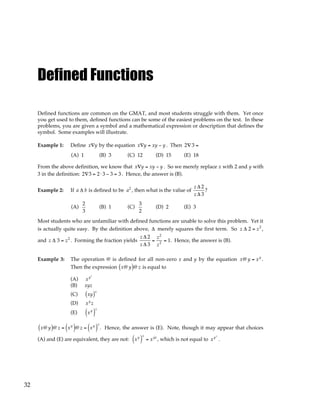
According to the passage, which of the following would be likely to stimulate violent
behavior in a child playing a video game?
I. Watching the computer stage a battle between two opponents
II. Controlling a character in battle against a computer
III. Challenging another player to a battle in a non-cooperative two-person game
(A) II only
(B) III only
(C) I and II only
(D) II and III only
Item I, True: Stimulation would occur. This choice is qualitatively the same as passively watch-
ing violence on television. Item II, True: Stimulation would also occur. This is another example
of solitary aggression (implied by the second sentence of the last paragraph). Item III, False: No
stimulation would occur. Two-player aggressive games are “cathartic” (again the needed refer-
ence is the second sentence of the last paragraph). The answer is (C).
Often you will be asked to define a word or phrase based on its context. For this type of
question, again you must look at a few lines before and after the word. Don’t assume that
because the word is familiar you know the definition requested. Words often have more than
one meaning. And the GMAT often asks for a peculiar or technical meaning of a common word.
For example, as a noun champion means “the winner,” but as a verb champion means “to be an
advocate for someone.” You must consider the word’s context to get its correct meaning.
On the GMAT the definition of a word will not use as simple a structure as was used above
to define champion. One common way the GMAT introduces a defining word or phrase is to
place it in apposition to the word being defined.
Don’t confuse “apposition” with “opposition”: they have antithetical [exactly opposite]
meanings. Words or phrases in apposition are placed next to each other, and the second word or
The Six Questions 353
phrase defines, clarifies, or gives evidence for the first word or phrase. The second word or
phrase will be set off from the first by a comma, semicolon, hyphen, or parentheses. (Note: If a
comma is not followed by a linking word—such as and, for, yet—then the following phrase is
probably appositional.)
Example:
The discussions were acrimonious, frequently degenerating into name-calling contests.
After the comma in this sentence, there is no linking word (such as and, but, because, although, etc.).
Hence the phrase following the comma is in apposition to acrimonious—it defines or further clari-
fies the word. Now acrimonious means bitter, mean-spirited talk, which would aptly describe a
name-calling contest.
Application: (Mini-passage)
The technical phenomenon, embracing all the separate techniques, forms a
whole.... It is useless to look for differentiations. They do exist, but only secondarily.
The common features of the technical phenomenon are so sharply drawn that it is easy
to discern that which is the technical phenomenon and that which is not.
... To analyze these common features is tricky, but it is simple to grasp them. Just
as there are principles common to things as different as a wireless set and an internal-
combustion engine, so the organization of an office and the construction of an aircraft
have certain identical features. This identity is the primary mark of that thoroughgoing
unity which makes the technical phenomenon a single essence despite the extreme
diversity of its appearances.
As a corollary, it is impossible to analyze this or that element out of it—a truth
which is today particularly misunderstood. The great tendency of all persons who
study techniques is to make distinctions. They distinguish between the different ele-
ments of technique, maintaining some and discarding others. They distinguish
between technique and the use to which it is put. These distinctions are completely
invalid and show only that he who makes them has understood nothing of the techni-
cal phenomenon. Its parts are ontologically tied together; in it, use is inseparable from
being.
From Jacques Ellul, The Technological Society, ©1964 by Alfred A. Knopf, Inc.
The “technical phenomenon” referred to in the opening line can best be defined as
(A) all of the machinery in use today
(B) the abstract idea of the machine
(C) a way of thinking in modern society
(D) what all machines have in common
(A): No, it is clear from the passage that the technical phenomenon is more abstract than that,
since it is described in the opening paragraph as uniting all the separate “techniques” (not
machines) and as comprising the “features” that such things as an office and an aircraft have in
common. (B): No, the passage states that the technical phenomenon is something that includes
both techniques and their use (See closing lines of the passage); it is thus broader that just the idea
of machinery. (C): Yes, this seems to be the best answer; it is broad enough to include both tech-
niques and their uses and abstract enough to go beyond talking only about machines. (D): No,
the passage suggests that it is something that techniques have in common and techniques can
include airplanes or offices.
354 GMAT Prep Course
WRITING TECHNIQUE QUESTIONS
All coherent writing has a superstructure or blueprint. When writing, we don’t just randomly jot
down our thoughts; we organize our ideas and present them in a logical manner. For instance,
we may present evidence that builds up to a conclusion but intentionally leave the conclusion
unstated, or we may present a position and then contrast it with an opposing position, or we may
draw an extended analogy.
There is an endless number of writing techniques that authors use to present their ideas, so
we cannot classify every method. However, some techniques are very common to the type of
explanatory or opinionated writing found in GMAT passages.
A. Compare and contrast two positions.
This technique has a number of variations, but the most common and direct is to develop two
ideas or systems (comparing) and then point out why one is better than the other (contrasting).
Comparing
Contr
asting
Idea 1
Idea 2
Some common tip-off phrases to this method of analysis are
• By contrast
• Similarly
Some typical questions for these types of passages are
• According to the passage, a central distinction between a woman’s presence and a man’s
presence is:
• In which of the following ways does the author imply that birds and reptiles are similar?
Writing-technique questions are similar to main idea questions; except that they ask about
how the author presents his ideas, not about the ideas themselves. Generally, you will be given
only two writing methods to choose from, but each method will have two or more variations.
Example: (Refer to passage on page 348.)
Which one of the following best describes the organization of the passage?
(A) Two systems of criminal justice are compared and contrasted, and one is deemed
to be better than the other.
(B) One system of criminal justice is presented as better than another. Then evidence
is offered to support that claim.
(C) Two systems of criminal justice are analyzed, and one specific example is exam-
ined in detail.
(D) A set of examples is furnished. Then a conclusion is drawn from them.
(E) The inner workings of the criminal justice system are illustrated by using two
systems.
Clearly the author is comparing and contrasting two criminal justice systems. Indeed, the open-
ing to paragraph two makes this explicit. The author uses a mixed form of comparison and
contrast. He opens the passage by developing (comparing) both systems and then shifts to
developing just the adversarial system. He opens the second paragraph by contrasting the two
The Six Questions 355
criminal justice systems and then further develops just the inquisitorial system. Finally, he closes
by again contrasting the two systems and implying that the inquisitorial system is superior.
Only two answer-choices, (A) and (B), have any real merit. They say essentially the same
thing—though in different order. Notice in the passage that the author does not indicate which
system is better until the end of paragraph one, and he does not make that certain until
paragraph two. This contradicts the order given by (B). Hence the answer is (A). (Note: In (A)
the order is not specified and therefore is harder to attack, whereas in (B) the order is definite and
therefore is easier to attack. Remember that a measured response is harder to attack and
therefore is more likely to be the answer.)
B. Show cause and effect.
In this technique, the author typically shows how a particular cause leads to a certain result or set
of results. It is not uncommon for this method to introduce a sequence of causes and effects. A
causes B, which causes C, which causes D, and so on. Hence B is both the effect of A and the
cause of C. For a discussion of the fallacies associated with this technique see Causal Reasoning
(page 467). The variations on this rhetorical technique can be illustrated by the following
schematics:
C —> E C
E
E
E
C —> C/E —> C/E —> E
Example: (Mini-passage)
Thirdly, I worry about the private automobile. It is a dirty, noisy, wasteful, and lonely
means of travel. It pollutes the air, ruins the safety and sociability of the street, and exercises
upon the individual a discipline which takes away far more freedom than it gives him. It
causes an enormous amount of land to be unnecessarily abstracted from nature and from
plant life and to become devoid of any natural function. It explodes cities, grievously im-
pairs the whole institution of neighborliness, fragmentizes and destroys communities. It has
already spelled the end of our cities as real cultural and social communities, and has made
impossible the construction of any others in their place. Together with the airplane, it has
crowded out other, more civilized and more convenient means of transport, leaving older
people, infirm people, poor people and children in a worse situation than they were a hun-
dred years ago. It continues to lend a terrible element of fragility to our civilization, placing
us in a situation where our life would break down completely if anything ever interfered
with the oil supply.
George F. Kennan
Which of the following best describes the organization of the passage?
(A) A problem is presented and then a possible solution is discussed.
(B) The benefits and demerits of the automobile are compared and contrasted.
(C) A topic is presented and a number of its effects are discussed.
(D) A set of examples is furnished to support a conclusion.
This passage is laden with effects. Kennan introduces the cause, the automobile, in the opening
sentence and from there on presents a series of effects—the automobile pollutes, enslaves, and so
on. Hence the answer is (C). Note: (D) is the second-best choice; it is disqualified by two flaws.
First, in this context, “examples” is not as precise as “effects.” Second, the order is wrong: the
conclusion, “I worry about the private automobile” is presented first and then the examples: it
pollutes, it enslaves, etc.
356 GMAT Prep Course
C. State a position and then give supporting evidence.
This technique is common with opinionated passages. Equally common is the reverse order.
That is, the supporting evidence is presented and then the position or conclusion is stated. And
sometimes the evidence will be structured to build up to a conclusion which is then left unstated.
If this is done skillfully the reader will be more likely to arrive at the same conclusion as the
author.
E
E
E
E
E
E
Unstated
Position
Position
Following are some typical questions for these types of passages:
• According to the author, which of the following is required for one to become proficient
with a computer?
• Which of the following does the author cite as evidence that the bald eagle is in danger
of becoming extinct?
EXTENSION QUESTIONS
Extension questions are the most common. They require you to go beyond what is stated in the
passage, asking you to draw an inference from the passage, to make a conclusion based on the
passage, or to identify one of the author’s tacit assumptions.
You may be asked to draw a conclusion based on the ideas or facts presented:
It can be inferred from the passage that . . .
The passage suggests that . . .
Since extension questions require you to go beyond the passage, the correct answer must say more
than what is said in the passage. Beware of same language traps with these questions: the correct
answer will often both paraphrase and extend a statement in the passage, but it will not directly
quote it.
“Same Language” traps: For extension questions, any answer-choice that explicitly refers to or
repeats a statement in the passage will probably be wrong.
The correct answer to an extension question will not require a quantum leap in thought, but
it will add significantly to the ideas presented in the passage.
Example: (Refer to passage on page 348.)
The author views the prosecution’s role in the inquisitorial system as being
(A) an advocate for both society and the defendant
(B) solely responsible for starting a trial
(C) a protector of the legal rule
(D) an investigator only
(E) an aggressive but fair investigator
This is an extension question. So the answer will not be explicitly stated in the passage, but it will
be strongly supported by it.
The Six Questions 357
The author states that the prosecutor is duty bound to present any evidence that may prove
the defendant innocent and that he must disclose all pretrial evidence (i.e., have no tricks up his
sleeve). This is the essence of fair play. So the answer is probably (E).
However, we should check all the choices. (A) overstates the case. Although the prosecutor
must disclose any evidence that might show the defendant innocent, the prosecutor is still advo-
cating society’s case against the defendant—it must merely be measured advocacy. This is the
second-best answer. As for (B), although it is implied that in both systems the right to initiate a
case is extended to all people through the prosecutor, it is not stated or implied that this is the
only way to start a case. Finally, neither (C) nor (D) is mentioned or implied in the passage. The
answer, therefore, is (E).
Application: (Mini-passage)
Often, the central problem in any business is that money is needed to make
money. The following discusses the sale of equity, which is one response to this
problem.
Sale of Capital Stock: a way to obtain capital through the sale of stock to individ-
ual investors beyond the scope of one’s immediate acquaintances. Periods of high
interest rates turn entrepreneurs to this equity market. This involves, of necessity, a
dilution of ownership, and many owners are reluctant to take this step for that reason.
Whether the owner is wise in declining to use outside equity financing depends upon
the firm’s long-range prospects. If there is an opportunity for substantial expansion on
a continuing basis and if other sources are inadequate, the owner may decide logically
to bring in other owners. Owning part of a larger business may be more profitable
than owning all of a smaller business.
Small-Business Management, 6th Ed., © 1983 by South-Western Publishing Co.
The passage implies that an owner who chooses not to sell capital stock despite the
prospect of continued expansion is
(A) subject to increased regulation
(B) more conservative than is wise under the circumstances
(C) likely to have her ownership of the business diluted
(D) sacrificing security for rapid growth
(A): No. This is not mentioned in the passage. (B): Yes. The passage states that “the owner may
decide logically to bring in other owners”; in other words, the owner would be wise to sell stock in
this situation. (C): No. By NOT selling stock, the owner retains full ownership. (D) No. Just the
opposite: the owner would be sacrificing a measure of security for growth if she did sell stock.
APPLICATION QUESTIONS
Application questions differ from extension questions only in degree. Extension questions ask
you to apply what you have learned from the passage to derive new information about the same
subject, whereas application questions go one step further, asking you to apply what you have
learned from the passage to a different or hypothetical situation.
The following are common application questions:
Which one of the following is the most likely source of the passage?
Which one of the following actions would be most likely to have the same effect as
the author’s actions?
You may be asked to complete a thought for the author:
358 GMAT Prep Course
The author would most likely agree with which one of the following statements?
Which one of the following sentences would the author be most likely to use to
complete the last paragraph of the passage?
To answer an application question, take the author’s perspective. Ask yourself: what am I
arguing for? what might make my argument stronger? what might make it weaker?
Because these questions go well beyond the passage, they tend to be the most difficult.
Furthermore, because application questions and extension questions require a deeper
understanding of the passage, skimming (or worse yet, speed-reading) the passage is ineffective.
Skimming may give you the main idea and structure of the passage, but it is unlikely to give you
the subtleties of the author’s attitude.
Example: (Refer to passage on page 348.)
Based on the information in the passage, it can be inferred that which one of the follow-
ing would most logically begin a paragraph immediately following the passage?
(A) Because of the inquisitorial system’s thoroughness in conducting its pretrial
investigation, it can be concluded that a defendant who is innocent would prefer
to be tried under the inquisitorial system, whereas a defendant who is guilty
would prefer to be tried under the adversarial system.
(B) As the preceding analysis shows, the legal system is in a constant state of flux.
For now the inquisitorial system is ascendant, but it will probably be soon
replaced by another system.
(C) The accusatorial system begins where the inquisitorial system ends. So it is three
steps removed from the system of private vengeance, and therefore historically
superior to it.
(D) Because in the inquisitorial system the judge must take an active role in the con-
duct of the trial, his competency and expertise have become critical.
(E) The criminal justice system has evolved to the point that it no longer seems to be
derivative of the system of private vengeance. Modern systems of criminal jus-
tice empower all of society with the right to instigate a legal action, and the need
for vengeance is satisfied through a surrogate—the public prosecutor.
The author has rather thoroughly presented his position, so the next paragraph would be a
natural place for him to summarize it. The passage compares and contrasts two systems of crim-
inal justice, implying that the inquisitorial system is superior. We expect the concluding para-
graph to sum up this position. Now all legal theory aside, the system of justice under which an
innocent person would choose to be judged would, as a practical matter, pretty much sum up the
situation. Hence the answer is (A).
Application: (Mini-passage)
The idea of stuff expresses no more than the experience of coming to a limit at
which our senses or our instruments are not fine enough to make out the pattern.
Something of the same kind happens when the scientist investigates any unit or
pattern so distinct to the naked eye that it has been considered a separate entity. He
finds that the more carefully he observes and describes it, the more he is also describing
the environment in which it moves and other patterns to which it seems inseparably
related. As Teilhard de Chardin has so well expressed it, the isolation of individual,
atomic patterns “is merely an intellectual dodge.”
...Although the ancient cultures of Asia never attained the rigorously exact physi-
cal knowledge of the modern West, they grasped in principle many things which are
only now occurring to us. Hinduism and Buddhism are impossible to classify as reli-
gions, philosophies, sciences, or even mythologies, or again as amalgamations of all
The Six Questions 359
four, because departmentalization is foreign to them even in so basic a form as the sep-
aration of the spiritual and the material.... Buddhism ... is not a culture but a critique of
culture, an enduring nonviolent revolution, or “loyal opposition,” to the culture with
which it is involved. This gives these ways of liberation something in common with
psychotherapy beyond the interest in changing states of consciousness. For the task of
the psychotherapist is to bring about a reconciliation between individual feeling and
social norms without, however, sacrificing the integrity of the individual. He tries to
help the individual to be himself and to go it alone in the world (of social convention)
but not of the world.
From Alan W. Watts, Psychotherapy East and West, © 1961 by Pantheon
Books, a division of Random House.
What does the passage suggest about the theme of the book from which it is excerpted?
(A) The book attempts to understand psychotherapy in the context of different and
changing systems of thought.
(B) The book argues that psychotherapy unites elements of an exact science with
elements of eastern philosophy.
(C) The book describes the origins of psychotherapy around the world.
(D) The book compares psychotherapy in the West and in the East.
(A): Yes, this is the most accurate inference from the passage. The passage discusses how the
more carefully a scientist views and describes something the more he describes the environment
in which it moves, and the passage traces similarities between psychotherapy and Eastern
systems of (evolving) thought. (B): No, this is too narrow an interpretation of what the whole
book would be doing. (C): No, too vague; the passage is too philosophical to be merely a history.
(D): No, also too vague, meant to entrap those of you who relied on the title without thinking
through the passage.
TONE QUESTIONS
Tone questions ask you to identify the writer’s attitude or perspective. Is the writer’s feeling
toward the subject positive, negative, or neutral? Does the writer give his own opinion, or does
he objectively present the opinions of others?
Before you read the answer-choices, decide whether the writer’s tone is positive, negative, or
neutral. It is best to do this without referring to the passage.
However, if you did not get a feel for the writer’s attitude on the first reading, check the
adjectives that he chooses. Adjectives and, to a lesser extent, adverbs express our feelings toward
subjects. For instance, if we agree with a person who holds strong feelings about a subject, we
may describe his opinions as impassioned. On the other hand, if we disagree with him, we may
describe his opinions as excitable, which has the same meaning as “impassioned” but carries a
negative connotation.
Example: (Refer to passage on page 348.)
The author’s attitude toward the adversarial system can best be described as
(A) encouraged that it is far removed from the system of private vengeance
(B) concerned that it does not allow all members of society to instigate legal action
(C) pleased that it does not require the defendant to conduct his own pretrial
investigation
(D) hopeful that it will be replaced by the inquisitorial system
(E) doubtful that it is the best vehicle for justice
The author does not reveal his feelings toward the adversarial system until the end of paragraph
one. Clearly the clause “the adversarial system of criminal procedure symbolizes and regularizes
360 GMAT Prep Course
the punitive combat” indicates that he has a negative attitude toward the system. This is
confirmed in the second paragraph when he states that the inquisitorial system is historically
superior to the adversarial system. So he feels that the adversarial system is deficient.
The “two-out-of-five” rule is at work here: only choices (D) and (E) have any real merit.
Both are good answers. But which one is better? Intuitively, choice (E) is more likely to be the
answer because it is more measured. To decide between two choices attack each: the one that
survives is the answer. Now a tone question should be answered from what is directly stated in
the passage—not from what it implies. Although the author has reservations toward the adver-
sarial system, at no point does he say that he hopes the inquisitorial system will replace it, he may
prefer a third system over both. This eliminates (D); the answer therefore is (E).
The remaining choices are not supported by the passage. (A), using the same language as in
the passage, overstates the author’s feeling. In lines 13–15, he states that the adversarial system is
only one step removed from the private vengeance system—not far removed. Remember: Be
wary of extreme words. (A) would be a better choice if “far” were dropped. (B) makes a false
claim. In lines 16–19, the author states that the adversarial system does extend the right to initiate
legal action to all members of society. Finally, (C) also makes a false claim. In lines 21–23, the
author states that the defendant in the adversarial system is still left to conduct his own pretrial
investigation.
Application: (Mini-passage)
An elm in our backyard caught the blight this summer and dropped stone dead,
leafless, almost overnight. One weekend it was a normal-looking elm, maybe a little bare in
spots but nothing alarming, and the next weekend it was gone, passed over, departed,
taken....
The dying of a field mouse, at the jaws of an amiable household cat, is a spectacle I have
beheld many times. It used to make me wince.... Nature, I thought, was an abomination.
Recently I’ve done some thinking about that mouse, and I wonder if his dying is
necessarily all that different from the passing of our elm. The main difference, if there is
one, would be in the matter of pain. I do not believe that an elm tree has pain receptors, and
even so, the blight seems to me a relatively painless way to go. But the mouse dangling tail-
down from the teeth of a gray cat is something else again, with pain beyond bearing, you’d
think, all over his small body. There are now some plausible reasons for thinking it is not
like that at all.... At the instant of being trapped and penetrated by teeth, peptide hormones
are released by cells in the hypothalamus and the pituitary gland; instantly these substances,
called endorphins, are attached to the surfaces of other cells responsible for pain perception;
the hormones have the pharmacologic properties of opium; there is no pain. Thus it is that
the mouse seems always to dangle so languidly from the jaws, lies there so quietly when
dropped, dies of his injuries without a struggle. If a mouse could shrug, he’d shrug....
Pain is useful for avoidance, for getting away when there’s time to get away, but when
it is end game, and no way back, pain is likely to be turned off, and the mechanisms for this
are wonderfully precise and quick. If I had to design an ecosystem in which creatures had to
live off each other and in which dying was an indispensable part of living, I could not think
of a better way to manage.
From Lewis Thomas, On Natural Death, © 1979 by Lewis Thomas.
Which one of the following would best characterize the author’s attitude toward the
relationship between pain and death?
(A) Dismay at the inherent cruelty of nature
(B) Amusement at the irony of the relationship between pain and death
(C) Admiration for the ways in which animal life functions in the ecosystem
(D) A desire to conduct experiments on animals in order to discover more about the
relationship between pain and death
The Six Questions 361
The author’s attitude toward the relationship between pain and death evolves through three
stages. First, he expresses revulsion at the relationship. This is indicated in the second paragraph
by the words “wince” and “abomination.” Then in the third paragraph, he adopts a more analyti-
cal attitude and questions his previous judgment. This is indicated by the clause, “I wonder if his
dying is necessarily all that different from the passing of our elm.” And in closing the paragraph, he
seems resigned to the fact the relationship is not all that bad. This is indicated by the sentence, “If
a mouse could shrug, he’d shrug.” Finally, in the last paragraph, he comes to express admiration for
the relationship between pain and death. This is indicated by the phrase “wonderfully precise and
quick,” and it is made definite by the closing line, “If I had to design an ecosystem . . . in which dying
was an indispensable part of living, I could not think of a better way to manage.” Thus, the answer is
(C).
The other choices are easily ruled out. Choice (A) is perhaps superficially tempting. In the
second paragraph the author does express dismay at the ways of nature, but notice that his con-
cerns are in the past tense. He is now more understanding, wiser of the ways of nature. As to (B),
the author is subtly reverential, never ironical, toward nature. Finally, (D) is not mentioned or
alluded to in the passage.
Beware of answer-choices that contain extreme emotions. Remember the passages are taken
from academic journals. In the rarefied air of academic circles, strong emotions are considered
inappropriate and sophomoric. The writers want to display opinions that are considered and
reasonable, not spontaneous and off-the-wall. So if an author’s tone is negative, it may be
disapproving—not snide. Or if her tone is positive, it may be approving—not ecstatic.
Furthermore, the answers must be indisputable. If the answers were subjective, then the
writers of the GMAT would be deluged with letters from angry test takers, complaining that their
test-scores are unfair. To avoid such a difficult position, the writers of the GMAT never allow the
correct answer to be either controversial or grammatically questionable.
Let’s use these theories to answer the following questions.
Example:
Which one of the following most accurately characterizes the author’s attitude with
respect to Phillis Wheatley’s literary accomplishments?
(A) enthusiastic advocacy
(B) qualified admiration
(C) dispassionate impartiality
(D) detached ambivalence
(E) perfunctory dismissal
Even without reference to the passage, this is not a difficult question to answer.
Scholars may advocate each other’s work, but they are unlikely to be enthusiastic advocates.
Furthermore, the context stretches the meaning of advocacy—to defend someone else’s cause or
plight. So (A) is unlikely to be the answer.
(B) is the measured response and therefore is probably the answer.
“Dispassionate impartiality” is a rather odd construction; additionally, it is redundant. It
could never be the answer to a GMAT question. This eliminates (C).
“Detached ambivalence” is not as odd as “dispassionate impartiality,” but it is unusual. So
(D) is unlikely to be the answer.
Remember, scholars want their audience to consider their opinions well thought out, not off-
the-wall. But perfunctory means “hasty and superficial.” So (E) could not be the answer.
Hence, even without the passage we can still find the answer, (B).
362 GMAT Prep Course
Example:
Which one of the following best describes the author’s attitude toward scientific
techniques?
(A) critical
(B) hostile
(C) idealistic
(D) ironic
(E) neutral
(A) is one of two measured responses offered. Now a scholar may be critical of a particular
scientific technique, but only a crackpot would be critical of all scientific techniques—eliminate
(A).
“Hostile” is far too negative. Scholars consider such emotions juvenile—eliminate (B).
“Idealistic,” on the other hand, is too positive; it sounds pollyannaish—eliminate (C).
“Ironic” seems illogical in this context. It’s hard to conceive of a person having an ironic
attitude toward scientific techniques—eliminate (D).
(E) is the other measured response, and by elimination it is the answer.
Description, extension, and application questions make up about 80% of the reading
comprehension questions, main idea questions about 10%, and tone and writing technique
questions about 5% each.
Points to Remember
1. The order of the passage questions roughly corresponds to the order in which the issues are
presented in the passage.
2. The six questions are
Main Idea
Description
Writing Technique
Extension
Application
Tone
3. The main idea of a passage is usually stated in the last, sometimes the first, sentence of the
first paragraph. If it’s not there, it will probably be the last sentence of the entire passage.
4. If after the first reading, you don’t have a feel for the main idea, review the first and last
sentence of each paragraph.
5. The answer to a description question must refer directly to a statement in the passage, not to
something implied by it. However, the correct answer will paraphrase a passage statement,
not quote it exactly. In fact, exact quotes are used with these questions to bait wrong
answers.
6. When answering a description question, you must find the point in the passage from which
the question is drawn.
The Six Questions 363
7. If a description question refers to line 20, the information needed to answer it can occur
anywhere from line 15 to 25.
8. Some writing techniques commonly used in the GMAT passages are
A. Compare and contrast two positions.
B. Show cause and effect.
C. State a position; then give supporting evidence.
9. For extension questions, any answer-choice that refers explicitly to or repeats a statement in
the passage will probably be wrong.
10. Application questions differ from extension questions only in degree. Extension questions
ask you to apply what you have learned from the passage to derive new information about
the same subject, whereas application questions go one step further, asking you to apply
what you have learned from the passage to a different or hypothetical situation.
11. To answer an application question, take the perspective of the author. Ask yourself: what
am I arguing for? what might make my argument stronger? what might make it weaker?
12. Because application questions go well beyond the passage, they tend to be the most
difficult.
13. For tone questions, decide whether the writer’s tone is positive, negative, or neutral before
you look at the answer-choices.
14. If you do not have a feel for the writer’s attitude after the first reading, check the adjectives
that she chooses.
15. Beware of answer-choices that contain extreme emotions. If an author’s tone is negative, it
may be disapproving—not snide. Or if her tone is positive, it may be approving—not
ecstatic.
16. The answers must be indisputable. A correct answer will never be controversial or gram-
matically questionable.
17. Description, extension, and application questions make up about 80% of the reading
comprehension questions, main idea questions about 10%, and tone and writing technique
questions about 5% each.
364 GMAT Prep Course
Mentor Exercise
Directions: This passage is followed by a group of questions to be answered based on what is stated or
implied in the passage. Choose the best answer; the one that most accurately and completely answers the
question. Hints, insights, and answers immediately follow the questions.
From Romania to Germany, from Tallinn to
Belgrade, a major historical process—the death
of communism—is taking place. The German
Democratic Republic no longer exists as a sepa-
rate state. And the former German Democratic
5
Republic will serve as the first measure of the
price a post-Communist society has to pay for
entering the normal European orbit. In
Yugoslavia we will see whether the federation
can survive without communism.
10
One thing seems common to all these coun-
tries: dictatorship has been defeated and free-
dom has won, yet the victory of freedom has not
yet meant the triumph of democracy.
Democracy is something more than freedom.
15
Democracy is freedom institutionalized, free-
dom submitted to the limits of the law, freedom
functioning as an object of compromise between
the major political forces on the scene.
We have freedom, but we still have not
20
achieved the democratic order. That is why this
freedom is so fragile. In the years of democratic
opposition to communism, we supposed that the
easiest thing would be to introduce changes in
the economy. In fact, we thought that the march
25
from a planned economy to a market economy
would take place within the framework of the
bureaucratic system, and that the market within
the Communist state would explode the totali-
tarian structures. Only then would the time
30
come to build the institutions of a civil society;
and only at the end, with the completion of the
market economy and the civil society, would the
time of great political transformations finally
arrive.
35
The opposite happened. First came the big
political change, the great shock, which either
broke the monopoly and the principle of
Communist Party rule or simply pushed the
Communists out of power. Then came the cre-
40
ation of civil society, whose institutions were
created in great pain, and which had trouble
negotiating the empty space of freedom. Only
then, as the third moment of change, the final
task was undertaken: that of transforming the
45
totalitarian economy into a normal economy
where different forms of ownership and differ-
ent economic actors will live one next to the
other.
Today we are in a typical moment of transi-
50
tion. No one can say where we are headed. The
people of the democratic opposition have the
feeling that we won. We taste the sweetness of
our victory the same way the Communists, only
yesterday our prison guards, taste the bitterness
55
of their defeat. Yet, even as we are conscious of
our victory, we feel that we are, in a strange
way, losing. In Bulgaria the Communists have
won the parliamentary elections and will govern
the country, without losing their social legiti-
60
macy. In Romania the National Salvation Front,
largely dominated by people from the old
Communist bureaucracy, has won. In other
countries democratic institutions seem shaky,
and the political horizon is cloudy. The mas-
65
querade goes on: dozens of groups and parties
are created, each announces similar slogans,
each accuses its adversaries of all possible sins,
and each declares itself representative of the na-
tional interest. Personal disputes are more im-
70
portant than disputes over values. Arguments
over values are fiercer than arguments over
ideas.
The Six Questions 365
1. The author originally thought that the order
of events in the transformation of commu-
nist society would be represented by which
one of the following?
(A) A great political shock would break
the totalitarian monopoly, leaving in
its wake a civil society whose task
would be to change the state-con-
trolled market into a free economy.
(B) The transformation of the economy
would destroy totalitarianism, after
which a new and different social and
political structure would be born.
(C) First the people would freely elect
political representatives who would
transform the economy, which would
then undermine the totalitarian
structure.
(D) The change to a democratic state
would necessarily undermine totali-
tarianism, after which a new economic
order would be created.
(E) The people’s frustration would build
until it spontaneously generated vio-
lent revolution, which would sentence
society to years of anarchy and
regression.
2. Beginning in the second paragraph, the
author describes the complicated relation-
ship between “freedom” and “democracy.”
In the author’s view, which one of the fol-
lowing statements best reflects that
relationship?
(A) A country can have freedom without
having democracy.
(B) If a country has freedom, it necessarily
has democracy.
(C) A country can have democracy
without having freedom.
(D) A country can never have democracy
if it has freedom.
(E) If a country has democracy, it cannot
have freedom.
1. This is a description question, so you
should locate the point in the passage from
which it was drawn. It is the third para-
graph. In lines 25–30, the author recalls his
expectation that, by introducing the market
system, the communist system would topple
from within.
Be careful not to choose (A). It chroni-
cles how the events actually occurred, not
how they were anticipated to occur. (A) is
baited with the words “great shock,”
“monopoly,” and “civil society.”
The answer is (B).
2. This is an extension question, so the
answer must say more than what is said in
the passage, without requiring a quantum
leap in thought. The needed reference is
“Democracy is something more than freedom”
(line 15). Since freedom can exist without
democracy, freedom alone does not insure
democracy.
The answer is (A).
366 GMAT Prep Course
3. From the passage, a reader could conclude
that which one of the following best
describes the author’s attitude toward the
events that have taken place in communist
society?
(A) Relieved that at last the democratic
order has surfaced.
(B) Clearly wants to return to the old
order.
(C) Disappointed with the nature of the
democracy that has emerged.
(D) Confident that a free economy will
ultimately provide the basis for a true
democracy.
(E) Surprised that communism was
toppled through political rather than
economic means.
4. A cynic who has observed political systems
in various countries would likely interpret
the author’s description of the situation at
the end of the passage as
(A) evidence that society is still in the
throws of the old totalitarian
structure.
(B) a distorted description of the new
political system.
(C) a necessary political reality that is a
prelude to “democracy.”
(D) a fair description of many democratic
political systems.
(E) evidence of the baseness of people.
3. This is a tone question. The key to
answering this question is found in the
closing comments. There the author states
“The masquerade goes on,” referring to nascent
democracies. So he has reservations about
the newly emerging democracies.
Watch out for (E). Although it is sup-
ported by the passage, it is in a supporting
paragraph. The ideas in a concluding para-
graph take precedence over those in a sup-
porting paragraph.
The answer is (C).
4. This is an application question. These are
like extension questions, but they go well
beyond what is stated in the passage. In this
case we are asked to interpret the author’s
comments from a cynic’s perspective.
Because application questions go well
beyond the passage, they are often difficult,
as is this one.
Hint: A cynic looks at reality from a
negative perspective, usually with a sense of
dark irony and hopelessness.
Don’t make the mistake of choosing (E).
Although a cynic is likely to make such a
statement, it does not address the subject of
the passage—political and economic sys-
tems. The passage is not about human
nature, at least not directly.
The answer is (D).
The Six Questions 367
5. Which one of the following does the author
imply may have contributed to the difficul-
ties involved in creating a new democratic
order in eastern Europe?
I. The people who existed under the
totalitarian structure have not had the
experience of “negotiating the empty
space of freedom.”
II. Mistaking the order in which political,
economic, and social restructuring
would occur.
III. Excessive self-interest among the new
political activists.
(A) I only
(B) II only
(C) I and III only
(D) II and III only
(E) I, II, and III
6. By stating “even as we are conscious of our
victory, we feel that we are, in a strange
way, losing” (lines 56–58) the author means
that
(A) some of the old governments are still
unwilling to grant freedom at the
individual level.
(B) some of the new governments are not
strong enough to exist as a single
federation.
(C) some of the new democratic govern-
ments are electing to retain the old
political parties.
(D) no new parties have been created to
fill the vacuum created by the victory
of freedom.
(E) some of the new governments are
reverting to communism.
5. This is an extension question. Statement I
is true. In lines 40–43, the author implies
that the institutions of the new-born, free
society were created in great pain because
the people lacked experience. Statement II is
true. Expectations that the market mecha-
nisms would explode totalitarianism and
usher in a new society were dashed, and
having to readjust one’s expectations
certainly makes a situation more difficult.
Finally, statement III is true. It summarizes
the thrust of the passage’s closing lines.
The answer is (E).
6. This is a hybrid extension and description
question. Because it refers to a specific point
in the passage, you must read a few
sentences before and after it. The answer
can be found in lines 58–70.
The answer is (C).
368 GMAT Prep Course
Exercise
Directions: This passage is followed by a group of questions to be answered based on what is stated or
implied in the passage. Choose the best answer; the one that most accurately and completely answers the
question.
In the United States the per capita costs of
schooling have risen almost as fast as the cost
of medical treatment. But increased treatment
by both doctors and teachers has shown
steadily declining results. Medical expenses
5
concentrated on those above forty-five have
doubled several times over a period of forty
years with a resulting 3 percent increase in the
life expectancy of men. The increase in educa-
tional expenditures has produced even
10
stranger results; otherwise President Nixon
could not have been moved this spring to
promise that every child shall soon have the
“Right to Read” before leaving school.
In the United States it would take eighty
15
billion dollars per year to provide what educa-
tors regard as equal treatment for all in gram-
mar and high school. This is well over twice
the $36 billion now being spent. Independent
cost projections prepared at HEW and at the
20
University of Florida indicate that by 1974 the
comparable figures will be $107 billion as
against the $45 billion now projected, and
these figures wholly omit the enormous costs
of what is called “higher education,” for which
25
demand is growing even faster. The United
States, which spent nearly eighty billion
dollars in 1969 for “defense,” including its
deployment in Vietnam, is obviously too poor
to provide equal schooling. The President’s
30
committee for the study of school finance
should ask not how to support or how to trim
such increasing costs, but how they can be
avoided.
Equal obligatory schooling must be rec-
35
ognized as at least economically unfeasible. In
Latin America the amount of public money
spent on each graduate student is between 350
and 1,500 times the amount spent on the me-
dian citizen (that is, the citizen who holds the
40
middle ground between the poorest and the
richest). In the United States the discrepancy
is smaller, but the discrimination is keener.
The richest parents, some 10 percent, can af-
ford private education for their children and
45
help them to benefit from foundation grants.
But in addition they obtain ten times the per
capita amount of public funds if this is com-
pared with the per capita expenditure made
on the children of the 10 percent who are
50
poorest. The principal reasons for this are that
rich children stay longer in school, that a year
in a university is disproportionately more
expensive than a year in high school, and that
most private universities depend—at least
55
indirectly—on tax-derived finances.
Obligatory schooling inevitably polarizes
a society; it also grades the nations of the
world according to an international caste sys-
tem. Countries are rated like castes whose ed-
60
ucational dignity is determined by the average
years of schooling of its citizens, a rating
which is closely related to per capita gross na-
tional product, and much more painful.
1. Which one of the following best expresses
the main idea of the passage?
(A) The educational shortcomings of the
United States, in contrast to those of
Latin America, are merely the result
of poor allocation of available
resources.
(B) Both education and medical care are
severely underfunded.
(C) Defense spending is sapping funds
which would be better spent in
education.
(D) Obligatory schooling must be
scrapped if the goal of educational
equality is to be realized.
(E) Obligatory education does not and
cannot provide equal education.
The Six Questions 369
2. The author most likely would agree with
which one of the following solutions to the
problems presented by obligatory educa-
tion?
(A) Education should not be obligatory
at all.
(B) Education should not be obligatory
for those who cannot afford it.
(C) More money should be diverted to
education for the poorest.
(D) Countries should cooperate to estab-
lish common minimal educational
standards.
(E) Future spending should be capped.
3. According to the passage, education is like
health care in all of the following ways
EXCEPT:
(A) It has reached a point of diminishing
returns, increased spending no
longer results in significant
improvement.
(B) It has an inappropriate “more is bet-
ter” philosophy.
(C) It is unfairly distributed between rich
and poor.
(D) The amount of money being spent on
older students is increasing.
(E) Its cost has increased nearly as fast.
4. Why does the author consider the results
from increased educational expenditures to
be “even stranger” than those from
increased medical expenditures?
(A) The aging of the population should
have had an impact only on medical
care, not on education.
(B) The “Right to Read” should be a bare
minimum, not a Presidential ideal.
(C) Educational spending has shown
even poorer results than spending on
health care, despite greater increases.
(D) Education has become even more
discriminatory than health care.
(E) It inevitably polarizes society.
5. Which one of the following most accurately
characterizes the author’s attitude with
respect to obligatory schooling?
(A) qualified admiration
(B) critical
(C) neutral
(D) ambivalent
(E) resentful
6. By stating “In Latin America the amount of
public money spent on each graduate stu-
dent is between 350 and 1,500 times the
amount spent on the median citizen” and
“In the United States the discrepancy is
smaller” the author implies that
(A) equal education is possible in the
United States but not in Latin
America.
(B) equal education for all at the gradu-
ate level is an unrealistic ideal.
(C) educational spending is more effi-
cient in the United States.
(D) higher education is more expensive
than lower education both in Latin
America and in the United States, but
more so in Latin America.
(E) underfunding of lower education is a
world-wide problem.
370 GMAT Prep Course
Answers and Solutions to Exercise
1. The answer to a main idea question will
summarize the passage, without going beyond
it.
(A) fails to meet these criteria because it
makes a false claim. Lines 36–42 imply that
the discrepancy in allocation of funds is
greater in Latin America. Besides, Latin
America is mentioned only in passing, so this
is not the main idea.
(B) also makes a false claim. The author
implies that increased funding for education is
irrelevant, if not counterproductive. In fact,
the sentence “The President’s committee for the
study of school finance should ask not how to
support or how to trim such increasing costs, but
how they can be avoided” implies that he thinks
an increase in funding would be counterpro-
ductive.
(C) is implied by the sentence “The United
States . . . is obviously too poor to provide equal
schooling,” but the author does not fully
develop this idea. Besides, he implies that the
problem is not financial.
(D) is the second-best answer-choice. The
answer to a main idea question should sum up
the passage, not make a conjecture about it.
Clearly the author has serious reservations
about obligatory schooling, but at no point
does he state or imply that it should be
scrapped. He may believe that it can be
modified, or he may be resigned to the fact
that, for other reasons, it is necessary. We
don’t know.
Finally, (E) aptly summarizes the
passage, without going beyond it. The key to
seeing this is the opening to paragraph three,
“Equal obligatory schooling must be recognized as
at least economically unfeasible.” In other words,
regardless of any other failings, it cannot
succeed economically and therefore cannot
provide equal education.
2. This is an application question. These
questions tend to be rather difficult, though
this one is not. To answer an application
question, put yourself in the author’s place. If
you were arguing his case, which of the
solutions would you advocate?
As to (A), although we rejected the
recommendation that obligatory education be
eliminated as Question 1’s answer, it is the
answer to Question 2. The author does not
merely imply that obligatory education has
some shortcomings; he suggests that it is
fundamentally flawed. Again this is made
clear by the opening to paragraph three,
“Equal obligatory schooling must be recognized as
at least economically unfeasible.” Still, there is a
possible misunderstanding here: perhaps the
author believes that obligatory education is a
noble but unrealistic idea. This possibility,
however, is dispelled by the closing paragraph
in which he states that obligatory education
polarizes society and sets up a caste system.
Obviously, such a system, if this is true,
should be discarded. The answer is (A).
The other choices can be easily dismissed.
(B) is incorrect because nothing in the passage
suggests that the author would advocate a
solution that would polarize society even
more. Indeed, at the end of paragraph three,
he suggests that the rich already get more than
their fair share.
(C) is incorrect because it contradicts the
author. Paragraph two is dedicated to show-
ing that the United States is too poor to pro-
vide equal schooling. You can’t divert money
you don’t have.
(D) is incorrect. It reads too much into
the last paragraph.
Finally, (E) is the second-best answer-
choice. Although the author probably believes
that future spending should be restrained or
capped, this understates the thrust of his
argument. However, he might offer this as a
compromise to his opponents.
3. This is a description question, so we must
find the place from which it is drawn. It is the
first paragraph. The sentence “But increased
treatment by both doctors and teachers has shown
steadily declining results” shows that both have
reached a point of diminishing returns. This
eliminates (A) and (B). Next, the passage
states “Medical expenses concentrated on those
above forty-five have doubled several times” (lines
5–7) and that the demand and costs of higher
education are growing faster than the demand
and costs of elementary and high school edu-
cation. This eliminates (D). Next, the opening
to the passage states that the costs of education
“have risen almost as fast as the cost of medical
The Six Questions 371
treatment.” This eliminates (E). Hence, by
process of elimination, the answer is (C). We
should, however, verify this. In paragraph
three, the author does state that there is a
“keen” discrepancy in the funding of educa-
tion between rich and poor, but a survey of the
passage shows that at no point does he men-
tion that this is also the case with health care.
4. This is an extension question. We are
asked to interpret a statement by the author.
The needed reference is the closing sentence to
paragraph one. Remember: extension ques-
tions require you to go beyond the passage, so
the answer won’t be explicitly stated in the
reference—we will have to interpret it.
The implication of President Nixon’s
promise is that despite increased educational
funding many children cannot even read
when they graduate from school. Hence the
answer is (B).
Don’t make the mistake of choosing (C).
Although at first glance this is a tempting
inference, it would be difficult to compare the
results of education and medical care directly
(how would we do so?). Regardless, the open-
ing line to the passage states that educational
costs have risen “almost as fast” as medical
costs, not faster.
(A) is incorrect because the passage never
mentions the aging of the population. The
same is true for (D).
Many students who cannot solve this
question choose (E)—don’t. It uses as bait
language from the passage, “inevitably polarizes
a society.” Note: The phrase “Right to Read” in
(B) is not a same language trap; it is merely
part of a paraphrase of the passage. The
correct answer to an extension question will
often both paraphrase and extend a passage
statement but will not quote it directly, as in
(E).
5. Like most tone questions this one is rather
easy. Although choice (A) is a measured
response, the author clearly does not admire
the obligatory school system. This eliminates
(A); it also eliminates (C) and (D). Of the two
remaining choices, (B) is the measured
response, and it is the answer. Although the
author strongly opposes obligatory schooling,
“resentful” is too strong and too personal. A
scholar would never directly express resent-
ment or envy, even if that is his true feeling.
6. This is another extension question. By
stating that the amount of funding spent on
graduate students is more than 350 times the
amount spent on the average citizen, the
author implies that it would be impossible to
equalize the funding. Hence the answer is (B).
None of the other choices have any real
merit. (A) is incorrect because the import of
the passage is that the rich get better schooling
and more public funds in the United States
and therefore discrimination is “keener” here
(lines 42–43).
(C) and (D) are incorrect because they are
neither mentioned nor implied by the passage.
(E) is the second-best choice. Although
this is implied by the numbers given, it has
little to do with the primary purpose of the
passage—to show that obligatory education is
perhaps not such a good idea.
372
Pivotal Words
As mentioned before, each passage contains about 300 words and only a few questions, so you
will not be tested on most of the material in the passage. Your best reading strategy, therefore, is
to identify the places from which questions will most likely be drawn and concentrate your
attention there.
Pivotal words can help in this regard. Following are the most common pivotal words.
PIVOTAL WORDS
But Although
However Yet
Despite Nevertheless
Nonetheless Except
In contrast Even though
As you may have noticed, these words indicate contrast. Pivotal words warn that the author
is about to either make a U-turn or introduce a counter-premise (concession to a minor point that
weakens the argument).
Example: (Counter-premise)
I submit that the strikers should accept the management’s offer. Admittedly, it is less
than what was demanded. But it does resolve the main grievance—inadequate health
care. Furthermore, an independent study shows that a wage increase greater than 5%
would leave the company unable to compete against Japan and Germany, forcing it
into bankruptcy.
The conclusion, “the strikers should accept the management’s offer,” is stated in the first
sentence. Then “Admittedly” introduces a concession (counter-premise); namely, that the offer
was less than what was demanded. This weakens the speaker’s case, but it addresses a potential
criticism of his position before it can be made. The last two sentences of the argument present
more compelling reasons to accept the offer and form the gist of the argument.
Pivotal words mark natural places for questions to be drawn. At a pivotal word, the author
changes direction. The GMAT writers form questions at these junctures to test whether you
turned with the author or you continued to go straight. Rarely do the GMAT writers let a pivotal
word pass without drawing a question from its sentence.
As you read a passage, note the pivotal words and refer to them when answering the
questions.
Let’s apply this theory to the passage on criminal justice. For easy reference, the passage is
reprinted here in the left-hand column, with explanations in the right-hand column. The pivotal
words are marked in bold.
Pivotal Words 373
There are two major systems of criminal procedure
in the modern world—the adversarial and the in-
quisitorial. The former is associated with common
law tradition and the latter with civil law tradition.
Both systems were historically preceded by the sys-
tem of private vengeance in which the victim of a
crime fashioned his own remedy and administered
it privately, either personally or through an agent.
The vengeance system was a system of self-help,
the essence of which was captured in the slogan
“an eye for an eye, a tooth for a tooth.” The mod-
ern adversarial system is only one historical step
removed from the private vengeance system and
still retains some of its characteristic features.
Thus, for example, even though the right to insti-
tute criminal action has now been extended to all
members of society and even though the police de-
partment has taken over the pretrial investigative
functions on behalf of the prosecution, the adver-
sarial system still leaves the defendant to conduct
his own pretrial investigation. The trial is still
viewed as a duel between two adversaries, refereed
by a judge who, at the beginning of the trial has no
knowledge of the investigative background of the
case. In the final analysis the adversarial system of
criminal procedure symbolizes and regularizes the
punitive combat.
By contrast, the inquisitorial system begins his-
torically where the adversarial system stopped its
development. It is two historical steps removed
from the system of private vengeance. Therefore,
from the standpoint of legal anthropology, it is his-
torically superior to the adversarial system. Under
the inquisitorial system the public investigator has
the duty to investigate not just on behalf of the
prosecutor but also on behalf of the defendant.
Additionally, the public prosecutor has the duty to
present to the court not only evidence that may
lead to the conviction of the defendant but also
evidence that may lead to his exoneration. This
system mandates that both parties permit full pre-
trial discovery of the evidence in their possession.
Finally, in an effort to make the trial less like a duel
between two adversaries, the inquisitorial system
mandates that the judge take an active part in the
conduct of the trial, with a role that is both directive
and protective.
Fact-finding is at the heart of the inquisitorial
system. This system operates on the philosophical
premise that in a criminal case the crucial factor is
not the legal rule but the facts of the case and that
the goal of the entire procedure is to experimentally
recreate for the court the commission of the alleged
crime.
Even though—Here “even though” is in-
troducing a concession. In the previous
sentence, the author stated that the adver-
sarial system is only one step removed
from the private vengeance system. The
author uses the two concessions as a hedge
against potential criticism that he did not
consider that the adversarial system has
extended the right to institute criminal ac-
tion to all members of society and that po-
lice departments now perform the pretrial
investigation. But the author then states
that the adversarial system still leaves the
defendant to conduct his own pretrial in-
vestigation. This marks a good place from
which to draw a question. Many people
will misinterpret the two concessions as
evidence that the adversarial system is two
steps removed from the private vengeance
system.
By contrast—In this case the pivotal
word is not introducing a concession.
Instead it indicates a change in thought:
now the author is going to discuss the
other criminal justice system. This is a
natural place to test whether the student
has made the transition and whether he
will attribute the properties soon to be
introduced to the inquisitorial system, not
the adversarial system.
But also—In both places, “but also”
indicates neither concession nor change in
thought. Instead it is part of the coordinat-
ing conjunction “not only . . . but also . . . .”
Rather than indicating contrast, it empha-
sizes the second element of the pair.
374 GMAT Prep Course
Let’s see how these pivotal words can help answer the questions in the last section. The first
is from the Description Section:
Example:
According to the passage, the inquisitorial system differs from the adversarial system
in that
(A) it does not make the defendant solely responsible for gathering evidence for his
case
(B) it does not require the police department to work on behalf of the prosecution
(C) it does not allow the victim the satisfaction of private vengeance
(D) it requires the prosecution to drop a weak case
(E) a defendant who is innocent would prefer to be tried under the inquisitorial
system
The pivotal phrase “by contrast” flags the second paragraph as the place to begin looking. The
pivotal phrase “but also” introduces the answer—namely that the prosecutor must also
investigate “on behalf of the defendant.” The answer is (A).
The next question is from the Writing Techniques Section:
Example:
Which one of the following best describes the organization of the passage?
(A) Two systems of criminal justice are compared and contrasted, and one is deemed
to be better than the other.
(B) One system of criminal justice is presented as better than another. Then evidence
is presented to support that claim.
(C) Two systems of criminal justice are analyzed, and one specific example is exam-
ined in detail.
(D) A set of examples is presented. Then a conclusion is drawn from them.
(E) The inner workings of the criminal justice system are illustrated by using two
systems.
The pivotal phrase “by contrast” gives this question away. The author is comparing and
contrasting two criminal justice systems, which the opening pivotal word introduces. Hence the
answer is (A).
For our final example, consider the question from the Extension Section:
Example:
The author views the prosecution’s role in the inquisitorial system as being
(A) an advocate for both society and the defendant
(B) solely responsible for starting a trial
(C) a protector of the legal rule
(D) an investigator only
(E) an aggressive but fair investigator
The information needed to answer this question is introduced by the pivotal phrase, “but also.”
There it is stated that the prosecutor must present evidence that may exonerate the defendant;
that is, he must act fairly. The answer is (E).
Pivotal Words 375
Points to Remember
1. Pivotal words indicate that the author is about to make a U-turn in thought or introduce a
counter-premise (concession to a minor point that weakens the argument).
2. The following are the most common pivotal words:
But Although
However Yet
Despite Nevertheless
Nonetheless Except
In contrast Even though
3. Pivotal words mark natural places for questions to be drawn. At a pivotal word, the author
changes direction. The GMAT writers form questions at these junctures to test whether you
made the turn with the author or whether you continued to go straight. Rarely do the
GMAT writers pass a pivotal word without drawing a question from its sentence.
4. As you read each passage, note the pivotal words.
376 GMAT Prep Course
Mentor Exercise
Directions: This passage is followed by a group of questions to be answered based on what is
stated or implied in the passage. Choose the best answer; the one that most accurately and com-
pletely answers the question. Hints, insights, and answers are given in the right-hand column.
The premise with which the multiculturalists
begin is unexceptional: that it is important to
recognize and to celebrate the wide range of
cultures that exist in the United States. In what
sounds like a reflection of traditional American
pluralism, the multiculturalists argue that we
must recognize difference, that difference is
legitimate; in its kindlier versions, multicultural-
ism represents the discovery on the part of
minority groups that they can play a part in
molding the larger culture even as they are
molded by it. And on the campus multicultural-
ism, defined more locally as the need to recog-
nize cultural variations among students, has tried
with some success to talk about how a racially
and ethnically diverse student body can enrich
everyone’s education.
Phillip Green, a political scientist at Smith
and a thoughtful proponent of multiculturalism,
notes that for a significant portion of the students
the politics of identity is all-consuming.
Students he says “are unhappy with the thin gruel
of rationalism. They require a therapeutic cur-
riculum to overcome not straightforward racism
but ignorant stereotyping.”
(1) But multiculturalism’s hard-liners, who
seem to make up the majority of the movement,
damn as racism any attempt to draw the myriad
of American groups into a common American
culture. For these multiculturalists, differences
are absolute, irreducible, intractable—occasions
not for understanding but for separation. The
multiculturalist, it turns out, is not especially
interested in the great American hyphen, in the
syncretistic (and therefore naturally tolerant)
identities that allow Americans to belong to more
than a single culture, to be both particularists and
universalists.
The time-honored American mixture of
assimilation and traditional allegiance is
denounced as a danger to racial and gender
authenticity. This is an extraordinary reversal of
the traditional liberal commitment to a “truth”
that transcends parochialisms. In the new
race/class/gender formation, universality is
replaced by, among other things, feminist science
Nubian numerals (as part of an Afro-centric
science), and what Marilyn Frankenstein of the
University of Massachusetts-Boston describes as
“ethno-mathematics,” in which the cultural basis
of counting comes to the fore.
There are two critical pivotal words in this
passage—(1) But, and (2) however.
(1) But. Until this point, the author did not
reveal his feeling toward multiculturalism. He
presented an objective, if not positive, view of
the movement. However, “But” introduced an
abrupt change in direction (a U-turn). Before he
talked about the “kindlier” multiculturalism—to
which he appears to be sympathetic. Now he
talks about “hard-line” multiculturalism, which
he implies is intolerant and divisive.
The pivotal word “but” doesn’t just change
the direction of the passage, it introduces the
main idea: that multiculturalism has become an
extreme and self-contradictory movement.
Pivotal Words 377
The multiculturalists insist on seeing all
perspectives as tainted by the perceiver’s particu-
lar point of view. Impartial knowledge, they
argue, is not possible, because ideas are simply
the expression of individual identity, or of the
unspoken but inescapable assumptions that are
inscribed in a culture or a language. The prob-
lem, (2) however, with this warmed-over
Nietzscheanism is that it threatens to leave no
ground for anybody to stand on. So the multi-
culturalists make a leap, necessary for their own
intellectual survival, and proceed to argue that
there are some categories, such as race and gen-
der, that do in fact embody an unmistakable
knowledge of oppression. Victims are at least
epistemologically lucky. Objectivity is a mask
for oppression. And so an appalled former 1960s
radical complained to me that self-proclaimed
witches were teaching classes on witchcraft.
“They’re not teaching students how to think,”
she said, “they’re telling them what to believe.”
1. Which one of the following ideas would a multi-
culturalist NOT believe?
(A) That we should recognize and celebrate
the differences among the many cultures
in the United States.
(B) That we can never know the “truth”
because “truth” is always shaped by one’s
culture.
(C) That “difference” is more important than
“sameness.”
(D) That a school curriculum should be con-
structed to compensate for institutional-
ized racism.
(E) That different cultures should work to
assimilate themselves into the mainstream
culture so that eventually there will be no
excuse for racism.
2. According to a hard-line multiculturalist, which
one of the following groups is most likely to
know the “truth” about political reality?
(A) Educated people who have learned how to
see reality from many different
perspectives.
(B) A minority group that has suffered
oppression at the hands of the majority.
(C) High government officials who have
privileged access to secret information.
(D) Minorities who through their education
have risen above the socioeconomic posi-
tion occupied by most members of their
ethnic group.
(E) Political scientists who have thoroughly
studied the problem.
(2) however. This is the second critical pivotal
word. The author opened this paragraph by
presenting the multiculturalist’s view; now he
will criticize their positions.
1. The sentence introduced by the pivotal word
“But” gives away the answer to this question.
The answer is (E).
2. This is a rather hard extension question.
Hint: A subjugated minority group has at
least the “unmistakable knowledge of oppres-
sion” (last paragraph).
Don’t make the mistake of choosing (D).
Upper class minorities have simply exchanged
one tainted point of view for another—and prob-
ably a more tainted one since the adopted posi-
tion does not allow for knowledge of
“oppression.”
The answer is (B).
378 GMAT Prep Course
3. The author states that in a “kindlier version” of
multiculturalism, minorities discover “that they
can play a part in molding the larger culture even
as they are molded by it.” If no new ethnic
groups were incorporated into the American
culture for many centuries to come, which one of
the following would be the most probable
outcome of this “kindlier version”?
(A) At some point in the future, there would
be only one culture with no observable
ethnic differences.
(B) Eventually the dominant culture would
overwhelm the minority cultures, who
would then lose their ethnic identities.
(C) The multiplicity of ethnic groups would
remain but the characteristics of the
different ethnic groups would change.
(D) The smaller ethnic groups would remain,
and they would retain their ethnic
heritage.
(E) The minority cultures would eventually
overwhelm the dominant culture, which
would then lose its identity.
4. The author speaks about the “politics of identity”
that Phillip Green, a political scientist at Smith,
notes is all-consuming for many of the students.
Considering the subject of the passage, which
one of the following best describes what the
author means by “the politics of identity”?
(A) The attempt to discover individual identi-
ties through political action
(B) The political agenda that aspires to create
a new pride of identity for Americans
(C) The current obsession for therapy groups
that help individuals discover their inner
selves
(D) The trend among minority students to
discover their identities in their ethnic
groups rather than in their individuality
(E) The increased political activism of minori-
ties on college campuses
3. This application question clearly goes well
beyond the passage.
If no new ethnic groups were incorporated
into the American culture, then the interplay
between the larger and smaller groups would
continue, with both groups changing, until there
would be only one common (and different from
any original) group.
The answer is (A).
4. This is an extension question. You may find
the classification of the these problems as
“application” or “extension” to be somewhat
arbitrary or even disagree with a particular clas-
sification. As mentioned before, application and
extension questions differ only in degree.
Question 3 is clearly an application question; by
asking you to make a conjecture about the future,
it goes well beyond the passage. How to classify
Question 4, however, is not so clear. I classified
it as an extension question because it seems to be
asking merely for the author’s true meaning of
the phrase “the politics of identity.” That is, it
stays within the context of the passage.
Don’t be led astray by (B); it uses the word
“political” to tempt you. Although it is perhaps a
good description, it is not within the context of
the passage, which focuses on ethnic politics, not
national identities through “roots.”
The answer is (D).
Pivotal Words 379
5. Which one of the following best describes the
attitude of the writer toward the multicultural
movement?
(A) Tolerant. It may have some faults, but it
is well-meaning overall.
(B) Critical. A formerly admirable move-
ment has been taken over by radical
intellectuals.
(C) Disinterested. He seems to be presenting
an objective report.
(D) Enthusiastic. The author embraces the
multiculturalist movement and is trying to
present it in a favorable light.
(E) Ambivalent. Like a moth to a flame he is
simultaneously attracted and repulsed by
the movement.
6. “Multiculturalist relativism” is the notion that
there is no such thing as impartial or objective
knowledge. The author seems to be grounding
his criticism of this notion on
(A) the clear evidence that science has indeed
discovered “truths” that have been inde-
pendent of both language and culture.
(B) the conclusion that relativism leaves one
with no clear notions of any one thing that
is true.
(C) the absurdity of claiming that knowledge
of oppression is more valid than knowl-
edge of scientific facts.
(D) the agreement among peoples of all
cultures as to certain undeniable truths—
e.g., when the sky is clear, day is warmer
than night.
(E) the fact that “truth” is not finitely defin-
able and therefore that any discussion of
impartial or objective truth is moot.
5. Like most tone questions this one is rather
easy.
To get a feel for the author’s attitude, check
the adjectives he chooses. The author starts by
introducing the “kindlier” version of multicul-
turalism and describes a proponent of multicul-
turalism, Phillip Green, as “thoughtful.” Then he
introduces the “hard liners” who “damn” any
attempt at cultural assimilation. He feels that the
movement has changed; that it has gone bad.
The answer is (B).
6. This is an another extension question.
Hint: The answer can be derived from the
pivotal sentence containing “however” (2).
The answer is (B).
380 GMAT Prep Course
Exercise
Directions: This passage is followed by a group of questions to be answered based on what is stated or
implied in the passage. Choose the best answer; the one that most accurately and completely answers
the question.
According to usage and conventions
which are at last being questioned but have
by no means been overcome, the social pres-
ence of a woman is different in kind from that
of a man. A man’s presence is dependent
5
upon the promise of power which he embod-
ies. If the promise is large and credible his
presence is striking. If it is small or incredi-
ble, he is found to have little presence. The
promised power may be moral, physical,
10
temperamental, economic, social, sexual—but
its object is always exterior to the man. A
man’s presence suggests what he is capable
of doing to you or for you. His presence may
be fabricated, in the sense that he pretends to
15
be capable of what he is not. But the pretense
is always toward a power which he exercises
on others.
By contrast, a woman’s presence ex-
presses her own attitude to herself, and de-
20
fines what can and cannot be done to her.
Her presence is manifest in her gestures,
voices, opinions, expressions, clothes, chosen
surroundings, taste—indeed there is nothing
she can do which does not contribute to her
25
presence. Presence for a woman is so intrin-
sic to her person that men tend to think of it
as an almost physical emanation, a kind of
heat or smell or aura.
To be born a woman has been to be born,
30
within an allotted and confined space, into
the keeping of men. The social presence of
women has developed as a result of their in-
genuity in living under such tutelage within
such a limited space. But this has been at the
35
cost of a woman’s self being split into two. A
woman must continually watch herself.
Whilst she is walking across a room or whilst
she is weeping at the death of her father, she
can scarcely avoid envisaging herself walking
40
or weeping. From earliest childhood she has
been taught and persuaded to survey herself
continually.
And so she comes to consider the surveyor
and the surveyed within her as the two
45
constituent yet always distinct elements of
her identity as a woman.
She has to survey everything she is and
everything she does because how she appears
to others, and ultimately how she appears to
50
men, is of crucial importance for what is
normally thought of as the success of her life.
Her own sense of being in herself is sup-
planted by a sense of being appreciated as
herself by another. Men survey women be-
55
fore treating them. Consequently how a
woman appears to a man can determine how
she will be treated. To acquire some control
over this process, women must contain it and
internalize it. That part of a woman’s self
60
which is the surveyor treats the part which is
the surveyed so as to demonstrate to others
how her whole self would like to be treated.
And this exemplary treatment of herself by
herself constitutes her presence. Every wom-
65
an’s presence regulates what is and is not
“permissible” within her presence. Every one
of her actions—whatever its direct purpose or
motivation—is also read as an indication of
how she would like to be treated. If a woman
70
throws a glass on the floor, this is an example
of how she treats her own emotion of anger
and so of how she would wish to be treated
by others. If a man does the same, his action
is only read as an expression of his anger. If a
75
woman makes a good joke this is an example
of how she treats the joker in herself and ac-
cordingly of how she as joker-woman would
like to be treated by others. Only a man can
make a good joke for its own sake.
80
Pivotal Words 381
1. According to “usage and conventions,” ap-
pearance is NECESSARILY a part of reality
for
(A) men
(B) women
(C) both men and women
(D) neither men nor women
(E) men always and women occasionally
2. In analyzing a woman’s customary “social
presence,” the author hopes to
(A) justify and reinforce it.
(B) understand and explain it.
(C) expose and discredit it.
(D) demonstrate and criticize it.
(E) sanction and promote it.
3. It can be inferred from the passage that a
woman with a Ph.D. in psychology who
gives a lecture to a group of students is
probably MOST concerned with
(A) whether her students learn the
material.
(B) what the males in the audience think
of her.
(C) how she comes off as a speaker in
psychology.
(D) finding a husband.
(E) whether a man challenges her.
4. The passage portrays women as
(A) victims
(B) liars
(C) actresses
(D) politicians
(E) ignorant
5. Which one of the following is NOT implied
by the passage?
(A) Women have split personalities.
(B) Men are not image-conscious.
(C) Good looks are more important to
women than to men.
(D) A man is defined by what he does,
whereas a woman is defined by how
she appears.
(E) A man’s presence is extrinsic, whereas
a woman’s is intrinsic.
6. The primary purpose of the passage is to
(A) compare and contrast woman’s pres-
ence and place in society with that of
man’s.
(B) discuss a woman’s presence and place
in society and to contrast it with a
man’s presence and place.
(C) illustrate how a woman is oppressed
by society.
(D) explain why men are better than
women at telling jokes.
(E) illustrate how both men and women
are hurt by sexism.
382 GMAT Prep Course
Answers and Solutions to Exercise
This passage is filled with pivotal words, some of which are crucial to following the author’s train
of thought. We will discuss only the critical pivotal words. The first pivotal word, “but” (line 16),
introduces a distinction between a man’s presence and a woman’s: a man’s is external, a woman’s
internal. The second pivotal word, “by contrast,” introduces the main idea of the passage. The
author opened the passage by defining a man’s presence; now she will define a woman’s presence.
The last pivotal word, “but” (lines 35–36), also introduces a change in thought. Now the author
discusses how a woman’s presence has split her identity into two parts—the surveyor and the
surveyed. By closing with, “Only a man can make a good joke for its own sake,” the author is saying a
man can concentrate on the punch line, whereas a woman must concentrate on its delivery.
1. This is a description question. The needed
reference is contained in lines 24–27: “there is
nothing [a woman] can do which does not
contribute to her presence. Presence for a woman
is intrinsic to her person . . .” If something is
intrinsic to you, then it necessarily is part of
your reality. Hence the answer is (B).
Note the question refers to “usage and
conventions” discussed in the passage, not to
any other way of viewing the world—such as
your own!
2. Although the author opens the passage
with a hint that she doesn’t like the customary
sex roles (“conventions which are at last being
questioned”), the rest of the passage is
explanatory and analytical. So (C) and (D) are
too strong. The answer is (B).
3. This is an application question; we are
asked to apply what we have learned from the
passage to a hypothetical situation.
The best way to analyze this question is
to compare the speaker to a joke-teller. The
passage paints a portrait of a woman as most
concerned with the image she presents to the
world. She is not concerned with the speech
or joke, per se, rather with how she delivers it.
“Only a man can make a good joke for its own
sake.” The answer is (C).
Don’t make the mistake of choosing (B).
Although men have, in the main, molded her
self-image, she has gone beyond that; she now
measures herself in the abstract: “how will I
come off to the ultimately critical audience?”
and not “how will actual audience members
see me?”
4. This description question is a bit tricky
because the second-best choice is rather good.
Women are concerned with the image they
present, so they cannot be themselves—they
must act their part. Hence the answer is (C).
You may have been tempted by (A).
According to the passage, women are thrown
into the role of an actress, “into the keeping of
men.” So, like victims, they are not responsi-
ble for their social position. However, nothing
in the passage directly suggests that it is
wrong for women to be in this position or that
women attempt to refuse this role. According
to the passage, therefore, women are not,
strictly speaking, victims. (Victim means
“someone not in control of something injuri-
ous happening to him or her.”)
5. This is an extension question. The passage
discusses the fact that a man may fabricate his
image (lines 14–16). This suggests that men
are conscious of their images, but the passage
also states that image is not intrinsic to their
personalities, as it is for women. The answer
is (B).
6. This is a rather hard main idea question
because the second-best choice, (A), is quite
good.
The passage does open with a discussion
of a man’s presence. But in paragraph two the
pivotal phrase “by contrast” introduces a
woman’s presence; from there the discussion
of a man’s presence is only in regard to how it
affects a woman’s. So a woman’s presence is
the main idea; contrasting it with a man’s
presence is secondary. (B) gives the proper
emphasis to these two purposes.
383
The Three Step Method
Now we apply all the methods we have learned to another passage. First let’s summarize the
reading techniques we have developed and express them in a three-step attack strategy for
reading GMAT passages:
THE THREE STEP METHOD
1. (Optional) Preview the first sentence of each paragraph.
2. Read the passage at a faster than usual pace (but not to the point that
comprehension suffers). Stay alert to places from which any of the six
questions might be drawn:
a.) Main Idea
b.) Description
c.) Writing Technique
d.) Extension
e.) Application
f.) Tone
3. Annotate the passage and note any pivotal words. Then use them as reference points
when answering the questions. Following are some common annotation marks (you
may want to add to this list):
A = Author’s Attitude
C = Complex point
? = Question? I don’t understand this part (you can bet that this area will be
important to at least one question)
SP = Significant point
! = Exclamation! Strong opinion
W = Weak, questionable or unsupported argument or premise
Notice how the three-step process proceeds from the general to the specific. The first step,
previewing the first sentences, gives you an overview of the passage. This will help you answer
main idea questions. The second step, reading the passage at a slightly faster than usual pace,
brings out the passage’s structure (i.e., does the author compare and contrast, show cause and
effect, etc.). Further, it will clue you into the author’s attitude (positive, negative, objective,
indifferent, etc.). Finally, the third step, noting pivotal words and annotating, will solidify your
understanding of the passage and highlight specific details.
The three step method should be viewed as a dynamic, and not a static, process. The steps
often overlap and they are not performed in strict order. Comprehending a passage is an ebb and
flow process. Analyzing a passage to understand how it is constructed can be compared to
dismantling an engine to understand how it was built—you may stop occasionally and
reassemble parts of it to review what you just did; then proceed again to dismantle more.
Likewise, when reading a passage, you may first read and annotate a paragraph (disassembling
it) and then go back and skim to reassemble it. During this process, comprehension proceeds
from the global to the specific. This can be represented by an inverted pyramid:
384 GMAT Prep Course
CONJECTURE
main idea
GENERAL UNDERSTANDING
author's attitude
logical structure
SPECIFIC UNDERSTANDING
logical details
INCORPORATION
what if?
In the conjecture stage, we form a tentative main idea—one which we may have to modify
or even reject as we read more deeply into the passage. In the general understanding stage, we
develop a feel for the author’s tone and discover the schema that she uses to present her ideas. In
the specific understanding stage, we fill in the minor gaps in our understanding. Finally, in the
incorporation stage, we integrate the ideas presented in the passage into our own thought
process. We now understand the ideas sufficiently to defend them, apply them to other
situations, or evaluate their validity in a hypothetical situation. Only with complete
understanding of the passage can this be done.
Let’s apply the three step method to the passage on the next page. Begin by previewing the
first sentence of each paragraph:
The sentence “That placebos can cure everything from dandruff to leprosy is well known” implies
that the passage is about placebos and that they are perhaps cure-alls.
The sentence “Every drug tested would prove effective if special steps were not taken to neutralize
the placebo effect” gives the first bit of evidence supporting the topic sentence.
The sentence “Most people feel that the lucky patients in a drug test get the experimental drug
because the real drug provides them a chance to be cured” might be introducing a counter-premise or
pivotal point; we won’t know until we read the passage.
The sentence “Placebos regularly cure more than five percent of the patients and would cure
considerably more if the doubts associated with the tests were eliminated” provides more support for the
topic sentence.
The sentence “The actual curing power of placebos probably stems from the faith of the patient in the
treatment” explains why the topic sentence is true.
The sentence “It may take a while to reach the ten percent level of cure because any newly
established program will not have cultivated the word-of-mouth advertising needed to insure its success” is
hard to interpret. This does not help us.
The sentence “Unfortunately, placebo treatment centers cannot operate as nonprofit businesses”
seems to be off the subject. Again, this does not help us.
In summary, although the last two sentences were not useful, we now have a good idea of
what the passage is about: how and why placebos are effective. We now read the passage—
looking for places from which any of the six questions might be drawn, noting the pivotal words,
and annotating key points.
Passage begins on the next page.
F
The Three Step Method 385
That placebos can cure everything from
dandruff to leprosy is well known. They have
a long history of use by witch doctors, faith
healers, and even modern physicians, all of
whom refuse to admit their efficacy. Modern
5
distribution techniques can bring this most po-
tent of medicines to the aid of everyone, not
just those lucky enough to receive placebos in
a medical testing program.
Every drug tested would prove effective
10
if special steps were not taken to neutralize the
placebo effect. This is why drug tests give half
the patients the new medication and half a
harmless substitute. These tests prove the
value of placebos because approximately five
15
percent of the patients taking them are cured
even though the placebos are made from sub-
stances that have been carefully selected to be
useless.
Most people feel that the lucky patients in
20
a drug test get the experimental drug because
the real drug provides them a chance to be
cured. (1) Yet analysis shows that patients get-
ting the placebo may be the lucky ones because
they may be cured without risking any adverse
25
effects the new drug may have. Furthermore,
the drug may well be found worthless and to
have severe side effects. No harmful side
effects result from placebos.
Placebos regularly cure more than five
30
percent of the patients and would cure consid-
erably more if the doubts associated with the
tests were eliminated. Cures are principally
due to the patient’s faith, (2) yet the patient
must have doubts knowing that he may or
35
may not be given the new drug, which itself
may or may not prove to be an effective drug.
Since he knows the probability of being given
the true drug is about fifty percent, the placebo
cure rate would be more than doubled by re-
40
moving these doubts if cures are directly
related to faith.
The actual curing power of placebos
probably stems from the faith of the patient in
the treatment. This suggests that cure rates in
45
the ten percent range could be expected if
patients are given placebos under the guise of
a proven cure, even when patients know their
problems are incurable.
It may take a while to reach the ten
50
percent level of cure because any newly estab-
lished program will not have cultivated the
word-of-mouth advertising needed to insure
its success. One person saying “I was told that
my problem was beyond medical help, but
55
they cured me,” can direct countless people to
the treatment with the required degree of faith.
Furthermore, when only terminal illnesses are
treated, those not cured tell no one of the
failure.
60
Unfortunately, placebo treatment centers
cannot operate as nonprofit businesses. The
nonprofit idea was ruled out upon learning
that the first rule of public medicine is never to
give free medicine. Public health services
65
know that medicine not paid for by patients is
often not taken or not effective because the re-
cipient feels the medicine is worth just what it
cost him. (3) Even though the patients would
not know they were taking sugar pills, the
70
placebos cost so little that the patients would
have no faith in the treatment. Therefore,
though it is against higher principles, treat-
ment centers must charge high fees for placebo
treatments. This sacrifice of principles, how-
75
ever, is a small price to pay for the greater
good of the patients.
1. Which one of the following best expresses the
main idea of the passage?
(A) Placebo treatment is a proven tool of
modern medicine and its expanded use
would benefit society’s health.
(B) Because modern technology allows for
distribution of drugs on a massive scale,
the proven efficacy of the placebo is no
longer limited to a privileged few.
(C) The curative power of the placebo is so
strong that it should replace proven
drugs because the patients receiving the
placebo will then be cured without risk-
ing any adverse side effects.
(D) The price of placebo treatment must be
kept artificially high because patients
have little faith in inexpensive treat-
ments.
(E) Semi-placebos—drugs that contain only
a small amount of the usual dosage—are
even more effective curatives than either
the placebo or the full-strength drug.
386 GMAT Prep Course
2. Which one of the following is most analogous
to the idea presented in the last paragraph?
(A) Buying a television at a discount house
(B) Making an additional pledge to charity
(C) Choosing the most expensive dish-
washer in a manufacturer’s line
(D) Waiting until a book comes out in
paperback
(E) Contributing one dollar to the
Presidential Campaign fund on your
tax return
3. According to the passage, when testing a new
drug medical researchers give half of the sub-
jects the test drug and half a placebo because
(A) proper statistical controls should be
observed.
(B) this method reduces the risk of maim-
ing too many subjects if the drug
should prove to be harmful.
(C) all drugs which are tested would prove
to be effective otherwise.
(D) most drugs would test positively
otherwise.
(E) the cost of dispensing drugs to all the
patients is prohibitive.
4. It can be inferred from the passage that the
author might
(A) believe that the benefits of a placebo
treatment program which leads pa-
tients to believe they were getting a
real drug would outweigh the moral
issue of lying.
(B) support legislation outlawing the use
of placebos.
(C) open up a medical clinic that would
treat patients exclusively through
placebo methods.
(D) believe that factors other than faith are
responsible for the curative power of
the placebo.
(E) believe that placebo treatment centers
should be tax-exempt because they are
nonprofit businesses.
5. Which one of the following best describes the
organization of the material presented in the
passage?
(A) A general proposition is stated; then
evidence for its support is given.
(B) Two types of drug treatment—placebo
and non-placebo—are compared and
contrasted.
(C) A result is stated, its cause is explained,
and an application is suggested.
(D) A dilemma is presented and a possible
solution is offered.
(E) A series of examples is presented; then
a conclusion is drawn from them.
6. Which one of the following most accurately
characterizes the author’s attitude toward
placebo treatment?
(A) reserved advocacy
(B) feigned objectivity
(C) summary dismissal
(D) perplexed by its effectiveness
(E) zealous promotion
The Three Step Method 387
The first item is a main idea question:
1. Which one of the following best expresses the main idea of the passage?
(A) Placebo treatment is a proven tool of modern medicine and its expanded use
would benefit society’s health.
(B) Because modern technology allows for distribution of drugs on a massive scale,
the proven efficacy of the placebo is no longer limited to a privileged few.
(C) The curative power of the placebo is so strong that it should replace proven
drugs because the patients receiving the placebo will then be cured without
risking any adverse side effects.
(D) The price of placebo treatment must be kept artificially high because patients
have little faith in inexpensive treatments.
(E) Semi-placebos—drugs that contain only a small amount of the usual dosage—are
even more effective curatives than either the placebo or the full-strength drug.
As we found by previewing the topic sentences, the passage is about the efficacy of placebo
treatment. Careful reading shows that the passage also promotes expanded use of placebos.
Hence the answer is (A).
The other choices can be quickly dismissed. (B) is the second-best choice: the author does
mention that modern distribution techniques can bring the curative power of placebos to
everyone, but he does not fully develop that idea. This answer-choice is tempting because it is
contained in the topic paragraph. As to (C), it overstates the author’s claim. Although in the
third paragraph, the author states that those who receive the placebos may be the lucky ones, this
is referring to new, unproven drugs, not to established drugs. As to (D), it, like (B), is mentioned
in the passage but is not fully developed. It’s tempting because it appears in the last paragraph—
a natural place for the conclusion. Finally, (E) is neither mentioned nor implied by the passage.
The second item is an application question.
2. Which one of the following is most analogous to the idea presented in the last
paragraph?
(A) Buying a television at a discount house
(B) Making an additional pledge to charity
(C) Choosing the most expensive dishwasher in a manufacturer’s line
(D) Waiting until a book comes out in paperback
(E) Contributing one dollar to the Presidential Campaign fund on your tax return
The information needed to answer this question is heralded by the pivotal phrase “Even though”
(lines 69–72). The implication of that sentence is “you get what you pay for.” This would
motivate one to buy the most expensive item in a manufacturer’s line. Hence the answer is (C).
The third item is a description question.
3. According to the passage, when testing a new drug medical researchers give half of the
subjects the test drug and half a placebo because
(A) proper statistical controls should be observed.
(B) this method reduces the risk of maiming too many subjects if the drug should
prove to be harmful.
(C) all drugs which are tested would prove to be effective otherwise.
(D) most drugs would test positively otherwise.
(E) the cost of dispensing drugs to all the patients is prohibitive.
Since this is a description question, you must refer to the passage to answer it. The opening sen-
tence to paragraph two contains the needed information. That sentence states “Every drug
would prove effective if special steps were not taken to neutralize the placebo effect.” Hence the
answer is (C).
388 GMAT Prep Course
Choice (D) illustrates why you must refer directly to the passage to answer a description
question: unless you have a remarkable memory, you will be unsure whether the statement was
that all or that most drugs would prove effective.
The fourth item is an extension question.
4. It can be inferred from the passage that the author might
(A) believe that the benefits of a placebo treatment program that lead patients to
believe they were getting a real drug would outweigh the moral issue of lying.
(B) support legislation outlawing the use of placebos.
(C) open up a medical clinic that would treat patients exclusively through placebo
methods.
(D) believe that factors other than faith are responsible for the curative power of the
placebo.
(E) believe that placebo treatment centers should be tax-exempt because they are
nonprofit businesses.
The answer is (A). One of the first clues to the author’s view on this issue is contained in the
pivotal clause “yet the patient . . . effective drug” (lines 34–37). Later, in paragraph six, the author
nearly advocates that the patient should not be told that he or she might be receiving a placebo.
Finally, the closing line of the passage cinches it. There, the author implies that certain principles
can be sacrificed for the greater good of the patients.
The fifth item is a writing technique question.
5. Which one of the following best describes the organization of the material presented in
the passage?
(A) A general proposition is stated; then evidence for its support is given.
(B) Two types of drug treatment—placebo and non-placebo—are compared and
contrasted.
(C) A result is stated, its cause is explained, and an application is suggested.
(D) A dilemma is presented and a possible solution is offered.
(E) A series of examples is presented; then a conclusion is drawn from them.
In the first paragraph the author claims that placebos can cure everything from dandruff to
leprosy—this is a result. Then in paragraphs two, three, four, and five, he explains the causes of
the result. Finally, he alludes to an application—the placebo treatment centers. The answer is
(C).
The sixth item is a tone question.
6. Which one of the following most accurately characterizes the author’s attitude toward
placebo treatment?
(A) reserved advocacy
(B) feigned objectivity
(C) summary dismissal
(D) perplexed by its effectiveness
(E) zealous promotion
This question is a little tricky. Only choices (A) and (B) have any real merit. Although the
passage has a detached, third-person style, the author nonetheless does present his opinions—
namely that placebos work and that their use should be expanded. However, that advocacy is
reserved, so the answer is (A).
The other choices can be quickly eliminated:
The Three Step Method 389
“Summary dismissal” is not supported by the passage. Besides, a scholar would never
summarily dismiss something; he would consider it carefully—or at least give the impression
that he has—before rejecting it. This eliminates (C).
Given the human ego, we are unlikely to admit that we don’t understand the subject we are
writing about. This eliminates (D).
“Zealous promotion” is too strong; “promotion” itself is probably too strong. This
eliminates (E).
Points to Remember
1. THE THREE STEP METHOD
1. (Optional) Preview the first sentence of each paragraph.
2. Read the passage at a faster than usual pace (but not to the point that
comprehension suffers), being alert to places from which any of the six questions
might be drawn:
a.) Main Idea
b.) Description
c.) Writing Technique
d.) Extension
e.) Application
f.) Tone
3. Annotate the passage and note any pivotal words. Then use these as reference points
for answering the questions. Following are some common annotation marks (you may
want to add to this list):
A = Author’s Attitude
C = Complex point
? = Question? I don’t understand this part (you can bet that this area will be
important to at least one question)
SP = Significant point
! = Exclamation! Strong opinion
W = Weak, questionable or unsupported argument or premise
390 GMAT Prep Course
Mentor Exercise
Directions: This passage is followed by a group of questions to be answered based on what is
stated or implied in the passage. Choose the best answer; the one that most accurately and com-
pletely answers the question.
Following the Three Step Method, we preview the first sentence of each paragraph in the passage:
(The body of the passage will be presented later.)
The enigmatic opening sentence “Many readers, I suspect, will take the title of this article
[Women, Fire, and Dangerous Things] as suggesting that women, fire, and dangerous things have
something in common—say, that women are fiery and dangerous” does not give us much of a clue to
what the passage is about.
The sentence “The classical view that categories are based on shared properties is not entirely
wrong” is more helpful. It tells us the passage is about categorization and that there are at least
two theories about it: the classical view, which has merit, and the modern view, which is
apparently superior.
The sentence “Categorization is not a matter to be taken lightly” merely confirms the subject of
the passage.
Although only one sentence was helpful, previewing did reveal a lot about the passage’s
subject matter—categorization. Now we read the passage, noting pivotal words, annotating, and
noting likely places from which any of the six questions might be drawn. After each paragraph,
we will stop to analyze and interpret what the author has presented:
Many readers, I suspect, will take the title of this article [Women, Fire, and
Dangerous Things] as suggesting that women, fire, and dangerous things have some-
thing in common—say, that women are fiery and dangerous. Most feminists I’ve men-
tioned it to have loved the title for that reason, though some have hated it for the same
reason. But the chain of inference—from conjunction to categorization to commonal-
ity—is the norm. The inference is based on the common idea of what it means to be in
the same category: things are categorized together on the basis of what they have in
common. The idea that categories are defined by common properties is not only our
everyday folk theory of what a category is, it is also the principle technical theory—one
that has been with us for more than two thousand years.
In this paragraph, the author introduces the subject matter of the passage—categorization.
And the pivotal sentence, introduced by “but,” explains the classical theory of categorization,
albeit rather obtusely. Namely, like things are placed in the same category.
Now we consider the second paragraph:
The classical view that categories are based on shared properties is not entirely
wrong. We often do categorize things on that basis. But that is only a small part of the
story. In recent years it has become clear that categorization is far more complex than
that. A new theory of categorization, called prototype theory, has emerged. It shows
that human categorization is based on principles that extend far beyond those
envisioned in the classical theory. One of our goals is to survey the complexities of the
way people really categorize. For example, the title of this book was inspired by the
Australian aboriginal language Dyirbal, which has a category, balan, that actually
includes women, fire, and dangerous things. It also includes birds that are not danger-
ous, as well as exceptional animals, such as the platypus, bandicoot, and echidna. This
is not simply a matter of categorization by common properties.
The Three Step Method 391
In this paragraph, the second pivotal word—but—is crucial. It introduces the main idea of
the passage—the prototype theory of categorization. Now everything that is introduced should
be attributed to the prototype theory, not to the classical theory. Wrong answer-choices are likely
to be baited with just the opposite.
The author states that the prototype theory goes “far beyond” the classical theory. Although
he does not tell us what the prototype theory is, he does tell us that it is not merely categorization
by common properties.
Now we turn to the third paragraph:
Categorization is not a matter to be taken lightly. There is nothing more basic
than categorization to our thought, perception, action and speech. Every time we see
something as a kind of thing, for example, a tree, we are categorizing. Whenever we
reason about kinds of things—chairs, nations, illnesses, emotions, any kind of thing at
all—we are employing categories. Whenever we intentionally perform any kind of
action, say something as mundane as writing with a pencil, hammering with a ham-
mer, or ironing clothes, we are using categories. The particular action we perform on
that occasion is a kind of motor activity, that is, it is in a particular category of motor
actions. They are never done in exactly the same way, yet despite the differences in
particular movements, they are all movements of a kind, and we know how to make
movements of that kind. And any time we either produce or understand any utterance
of any reasonable length, we are employing dozens if not hundreds of categories: cate-
gories of speech sounds, of words, of phrases and clauses, as well as conceptual cate-
gories. Without the ability to categorize, we could not function at all, either in the
physical world or in our social and intellectual lives.
Though the author does not explicitly state it, this paragraph defines the theory of
prototypes. Notice the author likes to use an indirect, even cryptic, method of introducing or
switching topics, which makes this a classic GMAT type passage. The GMAT writers have many
opportunities here to test whether you are following the author’s train of thought.
Now we attack the questions.
392 GMAT Prep Course
1. The author probably chose Women, Fire,
and Dangerous Things as the title of the
article because
I. he thought that since the Dyirbal
placed all three items in the same cat-
egory, women, fire, and dangerous
things necessarily had something in
common.
II. he was hoping to draw attention to
the fact that because items have been
placed in the same category doesn’t
mean that they necessarily have
anything in common
III. he wanted to use the Dyirbal classifi-
cation system as an example of how
primitive classifications are not as
functional as contemporary Western
classification systems.
(A) I only
(B) II only
(C) III only
(D) II and III only
(E) I, II, and III
2. According to the author,
I. categorizing is a fundamental activ-
ity of people.
II. whenever a word refers to a kind of
thing, it signifies a category.
III. one has to be able to categorize in
order to function in our culture.
(A) I only
(B) II only
(C) I and II only
(D) II and III only
(E) I, II, and III
3. Which one of the following facts would
most weaken the significance of the
author’s title?
(A) The discovery that all the birds and
animals classified as balan in Dyirbal
are female
(B) The discovery that the male Dyirbal
culture considers females to be both
fiery and dangerous
(C) The discovery that all items in the
balan category are considered female
(D) The discovery that neither fire nor
women are considered dangerous
(E) The discovery that other cultures
have categories similar to the balan
category
1. This is an extension question. The second
paragraph contains the information needed to
answer it. There the author states that
women, fire, and dangerous things belong to
a category called balan in an Australian
aboriginal language, which is not simply
based on common properties. This eliminates
Statement I and confirms Statement II.
The answer is (B).
2. This is a description question, so we must
find the points in the passage from which the
statements were drawn. Remember, the
answer to a description question will not
directly quote a statement from the passage,
but it will be closely related to one—often a
paraphrase. The needed references for
Statements I, II, and III are all contained in the
closing paragraph.
The answer is (E).
3. To weaken an argument, attack one or
more of its premises. Now the implication of
the title is that women, fire, and dangerous
things do not have anything in common. To
weaken this implication, the answer should
state that all things in the balan category have
something in common.
The answer is (C).
The Three Step Method 393
4. If linguistic experts cannot perceive how
women, fire, and dangerous things in the
category balan have at least one thing in
common, it follows that
(A) there probably is something other
than shared properties that led to all
items in balan being placed in that
category.
(B) the anthropologists simply weren’t
able to perceive what the items had
in common.
(C) the anthropologists might not have
been able to see what the items had
in common.
(D) the items do not have anything in
common.
(E) the Australian aboriginal culture is
rather mystic.
5. Which one of the following sentences
would best complete the last paragraph of
the passage?
(A) An understanding of how we catego-
rize is central to any understanding
of how we think and how we
function, and therefore central to an
understanding of what makes us
human.
(B) The prototype theory is only the
latest in a series of new and
improved theories of categorization;
undoubtedly even better theories
will replace it.
(C) The prototype theory of categories
has not only unified a major branch
of linguistics, but it has applications
to mathematics and physics as well.
(D) An understanding of how the proto-
type theory of categorization evolved
from the classical theory is essential
to any understanding of how we
think and how we function in
society.
(E) To fully understand how modern
Australian society functions, we
must study how it is influenced by
aboriginal culture—most specifically
how aborigines organize and classify
their surroundings.
4. This is an extension question; we are asked
to draw a conclusion based on the passage.
Hint: The thrust of the passage is that com-
monality is not the only way to categorize
things.
The answer is (A).
5. This is an application question; we are
asked to complete a thought for the author.
Most of the third paragraph is introduc-
ing the prototype theory of categorization.
But in the last sentence the author changes
direction somewhat—without any notice, as is
typical of his style. Now he is discussing the
importance of the ability to categorize. The
clause “Without the ability to categorize, we could
not function at all” indicates that this ability is
fundamental to our very being.
Be careful not to choose (D). Although it
is probably true, it is too specific: in the final
sentence the author is discussing categoriza-
tion in general.
The answer is (A).
394 GMAT Prep Course
Exercise
Directions: This passage is followed by a group of questions to be answered based on what is
stated or implied in the passage. Choose the best answer; the one that most accurately and
completely answers the question.
Global strategies to control infectious
disease have historically included the erec-
tion of barriers to international travel and
immigration. Keeping people with
infectious diseases outside national borders
5
has reemerged as an important public health
policy in the human immunodeficiency virus
(HIV) epidemic. Between 29 and 50 coun-
tries are reported to have introduced border
restrictions on HIV-positive foreigners, usu-
10
ally those planning an extended stay in the
country, such as students, workers, or
seamen.
Travel restrictions have been
established primarily by countries in the
15
western Pacific and Mediterranean regions,
where HIV seroprevalence is relatively low.
However, the country with the broadest
policy of testing and excluding foreigners is
the United States. From December 1, 1987,
20
when HIV infection was first classified in the
United States as a contagious disease,
through September 30, 1989, more than 3
million people seeking permanent residence
in this country were tested for HIV
25
antibodies. The U.S. policy has been sharply
criticized by national and international
organizations as being contrary to public
health goals and human-rights principles.
Many of these organizations are boycotting
30
international meetings in the United States
that are vital for the study of prevention,
education, and treatment of HIV infection.
The Immigration and Nationality Act
requires the Public Health Service to list
35
“dangerous contagious diseases” for which
aliens can be excluded from the United
States. By 1987 there were seven designated
diseases—five of them sexually transmitted
(chancroid, gonorrhea, granuloma inguinale,
40
lymphog-ranuloma venereum, and
infectious syphilis) and two non-venereal
(active tuberculosis and infectious leprosy).
On June 8, 1987, in response to a
Congressional direction in the Helms
45
Amendment, the Public Health Service
added HIV infection to the list of dangerous
contagious diseases.
A just and efficacious travel and immi-
gration policy would not exclude people
50
because of their serologic status unless they
posed a danger to the community through
casual transmission. U.S. regulations should
list only active tuberculosis as a contagious
infectious disease. We support well-funded
55
programs to protect the health of travelers
infected with HIV through appropriate im-
munizations and prophylactic treatment and
to reduce behaviors that may transmit
infection.
60
We recognize that treating patients
infected with HIV who immigrate to the
United States will incur costs for the public
sector. It is inequitable, however, to use cost
as a reason to exclude people infected with
65
HIV, for there are no similar exclusionary
policies for those with other costly chronic
diseases, such as heart disease or cancer.
Rather than arbitrarily restrict the
movement of a subgroup of infected people,
70
we must dedicate ourselves to the principles
of justice, scientific cooperation, and a global
response to the HIV pandemic.
1. According to the passage, countries in the
western Pacific have
(A) a very high frequency of HIV-positive
immigrants and have a greater reason to
be concerned over this issue than other
countries.
(B) opposed efforts on the part of
Mediterranean states to establish travel
restrictions on HIV-positive residents.
(C) a low HIV seroprevalence and, in tandem
with Mediterranean regions, have estab-
lished travel restrictions on HIV-positive
foreigners.
(D) continued to obstruct efforts to unify
policy concerning immigrant screening.
(E) joined with the United States in sharing
information about HIV-positive
individuals.
The Three Step Method 395
2. The authors of the passage conclude that
(A) it is unjust to exclude people based
on their serological status without
the knowledge that they pose a
danger to the public.
(B) U.S. regulations should require more
stringent testing to be implemented
at all major border crossings.
(C) it is the responsibility of the public
sector to absorb costs incurred by
treatment of immigrants infected
with HIV.
(D) the HIV pandemic is largely over-
stated and that, based on new
epidemiological data, screening
immigrants is not indicated.
(E) only the non-venereal diseases active
tuberculosis and infectious leprosy
should be listed as dangerous and
contagious diseases.
3. It can be inferred from the passage that
(A) more than 3 million HIV-positive
people have sought permanent
residence in the United States.
(B) countries with a low seroprevalence
of HIV have a disproportionate and
unjustified concern over the spread
of AIDS by immigration.
(C) the United States is more concerned
with controlling the number of HIV-
positive immigrants than with
avoiding criticism from outside its
borders.
(D) current law is meeting the demand
for prudent handling of a potentially
hazardous international issue.
(E) actions by countries in the western
Pacific and Mediterranean regions to
restrict travel are ineffective.
4. Before the Helms Amendment in 1987,
seven designated diseases were listed as
being cause for denying immigration. We
can conclude from the passage that
(A) the authors agree fully with this
policy but disagree with adding HIV
to the list.
(B) the authors believe that sexual
diseases are appropriate reasons for
denying immigration but not non-
venereal diseases.
(C) the authors disagree with the
amendment.
(D) the authors believe that non-venereal
diseases are justifiable reasons for
exclusion, but not sexually transmit-
ted diseases.
(E) the authors believe that no diseases
should be cause for denying
immigration.
5. In referring to the “costs” incurred by the
public (line 63), the authors apparently
mean
(A) financial costs.
(B) costs to the public health.
(C) costs in manpower.
(D) costs in international reputation.
(E) costs in public confidence.
396 GMAT Prep Course
Answers and Solutions to Exercise
Previewing the first sentence of each paragraph shows that the passage is about restricting travel
of HIV-positive persons and that the authors feel there should be no restrictions. There are two
pivotal words: “however” (line 18), and “Rather than” (line 69), which introduces the concluding
paragraph.
1. This is a description question, so we must
find the point in the passage from which the
question is drawn. It is the opening
sentence to paragraph two. There it is stated
that countries in the western Pacific and
Mediterranean regions have a low incidence
of HIV infection and have introduced border
restrictions. The answer, therefore, is (C).
2. This is another description question. The
answer is (A). This is directly supported by
the opening sentence of paragraph four.
Note that (A) is a paraphrase of that
sentence.
Be careful with (C). Although this is
hinted at in paragraph five, it is never
directly stated that the public sector is
responsible for these costs, only that it
would in fact pick up these costs.
Remember: A description question must be
answered from what is directly stated in the
passage, not from what it implies.
3. This is an extension question. Lines 26–
28 state “U.S. policy has been sharply criticized
by national and international organizations.”
Given that this criticism has not caused the
United States to change its policies, it must
be more concerned with controlling the
number of HIV-positive immigrants than
with avoiding criticism. The answer, there-
fore, is (C).
Don’t be tempted by (A); it’s a same
language trap. Every word in it is taken
from the passage. However, the passage
states that over 3 million people were tested
for HIV antibodies (lines 23–26), not that
they were tested “positive” for HIV
antibodies.
4. This is another extension question. In
lines 53–55, the authors state that only active
tuberculosis should be listed as a dangerous
contagious disease. We expect that they
would oppose adding HIV to the list. The
answer is (C).
5. Although governments have ostensibly
restricted the immigration of HIV-positive
persons out of fear that they may spread the
disease, the authors apparently are referring
to financial costs, not costs to public health.
This is indicated by lines 64–68, where they
describe heart disease and cancer as non-
contagious and costly, yet still admissible.
The answer, therefore, is (A).
397
EXTRA READING
Directions: Each passage in this group is followed by questions based on its content. After reading a
passage, choose the best answer to each question. Answer all questions following a passage on the basis of
what is stated or implied in that passage. Answers and solutions begin on page 405.
Most students arrive at [college] using “dis-
crete, concrete, and absolute categories to under-
stand people, knowledge, and values.” These
students live with a dualistic view, seeing “the
world in polar terms of we-right-good vs. other-
5
wrong-bad.” These students cannot acknowl-
edge the existence of more than one point of
view toward any issue. There is one “right”
way. And because these absolutes are assumed
by or imposed on the individual from external
10
authority, they cannot be personally substanti-
ated or authenticated by experience. These stu-
dents are slaves to the generalizations of their
authorities. An eye for an eye! Capital punish-
ment is apt justice for murder. The Bible says so.
15
Most students break through the dualistic
stage to another equally frustrating stage—multi-
plicity. Within this stage, students see a variety
of ways to deal with any given topic or problem.
However, while these students accept multiple
20
points of view, they are unable to evaluate or
justify them. To have an opinion is everyone’s
right. While students in the dualistic stage are
unable to produce evidence to support what
they consider to be self-evident absolutes, stu-
25
dents in the multiplistic stage are unable to
connect instances into coherent generalizations.
Every assertion, every point, is valid. In their
democracy they are directionless. Capital pun-
ishment? What sense is there in answering one
30
murder with another?
The third stage of development finds stu-
dents living in a world of relativism. Knowledge
is relative: right and wrong depend on the con-
text. No longer recognizing the validity of each
35
individual idea or action, relativists examine ev-
erything to find its place in an overall frame-
work. While the multiplist views the world as
unconnected, almost random, the relativist seeks
always to place phenomena into coherent larger
40
patterns. Students in this stage view the world
analytically. They appreciate authority for its ex-
pertise, using it to defend their own generaliza-
tions. In addition, they accept or reject ostensi-
ble authority after systematically evaluating its
45
validity. In this stage, however, students resist
decision making. Suffering the ambivalence of
finding several consistent and acceptable alter-
natives, they are almost overwhelmed by diver-
sity and need means for managing it. Capital
50
punishment is appropriate justice—in some
instances.
In the final stage students manage diversity
through individual commitment. Students do not
deny relativism. Rather they assert an identity
55
by forming commitments and assuming respon-
sibility for them. They gather personal experi-
ence into a coherent framework, abstract princi-
ples to guide their actions, and use these princi-
ples to discipline and govern their thoughts and
60
actions. The individual has chosen to join a par-
ticular community and agrees to live by its
tenets. The accused has had the benefit of due
process to guard his civil rights, a jury of peers
has found him guilty, and the state has the right
65
to end his life. This is a principle my community
and I endorse.
1. It can be inferred from the passage that the
author would consider which of the follow-
ing to be good examples of “dualistic
thinking”?
I. People who think “there is a right
way and a wrong way to do things”
II. Teenagers who assume they know
more about “the real world” than
adults do
III. People who back our country “right
or wrong” when it goes to war
(A) I only
(B) II only
(C) III only
(D) I and II only
(E) I and III only
398 GMAT Prep Course
2. Students who are “dualistic” thinkers may
not be able to support their beliefs convinc-
ingly because
(A) most of their beliefs cannot be sup-
ported by arguments.
(B) they have accepted their “truths” sim-
ply because authorities have said
these things are “true.”
(C) they half-believe and half-disbelieve
just about everything.
(D) their teachers almost always think that
“dualistic” thinkers are wrong.
(E) they are enslaved by their authorities.
3. Which one of the following assertions is
supported by the passage?
(A) Committed thinkers are not very sure
of their positions.
(B) Relativistic thinkers have learned how
to make sense out of the world and
have chosen their own positions in it.
(C) Multiplicity thinkers have difficulty
understanding the relationships be-
tween different points of view.
(D) Dualistic thinkers have thought out the
reasons for taking their positions.
(E) Dualistic thinkers fear the power of
authority.
4. In paragraph two, the author states that in
their “democracy” students in the multiplic-
ity stage are directionless. The writer
describes multiplicity students as being in a
“democracy” because
(A) there are so many different kinds of
people in a democracy.
(B) in an “ideal” democracy, all people
are considered equal; by extension, so
are their opinions.
(C) Democrats generally do not have a
good sense of direction.
(D) although democracies may grant free-
dom, they are generally acknowl-
edged to be less efficient than more
authoritarian forms of government.
(E) in a democracy the individual has
ultimate authority over himself, not
the state.
5. Which one of the following kinds of think-
ing is NOT described in the passage?
(A) People who assume that there is no
right or wrong in any issue
(B) People who make unreasoned com-
mitments and stick by them
(C) People who believe that right or
wrong depends on the situation
(D) People who commit themselves to a
particular point of view after having
considered several alternative con-
cepts
(E) People who think that all behavior can
be accounted for by cause and effect
relationships
6. If students were asked to write essays on the
different concepts of tragedy as exemplified
by Cordelia and Antigone, and they all re-
sponded by showing how each character ex-
emplified a traditional definition of tragedy,
we could, according to the passage, hypoth-
esize which one of the following about these
students?
(A) The students were locked into the rel-
ativist stage.
(B) The students had not advanced be-
yond the dualist stage.
(C) The students had at least achieved the
multiplicity stage.
(D) The students had reached the com-
mitment stage.
(E) We have no indication of which cogni-
tive stage the students were in.
7. Which one of the following best describes
the organization of the passage?
(A) Four methods of thought are com-
pared and contrasted.
(B) It is shown how each of four types of
thought evolved from each other.
(C) Four methods of thought are pre-
sented, and each is shown to comple-
ment the other.
(D) The evolution of thought from sim-
plistic and provincial through consid-
ered and cosmopolitan is illustrated
by four stages.
(E) The evolution of thought through four
stages is presented, and each stage is
illustrated by how it views capital
punishment.
Extra Reading 399
A growing taste for shark steaks and
shark-fin soup has for the first time in 400 mil-
lion years put the scourge of the sea at the
wrong end of the food chain. Commercial land-
ings of this toothsome fish have doubled every
5
year since 1986, and shark populations are
plunging. It is hardly a case of good riddance.
Sharks do for gentler fish what lions do for the
wildebeest: they check populations by feeding
on the weak. Also, sharks apparently do not
10
get cancer and may therefore harbor clues to the
nature of that disease.
Finally, there is the issue of motherhood.
Sharks are viviparous. That is, they bear their
young alive and swimming (not sealed in eggs)
15
after gestation periods lasting from nine months
to two years. Shark mothers generally give
birth to litters of from eight to twelve pups and
bear only one litter every other year.
This is why sharks have one of the lowest
20
fecundity rates in the ocean. The female cod,
for example, spawns annually and lays a few
million eggs at a time. If three quarters of the
cod were to be fished this year, they could be
back in full force in a few years. But if humans
25
took that big of a bite out of the sharks, the
population would not recover for 15 years.
So, late this summer, if all goes according
to plan, the shark will join the bald eagle and
the buffalo on the list of managed species. The
30
federal government will cap the U.S. commer-
cial catch at 5,800 metric tons, about half of the
1989 level, and limit sportsmen to two sharks
per boat. Another provision discourages
finning, the harvesting of shark fins alone, by
35
limiting the weight of fins to 7 percent of that of
all the carcasses.
Finning got under the skin of environmen-
talists, and the resulting anger helped to mobi-
lize support for the new regulations. Finning
40
itself is a fairly recent innovation. Shark fins
contain noodle-like cartilaginous tissues that
Chinese chefs have traditionally used to thicken
and flavor soup. Over the past few years rising
demand in Hong Kong has made the fins as
45
valuable as the rest of the fish. Long strands are
prized, so unusually large fins can be worth
considerably more to the fisherman than the
average price of about $10 a pound.
But can U.S. quotas save shark species that
50
wander the whole Atlantic? The blue shark, for
example, migrates into the waters of something
like 23 countries. John G. Casey, a biologist
with the National Marine Fisheries Service
Research Center in Narragansett, R.I., admits
55
that international co-ordination will eventually
be necessary. But he supports U.S. quotas as a
first step in mobilizing other nations.
Meanwhile the commercial fishermen are not
waiting for the new rules to take effect.
60
“There’s a pre-quota rush on sharks,” Casey
says, “and it’s going on as we speak.”
8. According to the passage, shark popula-
tions are at greater risk than cod popula-
tions because
(A) sharks are now being eaten more
than cod.
(B) the shark reproduction rate is lower
than that of the cod.
(C) sharks are quickly becoming fewer
in number.
(D) sharks are now as scarce as bald
eagles and buffalo.
(E) sharks are scavengers and therefore
more susceptible to disease.
9. According to the passage, a decrease in
shark populations
I. might cause some fish populations
to go unchecked.
II. would hamper cancer research.
III. to one-quarter the current level
would take over a decade to recover
from.
(A) II only
(B) III only
(C) I and III only
(D) I and II only
(E) I, II, and III
400 GMAT Prep Course
10. If the species Homo logicus was determined
to be viviparous and to have extremely low
fecundity rates on land, we might expect
that
(A) Homo logicus could overpopulate its
niche and should be controlled.
(B) Homo logicus might be declared an
endangered species.
(C) Homo logicus would pose no danger to
other species and would itself be in no
danger.
(D) Homo logicus would soon become
extinct.
(E) None of these events would be
expected with certainty.
11. Which one of the following best describes
the author’s attitude toward the efforts to
protect shark populations?
(A) strong advocate
(B) impartial observer
(C) opposed
(D) perplexed
(E) resigned to their ineffectiveness
12. It can be inferred from the passage that
I. research efforts on cancer will be hin-
dered if shark populations are threat-
ened.
II. U.S. quotas on shark fishing will have
limited effectiveness in protecting cer-
tain species.
III. some practices of Chinese chefs have
angered environmentalists.
(A) I only
(B) II only
(C) I and II only
(D) II and III only
(E) I, II, and III
13. An irony resulting from the announcement
that sharks will be placed on the managed
list is
(A) we will now find out less about can-
cer, so in effect by saving the sharks,
we are hurting ourselves.
(B) sharks are far more dangerous to
other fish than we are to them.
(C) more chefs are now using the carti-
laginous tissues found in shark fins.
(D) more sharks are being killed now than
before the announcement.
(E) man will now protect a creature that
he has been the victim of.
Extra Reading 401
“A writer’s job is to tell the truth,” said
Hemingway in 1942. No other writer of our time
had so fiercely asserted, so pugnaciously de-
fended or so consistently exemplified the writer’s
obligation to speak truly. His standard of truth-
5
telling remained, moreover, so high and so rigor-
ous that he was ordinarily unwilling to admit sec-
ondary evidence, whether literary evidence or evi-
dence picked up from other sources than his own
experience. “I only know what I have seen,” was
10
a statement which came often to his lips and pen.
What he had personally done, or what he knew
unforgettably by having gone through one ver-
sion of it, was what he was interested in telling
about. This is not to say that he refused to invent
15
freely. But he always made it a sacrosanct point
to invent in terms of what he actually knew from
having been there.
The primary intent of his writing, from first
to last, was to seize and project for the reader
20
what he often called “the way it was.” This is a
characteristically simple phrase for a concept of
extraordinary complexity, and Hemingway’s con-
ception of its meaning subtly changed several
times in the course of his career—always in the di-
25
rection of greater complexity. At the core of the
concept, however, one can invariably discern the
operation of three aesthetic instruments: the sense
of place, the sense of fact, and the sense of scene.
The first of these, obviously a strong passion
30
with Hemingway, is the sense of place. “Unless
you have geography, background,” he once told
George Antheil, “you have nothing.” You have,
that is to say, a dramatic vacuum. Few writers
have been more place-conscious. Few have so
35
carefully charted out the geographical ground
work of their novels while managing to keep
background so conspicuously unobtrusive. Few,
accordingly, have been able to record more eco-
nomically and graphically the way it is when you
40
walk through the streets of Paris in search of
breakfast at a corner café . . . Or when, at around
six o’clock of a Spanish dawn, you watch the bulls
running from the corrals at the Puerta Rochapea
through the streets of Pamplona towards the
45
bullring.
“When I woke it was the sound of the
rocket exploding that announced the release
of the bulls from the corrals at the edge of
town. Down below the narrow street was
50
empty. All the balconies were crowded
with people. Suddenly a crowd came down
the street. They were all running, packed
close together. They passed along and up
the street toward the bullring and behind
55
them came more men running faster, and
then some stragglers who were really run-
ning. Behind them was a little bare space,
and then the bulls, galloping, tossing their
heads up and down. It all went out of sight
60
around the corner. One man fell, rolled to
the gutter, and lay quiet. But the bulls went
right on and did not notice him. They were
all running together.”
This landscape is as morning-fresh as a de-
65
sign in India ink on clean white paper. First is the
bare white street, seen from above, quiet and
empty. Then one sees the first packed clot of
runners. Behind these are the thinner ranks of
those who move faster because they are closer to
70
the bulls. Then the almost comic stragglers, who
are “really running.” Brilliantly behind these
shines the “little bare space,” a desperate margin
for error. Then the clot of running bulls—closing
the design, except of course for the man in the
75
gutter making himself, like the designer’s initials,
as inconspicuous as possible.
14. According to the author, Hemingway’s
primary purpose in telling a story was
(A) to construct a well-told story that the
reader would thoroughly enjoy.
(B) to construct a story that would reflect
truths that were not particular to a
specific historical period.
(C) to begin from reality but to allow his
imagination to roam from “the way it
was” to “the way it might have
been.”
(D) to report faithfully reality as
Hemingway had experienced it.
(E) to go beyond the truth, to “create”
reality.
402 GMAT Prep Course
15. From the author’s comments and the exam-
ple of the bulls (paragraph 4), what was the
most likely reason for which Hemingway
took care to include details of place?
(A) He felt that geography in some way
illuminated other, more important
events.
(B) He thought readers generally did not
have enough imagination to visualize
the scenes for themselves.
(C) He had no other recourse since he was
avoiding the use of other literary
sources.
(D) He thought that landscapes were more
important than characters to convey
“the way it was.”
(E) He felt that without background infor-
mation the readers would be unable to
follow the story.
16. One might infer from the passage that
Hemingway preferred which one of the fol-
lowing sources for his novels and short
stories?
(A) Stories that he had heard from friends
or chance acquaintances
(B) Stories that he had read about in news-
papers or other secondary sources
(C) Stories that came to him in periods of
meditation or in dreams
(D) Stories that he had lived rather than
read about
(E) Stories adapted from myths
17. It has been suggested that part of
Hemingway’s genius lies in the way in which
he removes himself from his stories in order
to let readers experience the stories for them-
selves. Which of the following elements of
the passage support this suggestion?
I. The comparison of “the designer’s ini-
tials” to the man who fell and lay in the
gutter (lines 61–62) during the running
of the bulls
II. Hemingway’s stated intent to project
for the reader “the way it was” (line 21)
III. Hemingway’s ability to invent fascinat-
ing tales from his own experience
(A) I only
(B) II only
(C) I and II only
(D) I and III only
(E) I, II, and III
18. From the passage, one can assume that
which of the following statements would
best describe Hemingway’s attitude toward
knowledge?
(A) One can learn about life only by living
it fully.
(B) A wise person will read widely in
order to learn about life.
(C) Knowledge is a powerful tool that
should be reserved only for those
who know how to use it.
(D) Experience is a poor teacher.
(E) One can never truly “know” anything.
19. The author calls “the way it was” a “charac-
teristically simple phrase for a concept of
extraordinary complexity” (lines 21–23)
because
(A) the phrase reflects Hemingway’s tal-
ent for obscuring ordinary events.
(B) the relationship between simplicity
and complexity reflected the relation-
ship between the style and content of
Hemingway’s writing.
(C) Hemingway became increasingly con-
fused about “the way it was” through-
out the course of his career.
(D) Hemingway’s obsession for geo-
graphic details progressively over-
shadowed the dramatic element of his
stories.
(E) it typifies how Hemingway under-
stated complex issues.
Extra Reading 403
Imagine that we stand on any ordinary seaside
pier, and watch the waves rolling in and striking
against the iron columns of the pier. Large waves
pay very little attention to the columns—they divide
right and left and re-unite after passing each
5
column, much as a regiment of soldiers would if a
tree stood in their way; it is almost as though the
columns had not been there. But the short waves
and ripples find the columns of the pier a much
more formidable obstacle. When the short waves
10
impinge on the columns, they are reflected back and
spread as new ripples in all directions. To use the
technical term, they are “scattered.” The obstacle
provided by the iron columns hardly affects the long
waves at all, but scatters the short ripples.
15
We have been watching a working model of the
way in which sunlight struggles through the earth’s
atmosphere. Between us on earth and outer space
the atmosphere interposes innumerable obstacles in
the form of molecules of air, tiny droplets of water,
20
and small particles of dust. They are represented by
the columns of the pier.
The waves of the sea represent the sunlight.
We know that sunlight is a blend of lights of many
colors—as we can prove for ourselves by passing it
25
through a prism, or even through a jug of water, or
as Nature demonstrates to us when she passes it
through the raindrops of a summer shower and
produces a rainbow. We also know that light con-
sists of waves, and that the different colors of light
30
are produced by waves of different lengths, red light
by long waves and blue light by short waves. The
mixture of waves which constitutes sunlight has to
struggle through the obstacles it meets in the atmo-
sphere, just as the mixture of waves at the seaside
35
has to struggle past the columns of the pier. And
these obstacles treat the light waves much as the
columns of the pier treat the sea-waves. The long
waves which constitute red light are hardly affected,
but the short waves which constitute blue light are
40
scattered in all directions.
Thus, the different constituents of sunlight are
treated in different ways as they struggle through
the earth’s atmosphere. A wave of blue light may be
scattered by a dust particle, and turned out of its
45
course. After a time a second dust particle again
turns it out of its course, and so on, until finally it
enters our eyes by a path as zigzag as that of a flash
of lightning. Consequently, the blue waves of the
sunlight enter our eyes from all directions. And that
50
is why the sky looks blue.
20. We know from experience that if we look di-
rectly at the sun, we will see red light near the
sun. This observation is supported by the
passage for which one of the following
reasons?
(A) It seems reasonable to assume that red
light would surround the sun because
the sun is basically a large fireball.
(B) It seems reasonable to assume that the
other colors of light would either cancel
each other or combine to produce red.
(C) It seems reasonable to assume that red
light would not be disturbed by the at-
mospheric particles and would conse-
quently reach us by a relatively direct
path from the sun to our eyes.
(D) It is not supported by the passage. The
author does not say what color of light
should be near the sun, and he provides
no reasons that would allow us to as-
sume that the light would be red.
(E) Gazing directly at the sun forces the eye
to focus on the longer red waves.
21. Scientists have observed that shorter wave-
length light has more energy than longer
wavelength light. From this we can conclude
that
(A) red light will exert more energy when it
hits the surface of the earth than will
blue light.
(B) lightning is caused by the collision of
blue light with particles in the air.
(C) red light will travel faster than blue
light.
(D) blue light has more energy than red
light.
(E) blue light has less energy than red light.
404 GMAT Prep Course
22. A scientist makes new observations and
learns that water waves of shorter wave-
lengths spread in all directions not only
because they scatter off piers but also
because they interact with previously scat-
tered short water waves. Drawing upon the
analogy between water waves and light
waves, we might hypothesize which of the
following?
(A) Blue light waves act like ripples that
other blue light waves meet and scat-
ter from.
(B) Red light waves will be scattered by
blue light waves like incoming long
water waves are scattered by outgoing
ripples.
(C) Red light waves can scatter blue light
waves, but blue light waves cannot
scatter red.
(D) The analogy between water and light
waves cannot be extended to include
the way in which short water waves
become ripples and scatter one
another.
(E) The scattering effect of blue light
waves is canceled by that of red.
23. Which one of the following is a reason for
assuming that sunlight is constituted of
waves of many colors?
(A) The mixture of waves that make up
sunlight has to struggle through a
variety of obstacles in the atmosphere.
(B) When passing through water in the
atmosphere, sunlight is sometimes
broken down into an array of colors.
(C) Many different wavelengths of light
enter our eyes from all directions.
(D) The mere fact that light waves can be
scattered is a reason for assuming that
sunlight is constituted of waves of
different colors.
(E) When passing through dust in the
atmosphere, sunlight is sometimes
broken down into an array of colors.
24. From the information presented in the pas-
sage, what can we conclude about the color
of the sky on a day with a large quantity of
dust in the air?
(A) The sky would be even bluer
(B) The sky would be redder
(C) The sky would not change colors
(D) We do not have enough information
to determine a change in color
(E) The sky would assume a violet hue
25. We all know that when there is a clear sky,
the western sky appears red as the sun sets.
From the information presented in the pas-
sage, this phenomenon would seem to be
explained by which of the following?
I. Light meets more obstacles when
passing parallel to the earth’s surface
than when traveling perpendicular.
Consequently, even red light is dif-
fused.
II. The blue light may not make it
through the denser pathway of the
evening sky, leaving only the long
light waves of red.
III. The short red light waves have more
energy and are the only waves that
can make it through the thick atmo-
sphere of the evening sky.
(A) I only
(B) II only
(C) I and II only
(D) II and III only
(E) I, II, and III
26. Which one of the following does the author
seem to imply?
(A) Waves of light and waves of water are
identical.
(B) Waves of light have the same physical
shape as waves of water.
(C) Waves of light and waves of water do
not have very much in common.
(D) Waves of water are only models of
waves of light.
(E) There are colors of light waves just as
there are colors of water waves.
Extra Reading 405
Answers and Solutions
Answers to Questions
1. E
2. B
3. C
4. B
5. E
6. B
7. E
8. B
9. C
10. E
11. B
12. B
13. D
14. D
15. A
16. D
17. C
18. A
19. B
20. C
21. D
22. D
23. B
24. D
25. C
26. D
Before we turn to the answers, three pivotal
words in the first passage should be noted:
“However” (line 20), “however” (line 46), and
“Rather” (line 55).
Questions 1–7
1. This is an extension question. Statement I is
true. This is the essential characteristic of dualis-
tic (right/wrong) thinkers (lines 3–9). This elimi-
nates (B) and (C). Statement II is false. Dualistic
thinkers grant authority (right thinking) to adults
and adult figures. This is clear from the sentence,
“These students are slaves to the generalizations of
their authorities.” This eliminates (D).
Unfortunately, we have to check Statement III. It
is true since Dualistic thinkers believe their group
is right and the other group is wrong. (Again, see
lines 3–9.) The answer, therefore, is (E).
2. This is another extension question. Dualistic
thinkers probably cannot give cogent arguments
for their beliefs since they have adopted them
unquestioningly from authority figures; dualistic
thinkers do not know (have never thought of) the
reasons for which their beliefs are right or wrong.
Hence the answer is (B).
3. This is a description question. (A) is false.
After carefully thinking through their reasons,
committed thinkers are reasonably sure of their
position. (B) is also false. Relativistic thinkers
make sense of the world, but they have not
chosen their position; indeed they cannot even
choose a position. (C) is true. Multiplicity
thinkers see the world as randomly organized;
they can’t see the relationships that connect
different positions. (See the first pivotal word,
“however” [line 20].)
4. This is an extension question. Multiplicity
students view all opinions as equally valid. They
have yet to learn how to rank opinions (truths)—
all votes (thoughts) count equally. The answer is
(B).
Note, (C) is offered to humor Republicans.
The test-makers sometimes run out of tempting
wrong choices. Don’t dwell on such humorous
nonsense.
5. This is another description question. (A): No,
these are the Multiplists. (B): No, Dualists think
this way. (C): No, this describes Relativists.
Don’t confuse (A) and (C). Multiplists acknowl-
edge no right or wrong; whereas Relativists
acknowledge a morality, but one that is context
dependent. (D): No, Committed thinkers fit this
description rather nicely. Hence, by process of
elimination, we have learned the answer is (E).
6. This is an application question. Since all the
students showed how the characters exemplified
the same concept of “tragedy,” they must be
working from a common definition of tragedy (the
traditional one). They have accepted “authority’s”
definition of tragedy and have shown how each
character fits it. It never occurred to them that
there may be other ways to view a tragedy. Hence
they are all dualistic thinkers. The answer is (B).
7. This is a writing technique question. In each
paragraph the author shows how a stage of
thought evolved from a previous stage—except
the dualistic stage, which starts the analysis.
Further, the thought process in each stage is illus-
trated by how it views capital punishment.
Hence the answer is (E).
Be careful not to choose (D). Although dual-
istic thinking certainly is simplistic and provin-
cial, and committed thinking seems to be consid-
ered and cosmopolitan, neither of these judg-
ments is stated nor implied by the passage.
406 GMAT Prep Course
Questions 8–13
8. This is a description question. Paragraph 3
contains the information needed to answer it.
There it is stated that the cod population can
replenish itself in a few years, but the shark
population would take 15 years. Hence the
answer is (B).
Don’t make the mistake of choosing (C).
Although it is certainly supported by the passage,
it does not state how this relates to cod—they too
may be decreasing in number. (C) uses the true-
but-irrelevant ploy.
9. This is a description question. Statement I is
true. It is supported by the analogy drawn
between lions and sharks (lines 8–10). This
eliminates (A) and (B). Statement II is false. It is
too strong an inference to draw from the
information in lines 10–12. If sharks were on the
verge of extinction, this “could hamper” research.
But given that the author does not claim or imply
that sharks are near extinction, “would hamper”
is too strong. Besides, the author does not state
that sharks are being used in research, just that
they may be useful in that regard. This
eliminates (D) and (E). Hence, by process of
elimination, we have learned the answer is (C).
10. This is an application question; we are asked
to apply what we have learned in the passage to a
hypothetical situation. A review of the passage
shows that only (B) and (E) have any real merit.
But sharks have survived for 400 million years
with an extremely low fecundity rate. This elim-
inates (B). Hence the answer is (E).
11. This is a rather easy tone question. The
passage has a matter-of-fact or journalistic tone to
it. So the answer is (B).
12. This is an extension question. Statement I is
incorrect. Like Statement II in Question 9, it
overstates the case. Statement II is correct. We
know from lines 51–53 that some species of
sharks migrate into the waters of over 20 coun-
tries. U.S. quotas alone cannot “protect” these
sharks, even if the quotas reduce the rate of
killing in U.S. waters. Statement III is incorrect.
The environmentalists are angry at the finning
fishermen who are over-fishing the waters, there
is nothing in the passage to suggest that this
anger is also directed towards the chefs. The
answer is (B).
13. By announcing the impending classification,
the federal government ironically encourages
fishermen to kill as many sharks as they can
before the regulations go into effect—stimulating
the opposite of what was intended, i.e., the
saving of sharks. The answer is (D).
Questions 14–19
14. This is a description question. (A) is false.
The enjoyment of the reader was incidental to
Hemingway’s primary purpose—truth-telling.
(B) is false, though very tempting. The first half
of this item “to construct a story that would reflect
truths” looks very good. The second half,
however, spoils it by adding the qualifier “not
particular to a specific historical period.” Reviewing
the passage reveals no indication that
Hemingway is trying to create any kind of
“general truth.” In fact, one can argue that
Hemingway’s emphasis on developing a strong
“sense of place” (lines 30–34), and his belief that
when trying to tell the truth “I only know what I
have seen” (line 10) support the inference that
Hemingway sees truth as subjective, not objec-
tive. (C) is also false. The passage gives no indi-
cation that Hemingway was interested in the way
things “might have been.” (D) is true. This is
clearly the author’s interpretation of
Hemingway’s purpose. Look at the first few sen-
tences of both the first and the second para-
graphs. Notice that this question item empha-
sizes subjective truth, or the truth “as
Hemingway had experienced it.”
Strategy: In this question, you have two
choices—(B) and (D)—which at first glance seem
very close. Let’s assume you don’t understand
exactly why a “close second” is wrong. When
confronted with this situation, it’s a good idea to
take a few seconds and try to get into the
Question-Writer’s mindset. What are you missing
that the Question-Writer thinks is an important
point in this passage? In this case, the Question-
Writer is focusing on the subtle point that
Hemingway sees his perspective as “subjective,”
that certain things, true in some places or to some
people, may not be true in other places or to other
people. In other words, there is no “objective
reality.”
If intuition is the only way to distinguish
between the two close choices, then you should
mark them in your test booklet as close, perhaps
Extra Reading 407
like this
(B)
(C)
(D)
, to show that you had to choose
between them, and move on. If you have trouble
with later questions on the same passage, you
may want to go back, analyze the passage, and
determine the real difference between the earlier
“close pair.” The Question-Writer may be testing
the same question from a different angle, in
which case time is well spent pondering the
issue.
15. This is an extension question. In lines 31–33,
Hemingway effectively equates geography with
background, and says that without them “you
have nothing.” In lines 35–38, the author refers to
the “geographical groundwork” of Hemingway’s
novels. Both of these statements imply that
details of place set the stage for other, more
important events. Hence the answer is (A).
Don’t try to draw a distinction between
“geography,” “background,” and “landscape.”
The author uses them interchangeably when
referring to details of place. Such latitude with
labels is often mimicked by the Question-Writers.
Choice (D) is a close second-best. The
author indicates that geography, background,
and landscape are quite important to
Hemingway. In fact, “first” in the opening to
paragraph 3 almost indicates that details of place
are the most important aspect of his writing.
Looking closely, however, we see that the
passage gives no indication of Hemingway’s
perspective on characters. So no comparison can
be made.
16. Hemingway’s primary intent was to project
for the reader “the way it was,” as seen through
his eyes. The answer is (D).
17. This is an extension question. Statement I is
true. The last line of the passage states that the
designer’s initials (i.e., the writer’s presence) are
made as inconspicuous as possible. Statement II
is also true. Readers cannot see “the way it was”
if they are looking through another medium (the
author). Hemingway appears to say, in effect:
“I’m striving to report exactly what happened (and
not my opinions about it). The readers must draw
their own conclusions.” Statement III is false. In
fact, a good case could be made that writing only
from personal experience would tend to increase,
not decrease, the presence of the writer in his
writings. The answer is (C).
18. This is an application question; we are asked
to put ourselves in Hemingway’s mind. From
Hemingway’s statement “I only know what I
have seen” and from the author’s assertion that
Hemingway refused to honor secondary sources,
we can infer that he believed one can “know”
only through experience. Hence the answer is
(A).
19. This is an extension question. The answer is
(B). There is a great parallel here. Phrase (in the
passage) corresponds to style (in the answer-
choice), and concept corresponds to content.
Questions 20–26
20. This is an extension question. According to
the passage, red light would not be significantly
deflected and consequently would pass through a
relatively direct route from the sun to our eyes.
Hence the answer is (C).
21. This is another extension question. Since the
passage is a science selection, we should expect a
lot of extension questions. (A): No, if anything,
blue light would exert more energy. (B): No. We
can not infer this. The collision of blue light with
particles in the air is the reason for a blue sky, not
for lightning. (C): No. Speed of light is not
mentioned in the passage. (D): Yes. Blue light
has a shorter wavelength, consequently it has
more energy than red light.
22. This is an application question since it intro-
duces new information about water waves and
asks us to conclude how the behavior of light
waves might be similarly affected. Given this
information, however, we can justify no conclu-
sion about whether light waves imitate water
waves in this new regard. The analogy might
hold or it might break down. We don’t yet know.
(To find out we would have to do an experiment
using light.) The answer is (D).
23. (A): No. We do not know anything about a
“variety” of obstacles; even if we did, we would
have no reason to assume that light is constituted
of different colors. (B): Yes. See lines 24–29.
Rainbows occur because light is constituted of
many colors. (C): No. This is a distortion of
lines 49–51, and it sounds illogical to boot. (D):
No. This gives no reason to assume that light is
constituted of many colors. (E): No. Water
vapor in the atmosphere causes rainbows, not
dust.
408 GMAT Prep Course
24. (A): No. Although dust is mentioned as one
of the three important obstacles (lines 20–21), we
simply do not have enough information to
conclude how dust density would change sky
color. (B): No. While this idea may fit with the
common lore that a lot of dust in the air creates
great, red sunsets, the passage itself gives no
basis to any conclusion regarding color change.
(C): No. Same reason as in (A) and (B). (D): Yes.
There is not enough information in the passage to
determine a relationship between color change
and dust density. The dust may give off a certain
color of its own—we can’t say for certain.
25. Statement I is true. There are obviously more
particles on a horizontal than a vertical path. The
glowing red sky is reasonable evidence for some
diffusion. Note that Question 24 asks “what can
we conclude” while this question asks what seems
plausible (what “would seem to be explained”).
So, while we are attempting to make very similar
inferences in both questions, what we can do
with the data depends, among other things, on
the degree of certainty requested. Statement II is
true. The path of evening light probably has a
greater average density, since it spends more
time passing through a zone of thicker atmo-
sphere. It is reasonable to assume this signifi-
cantly greater density, or the absolute number of
particles, might present an obstacle to blue light.
Statement III is false. There are two things wrong
with this answer: (1) red light waves are not
short, relative to blue; (2) we do not know that
waves with more energy will more readily pass
through obstacles. The passage, in fact, implies
just the opposite. The answer is (C).
26. (A): No. Water waves offer only a model for
light waves. As a model, they are identical in
some ways but not in others. (B): No. This is not
implied by the passage. What they have in
common is the way they act when they impinge
on obstacles. (C): No. Waves of water are used
as a model because they have much in common
with waves of light. (D): Yes. See explanation
for (A).
409
ARGUMENTS
• INTRODUCTION
• OBFUSCATION
• LOGIC I
Conclusions
Premises
Suppressed Premises
Counter-Premises
• LOGIC II (Diagramming)
If..., then...
Embedded If-Then Statements
Affirming the Conclusion Fallacy
Denying the Premise Fallacy
Transitive Property
DeMorgan’s Laws
A unless B
Game-like Arguments
• CLASSIFICATION
Generalization
Analogy
Causal Reasoning
Common Fallacies
1. Contradiction
2. Equivocation
3. Circular Reasoning
4. Shifting the Burden of Proof
5. Unwarranted Assumptions
6. True but Irrelevant
7. Appeal to Authority
8. Personal Attack
• EXTRA ARGUMENTS
410
Introduction
An argument, as used on the GMAT, is a presentation of facts and opinions in order to support a
position. In common jargon, an argument means a heated debate between two people. While the
GMAT will offer a few of these arguments, most will be formal presentations of positions. The
arguments come from disparate sources—including sociology, philosophy, science, and even
popular culture. The richest source, however, is the Op/Ed page of newspapers.
Many arguments will be fallacious. And many correct answers will be false! This often
causes students much consternation; they feel that the correct answer should be true. But the
arguments are intended to test your ability to think logically. Now logic is the study of the
relationships between statements, not of the truth of those statements. Being overly concerned
with finding the truth can be ruinous to your GMAT logic score.
Many books recommend reading the question before reading the argument. This method,
however, does not work for me; I find it distracting and exhausting. Reading the questions twice
can use up precious time and tax your concentration. I get the feeling that many books recom-
mend this method because it gives the readers a feeling that they are getting the “scoop” on how
to beat the test. Nevertheless, you may want to experiment—it may work for you.
We will analyze the arguments from four different perspectives. First, we will study how the
answer-choices are constructed to obscure the correct answer. The GMAT writers rely heavily on
obfuscation for argument questions. Next, we will study the structure of an argument—the
premises, conclusions, counter-premises, etc. Although the questions are designed so that they
can be answered without reference to formal logic, some knowledge of the foundations of logic
will give you a definite advantage. Then, we will study how to diagram certain arguments.
Finally, we will classify the major types of reasoning used in arguments and their associated
fallacies.
OBFUSCATION
In most arguments, the writer is trying to convince you of the validity of her position, so she has a
vested interest in presenting the point as clearly as possible. Of course, the point may be complex
or subtle or both. Nevertheless, she wants to express it clearly and simply. To obscure this under-
lying simplicity, the writers of the GMAT cannot change the wording of the statement much
because that would leave it vague and poorly written. Their only option, therefore, is to camou-
flage the answer-choices.
Creating a good but incorrect answer-choice is much harder than developing the correct
answer. For this reason, usually only one attractive wrong answer-choice is presented. This is
called the “2 out of 5” rule. That is, only two of the five answer-choices will have any real merit.
Hence, even if you don’t fully understand an argument, you probably can still eliminate the three
fluff choices, thereby greatly increasing your odds of answering the question correctly.
411
Logic I
Although in theory argument questions are designed to be answered without any reference to
formal logic, some knowledge of the fundamentals of logic will give you a definite advantage.
Armed with this knowledge, you should quickly notice that the arguments are fundamentally
easy and that most of them fall into a few basic categories. In this section, we will study the
logical structure of arguments. In Logic II, we will symbolize and diagram arguments.
Conclusions
Most argument questions hinge, either directly or indirectly, on determining the conclusion of the
argument. The conclusion is the main idea of the argument. It is what the writer tries to
persuade the reader to believe. Most often the conclusion comes at the end of the argument. The
writer organizes the facts and his opinions so that they build up to the conclusion. Sometimes,
however, the conclusion will come at the beginning of an argument, rarely does it come in the
middle, and occasionally, for rhetorical effect, the conclusion is not even stated.
Example:
The police are the armed guardians of the social order. The blacks are the chief
domestic victims of the American social order. A conflict of interest exists, therefore,
between the blacks and the police.—Eldridge Cleaver, Soul on Ice
Here the first two sentences anticipate or set up the conclusion. By changing the grammar
slightly, the conclusion can be placed at the beginning of the argument and still sound natural:
A conflict of interest exists between the blacks and the police because the police are the
armed guardians of the social order and the blacks are the chief domestic victims of the
American social order.
The conclusion can also be forced into the middle:
The police are the armed guardians of the social order. So a conflict of interest exists
between the blacks and the police because the blacks are the chief domestic victims of
the American social order.
It is generally awkward, as in the previous paragraph, to place the conclusion in the middle of the
argument because then it cannot be fully anticipated by what comes before nor fully explained by
what comes after. On the rare occasion when a conclusion comes in the middle of an argument,
most often either the material that comes after it or the material that comes before it is not
essential.
Summary: To find the conclusion, check the last sentence of the argument. If that is not the con-
clusion, check the first sentence. Rarely does the conclusion come in the middle of an argument.
When determining the meaning of a conclusion, be careful not to read any more into it than
what the author states. You must read arguments with more care than you would use in your
everyday reading.
For example, many people will interpret the sentence
“Every Republican is not a conservative”
to mean that some Republicans are not conservative.* The writers of the GMAT do not use
grammar (logic) that loosely. On the GMAT, the above sentence would mean what it literally
states—that no Republican is a conservative.
Read the words and sentences of an argument precisely, and use their literal meaning.
* To give the sentence that meaning, reword it as "Not every Republican is a conservative".
412 GMAT Prep Course
To illustrate further, consider the meaning of some in the sentence
“Some of Mary’s friends went to the party.”
It would be unwarranted, based on this statement, to assume that some of Mary’s friends did not
go to the party. Although it may seem deceiving to say that some of Mary’s friends went to the
party when in fact all of them did, it is nonetheless technically consistent with the meaning of
some.
Some means “at least one and perhaps all.”
As mentioned before, the conclusion usually comes at the end of an argument, sometimes at
the beginning, and rarely in the middle. Writers use certain words to indicate that the conclusion
is about to be stated. Following is a list of the most common conclusion indicators:
CONCLUSION INDICATORS
hence therefore conclude that
so accordingly as a result
thus consequently implies
follows that shows that means that
These conclusion flags are very helpful, but you must use them cautiously because many of these
words have other functions.
Example:
All devout Muslims abstain from alcohol. Steve is a devout Muslim. Thus, he abstains from
alcohol.
In this example, “thus” anticipates the conclusion that necessarily follows from the first two
sentences. Notice the different function of thus in the following argument.
Example:
The problem is simple when the solution is thus stated.
In this example, thus means “in that manner.”
Most often the conclusion of an argument is put in the form of a statement (as with every
example we have considered so far). Sometimes, however, the conclusion is given as a command
or obligation.
Example:
All things considered, you ought to vote.
Here, the author implies that you are obliged to vote.
Example:
Son, unless you go to college, you will not make a success of yourself. No Carnegie has ever
been a failure. So you will go to college.
Here the conclusion is given as an imperative command.
The conclusion can even be put in the form of a question. This rhetorical technique is quite
effective in convincing people that a certain position is correct. We are more likely to believe
something if we feel that we concluded it on our own, or at least if we feel that we were not told
to believe it. A conclusion put in question form can have this result.
Logic I 413
Example:
The Nanuuts believe that they should not take from Nature anything She cannot replenish
during their lifetime. This assures that future generations can enjoy the same riches of
Nature that they have. At the current rate of destruction, the rain forests will disappear
during our lifetime. Do we have an obligation to future generations to prevent this result?
Here the author trusts that the power of her argument will persuade the reader to answer the
question affirmatively.
Taking this rhetorical technique one step further, the writer may build up to the conclusion
but leave it unstated. This allows the reader to make up his own mind. If the build-up is done
skillfully, the reader will be more likely to agree with the author, without feeling manipulated.
Example:
He who is without sin should cast the first stone. There is no one here who does not have a
skeleton in his closet.
The unstated but obvious conclusion here is that none of the people has the right to cast the first
stone.
When determining the conclusion’s scope be careful not to read any more or less into it than the
author states. GMAT writers often create wrong answer-choices by slightly overstating or
understating the author’s claim. Certain words limit the scope of a statement. These words are
called quantifiers—pay close attention to them. Following is a list of the most important
quantifiers:
Quantifiers
all except likely
some most many
only could no
never always everywhere
probably must alone
Example:
Whether the world is Euclidean or non-Euclidean is still an open question. However, if a
star’s position is predicted based on non-Euclidean geometry, then when a telescope is
pointed to where the star should be it will be there. Whereas, if the star’s position is
predicted based on Euclidean geometry, then when a telescope is pointed to where the star
should be it won’t be there. This strongly indicates that the world is non-Euclidean.
Which one of the following best expresses the main idea of the passage?
(A) The world may or may not be Euclidean.
(B) The world is probably non-Euclidean.
(C) The world is non-Euclidean.
(D) The world is Euclidean.
(E) The world is neither Euclidean nor non-Euclidean.
Choice (A) understates the main idea. Although the opening to the passage states that we don’t
know whether the world is non-Euclidean, the author goes on to give evidence that it is non-
Euclidean. Choice (C) overstates the main idea. The author doesn’t say that the world is non-
Euclidean, just that evidence strongly indicates that it is. In choice (B), the word “probably”
properly limits the scope of the main idea, namely, that the world is probably non-Euclidean, but
we can’t yet state so definitively. The answer is (B).
414 GMAT Prep Course
Warm-Up Drill I
Directions: Find, then underline, the conclusion to each of the following arguments. If an argument does
not state the conclusion, complete it with the most natural conclusion. Answers and solutions begin on the
next page.
1. When a man is tired of London, he is tired of life; for there is in London all that life can
afford.—Samuel Johnson
2. Some psychiatrists claim that watching violent movies dissipates aggression. Does watching
pornography dissipate one’s libido?
3. By the age of 10 months, purebred golden retrievers display certain instinctive behaviors.
Because this 11-month-old golden retriever does not display these instinctive behaviors, it is
not a purebred.
4. Most people would agree that it is immoral to lie. But if a kidnaper accosts you on the street
and asks which way his escaped victim went, would it be immoral to point in the opposite
direction?
5. Beware, for I am fearless, and therefore, powerful.—Mary Shelley, Frankenstein
6. The continuous stream of violent death depicted on television has so jaded society that
murder is no longer shocking. It’s hardly surprising, then, that violent crime so permeates
modern society.
7. Where all other circumstances are equal, wages are generally higher in new than in old
trades. When a projector attempts to establish a new manufacture, he must at first entice his
workmen from other employments by higher wages than they can either earn in their old
trades, or than the nature of his work would otherwise require, and a considerable time
must pass away before he can venture to reduce them to the common level.—Adam Smith,
The Wealth of Nations
8. Existentialists believe that our identity is continually evolving, that we are born into this
world without an identity and do not begin to develop one until the act of retrospection. So
one’s identity is always trailing oneself like the wake of a boat. As one goes through life, the
wake becomes wider and wider defining him more and more precisely.
9. In time I began to recognize that all of these smaller complaints about rigidity, emotional
suffocation, the tortured logic of the law were part of a more fundamental phenomenon in
the law itself. Law is at war with ambiguity, with uncertainty. In the courtroom, the
adversary system—plaintiff against defendant—guarantees that someone will always win,
someone loses. No matter if justice is evenly with each side, no matter if the issues are
indefinite and obscure, the rule of law will be declared.—Scott Turow, One L
10. Either God controls all of man’s behavior or God does not control any of man’s behavior.
God must not control man’s behavior since there is so much evil in the world.
11. The more deeply I understand the central role of caring in my own life, the more I realize it
to be central to the human condition.—Milton Mayeroff, On Caring
Logic I 415
Solutions to Warm-Up Drill I
1. When a man is tired of London, he is tired of life; for there is in London all that life can
afford.—Samuel Johnson
2. The conclusion is not stated, but the arguer implies that watching violent movies does not
dissipate aggression.
3. By the age of 10 months, purebred golden retrievers display certain instinctive behaviors.
Because this 11 month-old golden retriever does not display these instinctive behaviors, it is
not a purebred.
4. No conclusion is stated. But the author implies that to lie is not always immoral.
5. Beware, for I am fearless, and therefore, powerful.—Mary Shelley, Frankenstein
6. The implied conclusion is that violence depicted on television contributes to society’s high
rate of violence.
7. Where all other circumstances are equal, wages are generally higher in new than in old
trades. When a projector attempts to establish a new manufacture, he must at first entice his
workmen from other employments by higher wages than they can either earn in their old
trades, or than the nature of his work would otherwise require, and a considerable time
must pass away before he can venture to reduce them to the common level.—Adam Smith,
The Wealth of Nations
8. Existentialists believe that our identity is continually evolving, that we are born into this
world without an identity and do not begin to develop one until the act of retrospection. So
one’s identity is always trailing oneself like the wake of a boat. As one goes through life, the
wake becomes wider and wider defining him more and more precisely.
9. In time I began to recognize that all of these smaller complaints about rigidity, emotional
suffocation, the tortured logic of the law were part of a more fundamental phenomenon in
the law itself. Law is at war with ambiguity, with uncertainty. In the courtroom, the adver-
sary system—plaintiff against defendant—guarantees that someone will always win, some-
one loses. No matter if justice is evenly with each side, no matter if the issues are indefinite
and obscure, the rule of law will be declared.—Scott Turow, One L
10. Either God controls all of man’s behavior or God does not control any of man’s behavior.
God must not control man’s behavior since there is so much evil in the world.
11. The more deeply I understand the central role of caring in my own life, the more I realize it
to be central to the human condition.—Milton Mayeroff, On Caring
416 GMAT Prep Course
Premises
Once you’ve found the conclusion, most often everything else in the argument will be either
premises or “noise.” The premises provide evidence for the conclusion; they form the foundation
or infrastructure upon which the conclusion depends. To determine whether a statement is a
premise, ask yourself whether it supports the conclusion. If so, it’s a premise. Earlier we saw
that writers use certain words to flag conclusions; likewise writers use certain words to flag
premises. Following is a partial list of the most common premise indicators:
PREMISE INDICATORS
because for
since is evidence that
if in that
as owing to
suppose inasmuch as
assume may be derived from
Premise indicators are very helpful. As with conclusion indicators, though, you must use
them cautiously because they have other functions. For example, since can indicate a premise, or
it can merely indicate time.
Example:
Since the incumbent’s views are out of step with public opinion, he probably will not
be reelected.
Here “since” is used to flag the premise that the incumbent’s positions are unpopular. Contrast
this use of “since” with the following example.
Example:
Since the incumbent was elected to office, he has spent less and less time with his
family.
In this case, “since” merely expresses a passage of time. The statement as a whole expresses an
observation, rather than an argument.
SUPPRESSED PREMISES
Most arguments depend on one or more unstated premises. Sometimes this indicates a weakness
in the argument, an oversight by the writer. More often, however, certain premises are left tacit
because they are too numerous, or the writer assumes that his audience is aware of the
assumptions, or he wants the audience to fill in the premise themselves and therefore be more
likely to believe the conclusion.
Example:
Conclusion: I knew he did it.
Premise: Only a guilty person would accept immunity from prosecution.
The suppressed premise is that he did, in fact, accept immunity. The speaker assumes that his
audience is aware of this fact or at least is willing to believe it, so to state it would be redundant
Logic I 417
and ponderous. If the unstated premise were false (that is, he did not accept immunity), the
argument would not technically be a lie; but it would be very deceptive. The unscrupulous
writer may use this ploy if he thinks that he can get away with it. That is, his argument has the
intended effect and the false premise, though implicit, is hard to find or is ambiguous. Politicians
are not at all above using this tactic.
Example:
Politician: A hawk should not be elected President because this country has seen too
many wars.
The argument has two tacit premises—one obvious, the other subtle. Clearly, the politician has
labeled his opponent a hawk, and he hopes the audience will accept that label. Furthermore,
although he does not state it explicitly, the argument rests on the assumption that a hawk is likely
to start a war. He hopes the audience will fill in that premise, thereby tainting his opponent as a
warmonger.
A common question on the GMAT asks you to find the suppressed premise of an argument.
Finding the suppressed premise, or assumption, of an argument can be difficult. However, on
the GMAT you have an advantage—the suppressed premise is listed as one of the five answer-
choices. To test whether an answer-choice is a suppressed premise, ask yourself whether it
would make the argument more plausible. If so, then it is very likely a suppressed premise.
Example:
American attitudes tend to be rather insular, but there is much we can learn from other
countries. In Japan, for example, workers set aside some time each day to exercise, and
many corporations provide elaborate exercise facilities for their employees. Few American
corporations have such exercise programs. Studies have shown that the Japanese worker is
more productive than the American worker. Thus it must be concluded that the productiv-
ity of American workers will lag behind their Japanese counterparts, until mandatory
exercise programs are introduced.
The conclusion of the argument is valid if which one of the following is assumed?
(A) Even if exercise programs do not increase productivity, they will improve the
American worker’s health.
(B) The productivity of all workers can be increased by exercise.
(C) Exercise is an essential factor in the Japanese worker’s superior productivity.
(D) American workers can adapt to the longer Japanese work week.
(E) American corporations don’t have the funds to build elaborate exercise facilities.
The unstated essence of the argument is that exercise is an integral part of productivity and that
Japanese workers are more productive than American workers because they exercise more. The
answer is (C).
418 GMAT Prep Course
Example:
Steve Cooper, senior sales officer, has trained many top salespeople in this company, includ-
ing 14 who have become the top salespersons in their regions and 3 who have won the top
salesperson award. Although there is an art to selling, Mr. Cooper’s success at training top
salespeople shows that the skills required to become a top salesperson can be both taught
and learned.
The argument depends on which one of the following assumptions?
(A) Mr. Cooper does not teach the hard-sell method. Nor does he teach the I’ll-be-your-
pal method. Instead, he stresses the professional-client relationship.
(B) More than 50% of the people trained by Mr. Cooper went on to become successful
salespeople.
(C) One of the successful salespeople who trained under Mr. Cooper was not an accom-
plished salesperson before learning the Cooper Method.
(D) There is a large and expanding industry dedicated to training salespeople.
(E) There is no one method with which to approach sales; a method that works for one
person may not for another person.
If the salespeople trained by Mr. Cooper were successful before studying under him, then clearly
the argument would be specious. On the other hand, if none of the salespeople were successful
before studying under him, then the argument would be strong. However, the argument does
not require this strong of a statement in order to be valid. All it needs is one person who profited
from the tutelage of Mr. Cooper. The answer is (C).
Many students have problems with this type of question. They read through the answer-
choices and find no significant statements. They may pause at (C) but reject it—thinking that the
argument would be deceptive if only one person out of 17 profited from the tutelage of Mr.
Cooper. However, the missing premise doesn’t have to make the argument good, just valid.
Example:
The petrochemical industry claims that chemical waste dumps pose no threat to people
living near them. If this is true, then why do they locate the plants in sparsely populated re-
gions. By not locating the chemical dumps in densely populated areas the petrochemical
industry tacitly admits that these chemicals are potentially dangerous to the people living
nearby.
Which of the following, if true, would most weaken the author's argument?
(A) Funding through the environmental Super Fund to clean up poorly run waste dumps is
reserved for rural areas only.
(B) Until chemical dumps are proven 100% safe, it would be imprudent to locate them
were they could potentially do the most harm.
(C) Locating the dumps in sparsely populated areas is less expensive and involves less
government red tape.
(D) The potential for chemicals to leach into the water table has in the past been
underestimated.
(E) People in cities are more likely to sue the industry if their health is harmed by the
dumps.
The suppressed false premise of the argument is that all things being equal there is no reason to
prefer locating the sites in sparsely populated areas. To weaken the argument, we need to show
it is not true that all things are equal. In other words, there are advantages other than safety in
locating the sites in sparsely populated areas. Choice (C) gives two possible advantages—cost
and ease. Hence (C) is the answer.
Logic I 419
Warm-Up Drill II
Directions: For each of the following arguments, identify the suppressed premise and state whether it is a
reasonable assumption for the author to make. Answers and solutions begin on the next page.
1. Sacramento is the capital of California; thus it is located northeast of San Francisco.
2. I read it in a book, so it must be true.
3. Any government action that intrudes on the right of privacy is unconstitutional. Therefore,
requiring government employees to take a drug test is unconstitutional.
4. After studying assiduously for three months, Sean retook the SAT and increased his score by
more than four hundred points. Therefore, the Educational Testing Service canceled his
score.
5. When explorers arrived in the Americas in the 1500s A.D., they observed the natives hunting
with bronze tipped arrows. Archaeological evidence shows that bronze was not smelted in
the Americas until the 1200s A.D. Therefore, native Americans must have begun hunting
with arrows sometime between 1200 and 1500 A.D.
6. Fiction is truer than history, because it goes beyond the evidence.—E. M. Forster
7. In Knox’s theory of military strategy, all decisions about troop deployment must be made by
a committee of generals. If, however, his model of command were in effect during World
War II, then daring and successful operations—such as Patton’s unilateral decision to land
paratroopers behind enemy lines during the Battle of the Bulge—would not have been
ordered.
8. In recent years many talented and dedicated teachers have left the public school system for
the private sector because the public school system’s salary scale is not sufficient for a family
to maintain a quality standard of living. To lure these dedicated teachers back to the public
schools, we must immediately raise the pay scale to a level comparable to that of the private
sector, and thereby save our schools.
420 GMAT Prep Course
Solutions to Warm-Up Drill II
1. The suppressed premise is that the capital of California is located northeast of San Francisco.
This is a reasonable assumption because it is true!
2. The suppressed premise is that only the truth is published. Clearly this is not a reasonable
assumption.
3. The suppressed premise is that being forced to take a drug test is an invasion of privacy.
This is a reasonable assumption.
4. ETS’s suppressed premise is that extremely high score improvements indicate cheating.
This is arguably a reasonable assumption, but it is not consistent with the tradition of
assuming one innocent until proven otherwise. (By the way, this is a true story. Sean sued
ETS and the courts ordered them to release his score.)
5. The suppressed premise is that hunting with arrows did not begin until the arrows were
tipped with bronze. This seems to be a questionable assumption.
6. The suppressed premise is that what goes beyond the evidence is truer that what does not.
This is a questionable assumption; arguably just the opposite is the case.
7. The suppressed premise is that only decisions made by a single individual can be daring.
This assumption has some truth to it, but it’s a bit extreme.
8. The suppressed premise is that comparable pay would be sufficient to entice the teachers to
change their careers again. This is probably a reasonable assumption since the teachers were
described as dedicated.
Logic I 421
COUNTER-PREMISES
When presenting a position, you obviously don’t want to argue against yourself. However, it is
often effective to concede certain minor points that weaken your argument. This shows that you
are open-minded and that your ideas are well considered. It also disarms potential arguments
against your position. For instance, in arguing for a strong, aggressive police department, you
may concede that in the past the police have at times acted too aggressively. Of course, you will
then need to state more convincing reasons to support your position.
Example:
I submit that the strikers should accept the management’s offer. Admittedly, it is less
than what was demanded. But it does resolve the main grievance—inadequate health
care. Furthermore, an independent study shows that a wage increase greater than 5%
would leave the company unable to compete against Japan and Germany, forcing it
into bankruptcy.
The conclusion, “the strikers should accept the management’s offer,” is stated in the first
sentence. Then “Admittedly” introduces a concession; namely, that the offer was less than what
was demanded. This weakens the speaker’s case, but it addresses a potential criticism of his
position before it can be made. The last two sentences of the argument present more compelling
reasons to accept the offer and form the gist of the argument.
Following are some of the most common counter-premise indicators:
COUNTER-PREMISE INDICATORS
but despite
admittedly except
even though nonetheless
nevertheless although
however in spite of the fact
As you may have anticipated, the GMAT writers sometimes use counter-premises to bait wrong
answer-choices. Answer-choices that refer to counter-premises are very tempting because they
refer directly to the passage and they are in part true. But you must ask yourself “Is this the main
point that the author is trying to make?” It may merely be a minor concession.
In the following argument, notice how the counter-premise is used as bait.
Example:
Nature constantly adjusts the atmospheric carbon level. An increase in the level causes the
atmosphere to hold more heat, which causes more water to evaporate from the oceans,
which causes increased rain. Rain washes some carbon from the air into the oceans, where it
eventually becomes part of the seabed. A decrease in atmospheric carbon causes the atmo-
sphere to hold less heat, which causes decreased evaporation from the oceans, which causes
less rain, and thus less carbon is washed into the oceans. Yet some environmentalists worry
that burning fossil fuels may raise atmospheric carbon to a dangerous level. It is true that a
sustained increase would threaten human life. But the environmentalists should relax—
nature will continually adjust the carbon level.
Which one of the following, if true, would most weaken the argument in the passage?
(A) Plant life cannot survive without atmospheric carbon.
(B) It is not clear that breathing excess carbon in the atmosphere will have a negative
effect on human life.
(C) Carbon is part of the chemical “blanket” that keeps the Earth warm enough to sustain
human life.
422 GMAT Prep Course
(D) Breathing by animals releases almost 30 times as much carbon as does the burning of
fossil fuels.
(E) The natural adjustment process, which occurs over millions of years, allows wide fluc-
tuations in the carbon level in the short term.
The counter-premise in this argument is the sentence “It is true that a sustained increase [in
atmospheric carbon] would threaten human life.” By making this concession, the author shows
that he is aware of the alternatives and the potential seriousness of situation; it also provides a
hedge against potential criticism that the situation is too important to risk following his advice.
The question asks us to weaken the argument. As mentioned before, to weaken an
argument typically you attack a premise (either expressed or suppressed) of the argument. Now,
someone who did not fully understand the author’s main point might mistake the counter-
premise for a premise. Look at answer-choice (B); it directly attacks the counter-premise by
implying that it may not be true. Choice (B) is offered as bait. Some people will fall for it because
it attacks a statement in the argument, as should the answer. The best answer, however, will
attack the main premise.
One possibility the author did not account for is that the natural adjustment process may
require many years and that in the short run dangerous levels of carbon could accumulate. This
directly attacks the main premise of the argument, “Nature constantly adjusts the atmospheric
carbon level.” Hence the answer is (E).
It is often clarifying to outline an argument’s logical structure. An outline can make clear
the argumentative strategy the author is using. The above argument has the following structure:
Main Premise
Explanation of Main Premise
Secondary Premise
Counter-Premise
Conclusion
The first sentence introduces the main premise that nature constantly adjusts the atmospheric
carbon level. The next three sentences explain that premise. Then in the fifth sentence, the sec-
ondary premise is introduced that environmentalists are concerned that burning fossil fuels may
increase atmospheric carbon to dangerous levels. Then the penultimate (next to last) sentence in-
troduces the counter-premise that an increase in the carbon level would be a threat to human life.
This measures the conclusion that environmentalists should relax because nature will adjust the
carbon level.
Logic I 423
Points to Remember
1. Most argument questions hinge on determining the conclusion of the argument.
2. To find the conclusion, check the final sentence of the argument. If the last sentence is not
the conclusion, check the first sentence. Rarely does the conclusion come in the middle of
the argument.
3. Take the words and sentences in an argument literally.
4. Some means “at least one and perhaps all.”
5. Some of the most common conclusion flags are
hence therefore
so accordingly
thus consequently
follows that shows that
conclude that implies
as a result means that
6. While conclusions are usually presented as statements, they can also be expressed as
commands, obligations, questions, or even left unstated.
7. The premises provide evidence for the conclusion; they form the foundation or infrastruc-
ture upon which the conclusion depends. To determine whether a statement is a premise,
ask yourself whether it supports the conclusion. If so, it’s a premise.
8. The following is a partial list of the most common premise indicators:
because for
since is evidence that
if in that
as owing to
suppose inasmuch as
assume may be derived from
9. Often a key premise to an argument will be suppressed.
10. To test whether an answer-choice is a suppressed premise, ask yourself whether it would
make the argument more plausible. If so, then it is very likely a suppressed premise.
11. A common argument question asks you to either strengthen or weaken an argument.
Typically, these questions pivot on suppressed premises: to strengthen an argument, show
that a suppressed premise is true; to weaken an argument, show that a suppressed premise
is false.
12. A counter-premise is a concession to a minor point that weakens your argument.
13. The following are some of the most common counter-premise indicators.
but despite
admittedly except
even though nonetheless
nevertheless although
however in spite of the fact
424 GMAT Prep Course
Exercise
Directions: The questions in this section are based on the reasoning contained in brief statements or passages. For some
questions, more than one of the choices could conceivably answer the question. However, you are to choose the best
answer; that is, the response that most accurately and completely answers the question. You should not make assump-
tions that are by common sense standards implausible, superfluous, or incompatible with the passage. Answers and
solutions begin on page 430.
1. Two prestigious fine art schools are located in
New England, Central and Northeast. Talented
vocal students attend each school. At Central,
voice students are required to take voice
lessons twice each week and to practice their
singing at least one hour each day. At
Northeast, voice students are required to take
voice lessons only once per week, and they are
required to practice only three times each
week. The voice students from both schools
were recently tested on a variety of vocal tech-
niques, including breath control. Voice
students at Central were able to hold a single
note for 60 seconds, which was 15 seconds
longer than the Northeast voice students.
Thus, one must conclude that Northeast voice
students will improve their breath control only
if they increase their voice lessons to twice per
week and their practice to one hour each day.
The paragraph assumes which one of the
following?
(A) All students would be able to hold a note
for 60 seconds if they take frequent voice
lessons and practice their singing at least
one hour per day.
(B) All students can have the same quality
singing voices if they take voice lessons
and practice one hour per day.
(C) Students with better breath control
appreciate music more.
(D) Taking voice lessons twice per week and
practicing one hour each day are essen-
tial factors in the ability of Central voice
students to hold notes longer than the
Northeast voice students.
(E) If students practice singing regularly,
they will prefer voice to other forms of
musical expression.
2. Gasoline-powered boat engines manufactured
in the a North American country prior to 1990
contribute significantly to the pollution found
in the world’s oceans. In 1990, however, the
government imposed stricter pollution controls
on gasoline engines manufactured for boats,
and beginning in 1995, the government
imposed a program of inspections for pre-1990
boat engines with increasingly rigorous pollu-
tion standards. As the older boat engines fail to
pass inspection, boat owners are increasingly
retiring their old engines in favor of newer,
less-polluting boat engines. As a result, the
amount of pollution these older boat engines
emit into the world’s oceans will steadily
decrease over the next ten years.
Which one of the following statements, if true,
most seriously undermines the argument?
(A) Water from the various oceans cannot be
accurately divided among nations
because ocean currents travel thousands
of miles and cross numerous national
boundary lines.
(B) Even as they become older, boat engines
manufactured after 1990 will never
pollute as much as boat engines manu-
factured prior to 1990.
(C) When boat owners retire their older boat
engines in favor of newer ones, the older
engines are frequently sent overseas to
countries with less stringent pollution
standards, where they are in high
demand.
(D) The government’s pollution control stan-
dards for boat engines are increasingly
stricter up until 1998; then they level off.
(E) If demand for new fishing and pleasure
boats increases significantly every year,
then pollution of the world’s oceans will
continue to increase, regardless of the
fact that older boat engines are being
retired.
Logic I 425
3. Plants that exhibit certain leaf diseases tend to
measure extremely high in the amount of zinc
in their leaf and stem tissue. Botanists have
discovered that phosphorus of the type typi-
cally used in a phosphorus-high fertilizer reacts
with the zinc in such a way as to prevent
treated plants from exhibiting the leaf diseases.
Thus, plants can be cured from these leaf dis-
eases by the use of a fertilizer high in phospho-
rus.
The passage’s conclusion is based upon which
one of the following premises?
(A) Plants with certain leaf diseases contain
the same high level of zinc in their leaf
and stem tissue.
(B) Zinc is the cause and not merely an effect
of the leaf diseases.
(C) Treating the plants with a fertilizer high
in phosphorus will have no negative
effect on the plants.
(D) The amount of phosphorus-high fertilizer
which should be used depends upon the
size and location of the plants.
(E) Normal plant tissue does not contain
zinc.
4. To be accepted as a member at the Brown
Country Club, one must have a net worth of
over ten million dollars and must not have any
connections to the entertainment industry.
Robert Chase, the publishing magnate, has a
net worth of 5 billion dollars and has been
accepted as a member at the Brown Country
Club.
Given the statements above, which one of the
following conclusions must be true?
(A) Chase’s membership was preapproved.
(B) Chase does not know anyone who has
connections to the entertainment
industry.
(C) Chase’s ex-business partner is a major
concert promoter, has a net worth of 100
million dollars, and is a member of the
Brown Country Club.
(D) Chase’s brother, who has also petitioned
for membership at Brown, has a net
worth of 10 billion dollars and considers
it beneath his dignity to associate with
anyone in the entertainment industry.
Hence, his petition will be accepted.
(E) Chase has not financed any Hollywood
movies.
5. Explorers of the northern regions in the early
1700s observed the natives playing an instru-
ment similar to the mandolin. The instrument
was strung with horse hair. Horses were not
introduced into the New World until the 1500s.
Thus, we can conclude that natives developed
the instrument sometime between the introduc-
tion of horses to the New World and the time
of the explorers in the early 1700s.
Which one of the following assumptions is
critical to the passage’s conclusion?
(A) Natives used the mandolin-like instru-
ment in all their religious events.
(B) Using horse hair in the mandolin-like
instrument was one of the natives’ earli-
est uses of horse hair.
(C) This instrument was used by natives
throughout North America.
(D) Since it was first developed, the instru-
ment was made with horse hair.
(E) Explorers in the 1700s were the first to
document natives’ use of horse hair.
426 GMAT Prep Course
6. The math professor’s goals for classroom hon-
esty and accurate student assessment were
founded upon his belief that the fear of punish-
ment and corresponding loss of privileges
would make students think twice or even three
times before cheating on exams, thus virtually
eliminating cheating in his classroom. In order
for this atmosphere to prevail, the students had
to believe that the consequences for cheating
were severe and that the professor had the
means to discover cheaters and enforce the
punishment against them.
If the statements contained in the preceding
passage are true, which one of the following
can be properly inferred?
(A) A student would only be deterred from
cheating if he knew he would be discov-
ered and punished.
(B) A student will not cheat on an exam if he
feels he is well prepared for the exam.
(C) A student who cheats on an exam
believes that he will not be able to pass
the exam without cheating.
(D) If the professor wants to achieve his
goals, he should make his students aware
of his policy on cheating and the conse-
quences that would befall those who
cheat on his exams.
(E) If the professor wants never to have an
incident of cheating in his classroom, his
policy on cheating must be stronger than
any other professor’s policy on cheating.
7. The survival of the publishing industry
depends upon the existence of a public who
will buy the printed word in the form of news-
papers, books and magazines. Over the past
several years, however, the advance of elec-
tronic media, particularly CD-ROMs, online
computer services, and the Internet, has made
information available to the public electroni-
cally without the need for printed materials.
As the availability of electronic media increases
and as it is more easily accessible, the public
has less need for printed materials.
Which one of the following statements flows
logically from the passage?
(A) Teachers and libraries must promote the
importance of books and other written
materials.
(B) The publishing industry is threatened by
the advance of the computer information
age.
(C) Every member of the public has a duty to
become informed about the Internet.
(D) Tabloids will most successfully compete
with computers.
(E) The publishing industry will survive if
the educated members of the public con-
tinue to purchase written materials.
8. Pharmacists recently conducted a study with
respect to the reasons their customers pur-
chased eye drops to soothe eye dryness. Dry
eyes were more frequently experienced by
customers who wore contact lenses than by
customers who did not wear contact lenses.
The pharmacists concluded that wearing con-
tact lenses, by itself, can cause contact wearers
to have dry eyes.
Which one of the following statements, if true,
most seriously undermines the pharmacists’
conclusion?
(A) An inherited condition can cause both
weak eyesight and dry eyes.
(B) Physical exertion causes dry eyes in
many people who wear contact lenses.
(C) Most people who have dry eyes do not
wear contact lenses.
(D) Most people who wear contact lenses do
not have dry eyes.
(E) Both weak vision and dry eyes cause
headaches.
Logic I 427
9. Kirkland’s theory of corporate structure can be
represented by a truncated pyramid. There are
workers, middle management, and executive
management, but no head of the corporation.
Instead, all major decisions are made by com-
mittee. As a consequence, in Kirkland’s struc-
ture, risky, cutting-edge technologies cannot be
developed.
Which one of the following is an assumption on
which the argument depends?
(A) Cutting-edge technologies are typically
developed by entrepreneurs, not by big
corporations.
(B) Only single individuals will make risky
decisions.
(C) An individual is more likely to take a
gamble on his own than in a group.
(D) All heads of corporations reached their
positions by taking risks.
(E) All cutting-edge technologies involve
some risk.
10. Advertisers are often criticized for their
unscrupulous manipulation of people’s tastes
and wants. There is evidence, however, that
some advertisers are motivated by moral as
well as financial considerations. A particular
publication decided to change its image from
being a family newspaper to concentration on
sex and violence, thus appealing to a different
readership. Some advertisers withdrew their
advertisements from the publication, and this
must have been because they morally disap-
proved of publishing salacious material.
Which one of the following, if true, would most
strengthen the argument?
(A) The advertisers switched their adver-
tisements to other family newspapers.
(B) Some advertisers switched from family
newspapers to advertise in the changed
publication.
(C) The advertisers expected their product
sales to increase if they stayed with the
changed publication, but to decrease if
they withdrew.
(D) People who generally read family news-
papers are not likely to buy newspapers
that concentrate on sex and violence.
(E) It was expected that the changed publi-
cation would appeal principally to those
in a different income group.
11. Some people believe that witnessing violence in
movies will discharge aggressive energy. Does
watching someone else eat fill one’s own
stomach?
In which one of the following does the reason-
ing most closely parallel that employed in the
passage?
(A) Some people think appropriating sup-
plies at work for their own personal use
is morally wrong. Isn’t shoplifting
morally wrong?
(B) Some people think nationalism is defen-
sible. Hasn’t nationalism been the excuse
for committing abominable crimes?
(C) Some people think that boxing is fixed
just because wrestling usually is. Are the
two sports managed by the same sort of
people?
(D) Some people think that economists can
control inflation. Can meteorologists
make the sun shine?
(E) Some people think workaholics are com-
pensating for a lack of interpersonal
skills. However, aren’t most doctors
workaholics?
428 GMAT Prep Course
12. The Agricultural Board of a western European
country determines when and under what
conditions new food-producing plants and
seeds can be sold to the public. As a result, the
Agricultural Board plays an important part in
improving agricultural production in western
Europe. Individual farmers and farm research
centers are involved in the time-consuming
task of discovering and testing new varieties of
fruits and vegetables. But the Agricultural
Board is responsible for verifying the qualities
of the new products and for approving their
sale and distribution to the public. New plants
and seeds are not available to improve agricul-
tural production until after they have been
approved by the Agricultural Board.
The passage implies which one of the following
statements?
(A) The Agricultural Board requires that new
varieties of fruits and vegetables be
regulated.
(B) Before new varieties of fruits and vegeta-
bles are made available to the public,
they do not improve agricultural
production.
(C) Researchers who develop new varieties
of fruits and vegetables are responsible
for the long period of time before such
products are released to the public, not
the Agricultural Board.
(D) The Agricultural Board should work
more closely with farm research centers
to guarantee the quality of new fruit and
vegetable varieties.
(E) If the discovery of a new variety of apple
has progressed from the research center
to the public, it will improve agricultural
production.
13. It has been suggested that with the continued
advance of technology, robots will be able to
replace skilled craftsmen who currently
assemble and test sophisticated manufactured
goods, such as musical instruments. This sug-
gestion is based on the belief that the assembly
and testing of musical instruments consists of
learning a series of techniques and processes,
which can be programmed automatically with-
out any understanding of how the various
parts are supposed to work together to produce
a high quality musical instrument. If this were
the case, then robots could be programmed to
follow the techniques and processes, and
craftsmen would not be needed to assemble
and test the instruments. But to do their jobs,
skilled craftsmen must also understand the
principles of sound production, together with
the nuances of tone quality and the other crite-
ria of a high quality musical instrument.
Therefore, the idea that robots will replace
people in the production of musical instru-
ments is seriously flawed.
Which one of the following selections, if true,
would most seriously weaken the author’s con-
clusion that robots will not replace skilled
craftsmen in the production of musical instru-
ments?
(A) Not as many musical instruments are
being produced today, so the industry
cannot afford to pay skilled craftsmen.
(B) Musical instruments are not produced
individually any more, but are mass pro-
duced in factories.
(C) Robots can be programmed to under-
stand the principles of sound production,
the nuances of tone quality and the other
criteria of a high quality musical
instrument.
(D) Robots can accomplish mundane assem-
bly tasks much more cost-effectively than
skilled craftsmen can.
(E) Skilled craftsmen are responsible for
ensuring that musical instruments meet
high quality standards.
Logic I 429
14. Over the past two decades, a wide gap in pay
has arisen between medical professionals who
practice in the public health arena as opposed
to those who practice privately. As a result,
many doctors, nurses and other health profes-
sionals employed by public and nonprofit
agencies have left their public health jobs in
favor of private clinics and hospitals. Public
and nonprofit agencies will be able to entice
these professionals to return to public health
jobs if salaries are made commensurate with
those paid in the private sector. The quality of
medical care provided by public and nonprofit
agencies will thus be improved.
Which one of the following is presumed in the
position stated above?
(A) The experience obtained by medical pro-
fessionals in private clinics and hospitals
will be especially important in the public
health arena.
(B) How well public and nonprofit health
agencies perform depends for the most
part upon the experience level of their
health professionals.
(C) Unless public and nonprofit health agen-
cies act, the salaries paid to medical pro-
fessionals in private practice will con-
tinue to outpace those paid in the public
health arena.
(D) Medical health professionals who moved
from the public sector to the private sec-
tor would change jobs again.
(E) If the pay disparity between the public
and private medical sectors continues to
increase, many doctors and nurses will
move from private practice to the public
health area.
15. Diseases have always plagued the earth’s living
organisms. Scientists believe that huge num-
bers of plant and animal diseases have devel-
oped and been eradicated naturally over time.
This ongoing emergence and disappearance of
diseases is ignored by those who blame the
widespread incidence of cancer entirely upon
man’s alteration of naturally occurring sub-
stances to, for instance, produce bigger and
better food sources. For example, some claim
that the use of hormones to increase meat
production heightens the risk of cancer in
people who eat meat. People who hold this
view need to accept the fact that even if cancer
was not such a prevalent disease, another
disease would have arisen naturally to take its
place.
Which one of the following identifies a flaw in
the passage’s reasoning?
(A) The writer wrongly assumes that the use
of hormones in meat production never
has an effect upon people who eat meat.
(B) The writer ignores the fact that scientists
are developing cures for some types of
cancer.
(C) The writer does not consider the fact that
a number of diseases have not yet been
discovered.
(D) While the writer identifies a group that
believes cancer is caused by man’s inter-
ference with natural forms of food pro-
duction, he does not identify or recognize
scientists who disagree with this con-
tention.
(E) The author does not acknowledge that
man’s alteration of naturally occurring
substances might trigger the emergence
of new diseases.
430 GMAT Prep Course
Answers and Solutions to Exercise
1. D
2. C
3. B
4. E
5. D
6. D
7. B
8. A
9. B
10. C
11. D
12. B
13. C
14. D
15. E
1. The implied premise of the first question is
that Central voice students have better breath
control than Northeast voice students because the
Central students take more frequent voice lessons
and are required to practice more often. Further,
it is assumed that more lessons and practice are
indispensable factors to this result. (D) is the
correct answer.
Selection (A) is the second best answer. The
conclusion in the first question states that
Northeast students “will improve their breath
control only if they increase” their lessons and
practice. Put another way, more frequent voice
lessons and practice are required for greater
breath control. Selection (A) says that all
students who take frequent lessons and practice
often would have good breath control, but (A)
does not imply that such a schedule of lessons
and practice are necessary.
2. Typically, to weaken an argument, one of its
premises must be shown to be false or flawed.
The argument implies that when boat owners
buy new engines for their boats, their old engines
will be discarded or destroyed. Selection (C)
contradicts this assumption by explaining that
old boat engines are in high demand in countries
with less rigorous pollution standards and that
old engines are often sent overseas to satisfy that
demand. Thus these old engines may still be in
use. Selection (C) is the right answer.
3. In this question, the premise has been
suppressed. If the high level of zinc found in
diseased plants is merely a symptom of the
diseases, and zinc does not actually cause the
diseases, then the fact that a fertilizer high in
phosphorus causes plants not to exhibit the
diseases, is irrelevant. So the question is based
upon the assumption set forth in choice (B). The
answer is (B).
4. The argument states that two criteria must be
met before the Brown Country Club will accept a
person:
I. He or she must have a net worth of over
ten million dollars.
II. He or she must not have any connec-
tions to the entertainment industry.
Since the Chase was accepted as a member, he
must not have any connections to the entertain-
ment industry and therefore could not have
financed a Hollywood movie. The answer is (E).
5. Natives could have initially developed their
mandolin-like instrument with strings made from
something other than horse hair, perhaps tree
bark. In order for the conclusion in the argument
to be valid, we must assume that the instrument
was first developed with horse hair. Selection
(D) is the assumption upon which the conclusion
is based. The answer is (D).
6. A conclusion for this argument is requested.
In order to accurately assess his students on
exams, the professor desires to eliminate cheating
from his classroom. He believes that a tough
policy on cheating will deter students from
cheating. Therefore, he is more likely to reach his
goal if he announces his policy on cheating and
makes it known that he will track down cheaters
and punish them. The answer is (D).
7. The first sentence is critical to this question—
publishers depend upon people who buy books
and other printed materials. If the advance of the
computer information age eliminates the need for
printed information, then the publishing industry
is threatened by the public’s wide-spread use of
computers and the Internet. The answer is (B).
8. This argument does not consider that an
outside factor may cause some people to have
both poor vision and dry eyes. Selection (A)
provides an outside factor for both conditions. It
is the correct answer.
Selection (D) is tempting, but don’t be
misled. Even if most people who wear contact
lenses do not have dry eyes, this does not weaken
the argument because it is based on the incidence
Logic I 431
of dry eyes between people who wear contact
lenses and those who do not. Secondly, the
author does not argue that wearing contact lenses
must cause dry eyes, only that it can cause dry
eyes.
9. The link that allows the conclusion to be
drawn is the assumption that only individuals
make risky decisions. The answer is (B).
Both (A) and (C) are close second-best
choices (a double-detractor pair). Both are sup-
ported by the passage, but each understates the
scope of the suppressed premise. The argument
states that in Kirkland’s model of corporate
structure cutting-edge technologies cannot be de-
veloped, not that they are less likely to be
developed.
10. The suppressed premise in this argument is
that the advertisers hurt themselves financially
by withdrawing their advertisements, or at least
did not help themselves. To strengthen the argu-
ment, we need to show that this assumption is
true. Choice (C) implies that this is the case by
stating that the advertisers expected to lose sales
if they withdrew their advertisements. Hence the
answer is (C).
11. To answer this question, we need to identify
the argument’s structure and the author’s tone.
The argument has two parts. First, a statement is
made. Then it is questioned by drawing an
extreme analogy. By putting the conclusion in
question form, the author hopes you will be more
likely to come to the same conclusion she did.
It’s important to note the sarcasm in the analogy.
Obviously, watching someone else eat doesn’t fill
your own stomach. The author implies it is
equally unlikely that watching violent movies
will dissipate aggressive energy, or satisfy one’s
need for violence.
In the argument, the writer throws out a
statement and then ridicules it by drawing an
extreme analogy. Look at choice (D). It presents
a statement: “Some people think that economists can
control inflation.” Then ridicules it with an
extreme analogy: “Can meteorologists make the sun
shine?” Hence the answer is (D).
(B) is somewhat tempting. It does have the
same basic structure as the original argument—a
statement is offered and then questioned.
However, the tone in (B) is not sarcastic.
Furthermore, the question “Hasn’t nationalism
been the excuse for committing abominable crimes?”
isn’t in analogy form.
12. This question is fairly simple; students
should not agonize over it. Clearly, before a new
variety of fruit or vegetable can improve agricul-
tural production, it must be made available to the
public. Selection (B) is the correct answer.
Answers such as (B) often cause students
much difficulty. Students may hesitate to mark
such a clear and simple answer because they
believe they must have missed something.
Sometimes they have. But sometimes the simple
answer is the correct answer. Caution: Students
should attempt to distinguish the simple answer
from the simplistic answer. While the simple
answer may more often be the correct answer
over a complex answer, rarely is the simplistic
answer correct.
Don’t be misled by answer (C). Even
though the argument supports (C), the question
asks for a statement that is inferred from the
passage. Thus, the answer must go beyond what
is divulged in the passage.
13. Remember that in order to weaken or
undermine an argument, one of the premises of
the argument must be disproved. The implied
premise of this passage is that robots cannot be
programmed to understand the principles of
sound production and the other criteria of a
quality musical instrument, and thus they will
not replace skilled craftsmen.
(A) No. Whether or not the industry can
afford to pay skilled craftsmen is irrelevant to the
question of whether robots could be programmed
to perform the craftsmen’s work at the same skill
level.
(B) No. This selection is also irrelevant to
the argument, which considers whether robots
can perform the skilled work of craftsmen.
(C) Yes. The implied premise of the
argument is that robots cannot understand the
workings of musical instruments or how to pro-
duce a high quality musical instrument. If robots
can be programmed with these understandings,
the author’s conclusion would be seriously
undermined.
(D) No. This statement is true, but the tasks
in issue are not mundane assembly tasks. Rather,
they involve the more sophisticated understand-
ings and nuances of musical instruments.
(E) No. This statement does not weaken the
argument. Instead, it reinforces it.
432 GMAT Prep Course
14. Don’t ponder too long over this question.
The answer is fairly simple. The question
presumes that medical professionals who left
their jobs in the public health sector for higher
paying private jobs would return to the public
health sector if salaries go up enough. (D) is the
correct choice.
15. The author seems to consider the emergence
of new diseases as entirely independent of man’s
use of technological advances. However, the
implementation of scientific advances might
impact the “ongoing emergence and disappear-
ance of diseases.” Therefore, the flaw in the
writer’s reasoning stems from his refusal to con-
sider the possible impact of man’s alteration of
naturally occurring substances upon the emer-
gence of new diseases. The correct answer is (E).
Selection (A) is tempting. However, the
author disagrees with those who argue that
man’s conduct is “entirely” responsible for the
high incidence of cancer. Thus, he implies that
man’s actions might have some role in the preva-
lence of cancer. There is nothing in the passage
to indicate whether or not (B) is true, even
though it is common knowledge that scientists
are continually conducting cancer research. The
test is designed so that outside knowledge is not
needed to answer the questions. Rather, the
questions should be answered solely on the basis
of what is stated or implied in the passage.
Inadvertently, the test authors might include a
question that can be more readily answered with
outside knowledge, but they make every effort to
avoid that situation. With respect to (C), whether
or not diseases have been discovered or not is
irrelevant to the passage, and (D) is similarly
irrelevant.
433
Logic II (Diagramming)
Most arguments are based on some variation of an if-then statement. However, the if-then
statement is often embedded in other equivalent structures. Diagramming brings out the
superstructure and the underlying simplicity of arguments.
If-Then
A—>B
If the premise of an if-then statement is true, then the conclusion must be true as well. This is the
defining characteristic of a conditional statement; it can be illustrated as follows:
A—>B
A
. .
.
B (Where the symbol means "therefore")
.
. .
This diagram displays the if-then statement “A—>B,” the affirmed premise “A,” and the
necessary conclusion “B.” Such a diagram can be very helpful in showing the logical structure of
an argument.
There are three statements that can be derived from the implication “if A, then B”; two are
invalid, and one is valid.
From “if A, then B” you cannot conclude “if B, then A.” For example, if it is cloudy, you
cannot conclude that it is raining. From experience, this example is obviously true; it seems silly
that anyone could commit such an error. However, when the implication is unfamiliar to us, this
fallacy can be tempting.
Another, and not as obvious, fallacy derived from “if A, then B” is to conclude “if not A,
then not B.” Again, consider the weather example. If it is not raining, you cannot conclude that it
is not cloudy—it may still be overcast. This fallacy is popular with students.
Finally, there is one statement that is logically equivalent to “if A, then B.” Namely, “if not
B, then not A.” This is called the contrapositive.
To show the contrapositive’s validity, we once again appeal to our weather example. If it is
not cloudy, then from experience we know that it cannot possibly be raining.
We now know two things about the implication “if A, then B”:
1) If A is true, then B must be true.
2) If B is false, then A must be false.
If you assume no more than these two facts about an implication, then you will not fall for
the fallacies that trap many students.
434 GMAT Prep Course
Example: (If-then)
If Jane does not study for the GMAT, then she will not score well. Jane, in fact, did not
study for the GMAT; therefore she scored poorly on the test.
When symbolizing arguments we may let a letter stand for an element, a phrase, a clause, or even
an entire sentence. The clause “Jane does not study for the GMAT” can be symbolized as ~S, and
the clause “she will not score well” can be symbolized as ~W. Substituting these symbols into the
argument yields the following diagram:
~S—>~W
~S
. .
.
~W
This diagram shows that the argument has a valid if-then structure. A conditional statement
is presented, ~S—>~W; its premise affirmed, ~S; and then the conclusion that necessarily follows,
~W, is stated.
Most of the arguments that you will have to diagram are more complex than this one—but
not much more. In fact, once you master diagramming, you will find these arguments rather
routine.
Embedded If-Then Statements
Usually, arguments involve an if-then statement. Unfortunately, the if-then thought is often
embedded in other equivalent structures. In this section, we study how to spot these structures.
Example: (Embedded If-then)
John and Ken cannot both go to the party.
At first glance, this sentence does not appear to contain an if-then statement. But it essentially
says:
“if John goes to the party, then Ken does not.”
Note, the statement “if Ken goes to the party, then John does not” expresses the same thing. So
we don’t need to state both.
Example: (Embedded If-then)
Danielle will be accepted to business school only if she does well on the GMAT.
Given this statement, we know that if Danielle is accepted to business school, then she must have
done well on the GMAT. Note: Students often wrongly interpret this statement to mean:
“If Danielle does well on the GMAT, then she will be accepted to business school.”
There is no such guarantee. The only guarantee is that if she does not do well on the GMAT, then
she will not be accepted to business school.
“A only if B” is logically equivalent to “if A, then B.”
Logic II (Diagramming) 435
Embedded If-Then Drill
Directions: Each of the following sentences contains an embedded if-then statement. Translate
each sentence into an equivalent if-then form. Solutions are on page 450.
Sentence If-Then Form
1. Only if John is allowed to go will Ken go.
2. Give a talented teacher academic free-
dom, and she will excel.
3. No Montague is a Rothschild.
4. Anyone who is not a Montague cannot be
a Rothschild.
5. All Montagues are Rothschilds.
6. Only Montagues are Rothschilds.
7. A Montague will not attend a party
hosted by a Rothschild.
8. Men and women cannot understand one
another.
9. There is no God but Allah.
10. None but the worthy are saved.
11. For a Montague to attend a party it is
necessary for a Rothschild to attend.
Affirming the Conclusion Fallacy
A—>B
B
. .
.
A
Remember that an if-then statement, A—>B, tells us only two things:
(1) If A is true, then B is true as well.
(2) If B is false, then A is false as well (contrapositive).
If, however, we know the conclusion is true, the if-then statement tells us nothing about the
premise. And if we know that the premise is false (we will consider this next), then the if-then
statement tells us nothing about the conclusion.
436 GMAT Prep Course
Example: (Affirming the Conclusion Fallacy)
If he is innocent, then when we hold him under water for sixty seconds he will not
drown. Since he did not die when we dunked him in the water, he must be innocent.
The logical structure of the argument above is most similar to which one of the
following?
(A) To insure that the remaining wetlands survive, they must be protected by the
government. This particular wetland is being neglected. Therefore, it will soon
perish.
(B) There were nuts in that pie I just ate. There had to be, because when I eat nuts I
break out in hives, and I just noticed a blemish on my hand.
(C) The president will be reelected unless a third candidate enters the race. A third
candidate has entered the race, so the president will not be reelected.
(D) Every time Melinda has submitted her book for publication it has been rejected.
So she should not bother with another rewrite.
(E) When the government loses the power to tax one area of the economy, it just
taxes another. The Supreme Court just overturned the sales tax, so we can expect
an increase in the income tax.
To symbolize this argument, let the clause “he is innocent” be denoted by I, and let the clause
“when we hold him under water for sixty seconds he will not drown” be denoted by ~D. Then the
argument can be symbolized as
. .
.
I—>~D
~D
I
Notice that this argument is fallacious: the conclusion “he is innocent” is also a premise of the
argument. Hence the argument is circular—it proves what was already assumed. The argument
affirms the conclusion then invalidly uses it to deduce the premise. The answer will likewise be
fallacious.
We start with answer-choice (A). The sentence
“To insure that the remaining wetlands survive, they must be protected by the government”
contains an embedded if-then statement:
“If the remaining wetlands are to survive, then they must be protected by the government.”
This can be symbolized as S—>P. Next, the sentence
“This particular wetland is being neglected”
can be symbolized as ~P. Finally, the sentence
“It will soon perish”
can be symbolized as ~S. Using these symbols to translate the argument gives the following
diagram:
S—>P
~P
. .
.
~S
Logic II (Diagramming) 437
The diagram clearly shows that this argument does not have the same structure as the given
argument. In fact, it is a valid argument by contraposition.
Turning to (B), we reword the statement
“when I eat nuts, I break out in hives”
as
“If I eat nuts, then I break out in hives.”
This in turn can be symbolized as N—>H.
Next, we interpret the clause
“there is a blemish on my hand”
to mean “hives,” which we symbolize as H. Substituting these symbols into the argument yields
the following diagram:
N—>H
H
. .
.
N
The diagram clearly shows that this argument has the same structure as the given argument.
The answer, therefore, is (B).
Denying the Premise Fallacy
A—>B
~A
. .
.
~B
The fallacy of denying the premise occurs when an if-then statement is presented, its premise
denied, and then its conclusion wrongly negated.
Example: (Denying the Premise Fallacy)
The senator will be reelected only if he opposes the new tax bill. But he was defeated.
So he must have supported the new tax bill.
The sentence “The senator will be reelected only if he opposes the new tax bill” contains an embedded
if-then statement: “If the senator is reelected, then he opposes the new tax bill.”* This in turn can be
symbolized as
R—>~T
The sentence “But the senator was defeated” can be reworded as “He was not reelected,” which in
turn can be symbolized as
~R
Finally, the sentence “He must have supported the new tax bill” can be symbolized as
T
Using these symbols the argument can be diagrammed as follows:
* "A only if B" is equivalent to "If A, then B."
438 GMAT Prep Course
R—>~T
~R
.
. . T
[Note: Two negatives make a positive, so the conclusion ~(~T) was reduced to T.] This diagram
clearly shows that the argument is committing the fallacy of denying the premise. An if-then
statement is made; its premise is negated; then its conclusion is negated.
Transitive Property
A—>B
B—>C
. .
.
A—>C
These arguments are rarely difficult, provided you step back and take a bird’s-eye view. It may
be helpful to view this structure as an inequality in mathematics. For example, 5 > 4 and 4 > 3, so
5 > 3.
Notice that the conclusion in the transitive property is also an if-then statement. So we don’t
know that C is true unless we know that A is true. However, if we add the premise “A is true” to
the diagram, then we can conclude that C is true:
A—>B
B—>C
A
C
. .
.
As you may have anticipated, the contrapositive can be generalized to the transitive
property:
A—>B
B—>C
~C
~A
. .
.
Example: (Transitive Property)
If you work hard, you will be successful in America. If you are successful in America,
you can lead a life of leisure. So if you work hard in America, you can live a life of
leisure.
Let W stand for “you work hard,” S stand for “you will be successful in America,” and L stand for
“you can lead a life of leisure.” Now the first sentence translates as W—>S, the second sentence as
S—>L, and the conclusion as W—>L. Combining these symbol statements yields the following
diagram:
W—>S
S—>L
W—>L
. .
.
The diagram clearly displays the transitive property.
Logic II (Diagramming) 439
DeMorgan’s Laws
~(A & B) = ~A or ~B
~(A or B) = ~A & ~B
If you have taken a course in logic, you are probably familiar with these formulas. Their validity
is intuitively clear: The conjunction A&B is false when either, or both, of its parts are false. This
is precisely what ~A or ~B says. And the disjunction A or B is false only when both A and B are
false, which is precisely what ~A and ~B says.
You will rarely get an argument whose main structure is based on these rules—they are too
mechanical. Nevertheless, DeMorgan’s laws often help simplify, clarify, or transform parts of an
argument.
Example: (DeMorgan’s Law)
It’s not the case that the senator will be both reelected and not acquitted of campaign
fraud.
Let R stand for “the senator will be reelected,” and let A stand for “acquitted of campaign fraud.”
Using these symbol statements to translate the argument yields
~(R & ~A),
which by the first of DeMorgan’s laws is equivalent to
~R or ~(~A).
This in turn can be reduced to
~R or A.
This final diagram tells us that the senator either will not be reelected or will be acquitted, or
both.
Example: (DeMorgan’s Law)
It is not the case that either Bill or Jane is going to the party.
This argument can be diagrammed as ~(B or J), which by the second of DeMorgan’s laws simpli-
fies to (~B and ~J). This diagram tells us that neither of them is going to the party.
A unless B
~B—>A
“A unless B” is a rather complex structure. Though surprisingly we use it with little thought or
confusion in our day-to-day speech.
To see that “A unless B” is equivalent to “~B—>A,” consider the following situation:
Biff is at the beach unless it is raining.
Given this statement, we know that if it is not raining, then Biff is at the beach. Now if we
symbolize “Biff is at the beach” as B, and “it is raining” as R, then the statement can be
diagrammed as
~R—>B.
440 GMAT Prep Course
Example: (A unless B)
Melinda can earn an MBA unless she does poorly on the GMAT or does not get a
scholarship.
Which one of the following statements cannot be validly drawn from the above
statements?
(A) Melinda received an MBA. So she must have both done well on the GMAT and
gotten a scholarship.
(B) Melinda received an MBA and she did well on the GMAT. So she must have
gotten a scholarship.
(C) Melinda did poorly on the GMAT. So she will not earn an MBA.
(D) If Melinda does not earn an MBA, then she did poorly on the GMAT or could not
get a scholarship.
(E) If Melinda does poorly on the GMAT and does not get a scholarship, then she
will not earn an MBA.
This argument says that two things stand in Melinda’s way—performing poorly on the GMAT
and not getting a scholarship. That is, if Melinda does well on the GMAT and gets a scholarship,
then she can earn an MBA.
Since Melinda received an MBA in choice (A), she must have overcome the two obstacles—
the GMAT and the scholarship. Hence (A) is valid. This eliminates (A). Next, (B) essentially
expresses the same thought as (A). This eliminates (B). Next, (C) says that Melinda didn’t meet
one of the two criteria, so she won’t earn an MBA. Hence (C) is valid. This eliminates (C). You
should notice that the conclusion in (D) is too strong. Melinda may do well on the GMAT and get
a scholarship yet decide not to pursue an MBA. The answer, therefore, is (D).
Game-Like Arguments
Although they do not occur frequently, game-like arguments are common enough to warrant
study.
Example: (Game)
No one will be admitted to Yale Business School unless he or she studies hard for the
GMAT. No one studied hard for the GMAT unless he or she was not a graduate from
Tri-State University.
Which one of the following conclusions necessarily follows from the above statements?
(A) No graduate of Tri-State University was admitted to Yale Business School.
(B) Some graduates of Tri-State University were admitted to Yale Business School.
(C) All graduates of Tri-State University studied hard for the GMAT.
(D) Only graduates of Tri-State University did well on the GMAT.
(E) Only college graduates did well on the GMAT.
We begin by symbolizing the statements. “No one will be admitted to Yale Business School unless he
or she studies hard for the GMAT” can be symbolized as
~SH—>~Y,
where SH stands for “he or she studies hard for the GMAT,” and Y stands for “admitted to Yale
Business School.”
Logic II (Diagramming) 441
The second condition appears confusing at first but is actually straightforward once we get
around the obfuscating tactics. “No one studied hard for the GMAT unless he or she was not a graduate
from Tri-State University” can be symbolized as
~(~G)—>~SH,
where G indicates “a graduate of Tri-State University.” Recalling that two negatives make a posi-
tive, we simplify this to
G—>~SH
Using the transitive property to combine this with the first premise, ~SH—>~Y, yields
G—>~Y
In other words, if a person graduated from Tri-State University, he or she was not admitted to
Yale. The answer is (A).
Points to Remember
1. Look for embedded if-then statements.
2. An if-then statement, A—>B, tells us only two things:
(1) If A is true, then B is true as well.
(2) If B is false, then A is false as well (contrapositive).
3. Affirming the conclusion fallacy:
A—>B
B
. .
.
A
4. Denying the premise fallacy:
A—>B
~A
. .
.
~B
7. Transitive property:
A—>B
B—>C
. .
.
A—>C
8. DeMorgan’s Laws:
~(A & B) = ~A or ~B
~(A or B) = ~A & ~B
9. A unless B:
~B—>A
442 GMAT Prep Course
Exercise
Directions: The questions in this section are based on the reasoning contained in brief statements or
passages. For some questions, more than one of the choices could conceivably answer the question.
However, you are to choose the best answer; that is, the response that most accurately and completely
answers the question. You should not make assumptions that are by common sense standards implausible,
superfluous, or incompatible with the passage. Answers and solutions begin on page 451.
1. To avoid economic collapse, Russia must
increase its GNP by 20%. However, due to the
structure of its economy, if the 20% threshold is
reached, then a 40% increase in GNP is
achievable.
Assuming that the above statements are true,
which one of the following must also be true?
(A) If ethnic strife continues in Russia, then a
20% increase in GNP will be unattainable.
(B) If a 40% increase in Russia’s GNP is
impossible, its economy will collapse.
(C) If Russia’s GNP increases by 40%, its
economy will not collapse.
(D) If the 20% threshold is reached, then a
40% increase in GNP is achievable and a
60% increase is probable.
(E) If Russia’s economy collapses, then it will
not have increased its GNP by 40%.
2. Some folks who live in the hills belong to the
Hatfield clan; others belong to the McCoy clan.
No Hatfields can farm.
All McCoys can farm.
Therefore, McCoys are not Hatfields.
Everyone who is not a Hatfield is a horseback
rider.
Assume that each one of the above statements
is true. Which of the following must be true if
it is also true that no Hatfields ride horses.
(A) The only people who can farm are
horseback-riding McCoys.
(B) Anyone who does not belong to the
McCoy clan belongs to the Hatfield clan.
(C) All horseback riders can farm.
(D) All horseback riders must be McCoys.
(E) All McCoys are horseback riders.
3. When a region is in a drought, the water level
of rivers and streams is seriously reduced.
When water levels are down, food is also scarce
for wildlife. Therefore, if food is not scarce for
wildlife, then the region is not in a drought.
In which one of the following selections does
the reasoning most closely follow the reasoning
in the above passage?
(A) If the dirty clothes hamper is full, the
sock drawer is empty, and if the sock
drawer is empty, the dirty clothes
hamper is full, so if the sock drawer is not
empty, the clothes hamper is not full.
(B) If the temperature falls below freezing,
the petunias will die, and if the petunias
die, they will not flower any more, so if
the petunias still produce flowers, the
temperature is not below freezing.
(C) If raccoons bear live young, they must be
mammals, so if they are amphibians, they
must lay eggs to reproduce, if they repro-
duce at all.
(D) If you want to fix an omelet, you will
have to use six eggs, and you will have
no eggs left for pancakes, so if you make
the omelet, you won’t be able to fix
pancakes.
(E) If earth scientists are correct, global tem-
peratures are warming, and if the earth’s
temperature increases, ocean levels will
rise, so if ocean levels rise, earth scientists
were correct.
Logic II (Diagramming) 443
4. If the dog is a collie, it will shed its downy
undercoat only in the spring. The dog shed in
the spring, so it must be a collie.
Which one of the following selections demon-
strates the same reasoning presented in the
passage?
(A) In the winter time in the mountains, it
frequently snows. Three inches of snow
fell last night, so it must be winter.
(B) When the wind sweeps down from the
mountains, a cold front will follow right
behind. Right now the winds are gusting
up to 40 mph, so a cold front must be on
its way.
(C) The crystal paperweights in Sharon’s
paperweight collection are always dusted
very carefully. The red paperweight is
not handled carefully when dusted, so it
must not be a crystal paperweight.
(D) One more hard frost would kill the
tomato plants. But a week later, the
tomato plants were still alive. Therefore,
a hard frost must not have occurred
within the last week.
(E) One must be very coordinated like
Franklin to be a good drummer.
However, Franklin’s inability to read
music will prevent him from being a
good drummer.
5. If a person studies four hours a day for the
GMAT , he will score in the top 10 percent.
Every student at Harvard Business School
scored in the top 10 percent. Thus, Sarah who
is studying at Harvard Business School must
have studied at least four hours a day.
The reasoning in the argument above is flawed
because it
(A) fails to consider that many students at
Harvard studied more than four hours a
day.
(B) fails to consider that studies have shown
that studying one subject more than three
hours a day can be counterproductive.
(C) fails to consider that studying less than
four hours a day may be sufficient for
some people to score in the top 10
percent.
(D) fails to consider that people who studied
less than three hours a day did not get
into Harvard.
(E) fails to consider that an additional eight
hours a week of studying is an impossible
burden for most college students.
6. If the rebels truly want a political settlement,
they will stop shelling the Capitol. They did
stop shelling the Capitol. Hence, the rebels sin-
cerely want peace.
Which one of the following uses reasoning that
is most similar to that used in the above
argument?
(A) There’s a cat in this house. There must
be, because I’m allergic to cats; and I just
sneezed.
(B) In order for a bill to pass, it must be sup-
ported by the President. The Crime Bill is
not being supported by the President.
Therefore, it will not pass.
(C) The flood of refugees will continue unless
the U.N. sends in peace keepers. The
U.N. has announced that peace-keeping
troops will not be sent, so the flood of
refugees will continue.
(D) Every time the United States attempts to
mediate between two warring parties, it
becomes the target of both. So the same
will occur with the civil war in Girunda.
(E) If you want dessert, you must eat your
vegetables. You did not eat your vegeta-
bles, so there will be no dessert for you.
444 GMAT Prep Course
7. Any person who scores poorly on the GMAT
will not get into business school unless he
bribes the admissions officers or has a relative
on the board of regents.
Based on the above statements, all of the
following statements can be made EXCEPT.
(A) If a person who did poorly on the GMAT
has neither the money to bribe the admis-
sions officers nor a relative on the board
of regents, then he will not get into busi-
ness school.
(B) If a person did poorly on the GMAT, is in
business school, and does not have a rela-
tive on the board of regents, then he must
have bribed the admissions officers.
(C) If a person does not take the GMAT but
has a relative on the board of regents,
then he will get into business school.
(D) If a person is in business school and does
not have relatives on the board of regents
nor has ever committed bribery, then he
must have done well on the GMAT.
(E) If a person did poorly on the GMAT, is in
business school, and did not bribe any-
one, then he must have a relative on the
board of regents.
8. Magazine commentary: If the major television
networks acted responsibly, they would com-
mit their most talented writers, directors and
actors to create quality programs suitable for
family viewing during “prime time” viewing
hours each weekday evening. Instead, televi-
sion programming is full of sex, violence, and
adult situations and language. In fact, the
most-watched programs are a situation comedy
full of degrading and sexual humor and a
police show with frequent violence and adult
language. At present, only a few networks
carry quality programs that are suitable for
family viewing.
If you assume that the statements in the com-
mentary are true, then which one of the follow-
ing statements must also be true?
(A) Children are being exposed to adult
situations and language at a younger age.
(B) Networks that carry programs unsuitable
for family viewing are only concerned
with the bottom line financially and do
not act responsibly toward their viewing
public.
(C) Only a minority of families watch pro-
grams carried on public television
stations.
(D) Advertisers must put pressure on the
major networks to carry more programs
suitable for family viewing.
(E) Most of the major networks are not
meeting their responsibility to bring the
public high quality programs suitable for
family viewing.
Logic II (Diagramming) 445
9. If you make good grades in high school, you
will get into a good college. If you get into a
good college, you will find a good job. So, if
you make good grades in high school, you will
find a good job.
Which one of the following selections most
closely follows the reasoning in the passage?
(A) If you brush your teeth twice every day,
you will keep your teeth clean. If you
keep your teeth clean, you will not get
cavities. So, if you brush your teeth twice
every day, you will have low dental bills.
(B) If you vacuum your room on Fridays, it
will stay clean. If your room stays clean,
you can invite your friends over. So, if
you invite your friends over, your room
will stay clean.
(C) If you plant your garden in healthy soil,
your vegetable plants will grow well. If
your vegetable plants grow well, you will
have a high vegetable yield. So, if you
plant your garden in healthy soil, you
will have a high vegetable yield.
(D) If you invest in the stock market, you are
optimistic that the market will go up. If
you have a good attitude about things in
general, then you are optimistic that the
market will go up. So, if you invest in the
market, you have a good attitude about
things in general.
(E) If you study hard for the math exam, you
will make an A on the exam. If you study
hard for the math exam, you will not get
enough sleep. So if you make an A on
the math exam, you will not get enough
sleep.
10. The art jury will select either Fillmore’s or
Clivestone’s sculptures, but not both, for the
midwest art show to be held next spring. If
Fillmore’s sculptures are chosen, then the show
will contain bronze works. If Clivestone’s
sculptures are selected, the show will contain
sculptures made from stainless steel.
Assuming the statements in the passage are
true, which one of the following statements
must also be true?
(A) The art show might contain no bronze or
stainless steel sculptures.
(B) If the art show contains bronze sculp-
tures, then it is certain that Fillmore’s
sculptures were chosen for the show.
(C) The art show will certainly contain either
bronze or stainless steel sculptures, and
the art show will most certainly not con-
tain both types of sculptures.
(D) If the art show contains stainless steel
sculptures, it is possible, but not certain,
that Clivestone’s sculptures were selected
by the jury for the show.
(E) If the art show contains neither bronze
nor stainless steel sculptures, it is certain
that neither Fillmore’s nor Clivestone’s
sculptures were selected for the show.
446 GMAT Prep Course
11. Senator Janice White is quietly lobbying to
become chairman of one of the Senate's most
prestigious committees. However, that post
currently belongs to Senator Dan Smith. If
Senator Smith already has twenty senators
committed to his continued chairmanship of
the committee, then Senator White will con-
sider another committee. If Senator Smith does
not have that much support lined up yet, then
Senator White will study Senator Smith's past
committee voting record for inconsistent and
unpopular votes. If Senator White finds that
Smith's voting record is out of favor with
today's voter and publicizes it, then her chances
of capturing the chairmanship would be in-
creased, and she would publicly announce her
interest in the chairmanship. If Senator Smith's
committee voting record is in keeping with cur-
rent public sentiment and contains no inconsis-
tencies, then Senator White will focus her atten-
tion on another committee chairmanship.
Based upon the information provided in the
passage, which one of the following statements
must be false?
(A) Senator Smith has lined up only five
votes, and Senator White drops her inter-
est in the committee chairmanship.
(B) A number of inconsistencies are found in
Senator Smith's voting record, and
Senator White publicly announces her
interest in the committee chairmanship.
(C) Several of Senator Smith's past committee
votes would find disfavor with today's
voting public, and Senator White does
not pursue the committee chairmanship.
(D) Senator Smith's past committee voting
record contains nothing that would
increase Senator White's chances of
obtaining the chairmanship, and Senator
White publicly announces her interest in
being named chairman.
(E) Senator Smith already has the support of
thirty of his fellow senators, and Senator
White focuses her interest on another
committee.
12. People who do well in the sled pull competi-
tion have tremendous upper body strength.
Caleb has tremendous upper body strength.
Therefore, Caleb performed well in the sled
pull competition.
Which one of the following contains the same
reasoning that is presented in the passage?
(A) People who are anemic cannot donate
blood. Mary donates blood regularly.
Therefore, she must not be anemic.
(B) People who swim competitively are thin
and muscular. Ben is thin and muscular
Therefore, Ben is a competitive swimmer.
(C) People who volunteer at the trauma
center must handle being on their feet all
day. Casey is a frequent volunteer at the
trauma center. Therefore, he must handle
being on his feet all day.
(D) People who are overly sensitive to the
cold cannot work at the Arctic substation.
John is overly sensitive to the cold.
Therefore John cannot work at the Arctic
substation.
(E) People who have ulcers cannot eat spicy
hot food. Kevin has recurrent ulcers.
Therefore Kevin is on a bland diet.
Logic II (Diagramming) 447
13. If the City Parks Department receives the same
allocation in next year's municipal budget, it is
expected to raise admission fees to the indoor
recreation center by fifty cents. If the City
Parks Department announces a higher admis-
sion fee increase, then its budget allocation for
next year must have been reduced.
Which of the following selections expresses a
reasoning pattern most similar to the pattern
expressed in the passage?
(A) If the mountains continue to receive snow
at the rate experienced for the past two
weeks, ski areas would have a record
snow base this winter. Instead, snow fall
diminished, and ski areas have a normal
ski base this winter.
(B) If urban neighborhoods wish to reduce
crime in their neighborhoods, they
should implement neighborhood crime
watch programs. If neighborhoods
experience higher burglary and theft
rates, it must mean that they have not
have implemented crime watch
programs.
(C) If the price of raw plastic pellets remains
the same, companies that manufacture
molded plastic parts such as fishing
bobbers can be expected to keep their
wholesale prices at last year's levels.
Thus, if these wholesalers raise their
prices on fishing bobbers, it will be
because raw material costs increased.
(D) If major league baseball teams wish to
increase attendance at home games, they
should not increase their ticket prices. If
they do increase ticket prices, they should
be expected to provide better seating and
concessions at the stadiums.
(E) If television networks want to broadcast
quality programming, they should recruit
programs with good writers and actors.
Thus, if the networks recruit poorly
written and poorly acted programs, it is
likely their television viewership will
decline.
14. A movie publicist accompanied a new movie
release with the following endorsement:
This movie is a must-see for men and women
who are in or want to have a committed
relationship in the Nineties. While the leading
actor in the movie has unrefined edges, he
eventually becomes sensitive and caring. The
leading actress begins to understand and
appreciate her lover's uniquely male
characteristics without booting him out the
door. If you are a true Nineties man or
woman—self-reliant, yet perceptive and
caring—you must see this movie!
If the publicist's claims about the movie are
true, which one of the following is also true?
(A) Men and women who are perceptive and
caring are also self-reliant.
(B) A man who has seen the movie but is still
not perceptive and caring misrepresents
himself as a true Nineties man.
(C) People who go to the movie described in
the passage are more sensitive than peo-
ple who go to action thriller movies.
(D) No other movie recognizes true Nineties
men and women.
(E) Most everyone would recognize the type
of man or woman who would go to see
the movie described in the passage.
448 GMAT Prep Course
15. A manufacturer can only recoup its retooling
costs for redesigning a product if it sells
enough of the product to its distributors to pass
its break-even point. Unless retail companies
believe the product will sell well, however,
they will not buy enough of the product from
distributors to enable the manufacturer to
recoup its costs. Manufacturers are more likely
to retool products if the products have scored
favorably in market studies or if large advance
orders for the redesigned products have come
in before the retooling process is started, or
both.
Of the following selections, which one can be
appropriately inferred from the above passage?
(A) If a manufacturer receives large advance
orders for the redesigned product from
its distributors, it will recoup its retooling
costs.
(B) Retail companies that stock products
based on favorable market studies will
sell a lot of products.
(C) A manufacturer that has recouped its
retooling costs has sold enough of the
redesigned product to pass its break-even
point.
(D) A manufacturer that did not get many
advance orders for a redesigned product
did not make a profit.
(E) A manufacturer that had enough sales of
a redesigned product to pass its break-
even point by a wide margin did not
make a profit on its sale of the product.
16. If Joan was growing marijuana plants in her
home, she would not allow police investigators
to search her home without a warrant. As a
result, allowing the police to search her home
without a warrant shows that Joan does not
grow marijuana plants in her home.
Which one of the following contains an argu-
ment logically most similar to the argument
presented in the passage?
(A) If Justin were playing golf at the city golf
course, he would not be home until
dinner. Therefore, the fact that he gets
home by mid-afternoon shows that he is
not playing golf at the city course.
(B) If Paul were stingy, he would not buy
Dorian a birthday present. Therefore,
Paul’s buying Francis a birthday present
shows that he is stingy.
(C) If Jason were over 30, he would not want
to listen to rap music. Therefore, the fact
that Jason does not like to listen to rap
music shows that he is over 30.
(D) If Sandra were a good seamstress, she
would not buy cheap fabric. Therefore,
the fact that Sandra is not a good seam-
stress shows that she bought cheap fabric.
(E) If Kevin were hungry, he would not skip
breakfast. Therefore, the fact that Kevin
is hungry shows that he did not skip
breakfast.
Logic II (Diagramming) 449
17. Students at Lincoln High School will boycott
graduation ceremonies unless the administra-
tion allows the band director to keep his
teaching position rather than forcing him to
retire at the end of the school year. If the band
director continues to teach at the high school,
however, then the administration will have to
eliminate one of the new coaching positions it
planned for next year. So, the new coaching
position will be eliminated.
The conclusion stated in the passage above is
properly drawn if which one of the following
assumptions is made?
(A) Students will drop out of the band
program.
(B) The administration will insist that the
high school band director retire.
(C) The students will not boycott graduation
ceremonies.
(D) The administration has the authority to
allow the band director to keep his teach-
ing position.
(E) The high school students will not drop
their threat to boycott graduation cere-
monies if other student benefits are
offered.
18. A lawyer who does not return phone calls from
her clients cannot be a skillful, experienced
lawyer. I feel comfortable with the skill and
experience of my attorney because she returns
all of my phone calls, even when she is busy.
Which of the following selections presents a
reasoning pattern most similar to the flawed
pattern presented in the passage?
(A) Anyone who plays on a baseball team has
had to make sacrifices for the good of the
team. Ted is used to making sacrifices, so
he might play on a baseball team.
(B) Anyone who is opposed to the city bond
issue has not received the city’s informa-
tion packet on the issue. Sandy says she
will vote against the city bond issue, so
she hasn’t received the city information
packet.
(C) No one who likes science fiction movies
will miss seeing the second release of the
Star Wars trilogy in movie theaters.
Jimmy loves the Star Wars movies, but he
did not see the second movie of the
trilogy when it was released recently.
(D) A school-age child who spends three
afternoons a week at gymnastics practice
does not have a proper balance between
school work and gymnastics. Tom
spends only one afternoon per week at
gymnastics practice, so he has a proper
balance between school and gymnastics.
(E) A person who is jumpy and impatient
will not work well with animals. Janice is
impatient, so she would not be a good
animal trainer.
19. Rebecca: When I went hiking in the mountains
the other day, every bird that scolded me was a
Steller’s Jay, and every Steller’s Jay I saw
scolded me.
Which one of the following statements can be
inferred from Rebecca’s observations?
(A) The only jays that Rebecca saw while
hiking were Steller’s Jays.
(B) There were no Gray Jays in the area
where Rebecca hiked.
(C) While she was hiking, no Gray Jays
scolded Rebecca.
(D) All the jays that Rebecca saw scolded her.
(E) Rebecca did not see any Gray Jays while
she was hiking.
450 GMAT Prep Course
Solutions to Embedded If-Then Drill
Sentence If-Then Form
1. Only if John is allowed to go will Ken go. If Ken goes, then John is allowed to go.
2. Give a talented teacher academic free-
dom, and she will excel.
If a talented teacher is given academic
freedom, she will excel.
3. No Montague is a Rothschild. If Montague, then not Rothschild.
4. Anyone who is not a Montague cannot be
a Rothschild.
If not a Montague, then not Rothschild.
5. All Montagues are Rothschilds. If Montague, then Rothschild.
6. Only Montagues are Rothschilds. If Rothschild, then Montague.
7. A Montague will not attend a party
hosted by a Rothschild.
If a Rothschild hosts a party, then a Montague
will not attend.
8. Men and women cannot understand each
other.
If Pat is a man, then he can’t understand
women. If Pat is a woman, then she can’t
understand men.
9. There is no God but Allah. If G is God, then G is Allah.
10. None but the worthy are saved. If X is saved, then X is worthy.
11. For a Montague to attend a party it is
necessary for a Rothschild to attend.
If a Montague attends a party, then a
Rothschild attends.
Logic II (Diagramming) 451
Answers and Solutions to Exercise
1. B
2. E
3. B
4. A
5. C
6. A
7. C
8. E
9. C
10. D
11. D
12. B
13. C
14. B
15. C
16. A
17. C
18. D
19. C
1. Diagramming will show this seemingly diffi-
cult problem to be simply an application of the
contrapositive. The sentence “To avoid economic
collapse, Russia must increase its GNP by 20%”
can be reworded as “if Russia does not increase
its GNP by 20%, its economy will collapse.” This
in turn can be symbolized as
~20%—>Collapse.
Next, symbolize the clause “if the 20% threshold
is reached, then a 40% increase is achievable” as
20%—>40%.
Applying the contrapositive to this statement
yields
~40%—>~20%.
Using the transitive property to combine this
with the first symbol statement yields
~40%—>Collapse.
In other words, if a 40% increase in GNP is
unattainable, the economy will collapse. This is
precisely what choice (B) states. The answer is
(B).
2. This problem looks rather complicated at
first glance. But only the last two statements of
the passage are necessary to solve the problem.
The statement, “Therefore, McCoys are not
Hatfields” contains an embedded if-then state-
ment. “If a person belongs to the McCoy clan, they
he does not belong to the Hatfield clan.” This
statement can be diagrammed as follows:
M—>~H
The next statement, “Everyone who is not a
Hatfield is a horseback rider” also contains an
embedded if-then statement: "If a person is not a
Hatfield, then he is a horseback rider.” This can be
diagrammed as:
~H—>R
If you use the transitive property to combine
these two diagrams, the following diagram
results:
M—>R
This diagram is translated to read that if a
person belongs to the McCoy clan, then he is a
horseback rider. This is the same as saying that
all McCoys are horseback riders. Thus, selec-
tion (E) is the correct answer.
3. The statement, “When a region is in a drought,
the water level of rivers and streams is seriously
reduced,” can be pictured as:
D—>WR
The statement, “When water levels are down, food
is also scarce for wildlife,” can be pictured as:
WR—>FS
The statement “if food is not scarce for wildlife,
then the region is not in a drought” can be
pictured as:
~FS—>~D
The diagram for the entire passage looks like
this:
D—>WR
WR—>FS
~FS—>~D
The diagram shows the argument to be a valid
application of the transitive and contrapositive
properties.
Take a minute to diagram the five possible
answers. In choice (B), the statement, “If the
temperature falls below freezing, the petunias will
die” can be pictured as:
F—>PD
The clause “if the petunias die, they will not flower
any more” can be pictured as:
PD—>NF
452 GMAT Prep Course
Finally, the clause “if the petunias still produce
flowers, the temperature is not below freezing” can
be pictured as:
~NF—>~F
If you diagram the entire petunia passage, it
looks like this:
F—>PD
PD—>NF
~NF—>~F
The diagram follows the same sequence as the
diagram for the passage. Thus the argument in
selection (B) is also a valid application of the
transitive and contrapositive properties. The
answer is selection (B).
4. This question presents an example of faulty
reasoning. “If the dog is a collie, it will shed its
downy undercoat only in the spring” can be
pictured as C—>S. The next clause, “The dog
shed in the spring,” can be pictured as S. The
conclusion of the passage, “so it must be a collie,”
can be pictured as ∴ C. The entire passage can
be diagrammed as follows:
C—>S
S____
∴ C
This diagram shows that the argument mistak-
enly affirms the conclusion. One of the selec-
tions makes the same mistake. Briefly diagram
the answer selections to see which argument
mistakenly affirms the conclusion the same
way the collie example does.
In selection (A), the first sentence, “In the
winter time in the mountains, it frequently snows,”
can be pictured as W—>S. The next clause,
“Three inches of snow fell last night,” can be dia-
grammed as S. Finally, the conclusion, “so it
must be winter,” can be diagrammed as ∴ W.
The entire argument in diagram form is
pictured as
W—>S
S_____
∴ W
The argument in selection (A) presents the
same diagram as the argument in the passage.
Both commit the fallacy of affirming the con-
clusion. Selection (A) is the correct answer.
5. We begin by symbolizing the argument.
The sentence “If a person studies four hours a day
for the GMAT, he will score in the top 10 percent”
can be symbolized as
4hrs—>10%
The sentence “Every student at Harvard Business
School scored in the top 10 percent” can be
reworded as an if-then statement: “If a person is
a student at Harvard Business School, then he
scored in the top 10 percent.” This in turn can be
symbolized as
H—>10%,
where H stands for “a student at Harvard
Business School.” Now, the phrase “Sarah who
is studying at Harvard Business School” affirms
the premise in the conditional H—>10%.
Hence, we know she scored in the top 10%.
This affirms the conclusion in the conditional
4hrs—>10%. Up to here the argument is
valid. But it then commits the fallacy of
affirming the conclusion by stating than she
must have studied 4 hours a day. This ignores
the possibility that Sarah may be gifted and
hence for her studying only two hours a day
may be sufficient. The answer is (C).
6. Let T stand for “the rebels truly want a political
settlement,” and let S stand for “they will stop
shelling the Capitol.” Now the argument can be
symbolized as
T—>S
S
T
∴
This diagram clearly shows that the argument
is committing the fallacy of affirming the con-
clusion. The answer will commit the same
fallacy.
Begin with choice (A). The clause “I’m
allergic to cats” contains an embedded if-then
statement: “If there is a cat around, I start
sneezing.” This in turn can be symbolized as
C—>Sn, where C stands for “there is a cat
around,” and Sn stands for “I start sneezing.”
Substituting these symbols into the argument
yields
C—>Sn
Sn
C
∴
The diagram shows that this argument has the
same structure as the original argument. The
answer is (A).
Logic II (Diagramming) 453
7. Let’s start by symbolizing the argument.
Symbolize the phrase “will get into business
school” as S.* Next, symbolize the phrase “he
bribes an admission officer” as B. Finally,
symbolize the phrase “has a relative on the
board of regents” as R. Substituting the sym-
bols into the argument, we get the following
diagram:
~(B or R)<—>~S
which simplifies to
(B or R)<—>S
(Note: We’ll add the phrase “any person who
scored poorly on the GMAT” to the diagram
later.)
We now use this diagram to analyze each
of the answer-choices. As for choice (A), from
~S we can conclude, by applying the contra-
positive to the diagram, ~(B or R). From
DeMorgan’s laws, we know that this is equiva-
lent to ~B & ~R. This is the premise of (A).
That is, (A) is a valid argument by contraposi-
tion. This eliminates (A).
Since choice (B) affirms S, we know from
the diagram that B or R must be true. But
choice (B) denies R. So from the meaning of
“or,” we know that B must be true. This is the
conclusion of choice (B). Hence choice (B) is a
valid deduction. This eliminates choice (B).
For simplicity we did not diagram the
entire argument. But for choice (C), we need to
complete the diagram. The premise of the
argument is “any person who scores poorly on
the GMAT.” This clause can be reworded as “If
a person does poorly on the GMAT,” which can
be symbolized as P. Affixing this to the origi-
nal diagram gives
P—>[(B or R)<—>S].
Recall that if the premise of an if-then statement
is true then the conclusion must be true as well.
But if the premise is false, then we cannot
determine whether the conclusion is true or
false. Now (C) negates the premise, ~P. So its
conclusion—that a person will get into business
school, S—is a non sequitur. Hence (C) is the
answer.
* Note that we dropped the "not" from the
original phrase.
8. (A) No. The commentator argues that the
networks are not acting responsibly. While the
author could perhaps place some of the blame
on the viewing audience, he does not.
(B) No. The commentator does not tell us why
the networks don’t broadcast more family
programs, so this statement does not follow
from the passage.
(C) No. Again, we do not know from the
passage anything about the programming on
public television stations or what the viewer-
ship is for those stations.
(D) No. The commentator is concerned that
the networks are not acting responsibly; he
does not elicit help from television advertisers
in this passage.
(E) Yes. The commentator states that if
networks acted responsibly, they would broad-
cast more family programming. The passage
strongly implies that the networks are not
currently meeting their responsibility to the
viewing public.
Selection (E) is an application of the con-
trapositive. The commentator’s argument can
be diagrammed as follows:
R—>~SVL
R stands for “If the major television networks acted
responsibly,” and ~SVL stands for “they would
commit their most talented writers, directors and
actors to create quality programs suitable for family
viewing during “prime time” viewing hours each
weekday evening.” The next statement in the
passage negates both sides of this diagram,
changing the R to ~ R and ~ S V L to SVL.
“Instead, television programming is full of sex,
violence, and adult situations and language.” The
diagram would look like the following:
~R—>SVL
Selection (E) also applies the contrapositive to
the author’s initial conclusion. The networks
are not acting responsibly, so “prime time”
television is still full of sex, adult language and
violence. ~R—>SVL. Thus, (E) follows from
the commentator’s position. Most major
networks are not meeting their responsibility to
provide high quality programs suitable for
family viewing.
454 GMAT Prep Course
9. This passage applies the transitive property,
just like the preceding passage did. “If you
make good grades in high school, you will get into a
good college” can be diagrammed as:
GG—>GC
The next statement, “If you get into a good college,
you will find a good job,” can be diagrammed as
follows:
GC—>GJ
Finally, if you combine these two statements
using the transitive property, your diagram
will look like the following:
GG—>GJ
The author concludes that good grades in high
school will result in a good job.
Quickly diagram out the statements
contained in each of the five possible answers.
Notice that selection (C) also makes use of the
transitive property. The first statement, “If you
plant your garden in healthy soil, your vegetable
plants will grow well,” can be diagrammed as
follows:
HS—>PG
The next statement, “If your vegetable plants grow
well, you will have a high vegetable yield,” looks
like the following:
PG—>HY
If you combine these two statements using the
transitive property, your conclusion will be: “If
you plant your garden in healthy soil, you will have
a high vegetable yield” and your diagram will
look like:
HS—>HY
This is the same reasoning followed in the
passage. As a result, selection (C) is correct.
The other selections do not follow the same
reasoning presented in the passage.
10. The passage indicates that the sculptures of
Fillmore or Clivestone will be selected for the
art show, but not both. The diagram would
look like (F—>B) or (C—>SS). Each of the
selections can be considered against this
diagram.
Selection (A) states that the show will not
contain bronze or stainless steel sculptures. It
is obviously false because the passage says that
one or the other type sculptures will be selected
for the show. Selection (B) is flawed because
the conclusion is used to affirm the premise.
Instead of F — > B, selection (B) concludes
B—>F. But we don’t know if the reverse is
true. Bronze sculptures by another artist might
have been selected for the show. The first part
of selection (C) is correct because we know that
either Fillmore’s or Clivestone’s works will be
selected for the show. But we do not have
enough information to know whether the
second part of (C) is true. As with (B), perhaps
other artists will be featured whose work
includes bronze or stainless steel sculptures.
Selection (E) sounds true, but it contradicts the
passage. The author tells us that one or the
other will be selected. So (E) is not correct.
Selection (D) is the best answer. Since
Clivestone’s sculptures might be chosen over
Fillmore’s, it is certainly possible that the show
would contain his stainless steel sculptures.
(D) begins by affirming the conclusion to the
diagram C—>SS. But unlike the flawed
selection (B), (D) does not rule out other possi-
bilities. In fact, selection (D) is perhaps too
weak to be untrue. It states that the stainless
steel sculptures in the show might be
Clivestone’s sculptures. This is true.
Logic II (Diagramming) 455
11. The question asks which one of the
selections is false based upon the information
provided in the passage below. Selection (A)
might be true because Senator Smith's voting
record might be unchallengeable. The scenario
in selection (B) could certainly happen. If
Senator Smith hasn't lined up enough support,
and if his voting record isn't perfect, Senator
White will challenge him for the chairmanship.
Selection (C) does not consider the amount of
support behind Senator Smith. If twenty-five
senators are already lined up behind him, then
his voting record is irrelevant. Selection (E) is
correct because if Senator Smith has the sup-
port of thirty senators, Senator White will not
challenge him.
Selection (D) is the correct answer. It is
inconsistent with the passage that Senator
White would strive for the chairmanship if
Senator Smith's voting record is good. The
passage indicates that "If Senator White finds
that Smith's voting record is out of favor with
today's voter and publicizes it, then her chances of
capturing the chairmanship would be increased."
This can diagrammed as follows:
BV—>I
If you apply the contrapositive to this state-
ment, your diagram will look like this:
~I—>~BV
The next sentence in the passage, "If Senator
Smith's committee voting record is in keeping with
current public sentiment and contains no inconsis-
tencies, then Senator White will focus her attention
on another committee chairmanship," can be
reworded to say that "If Senator Smith has a good
committee voting record, then Senator White will
not seek the chairmanship." This can be dia-
grammed as follows:
~BV—>~CH
If you use the transitive property to combine
this with the statement ~I—>~BV, your dia-
gram will look like the following:
~I—>~CH
In selection (D), the clause "Senator Smith's past
committee voting record contains nothing that
would increase Senator White's chances of obtain-
ing the chairmanship" — ~ I — affirms the
premise of the last diagram. Hence, we
conclude that Senator White does not seek the
chairmanship — ~CH. But Selection (D)
negates this conclusion. It states that despite
Senator Smith's good voting record, Senator
White publicly announces her interest in being
named chairman — CH. Thus, the statement in
Selection (D) is false and is the correct answer.
12. The error in this passage is that it affirms
the conclusion. The first sentence, "People who
do well in the sled pull competition have tremendous
upper body strength," is represented by the
following:
SP—>UBS
The next sentence, "Caleb has tremendous upper
body strength," affirms the conclusion. But the
last sentence, "Therefore, Caleb performed well in
the sled pull competition," invalidly affirms the
premise that leads to the conclusion. This
fallacy is diagrammed below.
SP—>UBS
UBS______
∴ SP
This diagram clearly displays the fallacy in
affirming the conclusion.
In selection (B), the same fallacy exists. It
can be demonstrated by diagramming the sen-
tences in selection (B). "People who swim
competitively are thin and muscular. Ben is thin
and muscular. Therefore, Ben is a competitive
swimmer."
SC—>TM
TM
∴
∴
∴
∴ SC
Diagramming one of the other answer
choices shows why the flaw exists in both the
passage and selection (B). For example, take
selection (D). "People who are overly sensitive to
the cold cannot work at the Arctic substation" can
be diagrammed as:
OS—>~AS
The last part of selection (D), "John is overly
sensitive to the cold. Therefore John cannot work at
the Arctic substation," adds to the diagram as
follows:
OS—>~AS
OS
∴
∴
∴
∴ ~AS
456 GMAT Prep Course
In selection (D), the premise and conclu-
sion are merely repeated in the last two sen-
tences. In contrast, in the last part of the
passage and in selection (B), the conclusion is
used to affirm the premise. By diagramming
these two different selections, the fallacy in the
passage and in selection (B) becomes clear.
13. Diagramming this problem helps to
simplify it. The sentence, "If the City Parks
Department receives the same allocation in next
year's municipal budget, it is expected to raise
admission fees to the indoor recreation center by
fifty cents," can be diagrammed as:
SA—>50¢
SA stands for "receives the same allocation in
next year's municipal budget" and 50¢ stands
for "raise admission fees to the indoor recre-
ation center by fifty cents." The next sentence,
"If the City Parks Department announces a higher
admission fee increase, then its budget allocation for
next year must have been reduced," can be dia-
grammed as:
~50¢—>~SA
This diagram can be recognized as the contra-
positive. Thus, in finding the answer to this
problem, you should look for an "if, then"
statement and its contrapositive. In selection
(C), the sentence, "If the price of raw plastic pellets
remains the same, companies that manufacture
molded plastic parts such as fishing tackles and
other plastic fishing bobbers can be expected to keep
their wholesale prices at last year's levels," can be
diagrammed as follows:
P$—>W$
P$ stands for "the price of raw plastic pellets
remains the same" and W$ stands for "keep
their wholesale prices at last year's levels." The
sentence, "Thus, if these wholesalers raise their
prices on fishing bobbers, it will be because raw
material costs increased." can be diagrammed as
follows:
~W$—>~P$
This is the contrapositive of P$—>W$. The
reasoning is the same as that expressed in the
passage. The answer is selection (C).
14. The passage contains an embedded if-then
statement. If you go to the movie, then you
must be a true Nineties man or woman and
have the three qualities listed—self-reliance,
perceptiveness and a caring disposition. The
selections should be considered with this if-then
statement in mind.
(A). No. The passage states that if you are
a Nineties man or woman and see the movie,
you are self-reliant, perceptive and caring. But
nothing in the passage makes these three char-
acteristics interdependent upon each other.
(B). Yes. Again, as the passage recites, if
you see the movie, you are a true Nineties man
or woman—self-reliant, perceptive and caring.
If a man sees the movie but he doesn't have all
three characteristics, then he is not a true
Nineties man and he misrepresents himself by
going to the movie with that in mind.
(C). No. The passage doesn't tell us
anything about the type of people who go see
action thriller movies.
(D). No. The passage doesn't tell us
anything about what claims have been made
about other movies.
(E). No. The passage doesn't tell us how
to make this determination.
15. The first sentence is all that is needed to
determine the answer to this question. “ A
manufacturer can only recoup its retooling costs for
redesigning a product if it sells enough of the
product to its distributors to pass its break-even
point.” We can conclude from this statement
that if a manufacturer has recouped its retool-
ing costs on a product, it had enough sales to
pass its break-even point. This can be symbol-
ized as RC—>BEP. R C stands for “recoup
costs” and BEP stands for “break-even point.”
Selection (C) affirms this hypothesis. It states
that a manufacturer that has recouped its
retooling costs, or RC, has sold enough product
to pass its break-even point, BEP. The answer
is (C).
Selection (A) is not correct because we are
not told how many orders it will take for the
manufacturer to recoup its retooling costs.
Selection (B) is irrelevant to the issue. Selection
(D) is not correct because again, we are not told
how many orders were necessary for the
manufacturer to pass its break-even point.
Maybe its retooling costs for the particular
product were not high and not many sales
would be needed to reach the break-even point.
Logic II (Diagramming) 457
We aren’t given enough information in (D) to
know if it can be correctly inferred from the
passage. Finally, (E) would appear to be
contradictory and thus not properly inferred
from the passage.
16. In order to find the solution to this
question, you should diagram the arguments
presented in the passage and in the answer
selections. The first clause, “If Joan were growing
marijuana plants in her home,” can be symbolized
as MP. The second clause, “she would not allow
police investigators to search her home without a
warrant,” can be symbolized as ~S. The entire
argument can be diagrammed as follows:
M—>~S
S
∴
∴
∴
∴ ~MP
This diagram shows that the argument is a
valid application of the contrapositive.
Diagram each of the answer selections. For
instance, selection (C) can be diagrammed as
follows, where >30 represents “If Jason were over
30,” and ~RM represents “he would not want to
listen to rap music.” Diagramming the entire
selection would look like this:
>30—>~RM
RM
∴
∴
∴
∴ >30
As can be seen from the diagram, it does not
correspond to the logic in the passage. Now,
let’s diagram selection (A). The first clause, “If
Justin were playing golf at the city golf course,” can
be represented as G, and the second clause, “he
would not be home until dinner,” can be repre-
sented as ~H. The rest of the argument can be
represented as follows:
G—>~H
H
∴
∴
∴
∴ ~G
As you can see, the logic is the same in
selection (A) as it is in the passage. It is a valid
application of the contrapositive. You should
also diagram the remaining selections to see
how their logic patterns differ from the logic
presented in the passage. The answer is (A).
17. Remember, “A unless B” is the equivalent
of ~B—>A. The first sentence in the passage
can be depicted as
~BD—>BG
where B D stands for “the administration
allows the band director to keep his teaching
position” and BG stands for “Students at
Lincoln High School will boycott graduation
ceremonies.” The second sentence contains an
implied if-then statement. It can be stated as
follows: “If the administration allows the band
director to keep his teaching position, then it
will have to eliminate one of the new coaching
positions.” This can be depicted as
BD—>EC
Of course, EC stands for “it will have to eliminate
one of the new coaching positions.” As presented,
the two diagrammed statements cannot be con-
nected. However, let’s suppose the high school
students do not boycott graduation ceremonies,
which is selection (C). If we apply the contra-
positive to the first diagram, ~BD—>BG, the
statement becomes
~BG—>BD
Then we can use the transitive property to
combine ~BG—>BD with BD—>EC to yield
the following diagram:
~BG—>EC
That is, if the students don’t boycott graduation
ceremonies, then a new coaching position will
be eliminated. Thus, the correct assumption is
that the students will not boycott graduation
ceremonies. The answer is selection (C).
458 GMAT Prep Course
18. The first part of the passage contains an
implied if-then statement. It can be restated as,
“If a lawyer does not return phone calls from her
clients, then she cannot be a skillful, experienced
lawyer.” This can be pictured as
~PC—>~SE
Part of the next sentence in the passage,
“she returns all of my phone calls,” negates the
premise in the “if-then” statement. From this,
the author concludes that her lawyer is skillful
and experienced. This can be summarized as
follows:
~PC—>~SE
PC
∴
∴
∴
∴ SE
Remember that an if-then statement tells
us only two things: First, it tells us that if the
premise is true, then the conclusion is also true.
Second, if the conclusion is false, then we know
that the premise is also false. (This is the con-
trapositive.).
Thus, the diagram presents an if-then
statement, and then denies the premise of the
statement. Thus, we cannot say anything about
the conclusion, not based upon what we know
generally about if-then statements. If the
conclusion were denied, then we would know
the premise is false. But if the premise is false,
we can go no further. We do not know the
effect of a false premise upon the conclusion.
This passage is an example of the fallacy of
denying the premise.
Look at the structure of the answer selec-
tions. Selection (D) contains an implied if-then
statement as follows: “If a school-age child spends
three afternoons a week at gymnastics practice, then
he does not have a proper balance between school
work and gymnastics.” This can be depicted as
3G—>~B
The next part of (D) negates the premise
because it states that Tom does not spend three
afternoons at gymnastics practice; he only
spends one afternoon there. But the argument
erroneously concludes that denying the
premise also denies the conclusion. Denying
that Tom does not have a proper balance (or
concluding that Tom does have a proper
balance between school work and gymnastics)
does not necessarily follow from denying the
premise. Thus, selection (D) presents the same
erroneous reasoning presented in the passage
and it is the correct answer. The answer is (D).
19. The passage contains an embedded if-then
statement. “Every bird that scolded me was a
Steller’s Jay” can be transformed into: If the
bird scolded me, then it was a Steller’s Jay.
This can be diagrammed as
BS—>SJ
Now we turn to the answer-choices.
(A). No. The passage indicates that every
bird that scolded Rebecca was a Steller’s Jay.
Stating it another way, a bird scolded Rebecca
if and only if it was a Steller’s Jay. The passage
doesn’t preclude the possibility that Rebecca
saw other types of jays that didn’t scold her.
(B) No. Remember the diagram above,
BS—>SJ. Gray Jays are not in the equation, but
the equation indicates that if Rebecca saw any
Gray Jays, they didn’t scold her.
(C) Yes. Review the diagram, BS—>SJ.
If a particular bird scolded Rebecca, then it
must have been a Steller’s Jay, not a Gray Jay.
Let’s apply the contrapositive to the diagram:
~SJ—>~BS
A Gray Jay is not a Steller Jay. The hy-
pothesis of the if-then contrapositive statement,
~SJ—>~BS, is thus supported. As a result, the
conclusion ~BS, must follow. No Gray Jays
scolded Rebecca.
(D) No. Unless all the jays Rebecca saw
were Steller’s Jays (which we do not know),
this statement does not follow. This statement
is not supported by the diagram, which is lim-
ited to Steller Jays.
(E) No. Again, consider the diagram,
BS—>SJ. It does not exclude Gray Jays, but it
does not allow them to scold Rebecca. So
again, Rebecca could have seen Gray Jays, but
they didn’t scold her as she hiked.
459
Classification
In Logic II, we studied deductive arguments. However, the bulk of arguments on the GMAT are
inductive. In this section we will classify and study the major types of inductive arguments.
An argument is deductive if its conclusion necessarily follows from its premises—otherwise it
is inductive. In an inductive argument, the author presents the premises as evidence or reasons
for the conclusion. The validity of the conclusion depends on how compelling the premises are.
Unlike deductive arguments, the conclusion of an inductive argument is never certain. The truth
of the conclusion can range from highly likely to highly unlikely. In reasonable arguments, the
conclusion is likely. In fallacious arguments, it is improbable. We will study both reasonable and
fallacious arguments.
First, we will classify the three major types of inductive reasoning—generalization, analogy,
and causal—and their associated fallacies. Next, we will study common fallacies.
Generalization
Generalization and analogy, which we consider in the next section, are the main tools by which
we accumulate knowledge and analyze our world. Many people define generalization as
“inductive reasoning.” In colloquial speech, the phrase “to generalize” carries a negative conno-
tation. To argue by generalization, however, is neither inherently good nor bad. The relative
validity of a generalization depends on both the context of the argument and the likelihood that
its conclusion is true. Polling organizations make predictions by generalizing information from a
small sample of the population, which hopefully represents the general population. The
soundness of their predictions (arguments) depends on how representative the sample is and on
its size. Clearly, the less comprehensive a conclusion is the more likely it is to be true.
Example:
During the late seventies when Japan was rapidly expanding its share of the American
auto market, GM surveyed owners of GM cars and asked them whether they would be
more willing to buy a large, powerful car or a small, economical car. Seventy percent
of those who responded said that they would prefer a large car. On the basis of this
survey, GM decided to continue building large cars. Yet during the ‘80s, GM lost even
more of the market to the Japanese.
Which one of the following, if it were determined to be true, would best explain this
discrepancy.
(A) Only 10 percent of those who were polled replied.
(B) Ford which conducted a similar survey with similar results continued to build
large cars and also lost more of their market to the Japanese.
(C) The surveyed owners who preferred big cars also preferred big homes.
(D) GM determined that it would be more profitable to make big cars.
(E) Eighty percent of the owners who wanted big cars and only 40 percent of the
owners who wanted small cars replied to the survey.
The argument generalizes from the survey to the general car-buying population, so the reliability
of the projection depends on how representative the sample is. At first glance, choice (A) seems
rather good, because 10 percent does not seem large enough. However, political opinion polls are
typically based on only .001 percent of the population. More importantly, we don’t know what
percentage of GM car owners received the survey. Choice (B) simply states that Ford made the
460 GMAT Prep Course
same mistake that GM did. Choice (C) is irrelevant. Choice (D), rather than explaining the
discrepancy, gives even more reason for GM to continue making large cars. Finally, choice (E)
points out that part of the survey did not represent the entire public, so (E) is the answer.
Analogy
To argue by analogy is to claim that because two things are similar in some respects, they will be
similar in others. Medical experimentation on animals is predicated on such reasoning. The
argument goes like this: the metabolism of pigs, for example, is similar to that of humans, and
high doses of saccharine cause cancer in pigs. Therefore, high doses of saccharine probably cause
cancer in humans.
Clearly, the greater the similarity between the two things being compared the stronger the
argument will be. Also the less ambitious the conclusion the stronger the argument will be. The
argument above would be strengthened by changing “probably” to “may.” It can be weakened
by pointing out the dissimilarities between pigs and people.
The following words usually indicate that an analogy is being drawn:
ANALOGY INDICATORS
like likewise
similar also
too compared to
as with just as . . . so too . . .
Often, however, a writer will use an analogy without flagging it with any of the above
words.
Example:
Just as the fishing line becomes too taut, so too the trials and tribulations of life in the city
can become so stressful that one’s mind can snap.
Which one of the following most closely parallels the reasoning used in the argument above?
(A) Just as the bow may be drawn too taut, so too may one’s life be wasted pursuing self-
gratification.
(B) Just as a gambler’s fortunes change unpredictably, so too do one’s career opportunities
come unexpectedly.
(C) Just as a plant can be killed by over watering it, so too can drinking too much water
lead to lethargy.
(D) Just as the engine may race too quickly, so too may life in the fast lane lead to an early
death.
(E) Just as an actor may become stressed before a performance, so too may dwelling on
the negative cause depression.
The argument compares the tautness in a fishing line to the stress of city life; it then concludes
that the mind can snap just as the fishing line can. So we are looking for an answer-choice that
compares two things and draws a conclusion based on their similarity. Notice that we are
looking for an argument that uses similar reasoning, but not necessarily similar concepts. In fact,
an answer-choice that mentions either tautness or stress will probably be a same-language trap.
Choice (A) uses the same-language trap—notice “too taut.” The analogy between a taut bow
and self-gratification is weak, if existent. Choice (B) offers a good analogy but no conclusion.
Choice (C) offers both a good analogy and a conclusion; however, the conclusion, “leads to
lethargy,” understates the scope of what the analogy implies. Choice (D) offers a strong analogy
and a conclusion with the same scope found in the original: “the engine blows, the person dies”;
“the line snaps, the mind snaps.” This is probably the best answer, but still we should check
every choice. The last choice, (E), uses language from the original, “stressful,” to make its weak
analogy more tempting. The best answer, therefore, is (D).
Classification 461
Causal Reasoning
Of the three types of inductive reasoning we will discuss, causal reasoning is both the weakest
and the most prone to fallacy. Nevertheless, it is a useful and common method of thought.
To argue by causation is to claim that one thing causes another. A causal argument can be
either weak or strong depending on the context. For example, to claim that you won the lottery
because you saw a shooting star the night before is clearly fallacious. However, most people
believe that smoking causes cancer because cancer often strikes those with a history of cigarette
use. Although the connection between smoking and cancer is virtually certain, as with all induc-
tive arguments it can never be 100 percent certain. Cigarette companies have claimed that there
may be a genetic predisposition in some people to both develop cancer and crave nicotine.
Although this claim is highly improbable, it is conceivable.
There are two common fallacies associated with causal reasoning:
1. Confusing Correlation with Causation.
To claim that A caused B merely because A occurred immediately before B is clearly
questionable. It may be only coincidental that they occurred together, or something
else may have caused them to occur together. For example, the fact that insomnia and
lack of appetite often occur together does not mean that one necessarily causes the
other. They may both be symptoms of an underlying condition.
2. Confusing Necessary Conditions with Sufficient Conditions.
A is necessary for B means “B cannot occur without A.” A is sufficient for B means “A
causes B to occur, but B can still occur without A.” For example, a small tax base is
sufficient to cause a budget deficit, but excessive spending can cause a deficit even with
a large tax base. A common fallacy is to assume that a necessary condition is sufficient
to cause a situation. For example, to win a modern war it is necessary to have modern,
high-tech equipment, but it is not sufficient, as Iraq discovered in the Persian Gulf War.
All Things Being Equal
This rather amorphous category is the source of many GMAT questions. Usually, two situations
are given that appear similar in all important aspects. From these two apparently similar situa-
tions, a conclusion will be drawn that may be surprising or contradictory. Your task in these
problems is to show or speculate that there is a critical dissimilarity between the two situations
(i.e., Not All Things Are Equal). The following example is a classic all-things-being-equal question.
Example:
The Blane County District Attorney claims that her senior assistant, Tom Feather, is the best
criminal prosecutor in Blane County. Inexplicably, a much lower percentage of the criminal
defendants Mr. Feather prosecutes are convicted of serious crimes than criminal defendants
tried by other prosecutors.
Which one of the following selections goes farthest in crediting both the district attorney’s
confidence in Mr. Feather and Mr. Feather’s low conviction rate?
(A) Since the Blane County District Attorney appointed Mr. Feather as her senior assistant,
her judgment would be questioned if she didn’t claim that Mr. Feather is the best.
(B) The district attorney followed established procedure in promoting Mr. Feather to
senior assistant from among the ranks of assistant district attorneys.
(C) Several years ago, Mr. Feather was involved in training attorneys new to the district
attorney’s office, and he trained a number of the assistant district attorneys currently
on the staff.
(D) In the district attorney’s office, the weakest, most difficult cases are usually assigned to
Mr. Feather.
462 GMAT Prep Course
(E) Mr. Feather’s conviction record is much better than the conviction record of the
previous senior assistant district attorney.
In finding the best answer to this question, we are asked to pick an explanation for why not all
things are equal. For only if things are not equal can both seemingly contradictory statements in
the passage be supported. If cases are randomly assigned in the district attorney’s office, then
Mr. Feather’s low conviction rate discredits the district attorney’s claim. However, if Mr. Feather
is assigned the cases that are the most difficult to prove, then it is reasonable that his conviction
rate will be lower than the conviction rates of other prosecutors in the office. Perhaps a less
skillful prosecutor would have an even lower conviction rate if given the weakest cases to take to
trial. Selection (D) is the correct answer.
Selection (A) is the second best answer because it provides an explanation for the district
attorney’s claim. Obviously, the district attorney will want her staff and the public to think that
she has chosen the best person for the job of first assistant district attorney. She might exaggerate
Mr. Feather’s capabilities to bolster her own image. But the answer doesn’t explain why even if
Mr. Feather is quite talented, he has such a low conviction record.
Selection (B) doesn’t really explain either of the positions in the passage. Explaining that Mr.
Feather was promoted from within the ranks doesn’t support the district attorney’s claim about
Mr. Feather’s prosecuting abilities or explain why Mr. Feather has such a low conviction record.
Neither does selection (C) explain why the district attorney touts Mr. Feather as the best.
Selection (C) also does not explain Mr. Feather’s poor conviction record.
Selection (E) just compares Mr. Feather’s record with that of his predecessor. It doesn’t
support the claims contained in the passage.
Common Fallacies
Contradiction
Contradiction is the most glaring type of fallacy. It is committed when two opposing statements
are simultaneously asserted. For example, saying “it is raining and it is not raining” is a contra-
diction. If the contradictions on the GMAT were this basic, the test would be significantly easier.
Typically, however, the arguer obscures the contradiction to the point that the argument can be
quite compelling. Take, for instance, the following argument:
We cannot know anything, because we intuitively realize that our thoughts are unreliable.
This argument has an air of reasonableness to it. But “intuitively realize” means “to know.”
Thus the arguer is in essence saying that we know that we don’t know anything. This is self-
contradictory.
Example:
In the game of basketball, scoring a three-point shot is a skill that only those with a soft
shooting touch can develop. Wilt Chamberlain, however, was a great player, so even
though he did not have a soft shooting touch he would have excelled at scoring three
point shots.
Which one of the following contains a flaw that most closely parallels the flaw
contained in the passage?
(A) Eighty percent of the freshmen at Berkeley go on to get a bachelor’s degree. David is a
freshman at Berkeley, so he will probably complete his studies and receive a
bachelor’s degree.
(B) If the police don’t act immediately to quell the disturbance, it will escalate into a riot.
However, since the police are understaffed, there will be a riot.
(C) The meek shall inherit the earth. Susie received an inheritance from her grandfather,
so she must be meek.
Classification 463
(D) During the Vietnam War, the powerful had to serve along with the poor. However,
Stevens’ father was a federal judge, so Stevens was able to get a draft deferment.
(E) All dolphins are mammals and all mammals breathe air. Therefore, all mammals that
breathe air are dolphins.
The argument clearly contradicts itself. So look for an answer-choice that contradicts itself in like
manner. Choice (A) is not self-contradictory. In fact, it’s a fairly sound argument—eliminate it.
Choice (B), on the other hand, is not a very sound argument. The police, though understaffed,
may realize the seriousness of the situation and rearrange their priorities. Nevertheless, (B) does
not contain a contradiction—eliminate it. Choice (C), though questionable, does not contain a
contradiction—eliminate it. Choice (D), however, does contain a contradiction. It begins by
stating that both the powerful and the poor had to serve in Vietnam and ends by stating that
some powerful people—namely, Stevens—did not have to serve. This is a contradiction, so (D) is
probably the answer. Choice (E), like the original argument, is invalid but does not contain a
contradiction—eliminate it. The answer is (D).
Equivocation
Equivocation is the use of a word in more than one sense during an argument. It is often done
intentionally.
Example:
Individual rights must be championed by the government. It is right for one to believe in
God. So government should promote the belief in God.
In this argument, right is used ambiguously. In the phrase “individual rights” it is used in the
sense of a privilege, whereas in the second sentence right is used to mean correct or moral. The
questionable conclusion is possible only if the arguer is allowed to play with the meaning of the
critical word right.
Example:
Judy: Traditionally, Republican administrations have supported free trade. But the
President must veto the North American Free Trade Act because it will drain
away American jobs to Mexico and lead to wholesale exploitation of the
Mexican workers by international conglomerates.
Tina: I disagree. Exploitation of workers is the essence of any economic system just
like the exploitation of natural resources.
Judy and Tina will not be able to settle their argument unless they
(A) explain their opinions in more detail
(B) ask an expert on international trade to decide who is correct
(C) decide whose conclusion is true but irrelevant
(D) decide whose conclusion is based on a questionable premise
(E) define a critical word
Clearly, Judy and Tina are working with different definitions of the word exploitation. Judy is
using the meaning that most people attribute to exploitation—abuse. We can’t tell the exact
meaning Tina intends, but for her exploitation must have a positive, or at least neutral, connota-
tion, otherwise she would be unlikely to defend it as essential. Their argument will be fruitless
until they agree on a definition for exploitation. Hence the answer is (E).
464 GMAT Prep Course
Circular Reasoning
Circular reasoning involves assuming as a premise that which you are trying to prove.
Intuitively, it may seem that no one would fall for such an argument. However, the conclusion
may appear to state something additional, or the argument may be so long that the reader may
forget that the conclusion was stated as a premise.
Example:
The death penalty is appropriate for traitors because it is right to execute those who
betray their own country and thereby risk the lives of millions.
This argument is circular because “right” means essentially the same thing as “appropriate.” In
effect, the writer is saying that the death penalty is appropriate because it is appropriate.
Shifting the Burden of Proof
As mentioned before, it is incumbent upon the writer to provide evidence or support for her
position. To imply that a position is true merely because no one has disproved it is to shift the
burden of proof to others.
Example:
Since no one has been able to prove God’s existence, there must not be a God.
There are two major weaknesses in this argument. First, the fact that God’s existence has yet to
be proven does not preclude any future proof of existence. Second, if there is a God, one would
expect that his existence is independent of any proof by man.
Reasoning by shifting the burden of proof is not always fallacious. In fact, our legal system
is predicated on this method of thought. The defendant is assumed innocent until proven guilty.
This assumption shifts the onus of proof to the state. Science can also validly use this method of
thought to better understand the world—so long as it is not used to claim “truth.” Consider the
following argument: “The multitude of theories about our world have failed to codify and predict
its behavior as well as Einstein’s theory of relativity. Therefore our world is probably
Einsteinian.” This argument is strong so long as it is qualified with “probably”—otherwise it is
fallacious: someone may yet create a better theory of our world.
Unwarranted Assumptions
We talked about unwarranted assumptions in connection with analyzing a problem. Now we
will discuss it as a method of fallacious thought. The fallacy of unwarranted assumption is commit-
ted when the conclusion of an argument is based on a premise (implicit or explicit) that is false or
unwarranted. An assumption is unwarranted when it is false—these premises are usually
suppressed or vaguely written. An assumption is also unwarranted when it is true but does not
apply in the given context—these premises are usually explicit. The varieties of unwarranted
assumptions are too numerous to classify, but a few examples should give you the basic idea.
Example: (False Dichotomy)
Either restrictions must be placed on freedom of speech or certain subversive elements
in society will use it to destroy this country. Since to allow the latter to occur is uncon-
scionable, we must restrict freedom of speech.
The conclusion above is unsound because
(A) subversives do not in fact want to destroy the country
(B) the author places too much importance on the freedom of speech
(C) the author fails to consider an accommodation between the two alternatives
(D) the meaning of “freedom of speech” has not been defined
(E) subversives are a true threat to our way of life
The arguer offers two options: either restrict freedom of speech, or lose the country. He hopes the
reader will assume that these are the only options available. This is unwarranted. He does not
Classification 465
state how the so-called “subversive elements” would destroy the country, nor for that matter
why they would want to destroy it. There may be a third option that the author did not mention;
namely, that society may be able to tolerate the “subversives”; it may even be improved by the
diversity of opinion they offer. The answer is (C).
Example:
Of course Steve supports government sponsorship of the arts. He’s an artist.
Which one of the following uses reasoning that is most similar to the above argument?
(A) Of course if a person lies to me, I will never trust that person again.
(B) Conservatives in the past have prevented ratification of any nuclear arms limita-
tion treaties with the Soviet Union (or Russia), so they will prevent the ratifica-
tion of the current treaty.
(C) Mr. Sullivan is the police commissioner, so it stands to reason that he would
support the NRA’s position on gun control.
(D) Following her conscience, Congresswoman Martinez voted against the death
penalty, in spite of the fact that she knew it would doom her chances for
reelection.
(E) You’re in no position to criticize me for avoiding paying my fair share of taxes.
You don’t even pay your employees a fair wage.
This argument is fallacious—and unfair—because it assumes that all artists support government
sponsorship of the arts. Some artists, however, may have reasons for not supporting government
sponsorship of the arts. For example, they may believe that government involvement stifles
artistic expression. Or they may reject government involvement on purely philosophical
grounds. The argument suggests a person’s profession taints his opinion. Choice (C) does the
same thing, so it is the answer.
True But Irrelevant
This tactic is quite simple: the arguer bases a conclusion on information that is true but not
germane to the issue.
Example:
This pain relief product can be bought over the counter or in a stronger form with a
prescription. But according to this pamphlet, for the prescription strength product to
be effective it must be taken at the immediate onset of pain, it must be taken every four
hours thereafter, and it cannot be taken with any dairy products. So it actually doesn’t
matter whether you use the prescription strength or the over-the-counter strength
product.
Which one of the following best identifies the flaw in the above argument?
(A) The fact that many people could not live a full life without the prescription
strength product cannot be ignored.
(B) It cannot be concluded that just because the prescription strength product has
certain guidelines and restrictions on its use that it is not more effective.
(C) It does not consider that complications may arise from the prescription strength
product.
(D) It fails to consider that other products may be more effective in relieving pain.
(E) It is unreasonable to assume that the over-the-counter strength product does not
have similar restrictions and guidelines for its use.
It is unreasonable to reject the effectiveness of a product merely because it has modest
requirements for use. All medications have directions and restrictions. Hence the answer is (B).
Don’t make the mistake of choosing (A). Although it is a good rebuttal, it does not address the
flaw in the argument. Interestingly, it too is true but irrelevant.
466 GMAT Prep Course
Appeal to Authority
To appeal to authority is to cite an expert’s opinion as support for one’s own opinion. This
method of thought is not necessarily fallacious. Clearly, the reasonableness of the argument
depends on the “expertise” of the person being cited and whether he or she is an expert in a field
relevant to the argument. Appealing to a doctor’s authority on a medical issue, for example,
would be reasonable; but if the issue is about dermatology and the doctor is an orthopedist, then
the argument would be questionable.
Example:
The legalization of drugs is advocated by no less respectable people than William F.
Buckley and federal judge Edmund J. Reinholt. These people would not propose a
social policy that is likely to be harmful. So there is little risk in experimenting with a
one-year legalization of drugs.
In presenting her position the author does which one of the following?
(A) Argues from the specific to the general.
(B) Attacks the motives of her opponents.
(C) Uses the positions of noted social commentators to support her position.
(D) Argues in a circular manner.
(E) Claims that her position is correct because others cannot disprove it.
The only evidence that the author gives to support her position is that respected people agree
with her. She is appealing to the authority of others. Thus, the answer is (C).
Personal Attack
In a personal attack (ad hominem), a person’s character is challenged instead of her opinions.
Example:
Politician: How can we trust my opponent to be true to the voters? He isn’t true to his
wife!
This argument is weak because it attacks the opponent’s character, not his positions. Some
people may consider fidelity a prerequisite for public office. History, however, shows no correla-
tion between fidelity and great political leadership.
Example:
A reporter responded with the following to the charge that he resorted to tabloid jour-
nalism when he rummaged through and reported on the contents of garbage taken
from the home of Henry Kissinger.
“Of all the printed commentary . . . only a few editorial writers thought to express
the obvious point that when it comes to invasion of privacy, the man who as
National Security Advisor helped to bug the home phones of his own staff members
is one of our nation’s leading practitioners.”—Washington Monthly, October 1975
In defending his actions, the reporter does which one of the following?
(A) Attacks the character of Henry Kissinger.
(B) Claims Henry Kissinger caused the reporter to act as he did.
(C) Claims that “bugging” is not an invasion of privacy.
(D) Appeals to the authority of editorial writers.
(E) Claims that his actions were justified because no one was able to show otherwise.
The reporter justifies his actions by claiming that Kissinger is guilty of wrong doing. So, instead
of addressing the question, he attacks the character of Henry Kissinger. The answer is (A).
Classification 467
Points to Remember
1. Most GMAT arguments are inductive, not deductive.
2. An argument is inductive if its conclusion does not necessarily follow from its premises—
otherwise it is deductive.
3. Unlike with deductive arguments, the conclusion of an inductive argument is never certain.
4. The three major types of inductive reasoning are
Generalization
Analogy
Causal
a. Confusing Correlation with Causation
b. Confusing Necessary Conditions with Sufficient Conditions
5. The most common fallacies are
1. Contradiction
2. Equivocation
3. Circular Reasoning
4. Shifting the Burden of Proof
5. Unwarranted Assumptions
6. True but Irrelevant
7. Appeal to Authority
8. Personal Attack
468 GMAT Prep Course
Exercise
Directions: The questions in this section are based on the reasoning contained in brief statements or passages. For some
questions, more than one of the choices could conceivably answer the question. However, you are to choose the best
answer; that is, the response that most accurately and completely answers the question. You should not make
assumptions that are by common sense standards implausible, superfluous, or incompatible with the passage. Answers
and solutions begin on page 480.
1. That the policy of nuclear deterrence has worked
thus far is unquestionable. Since the end of the
Second World War, the very fact that there were
nuclear armaments in existence has kept major
powers from using nuclear weapons, for fear of
starting a worldwide nuclear exchange that would
make the land of the power initiating it uninhabit-
able. The proof is that a third world war between
superpowers has not happened.
Which one of the following, if true, indicates a flaw
in the argument?
(A) Maintaining a high level of nuclear arma-
ments represents a significant drain on a
country’s economy.
(B) From what has happened in the past, it is
impossible to infer with certainty what will
happen in the future, so an accident could still
trigger a third world war between
superpowers.
(C) Continuing to produce nuclear weapons
beyond the minimum needed for deterrence
increases the likelihood of a nuclear accident.
(D) The major powers have engaged in many
smaller-scale military operations since the
end of the Second World War, while refrain-
ing from a nuclear confrontation.
(E) It cannot be known whether it was nuclear
deterrence that worked, or some other factor,
such as a recognition of the economic value
of remaining at peace.
2. A medical journal used a questionnaire survey to
determine whether a particular change in its format
would increase its readership. Sixty-two percent of
those who returned the questionnaire supported that
change. On the basis of this outcome, the decision
was made to introduce the new format.
Which one of the following, if it were determined to
be true, would provide the best evidence that the
journal’s decision will have the desired effect?
(A) Of the readers who received questionnaires,
90 percent returned them.
(B) Other journals have based format changes on
survey results.
(C) The percentage of surveyed readers who like
the format change was almost the same as the
percentage of the entire potential readership
who would like the format change.
(D) It was determined that the new format would
be less costly than the old format.
(E) Ninety percent of the readers who were
dissatisfied with the old format and only 50
percent of the readers who liked the old
format returned their questionnaires.
Classification 469
3. In Brazil, side-by-side comparisons of Africanized
honeybees and the native honeybees have shown
that the Africanized bees are far superior honey
producers. Therefore, there is no reason to fear that
domestic commercial honey production will decline
in the United States if local honeybees are displaced
by Africanized honeybees.
Each of the following, if true, would weaken the
argument EXCEPT:
(A) The honeybees native to Brazil are not of the
same variety as those most frequently used in
the commercial beekeeping industry in the
United States.
(B) Commercial honey production is far more
complicated and expensive with Africanized
honeybees than it is with the more docile
honeybees common in the United States.
(C) If Africanized honeybees replace local
honeybees, certain types of ornamental trees
will be less effectively pollinated.
(D) In the United States a significant proportion
of the commercial honey supply comes from
hobby beekeepers, many of whom are likely
to abandon beekeeping with the influx of
Africanized bees.
(E) The area of Brazil where the comparative
study was done is far better suited to the
foraging habits of the Africanized honeybees
than are most areas of the United States.
4. For a television program about astrology, investiga-
tors went into the street and found twenty volunteers
born under the sign of Gemini who were willing to
be interviewed on the program and to take a per-
sonality test. The test confirmed the investigators’
personal impressions that each of the volunteers was
more sociable and extroverted than people are on
average. This modest investigation thus supports
the claim that one’s astrological birth sign influ-
ences one’s personality.
Which one of the following, if true, indicates the
most serious flaw in the method used by the
investigators?
(A) The personality test was not administered or
scored personally by the investigators.
(B) People born under astrological signs other
than Gemini have been judged by astrologers
to be much less sociable than those born
under Gemini.
(C) The personal impressions the investigators
first formed of other people have tended to be
confirmed by the investigators’ later experi-
ence of those people.
(D) There is not likely to be a greater proportion
of people born under the sign of Gemini on
the street than in the population as a whole.
(E) People who are not sociable and extroverted
are not likely to agree to participate in such an
investigation.
470 GMAT Prep Course
5. Democracy is the best form of government yet
created. Therefore, we must be vigilant in its
defense; that is, we must be prepared to defend the
right to freedom. Because this right is fundamental
to any progressive form of government, it is clear
that democracy is better than any other form of
government.
Which one of the following illustrates the same
flawed reasoning as found in the passage?
(A) I never get a headache when I eat only
Chinese food, nor when I drink only wine.
But when I eat Chinese food and drink wine, I
get a headache. So the combination of the
two must be the cause of my headaches.
(B) The two times I have gone to that restaurant
something bad has happened. The first time
the waiter dropped a glass and it shattered all
over the table. And after the second time I
went there, I got sick. So why should I go
there again—something bad will just happen
again.
(C) I would much rather live a life dedicated to
helping my fellow man than one dedicated to
gaining material possessions and seeing my
fellow man as a competitor. At the end of
each day, the satisfaction of having helped
people is infinitely greater than the satisfac-
tion of having achieved something material.
(D) I’m obsessed with volleyball; that’s why I
play it constantly. I train seven days a week,
and I enter every tournament. Since I’m
always playing it, I must be obsessed with it.
(E) In my academic studies, I have repeatedly
changed majors. I decide to major in each
new subject that I’m introduced to. Just as a
bee lights from one flower to the next, tasting
the nectar of each, I jump from one subject to
the next getting just a taste of each.
6. A survey of alumni of the class of 1960 at Aurora
University yielded puzzling results. When asked to
indicate their academic rank, half of the respondents
reported that they were in the top quarter of the
graduating class in 1960.
Which one of the following most helps account for
the apparent contradiction above?
(A) A disproportionately large number of high-
ranking alumni responded to the survey.
(B) Few, if any, respondents were mistaken about
their class rank.
(C) Not all the alumni who were actually in the
top quarter responded to the survey.
(D) Almost all of the alumni who graduated in
1960 responded to the survey.
(E) Academic rank at Aurora University was
based on a number considerations in addition
to average grades.
7. Astronomers have created a mathematical model for
determining whether life exists outside our solar
system. It is based on the assumption that life as we
know it can exist only on a planet such as our own,
and that our sun, which has nine planets circling it,
is the kind of star commonly found throughout the
universe. Hence it is projected that there are billions
of planets with conditions similar to our own. So
astronomers have concluded that it is highly proba-
ble, if not virtually certain, that life exists outside
our solar system. Yet there has never been detected
so much as one planet beyond our solar system.
Hence life exists only on planet Earth.
Which one of the following would most weaken the
above argument?
(A) Thousands of responsible people, people with
reputations in the community to protect, have
claimed to have seen UFOs. Statistically, it is
virtually impossible for this many people to
be mistaken or to be lying.
(B) Recently it has been discovered that Mars has
water, and its equatorial region has tempera-
tures in the same range as that of northern
Europe. So there may be life on Mars.
(C) Only one percent of the stars in the universe
are like our sun.
(D) The technology needed to detect planets out-
side our solar system has not yet been
developed.
(E) Even if all the elements for life as we know it
are present, the probability that life would
spontaneously generate is infinitesimal.
8. To score in the ninetieth percentile on the GMAT,
one must study hard. If one studies four hours a day
for one month, she will score in the ninetieth
percentile. Hence, if a person scored in the top ten
percent on the GMAT, then she must have studied at
least four hours a day for one month.
Which one of the following most accurately
describes the weakness in the above argument?
(A) The argument fails to take into account that
not all test-prep books recommend studying
four hours a day for one month.
(B) The argument does not consider that exces-
sive studying can be counterproduc-tive.
(C) The argument does not consider that some
people may be able to score in the ninetieth
percentile though they studied less than four
hours a day for one month.
(D) The argument fails to distinguish between
how much people should study and how
much they can study.
(E) The author fails to realize that the ninetieth
percentile and the top ten percent do not mean
the same thing.
Classification 471
9. Advertisement: Anyone who exercises knows from
firsthand experience that exercise leads to
better performance of such physical organs as
the heart and the lungs, as well as to improve-
ment in muscle tone. And since your brain is a
physical organ, your actions can improve its
performance, too. Act now. Subscribe to
Stimulus: read the magazine that exercises
your brain.
The advertisement employs which one of the
following argumentative strategies?
(A) It cites experimental evidence that subscrib-
ing to the product being advertised has
desirable consequences.
(B) It ridicules people who do not subscribe to
Stimulus by suggesting that they do not
believe that exercise will improve brain
capacity.
(C) It explains the process by which the product
being advertised brings about the result
claimed for its use.
(D) It supports its recommendation by a careful
analysis of the concept of exercise.
(E) It implies that brains and muscle are similar in
one respect because they are similar in
another respect.
10. When workers do not find their assignments chal-
lenging, they become bored and so achieve less than
their abilities would allow. On the other hand, when
workers find their assignments too difficult, they
give up and so again achieve less than what they are
capable of achieving. It is, therefore, clear that no
worker’s full potential will ever be realized.
Which one of the following is an error of reasoning
contained in the argument?
(A) mistakenly equating what is actual and what
is merely possible
(B) assuming without warrant that a situation
allows only two possibilities
(C) relying on subjective rather than objective
evidence
(D) confusing the coincidence of two events with
a causal relation between the two
(E) depending on the ambiguous use of a key
term
11. The senator has long held to the general principle
that no true work of art is obscene, and thus that
there is no conflict between the need to encourage
free artistic expression and the need to protect the
sensibilities of the public from obscenity. When
well-known works generally viewed as obscene are
cited as possible counterexamples, the senator justi-
fies accepting the principle by saying that if these
works really are obscene then they cannot be works
of art.
The senator’s reasoning contains which one of the
following errors?
(A) It seeks to persuade by emotional rather than
intellectual means.
(B) It contains an implicit contradiction.
(C) It relies on an assertion of the senator’s
authority.
(D) It assumes what it seeks to establish.
(E) It attempts to justify a position by appeal to an
irrelevant consideration.
12. The 1980s have been characterized as a period of
selfish individualism that threatens the cohesion of
society. But this characterization is true of any time.
Throughout history all human actions have been
motivated by selfishness. When the deeper implica-
tions are considered, even the simplest “unselfish”
acts prove to be instances of selfish concern for the
human species.
Which one of the following is a flaw in the
argument?
(A) The claim that selfishness has been present
throughout history is not actually relevant to
the argument.
(B) No statistical evidence is provided to show
that humans act selfishly more often than they
act unselfishly.
(C) The argument assumes that selfishness is
unique to the present age.
(D) The argument mentions only humans and
does not consider the behavior of other
species.
(E) The argument relies on two different uses of
the term “selfish.”
472 GMAT Prep Course
13. The true scientific significance of a group of
unusual fossils discovered by the paleontologist
Charles Walcott is more likely to be reflected in a
recent classification than it was in Walcott’s own
classification. Walcott was, after all, a prominent
member of the scientific establishment. His classi-
fications are thus unlikely to have done anything but
confirm what established science had already taken
to be true.
Which one of the following most accurately
describes a questionable technique used in the
argument?
(A) It draws conclusions about the merit of a posi-
tion and about the content of that position from
evidence about the position’s source.
(B) It cites two pieces of evidence, each of which
is both questionable and unverifiable, and uses
this evidence to support its conclusions.
(C) It bases a conclusion on two premises that con-
tradict each other and minimizes this contra-
diction by the vagueness of the terms
employed.
(D) It attempts to establish the validity of a claim,
which is otherwise unsupported, by denying
the truth of the opposite of that claim.
(E) It analyzes the past on the basis of social and
political categories that properly apply only to
the present and uses the results of this analysis
to support its conclusion.
14. Giselle: The government needs to ensure that the
public consumes less petroleum. When
things cost more, people buy and use less of
them. Therefore, the government should
raise the sales tax on gasoline, a major
petroleum product.
Antoine: The government should not raise the sales
tax on gasoline. Such an increase would be
unfair to gasoline users. If taxes are to be
increased, the increases should be applied in
such a way that they spread the burden of
providing the government with increased
revenues among many people, not just the
users of gasoline.
As a rebuttal of Giselle's argument, Antoine's
response is ineffective because
(A) he ignores the fact that Giselle does not base
her argument for raising the gasoline sales tax
on the government's need for increased
revenues
(B) he fails to specify how many taxpayers there
are who are not gasoline users
(C) his conclusion is based on an assertion regard-
ing unfairness, and unfairness is a very
subjective concept
(D) he mistakenly assumes that Giselle wants a
sales tax increase only on gasoline
(E) he makes the implausible assumption that the
burden of increasing government revenues
can be more evenly distributed among the
people through other means besides increas-
ing the gasoline sales tax
15. All intelligent people are nearsighted. I am very
nearsighted. So I must be a genius.
Which one of the following exhibits both of the
logical flaws exhibited in the argument above?
(A) I must be stupid because all intelligent people
are nearsighted and I have perfect eyesight.
(B) All chickens have beaks. This bird has a
beak. So this bird must be a chicken.
(C) All pigs have four legs, but this spider has
eight legs. So this spider must be twice as big
as any pig.
(D) John is extremely happy, so he must be
extremely tall because all tall people are
happy.
(E) All geniuses are very nearsighted. I must be
very nearsighted since I am a genius.
Classification 473
16. An accomplished amateur musician, the Mayor has
always believed that “all music is good music.” He,
therefore, was happy to sponsor a series of “Rock
the Park” concerts last summer. When neighbors of
the parks complained several times during the
summer, the Mayor said that if the music was not
good, then it wasn’t music.
The Mayor’s reasoning contains which of the
following errors?
(A) It assumes what it is trying to establish.
(B) It attempts to justify a position by appealing
to a consideration that is of no importance.
(C) It relies on the Mayor’s authority.
(D) The Mayor does not live near any of the parks
where “Rock the Park” concerts were held.
(E) The Mayor is an amateur classical musician,
not an amateur rock musician.
17. Susan has been collecting unemployment com-
pensation for a long time. She always applies for
jobs that require more education than she has—and
is always turned down. She tells her friends, “There
aren’t any jobs for me."
What is the error in Susan’s reasoning?
(A) she hasn’t gone to a job guidance center
(B) assuming what it seeks to establish
(C) assuming that she only has two choices
(D) equating the actual and the possible
(E) confusing coincidence with a relationship
18. The extremely high cost of running a world class
zoo is limiting what animals are seen by the public.
A few, very wealthy families now determine what
animals can be acquired and seen. Zoo administra-
tors should choose what animals are displayed. If
we reduce the budget so that the zoo is supported
only by ticket sales and gift shop receipts, the public
will see less exotic animals.
Which statement below, if true, would weaken the
argument?
(A) The combination of ticket sales and gift shop
receipts cannot match the amount of money
donated by wealthy families.
(B) Wealthy families will stop supporting the zoo
if they are denied all control over how their
money is used.
(C) Without the support of wealthy families, the
zoo cannot afford to produce any new
exhibits and will have to sell some animals.
(D) Some zoos have active breeding programs
and literally “grow their own” animals.
(E) Some people go to the zoo regularly—not to
see specific animals or new exhibits.
19. Cats used to be characterized as independent ani-
mals who do not need contact with other animals or
humans. Dogs, on the other hand, previously were
thought of as animals who are devoted to other
animals and humans. When experiments on feline
and canine behavior are examined, however, what
was thought of as unstereotypical behavior proves to
be instances of stereotypical behavior of all animals,
including humans.
Which one of the following is a flaw in the
argument?
(A) The claim that what stereotypical behavior
used to be believed to be is not actually
relevant.
(B) No evidence is provided to show that animals
ever act in stereotyped ways more than
unstereotyped ways, or vice versa.
(C) The argument relies on two different uses of
the term “stereotypical."
(D) The argument assumes that some stereotyped
behavior is unique to all animals.
(E) The argument does not mention specific
human behavior.
20. Computers have solved many problems for us, but
they create some problems too. Say, for example,
that you are writing a novel. After you are done
with your first draft you decide to change your hero-
ine’s name from Linda to Lydia. With a typewriter
you would have to retype every page containing the
heroine’s name. With word processing software, on
a computer, you press just a few keys and the
computer takes care of all the work. But technology
hasn’t solved all our problems. While many of
Shakespeare’s original documents survive, it takes
only misplaced keystrokes to wipe out your next
masterpiece.
Which of the following propositions is illustrated by
this passage?
(A) All you really need is a typewriter.
(B) All you really need is some parchment paper,
a quill pen, and some ink.
(C) New technology can improve our lives and
cause some problems.
(D) Always make backup copies of your
documents.
(E) Most computers are good, some computers
are bad.
474 GMAT Prep Course
21. On several Native American reservations, compar-
isons of buffalo herds versus domesticated cattle
herds have shown that the buffalo herds are far
superior meat producers. In addition, native tribes
use every part of the buffalo as they did before wild
buffalo were almost destroyed on this continent.
Therefore, domesticated cattle herds should be
replaced with buffalo herds as soon as possible.
Each of the following, if true, would weaken the
argument EXCEPT:
(A) Only Native American tribes use part of the
buffalo other than the meat.
(B) Not everyone likes the taste of buffalo as
much as they like the taste of regular beef.
(C) Cattle ranchers may not know how to raise
buffalo.
(D) Professional chefs need time to develop meals
that include buffalo.
(E) Cattle ranches may not have the type of graz-
ing land required for buffalo.
22. The United States has experienced a big growth in
job creation. This trend has continued for several
years and will soon eliminate the problem of
joblessness.
Which one of the answers below is an error in the
reasoning that leads to the above prediction?
(A) It does not quote numbers showing how jobs
are growing in comparison to the population.
(B) Some people will never have jobs because
they lack the skills to hold a simple job.
(C) It fails to quote government reports compar-
ing pay rates of new jobs to minimum wage.
(D) Some people will have to hold two or even
three jobs to live at a minimum level.
(E) It fails to consider tax rates.
23. The idea that parents should be given choices in the
material taught to their children in nursery school
should be dropped. The parents who want to control
the information presented to their young children in
pre-school and nursery school are never happy. For
example, last year, one set of parents was angry that
their 5-year old twins were not piano prodigies by
the time they started public kindergarten. Their pre-
school class had been exposed to some basic music
classes and the parents said that those classes should
have made their children piano prodigies.
There is a problem with the above argument. The
flaw is that it:
(A) Misrepresents ideas advocated by opponents.
(B) Assumes the conclusion is true in stating the
premise.
(C) Does not discuss the idea being argued but
instead attacks parents who support the idea.
(D) Does not define “happy.”
(E) Summarizes a position the argument is
directed toward discrediting.
24. Sheep and monkeys are some of the mammals that
have been successfully cloned. In the future,
cloning may be a very important way to reproduce
animals that are in endangered. It may also be a
useful way to reproduce animals that can be used for
food in underdeveloped countries. However,
cloning humans raises many questions. If you clone
a 40 year old man, what do you have when the clone
of the man reaches 30? A 30 year old clone of a 40
year old? Or, a 40 year old clone of a 30 year old?
Also, how much of human behavior is genetic and
how much is environmental? Experts disagree on
the answers. Though studies have been done on
identical twins separated at birth, we are far from
having definitive answers.
If the above discussion is true, it is a reason for
accepting which of the following statements?
(A) The argument that cloning of mammals
should continue.
(B) The argument that cloning of mammals
should not continue.
(C) The argument that cloning of mammals
should continue, but experiments leading
directly to cloning of humans should be
stopped.
(D) Some stereotypical behavior is unique to all
mammals.
(E) Some stereotypical behavior is not unique to
all mammals.
25. Good medical care for all citizens is a national prob-
lem. Older people are running out of Medicare
benefits and poor people are running out of
Medicaid benefits. Also, it is not uncommon for
people who do have insurance to run up bills above
their insurance limits. But additional government
funding is not the solution. Medical care is
available at free clinics. So, the claim that people
cannot get good medical care is wrong.
That medical care is a problem figures in the discus-
sion in which one of the following ways?
(A) It is compatible either with accepting the
conclusion or with denying it.
(B) It suggests an alternative perspective to the
one in the argument.
(C) It sets out a problem the argument is designed
to resolve.
(D) It summarizes a position the argument is
directed toward discrediting.
(E) It is required to establish the conclusion.
Classification 475
26. Until she was given tenure at the college, Susan was
considered an average teacher. It is clear that if her
receiving tenure was justified, then Susan was much
better than average or very loyal. Soon after she
was awarded tenure, however, it was shown that she
was not better than average. Thus, one is forced to
conclude that Susan must have been very loyal.
Which one of the following states an assumption
upon which the argument depends?
(A) Susan being given tenure was justified.
(B) Susan was a teacher at a college.
(C) Giving tenure to someone who is very loyal
would be justified.
(D) Anyone who gets tenure is very loyal.
(E) If someone is an above average teacher or
very loyal, then they deserve tenure.
27. The significance of Monet’s work is reflected in a
recent discussion of art more than it was in his own
descriptions. He is, usually, considered a founding
member of French impressionists. Thus, his
descriptions are unlikely to do more than confirm
what he thought to be true.
Which one of the following most accurately
describes a questionable technique used in the
argument?
(A) It cites two pieces of evidence, each of which
is both questionable and unverifiable, and
uses this evidence to support its conclusions.
(B) It uses the descriptions from a famous artist to
support its conclusions.
(C) It attempts to establish the validity of a claim,
which is otherwise unsupported, by denying
the truth of the opposite of that claim.
(D) It bases a conclusion on two premises that
contradict each other and minimize this con-
tradiction by the vagueness of the terms
employed.
(E) It draws conclusions about the merit of a posi-
tion from evidence about the position’s
source.
28. Senator: Some economists believe that our coun-
try’s continued growth requires a higher level of
homeownership than we currently have. A recent
proposal would allow individuals to remove as
much as $20,000 from an IRA, SEP IRA, and
Keogh without penalty if the money went to the
purchase of a primary residence. Supporters of this
proposal claim that its implementation would
increase revenues for the construction industry as
well as tax revenues for city, county, and state
governments.
The passage as a whole provides the most support
for which one of the following conclusions?
(A) The proposed incentive is likely to attract
additional money into the homebuying
market.
(B) Supporters of this proposal have some motive
other than their expressed aim.
(C) The government has no effective means of
influencing the amount of money that people
are willing to put into savings accounts.
(D) A program that resulted in an increase of tax
revenues would be greeted negatively by city,
county, and state officials.
(E) The economy is in danger unless some incen-
tive to increased homeownership can be
found to stimulate growth.
29. Researchers believe that we will ultimately be able
to explain all “psychic” phenomena. Achieving this
goal requires knowledge of how mental images are
“sent” and “received” over distance and how
senders and receivers interact at a biological level.
At present, there is a substantial amount of funda-
mental knowledge about receiving images and
sending images. Thus, as researchers claim, psychic
phenomena will soon be explainable.
Which one of the following indicates an error in the
reasons in the passage?
(A) The conclusion contradicts researchers.
(B) The passage fails to describe what is currently
known about senders and receivers.
(C) The passage does not indicate that any
knowledge has been achieved about how
senders and receivers interact at a biological
level.
(D) The argument does not indicate whether this
information will be useful.
(E) The passage is not specific about what psy-
chic phenomena are being researched.
476 GMAT Prep Course
30. Rev. Hayes says that an action is right if it benefits
one or more other people and an action is wrong if it
harms anyone. Rev. Hayes says the action is wrong
if the harm could have been seen with reasonable
thought or whether or not harm was intended to
anyone.
Which one of the following most clearly conforms
to the principle cited above?
(A) Frank wrote a proposal attempting to cause
trouble between Linda and Jane; this action
was morally bad, even though, in fact, it had
an opposite effect than the one intended.
(B) Giving a homeless man a ride to a local
shelter, Fred was in a serious car accident that
was not his fault. The homeless man, injured
in the accident, received a settlement from the
other driver’s insurance company. The settle-
ment allowed him to get an apartment for him
and his family; thus showing that a right action
can have both bad and good consequences.
(C) Giving a homeless man a ride to a local
shelter, George was in a serious car accident
that was his fault. The homeless man, injured
in the accident, received a settlement from
George’s insurance company. The settlement
allowed him to get an apartment for him and
his family; thus showing that a right action can
have both bad and good consequences.
(D) Linda agreed to watch her friend’s cat for two
weeks at her home. Everything went fine for
10 days. Then, on the next day, when Linda
opened the window and sat down to watch
television, the cat fell out of the window and
was injured. She took the cat to a local vet,
paid the bill, and the cat was almost recovered
by the time Linda’s friend returned. Even
though she intended no harm, Linda’s action
was wrong.
(E) Mary, a trained social worker, was asked by a
homeless man for food. She walked with the
man to the local shelter that runs a soup
kitchen. There, the man choked while eating
lunch and died. Thus, Mary performed a
wrong action.
31. An author writing a book about birth order adver-
tised in his local paper for people who were first
born. Fifty people consented to be interviewed and
assessed for certain personality traits. As the writer
suspected, the interview results and personality
assessments showed that first-borns were more goal-
oriented and serious-minded than random samples
of the general public. These findings support the
conclusion that people are affected by their birth
order.
Which one of the following selections, if true, points
out the most critical weakness in the method used by
the author to investigate birth order characteristics?
(A) Last born children are typically more laid-back
and calm than their older siblings.
(B) The interviews and assessments were per-
formed by an outside firm, not by the author.
(C) People who saw the newspaper ad were not
more likely to be first born than the number of
first-born people in the population in general.
(D) The author’s subsequent contact with people
who were middle children or last born tended
to reinforce his initial impression of the char-
acter traits of people who were not first born.
(E) People who are not goal-oriented and serious-
minded were not as likely to respond to the
author’s newspaper ad nor were they as likely
to agree to participate in the study.
Classification 477
32. Heavy snow fall in the Sierra Nevada Mountains is
usually preceded by subzero temperatures in
northwestern Canada. When snow fall is high in
Canada’s northwestern provinces, the same storm
typically produces heavy snows in the Sierra
Nevadas. Therefore, subzero temperatures cause
winter snow storms to rebuild as they move down
from Canada to the Sierra Nevadas.
Which selection contains the same type flaw as that
contained in the passage above?
(A) Professional golfers tend to have lean builds.
Therefore, professional golfers typically have
healthy eating habits.
(B) People tend to write larger when they use
wide-ruled notebook paper than when they use
narrow-ruled paper. Therefore, people write
more neatly on the wide-ruled paper.
(C) Students who participate in debate in high
school often end up as trial lawyers.
Therefore, participating in high school debate
must somehow influence students to attend law
school.
(D) During the hottest part of the day, song birds
do not visit unshaded feeders. Therefore, song
birds must visit the feeders before dawn.
(E) The kind of shows on Broadway can impact
the type of shows premiered during new tele-
vision seasons. Therefore, if the new
Broadway shows feature aliens as characters in
their productions, then the new television
shows will also feature alien characters.
33. Ten years after graduation, men and women who
had participated in the Thompson High School
basketball program were surveyed with regard to
their individual playing records for their teams.
Some of the results of the survey were curious.
Seventy-five percent of those responding reported
that they had started for their respective boys’ or
girls’ teams, when the actual number of boys and
girls who had started for their teams was only 50%.
Which one of the following provides the most
helpful explanation for the apparent contradiction in
these survey results?
(A) A very small number of those responding
were incorrect in reporting that they held
starting positions.
(B) A disproportionately high number of players
who started for their teams responded to the
survey.
(C) Not all starting players responded to the
survey.
(D) Almost all men and women who played
basketball for Thompson High School ten
years earlier responded to the survey.
(E) Not all good basketball players started for
their teams; some good players were deliber-
ately held out to play later in the game.
34. Magazine ad: Men and women who run competi-
tively learn that at least two of their human
capabilities—physical stamina and breath control—
can be stretched to higher and higher levels. The
vigorous conditioning runners undergo is critical to
their performance. Proper conditioning can also
stretch another human capability—our minds. If
you rigorously condition your mind, it can also
attain higher and higher levels. Stretch and stimu-
late your mind! Join your local Puzzlemaster Club.
This magazine ad uses which one of the following
strategies in its approach?
(A) The ad relies on the results of experiments to
suggest that joining a Puzzlemaster Club will
have the effect of improving mental abilities.
(B) The ad ridicules people who don’t join a
Puzzlemaster Club by suggesting that they
don’t want to improve their minds.
(C) The ad explains why becoming a member of a
Puzzlemaster Club will stretch and stimulate
your mind.
(D) The ad supports or justifies its goal, i.e., that
people join a Puzzlemaster Club, by carefully
documenting the benefits of competitive
running.
(E) The ad implies that because physical stamina,
breath control and the mind are all human
capabilities, our minds can be stretched to
higher levels just as stamina and breath
control can be stretched.
478 GMAT Prep Course
35. Participants at a continuing legal education seminar
were asked to evaluate the seminar schedule, location
and topic selection to determine whether changes
would increase attendance at next year’s seminar. A
majority of the evaluations recommended that the
seminar schedule be changed so that the sessions
would be held from 8:00 a.m. to 4:00 p.m. instead of
the current 9:00 a.m. to 5:00 p.m. schedule. Based
upon the results of the evaluations, the sponsors of
the seminar decided to change to an earlier schedule
for next year’s program.
Which of the following selections, if true, would
most prove the sponsors right in their decision to
change to an earlier schedule next year?
(A) Approximately 85% of the people who received
evaluation forms completed their forms and
handed them in.
(B) Other seminar sponsors have made changes in
their programs based on comments they have
received in evaluation forms.
(C) About the same percentage of people attending
the seminar wanted the earlier schedule as those
who returned their evaluation forms.
(D) An earlier seminar schedule would make
commuting easier for the participants.
(E) A significantly larger percentage of people who
preferred the earlier schedule returned their
evaluation forms than people who preferred the
9:00 a.m. to 5:00 p.m. schedule.
36. Psychologists have studied the impact a person’s
attitude has on his ability to accomplish tasks. In
one study, a group of college students was outfitted
with contraptions designed to administer soothing
heat pulses to the students’ neck and shoulder
muscles. The students were told that the pulses
would enhance their performance of in-class
assignments. Only half of these contraptions
worked, but neither the students nor the psycholo-
gists were told which students would actually
receive these pulses. This component of the exper-
iment is often frustrated, however, because
Which one of the following selections, if it is true,
completes the sentence most appropriately?
(A) frequently the faces of the students who actu-
ally receive the pulses become a little flushed.
(B) students who believe they are receiving the
warm pulses do better on their class
assignments.
(C) students who participate in the studies are
volunteers who must told that some of them
will not receive the heat pulses.
(D) many students will not complete the experi-
ment if the sessions last too long.
(E) many of the participating students suffer from
tension headaches which readily respond to
the heat pulses.
37. In a suburban community in the Southeast, neigh-
borhood security guards have their residents’
permission to call local police if anyone is observed
entering the home of a resident who is out of town.
When residents leave town, they report their depar-
ture and return dates to the neighborhood security
office. If guards observe someone entering the
home of a resident who is out of town, they will
immediately call the police. The residential bur-
glary rate for that community has decreased since
the implementation of this reporting procedure.
If it is true that the burglary rate has decreased in
this community since the reporting procedure was
implemented, then which of the following would be
most important to know to make sure the conclusion
is valid?
(A) Are residents who report their travel plans to
the security office also taking other precau-
tions to protect their homes while they are
away?
(B) How many other communities utilize this
reporting procedure with their neighborhood
security offices?
(C) Will residents be harassed by security guards
or the police if they return home early from
their travels?
(D) Is this community similar to other guarded
suburban communities in the Southeast?
(E) Are homes in this community sometimes
burglarized even when residents are in town?
38. The number of citations issued to convenience stores
for selling tobacco products to minors has dramati-
cally decreased in recent years. Between the years
1985-1990, a total of 5,511 citations were issued to
convenience stores for this infraction. For the period
1990-1995, however, only 3,189 citations were
issued. These statistics prove that local enforcement
agencies have seriously neglected their inspection
and surveillance of tobacco sales practices since
1990.
Which one of the following does the author assume
in reaching his conclusion?
(A) Monitoring and enforcement of tobacco viola-
tions became more lax due to a change in the
political climate in Washington, D.C.
(B) The decrease in the number of citations was
not due to a reduction in the number of
tobacco sales actually made to minors.
(C) Authorities focused more on enforcing the ban
on liquor sales to minors than the ban on the
sale of tobacco products to minors.
(D) Local enforcement agencies suffered from a
reduction in personnel during the period 1990-
1995.
(E) For several years prior to 1985, in excess of
1,500 citations per year were issued in connec-
tion with tobacco sales to minors.
Classification 479
39. County building inspectors report that almost fifty
percent of the homes they inspect are equipped with
gauges that monitor carbon monoxide levels.
Fifteen years ago, only twenty-five percent of
inspected homes were equipped with these gauges.
However, even though more homes are now moni-
tored for poisonous carbon monoxide fumes, the
total number of homes with confirmed dangerous
fume levels is no higher now than it was fifteen
years ago because a large proportion of gauges
produce false readings.
Which one of the following assumptions must be
made in order for the author to be correct in drawing
the conclusion stated in the passage?
(A) Thirty percent of the residential carbon
monoxide gauges have been installed within
the last fifteen years.
(B) The number of confirmed dangerous fume
readings per year in homes with carbon
monoxide gauges has increased in recent
years.
(C) Not all carbon monoxide gauges report false
carbon monoxide fume levels.
(D) The percentage of malfunctioning carbon
monoxide gauges has increased in the last
fifteen years.
(E) Properly functioning gauges do not, in them-
selves, decrease the risk that dangerous
carbon monoxide fumes will enter people’s
homes.
40. Clearly, the strict policy adopted by prestigious
Central University against cheating has worked.
Since the university implemented its “no tolerance
for cheating” policy two years ago, no student has
dared to risk the harsh consequences for cheating.
Central University has threatened to immediately
shut down all competitive athletic activities if any
student is caught cheating on an exam. Because
students don’t want to incur the wrath of the univer-
sity and their fellow students, no has been caught
cheating on an exam since the policy was imple-
mented. This proves that the policy works.
Which of the following selections points out a flaw
in the author’s reasoning?
(A) Central University’s athletic programs account
for a significant percentage of the university’s
annual budget.
(B) Considering the problems Central University
experienced in the years preceding the “no
tolerance for cheating” policy, it is impossible
to predict that students will never again cheat
on exams at Central University.
(C) A teacher could accuse a student of cheating
who is innocent, for instance, if a student’s
examination on computer disk was inadver-
tently copied onto another student’s disk
during the grading process; this could trigger a
shut-down of athletic activities.
(D) Students have cheated in more sneaky ways
outside of classroom exams, for example, by
students paraphrasing their classmates’ book
reports.
(E) It is impossible to tell whether cheating inci-
dents disappeared due to another reason, i.e.,
perhaps teachers implemented classroom
testing procedures which made it extremely
difficult to cheat on classroom tests.
480 GMAT Prep Course
Answers and Solutions to Exercise
1. E
2. C
3. C
4. E
5. D
6. A
7. D
8. C
9. E
10. B
11. D
12. E
13. A
14. A
15. D
16. A
17. C
18. C
19. C
20. C
21. A
22. B
23. C
24. C
25. A
26. A
27. E
28. A
29. C
30. D
31. E
32. C
33. B
34. E
35. C
36. A
37. A
38. B
39. D
40. E
1. The argument commits the fallacy of false
correlation. The argument assumes the fear of
the destructive affects of nuclear war has
prevented a nuclear exchange. It does not take
into account that other factors may have affected
events, such as the economic value of remaining
at peace. The answer is (E).
2. The argument generalizes from the survey to
the general readership, so the reliability of the
projection depends on how representative the
sample is. At first glance, choice (A) seems
rather good; 90% is an excellent return for any
survey. However, it has a flaw—we don’t know
what percentage of the readers received the
survey. Perhaps only a few questionnaires were
sent out. Choice (B) is irrelevant since we don’t
know whether the decisions had the desired
effect. Choice (C) points out that the survey is
representative of the potential readership.
Hence, it should be accurate. The answer is (C).
3. The answer is (C), which commits the true-
but-irrelevant fallacy. The passage is about the
commercial production of honey, not about
pollination, nor for that matter about ornamental
trees.
4. The argument generalizes from a sample to
the general population. To weaken it, we must
show that the sample is not representative of the
general population. Now if only sociable and
extroverted people are likely to submit to an
interview, then the sample would not represent
the general population. The answer, therefore, is
(E).
Don’t make the mistake of choosing (D).
Although it addresses the issue of the representa-
tiveness of the sample, it actually strengthens the
argument by showing that the sample is typical
of the general public.
5. The argument in the passage is circular (and
filled with non-sequiturs). It is incumbent on the
writer to give evidence or support for the conclu-
sion. In this argument, though, the writer first
states that democracy is the best government, the
rest is merely “noise,” until he restates the
conclusion.
Choice (A) is a reasonably valid causation
argument—eliminate. (B) argues by generaliza-
tion. Although it is of questionable validity, it is
not circular because the conclusion, “it will
happen again,” is not stated, nor is it implicit in
the premises—eliminate. (C) is not circular
because the conclusion is mentioned only once—
eliminate. (D) begins by stating, “I’m obsessed
with volleyball.” It does not, however, provide
compelling evidence for that claim: training
seven days a week, rather than indicating obses-
sion, may be required for, say, members of the
Olympic Volleyball Team. Further, the argu-
ment repeats the conclusion at the end. So it is
circular in the same manner as the original.
Hence (D) is our answer.
6. If all the alumni responded, the result would
be a true contradiction. Suppose, however, only
two alumni responded—one who scored in the
top quarter of the class and one who did not.
Then half of the respondents would have been in
the top quarter of the class. The answer is (A).
7. This argument implies that since no planet has
been discovered outside our solar system, none
exist and therefore no life exists elsewhere in the
universe. Hence the burden of proof is shifted
from the arguer to the astronomers.
Although choice (A) weakens the argument,
it has a flaw: the UFOs may not be life forms.
Choice (B) is irrelevant. Although the argument
states that the only life in the universe is on
Earth, it is essentially about the possibility of life
beyond our solar system. Choice (C) also
weakens the argument. However, one percent of
billions is still a significant number, and it is not
clear whether one percent should be considered
“common.” Since a GMAT answer must be
indisputable, there is probably a better answer-
choice. The underlying premise of the argument
is that since no other planets have been detected,
Classification 481
no others exist. Choice (D) attacks this premise
directly by stating that no planets outside our
solar system have been discovered because we
don’t yet have the ability to detect them. This is
probably the best answer, but we must check all
the choices. Choice (E) strengthens the argu-
ment by implying that even if there were other
planets it would be extremely unlikely that they
would contain life. The answer, therefore, is (D).
At this time, I would like to discuss the
relative difficulty of the problems we have been
studying. You may feel that the arguments have
been fairly easy. However, they have the same
level of difficulty as those on the GMAT. When
arguments are classified by the method of
reasoning used, their underlying simplicity
becomes apparent, and with sufficient study,
everyone can master them.
8. You may have noticed that this argument uses
the converse of the fallacy “Confusing Necessary
Conditions with Sufficient Conditions” men-
tioned earlier. In other words, it assumes that
something which is sufficient is also necessary.
In the given argument, this is fallacious because
some people may still score in the ninetieth
percentile, though they studied less than four
hours a day for one month. Therefore the answer
is (C).
9. The argument draws an analogy between
muscles and brains, and it concludes that since
exercise improves the performance of one’s
muscles it will also improve the performance of
one’s brain. The answer is (E).
10. This argument commits the fallacy of false
dichotomy. It assumes that workers have only
two reactions to their work—either it’s not chal-
lenging or it’s too challenging. Clearly, there is
a wide range of reactions between those two
extremes. The answer is (B).
11. The opening sentence “The senator has long
held to the general principle that no true work of
art is obscene” is the premise of the senator’s
argument. It contains an embedded if-then
statement: If it is a work of art, then it is not
obscene. This can be diagrammed as follows:
A—>~O,
where A stands for “it is a work of art” and O
stands for “it is obscene.” Now, the senator
justifies this principle by stating “if these works
really are obscene then they cannot be works of
art,” which can be symbolized as
O—>~A.
Applying the contrapositive to this diagram
yields
A—>~O.
Now, we have already established that this is the
premise of the argument. Hence the senator’s
argument is circular—he assumes what he seeks
to establish. The answer is (D).
12. The argument starts out using the word
“selfish” in the usual sense—self-centered. But
in the phrase “even the simplest ‘unselfish’ acts
prove to be instances of selfish concern for the
human species” it uses the term to mean altruis-
tic. Thus, the argument is equivocating. The
answer is (E).
13. The argument unfairly assumes that
Walcott’s background prevents him from being
objective. The answer is (A).
14. The argument commits the true-but-irrele-
vant fallacy. In this context, it is often called the
straw-man fallacy. Instead of addressing
Giselle's statement, Antoine sets up a statement
that Giselle did not make and then attacks that
straw-man. Arguing with someone who employs
this tactic can be quite infuriating. Giselle's
argument is that taxes should be increased to cut
consumption of gasoline, not to raise revenue.
Antoine ignores this fact and argues that if the
government needs additional revenue (which
Giselle does not claim) then the burden should be
distributed evenly. The answer is (A).
15. This argument commits two errors. First, it
takes a necessary condition to be sufficient. The
statement "All intelligent people are
nearsighted" means that for a person to be intel-
ligent he or she must necessarily be nearsighted.
But being nearsighted is not sufficient to make
one intelligent. Second, the argument overstates
the claim made in the premise. The premise is
about intelligent people in general, not a
subgroup of intelligent people—geniuses. Now
in choice (D), the statement "all tall people are
happy" has the same form as "All intelligent
people are nearsighted"; the statement "John is
extremely happy" has the same form as "I am
very nearsighted"; and the statement "so he must
be extremely tall” has the same form as "So I
must be a genius.” This shows a one-to-one cor-
respondence between choice (D) and the given
argument. Hence the answer is (D).
Choices (A) and (E) are eye-catchers
because they mention nearsightedness.
Remember the answer to a logical structure
(logical flaw) argument will have the same
482 GMAT Prep Course
structure as the given argument but will be in a
different context.
(B) is second-best. It does commit the fal-
lacy of taking a necessary condition to be suffi-
cient, but it does not overstate the claim.
It's hard to give choice (C) any meaning.
16. The opening sentence “An accomplished
amateur musician, the Mayor has always
believed that "all music is good music” is the
premise of the Mayor’s argument. It contains an
embedded if-then statement: If is it music, then
it is good, which can be diagrammed as follows:
M—>~G,
where M stands for “it is music” and G stands for
“it is good.” Now, the Mayor justifies this prin-
ciple by stating “if the music was not good, then
it wasn’t music,” which can be symbolized as
G—>~M.
Applying the contrapositive to this diagram
yields
M—>~G.
Now, we have already established that this is the
premise of the argument. Hence, the Mayor’s
argument is circular—he assumes what he is
trying to establish. The answer is (A)
17. The argument commits the fallacy of false
dichotomy. It assumes that Susan has only two
possibilities—a job that requires more education
or no job. Clearly, there is a wide choice
between these extremes. The answer is (C).
18. The argument is that if costs were reduced to
the point that new exhibits could not be produced
(and animals acquired) without sponsors, the zoo
would be able to continue without sponsors.
Choice (C) attacks this claim by stating that
without sponsors no new exhibits can be
produced and some animals will be sold. The
answer is (C).
19. In the phrase “unstereotypical behavior” the
word “stereotypical” is being used with the usual
meaning. But in the phrase “stereotypical behav-
ior” the word is being used with a different
meaning. Thus, the argument equivocates. The
answer is (C).
20. This is a straightforward question. It uses
the example to illustrate how new technologies
can both liberate us, by increasing productivity
and therefore increasing the range of choices,
and exposing us to danger. The answer is (C).
21. The answer is (A). The fact that Native
American tribes use parts of the buffalo other
than the meat is true but does not figure into this
argument. The passage is about the production
of meat from buffalo, not using parts of the
buffalo other than the meat.
22. It is unwarranted to assume that all people
can hold a job. Some people, because of a lack
of education or training, or because of physical
or mental handicap, will never be able to hold a
job. These people may be considered chronically
unemployed. The answer is (B).
23. Instead of discussing the proposal, the
passage attacks the people supporting the pro-
posal. The answer is (C).
24. The discussion argues that cloning mammals
may serve some useful purpose. However, it
also indicates that we do not know enough about
what would happen if humans are cloned.
Therefore, the answer is (C).
25. “Figures in the discussion” could mean
many different things. However, the underlying
structure is easy. The author states that medical
care is available at free clinics; he does not state
whether this good medical care; it probably is
not. Thus, the conclusion is independent of the
premises of the argument. The answer is (A).
26. The statement “It is clear that if her receiv-
ing tenure was justified, then Susan was much
better than average or very loyal” can be symbol-
ized as
T—>(BA or VL),
where T stands for “tenure was justified,” BA
stands for “better than average,” and VL stands
for “very loyal.” Now, the statement “it was
shown that she was not better than average”—
~BA —reduces the diagram to
T—>VL.
The diagram tells us that if we assume that T is
true, then, as the argument concludes, VL must
be true. Hence, the argument assumes that
Susan’s tenure was justified. The answer is (A).
Classification 483
27. The argument unfairly assumes Monet’s
background prevents him from being objective.
The answer is (E).
28. (A) Yes. Since one of the most difficult
problems for many new homeowners is getting
the down payment, this would solve that
problem.
(B) No. This is speculation.
(C) No. The claim is too broad. The passage
does not imply that the government has no means
of influencing the savings rate. In fact, this
proposal might increase savings.
(D) No. On the contrary, the opposite is likely
true.
(E) No. The claim that the economy will be
endangered is too strong.
29. Two conditions are introduced as necessary
for achieving the goal of explaining psychic
phenomena:
1) how mental images are sent and
received over distance
2) how senders and receivers interact at a
biological level
The first is partially fulfilled. The passage states
that we know a substantial amount about receiv-
ing images and sending images. However, it
does not mention anything about how senders
and receivers interact. Hence the passage does
not meet the very conditions it requires—this is
an error in reasoning. The answer is (C).
30. The argument claims that an action is right
only if it meets both the following criteria:
(1) It benefits another person.
(2) It is performed with that intent.
The argument also claims that an action that
harms another person is wrong if it meets either
one of the following criteria:
(1) The harm was intended.
(2) Reasonable thought would show that the
action was likely to cause harm.
In choice (D), Linda should have realized that if
she was watching television and the window was
open, the cat might jump out. This satisfies the
second criteria for a wrong action. Reasonable
thought would have shown Linda the error of this
choice. The answer is (D)* .
* Remember: Only one of the statements is an
either-or construction need be true for the whole
structure to be true.
As for the other choices, (A) is second best.
The first part of (A), “Frank wrote a proposal
attempting to cause trouble between Linda and
Jane,” meets the first criterion for a wrong
action. But, the remainder of the sentence
doesn’t relate to the second criterion.
In (B), even though the homeless man was
injured, both criteria of the right action are
satisfied. Who was at fault in the accident is
besides the point.
In (C), even though the homeless man was
injured, both criteria of the right action are satis-
fied. Again, who was at fault in the accident is
besides the point. Both Fred (in (B)) and George
performed actions that eventually met both crite-
ria of a right action.
Choice (E) satisfies only the second criterion
for a right action. However, since no harm was
intended and could not be foreseen, this choice
does not satisfy either criteria for a wrong action.
31. The argument generalizes from a small
sample to the population as a whole. If the
sample is shown not to be representative of the
general population, then the author’s conclusion
is weakened. If goal-oriented and serious-
minded people were more likely to respond to
the author’s newspaper ad and agree to be
studied, then this shows that the sample was not
representative of the general population.
Selection (E) points out this weakness and is the
correct answer. If first-born people who were
not serious-minded and goal-oriented simply
didn’t respond to the newspaper ad, then the
sample studied by the author was not representa-
tive of first-borns in the general population.
Rather, his sample consisted heavily of first-
borns who had those two personality traits, and
thus his conclusion would be seriously flawed.
Selection (C) is tempting. Although it goes
to the core of the question, that is, how represen-
tative is the study sample of the general public, it
actually strengthens the writer’s argument.
Selection (C) suggests that the newspaper ad was
exposed to the general public as opposed to a
more limited audience.
484 GMAT Prep Course
32. The author of this passage uses a false corre-
lation in his argument. He assumes that subzero
temperatures lead to heavy snow storms in the
Sierra Nevada Mountains. The author doesn’t
recognize that some other weather condition
might lead to both the subzero temperatures and
the heavy snow storms. As you look over the
answer selections, it appears that selection (C)
makes the same mistake. In (C), it is assumed
that participation in high school debate must
influence students to attend law school. Instead,
perhaps a student’s interest in public affairs or
some other subject causes her to take high school
debate classes and go to law school. The argu-
ment doesn’t contemplate another possible cause.
Thus, selection (C) is the correct answer. The
other selections also contain flaws, but they do
not pattern the same defect contained in the
passage.
33. If all of the men and women who had played
basketball for Thompson High School ten years
earlier had responded to the survey, then the
results would indeed contradict the facts.
However, if a disproportionately higher number
of starting players responded to the survey, then
the apparent contradiction can be easily
explained. If only four people responded to the
survey and three of them were in fact starting
players, then 75% of those responding were
starters. This would explain the apparent con-
tradiction. The answer is Selection (B).
Selection (A) does not explain the contradic-
tion; in fact, it seems to support the contradiction
because it states that people reported their
starting positions correctly. If instead Selection
(A) had indicated that people’s faulty memories
accounted for inaccurate responses, then it would
help explain the contradiction.
Selection (C) is too vaguely worded to be of
much help. Perhaps only two starting players
failed to respond while all the other starting
players responded to the survey. This might help
explain the contradiction if a larger percentage of
non-starters failed to respond.
If Selection (D) were true, then it would not
help resolve the contradiction. Rather, it would
make the contradiction more inexplicable,
particularly if we assume that the people who
responded were correct in their responses.
Finally, Selection (E) might help explain the
contradiction if good players who played later in
the game were confused about whether they were
classified as starters or not. But this answer is
not the best answer. Selection (B) is by far the
best answer.
34. This magazine ad draws parallels between
one human capability—the mind—and two other
human capabilities—physical stamina and breath
control. It suggests that because competitive
runners who condition properly can stretch their
stamina and breath control, proper conditioning
can also stretch this third capability—the mind.
Selection (E) is the correct answer.
Selection (A) is incorrect because the ad
doesn’t discuss experiment results. Rather, the
ad describes some general observations about
competitive runners. Selection (B) is incorrect
because the ad does not ridicule anyone.
Selection (C) doesn’t provide any details of what
activities occur in a Puzzlemaster Club, so we
don’t know how club members might stretch
their minds. Finally, selection (D) does not care-
fully document the benefits of competitive
running. Like (A), selection (D) only makes
general statements about men and women who
run competitively.
35. The argument presumes that the comments
in the evaluation forms are representative of all
the people who attended the seminar. So the
reliability of the preferences expressed in the
evaluation forms depends upon how representa-
tive they are of all seminar participants. If the
evaluation comments were representative of all
participants, then reliance upon them would be
warranted in determining the schedule for next
year.
Upon first glance, selection (A) looks
correct. But a close reading of selection (A)
suggests there might be a problem with how
many people actually received the evaluation
forms. If the evaluation forms were handed out
only at every other table, then the comments
might be representative of only half of the partic-
ipants. Selections (B) and (D) are irrelevant to
the argument here. Selection (E) weakens the
reliability of the results rather than strengthens
them because it appears that a rather small
number of people would have a big impact on
the results. Selection (C) is correct because it
strengthens the connection between the sample
and the general population. It states that the per-
centage results would be the same for the sample
who returned evaluation forms and for all people
who attended the seminar.
Classification 485
36. One of the purposes of these studies, of
course, is to find out whether or not students who
think they are receiving the soothing heat pulses
do better on their assignments than they would
otherwise. If the psychologists knew ahead of
time which students were receiving the pulses,
they might subconsciously evaluate the students’
assignments based on the results they anticipated.
Only if both students and psychologists are
shielded from knowing who is receiving the
pulses can the students’ assignments be graded
and the results fairly tallied and analyzed.
Selection (A) states that often students who
receive the heat pulses become flushed in the
face. This condition would be observable by both
students and psychologists and would definitely
frustrate one of the purposes of the experiment.
Thus (A) is the correct answer. The other answer
selections do not indicate how either students or
psychologists would learn which students were
actually receiving the heat pulses. Selection (C)
is tempting, but it does not suggest that students
know which of them will actually receive the
pulses and which will not.
37. This passage is an example of an argument
that generalizes from the purported success the
reporting program has had in reducing burglary
rates. In order for the conclusion to be valid, it
must be based upon all other things being the
same. If some other factor is instrumental in
reducing the burglary rate, then concluding that
the reporting program is responsible for the
reduced crime rate would be weakened. Look at
selection (A). If people who travel take addi-
tional precautions, for instance, if they installed
motion detector lights on the outside of their
homes, then perhaps increased lighting is respon-
sible for lowering the burglary rate rather than
the new travel reporting procedure.
The other selections are irrelevant to deter-
mining what caused the lower burglary rate in
the community under study. What happens in
other communities doesn’t impact results in the
subject community. Selection (C) is a tempting
choice because the answer might suggest that the
security guards and police are observant and
taking action as a result of the reporting proce-
dure. But (C) does not suggest a reason that
might weaken the validity of the conclusion.
Selection (A) does, and it is the correct answer.
38. Based on the conclusion of the passage, the
author believes that convenience stores continued
to sell tobacco products to minors but that they
just weren’t caught as often during the years
1990-1995. He places the blame for this at the
feet of local enforcement agencies. Thus, selec-
tion (B) is assumed in the author’s conclusion
and is the correct selection. The author assumes
that the number of tobacco sales to minors did
not decrease. However, if in fact the number of
tobacco sales to minors decreased from 1990-
1995, then the author’s conclusion is flawed.
But that isn’t the question here. Rather, the ques-
tion asks about the assumptions the author has
made in reaching his conclusion, valid or not.
This question points out the importance of read-
ing the specific question asked about the test
passage.
Selections (A), (C) and (D) would perhaps
explain why fewer citations were issued during
1990- 1995. But they are not assumptions the
author has necessarily made in reaching his
conclusion. The basic underpinning of the
author’s conclusion is his belief or assumption
that convenience stores continued to sell tobacco
products to minors at the same levels sold during
the preceding five year period. Selection (E) is
irrelevant to the conclusion because it has no
bearing on why the number of citations
decreased during 1990-1995.
39. If the percentage of malfunctioning carbon
monoxide gauges is the same now as it was
fifteen years ago, then the number of homes with
confirmed dangerous fume levels would be twice
as high today as it was then because there are
twice as many gauges in homes now (50% is
twice as high as 25%). But if the percentage of
defective gauges has increased within the last
fifteen years, then the number of confirmed
dangerous readings would decrease, perhaps
even to the numbers experienced fifteen years
ago. But this would occur only if the proportion
of defective gauges increased dramatically
within the last fifteen years. Thus, selection (D)
is the correct answer.
Since the assumption is based on the
proportion of gauges that accurately read fume
levels, selection (A) is irrelevant. Selection (B)
is inconsistent with the author’s conclusion.
Selection (C) does not provide us with any
information as to how many gauges are flawed.
This statement would be true if even one gauge
works properly. Selection (E) might be true, but
it has no bearing on the author’s conclusion and
the assumptions upon which it is based.
486 GMAT Prep Course
40. The author makes a false correlation. He
assumes that the only reason Central University
has had no cheating incidents in the last two
years is due to the new strict “no tolerance for
cheating” policy. The author should have
checked to see if other factors might have had an
impact on cheating. Perhaps the faculty is so
supportive of the university’s athletic programs
that they refused to report suspected cheating.
Choice (E) provides another possible explanation
why cheating has disappeared, the faculty’s
implementation of procedures which make it
virtually impossible to cheat on a classroom
exam. The correct answer is (E).
Choice (A) is irrelevant to the problem.
While choice (B) might be true, it doesn’t answer
the question. It doesn’t point out a flaw in the
author’s explanation for why no cheating
occurred for two years. Choice (C) might also be
true, but like (B), it doesn’t explain why the
author’s reasoning is faulty. Finally, choice (D)
contradicts the author’s conclusion that no
cheating occurred, but it doesn’t point out a
problem with the author’s reasoning.
487
EXTRA ARGUMENTS
Directions: The questions in this section are based on the reasoning contained in brief statements or passages. For some
questions, more than one of the choices could conceivably answer the question. However, you are to choose the best
answer; that is, the response that most accurately and completely answers the question. You should not make assump-
tions that are by common sense standards implausible, superfluous, or incompatible with the passage. Answers and
solutions begin on page 495.
1. A prestigious golf association hosts a special tour-
nament every year over the Labor Day weekend. It
accepts into the tournament only those golfers who
pay the entry fee by June 1 and who have won a
major tournament during the previous calendar year.
Fred Smith, a successful professional golfer for
many years, paid the entry fee by June 1 to be in the
Labor Day tournament. The golf association
accepted Smith to play in the tournament.
Which one of the following conclusions flows logi-
cally from the paragraph?
(A) Smith won a major golf tournament the
previous calendar year.
(B) Smith has played in the Labor Day tourna-
ment in previous years.
(C) Smith is well know for his professional
golfing career.
(D) The golf association asked Smith to enter the
tournament.
(D) Television coverage of the Labor Day tour-
nament will focus on Smith’s participation.
2. One theory of school governance can be pictured as
an upside-down triangle. Students, teachers and the
faculty/parent committee make up the body of the
triangle, but the triangle has no point, that is, it has
no school principal. Schools are run by the
faculty/parent committee, which makes all signifi-
cant decisions concerning academic standards, cur-
riculum, discipline, extra-curricular activities, etc.
As a result, under this theory, innovative teaching
methods and progressive academic programs cannot
be implemented.
The argument depends upon which one of the
following assumptions?
(A) Innovative teaching methods and progressive
academic programs are usually implemented
by individual private schools, not by public
school systems.
(B) Only principals will try new methods and
programs.
(C) A person acting by himself is more likely to
direct that new methods be tried than if he is
acting as part of a committee.
(D) All school principals achieved their positions
by taking academic risks.
(E) All innovative teaching methods and pro-
gressive academic programs encompass some
risk.
488 GMAT Prep Course
3. Based upon studies conducted over the last two
decades that show head injuries can be reduced if
children wear bicycle helmets, some jurisdictions
have passed laws requiring that children under the
age of 12 wear helmets when they ride their
bicycles. A surprising result has been observed,
however. Even though a large number of children
do wear bicycle helmets, more head injuries than
expected are continuing to occur. And this is the
result even though the studies have shown that wear-
ing a helmet reduces the incidence of head injuries.
Which one of the following statements, if true,
might suitably explain the unexpected finding?
(A) A large number of parents are not making
their children wear bicycle helmets.
(B) More children are riding bicycles now than
before bicycle helmets were introduced.
(C) Because bicycle helmets are quite expensive,
many parents don’t buy them for their
children.
(D) Bicycle helmets were not designed to prevent
all head injuries, so it is not surprising that
head injuries still occur.
(E) Bicycle helmets do not work properly if they
are not properly secured with the chin strap,
and many children and their parents do not
secure the chin strap properly.
4. Automobiles use 50 percent of all energy consumed
in the United States. Since Congress has passed
legislation requiring all cars built after 2002 to be
twice as energy-efficient, eventually automobiles
will consume only 25 percent.
The argument makes which of the following
assumptions?
(A) Electric cars will not become widely avail-
able before 2002.
(B) The public will not be buying twice as many
cars in 2002 as it is currently.
(C) As cars become more energy-efficient, the
public does not increase its use of cars.
(D) Cars will actually be three times as energy-
efficient in 2002.
(E) Cars will not be significantly more expensive
in 2002.
5. Studies have shown that children who watch a lot of
television do not typically read above grade level.
In the United States, more than three out of ten
children watch television at least 35 hours per week.
In other western countries, less than one child out of
ten watches that much television. In contrast, these
other children perform much better than American
children on reading tests and more often read above
grade level. A majority of these non American
children read above their school grade level; a
smaller percentage of American children read above
grade level. In order to read as well as children in
other western countries, American children will
have to reduce the amount of time they spend
watching television.
The passage depends upon which one of the follow-
ing assumptions?
(A) American children are not as interested in
reading well as children in other western
countries.
(B) Other children are more structured in their
studies than children in the United States.
(C) If a child wants to become a better reader, he
or she will not watch as much television.
(D) If a child watches less television, his or her
reading level will increase.
(E) The methods American teachers and parents
use to teach reading are not significantly
worse than the methods used by teachers and
parents in other western countries.
6. Two naval cadets—Steve and Robert—received the
same the evaluation in only one of four areas. Each
evaluation was on a scale of 1 to 10.
From which of the following statements can one
determine whose average score was higher on the
evaluation?
(A) Robert graduated at the top of his class.
(B) Steve scored higher than Robert in two areas
and neither cadet scored below 5 in any area.
(C) Steve’s lowest score was less than or equal to
Robert’s highest score.
(D) Robert received a score of 10 in three areas
and Steve did not score higher than 8 in any
area.
(E) Robert’s highest score and Steve’s lowest
score were in the same area.
Extra Arguments 489
7. Donna: For the most part, medical researchers
agree that someone who regularly consumes large
amounts of alcohol will probably have serious
health problems.
Steve: Heavy drinking does not adversely
impact one’s health. My great uncle drank heavily
for years and seemed in perfect health. In fact, he
lived to be 87 years old.
Which one of the following is a major flaw in
Steve’s argument?
(A) Steve’s argument uses only one example to
attempt to refute a probable, not a foregone,
result.
(B) Steve cites an example that medical
researchers did not study.
(C) Steve’s argument implies that there can be no
correlation between heavy drinking and poor
health.
(D) Steve’s argument fails to acknowledge the
possibility that his great uncle may not have
been in good health after all.
(E) Steve doesn’t indicate how long ago his great
uncle lived so that different medical treat-
ments can be taken into account.
8. Government take-over of foreign private industry in
developing countries is generally regarded as an
example by which the profits and benefits of a
foreign enterprise can be redirected to improve the
lot of native populations. The government’s take-
over of a large foreign mining operation in a
fledgling African country a few years ago is a poor
example of this principle, however. The govern-
ment ousted the corporation in name, but the man-
agement team and workforce, most of whom were
foreign, remained to operate the facility and were
given a large pay increase. Profits from the opera-
tion were thus severely reduced. As a result, native
projects did not receive large profits from the opera-
tion, nor were natives hired to replace foreign
workers.
Which one of the following describes the type of
argument used in the passage?
(A) The author supplies an example that supports
the general principle.
(B) The author compares and contrasts two
divergent examples of the same principle.
(C) The author weakens the argument by supply-
ing evidence which undermines the argument.
(D) The author disproves the argument with one
compelling example.
(E) The author explains why all general princi-
ples have flaws.
9. Edward Grieg: Your gallery is biased against
my paintings. I have submitted twenty canvases in
the last three years and you have not accepted any of
them for display. You are punishing me because I
won the Western Art award three years ago and your
manager thought the award should have gone to his
artist son.
Gallery owner: You are wrong! Our acceptance
standards and display policies do not discriminate
against you. Our staff covers the painters’ names,
so the review board does not know who the artist is
when it determines which pieces of art will be
accepted for display and sale. The review board
would not know which paintings you submitted.
Which one of the following assumptions does the
gallery owner make in his reply?
(A) The gallery manager holds no bad feelings
about Edward Grieg winning the Western Art
award over his artist son.
(B) Many artists submit their work to galleries
without having any pieces accepted for
display.
(C) The review board cannot recognize Edward
Grieg’s paintings without seeing his name on
the canvases.
(D) The gallery accepts only nature studies, and
Edward Grieg’s paintings frequently portray
people and interior settings.
(E) The review board has tended to favor oil
paintings over the last several years and
Edward Grieg more typically paints water
colors.
10. Scientists have studied the effects of electromag-
netic fields associated with high voltage power lines
upon people whose homes are located within 300
yards of the lines. They have compared the growth
rate of children who live near the lines with the
growth rate of children who live elsewhere.
Because they found no significant differences in the
growth rates in the two study areas, they have
concluded that electromagnetic fields are harmless.
Which one of the following, if true, would most
seriously jeopardize the scientists’ conclusion?
(A) The scientists did not consider other possible
impacts upon growth rates.
(B) In studying people who lived near high
voltage power lines, the scientists did not
consider what type of housing those people
lived in.
(C) The growth rates of children have changed
considerably since the 1920s.
(D) People who live near electromagnetic fields
suffer health problems that are not reflected
in the growth rates of their children.
(E) As children get older, their activities tend to
occur away from home more often.
490 GMAT Prep Course
11. Scientists used to think that pepper plants had the
ability to produce an unlimited number of peppers.
So long as the plant was properly fertilized and
pollinated, and temperature, water and sunlight
controlled, they believed pepper plants would
continue to produce indefinitely. However, scien-
tists have now learned that a pepper plant will not
produce more than 200 peppers in its lifetime. If a
pepper plant goes dormant due to a deficiency of
light or water, for example, when reinvigorated, it
will start producing peppers where it left off. But a
normal pepper plant will produce no more than 200
peppers.
Assume the information in the passage is true, and
assume that a pepper plant has been discovered that
has produced 225 peppers and is still producing. If
so, the still-producing pepper plant CANNOT fit
which one of the following categories?
(A) An abnormal pepper plant flourishing under
ideal temperature, humidity, water and light
conditions.
(B) A normal pepper plant that went into a
dormancy stage and then was revived.
(C) An abnormal pepper plant grown organically.
(D) A normal pepper plant grown from the seed
of an abnormal pepper plant.
(E) A abnormal pepper plant grown in the lab
without soil.
12. In the last decade, the use of bicycle helmets has
increased tremendously, particularly among young
children. Although bicycle helmets appear to be as
sturdy and safe as football helmets, they are exempt
from the safety standards the government has
imposed upon the manufacture of football helmets.
As a result, a child involved in a bicycle accident is
more likely to suffer a serious head injury than is a
child injured in a football game.
The argument depends upon which one of the
following assumptions:
(A) Youngsters ride their bicycles less carefully
when they wear helmets.
(B) The government has mandated a set of safety
standards for manufacturers of bicycle
helmets.
(C) Children are more likely to be injured riding
their bicycles than playing football.
(D) More children ride bicycles than play
football.
(E) Bicycle helmets are less likely to meet the
government’s helmet safety standards than
are football helmets, which are subject to the
safety standards.
13. Because of winter storm damage, the cost of a
pound of apples at the local supermarket has
increased 40 percent while the cost of a pound of
oranges has increased 20 percent. Therefore, apples
are now more expensive than oranges.
The argument’s reasoning is questionable because
the argument fails to rule out the possibility that
(A) before the storm, apples had increased in
price less than oranges
(B) before the storm, apples had already been
more expensive than oranges
(C) before the storm, oranges were significantly
more expensive than apples
(D) apples will fall back to their normal price
more quickly than oranges will
(E) consumers will reduce their purchases of
apples until the price falls to below that of
oranges
14. In 1970, only 10 percent of vacationers traveled by
airplanes to their destination. By 1990, that number
had increased to 35 percent. Now, in 1970 the risk
of being injured in an airline accident was 1 chance
per 300 flights. Due to changes in aircraft design,
this risk decreased to 1 chance per 1000 flights by
1990.
Which of the following can be properly inferred
from the passage?
(A) More vacationers were injured in airplane
accidents in 1970 compared to 1990.
(B) More vacationers were injured in airplane
accidents in 1990 compared to 1970.
(C) More vacationers traveled by car in 1970 than
in 1990.
(D) Vacationers were less likely to be injured in a
plane accident in 1970 compared to 1990.
(E) Vacationers were less likely to be injured in a
plane accident in 1990 compared to 1970.
Extra Arguments 491
15. Ten years ago, the total share of federal, state, and
local taxes was 23 percent of the nation’s Gross
National Product. Now, that share has decreased to
21 percent.
Which one of the following can be properly inferred
from the facts given above?
(A) The total amount of federal, state, and local
taxes paid now is less than the amount paid
ten years ago.
(B) On average, people now have a better stan-
dard of living than they did ten years ago.
(C) The average taxpayer keeps a greater
percentage of income for his own use than he
did ten years ago.
(D) Federal, state, and local governments have
reduced the level of services they offer to
constituents.
(E) Inefficiency and fraud have been reduced in
government services.
16. This past holiday weekend, the number of traffic
accidents that occurred on a particular stretch of
Highway 79 was 25 percent lower than the corre-
sponding number of accidents last year in the same
location over the same holiday weekend. This is
good evidence that the Highway Patrol’s publicity
campaign against speeding has resulted in safer
driving habits among motorists.
Which of the following is assumed in reaching the
conclusion above?
(A) Traffic accident rates on the particular stretch
of Highway 79 will continue to drop as long
as the Highway Patrol’s publicity campaign
continues.
(B) The two holiday weekends cover exactly the
same calendar dates.
(C) Highway Patrol cars are patrolling the par-
ticular stretch of Highway 79 more
frequently.
(D) The total number of miles driven on the
particular stretch of Highway 79 has not
decreased 25% or more since last year.
(E) A reduction in speeding is the only driving
habit that has improved since last year.
17. Those who prepare a nation’s armed forces can
learn much from the world of college athletics. In
athletic competition, winning teams are generally
those whose members are well-trained as individuals
and as a team, who are inspired by their coach, and
who learn from mistakes made in games they lose.
Similarly, a military that is successful needs well-
trained soldiers who are confident about their
capabilities, with each and every soldier learning
from his mistakes in order to constantly improve his
abilities.
Which of the following expresses the most serious
weakness in the comparison drawn between athletes
and soldiers?
(A) Coaches of athletic teams are often chosen
for their ability to teach young adults, while
admirals and generals often lack this
capability.
(B) Not all college athletics are team sports. In
sports such as tennis or gymnastics, competi-
tors play as individuals.
(C) College athletic teams that lose games can
review mistakes to improve each member’s
performance, but soldiers who make signifi-
cant errors in battle may not survive to learn
from their mistakes.
(D) Even those teams from the wealthiest
colleges do not have the resources that a
nation can marshal in developing its armed
forces.
(E) Both men and women serve in modern armed
forces, but there is no college athletic event in
which men and women compete on the same
team.
492 GMAT Prep Course
18. Advertisement: Do you want to be more energetic,
vigorous, and physically fit? Take a daily supple-
ment of Vita-plus, a vitamin combination containing
additional proprietary ingredients. Our studies using
hundreds of volunteers show that after just one week
of taking 2 capsules daily, participants report being
more energetic and alert on average than the average
level reported by the National Institutes of Health
survey of all Americans.
Which of the following would most strengthen the
advertisement’s claim that Vita-Plus supplements
make one more energetic and alert?
(A) Those who voluntarily chose to take more
than 2 capsules daily reported energy levels
even greater than those who took only 2
capsules.
(B) The volunteers were randomly selected from
all those who answered a newspaper adver-
tisement and were willing to pay for the cost
of the Vita-Plus capsules.
(C) At the beginning of the study, the volunteers’
reports on alertness showed levels on average
no different from the average level reported
by the National Institutes of Health.
(D) Some of the volunteers were given capsules
that solely contained cellulose, an inert
substance with no vitamins or other health-
inducing substances. Those volunteers also
reported increased levels of alertness and
energy.
(E) Some of the volunteers were given capsules
that solely contained cellulose, an inert
substance with no vitamins or other health-
inducing substances. Those volunteers
reported no increase in alertness or energy.
19. Over the last 20 years, psychologists have studied
the effect of television viewing on the subsequent
levels of violent behavior by young adults. The
researchers studied children between the ages of 10
and 15 and found that those children who viewed an
average of 6 hours or more of television daily were
over four times as likely to be arrested for violent
crimes when they were young adults than those
young adults who as children watched less than 2
hours of television daily. Therefore, researchers
concluded that television viewing causes increased
levels of violent activity in young adults.
Which of the following would indicate a flaw in the
researcher’s conclusion?
(A) The researchers did not establish that those
who watched more than six hours of televi-
sion were watching shows that featured
violence.
(B) The researchers did not establish that those
who watched more violent shows were even
more likely to be arrested than those who
watched less violent shows.
(C) The researchers did not establish that some
other reason, such as parental style, was not a
factor for both the differences in television
viewing and later arrest levels between the
two groups.
(D) The researchers did not carry out their study
long enough to determine if television view-
ing influences arrest records for those over
the age of 40.
(E) The researchers did not establish that those
who were arrested for violent crimes had
actually caused serious injury to other people.
Extra Arguments 493
20. Here-and-There Import Company has always shown
a quarterly loss whenever the value of the dollar
falls 7% or more against the yen in the previous
fiscal quarter. The company had a loss this quarter.
Therefore, the dollar must have fallen at least 7%
against the yen last quarter.
Which of the following exhibits a parallel pattern of
reasoning as the argument above?
(A) Every Fourth of July weekend, the police
strictly enforce parking regulations. I just
received a parking ticket. Therefore, today
must be July 4th.
(B) Whenever the circus comes to town,
schoolchildren become very hard to control.
Since little Susie is behaving very properly,
the circus must not be in town.
(C) C & D bakery shows a profit whenever the
local factory hires overtime workers.
Because the factory has hired overtime
workers, C & D bakery will show a profit.
(D) Whenever it has been sunny, Biff has gone to
the beach, Therefore it must be sunny,
because Biff has just left for the beach.
(E) Everybody who is somebody went to the
awards banquet. Since Steve did not go to
the awards banquet, he must not be anybody.
21. The news media is often accused of being willing to
do anything for ratings. However, recent action by a
television network indicates that the news media is
sometimes guided by moral principle. This network
had discovered through polling voters on the east
coast that the Republican candidate for President
had garnered enough votes to ensure victory before
the polls closed on the west coast. However, the
network withheld this information until the polls on
the west coast closed so that the information would
not affect the outcome of key congressional races.
Which one of the following most strengthens the
argument?
(A) The network had endorsed the Republican
candidate for President.
(B) The network expected its ratings to increase
if it predicted the winner of the presidential
race, and to decrease if did not predict the
winner.
(C) A rival network did predict a winner of the
presidential race before the polls on the west
coast closed.
(D) The network believed that it would receive
higher ratings by not predicting the winner of
the presidential race.
(E) The network feared that predicting the winner
of the presidential race could so anger
Congress that it might enact legislation
preventing all future polling outside of voting
centers.
22. An oligarchy is a government run by a small,
conservative faction. Often, oligarchies consist of
families such as the Royal family in Saudi Arabia.
Like the Royal family in Saudi Arabia, no one
person in an oligarchy has the power to make a
particular investment. Therefore, risky investments
are never made by oligarchies.
The conclusion of the argument is valid if which one
of the following is assumed?
(A) Not all oligarchies are run by families.
(B) The Royal family in Saudi Arabia has never
made a risky investment.
(C) Conservative governments rarely make risky
investments.
(D) Only liberal governments make risky
investments.
(E) Only individuals make risky investments.
23. Thirty years ago, deer and elk in selected parts of
the Rocky Mountains were first discovered with a
condition known as wasting disease. In 1970, two
percent of the deer and elk killed by hunters were
diagnosed with the disease. In 1995, that percentage
had grown to six percent. This increase in the inci-
dence of the disease proves that wasting disease has
become much more prevalent in the last twenty-five
years.
If true, which one of the following selections most
seriously weakens the author’s conclusion?
(A) Wasting disease has not been discovered in
domestic livestock or in moose or bighorn
sheep, which are also found in significant
numbers in the Rocky Mountains.
(B) Wasting disease tends to make deer and elk
lethargic, making them more easily killed by
hunters.
(C) Since it was first reported, wasting disease
has occasionally been diagnosed in deer
outside the Rocky Mountains.
(D) Hunters have grown more reluctant to
cooperate with the authorities in reporting
their deer and elk harvest, because if wasting
disease is diagnosed in their harvest, the meat
will be destroyed.
(E) It is very difficult to diagnose wasting disease
more than twenty-four hours after death, so
many cases of the disease have gone
undiagnosed.
494 GMAT Prep Course
24. The first African slaves were brought to the
Americas in the early 1600s, where their labor was
used primarily for agricultural and household
purposes. The institution of slavery in the New
World presupposes not only the existence of slaves
and owners, but also a system of laws in place
which recognized and protected the practice of
slavery. However, laws were not enacted, for
example, declaring slaves the personal property of
their owners and imposing punishments upon those
who aided slaves in escape, until many years later.
If the sentences in the passage above are true, then
they support which one of the following statements?
(A) Arguing that laws needed to be enacted
recognizing and protecting the institution of
slavery before the practice of slavery could
have existed in the New World is to ignore
historical fact.
(B) Prior to 1700, some of the Europeans who
came to the New World enslaved native
Indian populations.
(C) Slavery was practiced in many parts of the
world before Africans were first brought to
the New World as slaves.
(D) The prior existence of a supportive legal
system is needed before an institutional prac-
tice can develop.
(E) One of the reasons slavery developed in the
New World was the tremendous need for
manual labor.
25. It is certain that at least as many migratory birds fly
through Hilden every fall as fly through Paluska.
The conclusion above follows logically from which
one of the following statements?
(A) Paluska’s average snowfall exceeds Hilden’s
by eight inches.
(B) Residents of Paluska have been warned not to
use bird feeders this fall to avoid spreading a
disease diagnosed in dead birds found at a
few feeders in Paluska.
(C) Hilden is the county in which Paluska is
located.
(D) More natural predators have been reported in
Hilden than in Paluska.
(E) Hilden’s population exceeds Paluska’s popu-
lation by 25,000.
26. The football coach at a midwestern college noticed
that some of his players were frequently late to
morning football practices and seemed somewhat
lethargic after they did arrive. He directed his
assistant coach to look into the matter. The assistant
coach reported back that most of the late and less
active players belonged to fraternities on campus
which were renowned for their frequent and late-
night parties. The head coach then prohibited all of
his football players from being members of fraterni-
ties. He reported that this would ensure that his
players would get to practice on time and that they
would have more productive practice sessions.
The head coach’s reasoning is not sound because he
fails to establish which one of the following:
(A) He fails to establish a system to monitor his
players’ fraternity membership and to impose
penalties for those who do not follow his new
rule.
(B) He fails to establish that his players are
physically big and strong enough to be
successful football players.
(C) He fails to establish that his new policy will
ensure that at least some of his football play-
ers will go to bed at a more reasonable hour.
(D) He fails to establish that his best football
players did not belong to fraternities anyway.
(E) He fails to establish that the success of the
fraternity system will not suffer if the football
players are precluded from becoming
members.
Extra Arguments 495
Answers and Solutions
1. A
2. B
3. E
4. C
5. E
6. C
7. A
8. C
9. C
10. D
11. B
12. E
13. C
14. E
15. C
16. D
17. C
18. E
19. C
20. D
21. B
22. E
23. B
24. A
25. C
26. C
1. The golf association requires two conditions to be
met before a golfer will be admitted into the Labor
Day tournament. First, the golfer must pay the entry
fee by June 1st. Second, the golfer must have won a
major tournament during the previous calendar year.
Since Smith was accepted to play in the Labor Day
tournament, he must have won a major tournament the
previous year. Selection (A) is correct.
2. The link that allows the conclusion to be drawn in
this problem is the assumption that only principals will
try new methods and programs. Under this theory of
governance by committee, new methods and programs
cannot be implemented. Thus, the theory assumes that
only individuals will try new ideas. Selection (B) is
the correct answer.
Selection (C) is a close second. It is supported
by the argument, but it understates the breadth of the
implied premise. The question states that in this
theory of school governance, new methods and
programs cannot be implemented, not that they are
less likely to be implemented.
3. Before looking at the possible answers, take a few
seconds to think about what might be causing the
unexpected result. What could explain the continuing
incidence of head injuries? Perhaps children’s bicycle
helmets were not designed properly or perhaps
children are not using the helmets properly.
Now look at the possible selections. (A) and (C)
are not correct because they are possible explanations
for why children do not wear helmets. The passage
asks why injuries still occur in children who do wear
helmets. (B) is irrelevant; it does not explain why
head injuries occur in children who wear bicycle
helmets. The passage implies that bicycle helmets
reduce the total incidence of head injuries, not that
they eliminate all head injuries. Selection (D) contra-
dicts this implication because it states that the same
injuries occur that bicycle helmets help prevent.
Selection (E) remains, and it is the correct selection. It
also fits an explanation we thought of before review-
ing the selections.
4. The answer is (C). Although cars may be twice as
efficient in 2002 if the public uses cars more than
twice as much as currently, then automobiles could
use more (not less) than 50 percent of energy con-
sumed in the United States.
5. In determining whether one of the assumptions
provided in the answers is a suppressed premise for
the passage, you should ask yourself whether the
assumption makes the presented argument more likely.
If it does, then the answer is most likely a suppressed
premise. The lower reading level in American
children could be caused by a number of things, not
just the amount of television they watch. For instance,
if the methods used by American teachers and parents
to teach reading are inferior to the methods used in
other western countries, then this could quite possibly
account for the difference in reading levels. Thus, in
order for the argument to be valid, the methods used in
the United States must be about as effective as the
methods used in other western countries. Choice (E)
is the correct answer.
Don’t be distracted by (C) or (D). While (C)
might be true, it is not an assumption in the argument.
And just because a child watches less television
doesn’t mean he or she is reading more.
6. The answer is (C). Since they scored the same in
only one area, Steve’s lowest score was equal to
Robert’s highest score. Hence, in the other three areas
Steve scored higher than Robert. Thus, Steve’s aver-
age score is higher than Robert’s.
7. Selection (A) is correct. Donna’s argument does
not state that people who drink heavily will necessarily
have serious health problems, only that they will
probably have serious health problems. Providing
only one example to attempt to disprove a probable
result is a serious flaw.
We do not know whether medical researchers
considered the case of Steve’s great uncle, so (B) is
not correct. Steve’s argument does not imply that
there is no correlation between drinking and health.
He is unequivocal that there is no correlation.
Therefore, (C) is not correct. Steve’s great uncle
clearly didn’t have any serious health problems
because he appeared to be in good health and he lived
to be 87, so selection (D) cannot be correct. Finally,
(E) is irrelevant to the arguments presented. What
type medical treatments were used is irrelevant to
whether or not Steve’s great uncle was affected by his
heavy drinking.
496 GMAT Prep Course
8. (A) is not the correct answer. The example does
not support the general principle—that government
take-over of foreign business benefits native
populations.
(B) is not correct, because the author presents
only one example of the principle, not two divergent
examples.
(C) is the correct selection. The author chal-
lenges the general principle by identifying a situation
in which the native population did not benefit by gov-
ernment’s take-over of a foreign business.
(D) is not correct. The author didn’t completely
disprove of the argument; he only provided one exam-
ple that didn’t follow the general principle.
(E) is not correct. In the passage, the author
points out why this principle is not borne out by every
situation, but he does not argue that all general princi-
ples have flaws.
9. (A) No. The gallery owner’s argument attempts to
directly refute this charge; it is not an assumption in
his argument.
(B) No. The gallery owner’s argument is based
on the quality and style of Grieg’s paintings, not the
number of pieces of artwork Grieg or any other artist
submits.
(C) Yes. The gallery owner states that the artists’
names are covered so the review board could not know
who the artists are. He or she assumes that the
members of the review board will not be able to
recognize Grieg’s paintings if his name is not
disclosed. But the review board could recognize
Grieg’s paintings based on his style, medium, subject
matter, and other things.
(D) No. We have no information as to the type of
artwork displayed in the gallery.
(E) No. Again, we have no information as to
what type of art the review board has favored in the
gallery in recent years.
10. (A) No. The study is concerned only with the
effects of electromagnetic fields. Determining what
other factors might impact children’s growth rates
would be irrelevant to determining the effects of elec-
tromagnetic fields.
(B) No. Since the growth rate for both groups of
children was the same, it does not appear that the type
of housing was important in determining the effects of
exposure to electromagnetic fields.
(C) No. The growth rate of children in the 1920s
is insignificant to the purpose of this study—to deter-
mine whether proximity to electromagnetic fields has
any harmful effects.
(D) Yes. The scientists assume that the only
negative effect from living near electromagnetic fields
would be a lower growth rate in children. Perhaps
adults and children who live near the lines suffer from
other ailments. These would not be reflected in a
study of children’s growth rates and thus, this state-
ment, if true, would seriously jeopardize the scientists’
conclusion.
(E) No. Children’s growth rates were the same,
so how much time children who lived near the power
lines spent at home would appear to be irrelevant.
11. The question asks us to find the category that
COULD NOT APPLY to the plant. So if the passage
could describe the high-bearing pepper plant, then it is
not the correct choice.
(A) No. If the pepper plant has already produced
225 peppers and is still producing, it is not a normal
pepper plant. So the high-bearing plant could be an
abnormal pepper grown under ideal conditions.
(B) Yes. The high producing plant cannot be a
normal pepper plant, even one that went into a
dormancy stage and then was revived. The passage
tells us that normal plants cannot produce more than
200 peppers, even those that go through a dormancy
period. We know that the plant will “start producing
peppers where it left off” and produce no more than
200 peppers.
(C) No. We know from the passage that no
normal pepper plant can produce more than 200
peppers. If the plant is abnormal in any way, it cannot
be a normal plant. So the high-bearing plant could be
an abnormal plant grown organically.
(D) No. This plant was grown from the seed of
an abnormal plant, so it could have produced the
abnormal results reported.
(E) No. Again, we know that a plant that
produces more than 200 peppers is abnormal.
Therefore, the high-bearing plant could be an abnor-
mal plant grown in the lab without soil.
12. (A) No. Nothing in the argument suggests that
the incidence of accidents has gone up with the
increased use of bicycle helmets.
(B) No. In fact, the argument states just the
opposite—that bicycle helmets are exempt from the
safety standards the government requires for football
helmets.
(C) No. This argument concerns the incidence of
head injuries in children who ride bicycles contrasted
with children who play football. This selection
encompasses all types of injuries, not merely head
injuries. We have no information about the incidence
of other types of injuries sustained in these activities,
i.e., broken bones, sprained ankles, etc.
(D) No. Again, the author provides no informa-
tion as to how many children play football and ride
bicycles. And the conclusion in the passage deals with
the probability of head injuries in children who partic-
ipate in both activities, not the number of children who
participate in these activities.
(E) Yes. The argument implies that because
bicycle helmets are exempt from the government
Extra Arguments 497
safety standards for football helmets, children will
more likely be injured in bicycle accidents. However,
bicycle helmets might be exempt from the standards
because the government believes bicycle helmets
already meet the safety standards applicable to football
helmets. We don’t know the reason bicycle helmets
are not covered by the standards. The implication in
this argument is that bicycle helmets are not as safe as
football helmets, and therefore, they are less likely to
meet the football helmet safety standards.
13. By concluding that apples are more expensive
than oranges because the cost of apples went up a
greater percentage, we implicitly assume that oranges
were not much more expensive initially. For example,
if apples were initially $1 per pound and increased
40% to $1.40 per pound while oranges were originally
$2 per pound and increased 20% to $2.40 per pound,
apples would not be more expensive. The answer is
(C).
As for (A), whatever increase in prices occurred
before the storm has no effect on the results after the
storm. With (B), if apples were previously more
expensive and increased in price a greater percentage
than oranges, they would be even more expensive.
Finally, choices (D) and (E) have no impact on the
current prices of apples and oranges.
14. This question is straightforward once you focus on
the relevant information. If the chance of injury was 1
per 300 flights in 1970 and 1 per 1000 flights in 1990,
then vacationers were less likely to be injured in a
plane accident in 1990 than in 1970. The answer is
(E).
Choices (A) and (B) make the error of comparing
numbers of vacationers injured when the passage only
gives percentages. Without knowing how many vaca-
tioners there were in each year (or at least a ratio), we
can not determine which year contained a greater
number of injuries. Choice (C) seems to assume that
vacationers who did not travel by plane traveled by car
instead—a likely but not necessary assumption.
Finally, choice (D) is contradicted by the passage.
15. If the various levels of government collect a
smaller share of the GNP through taxes, then the aver-
age taxpayer keeps a larger share. The answer is (C).
Be careful of choice (A): it commits an error by
failing to distinguish between percentage and amount.
While the percentage share of taxes has decreased, the
overall amount of tax revenue could have increased if
the GNP is larger than it was ten years ago.
The other choices can not be logically inferred
from the passage. Each choice offers a possible cause
or effect of the tax reduction, but none of these must
occur.
16. This is a case of All-Things-Being-Equal. In
order to attribute the reduction in accidents to the
Highway Patrol’s Publicity campaign, we must
remove the possibility of alternative explanations.
Choice (D) removes one such explanation—that the
decrease in accidents could have been due to a de-
crease in driving on the highway. The answer is (D).
17. The passage draws an analogy between armed
forces and college athletic teams, and concludes that
training methods which work in college sports will be
effective in the military as well. There are three
training methods listed for a successful sports team:
1) trained as individuals and as team
2) inspired by their coach
3) learn from their mistakes
Reasoning by analogy is not made invalid by minor
differences between the two items being compared.
Choices (A), (B), (D), and (E) point out such differ-
ences but do not detract from the essence of the anal-
ogy. However, choice (C) states that it may not be
possible for soldiers to learn from their mistakes, a
definite distinction between sports and the military,
and one that weakens the argument. The answer is
(C).
18. To strengthen a claim that a substance has a
certain health effect, we often test the substance
against a placebo, an inert substitute. If the substance
tested produces results that the placebo does not, we
attribute these differences to the action of the
substance. In choice (E), some of the volunteers were
given cellulose instead of Vita-plus, and these volun-
teers did not show the same increased energy as those
who received Vita-plus. This strengthens the conclu-
sion that Vita-plus increased one’s energy. The
answer is (E).
Choice (A) suffers from the weakness that those
who believe in the efficacy of Vita-plus and take
increased doses may convince themselves that it truly
has an effect. Choice (B) shows the same weakness:
maybe only “true believers” are willing to pay for the
cost of the capsules.
As for (C), this choice is required to properly
compare the two levels, but it is not sufficient to show
Vita-plus caused any differences. Finally, choice (D)
weakens the claim by stating that another substance
shows the same results as Vita-plus.
19. This argument claims that a causal relationship
exists between television viewing and arrest levels of
young adults because the two situations are correlated.
However, the argument does not rule out the possibil-
ity that both of these situations may be caused by a
third, independent event. The answer is (C).
The other choices may all be true, but they do
not impact the researchers’ conclusion.
498 GMAT Prep Course
20. With parallel pattern of reasoning questions, we
first identify the structure and validity of the passage,
and then consider each answer-choice in turn.
The argument in the passage may be
diagrammed as follows:
Dollar drops —> Quarterly loss
Quarterly loss
∴ Dollar dropped
This argument is invalid since it commits the fallacy
of affirming the conclusion.
Consider choice (D):
Sunny —> Biff goes to beach
Biff goes to beach
∴ Sunny
The answer is (D).
As for (A), a diagram shows:
4th of July weekend —> Parking enforced
Parking enforced
∴ July 4th
This appears to have the same structure as the original
passage, but it is in fact much stronger. While the
premise in (A) discusses the 4th of July weekend, the
choice concludes the day is July 4th itself.
Choices (B) and (C) exhibit valid reasoning and
therefore can not be parallel to the original argument.
Finally, it’s hard to know exactly what choice (E) is
saying.
21. The suppressed premise in this argument is that
the network hurt itself by not predicting the winner of
the presidential race, or at least did not help itself. To
strengthen the argument, we need to show that this
assumption is true. Choice (B) implies that this is the
case by stating that the network expected to lose
ratings if it did not predict a winner. Hence the answer
is (B).
22. If risky investments are never made by oligarchies
because no one person has the power to make a partic-
ular investment, then it must be the case that only in-
dividuals make risky investments. The answer is (E).
23. (A) No. The apparent fact that wasting disease
does not afflict moose or bighorn sheep has no rele-
vance to the incidence of the disease in deer and elk.
(B) Yes. If wasting disease makes deer and elk
more lethargic and less able to escape from hunters,
then this could account for the increased incidence of
the disease in deer and elk killed by hunters, but it
would not necessarily mean that the incidence of the
disease has increased in the general deer and elk
population.
(C) No. Simply because the disease has spread
geographically does not mean its incidence in the deer
and elk population in the Rocky Mountains has
increased.
(D) No. This statement could actually strengthen
the argument because it suggests that the disease could
actually be more prevalent than reported. Hunters
may not be reporting their kills to avoid the risk of
losing their meat if wasting disease is diagnosed in
their animals. If all animals were reported, a greater
incidence of the disease might be found.
(E) No. This statement also strengthens the
argument because it suggests that more cases of
wasting disease would be discovered if diagnoses
could be made within a twenty-four hour period after
the animals’ death.
24. (A) Yes. According to the passage, the practice
of slavery began much sooner than laws were enacted
to protect its practice. Thus, to argue that laws needed
to be in place first is to ignore historical fact.
(B) No. The passage is concerned with the
importation of African slaves and when laws were first
enacted concerning slavery. We don’t know the
timing of slavery laws relative to when Europeans
enslaved native Indian populations, so this statement is
not supported by the passage.
(C) No. Whether or not slavery was practiced
elsewhere prior to the importation of African slaves is
irrelevant to the question—which statement is
supported by the passage with respect to the institution
of slavery in the New World?
(D) No. This statement is directly contradicted
by the passage. The facts set forth in the passage
prove just the opposite—that slavery was practiced
long before a supportive legal system developed.
(E) No. Again, this statement is irrelevant to the
question. The reasons slavery developed in the New
World are not significant to the timing of a legal
system supportive of slavery.
Extra Arguments 499
25. (A) No. We are not given any information as to
how average snowfall might impact migratory bird
flight patterns.
(B) No. We don’t know whether migratory birds
are susceptible to the disease or if they might in fact be
carriers of the disease. If they are carriers of the
disease, then the fact that the disease has been diag-
nosed in Paluska would not necessarily affect the
levels of migratory birds flying through either Hilden
or Paluska.
(C) Yes. If Paluska is a town in Hilden County,
then birds that fly through Paluska are also flying
through Hilden County. So at least as many birds fly
through Hilden as fly through Paluska. The following
diagram might be helpful in conceptualizing this
problem.
(D) No. Knowing that more natural predators
have been reported in Hilden does not verify that there
actually are more predators in Hilden. Furthermore,
we don’t know the sizes of Hilden and Paluska. If
Paluska is very small and Hilden is very large, the fact
that more predators have been sighted in Hilden would
not be significant to this passage.
(E) No. Again, while population density might
impact migratory bird patterns, we don’t know how
big Paluska and Hilden are. If Hilden’s area exceeds
Paluska’s area significantly, the fact that Hilden has a
bigger population might not affect the numbers of
migratory birds that fly through each place.
26. (A) No. This answer deals with enforcement of
the new policy, not whether the new policy is likely to
change the unwanted behavior in the first place.
(B) No. This answer is irrelevant to the issue—
behavior the coach wishes to change.
(C) Yes. The coach assumes that if his players
do not belong to fraternities, they will not have other
distractions at night to keep them from getting a
reasonable night’s sleep. Many other reasons may
keep the players up late at night—non-fraternity
parties, library research, part time jobs, etc.
(D) No. We know from the passage that only
some of the football players were late and lethargic at
practice and that many of these later players were
fraternity members. Perhaps his best players were
fraternity members who showed up to practice on
time, but we cannot tell this from the passage.
(E) No. This answer is also irrelevant to the
issue. The impact of the coach’s rule upon the
fraternity system is unimportant in this scenario.
501
SENTENCE
CORRECTION
• INTRODUCTION
• PRONOUN ERRORS
• SUBJECT-VERB AGREEMENT
• MISPLACED MODIFIERS
• FAULTY PARALLELISM
• FAULTY VERB TENSE
• THE USE OF ADVERBS
• PHRASES & CLAUSES
• IDIOM & USAGE
503
Introduction
The field of grammar is huge and complex—tomes have been written on the subject. This
complexity should be no surprise since grammar deals with the process of communication.
GMAT grammar tests only a small part of standard written English. Grammar can be
divided into two parts: Mechanics and Usage.
Mechanics concerns punctuation, capitalization, etc. It is not tested on the GMAT nearly as
often as is usage. So don’t spend too much time worrying whether the comma is in the right place
or whether a particular word should be capitalized. (For a thorough discussion of punctuation,
see the Analytical Writing Assessment chapter.)
Usage concerns how we choose our words and how we express our thoughts. In other
words, are the connections between the words in a sentence logically sound, and are they
expressed in a way that conforms to standard idiom? This is the part of grammar that is most
important on the GMAT. Seven major categories of usage are tested:
Pronoun Errors
Subject-Verb Agreement
Misplaced Modifiers
Faulty Parallelism
Faulty Verb Tense
Adverbs
Faulty Idiom
To do well on this portion of the test, you need to know certain basic components of English
grammar and usage. The more familiar you are with the parts of speech (nouns, verbs, pronouns,
adjectives, adverbs, and so forth) and how they function in a sentence, the easier the test will be
for you.
504
Pronoun Errors
A pronoun is a word that stands for a noun, known as the antecedent of the pronoun. The key
point for the use of pronouns is this: pronouns must agree with their antecedents in both number
(singular or plural) and person (1st, 2nd, or 3rd).
Example:
Steve has yet to receive his degree.
Here, the pronoun his refers to the noun Steve.
Following is a list of the most common pronouns:
PRONOUNS
Singular Plural
Both Singular
and Plural
I, me we, us any
she, her they none
he, him them all
it these most
anyone those more
either some who
each that which
many a both what
nothing ourselves you
one any
another many
everything few
mine several
his, hers others
this
that
Reference
• A pronoun should be plural when it refers to two nouns joined by and.
Example:
Jane and Katarina believe they passed the final exam.
The plural pronoun they refers to the compound subject, Jane and Katarina.
• A pronoun should be singular when it refers to two nouns joined by or or nor.
Faulty Usage
Neither Jane nor Katarina believes they passed the final.
Correct
Neither Jane nor Katarina believes she passed the final.
Sentence Correction 505
• A pronoun should refer to one, and only one, noun or compound noun.
This is probably the most common error on the GMAT. If a pronoun follows two nouns, it is
often unclear which of the nouns the pronoun refers to.
Faulty Usage
The breakup of the Soviet Union has left nuclear weapons in the hands of unstable,
nascent countries. It is imperative to world security that they be destroyed.
Although one is unlikely to take the sentence to mean that the countries must be destroyed,
that interpretation is possible from the structure of the sentence. It is easily corrected:
The breakup of the Soviet Union has left nuclear weapons in the hands of unstable,
nascent countries. It is imperative to world security that these weapons be destroyed.
Faulty Usage
In Somalia, they have become jaded by the constant warfare.
This construction is faulty because they does not have an antecedent. The sentence can be
corrected by replacing they with people:
In Somalia, people have become jaded by the constant warfare.
Better:
The people of Somalia have become jaded by the constant warfare.
• In addition to agreeing with its antecedent in number, a pronoun must agree with its
antecedent in person.
Faulty Usage
One enters this world with no responsibilities. Then comes school, then work,
then marriage and family. No wonder you look longingly to retirement.
In this sentence, the subject has changed from one (third person) to you (second person). To
correct the sentence either replace one with you or vice versa:
You enter this world with no responsibilities. Then comes school, then work, then
marriage and family. No wonder you look longingly to retirement.
One enters this world with no responsibilities. Then comes school, then work, then
marriage and family. No wonder one looks longingly to retirement.
Personal Pronouns as Subjects and Objects
When a personal pronoun is used as the subject of a sentence, the pronoun must be in the
subjective, or nominative, case: I, you, he/she/it, we, you, they. When used as the object of a verb
or preposition, the pronoun must be in the objective case: me, you, his/her/it, us, you, them. A
pronoun in the objective case can never function as its subject; for example, Him went to the store.
When two personal pronouns are used in a compound subject, they must agree in case (he
and I); the same is true when two pronouns are used as objects (him and me). You need to be
especially alert to compound subjects and objects where one word is a person’s name and the
other a pronoun, as in “Esperanza and I” or “Esperanza and me.” As in other instances, pronoun
mistakes involving subject/object agreement happen only in some usages. You are unlikely to
hear anyone say, "She threw the ball to I" or "I blamed she for telling on me," but you constantly
hear the incorrect usage, “They divided the proceeds between him and I.”
Faulty Usage
The test was administered to Frank, Billy, Joanne and I.
The verb phrase administered to requires an object; the pronoun in this case must be me.
506 GMAT Prep Course
Faulty Usage
Him and I always watched the news at 7 P.M.
As the (compound) subject of the sentence, both pronouns must be in the subjective case:
He and I always watched the news at 7 P.M.
Faulty Usage
Between you and I, I thought the ceremony lacked elegance.
The preposition between requires an object; you is the right form for both subjective and objective
cases, but the pronoun I should be me.
Faulty Usage
Dad and me always went to the game together.
“Dad and me” is the (compound) subject of the sentence; me is the objective case and cannot
function as the subject. The correct sentence should read, Dad and I always went to the game
together.
Tip: To determine the correct pronoun consider compound subjects as simple subjects. For
example, in the sentence above, remove “Dad” so the sentence reads, Me always went to the
game. Clearly, this is incorrect, so it should be Dad and I. (I went to the game)
Personal Pronouns in Predicate Nominative Constructions
The case of the pronoun is also at issue in predicate nominative constructions that contain a
pronoun. We have no problem with the sentences such as "the book is a novel" or "we were
outcasts" because the word on the other side of the verbal "net" is a noun, and nouns don't change
case, only number. Pronouns change both—going from "I" (SUBJECT) to "me" (OBJECT) and
from "I" (SINGULAR) to "we" (PLURAL).
Faulty Usage
You knew perfectly well that it was me.
In the clause “it was me,” me is in a predicate nominative construction and therefore should be, it
was I.
Faulty Usage
We are not them; we are in a class of our own.
The pronoun them is in a predicate nominative construction and must agree with the subject of
the sentence, we. The correct form is, We are not they; we are in a class of our own.
Personal Pronouns with Infinitives
In sentences where a pronoun functions as the subject of an infinitive construction (the “to” form
of the verb), the pronoun, paradoxically, must be in the objective case. For example,
I want him to understand this rule.
I want Gladys and him to understand this rule.
She told her to clean up.
He told Jorge and them to clean up.
They asked me to stand up.
They asked Larry and us to stand up.
I like them to laugh out loud.
She told Sinead and him to sing loudly.
Sentence Correction 507
Personal Pronouns with Comparatives
In comparative expressions (such as "more than" or "better than" or "smarter than") followed by a
pronoun, the case, again, is important. In everyday speech, most people use the objective case
when they should use the subjective case.
Faulty Usage
I liked it better than her.
She does it more than me.
My sisters are smarter than them.
Tip: As a guide to correct usage, in your mind, add the verb that is understood but not stated: I
liked it better than she ["did" is understood]. She does it more than I ["do" is understood]. My
sisters are smarter than they ["are" is understood].
Who/Whom, and Whoever/Whomever
Again, these pronouns have subjective and objective forms whether they are used in interrogative
sentences (Who wrote that miserable essay?), declarative sentences (He is whoever you think he is)
or in phrases and clauses as the object of a preposition (to whom it may concern). Here are a few
examples:
He’s the one who wrote the book. (As the subject of "wrote")
Whom do you wish to speak to? Or: To whom do you wish to speak? (As object of the
preposition “to”)
Whoever he is, he is out of line. (As subject of the sentence; predicate nominative
construction)
I will give that report to whomever you designate. (As object of "designate")
For added complexity:
The CFO, who she hoped would resign, was a person whom she did not respect.
Tip: You can check your decision by substituting the appropriate pronoun for who/whom:
“. . . she hoped he would resign . . . she did not respect him”
Possessives and Contractions with Pronouns
Possessive pronouns such as mine, his, and her seldom pose problems. Its, their and your, as well
as whose are the ones that often cause confusion.
Its/It’s
Contrary to expectations, the possessive form of its has no apostrophe—ever. It’s is always the
contraction for it is.
It’s that simple. (Contraction for it is)
Its main advantage is speed. (Possessive with noun “advantage”)
Their/They’re/There
Unlike its/it’s, which are genuinely confusing because the possessive form breaks the
conventional rule, mistakes in the use of their and your most often come from carelessness which,
in turn, comes from the fact that these words sound alike.
508 GMAT Prep Course
Their is the possessive: Their interest in grammar is not as great as yours.
They’re is the contraction for they are: They’re not going.
There is a pronoun, as in "There is a saying that . . ." or an adverb, as in "I put it there . . ."
Your/You’re
Your, the possessive form of you, and you're, the contraction for you are, also sound alike but must
be distinguished in writing.
Your heart is in the right place. (Possessive with noun “heart”)
You’re going to pass with flying colors. (Contraction for you are)
Whose/Who's
Other sound-alikes include whose/who’s. Whose is used as a possessive adjective or as a stand-
alone pronoun. Who’s is always the contraction for who is.
He was someone whose reasoning failed him when he was under pressure. (Possessive
adjective modifying the noun “reasoning”)
Ask him whose it was. (Pronoun standing alone)
The woman who’s speaking to us today is the new CEO of the company. (Contraction for
who is)
Possessives and Contractions with Nouns
Singular/Plural Possessives
If the possessive applies to one entity or one individual, the apostrophe belongs before the final s.
If the possessive applies to multiple entities or individuals, the apostrophe belongs after the s. In
the case of proper names that end in s, you have the choice of simply adding a final apostrophe or
adding an apostrophe and then a final s. If the plural is formed by changing s to ies, the
apostrophe still belongs after the s. Consider these examples:
The book’s (singular) ending was not at all satisfying to me.
The Jones’ (proper name ending in s) house was much larger and more expensive than
mine.
The Jones’s house . . . (alternative)
The company’s (singular noun) policy was rigidly adhered to by middle management.
The companies’ (plural noun) plummeting returns were completely unexpected.
Tip: You can usually (not always) check by turning the phrase around and using "of" (a
construction that is far more common to other languages). For example:
The ending of the book . . .
The policy of the company . . .
The plummeting returns of the companies . . .
Note, however, that you would not say: The house of the Jones, just as you would not say: a
friend of me—although technically, both should be correct. Note also that a sentence such as,
“My friend’s/friends’ encouragement meant a lot to me” could be singular or plural.
Sentence Correction 509
Many company names do not use an apostrophe even though it would appear that they should.
You need to check each case; companies are not obliged to use apostrophes in their company
names and their decisions vary. Longs Drugs, for example, does not use an apostrophe.
Nordstrom does not want to be called Nordstrom’s.
In words whose plurals are formed by changing the spelling of the word rather than by
adding an s, both singular and plural possessives are formed by adding apostrophe s. For
example:
The woman’s wristwatch
The women’s ice hockey team
The man’s ability to skate
The men’s final score
In words such as attorney and alley where forming the plural does not follow the convention of
changing the “s” to “ies,” you again must know whether the reference is to one or more attorneys
before you can know where the apostrophe belongs.
The attorney’s/attorneys’ decision was to postpone the trial indefinitely.
They alley’s/alleys’ resurfacing was an item on the council’s agenda.
Contractions Used with Nouns
Contractions are of different types: (1) the kind that shorten a verb phrase and are used in
informal speech and writing (can’t/cannot, don’t/do not, won’t/will not, etc.); and (2) nouns
with an apostrophe "s" as a shortened form of “is” or pronouns with an apostrophe “re” as a
shortened form of “are.”
The work’s too easy for her. (The work is too ...)
The family’s going to put up the money for them. (The family is going to ...)
Note: If the word in question is neither a possessive nor a contraction, no apostrophe is used.
(Faulty) The test’s are supposed to be difficult but essentially fair.
(Correct) The tests are supposed to be difficult but essentially fair.
Seldom do you encounter a situation where a plural form of the noun is used with the contraction
“re” (for example, “books’re my friends”), but you do see the plural form used with personal
pronouns: “We’re going/You’re going/They’re going. The most common mistake, however, is
seen with there’s (the singular form, and there’re (the plural form.)
(Faulty) There’s (there is) many ways to look at the problem.
(Correct) There’re (there are) many ways to look at the problem.
Possessive Pronouns with Gerunds
In everyday speech, many people do not use the possessive form before a gerund—the participial
(“ing”) form of the verb that functions as a noun—although scholars and language purists prefer
the possessive. Here are a few examples:
Carelessness leads to them/their making mistakes.
Him/his wanting so much to help is heartwarming to see.
I know that me/my talking to you this way is intrusive.
It/Its being one of her own choices made it special.
510 GMAT Prep Course
Warm-Up Drill I
In each of the following sentences, part or all of the sentence is underlined. The answer-choices
offer five ways of phrasing the underlined part. If you think the sentence as written is better than
the alternatives, choose A, which merely repeats the underlined part; otherwise choose one of the
alternatives. Answers and solutions begin on page 534.
1. Had the President’s Administration not lost the vote on the budget reduction package, his
first year in office would have been rated an A.
(A) Had the President’s Administration not lost the vote on the budget reduction package,
his first year in office would have been rated an A.
(B) If the Administration had not lost the vote on the budget reduction package, his first
year in office would have been rated an A.
(C) Had the President’s Administration not lost the vote on the budget reduction package,
it would have been rated an A.
(D) Had the President’s Administration not lost the vote on its budget reduction package,
his first year in office would have been rated an A.
(E) If the President had not lost the vote on the budget reduction package, the
Administration’s first year in office would have been rated an A.
2. The new law requires a manufacturer to immediately notify their customers whenever the
government is contemplating a forced recall of any of the manufacturer’s products.
(A) to immediately notify their customers whenever the government is contemplating a
forced recall of any of the manufacturer’s products.
(B) to immediately notify customers whenever the government is contemplating a forced
recall of their products.
(C) to immediately, and without delay, notify its customers whenever the government is
contemplating a forced recall of any of the manufacturer’s products.
(D) to immediately notify whenever the government is contemplating a forced recall of
any of the manufacturer’s products that the customers may have bought.
(E) to immediately notify its customers whenever the government is contemplating a
forced recall of any of the manufacturer’s products.
3. World War II taught the United States the folly of punishing a vanquished aggressor; so
after the war, they enacted the Marshall Plan to rebuild Germany.
(A) after the war, they enacted the Marshall Plan to rebuild Germany.
(B) after the war, the Marshall Plan was enacted to rebuild Germany.
(C) after the war, the Marshall Plan was enacted by the United States to rebuild Germany.
(D) after the war, the United States enacted the Marshall Plan to rebuild Germany.
(E) after the war, the United States enacted the Marshall Plan in order to rebuild
Germany.
4. In the 1950’s, integration was an anathema to most Americans; now, however, most
Americans accept it as desirable.
(A) to most Americans; now, however, most Americans accept it as desirable.
(B) to most Americans, now, however, most Americans accept it.
(C) to most Americans; now, however, most Americans are desirable of it.
(D) to most Americans; now, however, most Americans accepted it as desirable.
(E) to most Americans. Now, however, most Americans will accept it as desirable.
Sentence Correction 511
5. Geologists in California have discovered a fault near the famous San Andreas Fault, one that
they believe to be a trigger for major quakes on the San Andreas.
(A) one that they believe to be a trigger for
(B) one they believe to be a trigger for
(C) one that they believe triggers
(D) that they believe to be a trigger for
(E) one they believe acts as a trigger for
6. A bite from the tsetse fly invariably paralyzes its victims unless an antidote is administered
within two hours.
(A) its victims unless an antidote is administered
(B) its victims unless an antidote can be administered
(C) its victims unless an antidote was administered
(D) its victims unless an antidote is administered to the victims
(E) its victims unless they receive an antidote
7. Accepting the assignment as given was a decision to be made between the manager and I.
(A) given was a decision to be made between the manager and I.
(B) it was given was a decision to be made between the manager and I.
(C) given was to be decided by the manager and I.
(D) given was to be decided between the manager and I.
(E) given was a decision to be made between the manager and me.
8. Ted, Dan, Diane and me were all cited for contempt of court.
(A) Ted, Dan, Diane and me were all cited
(B) Ted, Dan, Diane and I were all cited
(C) Ted, Dan, Diane and I were the ones cited
(D) Ted, Dan, Diane and I were cited
(E) Ted, Dan, Diane and I was cited
9. I want Julio and she to be the project leaders for the rest of the year.
(A) I want Julio and she to be the project leaders
(B) I want Julio and her to be the project leaders
(C) I want Julio and she to lead the project
(D) I want Julio and her as the project leaders
(E) I want Julio and she both to be the project leaders
10. The Joneses are hoping that whomever threw the toxic leaves into their pasture was simply
thinking the cows might like something green and leafy to munch on.
(A) The Joneses are hoping that whomever threw the toxic leaves into their pasture was
simply thinking the cows might like something green and leafy to munch on.
(B) The Joneses are hoping that whomever threw the toxic leaves into their pasture were
simply thinking the cows might like something green and leafy to munch on.
(C) The Joneses’ are hoping that whomever threw the toxic leaves into their pasture was
simply thinking the cows might like something green and leafy on which to munch.
(D) The Joneses are hoping that whoever threw the toxic leaves into their pasture was
simply thinking the cows might like something green and leafy to munch on.
(E) The Joneses are hoping that whoever threw the toxic leaves into the pasture was
simply thinking the cows might like something green and leafy to munch on.
512 GMAT Prep Course
11. Whoever you are, you should strive to emulate whoever you most admire.
(A) Whoever you are, you should strive to emulate whoever you most admire.
(B) Whoever you are, you should strive to emulate whomever you most admire.
(C) Whomever you are, you should strive to emulate whoever you most admire.
(D) You should strive to emulate those people you most admire.
(E) Whoever you are, you should strive to emulate those whom you most admire.
12. It’s having been announced in the morning, the news was no surprise.
(A) It’s having been announced in the morning, the news was no surprise.
(B) Its having been announced in the morning, the news was no surprise.
(C) Its having been announced earlier, the news was no surprise.
(D) Its having been already announced, the news was no surprise.
(E) Its having been announced that morning, the news came as no surprise.
13. I need to know who’s to blame for all the mistakes I found.
(A) I need to know who’s to blame for all the mistakes I found.
(B) I need to know whose to blame for all the mistakes I found.
(C) I need to know who to blame for all the mistakes I found.
(D) I need to know who is to blame for the mistakes I found.
(E) I need to know whose’s to blame for all the mistakes I found.
14. The returns indicated on her list do not match those on Emilios.
(A) indicated on her list do not match those on Emilios.
(B) on her list do not match those on Emilio’s.
(C) indicated on her list do not match those on Emilio’s.
(D) indicated on her list do not match those on Emilios’.
(E) indicated on her list do not correspond to those on Emilio’s.
15. All of the companies registered represent companies that signed up ahead of time.
(A) companies registered represent companies
(B) companies’ registered represent companies
(C) companies registered represent companies’
(D) companies’ registered represent companies’
(E) companie’s that registered are companie’s
16. Jamie Salvadors presentation was by far the most eloquent on the panel.
(A) Jamie Salvadors presentation was
(B) Jamie Salvadors’ presentation was
(C) Jamie Salvador’s presentation was
(D) Jamie Salvadors’ presentations were
(E) James Salvador’s presentation was
17. There’s so many ways to evaluate their performance.
(A) There’s so many ways
(B) There’re so many ways
(C) There is so many ways
(D) There are so many ways
(E) There’re too many ways
513
Subject-Verb Agreement
Within a sentence, there are certain requirements for the relationship between the subject and the
verb.
• The subject and verb must agree both in number and person.
Example:
We have surpassed our sales goal of one million dollars.
Here, the first person plural verb have agrees with its first person plural subject we.
Note: ironically, third person singular verbs often end in s or es:
He seems to be fair.
• Intervening phrases and clauses have no effect on subject-verb agreement.
Example:
Only one of the President’s nominees was confirmed.
Here, the singular verb was agrees with its singular subject one. The intervening prepositional
phrase of the President’s nominees has no effect on the number or person of the verb.
Collective nouns followed by intervening phrases are particularly easy to miss.
Example:
The content of the boxes is what she wants.
The meaning of her sentences is not clear.
A group of lions is called a "pride."
Be careful when a simple subject is followed by a phrase beginning with as well as, along with,
together with, in addition to, or a similar expression. Be sure to make the verb agree with the simple
subject, not with a noun in the intervening phrase.
Example:
Our Senator, along with most congressmen, opposes the bill.
Here, the singular verb opposes agrees with its singular subject Senator. The intervening
phrase along with most congressmen has no effect on the number or person of the verb.
• When the subject and verb are reversed, they still must agree in both number and person.
Example:
Attached are copies of the contract.
Here, the plural verb are attached agrees with its plural subject copies. The sentence could be
rewritten as
Copies of the contract are attached.
514 GMAT Prep Course
Warm-Up Drill II
Answers and solutions begin on page 537.
1. The rising cost of government bureaucracy have made it all but impossible to reign in the
budget deficit.
(A) The rising cost
(B) Since the rising costs
(C) Because of the rising costs
(D) The rising costs
(E) Rising cost
2. In a co-publication agreement, ownership of both the material and its means of distribution
are equally shared by the parties.
(A) its means of distribution are equally shared by the parties.
(B) its means of distribution are shared equally by each of the parties.
(C) its means of distribution is equally shared by the parties.
(D) their means of distribution is equally shared by the parties.
(E) the means of distribution are equally shared by the parties.
3. The rise in negative attitudes toward foreigners indicate that the country is becoming less
tolerant, and therefore that the opportunities are ripe for extremist groups to exploit the
illegal immigration problem.
(A) indicate that the country is becoming less tolerant, and therefore that
(B) indicates that the country is becoming less tolerant, and therefore
(C) indicates that the country is becoming less tolerant, and therefore that
(D) indicates that the country is being less tolerant, and therefore
(E) indicates that the country is becoming less tolerant of and therefore that
4. The harvest of grapes in the local valleys decreased in 1990 for the third straight year but
were still at a robust level.
(A) The harvest of grapes in the local valleys decreased in 1990 for the third straight year
but were
(B) The harvest of grapes in the local valleys began to decrease in 1990 for the third
straight year but were
(C) In 1990, the harvest of grapes in the local valleys decreased for the third straight year
but were
(D) The harvest of grapes in the local valleys decreased for the third straight year in 1990
but was
(E) The harvest of grapes in the local valleys began decreasing in 1990 for the third
straight year but was
5. Each of the book’s protagonists—Mark Streit, Mary Eby, and Dr. Thomas—has a powerful,
dynamic personality.
(A) Each of the book’s protagonists—Mark Streit, Mary Eby, and Dr. Thomas—has
(B) Each of the book’s protagonists—Mark Streit, Mary Eby, and Dr. Thomas—have
(C) All the book’s protagonists—Mark Streit, Mary Eby, and Dr. Thomas—has
(D) Mark Streit, Mary Eby, and Dr. Thomas—the book’s protagonists—each has
(E) Each of the book’s protagonists—Mark Streit, Mary Eby, and Dr. Thomas—could have
had
515
Misplaced Modifiers
A modifier is a phrase or a clause that describes something. A misplaced modifier, therefore, is
one that describes the wrong item in a sentence, often creating an illogical statement.
• As a general rule, a modifier should be located as close as possible to what it modifies.
Example:
Following are some useful tips for protecting your person and property from the FBI.
As written, the sentence implies that the FBI is a threat to your person and property. To
correct the sentence put the modifier from the FBI next to the word it modifies, tips:
Following are some useful tips from the FBI for protecting your person and property.
• When a phrase begins a sentence, make sure that it modifies the subject of the sentence.
Example:
Coming around the corner, a few moments passed before I could recognize my old home.
As worded, the sentence implies that the moments were coming around the corner. The
sentence can be corrected as follows:
As I came around the corner, a few moments passed before I could recognize my old home.
or
Coming around the corner, I paused a few moments before I could recognize my old home.
516 GMAT Prep Course
Warm-Up Drill III
Answers and solutions begin on page 538.
1. By focusing on poverty, the other causes of crime—such as the breakup of the nuclear family,
changing morals, the loss of community, etc.—have been overlooked by sociologists.
(A) the other causes of crime—such as the breakup of the nuclear family, changing morals,
the loss of community, etc.—have been overlooked by sociologists.
(B) the other causes of crime have been overlooked by sociologists—such as the breakup of
the nuclear family, changing morals, the loss of community, etc.
(C) there are other causes of crime that have been overlooked by sociologists—such as the
breakup of the nuclear family, changing morals, the loss of community, etc.
(D) crimes—such as the breakup of the nuclear family, changing morals, the loss of com-
munity, etc.—have been overlooked by sociologists.
(E) sociologists have overlooked the other causes of crime—such as the breakup of the
nuclear family, changing morals, the loss of community, etc.
2. Using the Hubble telescope, previously unknown galaxies are now being charted.
(A) Using the Hubble telescope, previously unknown galaxies are now being charted.
(B) Previously unknown galaxies are now being charted, using the Hubble telescope.
(C) Using the Hubble telescope, previously unknown galaxies are now being charted by
astronomers.
(D) Using the Hubble telescope, astronomers are now charting previously unknown
galaxies.
(E) With the aid of the Hubble telescope, previously unknown galaxies are now being
charted.
3. The bitter cold the Midwest is experiencing is potentially life threatening to stranded mo-
torists unless well-insulated with protective clothing.
(A) stranded motorists unless well-insulated
(B) stranded motorists unless being insulated
(C) stranded motorists unless they are well-insulated
(D) stranded motorists unless there is insulation
(E) the stranded motorist unless insulated
4. Traveling across and shooting the vast expanse of the Southwest, in 1945 Ansel Adams began
his photographic career.
(A) Traveling across and shooting the vast expanse of the Southwest, in 1945 Ansel Adams
began his photographic career.
(B) In 1945, Ansel Adams began his photographic career, traveling across and shooting the
vast expanse of the Southwest.
(C) Having traveled across and shooting the vast expanse of the Southwest, in 1945 Ansel
Adams began his photographic career.
(D) Ansel Adams, in 1945 began his photographic career, traveling across and shooting the
vast expanse of the Southwest.
(E) Traveling across and shooting the vast expanse of the Southwest, Ansel Adams began
his photographic career in 1945.
517
Faulty Parallelism
Faulty parallelism occurs when units with similar functions in a sentence are not written with
similar structures. For example, the verbs in a sentence should have the same tense if the subject
performs the actions simultaneously.
• For a sentence to be parallel, similar elements must be expressed in similar form.
• When two adjectives modify the same noun, they should have similar forms.
Example:
The topology course was both rigorous and a challenge.
Since both rigorous and a challenge are modifying course, they should have the same form:
The topology course was both rigorous and challenging.
• When a series of clauses is listed, the verbs in each clause must have the same form.
Example:
During his trip to Europe, the President will discuss ways to stimulate trade, offer
economic aid, and trying to forge a new coalition with moderate forces in Russia.
In this example, the first two verbs, discuss and offer, are simple future tense. But the third
verb in the series, trying, is progressive. Trying should be in the simple future tense try:
During his trip to Europe, the President will discuss ways to stimulate trade, offer
economic aid, and try to forge a new coalition with moderate forces in Russia.
• When the first half of a sentence has a certain structure, the second half should preserve that
structure.
Example:
To acknowledge that one is an alcoholic is taking the first and hardest step to recovery.
The first half of the above sentence has an infinitive structure, to acknowledge, so the second
half must have a similar structure:
To acknowledge that one is an alcoholic is to take the first and hardest step to recovery.
518 GMAT Prep Course
Warm-Up Drill IV
Answers and solutions begin on page 539.
1. Common knowledge tells us that sensible exercise and eating properly will result in better
health.
(A) eating properly will result
(B) proper diet resulted
(C) dieting will result
(D) proper diet results
(E) eating properly results
2. This century began with war brewing in Europe, the industrial revolution well-established,
and a nascent communication age.
(A) war brewing in Europe, the industrial revolution well-established, and a nascent
communication age.
(B) war brewing in Europe, the industrial revolution surging, and a nascent communica-
tion age.
(C) war in Europe, the industrial revolution well-established, and a nascent communica-
tion age.
(D) war brewing in Europe, the industrial revolution well-established, and the communi-
cation age beginning.
(E) war brewing in Europe, the industrial revolution well-established, and saw the birth
of the communication age.
3. It is often better to try repairing an old car than to junk it.
(A) to try repairing an old car than to junk it.
(B) to repair an old car than to have it junked.
(C) to try repairing an old car than to junking it.
(D) to try and repair an old car than to junk it.
(E) to try to repair an old car than to junk it.
4. Jurassic Park, written by Michael Crichton, and which was first printed in 1988, is a novel
about a theme park of the future in which dinosaurs roam free.
(A) Jurassic Park, written by Michael Crichton, and which was first printed in 1988,
(B) Jurassic Park, written by Michael Crichton and first printed in 1988,
(C) Jurassic Park, which was written by Michael Crichton, and which was first printed in
1988,
(D) Written by Michael Crichton and first printed in 1988, Jurassic Park
(E) Jurassic Park, which was written by Michael Crichton and first printed in 1988,
519
Faulty Verb Tense
A verb has four principal forms:
1. Present Tense
a. Used to express present tense.
He studies hard.
b. Used to express general truths.
During a recession, people are cautious about taking on more debt.
c. Used with will or shall to express future time.
He will take the GMAT next year.
2. Past Tense
a. Used to express past tense.
He took the GMAT last year.
3. Past Participle
a. Used to form the present perfect tense, which indicates that an action was started in the
past and its effects are continuing in the present. It is formed using have or has and the
past participle of the verb.
He has prepared thoroughly for the GMAT.
b. Used to form the past perfect tense, which indicates that an action was completed before
another past action. It is formed using had and the past participle of the verb.
He had prepared thoroughly before taking the GMAT.
c. Used to form the future perfect tense, which indicates that an action will be completed
before another future action. It is formed using will have or shall have and the past
participle of the verb.
He will have prepared thoroughly before taking the GMAT.
4. Present Participle (-ing form of the verb)
a. Used to form the present progressive tense, which indicates that an action is ongoing. It is
formed using is, am, or are and the present participle of the verb.
He is preparing thoroughly for the GMAT.
b. Used to form the past progressive tense, which indicates that an action was in progress in
the past. It is formed using was or were and the present participle of the verb.
He was preparing for the GMAT.
c. Used to form the future progressive tense, which indicates that an action will be in
progress in the future. It is formed using will be or shall be and the present participle of
the verb.
He will be preparing thoroughly for the GMAT.
520 GMAT Prep Course
PASSIVE VOICE
The passive voice removes the subject from the sentence. It is formed with the verb to be and the
past participle of the main verb.
Passive: The bill was resubmitted by the Senator.
Active: The Senator resubmitted the bill.
Unless you want to de-emphasize the doer of an action, you should favor the active voice.
Warm-Up Drill V
Answers and solutions begin on page 540.
1. In the past few years and to this day, many teachers of math and science had chosen to return
to the private sector.
(A) had chosen to return to the private sector.
(B) having chosen to return to the private sector.
(C) chose to return to the private sector.
(D) have chosen to return to the private sector.
(E) have chosen returning to the private sector.
2. Most of the homes that were destroyed in last summer’s brush fires were built with wood-
shake roofs.
(A) Most of the homes that were destroyed in last summer’s brush fires were
(B) Last summer, brush fires destroyed most of the homes that were
(C) Most of the homes that were destroyed in last summer’s brush fires had been
(D) Most of the homes that the brush fires destroyed last summer’s have been
(E) Most of the homes destroyed in last summer’s brush fires were being
3. Although World War II ended nearly a half century ago, Russia and Japan still have not
signed a formal peace treaty; and both countries have been reticent to develop closer
relations.
(A) have not signed a formal peace treaty; and both countries have been
(B) did not signed a formal peace treaty; and both countries have been
(C) have not signed a formal peace treaty; and both countries being
(D) have not signed a formal peace treaty; and both countries are
(E) are not signing a formal peace treaty; and both countries have been
4. The Democrats have accused the Republicans of resorting to dirty tricks by planting a mole
on the Democrat’s planning committee and then used the information obtained to sabotage
the Democrat’s campaign.
(A) used the information obtained to sabotage
(B) used the information they had obtained to sabotage
(C) of using the information they had obtained to sabotage
(D) using the information obtained to sabotage
(E) to have used the information obtained to sabotage
521
The Use of Adverbs
Confusing a generation of students and others, largely because of the playfulness of advertising
(Apple’s “Think Different”) and the space limitation in signage (Drive Slow), adverbs are in a
chaotic state.
The rule: An adverb modifies a verb, an adjective, or another adverb.
Modifying a verb: Drive slowly and carefully.
Modifying an adjective: The wildly differing stories confused her.
Modifying an adverb: She very carefully raised the bar above her head.
The comparative ending “er” is often used incorrectly as an adverb:
(Faulty) She walks a lot slower since the accident.
(Correct) She walks a lot more slowly since the accident.
Slow and slower both function as adjectives. For example, you can say:
My reaction time is slow but hers is slower,
where both "slow" and "slower" modify the noun phrase, "reaction time."
Some comparative adverbs, like fast, can function as adverbs by adding “er”; for example, “She
runs faster than he.”
Which/That
The distinction between which and that to introduce a clause remains an important one to
scholars, although its general use is fading fast.
If the clause you are introducing can be removed without significantly changing the mean-
ing of the sentence, use the nonrestrictive, which. If you can't remove it without altering the
meaning or intent of the sentence, use the restrictive, that. In addition, assuming that you opt for
which, you very likely will be setting off the clause with a comma or commas; if you use that, you
will not do so.
The book, which I returned to the library yesterday, is one of my favorites.
The book is one of your favorites whether or not you returned it to the library; the information in
the “which” clause is not vital to your meaning.
The book that I want you to read is in the library.
The particular book you are referring to is in the library; the information in the “that” clause is
vital to your meaning.
In some cases, the decision is less obvious than in the previous examples:
The values which were recorded by the instrument were all in normal range.
522 GMAT Prep Course
This construction should be punctuated and read as: “The values, which were recorded by the
instrument, were all in normal range.” That is, the information in the “which” clause is simply an
additional, non-vital piece of information.
The values that were recorded by the instrument were all in normal range.
The particular values recorded by the instrument are the ones under discussion; this information
is vital to the intent of the sentence.
Warm-Up Drill VI
Answers and solutions begin on page 541.
1. Sometimes I think everybody works faster than me.
(A) everybody works faster than me.
(B) everybody works faster than I.
(C) everyone works more quickly than me.
(D) everybody works more quickly than I do.
(E) everybody works faster than I work.
2. If you don’t want anymore champagne, then don’t come to the bar anymore.
(A) If you don’t want anymore champagne, then don’t come to the bar anymore.
(B) If you don’t want any more champagne, then don’t come to the bar anymore.
(C) If you don’t want any more champagne, then don’t come to the bar any more.
(D) If you don’t want anymore champagne, then don’t come to the bar any more.
(E) If you don’t want any more champagne, then don’t come to the bar any more.
3. Be sure the one which you select is the one which you really know to be correct.
(A) Be sure the one which you select is the one which you really know to be correct.
(B) Be sure the one that you select is the one which you really know to be correct.
(C) Be sure the one that you select is the one that you really know to be correct.
(D) Be sure the one that you select is the one you really know to be correct.
(E) Be sure the one which you select is the one that you really know to be correct.
4. The “Graceland” album by Paul Simon, which is my favorite, is the one that I loaned to
Mudita.
(A) Paul Simon, which is my favorite, is the one that I loaned to Mudita.
(B) Paul Simon, that is my favorite, is the one I loaned to Mudita.
(C) Paul Simon, which is my favorite, is the one which I loaned to Mudita.
(D) Paul Simon which is my favorite is the one which I loaned to Mudita.
(E) Paul Simon, which is my favorite, is one that I loaned to Mudita.
523
Phrases & Clauses
Phrases are groups of related words that lack a subject or a predicate, or both. Depending on how
they are used in the sentence, they can be defined as noun phrases, verb and verbal phrases,
prepositional phrases, appositive phrases and absolute phrases. Most common are phrases
introduced by a preposition: in the house, down the street, above the shelf, of the same kind, for
my grandmother, with my buddy, beyond the horizon, around the corner, and many more.
Note: All prepositions, even long ones, are to be in lowercase letters when used in titles;
most people assume that only "little words" are treated in this way, including verbs such as is and
pronouns such as that. Adding to the confusion, most newspapers no longer follow this
convention, which will very likely be eliminated altogether as time goes on, probably because it
requires knowing the difference among parts of speech.
Clauses have both a subject and a predicate. Clauses are classified as being independent or
dependent. It is the dependent clause that often gives people trouble, whether it is a noun clause,
an adverbial clause, or an adjectival clause.
Whatever questions you don’t understand you should discuss with the instructor.
Notice that the noun clause has its own subject and predicate (you/[do not] understand) AND
notice that the whole clause (whatever questions you don’t understand) is the object of the verb
discuss.
Whoever runs for office needs to know the town well.
Again, the noun clause has its own subject and predicate (whoever/runs) and, in this case, the
whole clause (whoever runs for office) is the subject of the sentence.
Other examples of clauses are:
Until you actually take the test, you will feel anxious.
(The until clause functions as an adverb.)
Tomorrow’s exam, which starts at 8 A.M., is one I know I can pass.
(The which clause functions as an adjective.)
524
Idiom & Usage
Idioms are figures of speech that convey messages which are peculiar to a language. If taken
literally, the message would not have the same meaning as the speaker intended.
Accept/Except
The meanings are entirely different; don’t let the sound-alike confuse you. Accept is a verb; except
is a preposition or a conjunction.
I accept your offer. (verb)
I would go except that she didn’t invite me. (conjunction)
Everyone except Stanley loved the movie. (preposition)
Account for
When explaining something, the correct idiom is account for.
We had to account for all the missing money.
When receiving blame or credit, the correct idiom is account to:
You will have to account to the state for your crimes.
Adapt/Adopt
Adapt and adopt are both verbs, but adapt means to modify to fit or suit some (new) purpose
whereas adopt means to accept and put into use or practice.
They adapted the course to appeal to foreign students.
She adopted his procedures for all committee meetings.
Adapted to/for/from
Adapted to means “naturally suited for.” Adapted for means “created to be suited for.” Adapted from
means “changed to be suited for.” Consider these examples:
The polar bear is adapted to the subzero temperatures.
For any “New Order” to be successful, it must be adapted for the continually
changing world power structure.
Lucas’ latest release is adapted from the 1950 B-movie “Attack of the Amazons.”
Affect/Effect
Both of these words can be used as nouns, but, unless you are in the psychology field, you will
seldom see affect (accent on the first syllable) used as a noun. In this usage, it indicates a person's
demeanor or facial/postural expression. Affect (accent on the second syllable) is most often seen
as a verb meaning to influence, modify, or have an effect on.
Affect is most often seen as a verb; effect is most often seen as a noun, meaning the result or impact
of an action. Effect as a verb means to bring about or cause to happen.
Restricted use as noun:
When the judge read the verdict, the witness showed no change in affect.
Sentence Correction 525
Common use as verb:
His attitude affected (had an effect on) his overall grade.
Common use as verb:
The professor was not affected (influenced) by his outburst.
Frequent use as noun:
Studying hard seemed to have little effect on her grade.
Less frequent use as verb:
The policy change effected widespread dissension among employees.
Tip: If you know your nouns and verbs, you can assume that nine times out of ten affect will be a
verb and effect will be a noun—but be alert.
Allude/Elude
Allude means to make indirect reference to, such as,
While she didn’t name names, she alluded to the fact that there had been a breakdown in
communication.
Elude means to escape attention, “slip your mind,” or leave you puzzled.
He darted in and out of the alleys and eluded the police.
The reference he made to Helen Keller eluded me.
All ready vs. Already
All ready means “everything is ready.”
Already means “earlier.”
Alot vs. A lot
Alot is nonstandard; a lot is the correct form.
Among/Between
Between should be used when referring to two things, and among should be used when referring
to more than two things. For example,
The young lady must choose between two suitors.
The fault is spread evenly among the three defendants.
As/Like
A frequent mistake is to use like when as is needed. If you are connecting a clause to its subject,
use as. If you merely need a preposition to introduce a noun, use like.
It appears as though the peace plan has failed.
(As is introducing the clause "the peace plan has failed.")
It looks like rain.
(Like is introducing the noun "rain.")
526 GMAT Prep Course
Being that vs. Since
Being that is nonstandard and should be replaced by since.
(Faulty) Being that darkness was fast approaching, we had to abandon the search.
(Better) Since darkness was fast approaching, we had to abandon the search.
Beside/Besides
Adding an s to beside completely changes its meaning: Beside means “next to.” Besides means “in
addition.”
We sat beside (next to) the host.
Besides (in addition), money was not even an issue in the contract negotiations.
Center on vs. Center around
Center around is colloquial. It should not be used in formal writing.
(Faulty) The dispute centers around the effects of undocumented workers.
(Correct) The dispute centers on the effects of undocumented workers.
Conform to (not with)
Stewart’s writing does not conform to standard literary conventions.
Consensus of opinion
Consensus of opinion is redundant: consensus means “general agreement.”
Correspond to/with
Correspond to means “in agreement with.”
The penalty does not correspond to the severity of the crime.
Correspond with means “to exchange letters.”
He corresponded with many of the top European leaders of his time.
Different from/Different than
Different from is the preferred form—though in daily speech, you will often hear and see the
incorrect form (“different than”). At one time, the memory drill was to repeat “different
from/more than.”
The new Volkswagen “bug” is very different from the original model.
In some instances, you will have to change the construction a bit to make it work:
I may have interpreted the evidence differently than you have.
becomes:
I may have interpreted the evidence differently from the way you have.
Sentence Correction 527
Double negatives
(Faulty) Scarcely nothing was learned during the seminar.
(Better) Scarcely anything was learned during the seminar.
Doubt that vs. Doubt whether
Doubt whether is nonstandard.
(Faulty) I doubt whether his new business will succeed.
(Correct) I doubt that his new business will succeed.
Farther/Further
Use farther when referring to distance, and use further when referring to degree.
They went no further (degree) than necking.
He threw the discs farther (distance) than the top seated competitor.
Fewer/Less
Use fewer when referring to a number of items. Use less when referring to a continuous quantity.
In the past, we had fewer options.
The impact was less than what was expected.
Identical with (not to)
This bid is identical with the one submitted by you.
Impact/Impact/Impactful
Although language changes constantly, some changes are acceptable and others are not. The use
of impact as a verb instead of a noun and impactful as an adjective upsets language scholars.
(Avoid) These decisions will impact your entire life.
(Preferred) These decisions will have an impact on your entire life.
(Unacceptable) The interviews were an impactful addition to the book.
Imply/Infer
When you imply something, you are sending a veiled message; when you infer something, you are
receiving and interpreting the message.
In her letter to me, she implied that I was lucky to get into Harvard.
Reading her letter, I inferred that she had been turned down.
In contrast to (not of)
In contrast to the conservative attitudes of her time, Mae West was quite
provocative.
Independent of (not from)
The judiciary is independent of the other branches of government.
528 GMAT Prep Course
It's/Its
It's is a contraction of it is. Its is the possessive form of it. To check whether the apostrophe is
needed, merely read the sentence replacing its or it's with it is. If the sentence reads well, then the
apostrophe is needed; otherwise it's not.
It's [it is] too early to determine its [possession] cause.
Lie/Lay
Lie is an intransitive verb (does not take an object) meaning to recline; lay is a transitive verb (does
take an object) meaning to place. (Lie meaning not to tell the truth is always lie.)
(Faulty) Lay across my big brass bed.
(Correct) Lie across my big brass bed.
(Faulty) Lie the test results on my desk.
(Correct) Lay the test results on my desk.
In the past tenses, confusion also can arise, because the past tense of lie is lay!
I lay it down/I laid it down yesterday; I had laid it down last week.
I lie down/I lay down yesterday/I had lain down last week
Tip: Simply memorize the past tense forms!
Not only . . . but also
In this construction, but cannot be replaced with and.
(Faulty) Peterson is not only the top salesman in the department and also the
most proficient.
(Correct) Peterson is not only the top salesman in the department but also the
most proficient.
On account of vs. Because
Because is always better than the circumlocution on account of.
(Poor) On account of his poor behavior, he was expelled.
(Better) Because he behaved poorly, he was expelled.
One another/Each other
Each other should be used when referring to two things, and one another should be used when
referring to more than two things.
The members of the basketball team (more than two) congratulated one another on their
victory.
The business partners (two) congratulated each other on their successful first year.
Sentence Correction 529
Plus vs. And
Do not use plus as a conjunction meaning and.
(Faulty) His contributions to this community are considerable, plus his
character is beyond reproach.
(Correct) His contributions to this community are considerable, and his
character is beyond reproach.
Note: Plus can be used to mean and as long as it is not being used as a conjunction.
(Acceptable) His generous financial contribution plus his donated time has
made this project a success.
In this sentence, plus is being used as a preposition. Note, the verb has is singular because
an intervening prepositional phrase (plus his donated time) does not affect subject verb
agreement.
Principal/Principal/Principle
The word principal has four meanings; principle has one. The following examples will reveal the
differences. (The first usage of principal is seen most frequently.)
The principal reason he joined the company was its promotion of minorities. (main,
primary)
The principal of my high school was always my pal. (head of educational institution)
The principal owing on the account was $5,400. (actual amount of debt)
The principals of the company were not available for comment. (person in leading position)
The principles he lived and worked by were passed on to his children. (code of conduct)
Regard vs. Regards
Unless you are giving best wishes to someone, you should use regard.
(Faulty) In regards to your letter, we would be interested in distributing your product.
(Correct) In regard to your letter, we would be interested in distributing your product.
Regardless vs. Irregardless
Regardless means “not withstanding.” Hence, the “ir” in irregardless is redundant. Regardless is the
correct form.
Retroactive to (not from)
The correct idiom is retroactive to:
The tax increase is retroactive to February.
Speak to/with
To speak to someone is to tell them something.
We spoke to Jennings about the alleged embezzlement.
To speak with someone is to discuss something with them.
Steve spoke with his friend Dave for hours yesterday.
530 GMAT Prep Course
The reason is because
This structure is redundant. Equally common and doubly redundant is the structure the reason
why is because.
(Poor) The reason why I could not attend the party is because I had to work.
(Better) I could not attend the party because I had to work.
Then/Than
Frequently confused, these two words have entirely different meanings. Then is used to pinpoint
a place in time; than is a preposition and a conjunction, often used to express comparison.
It wasn’t until then that he saw what had really happened.
Success meant more to my father than it did to me.
Tip: Check for time sense before using then.
There/Their/They’re
Be sure to distinguish among these three: there (pronoun), their (possessive) and they’re
(contraction).
There are many irregularities in the English language.
Their scores were the highest the school had ever recorded.
They’re not going to stay for the entire session.
Unique
Unique means one of a kind. Since very few things in this world are truly one of a kind, this word
should be used sparingly. Given that something is or is not unique, “very” unique ("very one of a
kind”) is unacceptable usage.
Utilize/Use
Invariably, there is a better word choice than the inflated and overworked utilize. The most
obvious substitute is use, although use does not work in all cases. More precise word choices
should be sought sentence by sentence.
This product utilizes (uses or relies on) digital technology.
We need to utilize (use or take advantage of) all of our facilities.
Whether vs. As to whether
The circumlocution as to whether should be replaced by whether.
(Poor) The United Nations has not decided as to whether to authorize a trade
embargo.
(Better) The United Nations has not decided whether to authorize a trade embargo.
Whether vs. If
Whether introduces a choice; if introduces a condition. A common mistake is to use if to present a
choice.
(Faulty) He inquired if we had decided to keep the gift.
(Correct) He inquired whether we had decided to keep the gift.
Sentence Correction 531
Warm-Up Drill VII
Answers and solutions begin on page 542.
1. Regarding legalization of drugs, I am not concerned so much by its potential impact on
middle class America but instead by its potential impact on the inner city.
(A) but instead
(B) so much as
(C) rather
(D) but rather
(E) as
2. Unless you maintain at least a 2.0 GPA, you will not graduate medical school.
(A) you will not graduate medical school.
(B) you will not be graduated from medical school.
(C) you will not be graduating medical school.
(D) you will not graduate from medical school.
(E) you will graduate medical school.
3. The studio’s retrospective art exhibit refers back to a simpler time in American history.
(A) The studio’s retrospective art exhibit refers back to
(B) The studio’s retrospective art exhibit harkens back to
(C) The studio’s retrospective art exhibit refers to
(D) The studio’s retrospective art exhibit refers from
(E) The studio’s retrospective art exhibit looks back to
4. Due to the chemical spill, the commute into the city will be delayed by as much as 2 hours.
(A) Due to the chemical spill, the commute into the city will be delayed by as much as 2
hours.
(B) The reason that the commute into the city will be delayed by as much as 2 hours is
because of the chemical spill.
(C) Due to the chemical spill, the commute into the city had been delayed by as much as 2
hours.
(D) Because of the chemical spill, the commute into the city will be delayed by as much as
2 hours.
(E) The chemical spill will be delaying the commute into the city by as much as 2 hours.
5. I would certainly rather be here than anywhere else I can think of, accept maybe Paris.
(A) than anywhere else I can think of, accept maybe Paris
(B) than anywhere else I can think of, except maybe Paris
(C) then anywhere else I can think of, except maybe Paris
(D) then anywhere else I can think of, accept maybe Paris
(E) than anywhere else I can think of, accept maybe Paris
6. The temporary closure of the library will effect local patrons.
(A) will effect local patrons
(B) will have an effect on local patrons
(C) will affect local patronage
(D) will affect local patrons
(E) has had an effect on local patrons
532 GMAT Prep Course
7. The CEO had implied that the sale would take place in the fall.
(A) The CEO had implied that the sale would take place in the fall.
(B) The CEO had inferred that the sale would take place in the fall.
(C) The CEO left the implication that the sale would take place in the fall.
(D) The CEO inferred that the sale would take place in the fall.
(E) The CEO’s implication was that the sale would take place in the fall.
8. He described the principal feature of the new version as being its high speed.
(A) He described the principal feature of the new version as being its high speed.
(B) He described the principle feature of the new version as being its high speed.
(C) He described the principal feature of the new model as being its high speed.
(D) He described the new version’s principal feature as its high speed.
(E) He described the principal new feature of this version as its high speed.
9. I wanted to take the test than, when I still remembered what I had read.
(A) I wanted to take the test than, when I still remembered what I had read.
(B) I wanted to take the test then, when I still remembered what I had studied.
(C) I wanted to take the test when I still remembered what I had read.
(D) Then I wanted to take the test, when I still remembered what I had read.
(E) I wanted to take the test then, when I still remembered what I had read.
10. There moving very slowly on the widening of the freeway.
(A) There moving very slowly on the widening of the freeway.
(B) Their moving very slowly on the widening of the freeway.
(C) They’re moving very slowly on the widening of the freeway.
(D) They’re moving very slowly in widening the freeway.
(E) Their moving very slowly in widening the freeway.
11. His way of doing things was different than what the previous instructor did.
(A) was different than what the previous instructor did
(B) differed from that of the previous instructor
(C) was different from what the previous instructor did
(D) was different from that of the previous instructor
(E) was different than the previous instructor’s
12. Everyone needs to adopt himself to the new way of detecting errors.
(A) to adopt himself to the new way of detecting errors.
(B) to adapt themselves to the new way of detecting errors.
(C) to adapt herself to the new way of detecting errors.
(D) to adapt himself to the new way of detecting errors.
(E) to adopt the new way of detecting errors.
Sentence Correction 533
Points to Remember
1. A pronoun should be plural when it refers to two nouns joined by and.
2. A pronoun should be singular when it refers to two nouns joined by or or nor.
3. A pronoun should refer to one, and only one, noun or compound noun.
4. A pronoun must agree with its antecedent in both number and person.
5. The subject and verb must agree both in number and person.
6. Intervening phrases and clauses have no effect on subject-verb agreement.
7. When the subject and verb are reversed, they still must agree in both number and person.
8. As a general rule, a modifier should be placed as close as possible to what it modifies.
9. When a phrase begins a sentence, make sure that it modifies the subject of the sentence.
10. For a sentence to be parallel, similar elements must be expressed in similar form.
11. When two adjectives modify the same noun, they should have similar forms.
12. When a series of clauses is listed, the verbs must be in the same form.
13. When the first half of a sentence has a certain structure, the second half should preserve that
structure.
14. An adverb modifies a verb, an adjective, or another adverb.
15. A verb has four principal forms:
I. Present Tense
a. Used to express something that is occurring now.
b. Used to express general truths.
c. Used with will or shall to express future time.
II. Past Tense
a. Used to express something that occurred in the past.
III. Past Participle
a. Used to form the present perfect tense, which indicates that an action was started in
the past and its effects are continuing in the present. It is formed using have or has
and the past participle of the verb.
b. Used to form the past perfect tense, which indicates that an action was completed
before another past action. It is formed using had and the past participle of the verb.
c. Used to form the future perfect tense, which indicates that an action will be
completed before another future action. It is formed using will have or shall have and
the past participle of the verb.
IV. Present Participle (-ing form of the verb)
a. Used to form the present progressive tense, which indicates that an action is ongoing.
It is formed using is, am, or are and the present participle of the verb.
b. Used to form the past progressive tense, which indicates that an action was in
progress in the past. It is formed using was or were and the present participle of the
verb.
c. Used to form the future progressive tense, which indicates that an action will be in
progress in the future. It is formed using will be or shall be and the present participle
of the verb.
16. Unless you want to de-emphasize the doer of an action, you should favor the active voice.
17. Attack strategy for identifying misplaced modifiers:
I. Find the subject and the verb.
II. Isolate the subject and the verb by deleting intervening phrases.
III. Follow the rule of proximity: Modifiers should describe the closest units.
IV. Check the punctuation. Any punctuation should create coherence and not confusion.
534 GMAT Prep Course
Solutions to Warm-Up Drill I
1. The answer is (E).
Choice (A) is incorrect because his appears to refer to the President, but the subject of the
subordinate clause is the President’s Administration, not the President.
Choice (B) changes the structure of the sentence, but retains the same flawed reference.
In choice (C), it can refer to either the President’s Administration or the budget reduction package.
Thus, the reference is ambiguous.
Choice (D) adds another pronoun, its, but still retains the same flawed reference.
Choice (E) corrects the flawed reference by removing all pronouns.
2. The answer is (E).
Choice (A) is incorrect because the plural pronoun their cannot have the singular noun a
manufacturer as its antecedent.
Although choice (B) corrects the given false reference, it introduces another one. Their can
now refer to either customers or government, neither of which would make sense in this context.
Choice (C) also corrects the false reference, but it introduces a redundancy: immediately
means “without delay.”
Choice (D) corrects the false reference, but its structure is very awkward. The direct object of
a verb should be as close to the verb as possible. In this case, the verb notify is separated from its
direct object customers by the clause “that the government is contemplating a forced recall of any of the
manufacturer’s products that.”
Choice (E) is correct because the singular pronoun its has the singular noun a manufacturer as
its antecedent.
3. The answer is (D).
Choice (A) is incorrect. Since United States is denoting the collective country, it is singular
and therefore cannot be correctly referred to by the plural pronoun they.
Choice (B) is not technically incorrect, but it lacks precision since it does not state who
enacted the Marshall Plan. Further, it uses a passive construction: “was enacted.”
Choice (C) states who enacted the Marshall Plan, but it retains the passive construction “was
enacted.”
Choice (D) corrects the false reference by replacing they with the United States. Further, it uses
the active verb enacted instead of the passive verb was enacted.
Choice (E) is second-best. The phrase “in order” is unnecessary.
4. The answer is (A).
Choice (A) is correct as written.
Choice (B) creates a run-on sentence by replacing the semicolon with a comma. Without a
connecting word—and, or, but, etc.—two independent clauses must be joined by a semicolon or
written as two separate sentences. Also, deleting “as desirable” changes the meaning of the
sentence.
Choice (C) uses a very awkward construction: are desirable of it.
Choice (D) contains an error in tense. The sentence progresses from the past to the present,
so the verb in the second clause should be accept, not accepted.
Choice (E) writes the two clauses as separate sentences, which is allowable, but it also
changes the tense of the second clause to the future: will accept.
5. The answer is (B).
Choice (A) is incorrect since the relative pronoun that is redundant: the pronoun one, which
refers to the newly discovered fault, is sufficient.
Choice (B) has both the correct pronoun and the correct verb form.
Although choice (C) reads more smoothly, it still contains the double pronouns.
Sentence Correction 535
Choice (D) is incorrect. Generally, relative pronouns such as that refer to whole ideas in
previous clauses or sentences. Since the second sentence is about the fault and not its discovery,
the pronoun that is appropriate.
Choice (E) is very tempting. It actually reads better than choice (A), but it contains a subtle
flaw. One is the direct object of the verb believes and therefore cannot be the subject of the verb
acts. Since they clearly is not the subject, the verb acts is without a subject.
6. The answer is (E).
Choice (A) is incorrect since it is unclear whether the victim or the fly should receive the
antidote.
Choice (B) is incorrect since is is more direct than can be.
Choice (C) is incorrect. A statement of fact should be expressed in the present tense, not the
past tense.
Choice (D) is wordy. A pronoun should be used for the phrase the victims.
Choice (E) is the answer since they correctly identifies who should receive the antidote.
7. The answer is (E).
Choice (A) incorrectly uses the subjective I following the preposition between instead of the
required objective me.
Choice (B) changes the wording and retains the incorrect form of the personal pronoun I.
Choice (C) also changes the wording and retains the incorrect form of I.
Choice (D) changes the wording and doesn’t correct the case of the pronoun.
Choice (E) is the answer because the only change required is placing the personal pronoun
in the objective case (me) following the preposition between. This mistake is very common.
8. The answer is (B).
Choice (A) incorrectly uses the objective case me with the passive form of the verb were cited.
Choice (B) correctly changes me to I. (You can test by saying “we were all cited . . .”)
Choice (C) does correctly change me to I but then changes the wording unnecessarily.
Choice (D) correctly changes me to I but inadvertently drops the word all.
Choice (E) changes the verb were to was, perhaps confused because it follows the singular
“I.”
9. The answer is (B).
Choice (A) incorrectly uses the subjective case (she) before the infinitive verb to be, which
requires the objective case.
Choice (B) fixes the problem and makes no unnecessary changes.
Choice (C) not only leaves the mistake in place but also tries to alter the wording to fix the
sentence.
Choice (D) manages to fix the pronoun correctly but then errs in making unnecessary
changes.
Choice (E) misses the pronoun fix and unnecessarily inserts the word both.
10. The answer is (D).
Choice (A) incorrectly uses the objective case (whomever) as subject of the verb threw.
Choice (B) changes the singular verb was to the plural were, perhaps thinking incorrectly that
the subject of the clause is the Joneses.
Choice (C) assumes that the mistake is in the funny-looking but correct “Joneses” and adds a
meaningless apostrophe.
Choice (D) gets it right. Whoever is the subject of the verb threw and is the only correction
needed.
Choice (E) changes their to the and accomplishes nothing!
536 GMAT Prep Course
11. The answer is (B).
Choice (A) starts out correctly (the predicate nominative construction requires the subjective
case) but fails to catch the second whoever, which, as the object of emulate, must be in the objective
case (whomever).
Choice (B) has it right: subjective whoever followed by objective whomever.
Choice (C) has it exactly backwards.
Choice (D) proceeds to change the wording of the sentence so as not to have to deal with the
problem of whoever/whomever.
Choice (E) reconstructs the sentence; it is a good one, but it alters the original needlessly.
12. The answer is (B).
Choice (A) is incorrect. It’s always means it is, and it is in this sentence makes no sense.
Choice (B) is the correct answer. The possessive form, its, is preferred with the participial
phrase, having been.
Choice (C) unnecessarily changes the wording of the sentence.
Choice (D) adds an apostrophe after the “s” in its and thus creates a nonword.
Choice (E) also tries to change the wording for no purpose.
13. The answer is (A).
Choice (A) is correct as written. Who’s is the contraction for who is and “who is to blame”
makes sense here.
Choice (B) uses the possessive form, which is grammatically incorrect in this sentence.
Choice (C) changes the wording in an effort to fix the sentence but inadvertently creates a
different error: who to blame is never correct. Blame requires an object and the proper form, then,
would be whom.
Choice (D) simply gets rid of the contraction by spelling it out—not the right approach.
Choice (E) is madness, you must agree.
14. The answer is (C).
Choice (A) is not correct. Emilio’s needs to be in the possessive to stand for Emilio’s list
(understood.)
Choice (B) does right by Emilio’s but unnecessarily drops the word indicated that appeared in
the original.
Choice (C) places the apostrophe correctly and makes no unnecessary changes.
Choice (D) seems to recognize that Emilios needs something, but it incorrectly places the
apostrophe after the “s.”
Choice (E) fixes the apostrophe but introduces unnecessary changes in wording.
15. The answer is (A).
Choice (A) correctly recognizes that the word companies, in both instances, is not possessive
and hence does not require any punctuation.
Choice (B) inserts a meaningless apostrophe on the first appearance of companies.
Choice (C) commits the same error on the second appearance of companies.
Choice (D) helplessly sought to fix things by inserting an apostrophe after both companies.
Choice (E) also inserts apostrophes incorrectly.
16. The answer is (C).
Choice (A) is incorrect; there is no apostrophe in Salvador to indicate the possessive needed
before presentation.
Choice (B) is incorrect; the apostrophe cannot come after the “s” for a singular proper noun.
Choice (C) places the possessive apostrophe correctly.
Choice (D) not only has the apostrophe in the wrong place, but also the verb is incorrectly
changed to “were.”
Choice (E) changes the person’s name to “James” from the original “Jamie.”
Sentence Correction 537
17. The answer is (B).
Choice (A) is incorrect because the plural noun (ways) requires the plural form of the verb (to
be).
Choice (B) correctly changes There’s to There’re because the plural noun (ways) requires the
plural form of the verb.
Choice (C) is incorrect because it changes the wording and because the singular verb (is)
does not agree with the plural noun (ways).
Choice (D) delivers a pristine sentence but sidesteps correcting the problem: the contraction
must be there’re, the plural form, to agree with the plural noun ways.
Choice (E) adds the word “too,” which changes the meaning of the sentence.
Solutions to Warm-Up Drill II
1. The answer is (D).
Choice (A) is incorrect because the plural verb have does not agree with its singular subject
the rising cost.
Both (B) and (C) are incorrect because they turn the sentence into a fragment.
Choice (D) is the correct answer since now the plural verb have agrees with its plural subject
the rising costs.
Choice (E) is incorrect because rising cost is still singular.
2. The answer is (C).
Choice (A) is incorrect. Recall that intervening phrases have no effect on subject-verb
agreement. In this sentence, the subject ownership is singular, but the verb are is plural. Dropping
the intervening phrase clearly shows that the sentence is ungrammatical:
In a co-publication agreement, ownership are equally shared by the parties.
Choice (B) is incorrect. Neither adding each of nor interchanging shared and equally addresses
the issue of subject-verb agreement.
Choice (C) is correct since the singular verb is agrees with its singular subject ownership.
Choice (D) contains a faulty pronoun reference. The antecedent of the plural pronoun their
would be the singular noun material.
Choice (E) is incorrect since it still contains the plural verb are.
3. The answer is (B).
Choice (A) has two flaws. First, the subject of the sentence the rise is singular, but the verb
indicate is plural. Second, the comma indicates that the sentence is made up of two independent
clauses, but the relative pronoun that immediately following therefore forms a subordinate clause.
Choice (B) is the answer because it both corrects the verb’s number and removes the
subordinating relative pronoun that.
Choice (C) corrects the number of the verb, but retains the subordinating relative pronoun
that.
Choice (D) corrects the number of the verb and eliminates the subordinating relative
pronoun that. However, the verb being is less descriptive than the verb becoming: “As negative
attitudes toward foreigners increase, the country becomes correspondingly less tolerant.” Being
does not capture this notion of change.
Choice (E) corrects the verb’s number, and by dropping the comma, makes the subordination
allowable. However, it introduces the preposition of which does not have an object: less tolerant
of what?
538 GMAT Prep Course
4. The answer is (D).
Choice (A) is incorrect since the singular subject the harvest requires a singular verb, not the
plural verb were.
Choice (B) is illogical since it states that the harvest began to decrease in 1990 and then it
states that it was the third straight year of decrease.
In choice (C), the plural verb were still does not agree with its singular subject the harvest.
Choice (D) has the singular verb was agreeing with its singular subject the harvest. Further, it
places the phrase in 1990 more naturally. The answer is (D).
Choice (E) contains the same flaw as choice (B).
5. The answer is (A).
Choice (A) is correct as written.
In choice (B) the plural verb have is incorrect. When each, every, or many a precedes two or
more subjects linked by and, they separate the subjects and the verb is singular.
Choice (C) is incorrect since the singular verb has does not agree with the plural subject all.
In choice (D) the singular verb has is incorrect. When each follows a plural subject, it does not
separate the subjects and the verb remains plural.
Choice (E) also changes the meaning of the original sentence, which states that the protag-
onist do have powerful, dynamic personalities.
Solutions to Warm-Up Drill III
1. The answer is (E).
Choice (A) is incorrect since it implies that the other causes of crime are doing the focusing.
Choice (B) has the same flaw as Choice (A).
Choice (C) is incorrect. The phrase by focusing on poverty must modify the subject of the
sentence, but there cannot be the subject since the construction there are is used to introduce a
subject.
Choice (D) implies that crimes are focusing on poverty.
Choice (E) correctly puts the subject of the sentence sociologists immediately next to its
modifying phrase by focusing on poverty.
2. The answer is (D).
Choice (A) is incorrect because the phrase using the Hubble telescope does not have a noun to
modify.
Choice (B) is incorrect because the phrase using the Hubble telescope still does not have a noun
to modify.
Choice (C) offers a noun, astronomers, but it is too far from the phrase using the Hubble
telescope.
Choice (D) offers a noun, astronomers, and correctly places it immediately after the modifying
phrase using the Hubble telescope.
In choice (E), the phrase with the aid of the Hubble telescope does not have a noun to modify.
3. The answer is (C).
Choice (A) is incorrect. As worded, the sentence implies that the cold should be well-
insulated.
Choice (B) is awkward; besides, it still implies that the cold should be well-insulated.
Choice (C) is the answer since it correctly implies that the stranded motorists should be well-
insulated with protective clothing.
Choice (D) does not indicate what should be insulated.
Choice (E), like choices (A) and (B), implies that the cold should be well-insulated.
Sentence Correction 539
4. The answer is (E).
Choice (A) has two flaws. First, the introductory phrase is too long. Second, the subject Ansel
Adams should immediately follow the introductory phrase since it was Ansel Adams—not the
year 1945—who was traveling and shooting the Southwest.
Choice (B) is incorrect because the phrase traveling across . . . Southwest is too far from its
subject Ansel Adams. As written, the sentence seems to imply that the photographic career was
traveling across and shooting the Southwest.
Choice (C) is inconsistent in verb tense. Further, it implies that Adams began his photo-
graphic career after he traveled across the Southwest.
Choice (D) is awkward.
Choice (E) is the best answer.
Solutions to Warm-Up Drill IV
1. The answer is (D).
Choice (A) is incorrect since eating properly (verb-adverb) is not parallel to sensible exercise
(adjective-noun).
Choice (B) offers two parallel nouns, exercise and diet. However, a general truth should be
expressed in the present tense, not in the past tense.
Choice (C) is not parallel since it pairs the noun exercise with the gerund (a verb acting as a
noun) dieting.
Choice (D) offers two parallel nouns—exercise and diet—and two parallel verbs—tells and
results.
Choice (E) contains the same mistake as choice (A).
2. The answer is (D).
Choice (A) is incorrect. Although the first two phrases, war brewing in Europe and the
industrial revolution well-established, have different structures, the thoughts are parallel. However,
the third phrase, and a nascent communication age, is not parallel to the first two.
Choice (B) does not make the third phrase parallel to the first two.
Choice (C) changes the meaning of the sentence: the new formulation states that war already
existed in Europe while the original sentence states that war was only developing.
Choice (D) offers three phrases in parallel form.
Choice (E) is not parallel since the first two phrases in the series are noun phrases, but saw
the birth of the communication age is a verb phrase. When a word introduces a series, each element
of the series must agree with the introductory word. You can test the correctness of a phrase in a
series by dropping the other phrases and checking whether the remaining phrase agrees with the
introductory word. In this series, each phrase must be the object of the preposition with:
This century began with war brewing in Europe
This century began with the industrial revolution well-established
This century began with saw the birth of the communication age
In this form, it is clear the verb saw cannot be the object of the preposition with.
3. The answer is (E).
Choice (A) is incorrect since the verb repairing is not parallel to the verb junk.
In choice (B), the construction have it junked is awkward. Further, it changes the original
construction from active to passive.
Choice (C) offers a parallel construction (repairing/junking), but it is awkward.
Choice (D) also offers a parallel construction (repair/junk), but the construction try and is not
idiomatic.
Choice (E) offers a parallel construction (repair/junk), and the correct idiom—try to.
540 GMAT Prep Course
4. The answer is (B).
Choice (A) is incorrect since the verb written is not parallel to the construction which was . . .
printed.
Choice (B) is the correct answer since the sentence is concise and the verb written is parallel
to the verb printed.
Choice (C) does offer a parallel structure (which was written/which was printed); however,
choice (B) is more concise.
Choice (D) rambles. The introduction Written by . . . 1988 is too long.
Choice (E) also offers a parallel structure (which was written/[which was] printed); however,
Choice (B) again is more concise. Note: which was need not be repeated for the sentence to be
parallel.
Solutions to Warm-Up Drill V
1. The answer is (D).
Choice (A) is incorrect because it uses the past perfect had chosen, which describes an event
that has been completed before another event. But the sentence implies that teachers have and are
continuing to return to the private sector. Hence, the present perfect tense should be used.
Choice (B) is incorrect because it uses the present progressive tense having chosen, which
describes an ongoing event. Although this is the case, it does not capture the fact that the event
began in the past.
Choice (C) is incorrect because it uses the simple past chose, which describes a past event.
But again, the sentence implies that the teachers are continuing to opt for the private sector.
Choice (D) is the correct answer because it uses the present perfect have chosen to describe an
event that occurred in the past and is continuing into the present.
Choice (E) is incorrect because it leaves the thought in the sentence uncompleted.
2. The answer is (C).
Choice (A) is incorrect because the simple past were does not express the fact that the homes
had been built before the fire destroyed them.
Choice (B) merely rearranges the wording while retaining the simple past were.
Choice (C) is the correct answer because it uses the past perfect had been to indicate that the
homes were completely built before they were destroyed by the fires.
Choice (D) is incorrect because it uses the present perfect have been, which implies that the
homes we
novas-gmat-prep-course_300622021002.pdf

novas-gmat-prep-course_300622021002.pdf

  • 2.
    Other Educational Productsfrom Nova Press: GRE Prep Course (624 pages) Master the LSAT (560 pages, includes an official LSAT exam!) The MCAT Biology Book (416 pages) SAT Prep Course (624 pages) Law School Basics: A Preview of Law School and Legal Reasoning (224 pages) Vocabulary 4000: The 4000 Words Essential for an Educated Vocabulary (160 pages) Copyright © 2004 by Nova Press Previous editions: 2003, 2002, 2001, 2000, 1999, 1998, 1996, 1994 All rights reserved. Duplication, distribution, or data base storage of any part of this work is prohibited without prior written approval from the publisher. ISBN 1–889057–27–4 GMAT is a service mark of Educational Testing Service, which does not endorse this book. Nova Press 11659 Mayfield Avenue Los Angeles, CA 90049 Phone: 1-800-949-6175 E-mail: info@novapress.net Website: www.novapress.net
  • 3.
    iii ABOUT THIS BOOK Ifyou don’t have a pencil in your hand, get one now! Don’t just read this book—write on it, study it, scrutinize it! In short, for the next six weeks, this book should be a part of your life. When you have finished the book, it should be marked-up, dog-eared, tattered and torn. Although the GMAT is a difficult test, it is a very learnable test. This is not to say that the GMAT is “beatable.” There is no bag of tricks that will show you how to master it overnight. You probably have already realized this. Some books, nevertheless, offer "inside stuff" or "tricks" which they claim will enable you to beat the test. These include declaring that answer-choices B, C, or D are more likely to be correct than choices A or E. This tactic, like most of its type, does not work. It is offered to give the student the feeling that he or she is getting the scoop on the test. The GMAT cannot be “beaten.” But it can be mastered—through hard work, analytical thought, and by training yourself to think like a test writer. This book will introduce you to numerous analytic techniques that will help you immensely, not only on the GMAT but in business school as well. For this reason, studying for the GMAT can be a rewarding and satisfying experience. Although the quick-fix method is not offered in this book, about 15% of the material is dedicated to studying how the questions are constructed. Knowing how the problems are written and how the test writers think will give you useful insight into the problems and make them less mysterious. Moreover, familiarity with the GMAT’s structure will help reduce your anxiety. The more you know about this test, the less anxious you will be the day you take it.
  • 5.
    v ACKNOWLEDGMENT Behind any successfultest-prep book, there is more than just the author’s efforts. I would like to thank Scott Thornburg for his meticulous editing of the manuscript and for his continued support and inspiration. I would also like to thank Kathleen Pierce for contributing the Writing Assessment section. This book is dedicated to my parents David and Mary Kolby To whom I owe more than words can express. Reading passages were drawn from the following sources: The Two Faces of Eastern Europe, © 1990 Adam Michnik. Deschooling Society, © 1971 Harper & Row, by Ivan Illich. The Cult of Multiculturalism, © 1991 Fred Siegel. Ways of Seeing, © 1972 Penguin Books Limited, by John Berger. Placebo Cures for the Incurable, Journal of Irreproducible Results, © 1985 Thomas G. Kyle. Women, Fire, and Dangerous Things, © George Lakoff. Screening Immigrants and International Travelers for the Human Immunodeficiency Virus, © 1990 New England Journal of Medicine. The Perry Scheme and the Teaching of Writing, © 1986 Christopher Burnham. Man Bites Shark, © 1990 Scientific American. Hemingway: The Writer as Artist, © 1952 Carlos Baker. The Stars in Their Courses, © 1931 James Jeans.
  • 7.
    CONTENTS ORIENTATION 9 Part One:MATH Standard Math 19 Substitution 23 Math Notes 27 Defined Functions 32 Number Theory 37 Geometry 43 Coordinate Geometry 62 Elimination Strategies 71 Inequalities 74 Fractions & Decimals 81 Equations 88 Averages 93 Ratio & Proportion 96 Exponents & Roots 101 Factoring 106 Algebraic Expressions 110 Percents 115 Graphs 119 Word Problems 127 Sequences & Series 135 Counting 139 Probability & Statistics 142 Summary of Math Properties 146 Diagnostic/Review Test 275 Data Sufficiency 287
  • 8.
    Part Two: VERBAL ReadingComprehension 345 The Six Questions 348 Pivotal Words 372 The Three Step Method 383 Extra Reading 397 Arguments 409 Logic I 411 Logic II (Diagramming) 433 Classification 459 Extra Arguments 487 Sentence Correction 501 Pronoun Errors 504 Subject-Verb Agreement 513 Misplaced Modifiers 515 Faulty Parallelism 517 Faulty Verb Tense 519 The Use of Adverbs 521 Phrases & Clauses 523 Idiom & Usage 524 Analytical Writing Assessment 545
  • 9.
    9 ORIENTATION • WHAT DOESTHE GMAT MEASURE? • FORMAT OF THE GMAT • THE CAT AND THE PAPER & PENCIL TEST • PACING • SCORING THE GMAT • GUESSING • ORDER OF DIFFICULTY • THE “2 OUT OF 5” RULE • COMPUTER SCREEN OPTIONS • TEST DAY • HOW TO USE THIS BOOK Shortened Study Plan • QUESTIONS AND ANSWERS
  • 11.
    Orientation 11 What Doesthe GMAT Measure? The GMAT is an aptitude test. Like all aptitude tests, it must choose a medium in which to measure intellectual ability. The GMAT has chosen math, English, and logic. OK, the GMAT is an aptitude test. The question is—does it measure aptitude for business school? The GMAT’s ability to predict performance in school is as poor as the SAT's. This is to be expected since the tests are written by the same company (ETS) and the problems are quite similar (though the formats are different). However, the GMAT also includes two types of questions—Arguments and Data Sufficiency—that the SAT does not. Many students struggle with these questions because they are unlike any material they have studied in school. However, the argument and data sufficiency questions are not inherently hard, and with sufficient study you can raise your performance on these questions significantly. No test can measure all aspects of intelligence. Thus any admission test, no matter how well written, is inherently inadequate. Nevertheless, some form of admission testing is necessary. It would be unfair to base acceptance to business school solely on grades; they can be misleading. For instance, would it be fair to admit a student with an A average earned in easy classes over a student with a B average earned in difficult classes? A school’s reputation is too broad a measure to use as admission criteria: many students seek out easy classes and generous instructors, in hopes of inflating their GPA. Furthermore, a system that would monitor the academic standards of every class would be cost prohibitive and stifling. So until a better system is proposed, the admission test is here to stay. Format of the GMAT The GMAT is a three-and-one-half hour computer adaptive test (CAT). There are four sections in the test. Section Type Questions Time 1 Analysis of Issue Essay 30 minutes 2 Analysis of Argument Essay 30 minutes 3 Math 37 75 minutes 4 Verbal 41 75 minutes The writing sections begin the test. You will type your essay on the computer, using a very basic word processor. Each question must be answered before you can go to the next question. Further, you cannot return to a question once you go to the next question. The GMAT is a standardized test. Each time it is offered, the test has, as close as possible, the same level of difficulty as every previous test. Maintaining this consistency is very difficult— hence the experimental questions (questions that are not scored). The effectiveness of each question must be assessed before it can be used on the GMAT. A problem that one person finds easy another person may find hard, and vice versa. The experimental questions measure the relative difficulty of potential questions; if responses to a question do not perform to strict specifications, the question is rejected.
  • 12.
    12 GMAT PrepCourse About one quarter of the questions are experimental. The experimental questions can be standard math, data sufficiency, reading comprehension, arguments, or sentence correction. You won’t know which questions are experimental. Because the “bugs” have not been worked out of the experimental questions—or, to put it more directly, because you are being used as a guinea pig to work out the “bugs”—these unscored questions are often more difficult and confusing than the scored questions. This brings up an ethical issue: How many students have run into experimental questions early in the test and have been confused and discouraged by them? Crestfallen by having done poorly on a few experimental questions, they lose confidence and perform below their ability on the other parts of the test. Some testing companies are becoming more enlightened in this regard and are administering experimental questions as separate practice tests. Unfortunately, ETS has yet to see the light. Knowing that the experimental questions can be disproportionately difficult, if you do poorly on a particular question you can take some solace in the hope that it may have been experimental. In other words, do not allow a few difficult questions to discourage your performance on the rest of the test. The CAT and the Paper & Pencil Test The computerized GMAT uses the same type of questions as did the old Paper & Pencil Test. The only thing that has changed is medium, that is the way the questions are presented. There are advantages and disadvantages to the CAT. Probably the biggest advantages are that you can take the CAT just about any time and you can take it in a small room with just a few other people—instead of in a large auditorium with hundreds of other stressed people. One the other hand, you cannot return to previous questions, it is easier to misread a computer screen than it is to misread printed material, and it can be distracting looking back and forth from the computer screen to your scratch paper. Pacing Although time is limited on the GMAT, working too quickly can damage your score. Many problems hinge on subtle points, and most require careful reading of the setup. Because undergraduate school puts such heavy reading loads on students, many will follow their academic conditioning and read the questions quickly, looking only for the gist of what the question is asking. Once they have found it, they mark their answer and move on, confident they have answered it correctly. Later, many are startled to discover that they missed questions because they either misread the problems or overlooked subtle points. To do well in your undergraduate classes, you had to attempt to solve every, or nearly every, problem on a test. Not so with the GMAT. For the vast majority of people, the key to performing well on the GMAT is not the number of questions they solve, within reason, but the percentage they solve correctly. Scoring the GMAT The two major parts of the test are scored independently. You will receive a verbal score (0 to 60) and a math score (0 to 60). You will also receive a total score (200 to 800), and a writing score (0 to 6). The average Verbal score is about 27, the average Math score is about 31, and the average total score is about 500. In addition, you will be assigned a percentile ranking, which gives the percentage of students with scores below yours.
  • 13.
    Orientation 13 Guessing On theCAT, you cannot skip questions; each question must be answered before moving on to the next question. However, if you can eliminate even one of the answer-choices, guessing can be advantageous. We’ll talk more about this later. Unfortunately, you cannot return to previously answered questions. On the test, your first question will be of medium difficulty. If you answer it correctly, the next question will be a little harder. If you again answer it correctly, the next question will be harder still, and so on. If your GMAT skills are strong and you are not making any mistakes, you should reach the medium-hard or hard problems by about the fifth problem. Although this is not very precise, it can be quite helpful. Once you have passed the fifth question, you should be alert to subtleties in any seemingly simple problems. Often students become obsessed with a particular problem and waste time trying to solve it. To get a top score, learn to cut your losses and move on. The exception to this rule is the first five questions of each section. Because of the importance of the first five questions to your score, you should read and solve these questions slowly and carefully. Because the total number of questions answered contributes to the calculation of your score, you should answer ALL the questions—even if this means guessing randomly before time runs out. Order of Difficulty Most standardized paper-&-pencil tests list problems in ascending order of difficulty. However, on a CAT, the first question will be of medium difficulty. If you answer it correctly, the next question will be a little harder. If you answer it incorrectly, the next question will be a little easier. Because the GMAT “adapts” to your performance, early questions are more important than later ones. The “2 out of 5” Rule It is significantly harder to create a good but incorrect answer-choice than it is to produce the correct answer. For this reason usually only two attractive answer-choices are offered. One correct; the other either intentionally misleading or only partially correct. The other three answer-choices are usually fluff. This makes educated guessing on the GMAT immensely effective. If you can dismiss the three fluff choices, your probability of answering the question successfully will increase from 20% to 50%. Example: “2 out of 5” rule During the late seventies when Japan was rapidly expanding its share of the American auto market, GM surveyed owners of GM cars and asked, “Would you be more willing to buy a large, powerful car or a small, economical car?” Seventy percent of those who responded said that they would prefer a large car. On the basis of this survey, GM decided to continue building large cars. Yet during the ‘80s, GM lost even more of the market to the Japanese. Which one of the following, if it were determined to be true, would best explain this discrepancy? (A) Only 10 percent of those who were polled replied. (B) Ford which conducted a similar survey with similar results continued to build large cars and also lost more of their market to the Japanese. (C) The surveyed owners who preferred big cars also preferred big homes. (D) GM determined that it would be more profitable to make big cars. (E) Eighty percent of the owners who wanted big cars and only 40 percent of the owners who wanted small cars replied to the survey.
  • 14.
    14 GMAT PrepCourse Only two answer-choices have any real merit—(A) and (E). The argument generalizes from the survey to the general car-buying population, so the reliability of the projection depends on how representative the sample is. At first glance choice (A) seems rather good, because 10 percent does not seem large enough. However, political opinion polls typically are based on only .001 percent of the population. More importantly, we don’t know what percentage of GM car owners received the survey. Choice (E), on the other hand, points out that the survey did not represent the entire public, so it is the answer. The other choices can be quickly dismissed. Choice (B) simply states that Ford made the same mistake that GM did. Choice (C) is irrelevant. Finally, choice (D), rather than explaining the discrepancy, would give even more reason for GM to continue making large cars. Computer Screen Options When taking the test, you will have six on-screen options/buttons: Quit Section Time Help Next Confirm Unless you just cannot stand it any longer, never select Quit or Section. If you finish a section early, just relax while the time runs out. If you’re not pleased with your performance on the test, you can always cancel it at the end. The Time button allows you to display or hide the time. During the last five minutes, the time display cannot be hidden and it will also display the seconds remaining. The Help button will present a short tutorial showing how to use the program. You select an answer-choice by clicking the small oval next to it. To go to the next question, click the Next button. You will then be asked to confirm your answer by clicking the Confirm button. Then the next question will be presented. Test Day • Bring a photo ID. • Bring a list of schools that you wish to send your scores to. • Arrive at the test center 30 minutes before your test appointment. If you arrive late, you might not be admitted and your fee will be forfeited. • You will be provided with scratch paper. Do not bring your own, and do not remove scratch paper from the testing room. • You cannot bring testing aids in to the testing room. This includes pens, calculators, watch calculators, books, rulers, cellular phones, watch alarms, and any electronic or photographic devices. • You may be photographed and videotaped at the test center. How to Use this Book The six parts of this book—(1) Standard Math, (2) Data Sufficiency, (3) Reading Comprehension, (4) Arguments, (5) Sentence Correction, and (6) Writing Assessment—are independent of one another. However, to take full advantage of the system presented in the book, it is best to tackle each part in the order given.
  • 15.
    Orientation 15 This bookcontains the equivalent of a six-week, 50-hour course. Ideally you have bought the book at least four weeks before your scheduled test date. However, if the test is only a week or two away, there is still a truncated study plan that will be useful. Shortened Study Plan Standard Math Study: Substitution Math Notes Number Theory Geometry Elimination Strategies Data Sufficiency Study: All Reading Comprehension Study: The Six Questions Pivotal Words Arguments Study: Logic I Logic II (Diagramming) Classification Sentence Correction Study: All The GMAT is not easy—nor is this book. To improve your GMAT score, you must be willing to work; if you study hard and master the techniques in this book, your score will improve— significantly. Questions and Answers When is the GMAT given? The test is given year round during normal business hours. There is often one week during each month in which the test is not offered. How important is the GMAT and how is it used? It is crucial! Although business schools may consider other factors, the vast majority of admission decisions are based on only two criteria: your GMAT score and your GPA. How many times should I take the GMAT? Most people are better off preparing thoroughly for the test, taking it once and getting their top score. You can take the test at most once a month and at most five times in any one year period, but some business schools will average your scores. You should call the schools to which you are applying to find out their policy. Then plan your strategy accordingly. Can I cancel my score? Yes. When you finish the test, the computer will offer the option of canceling the test or accepting it. If you cancel the test, neither you nor any school will see your score. If you accept the test, the computer will display your score and it will be available to all schools.
  • 16.
    16 GMAT PrepCourse Where can I get the registration forms? Most colleges and universities have the forms. You can also get them directly from ETS by writing to: Graduate Management Admission Test Educational Testing Service P. O. Box 6103 Princeton, NJ 08541 Or calling, (609) 771-7330 Or online: www.ets.org
  • 17.
  • 19.
    19 STANDARD MATH • TYPES OFMATH QUESTIONS • GMAT VS. SAT • SUBSTITUTION • MATH NOTES • DEFINED FUNCTIONS • NUMBER THEORY • GEOMETRY • COORDINATE GEOMETRY • ELIMINATION STRATEGIES • INEQUALITIES • FRACTIONS & DECIMALS • EQUATIONS • AVERAGES • RATIO & PROPORTION • EXPONENTS & ROOTS • FACTORING • ALGEBRAIC EXPRESSIONS • PERCENTS • GRAPHS • WORD PROBLEMS • SEQUENCES & SERIES • COUNTING • PROBABILITY & STATISTICS • SUMMARY OF MATH PROPERTIES
  • 21.
    Standard Math 21 Typesof Math Questions The Math section consists of 37 multiple-choice questions. The questions come in two formats: the standard multiple-choice question which we will study in this section and the Data Sufficiency question which we will study in the next section. The math section is designed to test your ability to solve problems, not to test your mathematical knowledge. GMAT VS. SAT GMAT math is very similar to SAT math, though slightly harder. The mathematical skills tested are very basic: only first year high school algebra and geometry (no proofs). However, this does not mean that the math section is easy. The medium of basic mathematics is chosen so that everyone taking the test will be on a fairly even playing field. Although the questions require only basic mathematics and all have simple solutions, it can require considerable ingenuity to find the simple solution. If you have taken a course in calculus or another advanced math topic, don’t assume that you will find the math section easy. Other than increasing your mathematical maturity, little you learned in calculus will help on the GMAT. As mentioned above, every GMAT math problem has a simple solution, but finding that simple solution may not be easy. The intent of the math section is to test how skilled you are at finding the simple solutions. The premise is that if you spend a lot of time working out long solutions you will not finish as much of the test as students who spot the short, simple solutions. So if you find yourself performing long calculations or applying advanced mathematics—stop. You’re heading in the wrong direction. To insure that you perform at your expected level on the actual GMAT, you need to develop a level of mathematical skill that is greater than what is tested on the GMAT. Hence, about 10% of the math problems in this book are harder than actual GMAT math problems.
  • 23.
    23 Substitution Substitution is avery useful technique for solving GMAT math problems. It often reduces hard problems to routine ones. In the substitution method, we choose numbers that have the proper- ties given in the problem and plug them into the answer-choices. A few examples will illustrate. Example 1: If n is an odd integer, which one of the following is an even integer? (A) n3 (B) n 4 (C) 2n + 3 (D) n(n + 3) (E) n We are told that n is an odd integer. So choose an odd integer for n, say, 1 and substitute it into each answer-choice. Now, n3 becomes 13 = 1, which is not an even integer. So eliminate (A). Next, n 4 = 1 4 is not an even integer—eliminate (B). Next, 2n + 3 = 2⋅1+ 3 = 5 is not an even integer—eliminate (C). Next, n(n + 3) = 1(1 + 3) = 4 is even and hence the answer is possibly (D). Finally, n = 1 = 1, which is not even—eliminate (E). The answer is (D). When using the substitution method, be sure to check every answer-choice because the number you choose may work for more than one answer-choice. If this does occur, then choose another number and plug it in, and so on, until you have eliminated all but the answer. This may sound like a lot of computing, but the calculations can usually be done in a few seconds. Example 2: If n is an integer, which of the following CANNOT be an even integer? (A) 2n + 2 (B) n – 5 (C) 2n (D) 2n + 3 (E) 5n + 2 Choose n to be 1. Then 2n + 2 = 2⋅1+ 2 = 4, which is even. So eliminate (A). Next, n – 5 = 1 – 5 = –4. Eliminate (B). Next, 2n = 2⋅1 = 2. Eliminate (C). Next, 2n + 3 = 2⋅1+ 3 = 5 is not even—it may be our answer. However, 5n + 2 = 5⋅1+ 2 = 7 is not even as well. So we choose another number, say, 2. Then 5n + 2 = 5⋅ 2 + 2 = 12 is even, which eliminates (E). Thus, choice (D), 2n + 3, is the answer.
  • 24.
    24 GMAT PrepCourse Example 3: If x y is a fraction greater than 1, then which of the following must be less than 1? (A) 3y x (B) x 3y (C) x y (D) y x (E) y We must choose x and y so that x y > 1. So choose x = 3 and y = 2. Now, 3y x = 3⋅ 2 3 = 2 is greater than 1, so eliminate (A). Next, x 3y = 3 3⋅ 2 = 1 2 , which is less than 1—it may be our answer. Next, x y = 3 2 > 1; eliminate (C). Now, y x = 2 3 < 1. So it too may be our answer. Next, y = 2 > 1; eliminate (E). Hence, we must decide between answer-choices (B) and (D). Let x = 6 and y = 2. Then x 3y = 6 3⋅ 2 = 1, which eliminates (B). Therefore, the answer is (D). Problem Set A: Solve the following problems by using substitution. Solutions begin on page 155. 1. If n is an odd integer, which of the fol- lowing must be an even integer? (A) n 2 (B) 4n + 3 (C) 2n (D) n4 (E) n 2. If x and y are perfect squares, then which of the following is not necessar- ily a perfect square? (A) x2 (B) xy (C) 4x (D) x + y (E) x5 3. If y is an even integer and x is an odd integer, which of the following expres- sions could be an even integer? (A) 3x + y 2 (B) x + y 2 (C) x + y (D) x 4 − y 2 (E) x2 + y2 4. If 0 < k < 1, then which of the following must be less than k? (A) 3 2 k (B) 1 k (C) k (D) k (E) k2
  • 25.
    Substitution 25 5. Supposeyou begin reading a book on page h and end on page k. If you read each page completely and the pages are numbered and read consecutively, then how many pages have you read? (A) h + k (B) h – k (C) k – h + 2 (D) k – h – 1 (E) k – h + 1 6. If m is an even integer, then which of the following is the sum of the next two even integers greater than 4m + 1? (A) 8m + 2 (B) 8m + 4 (C) 8m + 6 (D) 8m + 8 (E) 8m + 10 7. If x2 is even, which of the following must be true? I. x is odd. II. x is even. III. x3 is odd. (A) I only (B) II only (C) III only (D) I and II only (E) II and III only 8. Suppose x is divisible by 8 but not by 3. Then which of the following CANNOT be an integer? (A) x 2 (B) x 4 (C) x 6 (D) x 8 (E) x 9. If p and q are positive integers, how many integers are larger than pq and smaller than p(q + 2)? (A) 3 (B) p + 2 (C) p – 2 (D) 2p – 1 (E) 2p + 1 10. If x and y are prime numbers, then which one of the following cannot equal x – y ? (A) 1 (B) 2 (C) 13 (D) 14 (E) 20 11. If x is an integer, then which of the following is the product of the next two integers greater than 2(x + 1)? (A) 4x2 + 14x + 12 (B) 4x2 + 12 (C) x2 + 14x + 12 (D) x2 + x + 12 (E) 4x2 + 14x 12. If the integer x is divisible by 3 but not by 2, then which one of the following expressions is NEVER an integer? (A) x + 1 2 (B) x 7 (C) x2 3 (D) x3 3 (E) x 24 13. If both x and y are positive even integers, then which of the following expressions must also be even? I. yx−1 II. y – 1 III. x 2 (A) I only (B) II only (C) III only (D) I and III only (E) I, II, and III 14. Which one of the following is a solution to the equation x x 4 2 2 1 − = − ? (A) 0 (B) 1 (C) 2 (D) 3 (E) 4 15. If x ≠ 3 4 , which one of the following will equal –2 when multiplied by 3 − 4x 5 ? (A) 5 − 4x 4 (B) 10 3 − 4x (C) 10 4x − 3 (D) 3 − 4x 5 (E) 4x − 3 10
  • 26.
    26 GMAT PrepCourse Substitution (Plugging In): Sometimes instead of making up numbers to substitute into the problem, we can use the actual answer-choices. This is called Plugging In. It is a very effective technique but not as common as Substitution. Example 1: The digits of a three-digit number add up to 18. If the ten’s digit is twice the hun- dred’s digit and the hundred’s digit is 1/3 the unit’s digit, what is the number? (A) 246 (B) 369 (C) 531 (D) 855 (E) 893 First, check to see which of the answer-choices has a sum of digits equal to 18. For choice (A), 2 + 4 + 6 ≠ 18. Eliminate. For choice (B), 3 + 6 + 9 = 18. This may be the answer. For choice (C), 5 + 3 + 1 ≠ 18. Eliminate. For choice (D), 8 + 5 + 5 = 18. This too may be the answer. For choice (E), 8 + 9 + 3 ≠ 18. Eliminate. Now, in choice (D), the ten’s digit is not twice the hundred’s digit, 5 / = 2⋅8. Hence, by process of elimination, the answer is (B). Note that we did not need the fact that the hundred’s digit is 1/3 the unit’s digit. Problem Set B: Use the method of Plugging In to solve the following problems. Solutions begin on page 160. 1. The ten’s digit of a two-digit number is twice the unit’s digit. Reversing the digits yields a new number that is 27 less than the original number. Which one of the following is the original number? (A) 12 (B) 21 (C) 43 (D) 63 (E) 83 2. If N + N N2 = 1, then N = (A) 1 6 (B) 1 3 (C) 1 (D) 2 (E) 3 3. Suppose half the people on a bus exit at each stop and no additional passengers board the bus. If on the third stop the next to last person exits the bus, then how many people were on the bus? (A) 20 (B) 16 (C) 8 (D) 6 (E) 4 4. The sum of the digits of a two-digit number is 12, and the ten’s digit is one- third the unit’s digit. What is the number? (A) 93 (B) 54 (C) 48 (D) 39 (E) 31 5. If x6 − 5x3 −16 8 = 1, then x could be (A) 1 (B) 2 (C) 3 (D) 5 (E) 8 6. Which one of the following is a solution to the equation x x 4 2 2 1 − = − ? (A) 0 (B) 1 (C) 2 (D) 3 (E) 4
  • 27.
    27 Math Notes 1. Tocompare two fractions, cross-multiply. The larger product will be on the same side as the larger fraction. Example: Given 5 6 vs. 6 7 . Cross-multiplying gives 5⋅7 vs. 6⋅6, or 35 vs. 36. Now 36 is larger than 35, so 6 7 is larger than 5 6 . 2. Taking the square root of a fraction between 0 and 1 makes it larger. Example: 1 4 = 1 2 and 1 2 is greater than 1 4 . Caution: This is not true for fractions greater than 1. For example, 9 4 = 3 2 . But 3 2 < 9 4 . 3. Squaring a fraction between 0 and 1 makes it smaller. Example: 1 2     2 = 1 4 and 1 4 is less than 1 2 . 4. ax2 / = ax ( )2 . In fact, a2 x2 = ax ( )2 . Example: 3⋅ 22 = 3⋅ 4 = 12. But 3⋅ 2 ( )2 = 62 = 36. This mistake is often seen in the following form: −x2 = −x ( )2 . To see more clearly why this is wrong, write −x2 = −1 ( )x2 , which is negative. But −x ( )2 = −x ( ) −x ( ) = x2 , which is positive. Example: −52 = −1 ( )52 = −1 ( )25 = −25. But −5 ( )2 = −5 ( ) −5 ( ) = 5 ⋅5 = 25. 5. 1 a b / = 1 a b . In fact, 1 a b = 1 ab and 1 a b = b a . Example: 1 2 3 = 1 2 ⋅ 1 3 = 1 6 . But 1 2 3 = 1⋅ 3 2 = 3 2 . 6. –(a + b) ≠ ≠ ≠ ≠ –a + b. In fact, –(a + b) = –a – b. Example: –(2 + 3) = –5. But –2 + 3 = 1. Example: –(2 + x) = –2 – x. 7. Memorize the following factoring formulas—they occur frequently on the GMAT. A. a2 − b2 = a − b ( ) a + b ( ) B. x2 ± 2xy + y2 = x ± y ( )2 C. a(b + c) = ab + ac
  • 28.
    28 GMAT PrepCourse Problem Set C: Use the properties and techniques on the previous page to solve the following problems. Solutions begin on page 161. 1. 2x2 + 2x ( )2 = (A) 4x2 (B) 4x4 (C) 8x2 (D) 6x4 (E) 6x2 2. Which of the following fractions is greatest? (A) 15 16 (B) 7 9 (C) 13 15 (D) 8 9 (E) 10 11 3. 1+ 1 1− 1 2 = (A) − 1 2 (B) 1 2 (C) 3 2 (D) 2 (E) 3 4. If the ratio of 1 5 to 1 4 is equal to the ratio of 1 4 to x, then what is the value of x? (A) 1 20 (B) 1 5 (C) 5 16 (D) 4 5 (E) 5 5. Which of the following are true? I. 7 8 7 8       2 > 1 II. 7 8 8 7       2 > 1 III. 7 8 7 8 > 1 (A) I only (B) II only (C) I and II only (D) I and III only (E) I, II, and III 6. If a#b is defined by the expression a#b = −b4 , what is the value of x# −y ( )? (A) y4 (B) −x4 (C) − xy ( )4 (D) x4 (E) −y4 7. 1 1− .2 ( )2 = (A) − 1 2 (B) 1 4 (C) 1 2 (D) 25 24 (E) 4
  • 29.
    Math Notes 29 8.If 0 < x < 1, which of the following expressions is greatest? (A) 1 x (B) x (C) 1 π x (D) x3 (E) x4 9. If x > y > 0, which of the following are true? I. x + 1 y + 1 > x y II. x + 1 y + 1 = x y III. x + 1 y + 1 > 1 (A) I only (B) II only (C) III only (D) I and III only (E) II and III only 10. If rs = 4 and st = 10, then 4 r 10 t = (A) 1 10 (B) 1 (C) 5 2 (D) 8 (E) 40 8. Know these rules for radicals: x y = xy x y = x y 9. Pythagorean Theorem (For right triangles only): a b c c2 = a2 + b2 Example: What is the area of the triangle to the right? (A) 6 (B) 7 (C) 8 (D) 10 (E) 16 3 5 Solution: Since the triangle is a right triangle, the Pythagorean Theorem applies: h2 + 32 = 52 , where h is the height of the triangle. Solving for h yields h = 4. Hence, the area of the triangle is 1 2 (base)(height) = 1 2 (3)(4) = 6. The answer is (A).
  • 30.
    30 GMAT PrepCourse 10. When parallel lines are cut by a transversal, three important angle relationships are formed: Alternate interior angles are equal. a a Corresponding angles are equal. c c Interior angles on the same side of the transversal are supplementary. a a + b = 180˚ b 11. In a triangle, an exterior angle is equal to the sum of its remote interior angles and there- fore greater than either of them. e a b e = a + b and e > a and e > b 12. A central angle has by definition the same measure as its intercepted arc. 60 60 ° ° 13. An inscribed angle has one-half the measure of its intercepted arc. 60 30 ° ° 14. There are 180° in a straight angle. y˚ x˚ x + y = 180˚ 15. The angle sum of a triangle is 180°. a b c a + b + c = 180˚ Example: What is the degree measure of angle c in the triangle to the right? (A) 30 (B) 35 (C) 40 (D) 41 (E) 45 50˚ c 100˚ Solution: Since a triangle has 180˚, we get 100 + 50 + c = 180. Solving for c yields c = 30. Hence, the answer is (A).
  • 31.
    Math Notes 31 16.Consecutive integers are written x, x + 1, x + 2, . . . . Consecutive even or odd integers are written x, x + 2, x + 4, . . . . 17. To find the percentage increase, find the absolute increase and divide by the original amount. Example: If a shirt selling for $18 is marked up to $20, then the absolute increase is 20 – 18 = 2. Thus, the percentage increase is increase original amount = 2 18 = 1 9 ≈ 11%. 18. Systems of simultaneous equations can most often be solved by merely adding or subtracting the equations. Example: If 4x + y = 14 and 3x + 2y = 13, then x – y = Solution: We merely subtract the second equation from the first: 4x + y = 14 3x + 2y = 13 x – y = 1 (–) 19. When counting elements that are in overlapping sets, the total number will equal the number in one group plus the number in the other group minus the number common to both groups. Venn diagrams are very helpful with these problems. Example: If in a certain school 20 students are taking math and 10 are taking history and 7 are taking both, how many students are there? Solution: History Math 10 7 20 Both History and Math By the principle stated above, we add 10 and 20 and then subtract 7 from the result. Thus, there are (10 + 20) – 7 = 23 students. 20. The number of integers between two integers inclusive is one more than their difference. For example: The number of integers between 49 and 101 inclusive is (101 – 49) + 1 = 53. To see this more clearly, choose smaller numbers, say, 9 and 11. The difference between 9 and 11 is 2. But there are three numbers between them inclusive—9, 10, and 11—one more than their difference. 21. Rounding Off: The convention used for rounding numbers is “if the following digit is less than five, then the preceding digit is not changed. But if the following digit is greater than or equal to five, then the preceding digit is increased by one.” Example: 65,439 —> 65,000 (following digit is 4) 5.5671 —> 5.5700 (dropping the unnecessary zeros gives 5.57)
  • 32.
    32 Defined Functions Defined functionsare common on the GMAT, and most students struggle with them. Yet once you get used to them, defined functions can be some of the easiest problems on the test. In these problems, you are given a symbol and a mathematical expression or description that defines the symbol. Some examples will illustrate. Example 1: Define x∇y by the equation x∇y = xy − y . Then 2∇ 3 = (A) 1 (B) 3 (C) 12 (D) 15 (E) 18 From the above definition, we know that x∇y = xy − y . So we merely replace x with 2 and y with 3 in the definition: 2∇3 = 2⋅ 3 − 3 = 3 . Hence, the answer is (B). Example 2: If a ∆ b is defined to be a2 , then what is the value of z ∆ 2 z ∆ 3 ? (A) 2 3 (B) 1 (C) 3 2 (D) 2 (E) 3 Most students who are unfamiliar with defined functions are unable to solve this problem. Yet it is actually quite easy. By the definition above, ∆ merely squares the first term. So z ∆ 2 = z2 , and z ∆ 3 = z2 . Forming the fraction yields z ∆ 2 z ∆ 3 = z2 z2 = 1. Hence, the answer is (B). Example 3: The operation @ is defined for all non-zero x and y by the equation x@ y = xy . Then the expression x@ y ( )@ z is equal to (A) xyz (B) xyz (C) xy ( )z (D) xy z (E) xy ( ) z x@ y ( )@ z = xy ( )@ z = xy ( ) z . Hence, the answer is (E). Note, though it may appear that choices (A) and (E) are equivalent, they are not: xy ( ) z = xyz , which is not equal to xyz .
  • 33.
    Defined Functions 33 Example4: For all real numbers x and y, let x#y = xy ( )2 − x + y2 . What is the value of y that makes x # y equal to –x for all values of x ? (A) 0 (B) 2 (C) 5 (D) 7 (E) 10 Setting x # y equal to –x yields xy ( )2 − x + y2 = −x Canceling –x from both sides of the equation yields xy ( )2 + y2 = 0 Expanding the first term yields x2 y2 + y2 = 0 Factoring out y2 yields y2 x2 + 1 ( )= 0 Setting each factor equal to zero yields y2 = 0 or x2 + 1 = 0 Now, x2 + 1 is greater than or equal to 1 (why?). Hence, y2 = 0 Taking the square root of both sides of this equation yields y = 0 Hence, the answer is (A). Example 5: If x denotes the area of a square with sides of length x, then which of the following is equal to 9 3 ÷ ? (A) 3 (B) 3 (C) 27 (D) 27 (E) 81 The area of a square with sides of length x is x2 . This formula yields 9 3 ÷ = 92 ÷ 32 = 81÷ 9 = 9. Now, 3 = 32 = 9. Hence, the answer is (B). Example 6: If x is a positive integer, define: x = x , if x is even; x = 4x, if x is odd. If k is a positive integer, which of the following equals 2k − 1 ? (A) 2k − 1 (B) k – 1 (C) 8k – 4 (D) 8k − 4 (E) 8k – 1 First, we must determine whether 2k – 1 is odd or even. (It cannot be both—why?) To this end, let k = 1. Then 2k − 1 = 2⋅1− 1 = 1, which is an odd number. Therefore, we use the bottom-half of the definition given above. That is, 2k − 1 = 4(2k – 1) = 8k – 4. The answer is (C). You may be wondering how defined functions differ from the functions, f(x), you studied in Intermediate Algebra and more advanced math courses. They don’t differ. They are the same old concept you dealt with in your math classes. The function in Example 6 could just as easily be written f(x) = x and f(x) = 4x. The purpose of defined functions is to see how well you can adapt unusual structures. Once you realize that defined functions are evaluated and manipu- lated just as regular functions, they become much less daunting.
  • 34.
    34 GMAT PrepCourse Example 7: Define x* by the equation x* = π – x. Then ((–π)*)* = (A) –2π (B) –1 (C) –π (D) 2π (E) 4π Working from the inner parentheses out, we get ((–π)*)* = (π – (–π))* = (π + π)* = (2π)* = π – 2π = –π. Hence, the answer is (C). Method II: We can rewrite this problem using ordinary function notation. Replacing the odd symbol x* with f(x) gives f(x) = π − x . Now, the expression ((–π)*)* becomes the ordinary composite function f(f(−π)) = f(π − (−π)) = f(π + π) = f(2π) = π − 2π = −π. Example 8: If x is an integer, define: x = 5, if x is odd; x = 10, if x is even. If u and v are integers, and both 3u and 7 – v are odd, then u – v = (A) –5 (B) 0 (C) 5 (D) 10 (E) 15 Since 3u is odd, u is odd. (Proof: Suppose u were even, then 3u would be even as well. But we are given that 3u is odd. Hence, u must be odd.) Since 7 – v is odd, v must be even. (Proof: Suppose v were odd, then 7 – v would be even [the difference of two odd numbers is an even number]. But we are given that 7 – v is odd. Hence, v must be even.) Since u is odd, the top part of the definition gives u = 5. Since v is even, the bottom part of the definition gives v = 10. Hence, u – v = 5 – 10 = –5. The answer is (A). Example 9: For all real numbers a and b, where a⋅b / = 0, let a◊b = ab. Then which of the following must be true? I. a◊b = b◊a II. −a ( )◊ −a ( ) = −1 ( )−a aa III. a◊b ( )◊c = a◊ b◊c ( ) (A) I only (B) II only (C) III only (D) I and II only (E) II and III only Statement I is false. For instance, 1◊2 = 12 = 1, but 2◊1 = 21 = 2. This eliminates (A) and (D). Statement II is true: −a ( )◊ −a ( ) = −a ( )−a = −1⋅ a ( )−a = −1 ( )−a a ( )−a = −1 ( )−a aa . This eliminates (C). Unfortunately, we have to check Statement III. It is false: 2◊2 ( )◊3 = 22 ◊3 = 4◊3 = 43 = 64 and 2◊ 2◊3 ( ) = 2◊23 = 2◊8 = 28 = 256. This eliminates (E), and the answer is (B). Note: The expression a ⋅b / = 0 insures that neither a nor b equals 0: if a⋅b = 0, then either a = 0 or b = 0, or both. This prevents division by zero from occurring in the problem, otherwise if a = 0 and b = –1, then 0◊ −1 ( ) = 0−1 = 1 0 .
  • 35.
    Defined Functions 35 ProblemSet D: Solutions begin on page 164. 1. For all p ≠ 2 define p* by the equation p* = p + 5 p − 2 . If p = 3, then p* = (A) 8 5 (B) 8 3 (C) 4 (D) 5 (E) 8 2. Let x be defined by the equation x = x2 2 . Then which of the following equals 2 ? (A) 2 (B) 4 (C) 6 (D) 8 (E) 10 3. For all a and b, define a#b to be − a + b ( )2 . What is the value of 2#3 ( ) 0#1 ( )? (A) –2 (B) 0 (C) 5 (D) 6 (E) 9 4. If d denotes the area of a circle with diameter d, then which of the fol- lowing is equal to . 4 6 ? (A) 10 (B) 12 (C) 24 (D) π ⋅ 12 (E) π ⋅ 24 5. For all real numbers x, y, and z, let x, y, z ← →   = x − y ( )z . For what value of a is 0, 1, a ← →   equal to 1, a, 0 ← →   ? (A) –1 (B) 0 (C) 1 (D) 5 (E) All values of a. 6. Let x = x2 − 2. If 2 − x = x2 , then x = (A) 2 (B) 3 (C) 2 (D) 4 (E) 8 7. For all real numbers a and b, where a⋅b / = 0, let a◊b = ab − a b . Then which of the following must be true? I. a◊b = b◊a II. a◊a = a + 1 ( ) a − 1 ( ) III. a◊b ( )◊c = a◊ b◊c ( ) (A) I only (B) II only (C) III only (D) I and II only (E) I, II, and III 8. The operation * is defined for all non- zero x and y by the equation x * y = x y . Then the expression x * y ( )* z is equal to (A) z xy (B) y xz (C) xyz (D) xz y (E) x yz
  • 36.
    36 GMAT PrepCourse 9. Let xΘ y = x y − y − 2x . For what value of x does xΘ y = −y for all values of y? (A) 0 (B) 2 3 (C) 3 (D) 2 (E) 4 10. For all positive numbers n, n* = n 2 . What is the value of 64* ( ) * ? (A) 1 (B) 2 (C) 32 2 (D) 4 (E) 16 11. If x = x + 2 ( )x , for all x, what is the value of x + 2 – x − 2 ? (A) –2 (B) x + 4 (C) 0 (D) x2 (E) 8(x + 1) 12. For all numbers N, let N ∞ denote the least integer greater than or equal to N. What is the value of −2.1 ∞ ? (A) –4 (B) –3 (C) –2 (D) –1 (E) 0 Questions 13–14 refer to the following definition: Define the symbol # by the following equations: x # y = x − y ( )2 , if x > y. x # y = x + y 4 , if x ≤ y. 13. 4 # 12 = (A) 4 (B) 7 (C) 8 (D) 13 (E) 64 14. If x # y = –1, which of the following could be true? I. x = y II. x > y III. x < y (A) I only (B) II only (C) III only (D) I and III only (E) I, II, and III Questions 15–16 refer to the following definition: Define the symbol * by the following equa- tion: x* = 2 – x, for all non-negative x. 15. (a + b*)* = (A) b – a (B) a – b – 4 (C) b – a + 4 (D) a + b – 2 (E) a – b 16. If (2 – x)* = (x – 2)*, then x = (A) 0 (B) 1 (C) 2 (D) 4 (E) 6
  • 37.
    37 Number Theory This broadcategory is a popular source for GMAT questions. At first, students often struggle with these problems since they have forgotten many of the basic properties of arithmetic. So before we begin solving these problems, let’s review some of these basic properties. • “The remainder is r when p is divided by q” means p = qz + r; the integer z is called the quotient. For instance, “The remainder is 1 when 7 is divided by 3” means 7 = 3⋅ 2 + 1. Example 1: When the integer n is divided by 2, the quotient is u and the remainder is 1. When the integer n is divided by 5, the quotient is v and the remainder is 3. Which one of the following must be true? (A) 2u + 5v = 4 (B) 2u – 5v = 2 (C) 4u + 5v = 2 (D) 4u – 5v = 2 (E) 3u – 5v = 2 Translating “When the integer n is divided by 2, the quotient is u and the remainder is 1” into an equation gives n = 2u + 1 Translating “When the integer n is divided by 5, the quotient is v and the remainder is 3” into an equation gives n = 5v + 3 Since both expressions equal n, we can set them equal to each other: 2u + 1 = 5v + 3 Rearranging and then combining like terms yields 2u – 5v = 2 The answer is (B). • A number n is even if the remainder is zero when n is divided by 2: n = 2z + 0, or n = 2z. • A number n is odd if the remainder is one when n is divided by 2: n = 2z + 1.
  • 38.
    38 GMAT PrepCourse • The following properties for odd and even numbers are very useful—you should memorize them: even × even = even odd × odd = odd even × odd = even even + even = even odd + odd = even even + odd = odd Example 2: Suppose p is even and q is odd. Then which of the following CANNOT be an integer? I. p + q p II. pq 3 III. q p2 (A) I only (B) II only (C) III only (D) I and II only (E) I and III only For a fractional expression to be an integer, the denominator must divide evenly into the numerator. Now, Statement I cannot be an integer. Since q is odd and p is even, p + q is odd. Further, since p + q is odd, it cannot be divided evenly by the even number p. Hence, p + q p cannot be an integer. Next, Statement II can be an integer. For example, if p = 2 and q = 3, then pq 3 = 2⋅ 3 3 = 2. Finally, Statement III cannot be an integer. p2 = p ⋅ p is even since it is the product of two even numbers. Further, since q is odd, it cannot be divided evenly by the even integer p2 . The answer is (E). • Consecutive integers are written as x, x + 1, x + 2, . . . • Consecutive even or odd integers are written as x + 2, x + 4, . . . • The integer zero is neither positive nor negative, but it is even: 0 = 2⋅0. • A prime number is an integer that is divisible only by itself and 1. The prime numbers are 2, 3, 5, 7, 11, 13, 17, 19, 23, 29, 31, 37, 41, . . . • A number is divisible by 3 if the sum of its digits is divisible by 3. For example, 135 is divisible by 3 because the sum of its digits (1 + 3 + 5 = 9) is divisible by 3. • The absolute value of a number, , is always positive. In other words, the absolute value symbol eliminates negative signs. For example, −7 = 7 and −π = π. Caution, the absolute value symbol acts only on what is inside the symbol, . For example, − − 7 − π ( ) = − 7 − π ( ). Here, only the negative sign inside the absolute value symbol but outside the parentheses is eliminated.
  • 39.
    Number Theory 39 Example3: If a, b, and c are consecutive integers and a < b < c, which of the following must be true? I. b – c = 1 II. abc 3 is an integer. III. a + b + c is even. (A) I only (B) II only (C) III only (D) I and II only (E) II and III only Let x, x + 1, x + 2 stand for the consecutive integers a, b, and c, in that order. Plugging this into Statement I yields b – c = (x + 1) – (x + 2) = –1 Hence, Statement I is false. As to Statement II, since a, b, and c are three consecutive integers, one of them must be divisible by 3. Hence, abc 3 is an integer, and Statement II is true. As to Statement III, suppose a is even, b is odd, and c is even. Then a + b is odd since even + odd = odd Hence, a + b + c = (a + b) + c = (odd) + even = odd Thus, Statement III is not necessarily true. The answer is (B). Example 4: If both x and y are prime numbers, which of the following CANNOT be the differ- ence of x and y? (A) 1 (B) 3 (C) 9 (D) 15 (E) 23 Both 3 and 2 are prime, and 3 – 2 = 1. This eliminates (A). Next, both 5 and 2 are prime, and 5 – 2 = 3. This eliminates (B). Next, both 11 and 2 are prime, and 11 – 2 = 9. This eliminates (C). Next, both 17 and 2 are prime, and 17 – 2 = 15. This eliminates (D). Hence, by process of elimination, the answer is (E). Example 5: If −x = − − −2 + 5 ( ) , then x = (A) –7 (B) –3 (C) 3 (D) 7 (E) 9 Working from the innermost parentheses out, we get −x = − − −2 + 5 ( ) −x = − −3 –x = –(+3) –x = –3 x = 3 The answer is (C).
  • 40.
    40 GMAT PrepCourse Problem Set E: Solutions begin on page 169. 1. If the remainder is 1 when m is divided by 2 and the remainder is 3 when n is divided by 4, which of the following must be true? (A) m is even (B) n is even m + n is even (D) mn is even (E) m n is even 2. If x and y are both prime and greater than 2, then which of the following CANNOT be a divisor of xy? (A) 2 (B) 3 (C) 11 (D) 15 (E) 17 3. If 2 is the greatest number that will divide evenly into both x and y, what is the greatest number that will divide evenly into both 5x and 5y? (A) 2 (B) 4 (C) 6 (D) 8 (E) 10 4. If the average of the consecutive even integers a, b, and c is less than 1 3 a, which of the fol- lowing best describes the value of a? (A) a is prime (B) a is odd (C) a is zero (D) a is positive (E) a is negative 5. If x + 5 y is a prime integer, which of the following must be true? I. y = 5x II. y is a prime integer. III. x + 5 y is odd. (A) None (B) I only (C) II only (D) I and II only (E) II and III only 6. If x is both the cube and the square of an integer and x is between 2 and 200, what is the value of x? (A) 8 (B) 16 (C) 64 (D) 125 (E) 169 7. In the two-digit number x, both the sum and the difference of its digits is 4. What is the value of x? (A) 13 (B) 31 (C) 40 (D) 48 (E) 59 8. If p divided by 9 leaves a remainder of 1, which of the following must be true? I. p is even. II. p is odd. III. p = 3⋅ z + 1 for some integer z. (A) I only (B) II only (C) III only (D) I and II only (E) I and III only 9. p and q are integers. If p is divided by 2, the remainder is 1; and if q is divided by 6, the remainder is 1. Which of the following must be true. I. pq + 1 is even. II. pq 2 is an integer. III. pq is a multiple of 12. (A) I only (B) II only (C) III only (D) I and II only (E) I and III only
  • 41.
    Number Theory 41 10.The smallest prime number greater than 53 is (A) 54 (B) 55 (C) 57 (D) 59 (E) 67 11. Which one of the following numbers is the greatest positive integer x such that 3x is a factor of 275 ? (A) 5 (B) 8 (C) 10 (D) 15 (E) 19 12. If x, y, and z are consecutive integers in that order, which of the following must be true? I. xy is even. II. x – z is even. III. xz is even. (A) I only (B) II only (C) III only (D) I and II only (E) I and III only 13. If −x − 2 = − − 6 − 2 ( ) , then x = (A) –5 (B) –2 (C) 0 (D) 2 (E) 5 14. If the sum of two prime numbers x and y is odd, then the product of x and y must be divisible by (A) 2 (B) 3 (C) 4 (D) 5 (E) 8 15. If x + y x − y = 3 and x and y are integers, then which one of the following must be true? (A) x is divisible by 4 (B) y is an odd number (C) y is an even integer (D) x is an even number (E) x is an irreducible fraction 16. A two-digit even number is such that reversing its digits creates an odd number greater than the original number. Which one of the following cannot be the first digit of the original number? (A) 1 (B) 3 (C) 5 (D) 7 (E) 9 17. Let a, b, and c be three integers, and let a be a perfect square. If a/b = b/c, then which one of the following statements must be true? (A) c must be an even number (B) c must be an odd number (C) c must be a perfect square (D) c must not be a perfect square (E) c must be a prime number 18. If n > 2, then the sum, S, of the integers from 1 through n can be calculated by the following formula: S = n(n + 1)/2. Which one of the following statements about S must be true? (A) S is always odd. (B) S is always even. (C) S must be a prime number. (D) S must not be a prime number. (E) S must be a perfect square.
  • 42.
    42 GMAT PrepCourse 19. Which one of the following could be the difference between two numbers both of which are divisible by 2, 3 and 4? (A) 71 (B) 72 (C) 73 (D) 74 (E) 75 20. A number, when divided by 12, gives a remainder of 7. If the same number is divided by 6, then the remainder must be (A) 1 (B) 2 (C) 3 (D) 4 (E) 5 21. Let x be a two-digit number. If the sum of the digits of x is 9, then the sum of the digits of the number (x + 10) is (A) 1 (B) 8 (C) 10 (D) either 8 or 10 (E) either 1 or 10 22. 39693 3 = (A) 33231 (B) 13231 (C) 12331 (D) 23123 (E) 12321 23. If n3 is an odd integer, which one of the following expressions is an even integer? (A) 2n2 +1 (B) n4 (C) n2 +1 (D) n(n + 2) (E) n 24. If the product of two integers is odd, then the sum of those two integers must be (A) odd (B) even (C) prime (D) divisible by the difference of the two numbers (E) a perfect square 25. An odd number added to itself an odd number of times yields (A) an odd number (B) an even number (C) a prime number (D) a positive number (E) a perfect square 26. If the sum of three consecutive integers is odd, then the first and the last integers must be (A) odd, even (B) odd, odd (C) even, odd (D) even, even (E) none of the above 27. If l, m, and n are positive integers such that l < m < n and n < 4, then m = (A) 0 (B) 1 (C) 2 (D) 3 (E) 4 28. If two non-zero positive integers p and q are such that p = 4q and p < 8, then q = (A) 1 (B) 2 (C) 3 (D) 4 (E) 5 29. If n is an integer, then which one of the following expressions must be even? (A) n2 +1 (B) n(n + 2) (C) n(n + 1) (D) n(n + 4) (E) (n + 1)(n + 3) 30. The sum of three consecutive positive integers must be divisible by which of the following? (A) 2 (B) 3 (C) 4 (D) 5 (E) 6
  • 43.
    43 Geometry One-fourth of themath problems on the GMAT involve geometry. (There are no proofs.) Fortunately, except for Data Sufficiency questions, the figures on the GMAT are usually drawn to scale. Hence, you can check your work and in some cases even solve a problem by “eyeballing” the drawing. We’ll discuss this technique in detail later. Following is a discussion of the basic properties of geometry. You probably know many of these properties. Memorize any that you do not know. Lines & Angles When two straight lines meet at a point, they form an angle. The point is called the vertex of the angle, and the lines are called the sides of the angle. The angle to the right can be identified in three ways: 1. ∠x 2. ∠B 3. ∠ABC or ∠CBA x A B C When two straight lines meet at a point, they form four angles. The angles opposite each other are called vertical angles, and they are congruent (equal). In the figure to the right, a = b, and c = d. a c b d a = b and c = d Angles are measured in degrees, ˚. By definition, a circle has 360˚. So an angle can be measured by its fractional part of a circle. For example, an angle that is 1 360 of the arc of a circle is 1˚. And an angle that is 1 4 of the arc of a circle is 1 4 × 360 = 90 . 1˚ 90˚ 1/360 of an arc of a circle 1/4 of an arc of a circle 2/3 of an arc of a circle 2 4 0 ˚
  • 44.
    44 GMAT PrepCourse There are four major types of angle measures: An acute angle has measure less than 90˚: A right angle has measure 90˚: 90˚ An obtuse angle has measure greater than 90˚: A straight angle has measure 180˚: y˚ x˚ x + y = 180˚ Example: In the figure to the right, if the quotient of a and b is 7 2 , then b = (A) 30 (B) 35 (C) 40 (D) 46 (E) 50 a˚ b˚ Since a and b form a straight angle, a + b = 180. Now, translating “the quotient of a and b is 7 2 ” into an equation gives a b = 7 2 . Solving for a yields a = 7 2 b. Plugging this into the equation a + b = 180 yields 7 2 b + b = 180 7b + 2b = 360 9b = 360 b = 40 The answer is (C). Two angles are supplementary if their angle sum is 180˚: 45˚ 135˚ 45 + 135 = 180 Two angles are complementary if their angle sum is 90˚: 30˚ 30 + 60 = 90 60˚ Perpendicular lines meet at right angles: l l 1 2 l l 1 2 ⊥ Two lines in the same plane are parallel if they never intersect. Parallel lines have the same slope.
  • 45.
    Geometry 45 When parallellines are cut by a transversal, three important angle relationships exist: Alternate interior angles are equal. a a Corresponding angles are equal. c c Interior angles on the same side of the transversal are supplementary. a a + b = 180˚ b The shortest distance from a point to a line is along a new line that passed through the point and is perpendicular to the original line. Shortest distance Longer distance Triangles A triangle containing a right angle is called a right triangle. The right angle is denoted by a small square: A triangle with two equal sides is called isosceles. The angles opposite the equal sides are called the base angles, and they are congruent (equal). A triangle with all three sides equal is called equilateral, and each angle is 60°. A triangle with no equal sides (and therefore no equal angles) is called scalene: Base angles x x Isosceles Equilateral x x x 60˚ 60˚ 60˚ Scalene a b c a ≠ b ≠ c The altitude to the base of an isosceles or equilateral triangle bisects the base and bisects the vertex angle: Isosceles: s s ° ° a a Equilateral: s/2 s/2 s s h ° ° a a h = s 3 2 The angle sum of a triangle is 180°: a b c a + b + c = 180˚
  • 46.
    46 GMAT PrepCourse Example: In the figure to the right, w = (A) 30 (B) 32 (C) 40 (D) 52 (E) 60 150˚ x y w z x + 150 = 180 since x and 150 form a straight angle x = 30 solving for x z + x + 90 = 180 since the angle sum of a triangle is 180° z + 30 + 90 = 180 replacing x with 30 z = 60 solving for z z = y = 60 since y and z are vertical angles w + y + 90 = 180 since the angle sum of a triangle is 180° w + 60 + 90 = 180 replacing y with 60 w = 30 solving for w The answer is (A). The area of a triangle is 1 2 bh, where b is the base and h is the height. Sometimes the base must be extended in order to draw the altitude, as in the third drawing immediately below: h b h h b b A = 1 2 bh In a triangle, the longer side is opposite the larger angle, and vice versa: 100˚ 50˚ 30˚ a c b 50˚ is larger than 30˚, so side b is longer than side a. Pythagorean Theorem (right triangles only): The square of the hypotenuse is equal to the sum of the squares of the legs. a b c c2 = a2 + b2 Pythagorean triples: The numbers 3, 4, and 5 can always represent the sides of a right triangle and they appear very often: 52 = 32 + 42 . Another, but less common, Pythagorean Triple is 5, 12, 13: 132 = 52 +122 . Two triangles are similar (same shape and usually different sizes) if their corresponding angles are equal. If two triangles are similar, their corresponding sides are proportional: a b c d e f a d = b e = c f
  • 47.
    Geometry 47 If twoangles of a triangle are congruent to two angles of another triangle, the triangles are similar. In the figure to the right, the large and small triangles are similar because both contain a right angle and they share ∠A. A Two triangles are congruent (identical) if they have the same size and shape. In a triangle, an exterior angle is equal to the sum of its remote interior angles and is therefore greater than either of them: e a b e = a + b and e > a and e > b In a triangle, the sum of the lengths of any two sides is greater than the length of the remaining side: x y z x + y > z y + z > x x + z > y Example: In the figure to the right, what is the value of x ? (A) 30 (B) 32 (C) 35 (D) 40 (E) 47 x 2x + 60 Since 2x + 60 is an exterior angle, it is equal to the sum of the remote interior angles. That is, 2x + 60 = x + 90. Solving for x gives x = 30. The answer is (A). In a 30°–60°–90° triangle, the sides have the following relationships: 60° 2 30° 1 3 In general F 60° 2x 30° x 3 x Quadrilaterals A quadrilateral is a four-sided closed figure, where each side is a straight line. The angle sum of a quadrilateral is 360˚. You can view a quadrilateral as being composed of two 180-degree triangles: 180˚ 180˚ A parallelogram is a quadrilateral in which the opposite sides are both parallel and congruent. Its area is base × height: h b A = bh
  • 48.
    48 GMAT PrepCourse The diagonals of a parallelogram bisect each other: A parallelogram with four right angles is a rectangle. If w is the width and l is the length of a rectangle, then its area is A = l ⋅ w and its perimeter is P = 2w + 2l. l w A = l ⋅ w P = 2w + 2l Example: In the figure to the right, what is the perimeter of the pentagon? (A) 12 (B) 13 (C) 17 (D) 20 (E) 25 3 4 4 4 Add the following line to the figure: 3 4 4 4 Since the legs of the right triangle formed are of lengths 3 and 4, the triangle must be a 3-4-5 right triangle. Hence, the added line has length 5. Since the bottom figure is a rectangle, the length of the base of the figure is also 5. Hence, the perimeter of the pentagon is 3 + 4 + 4 + 5 + 4 = 20. The answer is (D). If the opposite sides of a rectangle are equal, it is a square and its area is A = s2 and its perimeter is P = 4s, where s is the length of a side: s s s s A = s2 P = 4s The diagonals of a square bisect each other and are perpendicular to each other: A quadrilateral with only one pair of parallel sides is a trapezoid. The parallel sides are called bases, and the non-parallel sides are called legs: base base leg leg The area of a trapezoid is the average of the two bases times the height: b b 1 2 h A = b1+b2 2     h
  • 49.
    Geometry 49 Volume The volumeof a rectangular solid (a box) is the product of the length, width, and height. The surface area is the sum of the area of the six faces: w l h V l w h S wl hl wh = ⋅ ⋅ = + + 2 2 2 If the length, width, and height of a rectangular solid (a box) are the same, it is a cube. Its volume is the cube of one of its sides, and its surface area is the sum of the areas of the six faces: x x x V x S x = = 3 2 6 Example: The volume of the cube to the right is x and its surface area is x. What is the length of an edge of the cube? (A) 6 (B) 10 (C) 18 (D) 36 (E) 48 Let e be the length of an edge of the cube. Recall that the volume of a cube is e3 and its surface area is 6e2 . Since we are given that both the volume and the surface area are x, these expressions are equal: e3 = 6e2 e3 − 6e2 = 0 e2 e − 6 ( ) = 0 e2 = 0 or e – 6 = 0 e = 0 or e = 6 We reject e = 0 since in that case no cube would exist. Hence, e = 6 and the answer is (A).
  • 50.
    50 GMAT PrepCourse The volume of a cylinder is V = πr2 h, and the lateral surface (excluding the top and bottom) is S = 2πrh, where r is the radius and h is the height: r h V r h S rh r = = + π π π 2 2 2 2 Circles A circle is a set of points in a plane equidistant from a fixed point (the center of the circle). The perimeter of a circle is called the circumference. A line segment from a circle to its center is a radius. A line segment with both end points on a circle is a chord. A chord passing though the center of a circle is a diameter. A diameter can be viewed as two radii, and hence a diameter’s length is twice that of a radius. A line passing through two points on a circle is a secant. A piece of the circumference is an arc. The area bounded by the circumference and an angle with vertex at the center of the circle is a sector. O diameter cord secant sector r a d i u s arc A tangent line to a circle intersects the circle at only one point. The radius of the circle is perpendicular to the tangent line at the point of tangency: O Two tangents to a circle from a common exterior point of the circle are congruent: O A B C AB ≅ AC An angle inscribed in a semicircle is a right angle:
  • 51.
    Geometry 51 A centralangle has by definition the same measure as its intercepted arc: 60 60 ° ° An inscribed angle has one-half the measure of its intercepted arc: 60 30 ° ° The area of a circle is πr2 , and its circumfer- ence (perimeter) is 2πr, where r is the radius: r A = πr2 C = 2πr On the GMAT, π ≈ 3 is a sufficient approximation for π. You don’t need π ≈ 3.14. Example: In the figure to the right, the circle has center O and its radius is 2. What is the length of arc ACB ? (A) π 3 (B) 2π 3 (C) π (D) 4π 3 (E) 7π 3 O 60˚ A B C The circumference of the circle is 2πr = 2π(2) = 4π. A central angle has by definition the same degree measure as its intercepted arc. Hence, arc ACB is also 60˚. Now, the circumference of the circle has 360˚. So arc ACB is 1 6 (= 60/360) of the circle’s circumference. Hence, arc ACB = 1 6 4π ( ) = 2 3 π . The answer is (B). Shaded Regions To find the area of the shaded region of a figure, subtract the area of the unshaded region from the area of the entire figure. Example: What is the area of the shaded region formed by the circle and the rectangle in the figure to the right? (A) 15 – 2π (B) 15 – π (C) 14 (D) 16 – π (E) 15π 1 3 5 1 To find the area of the shaded region subtract the area of the circle from the area of the rectangle: area of rectangle – area of circle 3⋅5 – π ⋅12 15 – π π π π The answer is (B).
  • 52.
    52 GMAT PrepCourse Example: In the figure to the right, the radius of the larger circle is three times that of the smaller circle. If the circles are concentric, what is the ratio of the shaded region’s area to the area of the smaller circle? (A) 10:1 (B) 9:1 (C) 8:1 (D) 3:1 (E) 5:2 O. Since we are not given the radii of the circles, we can choose any two positive numbers such that one is three times the other. Let the outer radius be 3 and the inner radius be 1. Then the area of the outer circle is π32 = 9π , and the area of the inner circle is π12 = π . So the area of the shaded region is 9π – π = 8π. Hence, the ratio of the area of the shaded region to the area of the smaller circle is 8π π = 8 1 . Therefore, the answer is (C). “Birds-Eye” View Most geometry problems on the GMAT require straightforward calculations. However, some problems measure your insight into the basic rules of geometry. For this type of problem, you should step back and take a “birds-eye” view of the problem. The following example will illustrate. Example: In the figure to the right, O is both the center of the circle with radius 2 and a vertex of the square OPRS. What is the length of diagonal PS? (A) 1 2 (B) 2 2 (C) 4 (D) 2 (E) 2 5 O P R S The diagonals of a square are equal. Hence, line segment OR (not shown) is equal to SP. Now, OR is a radius of the circle and therefore OR = 2. Hence, SP = 2 as well, and the answer is (D).
  • 53.
    Geometry 53 Problem SetF: Solutions begin on page 177. 1. In the triangle to the right, what is the value of y? (A) 3 (B) 18 (C) 27 (D) 9 (E) 27 3 y 6 2. In the figure to the right, circle P has diameter 2 and circle Q has diameter 1. What is the area of the shaded region? (A) 3 4 π (B) 3π (C) 7 2 π (D) 5π (E) 6π circle P circle Q 3. In the figure to the right, QRST is a square. If the shaded region is bounded by arcs of circles with centers at Q, R, S, and T, then the area of the shaded region is (A) 9 (B) 36 (C) 36 – 9π (D) 36 – π (E) 9 – 3π Q T S R (0,3) (3,0) (0,-3) (-3,0) 4. In the figure to the right, QRST is a square. If the area of each circle is 2π, then the area of square QRST is (A) 2 (B) 4 (C) 2π (D) 4 2 (E) 32 . . . . Q R S T 5. In the figure to the right, if O is the center of the circle, then y = (A) 75 (B) 76 (C) 77 (D) 78 (E) 79 O y 51 S T ° °
  • 54.
    54 GMAT PrepCourse 6. In the figure to the right, the value of a + b is (A) 118 (B) 119 (C) 120 (D) 121 (E) 122 29 b a 7. If l1 l2 in the figure to the right, what is the value of x? (A) 30 (B) 45 (C) 60 (D) 72 (E) 90 l l 1 2 5x x s 8. For the figure to the right, which of the following are true? I. OP = OQ II. PQ < OP III. PQ > OQ (A) I only (B) II only (C) III only (D) I and II only (E) I and III only 59 O P Q ° O is the center of the circle. s 4s 2s x x x 9. From the two figures above, which of the following can be determined? I. x = 60˚ II. 7s = 180˚ III. 2s < x (A) I only (B) II only (C) III only (D) I and II only (E) I, II, and III 10. In the figure to the right, x is both the radius of the larger circle and the diameter of the smaller circle. The area of the shaded region is (A) 3 4 πx2 (B) π 3 (C) 4 3 πx2 (D) 3 5 πx2 (E) πx2 x
  • 55.
    Geometry 55 11. Inthe figure to the right, the circle with center O is inscribed in the square PQRS. The combined area of the shaded regions is (A) 36 – 9π (B) 36 − 9 2 π (C) 36 − 9π 2 (D) 18 – 9π (E) 9 − 9 4 π P Q R S O 6 12. In the figure to the right, the length of QS is (A) 51 (B) 61 (C) 69 (D) 77 (E) 89 10 5 3 P Q R S 13. For the figure to the right, which of the following best describes the value of y? (A) y < 50 (B) y < 55 (C) y > 35 (D) y > 55 (E) y < 35 O 20 x y P Q POQ = 70 and x > 15 ° ° 14. In the figure to the right, if l k, then what is the value of y ? (A) 20 (B) 45 (C) 55 (D) 75 (E) 110 y 2y-75 l k 15. In the figure to the right, both triangles are right triangles. The area of the shaded region is (A) 1/2 (B) 2/3 (C) 7/8 (D) 3/2 (E) 5/2 2 2 3/2
  • 56.
    56 GMAT PrepCourse 16. In the figure to the right, the radius of the larger circle is twice that of the smaller circle. If the circles are concentric, what is the ratio of the shaded region’s area to the area of the smaller circle? (A) 10:1 (B) 9:1 (C) 3:1 (D) 2:1 (E) 1:1 O. 17. In the figure to the right, ∆PST is an isosceles right triangle, and PS = 2. What is the area of the shaded region URST? (A) 4 (B) 2 (C) 5 4 (D) 5 6 (E) 1 2 P Q R S T U 1 18. In the figure to the right, the area of ∆PQR is 40. What is the area of ∆QRS? (A) 10 (B) 15 (C) 20 (D) 25 (E) 45 5 P Q R S 6 19. In the figure to the right, PQRS is a square and M and N are midpoints of their respective sides. What is the area of quadrilateral PMRN? (A) 8 (B) 10 (C) 12 (D) 14 (E) 16 P Q R S M N 4 20. In the figure to the right, what is the greatest number of regions into which two straight lines will divide the shaded region? (A) 1 (B) 2 (C) 3 (D) 4 (E) 5
  • 57.
    Geometry 57 21. Inthe figure to the right, O is the center of the circle. If the area of the circle is 9π, then the perimeter of the sector PRQO is (A) π 2 + 18 (B) π 2 + 6 (C) 3 4 π + 6 (D) 3 4 π + 18 (E) π 2 − 6 O P Q ° 30 R 22. Let A denote the area of a circular region. Which of the following denotes the circumference of that circular region? (A) A π (B) 2 A π (C) 2π A (D) 2 A π (E) 2π A π 23. Ship X and ship Y are 5 miles apart and are on a collision course. Ship X is sailing directly north, and ship Y is sailing directly east. If the point of impact is 1 mile closer to the current position of ship X than to the current position of ship Y, how many miles away from the point of impact is ship Y at this time? (A) 1 (B) 2 (C) 3 (D) 4 (E) 5 24. The figure to the right represents a square with sides of length 4 surmounted by a circle with center O. What is the outer perimeter of the figure? (A) 49 9 π + 12 (B) 20 3 π + 12 (C) 5 6 π + 12 (D) π + 12 (E) 9π + 12 O ° 60 25. The perimeter of a square is equal to the perimeter of a rectangle whose length and width are 6m and 4m, respectively. The side of the square is (A) 3m (B) 4m (C) 5m (D) 6m (E) 7m 26. If the circumference of a circle is 4m, then the ratio of circumference of the circle to the diameter of the circle is (A) π (B) 4 (C) 2π (D) 4π (E) 16 27. In Triangle ABC, ∠A is 10 degrees greater than ∠B, and ∠B is 10 degrees greater than ∠C. The value of angle B is (A) 30 (B) 40 (C) 50 (D) 60 (E) 70 28. Two squares each with sides of length s are joined to form a rectangle. The area of the rectangle is (A) s2 (B) 2s2 (C) 4s2 (D) 8s2 (E) 16s2
  • 58.
    58 GMAT PrepCourse 29. A person travels 16 miles due north and then 12 miles due east. How far is the person from his initial location? (A) 4 miles (B) 8 miles (C) 14 miles (D) 20 miles (E) 28 miles 30. The area of Triangle PQR is 6. If PR = 4, then the length of the hypotenuse QR is (A) 1 (B) 2 (C) 3 (D) 4 (E) 5 P Q R 4 31. In the figure, the equation of line A B is y = − 5 3 x +10. The area of the shaded portion is (A) 12 (B) 30 (C) 100/3 (D) 60 (E) 100 A B O x-axis y-axis 32. In the figure, if x = 54˚ and y = 72˚, then z = (A) 54˚ (B) 56˚ (C) 72˚ (D) 76˚ (E) 98˚ x z y A B C D E F O O is the point of intersection of the three lines in the figure. 33. If one of the sides of the rectangle shown in the figure has a length of 3, then the area of the rectangle is (A) 9 (B) 13.5 (C) 18 (D) 27 (E) 54 A B C D x x + 6 34. The value of x + y + z = (A) 120° (B) 160° (C) 180° (D) 270° (E) 360° x y z A B C
  • 59.
    Geometry 59 35. Inthe figure, what is the area of Triangle ABC ? (A) 25 (B) 50 (C) 100 2 (D) 100 (E) 100 2 10 10 A B C D 90˚ 45˚ 36. In the figure, what is the value of x? (A) 20˚ (B) 30˚ (C) 40˚ (D) 50˚ (E) 60˚ A B C D x 50 40 40 37. The area of the Triangle ABC shown in the figure is 30. The area of Triangle ADC is (A) 5 (B) 10 (C) 15 (D) 20 (E) 25 A B C D 2 1 38. In the figure, what is the value of y ? (A) 7.5 (B) 15 (C) 30 (D) 40 (E) 45 A B C D y + 30 y – 15 y + 15 39. A circle is depicted in the rectangular coordinate system as shown. The value of x is (A) 4 (B) 6 (C) 8 (D) 10 (E) 12 4 –4 y-axis x-axis (2, 0) (x, 0) 40. In the figure, the ratio of x to y is 2. What is the value of y ? (A) 108 (B) 90 (C) 68 (D) 45 (E) 36 y˚ x˚ y˚
  • 60.
    60 GMAT PrepCourse EYE-BALLING Surprisingly, on the GMAT you can often solve geometry problems by merely “eye-balling” the given drawing. Even on problems whose answers you can’t get directly by looking, you often can eliminate a couple of the answer-choices. Unless stated otherwise, all figures on Standard Math questions are drawn exactly to scale. Hence, if an angle looks like it’s about 90°, it is; if a line segment looks like it’s about 2 units long, it is; if one figure looks like it’s about twice as large as another figure, it is. Caution: The figures in Data Sufficiency questions are not necessarily drawn to scale. Hence, you cannot use the methods of this section on Data Sufficiency problems. All the problems in this section were solved before. Now, we will solve them by eye-balling the drawings. Example 1: In the figure to the right, if l k, then what is the value of y? (A) 20 (B) 45 (C) 55 (D) 75 (E) 110 y 2y-75 l k By eye-balling the drawing, we can see that y is less than 90˚. It appears to be somewhere between 65˚ and 85˚. But 75° is the only answer-choice in that range. Hence, the answer is (D). Example 2: In the figure to the right, the area of the shaded region is (A) 1 2 (B) 2 3 (C) 7 8 (D) 3 2 (E) 5 2 2 2 3/2 The area of the larger triangle is A = 1 2 bh = 1 2 ⋅ 2⋅ 2 = 2 . Now, by eye-balling the drawing, the area of the shaded region looks to be about half that of the larger triangle. Therefore, the answer should be about 1 2 ⋅ 2 = 1. The closest answer-choice to 1 is 7 8 . The answer is (C). Note: On the GMAT, answer-choices are listed in order of size: usually from smallest to largest (unless the question asks for the smallest or largest). Hence, in the previous example, 2 3 is smaller than 7 8 because it comes before 7 8 .
  • 61.
    Geometry 61 Problem SetG: Solutions begin on page 193. 1. In the figure to the right, the radius of the larger circle is twice that of the smaller circle. If the circles are concentric, what is the ratio of the shaded region’s area to the area of the smaller circle? (A) 10:1 (B) 9:1 (C) 3:1 (D) 2:1 (E) 1:1 O. 2. In the figure to the right, ∆PST is an isosceles right triangle, and PS = 2. What is the area of the shaded region URST? (A) 4 (B) 2 (C) 5 4 (D) 5 6 (E) 1 2 P Q R S T U 1 3. In the figure to the right, the area of ∆PQR is 40. What is the area of ∆QRS? (A) 10 (B) 15 (C) 20 (D) 25 (E) 45 5 P Q R S 6 4. In the figure to the right, PQRS is a square and M and N are midpoints of their respective sides. What is the area of quadrilateral PMRN? (A) 8 (B) 10 (C) 12 (D) 14 (E) 16 P Q R S M N 4
  • 62.
    62 Coordinate Geometry On anumber line, the numbers increase in size to the right and decrease to the left: 0 1 2 3 4 5 –1 –2 –3 –4 –5 larger smaller If we draw a line through the point 0 perpendicular to the number line, we will form a grid: 2 4 –2 –4 (0,0) 4 –2 –4 I II III IV } x } y (x,y) The thick horizontal line in the above diagram is called the x-axis, and the thick vertical line is called the y-axis. The point at which the axes meet, (0, 0), is called the origin. On the x-axis, positive numbers are to the right of the origin and increase in size to the right; further, negative numbers are to the left of the origin and decrease in size to the left. On the y-axis, positive numbers are above the origin and ascend in size; further, negative numbers are below the origin and descend in size. As shown in the diagram, the point represented by the ordered pair (x, y) is reached by moving x units along the x-axis from the origin and then moving y units vertically. In the ordered pair (x, y), x is called the abscissa and y is called the ordinate; collectively they are called coordinates. The x and y axes divide the plane into four quadrants, numbered I, II, III, and IV counterclockwise. Note, if x ≠ y, then (x, y) and (y, x) represent different points on the coordi- nate system. The points (2, 3), (–3, 1), (–4, –4), and (4, –2) are plotted in the following coordinate system:
  • 63.
    Coordinate Geometry 63 (0,0) (2,3) (–4,–4) (–3,1) (4,–2) Example:In the figure to the right, polygon ABCO is a square. If the coordinates of B are (h, 4), what is the value of h ? (A) 4 (B) 4 2 (C) −4 2 (D) –4 (E) not enough information A B C O y x Since the y-coordinate of point B is 4, line segment CO has length 4. Since figure ABCO is a square, line segment AO also has length 4. Since point B is in the second quadrant, the x- coordinate of B is –4. The answer is (D). Be careful not to choose 4. h is the x-coordinate of point B, not the length of the square’s side. Distance Formula: The distance formula is derived by using the Pythagorean theorem. Notice in the figure below that the distance between the points (x, y) and (a, b) is the hypotenuse of a right triangle. The difference y–b is the measure of the height of the triangle, and the difference x–a is the length of base of the triangle. Applying the Pythagorean theorem yields d x a y b 2 2 2 = − ( ) + − ( ) Taking the square root of both sides this equation yields d x a y b = − ( ) + − ( ) 2 2 (x,y) (a,b) x–a y–b (x,b) d
  • 64.
    64 GMAT PrepCourse Example: In the figure to the right, the circle is centered at the origin and passes through point P. Which of the following points does it also pass through? (A) (3, 3) (B) ( , ) − − 2 2 1 (C) (2, 6) (D) ( , ) − 3 3 (E) (–3, 4) y x P (0,–3) Since the circle is centered at the origin and passes through the point (0, –3), the radius of the circle is 3. Now, if any other point is on the circle, the distance from that point to the center of the circle (the radius) must also be 3. Look at choice (B). Using the distance formula to calculate the distance between −2 2,−1 ( ) and (0, 0) (the origin) yields d = −2 2 − 0 ( ) 2 + −1− 0 ( )2 = −2 2 ( ) 2 + −1 ( )2 = 8 +1 = 9 = 3 Hence, −2 2,−1 ( ) is on the circle, and the answer is (B). Midpoint Formula: The midpoint M between points (x, y) and (a, b) is given by M x a y b = + +       2 2 , In other words, to find the midpoint, simply average the corresponding coordinates of the two points. Example: In the figure to the right, polygon PQRO is a square and T is the midpoint of side QR. What are the coordinates of T ? (A) (1, 1) (B) (1, 2) (C) (1.5, 1.5) (D) (2, 1) (E) (2, 3) y x (2,2) Q T P R O Since point R is on the x-axis, its y-coordinate is 0. Further, since PQRO is a square and the x-coordinate of Q is 2, the x-coordinate of R is also 2. Since T is the midpoint of side QR, the midpoint formula yields T = 2 + 2 2 , 2 + 0 2     = 4 2 , 2 2     = 2,1 ( ) The answer is (D).
  • 65.
    Coordinate Geometry 65 SlopeFormula: The slope of a line measures the inclination of the line. By definition, it is the ratio of the vertical change to the horizontal change (see figure below). The vertical change is called the rise, and the horizontal change is called the run. Thus, the slope is the rise over the run. (x,y) (a,b) x–a y–b Forming the rise over the run in the above figure yields m y b x a = − − Example: In the figure to the right, what is the slope of line passing through the two points? (A) 1 4 (B) 1 (C) 1 2 (D) 3 2 (E) 2 (5,4) (1,2) The slope formula yields m = 4 − 2 5 −1 = 2 4 = 1 2 . The answer is (C). Slope-Intercept Form: Multiplying both sides of the equation m = y − b x − a by x–a yields y – b = m(x – a) Now, if the line passes through the y-axis at (0, b), then the equation becomes y – b = m(x – 0) or y – b = mx or y = mx + b This is called the slope-intercept form of the equation of a line, where m is the slope and b is the y-intercept. This form is convenient because it displays the two most important bits of informa- tion about a line: its slope and its y-intercept.
  • 66.
    66 GMAT PrepCourse A B O Example: The equation of the line in the figure above is y x k = + 9 10 . Which one of the following is true? (A) AO > BO (B) AO < BO (C) AO = BO (D) AO = 2 (E) BO =2 Since y = 9 10 x + k is in slope-intercept form, we know the slope of the line is 9/10. Now, the ratio of BO to AO is the slope of the line (rise over run). Hence, BO AO = 9 10 . Multiplying both sides of this equation by AO yields BO = 9 10 AO. In other words, BO is 9/10 the length of AO. Hence, AO is longer. The answer is (A). Intercepts: The x-intercept is the point where the line crosses the x-axis. It is found by setting y = 0 and solving the resulting equation. The y-intercept is the point where the line crosses the y-axis. It is found by setting x = 0 and solving the resulting equation. y-intercept x-intercept y x Example: Graph the equation x – 2y = 4. Solution: To find the x-intercept, set y = 0. This yields x − 2 ⋅0 = 4, or x = 4. So the x-intercept is (4, 0). To find the y-intercept, set x = 0. This yields 0 – 2y = 4, or y = –2. So the y-intercept is (0, –2). Plotting these two points and connecting them with a straight line yields (4,0) (0,-2)
  • 67.
    Coordinate Geometry 67 Areasand Perimeters: Often, you will be given a geometric figure drawn on a coordinate system and will be asked to find its area or perimeter. In these problems, use the properties of the coordinate system to deduce the dimensions of the figure and then calculate the area or perimeter. For complicated figures, you may need to divide the figure into simpler forms, such as squares and triangles. A couple examples will illustrate: Example: What is the area of the quadrilateral in the coordinate system to the right? (A) 2 (B) 4 (C) 6 (D) 8 (E) 11 O 1 1 y x If the quadrilateral is divided horizontally through the line y = 2, two congruent triangles are formed. As the figure to the right shows, the top triangle has height 2 and base 4. Hence, its area is A = 1 2 bh = 1 2 ⋅ 4 ⋅2 = 4 The area of the bottom triangle is the same, so the area of the quadrilateral is 4 + 4 = 8. The answer is (D). O 1 1 y x 2 4 } } Example: What is the perimeter of Triangle ABC in the figure to the right? (A) 5 + 5 + 34 (B) 10 + 34 (C) 5 + 5 + 28 (D) 2 5 + 34 (E) 5 + 28 O 1 1 y x A B C Point A has coordinates (0, 4), point B has coordinates (3, 0), and point C has coordinates (5, 1). Using the distance formula to calculate the distances between points A and B, A and C, and B and C yields AB = 0 − 3 ( )2 + 4 − 0 ( )2 = 9 +16 = 25 = 5 AC = 0 − 5 ( )2 + 4 −1 ( )2 = 25 + 9 = 34 BC = 5 − 3 ( )2 + 1− 0 ( )2 = 4 +1 = 5 Adding these lengths gives the perimeter of Triangle ABC: AB + AC + BC = 5 + 34 + 5 The answer is (A).
  • 68.
    68 GMAT PrepCourse Problem Set H: Solutions begin on page 195. 1. In the figure to the right, O is the center of the circle. What is the area of the circle? (A) 2π (B) 3π (C) 5.5π (D) 7π (E) 9π y x P (–3,0) O 2. In the figure to the right, P is a point in the coordi- nate system and OP = 6. The y-coordinate of point P is (A) less than OP (B) greater than OP (C) equal to OP (D) equal to 5 (E) there is not enough information to decide y x O P 3. In the figure to the right, if the equation of the line is y = px + a, then p = (A) b a (B) −b a (C) −a b (D) a b (E) there is not enough information to decide y x O (0,a) (b,0) 4. For the figure to the right, which of the following must be true? (A) x > y (B) y > x (C) x = y (D) x = 2 (E) there is not enough information to decide y x O (x,y) (–4,–5) 5. In the figure to the right, a is the x-coordinate of point P and b is the y-coordinate of point Q. In which quadrant is the point (a, b) ? (A) I (B) II (C) III (D) IV (E) cannot be determined from the information given y x O I II III IV P Q
  • 69.
    Coordinate Geometry 69 6.In the figure to the right, if x = 4, then y = (A) 1 (B) 2 (C) 3 (D) 4 (E) 5.1 y x O (x,y) (2,1) 7. In the figure to the right, which of the following could be the coordinates of a point in the shaded region? (A) (1, 2) (B) (–2, 3) (C) (3, –5) (D) (–5, 1) (E) (–1, –6) y x O 8. In the figure to the right, which of the following points lies within the circle? (A) (3.5, 9.5) (B) (–7, 7) (C) (–10, 1) (D) (0, 11) (E) (5.5, 8.5) y x (6,8) O 9. For the figure to the right, which of the following statements about –3a and 3b must be true? (A) –3a = 3b (B) –3a > 3b (C) –3a < 3b (D) –3a ≠ 3b (E) there is not enough information to decide y x O (3,a) (–3,b) Note: Figure not drawn to scale 10. In the figure to the right, the grid consists of unit squares. What is the area of the polygon? (A) 7 (B) 9 (C) 10 (D) 12 (E) 15
  • 70.
    70 GMAT PrepCourse 11. In the figure to the right, which of the following points is three times as far from P as from Q? (A) (0, 3) (B) (1, 1) (C) (4, 5) (D) (2, 3) (E) (4, 1) O 1 1 y x 2 3 4 5 2 3 4 5 P Q 12. In the figure to the right, what is the area of quadrilateral ABCO ? (A) 3 (B) 5 (C) 6.5 (D) 8 (E) 13 O y x (3, 0) B 45 (2, 2) A C 13. In the figure to the right, which quadrants contain points (x,y) such that xy = –2 ? (A) I only (B) II only (C) III and IV only (D) II and IV only (E) II, III, and IV O y x I II III IV 14. If the square in the figure to the right is rotated clockwise about the origin until vertex V is on the negative y-axis, then the new y-coordinate of V is (A) –2 (B) −2 2 (C) –4 (D) −3 2 (E) –8 O y x V (2, –2) 15. In the standard coordinate system, which of the following points is the greatest distance from the origin: (A) (–4, –1) (B) (–3, 3) (C) (4, 0) (D) (2, 3) (E) (0, 4) 16. What is the perimeter of Triangle ABC in the figure to the right? (A) 5 + 2 + 29 (B) 5 + 2 2 + 29 (C) 5 + 4 2 + 29 (D) 3 2 + 34 (E) 4 2 + 34 O 1 1 y x A B C
  • 71.
    71 Elimination Strategies 1. Onhard problems, if you are asked to find the least (or greatest) number, then eliminate the least (or greatest) answer-choice. This rule also applies to easy and medium problems. When people guess on these types of problems, they most often choose either the least or the greatest number. But if the least or the greatest number were the answer, most people would answer the problem correctly, and it therefore would not be a hard problem. Example: What is the maximum number of points common to the intersection of a square and a triangle if no two sides coincide? (A) 4 (B) 5 (C) 6 (D) 8 (E) 9 By the above rule, we eliminate answer-choice (E). 2. On hard problems, eliminate the answer-choice “not enough information.” When people cannot solve a problem, they most often choose the answer-choice “not enough information.” But if this were the answer, then it would not be a “hard” problem. 3. On hard problems, eliminate answer-choices that merely repeat numbers from the problem. Example: If the sum of x and 20 is 8 more than the difference of 10 and y, what is the value of x + y? (A) –2 (B) 8 (C) 9 (D) 28 (E) not enough information By the above rule, we eliminate choice (B) since it merely repeats the number 8 from the problem. By Strategy 2, we would also eliminate choice (E). Caution: If choice (B) contained more than the number 8, say, 8 + 2 , then it would not be eliminated by the above rule.
  • 72.
    72 GMAT PrepCourse 4. On hard problems, eliminate answer-choices that can be derived from elementary operations. Example: In the figure to the right, what is the perimeter of parallelogram ABCD? (A) 12 (B) 10 + 6 2 (C) 20 + 2 (D) 24 (E) not enough information 45 A B C D (8,3) ° Using the above rule, we eliminate choice (D) since 24 = 8⋅ 3. Further, using Strategy 2, eliminate choice (E). Note, 12 was offered as an answer-choice because some people will interpret the drawing as a rectangle tilted halfway on its side and therefore expect it to have one-half its original area. 5. After you have eliminated as many answer-choices as you can, choose from the more complicated or more unusual answer-choices remaining. Example: Suppose you were offered the following answer-choices: (A) 4 + 3 (B) 4 + 2 3 (C) 8 (D) 10 (E) 12 Then you would choose either (A) or (B). We have been discussing hard problems but have not mentioned how to identify a hard problem. Most of the time, we have an intuitive feel for whether a problem is hard or easy. But on tricky problems (problems that appear easy but are actually hard) our intuition can fail us. On the test, your first question will be of medium difficulty. If you answer it correctly, the next question will be a little harder. If you again answer it correctly, the next question will be harder still, and so on. If your math skills are strong and you are not making any mistakes, you should reach the medium-hard or hard problems by about the fifth problem. Although this is not very precise, it can be quite helpful. Once you have passed the fifth question, you should be alert to subtleties in any seemingly simple problems. Problem Set I: Solutions begin on page 201. 1. What is the maximum number of 3x3 squares that can be formed from the squares in the 6x6 checker board to the right? (A) 4 (B) 6 (C) 12 (D) 16 (E) 24 2. Let P stand for the product of the first 5 positive integers. What is the greatest possible value of m if P 10m is an integer? (A) 1 (B) 2 (C) 3 (D) 5 (E) 10
  • 73.
    Elimination Strategies 73 3.After being marked down 20 percent, a calculator sells for $10. The original selling price was (A) $20 (B) $12.5 (C) $12 (D) $9 (E) $7 4. The distance between cities A and B is 120 miles. A car travels from A to B at 60 miles per hour and returns from B to A along the same route at 40 miles per hour. What is the average speed for the round trip? (A) 48 (B) 50 (C) 52 (D) 56 (E) 58 5. If w is 10 percent less than x, and y is 30 percent less than z, then wy is what percent less than xz? (A) 10% (B) 20% (C) 37% (D) 40% (E) 100% 6. In the game of chess, the Knight can make any of the moves displayed in the diagram to the right. If a Knight is the only piece on the board, what is the greatest number of spaces from which not all 8 moves are possible? (A) 8 (B) 24 (C) 38 (D) 48 (E) 56 7. How many different ways can 3 cubes be painted if each cube is painted one color and only the 3 colors red, blue, and green are available? (Order is not considered, for example, green, green, blue is considered the same as green, blue, green.) (A) 2 (B) 3 (C) 9 (D) 10 (E) 27 8. What is the greatest prime factor of 24 ( ) 2 − 1? (A) 3 (B) 5 (C) 11 (D) 17 (E) 19 9. Suppose five circles, each 4 inches in diameter, are cut from a rectangular strip of paper 12 inches long. If the least amount of paper is to be wasted, what is the width of the paper strip? (A) 5 (B) 4 + 2 3 (C) 8 (D) 4 1+ 3 ( ) (E) not enough information 10. Let C and K be constants. If x2 + Kx + 5 factors into x + 1 ( ) x + C ( ), the value of K is (A) 0 (B) 5 (C) 6 (D) 8 (E) not enough information
  • 74.
    74 Inequalities Inequalities are manipulatedalgebraically the same way as equations with one exception: Multiplying or dividing both sides of an inequality by a negative number reverses the inequality. That is, if x > y and c < 0, then cx < cy. Example: For which values of x is 4x + 3 > 6x – 8? As with equations, our goal is to isolate x on one side: Subtracting 6x from both sides yields –2x + 3 > – 8 Subtracting 3 from both sides yields –2x > – 11 Dividing both sides by –2 and reversing the inequality yields x < 11 2 Positive & Negative Numbers A number greater than 0 is positive. On the number line, positive numbers are to the right of 0. A number less than 0 is negative. On the number line, negative numbers are to the left of 0. Zero is the only number that is neither positive nor negative; it divides the two sets of numbers. On the number line, numbers increase to the right and decrease to the left. The expression x > y means that x is greater than y. In other words, x is to the right of y on the number line: y x 0 1 2 3 4 5 –1 –2 –3 –4 –5 larger smaller We usually have no trouble determining which of two numbers is larger when both are positive or one is positive and the other negative (e.g., 5 > 2 and 3.1 > –2). However, we sometimes hesitate when both numbers are negative (e.g., –2 > –4.5). When in doubt, think of the number line: if one number is to the right of the number, then it is larger. As the number line below illustrates, –2 is to the right of –4.5. Hence, –2 is larger than –4.5. 0 –2 –4.5 larger smaller
  • 75.
    Inequalities 75 Miscellaneous Propertiesof Positive and Negative Numbers 1. The product (quotient) of positive numbers is positive. 2. The product (quotient) of a positive number and a negative number is negative. 3. The product (quotient) of an even number of negative numbers is positive. 4. The product (quotient) of an odd number of negative numbers is negative. 5. The sum of negative numbers is negative. 6. A number raised to an even exponent is greater than or equal to zero. Example: If xy z 2 0 < , then which one of the following statements must also be true? I. xz < 0 II. z < 0 III. xyz < 0 (A) None (B) I only (C) III only (D) I and II (E) II and III Since a number raised to an even exponent is greater than or equal to zero, we know that y2 is positive (it cannot be zero because the product xy z 2 would then be zero). Hence, we can divide both sides of the inequality xy z 2 0 < by y2 : xy z y y 2 2 0 2 < Simplifying yields xz < 0 Therefore, I is true, which eliminates (A), (C), and (E). Now, the following illustrates that z < 0 is not necessarily true: − ⋅ ⋅ = − < 1 2 3 12 0 2 This eliminates (D). Hence, the answer is (B). Absolute Value The absolute value of a number is its distance on the number line from 0. Since distance is a positive number, absolute value of a number is positive. Two vertical bars denote the absolute value of a number: x . For example, 3 = 3 and − 3 = 3. This can be illustrated on the number line: 0 1 2 3 4 5 –1 –2 –3 –4 –5 } } − = 3 3 3 3 = Students rarely struggle with the absolute value of numbers: if the number is negative, simply make it positive; and if it is already positive, leave it as is. For example, since –2.4 is negative, − 24 = 2.4 and since 5.01 is positive 5.01 = 5.01. Further, students rarely struggle with the absolute value of positive variables: if the variable is positive, simply drop the absolute value symbol. For example, if x > 0, then x = x. However, negative variables can cause students much consternation. If x is negative, then x = −x . This often confuses students because the absolute value is positive but the –x appears to be negative. It is actually positive—it is the negative of a negative number, which is positive. To see this more clearly let x = –k, where k is a positive number. Then x is a negative number. So
  • 76.
    76 GMAT PrepCourse x = −x = −(−k) = k . Since k is positive so is –x . Another way to view this is x = −x = (−1)⋅ x = (–1)(a negative number) = a positive number. Example: If x = ± x , then which one of the following statements could be true? I. x = 0 II. x < 0 III. x > 0 (A) None (B) I only (C) III only (D) I and II (E) II and III Statement I could be true because ± 0 = − +0 ( ) = − 0 ( ) = 0. Statement II could be true because the right side of the equation is always negative [ ± x = –(a positive number) = a negative number]. Now, if one side of an equation is always negative, then the other side must always be negative, otherwise the opposite sides of the equation would not be equal. Since Statement III is the opposite of Statement II, it must be false. But let’s show this explicitly: Suppose x were positive. Then x = x, and the equation x = ± x becomes x = –x. Dividing both sides of this equation by x yields 1 = –1. This is contradiction. Hence, x cannot be positive. The answer is (D). Higher Order Inequalities These inequalities have variables whose exponents are greater than 1. For example, x2 + 4 < 2 and x3 − 9 > 0. The number line is often helpful in solving these types of inequalities. Example: For which values of x is x x 2 6 5 > − − ? First, replace the inequality symbol with an equal symbol: x x 2 6 5 = − − Adding 6x and 5 to both sides yields x x 2 6 5 0 + + = Factoring yields (see General Trinomials in the chapter Factoring) (x + 5)(x + 1) = 0 Setting each factor to 0 yields x + 5 = 0 and x + 1 = 0 Or x = –5 and x = –1 Now, the only numbers at which the expression can change sign are –5 and –1. So –5 and –1 divide the number line into three intervals. Let’s set up a number line and choose test points in each interval: 0 –1 –3 –5 –6 Interval I Interval III Interval II When x = –6, x x 2 6 5 > − − becomes 36 > 31. This is true. Hence, all numbers in Interval I satisfy the inequality. That is, x < –5. When x = –3, x x 2 6 5 > − − becomes 9 > 13. This is false. Hence, no numbers in Interval II satisfy the inequality. When x = 0, x x 2 6 5 > − − becomes 0 > –5. This is true. Hence, all numbers in Interval III satisfy the inequality. That is, x > –1. The graph of the solution follows: –1 –5 Note, if the original inequality had included the greater-than-or-equal symbol, ≥, the solution set would have included both –5 and –1. On the graph, this would have been indicated by filling in the circles above –5 and –1. The open circles indicate that –5 and –1 are not part of the solution.
  • 77.
    Inequalities 77 Summary ofsteps for solving higher order inequalities: 1. Replace the inequality symbol with an equal symbol. 2. Move all terms to one side of the equation (usually the left side). 3. Factor the equation. 4. Set the factors equal to 0 to find zeros. 5. Choose test points on either side of the zeros. 6. If a test point satisfies the original inequality, then all numbers in that interval satisfy the inequality. Similarly, if a test point does not satisfy the inequality, then no numbers in that interval satisfy the inequality. Transitive Property If x < y and y < z, then x < z. Example: If 1 1 Q > , which of the following must be true? (A) 1 < Q2 (B) 1 Q2 > 2 (C) 1 > Q2 (D) 1 Q2 < 1 (E) Q < Q2 Since 1 1 Q > and 1 > 0, we know from the transitive property that 1 Q is positive. Hence, Q is positive. Therefore, we can multiply both sides of 1 1 Q > by Q without reversing the inequality: Q Q Q ⋅ > ⋅ 1 1 Reducing yields 1 > Q Multiplying both sides again by Q yields Q Q > 2 Using the transitive property to combine the last two inequalities yields 1 2 > Q The answer is (C). Like Inequalities Can Be Added If x < y and w < z, then x + w < y + z Example: If 2 < x < 5 and 3 < y < 5, which of the following best describes x – y? (A) –3 < x – y < 2 (B) –3 < x – y < 5 (C) 0 < x – y < 2 (D) 3 < x – y < 5 (E) 2 < x – y < 5 Multiplying both sides of 3 < y < 5 by –1 yields –3 > –y > –5. Now, we usually write the smaller number on the left side of the inequality. So –3 > –y > –5 becomes –5 < –y < –3. Add this inequality to the like inequality 2 < x < 5: 2 5 5 3 3 2 < < + ( ) − < − < − − < − < x y x y The answer is (A).
  • 78.
    78 GMAT PrepCourse Problem Set J: Solutions begin on page 207. 1. If 1 < x < y, which of the following must be true? (A) −x2 < −y2 (B) x y < y x (C) y x < x y (D) −x y < −y x (E) x2 > y2 2. If –3 < x < –1 and 3 < y < 7, which of the following best describes x y − 2 ? (A) − < − < − 5 2 2 x y (B) − < − < − 3 2 1 x y (C) − < − < 2 2 0 x y (D) 2 2 5 < − < x y (E) 3 2 7 < − < x y 3. If x is an integer and y = –2x – 8, what is the least value of x for which y is less than 9? (A) –9 (B) –8 (C) –7 (D) –6 (E) –5 4. Which one of the following could be the graph of 3 6 4 2 2 − ≤ + − x x ? (A) 0 (B) 0 (C) 0 (D) 0 (E) 0 5. If line segment AD has midpoint M1 and line segment M D 1 has midpoint M2 , what is the value of M D AM 1 2 ? (A) 1 2 (B) 2 3 (C) 3 4 (D) 4 5 (E) 5 6 6. If x < y < –1, which of the following must be true? (A) x y > xy (B) y x > x + y (C) y x > xy (D) y x < x + y (E) y x > x y 7. Which of the following represents all solutions of the inequality x x 2 2 < ? (A) –1 < x < 1 (B) 0 < x < 2 (C) 1 < x < 3 (D) 2 < x < 4 (E) 4 < x < 6
  • 79.
    Inequalities 79 y 0 x 8. Giventhe positions of numbers x and y on the number line above, which of the following must be true? I. xy > 0 II. x y < 0 III. x – y > 0 (A) I only (B) II only (C) III only (D) I and II only (E) I, II, and III 9. If x y xy 4 4 0 0 < > , which of the following must be true? (A) x > y (B) y > x (C) x = y (D) x < 0 (E) y > 0 10. If n is an integer, what is the least value of n such that 1 3 0 01 n < . ? (A) 2 (B) 3 (C) 4 (D) 5 (E) 6 11. If the average of 10, 14, and n is greater than or equal to 8 and less than or equal to 12, what is the least possible value of n ? (A) –12 (B) –6 (C) 0 (D) 6 (E) 12 12. If 3 4 3 x y x + < > , which of the following must be true? (A) y < –5 (B) y < –10 (C) x = y (D) x < 3 (E) y > 0 2 – 3x ? 5 13. Of the following symbols, which one can be substituted for the question mark in the above expression to make a true statement for all values of x such that –1 < x ≤ 2 ? (A) = (B) < (C) ≥ (D) > (E) ≤ 14. Let x, y, z be three different positive integers each less than 20. What is the smallest possible value of expression x − y −z ? (A) –18 (B) –17 (C) –14 (D) –11 (E) –9 15. If x > 0 and x = 1 x , then x = (A) –1 (B) 0 (C) 1 (D) 2 (E) 3 16. Four letters—a, b, c, and d—represent one number each from one through four. No two letters represent the same number. It is known that c > a and a > d. If b = 2, then a = (A) 1 (B) 2 (C) 3 (D) 4 (E) Not enough information to decide.
  • 80.
    80 GMAT PrepCourse 17. If r > t and r < 1 and rt = 1, then which one of the following must be true? (A) r > 0 and t < –1 (B) r > –1 and t < –1 (C) r < –1 and t > –1 (D) r < 1 and t > 1 (E) r > 1 and t < 0 18. If x > y > 0 and p > q > 0, then which one of the following expressions must be greater than 1? (A) x + p y + q (B) x + q y + p (C) x p (D) xq yp (E) yq xp 19. If 2x + y > m and 2y + x < n, then x – y must be greater than (A) m + n (B) m – n (C) mn (D) 2m + n (E) n – m 20. If p > 2, then which one of the following inequalities must be false? (A) 2p > 7 (B) 3p < 7 (C) p < 3 (D) p > 4 (E) 3p < 6
  • 81.
    81 Fractions & Decimals Fractions Afraction consists of two parts: a numerator and a denominator. numerator denominator If the numerator is smaller than the denominator, the fraction is called proper and is less than one. For example: 1 2 , 4 5 , and 3 π are all proper fractions and therefore less than 1. If the numerator is larger than the denominator, the fraction is called improper and is greater than 1. For example: 3 2 , 5 4 , and π 3 are all improper fractions and therefore greater than 1. An improper fraction can be converted into a mixed fraction by dividing its denominator into its numerator. For example, since 2 divides into 7 three times with a remainder of 1, we get 7 2 = 3 1 2 To convert a mixed fraction into an improper fraction, multiply the denominator and the integer and then add the numerator. Then, write the result over the denominator. For example, 5 2 3 = 3⋅5 + 2 3 = 17 3 . In a negative fraction, the negative symbol can be written on the top, in the middle, or on the bottom; however, when a negative symbol appears on the bottom, it is usually moved to the top or the middle: 5 −3 = −5 3 = − 5 3 . If both terms in the denominator of a fraction are negative, the negative symbol is often factored out and moved to the top or middle of the fraction: 1 −x − 2 = 1 − x + 2 ( ) = − 1 x + 2 or −1 x + 2 . • To compare two fractions, cross-multiply. The larger number will be on the same side as the larger fraction. Example: Which of the following fractions is larger? 9 10 10 11 Cross-multiplying gives 9⋅11 versus 10⋅10 , which reduces to 99 versus 100. Now, 100 is greater than 99. Hence, 10 11 is greater than 9 10 .
  • 82.
    82 GMAT PrepCourse • Always reduce a fraction to its lowest terms. Example: If x ≠ –1, then 2x2 + 4x + 2 x + 1 ( )2 = (A) 0 (B) 1 (C) 2 (D) 4 (E) 6 Factor out the 2 in the expression: 2 x2 + 2x + 1 ( ) x + 1 ( )2 Factor the quadratic expressions: 2 x + 1 ( ) x + 1 ( ) x + 1 ( ) x + 1 ( ) Finally, canceling the (x + 1)’s gives 2. The answer is (C). • To solve a fractional equation, multiply both sides by the LCD (lowest common denominator) to clear fractions. Example: If x + 3 x − 3 = y, what is the value of x in terms of y? (A) 3 – y (B) 3 y (C) y + 12 (D) −3y − 3 1− y (E) 3y2 First, multiply both sides of the equation by x –3: x − 3 ( ) x + 3 x − 3 = x − 3 ( )y Cancel the (x – 3)'s on the left side of the equation: x + 3 = (x – 3)y Distribute the y: x + 3 = xy – 3y Subtract xy and 3 from both sides: x – xy = –3y – 3 Factor out the x on the left side of the equation: x(1 – y)= –3y – 3 Finally, divide both sides of the equation by 1 – y: x = −3y − 3 1− y Hence, the answer is (D). • Complex Fractions: When dividing a fraction by a whole number (or vice versa), you must keep track of the main division bar: a b c = a ⋅ c b = ac b . But a b c = a b ⋅ 1 c = a bc . Example: 1− 1 2 3 = (A) 6 (B) 3 (C) 1 3 (D) 1 6 (E) 1 8 Solution: 1− 1 2 3 = 2 2 − 1 2 3 = 2 − 1 2 3 = 1 2 3 = 1 2 ⋅ 1 3 = 1 6 . The answer is (D). Example: If z ≠ 0 and yz ≠ 1, then 1 y − 1 z = (A) yz zy −1 (B) y − z z (C) yz − z z −1 (D) z zy −1 (E) y − z zy −1 Solution: 1 y − 1 z = 1 z z y − 1 z = 1 zy − 1 z = 1⋅ z zy − 1 = z zy − 1 . The answer is (D).
  • 83.
    Fractions & Decimals83 • Multiplying fractions is routine: merely multiply the numerators and multiply the denominators: a b ⋅ c d = ac bd . For example, 1 2 ⋅ 3 4 = 1⋅3 2 ⋅ 4 = 3 8 . • Two fractions can be added quickly by cross-multiplying: a b ± c d = ad ± bc bd Example: 1 2 − 3 4 = (A) − 5 4 (B) − 2 3 (C) − 1 4 (D) 1 2 (E) 2 3 Cross multiplying the expression 1 2 − 3 4 yields 1⋅ 4 − 2⋅ 3 2⋅ 4 = 4 − 6 8 = −2 8 = − 1 4 . Hence, the answer is (C). Example: Which of the following equals the average of x and 1 x ? (A) x + 2 x (B) x2 + 1 2x (C) x + 1 x2 (D) 2x2 + 1 x (E) x + 1 x The average of x and 1 x is x + 1 x 2 = x2 + 1 x 2 = x2 + 1 x ⋅ 1 2 = x2 + 1 2x . Hence, the answer is (B). • To add three or more fractions with different denominators, you need to form a common denominator of all the fractions. For example, to add the fractions in the expression 1 3 + 1 4 + 1 18 , we have to change the denomina- tor of each fraction into the common denominator 36 (note, 36 is a common denominator because 3, 4, and 18 all divide into it evenly). This is done by multiply the top and bottom of each fraction by an appropriate number (this does not change the value of the expression because any number divided by itself equals 1): 1 3 12 12     + 1 4 9 9     + 1 18 2 2     = 12 36 + 9 36 + 2 36 = 12 + 9 + 2 36 = 23 36 You may remember from algebra that to find a common denominator of a set of fractions, you prime factor the denominators and then select each factor the greatest number of times it occurs in any of the factorizations. That is too cumbersome, however. A better way is to simply add the largest denominator to itself until all the other denominators divide into it evenly. In the above example, we just add 18 to itself to get the common denominator 36. • To find a common denominator of a set of fractions, simply add the largest denominator to itself until all the other denominators divide into it evenly. • Fractions often behave in unusual ways: Squaring a fraction makes it smaller, and taking the square root of a fraction makes it larger. (Caution: This is true only for proper fractions, that is, fractions between 0 and 1.) Example: 1 3       2 = 1 9 and 1 9 is less than 1 3 . Also 1 4 = 1 2 and 1 2 is greater than 1 4 .
  • 84.
    84 GMAT PrepCourse • You can cancel only over multiplication, not over addition or subtraction. For example, the c’s in the expression c + x c cannot be canceled. However, the c’s in the expression cx + c c can be canceled as follows: cx + c c = / c x +1 ( ) / c = x +1. Decimals If a fraction’s denominator is a power of 10, it can be written in a special form called a decimal fraction. Some common decimals are 1 10 =.1, 2 100 =.02, 3 1000 =.003. Notice that the number of decimal places corresponds to the number of zeros in the denominator of the fraction. Also note that the value of the decimal place decreases to the right of the decimal point: thousandths hundredths tenths ten-thousandths . 1 2 3 4 This decimal can be written in expanded form as follows: .1234 = 1 10 + 2 100 + 3 1000 + 4 10000 Sometimes a zero is placed before the decimal point to prevent misreading the decimal as a whole number. The zero has no affect on the value of the decimal. For example, .2 = 0.2. Fractions can be converted to decimals by dividing the denominator into the numerator. For example, to convert 5/8 to a decimal, divide 8 into 5 (note, a decimal point and as many zeros as necessary are added after the 5): 8 5.000 .625 ) 48 20 16 40 40 0 The procedures for adding, subtracting, multiplying, and dividing decimals are the same as for whole numbers, except for a few small adjustments. • Adding and Subtracting Decimals: To add or subtract decimals, merely align the decimal points and then add or subtract as you would with whole numbers. 1.369 + 9.7 11.069 12.45 − 6.367 6.083 • Multiplying Decimals: Multiply decimals as you would with whole numbers. The answer will have as many decimal places as the sum of the number of decimal places in the numbers being multiplied. 2 decimal places 1.23 × 2.4 492 246 2.952 1 decimal place 3 decimal places
  • 85.
    Fractions & Decimals85 • Dividing Decimals: Before dividing decimals, move the decimal point of the divisor all the way to the right and move the decimal point of the dividend the same number of spaces to the right (adding zeros if necessary). Then divide as you would with whole numbers. .24 .6 ) = 24 60.0 48 120 120 0 2.5 ) Example: 1 5 of .1 percent equals: (A) 2 (B) .2 (C) .02 (D) .002 (E) .0002 Recall that percent means to divide by 100. So .1 percent equals .1 100 =.001. To convert 1 5 to a decimal, divide 5 into 1: 5 1.0 10 0 .2 ) In percent problems, “of” means multiplication. So multiplying .2 and .001 yields .001 × .2 .0002 Hence, the answer is (E). Note, you may be surprised to learn that the GMAT would consider this to be a hard problem. Example: The decimal .1 is how many times greater than the decimal .001 ( )3 ? (A) 10 (B) 102 (C) 105 (D) 108 (E) 1010 Converting .001 to a fraction gives 1 1000 . This fraction, in turn, can be written as 1 103 , or 10−3 . Cubing this expression yields .001 ( )3 = 10−3 ( ) 3 = 10−9 . Now, dividing the larger number, .1, by the smaller number, .001 ( )3 , yields .1 .001 ( )3 = 10−1 10−9 = 10−1− −9 ( ) = 10−1+9 = 108 Hence, .1 is 108 times as large as .001 ( )3 . The answer is (D). Example: Let x = .99, y = .99 , and z = .99 ( )2 . Then which of the following is true? (A) x < z < y (B) z < y < x (C) z < x < y (D) y < x < z (E) y < z < x Converting .99 into a fraction gives 99 100 . Since 99 100 is between 0 and 1, squaring it will make it smaller and taking its square root will make it larger. Hence, .99 ( )2 < .99 < .99 . The answer is (C). Note, this property holds for all proper decimals (decimals between 0 and 1) just as it does for all proper fractions.
  • 86.
    86 GMAT PrepCourse Problem Set K: Solutions begin on page 213. 1. Which one of the following fractions is greatest? (A) 5 6 (B) 4 5 (C) 1 2 (D) 2 3 (E) 3 4 2. If x ≠ ±3, then x2 + 6x + 9 x + 3 ⋅ x2 − 9 x − 3 = (A) x + 3 x − 3 (B) –1 (C) x + 3 ( )2 (D) x + 3 x − 3       2 (E) 1 3. 1 4 3 − 1 = (A) − 1 3 (B) − 1 4 (C) 3 4 (D) 3 (E) 9 2 4. If 0 < x < 1, which of the following must be true? I. x2 < x II. x < 1 x2 III. x < x (A) I only (B) II only (C) III only (D) I and II only (E) I, II, and III 5. In the following pairs of numbers, which are reciprocals of each other? I. 1 and 1 II. 1 11 and –11 III. 5 and 5 5 (A) I only (B) II only (C) I and II only (D) I and III only (E) II and III only 6. 64 − 63 5 = (A) 1 5 (B) 63 (C) 6 5 (D) 64 (E) 63 5 7. 1 1− 1 1− 1 2 = (A) –2 (B) –1 (C) 3 2 (D) 2 (E) 4 8. If x2 − 4 ( ) 4 x − 5       = 0, then x = (A) –4 (B) –1 (C) − 4 5 (D) 4 5 (E) 4 9. 1 109 − 1 1010 = (A) − 1 10 (B) − 1 109 (C) − 1 1019 (D) 9 1010 (E) 9 10
  • 87.
    Fractions & Decimals87 10. If x ≠ ±1, then 2x2 − 2 x − 1 2 x + 1 ( ) = (A) x + 1 (B) 1 (C) x2 − 1 (D) x – 1 (E) 2 11. If z ≠ 0 and yz ≠ 1, then x − 1 y − 1 z = (A) xyz zy − 1 (B) y − x − z z (C) xyz − x − z z − 1 (D) xyz − x − z zy − 1 (E) x − y − z zy − 1 12. If 1 x 1 y = 1 2 , then one of the following statements must be true? I. x y > y x II. x y < y x III. x y = y x (A) I only (B) II only (C) I and II only (D) I and III only (E) II and III only 13. For all p ≠ 1 4 define p* by the equation p* = p 2 4p − 1 . If q = 1*, then q* = (A) − 5 7 (B) − 1 3 (C) − 1 4 (D) 2 3 (E) 3 4 14. If 1 x + 1 y ≠ 0, then which one of the following is equal to the negative reciprocal of 1 x + 1 y ? (A) xy x + y (B) − x + y xy (C) –(x + y) (D) x − y xy (E) −xy x + y v + w x yz 15. To halve the value of the expression above by doubling exactly one of the variables, one must double which of the following variables? (A) v (B) w (C) x (D) y (E) z          16. The picture above represents 4,250 apples. How many apples does each  stand for? (A) 400 (B) 450 (C) 500 (D) 625 (E) 710
  • 88.
    88 Equations When simplifying algebraicexpressions, we perform operations within parentheses first and then exponents and then multiplication and then division and then addition and lastly subtraction. This can be remembered by the mnemonic: PEMDAS Please Excuse My Dear Aunt Sally When solving equations, however, we apply the mnemonic in reverse order: SADMEP. This is often expressed as follows: inverse operations in inverse order. The goal in solving an equation is to isolate the variable on one side of the equal sign (usually the left side). This is done by identifying the main operation—addition, multiplication, etc.—and then performing the opposite operation. Example: Solve the following equation for x: 2x + y = 5 Solution: The main operation is addition (remember addition now comes before multiplication, SADMEP), so subtracting y from both sides yields 2x + y – y = 5 – y Simplifying yields 2x = 5 – y The only operation remaining on the left side is multiplication. Undoing the multiplication by dividing both sides by 2 yields 2x 2 = 5 − y 2 Canceling the 2 on the left side yields x = 5 − y 2 Example: Solve the following equation for x: 3x – 4 = 2(x – 5) Solution: Here x appears on both sides of the equal sign, so let’s move the x on the right side to the left side. But the x is trapped inside the parentheses. To release it, distribute the 2: 3x – 4 = 2x – 10 Now, subtracting 2x from both sides yields* x – 4 = –10 Finally, adding 4 to both sides yields x = –6 * Note, students often mistakenly add 2x to both sides of this equation because of the minus symbol between 2x and 10. But 2x is positive, so we subtract it. This can be seen more clearly by rewriting the right side of the equation as –10 + 2x.
  • 89.
    Equations 89 We oftenmanipulate equations without thinking about what the equations actually say. The GMAT likes to test this oversight. Equations are packed with information. Take for example the simple equation 3x + 2 = 5. Since 5 is positive, the expression 3x + 2 must be positive as well. And since 5 is prime, the expression 3x + 2 must be prime as well. An equation means that the terms on either side of the equal sign are equal in every way. Hence, any property one side of an equation has the other side will have as well. Following are some immediate deductions that can be made from simple equations. Equation Deduction y – x = 1 y > x y2 = x2 y = ±x, or y = x . That is, x and y can differ only in sign. y3 = x3 y = x y = x2 y ≥ 0 y x2 = 1 y > 0 y x3 = 2 Both x and y are positive or both x and y are negative. x2 + y2 = 0 y = x = 0 3y = 4x and x > 0 y > x and y is positive. 3y = 4x and x < 0 y < x and y is negative. y = x + 2 y ≥ 0 and x ≥ –2 y = 2x y is even y = 2x + 1 y is odd yx = 0 y = 0 or x = 0, or both In Algebra, you solve an equation for, say, y by isolating y on one side of the equality symbol. On the GMAT, however, you are often asked to solve for an entire term, say, 3 – y by isolating it on one side. Example 1: If a + 3a is 4 less than b + 3b, then a – b = (A) –4 (B) –1 (C) 1/5 (D) 1/3 (E) 2 Translating the sentence into an equation gives a + 3a = b + 3b – 4 Combining like terms gives 4a = 4b – 4 Subtracting 4b from both sides gives 4a – 4b = –4 Finally, dividing by 4 gives a – b = –1 Hence, the answer is (B). Sometimes on the GMAT, a system of 3 equations will be written as one long “triple” equation. For example, the three equations x = y, y = z, x = z, can be written more compactly as x = y = z. Example 2: If w ≠ 0 and w = 2x = 2y, what is the value of w – x in terms of y ? (A) 2y (B) 2 2 y (C) 2y (D) 4 2 y (E) y The equation w = 2x = 2y stands for three equations: w = 2x, 2x = 2y, and w = 2y. From the last equation, we get w = 2y, and from the second equation we get x = 2 2 y. Hence, w − x = 2y − 2 2 y = 2 2 2y − 2 2 y = 2 2y − 2y 2 = 2y 2 . Hence, the answer is (B).
  • 90.
    90 GMAT PrepCourse Often on the GMAT, you can solve a system of two equations in two unknowns by merely adding or subtracting the equations—instead of solving for one of the variables and then substituting it into the other equation. Example 3: If p and q are positive, p2 + q2 = 16, and p2 − q2 = 8, then q = (A) 2 (B) 4 (C) 8 (D) 2 2 (E) 2 6 Subtract the second equation from the first: p2 + q2 = 16 (–) p2 − q2 = 8 2q2 = 8 Dividing both sides of the equation by 2 gives q2 = 4 Finally, taking the square root of both sides gives q = ±2 Hence, the answer is (A). METHOD OF SUBSTITUTION (Four-Step Method) Although on the GMAT you can usually solve a system of two equations in two unknowns by merely adding or subtracting the equations, you still need to know a standard method for solving these types of systems. The four-step method will be illustrated with the following system: 2x + y = 10 5x – 2y = 7 1) Solve one of the equations for one of the variables: Solving the top equation for y yields y = 10 – 2x. 2) Substitute the result from Step 1 into the other equation: Substituting y = 10 – 2x into the bottom equation yields 5x – 2(10 – 2x) = 7. 3) Solve the resulting equation: 5x – 2(10 – 2x) = 7 5x – 20 + 4x = 7 9x – 20 = 7 9x = 27 x = 3 4) Substitute the result from Step 3 into the equation derived in Step 1: Substituting x = 3 into y = 10 – 2x yields y = 10 – 2(3) = 10 – 6 = 4. Hence, the solution of the system of equations is the ordered pair (3, 4).
  • 91.
    Equations 91 Problem SetL: Solutions begin on page 218. 1. If a > 0 and 6a = 5b, which of the following must be true? (A) a = 6 5 b (B) ab < 0 (C) a > b (D) b = 5 6 a (E) b > a 2. If p – q + r = 4 and p + q + r = 8, then p + r = (A) 2 (B) 4 (C) 6 (D) 8 (E) 10 3. Suppose x = y − 2 = y + 5 2 . Then x equals (A) 1 3 (B) 1 (C) 7 6 (D) 2 (E) 7 4. Let p = 3q+1 and q = 2r. Then p 32 = (A) 32r−1 (B) 32r (C) 3 (D) r (E) 32r+1 5. k is a constant in the equation u − v k = 8. If u = 18 when v = 2, then what is the value of u when v = 4? (A) –3 (B) 0 (C) 10 (D) 23 2 (E) 20 6. If x = 3y = 4z, which of the following must equal 6x ? I. 18y II. 3y + 20z III. 4y + 10z 3 (A) I only (B) II only (C) III only (D) I and II only (E) I and III only 7. Let P = (x + y)k. If P = 10 and k = 3, what is the average of x and y? (A) 0 (B) 1 2 (C) 5 3 (D) 10 3 (E) 7 2 8. Let x y + w z = 2. Then the value of y x + z w is (A) 1 2 (B) 3 4 (C) 1 (D) 5 (E) It cannot be determined from the information given. 9. If 4 percent of (p + q) is 8 and p is a positive integer, what is the greatest possible value of q? (A) 196 (B) 197 (C) 198 (D) 199 (E) 200 10. If x5 = 4 and x4 = 7 y , then what is the value of x in terms of y? (A) 7 4 y (B) 4 7 y (C) 1 7 y (D) 7y (E) 7 + 5 y
  • 92.
    92 GMAT PrepCourse 11. 2x + y = 3 3y = 9 – 6x How many solutions does the above system of equations have? (A) None (B) One (C) Two (D) Four (E) An infinite number 12. If p 19 is 1 less than 3 times q 19 , then p equals which of the following expressions? (A) 3q + 19 (B) 3q + 38 (C) 19 2 (D) 3q – 38 (E) 3q – 19 13. If n is a number such that −8 ( )2n = 28+2n , then n = (A) 1 2 (B) 2 (C) 3 2 (D) 4 (E) 5 14. If s + S ≠ 0 and 1 3 = 1 4 s − S s + S , then what is s in terms of S ? (A) s = S + 3 (B) s = 4S (C) s = S 12 (D) s = –7S (E) s = 4S – 6 15. If 3x = 81, then 3x+3 ( ) 4x+1 ( )= (A) 5 7 ( )5 (B) 9 7 ( )5 (C) 2 12 ( )4 (D) 9 12 ( )5 (E) 2 12 ( )7 16. If x = y/2 and y = z/2, then x z = (A) 4 (B) 2 (C) 1 (D) 1/2 (E) 1/4 17. If a = b/c and b = a/c, then c = (A) b/a (B) a/b (C) –1 (D) a (E) –b 18. If x + 3y = 5 and 3x + y = 7, then x + y = (A) 1 (B) 2 (C) 3 (D) 4 (E) 5 19. If 7x – y = 23 and 7y – x = 31, then x + y = (A) 4 (B) 6 (C) 7 (D) 8 (E) 9 20. If x + y = 4a/5, y + z = 7a/5 and z + x = 9a/5, then x + y + z = (A) 7a/15 (B) a (C) 2a (D) 3a (E) 4a
  • 93.
    93 Averages Problems involving averagesare very common on the GMAT. They can be classified into four major categories as follows. I. The average of N numbers is their sum divided by N, that is, average = sum N . Example 1: What is the average of x, 2x, and 6? (A) 1 2 x (B) 2x (C) x + 2 6 (D) x + 2 (E) x + 2 3 By the definition of an average, we get x + 2x + 6 3 = 3x + 6 3 = 3 x + 2 ( ) 3 = x + 2. Hence, the answer is (D). II. Weighted Average: The average between two sets of numbers is closer to the set with more numbers. Example 2: If on a test three people answered 90% of the questions correctly and two people answered 80% correctly, then the average for the group is not 85% but rather 3⋅90 + 2⋅80 5 = 430 5 = 86. Here, 90 has a weight of 3—it occurs 3 times. Whereas 80 has a weight of 2—it occurs 2 times. So the average is closer to 90 than to 80 as we have just calculated. III. Using an average to find a number. Sometimes you will be asked to find a number by using a given average. An example will illustrate. Example 3: If the average of five numbers is –10, and the sum of three of the numbers is 16, then what is the average of the other two numbers? (A) –33 (B) –1 (C) 5 (D) 20 (E) 25 Let the five numbers be a, b, c, d, e. Then their average is a + b + c + d + e 5 = −10. Now three of the numbers have a sum of 16, say, a + b + c = 16. So substitute 16 for a + b + c in the average above: 16 + d + e 5 = −10. Solving this equation for d + e gives d + e = –66. Finally, dividing by 2 (to form the average) gives d + e 2 = −33. Hence, the answer is (A).
  • 94.
    94 GMAT PrepCourse IV. Average Speed = Total Distance Total Time Although the formula for average speed is simple, few people solve these problems correctly because most fail to find both the total distance and the total time. Example 4: In traveling from city A to city B, John drove for 1 hour at 50 mph and for 3 hours at 60 mph. What was his average speed for the whole trip? (A) 50 (B) 53 1 2 (C) 55 (D) 56 (E) 57 1 2 The total distance is 1⋅50 + 3⋅60 = 230. And the total time is 4 hours. Hence, Average Speed = Total Distance Total Time = 230 4 = 57 1 2 The answer is (E). Note, the answer is not the mere average of 50 and 60. Rather the average is closer to 60 because he traveled longer at 60 mph (3 hrs) than at 50 mph (1 hr). Problem Set M: Solutions begin on page 225. 1. If the average of p and 4p is 10, then p = (A) 1 (B) 3 (C) 4 (D) 10 (E) 18 2. The average of six consecutive integers in increasing order of size is 9 1 2 . What is the aver- age of the last three integers? (A) 8 (B) 9 1 2 (C) 10 (D) 11 (E) 19 3. If S denotes the sum and A the average of the consecutive positive integers 1 through n, then which of the following must be true? I. A = S n II. S = A n III. A – S = n (A) I only (B) II only (C) III only (D) I and II only (E) I, II, and III 4. Cars X and Y leave City A at the same time and travel the same route to City B. Car X takes 30 minutes to complete the trip and car Y takes 20 minutes. Which of the following must be true? I. The average miles per hour at which car X traveled was greater than the average miles per hour at which car Y traveled. II. The distance between the cities is 30 miles. III. The average miles per hour at which car Y traveled was greater than the average miles per hour at which car X traveled. (A) I only (B) II only (C) III only (D) I and II only (E) I and III only
  • 95.
    Averages 95 5. Ifp + q = r, what is the average of p, q, and r ? (A) r 3 (B) p + q 3 (C) 2r 3 (D) r 2 (E) p + q 2 6. Suppose a train travels x miles in y hours and 15 minutes. Its average speed in miles per hour is (A) y + 15 x (B) x y − 1 4       (C) x y + 1 4 (D) x y + 15 (E) y + 1 4 x 7. The average of five numbers is 6.9. If one of the numbers is deleted, the average of the remaining numbers is 4.4. What is the value of the number deleted? (A) 6.8 (B) 7.4 (C) 12.5 (D) 16.9 (E) 17.2 8. The average of two numbers is π 2 , and one of the numbers is x. What is the other number in terms of x? (A) π 2 − x (B) π 2 + x (C) π – x (D) π + x (E) 2π + x 9. A shopper spends $25 to purchase floppy disks at 50¢ each. The next day, the disks go on sale for 30¢ each and the shopper spends $45 to purchase more disks? What was the average price per disk purchased? (A) 25¢ (B) 30¢ (C) 35¢ (D) 40¢ (E) 45¢ 10. The average of 8 numbers is A, and one of the numbers is 14. If 14 is replaced with 28, then what is the new average in terms of A ? (A) A + 7 4 (B) A + 1 2 (C) A + 2 (D) 2A + 1 (E) A + 4
  • 96.
    96 Ratio & Proportion RATIO Aratio is simply a fraction. The following notations all express the ratio of x to y: x:y, x ÷ y, or x y . Writing two numbers as a ratio provides a convenient way to compare their sizes. For example, since 3 π < 1, we know that 3 is less than π. A ratio compares two numbers. Just as you cannot compare apples and oranges, so to must the numbers you are comparing have the same units. For example, you cannot form the ratio of 2 feet to 4 yards because the two numbers are expressed in different units—feet vs. yards. It is quite common for the GMAT to ask for the ratio of two numbers with different units. Before you form any ratio, make sure the two numbers are expressed in the same units. Example 1: What is the ratio of 2 feet to 4 yards? (A) 1:9 (B) 1:8 (C) 1:7 (D) 1:6 (E) 1:5 The ratio cannot be formed until the numbers are expressed in the same units. Let’s turn the yards into feet. Since there are 3 feet in a yard, 4 yards = 4 × 3 feet = 12 feet . Forming the ratio yields 2 feet 12 feet = 1 6 or 1:6 The answer is (D). Note, taking the reciprocal of a fraction usually changes its size. For example, 3 4 ≠ 4 3 . So order is important in a ratio: 3:4 ≠ 4:3. PROPORTION A proportion is simply an equality between two ratios (fractions). For example, the ratio of x to y is equal to the ratio of 3 to 2 is translated as x y = 3 2 or in ratio notation, x:y::3:2
  • 97.
    Ratio & Proportion97 Two variables are directly proportional if one is a constant multiple of the other: y = kx where k is a constant. The above equation shows that as x increases (or decreases) so does y. This simple concept has numerous applications in mathematics. For example, in constant velocity problems, distance is directly proportional to time: d = vt, where v is a constant. Note, sometimes the word directly is suppressed. Example 2: If the ratio of y to x is equal to 3 and the sum of y and x is 80, what is the value of y? (A) –10 (B) –2 (C) 5 (D) 20 (E) 60 Translating “the ratio of y to x is equal to 3” into an equation yields y x = 3 Translating “the sum of y and x is 80” into an equation yields y + x = 80 Solving the first equation for y gives y = 3x. Substituting this into the second equation yields 3x + x = 80 4x = 80 x = 20 Hence, y = 3x = 3(20) = 60. The answer is (E). In many word problems, as one quantity increases (decreases), another quantity also increases (decreases). This type of problem can be solved by setting up a direct proportion. Example 3: If Biff can shape 3 surfboards in 50 minutes, how many surfboards can he shape in 5 hours? (A) 16 (B) 17 (C) 18 (D) 19 (E) 20 As time increases so does the number of shaped surfboards. Hence, we set up a direct proportion. First, convert 5 hours into minutes: 5 hours = 5 × 60 minutes = 300 minutes. Next, let x be the number of surfboards shaped in 5 hours. Finally, forming the proportion yields 3 50 = x 300 3⋅300 50 = x 18 =x The answer is (C).
  • 98.
    98 GMAT PrepCourse Example 4: On a map, 1 inch represents 150 miles. What is the actual distance between two cities if they are 3 1 2 inches apart on the map? (A) 225 (B) 300 (C) 450 (D) 525 (E) 600 As the distance on the map increases so does the actual distance. Hence, we set up a direct proportion. Let x be the actual distance between the cities. Forming the proportion yields 1in 150 mi = 3 1 2in x mi x = 3 1 2 × 150 x = 525 The answer is (D). Note, you need not worry about how you form the direct proportion so long as the order is the same on both sides of the equal sign. The proportion in Example 4 could have been written as 1in 3 1 2in = 150 mi x mi . In this case, the order is inches to inches and miles to miles. However, the following is not a direct proportion because the order is not the same on both sides of the equal sign: 1in 150 mi = x mi 3 1 2in . In this case, the order is inches to miles on the left side of the equal sign but miles to inches on the right side. If one quantity increases (or decreases) while another quantity decreases (or increases), the quantities are said to be inversely proportional. The statement “y is inversely proportional to x” is written as y = k x where k is a constant. Multiplying both sides of y = k x by x yields yx = k Hence, in an inverse proportion, the product of the two quantities is constant. Therefore, instead of setting ratios equal, we set products equal. In many word problems, as one quantity increases (decreases), another quantity decreases (increases). This type of problem can be solved by setting up a product of terms.
  • 99.
    Ratio & Proportion99 Example 5: If 7 workers can assemble a car in 8 hours, how long would it take 12 workers to assemble the same car? (A) 3hrs (B) 3 1 2 hrs (C) 4 2 3 hrs (D) 5hrs (E) 6 1 3 hrs As the number of workers increases, the amount time required to assemble the car decreases. Hence, we set the products of the terms equal. Let x be the time it takes the 12 workers to assemble the car. Forming the equation yields 7⋅8 = 12 ⋅ x 56 12 = x 4 2 3 = x The answer is (C). To summarize: if one quantity increases (decreases) as another quantity also increases (decreases), set ratios equal. If one quantity increases (decreases) as another quantity decreases (increases), set products equal. The concept of proportion can be generalized to three or more ratios. A, B, and C are in the ratio 3:4:5 means A B = 3 4 , A C = 3 5 , and B C = 4 5 . Example 6: In the figure to the right, the angles A, B, C of the triangle are in the ratio 5:12:13. What is the measure of angle A? (A) 15 (B) 27 (C) 30 (D) 34 (E) 40 A B C Since the angle sum of a triangle is 180°, A + B + C = 180. Forming two of the ratios yields A B = 5 12 A C = 5 13 Solving the first equation for B yields B = 12 5 A Solving the second equation for C yields C = 13 5 A Hence, 180 = A + B + C = A + 12 5 A + 13 5 A = 6A. Therefore, 180 = 6A, or A = 30. The answer is (C).
  • 100.
    100 GMAT PrepCourse Problem Set N: Solutions begin on page 229. 1. What is the ratio of 2 ft. 3 in. to 2 yds? (A) 1 4 (B) 1 3 (C) 3 8 (D) 1 2 (E) 3 4 2. The ratio of two numbers is 10 and their difference is 18. What is the value of the smaller number? (A) 2 (B) 5 (C) 10 (D) 21 (E) 27 3. If the degree measures of two angles of an isosceles triangle are in the ratio 1:3, what is the degree measure of the largest angle if it is not a base angle? (A) 26° (B) 36° (C) 51° (D) 92° (E) 108° 4. A jet uses 80 gallons of fuel to fly 320 miles. At this rate, how many gallons of fuel are needed for a 700 mile flight? (A) 150 (B) 155 (C) 160 (D) 170 (E) 175 5. Two boys can mow a lawn in 2 hours and 30 minutes If they are joined by three other boys, how many hours will it take to mow the lawn? (A) 1 hr. (B) 1 1 4 hrs. (C) 1 1 2 hrs. (D) 13 4 hrs. (E) 2 hrs. 6. A recipe requires 1 2 lb. of shortening and 14 oz. of flour. If the chef accidentally pours in 21 oz. of flour, how many ounces of shortening should be added? (A) 9 (B) 10 (C) 11 (D) 12 (E) 13 7. If w widgets cost d dollars, then at this rate how many dollars will 2000 widgets cost? (A) wd 2000 (B) 2000w d (C) 2000d w (D) d 2000w (E) 2000 wd 8. In the system of equations to the right, z ≠ 0. What is ratio of x to z? x + 2y − z = 1 3x − 2y − 8z = −1 (A) − 9 4 (B) − 1 3 (C) 1 3 (D) 4 9 (E) 9 4 9. If a sprinter takes 30 steps in 9 seconds, how many steps does he take in 54 seconds? (A) 130 (B) 170 (C) 173 (D) 180 (E) 200 10. If 5x = 6y, then the ratio of x to y is (A) 5:11 (B) 5:6 (C) 1:1 (D) 6:5 (E) 11:6
  • 101.
    101 Exponents & Roots EXPONENTS Exponentsafford a convenient way of expressing long products of the same number. The expression bn is called a power and it stands for b × b × b×L×b, where there are n factors of b. b is called the base, and n is called the exponent. By definition, b0 = 1* There are six rules that govern the behavior of exponents: Rule 1: xa ⋅ xb = xa+b Example, 23 ⋅22 = 23+2 = 25 = 32 . Caution, xa + xb ≠ xa+b Rule 2: xa ( ) b = xab Example, 23 ( ) 2 = 23⋅2 = 26 = 64 Rule 3: xy ( )a = xa ⋅ ya Example, 2y ( )3 = 23 ⋅ y3 = 8y3 Rule 4: x y       a = xa ya Example, x 3     2 = x2 32 = x2 9 Rule 5: xa xb = xa−b , if a > b. Example, 26 23 = 26−3 = 23 = 8 xa xb = 1 xb−a , if b > a. Example, 23 26 = 1 26−3 = 1 23 = 1 8 Rule 6: x−a = 1 xa Example, z−3 = 1 z3 Caution, a negative exponent does not make the number negative; it merely indicates that the base should be reciprocated. For example, 3−2 ≠ − 1 32 or − 1 9 . Problems involving these six rules are common on the GMAT, and they are often listed as hard problems. However, the process of solving these problems is quite mechanical: simply apply the six rules until they can no longer be applied. Example 1: If x ≠ 0, x x5 ( ) 2 x4 = (A) x5 (B) x6 (C) x7 (D) x8 (E) x9 First, apply the rule xa ( ) b = xab to the expression x x5 ( ) 2 x4 : * Any term raised to the zero power equals 1, no matter complex the term is. For example, x + 5π y       0 = 1.
  • 102.
    102 GMAT PrepCourse x ⋅ x5⋅2 x4 = x ⋅ x10 x4 Next, apply the rule xa ⋅ xb = xa+b : x ⋅ x10 x4 = x11 x4 Finally, apply the rule xa xb = xa−b : x11 x4 = x11−4 = x7 The answer is (C). Note: Typically, there are many ways of solving these types of problems. For this example, we could have begun with Rule 5, xa xb = 1 xb−a : x x5 ( ) 2 x4 = x5 ( ) 2 x4−1 = x5 ( ) 2 x3 Then apply Rule 2, xa ( ) b = xab : x5 ( ) 2 x3 = x10 x3 Finally, apply the other version of Rule 5, xa xb = xa−b : x10 x3 = x7 Example 2: 3⋅ 3⋅ 3⋅ 3 9⋅9⋅9⋅9 = (A) 1 3       4 (B) 1 3       3 (C) 1 3 (D) 4 9 (E) 4 3 Canceling the common factor 3 yields 1⋅1⋅1⋅1 3⋅3⋅3⋅3 , or 1 3 ⋅ 1 3 ⋅ 1 3 ⋅ 1 3 . Now, by the definition of a power, 1 3 ⋅ 1 3 ⋅ 1 3 ⋅ 1 3 = 1 3     4 Hence, the answer is (A). Example 3: 64 32 = (A) 24 (B) 23 ⋅ 3 (C) 62 (D) 24 ⋅ 32 (E) 22 ⋅ 34 First, factor the top of the fraction: 2 ⋅3 ( )4 32 Next, apply the rule xy ( )a = xa ⋅ ya : 24 ⋅34 32 Finally, apply the rule xa xb = xa−b : 24 ⋅32 Hence, the answer is (D).
  • 103.
    Exponents & Roots103 ROOTS The symbol b n is read the nth root of b, where n is called the index, b is called the base, and is called the radical. b n denotes that number which raised to the nth power yields b. In other words, a is the nth root of b if an = b. For example, 9 = 3* because 32 = 9, and −8 3 = −2 because −2 ( )3 = −8. Even roots occur in pairs: both a positive root and a negative root. For example, 16 4 = 2 since 24 = 16, and 16 4 = −2 since −2 ( )4 = 16 . Odd roots occur alone and have the same sign as the base: −27 3 = −3 since −3 ( )3 = −27. If given an even root, you are to assume it is the positive root. However, if you introduce even roots by solving an equation, then you must consider both the positive and negative roots: x2 = 9 x2 = ± 9 x = ±3 Square roots and cube roots can be simplified by removing perfect squares and perfect cubes, respectively. For example, 8 = 4 ⋅2 = 4 2 = 2 2 54 3 = 27⋅2 3 = 27 3 2 3 = 3 2 3 There are only two rules for roots that you need to know for the GMAT: xy n = x n y n For example, 3x = 3 x . x y n = x n y n For example, x 8 3 = x 3 8 3 = x 3 2 . Caution: x + y n ≠ x n + y n . For example, x + 5 ≠ x + 5 . Also, x2 + y2 ≠ x + y. This common mistake occurs because it is similar to the following valid property: x + y ( )2 = x + y (If x + y can be negative, then it must be written with the absolute value symbol: x + y ). Note, in the valid formula, it’s the whole term, x + y, that is squared, not the individual x and y. To add two roots, both the index and the base must be the same. For example, 2 3 + 2 4 cannot be added because the indices are different, nor can 2 + 3 be added because the bases are different. However, 2 3 + 2 3 = 2 2 3 . In this case, the roots can be added because both the indices and bases are the same. Sometimes radicals with different bases can actually be added once they have been simplified to look alike. For example, 28 + 7 = 4 ⋅7 + 7 = 4 7 + 7 = 2 7 + 7 = 3 7 . You need to know the approximations of the following roots: 2 ≈ 1.4 3 ≈ 1.7 5 ≈ 2.2 * With square roots, the index is not written, 9 2 = 9 .
  • 104.
    104 GMAT PrepCourse Example 4: Given the system x2 = 4 y3 = −8 , which of the following is NOT necessarily true? (A) y < 0 (B) x < 5 (C) y is an integer (D) x > y (E) x y is an integer y3 = −8 yields one cube root, y = –2. However, x2 = 4 yields two square roots, x = ±2. Now, if x = 2, then x > y; but if x = –2, then x = y. Hence, choice (D) is not necessarily true. The answer is (D). Example 5: If x < 0 and y is 5 more than the square of x, which one of the following expresses x in terms of y? (A) x = y − 5 (B) x = − y − 5 (C) x = y + 5 (D) x = y2 − 5 (E) x = − y2 − 5 Translating the expression “y is 5 more than the square of x” into an equation yields: y = x2 + 5 y − 5 = x2 ± y − 5 = x Since we are given that x < 0, we take the negative root, − y − 5 = x . The answer is (B). RATIONALIZING A fraction is not considered simplified until all the radicals have been removed from the denominator. If a denominator contains a single term with a square root, it can be rationalized by multiplying both the numerator and denominator by that square root. If the denominator contains square roots separated by a plus or minus sign, then multiply both the numerator and denominator by the conjugate, which is formed by merely changing the sign between the roots. Example : Rationalize the fraction 2 3 5 . Multiply top and bottom of the fraction by 5 : 2 3 5 ⋅ 5 5 = 2 5 3⋅ 25 = 2 5 3⋅5 = 2 5 15 Example : Rationalize the fraction 2 3 − 5 . Multiply top and bottom of the fraction by the conjugate 3 + 5 : 2 3 − 5 ⋅ 3 + 5 3 + 5 = 2 3 + 5 ( ) 32 + 3 5 − 3 5 − 5 ( ) 2 = 2 3 + 5 ( ) 9 − 5 = 2 3 + 5 ( ) 4 = 3 + 5 2
  • 105.
    Exponents & Roots105 Problem Set O: Solutions begin on page 232. 1. If x ≠ 0, 2y3 x2       4 ⋅ x10 = (A) 16y12 x2 (B) 8y7 x2 (C) 16 y12 x8 (D) 8 y12 x8 (E) y12 16x8 2. 31− 6 ( ) 16 + 9 ( ) = (A) 5 (B) 10 (C) 25 (D) 50 (E) 625 3. What is the largest integer n such that 2n is a factor of 208 ? (A) 1 (B) 2 (C) 4 (D) 8 (E) 16 4. 555 555 = (A) 11 550 (B) 11 555 (C) 115 550 (D) 115 55 (E) 115 5 5. If x = 1 9 , then x − x2 = (A) 0 (B) 1 9 (C) 26 81 (D) 1 3 (E) 1 6. 9x ( ) 3 = (A) 33x (B) 32+3x (C) 36x (D) 729x3 (E) 9x3 7. If x = 4, then −22 x + 2 = (A) –14 (B) –8 (C) –2 (D) 0 (E) 18 8. 25 + 10x + x2 2 = (A) 2 5 − x ( ) 2 (B) 5 + x 2 (C) 2 5 + x ( ) 2 (D) 5 + x 2 (E) 5 − x 2 9. 2 + 5 2 − 5 = (A) −9 − 4 5 (B) −1− 4 9 5 (C) 1+ 4 9 5 (D) 9 + 4 5 (E) 20 10. 212 + 212 + 212 + 212 = (A) 412 (B) 214 (C) 216 (D) 416 (E) 248 11. x2 y ( ) 3 z xyz         3 = (A) x8 y5 (B) xy6 (C) x15 y6 z (D) x3 y6 (E) x15 y6
  • 106.
    106 Factoring To factor analgebraic expression is to rewrite it as a product of two or more expressions, called factors. In general, any expression on the GMAT that can be factored should be factored, and any expression that can be unfactored (multiplied out) should be unfactored. DISTRIBUTIVE RULE The most basic type of factoring involves the distributive rule: ax + ay = a(x + y) For example, 3h + 3k = 3(h + k), and 5xy + 45x = 5xy + 9⋅5x = 5x y + 9 ( ). The distributive rule can be generalized to any number of terms. For three terms, it looks like ax + ay + az = a(x + y + z). For example, 2x + 4y + 8 = 2x + 2 ⋅2y + 2 ⋅ 4 = 2 x + 2y + 4 ( ). For another example, x2 y2 + xy3 + y5 = y2 x2 + xy + y3 ( ). Example 1: If x – y = 9, then x − y 3       − y − x 3       = (A) –4 (B) –3 (C) 0 (D) 12 (E) 27 x − y 3     − y − x 3     = x − y 3 − y + x 3 = by distributing the negative sign 4 3 x − 4 3 y = by combining the fractions 4 3 x − y ( ) = by factoring out the common factor 4 3 4 3 9 ( ) = since x – y = 9 12 The answer is (D).
  • 107.
    Factoring 107 Example 2: 220 −219 211 = (A) 29 − 219 (B) 1 211 (C) 28 (D) 210 (E) 228 220 − 219 211 = 219+1 − 219 211 = 219 ⋅21 − 219 211 = by the rule xa ⋅ xb = xa+b 219 2 −1 ( ) 211 = by the distributive property ax + ay = a(x + y) 219 211 = 28 by the rule xa xb = xa−b The answer is (C). DIFFERENCE OF SQUARES One of the most important formulas on the GMAT is the difference of squares: x2 − y2 = x + y ( ) x − y ( ) Example 3: If x ≠ –2, then 8x2 − 32 4x + 8 = (A) 2(x – 2) (B) 2(x – 4) (C) 8(x + 2) (D) x – 2 (E) x + 4 In most algebraic expressions involving multiplication or division, you won’t actually multiply or divide, rather you will factor and cancel, as in this problem. 8x2 − 32 4x + 8 = 8 x2 − 4 ( ) 4 x + 2 ( ) = by the distributive property ax + ay = a(x + y) 8 x + 2 ( ) x − 2 ( ) 4 x + 2 ( ) = by the difference of squares x2 − y2 = x + y ( ) x − y ( ) 2(x – 2) by canceling common factors The answer is (A).
  • 108.
    108 GMAT PrepCourse PERFECT SQUARE TRINOMIALS Like the difference of squares formula, perfect square trinomial formulas are very common on the GMAT. x2 + 2xy + y2 = x + y ( )2 x2 − 2xy + y2 = x − y ( )2 For example, x2 + 6x + 9 = x2 + 2 3x ( ) + 32 = x + 3 ( )2 . Note, in a perfect square trinomial, the middle term is twice the product of the square roots of the outer terms. Example 4: If r2 − 2rs + s2 = 4, then r − s ( )6 = (A) −4 (B) 4 (C) 8 (D) 16 (E) 64 r2 − 2rs + s2 = 4 r − s ( )2 = 4 by the formula x2 − 2xy + y2 = x − y ( )2 r − s ( )2 [ ] 3 = 43 by cubing both sides of the equation r − s ( )6 = 64 by the rule xa ( ) b = xab The answer is (E). GENERAL TRINOMIALS x2 + a + b ( )x + ab = x + a ( ) x + b ( ) The expression x2 + a + b ( )x + ab tells us that we need two numbers whose product is the last term and whose sum is the coefficient of the middle term. Consider the trinomial x2 + 5x + 6. Now, two factors of 6 are 1 and 6, but 1 + 6 ≠ 5. However, 2 and 3 are also factors of 6, and 2 + 3 = 5. Hence, x2 + 5x + 6 = x + 2 ( ) x + 3 ( ). Example 5: Which of the following could be a solution of the equation x2 − 7x − 18 = 0? (A) −1 (B) 0 (C) 2 (D) 7 (E) 9 Now, both 2 and –9 are factors of 18, and 2 + (–9) = –7. Hence, x2 − 7x −18 = x + 2 ( ) x − 9 ( ) = 0. Setting each factor equal to zero yields x + 2 = 0 and x – 9 = 0. Solving these equations yields x = –2 and 9. The answer is (E). COMPLETE FACTORING When factoring an expression, first check for a common factor, then check for a difference of squares, then for a perfect square trinomial, and then for a general trinomial. Example 6: Factor the expression 2x3 − 2x2 −12x completely. Solution: First check for a common factor: 2x is common to each term. Factoring 2x out of each term yields 2x x2 − x − 6 ( ). Next, there is no difference of squares, and x2 − x − 6 is not a perfect square trinomial since x does not equal twice the product of the square roots of x2 and 6. Now, –3 and 2 are factors of –6 whose sum is –1. Hence, 2x x2 − x − 6 ( ) factors into 2x(x – 3)(x + 2).
  • 109.
    Factoring 109 Problem SetP: Solutions begin on page 235. 1. If 3y + 5 = 7x, then 21y – 49x = (A) −40 (B) −35 (C) −10 (D) 0 (E) 15 2. If x – y = p, then 2x2 − 4xy + 2y2 = (A) p (B) 2p (C) 4p (D) p2 (E) 2p2 3. If p ≠ 0 and p = 2pq − q2 , then in terms of q, p = (A) q (B) q2 (C) 2q (D) –2q (E) q 4 4. If x2 + 2x − 10 5 = 1, then x could equal (A) –5 (B) –3 (C) 0 (D) 10 (E) 15 5. What is the absolute value of twice the difference of the roots of the equation 5y2 − 20y + 15 = 0 ? (A) 0 (B) 1 (C) 2 (D) 3 (E) 4 6. If x ≠ –2, then 7x2 + 28x + 28 x + 2 ( )2 = (A) 7 (B) 8 (C) 9 (D) 10 (E) 11 7. 79 + 78 8 = (A) 1 8 (B) 7 8 (C) 77 8 (D) 78 (E) 79 8. If x + y = 10 and x – y = 5, then x2 − y2 = (A) 50 (B) 60 (C) 75 (D) 80 (E) 100 9. x(x – y) – z(x – y) = (A) x – y (B) x – z (C) (x – y)(x – z) (D) (x – y)(x + z) (E) (x – y)(z – x) 10. If x − y ( )2 = x2 + y2 , then which one of the following statements must also be true? I. x = 0 II. y = 0 III. xy = 0 (A) None (B) I only (C) II only (D) III only (E) II and III only 11. If x and y are prime numbers such that x > y > 2, then x2 − y2 must be divisible by which one of the following numbers? (A) 3 (B) 4 (C) 5 (D) 9 (E) 12 12. If x + y x − y = 1 2 , then xy + x2 xy − x2 = (A) –4.2 (B) –1/2 (C) 1.1 (D) 3 (E) 5.3
  • 110.
    110 Algebraic Expressions A mathematicalexpression that contains a variable is called an algebraic expression. Some examples of algebraic expressions are x2 , 3x – 2y, 2z( y3 − 1 z2 ). Two algebraic expressions are called like terms if both the variable parts and the exponents are identical. That is, the only parts of the expressions that can differ are the coefficients. For example, 5y3 and 3 2 y3 are like terms, as are x + y2 and −7 x + y2 ( ). However, x3 and y3 are not like terms, nor are x – y and 2 – y. ADDING & SUBTRACTING ALGEBRAIC EXPRESSIONS Only like terms may be added or subtracted. To add or subtract like terms, merely add or subtract their coefficients: x2 + 3x2 = (1+ 3)x2 = 4x2 2 x − 5 x = (2 − 5) x = −3 x .5 x + 1 y       2 +.2 x + 1 y       2 = .5+.2 ( ) x + 1 y       2 =.7 x + 1 y       2 3x3 + 7x2 + 2x + 4 ( )+ 2x2 − 2x − 6 ( )= 3x3 + 7 + 2 ( )x2 + 2 − 2 ( )x + 4 − 6 ( ) = 3x3 + 9x2 − 2 You may add or multiply algebraic expressions in any order. This is called the commutative property: x + y = y + x xy = yx For example, –2x + 5x = 5x + (–2x) = (5 – 2)x = – 3x and (x – y)(–3) = (–3)(x – y) = (–3)x – (–3)y = –3x + 3y. Caution: the commutative property does not apply to division or subtraction: 2 = 6 ÷ 3 ≠ 3 ÷ 6 = 1 2 and −1 = 2 − 3 ≠ 3 − 2 = 1. When adding or multiplying algebraic expressions, you may regroup the terms. This is called the associative property: x + (y + z) = (x + y ) + z x(yz) = (xy)z Notice in these formulas that the variables have not been moved, only the way they are grouped has changed: on the left side of the formulas the last two variables are grouped together, and on the right side of the formulas the first two variables are grouped together.
  • 111.
    Algebraic Expressions 111 Forexample, (x – 2x ) + 5x = (x + [–2x]) + 5x = x + (–2x + 5x ) = x + 3x = 4x and 24x = 2x(12x) = 2x(3x4x) = (2x3x)4x = 6x4x = 24x. The associative property doesn't apply to division or subtraction: 4 = 8 ÷ 2 = 8 ÷ (4 ÷ 2) ≠ 8 ÷ 4 ( )÷ 2 = 2 ÷ 2 = 1 and −6 = −3 − 3 = −1− 2 ( )− 3 ≠ −1− 2 − 3 ( ) = −1− −1 ( ) = −1+ 1 = 0. Notice in the first example that we changed the subtraction into negative addition: (x – 2x) = (x + [– 2x]). This allowed us to apply the associative property over addition. PARENTHESES When simplifying expressions with nested parentheses, work from the inner most parentheses out: 5x + (y – (2x – 3x)) = 5x + (y – (–x)) = 5x + (y + x) = 6x + y Sometimes when an expression involves several pairs of parentheses, one or more pairs are written as brackets. This makes the expression easier to read: 2x(x – [y + 2(x – y)]) = 2x(x – [y + 2x – 2y]) = 2x(x – [2x – y]) = 2x(x – 2x + y) = 2x(–x + y) = −2x2 + 2xy ORDER OF OPERATIONS: (PEMDAS) When simplifying algebraic expressions, perform operations within parentheses first and then exponents and then multiplication and then division and then addition and lastly subtraction. This can be remembered by the mnemonic: PEMDAS Please Excuse My Dear Aunt Sally Example 1: 2 − 5 − 33 4 ÷ 2 +1 [ ] ( )= (A) –21 (B) 32 (C) 45 (D) 60 (E) 78 2 − 5 − 33 4 ÷ 2 +1 [ ] ( )= 2 − 5 − 33 2 +1 [ ] ( )= By performing the division within the innermost parentheses 2 − 5 − 33 3 [ ] ( )= By performing the addition within the innermost parentheses 2 – (5 – 27[3]) = By performing the exponentiation 2 – (5 – 81) = By performing the multiplication within the parentheses 2 – (–76) = By performing the subtraction within the parentheses 2 + 76 = By multiplying the two negatives 78 The answer is (E).
  • 112.
    112 GMAT PrepCourse FOIL MULTIPLICATION You may recall from algebra that when multiplying two expressions you use the FOIL method: First, Outer, Inner, Last: (x + y)(x + y) = xx + xy + xy + yy F L O I Simplifying the right side yields x + y ( ) x + y ( ) = x2 + 2xy + y2 . For the product (x – y)(x – y) we get x − y ( ) x − y ( ) = x2 − 2xy + y2 . These types of products occur often, so it is worthwhile to memorize the formulas. Nevertheless, you should still learn the FOIL method of multiplying because the formulas do not apply in all cases. Examples (FOIL): 2 − y ( ) x − y2 ( )= 2x − 2y2 − xy + yy2 = 2x − 2y2 − xy + y3 1 x − y     x − 1 y       = 1 x x − 1 x 1 y − xy + y 1 y = 1− 1 xy − xy +1 = 2 − 1 xy − xy 1 2 − y     2 = 1 2 − y     1 2 − y     = 1 2     2 − 2 1 2     y + y2 = 1 4 − y + y2 DIVISION OF ALGEBRAIC EXPRESSIONS When dividing algebraic expressions, the following formula is useful: x + y z = x z + y z This formula generalizes to any number of terms. Examples: x2 + y x = x2 x + y x = x2−1 + y x = x + y x x2 + 2y − x3 x2 = x2 x2 + 2y x2 − x3 x2 = x2−2 + 2y x2 − x3−2 = x0 + 2y x2 − x = 1+ 2y x2 − x When there is more than a single variable in the denominator, we usually factor the expression and then cancel, instead of using the above formula. Example 2: x2 − 2x +1 x −1 = (A) x + 1 (B) –x – 1 (C) –x + 1 (D) x – 1 (E) x – 2 x2 − 2x +1 x −1 = x −1 ( ) x −1 ( ) x −1 = x −1. The answer is (D).
  • 113.
    Algebraic Expressions 113 ProblemSet Q: Solutions begin on page 239. 1. If x2 + 2 ( ) x − x3 ( )= (A) x4 − x2 + 2 (B) −x5 − x3 + 2x (C) x5 − 2x (D) 3x3 + 2x (E) x5 + x3 + 2x 2. −2 3 − x 5 + y − 2 x       − 7 + 2 ⋅32       = (A) 2y – 11 (B) 2y + 1 (C) x – 2 (D) x + 22 (E) 2y – 22 3. For all real numbers a and b, a⋅b / = 0, let a◊b = ab −1. Which of the following must be true? I. a◊b = b◊a II. a◊a a = 1◊1 III. a◊b ( )◊c = a◊ b◊c ( ) (A) I only (B) II only (C) III only (D) I and II only (E) I and III only 4. x + 1 2     2 − 2x − 4 ( )2 = (A) −3x2 −15x + 65 4 (B) 3x2 +16x (C) −3x2 +17x − 63 4 (D) 5x2 + 65 4 (E) 3x2 5. If x = 2 and y = –3, then y2 − x − y + 1 2             − 2 ⋅3 = (A) − 39 2 (B) − 3 2 (C) 0 (D) 31 (E) 43 6. 4 xy ( )3 + x3 − y3 ( ) 2 = (A) x3 − y3 (B) x2 + y2 ( ) 3 (C) x3 + y3 ( ) 3 (D) x3 − y3 ( ) 2 (E) x3 + y3 ( ) 2 7. If a b = − 2 3 , then b − a a = (A) − 5 2 (B) − 5 3 (C) − 1 3 (D) 0 (E) 7 8. The operation * is defined for all non-zero x and y by the equation x * y = x y . Then the expression x − 2 ( )2 * x is equal to (A) x − 4 + 4 x (B) 4 + 4 x (C) 4 x (D) 1+ 4 x (E) 1− 4x + 4 x 9. 2 + 7 ( ) 4 − 7 ( ) −2x ( ) = (A) 78x − 4x 7 (B) 7x (C) −2x − 4x 7 (D) –2x (E) 4x 7 10. If the operation * is defined for all non-zero x and y by the equation x * y = xy ( )2 , then x * y ( )* z = (A) x2 y2 z2 (B) x4 y4 z2 (C) x2 y4 z2 (D) x4 y2 z2 (E) x4 y4 z4
  • 114.
    114 GMAT PrepCourse 11. If p = z + 1/z and q = z – 1/z, where z is a real number not equal to zero, then (p + q)(p – q) = (A) 2 (B) 4 (C) z2 (D) 1 z2 (E) z2 − 1 z2 12. If x2 + y2 = xy, then x + y ( )4 = (A) xy (B) x2 y2 (C) 9x2 y2 (D) x2 + y2 ( ) 2 (E) x4 + y4 13. (2 + x)(2 + y) – (2 + x) – (2 + y) = (A) 2y (B) xy (C) x + y (D) x – y (E) x + y + xy 14. If x2 + y2 = 2ab and 2xy = a2 + b2 , with a, b, x, y > 0, then x + y = (A) ab (B) a – b (C) a + b (D) a2 + b2 (E) a2 − b2
  • 115.
    115 Percents Problems involving percentare common on the GMAT. The word percent means “divided by one hundred.” When you see the word “percent,” or the symbol %, remember it means 1/100. For example, 25 percent ↓ ↓ 25 × 1 100 = 1 4 To convert a decimal into a percent, move the decimal point two places to the right. For example, 0.25 = 25% 0.023 = 2.3% 1.3 = 130% Conversely, to convert a percent into a decimal, move the decimal point two places to the left. For example, 47% = .47 3.4% = .034 175% = 1.75 To convert a fraction into a percent, first change it into a decimal (by dividing the denominator [bottom] into the numerator [top]) and then move the decimal point two places to the right. For example, 7 8 = 0.875 = 87.5% Conversely, to convert a percent into a fraction, first change it into a decimal and then change the decimal into a fraction. For example, 80% =.80 = 80 100 = 4 5 Following are the most common fractional equivalents of percents: 33 1 3 1 3 66 1 3 2 3 25 1 4 50 1 2 % % % % = = = = 20 1 5 40 2 5 60 3 5 80 4 5 % % % % = = = =
  • 116.
    116 GMAT PrepCourse Percent problems often require you to translate a sentence into a mathematical equation. Example 1: What percent of 25 is 5? (A) 10% (B) 20% (C) 30% (D) 35% (E) 40% Translate the sentence into a mathematical equation as follows: What percent of 25 is 5 ↓ ↓ ↓ ↓ ↓ ↓ x 1 100 . 25 = 5 25 100 x = 5 1 4 x = 5 x = 20 The answer is (B). Example 2: 2 is 10% of what number (A) 10 (B) 12 (C) 20 (D) 24 (E) 32 Translate the sentence into a mathematical equation as follows: 2 is 10 % of what number ↓ ↓ ↓ ↓ ↓ ↓ 2 = 10 1 100 . x 2 = 10 100 x 2 = 1 10 x 20 = x The answer is (C). Example 3: What percent of a is 3a ? (A) 100% (B) 150% (C) 200% (D) 300% (E) 350% Translate the sentence into a mathematical equation as follows: What percent of a is 3a ↓ ↓ ↓ ↓ ↓ ↓ x 1 100 . a = 3a x 100 ⋅ a = 3a x 100 = 3 (by canceling the a’s) x = 300 The answer is (D).
  • 117.
    Percents 117 Example 4:If there are 15 boys and 25 girls in a class, what percent of the class is boys? (A) 10% (B) 15% (C) 18% (D) 25% (E) 37.5% The total number of students in the class is 15 + 25 = 40. Now, translate the main part of the sentence into a mathematical equation: what percent of the class is boys ↓ ↓ ↓ ↓ ↓ ↓ x 1 100 . 40 = 15 40 100 x = 15 2 5 x = 15 2x = 75 x = 37.5 The answer is (E). Often you will need to find the percent of increase (or decrease). To find it, calculate the increase (or decrease) and divide it by the original amount: Percent of change: Amount of change Original amount ×100% Example 5: The population of a town was 12,000 in 1980 and 16,000 in 1990. What was the percent increase in the population of the town during this period? (A) 33 1 3 % (B) 50% (C) 75% (D) 80% (E) 120% The population increased from 12,000 to 16,000. Hence, the change in population was 4,000. Now, translate the main part of the sentence into a mathematical equation: Percent of change: Amount of change Original amount ×100% = 4000 12000 × 100% = 1 3 × 100% = (by canceling 4000) 33 1 3 % The answer is (A).
  • 118.
    118 GMAT PrepCourse Problem Set R: Solutions begin on page 244. 1. John spent $25, which is 15 percent of his monthly wage. What is his monthly wage? (A) $80 (B) $166 2 3 (C) $225 (D) $312.5 (E) $375 2. If a = 4b, what percent of 2a is 2b? (A) 10% (B) 20% (C) 25% (D) 26% (E) 40% 3. If p = 5q > 0, then 40 percent of 3p equals (A) 6q (B) 5.52q (C) 13.3q (D) 9q (E) 20.1q 4. A jar contains 24 blue balls and 40 red balls. Which one of the following is 50% of the blue balls? (A) 10 (B) 11 (C) 12 (D) 13 (E) 14 5. In a company with 180 employees, 108 of the employees are female. What percent of the employees are male? (A) 5% (B) 25% (C) 35% (D) 40% (E) 60% 6. John bought a shirt, a pair of pants, and a pair of shoes, which cost $10, $20, and $30, respectively. What percent of the total expense was spent for the pants? (A) 16 2 3 % (B) 20% (C) 30% (D) 33 1 3 % (E) 60% 7. Last year Jenny was 5 feet tall, and this year she is 5 feet 6 inches. What is the percent increase of her height? (A) 5% (B) 10% (C) 15% (D) 20% (E) 40% 8. Last month the price of a particular pen was $1.20. This month the price of the same pen is $1.50. What is the percent increase in the price of the pen? (A) 5% (B) 10% (C) 25% (D) 30% (E) 33 1 3 % 9. Stella paid $1,500 for a computer after receiving a 20 percent discount. What was the price of the computer before the discount? (A) $300 (B) $1,500 (C) $1,875 (D) $2,000 (E) $3,000 10. A town has a population growth rate of 10% per year. The population in 1990 was 2000. What was the population in 1992? (A) 1600 (B) 2200 (C) 2400 (D) 2420 (E) 4000 11. In a class of 200 students, forty percent are girls. Twenty-five percent of the boys and 10 percent of the girls signed up for a tour to Washington DC. What percent of the class signed up for the tour? (A) 19% (B) 23% (C) 25% (D) 27% (E) 35% 12. If 15% of a number is 4.5, then 45% of the same number is (A) 1.5 (B) 3.5 (C) 13.5 (D) 15 (E) 45 13. A 30% discount reduces the price of a commodity by $90. If the discount is reduced to 20%, then the price of the commodity will be (A) $180 (B) $210 (C) $240 (D) $270 (E) $300
  • 119.
    119 Graphs Questions involving graphsrarely involve any significant calculating. Usually, the solution is merely a matter of interpreting the graph. Questions 1-4 refer to the following graphs. SALES AND EARNINGS OF CONSOLIDATED CONGLOMERATE Sales Earnings (in millions of dollars) (in millions of dollars) 0 1 0 2 0 3 0 4 0 5 0 6 0 7 0 8 0 9 0 100 8 5 8 6 8 7 8 8 8 9 9 0 0 2 4 6 8 1 0 1 2 8 5 8 6 8 7 8 8 8 9 9 0 Note: Figure drawn to scale. 1. During what two-year period did the company’s earnings increase the greatest? (A) 85–87 (B) 86–87 (C) 86–88 (D) 87–89 (E) 88–90 Reading from the graph, the company’s earnings increased from $5 million in 1986 to $10 million in 1987, and then to $12 million in 1988. The two-year increase from ‘86 to ‘88 was $7 million— clearly the largest on the graph. The answer is (C). 2. During the years 1986 through 1988, what were the average earnings per year? (A) 6 million (B) 7.5 million (C) 9 million (D) 10 million (E) 27 million The graph yields the following information:
  • 120.
    120 GMAT PrepCourse Year Earnings 1986 $5 million 1987 $10 million 1988 $12 million Forming the average yields 5 +10 +12 3 = 27 3 = 9. The answer is (C). 3. In which year did sales increase by the greatest percentage over the previous year? (A) 86 (B) 87 (C) 88 (D) 89 (E) 90 To find the percentage increase (or decrease), divide the numerical change by the original amount. This yields Year Percentage increase 86 70 − 80 80 = −10 80 = −1 8 = −12.5% 87 50 − 70 70 = −20 70 = −2 7 ≈ −29% 88 80 − 50 50 = 30 50 = 3 5 = 60% 89 90 − 80 80 = 10 80 = 1 8 = 12.5% 90 100 − 90 90 = 10 90 = 1 9 ≈ 11% The largest number in the right-hand column, 60%, corresponds to the year 1988. The answer is (C). 4. If Consolidated Conglomerate’s earnings are less than or equal to 10 percent of sales during a year, then the stockholders must take a dividend cut at the end of the year. In how many years did the stockholders of Consolidated Conglomerate suffer a dividend cut? (A) None (B) One (C) Two (D) Three (E) Four Calculating 10 percent of the sales for each year yields Year 10% of Sales (millions) Earnings (millions) 85 .10 × 80 = 8 8 86 .10 × 70 = 7 5 87 .10 × 50 = 5 10 88 .10 × 80 = 8 12 89 .10 × 90 = 9 11 90 .10 × 100 = 10 8 Comparing the right columns shows that earnings were 10 percent or less of sales in 1985, 1986, and 1990. The answer is (D).
  • 121.
    Graphs 121 Problem SetS: Solutions begin on page 250. Questions 1–5 refer to the following graphs. PROFIT AND REVENUE DISTRIBUTION FOR ZIPPY PRINTING, 1990–1993, COPYING AND PRINTING. Total Profit Total Revenue (in thousands of dollars) (in millions of dollars) 0 100 200 300 400 500 600 700 9 0 9 1 9 2 9 3 Copying Printing 0 1 2 3 4 5 6 7 9 0 9 1 9 2 9 3 Distribution of Profit from Copying, 1992 (in thousands of dollars) Corporate 35% Individual 45% Government 20% 1. In 1993, the total profit was approximately how much greater than the total profit in 1990? (A) 50 thousand (B) 75 thousand (C) 120 thousand (D) 200 thousand (E) 350 thousand
  • 122.
    122 GMAT PrepCourse 2. In 1990, the profit from copying was approximately what percent of the revenue from copying? (A) 2% (B) 10% (C) 20% (D) 35% (E) 50% 3. In 1992, the profit from copying for corporate customers was approximately how much greater than the profit from copying for government customers? (A) 50 thousand (B) 80 thousand (C) 105 thousand (D) 190 thousand (E) 260 thousand 4. During the two years in which total profit was most nearly equal, the combined revenue from printing was closest to (A) 1 million (B) 2 million (C) 4.5 million (D) 6 million (E) 6.5 million 5. The amount of profit made from government copy sales in 1992 was (A) 70 thousand (B) 100 thousand (C) 150 thousand (D) 200 thousand (E) 350 thousand
  • 123.
    Graphs 123 Questions 6–10refer to the following graphs. DISTRIBUTION OF CRIMINAL ACTIVITY BY CATEGORY OF CRIME FOR COUNTRY X IN 1990 AND PROJECTED FOR 2000. Criminal Population: 10 million Criminal Population: 20 million Murder 5% Assault 20% Robbery 20% White Collar 38% Vice 17% Murder 10% Assault 20% Robbery 25% White Collar 30% Vice 15% 1990 2000 (Projected) 6. What is the projected number of white-collar criminals in 2000? (A) 1 million (B) 3.8 million (C) 6 million (D) 8 million (E) 10 million 7. The ratio of the number of robbers in 1990 to the number of projected robbers in 2000 is (A) 2 5 (B) 3 5 (C) 1 (D) 3 2 (E) 5 2 8. From 1990 to 2000, there is a projected decrease in the number of criminals for which of the following categories? I. Vice II. Assault III. White Collar (A) None (B) I only (C) II only (D) II and III only (E) I, II, and III 9. What is the approximate projected percent increase between 1990 and 2000 in the number of criminals involved in vice? (A) 25% (B) 40% (C) 60% (D) 75% (E) 85% 10. The projected number of Robbers in 2000 will exceed the number of white-collar criminals in 1990 by (A) 1.2 million (B) 2.3 million (C) 3.4 million (D) 5.8 million (E) 7.2 million
  • 124.
    124 GMAT PrepCourse Questions 11–15 refer to the following graph. SALES BY CATEGORY FOR GRAMMERCY PRESS, 1980–1989 (in thousands of books) 0 1 0 2 0 3 0 4 0 5 0 6 0 7 0 8 0 9 0 100 1980 1981 1982 1983 1984 1985 1986 1987 1988 1989 Fiction Nonfiction 11. In how many years did the sales of nonfiction titles exceed the sales of fiction titles ? (A) 2 (B) 3 (C) 4 (D) 5 (E) 6 12. Which of the following best approximates the amount by which the increase in sales of fiction titles from 1985 to 1986 exceeded the increase in sales of fiction titles from 1983 to 1984? (A) 31.5 thousand (B) 40 thousand (C) 49.3 thousand (D) 50.9 thousand (E) 68 thousand 13. Which of the following periods showed a continual increase in the sales of fiction titles? (A) 1980–1982 (B) 1982–1984 (C) 1984–1986 (D) 1986–1988 (E) 1987–1989 14. What was the approximate average number of sales of fiction titles from 1984 to 1988? (A) 15 thousand (B) 30 thousand (C) 40 thousand (D) 48 thousand (E) 60 thousand 15. By approximately what percent did the sale of nonfiction titles increase from 1984 to 1987? (A) 42% (B) 50% (C) 70% (D) 90% (E) 110%
  • 125.
    Graphs 125 Questions 16–20refer to the following graph. AUTOMOBILE ACCIDENTS IN COUNTRY X: 1990 TO 1994 (in ten thousands) 0 10 20 30 40 50 1990 1991 1992 1993 1994 CARS IN COUNTRY X (in millions) 0 5 10 15 20 1990 1991 1992 1993 1994 16. Approximately how many millions of cars were in Country X in 1994? (A) 1.0 (B) 4.7 (C) 9.0 (D) 15.5 (E) 17.5 17. The amount by which the number of cars in 1990 exceeded the number of accidents in 1991 was approximately (A) 0.3 million (B) 0.7 million (C) 1.0 million (D) 1.7 million (E) 2.5 million 18. The number of accidents in 1993 was approximately what percentage of the number of cars? (A) 1% (B) 1.5% (C) 3% (D) 5% (E) 10% 19. In which of the following years will the number of accidents exceed 500 thousand? (A) 1994 (B) 1995 (C) 1998 (D) 2000 (E) It cannot be determined from the information given. 20. If no car in 1993 was involved in more than four accidents, what is the minimum number of cars that could have been in accidents in 1993? (A) 50 thousand (B) 60 thousand (C) 70 thousand (D) 80 thousand (E) 90 thousand
  • 126.
    126 GMAT PrepCourse Questions 21–25 refer to the following graphs. DISTRIBUTION OF IMPORTS AND EXPORTS FOR COUNTRY X IN 1994. Imports Exports 200 million items 100 million items Autos 50% Textiles 30% Food 5% Tech 15% Autos 10% Textiles 20% Food 40% Tech 30% 21. How many autos did Country X export in 1994? (A) 10 million (B) 15 million (C) 16 million (D) 20 million (E) 30 million 22. In how many categories did the total number of items (import and export) exceed 75 million? (A) 1 (B) 2 (C) 3 (D) 4 (E) none 23. The ratio of the number of technology items imported in 1994 to the number of textile items exported in 1994 is (A) 1 3 (B) 3 5 (C) 1 (D) 6 5 (E) 3 2 24. If in 1995 the number of autos exported was 16 million, then the percent increase from 1994 in the number of autos exported is (A) 40% (B) 47% (C) 50% (D) 60% (E) 65% 25. In 1994, if twice as many autos imported to Country X broke down as autos exported from Country X and 20 percent of the exported autos broke down, what percent of the imported autos broke down? (A) 1% (B) 1.5% (C) 2% (D) 4% (E) 5.5%
  • 127.
    127 Word Problems TRANSLATING WORDSINTO MATHEMATICAL SYMBOLS Before we begin solving word problems, we need to be very comfortable with translating words into mathematical symbols. Following is a partial list of words and their mathematical equivalents. Concept Symbol Words Example Translation equality = is 2 plus 2 is 4 2 + 2 = 4 equals x minus 5 equals 2 x – 5 = 2 is the same as multiplying x by 2 is the same as dividing x by 7 2x = x/7 addition + sum the sum of y and π is 20 y + π = 20 plus x plus y equals 5 x + y = 5 add how many marbles must John add to collection P so that he has 13 marbles x + P = 13 increase a number is increased by 10% x + 10%x more the perimeter of the square is 3 more than the area P = 3 + A subtraction – minus x minus y x – y difference the difference of x and y is 8 x − y = 8 subtracted x subtracted from y y – x less than the circumference is 5 less than the area C = A – 5 multiplication × or • times the acceleration is 5 times the velocity a = 5v product the product of two consecutive integers x(x + 1) of x is 125% of y x = 125%y division ÷ quotient the quotient of x and y is 9 x ÷ y = 9 divided if x is divided by y, the result is 4 x ÷ y = 4 Although exact steps for solving word problems cannot be given, the following guidelines will help: (1) First, choose a variable to stand for the least unknown quantity, and then try to write the other unknown quantities in terms of that variable. For example, suppose we are given that Sue’s age is 5 years less than twice Jane’s and the sum of their ages is 16. Then Jane’s age would be the least unknown, and we let x = Jane's age. Expressing Sue’s age in terms of x gives Sue's age = 2x – 5. (2) Second, write an equation that involves the expressions in Step 1. Most (though not all) word problems pivot on the fact that two quantities in the problem are equal. Deciding which two quantities should be set equal is usually the hardest part in solving a word problem since it can require considerable ingenuity to discover which expressions are equal. For the example above, we would get (2x – 5) + x = 16. (3) Third, solve the equation in Step 2 and interpret the result. For the example above, we would get by adding the x’s: 3x – 5 = 16 Then adding 5 to both sides gives 3x = 21 Finally, dividing by 3 gives x = 7 Hence, Jane is 7 years old and Sue is 2x − 5 = 2⋅7 − 5 = 9 years old.
  • 128.
    128 GMAT PrepCourse MOTION PROBLEMS Virtually, all motion problems involve the formula Distance = Rate × Time, or D = R × T Overtake: In this type of problem, one person catches up with or overtakes another person. The key to these problems is that at the moment one person overtakes the other they have traveled the same distance. Example: Scott starts jogging from point X to point Y. A half-hour later his friend Garrett who jogs 1 mile per hour slower than twice Scott’s rate starts from the same point and follows the same path. If Garrett overtakes Scott in 2 hours, how many miles will Garrett have covered? (A) 2 1 5 (B) 3 1 3 (C) 4 (D) 6 (E) 6 2 3 Following Guideline 1, we let r = Scott's rate. Then 2r – 1 = Garrett's rate. Turning to Guideline 2, we look for two quantities that are equal to each other. When Garrett overtakes Scott, they will have traveled the same distance. Now, from the formula D = R × T , Scott’s distance is D = r × 2 1 2 and Garrett’s distance is D = 2r − 1 ( )2 = 4r − 2 Setting these expressions equal to each other gives 4r − 2 = r × 2 1 2 Solving this equation for r gives r = 4 3 Hence, Garrett will have traveled D = 4r − 2 = 4 4 3       − 2 = 3 1 3 miles. The answer is (B). Opposite Directions: In this type of problem, two people start at the same point and travel in opposite directions. The key to these problems is that the total distance traveled is the sum of the individual distances traveled. Example: Two people start jogging at the same point and time but in opposite directions. If the rate of one jogger is 2 mph faster than the other and after 3 hours they are 30 miles apart, what is the rate of the faster jogger? (A) 3 (B) 4 (C) 5 (D) 6 (E) 7 Let r be the rate of the slower jogger. Then the rate of the faster jogger is r + 2. Since they are jogging for 3 hours, the distance traveled by the slower jogger is D = rt = 3r, and the distance traveled by the faster jogger is 3(r + 2). Since they are 30 miles apart, adding the distances traveled gives 3r + 3(r + 2) = 30 3r + 3r + 6 = 30 6r + 6 = 30 6r = 24 r = 4 Hence, the rate of the faster jogger is r + 2 = 4 + 2 = 6. The answer is (D).
  • 129.
    Word Problems 129 RoundTrip: The key to these problems is that the distance going is the same as the distance returning. Example: A cyclist travels 20 miles at a speed of 15 miles per hour. If he returns along the same path and the entire trip takes 2 hours, at what speed did he return? (A) 15 mph (B) 20 mph (C) 22 mph (D) 30 mph (E) 34 mph Solving the formula D = R × T for T yields T = D R . For the first half of the trip, this yields T = 20 15 = 4 3 hours. Since the entire trip takes 2 hours, the return trip takes 2 − 4 3 hours, or 2 3 hours. Now, the return trip is also 20 miles, so solving the formula D = R × T for R yields R = D T = 20 2 3 = 20⋅ 3 2 = 30. The answer is (D). Compass Headings: In this type of problem, typically two people are traveling in perpendicular directions. The key to these problems is often the Pythagorean Theorem. Example: At 1 PM, Ship A leaves port heading due west at x miles per hour. Two hours later, Ship B is 100 miles due south of the same port and heading due north at y miles per hour. At 5 PM, how far apart are the ships? (A) 4x ( )2 + 100 + 2y ( )2 (B) x + y (C) x2 + y2 (D) 4x ( )2 + 2y ( )2 (E) 4x ( )2 + 100 − 2y ( )2 Since Ship A is traveling at x miles per hour, its distance traveled at 5 PM is D = rt = 4x. The distance traveled by Ship B is D = rt = 2y. This can be represented by the following diagram: 2y 4x } 100 – 2y s P o r t Distance traveled by Ship B between 3 PM and 5 PM. Applying the Pythagorean Theorem yields s2 = 4x ( )2 + 100 − 2y ( )2 . Taking the square root of this equation gives s = 4x ( )2 + 100 − 2y ( )2 . The answer is (E).
  • 130.
    130 GMAT PrepCourse Circular Motion: In this type of problem, the key is often the arc length formula S = Rθ , where S is the arc length (or distance traveled), R is the radius of the circle, and θ is the angle. Example: The figure to the right shows the path of a car moving around a circular racetrack. How many miles does the car travel in going from point A to point B ? (A) π 6 (B) π 3 (C) π (D) 30 (E) 60 60˚ A B 1/2 mile When calculating distance, degree measure must be converted to radian measure. To convert degree measure to radian measure, multiply by the conversion factor π 180 . Multiplying 60˚ by π 180 yields 60⋅ π 180 = π 3 . Now, the length of arc traveled by the car in moving from point A to point B is S. Plugging this information into the formula S = Rθ yields S = 1 2 ⋅ π 3 = π 6 . The answer is (A). Example : If a wheel is spinning at 1200 revolutions per minute, how many revolutions will it make in t seconds? (A) 2t (B) 10t (C) 20t (D) 48t (E) 72t Since the question asks for the number of revolutions in t seconds, we need to find the number of revolutions per second and multiply that number by t. Since the wheel is spinning at 1200 revo- lutions per minute and there are 60 seconds in a minute, we get 1200 revolutions 60 seconds = 20rev sec. Hence, in t seconds, the wheel will make 20t revolutions. The answer is (C). WORK PROBLEMS The formula for work problems is Work = Rate × Time, or W = R × T . The amount of work done is usually 1 unit. Hence, the formula becomes 1 = R × T . Solving this for R gives R = 1 T . Example: If Johnny can mow the lawn in 30 minutes and with the help of his brother, Bobby, they can mow the lawn 20 minutes, how long would it take Bobby working alone to mow the lawn? (A) 1 2 hour (B) 3 4 hour (C) 1 hour (D) 3 2 hours (E) 2 hours Let r = 1 t be Bobby’s rate. Now, the rate at which they work together is merely the sum of their rates: Total Rate = Johnny© s Rate + Bobby© s Rate 1 20 = 1 30 + 1 t 1 20 − 1 30 = 1 t 30 − 20 30⋅ 20 = 1 t 1 60 = 1 t t = 60 Hence, working alone, Bobby can do the job in 1 hour. The answer is (C).
  • 131.
    Word Problems 131 Example:A tank is being drained at a constant rate. If it takes 3 hours to drain 6 7 of its capacity, how much longer will it take to drain the tank completely? (A) 1 2 hour (B) 3 4 hour (C) 1 hour (D) 3 2 hours (E) 2 hours Since 6 7 of the tank’s capacity was drained in 3 hours, the formula W = R × T becomes 6 7 = R × 3. Solving for R gives R = 2 7 . Now, since 6 7 of the work has been completed, 1 7 of the work remains. Plugging this information into the formula W = R × T gives 1 7 = 2 7 × T . Solving for T gives T = 1 2 . The answer is (A). MIXTURE PROBLEMS The key to these problems is that the combined total of the concentrations in the two parts must be the same as the whole mixture. Example: How many ounces of a solution that is 30 percent salt must be added to a 50-ounce solution that is 10 percent salt so that the resulting solution is 20 percent salt? (A) 20 (B) 30 (C) 40 (D) 50 (E) 60 Let x be the ounces of the 30 percent solution. Then 30%x is the amount of salt in that solution. The final solution will be 50 + x ounces, and its concentration of salt will be 20%(50 + x). The original amount of salt in the solution is 10%⋅ 50. Now, the concentration of salt in the original solution plus the concentration of salt in the added solution must equal the concentration of salt in the resulting solution: 10%⋅ 50 + 30%x = 20% 50 + x ( ) Multiply this equation by 100 to clear the percent symbol and then solving for x yields x = 50. The answer is (D). COIN PROBLEMS The key to these problems is to keep the quantity of coins distinct from the value of the coins. An example will illustrate. Example: Laura has 20 coins consisting of quarters and dimes. If she has a total of $3.05, how many dimes does she have? (A) 3 (B) 7 (C) 10 (D) 13 (E) 16 Let D stand for the number of dimes, and let Q stand for the number of quarters. Since the total number of coins in 20, we get D + Q = 20, or Q = 20 – D. Now, each dime is worth 10¢, so the value of the dimes is 10D. Similarly, the value of the quarters is 25Q = 25(20 – D). Summarizing this information in a table yields Dimes Quarters Total Number D 20 – D 20 Value 10D 25(20 – D) 305 Notice that the total value entry in the table was converted from $3.05 to 305¢. Adding up the value of the dimes and the quarters yields the following equation:
  • 132.
    132 GMAT PrepCourse 10D + 25(20 – D) = 305 10D + 500 – 25D = 305 –15D = –195 D = 13 Hence, there are 13 dimes, and the answer is (D). AGE PROBLEMS Typically, in these problems, we start by letting x be a person's current age and then the person's age a years ago will be x – a and the person's age a years in future will be x + a. An example will illustrate. Example : John is 20 years older than Steve. In 10 years, Steve's age will be half that of John's. What is Steve's age? (A) 2 (B) 8 (C) 10 (D) 20 (E) 25 Steve's age is the most unknown quantity. So we let x = Steve's age and then x + 20 is John's age. Ten years from now, Steve and John's ages will be x + 10 and x + 30, respectively. Summarizing this information in a table yields Age now Age in 10 years Steve x x + 10 John x + 20 x + 30 Since "in 10 years, Steve's age will be half that of John's," we get 1 2 x + 30 ( ) = x +10 x + 30 = 2(x + 10) x + 30 = 2x + 20 x = 10 Hence, Steve is 10 years old, and the answer is (C). INTEREST PROBLEMS These problems are based on the formula INTEREST = AMOUNT × TIME × RATE Often, the key to these problems is that the interest earned from one account plus the interest earned from another account equals the total interest earned: Total Interest = (Interest from first account) + (Interest from second account) An example will illustrate. Example : A total of $1200 is deposited in two savings accounts for one year, part at 5% and the remainder at 7%. If $72 was earned in interest, how much was deposited at 5%? (A) 410 (B) 520 (C) 600 (D) 650 (E) 760 Let x be the amount deposited at 5%. Then 1200 – x is the amount deposited at 7%. The interest on these investments is .05x and .07(1200 – x). Since the total interest is $72, we get .05x + .07(1200 – x) = 72 .05x + 84 – .07x = 72 –.02x + 84 = 72 –.02x = –12 x = 600 The answer is (C).
  • 133.
    Word Problems 133 ProblemSet T: Solutions begin on page 260. 1. Jennifer and Alice are 4 miles apart. If Jennifer starts walking toward Alice at 3 miles per hour and at the same time Alice starts walking toward Jennifer at 2 miles per hour, how much time will pass before they meet? (A) 20 minutes (B) 28 minutes (C) 43 minutes (D) 48 minutes (E) 60 minutes 2. If Robert can assemble a model car in 30 minutes and Craig can assemble the same model car in 20 minutes, how long would it take them, working together, to assemble the model car? (A) 12 minutes (B) 13 minutes (C) 14 minutes (D) 15 minutes (E) 16 minutes 3. How many ounces of nuts costing 80 cents a pound must be mixed with nuts costing 60 cents a pound to make a 10-ounce mixture costing 70 cents a pound? (A) 3 (B) 4 (C) 5 (D) 7 (E) 8 4. Tom is 10 years older than Carrie. However, 5 years ago Tom was twice as old as Carrie. How old is Carrie? (A) 5 (B) 10 (C) 12 (D) 15 (E) 25 5. Two cars start at the same point and travel in opposite directions. If one car travels at 45 miles per hour and the other at 60 miles per hour, how much time will pass before they are 210 miles apart? (A) .5 hours (B) 1 hour (C) 1.5 hours (D) 2 hours (E) 2.5 hours 6. If the value of x quarters is equal to the value of x + 32 nickels, x = (A) 8 (B) 11 (C) 14 (D) 17 (E) 20 7. Steve has $5.25 in nickels and dimes. If he has 15 more dimes than nickels, how many nickels does he have? (A) 20 (B) 25 (C) 27 (D) 30 (E) 33 8. Cathy has equal numbers of nickels and quarters worth a total of $7.50. How many coins does she have? (A) 20 (B) 25 (C) 50 (D) 62 (E) 70 9. Richard leaves to visit his friend who lives 200 miles down Interstate 10. One hour later his friend Steve leaves to visit Richard via Interstate 10. If Richard drives at 60 mph and Steve drives at 40 mph, how many miles will Steve have driven when they cross paths? (A) 56 (B) 58 (C) 60 (D) 65 (E) 80 10. At 1 PM, Ship A leaves port traveling 15 mph. Three hours later, Ship B leaves the same port in the same direction traveling 25 mph. At what time does Ship B pass Ship A? (A) 8:30 PM (B) 8:35 PM (C) 9 PM (D) 9:15 PM (E) 9:30 PM 11. In x hours and y minutes a car traveled z miles. What is the car's speed in miles per hour? (A) z 60 + y (B) 60z 60x + y (C) 60 60 + y (D) z x + y (E) 60 + y 60z
  • 134.
    134 GMAT PrepCourse 12. In a class of 40 students, the number of students who passed the math exam is equal to half the number of students who passed the science exam. Each student in the class passed at least one of the two exams. If 5 students passed both exams, then the number of students who passed the math exam is (A) 5 (B) 10 (C) 15 (D) 20 (E) 25 13. A train of length l, traveling at a constant velocity, passes a pole in t seconds. If the same train traveling at the same velocity passes a platform in 3t seconds, then the length of the platform is (A) 0.5l (B) l (C) 1.5l (D) 2l (E) 3l 14. If two workers can assemble a car in 8 hours and a third worker can assemble the same car in 12 hours, then how long would it take the three workers together to assemble the car? (A) 5 12 hrs (B) 2 2 5 hrs (C) 2 4 5 hrs (D) 3 1 2 hrs (E) 4 4 5 hrs 15. The age of B is half the sum of the ages of A and C. If B is 2 years younger than A and C is 32 years old, then the age of B must be (A) 28 (B) 30 (C) 32 (D) 34 (E) 36 16. The ages of three people are such that the age of one person is twice the age of the second person and three times the age of the third person. If the sum of the ages of the three people is 33, then the age of the youngest person is (A) 3 (B) 6 (C) 9 (D) 11 (E) 18
  • 135.
    135 Sequences & Series SEQUENCES Asequence is an ordered list of numbers. The following is a sequence of odd numbers: 1, 3, 5, 7, . . . A term of a sequence is identified by its position in the sequence. In the above sequence, 1 is the first term, 3 is the second term, etc. The ellipsis symbol (. . .) indicates that the sequence continues forever. Example 1: In sequence S, the 3rd term is 4, the 2nd term is three times the 1st, and the 3rd term is four times the 2nd. What is the 1st term in sequence S? (A) 0 (B) 1 3 (C) 1 (D) 3 2 (E) 4 We know “the 3rd term of S is 4,” and that “the 3rd term is four times the 2nd.” This is equivalent to saying the 2nd term is 1/4 the 3rd term: 1 4 ⋅ 4 = 1. Further, we know “the 2nd term is three times the 1st.” This is equivalent to saying the 1st term is 1/3 the 2nd term: 1 3 ⋅1 = 1 3 . Hence, the first term of the sequence is fully determined: 1 3 , 1, 4 The answer is (B). Example 2: Except for the first two numbers, every number in the sequence –1, 3, –3, . . . is the product of the two immediately preceding numbers. How many numbers of this sequence are odd? (A) one (B) two (C) three (D) four (E) more than four Since “every number in the sequence –1, 3, –3, . . . is the product of the two immediately preceding numbers,” the forth term of the sequence is –9 = 3(–3). The first 6 terms of this sequence are –1, 3, –3, –9, 27, –243, . . . At least six numbers in this sequence are odd: –1, 3, –3, –9, 27, –243. The answer is (E). Arithmetic Progressions An arithmetic progression is a sequence in which the difference between any two consecutive terms is the same. This is the same as saying: each term exceeds the previous term by a fixed amount. For example, 0, 6, 12, 18, . . . is an arithmetic progression in which the common difference is 6. The sequence 8, 4, 0, –4, . . . is arithmetic with a common difference of –4.
  • 136.
    136 GMAT PrepCourse Example 3: The seventh number in a sequence of numbers is 31 and each number after the first number in the sequence is 4 less than the number immediately preceding it. What is the fourth number in the sequence? (A) 15 (B) 19 (C) 35 (D) 43 (E) 51 Since each number “in the sequence is 4 less than the number immediately preceding it,” the sixth term is 31 + 4 = 35; the fifth number in the sequence is 35 + 4 = 39; and the fourth number in the sequence is 39 + 4 = 43. The answer is (D). Following is the sequence written out: 55, 51, 47, 43, 39, 35, 31, 27, 23, 19, 15, 11, . . . Advanced concepts: (Sequence Formulas) Students with strong backgrounds in mathematics may prefer to solve sequence problems by using formulas. Note, none of the formulas in this section are necessary to answer questions about sequences on the GMAT. Since each term of an arithmetic progression “exceeds the previous term by a fixed amount,” we get the following: first term a + 0d where a is the first term and d is the common difference second term a + 1d third term a + 2d fourth term a + 3d . . . nth term a + (n – 1)d This formula generates the nth term The sum of the first n terms of an arithmetic sequence is n 2 2a + n −1 ( )d [ ] Geometric Progressions A geometric progression is a sequence in which the ratio of any two consecutive terms is the same. Thus, each term is generated by multiplying the preceding term by a fixed number. For example, –3, 6, –12, 24, . . . is a geometric progression in which the common ratio is –2. The sequence 32, 16, 8, 4, . . . is geometric with common ratio 1/2. Example 4: What is the sixth term of the sequence 90, –30, 10, − 10 3 , . . . ? (A) 1 3 (B) 0 (C) − 10 27 (D) –3 (E) − 100 3 Since the common ratio between any two consecutive terms is − 1 3 , the fifth term is 10 9 = − 1 3     ⋅ − 10 3     . Hence, the sixth number in the sequence is − 10 27 = − 1 3     ⋅ 10 9     . The answer is (C).
  • 137.
    Sequences & Series137 Advanced concepts: (Sequence Formulas) Note, none of the formulas in this section are necessary to answer questions about sequences on the GMAT. Since each term of a geometric progression “is generated by multiplying the preceding term by a fixed number,” we get the following: first term a second term ar1 where r is the common ratio third term ar2 fourth term ar3 . . . nth term a ar n n = −1 This formula generates the nth term The sum of the first n terms of an geometric sequence is a r r n 1 1 − ( ) − SERIES A series is simply the sum of the terms of a sequence. The following is a series of even numbers formed from the sequence 2, 4, 6, 8, . . . : 2 + 4 + 6 + 8+L A term of a series is identified by its position in the series. In the above series, 2 is the first term, 4 is the second term, etc. The ellipsis symbol (. . .) indicates that the series continues forever. Example 5: The sum of the squares of the first n positive integers 1 2 3 2 2 2 2 + + + + K n is n n n + ( ) + ( ) 1 2 1 6 . What is the sum of the squares of the first 9 positive integers? (A) 90 (B) 125 (C) 200 (D) 285 (E) 682 We are given a formula for the sum of the squares of the first n positive integers. Plugging n = 9 into this formula yields n(n +1)(2n +1) 6 = 9(9 +1)(2 ⋅9 +1) 6 = 9(10)(19) 6 = 285 The answer is (D). Example 6: For all integers x > 1, 〈x〉 = 2x + (2x −1) + (2x − 2)+K+2 +1. What is the value of 〈3〉 ⋅〈2〉? (A) 60 (B) 116 (C) 210 (D) 263 (E) 478 〈3〉 = 2(3) + (2⋅ 3 − 1) + (2⋅ 3 − 2) + (2⋅ 3 − 3) + (2⋅ 3 − 4) + (2⋅ 3 − 5) = 6 + 5 + 4 + 3 + 2 + 1 = 21 〈2〉 = 2(2) + (2⋅ 2 − 1) + (2⋅ 2 − 2) + (2⋅ 2 − 3) = 4 + 3 + 2 + 1 = 10 Hence, 〈3〉 ⋅〈2〉 = 21⋅10 = 210, and the answer is (C).
  • 138.
    138 GMAT PrepCourse Problem Set U: Solutions begin on page 266. 1. By dividing 21 into 1, the fraction 1 21 can be written as a repeating decimal: 0.476190476190 . . . where the block of digits 476190 repeats. What is the 54th digit following the decimal point? (A) 0 (B) 4 (C) 6 (D) 7 (E) 9 2. The positive integers P, Q, R, S, and T increase in order of size such that the value of each successive integer is one more than the preceding integer and the value of T is 6. What is the value of R? (A) 0 (B) 1 (C) 2 (D) 3 (E) 4 3. Let u represent the sum of the integers from 1 through 20, and let v represent the sum of the integers from 21 through 40. What is the value of v – u ? (A) 21 (B) 39 (C) 200 (D) 320 (E) 400 4. In the pattern of dots to the right, each row after the first row has two more dots than the row immediately above it. Row 6 contains how many dots? (A) 6 (B) 8 (C) 10 (D) 11 (E) 12 5. In sequence S, all odd numbered terms are equal and all even numbered terms are equal. The first term in the sequence is 2 and the second term is –2. What is approximately the sum of two consecutive terms of the sequence? (A) –2 (B) –0.6 (C) 0 (D) 2 (E) 0.8 6. The sum of the first n even, positive integers is 2 4 6 2 + + + + L n is n n + ( ) 1 . What is the sum of the first 20 even, positive integers? (A) 120 (B) 188 (C) 362 (D) 406 (E) 420 7. In the array of numbers to the right, each number above 27 x 81 –108 the bottom row is equal to three times the number 9 –18 27 –36 immediately below it. What is value of x + y ? 3 –6 y –12 1 –2 3 –4 (A) –45 (B) –15 (C) –2 (D) 20 (E) 77 8. The first term of a sequence is 2. All subsequent terms are found by adding 3 to the immediately preceding term and then multiplying the sum by 2. Which of the following describes the terms of the sequence? (A) Each term is odd (B) Each term is even (C) The terms are: even, odd, even, odd... (D) The terms are: even, odd, odd, odd... (E) The terms are: even, odd, odd, even, odd, odd... 9. Except for the first two numbers, every number in the sequence –1, 3, 2, . . . is the sum of the two immediately preceding numbers. How many numbers of this sequence are even? (A) none (B) one (C) two (D) three (E) more than three 10. In the sequence w, x, y, 30, adding any one of the first three terms to the term immediately following it yields w 2 . What is the value of w ? (A) –60 (B) –30 (C) 0 (D) 5 (E) 25
  • 139.
    139 Counting Counting may havebeen one of humankind’s first thought processes; nevertheless, counting can be deceptively hard. In part, because we often forget some of the principles of counting, but also because counting can be inherently difficult. When counting elements that are in overlapping sets, the total number will equal the number in one group plus the number in the other group minus the number common to both groups. Venn diagrams are very helpful with these problems. Example 1: If in a certain school 20 students are taking math and 10 are taking history and 7 are taking both, how many students are taking either math or history? (A) 20 (B) 22 (C) 23 (D) 25 (E) 29 Solution: History Math 10 7 20 Both History and Math By the principle stated above, we add 10 and 20 and then subtract 7 from the result. Thus, there are (10 + 20) – 7 = 23 students. The answer is (C). The number of integers between two integers inclusive is one more than their difference. Example 2: How many integers are there between 49 and 101, inclusive? (A) 50 (B) 51 (C) 52 (D) 53 (E) 54 By the principle stated above, the number of integers between 49 and 101 inclusive is (101 – 49) + 1 = 53. The answer is (D). To see this more clearly, choose smaller numbers, say, 9 and 11. The difference between 9 and 11 is 2. But there are three numbers between them inclusive—9, 10, and 11—one more than their difference. Fundamental Principle of Counting: If an event occurs m times, and each of the m events is followed by a second event which occurs k times, then the first event follows the second event m k ⋅ times. The following diagram illustrates the fundamental principle of counting for an event that occurs 3 times with each occurrence being followed by a second event that occurs 2 times for a total of 3⋅ 2 = 6 events:
  • 140.
    140 GMAT PrepCourse } Event One: 3 times Event Two: 2 times for each occurence of Event One Total number of events: m k = 3 2 = 6 . . Example 3: A drum contains 3 to 5 jars each of which contains 30 to 40 marbles. If 10 percent of the marbles are flawed, what is the greatest possible number of flawed marbles in the drum? (A) 51 (B) 40 (C) 30 (D) 20 (E) 12 There is at most 5 jars each of which contains at most 40 marbles; so by the fundamental counting principle, there is at most 5⋅ 40 = 200 marbles in the drum. Since 10 percent of the marbles are flawed, there is at most 20 = 10%⋅ 200 flawed marbles. The answer is (D). MISCELLANEOUS COUNTING PROBLEMS Example 4: In a legislative body of 200 people, the number of Democrats is 50 less than 4 times the number of Republicans. If one fifth of the legislators are neither Republican nor Democrat, how many of the legislators are Republicans? (A) 42 (B) 50 (C) 71 (D) 95 (E) 124 Let D be the number of Democrats and let R be the number of Republicans. "One fifth of the legislators are neither Republican nor Democrat," so there are 1 5 ⋅ 200 = 40 legislators who are neither Republican nor Democrat. Hence, there are 200 – 40 = 160 Democrats and Republicans, or D + R = 160. Translating the clause "the number of Democrats is 50 less than 4 times the number of Republicans" into an equation yields D = 4R – 50. Plugging this into the equation D + R = 160 yields 4R – 50 + R = 160 5R – 50 = 160 5R = 210 R = 42 The answer is (A). Example 5: Speed bumps are being placed at 20 foot intervals along a road 1015 feet long. If the first speed bump is placed at one end of the road, how many speed bumps are needed? (A) 49 (B) 50 (C) 51 (D) 52 (E) 53 Since the road is 1015 feet long and the speed bumps are 20 feet apart, there are 1015 20 = 50.75, or 50 full sections in the road. If we ignore the first speed bump and associate the speed bump at the end of each section with that section, then there are 50 speed bumps (one for each of the fifty full sections). Counting the first speed bump gives a total of 51 speed bumps. The answer is (C).
  • 141.
    Counting 141 Problem SetV: Solutions begin on page 269. 1. The number of integers between 29 and 69, inclusive is (A) 39 (B) 40 (C) 41 (D) 42 (E) 43 2. A school has a total enrollment of 150 students. There are 63 students taking French, 48 taking chemistry, and 21 taking both. How many students are taking neither French nor chemistry? (A) 60 (B) 65 (C) 71 (D) 75 (E) 97 3. The number of minutes in 1 1 3 hours is (A) 60 (B) 65 (C) 71 (D) 80 (E) 97 4. A web press prints 5 pages every 2 seconds. At this rate, how many pages will the press print in 7 minutes? (A) 350 (B) 540 (C) 700 (D) 950 (E) 1050 5. A school has a total enrollment of 90 students. There are 30 students taking physics, 25 taking English, and 13 taking both. What percentage of the students are taking either physics or English? (A) 30% (B) 36% (C) 47% (D) 51% (E) 58% 6. Callers 49 through 91 to a radio show won a prize. How many callers won a prize? (A) 42 (B) 43 (C) 44 (D) 45 (E) 46 7. A rancher is constructing a fence by stringing wire between posts 20 feet apart. If the fence is 400 feet long, how many posts must the rancher use? (A) 18 (B) 19 (C) 20 (D) 21 (E) 22 8. The number of marbles in x jars , each containing 15 marbles, plus the number of marbles in 3x jars , each containing 20 marbles is (A) 65x (B) 70x (C) 75x (D) 80x (E) 85x 9. The number of integers from 2 to 103, inclusive is (A) 997 (B) 998 (C) 999 (D) 1000 (E) 1001 10. In a small town, 16 people own Fords and 11 people own Toyotas. If exactly 15 people own only one of the two types of cars, how many people own both types of cars. (A) 2 (B) 6 (C) 7 (D) 12 (E) 14
  • 142.
    142 Probability & Statistics PROBABILITY Weknow what probability means, but what is its formal definition? Let’s use our intuition to define it. If there is no chance that an event will occur, then its probability of occurring should be 0. On the other extreme, if an event is certain to occur, then its probability of occurring should be 100%, or 1. Hence, our probability should be a number between 0 and 1, inclusive. But what kind of number? Suppose your favorite actor has a 1 in 3 chance of winning the Oscar for best actor. This can be measured by forming the fraction 1/3. Hence, a probability is a fraction where the top is the number of ways an event can occur and the bottom is the total number of possible events: P = Number of ways an event can occur Number of total possible events Example: Flipping a coin What’s the probability of getting heads when flipping a coin? There is only one way to get heads in a coin toss. Hence, the top of the probability fraction is 1. There are two possible results: heads or tails. Forming the probability fraction gives 1/2. Example: Tossing a die What’s the probability of getting a 3 when tossing a die? A die (a cube) has six faces, numbered 1 through 6. There is only one way to get a 3. Hence, the top of the fraction is 1. There are 6 possible results: 1, 2, 3, 4, 5, and 6. Forming the probability fraction gives 1/6. Example: Drawing a card from a deck What’s the probability of getting a king when drawing a card from a deck of cards? A deck of cards has four kings, so there are 4 ways to get a king. Hence, the top of the fraction is 4. There are 52 total cards in a deck. Forming the probability fraction gives 4/52, which reduces to 1/13. Hence, there is 1 chance in 13 of getting a king. Example: Drawing marbles from a bowl What’s the probability of drawing a blue marble from a bowl containing 4 red marbles, 5 blue marbles, and 5 green marbles? There are five ways of drawing a blue marble. Hence, the top of the fraction is 5. There are 14 (= 4 + 5 + 5) possible results. Forming the probability fraction gives 5/14. Example: Drawing marbles from a bowl (second drawing) What’s the probability of drawing a red marble from the same bowl, given that the first marble drawn was blue and was not placed back in the bowl? There are four ways of drawing a red marble. Hence, the top of the fraction is 4. Since the blue marble from the first drawing was not replaced, there are only 4 blue marbles remaining. Hence, there are 13 (= 4 + 4 + 5) possible results. Forming the probability fraction gives 4/13.
  • 143.
    Probability & Statistics143 Consecutive Probabilities What’s the probability of getting heads twice in a row when flipping a coin twice? Previously we calculated the probability for the first flip to be 1/2. Since the second flip is not affected by the first (these are called mutually exclusive events), its probability is also 1/2. Forming the product yields the probability of two heads in a row: 1 2 × 1 2 = 1 4 . What’s the probability of drawing a blue marble and then a red marble from a bowl containing 4 red marbles, 5 blue marbles, and 5 green marbles? (Assume that the marbles are not replaced after being selected.) As calculated before, there is a 5/14 likelihood of selecting a blue marble first and a 4/13 likelihood of selecting a red marble second. Forming the product yields the probability of a blue marble immediately followed by a red marble: 5 14 × 4 13 = 20 182 = 10 91 . These two examples can be generalized into the following rule for calculating consecutive probabilities: To calculate consecutive probabilities, multiply the individual probabilities. This rule applies to two, three, or any number of consecutive probabilities. Either-Or Probabilities What’s the probability of getting either heads or tails when flipping a coin once? Since the only possible outcomes are heads or tails, we expect the probability to 100%, or 1: 1 2 + 1 2 = 1. Note that the events heads and tails are mutually exclusive. That is, if heads occurs, then tails cannot (and vice versa). What’s the probability of drawing a red marble or a green marble from a bowl containing 4 red marbles, 5 blue marbles, and 5 green marbles? There are 4 red marbles out of 14 total marbles. So the probability of selecting a red marble is 4/14 = 2/7. Similarly, the probability of selecting a green marble is 5/14. So the probability of selecting a red or green marble is 2 7 + 5 14 = 9 14 . Note again that the events are mutually exclusive. For instance, if a red marble is selected, then neither a blue marble nor a green marble is selected. These two examples can be generalized into the following rule for calculating either-or probabilities: To calculate either-or probabilities, add the individual probabilities (only if the events are mutually exclusive). The probabilities in the two immediately preceding examples can be calculated more naturally by adding up the events that occur and then dividing by the total number of possible events. For the coin example, we get 2 events (heads or tails) divided by the total number of possible events, 2 (heads and tails): 2/2 = 1. For the marble example, we get 9 (= 4 + 5) ways the event can occur divided by 14 (= 4 + 5 + 5) possible events: 9/14. If it’s more natural to calculate the either-or probabilities above by adding up the events that occur and then dividing by the total number of possible events, why did we introduce a second way of calculating the probabilities? Because in some cases, you may have to add the individual probabilities. For example, you may be given the individual probabilities of two mutually exclusive events and be asked for the probability that either could occur. You now know to merely add their individual probabilities.
  • 144.
    144 GMAT PrepCourse STATISTICS Statistics is the study of the patterns and relationships of numbers and data. There are four main concepts that may appear on the test: Median When a set of numbers is arranged in order of size, the median is the middle number. For example, the median of the set {8, 9, 10, 11, 12} is 10 because it is the middle number. In this case, the median is also the mean (average). But this is usually not the case. For example, the median of the set {8, 9, 10, 11, 17} is 10 because it is the middle number, but the mean is 11 = 8 + 9 +10 +11+17 5 . If a set contains an even number of elements, then the median is the average of the two middle elements. For example, the median of the set {1, 5, 8, 20} is 6.5 = 5 + 8 2     . Example: What is the median of 0, –2, 256 , 18, 2 ? Arranging the numbers from smallest to largest (we could also arrange the numbers from the largest to smallest; the answer would be the same), we get –2, 0, 2 , 18, 256. The median is the middle number, 2 . Mode The mode is the number or numbers that appear most frequently in a set. Note that this definition allows a set of numbers to have more than one mode. Example: What is the mode of 3, –4, 3 , 7, 9, 7.5 ? The number 3 is the mode because it is the only number that is listed more than once. Example: What is the mode of 2, π, 2 , –9, π, 5 ? Both 2 and π are modes because each occurs twice, which is the greatest number of occurrences for any number in the list. Range The range is the distance between the smallest and largest numbers in a set. To calculate the range, merely subtract the smallest number from the largest number. Example: What is the range of 2, 8, 1 , –6, π, 1/2 ? The largest number in this set is 8, and the smallest number is –6. Hence, the range is 8 – (–6) = 8 + 6 = 14. Standard Deviation On the test, you are not expected to know the definition of standard deviation. However, you may be presented with the definition of standard deviation and then be asked a question based on the definition. To make sure we cover all possible bases, we’ll briefly discuss this concept. Standard deviation measures how far the numbers in a set vary from the set’s mean. If the numbers are scattered far from the set’s mean, then the standard deviation is large. If the numbers are bunched up near the set’s mean, then the standard deviation is small. Example: Which of the following sets has the larger standard deviation? A = {1, 2, 3, 4, 5} B = {1, 4, 15, 21, 27} All the numbers in Set A are within 2 units of the mean, 3. All the numbers in Set B are greater than 5 units from the mean, 15. Hence, the standard deviation of Set B is greater.
  • 145.
    Probability & Statistics145 Problem Set W: Solutions begin on page 271. 1. The median is larger than the average for which one of the following sets of integers? (A) {8, 9, 10, 11, 12} (B) {8, 9, 10, 11, 13} (C) {8, 10, 10, 10, 12} (D) {10, 10, 10, 10, 10} (E) {7, 9, 10, 11, 12} 2. A hat contains 15 marbles, and each marble is numbered with one and only one of the num- bers 1, 2, 3. From a group of 15 people, each person selects exactly 1 marble from the hat. Numbered Marble Number of People Who Selected The Marble 1 4 2 5 3 6 What is the probability that a person selected at random picked a marble numbered 2 or greater? (A) 5/15 (B) 9/15 (C) 10/15 (D) 11/15 (E) 1 3. Sarah cannot completely remember her four-digit ATM pin number. She does remember the first two digits, and she knows that each of the last two digits is greater than 5. The ATM will allow her three tries before it blocks further access. If she randomly guesses the last two digits, what is the probability that she will get access to her account? (A) 1/2 (B) 1/4 (C) 3/16 (D) 3/18 (E) 1/32 4. If x < y < z, z = ky, x = 0, and the average of the numbers x, y, and z is 3 times the median, what is the value of k? (A) –2 (B) 3 (C) 5.5 (D) 6 (E) 8 5. Three positive numbers x, y, and z have the following relationships y = x + 2 and z = y + 2. When the median of x, y, and z is subtracted from the product of the smallest number and the median, the result is 0. What is the value of the largest number? (A) –2 (B) π (C) 5 (D) 8 (E) 21/2 6. A jar contains only three types of objects: red, blue, and silver paper clips. The probability of selecting a red paper clip is 1/4, and the probability of selecting a blue paper clip is 1/6. What is the probability of selecting a silver paper clip? (A) 5/12 (B) 1/2 (C) 7/12 (D) 3/4 (E) 11/12 7. A bowl contains one marble labeled 0, one marble labeled 1, one marble labeled 2, and one marble labeled 3. The bowl contains no other objects. If two marbles are drawn randomly without replacement, what is the probability that they will add up to 3? (A) 1/12 (B) 1/8 (C) 1/6 (D) 1/4 (E) 1/3 8. A housing subdivision contains only two types of homes: ranch-style homes and townhomes. There are twice as many townhomes as ranch-style homes. There are 3 times as many townhomes with pools than without pools. What is the probability that a home selected at random from the subdivision will be a townhome with a pool? (A) 1/6 (B) 1/5 (C) 1/4 (D) 1/3 (E) 1/2
  • 146.
    146 Summary of MathProperties Arithmetic 1. A prime number is an integer that is divisible only by itself and 1. 2. An even number is divisible by 2, and can be written as 2x. 3. An odd number is not divisible by 2, and can be written as 2x + 1. 4. Division by zero is undefined. 5. Perfect squares: 1, 4, 9, 16, 25, 36, 49, 64, 81 . . . 6. Perfect cubes: 1, 8, 27, 64, 125 . . . 7. If the last digit of a integer is 0, 2, 4, 6, or 8, then it is divisible by 2. 8. An integer is divisible by 3 if the sum of its digits is divisible by 3. 9. If the last digit of a integer is 0 or 5, then it is divisible by 5. 10. Miscellaneous Properties of Positive and Negative Numbers: A. The product (quotient) of positive numbers is positive. B. The product (quotient) of a positive number and a negative number is negative. C. The product (quotient) of an even number of negative numbers is positive. D. The product (quotient) of an odd number of negative numbers is negative. E. The sum of negative numbers is negative. F. A number raised to an even exponent is greater than or equal to zero. even × even = even odd × odd = odd even × odd = even even + even = even odd + odd = even even + odd = odd 11. Consecutive integers are written as x, x + 1, x + 2,K 12. Consecutive even or odd integers are written as x, x + 2, x + 4,K 13. The integer zero is neither positive nor negative, but it is even: 0 = 2 ⋅ 0. 14. Commutative property: x + y = y + x. Example: 5 + 4 = 4 + 5. 15. Associative property: (x + y) + z = x + (y + z). Example: (1 + 2) + 3 = 1 + (2 + 3). 16. Order of operations: Parentheses, Exponents, Multiplication, Division, Addition, Subtraction. 17. − x y = −x y = x −y . Example: − 2 3 = −2 3 = 2 −3 18. 33 1 3 % = 1 3 66 2 3 % = 2 3 25% = 1 4 50% = 1 2 20% = 1 5 40% = 2 5 60% = 3 5 80% = 4 5
  • 147.
    Summary of MathProperties 147 19. 1 100 =.01 1 50 =.02 1 25 =.04 1 20 =.05 1 10 =.1 1 5 =.2 1 4 =.25 1 3 =.333... 2 5 =.4 1 2 =.5 2 3 =.666... 3 4 =.75 20. Common measurements: 1 foot = 12 inches 1 yard = 3 feet 1 mile = 5,280 feet 1 quart = 2 pints 1 gallon = 4 quarts 1 pound = 16 ounces 1 ton = 2,000 pounds 1 year = 365 days 1 year = 52 weeks 21. Important approximations: 2 ≈ 1.4 3 ≈ 1.7 π ≈ 3.14 22. “The remainder is r when p is divided by q” means p = qz + r; the integer z is called the quotient. For instance, “The remainder is 1 when 7 is divided by 3” means 7 = 3 ⋅ 2 + 1. 23. Probability = number of outcomes total number of possible outcomes Algebra 24. Multiplying or dividing both sides of an inequality by a negative number reverses the inequality. That is, if x > y and c < 0, then cx < cy. 25. Transitive Property: If x < y and y < z, then x < z. 26. Like Inequalities Can Be Added: If x < y and w < z, then x + w < y + z . 27. Rules for exponents: xa ⋅ xb = xa+b Caution, xa + xb ≠ xa+b xa ( ) b = xab xy ( )a = xa ⋅ ya x y       a = xa ya xa xb = xa−b , if a > b . xa xb = 1 xb−a , if b > a . x0 = 1 28. There are only two rules for roots that you need to know for the test: xy n = x n y n For example, 3x = 3 x . x y n = x n y n For example, x 8 3 = x 3 8 3 = x 3 2 . Caution: x + y n ≠ x n + y n .
  • 148.
    148 GMAT PrepCourse 29. Factoring formulas: x y z xy xz x y x y x y x y x xy y x y x xy y x y y x + ( ) = + − = + ( ) − ( ) − ( ) = − + + ( ) = + + − − ( ) = − 2 2 2 2 2 2 2 2 2 2 30. Adding, multiplying, and dividing fractions: x y z y x z y x y z y x z y + = + − = − and Example: 2 4 3 4 2 3 4 5 4 + = + = . w x y z wy xz ⋅ = Example: 1 2 3 4 1 3 2 4 3 8 ⋅ = ⋅ ⋅ = . w x y z w x z y ÷ = ⋅ Example: 1 2 3 4 1 2 4 3 4 6 2 3 ÷ = ⋅ = = . 31. x% = x 100 32. Quadratic Formula: x = −b ± b2 − 4ac 2a are the solutions of the equation ax2 + bx + c = 0. Geometry 33. There are four major types of angle measures: An acute angle has measure less than 90˚: A right angle has measure 90˚: 90˚ An obtuse angle has measure greater than 90˚: A straight angle has measure 180°: y˚ x˚ x + y = 180˚ 34. Two angles are supplementary if their angle sum is 180˚: 45˚ 135˚ 45 + 135 = 180 35. Two angles are complementary if their angle sum is 90˚: 30˚ 30 + 60 = 90 60˚
  • 149.
    Summary of MathProperties 149 36. Perpendicular lines meet at right angles: l l 1 2 l l 1 2 ⊥ 37. When two straight lines meet at a point, they form four angles. The angles opposite each other are called vertical angles, and they are congruent (equal). In the figure to the right, a = b, and c = d. a c b d a = b, and c = d 38. When parallel lines are cut by a transversal, three important angle relationships exist: Alternate interior angles are equal. a a Corresponding angles are equal. c c Interior angles on the same side of the transversal are supplementary. a a + b = 180˚ b 39. The shortest distance from a point not on a line to the line is along a perpendicular line. Shortest distance Longer distance 40. A triangle containing a right angle is called a right triangle. The right angle is denoted by a small square: 41. A triangle with two equal sides is called isosceles. The angles opposite the equal sides are called the base angles: Base angles x x 42. In an equilateral triangle all three sides are equal, and each angle is 60°: 60˚ 60˚ 60˚ s s s
  • 150.
    150 GMAT PrepCourse 43. The altitude to the base of an isosceles or equilateral triangle bisects the base and bisects the vertex angle: Isosceles: s s a˚ a˚ Equilateral: s/2 s/2 s s h a˚ a˚ h = s 3 2 44. The angle sum of a triangle is 180°: a b c a + b + c = 180˚ 45. The area of a triangle is 1 2 bh, where b is the base and h is the height. h b h h b b A = 1 2 bh 46. In a triangle, the longer side is opposite the larger angle, and vice versa: 100˚ 50˚ 30˚ a c b 50˚ is larger than 30˚, so side b is longer than side a. 47. Pythagorean Theorem (right triangles only): The square of the hypotenuse is equal to the sum of the squares of the legs. a b c c2 = a2 + b2 48. A Pythagorean triple: the numbers 3, 4, and 5 can always represent the sides of a right triangle and they appear very often: 52 = 32 + 42 . 49. Two triangles are similar (same shape and usually different size) if their corresponding angles are equal. If two triangles are similar, their corresponding sides are proportional: a b c d e f a d = b e = c f 50. If two angles of a triangle are congruent to two angles of another triangle, the triangles are similar. In the figure to the right, the large and small triangles are similar because both contain a right angle and they share ∠A. A 51. Two triangles are congruent (identical) if they have the same size and shape.
  • 151.
    Summary of MathProperties 151 52. In a triangle, an exterior angle is equal to the sum of its remote interior angles and is therefore greater than either of them: e a b e = a + b and e > a and e > b 53. In a 30°–60°–90° triangle, the sides have the following relationships: 60° 2 30° 1 3 In general F 60° 2x 30° x 3 x 54. Opposite sides of a parallelogram are both parallel and congruent: 55. The diagonals of a parallelogram bisect each other: 56. A parallelogram with four right angles is a rectangle. If w is the width and l is the length of a rectangle, then its area is A = lw and its perimeter is P = 2w + 2l: l w A = l ⋅ w P = 2w + 2l 57. If the opposite sides of a rectangle are equal, it is a square and its area is A = s2 and its perimeter is P = 4s, where s is the length of a side: s s s s A = s2 P = 4s 58. The diagonals of a square bisect each other and are perpendicular to each other: 59. A quadrilateral with only one pair of parallel sides is a trapezoid. The parallel sides are called bases, and the non-parallel sides are called legs: base base leg leg
  • 152.
    152 GMAT PrepCourse 60. The area of a trapezoid is the average of the bases times the height: b b 1 2 A = b1+b2 2       h 61. The volume of a rectangular solid (a box) is the product of the length, width, and height. The surface area is the sum of the area of the six faces: w l h V = l ⋅ w ⋅ h S = 2wl + 2hl + 2wh 62. If the length, width, and height of a rectangular solid (a box) are the same, it is a cube. Its volume is the cube of one of its sides, and its surface area is the sum of the areas of the six faces: x x x V = x3 S = 6x2 63. The volume of a cylinder is V = πr2 h, and the lateral surface (excluding the top and bottom) is S = 2πrh, where r is the radius and h is the height: r h V = πr2 h S = 2πrh + 2πr2 64. A line segment form the circle to its center is a radius. A line segment with both end points on a circle is a chord. A chord passing though the center of a circle is a diameter. A diameter can be viewed as two radii, and hence a diameter’s length is twice that of a radius. A line passing through two points on a circle is a secant. A piece of the circumference is an arc. The area bounded by the circumference and an angle with vertex at the center of the circle is a sector. O diameter cord secant sector r a d i u s arc 65. A tangent line to a circle intersects the circle at only one point. The radius of the circle is perpendicular to the tangent line at the point of tangency: O
  • 153.
    Summary of MathProperties 153 66. An angle inscribed in a semicircle is a right angle: 67. A central angle has by definition the same measure as its intercepted arc. 60 60 ° ° 68. An inscribed angle has one-half the measure of its intercepted arc. 60 30 ° ° 69. The area of a circle is πr2 , where r is the radius. 70. The circumference of a circle is 2πr. 71. To find the area of the shaded region of a figure, subtract the area of the unshaded region from the area of the entire figure. 72. When drawing geometric figures, don’t forget extreme cases. Miscellaneous 73. To compare two fractions, cross-multiply. The larger product will be on the same side as the larger fraction. 74. Taking the square root of a fraction between 0 and 1 makes it larger. Caution: This is not true for fractions greater than 1. For example, 9 4 = 3 2 . But 3 2 < 9 4 . 75. Squaring a fraction between 0 and 1 makes it smaller. 76. ax2 ≠ ax ( )2 . In fact, a2 x2 = ax ( )2 . 77. 1 a b / = 1 a b . In fact, 1 a b = 1 ab and 1 a b = b a . 78. –(a + b) ≠ –a + b. In fact, –(a + b) = –a – b. 79. percentage increase = increase original amount 80. Systems of simultaneous equations can most often be solved by merely adding or subtracting the equations. 81. When counting elements that are in overlapping sets, the total number will equal the number in one group plus the number in the other group minus the number common to both groups. 82. The number of integers between two integers inclusive is one more than their difference.
  • 154.
    154 GMAT PrepCourse 83. Substitution (Special Cases): A. In a problem with two variables, say, x and y, you must check the case in which x = y. (This often gives a double case.) B. When you are given that x < 0, you must plug in negative whole numbers, negative fractions, and –1. (Choose the numbers –1, –2, and − 1 2 , in that order.) C. Sometimes you have to plug in the first three numbers (but never more than three) from a class of numbers. 84. Elimination strategies: A. On hard problems, if you are asked to find the least (or greatest) number, then eliminate the least (or greatest) answer-choice. B. On hard problems, eliminate the answer-choice “not enough information.” C. On hard problems, eliminate answer-choices that merely repeat numbers from the problem. D. On hard problems, eliminate answer-choices that can be derived from elementary operations. E. After you have eliminated as many answer-choices as you can, choose from the more compli- cated or more unusual answer-choices remaining. 85. To solve a fractional equation, multiply both sides by the LCD (lowest common denominator) to clear fractions. 86. You can cancel only over multiplication, not over addition or subtraction. For example, the c’s in the expression c + x c cannot be canceled. 87. Often you can solve a system of two equations in two unknowns by merely adding or subtracting the equations. 88. The average of N numbers is their sum divided by N, that is, average = sum N . 89. Weighted average: The average between two sets of numbers is closer to the set with more numbers. 90. Average Speed = Total Distance Total Time 91. Distance = Rate × Time 92. Work = Rate × Time, or W = R × T . The amount of work done is usually 1 unit. Hence, the formula becomes 1 = R × T . Solving this for R gives R = 1 T . 93. Interest = Amount × Time × Rate
  • 155.
    Math (Solutions) 155 SOLUTIONSTO PROBLEMS Problem Set A: 1. If n is an odd integer, which of the following must be an even integer? (A) n 2 (B) 4n + 3 (C) 2n (D) n4 (E) n Choose n = 1. Then n/2 = 1/2, which is not even—eliminate (A). Next, 4n + 3 = 4 ⋅1+ 3 = 7, which is not even—eliminate (B). Next, 2n = 2⋅1 = 2, which is even and may therefore be the answer. Next, both (D) and (E) equal 1, which is not even. Hence, the answer is (C). 2. If x and y are perfect squares, then which of the following is not necessarily a perfect square? (A) x2 (B) xy (C) 4x (D) x + y (E) x5 Choose x = 4 and y = 9. Then x2 = 42 = 16, which is a perfect square. (Note, we cannot eliminate x2 because it may not be a perfect square for another choice of x.) Next, xy = 4 ⋅9 = 36, which is a perfect square. Next, 4x = 4 ⋅ 4 = 16, which is a perfect square. Next, x + y = 4 + 9 = 13, which is not a perfect square. Hence, the answer is (D). 3. If y is an even integer and x is an odd integer, which of the following expressions could be an even integer? (A) 3x + y 2 (B) x + y 2 (C) x + y (D) x 4 − y 2 (E) x2 + y2 Choose x = 1 and y = 2. Then 3x + y 2 = 3⋅1+ 2 2 = 4, which is even. The answer is (A). Note: We don’t need to check the other answer-choices because the problem asked for the expression that could be even. Thus, the first answer-choice that turns out even is the answer.
  • 156.
    156 GMAT PrepCourse 4. If 0 < k < 1, then which of the following must be less than k? (A) 3 2 k (B) 1 k (C) k (D) k (E) k2 Choose k = 1/4 . Then 3 2 k = 3 2 ⋅ 1 4 = 3 8 > 1 4 ; eliminate (A). Next, 1 k = 1 1 4 = 4 > 1 4 ; eliminate (B). Next, k = 1 4 = 1 4 ; eliminate (C). Next, k = 1 4 = 1 2 > 1 4 ; eliminate (D). Thus, by process of elimination, the answer is (E). 5. Suppose you begin reading a book on page h and end on page k. If you read each page completely and the pages are numbered and read consecutively, then how many pages have you read? (A) h + k (B) h – k (C) k – h + 2 (D) k – h – 1 (E) k – h + 1 Without substitution, this is a hard problem. With substitution, it’s quite easy. Suppose you begin reading on page 1 and stop on page 2. Then you will have read 2 pages. Now, merely substitute h = 1 and k = 2 into the answer-choices to see which one(s) equal 2. Only k – h + 1 = 2 – 1 + 1 = 2 does. (Verify this.) The answer is (E). 6. If m is an even integer, then which of the following is the sum of the next two even integers greater than 4m + 1? (A) 8m + 2 (B) 8m + 4 (C) 8m + 6 (D) 8m + 8 (E) 8m + 10 Suppose m = 2, an even integer. Then 4m + 1 = 9, which is odd. Hence, the next even integer greater than 9 is 10. And the next even integer after 10 is 12. Now, 10 + 12 = 22. So look for an answer-choice which equals 22 when m = 2. Begin with choice (A). Since m = 2, 8m + 2 = 18—eliminate (A). Next, 8m + 4 = 20—eliminate (B). Next, 8m + 6 = 22. Hence, the answer is (C).
  • 157.
    Math (Solutions) 157 7.If x2 is even, which of the following must be true? I. x is odd. II. x is even. III. x3 is odd. (A) I only (B) II only (C) III only (D) I and II only (E) II and III only Suppose x2 = 4. Then x = 2 or x = –2. In either case, x is even. Hence, Statement I need not be true, which eliminates (A) and (D). Further, x3 = 8 or x3 = −8. In either case, x3 is even. Hence, Statement III need not be true, which eliminates (C) and (E). Therefore, by process of elimination, the answer is (B). 8. Suppose x is divisible by 8 but not by 3. Then which of the following CANNOT be an integer? (A) x 2 (B) x 4 (C) x 6 (D) x 8 (E) x Suppose x = 8. Then x is divisible by 8 and is not divisible by 3. Now, x 2 = 4, x 4 = 2, x 8 = 1, and x = 8, which are all integers—eliminate (A), (B), (D), and (E). Hence, by process of elimination, the answer is (C). 9. If p and q are positive integers, how many integers are larger than pq and smaller than p(q + 2)? (A) 3 (B) p + 2 (C) p – 2 (D) 2p – 1 (E) 2p + 1 Let p = 1 and q = 2. Then pq = 2 and p(q + 2) = 4. This scenario has one integer, 3, greater than pq and less than p(q + 2). Now, we plug p = 1 and q = 2 into the answer-choices until we find one that has the value 1. Look at choice (D): 2p – 1 = (2)(1) – 1 = 1. Thus, the answer is (D). 10. If x and y are prime numbers, then which one of the following cannot equal x – y ? (A) 1 (B) 2 (C) 13 (D) 14 (E) 20 If x = 3 and y = 2, then x – y = 3 – 2 = 1. This eliminates (A). If x = 5 and y = 3, then x – y = 5 – 3 = 2. This eliminates (B). If x = 17 and y = 3, then x – y = 17 – 3 = 14. This eliminates (D). If x = 23 and y = 3, then x – y = 23 – 3 = 20. This eliminates (E). Hence, by process of elimination, the answer is (C). Method II (without substitution): Suppose x – y = 13. Now, let x and y be distinct prime numbers, both greater than 2. Then both x and y are odd numbers since the only even prime is 2. Hence, x = 2k + 1, and y = 2h + 1, for some positive integers k and h. And x – y = (2k + 1) – (2h + 1) = 2k – 2h = 2(k – h). Hence, x – y is even. This contradicts the assumption that x – y = 13, an odd number. Hence, x and y cannot both be greater than 2. Next, suppose y = 2, then x – y = 13 becomes x – 2 = 13. Solving yields x = 15. But 15 is not prime. Hence, there does not exist prime numbers x and y such that x – y = 13. The answer is (C).
  • 158.
    158 GMAT PrepCourse 11. If x is an integer, then which of the following is the product of the next two integers greater than 2(x + 1)? (A) 4x2 + 14x + 12 (B) 4x2 + 12 (C) x2 + 14x + 12 (D) x2 + x + 12 (E) 4x2 + 14x Suppose x = 1, an integer. Then 2(x + 1) = 2(1 + 1) = 4. The next two integers greater than 4 are 5 and 6, and their product is 30. Now, check which of the answer-choices equal 30 when x = 1. Begin with (A): 4x2 +14x +12 = 4 1 ( )2 +14 ⋅1+12 = 30 . No other answer-choice equals 30 when x = 1. Hence, the answer is (A). 12. If the integer x is divisible by 3 but not by 2, then which one of the following expressions is NEVER an integer? (A) x + 1 2 (B) x 7 (C) x2 3 (D) x3 3 (E) x 24 The number 3 itself is divisible by 3 but not by 2. With this value for x, Choice (A) becomes 3 + 1 2 = 4 2 = 2, eliminate; Choice (C) becomes 32 3 = 9 3 = 3 , eliminate; Choice (D) becomes 33 3 = 27 3 = 9, eliminate. Next, if x = 21, then Choice (B) becomes 21 7 = 3, eliminate. Hence, by process of elimination, the answer is (E). 13. If both x and y are positive even integers, then which of the following expressions must also be even? I. yx−1 II. y – 1 III. x 2 (A) I only (B) II only (C) III only (D) I and III only (E) I, II, and III If x = y = 2, then yx−1 = 22−1 = 21 = 2, which is even. But y – 1 = 2 – 1 = 1 is odd, and x/2 = 2/2 = 1 is also odd. This eliminates choices (B), (C), (D), and (E). The answer is (A). 14. Which one of the following is a solution to the equation x x 4 2 2 1 − = − ? (A) 0 (B) 1 (C) 2 (D) 3 (E) 4 We could solve the equation, but it is much faster to just plug in the answer-choices. Begin with 0: x4 − 2x2 = 04 − 2⋅02 = 0 − 0 = 0. Hence, eliminate (A). Next, plug in 1: x4 − 2x2 = 14 − 2⋅12 = 1− 2 = –1. Hence, the answer is (B).
  • 159.
    Math (Solutions) 159 15.If x ≠ 3 4 which one of the following will equal –2 when multiplied by 3 − 4x 5 ? (A) 5 − 4x 4 (B) 10 3 − 4x (C) 10 4x − 3 (D) 3 − 4x 5 (E) 4x − 3 10 If x = 0, then 3 − 4x 5 becomes 3 5 and the answer-choices become (A) 5 4 (B) 10 3 (C) − 10 3 (D) 3 5 (E) − 3 10 Multiplying Choice (C) by 3 5 , gives 3 5     − 10 3     = −2 . The answer is (C).
  • 160.
    160 GMAT PrepCourse Problem Set B: 1. The ten’s digit of a two-digit number is twice the unit’s digit. Reversing the digits yields a new number that is 27 less than the original number. Which one of the following is the original number? (A) 12 (B) 21 (C) 43 (D) 63 (E) 83 The ten’s digit must be twice the unit’s digit. This eliminates (A), (C), and (E). Now reversing the digits in choice (B) yields 12. But 21 – 12 ≠ 27 This eliminates (B). Hence, by process of elimination, the answer is (D). (63 – 36 = 27.) 2. If N + N N2 = 1, then N = (A) 1 6 (B) 1 3 (C) 1 (D) 2 (E) 3 Here we need only plug in answer-choices until we find the one that yields a result of 1. Start with 1, the easiest number to calculate with. 1+ 1 12 = 2 / = 1. Eliminate (C). Next, choosing N = 2, we get 2 + 2 22 = 4 4 = 1. The answer is (D). 3. Suppose half the people on a bus exit at each stop and no additional passengers board the bus. If on the third stop the next to last person exits the bus, then how many people were on the bus? (A) 20 (B) 16 (C) 8 (D) 6 (E) 4 Suppose there were 8 people on the bus—choice (C). Then after the first stop, there would be 4 people left on the bus. After the second stop, there would 2 people left on the bus. After the third stop, there would be only one person left on the bus. Hence, on the third stop the next to last person would have exited the bus. The answer is (C). 4. The sum of the digits of a two-digit number is 12, and the ten’s digit is one-third the unit’s digit. What is the number? (A) 93 (B) 54 (C) 48 (D) 39 (E) 31 In choice (D), 3 + 9 = 12 and 3 = 1 3 ⋅9. Hence, the answer is (D). 5. If x6 − 5x3 −16 8 = 1, then x could be (A) 1 (B) 2 (C) 3 (D) 5 (E) 8 We could solve the equation, but it is much faster to just plug in the answer-choices. Begin with 1: 16 − 5 1 ( )3 − 16 8 = 1− 5 − 16 8 = −20 8 . Hence, eliminate (A). Next, plug in 2: 26 − 5 2 ( )3 − 16 8 = 64 − 5 8 ( )− 16 8 = 64 − 40 − 16 8 = 8 8 = 1. The answer is (B). 6. Which one of the following is a solution to the equation x x 4 2 2 1 − = − ? (A) 0 (B) 1 (C) 2 (D) 3 (E) 4 Begin with 0: x4 − 2x2 = 04 − 2⋅02 = 0 – 0 = 0. Hence, eliminate (A). Next, plug in 1: x4 − 2x2 = 14 − 2⋅12 = 1− 2 = −1. Hence, the answer is (B).
  • 161.
    Math (Solutions) 161 ProblemSet C: 1. 2x2 + 2x ( )2 = (A) 4x2 (B) 4x4 (C) 8x2 (D) 6x4 (E) 6x2 From the formula a2 x2 = ax ( )2 , we see that 2x ( )2 = 22 ⋅ x2 = 4x2 . Plugging this result into the expression 2x2 + 2x ( )2 yields 2x2 + 4x2 Combining like terms gives 6x2 The answer is (E). 2. Which of the following fractions is greatest? (A) 15 16 (B) 7 9 (C) 13 15 (D) 8 9 (E) 10 11 Begin by comparing 15/16 to each of the other answer-choices. Cross-multiplying 15/16 and 7/9 gives 135 vs. 112 Now, 135 is greater than 112, so 15/16 is greater than 7/9. Using this procedure to compare 15/16 to each of the remaining answer-choices shows that 15/16 is the greatest fraction listed. The answer is (A). 3. 1+ 1 1− 1 2 = (A) − 1 2 (B) 1 2 (C) 3 2 (D) 2 (E) 3 1+ 1 1− 1 2 = 1+ 1 1 2 = 1+ 2 = 3. The answer is (E). 4. If the ratio of 1 5 to 1 4 is equal to the ratio of 1 4 to x, then what is the value of x? (A) 1 20 (B) 1 5 (C) 5 16 (D) 4 5 (E) 5 “The ratio of 1 5 to 1 4 is equal to the ratio of 1 4 to x” means 1 5 1 4 = 1 4 x
  • 162.
    162 GMAT PrepCourse or 1 5 ⋅ 4 1 = 1 4 ⋅ 1 x This in turn reduces to 4 5 = 1 4x Cross-multiplying yields 16x = 5 dividing by 16 gives x = 5 16 The answer is (C). 5. Which of the following are true? I. 7 8 7 8       2 > 1 II. 7 8 8 7       2 > 1 III. 7 8 7 8 > 1 (A) I only (B) II only (C) I and II only (D) I and III only (E) I, II, and III Squaring a fraction between 0 and 1 makes it smaller, and taking the square root of it makes it larger. Therefore, Statement I is true since the top part of the fraction is larger than the bottom. This eliminates (B). Next, Statement II is false. Squaring a fraction makes it smaller only if the fraction is between 0 and 1. This eliminates (C) and (E). Finally, Statement III is false. Since 7 8 < 7 8 , we get 7 8 7 8 < 1 Although taking the square root of this expression will make it larger, it will still be less than 1. The answer is (A). 6. If a#b is defined by the expression a#b = −b4 , what is the value of x# −y ( )? (A) y4 (B) −x4 (C) − xy ( )4 (D) x4 (E) −y4 x# −y ( ) = − −y ( )4 = −y4 . Note: The exponent applies only to the negative inside the parentheses. The answer is (E).
  • 163.
    Math (Solutions) 163 7. 1 1−.2 ( )2 = (A) − 1 2 (B) 1 4 (C) 1 2 (D) 25 24 (E) 4 1 1− .2 ( )2 = 1 1−.04 = 1 .96 = 1 96 100 = 1⋅ 100 96 = 100 96 = 25 24 . The answer is (D). 8. If 0 < x < 1, which of the following expressions is greatest? (A) 1 x (B) x (C) 1 π x (D) x3 (E) x4 Since x is a fraction between 0 and 1, x is greater than either x3 or x4 . It’s also greater than 1 π x since 1 π x is less than x. To tell which is greater between x and 1 x , let x = 1 4 and plug it into each expression: x = 1 4 = 1 2 and 1 x = 1 1 4 = 1 1 2 = 2. Hence, 1 x is greater than x . The answer is (A). 9. If x > y > 0, which of the following are true? I. x + 1 y + 1 > x y II. x + 1 y + 1 = x y III. x + 1 y + 1 > 1 (A) I only (B) II only (C) III only (D) I and III only (E) II and III only Statement I is not necessarily true. For example, if x = 2 and y = 1, then x + 1 y + 1 = 2 + 1 1+ 1 = 3 2 / > 2 = 2 1 = x y This is also a counterexample to Statement II. Hence, we can eliminate (A), (B), (D), and (E). Thus, by process of elimination, the answer is (C). However, it is instructive to prove that Statement III is true. From the expression x > y > 0, we get x + 1 > y + 1 Since y + 1 > 0, dividing both sides of the above expression will not reverse the inequality: x + 1 y + 1 > 1 Hence, Statement III is necessarily true.
  • 164.
    164 GMAT PrepCourse 10. If rs = 4 and st = 10, then 4 r 10 t = (A) 1 10 (B) 1 (C) 5 2 (D) 8 (E) 40 Solving the equation rs = 4 for s gives s = 4 r . Solving the equation st = 10 for s gives s = 10 t . Hence, 4 r 10 t = s s = 1. The answer is (B). Problem Set D: 1. For all p ≠ 2 define p* by the equation p* = p + 5 p − 2 . If p = 3, then p* = (A) 8 5 (B) 8 3 (C) 4 (D) 5 (E) 8 Substituting p = 3 into the equation p* = p + 5 p − 2 gives 3* = 3 + 5 3 − 2 = 8 1 = 8. The answer is (E). 2. Let x be defined by the equation x = x2 2 . Then which of the following equals 2 ? (A) 2 (B) 4 (C) 6 (D) 8 (E) 10 GMAT answer-choices are usually listed in ascending order of size—occasionally they are listed in descending order. Hence, start with choice (C). If it is less than 2, then turn to choice (D). If it is greater than 2, then turn to choice (B). Now, 6 = 62 2 = 36 2 = 18, which is greater than 2. So we next check choice (B). Now, 4 = 42 2 = 16 2 = 8, which is greater than 2. Therefore, by process of elimination, the answer is (A). Let’s verify this: 2 = 22 2 = 4 2 = 2. 3. For all a and b, define a#b to be − a + b ( )2 . What is the value of 2#3 ( ) 0#1 ( )? (A) -2 (B) 0 (C) 5 (D) 6 (E) 9 2 #3 ( ) 0 #1 ( ) = − 2 + 3 ( )2     − 0 +1 ( )2     = − 52     − 12     = −5 ( ) −1 ( ) = 5. The answer is (C).
  • 165.
    Math (Solutions) 165 4.If d denotes the area of a circle with diameter d, then which of the following is equal to . 4 6 ? (A) 10 (B) 12 (C) 24 (D) π ⋅ 12 (E) π ⋅ 24 The area of a circle is πr2 (where r is the radius), or π d 2     2 (where d is the diameter). This formula yields . 4 6 = π 4 2     2 ⋅ π 6 2     2 = π4 ⋅ π9 = 36π2 . Now, π ⋅ 12 = π ⋅ π 12 2     2 = π2 62 = 36π2 . Hence, the answer is (D). 5. For all real numbers x, y, and z, let x, y, z ← →   = x − y ( )z . For what value of a is 0, 1, a ← →   equal to 1, a, 0 ← →   ? (A) –1 (B) 0 (C) 1 (D) 5 (E) All values of a. 0,1, a ← →  = 0 −1 ( )a = −a, and 1, a, 0 ← →  = 1− a ( )0 = 0. Setting these expressions equal to each other gives –a = 0, which reduces to a = 0. The answer is (B). 6. Let x = x2 − 2. If 2 − x = x2 , then x = (A) 2 (B) 3 (C) 2 (D) 4 (E) 8 2 = 22 − 2 = 2, and x = x2 − 2. Substituting these values into the equation 2 − x = x2 yields 2 − x2 − 2 ( )= x2 2 − x2 + 2 = x2 4 − x2 = x2 4 = 2x2 2 = x2 2 = x The answer is (A).
  • 166.
    166 GMAT PrepCourse 7. For all real numbers a and b, where a⋅b / = 0, let a◊b = ab − a b . Then which of the following must be true? I. a◊b = b◊a II. a◊a = a + 1 ( ) a − 1 ( ) III. a◊b ( )◊c = a◊ b◊c ( ) (A) I only (B) II only (C) III only (D) I and II only (E) I, II, and III Statement I is false. For instance, 1◊2 = 1⋅2 − 1 2 = 3 2 , but 2◊1 = 2 ⋅1− 2 1 = 0. This eliminates (A), (D), and (E). Statement II is true: a◊a = aa − a a = a2 −1 = a +1 ( ) a −1 ( ). This eliminates (C). Hence, by process of elimination, the answer is (B). Note: The expression a ⋅b / = 0 insures that neither a nor b equals 0: if a ⋅b = 0, then either a = 0 or b = 0, or both. 8. The operation * is defined for all non-zero x and y by the equation x * y = x y . Then the expression x * y ( )* z is equal to (A) z xy (B) y xz (C) xyz (D) xz y (E) x yz x * y ( )* z = x y       * z = x y       z = x y ⋅ 1 z = x yz . Hence, the answer is (E). 9. Let xΘ y = x y − y − 2x . For what value of x does xΘ y = −y for all values of y? (A) 0 (B) 2 3 (C) 3 (D) 2 (E) 4 From the equation x Θ y = −y, we get x y − y − 2x = −y
  • 167.
    Math (Solutions) 167 xy − 2x = 0 x y − 2 ( )= 0 Now, if x = 0, then x y − 2 ( )= 0 will be true regardless the value of y since the product of zero and any number is zero. The answer is (A). 10. For all positive numbers n, n* = n 2 . What is the value of 64* ( ) * ? (A) 1 (B) 2 (C) 32 2 (D) 4 (E) 16 64* ( ) * = 64 2       * = 8 2     * = 4* = 4 2 = 2 2 = 1. The answer is (A). 11. If x = x + 2 ( )x , for all x, what is the value of x + 2 – x − 2 ? (A) –2 (B) x + 4 (C) 0 (D) x2 (E) 8(x + 1) x + 2 – x − 2 = x + 2 [ ]+ 2 ( ) x + 2 [ ]− x − 2 [ ]+ 2 ( ) x − 2 [ ] = x + 4 ( ) x + 2 [ ]− x x − 2 [ ] = x2 + 6x + 8 − x2 − 2x ( ) = x2 + 6x + 8 − x2 + 2x = 8x + 8 = 8(x + 1) The answer is (E). 12. For all numbers N, let N ∞ denote the least integer greater than or equal to N. What is the value of −2.1 ∞ ? (A) –4 (B) –3 (C) –2 (D) –1 (E) 0 Following is the set of all integers greater than –2.1: {–2, –1, 0, 1, 2, . . .} The least integer in this set is –2. The answer is (C).
  • 168.
    168 GMAT PrepCourse Questions 13–14 refer to the following definition: Define the symbol # by the following equations: x # y = x − y ( )2 , if x > y. x # y = x + y 4 , if x ≤ y. 13. 4 # 12 = (A) 4 (B) 7 (C) 8 (D) 13 (E) 64 Since 4 < 12, we use the bottom half of the definition of #: 4 # 12 = 4 + 12 4 = 4 + 3 = 7 The answer is (B). 14. If x # y = –1, which of the following could be true? I. x = y II. x > y III. x < y (A) I only (B) II only (C) III only (D) I and III only (E) I, II, and III Statement I is possible: − 4 5     # − 4 5     = − 4 5 + −4 5 ( ) 4 = − 4 5 − 1 5 = − 5 5 = −1. Statement II is not possible: since x > y, the top part of the definition of # applies. But a square cannot be negative (i.e., cannot equal –1). Statement III is possible: –1 < 0. So by the bottom half of the definition, −1 # 0 = −1+ 0 4 = −1. The answer is (D). 15. (a + b*)* = (A) b – a (B) a – b – 4 (C) b – a + 4 (D) a + b – 2 (E) a – b (a + b*)* = (a + [2 – b])* = (a + 2 – b)* = 2 – (a + 2 – b) = 2 – a – 2 + b = –a + b = b – a. The answer is (A).
  • 169.
    Math (Solutions) 169 16.If (2 – x)* = (x – 2)*, then x = (A) 0 (B) 1 (C) 2 (D) 4 (E) 6 (2 – x)* = (x – 2)* 2 – (2 – x) = 2 – (x – 2) 2 – 2 + x = 2 – x + 2 x = 4 – x 2x = 4 x = 2 The answer is (C). Problem Set E: 1. If the remainder is 1 when m is divided by 2 and the remainder is 3 when n is divided by 4, which of the following must be true? (A) m is even (B) n is even (C) m + n is even (D) mn is even (E) m n is even The statement “the remainder is 1 when m is divided by 2” translates into m = 2u + 1 The statement “the remainder is 3 when n is divided by 4” translates into n = 4v + 3 Forming the sum of m and n gives m + n = 2u +1+ 4v + 3 = 2u + 4v + 4 = 2 u + 2v + 2 ( ) Since we have written m + n as a multiple of 2, it is even. The answer is (C). Method II (Substitution) Let m = 3 and n = 7. Then 3 = 2 ⋅1+1 and 7 = 4 ⋅1+ 3 Now, both 3 and 7 are odd, which eliminates (A) and (B). Further, 3⋅7 = 21 is odd, which eliminates (D). Finally, 3/7 is not an integer, which eliminates (E). Hence, by process of elimination, the answer is (C). 2. If x and y are both prime and greater than 2, then which of the following CANNOT be a divisor of xy? (A) 2 (B) 3 (C) 11 (D) 15 (E) 17 Since x and y are prime and greater than 2, xy is the product of two odd numbers and is therefore odd. Hence, 2 cannot be a divisor of xy. The answer is (A). 3. If 2 is the greatest number that will divide evenly into both x and y, what is the greatest number that will divide evenly into both 5x and 5y? (A) 2 (B) 4 (C) 6 (D) 8 (E) 10 Since 2 divides evenly into x, we get x = 2z. Hence, 5x = 5(2z) = 10z. In other words, 5x is divisible by 10. A similar analysis shows that 5y is also divisible by 10. Since 10 is the greatest number listed, the answer is (E).
  • 170.
    170 GMAT PrepCourse 4. If the average of the consecutive even integers a, b, and c is less than 1 3 a, which of the following best describes the value of a? (A) a is prime (B) a is odd (C) a is zero (D) a is positive (E) a is negative Let a, a + 2, a + 4 stand for the consecutive even integers a, b, and c, in that order. Forming the average of a, b, and c yields a + b + c 3 = a + a + 2 + a + 4 3 = 3a + 6 3 = a + 2 Setting this less than 1 3 a gives a + 2 < 1 3 a Multiplying by 3 yields 3a + 6 < a Subtracting 6 and a from both sides yields 2a < –6 Dividing by 2 yields a < –3 Hence, a is negative, and the best answer is (E). 5. If x + 5 y is a prime integer, which of the following must be true? I. y = 5x II. y is a prime integer. III. x + 5 y is odd. (A) None (B) I only (C) II only (D) I and II only (E) II and III only If x = 1 and y = 3, then y ≠ 5x and x + 5 y = 1+ 5 3 = 6 3 = 2, which is prime and not odd. Hence, I and III are not necessarily true. Next, let x = 3 and y = 4. Then y is not prime and x + 5 y = 3 + 5 4 = 8 4 = 2 , which is prime. Hence, II is not necessarily true. The answer is (A). 6. If x is both the cube and the square of an integer and x is between 2 and 200, what is the value of x? (A) 8 (B) 16 (C) 64 (D) 125 (E) 169 Since x is both a cube and between 2 and 200, we are looking at the integers: 23, 33, 43, 53 which reduce to 8, 27, 64, 125 There is only one perfect square, 64 = 82, in this set. The answer is (C).
  • 171.
    Math (Solutions) 171 7.In the two-digit number x, both the sum and the difference of its digits is 4. What is the value of x? (A) 13 (B) 31 (C) 40 (D) 48 (E) 59 Since the sum of the digits is 4, x must be 13, 22, 31, or 40. Further, since the difference of the digits is 4, x must be 40, 51, 15, 62, 26, 73, 37, 84, 48, 95, or 59. We see that 40 and only 40 is common to the two sets of choices for x. Hence, x must be 40. The answer is (C). 8. If p divided by 9 leaves a remainder of 1, which of the following must be true? I. p is even. II. p is odd. III. p = 3⋅ z + 1 for some integer z. (A) I only (B) II only (C) III only (D) I and II only (E) I and III only First, let’s briefly review the concept of division. “Seven divided by 3 leaves a remainder of 1” means that 7 = 3⋅2 +1. By analogy, “x divided by y leaves a remainder of 1” means that x = y ⋅q +1, where q is an integer. Hence, “p divided by 9 leaves a remainder of 1” translates into p = 9⋅q +1. If q = 1, then p = 10 which is even. But if q = 2, then p = 19 which is odd. Hence, neither Statement I nor Statement II need be true. This eliminates (A), (B), (D), and (E). Hence, the answer is (C). Let’s verify that Statement III is true. p = 9⋅q +1 = 3 3q ( )+1 = 3z +1, where z = 3q. 9. p and q are integers. If p is divided by 2, the remainder is 1; and if q is divided by 6, the remainder is 1. Which of the following must be true. I. pq + 1 is even. II. pq 2 is an integer. III. pq is a multiple of 12. (A) I only (B) II only (C) III only (D) I and II only (E) I and III only Statement I is true: From “If p is divided by 2, the remainder is 1,” p = 2u + 1; and from “if q is divided by 6, the remainder is 1,” q = 6v + 1. Hence, pq + 1 = 2u +1 ( ) 6v +1 ( ) +1 = 12uv + 2u + 6v +1+1 = 12uv + 2u + 6v + 2 = 2 6uv + u + 3v +1 ( ) Since we have written pq + 1 as a multiple of 2, it is even. Method II Since p and q each leave a remainder of 1 when divided by an even number, both are odd. Now, the product of two odd numbers is another odd number. Hence, pq is odd, and therefore pq + 1 is even. Now, since pq + 1 is even, pq is odd. Hence, pq 2 is not an integer, and Statement II is not necessarily true. Next, Statement III is not necessarily true. For example, if p = 3 and q = 7, then pq = 21, which is not a multiple of 12. The answer is (A). 10. The smallest prime number greater than 53 is (A) 54 (B) 55 (C) 57 (D) 59 (E) 67 Since the question asks for the smallest prime greater than 53, we start with the smallest answer- choice. 54 is not prime since 54 = 2(27). 55 is not prime since 55 = 5(11). 57 is not prime since 57 = 3(19). Now, 59 is prime. Hence, the answer is (D).
  • 172.
    172 GMAT PrepCourse 11. Which one of the following numbers is the greatest positive integer x such that 3x is a factor of 275 ? (A) 5 (B) 8 (C) 10 (D) 15 (E) 19 275 = 33 ( ) 5 = 315 . Hence, x = 15 and the answer is (D). 12. If x, y, and z are consecutive integers in that order, which of the following must be true? I. xy is even. II. x – z is even. III. xz is even. (A) I only (B) II only (C) III only (D) I and II only (E) I and III only Since x and y are consecutive integers, one of them must be even. Hence, the product xy is even and Statement I is true. As to Statement II, suppose z is odd, then x must be odd as well. Now, the difference of two odd numbers is an even number. Next, suppose z is even, then x must be even as well. Now, the difference of two even numbers is again an even number. Hence, Statement II is true. As to Statement III, let x = 1, then z = 3 and xz = 13 = 1, which is odd. Thus, Statement III is not necessarily true. The answer is (D). 13. If −x − 2 = − − 6 − 2 ( ) , then x = (A) –5 (B) –2 (C) 0 (D) 2 (E) 5 Working from the innermost parentheses out, we get −x − 2 = − − 6 − 2 ( ) −x − 2 = − −4 –x – 2 = –(+4) –x – 2 = –4 –x = –2 x = 2 The answer is (D). 14. If the sum of two prime numbers x and y is odd, then the product of x and y must be divisible by (A) 2 (B) 3 (C) 4 (D) 5 (E) 8 We are told that the sum of the prime numbers x and y is odd. For a sum of two numbers to be odd, one number must be odd and another even. There is only one even prime number—2; all others are odd. Hence, either x or y must be 2. Thus, the product of x and y is a multiple of 2 and therefore is divisible by 2. The answer is (A).
  • 173.
    Math (Solutions) 173 15.If x + y x − y = 3 and x and y are integers, then which one of the following must be true? (A) x is divisible by 4 (B) y is an odd number (C) y is an even integer (D) x is an even number (E) x is an irreducible fraction Solution: x + y x − y = 3. Multiplying both sides of this equation by (x – y) yields x + y = 3(x – y) x + y = 3x – 3y –2x = –4y x = 2y Since we have expressed x as 2 times an integer, it is even. The answer is (D). 16. A two-digit even number is such that reversing its digits creates an odd number greater than the original number. Which one of the following cannot be the first digit of the original number? (A) 1 (B) 3 (C) 5 (D) 7 (E) 9 Let the original number be represented by xy. (Note: here xy does not denote multiplication, but merely the position of the digits: x first, then y.). Reversing the digits of xy gives yx. We are told that yx > xy. This implies that y > x. (For example, 73 > 69 because 7 > 6.) If x = 9, then the condition y > x cannot be satisfied. Hence, x cannot equal 9. The answer is (E). Method II: Let the original number be represented by xy. In expanded form, xy can be written as 10x + y. For example, 53 = 5(10) + 3. Similarly, yx = 10y + x. Since yx > xy, we get 10y + x > 10x + y. Subtracting x and y from both sides of this equation yields 9y > 9x. Dividing this equation by 9 yields y > x. Now, if x = 9, then the inequality y > x cannot be satisfied. The answer is (E). 17. Let a, b, and c be three integers, and let a be a perfect square. If a/b = b/c, then which one of the following statements must be true? (A) c must be an even number (B) c must be an odd number (C) c must be a perfect square (D) c must not be a perfect square (E) c must be a prime number Cross multiplying the equation a/b = b/c yields ac = b2 Dividing by a yields c = b2 a We are given that a is a perfect square. Hence, a = k2 , for some number k. Replacing a in the bottom equation with k2 , we get c = b2 k2 = b k ( )2 . Since we have written c as the square of a number, it is a perfect square. The answer is (C).
  • 174.
    174 GMAT PrepCourse 18. If n > 2, then the sum, S, of the integers from 1 through n can be calculated by the following formula: S = n(n + 1)/2. Which one of the following statements about S must be true? (A) S is always odd. (B) S is always even. (C) S must be a prime number. (D) S must not be a prime number. (E) S must be a perfect square. Observe that n and (n + 1) are consecutive integers. Hence, one of the numbers is even. Therefore, the 2 in the denominator divides evenly into either n or (n + 1), eliminating 2 from the denominator. Thus, S can be reduced to a product of two integers. Remember, a prime number cannot be written as the product of two integers (other than itself and 1). Hence, S is not a prime number, and the answer is (D). 19. Which one of the following could be the difference between two numbers both of which are divisible by 2, 3 and 4? (A) 71 (B) 72 (C) 73 (D) 74 (E) 75 A number divisible by all three numbers 2, 3, and 4 is also divisible by 12. Hence, each number can be written as a multiple of 12. Let the first number be represented as 12a and the second number as 12b. Assuming a > b, the difference between the two numbers is 12a – 12b = 12(a – b). Observe that this number is also a multiple of 12. Hence, the answer must also be divisible by 12. Since 72 is the only answer-choice divisible by 12, the answer is (B). 20. A number, when divided by 12, gives a remainder of 7. If the same number is divided by 6, then the remainder must be (A) 1 (B) 2 (C) 3 (D) 4 (E) 5 We are told that the remainder is 7 when the number is divided by 12. Hence, we can represent the number as 12x + 7. Now, 7 can be written as 6 + 1. Plugging this into the expression yields 12x + (6 + 1) = (12x + 6) + 1 = by regrouping 6(2x + 1) + 1 by factoring 6 out of the first two terms This shows that the remainder is 1 when the expression 12x + 7 is divided by 6. The answer is (A). Method II (Substitution): Choose the number 19, which gives a remainder of 7 when divided by 12. Now, divide 19 by 6: 19 6 = 3 1 6 This shows that 6 divides into 19 with a remainder of 1. The answer is (A). 21. Let x be a two-digit number. If the sum of the digits of x is 9, then the sum of the digits of the number (x + 10) is (A) 1 (B) 8 (C) 10 (D) either 8 or 10 (E) either 1 or 10 Let's take a two-digit number whose digits add up to 9, say, 72. Adding 10 to this number gives 82. The sum of the digits of this number is 10. Now, let’s choose another two-digit number whose digits add up to 9, say, 90. Then x + 10 = 90 + 10 = 100. The sum of the digits of this number is 1. Hence, the sum of the numbers is either 1 or 10. The answer is (E).
  • 175.
    Math (Solutions) 175 22. 39693 3 = (A)33231 (B) 13231 (C) 12331 (D) 23123 (E) 12321 Observe that all the digits of the dividend 39693 are divisible by 3. So 3 will divide the dividend into such a number that each of its digits will be 1/3 the corresponding digit in the dividend (i.e., 39693). For example, the third digit in the dividend is 6, and hence the third digit in the quotient will be 2, which is 1/3 of 6. Applying the same process to all digits gives the quotient 13231. The answer is (B). 23. If n3 is an odd integer, which one of the following expressions is an even integer? (A) 2n2 +1 (B) n4 (C) n2 +1 (D) n(n + 2) (E) n Suppose n = 1. Then n3 = 13 = 1, which is odd. Now, we plug this value for n into each of the answer-choices to see which ones are even. Thus, 2n2 +1 becomes 2 1 ( )2 +1 = 3, which is not even. So eliminate (A). Next, n4 = 14 = 1 is not even—eliminate (B). Next, n2 +1 = 12 +1 = 2 is even, so the answer is possibly (C). Next, n(n + 2) = 1(1 + 2) = 3 is not even—eliminate (D). Finally, n = 1, which is not even—eliminate (E). Hence, by the process of elimination, the answer is (C). 24. If the product of two integers is odd, then the sum of those two integers must be (A) odd (B) even (C) prime (D) divisible by the difference of the two numbers (E) a perfect square If the product of the two numbers is odd, then each number in the product must be odd. Recall that the sum of two odd numbers is an even number. The answer is (B). 25. An odd number added to itself an odd number of times yields (A) an odd number (B) an even number (C) a prime number (D) a positive number (E) a perfect square Suppose the odd number n is added to itself an odd number of times, say m times. The result would be mn, which is the product of two odd numbers. Recall that the product of two odd numbers is odd. The answer is (A). 26. If the sum of three consecutive integers is odd, then the first and the last integers must be (A) odd, even (B) odd, odd (C) even, odd (D) even, even (E) none of the above Let the three consecutive integers be x, x + 1, and x + 2. The sum of these integers is 3x + 3. According to the question, this sum is odd. Hence 3x + 3 is odd. Recall that if the sum of two integers is odd, then one of the integers is odd and the other one is even. Since 3 in the expression 3x + 3 is odd, 3x must be even. Now, recall that the product of two numbers is odd only when one of the numbers is odd and the other is even. So x must be even. If x is an even number, then x + 2 is also even. Thus, the first and the last integers must both be even. The answer is (D).
  • 176.
    176 GMAT PrepCourse 27. If l, m, and n are positive integers such that l < m < n and n < 4, then m = (A) 0 (B) 1 (C) 2 (D) 3 (E) 4 We are given that l, m, and n are three positive integers such that l < m < n. This implies that l, m, and n are each greater than zero and not equal to each other. Since n is less than 4, the numbers l, m, and n must have the values 1, 2, and 3, respectively. Hence, the answer is (C). 28. If two non-zero positive integers p and q are such that p = 4q and p < 8, then q = (A) 1 (B) 2 (C) 3 (D) 4 (E) 5 Dividing both sides of the equation p = 4q by 4, we get q = p/4. We are also given that p < 8. Dividing both sides of this inequality by 4 yields, p/4 < 8/4. Simplifying it, we get p/4 < 2. But q = p/4. Hence, q < 2. The only non-zero positive integer less than 2 is 1. Hence, q = 1. The answer is (A). 29. If n is an integer, then which one of the following expressions must be even? (A) n2 +1 (B) n(n + 2) (C) n(n + 1) (D) n(n + 4) (E) (n + 1)(n + 3) Answer-choice (C) consists of the product of two consecutive integers. Now, of any two consecutive integers, one of the integers must be even. Hence, their product must be even. The answer is (C). 30. The sum of three consecutive positive integers must be divisible by which of the following? (A) 2 (B) 3 (C) 4 (D) 5 (E) 6 Let the three consecutive positive integers be n, n + 1, and n + 2. The sum of these three positive integers is n + (n + 1) + (n + 2) = 3n + 3 = 3(n + 1) Since we have written the sum as a multiple of 3, it is divisible by 3. The answer is (B).
  • 177.
    Math (Solutions) 177 ProblemSet F: 1. In the triangle to the right, what is the value of y? (A) 3 (B) 18 (C) 27 (D) 9 (E) 27 3 y 6 Since we have a right triangle, the Pythagorean Theorem yields y2 + 32 = 62 Simplifying yields y2 + 9 = 36 Subtracting 9 from both sides yields y2 = 27 Taking the square root of both sides yields y = 27 The answer is (C). 2. In the figure to the right, circle P has diameter 2 and circle Q has diameter 1. What is the area of the shaded region? (A) 3 4 π (B) 3π (C) 7 2 π (D) 5π (E) 6π circle P circle Q Since the diameter of circle P is 2, its radius is 1. So the area of circle P is π 1 ( )2 = π . Since the diameter of circle Q is 1, its radius is 1/2. So the area of circle Q is π 1 2     2 = 1 4 π. The area of the shaded region is the difference between the area of circle P and the area of circle Q: π − 1 4 π = 3 4 π . The answer is (A). 3. In the figure to the right, QRST is a square. If the shaded region is bounded by arcs of circles with centers at Q, R, S, and T, then the area of the shaded region is (A) 9 (B) 36 (C) 36 – 9π (D) 36 – π (E) 9 – 3π Q T S R (0,3) (3,0) (0,-3) (-3,0) Each arc forms a quarter of a circle. Taken together the four arcs constitute one whole circle. From the drawing, we see that the radii of the arcs are each length 3, so the area of the four arcs together is π 3 ( )2 = 9π. Since the square has sides of length 6, its area is 36. Hence, the area of the shaded region is 36 – 9π. The answer is (C).
  • 178.
    178 GMAT PrepCourse 4. In the figure to the right, QRST is a square. If the area of each circle is 2π, then the area of square QRST is (A) 2 (B) 4 (C) 2π (D) 4 2 (E) 32 . . . . Q R S T Setting the area of a circle equal to 2π gives πr2 = 2π Dividing both sides of this equation by π gives r2 = 2 Taking the square root of both sides gives r = 2 Hence, the diameter of each circle is d = 2r = 2 2 Adding the diameters to the diagram gives . . Q R S T 2 2 2 2 Clearly, in this diagram, the sides of the square are length 2 2 + 2 2 = 4 2 . Hence, the area of the square is 4 2 ⋅ 4 2 = 16⋅2 = 32 . The answer is (E). 5. In the figure to the right, if O is the center of the circle, then y = (A) 75 (B) 76 (C) 77 (D) 78 (E) 79 O y 51 S T ° ° OS and OT are equal since they are radii of the circle. Hence, ∆SOT is isosceles. Therefore, S = T = 51˚. Recalling that the angle sum of a triangle is 180˚, we get S + T + y = 51°+51°+y = 180°. Solving for y gives y = 78˚. The answer is (D). 6. In the figure to the right, the value of a + b is (A) 118 (B) 119 (C) 120 (D) 121 (E) 122 29 b a Since the two horizontal lines are parallel (Why?), angle a and the angle with measure 29 are alternate interior angles and therefore are equal. Further, from the drawing, angle b is 90˚. Hence, a + b = 29 + 90 = 119. The answer is (B).
  • 179.
    Math (Solutions) 179 7.If l1 l2 in the figure to the right, what is the value of x? (A) 30 (B) 45 (C) 60 (D) 72 (E) 90 l l 1 2 5x x s Since l1 l2 , s and x are corresponding angles and therefore are congruent. Now, about any point there are 360˚. Hence, 5x + s = 360 Substituting x for s in this equation gives 5x + x = 360 Combining like terms gives 6x = 360 Dividing by 6 gives x = 60 The answer is (C). 8. For the figure to the right, which of the following are true? I. OP = OQ II. PQ < OP III. PQ > OQ (A) I only (B) II only (C) III only (D) I and II only (E) I and III only 59 O P Q ° ∆OPQ is isosceles. Since OP and OQ are radii of the circle, they are equal and Statement I is true. This eliminates (B) and (C). Since 2 sides of ∆OPQ are equal, the triangle is isosceles with P = Q = 59˚. Now, the angle sum of a triangle is 180. So O + P + Q = 180. Substituting P = Q = 59˚ into this equation gives O + 59 + 59 = 180. Solving for O gives O = 62. Now, since O is the largest angle in ∆OPQ, the side opposite it, PQ, is the longest side of the triangle. Therefore, PQ > OQ and Statement III is true. This eliminates, (A) and (D). Hence, by process of elimination, the answer is (E).
  • 180.
    180 GMAT PrepCourse s 4s 2s x x x 9. From the two figures above, which of the following can be determined? I. x = 60˚ II. 7s = 180˚ III. 2s < x (A) I only (B) II only (C) III only (D) I and II only (E) I, II, and III The second triangle is equilateral. Hence, x = 60˚ Thus, Statement I is true. The angle sum of the first triangle is s + 2s + 4s = 180˚ Combining like terms yields 7s = 180˚ Thus, Statement II is true. Dividing the last equation by 7 gives s = 180° 7 < 30° So 2s < 60˚ = x Thus, Statement III is true, and the answer is (E). 10. In the figure to the right, x is both the radius of the larger circle and the diameter of the smaller circle. The area of the shaded region is (A) 3 4 πx2 (B) π 3 (C) 4 3 πx2 (D) 3 5 πx2 (E) πx2 x Since x is the radius of the larger circle, the area of the larger circle is πx2 . Since x is the diameter of the smaller circle, the radius of the smaller circle is x 2 . Therefore, the area of the smaller circle is π x 2     2 = π x2 4 . Subtracting the area of the smaller circle from the area of the larger circle gives πx2 − π x2 4 = 4 4 πx2 − π x2 4 = 4πx2 − πx2 4 = 3πx2 4 The answer is (A).
  • 181.
    Math (Solutions) 181 11.In the figure to the right, the circle with center O is inscribed in the square PQRS. The combined area of the shaded regions is (A) 36 – 9π (B) 36 − 9 2 π (C) 36 − 9π 2 (D) 18 – 9π (E) 9 − 9 4 π P Q R S O 6 The area of square PQRS is 62 = 36. Now, the radius of the circle is 3. (Why?) So the area of the circle is π 3 ( )2 = 9π. Subtracting the area of the circle from the area of the square yields 36 – 9π. This is the combined area of the regions outside the circle and inside the square. Dividing this quantity by 2 gives 36 − 9π 2 . The answer is (C). 12. In the figure to the right, the length of QS is (A) 51 (B) 61 (C) 69 (D) 77 (E) 89 10 5 3 P Q R S The length of PR is PR = 3 + 5 = 8. Applying the Pythagorean Theorem to triangle PRS yields 82 + PS ( )2 = 102 Squaring yields 64 + PS ( )2 = 100 Subtracting 64 from both sides yields PS ( )2 = 36 Taking the square root of both sides yields PS = 36 = 6 Now, applying the Pythagorean Theorem to triangle PQS yields QS ( )2 = 52 + 62 Squaring and adding yields QS ( )2 = 61 Taking the square root of both sides yields QS = 61 The answer is (B).
  • 182.
    182 GMAT PrepCourse 13. For the figure to the right, which of the following best describes the value of y? (A) y < 50 (B) y < 55 (C) y > 35 (D) y > 55 (E) y < 35 O 20 x y P Q POQ = 70 and x > 15 ° ° Since POQ = 70° we get x + y + 20 = 70. Solving this equation for y yields y = 50 – x. Now, we are given that x >15. Hence, the expression 50 – x must be less than 35. The answer is (E). 14. In the figure to the right, if l k, then what is the value of y ? (A) 20 (B) 45 (C) 55 (D) 75 (E) 110 y 2y-75 l k Since lines l and k are parallel, we know that the corresponding angles are equal. Hence, y = 2y – 75. Solving this equation for y gives y = 75. The answer is (D). 15. In the figure to the right, both triangles are right triangles. The area of the shaded region is (A) 1/2 (B) 2/3 (C) 7/8 (D) 3/2 (E) 5/2 2 2 3/2 Since the height and base of the larger triangle are the same, the slope of the hypotenuse is 45°. Hence, the base of the smaller triangle is the same as its height, 3/2. Thus, the area of the shaded region = (area of the larger triangle) – (area of the smaller triangle) = 1 2 ⋅2 ⋅2     − 1 2 ⋅ 3 2 ⋅ 3 2     = 2 − 9 8 = 7 8 The answer is (C).
  • 183.
    Math (Solutions) 183 16.In the figure to the right, the radius of the larger circle is twice that of the smaller circle. If the circles are concentric, what is the ratio of the shaded region’s area to the area of the smaller circle? (A) 10:1 (B) 9:1 (C) 3:1 (D) 2:1 (E) 1:1 O. Suppose the radius of the larger circle is 2 and the radius of the smaller circle is 1. Then the area of the larger circle is πr2 = π 2 ( )2 = 4π , and the area of the smaller circle is πr2 = π 1 ( )2 = π . Hence, the area of the shaded region is 4π – π = 3π. Now, area of shaded region area of smaller circle = 3π π = 3 1 . The answer is (C). 17. In the figure to the right, ∆PST is an isosceles right triangle, and PS = 2. What is the area of the shaded region URST? (A) 4 (B) 2 (C) 5 4 (D) 5 6 (E) 1 2 P Q R S T U 1 Let x stand for the distances TP and TS. Applying the Pythagorean Theorem to the right triangle PST gives TP2 + TS2 = PS2 Substituting x for TP and TS and substituting 2 for PS gives x2 + x2 = 22 Squaring and combining like terms gives 2x2 = 4 Dividing by 2 gives x2 = 2 Finally, taking the square root gives x = 2 Adding this information to the diagram gives
  • 184.
    184 GMAT PrepCourse P Q R S T U 1 1 1 1 2 2 Now, the area of the shaded region equals (area of triangle PST) – (area of triangle PRU) = 1 2 ⋅ 2 ⋅ 2     − 1 2 ⋅1⋅1     = 1 2 ⋅2     − 1 2     = 1− 1 2 = 1 2 . The answer is (E). 18. In the figure to the right, the area of ∆PQR is 40. What is the area of ∆QRS? (A) 10 (B) 15 (C) 20 (D) 25 (E) 45 5 P Q R S 6 The area of triangle PQS is 1 2 ⋅5⋅6 = 15. Now, (the area of ∆QRS ) = (the area of ∆PQR) – (the area of ∆PQS ) = 40 – 15 = 25. The answer is (D). 19. In the figure to the right, PQRS is a square and M and N are midpoints of their respective sides. What is the area of quadrilateral PMRN? (A) 8 (B) 10 (C) 12 (D) 14 (E) 16 P Q R S M N 4 Since M is the midpoint of side PQ, the length of MQ is 2. Hence, the area of triangle MQR is 1 2 ⋅2 ⋅ 4 = 4. A similar analysis shows that the area of triangle NSR is 4. Thus, the unshaded area of the figure is 4 + 4 = 8. Subtracting this from the area of the square gives 16 – 8 = 8. The answer is (A).
  • 185.
    Math (Solutions) 185 20.In the figure to the right, what is the greatest number of regions into which two straight lines will divide the shaded region? (A) 1 (B) 2 (C) 3 (D) 4 (E) 5 Most people will draw one or the other of the two following drawings: In each case, four separate shaded regions are formed. But these drawings are too ordinary, too easy. There must be a way to draw the lines to form more than four regions. Try to draw it before looking at the answer below. The lines must intersect in the shaded region. The answer is (E). 21. In the figure to the right, O is the center of the circle. If the area of the circle is 9π, then the perimeter of the sector PRQO is (A) π 2 + 18 (B) π 2 + 6 (C) 3 4 π + 6 (D) 3 4 π + 18 (E) π 2 − 6 O P Q ° 30 R Since the area of the circle is 9π, we get πr2 = 9π r2 = 9 r = 3 Now, the circumference of the circle is C = 2πr = 2π3 = 6π
  • 186.
    186 GMAT PrepCourse Since the central angle is 30°, the length of arc PRQ is 30 360 C = 1 12 ⋅6π = 1 2 π Hence, the perimeter of the sector is 1 2 π + 3 + 3 = 1 2 π + 6 The answer is (B). 22. Let A denote the area of a circular region. Which of the following denotes the circumference of that circular region? (A) A π (B) 2 A π (C) 2π A (D) 2 A π (E) 2π A π Since A denotes the area of the circular region, we get A = πr2 A π = r2 A π = r Hence, the circumference is C = 2πr = 2π A π The answer is (E). 23. Ship X and ship Y are 5 miles apart and are on a collision course. Ship X is sailing directly north, and ship Y is sailing directly east. If the point of impact is 1 mile closer to the current position of ship X than to the current position of ship Y, how many miles away from the point of impact is ship Y at this time? (A) 1 (B) 2 (C) 3 (D) 4 (E) 5 Let d be the distance ship Y is from the point of collision. Then the distance ship X is from the point of collision is d – 1. The following diagram depicts the situation: Y X P 5 d d–1 Applying the Pythagorean Theorem to the diagram yields d2 + d −1 ( )2 = 52 d2 + d2 − 2d +1 = 25 2d2 − 2d − 24 = 0 d2 − d −12 = 0 (d – 4)(d + 3) = 0 d = 4 or d = –3 Since d denotes distance, we reject d = –3. Hence, d = 4 and the answer is (D).
  • 187.
    Math (Solutions) 187 24.The figure to the right represents a square with sides of length 4 surmounted by a circle with center O. What is the outer perimeter of the figure? (A) 49 9 π + 12 (B) 20 3 π + 12 (C) 5 6 π + 12 (D) π + 12 (E) 9π + 12 O ° 60 Since two sides of the triangle are radii of the circle, they are equal. Hence, the triangle is isosceles, and the base angles are equal: ° 60 x x 4 Since the angle sum of a triangle is 180, we get x + x + 60 = 180 2x = 120 x = 60 Hence, the triangle is equilateral. Therefore, the radius of the circle is 4, and the circumference is C = 2πr = 2π4 = 8π. Now, the portion of the perimeter formed by the circle has length 360 − 60 360 ⋅C = 5 6 ⋅8π = 20 3 π. Adding the three sides of the square to this expression gives 20 3 π +12 . The answer is (B). 25. The perimeter of a square is equal to the perimeter of a rectangle whose length and width are 6m and 4m, respectively. The side of the square is (A) 3m (B) 4m (C) 5m (D) 6m (E) 7m The length of the rectangle is 6m and the width of the rectangle is 4m. From the standard formula for the perimeter of a rectangle, we get P = 2L + 2W = 2(6m) + 2(4m) = 20m Now, the formula for the perimeter of a square is 4x, where x represents the length of a side of the square. Since we are given that the perimeter of the square is equal to that of the rectangle, we write 4x = 20m x = 20m 4 = 5m The answer is (C).
  • 188.
    188 GMAT PrepCourse 26. If the circumference of a circle is 4m, then the ratio of circumference of the circle to the diameter of the circle is (A) π (B) 4 (C) 2π (D) 4π (E) 16 The formula for the circumference of a circle with diameter d is C = 2πr = π(2r) = πd (since the diameter is twice the radius, d = 2r). Hence, the ratio of the circumference of the circle to its diameter is C d = πd d = π The answer is (A). Note: The fact that the circumference of the circle is 4m was not used in solving the problem. Thus, the answer is independent of the size of the circle. In other words, the ratio of the circumference of a circle to its diameter is always π. 27. In Triangle ABC, ∠A is 10 degrees greater than ∠B, and ∠B is 10 degrees greater than ∠C. The value of angle B is (A) 30 (B) 40 (C) 50 (D) 60 (E) 70 We are given that ∠A is 10 degrees greater than ∠B. Expressing this as an equation gives ∠A = ∠B + 10 We are also given that ∠B is 10 degrees greater than ∠C. Expressing this as an equation gives ∠B = ∠C + 10 In a triangle, the sum of the three angles is 180 degrees. Expressing this as an equation gives ∠A + ∠B + ∠C = 180 Solving these three equations for ∠B, we get ∠B = 60 degrees. The answer is (D). 28. Two squares each with sides of length s are joined to form a rectangle. The area of the rectangle is (A) s2 (B) 2s2 (C) 4s2 (D) 8s2 (E) 16s2 The area of a square with side s is s2 . On joining two such squares, the resulting area will be twice the area of either square: 2s2 . The answer is (B).
  • 189.
    Math (Solutions) 189 29.A person travels 16 miles due north and then 12 miles due east. How far is the person from his initial location? (A) 4 miles (B) 8 miles (C) 14 miles (D) 20 miles (E) 28 miles Solution: A B C A: Initial position B: Second position C: Final position 16 12 d The path taken by the person can be represented diagrammatically as shown. Let d be the distance between his initial location and his final location. Since a person traveling due north has to turn 90 degrees to travel due east, the Angle ABC is a right angle. Hence, we can apply the Pythagorean Theorem to the triangle, which yields d2 = 122 +162 d2 = 400 d = 400 d = 20 The answer is (D). 30. The area of Triangle PQR is 6. If PR = 4, then the length of the hypotenuse QR is (A) 1 (B) 2 (C) 3 (D) 4 (E) 5 P Q R 4 Triangle PQR is a right triangle with the base PR equal to 4 and height PQ. The area of Triangle PQR is 1 2 bh = 6. Substituting the known quantities into this formula yields 1 2 4 ( ) PQ ( ) = 6. Solving this equation for PQ yields PQ = 3. Applying the Pythagorean Theorem to the triangle yields PQ ( )2 + PR ( )2 = QR ( )2 32 + 42 = QR ( )2 by substitution 25 = QR ( )2 5 = QR by taking the square root of both sides The answer is (E).
  • 190.
    190 GMAT PrepCourse 31. In the figure, the equation of line A B is y = − 5 3 x +10. The area of the shaded portion is (A) 12 (B) 30 (C) 100/3 (D) 60 (E) 100 A B O x-axis y-axis To find the y-intercept of a line, we set x = 0: y = − 5 3 0 ( ) +10 = 10. Hence, the height of the triangle is 10. To find the x-intercept of a line, we set y = 0: − 5 3 x +10 = 0. Solving this equation for x yields x = 6. Hence, the base of the triangle is 6. Therefore, the area of shaded portion (which is a triangle) is 1 2 ⋅6⋅10 = 30. The answer is (B). 32. In the figure, if x = 54˚ and y = 72˚, then z = (A) 54˚ (B) 56˚ (C) 72˚ (D) 76˚ (E) 98˚ x z y A B C D E F O O is the point of intersection of the three lines in the figure. From the figure, observe that ∠AOC and ∠BOD are vertical angles between the lines AB and CD. Hence, ∠AOC = ∠BOD = x. Since a straight angle has 180˚, we get the following equation: ∠EOD + ∠BOD + ∠BOF = 180 z + x + y = 180 since ∠EOD = z, ∠BOD = x, ∠BOF = y z + 54 + 72 = 180 since x = 54° and y = 72° z = 180 – 54 – 72 = 54 The answer is (A) 33. If one of the sides of the rectangle shown in the figure has a length of 3, then the area of the rectangle is (A) 9 (B) 13.5 (C) 18 (D) 27 (E) 54 A B C D x x + 6 We are given that one of the sides of the rectangle has length 3. This implies that either x or x + 6 equals 3. If x + 6 equals 3, then x must be –3, which is impossible since a length cannot be negative. Hence, x = 3 and x + 6 = 3 + 6 = 9. The area of the rectangle, being the product of two adjacent sides of the rectangle, is x(x + 6) = 3(9) = 27. The answer is (D).
  • 191.
    Math (Solutions) 191 34.The value of x + y + z = (A) 120° (B) 160° (C) 180° (D) 270° (E) 360° x y z A B C Since angles A, B, and C are the interior angles of the triangle, their angle sum is 180°. Hence, A + B + C = 180. Since A and y are vertical angles, they are equal. This is also true for angles B and z and angles C and x. Substituting these values into the equation yields y + z + x = 180. The answer is (C). 35. In the figure, what is the area of Triangle ABC ? (A) 25 (B) 50 (C) 100 2 (D) 100 (E) 100 2 10 10 A B C D 90˚ 45˚ In a triangle, the sum of the interior angles is 180 degrees. Applying this to Triangle ADC yields ∠DAC + ∠C + ∠CDA = 180 45 + ∠C + 90 = 180 since ∠DAC = 45˚ and ∠CDA = 90˚ ∠C = 180 – 90 – 45 = 45 In Triangle ABC, AB = AC. Recall that angles opposite equal sides of a triangle are equal. Hence, ∠B = ∠C. We have already derived that ∠C = 45˚. Hence, ∠B = ∠C = 45˚. Again, the sum of the interior angles of a triangle is 180 degrees. Applying this to Triangle ABC yields ∠A + ∠B + ∠C = 180 ∠A + 45 + 45 = 180 ∠A = 90 This implies that Triangle ABC is a right triangle with right angle at A. Hence, the area of the triangle is 1 2 the product of the sides containing the right angle ( ) = 1 2 AB⋅ AC = 1 2 10 ⋅10 = 50 The answer is (B).
  • 192.
    192 GMAT PrepCourse 36. In the figure, what is the value of x? (A) 20˚ (B) 30˚ (C) 40˚ (D) 50˚ (E) 60˚ A B C D x 50 40 40 In the figure, ∠B is the sum of ∠ABD and ∠DBC. So, ∠B = ∠ABD + ∠DBC = 40 + 40 = 80. Now, recall that the sum of the angles in a triangle is 180°. Hence, ∠A + ∠B + ∠C = 180 50 + 80 + x = 180 since ∠A = 50 and ∠B = 80 130 + x = 180 x = 50 The answer is (D). 37. The area of the Triangle ABC shown in the figure is 30. The area of Triangle ADC is (A) 5 (B) 10 (C) 15 (D) 20 (E) 25 A B C D 2 1 Let’s add an altitude to Triangle ABC by extending side BC as shown in the figure below. A B C D 2 1 F The formula for the area of a triangle is A = (1/2)(base)(height). Hence, the area of Triangle ABC = (1/2)(BC)(AF) = (1/2)(2 + 1)(AF) = (3/2)(AF) = 30 (the area of Triangle ABC is given to be 30). Solving this equation for AF yields AF = 20. Now, the area of Triangle ADC = (1/2)(DC)(AF) = (1/2)(1)(20) = 10. The answer is (B). 38. In the figure, what is the value of y ? (A) 7.5 (B) 15 (C) 30 (D) 40 (E) 45 A B C D y + 30 y – 15 y + 15 Observe that ∠DBA is an exterior angle of Triangle ABC. Applying the exterior angle theorem yields ∠DBA = ∠A + ∠C y + 30 = (y – 15) + (y + 15) y + 30 = 2y by adding like terms 30 = y by subtracting y from both sides The answer is (C).
  • 193.
    Math (Solutions) 193 39.A circle is depicted in the rectangular coordinate system as shown. The value of x is (A) 4 (B) 6 (C) 8 (D) 10 (E) 12 4 –4 y-axis x-axis (2, 0) (x, 0) The figure shows that the circle is located between the lines y = 4 and y = –4 and that the circle is symmetric to the x-axis. From this, we make two observations: 1) The center of the circle is on the x-axis. 2) The diameter of the circle is 8. Since the center of the circle is on the x-axis, the points (2, 0) and (x, 0) must be diametrically opposite points of the circle. That is, they are end points of a diameter of the circle. Hence, the distance between the two points, x – 2, must equal the length of the diameter. Hence, x – 2 = 8. Adding 2 to both sides of this equation, we get x = 10. The answer is (D). 40. In the figure, the ratio of x to y is 2. What is the value of y ? (A) 108 (B) 90 (C) 68 (D) 45 (E) 36 y˚ x˚ y˚ Since the ratio of x to y is 2, we get x/y = 2. Solving this equation for x yields x = 2y. Since the sum of the angles made by a line is 180˚, y + x + y = 180. Substituting 2y for x in this equation yields y + 2y + y = 180 4y = 180 y = 45 The answer is (D). Problem Set G: 1. In the figure to the right, the radius of the larger circle is twice that of the smaller circle. If the circles are concentric, what is the ratio of the shaded region’s area to the area of the smaller circle? (A) 10:1 (B) 9:1 (C) 3:1 (D) 2:1 (E) 1:1 O. The area of the shaded region appears to be about three times the area of the smaller circle, so the answer should be (C). Let’s verify this. Suppose the radius of the larger circle is 2 and the radius of the smaller circle is 1. Then the area of the larger circle is πr2 = π 2 ( )2 = 4π , and the area of the smaller circle is πr2 = π 1 ( )2 = π . Hence, the area of the shaded region is 4π − π = 3π . Now, area of shaded region area of smaller circle = 3π π = 3 1 . The answer is (C).
  • 194.
    194 GMAT PrepCourse 2. In the figure to the right, ∆PST is an isosceles right triangle, and PS = 2. What is the area of the shaded region URST? (A) 4 (B) 2 (C) 5 4 (D) 5 6 (E) 1 2 P Q R S T U 1 The area of the square is 12 = 1. Now, the area of the shaded region appears to be about half that of the square. Hence, the area of the shaded region is about 1/2. The answer is (E). 3. In the figure to the right, the area of ∆PQR is 40. What is the area of ∆QRS? (A) 10 (B) 15 (C) 20 (D) 25 (E) 45 5 P Q R S 6 Clearly from the drawing, the area of ∆QRS is greater than half the area of ∆PQR. This eliminates (A), (B), and (C). Now, the area of ∆QRS cannot be greater than the area of ∆PQR. This eliminates (E). The answer is (D). 4. In the figure to the right, PQRS is a square and M and N are midpoints of their respective sides. What is the area of quadrilateral PMRN? (A) 8 (B) 10 (C) 12 (D) 14 (E) 16 P Q R S M N 4 Since the square has sides of length 4, its area is 16. Now, the area of the shaded region appears to be half that of the square. Hence, its area is 8. The answer is (A).
  • 195.
    Math (Solutions) 195 ProblemSet H: 1. In the figure to the right, O is the center of the circle. What is the area of the circle? (A) 2π (B) 3π (C) 5.5π (D) 7π (E) 9π y x P (–3,0) O Since the circle is centered at the origin and passes through the point (–3, 0), the radius of the circle is 3. Hence, the area is A = πr2 = π32 = 9π. The answer is (E). 2. In the figure to the right, P is a point in the coordinate system and OP = 6. The y-coordinate of point P is (A) less than OP (B) greater than OP (C) equal to OP (D) equal to 5 (E) there is not enough information to decide y x O P Whatever the coordinates of P are, the line OP is the hypotenuse of a right triangle with sides being the absolute value of the x and y coordinates. Hence, OP is greater than the y-coordinate of point P. The answer is (A). This problem brings up the issue of how much you can assume when viewing a diagram. We are told that P is a point in the coordinate system and that it appears in the second quadrant. Could P be on one of the axes or in another quadrant? No. Although P could be anywhere in Quadrant II (not necessarily where it is displayed), P could not be on the y-axis because the “position of points, angles, regions, etc. can be assumed to be in the order shown.” If P were on the y-axis, then it would not be to the left of the y-axis, as it is in the diagram. That is, the order would be different. [By the way, if P could also be on the axes, the answer would be (E). Why?] 3. In the figure to the right, if the equation of the line is y = px + a, then p = (A) b a (B) −b a (C) −a b (D) a b (E) there is not enough information to decide y x O (0,a) (b,0) Since (b, 0) is the x-intercept of the line, it must satisfy the equation: 0 = pb + a Subtracting a from both sides yields –a = pb Dividing both sides by b yields −a b = p Hence, the answer is (C).
  • 196.
    196 GMAT PrepCourse 4. For the figure to the right, which of the following must be true? (A) x > y (B) y > x (C) x = y (D) x = 2 (E) there is not enough information to decide y x O (x,y) (–4,–5) Since the line passes through (–4, –5) and (0, 0), its slope is m = rise run = −5 − 0 −4 − 0 = 5 4 . Notice that the rise, 5, is larger than the run, 4. Hence, the y-coordinate will always be larger in absolute value than the x-coordinate. The answer is (B). 5. In the figure to the right, a is the x-coordinate of point P and b is the y-coordinate of point Q. In which quadrant is the point (a, b)? (A) I (B) II (C) III (D) IV (E) cannot be determined from the information given y x O I II III IV P Q Since P is in Quadrant II, its x-coordinate is negative. That is, a is negative. Since Q is in Quadrant IV, its y-coordinate is negative. That is, b is negative. Hence, (a, b) is in Quadrant III. The answer is (C). 6. In the figure to the right, if x = 4, then y = (A) 1 (B) 2 (C) 3 (D) 4 (E) 5.1 y x O (x,y) (2,1) Let’s write the equation of the line, using the slope-intercept form, y = mx + b. Since the line passes through the origin, b = 0. This reduces the equation to y = mx. Calculating the slope between (2, 1) and (0, 0) yields m = 1− 0 2 − 0 = 1 2 . Plugging this into the equation yields y = 1 2 x. Since x = 4, we get y = 1 2 ⋅ 4 = 2. The answer is (B).
  • 197.
    Math (Solutions) 197 7.In the figure to the right, which of the following could be the coordinates of a point in the shaded region? (A) (1, 2) (B) (–2, 3) (C) (3, –5) (D) (–5, 1) (E) (–1, –6) y x O The shaded region is entirely within the third quadrant. Now, both coordinates of any point in Quadrant III are negative. The only point listed with both coordinates negative is (–1, –6). The answer is (E). 8. In the figure to the right, which of the following points lies within the circle? (A) (3.5, 9.5) (B) (–7, 7) (C) (–10, 1) (D) (0, 11) (E) (5.5, 8.5) y x (6,8) O For a point to be within a circle, its distance from the center of the circle must be less than the radius of the circle. The distance from (6, 8) to (0, 0) is the radius of the circle: R = 6 − 0 ( )2 + 8 − 0 ( )2 = 36 + 64 = 100 = 10. Now, let’s calculate the distance between (–7, 7) and (0, 0): R = −7 − 0 ( )2 + 7 − 0 ( )2 = 49 + 49 = 98 < 10. The answer is (B). 9. For the figure to the right, which of the following statements about –3a and 3b must be true? (A) –3a = 3b (B) –3a > 3b (C) –3a < 3b (D) –3a ≠ 3b (E) there is not enough information to decide y x O (3, a) (–3, b) Note: Figure not drawn to scale Since b is the y-coordinate of a point in Quadrant II, it is positive. Since a is the y-coordinate of a point in Quadrant IV, it is negative and therefore –3a is positive. However, since the point (–3, b) could be anywhere in Quadrant II and the point (3, a) could be anywhere in Quadrant IV, we cannot deduce anything more about the relative sizes of –3a and 3b. The answer is (E).
  • 198.
    198 GMAT PrepCourse 10. In the figure to the right, the grid consists of unit squares. What is the area of the polygon? (A) 7 (B) 9 (C) 10 (D) 12 (E) 15 Dividing the polygon into triangles and squares yields 2 } } 2 } 2 } 1 The triangle furthest to the left has area A = 1 2 bh = 1 2 ⋅2 ⋅2 = 2. The square has area A = s2 = 22 = 4. The triangle furthest to the right has area A = 1 2 ⋅1⋅2 = 1. The sum of the areas of these three figures is 2 + 4 + 1 = 7. The answer is (A). 11. In the figure to the right, which of the following points is three times as far from P as from Q ? (A) (0, 3) (B) (1, 1) (C) (4, 5) (D) (2, 3) (E) (4, 1) O 1 1 y x 2 3 4 5 2 3 4 5 P Q From the distance formula, the distance between (4, 1) and Q is 2 , and the distance between (4, 1) and P is 4 −1 ( )2 + 1− 4 ( )2 = 32 + −3 ( )2 = 2 ⋅32 = 3 2 . The answer is (E). 12. In the figure to the right, what is the area of quadrilateral ABCO ? (A) 3 (B) 5 (C) 6.5 (D) 8 (E) 13 O y x (3,0) B 45 (2,2) A C Dropping a vertical line from point B perpendicular to the x-axis will form a square and a triangle:
  • 199.
    Math (Solutions) 199 O y x (3,0) B(2,2) A C 2 1 2 From the figure, we see that the square has area s2 = 22 = 4 , and the triangle has area 1 2 bh = 1 2 ⋅1⋅2 = 1. Hence, the area of the quadrilateral is 4 + 1 = 5. The answer is (B). Note, with this particular solution, we did not need to use the properties of the diagonal line in the original diagram. 13. In the figure to the right, which quadrants contain points (x,y) such that xy = –2 ? (A) I only (B) II only (C) III and IV only (D) II and IV only (E) II, III, and IV O y x I II III IV If the product of two numbers is negative, the numbers must have opposite signs. Now, only the coordinates of points in quadrants II and IV have opposite signs. The following diagram illustrates the sign pattern of points for all four quadrants. The answer is (D). O y x (–,+) (–,–) (+,+) (+,–) 14. If the square in the figure to the right is rotated clockwise about the origin until vertex V is on the negative y-axis, then the new y-coordinate of V is (A) –2 (B) −2 2 (C) –4 (D) −3 2 (E) –8 O y x V (2, –2) Calculating the distance between V and the origin yields 2 − 0 ( )2 + −2 − 0 ( )2 = 4 + 4 = 8 = 2 2 . Since the square is rotated about the origin, the distance between the origin and V is fix. Hence, the new y-coordinate of V is −2 2 . The following diagram illustrates the position of V after the rotation. The answer is (B).
  • 200.
    200 GMAT PrepCourse O y x V 15. In the standard coordinate system, which of the following points is the greatest distance from the origin: (A) (–4, –1) (B) (–3, 3) (C) (4, 0) (D) (2, 3) (E) (0, 4) Using the distance formula to calculate the distance of each point from the origin yields d = −4 ( )2 + −1 ( )2 = 17 d = −3 ( )2 + 3 ( )2 = 18 d = 4 ( )2 + 0 ( )2 = 16 d = 2 ( )2 + 3 ( )2 = 13 d = 0 ( )2 + 4 ( )2 = 16 The answer is (B). 16. What is the perimeter of Triangle ABC in the figure to the right? (A) 5 + 2 + 29 (B) 5 + 2 2 + 29 (C) 5 + 4 2 + 29 (D) 3 2 + 34 (E) 4 2 + 34 O 1 1 y x A B C Point A has coordinates (0, 2), point B has coordinates (2, 0), and point C has coordinates (5, 4). Using the distance formula to calculate the distances between points A and B, A and C, and B and C yields AB = 0 − 2 ( )2 + 2 − 0 ( )2 = 4 + 4 = 8 = 2 2 AC = 0 − 5 ( )2 + 2 − 4 ( )2 = 25 + 4 = 29 BC = 2 − 5 ( )2 + 0 − 4 ( )2 = 9 +16 = 5 Adding these lengths gives the perimeter of Triangle ABC: AB + AC + BC = 2 2 + 29 + 5 The answer is (B).
  • 201.
    Math (Solutions) 201 ProblemSet I: 1. What is the maximum number of 3x3 squares that can be formed from the squares in the 6x6 checker board to the right? (A) 4 (B) 6 (C) 12 (D) 16 (E) 24 Clearly, there are more than four 3x3 squares in the checker board—eliminate (A). Next, eliminate (B) since it merely repeats a number from the problem. Further, eliminate (E) since it is the greatest. This leaves choices (C) and (D). If you count carefully, you will find sixteen 3x3 squares in the checker board. The answer is (D). 2. Let P stand for the product of the first 5 positive integers. What is the greatest possible value of m if P 10m is an integer? (A) 1 (B) 2 (C) 3 (D) 5 (E) 10 Since we are to find the greatest value of m, we eliminate (E)—the greatest. Also, eliminate 5 because it is repeated from the problem. Now, since we are looking for the largest number, start with the greatest number remaining and work toward the smallest number. The first number that works will be the answer. To this end, let m = 3. Then P 10m = 1⋅2 ⋅3⋅ 4 ⋅5 103 = 120 1000 = 3 25 . This is not an integer, so eliminate (C). Next, let m = 2. Then P 10m = 1⋅2 ⋅3⋅ 4 ⋅5 102 = 120 100 = 6 5 . This still is not an integer, so eliminate (B). Hence, by process of elimination, the answer is (A). 3. After being marked down 20 percent, a calculator sells for $10. The original selling price was (A) $20 (B) $12.5 (C) $12 (D) $9 (E) $7 Twenty dollars is too large. The discount was only 20 percent—eliminate (A). Both (D) and (E) are impossible since they are less than the selling price—eliminate. 12 is the eye-catcher: 20% of 10 is 2 and 10 + 2 = 12. This is too easy for a hard problem—eliminate. Thus, by process of elimination, the answer is (B). 4. The distance between cities A and B is 120 miles. A car travels from A to B at 60 miles per hour and returns from B to A along the same route at 40 miles per hour. What is the average speed for the round trip? (A) 48 (B) 50 (C) 52 (D) 56 (E) 58 We can eliminate 50 (the mere average of 40 and 60) since that would be too elementary. Now, the average must be closer to 40 than to 60 because the car travels for a longer time at 40 mph. But 48 is the only number given that is closer to 40 than to 60. The answer is (A).
  • 202.
    202 GMAT PrepCourse It’s instructive to also calculate the answer. Average Speed = Total Distance Total Time . Now, a car traveling at 40 mph will cover 120 miles in 3 hours. And a car traveling at 60 mph will cover the same 120 miles in 2 hours. So the total traveling time is 5 hours. Hence, for the round trip, the average speed = 120 +120 5 = 48. 5. If w is 10 percent less than x, and y is 30 percent less than z, then wy is what percent less than xz? (A) 10% (B) 20% (C) 37% (D) 40% (E) 100% We eliminate (A) since it repeats the number 10 from the problem. We can also eliminate choices (B), (D), and (E) since they are derivable from elementary operations: 20 = 30 – 10 40 = 30 + 10 100 = 10 ⋅10 This leaves choice (C) as the answer. Let’s also solve this problem directly. The clause w is 10 percent less than x translates into w = x – .10x Simplifying yields 1) w = .9x Next, the clause y is 30 percent less than z translates into y = z – .30z Simplifying yields 2) y = .7z Multiplying 1) and 2) gives wy = .9x ( ) .7z ( ) =.63xz = xz−.37xz Hence, wy is 37 percent less than xz. The answer is (C).
  • 203.
    Math (Solutions) 203 6.In the game of chess, the Knight can make any of the moves displayed in the diagram to the right. If a Knight is the only piece on the board, what is the greatest number of spaces from which not all 8 moves are possible? (A) 8 (B) 24 (C) 38 (D) 48 (E) 56 Since we are looking for the greatest number of spaces from which not all 8 moves are possible, we can eliminate the greatest number, 56. Now, clearly not all 8 moves are possible from the outer squares, and there are 28 outer squares—not 32. Also, not all 8 moves are possible from the next to outer squares, and there are 20 of them—not 24. All 8 moves are possible from the remaining squares. Hence, the answer is 28 + 20 = 48. The answer is (D). Notice that 56, (32 + 24), is given as an answer-choice to catch those who don’t add carefully. 7. How many different ways can 3 cubes be painted if each cube is painted one color and only the 3 colors red, blue, and green are available? (Order is not considered, for example, green, green, blue is considered the same as green, blue, green.) (A) 2 (B) 3 (C) 9 (D) 10 (E) 27 Clearly, there are more than 3 color combinations possible. This eliminates (A) and (B). We can also eliminate (C) and (E) because they are both multiples of 3, and that would be too ordinary, too easy, to be the answer. Hence, by process of elimination, the answer is (D). Let’s also solve this problem directly. The following list displays all 27 (= 3⋅3⋅3) color combinations possible (without restriction): RRR BBB GGG RRB BBR GGR RRG BBG GGB RBR BRB GRG RBB BRR GRR RBG BRG GRB RGR BGB GBG RGB BGR GBR RGG BGG GBB If order is not considered, then there are 10 distinct color combinations in this list. You should count them.
  • 204.
    204 GMAT PrepCourse 8. What is the greatest prime factor of 24 ( ) 2 − 1? (A) 3 (B) 5 (C) 11 (D) 17 (E) 19 24 ( ) 2 −1 = 16 ( )2 −1 = 256 −1 = 255. Since the question asks for the greatest prime factor, we eliminate 19, the greatest number. Now, we start with the next largest number and work our way up the list; the first number that divides into 255 evenly will be the answer. Dividing 17 into 255 gives 17 255 ) = 15 Hence, 17 is the largest prime factor of 24 ( ) 2 −1. The answer is (D). 9. Suppose five circles, each 4 inches in diameter, are cut from a rectangular strip of paper 12 inches long. If the least amount of paper is to be wasted, what is the width of the paper strip? (A) 5 (B) 4 + 2 3 (C) 8 (D) 4 1+ 3 ( ) (E) not enough information Since this is a hard problem, we can eliminate (E), “not enough information.” And because it is too easily derived, we can eliminate (C), (8 = 4 + 4). Further, we can eliminate (A), 5, because answer-choices (B) and (D) form a more complicated set. At this stage we cannot apply any more elimination rules; so if we could not solve the problem, we would guess either (B) or (D). Let’s solve the problem directly. The drawing below shows the position of the circles so that the paper width is a minimum. Now, take three of the circles in isolation, and connect the centers of these circles to form a triangle:
  • 205.
    Math (Solutions) 205 Sincethe triangle connects the centers of circles of diameter 4, the triangle is equilateral with sides of length 4. 4 4 4 Drawing an altitude gives 4 4 h 2 2 Applying the Pythagorean Theorem to either right triangle gives h2 + 22 = 42 Squaring yields h2 + 4 = 16 Subtracting 4 from both sides of this equation yields h2 = 12 Taking the square root of both sides yields h = 12 = 4 ⋅3 Removing the perfect square 4 from the radical yields h = 2 3 Summarizing gives h 2 2 Adding to the height, h = 2 3 , the distance above the triangle and the distance below the triangle to the edges of the paper strip gives
  • 206.
    206 GMAT PrepCourse width = 2 + 2 ( ) + 2 3 = 4 + 2 3 The answer is (B). 10. Let C and K be constants. If x2 + Kx + 5 factors into x + 1 ( ) x + C ( ), the value of K is (A) 0 (B) 5 (C) 6 (D) 8 (E) not enough information Since the number 5 is merely repeated from the problem, we eliminate (B). Further, since this is a hard problem, we eliminate (E), “not enough information.” Now, since 5 is prime, its only factors are 1 and 5. So the constant C in the expression (x + 1)(x + C) must be 5: (x + 1)(x + 5) Multiplying out this expression yields x +1 ( ) x + 5 ( ) = x2 + 5x + x + 5 Combining like terms yields x +1 ( ) x + 5 ( ) = x2 + 6x + 5 Hence, K = 6, and the answer is (C).
  • 207.
    Math (Solutions) 207 ProblemSet J: 1. If 1 < x < y, which of the following must be true? (A) −x2 < −y2 (B) x y < y x (C) y x < x y (D) −x y < −y x (E) x2 > y2 From 1 < x < y, we know that both x and y are positive. So dividing both sides of x < y by x yields 1 < y x ; and dividing both sides of x < y by y yields x y < 1. Hence, x y < 1 < y x . By the transitive property of inequalities, x y < y x . The answer is (B). 2. If –3 < x < –1 and 3 < y < 7, which of the following best describes x y − 2 ? (A) − < − < − 5 2 2 x y (B) − < − < − 3 2 1 x y (C) − < − < 2 2 0 x y (D) 2 2 5 < − < x y (E) 3 2 7 < − < x y Multiplying both sides of 3 < y < 7 by –1 yields –3 > –y > –7. Now, we usually write the smaller number on the left side of an inequality. So –3 > –y > –7 becomes –7 < –y < –3. Add this inequality to the like inequality –3 < x < –1: –3 < x < –1 (+) –7 < –y < –3 –10 < x – y < –4 Dividing –10 < x – y < –4 by 2 yields −10 2 < x − y 2 < −4 2 , or −5 < x − y 2 < −2. The answer is (A). 3. If x is an integer and y = –2x – 8, what is the least value of x for which y is less than 9? (A) –9 (B) –8 (C) –7 (D) –6 (E) –5 Since y is less than 9 and y = –2x – 8, we get –2x – 8 < 9 Adding 8 to both sides of this inequality yields –2x < 17 Dividing by –2 and reversing the inequality yields x > − 17 2 = −8.5 Since x is an integer and is to be as small as possible, x = –8 The answer is (B).
  • 208.
    208 GMAT PrepCourse 4. Which one of the following could be the graph of 3 6 4 2 2 − ≤ + − x x ? (A) 0 (B) 0 (C) 0 (D) 0 (E) 0 Multiplying both sides of the inequality by –2 yields –2(3 – 6x) ≥ 4x + 2 Distributing the –2 yields –6 + 12x ≥ 4x + 2 Subtracting 4x and adding 6 to both sides yields 8x ≥ 8 Dividing both sides of the inequality by 8 yields x ≥ 1 The answer is (D). 5. If line segment AD has midpoint M1 and line segment M D 1 has midpoint M2 , what is the value of M D AM 1 2 ? (A) 1 2 (B) 2 3 (C) 3 4 (D) 4 5 (E) 5 6 Let 4 be the length of line segment AD. Since M1 is the midpoint of AD, this yields } } A D 2 2 M1 Now, since M2 is the midpoint of M D 1 , this yields } } A D 2 2 M1 M2 1 1 From the diagram, we see that M1D = 2 and AM2 = 3. Hence, M1D AM2 = 2 3 . The answer is (B). 6. If x < y < –1, which of the following must be true? (A) x y > xy (B) y x > x + y (C) y x > xy (D) y x < x + y (E) y x > x y Since the sum of negative numbers is negative, x + y is negative. Since the quotient of an even number of negative numbers is positive, y x is positive. Hence, y x > x + y. The answer is (B).
  • 209.
    Math (Solutions) 209 7.Which of the following represents all solutions of the inequality x x 2 2 < ? (A) –1 < x < 1 (B) 0 < x < 2 (C) 1 < x < 3 (D) 2 < x < 4 (E) 4 < x < 6 Forming an equation from x2 < 2x yields x2 = 2x Subtracting 2x from both sides yields x2 − 2x = 0 Factoring yields x(x – 2) = 0 Setting each factor to zero yields x = 0 and x – 2 = 0 Solving yields x = 0 and x = 2 Setting up a number line and choosing test points (the circled numbers on the number line below) yields 2 0 Interval I Interval III Interval II -1 1 3 Now, if x = –1, the inequality x2 < 2x becomes −1 ( )2 < 2 −1 ( ), or 1 < –2. This is false. Hence, Interval I is not a solution. If x = 1, the inequality x2 < 2x becomes 12 < 2 1 ( ), or 1 < 2. This is true. Hence, Interval II is a solution. If x = 3, the inequality x2 < 2x becomes 32 < 2 3 ( ), or 9 < 6. This is false. Hence, Interval III is not a solution. Thus, only Interval II is a solution: 2 0 Interval II The answer is (B). y 0 x 8. Given the positions of numbers x and y on the number line above, which of the following must be true? I. xy > 0 II. x y < 0 III. x – y > 0 (A) I only (B) II only (C) III only (D) I and II only (E) I, II, and III Since x is to the left of zero on the number line, it’s negative. Since y is to the right of zero, it’s positive. Now, the product or quotient of a positive number and a negative number is negative. Hence, Statement I is false and Statement II is true. Regarding Statement III, since x is to the left of y on the number line, x < y. Subtracting y from both sides of this inequality yields x – y < 0. Hence, Statement III is false. Therefore, the answer is (B). 9. If x y xy 4 4 0 0 < > , which of the following must be true? (A) x > y (B) y > x (C) x = y (D) x < 0 (E) y > 0 Since x is raised to an even exponent, it is greater than or equal to zero. Further, since x4y ≠ 0 , we know that neither x nor y is zero (otherwise x4y = 0 ). Hence, we may divide x4y < 0 by x4 without reversing the inequality: xy4 x4 < 0 x4
  • 210.
    210 GMAT PrepCourse Simplifying yields y < 0 A similar analysis of the inequality xy4 > 0 shows that x > 0. Hence, x > y. The answer is (A). 10. If n is an integer, what is the least value of n such that 1 3 0 01 n < . ? (A) 2 (B) 3 (C) 4 (D) 5 (E) 6 Replacing 0.01 with its fractional equivalent, 1 100 , yields 1 3n < 1 100 Multiplying both sides by 3n and 100 and then simplifying yields 100 < 3n Beginning with n = 2, we plug in larger and larger values of n until we reach one that makes 100 < 3n true. The table below summarizes the results: n 100 < 3n 2 100 < 32 = 9 False 3 100 < 33 = 27 False 4 100 < 34 = 81 False 5 100 < 35 = 243 True Since 5 is the first integer to work, the answer is (D). 11. If the average of 10, 14, and n is greater than or equal to 8 and less than or equal to 12, what is the least possible value of n ? (A) –12 (B) –6 (C) 0 (D) 6 (E) 12 Translating the clause “the average of 10, 14, and n is greater than or equal to 8 and less than or equal to 12” into an inequality yields 8 ≤ 10 +14 + n 3 ≤ 12 Adding 10 and 14 yields 8 ≤ 24 + n 3 ≤ 12 Multiplying each term by 3 yields 24 ≤ 24 + n ≤ 36 Subtracting 24 from each term yields 0 ≤ n ≤ 12 Hence, the least possible value of n is 0. The answer is (C). 12. If 3 4 3 x y x + < > , which of the following must be true? (A) y < –5 (B) y < –10 (C) x = y (D) x < 3 (E) y > 0 Subtracting 3x from both sides of 3x + y < 4 yields y < 4 – 3x. Now, multiplying both sides of x > 3 by –3 yields –3x < –9. Adding 4 to both sides yields 4 – 3x < –5. Now, using the transitive property to combine y < 4 – 3x and 4 – 3x < –5 yields y < 4 – 3x < –5. Hence, y < –5. The answer is (A). 2 – 3x ? 5 13. Of the following symbols, which one can be substituted for the question mark in the above expression to make a true statement for all values of x such that –1 < x ≤ 2 ? (A) = (B) < (C) ≥ (D) > (E) ≤ Multiply each term of the inequality –1 < x ≤ 2 by –3 (this is done because the original expression involves –3x): 3 > –3x ≥ –6.
  • 211.
    Math (Solutions) 211 Add2 to each term of this inequality (this is done because the original expression adds 2 and –3x): 5 > 2 –3x ≥ –4. Rewrite the inequality in standard form (with the smaller number on the left and the larger number on the right): –4 ≤ 2 –3x < 5. The answer is (B). 14. Let x, y, z be three different positive integers each less than 20. What is the smallest possible value of expression x − y −z is (A) –18 (B) –17 (C) –14 (D) –11 (E) –9 First, bring the negative symbol in the expression x − y −z to the top: − x − y ( ) z Then distribute the negative symbol: y − x z To make this expression as small as possible, we need to make both the y – x and z as small as possible. To make y – x as small as possible, let y = 1 and x = 19. Then y – x = 1 – 19 = –18. With these choices for y and x, the smallest remaining value for z is 2. This gives y − x z = 1−19 2 = −18 2 = −9 In this case, we made the numerator as small as possible. Now, let's make the denominator as small as possible. To that end, chose z = 1 and y = 2 and x = 19. This gives y − x z = 2 −19 1 = −17 1 = −17 The answer is (B). 15. If x > 0 and x = 1 x , then x = (A) –1 (B) 0 (C) 1 (D) 2 (E) 3 Since x > 0, x = x. And the equation x = 1 x becomes x = 1 x . Multiplying both sides of this equation by x yields x2 = 1. Taking the square root of both sides gives x = ±1. Since we are given that x > 0, x must equal 1. The answer is (C). 16. Four letters—a, b, c, and d—represent one number each from one through four. No two letters represent the same number. It is known that c > a and a > d. If b = 2, then a = (A) 1 (B) 2 (C) 3 (D) 4 (E) Not enough information to decide. Combining the inequalities c > a and a > d gives c > a > d. Since b = 2, a, c, and d must represent the remaining numbers 1, 3, and 4—not necessarily in that order. In order to satisfy the condition c > a > d, c must be 4, a must be 3, and d must be 1. The answer is (C).
  • 212.
    212 GMAT PrepCourse 17. If r > t and r < 1 and rt = 1, then which one of the following must be true? (A) r > 0 and t < –1 (B) r > –1 and t < –1 (C) r < –1 and t > –1 (D) r < 1 and t > 1 (E) r > 1 and t < 0 Note that the product of r and t is 1. The product of two numbers is positive only if both numbers are positive or both numbers are negative. Since rt = 1 and r > t, there are two possibilities: Case I (both negative): –1 < r < 0 and t < –1 Case II (both positive): 0 < t < 1 and r > 1 The second case violates the condition r < 1. Hence, Case I is true, and the answer is (B). 18. If x > y > 0 and p > q > 0, then which one of the following expressions must be greater than 1? (A) x + p y + q (B) x + q y + p (C) x p (D) xq yp (E) yq xp Adding the given inequalities x > y > 0 and p > q > 0 yields x + p > y + q > 0 Since y + q is positive, dividing the inequality by y + q will not reverse the inequality: x + p y + q > y + q y + q x + p y + q > 1 Hence, the answer is (A). 19. If 2x + y > m and 2y + x < n, then x – y must be greater than (A) m + n (B) m – n (C) mn (D) 2m + n (E) n – m Aligning the system of inequalities vertically yields 2x + y > m 2y + x < n
  • 213.
    Math (Solutions) 213 Multiplyingboth sides of the bottom inequality by –1 and flipping the direction of the inequality yields –2y – x > –n Adding this inequality to the top inequality yields (2x + y) + (–2y – x) > m – n (2x – x) + (–2y + y) > m – n x – y > m – n The answer is (B). 20. If p > 2, then which one of the following inequalities must be false? (A) 2p > 7 (B) 3p < 7 (C) p < 3 (D) p > 4 (E) 3p < 6 We are given that p > 2. Multiplying both sides of this inequality by 3 yields 3p > 6. The answer is (E). Problem Set K: 1. Which one of the following fractions is greatest? (A) 5 6 (B) 4 5 (C) 1 2 (D) 2 3 (E) 3 4 Begin with 5 6 and 4 5 . Cross-multiplying gives 25 versus 24. Hence, 5 6 > 4 5 . Continuing in this manner will show that 5 6 is the greatest fraction listed. The answer is (A). 2. If x ≠ ±3, then x2 + 6x + 9 x + 3 ⋅ x2 − 9 x − 3 = (A) x + 3 x − 3 (B) –1 (C) x + 3 ( )2 (D) x + 3 x − 3       2 (E) 1 First, factor the expression x2 + 6x + 9 x + 3 ⋅ x2 − 9 x − 3 : x + 3 ( ) x + 3 ( ) x + 3 ⋅ x + 3 ( ) x − 3 ( ) x − 3 Next, cancel the x + 3 and the x – 3: x + 3 ( )⋅ x + 3 ( ) or x + 3 ( )2 The answer is (C).
  • 214.
    214 GMAT PrepCourse 3. 1 4 3 − 1 = (A) − 1 3 (B) − 1 4 (C) 3 4 (D) 3 (E) 9 2 1 4 3 −1 = 1 4 3 − 3 3 = 1 1 3 = 3. The answer is (D). 4. If 0 < x < 1, which of the following must be true? I. x2 < x II. x < 1 x2 III. x < x (A) I only (B) II only (C) III only (D) I and II only (E) I, II, and III Since squaring a fraction between 0 and 1 makes it smaller, we know Statement I is true. This eliminates both (B) and (C). Also, since taking the square root of a fraction between 0 and 1 makes it larger, we know Statement III is false. This eliminates (E). To analyze Statement II, we’ll use substitution. Since 0 < x < 1, we need only check one fraction, say, x = 1 2 . Then 1 x2 = 1 1 2     2 = 1 1 4     = 1⋅ 4 1 = 4. Now, 1 2 < 4 . Hence, Statement II is true, and the answer is (D). 5. In the following pairs of numbers, which are reciprocals of each other? I. 1 and 1 II. 1 11 and −11 III. 5 and 5 5 (A) I only (B) II only (C) I and II only (D) I and III only (E) II and III only Let’s take the first number in each pair, form its reciprocal, and then try to reduce it to the second number. Now, 1⇒ 1 1 = 1. Hence the pair 1 and 1 are reciprocals of each other. Next, 1 11 ⇒ 1 1 11 = 1⋅ 11 1 = 11 / = −11. Hence, the pair 1 11 and –11 are not reciprocals of each other. Finally, 5 ⇒ 1 5 = 1 5 ⋅ 5 5 = 5 5 . Hence, the pair 5 and 5 5 are reciprocals of each other. The answer is (D). 6. 64 − 63 5 = (A) 1 5 (B) 63 (C) 6 5 (D) 64 (E) 63 5 64 − 63 5 = 63 6 −1 ( ) 5 = 63 ⋅5 5 = 63. The answer is (B).
  • 215.
    Math (Solutions) 215 7. 1 1− 1 1− 1 2 = (A)–2 (B) –1 (C) 3 2 (D) 2 (E) 4 1 1− 1 1− 1 2 = 1 1− 1 2 2 − 1 2 = 1 1− 1 1 2 = 1 1− 2 = 1 −1 = −1. The answer is (B). 8. If x2 − 4 ( ) 4 x − 5       = 0, then x = (A) –4 (B) –1 (C) − 4 5 (D) 4 5 (E) 4 From the equation x2 − 4 ( ) 4 x − 5     = 0, we get x2 − 4 = 0 or 4 x − 5 = 0. Consider the equation x2 − 4 = 0 first. Factoring gives (x + 2)(x – 2) = 0 Setting each factor to zero gives x + 2 = 0 or x – 2 = 0 Hence, x = 2 or x = –2. But neither number is offered as an answer-choice. So we turn to the equation 4 x − 5 = 0. Adding 5 to both sides yields 4 x = 5 Multiplying both sides by x gives 4 = 5x Dividing both sides by 5 gives 4 5 = x The answer is (D). 9. 1 109 − 1 1010 = (A) − 1 10 (B) − 1 109 (C) − 1 1019 (D) 9 1010 (E) 9 10 1 109 − 1 1010 = 1 109 − 1 109 ⋅ 1 10 = 1 109 1− 1 10     = 1 109 9 10     = 9 1010 . The answer is (D). 10. If x ≠ ±1, then 2x2 − 2 x − 1 2 x + 1 ( ) = (A) x + 1 (B) 1 (C) x2 − 1 (D) x – 1 (E) 2 2x2 − 2 x −1 2 x +1 ( ) = 2x2 − 2 x −1 ⋅ 1 2 x +1 ( ) = 2 x2 −1 ( ) x −1 ⋅ 1 2 x +1 ( ) = 2 x +1 ( ) x −1 ( ) x −1 ⋅ 1 2 x +1 ( ) = 2 2 ⋅ x +1 x +1 ⋅ x −1 x −1 = 1. The answer is (B).
  • 216.
    216 GMAT PrepCourse 11. If z ≠ 0 and yz ≠ 1, then x − 1 y − 1 z = (A) xyz zy − 1 (B) y − x − z z (C) xyz − x − z z − 1 (D) xyz − x − z zy − 1 (E) x − y − z zy − 1 x − 1 y − 1 z = x − 1 z z y − 1 z = x − 1 zy −1 z = x − z zy −1 = zy −1 zy −1 x − z zy −1 = zy −1 ( )x − z zy −1 = xyz − x − z zy −1 The answer is (D). 12. If 1 x 1 y = 1 2 , then one of the following statements must be true? I. x y > y x II. x y < y x III. x y = y x (A) I only (B) II only (C) I and II only (D) I and III only (E) II and III only 1 x 1 y = 1 2 1 x ⋅ y 1 = 1 2 y x = 1 2 y x       2 = 1 2     2 y x = 1 4 Reciprocating both sides of this final equation yields x y = 4. Hence, 4 = x y > y x = 1 4 . The answer is (A).
  • 217.
    Math (Solutions) 217 13.For all p ≠ 1 4 define p* by the equation p* = p 2 4p − 1 . If q = 1*, then q* = (A) − 5 7 (B) − 1 3 (C) − 1 4 (D) 2 3 (E) 3 4 q = 1* = 1 2 4 ⋅1−1 = 1 2 3 = 1 2 ⋅ 1 3 = 1 6 Hence, q* = 1 6 2 4 ⋅ 1 6 −1 = 1 6 ⋅ 1 2 2 3 −1 = 1 12 − 1 3 = 1 12 − 3 1     = − 3 12 = − 1 4 The answer is (C). 14. If 1 x + 1 y ≠ 0, then which one of the following is equal to the negative reciprocal of 1 x + 1 y ? (A) xy x + y (B) − x + y xy (C) − x + y ( ) (D) x − y xy (E) −xy x + y Forming the negative reciprocal of 1 x + 1 y yields −1 1 x + 1 y Adding the fractions in the denominator yields −1 y + x xy Reciprocating the denominator yields −1⋅ xy x + y Or −xy x + y The answer is (E). v + w x yz 15. To halve the value of the expression above by doubling exactly one of the variables, one must double which of the following variables? (A) v (B) w (C) x (D) y (E) z Doubling the x in the expression yields v + w 2x yz = 1 2 v + w x yz         . Since we have written the expression as 1/2 times the original expression, doubling the x halved the original expression. The answer is (C).          16. The picture above represents 4,250 apples. How many apples does each  stand for? (A) 400 (B) 450 (C) 500 (D) 625 (E) 710 There are 8.5 apples in the picture. Dividing the total number of apples by 8.5 yields 4,250 8.5 = 500 . The answer is (C).
  • 218.
    218 GMAT PrepCourse Problem Set L: 1. If a > 0 and 6a = 5b, which of the following must be true? (A) a = 6 5 b (B) ab < 0 (C) a > b (D) b = 5 6 a (E) b > a Dividing both sides of the equation 6a = 5b by 6 gives a = 5 6 b. That is, a is a fraction of b. But b is greater than zero and therefore b is greater than a. (Note, had we been given that a was less than zero, then a would have been greater than b.) The answer is (E). 2. If p – q + r = 4 and p + q + r = 8, then p + r = (A) 2 (B) 4 (C) 6 (D) 8 (E) 10 Adding the two equations p − q + r = 4 p + q + r = 8 gives 2p + 2r = 12 Then dividing by 2 gives p +r = 6 Hence, the answer is (C). 3. Suppose x = y − 2 = y + 5 2 . Then x equals (A) 1 3 (B) 1 (C) 7 6 (D) 2 (E) 7 Clearing fractions in the equation y − 2 = y + 5 2 gives 2(y – 2) = y + 5 Distributing the 2 gives 2y – 4 = y + 5 Subtracting y and adding 4 to both sides gives y = 9 Now, replacing y with 9 in the equation x = y – 2 gives x = y – 2 = 9 – 2 = 7 Hence, the answer is (E). 4. Let p = 3q+1 and q = 2r. Then p 32 = (A) 32r−1 (B) 32r (C) 3 (D) r (E) 32r+1 Replacing p with 3q+1 in the expression p 32 gives p 32 = 3q+1 32 = 3q+1−2 = 3q−1 Now, replacing q with 2r in the expression 3q−1 gives 3q−1 = 32r−1 Hence, the answer is (A).
  • 219.
    Math (Solutions) 219 5.k is a constant in the equation u − v k = 8. If u = 18 when v = 2, then what is the value of u when v = 4? (A) –3 (B) 0 (C) 10 (D) 23 2 (E) 20 Substituting u = 18 and v = 2 into the equation u − v k = 8 gives 18 − 2 k = 8 Subtracting gives 16 k = 8 Multiplying both sides of this equation by k gives 16 = 8k Dividing by 8 gives 2 = k With this value for k, the original equation becomes u − v 2 = 8 Now, we are asked to find u when v = 4. Replacing v with 4 in the equation u − v 2 = 8 gives u − 4 2 = 8 Multiplying by 2 gives u – 4 = 16 Adding 4 gives u = 20 Hence, the answer is (E). 6. If x = 3y = 4z, which of the following must equal 6x ? I. 18y II. 3y + 20z III. 4y + 10z 3 (A) I only (B) II only (C) III only (D) I and II only (E) I and III only The equation x = 3y = 4z contains three equations: x = 3y 3y = 4z x = 4z Multiplying both sides of the equation x = 3y by 6 gives 6x = 18y. Hence, Statement I is true. This eliminates (B) and (C). Next, 3y + 20z = 3y + 5(4z). Substituting x for 3y and for 4z in this equation gives 3y + 20z = 3y + 5(4z) = x + 5x = 6x. Hence, Statement II is true. This eliminates (A) and (E). Hence, by process of elimination, the answer is (D). 7. Let P = (x + y)k. If P = 10 and k = 3, what is the average of x and y? (A) 0 (B) 1 2 (C) 5 3 (D) 10 3 (E) 7 2 Plugging P = 10 and k = 3 into the equation P = (x + y)k gives 10 = (x + y)3. Dividing by 3 gives x + y = 10 3 . Finally, to form the average, divide both sides of this equation by 2: x + y 2 = 10 6 = 5 3 . Hence, the answer is (C).
  • 220.
    220 GMAT PrepCourse 8. Let x y + w z = 2. Then the value of y x + z w is (A) 1 2 (B) 3 4 (C) 1 (D) 5 (E) It cannot be determined from the information given. There are many different values for w, x, y, and z such that x y + w z = 2 . Two particular cases are listed below: If x = y = w = z = 1, then x y + w z = 1 1 + 1 1 = 1+1 = 2 and y x + z w = 1 1 + 1 1 = 1+1 = 2. If x = 3, y = 2, w = 1, and z = 2, then x y + w z = 3 2 + 1 2 = 3 +1 2 = 4 2 = 2 and y x + z w = 2 3 + 2 1 = 2 3 + 2 1 ⋅ 3 3 = 2 3 + 6 3 = 2 + 6 3 = 8 3 This is a double case. Hence, the answer is (E). 9. If 4 percent of (p + q) is 8 and p is a positive integer, what is the greatest possible value of q? (A) 196 (B) 197 (C) 198 (D) 199 (E) 200 Translating the clause “4 percent of (p + q) is 8” into a mathematical expression yields .04(p + q) = 8 Dividing both sides of this equation by .04 yields p + q = 8 .04 = 200 Subtracting p from both sides yields q = 200 – p This expression will be greatest when p is as small as possible. This is when p = 1: q = 200 – 1 = 199 The answer is (D). 10. If x5 = 4 and x4 = 7 y , then what is the value of x in terms of y? (A) 7 4 y (B) 4 7 y (C) 1 7 y (D) 7y (E) 7 + 5 y The expression x5 = 4 can be rewritten as x ⋅ x4 = 4 Replacing x4 in this expression with 7 y yields x ⋅ 7 y = 4 Multiplying both sides of this equation by y gives x ⋅7 = 4 ⋅ y Dividing both sides of this equation by 7 yields x = 4 7 ⋅ y Hence, the answer is (B).
  • 221.
    Math (Solutions) 221 11. 2x+ y = 3 3y = 9 − 6x How many solutions does the above system of equations have? (A) None (B) One (C) Two (D) Four (E) An infinite number Start with the bottom equation 3y = 9 – 6x: Dividing by 3 yields y = 3 – 2x Adding 2x yields 2x + y = 3 Notice that this is the top equation in the system. Hence, the system is only one equation in two different forms. Thus, there are an infinite number of solutions. For example, the pair x = 2, y = –1 is a solution as is the pair x = 0, y = 3. The answer is (E). 12. If p 19 is 1 less than 3 times q 19 , then p equals which of the following expressions? (A) 3q + 19 (B) 3q + 38 (C) 19 2 (D) 3q – 38 (E) 3q – 19 The clause “ p 19 is 1 less than 3 times q 19 ” translates into: p 19 = 3⋅ q 19 −1 Multiplying both sides of this equation by 19 gives p = 3⋅q −19 The answer is (E). 13. If n is a number such that −8 ( )2n = 28+2n , then n = (A) 1 2 (B) 2 (C) 3 2 (D) 4 (E) 5 Since the right side of the equation is positive, the left side must also be positive. Thus, −8 ( )2n is equal to 82n This in turn can be written as 23 ( ) 2n Multiplying the exponents gives 26n Plugging this into the original equation gives 26n = 28+2n Now, since the bases are the same, the exponents must be equal: 6n = 8 + 2n Solving this equation gives n = 2 The answer is (B).
  • 222.
    222 GMAT PrepCourse 14. If s + S ≠ 0 and 1 3 = 1 4 s − S s + S , then what is s in terms of S ? (A) s = S + 3 (B) s = 4S (C) s = S 12 (D) s = –7S (E) s = 4S – 6 First, clear fractions by multiplying both sides by 12(s + S): 4(s + S) = 3(s – S) Next, distribute the 3 and 4: 4s + 4S = 3s – 3S Finally, subtract 3s and 4S from both sides: s = –7S The answer is (D). 15. If 3x = 81, then 3x+3 ( ) 4x+1 ( )= (A) 5 7 ( )5 (B) 9 7 ( )5 (C) 2 12 ( )4 (D) 9 12 ( )5 (E) 2 12 ( )7 3x = 81 = 34 . Hence, x = 4. Replacing x with 4 in the expression 3x+3 ( ) 4x+1 ( ) yields 34+3 ( ) 44+1 ( )= 37 ⋅ 45 = 32 ⋅35 ⋅ 45 = 32 3⋅ 4 ( )5 = 9 12 ( )5 The answer is (D). 16. If x = y/2 and y = z/2, then x z = (A) 4 (B) 2 (C) 1 (D) 1/2 (E) 1/4 We are given the equations: x = y/2 y = z/2 Solving the bottom equation for z yields z = 2y. Replacing x and z in the expression x z with y/2 and 2y, respectively, yields x z = y 2 2y = y 2 ⋅ 1 2y = 1 4 = 1 2 The answer is (D).
  • 223.
    Math (Solutions) 223 17.If a = b/c and b = a/c, then c = (A) b/a (B) a/b (C) –1 (D) a (E) –b We are given a = b/c b = a/c Replacing b in the top equation with a/c (since b = a/c according to the bottom equation) yields a = a c c a = a c ⋅ 1 c a = a c2 1 = 1 c2 (by canceling a from both sides) c2 = 1 c = ± 1 = ±1 Since one of the two possible answers is –1, the answer is (C). 18. If x + 3y = 5 and 3x + y = 7, then x + y = (A) 1 (B) 2 (C) 3 (D) 4 (E) 5 Forming a system from the two given equations yields x + 3y = 5 3x + y = 7 Adding the two equations yields 4x + 4y = 12 4(x + y) = 12 by factoring out 4 x + y = 12/4 = 3 by dividing by 4 The answer is (C).
  • 224.
    224 GMAT PrepCourse 19. If 7x – y = 23 and 7y – x = 31, then x + y = (A) 4 (B) 6 (C) 7 (D) 8 (E) 9 Aligning the system of equations vertically yields 7x – y = 23 7y – x = 31 Adding the system of equations yields (7x – y) + (7y – x) = 23 + 31 (7x – x) + (7y – y) = 54 by collecting like terms 6x + 6y = 54 by adding like terms 6(x + y) = 54 by factoring out 6 x + y = 9 by dividing both sides by 6 The answer is (E). 20. If x + y = 4a/5, y + z = 7a/5 and z + x = 9a/5, then x + y + z = (A) 7a/15 (B) a (C) 2a (D) 3a (E) 4a Writing the system of given equations vertically yields x + y = 4a/5 y + z = 7a/5 z + x = 9a/5 Adding the three equations yields (x + y) + (y + z) + (z + x) = 4a/5 + 7a/5 + 9a/5 2x + 2y + 2z = 20a/5 by adding like terms 2(x + y + z) = 4a x + y + z = 2a by dividing both sides by 2 The answer is (C).
  • 225.
    Math (Solutions) 225 ProblemSet M: 1. If the average of p and 4p is 10, then p = (A) 1 (B) 3 (C) 4 (D) 10 (E) 18 Since the average of p and 4p is 10, we get p + 4p 2 = 10 Combining the p’s gives 5p 2 = 10 Multiplying by 2 yields 5p = 20 Finally, dividing by 5 gives p = 4 The answer is (C). 2. The average of six consecutive integers in increasing order of size is 9 1 2 . What is the aver- age of the last three integers? (A) 8 (B) 9 1 2 (C) 10 (D) 11 (E) 19 We have six consecutive integers whose average is 9 1 2, so we have the first three integers less than 9 1 2 and the first three integers greater than 9 1 2. That is, we are dealing with the numbers 7, 8, 9, 10, 11, 12. Clearly, the average of the last three numbers in this list is 11. Hence, the answer is (D). 3. If S denotes the sum and A the average of the consecutive positive integers 1 through n, then which of the following must be true? I. A = S n II. S = A n III. A – S = n (A) I only (B) II only (C) III only (D) I and II only (E) I, II, and III The average of the consecutive positive integers 1 through n is A = 1+ 2+...+n n . Now, we are given that S denotes the sum of the consecutive positive integers 1 through n, that is, S = 1 + 2 + . . . +n.. Plugging this into the formula for the average gives A = S n . Hence, Statement I is true, which eliminates (B) and (C). Next, solving the equation A = S n for S yields S = A ⋅n . Thus, Statement II is false, which eliminates (D) and (E). Therefore, the answer is (A).
  • 226.
    226 GMAT PrepCourse 4. Cars X and Y leave City A at the same time and travel the same route to City B. Car X takes 30 minutes to complete the trip and car Y takes 20 minutes. Which of the following must be true? I. The average miles per hour at which car X traveled was greater than the average miles per hour at which car Y traveled. II. The distance between the cities is 30 miles. III. The average miles per hour at which car Y traveled was greater than the average miles per hour at which car X traveled. (A) I only (B) II only (C) III only (D) I and II only (E) I and III only The average speed at which car X traveled is Total Distance 30 . The average speed at which car Y traveled is Total Distance 20 . The two fractions have the same numerators, and the denominator for car Y is smaller. Hence, the average miles per hour at which car Y traveled is greater than the average miles per hour at which car X traveled. Thus, Statement I is false and Statement III is true. As to Statement II, we do not have enough information to calculate the distance between the cities. Hence, Statement II need not be true. The answer is (C). 5. If p + q = r, what is the average of p, q, and r ? (A) r 3 (B) p + q 3 (C) 2r 3 (D) r 2 (E) p + q 2 The average of p, q, and r is p + q + r 3 . Replacing p + q with r gives r + r 3 = 2r 3 . The answer is (C).
  • 227.
    Math (Solutions) 227 6.Suppose a train travels x miles in y hours and 15 minutes. Its average speed in miles per hour is (A) y + 15 x (B) x y − 1 4       (C) x y + 1 4 (D) x y + 15 (E) y + 1 4 x Often on the GMAT you will be given numbers in different units. When this occurs, you must convert the numbers into the same units. (This is obnoxious but it does occur on the GMAT, so be alert to it.) In this problem, we must convert 15 minutes into hours: 15⋅ 1 60 = 1 4 hr. Hence, the average speed is Total Distance Total Time = x y + 1 4 . The answer is (C). 7. The average of five numbers is 6.9. If one of the numbers is deleted, the average of the remaining numbers is 4.4. What is the value of the number deleted? (A) 6.8 (B) 7.4 (C) 12.5 (D) 16.9 (E) 17.2 Forming the average of five numbers gives v + w + x + y + z 5 = 6.9 Let the deleted number be z. Then forming the average of the remaining four numbers gives v + w + x + y 4 = 4.4 Multiplying both sides of this equation by 4 gives v + w + x + y = 17.6 Plugging this value into the original average gives 17.6 + z 5 = 6.9 Solving this equation for z gives z = 16.9 The answer is (D).
  • 228.
    228 GMAT PrepCourse 8. The average of two numbers is π 2 , and one of the numbers is x. What is the other number in terms of x? (A) π 2 − x (B) π 2 + x (C) π – x (D) π + x (E) 2π + x Let the other number be y. Since the average of the two numbers is π 2 , we get x + y 2 = π 2 Multiplying both sides of this equation by 2 yields x + y = π Subtracting x from both sides of this equation yields y = π – x The answer is (C). 9. A shopper spends $25 to purchase floppy disks at 50¢ each. The next day, the disks go on sale for 30¢ each and the shopper spends $45 to purchase more disks. What was the average price per disk purchased? (A) 25¢ (B) 30¢ (C) 35¢ (D) 40¢ (E) 45¢ This is a weighted-average problem because more disks were purchased on the second day. Let x be the number of disks purchased on the first day. Then .50x = 25. Solving for x yields x = 50. Let y be the number of disks purchased on the second day. Then .30y = 45. Solving for y yields y = 150. Forming the weighted average, we get Average Cost = Total Cost Total Number = 25 + 45 50 +150 = 70 200 =.35 The answer is (C). 10. The average of 8 numbers is A, and one of the numbers is 14. If 14 is replaced with 28, then what is the new average in terms of A ? (A) A + 7 4 (B) A + 1 2 (C) A + 2 (D) 2A + 1 (E) A + 4 Let the seven unknown numbers be represented by x1, x2,L, x7. Forming the average of the eight numbers yields x1 + x2 + L + x7 +14 8 = A Replacing 14 with 28 (= 14+14), and forming the average yields x1 + x2 + L + x7 + 14 + 14 ( ) 8 Separating the fraction into the sum of two fractions yields x1 + x2 + L + x7 +14 8 + 14 8 Since x1 + x2 + L + x7 +14 8 = A, this becomes A + 14 8 Reducing the fraction yields A + 7 4 The answer is (A).
  • 229.
    Math (Solutions) 229 ProblemSet N: 1. What is the ratio of 2 ft. 3 in. to 2 yds? (A) 1 4 (B) 1 3 (C) 3 8 (D) 1 2 (E) 3 4 First change all the units to inches: 2 ft. 3 in. = 27 in., and 2 yds. = 72 in. Forming the ratio yields 2 ft. 3in. 2 yds. = 27in. 72in. = 3 8 The answer is (C). 2. The ratio of two numbers is 10 and their difference is 18. What is the value of the smaller number? (A) 2 (B) 5 (C) 10 (D) 21 (E) 27 Let x and y denote the numbers. Then x y = 10 and x – y = 18. Solving the first equation for x and plugging it into the second equation yields 10y – y = 18 9y = 18 y = 2 Plugging this into the equation x – y = 18 yields x = 20. Hence, y is the smaller number. The answer is (A). 3. If the degree measures of two angles of an isosceles triangle are in the ratio 1:3, what is the degree measure of the largest angle if it is not a base angle? (A) 26° (B) 36° (C) 51° (D) 92° (E) 108° Let x and y denote the angles: x x y Then x y = 1 3 and since the angle sum of a triangle is 180°, x + x + y = 180. Solving the first equation for y and plugging it into the second equation yields 2x + 3x = 180 5x = 180 x = 36 Plugging this into the equation x y = 1 3 yields y = 108. The answer is (E).
  • 230.
    230 GMAT PrepCourse 4. A jet uses 80 gallons of fuel to fly 320 miles. At this rate, how many gallons of fuel are needed for a 700 mile flight? (A) 150 (B) 155 (C) 160 (D) 170 (E) 175 This is a direct proportion: as the distance increases, the gallons of fuel consumed also increases. Setting ratios equal yields 80 gal. 320 mi. = x gal. 700 mi. 700 ⋅80 320 = x 175 = x The answer is (E). 5. Two boys can mow a lawn in 2 hours and 30 minutes If they are joined by three other boys, how many hours will it take to mow the lawn? (A) 1 hr. (B) 1 1 4 hrs. (C) 1 1 2 hrs. (D) 13 4 hrs. (E) 2 hrs. This is an inverse proportion: as the number of boys increases the time required to complete the job decreases. Setting products equal yields 2 × 2.5 = 5 × t 1 = t The answer is (A). 6. A recipe requires 1 2 lb. of shortening and 14 oz. of flour. If the chef accidentally pours in 21 oz. of flower, how many ounces of shortening should be added? (A) 9 (B) 10 (C) 11 (D) 12 (E) 13 This is a direct proportion: as the amount of flour increases so must the amount of shortening. First change 1 2 lb. into 8 oz., Setting ratios equal yields 8 14 = x 21 21⋅8 14 = x 12 = x The answer is (D).
  • 231.
    Math (Solutions) 231 7.If w widgets cost d dollars, then at this rate how many dollars will 2000 widgets cost? (A) wd 2000 (B) 2000w d (C) 2000d w (D) d 2000w (E) 2000 wd Most students struggle with this type of problem, and the GMAT considers them to be difficult. However, if you can identify whether a problem is a direct proportion or an inverse proportion, then it is not so challenging. In this problem, as the number of widgets increases so does the absolute cost. This is a direct proportion, and therefore we set ratios equal: w d = 2000 x Cross multiplying yields w ⋅ x = 2000 ⋅ d Dividing by w yields x = 2000d w The answer is (C). 8. In the system of equations to the right, z ≠ 0. What is ratio of x to z? x + 2y − z = 1 3x − 2y − 8z = −1 (A) − 9 4 (B) − 1 3 (C) 1 3 (D) 4 9 (E) 9 4 This is considered to be a hard problem. Begin by adding the two equations: x + 2y − z = 1 3x − 2y − 8z = −1 4x − 9z = 0 4x = 9z x z = 9 4 The answer is (E). 9. If a sprinter takes 30 steps in 9 seconds, how many steps does he take in 54 seconds? (A) 130 (B) 170 (C) 173 (D) 180 (E) 200 This is a direct proportion: as the time increases so does the number of steps that the sprinter takes. Setting ratios equal yields 30 9 = x 54 30 ⋅54 9 = x 180 = x The answer is (D). 10. If 5x = 6y, then the ratio of x to y is (A) 5:11 (B) 5:6 (C) 1:1 (D) 6:5 (E) 11:6 Dividing the equation 5x = 6y by 5y yields x y = 6 5 ratio of x to y or in ratio notation x:y = 6:5 The answer is (D).
  • 232.
    232 GMAT PrepCourse Problem Set O: 1. If x ≠ 0, 2y3 x2       4 ⋅ x10 = (A) 16y12 x2 (B) 8y7 x2 (C) 16 y12 x8 (D) 8 y12 x8 (E) y12 16x8 2y3 x2       4 ⋅ x10 = 2y3 ( ) 4 x2 ( ) 4 ⋅ x10 = by the rule x y       a = xa ya 24 ⋅ y3 ( ) 4 x2 ( ) 4 ⋅ x10 = by the rule xy ( )a = xa ⋅ ya 24 ⋅ y12 x8 ⋅ x10 = by the rule xa ( ) b = xab 24 ⋅ y12 ⋅ x2 = by the rule xa xb = xa−b 16⋅ y12 ⋅ x2 The answer is (A). 2. 31− 6 ( ) 16 + 9 ( ) = (A) 5 (B) 10 (C) 25 (D) 50 (E) 625 31− 6 ( ) 16 + 9 ( ) = 25⋅25 = 25 25 = 5⋅5 = 25. The answer is (C). 3. What is the largest integer n such that 2n is a factor of 208 ? (A) 1 (B) 2 (C) 4 (D) 8 (E) 16 Begin by completely factoring 20: 208 = 2 ⋅2 ⋅5 ( )8 = 28 ⋅28 ⋅58 = by Rule 3, xy ( )a = xa ⋅ ya* 216 ⋅58 by Rule 1, xa ⋅ xb = xa+b The expression 216 represents all the factors of 208 of the form 2n. Hence, 16 is the largest such number, and the answer is (E). * Note, Rule 3 can be extended to any number of terms by repeatedly applying the rule. For example, xyz ( )a = xy [ ]z ( ) a = xy [ ]a ⋅ za = xa ya za .
  • 233.
    Math (Solutions) 233 4. 555 555 = (A) 11 550 (B) 11 555(C) 115 550 (D) 115 55 (E) 115 5 Begin by factoring 55 in the top of the fraction: 555 555 = 5⋅11 ( )5 555 = 55 ⋅115 555 = by Rule 3, xy ( )a = xa ⋅ ya 115 550 by Rule 5, xa xb = 1 xb−a The answer is (C). 5. If x = 1 9 , then x − x2 = (A) 0 (B) 1 9 (C) 26 81 (D) 1 3 (E) 1 x − x2 = 1 9 − 1 9     2 = 1 3 − 1 81 = 27 27 ⋅ 1 3 − 1 81 = 27 −1 81 = 26 81 The answer is (C). 6. 9x ( ) 3 = (A) 33x (B) 32+3x (C) 36x (D) 729x3 (E) 9x3 9x ( ) 3 = 93x = by the rule xa ( ) b = xab 32 ( ) 3x = since 9 = 32 36x again by the rule xa ( ) b = xab The answer is (C). Note, this is considered to be a hard problem. 7. If x = 4, then −22 x + 2 = (A) –14 (B) –8 (C) –2 (D) 0 (E) 18 Plugging x = 4 into the expression −22 x + 2 yields −22 4 + 2 = −22⋅2 + 2 = −24 + 2 = −16 + 2 = −14 The answer is (A).
  • 234.
    234 GMAT PrepCourse 8. 25 + 10x + x2 2 = (A) 2 5 − x ( ) 2 (B) 5 + x 2 (C) 2 5 + x ( ) 2 (D) 5 + x 2 (E) 5 − x 2 25 +10x + x2 2 = 5 + x ( )2 2 = since 25 +10x + x2 factors into 5 + x ( )2 5 + x ( )2 2 = by the rule x y n = x n y n 5 + x 2 = since x2 = x 2 2 ⋅ 5 + x 2 = rationalizing the denominator 2 5 + x ( ) 2 Hence, the answer is (C). 9. 2 + 5 2 − 5 = (A) −9 − 4 5 (B) −1− 4 9 5 (C) 1+ 4 9 5 (D) 9 + 4 5 (E) 20 2 + 5 2 − 5 = 2 + 5 2 − 5 ⋅ 2 + 5 2 + 5 = 4 + 4 5 + 5 4 − 5 = 9 + 4 5 −1 = −9 − 4 5 Hence, the answer is (A). 10. 212 + 212 + 212 + 212 = (A) 412 (B) 214 (C) 216 (D) 416 (E) 248 212 + 212 + 212 + 212 = 4 ⋅212 = 22 ⋅212 = 22+12 = 214 . The answer is (B). 11. x2 y ( ) 3 z xyz         2 = (A) x8 y5 (B) xy6 (C) x15 y6 z (D) x3 y6 (E) x15 y6 x2 y ( ) 3 z xyz         3 = x2 y ( ) 3 xy         3 = x2 ( ) 3 y3 xy         3 = x6 y3 xy       3 = x5 y2 ( ) 3 = x5 ( ) 3 y2 ( ) 3 = x15 y6 Hence, the answer is (E).
  • 235.
    Math (Solutions) 235 ProblemSet P: 1. If 3y + 5 = 7x, then 21y – 49x = (A) –40 (B) –35 (C) –10 (D) 0 (E) 15 First, interchanging 5 and 7x in the expression 3y + 5 = 7x yields 3y – 7x = –5. Next, factoring 21y – 49x yields 21y – 49x = 7⋅3y − 7⋅7x = 7(3y – 7x) = 7(–5) = since 3y – 7x = –5 –35 The answer is (B). 2. If x – y = p, then 2x2 − 4xy + 2y2 = (A) p (B) 2p (C) 4p (D) p2 (E) 2p2 2x2 − 4xy + 2y2 = 2 x2 − 2xy + y2 ( )= by factoring out the common factor 2 2 x − y ( )2 = by the formula x2 − 2xy + y2 = x − y ( )2 2p2 since x – y = p The answer is (E). 3. If p ≠ 0 and p = 2pq − q2 , then in terms of q, p = (A) q (B) q2 (C) 2q (D) –2q (E) q 4 p = 2pq − q2 p2 = 2pq − q2 by squaring both sides p2 − 2pq + q2 = 0 by subtracting 2pq and adding q2 to both sides p − q ( )2 = 0 by the formula x2 − 2xy + y2 = x − y ( )2 p – q = 0 by taking the square root of both sides p = q by adding q to both sides The answer is (A). 4. If x2 + 2x − 10 5 = 1, then x could equal (A) –5 (B) –3 (C) 0 (D) 10 (E) 15 x2 + 2x −10 5 = 1 x2 + 2x −10 = 5 by multiplying both sides by 5 x2 + 2x −15 = 0 by subtracting 5 from both sides (x + 5)(x – 3) = 0 since 5⋅3 = 15 and 5 – 3 = 2 x + 5 = 0 and x – 3 = 0 by setting each factor equal to zero x = –5 and x = 3 The answer is (A).
  • 236.
    236 GMAT PrepCourse 5. What is the absolute value of twice the difference of the roots of the equation 5y2 − 20y + 15 = 0 ? (A) 0 (B) 1 (C) 2 (D) 3 (E) 4 Begin by factoring out the common factor in the equation 5y2 − 20y +15 = 0: 5 y2 − 4y + 3 ( )= 0 Dividing both sides of this equation by 5 yields y2 − 4y + 3 = 0 Since 3 + 1 = 4, the trinomial factors into (y – 3)(y – 1) = 0 Setting each factor equal to zero yields y – 3 = 0 and y – 1 = 0 Solving these equations yields y = 3 and y = 1. Now, the difference of 3 and 1 is 2 and twice 2 is 4. Further, the difference of 1 and 3 is –2 and twice –2 is –4. Now, the absolute value of both 4 and –4 is 4. The answer is (E). 6. If x ≠ –2, then 7x2 + 28x + 28 x + 2 ( )2 = (A) 7 (B) 8 (C) 9 (D) 10 (E) 11 7x2 + 28x + 28 x + 2 ( )2 = 7 x2 + 4x + 4 ( ) x + 2 ( )2 = by factoring out 7 7 x + 2 ( )2 x + 2 ( )2 = by the formula x2 + 2xy + y2 = x + y ( )2 7 by canceling the common factor x + 2 ( )2 The answer is (A). 7. 79 + 78 8 = (A) 1 8 (B) 7 8 (C) 77 8 (D) 78 (E) 79 79 + 78 8 = 78 ⋅7 + 78 8 = since 79 = 78 ⋅7 78 7 +1 ( ) 8 = by factoring out the common factor 78 78 8 ( ) 8 = 78 Hence, the answer is (D). Note, this is considered to be a very hard problem.
  • 237.
    Math (Solutions) 237 8.If x + y = 10 and x – y = 5, then x2 − y2 = (A) 50 (B) 60 (C) 75 (D) 80 (E) 100 x2 − y2 = (x + y)(x – y) = since x2 − y2 is a difference of squares (10)(5) = since x + y = 10 and x – y = 5 50 The answer is (A). This problem can also be solved by adding the two equations. However, that approach will lead to long, messy fractions. Writers of the GMAT put questions like this one on the GMAT to see whether you will discover the short cut. The premise being that those students who do not see the short cut will take longer to solve the problem and therefore will have less time to finish the test. 9. x(x – y) – z(x – y) = (A) x – y (B) x – z (C) (x – y)(x – z) (D) (x – y)(x + z) (E) (x – y)(z – x) Noticing that x – y is a common factor, we factor it out: x(x – y) – z(x – y) = (x – y)(x – z) The answer is (C). Method II Sometimes a complicated expression can be simplified by making a substitution. In the expression x(x – y) – z(x – y) replace x – y with w: xw – zw Now, the structure appears much simpler. Factoring out the common factor w yields w(x – z) Finally, re-substitute x – y for w: (x – y)(x – z) 10. If x − y ( )2 = x2 + y2 , then which one of the following statements must also be true? I. x = 0 II. y = 0 III. xy = 0 (A) None (B) I only (C) II only (D) III only (E) II and III only x − y ( )2 = x2 + y2 x2 − 2xy + y2 = x2 + y2 by the formula x2 − 2xy + y2 = x − y ( )2 –2xy = 0 by subtracting x2 and y2 from both sides of the equation xy = 0 by dividing both sides of the equation by –2 Hence, Statement III is true, which eliminates choices (A), (B), and (C). However, Statement II is false. For example, if y = 5 and x = 0, then xy = 0 ⋅5 = 0. A similar analysis shows that Statement I is false. The answer is (D).
  • 238.
    238 GMAT PrepCourse 11. If x and y are prime numbers such that x > y > 2, then x2 − y2 must be divisible by which one of the following numbers? (A) 3 (B) 4 (C) 5 (D) 9 (E) 12 The Difference of Squares formula yields x2 − y2 = (x + y)(x – y). Now, both x and y must be odd because 2 is the only even prime and x > y > 2. Remember that the sum (or difference) of two odd numbers is even. Hence, (x + y)(x – y) is the product of two even numbers and therefore is divisible by 4. To show this explicitly, let x + y = 2p and let x – y = 2q. Then (x + y)(x – y) = 2p⋅2q = 4pq. Since we have written (x + y)(x – y) as a multiple of 4, it is divisible by 4. The answer is (B). Method II (substitution): Let x = 5 and y = 3, then x > y > 2 and x2 − y2 = 52 − 32 = 25 – 9 = 16. Since 4 is the only number listed that divides evenly into 16, the answer is (B). 12. If x + y x − y = 1 2 , then xy + x2 xy − x2 = (A) –4.2 (B) –1/2 (C) 1.1 (D) 3 (E) 5.3 Solution: xy + x2 xy − x2 = x y + x ( ) x y − x ( ) = by factoring out x from both the top and bottom expressions y + x y − x = by canceling the common factor x x + y − x − y ( ) = by factoring out the negative sign in the bottom and then rearranging − x + y x − y = by recalling that a negative fraction can be written three ways: a −b = − a b = −a b − 1 2 by replacing x + y x − y with 1 2 The answer is (B).
  • 239.
    Math (Solutions) 239 ProblemSet Q: 1. If x2 + 2 ( ) x − x3 ( )= (A) x4 − x2 + 2 (B) −x5 − x3 + 2x (C) x5 − 2x (D) 3x3 + 2x (E) x5 + x3 + 2x x2 + 2 ( ) x − x3 ( )= x2x − x2x3 + 2x − 2x3 = x3 − x5 + 2x − 2x3 = −x5 − x3 + 2x . Thus, the answer is (B). 2. −2 3 − x 5 + y − 2 x       − 7 + 2 ⋅32       = (A) 2y – 11 (B) 2y + 1 (C) x – 2 (D) x + 22 (E) 2y – 22 −2 3 − x 5 + y − 2 x       − 7 + 2 ⋅32       = −2 3 − x 3 + y x       − 7 + 2 ⋅32       = −2 3 − 3 + y [ ]− 7 + 2 ⋅32 ( )= −2 3 − 3 − y − 7 + 2 ⋅32 ( )= −2 3 − 3 − y − 7 + 2 ⋅9 ( ) = –2(3 – 3 – y – 7 + 18) = –2(–y + 11) = 2y – 22 The answer is (E). 3. For all real numbers a and b, a⋅b / = 0, let a◊b = ab −1. Which of the following must be true? I. a◊b = b◊a II. a◊a a = 1◊1 III. a◊b ( )◊c = a◊ b◊c ( ) (A) I only (B) II only (C) III only (D) I and II only (E) I and III only a◊b = ab −1 = ba −1 = b◊a . Thus, I is true, which eliminates (B) and (C). a◊a a = aa −1 a ≠ 1⋅1−1 = 1−1 = 0 = 1◊1. Thus, II is false, which eliminates (D). a◊b ( )◊c = ab −1 ( )◊c = ab −1 ( )c −1 = abc − c −1 ≠ a◊ bc −1 ( ) = a bc −1 ( ) −1 = abc − a −1 = a◊ b◊c ( ). Thus, III is false, which eliminates (E). Hence, the answer is (A).
  • 240.
    240 GMAT PrepCourse 4. x + 1 2     2 − 2x − 4 ( )2 = (A) −3x2 −15x + 65 4 (B) 3x2 +16x (C) −3x2 +17x − 63 4 (D) 5x2 + 65 4 (E) 3x2 x + 1 2     2 − 2x − 4 ( )2 = x2 + 2x 1 2 + 1 2     2 − 2x ( )2 − 2 2x ( )4 + 42 [ ]= x2 + x + 1 4 − 4x2 +16x −16 = −3x2 +17x − 63 4 Hence, the answer is (C). 5. If x = 2 and y = –3, then y2 − x − y + 1 2             − 2 ⋅3 = (A) − 39 2 (B) − 3 2 (C) 0 (D) 31 (E) 43 y2 − x − y + 1 2             − 2 ⋅3 = −3 ( )2 − 2 − −3 + 1 2             − 2 ⋅3 = −3 ( )2 − 2 − − 5 2             − 2 ⋅3 = −3 ( )2 − 2 + 5 2     − 2 ⋅3 = −3 ( )2 − 9 2 − 2 ⋅3 = 9 − 9 2 − 2 ⋅3 = 9 − 9 2 − 6 = 3 − 9 2 = − 3 2 The answer is (B).
  • 241.
    Math (Solutions) 241 6.4 xy ( )3 + x3 − y3 ( ) 2 = (A) x3 − y3 (B) x2 + y2 ( ) 3 (C) x3 + y3 ( ) 3 (D) x3 − y3 ( ) 2 (E) x3 + y3 ( ) 2 4 xy ( )3 + x3 − y3 ( ) 2 = 4x3y3 + x3 ( ) 2 − 2x3y3 + y3 ( ) 2 = x3 ( ) 2 + 2x3y3 + y3 ( ) 2 = x3 + y3 ( ) 2 The answer is (E). 7. If a b = − 2 3 , then b − a a = (A) − 5 2 (B) − 5 3 (C) − 1 3 (D) 0 (E) 7 b − a a = b a − a a = b a −1 = −3 2 −1 = −3 2 − 2 2 = −3 − 2 2 = −5 2 . The answer is (A). 8. The operation * is defined for all non-zero x and y by the equation x * y = x y . Then the expression x − 2 ( )2 * x is equal to (A) x − 4 + 4 x (B) 4 + 4 x (C) 4 x (D) 1+ 4 x (E) 1− 4x + 4 x x − 2 ( )2 * x = x − 2 ( )2 x = x2 − 4x + 4 x = x2 x − 4x x + 4 x = x − 4 + 4 x . The answer is (A). 9. 2 + 7 ( ) 4 − 7 ( ) −2x ( ) = (A) 78x − 4x 7 (B) 7x (C) −2x − 4x 7 (D) –2x (E) 4x 7 2 + 7 ( ) 4 − 7 ( ) −2x ( ) = 2 ⋅ 4 − 2 7 + 4 7 − 7 7 ( ) −2x ( ) = 8 + 2 7 − 7 ( ) −2x ( ) = 1+ 2 7 ( ) −2x ( ) = 1 −2x ( ) + 2 7 −2x ( ) = −2x − 4x 7 The answer is (C).
  • 242.
    242 GMAT PrepCourse 10. If the operation * is defined for all non-zero x and y by the equation x * y = xy ( )2 , then x * y ( )* z = (A) x2 y2 z2 (B) x4 y4 z2 (C) x2 y4 z2 (D) x4 y2 z2 (E) x4 y4 z4 x * y ( )* z = xy ( )2 * z = xy ( )2 z ( ) 2 = xy ( )2 ( ) 2 z2 = xy ( )4 z2 = x4y4z2 . The answer is (B). 11. If p = z + 1/z and q = z – 1/z, where z is a real number not equal to zero, then (p + q)(p – q) = (A) 2 (B) 4 (C) z2 (D) 1 z2 (E) z2 − 1 z2 Since we are given that p = z + 1/z and q = z – 1/z, p + q = (z + 1/z) + (z – 1/z) = z + 1/z + z – 1/z = 2z. p – q = (z + 1/z) – (z – 1/z) = z + 1/z – z + 1/z = 2/z. Therefore, (p + q)(p – q) = (2z)(2/z) = 4. The answer is (B). 12. If x2 + y2 = xy, then x + y ( )4 = (A) xy (B) x2 y2 (C) 9x2 y2 (D) x2 + y2 ( ) 2 (E) x4 + y4 Adding 2xy to both sides of the equation x2 + y2 = xy yields x2 + y2 + 2xy = 3xy x + y ( )2 = 3xy from the formula x + y ( )2 = x2 + 2xy + y2 Squaring on both sides of this equation yields x + y ( )4 = 3xy ( )2 = 9x2 y2 The answer is (C).
  • 243.
    Math (Solutions) 243 13.(2 + x)(2 + y) – (2 + x) – (2 + y) = (A) 2y (B) xy (C) x + y (D) x – y (E) x + y + xy Solution: (2 + x)(2 + y) – (2 + x) – (2 + y) = 4 + 2y + 2x + xy – 2 – x – 2 – y = x + y + xy The answer is (E). 14. If x2 + y2 = 2ab and 2xy = a2 + b2 , with a, b, x, y > 0, then x + y = (A) ab (B) a – b (C) a + b (D) a2 + b2 (E) a2 − b2 Writing the system of equations vertically yields x2 + y2 = 2ab 2xy = a2 + b2 Adding the equations yields x2 + 2xy + y2 = a2 + 2ab + b2 Applying the Perfect Square Trinomial formula to both the sides of the equation yields x + y ( )2 = a + b ( )2 x + y = a + b by taking the square root of both sides and noting all numbers are positive The answer is (C).
  • 244.
    244 GMAT PrepCourse Problem Set R: 1. John spent $25, which is 15 percent of his monthly wage. What is his monthly wage? (A) $80 (B) $166 2 3 (C) $225 (D) $312.5 (E) $375 Consider the first sentence: John spent $25, which is 15 percent of his monthly wage. Now, translate the main part of the sentence into a mathematical equation as follows: 25 is 15 % of his monthly wage ↓ ↓ ↓ ↓ ↓ ↓ 25 = 15 1 100 . x 25 = 15 100 x 2500 = 15x x = 2500 15 = 500 3 = 166 2 3 The answer is (B). 2. If a = 4b, what percent of 2a is 2b? (A) 10% (B) 20% (C) 25% (D) 26% (E) 40% Translate the main part of the sentence into a mathematical equation as follows: What percent of 2a is 2b ↓ ↓ ↓ ↓ ↓ ↓ x 1 100 . 2a = 2b x 100 ⋅2a = 2b x 100 ⋅2 4b ( ) = 2b (substituting a = 4b) x 100 ⋅8 = 2 (canceling b from both sides) 8x 100 = 2 8x = 200 x = 25 The answer is (C). Remark: You can substitute b = a/4 instead of a = 4b. Whichever letter you substitute, you will get the same answer. However, depending on the question, one substitution may be easier than another.
  • 245.
    Math (Solutions) 245 3.If p = 5q > 0, then 40 percent of 3p equals (A) 6q (B) 5.52q (C) 13.3q (D) 9q (E) 20.1q Since more than one letter is used in this question, we need to substitute one of the letters for the other to minimize the number of unknown quantities (letters). 40 percent of 3p ↓ ↓ ↓ ↓ 40 1 100 × 3p = 40 100 × 3p = 40 100 × 3(5q) (substituting p = 5q) = 600q 100 = 6q The answer is (A). 4. A jar contains 24 blue balls and 40 red balls. Which one of the following is 50% of the blue balls? (A) 10 (B) 11 (C) 12 (D) 13 (E) 14 50 % of the blue balls ↓ ↓ ↓ ↓ 50 1 100 × 24 = 50 × 24 100 = 1200 100 = 12 The answer is (C). 5. In a company with 180 employees, 108 of the employees are female. What percent of the employees are male? (A) 5% (B) 25% (C) 35% (D) 40% (E) 60% Since female employees are 108 out of 180, there are 180 – 108 = 72 male employees. Now, translate the main part of the sentence into a mathematical equation as follows: What percent of the employees are male ↓ ↓ ↓ ↓ ↓ ↓ x 1 100 . 180 = 72 180 100 x = 72 100 180 × 180 100 x = 100 180 × 72 x = 40 The answer is (D).
  • 246.
    246 GMAT PrepCourse 6. John bought a shirt, a pair of pants, and a pair of shoes, which cost $10, $20, and $30, respectively. What percent of the total expense was spent for the pants? (A) 16 2 3 % (B) 20% (C) 30% (D) 33 1 3 % (E) 60% The total expense is the sum of expenses for the shirt, pants, and shoes, which is $10 + $20 + $30 = $60. Now, translate the main part of the sentence into a mathematical equation: What percent of the total expense was spent for the pants ↓ ↓ ↓ ↓ ↓ ↓ x 1 100 . 60 = 20 60 100 x = 20 60x = 2000 (by multiplying both sides of the equation by 100) x = 2000 60 (by dividing both sides of the equation by 60) x = 100 3 = 33 1 3 The answer is (D). 7. Last year Jenny was 5 feet tall, and this year she is 5 feet 6 inches. What is the percent increase of her height? (A) 5% (B) 10% (C) 15% (D) 20% (E) 40% First, express all the numbers in the same units (inches): The original height is 5 feet = 5 feet × 12 inches 1 feet = 60 inches The change in height is (5 feet 6 inches) – (5 feet) = 6 inches. Now, use the formula for percent of change. Percent of change: Amount of change Original amount ×100% = 6 60 × 100% = 1 10 × 100% = (by canceling 6) 10% The answer is (B).
  • 247.
    Math (Solutions) 247 8.Last month the price of a particular pen was $1.20. This month the price of the same pen is $1.50. What is the percent increase in the price of the pen? (A) 5% (B) 10% (C) 25% (D) 30% (E) 33 1 3 % The change in price is $1.50 – $1.20 = $.30. Now, use the formula for percent of change. Amount of change Original amount ×100% = .30 1.20 × 100% = 1 4 × 100% = 25% The answer is (C). 9. Stella paid $1,500 for a computer after receiving a 20 percent discount. What was the price of the computer before the discount? (A) $300 (B) $1,500 (C) $1,875 (D) $2,000 (E) $3,000 Let x be the price before the discount. Since Stella received a 20 percent discount, she paid 80 percent of the original price. Thus, 80 percent of the original price is $1,500. Now, translate this sentence into a mathematical equation: 80 percent of the original price is $1,500 ↓ ↓ ↓ ↓ ↓ ↓ 80 1 100 . x = 1500 80 100 x = 1500 100 80 80 100 x = 100 80 1500 (by multiplying both sides by the reciprocal of 80 100 ) x = 1875 The answer is (C). 10. A town has a population growth rate of 10% per year. The population in 1990 was 2000. What was the population in 1992? (A) 1600 (B) 2200 (C) 2400 (D) 2420 (E) 4000 Since the population increased at a rate of 10% per year, the population of any year is the population of the previous year + 10% of that same year. Hence, the population in 1991 is the population of 1990 + 10% of the population of 1990: 2000 + 10% of 2000 = 2000 + 200 = 2200 Similarly, the population in 1992 is the population of 1991 + 10% of the population of 1991: 2200 + 10% of 2200 = 2200 + 220 = 2420 Hence, the answer is (D).
  • 248.
    248 GMAT PrepCourse 11. In a class of 200 students, forty percent are girls. Twenty-five percent of the boys and 10 percent of the girls signed up for a tour to Washington DC. What percent of the class signed up for the tour? (A) 19% (B) 23% (C) 25% (D) 27% (E) 35% Let g be the number of girls, and b the number of boys. Calculate the number of girls in the class: Girls are 40 percent of the class ↓ ↓ ↓ ↓ ↓ ↓ g = 40 1 100 × 200 g = 40 100 × 200 = 80 The number of boys equals the total number of students minus the number of girls: b = 200 – 80 = 120 Next, calculate the number of boys and girls who signed up for the tour: 25 percent of boys ( 25 100 × 120 = 30) and 10 percent of girls ( 10 100 × 80 = 8) signed up for the tour. Thus, 30 + 8 = 38 students signed up. Now, translate the main part of the question with a little modification into a mathematical equation: What percent of the class is the students who signed up for the tour ↓ ↓ ↓ ↓ ↓ ↓ x 1 100 . 200 = 38 200 100 x = 38 x = 19 The answer is (A). 12. If 15% of a number is 4.5, then 45% of the same number is (A) 1.5 (B) 3.5 (C) 13.5 (D) 15 (E) 45 Let x be the number of which the percentage is being calculated. Then 15% of the number x is .15x. We are told this is equal to 4.5. Hence, .15x = 4.5 Solving this equation by dividing both sides by .15 yields x = 4.5 .15 = 30 Now, 45% of 30 is .45(30) Multiplying out this expression gives 13.5. The answer is (C).
  • 249.
    Math (Solutions) 249 13.A 30% discount reduces the price of a commodity by $90. If the discount is reduced to 20%, then the price of the commodity will be (A) $180 (B) $210 (C) $240 (D) $270 (E) $300 Let the original price of the commodity be x. The reduction in price due to the 30% discount is 0.3x. It is given that the 30% discount reduced the price of the commodity by $90. Expressing this as an equation yields 0.3x = 90 Solving for x yields x = 300 Hence, the original price of the commodity was $300. The value of a 20% discount on $300 is .20(300) = 60 Hence, the new selling price of the commodity is $300 – $60 = $240 The answer is (C).
  • 250.
    250 GMAT PrepCourse Problem Set S: Questions 1–5 refer to the following graphs. PROFIT AND REVENUE DISTRIBUTION FOR ZIPPY PRINTING, 1990–1993, COPYING AND PRINTING. Total Profit Total Revenue (in thousands of dollars) (in millions of dollars) 0 100 200 300 400 500 600 700 9 0 9 1 9 2 9 3 Copying Printing 0 1 2 3 4 5 6 7 9 0 9 1 9 2 9 3 Distribution of Profit from Copying, 1992 (in thousands of dollars) Corporate 35% Individual 45% Government 20% 1. In 1993, the total profit was approximately how much greater than the total profit in 1990? (A) 50 thousand (B) 75 thousand (C) 120 thousand (D) 200 thousand (E) 350 thousand Remember, rarely does a graph question involve significant computation. For this question, we need merely to read the bar graph. The Total Profit graph shows that in 1993 approximately 680 thousand was earned, and in 1990 approximately 560 thousand was earned. Subtracting these numbers yields 680 – 560 = 120 The answer is (C).
  • 251.
    Math (Solutions) 251 2.In 1990, the profit from copying was approximately what percent of the revenue from copying? (A) 2% (B) 10% (C) 20% (D) 35% (E) 50% The Total Revenue graph indicates that in 1990 the revenue from copying was about $2,600,000. The Total Profit graph shows the profit from copying in that same year was about $270,000. The profit margin is Profit Revenue = 270,000 2,600,000 ≈ 10% The answer is (B). 3. In 1992, the profit from copying for corporate customers was approximately how much greater than the profit from copying for government customers? (A) 50 thousand (B) 80 thousand (C) 105 thousand (D) 190 thousand (E) 260 thousand From the chart, the profit in 1992 for copying was approximately $340,000 of which 35% x $340,000 = $119,000 was from corporate customers and 20% x $340,000 = $68,000 was from government customers. Subtracting these amounts yields $119,000 – $68,000 = $51,000 The answer is (A). 4. During the two years in which total profit was most nearly equal, the combined revenue from printing was closest to (A) 1 million (B) 2 million (C) 4.5 million (D) 6 million (E) 6.5 million The Total Profit graph shows that 1992 and 1993 are clearly the two years in which total profit was most nearly equal. Turning to the Total Revenue graph, we see that in 1992 the revenue from printing sales was approximately 2.5 million, and that in 1993 the revenue from printing sales was approximately 2 million. This gives a total of 4.5 million in total printing sales revenue for the period. The answer is (C).
  • 252.
    252 GMAT PrepCourse 5. The amount of profit made from government copy sales in 1992 was (A) 70 thousand (B) 100 thousand (C) 150 thousand (D) 200 thousand (E) 350 thousand The Total Profit graph shows that Zippy Printing earned about $340,000 from copying in 1992. The Pie Chart indicates that 20% of this was earned from government sales. Multiplying these numbers gives $340,000 × 20% ≈ $70,000 The answer is (A). Questions 6–10 refer to the following graphs. DISTRIBUTION OF CRIMINAL ACTIVITY BY CATEGORY OF CRIME FOR COUNTRY X IN 1990 AND PROJECTED FOR 2000. Criminal Population: 10 million Criminal Population: 20 million Murder 5% Assault 20% Robbery 20% White Collar 38% Vice 17% Murder 10% Assault 20% Robbery 25% White Collar 30% Vice 15% 1990 2000 (Projected) 6. What is the projected number of white-collar criminals in 2000? (A) 1 million (B) 3.8 million (C) 6 million (D) 8 million (E) 10 million From the projected-crime graph, we see that the criminal population will be 20 million and of these 30 percent are projected to be involved in white-collar crime. Hence, the number of white- collar criminals is (30%)(20 million) = (.30)(20 million) = 6 million The answer is (C).
  • 253.
    Math (Solutions) 253 7.The ratio of the number of robbers in 1990 to the number of projected robbers in 2000 is (A) 2 5 (B) 3 5 (C) 1 (D) 3 2 (E) 5 2 In 1990, there were 10 million criminals and 20% were robbers. Thus, the number of robbers in 1990 was (20%)(10 million) = (.20)(10 million) = 2 million In 2000, there are projected to be 20 million criminals of which 25% are projected to be robbers. Thus, the number of robbers in 2000 is projected to be (25%)(20 million) = (.25)(20 million) = 5 million Forming the ratio of the above numbers yields number of robbers in 1990 number of robbers in 2000 = 2 5 The answer is (A). 8. From 1990 to 2000, there is a projected decrease in the number of criminals for which of the following categories? I. Vice II. Assault III. White Collar (A) None (B) I only (C) II only (D) II and III only (E) I, II, and III The following table lists the number of criminals by category for 1990 and 2000 and the projected increase or decrease: Category Number in 1990 (millions) Number in 2000 (millions) Projected increase (millions) Projected decrease (millions) Vice 1.7 3 1.3 None Assault 2 4 2 None White Collar 3.8 6 2.2 None As the table displays, there is a projected increase (not decrease) in all three categories. Hence, the answer is (A). 9. What is the approximate projected percent increase between 1990 and 2000 in the number of criminals involved in vice? (A) 25% (B) 40% (C) 60% (D) 75% (E) 85% Remember, to calculate the percentage increase, find the absolute increase and divide it by the original number. Now, in 1990, the number of criminals in vice was 1.7 million, and in 2000 it is projected to be 3 million. The absolute increase is thus: 3 – 1.7 = 1.3 Hence the projected percent increase in the number of criminals in vice is absolute increase original number = 1.3 1.7 ≈ 75%. The answer is (D).
  • 254.
    254 GMAT PrepCourse 10. The projected number of Robbers in 2000 will exceed the number of white-collar criminals in 1990 by (A) 1.2 million (B) 2.3 million (C) 3.4 million (D) 5.8 million (E) 7.2 million In 1990, the number of white-collar criminals was (38%)(10 million) = 3.8 million. From the projected-crime graph, we see that the criminal population in the year 2000 will be 20 million and of these (25%)(20 million) = 5 million will be robbers. Hence, the projected number of Robbers in 2000 will exceed the number of white-collar criminals in 1990 by 5 – 3.8 = 1.2 million. The answer is (A). Questions 11–15 refer to the following graph. SALES BY CATEGORY FOR GRAMMERCY PRESS, 1980–1989 (in thousands of books) 0 10 20 30 40 50 60 70 80 90 100 1980 1981 1982 1983 1984 1985 1986 1987 1988 1989 Fiction Nonfiction 11. In how many years did the sales of nonfiction titles exceed the sales of fiction titles ? (A) 2 (B) 3 4 (D) 5 (E) 6 The graph shows that nonfiction sales exceeded fiction sales in ‘81, ‘82, ‘83, ‘84, ‘85, and ‘87. The answer is (E).
  • 255.
    Math (Solutions) 255 12.Which of the following best approximates the amount by which the increase in sales of fiction titles from 1985 to 1986 exceeded the increase in sales of fiction titles from 1983 to 1984? (A) 31.5 thousand (B) 40 thousand (C) 49.3 thousand (D) 50.9 thousand (E) 68 thousand The graph shows that the increase in sales of fiction titles from 1985 to 1986 was approximately 40 thousand and the increase in sales of fiction titles from 1983 to 1984 was approximately 10 thousand. Hence, the difference is 40 – 10 = 30 Choice (A) is the only answer-choice close to 30 thousand. 13. Which of the following periods showed a continual increase in the sales of fiction titles? (A) 1980–1982 (B) 1982–1984 (C) 1984–1986 (D) 1986–1988 (E) 1987–1989 According to the chart, sales of fiction increased from 15,000 to 20,000 to 30,000 between 1982 and 1984. The answer is (B). 14. What was the approximate average number of sales of fiction titles from 1984 to 1988? (A) 15 thousand (B) 30 thousand (C) 40 thousand (D) 48 thousand (E) 60 thousand The following chart summarizes the sales for the years 1984 to 1988: Year Sales 1984 30 thousand 1985 11 thousand 1986 52 thousand 1987 52 thousand 1988 95 thousand Forming the average yields: 30 +11+ 52 + 52 + 95 5 = 48 The answer is (D). Note, it is important to develop a feel for how the writers of the GMAT approximate when calculating. We used 52 thousand to calculate the sales of fiction in 1986, which is the actual number. But from the chart, it is difficult to whether the actual number is 51, 52, or 53 thousand. However, using any of the these numbers, the average would still be nearer to 40 than to any other answer-choice. 15. By approximately what percent did the sale of nonfiction titles increase from 1984 to 1987? (A) 42% (B) 50% (C) 70% (D) 90% (E) 110% Recall that the percentage increase (decrease) is formed by dividing the absolute increase (decrease) by the original amount: 57 − 40 40 = 42 The answer is (A).
  • 256.
    256 GMAT PrepCourse Questions 16–20 refer to the following graph. AUTOMOBILE ACCIDENTS IN COUNTRY X: 1990 TO 1994 (in ten thousands) 0 10 20 30 40 50 1990 1991 1992 1993 1994 CARS IN COUNTRY X (in millions) 0 5 10 15 20 1990 1991 1992 1993 1994 16. Approximately how many millions of cars were in Country X in 1994? (A) 1.0 (B) 4.7 (C) 9.0 (D) 15.5 (E) 17.5 In the bottom chart, the bar for 1994 ends half way between 15 and 20. Thus, there were about 17.5 million cars in 1994. The answer is (E). 17. The amount by which the number of cars in 1990 exceeded the number of accidents in 1991 was approximately (A) 0.3 million (B) 0.7 million (C) 1.0 million (D) 1.7 million (E) 2.5 million From the bottom chart, there were 2 million cars in 1990; and from the top chart, there were 340 thousand accidents in 1991. Forming the difference yields 2,000,000 – 340,000 = 1,660,000 Rounding 1.66 million off yields 1.7 million. The answer is (D).
  • 257.
    Math (Solutions) 257 18.The number of accidents in 1993 was approximately what percentage of the number of cars? (A) 1% (B) 1.5% (C) 3% (D) 5% (E) 10% From the charts, the number of accidents in 1993 was 360,000 and the number of cars was 11,000,000. Forming the percentage yields 360,000 11,000,000 ≈ 3% The answer is (C). 19. In which of the following years will the number of accidents exceed 500 thousand? (A) 1994 (B) 1995 (C) 1998 (D) 2000 (E) It cannot be determined from the information given. From the graphs, there is no way to predict what will happen in the future. The number of accidents could continually decrease after 1994. The answer is (E). 20. If no car in 1993 was involved in more than four accidents, what is the minimum number of cars that could have been in accidents in 1993? (A) 50 thousand (B) 60 thousand (C) 70 thousand (D) 80 thousand (E) 90 thousand The number of cars involved in accidents will be minimized when each car has exactly 4 accidents. Now, from the top chart, there were 360,000 accidents in 1993. Dividing 360,000 by 4 yields 360,000 4 = 90,000 The answer is (E).
  • 258.
    258 GMAT PrepCourse Questions 21–25 refer to the following graphs. DISTRIBUTION OF IMPORTS AND EXPORTS FOR COUNTRY X IN 1994. Imports Exports 200 million items 100 million items Autos 50% Textiles 30% Food 5% Tech 15% Autos 10% Textiles 20% Food 40% Tech 30% 21. How many autos did Country X export in 1994? (A) 10 million (B) 15 million (C) 16 million (D) 20 million (E) 30 million The graph shows that 100 million items were exported in 1994 and 10% were autos. Hence, 10 million autos were exported. The answer is (A). 22. In how many categories did the total number of items (import and export) exceed 75 million? (A) 1 (B) 2 (C) 3 (D) 4 (E) none The following chart summarizes the items imported and exported: Imports Exports Total Autos 100 10 110 Textiles 60 20 80 Food 10 40 50 Tech 30 30 60 The chart shows that only autos and textiles exceeded 75 million total items. The answer is (B).
  • 259.
    Math (Solutions) 259 23.The ratio of the number of technology items imported in 1994 to the number of textile items exported in 1994 is (A) 1 3 (B) 3 5 (C) 1 (D) 6 5 (E) 3 2 In 1994, there were 200 million items imported of which 15% were technology items. Thus, the number of technology items imported was (15%)(200 million) = (.15)(200 million) = 30 million In 1994, there were 100 million items exported of which 20% were textile items. Thus, the number of textile items exported was (20%)(100 million) = (.20)(100 million) = 20 million Forming the ratio of the above numbers yields number of technology items imported number of textile items exported = 30 20 = 3 2 The answer is (E). 24. If in 1995 the number of autos exported was 16 million, then the percent increase from 1994 in the number of autos exported is (A) 40% (B) 47% (C) 50% (D) 60% (E) 65% Remember, to calculate the percentage increase, find the absolute increase and divide it by the original number. Now, in 1994, the number of autos exported was 10 million (100x10%), and in 1995 it was 16 million. The absolute increase is thus: 16 – 10 = 6 Hence the percent increase in the number of autos exported is absolute increase original number = 6 10 = 60% The answer is (D). 25. In 1994, if twice as many autos imported to Country X broke down as autos exported from Country X and 20 percent of the exported autos broke down, what percent of the imported autos broke down? (A) 1% (B) 1.5% (C) 2% (D) 4% (E) 5.5% If 20% of the exports broke down, then 2 million autos broke down (20%x10). Since “twice as many autos imported to Country X broke down as autos exported from Country X,” 4 million imported autos broke down. Further, Country X imported 100 million autos (50%x200). Forming the percentage yields 4 100 = 0.04 = 4% The answer is (D).
  • 260.
    260 GMAT PrepCourse Problem Set T: 1. Jennifer and Alice are 4 miles apart. If Jennifer starts walking toward Alice at 3 miles per hour and at the same time Alice starts walking toward Jennifer at 2 miles per hour, how much time will pass before they meet? (A) 20 minutes (B) 28 minutes (C) 43 minutes (D) 48 minutes (E) 60 minutes Let the distance Jennifer walks be x. Then since they are 4 miles apart, Alice will walk 4 – x miles. The key to this problem is that when they meet each person will have walked for an equal amount of time. Solving the equation D = R × T for T yields T = D R . Hence, x 3 = 4 − x 2 2x = 3(4 – x) 2x = 12 – 3x 5x = 12 x = 12 5 Therefore, the time that Jennifer walks is T = D R = 12 5 3 = 12 5 × 1 3 = 4 5 of an hour. Converting this into minutes gives 4 5 × 60 = 48 minutes. The answer is (D). 2. If Robert can assemble a model car in 30 minutes and Craig can assemble the same model car in 20 minutes, how long would it take them, working together, to assemble the model car? (A) 12 minutes (B) 13 minutes (C) 14 minutes (D) 15 minutes (E) 16 minutes Let t be the time it takes the boys, working together, to assemble the model car. Then their combined rate is 1 t , and their individual rates are 1 30 and 1 20 . Now, their combined rate is merely the sum of their individual rates: 1 t = 1 30 + 1 20 Solving this equation for t yields t = 12. The answer is (A). 3. How many ounces of nuts costing 80 cents a pound must be mixed with nuts costing 60 cents a pound to make a 10-ounce mixture costing 70 cents a pound? (A) 3 (B) 4 (C) 5 (D) 7 (E) 8 Let x be the amount of nuts at 80 cents a pound. Then 10 – x is the amount of nuts at 60 cents a pound. The cost of the 80-cent nuts is 80x, the cost of the 60-cent nuts is 60(10 – x), and the cost of the mixture is 70(10) cents. Since the cost of the mixture is the sum of the costs of the 70- and 80-cent nuts, we get 80x + 60(10 – x) = 70(10) Solving this equation for x yields x = 5. The answer is (C).
  • 261.
    Math (Solutions) 261 4.Tom is 10 years older than Carrie. However, 5 years ago Tom was twice as old as Carrie. How old is Carrie? (A) 5 (B) 10 (C) 12 (D) 15 (E) 25 Let C be Carrie’s age. Then Tom’s age is C + 10. Now, 5 years ago, Carrie’s age was C – 5 and Tom’s age was (C + 10) – 5 = C + 5. Since at that time, Tom was twice as old as Carrie, we get 5 + C = 2(C – 5). Solving this equation for C yields C = 15. The answer is (D). 5. Two cars start at the same point and travel in opposite directions. If one car travels at 45 miles per hour and the other at 60 miles per hour, how much time will pass before they are 210 miles apart? (A) .5 hours (B) 1 hour (C) 1.5 hours (D) 2 hours (E) 2.5 hours Since the cars start at the same time, the time each has traveled is the same. Let t be the time when the cars are 210 miles apart. From the equation D = R × T, we get 210 = 45⋅t + 60 ⋅t 210 = 105⋅t 2 = t The answer is (D). 6. If the value of x quarters is equal to the value of x + 32 nickels, x = (A) 8 (B) 11 (C) 14 (D) 17 (E) 20 The value of the x quarters is 25x, and the value of the x + 32 nickels is 5(x + 32). Since these two quantities are equal, we get 25x = 5(x + 32) 25x = 5x + 160 20x = 160 x = 8 The answer is (A). 7. Steve has $5.25 in nickels and dimes. If he has 15 more dimes than nickels, how many nickels does he have? (A) 20 (B) 25 (C) 27 (D) 30 (E) 33 Let N stand for the number of nickels. Then the number of dimes is N + 15. The value of the nickels is 5N, and the value of the dimes is 10(N + 15). Since the total value of the nickels and dimes is 525¢, we get 5N + 10(N + 15) = 525 15N + 150 = 525 15N = 375 N = 25 Hence, there are 25 nickels, and the answer is (B).
  • 262.
    262 GMAT PrepCourse 8. Cathy has equal numbers of nickels and quarters worth a total of $7.50. How many coins does she have? (A) 20 (B) 25 (C) 50 (D) 62 (E) 70 Let x stand for both the number of nickels and the number of quarters. Then the value of the nickels is 5x and the value of the quarters is 25x. Since the total value of the coins is $7.50, we get 5x + 25x = 750 30x = 750 x = 25 Hence, she has x + x = 25 + 25 = 50 coins. The answer is (C). 9. Richard leaves to visit his friend who lives 200 miles down Interstate 10. One hour later his friend Steve leaves to visit Richard via Interstate 10. If Richard drives at 60 mph and Steve drives at 40 mph, how many miles will Steve have driven when they cross paths? (A) 56 (B) 58 (C) 60 (D) 65 (E) 80 Let t be time that Steve has been driving. Then t + 1 is time that Richard has been driving. Now, the distance traveled by Steve is D = rt = 40t, and Richard's distance is 60(t + 1). At the moment they cross paths, they will have traveled a combined distance of 200 miles. Hence, 40t + 60(t + 1) = 200 40t + 60t + 60 = 200 100t + 60 = 200 100t = 140 t = 1.4 Therefore, Steve will have traveled D = rt = 40(1.4) = 56 miles. The answer is (A). 10. At 1 PM, Ship A leaves port traveling 15 mph. Three hours later, Ship B leaves the same port in the same direction traveling 25 mph. At what time does Ship B pass Ship A? (A) 8:30 PM (B) 8:35 PM (C) 9 PM (D) 9:15 PM (E) 9:30 PM Let t be time that Ship B has been traveling. Then t + 3 is time that Ship A has been traveling. The distance traveled by Ship B is D = rt = 25t, and Ship A's distance is 15(t + 3). At the moment Ship B passes Ship A, they will have traveled the same distance. Hence, 25t = 15(t + 3) 25t = 15t + 45 10t = 45 t = 4.5 Since Ship B left port at 4 PM and overtook Ship A in 4.5 hours, it passed Ship A at 8:30 PM. The answer is (A).
  • 263.
    Math (Solutions) 263 11.In x hours and y minutes a car traveled z miles. What is the car's speed in miles per hour? (A) z 60 + y (B) 60z 60x + y (C) 60 60 + y (D) z x + y (E) 60 + y 60z Since the time is given in mixed units, we need to change the minutes into hours. Since there are 60 minutes in an hour, y minutes is equivalent to y 60 hours. Hence, the car's travel time, “x hours and y minutes,” is x + y 60 hours. Plugging this along with the distance traveled, z, into the formula d = rt yields z = r x + y 60     z = r 60 60 x + y 60     z = r 60x + y 60     60z 60x + y = r The answer is (B). 12. In a class of 40 students, the number of students who passed the math exam is equal to half the number of students who passed the science exam. Each student in the class passed at least one of the two exams. If 5 students passed both exams, then the number of students who passed the math exam is (A) 5 (B) 10 (C) 15 (D) 20 (E) 25 Let x represent the number of students in the class who passed the math exam. Since it is given that the number of students who passed the math exam is half the number of students who passed the science exam, the number of students in the class who passed the science exam is 2x. It is given that 5 students passed both exams. Hence, the number of students who passed only the math exam is (x – 5), and the number of students who passed only the science exam is (2x – 5). Since it is given that each student in the class passed at least one of the two exams, the number of students who failed both exams is 0. We can divide the class into four groups: 1) Group of students who passed only the math exam: (x – 5) 2) Group of students who passed only the science exam: (2x – 5) 3) Group of students who passed both exams: 5 4) Group of students who failed both exams: 0 The sum of the number of students from each of these four categories is equal to the number of students in the class—40. Expressing this as an equation yields (x – 5) + (2x – 5) + 5 + 0 = 40 3x – 5 = 40 3x = 45 x = 15 Thus, the number of students who passed the math exam is 15. The answer is (C).
  • 264.
    264 GMAT PrepCourse 13. A train of length l, traveling at a constant velocity, passes a pole in t seconds. If the same train traveling at the same velocity passes a platform in 3t seconds, then the length of the platform is (A) 0.5l (B) l (C) 1.5l (D) 2l (E) 3l The distance traveled by the train while passing the pole is l (which is the length of the train). The train takes t seconds to pass the pole. Recall the formula velocity = distance/time. Applying this formula, we get velocity = l t While passing the platform, the train travels a distance of l + x, where x is the length of the platform. The train takes 3t seconds at the velocity of l/t to cross the platform. Recalling the formula distance = velocity × time and substituting the values for the respective variables, we get l + x = l t × 3t by substitution l + x = 3l by canceling t x = 2l by subtracting l from both sides Hence, the length of the platform is 2l. The answer is (D). 14. If two workers can assemble a car in 8 hours and a third worker can assemble the same car in 12 hours, then how long would it take the three workers together to assemble the car? (A) 5 12 hrs (B) 2 2 5 hrs (C) 2 4 5 hrs (D) 3 1 2 hrs (E) 4 4 5 hrs The fraction of work done in 1 hour by the first two people working together is 1/8. The fraction of work done in 1 hour by the third person is 1/12. When the three people work together, the total amount of work done in 1 hour is 1/8 + 1/12 = 5/24. The time taken by the people working together to complete the job is 1 fraction of work done per unit time = 1 5 24 = 24 5 = 4 4 5 The answer is (E).
  • 265.
    Math (Solutions) 265 15.The age of B is half the sum of the ages of A and C. If B is 2 years younger than A and C is 32 years old, then the age of B must be (A) 28 (B) 30 (C) 32 (D) 34 (E) 36 Let a represent the age of A and let c represent the age of C. If b represents the age of B, then according to the question b = a + c 2 . We are told that B is 2 years younger than A. This generates the equation a = b + 2. We know that the age of C is 32. Substituting these values into the equation b = a + c 2 yields b = (b + 2) + 32 2 . Solving this equation for b yields b = 34. The answer is (D). 16. The ages of three people are such that the age of one person is twice the age of the second person and three times the age of the third person. If the sum of the ages of the three people is 33, then the age of the youngest person is (A) 3 (B) 6 (C) 9 (D) 11 (E) 18 Let a represent the age of the oldest person, b the age of the age of second person, and c the age of youngest person. The age of first person is twice the age of the second person and three times the age of the third person. This can be expressed as a = 2b and a = 3c. Solving these equations for b and c yields b = a/2 and c = a/3. The sum of the ages of the three people is a + b + c = 33. Substituting for b and c in this equation, we get a + a/2 + a/3 = 33 6a + 3a + 2a = 198 by multiplying both sides by 6 11a = 198 a = 198/11 = 18 by dividing both sides by 11 Since c = a/3, we get c = a/3 = 18/3 = 6 The answer is (B).
  • 266.
    266 GMAT PrepCourse Problem Set U: 1. By dividing 21 into 1, the fraction 1 21 can be written as a repeating decimal: 0.476190476190 . . . where the block of digits 476190 repeats. What is the 54th digit following the decimal point? (A) 0 (B) 4 (C) 6 (D) 7 (E) 9 The sixth digit following the decimal point is the number zero: 0.476190476190 . . . Since the digits repeat in blocks of six numbers, 0 will appear in the space for all multiplies of six. Since 54 is a multiple of six, the 54th digit following the decimal point is 0. The answer is (A). 2. The positive integers P, Q, R, S, and T increase in order of size such that the value of each successive integer is one more than the preceding integer and the value of T is 6. What is the value of R? (A) 0 (B) 1 (C) 2 (D) 3 (E) 4 We know that T is 6; and therefore from the fact that “each successive integer is one more than the preceding integer” we see that S is 5. Continuing in this manner yields the following unique sequence: P Q R S T 2 3 4 5 6 Hence, the value of R is 4. The answer is (E). 3. Let u represent the sum of the integers from 1 through 20, and let v represent the sum of the integers from 21 through 40. What is the value of v – u ? (A) 21 (B) 39 (C) 200 (D) 320 (E) 400 Forming the series for u and v yields u v = + + + + = + + + + 1 2 19 20 21 22 39 40 L L Subtracting the series for u from the series for v yields v u − = + + + + = ⋅ = 20 20 20 20 20 20 20 400 L 1 2 444 3 444 times The answer is (E). 4. In the pattern of dots to the right, each row after the first row has two more dots than the row immediately above it. Row 6 contains how many dots? (A) 6 (B) 8 (C) 10 (D) 11 (E) 12 Extending the dots to six rows yields Row 6 has twelve dots. Hence, the answer is (E).
  • 267.
    Math (Solutions) 267 5.In sequence S, all odd numbered terms are equal and all even numbered terms are equal. The first term in the sequence is 2 and the second term is –2. What is approximately the sum of two consecutive terms of the sequence? (A) –2 (B) –0.6 (C) 0 (D) 2 (E) 0.8 Since the “the first term in the sequence is 2 ” and “all odd numbered terms are equal,” all odd numbered terms equal 2 . Since the “the second term is –2” and “all even numbered terms are equal,” all even numbered terms equal –2. Hence, the sum of any two consecutive terms of the sequence is 2 + −2 ( ) ≈ −0.6 (remember, 2 ≈ 1.4). The answer is (B). 6. The sum of the first n even, positive integers is 2 4 6 2 + + + + L n is n(n + 1). What is the sum of the first 20 even, positive integers? (A) 120 (B) 188 (C) 362 (D) 406 (E) 420 We are given a formula for the sum of the first n even, positive integers. Plugging n = 20 into this formula yields n(n + 1) = 20(20 + 1) = 20(21) = 420 The answer is (E). 7. In the array of numbers to the right, each number above 27 x 81 –108 the bottom row is equal to three times the number 9 –18 27 –36 immediately below it. What is value of x + y ? 3 –6 y –12 1 –2 3 –4 (A) –45 (B) –15 (C) –2 (D) 20 (E) 77 Since “each number above the bottom row is equal to three times the number immediately below it,” x = 3(–18) = –54 and y = 3(3) = 9. Hence, x + y = –54 + 9 = –45. The answer is (A). 8. The first term of a sequence is 2. All subsequent terms are found by adding 3 to the immediately preceding term and then multiplying the sum by 2. Which of the following describes the terms of the sequence? (A) Each term is odd (B) Each term is even (C) The terms are: even, odd, even, odd, etc. (D) The terms are: even, odd, odd, odd, etc. (E) The terms are: even, odd, odd, even, odd, odd, etc. The first term is even, and all subsequent terms are found by multiplying a number by 2. Hence, all terms of the sequence are even. The answer is (B). Following is the sequence: 2, 10, 26, 58, . . . 9. Except for the first two numbers, every number in the sequence –1, 3, 2, . . . is the sum of the two immediately preceding numbers. How many numbers of this sequence are even? (A) none (B) one (C) two (D) three (E) more than three Since “every number in the sequence –1, 3, 2, . . . is the sum of the two immediately preceding numbers,” the forth term of the sequence is 5 = 3 + 2. The first 12 terms of this sequence are –1, 3, 2, 5, 7, 12, 19, 31, 50, 81, 131, 212, . . . At least four numbers in this sequence are even: 2, 12, 50, and 212. The answer is (E).
  • 268.
    268 GMAT PrepCourse 10. In the sequence w, x, y, 30, adding any one of the first three terms to the term immediately following it yields w 2 . What is the value of w ? (A) –60 (B) –30 (C) 0 (D) 5 (E) 25 Since “adding any one of the first three terms to the term immediately following it yields w 2 ,” we get w + x = w 2 x + y = w 2 y + 30 = w 2 Subtracting the last equation from the second equation yields x – 30 = 0. That is x = 30. Plugging x = 30 into the first equation yields w + 30 = w 2 Multiplying both sides by 2 yields 2w + 60 = w Subtracting w from both sides yields w + 60 = 0 Finally, subtracting 60 from both sides yields w = –60 The answer is (A).
  • 269.
    Math (Solutions) 269 ProblemSet V: 1. The number of integers between 29 and 69, inclusive is (A) 39 (B) 40 (C) 41 (D) 42 (E) 43 Since the number of integers between two integers inclusive is one more than their difference, we get 69 – 29 + 1 = 41 integers. The answer is (C). 2. A school has a total enrollment of 150 students. There are 63 students taking French, 48 taking chemistry, and 21 taking both. How many students are taking neither French nor chemistry? (A) 60 (B) 65 (C) 71 (D) 75 (E) 97 French Chemistry 63 21 48 Both French and Chemistry Adding the number of students taking French and the number of students taking chemistry and then subtracting the number of students taking both yields (63 + 48) – 21 = 90. This is the number of students enrolled in either French or chemistry or both. Since the total school enrollment is 150, there are 150 – 90 = 60 students enrolled in neither French nor chemistry. The answer is (A). 3. The number of minutes in 1 1 3 hours is (A) 60 (B) 65 (C) 71 (D) 80 (E) 97 There are 60 minutes in an hour. Hence, there are 1 1 3 ⋅60 = 80 minutes in 1 1 3 hours. The answer is (D). 4. A web press prints 5 pages every 2 seconds. At this rate, how many pages will the press print in 7 minutes? (A) 350 (B) 540 (C) 700 (D) 950 (E) 1050 Since there are 60 seconds in a minute and the press prints 5 pages every 2 seconds, the press prints 5⋅30 = 150 pages in one minute. Hence, in 7 minutes, the press will print 7⋅150 = 1050 pages. The answer is (E). 5. A school has a total enrollment of 90 students. There are 30 students taking physics, 25 taking English, and 13 taking both. What percentage of the students are taking either physics or English? (A) 30% (B) 36% (C) 47% (D) 51% (E) 58% Physics English 30 13 25 Both Physics and English Adding the number of students taking physics and the number of students taking English and then subtracting the number of students taking both yields (30 + 25) – 13 = 42. This is the number
  • 270.
    270 GMAT PrepCourse of students enrolled in either physics or English or both. The total school enrollment is 90, so forming the ratio yields physics or math enrollment total enrollment = 42 90 ≈.47 = 47% The answer is (C). 6. Callers 49 through 91 to a radio show won a prize. How many callers won a prize? (A) 42 (B) 43 (C) 44 (D) 45 (E) 46 Since the number of integers between two integers inclusive is one more than their difference, (91 – 49) + 1 = 43 callers won a prize. The answer is (B). 7. A rancher is constructing a fence by stringing wire between posts 20 feet apart. If the fence is 400 feet long, how many posts must the rancher use? (A) 18 (B) 19 (C) 20 (D) 21 (E) 22 Since the fence is 400 feet long and the posts are 20 feet apart, there are 400 20 = 20 sections in the fence. Now, if we ignore the first post and associate the post at the end of each section with that section, then there are 20 posts (one for each of the twenty sections). Counting the first post gives a total of 21 posts. The answer is (D). 8. The number of marbles in x jars , each containing 15 marbles, plus the number of marbles in 3x jars , each containing 20 marbles is (A) 65x (B) 70x (C) 75x (D) 80x (E) 85x The x jars have 15x marbles, and the 3x jars have 20 ⋅3x = 60x marbles. Hence, there are a total of 15x + 60x = 75x marbles. The answer is (C). 9. The number of integers from 2 to 103, inclusive is (A) 997 (B) 998 (C) 999 (D) 1000 (E) 1001 Since the number of integers between two integers inclusive is one more than their difference, we have 103 − 2 ( )+1 = 1000 − 2 ( ) +1 = 999 integers. The answer is (C). 10. In a small town, 16 people own Fords and 11 people own Toyotas. If exactly 15 people own only one of the two types of cars, how many people own both types of cars. (A) 2 (B) 6 (C) 7 (D) 12 (E) 14 This is a hard problem. Let x be the number of people who own both types of cars. Then the number of people who own only Fords is 16 – x, and the number of people who own only Toyotas is 11 – x. Adding these two expressions gives the number of people who own only one of the two types of cars, which were are told is 15: (16 – x) + (11 – x) = 15 Add like terms: 27 – 2x = 15 Subtract 27 from both sides of the equation: –2x = –12 Finally, divide both sides of the equation by –2: x = 6 The answer is (B).
  • 271.
    Math (Solutions) 271 ProblemSet W: 1. The median is larger than the average for which one of the following sets of integers? (A) {8, 9, 10, 11, 12} (B) {8, 9, 10, 11, 13} (C) {8, 10, 10, 10, 12} (D) {10, 10, 10, 10, 10} (E) {7, 9, 10, 11, 12} The median in all five answer-choices is 10. By symmetry, the average in answer-choices (A), (C), and (D) is 10 as well. The average in choice (B) is larger than 10 because 13 is further away from 10 than 8 is. Similarly, the average in choice (E) is smaller than 10 because 7 is further away from 10 than 12 is. The exact average is 7 + 9 +10 +11+12 5 = 49 5 < 10. The answer is (E). 2. A hat contains 15 marbles, and each marble is numbered with one and only one of the num- bers 1, 2, 3. From a group of 15 people, each person selects exactly 1 marble from the hat. Numbered Marble Number of People Who Selected The Marble 1 4 2 5 3 6 What is the probability that a person selected at random picked a marble numbered 2 or greater? (A) 5/15 (B) 9/15 (C) 10/15 (D) 11/15 (E) 1 There are 11 (= 5 + 6) people who selected a number 2 or number 3 marble, and there are 15 total people. Hence, the probability of selecting a number 2 or number 3 marble is 11/15, and the answer is (D). 3. Sarah cannot completely remember her four-digit ATM pin number. She does remember the first two digits, and she knows that each of the last two digits is greater than 5. The ATM will allow her three tries before it blocks further access. If she randomly guesses the last two digits, what is the probability that she will get access to her account? (A) 1/2 (B) 1/4 (C) 3/16 (D) 3/18 (E) 1/32 Randomly guessing either of the last two digits does not affect the choice of the other, which means that these events are mutually exclusive and we are dealing with consecutive probabilities. Since each of the last two digits is greater than 5, Sarah has four digits to choose from: 6, 7, 8, 9. Her chance of guessing correctly on the first choice is 1/4, and on the second choice also 1/4. Her chance of guessing correctly on both choices is 1 4 ⋅ 1 4 = 1 16 Since she gets three tries, the total probability is 1 16 + 1 16 + 1 16 = 3 16 . The answer is (C). 4. If x < y < z, z = ky, x = 0, and the average of the numbers x, y, and z is 3 times the median, what is the value of k? (A) –2 (B) 3 (C) 5.5 (D) 6 (E) 8 Since y is the middle number, it is the median. Forming the average of x, y, and z and setting it equal to 3 times the median yields
  • 272.
    272 GMAT PrepCourse x + y + z 3 = 3y Replacing x with 0 and z with ky yields 0 + y + ky 3 = 3y Multiplying both sides of this equation by 3 yields y + ky = 9y Subtracting 9y from both sides yields –8y + ky = 0 Factoring out y yields y(–8 + k) = 0 Since y ≠ 0 (why?), –8 + k = 0. Hence, k = 8 and the answer is (E). 5. Three positive numbers x, y, and z have the following relationships y = x + 2 and z = y + 2. When the median of x, y, and z is subtracted from the product of the smallest number and the median, the result is 0. What is the value of the largest number? (A) –2 (B) π (C) 5 (D) 8 (E) 21/2 Plugging y = x + 2 into the equation z = y + 2 gives z = (x + 2) + 2 = x + 4. Hence, in terms of x, the three numbers x, y, and z are x, x + 2, x + 4 Clearly, x is the smallest number. Further, since x + 2 is smaller than x + 4, x + 2 is the median. Subtracting the median from the product of the smallest number and the median and setting the result equal to 0 yields x(x + 2) – (x + 2) = 0 Factoring out the common factor x + 2 yields (x + 2)(x – 1) = 0 Setting each factor equal to 0 yields x + 2 = 0 or x – 1 = 0 Hence, x = –2 or x = 1. Since the three numbers are positive, x must be 1. Hence, the largest number is x + 4 = 1 + 4 = 5. The answer is (C). 6. A jar contains only three types of objects: red, blue, and silver paper clips. The probability of selecting a red paper clip is 1/4, and the probability of selecting a blue paper clip is 1/6. What is the probability of selecting a silver paper clip? (A) 5/12 (B) 1/2 (C) 7/12 (D) 3/4 (E) 11/12 First, let’s calculate the probability of selecting a red or a blue paper clip. This is an either-or probability and is therefore the sum of the individual probabilities: 1/4 + 1/6 = 5/12 Now, since there are only three types of objects, the sum of their probabilities must be 1 (Remember that the sum of the probabilities of all possible outcomes is always 1):
  • 273.
    Math (Solutions) 273 P(r)+ P(b) + P(s) = 1, where r stands for red, b stands for blue, and s stands for silver. Replacing P(r) + P(b) with 5/12 yields 5/12 + P(s) = 1 Subtracting 5/12 from both sides of this equation yields P(s) = 1 – 5/12 Performing the subtraction yields P(s) = 7/12 The answer is (C). 7. A bowl contains one marble labeled 0, one marble labeled 1, one marble labeled 2, and one marble labeled 3. The bowl contains no other objects. If two marbles are drawn randomly without replacement, what is the probability that they will add up to 3? (A) 1/12 (B) 1/8 (C) 1/6 (D) 1/4 (E) 1/3 The following list shows all 12 ways of selecting the two marbles: (0, 1) (1, 0) (2, 0) (3, 0) (0, 2) (1, 2) (2, 1) (3, 1) (0, 3) (1, 3) (2, 3) (3, 2) The four pairs in bold are the only ones whose sum is 3. Hence, the probability that two randomly drawn marbles will have a sum of 3 is 4/12 = 1/3 The answer is (E). 8. A housing subdivision contains only two types of homes: ranch-style homes and townhomes. There are twice as many townhomes as ranch-style homes. There are 3 times as many townhomes with pools than without pools. What is the probability that a home selected at random from the subdivision will be a townhome with a pool? (A) 1/6 (B) 1/5 (C) 1/4 (D) 1/3 (E) 1/2 Since there are twice as many townhomes as ranch-style homes, the probability of selecting a townhome is 2/3.* Now, “there are 3 times as many townhomes with pools than without pools.” So the probability that a townhome will have a pool is 3/4. Hence, the probability of selecting a townhome with a pool is 2 3 ⋅ 1 4 = 1 6 The answer is (E). * Caution: Were you tempted to choose 1/2 for the probability because there are “twice” as many townhomes? One-half (= 50%) would be the probability if there were an equal number of town- homes and ranch-style homes. Remember the probability of selecting a townhome is not the ratio of townhomes to ranch-style homes, but the ratio of townhomes to the total number of homes. To see this more clearly, suppose there are 3 homes in the subdivision. Then 2 would be townhomes and 1 would be a ranch-style home. So the ratio of townhomes to total homes would be 2/3.
  • 275.
    275 Diagnostic/Review Math Test This diagnostictest appears at the end of the math section because it is probably best for you to use it as a review test. Unless your math skills are very strong, you should thoroughly study every math chapter. Afterwards, you can use this diagnostic/review test to determine which math chapters you need to work on more. If you do not have much time to study, this test can also be used to concentrate your studies on your weakest areas.
  • 276.
    276 GMAT PrepCourse 1. If 3x + 9 = 15, then x + 2 = (A) 2 (B) 3 (C) 4 (D) 5 (E) 6 2. If a = 3b, b2 = 2c, 9c = d, then a2 d = (A) 1/2 (B) 2 (C) 10/3 (D) 5 (E) 6 a + b + c/2 = 60 –a – b + c/2 = –10 3. In the system of equations above, what is the value of b ? (A) 8 (B) 20 (C) 35 (D) 50 (E) Not enough information to decide. 4. 3 – (23 – 2[3 – 16 ÷ 2]) = (A) –15 (B) –5 (C) 1 (D) 2 (E) 30 5. (x – 2)(x + 4) – (x – 3)(x – 1) = 0 (A) –5 (B) –1 (C) 0 (D) 1/2 (E) 11/6 6. −24 − x2 −1 ( ) 2 = (A) −x4 + 2x2 +15 (B) −x4 − 2x2 +17 (C) −x4 + 2x2 −17 (D) −x4 + 2x2 −15 (E) −x4 + 2x2 +17 7. The smallest prime number greater than 48 is (A) 49 (B) 50 (C) 51 (D) 52 (E) 53 8. If a, b, and c are consecutive integers and a < b < c, which of the following must be true? (A) b2 is a prime number (B) a + c 2 = b (C) a + b is even (D) ab 3 is an integer (E) c – a = b 9. 42 − 6 ( ) 20 +16 ( ) = (A) 2 (B) 20 (C) 28 (D) 30 (E) 36 10. 4x ( ) 2 = (A) 24x (B) 4x+2 (C) 22x+2 (D) 4x2 (E) 22x2 11. If 813 = 2z , then z = (A) 10 (B) 13 (C) 19 (D) 26 (E) 39 12. 1/2 of 0.2 percent equals (A) 1 (B) 0.1 (C) 0.01 (D) 0.001 (E) 0.0001 13. 4 1 3 +1 = (A) 1 (B) 1/2 (C) 2 (D) 3 (E) 4
  • 277.
    Diagnostic Math Test277 14. If x + y = k, then 3x2 + 6xy + 3y2 = (A) k (B) 3k (C) 6k (D) k2 (E) 3k2 15. 8x2 – 18 = (A) 8(x2 – 2) (B) 2(2x + 3)(2x – 3) (C) 2(4x + 3)(4x – 3) (D) 2(2x + 9)(2x – 9) (E) 2(4x + 3)(x – 3) 16. For which values of x is the following inequality true: x2 < 2x. (A) x < 0 (B) 0 < x < 2 (C) –2 < x < 2 (D) x < 2 (E) x > 2 17. If x is an integer and y = –3x + 7, what is the least value of x for which y is less than 1? (A) 1 (B) 2 (C) 3 (D) 4 (E) 5 A B C Note, figure not drawn to scale x 4 18. In the figure above, triangle ABC is isosceles with base AC. If x = 60˚, then AC = (A) 2 (B) 3 (C) 4 (D) 14 3 (E) 30 19. A unit square is circumscribed about a circle. If the circumference of the circle is qπ, what is the value of q? (A) 1 (B) 2 (C) π (D) 2π (E) 5π 9 15 20. What is the area of the triangle above? (A) 20 (B) 24 (C) 30 (D) 54 (E) 64 21. If the average of 2x and 4x is 12, then x = (A) 1 (B) 2 (C) 3 (D) 4 (E) 24 22. The average of x, y, and z is 8 and the aver- age of y and z is 4. What is the value of x? (A) 4 (B) 9 (C) 16 (D) 20 (E) 24 23. If the ratio of two numbers is 6 and their sum is 21, what is the value of the larger number? (A) 1 (B) 5 (C) 12 (D) 17 (E) 18 24. What percent of 3x is 6y if x = 4y? (A) 50% (B) 40% (C) 30% (D) 20% (E) 18%
  • 278.
    278 GMAT PrepCourse 25. If y = 3x, then the value of 10% of y is (A) .003x (B) .3x (C) 3x (D) 30x (E) 300x 26. How many ounces of water must be added to a 30-ounce solution that is 40 percent alcohol to dilute the solution to 25 percent alcohol? (A) 9 (B) 10 (C) 15 (D) 16 (E) 18 27. What is the value 201 st term of a sequence if the first term of the sequence is 2 and each successive term is 4 more the term immediately preceding it? (A) 798 (B) 800 (C) 802 (D) 804 (E) 806 28. A particular carmaker sells four models of cars, and each model comes with 5 options. How many different types of cars does the carmaker sell? (A) 15 (B) 16 (C) 17 (D) 18 (E) 20 29. Define a @ b to be a3 – 1. What is the value of x @ 1 ? (A) 0 (B) a3 (C) x3 – 1 (D) x3 + 1 (E) 2 30. Define the symbol * by the following equa- tion: x* = 1 – x, for all non-negative x. If 1− x ( )* ( )* = 1− x ( )*, then x = (A) 1/2 (B) 3/4 (C) 1 (D) 2 (E) 3
  • 279.
    Diagnostic Math Test279 1. Dividing both sides of the equation by 3 yields x + 3 = 5 Subtracting 1 from both sides of this equation (because we are looking for x + 2) yields x + 2 = 4 The answer is (C). 2. a2 d = 3b ( )2 9c = since a = 3b and 9c = d 9b2 9c = b2 c = 2c c = since b2 = 2c 2 The answer is (B). 3. Merely adding the two equations yields c = 50 Next, multiplying the bottom equation by –1 and then adding the equations yields a + b + c/2 = 60 (+) a + b – c/2 = 10 2a + 2b = 70 Dividing this equation by 2 yields a + b = 35 This equation does not allow us to determine the value of b. For example, if a = 0, then b = 35. Now suppose, is a = –15, then b = 50. This is a double case and therefore the answer is (E), not enough information to decide. 4. 3 – (23 – 2[3 – 16 ÷ 2]) = Within the innermost parentheses, division is performed before subtraction: 3 – (23 – 2[3 – 8]) = 3 – (23 – 2[–5]) = 3 – (8 – 2[–5]) = 3 – (8 + 10) = 3 – 18 = –15 The answer is (A).
  • 280.
    280 GMAT PrepCourse 5. Multiplying (using foil multiplication) both terms in the expression yields x2 + 4x – 2x – 8 – (x2 – x – 3x + 3) = 0 (Notice that parentheses are used in the second expansion but not in the first. Parentheses must be used in the second expansion because the negative sign must be distributed to every term within the parentheses.) Combining like terms yields x2 + 2x – 8 – (x2 – 4x + 3) = 0 Distributing the negative sign to every term within the parentheses yields x2 + 2x – 8 – x2 + 4x – 3 = 0 (Note, although distributing the negative sign over the parentheses is an elementary operation, many, if not most, students will apply the negative sign to only the first term: –x2 – 4x + 3 The writers of the test are aware of this common mistake and structure the test so that there are many opportunities to make this mistake.) Grouping like terms together yields (x2 – x2 ) + (2x + 4x) + (–8 – 3) = 0 Combining the like terms yields 6x – 11 = 0 6x = 11 x = 11/6 The answer is (E). 6. –24 – (x2 – 1)2 = –16 – [(x2 )2 – 2x2 + 1] = –16 – [x4 – 2x2 + 1] = –16 – x4 + 2x2 – 1 = –x4 + 2x2 – 17 The answer is (C). Notice that –24 = –16, not 16. This is one of the most common mistakes on the test. To see why –24 = –16 more clearly, rewrite –24 as follows: –24 = (–1)24 In this form, it is clearer that the exponent, 4, applies only to the number 2, not to the number –1. So –24 = (–1)24 = (–1)16 = –16. To make the answer positive 16, the –2 could be placed in parentheses: (–2)4 = [(–1)2]4 = (–1)4 24 = (+1)16 = 16 7. Since the question asks for the smallest prime greater then 48, we start with the smallest answer-choice. Now, 49 is not prime since 49 = 7⋅7. Next, 50 is not prime since 50 = 5⋅10. Next, 51 is not prime since 51 = 3⋅17. Next, 52 is not prime since 52 = 2 ⋅26. Finally, 53 is prime since it is divisible by only itself and 1. The answer is (E). Note, an integer is prime if it greater than 1 and divisible by only itself and 1. The number 2 is the smallest prime (and the only even prime) because the only integers that divide into it evenly are 1 and 2. The number 3 is the next larger prime. The number 4 is not prime because 4 = 2 ⋅2. Following is a partial list of the prime numbers. You should memorize it. 2, 3, 5, 7, 11, 13, 17, 19, 23, 29, 31, . . .
  • 281.
    Diagnostic Math Test281 8. Recall that an integer is prime if it is divisible by only itself and 1. In other words, an integer is prime if it cannot be written as a product of two other integers, other than itself and 1. Now, b2 = bb. Since b2 can be written as a product of b and b, it is not prime. Statement (A) is false. Turning to Choice (B), since a, b, and c are consecutive integers, in that order, b is one unit larger than a: b = a + 1, and c is one unit larger than b: c = b + 1 = (a + 1) + 1 = a + 2. Now, plugging this information into the expression a + c 2 yields a + c 2 = a + a + 2 ( ) 2 = 2a + 2 2 = 2a 2 + 2 2 = a + 1 = b The answer is (B). Regarding the other answer-choices, Choice (C) is true in some cases and false in others. To show that it can be false, let’s plug in some numbers satisfying the given conditions. How about a = 1 and b = 2. In this case, a + b = 1 + 2 = 3, which is odd, not even. This eliminates Choice (C). Notice that to show a statement is false, we need only find one exception. However, to show a statement is true by plugging in numbers, you usually have to plug in more than one set of numbers because the statement may be true for one set of numbers but not for another set. We’ll discuss in detail later the conditions under which you can say that a statement is true by plugging in numbers. Choice (D) is not necessarily true. For instance, let a = 1 and b = 2. Then ab 3 = 1⋅2 3 = 2 3 , which is not an integer. This eliminates Choice (D). Finally, c – a = b is not necessarily true. For instance, let a = 2, b = 3, and c = 4. Then c – a = 4 – 2 = 2 ≠ 3. This eliminates Choice (E). 9. 42 − 6 ( ) 20 +16 ( ) = 36 ( ) 36 ( ) = 36 36 = from the rule xy = x y 6⋅6 = 36 The answer is (E). 10. 4x ( ) 2 = 42x = by the rule xa ( ) b = xab 22 ( ) 2x = by replacing 4 with 22 2 ( )4x by the rule xa ( ) b = xab The answer is (A). Note, this is considered to be a hard problem. As to the other answer-choices, Choice (B) wrongly adds the exponents x and 2. The exponents are added when the same bases are multiplied: ax ay = ax+ y
  • 282.
    282 GMAT PrepCourse For example: 23 22 = 23+2 = 25 = 32 . Be careful not to multiply unlike bases. For example, do not add exponents in the following expression: 23 42 . The exponents cannot be added here because the bases, 2 and 4, are not the same. Choice (C), first changes 4 into 22 , and then correctly multiplies 2 and x: 22 ( ) x = 22x . However, it then errs in adding 2x and 2: 22x ( ) 2 ≠ 22x+2 . Choice (D) wrongly squares the x. When a power is raised to another power, the powers are multiplied: xa ( ) b = xab So 4x ( ) 2 = 42x . Choice (E) makes the same mistake as in Choice (D). 11. The number 8 can be written as 23 . Plugging this into the equation 813 = 2z yields 23 ( ) 13 = 2z Applying the rule xa ( ) b = xab yields 239 = 2z Since the bases are the same, the exponents must be the same. Hence, z = 39, and the answer is (E). 12. Recall that percent means to divide by 100. So .2 percent equals .2/100 = .002. (Recall that the decimal point is moved to the left one space for each zero in the denominator.) Now, as a decimal 1/2 = .5. In percent problems, “of” means multiplication. So multiplying .5 and .002 yields .002 x .5 .001 Hence, the answer is (D). 13. 4 1 3 +1 = 4 1 3 + 3 3 = by creating a common denominator of 3 4 1+ 3 3 = 4 4 3 = 4 ⋅ 3 4 = Recall: “to divide” means to invert and multiply 3 by canceling the 4's Hence, the answer is (D). 14. 3x2 + 6xy + 3y2 = 3(x2 + 2xy + y2 ) = by factoring out the common factor 3 3(x + y)2 = by the perfect square trinomial formula x2 + 2xy + y2 = (x + y)2 3k2 Hence, the answer is (E).
  • 283.
    Diagnostic Math Test283 15. 8x2 – 18 = 2(4x2 – 9) = by the distributive property ax + ay = a(x + y) 2(22 x2 – 32 ) = 2([2x]2 – 32 ) = 2(2x + 3)(2x – 3) by the difference of squares formula x2 – y2 = (x + y)(x – y) The answer is (B). It is common for students to wrongly apply the difference of squares formula to a perfect square: (x – y)2 ≠ (x + y)(x – y) The correct formulas follow. Notice that the first formula is the square of a difference, and the second formula is the difference of two squares. Perfect square trinomial: (x – y)2 = x2 – 2xy + y2 Difference of squares: x2 – y2 = (x + y)(x – y) It is also common for students to wrongly distribute the 2 in a perfect square: (x – y)2 ≠ x2 – y2 Note, there is no factoring formula for a sum of squares: x2 + y2 . It cannot be factored. 16. First, replace the inequality symbol with an equal symbol: x2 = 2x Subtracting 2x from both sides yields x2 – 2x = 0 Factoring by the distributive rule yields x(x – 2) = 0 Setting each factor to 0 yields x = 0 and x – 2 = 0 Or x = 0 and x = 2 Now, the only numbers at which the expression can change sign are 0 and 2. So 0 and 2 divide the number line into three intervals. Let’s set up a number line and choose test points in each interval: 3 2 1 0 –1 Interval I Interval III Interval II When x = –1, x2 < 2x becomes 1 < –2. This is false. Hence, no numbers in Interval I satisfy the inequality. When x = 1, x2 < 2x becomes 1 < 2. This is true. Hence, all numbers in Interval II satisfy the inequality. That is, 0 < x < 2. When x = 3, x2 < 2x becomes 9 < 6. This is false. Hence, no numbers in Interval III satisfy the inequality. The answer is (B). The graph of the solution follows: 2 0 17. Since y is lto be ess than 1 and y = –3x + 7, we get –3x + 7 < 1 –3x < –6 by subtracting 7 from both sides of the inequality x > 2 by dividing both sides of the inequality by –3 (Note that the inequality changes direction when we divide both sides by a negative number. This is also the case if you multiply both sides of an inequality by a negative number.) Since x is an integer and is to be as small as possible, x = 3. The answer is (C).
  • 284.
    284 GMAT PrepCourse 18. Since the triangle is isosceles, with base AC, the base angles are congruent (equal). That is, A = C. Since the angle sum of a triangle is 180, we get A + C + x = 180 Replacing C with A and x with 60 gives A + A + 60 = 180 A + A + 60 = 180 2A + 60 = 180 2A = 120 A = 60 Hence, the triangle is equilateral (all three sides are congruent). Since we are given that side AB has length 4, side AC also has length 4. The answer is (C). 19. Since the unit square is circumscribed about the circle, the diameter of the circle is 1 and the radius of the circle is r = d/2 = 1/2. This is illustrated in the following figure: 1 1 1 1 { 1/2 Now, the circumference of a circle is given by the formula 2πr. For this circle the formula becomes 2πr = 2π(1/2) = π. We are told that the circumference of the circle is qπ. Setting these two expressions equal yields π = qπ Dividing both sides of this equation by π yields 1 = q The answer is (A). 20. Let x be the unknown side of the triangle. Applying the Pythagorean Theorem yields 92 + x2 = 152 81+ x2 = 225 by squaring the terms x2 = 144 by subtracting 81 from both sides of the equation x = ± 144 by taking the square root of both sides of the equation x = 12 since we are looking for a length, we take the positive root In a right triangle, the legs are the base and the height of the triangle. Hence, A = 1 2 bh = 1 2 ⋅9⋅12 = 54. The answer is (D). 21. Since the average of 2x and 4x is 12, we get 2x + 4x 2 = 12 6x 2 = 12 3x = 12 x = 4 The answer is (D).
  • 285.
    Diagnostic Math Test285 22. Recall that the average of N numbers is their sum divided by N. That is, average = sum/N. Since the average of x, y, and z is 8 and the average of y and z is 4, this formula yields x + y + z 3 = 8 y + z 2 = 4 Solving the bottom equation for y + z yields y + z = 8. Plugging this into the top equation gives x + 8 3 = 8 x + 8 = 24 x = 16 The answer is (C). 23. Let the two numbers be x and y. Now, a ratio is simply a fraction. Forming the fraction yields x/y = 6, and forming the sum yields x + y = 21. Solving the first equation for x yields x = 6y. Plugging this into the second equation yields 6y + y = 21 7y = 21 y = 3 Plugging this into the equation x = 6y yields x = 6(3) = 18 The answer is (E). 24. Let z% represent the unknown percent. Now, when solving percent problems, “of” means times. Translating the statement “What percent of 3x is 6y” into an equation yields z%(3x) = 6y Substituting x = 4y into this equation yields z%(3⋅ 4y) = 6y z%(12y) = 6y z% = 6y 12y z% = 1/2 = .50 = 50% The answer is (A). 25. The percent symbol, %, means to divide by 100. So 10% = 10/100 = .10. Hence, the expression 10% of y tranlsates into .10y. Since y = 3x, this becomes .10y = .10(3x) = .30x. The answer is (B). 26. Let x be the amount of water added. Since there is no alcohol in the water, the percent of alcohol in the water is 0%x. The amount of alcohol in the original solution is 40%(30), and the amount of alcohol in the final solution will be 25%(30 + x). Now, the concentration of alcohol in the original solution plus the concentration of alcohol in the added solution (water) must equal the concentration of alcohol in the result- ing solution: 40%(30) + 0%x = 25%(30 + x) Multiplying this equation by 100 to clear the percent symbol yields 40(30) + 0 = 25(30 + x) 1200 = 750 + 25x 450 = 25x 18 = x The answer is (E).
  • 286.
    286 GMAT PrepCourse 27. Except for the first term, each term of the sequence is found by adding 4 to the term immediately preceding it. In other words, we are simply adding 4 to the sequence 200 times. This yields 4 ⋅200 = 800 Adding the 2 in the first term gives 800 + 2 = 802. The answer is (C). We can also solve this problem formally. The first term of the sequence is 2, and since each successive term is 4 more than the term immediately preceding it, the second term is 2 + 4, and the third term is (2 + 4) + 4, and the fourth term is [(2 + 4) + 4] + 4, etc. Regrouping yields (note that we rewrite the first term as 2 + 4(0). You’ll see why in a moment.) 2 + 4(0), 2 + 4(1), 2 + 4(2), 2 + 4(3), . . . Notice that the number within each pair of parentheses is 1 less than the numerical order of the term. For instance, the first term has a 0 within the parentheses, the second term has a 1 within the parentheses, etc. Hence, the nth term of the sequence is 2 + 4(n – 1) Using this formula, the 201st term is 2 + 4(201 – 1) = 2 + 4(200) = 2 + 800 = 802. 28. For the first model, there are 5 options. So there are 5 different types of cars in this model. For the second model, there are the same number of different types of cars. Likewise, for the other two types of models. Hence, there are 5 + 5 + 5 + 5 = 20 different types of cars. The answer is (E). This problem illustrates the Fundamental Principle of Counting: If an event occurs m times, and each of the m events is followed by a second event which occurs k times, then the first event follows the second event m ⋅ k times. 29. This is considered to be a hard problem. However, it is actually quite easy. By the definition given, the function @ merely cubes the term on the left and then subtracts 1 from it (the value of the term on the right is irrelevant). The term on the left is x. Hence, x @ 1 = x3 – 1, and the answer is (C). 30. 1− x ( )* ( )* = 1− x ( )* 1− 1− x ( ) ( )* = 1− x ( )* 1−1+ x ( )* = 1− x ( )* x ( )* = 1− x ( )* 1− x = 1− 1− x ( ) 1 – x = 1 – 1 + x 1 – x = x 1 = 2x 1 2 = x The answer is (A). Study Plan Use the list below to review the appropriate chapters for any questions you missed. Equations: Page 88 Questions: 1, 2, 3 Algebraic Expressions: Page 110 Questions: 4, 5, 6 Number Theory: Page 37 Questions: 7, 8 Exponents & Roots: Page 101 Questions: 9, 10, 11 Fractions & Decimals: Page 81 Questions: 12, 13 Factoring: Page 106 Questions: 14, 15 Inequalities: Page 74 Questions: 16, 17 Geometry: Page 43 Questions: 18, 19, 20 Averages: Page 93 Questions: 21, 22 Ratio & Proportion: Page 96 Question: 23 Percents: Page 115 Questions: 24, 25 Word Problems: Page 127 Question: 26 Sequences & Series: Page 135 Question: 27 Counting: Page 139 Question: 28 Defined Functions: Page 32 Questions: 29, 30
  • 287.
    DATA SUFFICIENCY • FORMAT OFDATA SUFFICIENCY QUESTIONS • THE DIRECTIONS • ELIMINATION • UNWARRANTED ASSUMPTIONS/TRICKY PROBLEMS • CHECKING EXTREME CASES
  • 289.
    289 Format of DataSufficiency Questions Most people have much more difficulty with the Data Sufficiency problems than with the Standard Math problems. However, the mathematical knowledge and skill required to solve Data Sufficiency problems is no greater than that required to solve standard math problems. What makes Data Sufficiency problems appear harder at first is the complicated directions. But once you become familiar with the directions, you’ll find these problems no harder than standard math problems. In fact, people usually become proficient more quickly on Data Sufficiency problems.
  • 291.
    291 The Directions The directionsfor Data Sufficiency questions are rather complicated. Before reading any further, take some time to learn the directions cold. Some of the wording in the directions below has been changed from the GMAT to make it clearer. You should never have to look at the instructions during the test. Directions: Each of the following Data Sufficiency problems contains a question followed by two statements, numbered (1) and (2). You need not solve the problem; rather you must decide whether the information given is sufficient to solve the problem. The correct answer to a question is A if statement (1) ALONE is sufficient to answer the question but statement (2) alone is not sufficient; B if statement (2) ALONE is sufficient to answer the question but statement (1) alone is not sufficient; C if the two statements TAKEN TOGETHER are sufficient to answer the question, but NEITHER statement ALONE is sufficient; D if EACH statement ALONE is sufficient to answer the question; E if the two statements TAKEN TOGETHER are still NOT sufficient to answer the question. Numbers: Only real numbers are used. That is, there are no complex numbers. Drawings: The drawings are drawn to scale according to the information given in the question, but may conflict with the information given in statements (1) and (2). You can assume that a line that appears straight is straight and that angle measures cannot be zero. You can assume that the relative positions of points, angles, and objects are as shown. All drawings lie in a plane unless stated otherwise. Example: In ∆ABC to the right, what is the value of y? (1) AB = AC (2) x = 30 x ° ° ° y z A B C Explanation: By statement (1), ∆ABC is isosceles. Hence, its base angles are equal: y = z. Since the angle sum of a triangle is 180°, we get x + y + z = 180. Replacing z with y in this equation and then simplifying yields x + 2y = 180. Since statement (1) does not give a value for x, we cannot determine the value of y from statement (1) alone. By statement (2), x = 30. Hence, x + y + z = 180 becomes 30 + y + z = 180, or y + z = 150. Since statement (2) does not give a value for z, we cannot determine the value of y from statement (2) alone. However, using both statements in combination, we can find both x and z and therefore y. Hence, the answer is C. Notice in the above example that the triangle appears to be a right triangle. However, that cannot be assumed: angle A may be 89° or 91°, we can’t tell from the drawing. You must be very careful not to assume any more than what is explicitly given in a Data Sufficiency problem.
  • 292.
    292 GMAT PrepCourse Elimination Data Sufficiency questions provide fertile ground for elimination. In fact, it is rare that you won’t be able to eliminate some answer-choices. Remember, if you can eliminate at least one answer choice, the odds of gaining points by guessing are in your favor. The following table summarizes how elimination functions with Data Sufficiency problems. Statement Choices Eliminated (1) is sufficient B, C, E (1) is not sufficient A, D (2) is sufficient A, C, E (2) is not sufficient B, D (1) is not sufficient and (2) is not sufficient A, B, D Example 1: What is the 1st term in sequence S? (1) The 3rd term of S is 4. (2) The 2nd term of S is three times the 1st, and the 3rd term is four times the 2nd. (1) is no help in finding the first term of S. For example, the following sequences each have 4 as their third term, yet they have different first terms: 0, 2, 4 –4, 0, 4 This eliminates choices A and D. Now, even if we are unable to solve this problem, we have significantly increased our chances of guessing correctly—from 1 in 5 to 1 in 3. Turning to (2), we completely ignore the information in (1). Although (2) contains a lot of information, it also is not sufficient. For example, the following sequences each satisfy (2), yet they have different first terms: 1, 3, 12 3, 9, 36 This eliminates B, and our chances of guessing correctly have increased to 1 in 2. Next, we consider (1) and (2) together. From (1), we know “the 3rd term of S is 4.” From (2), we know “the 3rd term is four times the 2nd.” This is equivalent to saying the 2nd term is 1 4 the 3rd term: 1 4 ⋅ 4 = 1. Further, from (2), we know “the 2nd term is three times the 1st.” This is equivalent to saying the 1st term is 1 3 the 2nd term: 1 3 ⋅1 = 1 3 . Hence, the first term of the sequence is fully determined: 1 3 , 1, 4 The answer is C.
  • 293.
    Data Sufficiency 293 Example2: In the figure to the right, what is the area of the triangle? (1) c2 = 62 + 82 (2) x = 90 x ° 6 8 c Recall that a triangle is a right triangle if and only if the square of the longest side is equal to the sum of the squares of the shorter sides (Pythagorean Theorem). Hence, (1) implies that the trian- gle is a right triangle. So the area of the triangle is 1 2 ⋅6⋅8. Note, there is no need to calculate the area—we just need to know that the area can be calculated. Hence, the answer is either A or D. Turning to (2), we see immediately that we have a right triangle. Hence, again the area can be calculated. The answer is D. Example 3: What is the value of x – y? (1) x + y = 3y – x (2) x + y = x3 + y3 Start with (1): x + y = 3y – x Subtract 3y and add x to both sides of the equation: 2x – 2y = 0 Divide by 2: x – y = 0 Hence, (1) is sufficient to determine the value of x – y, and therefore the answer is either A or D. Turning to (2), we suspect there is not enough information since there are no like terms that can be combined as in (1). So use substitution to look for a counterexample. Let x = y = 0. Then 0 + 0 = 03 + 03 and x – y = 0. However, if x = 1 and y = 0, then 1+ 0 = 13 + 03 and x – y = 1. This shows that there are different pairs of numbers which satisfy (2) yet yield different values for x – y. Hence, (2) is not sufficient to determine the value of x – y. The answer is A. (Note, for the information to be sufficient, it is not enough to find a value of x – y; there must be a unique value.) Example 4: If x is both the cube of an integer and between 2 and 200, what is the value of x? (1) x is odd. (2) x is the square of an integer. Since x is both a cube and between 2 and 200, we are looking at the integers: 23 , 33 , 43 , 53 which reduce to 8, 27, 64, 125 Since there are two odd integers in this set, (1) is not sufficient to uniquely determine the value of x. This eliminates choices A and D. Next, there is only one perfect square, 64 = 82 , in the set. Hence, (2) is sufficient to deter- mine the value of x. The answer is B.
  • 294.
    294 GMAT PrepCourse Example 5: Is CAB a code word in language Q? (1) ABC is the base word. (2) If C immediately follows B, then C can be moved to the front of the code word to generate another word. From (1), we cannot determine whether CAB is a code word since (1) gives no rule for generating another word from the base word. This eliminates A and D. Turning to (2), we still cannot determine whether CAB is a code word since now we have no word to apply this rule to. This eliminates B. However, if we consider (1) and (2) together, then we can determine whether CAB is a code word: From (1), ABC is a code word. From (2), the C in the code word ABC can be moved to the front of the word: CAB. Hence, CAB is a code word and the answer is C. Example 6: If x and y are positive integers, is 2xy an integer? (1) y – x = 0 (2) xy = 1 for some positive integer y. From y – x = 0, we get y = x. Plug this into the expression 2xy : 2xx = 2x2 = 2x Since 2 is not an integer, 2xy is not an integer. Hence, (1) is sufficient to answer the question. Next, dividing both sides of xy = 1 by x yields y = 1/x. Plugging this into the expression 2xy yields 2x 1 x     = 2 Since 2 is not an integer, 2xy is not an integer. Hence, (2) is also sufficient to answer the question. The answer is D. Example 7: What is the value of 3 + 2p 3p ? (1) p2 – 5p + 4 = 0. (2) The value of 1 p + 2 3 is –2. Factoring (1) gives (p – 1)(p – 4) = 0. Hence, p – 1 = 0 or p – 4 = 0. So, p = 1 or p = 4. However, if p = 1, then 3 + 2p 3p = 5 3 . But if p = 4, then 3 + 2p 3p = 11 12 . Therefore, (1) is not sufficient. Translating (2) into an equation gives 1 p + 2 3 = −2.
  • 295.
    Data Sufficiency 295 Addingthe fractions on the left side gives 3 + 2p 3p = −2. Hence, (2) is sufficient to answer the question. The answer is B. Example 8: If x ≠ –1 and y ≠ ±1, then what is the value of xy − x x + 1 ( ) y − 1 ( ) ? (1) x = 5 (2) y = 4 Begin by factoring the expression: x y −1 ( ) x +1 ( ) y −1 ( ) Next, cancel the term (y – 1): x x +1 Since x is the only variable left in the expression and (1) gives a value for x, we can calculate the value of the expression. Hence, (1) is sufficient to determine the value of the expression, and the answer is A or D. Next, (2) is insufficient to determine the value of the expression since the value of x is not given. The answer is A. Note, the value of y is not needed to determine the value of the expression since all the y's can be canceled from the expression; however, the value of x is needed since not all the x's can be canceled. Unwarranted Assumptions With data sufficiency problems, be careful not to read any more into a statement than what is given. • The main purpose of some difficult problems is to lure you into making an unwarranted assumption. If you avoid the temptation, these problems can become routine. Example 6: Did Incumbent I get over 50% of the vote? (1) Challenger C got 49% of the vote. (2) Incumbent I got 25,000 of the 100,000 votes cast. If you did not make any unwarranted assumptions, you probably did not find this to be a hard problem. What makes a problem difficult is not necessarily its underlying complexity; rather a problem is classified as difficult if many people miss it. A problem may be simple yet contain a psychological trap that causes people to answer it incorrectly. The above problem is difficult because many people subconsciously assume that there are only two candidates. They then figure that since the challenger received 49% of the vote the incumbent received 51% of the vote. This would be a valid deduction if C were the only challenger*. But we cannot assume that. There may be two or more challengers. Hence, (1) is insufficient. * You might ask, “What if some people voted for none-of-the-above?” But don’t get carried away with finding exceptions. The writers of the GMAT would not set a trap that subtle.
  • 296.
    296 GMAT PrepCourse Now, consider (2) alone. Since Incumbent I received 25,000 of the 100,000 votes cast, I necessarily received 25% of the vote. Hence, the answer to the question is “No, the incumbent did not receive over 50% of the vote.” Therefore, (2) is sufficient to answer the question. The answer is B. Note, some people have trouble with (2) because they feel that the question asks for a “yes” answer. But on Data Sufficiency questions, a “no” answer is just as valid as a “yes” answer. What we’re looking for is a definite answer. Checking Extreme Cases • When drawing a geometric figure or checking a given one, be sure to include drawings of extreme cases as well as ordinary ones. Example 1: In the figure to the right, AC is a chord and B is a point on the circle. What is the measure of angle x? A B C x Although in the drawing AC looks to be a diameter, that cannot be assumed. All we know is that AC is a chord. Hence, numerous cases are possible, three of which are illustrated below: Case I Case II Case III A B C x A B C x A B C x In Case I, x is greater than 45 degrees; in Case II, x equals 45 degrees; in Case III, x is less than 45 degrees. Hence, the given information is not sufficient to answer the question. Example 2: Three rays emanate from a common point and form three angles with measures p, q, and r. What is the measure of q + r ? It is natural to make the drawing symmetric as follows: p q r In this case, p = q = r = 120˚, so q + r = 240˚. However, there are other drawings possible. For example:
  • 297.
    Data Sufficiency 297 p qr In this case, q + r = 180˚. Hence, the given information is not sufficient to answer the question. Example 3: In triangle ABC, AB = 5 and AC = 3. Is BC < 7 ? The most natural drawing is the following: A B C 5 3 In this case, BC is less than 7. However, there is another drawing possible, as follows: A B C 5 3 In this case, BC is greater than 7. Hence, the given information is not sufficient to answer the question. Example 4: In the figure to the right, what is the area of triangle ∆ABC? A B C 4 Although the drawing looks to be an isosceles triangle, that cannot be assumed. We are not given the length of side AC: it could be 4 units long or 100 units long, we don’t know. Hence, the given information is not sufficient to answer the question.
  • 298.
    298 GMAT PrepCourse Problem Set A: Solutions begin on page 304. 1. Is p > q ? (1) 0 < p < 0.5 (2) 0.4 < q < 1 2. What is the remainder if the positive integer y is divided by 3? (1) y is an even integer. (2) y is a multiple of 6. 3. What is the volume of rectangular box S? (1) The total surface area of S is 22. (2) The rectangular box S is a cube. 4. What is the value of the positive, two- digit number x? (1) The sum of its digits is 4. (2) The difference of its digits is 4. 5. How many students are enrolled in Math? (1) There are 72 students enrolled in History. (2) There are 40 students enrolled in both History and Math. 6. If ◊ is a function, is the value of u◊ v less than 9? (1) x ◊ y = xy for all x and y. (2) u = 3 and v = 4. b c a 7. What is the area of the triangle above? (1) a = x, b = 2x, and c = 3x. (2) The side opposite a is 4 and the side opposite b is 3. 8. Is 500 the average (arithmetic mean) score on the GMAT? (1) Half of the people who take the GMAT score above 500 and half of the people score below 500. (2) The highest GMAT score is 800 and the lowest score is 200. 9. Is –x – y > –u – v ? (1) x < u and y < v. (2) x = 3, y = 4, u = 7, and v = 9 10. If bowl S contains only marbles, how many marbles are in the bowl? (1) If 1/4 of the marbles were removed, the bowl would be filled to 1/2 of its capacity. (2) If 100 marbles were added to the bowl, it would be full. 11. Is x an odd integer? (1) x is the square root of an integer. (2) x is the square of an integer. 12. If Scott is 5 years older than Kathy, how old is Scott? (1) Seven years ago, Scott was 3 times as old as Kathy was at that time. (2) Kathy and Scott were born on the same day of the month. A B C 13. Triangle ABC is inscribed in a circle as shown above. What is the radius of the circle? (1) AB is a diameter of the circle. (2) AC = 3 and BC = 4. 14. Does x – y = 0 ? (1) x y > 0 (2) x2 = y2 15. If p is a positive integer, is p even? (1) p divided by 3 leaves a remainder of 1. (2) p divided by 4 leaves a remainder of 1.
  • 299.
    Data Sufficiency 299 16.In the figure above, the circle is inscribed in the square. What is the area of the shaded region? (1) The area of the square is 16 square feet. (2) The area of the circle is 1.21π square feet. 17. If the positive integers P, Q, R, S, and T increase in order of size, what is the value of R? (1) The value of T is 6. (2) The value of each successive integer is one more than the pre- ceding integer. 18. If x ≠ 0, –1, then is 1 x greater than 1 x + 1 ? (1) x < 1 (2) x > 1 19. Does z = 3 ? (1) z is a solution of z2 − 2z − 3 = 0. (2) z is a solution of z2 − 3z = 0. x y z ° ° ° P Q R 20. In the triangle above is RP > PQ ? (1) y = 180 – x (2) y = z = 60 21. How many minutes are there in time period T? (1) Time period T extends from 12:00 midnight to 12:00 noon. (2) Time period T is 2 hours and 180 seconds long. 22. If x ≠ –1 and y ≠ ±1, then what is the value of xy ( )2 − x2 x + 1 ( ) y2 − 1 ( ) ? (1) x = 3 2 (2) y = 2 23. A dress was initially listed at a price that would have given the store a profit of 20 percent of the wholesale cost. What was the wholesale cost of the dress? (1) After reducing the asking price by 10 percent, the dress sold for a net profit of 10 dollars. (2) The dress sold for 50 dollars. 24. The set S of numbers has the following properties: I) If x is in S, then 1 x is in S. II) If both x and y are in S, then so is x + y. Is 3 in S? (1) 1 3 is in S. (2) 1 is in S. x z y 5 5 P Q R ° ° ° 25. In ∆PQR above, what is the value of y? (1) x = 60 (2) y + z = 150
  • 300.
    300 GMAT PrepCourse Problem Set B: Solutions begin on page 316. 1. A certain brand of computer can be bought with or without a hard drive. What is the cost of the hard drive? (1) The computer with the hard-drive costs 2,900 dollars. (2) The computer without the hard drive costs 1,950 dollars more than the hard drive alone. 2. If x = 3y, what is the value of x + y ? (1) 3y = 4x + 21 (2) x > y 6 8 z s ° 3. What is the area of the triangle above? (1) z < 90 (2) s2 − 36 = 64 4. The capacity of glass X is 80 percent of the capacity of glass Y. Glass X contains how many more ounces of punch than glass Y? (1) Glass X contains 6 ounces of punch and is half-full, while glass Y is full. (2) Glass X is 70 percent full, and glass Y is 30 percent full. 5. An integer greater than 1 is prime if it is divisible only by itself and 1. Is n prime? (1) n is between 1 and 4. (2) n2 − 5n + 6 = 0 P 5 5 6. If point P (shown above) makes one complete revolution around the triangle, what is the length of the path traveled by P? (1) The point P moves in a counter- clockwise direction at 1 unit per second and completes one revolu- tion around the triangle in 15 seconds. (2) The height of the triangle is 4. 7. If φ is a function, does aφ 1 = 1 for all a? (1) 1φ a = 1 for all a. (2) aφ b = bφ a for all a and b. 8. S is a sequence such that each term is 3 more than the preceding term. What is the third term of S? (1) The middle term of S is 11. (2) The first term of S is 0. 9. Car X traveled from city A to city B in 30 minutes. What was the average speed of car X? (1) Half the distance of the trip was covered at 50 miles per hour, and the other half of the distance was covered at 60 miles per hour. (2) Car X traveled 30 miles during the trip. a b c 10. Is the triangle above isosceles? (1) a = b (2) c ≠ b 11. Is the integer n greater than 3? (1) 2n is a positive integer. (2) n is an integer. 12. Steve bought some apples at a cost of $.60 each and some oranges at a cost of $.50 each. If he paid a total of $4.10, how many apples did Steve buy? (1) The total number of apples and oranges Steve bought was 8. (2) Steve bought seven times as many oranges as apples. 13. If x ≠ 0, is x > 1? (1) x4 < 1 (2) x x = 1
  • 301.
    Data Sufficiency 301 14.If p and q are integers, is pq + 1 even? (1) If p is divided by 2, the remainder is 1. (2) If q is divided by 6, the remainder is 1. 15. If Q is a quadrilateral, is Q a rectangle? (1) Opposite sides of Q are parallel. (2) One of the four angles of Q is 90 degrees. 16. Cyclist M leaves point P at 12 noon and travels at constant velocity in a straight path. Cyclist N leaves point P at 2 PM, travels the same path at a constant velocity, and overtakes M at 4 PM. What was the average speed of N? (1) The velocity of Cyclist M was 20 miles per hour. (2) When Cyclist N overtook Cyclist M, both had traveled 60 miles. O A B 17. In the above figure, what is the area of ∆ABO? (1) The coordinates of A are ( 3, 3 ). (2) ∆ABO is equilateral. 18. Does x2 = xy ? (1) y x3 = 1 (2) x2 + y2 = x − y ( )2 19. If a is an integer, what is the value of a? (1) 1 4 < 1 a < 2 3 (2) The integer a is odd. 20. n is an integer between 1 and 84. What is the value of n? (1) The square root of n is divisible by 5. (2) n is both the square of an integer and the cube of an integer. A B C D E 21. If E is the midpoint of AD, what is the length of EB? (1) ∠D = 60° (2) DC = 4 22. If x, y ≠ 0, is x y an integer? (1) x is prime. (2) y is even. 23. Is x2 − y2 even? (1) x + y is odd. (2) x – y is odd. 24. If both x and y are integers, is x2 − y2 an integer? (1) x + y = 0 (2) x2 − y2 equals the cube of an integer. x x y y 25. If the sides x of the rectangle above are increased by 3 units, what was the original area? (1) The resulting area is 20. (2) The resulting figure is a square.
  • 302.
    302 GMAT PrepCourse Problem Set C: Solutions begin on page 330. 1. Suppose 3p + 4q = 11. Then what is the value of q? (1) p is prime. (2) q = –2p 2. Is x – y divisible by 5? (1) x is divisible by 5. (2) y is divisible by 5. z ° x ° y ° 3. In the triangle above, what is the value of y? (1) x = 90 (2) y + z = 90 4. A pair of pants and matching shirt cost $52. What is the cost of the shirt alone? (1) The pants cost $32.95. (2) The pants cost two and a half times as much as the shirt. 5. Is p < q ? (1) 1 3 p < 1 3 q (2) –p + x > –q + x A B C D E F 6. What is the perimeter of ∆ABC above? (1) The ratio of DE to BF is 1:3. (2) D and E are midpoints of sides AB and CB, respectively. 7. A group of 50 people, all of who voted in the last Presidential election, were polled. How many men voted for the Democratic candidate? (1) Fifty percent of the men in the group voted for the Democratic candidate. (2) Twenty-five people in the group voted for the Democratic candidate. 8. Is the integer x even? (1) x is divisible by 5. (2) x is divisible by 7. 9. If x is a prime integer, does x = 7? (1) x = n + 1, where n is an integer. (2) x2 − 11x + 28 = 0 b h 10. Let h denote the height and b the base of the triangle above. What is the area of the triangle? (1) 2b + h = 6 (2) bh ( )2 = 16 11. If x ≠ 0, what is the value of xu xv ? (1) u = v (2) x is a perfect square. 12. If a marble is selected at random from a bag containing only red and black marbles, what is the probability that the marble will be red? (1) There are 9 marbles in the bag. (2) There are 3 red marbles in the bag.
  • 303.
    Data Sufficiency 303 13.Is the negative number x less than –1? (1) 1 x < 1 2 (2) 1 x2 < 1 2 14. What is the volume of a given cube? (1) The ratio of an edge of the cube and the greatest distance between two points on the cube is 1: 3 . (2) The length of the diagonal across a face of the cube is 2. A B C D 15. In the parallelogram above, what is the measure of ∠ABC ? (1) ∠BAD + ∠BCD = 140 (2) ∠BAD = 140 16. What is the value of p3 + 2p? (1) p2 − 5p + 4 = 0. (2) The value of p2 + 1 p is –2. 17. An equilateral triangle is inscribed in a circle, as shown above. What is the area of the triangle? (1) The radius of the circle is 2. (2) The ratio of the radius of the circle to a side of the triangle is 1: 3 . 18. If 2x + y = –31, what is the value of x? (1) y − 2 ( )⋅ y − 2 ( )− 4 = 0 (2) y = 2 19. The symbol Θ denotes one of the operations: addition, subtraction, multiplication, or division. What is the value of π Θ 2 ? (1) 1Θ1 = 1 (2) 0Θ0 = 0 20. Let ∇ denote a mathematical opera- tion. Is it true that x∇ y = y ∇ x for all x and y? (1) x∇ y = 1 x + 1 y (2) x∇ y = x − y A B C D M 21. The triangle above has side DC of the square as its base. What is the area of the shaded region? (1) DM = 5 (2) M is the midpoint of side AB. 22. If p and q are consecutive even integers, is p > q ? (1) p – 2 and q + 2 are consecutive even integers. (2) p is prime. 23. S is a set of integers such that I) If x is in S, then –x is in S. II) If both x and y are in S, then so is x + y. Is –2 in S? (1) 1 is in S. (2) 0 is in S. 24. If m = 3n−1 , what is the value of m n ? (1) 34n−1 = 27 (2) m = 33n+1 25. If x is an integer, is x2 + y2 an integer? (1) x2 − y2 = 0 (2) x2 − k2 = −y2 for some positive integer k.
  • 304.
    304 GMAT PrepCourse Answers and Solutions to Problems Answers Set A 1. E 6. C 11. E 16. D 21. B 2. B 7. C 12. A 17. C 22. A 3. C 8. E 13. C 18. B 23. A 4. C 9. D 14. C 19. C 24. D 5. E 10. C 15. B 20. B 25. D Solutions Set A 1. Is p > q ? (1) 0 < p < 0.5 (2) 0.4 < q < 1 (1) is not sufficient to answer the question since it does not indicate the value of q. This eliminates A and D. Likewise, (2) is not sufficient since it does not indicate the value of p. This eliminates B. Since the range of p and the range of q overlap, (1) and (2) together are still insufficient to answer the question. For example, if p = 0.49 and q = 0.45, then p > q. However, if p = 0.49 and q = 0.9, then p < q. The answer is E. A number line will make the situation clearer: 0 .4 .5 1 { area of overlap p q 2. What is the remainder if the positive integer y is divided by 3? (1) y is an even integer. (2) y is a multiple of 6. (1) is not sufficient to answer the question. For example, 4 ÷ 3 leaves a remainder of 1. 6 ÷ 3 leaves a remainder of 0. However, (2) is sufficient to answer the question. If a number is a multiple of 6, then it is necessarily a multiple of 3; therefore, the remainder when the number is divided by 3 is 0. The answer is B.
  • 305.
    Data Sufficiency 305 3.What is the volume of rectangular box S? (1) The total surface area of S is 22. (2) The rectangular box S is a cube. (1) is not sufficient to determine the volume of box S since the dimensions of S can vary. The diagram below shows two boxes with different volumes yet both have surface area 22. This eliminates A and D. 1 2 3 Surface area: 22 Volume: 1x2x3=6 Surface area: 22 Volume: 1x1x5=5 1 1 5 (2) alone is not sufficient since the cube could be small, medium, or large. This eliminates B. Next, consider (1) and (2) together. Since the total surface area of the cube is 22 and each of the cube’s six faces has the same area, the area of each face is 22/6, or 11/3. Now, each face of the cube is a square with area 11/3, so the length of a side of the cube is 11 3 . Hence, the volume of the cube is 11 3 ⋅ 11 3 ⋅ 11 3 . Thus, (1) and (2) together are sufficient to find the volume. The answer is C. 4. What is the value of the positive, two-digit number x? (1) The sum of its digits is 4. (2) The difference of its digits is 4. Considering (1) only, x must be 13, 22, 31, or 40. Hence, (1) is not sufficient to determine the value of x. Considering (2) only, x must be 40, 51, 15, 62, 26, 73, 37, 84, 48, 95, or 59. Hence, (2) is not sufficient to determine the value of x. Considering (1) and (2) together, we see that 40 and only 40 is common to the two sets of choices for x. Hence, x must be 40. Thus, together (1) and (2) are sufficient to uniquely determine the value of x. The answer is C. 5. How many students are enrolled in Math? (1) There are 72 students enrolled in History. (2) There are 40 students enrolled in both History and Math. (1) tells us nothing about the number of people enrolled in Math. This eliminates A and D. Although (2) tells us that there are at least 40 students enrolled in Math, there could be more. This eliminates B. Taken together, (1) and (2) do tell us the number of History students who are not taking Math—32; however, the statements still do not tell us the number of students enrolled in Math.
  • 306.
    306 GMAT PrepCourse The following Venn diagrams show two scenarios that satisfy both (1) and (2) yet have different numbers of students enrolled in Math: 72 40 10 History Math Both Math and History 72 40 60 History Math Both Math and History The answer is E. 6. If ◊ is a function, is the value of u◊ v less than 9? (1) x ◊ y = xy for all x and y. (2) u = 3 and v = 4. (1) is not sufficient to answer the question since while it defines the function, it does not tell us the values of u and v. Next, (2) does tell us the values of u and v, but now we don’t know the function. However, together (1) and (2) describe both the function and the values of u and v. Therefore, we can calculate the value of u ◊v: u ◊v = 3◊ 4 = 3⋅ 4 = 12 < 9 The answer is C. b c a 7. What is the area of the triangle above? (1) a = x, b = 2x, and c = 3x. (2) The side opposite a is 4 and the side opposite b is 3. From (1) we can determine the measures of the angles: a + b + c = x + 2x + 3x = 6x = 180 Dividing the last equation by 6 gives x = 30 Hence, a = 30, b = 60, and c = 90. However, different size triangles can have these angle measures, as the diagram below illustrates: 90 90 60 60 30 30 ° ° ° ° ° ° Hence, (1) is not sufficient to determine the area of the triangle.
  • 307.
    Data Sufficiency 307 Turningto (2), be careful not to assume that c is a right angle. Although from the diagram c appears to be a right angle, it could be 91° or 89°—we can’t tell. Hence, (2) is not sufficient to determine the area of the triangle. However, with both (1) and (2), c is a right angle and the area of the triangle is 1 2 ⋅base⋅height = 1 2 ⋅ 4 ⋅3. The answer is C. 8. Is 500 the average (arithmetic mean) score on the GMAT? (1) Half of the people who take the GMAT score above 500 and half of the people score below 500. (2) The highest GMAT score is 800 and the lowest score is 200. Many students mistakenly think that (1) implies the average is 500. Suppose just 2 people take the test and one scores 700 (above 500) and the other scores 400 (below 500). Clearly, the average score for the two test-takers is not 500. (2) is less tempting. Knowing the highest and lowest scores tells us nothing about the other scores. Finally, (1) and (2) together do not determine the average since together they still don’t tell us the distribution of most of the scores. The answer is E. 9. Is –x – y > –u – v ? (1) x < u and y < v. (2) x = 3, y = 4, u = 7, and v = 9 Remember, multiplying both sides of an inequality by a negative number reverses the direction of the inequality. Multiplying both sides of x < u and y < v by –1 gives –x > –u –y > –v Adding these inequalities yields –x – y > –u – v Hence, (1) is sufficient to answer the question. As to (2), clearly by plugging in the given numbers we can answer the question. Hence, (2) is also sufficient. The answer, therefore, is D. 10. If bowl S contains only marbles, how many marbles are in the bowl? (1) If 1/4 of the marbles were removed, the bowl would be filled to 1/2 of its capacity. (2) If 100 marbles were added to the bowl, it would be full. (1) alone is insufficient to answer the question since we don’t know the capacity of the bowl. (2) alone is also insufficient to answer the question since we still don’t know the capacity of the bowl. However, (1) and (2) together are sufficient to answer the question: Let n be the number of marbles in the bowl, and let c be the capacity of the bowl. Then from (1), n − 1 4 n = 1 2 c, or 3 2 n = c . Next, from (2), 100 + n = c. Hence, we have the system: 3 2 n = c 100 + n = c This system can be solved for n. Hence, the number of marbles in the bowl can be calculated, and the answer is C.
  • 308.
    308 GMAT PrepCourse 11. Is x an odd integer? (1) x is the square root of an integer. (2) x is the square of an integer. (1) alone is insufficient to answer the question. For example, consider x = 2 = 4 and x = 3 = 9 ; in one case x is even, in the other case x is odd. (2) alone is also insufficient. For example, x = 4 = 22 or x = 9 = 32 ; in one case x is even, in the other case x is odd. (1) and (2) taken together are still insufficient to determine whether x is odd. For example, both 9 (odd) and 16 (even) are squares of integers, fulfilling (2). As to (1), clearly both numbers are square roots of integers, namely 81 and 256, respectively. The answer is E. 12. If Scott is 5 years older than Kathy, how old is Scott? (1) Seven years ago, Scott was 3 times as old as Kathy was at that time. (2) Kathy and Scott were born on the same day of the month. Let S be Scott’s age and K be Kathy’s age. Then from the question setup, S = K + 5. Considering (1) alone, Scott’s age 7 years ago can be represented as S – 7, and Kathy’s age can be represented as K – 7. Translating (1) into an equation gives S – 7 = 3(K – 7) Combining this equation with S = K + 5 yields the system: S – 7 = 3(K – 7) S = K + 5 By solving this system, we can determine S. Hence, (1) is sufficient to determine Scott’s age. This eliminates B, C, and E. Considering (2) alone, clearly the fact that they were born on the same day of the month does not determine Scott’s age. For example, Scott could be 20 and Kathy 15, or Scott could be 30 and Kathy 25; yet in both cases they could be born on the same day of the month, but of course in different years. This eliminates D. Hence, the answer is A. A B C 13. Triangle ABC is inscribed in a circle as shown above. What is the radius of the circle? (1) AB is a diameter of the circle. (2) AC = 3 and BC = 4. (1) is insufficient since the circle can be small or large: A B C A B C
  • 309.
    Data Sufficiency 309 (2)is insufficient since the lengths of two sides of a triangle will determine the length of the third side only in special cases (for example, in a right triangle). However, (1) and (2) taken together will determine the radius of the circle. Recall from geometry that a triangle inscribed in a semicircle is a right triangle. Hence, we can use the Pythagorean Theorem to calculate the length of AB: AC2 + BC2 = AB2 or 32 + 42 = AB2 or 25 = AB2 or 5 = AB Hence, the radius of the circle is diameter 2 = 5 2 . The answer is C. 14. Does x – y = 0 ? (1) x y > 0 (2) x2 = y2 Asking whether x – y = 0 is equivalent to asking whether x = y. Now, if x y > 0, then both x and y are positive or both are negative. But this tells us nothing about their relative value. For example, 3 2 > 0 and 3 ≠ 2, and 2 4 > 0 and 2 = 4 . Thus, (1) is insufficient, which eliminates A and D. x2 = y2 implies that x = ±y. Hence, we cannot determine whether x = y. Therefore, (2) is insufficient, which eliminates B. However, together (1) and (2) are sufficient to determine whether x = y. From (1), x and y must both be positive or both negative, so we need to consider two cases: Case I x and y are positive. Case II x and y are negative. From (2), we know that x = ±y. But if x = –y, then x would be negative—contradicting our assumption that x is positive. Hence, x = y. Again, from (2), we know that x = ±y. But if x = –y, then x would be positive* —contradicting our assumption that x is negative. Hence, x = y. The answer is C. * Remember, y itself is negative. Hence, –y is positive.
  • 310.
    310 GMAT PrepCourse 15. If p is a positive integer, is p even? (1) p divided by 3 leaves a remainder of 1. (2) p divided by 4 leaves a remainder of 1. First, let’s briefly review the concept of division. “Seven divided by 3 leaves a remainder of 1” means that 7 = 3⋅2 +1. By analogy, “x divided by y leaves a remainder of 1” means that x = y ⋅ z +1, where z is an integer. Hence, (1) translates into p = 3⋅ z +1. If z = 1, then p = 4 which is even. But if z = 2, then p = 7 which is odd. Hence, (1) is insufficient to answer the question. This eliminates A and D. Now, (2) translates into p = 4 ⋅ z +1. The expression 4 ⋅ z +1 is odd since it is 1 more than the even expression 4 ⋅ z†. Hence, (2) alone is sufficient to determine whether p is even. The answer is B. 16. In the figure above, the circle is inscribed in the square. What is the area of the shaded region? (1) The area of the square is 16 square feet. (2) The area of the circle is 1.21π square feet. Consider (1) alone. Since the area of the square is 16, the length of a side is 16 = 4 Since the circle is inscribed in the square, a diameter of the circle has the same length as a side of the square. Hence, the radius of the circle is diameter 2 = 4 2 = 2 Therefore, the area of the circle is π ⋅22 = 4π and the area of the shaded region is 16 – 4π So the answer must be A or D. Next, consider (2) alone. Since the area of the circle is 1.21π, we get πr2 = 1.21π Dividing by π yields r2 = 1.21 Taking the square root of both sides gives r = 1.1 † 4 ⋅ z is even since is a multiple of 2: 4 ⋅ z = 2 2z ( ).
  • 311.
    Data Sufficiency 311 Sothe diameter of the circle is d = 2r = 2(1.1) = 2.2 Hence, a side of the square has length 2.2, and the area of the square is 2.2 ( )2 = 4.84 Therefore, the area of the shaded region is 4.84 – 1.21π The answer is D. 17. If the positive integers P, Q, R, S, and T increase in order of size, what is the value of R? (1) The value of T is 6. (2) The value of each successive integer is one more than the preceding integer. Considering (1) alone, there are several possible sequences: P Q R S T P Q R S T 1 2 3 4 6 2 3 4 5 6 In the first sequence, R is 3, but in the second sequence R is 4. Hence, (1) is not sufficient to determine the value of R. This eliminates A and D. Considering (2) alone, there are many possible sequences: P Q R S T P Q R S T 1 2 3 4 5 10 11 12 13 14 Hence, (2) is not sufficient to determine the value of R. This eliminates B. Considering (1) and (2) together, there is sufficient information to determine the value of R. From (1), we know that T is 6; and therefore from (2), we see that S is 5. Continuing in this manner yields the following unique sequence: P Q R S T 2 3 4 5 6 Hence, the value of R is 4. The answer is C. 18. If x ≠ 0, –1, then is 1 x greater than 1 x + 1 ? (1) x < 1 (2) x > 1 The key to this problem is to note that x can be negative. Consider (1) alone. If x = 1 2 , then 1 x = 1 1 2 = 1⋅ 2 1 = 2 and 1 x +1 = 1 1 2 +1 = 1 3 2 = 2 3 . In this case, 1 x is greater than 1 x +1 . But if x = − 1 2 , then 1 x = 1 −1 2 = −2 and 1 x +1 = 1 − 1 2 +1 = 1 1 2 = 2. In this case, 1 x +1 is greater than 1 x . Hence, (1) alone is insufficient to answer the question.
  • 312.
    312 GMAT PrepCourse Consider (2) alone. Now, x < x + 1; and since x > 1, it is positive. Hence, dividing both sides of x < x + 1 by x(x + 1) will not reverse the inequality: x x x +1 ( ) < x +1 x x +1 ( ) Canceling yields 1 x +1 < 1 x Hence, (2) is sufficient to answer the question. The answer is B. 19. Does z = 3 ? (1) z is a solution of z2 − 2z − 3 = 0. (2) z is a solution of z2 − 3z = 0. Factoring z2 − 2z − 3 yields (z + 1)(z – 3) = 0 Hence, z = –1 or z = 3. Therefore, (1) is insufficient to answer the question. Next, factoring z2 − 3z = 0 yields z(z – 3) = 0 Hence, z = 0 or z = 3. Therefore, (2) is also insufficient to answer the question. Next, considering (1) and (2) together, we see that only z = 3 is a solution of both z2 − 2z − 3 = 0 and z2 − 3z = 0. Hence, z = 3 and the answer is C. x y z ° ° ° P Q R 20. In the triangle above is RP > PQ ? (1) y = 180 – x (2) y = z = 60 The supplement of angle x is 180 – x, which by (1) is also the value of y. Hence, we have an isosceles triangle: x y z ° ° ° P Q R y ° In this drawing, RP > PQ. However, this is not always the case. The triangle could be taller:
  • 313.
    Data Sufficiency 313 xy z ° ° ° P Q R y ° In this case, RP < PQ. Hence, (1) is not sufficient to answer the question. Next, if y = z = 60, then the triangle is equilateral (remember, the angle sum of a triangle is 180°). Hence, in this case, RP is equal to PQ and so is not greater than PQ. Thus, (2) is sufficient, and the answer is B. 21. How many minutes are there in time period T? (1) Time period T extends from 12:00 midnight to 12:00 noon. (2) Time period T is 2 hours and 180 seconds long. This is an easy question—provided you do not make any unwarranted assumptions. (1) is not sufficient since we do not know whether the time period T occurs entirely within one day. For instance, time period T could begin Monday at 12:00 midnight and end Tuesday at 12:00 noon. (2) is sufficient since it indicates that time period T is 123 minutes long. The answer is B. 22. If x ≠ –1 and y ≠ ±1, then what is the value of xy ( )2 − x2 x + 1 ( ) y2 − 1 ( ) ? (1) x = 3 2 (2) y = 2 Begin by simplifying the expression xy ( )2 − x2 x +1 ( ) y2 −1 ( ) : x2 y2 − x2 x +1 ( ) y2 −1 ( ) x2 y2 −1 ( ) x +1 ( ) y2 −1 ( ) x2 x +1 Since x is the only variable left in the expression and (1) gives a value for x, we can calculate the value of the expression. Hence, (1) is sufficient to determine the value of the expression, and the answer is A or D. Next, (2) is insufficient to determine the value of the expression since the value of x is not given. The answer is A. Note, the value of y is not needed to determine the value of the expression since all the y’s can be canceled from the expression; however, the value of x is needed since not all the x’s can be canceled.
  • 314.
    314 GMAT PrepCourse 23. A dress was initially listed at a price that would have given the store a profit of 20 percent of the wholesale cost. What was the wholesale cost of the dress? (1) After reducing the asking price by 10 percent, the dress sold for a net profit of 10 dollars. (2) The dress sold for 50 dollars. Consider just the question setup. Since the store would have made a profit of 20 percent on the wholesale cost, the original price P of the dress was 120 percent of the cost: P = 1.2C. Now, translating (1) into an equation yields: P – .1P = C + 10 Simplifying gives .9P = C + 10 Solving for P yields P = C +10 .9 Plugging this expression for P into P = 1.2C gives C +10 .9 = 1.2C Since we now have only one equation involving the cost, we can determine the cost by solving for C. Hence, the answer is A or D. (2) is insufficient since it does not relate the selling price to any other information. Note, the phrase “initially listed” implies that there was more than one asking price. If it wasn’t for that phrase, (2) would be sufficient. The answer is A. 24. The set S of numbers has the following properties: I) If x is in S, then 1 x is in S. II) If both x and y are in S, then so is x + y. Is 3 in S? (1) 1 3 is in S. (2) 1 is in S. Consider (1) alone. Since 1 3 is in S, we know from Property I that 1 1 3 = 3 is in S. Hence, (1) is sufficient. Consider (2) alone. Since 1 is in S, we know from Property II that 1 + 1 = 2* is in S. Applying Property II again shows that 1 + 2 = 3 is in S. Hence, (2) is also sufficient. The answer is D. * Note, nothing in Property II prevents x and y from standing for the same number. In this case both stand for 1.
  • 315.
    Data Sufficiency 315 xz y 5 5 P Q R ° ° ° 25. In ∆PQR above, what is the value of y? (1) x = 60 (2) y + z = 150 Consider (1) alone. Since ∆PQR is isosceles, its base angles are equal: 60 z 5 5 P Q R ° ° 60° y° Remembering that the angle sum of a triangle is 180°, we see y is also 60°. Hence, (1) is sufficient to determine the value of y, and the answer must be A or D. Next, consider (2) alone. Again since the base angles of an isosceles triangle are equal, the diagram becomes x z 5 5 P Q R ° ° x ° y° Since x and z form a straight angle, x + z = 180. Hence, we have the system: x + z = 180 y + z = 150 Subtracting these equations yields x – y = 30. Since there are two variables and only one equation, we need another equation in order to determine y. However, since the angle sum of a triangle is 180°, x + x + y = 180, or 2x + y = 180. This yields the system: x – y = 30 2x + y = 180 Adding the equations gives 3x = 210. Hence, x = 70. Plugging this value for x back into either equation gives y = 40. Thus, (2) alone is also sufficient to determine the value of y, and the answer is D.
  • 316.
    316 GMAT PrepCourse Answers Set B 1. C 6. D 11. E 16. D 21. B 2. A 7. C 12. D 17. C 22. E 3. B 8. B 13. A 18. A 23. D 4. A 9. D 14. C 19. C 24. A 5. D 10. A 15. C 20. D 25. C Solutions Set B 1. A certain brand of computer can be bought with or without a hard drive. What is the cost of the hard drive? (1) The computer with the hard drive costs 2,900 dollars. (2) The computer without the hard drive costs 1,950 dollars more than the hard drive alone. Let C be the cost of the computer without the hard drive, and let H be the cost of the hard drive. Then translating (1) into an equation yields C + H = 2,900 Since we don’t know the value of C, we cannot determine the cost of the hard drive from this equation. Hence, (1) is insufficient, which eliminates A and D. Translating (2) into an equation yields C = H + 1,950 As before, we cannot determine the cost of the hard drive since we still don’t know the value of C. Hence, (2) is also insufficient, which eliminates B. Considering (1) and (2) together, we get the system: C + H = 2,900 C = H + 1,950 By solving this system for H, we can determine the cost of the hard drive. The answer is C. 2. If x = 3y, what is the value of x + y ? (1) 3y = 4x + 21 (2) x > y Considering (1) alone yields the following system: 3y = 4x + 21 x = 3y By solving this system, we can determine the value of both x and y and therefore the value of x + y. Hence, (1) is sufficient, and the answer is either A or D. Considering (2) alone, we don’t have enough information to determine the value of x + y. For example, if x = 9 and y = 3, then x = 3y is satisfied ( 9 = 3⋅3) and x > y is also satisfied (9 > 3). In this case, x + y = 9 + 3 = 12. However, if x = 3 and y = 1, then x = 3y is again satisfied (3 = 3⋅1) and x > y is also satisfied (3 > 1). In this case, x + y = 3 + 1 = 4. Since the value of x + y is not unique, (2) is insufficient. The answer is A.
  • 317.
    Data Sufficiency 317 6 8 z s ° 3.What is the area of the triangle above? (1) z < 90 (2) s2 − 36 = 64 Consider (1) alone. Since we do not know the value of z, the triangle can vary in size. The two triangles illustrated below both satisfy (1) yet have different areas: 6 8 60 s ° 6 8 30 s ° Hence, (1) is insufficient. Consider (2) alone. The expression s2 − 36 = 64 can be rewritten as follows: s2 = 62 + 82 You should recognize this as the Pythagorean Theorem. Hence, we have a right triangle, and we can calculate the area: 1 2 ⋅base⋅height = 1 2 ⋅8⋅6 Hence, (2) is sufficient and the answer is B. 4. The capacity of glass X is 80 percent of the capacity of glass Y. Glass X contains how many more ounces of punch than glass Y? (1) Glass X contains 6 ounces of punch and is half-full, while glass Y is full. (2) Glass X is 70 percent full, and glass Y is 30 percent full. Since “the capacity of glass X is 80 percent of the capacity of glass Y,” we get X = .8Y Translating (1) into an equation yields .5X = 6 By solving the system of two equations above, we can determine the values of both X and Y and therefore how many more ounces of punch glass X contains than glass Y. Hence, (1) is sufficient and the answer is A or D. Next, (2) is not sufficient since it does not provide any absolute numbers. The following diagram shows two situations: one in which Glass X contains 5.2 more ounces of punch than glass Y, and one in which Glass X contains 2.6 more ounces than glass Y.
  • 318.
    318 GMAT PrepCourse Scenario I (Glass X contains 5.2 more ounces than glass Y.) Glass X 70% Capacity 16 oz. { Glass Y 30% Capacity 20 oz. { Scenario II (Glass X contains 2.6 more ounces than glass Y.) Glass X 70% Capacity 8 oz. { Glass Y 30% Capacity 10 oz. { The answer is A. 5. An integer greater than 1 is prime if it is divisible only by itself and 1. Is n prime? (1) n is between 1 and 4. (2) n2 − 5n + 6 = 0 Consider (1) alone. The only integers between 1 and 4 are 2 and 3, and both are prime. Hence, from (1) we can determine that n is prime, and the answer is A or D. Consider (2) alone. Solving the equation n2 − 5n + 6 = 0 for n gives (n – 2)(n – 3) = 0 or n – 2 = 0 or n – 3 = 0 Hence, n = 2 or n = 3. Again, both 2 and 3 are prime. Hence, (2) is also sufficient, and the answer is D.
  • 319.
    Data Sufficiency 319 P 55 6. If point P (shown above) makes one complete revolution around the triangle, what is the length of the path traveled by P? (1) The point P moves in a counterclockwise direction at 1 unit per second and completes one revolution around the triangle in 15 seconds. (2) The height of the triangle is 4. Consider (1) alone. Since P moves at 1 unit per second and travels around the triangle in 15 seconds, the perimeter of the triangle is 15. Hence, (1) is sufficient. Consider (2) alone. Add the height to the diagram: P 5 5 4 x x Applying the Pythagorean Theorem to either of the right triangles formed above yields x2 + 42 = 52 Solving for x yields x = 3 Hence, the base of the triangle is 2x = 2 ⋅3 = 6, and therefore the perimeter is 5 + 5 + 6 = 16. Thus, (2) is also sufficient. The answer is D. 7. If φ is a function, does aφ 1 = 1 for all a? (1) 1φ a = 1 for all a. (2) aφ b = bφ a for all a and b. (1) gives us no device for moving a to the front of the function. Hence, we cannot determine whether aφ1 = 1 from (1) alone. (2) gives us a device for moving a to the front of the function, but now we are not given any values for aφb. Hence, (2) is also insufficient. However, together (1) and (2) are sufficient to determine whether aφ1 = 1: aφ1 = 1φ a = [By statement (2)] 1 [By statement (1)] The answer is C.
  • 320.
    320 GMAT PrepCourse 8. S is a sequence such that each term is 3 more than the preceding term. What is the third term of S? (1) The middle term of S is 11. (2) The first term of S is 0. Considered alone, (1) is not sufficient to determine the third term. For example, the following sequences satisfy both the question setup and (1), yet they have different third terms: 8, 11, 14 5, 8, 11, 14, 17 Considered alone, (2) is sufficient to determine the third term. Since the first term is 0, the second term must be 0 + 3 = 3 and the third term must be 3 + 3 = 6. The answer is B. 9. Car X traveled from city A to city B in 30 minutes. What was the average speed of car X? (1) Half the distance of the trip was covered at 50 miles per hour, and the other half of the distance was covered at 60 miles per hour. (2) Car X traveled 30 miles during the trip. Recall that Average Speed = Total Distance Total Time . Now, the setup to the question gives the total time for the trip—30 minutes. Hence, to answer the question, we need to find the distance of the trip. Consider (1) alone. Let t equal the time for the first half of the trip. Then since the whole trip took 30 minutes (or 1 2 hour), the second half of the trip took 1 2 − t hours. Now, from the formula Distance = Rate × Time, we get for the first half of the trip: d 2 = 50 ⋅t And for the second half of the trip, we get d 2 = 60 1 2 − t     By solving the above system, we can determine the distance d between the cities. Therefore, (1) is sufficient to answer the question. Consider (2) alone. Since (2) gives the distance of the trip—30 miles, we can immediately conclude that (2) is also sufficient to answer the question. The answer is D.
  • 321.
    Data Sufficiency 321 a b c 10.Is the triangle above isosceles? (1) a = b (2) c ≠ b By definition, a triangle with two equal sides is isosceles. Hence, (1) is sufficient to answer the question. However, (2) is not sufficient to answer the question since a could equal b or c but it may not, as the following diagrams illustrate: a = b Isosceles a = c Isosceles a ≠ b, c Not Isosceles a b c a b c a b c The answer is A. 11. Is the integer n greater than 3? (1) 2n is a positive integer. (2) n is an integer. (1) is not sufficient to answer the question. For example, 2 ⋅1 = 2 is a positive integer and 1 < 3. Further, 2 ⋅ 4 = 8 is a positive integer and 4 > 3. (2) is also insufficient. For example, 1 = 1 is an integer and 1 < 3. Further, 16 = 4 is an integer and 16 > 3. Since together (1) and (2) do not put any further restrictions on n than does (2) alone, taken together they are still insufficient to answer the question. The answer is E. 12. Steve bought some apples at a cost of $.60 each and some oranges at a cost of $.50 each. If he paid a total of $4.10, how many apples did Steve buy? (1) The total number of apples and oranges Steve bought was 8. (2) Steve bought seven times as many oranges as apples. Let x denote the number of apples bought, and let y denote the number of oranges bought. Then, translating the question setup into an equation yields .60x + .50y = 4.10 Since there are two variables and only one equation, the key to this problem is finding a second equation that relates x and y. From (1), we get x + y = 8
  • 322.
    322 GMAT PrepCourse Since this equation relates x and y, (1) is sufficient to answer the question. Next, from (2), we get y = 7x Since this equation also relates x and y, (2) is again sufficient to answer the question. The answer is D. 13. If x ≠ 0, is x > 1? (1) x4 < 1 (2) x x = 1 Consider (1) alone. The only numbers raised to the fourth power that are less than 1 are numbers between –1 and 1. Now, the absolute value of any number between –1 and 1 is less than 1. Hence, (1) is sufficient to answer the question. Consider (2) alone. The expression x x = 1 tells us only that x is positive. Hence, (2) is insufficient to answer the question. For example, if x = 1, then x x = 1 1 = 1 1 = 1 and x = 1 / > 1. However, if x = 2, then x x = 2 2 = 2 2 = 1 and x = 2 > 1. The answer is A. 14. If p and q are integers, is pq + 1 even? (1) If p is divided by 2, the remainder is 1. (2) If q is divided by 6, the remainder is 1. (1) is insufficient. For example, suppose p = 3 = 2 ⋅1+1. Now, if q = 1, then pq +1 = 3⋅1+1 = 4— which is even. However, if q = 2, then pq +1 = 3⋅2 +1 = 7—which is odd. A similar analysis shows that (2) is also insufficient. Taken together, however, (1) and (2) are sufficient: From (1), p = 2u + 1; and from (2), q = 6v + 1, where u and v are integers. Hence, pq + 1 = (2u + 1)(6v + 1) + 1 = 12uv + 2u + 6v + 1 + 1 = 12uv + 2u + 6v + 2 = 2(6uv + u + 3v + 1) Since we have written pq + 1 as a multiple of 2, it is even. The answer is C. Method II Since both p and q leave remainders of 1 when divided by an even number, both are odd. Now, the product of two odd numbers is another odd number. Hence, pq is odd, and therefore pq + 1 is even.
  • 323.
    Data Sufficiency 323 15.If Q is a quadrilateral, is Q a rectangle? (1) Opposite sides of Q are parallel. (2) One of the four angles of Q is 90 degrees. Note, a quadrilateral is a closed figure formed by four straight lines. (1) is not sufficient, as the diagrams below illustrate: (2) is not sufficient, as the diagrams below illustrate: Now, (1) and (2) together generate the following diagram: Here, our goal is to show that the other three angles are also 90 degrees. It will help to extend the sides as follows: Since corresponding angles are congruent, we get Or Continuing in this manner will show that the other two angles are also 90 degrees. Hence, Q is a rectangle, and the answer is C.
  • 324.
    324 GMAT PrepCourse 16. Cyclist M leaves point P at 12 noon and travels at constant velocity in a straight path. Cyclist N leaves point P at 2 PM, travels the same path at a constant velocity, and overtakes M at 4 PM. What was the average speed of N? (1) The velocity of Cyclist M was 20 miles per hour. (2) When Cyclist N overtook Cyclist M, both had traveled 60 miles. Recall the formula Distance = Rate × Time, or D = R⋅T . From the question setup, we get for Cyclist N: D = R⋅2 Now, (1) states that Cyclist M traveled at 20 miles per hour, and the question setup states that Cyclist M took 4 hours. Hence, Cyclist M traveled a total distance of D = R⋅T = 20 ⋅ 4 = 80 miles Since the cyclists covered the same distance at the moment they met, we can plug this value for D into the equation D = R⋅2 and thereby determine the rate of Cyclist N. Hence, (1) is sufficient. (2) states that the distance the cyclists traveled was 60 miles. Hence, we can plug this value for D into the equation D = R⋅2 and thereby determine the rate of Cyclist N. So (2) is also sufficient, and the answer is D. O A B 17. In the above figure, what is the area of ∆ABO? (1) The coordinates of A are ( 3, 3 ). (2) ∆ABO is equilateral. (1) is insufficient to determine the area since we have no means of determining the length of OB. For example, each diagram below is possible: O A B ( ) 3, 3 Area = 1 2 ⋅ 3⋅ 3 O A B ( ) 3, 3 8 Area = 4 3 (2) is also insufficient since now we do not know the position of A. Together, however, (1) and (2) are sufficient since now both the position of A and the length of OB are known. Drawing an altitude yields
  • 325.
    Data Sufficiency 325 O A B 3 33 Area = 3 3 The answer is C. 18. Does x2 = xy ? (1) y x3 = 1 (2) x2 + y2 = x − y ( )2 Consider (1) alone. Solving the equation y x3 = 1 for y gives y = x3 Plugging this into the expression xy yields x ⋅ x3 Adding exponents gives x4 Taking the square root yields x2 Hence, from (1) alone, we can determine that x2 does equal xy . Consider (2) alone. Multiplying out the expression on the right side of x2 + y2 = x − y ( )2 gives x2 + y2 = x2 − 2xy + y2 Subtracting x2 and y2 from both sides of the equation yields 0 = –2xy Dividing by –2 gives 0 = xy Hence, x = 0 or y = 0 or both. If x = 0, then x2 = xy becomes 02 = 0 ⋅ y
  • 326.
    326 GMAT PrepCourse This in turn reduces to 0 = 0 Hence, if x = 0, then we can determine that x2 x2 does equal xy . However, if y = 0, then x2 = xy becomes x2 = x ⋅0 or x2 = 0 But this equation is true only if x = 0, which is not required. Hence, (2) is insufficient. The answer is A. 19. If a is an integer, what is the value of a? (1) 1 4 < 1 a < 2 3 (2) The integer a is odd. (1) is not sufficient since two integers, 4 and 9, satisfy the inequality 1 4 < 1 a < 2 3 : 1 4 < 1 4 = 1 2       < 2 3 1 4 < 1 9 = 1 3       < 2 3 Clearly, (2) is not sufficient. However, together (1) and (2) determine that a = 9 since 4 is even. The answer is C. 20. n is an integer between 1 and 84. What is the value of n? (1) The square root of n is divisible by 5. (2) n is both the square of an integer and the cube of an integer. Consider (1) alone. Twenty-five is the only integer between 1 and 84 whose square root is divisible by 5. Hence, (1) is sufficient. Consider (2) alone. Below is a list of all cubes between 1 and 84: 8, 27, 64 Now, 64 is the only number in this list that is also a square, 64 = 82 . Hence, (2) is also sufficient. The answer is D.
  • 327.
    Data Sufficiency 327 AB C D E 21. If E is the midpoint of AD, what is the length of EB? (1) ∠D = 60° (2) DC = 4 Recall from geometry that if two angles of one triangle are equal to two angles of another triangle then the triangles are similar. Hence, ∆ACD is similar to ∆ABE since they share angle A and both are right triangles. Consider (1) alone. Since angle D is 60°, angle A is 30° (A + C + D = A + 90 + 60 = 180). Hence, both ∆ACD and ∆ABE are 30°–60°–90° triangles. However, unless we know the length of at least one of the sides, we cannot calculate the length of EB. For example, in the following diagram each drawing satisfies both the question setup and Statement (1) yet each has a different length for EB: A B C D E 5 10 5 3 A B C D E 20 10 10 3 Hence, (1) is insufficient. Before we consider (2), let’s calculate the relative sizes of EB and DC. Since E is the midpoint of AD, the diagram becomes A B C D E x x Since ∆ABE and ∆ACD are similar, their corresponding sides are proportional: EB EA = DC DA or EB x = DC 2x Solving for EB yields EB = 1 2 DC Now from (2), DC = 4. Hence, EB = 1 2 ⋅ 4 = 2. Thus, (2) is sufficient and the answer is B.
  • 328.
    328 GMAT PrepCourse 22. If x, y ≠ 0, is x y an integer? (1) x is prime. (2) y is even. (1) is not sufficient since we don’t know the value of y. Similarly, (2) is not sufficient. Furthermore, (1) and (2) together are still insufficient since there is an even prime number—2. For example, let x be the prime number 2, and let y be the even number 2 (don’t forget that different variables can stand for the same number). Then x y = 2 2 = 1, which is an integer. For all other values of x and y, x y is not an integer. (Plug in a few values to verify this.) The answer is E. 23. Is x2 − y2 even? (1) x + y is odd. (2) x – y is odd. Consider (1): x + y is odd. For two numbers to produce an odd sum, one number must be odd and the other even. In such a case, the difference of the two numbers will also be odd. Hence, x – y is also odd and x + y ( ) x − y ( ) = odd × odd = odd A similar analysis using (2) alone gives the same result. The answer is D. 24. If both x and y are integers, is x2 − y2 an integer? (1) x + y = 0 (2) x2 − y2 equals the cube of an integer. If x + y = 0, then y = –x. Substituting this into the expression x2 − y2 yields x2 − −x ( )2 or x2 − x2 or 0 = 0 Since 0 is an integer, (1) is sufficient. However, (2) is not sufficient. For example, if x = 3 and y = 1, then x2 − y2 = 32 −12 = 9 −1 = 8, which is a cube. But 8 is not an integer. On the other hand, if x = 1 and y = 0, then x2 − y2 = 12 − 02 = 1—which is a cube. But now 1 = 1 is an integer. The answer is A.
  • 329.
    Data Sufficiency 329 xx y y 25. If the sides x of the rectangle above are increased by 3 units, what was the original area? (1) The resulting area is 20. (2) The resulting figure is a square. The area of the original rectangle is A = xy. So the goal in this problem is to find the values of x and y. Lengthening side x of the original figure by 3 units yields y y x + 3 x + 3 From (1), the area of this figure is y(x + 3) = 20. Since we have two variables and only one equation, we cannot find the values of x and y. Hence, (1) is not sufficient. If the resulting figure is a square, then y = x + 3. Again, since we have two variables and only one equation, we cannot find the values of x and y. Hence, (2) is not sufficient. However, (1) and (2) together form the system: y(x + 3) = 20 y = x + 3 From this system, we can determine the values of both x and y, and therefore calculate the area of the original rectangle. The answer is C.
  • 330.
    330 GMAT PrepCourse Answers Set C 1. B 6. E 11. A 16. B 21. C 2. C 7. E 12. C 17. A 22. A 3. E 8. E 13. B 18. B 23. A 4. D 9. B 14. B 19. C 24. D 5. D 10. B 15. D 20. D 25. D Solutions Set C 1. Suppose 3p + 4q = 11. Then what is the value of q? (1) p is prime. (2) q = –2p (1) is insufficient. For example, if p = 3 and q = 1 2 , then 3p + 4q = 3 3 ( ) + 4 1 2     = 11. However, if p = 5 and q = –1, then 3p + 4q = 3(5) + 4(–1) = 11. Since the value of q is not unique, (1) is insufficient. Turning to (2), we now have a system of two equations in two unknowns. Hence, the system can be solved to determine the value of q. Thus, (2) is sufficient, and the answer is B. 2. Is x – y divisible by 5? (1) x is divisible by 5. (2) y is divisible by 5. (1) is not sufficient. For example, if x = 5 and y = 1, then x – y = 5 – 1 = 4, which is not divisible by 5. However, if x = 5 and y = –5, then x – y = 5 – (–5) = 10, which is divisible by 5. A similar analysis shows that (2) is not sufficient. However, together, (1) and (2) are sufficient. Since both x and y are now divisible by 5, we can set x = 5u and y = 5v. So x – y = 5u – 5v = 5(u – v). Since x – y can be written as a multiple of 5, it too is divisible by 5. The answer is C. z ° x ° y ° 3. In the triangle above, what is the value of y? (1) x = 90 (2) y + z = 90 (1) is insufficient since we don’t know the value of z. Similarly, (2) is insufficient since a variety of values of y and z can add up to 90. For example, y + z = 45 + 45 = 90 and y + z = 60 + 30 = 90. Together, (1) and (2) are still insufficient to determine y. For example, x + (y + z) = 90 + (45 + 45) = 180 and x + (y + z) = 90 + (60 + 30) = 180. The answer is E. 4. A pair of pants and matching shirt cost $52. What is the cost of the shirt alone? (1) The pants cost $32.95. (2) The pants cost two and a half times as much as the shirt. Let p denote the cost of the pants, and let s denote the cost of the shirt. Then from the question setup, p + s = 52. Since we have one equation in two unknowns, the goal in this problem is to find another equation relating p and s.
  • 331.
    Data Sufficiency 331 Clearly,(1) is sufficient: we can subtract the cost of the pants from the total bill to obtain the cost of the shirt. (2) is also sufficient. Translating (2) into an equation gives p = 2.5s. We now have a system of two equations in two unknowns, so the cost of the shirt can be determined. The answer is D. 5. Is p < q ? (1) 1 3 p < 1 3 q (2) –p + x > –q + x Multiplying both sides of 1 3 p < 1 3 q by 3 yields p < q Hence, (1) is sufficient. As to (2), subtract x from both sides of –p + x > –q + x: –p > –q Multiply both sides of this inequality by –1, and recall that multiplying both sides of an inequality by a negative number reverses the inequality: p < q Hence, (2) is also sufficient. The answer is D. A B C D E F 6. What is the perimeter of ∆ABC above? (1) The ratio of DE to BF is 1:3. (2) D and E are midpoints of sides AB and CB, respectively. Since we do not even know whether BF is an altitude, nothing can be determined from (1). More importantly, there is no information telling us the absolute size of the triangle. As to (2), although from geometry we know that DE = 1 2 AC , this relationship holds for any size triangle. Hence, (2) is also insufficient. Together, (1) and (2) are also insufficient since we still don’t have information about the size of the triangle, so we can’t determine the perimeter. The answer is E. 7. A group of 50 people, all of who voted in the last Presidential election, were polled. How many men voted for the Democratic candidate? (1) Fifty percent of the men in the group voted for the Democratic candidate. (2) Twenty-five people in the group voted for the Democratic candidate. Since from (1) alone we cannot determine the total number of men polled, (1) is not sufficient. (2) is also insufficient. While we know twenty-five people voted Democratic, we have no information whatsoever about how many of them were men.
  • 332.
    332 GMAT PrepCourse Together (1) and (2) are still insufficient. For example, the group could have 30 men 15 of who voted Democratic and 20 women 10 of who voted Democratic Or the numbers of men and women could be switched. Thus, we still cannot determine the number of men in the group. The answer is E. 8. Is the integer x even? (1) x is divisible by 5. (2) x is divisible by 7. (1) is not sufficient since both 5 (odd) and 10 (even) are divisible by 5. Similarly, (2) is not sufficient since both 7 and 14 are divisible by 7. Together (1) and (2) are still not sufficient since 35 is divisible by both 5 and 7 as is 70. The answer is E. 9. If x is a prime integer, does x = 7? (1) x = n + 1, where n is an integer. (2) x2 − 11x + 28 = 0 Both 3 and 7 are prime, and 3 = 4 +1 while 7 = 36 +1. Hence, (1) is not sufficient. Consider (2) alone. Factoring the equation x2 −11x + 28 = 0 gives (x – 4)(x – 7) = 0 x – 4 = 0 or x – 7 = 0 Hence, x = 4 or x = 7. But 4 is not prime. Therefore, x = 7, and the answer is B. b h 10. Let h denote the height and b the base of the triangle above. What is the area of the triangle? (1) 2b + h = 6 (2) bh ( )2 = 16 The area of a triangle is 1 2 base × height . For the given triangle, this becomes Area = 1 2 b × h Solving the equation 2b + h = 6 for h gives h = 6 – 2b. Plugging this into the area formula gives Area = 1 2 b 6 − 2b ( ) Since the value of b is not given, we cannot determine the area. Hence, (1) is not sufficient. Taking the square root of both sides of the equation bh ( )2 = 16 gives bh = 4 Plugging this into the area formula gives Area = 1 2 ⋅ 4 = 2 Hence, (2) is sufficient to determine the area. The answer is B.
  • 333.
    Data Sufficiency 333 11.If x ≠ 0, what is the value of xu xv ? (1) u = v (2) x is a perfect square. Plugging u = v into the expression xu xv gives xv xv = 1 = 1 Hence, (1) is sufficient. However, (2) is not sufficient. For example, let x = 4 and u = v = 1. Then xu xv = 41 41 = 1 = 1. But if u = 3 and v = 1, then 43 41 = 42 = 4. The answer is A. 12. If a marble is selected at random from a bag containing only red and black marbles, what is the probability that the marble will be red? (1) There are 9 marbles in the bag. (2) There are 3 red marbles in the bag. (1) is not sufficient since there could be 8 red marbles and 1 black, or 7 red marbles and 2 black, etc. (2) is not sufficient since along with the 3 red marbles there could be 1 black, 2 black, 3 black, etc. However, together (1) and (2) are sufficient since now there are 3 red and 6 black marbles in the bag. Hence, the probability of selecting a red marble is 3 9 = 1 3 . The answer is C. 13. Is the negative number x less than –1? (1) 1 x < 1 2 (2) 1 x2 < 1 2 (1) is not sufficient. For example, if x = –1, then 1 x = 1 −1 = −1 < 1 2 . But if x = –2, then 1 x = − 1 2 < 1 2 . Hence, (1) is insufficient since different values of x satisfy (1), some less than –1 and some not less than –1. Considering (2), since x2 is positive, multiplying both sides of 1 x2 < 1 2 by 2x2 will not reverse the inequality: 2x2 ⋅ 1 x2 < 2x2 ⋅ 1 2 2 < x2 x < − 2 or x > 2 Since we are given that x is negative, we reject the inequality x > 2 . From x < − 2 , we can conclude that x is less than –1. Hence, (2) is sufficient, and the answer is B.
  • 334.
    334 GMAT PrepCourse 14. What is the volume of a given cube? (1) The ratio of an edge of the cube and the greatest distance between two points on the cube is 1: 3 . (2) The length of the diagonal across a face of the cube is 2. (1) is not sufficient since different size cubes all have the ratio 1: 3. Ratio: 2 2 3 = 1 3 Ratio: 1 3 2 2 3 1 3 A diagram illustrating (2) is shown below: 2 Looking at the face in isolation gives 2 x x Applying the Pythagorean Theorem to this diagram gives x2 + x2 = 22 2x2 = 4 x2 = 2 x = 2 Hence, the volume of the cube is x3 = 2 ( ) 3 . Thus, (2) is sufficient, and the answer is B.
  • 335.
    Data Sufficiency 335 A BC D 15. In the parallelogram above, what is the measure of ∠ABC ? (1) ∠BAD + ∠BCD = 140 (2) ∠BAD = 140 Consider (1) alone. Since opposite angles of a parallelogram are equal, ∠ABC = ∠ADC. Further, since there are 360° in a parallelogram, ∠ABC + ∠ADC + ∠BAD + ∠BCD = 360 ∠ABC + ∠ADC +140 = 360 ∠ABC + ∠ABC = 220 2∠ABC = 220 ∠ABC = 110 Hence, (1) is sufficient. From ∠BAD = 140 and the fact that consecutive angles of a parallelogram are supplemen- tary, we get ∠ABC = 40. Hence, (2) is also sufficient. The answer is D. 16. What is the value of p3 + 2p? (1) p2 − 5p + 4 = 0. (2) The value of p2 + 1 p is –2. Factoring the equation p2 − 5p + 4 = 0 gives (p – 1)(p – 4) = 0 p – 1 = 0 or p – 4 = 0 Hence, p = 1 or p = 4. However, 13 + 2 ⋅1 / = 43 + 2 ⋅ 4 . Therefore, (1) is not sufficient. Translating (2) into an equation gives p2 + 1 p = −2 Multiplying by p gives p3 +1 = −2p Rearranging gives p3 + 2p = −1 Hence, (2) is sufficient to answer the question. The answer is B.
  • 336.
    336 GMAT PrepCourse 17. An equilateral triangle is inscribed in a circle, as shown above. What is the area of the triangle? (1) The radius of the circle is 2. (2) The ratio of the radius of the circle to a side of the triangle is 1: 3 . Adding radii to the diagram yields 2 2 2 Now, viewing the bottom triangle in isolation yields 2 2 30° 60° Recall, in a 30°–60°–90° triangle, the side opposite the 30° angle is 1/2 the length of the hypotenuse, and the side opposite the 60° angle is 3 2 times the length of the hypotenuse. Hence, the altitude of the above triangle is 1, and the base is 3 + 3 = 2 3 . Thus, the area of the triangle is A = 1 2 ⋅2 3 ⋅1. By symmetry, the area of the inscribed triangle is 3A. Therefore, (1) is sufficient. (2) is not sufficient, as the following diagrams show: Ratio: r s = 1 3 Ratio: r s = 4 4 3 = 1 3 1 O 3 4 O 4 3 The answer is A.
  • 337.
    Data Sufficiency 337 18.If 2x + y = –31, what is the value of x? (1) y − 2 ( )⋅ y − 2 ( )− 4 = 0 (2) y = 2 Since we are given one equation in two variables, we need at least one other equation or the value of y itself in order to determine the value of x. (2) gives a value for y. Hence, (2) is sufficient. Although (1) gives another equation, it still is not sufficient: y − 2 ( )⋅ y − 2 ( )− 4 = 0 y − 2 ( )⋅ y − 2 ( ) = 4 y − 2 ( )2 = 4 y – 2 = ±2 y = 2 ± 2 y = 0 or y = 4 Since there are two values for y, we cannot uniquely determine the value of x. The answer is B. 19. The symbol Θ denotes one of the operations: addition, subtraction, multiplication, or divi- sion. What is the value of π Θ 2 ? (1) 1Θ1 = 1 (2) 0Θ0 = 0 Consider (1) alone. Now, 1⋅1 = 1 and 1÷1 = 1, so Θ could denote multiplication or division. But, π⋅ 2 / = π ÷ 2 . Therefore, the value of πΘ 2 cannot be uniquely determined from (1) alone. Consider (2) alone. Now, 0 ⋅0 = 0, 0 + 0 = 0, and 0 – 0 = 0. So in this case, Θ could denote multiplication, addition, or subtraction. But, π⋅ 2 / = π + 2 / = π − 2 . Therefore, the value of πΘ 2 cannot be uniquely determined from (2) alone. Consider (1) and (2) together. From (1), we know that Θ must denote multiplication or division; from (2), we know that Θ must denote multiplication, addition, or subtraction. The only operation common to these two groups is multiplication. Hence, the value of πΘ 2 can be uniquely determined: πΘ 2 = π⋅ 2 The answer is C. 20. Let ∇ denote a mathematical operation. Is it true that x∇ y = y ∇ x for all x and y? (1) x∇ y = 1 x + 1 y (2) x∇ y = x − y x ∇ y = 1 x + 1 y = 1 y + 1 x (By the commutative property of addition) = y∇ x Hence, (1) is sufficient. (2) is also sufficient. For example, let x = 2 and y = 1. Then x ∇ y = 2∇1 = 2 −1 = 1, but y∇ x = 1∇2 = 1− 2 = −1. Hence in this case, the response is “no, it’s not true that x ∇ y = y∇ x for all x and y.” The answer is D.
  • 338.
    338 GMAT PrepCourse A B C D M 21. The triangle above has side DC of the square as its base. What is the area of the shaded region? (1) DM = 5 (2) M is the midpoint of side AB. (1) is not sufficient to determine the area since the position of M is not known: A B C D M 5 A B C D M 5 (2) is not sufficient since no dimensions are given. However, together (1) and (2) are sufficient: A B C D M 5 x x 2 Applying the Pythagorean Theorem yields x2 + 2x ( )2 = 52 x2 + 4x2 = 52 5x2 = 52 x2 = 5 x = 5 Since the height of the unshaded triangle is the same as the length of a side of the square, the area of the triangle is A = 1 2 2 5 ( ) 2 5 ( )= 10 Subtracting this from the area of the square will give the area of the shaded region. The answer is C.
  • 339.
    Data Sufficiency 339 22.If p and q are consecutive even integers, is p > q ? (1) p – 2 and q + 2 are consecutive even integers. (2) p is prime. Consider (1) alone. First, check whether p can be larger than q. Place p and q on a number line: q p Then, place p – 2 and q + 2 on the number line: q p p − 2 q + 2 This diagram shows that p – 2 and q + 2 are also consecutive even integers. Hence, p can be larger than q. Next, we check whether p can be less than q. Place p and q on a number line: q p Then, place p – 2 and q + 2 on the number line: q p p − 2 q + 2 On this diagram, p – 2 and q + 2 are not consecutive even integers. Hence, p cannot be less than q. Thus, (1) is sufficient. Next, consider (2) alone. Since p is now both prime and even, p = 2—the only even prime. Now, q could be either 0 or 4. Hence, we cannot determine whether p > q, and (2) is insufficient. The answer is A. 23. S is a set of integers such that I) If x is in S, then –x is in S. II) If both x and y are in S, then so is x + y. Is –2 in S? (1) 1 is in S. (2) 0 is in S. Suppose 1 is in S. Then by Property I, –1 is in S. Now, by Property II, –1 + (–1) = –2 is in S. Hence, (1) is sufficient. Next, suppose 0 is in S. Then by Property I, –0 = 0, which does not give us another element. Further, by Property II, 0 + 0 = 0, which again does not give us another element. Thus, (2) is not sufficient. The answer is A.
  • 340.
    340 GMAT PrepCourse 24. If m = 3n−1 , what is the value of m n ? (1) 34n−1 = 27 (2) m = 33n+1 Consider (1) alone: 34n−1 = 27 34n−1 = 33 4n – 1 = 3 4n = 4 n = 1 Since n = 1, m = 3n−1 = 31−1 = 30 = 1. Hence, m n = 1 1 = 1, and (1) is sufficient. Consider (2) alone. Since 3n−1 and 33n+1 are both equal to m, they must equal each other: 3n−1 = 33n+1 n – 1 = 3n + 1 –2n = 2 n = –1 Since n = –1, m = 3n−1 = 3−1−1 = 3−2 = 1 32 = 1 9 . Hence, m n = 1 9 −1 = − 1 9 , and (2) is also sufficient. The answer is D. 25. If x is an integer, is x2 + y2 an integer? (1) x2 − y2 = 0 (2) x2 − k2 = −y2 for some positive integer k. From x2 − y2 = 0, we get x2 = y2 . Plug this into the expression x2 + y2 : x2 + x2 = 2x2 = 2 ⋅ x Since 2 is not an integer, x2 + y2 is not an integer. Hence, (1) is sufficient to answer the question. Adding k2 and y2 to both sides of x2 − k2 = −y2 yields x2 + y2 = k2 Plugging this into the expression x2 + y2 yields k2 = k Since k is an integer, x2 + y2 is an integer. Hence, (2) is also sufficient to answer the question. The answer is D.
  • 341.
  • 343.
    Verbal 343 Format ofthe Verbal Portion The verbal portion of the test consists of three types of questions: Reading Comprehension, Arguments, and Sentence Correction. They are designed to test your ability to reason using the written word. There is roughly the same number of each type of question, for a total of 41 questions.
  • 345.
    345 READING COMPREHENSION • INTRODUCTION TheSource for the Passages • READING METHODS Why Speed Reading Doesn’t Work Pre-reading the Topic Sentences • THE SIX QUESTIONS Main Idea Questions Description Questions Writing Technique Questions Extension Questions Application Questions Tone Questions • PIVOTAL WORDS • THE THREE STEP METHOD 1. (Optional) Preview the First Sentences 2. Note the Six Questions 3. Note the Pivotal Words • EXTRA READING
  • 346.
    346 Introduction The GMAT readingcomprehension passages are about 200 to 400 words long. The subject matter of a passage can be almost anything, but the most common themes are politics, history, culture, science, and business. Most people find the passages difficult because the subject matter is dry and unfamiliar. Obscure subject matter is chosen so that your reading comprehension will be tested, not your knowledge of a particular subject. Also the more esoteric the subject the more likely everyone taking the test will be on an even playing field. However, because the material must still be accessible to laymen, you won’t find any tracts on subtle issues of philosophy or abstract mathe- matics. In fact, if you read books on current affairs and the Op/Ed page of the newspaper, then the style of writing used in the GMAT passages will be familiar and you probably won’t find the reading comprehension section particularly difficult. The passages use a formal, compact style. They are typically taken from articles in academic journals, but they are rarely reprinted verbatim. Usually the chosen article is heavily edited until it is honed down to about 200 to 400 hundred words. The formal style of the piece is retained but much of the “fluff” is removed. The editing process condenses the article to about one-third its original length. Thus, an GMAT passage contains about three times as much information for its length as does the original article. This is why the passages are similar to the writing on the Op/Ed page of a newspaper. After all, a person writing a piece for the Op/Ed page must express all his ideas in about 500 words, and he must use a formal (grammatical) style to convince people that he is well educated. In addition to being dry and unfamiliar, GMAT passages often start in the middle of an explanation, so there is no point of reference. Furthermore, the passages are untitled, so you have to hit the ground running. The passages presented depend on how well you are performing on the test. However, unlike other parts of the test, the questions presented do not depend on your performance. The longer passages will require you to scroll through the passage. Reading Methods Reading styles are subjective—there is no best method for approaching the passages. There are as many “systems” for reading the passages as there are test-prep books—all “authoritatively” promoting their method, while contradicting some aspect of another. A reading technique that is natural for one person can be awkward and unnatural for another person. However, I find it hard to believe that many of the methods advocated in certain books could help anyone. Be that as it may, I will throw in my own two-cents worth—though not so dogmatically. Some books recommend speed-reading the passages. This is a mistake. Speed reading is designed for ordinary, nontechnical material. Because this material is filled with “fluff,” you can skim over the nonessential parts and still get the gist—and often more—of the passage. As mentioned before, however, GMAT passages are dense. Some are actual quoted articles (when the writers of the GMAT find one that is sufficiently compact). Most often, however, they are based on articles that have been condensed to about one-third their original length. During this process no essential information is lost, just the “fluff” is cut. This is why speed reading will not work here—the passages contain too much information. You should, however, read somewhat
  • 347.
    Reading Methods 347 fasterthan you normally do, but not to the point that your comprehension suffers. You will have to experiment to find your optimum pace. One technique that you may find helpful is to preview the passage by reading the first sentence of each paragraph. Generally, the topic of a paragraph is contained in the first sentence. Reading the first sentence of each paragraph will give an overview of the passage. The topic sentences act in essence as a summary of the passage. Furthermore, since each passage is only three or four paragraphs long, previewing the topic sentences will not use up an inordinate amount of time. (I don’t use this method myself, however. I prefer to see the passage as a com- pleted whole, and to let the passage unveil its main idea to me as I become absorbed in it. I find that when I try to pre-analyze the passage it tends to become disjointed, and I lose my concentra- tion. Nonetheless, as mentioned before, reading methods are subjective, so experiment—this may work for you.) Points to Remember 1. Reading styles are subjective—there is no best method for approaching the passages. 2. Don’t speed read, or skim, the passage. Instead, read at a faster than usual pace, but not to the point that your comprehension suffers. 3. (Optional) Preview the first sentence of each paragraph before you read the passage.
  • 348.
    348 The Six Questions Thekey to performing well on the passages is not the particular reading technique you use (so long as it’s not speed reading). Rather the key is to become completely familiar with the question types—there are only six—so that you can anticipate the questions that might be asked as you read the passage and answer those that are asked more quickly and efficiently. As you become familiar with the six question types, you will gain an intuitive sense for the places from which questions are likely to be drawn. Note, the order in which the questions are asked roughly corresponds to the order in which the main issues are presented in the passage. Early questions should correspond to information given early in the passage, and so on. The following passage and accompanying questions illustrate the six question types. Read the passage slowly to get a good understanding of the issues. There are two major systems of criminal procedure in the modern world—the adversar- ial and the inquisitorial. The former is associ- ated with common law tradition and the latter with civil law tradition. Both systems were 5 historically preceded by the system of private vengeance in which the victim of a crime fash- ioned his own remedy and administered it pri- vately, either personally or through an agent. The vengeance system was a system of self- 10 help, the essence of which was captured in the slogan “an eye for an eye, a tooth for a tooth.” The modern adversarial system is only one historical step removed from the private vengeance system and still retains some of its 15 characteristic features. Thus, for example, even though the right to institute criminal ac- tion has now been extended to all members of society and even though the police department has taken over the pretrial investigative func- 20 tions on behalf of the prosecution, the adver- sarial system still leaves the defendant to con- duct his own pretrial investigation. The trial is still viewed as a duel between two adversaries, refereed by a judge who, at the beginning of 25 the trial has no knowledge of the investigative background of the case. In the final analysis the adversarial system of criminal procedure symbolizes and regularizes the punitive combat. 30 By contrast, the inquisitorial system be- gins historically where the adversarial system stopped its development. It is two historical steps removed from the system of private vengeance. Therefore, from the standpoint of 35 legal anthropology, it is historically superior to the adversarial system. Under the inquisitorial system the public investigator has the duty to investigate not just on behalf of the prosecutor but also on behalf of the defendant. 40 Additionally, the public prosecutor has the duty to present to the court not only evidence that may lead to the conviction of the defen- dant but also evidence that may lead to his ex- oneration. This system mandates that both 45 parties permit full pretrial discovery of the evi- dence in their possession. Finally, in an effort to make the trial less like a duel between two adversaries, the inquisitorial system mandates that the judge take an active part in the con- 50 duct of the trial, with a role that is both direc- tive and protective. Fact-finding is at the heart of the inquisi- torial system. This system operates on the philosophical premise that in a criminal case 55 the crucial factor is not the legal rule but the facts of the case and that the goal of the entire procedure is to experimentally recreate for the court the commission of the alleged crime.
  • 349.
    The Six Questions349 MAIN IDEA QUESTIONS All authors have a point they want to make in their writing. Main idea questions test your ability to identify and understand an author’s intent. The main idea is usually stated in the last— occasionally the first—sentence of the first paragraph. If it’s not there, it will probably be the last sentence of the entire passage. Main idea questions are usually the first questions asked. Some common main idea questions are Which one of the following best expresses the main idea of the passage? The primary purpose of the passage is to . . . In the passage, the author’s primary concern is to discuss . . . Main idea questions are rarely difficult; after all the author wants to clearly communicate her ideas to you. If, however, after the first reading, you don’t have a feel for the main idea, review the first and last sentence of each paragraph; these will give you a quick overview of the passage. Because main idea questions are relatively easy, the GMAT writers try to obscure the correct answer by surrounding it with close answer-choices (“detractors”) that either overstate or understate the author’s main point. Answer-choices that stress specifics tend to understate the main idea; choices that go beyond the scope of the passage tend to overstate the main idea. The answer to a main idea question will summarize the author’s argument, yet be neither too specific nor too broad. In most GMAT passages the author’s primary purpose is to persuade the reader to accept her opinion. Occasionally, it is to describe something. Example: (Refer to passage on page 348.) The primary purpose of the passage is to (A) explain why the inquisitorial system is the best system of criminal justice (B) explain how the adversarial and the inquisitorial systems of criminal justice both evolved from the system of private vengeance (C) show how the adversarial and inquisitorial systems of criminal justice can both complement and hinder each other’s development (D) show how the adversarial and inquisitorial systems of criminal justice are being combined into a new and better system (E) analyze two systems of criminal justice and deduce which one is better The answer to a main idea question will summarize the passage without going beyond it. (A) violates these criteria by overstating the scope of the passage. The comparison in the passage is between two specific systems, not between all systems. (A) would be a good answer if “best” were replaced with “better.” Beware of extreme words. (B) violates the criteria by understating the scope of the passage. Although the evolution of both the adversarial and the inquisitorial sys- tems is discussed in the passage, it is done to show why one is superior to the other. As to (C) and (D), both can be quickly dismissed since neither is mentioned in the passage. Finally, the passage does two things: it presents two systems of criminal justice and shows why one is better than the other. (E) aptly summarizes this, so it is the best answer. Following is a mini-passage. These exercises are interspersed among the sections of this chapter and are written to the same specifications as actual GMAT passages. Because the mini- passages are short and designed to test only one issue, they are more tractable than a full passage.
  • 350.
    350 GMAT PrepCourse Application: (Mini-passage) As Xenophanes recognized as long ago as the sixth century before Christ, whether or not God made man in His own image, it is certain that man makes gods in his. The gods of Greek mythology first appear in the writings of Homer and Hesiod, and, from the character and actions of these picturesque and, for the most part, friendly beings, we get some idea of the men who made them and brought them to Greece. But ritual is more fundamental than mythology, and the study of Greek ritual dur- ing recent years has shown that, beneath the belief or skepticism with which the Olympians were regarded, lay an older magic, with traditional rites for the promotion of fertility by the celebration of the annual cycle of life and death, and the propitiation of unfriendly ghosts, gods or demons. Some such survivals were doubtless widespread, and, prolonged into classical times, probably made the substance of Eleusinian and Orphic mysteries. Against this dark and dangerous background arose Olympic mythology on the one hand and early philosophy and science on the other. In classical times the need of a creed higher than the Olympian was felt, and Aeschylus, Sophocles and Plato finally evolved from the pleasant but crude polytheism the idea of a single, supreme and righteous Zeus. But the decay of Olympus led to a revival of old and the invasion of new magic cults among the people, while some philosophers were looking to a vision of the uniformity of nature under divine and universal law. From Sir William Cecil Dampier, A Shorter History of Science, ©1957, Meridian Books. The main idea of the passage is that (A) Olympic mythology evolved from ancient rituals and gave rise to early philosophy (B) early moves toward viewing nature as ordered by divine and universal law coin- cided with monotheistic impulses and the disintegration of classical mythology (C) early philosophy followed from classical mythology (D) the practice of science, i.e., empiricism, preceded scientific theory Most main idea questions are rather easy. This one is not—mainly, because the passage itself is not an easy read. Recall that to find the main idea of a passage, we check the last sentence of the first paragraph; if it’s not there, we check the closing of the passage. Reviewing the last sentence of the first paragraph, we see that it hardly presents a statement, let alone the main idea. Turning to the closing line of the passage, however, we find the key to this question. The passage describes a struggle for ascendancy amongst four opposing philosophies: (magic and traditional rites) vs. (Olympic mythology) vs. (monotheism [Zeus]) vs. (early philosophy and science). The closing lines of the passage summarize this and add that Olympic mythology lost out to monotheism (Zeus), while magical cults enjoyed a revival and the germ of universal law was planted. Thus the answer is (B). As to the other choices, (A) is false. “Olympic mythology [arose] on one hand and early philosophy and science on the other” (closing to paragraph two); thus they initially developed in parallel. (C) is also false. It makes the same type of error as (A). Finally, (D) is not mentioned in the passage.
  • 351.
    The Six Questions351 DESCRIPTION QUESTIONS Description questions, as with main idea questions, refer to a point made by the author. However, description questions refer to a minor point or to incidental information, not to the author’s main point. Again, these questions take various forms: According to the passage . . . In line 37, the author mentions . . . for the purpose of . . . The passage suggests that which one of the following would . . . The answer to a description question must refer directly to a statement in the passage, not to something implied by it. However, the correct answer will paraphrase a statement in the passage, not give an exact quote. In fact, exact quotes (“Same language” traps) are often used to bait wrong answers. Caution: When answering a description question, you must find the point in the passage from which the question is drawn. Don’t rely on memory—too many obfuscating tactics are used with these questions. Not only must the correct answer refer directly to a statement in the passage, it must refer to the relevant statement. The correct answer will be surrounded by wrong choices which refer directly to the passage but don’t address the question. These choices can be tempting because they tend to be quite close to the actual answer. Once you spot the sentence to which the question refers, you still must read a few sentences before and after it, to put the question in context. If a question refers to line 20, the information needed to answer it can occur anywhere from line 15 to 25. Even if you have spotted the answer in line 20, you should still read a couple more lines to make certain you have the proper perspective. Example: (Refer to passage on page 348.) According to the passage, the inquisitorial system differs from the adversarial system in that (A) it does not make the defendant solely responsible for gathering evidence for his case (B) it does not require the police department to work on behalf of the prosecution (C) it does not allow the victim the satisfaction of private vengeance (D) it requires the prosecution to drop a weak case (E) a defendant who is innocent would prefer to be tried under the inquisitorial system This is a description question, so the information needed to answer it must be stated in the passage—though not in the same language as in the answer. The needed information is contained in lines 37–40, which state that the public prosecutor has to investigate on behalf of both society and the defendant. Thus, the defendant is not solely responsible for investigating his case. Furthermore, the paragraph’s opening implies that this feature is not found in the adver- sarial system. This illustrates why you must determine the context of the situation before you can safely answer the question. The answer is (A). The other choices can be easily dismissed. (B) is the second best answer. Lines 19–21 state that in the adversarial system the police assume the work of the prosecution. Then lines 31–33 state that the inquisitorial system begins where the adversarial system stopped; this implies that in both systems the police work for the prosecution. (C) uses a false claim ploy. The passage states that both systems are removed from the system of private vengeance. (D) is probably true,
  • 352.
    352 GMAT PrepCourse but it is neither stated nor directly implied by the passage. Finally, (E) uses a reference to the passage to make a true but irrelevant statement. People’s attitude or preference toward a system is not a part of that system. Application: (Mini-passage) If dynamic visual graphics, sound effects, and automatic scorekeeping are the fea- tures that account for the popularity of video games, why are parents so worried? All of these features seem quite innocent. But another source of concern is that the games available in arcades have, almost without exception, themes of physical aggression.... There has long been the belief that violent content may teach violent behavior. And yet again our society finds a new medium in which to present that content, and yet again the demand is nearly insatiable. And there is evidence that violent video games breed violent behavior, just as violent television shows do.... The effects of video violence are less simple, however, than they at first appeared. The same group of researchers who found negative effects [from certain video games] have more recently found that two-player aggressive video games, whether coopera- tive or competitive, reduce the level of aggression in children’s play.... It may be that the most harmful aspect of the violent video games is that they are solitary in nature. A two-person aggressive game (video boxing, in this study) seems to provide a cathartic or releasing effect for aggression, while a solitary aggressive game (such as Space Invaders) may stimulate further aggression. Perhaps the effects of tele- vision in stimulating aggression will also be found to stem partly from the fact that TV viewing typically involves little social interaction. From Patricia Marks Greenfield, Mind and Media: The Effects of Television, Video Games, and Computers. © 1984 by Harvard University Press. According to the passage, which of the following would be likely to stimulate violent behavior in a child playing a video game? I. Watching the computer stage a battle between two opponents II. Controlling a character in battle against a computer III. Challenging another player to a battle in a non-cooperative two-person game (A) II only (B) III only (C) I and II only (D) II and III only Item I, True: Stimulation would occur. This choice is qualitatively the same as passively watch- ing violence on television. Item II, True: Stimulation would also occur. This is another example of solitary aggression (implied by the second sentence of the last paragraph). Item III, False: No stimulation would occur. Two-player aggressive games are “cathartic” (again the needed refer- ence is the second sentence of the last paragraph). The answer is (C). Often you will be asked to define a word or phrase based on its context. For this type of question, again you must look at a few lines before and after the word. Don’t assume that because the word is familiar you know the definition requested. Words often have more than one meaning. And the GMAT often asks for a peculiar or technical meaning of a common word. For example, as a noun champion means “the winner,” but as a verb champion means “to be an advocate for someone.” You must consider the word’s context to get its correct meaning. On the GMAT the definition of a word will not use as simple a structure as was used above to define champion. One common way the GMAT introduces a defining word or phrase is to place it in apposition to the word being defined. Don’t confuse “apposition” with “opposition”: they have antithetical [exactly opposite] meanings. Words or phrases in apposition are placed next to each other, and the second word or
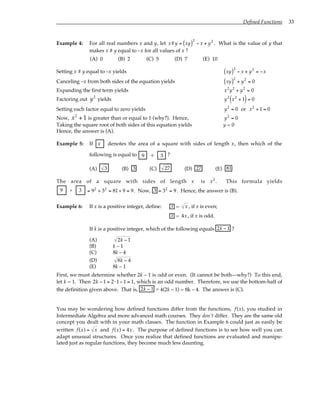
  • 353.
    The Six Questions353 phrase defines, clarifies, or gives evidence for the first word or phrase. The second word or phrase will be set off from the first by a comma, semicolon, hyphen, or parentheses. (Note: If a comma is not followed by a linking word—such as and, for, yet—then the following phrase is probably appositional.) Example: The discussions were acrimonious, frequently degenerating into name-calling contests. After the comma in this sentence, there is no linking word (such as and, but, because, although, etc.). Hence the phrase following the comma is in apposition to acrimonious—it defines or further clari- fies the word. Now acrimonious means bitter, mean-spirited talk, which would aptly describe a name-calling contest. Application: (Mini-passage) The technical phenomenon, embracing all the separate techniques, forms a whole.... It is useless to look for differentiations. They do exist, but only secondarily. The common features of the technical phenomenon are so sharply drawn that it is easy to discern that which is the technical phenomenon and that which is not. ... To analyze these common features is tricky, but it is simple to grasp them. Just as there are principles common to things as different as a wireless set and an internal- combustion engine, so the organization of an office and the construction of an aircraft have certain identical features. This identity is the primary mark of that thoroughgoing unity which makes the technical phenomenon a single essence despite the extreme diversity of its appearances. As a corollary, it is impossible to analyze this or that element out of it—a truth which is today particularly misunderstood. The great tendency of all persons who study techniques is to make distinctions. They distinguish between the different ele- ments of technique, maintaining some and discarding others. They distinguish between technique and the use to which it is put. These distinctions are completely invalid and show only that he who makes them has understood nothing of the techni- cal phenomenon. Its parts are ontologically tied together; in it, use is inseparable from being. From Jacques Ellul, The Technological Society, ©1964 by Alfred A. Knopf, Inc. The “technical phenomenon” referred to in the opening line can best be defined as (A) all of the machinery in use today (B) the abstract idea of the machine (C) a way of thinking in modern society (D) what all machines have in common (A): No, it is clear from the passage that the technical phenomenon is more abstract than that, since it is described in the opening paragraph as uniting all the separate “techniques” (not machines) and as comprising the “features” that such things as an office and an aircraft have in common. (B): No, the passage states that the technical phenomenon is something that includes both techniques and their use (See closing lines of the passage); it is thus broader that just the idea of machinery. (C): Yes, this seems to be the best answer; it is broad enough to include both tech- niques and their uses and abstract enough to go beyond talking only about machines. (D): No, the passage suggests that it is something that techniques have in common and techniques can include airplanes or offices.
  • 354.
    354 GMAT PrepCourse WRITING TECHNIQUE QUESTIONS All coherent writing has a superstructure or blueprint. When writing, we don’t just randomly jot down our thoughts; we organize our ideas and present them in a logical manner. For instance, we may present evidence that builds up to a conclusion but intentionally leave the conclusion unstated, or we may present a position and then contrast it with an opposing position, or we may draw an extended analogy. There is an endless number of writing techniques that authors use to present their ideas, so we cannot classify every method. However, some techniques are very common to the type of explanatory or opinionated writing found in GMAT passages. A. Compare and contrast two positions. This technique has a number of variations, but the most common and direct is to develop two ideas or systems (comparing) and then point out why one is better than the other (contrasting). Comparing Contr asting Idea 1 Idea 2 Some common tip-off phrases to this method of analysis are • By contrast • Similarly Some typical questions for these types of passages are • According to the passage, a central distinction between a woman’s presence and a man’s presence is: • In which of the following ways does the author imply that birds and reptiles are similar? Writing-technique questions are similar to main idea questions; except that they ask about how the author presents his ideas, not about the ideas themselves. Generally, you will be given only two writing methods to choose from, but each method will have two or more variations. Example: (Refer to passage on page 348.) Which one of the following best describes the organization of the passage? (A) Two systems of criminal justice are compared and contrasted, and one is deemed to be better than the other. (B) One system of criminal justice is presented as better than another. Then evidence is offered to support that claim. (C) Two systems of criminal justice are analyzed, and one specific example is exam- ined in detail. (D) A set of examples is furnished. Then a conclusion is drawn from them. (E) The inner workings of the criminal justice system are illustrated by using two systems. Clearly the author is comparing and contrasting two criminal justice systems. Indeed, the open- ing to paragraph two makes this explicit. The author uses a mixed form of comparison and contrast. He opens the passage by developing (comparing) both systems and then shifts to developing just the adversarial system. He opens the second paragraph by contrasting the two
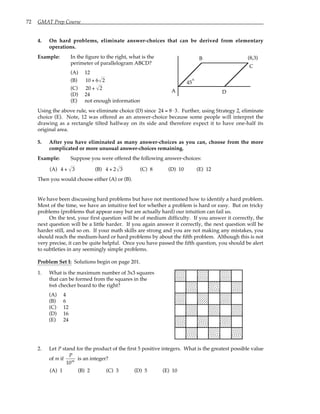
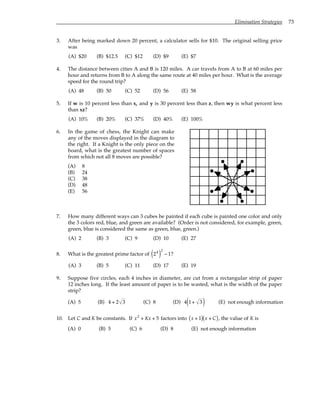
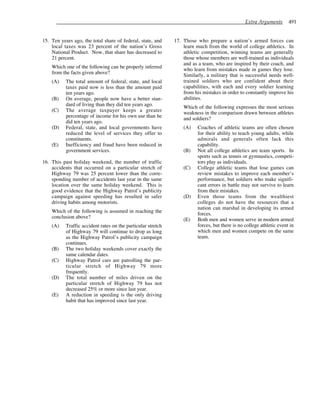
  • 355.
    The Six Questions355 criminal justice systems and then further develops just the inquisitorial system. Finally, he closes by again contrasting the two systems and implying that the inquisitorial system is superior. Only two answer-choices, (A) and (B), have any real merit. They say essentially the same thing—though in different order. Notice in the passage that the author does not indicate which system is better until the end of paragraph one, and he does not make that certain until paragraph two. This contradicts the order given by (B). Hence the answer is (A). (Note: In (A) the order is not specified and therefore is harder to attack, whereas in (B) the order is definite and therefore is easier to attack. Remember that a measured response is harder to attack and therefore is more likely to be the answer.) B. Show cause and effect. In this technique, the author typically shows how a particular cause leads to a certain result or set of results. It is not uncommon for this method to introduce a sequence of causes and effects. A causes B, which causes C, which causes D, and so on. Hence B is both the effect of A and the cause of C. For a discussion of the fallacies associated with this technique see Causal Reasoning (page 467). The variations on this rhetorical technique can be illustrated by the following schematics: C —> E C E E E C —> C/E —> C/E —> E Example: (Mini-passage) Thirdly, I worry about the private automobile. It is a dirty, noisy, wasteful, and lonely means of travel. It pollutes the air, ruins the safety and sociability of the street, and exercises upon the individual a discipline which takes away far more freedom than it gives him. It causes an enormous amount of land to be unnecessarily abstracted from nature and from plant life and to become devoid of any natural function. It explodes cities, grievously im- pairs the whole institution of neighborliness, fragmentizes and destroys communities. It has already spelled the end of our cities as real cultural and social communities, and has made impossible the construction of any others in their place. Together with the airplane, it has crowded out other, more civilized and more convenient means of transport, leaving older people, infirm people, poor people and children in a worse situation than they were a hun- dred years ago. It continues to lend a terrible element of fragility to our civilization, placing us in a situation where our life would break down completely if anything ever interfered with the oil supply. George F. Kennan Which of the following best describes the organization of the passage? (A) A problem is presented and then a possible solution is discussed. (B) The benefits and demerits of the automobile are compared and contrasted. (C) A topic is presented and a number of its effects are discussed. (D) A set of examples is furnished to support a conclusion. This passage is laden with effects. Kennan introduces the cause, the automobile, in the opening sentence and from there on presents a series of effects—the automobile pollutes, enslaves, and so on. Hence the answer is (C). Note: (D) is the second-best choice; it is disqualified by two flaws. First, in this context, “examples” is not as precise as “effects.” Second, the order is wrong: the conclusion, “I worry about the private automobile” is presented first and then the examples: it pollutes, it enslaves, etc.
  • 356.
    356 GMAT PrepCourse C. State a position and then give supporting evidence. This technique is common with opinionated passages. Equally common is the reverse order. That is, the supporting evidence is presented and then the position or conclusion is stated. And sometimes the evidence will be structured to build up to a conclusion which is then left unstated. If this is done skillfully the reader will be more likely to arrive at the same conclusion as the author. E E E E E E Unstated Position Position Following are some typical questions for these types of passages: • According to the author, which of the following is required for one to become proficient with a computer? • Which of the following does the author cite as evidence that the bald eagle is in danger of becoming extinct? EXTENSION QUESTIONS Extension questions are the most common. They require you to go beyond what is stated in the passage, asking you to draw an inference from the passage, to make a conclusion based on the passage, or to identify one of the author’s tacit assumptions. You may be asked to draw a conclusion based on the ideas or facts presented: It can be inferred from the passage that . . . The passage suggests that . . . Since extension questions require you to go beyond the passage, the correct answer must say more than what is said in the passage. Beware of same language traps with these questions: the correct answer will often both paraphrase and extend a statement in the passage, but it will not directly quote it. “Same Language” traps: For extension questions, any answer-choice that explicitly refers to or repeats a statement in the passage will probably be wrong. The correct answer to an extension question will not require a quantum leap in thought, but it will add significantly to the ideas presented in the passage. Example: (Refer to passage on page 348.) The author views the prosecution’s role in the inquisitorial system as being (A) an advocate for both society and the defendant (B) solely responsible for starting a trial (C) a protector of the legal rule (D) an investigator only (E) an aggressive but fair investigator This is an extension question. So the answer will not be explicitly stated in the passage, but it will be strongly supported by it.
  • 357.
    The Six Questions357 The author states that the prosecutor is duty bound to present any evidence that may prove the defendant innocent and that he must disclose all pretrial evidence (i.e., have no tricks up his sleeve). This is the essence of fair play. So the answer is probably (E). However, we should check all the choices. (A) overstates the case. Although the prosecutor must disclose any evidence that might show the defendant innocent, the prosecutor is still advo- cating society’s case against the defendant—it must merely be measured advocacy. This is the second-best answer. As for (B), although it is implied that in both systems the right to initiate a case is extended to all people through the prosecutor, it is not stated or implied that this is the only way to start a case. Finally, neither (C) nor (D) is mentioned or implied in the passage. The answer, therefore, is (E). Application: (Mini-passage) Often, the central problem in any business is that money is needed to make money. The following discusses the sale of equity, which is one response to this problem. Sale of Capital Stock: a way to obtain capital through the sale of stock to individ- ual investors beyond the scope of one’s immediate acquaintances. Periods of high interest rates turn entrepreneurs to this equity market. This involves, of necessity, a dilution of ownership, and many owners are reluctant to take this step for that reason. Whether the owner is wise in declining to use outside equity financing depends upon the firm’s long-range prospects. If there is an opportunity for substantial expansion on a continuing basis and if other sources are inadequate, the owner may decide logically to bring in other owners. Owning part of a larger business may be more profitable than owning all of a smaller business. Small-Business Management, 6th Ed., © 1983 by South-Western Publishing Co. The passage implies that an owner who chooses not to sell capital stock despite the prospect of continued expansion is (A) subject to increased regulation (B) more conservative than is wise under the circumstances (C) likely to have her ownership of the business diluted (D) sacrificing security for rapid growth (A): No. This is not mentioned in the passage. (B): Yes. The passage states that “the owner may decide logically to bring in other owners”; in other words, the owner would be wise to sell stock in this situation. (C): No. By NOT selling stock, the owner retains full ownership. (D) No. Just the opposite: the owner would be sacrificing a measure of security for growth if she did sell stock. APPLICATION QUESTIONS Application questions differ from extension questions only in degree. Extension questions ask you to apply what you have learned from the passage to derive new information about the same subject, whereas application questions go one step further, asking you to apply what you have learned from the passage to a different or hypothetical situation. The following are common application questions: Which one of the following is the most likely source of the passage? Which one of the following actions would be most likely to have the same effect as the author’s actions? You may be asked to complete a thought for the author:
  • 358.
    358 GMAT PrepCourse The author would most likely agree with which one of the following statements? Which one of the following sentences would the author be most likely to use to complete the last paragraph of the passage? To answer an application question, take the author’s perspective. Ask yourself: what am I arguing for? what might make my argument stronger? what might make it weaker? Because these questions go well beyond the passage, they tend to be the most difficult. Furthermore, because application questions and extension questions require a deeper understanding of the passage, skimming (or worse yet, speed-reading) the passage is ineffective. Skimming may give you the main idea and structure of the passage, but it is unlikely to give you the subtleties of the author’s attitude. Example: (Refer to passage on page 348.) Based on the information in the passage, it can be inferred that which one of the follow- ing would most logically begin a paragraph immediately following the passage? (A) Because of the inquisitorial system’s thoroughness in conducting its pretrial investigation, it can be concluded that a defendant who is innocent would prefer to be tried under the inquisitorial system, whereas a defendant who is guilty would prefer to be tried under the adversarial system. (B) As the preceding analysis shows, the legal system is in a constant state of flux. For now the inquisitorial system is ascendant, but it will probably be soon replaced by another system. (C) The accusatorial system begins where the inquisitorial system ends. So it is three steps removed from the system of private vengeance, and therefore historically superior to it. (D) Because in the inquisitorial system the judge must take an active role in the con- duct of the trial, his competency and expertise have become critical. (E) The criminal justice system has evolved to the point that it no longer seems to be derivative of the system of private vengeance. Modern systems of criminal jus- tice empower all of society with the right to instigate a legal action, and the need for vengeance is satisfied through a surrogate—the public prosecutor. The author has rather thoroughly presented his position, so the next paragraph would be a natural place for him to summarize it. The passage compares and contrasts two systems of crim- inal justice, implying that the inquisitorial system is superior. We expect the concluding para- graph to sum up this position. Now all legal theory aside, the system of justice under which an innocent person would choose to be judged would, as a practical matter, pretty much sum up the situation. Hence the answer is (A). Application: (Mini-passage) The idea of stuff expresses no more than the experience of coming to a limit at which our senses or our instruments are not fine enough to make out the pattern. Something of the same kind happens when the scientist investigates any unit or pattern so distinct to the naked eye that it has been considered a separate entity. He finds that the more carefully he observes and describes it, the more he is also describing the environment in which it moves and other patterns to which it seems inseparably related. As Teilhard de Chardin has so well expressed it, the isolation of individual, atomic patterns “is merely an intellectual dodge.” ...Although the ancient cultures of Asia never attained the rigorously exact physi- cal knowledge of the modern West, they grasped in principle many things which are only now occurring to us. Hinduism and Buddhism are impossible to classify as reli- gions, philosophies, sciences, or even mythologies, or again as amalgamations of all
  • 359.
    The Six Questions359 four, because departmentalization is foreign to them even in so basic a form as the sep- aration of the spiritual and the material.... Buddhism ... is not a culture but a critique of culture, an enduring nonviolent revolution, or “loyal opposition,” to the culture with which it is involved. This gives these ways of liberation something in common with psychotherapy beyond the interest in changing states of consciousness. For the task of the psychotherapist is to bring about a reconciliation between individual feeling and social norms without, however, sacrificing the integrity of the individual. He tries to help the individual to be himself and to go it alone in the world (of social convention) but not of the world. From Alan W. Watts, Psychotherapy East and West, © 1961 by Pantheon Books, a division of Random House. What does the passage suggest about the theme of the book from which it is excerpted? (A) The book attempts to understand psychotherapy in the context of different and changing systems of thought. (B) The book argues that psychotherapy unites elements of an exact science with elements of eastern philosophy. (C) The book describes the origins of psychotherapy around the world. (D) The book compares psychotherapy in the West and in the East. (A): Yes, this is the most accurate inference from the passage. The passage discusses how the more carefully a scientist views and describes something the more he describes the environment in which it moves, and the passage traces similarities between psychotherapy and Eastern systems of (evolving) thought. (B): No, this is too narrow an interpretation of what the whole book would be doing. (C): No, too vague; the passage is too philosophical to be merely a history. (D): No, also too vague, meant to entrap those of you who relied on the title without thinking through the passage. TONE QUESTIONS Tone questions ask you to identify the writer’s attitude or perspective. Is the writer’s feeling toward the subject positive, negative, or neutral? Does the writer give his own opinion, or does he objectively present the opinions of others? Before you read the answer-choices, decide whether the writer’s tone is positive, negative, or neutral. It is best to do this without referring to the passage. However, if you did not get a feel for the writer’s attitude on the first reading, check the adjectives that he chooses. Adjectives and, to a lesser extent, adverbs express our feelings toward subjects. For instance, if we agree with a person who holds strong feelings about a subject, we may describe his opinions as impassioned. On the other hand, if we disagree with him, we may describe his opinions as excitable, which has the same meaning as “impassioned” but carries a negative connotation. Example: (Refer to passage on page 348.) The author’s attitude toward the adversarial system can best be described as (A) encouraged that it is far removed from the system of private vengeance (B) concerned that it does not allow all members of society to instigate legal action (C) pleased that it does not require the defendant to conduct his own pretrial investigation (D) hopeful that it will be replaced by the inquisitorial system (E) doubtful that it is the best vehicle for justice The author does not reveal his feelings toward the adversarial system until the end of paragraph one. Clearly the clause “the adversarial system of criminal procedure symbolizes and regularizes
  • 360.
    360 GMAT PrepCourse the punitive combat” indicates that he has a negative attitude toward the system. This is confirmed in the second paragraph when he states that the inquisitorial system is historically superior to the adversarial system. So he feels that the adversarial system is deficient. The “two-out-of-five” rule is at work here: only choices (D) and (E) have any real merit. Both are good answers. But which one is better? Intuitively, choice (E) is more likely to be the answer because it is more measured. To decide between two choices attack each: the one that survives is the answer. Now a tone question should be answered from what is directly stated in the passage—not from what it implies. Although the author has reservations toward the adver- sarial system, at no point does he say that he hopes the inquisitorial system will replace it, he may prefer a third system over both. This eliminates (D); the answer therefore is (E). The remaining choices are not supported by the passage. (A), using the same language as in the passage, overstates the author’s feeling. In lines 13–15, he states that the adversarial system is only one step removed from the private vengeance system—not far removed. Remember: Be wary of extreme words. (A) would be a better choice if “far” were dropped. (B) makes a false claim. In lines 16–19, the author states that the adversarial system does extend the right to initiate legal action to all members of society. Finally, (C) also makes a false claim. In lines 21–23, the author states that the defendant in the adversarial system is still left to conduct his own pretrial investigation. Application: (Mini-passage) An elm in our backyard caught the blight this summer and dropped stone dead, leafless, almost overnight. One weekend it was a normal-looking elm, maybe a little bare in spots but nothing alarming, and the next weekend it was gone, passed over, departed, taken.... The dying of a field mouse, at the jaws of an amiable household cat, is a spectacle I have beheld many times. It used to make me wince.... Nature, I thought, was an abomination. Recently I’ve done some thinking about that mouse, and I wonder if his dying is necessarily all that different from the passing of our elm. The main difference, if there is one, would be in the matter of pain. I do not believe that an elm tree has pain receptors, and even so, the blight seems to me a relatively painless way to go. But the mouse dangling tail- down from the teeth of a gray cat is something else again, with pain beyond bearing, you’d think, all over his small body. There are now some plausible reasons for thinking it is not like that at all.... At the instant of being trapped and penetrated by teeth, peptide hormones are released by cells in the hypothalamus and the pituitary gland; instantly these substances, called endorphins, are attached to the surfaces of other cells responsible for pain perception; the hormones have the pharmacologic properties of opium; there is no pain. Thus it is that the mouse seems always to dangle so languidly from the jaws, lies there so quietly when dropped, dies of his injuries without a struggle. If a mouse could shrug, he’d shrug.... Pain is useful for avoidance, for getting away when there’s time to get away, but when it is end game, and no way back, pain is likely to be turned off, and the mechanisms for this are wonderfully precise and quick. If I had to design an ecosystem in which creatures had to live off each other and in which dying was an indispensable part of living, I could not think of a better way to manage. From Lewis Thomas, On Natural Death, © 1979 by Lewis Thomas. Which one of the following would best characterize the author’s attitude toward the relationship between pain and death? (A) Dismay at the inherent cruelty of nature (B) Amusement at the irony of the relationship between pain and death (C) Admiration for the ways in which animal life functions in the ecosystem (D) A desire to conduct experiments on animals in order to discover more about the relationship between pain and death
  • 361.
    The Six Questions361 The author’s attitude toward the relationship between pain and death evolves through three stages. First, he expresses revulsion at the relationship. This is indicated in the second paragraph by the words “wince” and “abomination.” Then in the third paragraph, he adopts a more analyti- cal attitude and questions his previous judgment. This is indicated by the clause, “I wonder if his dying is necessarily all that different from the passing of our elm.” And in closing the paragraph, he seems resigned to the fact the relationship is not all that bad. This is indicated by the sentence, “If a mouse could shrug, he’d shrug.” Finally, in the last paragraph, he comes to express admiration for the relationship between pain and death. This is indicated by the phrase “wonderfully precise and quick,” and it is made definite by the closing line, “If I had to design an ecosystem . . . in which dying was an indispensable part of living, I could not think of a better way to manage.” Thus, the answer is (C). The other choices are easily ruled out. Choice (A) is perhaps superficially tempting. In the second paragraph the author does express dismay at the ways of nature, but notice that his con- cerns are in the past tense. He is now more understanding, wiser of the ways of nature. As to (B), the author is subtly reverential, never ironical, toward nature. Finally, (D) is not mentioned or alluded to in the passage. Beware of answer-choices that contain extreme emotions. Remember the passages are taken from academic journals. In the rarefied air of academic circles, strong emotions are considered inappropriate and sophomoric. The writers want to display opinions that are considered and reasonable, not spontaneous and off-the-wall. So if an author’s tone is negative, it may be disapproving—not snide. Or if her tone is positive, it may be approving—not ecstatic. Furthermore, the answers must be indisputable. If the answers were subjective, then the writers of the GMAT would be deluged with letters from angry test takers, complaining that their test-scores are unfair. To avoid such a difficult position, the writers of the GMAT never allow the correct answer to be either controversial or grammatically questionable. Let’s use these theories to answer the following questions. Example: Which one of the following most accurately characterizes the author’s attitude with respect to Phillis Wheatley’s literary accomplishments? (A) enthusiastic advocacy (B) qualified admiration (C) dispassionate impartiality (D) detached ambivalence (E) perfunctory dismissal Even without reference to the passage, this is not a difficult question to answer. Scholars may advocate each other’s work, but they are unlikely to be enthusiastic advocates. Furthermore, the context stretches the meaning of advocacy—to defend someone else’s cause or plight. So (A) is unlikely to be the answer. (B) is the measured response and therefore is probably the answer. “Dispassionate impartiality” is a rather odd construction; additionally, it is redundant. It could never be the answer to a GMAT question. This eliminates (C). “Detached ambivalence” is not as odd as “dispassionate impartiality,” but it is unusual. So (D) is unlikely to be the answer. Remember, scholars want their audience to consider their opinions well thought out, not off- the-wall. But perfunctory means “hasty and superficial.” So (E) could not be the answer. Hence, even without the passage we can still find the answer, (B).
  • 362.
    362 GMAT PrepCourse Example: Which one of the following best describes the author’s attitude toward scientific techniques? (A) critical (B) hostile (C) idealistic (D) ironic (E) neutral (A) is one of two measured responses offered. Now a scholar may be critical of a particular scientific technique, but only a crackpot would be critical of all scientific techniques—eliminate (A). “Hostile” is far too negative. Scholars consider such emotions juvenile—eliminate (B). “Idealistic,” on the other hand, is too positive; it sounds pollyannaish—eliminate (C). “Ironic” seems illogical in this context. It’s hard to conceive of a person having an ironic attitude toward scientific techniques—eliminate (D). (E) is the other measured response, and by elimination it is the answer. Description, extension, and application questions make up about 80% of the reading comprehension questions, main idea questions about 10%, and tone and writing technique questions about 5% each. Points to Remember 1. The order of the passage questions roughly corresponds to the order in which the issues are presented in the passage. 2. The six questions are Main Idea Description Writing Technique Extension Application Tone 3. The main idea of a passage is usually stated in the last, sometimes the first, sentence of the first paragraph. If it’s not there, it will probably be the last sentence of the entire passage. 4. If after the first reading, you don’t have a feel for the main idea, review the first and last sentence of each paragraph. 5. The answer to a description question must refer directly to a statement in the passage, not to something implied by it. However, the correct answer will paraphrase a passage statement, not quote it exactly. In fact, exact quotes are used with these questions to bait wrong answers. 6. When answering a description question, you must find the point in the passage from which the question is drawn.
  • 363.
    The Six Questions363 7. If a description question refers to line 20, the information needed to answer it can occur anywhere from line 15 to 25. 8. Some writing techniques commonly used in the GMAT passages are A. Compare and contrast two positions. B. Show cause and effect. C. State a position; then give supporting evidence. 9. For extension questions, any answer-choice that refers explicitly to or repeats a statement in the passage will probably be wrong. 10. Application questions differ from extension questions only in degree. Extension questions ask you to apply what you have learned from the passage to derive new information about the same subject, whereas application questions go one step further, asking you to apply what you have learned from the passage to a different or hypothetical situation. 11. To answer an application question, take the perspective of the author. Ask yourself: what am I arguing for? what might make my argument stronger? what might make it weaker? 12. Because application questions go well beyond the passage, they tend to be the most difficult. 13. For tone questions, decide whether the writer’s tone is positive, negative, or neutral before you look at the answer-choices. 14. If you do not have a feel for the writer’s attitude after the first reading, check the adjectives that she chooses. 15. Beware of answer-choices that contain extreme emotions. If an author’s tone is negative, it may be disapproving—not snide. Or if her tone is positive, it may be approving—not ecstatic. 16. The answers must be indisputable. A correct answer will never be controversial or gram- matically questionable. 17. Description, extension, and application questions make up about 80% of the reading comprehension questions, main idea questions about 10%, and tone and writing technique questions about 5% each.
  • 364.
    364 GMAT PrepCourse Mentor Exercise Directions: This passage is followed by a group of questions to be answered based on what is stated or implied in the passage. Choose the best answer; the one that most accurately and completely answers the question. Hints, insights, and answers immediately follow the questions. From Romania to Germany, from Tallinn to Belgrade, a major historical process—the death of communism—is taking place. The German Democratic Republic no longer exists as a sepa- rate state. And the former German Democratic 5 Republic will serve as the first measure of the price a post-Communist society has to pay for entering the normal European orbit. In Yugoslavia we will see whether the federation can survive without communism. 10 One thing seems common to all these coun- tries: dictatorship has been defeated and free- dom has won, yet the victory of freedom has not yet meant the triumph of democracy. Democracy is something more than freedom. 15 Democracy is freedom institutionalized, free- dom submitted to the limits of the law, freedom functioning as an object of compromise between the major political forces on the scene. We have freedom, but we still have not 20 achieved the democratic order. That is why this freedom is so fragile. In the years of democratic opposition to communism, we supposed that the easiest thing would be to introduce changes in the economy. In fact, we thought that the march 25 from a planned economy to a market economy would take place within the framework of the bureaucratic system, and that the market within the Communist state would explode the totali- tarian structures. Only then would the time 30 come to build the institutions of a civil society; and only at the end, with the completion of the market economy and the civil society, would the time of great political transformations finally arrive. 35 The opposite happened. First came the big political change, the great shock, which either broke the monopoly and the principle of Communist Party rule or simply pushed the Communists out of power. Then came the cre- 40 ation of civil society, whose institutions were created in great pain, and which had trouble negotiating the empty space of freedom. Only then, as the third moment of change, the final task was undertaken: that of transforming the 45 totalitarian economy into a normal economy where different forms of ownership and differ- ent economic actors will live one next to the other. Today we are in a typical moment of transi- 50 tion. No one can say where we are headed. The people of the democratic opposition have the feeling that we won. We taste the sweetness of our victory the same way the Communists, only yesterday our prison guards, taste the bitterness 55 of their defeat. Yet, even as we are conscious of our victory, we feel that we are, in a strange way, losing. In Bulgaria the Communists have won the parliamentary elections and will govern the country, without losing their social legiti- 60 macy. In Romania the National Salvation Front, largely dominated by people from the old Communist bureaucracy, has won. In other countries democratic institutions seem shaky, and the political horizon is cloudy. The mas- 65 querade goes on: dozens of groups and parties are created, each announces similar slogans, each accuses its adversaries of all possible sins, and each declares itself representative of the na- tional interest. Personal disputes are more im- 70 portant than disputes over values. Arguments over values are fiercer than arguments over ideas.
  • 365.
    The Six Questions365 1. The author originally thought that the order of events in the transformation of commu- nist society would be represented by which one of the following? (A) A great political shock would break the totalitarian monopoly, leaving in its wake a civil society whose task would be to change the state-con- trolled market into a free economy. (B) The transformation of the economy would destroy totalitarianism, after which a new and different social and political structure would be born. (C) First the people would freely elect political representatives who would transform the economy, which would then undermine the totalitarian structure. (D) The change to a democratic state would necessarily undermine totali- tarianism, after which a new economic order would be created. (E) The people’s frustration would build until it spontaneously generated vio- lent revolution, which would sentence society to years of anarchy and regression. 2. Beginning in the second paragraph, the author describes the complicated relation- ship between “freedom” and “democracy.” In the author’s view, which one of the fol- lowing statements best reflects that relationship? (A) A country can have freedom without having democracy. (B) If a country has freedom, it necessarily has democracy. (C) A country can have democracy without having freedom. (D) A country can never have democracy if it has freedom. (E) If a country has democracy, it cannot have freedom. 1. This is a description question, so you should locate the point in the passage from which it was drawn. It is the third para- graph. In lines 25–30, the author recalls his expectation that, by introducing the market system, the communist system would topple from within. Be careful not to choose (A). It chroni- cles how the events actually occurred, not how they were anticipated to occur. (A) is baited with the words “great shock,” “monopoly,” and “civil society.” The answer is (B). 2. This is an extension question, so the answer must say more than what is said in the passage, without requiring a quantum leap in thought. The needed reference is “Democracy is something more than freedom” (line 15). Since freedom can exist without democracy, freedom alone does not insure democracy. The answer is (A).
  • 366.
    366 GMAT PrepCourse 3. From the passage, a reader could conclude that which one of the following best describes the author’s attitude toward the events that have taken place in communist society? (A) Relieved that at last the democratic order has surfaced. (B) Clearly wants to return to the old order. (C) Disappointed with the nature of the democracy that has emerged. (D) Confident that a free economy will ultimately provide the basis for a true democracy. (E) Surprised that communism was toppled through political rather than economic means. 4. A cynic who has observed political systems in various countries would likely interpret the author’s description of the situation at the end of the passage as (A) evidence that society is still in the throws of the old totalitarian structure. (B) a distorted description of the new political system. (C) a necessary political reality that is a prelude to “democracy.” (D) a fair description of many democratic political systems. (E) evidence of the baseness of people. 3. This is a tone question. The key to answering this question is found in the closing comments. There the author states “The masquerade goes on,” referring to nascent democracies. So he has reservations about the newly emerging democracies. Watch out for (E). Although it is sup- ported by the passage, it is in a supporting paragraph. The ideas in a concluding para- graph take precedence over those in a sup- porting paragraph. The answer is (C). 4. This is an application question. These are like extension questions, but they go well beyond what is stated in the passage. In this case we are asked to interpret the author’s comments from a cynic’s perspective. Because application questions go well beyond the passage, they are often difficult, as is this one. Hint: A cynic looks at reality from a negative perspective, usually with a sense of dark irony and hopelessness. Don’t make the mistake of choosing (E). Although a cynic is likely to make such a statement, it does not address the subject of the passage—political and economic sys- tems. The passage is not about human nature, at least not directly. The answer is (D).
  • 367.
    The Six Questions367 5. Which one of the following does the author imply may have contributed to the difficul- ties involved in creating a new democratic order in eastern Europe? I. The people who existed under the totalitarian structure have not had the experience of “negotiating the empty space of freedom.” II. Mistaking the order in which political, economic, and social restructuring would occur. III. Excessive self-interest among the new political activists. (A) I only (B) II only (C) I and III only (D) II and III only (E) I, II, and III 6. By stating “even as we are conscious of our victory, we feel that we are, in a strange way, losing” (lines 56–58) the author means that (A) some of the old governments are still unwilling to grant freedom at the individual level. (B) some of the new governments are not strong enough to exist as a single federation. (C) some of the new democratic govern- ments are electing to retain the old political parties. (D) no new parties have been created to fill the vacuum created by the victory of freedom. (E) some of the new governments are reverting to communism. 5. This is an extension question. Statement I is true. In lines 40–43, the author implies that the institutions of the new-born, free society were created in great pain because the people lacked experience. Statement II is true. Expectations that the market mecha- nisms would explode totalitarianism and usher in a new society were dashed, and having to readjust one’s expectations certainly makes a situation more difficult. Finally, statement III is true. It summarizes the thrust of the passage’s closing lines. The answer is (E). 6. This is a hybrid extension and description question. Because it refers to a specific point in the passage, you must read a few sentences before and after it. The answer can be found in lines 58–70. The answer is (C).
  • 368.
    368 GMAT PrepCourse Exercise Directions: This passage is followed by a group of questions to be answered based on what is stated or implied in the passage. Choose the best answer; the one that most accurately and completely answers the question. In the United States the per capita costs of schooling have risen almost as fast as the cost of medical treatment. But increased treatment by both doctors and teachers has shown steadily declining results. Medical expenses 5 concentrated on those above forty-five have doubled several times over a period of forty years with a resulting 3 percent increase in the life expectancy of men. The increase in educa- tional expenditures has produced even 10 stranger results; otherwise President Nixon could not have been moved this spring to promise that every child shall soon have the “Right to Read” before leaving school. In the United States it would take eighty 15 billion dollars per year to provide what educa- tors regard as equal treatment for all in gram- mar and high school. This is well over twice the $36 billion now being spent. Independent cost projections prepared at HEW and at the 20 University of Florida indicate that by 1974 the comparable figures will be $107 billion as against the $45 billion now projected, and these figures wholly omit the enormous costs of what is called “higher education,” for which 25 demand is growing even faster. The United States, which spent nearly eighty billion dollars in 1969 for “defense,” including its deployment in Vietnam, is obviously too poor to provide equal schooling. The President’s 30 committee for the study of school finance should ask not how to support or how to trim such increasing costs, but how they can be avoided. Equal obligatory schooling must be rec- 35 ognized as at least economically unfeasible. In Latin America the amount of public money spent on each graduate student is between 350 and 1,500 times the amount spent on the me- dian citizen (that is, the citizen who holds the 40 middle ground between the poorest and the richest). In the United States the discrepancy is smaller, but the discrimination is keener. The richest parents, some 10 percent, can af- ford private education for their children and 45 help them to benefit from foundation grants. But in addition they obtain ten times the per capita amount of public funds if this is com- pared with the per capita expenditure made on the children of the 10 percent who are 50 poorest. The principal reasons for this are that rich children stay longer in school, that a year in a university is disproportionately more expensive than a year in high school, and that most private universities depend—at least 55 indirectly—on tax-derived finances. Obligatory schooling inevitably polarizes a society; it also grades the nations of the world according to an international caste sys- tem. Countries are rated like castes whose ed- 60 ucational dignity is determined by the average years of schooling of its citizens, a rating which is closely related to per capita gross na- tional product, and much more painful. 1. Which one of the following best expresses the main idea of the passage? (A) The educational shortcomings of the United States, in contrast to those of Latin America, are merely the result of poor allocation of available resources. (B) Both education and medical care are severely underfunded. (C) Defense spending is sapping funds which would be better spent in education. (D) Obligatory schooling must be scrapped if the goal of educational equality is to be realized. (E) Obligatory education does not and cannot provide equal education.
  • 369.
    The Six Questions369 2. The author most likely would agree with which one of the following solutions to the problems presented by obligatory educa- tion? (A) Education should not be obligatory at all. (B) Education should not be obligatory for those who cannot afford it. (C) More money should be diverted to education for the poorest. (D) Countries should cooperate to estab- lish common minimal educational standards. (E) Future spending should be capped. 3. According to the passage, education is like health care in all of the following ways EXCEPT: (A) It has reached a point of diminishing returns, increased spending no longer results in significant improvement. (B) It has an inappropriate “more is bet- ter” philosophy. (C) It is unfairly distributed between rich and poor. (D) The amount of money being spent on older students is increasing. (E) Its cost has increased nearly as fast. 4. Why does the author consider the results from increased educational expenditures to be “even stranger” than those from increased medical expenditures? (A) The aging of the population should have had an impact only on medical care, not on education. (B) The “Right to Read” should be a bare minimum, not a Presidential ideal. (C) Educational spending has shown even poorer results than spending on health care, despite greater increases. (D) Education has become even more discriminatory than health care. (E) It inevitably polarizes society. 5. Which one of the following most accurately characterizes the author’s attitude with respect to obligatory schooling? (A) qualified admiration (B) critical (C) neutral (D) ambivalent (E) resentful 6. By stating “In Latin America the amount of public money spent on each graduate stu- dent is between 350 and 1,500 times the amount spent on the median citizen” and “In the United States the discrepancy is smaller” the author implies that (A) equal education is possible in the United States but not in Latin America. (B) equal education for all at the gradu- ate level is an unrealistic ideal. (C) educational spending is more effi- cient in the United States. (D) higher education is more expensive than lower education both in Latin America and in the United States, but more so in Latin America. (E) underfunding of lower education is a world-wide problem.
  • 370.
    370 GMAT PrepCourse Answers and Solutions to Exercise 1. The answer to a main idea question will summarize the passage, without going beyond it. (A) fails to meet these criteria because it makes a false claim. Lines 36–42 imply that the discrepancy in allocation of funds is greater in Latin America. Besides, Latin America is mentioned only in passing, so this is not the main idea. (B) also makes a false claim. The author implies that increased funding for education is irrelevant, if not counterproductive. In fact, the sentence “The President’s committee for the study of school finance should ask not how to support or how to trim such increasing costs, but how they can be avoided” implies that he thinks an increase in funding would be counterpro- ductive. (C) is implied by the sentence “The United States . . . is obviously too poor to provide equal schooling,” but the author does not fully develop this idea. Besides, he implies that the problem is not financial. (D) is the second-best answer-choice. The answer to a main idea question should sum up the passage, not make a conjecture about it. Clearly the author has serious reservations about obligatory schooling, but at no point does he state or imply that it should be scrapped. He may believe that it can be modified, or he may be resigned to the fact that, for other reasons, it is necessary. We don’t know. Finally, (E) aptly summarizes the passage, without going beyond it. The key to seeing this is the opening to paragraph three, “Equal obligatory schooling must be recognized as at least economically unfeasible.” In other words, regardless of any other failings, it cannot succeed economically and therefore cannot provide equal education. 2. This is an application question. These questions tend to be rather difficult, though this one is not. To answer an application question, put yourself in the author’s place. If you were arguing his case, which of the solutions would you advocate? As to (A), although we rejected the recommendation that obligatory education be eliminated as Question 1’s answer, it is the answer to Question 2. The author does not merely imply that obligatory education has some shortcomings; he suggests that it is fundamentally flawed. Again this is made clear by the opening to paragraph three, “Equal obligatory schooling must be recognized as at least economically unfeasible.” Still, there is a possible misunderstanding here: perhaps the author believes that obligatory education is a noble but unrealistic idea. This possibility, however, is dispelled by the closing paragraph in which he states that obligatory education polarizes society and sets up a caste system. Obviously, such a system, if this is true, should be discarded. The answer is (A). The other choices can be easily dismissed. (B) is incorrect because nothing in the passage suggests that the author would advocate a solution that would polarize society even more. Indeed, at the end of paragraph three, he suggests that the rich already get more than their fair share. (C) is incorrect because it contradicts the author. Paragraph two is dedicated to show- ing that the United States is too poor to pro- vide equal schooling. You can’t divert money you don’t have. (D) is incorrect. It reads too much into the last paragraph. Finally, (E) is the second-best answer- choice. Although the author probably believes that future spending should be restrained or capped, this understates the thrust of his argument. However, he might offer this as a compromise to his opponents. 3. This is a description question, so we must find the place from which it is drawn. It is the first paragraph. The sentence “But increased treatment by both doctors and teachers has shown steadily declining results” shows that both have reached a point of diminishing returns. This eliminates (A) and (B). Next, the passage states “Medical expenses concentrated on those above forty-five have doubled several times” (lines 5–7) and that the demand and costs of higher education are growing faster than the demand and costs of elementary and high school edu- cation. This eliminates (D). Next, the opening to the passage states that the costs of education “have risen almost as fast as the cost of medical
  • 371.
    The Six Questions371 treatment.” This eliminates (E). Hence, by process of elimination, the answer is (C). We should, however, verify this. In paragraph three, the author does state that there is a “keen” discrepancy in the funding of educa- tion between rich and poor, but a survey of the passage shows that at no point does he men- tion that this is also the case with health care. 4. This is an extension question. We are asked to interpret a statement by the author. The needed reference is the closing sentence to paragraph one. Remember: extension ques- tions require you to go beyond the passage, so the answer won’t be explicitly stated in the reference—we will have to interpret it. The implication of President Nixon’s promise is that despite increased educational funding many children cannot even read when they graduate from school. Hence the answer is (B). Don’t make the mistake of choosing (C). Although at first glance this is a tempting inference, it would be difficult to compare the results of education and medical care directly (how would we do so?). Regardless, the open- ing line to the passage states that educational costs have risen “almost as fast” as medical costs, not faster. (A) is incorrect because the passage never mentions the aging of the population. The same is true for (D). Many students who cannot solve this question choose (E)—don’t. It uses as bait language from the passage, “inevitably polarizes a society.” Note: The phrase “Right to Read” in (B) is not a same language trap; it is merely part of a paraphrase of the passage. The correct answer to an extension question will often both paraphrase and extend a passage statement but will not quote it directly, as in (E). 5. Like most tone questions this one is rather easy. Although choice (A) is a measured response, the author clearly does not admire the obligatory school system. This eliminates (A); it also eliminates (C) and (D). Of the two remaining choices, (B) is the measured response, and it is the answer. Although the author strongly opposes obligatory schooling, “resentful” is too strong and too personal. A scholar would never directly express resent- ment or envy, even if that is his true feeling. 6. This is another extension question. By stating that the amount of funding spent on graduate students is more than 350 times the amount spent on the average citizen, the author implies that it would be impossible to equalize the funding. Hence the answer is (B). None of the other choices have any real merit. (A) is incorrect because the import of the passage is that the rich get better schooling and more public funds in the United States and therefore discrimination is “keener” here (lines 42–43). (C) and (D) are incorrect because they are neither mentioned nor implied by the passage. (E) is the second-best choice. Although this is implied by the numbers given, it has little to do with the primary purpose of the passage—to show that obligatory education is perhaps not such a good idea.
  • 372.
    372 Pivotal Words As mentionedbefore, each passage contains about 300 words and only a few questions, so you will not be tested on most of the material in the passage. Your best reading strategy, therefore, is to identify the places from which questions will most likely be drawn and concentrate your attention there. Pivotal words can help in this regard. Following are the most common pivotal words. PIVOTAL WORDS But Although However Yet Despite Nevertheless Nonetheless Except In contrast Even though As you may have noticed, these words indicate contrast. Pivotal words warn that the author is about to either make a U-turn or introduce a counter-premise (concession to a minor point that weakens the argument). Example: (Counter-premise) I submit that the strikers should accept the management’s offer. Admittedly, it is less than what was demanded. But it does resolve the main grievance—inadequate health care. Furthermore, an independent study shows that a wage increase greater than 5% would leave the company unable to compete against Japan and Germany, forcing it into bankruptcy. The conclusion, “the strikers should accept the management’s offer,” is stated in the first sentence. Then “Admittedly” introduces a concession (counter-premise); namely, that the offer was less than what was demanded. This weakens the speaker’s case, but it addresses a potential criticism of his position before it can be made. The last two sentences of the argument present more compelling reasons to accept the offer and form the gist of the argument. Pivotal words mark natural places for questions to be drawn. At a pivotal word, the author changes direction. The GMAT writers form questions at these junctures to test whether you turned with the author or you continued to go straight. Rarely do the GMAT writers let a pivotal word pass without drawing a question from its sentence. As you read a passage, note the pivotal words and refer to them when answering the questions. Let’s apply this theory to the passage on criminal justice. For easy reference, the passage is reprinted here in the left-hand column, with explanations in the right-hand column. The pivotal words are marked in bold.
  • 373.
    Pivotal Words 373 Thereare two major systems of criminal procedure in the modern world—the adversarial and the in- quisitorial. The former is associated with common law tradition and the latter with civil law tradition. Both systems were historically preceded by the sys- tem of private vengeance in which the victim of a crime fashioned his own remedy and administered it privately, either personally or through an agent. The vengeance system was a system of self-help, the essence of which was captured in the slogan “an eye for an eye, a tooth for a tooth.” The mod- ern adversarial system is only one historical step removed from the private vengeance system and still retains some of its characteristic features. Thus, for example, even though the right to insti- tute criminal action has now been extended to all members of society and even though the police de- partment has taken over the pretrial investigative functions on behalf of the prosecution, the adver- sarial system still leaves the defendant to conduct his own pretrial investigation. The trial is still viewed as a duel between two adversaries, refereed by a judge who, at the beginning of the trial has no knowledge of the investigative background of the case. In the final analysis the adversarial system of criminal procedure symbolizes and regularizes the punitive combat. By contrast, the inquisitorial system begins his- torically where the adversarial system stopped its development. It is two historical steps removed from the system of private vengeance. Therefore, from the standpoint of legal anthropology, it is his- torically superior to the adversarial system. Under the inquisitorial system the public investigator has the duty to investigate not just on behalf of the prosecutor but also on behalf of the defendant. Additionally, the public prosecutor has the duty to present to the court not only evidence that may lead to the conviction of the defendant but also evidence that may lead to his exoneration. This system mandates that both parties permit full pre- trial discovery of the evidence in their possession. Finally, in an effort to make the trial less like a duel between two adversaries, the inquisitorial system mandates that the judge take an active part in the conduct of the trial, with a role that is both directive and protective. Fact-finding is at the heart of the inquisitorial system. This system operates on the philosophical premise that in a criminal case the crucial factor is not the legal rule but the facts of the case and that the goal of the entire procedure is to experimentally recreate for the court the commission of the alleged crime. Even though—Here “even though” is in- troducing a concession. In the previous sentence, the author stated that the adver- sarial system is only one step removed from the private vengeance system. The author uses the two concessions as a hedge against potential criticism that he did not consider that the adversarial system has extended the right to institute criminal ac- tion to all members of society and that po- lice departments now perform the pretrial investigation. But the author then states that the adversarial system still leaves the defendant to conduct his own pretrial in- vestigation. This marks a good place from which to draw a question. Many people will misinterpret the two concessions as evidence that the adversarial system is two steps removed from the private vengeance system. By contrast—In this case the pivotal word is not introducing a concession. Instead it indicates a change in thought: now the author is going to discuss the other criminal justice system. This is a natural place to test whether the student has made the transition and whether he will attribute the properties soon to be introduced to the inquisitorial system, not the adversarial system. But also—In both places, “but also” indicates neither concession nor change in thought. Instead it is part of the coordinat- ing conjunction “not only . . . but also . . . .” Rather than indicating contrast, it empha- sizes the second element of the pair.
  • 374.
    374 GMAT PrepCourse Let’s see how these pivotal words can help answer the questions in the last section. The first is from the Description Section: Example: According to the passage, the inquisitorial system differs from the adversarial system in that (A) it does not make the defendant solely responsible for gathering evidence for his case (B) it does not require the police department to work on behalf of the prosecution (C) it does not allow the victim the satisfaction of private vengeance (D) it requires the prosecution to drop a weak case (E) a defendant who is innocent would prefer to be tried under the inquisitorial system The pivotal phrase “by contrast” flags the second paragraph as the place to begin looking. The pivotal phrase “but also” introduces the answer—namely that the prosecutor must also investigate “on behalf of the defendant.” The answer is (A). The next question is from the Writing Techniques Section: Example: Which one of the following best describes the organization of the passage? (A) Two systems of criminal justice are compared and contrasted, and one is deemed to be better than the other. (B) One system of criminal justice is presented as better than another. Then evidence is presented to support that claim. (C) Two systems of criminal justice are analyzed, and one specific example is exam- ined in detail. (D) A set of examples is presented. Then a conclusion is drawn from them. (E) The inner workings of the criminal justice system are illustrated by using two systems. The pivotal phrase “by contrast” gives this question away. The author is comparing and contrasting two criminal justice systems, which the opening pivotal word introduces. Hence the answer is (A). For our final example, consider the question from the Extension Section: Example: The author views the prosecution’s role in the inquisitorial system as being (A) an advocate for both society and the defendant (B) solely responsible for starting a trial (C) a protector of the legal rule (D) an investigator only (E) an aggressive but fair investigator The information needed to answer this question is introduced by the pivotal phrase, “but also.” There it is stated that the prosecutor must present evidence that may exonerate the defendant; that is, he must act fairly. The answer is (E).
  • 375.
    Pivotal Words 375 Pointsto Remember 1. Pivotal words indicate that the author is about to make a U-turn in thought or introduce a counter-premise (concession to a minor point that weakens the argument). 2. The following are the most common pivotal words: But Although However Yet Despite Nevertheless Nonetheless Except In contrast Even though 3. Pivotal words mark natural places for questions to be drawn. At a pivotal word, the author changes direction. The GMAT writers form questions at these junctures to test whether you made the turn with the author or whether you continued to go straight. Rarely do the GMAT writers pass a pivotal word without drawing a question from its sentence. 4. As you read each passage, note the pivotal words.
  • 376.
    376 GMAT PrepCourse Mentor Exercise Directions: This passage is followed by a group of questions to be answered based on what is stated or implied in the passage. Choose the best answer; the one that most accurately and com- pletely answers the question. Hints, insights, and answers are given in the right-hand column. The premise with which the multiculturalists begin is unexceptional: that it is important to recognize and to celebrate the wide range of cultures that exist in the United States. In what sounds like a reflection of traditional American pluralism, the multiculturalists argue that we must recognize difference, that difference is legitimate; in its kindlier versions, multicultural- ism represents the discovery on the part of minority groups that they can play a part in molding the larger culture even as they are molded by it. And on the campus multicultural- ism, defined more locally as the need to recog- nize cultural variations among students, has tried with some success to talk about how a racially and ethnically diverse student body can enrich everyone’s education. Phillip Green, a political scientist at Smith and a thoughtful proponent of multiculturalism, notes that for a significant portion of the students the politics of identity is all-consuming. Students he says “are unhappy with the thin gruel of rationalism. They require a therapeutic cur- riculum to overcome not straightforward racism but ignorant stereotyping.” (1) But multiculturalism’s hard-liners, who seem to make up the majority of the movement, damn as racism any attempt to draw the myriad of American groups into a common American culture. For these multiculturalists, differences are absolute, irreducible, intractable—occasions not for understanding but for separation. The multiculturalist, it turns out, is not especially interested in the great American hyphen, in the syncretistic (and therefore naturally tolerant) identities that allow Americans to belong to more than a single culture, to be both particularists and universalists. The time-honored American mixture of assimilation and traditional allegiance is denounced as a danger to racial and gender authenticity. This is an extraordinary reversal of the traditional liberal commitment to a “truth” that transcends parochialisms. In the new race/class/gender formation, universality is replaced by, among other things, feminist science Nubian numerals (as part of an Afro-centric science), and what Marilyn Frankenstein of the University of Massachusetts-Boston describes as “ethno-mathematics,” in which the cultural basis of counting comes to the fore. There are two critical pivotal words in this passage—(1) But, and (2) however. (1) But. Until this point, the author did not reveal his feeling toward multiculturalism. He presented an objective, if not positive, view of the movement. However, “But” introduced an abrupt change in direction (a U-turn). Before he talked about the “kindlier” multiculturalism—to which he appears to be sympathetic. Now he talks about “hard-line” multiculturalism, which he implies is intolerant and divisive. The pivotal word “but” doesn’t just change the direction of the passage, it introduces the main idea: that multiculturalism has become an extreme and self-contradictory movement.
  • 377.
    Pivotal Words 377 Themulticulturalists insist on seeing all perspectives as tainted by the perceiver’s particu- lar point of view. Impartial knowledge, they argue, is not possible, because ideas are simply the expression of individual identity, or of the unspoken but inescapable assumptions that are inscribed in a culture or a language. The prob- lem, (2) however, with this warmed-over Nietzscheanism is that it threatens to leave no ground for anybody to stand on. So the multi- culturalists make a leap, necessary for their own intellectual survival, and proceed to argue that there are some categories, such as race and gen- der, that do in fact embody an unmistakable knowledge of oppression. Victims are at least epistemologically lucky. Objectivity is a mask for oppression. And so an appalled former 1960s radical complained to me that self-proclaimed witches were teaching classes on witchcraft. “They’re not teaching students how to think,” she said, “they’re telling them what to believe.” 1. Which one of the following ideas would a multi- culturalist NOT believe? (A) That we should recognize and celebrate the differences among the many cultures in the United States. (B) That we can never know the “truth” because “truth” is always shaped by one’s culture. (C) That “difference” is more important than “sameness.” (D) That a school curriculum should be con- structed to compensate for institutional- ized racism. (E) That different cultures should work to assimilate themselves into the mainstream culture so that eventually there will be no excuse for racism. 2. According to a hard-line multiculturalist, which one of the following groups is most likely to know the “truth” about political reality? (A) Educated people who have learned how to see reality from many different perspectives. (B) A minority group that has suffered oppression at the hands of the majority. (C) High government officials who have privileged access to secret information. (D) Minorities who through their education have risen above the socioeconomic posi- tion occupied by most members of their ethnic group. (E) Political scientists who have thoroughly studied the problem. (2) however. This is the second critical pivotal word. The author opened this paragraph by presenting the multiculturalist’s view; now he will criticize their positions. 1. The sentence introduced by the pivotal word “But” gives away the answer to this question. The answer is (E). 2. This is a rather hard extension question. Hint: A subjugated minority group has at least the “unmistakable knowledge of oppres- sion” (last paragraph). Don’t make the mistake of choosing (D). Upper class minorities have simply exchanged one tainted point of view for another—and prob- ably a more tainted one since the adopted posi- tion does not allow for knowledge of “oppression.” The answer is (B).
  • 378.
    378 GMAT PrepCourse 3. The author states that in a “kindlier version” of multiculturalism, minorities discover “that they can play a part in molding the larger culture even as they are molded by it.” If no new ethnic groups were incorporated into the American culture for many centuries to come, which one of the following would be the most probable outcome of this “kindlier version”? (A) At some point in the future, there would be only one culture with no observable ethnic differences. (B) Eventually the dominant culture would overwhelm the minority cultures, who would then lose their ethnic identities. (C) The multiplicity of ethnic groups would remain but the characteristics of the different ethnic groups would change. (D) The smaller ethnic groups would remain, and they would retain their ethnic heritage. (E) The minority cultures would eventually overwhelm the dominant culture, which would then lose its identity. 4. The author speaks about the “politics of identity” that Phillip Green, a political scientist at Smith, notes is all-consuming for many of the students. Considering the subject of the passage, which one of the following best describes what the author means by “the politics of identity”? (A) The attempt to discover individual identi- ties through political action (B) The political agenda that aspires to create a new pride of identity for Americans (C) The current obsession for therapy groups that help individuals discover their inner selves (D) The trend among minority students to discover their identities in their ethnic groups rather than in their individuality (E) The increased political activism of minori- ties on college campuses 3. This application question clearly goes well beyond the passage. If no new ethnic groups were incorporated into the American culture, then the interplay between the larger and smaller groups would continue, with both groups changing, until there would be only one common (and different from any original) group. The answer is (A). 4. This is an extension question. You may find the classification of the these problems as “application” or “extension” to be somewhat arbitrary or even disagree with a particular clas- sification. As mentioned before, application and extension questions differ only in degree. Question 3 is clearly an application question; by asking you to make a conjecture about the future, it goes well beyond the passage. How to classify Question 4, however, is not so clear. I classified it as an extension question because it seems to be asking merely for the author’s true meaning of the phrase “the politics of identity.” That is, it stays within the context of the passage. Don’t be led astray by (B); it uses the word “political” to tempt you. Although it is perhaps a good description, it is not within the context of the passage, which focuses on ethnic politics, not national identities through “roots.” The answer is (D).
  • 379.
    Pivotal Words 379 5.Which one of the following best describes the attitude of the writer toward the multicultural movement? (A) Tolerant. It may have some faults, but it is well-meaning overall. (B) Critical. A formerly admirable move- ment has been taken over by radical intellectuals. (C) Disinterested. He seems to be presenting an objective report. (D) Enthusiastic. The author embraces the multiculturalist movement and is trying to present it in a favorable light. (E) Ambivalent. Like a moth to a flame he is simultaneously attracted and repulsed by the movement. 6. “Multiculturalist relativism” is the notion that there is no such thing as impartial or objective knowledge. The author seems to be grounding his criticism of this notion on (A) the clear evidence that science has indeed discovered “truths” that have been inde- pendent of both language and culture. (B) the conclusion that relativism leaves one with no clear notions of any one thing that is true. (C) the absurdity of claiming that knowledge of oppression is more valid than knowl- edge of scientific facts. (D) the agreement among peoples of all cultures as to certain undeniable truths— e.g., when the sky is clear, day is warmer than night. (E) the fact that “truth” is not finitely defin- able and therefore that any discussion of impartial or objective truth is moot. 5. Like most tone questions this one is rather easy. To get a feel for the author’s attitude, check the adjectives he chooses. The author starts by introducing the “kindlier” version of multicul- turalism and describes a proponent of multicul- turalism, Phillip Green, as “thoughtful.” Then he introduces the “hard liners” who “damn” any attempt at cultural assimilation. He feels that the movement has changed; that it has gone bad. The answer is (B). 6. This is an another extension question. Hint: The answer can be derived from the pivotal sentence containing “however” (2). The answer is (B).
  • 380.
    380 GMAT PrepCourse Exercise Directions: This passage is followed by a group of questions to be answered based on what is stated or implied in the passage. Choose the best answer; the one that most accurately and completely answers the question. According to usage and conventions which are at last being questioned but have by no means been overcome, the social pres- ence of a woman is different in kind from that of a man. A man’s presence is dependent 5 upon the promise of power which he embod- ies. If the promise is large and credible his presence is striking. If it is small or incredi- ble, he is found to have little presence. The promised power may be moral, physical, 10 temperamental, economic, social, sexual—but its object is always exterior to the man. A man’s presence suggests what he is capable of doing to you or for you. His presence may be fabricated, in the sense that he pretends to 15 be capable of what he is not. But the pretense is always toward a power which he exercises on others. By contrast, a woman’s presence ex- presses her own attitude to herself, and de- 20 fines what can and cannot be done to her. Her presence is manifest in her gestures, voices, opinions, expressions, clothes, chosen surroundings, taste—indeed there is nothing she can do which does not contribute to her 25 presence. Presence for a woman is so intrin- sic to her person that men tend to think of it as an almost physical emanation, a kind of heat or smell or aura. To be born a woman has been to be born, 30 within an allotted and confined space, into the keeping of men. The social presence of women has developed as a result of their in- genuity in living under such tutelage within such a limited space. But this has been at the 35 cost of a woman’s self being split into two. A woman must continually watch herself. Whilst she is walking across a room or whilst she is weeping at the death of her father, she can scarcely avoid envisaging herself walking 40 or weeping. From earliest childhood she has been taught and persuaded to survey herself continually. And so she comes to consider the surveyor and the surveyed within her as the two 45 constituent yet always distinct elements of her identity as a woman. She has to survey everything she is and everything she does because how she appears to others, and ultimately how she appears to 50 men, is of crucial importance for what is normally thought of as the success of her life. Her own sense of being in herself is sup- planted by a sense of being appreciated as herself by another. Men survey women be- 55 fore treating them. Consequently how a woman appears to a man can determine how she will be treated. To acquire some control over this process, women must contain it and internalize it. That part of a woman’s self 60 which is the surveyor treats the part which is the surveyed so as to demonstrate to others how her whole self would like to be treated. And this exemplary treatment of herself by herself constitutes her presence. Every wom- 65 an’s presence regulates what is and is not “permissible” within her presence. Every one of her actions—whatever its direct purpose or motivation—is also read as an indication of how she would like to be treated. If a woman 70 throws a glass on the floor, this is an example of how she treats her own emotion of anger and so of how she would wish to be treated by others. If a man does the same, his action is only read as an expression of his anger. If a 75 woman makes a good joke this is an example of how she treats the joker in herself and ac- cordingly of how she as joker-woman would like to be treated by others. Only a man can make a good joke for its own sake. 80
  • 381.
    Pivotal Words 381 1.According to “usage and conventions,” ap- pearance is NECESSARILY a part of reality for (A) men (B) women (C) both men and women (D) neither men nor women (E) men always and women occasionally 2. In analyzing a woman’s customary “social presence,” the author hopes to (A) justify and reinforce it. (B) understand and explain it. (C) expose and discredit it. (D) demonstrate and criticize it. (E) sanction and promote it. 3. It can be inferred from the passage that a woman with a Ph.D. in psychology who gives a lecture to a group of students is probably MOST concerned with (A) whether her students learn the material. (B) what the males in the audience think of her. (C) how she comes off as a speaker in psychology. (D) finding a husband. (E) whether a man challenges her. 4. The passage portrays women as (A) victims (B) liars (C) actresses (D) politicians (E) ignorant 5. Which one of the following is NOT implied by the passage? (A) Women have split personalities. (B) Men are not image-conscious. (C) Good looks are more important to women than to men. (D) A man is defined by what he does, whereas a woman is defined by how she appears. (E) A man’s presence is extrinsic, whereas a woman’s is intrinsic. 6. The primary purpose of the passage is to (A) compare and contrast woman’s pres- ence and place in society with that of man’s. (B) discuss a woman’s presence and place in society and to contrast it with a man’s presence and place. (C) illustrate how a woman is oppressed by society. (D) explain why men are better than women at telling jokes. (E) illustrate how both men and women are hurt by sexism.
  • 382.
    382 GMAT PrepCourse Answers and Solutions to Exercise This passage is filled with pivotal words, some of which are crucial to following the author’s train of thought. We will discuss only the critical pivotal words. The first pivotal word, “but” (line 16), introduces a distinction between a man’s presence and a woman’s: a man’s is external, a woman’s internal. The second pivotal word, “by contrast,” introduces the main idea of the passage. The author opened the passage by defining a man’s presence; now she will define a woman’s presence. The last pivotal word, “but” (lines 35–36), also introduces a change in thought. Now the author discusses how a woman’s presence has split her identity into two parts—the surveyor and the surveyed. By closing with, “Only a man can make a good joke for its own sake,” the author is saying a man can concentrate on the punch line, whereas a woman must concentrate on its delivery. 1. This is a description question. The needed reference is contained in lines 24–27: “there is nothing [a woman] can do which does not contribute to her presence. Presence for a woman is intrinsic to her person . . .” If something is intrinsic to you, then it necessarily is part of your reality. Hence the answer is (B). Note the question refers to “usage and conventions” discussed in the passage, not to any other way of viewing the world—such as your own! 2. Although the author opens the passage with a hint that she doesn’t like the customary sex roles (“conventions which are at last being questioned”), the rest of the passage is explanatory and analytical. So (C) and (D) are too strong. The answer is (B). 3. This is an application question; we are asked to apply what we have learned from the passage to a hypothetical situation. The best way to analyze this question is to compare the speaker to a joke-teller. The passage paints a portrait of a woman as most concerned with the image she presents to the world. She is not concerned with the speech or joke, per se, rather with how she delivers it. “Only a man can make a good joke for its own sake.” The answer is (C). Don’t make the mistake of choosing (B). Although men have, in the main, molded her self-image, she has gone beyond that; she now measures herself in the abstract: “how will I come off to the ultimately critical audience?” and not “how will actual audience members see me?” 4. This description question is a bit tricky because the second-best choice is rather good. Women are concerned with the image they present, so they cannot be themselves—they must act their part. Hence the answer is (C). You may have been tempted by (A). According to the passage, women are thrown into the role of an actress, “into the keeping of men.” So, like victims, they are not responsi- ble for their social position. However, nothing in the passage directly suggests that it is wrong for women to be in this position or that women attempt to refuse this role. According to the passage, therefore, women are not, strictly speaking, victims. (Victim means “someone not in control of something injuri- ous happening to him or her.”) 5. This is an extension question. The passage discusses the fact that a man may fabricate his image (lines 14–16). This suggests that men are conscious of their images, but the passage also states that image is not intrinsic to their personalities, as it is for women. The answer is (B). 6. This is a rather hard main idea question because the second-best choice, (A), is quite good. The passage does open with a discussion of a man’s presence. But in paragraph two the pivotal phrase “by contrast” introduces a woman’s presence; from there the discussion of a man’s presence is only in regard to how it affects a woman’s. So a woman’s presence is the main idea; contrasting it with a man’s presence is secondary. (B) gives the proper emphasis to these two purposes.
  • 383.
    383 The Three StepMethod Now we apply all the methods we have learned to another passage. First let’s summarize the reading techniques we have developed and express them in a three-step attack strategy for reading GMAT passages: THE THREE STEP METHOD 1. (Optional) Preview the first sentence of each paragraph. 2. Read the passage at a faster than usual pace (but not to the point that comprehension suffers). Stay alert to places from which any of the six questions might be drawn: a.) Main Idea b.) Description c.) Writing Technique d.) Extension e.) Application f.) Tone 3. Annotate the passage and note any pivotal words. Then use them as reference points when answering the questions. Following are some common annotation marks (you may want to add to this list): A = Author’s Attitude C = Complex point ? = Question? I don’t understand this part (you can bet that this area will be important to at least one question) SP = Significant point ! = Exclamation! Strong opinion W = Weak, questionable or unsupported argument or premise Notice how the three-step process proceeds from the general to the specific. The first step, previewing the first sentences, gives you an overview of the passage. This will help you answer main idea questions. The second step, reading the passage at a slightly faster than usual pace, brings out the passage’s structure (i.e., does the author compare and contrast, show cause and effect, etc.). Further, it will clue you into the author’s attitude (positive, negative, objective, indifferent, etc.). Finally, the third step, noting pivotal words and annotating, will solidify your understanding of the passage and highlight specific details. The three step method should be viewed as a dynamic, and not a static, process. The steps often overlap and they are not performed in strict order. Comprehending a passage is an ebb and flow process. Analyzing a passage to understand how it is constructed can be compared to dismantling an engine to understand how it was built—you may stop occasionally and reassemble parts of it to review what you just did; then proceed again to dismantle more. Likewise, when reading a passage, you may first read and annotate a paragraph (disassembling it) and then go back and skim to reassemble it. During this process, comprehension proceeds from the global to the specific. This can be represented by an inverted pyramid:
  • 384.
    384 GMAT PrepCourse CONJECTURE main idea GENERAL UNDERSTANDING author's attitude logical structure SPECIFIC UNDERSTANDING logical details INCORPORATION what if? In the conjecture stage, we form a tentative main idea—one which we may have to modify or even reject as we read more deeply into the passage. In the general understanding stage, we develop a feel for the author’s tone and discover the schema that she uses to present her ideas. In the specific understanding stage, we fill in the minor gaps in our understanding. Finally, in the incorporation stage, we integrate the ideas presented in the passage into our own thought process. We now understand the ideas sufficiently to defend them, apply them to other situations, or evaluate their validity in a hypothetical situation. Only with complete understanding of the passage can this be done. Let’s apply the three step method to the passage on the next page. Begin by previewing the first sentence of each paragraph: The sentence “That placebos can cure everything from dandruff to leprosy is well known” implies that the passage is about placebos and that they are perhaps cure-alls. The sentence “Every drug tested would prove effective if special steps were not taken to neutralize the placebo effect” gives the first bit of evidence supporting the topic sentence. The sentence “Most people feel that the lucky patients in a drug test get the experimental drug because the real drug provides them a chance to be cured” might be introducing a counter-premise or pivotal point; we won’t know until we read the passage. The sentence “Placebos regularly cure more than five percent of the patients and would cure considerably more if the doubts associated with the tests were eliminated” provides more support for the topic sentence. The sentence “The actual curing power of placebos probably stems from the faith of the patient in the treatment” explains why the topic sentence is true. The sentence “It may take a while to reach the ten percent level of cure because any newly established program will not have cultivated the word-of-mouth advertising needed to insure its success” is hard to interpret. This does not help us. The sentence “Unfortunately, placebo treatment centers cannot operate as nonprofit businesses” seems to be off the subject. Again, this does not help us. In summary, although the last two sentences were not useful, we now have a good idea of what the passage is about: how and why placebos are effective. We now read the passage— looking for places from which any of the six questions might be drawn, noting the pivotal words, and annotating key points. Passage begins on the next page. F
  • 385.
    The Three StepMethod 385 That placebos can cure everything from dandruff to leprosy is well known. They have a long history of use by witch doctors, faith healers, and even modern physicians, all of whom refuse to admit their efficacy. Modern 5 distribution techniques can bring this most po- tent of medicines to the aid of everyone, not just those lucky enough to receive placebos in a medical testing program. Every drug tested would prove effective 10 if special steps were not taken to neutralize the placebo effect. This is why drug tests give half the patients the new medication and half a harmless substitute. These tests prove the value of placebos because approximately five 15 percent of the patients taking them are cured even though the placebos are made from sub- stances that have been carefully selected to be useless. Most people feel that the lucky patients in 20 a drug test get the experimental drug because the real drug provides them a chance to be cured. (1) Yet analysis shows that patients get- ting the placebo may be the lucky ones because they may be cured without risking any adverse 25 effects the new drug may have. Furthermore, the drug may well be found worthless and to have severe side effects. No harmful side effects result from placebos. Placebos regularly cure more than five 30 percent of the patients and would cure consid- erably more if the doubts associated with the tests were eliminated. Cures are principally due to the patient’s faith, (2) yet the patient must have doubts knowing that he may or 35 may not be given the new drug, which itself may or may not prove to be an effective drug. Since he knows the probability of being given the true drug is about fifty percent, the placebo cure rate would be more than doubled by re- 40 moving these doubts if cures are directly related to faith. The actual curing power of placebos probably stems from the faith of the patient in the treatment. This suggests that cure rates in 45 the ten percent range could be expected if patients are given placebos under the guise of a proven cure, even when patients know their problems are incurable. It may take a while to reach the ten 50 percent level of cure because any newly estab- lished program will not have cultivated the word-of-mouth advertising needed to insure its success. One person saying “I was told that my problem was beyond medical help, but 55 they cured me,” can direct countless people to the treatment with the required degree of faith. Furthermore, when only terminal illnesses are treated, those not cured tell no one of the failure. 60 Unfortunately, placebo treatment centers cannot operate as nonprofit businesses. The nonprofit idea was ruled out upon learning that the first rule of public medicine is never to give free medicine. Public health services 65 know that medicine not paid for by patients is often not taken or not effective because the re- cipient feels the medicine is worth just what it cost him. (3) Even though the patients would not know they were taking sugar pills, the 70 placebos cost so little that the patients would have no faith in the treatment. Therefore, though it is against higher principles, treat- ment centers must charge high fees for placebo treatments. This sacrifice of principles, how- 75 ever, is a small price to pay for the greater good of the patients. 1. Which one of the following best expresses the main idea of the passage? (A) Placebo treatment is a proven tool of modern medicine and its expanded use would benefit society’s health. (B) Because modern technology allows for distribution of drugs on a massive scale, the proven efficacy of the placebo is no longer limited to a privileged few. (C) The curative power of the placebo is so strong that it should replace proven drugs because the patients receiving the placebo will then be cured without risk- ing any adverse side effects. (D) The price of placebo treatment must be kept artificially high because patients have little faith in inexpensive treat- ments. (E) Semi-placebos—drugs that contain only a small amount of the usual dosage—are even more effective curatives than either the placebo or the full-strength drug.
  • 386.
    386 GMAT PrepCourse 2. Which one of the following is most analogous to the idea presented in the last paragraph? (A) Buying a television at a discount house (B) Making an additional pledge to charity (C) Choosing the most expensive dish- washer in a manufacturer’s line (D) Waiting until a book comes out in paperback (E) Contributing one dollar to the Presidential Campaign fund on your tax return 3. According to the passage, when testing a new drug medical researchers give half of the sub- jects the test drug and half a placebo because (A) proper statistical controls should be observed. (B) this method reduces the risk of maim- ing too many subjects if the drug should prove to be harmful. (C) all drugs which are tested would prove to be effective otherwise. (D) most drugs would test positively otherwise. (E) the cost of dispensing drugs to all the patients is prohibitive. 4. It can be inferred from the passage that the author might (A) believe that the benefits of a placebo treatment program which leads pa- tients to believe they were getting a real drug would outweigh the moral issue of lying. (B) support legislation outlawing the use of placebos. (C) open up a medical clinic that would treat patients exclusively through placebo methods. (D) believe that factors other than faith are responsible for the curative power of the placebo. (E) believe that placebo treatment centers should be tax-exempt because they are nonprofit businesses. 5. Which one of the following best describes the organization of the material presented in the passage? (A) A general proposition is stated; then evidence for its support is given. (B) Two types of drug treatment—placebo and non-placebo—are compared and contrasted. (C) A result is stated, its cause is explained, and an application is suggested. (D) A dilemma is presented and a possible solution is offered. (E) A series of examples is presented; then a conclusion is drawn from them. 6. Which one of the following most accurately characterizes the author’s attitude toward placebo treatment? (A) reserved advocacy (B) feigned objectivity (C) summary dismissal (D) perplexed by its effectiveness (E) zealous promotion
  • 387.
    The Three StepMethod 387 The first item is a main idea question: 1. Which one of the following best expresses the main idea of the passage? (A) Placebo treatment is a proven tool of modern medicine and its expanded use would benefit society’s health. (B) Because modern technology allows for distribution of drugs on a massive scale, the proven efficacy of the placebo is no longer limited to a privileged few. (C) The curative power of the placebo is so strong that it should replace proven drugs because the patients receiving the placebo will then be cured without risking any adverse side effects. (D) The price of placebo treatment must be kept artificially high because patients have little faith in inexpensive treatments. (E) Semi-placebos—drugs that contain only a small amount of the usual dosage—are even more effective curatives than either the placebo or the full-strength drug. As we found by previewing the topic sentences, the passage is about the efficacy of placebo treatment. Careful reading shows that the passage also promotes expanded use of placebos. Hence the answer is (A). The other choices can be quickly dismissed. (B) is the second-best choice: the author does mention that modern distribution techniques can bring the curative power of placebos to everyone, but he does not fully develop that idea. This answer-choice is tempting because it is contained in the topic paragraph. As to (C), it overstates the author’s claim. Although in the third paragraph, the author states that those who receive the placebos may be the lucky ones, this is referring to new, unproven drugs, not to established drugs. As to (D), it, like (B), is mentioned in the passage but is not fully developed. It’s tempting because it appears in the last paragraph— a natural place for the conclusion. Finally, (E) is neither mentioned nor implied by the passage. The second item is an application question. 2. Which one of the following is most analogous to the idea presented in the last paragraph? (A) Buying a television at a discount house (B) Making an additional pledge to charity (C) Choosing the most expensive dishwasher in a manufacturer’s line (D) Waiting until a book comes out in paperback (E) Contributing one dollar to the Presidential Campaign fund on your tax return The information needed to answer this question is heralded by the pivotal phrase “Even though” (lines 69–72). The implication of that sentence is “you get what you pay for.” This would motivate one to buy the most expensive item in a manufacturer’s line. Hence the answer is (C). The third item is a description question. 3. According to the passage, when testing a new drug medical researchers give half of the subjects the test drug and half a placebo because (A) proper statistical controls should be observed. (B) this method reduces the risk of maiming too many subjects if the drug should prove to be harmful. (C) all drugs which are tested would prove to be effective otherwise. (D) most drugs would test positively otherwise. (E) the cost of dispensing drugs to all the patients is prohibitive. Since this is a description question, you must refer to the passage to answer it. The opening sen- tence to paragraph two contains the needed information. That sentence states “Every drug would prove effective if special steps were not taken to neutralize the placebo effect.” Hence the answer is (C).
  • 388.
    388 GMAT PrepCourse Choice (D) illustrates why you must refer directly to the passage to answer a description question: unless you have a remarkable memory, you will be unsure whether the statement was that all or that most drugs would prove effective. The fourth item is an extension question. 4. It can be inferred from the passage that the author might (A) believe that the benefits of a placebo treatment program that lead patients to believe they were getting a real drug would outweigh the moral issue of lying. (B) support legislation outlawing the use of placebos. (C) open up a medical clinic that would treat patients exclusively through placebo methods. (D) believe that factors other than faith are responsible for the curative power of the placebo. (E) believe that placebo treatment centers should be tax-exempt because they are nonprofit businesses. The answer is (A). One of the first clues to the author’s view on this issue is contained in the pivotal clause “yet the patient . . . effective drug” (lines 34–37). Later, in paragraph six, the author nearly advocates that the patient should not be told that he or she might be receiving a placebo. Finally, the closing line of the passage cinches it. There, the author implies that certain principles can be sacrificed for the greater good of the patients. The fifth item is a writing technique question. 5. Which one of the following best describes the organization of the material presented in the passage? (A) A general proposition is stated; then evidence for its support is given. (B) Two types of drug treatment—placebo and non-placebo—are compared and contrasted. (C) A result is stated, its cause is explained, and an application is suggested. (D) A dilemma is presented and a possible solution is offered. (E) A series of examples is presented; then a conclusion is drawn from them. In the first paragraph the author claims that placebos can cure everything from dandruff to leprosy—this is a result. Then in paragraphs two, three, four, and five, he explains the causes of the result. Finally, he alludes to an application—the placebo treatment centers. The answer is (C). The sixth item is a tone question. 6. Which one of the following most accurately characterizes the author’s attitude toward placebo treatment? (A) reserved advocacy (B) feigned objectivity (C) summary dismissal (D) perplexed by its effectiveness (E) zealous promotion This question is a little tricky. Only choices (A) and (B) have any real merit. Although the passage has a detached, third-person style, the author nonetheless does present his opinions— namely that placebos work and that their use should be expanded. However, that advocacy is reserved, so the answer is (A). The other choices can be quickly eliminated:
  • 389.
    The Three StepMethod 389 “Summary dismissal” is not supported by the passage. Besides, a scholar would never summarily dismiss something; he would consider it carefully—or at least give the impression that he has—before rejecting it. This eliminates (C). Given the human ego, we are unlikely to admit that we don’t understand the subject we are writing about. This eliminates (D). “Zealous promotion” is too strong; “promotion” itself is probably too strong. This eliminates (E). Points to Remember 1. THE THREE STEP METHOD 1. (Optional) Preview the first sentence of each paragraph. 2. Read the passage at a faster than usual pace (but not to the point that comprehension suffers), being alert to places from which any of the six questions might be drawn: a.) Main Idea b.) Description c.) Writing Technique d.) Extension e.) Application f.) Tone 3. Annotate the passage and note any pivotal words. Then use these as reference points for answering the questions. Following are some common annotation marks (you may want to add to this list): A = Author’s Attitude C = Complex point ? = Question? I don’t understand this part (you can bet that this area will be important to at least one question) SP = Significant point ! = Exclamation! Strong opinion W = Weak, questionable or unsupported argument or premise
  • 390.
    390 GMAT PrepCourse Mentor Exercise Directions: This passage is followed by a group of questions to be answered based on what is stated or implied in the passage. Choose the best answer; the one that most accurately and com- pletely answers the question. Following the Three Step Method, we preview the first sentence of each paragraph in the passage: (The body of the passage will be presented later.) The enigmatic opening sentence “Many readers, I suspect, will take the title of this article [Women, Fire, and Dangerous Things] as suggesting that women, fire, and dangerous things have something in common—say, that women are fiery and dangerous” does not give us much of a clue to what the passage is about. The sentence “The classical view that categories are based on shared properties is not entirely wrong” is more helpful. It tells us the passage is about categorization and that there are at least two theories about it: the classical view, which has merit, and the modern view, which is apparently superior. The sentence “Categorization is not a matter to be taken lightly” merely confirms the subject of the passage. Although only one sentence was helpful, previewing did reveal a lot about the passage’s subject matter—categorization. Now we read the passage, noting pivotal words, annotating, and noting likely places from which any of the six questions might be drawn. After each paragraph, we will stop to analyze and interpret what the author has presented: Many readers, I suspect, will take the title of this article [Women, Fire, and Dangerous Things] as suggesting that women, fire, and dangerous things have some- thing in common—say, that women are fiery and dangerous. Most feminists I’ve men- tioned it to have loved the title for that reason, though some have hated it for the same reason. But the chain of inference—from conjunction to categorization to commonal- ity—is the norm. The inference is based on the common idea of what it means to be in the same category: things are categorized together on the basis of what they have in common. The idea that categories are defined by common properties is not only our everyday folk theory of what a category is, it is also the principle technical theory—one that has been with us for more than two thousand years. In this paragraph, the author introduces the subject matter of the passage—categorization. And the pivotal sentence, introduced by “but,” explains the classical theory of categorization, albeit rather obtusely. Namely, like things are placed in the same category. Now we consider the second paragraph: The classical view that categories are based on shared properties is not entirely wrong. We often do categorize things on that basis. But that is only a small part of the story. In recent years it has become clear that categorization is far more complex than that. A new theory of categorization, called prototype theory, has emerged. It shows that human categorization is based on principles that extend far beyond those envisioned in the classical theory. One of our goals is to survey the complexities of the way people really categorize. For example, the title of this book was inspired by the Australian aboriginal language Dyirbal, which has a category, balan, that actually includes women, fire, and dangerous things. It also includes birds that are not danger- ous, as well as exceptional animals, such as the platypus, bandicoot, and echidna. This is not simply a matter of categorization by common properties.
  • 391.
    The Three StepMethod 391 In this paragraph, the second pivotal word—but—is crucial. It introduces the main idea of the passage—the prototype theory of categorization. Now everything that is introduced should be attributed to the prototype theory, not to the classical theory. Wrong answer-choices are likely to be baited with just the opposite. The author states that the prototype theory goes “far beyond” the classical theory. Although he does not tell us what the prototype theory is, he does tell us that it is not merely categorization by common properties. Now we turn to the third paragraph: Categorization is not a matter to be taken lightly. There is nothing more basic than categorization to our thought, perception, action and speech. Every time we see something as a kind of thing, for example, a tree, we are categorizing. Whenever we reason about kinds of things—chairs, nations, illnesses, emotions, any kind of thing at all—we are employing categories. Whenever we intentionally perform any kind of action, say something as mundane as writing with a pencil, hammering with a ham- mer, or ironing clothes, we are using categories. The particular action we perform on that occasion is a kind of motor activity, that is, it is in a particular category of motor actions. They are never done in exactly the same way, yet despite the differences in particular movements, they are all movements of a kind, and we know how to make movements of that kind. And any time we either produce or understand any utterance of any reasonable length, we are employing dozens if not hundreds of categories: cate- gories of speech sounds, of words, of phrases and clauses, as well as conceptual cate- gories. Without the ability to categorize, we could not function at all, either in the physical world or in our social and intellectual lives. Though the author does not explicitly state it, this paragraph defines the theory of prototypes. Notice the author likes to use an indirect, even cryptic, method of introducing or switching topics, which makes this a classic GMAT type passage. The GMAT writers have many opportunities here to test whether you are following the author’s train of thought. Now we attack the questions.
  • 392.
    392 GMAT PrepCourse 1. The author probably chose Women, Fire, and Dangerous Things as the title of the article because I. he thought that since the Dyirbal placed all three items in the same cat- egory, women, fire, and dangerous things necessarily had something in common. II. he was hoping to draw attention to the fact that because items have been placed in the same category doesn’t mean that they necessarily have anything in common III. he wanted to use the Dyirbal classifi- cation system as an example of how primitive classifications are not as functional as contemporary Western classification systems. (A) I only (B) II only (C) III only (D) II and III only (E) I, II, and III 2. According to the author, I. categorizing is a fundamental activ- ity of people. II. whenever a word refers to a kind of thing, it signifies a category. III. one has to be able to categorize in order to function in our culture. (A) I only (B) II only (C) I and II only (D) II and III only (E) I, II, and III 3. Which one of the following facts would most weaken the significance of the author’s title? (A) The discovery that all the birds and animals classified as balan in Dyirbal are female (B) The discovery that the male Dyirbal culture considers females to be both fiery and dangerous (C) The discovery that all items in the balan category are considered female (D) The discovery that neither fire nor women are considered dangerous (E) The discovery that other cultures have categories similar to the balan category 1. This is an extension question. The second paragraph contains the information needed to answer it. There the author states that women, fire, and dangerous things belong to a category called balan in an Australian aboriginal language, which is not simply based on common properties. This eliminates Statement I and confirms Statement II. The answer is (B). 2. This is a description question, so we must find the points in the passage from which the statements were drawn. Remember, the answer to a description question will not directly quote a statement from the passage, but it will be closely related to one—often a paraphrase. The needed references for Statements I, II, and III are all contained in the closing paragraph. The answer is (E). 3. To weaken an argument, attack one or more of its premises. Now the implication of the title is that women, fire, and dangerous things do not have anything in common. To weaken this implication, the answer should state that all things in the balan category have something in common. The answer is (C).
  • 393.
    The Three StepMethod 393 4. If linguistic experts cannot perceive how women, fire, and dangerous things in the category balan have at least one thing in common, it follows that (A) there probably is something other than shared properties that led to all items in balan being placed in that category. (B) the anthropologists simply weren’t able to perceive what the items had in common. (C) the anthropologists might not have been able to see what the items had in common. (D) the items do not have anything in common. (E) the Australian aboriginal culture is rather mystic. 5. Which one of the following sentences would best complete the last paragraph of the passage? (A) An understanding of how we catego- rize is central to any understanding of how we think and how we function, and therefore central to an understanding of what makes us human. (B) The prototype theory is only the latest in a series of new and improved theories of categorization; undoubtedly even better theories will replace it. (C) The prototype theory of categories has not only unified a major branch of linguistics, but it has applications to mathematics and physics as well. (D) An understanding of how the proto- type theory of categorization evolved from the classical theory is essential to any understanding of how we think and how we function in society. (E) To fully understand how modern Australian society functions, we must study how it is influenced by aboriginal culture—most specifically how aborigines organize and classify their surroundings. 4. This is an extension question; we are asked to draw a conclusion based on the passage. Hint: The thrust of the passage is that com- monality is not the only way to categorize things. The answer is (A). 5. This is an application question; we are asked to complete a thought for the author. Most of the third paragraph is introduc- ing the prototype theory of categorization. But in the last sentence the author changes direction somewhat—without any notice, as is typical of his style. Now he is discussing the importance of the ability to categorize. The clause “Without the ability to categorize, we could not function at all” indicates that this ability is fundamental to our very being. Be careful not to choose (D). Although it is probably true, it is too specific: in the final sentence the author is discussing categoriza- tion in general. The answer is (A).
  • 394.
    394 GMAT PrepCourse Exercise Directions: This passage is followed by a group of questions to be answered based on what is stated or implied in the passage. Choose the best answer; the one that most accurately and completely answers the question. Global strategies to control infectious disease have historically included the erec- tion of barriers to international travel and immigration. Keeping people with infectious diseases outside national borders 5 has reemerged as an important public health policy in the human immunodeficiency virus (HIV) epidemic. Between 29 and 50 coun- tries are reported to have introduced border restrictions on HIV-positive foreigners, usu- 10 ally those planning an extended stay in the country, such as students, workers, or seamen. Travel restrictions have been established primarily by countries in the 15 western Pacific and Mediterranean regions, where HIV seroprevalence is relatively low. However, the country with the broadest policy of testing and excluding foreigners is the United States. From December 1, 1987, 20 when HIV infection was first classified in the United States as a contagious disease, through September 30, 1989, more than 3 million people seeking permanent residence in this country were tested for HIV 25 antibodies. The U.S. policy has been sharply criticized by national and international organizations as being contrary to public health goals and human-rights principles. Many of these organizations are boycotting 30 international meetings in the United States that are vital for the study of prevention, education, and treatment of HIV infection. The Immigration and Nationality Act requires the Public Health Service to list 35 “dangerous contagious diseases” for which aliens can be excluded from the United States. By 1987 there were seven designated diseases—five of them sexually transmitted (chancroid, gonorrhea, granuloma inguinale, 40 lymphog-ranuloma venereum, and infectious syphilis) and two non-venereal (active tuberculosis and infectious leprosy). On June 8, 1987, in response to a Congressional direction in the Helms 45 Amendment, the Public Health Service added HIV infection to the list of dangerous contagious diseases. A just and efficacious travel and immi- gration policy would not exclude people 50 because of their serologic status unless they posed a danger to the community through casual transmission. U.S. regulations should list only active tuberculosis as a contagious infectious disease. We support well-funded 55 programs to protect the health of travelers infected with HIV through appropriate im- munizations and prophylactic treatment and to reduce behaviors that may transmit infection. 60 We recognize that treating patients infected with HIV who immigrate to the United States will incur costs for the public sector. It is inequitable, however, to use cost as a reason to exclude people infected with 65 HIV, for there are no similar exclusionary policies for those with other costly chronic diseases, such as heart disease or cancer. Rather than arbitrarily restrict the movement of a subgroup of infected people, 70 we must dedicate ourselves to the principles of justice, scientific cooperation, and a global response to the HIV pandemic. 1. According to the passage, countries in the western Pacific have (A) a very high frequency of HIV-positive immigrants and have a greater reason to be concerned over this issue than other countries. (B) opposed efforts on the part of Mediterranean states to establish travel restrictions on HIV-positive residents. (C) a low HIV seroprevalence and, in tandem with Mediterranean regions, have estab- lished travel restrictions on HIV-positive foreigners. (D) continued to obstruct efforts to unify policy concerning immigrant screening. (E) joined with the United States in sharing information about HIV-positive individuals.
  • 395.
    The Three StepMethod 395 2. The authors of the passage conclude that (A) it is unjust to exclude people based on their serological status without the knowledge that they pose a danger to the public. (B) U.S. regulations should require more stringent testing to be implemented at all major border crossings. (C) it is the responsibility of the public sector to absorb costs incurred by treatment of immigrants infected with HIV. (D) the HIV pandemic is largely over- stated and that, based on new epidemiological data, screening immigrants is not indicated. (E) only the non-venereal diseases active tuberculosis and infectious leprosy should be listed as dangerous and contagious diseases. 3. It can be inferred from the passage that (A) more than 3 million HIV-positive people have sought permanent residence in the United States. (B) countries with a low seroprevalence of HIV have a disproportionate and unjustified concern over the spread of AIDS by immigration. (C) the United States is more concerned with controlling the number of HIV- positive immigrants than with avoiding criticism from outside its borders. (D) current law is meeting the demand for prudent handling of a potentially hazardous international issue. (E) actions by countries in the western Pacific and Mediterranean regions to restrict travel are ineffective. 4. Before the Helms Amendment in 1987, seven designated diseases were listed as being cause for denying immigration. We can conclude from the passage that (A) the authors agree fully with this policy but disagree with adding HIV to the list. (B) the authors believe that sexual diseases are appropriate reasons for denying immigration but not non- venereal diseases. (C) the authors disagree with the amendment. (D) the authors believe that non-venereal diseases are justifiable reasons for exclusion, but not sexually transmit- ted diseases. (E) the authors believe that no diseases should be cause for denying immigration. 5. In referring to the “costs” incurred by the public (line 63), the authors apparently mean (A) financial costs. (B) costs to the public health. (C) costs in manpower. (D) costs in international reputation. (E) costs in public confidence.
  • 396.
    396 GMAT PrepCourse Answers and Solutions to Exercise Previewing the first sentence of each paragraph shows that the passage is about restricting travel of HIV-positive persons and that the authors feel there should be no restrictions. There are two pivotal words: “however” (line 18), and “Rather than” (line 69), which introduces the concluding paragraph. 1. This is a description question, so we must find the point in the passage from which the question is drawn. It is the opening sentence to paragraph two. There it is stated that countries in the western Pacific and Mediterranean regions have a low incidence of HIV infection and have introduced border restrictions. The answer, therefore, is (C). 2. This is another description question. The answer is (A). This is directly supported by the opening sentence of paragraph four. Note that (A) is a paraphrase of that sentence. Be careful with (C). Although this is hinted at in paragraph five, it is never directly stated that the public sector is responsible for these costs, only that it would in fact pick up these costs. Remember: A description question must be answered from what is directly stated in the passage, not from what it implies. 3. This is an extension question. Lines 26– 28 state “U.S. policy has been sharply criticized by national and international organizations.” Given that this criticism has not caused the United States to change its policies, it must be more concerned with controlling the number of HIV-positive immigrants than with avoiding criticism. The answer, there- fore, is (C). Don’t be tempted by (A); it’s a same language trap. Every word in it is taken from the passage. However, the passage states that over 3 million people were tested for HIV antibodies (lines 23–26), not that they were tested “positive” for HIV antibodies. 4. This is another extension question. In lines 53–55, the authors state that only active tuberculosis should be listed as a dangerous contagious disease. We expect that they would oppose adding HIV to the list. The answer is (C). 5. Although governments have ostensibly restricted the immigration of HIV-positive persons out of fear that they may spread the disease, the authors apparently are referring to financial costs, not costs to public health. This is indicated by lines 64–68, where they describe heart disease and cancer as non- contagious and costly, yet still admissible. The answer, therefore, is (A).
  • 397.
    397 EXTRA READING Directions: Eachpassage in this group is followed by questions based on its content. After reading a passage, choose the best answer to each question. Answer all questions following a passage on the basis of what is stated or implied in that passage. Answers and solutions begin on page 405. Most students arrive at [college] using “dis- crete, concrete, and absolute categories to under- stand people, knowledge, and values.” These students live with a dualistic view, seeing “the world in polar terms of we-right-good vs. other- 5 wrong-bad.” These students cannot acknowl- edge the existence of more than one point of view toward any issue. There is one “right” way. And because these absolutes are assumed by or imposed on the individual from external 10 authority, they cannot be personally substanti- ated or authenticated by experience. These stu- dents are slaves to the generalizations of their authorities. An eye for an eye! Capital punish- ment is apt justice for murder. The Bible says so. 15 Most students break through the dualistic stage to another equally frustrating stage—multi- plicity. Within this stage, students see a variety of ways to deal with any given topic or problem. However, while these students accept multiple 20 points of view, they are unable to evaluate or justify them. To have an opinion is everyone’s right. While students in the dualistic stage are unable to produce evidence to support what they consider to be self-evident absolutes, stu- 25 dents in the multiplistic stage are unable to connect instances into coherent generalizations. Every assertion, every point, is valid. In their democracy they are directionless. Capital pun- ishment? What sense is there in answering one 30 murder with another? The third stage of development finds stu- dents living in a world of relativism. Knowledge is relative: right and wrong depend on the con- text. No longer recognizing the validity of each 35 individual idea or action, relativists examine ev- erything to find its place in an overall frame- work. While the multiplist views the world as unconnected, almost random, the relativist seeks always to place phenomena into coherent larger 40 patterns. Students in this stage view the world analytically. They appreciate authority for its ex- pertise, using it to defend their own generaliza- tions. In addition, they accept or reject ostensi- ble authority after systematically evaluating its 45 validity. In this stage, however, students resist decision making. Suffering the ambivalence of finding several consistent and acceptable alter- natives, they are almost overwhelmed by diver- sity and need means for managing it. Capital 50 punishment is appropriate justice—in some instances. In the final stage students manage diversity through individual commitment. Students do not deny relativism. Rather they assert an identity 55 by forming commitments and assuming respon- sibility for them. They gather personal experi- ence into a coherent framework, abstract princi- ples to guide their actions, and use these princi- ples to discipline and govern their thoughts and 60 actions. The individual has chosen to join a par- ticular community and agrees to live by its tenets. The accused has had the benefit of due process to guard his civil rights, a jury of peers has found him guilty, and the state has the right 65 to end his life. This is a principle my community and I endorse. 1. It can be inferred from the passage that the author would consider which of the follow- ing to be good examples of “dualistic thinking”? I. People who think “there is a right way and a wrong way to do things” II. Teenagers who assume they know more about “the real world” than adults do III. People who back our country “right or wrong” when it goes to war (A) I only (B) II only (C) III only (D) I and II only (E) I and III only
  • 398.
    398 GMAT PrepCourse 2. Students who are “dualistic” thinkers may not be able to support their beliefs convinc- ingly because (A) most of their beliefs cannot be sup- ported by arguments. (B) they have accepted their “truths” sim- ply because authorities have said these things are “true.” (C) they half-believe and half-disbelieve just about everything. (D) their teachers almost always think that “dualistic” thinkers are wrong. (E) they are enslaved by their authorities. 3. Which one of the following assertions is supported by the passage? (A) Committed thinkers are not very sure of their positions. (B) Relativistic thinkers have learned how to make sense out of the world and have chosen their own positions in it. (C) Multiplicity thinkers have difficulty understanding the relationships be- tween different points of view. (D) Dualistic thinkers have thought out the reasons for taking their positions. (E) Dualistic thinkers fear the power of authority. 4. In paragraph two, the author states that in their “democracy” students in the multiplic- ity stage are directionless. The writer describes multiplicity students as being in a “democracy” because (A) there are so many different kinds of people in a democracy. (B) in an “ideal” democracy, all people are considered equal; by extension, so are their opinions. (C) Democrats generally do not have a good sense of direction. (D) although democracies may grant free- dom, they are generally acknowl- edged to be less efficient than more authoritarian forms of government. (E) in a democracy the individual has ultimate authority over himself, not the state. 5. Which one of the following kinds of think- ing is NOT described in the passage? (A) People who assume that there is no right or wrong in any issue (B) People who make unreasoned com- mitments and stick by them (C) People who believe that right or wrong depends on the situation (D) People who commit themselves to a particular point of view after having considered several alternative con- cepts (E) People who think that all behavior can be accounted for by cause and effect relationships 6. If students were asked to write essays on the different concepts of tragedy as exemplified by Cordelia and Antigone, and they all re- sponded by showing how each character ex- emplified a traditional definition of tragedy, we could, according to the passage, hypoth- esize which one of the following about these students? (A) The students were locked into the rel- ativist stage. (B) The students had not advanced be- yond the dualist stage. (C) The students had at least achieved the multiplicity stage. (D) The students had reached the com- mitment stage. (E) We have no indication of which cogni- tive stage the students were in. 7. Which one of the following best describes the organization of the passage? (A) Four methods of thought are com- pared and contrasted. (B) It is shown how each of four types of thought evolved from each other. (C) Four methods of thought are pre- sented, and each is shown to comple- ment the other. (D) The evolution of thought from sim- plistic and provincial through consid- ered and cosmopolitan is illustrated by four stages. (E) The evolution of thought through four stages is presented, and each stage is illustrated by how it views capital punishment.
  • 399.
    Extra Reading 399 Agrowing taste for shark steaks and shark-fin soup has for the first time in 400 mil- lion years put the scourge of the sea at the wrong end of the food chain. Commercial land- ings of this toothsome fish have doubled every 5 year since 1986, and shark populations are plunging. It is hardly a case of good riddance. Sharks do for gentler fish what lions do for the wildebeest: they check populations by feeding on the weak. Also, sharks apparently do not 10 get cancer and may therefore harbor clues to the nature of that disease. Finally, there is the issue of motherhood. Sharks are viviparous. That is, they bear their young alive and swimming (not sealed in eggs) 15 after gestation periods lasting from nine months to two years. Shark mothers generally give birth to litters of from eight to twelve pups and bear only one litter every other year. This is why sharks have one of the lowest 20 fecundity rates in the ocean. The female cod, for example, spawns annually and lays a few million eggs at a time. If three quarters of the cod were to be fished this year, they could be back in full force in a few years. But if humans 25 took that big of a bite out of the sharks, the population would not recover for 15 years. So, late this summer, if all goes according to plan, the shark will join the bald eagle and the buffalo on the list of managed species. The 30 federal government will cap the U.S. commer- cial catch at 5,800 metric tons, about half of the 1989 level, and limit sportsmen to two sharks per boat. Another provision discourages finning, the harvesting of shark fins alone, by 35 limiting the weight of fins to 7 percent of that of all the carcasses. Finning got under the skin of environmen- talists, and the resulting anger helped to mobi- lize support for the new regulations. Finning 40 itself is a fairly recent innovation. Shark fins contain noodle-like cartilaginous tissues that Chinese chefs have traditionally used to thicken and flavor soup. Over the past few years rising demand in Hong Kong has made the fins as 45 valuable as the rest of the fish. Long strands are prized, so unusually large fins can be worth considerably more to the fisherman than the average price of about $10 a pound. But can U.S. quotas save shark species that 50 wander the whole Atlantic? The blue shark, for example, migrates into the waters of something like 23 countries. John G. Casey, a biologist with the National Marine Fisheries Service Research Center in Narragansett, R.I., admits 55 that international co-ordination will eventually be necessary. But he supports U.S. quotas as a first step in mobilizing other nations. Meanwhile the commercial fishermen are not waiting for the new rules to take effect. 60 “There’s a pre-quota rush on sharks,” Casey says, “and it’s going on as we speak.” 8. According to the passage, shark popula- tions are at greater risk than cod popula- tions because (A) sharks are now being eaten more than cod. (B) the shark reproduction rate is lower than that of the cod. (C) sharks are quickly becoming fewer in number. (D) sharks are now as scarce as bald eagles and buffalo. (E) sharks are scavengers and therefore more susceptible to disease. 9. According to the passage, a decrease in shark populations I. might cause some fish populations to go unchecked. II. would hamper cancer research. III. to one-quarter the current level would take over a decade to recover from. (A) II only (B) III only (C) I and III only (D) I and II only (E) I, II, and III
  • 400.
    400 GMAT PrepCourse 10. If the species Homo logicus was determined to be viviparous and to have extremely low fecundity rates on land, we might expect that (A) Homo logicus could overpopulate its niche and should be controlled. (B) Homo logicus might be declared an endangered species. (C) Homo logicus would pose no danger to other species and would itself be in no danger. (D) Homo logicus would soon become extinct. (E) None of these events would be expected with certainty. 11. Which one of the following best describes the author’s attitude toward the efforts to protect shark populations? (A) strong advocate (B) impartial observer (C) opposed (D) perplexed (E) resigned to their ineffectiveness 12. It can be inferred from the passage that I. research efforts on cancer will be hin- dered if shark populations are threat- ened. II. U.S. quotas on shark fishing will have limited effectiveness in protecting cer- tain species. III. some practices of Chinese chefs have angered environmentalists. (A) I only (B) II only (C) I and II only (D) II and III only (E) I, II, and III 13. An irony resulting from the announcement that sharks will be placed on the managed list is (A) we will now find out less about can- cer, so in effect by saving the sharks, we are hurting ourselves. (B) sharks are far more dangerous to other fish than we are to them. (C) more chefs are now using the carti- laginous tissues found in shark fins. (D) more sharks are being killed now than before the announcement. (E) man will now protect a creature that he has been the victim of.
  • 401.
    Extra Reading 401 “Awriter’s job is to tell the truth,” said Hemingway in 1942. No other writer of our time had so fiercely asserted, so pugnaciously de- fended or so consistently exemplified the writer’s obligation to speak truly. His standard of truth- 5 telling remained, moreover, so high and so rigor- ous that he was ordinarily unwilling to admit sec- ondary evidence, whether literary evidence or evi- dence picked up from other sources than his own experience. “I only know what I have seen,” was 10 a statement which came often to his lips and pen. What he had personally done, or what he knew unforgettably by having gone through one ver- sion of it, was what he was interested in telling about. This is not to say that he refused to invent 15 freely. But he always made it a sacrosanct point to invent in terms of what he actually knew from having been there. The primary intent of his writing, from first to last, was to seize and project for the reader 20 what he often called “the way it was.” This is a characteristically simple phrase for a concept of extraordinary complexity, and Hemingway’s con- ception of its meaning subtly changed several times in the course of his career—always in the di- 25 rection of greater complexity. At the core of the concept, however, one can invariably discern the operation of three aesthetic instruments: the sense of place, the sense of fact, and the sense of scene. The first of these, obviously a strong passion 30 with Hemingway, is the sense of place. “Unless you have geography, background,” he once told George Antheil, “you have nothing.” You have, that is to say, a dramatic vacuum. Few writers have been more place-conscious. Few have so 35 carefully charted out the geographical ground work of their novels while managing to keep background so conspicuously unobtrusive. Few, accordingly, have been able to record more eco- nomically and graphically the way it is when you 40 walk through the streets of Paris in search of breakfast at a corner café . . . Or when, at around six o’clock of a Spanish dawn, you watch the bulls running from the corrals at the Puerta Rochapea through the streets of Pamplona towards the 45 bullring. “When I woke it was the sound of the rocket exploding that announced the release of the bulls from the corrals at the edge of town. Down below the narrow street was 50 empty. All the balconies were crowded with people. Suddenly a crowd came down the street. They were all running, packed close together. They passed along and up the street toward the bullring and behind 55 them came more men running faster, and then some stragglers who were really run- ning. Behind them was a little bare space, and then the bulls, galloping, tossing their heads up and down. It all went out of sight 60 around the corner. One man fell, rolled to the gutter, and lay quiet. But the bulls went right on and did not notice him. They were all running together.” This landscape is as morning-fresh as a de- 65 sign in India ink on clean white paper. First is the bare white street, seen from above, quiet and empty. Then one sees the first packed clot of runners. Behind these are the thinner ranks of those who move faster because they are closer to 70 the bulls. Then the almost comic stragglers, who are “really running.” Brilliantly behind these shines the “little bare space,” a desperate margin for error. Then the clot of running bulls—closing the design, except of course for the man in the 75 gutter making himself, like the designer’s initials, as inconspicuous as possible. 14. According to the author, Hemingway’s primary purpose in telling a story was (A) to construct a well-told story that the reader would thoroughly enjoy. (B) to construct a story that would reflect truths that were not particular to a specific historical period. (C) to begin from reality but to allow his imagination to roam from “the way it was” to “the way it might have been.” (D) to report faithfully reality as Hemingway had experienced it. (E) to go beyond the truth, to “create” reality.
  • 402.
    402 GMAT PrepCourse 15. From the author’s comments and the exam- ple of the bulls (paragraph 4), what was the most likely reason for which Hemingway took care to include details of place? (A) He felt that geography in some way illuminated other, more important events. (B) He thought readers generally did not have enough imagination to visualize the scenes for themselves. (C) He had no other recourse since he was avoiding the use of other literary sources. (D) He thought that landscapes were more important than characters to convey “the way it was.” (E) He felt that without background infor- mation the readers would be unable to follow the story. 16. One might infer from the passage that Hemingway preferred which one of the fol- lowing sources for his novels and short stories? (A) Stories that he had heard from friends or chance acquaintances (B) Stories that he had read about in news- papers or other secondary sources (C) Stories that came to him in periods of meditation or in dreams (D) Stories that he had lived rather than read about (E) Stories adapted from myths 17. It has been suggested that part of Hemingway’s genius lies in the way in which he removes himself from his stories in order to let readers experience the stories for them- selves. Which of the following elements of the passage support this suggestion? I. The comparison of “the designer’s ini- tials” to the man who fell and lay in the gutter (lines 61–62) during the running of the bulls II. Hemingway’s stated intent to project for the reader “the way it was” (line 21) III. Hemingway’s ability to invent fascinat- ing tales from his own experience (A) I only (B) II only (C) I and II only (D) I and III only (E) I, II, and III 18. From the passage, one can assume that which of the following statements would best describe Hemingway’s attitude toward knowledge? (A) One can learn about life only by living it fully. (B) A wise person will read widely in order to learn about life. (C) Knowledge is a powerful tool that should be reserved only for those who know how to use it. (D) Experience is a poor teacher. (E) One can never truly “know” anything. 19. The author calls “the way it was” a “charac- teristically simple phrase for a concept of extraordinary complexity” (lines 21–23) because (A) the phrase reflects Hemingway’s tal- ent for obscuring ordinary events. (B) the relationship between simplicity and complexity reflected the relation- ship between the style and content of Hemingway’s writing. (C) Hemingway became increasingly con- fused about “the way it was” through- out the course of his career. (D) Hemingway’s obsession for geo- graphic details progressively over- shadowed the dramatic element of his stories. (E) it typifies how Hemingway under- stated complex issues.
  • 403.
    Extra Reading 403 Imaginethat we stand on any ordinary seaside pier, and watch the waves rolling in and striking against the iron columns of the pier. Large waves pay very little attention to the columns—they divide right and left and re-unite after passing each 5 column, much as a regiment of soldiers would if a tree stood in their way; it is almost as though the columns had not been there. But the short waves and ripples find the columns of the pier a much more formidable obstacle. When the short waves 10 impinge on the columns, they are reflected back and spread as new ripples in all directions. To use the technical term, they are “scattered.” The obstacle provided by the iron columns hardly affects the long waves at all, but scatters the short ripples. 15 We have been watching a working model of the way in which sunlight struggles through the earth’s atmosphere. Between us on earth and outer space the atmosphere interposes innumerable obstacles in the form of molecules of air, tiny droplets of water, 20 and small particles of dust. They are represented by the columns of the pier. The waves of the sea represent the sunlight. We know that sunlight is a blend of lights of many colors—as we can prove for ourselves by passing it 25 through a prism, or even through a jug of water, or as Nature demonstrates to us when she passes it through the raindrops of a summer shower and produces a rainbow. We also know that light con- sists of waves, and that the different colors of light 30 are produced by waves of different lengths, red light by long waves and blue light by short waves. The mixture of waves which constitutes sunlight has to struggle through the obstacles it meets in the atmo- sphere, just as the mixture of waves at the seaside 35 has to struggle past the columns of the pier. And these obstacles treat the light waves much as the columns of the pier treat the sea-waves. The long waves which constitute red light are hardly affected, but the short waves which constitute blue light are 40 scattered in all directions. Thus, the different constituents of sunlight are treated in different ways as they struggle through the earth’s atmosphere. A wave of blue light may be scattered by a dust particle, and turned out of its 45 course. After a time a second dust particle again turns it out of its course, and so on, until finally it enters our eyes by a path as zigzag as that of a flash of lightning. Consequently, the blue waves of the sunlight enter our eyes from all directions. And that 50 is why the sky looks blue. 20. We know from experience that if we look di- rectly at the sun, we will see red light near the sun. This observation is supported by the passage for which one of the following reasons? (A) It seems reasonable to assume that red light would surround the sun because the sun is basically a large fireball. (B) It seems reasonable to assume that the other colors of light would either cancel each other or combine to produce red. (C) It seems reasonable to assume that red light would not be disturbed by the at- mospheric particles and would conse- quently reach us by a relatively direct path from the sun to our eyes. (D) It is not supported by the passage. The author does not say what color of light should be near the sun, and he provides no reasons that would allow us to as- sume that the light would be red. (E) Gazing directly at the sun forces the eye to focus on the longer red waves. 21. Scientists have observed that shorter wave- length light has more energy than longer wavelength light. From this we can conclude that (A) red light will exert more energy when it hits the surface of the earth than will blue light. (B) lightning is caused by the collision of blue light with particles in the air. (C) red light will travel faster than blue light. (D) blue light has more energy than red light. (E) blue light has less energy than red light.
  • 404.
    404 GMAT PrepCourse 22. A scientist makes new observations and learns that water waves of shorter wave- lengths spread in all directions not only because they scatter off piers but also because they interact with previously scat- tered short water waves. Drawing upon the analogy between water waves and light waves, we might hypothesize which of the following? (A) Blue light waves act like ripples that other blue light waves meet and scat- ter from. (B) Red light waves will be scattered by blue light waves like incoming long water waves are scattered by outgoing ripples. (C) Red light waves can scatter blue light waves, but blue light waves cannot scatter red. (D) The analogy between water and light waves cannot be extended to include the way in which short water waves become ripples and scatter one another. (E) The scattering effect of blue light waves is canceled by that of red. 23. Which one of the following is a reason for assuming that sunlight is constituted of waves of many colors? (A) The mixture of waves that make up sunlight has to struggle through a variety of obstacles in the atmosphere. (B) When passing through water in the atmosphere, sunlight is sometimes broken down into an array of colors. (C) Many different wavelengths of light enter our eyes from all directions. (D) The mere fact that light waves can be scattered is a reason for assuming that sunlight is constituted of waves of different colors. (E) When passing through dust in the atmosphere, sunlight is sometimes broken down into an array of colors. 24. From the information presented in the pas- sage, what can we conclude about the color of the sky on a day with a large quantity of dust in the air? (A) The sky would be even bluer (B) The sky would be redder (C) The sky would not change colors (D) We do not have enough information to determine a change in color (E) The sky would assume a violet hue 25. We all know that when there is a clear sky, the western sky appears red as the sun sets. From the information presented in the pas- sage, this phenomenon would seem to be explained by which of the following? I. Light meets more obstacles when passing parallel to the earth’s surface than when traveling perpendicular. Consequently, even red light is dif- fused. II. The blue light may not make it through the denser pathway of the evening sky, leaving only the long light waves of red. III. The short red light waves have more energy and are the only waves that can make it through the thick atmo- sphere of the evening sky. (A) I only (B) II only (C) I and II only (D) II and III only (E) I, II, and III 26. Which one of the following does the author seem to imply? (A) Waves of light and waves of water are identical. (B) Waves of light have the same physical shape as waves of water. (C) Waves of light and waves of water do not have very much in common. (D) Waves of water are only models of waves of light. (E) There are colors of light waves just as there are colors of water waves.
  • 405.
    Extra Reading 405 Answersand Solutions Answers to Questions 1. E 2. B 3. C 4. B 5. E 6. B 7. E 8. B 9. C 10. E 11. B 12. B 13. D 14. D 15. A 16. D 17. C 18. A 19. B 20. C 21. D 22. D 23. B 24. D 25. C 26. D Before we turn to the answers, three pivotal words in the first passage should be noted: “However” (line 20), “however” (line 46), and “Rather” (line 55). Questions 1–7 1. This is an extension question. Statement I is true. This is the essential characteristic of dualis- tic (right/wrong) thinkers (lines 3–9). This elimi- nates (B) and (C). Statement II is false. Dualistic thinkers grant authority (right thinking) to adults and adult figures. This is clear from the sentence, “These students are slaves to the generalizations of their authorities.” This eliminates (D). Unfortunately, we have to check Statement III. It is true since Dualistic thinkers believe their group is right and the other group is wrong. (Again, see lines 3–9.) The answer, therefore, is (E). 2. This is another extension question. Dualistic thinkers probably cannot give cogent arguments for their beliefs since they have adopted them unquestioningly from authority figures; dualistic thinkers do not know (have never thought of) the reasons for which their beliefs are right or wrong. Hence the answer is (B). 3. This is a description question. (A) is false. After carefully thinking through their reasons, committed thinkers are reasonably sure of their position. (B) is also false. Relativistic thinkers make sense of the world, but they have not chosen their position; indeed they cannot even choose a position. (C) is true. Multiplicity thinkers see the world as randomly organized; they can’t see the relationships that connect different positions. (See the first pivotal word, “however” [line 20].) 4. This is an extension question. Multiplicity students view all opinions as equally valid. They have yet to learn how to rank opinions (truths)— all votes (thoughts) count equally. The answer is (B). Note, (C) is offered to humor Republicans. The test-makers sometimes run out of tempting wrong choices. Don’t dwell on such humorous nonsense. 5. This is another description question. (A): No, these are the Multiplists. (B): No, Dualists think this way. (C): No, this describes Relativists. Don’t confuse (A) and (C). Multiplists acknowl- edge no right or wrong; whereas Relativists acknowledge a morality, but one that is context dependent. (D): No, Committed thinkers fit this description rather nicely. Hence, by process of elimination, we have learned the answer is (E). 6. This is an application question. Since all the students showed how the characters exemplified the same concept of “tragedy,” they must be working from a common definition of tragedy (the traditional one). They have accepted “authority’s” definition of tragedy and have shown how each character fits it. It never occurred to them that there may be other ways to view a tragedy. Hence they are all dualistic thinkers. The answer is (B). 7. This is a writing technique question. In each paragraph the author shows how a stage of thought evolved from a previous stage—except the dualistic stage, which starts the analysis. Further, the thought process in each stage is illus- trated by how it views capital punishment. Hence the answer is (E). Be careful not to choose (D). Although dual- istic thinking certainly is simplistic and provin- cial, and committed thinking seems to be consid- ered and cosmopolitan, neither of these judg- ments is stated nor implied by the passage.
  • 406.
    406 GMAT PrepCourse Questions 8–13 8. This is a description question. Paragraph 3 contains the information needed to answer it. There it is stated that the cod population can replenish itself in a few years, but the shark population would take 15 years. Hence the answer is (B). Don’t make the mistake of choosing (C). Although it is certainly supported by the passage, it does not state how this relates to cod—they too may be decreasing in number. (C) uses the true- but-irrelevant ploy. 9. This is a description question. Statement I is true. It is supported by the analogy drawn between lions and sharks (lines 8–10). This eliminates (A) and (B). Statement II is false. It is too strong an inference to draw from the information in lines 10–12. If sharks were on the verge of extinction, this “could hamper” research. But given that the author does not claim or imply that sharks are near extinction, “would hamper” is too strong. Besides, the author does not state that sharks are being used in research, just that they may be useful in that regard. This eliminates (D) and (E). Hence, by process of elimination, we have learned the answer is (C). 10. This is an application question; we are asked to apply what we have learned in the passage to a hypothetical situation. A review of the passage shows that only (B) and (E) have any real merit. But sharks have survived for 400 million years with an extremely low fecundity rate. This elim- inates (B). Hence the answer is (E). 11. This is a rather easy tone question. The passage has a matter-of-fact or journalistic tone to it. So the answer is (B). 12. This is an extension question. Statement I is incorrect. Like Statement II in Question 9, it overstates the case. Statement II is correct. We know from lines 51–53 that some species of sharks migrate into the waters of over 20 coun- tries. U.S. quotas alone cannot “protect” these sharks, even if the quotas reduce the rate of killing in U.S. waters. Statement III is incorrect. The environmentalists are angry at the finning fishermen who are over-fishing the waters, there is nothing in the passage to suggest that this anger is also directed towards the chefs. The answer is (B). 13. By announcing the impending classification, the federal government ironically encourages fishermen to kill as many sharks as they can before the regulations go into effect—stimulating the opposite of what was intended, i.e., the saving of sharks. The answer is (D). Questions 14–19 14. This is a description question. (A) is false. The enjoyment of the reader was incidental to Hemingway’s primary purpose—truth-telling. (B) is false, though very tempting. The first half of this item “to construct a story that would reflect truths” looks very good. The second half, however, spoils it by adding the qualifier “not particular to a specific historical period.” Reviewing the passage reveals no indication that Hemingway is trying to create any kind of “general truth.” In fact, one can argue that Hemingway’s emphasis on developing a strong “sense of place” (lines 30–34), and his belief that when trying to tell the truth “I only know what I have seen” (line 10) support the inference that Hemingway sees truth as subjective, not objec- tive. (C) is also false. The passage gives no indi- cation that Hemingway was interested in the way things “might have been.” (D) is true. This is clearly the author’s interpretation of Hemingway’s purpose. Look at the first few sen- tences of both the first and the second para- graphs. Notice that this question item empha- sizes subjective truth, or the truth “as Hemingway had experienced it.” Strategy: In this question, you have two choices—(B) and (D)—which at first glance seem very close. Let’s assume you don’t understand exactly why a “close second” is wrong. When confronted with this situation, it’s a good idea to take a few seconds and try to get into the Question-Writer’s mindset. What are you missing that the Question-Writer thinks is an important point in this passage? In this case, the Question- Writer is focusing on the subtle point that Hemingway sees his perspective as “subjective,” that certain things, true in some places or to some people, may not be true in other places or to other people. In other words, there is no “objective reality.” If intuition is the only way to distinguish between the two close choices, then you should mark them in your test booklet as close, perhaps
  • 407.
    Extra Reading 407 likethis (B) (C) (D) , to show that you had to choose between them, and move on. If you have trouble with later questions on the same passage, you may want to go back, analyze the passage, and determine the real difference between the earlier “close pair.” The Question-Writer may be testing the same question from a different angle, in which case time is well spent pondering the issue. 15. This is an extension question. In lines 31–33, Hemingway effectively equates geography with background, and says that without them “you have nothing.” In lines 35–38, the author refers to the “geographical groundwork” of Hemingway’s novels. Both of these statements imply that details of place set the stage for other, more important events. Hence the answer is (A). Don’t try to draw a distinction between “geography,” “background,” and “landscape.” The author uses them interchangeably when referring to details of place. Such latitude with labels is often mimicked by the Question-Writers. Choice (D) is a close second-best. The author indicates that geography, background, and landscape are quite important to Hemingway. In fact, “first” in the opening to paragraph 3 almost indicates that details of place are the most important aspect of his writing. Looking closely, however, we see that the passage gives no indication of Hemingway’s perspective on characters. So no comparison can be made. 16. Hemingway’s primary intent was to project for the reader “the way it was,” as seen through his eyes. The answer is (D). 17. This is an extension question. Statement I is true. The last line of the passage states that the designer’s initials (i.e., the writer’s presence) are made as inconspicuous as possible. Statement II is also true. Readers cannot see “the way it was” if they are looking through another medium (the author). Hemingway appears to say, in effect: “I’m striving to report exactly what happened (and not my opinions about it). The readers must draw their own conclusions.” Statement III is false. In fact, a good case could be made that writing only from personal experience would tend to increase, not decrease, the presence of the writer in his writings. The answer is (C). 18. This is an application question; we are asked to put ourselves in Hemingway’s mind. From Hemingway’s statement “I only know what I have seen” and from the author’s assertion that Hemingway refused to honor secondary sources, we can infer that he believed one can “know” only through experience. Hence the answer is (A). 19. This is an extension question. The answer is (B). There is a great parallel here. Phrase (in the passage) corresponds to style (in the answer- choice), and concept corresponds to content. Questions 20–26 20. This is an extension question. According to the passage, red light would not be significantly deflected and consequently would pass through a relatively direct route from the sun to our eyes. Hence the answer is (C). 21. This is another extension question. Since the passage is a science selection, we should expect a lot of extension questions. (A): No, if anything, blue light would exert more energy. (B): No. We can not infer this. The collision of blue light with particles in the air is the reason for a blue sky, not for lightning. (C): No. Speed of light is not mentioned in the passage. (D): Yes. Blue light has a shorter wavelength, consequently it has more energy than red light. 22. This is an application question since it intro- duces new information about water waves and asks us to conclude how the behavior of light waves might be similarly affected. Given this information, however, we can justify no conclu- sion about whether light waves imitate water waves in this new regard. The analogy might hold or it might break down. We don’t yet know. (To find out we would have to do an experiment using light.) The answer is (D). 23. (A): No. We do not know anything about a “variety” of obstacles; even if we did, we would have no reason to assume that light is constituted of different colors. (B): Yes. See lines 24–29. Rainbows occur because light is constituted of many colors. (C): No. This is a distortion of lines 49–51, and it sounds illogical to boot. (D): No. This gives no reason to assume that light is constituted of many colors. (E): No. Water vapor in the atmosphere causes rainbows, not dust.
  • 408.
    408 GMAT PrepCourse 24. (A): No. Although dust is mentioned as one of the three important obstacles (lines 20–21), we simply do not have enough information to conclude how dust density would change sky color. (B): No. While this idea may fit with the common lore that a lot of dust in the air creates great, red sunsets, the passage itself gives no basis to any conclusion regarding color change. (C): No. Same reason as in (A) and (B). (D): Yes. There is not enough information in the passage to determine a relationship between color change and dust density. The dust may give off a certain color of its own—we can’t say for certain. 25. Statement I is true. There are obviously more particles on a horizontal than a vertical path. The glowing red sky is reasonable evidence for some diffusion. Note that Question 24 asks “what can we conclude” while this question asks what seems plausible (what “would seem to be explained”). So, while we are attempting to make very similar inferences in both questions, what we can do with the data depends, among other things, on the degree of certainty requested. Statement II is true. The path of evening light probably has a greater average density, since it spends more time passing through a zone of thicker atmo- sphere. It is reasonable to assume this signifi- cantly greater density, or the absolute number of particles, might present an obstacle to blue light. Statement III is false. There are two things wrong with this answer: (1) red light waves are not short, relative to blue; (2) we do not know that waves with more energy will more readily pass through obstacles. The passage, in fact, implies just the opposite. The answer is (C). 26. (A): No. Water waves offer only a model for light waves. As a model, they are identical in some ways but not in others. (B): No. This is not implied by the passage. What they have in common is the way they act when they impinge on obstacles. (C): No. Waves of water are used as a model because they have much in common with waves of light. (D): Yes. See explanation for (A).
  • 409.
    409 ARGUMENTS • INTRODUCTION • OBFUSCATION •LOGIC I Conclusions Premises Suppressed Premises Counter-Premises • LOGIC II (Diagramming) If..., then... Embedded If-Then Statements Affirming the Conclusion Fallacy Denying the Premise Fallacy Transitive Property DeMorgan’s Laws A unless B Game-like Arguments • CLASSIFICATION Generalization Analogy Causal Reasoning Common Fallacies 1. Contradiction 2. Equivocation 3. Circular Reasoning 4. Shifting the Burden of Proof 5. Unwarranted Assumptions 6. True but Irrelevant 7. Appeal to Authority 8. Personal Attack • EXTRA ARGUMENTS
  • 410.
    410 Introduction An argument, asused on the GMAT, is a presentation of facts and opinions in order to support a position. In common jargon, an argument means a heated debate between two people. While the GMAT will offer a few of these arguments, most will be formal presentations of positions. The arguments come from disparate sources—including sociology, philosophy, science, and even popular culture. The richest source, however, is the Op/Ed page of newspapers. Many arguments will be fallacious. And many correct answers will be false! This often causes students much consternation; they feel that the correct answer should be true. But the arguments are intended to test your ability to think logically. Now logic is the study of the relationships between statements, not of the truth of those statements. Being overly concerned with finding the truth can be ruinous to your GMAT logic score. Many books recommend reading the question before reading the argument. This method, however, does not work for me; I find it distracting and exhausting. Reading the questions twice can use up precious time and tax your concentration. I get the feeling that many books recom- mend this method because it gives the readers a feeling that they are getting the “scoop” on how to beat the test. Nevertheless, you may want to experiment—it may work for you. We will analyze the arguments from four different perspectives. First, we will study how the answer-choices are constructed to obscure the correct answer. The GMAT writers rely heavily on obfuscation for argument questions. Next, we will study the structure of an argument—the premises, conclusions, counter-premises, etc. Although the questions are designed so that they can be answered without reference to formal logic, some knowledge of the foundations of logic will give you a definite advantage. Then, we will study how to diagram certain arguments. Finally, we will classify the major types of reasoning used in arguments and their associated fallacies. OBFUSCATION In most arguments, the writer is trying to convince you of the validity of her position, so she has a vested interest in presenting the point as clearly as possible. Of course, the point may be complex or subtle or both. Nevertheless, she wants to express it clearly and simply. To obscure this under- lying simplicity, the writers of the GMAT cannot change the wording of the statement much because that would leave it vague and poorly written. Their only option, therefore, is to camou- flage the answer-choices. Creating a good but incorrect answer-choice is much harder than developing the correct answer. For this reason, usually only one attractive wrong answer-choice is presented. This is called the “2 out of 5” rule. That is, only two of the five answer-choices will have any real merit. Hence, even if you don’t fully understand an argument, you probably can still eliminate the three fluff choices, thereby greatly increasing your odds of answering the question correctly.
  • 411.
    411 Logic I Although intheory argument questions are designed to be answered without any reference to formal logic, some knowledge of the fundamentals of logic will give you a definite advantage. Armed with this knowledge, you should quickly notice that the arguments are fundamentally easy and that most of them fall into a few basic categories. In this section, we will study the logical structure of arguments. In Logic II, we will symbolize and diagram arguments. Conclusions Most argument questions hinge, either directly or indirectly, on determining the conclusion of the argument. The conclusion is the main idea of the argument. It is what the writer tries to persuade the reader to believe. Most often the conclusion comes at the end of the argument. The writer organizes the facts and his opinions so that they build up to the conclusion. Sometimes, however, the conclusion will come at the beginning of an argument, rarely does it come in the middle, and occasionally, for rhetorical effect, the conclusion is not even stated. Example: The police are the armed guardians of the social order. The blacks are the chief domestic victims of the American social order. A conflict of interest exists, therefore, between the blacks and the police.—Eldridge Cleaver, Soul on Ice Here the first two sentences anticipate or set up the conclusion. By changing the grammar slightly, the conclusion can be placed at the beginning of the argument and still sound natural: A conflict of interest exists between the blacks and the police because the police are the armed guardians of the social order and the blacks are the chief domestic victims of the American social order. The conclusion can also be forced into the middle: The police are the armed guardians of the social order. So a conflict of interest exists between the blacks and the police because the blacks are the chief domestic victims of the American social order. It is generally awkward, as in the previous paragraph, to place the conclusion in the middle of the argument because then it cannot be fully anticipated by what comes before nor fully explained by what comes after. On the rare occasion when a conclusion comes in the middle of an argument, most often either the material that comes after it or the material that comes before it is not essential. Summary: To find the conclusion, check the last sentence of the argument. If that is not the con- clusion, check the first sentence. Rarely does the conclusion come in the middle of an argument. When determining the meaning of a conclusion, be careful not to read any more into it than what the author states. You must read arguments with more care than you would use in your everyday reading. For example, many people will interpret the sentence “Every Republican is not a conservative” to mean that some Republicans are not conservative.* The writers of the GMAT do not use grammar (logic) that loosely. On the GMAT, the above sentence would mean what it literally states—that no Republican is a conservative. Read the words and sentences of an argument precisely, and use their literal meaning. * To give the sentence that meaning, reword it as "Not every Republican is a conservative".
  • 412.
    412 GMAT PrepCourse To illustrate further, consider the meaning of some in the sentence “Some of Mary’s friends went to the party.” It would be unwarranted, based on this statement, to assume that some of Mary’s friends did not go to the party. Although it may seem deceiving to say that some of Mary’s friends went to the party when in fact all of them did, it is nonetheless technically consistent with the meaning of some. Some means “at least one and perhaps all.” As mentioned before, the conclusion usually comes at the end of an argument, sometimes at the beginning, and rarely in the middle. Writers use certain words to indicate that the conclusion is about to be stated. Following is a list of the most common conclusion indicators: CONCLUSION INDICATORS hence therefore conclude that so accordingly as a result thus consequently implies follows that shows that means that These conclusion flags are very helpful, but you must use them cautiously because many of these words have other functions. Example: All devout Muslims abstain from alcohol. Steve is a devout Muslim. Thus, he abstains from alcohol. In this example, “thus” anticipates the conclusion that necessarily follows from the first two sentences. Notice the different function of thus in the following argument. Example: The problem is simple when the solution is thus stated. In this example, thus means “in that manner.” Most often the conclusion of an argument is put in the form of a statement (as with every example we have considered so far). Sometimes, however, the conclusion is given as a command or obligation. Example: All things considered, you ought to vote. Here, the author implies that you are obliged to vote. Example: Son, unless you go to college, you will not make a success of yourself. No Carnegie has ever been a failure. So you will go to college. Here the conclusion is given as an imperative command. The conclusion can even be put in the form of a question. This rhetorical technique is quite effective in convincing people that a certain position is correct. We are more likely to believe something if we feel that we concluded it on our own, or at least if we feel that we were not told to believe it. A conclusion put in question form can have this result.
  • 413.
    Logic I 413 Example: TheNanuuts believe that they should not take from Nature anything She cannot replenish during their lifetime. This assures that future generations can enjoy the same riches of Nature that they have. At the current rate of destruction, the rain forests will disappear during our lifetime. Do we have an obligation to future generations to prevent this result? Here the author trusts that the power of her argument will persuade the reader to answer the question affirmatively. Taking this rhetorical technique one step further, the writer may build up to the conclusion but leave it unstated. This allows the reader to make up his own mind. If the build-up is done skillfully, the reader will be more likely to agree with the author, without feeling manipulated. Example: He who is without sin should cast the first stone. There is no one here who does not have a skeleton in his closet. The unstated but obvious conclusion here is that none of the people has the right to cast the first stone. When determining the conclusion’s scope be careful not to read any more or less into it than the author states. GMAT writers often create wrong answer-choices by slightly overstating or understating the author’s claim. Certain words limit the scope of a statement. These words are called quantifiers—pay close attention to them. Following is a list of the most important quantifiers: Quantifiers all except likely some most many only could no never always everywhere probably must alone Example: Whether the world is Euclidean or non-Euclidean is still an open question. However, if a star’s position is predicted based on non-Euclidean geometry, then when a telescope is pointed to where the star should be it will be there. Whereas, if the star’s position is predicted based on Euclidean geometry, then when a telescope is pointed to where the star should be it won’t be there. This strongly indicates that the world is non-Euclidean. Which one of the following best expresses the main idea of the passage? (A) The world may or may not be Euclidean. (B) The world is probably non-Euclidean. (C) The world is non-Euclidean. (D) The world is Euclidean. (E) The world is neither Euclidean nor non-Euclidean. Choice (A) understates the main idea. Although the opening to the passage states that we don’t know whether the world is non-Euclidean, the author goes on to give evidence that it is non- Euclidean. Choice (C) overstates the main idea. The author doesn’t say that the world is non- Euclidean, just that evidence strongly indicates that it is. In choice (B), the word “probably” properly limits the scope of the main idea, namely, that the world is probably non-Euclidean, but we can’t yet state so definitively. The answer is (B).
  • 414.
    414 GMAT PrepCourse Warm-Up Drill I Directions: Find, then underline, the conclusion to each of the following arguments. If an argument does not state the conclusion, complete it with the most natural conclusion. Answers and solutions begin on the next page. 1. When a man is tired of London, he is tired of life; for there is in London all that life can afford.—Samuel Johnson 2. Some psychiatrists claim that watching violent movies dissipates aggression. Does watching pornography dissipate one’s libido? 3. By the age of 10 months, purebred golden retrievers display certain instinctive behaviors. Because this 11-month-old golden retriever does not display these instinctive behaviors, it is not a purebred. 4. Most people would agree that it is immoral to lie. But if a kidnaper accosts you on the street and asks which way his escaped victim went, would it be immoral to point in the opposite direction? 5. Beware, for I am fearless, and therefore, powerful.—Mary Shelley, Frankenstein 6. The continuous stream of violent death depicted on television has so jaded society that murder is no longer shocking. It’s hardly surprising, then, that violent crime so permeates modern society. 7. Where all other circumstances are equal, wages are generally higher in new than in old trades. When a projector attempts to establish a new manufacture, he must at first entice his workmen from other employments by higher wages than they can either earn in their old trades, or than the nature of his work would otherwise require, and a considerable time must pass away before he can venture to reduce them to the common level.—Adam Smith, The Wealth of Nations 8. Existentialists believe that our identity is continually evolving, that we are born into this world without an identity and do not begin to develop one until the act of retrospection. So one’s identity is always trailing oneself like the wake of a boat. As one goes through life, the wake becomes wider and wider defining him more and more precisely. 9. In time I began to recognize that all of these smaller complaints about rigidity, emotional suffocation, the tortured logic of the law were part of a more fundamental phenomenon in the law itself. Law is at war with ambiguity, with uncertainty. In the courtroom, the adversary system—plaintiff against defendant—guarantees that someone will always win, someone loses. No matter if justice is evenly with each side, no matter if the issues are indefinite and obscure, the rule of law will be declared.—Scott Turow, One L 10. Either God controls all of man’s behavior or God does not control any of man’s behavior. God must not control man’s behavior since there is so much evil in the world. 11. The more deeply I understand the central role of caring in my own life, the more I realize it to be central to the human condition.—Milton Mayeroff, On Caring
  • 415.
    Logic I 415 Solutionsto Warm-Up Drill I 1. When a man is tired of London, he is tired of life; for there is in London all that life can afford.—Samuel Johnson 2. The conclusion is not stated, but the arguer implies that watching violent movies does not dissipate aggression. 3. By the age of 10 months, purebred golden retrievers display certain instinctive behaviors. Because this 11 month-old golden retriever does not display these instinctive behaviors, it is not a purebred. 4. No conclusion is stated. But the author implies that to lie is not always immoral. 5. Beware, for I am fearless, and therefore, powerful.—Mary Shelley, Frankenstein 6. The implied conclusion is that violence depicted on television contributes to society’s high rate of violence. 7. Where all other circumstances are equal, wages are generally higher in new than in old trades. When a projector attempts to establish a new manufacture, he must at first entice his workmen from other employments by higher wages than they can either earn in their old trades, or than the nature of his work would otherwise require, and a considerable time must pass away before he can venture to reduce them to the common level.—Adam Smith, The Wealth of Nations 8. Existentialists believe that our identity is continually evolving, that we are born into this world without an identity and do not begin to develop one until the act of retrospection. So one’s identity is always trailing oneself like the wake of a boat. As one goes through life, the wake becomes wider and wider defining him more and more precisely. 9. In time I began to recognize that all of these smaller complaints about rigidity, emotional suffocation, the tortured logic of the law were part of a more fundamental phenomenon in the law itself. Law is at war with ambiguity, with uncertainty. In the courtroom, the adver- sary system—plaintiff against defendant—guarantees that someone will always win, some- one loses. No matter if justice is evenly with each side, no matter if the issues are indefinite and obscure, the rule of law will be declared.—Scott Turow, One L 10. Either God controls all of man’s behavior or God does not control any of man’s behavior. God must not control man’s behavior since there is so much evil in the world. 11. The more deeply I understand the central role of caring in my own life, the more I realize it to be central to the human condition.—Milton Mayeroff, On Caring
  • 416.
    416 GMAT PrepCourse Premises Once you’ve found the conclusion, most often everything else in the argument will be either premises or “noise.” The premises provide evidence for the conclusion; they form the foundation or infrastructure upon which the conclusion depends. To determine whether a statement is a premise, ask yourself whether it supports the conclusion. If so, it’s a premise. Earlier we saw that writers use certain words to flag conclusions; likewise writers use certain words to flag premises. Following is a partial list of the most common premise indicators: PREMISE INDICATORS because for since is evidence that if in that as owing to suppose inasmuch as assume may be derived from Premise indicators are very helpful. As with conclusion indicators, though, you must use them cautiously because they have other functions. For example, since can indicate a premise, or it can merely indicate time. Example: Since the incumbent’s views are out of step with public opinion, he probably will not be reelected. Here “since” is used to flag the premise that the incumbent’s positions are unpopular. Contrast this use of “since” with the following example. Example: Since the incumbent was elected to office, he has spent less and less time with his family. In this case, “since” merely expresses a passage of time. The statement as a whole expresses an observation, rather than an argument. SUPPRESSED PREMISES Most arguments depend on one or more unstated premises. Sometimes this indicates a weakness in the argument, an oversight by the writer. More often, however, certain premises are left tacit because they are too numerous, or the writer assumes that his audience is aware of the assumptions, or he wants the audience to fill in the premise themselves and therefore be more likely to believe the conclusion. Example: Conclusion: I knew he did it. Premise: Only a guilty person would accept immunity from prosecution. The suppressed premise is that he did, in fact, accept immunity. The speaker assumes that his audience is aware of this fact or at least is willing to believe it, so to state it would be redundant
  • 417.
    Logic I 417 andponderous. If the unstated premise were false (that is, he did not accept immunity), the argument would not technically be a lie; but it would be very deceptive. The unscrupulous writer may use this ploy if he thinks that he can get away with it. That is, his argument has the intended effect and the false premise, though implicit, is hard to find or is ambiguous. Politicians are not at all above using this tactic. Example: Politician: A hawk should not be elected President because this country has seen too many wars. The argument has two tacit premises—one obvious, the other subtle. Clearly, the politician has labeled his opponent a hawk, and he hopes the audience will accept that label. Furthermore, although he does not state it explicitly, the argument rests on the assumption that a hawk is likely to start a war. He hopes the audience will fill in that premise, thereby tainting his opponent as a warmonger. A common question on the GMAT asks you to find the suppressed premise of an argument. Finding the suppressed premise, or assumption, of an argument can be difficult. However, on the GMAT you have an advantage—the suppressed premise is listed as one of the five answer- choices. To test whether an answer-choice is a suppressed premise, ask yourself whether it would make the argument more plausible. If so, then it is very likely a suppressed premise. Example: American attitudes tend to be rather insular, but there is much we can learn from other countries. In Japan, for example, workers set aside some time each day to exercise, and many corporations provide elaborate exercise facilities for their employees. Few American corporations have such exercise programs. Studies have shown that the Japanese worker is more productive than the American worker. Thus it must be concluded that the productiv- ity of American workers will lag behind their Japanese counterparts, until mandatory exercise programs are introduced. The conclusion of the argument is valid if which one of the following is assumed? (A) Even if exercise programs do not increase productivity, they will improve the American worker’s health. (B) The productivity of all workers can be increased by exercise. (C) Exercise is an essential factor in the Japanese worker’s superior productivity. (D) American workers can adapt to the longer Japanese work week. (E) American corporations don’t have the funds to build elaborate exercise facilities. The unstated essence of the argument is that exercise is an integral part of productivity and that Japanese workers are more productive than American workers because they exercise more. The answer is (C).
  • 418.
    418 GMAT PrepCourse Example: Steve Cooper, senior sales officer, has trained many top salespeople in this company, includ- ing 14 who have become the top salespersons in their regions and 3 who have won the top salesperson award. Although there is an art to selling, Mr. Cooper’s success at training top salespeople shows that the skills required to become a top salesperson can be both taught and learned. The argument depends on which one of the following assumptions? (A) Mr. Cooper does not teach the hard-sell method. Nor does he teach the I’ll-be-your- pal method. Instead, he stresses the professional-client relationship. (B) More than 50% of the people trained by Mr. Cooper went on to become successful salespeople. (C) One of the successful salespeople who trained under Mr. Cooper was not an accom- plished salesperson before learning the Cooper Method. (D) There is a large and expanding industry dedicated to training salespeople. (E) There is no one method with which to approach sales; a method that works for one person may not for another person. If the salespeople trained by Mr. Cooper were successful before studying under him, then clearly the argument would be specious. On the other hand, if none of the salespeople were successful before studying under him, then the argument would be strong. However, the argument does not require this strong of a statement in order to be valid. All it needs is one person who profited from the tutelage of Mr. Cooper. The answer is (C). Many students have problems with this type of question. They read through the answer- choices and find no significant statements. They may pause at (C) but reject it—thinking that the argument would be deceptive if only one person out of 17 profited from the tutelage of Mr. Cooper. However, the missing premise doesn’t have to make the argument good, just valid. Example: The petrochemical industry claims that chemical waste dumps pose no threat to people living near them. If this is true, then why do they locate the plants in sparsely populated re- gions. By not locating the chemical dumps in densely populated areas the petrochemical industry tacitly admits that these chemicals are potentially dangerous to the people living nearby. Which of the following, if true, would most weaken the author's argument? (A) Funding through the environmental Super Fund to clean up poorly run waste dumps is reserved for rural areas only. (B) Until chemical dumps are proven 100% safe, it would be imprudent to locate them were they could potentially do the most harm. (C) Locating the dumps in sparsely populated areas is less expensive and involves less government red tape. (D) The potential for chemicals to leach into the water table has in the past been underestimated. (E) People in cities are more likely to sue the industry if their health is harmed by the dumps. The suppressed false premise of the argument is that all things being equal there is no reason to prefer locating the sites in sparsely populated areas. To weaken the argument, we need to show it is not true that all things are equal. In other words, there are advantages other than safety in locating the sites in sparsely populated areas. Choice (C) gives two possible advantages—cost and ease. Hence (C) is the answer.
  • 419.
    Logic I 419 Warm-UpDrill II Directions: For each of the following arguments, identify the suppressed premise and state whether it is a reasonable assumption for the author to make. Answers and solutions begin on the next page. 1. Sacramento is the capital of California; thus it is located northeast of San Francisco. 2. I read it in a book, so it must be true. 3. Any government action that intrudes on the right of privacy is unconstitutional. Therefore, requiring government employees to take a drug test is unconstitutional. 4. After studying assiduously for three months, Sean retook the SAT and increased his score by more than four hundred points. Therefore, the Educational Testing Service canceled his score. 5. When explorers arrived in the Americas in the 1500s A.D., they observed the natives hunting with bronze tipped arrows. Archaeological evidence shows that bronze was not smelted in the Americas until the 1200s A.D. Therefore, native Americans must have begun hunting with arrows sometime between 1200 and 1500 A.D. 6. Fiction is truer than history, because it goes beyond the evidence.—E. M. Forster 7. In Knox’s theory of military strategy, all decisions about troop deployment must be made by a committee of generals. If, however, his model of command were in effect during World War II, then daring and successful operations—such as Patton’s unilateral decision to land paratroopers behind enemy lines during the Battle of the Bulge—would not have been ordered. 8. In recent years many talented and dedicated teachers have left the public school system for the private sector because the public school system’s salary scale is not sufficient for a family to maintain a quality standard of living. To lure these dedicated teachers back to the public schools, we must immediately raise the pay scale to a level comparable to that of the private sector, and thereby save our schools.
  • 420.
    420 GMAT PrepCourse Solutions to Warm-Up Drill II 1. The suppressed premise is that the capital of California is located northeast of San Francisco. This is a reasonable assumption because it is true! 2. The suppressed premise is that only the truth is published. Clearly this is not a reasonable assumption. 3. The suppressed premise is that being forced to take a drug test is an invasion of privacy. This is a reasonable assumption. 4. ETS’s suppressed premise is that extremely high score improvements indicate cheating. This is arguably a reasonable assumption, but it is not consistent with the tradition of assuming one innocent until proven otherwise. (By the way, this is a true story. Sean sued ETS and the courts ordered them to release his score.) 5. The suppressed premise is that hunting with arrows did not begin until the arrows were tipped with bronze. This seems to be a questionable assumption. 6. The suppressed premise is that what goes beyond the evidence is truer that what does not. This is a questionable assumption; arguably just the opposite is the case. 7. The suppressed premise is that only decisions made by a single individual can be daring. This assumption has some truth to it, but it’s a bit extreme. 8. The suppressed premise is that comparable pay would be sufficient to entice the teachers to change their careers again. This is probably a reasonable assumption since the teachers were described as dedicated.
  • 421.
    Logic I 421 COUNTER-PREMISES Whenpresenting a position, you obviously don’t want to argue against yourself. However, it is often effective to concede certain minor points that weaken your argument. This shows that you are open-minded and that your ideas are well considered. It also disarms potential arguments against your position. For instance, in arguing for a strong, aggressive police department, you may concede that in the past the police have at times acted too aggressively. Of course, you will then need to state more convincing reasons to support your position. Example: I submit that the strikers should accept the management’s offer. Admittedly, it is less than what was demanded. But it does resolve the main grievance—inadequate health care. Furthermore, an independent study shows that a wage increase greater than 5% would leave the company unable to compete against Japan and Germany, forcing it into bankruptcy. The conclusion, “the strikers should accept the management’s offer,” is stated in the first sentence. Then “Admittedly” introduces a concession; namely, that the offer was less than what was demanded. This weakens the speaker’s case, but it addresses a potential criticism of his position before it can be made. The last two sentences of the argument present more compelling reasons to accept the offer and form the gist of the argument. Following are some of the most common counter-premise indicators: COUNTER-PREMISE INDICATORS but despite admittedly except even though nonetheless nevertheless although however in spite of the fact As you may have anticipated, the GMAT writers sometimes use counter-premises to bait wrong answer-choices. Answer-choices that refer to counter-premises are very tempting because they refer directly to the passage and they are in part true. But you must ask yourself “Is this the main point that the author is trying to make?” It may merely be a minor concession. In the following argument, notice how the counter-premise is used as bait. Example: Nature constantly adjusts the atmospheric carbon level. An increase in the level causes the atmosphere to hold more heat, which causes more water to evaporate from the oceans, which causes increased rain. Rain washes some carbon from the air into the oceans, where it eventually becomes part of the seabed. A decrease in atmospheric carbon causes the atmo- sphere to hold less heat, which causes decreased evaporation from the oceans, which causes less rain, and thus less carbon is washed into the oceans. Yet some environmentalists worry that burning fossil fuels may raise atmospheric carbon to a dangerous level. It is true that a sustained increase would threaten human life. But the environmentalists should relax— nature will continually adjust the carbon level. Which one of the following, if true, would most weaken the argument in the passage? (A) Plant life cannot survive without atmospheric carbon. (B) It is not clear that breathing excess carbon in the atmosphere will have a negative effect on human life. (C) Carbon is part of the chemical “blanket” that keeps the Earth warm enough to sustain human life.
  • 422.
    422 GMAT PrepCourse (D) Breathing by animals releases almost 30 times as much carbon as does the burning of fossil fuels. (E) The natural adjustment process, which occurs over millions of years, allows wide fluc- tuations in the carbon level in the short term. The counter-premise in this argument is the sentence “It is true that a sustained increase [in atmospheric carbon] would threaten human life.” By making this concession, the author shows that he is aware of the alternatives and the potential seriousness of situation; it also provides a hedge against potential criticism that the situation is too important to risk following his advice. The question asks us to weaken the argument. As mentioned before, to weaken an argument typically you attack a premise (either expressed or suppressed) of the argument. Now, someone who did not fully understand the author’s main point might mistake the counter- premise for a premise. Look at answer-choice (B); it directly attacks the counter-premise by implying that it may not be true. Choice (B) is offered as bait. Some people will fall for it because it attacks a statement in the argument, as should the answer. The best answer, however, will attack the main premise. One possibility the author did not account for is that the natural adjustment process may require many years and that in the short run dangerous levels of carbon could accumulate. This directly attacks the main premise of the argument, “Nature constantly adjusts the atmospheric carbon level.” Hence the answer is (E). It is often clarifying to outline an argument’s logical structure. An outline can make clear the argumentative strategy the author is using. The above argument has the following structure: Main Premise Explanation of Main Premise Secondary Premise Counter-Premise Conclusion The first sentence introduces the main premise that nature constantly adjusts the atmospheric carbon level. The next three sentences explain that premise. Then in the fifth sentence, the sec- ondary premise is introduced that environmentalists are concerned that burning fossil fuels may increase atmospheric carbon to dangerous levels. Then the penultimate (next to last) sentence in- troduces the counter-premise that an increase in the carbon level would be a threat to human life. This measures the conclusion that environmentalists should relax because nature will adjust the carbon level.
  • 423.
    Logic I 423 Pointsto Remember 1. Most argument questions hinge on determining the conclusion of the argument. 2. To find the conclusion, check the final sentence of the argument. If the last sentence is not the conclusion, check the first sentence. Rarely does the conclusion come in the middle of the argument. 3. Take the words and sentences in an argument literally. 4. Some means “at least one and perhaps all.” 5. Some of the most common conclusion flags are hence therefore so accordingly thus consequently follows that shows that conclude that implies as a result means that 6. While conclusions are usually presented as statements, they can also be expressed as commands, obligations, questions, or even left unstated. 7. The premises provide evidence for the conclusion; they form the foundation or infrastruc- ture upon which the conclusion depends. To determine whether a statement is a premise, ask yourself whether it supports the conclusion. If so, it’s a premise. 8. The following is a partial list of the most common premise indicators: because for since is evidence that if in that as owing to suppose inasmuch as assume may be derived from 9. Often a key premise to an argument will be suppressed. 10. To test whether an answer-choice is a suppressed premise, ask yourself whether it would make the argument more plausible. If so, then it is very likely a suppressed premise. 11. A common argument question asks you to either strengthen or weaken an argument. Typically, these questions pivot on suppressed premises: to strengthen an argument, show that a suppressed premise is true; to weaken an argument, show that a suppressed premise is false. 12. A counter-premise is a concession to a minor point that weakens your argument. 13. The following are some of the most common counter-premise indicators. but despite admittedly except even though nonetheless nevertheless although however in spite of the fact
  • 424.
    424 GMAT PrepCourse Exercise Directions: The questions in this section are based on the reasoning contained in brief statements or passages. For some questions, more than one of the choices could conceivably answer the question. However, you are to choose the best answer; that is, the response that most accurately and completely answers the question. You should not make assump- tions that are by common sense standards implausible, superfluous, or incompatible with the passage. Answers and solutions begin on page 430. 1. Two prestigious fine art schools are located in New England, Central and Northeast. Talented vocal students attend each school. At Central, voice students are required to take voice lessons twice each week and to practice their singing at least one hour each day. At Northeast, voice students are required to take voice lessons only once per week, and they are required to practice only three times each week. The voice students from both schools were recently tested on a variety of vocal tech- niques, including breath control. Voice students at Central were able to hold a single note for 60 seconds, which was 15 seconds longer than the Northeast voice students. Thus, one must conclude that Northeast voice students will improve their breath control only if they increase their voice lessons to twice per week and their practice to one hour each day. The paragraph assumes which one of the following? (A) All students would be able to hold a note for 60 seconds if they take frequent voice lessons and practice their singing at least one hour per day. (B) All students can have the same quality singing voices if they take voice lessons and practice one hour per day. (C) Students with better breath control appreciate music more. (D) Taking voice lessons twice per week and practicing one hour each day are essen- tial factors in the ability of Central voice students to hold notes longer than the Northeast voice students. (E) If students practice singing regularly, they will prefer voice to other forms of musical expression. 2. Gasoline-powered boat engines manufactured in the a North American country prior to 1990 contribute significantly to the pollution found in the world’s oceans. In 1990, however, the government imposed stricter pollution controls on gasoline engines manufactured for boats, and beginning in 1995, the government imposed a program of inspections for pre-1990 boat engines with increasingly rigorous pollu- tion standards. As the older boat engines fail to pass inspection, boat owners are increasingly retiring their old engines in favor of newer, less-polluting boat engines. As a result, the amount of pollution these older boat engines emit into the world’s oceans will steadily decrease over the next ten years. Which one of the following statements, if true, most seriously undermines the argument? (A) Water from the various oceans cannot be accurately divided among nations because ocean currents travel thousands of miles and cross numerous national boundary lines. (B) Even as they become older, boat engines manufactured after 1990 will never pollute as much as boat engines manu- factured prior to 1990. (C) When boat owners retire their older boat engines in favor of newer ones, the older engines are frequently sent overseas to countries with less stringent pollution standards, where they are in high demand. (D) The government’s pollution control stan- dards for boat engines are increasingly stricter up until 1998; then they level off. (E) If demand for new fishing and pleasure boats increases significantly every year, then pollution of the world’s oceans will continue to increase, regardless of the fact that older boat engines are being retired.
  • 425.
    Logic I 425 3.Plants that exhibit certain leaf diseases tend to measure extremely high in the amount of zinc in their leaf and stem tissue. Botanists have discovered that phosphorus of the type typi- cally used in a phosphorus-high fertilizer reacts with the zinc in such a way as to prevent treated plants from exhibiting the leaf diseases. Thus, plants can be cured from these leaf dis- eases by the use of a fertilizer high in phospho- rus. The passage’s conclusion is based upon which one of the following premises? (A) Plants with certain leaf diseases contain the same high level of zinc in their leaf and stem tissue. (B) Zinc is the cause and not merely an effect of the leaf diseases. (C) Treating the plants with a fertilizer high in phosphorus will have no negative effect on the plants. (D) The amount of phosphorus-high fertilizer which should be used depends upon the size and location of the plants. (E) Normal plant tissue does not contain zinc. 4. To be accepted as a member at the Brown Country Club, one must have a net worth of over ten million dollars and must not have any connections to the entertainment industry. Robert Chase, the publishing magnate, has a net worth of 5 billion dollars and has been accepted as a member at the Brown Country Club. Given the statements above, which one of the following conclusions must be true? (A) Chase’s membership was preapproved. (B) Chase does not know anyone who has connections to the entertainment industry. (C) Chase’s ex-business partner is a major concert promoter, has a net worth of 100 million dollars, and is a member of the Brown Country Club. (D) Chase’s brother, who has also petitioned for membership at Brown, has a net worth of 10 billion dollars and considers it beneath his dignity to associate with anyone in the entertainment industry. Hence, his petition will be accepted. (E) Chase has not financed any Hollywood movies. 5. Explorers of the northern regions in the early 1700s observed the natives playing an instru- ment similar to the mandolin. The instrument was strung with horse hair. Horses were not introduced into the New World until the 1500s. Thus, we can conclude that natives developed the instrument sometime between the introduc- tion of horses to the New World and the time of the explorers in the early 1700s. Which one of the following assumptions is critical to the passage’s conclusion? (A) Natives used the mandolin-like instru- ment in all their religious events. (B) Using horse hair in the mandolin-like instrument was one of the natives’ earli- est uses of horse hair. (C) This instrument was used by natives throughout North America. (D) Since it was first developed, the instru- ment was made with horse hair. (E) Explorers in the 1700s were the first to document natives’ use of horse hair.
  • 426.
    426 GMAT PrepCourse 6. The math professor’s goals for classroom hon- esty and accurate student assessment were founded upon his belief that the fear of punish- ment and corresponding loss of privileges would make students think twice or even three times before cheating on exams, thus virtually eliminating cheating in his classroom. In order for this atmosphere to prevail, the students had to believe that the consequences for cheating were severe and that the professor had the means to discover cheaters and enforce the punishment against them. If the statements contained in the preceding passage are true, which one of the following can be properly inferred? (A) A student would only be deterred from cheating if he knew he would be discov- ered and punished. (B) A student will not cheat on an exam if he feels he is well prepared for the exam. (C) A student who cheats on an exam believes that he will not be able to pass the exam without cheating. (D) If the professor wants to achieve his goals, he should make his students aware of his policy on cheating and the conse- quences that would befall those who cheat on his exams. (E) If the professor wants never to have an incident of cheating in his classroom, his policy on cheating must be stronger than any other professor’s policy on cheating. 7. The survival of the publishing industry depends upon the existence of a public who will buy the printed word in the form of news- papers, books and magazines. Over the past several years, however, the advance of elec- tronic media, particularly CD-ROMs, online computer services, and the Internet, has made information available to the public electroni- cally without the need for printed materials. As the availability of electronic media increases and as it is more easily accessible, the public has less need for printed materials. Which one of the following statements flows logically from the passage? (A) Teachers and libraries must promote the importance of books and other written materials. (B) The publishing industry is threatened by the advance of the computer information age. (C) Every member of the public has a duty to become informed about the Internet. (D) Tabloids will most successfully compete with computers. (E) The publishing industry will survive if the educated members of the public con- tinue to purchase written materials. 8. Pharmacists recently conducted a study with respect to the reasons their customers pur- chased eye drops to soothe eye dryness. Dry eyes were more frequently experienced by customers who wore contact lenses than by customers who did not wear contact lenses. The pharmacists concluded that wearing con- tact lenses, by itself, can cause contact wearers to have dry eyes. Which one of the following statements, if true, most seriously undermines the pharmacists’ conclusion? (A) An inherited condition can cause both weak eyesight and dry eyes. (B) Physical exertion causes dry eyes in many people who wear contact lenses. (C) Most people who have dry eyes do not wear contact lenses. (D) Most people who wear contact lenses do not have dry eyes. (E) Both weak vision and dry eyes cause headaches.
  • 427.
    Logic I 427 9.Kirkland’s theory of corporate structure can be represented by a truncated pyramid. There are workers, middle management, and executive management, but no head of the corporation. Instead, all major decisions are made by com- mittee. As a consequence, in Kirkland’s struc- ture, risky, cutting-edge technologies cannot be developed. Which one of the following is an assumption on which the argument depends? (A) Cutting-edge technologies are typically developed by entrepreneurs, not by big corporations. (B) Only single individuals will make risky decisions. (C) An individual is more likely to take a gamble on his own than in a group. (D) All heads of corporations reached their positions by taking risks. (E) All cutting-edge technologies involve some risk. 10. Advertisers are often criticized for their unscrupulous manipulation of people’s tastes and wants. There is evidence, however, that some advertisers are motivated by moral as well as financial considerations. A particular publication decided to change its image from being a family newspaper to concentration on sex and violence, thus appealing to a different readership. Some advertisers withdrew their advertisements from the publication, and this must have been because they morally disap- proved of publishing salacious material. Which one of the following, if true, would most strengthen the argument? (A) The advertisers switched their adver- tisements to other family newspapers. (B) Some advertisers switched from family newspapers to advertise in the changed publication. (C) The advertisers expected their product sales to increase if they stayed with the changed publication, but to decrease if they withdrew. (D) People who generally read family news- papers are not likely to buy newspapers that concentrate on sex and violence. (E) It was expected that the changed publi- cation would appeal principally to those in a different income group. 11. Some people believe that witnessing violence in movies will discharge aggressive energy. Does watching someone else eat fill one’s own stomach? In which one of the following does the reason- ing most closely parallel that employed in the passage? (A) Some people think appropriating sup- plies at work for their own personal use is morally wrong. Isn’t shoplifting morally wrong? (B) Some people think nationalism is defen- sible. Hasn’t nationalism been the excuse for committing abominable crimes? (C) Some people think that boxing is fixed just because wrestling usually is. Are the two sports managed by the same sort of people? (D) Some people think that economists can control inflation. Can meteorologists make the sun shine? (E) Some people think workaholics are com- pensating for a lack of interpersonal skills. However, aren’t most doctors workaholics?
  • 428.
    428 GMAT PrepCourse 12. The Agricultural Board of a western European country determines when and under what conditions new food-producing plants and seeds can be sold to the public. As a result, the Agricultural Board plays an important part in improving agricultural production in western Europe. Individual farmers and farm research centers are involved in the time-consuming task of discovering and testing new varieties of fruits and vegetables. But the Agricultural Board is responsible for verifying the qualities of the new products and for approving their sale and distribution to the public. New plants and seeds are not available to improve agricul- tural production until after they have been approved by the Agricultural Board. The passage implies which one of the following statements? (A) The Agricultural Board requires that new varieties of fruits and vegetables be regulated. (B) Before new varieties of fruits and vegeta- bles are made available to the public, they do not improve agricultural production. (C) Researchers who develop new varieties of fruits and vegetables are responsible for the long period of time before such products are released to the public, not the Agricultural Board. (D) The Agricultural Board should work more closely with farm research centers to guarantee the quality of new fruit and vegetable varieties. (E) If the discovery of a new variety of apple has progressed from the research center to the public, it will improve agricultural production. 13. It has been suggested that with the continued advance of technology, robots will be able to replace skilled craftsmen who currently assemble and test sophisticated manufactured goods, such as musical instruments. This sug- gestion is based on the belief that the assembly and testing of musical instruments consists of learning a series of techniques and processes, which can be programmed automatically with- out any understanding of how the various parts are supposed to work together to produce a high quality musical instrument. If this were the case, then robots could be programmed to follow the techniques and processes, and craftsmen would not be needed to assemble and test the instruments. But to do their jobs, skilled craftsmen must also understand the principles of sound production, together with the nuances of tone quality and the other crite- ria of a high quality musical instrument. Therefore, the idea that robots will replace people in the production of musical instru- ments is seriously flawed. Which one of the following selections, if true, would most seriously weaken the author’s con- clusion that robots will not replace skilled craftsmen in the production of musical instru- ments? (A) Not as many musical instruments are being produced today, so the industry cannot afford to pay skilled craftsmen. (B) Musical instruments are not produced individually any more, but are mass pro- duced in factories. (C) Robots can be programmed to under- stand the principles of sound production, the nuances of tone quality and the other criteria of a high quality musical instrument. (D) Robots can accomplish mundane assem- bly tasks much more cost-effectively than skilled craftsmen can. (E) Skilled craftsmen are responsible for ensuring that musical instruments meet high quality standards.
  • 429.
    Logic I 429 14.Over the past two decades, a wide gap in pay has arisen between medical professionals who practice in the public health arena as opposed to those who practice privately. As a result, many doctors, nurses and other health profes- sionals employed by public and nonprofit agencies have left their public health jobs in favor of private clinics and hospitals. Public and nonprofit agencies will be able to entice these professionals to return to public health jobs if salaries are made commensurate with those paid in the private sector. The quality of medical care provided by public and nonprofit agencies will thus be improved. Which one of the following is presumed in the position stated above? (A) The experience obtained by medical pro- fessionals in private clinics and hospitals will be especially important in the public health arena. (B) How well public and nonprofit health agencies perform depends for the most part upon the experience level of their health professionals. (C) Unless public and nonprofit health agen- cies act, the salaries paid to medical pro- fessionals in private practice will con- tinue to outpace those paid in the public health arena. (D) Medical health professionals who moved from the public sector to the private sec- tor would change jobs again. (E) If the pay disparity between the public and private medical sectors continues to increase, many doctors and nurses will move from private practice to the public health area. 15. Diseases have always plagued the earth’s living organisms. Scientists believe that huge num- bers of plant and animal diseases have devel- oped and been eradicated naturally over time. This ongoing emergence and disappearance of diseases is ignored by those who blame the widespread incidence of cancer entirely upon man’s alteration of naturally occurring sub- stances to, for instance, produce bigger and better food sources. For example, some claim that the use of hormones to increase meat production heightens the risk of cancer in people who eat meat. People who hold this view need to accept the fact that even if cancer was not such a prevalent disease, another disease would have arisen naturally to take its place. Which one of the following identifies a flaw in the passage’s reasoning? (A) The writer wrongly assumes that the use of hormones in meat production never has an effect upon people who eat meat. (B) The writer ignores the fact that scientists are developing cures for some types of cancer. (C) The writer does not consider the fact that a number of diseases have not yet been discovered. (D) While the writer identifies a group that believes cancer is caused by man’s inter- ference with natural forms of food pro- duction, he does not identify or recognize scientists who disagree with this con- tention. (E) The author does not acknowledge that man’s alteration of naturally occurring substances might trigger the emergence of new diseases.
  • 430.
    430 GMAT PrepCourse Answers and Solutions to Exercise 1. D 2. C 3. B 4. E 5. D 6. D 7. B 8. A 9. B 10. C 11. D 12. B 13. C 14. D 15. E 1. The implied premise of the first question is that Central voice students have better breath control than Northeast voice students because the Central students take more frequent voice lessons and are required to practice more often. Further, it is assumed that more lessons and practice are indispensable factors to this result. (D) is the correct answer. Selection (A) is the second best answer. The conclusion in the first question states that Northeast students “will improve their breath control only if they increase” their lessons and practice. Put another way, more frequent voice lessons and practice are required for greater breath control. Selection (A) says that all students who take frequent lessons and practice often would have good breath control, but (A) does not imply that such a schedule of lessons and practice are necessary. 2. Typically, to weaken an argument, one of its premises must be shown to be false or flawed. The argument implies that when boat owners buy new engines for their boats, their old engines will be discarded or destroyed. Selection (C) contradicts this assumption by explaining that old boat engines are in high demand in countries with less rigorous pollution standards and that old engines are often sent overseas to satisfy that demand. Thus these old engines may still be in use. Selection (C) is the right answer. 3. In this question, the premise has been suppressed. If the high level of zinc found in diseased plants is merely a symptom of the diseases, and zinc does not actually cause the diseases, then the fact that a fertilizer high in phosphorus causes plants not to exhibit the diseases, is irrelevant. So the question is based upon the assumption set forth in choice (B). The answer is (B). 4. The argument states that two criteria must be met before the Brown Country Club will accept a person: I. He or she must have a net worth of over ten million dollars. II. He or she must not have any connec- tions to the entertainment industry. Since the Chase was accepted as a member, he must not have any connections to the entertain- ment industry and therefore could not have financed a Hollywood movie. The answer is (E). 5. Natives could have initially developed their mandolin-like instrument with strings made from something other than horse hair, perhaps tree bark. In order for the conclusion in the argument to be valid, we must assume that the instrument was first developed with horse hair. Selection (D) is the assumption upon which the conclusion is based. The answer is (D). 6. A conclusion for this argument is requested. In order to accurately assess his students on exams, the professor desires to eliminate cheating from his classroom. He believes that a tough policy on cheating will deter students from cheating. Therefore, he is more likely to reach his goal if he announces his policy on cheating and makes it known that he will track down cheaters and punish them. The answer is (D). 7. The first sentence is critical to this question— publishers depend upon people who buy books and other printed materials. If the advance of the computer information age eliminates the need for printed information, then the publishing industry is threatened by the public’s wide-spread use of computers and the Internet. The answer is (B). 8. This argument does not consider that an outside factor may cause some people to have both poor vision and dry eyes. Selection (A) provides an outside factor for both conditions. It is the correct answer. Selection (D) is tempting, but don’t be misled. Even if most people who wear contact lenses do not have dry eyes, this does not weaken the argument because it is based on the incidence
  • 431.
    Logic I 431 ofdry eyes between people who wear contact lenses and those who do not. Secondly, the author does not argue that wearing contact lenses must cause dry eyes, only that it can cause dry eyes. 9. The link that allows the conclusion to be drawn is the assumption that only individuals make risky decisions. The answer is (B). Both (A) and (C) are close second-best choices (a double-detractor pair). Both are sup- ported by the passage, but each understates the scope of the suppressed premise. The argument states that in Kirkland’s model of corporate structure cutting-edge technologies cannot be de- veloped, not that they are less likely to be developed. 10. The suppressed premise in this argument is that the advertisers hurt themselves financially by withdrawing their advertisements, or at least did not help themselves. To strengthen the argu- ment, we need to show that this assumption is true. Choice (C) implies that this is the case by stating that the advertisers expected to lose sales if they withdrew their advertisements. Hence the answer is (C). 11. To answer this question, we need to identify the argument’s structure and the author’s tone. The argument has two parts. First, a statement is made. Then it is questioned by drawing an extreme analogy. By putting the conclusion in question form, the author hopes you will be more likely to come to the same conclusion she did. It’s important to note the sarcasm in the analogy. Obviously, watching someone else eat doesn’t fill your own stomach. The author implies it is equally unlikely that watching violent movies will dissipate aggressive energy, or satisfy one’s need for violence. In the argument, the writer throws out a statement and then ridicules it by drawing an extreme analogy. Look at choice (D). It presents a statement: “Some people think that economists can control inflation.” Then ridicules it with an extreme analogy: “Can meteorologists make the sun shine?” Hence the answer is (D). (B) is somewhat tempting. It does have the same basic structure as the original argument—a statement is offered and then questioned. However, the tone in (B) is not sarcastic. Furthermore, the question “Hasn’t nationalism been the excuse for committing abominable crimes?” isn’t in analogy form. 12. This question is fairly simple; students should not agonize over it. Clearly, before a new variety of fruit or vegetable can improve agricul- tural production, it must be made available to the public. Selection (B) is the correct answer. Answers such as (B) often cause students much difficulty. Students may hesitate to mark such a clear and simple answer because they believe they must have missed something. Sometimes they have. But sometimes the simple answer is the correct answer. Caution: Students should attempt to distinguish the simple answer from the simplistic answer. While the simple answer may more often be the correct answer over a complex answer, rarely is the simplistic answer correct. Don’t be misled by answer (C). Even though the argument supports (C), the question asks for a statement that is inferred from the passage. Thus, the answer must go beyond what is divulged in the passage. 13. Remember that in order to weaken or undermine an argument, one of the premises of the argument must be disproved. The implied premise of this passage is that robots cannot be programmed to understand the principles of sound production and the other criteria of a quality musical instrument, and thus they will not replace skilled craftsmen. (A) No. Whether or not the industry can afford to pay skilled craftsmen is irrelevant to the question of whether robots could be programmed to perform the craftsmen’s work at the same skill level. (B) No. This selection is also irrelevant to the argument, which considers whether robots can perform the skilled work of craftsmen. (C) Yes. The implied premise of the argument is that robots cannot understand the workings of musical instruments or how to pro- duce a high quality musical instrument. If robots can be programmed with these understandings, the author’s conclusion would be seriously undermined. (D) No. This statement is true, but the tasks in issue are not mundane assembly tasks. Rather, they involve the more sophisticated understand- ings and nuances of musical instruments. (E) No. This statement does not weaken the argument. Instead, it reinforces it.
  • 432.
    432 GMAT PrepCourse 14. Don’t ponder too long over this question. The answer is fairly simple. The question presumes that medical professionals who left their jobs in the public health sector for higher paying private jobs would return to the public health sector if salaries go up enough. (D) is the correct choice. 15. The author seems to consider the emergence of new diseases as entirely independent of man’s use of technological advances. However, the implementation of scientific advances might impact the “ongoing emergence and disappear- ance of diseases.” Therefore, the flaw in the writer’s reasoning stems from his refusal to con- sider the possible impact of man’s alteration of naturally occurring substances upon the emer- gence of new diseases. The correct answer is (E). Selection (A) is tempting. However, the author disagrees with those who argue that man’s conduct is “entirely” responsible for the high incidence of cancer. Thus, he implies that man’s actions might have some role in the preva- lence of cancer. There is nothing in the passage to indicate whether or not (B) is true, even though it is common knowledge that scientists are continually conducting cancer research. The test is designed so that outside knowledge is not needed to answer the questions. Rather, the questions should be answered solely on the basis of what is stated or implied in the passage. Inadvertently, the test authors might include a question that can be more readily answered with outside knowledge, but they make every effort to avoid that situation. With respect to (C), whether or not diseases have been discovered or not is irrelevant to the passage, and (D) is similarly irrelevant.
  • 433.
    433 Logic II (Diagramming) Mostarguments are based on some variation of an if-then statement. However, the if-then statement is often embedded in other equivalent structures. Diagramming brings out the superstructure and the underlying simplicity of arguments. If-Then A—>B If the premise of an if-then statement is true, then the conclusion must be true as well. This is the defining characteristic of a conditional statement; it can be illustrated as follows: A—>B A . . . B (Where the symbol means "therefore") . . . This diagram displays the if-then statement “A—>B,” the affirmed premise “A,” and the necessary conclusion “B.” Such a diagram can be very helpful in showing the logical structure of an argument. There are three statements that can be derived from the implication “if A, then B”; two are invalid, and one is valid. From “if A, then B” you cannot conclude “if B, then A.” For example, if it is cloudy, you cannot conclude that it is raining. From experience, this example is obviously true; it seems silly that anyone could commit such an error. However, when the implication is unfamiliar to us, this fallacy can be tempting. Another, and not as obvious, fallacy derived from “if A, then B” is to conclude “if not A, then not B.” Again, consider the weather example. If it is not raining, you cannot conclude that it is not cloudy—it may still be overcast. This fallacy is popular with students. Finally, there is one statement that is logically equivalent to “if A, then B.” Namely, “if not B, then not A.” This is called the contrapositive. To show the contrapositive’s validity, we once again appeal to our weather example. If it is not cloudy, then from experience we know that it cannot possibly be raining. We now know two things about the implication “if A, then B”: 1) If A is true, then B must be true. 2) If B is false, then A must be false. If you assume no more than these two facts about an implication, then you will not fall for the fallacies that trap many students.
  • 434.
    434 GMAT PrepCourse Example: (If-then) If Jane does not study for the GMAT, then she will not score well. Jane, in fact, did not study for the GMAT; therefore she scored poorly on the test. When symbolizing arguments we may let a letter stand for an element, a phrase, a clause, or even an entire sentence. The clause “Jane does not study for the GMAT” can be symbolized as ~S, and the clause “she will not score well” can be symbolized as ~W. Substituting these symbols into the argument yields the following diagram: ~S—>~W ~S . . . ~W This diagram shows that the argument has a valid if-then structure. A conditional statement is presented, ~S—>~W; its premise affirmed, ~S; and then the conclusion that necessarily follows, ~W, is stated. Most of the arguments that you will have to diagram are more complex than this one—but not much more. In fact, once you master diagramming, you will find these arguments rather routine. Embedded If-Then Statements Usually, arguments involve an if-then statement. Unfortunately, the if-then thought is often embedded in other equivalent structures. In this section, we study how to spot these structures. Example: (Embedded If-then) John and Ken cannot both go to the party. At first glance, this sentence does not appear to contain an if-then statement. But it essentially says: “if John goes to the party, then Ken does not.” Note, the statement “if Ken goes to the party, then John does not” expresses the same thing. So we don’t need to state both. Example: (Embedded If-then) Danielle will be accepted to business school only if she does well on the GMAT. Given this statement, we know that if Danielle is accepted to business school, then she must have done well on the GMAT. Note: Students often wrongly interpret this statement to mean: “If Danielle does well on the GMAT, then she will be accepted to business school.” There is no such guarantee. The only guarantee is that if she does not do well on the GMAT, then she will not be accepted to business school. “A only if B” is logically equivalent to “if A, then B.”
  • 435.
    Logic II (Diagramming)435 Embedded If-Then Drill Directions: Each of the following sentences contains an embedded if-then statement. Translate each sentence into an equivalent if-then form. Solutions are on page 450. Sentence If-Then Form 1. Only if John is allowed to go will Ken go. 2. Give a talented teacher academic free- dom, and she will excel. 3. No Montague is a Rothschild. 4. Anyone who is not a Montague cannot be a Rothschild. 5. All Montagues are Rothschilds. 6. Only Montagues are Rothschilds. 7. A Montague will not attend a party hosted by a Rothschild. 8. Men and women cannot understand one another. 9. There is no God but Allah. 10. None but the worthy are saved. 11. For a Montague to attend a party it is necessary for a Rothschild to attend. Affirming the Conclusion Fallacy A—>B B . . . A Remember that an if-then statement, A—>B, tells us only two things: (1) If A is true, then B is true as well. (2) If B is false, then A is false as well (contrapositive). If, however, we know the conclusion is true, the if-then statement tells us nothing about the premise. And if we know that the premise is false (we will consider this next), then the if-then statement tells us nothing about the conclusion.
  • 436.
    436 GMAT PrepCourse Example: (Affirming the Conclusion Fallacy) If he is innocent, then when we hold him under water for sixty seconds he will not drown. Since he did not die when we dunked him in the water, he must be innocent. The logical structure of the argument above is most similar to which one of the following? (A) To insure that the remaining wetlands survive, they must be protected by the government. This particular wetland is being neglected. Therefore, it will soon perish. (B) There were nuts in that pie I just ate. There had to be, because when I eat nuts I break out in hives, and I just noticed a blemish on my hand. (C) The president will be reelected unless a third candidate enters the race. A third candidate has entered the race, so the president will not be reelected. (D) Every time Melinda has submitted her book for publication it has been rejected. So she should not bother with another rewrite. (E) When the government loses the power to tax one area of the economy, it just taxes another. The Supreme Court just overturned the sales tax, so we can expect an increase in the income tax. To symbolize this argument, let the clause “he is innocent” be denoted by I, and let the clause “when we hold him under water for sixty seconds he will not drown” be denoted by ~D. Then the argument can be symbolized as . . . I—>~D ~D I Notice that this argument is fallacious: the conclusion “he is innocent” is also a premise of the argument. Hence the argument is circular—it proves what was already assumed. The argument affirms the conclusion then invalidly uses it to deduce the premise. The answer will likewise be fallacious. We start with answer-choice (A). The sentence “To insure that the remaining wetlands survive, they must be protected by the government” contains an embedded if-then statement: “If the remaining wetlands are to survive, then they must be protected by the government.” This can be symbolized as S—>P. Next, the sentence “This particular wetland is being neglected” can be symbolized as ~P. Finally, the sentence “It will soon perish” can be symbolized as ~S. Using these symbols to translate the argument gives the following diagram: S—>P ~P . . . ~S
  • 437.
    Logic II (Diagramming)437 The diagram clearly shows that this argument does not have the same structure as the given argument. In fact, it is a valid argument by contraposition. Turning to (B), we reword the statement “when I eat nuts, I break out in hives” as “If I eat nuts, then I break out in hives.” This in turn can be symbolized as N—>H. Next, we interpret the clause “there is a blemish on my hand” to mean “hives,” which we symbolize as H. Substituting these symbols into the argument yields the following diagram: N—>H H . . . N The diagram clearly shows that this argument has the same structure as the given argument. The answer, therefore, is (B). Denying the Premise Fallacy A—>B ~A . . . ~B The fallacy of denying the premise occurs when an if-then statement is presented, its premise denied, and then its conclusion wrongly negated. Example: (Denying the Premise Fallacy) The senator will be reelected only if he opposes the new tax bill. But he was defeated. So he must have supported the new tax bill. The sentence “The senator will be reelected only if he opposes the new tax bill” contains an embedded if-then statement: “If the senator is reelected, then he opposes the new tax bill.”* This in turn can be symbolized as R—>~T The sentence “But the senator was defeated” can be reworded as “He was not reelected,” which in turn can be symbolized as ~R Finally, the sentence “He must have supported the new tax bill” can be symbolized as T Using these symbols the argument can be diagrammed as follows: * "A only if B" is equivalent to "If A, then B."
  • 438.
    438 GMAT PrepCourse R—>~T ~R . . . T [Note: Two negatives make a positive, so the conclusion ~(~T) was reduced to T.] This diagram clearly shows that the argument is committing the fallacy of denying the premise. An if-then statement is made; its premise is negated; then its conclusion is negated. Transitive Property A—>B B—>C . . . A—>C These arguments are rarely difficult, provided you step back and take a bird’s-eye view. It may be helpful to view this structure as an inequality in mathematics. For example, 5 > 4 and 4 > 3, so 5 > 3. Notice that the conclusion in the transitive property is also an if-then statement. So we don’t know that C is true unless we know that A is true. However, if we add the premise “A is true” to the diagram, then we can conclude that C is true: A—>B B—>C A C . . . As you may have anticipated, the contrapositive can be generalized to the transitive property: A—>B B—>C ~C ~A . . . Example: (Transitive Property) If you work hard, you will be successful in America. If you are successful in America, you can lead a life of leisure. So if you work hard in America, you can live a life of leisure. Let W stand for “you work hard,” S stand for “you will be successful in America,” and L stand for “you can lead a life of leisure.” Now the first sentence translates as W—>S, the second sentence as S—>L, and the conclusion as W—>L. Combining these symbol statements yields the following diagram: W—>S S—>L W—>L . . . The diagram clearly displays the transitive property.
  • 439.
    Logic II (Diagramming)439 DeMorgan’s Laws ~(A & B) = ~A or ~B ~(A or B) = ~A & ~B If you have taken a course in logic, you are probably familiar with these formulas. Their validity is intuitively clear: The conjunction A&B is false when either, or both, of its parts are false. This is precisely what ~A or ~B says. And the disjunction A or B is false only when both A and B are false, which is precisely what ~A and ~B says. You will rarely get an argument whose main structure is based on these rules—they are too mechanical. Nevertheless, DeMorgan’s laws often help simplify, clarify, or transform parts of an argument. Example: (DeMorgan’s Law) It’s not the case that the senator will be both reelected and not acquitted of campaign fraud. Let R stand for “the senator will be reelected,” and let A stand for “acquitted of campaign fraud.” Using these symbol statements to translate the argument yields ~(R & ~A), which by the first of DeMorgan’s laws is equivalent to ~R or ~(~A). This in turn can be reduced to ~R or A. This final diagram tells us that the senator either will not be reelected or will be acquitted, or both. Example: (DeMorgan’s Law) It is not the case that either Bill or Jane is going to the party. This argument can be diagrammed as ~(B or J), which by the second of DeMorgan’s laws simpli- fies to (~B and ~J). This diagram tells us that neither of them is going to the party. A unless B ~B—>A “A unless B” is a rather complex structure. Though surprisingly we use it with little thought or confusion in our day-to-day speech. To see that “A unless B” is equivalent to “~B—>A,” consider the following situation: Biff is at the beach unless it is raining. Given this statement, we know that if it is not raining, then Biff is at the beach. Now if we symbolize “Biff is at the beach” as B, and “it is raining” as R, then the statement can be diagrammed as ~R—>B.
  • 440.
    440 GMAT PrepCourse Example: (A unless B) Melinda can earn an MBA unless she does poorly on the GMAT or does not get a scholarship. Which one of the following statements cannot be validly drawn from the above statements? (A) Melinda received an MBA. So she must have both done well on the GMAT and gotten a scholarship. (B) Melinda received an MBA and she did well on the GMAT. So she must have gotten a scholarship. (C) Melinda did poorly on the GMAT. So she will not earn an MBA. (D) If Melinda does not earn an MBA, then she did poorly on the GMAT or could not get a scholarship. (E) If Melinda does poorly on the GMAT and does not get a scholarship, then she will not earn an MBA. This argument says that two things stand in Melinda’s way—performing poorly on the GMAT and not getting a scholarship. That is, if Melinda does well on the GMAT and gets a scholarship, then she can earn an MBA. Since Melinda received an MBA in choice (A), she must have overcome the two obstacles— the GMAT and the scholarship. Hence (A) is valid. This eliminates (A). Next, (B) essentially expresses the same thought as (A). This eliminates (B). Next, (C) says that Melinda didn’t meet one of the two criteria, so she won’t earn an MBA. Hence (C) is valid. This eliminates (C). You should notice that the conclusion in (D) is too strong. Melinda may do well on the GMAT and get a scholarship yet decide not to pursue an MBA. The answer, therefore, is (D). Game-Like Arguments Although they do not occur frequently, game-like arguments are common enough to warrant study. Example: (Game) No one will be admitted to Yale Business School unless he or she studies hard for the GMAT. No one studied hard for the GMAT unless he or she was not a graduate from Tri-State University. Which one of the following conclusions necessarily follows from the above statements? (A) No graduate of Tri-State University was admitted to Yale Business School. (B) Some graduates of Tri-State University were admitted to Yale Business School. (C) All graduates of Tri-State University studied hard for the GMAT. (D) Only graduates of Tri-State University did well on the GMAT. (E) Only college graduates did well on the GMAT. We begin by symbolizing the statements. “No one will be admitted to Yale Business School unless he or she studies hard for the GMAT” can be symbolized as ~SH—>~Y, where SH stands for “he or she studies hard for the GMAT,” and Y stands for “admitted to Yale Business School.”
  • 441.
    Logic II (Diagramming)441 The second condition appears confusing at first but is actually straightforward once we get around the obfuscating tactics. “No one studied hard for the GMAT unless he or she was not a graduate from Tri-State University” can be symbolized as ~(~G)—>~SH, where G indicates “a graduate of Tri-State University.” Recalling that two negatives make a posi- tive, we simplify this to G—>~SH Using the transitive property to combine this with the first premise, ~SH—>~Y, yields G—>~Y In other words, if a person graduated from Tri-State University, he or she was not admitted to Yale. The answer is (A). Points to Remember 1. Look for embedded if-then statements. 2. An if-then statement, A—>B, tells us only two things: (1) If A is true, then B is true as well. (2) If B is false, then A is false as well (contrapositive). 3. Affirming the conclusion fallacy: A—>B B . . . A 4. Denying the premise fallacy: A—>B ~A . . . ~B 7. Transitive property: A—>B B—>C . . . A—>C 8. DeMorgan’s Laws: ~(A & B) = ~A or ~B ~(A or B) = ~A & ~B 9. A unless B: ~B—>A
  • 442.
    442 GMAT PrepCourse Exercise Directions: The questions in this section are based on the reasoning contained in brief statements or passages. For some questions, more than one of the choices could conceivably answer the question. However, you are to choose the best answer; that is, the response that most accurately and completely answers the question. You should not make assumptions that are by common sense standards implausible, superfluous, or incompatible with the passage. Answers and solutions begin on page 451. 1. To avoid economic collapse, Russia must increase its GNP by 20%. However, due to the structure of its economy, if the 20% threshold is reached, then a 40% increase in GNP is achievable. Assuming that the above statements are true, which one of the following must also be true? (A) If ethnic strife continues in Russia, then a 20% increase in GNP will be unattainable. (B) If a 40% increase in Russia’s GNP is impossible, its economy will collapse. (C) If Russia’s GNP increases by 40%, its economy will not collapse. (D) If the 20% threshold is reached, then a 40% increase in GNP is achievable and a 60% increase is probable. (E) If Russia’s economy collapses, then it will not have increased its GNP by 40%. 2. Some folks who live in the hills belong to the Hatfield clan; others belong to the McCoy clan. No Hatfields can farm. All McCoys can farm. Therefore, McCoys are not Hatfields. Everyone who is not a Hatfield is a horseback rider. Assume that each one of the above statements is true. Which of the following must be true if it is also true that no Hatfields ride horses. (A) The only people who can farm are horseback-riding McCoys. (B) Anyone who does not belong to the McCoy clan belongs to the Hatfield clan. (C) All horseback riders can farm. (D) All horseback riders must be McCoys. (E) All McCoys are horseback riders. 3. When a region is in a drought, the water level of rivers and streams is seriously reduced. When water levels are down, food is also scarce for wildlife. Therefore, if food is not scarce for wildlife, then the region is not in a drought. In which one of the following selections does the reasoning most closely follow the reasoning in the above passage? (A) If the dirty clothes hamper is full, the sock drawer is empty, and if the sock drawer is empty, the dirty clothes hamper is full, so if the sock drawer is not empty, the clothes hamper is not full. (B) If the temperature falls below freezing, the petunias will die, and if the petunias die, they will not flower any more, so if the petunias still produce flowers, the temperature is not below freezing. (C) If raccoons bear live young, they must be mammals, so if they are amphibians, they must lay eggs to reproduce, if they repro- duce at all. (D) If you want to fix an omelet, you will have to use six eggs, and you will have no eggs left for pancakes, so if you make the omelet, you won’t be able to fix pancakes. (E) If earth scientists are correct, global tem- peratures are warming, and if the earth’s temperature increases, ocean levels will rise, so if ocean levels rise, earth scientists were correct.
  • 443.
    Logic II (Diagramming)443 4. If the dog is a collie, it will shed its downy undercoat only in the spring. The dog shed in the spring, so it must be a collie. Which one of the following selections demon- strates the same reasoning presented in the passage? (A) In the winter time in the mountains, it frequently snows. Three inches of snow fell last night, so it must be winter. (B) When the wind sweeps down from the mountains, a cold front will follow right behind. Right now the winds are gusting up to 40 mph, so a cold front must be on its way. (C) The crystal paperweights in Sharon’s paperweight collection are always dusted very carefully. The red paperweight is not handled carefully when dusted, so it must not be a crystal paperweight. (D) One more hard frost would kill the tomato plants. But a week later, the tomato plants were still alive. Therefore, a hard frost must not have occurred within the last week. (E) One must be very coordinated like Franklin to be a good drummer. However, Franklin’s inability to read music will prevent him from being a good drummer. 5. If a person studies four hours a day for the GMAT , he will score in the top 10 percent. Every student at Harvard Business School scored in the top 10 percent. Thus, Sarah who is studying at Harvard Business School must have studied at least four hours a day. The reasoning in the argument above is flawed because it (A) fails to consider that many students at Harvard studied more than four hours a day. (B) fails to consider that studies have shown that studying one subject more than three hours a day can be counterproductive. (C) fails to consider that studying less than four hours a day may be sufficient for some people to score in the top 10 percent. (D) fails to consider that people who studied less than three hours a day did not get into Harvard. (E) fails to consider that an additional eight hours a week of studying is an impossible burden for most college students. 6. If the rebels truly want a political settlement, they will stop shelling the Capitol. They did stop shelling the Capitol. Hence, the rebels sin- cerely want peace. Which one of the following uses reasoning that is most similar to that used in the above argument? (A) There’s a cat in this house. There must be, because I’m allergic to cats; and I just sneezed. (B) In order for a bill to pass, it must be sup- ported by the President. The Crime Bill is not being supported by the President. Therefore, it will not pass. (C) The flood of refugees will continue unless the U.N. sends in peace keepers. The U.N. has announced that peace-keeping troops will not be sent, so the flood of refugees will continue. (D) Every time the United States attempts to mediate between two warring parties, it becomes the target of both. So the same will occur with the civil war in Girunda. (E) If you want dessert, you must eat your vegetables. You did not eat your vegeta- bles, so there will be no dessert for you.
  • 444.
    444 GMAT PrepCourse 7. Any person who scores poorly on the GMAT will not get into business school unless he bribes the admissions officers or has a relative on the board of regents. Based on the above statements, all of the following statements can be made EXCEPT. (A) If a person who did poorly on the GMAT has neither the money to bribe the admis- sions officers nor a relative on the board of regents, then he will not get into busi- ness school. (B) If a person did poorly on the GMAT, is in business school, and does not have a rela- tive on the board of regents, then he must have bribed the admissions officers. (C) If a person does not take the GMAT but has a relative on the board of regents, then he will get into business school. (D) If a person is in business school and does not have relatives on the board of regents nor has ever committed bribery, then he must have done well on the GMAT. (E) If a person did poorly on the GMAT, is in business school, and did not bribe any- one, then he must have a relative on the board of regents. 8. Magazine commentary: If the major television networks acted responsibly, they would com- mit their most talented writers, directors and actors to create quality programs suitable for family viewing during “prime time” viewing hours each weekday evening. Instead, televi- sion programming is full of sex, violence, and adult situations and language. In fact, the most-watched programs are a situation comedy full of degrading and sexual humor and a police show with frequent violence and adult language. At present, only a few networks carry quality programs that are suitable for family viewing. If you assume that the statements in the com- mentary are true, then which one of the follow- ing statements must also be true? (A) Children are being exposed to adult situations and language at a younger age. (B) Networks that carry programs unsuitable for family viewing are only concerned with the bottom line financially and do not act responsibly toward their viewing public. (C) Only a minority of families watch pro- grams carried on public television stations. (D) Advertisers must put pressure on the major networks to carry more programs suitable for family viewing. (E) Most of the major networks are not meeting their responsibility to bring the public high quality programs suitable for family viewing.
  • 445.
    Logic II (Diagramming)445 9. If you make good grades in high school, you will get into a good college. If you get into a good college, you will find a good job. So, if you make good grades in high school, you will find a good job. Which one of the following selections most closely follows the reasoning in the passage? (A) If you brush your teeth twice every day, you will keep your teeth clean. If you keep your teeth clean, you will not get cavities. So, if you brush your teeth twice every day, you will have low dental bills. (B) If you vacuum your room on Fridays, it will stay clean. If your room stays clean, you can invite your friends over. So, if you invite your friends over, your room will stay clean. (C) If you plant your garden in healthy soil, your vegetable plants will grow well. If your vegetable plants grow well, you will have a high vegetable yield. So, if you plant your garden in healthy soil, you will have a high vegetable yield. (D) If you invest in the stock market, you are optimistic that the market will go up. If you have a good attitude about things in general, then you are optimistic that the market will go up. So, if you invest in the market, you have a good attitude about things in general. (E) If you study hard for the math exam, you will make an A on the exam. If you study hard for the math exam, you will not get enough sleep. So if you make an A on the math exam, you will not get enough sleep. 10. The art jury will select either Fillmore’s or Clivestone’s sculptures, but not both, for the midwest art show to be held next spring. If Fillmore’s sculptures are chosen, then the show will contain bronze works. If Clivestone’s sculptures are selected, the show will contain sculptures made from stainless steel. Assuming the statements in the passage are true, which one of the following statements must also be true? (A) The art show might contain no bronze or stainless steel sculptures. (B) If the art show contains bronze sculp- tures, then it is certain that Fillmore’s sculptures were chosen for the show. (C) The art show will certainly contain either bronze or stainless steel sculptures, and the art show will most certainly not con- tain both types of sculptures. (D) If the art show contains stainless steel sculptures, it is possible, but not certain, that Clivestone’s sculptures were selected by the jury for the show. (E) If the art show contains neither bronze nor stainless steel sculptures, it is certain that neither Fillmore’s nor Clivestone’s sculptures were selected for the show.
  • 446.
    446 GMAT PrepCourse 11. Senator Janice White is quietly lobbying to become chairman of one of the Senate's most prestigious committees. However, that post currently belongs to Senator Dan Smith. If Senator Smith already has twenty senators committed to his continued chairmanship of the committee, then Senator White will con- sider another committee. If Senator Smith does not have that much support lined up yet, then Senator White will study Senator Smith's past committee voting record for inconsistent and unpopular votes. If Senator White finds that Smith's voting record is out of favor with today's voter and publicizes it, then her chances of capturing the chairmanship would be in- creased, and she would publicly announce her interest in the chairmanship. If Senator Smith's committee voting record is in keeping with cur- rent public sentiment and contains no inconsis- tencies, then Senator White will focus her atten- tion on another committee chairmanship. Based upon the information provided in the passage, which one of the following statements must be false? (A) Senator Smith has lined up only five votes, and Senator White drops her inter- est in the committee chairmanship. (B) A number of inconsistencies are found in Senator Smith's voting record, and Senator White publicly announces her interest in the committee chairmanship. (C) Several of Senator Smith's past committee votes would find disfavor with today's voting public, and Senator White does not pursue the committee chairmanship. (D) Senator Smith's past committee voting record contains nothing that would increase Senator White's chances of obtaining the chairmanship, and Senator White publicly announces her interest in being named chairman. (E) Senator Smith already has the support of thirty of his fellow senators, and Senator White focuses her interest on another committee. 12. People who do well in the sled pull competi- tion have tremendous upper body strength. Caleb has tremendous upper body strength. Therefore, Caleb performed well in the sled pull competition. Which one of the following contains the same reasoning that is presented in the passage? (A) People who are anemic cannot donate blood. Mary donates blood regularly. Therefore, she must not be anemic. (B) People who swim competitively are thin and muscular. Ben is thin and muscular Therefore, Ben is a competitive swimmer. (C) People who volunteer at the trauma center must handle being on their feet all day. Casey is a frequent volunteer at the trauma center. Therefore, he must handle being on his feet all day. (D) People who are overly sensitive to the cold cannot work at the Arctic substation. John is overly sensitive to the cold. Therefore John cannot work at the Arctic substation. (E) People who have ulcers cannot eat spicy hot food. Kevin has recurrent ulcers. Therefore Kevin is on a bland diet.
  • 447.
    Logic II (Diagramming)447 13. If the City Parks Department receives the same allocation in next year's municipal budget, it is expected to raise admission fees to the indoor recreation center by fifty cents. If the City Parks Department announces a higher admis- sion fee increase, then its budget allocation for next year must have been reduced. Which of the following selections expresses a reasoning pattern most similar to the pattern expressed in the passage? (A) If the mountains continue to receive snow at the rate experienced for the past two weeks, ski areas would have a record snow base this winter. Instead, snow fall diminished, and ski areas have a normal ski base this winter. (B) If urban neighborhoods wish to reduce crime in their neighborhoods, they should implement neighborhood crime watch programs. If neighborhoods experience higher burglary and theft rates, it must mean that they have not have implemented crime watch programs. (C) If the price of raw plastic pellets remains the same, companies that manufacture molded plastic parts such as fishing bobbers can be expected to keep their wholesale prices at last year's levels. Thus, if these wholesalers raise their prices on fishing bobbers, it will be because raw material costs increased. (D) If major league baseball teams wish to increase attendance at home games, they should not increase their ticket prices. If they do increase ticket prices, they should be expected to provide better seating and concessions at the stadiums. (E) If television networks want to broadcast quality programming, they should recruit programs with good writers and actors. Thus, if the networks recruit poorly written and poorly acted programs, it is likely their television viewership will decline. 14. A movie publicist accompanied a new movie release with the following endorsement: This movie is a must-see for men and women who are in or want to have a committed relationship in the Nineties. While the leading actor in the movie has unrefined edges, he eventually becomes sensitive and caring. The leading actress begins to understand and appreciate her lover's uniquely male characteristics without booting him out the door. If you are a true Nineties man or woman—self-reliant, yet perceptive and caring—you must see this movie! If the publicist's claims about the movie are true, which one of the following is also true? (A) Men and women who are perceptive and caring are also self-reliant. (B) A man who has seen the movie but is still not perceptive and caring misrepresents himself as a true Nineties man. (C) People who go to the movie described in the passage are more sensitive than peo- ple who go to action thriller movies. (D) No other movie recognizes true Nineties men and women. (E) Most everyone would recognize the type of man or woman who would go to see the movie described in the passage.
  • 448.
    448 GMAT PrepCourse 15. A manufacturer can only recoup its retooling costs for redesigning a product if it sells enough of the product to its distributors to pass its break-even point. Unless retail companies believe the product will sell well, however, they will not buy enough of the product from distributors to enable the manufacturer to recoup its costs. Manufacturers are more likely to retool products if the products have scored favorably in market studies or if large advance orders for the redesigned products have come in before the retooling process is started, or both. Of the following selections, which one can be appropriately inferred from the above passage? (A) If a manufacturer receives large advance orders for the redesigned product from its distributors, it will recoup its retooling costs. (B) Retail companies that stock products based on favorable market studies will sell a lot of products. (C) A manufacturer that has recouped its retooling costs has sold enough of the redesigned product to pass its break-even point. (D) A manufacturer that did not get many advance orders for a redesigned product did not make a profit. (E) A manufacturer that had enough sales of a redesigned product to pass its break- even point by a wide margin did not make a profit on its sale of the product. 16. If Joan was growing marijuana plants in her home, she would not allow police investigators to search her home without a warrant. As a result, allowing the police to search her home without a warrant shows that Joan does not grow marijuana plants in her home. Which one of the following contains an argu- ment logically most similar to the argument presented in the passage? (A) If Justin were playing golf at the city golf course, he would not be home until dinner. Therefore, the fact that he gets home by mid-afternoon shows that he is not playing golf at the city course. (B) If Paul were stingy, he would not buy Dorian a birthday present. Therefore, Paul’s buying Francis a birthday present shows that he is stingy. (C) If Jason were over 30, he would not want to listen to rap music. Therefore, the fact that Jason does not like to listen to rap music shows that he is over 30. (D) If Sandra were a good seamstress, she would not buy cheap fabric. Therefore, the fact that Sandra is not a good seam- stress shows that she bought cheap fabric. (E) If Kevin were hungry, he would not skip breakfast. Therefore, the fact that Kevin is hungry shows that he did not skip breakfast.
  • 449.
    Logic II (Diagramming)449 17. Students at Lincoln High School will boycott graduation ceremonies unless the administra- tion allows the band director to keep his teaching position rather than forcing him to retire at the end of the school year. If the band director continues to teach at the high school, however, then the administration will have to eliminate one of the new coaching positions it planned for next year. So, the new coaching position will be eliminated. The conclusion stated in the passage above is properly drawn if which one of the following assumptions is made? (A) Students will drop out of the band program. (B) The administration will insist that the high school band director retire. (C) The students will not boycott graduation ceremonies. (D) The administration has the authority to allow the band director to keep his teach- ing position. (E) The high school students will not drop their threat to boycott graduation cere- monies if other student benefits are offered. 18. A lawyer who does not return phone calls from her clients cannot be a skillful, experienced lawyer. I feel comfortable with the skill and experience of my attorney because she returns all of my phone calls, even when she is busy. Which of the following selections presents a reasoning pattern most similar to the flawed pattern presented in the passage? (A) Anyone who plays on a baseball team has had to make sacrifices for the good of the team. Ted is used to making sacrifices, so he might play on a baseball team. (B) Anyone who is opposed to the city bond issue has not received the city’s informa- tion packet on the issue. Sandy says she will vote against the city bond issue, so she hasn’t received the city information packet. (C) No one who likes science fiction movies will miss seeing the second release of the Star Wars trilogy in movie theaters. Jimmy loves the Star Wars movies, but he did not see the second movie of the trilogy when it was released recently. (D) A school-age child who spends three afternoons a week at gymnastics practice does not have a proper balance between school work and gymnastics. Tom spends only one afternoon per week at gymnastics practice, so he has a proper balance between school and gymnastics. (E) A person who is jumpy and impatient will not work well with animals. Janice is impatient, so she would not be a good animal trainer. 19. Rebecca: When I went hiking in the mountains the other day, every bird that scolded me was a Steller’s Jay, and every Steller’s Jay I saw scolded me. Which one of the following statements can be inferred from Rebecca’s observations? (A) The only jays that Rebecca saw while hiking were Steller’s Jays. (B) There were no Gray Jays in the area where Rebecca hiked. (C) While she was hiking, no Gray Jays scolded Rebecca. (D) All the jays that Rebecca saw scolded her. (E) Rebecca did not see any Gray Jays while she was hiking.
  • 450.
    450 GMAT PrepCourse Solutions to Embedded If-Then Drill Sentence If-Then Form 1. Only if John is allowed to go will Ken go. If Ken goes, then John is allowed to go. 2. Give a talented teacher academic free- dom, and she will excel. If a talented teacher is given academic freedom, she will excel. 3. No Montague is a Rothschild. If Montague, then not Rothschild. 4. Anyone who is not a Montague cannot be a Rothschild. If not a Montague, then not Rothschild. 5. All Montagues are Rothschilds. If Montague, then Rothschild. 6. Only Montagues are Rothschilds. If Rothschild, then Montague. 7. A Montague will not attend a party hosted by a Rothschild. If a Rothschild hosts a party, then a Montague will not attend. 8. Men and women cannot understand each other. If Pat is a man, then he can’t understand women. If Pat is a woman, then she can’t understand men. 9. There is no God but Allah. If G is God, then G is Allah. 10. None but the worthy are saved. If X is saved, then X is worthy. 11. For a Montague to attend a party it is necessary for a Rothschild to attend. If a Montague attends a party, then a Rothschild attends.
  • 451.
    Logic II (Diagramming)451 Answers and Solutions to Exercise 1. B 2. E 3. B 4. A 5. C 6. A 7. C 8. E 9. C 10. D 11. D 12. B 13. C 14. B 15. C 16. A 17. C 18. D 19. C 1. Diagramming will show this seemingly diffi- cult problem to be simply an application of the contrapositive. The sentence “To avoid economic collapse, Russia must increase its GNP by 20%” can be reworded as “if Russia does not increase its GNP by 20%, its economy will collapse.” This in turn can be symbolized as ~20%—>Collapse. Next, symbolize the clause “if the 20% threshold is reached, then a 40% increase is achievable” as 20%—>40%. Applying the contrapositive to this statement yields ~40%—>~20%. Using the transitive property to combine this with the first symbol statement yields ~40%—>Collapse. In other words, if a 40% increase in GNP is unattainable, the economy will collapse. This is precisely what choice (B) states. The answer is (B). 2. This problem looks rather complicated at first glance. But only the last two statements of the passage are necessary to solve the problem. The statement, “Therefore, McCoys are not Hatfields” contains an embedded if-then state- ment. “If a person belongs to the McCoy clan, they he does not belong to the Hatfield clan.” This statement can be diagrammed as follows: M—>~H The next statement, “Everyone who is not a Hatfield is a horseback rider” also contains an embedded if-then statement: "If a person is not a Hatfield, then he is a horseback rider.” This can be diagrammed as: ~H—>R If you use the transitive property to combine these two diagrams, the following diagram results: M—>R This diagram is translated to read that if a person belongs to the McCoy clan, then he is a horseback rider. This is the same as saying that all McCoys are horseback riders. Thus, selec- tion (E) is the correct answer. 3. The statement, “When a region is in a drought, the water level of rivers and streams is seriously reduced,” can be pictured as: D—>WR The statement, “When water levels are down, food is also scarce for wildlife,” can be pictured as: WR—>FS The statement “if food is not scarce for wildlife, then the region is not in a drought” can be pictured as: ~FS—>~D The diagram for the entire passage looks like this: D—>WR WR—>FS ~FS—>~D The diagram shows the argument to be a valid application of the transitive and contrapositive properties. Take a minute to diagram the five possible answers. In choice (B), the statement, “If the temperature falls below freezing, the petunias will die” can be pictured as: F—>PD The clause “if the petunias die, they will not flower any more” can be pictured as: PD—>NF
  • 452.
    452 GMAT PrepCourse Finally, the clause “if the petunias still produce flowers, the temperature is not below freezing” can be pictured as: ~NF—>~F If you diagram the entire petunia passage, it looks like this: F—>PD PD—>NF ~NF—>~F The diagram follows the same sequence as the diagram for the passage. Thus the argument in selection (B) is also a valid application of the transitive and contrapositive properties. The answer is selection (B). 4. This question presents an example of faulty reasoning. “If the dog is a collie, it will shed its downy undercoat only in the spring” can be pictured as C—>S. The next clause, “The dog shed in the spring,” can be pictured as S. The conclusion of the passage, “so it must be a collie,” can be pictured as ∴ C. The entire passage can be diagrammed as follows: C—>S S____ ∴ C This diagram shows that the argument mistak- enly affirms the conclusion. One of the selec- tions makes the same mistake. Briefly diagram the answer selections to see which argument mistakenly affirms the conclusion the same way the collie example does. In selection (A), the first sentence, “In the winter time in the mountains, it frequently snows,” can be pictured as W—>S. The next clause, “Three inches of snow fell last night,” can be dia- grammed as S. Finally, the conclusion, “so it must be winter,” can be diagrammed as ∴ W. The entire argument in diagram form is pictured as W—>S S_____ ∴ W The argument in selection (A) presents the same diagram as the argument in the passage. Both commit the fallacy of affirming the con- clusion. Selection (A) is the correct answer. 5. We begin by symbolizing the argument. The sentence “If a person studies four hours a day for the GMAT, he will score in the top 10 percent” can be symbolized as 4hrs—>10% The sentence “Every student at Harvard Business School scored in the top 10 percent” can be reworded as an if-then statement: “If a person is a student at Harvard Business School, then he scored in the top 10 percent.” This in turn can be symbolized as H—>10%, where H stands for “a student at Harvard Business School.” Now, the phrase “Sarah who is studying at Harvard Business School” affirms the premise in the conditional H—>10%. Hence, we know she scored in the top 10%. This affirms the conclusion in the conditional 4hrs—>10%. Up to here the argument is valid. But it then commits the fallacy of affirming the conclusion by stating than she must have studied 4 hours a day. This ignores the possibility that Sarah may be gifted and hence for her studying only two hours a day may be sufficient. The answer is (C). 6. Let T stand for “the rebels truly want a political settlement,” and let S stand for “they will stop shelling the Capitol.” Now the argument can be symbolized as T—>S S T ∴ This diagram clearly shows that the argument is committing the fallacy of affirming the con- clusion. The answer will commit the same fallacy. Begin with choice (A). The clause “I’m allergic to cats” contains an embedded if-then statement: “If there is a cat around, I start sneezing.” This in turn can be symbolized as C—>Sn, where C stands for “there is a cat around,” and Sn stands for “I start sneezing.” Substituting these symbols into the argument yields C—>Sn Sn C ∴ The diagram shows that this argument has the same structure as the original argument. The answer is (A).
  • 453.
    Logic II (Diagramming)453 7. Let’s start by symbolizing the argument. Symbolize the phrase “will get into business school” as S.* Next, symbolize the phrase “he bribes an admission officer” as B. Finally, symbolize the phrase “has a relative on the board of regents” as R. Substituting the sym- bols into the argument, we get the following diagram: ~(B or R)<—>~S which simplifies to (B or R)<—>S (Note: We’ll add the phrase “any person who scored poorly on the GMAT” to the diagram later.) We now use this diagram to analyze each of the answer-choices. As for choice (A), from ~S we can conclude, by applying the contra- positive to the diagram, ~(B or R). From DeMorgan’s laws, we know that this is equiva- lent to ~B & ~R. This is the premise of (A). That is, (A) is a valid argument by contraposi- tion. This eliminates (A). Since choice (B) affirms S, we know from the diagram that B or R must be true. But choice (B) denies R. So from the meaning of “or,” we know that B must be true. This is the conclusion of choice (B). Hence choice (B) is a valid deduction. This eliminates choice (B). For simplicity we did not diagram the entire argument. But for choice (C), we need to complete the diagram. The premise of the argument is “any person who scores poorly on the GMAT.” This clause can be reworded as “If a person does poorly on the GMAT,” which can be symbolized as P. Affixing this to the origi- nal diagram gives P—>[(B or R)<—>S]. Recall that if the premise of an if-then statement is true then the conclusion must be true as well. But if the premise is false, then we cannot determine whether the conclusion is true or false. Now (C) negates the premise, ~P. So its conclusion—that a person will get into business school, S—is a non sequitur. Hence (C) is the answer. * Note that we dropped the "not" from the original phrase. 8. (A) No. The commentator argues that the networks are not acting responsibly. While the author could perhaps place some of the blame on the viewing audience, he does not. (B) No. The commentator does not tell us why the networks don’t broadcast more family programs, so this statement does not follow from the passage. (C) No. Again, we do not know from the passage anything about the programming on public television stations or what the viewer- ship is for those stations. (D) No. The commentator is concerned that the networks are not acting responsibly; he does not elicit help from television advertisers in this passage. (E) Yes. The commentator states that if networks acted responsibly, they would broad- cast more family programming. The passage strongly implies that the networks are not currently meeting their responsibility to the viewing public. Selection (E) is an application of the con- trapositive. The commentator’s argument can be diagrammed as follows: R—>~SVL R stands for “If the major television networks acted responsibly,” and ~SVL stands for “they would commit their most talented writers, directors and actors to create quality programs suitable for family viewing during “prime time” viewing hours each weekday evening.” The next statement in the passage negates both sides of this diagram, changing the R to ~ R and ~ S V L to SVL. “Instead, television programming is full of sex, violence, and adult situations and language.” The diagram would look like the following: ~R—>SVL Selection (E) also applies the contrapositive to the author’s initial conclusion. The networks are not acting responsibly, so “prime time” television is still full of sex, adult language and violence. ~R—>SVL. Thus, (E) follows from the commentator’s position. Most major networks are not meeting their responsibility to provide high quality programs suitable for family viewing.
  • 454.
    454 GMAT PrepCourse 9. This passage applies the transitive property, just like the preceding passage did. “If you make good grades in high school, you will get into a good college” can be diagrammed as: GG—>GC The next statement, “If you get into a good college, you will find a good job,” can be diagrammed as follows: GC—>GJ Finally, if you combine these two statements using the transitive property, your diagram will look like the following: GG—>GJ The author concludes that good grades in high school will result in a good job. Quickly diagram out the statements contained in each of the five possible answers. Notice that selection (C) also makes use of the transitive property. The first statement, “If you plant your garden in healthy soil, your vegetable plants will grow well,” can be diagrammed as follows: HS—>PG The next statement, “If your vegetable plants grow well, you will have a high vegetable yield,” looks like the following: PG—>HY If you combine these two statements using the transitive property, your conclusion will be: “If you plant your garden in healthy soil, you will have a high vegetable yield” and your diagram will look like: HS—>HY This is the same reasoning followed in the passage. As a result, selection (C) is correct. The other selections do not follow the same reasoning presented in the passage. 10. The passage indicates that the sculptures of Fillmore or Clivestone will be selected for the art show, but not both. The diagram would look like (F—>B) or (C—>SS). Each of the selections can be considered against this diagram. Selection (A) states that the show will not contain bronze or stainless steel sculptures. It is obviously false because the passage says that one or the other type sculptures will be selected for the show. Selection (B) is flawed because the conclusion is used to affirm the premise. Instead of F — > B, selection (B) concludes B—>F. But we don’t know if the reverse is true. Bronze sculptures by another artist might have been selected for the show. The first part of selection (C) is correct because we know that either Fillmore’s or Clivestone’s works will be selected for the show. But we do not have enough information to know whether the second part of (C) is true. As with (B), perhaps other artists will be featured whose work includes bronze or stainless steel sculptures. Selection (E) sounds true, but it contradicts the passage. The author tells us that one or the other will be selected. So (E) is not correct. Selection (D) is the best answer. Since Clivestone’s sculptures might be chosen over Fillmore’s, it is certainly possible that the show would contain his stainless steel sculptures. (D) begins by affirming the conclusion to the diagram C—>SS. But unlike the flawed selection (B), (D) does not rule out other possi- bilities. In fact, selection (D) is perhaps too weak to be untrue. It states that the stainless steel sculptures in the show might be Clivestone’s sculptures. This is true.
  • 455.
    Logic II (Diagramming)455 11. The question asks which one of the selections is false based upon the information provided in the passage below. Selection (A) might be true because Senator Smith's voting record might be unchallengeable. The scenario in selection (B) could certainly happen. If Senator Smith hasn't lined up enough support, and if his voting record isn't perfect, Senator White will challenge him for the chairmanship. Selection (C) does not consider the amount of support behind Senator Smith. If twenty-five senators are already lined up behind him, then his voting record is irrelevant. Selection (E) is correct because if Senator Smith has the sup- port of thirty senators, Senator White will not challenge him. Selection (D) is the correct answer. It is inconsistent with the passage that Senator White would strive for the chairmanship if Senator Smith's voting record is good. The passage indicates that "If Senator White finds that Smith's voting record is out of favor with today's voter and publicizes it, then her chances of capturing the chairmanship would be increased." This can diagrammed as follows: BV—>I If you apply the contrapositive to this state- ment, your diagram will look like this: ~I—>~BV The next sentence in the passage, "If Senator Smith's committee voting record is in keeping with current public sentiment and contains no inconsis- tencies, then Senator White will focus her attention on another committee chairmanship," can be reworded to say that "If Senator Smith has a good committee voting record, then Senator White will not seek the chairmanship." This can be dia- grammed as follows: ~BV—>~CH If you use the transitive property to combine this with the statement ~I—>~BV, your dia- gram will look like the following: ~I—>~CH In selection (D), the clause "Senator Smith's past committee voting record contains nothing that would increase Senator White's chances of obtain- ing the chairmanship" — ~ I — affirms the premise of the last diagram. Hence, we conclude that Senator White does not seek the chairmanship — ~CH. But Selection (D) negates this conclusion. It states that despite Senator Smith's good voting record, Senator White publicly announces her interest in being named chairman — CH. Thus, the statement in Selection (D) is false and is the correct answer. 12. The error in this passage is that it affirms the conclusion. The first sentence, "People who do well in the sled pull competition have tremendous upper body strength," is represented by the following: SP—>UBS The next sentence, "Caleb has tremendous upper body strength," affirms the conclusion. But the last sentence, "Therefore, Caleb performed well in the sled pull competition," invalidly affirms the premise that leads to the conclusion. This fallacy is diagrammed below. SP—>UBS UBS______ ∴ SP This diagram clearly displays the fallacy in affirming the conclusion. In selection (B), the same fallacy exists. It can be demonstrated by diagramming the sen- tences in selection (B). "People who swim competitively are thin and muscular. Ben is thin and muscular. Therefore, Ben is a competitive swimmer." SC—>TM TM ∴ ∴ ∴ ∴ SC Diagramming one of the other answer choices shows why the flaw exists in both the passage and selection (B). For example, take selection (D). "People who are overly sensitive to the cold cannot work at the Arctic substation" can be diagrammed as: OS—>~AS The last part of selection (D), "John is overly sensitive to the cold. Therefore John cannot work at the Arctic substation," adds to the diagram as follows: OS—>~AS OS ∴ ∴ ∴ ∴ ~AS
  • 456.
    456 GMAT PrepCourse In selection (D), the premise and conclu- sion are merely repeated in the last two sen- tences. In contrast, in the last part of the passage and in selection (B), the conclusion is used to affirm the premise. By diagramming these two different selections, the fallacy in the passage and in selection (B) becomes clear. 13. Diagramming this problem helps to simplify it. The sentence, "If the City Parks Department receives the same allocation in next year's municipal budget, it is expected to raise admission fees to the indoor recreation center by fifty cents," can be diagrammed as: SA—>50¢ SA stands for "receives the same allocation in next year's municipal budget" and 50¢ stands for "raise admission fees to the indoor recre- ation center by fifty cents." The next sentence, "If the City Parks Department announces a higher admission fee increase, then its budget allocation for next year must have been reduced," can be dia- grammed as: ~50¢—>~SA This diagram can be recognized as the contra- positive. Thus, in finding the answer to this problem, you should look for an "if, then" statement and its contrapositive. In selection (C), the sentence, "If the price of raw plastic pellets remains the same, companies that manufacture molded plastic parts such as fishing tackles and other plastic fishing bobbers can be expected to keep their wholesale prices at last year's levels," can be diagrammed as follows: P$—>W$ P$ stands for "the price of raw plastic pellets remains the same" and W$ stands for "keep their wholesale prices at last year's levels." The sentence, "Thus, if these wholesalers raise their prices on fishing bobbers, it will be because raw material costs increased." can be diagrammed as follows: ~W$—>~P$ This is the contrapositive of P$—>W$. The reasoning is the same as that expressed in the passage. The answer is selection (C). 14. The passage contains an embedded if-then statement. If you go to the movie, then you must be a true Nineties man or woman and have the three qualities listed—self-reliance, perceptiveness and a caring disposition. The selections should be considered with this if-then statement in mind. (A). No. The passage states that if you are a Nineties man or woman and see the movie, you are self-reliant, perceptive and caring. But nothing in the passage makes these three char- acteristics interdependent upon each other. (B). Yes. Again, as the passage recites, if you see the movie, you are a true Nineties man or woman—self-reliant, perceptive and caring. If a man sees the movie but he doesn't have all three characteristics, then he is not a true Nineties man and he misrepresents himself by going to the movie with that in mind. (C). No. The passage doesn't tell us anything about the type of people who go see action thriller movies. (D). No. The passage doesn't tell us anything about what claims have been made about other movies. (E). No. The passage doesn't tell us how to make this determination. 15. The first sentence is all that is needed to determine the answer to this question. “ A manufacturer can only recoup its retooling costs for redesigning a product if it sells enough of the product to its distributors to pass its break-even point.” We can conclude from this statement that if a manufacturer has recouped its retool- ing costs on a product, it had enough sales to pass its break-even point. This can be symbol- ized as RC—>BEP. R C stands for “recoup costs” and BEP stands for “break-even point.” Selection (C) affirms this hypothesis. It states that a manufacturer that has recouped its retooling costs, or RC, has sold enough product to pass its break-even point, BEP. The answer is (C). Selection (A) is not correct because we are not told how many orders it will take for the manufacturer to recoup its retooling costs. Selection (B) is irrelevant to the issue. Selection (D) is not correct because again, we are not told how many orders were necessary for the manufacturer to pass its break-even point. Maybe its retooling costs for the particular product were not high and not many sales would be needed to reach the break-even point.
  • 457.
    Logic II (Diagramming)457 We aren’t given enough information in (D) to know if it can be correctly inferred from the passage. Finally, (E) would appear to be contradictory and thus not properly inferred from the passage. 16. In order to find the solution to this question, you should diagram the arguments presented in the passage and in the answer selections. The first clause, “If Joan were growing marijuana plants in her home,” can be symbolized as MP. The second clause, “she would not allow police investigators to search her home without a warrant,” can be symbolized as ~S. The entire argument can be diagrammed as follows: M—>~S S ∴ ∴ ∴ ∴ ~MP This diagram shows that the argument is a valid application of the contrapositive. Diagram each of the answer selections. For instance, selection (C) can be diagrammed as follows, where >30 represents “If Jason were over 30,” and ~RM represents “he would not want to listen to rap music.” Diagramming the entire selection would look like this: >30—>~RM RM ∴ ∴ ∴ ∴ >30 As can be seen from the diagram, it does not correspond to the logic in the passage. Now, let’s diagram selection (A). The first clause, “If Justin were playing golf at the city golf course,” can be represented as G, and the second clause, “he would not be home until dinner,” can be repre- sented as ~H. The rest of the argument can be represented as follows: G—>~H H ∴ ∴ ∴ ∴ ~G As you can see, the logic is the same in selection (A) as it is in the passage. It is a valid application of the contrapositive. You should also diagram the remaining selections to see how their logic patterns differ from the logic presented in the passage. The answer is (A). 17. Remember, “A unless B” is the equivalent of ~B—>A. The first sentence in the passage can be depicted as ~BD—>BG where B D stands for “the administration allows the band director to keep his teaching position” and BG stands for “Students at Lincoln High School will boycott graduation ceremonies.” The second sentence contains an implied if-then statement. It can be stated as follows: “If the administration allows the band director to keep his teaching position, then it will have to eliminate one of the new coaching positions.” This can be depicted as BD—>EC Of course, EC stands for “it will have to eliminate one of the new coaching positions.” As presented, the two diagrammed statements cannot be con- nected. However, let’s suppose the high school students do not boycott graduation ceremonies, which is selection (C). If we apply the contra- positive to the first diagram, ~BD—>BG, the statement becomes ~BG—>BD Then we can use the transitive property to combine ~BG—>BD with BD—>EC to yield the following diagram: ~BG—>EC That is, if the students don’t boycott graduation ceremonies, then a new coaching position will be eliminated. Thus, the correct assumption is that the students will not boycott graduation ceremonies. The answer is selection (C).
  • 458.
    458 GMAT PrepCourse 18. The first part of the passage contains an implied if-then statement. It can be restated as, “If a lawyer does not return phone calls from her clients, then she cannot be a skillful, experienced lawyer.” This can be pictured as ~PC—>~SE Part of the next sentence in the passage, “she returns all of my phone calls,” negates the premise in the “if-then” statement. From this, the author concludes that her lawyer is skillful and experienced. This can be summarized as follows: ~PC—>~SE PC ∴ ∴ ∴ ∴ SE Remember that an if-then statement tells us only two things: First, it tells us that if the premise is true, then the conclusion is also true. Second, if the conclusion is false, then we know that the premise is also false. (This is the con- trapositive.). Thus, the diagram presents an if-then statement, and then denies the premise of the statement. Thus, we cannot say anything about the conclusion, not based upon what we know generally about if-then statements. If the conclusion were denied, then we would know the premise is false. But if the premise is false, we can go no further. We do not know the effect of a false premise upon the conclusion. This passage is an example of the fallacy of denying the premise. Look at the structure of the answer selec- tions. Selection (D) contains an implied if-then statement as follows: “If a school-age child spends three afternoons a week at gymnastics practice, then he does not have a proper balance between school work and gymnastics.” This can be depicted as 3G—>~B The next part of (D) negates the premise because it states that Tom does not spend three afternoons at gymnastics practice; he only spends one afternoon there. But the argument erroneously concludes that denying the premise also denies the conclusion. Denying that Tom does not have a proper balance (or concluding that Tom does have a proper balance between school work and gymnastics) does not necessarily follow from denying the premise. Thus, selection (D) presents the same erroneous reasoning presented in the passage and it is the correct answer. The answer is (D). 19. The passage contains an embedded if-then statement. “Every bird that scolded me was a Steller’s Jay” can be transformed into: If the bird scolded me, then it was a Steller’s Jay. This can be diagrammed as BS—>SJ Now we turn to the answer-choices. (A). No. The passage indicates that every bird that scolded Rebecca was a Steller’s Jay. Stating it another way, a bird scolded Rebecca if and only if it was a Steller’s Jay. The passage doesn’t preclude the possibility that Rebecca saw other types of jays that didn’t scold her. (B) No. Remember the diagram above, BS—>SJ. Gray Jays are not in the equation, but the equation indicates that if Rebecca saw any Gray Jays, they didn’t scold her. (C) Yes. Review the diagram, BS—>SJ. If a particular bird scolded Rebecca, then it must have been a Steller’s Jay, not a Gray Jay. Let’s apply the contrapositive to the diagram: ~SJ—>~BS A Gray Jay is not a Steller Jay. The hy- pothesis of the if-then contrapositive statement, ~SJ—>~BS, is thus supported. As a result, the conclusion ~BS, must follow. No Gray Jays scolded Rebecca. (D) No. Unless all the jays Rebecca saw were Steller’s Jays (which we do not know), this statement does not follow. This statement is not supported by the diagram, which is lim- ited to Steller Jays. (E) No. Again, consider the diagram, BS—>SJ. It does not exclude Gray Jays, but it does not allow them to scold Rebecca. So again, Rebecca could have seen Gray Jays, but they didn’t scold her as she hiked.
  • 459.
    459 Classification In Logic II,we studied deductive arguments. However, the bulk of arguments on the GMAT are inductive. In this section we will classify and study the major types of inductive arguments. An argument is deductive if its conclusion necessarily follows from its premises—otherwise it is inductive. In an inductive argument, the author presents the premises as evidence or reasons for the conclusion. The validity of the conclusion depends on how compelling the premises are. Unlike deductive arguments, the conclusion of an inductive argument is never certain. The truth of the conclusion can range from highly likely to highly unlikely. In reasonable arguments, the conclusion is likely. In fallacious arguments, it is improbable. We will study both reasonable and fallacious arguments. First, we will classify the three major types of inductive reasoning—generalization, analogy, and causal—and their associated fallacies. Next, we will study common fallacies. Generalization Generalization and analogy, which we consider in the next section, are the main tools by which we accumulate knowledge and analyze our world. Many people define generalization as “inductive reasoning.” In colloquial speech, the phrase “to generalize” carries a negative conno- tation. To argue by generalization, however, is neither inherently good nor bad. The relative validity of a generalization depends on both the context of the argument and the likelihood that its conclusion is true. Polling organizations make predictions by generalizing information from a small sample of the population, which hopefully represents the general population. The soundness of their predictions (arguments) depends on how representative the sample is and on its size. Clearly, the less comprehensive a conclusion is the more likely it is to be true. Example: During the late seventies when Japan was rapidly expanding its share of the American auto market, GM surveyed owners of GM cars and asked them whether they would be more willing to buy a large, powerful car or a small, economical car. Seventy percent of those who responded said that they would prefer a large car. On the basis of this survey, GM decided to continue building large cars. Yet during the ‘80s, GM lost even more of the market to the Japanese. Which one of the following, if it were determined to be true, would best explain this discrepancy. (A) Only 10 percent of those who were polled replied. (B) Ford which conducted a similar survey with similar results continued to build large cars and also lost more of their market to the Japanese. (C) The surveyed owners who preferred big cars also preferred big homes. (D) GM determined that it would be more profitable to make big cars. (E) Eighty percent of the owners who wanted big cars and only 40 percent of the owners who wanted small cars replied to the survey. The argument generalizes from the survey to the general car-buying population, so the reliability of the projection depends on how representative the sample is. At first glance, choice (A) seems rather good, because 10 percent does not seem large enough. However, political opinion polls are typically based on only .001 percent of the population. More importantly, we don’t know what percentage of GM car owners received the survey. Choice (B) simply states that Ford made the
  • 460.
    460 GMAT PrepCourse same mistake that GM did. Choice (C) is irrelevant. Choice (D), rather than explaining the discrepancy, gives even more reason for GM to continue making large cars. Finally, choice (E) points out that part of the survey did not represent the entire public, so (E) is the answer. Analogy To argue by analogy is to claim that because two things are similar in some respects, they will be similar in others. Medical experimentation on animals is predicated on such reasoning. The argument goes like this: the metabolism of pigs, for example, is similar to that of humans, and high doses of saccharine cause cancer in pigs. Therefore, high doses of saccharine probably cause cancer in humans. Clearly, the greater the similarity between the two things being compared the stronger the argument will be. Also the less ambitious the conclusion the stronger the argument will be. The argument above would be strengthened by changing “probably” to “may.” It can be weakened by pointing out the dissimilarities between pigs and people. The following words usually indicate that an analogy is being drawn: ANALOGY INDICATORS like likewise similar also too compared to as with just as . . . so too . . . Often, however, a writer will use an analogy without flagging it with any of the above words. Example: Just as the fishing line becomes too taut, so too the trials and tribulations of life in the city can become so stressful that one’s mind can snap. Which one of the following most closely parallels the reasoning used in the argument above? (A) Just as the bow may be drawn too taut, so too may one’s life be wasted pursuing self- gratification. (B) Just as a gambler’s fortunes change unpredictably, so too do one’s career opportunities come unexpectedly. (C) Just as a plant can be killed by over watering it, so too can drinking too much water lead to lethargy. (D) Just as the engine may race too quickly, so too may life in the fast lane lead to an early death. (E) Just as an actor may become stressed before a performance, so too may dwelling on the negative cause depression. The argument compares the tautness in a fishing line to the stress of city life; it then concludes that the mind can snap just as the fishing line can. So we are looking for an answer-choice that compares two things and draws a conclusion based on their similarity. Notice that we are looking for an argument that uses similar reasoning, but not necessarily similar concepts. In fact, an answer-choice that mentions either tautness or stress will probably be a same-language trap. Choice (A) uses the same-language trap—notice “too taut.” The analogy between a taut bow and self-gratification is weak, if existent. Choice (B) offers a good analogy but no conclusion. Choice (C) offers both a good analogy and a conclusion; however, the conclusion, “leads to lethargy,” understates the scope of what the analogy implies. Choice (D) offers a strong analogy and a conclusion with the same scope found in the original: “the engine blows, the person dies”; “the line snaps, the mind snaps.” This is probably the best answer, but still we should check every choice. The last choice, (E), uses language from the original, “stressful,” to make its weak analogy more tempting. The best answer, therefore, is (D).
  • 461.
    Classification 461 Causal Reasoning Ofthe three types of inductive reasoning we will discuss, causal reasoning is both the weakest and the most prone to fallacy. Nevertheless, it is a useful and common method of thought. To argue by causation is to claim that one thing causes another. A causal argument can be either weak or strong depending on the context. For example, to claim that you won the lottery because you saw a shooting star the night before is clearly fallacious. However, most people believe that smoking causes cancer because cancer often strikes those with a history of cigarette use. Although the connection between smoking and cancer is virtually certain, as with all induc- tive arguments it can never be 100 percent certain. Cigarette companies have claimed that there may be a genetic predisposition in some people to both develop cancer and crave nicotine. Although this claim is highly improbable, it is conceivable. There are two common fallacies associated with causal reasoning: 1. Confusing Correlation with Causation. To claim that A caused B merely because A occurred immediately before B is clearly questionable. It may be only coincidental that they occurred together, or something else may have caused them to occur together. For example, the fact that insomnia and lack of appetite often occur together does not mean that one necessarily causes the other. They may both be symptoms of an underlying condition. 2. Confusing Necessary Conditions with Sufficient Conditions. A is necessary for B means “B cannot occur without A.” A is sufficient for B means “A causes B to occur, but B can still occur without A.” For example, a small tax base is sufficient to cause a budget deficit, but excessive spending can cause a deficit even with a large tax base. A common fallacy is to assume that a necessary condition is sufficient to cause a situation. For example, to win a modern war it is necessary to have modern, high-tech equipment, but it is not sufficient, as Iraq discovered in the Persian Gulf War. All Things Being Equal This rather amorphous category is the source of many GMAT questions. Usually, two situations are given that appear similar in all important aspects. From these two apparently similar situa- tions, a conclusion will be drawn that may be surprising or contradictory. Your task in these problems is to show or speculate that there is a critical dissimilarity between the two situations (i.e., Not All Things Are Equal). The following example is a classic all-things-being-equal question. Example: The Blane County District Attorney claims that her senior assistant, Tom Feather, is the best criminal prosecutor in Blane County. Inexplicably, a much lower percentage of the criminal defendants Mr. Feather prosecutes are convicted of serious crimes than criminal defendants tried by other prosecutors. Which one of the following selections goes farthest in crediting both the district attorney’s confidence in Mr. Feather and Mr. Feather’s low conviction rate? (A) Since the Blane County District Attorney appointed Mr. Feather as her senior assistant, her judgment would be questioned if she didn’t claim that Mr. Feather is the best. (B) The district attorney followed established procedure in promoting Mr. Feather to senior assistant from among the ranks of assistant district attorneys. (C) Several years ago, Mr. Feather was involved in training attorneys new to the district attorney’s office, and he trained a number of the assistant district attorneys currently on the staff. (D) In the district attorney’s office, the weakest, most difficult cases are usually assigned to Mr. Feather.
  • 462.
    462 GMAT PrepCourse (E) Mr. Feather’s conviction record is much better than the conviction record of the previous senior assistant district attorney. In finding the best answer to this question, we are asked to pick an explanation for why not all things are equal. For only if things are not equal can both seemingly contradictory statements in the passage be supported. If cases are randomly assigned in the district attorney’s office, then Mr. Feather’s low conviction rate discredits the district attorney’s claim. However, if Mr. Feather is assigned the cases that are the most difficult to prove, then it is reasonable that his conviction rate will be lower than the conviction rates of other prosecutors in the office. Perhaps a less skillful prosecutor would have an even lower conviction rate if given the weakest cases to take to trial. Selection (D) is the correct answer. Selection (A) is the second best answer because it provides an explanation for the district attorney’s claim. Obviously, the district attorney will want her staff and the public to think that she has chosen the best person for the job of first assistant district attorney. She might exaggerate Mr. Feather’s capabilities to bolster her own image. But the answer doesn’t explain why even if Mr. Feather is quite talented, he has such a low conviction record. Selection (B) doesn’t really explain either of the positions in the passage. Explaining that Mr. Feather was promoted from within the ranks doesn’t support the district attorney’s claim about Mr. Feather’s prosecuting abilities or explain why Mr. Feather has such a low conviction record. Neither does selection (C) explain why the district attorney touts Mr. Feather as the best. Selection (C) also does not explain Mr. Feather’s poor conviction record. Selection (E) just compares Mr. Feather’s record with that of his predecessor. It doesn’t support the claims contained in the passage. Common Fallacies Contradiction Contradiction is the most glaring type of fallacy. It is committed when two opposing statements are simultaneously asserted. For example, saying “it is raining and it is not raining” is a contra- diction. If the contradictions on the GMAT were this basic, the test would be significantly easier. Typically, however, the arguer obscures the contradiction to the point that the argument can be quite compelling. Take, for instance, the following argument: We cannot know anything, because we intuitively realize that our thoughts are unreliable. This argument has an air of reasonableness to it. But “intuitively realize” means “to know.” Thus the arguer is in essence saying that we know that we don’t know anything. This is self- contradictory. Example: In the game of basketball, scoring a three-point shot is a skill that only those with a soft shooting touch can develop. Wilt Chamberlain, however, was a great player, so even though he did not have a soft shooting touch he would have excelled at scoring three point shots. Which one of the following contains a flaw that most closely parallels the flaw contained in the passage? (A) Eighty percent of the freshmen at Berkeley go on to get a bachelor’s degree. David is a freshman at Berkeley, so he will probably complete his studies and receive a bachelor’s degree. (B) If the police don’t act immediately to quell the disturbance, it will escalate into a riot. However, since the police are understaffed, there will be a riot. (C) The meek shall inherit the earth. Susie received an inheritance from her grandfather, so she must be meek.
  • 463.
    Classification 463 (D) Duringthe Vietnam War, the powerful had to serve along with the poor. However, Stevens’ father was a federal judge, so Stevens was able to get a draft deferment. (E) All dolphins are mammals and all mammals breathe air. Therefore, all mammals that breathe air are dolphins. The argument clearly contradicts itself. So look for an answer-choice that contradicts itself in like manner. Choice (A) is not self-contradictory. In fact, it’s a fairly sound argument—eliminate it. Choice (B), on the other hand, is not a very sound argument. The police, though understaffed, may realize the seriousness of the situation and rearrange their priorities. Nevertheless, (B) does not contain a contradiction—eliminate it. Choice (C), though questionable, does not contain a contradiction—eliminate it. Choice (D), however, does contain a contradiction. It begins by stating that both the powerful and the poor had to serve in Vietnam and ends by stating that some powerful people—namely, Stevens—did not have to serve. This is a contradiction, so (D) is probably the answer. Choice (E), like the original argument, is invalid but does not contain a contradiction—eliminate it. The answer is (D). Equivocation Equivocation is the use of a word in more than one sense during an argument. It is often done intentionally. Example: Individual rights must be championed by the government. It is right for one to believe in God. So government should promote the belief in God. In this argument, right is used ambiguously. In the phrase “individual rights” it is used in the sense of a privilege, whereas in the second sentence right is used to mean correct or moral. The questionable conclusion is possible only if the arguer is allowed to play with the meaning of the critical word right. Example: Judy: Traditionally, Republican administrations have supported free trade. But the President must veto the North American Free Trade Act because it will drain away American jobs to Mexico and lead to wholesale exploitation of the Mexican workers by international conglomerates. Tina: I disagree. Exploitation of workers is the essence of any economic system just like the exploitation of natural resources. Judy and Tina will not be able to settle their argument unless they (A) explain their opinions in more detail (B) ask an expert on international trade to decide who is correct (C) decide whose conclusion is true but irrelevant (D) decide whose conclusion is based on a questionable premise (E) define a critical word Clearly, Judy and Tina are working with different definitions of the word exploitation. Judy is using the meaning that most people attribute to exploitation—abuse. We can’t tell the exact meaning Tina intends, but for her exploitation must have a positive, or at least neutral, connota- tion, otherwise she would be unlikely to defend it as essential. Their argument will be fruitless until they agree on a definition for exploitation. Hence the answer is (E).
  • 464.
    464 GMAT PrepCourse Circular Reasoning Circular reasoning involves assuming as a premise that which you are trying to prove. Intuitively, it may seem that no one would fall for such an argument. However, the conclusion may appear to state something additional, or the argument may be so long that the reader may forget that the conclusion was stated as a premise. Example: The death penalty is appropriate for traitors because it is right to execute those who betray their own country and thereby risk the lives of millions. This argument is circular because “right” means essentially the same thing as “appropriate.” In effect, the writer is saying that the death penalty is appropriate because it is appropriate. Shifting the Burden of Proof As mentioned before, it is incumbent upon the writer to provide evidence or support for her position. To imply that a position is true merely because no one has disproved it is to shift the burden of proof to others. Example: Since no one has been able to prove God’s existence, there must not be a God. There are two major weaknesses in this argument. First, the fact that God’s existence has yet to be proven does not preclude any future proof of existence. Second, if there is a God, one would expect that his existence is independent of any proof by man. Reasoning by shifting the burden of proof is not always fallacious. In fact, our legal system is predicated on this method of thought. The defendant is assumed innocent until proven guilty. This assumption shifts the onus of proof to the state. Science can also validly use this method of thought to better understand the world—so long as it is not used to claim “truth.” Consider the following argument: “The multitude of theories about our world have failed to codify and predict its behavior as well as Einstein’s theory of relativity. Therefore our world is probably Einsteinian.” This argument is strong so long as it is qualified with “probably”—otherwise it is fallacious: someone may yet create a better theory of our world. Unwarranted Assumptions We talked about unwarranted assumptions in connection with analyzing a problem. Now we will discuss it as a method of fallacious thought. The fallacy of unwarranted assumption is commit- ted when the conclusion of an argument is based on a premise (implicit or explicit) that is false or unwarranted. An assumption is unwarranted when it is false—these premises are usually suppressed or vaguely written. An assumption is also unwarranted when it is true but does not apply in the given context—these premises are usually explicit. The varieties of unwarranted assumptions are too numerous to classify, but a few examples should give you the basic idea. Example: (False Dichotomy) Either restrictions must be placed on freedom of speech or certain subversive elements in society will use it to destroy this country. Since to allow the latter to occur is uncon- scionable, we must restrict freedom of speech. The conclusion above is unsound because (A) subversives do not in fact want to destroy the country (B) the author places too much importance on the freedom of speech (C) the author fails to consider an accommodation between the two alternatives (D) the meaning of “freedom of speech” has not been defined (E) subversives are a true threat to our way of life The arguer offers two options: either restrict freedom of speech, or lose the country. He hopes the reader will assume that these are the only options available. This is unwarranted. He does not
  • 465.
    Classification 465 state howthe so-called “subversive elements” would destroy the country, nor for that matter why they would want to destroy it. There may be a third option that the author did not mention; namely, that society may be able to tolerate the “subversives”; it may even be improved by the diversity of opinion they offer. The answer is (C). Example: Of course Steve supports government sponsorship of the arts. He’s an artist. Which one of the following uses reasoning that is most similar to the above argument? (A) Of course if a person lies to me, I will never trust that person again. (B) Conservatives in the past have prevented ratification of any nuclear arms limita- tion treaties with the Soviet Union (or Russia), so they will prevent the ratifica- tion of the current treaty. (C) Mr. Sullivan is the police commissioner, so it stands to reason that he would support the NRA’s position on gun control. (D) Following her conscience, Congresswoman Martinez voted against the death penalty, in spite of the fact that she knew it would doom her chances for reelection. (E) You’re in no position to criticize me for avoiding paying my fair share of taxes. You don’t even pay your employees a fair wage. This argument is fallacious—and unfair—because it assumes that all artists support government sponsorship of the arts. Some artists, however, may have reasons for not supporting government sponsorship of the arts. For example, they may believe that government involvement stifles artistic expression. Or they may reject government involvement on purely philosophical grounds. The argument suggests a person’s profession taints his opinion. Choice (C) does the same thing, so it is the answer. True But Irrelevant This tactic is quite simple: the arguer bases a conclusion on information that is true but not germane to the issue. Example: This pain relief product can be bought over the counter or in a stronger form with a prescription. But according to this pamphlet, for the prescription strength product to be effective it must be taken at the immediate onset of pain, it must be taken every four hours thereafter, and it cannot be taken with any dairy products. So it actually doesn’t matter whether you use the prescription strength or the over-the-counter strength product. Which one of the following best identifies the flaw in the above argument? (A) The fact that many people could not live a full life without the prescription strength product cannot be ignored. (B) It cannot be concluded that just because the prescription strength product has certain guidelines and restrictions on its use that it is not more effective. (C) It does not consider that complications may arise from the prescription strength product. (D) It fails to consider that other products may be more effective in relieving pain. (E) It is unreasonable to assume that the over-the-counter strength product does not have similar restrictions and guidelines for its use. It is unreasonable to reject the effectiveness of a product merely because it has modest requirements for use. All medications have directions and restrictions. Hence the answer is (B). Don’t make the mistake of choosing (A). Although it is a good rebuttal, it does not address the flaw in the argument. Interestingly, it too is true but irrelevant.
  • 466.
    466 GMAT PrepCourse Appeal to Authority To appeal to authority is to cite an expert’s opinion as support for one’s own opinion. This method of thought is not necessarily fallacious. Clearly, the reasonableness of the argument depends on the “expertise” of the person being cited and whether he or she is an expert in a field relevant to the argument. Appealing to a doctor’s authority on a medical issue, for example, would be reasonable; but if the issue is about dermatology and the doctor is an orthopedist, then the argument would be questionable. Example: The legalization of drugs is advocated by no less respectable people than William F. Buckley and federal judge Edmund J. Reinholt. These people would not propose a social policy that is likely to be harmful. So there is little risk in experimenting with a one-year legalization of drugs. In presenting her position the author does which one of the following? (A) Argues from the specific to the general. (B) Attacks the motives of her opponents. (C) Uses the positions of noted social commentators to support her position. (D) Argues in a circular manner. (E) Claims that her position is correct because others cannot disprove it. The only evidence that the author gives to support her position is that respected people agree with her. She is appealing to the authority of others. Thus, the answer is (C). Personal Attack In a personal attack (ad hominem), a person’s character is challenged instead of her opinions. Example: Politician: How can we trust my opponent to be true to the voters? He isn’t true to his wife! This argument is weak because it attacks the opponent’s character, not his positions. Some people may consider fidelity a prerequisite for public office. History, however, shows no correla- tion between fidelity and great political leadership. Example: A reporter responded with the following to the charge that he resorted to tabloid jour- nalism when he rummaged through and reported on the contents of garbage taken from the home of Henry Kissinger. “Of all the printed commentary . . . only a few editorial writers thought to express the obvious point that when it comes to invasion of privacy, the man who as National Security Advisor helped to bug the home phones of his own staff members is one of our nation’s leading practitioners.”—Washington Monthly, October 1975 In defending his actions, the reporter does which one of the following? (A) Attacks the character of Henry Kissinger. (B) Claims Henry Kissinger caused the reporter to act as he did. (C) Claims that “bugging” is not an invasion of privacy. (D) Appeals to the authority of editorial writers. (E) Claims that his actions were justified because no one was able to show otherwise. The reporter justifies his actions by claiming that Kissinger is guilty of wrong doing. So, instead of addressing the question, he attacks the character of Henry Kissinger. The answer is (A).
  • 467.
    Classification 467 Points toRemember 1. Most GMAT arguments are inductive, not deductive. 2. An argument is inductive if its conclusion does not necessarily follow from its premises— otherwise it is deductive. 3. Unlike with deductive arguments, the conclusion of an inductive argument is never certain. 4. The three major types of inductive reasoning are Generalization Analogy Causal a. Confusing Correlation with Causation b. Confusing Necessary Conditions with Sufficient Conditions 5. The most common fallacies are 1. Contradiction 2. Equivocation 3. Circular Reasoning 4. Shifting the Burden of Proof 5. Unwarranted Assumptions 6. True but Irrelevant 7. Appeal to Authority 8. Personal Attack
  • 468.
    468 GMAT PrepCourse Exercise Directions: The questions in this section are based on the reasoning contained in brief statements or passages. For some questions, more than one of the choices could conceivably answer the question. However, you are to choose the best answer; that is, the response that most accurately and completely answers the question. You should not make assumptions that are by common sense standards implausible, superfluous, or incompatible with the passage. Answers and solutions begin on page 480. 1. That the policy of nuclear deterrence has worked thus far is unquestionable. Since the end of the Second World War, the very fact that there were nuclear armaments in existence has kept major powers from using nuclear weapons, for fear of starting a worldwide nuclear exchange that would make the land of the power initiating it uninhabit- able. The proof is that a third world war between superpowers has not happened. Which one of the following, if true, indicates a flaw in the argument? (A) Maintaining a high level of nuclear arma- ments represents a significant drain on a country’s economy. (B) From what has happened in the past, it is impossible to infer with certainty what will happen in the future, so an accident could still trigger a third world war between superpowers. (C) Continuing to produce nuclear weapons beyond the minimum needed for deterrence increases the likelihood of a nuclear accident. (D) The major powers have engaged in many smaller-scale military operations since the end of the Second World War, while refrain- ing from a nuclear confrontation. (E) It cannot be known whether it was nuclear deterrence that worked, or some other factor, such as a recognition of the economic value of remaining at peace. 2. A medical journal used a questionnaire survey to determine whether a particular change in its format would increase its readership. Sixty-two percent of those who returned the questionnaire supported that change. On the basis of this outcome, the decision was made to introduce the new format. Which one of the following, if it were determined to be true, would provide the best evidence that the journal’s decision will have the desired effect? (A) Of the readers who received questionnaires, 90 percent returned them. (B) Other journals have based format changes on survey results. (C) The percentage of surveyed readers who like the format change was almost the same as the percentage of the entire potential readership who would like the format change. (D) It was determined that the new format would be less costly than the old format. (E) Ninety percent of the readers who were dissatisfied with the old format and only 50 percent of the readers who liked the old format returned their questionnaires.
  • 469.
    Classification 469 3. InBrazil, side-by-side comparisons of Africanized honeybees and the native honeybees have shown that the Africanized bees are far superior honey producers. Therefore, there is no reason to fear that domestic commercial honey production will decline in the United States if local honeybees are displaced by Africanized honeybees. Each of the following, if true, would weaken the argument EXCEPT: (A) The honeybees native to Brazil are not of the same variety as those most frequently used in the commercial beekeeping industry in the United States. (B) Commercial honey production is far more complicated and expensive with Africanized honeybees than it is with the more docile honeybees common in the United States. (C) If Africanized honeybees replace local honeybees, certain types of ornamental trees will be less effectively pollinated. (D) In the United States a significant proportion of the commercial honey supply comes from hobby beekeepers, many of whom are likely to abandon beekeeping with the influx of Africanized bees. (E) The area of Brazil where the comparative study was done is far better suited to the foraging habits of the Africanized honeybees than are most areas of the United States. 4. For a television program about astrology, investiga- tors went into the street and found twenty volunteers born under the sign of Gemini who were willing to be interviewed on the program and to take a per- sonality test. The test confirmed the investigators’ personal impressions that each of the volunteers was more sociable and extroverted than people are on average. This modest investigation thus supports the claim that one’s astrological birth sign influ- ences one’s personality. Which one of the following, if true, indicates the most serious flaw in the method used by the investigators? (A) The personality test was not administered or scored personally by the investigators. (B) People born under astrological signs other than Gemini have been judged by astrologers to be much less sociable than those born under Gemini. (C) The personal impressions the investigators first formed of other people have tended to be confirmed by the investigators’ later experi- ence of those people. (D) There is not likely to be a greater proportion of people born under the sign of Gemini on the street than in the population as a whole. (E) People who are not sociable and extroverted are not likely to agree to participate in such an investigation.
  • 470.
    470 GMAT PrepCourse 5. Democracy is the best form of government yet created. Therefore, we must be vigilant in its defense; that is, we must be prepared to defend the right to freedom. Because this right is fundamental to any progressive form of government, it is clear that democracy is better than any other form of government. Which one of the following illustrates the same flawed reasoning as found in the passage? (A) I never get a headache when I eat only Chinese food, nor when I drink only wine. But when I eat Chinese food and drink wine, I get a headache. So the combination of the two must be the cause of my headaches. (B) The two times I have gone to that restaurant something bad has happened. The first time the waiter dropped a glass and it shattered all over the table. And after the second time I went there, I got sick. So why should I go there again—something bad will just happen again. (C) I would much rather live a life dedicated to helping my fellow man than one dedicated to gaining material possessions and seeing my fellow man as a competitor. At the end of each day, the satisfaction of having helped people is infinitely greater than the satisfac- tion of having achieved something material. (D) I’m obsessed with volleyball; that’s why I play it constantly. I train seven days a week, and I enter every tournament. Since I’m always playing it, I must be obsessed with it. (E) In my academic studies, I have repeatedly changed majors. I decide to major in each new subject that I’m introduced to. Just as a bee lights from one flower to the next, tasting the nectar of each, I jump from one subject to the next getting just a taste of each. 6. A survey of alumni of the class of 1960 at Aurora University yielded puzzling results. When asked to indicate their academic rank, half of the respondents reported that they were in the top quarter of the graduating class in 1960. Which one of the following most helps account for the apparent contradiction above? (A) A disproportionately large number of high- ranking alumni responded to the survey. (B) Few, if any, respondents were mistaken about their class rank. (C) Not all the alumni who were actually in the top quarter responded to the survey. (D) Almost all of the alumni who graduated in 1960 responded to the survey. (E) Academic rank at Aurora University was based on a number considerations in addition to average grades. 7. Astronomers have created a mathematical model for determining whether life exists outside our solar system. It is based on the assumption that life as we know it can exist only on a planet such as our own, and that our sun, which has nine planets circling it, is the kind of star commonly found throughout the universe. Hence it is projected that there are billions of planets with conditions similar to our own. So astronomers have concluded that it is highly proba- ble, if not virtually certain, that life exists outside our solar system. Yet there has never been detected so much as one planet beyond our solar system. Hence life exists only on planet Earth. Which one of the following would most weaken the above argument? (A) Thousands of responsible people, people with reputations in the community to protect, have claimed to have seen UFOs. Statistically, it is virtually impossible for this many people to be mistaken or to be lying. (B) Recently it has been discovered that Mars has water, and its equatorial region has tempera- tures in the same range as that of northern Europe. So there may be life on Mars. (C) Only one percent of the stars in the universe are like our sun. (D) The technology needed to detect planets out- side our solar system has not yet been developed. (E) Even if all the elements for life as we know it are present, the probability that life would spontaneously generate is infinitesimal. 8. To score in the ninetieth percentile on the GMAT, one must study hard. If one studies four hours a day for one month, she will score in the ninetieth percentile. Hence, if a person scored in the top ten percent on the GMAT, then she must have studied at least four hours a day for one month. Which one of the following most accurately describes the weakness in the above argument? (A) The argument fails to take into account that not all test-prep books recommend studying four hours a day for one month. (B) The argument does not consider that exces- sive studying can be counterproduc-tive. (C) The argument does not consider that some people may be able to score in the ninetieth percentile though they studied less than four hours a day for one month. (D) The argument fails to distinguish between how much people should study and how much they can study. (E) The author fails to realize that the ninetieth percentile and the top ten percent do not mean the same thing.
  • 471.
    Classification 471 9. Advertisement:Anyone who exercises knows from firsthand experience that exercise leads to better performance of such physical organs as the heart and the lungs, as well as to improve- ment in muscle tone. And since your brain is a physical organ, your actions can improve its performance, too. Act now. Subscribe to Stimulus: read the magazine that exercises your brain. The advertisement employs which one of the following argumentative strategies? (A) It cites experimental evidence that subscrib- ing to the product being advertised has desirable consequences. (B) It ridicules people who do not subscribe to Stimulus by suggesting that they do not believe that exercise will improve brain capacity. (C) It explains the process by which the product being advertised brings about the result claimed for its use. (D) It supports its recommendation by a careful analysis of the concept of exercise. (E) It implies that brains and muscle are similar in one respect because they are similar in another respect. 10. When workers do not find their assignments chal- lenging, they become bored and so achieve less than their abilities would allow. On the other hand, when workers find their assignments too difficult, they give up and so again achieve less than what they are capable of achieving. It is, therefore, clear that no worker’s full potential will ever be realized. Which one of the following is an error of reasoning contained in the argument? (A) mistakenly equating what is actual and what is merely possible (B) assuming without warrant that a situation allows only two possibilities (C) relying on subjective rather than objective evidence (D) confusing the coincidence of two events with a causal relation between the two (E) depending on the ambiguous use of a key term 11. The senator has long held to the general principle that no true work of art is obscene, and thus that there is no conflict between the need to encourage free artistic expression and the need to protect the sensibilities of the public from obscenity. When well-known works generally viewed as obscene are cited as possible counterexamples, the senator justi- fies accepting the principle by saying that if these works really are obscene then they cannot be works of art. The senator’s reasoning contains which one of the following errors? (A) It seeks to persuade by emotional rather than intellectual means. (B) It contains an implicit contradiction. (C) It relies on an assertion of the senator’s authority. (D) It assumes what it seeks to establish. (E) It attempts to justify a position by appeal to an irrelevant consideration. 12. The 1980s have been characterized as a period of selfish individualism that threatens the cohesion of society. But this characterization is true of any time. Throughout history all human actions have been motivated by selfishness. When the deeper implica- tions are considered, even the simplest “unselfish” acts prove to be instances of selfish concern for the human species. Which one of the following is a flaw in the argument? (A) The claim that selfishness has been present throughout history is not actually relevant to the argument. (B) No statistical evidence is provided to show that humans act selfishly more often than they act unselfishly. (C) The argument assumes that selfishness is unique to the present age. (D) The argument mentions only humans and does not consider the behavior of other species. (E) The argument relies on two different uses of the term “selfish.”
  • 472.
    472 GMAT PrepCourse 13. The true scientific significance of a group of unusual fossils discovered by the paleontologist Charles Walcott is more likely to be reflected in a recent classification than it was in Walcott’s own classification. Walcott was, after all, a prominent member of the scientific establishment. His classi- fications are thus unlikely to have done anything but confirm what established science had already taken to be true. Which one of the following most accurately describes a questionable technique used in the argument? (A) It draws conclusions about the merit of a posi- tion and about the content of that position from evidence about the position’s source. (B) It cites two pieces of evidence, each of which is both questionable and unverifiable, and uses this evidence to support its conclusions. (C) It bases a conclusion on two premises that con- tradict each other and minimizes this contra- diction by the vagueness of the terms employed. (D) It attempts to establish the validity of a claim, which is otherwise unsupported, by denying the truth of the opposite of that claim. (E) It analyzes the past on the basis of social and political categories that properly apply only to the present and uses the results of this analysis to support its conclusion. 14. Giselle: The government needs to ensure that the public consumes less petroleum. When things cost more, people buy and use less of them. Therefore, the government should raise the sales tax on gasoline, a major petroleum product. Antoine: The government should not raise the sales tax on gasoline. Such an increase would be unfair to gasoline users. If taxes are to be increased, the increases should be applied in such a way that they spread the burden of providing the government with increased revenues among many people, not just the users of gasoline. As a rebuttal of Giselle's argument, Antoine's response is ineffective because (A) he ignores the fact that Giselle does not base her argument for raising the gasoline sales tax on the government's need for increased revenues (B) he fails to specify how many taxpayers there are who are not gasoline users (C) his conclusion is based on an assertion regard- ing unfairness, and unfairness is a very subjective concept (D) he mistakenly assumes that Giselle wants a sales tax increase only on gasoline (E) he makes the implausible assumption that the burden of increasing government revenues can be more evenly distributed among the people through other means besides increas- ing the gasoline sales tax 15. All intelligent people are nearsighted. I am very nearsighted. So I must be a genius. Which one of the following exhibits both of the logical flaws exhibited in the argument above? (A) I must be stupid because all intelligent people are nearsighted and I have perfect eyesight. (B) All chickens have beaks. This bird has a beak. So this bird must be a chicken. (C) All pigs have four legs, but this spider has eight legs. So this spider must be twice as big as any pig. (D) John is extremely happy, so he must be extremely tall because all tall people are happy. (E) All geniuses are very nearsighted. I must be very nearsighted since I am a genius.
  • 473.
    Classification 473 16. Anaccomplished amateur musician, the Mayor has always believed that “all music is good music.” He, therefore, was happy to sponsor a series of “Rock the Park” concerts last summer. When neighbors of the parks complained several times during the summer, the Mayor said that if the music was not good, then it wasn’t music. The Mayor’s reasoning contains which of the following errors? (A) It assumes what it is trying to establish. (B) It attempts to justify a position by appealing to a consideration that is of no importance. (C) It relies on the Mayor’s authority. (D) The Mayor does not live near any of the parks where “Rock the Park” concerts were held. (E) The Mayor is an amateur classical musician, not an amateur rock musician. 17. Susan has been collecting unemployment com- pensation for a long time. She always applies for jobs that require more education than she has—and is always turned down. She tells her friends, “There aren’t any jobs for me." What is the error in Susan’s reasoning? (A) she hasn’t gone to a job guidance center (B) assuming what it seeks to establish (C) assuming that she only has two choices (D) equating the actual and the possible (E) confusing coincidence with a relationship 18. The extremely high cost of running a world class zoo is limiting what animals are seen by the public. A few, very wealthy families now determine what animals can be acquired and seen. Zoo administra- tors should choose what animals are displayed. If we reduce the budget so that the zoo is supported only by ticket sales and gift shop receipts, the public will see less exotic animals. Which statement below, if true, would weaken the argument? (A) The combination of ticket sales and gift shop receipts cannot match the amount of money donated by wealthy families. (B) Wealthy families will stop supporting the zoo if they are denied all control over how their money is used. (C) Without the support of wealthy families, the zoo cannot afford to produce any new exhibits and will have to sell some animals. (D) Some zoos have active breeding programs and literally “grow their own” animals. (E) Some people go to the zoo regularly—not to see specific animals or new exhibits. 19. Cats used to be characterized as independent ani- mals who do not need contact with other animals or humans. Dogs, on the other hand, previously were thought of as animals who are devoted to other animals and humans. When experiments on feline and canine behavior are examined, however, what was thought of as unstereotypical behavior proves to be instances of stereotypical behavior of all animals, including humans. Which one of the following is a flaw in the argument? (A) The claim that what stereotypical behavior used to be believed to be is not actually relevant. (B) No evidence is provided to show that animals ever act in stereotyped ways more than unstereotyped ways, or vice versa. (C) The argument relies on two different uses of the term “stereotypical." (D) The argument assumes that some stereotyped behavior is unique to all animals. (E) The argument does not mention specific human behavior. 20. Computers have solved many problems for us, but they create some problems too. Say, for example, that you are writing a novel. After you are done with your first draft you decide to change your hero- ine’s name from Linda to Lydia. With a typewriter you would have to retype every page containing the heroine’s name. With word processing software, on a computer, you press just a few keys and the computer takes care of all the work. But technology hasn’t solved all our problems. While many of Shakespeare’s original documents survive, it takes only misplaced keystrokes to wipe out your next masterpiece. Which of the following propositions is illustrated by this passage? (A) All you really need is a typewriter. (B) All you really need is some parchment paper, a quill pen, and some ink. (C) New technology can improve our lives and cause some problems. (D) Always make backup copies of your documents. (E) Most computers are good, some computers are bad.
  • 474.
    474 GMAT PrepCourse 21. On several Native American reservations, compar- isons of buffalo herds versus domesticated cattle herds have shown that the buffalo herds are far superior meat producers. In addition, native tribes use every part of the buffalo as they did before wild buffalo were almost destroyed on this continent. Therefore, domesticated cattle herds should be replaced with buffalo herds as soon as possible. Each of the following, if true, would weaken the argument EXCEPT: (A) Only Native American tribes use part of the buffalo other than the meat. (B) Not everyone likes the taste of buffalo as much as they like the taste of regular beef. (C) Cattle ranchers may not know how to raise buffalo. (D) Professional chefs need time to develop meals that include buffalo. (E) Cattle ranches may not have the type of graz- ing land required for buffalo. 22. The United States has experienced a big growth in job creation. This trend has continued for several years and will soon eliminate the problem of joblessness. Which one of the answers below is an error in the reasoning that leads to the above prediction? (A) It does not quote numbers showing how jobs are growing in comparison to the population. (B) Some people will never have jobs because they lack the skills to hold a simple job. (C) It fails to quote government reports compar- ing pay rates of new jobs to minimum wage. (D) Some people will have to hold two or even three jobs to live at a minimum level. (E) It fails to consider tax rates. 23. The idea that parents should be given choices in the material taught to their children in nursery school should be dropped. The parents who want to control the information presented to their young children in pre-school and nursery school are never happy. For example, last year, one set of parents was angry that their 5-year old twins were not piano prodigies by the time they started public kindergarten. Their pre- school class had been exposed to some basic music classes and the parents said that those classes should have made their children piano prodigies. There is a problem with the above argument. The flaw is that it: (A) Misrepresents ideas advocated by opponents. (B) Assumes the conclusion is true in stating the premise. (C) Does not discuss the idea being argued but instead attacks parents who support the idea. (D) Does not define “happy.” (E) Summarizes a position the argument is directed toward discrediting. 24. Sheep and monkeys are some of the mammals that have been successfully cloned. In the future, cloning may be a very important way to reproduce animals that are in endangered. It may also be a useful way to reproduce animals that can be used for food in underdeveloped countries. However, cloning humans raises many questions. If you clone a 40 year old man, what do you have when the clone of the man reaches 30? A 30 year old clone of a 40 year old? Or, a 40 year old clone of a 30 year old? Also, how much of human behavior is genetic and how much is environmental? Experts disagree on the answers. Though studies have been done on identical twins separated at birth, we are far from having definitive answers. If the above discussion is true, it is a reason for accepting which of the following statements? (A) The argument that cloning of mammals should continue. (B) The argument that cloning of mammals should not continue. (C) The argument that cloning of mammals should continue, but experiments leading directly to cloning of humans should be stopped. (D) Some stereotypical behavior is unique to all mammals. (E) Some stereotypical behavior is not unique to all mammals. 25. Good medical care for all citizens is a national prob- lem. Older people are running out of Medicare benefits and poor people are running out of Medicaid benefits. Also, it is not uncommon for people who do have insurance to run up bills above their insurance limits. But additional government funding is not the solution. Medical care is available at free clinics. So, the claim that people cannot get good medical care is wrong. That medical care is a problem figures in the discus- sion in which one of the following ways? (A) It is compatible either with accepting the conclusion or with denying it. (B) It suggests an alternative perspective to the one in the argument. (C) It sets out a problem the argument is designed to resolve. (D) It summarizes a position the argument is directed toward discrediting. (E) It is required to establish the conclusion.
  • 475.
    Classification 475 26. Untilshe was given tenure at the college, Susan was considered an average teacher. It is clear that if her receiving tenure was justified, then Susan was much better than average or very loyal. Soon after she was awarded tenure, however, it was shown that she was not better than average. Thus, one is forced to conclude that Susan must have been very loyal. Which one of the following states an assumption upon which the argument depends? (A) Susan being given tenure was justified. (B) Susan was a teacher at a college. (C) Giving tenure to someone who is very loyal would be justified. (D) Anyone who gets tenure is very loyal. (E) If someone is an above average teacher or very loyal, then they deserve tenure. 27. The significance of Monet’s work is reflected in a recent discussion of art more than it was in his own descriptions. He is, usually, considered a founding member of French impressionists. Thus, his descriptions are unlikely to do more than confirm what he thought to be true. Which one of the following most accurately describes a questionable technique used in the argument? (A) It cites two pieces of evidence, each of which is both questionable and unverifiable, and uses this evidence to support its conclusions. (B) It uses the descriptions from a famous artist to support its conclusions. (C) It attempts to establish the validity of a claim, which is otherwise unsupported, by denying the truth of the opposite of that claim. (D) It bases a conclusion on two premises that contradict each other and minimize this con- tradiction by the vagueness of the terms employed. (E) It draws conclusions about the merit of a posi- tion from evidence about the position’s source. 28. Senator: Some economists believe that our coun- try’s continued growth requires a higher level of homeownership than we currently have. A recent proposal would allow individuals to remove as much as $20,000 from an IRA, SEP IRA, and Keogh without penalty if the money went to the purchase of a primary residence. Supporters of this proposal claim that its implementation would increase revenues for the construction industry as well as tax revenues for city, county, and state governments. The passage as a whole provides the most support for which one of the following conclusions? (A) The proposed incentive is likely to attract additional money into the homebuying market. (B) Supporters of this proposal have some motive other than their expressed aim. (C) The government has no effective means of influencing the amount of money that people are willing to put into savings accounts. (D) A program that resulted in an increase of tax revenues would be greeted negatively by city, county, and state officials. (E) The economy is in danger unless some incen- tive to increased homeownership can be found to stimulate growth. 29. Researchers believe that we will ultimately be able to explain all “psychic” phenomena. Achieving this goal requires knowledge of how mental images are “sent” and “received” over distance and how senders and receivers interact at a biological level. At present, there is a substantial amount of funda- mental knowledge about receiving images and sending images. Thus, as researchers claim, psychic phenomena will soon be explainable. Which one of the following indicates an error in the reasons in the passage? (A) The conclusion contradicts researchers. (B) The passage fails to describe what is currently known about senders and receivers. (C) The passage does not indicate that any knowledge has been achieved about how senders and receivers interact at a biological level. (D) The argument does not indicate whether this information will be useful. (E) The passage is not specific about what psy- chic phenomena are being researched.
  • 476.
    476 GMAT PrepCourse 30. Rev. Hayes says that an action is right if it benefits one or more other people and an action is wrong if it harms anyone. Rev. Hayes says the action is wrong if the harm could have been seen with reasonable thought or whether or not harm was intended to anyone. Which one of the following most clearly conforms to the principle cited above? (A) Frank wrote a proposal attempting to cause trouble between Linda and Jane; this action was morally bad, even though, in fact, it had an opposite effect than the one intended. (B) Giving a homeless man a ride to a local shelter, Fred was in a serious car accident that was not his fault. The homeless man, injured in the accident, received a settlement from the other driver’s insurance company. The settle- ment allowed him to get an apartment for him and his family; thus showing that a right action can have both bad and good consequences. (C) Giving a homeless man a ride to a local shelter, George was in a serious car accident that was his fault. The homeless man, injured in the accident, received a settlement from George’s insurance company. The settlement allowed him to get an apartment for him and his family; thus showing that a right action can have both bad and good consequences. (D) Linda agreed to watch her friend’s cat for two weeks at her home. Everything went fine for 10 days. Then, on the next day, when Linda opened the window and sat down to watch television, the cat fell out of the window and was injured. She took the cat to a local vet, paid the bill, and the cat was almost recovered by the time Linda’s friend returned. Even though she intended no harm, Linda’s action was wrong. (E) Mary, a trained social worker, was asked by a homeless man for food. She walked with the man to the local shelter that runs a soup kitchen. There, the man choked while eating lunch and died. Thus, Mary performed a wrong action. 31. An author writing a book about birth order adver- tised in his local paper for people who were first born. Fifty people consented to be interviewed and assessed for certain personality traits. As the writer suspected, the interview results and personality assessments showed that first-borns were more goal- oriented and serious-minded than random samples of the general public. These findings support the conclusion that people are affected by their birth order. Which one of the following selections, if true, points out the most critical weakness in the method used by the author to investigate birth order characteristics? (A) Last born children are typically more laid-back and calm than their older siblings. (B) The interviews and assessments were per- formed by an outside firm, not by the author. (C) People who saw the newspaper ad were not more likely to be first born than the number of first-born people in the population in general. (D) The author’s subsequent contact with people who were middle children or last born tended to reinforce his initial impression of the char- acter traits of people who were not first born. (E) People who are not goal-oriented and serious- minded were not as likely to respond to the author’s newspaper ad nor were they as likely to agree to participate in the study.
  • 477.
    Classification 477 32. Heavysnow fall in the Sierra Nevada Mountains is usually preceded by subzero temperatures in northwestern Canada. When snow fall is high in Canada’s northwestern provinces, the same storm typically produces heavy snows in the Sierra Nevadas. Therefore, subzero temperatures cause winter snow storms to rebuild as they move down from Canada to the Sierra Nevadas. Which selection contains the same type flaw as that contained in the passage above? (A) Professional golfers tend to have lean builds. Therefore, professional golfers typically have healthy eating habits. (B) People tend to write larger when they use wide-ruled notebook paper than when they use narrow-ruled paper. Therefore, people write more neatly on the wide-ruled paper. (C) Students who participate in debate in high school often end up as trial lawyers. Therefore, participating in high school debate must somehow influence students to attend law school. (D) During the hottest part of the day, song birds do not visit unshaded feeders. Therefore, song birds must visit the feeders before dawn. (E) The kind of shows on Broadway can impact the type of shows premiered during new tele- vision seasons. Therefore, if the new Broadway shows feature aliens as characters in their productions, then the new television shows will also feature alien characters. 33. Ten years after graduation, men and women who had participated in the Thompson High School basketball program were surveyed with regard to their individual playing records for their teams. Some of the results of the survey were curious. Seventy-five percent of those responding reported that they had started for their respective boys’ or girls’ teams, when the actual number of boys and girls who had started for their teams was only 50%. Which one of the following provides the most helpful explanation for the apparent contradiction in these survey results? (A) A very small number of those responding were incorrect in reporting that they held starting positions. (B) A disproportionately high number of players who started for their teams responded to the survey. (C) Not all starting players responded to the survey. (D) Almost all men and women who played basketball for Thompson High School ten years earlier responded to the survey. (E) Not all good basketball players started for their teams; some good players were deliber- ately held out to play later in the game. 34. Magazine ad: Men and women who run competi- tively learn that at least two of their human capabilities—physical stamina and breath control— can be stretched to higher and higher levels. The vigorous conditioning runners undergo is critical to their performance. Proper conditioning can also stretch another human capability—our minds. If you rigorously condition your mind, it can also attain higher and higher levels. Stretch and stimu- late your mind! Join your local Puzzlemaster Club. This magazine ad uses which one of the following strategies in its approach? (A) The ad relies on the results of experiments to suggest that joining a Puzzlemaster Club will have the effect of improving mental abilities. (B) The ad ridicules people who don’t join a Puzzlemaster Club by suggesting that they don’t want to improve their minds. (C) The ad explains why becoming a member of a Puzzlemaster Club will stretch and stimulate your mind. (D) The ad supports or justifies its goal, i.e., that people join a Puzzlemaster Club, by carefully documenting the benefits of competitive running. (E) The ad implies that because physical stamina, breath control and the mind are all human capabilities, our minds can be stretched to higher levels just as stamina and breath control can be stretched.
  • 478.
    478 GMAT PrepCourse 35. Participants at a continuing legal education seminar were asked to evaluate the seminar schedule, location and topic selection to determine whether changes would increase attendance at next year’s seminar. A majority of the evaluations recommended that the seminar schedule be changed so that the sessions would be held from 8:00 a.m. to 4:00 p.m. instead of the current 9:00 a.m. to 5:00 p.m. schedule. Based upon the results of the evaluations, the sponsors of the seminar decided to change to an earlier schedule for next year’s program. Which of the following selections, if true, would most prove the sponsors right in their decision to change to an earlier schedule next year? (A) Approximately 85% of the people who received evaluation forms completed their forms and handed them in. (B) Other seminar sponsors have made changes in their programs based on comments they have received in evaluation forms. (C) About the same percentage of people attending the seminar wanted the earlier schedule as those who returned their evaluation forms. (D) An earlier seminar schedule would make commuting easier for the participants. (E) A significantly larger percentage of people who preferred the earlier schedule returned their evaluation forms than people who preferred the 9:00 a.m. to 5:00 p.m. schedule. 36. Psychologists have studied the impact a person’s attitude has on his ability to accomplish tasks. In one study, a group of college students was outfitted with contraptions designed to administer soothing heat pulses to the students’ neck and shoulder muscles. The students were told that the pulses would enhance their performance of in-class assignments. Only half of these contraptions worked, but neither the students nor the psycholo- gists were told which students would actually receive these pulses. This component of the exper- iment is often frustrated, however, because Which one of the following selections, if it is true, completes the sentence most appropriately? (A) frequently the faces of the students who actu- ally receive the pulses become a little flushed. (B) students who believe they are receiving the warm pulses do better on their class assignments. (C) students who participate in the studies are volunteers who must told that some of them will not receive the heat pulses. (D) many students will not complete the experi- ment if the sessions last too long. (E) many of the participating students suffer from tension headaches which readily respond to the heat pulses. 37. In a suburban community in the Southeast, neigh- borhood security guards have their residents’ permission to call local police if anyone is observed entering the home of a resident who is out of town. When residents leave town, they report their depar- ture and return dates to the neighborhood security office. If guards observe someone entering the home of a resident who is out of town, they will immediately call the police. The residential bur- glary rate for that community has decreased since the implementation of this reporting procedure. If it is true that the burglary rate has decreased in this community since the reporting procedure was implemented, then which of the following would be most important to know to make sure the conclusion is valid? (A) Are residents who report their travel plans to the security office also taking other precau- tions to protect their homes while they are away? (B) How many other communities utilize this reporting procedure with their neighborhood security offices? (C) Will residents be harassed by security guards or the police if they return home early from their travels? (D) Is this community similar to other guarded suburban communities in the Southeast? (E) Are homes in this community sometimes burglarized even when residents are in town? 38. The number of citations issued to convenience stores for selling tobacco products to minors has dramati- cally decreased in recent years. Between the years 1985-1990, a total of 5,511 citations were issued to convenience stores for this infraction. For the period 1990-1995, however, only 3,189 citations were issued. These statistics prove that local enforcement agencies have seriously neglected their inspection and surveillance of tobacco sales practices since 1990. Which one of the following does the author assume in reaching his conclusion? (A) Monitoring and enforcement of tobacco viola- tions became more lax due to a change in the political climate in Washington, D.C. (B) The decrease in the number of citations was not due to a reduction in the number of tobacco sales actually made to minors. (C) Authorities focused more on enforcing the ban on liquor sales to minors than the ban on the sale of tobacco products to minors. (D) Local enforcement agencies suffered from a reduction in personnel during the period 1990- 1995. (E) For several years prior to 1985, in excess of 1,500 citations per year were issued in connec- tion with tobacco sales to minors.
  • 479.
    Classification 479 39. Countybuilding inspectors report that almost fifty percent of the homes they inspect are equipped with gauges that monitor carbon monoxide levels. Fifteen years ago, only twenty-five percent of inspected homes were equipped with these gauges. However, even though more homes are now moni- tored for poisonous carbon monoxide fumes, the total number of homes with confirmed dangerous fume levels is no higher now than it was fifteen years ago because a large proportion of gauges produce false readings. Which one of the following assumptions must be made in order for the author to be correct in drawing the conclusion stated in the passage? (A) Thirty percent of the residential carbon monoxide gauges have been installed within the last fifteen years. (B) The number of confirmed dangerous fume readings per year in homes with carbon monoxide gauges has increased in recent years. (C) Not all carbon monoxide gauges report false carbon monoxide fume levels. (D) The percentage of malfunctioning carbon monoxide gauges has increased in the last fifteen years. (E) Properly functioning gauges do not, in them- selves, decrease the risk that dangerous carbon monoxide fumes will enter people’s homes. 40. Clearly, the strict policy adopted by prestigious Central University against cheating has worked. Since the university implemented its “no tolerance for cheating” policy two years ago, no student has dared to risk the harsh consequences for cheating. Central University has threatened to immediately shut down all competitive athletic activities if any student is caught cheating on an exam. Because students don’t want to incur the wrath of the univer- sity and their fellow students, no has been caught cheating on an exam since the policy was imple- mented. This proves that the policy works. Which of the following selections points out a flaw in the author’s reasoning? (A) Central University’s athletic programs account for a significant percentage of the university’s annual budget. (B) Considering the problems Central University experienced in the years preceding the “no tolerance for cheating” policy, it is impossible to predict that students will never again cheat on exams at Central University. (C) A teacher could accuse a student of cheating who is innocent, for instance, if a student’s examination on computer disk was inadver- tently copied onto another student’s disk during the grading process; this could trigger a shut-down of athletic activities. (D) Students have cheated in more sneaky ways outside of classroom exams, for example, by students paraphrasing their classmates’ book reports. (E) It is impossible to tell whether cheating inci- dents disappeared due to another reason, i.e., perhaps teachers implemented classroom testing procedures which made it extremely difficult to cheat on classroom tests.
  • 480.
    480 GMAT PrepCourse Answers and Solutions to Exercise 1. E 2. C 3. C 4. E 5. D 6. A 7. D 8. C 9. E 10. B 11. D 12. E 13. A 14. A 15. D 16. A 17. C 18. C 19. C 20. C 21. A 22. B 23. C 24. C 25. A 26. A 27. E 28. A 29. C 30. D 31. E 32. C 33. B 34. E 35. C 36. A 37. A 38. B 39. D 40. E 1. The argument commits the fallacy of false correlation. The argument assumes the fear of the destructive affects of nuclear war has prevented a nuclear exchange. It does not take into account that other factors may have affected events, such as the economic value of remaining at peace. The answer is (E). 2. The argument generalizes from the survey to the general readership, so the reliability of the projection depends on how representative the sample is. At first glance, choice (A) seems rather good; 90% is an excellent return for any survey. However, it has a flaw—we don’t know what percentage of the readers received the survey. Perhaps only a few questionnaires were sent out. Choice (B) is irrelevant since we don’t know whether the decisions had the desired effect. Choice (C) points out that the survey is representative of the potential readership. Hence, it should be accurate. The answer is (C). 3. The answer is (C), which commits the true- but-irrelevant fallacy. The passage is about the commercial production of honey, not about pollination, nor for that matter about ornamental trees. 4. The argument generalizes from a sample to the general population. To weaken it, we must show that the sample is not representative of the general population. Now if only sociable and extroverted people are likely to submit to an interview, then the sample would not represent the general population. The answer, therefore, is (E). Don’t make the mistake of choosing (D). Although it addresses the issue of the representa- tiveness of the sample, it actually strengthens the argument by showing that the sample is typical of the general public. 5. The argument in the passage is circular (and filled with non-sequiturs). It is incumbent on the writer to give evidence or support for the conclu- sion. In this argument, though, the writer first states that democracy is the best government, the rest is merely “noise,” until he restates the conclusion. Choice (A) is a reasonably valid causation argument—eliminate. (B) argues by generaliza- tion. Although it is of questionable validity, it is not circular because the conclusion, “it will happen again,” is not stated, nor is it implicit in the premises—eliminate. (C) is not circular because the conclusion is mentioned only once— eliminate. (D) begins by stating, “I’m obsessed with volleyball.” It does not, however, provide compelling evidence for that claim: training seven days a week, rather than indicating obses- sion, may be required for, say, members of the Olympic Volleyball Team. Further, the argu- ment repeats the conclusion at the end. So it is circular in the same manner as the original. Hence (D) is our answer. 6. If all the alumni responded, the result would be a true contradiction. Suppose, however, only two alumni responded—one who scored in the top quarter of the class and one who did not. Then half of the respondents would have been in the top quarter of the class. The answer is (A). 7. This argument implies that since no planet has been discovered outside our solar system, none exist and therefore no life exists elsewhere in the universe. Hence the burden of proof is shifted from the arguer to the astronomers. Although choice (A) weakens the argument, it has a flaw: the UFOs may not be life forms. Choice (B) is irrelevant. Although the argument states that the only life in the universe is on Earth, it is essentially about the possibility of life beyond our solar system. Choice (C) also weakens the argument. However, one percent of billions is still a significant number, and it is not clear whether one percent should be considered “common.” Since a GMAT answer must be indisputable, there is probably a better answer- choice. The underlying premise of the argument is that since no other planets have been detected,
  • 481.
    Classification 481 no othersexist. Choice (D) attacks this premise directly by stating that no planets outside our solar system have been discovered because we don’t yet have the ability to detect them. This is probably the best answer, but we must check all the choices. Choice (E) strengthens the argu- ment by implying that even if there were other planets it would be extremely unlikely that they would contain life. The answer, therefore, is (D). At this time, I would like to discuss the relative difficulty of the problems we have been studying. You may feel that the arguments have been fairly easy. However, they have the same level of difficulty as those on the GMAT. When arguments are classified by the method of reasoning used, their underlying simplicity becomes apparent, and with sufficient study, everyone can master them. 8. You may have noticed that this argument uses the converse of the fallacy “Confusing Necessary Conditions with Sufficient Conditions” men- tioned earlier. In other words, it assumes that something which is sufficient is also necessary. In the given argument, this is fallacious because some people may still score in the ninetieth percentile, though they studied less than four hours a day for one month. Therefore the answer is (C). 9. The argument draws an analogy between muscles and brains, and it concludes that since exercise improves the performance of one’s muscles it will also improve the performance of one’s brain. The answer is (E). 10. This argument commits the fallacy of false dichotomy. It assumes that workers have only two reactions to their work—either it’s not chal- lenging or it’s too challenging. Clearly, there is a wide range of reactions between those two extremes. The answer is (B). 11. The opening sentence “The senator has long held to the general principle that no true work of art is obscene” is the premise of the senator’s argument. It contains an embedded if-then statement: If it is a work of art, then it is not obscene. This can be diagrammed as follows: A—>~O, where A stands for “it is a work of art” and O stands for “it is obscene.” Now, the senator justifies this principle by stating “if these works really are obscene then they cannot be works of art,” which can be symbolized as O—>~A. Applying the contrapositive to this diagram yields A—>~O. Now, we have already established that this is the premise of the argument. Hence the senator’s argument is circular—he assumes what he seeks to establish. The answer is (D). 12. The argument starts out using the word “selfish” in the usual sense—self-centered. But in the phrase “even the simplest ‘unselfish’ acts prove to be instances of selfish concern for the human species” it uses the term to mean altruis- tic. Thus, the argument is equivocating. The answer is (E). 13. The argument unfairly assumes that Walcott’s background prevents him from being objective. The answer is (A). 14. The argument commits the true-but-irrele- vant fallacy. In this context, it is often called the straw-man fallacy. Instead of addressing Giselle's statement, Antoine sets up a statement that Giselle did not make and then attacks that straw-man. Arguing with someone who employs this tactic can be quite infuriating. Giselle's argument is that taxes should be increased to cut consumption of gasoline, not to raise revenue. Antoine ignores this fact and argues that if the government needs additional revenue (which Giselle does not claim) then the burden should be distributed evenly. The answer is (A). 15. This argument commits two errors. First, it takes a necessary condition to be sufficient. The statement "All intelligent people are nearsighted" means that for a person to be intel- ligent he or she must necessarily be nearsighted. But being nearsighted is not sufficient to make one intelligent. Second, the argument overstates the claim made in the premise. The premise is about intelligent people in general, not a subgroup of intelligent people—geniuses. Now in choice (D), the statement "all tall people are happy" has the same form as "All intelligent people are nearsighted"; the statement "John is extremely happy" has the same form as "I am very nearsighted"; and the statement "so he must be extremely tall” has the same form as "So I must be a genius.” This shows a one-to-one cor- respondence between choice (D) and the given argument. Hence the answer is (D). Choices (A) and (E) are eye-catchers because they mention nearsightedness. Remember the answer to a logical structure (logical flaw) argument will have the same
  • 482.
    482 GMAT PrepCourse structure as the given argument but will be in a different context. (B) is second-best. It does commit the fal- lacy of taking a necessary condition to be suffi- cient, but it does not overstate the claim. It's hard to give choice (C) any meaning. 16. The opening sentence “An accomplished amateur musician, the Mayor has always believed that "all music is good music” is the premise of the Mayor’s argument. It contains an embedded if-then statement: If is it music, then it is good, which can be diagrammed as follows: M—>~G, where M stands for “it is music” and G stands for “it is good.” Now, the Mayor justifies this prin- ciple by stating “if the music was not good, then it wasn’t music,” which can be symbolized as G—>~M. Applying the contrapositive to this diagram yields M—>~G. Now, we have already established that this is the premise of the argument. Hence, the Mayor’s argument is circular—he assumes what he is trying to establish. The answer is (A) 17. The argument commits the fallacy of false dichotomy. It assumes that Susan has only two possibilities—a job that requires more education or no job. Clearly, there is a wide choice between these extremes. The answer is (C). 18. The argument is that if costs were reduced to the point that new exhibits could not be produced (and animals acquired) without sponsors, the zoo would be able to continue without sponsors. Choice (C) attacks this claim by stating that without sponsors no new exhibits can be produced and some animals will be sold. The answer is (C). 19. In the phrase “unstereotypical behavior” the word “stereotypical” is being used with the usual meaning. But in the phrase “stereotypical behav- ior” the word is being used with a different meaning. Thus, the argument equivocates. The answer is (C). 20. This is a straightforward question. It uses the example to illustrate how new technologies can both liberate us, by increasing productivity and therefore increasing the range of choices, and exposing us to danger. The answer is (C). 21. The answer is (A). The fact that Native American tribes use parts of the buffalo other than the meat is true but does not figure into this argument. The passage is about the production of meat from buffalo, not using parts of the buffalo other than the meat. 22. It is unwarranted to assume that all people can hold a job. Some people, because of a lack of education or training, or because of physical or mental handicap, will never be able to hold a job. These people may be considered chronically unemployed. The answer is (B). 23. Instead of discussing the proposal, the passage attacks the people supporting the pro- posal. The answer is (C). 24. The discussion argues that cloning mammals may serve some useful purpose. However, it also indicates that we do not know enough about what would happen if humans are cloned. Therefore, the answer is (C). 25. “Figures in the discussion” could mean many different things. However, the underlying structure is easy. The author states that medical care is available at free clinics; he does not state whether this good medical care; it probably is not. Thus, the conclusion is independent of the premises of the argument. The answer is (A). 26. The statement “It is clear that if her receiv- ing tenure was justified, then Susan was much better than average or very loyal” can be symbol- ized as T—>(BA or VL), where T stands for “tenure was justified,” BA stands for “better than average,” and VL stands for “very loyal.” Now, the statement “it was shown that she was not better than average”— ~BA —reduces the diagram to T—>VL. The diagram tells us that if we assume that T is true, then, as the argument concludes, VL must be true. Hence, the argument assumes that Susan’s tenure was justified. The answer is (A).
  • 483.
    Classification 483 27. Theargument unfairly assumes Monet’s background prevents him from being objective. The answer is (E). 28. (A) Yes. Since one of the most difficult problems for many new homeowners is getting the down payment, this would solve that problem. (B) No. This is speculation. (C) No. The claim is too broad. The passage does not imply that the government has no means of influencing the savings rate. In fact, this proposal might increase savings. (D) No. On the contrary, the opposite is likely true. (E) No. The claim that the economy will be endangered is too strong. 29. Two conditions are introduced as necessary for achieving the goal of explaining psychic phenomena: 1) how mental images are sent and received over distance 2) how senders and receivers interact at a biological level The first is partially fulfilled. The passage states that we know a substantial amount about receiv- ing images and sending images. However, it does not mention anything about how senders and receivers interact. Hence the passage does not meet the very conditions it requires—this is an error in reasoning. The answer is (C). 30. The argument claims that an action is right only if it meets both the following criteria: (1) It benefits another person. (2) It is performed with that intent. The argument also claims that an action that harms another person is wrong if it meets either one of the following criteria: (1) The harm was intended. (2) Reasonable thought would show that the action was likely to cause harm. In choice (D), Linda should have realized that if she was watching television and the window was open, the cat might jump out. This satisfies the second criteria for a wrong action. Reasonable thought would have shown Linda the error of this choice. The answer is (D)* . * Remember: Only one of the statements is an either-or construction need be true for the whole structure to be true. As for the other choices, (A) is second best. The first part of (A), “Frank wrote a proposal attempting to cause trouble between Linda and Jane,” meets the first criterion for a wrong action. But, the remainder of the sentence doesn’t relate to the second criterion. In (B), even though the homeless man was injured, both criteria of the right action are satisfied. Who was at fault in the accident is besides the point. In (C), even though the homeless man was injured, both criteria of the right action are satis- fied. Again, who was at fault in the accident is besides the point. Both Fred (in (B)) and George performed actions that eventually met both crite- ria of a right action. Choice (E) satisfies only the second criterion for a right action. However, since no harm was intended and could not be foreseen, this choice does not satisfy either criteria for a wrong action. 31. The argument generalizes from a small sample to the population as a whole. If the sample is shown not to be representative of the general population, then the author’s conclusion is weakened. If goal-oriented and serious- minded people were more likely to respond to the author’s newspaper ad and agree to be studied, then this shows that the sample was not representative of the general population. Selection (E) points out this weakness and is the correct answer. If first-born people who were not serious-minded and goal-oriented simply didn’t respond to the newspaper ad, then the sample studied by the author was not representa- tive of first-borns in the general population. Rather, his sample consisted heavily of first- borns who had those two personality traits, and thus his conclusion would be seriously flawed. Selection (C) is tempting. Although it goes to the core of the question, that is, how represen- tative is the study sample of the general public, it actually strengthens the writer’s argument. Selection (C) suggests that the newspaper ad was exposed to the general public as opposed to a more limited audience.
  • 484.
    484 GMAT PrepCourse 32. The author of this passage uses a false corre- lation in his argument. He assumes that subzero temperatures lead to heavy snow storms in the Sierra Nevada Mountains. The author doesn’t recognize that some other weather condition might lead to both the subzero temperatures and the heavy snow storms. As you look over the answer selections, it appears that selection (C) makes the same mistake. In (C), it is assumed that participation in high school debate must influence students to attend law school. Instead, perhaps a student’s interest in public affairs or some other subject causes her to take high school debate classes and go to law school. The argu- ment doesn’t contemplate another possible cause. Thus, selection (C) is the correct answer. The other selections also contain flaws, but they do not pattern the same defect contained in the passage. 33. If all of the men and women who had played basketball for Thompson High School ten years earlier had responded to the survey, then the results would indeed contradict the facts. However, if a disproportionately higher number of starting players responded to the survey, then the apparent contradiction can be easily explained. If only four people responded to the survey and three of them were in fact starting players, then 75% of those responding were starters. This would explain the apparent con- tradiction. The answer is Selection (B). Selection (A) does not explain the contradic- tion; in fact, it seems to support the contradiction because it states that people reported their starting positions correctly. If instead Selection (A) had indicated that people’s faulty memories accounted for inaccurate responses, then it would help explain the contradiction. Selection (C) is too vaguely worded to be of much help. Perhaps only two starting players failed to respond while all the other starting players responded to the survey. This might help explain the contradiction if a larger percentage of non-starters failed to respond. If Selection (D) were true, then it would not help resolve the contradiction. Rather, it would make the contradiction more inexplicable, particularly if we assume that the people who responded were correct in their responses. Finally, Selection (E) might help explain the contradiction if good players who played later in the game were confused about whether they were classified as starters or not. But this answer is not the best answer. Selection (B) is by far the best answer. 34. This magazine ad draws parallels between one human capability—the mind—and two other human capabilities—physical stamina and breath control. It suggests that because competitive runners who condition properly can stretch their stamina and breath control, proper conditioning can also stretch this third capability—the mind. Selection (E) is the correct answer. Selection (A) is incorrect because the ad doesn’t discuss experiment results. Rather, the ad describes some general observations about competitive runners. Selection (B) is incorrect because the ad does not ridicule anyone. Selection (C) doesn’t provide any details of what activities occur in a Puzzlemaster Club, so we don’t know how club members might stretch their minds. Finally, selection (D) does not care- fully document the benefits of competitive running. Like (A), selection (D) only makes general statements about men and women who run competitively. 35. The argument presumes that the comments in the evaluation forms are representative of all the people who attended the seminar. So the reliability of the preferences expressed in the evaluation forms depends upon how representa- tive they are of all seminar participants. If the evaluation comments were representative of all participants, then reliance upon them would be warranted in determining the schedule for next year. Upon first glance, selection (A) looks correct. But a close reading of selection (A) suggests there might be a problem with how many people actually received the evaluation forms. If the evaluation forms were handed out only at every other table, then the comments might be representative of only half of the partic- ipants. Selections (B) and (D) are irrelevant to the argument here. Selection (E) weakens the reliability of the results rather than strengthens them because it appears that a rather small number of people would have a big impact on the results. Selection (C) is correct because it strengthens the connection between the sample and the general population. It states that the per- centage results would be the same for the sample who returned evaluation forms and for all people who attended the seminar.
  • 485.
    Classification 485 36. Oneof the purposes of these studies, of course, is to find out whether or not students who think they are receiving the soothing heat pulses do better on their assignments than they would otherwise. If the psychologists knew ahead of time which students were receiving the pulses, they might subconsciously evaluate the students’ assignments based on the results they anticipated. Only if both students and psychologists are shielded from knowing who is receiving the pulses can the students’ assignments be graded and the results fairly tallied and analyzed. Selection (A) states that often students who receive the heat pulses become flushed in the face. This condition would be observable by both students and psychologists and would definitely frustrate one of the purposes of the experiment. Thus (A) is the correct answer. The other answer selections do not indicate how either students or psychologists would learn which students were actually receiving the heat pulses. Selection (C) is tempting, but it does not suggest that students know which of them will actually receive the pulses and which will not. 37. This passage is an example of an argument that generalizes from the purported success the reporting program has had in reducing burglary rates. In order for the conclusion to be valid, it must be based upon all other things being the same. If some other factor is instrumental in reducing the burglary rate, then concluding that the reporting program is responsible for the reduced crime rate would be weakened. Look at selection (A). If people who travel take addi- tional precautions, for instance, if they installed motion detector lights on the outside of their homes, then perhaps increased lighting is respon- sible for lowering the burglary rate rather than the new travel reporting procedure. The other selections are irrelevant to deter- mining what caused the lower burglary rate in the community under study. What happens in other communities doesn’t impact results in the subject community. Selection (C) is a tempting choice because the answer might suggest that the security guards and police are observant and taking action as a result of the reporting proce- dure. But (C) does not suggest a reason that might weaken the validity of the conclusion. Selection (A) does, and it is the correct answer. 38. Based on the conclusion of the passage, the author believes that convenience stores continued to sell tobacco products to minors but that they just weren’t caught as often during the years 1990-1995. He places the blame for this at the feet of local enforcement agencies. Thus, selec- tion (B) is assumed in the author’s conclusion and is the correct selection. The author assumes that the number of tobacco sales to minors did not decrease. However, if in fact the number of tobacco sales to minors decreased from 1990- 1995, then the author’s conclusion is flawed. But that isn’t the question here. Rather, the ques- tion asks about the assumptions the author has made in reaching his conclusion, valid or not. This question points out the importance of read- ing the specific question asked about the test passage. Selections (A), (C) and (D) would perhaps explain why fewer citations were issued during 1990- 1995. But they are not assumptions the author has necessarily made in reaching his conclusion. The basic underpinning of the author’s conclusion is his belief or assumption that convenience stores continued to sell tobacco products to minors at the same levels sold during the preceding five year period. Selection (E) is irrelevant to the conclusion because it has no bearing on why the number of citations decreased during 1990-1995. 39. If the percentage of malfunctioning carbon monoxide gauges is the same now as it was fifteen years ago, then the number of homes with confirmed dangerous fume levels would be twice as high today as it was then because there are twice as many gauges in homes now (50% is twice as high as 25%). But if the percentage of defective gauges has increased within the last fifteen years, then the number of confirmed dangerous readings would decrease, perhaps even to the numbers experienced fifteen years ago. But this would occur only if the proportion of defective gauges increased dramatically within the last fifteen years. Thus, selection (D) is the correct answer. Since the assumption is based on the proportion of gauges that accurately read fume levels, selection (A) is irrelevant. Selection (B) is inconsistent with the author’s conclusion. Selection (C) does not provide us with any information as to how many gauges are flawed. This statement would be true if even one gauge works properly. Selection (E) might be true, but it has no bearing on the author’s conclusion and the assumptions upon which it is based.
  • 486.
    486 GMAT PrepCourse 40. The author makes a false correlation. He assumes that the only reason Central University has had no cheating incidents in the last two years is due to the new strict “no tolerance for cheating” policy. The author should have checked to see if other factors might have had an impact on cheating. Perhaps the faculty is so supportive of the university’s athletic programs that they refused to report suspected cheating. Choice (E) provides another possible explanation why cheating has disappeared, the faculty’s implementation of procedures which make it virtually impossible to cheat on a classroom exam. The correct answer is (E). Choice (A) is irrelevant to the problem. While choice (B) might be true, it doesn’t answer the question. It doesn’t point out a flaw in the author’s explanation for why no cheating occurred for two years. Choice (C) might also be true, but like (B), it doesn’t explain why the author’s reasoning is faulty. Finally, choice (D) contradicts the author’s conclusion that no cheating occurred, but it doesn’t point out a problem with the author’s reasoning.
  • 487.
    487 EXTRA ARGUMENTS Directions: Thequestions in this section are based on the reasoning contained in brief statements or passages. For some questions, more than one of the choices could conceivably answer the question. However, you are to choose the best answer; that is, the response that most accurately and completely answers the question. You should not make assump- tions that are by common sense standards implausible, superfluous, or incompatible with the passage. Answers and solutions begin on page 495. 1. A prestigious golf association hosts a special tour- nament every year over the Labor Day weekend. It accepts into the tournament only those golfers who pay the entry fee by June 1 and who have won a major tournament during the previous calendar year. Fred Smith, a successful professional golfer for many years, paid the entry fee by June 1 to be in the Labor Day tournament. The golf association accepted Smith to play in the tournament. Which one of the following conclusions flows logi- cally from the paragraph? (A) Smith won a major golf tournament the previous calendar year. (B) Smith has played in the Labor Day tourna- ment in previous years. (C) Smith is well know for his professional golfing career. (D) The golf association asked Smith to enter the tournament. (D) Television coverage of the Labor Day tour- nament will focus on Smith’s participation. 2. One theory of school governance can be pictured as an upside-down triangle. Students, teachers and the faculty/parent committee make up the body of the triangle, but the triangle has no point, that is, it has no school principal. Schools are run by the faculty/parent committee, which makes all signifi- cant decisions concerning academic standards, cur- riculum, discipline, extra-curricular activities, etc. As a result, under this theory, innovative teaching methods and progressive academic programs cannot be implemented. The argument depends upon which one of the following assumptions? (A) Innovative teaching methods and progressive academic programs are usually implemented by individual private schools, not by public school systems. (B) Only principals will try new methods and programs. (C) A person acting by himself is more likely to direct that new methods be tried than if he is acting as part of a committee. (D) All school principals achieved their positions by taking academic risks. (E) All innovative teaching methods and pro- gressive academic programs encompass some risk.
  • 488.
    488 GMAT PrepCourse 3. Based upon studies conducted over the last two decades that show head injuries can be reduced if children wear bicycle helmets, some jurisdictions have passed laws requiring that children under the age of 12 wear helmets when they ride their bicycles. A surprising result has been observed, however. Even though a large number of children do wear bicycle helmets, more head injuries than expected are continuing to occur. And this is the result even though the studies have shown that wear- ing a helmet reduces the incidence of head injuries. Which one of the following statements, if true, might suitably explain the unexpected finding? (A) A large number of parents are not making their children wear bicycle helmets. (B) More children are riding bicycles now than before bicycle helmets were introduced. (C) Because bicycle helmets are quite expensive, many parents don’t buy them for their children. (D) Bicycle helmets were not designed to prevent all head injuries, so it is not surprising that head injuries still occur. (E) Bicycle helmets do not work properly if they are not properly secured with the chin strap, and many children and their parents do not secure the chin strap properly. 4. Automobiles use 50 percent of all energy consumed in the United States. Since Congress has passed legislation requiring all cars built after 2002 to be twice as energy-efficient, eventually automobiles will consume only 25 percent. The argument makes which of the following assumptions? (A) Electric cars will not become widely avail- able before 2002. (B) The public will not be buying twice as many cars in 2002 as it is currently. (C) As cars become more energy-efficient, the public does not increase its use of cars. (D) Cars will actually be three times as energy- efficient in 2002. (E) Cars will not be significantly more expensive in 2002. 5. Studies have shown that children who watch a lot of television do not typically read above grade level. In the United States, more than three out of ten children watch television at least 35 hours per week. In other western countries, less than one child out of ten watches that much television. In contrast, these other children perform much better than American children on reading tests and more often read above grade level. A majority of these non American children read above their school grade level; a smaller percentage of American children read above grade level. In order to read as well as children in other western countries, American children will have to reduce the amount of time they spend watching television. The passage depends upon which one of the follow- ing assumptions? (A) American children are not as interested in reading well as children in other western countries. (B) Other children are more structured in their studies than children in the United States. (C) If a child wants to become a better reader, he or she will not watch as much television. (D) If a child watches less television, his or her reading level will increase. (E) The methods American teachers and parents use to teach reading are not significantly worse than the methods used by teachers and parents in other western countries. 6. Two naval cadets—Steve and Robert—received the same the evaluation in only one of four areas. Each evaluation was on a scale of 1 to 10. From which of the following statements can one determine whose average score was higher on the evaluation? (A) Robert graduated at the top of his class. (B) Steve scored higher than Robert in two areas and neither cadet scored below 5 in any area. (C) Steve’s lowest score was less than or equal to Robert’s highest score. (D) Robert received a score of 10 in three areas and Steve did not score higher than 8 in any area. (E) Robert’s highest score and Steve’s lowest score were in the same area.
  • 489.
    Extra Arguments 489 7.Donna: For the most part, medical researchers agree that someone who regularly consumes large amounts of alcohol will probably have serious health problems. Steve: Heavy drinking does not adversely impact one’s health. My great uncle drank heavily for years and seemed in perfect health. In fact, he lived to be 87 years old. Which one of the following is a major flaw in Steve’s argument? (A) Steve’s argument uses only one example to attempt to refute a probable, not a foregone, result. (B) Steve cites an example that medical researchers did not study. (C) Steve’s argument implies that there can be no correlation between heavy drinking and poor health. (D) Steve’s argument fails to acknowledge the possibility that his great uncle may not have been in good health after all. (E) Steve doesn’t indicate how long ago his great uncle lived so that different medical treat- ments can be taken into account. 8. Government take-over of foreign private industry in developing countries is generally regarded as an example by which the profits and benefits of a foreign enterprise can be redirected to improve the lot of native populations. The government’s take- over of a large foreign mining operation in a fledgling African country a few years ago is a poor example of this principle, however. The govern- ment ousted the corporation in name, but the man- agement team and workforce, most of whom were foreign, remained to operate the facility and were given a large pay increase. Profits from the opera- tion were thus severely reduced. As a result, native projects did not receive large profits from the opera- tion, nor were natives hired to replace foreign workers. Which one of the following describes the type of argument used in the passage? (A) The author supplies an example that supports the general principle. (B) The author compares and contrasts two divergent examples of the same principle. (C) The author weakens the argument by supply- ing evidence which undermines the argument. (D) The author disproves the argument with one compelling example. (E) The author explains why all general princi- ples have flaws. 9. Edward Grieg: Your gallery is biased against my paintings. I have submitted twenty canvases in the last three years and you have not accepted any of them for display. You are punishing me because I won the Western Art award three years ago and your manager thought the award should have gone to his artist son. Gallery owner: You are wrong! Our acceptance standards and display policies do not discriminate against you. Our staff covers the painters’ names, so the review board does not know who the artist is when it determines which pieces of art will be accepted for display and sale. The review board would not know which paintings you submitted. Which one of the following assumptions does the gallery owner make in his reply? (A) The gallery manager holds no bad feelings about Edward Grieg winning the Western Art award over his artist son. (B) Many artists submit their work to galleries without having any pieces accepted for display. (C) The review board cannot recognize Edward Grieg’s paintings without seeing his name on the canvases. (D) The gallery accepts only nature studies, and Edward Grieg’s paintings frequently portray people and interior settings. (E) The review board has tended to favor oil paintings over the last several years and Edward Grieg more typically paints water colors. 10. Scientists have studied the effects of electromag- netic fields associated with high voltage power lines upon people whose homes are located within 300 yards of the lines. They have compared the growth rate of children who live near the lines with the growth rate of children who live elsewhere. Because they found no significant differences in the growth rates in the two study areas, they have concluded that electromagnetic fields are harmless. Which one of the following, if true, would most seriously jeopardize the scientists’ conclusion? (A) The scientists did not consider other possible impacts upon growth rates. (B) In studying people who lived near high voltage power lines, the scientists did not consider what type of housing those people lived in. (C) The growth rates of children have changed considerably since the 1920s. (D) People who live near electromagnetic fields suffer health problems that are not reflected in the growth rates of their children. (E) As children get older, their activities tend to occur away from home more often.
  • 490.
    490 GMAT PrepCourse 11. Scientists used to think that pepper plants had the ability to produce an unlimited number of peppers. So long as the plant was properly fertilized and pollinated, and temperature, water and sunlight controlled, they believed pepper plants would continue to produce indefinitely. However, scien- tists have now learned that a pepper plant will not produce more than 200 peppers in its lifetime. If a pepper plant goes dormant due to a deficiency of light or water, for example, when reinvigorated, it will start producing peppers where it left off. But a normal pepper plant will produce no more than 200 peppers. Assume the information in the passage is true, and assume that a pepper plant has been discovered that has produced 225 peppers and is still producing. If so, the still-producing pepper plant CANNOT fit which one of the following categories? (A) An abnormal pepper plant flourishing under ideal temperature, humidity, water and light conditions. (B) A normal pepper plant that went into a dormancy stage and then was revived. (C) An abnormal pepper plant grown organically. (D) A normal pepper plant grown from the seed of an abnormal pepper plant. (E) A abnormal pepper plant grown in the lab without soil. 12. In the last decade, the use of bicycle helmets has increased tremendously, particularly among young children. Although bicycle helmets appear to be as sturdy and safe as football helmets, they are exempt from the safety standards the government has imposed upon the manufacture of football helmets. As a result, a child involved in a bicycle accident is more likely to suffer a serious head injury than is a child injured in a football game. The argument depends upon which one of the following assumptions: (A) Youngsters ride their bicycles less carefully when they wear helmets. (B) The government has mandated a set of safety standards for manufacturers of bicycle helmets. (C) Children are more likely to be injured riding their bicycles than playing football. (D) More children ride bicycles than play football. (E) Bicycle helmets are less likely to meet the government’s helmet safety standards than are football helmets, which are subject to the safety standards. 13. Because of winter storm damage, the cost of a pound of apples at the local supermarket has increased 40 percent while the cost of a pound of oranges has increased 20 percent. Therefore, apples are now more expensive than oranges. The argument’s reasoning is questionable because the argument fails to rule out the possibility that (A) before the storm, apples had increased in price less than oranges (B) before the storm, apples had already been more expensive than oranges (C) before the storm, oranges were significantly more expensive than apples (D) apples will fall back to their normal price more quickly than oranges will (E) consumers will reduce their purchases of apples until the price falls to below that of oranges 14. In 1970, only 10 percent of vacationers traveled by airplanes to their destination. By 1990, that number had increased to 35 percent. Now, in 1970 the risk of being injured in an airline accident was 1 chance per 300 flights. Due to changes in aircraft design, this risk decreased to 1 chance per 1000 flights by 1990. Which of the following can be properly inferred from the passage? (A) More vacationers were injured in airplane accidents in 1970 compared to 1990. (B) More vacationers were injured in airplane accidents in 1990 compared to 1970. (C) More vacationers traveled by car in 1970 than in 1990. (D) Vacationers were less likely to be injured in a plane accident in 1970 compared to 1990. (E) Vacationers were less likely to be injured in a plane accident in 1990 compared to 1970.
  • 491.
    Extra Arguments 491 15.Ten years ago, the total share of federal, state, and local taxes was 23 percent of the nation’s Gross National Product. Now, that share has decreased to 21 percent. Which one of the following can be properly inferred from the facts given above? (A) The total amount of federal, state, and local taxes paid now is less than the amount paid ten years ago. (B) On average, people now have a better stan- dard of living than they did ten years ago. (C) The average taxpayer keeps a greater percentage of income for his own use than he did ten years ago. (D) Federal, state, and local governments have reduced the level of services they offer to constituents. (E) Inefficiency and fraud have been reduced in government services. 16. This past holiday weekend, the number of traffic accidents that occurred on a particular stretch of Highway 79 was 25 percent lower than the corre- sponding number of accidents last year in the same location over the same holiday weekend. This is good evidence that the Highway Patrol’s publicity campaign against speeding has resulted in safer driving habits among motorists. Which of the following is assumed in reaching the conclusion above? (A) Traffic accident rates on the particular stretch of Highway 79 will continue to drop as long as the Highway Patrol’s publicity campaign continues. (B) The two holiday weekends cover exactly the same calendar dates. (C) Highway Patrol cars are patrolling the par- ticular stretch of Highway 79 more frequently. (D) The total number of miles driven on the particular stretch of Highway 79 has not decreased 25% or more since last year. (E) A reduction in speeding is the only driving habit that has improved since last year. 17. Those who prepare a nation’s armed forces can learn much from the world of college athletics. In athletic competition, winning teams are generally those whose members are well-trained as individuals and as a team, who are inspired by their coach, and who learn from mistakes made in games they lose. Similarly, a military that is successful needs well- trained soldiers who are confident about their capabilities, with each and every soldier learning from his mistakes in order to constantly improve his abilities. Which of the following expresses the most serious weakness in the comparison drawn between athletes and soldiers? (A) Coaches of athletic teams are often chosen for their ability to teach young adults, while admirals and generals often lack this capability. (B) Not all college athletics are team sports. In sports such as tennis or gymnastics, competi- tors play as individuals. (C) College athletic teams that lose games can review mistakes to improve each member’s performance, but soldiers who make signifi- cant errors in battle may not survive to learn from their mistakes. (D) Even those teams from the wealthiest colleges do not have the resources that a nation can marshal in developing its armed forces. (E) Both men and women serve in modern armed forces, but there is no college athletic event in which men and women compete on the same team.
  • 492.
    492 GMAT PrepCourse 18. Advertisement: Do you want to be more energetic, vigorous, and physically fit? Take a daily supple- ment of Vita-plus, a vitamin combination containing additional proprietary ingredients. Our studies using hundreds of volunteers show that after just one week of taking 2 capsules daily, participants report being more energetic and alert on average than the average level reported by the National Institutes of Health survey of all Americans. Which of the following would most strengthen the advertisement’s claim that Vita-Plus supplements make one more energetic and alert? (A) Those who voluntarily chose to take more than 2 capsules daily reported energy levels even greater than those who took only 2 capsules. (B) The volunteers were randomly selected from all those who answered a newspaper adver- tisement and were willing to pay for the cost of the Vita-Plus capsules. (C) At the beginning of the study, the volunteers’ reports on alertness showed levels on average no different from the average level reported by the National Institutes of Health. (D) Some of the volunteers were given capsules that solely contained cellulose, an inert substance with no vitamins or other health- inducing substances. Those volunteers also reported increased levels of alertness and energy. (E) Some of the volunteers were given capsules that solely contained cellulose, an inert substance with no vitamins or other health- inducing substances. Those volunteers reported no increase in alertness or energy. 19. Over the last 20 years, psychologists have studied the effect of television viewing on the subsequent levels of violent behavior by young adults. The researchers studied children between the ages of 10 and 15 and found that those children who viewed an average of 6 hours or more of television daily were over four times as likely to be arrested for violent crimes when they were young adults than those young adults who as children watched less than 2 hours of television daily. Therefore, researchers concluded that television viewing causes increased levels of violent activity in young adults. Which of the following would indicate a flaw in the researcher’s conclusion? (A) The researchers did not establish that those who watched more than six hours of televi- sion were watching shows that featured violence. (B) The researchers did not establish that those who watched more violent shows were even more likely to be arrested than those who watched less violent shows. (C) The researchers did not establish that some other reason, such as parental style, was not a factor for both the differences in television viewing and later arrest levels between the two groups. (D) The researchers did not carry out their study long enough to determine if television view- ing influences arrest records for those over the age of 40. (E) The researchers did not establish that those who were arrested for violent crimes had actually caused serious injury to other people.
  • 493.
    Extra Arguments 493 20.Here-and-There Import Company has always shown a quarterly loss whenever the value of the dollar falls 7% or more against the yen in the previous fiscal quarter. The company had a loss this quarter. Therefore, the dollar must have fallen at least 7% against the yen last quarter. Which of the following exhibits a parallel pattern of reasoning as the argument above? (A) Every Fourth of July weekend, the police strictly enforce parking regulations. I just received a parking ticket. Therefore, today must be July 4th. (B) Whenever the circus comes to town, schoolchildren become very hard to control. Since little Susie is behaving very properly, the circus must not be in town. (C) C & D bakery shows a profit whenever the local factory hires overtime workers. Because the factory has hired overtime workers, C & D bakery will show a profit. (D) Whenever it has been sunny, Biff has gone to the beach, Therefore it must be sunny, because Biff has just left for the beach. (E) Everybody who is somebody went to the awards banquet. Since Steve did not go to the awards banquet, he must not be anybody. 21. The news media is often accused of being willing to do anything for ratings. However, recent action by a television network indicates that the news media is sometimes guided by moral principle. This network had discovered through polling voters on the east coast that the Republican candidate for President had garnered enough votes to ensure victory before the polls closed on the west coast. However, the network withheld this information until the polls on the west coast closed so that the information would not affect the outcome of key congressional races. Which one of the following most strengthens the argument? (A) The network had endorsed the Republican candidate for President. (B) The network expected its ratings to increase if it predicted the winner of the presidential race, and to decrease if did not predict the winner. (C) A rival network did predict a winner of the presidential race before the polls on the west coast closed. (D) The network believed that it would receive higher ratings by not predicting the winner of the presidential race. (E) The network feared that predicting the winner of the presidential race could so anger Congress that it might enact legislation preventing all future polling outside of voting centers. 22. An oligarchy is a government run by a small, conservative faction. Often, oligarchies consist of families such as the Royal family in Saudi Arabia. Like the Royal family in Saudi Arabia, no one person in an oligarchy has the power to make a particular investment. Therefore, risky investments are never made by oligarchies. The conclusion of the argument is valid if which one of the following is assumed? (A) Not all oligarchies are run by families. (B) The Royal family in Saudi Arabia has never made a risky investment. (C) Conservative governments rarely make risky investments. (D) Only liberal governments make risky investments. (E) Only individuals make risky investments. 23. Thirty years ago, deer and elk in selected parts of the Rocky Mountains were first discovered with a condition known as wasting disease. In 1970, two percent of the deer and elk killed by hunters were diagnosed with the disease. In 1995, that percentage had grown to six percent. This increase in the inci- dence of the disease proves that wasting disease has become much more prevalent in the last twenty-five years. If true, which one of the following selections most seriously weakens the author’s conclusion? (A) Wasting disease has not been discovered in domestic livestock or in moose or bighorn sheep, which are also found in significant numbers in the Rocky Mountains. (B) Wasting disease tends to make deer and elk lethargic, making them more easily killed by hunters. (C) Since it was first reported, wasting disease has occasionally been diagnosed in deer outside the Rocky Mountains. (D) Hunters have grown more reluctant to cooperate with the authorities in reporting their deer and elk harvest, because if wasting disease is diagnosed in their harvest, the meat will be destroyed. (E) It is very difficult to diagnose wasting disease more than twenty-four hours after death, so many cases of the disease have gone undiagnosed.
  • 494.
    494 GMAT PrepCourse 24. The first African slaves were brought to the Americas in the early 1600s, where their labor was used primarily for agricultural and household purposes. The institution of slavery in the New World presupposes not only the existence of slaves and owners, but also a system of laws in place which recognized and protected the practice of slavery. However, laws were not enacted, for example, declaring slaves the personal property of their owners and imposing punishments upon those who aided slaves in escape, until many years later. If the sentences in the passage above are true, then they support which one of the following statements? (A) Arguing that laws needed to be enacted recognizing and protecting the institution of slavery before the practice of slavery could have existed in the New World is to ignore historical fact. (B) Prior to 1700, some of the Europeans who came to the New World enslaved native Indian populations. (C) Slavery was practiced in many parts of the world before Africans were first brought to the New World as slaves. (D) The prior existence of a supportive legal system is needed before an institutional prac- tice can develop. (E) One of the reasons slavery developed in the New World was the tremendous need for manual labor. 25. It is certain that at least as many migratory birds fly through Hilden every fall as fly through Paluska. The conclusion above follows logically from which one of the following statements? (A) Paluska’s average snowfall exceeds Hilden’s by eight inches. (B) Residents of Paluska have been warned not to use bird feeders this fall to avoid spreading a disease diagnosed in dead birds found at a few feeders in Paluska. (C) Hilden is the county in which Paluska is located. (D) More natural predators have been reported in Hilden than in Paluska. (E) Hilden’s population exceeds Paluska’s popu- lation by 25,000. 26. The football coach at a midwestern college noticed that some of his players were frequently late to morning football practices and seemed somewhat lethargic after they did arrive. He directed his assistant coach to look into the matter. The assistant coach reported back that most of the late and less active players belonged to fraternities on campus which were renowned for their frequent and late- night parties. The head coach then prohibited all of his football players from being members of fraterni- ties. He reported that this would ensure that his players would get to practice on time and that they would have more productive practice sessions. The head coach’s reasoning is not sound because he fails to establish which one of the following: (A) He fails to establish a system to monitor his players’ fraternity membership and to impose penalties for those who do not follow his new rule. (B) He fails to establish that his players are physically big and strong enough to be successful football players. (C) He fails to establish that his new policy will ensure that at least some of his football play- ers will go to bed at a more reasonable hour. (D) He fails to establish that his best football players did not belong to fraternities anyway. (E) He fails to establish that the success of the fraternity system will not suffer if the football players are precluded from becoming members.
  • 495.
    Extra Arguments 495 Answersand Solutions 1. A 2. B 3. E 4. C 5. E 6. C 7. A 8. C 9. C 10. D 11. B 12. E 13. C 14. E 15. C 16. D 17. C 18. E 19. C 20. D 21. B 22. E 23. B 24. A 25. C 26. C 1. The golf association requires two conditions to be met before a golfer will be admitted into the Labor Day tournament. First, the golfer must pay the entry fee by June 1st. Second, the golfer must have won a major tournament during the previous calendar year. Since Smith was accepted to play in the Labor Day tournament, he must have won a major tournament the previous year. Selection (A) is correct. 2. The link that allows the conclusion to be drawn in this problem is the assumption that only principals will try new methods and programs. Under this theory of governance by committee, new methods and programs cannot be implemented. Thus, the theory assumes that only individuals will try new ideas. Selection (B) is the correct answer. Selection (C) is a close second. It is supported by the argument, but it understates the breadth of the implied premise. The question states that in this theory of school governance, new methods and programs cannot be implemented, not that they are less likely to be implemented. 3. Before looking at the possible answers, take a few seconds to think about what might be causing the unexpected result. What could explain the continuing incidence of head injuries? Perhaps children’s bicycle helmets were not designed properly or perhaps children are not using the helmets properly. Now look at the possible selections. (A) and (C) are not correct because they are possible explanations for why children do not wear helmets. The passage asks why injuries still occur in children who do wear helmets. (B) is irrelevant; it does not explain why head injuries occur in children who wear bicycle helmets. The passage implies that bicycle helmets reduce the total incidence of head injuries, not that they eliminate all head injuries. Selection (D) contra- dicts this implication because it states that the same injuries occur that bicycle helmets help prevent. Selection (E) remains, and it is the correct selection. It also fits an explanation we thought of before review- ing the selections. 4. The answer is (C). Although cars may be twice as efficient in 2002 if the public uses cars more than twice as much as currently, then automobiles could use more (not less) than 50 percent of energy con- sumed in the United States. 5. In determining whether one of the assumptions provided in the answers is a suppressed premise for the passage, you should ask yourself whether the assumption makes the presented argument more likely. If it does, then the answer is most likely a suppressed premise. The lower reading level in American children could be caused by a number of things, not just the amount of television they watch. For instance, if the methods used by American teachers and parents to teach reading are inferior to the methods used in other western countries, then this could quite possibly account for the difference in reading levels. Thus, in order for the argument to be valid, the methods used in the United States must be about as effective as the methods used in other western countries. Choice (E) is the correct answer. Don’t be distracted by (C) or (D). While (C) might be true, it is not an assumption in the argument. And just because a child watches less television doesn’t mean he or she is reading more. 6. The answer is (C). Since they scored the same in only one area, Steve’s lowest score was equal to Robert’s highest score. Hence, in the other three areas Steve scored higher than Robert. Thus, Steve’s aver- age score is higher than Robert’s. 7. Selection (A) is correct. Donna’s argument does not state that people who drink heavily will necessarily have serious health problems, only that they will probably have serious health problems. Providing only one example to attempt to disprove a probable result is a serious flaw. We do not know whether medical researchers considered the case of Steve’s great uncle, so (B) is not correct. Steve’s argument does not imply that there is no correlation between drinking and health. He is unequivocal that there is no correlation. Therefore, (C) is not correct. Steve’s great uncle clearly didn’t have any serious health problems because he appeared to be in good health and he lived to be 87, so selection (D) cannot be correct. Finally, (E) is irrelevant to the arguments presented. What type medical treatments were used is irrelevant to whether or not Steve’s great uncle was affected by his heavy drinking.
  • 496.
    496 GMAT PrepCourse 8. (A) is not the correct answer. The example does not support the general principle—that government take-over of foreign business benefits native populations. (B) is not correct, because the author presents only one example of the principle, not two divergent examples. (C) is the correct selection. The author chal- lenges the general principle by identifying a situation in which the native population did not benefit by gov- ernment’s take-over of a foreign business. (D) is not correct. The author didn’t completely disprove of the argument; he only provided one exam- ple that didn’t follow the general principle. (E) is not correct. In the passage, the author points out why this principle is not borne out by every situation, but he does not argue that all general princi- ples have flaws. 9. (A) No. The gallery owner’s argument attempts to directly refute this charge; it is not an assumption in his argument. (B) No. The gallery owner’s argument is based on the quality and style of Grieg’s paintings, not the number of pieces of artwork Grieg or any other artist submits. (C) Yes. The gallery owner states that the artists’ names are covered so the review board could not know who the artists are. He or she assumes that the members of the review board will not be able to recognize Grieg’s paintings if his name is not disclosed. But the review board could recognize Grieg’s paintings based on his style, medium, subject matter, and other things. (D) No. We have no information as to the type of artwork displayed in the gallery. (E) No. Again, we have no information as to what type of art the review board has favored in the gallery in recent years. 10. (A) No. The study is concerned only with the effects of electromagnetic fields. Determining what other factors might impact children’s growth rates would be irrelevant to determining the effects of elec- tromagnetic fields. (B) No. Since the growth rate for both groups of children was the same, it does not appear that the type of housing was important in determining the effects of exposure to electromagnetic fields. (C) No. The growth rate of children in the 1920s is insignificant to the purpose of this study—to deter- mine whether proximity to electromagnetic fields has any harmful effects. (D) Yes. The scientists assume that the only negative effect from living near electromagnetic fields would be a lower growth rate in children. Perhaps adults and children who live near the lines suffer from other ailments. These would not be reflected in a study of children’s growth rates and thus, this state- ment, if true, would seriously jeopardize the scientists’ conclusion. (E) No. Children’s growth rates were the same, so how much time children who lived near the power lines spent at home would appear to be irrelevant. 11. The question asks us to find the category that COULD NOT APPLY to the plant. So if the passage could describe the high-bearing pepper plant, then it is not the correct choice. (A) No. If the pepper plant has already produced 225 peppers and is still producing, it is not a normal pepper plant. So the high-bearing plant could be an abnormal pepper grown under ideal conditions. (B) Yes. The high producing plant cannot be a normal pepper plant, even one that went into a dormancy stage and then was revived. The passage tells us that normal plants cannot produce more than 200 peppers, even those that go through a dormancy period. We know that the plant will “start producing peppers where it left off” and produce no more than 200 peppers. (C) No. We know from the passage that no normal pepper plant can produce more than 200 peppers. If the plant is abnormal in any way, it cannot be a normal plant. So the high-bearing plant could be an abnormal plant grown organically. (D) No. This plant was grown from the seed of an abnormal plant, so it could have produced the abnormal results reported. (E) No. Again, we know that a plant that produces more than 200 peppers is abnormal. Therefore, the high-bearing plant could be an abnor- mal plant grown in the lab without soil. 12. (A) No. Nothing in the argument suggests that the incidence of accidents has gone up with the increased use of bicycle helmets. (B) No. In fact, the argument states just the opposite—that bicycle helmets are exempt from the safety standards the government requires for football helmets. (C) No. This argument concerns the incidence of head injuries in children who ride bicycles contrasted with children who play football. This selection encompasses all types of injuries, not merely head injuries. We have no information about the incidence of other types of injuries sustained in these activities, i.e., broken bones, sprained ankles, etc. (D) No. Again, the author provides no informa- tion as to how many children play football and ride bicycles. And the conclusion in the passage deals with the probability of head injuries in children who partic- ipate in both activities, not the number of children who participate in these activities. (E) Yes. The argument implies that because bicycle helmets are exempt from the government
  • 497.
    Extra Arguments 497 safetystandards for football helmets, children will more likely be injured in bicycle accidents. However, bicycle helmets might be exempt from the standards because the government believes bicycle helmets already meet the safety standards applicable to football helmets. We don’t know the reason bicycle helmets are not covered by the standards. The implication in this argument is that bicycle helmets are not as safe as football helmets, and therefore, they are less likely to meet the football helmet safety standards. 13. By concluding that apples are more expensive than oranges because the cost of apples went up a greater percentage, we implicitly assume that oranges were not much more expensive initially. For example, if apples were initially $1 per pound and increased 40% to $1.40 per pound while oranges were originally $2 per pound and increased 20% to $2.40 per pound, apples would not be more expensive. The answer is (C). As for (A), whatever increase in prices occurred before the storm has no effect on the results after the storm. With (B), if apples were previously more expensive and increased in price a greater percentage than oranges, they would be even more expensive. Finally, choices (D) and (E) have no impact on the current prices of apples and oranges. 14. This question is straightforward once you focus on the relevant information. If the chance of injury was 1 per 300 flights in 1970 and 1 per 1000 flights in 1990, then vacationers were less likely to be injured in a plane accident in 1990 than in 1970. The answer is (E). Choices (A) and (B) make the error of comparing numbers of vacationers injured when the passage only gives percentages. Without knowing how many vaca- tioners there were in each year (or at least a ratio), we can not determine which year contained a greater number of injuries. Choice (C) seems to assume that vacationers who did not travel by plane traveled by car instead—a likely but not necessary assumption. Finally, choice (D) is contradicted by the passage. 15. If the various levels of government collect a smaller share of the GNP through taxes, then the aver- age taxpayer keeps a larger share. The answer is (C). Be careful of choice (A): it commits an error by failing to distinguish between percentage and amount. While the percentage share of taxes has decreased, the overall amount of tax revenue could have increased if the GNP is larger than it was ten years ago. The other choices can not be logically inferred from the passage. Each choice offers a possible cause or effect of the tax reduction, but none of these must occur. 16. This is a case of All-Things-Being-Equal. In order to attribute the reduction in accidents to the Highway Patrol’s Publicity campaign, we must remove the possibility of alternative explanations. Choice (D) removes one such explanation—that the decrease in accidents could have been due to a de- crease in driving on the highway. The answer is (D). 17. The passage draws an analogy between armed forces and college athletic teams, and concludes that training methods which work in college sports will be effective in the military as well. There are three training methods listed for a successful sports team: 1) trained as individuals and as team 2) inspired by their coach 3) learn from their mistakes Reasoning by analogy is not made invalid by minor differences between the two items being compared. Choices (A), (B), (D), and (E) point out such differ- ences but do not detract from the essence of the anal- ogy. However, choice (C) states that it may not be possible for soldiers to learn from their mistakes, a definite distinction between sports and the military, and one that weakens the argument. The answer is (C). 18. To strengthen a claim that a substance has a certain health effect, we often test the substance against a placebo, an inert substitute. If the substance tested produces results that the placebo does not, we attribute these differences to the action of the substance. In choice (E), some of the volunteers were given cellulose instead of Vita-plus, and these volun- teers did not show the same increased energy as those who received Vita-plus. This strengthens the conclu- sion that Vita-plus increased one’s energy. The answer is (E). Choice (A) suffers from the weakness that those who believe in the efficacy of Vita-plus and take increased doses may convince themselves that it truly has an effect. Choice (B) shows the same weakness: maybe only “true believers” are willing to pay for the cost of the capsules. As for (C), this choice is required to properly compare the two levels, but it is not sufficient to show Vita-plus caused any differences. Finally, choice (D) weakens the claim by stating that another substance shows the same results as Vita-plus. 19. This argument claims that a causal relationship exists between television viewing and arrest levels of young adults because the two situations are correlated. However, the argument does not rule out the possibil- ity that both of these situations may be caused by a third, independent event. The answer is (C). The other choices may all be true, but they do not impact the researchers’ conclusion.
  • 498.
    498 GMAT PrepCourse 20. With parallel pattern of reasoning questions, we first identify the structure and validity of the passage, and then consider each answer-choice in turn. The argument in the passage may be diagrammed as follows: Dollar drops —> Quarterly loss Quarterly loss ∴ Dollar dropped This argument is invalid since it commits the fallacy of affirming the conclusion. Consider choice (D): Sunny —> Biff goes to beach Biff goes to beach ∴ Sunny The answer is (D). As for (A), a diagram shows: 4th of July weekend —> Parking enforced Parking enforced ∴ July 4th This appears to have the same structure as the original passage, but it is in fact much stronger. While the premise in (A) discusses the 4th of July weekend, the choice concludes the day is July 4th itself. Choices (B) and (C) exhibit valid reasoning and therefore can not be parallel to the original argument. Finally, it’s hard to know exactly what choice (E) is saying. 21. The suppressed premise in this argument is that the network hurt itself by not predicting the winner of the presidential race, or at least did not help itself. To strengthen the argument, we need to show that this assumption is true. Choice (B) implies that this is the case by stating that the network expected to lose ratings if it did not predict a winner. Hence the answer is (B). 22. If risky investments are never made by oligarchies because no one person has the power to make a partic- ular investment, then it must be the case that only in- dividuals make risky investments. The answer is (E). 23. (A) No. The apparent fact that wasting disease does not afflict moose or bighorn sheep has no rele- vance to the incidence of the disease in deer and elk. (B) Yes. If wasting disease makes deer and elk more lethargic and less able to escape from hunters, then this could account for the increased incidence of the disease in deer and elk killed by hunters, but it would not necessarily mean that the incidence of the disease has increased in the general deer and elk population. (C) No. Simply because the disease has spread geographically does not mean its incidence in the deer and elk population in the Rocky Mountains has increased. (D) No. This statement could actually strengthen the argument because it suggests that the disease could actually be more prevalent than reported. Hunters may not be reporting their kills to avoid the risk of losing their meat if wasting disease is diagnosed in their animals. If all animals were reported, a greater incidence of the disease might be found. (E) No. This statement also strengthens the argument because it suggests that more cases of wasting disease would be discovered if diagnoses could be made within a twenty-four hour period after the animals’ death. 24. (A) Yes. According to the passage, the practice of slavery began much sooner than laws were enacted to protect its practice. Thus, to argue that laws needed to be in place first is to ignore historical fact. (B) No. The passage is concerned with the importation of African slaves and when laws were first enacted concerning slavery. We don’t know the timing of slavery laws relative to when Europeans enslaved native Indian populations, so this statement is not supported by the passage. (C) No. Whether or not slavery was practiced elsewhere prior to the importation of African slaves is irrelevant to the question—which statement is supported by the passage with respect to the institution of slavery in the New World? (D) No. This statement is directly contradicted by the passage. The facts set forth in the passage prove just the opposite—that slavery was practiced long before a supportive legal system developed. (E) No. Again, this statement is irrelevant to the question. The reasons slavery developed in the New World are not significant to the timing of a legal system supportive of slavery.
  • 499.
    Extra Arguments 499 25.(A) No. We are not given any information as to how average snowfall might impact migratory bird flight patterns. (B) No. We don’t know whether migratory birds are susceptible to the disease or if they might in fact be carriers of the disease. If they are carriers of the disease, then the fact that the disease has been diag- nosed in Paluska would not necessarily affect the levels of migratory birds flying through either Hilden or Paluska. (C) Yes. If Paluska is a town in Hilden County, then birds that fly through Paluska are also flying through Hilden County. So at least as many birds fly through Hilden as fly through Paluska. The following diagram might be helpful in conceptualizing this problem. (D) No. Knowing that more natural predators have been reported in Hilden does not verify that there actually are more predators in Hilden. Furthermore, we don’t know the sizes of Hilden and Paluska. If Paluska is very small and Hilden is very large, the fact that more predators have been sighted in Hilden would not be significant to this passage. (E) No. Again, while population density might impact migratory bird patterns, we don’t know how big Paluska and Hilden are. If Hilden’s area exceeds Paluska’s area significantly, the fact that Hilden has a bigger population might not affect the numbers of migratory birds that fly through each place. 26. (A) No. This answer deals with enforcement of the new policy, not whether the new policy is likely to change the unwanted behavior in the first place. (B) No. This answer is irrelevant to the issue— behavior the coach wishes to change. (C) Yes. The coach assumes that if his players do not belong to fraternities, they will not have other distractions at night to keep them from getting a reasonable night’s sleep. Many other reasons may keep the players up late at night—non-fraternity parties, library research, part time jobs, etc. (D) No. We know from the passage that only some of the football players were late and lethargic at practice and that many of these later players were fraternity members. Perhaps his best players were fraternity members who showed up to practice on time, but we cannot tell this from the passage. (E) No. This answer is also irrelevant to the issue. The impact of the coach’s rule upon the fraternity system is unimportant in this scenario.
  • 501.
    501 SENTENCE CORRECTION • INTRODUCTION • PRONOUNERRORS • SUBJECT-VERB AGREEMENT • MISPLACED MODIFIERS • FAULTY PARALLELISM • FAULTY VERB TENSE • THE USE OF ADVERBS • PHRASES & CLAUSES • IDIOM & USAGE
  • 503.
    503 Introduction The field ofgrammar is huge and complex—tomes have been written on the subject. This complexity should be no surprise since grammar deals with the process of communication. GMAT grammar tests only a small part of standard written English. Grammar can be divided into two parts: Mechanics and Usage. Mechanics concerns punctuation, capitalization, etc. It is not tested on the GMAT nearly as often as is usage. So don’t spend too much time worrying whether the comma is in the right place or whether a particular word should be capitalized. (For a thorough discussion of punctuation, see the Analytical Writing Assessment chapter.) Usage concerns how we choose our words and how we express our thoughts. In other words, are the connections between the words in a sentence logically sound, and are they expressed in a way that conforms to standard idiom? This is the part of grammar that is most important on the GMAT. Seven major categories of usage are tested: Pronoun Errors Subject-Verb Agreement Misplaced Modifiers Faulty Parallelism Faulty Verb Tense Adverbs Faulty Idiom To do well on this portion of the test, you need to know certain basic components of English grammar and usage. The more familiar you are with the parts of speech (nouns, verbs, pronouns, adjectives, adverbs, and so forth) and how they function in a sentence, the easier the test will be for you.
  • 504.
    504 Pronoun Errors A pronounis a word that stands for a noun, known as the antecedent of the pronoun. The key point for the use of pronouns is this: pronouns must agree with their antecedents in both number (singular or plural) and person (1st, 2nd, or 3rd). Example: Steve has yet to receive his degree. Here, the pronoun his refers to the noun Steve. Following is a list of the most common pronouns: PRONOUNS Singular Plural Both Singular and Plural I, me we, us any she, her they none he, him them all it these most anyone those more either some who each that which many a both what nothing ourselves you one any another many everything few mine several his, hers others this that Reference • A pronoun should be plural when it refers to two nouns joined by and. Example: Jane and Katarina believe they passed the final exam. The plural pronoun they refers to the compound subject, Jane and Katarina. • A pronoun should be singular when it refers to two nouns joined by or or nor. Faulty Usage Neither Jane nor Katarina believes they passed the final. Correct Neither Jane nor Katarina believes she passed the final.
  • 505.
    Sentence Correction 505 •A pronoun should refer to one, and only one, noun or compound noun. This is probably the most common error on the GMAT. If a pronoun follows two nouns, it is often unclear which of the nouns the pronoun refers to. Faulty Usage The breakup of the Soviet Union has left nuclear weapons in the hands of unstable, nascent countries. It is imperative to world security that they be destroyed. Although one is unlikely to take the sentence to mean that the countries must be destroyed, that interpretation is possible from the structure of the sentence. It is easily corrected: The breakup of the Soviet Union has left nuclear weapons in the hands of unstable, nascent countries. It is imperative to world security that these weapons be destroyed. Faulty Usage In Somalia, they have become jaded by the constant warfare. This construction is faulty because they does not have an antecedent. The sentence can be corrected by replacing they with people: In Somalia, people have become jaded by the constant warfare. Better: The people of Somalia have become jaded by the constant warfare. • In addition to agreeing with its antecedent in number, a pronoun must agree with its antecedent in person. Faulty Usage One enters this world with no responsibilities. Then comes school, then work, then marriage and family. No wonder you look longingly to retirement. In this sentence, the subject has changed from one (third person) to you (second person). To correct the sentence either replace one with you or vice versa: You enter this world with no responsibilities. Then comes school, then work, then marriage and family. No wonder you look longingly to retirement. One enters this world with no responsibilities. Then comes school, then work, then marriage and family. No wonder one looks longingly to retirement. Personal Pronouns as Subjects and Objects When a personal pronoun is used as the subject of a sentence, the pronoun must be in the subjective, or nominative, case: I, you, he/she/it, we, you, they. When used as the object of a verb or preposition, the pronoun must be in the objective case: me, you, his/her/it, us, you, them. A pronoun in the objective case can never function as its subject; for example, Him went to the store. When two personal pronouns are used in a compound subject, they must agree in case (he and I); the same is true when two pronouns are used as objects (him and me). You need to be especially alert to compound subjects and objects where one word is a person’s name and the other a pronoun, as in “Esperanza and I” or “Esperanza and me.” As in other instances, pronoun mistakes involving subject/object agreement happen only in some usages. You are unlikely to hear anyone say, "She threw the ball to I" or "I blamed she for telling on me," but you constantly hear the incorrect usage, “They divided the proceeds between him and I.” Faulty Usage The test was administered to Frank, Billy, Joanne and I. The verb phrase administered to requires an object; the pronoun in this case must be me.
  • 506.
    506 GMAT PrepCourse Faulty Usage Him and I always watched the news at 7 P.M. As the (compound) subject of the sentence, both pronouns must be in the subjective case: He and I always watched the news at 7 P.M. Faulty Usage Between you and I, I thought the ceremony lacked elegance. The preposition between requires an object; you is the right form for both subjective and objective cases, but the pronoun I should be me. Faulty Usage Dad and me always went to the game together. “Dad and me” is the (compound) subject of the sentence; me is the objective case and cannot function as the subject. The correct sentence should read, Dad and I always went to the game together. Tip: To determine the correct pronoun consider compound subjects as simple subjects. For example, in the sentence above, remove “Dad” so the sentence reads, Me always went to the game. Clearly, this is incorrect, so it should be Dad and I. (I went to the game) Personal Pronouns in Predicate Nominative Constructions The case of the pronoun is also at issue in predicate nominative constructions that contain a pronoun. We have no problem with the sentences such as "the book is a novel" or "we were outcasts" because the word on the other side of the verbal "net" is a noun, and nouns don't change case, only number. Pronouns change both—going from "I" (SUBJECT) to "me" (OBJECT) and from "I" (SINGULAR) to "we" (PLURAL). Faulty Usage You knew perfectly well that it was me. In the clause “it was me,” me is in a predicate nominative construction and therefore should be, it was I. Faulty Usage We are not them; we are in a class of our own. The pronoun them is in a predicate nominative construction and must agree with the subject of the sentence, we. The correct form is, We are not they; we are in a class of our own. Personal Pronouns with Infinitives In sentences where a pronoun functions as the subject of an infinitive construction (the “to” form of the verb), the pronoun, paradoxically, must be in the objective case. For example, I want him to understand this rule. I want Gladys and him to understand this rule. She told her to clean up. He told Jorge and them to clean up. They asked me to stand up. They asked Larry and us to stand up. I like them to laugh out loud. She told Sinead and him to sing loudly.
  • 507.
    Sentence Correction 507 PersonalPronouns with Comparatives In comparative expressions (such as "more than" or "better than" or "smarter than") followed by a pronoun, the case, again, is important. In everyday speech, most people use the objective case when they should use the subjective case. Faulty Usage I liked it better than her. She does it more than me. My sisters are smarter than them. Tip: As a guide to correct usage, in your mind, add the verb that is understood but not stated: I liked it better than she ["did" is understood]. She does it more than I ["do" is understood]. My sisters are smarter than they ["are" is understood]. Who/Whom, and Whoever/Whomever Again, these pronouns have subjective and objective forms whether they are used in interrogative sentences (Who wrote that miserable essay?), declarative sentences (He is whoever you think he is) or in phrases and clauses as the object of a preposition (to whom it may concern). Here are a few examples: He’s the one who wrote the book. (As the subject of "wrote") Whom do you wish to speak to? Or: To whom do you wish to speak? (As object of the preposition “to”) Whoever he is, he is out of line. (As subject of the sentence; predicate nominative construction) I will give that report to whomever you designate. (As object of "designate") For added complexity: The CFO, who she hoped would resign, was a person whom she did not respect. Tip: You can check your decision by substituting the appropriate pronoun for who/whom: “. . . she hoped he would resign . . . she did not respect him” Possessives and Contractions with Pronouns Possessive pronouns such as mine, his, and her seldom pose problems. Its, their and your, as well as whose are the ones that often cause confusion. Its/It’s Contrary to expectations, the possessive form of its has no apostrophe—ever. It’s is always the contraction for it is. It’s that simple. (Contraction for it is) Its main advantage is speed. (Possessive with noun “advantage”) Their/They’re/There Unlike its/it’s, which are genuinely confusing because the possessive form breaks the conventional rule, mistakes in the use of their and your most often come from carelessness which, in turn, comes from the fact that these words sound alike.
  • 508.
    508 GMAT PrepCourse Their is the possessive: Their interest in grammar is not as great as yours. They’re is the contraction for they are: They’re not going. There is a pronoun, as in "There is a saying that . . ." or an adverb, as in "I put it there . . ." Your/You’re Your, the possessive form of you, and you're, the contraction for you are, also sound alike but must be distinguished in writing. Your heart is in the right place. (Possessive with noun “heart”) You’re going to pass with flying colors. (Contraction for you are) Whose/Who's Other sound-alikes include whose/who’s. Whose is used as a possessive adjective or as a stand- alone pronoun. Who’s is always the contraction for who is. He was someone whose reasoning failed him when he was under pressure. (Possessive adjective modifying the noun “reasoning”) Ask him whose it was. (Pronoun standing alone) The woman who’s speaking to us today is the new CEO of the company. (Contraction for who is) Possessives and Contractions with Nouns Singular/Plural Possessives If the possessive applies to one entity or one individual, the apostrophe belongs before the final s. If the possessive applies to multiple entities or individuals, the apostrophe belongs after the s. In the case of proper names that end in s, you have the choice of simply adding a final apostrophe or adding an apostrophe and then a final s. If the plural is formed by changing s to ies, the apostrophe still belongs after the s. Consider these examples: The book’s (singular) ending was not at all satisfying to me. The Jones’ (proper name ending in s) house was much larger and more expensive than mine. The Jones’s house . . . (alternative) The company’s (singular noun) policy was rigidly adhered to by middle management. The companies’ (plural noun) plummeting returns were completely unexpected. Tip: You can usually (not always) check by turning the phrase around and using "of" (a construction that is far more common to other languages). For example: The ending of the book . . . The policy of the company . . . The plummeting returns of the companies . . . Note, however, that you would not say: The house of the Jones, just as you would not say: a friend of me—although technically, both should be correct. Note also that a sentence such as, “My friend’s/friends’ encouragement meant a lot to me” could be singular or plural.
  • 509.
    Sentence Correction 509 Manycompany names do not use an apostrophe even though it would appear that they should. You need to check each case; companies are not obliged to use apostrophes in their company names and their decisions vary. Longs Drugs, for example, does not use an apostrophe. Nordstrom does not want to be called Nordstrom’s. In words whose plurals are formed by changing the spelling of the word rather than by adding an s, both singular and plural possessives are formed by adding apostrophe s. For example: The woman’s wristwatch The women’s ice hockey team The man’s ability to skate The men’s final score In words such as attorney and alley where forming the plural does not follow the convention of changing the “s” to “ies,” you again must know whether the reference is to one or more attorneys before you can know where the apostrophe belongs. The attorney’s/attorneys’ decision was to postpone the trial indefinitely. They alley’s/alleys’ resurfacing was an item on the council’s agenda. Contractions Used with Nouns Contractions are of different types: (1) the kind that shorten a verb phrase and are used in informal speech and writing (can’t/cannot, don’t/do not, won’t/will not, etc.); and (2) nouns with an apostrophe "s" as a shortened form of “is” or pronouns with an apostrophe “re” as a shortened form of “are.” The work’s too easy for her. (The work is too ...) The family’s going to put up the money for them. (The family is going to ...) Note: If the word in question is neither a possessive nor a contraction, no apostrophe is used. (Faulty) The test’s are supposed to be difficult but essentially fair. (Correct) The tests are supposed to be difficult but essentially fair. Seldom do you encounter a situation where a plural form of the noun is used with the contraction “re” (for example, “books’re my friends”), but you do see the plural form used with personal pronouns: “We’re going/You’re going/They’re going. The most common mistake, however, is seen with there’s (the singular form, and there’re (the plural form.) (Faulty) There’s (there is) many ways to look at the problem. (Correct) There’re (there are) many ways to look at the problem. Possessive Pronouns with Gerunds In everyday speech, many people do not use the possessive form before a gerund—the participial (“ing”) form of the verb that functions as a noun—although scholars and language purists prefer the possessive. Here are a few examples: Carelessness leads to them/their making mistakes. Him/his wanting so much to help is heartwarming to see. I know that me/my talking to you this way is intrusive. It/Its being one of her own choices made it special.
  • 510.
    510 GMAT PrepCourse Warm-Up Drill I In each of the following sentences, part or all of the sentence is underlined. The answer-choices offer five ways of phrasing the underlined part. If you think the sentence as written is better than the alternatives, choose A, which merely repeats the underlined part; otherwise choose one of the alternatives. Answers and solutions begin on page 534. 1. Had the President’s Administration not lost the vote on the budget reduction package, his first year in office would have been rated an A. (A) Had the President’s Administration not lost the vote on the budget reduction package, his first year in office would have been rated an A. (B) If the Administration had not lost the vote on the budget reduction package, his first year in office would have been rated an A. (C) Had the President’s Administration not lost the vote on the budget reduction package, it would have been rated an A. (D) Had the President’s Administration not lost the vote on its budget reduction package, his first year in office would have been rated an A. (E) If the President had not lost the vote on the budget reduction package, the Administration’s first year in office would have been rated an A. 2. The new law requires a manufacturer to immediately notify their customers whenever the government is contemplating a forced recall of any of the manufacturer’s products. (A) to immediately notify their customers whenever the government is contemplating a forced recall of any of the manufacturer’s products. (B) to immediately notify customers whenever the government is contemplating a forced recall of their products. (C) to immediately, and without delay, notify its customers whenever the government is contemplating a forced recall of any of the manufacturer’s products. (D) to immediately notify whenever the government is contemplating a forced recall of any of the manufacturer’s products that the customers may have bought. (E) to immediately notify its customers whenever the government is contemplating a forced recall of any of the manufacturer’s products. 3. World War II taught the United States the folly of punishing a vanquished aggressor; so after the war, they enacted the Marshall Plan to rebuild Germany. (A) after the war, they enacted the Marshall Plan to rebuild Germany. (B) after the war, the Marshall Plan was enacted to rebuild Germany. (C) after the war, the Marshall Plan was enacted by the United States to rebuild Germany. (D) after the war, the United States enacted the Marshall Plan to rebuild Germany. (E) after the war, the United States enacted the Marshall Plan in order to rebuild Germany. 4. In the 1950’s, integration was an anathema to most Americans; now, however, most Americans accept it as desirable. (A) to most Americans; now, however, most Americans accept it as desirable. (B) to most Americans, now, however, most Americans accept it. (C) to most Americans; now, however, most Americans are desirable of it. (D) to most Americans; now, however, most Americans accepted it as desirable. (E) to most Americans. Now, however, most Americans will accept it as desirable.
  • 511.
    Sentence Correction 511 5.Geologists in California have discovered a fault near the famous San Andreas Fault, one that they believe to be a trigger for major quakes on the San Andreas. (A) one that they believe to be a trigger for (B) one they believe to be a trigger for (C) one that they believe triggers (D) that they believe to be a trigger for (E) one they believe acts as a trigger for 6. A bite from the tsetse fly invariably paralyzes its victims unless an antidote is administered within two hours. (A) its victims unless an antidote is administered (B) its victims unless an antidote can be administered (C) its victims unless an antidote was administered (D) its victims unless an antidote is administered to the victims (E) its victims unless they receive an antidote 7. Accepting the assignment as given was a decision to be made between the manager and I. (A) given was a decision to be made between the manager and I. (B) it was given was a decision to be made between the manager and I. (C) given was to be decided by the manager and I. (D) given was to be decided between the manager and I. (E) given was a decision to be made between the manager and me. 8. Ted, Dan, Diane and me were all cited for contempt of court. (A) Ted, Dan, Diane and me were all cited (B) Ted, Dan, Diane and I were all cited (C) Ted, Dan, Diane and I were the ones cited (D) Ted, Dan, Diane and I were cited (E) Ted, Dan, Diane and I was cited 9. I want Julio and she to be the project leaders for the rest of the year. (A) I want Julio and she to be the project leaders (B) I want Julio and her to be the project leaders (C) I want Julio and she to lead the project (D) I want Julio and her as the project leaders (E) I want Julio and she both to be the project leaders 10. The Joneses are hoping that whomever threw the toxic leaves into their pasture was simply thinking the cows might like something green and leafy to munch on. (A) The Joneses are hoping that whomever threw the toxic leaves into their pasture was simply thinking the cows might like something green and leafy to munch on. (B) The Joneses are hoping that whomever threw the toxic leaves into their pasture were simply thinking the cows might like something green and leafy to munch on. (C) The Joneses’ are hoping that whomever threw the toxic leaves into their pasture was simply thinking the cows might like something green and leafy on which to munch. (D) The Joneses are hoping that whoever threw the toxic leaves into their pasture was simply thinking the cows might like something green and leafy to munch on. (E) The Joneses are hoping that whoever threw the toxic leaves into the pasture was simply thinking the cows might like something green and leafy to munch on.
  • 512.
    512 GMAT PrepCourse 11. Whoever you are, you should strive to emulate whoever you most admire. (A) Whoever you are, you should strive to emulate whoever you most admire. (B) Whoever you are, you should strive to emulate whomever you most admire. (C) Whomever you are, you should strive to emulate whoever you most admire. (D) You should strive to emulate those people you most admire. (E) Whoever you are, you should strive to emulate those whom you most admire. 12. It’s having been announced in the morning, the news was no surprise. (A) It’s having been announced in the morning, the news was no surprise. (B) Its having been announced in the morning, the news was no surprise. (C) Its having been announced earlier, the news was no surprise. (D) Its having been already announced, the news was no surprise. (E) Its having been announced that morning, the news came as no surprise. 13. I need to know who’s to blame for all the mistakes I found. (A) I need to know who’s to blame for all the mistakes I found. (B) I need to know whose to blame for all the mistakes I found. (C) I need to know who to blame for all the mistakes I found. (D) I need to know who is to blame for the mistakes I found. (E) I need to know whose’s to blame for all the mistakes I found. 14. The returns indicated on her list do not match those on Emilios. (A) indicated on her list do not match those on Emilios. (B) on her list do not match those on Emilio’s. (C) indicated on her list do not match those on Emilio’s. (D) indicated on her list do not match those on Emilios’. (E) indicated on her list do not correspond to those on Emilio’s. 15. All of the companies registered represent companies that signed up ahead of time. (A) companies registered represent companies (B) companies’ registered represent companies (C) companies registered represent companies’ (D) companies’ registered represent companies’ (E) companie’s that registered are companie’s 16. Jamie Salvadors presentation was by far the most eloquent on the panel. (A) Jamie Salvadors presentation was (B) Jamie Salvadors’ presentation was (C) Jamie Salvador’s presentation was (D) Jamie Salvadors’ presentations were (E) James Salvador’s presentation was 17. There’s so many ways to evaluate their performance. (A) There’s so many ways (B) There’re so many ways (C) There is so many ways (D) There are so many ways (E) There’re too many ways
  • 513.
    513 Subject-Verb Agreement Within asentence, there are certain requirements for the relationship between the subject and the verb. • The subject and verb must agree both in number and person. Example: We have surpassed our sales goal of one million dollars. Here, the first person plural verb have agrees with its first person plural subject we. Note: ironically, third person singular verbs often end in s or es: He seems to be fair. • Intervening phrases and clauses have no effect on subject-verb agreement. Example: Only one of the President’s nominees was confirmed. Here, the singular verb was agrees with its singular subject one. The intervening prepositional phrase of the President’s nominees has no effect on the number or person of the verb. Collective nouns followed by intervening phrases are particularly easy to miss. Example: The content of the boxes is what she wants. The meaning of her sentences is not clear. A group of lions is called a "pride." Be careful when a simple subject is followed by a phrase beginning with as well as, along with, together with, in addition to, or a similar expression. Be sure to make the verb agree with the simple subject, not with a noun in the intervening phrase. Example: Our Senator, along with most congressmen, opposes the bill. Here, the singular verb opposes agrees with its singular subject Senator. The intervening phrase along with most congressmen has no effect on the number or person of the verb. • When the subject and verb are reversed, they still must agree in both number and person. Example: Attached are copies of the contract. Here, the plural verb are attached agrees with its plural subject copies. The sentence could be rewritten as Copies of the contract are attached.
  • 514.
    514 GMAT PrepCourse Warm-Up Drill II Answers and solutions begin on page 537. 1. The rising cost of government bureaucracy have made it all but impossible to reign in the budget deficit. (A) The rising cost (B) Since the rising costs (C) Because of the rising costs (D) The rising costs (E) Rising cost 2. In a co-publication agreement, ownership of both the material and its means of distribution are equally shared by the parties. (A) its means of distribution are equally shared by the parties. (B) its means of distribution are shared equally by each of the parties. (C) its means of distribution is equally shared by the parties. (D) their means of distribution is equally shared by the parties. (E) the means of distribution are equally shared by the parties. 3. The rise in negative attitudes toward foreigners indicate that the country is becoming less tolerant, and therefore that the opportunities are ripe for extremist groups to exploit the illegal immigration problem. (A) indicate that the country is becoming less tolerant, and therefore that (B) indicates that the country is becoming less tolerant, and therefore (C) indicates that the country is becoming less tolerant, and therefore that (D) indicates that the country is being less tolerant, and therefore (E) indicates that the country is becoming less tolerant of and therefore that 4. The harvest of grapes in the local valleys decreased in 1990 for the third straight year but were still at a robust level. (A) The harvest of grapes in the local valleys decreased in 1990 for the third straight year but were (B) The harvest of grapes in the local valleys began to decrease in 1990 for the third straight year but were (C) In 1990, the harvest of grapes in the local valleys decreased for the third straight year but were (D) The harvest of grapes in the local valleys decreased for the third straight year in 1990 but was (E) The harvest of grapes in the local valleys began decreasing in 1990 for the third straight year but was 5. Each of the book’s protagonists—Mark Streit, Mary Eby, and Dr. Thomas—has a powerful, dynamic personality. (A) Each of the book’s protagonists—Mark Streit, Mary Eby, and Dr. Thomas—has (B) Each of the book’s protagonists—Mark Streit, Mary Eby, and Dr. Thomas—have (C) All the book’s protagonists—Mark Streit, Mary Eby, and Dr. Thomas—has (D) Mark Streit, Mary Eby, and Dr. Thomas—the book’s protagonists—each has (E) Each of the book’s protagonists—Mark Streit, Mary Eby, and Dr. Thomas—could have had
  • 515.
    515 Misplaced Modifiers A modifieris a phrase or a clause that describes something. A misplaced modifier, therefore, is one that describes the wrong item in a sentence, often creating an illogical statement. • As a general rule, a modifier should be located as close as possible to what it modifies. Example: Following are some useful tips for protecting your person and property from the FBI. As written, the sentence implies that the FBI is a threat to your person and property. To correct the sentence put the modifier from the FBI next to the word it modifies, tips: Following are some useful tips from the FBI for protecting your person and property. • When a phrase begins a sentence, make sure that it modifies the subject of the sentence. Example: Coming around the corner, a few moments passed before I could recognize my old home. As worded, the sentence implies that the moments were coming around the corner. The sentence can be corrected as follows: As I came around the corner, a few moments passed before I could recognize my old home. or Coming around the corner, I paused a few moments before I could recognize my old home.
  • 516.
    516 GMAT PrepCourse Warm-Up Drill III Answers and solutions begin on page 538. 1. By focusing on poverty, the other causes of crime—such as the breakup of the nuclear family, changing morals, the loss of community, etc.—have been overlooked by sociologists. (A) the other causes of crime—such as the breakup of the nuclear family, changing morals, the loss of community, etc.—have been overlooked by sociologists. (B) the other causes of crime have been overlooked by sociologists—such as the breakup of the nuclear family, changing morals, the loss of community, etc. (C) there are other causes of crime that have been overlooked by sociologists—such as the breakup of the nuclear family, changing morals, the loss of community, etc. (D) crimes—such as the breakup of the nuclear family, changing morals, the loss of com- munity, etc.—have been overlooked by sociologists. (E) sociologists have overlooked the other causes of crime—such as the breakup of the nuclear family, changing morals, the loss of community, etc. 2. Using the Hubble telescope, previously unknown galaxies are now being charted. (A) Using the Hubble telescope, previously unknown galaxies are now being charted. (B) Previously unknown galaxies are now being charted, using the Hubble telescope. (C) Using the Hubble telescope, previously unknown galaxies are now being charted by astronomers. (D) Using the Hubble telescope, astronomers are now charting previously unknown galaxies. (E) With the aid of the Hubble telescope, previously unknown galaxies are now being charted. 3. The bitter cold the Midwest is experiencing is potentially life threatening to stranded mo- torists unless well-insulated with protective clothing. (A) stranded motorists unless well-insulated (B) stranded motorists unless being insulated (C) stranded motorists unless they are well-insulated (D) stranded motorists unless there is insulation (E) the stranded motorist unless insulated 4. Traveling across and shooting the vast expanse of the Southwest, in 1945 Ansel Adams began his photographic career. (A) Traveling across and shooting the vast expanse of the Southwest, in 1945 Ansel Adams began his photographic career. (B) In 1945, Ansel Adams began his photographic career, traveling across and shooting the vast expanse of the Southwest. (C) Having traveled across and shooting the vast expanse of the Southwest, in 1945 Ansel Adams began his photographic career. (D) Ansel Adams, in 1945 began his photographic career, traveling across and shooting the vast expanse of the Southwest. (E) Traveling across and shooting the vast expanse of the Southwest, Ansel Adams began his photographic career in 1945.
  • 517.
    517 Faulty Parallelism Faulty parallelismoccurs when units with similar functions in a sentence are not written with similar structures. For example, the verbs in a sentence should have the same tense if the subject performs the actions simultaneously. • For a sentence to be parallel, similar elements must be expressed in similar form. • When two adjectives modify the same noun, they should have similar forms. Example: The topology course was both rigorous and a challenge. Since both rigorous and a challenge are modifying course, they should have the same form: The topology course was both rigorous and challenging. • When a series of clauses is listed, the verbs in each clause must have the same form. Example: During his trip to Europe, the President will discuss ways to stimulate trade, offer economic aid, and trying to forge a new coalition with moderate forces in Russia. In this example, the first two verbs, discuss and offer, are simple future tense. But the third verb in the series, trying, is progressive. Trying should be in the simple future tense try: During his trip to Europe, the President will discuss ways to stimulate trade, offer economic aid, and try to forge a new coalition with moderate forces in Russia. • When the first half of a sentence has a certain structure, the second half should preserve that structure. Example: To acknowledge that one is an alcoholic is taking the first and hardest step to recovery. The first half of the above sentence has an infinitive structure, to acknowledge, so the second half must have a similar structure: To acknowledge that one is an alcoholic is to take the first and hardest step to recovery.
  • 518.
    518 GMAT PrepCourse Warm-Up Drill IV Answers and solutions begin on page 539. 1. Common knowledge tells us that sensible exercise and eating properly will result in better health. (A) eating properly will result (B) proper diet resulted (C) dieting will result (D) proper diet results (E) eating properly results 2. This century began with war brewing in Europe, the industrial revolution well-established, and a nascent communication age. (A) war brewing in Europe, the industrial revolution well-established, and a nascent communication age. (B) war brewing in Europe, the industrial revolution surging, and a nascent communica- tion age. (C) war in Europe, the industrial revolution well-established, and a nascent communica- tion age. (D) war brewing in Europe, the industrial revolution well-established, and the communi- cation age beginning. (E) war brewing in Europe, the industrial revolution well-established, and saw the birth of the communication age. 3. It is often better to try repairing an old car than to junk it. (A) to try repairing an old car than to junk it. (B) to repair an old car than to have it junked. (C) to try repairing an old car than to junking it. (D) to try and repair an old car than to junk it. (E) to try to repair an old car than to junk it. 4. Jurassic Park, written by Michael Crichton, and which was first printed in 1988, is a novel about a theme park of the future in which dinosaurs roam free. (A) Jurassic Park, written by Michael Crichton, and which was first printed in 1988, (B) Jurassic Park, written by Michael Crichton and first printed in 1988, (C) Jurassic Park, which was written by Michael Crichton, and which was first printed in 1988, (D) Written by Michael Crichton and first printed in 1988, Jurassic Park (E) Jurassic Park, which was written by Michael Crichton and first printed in 1988,
  • 519.
    519 Faulty Verb Tense Averb has four principal forms: 1. Present Tense a. Used to express present tense. He studies hard. b. Used to express general truths. During a recession, people are cautious about taking on more debt. c. Used with will or shall to express future time. He will take the GMAT next year. 2. Past Tense a. Used to express past tense. He took the GMAT last year. 3. Past Participle a. Used to form the present perfect tense, which indicates that an action was started in the past and its effects are continuing in the present. It is formed using have or has and the past participle of the verb. He has prepared thoroughly for the GMAT. b. Used to form the past perfect tense, which indicates that an action was completed before another past action. It is formed using had and the past participle of the verb. He had prepared thoroughly before taking the GMAT. c. Used to form the future perfect tense, which indicates that an action will be completed before another future action. It is formed using will have or shall have and the past participle of the verb. He will have prepared thoroughly before taking the GMAT. 4. Present Participle (-ing form of the verb) a. Used to form the present progressive tense, which indicates that an action is ongoing. It is formed using is, am, or are and the present participle of the verb. He is preparing thoroughly for the GMAT. b. Used to form the past progressive tense, which indicates that an action was in progress in the past. It is formed using was or were and the present participle of the verb. He was preparing for the GMAT. c. Used to form the future progressive tense, which indicates that an action will be in progress in the future. It is formed using will be or shall be and the present participle of the verb. He will be preparing thoroughly for the GMAT.
  • 520.
    520 GMAT PrepCourse PASSIVE VOICE The passive voice removes the subject from the sentence. It is formed with the verb to be and the past participle of the main verb. Passive: The bill was resubmitted by the Senator. Active: The Senator resubmitted the bill. Unless you want to de-emphasize the doer of an action, you should favor the active voice. Warm-Up Drill V Answers and solutions begin on page 540. 1. In the past few years and to this day, many teachers of math and science had chosen to return to the private sector. (A) had chosen to return to the private sector. (B) having chosen to return to the private sector. (C) chose to return to the private sector. (D) have chosen to return to the private sector. (E) have chosen returning to the private sector. 2. Most of the homes that were destroyed in last summer’s brush fires were built with wood- shake roofs. (A) Most of the homes that were destroyed in last summer’s brush fires were (B) Last summer, brush fires destroyed most of the homes that were (C) Most of the homes that were destroyed in last summer’s brush fires had been (D) Most of the homes that the brush fires destroyed last summer’s have been (E) Most of the homes destroyed in last summer’s brush fires were being 3. Although World War II ended nearly a half century ago, Russia and Japan still have not signed a formal peace treaty; and both countries have been reticent to develop closer relations. (A) have not signed a formal peace treaty; and both countries have been (B) did not signed a formal peace treaty; and both countries have been (C) have not signed a formal peace treaty; and both countries being (D) have not signed a formal peace treaty; and both countries are (E) are not signing a formal peace treaty; and both countries have been 4. The Democrats have accused the Republicans of resorting to dirty tricks by planting a mole on the Democrat’s planning committee and then used the information obtained to sabotage the Democrat’s campaign. (A) used the information obtained to sabotage (B) used the information they had obtained to sabotage (C) of using the information they had obtained to sabotage (D) using the information obtained to sabotage (E) to have used the information obtained to sabotage
  • 521.
    521 The Use ofAdverbs Confusing a generation of students and others, largely because of the playfulness of advertising (Apple’s “Think Different”) and the space limitation in signage (Drive Slow), adverbs are in a chaotic state. The rule: An adverb modifies a verb, an adjective, or another adverb. Modifying a verb: Drive slowly and carefully. Modifying an adjective: The wildly differing stories confused her. Modifying an adverb: She very carefully raised the bar above her head. The comparative ending “er” is often used incorrectly as an adverb: (Faulty) She walks a lot slower since the accident. (Correct) She walks a lot more slowly since the accident. Slow and slower both function as adjectives. For example, you can say: My reaction time is slow but hers is slower, where both "slow" and "slower" modify the noun phrase, "reaction time." Some comparative adverbs, like fast, can function as adverbs by adding “er”; for example, “She runs faster than he.” Which/That The distinction between which and that to introduce a clause remains an important one to scholars, although its general use is fading fast. If the clause you are introducing can be removed without significantly changing the mean- ing of the sentence, use the nonrestrictive, which. If you can't remove it without altering the meaning or intent of the sentence, use the restrictive, that. In addition, assuming that you opt for which, you very likely will be setting off the clause with a comma or commas; if you use that, you will not do so. The book, which I returned to the library yesterday, is one of my favorites. The book is one of your favorites whether or not you returned it to the library; the information in the “which” clause is not vital to your meaning. The book that I want you to read is in the library. The particular book you are referring to is in the library; the information in the “that” clause is vital to your meaning. In some cases, the decision is less obvious than in the previous examples: The values which were recorded by the instrument were all in normal range.
  • 522.
    522 GMAT PrepCourse This construction should be punctuated and read as: “The values, which were recorded by the instrument, were all in normal range.” That is, the information in the “which” clause is simply an additional, non-vital piece of information. The values that were recorded by the instrument were all in normal range. The particular values recorded by the instrument are the ones under discussion; this information is vital to the intent of the sentence. Warm-Up Drill VI Answers and solutions begin on page 541. 1. Sometimes I think everybody works faster than me. (A) everybody works faster than me. (B) everybody works faster than I. (C) everyone works more quickly than me. (D) everybody works more quickly than I do. (E) everybody works faster than I work. 2. If you don’t want anymore champagne, then don’t come to the bar anymore. (A) If you don’t want anymore champagne, then don’t come to the bar anymore. (B) If you don’t want any more champagne, then don’t come to the bar anymore. (C) If you don’t want any more champagne, then don’t come to the bar any more. (D) If you don’t want anymore champagne, then don’t come to the bar any more. (E) If you don’t want any more champagne, then don’t come to the bar any more. 3. Be sure the one which you select is the one which you really know to be correct. (A) Be sure the one which you select is the one which you really know to be correct. (B) Be sure the one that you select is the one which you really know to be correct. (C) Be sure the one that you select is the one that you really know to be correct. (D) Be sure the one that you select is the one you really know to be correct. (E) Be sure the one which you select is the one that you really know to be correct. 4. The “Graceland” album by Paul Simon, which is my favorite, is the one that I loaned to Mudita. (A) Paul Simon, which is my favorite, is the one that I loaned to Mudita. (B) Paul Simon, that is my favorite, is the one I loaned to Mudita. (C) Paul Simon, which is my favorite, is the one which I loaned to Mudita. (D) Paul Simon which is my favorite is the one which I loaned to Mudita. (E) Paul Simon, which is my favorite, is one that I loaned to Mudita.
  • 523.
    523 Phrases & Clauses Phrasesare groups of related words that lack a subject or a predicate, or both. Depending on how they are used in the sentence, they can be defined as noun phrases, verb and verbal phrases, prepositional phrases, appositive phrases and absolute phrases. Most common are phrases introduced by a preposition: in the house, down the street, above the shelf, of the same kind, for my grandmother, with my buddy, beyond the horizon, around the corner, and many more. Note: All prepositions, even long ones, are to be in lowercase letters when used in titles; most people assume that only "little words" are treated in this way, including verbs such as is and pronouns such as that. Adding to the confusion, most newspapers no longer follow this convention, which will very likely be eliminated altogether as time goes on, probably because it requires knowing the difference among parts of speech. Clauses have both a subject and a predicate. Clauses are classified as being independent or dependent. It is the dependent clause that often gives people trouble, whether it is a noun clause, an adverbial clause, or an adjectival clause. Whatever questions you don’t understand you should discuss with the instructor. Notice that the noun clause has its own subject and predicate (you/[do not] understand) AND notice that the whole clause (whatever questions you don’t understand) is the object of the verb discuss. Whoever runs for office needs to know the town well. Again, the noun clause has its own subject and predicate (whoever/runs) and, in this case, the whole clause (whoever runs for office) is the subject of the sentence. Other examples of clauses are: Until you actually take the test, you will feel anxious. (The until clause functions as an adverb.) Tomorrow’s exam, which starts at 8 A.M., is one I know I can pass. (The which clause functions as an adjective.)
  • 524.
    524 Idiom & Usage Idiomsare figures of speech that convey messages which are peculiar to a language. If taken literally, the message would not have the same meaning as the speaker intended. Accept/Except The meanings are entirely different; don’t let the sound-alike confuse you. Accept is a verb; except is a preposition or a conjunction. I accept your offer. (verb) I would go except that she didn’t invite me. (conjunction) Everyone except Stanley loved the movie. (preposition) Account for When explaining something, the correct idiom is account for. We had to account for all the missing money. When receiving blame or credit, the correct idiom is account to: You will have to account to the state for your crimes. Adapt/Adopt Adapt and adopt are both verbs, but adapt means to modify to fit or suit some (new) purpose whereas adopt means to accept and put into use or practice. They adapted the course to appeal to foreign students. She adopted his procedures for all committee meetings. Adapted to/for/from Adapted to means “naturally suited for.” Adapted for means “created to be suited for.” Adapted from means “changed to be suited for.” Consider these examples: The polar bear is adapted to the subzero temperatures. For any “New Order” to be successful, it must be adapted for the continually changing world power structure. Lucas’ latest release is adapted from the 1950 B-movie “Attack of the Amazons.” Affect/Effect Both of these words can be used as nouns, but, unless you are in the psychology field, you will seldom see affect (accent on the first syllable) used as a noun. In this usage, it indicates a person's demeanor or facial/postural expression. Affect (accent on the second syllable) is most often seen as a verb meaning to influence, modify, or have an effect on. Affect is most often seen as a verb; effect is most often seen as a noun, meaning the result or impact of an action. Effect as a verb means to bring about or cause to happen. Restricted use as noun: When the judge read the verdict, the witness showed no change in affect.
  • 525.
    Sentence Correction 525 Commonuse as verb: His attitude affected (had an effect on) his overall grade. Common use as verb: The professor was not affected (influenced) by his outburst. Frequent use as noun: Studying hard seemed to have little effect on her grade. Less frequent use as verb: The policy change effected widespread dissension among employees. Tip: If you know your nouns and verbs, you can assume that nine times out of ten affect will be a verb and effect will be a noun—but be alert. Allude/Elude Allude means to make indirect reference to, such as, While she didn’t name names, she alluded to the fact that there had been a breakdown in communication. Elude means to escape attention, “slip your mind,” or leave you puzzled. He darted in and out of the alleys and eluded the police. The reference he made to Helen Keller eluded me. All ready vs. Already All ready means “everything is ready.” Already means “earlier.” Alot vs. A lot Alot is nonstandard; a lot is the correct form. Among/Between Between should be used when referring to two things, and among should be used when referring to more than two things. For example, The young lady must choose between two suitors. The fault is spread evenly among the three defendants. As/Like A frequent mistake is to use like when as is needed. If you are connecting a clause to its subject, use as. If you merely need a preposition to introduce a noun, use like. It appears as though the peace plan has failed. (As is introducing the clause "the peace plan has failed.") It looks like rain. (Like is introducing the noun "rain.")
  • 526.
    526 GMAT PrepCourse Being that vs. Since Being that is nonstandard and should be replaced by since. (Faulty) Being that darkness was fast approaching, we had to abandon the search. (Better) Since darkness was fast approaching, we had to abandon the search. Beside/Besides Adding an s to beside completely changes its meaning: Beside means “next to.” Besides means “in addition.” We sat beside (next to) the host. Besides (in addition), money was not even an issue in the contract negotiations. Center on vs. Center around Center around is colloquial. It should not be used in formal writing. (Faulty) The dispute centers around the effects of undocumented workers. (Correct) The dispute centers on the effects of undocumented workers. Conform to (not with) Stewart’s writing does not conform to standard literary conventions. Consensus of opinion Consensus of opinion is redundant: consensus means “general agreement.” Correspond to/with Correspond to means “in agreement with.” The penalty does not correspond to the severity of the crime. Correspond with means “to exchange letters.” He corresponded with many of the top European leaders of his time. Different from/Different than Different from is the preferred form—though in daily speech, you will often hear and see the incorrect form (“different than”). At one time, the memory drill was to repeat “different from/more than.” The new Volkswagen “bug” is very different from the original model. In some instances, you will have to change the construction a bit to make it work: I may have interpreted the evidence differently than you have. becomes: I may have interpreted the evidence differently from the way you have.
  • 527.
    Sentence Correction 527 Doublenegatives (Faulty) Scarcely nothing was learned during the seminar. (Better) Scarcely anything was learned during the seminar. Doubt that vs. Doubt whether Doubt whether is nonstandard. (Faulty) I doubt whether his new business will succeed. (Correct) I doubt that his new business will succeed. Farther/Further Use farther when referring to distance, and use further when referring to degree. They went no further (degree) than necking. He threw the discs farther (distance) than the top seated competitor. Fewer/Less Use fewer when referring to a number of items. Use less when referring to a continuous quantity. In the past, we had fewer options. The impact was less than what was expected. Identical with (not to) This bid is identical with the one submitted by you. Impact/Impact/Impactful Although language changes constantly, some changes are acceptable and others are not. The use of impact as a verb instead of a noun and impactful as an adjective upsets language scholars. (Avoid) These decisions will impact your entire life. (Preferred) These decisions will have an impact on your entire life. (Unacceptable) The interviews were an impactful addition to the book. Imply/Infer When you imply something, you are sending a veiled message; when you infer something, you are receiving and interpreting the message. In her letter to me, she implied that I was lucky to get into Harvard. Reading her letter, I inferred that she had been turned down. In contrast to (not of) In contrast to the conservative attitudes of her time, Mae West was quite provocative. Independent of (not from) The judiciary is independent of the other branches of government.
  • 528.
    528 GMAT PrepCourse It's/Its It's is a contraction of it is. Its is the possessive form of it. To check whether the apostrophe is needed, merely read the sentence replacing its or it's with it is. If the sentence reads well, then the apostrophe is needed; otherwise it's not. It's [it is] too early to determine its [possession] cause. Lie/Lay Lie is an intransitive verb (does not take an object) meaning to recline; lay is a transitive verb (does take an object) meaning to place. (Lie meaning not to tell the truth is always lie.) (Faulty) Lay across my big brass bed. (Correct) Lie across my big brass bed. (Faulty) Lie the test results on my desk. (Correct) Lay the test results on my desk. In the past tenses, confusion also can arise, because the past tense of lie is lay! I lay it down/I laid it down yesterday; I had laid it down last week. I lie down/I lay down yesterday/I had lain down last week Tip: Simply memorize the past tense forms! Not only . . . but also In this construction, but cannot be replaced with and. (Faulty) Peterson is not only the top salesman in the department and also the most proficient. (Correct) Peterson is not only the top salesman in the department but also the most proficient. On account of vs. Because Because is always better than the circumlocution on account of. (Poor) On account of his poor behavior, he was expelled. (Better) Because he behaved poorly, he was expelled. One another/Each other Each other should be used when referring to two things, and one another should be used when referring to more than two things. The members of the basketball team (more than two) congratulated one another on their victory. The business partners (two) congratulated each other on their successful first year.
  • 529.
    Sentence Correction 529 Plusvs. And Do not use plus as a conjunction meaning and. (Faulty) His contributions to this community are considerable, plus his character is beyond reproach. (Correct) His contributions to this community are considerable, and his character is beyond reproach. Note: Plus can be used to mean and as long as it is not being used as a conjunction. (Acceptable) His generous financial contribution plus his donated time has made this project a success. In this sentence, plus is being used as a preposition. Note, the verb has is singular because an intervening prepositional phrase (plus his donated time) does not affect subject verb agreement. Principal/Principal/Principle The word principal has four meanings; principle has one. The following examples will reveal the differences. (The first usage of principal is seen most frequently.) The principal reason he joined the company was its promotion of minorities. (main, primary) The principal of my high school was always my pal. (head of educational institution) The principal owing on the account was $5,400. (actual amount of debt) The principals of the company were not available for comment. (person in leading position) The principles he lived and worked by were passed on to his children. (code of conduct) Regard vs. Regards Unless you are giving best wishes to someone, you should use regard. (Faulty) In regards to your letter, we would be interested in distributing your product. (Correct) In regard to your letter, we would be interested in distributing your product. Regardless vs. Irregardless Regardless means “not withstanding.” Hence, the “ir” in irregardless is redundant. Regardless is the correct form. Retroactive to (not from) The correct idiom is retroactive to: The tax increase is retroactive to February. Speak to/with To speak to someone is to tell them something. We spoke to Jennings about the alleged embezzlement. To speak with someone is to discuss something with them. Steve spoke with his friend Dave for hours yesterday.
  • 530.
    530 GMAT PrepCourse The reason is because This structure is redundant. Equally common and doubly redundant is the structure the reason why is because. (Poor) The reason why I could not attend the party is because I had to work. (Better) I could not attend the party because I had to work. Then/Than Frequently confused, these two words have entirely different meanings. Then is used to pinpoint a place in time; than is a preposition and a conjunction, often used to express comparison. It wasn’t until then that he saw what had really happened. Success meant more to my father than it did to me. Tip: Check for time sense before using then. There/Their/They’re Be sure to distinguish among these three: there (pronoun), their (possessive) and they’re (contraction). There are many irregularities in the English language. Their scores were the highest the school had ever recorded. They’re not going to stay for the entire session. Unique Unique means one of a kind. Since very few things in this world are truly one of a kind, this word should be used sparingly. Given that something is or is not unique, “very” unique ("very one of a kind”) is unacceptable usage. Utilize/Use Invariably, there is a better word choice than the inflated and overworked utilize. The most obvious substitute is use, although use does not work in all cases. More precise word choices should be sought sentence by sentence. This product utilizes (uses or relies on) digital technology. We need to utilize (use or take advantage of) all of our facilities. Whether vs. As to whether The circumlocution as to whether should be replaced by whether. (Poor) The United Nations has not decided as to whether to authorize a trade embargo. (Better) The United Nations has not decided whether to authorize a trade embargo. Whether vs. If Whether introduces a choice; if introduces a condition. A common mistake is to use if to present a choice. (Faulty) He inquired if we had decided to keep the gift. (Correct) He inquired whether we had decided to keep the gift.
  • 531.
    Sentence Correction 531 Warm-UpDrill VII Answers and solutions begin on page 542. 1. Regarding legalization of drugs, I am not concerned so much by its potential impact on middle class America but instead by its potential impact on the inner city. (A) but instead (B) so much as (C) rather (D) but rather (E) as 2. Unless you maintain at least a 2.0 GPA, you will not graduate medical school. (A) you will not graduate medical school. (B) you will not be graduated from medical school. (C) you will not be graduating medical school. (D) you will not graduate from medical school. (E) you will graduate medical school. 3. The studio’s retrospective art exhibit refers back to a simpler time in American history. (A) The studio’s retrospective art exhibit refers back to (B) The studio’s retrospective art exhibit harkens back to (C) The studio’s retrospective art exhibit refers to (D) The studio’s retrospective art exhibit refers from (E) The studio’s retrospective art exhibit looks back to 4. Due to the chemical spill, the commute into the city will be delayed by as much as 2 hours. (A) Due to the chemical spill, the commute into the city will be delayed by as much as 2 hours. (B) The reason that the commute into the city will be delayed by as much as 2 hours is because of the chemical spill. (C) Due to the chemical spill, the commute into the city had been delayed by as much as 2 hours. (D) Because of the chemical spill, the commute into the city will be delayed by as much as 2 hours. (E) The chemical spill will be delaying the commute into the city by as much as 2 hours. 5. I would certainly rather be here than anywhere else I can think of, accept maybe Paris. (A) than anywhere else I can think of, accept maybe Paris (B) than anywhere else I can think of, except maybe Paris (C) then anywhere else I can think of, except maybe Paris (D) then anywhere else I can think of, accept maybe Paris (E) than anywhere else I can think of, accept maybe Paris 6. The temporary closure of the library will effect local patrons. (A) will effect local patrons (B) will have an effect on local patrons (C) will affect local patronage (D) will affect local patrons (E) has had an effect on local patrons
  • 532.
    532 GMAT PrepCourse 7. The CEO had implied that the sale would take place in the fall. (A) The CEO had implied that the sale would take place in the fall. (B) The CEO had inferred that the sale would take place in the fall. (C) The CEO left the implication that the sale would take place in the fall. (D) The CEO inferred that the sale would take place in the fall. (E) The CEO’s implication was that the sale would take place in the fall. 8. He described the principal feature of the new version as being its high speed. (A) He described the principal feature of the new version as being its high speed. (B) He described the principle feature of the new version as being its high speed. (C) He described the principal feature of the new model as being its high speed. (D) He described the new version’s principal feature as its high speed. (E) He described the principal new feature of this version as its high speed. 9. I wanted to take the test than, when I still remembered what I had read. (A) I wanted to take the test than, when I still remembered what I had read. (B) I wanted to take the test then, when I still remembered what I had studied. (C) I wanted to take the test when I still remembered what I had read. (D) Then I wanted to take the test, when I still remembered what I had read. (E) I wanted to take the test then, when I still remembered what I had read. 10. There moving very slowly on the widening of the freeway. (A) There moving very slowly on the widening of the freeway. (B) Their moving very slowly on the widening of the freeway. (C) They’re moving very slowly on the widening of the freeway. (D) They’re moving very slowly in widening the freeway. (E) Their moving very slowly in widening the freeway. 11. His way of doing things was different than what the previous instructor did. (A) was different than what the previous instructor did (B) differed from that of the previous instructor (C) was different from what the previous instructor did (D) was different from that of the previous instructor (E) was different than the previous instructor’s 12. Everyone needs to adopt himself to the new way of detecting errors. (A) to adopt himself to the new way of detecting errors. (B) to adapt themselves to the new way of detecting errors. (C) to adapt herself to the new way of detecting errors. (D) to adapt himself to the new way of detecting errors. (E) to adopt the new way of detecting errors.
  • 533.
    Sentence Correction 533 Pointsto Remember 1. A pronoun should be plural when it refers to two nouns joined by and. 2. A pronoun should be singular when it refers to two nouns joined by or or nor. 3. A pronoun should refer to one, and only one, noun or compound noun. 4. A pronoun must agree with its antecedent in both number and person. 5. The subject and verb must agree both in number and person. 6. Intervening phrases and clauses have no effect on subject-verb agreement. 7. When the subject and verb are reversed, they still must agree in both number and person. 8. As a general rule, a modifier should be placed as close as possible to what it modifies. 9. When a phrase begins a sentence, make sure that it modifies the subject of the sentence. 10. For a sentence to be parallel, similar elements must be expressed in similar form. 11. When two adjectives modify the same noun, they should have similar forms. 12. When a series of clauses is listed, the verbs must be in the same form. 13. When the first half of a sentence has a certain structure, the second half should preserve that structure. 14. An adverb modifies a verb, an adjective, or another adverb. 15. A verb has four principal forms: I. Present Tense a. Used to express something that is occurring now. b. Used to express general truths. c. Used with will or shall to express future time. II. Past Tense a. Used to express something that occurred in the past. III. Past Participle a. Used to form the present perfect tense, which indicates that an action was started in the past and its effects are continuing in the present. It is formed using have or has and the past participle of the verb. b. Used to form the past perfect tense, which indicates that an action was completed before another past action. It is formed using had and the past participle of the verb. c. Used to form the future perfect tense, which indicates that an action will be completed before another future action. It is formed using will have or shall have and the past participle of the verb. IV. Present Participle (-ing form of the verb) a. Used to form the present progressive tense, which indicates that an action is ongoing. It is formed using is, am, or are and the present participle of the verb. b. Used to form the past progressive tense, which indicates that an action was in progress in the past. It is formed using was or were and the present participle of the verb. c. Used to form the future progressive tense, which indicates that an action will be in progress in the future. It is formed using will be or shall be and the present participle of the verb. 16. Unless you want to de-emphasize the doer of an action, you should favor the active voice. 17. Attack strategy for identifying misplaced modifiers: I. Find the subject and the verb. II. Isolate the subject and the verb by deleting intervening phrases. III. Follow the rule of proximity: Modifiers should describe the closest units. IV. Check the punctuation. Any punctuation should create coherence and not confusion.
  • 534.
    534 GMAT PrepCourse Solutions to Warm-Up Drill I 1. The answer is (E). Choice (A) is incorrect because his appears to refer to the President, but the subject of the subordinate clause is the President’s Administration, not the President. Choice (B) changes the structure of the sentence, but retains the same flawed reference. In choice (C), it can refer to either the President’s Administration or the budget reduction package. Thus, the reference is ambiguous. Choice (D) adds another pronoun, its, but still retains the same flawed reference. Choice (E) corrects the flawed reference by removing all pronouns. 2. The answer is (E). Choice (A) is incorrect because the plural pronoun their cannot have the singular noun a manufacturer as its antecedent. Although choice (B) corrects the given false reference, it introduces another one. Their can now refer to either customers or government, neither of which would make sense in this context. Choice (C) also corrects the false reference, but it introduces a redundancy: immediately means “without delay.” Choice (D) corrects the false reference, but its structure is very awkward. The direct object of a verb should be as close to the verb as possible. In this case, the verb notify is separated from its direct object customers by the clause “that the government is contemplating a forced recall of any of the manufacturer’s products that.” Choice (E) is correct because the singular pronoun its has the singular noun a manufacturer as its antecedent. 3. The answer is (D). Choice (A) is incorrect. Since United States is denoting the collective country, it is singular and therefore cannot be correctly referred to by the plural pronoun they. Choice (B) is not technically incorrect, but it lacks precision since it does not state who enacted the Marshall Plan. Further, it uses a passive construction: “was enacted.” Choice (C) states who enacted the Marshall Plan, but it retains the passive construction “was enacted.” Choice (D) corrects the false reference by replacing they with the United States. Further, it uses the active verb enacted instead of the passive verb was enacted. Choice (E) is second-best. The phrase “in order” is unnecessary. 4. The answer is (A). Choice (A) is correct as written. Choice (B) creates a run-on sentence by replacing the semicolon with a comma. Without a connecting word—and, or, but, etc.—two independent clauses must be joined by a semicolon or written as two separate sentences. Also, deleting “as desirable” changes the meaning of the sentence. Choice (C) uses a very awkward construction: are desirable of it. Choice (D) contains an error in tense. The sentence progresses from the past to the present, so the verb in the second clause should be accept, not accepted. Choice (E) writes the two clauses as separate sentences, which is allowable, but it also changes the tense of the second clause to the future: will accept. 5. The answer is (B). Choice (A) is incorrect since the relative pronoun that is redundant: the pronoun one, which refers to the newly discovered fault, is sufficient. Choice (B) has both the correct pronoun and the correct verb form. Although choice (C) reads more smoothly, it still contains the double pronouns.
  • 535.
    Sentence Correction 535 Choice(D) is incorrect. Generally, relative pronouns such as that refer to whole ideas in previous clauses or sentences. Since the second sentence is about the fault and not its discovery, the pronoun that is appropriate. Choice (E) is very tempting. It actually reads better than choice (A), but it contains a subtle flaw. One is the direct object of the verb believes and therefore cannot be the subject of the verb acts. Since they clearly is not the subject, the verb acts is without a subject. 6. The answer is (E). Choice (A) is incorrect since it is unclear whether the victim or the fly should receive the antidote. Choice (B) is incorrect since is is more direct than can be. Choice (C) is incorrect. A statement of fact should be expressed in the present tense, not the past tense. Choice (D) is wordy. A pronoun should be used for the phrase the victims. Choice (E) is the answer since they correctly identifies who should receive the antidote. 7. The answer is (E). Choice (A) incorrectly uses the subjective I following the preposition between instead of the required objective me. Choice (B) changes the wording and retains the incorrect form of the personal pronoun I. Choice (C) also changes the wording and retains the incorrect form of I. Choice (D) changes the wording and doesn’t correct the case of the pronoun. Choice (E) is the answer because the only change required is placing the personal pronoun in the objective case (me) following the preposition between. This mistake is very common. 8. The answer is (B). Choice (A) incorrectly uses the objective case me with the passive form of the verb were cited. Choice (B) correctly changes me to I. (You can test by saying “we were all cited . . .”) Choice (C) does correctly change me to I but then changes the wording unnecessarily. Choice (D) correctly changes me to I but inadvertently drops the word all. Choice (E) changes the verb were to was, perhaps confused because it follows the singular “I.” 9. The answer is (B). Choice (A) incorrectly uses the subjective case (she) before the infinitive verb to be, which requires the objective case. Choice (B) fixes the problem and makes no unnecessary changes. Choice (C) not only leaves the mistake in place but also tries to alter the wording to fix the sentence. Choice (D) manages to fix the pronoun correctly but then errs in making unnecessary changes. Choice (E) misses the pronoun fix and unnecessarily inserts the word both. 10. The answer is (D). Choice (A) incorrectly uses the objective case (whomever) as subject of the verb threw. Choice (B) changes the singular verb was to the plural were, perhaps thinking incorrectly that the subject of the clause is the Joneses. Choice (C) assumes that the mistake is in the funny-looking but correct “Joneses” and adds a meaningless apostrophe. Choice (D) gets it right. Whoever is the subject of the verb threw and is the only correction needed. Choice (E) changes their to the and accomplishes nothing!
  • 536.
    536 GMAT PrepCourse 11. The answer is (B). Choice (A) starts out correctly (the predicate nominative construction requires the subjective case) but fails to catch the second whoever, which, as the object of emulate, must be in the objective case (whomever). Choice (B) has it right: subjective whoever followed by objective whomever. Choice (C) has it exactly backwards. Choice (D) proceeds to change the wording of the sentence so as not to have to deal with the problem of whoever/whomever. Choice (E) reconstructs the sentence; it is a good one, but it alters the original needlessly. 12. The answer is (B). Choice (A) is incorrect. It’s always means it is, and it is in this sentence makes no sense. Choice (B) is the correct answer. The possessive form, its, is preferred with the participial phrase, having been. Choice (C) unnecessarily changes the wording of the sentence. Choice (D) adds an apostrophe after the “s” in its and thus creates a nonword. Choice (E) also tries to change the wording for no purpose. 13. The answer is (A). Choice (A) is correct as written. Who’s is the contraction for who is and “who is to blame” makes sense here. Choice (B) uses the possessive form, which is grammatically incorrect in this sentence. Choice (C) changes the wording in an effort to fix the sentence but inadvertently creates a different error: who to blame is never correct. Blame requires an object and the proper form, then, would be whom. Choice (D) simply gets rid of the contraction by spelling it out—not the right approach. Choice (E) is madness, you must agree. 14. The answer is (C). Choice (A) is not correct. Emilio’s needs to be in the possessive to stand for Emilio’s list (understood.) Choice (B) does right by Emilio’s but unnecessarily drops the word indicated that appeared in the original. Choice (C) places the apostrophe correctly and makes no unnecessary changes. Choice (D) seems to recognize that Emilios needs something, but it incorrectly places the apostrophe after the “s.” Choice (E) fixes the apostrophe but introduces unnecessary changes in wording. 15. The answer is (A). Choice (A) correctly recognizes that the word companies, in both instances, is not possessive and hence does not require any punctuation. Choice (B) inserts a meaningless apostrophe on the first appearance of companies. Choice (C) commits the same error on the second appearance of companies. Choice (D) helplessly sought to fix things by inserting an apostrophe after both companies. Choice (E) also inserts apostrophes incorrectly. 16. The answer is (C). Choice (A) is incorrect; there is no apostrophe in Salvador to indicate the possessive needed before presentation. Choice (B) is incorrect; the apostrophe cannot come after the “s” for a singular proper noun. Choice (C) places the possessive apostrophe correctly. Choice (D) not only has the apostrophe in the wrong place, but also the verb is incorrectly changed to “were.” Choice (E) changes the person’s name to “James” from the original “Jamie.”
  • 537.
    Sentence Correction 537 17.The answer is (B). Choice (A) is incorrect because the plural noun (ways) requires the plural form of the verb (to be). Choice (B) correctly changes There’s to There’re because the plural noun (ways) requires the plural form of the verb. Choice (C) is incorrect because it changes the wording and because the singular verb (is) does not agree with the plural noun (ways). Choice (D) delivers a pristine sentence but sidesteps correcting the problem: the contraction must be there’re, the plural form, to agree with the plural noun ways. Choice (E) adds the word “too,” which changes the meaning of the sentence. Solutions to Warm-Up Drill II 1. The answer is (D). Choice (A) is incorrect because the plural verb have does not agree with its singular subject the rising cost. Both (B) and (C) are incorrect because they turn the sentence into a fragment. Choice (D) is the correct answer since now the plural verb have agrees with its plural subject the rising costs. Choice (E) is incorrect because rising cost is still singular. 2. The answer is (C). Choice (A) is incorrect. Recall that intervening phrases have no effect on subject-verb agreement. In this sentence, the subject ownership is singular, but the verb are is plural. Dropping the intervening phrase clearly shows that the sentence is ungrammatical: In a co-publication agreement, ownership are equally shared by the parties. Choice (B) is incorrect. Neither adding each of nor interchanging shared and equally addresses the issue of subject-verb agreement. Choice (C) is correct since the singular verb is agrees with its singular subject ownership. Choice (D) contains a faulty pronoun reference. The antecedent of the plural pronoun their would be the singular noun material. Choice (E) is incorrect since it still contains the plural verb are. 3. The answer is (B). Choice (A) has two flaws. First, the subject of the sentence the rise is singular, but the verb indicate is plural. Second, the comma indicates that the sentence is made up of two independent clauses, but the relative pronoun that immediately following therefore forms a subordinate clause. Choice (B) is the answer because it both corrects the verb’s number and removes the subordinating relative pronoun that. Choice (C) corrects the number of the verb, but retains the subordinating relative pronoun that. Choice (D) corrects the number of the verb and eliminates the subordinating relative pronoun that. However, the verb being is less descriptive than the verb becoming: “As negative attitudes toward foreigners increase, the country becomes correspondingly less tolerant.” Being does not capture this notion of change. Choice (E) corrects the verb’s number, and by dropping the comma, makes the subordination allowable. However, it introduces the preposition of which does not have an object: less tolerant of what?
  • 538.
    538 GMAT PrepCourse 4. The answer is (D). Choice (A) is incorrect since the singular subject the harvest requires a singular verb, not the plural verb were. Choice (B) is illogical since it states that the harvest began to decrease in 1990 and then it states that it was the third straight year of decrease. In choice (C), the plural verb were still does not agree with its singular subject the harvest. Choice (D) has the singular verb was agreeing with its singular subject the harvest. Further, it places the phrase in 1990 more naturally. The answer is (D). Choice (E) contains the same flaw as choice (B). 5. The answer is (A). Choice (A) is correct as written. In choice (B) the plural verb have is incorrect. When each, every, or many a precedes two or more subjects linked by and, they separate the subjects and the verb is singular. Choice (C) is incorrect since the singular verb has does not agree with the plural subject all. In choice (D) the singular verb has is incorrect. When each follows a plural subject, it does not separate the subjects and the verb remains plural. Choice (E) also changes the meaning of the original sentence, which states that the protag- onist do have powerful, dynamic personalities. Solutions to Warm-Up Drill III 1. The answer is (E). Choice (A) is incorrect since it implies that the other causes of crime are doing the focusing. Choice (B) has the same flaw as Choice (A). Choice (C) is incorrect. The phrase by focusing on poverty must modify the subject of the sentence, but there cannot be the subject since the construction there are is used to introduce a subject. Choice (D) implies that crimes are focusing on poverty. Choice (E) correctly puts the subject of the sentence sociologists immediately next to its modifying phrase by focusing on poverty. 2. The answer is (D). Choice (A) is incorrect because the phrase using the Hubble telescope does not have a noun to modify. Choice (B) is incorrect because the phrase using the Hubble telescope still does not have a noun to modify. Choice (C) offers a noun, astronomers, but it is too far from the phrase using the Hubble telescope. Choice (D) offers a noun, astronomers, and correctly places it immediately after the modifying phrase using the Hubble telescope. In choice (E), the phrase with the aid of the Hubble telescope does not have a noun to modify. 3. The answer is (C). Choice (A) is incorrect. As worded, the sentence implies that the cold should be well- insulated. Choice (B) is awkward; besides, it still implies that the cold should be well-insulated. Choice (C) is the answer since it correctly implies that the stranded motorists should be well- insulated with protective clothing. Choice (D) does not indicate what should be insulated. Choice (E), like choices (A) and (B), implies that the cold should be well-insulated.
  • 539.
    Sentence Correction 539 4.The answer is (E). Choice (A) has two flaws. First, the introductory phrase is too long. Second, the subject Ansel Adams should immediately follow the introductory phrase since it was Ansel Adams—not the year 1945—who was traveling and shooting the Southwest. Choice (B) is incorrect because the phrase traveling across . . . Southwest is too far from its subject Ansel Adams. As written, the sentence seems to imply that the photographic career was traveling across and shooting the Southwest. Choice (C) is inconsistent in verb tense. Further, it implies that Adams began his photo- graphic career after he traveled across the Southwest. Choice (D) is awkward. Choice (E) is the best answer. Solutions to Warm-Up Drill IV 1. The answer is (D). Choice (A) is incorrect since eating properly (verb-adverb) is not parallel to sensible exercise (adjective-noun). Choice (B) offers two parallel nouns, exercise and diet. However, a general truth should be expressed in the present tense, not in the past tense. Choice (C) is not parallel since it pairs the noun exercise with the gerund (a verb acting as a noun) dieting. Choice (D) offers two parallel nouns—exercise and diet—and two parallel verbs—tells and results. Choice (E) contains the same mistake as choice (A). 2. The answer is (D). Choice (A) is incorrect. Although the first two phrases, war brewing in Europe and the industrial revolution well-established, have different structures, the thoughts are parallel. However, the third phrase, and a nascent communication age, is not parallel to the first two. Choice (B) does not make the third phrase parallel to the first two. Choice (C) changes the meaning of the sentence: the new formulation states that war already existed in Europe while the original sentence states that war was only developing. Choice (D) offers three phrases in parallel form. Choice (E) is not parallel since the first two phrases in the series are noun phrases, but saw the birth of the communication age is a verb phrase. When a word introduces a series, each element of the series must agree with the introductory word. You can test the correctness of a phrase in a series by dropping the other phrases and checking whether the remaining phrase agrees with the introductory word. In this series, each phrase must be the object of the preposition with: This century began with war brewing in Europe This century began with the industrial revolution well-established This century began with saw the birth of the communication age In this form, it is clear the verb saw cannot be the object of the preposition with. 3. The answer is (E). Choice (A) is incorrect since the verb repairing is not parallel to the verb junk. In choice (B), the construction have it junked is awkward. Further, it changes the original construction from active to passive. Choice (C) offers a parallel construction (repairing/junking), but it is awkward. Choice (D) also offers a parallel construction (repair/junk), but the construction try and is not idiomatic. Choice (E) offers a parallel construction (repair/junk), and the correct idiom—try to.
  • 540.
    540 GMAT PrepCourse 4. The answer is (B). Choice (A) is incorrect since the verb written is not parallel to the construction which was . . . printed. Choice (B) is the correct answer since the sentence is concise and the verb written is parallel to the verb printed. Choice (C) does offer a parallel structure (which was written/which was printed); however, choice (B) is more concise. Choice (D) rambles. The introduction Written by . . . 1988 is too long. Choice (E) also offers a parallel structure (which was written/[which was] printed); however, Choice (B) again is more concise. Note: which was need not be repeated for the sentence to be parallel. Solutions to Warm-Up Drill V 1. The answer is (D). Choice (A) is incorrect because it uses the past perfect had chosen, which describes an event that has been completed before another event. But the sentence implies that teachers have and are continuing to return to the private sector. Hence, the present perfect tense should be used. Choice (B) is incorrect because it uses the present progressive tense having chosen, which describes an ongoing event. Although this is the case, it does not capture the fact that the event began in the past. Choice (C) is incorrect because it uses the simple past chose, which describes a past event. But again, the sentence implies that the teachers are continuing to opt for the private sector. Choice (D) is the correct answer because it uses the present perfect have chosen to describe an event that occurred in the past and is continuing into the present. Choice (E) is incorrect because it leaves the thought in the sentence uncompleted. 2. The answer is (C). Choice (A) is incorrect because the simple past were does not express the fact that the homes had been built before the fire destroyed them. Choice (B) merely rearranges the wording while retaining the simple past were. Choice (C) is the correct answer because it uses the past perfect had been to indicate that the homes were completely built before they were destroyed by the fires. Choice (D) is incorrect because it uses the present perfect have been, which implies that the homes we