NOSQL FUNDAMENTALS
PROF. ABHAYA KUMAR SAHOO
KALINGA INSTITUTE OF INDUSTRIAL TECHNOLOGY
STRUCTURED VS UNSTRUCTURED DATA
• Structured data: information with a degree of organization that is readily
searchable and quickly consolidate into facts
Ex: RDMBS, spreadsheet
• Unstructured data: information with a lack of structure that is time and
energy consuming to search and find and consolidate into facts
Ex: email, documents, images, reports
2
5/31/2024
RDBMS
• Enormous data per day
• Large section of data is handled by RDBMS
• Atomic (A): A transaction is a logical unit of work which must be either completed
with all of its data modifications, or none of them is performed
• Consistency (C): At the end of the transaction, all data must be left in a consistent
state
• Isolation (I): Modifications of data performed by a transaction must be independent
of another transaction
• Durability (D): When the transaction is completed, effects of the modifications
performed by the transaction must be permanent in the system
3
5/31/2024
DISTRIBUTED SYSTEMS
• A distributed system consists of multiple computers and software
components that communicate through a computer network
• A distributed system can consist of any number of possible
configurations, such as mainframes, workstations, personal
computers, and so on
• The computers interact with each other and share the resources of the
system to achieve a common goal
4
5/31/2024
ADVANTAGES OF DISTRIBUTED SYSTEMS
• Reliability (fault tolerance): If some of the machines within the system crash, the rest of the
computers remain unaffected and work does not stop
• Scalability: In distributed computing the system can easily be expanded by adding more machines
as needed
• Sharing of Resources: As data or resources are shared in distributed system, other resources
can be also shared (e.g. expensive printers)
• Flexibility: As the system is very flexible, it is very easy to install, implement and debug new
services
• Speed: A distributed computing system can have more computing power and it's speed makes it
different than other systems
• Open system: As it is open system, every service is equally accessible to every client i.e. local or
remote
• Performance: The collection of processors in the system can provide higher performance (and
better price/performance ratio) than a centralized computer
5
5/31/2024
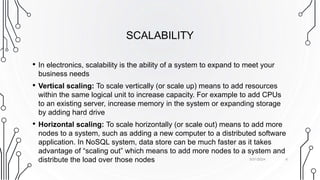
SCALABILITY
• In electronics, scalability is the ability of a system to expand to meet your
business needs
• Vertical scaling: To scale vertically (or scale up) means to add resources
within the same logical unit to increase capacity. For example to add CPUs
to an existing server, increase memory in the system or expanding storage
by adding hard drive
• Horizontal scaling: To scale horizontally (or scale out) means to add more
nodes to a system, such as adding a new computer to a distributed software
application. In NoSQL system, data store can be much faster as it takes
advantage of “scaling out” which means to add more nodes to a system and
distribute the load over those nodes 6
5/31/2024
NOSQL
• NoSQL (Not Only SQL) is a non-relational database management
systems
• It is designed for distributed data stores where very large scale of data
storing needs (for example Google or Facebook which collects
terabytes of data every day for their users)
• These type of data storing may not require fixed schema, avoid join
operations and typically scale horizontally
7
5/31/2024
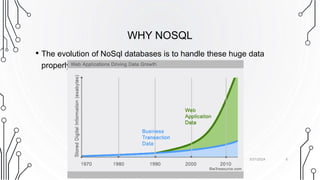
WHY NOSQL
• The evolution of NoSql databases is to handle these huge data
properly
8
5/31/2024
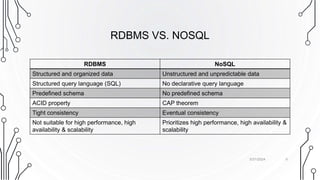
RDBMS VS. NOSQL
RDBMS NoSQL
Structured and organized data Unstructured and unpredictable data
Structured query language (SQL) No declarative query language
Predefined schema No predefined schema
ACID property CAP theorem
Tight consistency Eventual consistency
Not suitable for high performance, high
availability & scalability
Prioritizes high performance, high availability &
scalability
9
5/31/2024
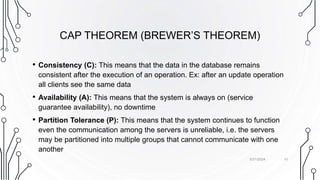
CAP THEOREM (BREWER’S THEOREM)
• Consistency (C): This means that the data in the database remains
consistent after the execution of an operation. Ex: after an update operation
all clients see the same data
• Availability (A): This means that the system is always on (service
guarantee availability), no downtime
• Partition Tolerance (P): This means that the system continues to function
even the communication among the servers is unreliable, i.e. the servers
may be partitioned into multiple groups that cannot communicate with one
another
10
5/31/2024
CAP THEOREM …
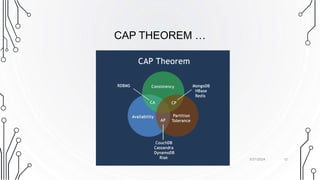
• CAP provides the basic requirements for a distributed system to follow 2 of
the 3 requirements. All the current NoSQL database follow the different
combinations of the C, A, P from the CAP theorem
• CA - Single site cluster, therefore all nodes are always in contact. When a
partition occurs, the system blocks
• CP -Some data may not be accessible, but the rest is still
consistent/accurate
• AP - System is still available under partitioning, but some of the data
returned may be inaccurate
11
5/31/2024
CAP THEOREM …
12
5/31/2024
NOSQL PROS/CONS
• Advantages:
• High scalability
• Distributed Computing
• Lower cost
• Schema flexibility, semi-structure data
• No complicated Relationships
• Disadvantages:
• No standardization
• Limited query capabilities (so far)
• Eventual consistent is not intuitive to program for
13
5/31/2024
NOSQL CATEGORIES
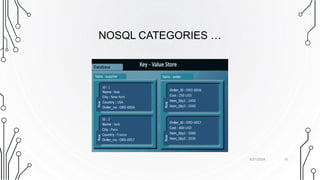
1. Key Value Stores
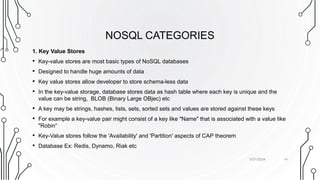
• Key-value stores are most basic types of NoSQL databases
• Designed to handle huge amounts of data
• Key value stores allow developer to store schema-less data
• In the key-value storage, database stores data as hash table where each key is unique and the
value can be string, BLOB (Binary Large OBjec) etc
• A key may be strings, hashes, lists, sets, sorted sets and values are stored against these keys
• For example a key-value pair might consist of a key like "Name" that is associated with a value like
"Robin“
• Key-Value stores follow the 'Availability' and 'Partition' aspects of CAP theorem
• Database Ex: Redis, Dynamo, Riak etc
14
5/31/2024
NOSQL CATEGORIES …
15
5/31/2024
NOSQL CATEGORIES …
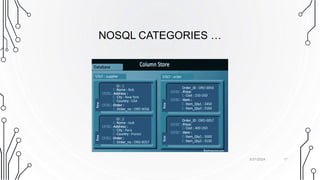
2. Column-oriented databases
• Column-oriented databases primarily work on columns and every column is treated individually
• Values of a single column are stored contiguously
• Column stores data in column specific files
• In Column stores, query processors work on columns too
• All data within each column datafile have the same type which makes it ideal for compression
• Column stores can improve the performance of queries as it can access specific column data
• High performance on aggregation queries (e.g. COUNT, SUM, AVG, MIN, MAX)
• Works on data warehouses and business intelligence, customer relationship management (CRM), Library card
catalogs etc
• Database Ex: BigTable, Cassandra, SimpleDB etc
16
5/31/2024
NOSQL CATEGORIES …
17
5/31/2024
NOSQL CATEGORIES …
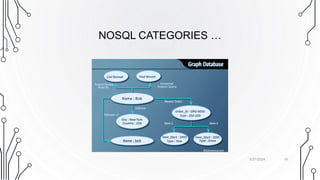
3. Graph databases
• A graph data structure consists of a finite set of ordered pairs, called edges or arcs, of certain
entities called nodes or vertices
• A graph database stores data in a graph
• A graph database is a collection of nodes and edges
• Each node represents an entity and each edge represents a connection or relationship between
two nodes
• Every node and edge are defined by a unique identifier
• Each node knows its adjacent nodes
• Database Ex: OrientDB, Neo4J, Titan.etc
Relational Model Graph Model
Tables Vertices & Edges set
Rows Vertices
Columns Key/value pairs
Joins Edges
18
5/31/2024
NOSQL CATEGORIES …
19
5/31/2024
NOSQL CATEGORIES …
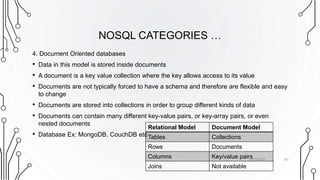
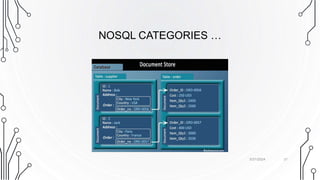
4. Document Oriented databases
• Data in this model is stored inside documents
• A document is a key value collection where the key allows access to its value
• Documents are not typically forced to have a schema and therefore are flexible and easy
to change
• Documents are stored into collections in order to group different kinds of data
• Documents can contain many different key-value pairs, or key-array pairs, or even
nested documents
• Database Ex: MongoDB, CouchDB etc
Relational Model Document Model
Tables Collections
Rows Documents
Columns Key/value pairs
Joins Not available
20
5/31/2024
NOSQL CATEGORIES …
21
5/31/2024

NoSQL Fundamentals PowerPoint Presentation

  • 1.
    NOSQL FUNDAMENTALS PROF. ABHAYAKUMAR SAHOO KALINGA INSTITUTE OF INDUSTRIAL TECHNOLOGY
  • 2.
    STRUCTURED VS UNSTRUCTUREDDATA • Structured data: information with a degree of organization that is readily searchable and quickly consolidate into facts Ex: RDMBS, spreadsheet • Unstructured data: information with a lack of structure that is time and energy consuming to search and find and consolidate into facts Ex: email, documents, images, reports 2 5/31/2024
  • 3.
    RDBMS • Enormous dataper day • Large section of data is handled by RDBMS • Atomic (A): A transaction is a logical unit of work which must be either completed with all of its data modifications, or none of them is performed • Consistency (C): At the end of the transaction, all data must be left in a consistent state • Isolation (I): Modifications of data performed by a transaction must be independent of another transaction • Durability (D): When the transaction is completed, effects of the modifications performed by the transaction must be permanent in the system 3 5/31/2024
  • 4.
    DISTRIBUTED SYSTEMS • Adistributed system consists of multiple computers and software components that communicate through a computer network • A distributed system can consist of any number of possible configurations, such as mainframes, workstations, personal computers, and so on • The computers interact with each other and share the resources of the system to achieve a common goal 4 5/31/2024
  • 5.
    ADVANTAGES OF DISTRIBUTEDSYSTEMS • Reliability (fault tolerance): If some of the machines within the system crash, the rest of the computers remain unaffected and work does not stop • Scalability: In distributed computing the system can easily be expanded by adding more machines as needed • Sharing of Resources: As data or resources are shared in distributed system, other resources can be also shared (e.g. expensive printers) • Flexibility: As the system is very flexible, it is very easy to install, implement and debug new services • Speed: A distributed computing system can have more computing power and it's speed makes it different than other systems • Open system: As it is open system, every service is equally accessible to every client i.e. local or remote • Performance: The collection of processors in the system can provide higher performance (and better price/performance ratio) than a centralized computer 5 5/31/2024
  • 6.
    SCALABILITY • In electronics,scalability is the ability of a system to expand to meet your business needs • Vertical scaling: To scale vertically (or scale up) means to add resources within the same logical unit to increase capacity. For example to add CPUs to an existing server, increase memory in the system or expanding storage by adding hard drive • Horizontal scaling: To scale horizontally (or scale out) means to add more nodes to a system, such as adding a new computer to a distributed software application. In NoSQL system, data store can be much faster as it takes advantage of “scaling out” which means to add more nodes to a system and distribute the load over those nodes 6 5/31/2024
  • 7.
    NOSQL • NoSQL (NotOnly SQL) is a non-relational database management systems • It is designed for distributed data stores where very large scale of data storing needs (for example Google or Facebook which collects terabytes of data every day for their users) • These type of data storing may not require fixed schema, avoid join operations and typically scale horizontally 7 5/31/2024
  • 8.
    WHY NOSQL • Theevolution of NoSql databases is to handle these huge data properly 8 5/31/2024
  • 9.
    RDBMS VS. NOSQL RDBMSNoSQL Structured and organized data Unstructured and unpredictable data Structured query language (SQL) No declarative query language Predefined schema No predefined schema ACID property CAP theorem Tight consistency Eventual consistency Not suitable for high performance, high availability & scalability Prioritizes high performance, high availability & scalability 9 5/31/2024
  • 10.
    CAP THEOREM (BREWER’STHEOREM) • Consistency (C): This means that the data in the database remains consistent after the execution of an operation. Ex: after an update operation all clients see the same data • Availability (A): This means that the system is always on (service guarantee availability), no downtime • Partition Tolerance (P): This means that the system continues to function even the communication among the servers is unreliable, i.e. the servers may be partitioned into multiple groups that cannot communicate with one another 10 5/31/2024
  • 11.
    CAP THEOREM … •CAP provides the basic requirements for a distributed system to follow 2 of the 3 requirements. All the current NoSQL database follow the different combinations of the C, A, P from the CAP theorem • CA - Single site cluster, therefore all nodes are always in contact. When a partition occurs, the system blocks • CP -Some data may not be accessible, but the rest is still consistent/accurate • AP - System is still available under partitioning, but some of the data returned may be inaccurate 11 5/31/2024
  • 12.
  • 13.
    NOSQL PROS/CONS • Advantages: •High scalability • Distributed Computing • Lower cost • Schema flexibility, semi-structure data • No complicated Relationships • Disadvantages: • No standardization • Limited query capabilities (so far) • Eventual consistent is not intuitive to program for 13 5/31/2024
  • 14.
    NOSQL CATEGORIES 1. KeyValue Stores • Key-value stores are most basic types of NoSQL databases • Designed to handle huge amounts of data • Key value stores allow developer to store schema-less data • In the key-value storage, database stores data as hash table where each key is unique and the value can be string, BLOB (Binary Large OBjec) etc • A key may be strings, hashes, lists, sets, sorted sets and values are stored against these keys • For example a key-value pair might consist of a key like "Name" that is associated with a value like "Robin“ • Key-Value stores follow the 'Availability' and 'Partition' aspects of CAP theorem • Database Ex: Redis, Dynamo, Riak etc 14 5/31/2024
  • 15.
  • 16.
    NOSQL CATEGORIES … 2.Column-oriented databases • Column-oriented databases primarily work on columns and every column is treated individually • Values of a single column are stored contiguously • Column stores data in column specific files • In Column stores, query processors work on columns too • All data within each column datafile have the same type which makes it ideal for compression • Column stores can improve the performance of queries as it can access specific column data • High performance on aggregation queries (e.g. COUNT, SUM, AVG, MIN, MAX) • Works on data warehouses and business intelligence, customer relationship management (CRM), Library card catalogs etc • Database Ex: BigTable, Cassandra, SimpleDB etc 16 5/31/2024
  • 17.
  • 18.
    NOSQL CATEGORIES … 3.Graph databases • A graph data structure consists of a finite set of ordered pairs, called edges or arcs, of certain entities called nodes or vertices • A graph database stores data in a graph • A graph database is a collection of nodes and edges • Each node represents an entity and each edge represents a connection or relationship between two nodes • Every node and edge are defined by a unique identifier • Each node knows its adjacent nodes • Database Ex: OrientDB, Neo4J, Titan.etc Relational Model Graph Model Tables Vertices & Edges set Rows Vertices Columns Key/value pairs Joins Edges 18 5/31/2024
  • 19.
  • 20.
    NOSQL CATEGORIES … 4.Document Oriented databases • Data in this model is stored inside documents • A document is a key value collection where the key allows access to its value • Documents are not typically forced to have a schema and therefore are flexible and easy to change • Documents are stored into collections in order to group different kinds of data • Documents can contain many different key-value pairs, or key-array pairs, or even nested documents • Database Ex: MongoDB, CouchDB etc Relational Model Document Model Tables Collections Rows Documents Columns Key/value pairs Joins Not available 20 5/31/2024
  • 21.