NORMALIZATION
COSC 6340
Spring 2015
Objective
 Normalization presents a set of rules that tables
and databases must follow to be well structured.
 Historically presented as a sequence of normal
forms
First Normal From
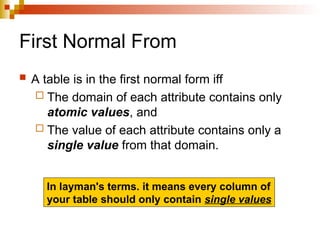
 A table is in the first normal form iff
 The domain of each attribute contains only
atomic values, and
 The value of each attribute contains only a
single value from that domain.
In layman's terms. it means every column of
your table should only contain single values
Example
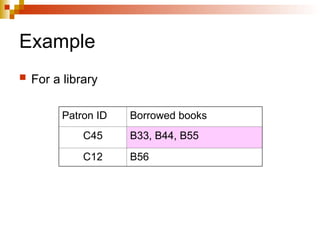
 For a library
Patron ID Borrowed books
C45 B33, B44, B55
C12 B56
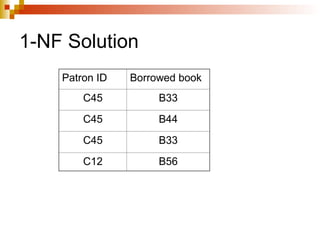
1-NF Solution
Patron ID Borrowed book
C45 B33
C45 B44
C45 B33
C12 B56
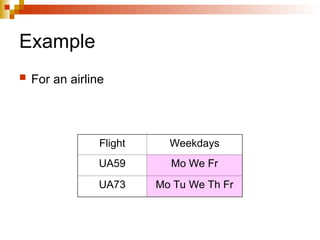
Example
 For an airline
Flight Weekdays
UA59 Mo We Fr
UA73 Mo Tu We Th Fr
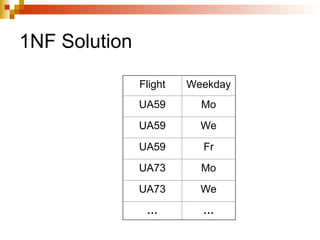
1NF Solution
Flight Weekday
UA59 Mo
UA59 We
UA59 Fr
UA73 Mo
UA73 We
… …
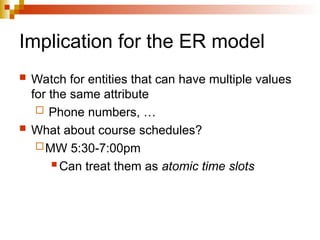
Implication for the ER model
 Watch for entities that can have multiple values
for the same attribute
 Phone numbers, …
 What about course schedules?
MW 5:30-7:00pm
 Can treat them as atomic time slots
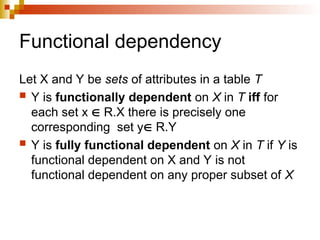
Functional dependency
Let X and Y be sets of attributes in a table T
 Y is functionally dependent on X in T iff for
each set x  R.X there is precisely one
corresponding set y R.Y
 Y is fully functional dependent on X in T if Y is
functional dependent on X and Y is not
functional dependent on any proper subset of X
Example
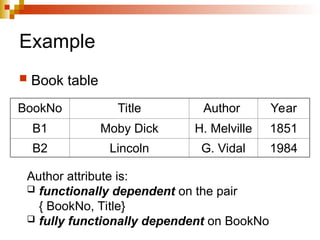
 Book table
BookNo Title Author Year
B1 Moby Dick H. Melville 1851
B2 Lincoln G. Vidal 1984
Author attribute is:
 functionally dependent on the pair
{ BookNo, Title}
 fully functionally dependent on BookNo
Why it matters
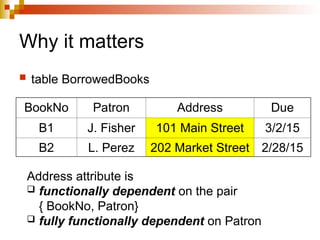
 table BorrowedBooks
BookNo Patron Address Due
B1 J. Fisher 101 Main Street 3/2/15
B2 L. Perez 202 Market Street 2/28/15
Address attribute is
 functionally dependent on the pair
{ BookNo, Patron}
 fully functionally dependent on Patron
Problems
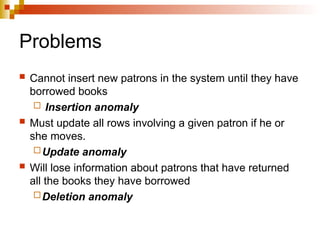
 Cannot insert new patrons in the system until they have
borrowed books
 Insertion anomaly
 Must update all rows involving a given patron if he or
she moves.
Update anomaly
 Will lose information about patrons that have returned
all the books they have borrowed
Deletion anomaly
Armstrong inference rules (1974)
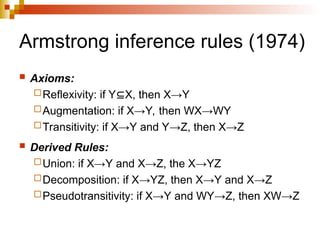
 Axioms:
Reflexivity: if YX, then X→Y
Augmentation: if X→Y, then WX→WY
Transitivity: if X→Y and Y→Z, then X→Z
 Derived Rules:
Union: if X→Y and X→Z, the X→YZ
Decomposition: if X→YZ, then X→Y and X→Z
Pseudotransitivity: if X→Y and WY→Z, then XW→Z
Armstrong inference rules (1974)
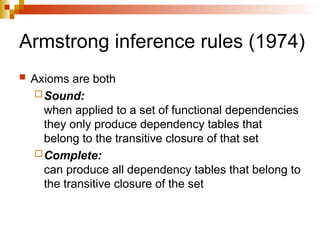
 Axioms are both
Sound:
when applied to a set of functional dependencies
they only produce dependency tables that
belong to the transitive closure of that set
Complete:
can produce all dependency tables that belong to
the transitive closure of the set
Armstrong inference rules (1974)
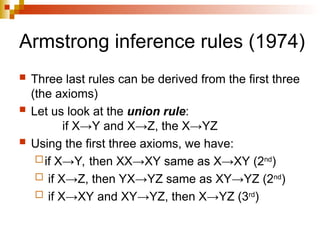
 Three last rules can be derived from the first three
(the axioms)
 Let us look at the union rule:
if X→Y and X→Z, the X→YZ
 Using the first three axioms, we have:
if X→Y, then XX→XY same as X→XY (2nd
)
 if X→Z, then YX→YZ same as XY→YZ (2nd
)
 if X→XY and XY→YZ, then X→YZ (3rd
)
Second Normal Form
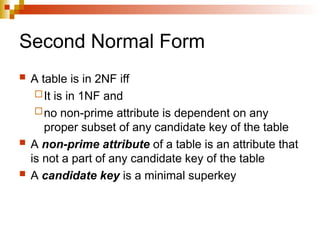
 A table is in 2NF iff
It is in 1NF and
no non-prime attribute is dependent on any
proper subset of any candidate key of the table
 A non-prime attribute of a table is an attribute that
is not a part of any candidate key of the table
 A candidate key is a minimal superkey
Example
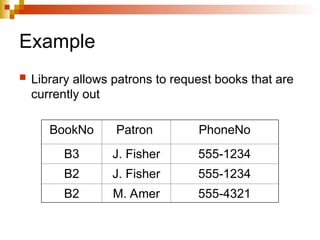
 Library allows patrons to request books that are
currently out
BookNo Patron PhoneNo
B3 J. Fisher 555-1234
B2 J. Fisher 555-1234
B2 M. Amer 555-4321
Example
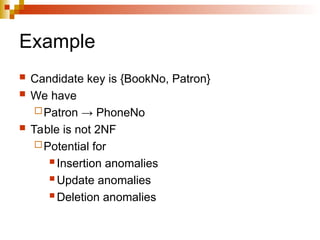
 Candidate key is {BookNo, Patron}
 We have
Patron → PhoneNo
 Table is not 2NF
Potential for
 Insertion anomalies
 Update anomalies
 Deletion anomalies
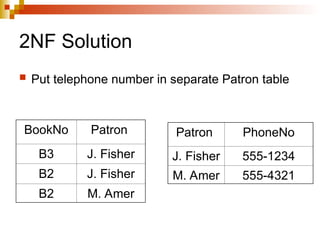
2NF Solution
 Put telephone number in separate Patron table
BookNo Patron
B3 J. Fisher
B2 J. Fisher
B2 M. Amer
Patron PhoneNo
J. Fisher 555-1234
M. Amer 555-4321
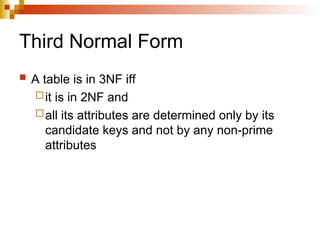
Third Normal Form
 A table is in 3NF iff
it is in 2NF and
all its attributes are determined only by its
candidate keys and not by any non-prime
attributes
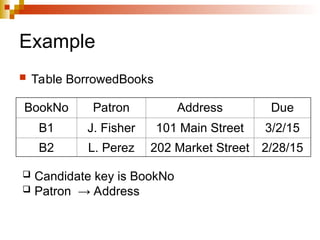
Example
 Table BorrowedBooks
BookNo Patron Address Due
B1 J. Fisher 101 Main Street 3/2/15
B2 L. Perez 202 Market Street 2/28/15
 Candidate key is BookNo
 Patron → Address
3NF Solution
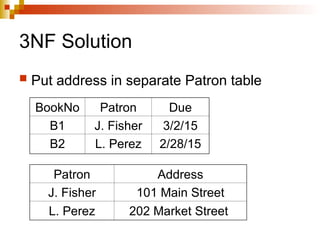
 Put address in separate Patron table
BookNo Patron Due
B1 J. Fisher 3/2/15
B2 L. Perez 2/28/15
Patron Address
J. Fisher 101 Main Street
L. Perez 202 Market Street
Another example
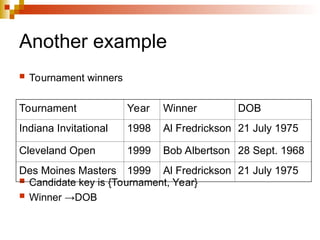
 Tournament winners
 Candidate key is {Tournament, Year}
 Winner →DOB
Tournament Year Winner DOB
Indiana Invitational 1998 Al Fredrickson 21 July 1975
Cleveland Open 1999 Bob Albertson 28 Sept. 1968
Des Moines Masters 1999 Al Fredrickson 21 July 1975
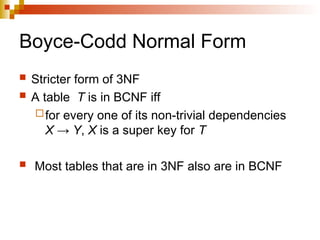
Boyce-Codd Normal Form
 Stricter form of 3NF
 A table T is in BCNF iff
for every one of its non-trivial dependencies
X → Y, X is a super key for T
 Most tables that are in 3NF also are in BCNF
Example
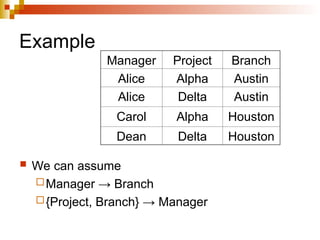
 We can assume
Manager → Branch
{Project, Branch} → Manager
Manager Project Branch
Alice Alpha Austin
Alice Delta Austin
Carol Alpha Houston
Dean Delta Houston
Example
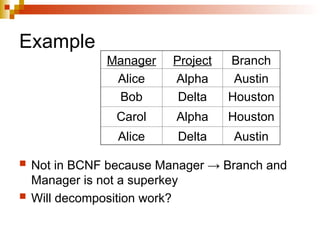
 Not in BCNF because Manager → Branch and
Manager is not a superkey
 Will decomposition work?
Manager Project Branch
Alice Alpha Austin
Bob Delta Houston
Carol Alpha Houston
Alice Delta Austin
A decomposition (I)
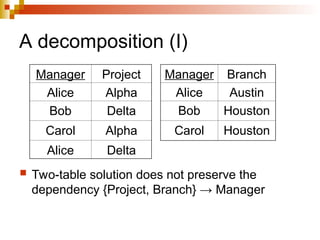
 Two-table solution does not preserve the
dependency {Project, Branch} → Manager
Manager Branch
Alice Austin
Bob Houston
Carol Houston
Manager Project
Alice Alpha
Bob Delta
Carol Alpha
Alice Delta
A decomposition (II)
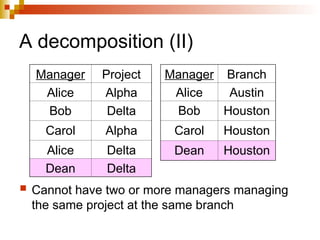
 Cannot have two or more managers managing
the same project at the same branch
Manager Branch
Alice Austin
Bob Houston
Carol Houston
Dean Houston
Manager Project
Alice Alpha
Bob Delta
Carol Alpha
Alice Delta
Dean Delta
Multivalued dependencies
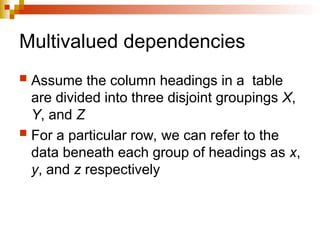
 Assume the column headings in a table
are divided into three disjoint groupings X,
Y, and Z
 For a particular row, we can refer to the
data beneath each group of headings as x,
y, and z respectively
Multivalued dependencies
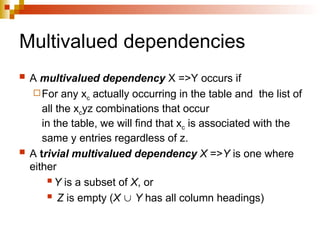
 A multivalued dependency X =>Y occurs if
For any xc actually occurring in the table and the list of
all the xcyz combinations that occur
in the table, we will find that xc is associated with the
same y entries regardless of z.
 A trivial multivalued dependency X =>Y is one where
either
 Y is a subset of X, or
 Z is empty (X  Y has all column headings)
Fourth Normal Form
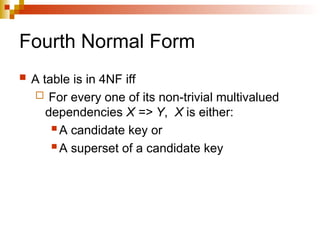
 A table is in 4NF iff
 For every one of its non-trivial multivalued
dependencies X => Y, X is either:
 A candidate key or
 A superset of a candidate key
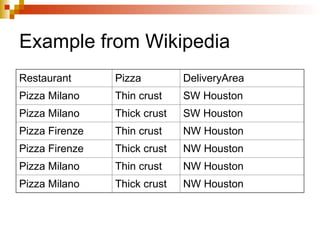
Example from Wikipedia
Restaurant Pizza DeliveryArea
Pizza Milano Thin crust SW Houston
Pizza Milano Thick crust SW Houston
Pizza Firenze Thin crust NW Houston
Pizza Firenze Thick crust NW Houston
Pizza Milano Thin crust NW Houston
Pizza Milano Thick crust NW Houston
Discussion
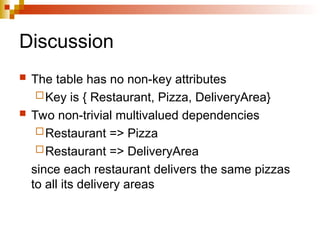
 The table has no non-key attributes
Key is { Restaurant, Pizza, DeliveryArea}
 Two non-trivial multivalued dependencies
Restaurant => Pizza
Restaurant => DeliveryArea
since each restaurant delivers the same pizzas
to all its delivery areas
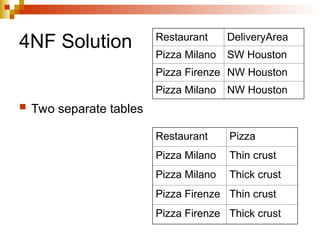
4NF Solution
 Two separate tables
Restaurant Pizza
Pizza Milano Thin crust
Pizza Milano Thick crust
Pizza Firenze Thin crust
Pizza Firenze Thick crust
Restaurant DeliveryArea
Pizza Milano SW Houston
Pizza Firenze NW Houston
Pizza Milano NW Houston
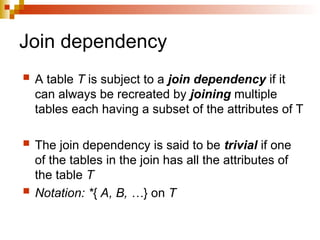
Join dependency
 A table T is subject to a join dependency if it
can always be recreated by joining multiple
tables each having a subset of the attributes of T
 The join dependency is said to be trivial if one
of the tables in the join has all the attributes of
the table T
 Notation: *{ A, B, …} on T
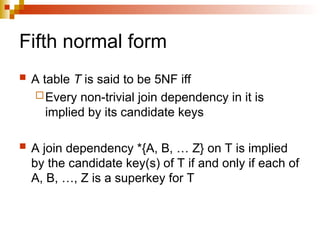
Fifth normal form
 A table T is said to be 5NF iff
Every non-trivial join dependency in it is
implied by its candidate keys
 A join dependency *{A, B, … Z} on T is implied
by the candidate key(s) of T if and only if each of
A, B, …, Z is a superkey for T
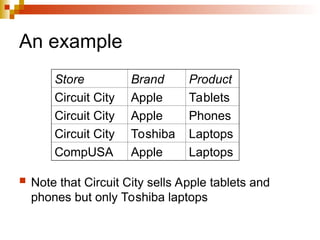
An example
 Note that Circuit City sells Apple tablets and
phones but only Toshiba laptops
Store Brand Product
Circuit City Apple Tablets
Circuit City Apple Phones
Circuit City Toshiba Laptops
CompUSA Apple Laptops
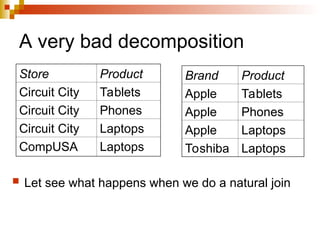
A very bad decomposition
 Let see what happens when we do a natural join
Brand Product
Apple Tablets
Apple Phones
Apple Laptops
Toshiba Laptops
Store Product
Circuit City Tablets
Circuit City Phones
Circuit City Laptops
CompUSA Laptops
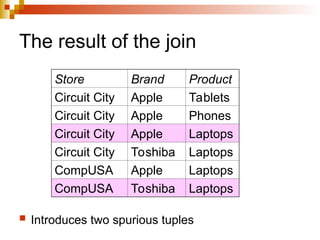
The result of the join
 Introduces two spurious tuples
Store Brand Product
Circuit City Apple Tablets
Circuit City Apple Phones
Circuit City Apple Laptops
Circuit City Toshiba Laptops
CompUSA Apple Laptops
CompUSA Toshiba Laptops
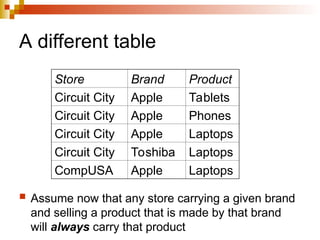
A different table
 Assume now that any store carrying a given brand
and selling a product that is made by that brand
will always carry that product
Store Brand Product
Circuit City Apple Tablets
Circuit City Apple Phones
Circuit City Apple Laptops
Circuit City Toshiba Laptops
CompUSA Apple Laptops
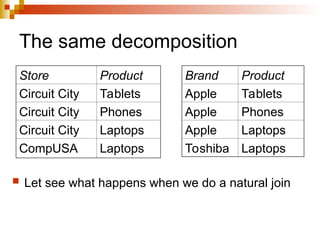
The same decomposition
 Let see what happens when we do a natural join
Brand Product
Apple Tablets
Apple Phones
Apple Laptops
Toshiba Laptops
Store Product
Circuit City Tablets
Circuit City Phones
Circuit City Laptops
CompUSA Laptops
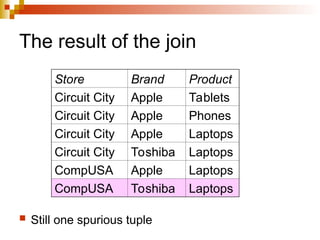
The result of the join
 Still one spurious tuple
Store Brand Product
Circuit City Apple Tablets
Circuit City Apple Phones
Circuit City Apple Laptops
Circuit City Toshiba Laptops
CompUSA Apple Laptops
CompUSA Toshiba Laptops
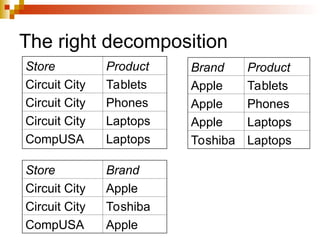
The right decomposition
Brand Product
Apple Tablets
Apple Phones
Apple Laptops
Toshiba Laptops
Store Product
Circuit City Tablets
Circuit City Phones
Circuit City Laptops
CompUSA Laptops
Store Brand
Circuit City Apple
Circuit City Toshiba
CompUSA Apple
Conclusion
 The first "big" table was 5NF
 The second table was decomposable
Lossless
Decomposition
General Concept
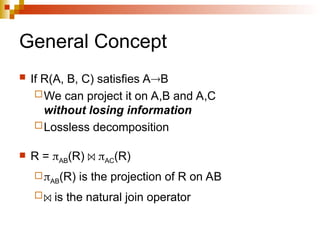
 If R(A, B, C) satisfies AB
We can project it on A,B and A,C
without losing information
Lossless decomposition
 R = AB(R) ⋈ AC(R)
AB(R) is the projection of R on AB
⋈ is the natural join operator
Example
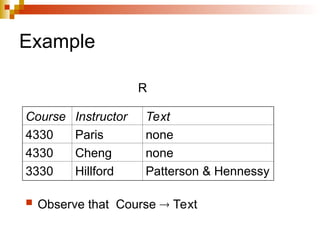
 Observe that Course  Text
Course Instructor Text
4330 Paris none
4330 Cheng none
3330 Hillford Patterson & Hennessy
R
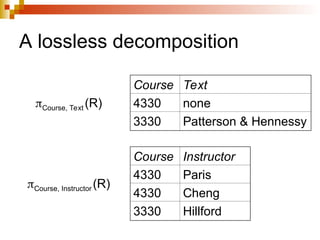
A lossless decomposition
Course Text
4330 none
3330 Patterson & Hennessy
Course, Text (R)
Course Instructor
4330 Paris
4330 Cheng
3330 Hillford
Course, Instructor (R)
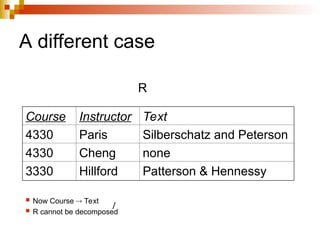
A different case
 Now Course  Text
 R cannot be decomposed
Course Instructor Text
4330 Paris Silberschatz and Peterson
4330 Cheng none
3330 Hillford Patterson & Hennessy
R
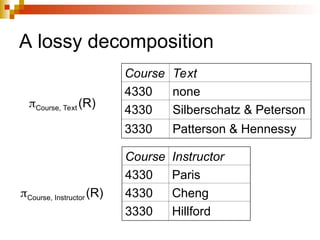
A lossy decomposition
Course Text
4330 none
4330 Silberschatz & Peterson
3330 Patterson & Hennessy
Course, Text (R)
Course Instructor
4330 Paris
4330 Cheng
3330 Hillford
Course, Instructor (R)
An Example
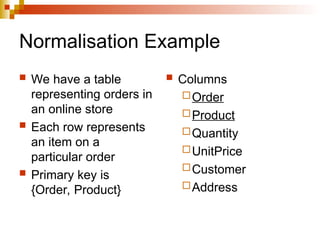
Normalisation Example
 We have a table
representing orders in
an online store
 Each row represents
an item on a
particular order
 Primary key is
{Order, Product}
 Columns
Order
Product
Quantity
UnitPrice
Customer
Address
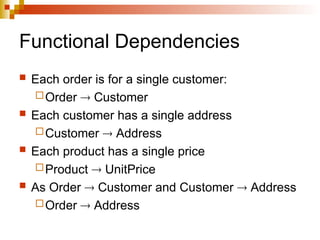
Functional Dependencies
 Each order is for a single customer:
Order  Customer
 Each customer has a single address
Customer  Address
 Each product has a single price
Product  UnitPrice
 As Order  Customer and Customer  Address
Order  Address
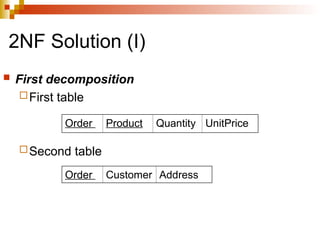
2NF Solution (I)
 First decomposition
First table
Second table
Order Product Quantity UnitPrice
Order Customer Address
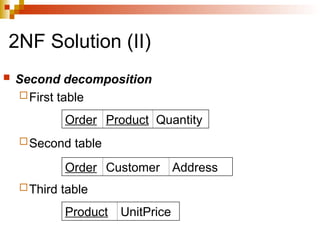
2NF Solution (II)
 Second decomposition
First table
Second table
Third table
Order Product Quantity
Order Customer Address
Product UnitPrice
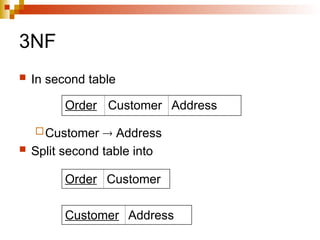
3NF
 In second table
Customer  Address
 Split second table into
Order Customer Address
Order Customer
Customer Address
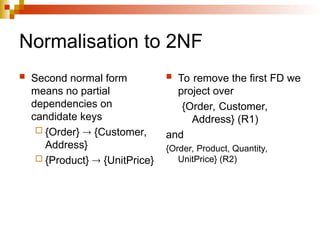
Normalisation to 2NF
 Second normal form
means no partial
dependencies on
candidate keys
 {Order}  {Customer,
Address}
 {Product}  {UnitPrice}
 To remove the first FD we
project over
{Order, Customer,
Address} (R1)
and
{Order, Product, Quantity,
UnitPrice} (R2)
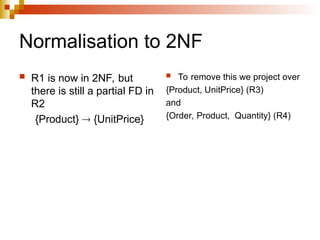
Normalisation to 2NF
 R1 is now in 2NF, but
there is still a partial FD in
R2
{Product}  {UnitPrice}
 To remove this we project over
{Product, UnitPrice} (R3)
and
{Order, Product, Quantity} (R4)
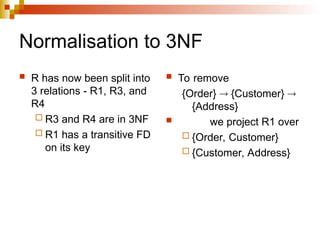
Normalisation to 3NF
 R has now been split into
3 relations - R1, R3, and
R4
 R3 and R4 are in 3NF
 R1 has a transitive FD
on its key
 To remove
{Order}  {Customer} 
{Address}
 we project R1 over
 {Order, Customer}
 {Customer, Address}
Normalisation
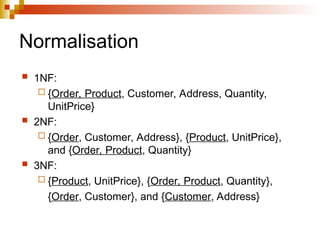
 1NF:
 {Order, Product, Customer, Address, Quantity,
UnitPrice}
 2NF:
 {Order, Customer, Address}, {Product, UnitPrice},
and {Order, Product, Quantity}
 3NF:
 {Product, UnitPrice}, {Order, Product, Quantity},
{Order, Customer}, and {Customer, Address}

Normalization in dbms -1nf,2nf,3nf .ppt

  • 1.
  • 2.
    Objective  Normalization presentsa set of rules that tables and databases must follow to be well structured.  Historically presented as a sequence of normal forms
  • 3.
    First Normal From A table is in the first normal form iff  The domain of each attribute contains only atomic values, and  The value of each attribute contains only a single value from that domain. In layman's terms. it means every column of your table should only contain single values
  • 4.
    Example  For alibrary Patron ID Borrowed books C45 B33, B44, B55 C12 B56
  • 5.
    1-NF Solution Patron IDBorrowed book C45 B33 C45 B44 C45 B33 C12 B56
  • 6.
    Example  For anairline Flight Weekdays UA59 Mo We Fr UA73 Mo Tu We Th Fr
  • 7.
    1NF Solution Flight Weekday UA59Mo UA59 We UA59 Fr UA73 Mo UA73 We … …
  • 8.
    Implication for theER model  Watch for entities that can have multiple values for the same attribute  Phone numbers, …  What about course schedules? MW 5:30-7:00pm  Can treat them as atomic time slots
  • 9.
    Functional dependency Let Xand Y be sets of attributes in a table T  Y is functionally dependent on X in T iff for each set x  R.X there is precisely one corresponding set y R.Y  Y is fully functional dependent on X in T if Y is functional dependent on X and Y is not functional dependent on any proper subset of X
  • 10.
    Example  Book table BookNoTitle Author Year B1 Moby Dick H. Melville 1851 B2 Lincoln G. Vidal 1984 Author attribute is:  functionally dependent on the pair { BookNo, Title}  fully functionally dependent on BookNo
  • 11.
    Why it matters table BorrowedBooks BookNo Patron Address Due B1 J. Fisher 101 Main Street 3/2/15 B2 L. Perez 202 Market Street 2/28/15 Address attribute is  functionally dependent on the pair { BookNo, Patron}  fully functionally dependent on Patron
  • 12.
    Problems  Cannot insertnew patrons in the system until they have borrowed books  Insertion anomaly  Must update all rows involving a given patron if he or she moves. Update anomaly  Will lose information about patrons that have returned all the books they have borrowed Deletion anomaly
  • 13.
    Armstrong inference rules(1974)  Axioms: Reflexivity: if YX, then X→Y Augmentation: if X→Y, then WX→WY Transitivity: if X→Y and Y→Z, then X→Z  Derived Rules: Union: if X→Y and X→Z, the X→YZ Decomposition: if X→YZ, then X→Y and X→Z Pseudotransitivity: if X→Y and WY→Z, then XW→Z
  • 14.
    Armstrong inference rules(1974)  Axioms are both Sound: when applied to a set of functional dependencies they only produce dependency tables that belong to the transitive closure of that set Complete: can produce all dependency tables that belong to the transitive closure of the set
  • 15.
    Armstrong inference rules(1974)  Three last rules can be derived from the first three (the axioms)  Let us look at the union rule: if X→Y and X→Z, the X→YZ  Using the first three axioms, we have: if X→Y, then XX→XY same as X→XY (2nd )  if X→Z, then YX→YZ same as XY→YZ (2nd )  if X→XY and XY→YZ, then X→YZ (3rd )
  • 16.
    Second Normal Form A table is in 2NF iff It is in 1NF and no non-prime attribute is dependent on any proper subset of any candidate key of the table  A non-prime attribute of a table is an attribute that is not a part of any candidate key of the table  A candidate key is a minimal superkey
  • 17.
    Example  Library allowspatrons to request books that are currently out BookNo Patron PhoneNo B3 J. Fisher 555-1234 B2 J. Fisher 555-1234 B2 M. Amer 555-4321
  • 18.
    Example  Candidate keyis {BookNo, Patron}  We have Patron → PhoneNo  Table is not 2NF Potential for  Insertion anomalies  Update anomalies  Deletion anomalies
  • 19.
    2NF Solution  Puttelephone number in separate Patron table BookNo Patron B3 J. Fisher B2 J. Fisher B2 M. Amer Patron PhoneNo J. Fisher 555-1234 M. Amer 555-4321
  • 20.
    Third Normal Form A table is in 3NF iff it is in 2NF and all its attributes are determined only by its candidate keys and not by any non-prime attributes
  • 21.
    Example  Table BorrowedBooks BookNoPatron Address Due B1 J. Fisher 101 Main Street 3/2/15 B2 L. Perez 202 Market Street 2/28/15  Candidate key is BookNo  Patron → Address
  • 22.
    3NF Solution  Putaddress in separate Patron table BookNo Patron Due B1 J. Fisher 3/2/15 B2 L. Perez 2/28/15 Patron Address J. Fisher 101 Main Street L. Perez 202 Market Street
  • 23.
    Another example  Tournamentwinners  Candidate key is {Tournament, Year}  Winner →DOB Tournament Year Winner DOB Indiana Invitational 1998 Al Fredrickson 21 July 1975 Cleveland Open 1999 Bob Albertson 28 Sept. 1968 Des Moines Masters 1999 Al Fredrickson 21 July 1975
  • 24.
    Boyce-Codd Normal Form Stricter form of 3NF  A table T is in BCNF iff for every one of its non-trivial dependencies X → Y, X is a super key for T  Most tables that are in 3NF also are in BCNF
  • 25.
    Example  We canassume Manager → Branch {Project, Branch} → Manager Manager Project Branch Alice Alpha Austin Alice Delta Austin Carol Alpha Houston Dean Delta Houston
  • 26.
    Example  Not inBCNF because Manager → Branch and Manager is not a superkey  Will decomposition work? Manager Project Branch Alice Alpha Austin Bob Delta Houston Carol Alpha Houston Alice Delta Austin
  • 27.
    A decomposition (I) Two-table solution does not preserve the dependency {Project, Branch} → Manager Manager Branch Alice Austin Bob Houston Carol Houston Manager Project Alice Alpha Bob Delta Carol Alpha Alice Delta
  • 28.
    A decomposition (II) Cannot have two or more managers managing the same project at the same branch Manager Branch Alice Austin Bob Houston Carol Houston Dean Houston Manager Project Alice Alpha Bob Delta Carol Alpha Alice Delta Dean Delta
  • 29.
    Multivalued dependencies  Assumethe column headings in a table are divided into three disjoint groupings X, Y, and Z  For a particular row, we can refer to the data beneath each group of headings as x, y, and z respectively
  • 30.
    Multivalued dependencies  Amultivalued dependency X =>Y occurs if For any xc actually occurring in the table and the list of all the xcyz combinations that occur in the table, we will find that xc is associated with the same y entries regardless of z.  A trivial multivalued dependency X =>Y is one where either  Y is a subset of X, or  Z is empty (X  Y has all column headings)
  • 31.
    Fourth Normal Form A table is in 4NF iff  For every one of its non-trivial multivalued dependencies X => Y, X is either:  A candidate key or  A superset of a candidate key
  • 32.
    Example from Wikipedia RestaurantPizza DeliveryArea Pizza Milano Thin crust SW Houston Pizza Milano Thick crust SW Houston Pizza Firenze Thin crust NW Houston Pizza Firenze Thick crust NW Houston Pizza Milano Thin crust NW Houston Pizza Milano Thick crust NW Houston
  • 33.
    Discussion  The tablehas no non-key attributes Key is { Restaurant, Pizza, DeliveryArea}  Two non-trivial multivalued dependencies Restaurant => Pizza Restaurant => DeliveryArea since each restaurant delivers the same pizzas to all its delivery areas
  • 34.
    4NF Solution  Twoseparate tables Restaurant Pizza Pizza Milano Thin crust Pizza Milano Thick crust Pizza Firenze Thin crust Pizza Firenze Thick crust Restaurant DeliveryArea Pizza Milano SW Houston Pizza Firenze NW Houston Pizza Milano NW Houston
  • 35.
    Join dependency  Atable T is subject to a join dependency if it can always be recreated by joining multiple tables each having a subset of the attributes of T  The join dependency is said to be trivial if one of the tables in the join has all the attributes of the table T  Notation: *{ A, B, …} on T
  • 36.
    Fifth normal form A table T is said to be 5NF iff Every non-trivial join dependency in it is implied by its candidate keys  A join dependency *{A, B, … Z} on T is implied by the candidate key(s) of T if and only if each of A, B, …, Z is a superkey for T
  • 37.
    An example  Notethat Circuit City sells Apple tablets and phones but only Toshiba laptops Store Brand Product Circuit City Apple Tablets Circuit City Apple Phones Circuit City Toshiba Laptops CompUSA Apple Laptops
  • 38.
    A very baddecomposition  Let see what happens when we do a natural join Brand Product Apple Tablets Apple Phones Apple Laptops Toshiba Laptops Store Product Circuit City Tablets Circuit City Phones Circuit City Laptops CompUSA Laptops
  • 39.
    The result ofthe join  Introduces two spurious tuples Store Brand Product Circuit City Apple Tablets Circuit City Apple Phones Circuit City Apple Laptops Circuit City Toshiba Laptops CompUSA Apple Laptops CompUSA Toshiba Laptops
  • 40.
    A different table Assume now that any store carrying a given brand and selling a product that is made by that brand will always carry that product Store Brand Product Circuit City Apple Tablets Circuit City Apple Phones Circuit City Apple Laptops Circuit City Toshiba Laptops CompUSA Apple Laptops
  • 41.
    The same decomposition Let see what happens when we do a natural join Brand Product Apple Tablets Apple Phones Apple Laptops Toshiba Laptops Store Product Circuit City Tablets Circuit City Phones Circuit City Laptops CompUSA Laptops
  • 42.
    The result ofthe join  Still one spurious tuple Store Brand Product Circuit City Apple Tablets Circuit City Apple Phones Circuit City Apple Laptops Circuit City Toshiba Laptops CompUSA Apple Laptops CompUSA Toshiba Laptops
  • 43.
    The right decomposition BrandProduct Apple Tablets Apple Phones Apple Laptops Toshiba Laptops Store Product Circuit City Tablets Circuit City Phones Circuit City Laptops CompUSA Laptops Store Brand Circuit City Apple Circuit City Toshiba CompUSA Apple
  • 44.
    Conclusion  The first"big" table was 5NF  The second table was decomposable
  • 45.
  • 46.
    General Concept  IfR(A, B, C) satisfies AB We can project it on A,B and A,C without losing information Lossless decomposition  R = AB(R) ⋈ AC(R) AB(R) is the projection of R on AB ⋈ is the natural join operator
  • 47.
    Example  Observe thatCourse  Text Course Instructor Text 4330 Paris none 4330 Cheng none 3330 Hillford Patterson & Hennessy R
  • 48.
    A lossless decomposition CourseText 4330 none 3330 Patterson & Hennessy Course, Text (R) Course Instructor 4330 Paris 4330 Cheng 3330 Hillford Course, Instructor (R)
  • 49.
    A different case Now Course  Text  R cannot be decomposed Course Instructor Text 4330 Paris Silberschatz and Peterson 4330 Cheng none 3330 Hillford Patterson & Hennessy R
  • 50.
    A lossy decomposition CourseText 4330 none 4330 Silberschatz & Peterson 3330 Patterson & Hennessy Course, Text (R) Course Instructor 4330 Paris 4330 Cheng 3330 Hillford Course, Instructor (R)
  • 51.
  • 52.
    Normalisation Example  Wehave a table representing orders in an online store  Each row represents an item on a particular order  Primary key is {Order, Product}  Columns Order Product Quantity UnitPrice Customer Address
  • 53.
    Functional Dependencies  Eachorder is for a single customer: Order  Customer  Each customer has a single address Customer  Address  Each product has a single price Product  UnitPrice  As Order  Customer and Customer  Address Order  Address
  • 54.
    2NF Solution (I) First decomposition First table Second table Order Product Quantity UnitPrice Order Customer Address
  • 55.
    2NF Solution (II) Second decomposition First table Second table Third table Order Product Quantity Order Customer Address Product UnitPrice
  • 56.
    3NF  In secondtable Customer  Address  Split second table into Order Customer Address Order Customer Customer Address
  • 57.
    Normalisation to 2NF Second normal form means no partial dependencies on candidate keys  {Order}  {Customer, Address}  {Product}  {UnitPrice}  To remove the first FD we project over {Order, Customer, Address} (R1) and {Order, Product, Quantity, UnitPrice} (R2)
  • 58.
    Normalisation to 2NF R1 is now in 2NF, but there is still a partial FD in R2 {Product}  {UnitPrice}  To remove this we project over {Product, UnitPrice} (R3) and {Order, Product, Quantity} (R4)
  • 59.
    Normalisation to 3NF R has now been split into 3 relations - R1, R3, and R4  R3 and R4 are in 3NF  R1 has a transitive FD on its key  To remove {Order}  {Customer}  {Address}  we project R1 over  {Order, Customer}  {Customer, Address}
  • 60.
    Normalisation  1NF:  {Order,Product, Customer, Address, Quantity, UnitPrice}  2NF:  {Order, Customer, Address}, {Product, UnitPrice}, and {Order, Product, Quantity}  3NF:  {Product, UnitPrice}, {Order, Product, Quantity}, {Order, Customer}, and {Customer, Address}