Study material providedby: Vishwajeet Londhe
Join Community by clicking below links
Telegram Channel
https://t.me/SPPU_TE_BE_COMP
(for all engineering Resources)
WhatsApp Channel
(for all tech updates)
https://whatsapp.com/channel/
0029ValjFriICVfpcV9HFc3b
Insta Page
(for all engg & tech updates)
https://www.instagram.com/
sppu_engineering_update
3.
Unit III Contents
●
RelationalModel: Basic concepts, Attributes and Domains,
CODD's Rules.
●
Relational Integrity: Domain, Referential Integrities,
Enterprise Constraints.
●
Database Design: Features of Good Relational Designs,
Normalization, Atomic Domains and First Normal Form,
Decomposition using Functional Dependencies, Algorithms
for Decomposition, 2NF, 3NF,BCNF.
CO Mapped : CO1, CO3
Dr. S.R.Khonde
4.
Relational Model
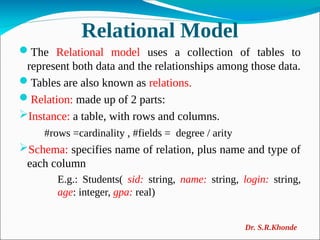
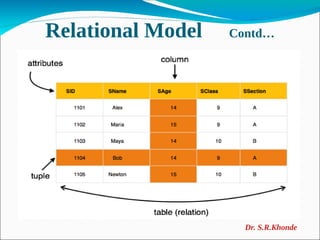
The Relationalmodel uses a collection of tables to
represent both data and the relationships among those data.
Tables are also known as relations.
Relation: made up of 2 parts:
Instance: a table, with rows and columns.
#rows =cardinality , #fields = degree / arity
Schema: specifies name of relation, plus name and type of
each column
E.g.: Students( sid: string, name: string, login: string,
age: integer, gpa: real)
Dr. S.R.Khonde
Relational Model Contd…
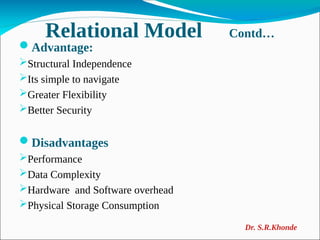
Advantage:
StructuralIndependence
Its simple to navigate
Greater Flexibility
Better Security
Disadvantages
Performance
Data Complexity
Hardware and Software overhead
Physical Storage Consumption
Dr. S.R.Khonde
7.
Components
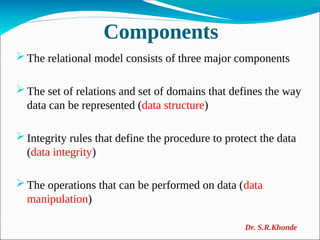
The relationalmodel consists of three major components
The set of relations and set of domains that defines the way
data can be represented (data structure)
Integrity rules that define the procedure to protect the data
(data integrity)
The operations that can be performed on data (data
manipulation)
Dr. S.R.Khonde
8.
Codd's Rule
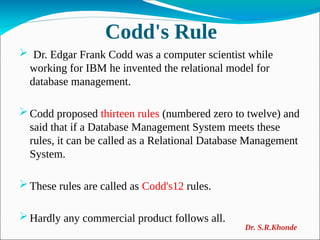
Dr.Edgar Frank Codd was a computer scientist while
working for IBM he invented the relational model for
database management.
Codd proposed thirteen rules (numbered zero to twelve) and
said that if a Database Management System meets these
rules, it can be called as a Relational Database Management
System.
These rules are called as Codd's12 rules.
Hardly any commercial product follows all.
Dr. S.R.Khonde
9.
Codd's Rule Cont..
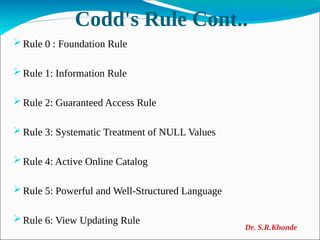
Rule0 : Foundation Rule
Rule 1: Information Rule
Rule 2: Guaranteed Access Rule
Rule 3: Systematic Treatment of NULL Values
Rule 4: Active Online Catalog
Rule 5: Powerful and Well-Structured Language
Rule 6: View Updating Rule
Dr. S.R.Khonde
10.
Codd's Rule Cont..
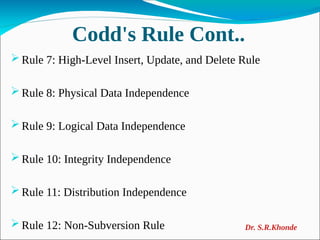
Rule 7: High-Level Insert, Update, and Delete Rule
Rule 8: Physical Data Independence
Rule 9: Logical Data Independence
Rule 10: Integrity Independence
Rule 11: Distribution Independence
Rule 12: Non-Subversion Rule Dr. S.R.Khonde
11.
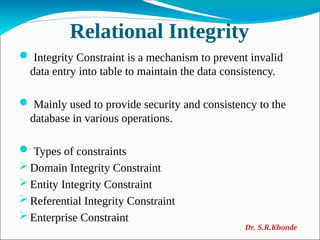
Relational Integrity
IntegrityConstraint is a mechanism to prevent invalid
data entry into table to maintain the data consistency.
Mainly used to provide security and consistency to the
database in various operations.
Types of constraints
Domain Integrity Constraint
Entity Integrity Constraint
Referential Integrity Constraint
Enterprise Constraint
Dr. S.R.Khonde
12.
Domain Integrity Constraint
The domain constraint are considered as the most basic
form of integrity constraints.
Domain integrity means it is the collection of valid set of
values for an attribute.
Constraints -
Not Null
Unique
Default
Check
Dr. S.R.Khonde
13.
Entity Integrity Constraint
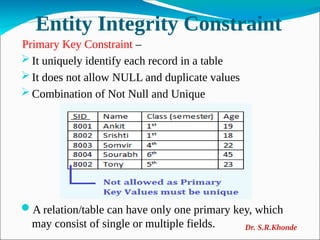
PrimaryKey Constraint –
It uniquely identify each record in a table
It does not allow NULL and duplicate values
Combination of Not Null and Unique
A relation/table can have only one primary key, which
may consist of single or multiple fields. Dr. S.R.Khonde
14.
Referential Integrity Constraint
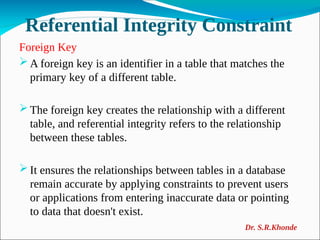
ForeignKey
A foreign key is an identifier in a table that matches the
primary key of a different table.
The foreign key creates the relationship with a different
table, and referential integrity refers to the relationship
between these tables.
It ensures the relationships between tables in a database
remain accurate by applying constraints to prevent users
or applications from entering inaccurate data or pointing
to data that doesn't exist.
Dr. S.R.Khonde
15.
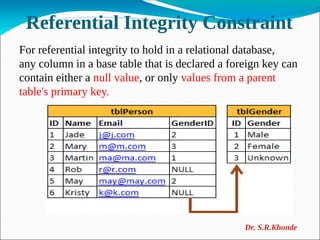
Referential Integrity Constraint
Forreferential integrity to hold in a relational database,
any column in a base table that is declared a foreign key can
contain either a null value, or only values from a parent
table's primary key.
Dr. S.R.Khonde
16.
Enterprise Constraint
Itis also referred as Semantic Constraints.
They are additional rules specified by users or database
administrators.
These rules are depending upon the requirements and
constraints of the business for which the database system
is being maintained.
eg. A class can have maximum 30 students
eg. A teacher can teach maximum 2 subject a semester
eg. A employee can work on max 5 projects at a time
Dr. S.R.Khonde
17.
Relational Database Design
Basicelements of design process:
Defining the problem or objective
Researching the current database
Designing the data structures
Constructing database relationships
Implementing rules and constraints
Creating database views and reports
Implementing the design
Dr. S.R.Khonde
18.
Features of GoodRelational Design
Reduce redundancy
Easy access to data
More accuracy and integrity of information
Data entry, updates and deletions should be efficient.
Bad Database design may lead to:
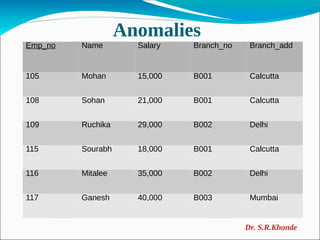
Repetition of information
Inability to represent certain information
Consist of anomalies – Insertion, Deletion ,
Updation /Modification
Dr. S.R.Khonde
Normalization
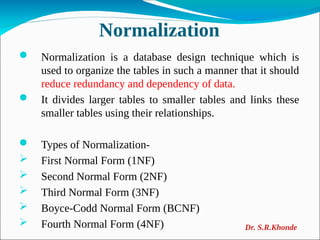
Normalization isa database design technique which is
used to organize the tables in such a manner that it should
reduce redundancy and dependency of data.
It divides larger tables to smaller tables and links these
smaller tables using their relationships.
Types of Normalization-
First Normal Form (1NF)
Second Normal Form (2NF)
Third Normal Form (3NF)
Boyce-Codd Normal Form (BCNF)
Fourth Normal Form (4NF) Dr. S.R.Khonde
21.
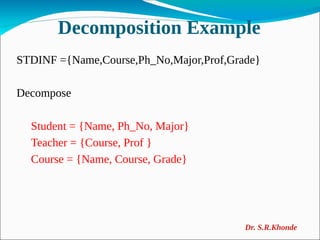
Decomposition
Definition -
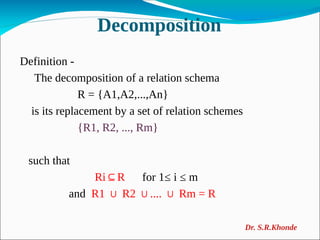
The decompositionof a relation schema
R = {A1,A2,...,An}
is its replacement by a set of relation schemes
{R1, R2, ..., Rm}
such that
Ri R
⊆ for 1≤ i ≤ m
and R1 R2 .... Rm = R
∪ ∪ ∪
Dr. S.R.Khonde
22.
Decomposition Example
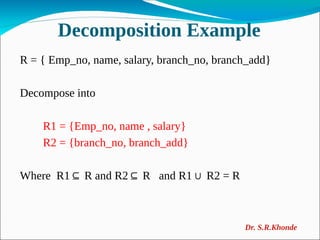
R ={ Emp_no, name, salary, branch_no, branch_add}
Decompose into
R1 = {Emp_no, name , salary}
R2 = {branch_no, branch_add}
Where R1 R and R2 R and R1 R2 = R
⊆ ⊆ ∪
Dr. S.R.Khonde
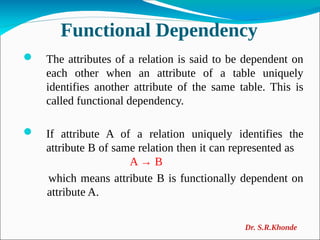
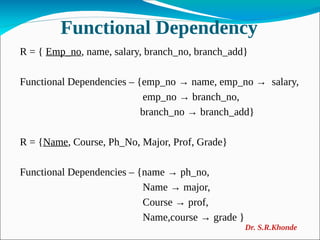
Functional Dependency
Theattributes of a relation is said to be dependent on
each other when an attribute of a table uniquely
identifies another attribute of the same table. This is
called functional dependency.
If attribute A of a relation uniquely identifies the
attribute B of same relation then it can represented as
A → B
which means attribute B is functionally dependent on
attribute A.
Dr. S.R.Khonde
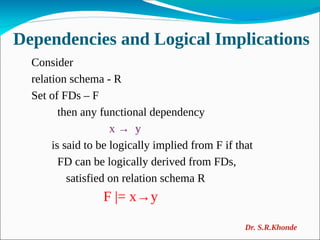
Dependencies and LogicalImplications
Consider
relation schema - R
Set of FDs – F
then any functional dependency
x → y
is said to be logically implied from F if that
FD can be logically derived from FDs,
satisfied on relation schema R
F |= x→y
Dr. S.R.Khonde
27.
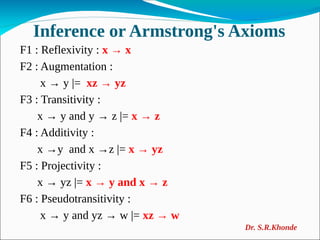
Inference or Armstrong'sAxioms
F1 : Reflexivity : x → x
F2 : Augmentation :
x → y |= xz → yz
F3 : Transitivity :
x → y and y → z |= x → z
F4 : Additivity :
x →y and x →z |= x → yz
F5 : Projectivity :
x → yz |= x → y and x → z
F6 : Pseudotransitivity :
x → y and yz → w |= xz → w
Dr. S.R.Khonde
28.
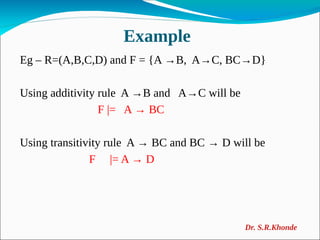
Example
Eg – R=(A,B,C,D)and F = {A →B, A→C, BC→D}
Using additivity rule A →B and A→C will be
F |= A → BC
Using transitivity rule A → BC and BC → D will be
F |= A → D
Dr. S.R.Khonde
29.
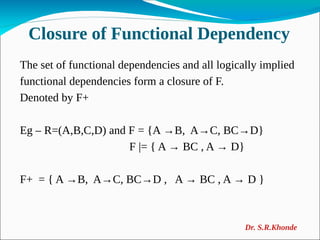
Closure of FunctionalDependency
The set of functional dependencies and all logically implied
functional dependencies form a closure of F.
Denoted by F+
Eg – R=(A,B,C,D) and F = {A →B, A→C, BC→D}
F |= { A → BC , A → D}
F+ = { A →B, A→C, BC→D , A → BC , A → D }
Dr. S.R.Khonde
30.
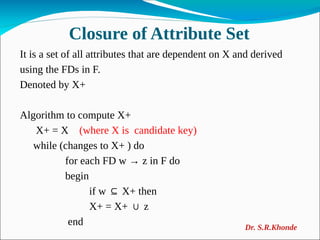
Closure of AttributeSet
It is a set of all attributes that are dependent on X and derived
using the FDs in F.
Denoted by X+
Algorithm to compute X+
X+ = X (where X is candidate key)
while (changes to X+ ) do
for each FD w → z in F do
begin
if w X+ then
⊆
X+ = X+ z
∪
end Dr. S.R.Khonde
31.
Dependencies
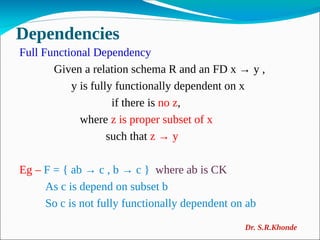
Full Functional Dependency
Givena relation schema R and an FD x → y ,
y is fully functionally dependent on x
if there is no z,
where z is proper subset of x
such that z → y
Eg – F = { ab → c , b → c } where ab is CK
As c is depend on subset b
So c is not fully functionally dependent on ab
Dr. S.R.Khonde
32.
Dependencies
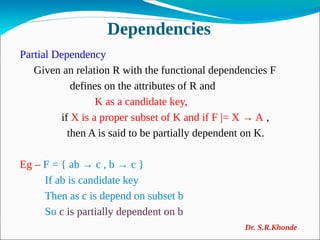
Partial Dependency
Given anrelation R with the functional dependencies F
defines on the attributes of R and
K as a candidate key,
if X is a proper subset of K and if F |= X → A ,
then A is said to be partially dependent on K.
Eg – F = { ab → c , b → c }
If ab is candidate key
Then as c is depend on subset b
So c is partially dependent on b
Dr. S.R.Khonde
33.
Dependencies
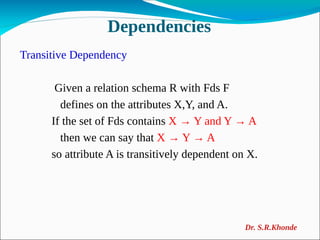
Transitive Dependency
Given arelation schema R with Fds F
defines on the attributes X,Y, and A.
If the set of Fds contains X → Y and Y → A
then we can say that X → Y → A
so attribute A is transitively dependent on X.
Dr. S.R.Khonde
34.
Example
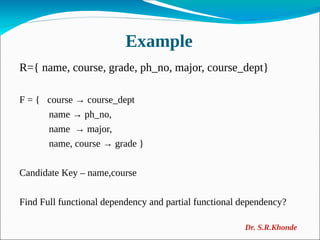
R={ name, course,grade, ph_no, major, course_dept}
F = { course → course_dept
name → ph_no,
name → major,
name, course → grade }
Candidate Key – name,course
Find Full functional dependency and partial functional dependency?
Dr. S.R.Khonde
35.
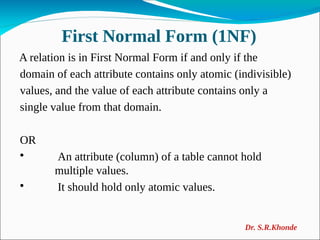
First Normal Form(1NF)
A relation is in First Normal Form if and only if the
domain of each attribute contains only atomic (indivisible)
values, and the value of each attribute contains only a
single value from that domain.
OR
An attribute (column) of a table cannot hold
multiple values.
It should hold only atomic values.
Dr. S.R.Khonde
36.
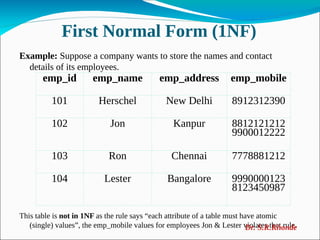
First Normal Form(1NF)
Example: Suppose a company wants to store the names and contact
details of its employees.
This table is not in 1NF as the rule says “each attribute of a table must have atomic
(single) values”, the emp_mobile values for employees Jon & Lester violates that rule.
emp_id emp_name emp_address emp_mobile
101 Herschel New Delhi 8912312390
102 Jon Kanpur 8812121212
9900012222
103 Ron Chennai 7778881212
104 Lester Bangalore 9990000123
8123450987
Dr. S.R.Khonde
37.
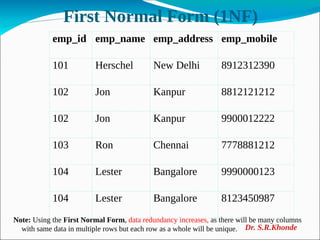
First Normal Form(1NF)
Note: Using the First Normal Form, data redundancy increases, as there will be many columns
with same data in multiple rows but each row as a whole will be unique.
emp_id emp_name emp_address emp_mobile
101 Herschel New Delhi 8912312390
102 Jon Kanpur 8812121212
102 Jon Kanpur 9900012222
103 Ron Chennai 7778881212
104 Lester Bangalore 9990000123
104 Lester Bangalore 8123450987
Dr. S.R.Khonde
38.
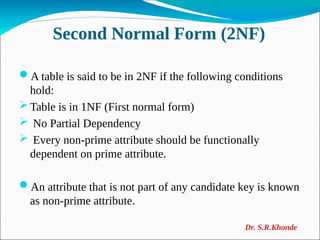
Second Normal Form(2NF)
A table is said to be in 2NF if the following conditions
hold:
Table is in 1NF (First normal form)
No Partial Dependency
Every non-prime attribute should be functionally
dependent on prime attribute.
An attribute that is not part of any candidate key is known
as non-prime attribute.
Dr. S.R.Khonde
39.
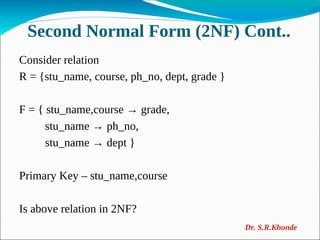
Second Normal Form(2NF) Cont..
Consider relation
R = {stu_name, course, ph_no, dept, grade }
F = { stu_name,course → grade,
stu_name → ph_no,
stu_name → dept }
Primary Key – stu_name,course
Is above relation in 2NF?
Dr. S.R.Khonde
40.
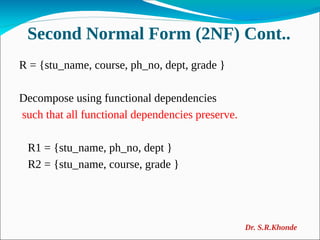
Second Normal Form(2NF) Cont..
R = {stu_name, course, ph_no, dept, grade }
Decompose using functional dependencies
such that all functional dependencies preserve.
R1 = {stu_name, ph_no, dept }
R2 = {stu_name, course, grade }
Dr. S.R.Khonde
41.
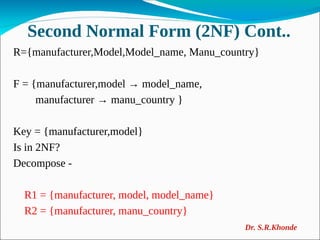
Second Normal Form(2NF) Cont..
R={manufacturer,Model,Model_name, Manu_country}
F = {manufacturer,model → model_name,
manufacturer → manu_country }
Key = {manufacturer,model}
Is in 2NF?
Decompose -
R1 = {manufacturer, model, model_name}
R2 = {manufacturer, manu_country}
Dr. S.R.Khonde
42.
Third Normal Form(3NF)
For a relation to be in Third Normal Form, it must satisfy
following conditions :
It should be in Second Normal form
No non-prime attribute is transitively dependent on prime
key attribute (no transitive dependency)
Dr. S.R.Khonde
43.
Third Normal Form(3NF) Cont..
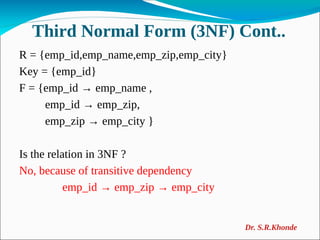
R = {emp_id,emp_name,emp_zip,emp_city}
Key = {emp_id}
F = {emp_id → emp_name ,
emp_id → emp_zip,
emp_zip → emp_city }
Is the relation in 3NF ?
No, because of transitive dependency
emp_id → emp_zip → emp_city
Dr. S.R.Khonde
44.
Third Normal Form(3NF) Cont..
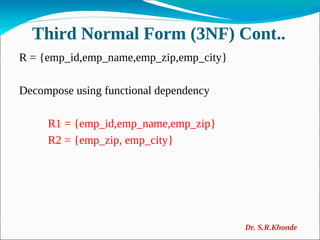
R = {emp_id,emp_name,emp_zip,emp_city}
Decompose using functional dependency
R1 = {emp_id,emp_name,emp_zip}
R2 = {emp_zip, emp_city}
Dr. S.R.Khonde
45.
Third Normal Form(3NF) Cont..
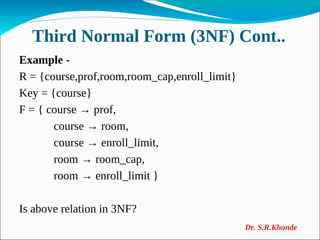
Example -
R = {course,prof,room,room_cap,enroll_limit}
Key = {course}
F = { course → prof,
course → room,
course → enroll_limit,
room → room_cap,
room → enroll_limit }
Is above relation in 3NF?
Dr. S.R.Khonde
46.
Boyce Code NormalForm (BCNF)
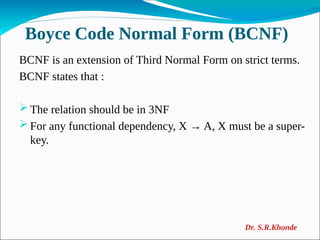
BCNF is an extension of Third Normal Form on strict terms.
BCNF states that :
The relation should be in 3NF
For any functional dependency, X → A, X must be a super-
key.
Dr. S.R.Khonde
47.
Boyce Code NormalForm (BCNF)
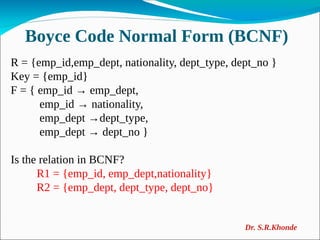
R = {emp_id,emp_dept, nationality, dept_type, dept_no }
Key = {emp_id}
F = { emp_id → emp_dept,
emp_id → nationality,
emp_dept →dept_type,
emp_dept → dept_no }
Is the relation in BCNF?
R1 = {emp_id, emp_dept,nationality}
R2 = {emp_dept, dept_type, dept_no}
Dr. S.R.Khonde
48.
Boyce Code NormalForm (BCNF)
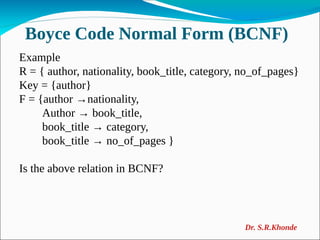
Example
R = { author, nationality, book_title, category, no_of_pages}
Key = {author}
F = {author →nationality,
Author → book_title,
book_title → category,
book_title → no_of_pages }
Is the above relation in BCNF?
Dr. S.R.Khonde
49.
Decomposition Algorithm
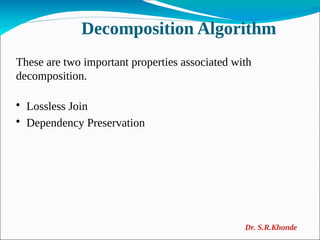
These aretwo important properties associated with
decomposition.
Lossless Join
Dependency Preservation
Dr. S.R.Khonde
50.
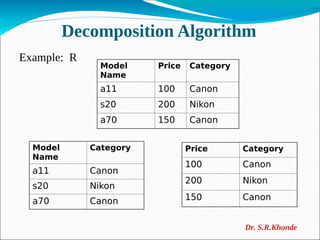
Decomposition Algorithm
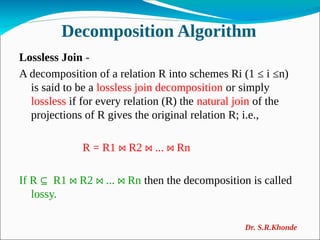
Lossless Join-
A decomposition of a relation R into schemes Ri (1 ≤ i ≤n)
is said to be a lossless join decomposition or simply
lossless if for every relation (R) the natural join of the
projections of R gives the original relation R; i.e.,
R = R1 R2 ... Rn
⋈ ⋈ ⋈
If R R1 R2 ... Rn
⊆ ⋈ ⋈ ⋈ then the decomposition is called
lossy.
Dr. S.R.Khonde
51.
Decomposition Algorithm
Example: R
Model
Name
PriceCategory
a11 100 Canon
s20 200 Nikon
a70 150 Canon
Model
Name
Category
a11 Canon
s20 Nikon
a70 Canon
Price Category
100 Canon
200 Nikon
150 Canon
Dr. S.R.Khonde
52.
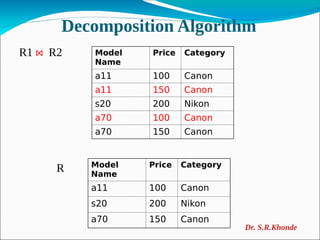
Decomposition Algorithm
R1 ⋈R2
R
Model
Name
Price Category
a11 100 Canon
a11 150 Canon
s20 200 Nikon
a70 100 Canon
a70 150 Canon
Model
Name
Price Category
a11 100 Canon
s20 200 Nikon
a70 150 Canon
Dr. S.R.Khonde
53.
Decomposition Algorithm
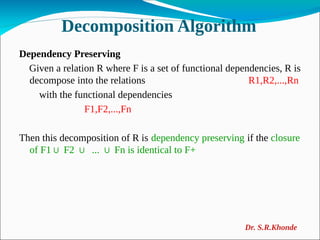
Dependency Preserving
Givena relation R where F is a set of functional dependencies, R is
decompose into the relations R1,R2,...,Rn
with the functional dependencies
F1,F2,...,Fn
Then this decomposition of R is dependency preserving if the closure
of F1 F2 ... Fn is identical to F+
∪ ∪ ∪
Dr. S.R.Khonde
54.
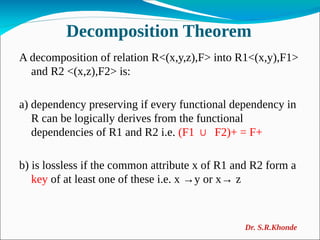
Decomposition Theorem
A decompositionof relation R<(x,y,z),F> into R1<(x,y),F1>
and R2 <(x,z),F2> is:
a) dependency preserving if every functional dependency in
R can be logically derives from the functional
dependencies of R1 and R2 i.e. (F1 F2)+ = F+
∪
b) is lossless if the common attribute x of R1 and R2 form a
key of at least one of these i.e. x →y or x→ z
Dr. S.R.Khonde
55.
Decomposition Theorem
Example -
LetR(a,b,c) and F = {a→b }
Check weather above relation is lossless and dependency
preserving if decompose as
R1 (a,b) and R2 (a,c)
Dr. S.R.Khonde





![[DSC Europe 25] Gordana Milutinovic Dumbelovic - From Insight to Oversight: A...](https://cdn.slidesharecdn.com/ss_thumbnails/t7dkjsfxqwwzceropjv4-gordana-milutinovicdumbelovic-from-insight-to-oversight-ai-driven-power-bi-moni-260119121559-9e0bf11b-thumbnail.jpg?width=640&height=640&fit=bounds)


![[DSC Europe 25] Andrzej Kowalczyk - AI - how to start small and grow in the f...](https://cdn.slidesharecdn.com/ss_thumbnails/oy1zmo94qv6vpcqjvno2-andrzej-kowalczyk-ai-how-to-start-small-and-grow-in-the-future-1-260119121559-cf093b23-thumbnail.jpg?width=640&height=640&fit=bounds)

![[DSC Europe 25] Mikhail Rozhkov - AI Product Canvas: From Business Goals to T...](https://cdn.slidesharecdn.com/ss_thumbnails/d53doddtpgfqivmzqel6-mikhail-rozhkov-ai-product-canvas-v1-260121115910-9dd517a7-thumbnail.jpg?width=640&height=640&fit=bounds)


![[DSC Europe 25] Marcos Heidemann - Beyond the Hype: Making AI Coding Assistan...](https://cdn.slidesharecdn.com/ss_thumbnails/eexkhvldrjsopspdjbur-marcos-heidemann-beyond-the-hype-getting-real-value-out-of-ai-assisted-coding-260121115910-7e9d41ec-thumbnail.jpg?width=640&height=640&fit=bounds)


![[DSC Europe 25] Borko Kozomora - Optimizing business workflows with advances ...](https://cdn.slidesharecdn.com/ss_thumbnails/hbgekyb0txw0xpo4yfml-borko-kozomora-leading-ai-transformation-260122103838-cc29ee38-thumbnail.jpg?width=640&height=640&fit=bounds)
![[DSC Europe 25] Tali Fulman - Guild Meetings, Then What? Building Data Commun...](https://cdn.slidesharecdn.com/ss_thumbnails/fgohhi33rwmhqdowdj5k-tali-fulman-guild-meetings-then-what-building-data-communities-that-actually-ch-260120105855-528492c3-thumbnail.jpg?width=640&height=640&fit=bounds)

![[DSC Europe 25] Paula Garcia Esteban -Building the Future: The Role of Data S...](https://cdn.slidesharecdn.com/ss_thumbnails/9ld1r1bsqpwve8qfvphy-paula-garcia-esteban-building-the-future-260122103838-4171f5cb-thumbnail.jpg?width=640&height=640&fit=bounds)


