GAL ZAHAVI, YARON ROSENSTEIN
TECHNION-ISRAEL INSTITUTE OF TECHNOLOGY
THE WILLIAM DAVIDSON FACULTY OF INDUSTRIAL ENGINEERING & MANAGEMENT
Nonlinear Weather Forecasting for Weather Derivatives
Pricing
Temperature Weather- Market
 Heating Degree Day (HDD) weather derivatives first
introduced in 1997
 The following factors contributed to the birth of
weather market that year:
 Convergence of capital and insurance markets
 Risk capital availability
 Strong El Nino event of 1997-98
 Deregulation of the electricity markets that started in 1996
 Enron prominence and strive for innovation
 Easy availability of (reliable) meteorological data
 By 1997, environmental markets already existed (air
pollutants)
Hedging Weather Risk CME
CME – Weather Products
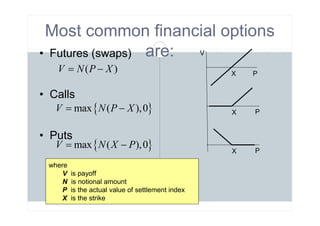
Most common financial options
are:
• Futures (swaps)
• Calls
• Puts
( )
V N P X
= −
{ }
max ( ),0
V N P X
= −
{ }
max ( ),0
V N X P
= −
where
V is payoff
N is notional amount
P is the actual value of settlement index
X is the strike
X P
V
X P
X P
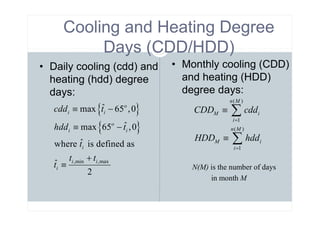
Cooling and Heating Degree
Days (CDD/HDD)
• Daily cooling (cdd) and
heating (hdd) degree
days:
{ }
{ }
,min ,max
ˆ
max 65 ,0
ˆ
max 65 ,0
ˆ
where is defined as
ˆ
2
o
i i
o
i i
i
i i
i
cdd t
hdd t
t
t t
t
≡ −
≡ −
+
≡
( )
1
( )
1
n M
M i
i
n M
M i
i
CDD cdd
HDD hdd
=
=
≡
≡
∑
∑
• Monthly cooling (CDD)
and heating (HDD)
degree days:
N(M) is the number of days
in month M
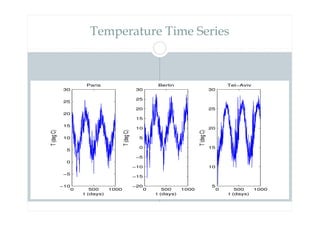
Temperature Time Series
0 500 1000
−10
−5
0
5
10
15
20
25
30
t (days)
T
(deg
C)
Paris
0 500 1000
−20
−15
−10
−5
0
5
10
15
20
25
30
t (days)
T
(deg
C)
Berlin
0 500 1000
5
10
15
20
25
30
t (days)
T
(deg
C)
Tel−Aviv
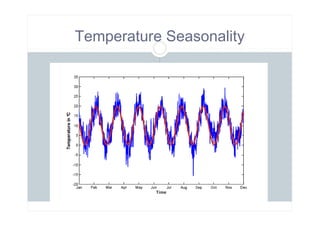
Temperature Seasonality
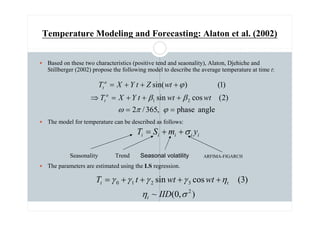
Temperature Modeling and Forecasting: Alaton et al. (2002)
 Based on these two characteristics (positive tend and seaonality), Alaton, Djehiche and
Stillberger (2002) propose the following model to describe the average temperature at time t:
 The model for temperature can be described as follows:
 The parameters are estimated using the LS regression.
angle
phase
,
365
/
2
)
2
(
cos
sin
)
1
(
)
sin(
2
1
=
=
+
+
+
=
⇒
+
+
+
=
ϕ
π
ω
β
β
ϕ
wt
wt
t
Y
X
T
t
w
Z
t
Y
X
T
a
t
a
t
)
,
0
(
~
)
3
(
cos
sin
2
3
2
1
0
σ
η
η
γ
γ
γ
γ
IID
wt
wt
t
T
t
t
t +
+
+
+
=
i
i
i
i
i y
m
S
T σ
+
+
=
Seasonality Trend ARFIMA-FIGARCH
Seasonal volatility
Temperature Modeling and Forecasting:
Alaton et al. (2002)
 Alaton et al. (2002) obtain the following stochastic
differential equation in continuous form:
 The above equation can be rewritten in discrete form:
 can be estimated based on Equations (2) and (3).
 can be obtained using the OLS regression and
)
5
(
)]
(
)
/
[( t
t
t
a
t
a
t
t dW
dt
T
T
dt
dT
dT σ
α +
−
+
=
a
j
T
( ) )
8
(
)
ˆ
1
(
ˆ
~
2
1
ˆ
1
2
1
1
2
∑
=
−
− −
−
−
−
=
µ
α
α
σ
µ
µ
N
j
j
a
j
j T
T
T
N
)
month
in
days
(
,
,
1
),
1
,
0
(
~
(7)
)
1
(
)
(
~
1
1
1
1
µ
η
η
σ
α
α
µ
µ
µ
N
N
j
N
T
T
T
T
T
T
j
j
j
a
j
a
j
a
j
j
j
K
=
+
−
+
=
−
−
≡ −
−
−
−
α̂
Time Trend
Mean-Reverting
Temperature and Forecasting Models: GARCH
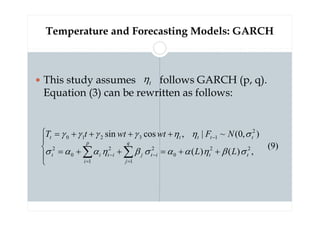
 This study assumes follows GARCH (p, q).
Equation (3) can be rewritten as follows:
)
9
(
,
)
(
)
(
)
,
0
(
~
|
,
cos
sin
2
2
0
1
2
1
2
0
2
2
1
3
2
1
0





+
+
=
+
+
=
+
+
+
+
=
∑
∑ =
−
=
−
−
t
t
q
j
i
t
j
p
i
i
t
i
t
t
t
t
t
t
L
L
N
F
wt
wt
t
T
σ
β
η
α
α
σ
β
η
α
α
σ
σ
η
η
γ
γ
γ
γ
t
η
Embedology Filter Algorithm
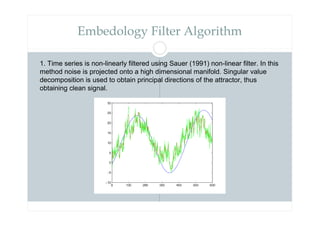
1. Time series is non-linearly filtered using Sauer (1991) non-linear filter. In this
method noise is projected onto a high dimensional manifold. Singular value
decomposition is used to obtain principal directions of the attractor, thus
obtaining clean signal.
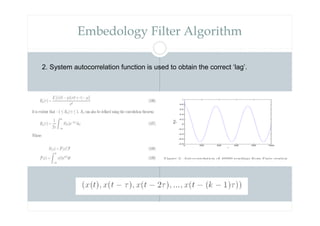
2. System autocorrelation function is used to obtain the correct ‘lag’.
Embedology Filter Algorithm
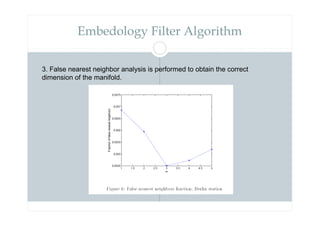
3. False nearest neighbor analysis is performed to obtain the correct
dimension of the manifold.
Embedology Filter Algorithm
Embedology Algorithm
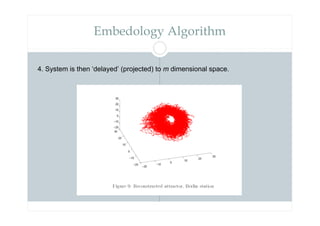
4. System is then ‘delayed’ (projected) to m dimensional space.
Non-Linear Dynamical System
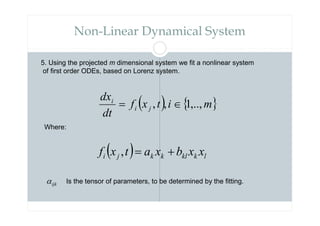
5. Using the projected m dimensional system we fit a nonlinear system
of first order ODEs, based on Lorenz system.
( ) { }
m
i
t
x
f
dt
dx
j
i
i
,..,
1
,
, ∈
=
( ) l
k
kl
k
k
j
i x
x
b
x
a
t
x
f +
=
,
Where:
ijk
α Is the tensor of parameters, to be determined by the fitting.
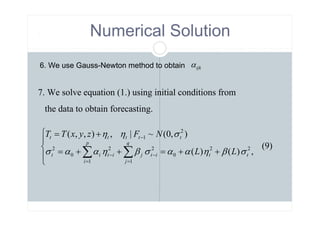
6. We use Gauss-Newton method to obtain ijk
α
. Numerical Solution
7. We solve equation (1.) using initial conditions from
the data to obtain forecasting.
)
9
(
,
)
(
)
(
)
,
0
(
~
|
,
)
,
,
(
2
2
0
1
2
1
2
0
2
2
1





+
+
=
+
+
=
+
=
∑
∑ =
−
=
−
−
t
t
q
j
i
t
j
p
i
i
t
i
t
t
t
t
t
t
L
L
N
F
z
y
x
T
T
σ
β
η
α
α
σ
β
η
α
α
σ
σ
η
η
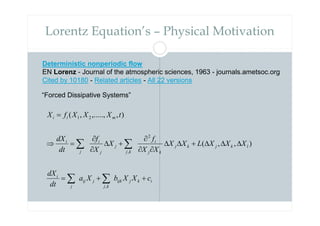
Lorentz Equation’s – Physical Motivation
Deterministic nonperiodic flow
EN Lorenz - Journal of the atmospheric sciences, 1963 - journals.ametsoc.org
Cited by 10180 - Related articles - All 22 versions
“Forced Dissipative Systems”
i
k
j
ijk
k
j
j
ij
j
i
l
k
j
k
j
k
j
i
k
j
j
j
i
j
i
m
i
i
c
X
X
b
X
a
dt
dX
X
X
X
L
X
X
X
X
f
X
X
f
dt
dX
t
X
X
X
f
X
+
+
=
∆
∆
∆
+
∆
∆
∂
∂
∂
+
∆
∂
∂
=
⇒
=
∑
∑
∑
∑
,
2
,
2
1
)
,
,
(
)
,
,.....,
,
(
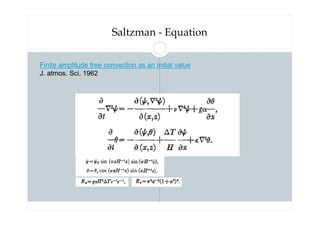
Saltzman - Equation
Finite amplitude free convection as an initial value
J. atmos. Sci, 1962
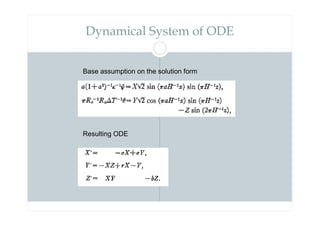
Dynamical System of ODE
Base assumption on the solution form
Resulting ODE
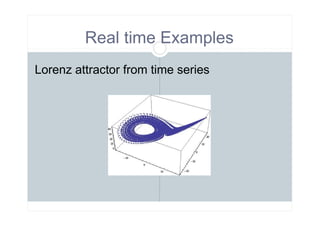
Real time Examples
Lorenz attractor from time series
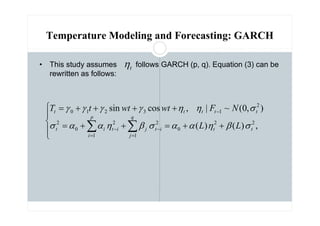
Temperature Modeling and Forecasting: GARCH
• This study assumes follows GARCH (p, q). Equation (3) can be
rewritten as follows:





+
+
=
+
+
=
+
+
+
+
=
∑
∑ =
−
=
−
−
,
)
(
)
(
)
,
0
(
~
|
,
cos
sin
2
2
0
1
2
1
2
0
2
2
1
3
2
1
0
t
t
q
j
i
t
j
p
i
i
t
i
t
t
t
t
t
t
L
L
N
F
wt
wt
t
T
σ
β
η
α
α
σ
β
η
α
α
σ
σ
η
η
γ
γ
γ
γ
t
η
))
0
(
)
(
(
))
0
(
)
(
(
))
0
(
)
(
(
)
(
,
)
0
(
)
0
(
)
0
(
)
cos(
0
0
0
)
sin(
0
0
0
)
(
)
(
)
(
,
0
0
0
0
0
0
3
3
2
2
2
1
3
2
1
3
2
1
4
3
3
2
1
3
2
1
4
3
3
2
1
X
t
X
X
t
X
X
t
X
t
T
c
c
c
X
X
X
wt
wt
ct
t
X
t
X
t
X
X
X
X
c
X
X
X
dt
d
−
+
−
+
+
=










+




















=






























−
=










γ
γ
γ
γ
Alaton 2002 – Linear ODE solution
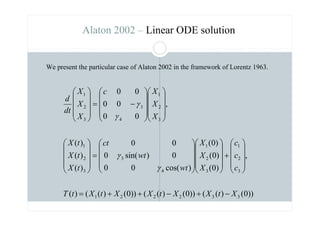
We present the particular case of Alaton 2002 in the framework of Lorentz 1963.
Linear Approximation
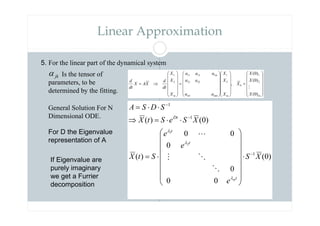
5. For the linear part of the dynamical system














=




























=














⇒
=
m
m
mm
m
m
m X
X
X
X
X
X
X
a
a
a
a
a
a
a
X
X
X
dt
d
X
A
X
dt
d
)
0
(
)
0
(
)
0
(
, 2
1
0
2
1
1
22
21
1
12
11
2
1
M
jk
α Is the tensor of
parameters, to be
determined by the fitting.
General Solution For N
Dimensional ODE.
)
0
(
0
0
0
0
0
0
)
(
)
0
(
)
(
1
1
1
2
1
X
S
e
e
e
S
t
X
X
S
e
S
t
X
S
D
S
A
t
t
t
Dt
m
−
−
−
⋅
















⋅
=
⋅
⋅
=
⇒
⋅
⋅
=
λ
λ
λ
O
O
M
L
For D the Eigenvalue
representation of A
If Eigenvalue are
purely imaginary
we get a Furrier
decomposition
Linear Approximation
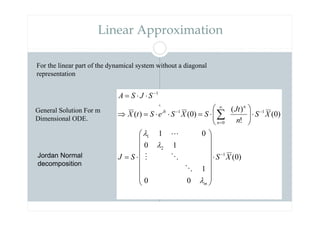
For the linear part of the dynamical system without a diagonal
representation
General Solution For m
Dimensional ODE.
)
0
(
0
0
1
1
0
0
1
)
0
(
!
)
(
)
0
(
)
(
1
2
1
1
0
1
1
X
S
S
J
X
S
n
Jt
S
X
S
e
S
t
X
S
J
S
A
m
n
n
Jt
−
−
∞
=
−
−
⋅
















⋅
=
⋅








⋅
=
⋅
⋅
=
⇒
⋅
⋅
=
∑
λ
λ
λ
O
O
M
L
Jordan Normal
decomposition
1
λ
1 Day
ahead
3 Days
ahead
5 Days
ahead
7 Days
ahead
9 Days
ahead
11 Days ahead
Tel-Aviv
Campbell (2005)
This work
1.15
0.13
2.36
0.62
3.40
1.19
4.22
1.46
4.94
1.53
5.56
1.44
Berlin
Campbell (2005)
This work
1.33
0.98
0.73
2.51
3.43
1.90
5.53
0.69
9.37
3.24
13.44
4.12
Paris
Campbell (2005)
This work
2.34
0.44
5.75
2.66
7.13
4.20
9.03
5.01
8.88
5.44
13.44
4.12
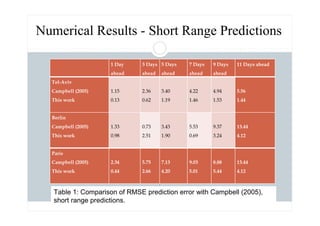
Numerical Results - Short Range Predictions
Table 1: Comparison of RMSE prediction error with Campbell (2005),
short range predictions.
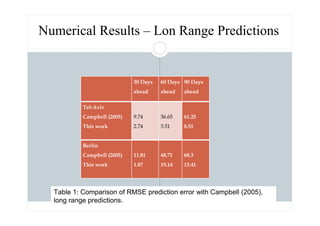
30 Days
ahead
60 Days
ahead
90 Days
ahead
Tel-Aviv
Campbell (2005)
This work
9.74
2.74
36.65
3.51
61.25
8.51
Berlin
Campbell (2005)
This work
11.81
1.87
48.71
19.14
68.3
15.41
Numerical Results – Lon Range Predictions
Table 1: Comparison of RMSE prediction error with Campbell (2005),
long range predictions.
HDD/CDD Option Price Formula . Alaton et al. 2002)
)
15
(
2
)
(
)
(
)
(
)
(
]
|
}
0
,
[max{
(14)
2
)
(
)
(
)
(
)
(
]
|
}
0
,
[max{
2
2
2
2
1
2
)
(
0
)
(
)
(
2
)
(
)
(
)
(




















−
+
















−
Φ
−
Φ
−
=
−
=
−
=








+
−
Φ
−
=
−
=
−
=








−
−
−
−
−
−
−
−
−
−
−
−
∞
−
−
−
−
∫
∫
n
n
n
n
n
n
n
n
n
n
n
n
e
e
K
e
dx
x
f
x
K
e
F
H
K
E
e
p
e
K
e
dx
x
f
K
x
e
F
K
H
E
e
c
n
n
n
n
n
t
t
r
K
H
t
t
r
t
n
Q
t
t
r
t
n
n
n
t
t
r
K
H
t
t
r
t
n
Q
t
t
r
t
σ
µ
α
α
π
σ
σ
µ
α
µ
π
σ
α
µ
Alaton et al. (2002) estimate the conditional variance
.
0
)
20
(
]
)[
1
)(
2
/
1
(
]
|
,
[
)
19
(
]
)[
1
)(
2
/
1
(
]
|
[
)
18
(
]
)[
1
)(
/
(
)
(
]
|
[
2
2
2
2
1
2
)
(
2
2
2
2
1
2
2
1
)
(
u
t
s
e
e
F
T
T
Cov
e
F
T
Var
e
T
e
T
T
F
T
E
t
s
s
s
t
s
u
t
t
s
s
s
t
t
s
s
m
t
s
t
m
s
s
s
t
Q
≤
≤
≤
+
+
+
−
=
+
+
+
−
=
+
+
+
−
−
+
−
=
+
+
−
−
−
+
+
−
+
+
−
−
−
σ
σ
σ
α
σ
σ
σ
α
σ
σ
σ
α
λ
α
α
α
α
α
L
L
L
First-Order and Second-Order Moments of Hn and Cn
( )
( )
)
27
(
]
│
,
[
2
]
|
[
]
│
[
)
26
(
23
]
|
[
|
23
]
|
[
)
25
(
]
|
,
[
2
]
|
[
]
|
[
)
24
(
]
|
[
23
|
23
]
|
[
1
1
1
1
1
1
∑∑
∑
∑
∑
∑∑
∑
∑
∑

=
=
=

=
=
=
+
≈
−
=
−
≈
+
≈
−
=
−
≈
j
i
t
t
t
n
t t
t
t
n
n
i t
t
Q
t
n
i t
Q
t
n
Q
j
i
t
t
t
n
t t
t
t
n
n
i t
t
Q
t
n
i t
Q
t
n
Q
F
T
T
Cov
F
T
Var
F
C
Var
n
F
T
E
F
n
T
E
F
C
E
F
T
T
Cov
F
T
Var
F
H
Var
F
T
E
n
F
T
n
E
F
H
E
j
i
i
i
j
i
i
i
Thank You ☺

Nonlinear Weather Forecasting-ORSIS.pdf

  • 1.
    GAL ZAHAVI, YARONROSENSTEIN TECHNION-ISRAEL INSTITUTE OF TECHNOLOGY THE WILLIAM DAVIDSON FACULTY OF INDUSTRIAL ENGINEERING & MANAGEMENT Nonlinear Weather Forecasting for Weather Derivatives Pricing
  • 2.
    Temperature Weather- Market Heating Degree Day (HDD) weather derivatives first introduced in 1997 The following factors contributed to the birth of weather market that year: Convergence of capital and insurance markets Risk capital availability Strong El Nino event of 1997-98 Deregulation of the electricity markets that started in 1996 Enron prominence and strive for innovation Easy availability of (reliable) meteorological data By 1997, environmental markets already existed (air pollutants)
  • 3.
  • 4.
  • 5.
    Most common financialoptions are: • Futures (swaps) • Calls • Puts ( ) V N P X = − { } max ( ),0 V N P X = − { } max ( ),0 V N X P = − where V is payoff N is notional amount P is the actual value of settlement index X is the strike X P V X P X P
  • 6.
    Cooling and HeatingDegree Days (CDD/HDD) • Daily cooling (cdd) and heating (hdd) degree days: { } { } ,min ,max ˆ max 65 ,0 ˆ max 65 ,0 ˆ where is defined as ˆ 2 o i i o i i i i i i cdd t hdd t t t t t ≡ − ≡ − + ≡ ( ) 1 ( ) 1 n M M i i n M M i i CDD cdd HDD hdd = = ≡ ≡ ∑ ∑ • Monthly cooling (CDD) and heating (HDD) degree days: N(M) is the number of days in month M
  • 7.
    Temperature Time Series 0500 1000 −10 −5 0 5 10 15 20 25 30 t (days) T (deg C) Paris 0 500 1000 −20 −15 −10 −5 0 5 10 15 20 25 30 t (days) T (deg C) Berlin 0 500 1000 5 10 15 20 25 30 t (days) T (deg C) Tel−Aviv
  • 8.
  • 9.
    Temperature Modeling andForecasting: Alaton et al. (2002) Based on these two characteristics (positive tend and seaonality), Alaton, Djehiche and Stillberger (2002) propose the following model to describe the average temperature at time t: The model for temperature can be described as follows: The parameters are estimated using the LS regression. angle phase , 365 / 2 ) 2 ( cos sin ) 1 ( ) sin( 2 1 = = + + + = ⇒ + + + = ϕ π ω β β ϕ wt wt t Y X T t w Z t Y X T a t a t ) , 0 ( ~ ) 3 ( cos sin 2 3 2 1 0 σ η η γ γ γ γ IID wt wt t T t t t + + + + = i i i i i y m S T σ + + = Seasonality Trend ARFIMA-FIGARCH Seasonal volatility
  • 10.
    Temperature Modeling andForecasting: Alaton et al. (2002) Alaton et al. (2002) obtain the following stochastic differential equation in continuous form: The above equation can be rewritten in discrete form: can be estimated based on Equations (2) and (3). can be obtained using the OLS regression and ) 5 ( )] ( ) / [( t t t a t a t t dW dt T T dt dT dT σ α + − + = a j T ( ) ) 8 ( ) ˆ 1 ( ˆ ~ 2 1 ˆ 1 2 1 1 2 ∑ = − − − − − − = µ α α σ µ µ N j j a j j T T T N ) month in days ( , , 1 ), 1 , 0 ( ~ (7) ) 1 ( ) ( ~ 1 1 1 1 µ η η σ α α µ µ µ N N j N T T T T T T j j j a j a j a j j j K = + − + = − − ≡ − − − − α̂ Time Trend Mean-Reverting
  • 11.
    Temperature and ForecastingModels: GARCH This study assumes follows GARCH (p, q). Equation (3) can be rewritten as follows: ) 9 ( , ) ( ) ( ) , 0 ( ~ | , cos sin 2 2 0 1 2 1 2 0 2 2 1 3 2 1 0      + + = + + = + + + + = ∑ ∑ = − = − − t t q j i t j p i i t i t t t t t t L L N F wt wt t T σ β η α α σ β η α α σ σ η η γ γ γ γ t η
  • 12.
    Embedology Filter Algorithm 1.Time series is non-linearly filtered using Sauer (1991) non-linear filter. In this method noise is projected onto a high dimensional manifold. Singular value decomposition is used to obtain principal directions of the attractor, thus obtaining clean signal.
  • 13.
    2. System autocorrelationfunction is used to obtain the correct ‘lag’. Embedology Filter Algorithm
  • 14.
    3. False nearestneighbor analysis is performed to obtain the correct dimension of the manifold. Embedology Filter Algorithm
  • 15.
    Embedology Algorithm 4. Systemis then ‘delayed’ (projected) to m dimensional space.
  • 16.
    Non-Linear Dynamical System 5.Using the projected m dimensional system we fit a nonlinear system of first order ODEs, based on Lorenz system. ( ) { } m i t x f dt dx j i i ,.., 1 , , ∈ = ( ) l k kl k k j i x x b x a t x f + = , Where: ijk α Is the tensor of parameters, to be determined by the fitting.
  • 17.
    6. We useGauss-Newton method to obtain ijk α . Numerical Solution 7. We solve equation (1.) using initial conditions from the data to obtain forecasting. ) 9 ( , ) ( ) ( ) , 0 ( ~ | , ) , , ( 2 2 0 1 2 1 2 0 2 2 1      + + = + + = + = ∑ ∑ = − = − − t t q j i t j p i i t i t t t t t t L L N F z y x T T σ β η α α σ β η α α σ σ η η
  • 18.
    Lorentz Equation’s –Physical Motivation Deterministic nonperiodic flow EN Lorenz - Journal of the atmospheric sciences, 1963 - journals.ametsoc.org Cited by 10180 - Related articles - All 22 versions “Forced Dissipative Systems” i k j ijk k j j ij j i l k j k j k j i k j j j i j i m i i c X X b X a dt dX X X X L X X X X f X X f dt dX t X X X f X + + = ∆ ∆ ∆ + ∆ ∆ ∂ ∂ ∂ + ∆ ∂ ∂ = ⇒ = ∑ ∑ ∑ ∑ , 2 , 2 1 ) , , ( ) , ,....., , (
  • 19.
    Saltzman - Equation Finiteamplitude free convection as an initial value J. atmos. Sci, 1962
  • 20.
    Dynamical System ofODE Base assumption on the solution form Resulting ODE
  • 21.
    Real time Examples Lorenzattractor from time series
  • 22.
    Temperature Modeling andForecasting: GARCH • This study assumes follows GARCH (p, q). Equation (3) can be rewritten as follows:      + + = + + = + + + + = ∑ ∑ = − = − − , ) ( ) ( ) , 0 ( ~ | , cos sin 2 2 0 1 2 1 2 0 2 2 1 3 2 1 0 t t q j i t j p i i t i t t t t t t L L N F wt wt t T σ β η α α σ β η α α σ σ η η γ γ γ γ t η
  • 23.
  • 24.
    Linear Approximation 5. Forthe linear part of the dynamical system               =                             =               ⇒ = m m mm m m m X X X X X X X a a a a a a a X X X dt d X A X dt d ) 0 ( ) 0 ( ) 0 ( , 2 1 0 2 1 1 22 21 1 12 11 2 1 M jk α Is the tensor of parameters, to be determined by the fitting. General Solution For N Dimensional ODE. ) 0 ( 0 0 0 0 0 0 ) ( ) 0 ( ) ( 1 1 1 2 1 X S e e e S t X X S e S t X S D S A t t t Dt m − − − ⋅                 ⋅ = ⋅ ⋅ = ⇒ ⋅ ⋅ = λ λ λ O O M L For D the Eigenvalue representation of A If Eigenvalue are purely imaginary we get a Furrier decomposition
  • 25.
    Linear Approximation For thelinear part of the dynamical system without a diagonal representation General Solution For m Dimensional ODE. ) 0 ( 0 0 1 1 0 0 1 ) 0 ( ! ) ( ) 0 ( ) ( 1 2 1 1 0 1 1 X S S J X S n Jt S X S e S t X S J S A m n n Jt − − ∞ = − − ⋅                 ⋅ = ⋅         ⋅ = ⋅ ⋅ = ⇒ ⋅ ⋅ = ∑ λ λ λ O O M L Jordan Normal decomposition 1 λ
  • 26.
    1 Day ahead 3 Days ahead 5Days ahead 7 Days ahead 9 Days ahead 11 Days ahead Tel-Aviv Campbell (2005) This work 1.15 0.13 2.36 0.62 3.40 1.19 4.22 1.46 4.94 1.53 5.56 1.44 Berlin Campbell (2005) This work 1.33 0.98 0.73 2.51 3.43 1.90 5.53 0.69 9.37 3.24 13.44 4.12 Paris Campbell (2005) This work 2.34 0.44 5.75 2.66 7.13 4.20 9.03 5.01 8.88 5.44 13.44 4.12 Numerical Results - Short Range Predictions Table 1: Comparison of RMSE prediction error with Campbell (2005), short range predictions.
  • 27.
    30 Days ahead 60 Days ahead 90Days ahead Tel-Aviv Campbell (2005) This work 9.74 2.74 36.65 3.51 61.25 8.51 Berlin Campbell (2005) This work 11.81 1.87 48.71 19.14 68.3 15.41 Numerical Results – Lon Range Predictions Table 1: Comparison of RMSE prediction error with Campbell (2005), long range predictions.
  • 28.
    HDD/CDD Option PriceFormula . Alaton et al. 2002) ) 15 ( 2 ) ( ) ( ) ( ) ( ] | } 0 , [max{ (14) 2 ) ( ) ( ) ( ) ( ] | } 0 , [max{ 2 2 2 2 1 2 ) ( 0 ) ( ) ( 2 ) ( ) ( ) (                     − +                 − Φ − Φ − = − = − =         + − Φ − = − = − =         − − − − − − − − − − − − ∞ − − − − ∫ ∫ n n n n n n n n n n n n e e K e dx x f x K e F H K E e p e K e dx x f K x e F K H E e c n n n n n t t r K H t t r t n Q t t r t n n n t t r K H t t r t n Q t t r t σ µ α α π σ σ µ α µ π σ α µ
  • 29.
    Alaton et al.(2002) estimate the conditional variance . 0 ) 20 ( ] )[ 1 )( 2 / 1 ( ] | , [ ) 19 ( ] )[ 1 )( 2 / 1 ( ] | [ ) 18 ( ] )[ 1 )( / ( ) ( ] | [ 2 2 2 2 1 2 ) ( 2 2 2 2 1 2 2 1 ) ( u t s e e F T T Cov e F T Var e T e T T F T E t s s s t s u t t s s s t t s s m t s t m s s s t Q ≤ ≤ ≤ + + + − = + + + − = + + + − − + − = + + − − − + + − + + − − − σ σ σ α σ σ σ α σ σ σ α λ α α α α α L L L
  • 30.
    First-Order and Second-OrderMoments of Hn and Cn ( ) ( ) ) 27 ( ] │ , [ 2 ] | [ ] │ [ ) 26 ( 23 ] | [ | 23 ] | [ ) 25 ( ] | , [ 2 ] | [ ] | [ ) 24 ( ] | [ 23 | 23 ] | [ 1 1 1 1 1 1 ∑∑ ∑ ∑ ∑ ∑∑ ∑ ∑ ∑ = = = = = = + ≈ − = − ≈ + ≈ − = − ≈ j i t t t n t t t t n n i t t Q t n i t Q t n Q j i t t t n t t t t n n i t t Q t n i t Q t n Q F T T Cov F T Var F C Var n F T E F n T E F C E F T T Cov F T Var F H Var F T E n F T n E F H E j i i i j i i i
  • 31.