HS 102
Basic environment science
WHAT IS NOISE POLLUTION?
• Sound that is unwanted or disrupts one’s quality of life is
called as noise. When there is lot of noise in the environment,
it is termed as noise pollution.
• Sound becomes undesirable when it disturbs the normal
activities such as working, sleeping, and during
conversations.
• It is an underrated environmental problem because of
the fact that we can’t see, smell, or taste it.
 HEALTH EFFECTS
According to the USEPA, there are direct links between
noise and health. Also, noise pollution adversely affects
the lives of millions of people.
Noise pollution can damage physiological and
psychological health.
High blood pressure, stress related illness, sleep
disruption, hearing loss, and productivity loss are the
problems related to noise pollution.
•SOURCES OF NOISE
POLLUTION
• Transportation systems are the main source of noise pollution in
urban areas.
• Construction of buildings, highways, and streets cause a
lot of noise, due to the usage of air compressors,
bulldozers, loaders, dump trucks, and pavement breakers
• Industrial noise also adds to the already unfavorable
state of noise pollution.
• Loud speakers, plumbing, boilers, generators, air conditioners,
fans, and vacuum cleaners add to the existing noise pollution.
SOLUTIONS FOR NOISE
POLLUTION
• Planting bushes and trees in and around sound
generating sources is an effective solution for noise
pollution.
• Regular servicing and tuning of automobiles can
effectively reduce the noise pollution.
• Buildings can be designed with suitable noise
absorbing material for the walls, windows, and
ceilings.
• Workers should be provided with equipments such
as ear plugs and earmuffs for hearing protection.
Continue …
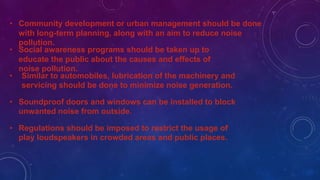
• Community development or urban management should be done
with long-term planning, along with an aim to reduce noise
pollution.
• Social awareness programs should be taken up to
educate the public about the causes and effects of
noise pollution.
• Similar to automobiles, lubrication of the machinery and
servicing should be done to minimize noise generation.
• Soundproof doors and windows can be installed to block
unwanted noise from outside.
• Regulations should be imposed to restrict the usage of
play loudspeakers in crowded areas and public places.

Noise pollution

  • 1.
  • 2.
    WHAT IS NOISEPOLLUTION? • Sound that is unwanted or disrupts one’s quality of life is called as noise. When there is lot of noise in the environment, it is termed as noise pollution. • Sound becomes undesirable when it disturbs the normal activities such as working, sleeping, and during conversations. • It is an underrated environmental problem because of the fact that we can’t see, smell, or taste it.
  • 3.
     HEALTH EFFECTS Accordingto the USEPA, there are direct links between noise and health. Also, noise pollution adversely affects the lives of millions of people. Noise pollution can damage physiological and psychological health. High blood pressure, stress related illness, sleep disruption, hearing loss, and productivity loss are the problems related to noise pollution.
  • 4.
    •SOURCES OF NOISE POLLUTION •Transportation systems are the main source of noise pollution in urban areas. • Construction of buildings, highways, and streets cause a lot of noise, due to the usage of air compressors, bulldozers, loaders, dump trucks, and pavement breakers • Industrial noise also adds to the already unfavorable state of noise pollution. • Loud speakers, plumbing, boilers, generators, air conditioners, fans, and vacuum cleaners add to the existing noise pollution.
  • 5.
    SOLUTIONS FOR NOISE POLLUTION •Planting bushes and trees in and around sound generating sources is an effective solution for noise pollution. • Regular servicing and tuning of automobiles can effectively reduce the noise pollution. • Buildings can be designed with suitable noise absorbing material for the walls, windows, and ceilings. • Workers should be provided with equipments such as ear plugs and earmuffs for hearing protection. Continue …
  • 6.
    • Community developmentor urban management should be done with long-term planning, along with an aim to reduce noise pollution. • Social awareness programs should be taken up to educate the public about the causes and effects of noise pollution. • Similar to automobiles, lubrication of the machinery and servicing should be done to minimize noise generation. • Soundproof doors and windows can be installed to block unwanted noise from outside. • Regulations should be imposed to restrict the usage of play loudspeakers in crowded areas and public places.