Node.js
Security
…trolololol
about.me
• break things for fun and
profit
• sometimes I talk about stuff
• involved in various groups
• <3 ROC hacker community
most importantly
node.js
• a JavaScript runtime built
on Google’s V8
JavaScript engine
• uses an event-driven,
non-blocking I/O model
• npm package repo
claims to be the largest
ecosystem of open
source libraries in the
world
V8 engine runtime
• written in C++
• implements ECMA
script standard
ECMA-262
• same engine the
chrome browser
uses for JavaScript
processing
installation
• don’t apt-get install
• download the tarball
• untar it $someplace
• add
$someplace/<nodedir>/bin
to your path
starting a project
• npm init
<demo>
• or don’t
things to know
• node.js is NOT a web framework.
• It’s an application server
• think Tomcat or Zend
• not rails or Django
• you know that, devops don’t care
express.js web framework
• modeled after the ruby ‘Sinatra’
project
• most widely used node framework
• easy to work with, lots of examples
• creating servers is easy
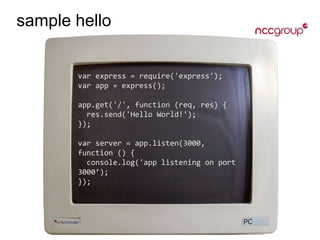
sample hello
var express = require('express');
var app = express();
app.get('/', function (req, res) {
res.send('Hello World!');
});
var server = app.listen(3000,
function () {
console.log('app listening on port
3000’);
});
other frameworks?
• koa
only framework that embraces ES6 fully
less robust than express, and not as tested
• hapi
built for complex apps, has big.corp support
(walmart)
less mature than express, heavier dev
investment requirements
what about $myFavorite.js?
• express / koa / hapi
server side
designed to manage the
application engine
• angular / ember /
backbone /
omgsomany
client-side JavaScript
frameworks
implement MVC or PAC
methods
moar demo
security risks
• npm makes it easy to add things
tough to track dependencies
repo is open, anyone can add modules
vulns in vendor libs == app.pwnd
• package.json may get stale
as libs are updated, version info may not change
lib patches that you ignore == app.pwnd
OMG! XSS! ONTHASERVER!
• we can inject commands & stuff
right?
• not really a concern, because this is
server-side
• client input isn’t parsed in the server code
• not shelling out to command line
• options that get parsed come from:
• env vars
• config files
• sometimes eval() but that’s very uncommon
node security tools
• helmet.js
framework makes it easy to remove common
vectors like XSS, CSRF, cache snarfing, and
clickjacking
helmet = require(‘helmet’);
app.use(helmet.xssFilter());
app.use(helmet.noCache());
app.use(helmet.xssnoSniff());
app.use(helmet.xssframeguard());
app.use(helmet.xsshidePoweredBy());
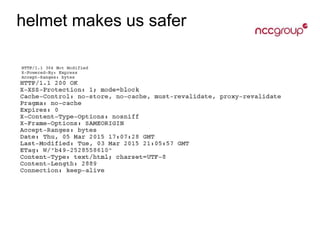
helmet makes us safer
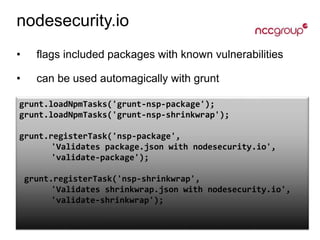
nodesecurity.io
• flags included packages with known vulnerabilities
• can be used automagically with grunt
grunt.loadNpmTasks('grunt-nsp-package');
grunt.loadNpmTasks('grunt-nsp-shrinkwrap');
grunt.registerTask('nsp-package',
'Validates package.json with nodesecurity.io',
'validate-package');
grunt.registerTask('nsp-shrinkwrap',
'Validates shrinkwrap.json with nodesecurity.io',
'validate-shrinkwrap');
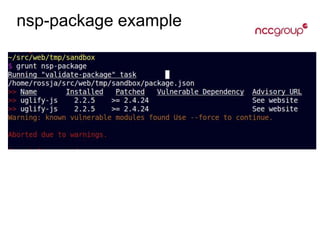
nsp-package example
NodeJs Scan
• python tool to scan node.js static
code
• problem: node is JavaScript, and is
dynamic
• that makes it tough to analyze code
• still does a decent job of trying
demo++;
preso.quit();

Nodejs Security

  • 1.
  • 2.
    about.me • break thingsfor fun and profit • sometimes I talk about stuff • involved in various groups • <3 ROC hacker community
  • 3.
  • 4.
    node.js • a JavaScriptruntime built on Google’s V8 JavaScript engine • uses an event-driven, non-blocking I/O model • npm package repo claims to be the largest ecosystem of open source libraries in the world
  • 5.
    V8 engine runtime •written in C++ • implements ECMA script standard ECMA-262 • same engine the chrome browser uses for JavaScript processing
  • 6.
    installation • don’t apt-getinstall • download the tarball • untar it $someplace • add $someplace/<nodedir>/bin to your path
  • 7.
    starting a project •npm init <demo> • or don’t
  • 8.
    things to know •node.js is NOT a web framework. • It’s an application server • think Tomcat or Zend • not rails or Django • you know that, devops don’t care
  • 9.
    express.js web framework •modeled after the ruby ‘Sinatra’ project • most widely used node framework • easy to work with, lots of examples • creating servers is easy
  • 10.
    sample hello var express= require('express'); var app = express(); app.get('/', function (req, res) { res.send('Hello World!'); }); var server = app.listen(3000, function () { console.log('app listening on port 3000’); });
  • 11.
    other frameworks? • koa onlyframework that embraces ES6 fully less robust than express, and not as tested • hapi built for complex apps, has big.corp support (walmart) less mature than express, heavier dev investment requirements
  • 12.
    what about $myFavorite.js? •express / koa / hapi server side designed to manage the application engine • angular / ember / backbone / omgsomany client-side JavaScript frameworks implement MVC or PAC methods
  • 13.
  • 14.
    security risks • npmmakes it easy to add things tough to track dependencies repo is open, anyone can add modules vulns in vendor libs == app.pwnd • package.json may get stale as libs are updated, version info may not change lib patches that you ignore == app.pwnd
  • 15.
    OMG! XSS! ONTHASERVER! •we can inject commands & stuff right? • not really a concern, because this is server-side • client input isn’t parsed in the server code • not shelling out to command line • options that get parsed come from: • env vars • config files • sometimes eval() but that’s very uncommon
  • 16.
    node security tools •helmet.js framework makes it easy to remove common vectors like XSS, CSRF, cache snarfing, and clickjacking helmet = require(‘helmet’); app.use(helmet.xssFilter()); app.use(helmet.noCache()); app.use(helmet.xssnoSniff()); app.use(helmet.xssframeguard()); app.use(helmet.xsshidePoweredBy());
  • 17.
  • 18.
    nodesecurity.io • flags includedpackages with known vulnerabilities • can be used automagically with grunt grunt.loadNpmTasks('grunt-nsp-package'); grunt.loadNpmTasks('grunt-nsp-shrinkwrap'); grunt.registerTask('nsp-package', 'Validates package.json with nodesecurity.io', 'validate-package'); grunt.registerTask('nsp-shrinkwrap', 'Validates shrinkwrap.json with nodesecurity.io', 'validate-shrinkwrap');
  • 19.
  • 20.
    NodeJs Scan • pythontool to scan node.js static code • problem: node is JavaScript, and is dynamic • that makes it tough to analyze code • still does a decent job of trying
  • 21.
  • 22.