Node.js Ask Us Anything
1 3/17/2017#DevoxxUS
Agenda
 Introductions
–Who we are
–Audience
 Common Questions
 Q/A
2 3/17/2017
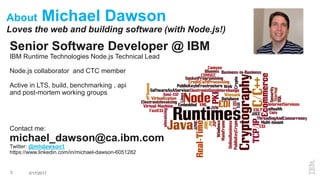
About Michael Dawson
Loves the web and building software (with Node.js!)
Senior Software Developer @ IBM
IBM Runtime Technologies Node.js Technical Lead
Node.js collaborator and CTC member
Active in LTS, build, benchmarking , api
and post-mortem working groups
Contact me:
michael_dawson@ca.ibm.com
Twitter: @mhdawson1
https://www.linkedin.com/in/michael-dawson-6051282
3 3/17/2017
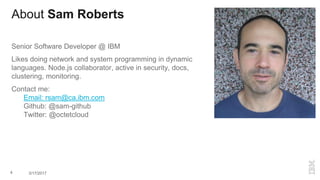
About Sam Roberts
Senior Software Developer @ IBM
Likes doing network and system programming in dynamic
languages. Node.js collaborator, active in security, docs,
clustering, monitoring.
Contact me:
Email: rsam@ca.ibm.com
Github: @sam-github
Twitter: @octetcloud
4 3/17/2017
About the Audience
 Have you written anything in Node.js?
 Have you pushed a module to npm?
 Are you running Node.js in production?
 Is it outward facing?
 Is your company planning to use Node.js?
5 3/17/2017
Common Questions – What/Why
 WW1 - What is Node.js
 WW2 - Why are people interested
 WW3 - What are the key components
 WW4 - What platforms are supported
 WW5 - What are the common use cases
 WW6 - When should I use Node.js versus Java
6 3/17/2017
WW1 - Why Node.js – What is it ?
 JavaScript != Java
 Node.js = Server-side JavaScript
 Event-oriented
 Non-blocking
 Asynchronous
7 3/17/2017
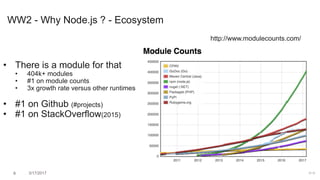
http://www.modulecounts.com/
WW2 - Why Node.js ? - Ecosystem
• There is a module for that
• 404k+ modules
• #1 on module counts
• 3x growth rate versus other runtimes
• #1 on Github (#projects)
• #1 on StackOverflow(2015)
8 3/17/2017
WW2 - Why Node.js ? - Productivity
 Faster development less code
 PayPal - https://www.paypal-engineering.com/2013/11/22/node-js-at-paypal/
 Took 1/2 time with less people
 33% fewer lines of code
 NextFlix- http://www.infoworld.com/article/2610110/javascript/paypal-and-netflix-cozy-
up-to-node-js.html
9 3/17/2017
WW2 - Why Node.js ? – Productivity
 Reuse of “isomorphic” code components
 Availability of JavaScript talent
 Developer satisfaction
10 3/17/2017
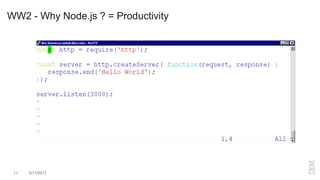
WW2 - Why Node.js ? = Productivity
11 3/17/2017
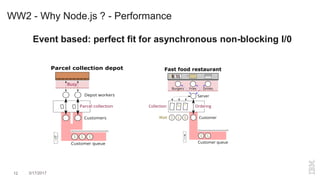
WW2 - Why Node.js ? - Performance
Event based: perfect fit for asynchronous non-blocking I/0
12 3/17/2017
WW2 - Why Node.js ? - Performance
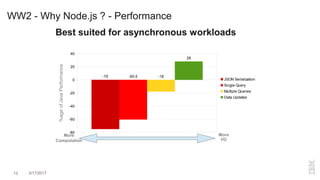
Best suited for asynchronous workloads
-80
-60
-40
-20
0
20
40
-75 -60.5 -18
28
JSON Serialization
Single Query
Multiple Queries
Data Updates
%ageofJavaPerformance
More
Computation
More
I/O
13 3/17/2017
 Thousands of concurrent connections
 PayPal - https://www.paypal-engineering.com/2013/11/22/node-js-at-paypal/
 Double number of requests/sec
 Response times 35% lower
 Groupon – http://www.nearform.com/nodecrunch/node-js-becoming-go-technology-enterprise/
 Reduced page load times by 50%
WW2 - Why Node.js ? - Performance
14 3/17/2017
WW2 - Why Node.js – Compact/Fast
 Small (linux.tar.xz)
 Download 8.2MB
 Uncompressed 35.5 MB
 Fast startup
 40 ms
 Small footprint
 16.5 MB
https://nodejs.org/en/download/
https://benchmarking.nodejs.org/
15 3/17/2017
WW3 - Key Components
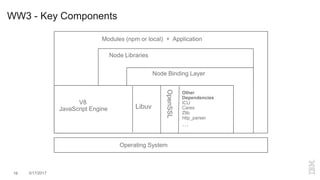
V8 – Javascript
Engine
V8
JavaScript Engine Libuv
Other
Dependencies
ICU
Cares
Zlib
http_parser
…
Node Binding Layer
Operating System
Node Libraries
Modules (npm or local) + Application
OpenSSL
16 3/17/2017
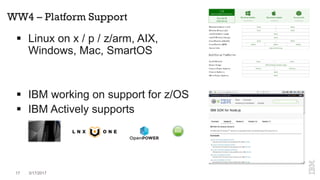
WW4 – Platform Support
 Linux on x / p / z/arm, AIX,
Windows, Mac, SmartOS
 IBM working on support for z/OS
 IBM Actively supports
17 3/17/2017
WW5 - Use Cases
 Back-end API services
 Service oriented architectures (SOA)
 Microservice-based applications
 Generating/serving dynamic web page content
 SPA applications with bidirectional
communication over WebSockets and/or HTTP/2
 Agents and data collectors
 Small scripts
https://github.com/nodejs/benchmarking/blob/master/docs/use_cases.md
18 3/17/2017
WW6 - Node.js versus Java
 Strengths and weaknesses
 Choosing the right language
19 3/17/2017
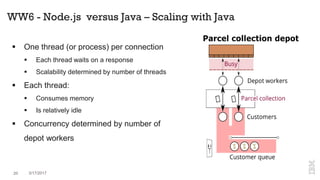
WW6 - Node.js versus Java – Scaling with Java
 One thread (or process) per connection
 Each thread waits on a response
 Scalability determined by number of threads
 Each thread:
 Consumes memory
 Is relatively idle
 Concurrency determined by number of
depot workers
20 3/17/2017
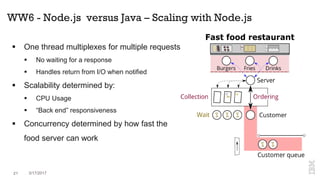
WW6 - Node.js versus Java – Scaling with Node.js
 One thread multiplexes for multiple requests
 No waiting for a response
 Handles return from I/O when notified
 Scalability determined by:
 CPU Usage
 “Back end” responsiveness
 Concurrency determined by how fast the
food server can work
21 3/17/2017
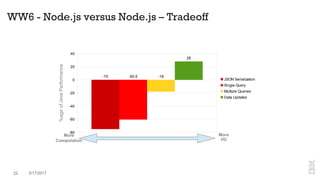
WW6 - Node.js versus Node.js – Tradeoff
-80
-60
-40
-20
0
20
40
-75 -60.5 -18
28
JSON Serialization
Single Query
Multiple Queries
Data Updates
%ageofJavaPerformance
More
Computation
More
I/O
22 3/17/2017
WW6 - Node.js versus Java – Choosing the Right Language
 Higher performance for I/O
 Easier async programming
 Fullstack/isomorphic development
23 3/17/2017
WW6 - Node.js versus Java – Choosing the Right Language
 Higher processing performance
 Type safety for calculations
 Rich processing frameworks
24 3/17/2017
WW6 - Node.js versus Java – Choosing the Right Language
 Highly performant, scalable rich web applications
 Highly performant, reliable transaction processing
 Self-contained micro-service components
+
25 3/17/2017
Common Questions – Project Organization
 PO1 - What does the leadership for the project look like
and how is the direction set
 PO2 - What is the Node.js foundation and how does it
interact with the technical work
 PO3 – What is the history of Node.js
 PO4 - What is semver and how does the Node.js project
use it
 PO5 - What are LTS releases
 PO6 - What version of Node.js should I use
26 3/17/2017
Common Questions – Project Organization
 PO7 - How does the project operate day to day
 PO8 - What does the community do in order to ensure
good quality
 PO9 - How do I get started in contributing to the Node.js
project
 PO10 - What are Node.js working groups, and how do I
get involved
27 3/17/2017
PO1 - Leadership
 Board
 TSC
 CTC
 WGs
 Teams
28 3/17/2017
PO2 - Node.js Community - Foundation
 Mission:
 Corporate members
 8 platinum(including IBM), 1 Gold, 19 Silver (Needs update)
 Individual members
https://nodejs.org/en/foundation/
The Node.js Foundation's mission is to enable widespread adoption and help accelerate
development of Node.js and other related modules through an open governance model that
encourages participation, technical contribution, and a framework for long term stewardship
by an ecosystem invested in Node.js' success.
29 3/17/2017
PO3 - Node.js Community - History
 2009 – written by Ryan Dhal
 Jan 2010 - npm
 Sep 2010 – Joyent sponsors Node.js
 June 2011 – Windows support
 2012 – 2014 – Hand over to Isaac Schlueter, then Timothy J. Fontaine
 December 2014 – io.js fork
 June 2015 – Node.js Foundation
 Oct 2015 – Node.js 4.x unites io.js/node.js 0.12.x lines
 Oct 2016 – Node.js 6.x
30 3/17/2017
PO4 - Semver
X.Y.Z:
 X – Major: backwards incompatible changes
 Y – Minor: additive, new features
 Z – Patch: no API changes or new features
31 3/17/2017
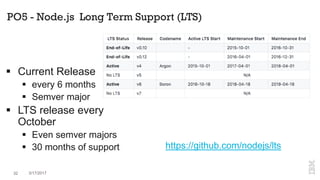
PO5 - Node.js Long Term Support (LTS)
https://github.com/nodejs/lts
 Current Release
 every 6 months
 Semver major
 LTS release every
October
 Even semver majors
 30 months of support
32 3/17/2017
PO6 – Versions
 Most stable – LTS
 Latest gives you longest runway
 Plan to upgrade at least 6 months in advance
 Changes already validated in Current
 Current – Live closer to the edge
 Most up to date fully tested release
 More rapid pace of chance, less settling time
 Nightly
 Experiment with new features in master
33 3/17/2017
PO7 - Node.js Community – Day to Day
 TSC - Technical Steering Committee
 CTC - Core technical Committee
 Collaborators (~76)
 Working Groups (Build, LTS, Benchmarking, API etc.)
 Teams
https://github.com/nodejs/TSC/
https://github.com/nodejs/node/
https://github.com/nodejs/node/blob/master/WORKING_GROUPS.md
https://github.com/orgs/nodejs/teams
34 3/17/2017
PO8 – Quality with Speed?
35 3/17/2017
 Different release types
 Change flow processes
 Enhancement Proposal process
 Automation and Testing
 Functional Tests
 Module Testing
 Stress Testing (Future)
 Platform/OS coverage (Future)
 Development Workflows (Future)
 Performance Benchmarks
 Tools
PO9 – I want to contribute, where to start ?
36 3/17/2017
 Node Todo: http://nodetodo.org/
 http://coverage.nodej.org
 Issues
 Follow/comment on issues
 “Good first contribution tag”
 Find issue related to your interest
 Tests/doc, lots to do here
 Working Groups
 build, LTS, testing, benchmarking, post-mortem, translation,
…. find one that interests you!
Common Questions – Production Concerns
 PC1 - What are some of the common use cases
 PC2 - How does a company typically start using Node.js
 PC3 - How do I monitor applications
 PC4 - What kinds of tools do I need for a production app
 PC5 - What about web frameworks
 PC6 - How/where do I run my Node.js applications
37 3/17/2017
PC1 – Common Use Cases
 Back-end API services
 Service oriented architectures (SOA)
 Microservice-based applications
 Generating/serving dynamic web page content
 SPA applications with bidirectional
communication over WebSockets and/or HTTP/2
 Agents and data collectors
 Small scripts
https://github.com/nodejs/benchmarking/blob/master/docs/use_cases.md
38 3/17/2017
PC2 - How does a company start using Node.js
 Starts using it internally for non-critical
 Expands to more critical but still internal uses
 After success and experience, uses it externally
39 3/17/2017
PC3 - How do I monitor applications?
 Aggregate logs: Splunk, Loggly, Syslog, …
 Graph your metrics: ELK, statsd/graphite, appmetrics
 Consider higher level tools: Newrelic, Appdynamics,
IBM BAM/APM,…
40 3/17/2017
PC4 – Tools for production app ?
 heapdump (appmetrics has it pre-compiled)
–dumps can be analyzed with Chrome Dev Tools
–https://strongloop.com/strongblog/how-to-heap-snapshots/
 node-report – human readable first failure information
 core dump on uncaught exception
–core files can be analyzed with llnode
41 3/17/2017
PC5 – What about web frameworks
 Pick one!
 express: bare bones, build it yourself, good way to tinker
 hapi, restify, koa, sails, loopback: when you want more
42 3/17/2017
PC6 – Where to run my applications
 And other clouds of course …
 Node is always one of the top tier
languages
 And works great on premise if that’s
still your thing
–Your choice of hardware due to
broad platform support
43 3/17/2017
Common Questions – Technical
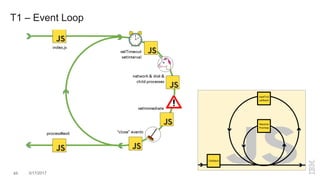
 T1 - Whats this event loop thing
 T2 - How should I use semver and manage project
dependencies
 T3 - What is the Node.js programming model
 T4 - How do you integrate with Native code
 T5 - Why do I have to recompile my native modules for
major versions
 T6 - Tools to deal with asynchrony
 T7 - Common tools (beside npm, git)
44 3/17/2017
T1 – Event Loop
45 3/17/2017
46 3/17/2017
T2 – Managing dependencies
- Use “loose” dependency specifications
- Freeze packages at deploy time,
https://strongloop.com/strongblog/node-js-deploy-
production-best-practice
- Keep up to date!
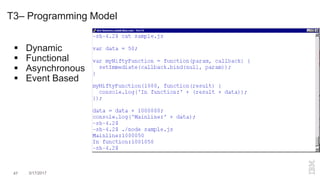
T3– Programming Model
 Dynamic
 Functional
 Asynchronous
 Event Based
47 3/17/2017
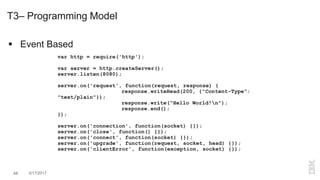
var http = require('http');
var server = http.createServer();
server.listen(8080);
server.on('request', function(request, response) {
response.writeHead(200, {"Content-Type":
"text/plain"});
response.write("Hello World!n");
response.end();
});
server.on('connection', function(socket) {});
server.on('close', function() {});
server.on('connect', function(socket) {});
server.on('upgrade', function(request, socket, head) {});
server.on('clientError', function(exception, socket) {});
 Event Based
T3– Programming Model
48 3/17/2017
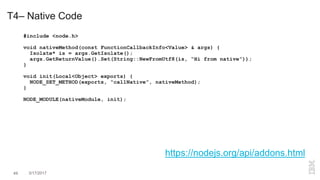
T4– Native Code
#include <node.h>
void nativeMethod(const FunctionCallbackInfo<Value> & args) {
Isolate* is = args.GetIsolate();
args.GetReturnValue().Set(String::NewFromUtf8(is, “Hi from native”));
}
void init(Local<Object> exports) {
NODE_SET_METHOD(exports, “callNative”, nativeMethod);
}
NODE_MODULE(nativeModule, init);
https://nodejs.org/api/addons.html
49 3/17/2017
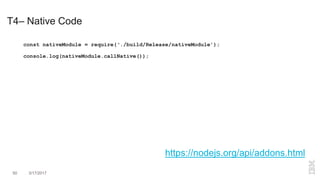
T4– Native Code
https://nodejs.org/api/addons.html
const nativeModule = require(‘./build/Release/nativeModule’);
console.log(nativeModule.callNative());
50 3/17/2017
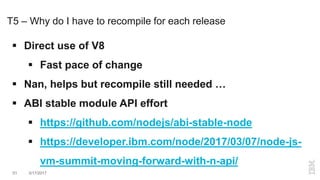
T5 – Why do I have to recompile for each release
51 3/17/2017
 Direct use of V8
 Fast pace of change
 Nan, helps but recompile still needed …
 ABI stable module API effort
 https://github.com/nodejs/abi-stable-node
 https://developer.ibm.com/node/2017/03/07/node-js-
vm-summit-moving-forward-with-n-api/
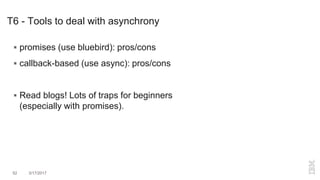
T6 - Tools to deal with asynchrony
52 3/17/2017
 promises (use bluebird): pros/cons
 callback-based (use async): pros/cons
 Read blogs! Lots of traps for beginners
(especially with promises).
53 3/17/2017
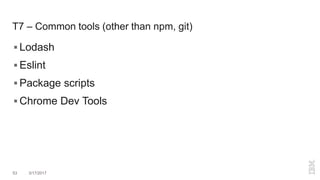
 Lodash
 Eslint
 Package scripts
 Chrome Dev Tools
T7 – Common tools (other than npm, git)
Common Questions – Security
 SEC1 – What tools should I be using
 SEC2 – What Node.js version should I use
 SEC3 – What should I be watching for updates
 SEC4 – What’s the nsp contribution to the Foundation
54 3/17/2017
SEC1 – What tools should I be using
 snyk
 nsp
 https://groups.google.com/group/nodejs-sec
 Not strictly security, but
– eslint
– coverity
55 3/17/2017
SEC2 – What Node.js version should I use
 6.x! It’s the best so far:
 https://blog.wikimedia.org/2017/02/17/node-6-
wikimedia/
56 3/17/2017
SEC3 – What should I be watching for updates
 Watch https://nodejs.org/en/blog/ to keep up to date.
57 3/17/2017
Copyrights and Trademarks
© IBM Corporation 2017. All Rights Reserved
IBM, the IBM logo, ibm.com are trademarks or registered
trademarks of International Business Machines Corp.,
registered in many jurisdictions worldwide. Other product and
service names might be trademarks of IBM or other companies.
A current list of IBM trademarks is available on the Web at
“Copyright and trademark information” at
www.ibm.com/legal/copytrade.shtml
Node.js is an official trademark of Joyent. IBM SDK for Node.js is not formally
related to or endorsed by the official Joyent Node.js open source or
commercial project.
Java, JavaScript and all Java-based trademarks and logos are trademarks or
registered trademarks of Oracle and/or its affiliates.
npm is a trademark of npm, Inc.
58 3/17/2017

Node.js – ask us anything!

  • 1.
    Node.js Ask UsAnything 1 3/17/2017#DevoxxUS
  • 2.
    Agenda  Introductions –Who weare –Audience  Common Questions  Q/A 2 3/17/2017
  • 3.
    About Michael Dawson Lovesthe web and building software (with Node.js!) Senior Software Developer @ IBM IBM Runtime Technologies Node.js Technical Lead Node.js collaborator and CTC member Active in LTS, build, benchmarking , api and post-mortem working groups Contact me: michael_dawson@ca.ibm.com Twitter: @mhdawson1 https://www.linkedin.com/in/michael-dawson-6051282 3 3/17/2017
  • 4.
    About Sam Roberts SeniorSoftware Developer @ IBM Likes doing network and system programming in dynamic languages. Node.js collaborator, active in security, docs, clustering, monitoring. Contact me: Email: rsam@ca.ibm.com Github: @sam-github Twitter: @octetcloud 4 3/17/2017
  • 5.
    About the Audience Have you written anything in Node.js?  Have you pushed a module to npm?  Are you running Node.js in production?  Is it outward facing?  Is your company planning to use Node.js? 5 3/17/2017
  • 6.
    Common Questions –What/Why  WW1 - What is Node.js  WW2 - Why are people interested  WW3 - What are the key components  WW4 - What platforms are supported  WW5 - What are the common use cases  WW6 - When should I use Node.js versus Java 6 3/17/2017
  • 7.
    WW1 - WhyNode.js – What is it ?  JavaScript != Java  Node.js = Server-side JavaScript  Event-oriented  Non-blocking  Asynchronous 7 3/17/2017
  • 8.
    http://www.modulecounts.com/ WW2 - WhyNode.js ? - Ecosystem • There is a module for that • 404k+ modules • #1 on module counts • 3x growth rate versus other runtimes • #1 on Github (#projects) • #1 on StackOverflow(2015) 8 3/17/2017
  • 9.
    WW2 - WhyNode.js ? - Productivity  Faster development less code  PayPal - https://www.paypal-engineering.com/2013/11/22/node-js-at-paypal/  Took 1/2 time with less people  33% fewer lines of code  NextFlix- http://www.infoworld.com/article/2610110/javascript/paypal-and-netflix-cozy- up-to-node-js.html 9 3/17/2017
  • 10.
    WW2 - WhyNode.js ? – Productivity  Reuse of “isomorphic” code components  Availability of JavaScript talent  Developer satisfaction 10 3/17/2017
  • 11.
    WW2 - WhyNode.js ? = Productivity 11 3/17/2017
  • 12.
    WW2 - WhyNode.js ? - Performance Event based: perfect fit for asynchronous non-blocking I/0 12 3/17/2017
  • 13.
    WW2 - WhyNode.js ? - Performance Best suited for asynchronous workloads -80 -60 -40 -20 0 20 40 -75 -60.5 -18 28 JSON Serialization Single Query Multiple Queries Data Updates %ageofJavaPerformance More Computation More I/O 13 3/17/2017
  • 14.
     Thousands ofconcurrent connections  PayPal - https://www.paypal-engineering.com/2013/11/22/node-js-at-paypal/  Double number of requests/sec  Response times 35% lower  Groupon – http://www.nearform.com/nodecrunch/node-js-becoming-go-technology-enterprise/  Reduced page load times by 50% WW2 - Why Node.js ? - Performance 14 3/17/2017
  • 15.
    WW2 - WhyNode.js – Compact/Fast  Small (linux.tar.xz)  Download 8.2MB  Uncompressed 35.5 MB  Fast startup  40 ms  Small footprint  16.5 MB https://nodejs.org/en/download/ https://benchmarking.nodejs.org/ 15 3/17/2017
  • 16.
    WW3 - KeyComponents V8 – Javascript Engine V8 JavaScript Engine Libuv Other Dependencies ICU Cares Zlib http_parser … Node Binding Layer Operating System Node Libraries Modules (npm or local) + Application OpenSSL 16 3/17/2017
  • 17.
    WW4 – PlatformSupport  Linux on x / p / z/arm, AIX, Windows, Mac, SmartOS  IBM working on support for z/OS  IBM Actively supports 17 3/17/2017
  • 18.
    WW5 - UseCases  Back-end API services  Service oriented architectures (SOA)  Microservice-based applications  Generating/serving dynamic web page content  SPA applications with bidirectional communication over WebSockets and/or HTTP/2  Agents and data collectors  Small scripts https://github.com/nodejs/benchmarking/blob/master/docs/use_cases.md 18 3/17/2017
  • 19.
    WW6 - Node.jsversus Java  Strengths and weaknesses  Choosing the right language 19 3/17/2017
  • 20.
    WW6 - Node.jsversus Java – Scaling with Java  One thread (or process) per connection  Each thread waits on a response  Scalability determined by number of threads  Each thread:  Consumes memory  Is relatively idle  Concurrency determined by number of depot workers 20 3/17/2017
  • 21.
    WW6 - Node.jsversus Java – Scaling with Node.js  One thread multiplexes for multiple requests  No waiting for a response  Handles return from I/O when notified  Scalability determined by:  CPU Usage  “Back end” responsiveness  Concurrency determined by how fast the food server can work 21 3/17/2017
  • 22.
    WW6 - Node.jsversus Node.js – Tradeoff -80 -60 -40 -20 0 20 40 -75 -60.5 -18 28 JSON Serialization Single Query Multiple Queries Data Updates %ageofJavaPerformance More Computation More I/O 22 3/17/2017
  • 23.
    WW6 - Node.jsversus Java – Choosing the Right Language  Higher performance for I/O  Easier async programming  Fullstack/isomorphic development 23 3/17/2017
  • 24.
    WW6 - Node.jsversus Java – Choosing the Right Language  Higher processing performance  Type safety for calculations  Rich processing frameworks 24 3/17/2017
  • 25.
    WW6 - Node.jsversus Java – Choosing the Right Language  Highly performant, scalable rich web applications  Highly performant, reliable transaction processing  Self-contained micro-service components + 25 3/17/2017
  • 26.
    Common Questions –Project Organization  PO1 - What does the leadership for the project look like and how is the direction set  PO2 - What is the Node.js foundation and how does it interact with the technical work  PO3 – What is the history of Node.js  PO4 - What is semver and how does the Node.js project use it  PO5 - What are LTS releases  PO6 - What version of Node.js should I use 26 3/17/2017
  • 27.
    Common Questions –Project Organization  PO7 - How does the project operate day to day  PO8 - What does the community do in order to ensure good quality  PO9 - How do I get started in contributing to the Node.js project  PO10 - What are Node.js working groups, and how do I get involved 27 3/17/2017
  • 28.
    PO1 - Leadership Board  TSC  CTC  WGs  Teams 28 3/17/2017
  • 29.
    PO2 - Node.jsCommunity - Foundation  Mission:  Corporate members  8 platinum(including IBM), 1 Gold, 19 Silver (Needs update)  Individual members https://nodejs.org/en/foundation/ The Node.js Foundation's mission is to enable widespread adoption and help accelerate development of Node.js and other related modules through an open governance model that encourages participation, technical contribution, and a framework for long term stewardship by an ecosystem invested in Node.js' success. 29 3/17/2017
  • 30.
    PO3 - Node.jsCommunity - History  2009 – written by Ryan Dhal  Jan 2010 - npm  Sep 2010 – Joyent sponsors Node.js  June 2011 – Windows support  2012 – 2014 – Hand over to Isaac Schlueter, then Timothy J. Fontaine  December 2014 – io.js fork  June 2015 – Node.js Foundation  Oct 2015 – Node.js 4.x unites io.js/node.js 0.12.x lines  Oct 2016 – Node.js 6.x 30 3/17/2017
  • 31.
    PO4 - Semver X.Y.Z: X – Major: backwards incompatible changes  Y – Minor: additive, new features  Z – Patch: no API changes or new features 31 3/17/2017
  • 32.
    PO5 - Node.jsLong Term Support (LTS) https://github.com/nodejs/lts  Current Release  every 6 months  Semver major  LTS release every October  Even semver majors  30 months of support 32 3/17/2017
  • 33.
    PO6 – Versions Most stable – LTS  Latest gives you longest runway  Plan to upgrade at least 6 months in advance  Changes already validated in Current  Current – Live closer to the edge  Most up to date fully tested release  More rapid pace of chance, less settling time  Nightly  Experiment with new features in master 33 3/17/2017
  • 34.
    PO7 - Node.jsCommunity – Day to Day  TSC - Technical Steering Committee  CTC - Core technical Committee  Collaborators (~76)  Working Groups (Build, LTS, Benchmarking, API etc.)  Teams https://github.com/nodejs/TSC/ https://github.com/nodejs/node/ https://github.com/nodejs/node/blob/master/WORKING_GROUPS.md https://github.com/orgs/nodejs/teams 34 3/17/2017
  • 35.
    PO8 – Qualitywith Speed? 35 3/17/2017  Different release types  Change flow processes  Enhancement Proposal process  Automation and Testing  Functional Tests  Module Testing  Stress Testing (Future)  Platform/OS coverage (Future)  Development Workflows (Future)  Performance Benchmarks  Tools
  • 36.
    PO9 – Iwant to contribute, where to start ? 36 3/17/2017  Node Todo: http://nodetodo.org/  http://coverage.nodej.org  Issues  Follow/comment on issues  “Good first contribution tag”  Find issue related to your interest  Tests/doc, lots to do here  Working Groups  build, LTS, testing, benchmarking, post-mortem, translation, …. find one that interests you!
  • 37.
    Common Questions –Production Concerns  PC1 - What are some of the common use cases  PC2 - How does a company typically start using Node.js  PC3 - How do I monitor applications  PC4 - What kinds of tools do I need for a production app  PC5 - What about web frameworks  PC6 - How/where do I run my Node.js applications 37 3/17/2017
  • 38.
    PC1 – CommonUse Cases  Back-end API services  Service oriented architectures (SOA)  Microservice-based applications  Generating/serving dynamic web page content  SPA applications with bidirectional communication over WebSockets and/or HTTP/2  Agents and data collectors  Small scripts https://github.com/nodejs/benchmarking/blob/master/docs/use_cases.md 38 3/17/2017
  • 39.
    PC2 - Howdoes a company start using Node.js  Starts using it internally for non-critical  Expands to more critical but still internal uses  After success and experience, uses it externally 39 3/17/2017
  • 40.
    PC3 - Howdo I monitor applications?  Aggregate logs: Splunk, Loggly, Syslog, …  Graph your metrics: ELK, statsd/graphite, appmetrics  Consider higher level tools: Newrelic, Appdynamics, IBM BAM/APM,… 40 3/17/2017
  • 41.
    PC4 – Toolsfor production app ?  heapdump (appmetrics has it pre-compiled) –dumps can be analyzed with Chrome Dev Tools –https://strongloop.com/strongblog/how-to-heap-snapshots/  node-report – human readable first failure information  core dump on uncaught exception –core files can be analyzed with llnode 41 3/17/2017
  • 42.
    PC5 – Whatabout web frameworks  Pick one!  express: bare bones, build it yourself, good way to tinker  hapi, restify, koa, sails, loopback: when you want more 42 3/17/2017
  • 43.
    PC6 – Whereto run my applications  And other clouds of course …  Node is always one of the top tier languages  And works great on premise if that’s still your thing –Your choice of hardware due to broad platform support 43 3/17/2017
  • 44.
    Common Questions –Technical  T1 - Whats this event loop thing  T2 - How should I use semver and manage project dependencies  T3 - What is the Node.js programming model  T4 - How do you integrate with Native code  T5 - Why do I have to recompile my native modules for major versions  T6 - Tools to deal with asynchrony  T7 - Common tools (beside npm, git) 44 3/17/2017
  • 45.
    T1 – EventLoop 45 3/17/2017
  • 46.
    46 3/17/2017 T2 –Managing dependencies - Use “loose” dependency specifications - Freeze packages at deploy time, https://strongloop.com/strongblog/node-js-deploy- production-best-practice - Keep up to date!
  • 47.
    T3– Programming Model Dynamic  Functional  Asynchronous  Event Based 47 3/17/2017
  • 48.
    var http =require('http'); var server = http.createServer(); server.listen(8080); server.on('request', function(request, response) { response.writeHead(200, {"Content-Type": "text/plain"}); response.write("Hello World!n"); response.end(); }); server.on('connection', function(socket) {}); server.on('close', function() {}); server.on('connect', function(socket) {}); server.on('upgrade', function(request, socket, head) {}); server.on('clientError', function(exception, socket) {});  Event Based T3– Programming Model 48 3/17/2017
  • 49.
    T4– Native Code #include<node.h> void nativeMethod(const FunctionCallbackInfo<Value> & args) { Isolate* is = args.GetIsolate(); args.GetReturnValue().Set(String::NewFromUtf8(is, “Hi from native”)); } void init(Local<Object> exports) { NODE_SET_METHOD(exports, “callNative”, nativeMethod); } NODE_MODULE(nativeModule, init); https://nodejs.org/api/addons.html 49 3/17/2017
  • 50.
    T4– Native Code https://nodejs.org/api/addons.html constnativeModule = require(‘./build/Release/nativeModule’); console.log(nativeModule.callNative()); 50 3/17/2017
  • 51.
    T5 – Whydo I have to recompile for each release 51 3/17/2017  Direct use of V8  Fast pace of change  Nan, helps but recompile still needed …  ABI stable module API effort  https://github.com/nodejs/abi-stable-node  https://developer.ibm.com/node/2017/03/07/node-js- vm-summit-moving-forward-with-n-api/
  • 52.
    T6 - Toolsto deal with asynchrony 52 3/17/2017  promises (use bluebird): pros/cons  callback-based (use async): pros/cons  Read blogs! Lots of traps for beginners (especially with promises).
  • 53.
    53 3/17/2017  Lodash Eslint  Package scripts  Chrome Dev Tools T7 – Common tools (other than npm, git)
  • 54.
    Common Questions –Security  SEC1 – What tools should I be using  SEC2 – What Node.js version should I use  SEC3 – What should I be watching for updates  SEC4 – What’s the nsp contribution to the Foundation 54 3/17/2017
  • 55.
    SEC1 – Whattools should I be using  snyk  nsp  https://groups.google.com/group/nodejs-sec  Not strictly security, but – eslint – coverity 55 3/17/2017
  • 56.
    SEC2 – WhatNode.js version should I use  6.x! It’s the best so far:  https://blog.wikimedia.org/2017/02/17/node-6- wikimedia/ 56 3/17/2017
  • 57.
    SEC3 – Whatshould I be watching for updates  Watch https://nodejs.org/en/blog/ to keep up to date. 57 3/17/2017
  • 58.
    Copyrights and Trademarks ©IBM Corporation 2017. All Rights Reserved IBM, the IBM logo, ibm.com are trademarks or registered trademarks of International Business Machines Corp., registered in many jurisdictions worldwide. Other product and service names might be trademarks of IBM or other companies. A current list of IBM trademarks is available on the Web at “Copyright and trademark information” at www.ibm.com/legal/copytrade.shtml Node.js is an official trademark of Joyent. IBM SDK for Node.js is not formally related to or endorsed by the official Joyent Node.js open source or commercial project. Java, JavaScript and all Java-based trademarks and logos are trademarks or registered trademarks of Oracle and/or its affiliates. npm is a trademark of npm, Inc. 58 3/17/2017