Neonatal
Jaundice
Presentor :
Jamuna A/P
Lachumanan
Lim Zhan Heng
Syazlin Binti Abdul
Said
Supervisor : Dr.
Mehala
Definition
Newborninfantscharacterized by:
• Elevatedlevelsofbilirubin intheblood
• Totalserumbilirubin concentration:
>5mg/dLor>85.5μmol/L
Classification
Physiological Pathological
Hyperbilirubin type Unconjugated Unconjugated / Conjugated
Onset > 24 hour < 24 hour
Peak total serum bilirubin • < 15 mg/dL
(in the case of a full-term,
breastfed infant)
• Direct bilirubin < 10% of total
• Rise > 15 mg/dL
• Direct bilirubin > 10% of total.
Daily rise in bilirubin < 5 mg/dL/day > 5 mg/dL/day
Etiology • Fetal hemoglobin Hemolysis
• Immature hepatic metabolism
of bilirubin
• Unconjugated :
Hemolytic, Non-Hemolytic
• Conjugated :
Intrahepatic, Extra-hepatic
• Mixed :
Combine direct. indirect
Etiology
Physiological Pathological
Unconjugated hyperbilirubinemia caused by :
• Short lifespan of erythrocytes in the newborn
• During first 3 months, fetal hemoglobin (HbF) is
replaced by adult hemoglobin (HbA);
↳ bilirubin ↑ + Hb ↓10–13 g/dL.
• Insufficient hepatic bilirubin metabolism: due to
immature UDP-glucuronosyltransferase
• ↑ Enterohepatic circulation of bilirubin
• Low concentration of bacteria in neonatal digestive
tracts → less bilirubin is reduced to urobilinogen and
excreted → unconjugated bilirubin is reabsorbed and
recycled into the circulation
Hyperbilirubinemia can be caused by multiple
mechanisms
• ↑ bilirubin production
(e.g., conditions with increased hemolysis)
• ↑ enterohepatic circulation
(e.g., conditions with decreased intestinal motility,
breastfeeding jaundice)
• ↓ hepatic uptake
(e.g., conditions with increased hemolysis)
• ↓ conjugation
(e.g., Crigler-Najjar syndrome)
• Impaired excretion
(e.g., conditions with cholestasis, gastrourinary
malformations)
Clinical Features
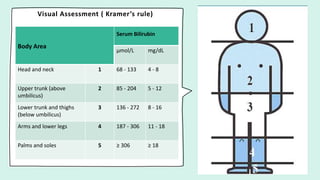
Visual Assessment ( Kramer’s rule)
Body Area
Serum Bilirubin
μmol/L mg/dL
Head and neck 1 68 - 133 4 - 8
Upper trunk (above
umbilicus)
2 85 - 204 5 - 12
Lower trunk and thighs
(below umbilicus)
3 136 - 272 8 - 16
Arms and lower legs 4 187 - 306 11 - 18
Palms and soles 5 ≥ 306 ≥ 18
Management
Complication
Acute Bilirubin Encephalopathy
(ABE)
Kernicterus
(Chronic bilirubin encephalopathy)
• Onset within first days of life
• Clinical Features :
• Lethargy, hypotonia (floppy infant
syndrome), poor feeding
• Fever, shrill cry
• Stupor, apnea, seizures
• Possibly fatal if neurotoxicity is severe
• Develops over first years of life
• Pathophysiology:
• Deposition of unconjugated bilirubin
(liposoluble) in the basal ganglia
and/or brain stem nuclei
• Clinical features :
• Cerebral paresis, hearing impairment,
vertical gaze palsy
• Movement disorder (athetosis)
• Apparent intellectual and
developmental disabilities
• Dental enamel hypoplasia
Bilirubin Induced Neurological Dysfunction ( BIND score)
Mental Status :
• Normal (0)
• Sleepy but arousable; decreased feeding (1)
• Lethargy, poor suck and/or irritable/jittery with strong suck (2)
• Semi-coma, apnoea, unable to feed, seizures, coma (3)
Muscle Tone :
• Normal (0)
• Persistent mild to moderate hypotonia (1)
• Mild to moderate hypertonia alternating with hypotonia, beginning arching of neck and trunk on
stimulation (2)
• Persistent retrocollis and opisthotonus - bicycling or twitching of hands and feet (3)
Cry Pattern
• Normal (0)
• High pitched when aroused (1)
• Shrill, difficult to console (2)
• Inconsolable crying or cry weak or absent (3)
Advanced ABE (score 7 - 9): urgent intervention needed
Moderate ABE (score 4 - 6): urgent intervention is likely to reverse this acute damage
Mild ABE (score 1 - 3): subtle signs of ABE
Prevention
Interruption of enterohepatic circulation with adequate enteral nutrition
• Frequent feeds with breast milk
• Protein-rich nutrition in the form of breast milk or special formula feeds
• Dehydration case, protein-rich feeding solutions are preferred over glucose or water.
Prevention for severe NNJ
All babies discharged <48 hours after birth should be seen by a healthcare provider in an ambulatory setting or at
home < 24 hours of discharge.
For babies with severe jaundice admitted for treatment,
early follow-up is needed to detect rebound jaundice after discharge.
Predischarge screening : to prevent severe neonatal jaundice (NNJ) in late preterm and term babies.
Clinical risk factor assessment or/and predischarge bilirubin levels [transcutaneous bilirubin or total serum bilirubin
(TSB)] can be used as predischarge screening
Universal predischarge bilirubin screening may be considered for all babies if resources are available.
All G6PD deficient babies should be admitted and monitored for NNJ during the first five days of life.
A TSB should be done if there is clinical jaundice.
Term G6PD deficient babies with birth weights >2500 g may be discharged earlier on day four of life if the TSB is <160
μmol/L (9 mg/dL), and followed-up closely.

NNJ.pptx

  • 1.
    Neonatal Jaundice Presentor : Jamuna A/P Lachumanan LimZhan Heng Syazlin Binti Abdul Said Supervisor : Dr. Mehala
  • 2.
    Definition Newborninfantscharacterized by: • Elevatedlevelsofbilirubinintheblood • Totalserumbilirubin concentration: >5mg/dLor>85.5μmol/L
  • 3.
    Classification Physiological Pathological Hyperbilirubin typeUnconjugated Unconjugated / Conjugated Onset > 24 hour < 24 hour Peak total serum bilirubin • < 15 mg/dL (in the case of a full-term, breastfed infant) • Direct bilirubin < 10% of total • Rise > 15 mg/dL • Direct bilirubin > 10% of total. Daily rise in bilirubin < 5 mg/dL/day > 5 mg/dL/day Etiology • Fetal hemoglobin Hemolysis • Immature hepatic metabolism of bilirubin • Unconjugated : Hemolytic, Non-Hemolytic • Conjugated : Intrahepatic, Extra-hepatic • Mixed : Combine direct. indirect
  • 4.
    Etiology Physiological Pathological Unconjugated hyperbilirubinemiacaused by : • Short lifespan of erythrocytes in the newborn • During first 3 months, fetal hemoglobin (HbF) is replaced by adult hemoglobin (HbA); ↳ bilirubin ↑ + Hb ↓10–13 g/dL. • Insufficient hepatic bilirubin metabolism: due to immature UDP-glucuronosyltransferase • ↑ Enterohepatic circulation of bilirubin • Low concentration of bacteria in neonatal digestive tracts → less bilirubin is reduced to urobilinogen and excreted → unconjugated bilirubin is reabsorbed and recycled into the circulation Hyperbilirubinemia can be caused by multiple mechanisms • ↑ bilirubin production (e.g., conditions with increased hemolysis) • ↑ enterohepatic circulation (e.g., conditions with decreased intestinal motility, breastfeeding jaundice) • ↓ hepatic uptake (e.g., conditions with increased hemolysis) • ↓ conjugation (e.g., Crigler-Najjar syndrome) • Impaired excretion (e.g., conditions with cholestasis, gastrourinary malformations)
  • 5.
  • 6.
    Visual Assessment (Kramer’s rule) Body Area Serum Bilirubin μmol/L mg/dL Head and neck 1 68 - 133 4 - 8 Upper trunk (above umbilicus) 2 85 - 204 5 - 12 Lower trunk and thighs (below umbilicus) 3 136 - 272 8 - 16 Arms and lower legs 4 187 - 306 11 - 18 Palms and soles 5 ≥ 306 ≥ 18
  • 7.
  • 8.
    Complication Acute Bilirubin Encephalopathy (ABE) Kernicterus (Chronicbilirubin encephalopathy) • Onset within first days of life • Clinical Features : • Lethargy, hypotonia (floppy infant syndrome), poor feeding • Fever, shrill cry • Stupor, apnea, seizures • Possibly fatal if neurotoxicity is severe • Develops over first years of life • Pathophysiology: • Deposition of unconjugated bilirubin (liposoluble) in the basal ganglia and/or brain stem nuclei • Clinical features : • Cerebral paresis, hearing impairment, vertical gaze palsy • Movement disorder (athetosis) • Apparent intellectual and developmental disabilities • Dental enamel hypoplasia
  • 9.
    Bilirubin Induced NeurologicalDysfunction ( BIND score) Mental Status : • Normal (0) • Sleepy but arousable; decreased feeding (1) • Lethargy, poor suck and/or irritable/jittery with strong suck (2) • Semi-coma, apnoea, unable to feed, seizures, coma (3) Muscle Tone : • Normal (0) • Persistent mild to moderate hypotonia (1) • Mild to moderate hypertonia alternating with hypotonia, beginning arching of neck and trunk on stimulation (2) • Persistent retrocollis and opisthotonus - bicycling or twitching of hands and feet (3) Cry Pattern • Normal (0) • High pitched when aroused (1) • Shrill, difficult to console (2) • Inconsolable crying or cry weak or absent (3) Advanced ABE (score 7 - 9): urgent intervention needed Moderate ABE (score 4 - 6): urgent intervention is likely to reverse this acute damage Mild ABE (score 1 - 3): subtle signs of ABE
  • 10.
    Prevention Interruption of enterohepaticcirculation with adequate enteral nutrition • Frequent feeds with breast milk • Protein-rich nutrition in the form of breast milk or special formula feeds • Dehydration case, protein-rich feeding solutions are preferred over glucose or water.
  • 11.
    Prevention for severeNNJ All babies discharged <48 hours after birth should be seen by a healthcare provider in an ambulatory setting or at home < 24 hours of discharge. For babies with severe jaundice admitted for treatment, early follow-up is needed to detect rebound jaundice after discharge. Predischarge screening : to prevent severe neonatal jaundice (NNJ) in late preterm and term babies. Clinical risk factor assessment or/and predischarge bilirubin levels [transcutaneous bilirubin or total serum bilirubin (TSB)] can be used as predischarge screening Universal predischarge bilirubin screening may be considered for all babies if resources are available. All G6PD deficient babies should be admitted and monitored for NNJ during the first five days of life. A TSB should be done if there is clinical jaundice. Term G6PD deficient babies with birth weights >2500 g may be discharged earlier on day four of life if the TSB is <160 μmol/L (9 mg/dL), and followed-up closely.