Process Diagnostics of Industrial Plasma Systems
A thesis for the degree of
PHILOSOPHIAE DOCTOR
Presented to
Dublin City University
By
Niall Mac Gearailt B.Eng.
Faculty of Engineering and Computing
Dublin City University
Research supervisor:
Dr. Stephen Daniels
ii
Declaration
I hereby certify that this thesis titled, “Process Diagnostics of Industrial Plasma
Systems”, which I now submit for assessment is entirely my own work. I’ve exercise
reasonable care to ensure that where work was completed jointly with others I have
made clear exactly what was done by others and what I have contributed myself.
Where I have consulted published work I have referenced this clearly.
Niall Mac Gearailt,
20 March 2014
iii
Acknowledgments
Firstly I would like to express my sincerest gratitude to my PhD supervisor
Dr. Stephen Daniels for his tireless support and patience and inspiring me to
undertake this study in the first place.
I’ve also benefited greatly from my collaborations with NC PST in Dublin City
University from which I have learned a great deal. Interacting with students and
academia has been a huge source of inspiration and knowledge.
I would like to thank Dr. Shane Lynn and Dave Kavanagh with whom I spent many a
late night running experiments on LRC 421.
I also wish to thank Dr. Eugene Tuv for introducing me to machine learning and
statistics.
I’d like to thank my family, my wife Anne for generosity and patience, and finally
I’d like to thank my parents for having me in first place and inspiring me to aim high
in life.
iv
Abstract
This thesis presents new techniques to investigate and understand the source of process
variability in plasma etching. In a semiconductor factory thousands of wafers are
processed every month in multiple chambers. While great effort is made to create
reproducible process conditions, common and special cause variation remain a big
challenge for the semiconductor industry. Process conditions are never identical from
wafer to wafer and chamber to chamber. When high-frequency RF power, employed
to create a plasma, is coupled into a chamber, the electrical characteristics of each
chamber assembly is different. This electrical difference is as a result of mechanical
differences of chamber components and how they are assembled. RF losses of the
current affect the power deposition in the plasma and affect the process outcome. As
each chamber processes more and more wafers, by-products build-up on the chamber
walls impacting the process repeatability and influencing the processing chemistry.
The surface roughness of the electrode and other chamber materials impact the rate at
which the by-products deposit, which may also affect the process repeatability both
chemically and electrically. These sources of variation contribute to inconsistent
processing conditions experienced by the wafers. The work in this thesis focuses on
the measurement of this process variability using intrusive and nonintrusive sensors to
measure the plasma parameters as accurately as possible. Statistical approaches are
used to build correlations between etch rate variability and the sensor measurements.
The main finding of the thesis concludes that the combination of appropriate process
measurement with sensors and statistical algorithms provide a very powerful tool to a
process engineer in diagnosing process variability.
v
Contents
1 Chapter 1 Introduction...................................1
1.1 Motivation.................................................................................................... 1
1.2 Contributions of this thesis .......................................................................... 2
1.3 Structure of the thesis................................................................................... 4
2 Chapter 2 Industrial RF Plasma processing6
2.1 Introduction.................................................................................................. 6
2.2 RF discharges............................................................................................... 8
2.2.1 Plasma generation .............................................................................. 11
2.2.2 The capacitive RF sheath ................................................................... 12
2.2.3 Ion Energy Distribution...................................................................... 13
2.2.4 Electron heating ................................................................................. 15
2.2.5 Electron – Ion collisions: ................................................................... 16
2.2.6 Collisional Cross Sections. ................................................................ 17
2.2.7 The electron energy distribution function (EEDF) ............................ 18
2.3 Plasma etching ........................................................................................... 19
2.3.1 Processing requirements..................................................................... 19
vi
2.3.2 Plasma etching fundamentals............................................................. 21
2.3.3 Other considerations for plasma etching............................................ 25
3 Chapter 3 Process Equipment, Sensors and
Statistics..............................................................32
3.1 Introduction................................................................................................ 32
3.2 Electron Cyclotron Resonance plasma sources.......................................... 32
3.2.1 The magnetron ................................................................................... 34
3.2.2 Microwave tuner controller................................................................ 36
3.2.3 Electron cyclone resonance................................................................ 37
3.3 Measurement techniques............................................................................ 40
3.3.1 Optical emission spectroscopy........................................................... 41
3.3.2 Current voltage probes....................................................................... 42
3.3.3 Hairpin probe ..................................................................................... 42
3.4 Statistical analysis techniques.................................................................... 44
3.4.1 Summarization of time series data ..................................................... 46
3.4.2 Principle Components Analysis ......................................................... 48
3.4.3 Gradient Boosting Trees .................................................................... 50
4 Chapter 4 Case Study One - Virtual
metrology of a Plasma Etch Process ................52
4.1 Introduction................................................................................................ 52
4.1.1 The etch process................................................................................. 53
vii
4.1.2 Recipe structure.................................................................................. 54
4.1.3 Insitu plasma chamber cleaning......................................................... 55
4.1.4 Sensor process measurement and data collection .............................. 56
4.1.5 Post etch metrology............................................................................ 58
4.1.6 Automated Process Control................................................................ 58
4.1.7 The dataset ......................................................................................... 59
4.2 The analysis of time series OES spectra of a production recipe................ 60
4.2.1 Analysis of time series OES spectra .................................................. 62
4.2.2 Approach for atomic and molecular species identification................ 66
4.2.3 Principal component analysis of time series OES spectra ................. 71
4.2.4 Spectral clustering.............................................................................. 75
4.3 Virtual metrology - etch rate estimation from sensor data......................... 77
4.3.1 Data reduction and modelling approaches ......................................... 78
4.3.2 Gradient boosting trees results........................................................... 81
4.3.3 Analysis of the first wafer effect........................................................ 86
4.3.4 Excursion investigation...................................................................... 93
4.3.5 Discussion and Conclusion .............................................................. 101
5 Chapter 5 Virtual Metrology in Production
102
5.1 Introduction.............................................................................................. 102
5.2 Architecture.............................................................................................. 103
5.3 Workflow design...................................................................................... 106
viii
5.3.1 Outlier detection and metrology estimation..................................... 106
5.3.2 Model updating ................................................................................ 108
5.4 Results...................................................................................................... 109
5.5 Discussion ................................................................................................ 114
6 Chapter 6 Electrical characterization of a
capacitively coupled plasma etcher................118
6.1 Introduction.............................................................................................. 118
6.2 Experimental setup................................................................................... 123
6.3 The chamber............................................................................................. 124
6.4 Sensor measurements............................................................................... 125
6.5 Variable ground unit ................................................................................ 125
6.6 The process............................................................................................... 127
6.7 The experiment......................................................................................... 128
6.8 Results...................................................................................................... 129
6.8.1 Etch rate, electron density................................................................ 129
6.8.2 Electrical behaviour of the confined plasma mode.......................... 134
6.8.3 Discussion on confined mode .......................................................... 140
6.8.4 Plasma expansion to the wall ........................................................... 143
6.9 Conclusion ............................................................................................... 150
7 Chapter 7 Conclusion and further work..152
7.1 Virtual metrology..................................................................................... 152
7.2 Equipment hardware diagnostics ............................................................. 156
ix
7.3 Process control- Further work.................................................................. 157
x
Figure 2-3:Plasma potentials Vp(t) ( solid curves) and excitation electrode voltage
V(t) (dashed curves), assuming purely capacitive RF sheath behavior, for three
system geometries and for DC coupled and capacitively coupled excitation
electrodes.[6].............................................................................................................. 10
Figure 2-4: Schematic representation of the voltages in an AC coupled asymmetric
RF plasma. a). Maximum RF voltage condition, b) minimum RF voltage condition.
Vp is the plasma potential [6]. ................................................................................... 13
Figure 2-5:The schematic shows the relationship between the phase in the RF cycle
that the ion enters the sheath and the resultant energy gained the ion as it accelerates
crossing the sheath[6]................................................................................................. 15
Figure 2-7: Total inelastic (σinel) and ionization (σi )cross sections for electrons in
nitrogen [15]............................................................................................................... 18
Figure 2-8: Simplified schematic of isotropic etching of silicon surface in SF6/He
discharge. ................................................................................................................... 21
Figure 2-9: The four fundamental etching mechanisms. І. Physical sputtering, ІІ.
Chemical, ІІІ. Ion Enhanced, ІV. Ion enhanced inhibitor [21]. ................................. 23
Figure 2-10: Cross section of 45nm transistors showing details of the different
profile of the etched structures.................................................................................. 24
Figure 2-11: SEMS cross section of metal etch stack with photoresist and Si3N4 hard
marks at 20 and 90 seconds into the etch process. SEMs show the erosion of the
photoresist mask showing the need for the hardmask ............................................... 26
Figure 2-12: Metal interconnects structures providing inter wiring as well as metal
contacts to metal plugs connecting the metal layer below......................................... 28
xi
Figure 2-13: The evolution of the metal etch process. The endpoint signal on the left
RF Voltage of the 2MHz RF bias displayed on the right the corresponding cross
sections of the center and edge of the wafer dense and isolated structures. .............. 30
Figure 2-14: Effect of wafer charging due to the different behaviour of the electrons
and ions at the surface of a wafer. Charging causes sputtering of the passivation at
the bottom of the structure allowing lateral etching of neutrals. ............................... 31
Figure 3-1: Schematic of an industrial ECR plasma etcher with a low frequency RF
bias source.................................................................................................................. 33
Figure 3-2; Magnetron Resonator. (http://www.cpii.com/) ....................................... 35
Figure 3-3: Cross sections of a magnetron showing the cavities and the cathode. The
two permanent magnets are positioned on the top and bottom of the cavities. Also
displayed is the alternating voltage to heat the filament the negative DC voltage
applied to the cathode[38].......................................................................................... 36
Figure 3-4: Plasma modeling completed by Kushner et al[42]. The simulations show
the power deposition, electron temperature and density in ECR reactor................... 39
Figure 3-5: The mean value of RF voltage (RMS) for 3000 wafers. Large shifts due
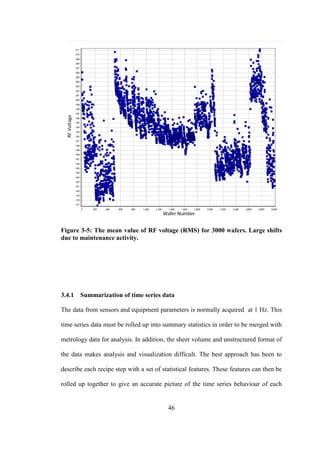
to maintenance activity. ............................................................................................. 46
Figure 3-6: The changes in the recipe step is a function of time and the corresponding
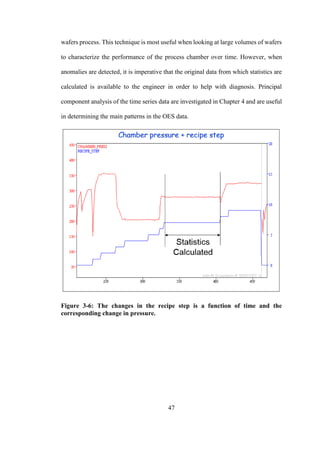
change in pressure...................................................................................................... 47
Figure 3-7: This two-dimensional representation of principal component 1 and 2
capturing most of the variability in the data set[48]. ................................................. 48
Figure 3-8: The score for each observation is the distance to the PC (a). The loading
for each PC is the angle each variables is from the PC[49]....................................... 49
xii
Figure 3-9: Shows a simple decision tree to predict the weather (Y) from
temperature( X1), humidity (X2) and dew- point(X3)[51]........................................ 51
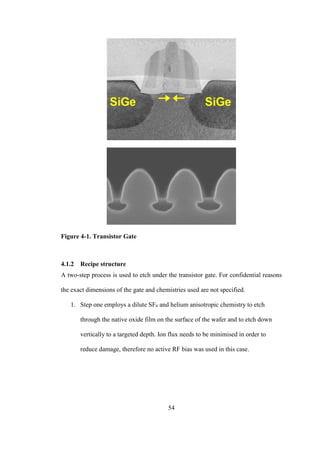
Figure 4-1. Transistor Gate ........................................................................................ 54
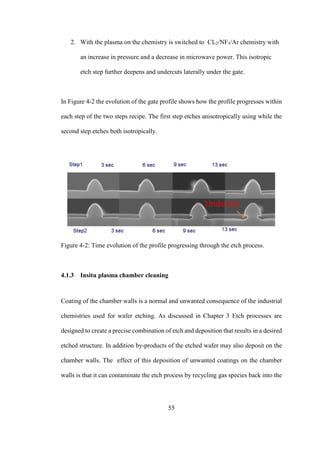
Figure 4-2: Time evolution of the profile progressing through the etch process....... 55
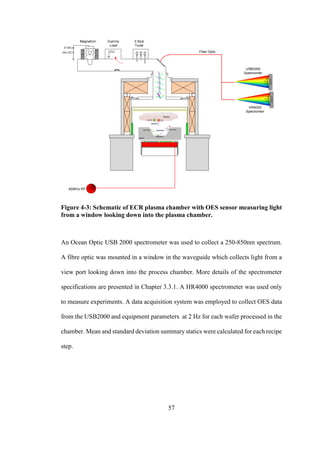
Figure 4-3: Schematic of ECR plasma chamber with OES sensor measuring light
from a window looking down into the plasma chamber............................................ 57
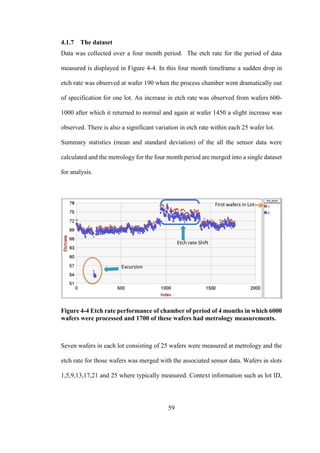
Figure 4-4 Etch rate performance of chamber of period of 4 months in which 6000
wafers were processed and 1700 of these wafers had metrology measurements. ..... 59
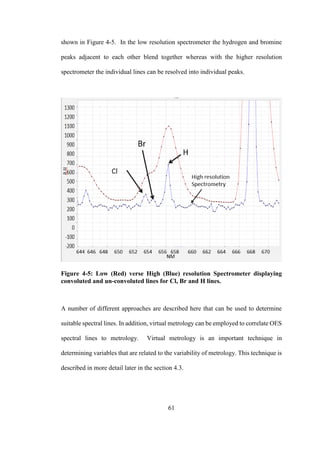
Figure 4-5: Low (Red) verse High (Blue) resolution Spectrometer displaying
convoluted and un-convoluted lines for Cl, Br and H lines....................................... 61
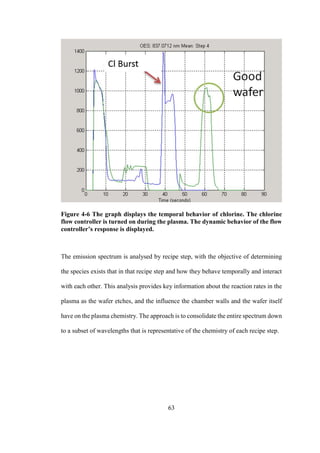
Figure 4-6 The graph displays the temporal behavior of chlorine. The chlorine flow
controller is turned on during the plasma. The dynamic behavior of the flow
controller’s response is displayed. ............................................................................. 63
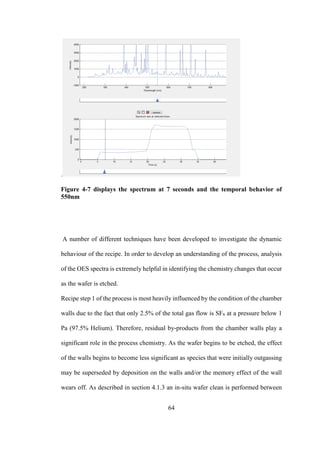
Figure 4-7 displays the spectrum at 7 seconds and the temporal behavior of 550nm64
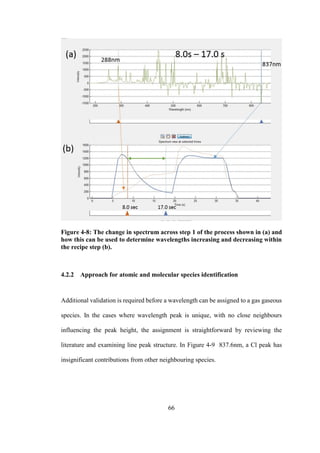
Figure 4-8: The change in spectrum across step 1 of the process shown in (a) and
how this can be used to determine wavelengths increasing and decreasing within the
recipe step (b)............................................................................................................. 66
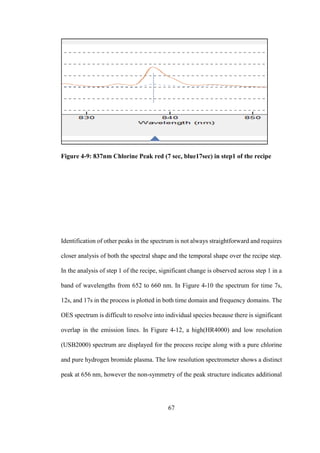
Figure 4-9: 837nm Chlorine Peak red (7 sec, blue17sec) in step1 of the recipe........ 67
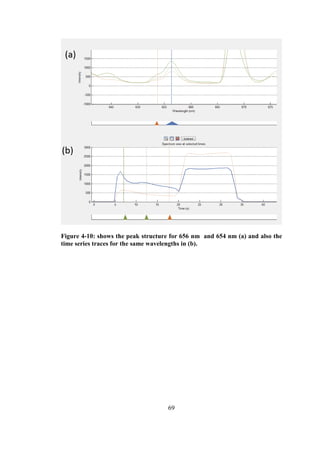
Figure 4-10: shows the peak structure for 656 nm and 654 nm (a) and also the time
series traces for the same wavelengths in (b)............................................................. 69
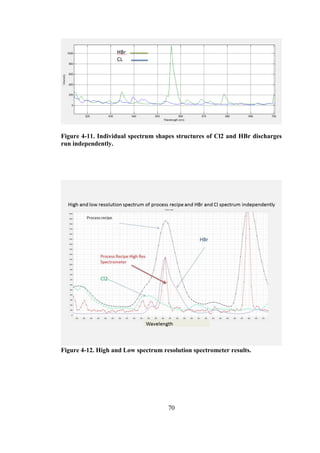
Figure 4-11. Individual spectrum shapes structures of Cl2 and HBr discharges run
independently............................................................................................................. 70
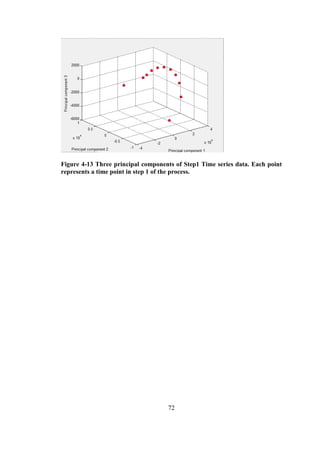
Figure 4-12. High and Low spectrum resolution spectrometer results. ..................... 70
xiii
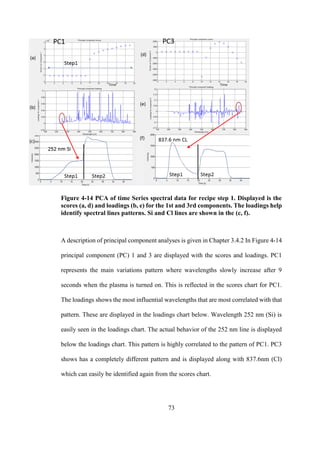
Figure 4-13 Three principal components of Step1 Time series data. Each point
represents a time point in step 1 of the process.......................................................... 72
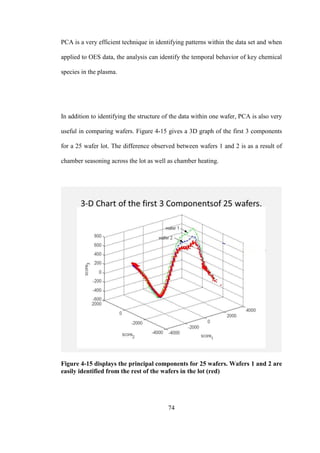
Figure 4-14 PCA of time Series spectral data for recipe step 1. Displayed is the
scores (a, d) and loadings (b, e) for the 1st and 3rd components. The loadings help
identify spectral lines patterns. Si and Cl lines are shown in the (c, f). ..................... 73
Figure 4-15 displays the principal components for 25 wafers. Wafers 1 and 2 are
easily identified from the rest of the wafers in the lot (red)....................................... 74
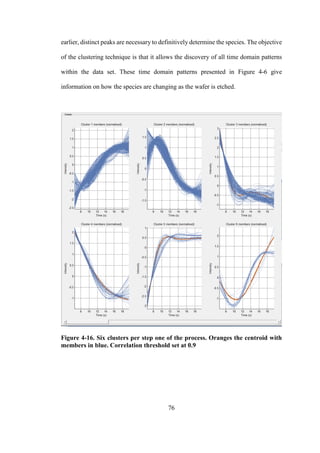
Figure 4-16. Six clusters per step one of the process. Oranges the centroid with
members in blue. Correlation threshold set at 0.9...................................................... 76
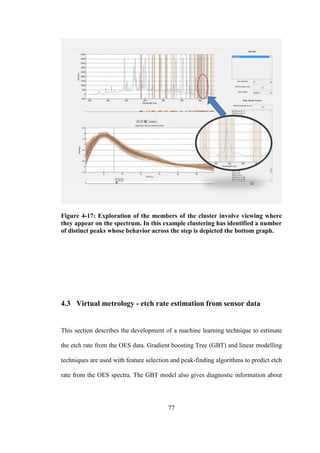
Figure 4-17: Exploration of the members of the cluster involve viewing where they
appear on the spectrum. In this example clustering has identified a number of distinct
peaks whose behavior across the step is depicted the bottom graph.......................... 77
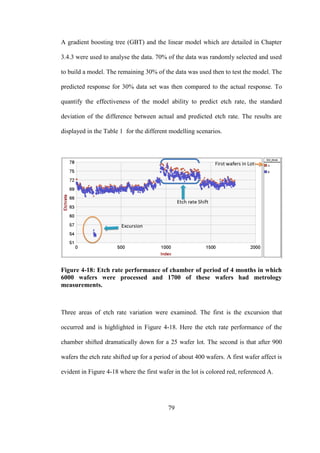
Figure 4-18: Etch rate performance of chamber of period of 4 months in which 6000
wafers were processed and 1700 of these wafers had metrology measurements. ..... 79
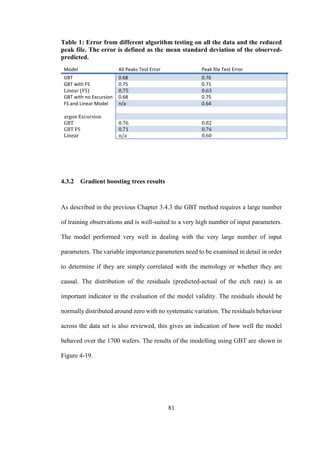
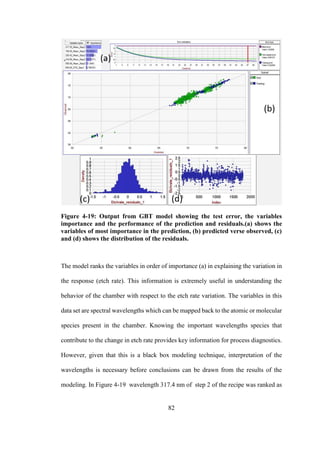
Figure 4-19: Output from GBT model showing the test error, the variables
importance and the performance of the prediction and residuals.(a) shows the
variables of most importance in the prediction, (b) predicted verse observed, (c) and
(d) shows the distribution of the residuals. ................................................................ 82
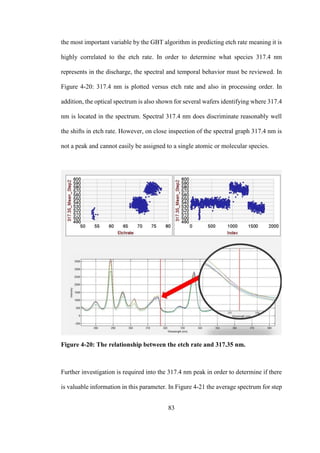
Figure 4-20: The relationship between the etch rate and 317.35 nm......................... 83
Figure 4-21: Inspection of 317.3nm wavelength that the GBT Model classed as
correlated variable to etch rate. Upper graph shows the temporal behavior of the
wavelengths. Lower graph is the mean spectra from Step 1 and 2............................ 85
xiv
Figure 4-22: The output of the gradient boosting tree analysis. The algorithm ranked
709.45 nm in step 2 is one of the most important variables for determining etch rate.
.................................................................................................................................... 86
Figure 4-23: A box plots of the etch rate for each of the wafers grouped by slot. .... 87
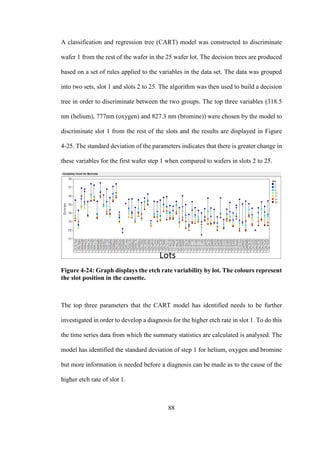
Figure 4-24: Graph displays the etch rate variability by lot. The colours represent the
slot position in the cassette......................................................................................... 88
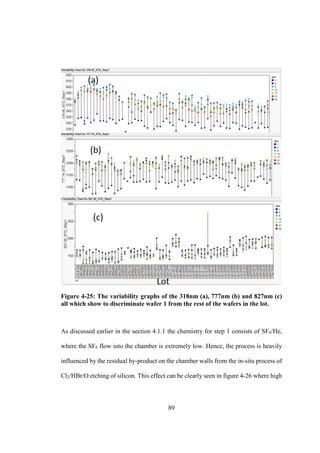
Figure 4-25: The variability graphs of the 318nm (a), 777nm (b) and 827nm (c) all
which show to discriminate wafer 1 from the rest of the wafers in the lot................ 89
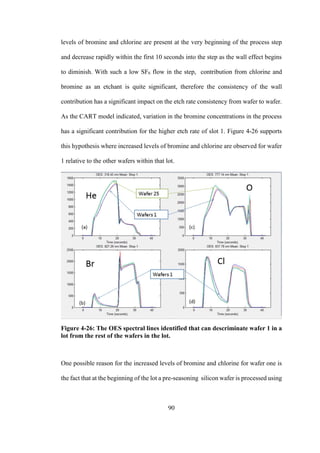
Figure 4-26: The OES spectral lines identified that can descriminate wafer 1 in a lot
from the rest of the wafers in the lot. ......................................................................... 90
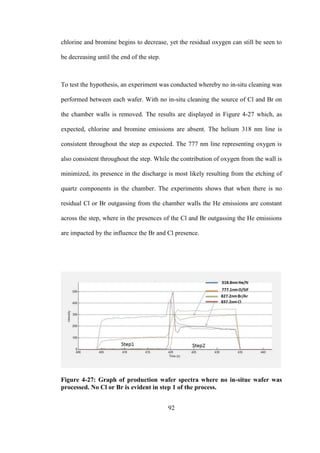
Figure 4-27: Graph of production wafer spectra where no in-situe wafer was
processed. No Cl or Br is evident in step 1 of the process......................................... 92
Figure 4-28: The first two principal components plotted against each other............. 94
Figure 4-29: The results from the principal component analysis displaying the scores
for each wafer in the loadings for each variable in the spectrum............................... 95
Figure 4-30: Graph shows the key wavelengths that represent the main etch activity
and the difference between the excursion wafers and the normal production wafers.
.................................................................................................................................... 96
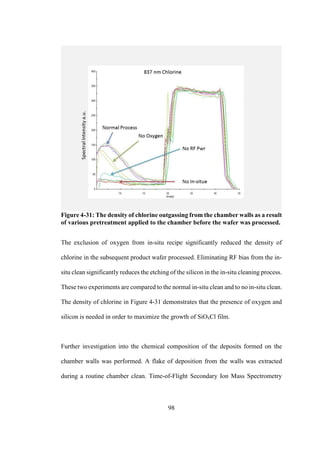
Figure 4-31: The density of chlorine outgassing from the chamber walls as a result of
various pretreatment applied to the chamber before the wafer was processed.......... 98
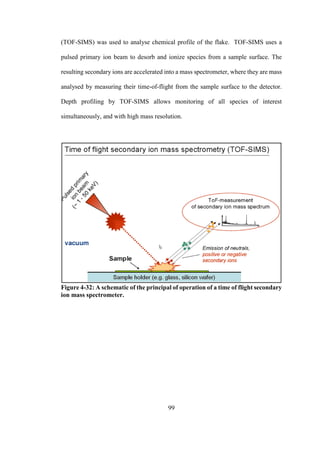
Figure 4-32: A schematic of the principal of operation of a time of flight secondary
ion mass spectrometer................................................................................................ 99
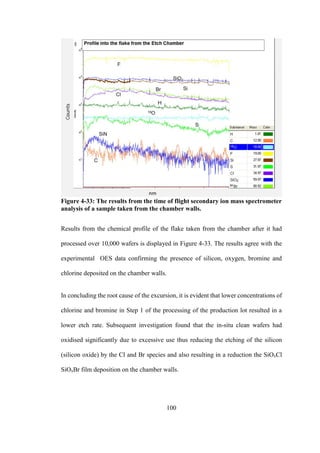
Figure 4-33: The results from the time of flight secondary ion mass spectrometer
analysis of a sample taken from the chamber walls................................................. 100
xv
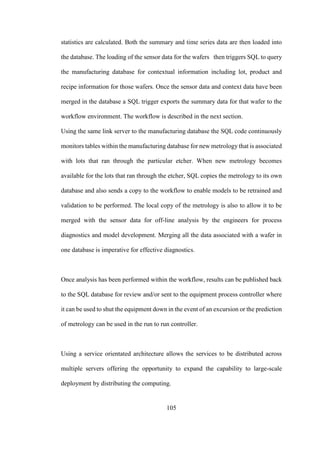
Figure 5-1. Real-time virtual metrology service orientated architecture. The schema
enables real-time data collection and analysis and decision-making....................... 104
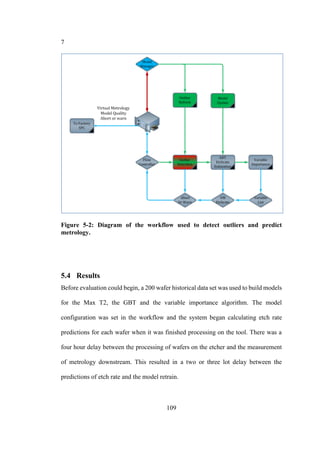
Figure 5-2: Diagram of the workflow used to detect outliers and predict metrology.
.................................................................................................................................. 109
Figure 5-3 A Multivariate T2 approach can easily pick up the etch depth deviations
from the OES data.................................................................................................... 110
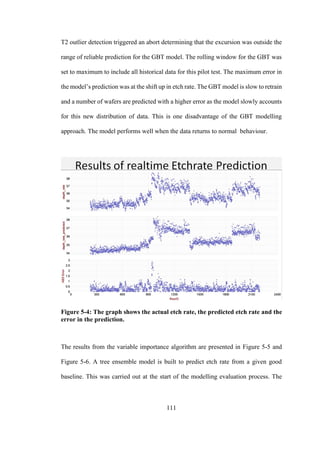
Figure 5-4: The graph shows the actual etch rate, the predicted etch rate and the error
in the prediction........................................................................................................ 111
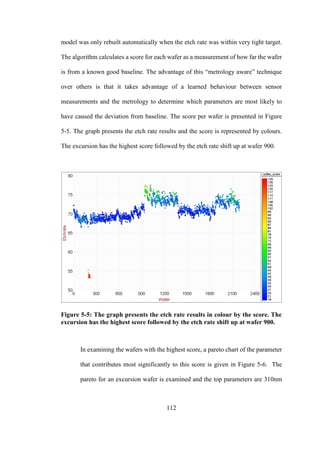
Figure 5-5: The graph presents the etch rate results in colour by the score. The
excursion has the highest score followed by the etch rate shift up at wafer 900. .... 112
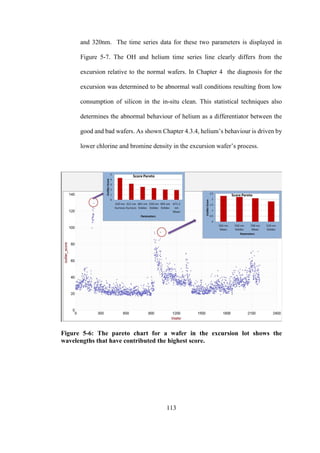
Figure 5-6: The pareto chart for a wafer in the excursion lot shows the wavelengths
that have contributed the highest score. ................................................................... 113
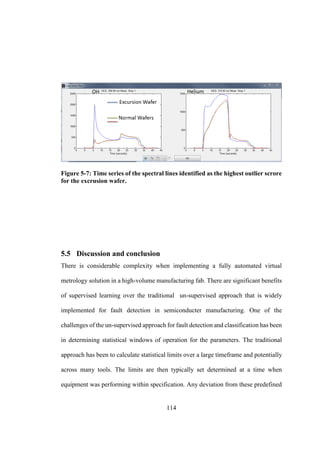
Figure 5-7: Time series of the spectral lines identified as the highest outlier scrore for
the excrusion wafer. ................................................................................................. 114
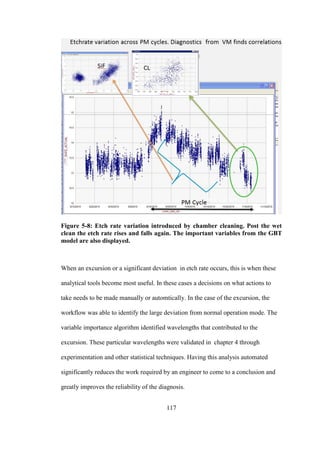
Figure 5-8: Etch rate variation introduced by chamber cleaning. Post the wet clean
the etch rate rises and falls again. The important variables from the GBT model are
also displayed........................................................................................................... 117
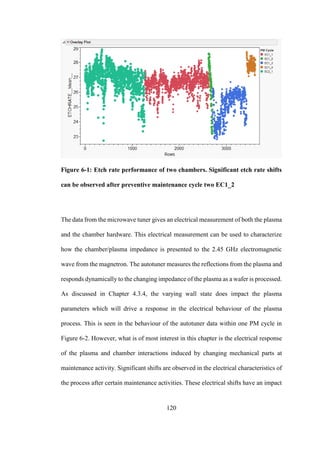
Figure 6-1: Etch rate performance of two chambers. Significant etch rate shifts can
be observed after preventive maintenance cycle two EC1_2................................... 120
Figure 6-2: The position of the microwave tuning stub1 for 4000 wafers spanning
multiple maintenance cycles is displayed. ............................................................... 121
Figure 6-3: This figure shows the correlation between etch rate in the tuning stub
position over multiple PM cycles for etch chamber 1&2 (EC1, EC2) .................... 122
Figure 6-4: Schematic diagram of experimental apparatus. .................................... 124
xvi
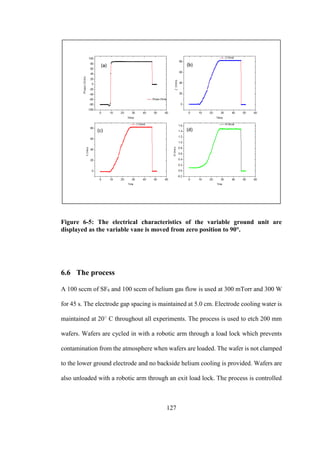
Figure 6-5: The electrical characteristics of the variable ground unit are displayed as
the variable vane is moved from zero position to 90°.............................................. 127
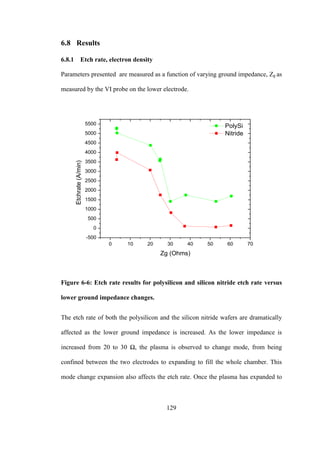
Figure 6-6: Etch rate results for polysilicon and silicon nitride etch rate versus lower
ground impedance changes. ..................................................................................... 129
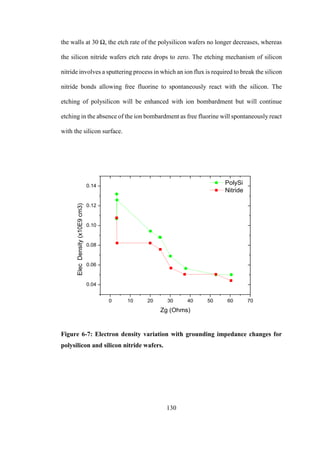
Figure 6-7: Electron density variation with grounding impedance changes for
polysilicon and silicon nitride wafers. ..................................................................... 130
Figure 6-8: Results from the powered electrode VI probe as a function of lower
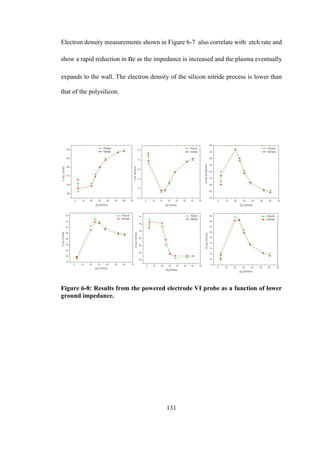
ground impedance. ................................................................................................... 131
Figure 6-9: Data from the lower electrode VI probe as a function of lower ground
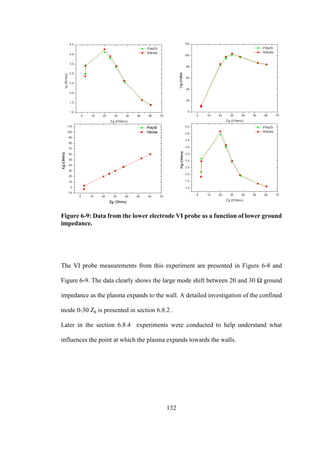
impedance. ............................................................................................................... 132
Figure 6-10: Power delivery to the plasma measured at the input to the upper
electrode for a RF setpoint of 300Watts to the RF generator with lower ground
impedance changes................................................................................................... 133
Figure 6-11: Equivalent circuit for simplified electrical model of RF discharge. ... 135
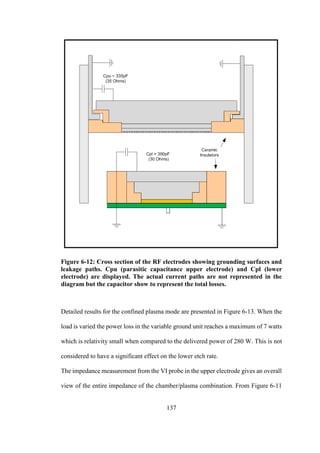
Figure 6-12: Cross section of the RF electrodes showing grounding surfaces and
leakage paths. Cpu (parasitic capacitance upper electrode) and Cpl (lower electrode)
are displayed. The actual current paths are not represented in the diagram but the
capacitor show to represent the total losses. ............................................................ 137
Figure 6-13: The VI probe measurements presenting a detailed mapping of the 0- 25
Ω lower grounding impedance (confined mode). .................................................... 138
Figure 6-14: Shows the relationship between the real and imaginary impedance. The
lower ground impedance is displayed as numbers above each point....................... 140
Figure 6-15: DC bias readings for both upper powered electrode and ground
electrode as function of ground impedance changes................................................ 143
xvii
Figure 6-16: The current voltage characteristics of the discharge as the ground path
impedance is increased all the way to 80 Ω the plasma expands all the way to walls.
.................................................................................................................................. 145
Figure 6-17: The current voltage characteristics of the discharge as the ground path
impedance is increased all the way to 80 Ω, the plasma expands all the way to walls
for RF power changes from 200-600Watts.............................................................. 146
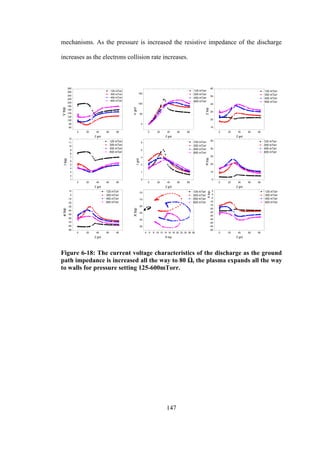
Figure 6-18: The current voltage characteristics of the discharge as the ground path
impedance is increased all the way to 80 Ω, the plasma expands all the way to walls
for pressure setting 125-600mTorr. ......................................................................... 147
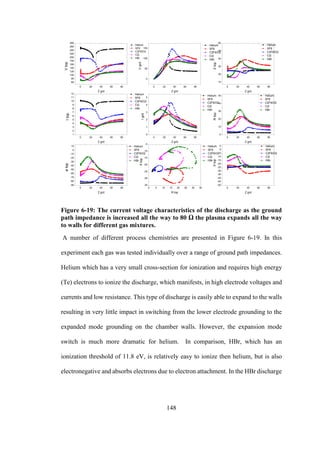
Figure 6-19: The current voltage characteristics of the discharge as the ground path
impedance is increased all the way to 80 Ω the plasma expands all the way to walls
for different gas mixtures......................................................................................... 148
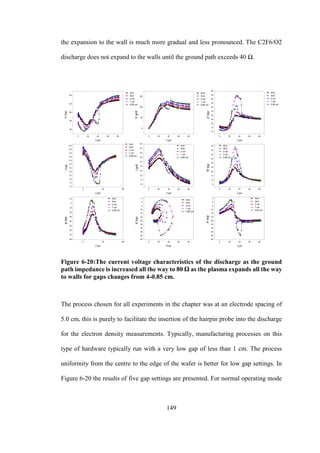
Figure 6-20:The current voltage characteristics of the discharge as the ground path
impedance is increased all the way to 80 Ω as the plasma expands all the way to
walls for gaps changes from 4-0.85 cm. .................................................................. 149
Figure 7-1: Business value of virtual metrology implemented in semiconductor fab
.................................................................................................................................. 154
1
1 Chapter 1
Introduction
1.1 Motivation
Plasma processing is widely used in the manufacture of semiconductor devices. Its
application to etching and deposition has enabled great advances in the type of
materials that can be deposited on the silicon wafer and the type of structures that can
be etched into those materials. With the pursuit of Moore’s law, the industry has driven
down the critical dimensions of high-volume manufacturing silicon structures to 14
nm. The increasingly smaller dimensions present challenges to process engineers in
the development of process recipes that are capable of etching 14 nm structures. Even
more challenging is the ability to reproduce these dimensions in a high-volume
manufacturing environment. Variation in the processing conditions from wafer to
wafer, within wafer, lot to lot and chamber to chamber result in a large variation in the
final dimensions of the etched features. The variation in critical dimensions (CD’s) of
the physical device features has a negative impact on the electrical performance of the
transistor. For example, the clocking speed of the transistor is determined by the time
taken to turn on and off the transistors. While the physical channel length under the
gate and how fast electrons can travel from the source to the drain determines the
2
clocking frequency. If the gate length is too large, the device speed is reduced. If the
gate length is too small, the device will leak. As a result, critical dimensions tolerances
in the order of +/- 0.2nm are necessary to produce high yield, high-speed devices. The
challenge for the process engineer in the etch modules is to achieve on target critical
dimensions with minimal variation from the target.
The motivation for this thesis was to investigate the sources of variation in the plasma
processing in the area of high-volume manufacturing of semiconductors which
influence the critical dimensions of silicon devices. Firstly data was collected from a
plasma etcher used in production using a spectrometers over a 3 month period. This
optical emission spectra (OES) was combined with etchrate measurements from the
production wafers and was analyses with a number of different statistical techniques
to study the etch rate variation. The root cause of the etchrate variation was validated
experimentally and with composition analysis of the deposition on the process
chamber walls. Secondly an experiment capacitively coupled 13.56 MHz plasma etch
chamber was modified with a variable inductor installed on the lower electrode
ground path. This modification was done to simulate the effect that routine chamber
maintenance has on the electrical characteristics of the chamber hardware as well as
the chamber to chamber differences seen in a semiconductor factories. The electrical
parameters of the chamber/plasma combination was measured with current-voltage
probes. Electron density and etch rate measurements where taken to study the impact
that changing the ground path impedances had on the plasma and process performance.
1.2 Contributions of this thesis
This thesis claims the following original contributions:
3
1. A comprehensive process diagnostic investigation of an industrial plasma
etch process was completed using optical emission spectroscopy (OES) to
measure process variability. The investigation studied etch-rate variability
over a 6000 wafer dataset through the analysis of OES data collected for
every wafer. Various statistical modelling techniques were employed and
evaluated for their suitability in estimating etch rate and also for investigating
the source of the common cause process variability and special cause
variability. The source of the variation determined by the statistical approach
was validated both experimentally and through the material analysis of the
deposition of the film on the plasma chamber walls.
2. The implementation of virtual metrology to predict etch rate in a high-volume
manufacturing fab is designed and evaluated. A novel workflow was
developed to detect outliers and predict etch rate real-time using a gradient
boosting trees algorithm. The data for each wafer process is first evaluated by
an outlier detection algorithm which determines whether the wafer process is
suitable for prediction or if a large excursion has occurred in the process. The
model was continuously retrained when new metrology subsequently became
available downstream in the process when the wafers are measured. To the
best of the author’s knowledge this research was the first application of
multiple models predicting etch rate, in real time, using OES. The author had
previously conducted internal research predicting etch rate using VI probe
data published in 2006 ISMI.
4
3. A patent (US 6677711 B2), granted to MacGearailt) describes how a variable
ground matching unit that is used to automatically tune the electrical
characteristics of the plasma apparatus to match the electrical behaviour of a
fleet of chambers in a semiconductor factory. In this thesis an in-depth study
is completed on how changing the electrical characteristics of the chamber
can affect the plasma process. A variable inductor grounding match unit is
designed and built which includes the ability to control the variable inductor
in real time with feedback of the position of the tuning vane. VI probe, OES,
electron density, and etch rate wafers are used to characterize the process
under various ground impedances.
1.3 Structure of the thesis
The thesis is structured as follows. Chapter 2 gives an introduction to the fundamentals
of industrial RF plasmas and the principals of plasma etching, chemistry and
processing. Chapter 3 describes electron cyclone resonance plasma systems and gives
details of the measurement techniques used in the thesis as well as the statistical
approaches and algorithms. Chapter 4 gives details on the process diagnostics
completed on the data set from the high-volume manufacturing etch process.
Statistical techniques are employed to determine the source of the variation observed
in the etch rate using an OES sensor. Chapter 5 describes the development and
deployment of real time etch rate prediction in a factory environment and the design
of the workflow for the self-learning prediction algorithms. Chapter 6 details the work
on characterizing the electrical behaviour of the plasma process with varying ground
impedance. Chapter 7, conclusions are drawn and further work proposed.
5
6
2 Chapter 2
Industrial RF Plasma processing
2.1 Introduction
RF plasmas have been widely adopted in semiconductor manufacturing due to their
ability to create and control complex chemistry which is used to manipulate and
modify surface properties of silicon wafers. This chapter examines the basic principles
of plasmas and gives a background to the etching mechanisms used in industrial
plasma processing tools.
The term plasma, coined by Irving Langmuir [1], is used to describe quasi-neutral gas
containing equal numbers of positive and negatively charged particles. As a substance
is heated to a sufficiently high temperature, the molecules in the gas decompose into
atoms. As the temperature is further increased, the atoms ionize into freely moving
charged particles as the gas transitions into a plasma state. The temperature required
to form plasma is many thousands of kelvin. Direct heating on the gas is not a viable
option and heating is typically done by electrical means.
Industrial plasma processing equipment primarily deal with weakly ionized plasma
discharges which are driven by a radio frequency (RF) voltage supply that drives
current through a low-pressure gas. This applied power preferentially heats the mobile
7
electrons relative to the heavy ions, exchanging energy through collisions with the
neutral gas. The degree of ionization in a low pressure plasma is less then 10−4
leaving
the gas consisting of mostly neutrals. As a result, the gas temperature remains very
low (effectively room temperature) and high energy electrons, typically 1-20 eV, can
be employed to dissociate the gasses into chemically reactive radicals which can react
with the surface of the wafers. The low gas temperature processing environment
provides a controlled environment for low damage processing applications. For
example, plasmas facilitate the use of photoresist as a mask in etch processes enabling
accurate pattern transfer. Plasmas produce positive ions which can be accelerated
through a potential gradient impinging on the wafer surface enhancing the chemical
reactions. The ability to control the ion flux and energy distribution as well as the
creation of radicals has revolutionized the ability of plasma process to etch nano scale
features in wafers.
Industrial capacitively coupled RF plasma reactors are parallel plate systems driven by
a 13.56 MHz power supply. One electrode is grounded while the other is powered by
the RF generator, delivering power through a matching network to the electrode. The
wafer is placed on the lower electrode where it can be mechanically or electrostatically
clamped. Helium backside cooling is delivered to the rear of the wafer to facilitate
heat transfer to the water cooled electrode. The gap between the electrodes can be
varied on some tool designs and controlled in the recipe. Furthermore, the RF power
delivery can be swapped between the upper and lower electrodes. Delivering the power
to the lower electrode will allow significant increase in ion bombardment to the wafer
surface as a result of the large potential difference between the plasma and the powered
electrode. This configuration is used in the etching of silicon nitride or silicon oxide
8
which has high bond energies and energetic ion bombardment is required to break
these bonds and allow chemical etching to occur.
2.2 RF discharges
In plasma processing reactors a wafer is normally placed on one of the electrodes. In
the case where the wafer surface is a dielectric, it will inhibit the flow of current in the
DC discharge resulting in the quenching of the plasma. In an RF discharge no net
current is required to sustain a discharge, making it suitable for plasma processing of
a wide range of materials including dielectric substrates.
Industrial capacitively coupled RF systems are driven mostly by 13.56 MHz. The
power is delivered from the generator through a matching network that resonates the
complex impedance generated by the discharge. The match also provides a 50 ohm
resistive load to the generator, facilitating maximum power transfer from the
generator. The parallel plate configuration involves one electrode delivering RF power
with the other grounded. Depending on the application for plasma processing, the RF
power may be coupled through the wafer electrode or the upper electrode. In some
designs the user can choose which electrodes to deliver the power in the recipe
configuration. The ratio between the area of the powered electrode and the grounding
surfaces (ground electrode and chamber walls) is important as it has a large impact on
the self-bias that develops on the powered electrode. The relationship between the
electrode configuration and the electrical potential is show in Figure 2-1.
In the work carried out in this thesis in Chapter 6, the power is delivered to the upper
electrode whose area is 12% larger than the lower electrode which is grounded and
9
upon which the 200 mm wafer is positioned. The chamber walls are somewhat
protected by ceramics reducing the effective ground surface area, but none the less a
significant area of the chamber wall is exposed giving the chamber an asymmetric
electrode configuration. This particular design is used to improve the uniformity of
the etch process across the wafer. In particular, to achieve uniform processing in a
commercial reactor, uniform ion bombardment as well as uniform neutral radicals
fluxes need to be presented to the wafer surface. Careful consideration is paid in the
design of the gas delivery to ensure uniform diffusion across the wafer’s surface as
well as the removal of the by-products. The gas is delivered through a hole in the centre
of the upper electrode and then diffused through a series of baffle plates.
10
Figure 2-1:Plasma potentials Vp(t) ( solid curves) and excitation electrode
voltage V(t) (dashed curves), assuming purely capacitive RF sheath behavior, for
three system geometries and for DC coupled and capacitively coupled excitation
electrodes.[6]
11
2.2.1 Plasma generation
The electric field between the electrodes accelerate the free electrons which then
collide with neutrals causing ionization creating more and more electrons Due to their
high mobility the electrons are lost to the walls and to the grounded electrode charging
them negatively, relative to the plasma and repelling additional electrons from leaving
the plasma. This results in an electric field between chamber surfaces and the plasma
creating a sheath. As in the DC discharge, ions are accelerated by the negative potential
relative to the plasma potential. This sheath edge is not static but oscillates back and
forth with the sinusoidal driving voltage of the RF generator.
In commercial RF systems, a blocking capacitor is placed between the RF matching
network and the powered electrode. This serves to allow the powered electrode to
develop a self-DC bias which will increase the energy of the ions bombarding the
electrode surface thus enhancing the etch rate if the wafer is placed on the powered
electrode. A DC bias can also develop on the wafer placed on the grounded electrode
due to the fact that the wafer is often a dielectric and will appear as a blocking capacitor
to the DC current. Similar to DC glow discharge, the self-bias that develops on the
powered electrode is to balance the difference in mobility between the electrons and
the ions. However, since the RF systems has an oscillating electric field, the sheath
potential is also time modulating. Of particular interest in this thesis, is the
understanding of the mechanisms for electron heating which create radicals and ions
employed to etch the wafer as well as the ion flux and energy distribution bombarding
the wafer surface, assisting in the etching process.
12
2.2.2 The capacitive RF sheath
The driving frequency of 13.56 MHz has a period of 74 ns. The ion and electron plasma
frequencies are given by [2]:
𝜔 𝑝𝑖 = (
𝑒2
𝑛𝑖
∈0 𝑚𝑖
)
1
2
2.1
𝜔 𝑝𝑒 = (
𝑒2
𝑛 𝑒
∈0 𝑚 𝑒
)
1
2
2.2
where ni and ne are the ion and electron densities and mi and me are the masses of the
ions and electrons respectively. For normal plasma conditions where ni=ne the ion and
plasma frequency are in the order of 3 MHz and 300 MHz respectively (for a plasma
density of 1015
m-3
measured with a hairpin probe in Chapter 6). The electrons respond
almost instantaneously to the oscillating electric field in the sheath, whereas the ions
respond to the time average fields.
In Figure 2-2 the voltages potential experienced by the powered and grounded
electrodes as a function of sinusoidal RF voltage is displayed. The sheath width
expands and contracts on both electrodes within the RF cycle. The plasma potential
also oscillates.
13
Figure 2-2: Schematic representation of the voltages in an AC coupled
asymmetric RF plasma. a). Maximum RF voltage condition, b) minimum RF
voltage condition. Vp is the plasma potential [3].
The electron density in the RF sheath changes with the instantaneous voltage.
Electrons move in and out of the sheath region when the sheath momentarily collapses
as the electrode potential approaches the plasma potential (Vp) allowing electrons to
escape and balance the ion current.
2.2.3 Ion Energy Distribution
The energy with which ions impinge on the wafer surface is a critical parameter in any
plasma process. In particular, ion bombardment plays a critical role in reactive ion
etching. The ion transit time to cross the sheath is given by [4]:
14
𝜏𝑖 = 3𝑠̅√ 𝑚𝑖 2𝑒𝑉̅𝑠⁄
2.3
where 𝑠̅ is the time average sheath width, 𝑚𝑖 is the ion mass and 𝑉̅𝑠 is the dc sheath
voltage potential. For a low frequency of 400 KHz used in the bias of the ECR
discharge discussed later in this chapter,
𝜏𝑖
𝜏 𝑟𝑓
⁄ ≪ 1 the ions cross the sheath only
during a small fraction of the RF cycle. As the sheath oscillates back and forth with
the RF cycle, the energy the ion gains is strongly dependent on the phase of the RF
cycle that it enters the sheath at. This results in a broad bimodal distribution of the ion
energies, where the minimum and maximum ion energies correspond to the minimum
and maximum sheath voltages. For example a frequency of 13.56MHz has
𝜏𝑖
𝜏 𝑟𝑓
⁄ ≫
1 , and the ions take many RF cycles to transit the sheath and are not influenced by the
instantaneous sheath voltage. The ion energy is influenced more by the time averaged
voltage and therefore not as dependent on the phase with which the ions enter the
sheath. The ion energy distribution for these higher RF frequencies is not bimodal.
15
Figure 2-3:The schematic shows the relationship between the phase in the RF
cycle that the ion enters the sheath and the resultant energy gained the ion as it
accelerates crossing the sheath[3].
2.2.4 Electron heating
There are two main mechanisms for heating electrons in RF capacitively coupled
discharges: ohmic (collisional) and stochastic heating. Plasma resistivity due to
16
electron-neutral collisions leads to ohmic heating while momentum transfer from high
voltage moving sheaths leads to stochastic heating. Thus, ohmic heating is mainly a
bulk phenomenon while stochastic heating is localized in the sheath regions.[5]
In the higher pressure regimes (100-500mTorr) of capacitively coupled RF discharges
studied in this thesis, ohmic heating is the predominant mechanism for the transfer of
energy to the electrons. This energy transfer, from the electric field to the electrons,
occurs in the bulk due to the elastic electron-neutral collisions. The energy is gained
by an electron in the oscillating electric field and is transferred into a direction
perpendicular to the field and it is not lost during the reversal of the electric field[6][7].
In this pressure regime, secondary electron emission may still occur with the majority
of electrons traversing the sheath without collisional ionization and penetrating the
bulk plasma with energies above the ionization threshold. The surf riding mechanism
of the oscillating sheath edge can also heat electrons. During the second half of the RF
cycle the sheath spatially extends back into the bulk, accelerating electrons into the
plasma [8][9].
2.2.5 Electron – Ion collisions:
In this section some of the basic processes involving electrons and ions are reviewed
to give an understanding of the basic mechanisms. It is by no means an exhaustive
review of the complex interactions that occur in the discharge, but is mainly focused
on those processes which are most important to plasma processing.
Collisional processes can be divided into elastic and inelastic collisions. An elastic
collision is one in which kinetic energy is conserved. In the collinsion between an
electron and an atom the different in mass is such that the energy transfer is negliable
17
and the electron just changes direction. If the electron is moving in an electric field the
collision just servers to restric the velocity in direction of the field. If the electron
energy is above the ionization threshold, the impinging electron may remove an
electron from the atom resulting in an ion and two electrons.
The three primary electron loss mechanisms are recombination, attachment and
diffusion. In electron attachment, there is a significant loss mechanism in the
electronegative gas regimes (O, Cl, F ,Br) used in plasma processing where electrons
are lost in the creation of negative ions. The electronegative gases have a quenching
effect and a significant impact on the resultant plasma properties, specifically the
EEDF and plasma emissions observed in Optical emission spectroscopy.
2.2.6 Collisional Cross Sections.
The collisional process between electrons and particles needs to consider how the
particle presents itself to an approaching electron. The atom consists of a nucleus in
the centre and an assembly of electrons orbiting around a large empty space. The
interaction between the approaching electron and the particle is strongly dependent on
the electrostatic forces and thus depends strongly on the velocity of the approaching
electron. There is a certain element of probability and uncertainty about the interaction
that can occur in the collision. This probability is represented as the collisional cross-
section of the particle. The collisional cross-section is a more useful parameter then
the mean free path [10]. Figure 2-4 gives the cross section for nitrogen as a function
18
of the electron energy. The cross section of neutral Nitrogen atoms is much different
from that of the Nitrogen ion. The dependence of the electron energy has a dramatic
effect on the collisional probability.
Figure 2-4: Total inelastic (σinel) and ionization (σi )cross sections for electrons
in nitrogen [11].
2.2.7 The electron energy distribution function (EEDF)
The Maxwell Boltzmann distribution applies to an assembly of particles that are in
complete thermal equilibrium. Electrons in a plasma discharge are not in a state of
equilibrium. Slow electrons make elastic collisions while electrons with energies
above excitation and ionization thresholds are involved in inelastic collisions [10].
Electrons also diffuse to the wall and have different heating mechanisms which result
in the wide distribution of energies. Many studies have been completed to determine
19
the EEDF for a variety of processing conditions[12]. The addition of electronegative
gas species to the discharge can also affect the EEDF. Many studies have measured a
hot tail in the distribution which is responsible for much of the ionization[13][14].
2.3 Plasma etching
Plasma etching’s popularity in the manufacturing of semiconductor devices has grown
greatly since the 1960s. As an alternative to wet chemical processing, plasma etching
has a number of advantages. In addition to the environmental benefits of moving away
from chemical baths, in which batches of wafers would be processed together, plasma
etching offers a cleaner more efficient and controllable environment for removing
material from the surface of silicon wafers. With the reduction in dimensions of
semiconductor devices, plasma etching offers the only commercially viable solution.
High-volume manufacturing of 14nm devices would be impossible without plasma
processing. Plasma etching provides anisotropic etching with a very high degree of
control and the ability to selectively etch one material in preference to another.
2.3.1 Processing requirements
The challenge for process engineers is to develop a process capable of etching
submicron features, meeting all the dimensional tolerances of the feature size, while
maintaining a high degree of repeatability. The challenges for plasma etching are:
1. The etch rate of the process must be as fast as possible in order to maximize
the throughput of the plasma etch tool.
2. Critical dimensions of the feature must be achieved.
20
3. The process uniformity from the centre to the edge of the wafer must be
maximised.
4. The process uniformity for dense and isolated structures must be the same.
5. The process must be able to selectively etch the bulk material over the mask
or an underlying layer such as silicon oxide underneath the polysilicon gate.
6. The amount of deposition of by-products on the chamber walls must be
minimized to prevent flaking and causing defects. This will lead to low
meantime between chamber cleans which affects costs and productivity.
7. The process variability from wafer to wafer and from lot to lot must be
minimized.
8. The process must be tolerant to the different product mixes and recipe mixes
processed in the same chamber.
9. Wafer charging damage must be minimized.
The development of robust manufacturable processes are still an empirical effort
involving a great deal of design of experiment in order to arrive at the best compromise
for process performance. The process must be evaluated as to how repeatable it will
be at processing wafers across multiple chambers in a high-volume manufacturing fab.
The commercial pressures to develop new process technology does not afford the
opportunity to continuously refine and develop the robustness of the process. There is
also large risk involved with changing processes once they have ramped up to high-
volume. One of the approaches taken in increasing yields and productivity has been to
use process diagnostics to investigate the source of process variation. If the cause of
21
process variation can be established, the appropriate control strategies can then be
implemented to mitigate the process drift.
2.3.2 Plasma etching fundamentals
The objective of industrial plasma process is to provide a consistent uniform flux of
etchants species, and in some cases ions, to produce repeatable reactions on the wafer
surface.
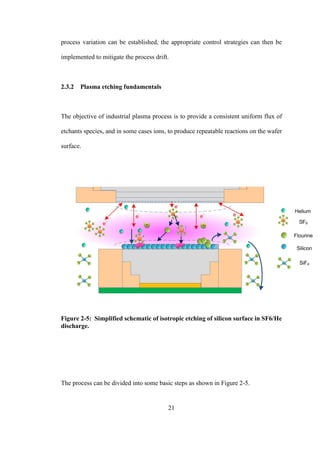
Figure 2-5: Simplified schematic of isotropic etching of silicon surface in SF6/He
discharge.
The process can be divided into some basic steps as shown in Figure 2-5.
22
1. Firstly, radicals and ions are produced from feedstock gasses. This process is
governed by the electron collisional processes. The electron density and
temperature and ultimately the electron collisional rate[15] are the
important parameters that determine the density of ions and radicals.
2. The transportation of the reactive radicals from the plasma bulk to the surface
of the wafer is through a diffusion process. The size of the chamber, gas flow
rates and pressure setpoint also determines whether the radical will have a
collision before making it to the wafer surface. The chamber is designed with
a shower head and baffle plate configurations to facilitate the delivery of the
feed gases in such a way as to compensate for the greater
loading/consumption of radicals in the centre of the wafer compared with the
edge[16].
3. The flux of ions directed towards the wafer surface will enhance the reaction
of the neutral radicals with the wafer surface. The ions provide energy that
break the bonds of the substrate material creating an active etching site. In
addition, any polymerization or passivation film that develops on the wafer
surface will also be sputtered off the horizontal surfaces by the ion flux.
4. The reactive species (fluorine radicals for example) are absorbed onto the
surface and react chemically. In the case of fluorine etching silicon, atomic
fluorine penetrates approximately five monolayers into the bulk, resulting in a
volatile by-product (SiF4) or its precursors (SiF,SiF2, SiF3)[17][9][18].
5. The volatile by-products need to be de-absorbed from the surface of the wafer
and are pumped out the chamber. This process is assisted by ensuring low
residence time in high flow process conditions.
23
The mechanism of etching three dimensional features involves some additional
complexity. In Figure 2-6 the basic etch mechanisms are shown. In order to achieve a
vertical profile, sidewall passivation is required to prevent neutral radicals from
etching the feature horizontally. The process chemistry and plasma parameters are
deliberately tuned so as to produce the right amount of passivation of the side wall to
balance the vertical etching. Too much passivation and the profile will taper. Too little
and it will bow.
Figure 2-6: The four fundamental etching mechanisms. І. Physical sputtering, ІІ.
Chemical, ІІІ. Ion Enhanced, ІV. Ion enhanced inhibitor [17].
This carefully engineered balance of vertical etching and lateral passivation determines
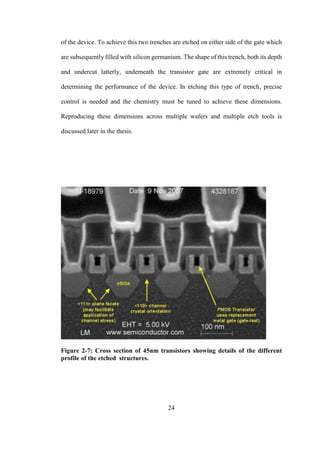
the profile of the etched structure. Figure 2-7 shows the cross section of the transistors
and first metal interconnects of a 45nm semiconductor device. While 90° profiles are
desired in the etching of the gate features, other structures demand tapered profiles.
For example, silicon germanium is used on either side of the channel under the gate to
stress the silicon lattice to improve electron mobility and increase the clocking speed
24
of the device. To achieve this two trenches are etched on either side of the gate which
are subsequently filled with silicon germanium. The shape of this trench, both its depth
and undercut latterly, underneath the transistor gate are extremely critical in
determining the performance of the device. In etching this type of trench, precise
control is needed and the chemistry must be tuned to achieve these dimensions.
Reproducing these dimensions across multiple wafers and multiple etch tools is
discussed later in the thesis.
Figure 2-7: Cross section of 45nm transistors showing details of the different
profile of the etched structures.
25
2.3.3 Other considerations for plasma etching
2.3.3.1 Lithography and Photoresist
Lithography and Photoresist are a vital component in the patterning of semiconductor
devices. The ability of plasma etching to produce smaller feature size is dependent on
the ability of the lithographer to provide imaging solutions that can create smaller and
smaller patterns in photoresist which act as a mask for plasma etching. To deal with
the reduction in line width, lithography has increased the numerical aperture of the
lens and reduced the wavelength of the illumination used to expose the
photoresist[19]. To accommodate shorter wavelengths of the illuminated source the
photoresist thickness and robustness has been reduced. As a result of these changes to
the mask materials and thickness, as well as the large cost associated with printing for
small featured masks, significant changes have been made in plasma etching. Firstly,
to deal with the reduced robustness of the photoresist, a hard mask is introduced into
the process flow. This thin sacrificial layer of silicon nitride, for example, upon which
the plasma process transfers the mask from the photoresist to the hard mask using a
chemistry which etches away the hard mask except where it is covered by the
photoresist. The mask integrity is now maintained by the more robust hard mask
enabling harsh processing conditions for a long duration during which the photoresist
would have been eroded away. The other option is to trim the photoresist before
transferring the pattern. Using a isotropic oxygen discharge, the dimensions of the
photoresist mask can be reduced [20]. The technique means that lithography can print
a line of 65nm which can be “trimmed” to 50nm resulting in a 50nm etched feature.
26
This technique is especially useful in extending the lifetime of older lithography
equipment.
Figure 2-8: SEMS cross section of metal etch stack with photoresist and Si3N4
hard marks at 20 and 90 seconds into the etch process. SEMs show the erosion of
the photoresist mask showing the need for the hardmask .
2.3.3.2 Selectivity and within wafer uniformity:
Selectivity of a process is the ability to etch one material preferentially over other
materials. In plasma etching, selectivity to underlying thin etch stop layers is critical
in preventing damage to underlying structures and have been studied extensively[21]–
[25]. In Figure 2-8 high selectivity of Aluminium over Si3N4 is required to prevent
the hard mask from being etched during the process and having an impact on the profile
of the metal line. Selectivity to the underlying silicon is critical to minimise damage
to the surface. Tuning a process to achieve the required selectivity is mostly achieved
by tuning the chemistry. If selectivity to an underlying layer is required, the process
can be endpointed[26] upon the first signs of breakthrough to the underlying layer.
Endpointing can be achieved by monitoring the optical emissions of a particular
27
plasma species or an electrical signal of the RF power [27]. The process chemistry can
immediately be modified upon the detection of the breakthrough to be more selective
to the underline layer. In the etching of polysilicon gates using Cl2/HBr, oxygen is
added to improve selectivity to the underlying SiO2 gate oxide stop layer[18]. The bias
power is also lowered to reduce the ion bombardment and allow the oxygen to defuse
into the thin gate oxide promoting oxide growth. Pulsing the RF wafer bias has also
been successful in improving the selectivity. The ability to control the ion energy and
flux to the wafer surface can significantly improve selectivity[28] . Pulsed plasmas
have also been successful in alleviating the issue of notching at the interface of
conductive films (polysilicon and aluminium). Notching can also occur at the interface
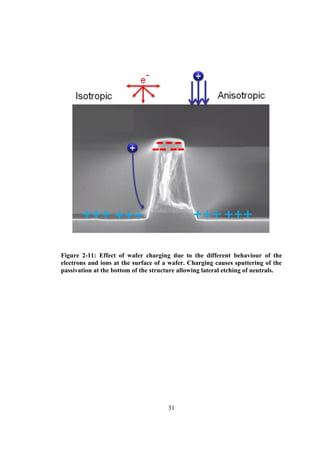
between underlying dielectric films (SiO2) and the polysilicon gate. Wafer charging,
caused by the charging of the polysilicon line, influences the ion trajectory arriving at
the surface of the wafer [29]. Pulsing the RF bias allows the charge build-up to
dissipate when the RF bias is momentarily turned off.
28
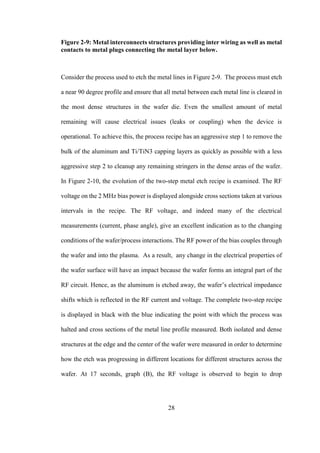
Figure 2-9: Metal interconnects structures providing inter wiring as well as metal
contacts to metal plugs connecting the metal layer below.
Consider the process used to etch the metal lines in Figure 2-9. The process must etch
a near 90 degree profile and ensure that all metal between each metal line is cleared in
the most dense structures in the wafer die. Even the smallest amount of metal
remaining will cause electrical issues (leaks or coupling) when the device is
operational. To achieve this, the process recipe has an aggressive step 1 to remove the
bulk of the aluminum and Ti/TiN3 capping layers as quickly as possible with a less
aggressive step 2 to cleanup any remaining stringers in the dense areas of the wafer.
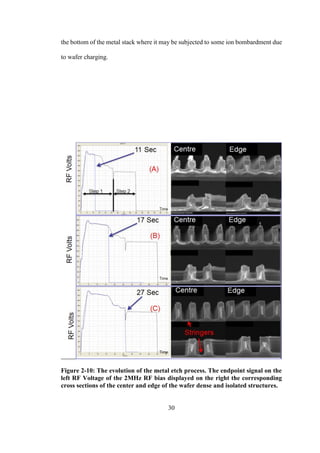
In Figure 2-10, the evolution of the two-step metal etch recipe is examined. The RF
voltage on the 2 MHz bias power is displayed alongside cross sections taken at various
intervals in the recipe. The RF voltage, and indeed many of the electrical
measurements (current, phase angle), give an excellent indication as to the changing
conditions of the wafer/process interactions. The RF power of the bias couples through
the wafer and into the plasma. As a result, any change in the electrical properties of
the wafer surface will have an impact because the wafer forms an integral part of the
RF circuit. Hence, as the aluminum is etched away, the wafer’s electrical impedance
shifts which is reflected in the RF current and voltage. The complete two-step recipe
is displayed in black with the blue indicating the point with which the process was
halted and cross sections of the metal line profile measured. Both isolated and dense
structures at the edge and the center of the wafer were measured in order to determine
how the etch was progressing in different locations for different structures across the
wafer. At 17 seconds, graph (B), the RF voltage is observed to begin to drop
29
corresponding to the clearing of aluminum at the edge of the wafer in the isolated open
areas. The dense structures of the edge and the center of the wafer are still in the
process of etching aluminum. Once the aluminum has been etched, Ti/TiN3
underneath begins to be etched. By 27 seconds, graph (C), at the end of step 1, all the
aluminum has been cleared but there are still a number of titanium stringers left in the
dense areas at the center of the wafer. The process recipe switches to a less aggressive
chemistry and reduced RF bias to give sufficient time for the last of the stringers to be
cleared in the dense areas at the center of the wafer. In this second step, the selectivity
to the underlying silicon dioxide must be sufficiently high to minimize any damage to
the surface. In addition, the selectivity must also be good enough not to etch the hard
mask, SiN3 at the top of the metal stack. As the isolated structures at the edge of the
wafer are the first to clear, these sites are most at risk for any marginality in the process
and must sustain a significantly longer exposure. The additional criteria of ensuring
that the profile of the metal lines achieves as close to 90° as possible, the passivation
of the sidewalls of the aluminum structures is also extremely important. In aluminum
etch processes, the sidewall passivation is formed by oxygen from the photoresist
eroded by the process forming AlO2 on the sidewalls of the structure preventing
chlorine from etching the metal stack laterally. A consistent supply of oxygen is
needed as the aluminum stack is etched. The availability of the oxygen relative to the
speed with which aluminum is been etched will determine the profile angle. Ensuring
this is consistent for the different structures and locations across the wafer presents a
challenge. Once the structures have been etched, the sensitivity to the quantity of
oxygen is reduced. However, oxygen is always needed in the chemistry to re-oxidize
30
the bottom of the metal stack where it may be subjected to some ion bombardment due
to wafer charging.
Figure 2-10: The evolution of the metal etch process. The endpoint signal on the
left RF Voltage of the 2MHz RF bias displayed on the right the corresponding
cross sections of the center and edge of the wafer dense and isolated structures.
31
Figure 2-11: Effect of wafer charging due to the different behaviour of the
electrons and ions at the surface of a wafer. Charging causes sputtering of the
passivation at the bottom of the structure allowing lateral etching of neutrals.
32
3 Chapter 3
Process Equipment, Sensors and Statistics
3.1 Introduction
In this chapter the basic principles of the electron cyclone resonance (ECR) plasma
reactors are discussed, in particular, the hardware used for industrial plasma
processing. The sensors used for the diagnostic measurements are explained and the
statistical approaches used to process the sensor data and correlation techniques are
discussed.
3.2 Electron Cyclotron Resonance plasma sources
Electron Cyclotron Resonance (ECR) plasmas have been in use since the early 1960s
for space craft propulsion applications [30]. Suzuki et al. first published the application
of a microwave source for plasma etching in 1977 [31]. They have been commercially
available in semiconductor factories from the mid-1980s. The main attraction of an
ECR plasma source is the ability to generate a high degree of ionization (>10%) at low
pressure. Since ECR plasma sources do not rely on a current flowing from an electrode,
this offered the opportunity to generate the plasma remotely from the wafer surface.
Thus, this minimized the damage to the wafer surface from ion bombardment or device
damage from wafer charging issues. The ECR source also allows for the opportunity
to independently bias the wafer using a low frequency RF power supply. This
33
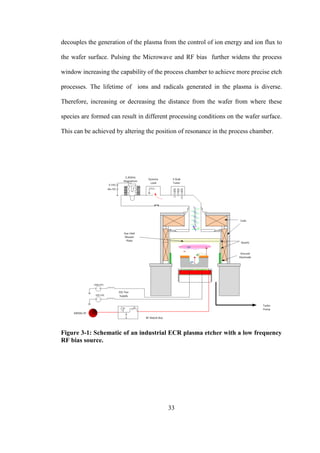
decouples the generation of the plasma from the control of ion energy and ion flux to
the wafer surface. Pulsing the Microwave and RF bias further widens the process
window increasing the capability of the process chamber to achieve more precise etch
processes. The lifetime of ions and radicals generated in the plasma is diverse.
Therefore, increasing or decreasing the distance from the wafer from where these
species are formed can result in different processing conditions on the wafer surface.
This can be achieved by altering the position of resonance in the process chamber.
Figure 3-1: Schematic of an industrial ECR plasma etcher with a low frequency
RF bias source.
34
3.2.1 The magnetron
Magnetron technology was invented by Albert Hull in 1920 in the US. At the start of
WWII, John Randall and Harry Boot at Birmingham University were contracted to
develop a short wavelength power source for radar application. They invented an 8
concentric cavity magnetron[32]. The magnetron is a high-powered oscillator which
converts potential energy of the electron cloud in the cathode into high-frequency radio
waves. The magnetron consists of a cathode in the center surrounded by cavities which
act as an anode. A perpendicular magnetic field is provided by permanent magnets
which are placed on the top and bottom of the magnetron as depicted in Figure 3-3.
The source of electrons is a heated cathode made from a thermionic material. A high
current (~20 A, ~5 V) AC power supply heats the filament which emits electrons. A
DC offset of -5KV is applied to the cathode. The E field between the cathode and
anode acts on the free electrons accelerating them towards the anode. The permanent
magnets mounted at the top and bottom of the magnetron exert a perpendicular B force
on the electrons which when combined with the E field horizontal force causes the
electrons to spiral away from the cathode in paths of varying curvature. Cavities that
are placed around the cathode are designed to specific physical dimensions.
Electrically, the cavity appears as an inductor and a capacitor in parallel and forms a
resonance circuit. The physical makeup of the cavity determines the resonating
frequency output of the magnetron. As this cloud of electrons approaches the anode, it
falls under the influence of the RF fields at the vane tips and electrons will either be
retarded in velocity, if they happen to face an opposing RF field, or accelerated if they
are in the vicinity of an aiding RF field. Since the force on an electron due to the
magnetic field B is proportional to the electron velocity through the field, the retarded
35
velocity electrons will experience less "curling
force" and will therefore drift toward the anode,
while the accelerated velocity electrons will curl
back away from the anode[33]. Every other
cavity is connected together and in turn
connected to an antenna which protrudes from
the magnetron.
Figure 3-2; Magnetron
Resonator.
(http://www.cpii.com/)
36
Figure 3-3: Cross sections of a magnetron showing the cavities and the cathode.
The two permanent magnets are positioned on the top and bottom of the cavities.
Also displayed is the alternating voltage to heat the filament the negative DC
voltage applied to the cathode[34].
3.2.2 Microwave tuner controller
The function of the microwave tuner is to provide accurate measurement of the
forward and reflected power from the plasma. Aditionally, a three stub tuner provides
varying capacitance to resonate with the varying inductance of the ECR chamber. A
voltage standing wave detector is mounted in the waveguide which consists of diodes
37
placed at 1/6 λ which feeds the signals into the microwave controller. The
measurement of the standing wave voltage allows the calculation of the progressive
power propagating towards the plasma and the reflected wave returned from the
chamber/plasma combination. The tuner also calculates insertion lengths of the three
stubs which are inserted into the waveguide to minimize the reflections. The measured
forward power is compared to the recipe setpoint and adjusts the high-voltage DC
current to the magnetron to deliver the required power to the plasma. As part of the
calculations, the tuner also calculates the reflection coefficients which are a very
useful diagnostic measurement as it gives an electrical impedance that the
plasma/chamber combination presents to the microwave power[35].
3.2.3 Electron cyclon resonance.
The 2.45 GHz high-frequency electromagnetic wave generated by the magnetron and
transmitted through the waveguide is introduced into the reaction chamber through a
quartz window. A magnetic field is generated in the reaction chamber through three
sets of electromagnetic coils, two placed around the chamber and one on the top.
Electrons rotate around the magnetic lines of force with an electron cyclotron angular
frequency given by the equation:
𝜔𝑐 =
𝑒𝐵
𝑚 𝑒
3.1
where 𝑒 is the electric charge, 𝑚 𝑒 is the mass of an electron and 𝐵 is the magnetic
field[9]. The electric field of the 2.45 GHz microwave delivered through the
waveguide is superimposed on the perpendicular magnetic field lines generated by the
electromagnets. At 87.5mT magnetic flux density, the 2.45 GHz microwave:e will
38
cause the electrons to rotate at 2.45 GHz around the magnetic field lines. As the
electrons are spiralling around the magnetic field lines, they continuously accelerate
achieving very high energies. This resonance zone is where the microwave energy is
strongly absorbed. Magnetic flux density higher than the 875 Gauss is required in the
source region of the vacuum window above in order to facilitate the propagation of the
microwaves into the vacuum chamber before reaching the dampening of the ECR
zone[36]. In Figure 3-4 Kushner’s [37] simulation of an ECR chamber is displayed.
The results show that most of the microwave power is absorbed in the resonance zone
accelerating electrons to very high energies. These electrons then collide with the
neutral gases causing a high degree of ionization. The influence that the magnetic field
lines have on the charged particles is clearly seen in the ionization rate and electron
density results of the simulation.
39
Figure 3-4: Plasma modeling completed by Kushner et al[38]. The simulations
show the power deposition, electron temperature and density in ECR reactor.
The electrode upon which the wafer is electrostatically clamped is connected to a 400
kHz RF power supply. As discussed in Chapter 2, 400 kHz frequency is below the ion
frequency and therefore the ions will be influenced by the modulation of the sheath
voltage. The 2.5μs period of the RF cycle is slow enough to allow ions to transition
40
across the sheath bombarding the surface of the wafer. The RF is controlled to a power
setpoint. An electrostatic chuck used to clamp the wafer to the electrode facilitates
high-pressure helium to be delivered to the gap between the electrode and the wafer,
thus, enabling heat transfer from the wafer to the water cooled electrode.
3.3 Measurement techniques
The adoption of sensors in industrial plasma reactors has not progressed relative to the
capability developed in academia for plasma diagnostics. Process equipment
manufacturers have always measured equipment parameters such as pressure, power,
temperature, etc. in order to control the equipment. It also provides some basic
alarming if process setpoints have not been achieved. In the 1990s a generic protocol
for communication and control of semiconductor manufacturing equipment was
agreed upon and the development of software began that could record the equipment
parameters[39]. However, few of these parameters relate to the process and
measurement of the process parameters in the industry remains relatively poor. The
availability of robust process sensors and the necessary software modeling to interpret
the data has limited implementation of advanced sensors in the industry. Many plasma
diagnostic sensors are intrusive and cannot be used in a manufacturing environment.
In addition, the corrosive chemistries used for industrial processes also limits the
choice of sensors. In this section two non-invasive measurement techniques will be
discussed along with two invasive sensors that are used for some fundamental
characterization.
41
3.3.1 Optical emission spectroscopy
Chapter 2 describes the electron heating mechanisms in an RF discharges which results
in a distribution of electrons with varying energies (EEDF). Theses electrons collide
with the gasses in the process chamber causing excitation and ionization as discussed
in Chapter 2. The subsequent relaxation by spontaneous emission to lower energy
states can occur in one or several transitions with lifetimes varying from nanoseconds
to seconds. The transition is accompanied by a photonic emission unique in
wavelength to the change in energy levels. The unique spectrum emissions of the
atomic and molecular species in the plasma offers a very powerful diagnostic
measurement of the discharge. In principal, if all the excitation process rates as well
as the electron density and temperature were known, it is theoretically possible to
calculate the species densities from their optical emissions. In reality, is not possible
and therefore the relationship between the emission of a species and its density is
somewhat ambiguous. Notwithstanding this, for diagnostics of industrial plasma
processes, spectroscopy has proven to be a very powerful diagnostic tool. The non-
intrusive nature of the measurement renders it suitable for use in industrial plasma
processing applications.
Two types of spectrometers where used in this study,USB2000 and HR4000 both made
by Ocean Optics. The USB2000 has a 2048 element charge-coupled device (CCD)
array which has a response of 250-850nm which give ~0.3nm optical resolution with
a entrance aperture (slit) of 25µm. The HR4000 has a 3648 element CCD array
measuring 200-1100 nm with a 5µm slit giving a ~0.25 nm resolution.
42
3.3.2 Current voltage probes
The electrical characteristics of the plasma process and hardware combination is
another useful diagnostic measurement. The electrical measurement is usually taken
between the RF matching unit and the powered electrode. A sample of the voltage
waveform is capacitively coupled to a detector and a sample of the RF current wave
form is usually inductively coupled to the detector. Both signals are processed and the
phase angle between the current and voltage is also calculated. Harmonics of the
fundamental frequency are generated by the nonlinearity of the modulation of the
plasma sheath and can be measured and calculated using Fourier analysis. Harmonics
measured by the VI probe are very sensitive to small changes in the sheath. If the wafer
is placed on the powered electrode, RF harmonics have shown to be able to detect
0.5% open area endpoint[40]. Other studies of the harmonics have shown them useful
in modelling the sheath behaviour [41]. Useful data from the VI probe is used to
measure the actual power delivered to the electrode which can determine the losses in
the match and delivery system as well as the determining the real and imaginary
elements of the plasma/hardware combination which is detailed later in Chapter 6.
3.3.3 Hairpin probe
A microwave hairpin resonator (hairpin probe) has been established as an effective
way of measuring electron density in plasmas. The hairpin probe is an open-ended u-
shaped quarter wavelength transmission line. When a suitable frequency signal source
43
is applied to the short end of the probe, maximum power coupling takes place. This
specific frequency is a quarter wavelength which equals the length of the pins. The
resonance frequency is related to the dielectric constant of the medium that surrounds
the probe.
The resonance frequency of the hairpin probe is given by [42]
𝑓𝑟 =
𝑐
4𝐿√𝜖
=
𝑓0
√∈
3.2
where c is the speed of light, and L is the length of the resonator and ∈ is the
permittivity of the surrounding medium. Plasma can also be treated as a dielectric. If
the thermal motion of electrons can be considered weak as compared to the electric
field set-up between the pins, then one can model the plasma permittivity based on
cold plasma approximation, which ignores the thermal motion of electrons. At low
pressures, the electron neutral mean free path can be larger than the separation between
the pins. Hence plasma permittivity can be given by [2]:
∈ 𝑝= 1 −
𝑓𝑝
2
𝑓2
3.3
where 𝑓𝑝 is the plasma frequency. By substituting equation 3.2 into equation 3.3 the
resonance frequency of the plasma can be expressed by:
𝑓𝑟
2
= 𝑓0
2
+ 𝑓𝑝
2 3.4
44
The above equation can be further simplified [2][42]:
𝑛 𝑒 =
𝑓𝑟
2
− 𝑓0
2
𝑒2 𝜋𝑚 𝑒⁄
3.5
where 𝑛 𝑒 is the electron density, 𝑒 is the electronic charge, 𝑚 𝑒 is the mass of and
electron and 𝑓𝑟 is the resonance frequency of the plasma and 𝑓0 is the resonance
frequency of the probe at vacuum.
Data collection with a hairpin probe involves inserting an invasive probe into the
plasma discharge. While this is not feasible in a production environment, it is possible
to take the equipment off-line to make measurements. A microwave generator provides
a sweeping signal from 2 to 3.8 GHz. The reflections are measured on an oscilloscope.
The resonance point is measured at vacuum and then again under plasma conditions.
The change in frequency from vacuum to plasma is used in equation 3.5 to determine
the electron density.
3.4 Statistical analysis techniques
Statistics have a long history of implementation in semiconductor manufacturing.
Statistical process control (SPC) has been widely used to set critical manufacturing
parameters. More recently, with the availability of equipment parameters from
45
processing equipment, statistical controls have been implemented on these parameters.
Univariate and multivariate analysis of these equipment parameters has been adopted
in semiconductors manufacturing. However, these unsupervised analytical techniques
are prone to false fails and missed alarms. In particular, parameters that are sensitive
to the process behave nonlinearly. In Figure 3-5 the RF voltage from a plasma etch
process is greatly disturbed due to maintenance and chamber conditioning. This
variation in the data is a challenge for applying appropriate statistical limits for fault
detection. The supervised learning approach (virtual metrology) where correlations
can be established with the metrology and the process parameters provides a more
accurate and robust fault monitoring/detection capability. When this technique is
combined with periodic model retraining it offers a very reliable fault monitoring
system.
46
Figure 3-5: The mean value of RF voltage (RMS) for 3000 wafers. Large shifts
due to maintenance activity.
3.4.1 Summarization of time series data
The data from sensors and equipment parameters is normally acquired at 1 Hz. This
time series data must be rolled up into summary statistics in order to be merged with
metrology data for analysis. In addition, the sheer volume and unstructured format of
the data makes analysis and visualization difficult. The best approach has been to
describe each recipe step with a set of statistical features. These features can then be
rolled up together to give an accurate picture of the time series behaviour of each
47
wafers process. This technique is most useful when looking at large volumes of wafers
to characterize the performance of the process chamber over time. However, when
anomalies are detected, it is imperative that the original data from which statistics are
calculated is available to the engineer in order to help with diagnosis. Principal
component analysis of the time series data are investigated in Chapter 4 and are useful
in determining the main patterns in the OES data.
Figure 3-6: The changes in the recipe step is a function of time and the
corresponding change in pressure.
48
3.4.2 Principal Components Analysis
Principal component analysis (PCA) is an unsupervised dimensionality reduction
technique that extracts explanatory variables from the data and is especially useful for
exploring the variation in the data sets and finding patterns.
In figure 3-7, a two dimensional dataset (x,y) is shown in (a). The principal component
analysis can be considered as a rotation of the axis of the original coordinate system
to new orthogonal axis that coincides with direction of maximum variation[43].The
construction of the two principle components (PC’s) which pass through the direction
of maximum variation are shown in Figure 3-7. Projecting each observation onto the
principle component (PC), the distance to the PC gives a score for each observation.
Figure 3-7: This two-dimensional representation of principal component 1 and 2
capturing most of the variability in the data set[44].
The angle between the PC’s and the original variables is calculated. A small angle
indicates that that variables has a large impact because it is most aligned with that
particular principle component. A large angles indicates that that variable has little
49
influence on that principal component. A loading plot shows how the variables
influence the principal component.
Figure 3-8: The score for each observation is the distance to the PC (a). The
loading for each PC is the angle each variables is from the PC[45].
Before PCA is performed the data is normally pre-processed. Each variable is mean
centred and normalized to unit variance by dividing by the standard deviation. This is
necessary because each variable can be measured on different scales and units (e.g.
temperature and voltage).
Next the covariance matrix is calculated. This is how much each pair of variables vary
from their mean with respect to each other. For two variables 𝑥𝑖 and 𝑥𝑗 the covariance
is expressed by:
𝑐𝑜𝑣(𝑥𝑖 , 𝑥𝑗) = [(𝑥𝑖 − 𝜇𝑖 )(𝑥𝑗 − 𝜇 𝑗 )] 3.6
50
The eigenvectors and corresponding eigenvalues of the covariance matrix are
calculated. The eigenvector of a square matrix, 𝐴, is a non-zero vector 𝜈 where the
matrix is multiplied by the vector it yields a constant multiple of 𝜈:
𝐴𝑣 = ⋌ 𝑣 3.7
where ⋋ is the eigenvalue.
The eigenvectors (principal components) are arranged in descending order by
eigenvalue consistent with the amount of variance explained. The eigenvector with the
largest eigenvalue is the first principal component and explains the most variances in
the dataset [46].
3.4.3 Gradient Boosting Trees
Gradient boosting trees (GBT) is a supervised machine learning technique in which a
model is built to predict an output Y from a set of input variables X. A decision tree is
a tree structured layout of decision rules (logical splits) on the X variables to predict
Y. In Figure 3-9 a decision trees is built to predict the weather from three X variables,
temperature, humidity and dew point. The model would typically be trained using
historical data and then used to predict the weather using the measurements.
51
Figure 3-9: Shows a simple decision tree to predict the weather (Y) from
temperature( X1), humidity (X2) and dew- point(X3)[47].
Depending on the nature of the data these decision trees work very well in producing
accurate predictions. This single tree approach has some limitations in dealing with
more complex and larger data sets. These trees can be unstable when small changes in
the data can result in very different series of splits giving errors that propagate down
the tree due to the hierarchical nature of the process.
The GBT algorithm computes the sequence of small trees for prediction. The first tree
is constructed to predict Y. The error or residuals in this tree’s prediction are
determined. The next tree is constructed to predict these residuals (prediction errors).
The process is then repeated to predict the errors from the previous tree and so forth.
The depth of each tree and the number of trees constructed are tuned for each data set’s
characteristics in order to minimize the error prediction and prevent over fitting.
52
4 Chapter 4
Case Study One - Virtual metrology of a Plasma Etch
Process
4.1 Introduction
Virtual Metrology is a concept used in the semiconductor industry where physical
and/or electrical parameters of wafers and/or devices is estimated from information
collected in real time from the manufacturing tools (e.g., equipment or process
parameters) and from other available sources (e.g., production context information or
up-stream metrology).The benefit of this virtual measurements is can be done before
physical metrology is available giving early warning of process drift as well as
affording the opportunity to reduce the numbers of wafers measured at metrology
reducing cost.
In this chapter a two-step etch process (SF6/Cl2, NF3) is investigated to study etch-rate
variability over a 6000 wafer period through the analysis of OES data collected for
every wafer. Linear regression and gradient boosting trees modelling techniques are
employed and evaluated for their suitability in estimating etch rate and also for
investigating the source of the common cause process variability and special cause
variability. The modelling results suggest that etch by-products adhering to the
chamber walls are the main contributor to the etch rate variability. The results are
validated by sampling the polymer build-up from the chamber walls and performing
53
elemental analysis of the sample. Experimental wall pre-treatments are also used to
validate the hypothesis.
4.1.1 The etch process
After a transistor gate structure has been fabricated and spacers deposited and etched,
the next step is an etch undercut operation. This is done to reduce the effective gate
length of the transistor. This trench is subsequently filled with epitaxial strained silicon
as shown in the Figure 4-1. This process has two functions; firstly the lateral etch under
the gate reduces the “effective gate” width allowing the device to clock at high speeds.
Secondly, the strained silicon fill increases the electron mobility again allowing faster
gate switching. The requirement is to tightly control these very critical gate dimensions
which presents challenges to the etch process. The specifications needs to be
maintained in both the vertical and horizontal directions. Since there are no termination
layers, endpoint detection is not possible and any variability in etch rate (vertically or
laterally) will be reflected in dimensional changes in the feature dimensions and hence
the electrical performance of the device. The trade-off between speed and leakage
requires precisely specific physical dimensions of the etched trench. If the trench is
too shallow or the lateral etch too narrow the device will not clock as fast and if the
effective gate is too narrow the device will leak more.
54
Figure 4-1. Transistor Gate
4.1.2 Recipe structure
A two-step process is used to etch under the transistor gate. For confidential reasons
the exact dimensions of the gate and chemistries used are not specified.
1. Step one employs a dilute SF6 and helium anisotropic chemistry to etch
through the native oxide film on the surface of the wafer and to etch down
vertically to a targeted depth. Ion flux needs to be minimised in order to
reduce damage, therefore no active RF bias was used in this case.
55
2. With the plasma on the chemistry is switched to CL2/NF3/Ar chemistry with
an increase in pressure and a decrease in microwave power. This isotropic
etch step further deepens and undercuts laterally under the gate.
In Figure 4-2 the evolution of the gate profile shows how the profile progresses within
each step of the two steps recipe. The first step etches anisotropically using while the
second step etches both isotropically.
Figure 4-2: Time evolution of the profile progressing through the etch process.
4.1.3 Insitu plasma chamber cleaning
Coating of the chamber walls is a normal and unwanted consequence of the industrial
chemistries used for wafer etching. As discussed in Chapter 3 Etch processes are
designed to create a precise combination of etch and deposition that results in a desired
etched structure. In addition by-products of the etched wafer may also deposit on the
chamber walls. The effect of this deposition of unwanted coatings on the chamber
walls is that it can contaminate the etch process by recycling gas species back into the
56
process and may also promote further chemical absorption of key gas species through
recombination on the walls. In addition, if chamber coatings are allowed to
continuously grow they eventually begin to flake off and cause defects on the wafer
surface. In order to maintain wafer to wafer and lot to lot reproducibility and prevent
the deposited film from growing too thick on the chamber walls, in-situ plasma
cleaning regimes are employed. In this particular etch process an SF6 plasma clean is
performed before a lot is etched in the chamber. Between each wafer a Cl/HBr/O
plasma etch is used to ensure the chamber walls have a consistent SiOClx film on the
walls. This pre-treatment of the chamber wall is to enhance wafer to wafer
reproducibility.
4.1.4 Sensor process measurement and data collection
57
Figure 4-3: Schematic of ECR plasma chamber with OES sensor measuring light
from a window looking down into the plasma chamber.
An Ocean Optic USB 2000 spectrometer was used to collect a 250-850nm spectrum.
A fibre optic was mounted in a window in the waveguide which collects light from a
view port looking down into the process chamber. More details of the spectrometer
specifications are presented in Chapter 3.3.1. A HR4000 spectrometer was used only
to measure experiments. A data acquisition system was employed to collect OES data
from the USB2000 and equipment parameters at 2 Hz for each wafer processed in the
chamber. Mean and standard deviation summary statics were calculated for each recipe
step.
5 VAC
-5kv DC
400Khz RF
Magnetron Dummy
Load
3 Stub
Tuner
USB2000
Spectromter
HR4000
Spectromter
Fiber Optic
58
4.1.5 Post etch metrology
Post etch, the lots receive a number of wet chemical clean steps to remove any residue
left over from the etch process. Subsequently, a profilometer is used to measure the
depth of the undercut. As it is not possible to measure the trench at the transistor gate,
a large trench test structure is purposely place between each die and is measured as a
proxy for the undercut depth at the transistor. The depth of ten test sites spatially
distributed across the wafer are measured. The measured depth is divided by the total
time of the recipe to give an etch rate and averaged for each wafer. A total of seven
wafers in each lot is measured for trench depth.
4.1.6 Automated Process Control
Automated process control (APC) automatically adjusts the recipe selected for each
lot based on incoming or post metrology. In this process, feedback metrology from the
downstream depth measurements are used and an EWMA (effective weight moving
average) algorithm modifies the recipe step time to maintain a target trench depth. It
achieves this by taking the weighted average depth of the last nine lots given a larger
weight to the more recent lots and calculates the difference from the target depth for
the process. A lookup table was developed at the start of the APC implementation in
which the relationship between the addition recipe time and the resultant change to
the etched depth was determined. The APC systems then consults this table in order to
determine how much to adjust the step time in order to bring the etched depth back on
target. This then determines which recipe is selected for the subsequent lot.
59
4.1.7 The dataset
Data was collected over a four month period. The etch rate for the period of data
measured is displayed in Figure 4-4. In this four month timeframe a sudden drop in
etch rate was observed at wafer 190 when the process chamber went dramatically out
of specification for one lot. An increase in etch rate was observed from wafers 600-
1000 after which it returned to normal and again at wafer 1450 a slight increase was
observed. There is also a significant variation in etch rate within each 25 wafer lot.
Summary statistics (mean and standard deviation) of the all the sensor data were
calculated and the metrology for the four month period are merged into a single dataset
for analysis.
Figure 4-4 Etch rate performance of chamber of period of 4 months in which 6000
wafers were processed and 1700 of these wafers had metrology measurements.
Seven wafers in each lot consisting of 25 wafers were measured at metrology and the
etch rate for those wafers was merged with the associated sensor data. Wafers in slots
1,5,9,13,17,21 and 25 where typically measured. Context information such as lot ID,
60
recipe, slot number etc. were also added to the data set. Wafers with no metrology
were removed. The time series data from with which the summary statistics were
calculated and retained for later analysis.
4.2 The analysis of time series OES spectra of a production recipe
The main objective of OES analysis in this study is to estimate the chemical
concentration of the species in the plasma and study how they relate to the etch rate
performance of the chamber. Understanding the wafer surface chemistry can lead to
a better understanding of the mechanisms involved in the etching of features on the
wafer. Understanding the chemical species in the spectrum and the rate with which the
density of the species are changing within the recipe steps provides valuable
information about the process. The intensity of a spectral line can be used as a proxy
for the density of a species in the plasma when measured within one wafer’s recipe or
from wafer to wafer[48]–[50].
The spectral peak identification of complex industrial plasma chemistries is not a
straightforward task. Industrial chemistries contain a variety of gasses and the
interaction of chamber walls and etching silicon wafers can create a very complex
spectrum of atomic and molecular species emissions. Atomic spectral lines are well
documented in the online NIST database[51]. The low resolution of industrial
spectrometers give broadened spectral lines making individual spectral lines difficult
to isolate and identify. The spectrum of a HBr/Cl2 plasma measured with a high
resolution HR4000 (0.05nm) and low resolution spectrometer USB2000 (0.25 nm) is
61
shown in Figure 4-5. In the low resolution spectrometer the hydrogen and bromine
peaks adjacent to each other blend together whereas with the higher resolution
spectrometer the individual lines can be resolved into individual peaks.
Figure 4-5: Low (Red) verse High (Blue) resolution Spectrometer displaying
convoluted and un-convoluted lines for Cl, Br and H lines.
A number of different approaches are described here that can be used to determine
suitable spectral lines. In addition, virtual metrology can be employed to correlate OES
spectral lines to metrology. Virtual metrology is an important technique in
determining variables that are related to the variability of metrology. This technique is
described in more detail later in the section 4.3.
62
4.2.1 Analysis of time series OES spectra
The spectral data for a two-step recipe is displayed in Figure 4-7. In step one, SF6 and
helium etch for 15.0 seconds. The plasma stays on while the recipe chemistry changes
to Cl2/NF3/Ar. These transitions can be observed in the emission spectrum. Analysing
the transients between recipe steps can be a very useful diagnostic in evaluating the
dynamic performance of the chamber’s response to recipe parameter changes. The
dynamic performance of MFC’s (mass flow controllers), pressure control and power
tuning responses are very important characteristics of a process chamber. This
performance can be a very important factor in matching chambers in a factory. In
Figure 4-6 the transient behaviour of chlorine is shown when the MFC is turned on in
a plasma-on transition step. In this case, the ‘blue’ flow controller releases a burst of
chlorine at turn-on when compared to a normal ‘green’ flow controller. This chlorine
burst resulted in a chamber mismatch in etch rate.
63
Figure 4-6 The graph displays the temporal behavior of chlorine. The chlorine
flow controller is turned on during the plasma. The dynamic behavior of the flow
controller’s response is displayed.
The emission spectrum is analysed by recipe step, with the objective of determining
the species exists that in that recipe step and how they behave temporally and interact
with each other. This analysis provides key information about the reaction rates in the
plasma as the wafer etches, and the influence the chamber walls and the wafer itself
have on the plasma chemistry. The approach is to consolidate the entire spectrum down
to a subset of wavelengths that is representative of the chemistry of each recipe step.
64
.
Figure 4-7 displays the spectrum at 7 seconds and the temporal behavior of
550nm
A number of different techniques have been developed to investigate the dynamic
behaviour of the recipe. In order to develop an understanding of the process, analysis
of the OES spectra is extremely helpful in identifying the chemistry changes that occur
as the wafer is etched.
Recipe step 1 of the process is most heavily influenced by the condition of the chamber
walls due to the fact that only 2.5% of the total gas flow is SF6 at a pressure below 1
Pa (97.5% Helium). Therefore, residual by-products from the chamber walls play a
significant role in the process chemistry. As the wafer begins to be etched, the effect
of the walls begins to become less significant as species that were initially outgassing
may be superseded by deposition on the walls and/or the memory effect of the wall
wears off. As described in section 4.1.3 an in-situ wafer clean is performed between
65
each product wafer. The chlorine, hydrogen bromide and oxygen chemistry of the in-
situ clean leaves a residue on the chamber walls.
A relatively simplistic visual approach illustrated in Figure 4-8 where the spectrum at
the end of step 1 is subtracted from a spectrum at the beginning of the step. The
difference between the spectra can be used to identify what species are increasing or
decreasing as step 1 proceeds. Positive Peaks show wavelength increases across the
step, while negative values indicate peaks decreasing. The time series for wavelengths
288nm and 837nm is also displayed in Figure 4-8 (b).
66
Figure 4-8: The change in spectrum across step 1 of the process shown in (a) and
how this can be used to determine wavelengths increasing and decreasing within
the recipe step (b).
4.2.2 Approach for atomic and molecular species identification
Additional validation is required before a wavelength can be assigned to a gas gaseous
species. In the cases where wavelength peak is unique, with no close neighbours
influencing the peak height, the assignment is straightforward by reviewing the
literature and examining line peak structure. In Figure 4-9 837.6nm, a Cl peak has
insignificant contributions from other neighbouring species.
67
Figure 4-9: 837nm Chlorine Peak red (7 sec, blue17sec) in step1 of the recipe
Identification of other peaks in the spectrum is not always straightforward and requires
closer analysis of both the spectral shape and the temporal shape over the recipe step.
In the analysis of step 1 of the recipe, significant change is observed across step 1 in a
band of wavelengths from 652 to 660 nm. In Figure 4-10 the spectrum for time 7s,
12s, and 17s in the process is plotted in both time domain and frequency domains. The
OES spectrum is difficult to resolve into individual species because there is significant
overlap in the emission lines. In Figure 4-12, a high(HR4000) and low resolution
(USB2000) spectrum are displayed for the process recipe along with a pure chlorine
and pure hydrogen bromide plasma. The low resolution spectrometer shows a distinct
peak at 656 nm, however the non-symmetry of the peak structure indicates additional
68
peaks in the region of 653 nm. In the high resolution spectrometer smaller peaks are
identified at 653 nm and 654.5 nm. From the NIST database these peaks are identified
as Cl and Br emissions respectively. The spectrum from a pure chlorine discharge and
a pure hydrogen bromide discharge are displayed in Figure 4-11. These individual gas
plasmas help give some indication as to the intensity and shape of the emission lines
of Cl and HBr in that part of the spectrum and indicate that H emissions dominate in
this region.
For the purposes of the analysis of the 656.3 nm peak can be used to give an estimation
of the density of hydrogen in the recipe. Changes in Cl or Br will have little effect on
the intensity of the hydrogen line 656.3 nm, except in their impact on the EEDF. More
suitable lines exist in the spectra to give estimations as to the density of bromine. As
shown inFigure 4-9, 837.6 nm is a more suitable line for estimating the density of Cl.
69
Figure 4-10: shows the peak structure for 656 nm and 654 nm (a) and also the
time series traces for the same wavelengths in (b).
70
Figure 4-11. Individual spectrum shapes structures of Cl2 and HBr discharges
run independently.
Figure 4-12. High and Low spectrum resolution spectrometer results.
71
4.2.3 Principal component analysis of time series OES spectra
Principal component analysis (PCA) is a very useful technique for data reduction
allowing the examination of patterns in the data. This is especially useful when dealing
with OES data, which is continuous and where much of the data is highly correlated.
In addition, there are also large differences in the data due to a large number of
different atomic and molecular species and different temporal behaviours as reaction
rates occur as the wafer is processed. The other advantage of PCA is that once found,
these patterns can compress the data and reduce the number of dimensions with little
or no loss of useful information. This is especially useful when visualizing the data for
interpretation. In Figure 4-13 the first three principal components of the OES spectra
for step 1 of the wafer are displayed. The three-dimensional graph displays an
overview of the variability in the data and each point represents an observation at a
point in time in the recipe step.
72
Figure 4-13 Three principal components of Step1 Time series data. Each point
represents a time point in step 1 of the process.
73
Figure 4-14 PCA of time Series spectral data for recipe step 1. Displayed is the
scores (a, d) and loadings (b, e) for the 1st and 3rd components. The loadings help
identify spectral lines patterns. Si and Cl lines are shown in the (c, f).
A description of principal component analyses is given in Chapter 3.4.2 In Figure 4-14
principal component (PC) 1 and 3 are displayed with the scores and loadings. PC1
represents the main variations pattern where wavelengths slowly increase after 9
seconds when the plasma is turned on. This is reflected in the scores chart for PC1.
The loadings shows the most influential wavelengths that are most correlated with that
pattern. These are displayed in the loadings chart below. Wavelength 252 nm (Si) is
easily seen in the loadings chart. The actual behavior of the 252 nm line is displayed
below the loadings chart. This pattern is highly correlated to the pattern of PC1. PC3
shows has a completely different pattern and is displayed along with 837.6nm (Cl)
which can easily be identified again from the scores chart.
74
PCA is a very efficient technique in identifying patterns within the data set and when
applied to OES data, the analysis can identify the temporal behavior of key chemical
species in the plasma.
In addition to identifying the structure of the data within one wafer, PCA is also very
useful in comparing wafers. Figure 4-15 gives a 3D graph of the first 3 components
for a 25 wafer lot. The difference observed between wafers 1 and 2 is as a result of
chamber seasoning across the lot as well as chamber heating.
Figure 4-15 displays the principal components for 25 wafers. Wafers 1 and 2 are
easily identified from the rest of the wafers in the lot (red)
75
4.2.4 Spectral clustering
One disadvantage of PCA lies in interpreting the results of dimension reduction
analysis. A reason why we need to normalize before calculating the principal
components is to mitigate the effects of scale. For example, if one of the wavelengths
is orders of magnitude higher than the others, PCA tends to assign the highest amount
of variance to this wavelength and thus bias the results of the analysis. By normalizing
the data, we can reduce this effect. However, normalizing results means spreading the
influence across many more principal components, so that more Principal Components
are required to explain the same amount of variance in data. The interpretation of the
PCA results can become more difficult.
A second tool for OES analysis is by so called data clustering. In this approach all of
the wavelengths for the entire sample spectrum are correlated with each other and
where the correlation is above a certain threshold they are clustered together. The data
can be pretreated by being mean centered and normalized to unit variance or left in
raw form. In addition, each data point is filtered for noise using a Kalman filter.
Figure 4-16 shows the results of clustering the time series data of step 1 of the process.
Identifying the atomic or molecular species attributable to that cluster requires closer
inspection of the cluster members. In Figure 4-17 an in-depth examination of the
cluster structures and where the correlated spectral lines appear in the spectrum is
necessary to determine what species can be attributed to the cluster shape. As discussed
76
earlier, distinct peaks are necessary to definitively determine the species. The objective
of the clustering technique is that it allows the discovery of all time domain patterns
within the data set. These time domain patterns presented in Figure 4-6 give
information on how the species are changing as the wafer is etched.
Figure 4-16. Six clusters per step one of the process. Oranges the centroid with
members in blue. Correlation threshold set at 0.9
77
Figure 4-17: Exploration of the members of the cluster involve viewing where
they appear on the spectrum. In this example clustering has identified a number
of distinct peaks whose behavior across the step is depicted the bottom graph.
4.3 Virtual metrology - etch rate estimation from sensor data
This section describes the development of a machine learning technique to estimate
the etch rate from the OES data. Gradient boosting Tree (GBT) and linear modelling
techniques are used with feature selection and peak-finding algorithms to predict etch
rate from the OES spectra. The GBT model also gives diagnostic information about
78
the top predictors for the metrology variation. The validity of these predictors is
validated through the analysis of the composition of the deposition on chamber walls,
which is known to contribute to the etch rate variation. Excursions in etch rate is also
investigated and again validated with experiments.
4.3.1 Data reduction and modelling approaches
A number of different approaches were used to investigate the root cause of the etch
rate variation seen in Figure 4-18. Two data reduction techniques, feature selection
and peak detecting are employed in combination with two correlation approaches,
GBT and ridge regression.
The spectral data contains 2048 data points corresponding to the number of pixels in
the USB2000 spectrometer used in this work. The time series data was summarized by
two statistics, mean and standard deviation for both process steps. This resulted in
8192 parameters for each 1772 observations (wafers). Two approaches are used to
reduce the data set. A peak detection routine was performed on the data to return only
the significant peaks from the original spectra. The data size is reduced from 2048 to
190 wavelengths (peaks). A feature extractor algorithm is also used on the original
data. The objective of this technique is to find the most important variables that affect
the response or etch rate. This supervised approach needs a response, such as etch rate
in this case, in order to identify the important wavelengths.
79
A gradient boosting tree (GBT) and the linear model which are detailed in Chapter
3.4.3 were used to analyse the data. 70% of the data was randomly selected and used
to build a model. The remaining 30% of the data was used then to test the model. The
predicted response for 30% data set was then compared to the actual response. To
quantify the effectiveness of the model ability to predict etch rate, the standard
deviation of the difference between actual and predicted etch rate. The results are
displayed in the Table 1 for the different modelling scenarios.
Figure 4-18: Etch rate performance of chamber of period of 4 months in which
6000 wafers were processed and 1700 of these wafers had metrology
measurements.
Three areas of etch rate variation were examined. The first is the excursion that
occurred and is highlighted in Figure 4-18. Here the etch rate performance of the
chamber shifted dramatically down for a 25 wafer lot. The second is that after 900
wafers the etch rate shifted up for a period of about 400 wafers. A first wafer affect is
evident in Figure 4-18 where the first wafer in the lot is colored red, referenced A.
80
Gradient boosting trees has the advantage of not requiring any prior feature selection
and are able to handle a very large numbers of input parameters. Also, being a
nonlinear algorithm technique, it is suitable for a wide range of responses. Feature
selection was also performed as a reduction method. Due to the large number of
input parameters relative to the number of observations, linear modeling could not be
performed without some data reduction methods. Feature selection and the peak
finder routine were used as data reduction methods. The output from the feature
reduction was analyzed with a GBT model and a linear modelling technique. The
results are displayed in
Table 1. A number of different scenarios were evaluated using all the input
parameters and the output from the peak finder routine. The data with and without
the excursion was also modeled. The weighting the model assigns to each variable
(variable importance) is one of the most useful outputs from the data modeling. From
a process diagnostics perspective, knowing the top predictors of the metrology
variation provides key information about the root cause of the process variability. In
addition to evaluating the error performance of the models, the top predictors were
analyzed to see how well they correlated with the metrology variation.
81
Table 1: Error from different algorithm testing on all the data and the reduced
peak file. The error is defined as the mean standard deviation of the observed-
predicted.
Model All Peaks Test Error Peak file Test Error
GBT 0.68 0.76
GBT with FS 0.75 0.71
Linear (FS) 0.75 0.63
GBT with no Excursion 0.68 0.75
FS and Linear Model n/a 0.64
argon Excursion
GBT 0.76 0.82
GBT FS 0.71 0.76
Linear n/a 0.60
4.3.2 Gradient boosting trees results
As described in the previous Chapter 3.4.3 the GBT method requires a large number
of training observations and is well-suited to a very high number of input parameters.
The model performed very well in dealing with the very large number of input
parameters. The variable importance parameters need to be examined in detail in order
to determine if they are simply correlated with the metrology or whether they are
causal. The distribution of the residuals (predicted-actual of the etch rate) is an
important indicator in the evaluation of the model validity. The residuals should be
normally distributed around zero with no systematic variation. The residuals behaviour
across the data set is also reviewed, this gives an indication of how well the model
behaved over the 1700 wafers. The results of the modelling using GBT are shown in
Figure 4-19.
82
Figure 4-19: Output from GBT model showing the test error, the variables
importance and the performance of the prediction and residuals.(a) shows the
variables of most importance in the prediction, (b) predicted verse observed, (c)
and (d) shows the distribution of the residuals.
The model ranks the variables in order of importance (a) in explaining the variation in
the response (etch rate). This information is extremely useful in understanding the
behavior of the chamber with respect to the etch rate variation. The variables in this
data set are spectral wavelengths which can be mapped back to the atomic or molecular
species present in the chamber. Knowing the important wavelengths species that
contribute to the change in etch rate provides key information for process diagnostics.
However, given that this is a black box modeling technique, interpretation of the
wavelengths is necessary before conclusions can be drawn from the results of the
modeling. In Figure 4-19 wavelength 317.4 nm of step 2 of the recipe was ranked as
83
the most important variable by the GBT algorithm in predicting etch rate meaning it is
highly correlated to the etch rate. In order to determine what species 317.4 nm
represents in the discharge, the spectral and temporal behavior must be reviewed. In
Figure 4-20: 317.4 nm is plotted versus etch rate and also in processing order. In
addition, the optical spectrum is also shown for several wafers identifying where 317.4
nm is located in the spectrum. Spectral 317.4 nm does discriminate reasonably well
the shifts in etch rate. However, on close inspection of the spectral graph 317.4 nm is
not a peak and cannot easily be assigned to a single atomic or molecular species.
Figure 4-20: The relationship between the etch rate and 317.35 nm.
Further investigation is required into the 317.4 nm peak in order to determine if there
is valuable information in this parameter. In Figure 4-21 the average spectrum for step
84
1 and step 2 are displayed as well as the time series data for the peaks surrounding
317.4 nm. Step 1, which is a He/SF6 chemistry has a helium peak at 318.8 nm. Given
that helium is inert and has little interaction with the chamber walls, it is shown in
Figure 4-21 to be quickly pumped out at the end of the step. There is a plasma-on
transition from step 1 to step 2 in which both the microwave power and pressure
change significantly as well as a transition from He/SF6 to NF3/Cl/Ar . The ‘plasma-
on’ transition has the advantage of reducing the overall recipe time. However, the
process performance can be significantly impacted by the dynamic behavior of the
flow, power and pressure controllers. This dynamic behavior is very important when
it comes to matching chambers process performance in large semiconductor fabs as
discussed previously.
85
Figure 4-21: Inspection of 317.3nm wavelength that the GBT Model classed as
correlated variable to etch rate. Upper graph shows the temporal behavior of the
wavelengths. Lower graph is the mean spectra from Step 1 and 2.
Reviewing the data in Figure 4-21 concludes that there is no easily determined physical
meaning to the 317.4 nm peak in this recipe. While there is some correlation with the
metrology, it is not causal and therefore this parameter is discounted from the analysis.
The same methodology is applied to the next parameter the 709.6 nm peak mean Step
2 from the GBT model. The results are displayed in Figure 4-22. The correlation to
metrology is much stronger. However, inspection of the spectrum data shows that
709.6 nm is on a shoulder and is not truly a peak. This peak saturation is as a result of
the trade-off in the integration time of the spectrometer enabling it to measure spectra
over a wide range of microwave power and input chemistry settings. In step 2 of the
process, the high microwave power coupled with argon resulted in many saturated
argon peaks. The emission spectra for argon in this regime produces very bright
spectral lines. The argon emission line at 706.7 nm is saturated. However, some of the
light from that wavelength would be picked up by neighboring pixels resulting in a
very broad emission band. With no other spectral emissions on the high end of this
band it can be appropriate to use the edge of the spectral band as a measurement of the
argon density. In addition, the root cause of the etch rate shift up which was observed
at wafer 900 was caused by an intervention on the chamber whereby the argon MFC’s
calibration was adjusted deliberately. This validates the results from the GBT model.
The excursion wafers will be discussed later in the chapter in section 4.3.4.
86
Figure 4-22: The output of the gradient boosting tree analysis. The algorithm
ranked 709.45 nm in step 2 is one of the most important variables for determining
etch rate.
4.3.3 Analysis of the first wafer effect
Significant effort is made during process development to ensure reproducibility across
all 25 wafers in a production lot. Maintaining low defects from chamber wall flaking
is also another requirement. In order to prevent deposition build-up on the chamber
walls which could result in flaking, elaborate plasma cleaning strategies are engineered
and adopted. These plasma cleaning strategies can be counterproductive or
complimentary depending how they are engineered. As discussed previously in the
section 4.1.2 , a Cl2/HBr/O2 in-situ clean is performed between each wafer. In addition,
87
at the beginning of the lot a pre-clean with SF6 is performed to reduce build-up on the
walls and also to preseason the chamber before the first wafer is processed. Even with
these strategies the etch rate of the first wafer is higher than the other wafers in the lot.
In Figure 4-23 the etch rate of 300 wafers by slot position is shown. The box plot
highlights the etch rate for slot 1 is 1.3 Å/s higher than the rest of the wafers in the lot.
In Figure 4-24 the chart displays the cross lot etch rate variability. Here the variability
across the lot can be as much as 2.5 Å/s with most of that variation attributed to the
first wafer in the lot.
Figure 4-23: A box plots of the etch rate for each of the wafers grouped by slot.
88
A classification and regression tree (CART) model was constructed to discriminate
wafer 1 from the rest of the wafer in the 25 wafer lot. The decision trees are produced
based on a set of rules applied to the variables in the data set. The data was grouped
into two sets, slot 1 and slots 2 to 25. The algorithm was then used to build a decision
tree in order to discriminate between the two groups. The top three variables (318.5
nm (helium), 777nm (oxygen) and 827.3 nm (bromine)) were chosen by the model to
discriminate slot 1 from the rest of the slots and the results are displayed in Figure
4-25. The standard deviation of the parameters indicates that there is greater change in
these variables for the first wafer step 1 when compared to wafers in slots 2 to 25.
Figure 4-24: Graph displays the etch rate variability by lot. The colours represent
the slot position in the cassette.
The top three parameters that the CART model has identified needs to be further
investigated in order to develop a diagnosis for the higher etch rate in slot 1. To do this
the time series data from which the summary statistics are calculated is analysed. The
model has identified the standard deviation of step 1 for helium, oxygen and bromine
but more information is needed before a diagnosis can be made as to the cause of the
higher etch rate of slot 1.
89
Figure 4-25: The variability graphs of the 318nm (a), 777nm (b) and 827nm (c)
all which show to discriminate wafer 1 from the rest of the wafers in the lot.
As discussed earlier in the section 4.1.1 the chemistry for step 1 consists of SF6/He,
where the SF6 flow into the chamber is extremely low. Hence, the process is heavily
influenced by the residual by-product on the chamber walls from the in-situ process of
Cl2/HBr/O etching of silicon. This effect can be clearly seen in figure 4-26 where high
90
levels of bromine and chlorine are present at the very beginning of the process step
and decrease rapidly within the first 10 seconds into the step as the wall effect begins
to diminish. With such a low SF6 flow in the step, contribution from chlorine and
bromine as an etchant is quite significant, therefore the consistency of the wall
contribution has a significant impact on the etch rate consistency from wafer to wafer.
As the CART model indicated, variation in the bromine concentrations in the process
has a significant contribution for the higher etch rate of slot 1. Figure 4-26 supports
this hypothesis where increased levels of bromine and chlorine are observed for wafer
1 relative to the other wafers within that lot.
Figure 4-26: The OES spectral lines identified that can descriminate wafer 1 in a
lot from the rest of the wafers in the lot.
One possible reason for the increased levels of bromine and chlorine for wafer one is
the fact that at the beginning of the lot a pre-seasoning silicon wafer is processed using
91
an extended SF6 step which is intended to etch chamber walls removing by-products
to prevent chamber flaking causing particles. At the end of that SF6 step the chamber
is re-seasoned using an in-situ cleaning process (Cl2/HBr/O). The analysis of the OES
spectra suggests that the amount of chlorine and bromine emanating from the chamber
walls is larger after the preseason wafer. This data indicates that the deposition on the
walls is thicker post preseason versus the in-situ clean.
The behaviour of the helium and oxygen spectral lines in 4-27 is not truly
representative of their gas densities in the process. The presence of electronegative
gases, chlorine and bromine, have a significant impact on the EEDF. Small changes in
chlorine and bromine significantly affect density of electrons in the discharge due to
electron attachment to electronegative gasses. The density of bromine and chlorine are
rapidly falling in the first 10 seconds of the process as shown in Figure 4-26 (b) and
(d). This impacts the entire discharge EEDF and the spectral emissions. Therefore, the
temporal behaviour of helium and oxygen emission lines is not representative of their
gas densities in the process. In particular, helium being an inert gas does not react with
the walls or the surface and hence its density should be consistent across the step.
However, in 4-26(a) the 318.5 nm emission line is observed to be increasing over the
duration of the step. This is most likely due to the fact that as the density of bromine
and chlorine reduces, there are more electrons available to cause excitation of the
helium. The source of oxygen in this step must again be from the walls as there is no
oxygen flow in the recipe. The 777 nm line emission line is also affected by the
behaviour of electrons. In this case the oxygen density is believed to be decreasing
across the recipe step and this can be observed after 15s, when the impact of the
92
chlorine and bromine begins to decrease, yet the residual oxygen can still be seen to
be decreasing until the end of the step.
To test the hypothesis, an experiment was conducted whereby no in-situ cleaning was
performed between each wafer. With no in-situ cleaning the source of Cl and Br on
the chamber walls is removed. The results are displayed in Figure 4-27 which, as
expected, chlorine and bromine emissions are absent. The helium 318 nm line is
consistent throughout the step as expected. The 777 nm line representing oxygen is
also consistent throughout the step. While the contribution of oxygen from the wall is
minimized, its presence in the discharge is most likely resulting from the etching of
quartz components in the chamber. The experiments shows that when there is no
residual Cl or Br outgassing from the chamber walls the He emissions are constant
across the step, where in the presences of the Cl and Br outgassing the He emissions
are impacted by the influence the Br and Cl presence.
Figure 4-27: Graph of production wafer spectra where no in-situe wafer was
processed. No Cl or Br is evident in step 1 of the process.
93
4.3.4 Excursion investigation
Within the data set, described previously within the section 4.1.7, there is a 25 wafer
lot where the etch rate dramatically dropped by 20 Å/s. This excursion is highlighted
in Figure 4-18. PCA is performed on the OES data independently for each process
step. The PCA analysis can be performed on all process steps together, however this
makes the interpretation of the results more difficult. Figure 4-28 displays the first two
components (PC) of the OES spectra for step 1 mean. 47.2% of the variability is
explained by the first principal component, PC1. PC1 lies along the line of greatest
variation and tries to capture the shape of the variation of the data. Each wafer may
now be projected on this line in order to get a coordinate value along the principal
component line. This new coordinate is known as the score and is plotted in Figure
4-29. From the graph the excursion can be clearly identified as having large scores
relative to the rest of the wafers. This is to be expected as the method captures the
variation in the “normal” wafers and as there are only 25 excursion wafers they have
limited impact on the model.
94
Figure 4-28: The first two principal components plotted against each other.
The loadings show the relationship between the original variables and the principal
components. The loadings inform how the variables are linearly combined to form the
scores. They unravel the magnitude and manner, positive or negative correlation, in
which the variables contribute to the scores. In analyzing the loadings for the OES
spectra, the results are best displayed as a computed spectrum so as to retain some of
the peak structure and enabling important wavelengths to be more effectively
determined. In Figure 4-29 the scores and loadings for PC1 are displayed. The
wavelengths of importance for the PC1 are easily determined from the loadings chart.
The objective again is to determine reasonably isolated peaks so as to be able to assign
them to a specific atomic or molecular species. Since PC1 is representative of the
normal wafers in the data set, picking atomic or molecular species from the loadings
95
chart would only be representative of those normal wafers. The approach taken was
to determine some meaningful wavelengths that are representative of normal behavior
and compared normal wafer wavelengths to the excursion wafers wavelengths.
Figure 4-29: The results from the principal component analysis displaying the
scores for each wafer in the loadings for each variable in the spectrum.
A number of key wavelengths were determined from Figure 4-29. Two wafers from
the excursion were compared to two normal wafers. The results are displayed in Figure
4-30. The time series data for the spectral lines gives more information than summary
statistics. The difference between excursion wafers and normal wafers can easily be
seen. As discussed in section 4.1.1, residual chlorine and bromine from the chamber
walls are an intrinsic part of the normal processing conditions. In Figure 4-30
considerably less chlorine and bromine is observed in the excursion wafers compared
96
to the normal wafers. In addition, as discussed previously the of the reduced levels of
bromine and chlorine has an effect on the EEDF and this is reflected in the emission
lines of helium, hydrogen and oxygen. Given the important contribution of bromine
and chlorine to the etching of silicon in step 1, the reduced levels for the excursion
wafers suggest this to be the primary reason for the reduced etch rate during the
excursion. It is also noted, while it is difficult to accurately determine the density of
atomic oxygen in the process due to the changing EEDF, its impact is believed to be
minimal. This is mainly due to the fact that, while chlorine and bromine would not
etch SiO2, the fluorine from the SF6 will etch both Si and SiO2 and remove any SiO2
on the surface of the wafer and additional oxygen emanating from the chamber walls.
This data points to an issue with the in-situ cleaning process that is performed between
each wafer. This is supported by the data in Figure 4-27 where the removal of the in-
situ clean eliminates chlorine and bromine presence in the process.
Figure 4-30: Graph shows the key wavelengths that represent the main etch
activity and the difference between the excursion wafers and the normal
production wafers.
97
In order to further validate the cause of the lower levels of bromine and chlorine in the
excursion wafers, the in-situ cleaning process was studied. As discussed previously,
the in-situ clean is an Ar/Cl2/HBr/O2 chemistry, with a silicon wafer etching. An RF
bias is also employed to increase the flux and energy of ions to the surface of the wafer
increasing the bombardment of the silicon lattice and thereby enhancing the etching
by chlorine and bromine neutrals. It has been widely reported that the etching of
silicon in the presence of chlorine, bromine and oxygen results in the deposition of
SiOClx and SiOBrx on the chamber walls[16][52][53]. During the in-situ cleaning a
thin layer is deposited on the chamber walls. During the subsequent etching of the
production wafers, the deposited film is etched by the fluorine from the SF6 feed gas
[52]. This liberates chlorine and bromine and oxygen from the film which are then
available to react with the surface of the wafer. From the analysis of the time series
data from chlorine and bromine, it is evident that the densities decreased quickly in
step 1 of the product wafer. This suggests that the film on the chamber wall is thin and
therefore its contribution is limited to the start of the recipe step.
In order to test this hypothesis a number of experiments were conducted in which
processing conditions for the in-situ cleaning were modified. The experimental set up
involved changing a number of recipe parameters in the in-situ clean. The in-situ clean
experiment was followed by a production recipe. OES analysis was then completed
for each of the production recipes to determine the impact the in-situ cleaning had on
each production wafer. In Figure 4-31, chlorine wavelength (837 nm) of the production
process is presented for four adjustments made to the in-situ clean and compared to
the normal in-situ clean.
98
Figure 4-31: The density of chlorine outgassing from the chamber walls as a result
of various pretreatment applied to the chamber before the wafer was processed.
The exclusion of oxygen from in-situ recipe significantly reduced the density of
chlorine in the subsequent product wafer processed. Eliminating RF bias from the in-
situ clean significantly reduces the etching of the silicon in the in-situ cleaning process.
These two experiments are compared to the normal in-situ clean and to no in-situ clean.
The density of chlorine in Figure 4-31 demonstrates that the presence of oxygen and
silicon is needed in order to maximize the growth of SiOxCl film.
Further investigation into the chemical composition of the deposits formed on the
chamber walls was performed. A flake of deposition from the walls was extracted
during a routine chamber clean. Time-of-Flight Secondary Ion Mass Spectrometry
99
(TOF-SIMS) was used to analyse chemical profile of the flake. TOF-SIMS uses a
pulsed primary ion beam to desorb and ionize species from a sample surface. The
resulting secondary ions are accelerated into a mass spectrometer, where they are mass
analysed by measuring their time-of-flight from the sample surface to the detector.
Depth profiling by TOF-SIMS allows monitoring of all species of interest
simultaneously, and with high mass resolution.
Figure 4-32: A schematic of the principal of operation of a time of flight secondary
ion mass spectrometer.
100
Figure 4-33: The results from the time of flight secondary ion mass spectrometer
analysis of a sample taken from the chamber walls.
Results from the chemical profile of the flake taken from the chamber after it had
processed over 10,000 wafers is displayed in Figure 4-33. The results agree with the
experimental OES data confirming the presence of silicon, oxygen, bromine and
chlorine deposited on the chamber walls.
In concluding the root cause of the excursion, it is evident that lower concentrations of
chlorine and bromine in Step 1 of the processing of the production lot resulted in a
lower etch rate. Subsequent investigation found that the in-situ clean wafers had
oxidised significantly due to excessive use thus reducing the etching of the silicon
(silicon oxide) by the Cl and Br species and also resulting in a reduction the SiOxCl
SiOxBr film deposition on the chamber walls.
101
4.3.5 Discussion and Conclusion
The techniques described in this chapter were primarily focused on investigating the
source of etch rate variation in an industrial plasma etcher. OES has been shown to be
a very powerful diagnostic tool for process monitoring. PCA is a very useful
exploratory tool for the analysis of large volumes of production data. It is especially
useful when there is no metrology. For etch rate prediction GBT has been
demonstrated as a robust technique with the additional benefit of ranking the
importance of the variables used in the prediction. This information can be used to
improve the understanding of the industrial plasma processes.
It was also shown that the intensity level of atomic or molecular species alone is not a
true determination of its gas density. The dynamics of the chemistry can have a large
impact on plasma parameters and electron dynamics resulting in changes to excitation
rates within the etch steps. These changes to the excitation rates compound the
chemistry's behavior and vice versa. The chambers walls have a significant impact on
the process repeatability for this processes.
102
5 Chapter 5
Virtual Metrology in Production
5.1 Introduction
The implementation of virtual metrology in a semiconductor manufacturing can have
significant benefits in terms of cost and quality[54]–[58]. As discussed in the previous
chapter 4, the value virtual metrology can offer goes from simple and accurate
(supervised) fault detection and process diagnostics to enabling metrology reduction
and ultimately process control. The offline analysis of data by an engineer can have
significant benefits in terms of understanding variability within the process and
offering solutions to improving process recipes as well as detecting and diagnosing
process excursions and equipment failures. Implementing this kind of analysis to occur
in real-time with no human intervention and produce reliable and accurate results
presents new challenges. In this chapter the architecture developed to deliver real-time
metrology estimation is discussed. Details of the workflow for the data analysis is also
presented as well as some of the safeguards developed to prevent inaccurate metrology
estimation. Results are presented for the sequential prediction of the etch rate for two
lots before the automated retraining of the model is performed when real metrology is
available for the two lots. A variable contribution pareto algorithm is also discussed in
which the variables responsible for the variation in the metrology for each wafer can
103
be calculated. Discussion on using multiple models and switching between them
dynamically is discussed.
5.2 Architecture
Implementing a virtual metrology platform in a manufacturing environment requires a
very robust data flow management system. The system must deliver data from a
number of sensors deployed on processing equipment in the factory. The sensor data
must be merged with additional data sourced from the manufacturing database, such
as metrology, to perform analytics in real-time. In addition, the large number of data
point in an OES spectrum results in file sizes of over 3 Megabytes per wafer, which
presents computing challenges. Further the system needs to be scalable to allow
factory wide deployment.
104
Etcher with OES Sensors
File Copy
App
Work Flow
Analytics
Manufacturing Data base
DataBase
Feature extraction
Visual Analytics and
Diagnotics
Equipment
Process
Control
Figure 5-1. Real-time virtual metrology service orientated architecture. The
schema enables real-time data collection and analysis and decision-making.
A schematic of the system architecture is presented in Figure 5-1. The OES sensor is
a commercially available ocean optics USB 2000 spectrometer. Acquisition of the data
is triggered when light from the discharge exceeds a predetermined threshold. The
equipment parameters are collected continuously for the duration for which the wafer
is in the chamber. This data is saved on the local PC. A file copy service was developed
to watch for new wafers and copy the files from the local PC to a server. A second
service detects data files arriving on the server and merges and synchronizes the OES
and equipment parameter data into one time series file representing the data for one
wafer. A third service then passes the data to a feature extractor where summary
105
statistics are calculated. Both the summary and time series data are then loaded into
the database. The loading of the sensor data for the wafers then triggers SQL to query
the manufacturing database for contextual information including lot, product and
recipe information for those wafers. Once the sensor data and context data have been
merged in the database a SQL trigger exports the summary data for that wafer to the
workflow environment. The workflow is described in the next section.
Using the same link server to the manufacturing database the SQL code continuously
monitors tables within the manufacturing database for new metrology that is associated
with lots that ran through the particular etcher. When new metrology becomes
available for the lots that ran through the etcher, SQL copies the metrology to its own
database and also sends a copy to the workflow to enable models to be retrained and
validation to be performed. The local copy of the metrology is also to allow it to be
merged with the sensor data for off-line analysis by the engineers for process
diagnostics and model development. Merging all the data associated with a wafer in
one database is imperative for effective diagnostics.
Once analysis has been performed within the workflow, results can be published back
to the SQL database for review and/or sent to the equipment process controller where
it can be used to shut the equipment down in the event of an excursion or the prediction
of metrology can be used in the run to run controller.
Using a service orientated architecture allows the services to be distributed across
multiple servers offering the opportunity to expand the capability to large-scale
deployment by distributing the computing.
106
5.3 Workflow design
The objective of the workflow design is to provide a fully automated self-learning
system capable of detecting outliers, estimating metrology and providing a list of
important variables that drive the variation in metrology for each individual wafer. The
advantages of using the gradient boosting trees (GBT) model in this case is that
parameters such as recipe and product can be included in the models, reducing the
number of models that are necessary to maintain. In a high-volume manufacturing
facility there can be hundreds of products running through many chambers which
would result in thousands of models. Managing such an environment would be
unsustainable. The system was also designed to be able to automatically learn new
relationships for new products or recipes and automatically defining the appropriate
limits. This is achieved by continuously refreshing the models when new downstream
metrology becomes available validating whether wafers are good or bad.
5.3.1 Outlier detection and metrology estimation
Once the sensor data for an individual wafer becomes available in the SQL database
and the associated context data has been merged, a trigger is fired within SQL and the
merged data for the wafer is sent to the flow controller. Here the data is transformed
into a matrix format. Using a system of folders and folder watcher services, the outlier
detection service detects an incoming wafer and passes the data through a T2
multivariate algorithm. The T-square value is then compared with a warning and abort
thresholds. When the analysis is complete, the results are posted to an output folder
which the flow controller is monitoring. This data is then sent back to the SQL database
107
where it is stored. If an abort has been detected, the abort is published immediately to
the SPC system to shut the tool down. If a warning has been calculated this information
is also sent SPC. Here, rules, such as Western electric rules, can be put in place so that
if more than one or two warnings are detected it will instruct the tool to shut down.
The GBT model also monitors the output from the flow controller and copies the
sensor data for analysis. It also monitors the results of the outlier detection. If the T2
analysis reports an abort, no GBT calculation is performed. The reason for this is the
validity of the estimation from the GBT algorithm is questionable when the data for
the aborted wafer differs significantly from the distribution of the training data. In the
case where a warning is detected, the GBT analysis is performed to produce an
estimation of the metrology.
In all cases, the variability importance algorithm is executed. This technique, while
using data the training data, gives information as to the weights of the variables within
the boosting tree that made this wafer different. This information is extremely useful
in providing diagnostics of the potential cause of the warning or an abort. Even on
wafers that pass the SPC etch rate limits, information regarding the parameters that
influence the variation in metrology give vital clues as to the characteristic of the
process. This type of information can help engineers understand normal behaviour and
process drift post maintenance and how the parameters that drive the variation may
change across the preventative maintenance (PM) cycle. It also may be useful in
understanding chamber to chamber variation.
108
5.3.2 Model updating
When new metrology becomes available, this data is used to refresh the modelling
parameters in the workflow. If the metrology has met specifications and has passed the
SPC limits, then this validation is used to update the outlier detection limits and to
retrain the GBT model. To do this, the history of the metrology and sensor data is
required to retrain the models. This historical dataset can be of the order of gigabytes.
While the data is stored in the database, retrieving this volume of data each time new
metrology is available to retrain the models puts significant loading on the I/O of the
database server. As an alternative, the data is stored locally within the workflow with
the new sensor and metrology data being appended to the file. In addition, a purging
routine is performed on this data source to keep it within the configurable time
window. If the metrology for a lot has breached the SPC limits then this information
is used by the model manager to adjust the outlier detection thresholds automatically.
109
7
Figure 5-2: Diagram of the workflow used to detect outliers and predict
metrology.
5.4 Results
Before evaluation could begin, a 200 wafer historical data set was used to build models
for the Max T2, the GBT and the variable importance algorithm. The model
configuration was set in the workflow and the system began calculating etch rate
predictions for each wafer when it was finished processing on the tool. There was a
four hour delay between the processing of wafers on the etcher and the measurement
of metrology downstream. This resulted in a two or three lot delay between the
predictions of etch rate and the model retrain.
110
A rolling window of 150 wafers was used to train the Max T2 algorithm. This would
give the algorithm a quick response to sudden shifts in the parameter distribution and
also the ability to adjust quickly to chamber drifting or to relearn new environments.
The results from the Max T2 analysis are displayed in Figure 5-3. The graph shows
the etch rate shifts for the excursion, elevated etch rate, and return to normal behaviour.
The Max T2 statistic detects these shifts but also re-teaches quickly. This is important
so the algorithm can detect the excursion and afterwards manual intervention is not
needed to retrain the tool before the chamber is brought up to production again.
Figure 5-3 A Multivariate T2 approach can easily pick up the etch depth
deviations from the OES data.
The results of the GBT model prediction of etch rate are presented in Figure 5-4. The
graph shows the actual etch rate, the predicted etch rate and the error in the prediction.
The model does not make a prediction for the excursion due to the fact that the Max
111
T2 outlier detection triggered an abort determining that the excursion was outside the
range of reliable prediction for the GBT model. The rolling window for the GBT was
set to maximum to include all historical data for this pilot test. The maximum error in
the model’s prediction was at the shift up in etch rate. The GBT model is slow to retrain
and a number of wafers are predicted with a higher error as the model slowly accounts
for this new distribution of data. This is one disadvantage of the GBT modelling
approach. The model performs well when the data returns to normal behaviour.
Figure 5-4: The graph shows the actual etch rate, the predicted etch rate and the
error in the prediction.
The results from the variable importance algorithm are presented in Figure 5-5 and
Figure 5-6. A tree ensemble model is built to predict etch rate from a given good
baseline. This was carried out at the start of the modelling evaluation process. The
112
model was only rebuilt automatically when the etch rate was within very tight target.
The algorithm calculates a score for each wafer as a measurement of how far the wafer
is from a known good baseline. The advantage of this “metrology aware” technique
over others is that it takes advantage of a learned behaviour between sensor
measurements and the metrology to determine which parameters are most likely to
have caused the deviation from baseline. The score per wafer is presented in Figure
5-5. The graph presents the etch rate results and the score is represented by colours.
The excursion has the highest score followed by the etch rate shift up at wafer 900.
Figure 5-5: The graph presents the etch rate results in colour by the score. The
excursion has the highest score followed by the etch rate shift up at wafer 900.
In examining the wafers with the highest score, a pareto chart of the parameter
that contributes most significantly to this score is given in Figure 5-6. The
pareto for an excursion wafer is examined and the top parameters are 310nm
113
and 320nm. The time series data for these two parameters is displayed in
Figure 5-7. The OH and helium time series line clearly differs from the
excursion relative to the normal wafers. In Chapter 4 the diagnosis for the
excursion was determined to be abnormal wall conditions resulting from low
consumption of silicon in the in-situ clean. This statistical techniques also
determines the abnormal behaviour of helium as a differentiator between the
good and bad wafers. As shown Chapter 4.3.4, helium’s behaviour is driven by
lower chlorine and bromine density in the excursion wafer’s process.
Figure 5-6: The pareto chart for a wafer in the excursion lot shows the
wavelengths that have contributed the highest score.
114
Figure 5-7: Time series of the spectral lines identified as the highest outlier scrore
for the excrusion wafer.
5.5 Discussion and conclusion
There is considerable complexity when implementing a fully automated virtual
metrology solution in a high-volume manufacturing fab. There are significant benefits
of supervised learning over the traditional un-supervised approach that is widely
implemented for fault detection in semiconducter manufacturing. One of the
challenges of the un-supervised approach for fault detection and classification has been
in determining statistical windows of operation for the parameters. The traditional
approach has been to calculate statistical limits over a large timeframe and potentially
across many tools. The limits are then typically set determined at a time when
equipment was performing within specification. Any deviation from these predefined
115
limits is considered a fault. This kind of approach generates a lot of false positives and
in some instances false negatives. In some cases, where there have been numerious
alarms an engineer may review the metrology for a period of time and determine a new
good state and recalculate limits. This manual intervention is time-consuming. A
supervised approach to modeling the data is much more effective and accurate and
affords the possibility of a fully automated solution.
In the case study in this chapter, the fully automated architecture and workflow
performed very well in predicting etch rate and providing diagnostic information as to
the cause of the excursions and shifts. The simple outlier detection algorithm detected
the excursion and also provided some warning when there was a shift in the etch rate
but it was still within specifications. The GBT model performed well with the
exception of the first few wafers after the etch rate jump at wafer 900. Here the model
was slow to retrain and alternative approachs could be taken. A number of different
approaches have been explored [59]. Global and local model approaches have been
applied on same dataset as this case study. The best approach for dealing with the
sudden shifts in etch rate were use a short window local model (SWLM). The best
results were achieved in predicting the first few wafers, after a significant etch rate
shift, was to use feature selection and a linear model. Only one wafer after the etch
rate shift was needed in the training dataset to provide accurate prediction of the
subsequent wafers. This approach will be especially useful post maintenance when
chamber conditions are significantly different from a seasoned chamber. The SWLM
approach could be taught on a test wafer post maintenance providing accurate fault
116
detection when the performance of the chamber is unpredictable and there is a high
risk to production.
Further development of the workflow could employ multiple modeling techniques in
parallel which could be supervised by a further algorithm which learns the
performance of each modeling approach by comparing its prediction versus the actual
metrology in combination with PM counter for example. The model could then switch
from the global model using GBT to a linear model depending where in the PM cycle
the chamber is.
The process diagnostic information, the modeling provides, is extremely useful.
Characterizing the behavior of the metrology variation across the PM cycle and
understanding what drives that variation is very important. This information can very
useful for chamber matching and process characterization. Knowing the source of the
variation can assist greatly in engineering solutions to mitigate this variation in
processing conditions that drives the metrology. In Figure 5-8 the important variables
from the GBT model reveal that the mechanism driving the metrology variation
changes over the course of the PM cycle. After maintenance with clean walls the
sticking coefficient is different from that of a seasoned chamber. This will affect the
absorption or de-absorption of species in the walls and also affects the recombination
rates on the wall surface. These effects are captured in the behavior of the OES spectra.
117
Figure 5-8: Etch rate variation introduced by chamber cleaning. Post the wet
clean the etch rate rises and falls again. The important variables from the GBT
model are also displayed.
When an excursion or a significant deviation in etch rate occurs, this is when these
analytical tools become most useful. In these cases a decisions on what actions to
take needs to be made manually or automtically. In the case of the excursion, the
workflow was able to identify the large deviation from normal operation mode. The
variable importance algorithm identified wavelengths that contributed to the
excursion. These particular wavelengths were validated in chapter 4 through
experimentation and other statistical techniques. Having this analysis automated
significantly reduces the work required by an engineer to come to a conclusion and
greatly improves the reliability of the diagnosis.
118
6 Chapter 6
Electrical characterization of a capacitively coupled
plasma etcher.
6.1 Introduction
In the previous chapters, the variation in etch rate was investigated through the analysis
of OES data. It was concluded that the most significant source of variability in the
process came from wall disturbances. In that particular case, the deposition of
SiOxClx[60],[61],[62] on the walls during an in-situ clean resulted in the recycling of
chlorine/bromine and oxygen back into the chamber during normal wafer processing.
The uncontrolled recycling and/or deposition during wafer processing creates
significant wafer to wafer and lot to lot variation in etch performance. The analysis in
the previous chapter 3 only pertained to the data within one maintenance cycle. In
addition to impacting the reproducibility of the plasma process, chamber wall
deposition also generates solid particles. These particles are as a result of thin-film on
the chamber walls flaking off due to stress within the film as well as thermal stresses
induced by turning on and off the RF power. Routine chamber cleaning maintenance
is necessary to keep flaking particles from landing on the surface of the wafer resulting
in defects and impacting yield. During these maintenance cleaning routines chamber
kits, including quartz, stainless steel and ceramics are removed from the chamber and
sent for cleaning. In many instances replacement process chamber kits are installed to
119
minimize the downtime. During the course of removing chamber hardware, the
disassembly of the chamber is necessary. In addition, some hardware, such as
electrodes are eroded by the process and have to be replaced. The removal and
reinstallation and/or replacement of this chamber hardware can significantly impact
the electrical characteristics of the process chamber. This intrusive maintenance is
known to have an impact on the process performance of the chamber. In Figure 6-1
the etch rate performance of two chambers for 4000 wafers is displayed. A significant
jump in etch rate is observed after maintenance cycle 2 on etch chamber 1 (EC1_2).
Some process performance change is expected when the chamber walls are cleaned
and the chamber is unseasoned. However, it would be expected that this effect would
be reduced as more wafers are processed and the chamber walls return to a previous
steady-state. After some particular maintenance activities, the performance of the
chamber shifts dramatically which cannot be explained by the wall effect.
120
Figure 6-1: Etch rate performance of two chambers. Significant etch rate shifts
can be observed after preventive maintenance cycle two EC1_2
The data from the microwave tuner gives an electrical measurement of both the plasma
and the chamber hardware. This electrical measurement can be used to characterize
how the chamber/plasma impedance is presented to the 2.45 GHz electromagnetic
wave from the magnetron. The autotuner measures the reflections from the plasma and
responds dynamically to the changing impedance of the plasma as a wafer is processed.
As discussed in Chapter 4.3.4, the varying wall state does impact the plasma
parameters which will drive a response in the electrical behaviour of the plasma
process. This is seen in the behaviour of the autotuner data within one PM cycle in
Figure 6-2. However, what is of most interest in this chapter is the electrical response
of the plasma and chamber interactions induced by changing mechanical parts at
maintenance activity. Significant shifts are observed in the electrical characteristics of
the process after certain maintenance activities. These electrical shifts have an impact
121
on the process performance as seen in Figure 6-3 which shows the correlations
between etch rate and tuning stub 1 position. The electrical characteristics of the
process chamber from a radiofrequency perspective is a poorly understood phenomena
in the semiconductor processing. Nevertheless, the impact of the electrical
characteristics on the process chambers has on the plasma parameters is poorly
understood. In high-volume manufacturing, maintaining process reproducibility across
multiple chambers is time-consuming and expensive business. Most chamber
matching activities are performed empirically with few decisions driven by sensor
data.
Figure 6-2: The position of the microwave tuning stub1 for 4000 wafers spanning
multiple maintenance cycles is displayed.
122
Figure 6-3: This figure shows the correlation between etch rate in the tuning stub
position over multiple PM cycles for etch chamber 1&2 (EC1, EC2)
The objectives of this chapter is to study the relationship between the process
chambers’ electrical parameters and the plasma parameters and their impact on the
etching process. In order to change the electrical impedance of the process chamber in
a controlled manner a variable inductor is inserted on the RF return ground path. This
experimental setup allowed the electrical parameters of chamber to be repeatable
manner changed and plasma and etch rate measurements taken. It is shows that the
123
etch performance of the chamber can be significantly modified by changing the ground
path impedance. The electrical parameters are measured using current-voltage probes
and electron density measurement are taken with a hairpin probe. Etch rate
experiments are completed on two types of wafer. The first are poly silicon wafers
which will etch spontaneously in a fluorine plasma without ion bombardment. The
second where Silicon nitride wafers which need ion bombardment of the surface to
break the Silicon nitride bonds allowing free fluorine to etch the Silicon. The silicon
nitride wafers where used in the experiment to study the impact that the electrical
parameters had on ion bombardment of the wafer.
6.2 Experimental setup
A capacitively coupled 13.56 MHz RF parallel plate chamber was used to conduct the
experiments. Current-voltage probes (VI) from Scientific Systems were installed on
the powered and grounded electrodes. A hairpin probe was also installed to measure
electron density. A variable grounding unit was designed and built that could simulate
the kind of electrical impedance changes induced by maintenance activities in
manufacturing. The grounding unit consisted of a variable inductor driven by a stepper
motor that could be controlled while the chamber was running RF power. Real-time
feedback on the position of the variable inductor was provided by an encoder. This
enabled the chamber impedance to be altered in a repeatable fashion while still
facilitating sensor measurements during the operation of the chamber
.
124
6.3 The chamber
The RF power is delivered to the top electrode through a matching unit. The top
aluminium electrode assembly includes baffle plates through which gas is delivered to
the back of the electrode which has over 1000 holes delivering uniform flux of gas into
the chamber. This assembly is mounted on a ceramic insulator ring which in turn sits
in a cylindrical barrel assembly which can be driven up-and-down by a gap motor
drive. The aluminium lower electrode assembly is also mounted on ceramic insulator
ring and is also water cooled.
Figure 6-4: Schematic diagram of experimental apparatus.
125
6.4 Sensor measurements
Two VI probe sensors are used to measure the power delivered to the plasma from the
generator and the output of the ground connection to the lower electrode. The VI
sensor was installed in the upper electrode assembly at the pins where the power is
delivered to the upper electrode. This VI probe is orientated towards the chamber and
measuring the plasma and chamber impedance downstream of the upper electrode. The
second VI probe is mounted at the ground connection to the lower electrode such that
it is outwardly looking measuring the impedance from the lower electrode to ground.
The VI sensors measure root mean square current Irms, potential Vrms and phase angle
between them ϕ. The VI probe sensor data was collection was managed by a
commercially available acquisition system from Lam Research. A hairpin probe
collects electron density measurements using an intrusive probe that can make spatial
measurements from the centre to the edge of the chamber. DC bias readings were taken
from the upper and lower electrodes and measured with a Fluke 113 Digital Multi-
meter.
6.5 Variable ground unit
The variable grounding unit consisted of three parallel 25 pF capacitors in series with
a variable inductor. The hollow tubed inductor has an internal vein driven by a stepper
motor which can be driven to any position using a control box. An encoder records the
position of the inductor vane. In figure 6-5, the characteristics of the variable load are
displayed. These bench test measurements were taken using a TE1000 RF Vector
126
Impedance Analyser at 13.56 MHz, while the position of the vein was cycled from 0°
to 90° manually over a 60 second run. Initially, with the vane position at 0°, the total
impedance of the grounding unit (Zg) is 0.5 Ω of which 0.01 Ω is resistive. At 0° the
capacitance is dominant, resonating out the effect of the inductor. This is reflected by
-80° phase angle at the beginning of the graph. As the vein is rotated from 0° through
to 90° the impedance rapidly changes from capacitive to inductive at about 10 s. From
there the impedance rises linearly to a maximum of about 80 Ω. The resistive value
only increases to 1.5 Ω. However, later in the chapter data is presented showing that
resistive value is seen to increase up to 5 Ω in some instances. This higher resistive
impedance is due to the higher current experienced when in operation on the etcher as
opposed to the low current employed by the network analyser. These type of resistive
losses are commonly experienced in radiofrequency matches used in semiconductor
manufacturing tools and have been documented.
From the results of the impedance analysis of the variable ground unit, the impedance
of the inductor can be determined. When the vein is at 0° the total impedance (Z) of
the match is ≈0. The three 25pF capacitors (C) are cancelling the effect of the inductor
(L) . Using equation:
𝑍 = 𝑅 + (2𝜋𝑓𝐿 −
1
2𝜋𝑓𝐶
) ≈ 0
6.1
Where 𝑓 is the frequency of 13.56 MHz, and Real impedance R≈0, the inductance of
the coil at position 0 can be calculated to be 1.8 𝜇𝐿 (153Ω) with an additional 0.9 𝜇𝐿
when the vein is rotated to 90°.
127
Figure 6-5: The electrical characteristics of the variable ground unit are
displayed as the variable vane is moved from zero position to 90°.
6.6 The process
A 100 sccm of SF6 and 100 sccm of helium gas flow is used at 300 mTorr and 300 W
for 45 s. The electrode gap spacing is maintained at 5.0 cm. Electrode cooling water is
maintained at 20○
C throughout all experiments. The process is used to etch 200 mm
wafers. Wafers are cycled in with a robotic arm through a load lock which prevents
contamination from the atmosphere when wafers are loaded. The wafer is not clamped
to the lower ground electrode and no backside helium cooling is provided. Wafers are
also unloaded with a robotic arm through an exit load lock. The process is controlled
128
with a microcomputer which ensures gas flows and pressure setpoints have been
achieved before power is turned on. Polysilicon and silicon nitride substrates are
etched using the same recipe. Before the wafers are etched, the film thickness is
measured with an ellipsometer at 49 points evenly spaced across the wafer. After
processing, the same points are measured again and the etch rate determined in
angstroms per minute (Å/min).
6.7 The experiment
Three sets of experiments were initially completed. The first involve nine polysilicon
wafers etched as the lower grounding impedance was varied from 0 to 60 Ω. The same
experiment was completed for the silicon nitride wafers. Etch rate measurements for
these wafers are presented in Figure 6-6. The experiment was repeated using
polysilicon and silicon nitride wafers again with electron density measurements being
taken. It was not possible to use the same wafers for the etch rate and electron density
measurements due to the fact that the intrusive probe masked the surface of the wafers
during the etch process and hence would impact the removal of material from the wafer
film. The impact that the by-products of the etch process have on the electron density
needed to be measured.
129
6.8 Results
6.8.1 Etch rate, electron density
Parameters presented are measured as a function of varying ground impedance, Zg as
measured by the VI probe on the lower electrode.
Figure 6-6: Etch rate results for polysilicon and silicon nitride etch rate versus
lower ground impedance changes.
The etch rate of both the polysilicon and the silicon nitride wafers are dramatically
affected as the lower ground impedance is increased. As the lower impedance is
increased from 20 to 30 Ω, the plasma is observed to change mode, from being
confined between the two electrodes to expanding to fill the whole chamber. This
mode change expansion also affects the etch rate. Once the plasma has expanded to
0 10 20 30 40 50 60 70
-500
0
500
1000
1500
2000
2500
3000
3500
4000
4500
5000
5500
Etchrate(A/min)
Zg (Ohms)
PolySi
Nitride
130
the walls at 30 Ω, the etch rate of the polysilicon wafers no longer decreases, whereas
the silicon nitride wafers etch rate drops to zero. The etching mechanism of silicon
nitride involves a sputtering process in which an ion flux is required to break the silicon
nitride bonds allowing free fluorine to spontaneously react with the silicon. The
etching of polysilicon will be enhanced with ion bombardment but will continue
etching in the absence of the ion bombardment as free fluorine will spontaneously react
with the silicon surface.
Figure 6-7: Electron density variation with grounding impedance changes for
polysilicon and silicon nitride wafers.
0 10 20 30 40 50 60 70
0.04
0.06
0.08
0.10
0.12
0.14
ElecDensity(x10E9cm3)
Zg (Ohms)
PolySi
Nitride
131
Electron density measurements shown in Figure 6-7 also correlate with etch rate and
show a rapid reduction in ne as the impedance is increased and the plasma eventually
expands to the wall. The electron density of the silicon nitride process is lower than
that of the polysilicon.
Figure 6-8: Results from the powered electrode VI probe as a function of lower
ground impedance.
132
Figure 6-9: Data from the lower electrode VI probe as a function of lower ground
impedance.
The VI probe measurements from this experiment are presented in Figure 6-8 and
Figure 6-9. The data clearly shows the large mode shift between 20 and 30 Ω ground
impedance as the plasma expands to the wall. A detailed investigation of the confined
mode 0-30 Zg is presented in section 6.8.2 .
Later in the section 6.8.4 experiments were conducted to help understand what
influences the point at which the plasma expands towards the walls.
133
Figure 6-10: Power delivery to the plasma measured at the input to the upper
electrode for a RF setpoint of 300Watts to the RF generator with lower ground
impedance changes.
The RF power is determined by a set point in the process recipe. This signal is relayed
to an RF generator via a 0 to 10 volt analog signal. The RF generator’s on board power
meter ensures that the output power from the generator matches the set point in the
process recipe. Not all the power coming from the RF generator is delivered to the
upper electrode and into the plasma. Some of the power is dissipated in the external
circuitry. These power losses can be large and variable[63][64]. The RF match unit
efficiency varies depending on the operating conditions and the RF current losses. The
matching unit needs to provide equal and opposite impedance to the plasma capacitive
load and maintain a 50 ohm resistive load to the generator. The variable load and
0 20 40 60 80
236
238
240
242
244
246
248
250
252
254
256
258
260
262
PwrUpperElec(Watts)
Z grd ()
Pwr Upper Elec
134
inductor positions of the match unit change continuously with the different loads
presented by the plasma and chamber. The losses are not linear over the entire range
of the match unit. In addition, other losses associated with the delivery of power to the
upper electrode as well as capacitive leakage to nearby grounding surfaces all
contribute to losses, especially at high voltages. In Figure 6-10 the actual delivered
power measured by the VI probe is displayed as a function of the changing ground
impedance for a fixed 300 W RF setpoint. Losses of up to 50 W are observed.
6.8.2 Electrical behaviour of the confined plasma mode
The data in Figure 6-13 shows detailed measurement of the confined stage of the
plasma before expansion to the walls. The etch rate measurements in this experimental
run was limited to polysilicon. As seen before, the etch rate negatively changes as the
lower impedance is increased. The drop in etch rate begins very rapidly after 14 Ω. In
the 0 to 14 Ω region there is little change in etch rate.
In order to explain the behaviour of the discharge in this experiment, a simplified time
average electrical equivalency model was constructed and presented in Figure 6-11.
The electrical characteristics of radiofrequency parallel plate capacitively coupled
discharges have been widely studied both experimentally and theoretically[5], [13],
[65]–[74].
135
Figure 6-11: Equivalent circuit for simplified electrical model of RF discharge.
A number of assumptions are made as the objective is to capture the basic
characteristics and understand the behaviour of the discharge as the lower impedance
is changed with respect to the impact these have on the etch rate. The plasma sheaths
are considered purely capacitive [70] at 300 mTorr. A number of authors have
considered this approach in modelling the electrical characteristics of the plasma[73].
The resistance of the plasma bulk due to electron-neutral collisions is represented by
136
the bulk resistance in the circuit. The electron diffusion losses towards the chamber
walls are represented by a wall losses resistor. This value is considered to be large
when the plasma is confined but once the mode shifts to the walls, its resistance drops
due to the plasma expansion filling the entire chamber and providing charge carriers
facilitating the conduction of current to the walls. The passive wall sheath should have
a very high capacitance when the plasma is confined relative to the powered electrode
sheath capacitance.
Stray capacitance cannot be ignored. This particular chamber design employs ceramics
to insulate the electrodes from the grounding of the chamber housing. As both
electrodes are capable of being powered, both are insulated by ceramics rings. To
estimate the stray capacitance to ground for the electrode, a small power setpoint of 5
watts is delivered to the electrodes and the electrical impedance measured with the VI
probes. The electrode gap is increased to 8cm and the chamber pressure is reduced to
2mTorr with no gas flow. This ensures that no plasma is ignited. The assumption is
that the leakage current measured will be capacitively coupled to ground surfaces.
Figure 6-12 shows the location of the ground surfaces relative to the powered
electrodes and displays the capacitive losses from the analysis of the VI probe data.
The resistive losses are in the order of 1 𝛺.
137
Figure 6-12: Cross section of the RF electrodes showing grounding surfaces and
leakage paths. Cpu (parasitic capacitance upper electrode) and Cpl (lower
electrode) are displayed. The actual current paths are not represented in the
diagram but the capacitor show to represent the total losses.
Detailed results for the confined plasma mode are presented in Figure 6-13. When the
load is varied the power loss in the variable ground unit reaches a maximum of 7 watts
which is relativity small when compared to the delivered power of 280 W. This is not
considered to have a significant effect on the lower etch rate.
The impedance measurement from the VI probe in the upper electrode gives an overall
view of the entire impedance of the chamber/plasma combination. From Figure 6-11
138
these impedance readings include the variable inductance of the grounding match as
well as the capacitance of the two sheaths and the bulk resistance of the plasma. It also
includes stray capacitance values between the powered electrode and grounding
surfaces in proximity.
Figure 6-13: The VI probe measurements presenting a detailed mapping of the 0-
25 Ω lower grounding impedance (confined mode).
4 6 8 10 12 14 16 18 20 22 24 26
2.0
2.5
3.0
3.5
4.0
I lwr
Ilwr(Amps)
Zg (Ohms)
4 6 8 10 12 14 16 18 20 22 24 26
10
20
30
40
50
60
70
80
90
100
V lwr
Vlwr(Volts)
Zg (Ohms)
4 6 8 10 12 14 16 18 20 22 24 26
3.0
3.5
4.0
4.5 I top
Itop(Amps)
Zg (Ohms)
4 6 8 10 12 14 16 18 20 22 24 26
75
80
85
90
95
100
V top
Vtop(Volts)
Zg (Ohms)
4 6 8 10 12 14 16 18 20 22 24 26
-50
-45
-40
-35
-30
-25
ø top
øtop(Degrees)
Zg (Ohms)
4 6 8 10 12 14 16 18 20 22 24 26
18
20
22
24
26
28
30
Z top
Ztop(Ohms)
Zg (Ohms)
4 6 8 10 12 14 16 18 20 22 24 26
-16
-14
-12
-10
X top
Xtop(Ohms)
Zg (Ohms)
4 6 8 10 12 14 16 18 20 22 24 26
12
14
16
18
20
22
24
26 R top
Rtop(Ohms)
Zg (Ohms)
4 6 8 10 12 14 16 18 20 22 24 26
4000
4500
5000
ER
ER(A/min)
Zg (Ohms)
139
The current from the upper electrode coupling into the plasma through the powered
sheath (Itop) decreases from 4.5 A to a minimum of 3 A as the variable inductance of
the ground Zg is increased from 0-30Ω. This decrease in current is in response to the
increase in Rtop. With the power delivery kept constant, the current drops to keep the
power constant. The potential Vtop is influenced by the capacitive Xj impedance of
the sheaths. The Xtop of the circuit drops as the increase in inductance of the lower
ground unit resonates out some of the sheath capacitance. This reduction in overall
negative reactance Xtop drives the drop in Vtop. This imaginary impedance Xtop is
measured from the upper electrode, which includes the two sheaths at the electrodes,
the stray capacitance of the upper electrode and lower electrode (which have high
values relative to the plasma initially) and the Xg of the variable ground unit. This is
reflected in Xtop and the phase angle measurements in Figure 6-13 which is observed
to decrease to a minima of -11 Ω at 14 Zg Ω. The phase angle which goes from -450
to -260
minima at 19 Zg Ω ground after which it increases again. The circuit is still
dominated by capacitance as the phase angle is still negative. The relationship between
the phase angle and R and Xj must be carefully interpreted as the Zg is increased. The
values of R and Xj provide key information regarding the behaviour of the plasma.
Figure 6-14 shows how the real and imaginary impedances behave with increasing Zg.
When these two impedances are displayed together it is clear that changes in the
resistive properties of the plasma is the predominant impedance change.
140
Figure 6-14: Shows the relationship between the real and imaginary impedance.
The lower ground impedance is displayed as numbers above each point.
The current through the lower electrode Ilwr increases from 2.7 A to a maximum of 3.2
A at 20 Ω lower Zg. The potential on the upper electrode Vtop decreases from 82 V to
77 V after a local minimum of 15 Ω Zg , while the voltage on the ground electrode
Vlwr, increases from 10-80 V approaching to within 10 V of the powered electrode.
6.8.3 Discussion on confined mode
For the confined mode experiment the current diffusion towards the wall is small and
are not considered until the plasma ignites in the entire chamber. The overall
impedance Ztop increases slowly from 18-21 Ω from 0-15 Ω Zg. Once past 15Ω Zg ,
141
Ztop begins to increase rapidly. When the components of the total impedance Ztop are
looked at individually, the resistive component of the circuit R top is also seen to
increase with Zg. One component of this is a small increases in losses in the lower
grounding unit, while the other component is the ohmic resistance of the plasma bulk.
The imaginary part of the impedance is represented by Xtop. This reactance decreases
from -13 to -9 Ω, the local minimum from where it increases again to-15 Ω. The
sheath impedances are not constant and vary with RF current flow through them[73].
When the plasma starts with the Zg=0, the RF current from the powered electrode
travels the path of least resistance to ground through the plasma bulk resistance and
lower electrode. Some small current will diffuse towards the walls of the chamber.
With no electric potential at the edge to accelerate electrons, the plasma is quenched
at the edges and the lack of charge carriers presents a very high impedance to the
current. As the ground impedance is increased further it forces more of the current to
the walls and increases the plasma’s expansion towards the walls but not all the way
to the walls. This is reflected in the increase in the Real resistance. This confinement
of the plasma is assisted not only by the quenching gas outside the electrode area, but
also the reduction in current (Itop) driven by the higher resistance and the reduction in
Vtop which will affect the electron heating. This regime continues until, finally, so
much current is forced to the walls by the very high impedance of the ground path that
there is enough high energy electrons to create and sustain a discharge all the way to
the walls and the resistance is observed to drop dramatically due to the high availability
of charge carriers.
142
The voltage (Vlwr) on the lower electrode increases with the increasing ground
impedance ultimately approaching within 10Volts of the plasma potential. This
reduction in the potential between the plasma potential and electrode reduces the ion
flux to the wafer surface ultimately to near zero when the plasma expands. This
hypothesis is supported by the etch rate results in Figure 6-6 where the etch rate of
Silicon nitride, which is highly dependent on ion bombardment to break the tightly
bonded Si3N4 lattice, drops to zero indicating no significant ion flux to the wafer
surface.
The current, Ig, measured by the VI probe in the lower ground circuit increases (Figure
6-13) with the ground impedance. The circuit below the lower electrode consists of the
variable inductor in series with the three 25 pF capacitors in parallel with the 390 pF
stray capacitance to ground. This becomes a resonance circuit as the inductor begins
resonating with the stray capacitance. The oscillating voltage on the lower electrode,
which has increased with the Zg, drives this resonant circuit. The DC bias measured
on the lower electrode in Figure 6-15 also increases rapidly and approaches 0 V as
electrons are no longer attracted by any potential between the lower electrode and the
plasma potential. Again, the loss of this DC bias also reduces any attraction ions might
have to the wafer surface.
143
Figure 6-15: DC bias readings for both upper powered electrode and ground
electrode as function of ground impedance changes.
6.8.4 Plasma expansion to the wall
As the lower ground impedance is increased above 20 Ω, the majority of current is
forced to the walls. However, since the plasma has not expanded to the walls the
availability of charge carriers to conduct the current to the walls is very low resulting
in a very high resistive impedance. In order to establish a discharge outside of the
electrode area, there needs to be a sufficient quantity of high energy electrons to initiate
and sustain a discharge in the entire chamber. In the SF6/helium discharge, two
mechanisms work against this process of creating additional electrons to initiate the
discharge. Firstly, the very high ionization potential of helium of 24.6 eV means that
few electrons have sufficiently high energy for this ionization processes. Secondly,
collisions of electrons with SF6 further reduces density of electrons due to electron
0 10 20 30 40 50 60
-90
-80
-70
-60
-50
-40
-30
-20
-10
0
DCBias(Volts)
Zg (Ohms)
Grd Elec
Pwr Elec
144
attachment. Both these mechanisms serve to quench the discharge from expanding
beyond the electrode area until electric fields are high enough to sustain high energy
electrons. However, as the voltage in the lower electrode approaches that of the plasma
potential, the electric field gradient shifts away from the lower electrode towards the
walls [75]. This modified electric potential drives more of the current towards the walls
and increases the ionization at the edge of the plasma facilitating the expansion of the
discharge towards the walls. The resultant reduction in resistance facilitates more
current to flow towards the walls allowing the plasma to expand further. This process
reaches a critical point where the specific density and temperature (EEDF) of the
electrons overcomes the loss mechanism and the plasma expands all the way to the
walls. This sudden transition can be clearly seen in the electrical measurements in
Figure 6-16. The reactance Xtop shows the most dramatic shift with a large increase
in impedance from -12 to -18 Ω when the ground impedance reaches 25 Ω. This
dramatic shift occurs because the current has now established a lower resistive path to
ground through the plasma to the walls as opposed to the lower electrode’s circuit. The
inductive component of the lower electrode circuit no longer dominates the imaginary
impedance and its impact in resonating with the capacitance of the sheaths no longer
serves to reduce the overall imaginary impedance. The inclusion of the wall sheath
capacitance in the circuit also serves to drive Xtop lower. This is seen most
predominantly on the Xtop verses Rtop graph in Figure 6-16. The real resistance of
the circuit begins to drop due to the availability of charge carriers in the bulk plasma
which now stretches all the way to the walls, the overall current Itop begins to increase
again.
145
Figure 6-16: The current voltage characteristics of the discharge as the ground
path impedance is increased all the way to 80 Ω the plasma expands all the way
to walls.
The inflection point where the plasma suddenly expands to the walls was investigated
under different operating conditions. The graph of Xtop verses Rtop is an effective
way of displaying the expansion point.
Figure 6-17 displays the electrical characteristics with changing RF power. All other
process recipe setpoints were unchanged. At the RF power of 200 W run, the plasma
expansion is delayed until the ground impedance reaches 25 Ω and the expansion
change is dramatic, whereas at 600 Watts the plasma can easily expand to the wall
and the transition is less pronounced. The electron density measured with the hairpin
probe shows an increases in ne with RF power. The increase in electron density with
0 20 40 60 80
60
80
100
120
140
160
180
200
V top
Vtop(V)
Z grd ()
-20 0 20 40 60 80 100
2.5
3.0
3.5
4.0
4.5
5.0
5.5
6.0
6.5
7.0
7.5
8.0
8.5
9.0
9.5
10.0
10.5
I top
Itop(Amp)
Z grd ()
-20 0 20 40 60 80 100
-70
-65
-60
-55
-50
-45
-40
-35
-30
-25
-20
ø top
øtop(Deg)
Z grd ()
0 20 40 60 80
0
50
100
150
V grd
Vgrd(V)
Z grd ()
0 20 40 60 80
1.0
1.5
2.0
2.5
3.0
3.5
4.0
I grd
Igrd(Amp)
Z grd ()
5 10 15 20 25
-25
-20
-15
-10
X top
Xtop()
R top ()
0 20 40 60 80
16
18
20
22
24
26
28
30
Z top
Ztop()
Z grd ()
0 20 40 60 80
4
6
8
10
12
14
16
18
20
22
24
26 R top
Rtop()
Z grd ()
0 20 40 60 80
-24
-22
-20
-18
-16
-14
-12
-10
-8
-6 X top
Xtop()
Z grd ()
146
higher power overcomes the quenching mechanisms and hence can strike the discharge
outside of the electrode area [12] more easily.
Figure 6-17: The current voltage characteristics of the discharge as the ground
path impedance is increased all the way to 80 Ω, the plasma expands all the way
to walls for RF power changes from 200-600Watts.
In Figure 6-18 the effect of pressure is displayed. At 125 mTorr the larger mean free
path resulting in higher electron temperature (Te). In this regime the plasma can
expand easily to the walls as the probability of an electron colliding before reaching
the walls is lower, hence, it is able to initiate a discharge outside the electrode area
more effectively. The effect of changing the lower ground impedance at low pressure
is less dramatic than at higher pressures when a plasma is contained by the quenching
0 20 40 60 80
60
80
100
120
140
160
180
200
200 Watts
300 Watts
400 Watts
500 Watts
600 Watts
Vtop
Z grd
0 50 100
2.5
3.0
3.5
4.0
4.5
5.0
5.5
6.0
6.5
7.0
7.5
8.0
8.5
9.0
9.5
10.0
10.5
200 Watts
300 Watts
400 Watts
500 Watts
600 Watts
Itop
Z grd
0 50 100
-80
-60
-40
-20
200 Watts
300 Watts
400 Watts
500 Watts
600 Watts
øtop
Z grd
0 20 40 60 80
0
50
100
150
200 Watts
300 Watts
400 Watts
500 Watts
600 Watts
Vgrd
Z grd
0 20 40 60 80
0.5
1.0
1.5
2.0
2.5
3.0
3.5
4.0
4.5
5.0
5.5 200 Watts
300 Watts
400 Watts
500 Watts
600 Watts
Igrd
Z grd
0 10 20 30
-30
-28
-26
-24
-22
-20
-18
-16
-14
-12
-10 200 Watts
300 Watts
400 Watts
500 Watts
600 Watts
Xtop
R top
0 20 40 60 80
20
30
200 Watts
300 Watts
400 Watts
500 Watts
600 Watts
Ztop
Z grd
0 20 40 60 80
4
6
8
10
12
14
16
18
20
22
24
26 200 Watts
300 Watts
400 Watts
500 Watts
600 Watts
Rtop
Z grd
0 20 40 60 80
-30
-20
-10
200 Watts
300 Watts
400 Watts
500 Watts
600 Watts
Xtop
Z grd
147
mechanisms. As the pressure is increased the resistive impedance of the discharge
increases as the electrons collision rate increases.
Figure 6-18: The current voltage characteristics of the discharge as the ground
path impedance is increased all the way to 80 Ω, the plasma expands all the way
to walls for pressure setting 125-600mTorr.
0 20 40 60 80
60
80
100
120
140
160
180
200
220
240
260
280
125 mTorr
300 mTorr
450 mTorr
600 mTorr
Vtop
Z grd
0 20 40 60 80
1
2
3
4
5
6
7
8
9
10
11
12
125 mTorr
300 mTorr
450 mTorr
600 mTorr
Itop
Z grd
0 20 40 60 80
-90
-80
-70
-60
-50
-40
-30
-20
-10
0
10 125 mTorr
300 mTorr
450 mTorr
600 mTorr
øtop
Z grd
0 20 40 60 80
0
50
100
150
125 mTorr
300 mTorr
450 mTorr
600 mTorr
Vgrd Z grd
0 20 40 60 80
0
1
2
3
4
5 125 mTorr
300 mTorr
450 mTorr
600 mTorr
Igrd
Z grd
4 6 8 10 12 14 16 18 20 22 24 26 28
-35
-30
-25
-20
-15
-10 125 mTorr
300 mTorr
450 mTorr
600 mTorr
Xtop
R top
0 20 40 60 80
10
20
30
40
50
60
125 mTorr
300 mTorr
450 mTorr
600 mTorr
Ztop
Z grd
0 20 40 60 80
0
10
20
30
40
50 125 mTorr
300 mTorr
450 mTorr
600 mTorr
Rtop
Z grd
0 20 40 60 80
-50
-45
-40
-35
-30
-25
-20
-15
-10
-5
0
5 125 mTorr
300 mTorr
450 mTorr
600 mTorr
Xtop
Z grd
148
Figure 6-19: The current voltage characteristics of the discharge as the ground
path impedance is increased all the way to 80 Ω the plasma expands all the way
to walls for different gas mixtures.
A number of different process chemistries are presented in Figure 6-19. In this
experiment each gas was tested individually over a range of ground path impedances.
Helium which has a very small cross-section for ionization and requires high energy
(Te) electrons to ionize the discharge, which manifests, in high electrode voltages and
currents and low resistance. This type of discharge is easily able to expand to the walls
resulting in very little impact in switching from the lower electrode grounding to the
expanded mode grounding on the chamber walls. However, the expansion mode
switch is much more dramatic for helium. In comparison, HBr, which has an
ionization threshold of 11.8 eV, is relatively easy to ionize then helium, but is also
electronegative and absorbs electrons due to electron attachment. In the HBr discharge
0 20 40 60 80
60
80
100
120
140
160
180
200
220
240
260
280
Helium
SF6
C2F6/O2
Cl2
HBr
Vtop
Z grd
0 20 40 60 80
1
2
3
4
5
6
7
8
9
10
11
12 Helium
SF6
C2F6/O2
Cl2
HBr
Itop
Z grd
0 20 40 60 80
-90
-80
-70
-60
-50
-40
-30
-20
-10
0
10 Helium
SF6
C2F6/O2
Cl2
HBr
øtop
Z grd
0 20 40 60 80
0
50
100
150
Helium
SF6
C2F6/O2
Cl2
HBr
Vgrd
Z grd
0 20 40 60 80
0
1
2
3
4
5
Helium
SF6
C2F6/O2
Cl2
HBr
Igrd Z grd
0 5 10 15 20 25 30 35
-35
-30
-25
-20
-15
-10
-5
Helium
SF6
C2F6/O2
Cl2
HBr
Xtop
R top
0 20 40 60 80
10
20
30
40
50
60
Helium
SF6
C2F6/O2
Cl2
HBr
Ztop
Z grd
0 20 40 60 80
0
10
20
30
40
50 Helium
SF6
C2F6/O2
Cl2
HBr
Rtop
Z grd
0 20 40 60 80
-50
-45
-40
-35
-30
-25
-20
-15
-10
-5
0
5 Helium
SF6
C2F6/O2
Cl2
HBr
Xtop
Z grd
149
the expansion to the wall is much more gradual and less pronounced. The C2F6/O2
discharge does not expand to the walls until the ground path exceeds 40 Ω.
Figure 6-20:The current voltage characteristics of the discharge as the ground
path impedance is increased all the way to 80 Ω as the plasma expands all the way
to walls for gaps changes from 4-0.85 cm.
The process chosen for all experiments in the chapter was at an electrode spacing of
5.0 cm, this is purely to facilitate the insertion of the hairpin probe into the discharge
for the electron density measurements. Typically, manufacturing processes on this
type of hardware typically run with a very low gap of less than 1 cm. The process
uniformity from the centre to the edge of the wafer is better for low gap settings. In
Figure 6-20 the results of five gap settings are presented. For normal operating mode
0 20 40 60 80
60
80
100
120
140
4cm
3cm
2 cm
1 cm
0.85 cm
Vtop
Z grd
0 50 100
1.0
1.5
2.0
2.5
3.0
3.5
4.0
4.5
5.0
5.5
6.0
6.5
4cm
3cm
2 cm
1 cm
0.85 cm
Itop
Z grd
0 50 100
-80
-70
-60
-50
-40
-30
-20
-10
0
10 4cm
3cm
2 cm
1 cm
0.85 cm
øtop
Z grd
0 20 40 60 80
0
50
100
150
4cm
3cm
2 cm
1 cm
0.85 cm
Vgrd
Z grd
0 20 40 60 80
1.0
1.5
2.0
2.5
3.0
3.5
4.0
4.5
5.0
5.5
4cm
3cm
2 cm
1 cm
0.85 cm
Igrd
Z grd
0 20 40 60 80
-50
-45
-40
-35
-30
-25
-20
-15
-10
-5
0
5
4cm
3cm
2 cm
1 cm
0.85 cm
Xtop
R top
0 20 40 60 80
10
15
20
25
30
35
40
45
50
55
60
4cm
3cm
2 cm
1 cm
0.85 cm
Ztop
Z grd
0 20 40 60 80
5
10
15
20
25
30
35
40
45
50 4cm
3cm
2 cm
1 cm
0.85 cm
Rtop
Z grd
0 20 40 60 80
-50
-45
-40
-35
-30
-25
-20
-15
-10
-5
0
5 4cm
3cm
2 cm
1 cm
0.85 cm
Xtop
Z grd
150
with the ground impedance at zero, the main effect of changing the gap is seen in Vtop
and a reduction in the capacitive impedance. This result suggests a reduction in the
sheath thickness as the gap decreases.
As the ground path resistance is increased for gap settings of less than 1 cm it reaches
a point where the phase angle goes to zero as the inductor fully resonates the
capacitance of the sheaths while the plasma is in a confined mode. The electrical circuit
becomes inductive for a short time. The plasma has a very high resistance of up to 48
Ω in this regime. With the very low gap between the two electrodes, expansion to the
wall is delayed significantly due to the very low diffusion of current between the small
spacing of the electrodes.
6.9 Conclusion
In this chapter an investigation was conducted on the impact the chamber’s hardware
has on electrical characteristics and etchrate performance. The impact that the
chamber’s electrical characterises has on etch rate was studied by introducing a
variable inductor in the RF ground path. Changing this ground impedance significantly
affected the etch rate performance of the process chamber. It was found that the overall
electrical characteristics of the discharge and chamber combination dramatically
impacted the plasma parameters of an industrial plasma etcher. The impact on the
chamber impedance has on the electron density and the ion energy bombarding the
wafer is significant enough to change the etch performance of the chamber. While
many of the experiments were performed at a large gap of 5 cm, electrical changes
were far more sensitive at low gap spacing compared to large gap spacing. Since this
151
is where industrial processes normally operate, it is anticipated that even small changes
to the electrical characteristics of the chamber have a significant impact on process
repeatability as observed in production. In particular, it assesses the impact that routine
maintenance has on process stability as a result of electrical differences before and
after maintenance activity. For example, there is considerable movement allowable in
the centring of the upper electrode assembly in the gap barrel. It has been shown in
other studies that etch rate performance can be modulated by positioning of the upper
electrode relative to the grounding walls. Electrical impedance measurements have
been used post maintenance to measure the electrical integrity of the chamber. A
plasma impedance test in argon discharge has been used to fingerprint electrical
characteristics of the chamber before committing to conditioning and etch rate
monitoring post maintenance. This technique is also being used for chamber to
chamber matching. In particular, inert discharges can be used to fingerprint and
compare the electrical impedances of chambers across a fleet of tools. Using an inert
plasma decouples the effect of the plasma chemistry and/or wall conditioning which
may contribute to chamber differences. While the process recipe calls for a certain
amount of RF power to be delivered from the RF generator, the way the power is
coupled into the plasma and the impact the real and imaginary impedances have on the
resultant RF voltage and current can dramatically affect the etching process.
152
7 Chapter 7
Conclusion and further work
7.1 Virtual metrology
Virtual metrology modelling of plasma etch processes has been demonstrated in this
thesis. Research in virtual metrology has examined many different statistical
approaches to modelling industrial processes but no clear advantageous approach has
emerged. The conclusion of this work completed in this thesis is that the measurement
of the process accurately, with the appropriate sensors, is fundamental to being able to
predict metrology. In particular, the sensors need to be able to measure the variability
in the process that is responsible for the physical and chemical variation that is driving
the variation in the physical dimensions of the etched features. If this can be achieved
to a high level, with passive sensors that don’t perturb the process, then any number
of statistical approaches can build correlations between the measured variability of the
process and the resultant variation in metrology. There are still limitations in the ability
to predict metrology from sensor data when the process deviates outside of the learnt
behaviour. This problem was dealt with in the workflow design in Chapter 5.3, where,
the outlier detector can act as a go no-go to allow the prediction of metrology.
Metrology will always be needed in order to construct an initial model and for periodic
retraining. Virtual metrology does offer the opportunity to significantly reduce the
amount of metrology needed, especially in a high-volume manufacturing fab where
significant savings could be made by reducing the metrology measurements
particularly in operations where on target metrology is not necessary. However, the
153
most important finding of this research lies in the value of the diagnostics that the
modelling approach provides. The ranking of the variables most responsible for the
variation in the data (principal component analysis) and those most correlated to the
variation in metrology is key information for process engineers. Combining this list of
variables with engineering know how and designing of experiments, the root cause of
process variability can be determined.
In modern processes, the dimensions of device structures measured at the metrology
operations are influenced by multiple upstream process steps. This makes the
metrology more convoluted with contributions of each of the different process steps to
the variation observed in the metrology. In this case, combining sensor data from each
process operation with the final metrology becomes a very powerful diagnostic
capability in which the modelling approach can rank the important variables that are
most correlated to the variation metrology. This insight into the integrated
manufacturing problems seen in many fabs provides critical information to engineers
to develop control strategies to minimize the variation.
154
Figure 7-1: Business value of virtual metrology implemented in semiconductor
fab
In Figure 7-1 the business value of virtual metrology is presented. At the lowest level
significant improvement over classical unsupervised fault detection is achieved when
supervised fault detection is implemented using virtual metrology. Knowing the
correlation between the sensor variables and the metrology presents a significant
advantage over unsupervised fault detection where the distribution of all the variables
is monitored with statistical limits. The implementation of fault classification in the
semiconductor industry has relied on teaching fault patterns to create a library and
comparing incoming wafers to those fault patterns. This approach requires significant
overhead in teaching faults to build the library and maintaining and managing libraries
155
adds complexity and cost. Transferring libraries from chamber to chamber has not
been completely successful.
The next level of value is in process diagnostics which was discussed earlier.
Tool/chamber matching can be achieved by building independent models for each
chamber in order to determine key variables driving the variation in metrology in each
chamber. With the same process running on both chambers, these key variables should
be the same in all chambers. If this approach is applied to multiple chambers running
the same processes where a “rogue” chamber’s process performance can be compared
to good chambers.
The requirement of better control of etch plasma processes is becoming more and more
important as device feature sizes are reduced. More and more process control is being
implemented in semiconductor factories. Run to run control, in which downstream
metrology is used in the modification of the recipe for a particular lot of wafers is
normal business in many fabs. One or two recipe variables are used to offset variation
in the process chamber performance. Run to run is also used to mitigate any incoming
variation in metrology. The run to run controller is very dependent on the fast
availability of metrology from the previous wafers that ran on the chamber to update
the EEMA (effective weight moving average). The ability to predict metrology at the
end of every wafer process and feed this data to the EEMA offers a distinct advantage
to a run to run controller as it increases the availability of metrology enabling the run
to run controller to mitigate variation (drift) and achieve on target metrology more
effectively.
156
However, there are still a number of key technical challenges that need to be overcome
for large-scale industrial adoption of this technique as an alternative to classical
metrology measurements.
7.2 Equipment hardware diagnostics
Chapter 6 demonstrated the impact that the electrical characteristics of the chamber
hardware can have on the process performance. Maintenance activities in the
semiconductor fab where chambers are disassembled for cleaning have a negative
impact on the repeatability of the process performance. There is a significant risk
associated with performing intrusive but necessary maintenance which can affect the
chamber’s process performance. There is a significant advantage in having electrical
measurements of the process chamber hardware using impedance measurements. The
obvious and most practical measurements involve VI probes or other RF tuning
characteristics which can establish an electrical baseline from which to compare before
and after maintenance. Another approach, not discussed in this thesis investigated was
the use of frequency domain reflectrometry [76]. This technique involves the injection
of a sweeping 100 Hz to 4 GHz signal into the etcher and the measurement of the
reflections. A unique fingerprint of the reflection points of the hardware can be
measured and used to build a baseline. Running argon only discharges can decouple
the complex interactions that electronegative and reactive gases have on the impedance
measurements. This technique has been very successful at generating electrical
fingerprints of the chambers hardware that can be used to evaluate the impact of
maintenance and chamber to chamber matching. The impedances of the chamber with
no plasma (very low RF power) can also be used to baseline the chamber hardware’s
stray impedances.
157
7.3 Process control- Further work
As the semiconductor process becomes more difficult, even run to run controllers
cannot keep processes on target. The requirement to control the process real-time is
fast becoming a needed reality. The ability to control etch rate in real time using a
predictive control schema was demonstrated to be very effective at mitigating the
effect of disturbances to the RF ground path[77][78]. A virtual metrology model was
used to estimate the etch rate real-time from the VI probe measurements of the plasma.
This data was fed real-time into a control schema which then mitigated any shift in
etch rate by controlling the RF generator’s power output. Disturbances were
introduced by changing the lower ground impedance, as detailed in chapter 6, which
have been shown to have a significant impact on the etch rate. This control schema is
very effective at compensating for these impedance changes on the etch rate by
adjusting the RF power in real-time. These results demonstrate that large disturbances
to the process can be rejected by the controller.
This real-time virtual metrology model does require training over a wide process
parameter space and the sensors need to have very good correlation to the variation in
metrology. This approach offers the ability to retrain the models from production
wafers and improve over time. The control model can react to changes very quickly
and can handle a lot of variation in processing conditions. Additional work would need
to be completed to evaluate this approach and its suitability for high-volume
manufacturing. In particular, the introduction of multiple disturbances, including wall
158
effects, and how that would impact a controllers ability to keep the etch rate on target
would need to be studied.
A second approach to real time process control is to control the individual plasma
[79]parameters and species densities in real-time. Multivariable closed loop control is
being investigated and has shown very promising results. The real challenge is to adapt
and harden these techniques so that they are robust enough for industrial use.
Appendix I
References
[1] I. Langmuir, “Oscillations in ionized gases,” Phys. Rev., vol. 14, pp. 627–637,
1929.
[2] Michael A. Liebermann; Allan J. Lichtenberg, Principles of plasma
discharges and materials processing. Wiley Interscience.
[3] Robertus Johannes Maria Mathilde Snijkers, “The Sheath of an RF Plasma:
Meauruments and simulations of the ion energy distribution.,” Eindhoven
University of Technology, 1993.
[4] D. Gahan, B. Dolinaj, and M. B. Hopkins, “Retarding field analyzer for ion
energy distribution measurements at a radio-frequency biased electrode.,” Rev.
Sci. Instrum., vol. 79, no. 3, p. 033502, Mar. 2008.
159
[5] E. Kawamura, A. Wu, M. Lieberman, and A. Lichtenberg, “Stochastic heating
in RF capacitive discharges,” 2006.
[6] M. a. Lieberman and V. a. Godyak, “From Fermi acceleration to collisionless
discharge heating,” IEEE Trans. Plasma Sci., vol. 26, no. 3, pp. 955–986, Jun.
1998.
[7] F. Schulze, “Electron Heating in Capacitively Coupled Radio Frequency
Discharges,” Bochum, 2009.
[8] J. V. Scanlan, “Langmuir probe measurements in 13.56 MHz discharges,”
Dublin City University.
[9] M. Sugawara, Plasma Etching, Fundamentals and Applications. Oxford
University Press, 1998.
[10] B. Chapman, Glow Discharge Processes. John Wiley & Sons, 1980.
[11] A.V. Phelps and L.C. Pitchford, “ELECTRON CROSS SECTIONS,” JILA
Inf. Cent., vol. 26.
[12] Z. Navrátil, P. Dvořák, O. Brzobohatý, and D. Trunec, “Determination of
electron density and temperature in a capacitively coupled RF discharge in
neon by OES complemented with a CR model,” J. Phys. D. Appl. Phys., vol.
43, no. 50, p. 505203, Dec. 2010.
[13] a. J. Lichtenberg, V. Vahedi, M. a. Lieberman, and T. Rognlien, “Modeling
electronegative plasma discharges,” J. Appl. Phys., vol. 75, no. 5, p. 2339,
1994.
[14] M. Turner and M. Hopkins, “Anomalous sheath heating in a low pressure rf
discharge in nitrogen,” Phys. Rev. Lett., vol. 69, no. 24, pp. 3511–3514, 1992.
[15] M. Klick, W. Rehak, and M. Kammeyer, “Plasma diagnostics in rf discharges
using nonlinear and resonance effects,” Japanese J. Appl. …, 1997.
[16] J. Tanaka and G. Miya, “Spatial profile monitoring of etch products of silicon
in HBr∕Cl[sub 2]∕O[sub 2]∕Ar plasma,” J. Vac. Sci. Technol. A Vacuum,
Surfaces, Film., vol. 25, no. 2, p. 353, 2007.
[17] D. Flamm, Mechanisms of silicon etching in fluorine-and chlorine-containing
plasmas, vol. 62, no. 9. 1990, pp. 1709–1720.
[18] D. L. Flamm and V. M. Donnelly, “T h e D e s i g n of P l a s m a E t c h a n t
s Daniel L. Flamm 1 and Vincent M. Donnelly 1,” vol. 1, no. 4, 1981.
160
[19] S. Sivakumar, “Lithography Challenges for 32nm Technologies and Beyond,”
2006 Int. Electron Devices Meet., pp. 1–4, 2006.
[20] M. El kodadi, S. Soulan, M. Besacier, and P. Schiavone, “Resist trimming
etch process control using dynamic scatterometry,” Microelectron. Eng., vol.
86, no. 4–6, pp. 1040–1042, Apr. 2009.
[21] Y. Zhang, G. S. Oehrlein, and F. H. Bell, “Fluorocarbon high density plasmas
. VII . Investigation of selective SiO 2 -to-Si 3 N 4 high density plasma etch
processes,” vol. 14, no. July 1995, pp. 2127–2137, 1996.
[22] M. Schaepkens and G. S. Oehrlein, “Selective SiO 2 -to-Si 3 N 4 etching in
inductively coupled fluorocarbon plasmas : Angular dependence of SiO 2 and
Si 3 N 4 etching rates,” pp. 3281–3286, 1998.
[23] M. Schaepkens, T. E. F. M. Standaert, N. R. Rueger, P. G. M. Sebel, G. S.
Oehrlein, and J. M. Cook, “Study of the SiO[sub 2]-to-Si[sub 3]N[sub 4] etch
selectivity mechanism in inductively coupled fluorocarbon plasmas and a
comparison with the SiO[sub 2]-to-Si mechanism,” J. Vac. Sci. Technol. A
Vacuum, Surfaces, Film., vol. 17, no. 1, p. 26, 1999.
[24] L. Chen, L. Xu, D. Li, and B. Lin, “Mechanism of selective Si3N4 etching
over SiO2 in hydrogen-containing fluorocarbon plasma,” Microelectron. Eng.,
vol. 86, no. 11, pp. 2354–2357, Nov. 2009.
[25] M. Matsui, T. Tatsumi, and M. Sekine, “Relationship of etch reaction and
reactive species flux in C[sub 4]F[sub 8]/Ar/O[sub 2] plasma for SiO[sub 2]
selective etching over Si and Si[sub 3]N[sub 4],” J. Vac. Sci. Technol. A
Vacuum, Surfaces, Film., vol. 19, no. 5, p. 2089, 2001.
[26] R. Westerman and D. Johnson, “Endpoint detection methods for time division
multiplex etch processes,” … 2006 Micro …, 2006.
[27] N. MacGearailt, “Endpoint via NMACG.” 1998.
[28] M. Darnon, C. Petit-Etienne, and E. Pargon, “Synchronous Pulsed Plasma for
Silicon Etch Applications,” ECS …, vol. 27, no. 1, pp. 717–723, 2010.
[29] J. P. Chang and H. H. Sawin, “Notch formation by stress enhanced
spontaneous etching of polysilicon,” J. Vac. Sci. Technol. B Microelectron.
Nanom. Struct., vol. 19, no. 5, p. 1870, 2001.
[30] H. G. Kosmahl, “Plasma Acceleration with Microwaves near Cyclotron
Resonance,” J. Appl. Phys., vol. 38, no. 12, p. 4576, 1967.
[31] K. Suzuki and S. Okudaira, “Microwave plasma etching,” Japanese J. …,
1977.
161
[32] “Radar Recollections.” [Online]. Available:
http://histru.bournemouth.ac.uk/Oral_History/Talking_About_Technology/rad
ar_research/the_magnetron.html.
[33] “Magnetron Theory of Operation,” Division, Beverly Microwaver. [Online].
Available: http://www.cpii.com/.
[34] “Magnetrons Cross Section.” [Online]. Available:
http://microwavetubes.iwarp.com/How_Magnetron_Work.html.
[35] Y. Yoshizako, M. Taniguchi, and Y. Ishida, “Microwave power source
apparatus for microwave oscillator comprising means for automatically
adjusting progressive wave power and control method therefor,” US Pat.
5,399,977, 1995.
[36] O. A. Popov and J. E. Stevens, High Density Plasma Sources. 1996.
[37] R. Kinder and M. Kushner, “Consequences of mode structure on plasma
properties in electron cyclotron resonance sources,” J. Vac. Sci. Technol. A
Vacuum, …, no. January, pp. 2421–2430, 1999.
[38] N. Carolina, R. L. Kinder, and M. J. Kushner, “SIMULATIONS OF ECR
PROCESSING SYSTEMS SUSTAINED BY AZIMUTHAL MICROWAVE
TE ( 0 , n ) MODES *,” 1998.
[39] “Semiconductor Equipment and Materials International.” [Online]. Available:
http://www.semi.org.
[40] N. MacGearailt, “Endpoint of <0.5 % open area with a VI sensor.”
[41] N. Dewan, “Analysis and modelling of the impact of plasma RF harmonics in
semiconductor plasma processing,” Dublin City University, 2001.
[42] R. L. Stenzel, “Microwave resonator probe for localized density
measurements in weakly magnetized plasmas,” Rev. Sci. Instrum., vol. 47, no.
5, p. 603, 1976.
[43] Campbel N.A. and Atchley W.R., The geometry of canonical variate analysis.
Syst. Zool, 1981.
[44] “PCA Diagram.” [Online]. Available:
http://web.media.mit.edu/~tristan/phd/dissertation/chapter5.html.
[45] “No Title.” [Online]. Available: http://umetrics.com/.
[46] J. E. Jackson, A Users Guide to principle components. Wiley Interscience,
1991.
162
[47] “Private Correspondance with Dr. Eugene Tuv.” .
[48] M. M. Turner, “Actinometry - Use of Particle In Cell code to generate
improved rate constants for determination of absolute O,” pp. 1–11.
[49] H. M. Katsch, A. Tewes, E. Quandt, A. Goehlich, and T. Kawetzki,
“Detection of atomic oxygen : Improvement of actinometry and comparison
with laser spectroscopy Detection of atomic oxygen : Improvement of
actinometry and comparison with laser spectroscopy,” vol. 6232, 2000.
[50] E. de la Cal, D. Tafalla, and F. L. Tabares, “Characterization of He/CH4 dc
glow discharge plasmas by optical emission spectroscopy, mass spectrometry,
and actinometry,” J. Appl. Phys., vol. 73, no. 2, p. 948, 1993.
[51] “National Institute of Standards and Technology Atomic Spectra Database.” .
[52] a. Le Gouil, E. Pargon, G. Cunge, O. Joubert, and B. Pelissier, “Chemical
analysis of deposits formed on the reactor walls during silicon and metal gate
etching processes,” J. Vac. Sci. Technol. B Microelectron. Nanom. Struct., vol.
24, no. 5, p. 2191, 2006.
[53] S. Bouchoule, L. Vallier, G. Patriarche, T. Chevolleau, and C. Cardinaud,
“Effect of Cl2- and HBr-based inductively coupled plasma etching on InP
surface composition analyzed using in situ x-ray photoelectron spectroscopy,”
J. Vac. Sci. Technol. A Vacuum, Surfaces, Film., vol. 30, no. 3, p. 031301,
2012.
[54] F. Cheng, “Design and Implementation of a Virtual Metrology System,” 2005.
[55] S. Wu, F. Ko, H. Lo, J. Wang, C. H. Yu, and M. S. Liang, “Virtual metrology:
a solution for wafer to wafer advanced process control,” ISSM 2005, IEEE Int.
Symp. Semicond. Manuf. 2005., pp. 155–157, 2005.
[56] T. Wünsche, M. Rudolph, and J. Zimpel, “Virtual Metrology to Measure Mass
Loss at Deep Trench Processes Motivation to Measure the Mass Loss during
the Deep Trench Etch Process,” 2007.
[57] F. Y. Wang, “Virtual Metrology — A Solution for Wafer to Wafer Process
Monitoring And Throughput Enhancement,” pp. 1–12.
[58] T. Lin, M. Hung, R. Lin, and F. Cheng, “A Virtual Metrology Scheme for
Predicting CVD Thickness in,” no. May, pp. 1054–1059, 2006.
[59] N. M. E Ragnoli (NUIM Maynooth, N MacGearailt, Intel Ireland, Sean
Mcclone, “EmanueleRagnoliIntelConference2009.” 2009.
163
[60] T. W. Kim and E. S. Aydil, “Effects of Chamber Wall Conditions on Cl
Concentration and Si Etch Rate Uniformity in Plasma Etching Reactors,” J.
Electrochem. Soc., vol. 150, no. 7, p. G418, 2003.
[61] M. Kogelschatz, G. Cunge, N. Sadeghi, and O. Joubert, “Characterisation of
layers deposited on reactor walls by plasma etching,” no. Lam 9400, pp. 130–
134.
[62] G. Cunge, B. Pelissier, O. Joubert, R. Ramos, and C. Maurice, “New chamber
walls conditioning and cleaning strategies to improve the stability of plasma
processes,” Plasma Sources Sci. Technol., vol. 14, no. 3, pp. 599–609, Aug.
2005.
[63] F. Bose, “Characterization of plasma etch processes using measurements of
discharge impedance,” J. Vac. Sci. Technol. B Microelectron. Nanom. Struct.,
vol. 12, no. 4, p. 2805, Jul. 1994.
[64] J. G. Langan, S. E. Beck, B. S. Felker, and S. W. Rynders, “The role of
diluents in electronegative fluorinated gas discharges,” J. Appl. Phys., vol. 79,
no. 8, p. 3886, 1996.
[65] B. Andries, “Electrical characterization of radio-frequency parallel-plate
capacitively coupled discharges,” J. Vac. Sci. Technol. A Vacuum, Surfaces,
Film., vol. 7, no. 4, p. 2774, Jul. 1989.
[66] E. At, “Detailed Investigations of the Sheath Dynamics and Elementary
Processes in Capacitively Coupled RF Plasmas Inauguraldissertation,” no.
September 1980, 2009.
[67] V. A. Godyak, “Dynamic model of the electrode sheaths in symmetrically,”
vol. 42, no. 4, 1990.
[68] M. Grapperhaus and M. Kushner, “A semianalytic radio frequency sheath
model integrated into a two-dimensional hybrid model for plasma processing
reactors,” J. Appl. Phys., vol. 81, no. January, pp. 569–577, 1997.
[69] H. R. Koenig and L. I. Maissel, “Application of rf discharges to sputtering,”
IBM J. Res. Dev., vol. 44, no. 1.2, pp. 106–110, Jan. 2000.
[70] K. Köhler, J. W. Coburn, D. E. Horne, E. Kay, and J. H. Keller, “Plasma
potentials of 13.56-MHz rf argon glow discharges in a planar system,” J. Appl.
Phys., vol. 57, no. 1, p. 59, 1985.
[71] Y. D. Lee and J. J. Oh, “Dynamic model and electrical characteristics for rf-
biased electronegative plasma sheath,” IEEE Trans. Plasma Sci., vol. 30, no.
3, pp. 1320–1330, Jun. 2002.
164
[72] M. Lieberman, “Analytical solution for capacitive RF sheath,” Plasma Sci.
IEEE Trans., vol. 16, no. 6, pp. 638–644, 1988.
[73] J. S. Logan, “Control of RF Sputtered Film Properties,” IBM J. Res. Dev., vol.
14, no. 2, p. 172, 1970.
[74] M. a. Sobolewski, “Electrical optimization of plasma-enhanced chemical
vapor deposition chamber cleaning plasmas,” J. Vac. Sci. Technol. B
Microelectron. Nanom. Struct., vol. 16, no. 1, p. 173, Jan. 1998.
[75] K. L. Steffens and M. a. Sobolewski, “Planar laser-induced fluorescence of
CF[sub 2] in O[sub 2]/CF[sub 4] and O[sub 2]/C[sub 2]F[sub 6] chamber-
cleaning plasmas: Spatial uniformity and comparison to electrical
measurements,” J. Vac. Sci. Technol. A Vacuum, Surfaces, Film., vol. 17, no.
2, p. 517, 1999.
[76] V. J. Law and N. Macgearailt, “Frequency domain reflectometry of Hitachi
ECR plasma-tool ELECTRONICS LETTERS 5th January 2006,” vol. 42, no.
1, pp. 0–1, 2006.
[77] S. Lynn, N. MacGearailt, and J. Ringwood, “Real-time virtual metrology and
control for plasma etch,” J. Process Control, 2012.
[78] MacGearailt, “Opportunities for APC/AEC in 450mm and beyond.” APC
Conference 2012 Grenoble, 2012.
[79] D. B.J. Keville,Y. Zhang,M. Turner, “Multivariable Control of a Capacitively
Coupled Plasma.”
165
Conference Proceeding and Journal Publications
Etch Rate Prediction using OES – A Virtual Metrology case study
E.Ragnoli, S.McLoone, J.Ringwood and N.Macgearailt
Proceedings of Intel European Research and Innovation Conference
2009.
Etch Rate Prediction using OES –A Virtual Metrology case study
E.Ragnoli, S.McLoone, N.Macgearailt
Technical Report Electronic Engineering Department NUI Maynooth,
June 2009.
Identifying key process characteristics and predicting Etch Rate from
High Dimensionality Datasets
E.Ragnoli, S.McLoone, J.Ringwood and N.Macgearailt
Proceedings of ASMC 2009.
Model Structure Improvement for Virtual Metrology in Plasma Etch
S.Lynn, J.Ringwood, N.Macgearailt, E.Ragnoli and S.McLoone
166
Proceedings of ASMC 2009.
Plasma diagnostics through five prominent oxygen triplets
V.Milosavljevic, E.Ragnoli, S.Daniels, N.Macgearailt, S.McLoone and
J.Ringwood in Proceedings of GEC 2008.
Comparison of NMF and Kernel NMF in applications to OES plasma
etching datasets
E.Ragnoli, S.McLoone, J.Ringwood and N.Macgearailt Proceedings of
Intel Innovation Forum 2008.
Virtual Metrology for Plasma Etching
S.Lynn, J.Ringwood, N.Macgearailt, E.Ragnoli and S.McLoone in
Proceedings of Intel Innovation Forum 2008.
Matrix Factorisation Techniques for Endpoint Detection in Plasma
Etching
E.Ragnoli, S.McLoone, J.Ringwood and N.Macgearailt in
Proceedings of Association of Semiconductor Manufacturing
167
Conference
2008.
Improved fluid simulations of radio-frequency plasmas using energy
dependent ion mobilities
Arthur Greb, Kari Niemi, Deborah O'Connell, Gerard J. Ennis, Niall
MacGearailt, Timo Gans
Physics of Plasmas 05/2013; 20(5). DOI:10.1063/1.4804280
Phase-resolved optical emission spectroscopy for an electron
cyclotron resonance etcher
Vladimir Milosavljevic, Niall MacGearailt, Stephen Daniels, Miles M.
Turner, P. J. Cullen
Journal of Applied Physics 04/2013; 113(16). DOI:10.1063/1.4802440
Real-time virtual metrology and control for plasma etch
Shane A. Lynn, Niall MacGearailt, John V. Ringwood
Journal of Process Control 04/2012; 22(4):666–676.
DOI:10.1016/j.jprocont.2012.01.012
168
Global and Local Virtual Metrology Models for a Plasma Etch Process
Shane A Lynn, John Ringwood, Niall Macgearailt
IEEE Transactions on Semiconductor Manufacturing . 01/2012; 25.
DOI:10.1109/TSM.2011.2176759
Gaussian process regression for virtual metrology of plasma etch.
Shane Lynn, John Ringwood, Niall MacGearailt
Department of Electronic Engineering, National University of Ireland,
Maynooth, Ireland
07/2010; DOI:10.1049/cp.2010.0485 In proceeding of: Signals and
Systems Conference (ISSC 2010), IET Irish
An analysis of noise on optical emission Spectroscopy measurements
Beibei Ma, Sean McLoone, John Ringwood, Niall MacGearailt
07/2010; DOI:10.1049/cp.2010.0510 In proceeding of: Signals and
Systems Conference
A role of low pressure plasma discharge on etch rate of SiO2 dummy
wafer
169
Vladimir Milosavljevic, Andrjana Zekic, Dusan Popovic, Niall
Macgearailt, Stephen Daniels
American Physical Society, 62nd Annual Gaseous Electronics
Conference, October 20-23, 2009, abstract #URP.024
Selecting signature optical emission spectroscopy variables using sparse
principal component analysis
B. Ma, S. McLoone, J. Ringwood, N. Macgearailt
Dept. of Electron. Eng., Nat. Univ. of Ireland, Maynooth
01/2009; DOI:10.1109/ICCITECHN.2008.4803104 In proceeding of:
Computer and Information Technology, 2008. ICCIT 2008. 11th
International Conference on
Prediction of Vacuum Pump Degradation in Semiconductor Processing
Shane W Butler, John V Ringwood, Niall Macgearailt
Department of Electronic Engineering, National University of Ireland,
Maynooth, Ireland; * Intel Ireland, Leixlip, Co. Kildare, Ireland
V. Milosavljeviæ, E. Ragnoli, S. Daniels, N. Macgearailt, S. McLoone
and J. Ringwood, Plasma diagnostic through the five prominent oxygen
170
triplets, 61th Gaseous Electronics Conference, 14-OCT-08 - 17-OCT-08,
Dallas, Texas, USA
E. Ragnoli, V. Milosavljeviæ, S. Daniels, N. Macgearailt, S. McLoone
and J. Ringwood, Plasma diagnostic through the five prominent oxygen
triplets, 19th Annual IEEE/SEMI® Advanced Semiconductor
Manufacturing Conference, 05-MAY-08 - 07-MAY-08, Boston,
Massachusetts, USA
Frequency domain reflectometry of plasma chambers
V.J. Law, N. Macgearailt, P. Cunningham
Vacuum 03/2007; 81(8):958-968. DOI:10.1016/j.vacuum.2006.11.004
Visualization of a dual-frequency plasma etch process
V J Law, N Macgearailt
Measurement Science and Technology (Impact Factor: 1.44). 01/2007;
18(3):645. DOI:10.1088/0957-0233/18/3/014
Frequency domain reflectometry of Hitachi ECR plasma-tool
V.J. Law, N. Macgearailt
171
Electronics Letters (Impact Factor: 1.04). 02/2006;
DOI:10.1049/el:20063219
Source: IEEE Xplore
Impact of low pressure plasma discharge on etch rate of SiO2 wafer
Dusan Popovic, Vladimir Milosavljevic, Andrijana Zekic, Niall
Macgearailt, Stephen Daniels
American Physical Society, 51st Annual Meeting of the APS Division of
Plasma Physics, November 2-6, 2009, abstract #NP8.037
The measurement and control of process variation in High Volume
Manufacturing semiconductor Fabs
12th EMEA Academic Forum, Budapest, Hungary-. MacGearailt. 2007.
The challenges of plasma processing in high volume factories - Invited
The 9th Technological Plasmas Workshop was held at the University of
Manchester on 5–6 January 2012
Plasma Process Control in the Semiconductor Industry Invited
172
VACUUM SYMPOSIUM UK October 2012, Ricoh Arena Coventry
Challenges of plasma nano-fabrication in the semi-conductor industry
Invited
ICPIG 2011 Conference
Opportunities for APC/AEC in 450mm and beyond.
Semicon Europa 2012
APC/AEC Grenoble 2012
Metrology Aware Fault Detection And Process Diagnostics
APC Europe 2011

NMacgearailt Sumit_thesis

  • 1.
    Process Diagnostics ofIndustrial Plasma Systems A thesis for the degree of PHILOSOPHIAE DOCTOR Presented to Dublin City University By Niall Mac Gearailt B.Eng. Faculty of Engineering and Computing Dublin City University Research supervisor: Dr. Stephen Daniels
  • 2.
    ii Declaration I hereby certifythat this thesis titled, “Process Diagnostics of Industrial Plasma Systems”, which I now submit for assessment is entirely my own work. I’ve exercise reasonable care to ensure that where work was completed jointly with others I have made clear exactly what was done by others and what I have contributed myself. Where I have consulted published work I have referenced this clearly. Niall Mac Gearailt, 20 March 2014
  • 3.
    iii Acknowledgments Firstly I wouldlike to express my sincerest gratitude to my PhD supervisor Dr. Stephen Daniels for his tireless support and patience and inspiring me to undertake this study in the first place. I’ve also benefited greatly from my collaborations with NC PST in Dublin City University from which I have learned a great deal. Interacting with students and academia has been a huge source of inspiration and knowledge. I would like to thank Dr. Shane Lynn and Dave Kavanagh with whom I spent many a late night running experiments on LRC 421. I also wish to thank Dr. Eugene Tuv for introducing me to machine learning and statistics. I’d like to thank my family, my wife Anne for generosity and patience, and finally I’d like to thank my parents for having me in first place and inspiring me to aim high in life.
  • 4.
    iv Abstract This thesis presentsnew techniques to investigate and understand the source of process variability in plasma etching. In a semiconductor factory thousands of wafers are processed every month in multiple chambers. While great effort is made to create reproducible process conditions, common and special cause variation remain a big challenge for the semiconductor industry. Process conditions are never identical from wafer to wafer and chamber to chamber. When high-frequency RF power, employed to create a plasma, is coupled into a chamber, the electrical characteristics of each chamber assembly is different. This electrical difference is as a result of mechanical differences of chamber components and how they are assembled. RF losses of the current affect the power deposition in the plasma and affect the process outcome. As each chamber processes more and more wafers, by-products build-up on the chamber walls impacting the process repeatability and influencing the processing chemistry. The surface roughness of the electrode and other chamber materials impact the rate at which the by-products deposit, which may also affect the process repeatability both chemically and electrically. These sources of variation contribute to inconsistent processing conditions experienced by the wafers. The work in this thesis focuses on the measurement of this process variability using intrusive and nonintrusive sensors to measure the plasma parameters as accurately as possible. Statistical approaches are used to build correlations between etch rate variability and the sensor measurements. The main finding of the thesis concludes that the combination of appropriate process measurement with sensors and statistical algorithms provide a very powerful tool to a process engineer in diagnosing process variability.
  • 5.
    v Contents 1 Chapter 1Introduction...................................1 1.1 Motivation.................................................................................................... 1 1.2 Contributions of this thesis .......................................................................... 2 1.3 Structure of the thesis................................................................................... 4 2 Chapter 2 Industrial RF Plasma processing6 2.1 Introduction.................................................................................................. 6 2.2 RF discharges............................................................................................... 8 2.2.1 Plasma generation .............................................................................. 11 2.2.2 The capacitive RF sheath ................................................................... 12 2.2.3 Ion Energy Distribution...................................................................... 13 2.2.4 Electron heating ................................................................................. 15 2.2.5 Electron – Ion collisions: ................................................................... 16 2.2.6 Collisional Cross Sections. ................................................................ 17 2.2.7 The electron energy distribution function (EEDF) ............................ 18 2.3 Plasma etching ........................................................................................... 19 2.3.1 Processing requirements..................................................................... 19
  • 6.
    vi 2.3.2 Plasma etchingfundamentals............................................................. 21 2.3.3 Other considerations for plasma etching............................................ 25 3 Chapter 3 Process Equipment, Sensors and Statistics..............................................................32 3.1 Introduction................................................................................................ 32 3.2 Electron Cyclotron Resonance plasma sources.......................................... 32 3.2.1 The magnetron ................................................................................... 34 3.2.2 Microwave tuner controller................................................................ 36 3.2.3 Electron cyclone resonance................................................................ 37 3.3 Measurement techniques............................................................................ 40 3.3.1 Optical emission spectroscopy........................................................... 41 3.3.2 Current voltage probes....................................................................... 42 3.3.3 Hairpin probe ..................................................................................... 42 3.4 Statistical analysis techniques.................................................................... 44 3.4.1 Summarization of time series data ..................................................... 46 3.4.2 Principle Components Analysis ......................................................... 48 3.4.3 Gradient Boosting Trees .................................................................... 50 4 Chapter 4 Case Study One - Virtual metrology of a Plasma Etch Process ................52 4.1 Introduction................................................................................................ 52 4.1.1 The etch process................................................................................. 53
  • 7.
    vii 4.1.2 Recipe structure..................................................................................54 4.1.3 Insitu plasma chamber cleaning......................................................... 55 4.1.4 Sensor process measurement and data collection .............................. 56 4.1.5 Post etch metrology............................................................................ 58 4.1.6 Automated Process Control................................................................ 58 4.1.7 The dataset ......................................................................................... 59 4.2 The analysis of time series OES spectra of a production recipe................ 60 4.2.1 Analysis of time series OES spectra .................................................. 62 4.2.2 Approach for atomic and molecular species identification................ 66 4.2.3 Principal component analysis of time series OES spectra ................. 71 4.2.4 Spectral clustering.............................................................................. 75 4.3 Virtual metrology - etch rate estimation from sensor data......................... 77 4.3.1 Data reduction and modelling approaches ......................................... 78 4.3.2 Gradient boosting trees results........................................................... 81 4.3.3 Analysis of the first wafer effect........................................................ 86 4.3.4 Excursion investigation...................................................................... 93 4.3.5 Discussion and Conclusion .............................................................. 101 5 Chapter 5 Virtual Metrology in Production 102 5.1 Introduction.............................................................................................. 102 5.2 Architecture.............................................................................................. 103 5.3 Workflow design...................................................................................... 106
  • 8.
    viii 5.3.1 Outlier detectionand metrology estimation..................................... 106 5.3.2 Model updating ................................................................................ 108 5.4 Results...................................................................................................... 109 5.5 Discussion ................................................................................................ 114 6 Chapter 6 Electrical characterization of a capacitively coupled plasma etcher................118 6.1 Introduction.............................................................................................. 118 6.2 Experimental setup................................................................................... 123 6.3 The chamber............................................................................................. 124 6.4 Sensor measurements............................................................................... 125 6.5 Variable ground unit ................................................................................ 125 6.6 The process............................................................................................... 127 6.7 The experiment......................................................................................... 128 6.8 Results...................................................................................................... 129 6.8.1 Etch rate, electron density................................................................ 129 6.8.2 Electrical behaviour of the confined plasma mode.......................... 134 6.8.3 Discussion on confined mode .......................................................... 140 6.8.4 Plasma expansion to the wall ........................................................... 143 6.9 Conclusion ............................................................................................... 150 7 Chapter 7 Conclusion and further work..152 7.1 Virtual metrology..................................................................................... 152 7.2 Equipment hardware diagnostics ............................................................. 156
  • 9.
    ix 7.3 Process control-Further work.................................................................. 157
  • 10.
    x Figure 2-3:Plasma potentialsVp(t) ( solid curves) and excitation electrode voltage V(t) (dashed curves), assuming purely capacitive RF sheath behavior, for three system geometries and for DC coupled and capacitively coupled excitation electrodes.[6].............................................................................................................. 10 Figure 2-4: Schematic representation of the voltages in an AC coupled asymmetric RF plasma. a). Maximum RF voltage condition, b) minimum RF voltage condition. Vp is the plasma potential [6]. ................................................................................... 13 Figure 2-5:The schematic shows the relationship between the phase in the RF cycle that the ion enters the sheath and the resultant energy gained the ion as it accelerates crossing the sheath[6]................................................................................................. 15 Figure 2-7: Total inelastic (σinel) and ionization (σi )cross sections for electrons in nitrogen [15]............................................................................................................... 18 Figure 2-8: Simplified schematic of isotropic etching of silicon surface in SF6/He discharge. ................................................................................................................... 21 Figure 2-9: The four fundamental etching mechanisms. І. Physical sputtering, ІІ. Chemical, ІІІ. Ion Enhanced, ІV. Ion enhanced inhibitor [21]. ................................. 23 Figure 2-10: Cross section of 45nm transistors showing details of the different profile of the etched structures.................................................................................. 24 Figure 2-11: SEMS cross section of metal etch stack with photoresist and Si3N4 hard marks at 20 and 90 seconds into the etch process. SEMs show the erosion of the photoresist mask showing the need for the hardmask ............................................... 26 Figure 2-12: Metal interconnects structures providing inter wiring as well as metal contacts to metal plugs connecting the metal layer below......................................... 28
  • 11.
    xi Figure 2-13: Theevolution of the metal etch process. The endpoint signal on the left RF Voltage of the 2MHz RF bias displayed on the right the corresponding cross sections of the center and edge of the wafer dense and isolated structures. .............. 30 Figure 2-14: Effect of wafer charging due to the different behaviour of the electrons and ions at the surface of a wafer. Charging causes sputtering of the passivation at the bottom of the structure allowing lateral etching of neutrals. ............................... 31 Figure 3-1: Schematic of an industrial ECR plasma etcher with a low frequency RF bias source.................................................................................................................. 33 Figure 3-2; Magnetron Resonator. (http://www.cpii.com/) ....................................... 35 Figure 3-3: Cross sections of a magnetron showing the cavities and the cathode. The two permanent magnets are positioned on the top and bottom of the cavities. Also displayed is the alternating voltage to heat the filament the negative DC voltage applied to the cathode[38].......................................................................................... 36 Figure 3-4: Plasma modeling completed by Kushner et al[42]. The simulations show the power deposition, electron temperature and density in ECR reactor................... 39 Figure 3-5: The mean value of RF voltage (RMS) for 3000 wafers. Large shifts due to maintenance activity. ............................................................................................. 46 Figure 3-6: The changes in the recipe step is a function of time and the corresponding change in pressure...................................................................................................... 47 Figure 3-7: This two-dimensional representation of principal component 1 and 2 capturing most of the variability in the data set[48]. ................................................. 48 Figure 3-8: The score for each observation is the distance to the PC (a). The loading for each PC is the angle each variables is from the PC[49]....................................... 49
  • 12.
    xii Figure 3-9: Showsa simple decision tree to predict the weather (Y) from temperature( X1), humidity (X2) and dew- point(X3)[51]........................................ 51 Figure 4-1. Transistor Gate ........................................................................................ 54 Figure 4-2: Time evolution of the profile progressing through the etch process....... 55 Figure 4-3: Schematic of ECR plasma chamber with OES sensor measuring light from a window looking down into the plasma chamber............................................ 57 Figure 4-4 Etch rate performance of chamber of period of 4 months in which 6000 wafers were processed and 1700 of these wafers had metrology measurements. ..... 59 Figure 4-5: Low (Red) verse High (Blue) resolution Spectrometer displaying convoluted and un-convoluted lines for Cl, Br and H lines....................................... 61 Figure 4-6 The graph displays the temporal behavior of chlorine. The chlorine flow controller is turned on during the plasma. The dynamic behavior of the flow controller’s response is displayed. ............................................................................. 63 Figure 4-7 displays the spectrum at 7 seconds and the temporal behavior of 550nm64 Figure 4-8: The change in spectrum across step 1 of the process shown in (a) and how this can be used to determine wavelengths increasing and decreasing within the recipe step (b)............................................................................................................. 66 Figure 4-9: 837nm Chlorine Peak red (7 sec, blue17sec) in step1 of the recipe........ 67 Figure 4-10: shows the peak structure for 656 nm and 654 nm (a) and also the time series traces for the same wavelengths in (b)............................................................. 69 Figure 4-11. Individual spectrum shapes structures of Cl2 and HBr discharges run independently............................................................................................................. 70 Figure 4-12. High and Low spectrum resolution spectrometer results. ..................... 70
  • 13.
    xiii Figure 4-13 Threeprincipal components of Step1 Time series data. Each point represents a time point in step 1 of the process.......................................................... 72 Figure 4-14 PCA of time Series spectral data for recipe step 1. Displayed is the scores (a, d) and loadings (b, e) for the 1st and 3rd components. The loadings help identify spectral lines patterns. Si and Cl lines are shown in the (c, f). ..................... 73 Figure 4-15 displays the principal components for 25 wafers. Wafers 1 and 2 are easily identified from the rest of the wafers in the lot (red)....................................... 74 Figure 4-16. Six clusters per step one of the process. Oranges the centroid with members in blue. Correlation threshold set at 0.9...................................................... 76 Figure 4-17: Exploration of the members of the cluster involve viewing where they appear on the spectrum. In this example clustering has identified a number of distinct peaks whose behavior across the step is depicted the bottom graph.......................... 77 Figure 4-18: Etch rate performance of chamber of period of 4 months in which 6000 wafers were processed and 1700 of these wafers had metrology measurements. ..... 79 Figure 4-19: Output from GBT model showing the test error, the variables importance and the performance of the prediction and residuals.(a) shows the variables of most importance in the prediction, (b) predicted verse observed, (c) and (d) shows the distribution of the residuals. ................................................................ 82 Figure 4-20: The relationship between the etch rate and 317.35 nm......................... 83 Figure 4-21: Inspection of 317.3nm wavelength that the GBT Model classed as correlated variable to etch rate. Upper graph shows the temporal behavior of the wavelengths. Lower graph is the mean spectra from Step 1 and 2............................ 85
  • 14.
    xiv Figure 4-22: Theoutput of the gradient boosting tree analysis. The algorithm ranked 709.45 nm in step 2 is one of the most important variables for determining etch rate. .................................................................................................................................... 86 Figure 4-23: A box plots of the etch rate for each of the wafers grouped by slot. .... 87 Figure 4-24: Graph displays the etch rate variability by lot. The colours represent the slot position in the cassette......................................................................................... 88 Figure 4-25: The variability graphs of the 318nm (a), 777nm (b) and 827nm (c) all which show to discriminate wafer 1 from the rest of the wafers in the lot................ 89 Figure 4-26: The OES spectral lines identified that can descriminate wafer 1 in a lot from the rest of the wafers in the lot. ......................................................................... 90 Figure 4-27: Graph of production wafer spectra where no in-situe wafer was processed. No Cl or Br is evident in step 1 of the process......................................... 92 Figure 4-28: The first two principal components plotted against each other............. 94 Figure 4-29: The results from the principal component analysis displaying the scores for each wafer in the loadings for each variable in the spectrum............................... 95 Figure 4-30: Graph shows the key wavelengths that represent the main etch activity and the difference between the excursion wafers and the normal production wafers. .................................................................................................................................... 96 Figure 4-31: The density of chlorine outgassing from the chamber walls as a result of various pretreatment applied to the chamber before the wafer was processed.......... 98 Figure 4-32: A schematic of the principal of operation of a time of flight secondary ion mass spectrometer................................................................................................ 99 Figure 4-33: The results from the time of flight secondary ion mass spectrometer analysis of a sample taken from the chamber walls................................................. 100
  • 15.
    xv Figure 5-1. Real-timevirtual metrology service orientated architecture. The schema enables real-time data collection and analysis and decision-making....................... 104 Figure 5-2: Diagram of the workflow used to detect outliers and predict metrology. .................................................................................................................................. 109 Figure 5-3 A Multivariate T2 approach can easily pick up the etch depth deviations from the OES data.................................................................................................... 110 Figure 5-4: The graph shows the actual etch rate, the predicted etch rate and the error in the prediction........................................................................................................ 111 Figure 5-5: The graph presents the etch rate results in colour by the score. The excursion has the highest score followed by the etch rate shift up at wafer 900. .... 112 Figure 5-6: The pareto chart for a wafer in the excursion lot shows the wavelengths that have contributed the highest score. ................................................................... 113 Figure 5-7: Time series of the spectral lines identified as the highest outlier scrore for the excrusion wafer. ................................................................................................. 114 Figure 5-8: Etch rate variation introduced by chamber cleaning. Post the wet clean the etch rate rises and falls again. The important variables from the GBT model are also displayed........................................................................................................... 117 Figure 6-1: Etch rate performance of two chambers. Significant etch rate shifts can be observed after preventive maintenance cycle two EC1_2................................... 120 Figure 6-2: The position of the microwave tuning stub1 for 4000 wafers spanning multiple maintenance cycles is displayed. ............................................................... 121 Figure 6-3: This figure shows the correlation between etch rate in the tuning stub position over multiple PM cycles for etch chamber 1&2 (EC1, EC2) .................... 122 Figure 6-4: Schematic diagram of experimental apparatus. .................................... 124
  • 16.
    xvi Figure 6-5: Theelectrical characteristics of the variable ground unit are displayed as the variable vane is moved from zero position to 90°.............................................. 127 Figure 6-6: Etch rate results for polysilicon and silicon nitride etch rate versus lower ground impedance changes. ..................................................................................... 129 Figure 6-7: Electron density variation with grounding impedance changes for polysilicon and silicon nitride wafers. ..................................................................... 130 Figure 6-8: Results from the powered electrode VI probe as a function of lower ground impedance. ................................................................................................... 131 Figure 6-9: Data from the lower electrode VI probe as a function of lower ground impedance. ............................................................................................................... 132 Figure 6-10: Power delivery to the plasma measured at the input to the upper electrode for a RF setpoint of 300Watts to the RF generator with lower ground impedance changes................................................................................................... 133 Figure 6-11: Equivalent circuit for simplified electrical model of RF discharge. ... 135 Figure 6-12: Cross section of the RF electrodes showing grounding surfaces and leakage paths. Cpu (parasitic capacitance upper electrode) and Cpl (lower electrode) are displayed. The actual current paths are not represented in the diagram but the capacitor show to represent the total losses. ............................................................ 137 Figure 6-13: The VI probe measurements presenting a detailed mapping of the 0- 25 Ω lower grounding impedance (confined mode). .................................................... 138 Figure 6-14: Shows the relationship between the real and imaginary impedance. The lower ground impedance is displayed as numbers above each point....................... 140 Figure 6-15: DC bias readings for both upper powered electrode and ground electrode as function of ground impedance changes................................................ 143
  • 17.
    xvii Figure 6-16: Thecurrent voltage characteristics of the discharge as the ground path impedance is increased all the way to 80 Ω the plasma expands all the way to walls. .................................................................................................................................. 145 Figure 6-17: The current voltage characteristics of the discharge as the ground path impedance is increased all the way to 80 Ω, the plasma expands all the way to walls for RF power changes from 200-600Watts.............................................................. 146 Figure 6-18: The current voltage characteristics of the discharge as the ground path impedance is increased all the way to 80 Ω, the plasma expands all the way to walls for pressure setting 125-600mTorr. ......................................................................... 147 Figure 6-19: The current voltage characteristics of the discharge as the ground path impedance is increased all the way to 80 Ω the plasma expands all the way to walls for different gas mixtures......................................................................................... 148 Figure 6-20:The current voltage characteristics of the discharge as the ground path impedance is increased all the way to 80 Ω as the plasma expands all the way to walls for gaps changes from 4-0.85 cm. .................................................................. 149 Figure 7-1: Business value of virtual metrology implemented in semiconductor fab .................................................................................................................................. 154
  • 18.
    1 1 Chapter 1 Introduction 1.1Motivation Plasma processing is widely used in the manufacture of semiconductor devices. Its application to etching and deposition has enabled great advances in the type of materials that can be deposited on the silicon wafer and the type of structures that can be etched into those materials. With the pursuit of Moore’s law, the industry has driven down the critical dimensions of high-volume manufacturing silicon structures to 14 nm. The increasingly smaller dimensions present challenges to process engineers in the development of process recipes that are capable of etching 14 nm structures. Even more challenging is the ability to reproduce these dimensions in a high-volume manufacturing environment. Variation in the processing conditions from wafer to wafer, within wafer, lot to lot and chamber to chamber result in a large variation in the final dimensions of the etched features. The variation in critical dimensions (CD’s) of the physical device features has a negative impact on the electrical performance of the transistor. For example, the clocking speed of the transistor is determined by the time taken to turn on and off the transistors. While the physical channel length under the gate and how fast electrons can travel from the source to the drain determines the
  • 19.
    2 clocking frequency. Ifthe gate length is too large, the device speed is reduced. If the gate length is too small, the device will leak. As a result, critical dimensions tolerances in the order of +/- 0.2nm are necessary to produce high yield, high-speed devices. The challenge for the process engineer in the etch modules is to achieve on target critical dimensions with minimal variation from the target. The motivation for this thesis was to investigate the sources of variation in the plasma processing in the area of high-volume manufacturing of semiconductors which influence the critical dimensions of silicon devices. Firstly data was collected from a plasma etcher used in production using a spectrometers over a 3 month period. This optical emission spectra (OES) was combined with etchrate measurements from the production wafers and was analyses with a number of different statistical techniques to study the etch rate variation. The root cause of the etchrate variation was validated experimentally and with composition analysis of the deposition on the process chamber walls. Secondly an experiment capacitively coupled 13.56 MHz plasma etch chamber was modified with a variable inductor installed on the lower electrode ground path. This modification was done to simulate the effect that routine chamber maintenance has on the electrical characteristics of the chamber hardware as well as the chamber to chamber differences seen in a semiconductor factories. The electrical parameters of the chamber/plasma combination was measured with current-voltage probes. Electron density and etch rate measurements where taken to study the impact that changing the ground path impedances had on the plasma and process performance. 1.2 Contributions of this thesis This thesis claims the following original contributions:
  • 20.
    3 1. A comprehensiveprocess diagnostic investigation of an industrial plasma etch process was completed using optical emission spectroscopy (OES) to measure process variability. The investigation studied etch-rate variability over a 6000 wafer dataset through the analysis of OES data collected for every wafer. Various statistical modelling techniques were employed and evaluated for their suitability in estimating etch rate and also for investigating the source of the common cause process variability and special cause variability. The source of the variation determined by the statistical approach was validated both experimentally and through the material analysis of the deposition of the film on the plasma chamber walls. 2. The implementation of virtual metrology to predict etch rate in a high-volume manufacturing fab is designed and evaluated. A novel workflow was developed to detect outliers and predict etch rate real-time using a gradient boosting trees algorithm. The data for each wafer process is first evaluated by an outlier detection algorithm which determines whether the wafer process is suitable for prediction or if a large excursion has occurred in the process. The model was continuously retrained when new metrology subsequently became available downstream in the process when the wafers are measured. To the best of the author’s knowledge this research was the first application of multiple models predicting etch rate, in real time, using OES. The author had previously conducted internal research predicting etch rate using VI probe data published in 2006 ISMI.
  • 21.
    4 3. A patent(US 6677711 B2), granted to MacGearailt) describes how a variable ground matching unit that is used to automatically tune the electrical characteristics of the plasma apparatus to match the electrical behaviour of a fleet of chambers in a semiconductor factory. In this thesis an in-depth study is completed on how changing the electrical characteristics of the chamber can affect the plasma process. A variable inductor grounding match unit is designed and built which includes the ability to control the variable inductor in real time with feedback of the position of the tuning vane. VI probe, OES, electron density, and etch rate wafers are used to characterize the process under various ground impedances. 1.3 Structure of the thesis The thesis is structured as follows. Chapter 2 gives an introduction to the fundamentals of industrial RF plasmas and the principals of plasma etching, chemistry and processing. Chapter 3 describes electron cyclone resonance plasma systems and gives details of the measurement techniques used in the thesis as well as the statistical approaches and algorithms. Chapter 4 gives details on the process diagnostics completed on the data set from the high-volume manufacturing etch process. Statistical techniques are employed to determine the source of the variation observed in the etch rate using an OES sensor. Chapter 5 describes the development and deployment of real time etch rate prediction in a factory environment and the design of the workflow for the self-learning prediction algorithms. Chapter 6 details the work on characterizing the electrical behaviour of the plasma process with varying ground impedance. Chapter 7, conclusions are drawn and further work proposed.
  • 22.
  • 23.
    6 2 Chapter 2 IndustrialRF Plasma processing 2.1 Introduction RF plasmas have been widely adopted in semiconductor manufacturing due to their ability to create and control complex chemistry which is used to manipulate and modify surface properties of silicon wafers. This chapter examines the basic principles of plasmas and gives a background to the etching mechanisms used in industrial plasma processing tools. The term plasma, coined by Irving Langmuir [1], is used to describe quasi-neutral gas containing equal numbers of positive and negatively charged particles. As a substance is heated to a sufficiently high temperature, the molecules in the gas decompose into atoms. As the temperature is further increased, the atoms ionize into freely moving charged particles as the gas transitions into a plasma state. The temperature required to form plasma is many thousands of kelvin. Direct heating on the gas is not a viable option and heating is typically done by electrical means. Industrial plasma processing equipment primarily deal with weakly ionized plasma discharges which are driven by a radio frequency (RF) voltage supply that drives current through a low-pressure gas. This applied power preferentially heats the mobile
  • 24.
    7 electrons relative tothe heavy ions, exchanging energy through collisions with the neutral gas. The degree of ionization in a low pressure plasma is less then 10−4 leaving the gas consisting of mostly neutrals. As a result, the gas temperature remains very low (effectively room temperature) and high energy electrons, typically 1-20 eV, can be employed to dissociate the gasses into chemically reactive radicals which can react with the surface of the wafers. The low gas temperature processing environment provides a controlled environment for low damage processing applications. For example, plasmas facilitate the use of photoresist as a mask in etch processes enabling accurate pattern transfer. Plasmas produce positive ions which can be accelerated through a potential gradient impinging on the wafer surface enhancing the chemical reactions. The ability to control the ion flux and energy distribution as well as the creation of radicals has revolutionized the ability of plasma process to etch nano scale features in wafers. Industrial capacitively coupled RF plasma reactors are parallel plate systems driven by a 13.56 MHz power supply. One electrode is grounded while the other is powered by the RF generator, delivering power through a matching network to the electrode. The wafer is placed on the lower electrode where it can be mechanically or electrostatically clamped. Helium backside cooling is delivered to the rear of the wafer to facilitate heat transfer to the water cooled electrode. The gap between the electrodes can be varied on some tool designs and controlled in the recipe. Furthermore, the RF power delivery can be swapped between the upper and lower electrodes. Delivering the power to the lower electrode will allow significant increase in ion bombardment to the wafer surface as a result of the large potential difference between the plasma and the powered electrode. This configuration is used in the etching of silicon nitride or silicon oxide
  • 25.
    8 which has highbond energies and energetic ion bombardment is required to break these bonds and allow chemical etching to occur. 2.2 RF discharges In plasma processing reactors a wafer is normally placed on one of the electrodes. In the case where the wafer surface is a dielectric, it will inhibit the flow of current in the DC discharge resulting in the quenching of the plasma. In an RF discharge no net current is required to sustain a discharge, making it suitable for plasma processing of a wide range of materials including dielectric substrates. Industrial capacitively coupled RF systems are driven mostly by 13.56 MHz. The power is delivered from the generator through a matching network that resonates the complex impedance generated by the discharge. The match also provides a 50 ohm resistive load to the generator, facilitating maximum power transfer from the generator. The parallel plate configuration involves one electrode delivering RF power with the other grounded. Depending on the application for plasma processing, the RF power may be coupled through the wafer electrode or the upper electrode. In some designs the user can choose which electrodes to deliver the power in the recipe configuration. The ratio between the area of the powered electrode and the grounding surfaces (ground electrode and chamber walls) is important as it has a large impact on the self-bias that develops on the powered electrode. The relationship between the electrode configuration and the electrical potential is show in Figure 2-1. In the work carried out in this thesis in Chapter 6, the power is delivered to the upper electrode whose area is 12% larger than the lower electrode which is grounded and
  • 26.
    9 upon which the200 mm wafer is positioned. The chamber walls are somewhat protected by ceramics reducing the effective ground surface area, but none the less a significant area of the chamber wall is exposed giving the chamber an asymmetric electrode configuration. This particular design is used to improve the uniformity of the etch process across the wafer. In particular, to achieve uniform processing in a commercial reactor, uniform ion bombardment as well as uniform neutral radicals fluxes need to be presented to the wafer surface. Careful consideration is paid in the design of the gas delivery to ensure uniform diffusion across the wafer’s surface as well as the removal of the by-products. The gas is delivered through a hole in the centre of the upper electrode and then diffused through a series of baffle plates.
  • 27.
    10 Figure 2-1:Plasma potentialsVp(t) ( solid curves) and excitation electrode voltage V(t) (dashed curves), assuming purely capacitive RF sheath behavior, for three system geometries and for DC coupled and capacitively coupled excitation electrodes.[6]
  • 28.
    11 2.2.1 Plasma generation Theelectric field between the electrodes accelerate the free electrons which then collide with neutrals causing ionization creating more and more electrons Due to their high mobility the electrons are lost to the walls and to the grounded electrode charging them negatively, relative to the plasma and repelling additional electrons from leaving the plasma. This results in an electric field between chamber surfaces and the plasma creating a sheath. As in the DC discharge, ions are accelerated by the negative potential relative to the plasma potential. This sheath edge is not static but oscillates back and forth with the sinusoidal driving voltage of the RF generator. In commercial RF systems, a blocking capacitor is placed between the RF matching network and the powered electrode. This serves to allow the powered electrode to develop a self-DC bias which will increase the energy of the ions bombarding the electrode surface thus enhancing the etch rate if the wafer is placed on the powered electrode. A DC bias can also develop on the wafer placed on the grounded electrode due to the fact that the wafer is often a dielectric and will appear as a blocking capacitor to the DC current. Similar to DC glow discharge, the self-bias that develops on the powered electrode is to balance the difference in mobility between the electrons and the ions. However, since the RF systems has an oscillating electric field, the sheath potential is also time modulating. Of particular interest in this thesis, is the understanding of the mechanisms for electron heating which create radicals and ions employed to etch the wafer as well as the ion flux and energy distribution bombarding the wafer surface, assisting in the etching process.
  • 29.
    12 2.2.2 The capacitiveRF sheath The driving frequency of 13.56 MHz has a period of 74 ns. The ion and electron plasma frequencies are given by [2]: 𝜔 𝑝𝑖 = ( 𝑒2 𝑛𝑖 ∈0 𝑚𝑖 ) 1 2 2.1 𝜔 𝑝𝑒 = ( 𝑒2 𝑛 𝑒 ∈0 𝑚 𝑒 ) 1 2 2.2 where ni and ne are the ion and electron densities and mi and me are the masses of the ions and electrons respectively. For normal plasma conditions where ni=ne the ion and plasma frequency are in the order of 3 MHz and 300 MHz respectively (for a plasma density of 1015 m-3 measured with a hairpin probe in Chapter 6). The electrons respond almost instantaneously to the oscillating electric field in the sheath, whereas the ions respond to the time average fields. In Figure 2-2 the voltages potential experienced by the powered and grounded electrodes as a function of sinusoidal RF voltage is displayed. The sheath width expands and contracts on both electrodes within the RF cycle. The plasma potential also oscillates.
  • 30.
    13 Figure 2-2: Schematicrepresentation of the voltages in an AC coupled asymmetric RF plasma. a). Maximum RF voltage condition, b) minimum RF voltage condition. Vp is the plasma potential [3]. The electron density in the RF sheath changes with the instantaneous voltage. Electrons move in and out of the sheath region when the sheath momentarily collapses as the electrode potential approaches the plasma potential (Vp) allowing electrons to escape and balance the ion current. 2.2.3 Ion Energy Distribution The energy with which ions impinge on the wafer surface is a critical parameter in any plasma process. In particular, ion bombardment plays a critical role in reactive ion etching. The ion transit time to cross the sheath is given by [4]:
  • 31.
    14 𝜏𝑖 = 3𝑠̅√𝑚𝑖 2𝑒𝑉̅𝑠⁄ 2.3 where 𝑠̅ is the time average sheath width, 𝑚𝑖 is the ion mass and 𝑉̅𝑠 is the dc sheath voltage potential. For a low frequency of 400 KHz used in the bias of the ECR discharge discussed later in this chapter, 𝜏𝑖 𝜏 𝑟𝑓 ⁄ ≪ 1 the ions cross the sheath only during a small fraction of the RF cycle. As the sheath oscillates back and forth with the RF cycle, the energy the ion gains is strongly dependent on the phase of the RF cycle that it enters the sheath at. This results in a broad bimodal distribution of the ion energies, where the minimum and maximum ion energies correspond to the minimum and maximum sheath voltages. For example a frequency of 13.56MHz has 𝜏𝑖 𝜏 𝑟𝑓 ⁄ ≫ 1 , and the ions take many RF cycles to transit the sheath and are not influenced by the instantaneous sheath voltage. The ion energy is influenced more by the time averaged voltage and therefore not as dependent on the phase with which the ions enter the sheath. The ion energy distribution for these higher RF frequencies is not bimodal.
  • 32.
    15 Figure 2-3:The schematicshows the relationship between the phase in the RF cycle that the ion enters the sheath and the resultant energy gained the ion as it accelerates crossing the sheath[3]. 2.2.4 Electron heating There are two main mechanisms for heating electrons in RF capacitively coupled discharges: ohmic (collisional) and stochastic heating. Plasma resistivity due to
  • 33.
    16 electron-neutral collisions leadsto ohmic heating while momentum transfer from high voltage moving sheaths leads to stochastic heating. Thus, ohmic heating is mainly a bulk phenomenon while stochastic heating is localized in the sheath regions.[5] In the higher pressure regimes (100-500mTorr) of capacitively coupled RF discharges studied in this thesis, ohmic heating is the predominant mechanism for the transfer of energy to the electrons. This energy transfer, from the electric field to the electrons, occurs in the bulk due to the elastic electron-neutral collisions. The energy is gained by an electron in the oscillating electric field and is transferred into a direction perpendicular to the field and it is not lost during the reversal of the electric field[6][7]. In this pressure regime, secondary electron emission may still occur with the majority of electrons traversing the sheath without collisional ionization and penetrating the bulk plasma with energies above the ionization threshold. The surf riding mechanism of the oscillating sheath edge can also heat electrons. During the second half of the RF cycle the sheath spatially extends back into the bulk, accelerating electrons into the plasma [8][9]. 2.2.5 Electron – Ion collisions: In this section some of the basic processes involving electrons and ions are reviewed to give an understanding of the basic mechanisms. It is by no means an exhaustive review of the complex interactions that occur in the discharge, but is mainly focused on those processes which are most important to plasma processing. Collisional processes can be divided into elastic and inelastic collisions. An elastic collision is one in which kinetic energy is conserved. In the collinsion between an electron and an atom the different in mass is such that the energy transfer is negliable
  • 34.
    17 and the electronjust changes direction. If the electron is moving in an electric field the collision just servers to restric the velocity in direction of the field. If the electron energy is above the ionization threshold, the impinging electron may remove an electron from the atom resulting in an ion and two electrons. The three primary electron loss mechanisms are recombination, attachment and diffusion. In electron attachment, there is a significant loss mechanism in the electronegative gas regimes (O, Cl, F ,Br) used in plasma processing where electrons are lost in the creation of negative ions. The electronegative gases have a quenching effect and a significant impact on the resultant plasma properties, specifically the EEDF and plasma emissions observed in Optical emission spectroscopy. 2.2.6 Collisional Cross Sections. The collisional process between electrons and particles needs to consider how the particle presents itself to an approaching electron. The atom consists of a nucleus in the centre and an assembly of electrons orbiting around a large empty space. The interaction between the approaching electron and the particle is strongly dependent on the electrostatic forces and thus depends strongly on the velocity of the approaching electron. There is a certain element of probability and uncertainty about the interaction that can occur in the collision. This probability is represented as the collisional cross- section of the particle. The collisional cross-section is a more useful parameter then the mean free path [10]. Figure 2-4 gives the cross section for nitrogen as a function
  • 35.
    18 of the electronenergy. The cross section of neutral Nitrogen atoms is much different from that of the Nitrogen ion. The dependence of the electron energy has a dramatic effect on the collisional probability. Figure 2-4: Total inelastic (σinel) and ionization (σi )cross sections for electrons in nitrogen [11]. 2.2.7 The electron energy distribution function (EEDF) The Maxwell Boltzmann distribution applies to an assembly of particles that are in complete thermal equilibrium. Electrons in a plasma discharge are not in a state of equilibrium. Slow electrons make elastic collisions while electrons with energies above excitation and ionization thresholds are involved in inelastic collisions [10]. Electrons also diffuse to the wall and have different heating mechanisms which result in the wide distribution of energies. Many studies have been completed to determine
  • 36.
    19 the EEDF fora variety of processing conditions[12]. The addition of electronegative gas species to the discharge can also affect the EEDF. Many studies have measured a hot tail in the distribution which is responsible for much of the ionization[13][14]. 2.3 Plasma etching Plasma etching’s popularity in the manufacturing of semiconductor devices has grown greatly since the 1960s. As an alternative to wet chemical processing, plasma etching has a number of advantages. In addition to the environmental benefits of moving away from chemical baths, in which batches of wafers would be processed together, plasma etching offers a cleaner more efficient and controllable environment for removing material from the surface of silicon wafers. With the reduction in dimensions of semiconductor devices, plasma etching offers the only commercially viable solution. High-volume manufacturing of 14nm devices would be impossible without plasma processing. Plasma etching provides anisotropic etching with a very high degree of control and the ability to selectively etch one material in preference to another. 2.3.1 Processing requirements The challenge for process engineers is to develop a process capable of etching submicron features, meeting all the dimensional tolerances of the feature size, while maintaining a high degree of repeatability. The challenges for plasma etching are: 1. The etch rate of the process must be as fast as possible in order to maximize the throughput of the plasma etch tool. 2. Critical dimensions of the feature must be achieved.
  • 37.
    20 3. The processuniformity from the centre to the edge of the wafer must be maximised. 4. The process uniformity for dense and isolated structures must be the same. 5. The process must be able to selectively etch the bulk material over the mask or an underlying layer such as silicon oxide underneath the polysilicon gate. 6. The amount of deposition of by-products on the chamber walls must be minimized to prevent flaking and causing defects. This will lead to low meantime between chamber cleans which affects costs and productivity. 7. The process variability from wafer to wafer and from lot to lot must be minimized. 8. The process must be tolerant to the different product mixes and recipe mixes processed in the same chamber. 9. Wafer charging damage must be minimized. The development of robust manufacturable processes are still an empirical effort involving a great deal of design of experiment in order to arrive at the best compromise for process performance. The process must be evaluated as to how repeatable it will be at processing wafers across multiple chambers in a high-volume manufacturing fab. The commercial pressures to develop new process technology does not afford the opportunity to continuously refine and develop the robustness of the process. There is also large risk involved with changing processes once they have ramped up to high- volume. One of the approaches taken in increasing yields and productivity has been to use process diagnostics to investigate the source of process variation. If the cause of
  • 38.
    21 process variation canbe established, the appropriate control strategies can then be implemented to mitigate the process drift. 2.3.2 Plasma etching fundamentals The objective of industrial plasma process is to provide a consistent uniform flux of etchants species, and in some cases ions, to produce repeatable reactions on the wafer surface. Figure 2-5: Simplified schematic of isotropic etching of silicon surface in SF6/He discharge. The process can be divided into some basic steps as shown in Figure 2-5.
  • 39.
    22 1. Firstly, radicalsand ions are produced from feedstock gasses. This process is governed by the electron collisional processes. The electron density and temperature and ultimately the electron collisional rate[15] are the important parameters that determine the density of ions and radicals. 2. The transportation of the reactive radicals from the plasma bulk to the surface of the wafer is through a diffusion process. The size of the chamber, gas flow rates and pressure setpoint also determines whether the radical will have a collision before making it to the wafer surface. The chamber is designed with a shower head and baffle plate configurations to facilitate the delivery of the feed gases in such a way as to compensate for the greater loading/consumption of radicals in the centre of the wafer compared with the edge[16]. 3. The flux of ions directed towards the wafer surface will enhance the reaction of the neutral radicals with the wafer surface. The ions provide energy that break the bonds of the substrate material creating an active etching site. In addition, any polymerization or passivation film that develops on the wafer surface will also be sputtered off the horizontal surfaces by the ion flux. 4. The reactive species (fluorine radicals for example) are absorbed onto the surface and react chemically. In the case of fluorine etching silicon, atomic fluorine penetrates approximately five monolayers into the bulk, resulting in a volatile by-product (SiF4) or its precursors (SiF,SiF2, SiF3)[17][9][18]. 5. The volatile by-products need to be de-absorbed from the surface of the wafer and are pumped out the chamber. This process is assisted by ensuring low residence time in high flow process conditions.
  • 40.
    23 The mechanism ofetching three dimensional features involves some additional complexity. In Figure 2-6 the basic etch mechanisms are shown. In order to achieve a vertical profile, sidewall passivation is required to prevent neutral radicals from etching the feature horizontally. The process chemistry and plasma parameters are deliberately tuned so as to produce the right amount of passivation of the side wall to balance the vertical etching. Too much passivation and the profile will taper. Too little and it will bow. Figure 2-6: The four fundamental etching mechanisms. І. Physical sputtering, ІІ. Chemical, ІІІ. Ion Enhanced, ІV. Ion enhanced inhibitor [17]. This carefully engineered balance of vertical etching and lateral passivation determines the profile of the etched structure. Figure 2-7 shows the cross section of the transistors and first metal interconnects of a 45nm semiconductor device. While 90° profiles are desired in the etching of the gate features, other structures demand tapered profiles. For example, silicon germanium is used on either side of the channel under the gate to stress the silicon lattice to improve electron mobility and increase the clocking speed
  • 41.
    24 of the device.To achieve this two trenches are etched on either side of the gate which are subsequently filled with silicon germanium. The shape of this trench, both its depth and undercut latterly, underneath the transistor gate are extremely critical in determining the performance of the device. In etching this type of trench, precise control is needed and the chemistry must be tuned to achieve these dimensions. Reproducing these dimensions across multiple wafers and multiple etch tools is discussed later in the thesis. Figure 2-7: Cross section of 45nm transistors showing details of the different profile of the etched structures.
  • 42.
    25 2.3.3 Other considerationsfor plasma etching 2.3.3.1 Lithography and Photoresist Lithography and Photoresist are a vital component in the patterning of semiconductor devices. The ability of plasma etching to produce smaller feature size is dependent on the ability of the lithographer to provide imaging solutions that can create smaller and smaller patterns in photoresist which act as a mask for plasma etching. To deal with the reduction in line width, lithography has increased the numerical aperture of the lens and reduced the wavelength of the illumination used to expose the photoresist[19]. To accommodate shorter wavelengths of the illuminated source the photoresist thickness and robustness has been reduced. As a result of these changes to the mask materials and thickness, as well as the large cost associated with printing for small featured masks, significant changes have been made in plasma etching. Firstly, to deal with the reduced robustness of the photoresist, a hard mask is introduced into the process flow. This thin sacrificial layer of silicon nitride, for example, upon which the plasma process transfers the mask from the photoresist to the hard mask using a chemistry which etches away the hard mask except where it is covered by the photoresist. The mask integrity is now maintained by the more robust hard mask enabling harsh processing conditions for a long duration during which the photoresist would have been eroded away. The other option is to trim the photoresist before transferring the pattern. Using a isotropic oxygen discharge, the dimensions of the photoresist mask can be reduced [20]. The technique means that lithography can print a line of 65nm which can be “trimmed” to 50nm resulting in a 50nm etched feature.
  • 43.
    26 This technique isespecially useful in extending the lifetime of older lithography equipment. Figure 2-8: SEMS cross section of metal etch stack with photoresist and Si3N4 hard marks at 20 and 90 seconds into the etch process. SEMs show the erosion of the photoresist mask showing the need for the hardmask . 2.3.3.2 Selectivity and within wafer uniformity: Selectivity of a process is the ability to etch one material preferentially over other materials. In plasma etching, selectivity to underlying thin etch stop layers is critical in preventing damage to underlying structures and have been studied extensively[21]– [25]. In Figure 2-8 high selectivity of Aluminium over Si3N4 is required to prevent the hard mask from being etched during the process and having an impact on the profile of the metal line. Selectivity to the underlying silicon is critical to minimise damage to the surface. Tuning a process to achieve the required selectivity is mostly achieved by tuning the chemistry. If selectivity to an underlying layer is required, the process can be endpointed[26] upon the first signs of breakthrough to the underlying layer. Endpointing can be achieved by monitoring the optical emissions of a particular
  • 44.
    27 plasma species oran electrical signal of the RF power [27]. The process chemistry can immediately be modified upon the detection of the breakthrough to be more selective to the underline layer. In the etching of polysilicon gates using Cl2/HBr, oxygen is added to improve selectivity to the underlying SiO2 gate oxide stop layer[18]. The bias power is also lowered to reduce the ion bombardment and allow the oxygen to defuse into the thin gate oxide promoting oxide growth. Pulsing the RF wafer bias has also been successful in improving the selectivity. The ability to control the ion energy and flux to the wafer surface can significantly improve selectivity[28] . Pulsed plasmas have also been successful in alleviating the issue of notching at the interface of conductive films (polysilicon and aluminium). Notching can also occur at the interface between underlying dielectric films (SiO2) and the polysilicon gate. Wafer charging, caused by the charging of the polysilicon line, influences the ion trajectory arriving at the surface of the wafer [29]. Pulsing the RF bias allows the charge build-up to dissipate when the RF bias is momentarily turned off.
  • 45.
    28 Figure 2-9: Metalinterconnects structures providing inter wiring as well as metal contacts to metal plugs connecting the metal layer below. Consider the process used to etch the metal lines in Figure 2-9. The process must etch a near 90 degree profile and ensure that all metal between each metal line is cleared in the most dense structures in the wafer die. Even the smallest amount of metal remaining will cause electrical issues (leaks or coupling) when the device is operational. To achieve this, the process recipe has an aggressive step 1 to remove the bulk of the aluminum and Ti/TiN3 capping layers as quickly as possible with a less aggressive step 2 to cleanup any remaining stringers in the dense areas of the wafer. In Figure 2-10, the evolution of the two-step metal etch recipe is examined. The RF voltage on the 2 MHz bias power is displayed alongside cross sections taken at various intervals in the recipe. The RF voltage, and indeed many of the electrical measurements (current, phase angle), give an excellent indication as to the changing conditions of the wafer/process interactions. The RF power of the bias couples through the wafer and into the plasma. As a result, any change in the electrical properties of the wafer surface will have an impact because the wafer forms an integral part of the RF circuit. Hence, as the aluminum is etched away, the wafer’s electrical impedance shifts which is reflected in the RF current and voltage. The complete two-step recipe is displayed in black with the blue indicating the point with which the process was halted and cross sections of the metal line profile measured. Both isolated and dense structures at the edge and the center of the wafer were measured in order to determine how the etch was progressing in different locations for different structures across the wafer. At 17 seconds, graph (B), the RF voltage is observed to begin to drop
  • 46.
    29 corresponding to theclearing of aluminum at the edge of the wafer in the isolated open areas. The dense structures of the edge and the center of the wafer are still in the process of etching aluminum. Once the aluminum has been etched, Ti/TiN3 underneath begins to be etched. By 27 seconds, graph (C), at the end of step 1, all the aluminum has been cleared but there are still a number of titanium stringers left in the dense areas at the center of the wafer. The process recipe switches to a less aggressive chemistry and reduced RF bias to give sufficient time for the last of the stringers to be cleared in the dense areas at the center of the wafer. In this second step, the selectivity to the underlying silicon dioxide must be sufficiently high to minimize any damage to the surface. In addition, the selectivity must also be good enough not to etch the hard mask, SiN3 at the top of the metal stack. As the isolated structures at the edge of the wafer are the first to clear, these sites are most at risk for any marginality in the process and must sustain a significantly longer exposure. The additional criteria of ensuring that the profile of the metal lines achieves as close to 90° as possible, the passivation of the sidewalls of the aluminum structures is also extremely important. In aluminum etch processes, the sidewall passivation is formed by oxygen from the photoresist eroded by the process forming AlO2 on the sidewalls of the structure preventing chlorine from etching the metal stack laterally. A consistent supply of oxygen is needed as the aluminum stack is etched. The availability of the oxygen relative to the speed with which aluminum is been etched will determine the profile angle. Ensuring this is consistent for the different structures and locations across the wafer presents a challenge. Once the structures have been etched, the sensitivity to the quantity of oxygen is reduced. However, oxygen is always needed in the chemistry to re-oxidize
  • 47.
    30 the bottom ofthe metal stack where it may be subjected to some ion bombardment due to wafer charging. Figure 2-10: The evolution of the metal etch process. The endpoint signal on the left RF Voltage of the 2MHz RF bias displayed on the right the corresponding cross sections of the center and edge of the wafer dense and isolated structures.
  • 48.
    31 Figure 2-11: Effectof wafer charging due to the different behaviour of the electrons and ions at the surface of a wafer. Charging causes sputtering of the passivation at the bottom of the structure allowing lateral etching of neutrals.
  • 49.
    32 3 Chapter 3 ProcessEquipment, Sensors and Statistics 3.1 Introduction In this chapter the basic principles of the electron cyclone resonance (ECR) plasma reactors are discussed, in particular, the hardware used for industrial plasma processing. The sensors used for the diagnostic measurements are explained and the statistical approaches used to process the sensor data and correlation techniques are discussed. 3.2 Electron Cyclotron Resonance plasma sources Electron Cyclotron Resonance (ECR) plasmas have been in use since the early 1960s for space craft propulsion applications [30]. Suzuki et al. first published the application of a microwave source for plasma etching in 1977 [31]. They have been commercially available in semiconductor factories from the mid-1980s. The main attraction of an ECR plasma source is the ability to generate a high degree of ionization (>10%) at low pressure. Since ECR plasma sources do not rely on a current flowing from an electrode, this offered the opportunity to generate the plasma remotely from the wafer surface. Thus, this minimized the damage to the wafer surface from ion bombardment or device damage from wafer charging issues. The ECR source also allows for the opportunity to independently bias the wafer using a low frequency RF power supply. This
  • 50.
    33 decouples the generationof the plasma from the control of ion energy and ion flux to the wafer surface. Pulsing the Microwave and RF bias further widens the process window increasing the capability of the process chamber to achieve more precise etch processes. The lifetime of ions and radicals generated in the plasma is diverse. Therefore, increasing or decreasing the distance from the wafer from where these species are formed can result in different processing conditions on the wafer surface. This can be achieved by altering the position of resonance in the process chamber. Figure 3-1: Schematic of an industrial ECR plasma etcher with a low frequency RF bias source.
  • 51.
    34 3.2.1 The magnetron Magnetrontechnology was invented by Albert Hull in 1920 in the US. At the start of WWII, John Randall and Harry Boot at Birmingham University were contracted to develop a short wavelength power source for radar application. They invented an 8 concentric cavity magnetron[32]. The magnetron is a high-powered oscillator which converts potential energy of the electron cloud in the cathode into high-frequency radio waves. The magnetron consists of a cathode in the center surrounded by cavities which act as an anode. A perpendicular magnetic field is provided by permanent magnets which are placed on the top and bottom of the magnetron as depicted in Figure 3-3. The source of electrons is a heated cathode made from a thermionic material. A high current (~20 A, ~5 V) AC power supply heats the filament which emits electrons. A DC offset of -5KV is applied to the cathode. The E field between the cathode and anode acts on the free electrons accelerating them towards the anode. The permanent magnets mounted at the top and bottom of the magnetron exert a perpendicular B force on the electrons which when combined with the E field horizontal force causes the electrons to spiral away from the cathode in paths of varying curvature. Cavities that are placed around the cathode are designed to specific physical dimensions. Electrically, the cavity appears as an inductor and a capacitor in parallel and forms a resonance circuit. The physical makeup of the cavity determines the resonating frequency output of the magnetron. As this cloud of electrons approaches the anode, it falls under the influence of the RF fields at the vane tips and electrons will either be retarded in velocity, if they happen to face an opposing RF field, or accelerated if they are in the vicinity of an aiding RF field. Since the force on an electron due to the magnetic field B is proportional to the electron velocity through the field, the retarded
  • 52.
    35 velocity electrons willexperience less "curling force" and will therefore drift toward the anode, while the accelerated velocity electrons will curl back away from the anode[33]. Every other cavity is connected together and in turn connected to an antenna which protrudes from the magnetron. Figure 3-2; Magnetron Resonator. (http://www.cpii.com/)
  • 53.
    36 Figure 3-3: Crosssections of a magnetron showing the cavities and the cathode. The two permanent magnets are positioned on the top and bottom of the cavities. Also displayed is the alternating voltage to heat the filament the negative DC voltage applied to the cathode[34]. 3.2.2 Microwave tuner controller The function of the microwave tuner is to provide accurate measurement of the forward and reflected power from the plasma. Aditionally, a three stub tuner provides varying capacitance to resonate with the varying inductance of the ECR chamber. A voltage standing wave detector is mounted in the waveguide which consists of diodes
  • 54.
    37 placed at 1/6λ which feeds the signals into the microwave controller. The measurement of the standing wave voltage allows the calculation of the progressive power propagating towards the plasma and the reflected wave returned from the chamber/plasma combination. The tuner also calculates insertion lengths of the three stubs which are inserted into the waveguide to minimize the reflections. The measured forward power is compared to the recipe setpoint and adjusts the high-voltage DC current to the magnetron to deliver the required power to the plasma. As part of the calculations, the tuner also calculates the reflection coefficients which are a very useful diagnostic measurement as it gives an electrical impedance that the plasma/chamber combination presents to the microwave power[35]. 3.2.3 Electron cyclon resonance. The 2.45 GHz high-frequency electromagnetic wave generated by the magnetron and transmitted through the waveguide is introduced into the reaction chamber through a quartz window. A magnetic field is generated in the reaction chamber through three sets of electromagnetic coils, two placed around the chamber and one on the top. Electrons rotate around the magnetic lines of force with an electron cyclotron angular frequency given by the equation: 𝜔𝑐 = 𝑒𝐵 𝑚 𝑒 3.1 where 𝑒 is the electric charge, 𝑚 𝑒 is the mass of an electron and 𝐵 is the magnetic field[9]. The electric field of the 2.45 GHz microwave delivered through the waveguide is superimposed on the perpendicular magnetic field lines generated by the electromagnets. At 87.5mT magnetic flux density, the 2.45 GHz microwave:e will
  • 55.
    38 cause the electronsto rotate at 2.45 GHz around the magnetic field lines. As the electrons are spiralling around the magnetic field lines, they continuously accelerate achieving very high energies. This resonance zone is where the microwave energy is strongly absorbed. Magnetic flux density higher than the 875 Gauss is required in the source region of the vacuum window above in order to facilitate the propagation of the microwaves into the vacuum chamber before reaching the dampening of the ECR zone[36]. In Figure 3-4 Kushner’s [37] simulation of an ECR chamber is displayed. The results show that most of the microwave power is absorbed in the resonance zone accelerating electrons to very high energies. These electrons then collide with the neutral gases causing a high degree of ionization. The influence that the magnetic field lines have on the charged particles is clearly seen in the ionization rate and electron density results of the simulation.
  • 56.
    39 Figure 3-4: Plasmamodeling completed by Kushner et al[38]. The simulations show the power deposition, electron temperature and density in ECR reactor. The electrode upon which the wafer is electrostatically clamped is connected to a 400 kHz RF power supply. As discussed in Chapter 2, 400 kHz frequency is below the ion frequency and therefore the ions will be influenced by the modulation of the sheath voltage. The 2.5μs period of the RF cycle is slow enough to allow ions to transition
  • 57.
    40 across the sheathbombarding the surface of the wafer. The RF is controlled to a power setpoint. An electrostatic chuck used to clamp the wafer to the electrode facilitates high-pressure helium to be delivered to the gap between the electrode and the wafer, thus, enabling heat transfer from the wafer to the water cooled electrode. 3.3 Measurement techniques The adoption of sensors in industrial plasma reactors has not progressed relative to the capability developed in academia for plasma diagnostics. Process equipment manufacturers have always measured equipment parameters such as pressure, power, temperature, etc. in order to control the equipment. It also provides some basic alarming if process setpoints have not been achieved. In the 1990s a generic protocol for communication and control of semiconductor manufacturing equipment was agreed upon and the development of software began that could record the equipment parameters[39]. However, few of these parameters relate to the process and measurement of the process parameters in the industry remains relatively poor. The availability of robust process sensors and the necessary software modeling to interpret the data has limited implementation of advanced sensors in the industry. Many plasma diagnostic sensors are intrusive and cannot be used in a manufacturing environment. In addition, the corrosive chemistries used for industrial processes also limits the choice of sensors. In this section two non-invasive measurement techniques will be discussed along with two invasive sensors that are used for some fundamental characterization.
  • 58.
    41 3.3.1 Optical emissionspectroscopy Chapter 2 describes the electron heating mechanisms in an RF discharges which results in a distribution of electrons with varying energies (EEDF). Theses electrons collide with the gasses in the process chamber causing excitation and ionization as discussed in Chapter 2. The subsequent relaxation by spontaneous emission to lower energy states can occur in one or several transitions with lifetimes varying from nanoseconds to seconds. The transition is accompanied by a photonic emission unique in wavelength to the change in energy levels. The unique spectrum emissions of the atomic and molecular species in the plasma offers a very powerful diagnostic measurement of the discharge. In principal, if all the excitation process rates as well as the electron density and temperature were known, it is theoretically possible to calculate the species densities from their optical emissions. In reality, is not possible and therefore the relationship between the emission of a species and its density is somewhat ambiguous. Notwithstanding this, for diagnostics of industrial plasma processes, spectroscopy has proven to be a very powerful diagnostic tool. The non- intrusive nature of the measurement renders it suitable for use in industrial plasma processing applications. Two types of spectrometers where used in this study,USB2000 and HR4000 both made by Ocean Optics. The USB2000 has a 2048 element charge-coupled device (CCD) array which has a response of 250-850nm which give ~0.3nm optical resolution with a entrance aperture (slit) of 25µm. The HR4000 has a 3648 element CCD array measuring 200-1100 nm with a 5µm slit giving a ~0.25 nm resolution.
  • 59.
    42 3.3.2 Current voltageprobes The electrical characteristics of the plasma process and hardware combination is another useful diagnostic measurement. The electrical measurement is usually taken between the RF matching unit and the powered electrode. A sample of the voltage waveform is capacitively coupled to a detector and a sample of the RF current wave form is usually inductively coupled to the detector. Both signals are processed and the phase angle between the current and voltage is also calculated. Harmonics of the fundamental frequency are generated by the nonlinearity of the modulation of the plasma sheath and can be measured and calculated using Fourier analysis. Harmonics measured by the VI probe are very sensitive to small changes in the sheath. If the wafer is placed on the powered electrode, RF harmonics have shown to be able to detect 0.5% open area endpoint[40]. Other studies of the harmonics have shown them useful in modelling the sheath behaviour [41]. Useful data from the VI probe is used to measure the actual power delivered to the electrode which can determine the losses in the match and delivery system as well as the determining the real and imaginary elements of the plasma/hardware combination which is detailed later in Chapter 6. 3.3.3 Hairpin probe A microwave hairpin resonator (hairpin probe) has been established as an effective way of measuring electron density in plasmas. The hairpin probe is an open-ended u- shaped quarter wavelength transmission line. When a suitable frequency signal source
  • 60.
    43 is applied tothe short end of the probe, maximum power coupling takes place. This specific frequency is a quarter wavelength which equals the length of the pins. The resonance frequency is related to the dielectric constant of the medium that surrounds the probe. The resonance frequency of the hairpin probe is given by [42] 𝑓𝑟 = 𝑐 4𝐿√𝜖 = 𝑓0 √∈ 3.2 where c is the speed of light, and L is the length of the resonator and ∈ is the permittivity of the surrounding medium. Plasma can also be treated as a dielectric. If the thermal motion of electrons can be considered weak as compared to the electric field set-up between the pins, then one can model the plasma permittivity based on cold plasma approximation, which ignores the thermal motion of electrons. At low pressures, the electron neutral mean free path can be larger than the separation between the pins. Hence plasma permittivity can be given by [2]: ∈ 𝑝= 1 − 𝑓𝑝 2 𝑓2 3.3 where 𝑓𝑝 is the plasma frequency. By substituting equation 3.2 into equation 3.3 the resonance frequency of the plasma can be expressed by: 𝑓𝑟 2 = 𝑓0 2 + 𝑓𝑝 2 3.4
  • 61.
    44 The above equationcan be further simplified [2][42]: 𝑛 𝑒 = 𝑓𝑟 2 − 𝑓0 2 𝑒2 𝜋𝑚 𝑒⁄ 3.5 where 𝑛 𝑒 is the electron density, 𝑒 is the electronic charge, 𝑚 𝑒 is the mass of and electron and 𝑓𝑟 is the resonance frequency of the plasma and 𝑓0 is the resonance frequency of the probe at vacuum. Data collection with a hairpin probe involves inserting an invasive probe into the plasma discharge. While this is not feasible in a production environment, it is possible to take the equipment off-line to make measurements. A microwave generator provides a sweeping signal from 2 to 3.8 GHz. The reflections are measured on an oscilloscope. The resonance point is measured at vacuum and then again under plasma conditions. The change in frequency from vacuum to plasma is used in equation 3.5 to determine the electron density. 3.4 Statistical analysis techniques Statistics have a long history of implementation in semiconductor manufacturing. Statistical process control (SPC) has been widely used to set critical manufacturing parameters. More recently, with the availability of equipment parameters from
  • 62.
    45 processing equipment, statisticalcontrols have been implemented on these parameters. Univariate and multivariate analysis of these equipment parameters has been adopted in semiconductors manufacturing. However, these unsupervised analytical techniques are prone to false fails and missed alarms. In particular, parameters that are sensitive to the process behave nonlinearly. In Figure 3-5 the RF voltage from a plasma etch process is greatly disturbed due to maintenance and chamber conditioning. This variation in the data is a challenge for applying appropriate statistical limits for fault detection. The supervised learning approach (virtual metrology) where correlations can be established with the metrology and the process parameters provides a more accurate and robust fault monitoring/detection capability. When this technique is combined with periodic model retraining it offers a very reliable fault monitoring system.
  • 63.
    46 Figure 3-5: Themean value of RF voltage (RMS) for 3000 wafers. Large shifts due to maintenance activity. 3.4.1 Summarization of time series data The data from sensors and equipment parameters is normally acquired at 1 Hz. This time series data must be rolled up into summary statistics in order to be merged with metrology data for analysis. In addition, the sheer volume and unstructured format of the data makes analysis and visualization difficult. The best approach has been to describe each recipe step with a set of statistical features. These features can then be rolled up together to give an accurate picture of the time series behaviour of each
  • 64.
    47 wafers process. Thistechnique is most useful when looking at large volumes of wafers to characterize the performance of the process chamber over time. However, when anomalies are detected, it is imperative that the original data from which statistics are calculated is available to the engineer in order to help with diagnosis. Principal component analysis of the time series data are investigated in Chapter 4 and are useful in determining the main patterns in the OES data. Figure 3-6: The changes in the recipe step is a function of time and the corresponding change in pressure.
  • 65.
    48 3.4.2 Principal ComponentsAnalysis Principal component analysis (PCA) is an unsupervised dimensionality reduction technique that extracts explanatory variables from the data and is especially useful for exploring the variation in the data sets and finding patterns. In figure 3-7, a two dimensional dataset (x,y) is shown in (a). The principal component analysis can be considered as a rotation of the axis of the original coordinate system to new orthogonal axis that coincides with direction of maximum variation[43].The construction of the two principle components (PC’s) which pass through the direction of maximum variation are shown in Figure 3-7. Projecting each observation onto the principle component (PC), the distance to the PC gives a score for each observation. Figure 3-7: This two-dimensional representation of principal component 1 and 2 capturing most of the variability in the data set[44]. The angle between the PC’s and the original variables is calculated. A small angle indicates that that variables has a large impact because it is most aligned with that particular principle component. A large angles indicates that that variable has little
  • 66.
    49 influence on thatprincipal component. A loading plot shows how the variables influence the principal component. Figure 3-8: The score for each observation is the distance to the PC (a). The loading for each PC is the angle each variables is from the PC[45]. Before PCA is performed the data is normally pre-processed. Each variable is mean centred and normalized to unit variance by dividing by the standard deviation. This is necessary because each variable can be measured on different scales and units (e.g. temperature and voltage). Next the covariance matrix is calculated. This is how much each pair of variables vary from their mean with respect to each other. For two variables 𝑥𝑖 and 𝑥𝑗 the covariance is expressed by: 𝑐𝑜𝑣(𝑥𝑖 , 𝑥𝑗) = [(𝑥𝑖 − 𝜇𝑖 )(𝑥𝑗 − 𝜇 𝑗 )] 3.6
  • 67.
    50 The eigenvectors andcorresponding eigenvalues of the covariance matrix are calculated. The eigenvector of a square matrix, 𝐴, is a non-zero vector 𝜈 where the matrix is multiplied by the vector it yields a constant multiple of 𝜈: 𝐴𝑣 = ⋌ 𝑣 3.7 where ⋋ is the eigenvalue. The eigenvectors (principal components) are arranged in descending order by eigenvalue consistent with the amount of variance explained. The eigenvector with the largest eigenvalue is the first principal component and explains the most variances in the dataset [46]. 3.4.3 Gradient Boosting Trees Gradient boosting trees (GBT) is a supervised machine learning technique in which a model is built to predict an output Y from a set of input variables X. A decision tree is a tree structured layout of decision rules (logical splits) on the X variables to predict Y. In Figure 3-9 a decision trees is built to predict the weather from three X variables, temperature, humidity and dew point. The model would typically be trained using historical data and then used to predict the weather using the measurements.
  • 68.
    51 Figure 3-9: Showsa simple decision tree to predict the weather (Y) from temperature( X1), humidity (X2) and dew- point(X3)[47]. Depending on the nature of the data these decision trees work very well in producing accurate predictions. This single tree approach has some limitations in dealing with more complex and larger data sets. These trees can be unstable when small changes in the data can result in very different series of splits giving errors that propagate down the tree due to the hierarchical nature of the process. The GBT algorithm computes the sequence of small trees for prediction. The first tree is constructed to predict Y. The error or residuals in this tree’s prediction are determined. The next tree is constructed to predict these residuals (prediction errors). The process is then repeated to predict the errors from the previous tree and so forth. The depth of each tree and the number of trees constructed are tuned for each data set’s characteristics in order to minimize the error prediction and prevent over fitting.
  • 69.
    52 4 Chapter 4 CaseStudy One - Virtual metrology of a Plasma Etch Process 4.1 Introduction Virtual Metrology is a concept used in the semiconductor industry where physical and/or electrical parameters of wafers and/or devices is estimated from information collected in real time from the manufacturing tools (e.g., equipment or process parameters) and from other available sources (e.g., production context information or up-stream metrology).The benefit of this virtual measurements is can be done before physical metrology is available giving early warning of process drift as well as affording the opportunity to reduce the numbers of wafers measured at metrology reducing cost. In this chapter a two-step etch process (SF6/Cl2, NF3) is investigated to study etch-rate variability over a 6000 wafer period through the analysis of OES data collected for every wafer. Linear regression and gradient boosting trees modelling techniques are employed and evaluated for their suitability in estimating etch rate and also for investigating the source of the common cause process variability and special cause variability. The modelling results suggest that etch by-products adhering to the chamber walls are the main contributor to the etch rate variability. The results are validated by sampling the polymer build-up from the chamber walls and performing
  • 70.
    53 elemental analysis ofthe sample. Experimental wall pre-treatments are also used to validate the hypothesis. 4.1.1 The etch process After a transistor gate structure has been fabricated and spacers deposited and etched, the next step is an etch undercut operation. This is done to reduce the effective gate length of the transistor. This trench is subsequently filled with epitaxial strained silicon as shown in the Figure 4-1. This process has two functions; firstly the lateral etch under the gate reduces the “effective gate” width allowing the device to clock at high speeds. Secondly, the strained silicon fill increases the electron mobility again allowing faster gate switching. The requirement is to tightly control these very critical gate dimensions which presents challenges to the etch process. The specifications needs to be maintained in both the vertical and horizontal directions. Since there are no termination layers, endpoint detection is not possible and any variability in etch rate (vertically or laterally) will be reflected in dimensional changes in the feature dimensions and hence the electrical performance of the device. The trade-off between speed and leakage requires precisely specific physical dimensions of the etched trench. If the trench is too shallow or the lateral etch too narrow the device will not clock as fast and if the effective gate is too narrow the device will leak more.
  • 71.
    54 Figure 4-1. TransistorGate 4.1.2 Recipe structure A two-step process is used to etch under the transistor gate. For confidential reasons the exact dimensions of the gate and chemistries used are not specified. 1. Step one employs a dilute SF6 and helium anisotropic chemistry to etch through the native oxide film on the surface of the wafer and to etch down vertically to a targeted depth. Ion flux needs to be minimised in order to reduce damage, therefore no active RF bias was used in this case.
  • 72.
    55 2. With theplasma on the chemistry is switched to CL2/NF3/Ar chemistry with an increase in pressure and a decrease in microwave power. This isotropic etch step further deepens and undercuts laterally under the gate. In Figure 4-2 the evolution of the gate profile shows how the profile progresses within each step of the two steps recipe. The first step etches anisotropically using while the second step etches both isotropically. Figure 4-2: Time evolution of the profile progressing through the etch process. 4.1.3 Insitu plasma chamber cleaning Coating of the chamber walls is a normal and unwanted consequence of the industrial chemistries used for wafer etching. As discussed in Chapter 3 Etch processes are designed to create a precise combination of etch and deposition that results in a desired etched structure. In addition by-products of the etched wafer may also deposit on the chamber walls. The effect of this deposition of unwanted coatings on the chamber walls is that it can contaminate the etch process by recycling gas species back into the
  • 73.
    56 process and mayalso promote further chemical absorption of key gas species through recombination on the walls. In addition, if chamber coatings are allowed to continuously grow they eventually begin to flake off and cause defects on the wafer surface. In order to maintain wafer to wafer and lot to lot reproducibility and prevent the deposited film from growing too thick on the chamber walls, in-situ plasma cleaning regimes are employed. In this particular etch process an SF6 plasma clean is performed before a lot is etched in the chamber. Between each wafer a Cl/HBr/O plasma etch is used to ensure the chamber walls have a consistent SiOClx film on the walls. This pre-treatment of the chamber wall is to enhance wafer to wafer reproducibility. 4.1.4 Sensor process measurement and data collection
  • 74.
    57 Figure 4-3: Schematicof ECR plasma chamber with OES sensor measuring light from a window looking down into the plasma chamber. An Ocean Optic USB 2000 spectrometer was used to collect a 250-850nm spectrum. A fibre optic was mounted in a window in the waveguide which collects light from a view port looking down into the process chamber. More details of the spectrometer specifications are presented in Chapter 3.3.1. A HR4000 spectrometer was used only to measure experiments. A data acquisition system was employed to collect OES data from the USB2000 and equipment parameters at 2 Hz for each wafer processed in the chamber. Mean and standard deviation summary statics were calculated for each recipe step. 5 VAC -5kv DC 400Khz RF Magnetron Dummy Load 3 Stub Tuner USB2000 Spectromter HR4000 Spectromter Fiber Optic
  • 75.
    58 4.1.5 Post etchmetrology Post etch, the lots receive a number of wet chemical clean steps to remove any residue left over from the etch process. Subsequently, a profilometer is used to measure the depth of the undercut. As it is not possible to measure the trench at the transistor gate, a large trench test structure is purposely place between each die and is measured as a proxy for the undercut depth at the transistor. The depth of ten test sites spatially distributed across the wafer are measured. The measured depth is divided by the total time of the recipe to give an etch rate and averaged for each wafer. A total of seven wafers in each lot is measured for trench depth. 4.1.6 Automated Process Control Automated process control (APC) automatically adjusts the recipe selected for each lot based on incoming or post metrology. In this process, feedback metrology from the downstream depth measurements are used and an EWMA (effective weight moving average) algorithm modifies the recipe step time to maintain a target trench depth. It achieves this by taking the weighted average depth of the last nine lots given a larger weight to the more recent lots and calculates the difference from the target depth for the process. A lookup table was developed at the start of the APC implementation in which the relationship between the addition recipe time and the resultant change to the etched depth was determined. The APC systems then consults this table in order to determine how much to adjust the step time in order to bring the etched depth back on target. This then determines which recipe is selected for the subsequent lot.
  • 76.
    59 4.1.7 The dataset Datawas collected over a four month period. The etch rate for the period of data measured is displayed in Figure 4-4. In this four month timeframe a sudden drop in etch rate was observed at wafer 190 when the process chamber went dramatically out of specification for one lot. An increase in etch rate was observed from wafers 600- 1000 after which it returned to normal and again at wafer 1450 a slight increase was observed. There is also a significant variation in etch rate within each 25 wafer lot. Summary statistics (mean and standard deviation) of the all the sensor data were calculated and the metrology for the four month period are merged into a single dataset for analysis. Figure 4-4 Etch rate performance of chamber of period of 4 months in which 6000 wafers were processed and 1700 of these wafers had metrology measurements. Seven wafers in each lot consisting of 25 wafers were measured at metrology and the etch rate for those wafers was merged with the associated sensor data. Wafers in slots 1,5,9,13,17,21 and 25 where typically measured. Context information such as lot ID,
  • 77.
    60 recipe, slot numberetc. were also added to the data set. Wafers with no metrology were removed. The time series data from with which the summary statistics were calculated and retained for later analysis. 4.2 The analysis of time series OES spectra of a production recipe The main objective of OES analysis in this study is to estimate the chemical concentration of the species in the plasma and study how they relate to the etch rate performance of the chamber. Understanding the wafer surface chemistry can lead to a better understanding of the mechanisms involved in the etching of features on the wafer. Understanding the chemical species in the spectrum and the rate with which the density of the species are changing within the recipe steps provides valuable information about the process. The intensity of a spectral line can be used as a proxy for the density of a species in the plasma when measured within one wafer’s recipe or from wafer to wafer[48]–[50]. The spectral peak identification of complex industrial plasma chemistries is not a straightforward task. Industrial chemistries contain a variety of gasses and the interaction of chamber walls and etching silicon wafers can create a very complex spectrum of atomic and molecular species emissions. Atomic spectral lines are well documented in the online NIST database[51]. The low resolution of industrial spectrometers give broadened spectral lines making individual spectral lines difficult to isolate and identify. The spectrum of a HBr/Cl2 plasma measured with a high resolution HR4000 (0.05nm) and low resolution spectrometer USB2000 (0.25 nm) is
  • 78.
    61 shown in Figure4-5. In the low resolution spectrometer the hydrogen and bromine peaks adjacent to each other blend together whereas with the higher resolution spectrometer the individual lines can be resolved into individual peaks. Figure 4-5: Low (Red) verse High (Blue) resolution Spectrometer displaying convoluted and un-convoluted lines for Cl, Br and H lines. A number of different approaches are described here that can be used to determine suitable spectral lines. In addition, virtual metrology can be employed to correlate OES spectral lines to metrology. Virtual metrology is an important technique in determining variables that are related to the variability of metrology. This technique is described in more detail later in the section 4.3.
  • 79.
    62 4.2.1 Analysis oftime series OES spectra The spectral data for a two-step recipe is displayed in Figure 4-7. In step one, SF6 and helium etch for 15.0 seconds. The plasma stays on while the recipe chemistry changes to Cl2/NF3/Ar. These transitions can be observed in the emission spectrum. Analysing the transients between recipe steps can be a very useful diagnostic in evaluating the dynamic performance of the chamber’s response to recipe parameter changes. The dynamic performance of MFC’s (mass flow controllers), pressure control and power tuning responses are very important characteristics of a process chamber. This performance can be a very important factor in matching chambers in a factory. In Figure 4-6 the transient behaviour of chlorine is shown when the MFC is turned on in a plasma-on transition step. In this case, the ‘blue’ flow controller releases a burst of chlorine at turn-on when compared to a normal ‘green’ flow controller. This chlorine burst resulted in a chamber mismatch in etch rate.
  • 80.
    63 Figure 4-6 Thegraph displays the temporal behavior of chlorine. The chlorine flow controller is turned on during the plasma. The dynamic behavior of the flow controller’s response is displayed. The emission spectrum is analysed by recipe step, with the objective of determining the species exists that in that recipe step and how they behave temporally and interact with each other. This analysis provides key information about the reaction rates in the plasma as the wafer etches, and the influence the chamber walls and the wafer itself have on the plasma chemistry. The approach is to consolidate the entire spectrum down to a subset of wavelengths that is representative of the chemistry of each recipe step.
  • 81.
    64 . Figure 4-7 displaysthe spectrum at 7 seconds and the temporal behavior of 550nm A number of different techniques have been developed to investigate the dynamic behaviour of the recipe. In order to develop an understanding of the process, analysis of the OES spectra is extremely helpful in identifying the chemistry changes that occur as the wafer is etched. Recipe step 1 of the process is most heavily influenced by the condition of the chamber walls due to the fact that only 2.5% of the total gas flow is SF6 at a pressure below 1 Pa (97.5% Helium). Therefore, residual by-products from the chamber walls play a significant role in the process chemistry. As the wafer begins to be etched, the effect of the walls begins to become less significant as species that were initially outgassing may be superseded by deposition on the walls and/or the memory effect of the wall wears off. As described in section 4.1.3 an in-situ wafer clean is performed between
  • 82.
    65 each product wafer.The chlorine, hydrogen bromide and oxygen chemistry of the in- situ clean leaves a residue on the chamber walls. A relatively simplistic visual approach illustrated in Figure 4-8 where the spectrum at the end of step 1 is subtracted from a spectrum at the beginning of the step. The difference between the spectra can be used to identify what species are increasing or decreasing as step 1 proceeds. Positive Peaks show wavelength increases across the step, while negative values indicate peaks decreasing. The time series for wavelengths 288nm and 837nm is also displayed in Figure 4-8 (b).
  • 83.
    66 Figure 4-8: Thechange in spectrum across step 1 of the process shown in (a) and how this can be used to determine wavelengths increasing and decreasing within the recipe step (b). 4.2.2 Approach for atomic and molecular species identification Additional validation is required before a wavelength can be assigned to a gas gaseous species. In the cases where wavelength peak is unique, with no close neighbours influencing the peak height, the assignment is straightforward by reviewing the literature and examining line peak structure. In Figure 4-9 837.6nm, a Cl peak has insignificant contributions from other neighbouring species.
  • 84.
    67 Figure 4-9: 837nmChlorine Peak red (7 sec, blue17sec) in step1 of the recipe Identification of other peaks in the spectrum is not always straightforward and requires closer analysis of both the spectral shape and the temporal shape over the recipe step. In the analysis of step 1 of the recipe, significant change is observed across step 1 in a band of wavelengths from 652 to 660 nm. In Figure 4-10 the spectrum for time 7s, 12s, and 17s in the process is plotted in both time domain and frequency domains. The OES spectrum is difficult to resolve into individual species because there is significant overlap in the emission lines. In Figure 4-12, a high(HR4000) and low resolution (USB2000) spectrum are displayed for the process recipe along with a pure chlorine and pure hydrogen bromide plasma. The low resolution spectrometer shows a distinct peak at 656 nm, however the non-symmetry of the peak structure indicates additional
  • 85.
    68 peaks in theregion of 653 nm. In the high resolution spectrometer smaller peaks are identified at 653 nm and 654.5 nm. From the NIST database these peaks are identified as Cl and Br emissions respectively. The spectrum from a pure chlorine discharge and a pure hydrogen bromide discharge are displayed in Figure 4-11. These individual gas plasmas help give some indication as to the intensity and shape of the emission lines of Cl and HBr in that part of the spectrum and indicate that H emissions dominate in this region. For the purposes of the analysis of the 656.3 nm peak can be used to give an estimation of the density of hydrogen in the recipe. Changes in Cl or Br will have little effect on the intensity of the hydrogen line 656.3 nm, except in their impact on the EEDF. More suitable lines exist in the spectra to give estimations as to the density of bromine. As shown inFigure 4-9, 837.6 nm is a more suitable line for estimating the density of Cl.
  • 86.
    69 Figure 4-10: showsthe peak structure for 656 nm and 654 nm (a) and also the time series traces for the same wavelengths in (b).
  • 87.
    70 Figure 4-11. Individualspectrum shapes structures of Cl2 and HBr discharges run independently. Figure 4-12. High and Low spectrum resolution spectrometer results.
  • 88.
    71 4.2.3 Principal componentanalysis of time series OES spectra Principal component analysis (PCA) is a very useful technique for data reduction allowing the examination of patterns in the data. This is especially useful when dealing with OES data, which is continuous and where much of the data is highly correlated. In addition, there are also large differences in the data due to a large number of different atomic and molecular species and different temporal behaviours as reaction rates occur as the wafer is processed. The other advantage of PCA is that once found, these patterns can compress the data and reduce the number of dimensions with little or no loss of useful information. This is especially useful when visualizing the data for interpretation. In Figure 4-13 the first three principal components of the OES spectra for step 1 of the wafer are displayed. The three-dimensional graph displays an overview of the variability in the data and each point represents an observation at a point in time in the recipe step.
  • 89.
    72 Figure 4-13 Threeprincipal components of Step1 Time series data. Each point represents a time point in step 1 of the process.
  • 90.
    73 Figure 4-14 PCAof time Series spectral data for recipe step 1. Displayed is the scores (a, d) and loadings (b, e) for the 1st and 3rd components. The loadings help identify spectral lines patterns. Si and Cl lines are shown in the (c, f). A description of principal component analyses is given in Chapter 3.4.2 In Figure 4-14 principal component (PC) 1 and 3 are displayed with the scores and loadings. PC1 represents the main variations pattern where wavelengths slowly increase after 9 seconds when the plasma is turned on. This is reflected in the scores chart for PC1. The loadings shows the most influential wavelengths that are most correlated with that pattern. These are displayed in the loadings chart below. Wavelength 252 nm (Si) is easily seen in the loadings chart. The actual behavior of the 252 nm line is displayed below the loadings chart. This pattern is highly correlated to the pattern of PC1. PC3 shows has a completely different pattern and is displayed along with 837.6nm (Cl) which can easily be identified again from the scores chart.
  • 91.
    74 PCA is avery efficient technique in identifying patterns within the data set and when applied to OES data, the analysis can identify the temporal behavior of key chemical species in the plasma. In addition to identifying the structure of the data within one wafer, PCA is also very useful in comparing wafers. Figure 4-15 gives a 3D graph of the first 3 components for a 25 wafer lot. The difference observed between wafers 1 and 2 is as a result of chamber seasoning across the lot as well as chamber heating. Figure 4-15 displays the principal components for 25 wafers. Wafers 1 and 2 are easily identified from the rest of the wafers in the lot (red)
  • 92.
    75 4.2.4 Spectral clustering Onedisadvantage of PCA lies in interpreting the results of dimension reduction analysis. A reason why we need to normalize before calculating the principal components is to mitigate the effects of scale. For example, if one of the wavelengths is orders of magnitude higher than the others, PCA tends to assign the highest amount of variance to this wavelength and thus bias the results of the analysis. By normalizing the data, we can reduce this effect. However, normalizing results means spreading the influence across many more principal components, so that more Principal Components are required to explain the same amount of variance in data. The interpretation of the PCA results can become more difficult. A second tool for OES analysis is by so called data clustering. In this approach all of the wavelengths for the entire sample spectrum are correlated with each other and where the correlation is above a certain threshold they are clustered together. The data can be pretreated by being mean centered and normalized to unit variance or left in raw form. In addition, each data point is filtered for noise using a Kalman filter. Figure 4-16 shows the results of clustering the time series data of step 1 of the process. Identifying the atomic or molecular species attributable to that cluster requires closer inspection of the cluster members. In Figure 4-17 an in-depth examination of the cluster structures and where the correlated spectral lines appear in the spectrum is necessary to determine what species can be attributed to the cluster shape. As discussed
  • 93.
    76 earlier, distinct peaksare necessary to definitively determine the species. The objective of the clustering technique is that it allows the discovery of all time domain patterns within the data set. These time domain patterns presented in Figure 4-6 give information on how the species are changing as the wafer is etched. Figure 4-16. Six clusters per step one of the process. Oranges the centroid with members in blue. Correlation threshold set at 0.9
  • 94.
    77 Figure 4-17: Explorationof the members of the cluster involve viewing where they appear on the spectrum. In this example clustering has identified a number of distinct peaks whose behavior across the step is depicted the bottom graph. 4.3 Virtual metrology - etch rate estimation from sensor data This section describes the development of a machine learning technique to estimate the etch rate from the OES data. Gradient boosting Tree (GBT) and linear modelling techniques are used with feature selection and peak-finding algorithms to predict etch rate from the OES spectra. The GBT model also gives diagnostic information about
  • 95.
    78 the top predictorsfor the metrology variation. The validity of these predictors is validated through the analysis of the composition of the deposition on chamber walls, which is known to contribute to the etch rate variation. Excursions in etch rate is also investigated and again validated with experiments. 4.3.1 Data reduction and modelling approaches A number of different approaches were used to investigate the root cause of the etch rate variation seen in Figure 4-18. Two data reduction techniques, feature selection and peak detecting are employed in combination with two correlation approaches, GBT and ridge regression. The spectral data contains 2048 data points corresponding to the number of pixels in the USB2000 spectrometer used in this work. The time series data was summarized by two statistics, mean and standard deviation for both process steps. This resulted in 8192 parameters for each 1772 observations (wafers). Two approaches are used to reduce the data set. A peak detection routine was performed on the data to return only the significant peaks from the original spectra. The data size is reduced from 2048 to 190 wavelengths (peaks). A feature extractor algorithm is also used on the original data. The objective of this technique is to find the most important variables that affect the response or etch rate. This supervised approach needs a response, such as etch rate in this case, in order to identify the important wavelengths.
  • 96.
    79 A gradient boostingtree (GBT) and the linear model which are detailed in Chapter 3.4.3 were used to analyse the data. 70% of the data was randomly selected and used to build a model. The remaining 30% of the data was used then to test the model. The predicted response for 30% data set was then compared to the actual response. To quantify the effectiveness of the model ability to predict etch rate, the standard deviation of the difference between actual and predicted etch rate. The results are displayed in the Table 1 for the different modelling scenarios. Figure 4-18: Etch rate performance of chamber of period of 4 months in which 6000 wafers were processed and 1700 of these wafers had metrology measurements. Three areas of etch rate variation were examined. The first is the excursion that occurred and is highlighted in Figure 4-18. Here the etch rate performance of the chamber shifted dramatically down for a 25 wafer lot. The second is that after 900 wafers the etch rate shifted up for a period of about 400 wafers. A first wafer affect is evident in Figure 4-18 where the first wafer in the lot is colored red, referenced A.
  • 97.
    80 Gradient boosting treeshas the advantage of not requiring any prior feature selection and are able to handle a very large numbers of input parameters. Also, being a nonlinear algorithm technique, it is suitable for a wide range of responses. Feature selection was also performed as a reduction method. Due to the large number of input parameters relative to the number of observations, linear modeling could not be performed without some data reduction methods. Feature selection and the peak finder routine were used as data reduction methods. The output from the feature reduction was analyzed with a GBT model and a linear modelling technique. The results are displayed in Table 1. A number of different scenarios were evaluated using all the input parameters and the output from the peak finder routine. The data with and without the excursion was also modeled. The weighting the model assigns to each variable (variable importance) is one of the most useful outputs from the data modeling. From a process diagnostics perspective, knowing the top predictors of the metrology variation provides key information about the root cause of the process variability. In addition to evaluating the error performance of the models, the top predictors were analyzed to see how well they correlated with the metrology variation.
  • 98.
    81 Table 1: Errorfrom different algorithm testing on all the data and the reduced peak file. The error is defined as the mean standard deviation of the observed- predicted. Model All Peaks Test Error Peak file Test Error GBT 0.68 0.76 GBT with FS 0.75 0.71 Linear (FS) 0.75 0.63 GBT with no Excursion 0.68 0.75 FS and Linear Model n/a 0.64 argon Excursion GBT 0.76 0.82 GBT FS 0.71 0.76 Linear n/a 0.60 4.3.2 Gradient boosting trees results As described in the previous Chapter 3.4.3 the GBT method requires a large number of training observations and is well-suited to a very high number of input parameters. The model performed very well in dealing with the very large number of input parameters. The variable importance parameters need to be examined in detail in order to determine if they are simply correlated with the metrology or whether they are causal. The distribution of the residuals (predicted-actual of the etch rate) is an important indicator in the evaluation of the model validity. The residuals should be normally distributed around zero with no systematic variation. The residuals behaviour across the data set is also reviewed, this gives an indication of how well the model behaved over the 1700 wafers. The results of the modelling using GBT are shown in Figure 4-19.
  • 99.
    82 Figure 4-19: Outputfrom GBT model showing the test error, the variables importance and the performance of the prediction and residuals.(a) shows the variables of most importance in the prediction, (b) predicted verse observed, (c) and (d) shows the distribution of the residuals. The model ranks the variables in order of importance (a) in explaining the variation in the response (etch rate). This information is extremely useful in understanding the behavior of the chamber with respect to the etch rate variation. The variables in this data set are spectral wavelengths which can be mapped back to the atomic or molecular species present in the chamber. Knowing the important wavelengths species that contribute to the change in etch rate provides key information for process diagnostics. However, given that this is a black box modeling technique, interpretation of the wavelengths is necessary before conclusions can be drawn from the results of the modeling. In Figure 4-19 wavelength 317.4 nm of step 2 of the recipe was ranked as
  • 100.
    83 the most importantvariable by the GBT algorithm in predicting etch rate meaning it is highly correlated to the etch rate. In order to determine what species 317.4 nm represents in the discharge, the spectral and temporal behavior must be reviewed. In Figure 4-20: 317.4 nm is plotted versus etch rate and also in processing order. In addition, the optical spectrum is also shown for several wafers identifying where 317.4 nm is located in the spectrum. Spectral 317.4 nm does discriminate reasonably well the shifts in etch rate. However, on close inspection of the spectral graph 317.4 nm is not a peak and cannot easily be assigned to a single atomic or molecular species. Figure 4-20: The relationship between the etch rate and 317.35 nm. Further investigation is required into the 317.4 nm peak in order to determine if there is valuable information in this parameter. In Figure 4-21 the average spectrum for step
  • 101.
    84 1 and step2 are displayed as well as the time series data for the peaks surrounding 317.4 nm. Step 1, which is a He/SF6 chemistry has a helium peak at 318.8 nm. Given that helium is inert and has little interaction with the chamber walls, it is shown in Figure 4-21 to be quickly pumped out at the end of the step. There is a plasma-on transition from step 1 to step 2 in which both the microwave power and pressure change significantly as well as a transition from He/SF6 to NF3/Cl/Ar . The ‘plasma- on’ transition has the advantage of reducing the overall recipe time. However, the process performance can be significantly impacted by the dynamic behavior of the flow, power and pressure controllers. This dynamic behavior is very important when it comes to matching chambers process performance in large semiconductor fabs as discussed previously.
  • 102.
    85 Figure 4-21: Inspectionof 317.3nm wavelength that the GBT Model classed as correlated variable to etch rate. Upper graph shows the temporal behavior of the wavelengths. Lower graph is the mean spectra from Step 1 and 2. Reviewing the data in Figure 4-21 concludes that there is no easily determined physical meaning to the 317.4 nm peak in this recipe. While there is some correlation with the metrology, it is not causal and therefore this parameter is discounted from the analysis. The same methodology is applied to the next parameter the 709.6 nm peak mean Step 2 from the GBT model. The results are displayed in Figure 4-22. The correlation to metrology is much stronger. However, inspection of the spectrum data shows that 709.6 nm is on a shoulder and is not truly a peak. This peak saturation is as a result of the trade-off in the integration time of the spectrometer enabling it to measure spectra over a wide range of microwave power and input chemistry settings. In step 2 of the process, the high microwave power coupled with argon resulted in many saturated argon peaks. The emission spectra for argon in this regime produces very bright spectral lines. The argon emission line at 706.7 nm is saturated. However, some of the light from that wavelength would be picked up by neighboring pixels resulting in a very broad emission band. With no other spectral emissions on the high end of this band it can be appropriate to use the edge of the spectral band as a measurement of the argon density. In addition, the root cause of the etch rate shift up which was observed at wafer 900 was caused by an intervention on the chamber whereby the argon MFC’s calibration was adjusted deliberately. This validates the results from the GBT model. The excursion wafers will be discussed later in the chapter in section 4.3.4.
  • 103.
    86 Figure 4-22: Theoutput of the gradient boosting tree analysis. The algorithm ranked 709.45 nm in step 2 is one of the most important variables for determining etch rate. 4.3.3 Analysis of the first wafer effect Significant effort is made during process development to ensure reproducibility across all 25 wafers in a production lot. Maintaining low defects from chamber wall flaking is also another requirement. In order to prevent deposition build-up on the chamber walls which could result in flaking, elaborate plasma cleaning strategies are engineered and adopted. These plasma cleaning strategies can be counterproductive or complimentary depending how they are engineered. As discussed previously in the section 4.1.2 , a Cl2/HBr/O2 in-situ clean is performed between each wafer. In addition,
  • 104.
    87 at the beginningof the lot a pre-clean with SF6 is performed to reduce build-up on the walls and also to preseason the chamber before the first wafer is processed. Even with these strategies the etch rate of the first wafer is higher than the other wafers in the lot. In Figure 4-23 the etch rate of 300 wafers by slot position is shown. The box plot highlights the etch rate for slot 1 is 1.3 Å/s higher than the rest of the wafers in the lot. In Figure 4-24 the chart displays the cross lot etch rate variability. Here the variability across the lot can be as much as 2.5 Å/s with most of that variation attributed to the first wafer in the lot. Figure 4-23: A box plots of the etch rate for each of the wafers grouped by slot.
  • 105.
    88 A classification andregression tree (CART) model was constructed to discriminate wafer 1 from the rest of the wafer in the 25 wafer lot. The decision trees are produced based on a set of rules applied to the variables in the data set. The data was grouped into two sets, slot 1 and slots 2 to 25. The algorithm was then used to build a decision tree in order to discriminate between the two groups. The top three variables (318.5 nm (helium), 777nm (oxygen) and 827.3 nm (bromine)) were chosen by the model to discriminate slot 1 from the rest of the slots and the results are displayed in Figure 4-25. The standard deviation of the parameters indicates that there is greater change in these variables for the first wafer step 1 when compared to wafers in slots 2 to 25. Figure 4-24: Graph displays the etch rate variability by lot. The colours represent the slot position in the cassette. The top three parameters that the CART model has identified needs to be further investigated in order to develop a diagnosis for the higher etch rate in slot 1. To do this the time series data from which the summary statistics are calculated is analysed. The model has identified the standard deviation of step 1 for helium, oxygen and bromine but more information is needed before a diagnosis can be made as to the cause of the higher etch rate of slot 1.
  • 106.
    89 Figure 4-25: Thevariability graphs of the 318nm (a), 777nm (b) and 827nm (c) all which show to discriminate wafer 1 from the rest of the wafers in the lot. As discussed earlier in the section 4.1.1 the chemistry for step 1 consists of SF6/He, where the SF6 flow into the chamber is extremely low. Hence, the process is heavily influenced by the residual by-product on the chamber walls from the in-situ process of Cl2/HBr/O etching of silicon. This effect can be clearly seen in figure 4-26 where high
  • 107.
    90 levels of bromineand chlorine are present at the very beginning of the process step and decrease rapidly within the first 10 seconds into the step as the wall effect begins to diminish. With such a low SF6 flow in the step, contribution from chlorine and bromine as an etchant is quite significant, therefore the consistency of the wall contribution has a significant impact on the etch rate consistency from wafer to wafer. As the CART model indicated, variation in the bromine concentrations in the process has a significant contribution for the higher etch rate of slot 1. Figure 4-26 supports this hypothesis where increased levels of bromine and chlorine are observed for wafer 1 relative to the other wafers within that lot. Figure 4-26: The OES spectral lines identified that can descriminate wafer 1 in a lot from the rest of the wafers in the lot. One possible reason for the increased levels of bromine and chlorine for wafer one is the fact that at the beginning of the lot a pre-seasoning silicon wafer is processed using
  • 108.
    91 an extended SF6step which is intended to etch chamber walls removing by-products to prevent chamber flaking causing particles. At the end of that SF6 step the chamber is re-seasoned using an in-situ cleaning process (Cl2/HBr/O). The analysis of the OES spectra suggests that the amount of chlorine and bromine emanating from the chamber walls is larger after the preseason wafer. This data indicates that the deposition on the walls is thicker post preseason versus the in-situ clean. The behaviour of the helium and oxygen spectral lines in 4-27 is not truly representative of their gas densities in the process. The presence of electronegative gases, chlorine and bromine, have a significant impact on the EEDF. Small changes in chlorine and bromine significantly affect density of electrons in the discharge due to electron attachment to electronegative gasses. The density of bromine and chlorine are rapidly falling in the first 10 seconds of the process as shown in Figure 4-26 (b) and (d). This impacts the entire discharge EEDF and the spectral emissions. Therefore, the temporal behaviour of helium and oxygen emission lines is not representative of their gas densities in the process. In particular, helium being an inert gas does not react with the walls or the surface and hence its density should be consistent across the step. However, in 4-26(a) the 318.5 nm emission line is observed to be increasing over the duration of the step. This is most likely due to the fact that as the density of bromine and chlorine reduces, there are more electrons available to cause excitation of the helium. The source of oxygen in this step must again be from the walls as there is no oxygen flow in the recipe. The 777 nm line emission line is also affected by the behaviour of electrons. In this case the oxygen density is believed to be decreasing across the recipe step and this can be observed after 15s, when the impact of the
  • 109.
    92 chlorine and brominebegins to decrease, yet the residual oxygen can still be seen to be decreasing until the end of the step. To test the hypothesis, an experiment was conducted whereby no in-situ cleaning was performed between each wafer. With no in-situ cleaning the source of Cl and Br on the chamber walls is removed. The results are displayed in Figure 4-27 which, as expected, chlorine and bromine emissions are absent. The helium 318 nm line is consistent throughout the step as expected. The 777 nm line representing oxygen is also consistent throughout the step. While the contribution of oxygen from the wall is minimized, its presence in the discharge is most likely resulting from the etching of quartz components in the chamber. The experiments shows that when there is no residual Cl or Br outgassing from the chamber walls the He emissions are constant across the step, where in the presences of the Cl and Br outgassing the He emissions are impacted by the influence the Br and Cl presence. Figure 4-27: Graph of production wafer spectra where no in-situe wafer was processed. No Cl or Br is evident in step 1 of the process.
  • 110.
    93 4.3.4 Excursion investigation Withinthe data set, described previously within the section 4.1.7, there is a 25 wafer lot where the etch rate dramatically dropped by 20 Å/s. This excursion is highlighted in Figure 4-18. PCA is performed on the OES data independently for each process step. The PCA analysis can be performed on all process steps together, however this makes the interpretation of the results more difficult. Figure 4-28 displays the first two components (PC) of the OES spectra for step 1 mean. 47.2% of the variability is explained by the first principal component, PC1. PC1 lies along the line of greatest variation and tries to capture the shape of the variation of the data. Each wafer may now be projected on this line in order to get a coordinate value along the principal component line. This new coordinate is known as the score and is plotted in Figure 4-29. From the graph the excursion can be clearly identified as having large scores relative to the rest of the wafers. This is to be expected as the method captures the variation in the “normal” wafers and as there are only 25 excursion wafers they have limited impact on the model.
  • 111.
    94 Figure 4-28: Thefirst two principal components plotted against each other. The loadings show the relationship between the original variables and the principal components. The loadings inform how the variables are linearly combined to form the scores. They unravel the magnitude and manner, positive or negative correlation, in which the variables contribute to the scores. In analyzing the loadings for the OES spectra, the results are best displayed as a computed spectrum so as to retain some of the peak structure and enabling important wavelengths to be more effectively determined. In Figure 4-29 the scores and loadings for PC1 are displayed. The wavelengths of importance for the PC1 are easily determined from the loadings chart. The objective again is to determine reasonably isolated peaks so as to be able to assign them to a specific atomic or molecular species. Since PC1 is representative of the normal wafers in the data set, picking atomic or molecular species from the loadings
  • 112.
    95 chart would onlybe representative of those normal wafers. The approach taken was to determine some meaningful wavelengths that are representative of normal behavior and compared normal wafer wavelengths to the excursion wafers wavelengths. Figure 4-29: The results from the principal component analysis displaying the scores for each wafer in the loadings for each variable in the spectrum. A number of key wavelengths were determined from Figure 4-29. Two wafers from the excursion were compared to two normal wafers. The results are displayed in Figure 4-30. The time series data for the spectral lines gives more information than summary statistics. The difference between excursion wafers and normal wafers can easily be seen. As discussed in section 4.1.1, residual chlorine and bromine from the chamber walls are an intrinsic part of the normal processing conditions. In Figure 4-30 considerably less chlorine and bromine is observed in the excursion wafers compared
  • 113.
    96 to the normalwafers. In addition, as discussed previously the of the reduced levels of bromine and chlorine has an effect on the EEDF and this is reflected in the emission lines of helium, hydrogen and oxygen. Given the important contribution of bromine and chlorine to the etching of silicon in step 1, the reduced levels for the excursion wafers suggest this to be the primary reason for the reduced etch rate during the excursion. It is also noted, while it is difficult to accurately determine the density of atomic oxygen in the process due to the changing EEDF, its impact is believed to be minimal. This is mainly due to the fact that, while chlorine and bromine would not etch SiO2, the fluorine from the SF6 will etch both Si and SiO2 and remove any SiO2 on the surface of the wafer and additional oxygen emanating from the chamber walls. This data points to an issue with the in-situ cleaning process that is performed between each wafer. This is supported by the data in Figure 4-27 where the removal of the in- situ clean eliminates chlorine and bromine presence in the process. Figure 4-30: Graph shows the key wavelengths that represent the main etch activity and the difference between the excursion wafers and the normal production wafers.
  • 114.
    97 In order tofurther validate the cause of the lower levels of bromine and chlorine in the excursion wafers, the in-situ cleaning process was studied. As discussed previously, the in-situ clean is an Ar/Cl2/HBr/O2 chemistry, with a silicon wafer etching. An RF bias is also employed to increase the flux and energy of ions to the surface of the wafer increasing the bombardment of the silicon lattice and thereby enhancing the etching by chlorine and bromine neutrals. It has been widely reported that the etching of silicon in the presence of chlorine, bromine and oxygen results in the deposition of SiOClx and SiOBrx on the chamber walls[16][52][53]. During the in-situ cleaning a thin layer is deposited on the chamber walls. During the subsequent etching of the production wafers, the deposited film is etched by the fluorine from the SF6 feed gas [52]. This liberates chlorine and bromine and oxygen from the film which are then available to react with the surface of the wafer. From the analysis of the time series data from chlorine and bromine, it is evident that the densities decreased quickly in step 1 of the product wafer. This suggests that the film on the chamber wall is thin and therefore its contribution is limited to the start of the recipe step. In order to test this hypothesis a number of experiments were conducted in which processing conditions for the in-situ cleaning were modified. The experimental set up involved changing a number of recipe parameters in the in-situ clean. The in-situ clean experiment was followed by a production recipe. OES analysis was then completed for each of the production recipes to determine the impact the in-situ cleaning had on each production wafer. In Figure 4-31, chlorine wavelength (837 nm) of the production process is presented for four adjustments made to the in-situ clean and compared to the normal in-situ clean.
  • 115.
    98 Figure 4-31: Thedensity of chlorine outgassing from the chamber walls as a result of various pretreatment applied to the chamber before the wafer was processed. The exclusion of oxygen from in-situ recipe significantly reduced the density of chlorine in the subsequent product wafer processed. Eliminating RF bias from the in- situ clean significantly reduces the etching of the silicon in the in-situ cleaning process. These two experiments are compared to the normal in-situ clean and to no in-situ clean. The density of chlorine in Figure 4-31 demonstrates that the presence of oxygen and silicon is needed in order to maximize the growth of SiOxCl film. Further investigation into the chemical composition of the deposits formed on the chamber walls was performed. A flake of deposition from the walls was extracted during a routine chamber clean. Time-of-Flight Secondary Ion Mass Spectrometry
  • 116.
    99 (TOF-SIMS) was usedto analyse chemical profile of the flake. TOF-SIMS uses a pulsed primary ion beam to desorb and ionize species from a sample surface. The resulting secondary ions are accelerated into a mass spectrometer, where they are mass analysed by measuring their time-of-flight from the sample surface to the detector. Depth profiling by TOF-SIMS allows monitoring of all species of interest simultaneously, and with high mass resolution. Figure 4-32: A schematic of the principal of operation of a time of flight secondary ion mass spectrometer.
  • 117.
    100 Figure 4-33: Theresults from the time of flight secondary ion mass spectrometer analysis of a sample taken from the chamber walls. Results from the chemical profile of the flake taken from the chamber after it had processed over 10,000 wafers is displayed in Figure 4-33. The results agree with the experimental OES data confirming the presence of silicon, oxygen, bromine and chlorine deposited on the chamber walls. In concluding the root cause of the excursion, it is evident that lower concentrations of chlorine and bromine in Step 1 of the processing of the production lot resulted in a lower etch rate. Subsequent investigation found that the in-situ clean wafers had oxidised significantly due to excessive use thus reducing the etching of the silicon (silicon oxide) by the Cl and Br species and also resulting in a reduction the SiOxCl SiOxBr film deposition on the chamber walls.
  • 118.
    101 4.3.5 Discussion andConclusion The techniques described in this chapter were primarily focused on investigating the source of etch rate variation in an industrial plasma etcher. OES has been shown to be a very powerful diagnostic tool for process monitoring. PCA is a very useful exploratory tool for the analysis of large volumes of production data. It is especially useful when there is no metrology. For etch rate prediction GBT has been demonstrated as a robust technique with the additional benefit of ranking the importance of the variables used in the prediction. This information can be used to improve the understanding of the industrial plasma processes. It was also shown that the intensity level of atomic or molecular species alone is not a true determination of its gas density. The dynamics of the chemistry can have a large impact on plasma parameters and electron dynamics resulting in changes to excitation rates within the etch steps. These changes to the excitation rates compound the chemistry's behavior and vice versa. The chambers walls have a significant impact on the process repeatability for this processes.
  • 119.
    102 5 Chapter 5 VirtualMetrology in Production 5.1 Introduction The implementation of virtual metrology in a semiconductor manufacturing can have significant benefits in terms of cost and quality[54]–[58]. As discussed in the previous chapter 4, the value virtual metrology can offer goes from simple and accurate (supervised) fault detection and process diagnostics to enabling metrology reduction and ultimately process control. The offline analysis of data by an engineer can have significant benefits in terms of understanding variability within the process and offering solutions to improving process recipes as well as detecting and diagnosing process excursions and equipment failures. Implementing this kind of analysis to occur in real-time with no human intervention and produce reliable and accurate results presents new challenges. In this chapter the architecture developed to deliver real-time metrology estimation is discussed. Details of the workflow for the data analysis is also presented as well as some of the safeguards developed to prevent inaccurate metrology estimation. Results are presented for the sequential prediction of the etch rate for two lots before the automated retraining of the model is performed when real metrology is available for the two lots. A variable contribution pareto algorithm is also discussed in which the variables responsible for the variation in the metrology for each wafer can
  • 120.
    103 be calculated. Discussionon using multiple models and switching between them dynamically is discussed. 5.2 Architecture Implementing a virtual metrology platform in a manufacturing environment requires a very robust data flow management system. The system must deliver data from a number of sensors deployed on processing equipment in the factory. The sensor data must be merged with additional data sourced from the manufacturing database, such as metrology, to perform analytics in real-time. In addition, the large number of data point in an OES spectrum results in file sizes of over 3 Megabytes per wafer, which presents computing challenges. Further the system needs to be scalable to allow factory wide deployment.
  • 121.
    104 Etcher with OESSensors File Copy App Work Flow Analytics Manufacturing Data base DataBase Feature extraction Visual Analytics and Diagnotics Equipment Process Control Figure 5-1. Real-time virtual metrology service orientated architecture. The schema enables real-time data collection and analysis and decision-making. A schematic of the system architecture is presented in Figure 5-1. The OES sensor is a commercially available ocean optics USB 2000 spectrometer. Acquisition of the data is triggered when light from the discharge exceeds a predetermined threshold. The equipment parameters are collected continuously for the duration for which the wafer is in the chamber. This data is saved on the local PC. A file copy service was developed to watch for new wafers and copy the files from the local PC to a server. A second service detects data files arriving on the server and merges and synchronizes the OES and equipment parameter data into one time series file representing the data for one wafer. A third service then passes the data to a feature extractor where summary
  • 122.
    105 statistics are calculated.Both the summary and time series data are then loaded into the database. The loading of the sensor data for the wafers then triggers SQL to query the manufacturing database for contextual information including lot, product and recipe information for those wafers. Once the sensor data and context data have been merged in the database a SQL trigger exports the summary data for that wafer to the workflow environment. The workflow is described in the next section. Using the same link server to the manufacturing database the SQL code continuously monitors tables within the manufacturing database for new metrology that is associated with lots that ran through the particular etcher. When new metrology becomes available for the lots that ran through the etcher, SQL copies the metrology to its own database and also sends a copy to the workflow to enable models to be retrained and validation to be performed. The local copy of the metrology is also to allow it to be merged with the sensor data for off-line analysis by the engineers for process diagnostics and model development. Merging all the data associated with a wafer in one database is imperative for effective diagnostics. Once analysis has been performed within the workflow, results can be published back to the SQL database for review and/or sent to the equipment process controller where it can be used to shut the equipment down in the event of an excursion or the prediction of metrology can be used in the run to run controller. Using a service orientated architecture allows the services to be distributed across multiple servers offering the opportunity to expand the capability to large-scale deployment by distributing the computing.
  • 123.
    106 5.3 Workflow design Theobjective of the workflow design is to provide a fully automated self-learning system capable of detecting outliers, estimating metrology and providing a list of important variables that drive the variation in metrology for each individual wafer. The advantages of using the gradient boosting trees (GBT) model in this case is that parameters such as recipe and product can be included in the models, reducing the number of models that are necessary to maintain. In a high-volume manufacturing facility there can be hundreds of products running through many chambers which would result in thousands of models. Managing such an environment would be unsustainable. The system was also designed to be able to automatically learn new relationships for new products or recipes and automatically defining the appropriate limits. This is achieved by continuously refreshing the models when new downstream metrology becomes available validating whether wafers are good or bad. 5.3.1 Outlier detection and metrology estimation Once the sensor data for an individual wafer becomes available in the SQL database and the associated context data has been merged, a trigger is fired within SQL and the merged data for the wafer is sent to the flow controller. Here the data is transformed into a matrix format. Using a system of folders and folder watcher services, the outlier detection service detects an incoming wafer and passes the data through a T2 multivariate algorithm. The T-square value is then compared with a warning and abort thresholds. When the analysis is complete, the results are posted to an output folder which the flow controller is monitoring. This data is then sent back to the SQL database
  • 124.
    107 where it isstored. If an abort has been detected, the abort is published immediately to the SPC system to shut the tool down. If a warning has been calculated this information is also sent SPC. Here, rules, such as Western electric rules, can be put in place so that if more than one or two warnings are detected it will instruct the tool to shut down. The GBT model also monitors the output from the flow controller and copies the sensor data for analysis. It also monitors the results of the outlier detection. If the T2 analysis reports an abort, no GBT calculation is performed. The reason for this is the validity of the estimation from the GBT algorithm is questionable when the data for the aborted wafer differs significantly from the distribution of the training data. In the case where a warning is detected, the GBT analysis is performed to produce an estimation of the metrology. In all cases, the variability importance algorithm is executed. This technique, while using data the training data, gives information as to the weights of the variables within the boosting tree that made this wafer different. This information is extremely useful in providing diagnostics of the potential cause of the warning or an abort. Even on wafers that pass the SPC etch rate limits, information regarding the parameters that influence the variation in metrology give vital clues as to the characteristic of the process. This type of information can help engineers understand normal behaviour and process drift post maintenance and how the parameters that drive the variation may change across the preventative maintenance (PM) cycle. It also may be useful in understanding chamber to chamber variation.
  • 125.
    108 5.3.2 Model updating Whennew metrology becomes available, this data is used to refresh the modelling parameters in the workflow. If the metrology has met specifications and has passed the SPC limits, then this validation is used to update the outlier detection limits and to retrain the GBT model. To do this, the history of the metrology and sensor data is required to retrain the models. This historical dataset can be of the order of gigabytes. While the data is stored in the database, retrieving this volume of data each time new metrology is available to retrain the models puts significant loading on the I/O of the database server. As an alternative, the data is stored locally within the workflow with the new sensor and metrology data being appended to the file. In addition, a purging routine is performed on this data source to keep it within the configurable time window. If the metrology for a lot has breached the SPC limits then this information is used by the model manager to adjust the outlier detection thresholds automatically.
  • 126.
    109 7 Figure 5-2: Diagramof the workflow used to detect outliers and predict metrology. 5.4 Results Before evaluation could begin, a 200 wafer historical data set was used to build models for the Max T2, the GBT and the variable importance algorithm. The model configuration was set in the workflow and the system began calculating etch rate predictions for each wafer when it was finished processing on the tool. There was a four hour delay between the processing of wafers on the etcher and the measurement of metrology downstream. This resulted in a two or three lot delay between the predictions of etch rate and the model retrain.
  • 127.
    110 A rolling windowof 150 wafers was used to train the Max T2 algorithm. This would give the algorithm a quick response to sudden shifts in the parameter distribution and also the ability to adjust quickly to chamber drifting or to relearn new environments. The results from the Max T2 analysis are displayed in Figure 5-3. The graph shows the etch rate shifts for the excursion, elevated etch rate, and return to normal behaviour. The Max T2 statistic detects these shifts but also re-teaches quickly. This is important so the algorithm can detect the excursion and afterwards manual intervention is not needed to retrain the tool before the chamber is brought up to production again. Figure 5-3 A Multivariate T2 approach can easily pick up the etch depth deviations from the OES data. The results of the GBT model prediction of etch rate are presented in Figure 5-4. The graph shows the actual etch rate, the predicted etch rate and the error in the prediction. The model does not make a prediction for the excursion due to the fact that the Max
  • 128.
    111 T2 outlier detectiontriggered an abort determining that the excursion was outside the range of reliable prediction for the GBT model. The rolling window for the GBT was set to maximum to include all historical data for this pilot test. The maximum error in the model’s prediction was at the shift up in etch rate. The GBT model is slow to retrain and a number of wafers are predicted with a higher error as the model slowly accounts for this new distribution of data. This is one disadvantage of the GBT modelling approach. The model performs well when the data returns to normal behaviour. Figure 5-4: The graph shows the actual etch rate, the predicted etch rate and the error in the prediction. The results from the variable importance algorithm are presented in Figure 5-5 and Figure 5-6. A tree ensemble model is built to predict etch rate from a given good baseline. This was carried out at the start of the modelling evaluation process. The
  • 129.
    112 model was onlyrebuilt automatically when the etch rate was within very tight target. The algorithm calculates a score for each wafer as a measurement of how far the wafer is from a known good baseline. The advantage of this “metrology aware” technique over others is that it takes advantage of a learned behaviour between sensor measurements and the metrology to determine which parameters are most likely to have caused the deviation from baseline. The score per wafer is presented in Figure 5-5. The graph presents the etch rate results and the score is represented by colours. The excursion has the highest score followed by the etch rate shift up at wafer 900. Figure 5-5: The graph presents the etch rate results in colour by the score. The excursion has the highest score followed by the etch rate shift up at wafer 900. In examining the wafers with the highest score, a pareto chart of the parameter that contributes most significantly to this score is given in Figure 5-6. The pareto for an excursion wafer is examined and the top parameters are 310nm
  • 130.
    113 and 320nm. Thetime series data for these two parameters is displayed in Figure 5-7. The OH and helium time series line clearly differs from the excursion relative to the normal wafers. In Chapter 4 the diagnosis for the excursion was determined to be abnormal wall conditions resulting from low consumption of silicon in the in-situ clean. This statistical techniques also determines the abnormal behaviour of helium as a differentiator between the good and bad wafers. As shown Chapter 4.3.4, helium’s behaviour is driven by lower chlorine and bromine density in the excursion wafer’s process. Figure 5-6: The pareto chart for a wafer in the excursion lot shows the wavelengths that have contributed the highest score.
  • 131.
    114 Figure 5-7: Timeseries of the spectral lines identified as the highest outlier scrore for the excrusion wafer. 5.5 Discussion and conclusion There is considerable complexity when implementing a fully automated virtual metrology solution in a high-volume manufacturing fab. There are significant benefits of supervised learning over the traditional un-supervised approach that is widely implemented for fault detection in semiconducter manufacturing. One of the challenges of the un-supervised approach for fault detection and classification has been in determining statistical windows of operation for the parameters. The traditional approach has been to calculate statistical limits over a large timeframe and potentially across many tools. The limits are then typically set determined at a time when equipment was performing within specification. Any deviation from these predefined
  • 132.
    115 limits is considereda fault. This kind of approach generates a lot of false positives and in some instances false negatives. In some cases, where there have been numerious alarms an engineer may review the metrology for a period of time and determine a new good state and recalculate limits. This manual intervention is time-consuming. A supervised approach to modeling the data is much more effective and accurate and affords the possibility of a fully automated solution. In the case study in this chapter, the fully automated architecture and workflow performed very well in predicting etch rate and providing diagnostic information as to the cause of the excursions and shifts. The simple outlier detection algorithm detected the excursion and also provided some warning when there was a shift in the etch rate but it was still within specifications. The GBT model performed well with the exception of the first few wafers after the etch rate jump at wafer 900. Here the model was slow to retrain and alternative approachs could be taken. A number of different approaches have been explored [59]. Global and local model approaches have been applied on same dataset as this case study. The best approach for dealing with the sudden shifts in etch rate were use a short window local model (SWLM). The best results were achieved in predicting the first few wafers, after a significant etch rate shift, was to use feature selection and a linear model. Only one wafer after the etch rate shift was needed in the training dataset to provide accurate prediction of the subsequent wafers. This approach will be especially useful post maintenance when chamber conditions are significantly different from a seasoned chamber. The SWLM approach could be taught on a test wafer post maintenance providing accurate fault
  • 133.
    116 detection when theperformance of the chamber is unpredictable and there is a high risk to production. Further development of the workflow could employ multiple modeling techniques in parallel which could be supervised by a further algorithm which learns the performance of each modeling approach by comparing its prediction versus the actual metrology in combination with PM counter for example. The model could then switch from the global model using GBT to a linear model depending where in the PM cycle the chamber is. The process diagnostic information, the modeling provides, is extremely useful. Characterizing the behavior of the metrology variation across the PM cycle and understanding what drives that variation is very important. This information can very useful for chamber matching and process characterization. Knowing the source of the variation can assist greatly in engineering solutions to mitigate this variation in processing conditions that drives the metrology. In Figure 5-8 the important variables from the GBT model reveal that the mechanism driving the metrology variation changes over the course of the PM cycle. After maintenance with clean walls the sticking coefficient is different from that of a seasoned chamber. This will affect the absorption or de-absorption of species in the walls and also affects the recombination rates on the wall surface. These effects are captured in the behavior of the OES spectra.
  • 134.
    117 Figure 5-8: Etchrate variation introduced by chamber cleaning. Post the wet clean the etch rate rises and falls again. The important variables from the GBT model are also displayed. When an excursion or a significant deviation in etch rate occurs, this is when these analytical tools become most useful. In these cases a decisions on what actions to take needs to be made manually or automtically. In the case of the excursion, the workflow was able to identify the large deviation from normal operation mode. The variable importance algorithm identified wavelengths that contributed to the excursion. These particular wavelengths were validated in chapter 4 through experimentation and other statistical techniques. Having this analysis automated significantly reduces the work required by an engineer to come to a conclusion and greatly improves the reliability of the diagnosis.
  • 135.
    118 6 Chapter 6 Electricalcharacterization of a capacitively coupled plasma etcher. 6.1 Introduction In the previous chapters, the variation in etch rate was investigated through the analysis of OES data. It was concluded that the most significant source of variability in the process came from wall disturbances. In that particular case, the deposition of SiOxClx[60],[61],[62] on the walls during an in-situ clean resulted in the recycling of chlorine/bromine and oxygen back into the chamber during normal wafer processing. The uncontrolled recycling and/or deposition during wafer processing creates significant wafer to wafer and lot to lot variation in etch performance. The analysis in the previous chapter 3 only pertained to the data within one maintenance cycle. In addition to impacting the reproducibility of the plasma process, chamber wall deposition also generates solid particles. These particles are as a result of thin-film on the chamber walls flaking off due to stress within the film as well as thermal stresses induced by turning on and off the RF power. Routine chamber cleaning maintenance is necessary to keep flaking particles from landing on the surface of the wafer resulting in defects and impacting yield. During these maintenance cleaning routines chamber kits, including quartz, stainless steel and ceramics are removed from the chamber and sent for cleaning. In many instances replacement process chamber kits are installed to
  • 136.
    119 minimize the downtime.During the course of removing chamber hardware, the disassembly of the chamber is necessary. In addition, some hardware, such as electrodes are eroded by the process and have to be replaced. The removal and reinstallation and/or replacement of this chamber hardware can significantly impact the electrical characteristics of the process chamber. This intrusive maintenance is known to have an impact on the process performance of the chamber. In Figure 6-1 the etch rate performance of two chambers for 4000 wafers is displayed. A significant jump in etch rate is observed after maintenance cycle 2 on etch chamber 1 (EC1_2). Some process performance change is expected when the chamber walls are cleaned and the chamber is unseasoned. However, it would be expected that this effect would be reduced as more wafers are processed and the chamber walls return to a previous steady-state. After some particular maintenance activities, the performance of the chamber shifts dramatically which cannot be explained by the wall effect.
  • 137.
    120 Figure 6-1: Etchrate performance of two chambers. Significant etch rate shifts can be observed after preventive maintenance cycle two EC1_2 The data from the microwave tuner gives an electrical measurement of both the plasma and the chamber hardware. This electrical measurement can be used to characterize how the chamber/plasma impedance is presented to the 2.45 GHz electromagnetic wave from the magnetron. The autotuner measures the reflections from the plasma and responds dynamically to the changing impedance of the plasma as a wafer is processed. As discussed in Chapter 4.3.4, the varying wall state does impact the plasma parameters which will drive a response in the electrical behaviour of the plasma process. This is seen in the behaviour of the autotuner data within one PM cycle in Figure 6-2. However, what is of most interest in this chapter is the electrical response of the plasma and chamber interactions induced by changing mechanical parts at maintenance activity. Significant shifts are observed in the electrical characteristics of the process after certain maintenance activities. These electrical shifts have an impact
  • 138.
    121 on the processperformance as seen in Figure 6-3 which shows the correlations between etch rate and tuning stub 1 position. The electrical characteristics of the process chamber from a radiofrequency perspective is a poorly understood phenomena in the semiconductor processing. Nevertheless, the impact of the electrical characteristics on the process chambers has on the plasma parameters is poorly understood. In high-volume manufacturing, maintaining process reproducibility across multiple chambers is time-consuming and expensive business. Most chamber matching activities are performed empirically with few decisions driven by sensor data. Figure 6-2: The position of the microwave tuning stub1 for 4000 wafers spanning multiple maintenance cycles is displayed.
  • 139.
    122 Figure 6-3: Thisfigure shows the correlation between etch rate in the tuning stub position over multiple PM cycles for etch chamber 1&2 (EC1, EC2) The objectives of this chapter is to study the relationship between the process chambers’ electrical parameters and the plasma parameters and their impact on the etching process. In order to change the electrical impedance of the process chamber in a controlled manner a variable inductor is inserted on the RF return ground path. This experimental setup allowed the electrical parameters of chamber to be repeatable manner changed and plasma and etch rate measurements taken. It is shows that the
  • 140.
    123 etch performance ofthe chamber can be significantly modified by changing the ground path impedance. The electrical parameters are measured using current-voltage probes and electron density measurement are taken with a hairpin probe. Etch rate experiments are completed on two types of wafer. The first are poly silicon wafers which will etch spontaneously in a fluorine plasma without ion bombardment. The second where Silicon nitride wafers which need ion bombardment of the surface to break the Silicon nitride bonds allowing free fluorine to etch the Silicon. The silicon nitride wafers where used in the experiment to study the impact that the electrical parameters had on ion bombardment of the wafer. 6.2 Experimental setup A capacitively coupled 13.56 MHz RF parallel plate chamber was used to conduct the experiments. Current-voltage probes (VI) from Scientific Systems were installed on the powered and grounded electrodes. A hairpin probe was also installed to measure electron density. A variable grounding unit was designed and built that could simulate the kind of electrical impedance changes induced by maintenance activities in manufacturing. The grounding unit consisted of a variable inductor driven by a stepper motor that could be controlled while the chamber was running RF power. Real-time feedback on the position of the variable inductor was provided by an encoder. This enabled the chamber impedance to be altered in a repeatable fashion while still facilitating sensor measurements during the operation of the chamber .
  • 141.
    124 6.3 The chamber TheRF power is delivered to the top electrode through a matching unit. The top aluminium electrode assembly includes baffle plates through which gas is delivered to the back of the electrode which has over 1000 holes delivering uniform flux of gas into the chamber. This assembly is mounted on a ceramic insulator ring which in turn sits in a cylindrical barrel assembly which can be driven up-and-down by a gap motor drive. The aluminium lower electrode assembly is also mounted on ceramic insulator ring and is also water cooled. Figure 6-4: Schematic diagram of experimental apparatus.
  • 142.
    125 6.4 Sensor measurements TwoVI probe sensors are used to measure the power delivered to the plasma from the generator and the output of the ground connection to the lower electrode. The VI sensor was installed in the upper electrode assembly at the pins where the power is delivered to the upper electrode. This VI probe is orientated towards the chamber and measuring the plasma and chamber impedance downstream of the upper electrode. The second VI probe is mounted at the ground connection to the lower electrode such that it is outwardly looking measuring the impedance from the lower electrode to ground. The VI sensors measure root mean square current Irms, potential Vrms and phase angle between them ϕ. The VI probe sensor data was collection was managed by a commercially available acquisition system from Lam Research. A hairpin probe collects electron density measurements using an intrusive probe that can make spatial measurements from the centre to the edge of the chamber. DC bias readings were taken from the upper and lower electrodes and measured with a Fluke 113 Digital Multi- meter. 6.5 Variable ground unit The variable grounding unit consisted of three parallel 25 pF capacitors in series with a variable inductor. The hollow tubed inductor has an internal vein driven by a stepper motor which can be driven to any position using a control box. An encoder records the position of the inductor vane. In figure 6-5, the characteristics of the variable load are displayed. These bench test measurements were taken using a TE1000 RF Vector
  • 143.
    126 Impedance Analyser at13.56 MHz, while the position of the vein was cycled from 0° to 90° manually over a 60 second run. Initially, with the vane position at 0°, the total impedance of the grounding unit (Zg) is 0.5 Ω of which 0.01 Ω is resistive. At 0° the capacitance is dominant, resonating out the effect of the inductor. This is reflected by -80° phase angle at the beginning of the graph. As the vein is rotated from 0° through to 90° the impedance rapidly changes from capacitive to inductive at about 10 s. From there the impedance rises linearly to a maximum of about 80 Ω. The resistive value only increases to 1.5 Ω. However, later in the chapter data is presented showing that resistive value is seen to increase up to 5 Ω in some instances. This higher resistive impedance is due to the higher current experienced when in operation on the etcher as opposed to the low current employed by the network analyser. These type of resistive losses are commonly experienced in radiofrequency matches used in semiconductor manufacturing tools and have been documented. From the results of the impedance analysis of the variable ground unit, the impedance of the inductor can be determined. When the vein is at 0° the total impedance (Z) of the match is ≈0. The three 25pF capacitors (C) are cancelling the effect of the inductor (L) . Using equation: 𝑍 = 𝑅 + (2𝜋𝑓𝐿 − 1 2𝜋𝑓𝐶 ) ≈ 0 6.1 Where 𝑓 is the frequency of 13.56 MHz, and Real impedance R≈0, the inductance of the coil at position 0 can be calculated to be 1.8 𝜇𝐿 (153Ω) with an additional 0.9 𝜇𝐿 when the vein is rotated to 90°.
  • 144.
    127 Figure 6-5: Theelectrical characteristics of the variable ground unit are displayed as the variable vane is moved from zero position to 90°. 6.6 The process A 100 sccm of SF6 and 100 sccm of helium gas flow is used at 300 mTorr and 300 W for 45 s. The electrode gap spacing is maintained at 5.0 cm. Electrode cooling water is maintained at 20○ C throughout all experiments. The process is used to etch 200 mm wafers. Wafers are cycled in with a robotic arm through a load lock which prevents contamination from the atmosphere when wafers are loaded. The wafer is not clamped to the lower ground electrode and no backside helium cooling is provided. Wafers are also unloaded with a robotic arm through an exit load lock. The process is controlled
  • 145.
    128 with a microcomputerwhich ensures gas flows and pressure setpoints have been achieved before power is turned on. Polysilicon and silicon nitride substrates are etched using the same recipe. Before the wafers are etched, the film thickness is measured with an ellipsometer at 49 points evenly spaced across the wafer. After processing, the same points are measured again and the etch rate determined in angstroms per minute (Å/min). 6.7 The experiment Three sets of experiments were initially completed. The first involve nine polysilicon wafers etched as the lower grounding impedance was varied from 0 to 60 Ω. The same experiment was completed for the silicon nitride wafers. Etch rate measurements for these wafers are presented in Figure 6-6. The experiment was repeated using polysilicon and silicon nitride wafers again with electron density measurements being taken. It was not possible to use the same wafers for the etch rate and electron density measurements due to the fact that the intrusive probe masked the surface of the wafers during the etch process and hence would impact the removal of material from the wafer film. The impact that the by-products of the etch process have on the electron density needed to be measured.
  • 146.
    129 6.8 Results 6.8.1 Etchrate, electron density Parameters presented are measured as a function of varying ground impedance, Zg as measured by the VI probe on the lower electrode. Figure 6-6: Etch rate results for polysilicon and silicon nitride etch rate versus lower ground impedance changes. The etch rate of both the polysilicon and the silicon nitride wafers are dramatically affected as the lower ground impedance is increased. As the lower impedance is increased from 20 to 30 Ω, the plasma is observed to change mode, from being confined between the two electrodes to expanding to fill the whole chamber. This mode change expansion also affects the etch rate. Once the plasma has expanded to 0 10 20 30 40 50 60 70 -500 0 500 1000 1500 2000 2500 3000 3500 4000 4500 5000 5500 Etchrate(A/min) Zg (Ohms) PolySi Nitride
  • 147.
    130 the walls at30 Ω, the etch rate of the polysilicon wafers no longer decreases, whereas the silicon nitride wafers etch rate drops to zero. The etching mechanism of silicon nitride involves a sputtering process in which an ion flux is required to break the silicon nitride bonds allowing free fluorine to spontaneously react with the silicon. The etching of polysilicon will be enhanced with ion bombardment but will continue etching in the absence of the ion bombardment as free fluorine will spontaneously react with the silicon surface. Figure 6-7: Electron density variation with grounding impedance changes for polysilicon and silicon nitride wafers. 0 10 20 30 40 50 60 70 0.04 0.06 0.08 0.10 0.12 0.14 ElecDensity(x10E9cm3) Zg (Ohms) PolySi Nitride
  • 148.
    131 Electron density measurementsshown in Figure 6-7 also correlate with etch rate and show a rapid reduction in ne as the impedance is increased and the plasma eventually expands to the wall. The electron density of the silicon nitride process is lower than that of the polysilicon. Figure 6-8: Results from the powered electrode VI probe as a function of lower ground impedance.
  • 149.
    132 Figure 6-9: Datafrom the lower electrode VI probe as a function of lower ground impedance. The VI probe measurements from this experiment are presented in Figure 6-8 and Figure 6-9. The data clearly shows the large mode shift between 20 and 30 Ω ground impedance as the plasma expands to the wall. A detailed investigation of the confined mode 0-30 Zg is presented in section 6.8.2 . Later in the section 6.8.4 experiments were conducted to help understand what influences the point at which the plasma expands towards the walls.
  • 150.
    133 Figure 6-10: Powerdelivery to the plasma measured at the input to the upper electrode for a RF setpoint of 300Watts to the RF generator with lower ground impedance changes. The RF power is determined by a set point in the process recipe. This signal is relayed to an RF generator via a 0 to 10 volt analog signal. The RF generator’s on board power meter ensures that the output power from the generator matches the set point in the process recipe. Not all the power coming from the RF generator is delivered to the upper electrode and into the plasma. Some of the power is dissipated in the external circuitry. These power losses can be large and variable[63][64]. The RF match unit efficiency varies depending on the operating conditions and the RF current losses. The matching unit needs to provide equal and opposite impedance to the plasma capacitive load and maintain a 50 ohm resistive load to the generator. The variable load and 0 20 40 60 80 236 238 240 242 244 246 248 250 252 254 256 258 260 262 PwrUpperElec(Watts) Z grd () Pwr Upper Elec
  • 151.
    134 inductor positions ofthe match unit change continuously with the different loads presented by the plasma and chamber. The losses are not linear over the entire range of the match unit. In addition, other losses associated with the delivery of power to the upper electrode as well as capacitive leakage to nearby grounding surfaces all contribute to losses, especially at high voltages. In Figure 6-10 the actual delivered power measured by the VI probe is displayed as a function of the changing ground impedance for a fixed 300 W RF setpoint. Losses of up to 50 W are observed. 6.8.2 Electrical behaviour of the confined plasma mode The data in Figure 6-13 shows detailed measurement of the confined stage of the plasma before expansion to the walls. The etch rate measurements in this experimental run was limited to polysilicon. As seen before, the etch rate negatively changes as the lower impedance is increased. The drop in etch rate begins very rapidly after 14 Ω. In the 0 to 14 Ω region there is little change in etch rate. In order to explain the behaviour of the discharge in this experiment, a simplified time average electrical equivalency model was constructed and presented in Figure 6-11. The electrical characteristics of radiofrequency parallel plate capacitively coupled discharges have been widely studied both experimentally and theoretically[5], [13], [65]–[74].
  • 152.
    135 Figure 6-11: Equivalentcircuit for simplified electrical model of RF discharge. A number of assumptions are made as the objective is to capture the basic characteristics and understand the behaviour of the discharge as the lower impedance is changed with respect to the impact these have on the etch rate. The plasma sheaths are considered purely capacitive [70] at 300 mTorr. A number of authors have considered this approach in modelling the electrical characteristics of the plasma[73]. The resistance of the plasma bulk due to electron-neutral collisions is represented by
  • 153.
    136 the bulk resistancein the circuit. The electron diffusion losses towards the chamber walls are represented by a wall losses resistor. This value is considered to be large when the plasma is confined but once the mode shifts to the walls, its resistance drops due to the plasma expansion filling the entire chamber and providing charge carriers facilitating the conduction of current to the walls. The passive wall sheath should have a very high capacitance when the plasma is confined relative to the powered electrode sheath capacitance. Stray capacitance cannot be ignored. This particular chamber design employs ceramics to insulate the electrodes from the grounding of the chamber housing. As both electrodes are capable of being powered, both are insulated by ceramics rings. To estimate the stray capacitance to ground for the electrode, a small power setpoint of 5 watts is delivered to the electrodes and the electrical impedance measured with the VI probes. The electrode gap is increased to 8cm and the chamber pressure is reduced to 2mTorr with no gas flow. This ensures that no plasma is ignited. The assumption is that the leakage current measured will be capacitively coupled to ground surfaces. Figure 6-12 shows the location of the ground surfaces relative to the powered electrodes and displays the capacitive losses from the analysis of the VI probe data. The resistive losses are in the order of 1 𝛺.
  • 154.
    137 Figure 6-12: Crosssection of the RF electrodes showing grounding surfaces and leakage paths. Cpu (parasitic capacitance upper electrode) and Cpl (lower electrode) are displayed. The actual current paths are not represented in the diagram but the capacitor show to represent the total losses. Detailed results for the confined plasma mode are presented in Figure 6-13. When the load is varied the power loss in the variable ground unit reaches a maximum of 7 watts which is relativity small when compared to the delivered power of 280 W. This is not considered to have a significant effect on the lower etch rate. The impedance measurement from the VI probe in the upper electrode gives an overall view of the entire impedance of the chamber/plasma combination. From Figure 6-11
  • 155.
    138 these impedance readingsinclude the variable inductance of the grounding match as well as the capacitance of the two sheaths and the bulk resistance of the plasma. It also includes stray capacitance values between the powered electrode and grounding surfaces in proximity. Figure 6-13: The VI probe measurements presenting a detailed mapping of the 0- 25 Ω lower grounding impedance (confined mode). 4 6 8 10 12 14 16 18 20 22 24 26 2.0 2.5 3.0 3.5 4.0 I lwr Ilwr(Amps) Zg (Ohms) 4 6 8 10 12 14 16 18 20 22 24 26 10 20 30 40 50 60 70 80 90 100 V lwr Vlwr(Volts) Zg (Ohms) 4 6 8 10 12 14 16 18 20 22 24 26 3.0 3.5 4.0 4.5 I top Itop(Amps) Zg (Ohms) 4 6 8 10 12 14 16 18 20 22 24 26 75 80 85 90 95 100 V top Vtop(Volts) Zg (Ohms) 4 6 8 10 12 14 16 18 20 22 24 26 -50 -45 -40 -35 -30 -25 ø top øtop(Degrees) Zg (Ohms) 4 6 8 10 12 14 16 18 20 22 24 26 18 20 22 24 26 28 30 Z top Ztop(Ohms) Zg (Ohms) 4 6 8 10 12 14 16 18 20 22 24 26 -16 -14 -12 -10 X top Xtop(Ohms) Zg (Ohms) 4 6 8 10 12 14 16 18 20 22 24 26 12 14 16 18 20 22 24 26 R top Rtop(Ohms) Zg (Ohms) 4 6 8 10 12 14 16 18 20 22 24 26 4000 4500 5000 ER ER(A/min) Zg (Ohms)
  • 156.
    139 The current fromthe upper electrode coupling into the plasma through the powered sheath (Itop) decreases from 4.5 A to a minimum of 3 A as the variable inductance of the ground Zg is increased from 0-30Ω. This decrease in current is in response to the increase in Rtop. With the power delivery kept constant, the current drops to keep the power constant. The potential Vtop is influenced by the capacitive Xj impedance of the sheaths. The Xtop of the circuit drops as the increase in inductance of the lower ground unit resonates out some of the sheath capacitance. This reduction in overall negative reactance Xtop drives the drop in Vtop. This imaginary impedance Xtop is measured from the upper electrode, which includes the two sheaths at the electrodes, the stray capacitance of the upper electrode and lower electrode (which have high values relative to the plasma initially) and the Xg of the variable ground unit. This is reflected in Xtop and the phase angle measurements in Figure 6-13 which is observed to decrease to a minima of -11 Ω at 14 Zg Ω. The phase angle which goes from -450 to -260 minima at 19 Zg Ω ground after which it increases again. The circuit is still dominated by capacitance as the phase angle is still negative. The relationship between the phase angle and R and Xj must be carefully interpreted as the Zg is increased. The values of R and Xj provide key information regarding the behaviour of the plasma. Figure 6-14 shows how the real and imaginary impedances behave with increasing Zg. When these two impedances are displayed together it is clear that changes in the resistive properties of the plasma is the predominant impedance change.
  • 157.
    140 Figure 6-14: Showsthe relationship between the real and imaginary impedance. The lower ground impedance is displayed as numbers above each point. The current through the lower electrode Ilwr increases from 2.7 A to a maximum of 3.2 A at 20 Ω lower Zg. The potential on the upper electrode Vtop decreases from 82 V to 77 V after a local minimum of 15 Ω Zg , while the voltage on the ground electrode Vlwr, increases from 10-80 V approaching to within 10 V of the powered electrode. 6.8.3 Discussion on confined mode For the confined mode experiment the current diffusion towards the wall is small and are not considered until the plasma ignites in the entire chamber. The overall impedance Ztop increases slowly from 18-21 Ω from 0-15 Ω Zg. Once past 15Ω Zg ,
  • 158.
    141 Ztop begins toincrease rapidly. When the components of the total impedance Ztop are looked at individually, the resistive component of the circuit R top is also seen to increase with Zg. One component of this is a small increases in losses in the lower grounding unit, while the other component is the ohmic resistance of the plasma bulk. The imaginary part of the impedance is represented by Xtop. This reactance decreases from -13 to -9 Ω, the local minimum from where it increases again to-15 Ω. The sheath impedances are not constant and vary with RF current flow through them[73]. When the plasma starts with the Zg=0, the RF current from the powered electrode travels the path of least resistance to ground through the plasma bulk resistance and lower electrode. Some small current will diffuse towards the walls of the chamber. With no electric potential at the edge to accelerate electrons, the plasma is quenched at the edges and the lack of charge carriers presents a very high impedance to the current. As the ground impedance is increased further it forces more of the current to the walls and increases the plasma’s expansion towards the walls but not all the way to the walls. This is reflected in the increase in the Real resistance. This confinement of the plasma is assisted not only by the quenching gas outside the electrode area, but also the reduction in current (Itop) driven by the higher resistance and the reduction in Vtop which will affect the electron heating. This regime continues until, finally, so much current is forced to the walls by the very high impedance of the ground path that there is enough high energy electrons to create and sustain a discharge all the way to the walls and the resistance is observed to drop dramatically due to the high availability of charge carriers.
  • 159.
    142 The voltage (Vlwr)on the lower electrode increases with the increasing ground impedance ultimately approaching within 10Volts of the plasma potential. This reduction in the potential between the plasma potential and electrode reduces the ion flux to the wafer surface ultimately to near zero when the plasma expands. This hypothesis is supported by the etch rate results in Figure 6-6 where the etch rate of Silicon nitride, which is highly dependent on ion bombardment to break the tightly bonded Si3N4 lattice, drops to zero indicating no significant ion flux to the wafer surface. The current, Ig, measured by the VI probe in the lower ground circuit increases (Figure 6-13) with the ground impedance. The circuit below the lower electrode consists of the variable inductor in series with the three 25 pF capacitors in parallel with the 390 pF stray capacitance to ground. This becomes a resonance circuit as the inductor begins resonating with the stray capacitance. The oscillating voltage on the lower electrode, which has increased with the Zg, drives this resonant circuit. The DC bias measured on the lower electrode in Figure 6-15 also increases rapidly and approaches 0 V as electrons are no longer attracted by any potential between the lower electrode and the plasma potential. Again, the loss of this DC bias also reduces any attraction ions might have to the wafer surface.
  • 160.
    143 Figure 6-15: DCbias readings for both upper powered electrode and ground electrode as function of ground impedance changes. 6.8.4 Plasma expansion to the wall As the lower ground impedance is increased above 20 Ω, the majority of current is forced to the walls. However, since the plasma has not expanded to the walls the availability of charge carriers to conduct the current to the walls is very low resulting in a very high resistive impedance. In order to establish a discharge outside of the electrode area, there needs to be a sufficient quantity of high energy electrons to initiate and sustain a discharge in the entire chamber. In the SF6/helium discharge, two mechanisms work against this process of creating additional electrons to initiate the discharge. Firstly, the very high ionization potential of helium of 24.6 eV means that few electrons have sufficiently high energy for this ionization processes. Secondly, collisions of electrons with SF6 further reduces density of electrons due to electron 0 10 20 30 40 50 60 -90 -80 -70 -60 -50 -40 -30 -20 -10 0 DCBias(Volts) Zg (Ohms) Grd Elec Pwr Elec
  • 161.
    144 attachment. Both thesemechanisms serve to quench the discharge from expanding beyond the electrode area until electric fields are high enough to sustain high energy electrons. However, as the voltage in the lower electrode approaches that of the plasma potential, the electric field gradient shifts away from the lower electrode towards the walls [75]. This modified electric potential drives more of the current towards the walls and increases the ionization at the edge of the plasma facilitating the expansion of the discharge towards the walls. The resultant reduction in resistance facilitates more current to flow towards the walls allowing the plasma to expand further. This process reaches a critical point where the specific density and temperature (EEDF) of the electrons overcomes the loss mechanism and the plasma expands all the way to the walls. This sudden transition can be clearly seen in the electrical measurements in Figure 6-16. The reactance Xtop shows the most dramatic shift with a large increase in impedance from -12 to -18 Ω when the ground impedance reaches 25 Ω. This dramatic shift occurs because the current has now established a lower resistive path to ground through the plasma to the walls as opposed to the lower electrode’s circuit. The inductive component of the lower electrode circuit no longer dominates the imaginary impedance and its impact in resonating with the capacitance of the sheaths no longer serves to reduce the overall imaginary impedance. The inclusion of the wall sheath capacitance in the circuit also serves to drive Xtop lower. This is seen most predominantly on the Xtop verses Rtop graph in Figure 6-16. The real resistance of the circuit begins to drop due to the availability of charge carriers in the bulk plasma which now stretches all the way to the walls, the overall current Itop begins to increase again.
  • 162.
    145 Figure 6-16: Thecurrent voltage characteristics of the discharge as the ground path impedance is increased all the way to 80 Ω the plasma expands all the way to walls. The inflection point where the plasma suddenly expands to the walls was investigated under different operating conditions. The graph of Xtop verses Rtop is an effective way of displaying the expansion point. Figure 6-17 displays the electrical characteristics with changing RF power. All other process recipe setpoints were unchanged. At the RF power of 200 W run, the plasma expansion is delayed until the ground impedance reaches 25 Ω and the expansion change is dramatic, whereas at 600 Watts the plasma can easily expand to the wall and the transition is less pronounced. The electron density measured with the hairpin probe shows an increases in ne with RF power. The increase in electron density with 0 20 40 60 80 60 80 100 120 140 160 180 200 V top Vtop(V) Z grd () -20 0 20 40 60 80 100 2.5 3.0 3.5 4.0 4.5 5.0 5.5 6.0 6.5 7.0 7.5 8.0 8.5 9.0 9.5 10.0 10.5 I top Itop(Amp) Z grd () -20 0 20 40 60 80 100 -70 -65 -60 -55 -50 -45 -40 -35 -30 -25 -20 ø top øtop(Deg) Z grd () 0 20 40 60 80 0 50 100 150 V grd Vgrd(V) Z grd () 0 20 40 60 80 1.0 1.5 2.0 2.5 3.0 3.5 4.0 I grd Igrd(Amp) Z grd () 5 10 15 20 25 -25 -20 -15 -10 X top Xtop() R top () 0 20 40 60 80 16 18 20 22 24 26 28 30 Z top Ztop() Z grd () 0 20 40 60 80 4 6 8 10 12 14 16 18 20 22 24 26 R top Rtop() Z grd () 0 20 40 60 80 -24 -22 -20 -18 -16 -14 -12 -10 -8 -6 X top Xtop() Z grd ()
  • 163.
    146 higher power overcomesthe quenching mechanisms and hence can strike the discharge outside of the electrode area [12] more easily. Figure 6-17: The current voltage characteristics of the discharge as the ground path impedance is increased all the way to 80 Ω, the plasma expands all the way to walls for RF power changes from 200-600Watts. In Figure 6-18 the effect of pressure is displayed. At 125 mTorr the larger mean free path resulting in higher electron temperature (Te). In this regime the plasma can expand easily to the walls as the probability of an electron colliding before reaching the walls is lower, hence, it is able to initiate a discharge outside the electrode area more effectively. The effect of changing the lower ground impedance at low pressure is less dramatic than at higher pressures when a plasma is contained by the quenching 0 20 40 60 80 60 80 100 120 140 160 180 200 200 Watts 300 Watts 400 Watts 500 Watts 600 Watts Vtop Z grd 0 50 100 2.5 3.0 3.5 4.0 4.5 5.0 5.5 6.0 6.5 7.0 7.5 8.0 8.5 9.0 9.5 10.0 10.5 200 Watts 300 Watts 400 Watts 500 Watts 600 Watts Itop Z grd 0 50 100 -80 -60 -40 -20 200 Watts 300 Watts 400 Watts 500 Watts 600 Watts øtop Z grd 0 20 40 60 80 0 50 100 150 200 Watts 300 Watts 400 Watts 500 Watts 600 Watts Vgrd Z grd 0 20 40 60 80 0.5 1.0 1.5 2.0 2.5 3.0 3.5 4.0 4.5 5.0 5.5 200 Watts 300 Watts 400 Watts 500 Watts 600 Watts Igrd Z grd 0 10 20 30 -30 -28 -26 -24 -22 -20 -18 -16 -14 -12 -10 200 Watts 300 Watts 400 Watts 500 Watts 600 Watts Xtop R top 0 20 40 60 80 20 30 200 Watts 300 Watts 400 Watts 500 Watts 600 Watts Ztop Z grd 0 20 40 60 80 4 6 8 10 12 14 16 18 20 22 24 26 200 Watts 300 Watts 400 Watts 500 Watts 600 Watts Rtop Z grd 0 20 40 60 80 -30 -20 -10 200 Watts 300 Watts 400 Watts 500 Watts 600 Watts Xtop Z grd
  • 164.
    147 mechanisms. As thepressure is increased the resistive impedance of the discharge increases as the electrons collision rate increases. Figure 6-18: The current voltage characteristics of the discharge as the ground path impedance is increased all the way to 80 Ω, the plasma expands all the way to walls for pressure setting 125-600mTorr. 0 20 40 60 80 60 80 100 120 140 160 180 200 220 240 260 280 125 mTorr 300 mTorr 450 mTorr 600 mTorr Vtop Z grd 0 20 40 60 80 1 2 3 4 5 6 7 8 9 10 11 12 125 mTorr 300 mTorr 450 mTorr 600 mTorr Itop Z grd 0 20 40 60 80 -90 -80 -70 -60 -50 -40 -30 -20 -10 0 10 125 mTorr 300 mTorr 450 mTorr 600 mTorr øtop Z grd 0 20 40 60 80 0 50 100 150 125 mTorr 300 mTorr 450 mTorr 600 mTorr Vgrd Z grd 0 20 40 60 80 0 1 2 3 4 5 125 mTorr 300 mTorr 450 mTorr 600 mTorr Igrd Z grd 4 6 8 10 12 14 16 18 20 22 24 26 28 -35 -30 -25 -20 -15 -10 125 mTorr 300 mTorr 450 mTorr 600 mTorr Xtop R top 0 20 40 60 80 10 20 30 40 50 60 125 mTorr 300 mTorr 450 mTorr 600 mTorr Ztop Z grd 0 20 40 60 80 0 10 20 30 40 50 125 mTorr 300 mTorr 450 mTorr 600 mTorr Rtop Z grd 0 20 40 60 80 -50 -45 -40 -35 -30 -25 -20 -15 -10 -5 0 5 125 mTorr 300 mTorr 450 mTorr 600 mTorr Xtop Z grd
  • 165.
    148 Figure 6-19: Thecurrent voltage characteristics of the discharge as the ground path impedance is increased all the way to 80 Ω the plasma expands all the way to walls for different gas mixtures. A number of different process chemistries are presented in Figure 6-19. In this experiment each gas was tested individually over a range of ground path impedances. Helium which has a very small cross-section for ionization and requires high energy (Te) electrons to ionize the discharge, which manifests, in high electrode voltages and currents and low resistance. This type of discharge is easily able to expand to the walls resulting in very little impact in switching from the lower electrode grounding to the expanded mode grounding on the chamber walls. However, the expansion mode switch is much more dramatic for helium. In comparison, HBr, which has an ionization threshold of 11.8 eV, is relatively easy to ionize then helium, but is also electronegative and absorbs electrons due to electron attachment. In the HBr discharge 0 20 40 60 80 60 80 100 120 140 160 180 200 220 240 260 280 Helium SF6 C2F6/O2 Cl2 HBr Vtop Z grd 0 20 40 60 80 1 2 3 4 5 6 7 8 9 10 11 12 Helium SF6 C2F6/O2 Cl2 HBr Itop Z grd 0 20 40 60 80 -90 -80 -70 -60 -50 -40 -30 -20 -10 0 10 Helium SF6 C2F6/O2 Cl2 HBr øtop Z grd 0 20 40 60 80 0 50 100 150 Helium SF6 C2F6/O2 Cl2 HBr Vgrd Z grd 0 20 40 60 80 0 1 2 3 4 5 Helium SF6 C2F6/O2 Cl2 HBr Igrd Z grd 0 5 10 15 20 25 30 35 -35 -30 -25 -20 -15 -10 -5 Helium SF6 C2F6/O2 Cl2 HBr Xtop R top 0 20 40 60 80 10 20 30 40 50 60 Helium SF6 C2F6/O2 Cl2 HBr Ztop Z grd 0 20 40 60 80 0 10 20 30 40 50 Helium SF6 C2F6/O2 Cl2 HBr Rtop Z grd 0 20 40 60 80 -50 -45 -40 -35 -30 -25 -20 -15 -10 -5 0 5 Helium SF6 C2F6/O2 Cl2 HBr Xtop Z grd
  • 166.
    149 the expansion tothe wall is much more gradual and less pronounced. The C2F6/O2 discharge does not expand to the walls until the ground path exceeds 40 Ω. Figure 6-20:The current voltage characteristics of the discharge as the ground path impedance is increased all the way to 80 Ω as the plasma expands all the way to walls for gaps changes from 4-0.85 cm. The process chosen for all experiments in the chapter was at an electrode spacing of 5.0 cm, this is purely to facilitate the insertion of the hairpin probe into the discharge for the electron density measurements. Typically, manufacturing processes on this type of hardware typically run with a very low gap of less than 1 cm. The process uniformity from the centre to the edge of the wafer is better for low gap settings. In Figure 6-20 the results of five gap settings are presented. For normal operating mode 0 20 40 60 80 60 80 100 120 140 4cm 3cm 2 cm 1 cm 0.85 cm Vtop Z grd 0 50 100 1.0 1.5 2.0 2.5 3.0 3.5 4.0 4.5 5.0 5.5 6.0 6.5 4cm 3cm 2 cm 1 cm 0.85 cm Itop Z grd 0 50 100 -80 -70 -60 -50 -40 -30 -20 -10 0 10 4cm 3cm 2 cm 1 cm 0.85 cm øtop Z grd 0 20 40 60 80 0 50 100 150 4cm 3cm 2 cm 1 cm 0.85 cm Vgrd Z grd 0 20 40 60 80 1.0 1.5 2.0 2.5 3.0 3.5 4.0 4.5 5.0 5.5 4cm 3cm 2 cm 1 cm 0.85 cm Igrd Z grd 0 20 40 60 80 -50 -45 -40 -35 -30 -25 -20 -15 -10 -5 0 5 4cm 3cm 2 cm 1 cm 0.85 cm Xtop R top 0 20 40 60 80 10 15 20 25 30 35 40 45 50 55 60 4cm 3cm 2 cm 1 cm 0.85 cm Ztop Z grd 0 20 40 60 80 5 10 15 20 25 30 35 40 45 50 4cm 3cm 2 cm 1 cm 0.85 cm Rtop Z grd 0 20 40 60 80 -50 -45 -40 -35 -30 -25 -20 -15 -10 -5 0 5 4cm 3cm 2 cm 1 cm 0.85 cm Xtop Z grd
  • 167.
    150 with the groundimpedance at zero, the main effect of changing the gap is seen in Vtop and a reduction in the capacitive impedance. This result suggests a reduction in the sheath thickness as the gap decreases. As the ground path resistance is increased for gap settings of less than 1 cm it reaches a point where the phase angle goes to zero as the inductor fully resonates the capacitance of the sheaths while the plasma is in a confined mode. The electrical circuit becomes inductive for a short time. The plasma has a very high resistance of up to 48 Ω in this regime. With the very low gap between the two electrodes, expansion to the wall is delayed significantly due to the very low diffusion of current between the small spacing of the electrodes. 6.9 Conclusion In this chapter an investigation was conducted on the impact the chamber’s hardware has on electrical characteristics and etchrate performance. The impact that the chamber’s electrical characterises has on etch rate was studied by introducing a variable inductor in the RF ground path. Changing this ground impedance significantly affected the etch rate performance of the process chamber. It was found that the overall electrical characteristics of the discharge and chamber combination dramatically impacted the plasma parameters of an industrial plasma etcher. The impact on the chamber impedance has on the electron density and the ion energy bombarding the wafer is significant enough to change the etch performance of the chamber. While many of the experiments were performed at a large gap of 5 cm, electrical changes were far more sensitive at low gap spacing compared to large gap spacing. Since this
  • 168.
    151 is where industrialprocesses normally operate, it is anticipated that even small changes to the electrical characteristics of the chamber have a significant impact on process repeatability as observed in production. In particular, it assesses the impact that routine maintenance has on process stability as a result of electrical differences before and after maintenance activity. For example, there is considerable movement allowable in the centring of the upper electrode assembly in the gap barrel. It has been shown in other studies that etch rate performance can be modulated by positioning of the upper electrode relative to the grounding walls. Electrical impedance measurements have been used post maintenance to measure the electrical integrity of the chamber. A plasma impedance test in argon discharge has been used to fingerprint electrical characteristics of the chamber before committing to conditioning and etch rate monitoring post maintenance. This technique is also being used for chamber to chamber matching. In particular, inert discharges can be used to fingerprint and compare the electrical impedances of chambers across a fleet of tools. Using an inert plasma decouples the effect of the plasma chemistry and/or wall conditioning which may contribute to chamber differences. While the process recipe calls for a certain amount of RF power to be delivered from the RF generator, the way the power is coupled into the plasma and the impact the real and imaginary impedances have on the resultant RF voltage and current can dramatically affect the etching process.
  • 169.
    152 7 Chapter 7 Conclusionand further work 7.1 Virtual metrology Virtual metrology modelling of plasma etch processes has been demonstrated in this thesis. Research in virtual metrology has examined many different statistical approaches to modelling industrial processes but no clear advantageous approach has emerged. The conclusion of this work completed in this thesis is that the measurement of the process accurately, with the appropriate sensors, is fundamental to being able to predict metrology. In particular, the sensors need to be able to measure the variability in the process that is responsible for the physical and chemical variation that is driving the variation in the physical dimensions of the etched features. If this can be achieved to a high level, with passive sensors that don’t perturb the process, then any number of statistical approaches can build correlations between the measured variability of the process and the resultant variation in metrology. There are still limitations in the ability to predict metrology from sensor data when the process deviates outside of the learnt behaviour. This problem was dealt with in the workflow design in Chapter 5.3, where, the outlier detector can act as a go no-go to allow the prediction of metrology. Metrology will always be needed in order to construct an initial model and for periodic retraining. Virtual metrology does offer the opportunity to significantly reduce the amount of metrology needed, especially in a high-volume manufacturing fab where significant savings could be made by reducing the metrology measurements particularly in operations where on target metrology is not necessary. However, the
  • 170.
    153 most important findingof this research lies in the value of the diagnostics that the modelling approach provides. The ranking of the variables most responsible for the variation in the data (principal component analysis) and those most correlated to the variation in metrology is key information for process engineers. Combining this list of variables with engineering know how and designing of experiments, the root cause of process variability can be determined. In modern processes, the dimensions of device structures measured at the metrology operations are influenced by multiple upstream process steps. This makes the metrology more convoluted with contributions of each of the different process steps to the variation observed in the metrology. In this case, combining sensor data from each process operation with the final metrology becomes a very powerful diagnostic capability in which the modelling approach can rank the important variables that are most correlated to the variation metrology. This insight into the integrated manufacturing problems seen in many fabs provides critical information to engineers to develop control strategies to minimize the variation.
  • 171.
    154 Figure 7-1: Businessvalue of virtual metrology implemented in semiconductor fab In Figure 7-1 the business value of virtual metrology is presented. At the lowest level significant improvement over classical unsupervised fault detection is achieved when supervised fault detection is implemented using virtual metrology. Knowing the correlation between the sensor variables and the metrology presents a significant advantage over unsupervised fault detection where the distribution of all the variables is monitored with statistical limits. The implementation of fault classification in the semiconductor industry has relied on teaching fault patterns to create a library and comparing incoming wafers to those fault patterns. This approach requires significant overhead in teaching faults to build the library and maintaining and managing libraries
  • 172.
    155 adds complexity andcost. Transferring libraries from chamber to chamber has not been completely successful. The next level of value is in process diagnostics which was discussed earlier. Tool/chamber matching can be achieved by building independent models for each chamber in order to determine key variables driving the variation in metrology in each chamber. With the same process running on both chambers, these key variables should be the same in all chambers. If this approach is applied to multiple chambers running the same processes where a “rogue” chamber’s process performance can be compared to good chambers. The requirement of better control of etch plasma processes is becoming more and more important as device feature sizes are reduced. More and more process control is being implemented in semiconductor factories. Run to run control, in which downstream metrology is used in the modification of the recipe for a particular lot of wafers is normal business in many fabs. One or two recipe variables are used to offset variation in the process chamber performance. Run to run is also used to mitigate any incoming variation in metrology. The run to run controller is very dependent on the fast availability of metrology from the previous wafers that ran on the chamber to update the EEMA (effective weight moving average). The ability to predict metrology at the end of every wafer process and feed this data to the EEMA offers a distinct advantage to a run to run controller as it increases the availability of metrology enabling the run to run controller to mitigate variation (drift) and achieve on target metrology more effectively.
  • 173.
    156 However, there arestill a number of key technical challenges that need to be overcome for large-scale industrial adoption of this technique as an alternative to classical metrology measurements. 7.2 Equipment hardware diagnostics Chapter 6 demonstrated the impact that the electrical characteristics of the chamber hardware can have on the process performance. Maintenance activities in the semiconductor fab where chambers are disassembled for cleaning have a negative impact on the repeatability of the process performance. There is a significant risk associated with performing intrusive but necessary maintenance which can affect the chamber’s process performance. There is a significant advantage in having electrical measurements of the process chamber hardware using impedance measurements. The obvious and most practical measurements involve VI probes or other RF tuning characteristics which can establish an electrical baseline from which to compare before and after maintenance. Another approach, not discussed in this thesis investigated was the use of frequency domain reflectrometry [76]. This technique involves the injection of a sweeping 100 Hz to 4 GHz signal into the etcher and the measurement of the reflections. A unique fingerprint of the reflection points of the hardware can be measured and used to build a baseline. Running argon only discharges can decouple the complex interactions that electronegative and reactive gases have on the impedance measurements. This technique has been very successful at generating electrical fingerprints of the chambers hardware that can be used to evaluate the impact of maintenance and chamber to chamber matching. The impedances of the chamber with no plasma (very low RF power) can also be used to baseline the chamber hardware’s stray impedances.
  • 174.
    157 7.3 Process control-Further work As the semiconductor process becomes more difficult, even run to run controllers cannot keep processes on target. The requirement to control the process real-time is fast becoming a needed reality. The ability to control etch rate in real time using a predictive control schema was demonstrated to be very effective at mitigating the effect of disturbances to the RF ground path[77][78]. A virtual metrology model was used to estimate the etch rate real-time from the VI probe measurements of the plasma. This data was fed real-time into a control schema which then mitigated any shift in etch rate by controlling the RF generator’s power output. Disturbances were introduced by changing the lower ground impedance, as detailed in chapter 6, which have been shown to have a significant impact on the etch rate. This control schema is very effective at compensating for these impedance changes on the etch rate by adjusting the RF power in real-time. These results demonstrate that large disturbances to the process can be rejected by the controller. This real-time virtual metrology model does require training over a wide process parameter space and the sensors need to have very good correlation to the variation in metrology. This approach offers the ability to retrain the models from production wafers and improve over time. The control model can react to changes very quickly and can handle a lot of variation in processing conditions. Additional work would need to be completed to evaluate this approach and its suitability for high-volume manufacturing. In particular, the introduction of multiple disturbances, including wall
  • 175.
    158 effects, and howthat would impact a controllers ability to keep the etch rate on target would need to be studied. A second approach to real time process control is to control the individual plasma [79]parameters and species densities in real-time. Multivariable closed loop control is being investigated and has shown very promising results. The real challenge is to adapt and harden these techniques so that they are robust enough for industrial use. Appendix I References [1] I. Langmuir, “Oscillations in ionized gases,” Phys. Rev., vol. 14, pp. 627–637, 1929. [2] Michael A. Liebermann; Allan J. Lichtenberg, Principles of plasma discharges and materials processing. Wiley Interscience. [3] Robertus Johannes Maria Mathilde Snijkers, “The Sheath of an RF Plasma: Meauruments and simulations of the ion energy distribution.,” Eindhoven University of Technology, 1993. [4] D. Gahan, B. Dolinaj, and M. B. Hopkins, “Retarding field analyzer for ion energy distribution measurements at a radio-frequency biased electrode.,” Rev. Sci. Instrum., vol. 79, no. 3, p. 033502, Mar. 2008.
  • 176.
    159 [5] E. Kawamura,A. Wu, M. Lieberman, and A. Lichtenberg, “Stochastic heating in RF capacitive discharges,” 2006. [6] M. a. Lieberman and V. a. Godyak, “From Fermi acceleration to collisionless discharge heating,” IEEE Trans. Plasma Sci., vol. 26, no. 3, pp. 955–986, Jun. 1998. [7] F. Schulze, “Electron Heating in Capacitively Coupled Radio Frequency Discharges,” Bochum, 2009. [8] J. V. Scanlan, “Langmuir probe measurements in 13.56 MHz discharges,” Dublin City University. [9] M. Sugawara, Plasma Etching, Fundamentals and Applications. Oxford University Press, 1998. [10] B. Chapman, Glow Discharge Processes. John Wiley & Sons, 1980. [11] A.V. Phelps and L.C. Pitchford, “ELECTRON CROSS SECTIONS,” JILA Inf. Cent., vol. 26. [12] Z. Navrátil, P. Dvořák, O. Brzobohatý, and D. Trunec, “Determination of electron density and temperature in a capacitively coupled RF discharge in neon by OES complemented with a CR model,” J. Phys. D. Appl. Phys., vol. 43, no. 50, p. 505203, Dec. 2010. [13] a. J. Lichtenberg, V. Vahedi, M. a. Lieberman, and T. Rognlien, “Modeling electronegative plasma discharges,” J. Appl. Phys., vol. 75, no. 5, p. 2339, 1994. [14] M. Turner and M. Hopkins, “Anomalous sheath heating in a low pressure rf discharge in nitrogen,” Phys. Rev. Lett., vol. 69, no. 24, pp. 3511–3514, 1992. [15] M. Klick, W. Rehak, and M. Kammeyer, “Plasma diagnostics in rf discharges using nonlinear and resonance effects,” Japanese J. Appl. …, 1997. [16] J. Tanaka and G. Miya, “Spatial profile monitoring of etch products of silicon in HBr∕Cl[sub 2]∕O[sub 2]∕Ar plasma,” J. Vac. Sci. Technol. A Vacuum, Surfaces, Film., vol. 25, no. 2, p. 353, 2007. [17] D. Flamm, Mechanisms of silicon etching in fluorine-and chlorine-containing plasmas, vol. 62, no. 9. 1990, pp. 1709–1720. [18] D. L. Flamm and V. M. Donnelly, “T h e D e s i g n of P l a s m a E t c h a n t s Daniel L. Flamm 1 and Vincent M. Donnelly 1,” vol. 1, no. 4, 1981.
  • 177.
    160 [19] S. Sivakumar,“Lithography Challenges for 32nm Technologies and Beyond,” 2006 Int. Electron Devices Meet., pp. 1–4, 2006. [20] M. El kodadi, S. Soulan, M. Besacier, and P. Schiavone, “Resist trimming etch process control using dynamic scatterometry,” Microelectron. Eng., vol. 86, no. 4–6, pp. 1040–1042, Apr. 2009. [21] Y. Zhang, G. S. Oehrlein, and F. H. Bell, “Fluorocarbon high density plasmas . VII . Investigation of selective SiO 2 -to-Si 3 N 4 high density plasma etch processes,” vol. 14, no. July 1995, pp. 2127–2137, 1996. [22] M. Schaepkens and G. S. Oehrlein, “Selective SiO 2 -to-Si 3 N 4 etching in inductively coupled fluorocarbon plasmas : Angular dependence of SiO 2 and Si 3 N 4 etching rates,” pp. 3281–3286, 1998. [23] M. Schaepkens, T. E. F. M. Standaert, N. R. Rueger, P. G. M. Sebel, G. S. Oehrlein, and J. M. Cook, “Study of the SiO[sub 2]-to-Si[sub 3]N[sub 4] etch selectivity mechanism in inductively coupled fluorocarbon plasmas and a comparison with the SiO[sub 2]-to-Si mechanism,” J. Vac. Sci. Technol. A Vacuum, Surfaces, Film., vol. 17, no. 1, p. 26, 1999. [24] L. Chen, L. Xu, D. Li, and B. Lin, “Mechanism of selective Si3N4 etching over SiO2 in hydrogen-containing fluorocarbon plasma,” Microelectron. Eng., vol. 86, no. 11, pp. 2354–2357, Nov. 2009. [25] M. Matsui, T. Tatsumi, and M. Sekine, “Relationship of etch reaction and reactive species flux in C[sub 4]F[sub 8]/Ar/O[sub 2] plasma for SiO[sub 2] selective etching over Si and Si[sub 3]N[sub 4],” J. Vac. Sci. Technol. A Vacuum, Surfaces, Film., vol. 19, no. 5, p. 2089, 2001. [26] R. Westerman and D. Johnson, “Endpoint detection methods for time division multiplex etch processes,” … 2006 Micro …, 2006. [27] N. MacGearailt, “Endpoint via NMACG.” 1998. [28] M. Darnon, C. Petit-Etienne, and E. Pargon, “Synchronous Pulsed Plasma for Silicon Etch Applications,” ECS …, vol. 27, no. 1, pp. 717–723, 2010. [29] J. P. Chang and H. H. Sawin, “Notch formation by stress enhanced spontaneous etching of polysilicon,” J. Vac. Sci. Technol. B Microelectron. Nanom. Struct., vol. 19, no. 5, p. 1870, 2001. [30] H. G. Kosmahl, “Plasma Acceleration with Microwaves near Cyclotron Resonance,” J. Appl. Phys., vol. 38, no. 12, p. 4576, 1967. [31] K. Suzuki and S. Okudaira, “Microwave plasma etching,” Japanese J. …, 1977.
  • 178.
    161 [32] “Radar Recollections.”[Online]. Available: http://histru.bournemouth.ac.uk/Oral_History/Talking_About_Technology/rad ar_research/the_magnetron.html. [33] “Magnetron Theory of Operation,” Division, Beverly Microwaver. [Online]. Available: http://www.cpii.com/. [34] “Magnetrons Cross Section.” [Online]. Available: http://microwavetubes.iwarp.com/How_Magnetron_Work.html. [35] Y. Yoshizako, M. Taniguchi, and Y. Ishida, “Microwave power source apparatus for microwave oscillator comprising means for automatically adjusting progressive wave power and control method therefor,” US Pat. 5,399,977, 1995. [36] O. A. Popov and J. E. Stevens, High Density Plasma Sources. 1996. [37] R. Kinder and M. Kushner, “Consequences of mode structure on plasma properties in electron cyclotron resonance sources,” J. Vac. Sci. Technol. A Vacuum, …, no. January, pp. 2421–2430, 1999. [38] N. Carolina, R. L. Kinder, and M. J. Kushner, “SIMULATIONS OF ECR PROCESSING SYSTEMS SUSTAINED BY AZIMUTHAL MICROWAVE TE ( 0 , n ) MODES *,” 1998. [39] “Semiconductor Equipment and Materials International.” [Online]. Available: http://www.semi.org. [40] N. MacGearailt, “Endpoint of <0.5 % open area with a VI sensor.” [41] N. Dewan, “Analysis and modelling of the impact of plasma RF harmonics in semiconductor plasma processing,” Dublin City University, 2001. [42] R. L. Stenzel, “Microwave resonator probe for localized density measurements in weakly magnetized plasmas,” Rev. Sci. Instrum., vol. 47, no. 5, p. 603, 1976. [43] Campbel N.A. and Atchley W.R., The geometry of canonical variate analysis. Syst. Zool, 1981. [44] “PCA Diagram.” [Online]. Available: http://web.media.mit.edu/~tristan/phd/dissertation/chapter5.html. [45] “No Title.” [Online]. Available: http://umetrics.com/. [46] J. E. Jackson, A Users Guide to principle components. Wiley Interscience, 1991.
  • 179.
    162 [47] “Private Correspondancewith Dr. Eugene Tuv.” . [48] M. M. Turner, “Actinometry - Use of Particle In Cell code to generate improved rate constants for determination of absolute O,” pp. 1–11. [49] H. M. Katsch, A. Tewes, E. Quandt, A. Goehlich, and T. Kawetzki, “Detection of atomic oxygen : Improvement of actinometry and comparison with laser spectroscopy Detection of atomic oxygen : Improvement of actinometry and comparison with laser spectroscopy,” vol. 6232, 2000. [50] E. de la Cal, D. Tafalla, and F. L. Tabares, “Characterization of He/CH4 dc glow discharge plasmas by optical emission spectroscopy, mass spectrometry, and actinometry,” J. Appl. Phys., vol. 73, no. 2, p. 948, 1993. [51] “National Institute of Standards and Technology Atomic Spectra Database.” . [52] a. Le Gouil, E. Pargon, G. Cunge, O. Joubert, and B. Pelissier, “Chemical analysis of deposits formed on the reactor walls during silicon and metal gate etching processes,” J. Vac. Sci. Technol. B Microelectron. Nanom. Struct., vol. 24, no. 5, p. 2191, 2006. [53] S. Bouchoule, L. Vallier, G. Patriarche, T. Chevolleau, and C. Cardinaud, “Effect of Cl2- and HBr-based inductively coupled plasma etching on InP surface composition analyzed using in situ x-ray photoelectron spectroscopy,” J. Vac. Sci. Technol. A Vacuum, Surfaces, Film., vol. 30, no. 3, p. 031301, 2012. [54] F. Cheng, “Design and Implementation of a Virtual Metrology System,” 2005. [55] S. Wu, F. Ko, H. Lo, J. Wang, C. H. Yu, and M. S. Liang, “Virtual metrology: a solution for wafer to wafer advanced process control,” ISSM 2005, IEEE Int. Symp. Semicond. Manuf. 2005., pp. 155–157, 2005. [56] T. Wünsche, M. Rudolph, and J. Zimpel, “Virtual Metrology to Measure Mass Loss at Deep Trench Processes Motivation to Measure the Mass Loss during the Deep Trench Etch Process,” 2007. [57] F. Y. Wang, “Virtual Metrology — A Solution for Wafer to Wafer Process Monitoring And Throughput Enhancement,” pp. 1–12. [58] T. Lin, M. Hung, R. Lin, and F. Cheng, “A Virtual Metrology Scheme for Predicting CVD Thickness in,” no. May, pp. 1054–1059, 2006. [59] N. M. E Ragnoli (NUIM Maynooth, N MacGearailt, Intel Ireland, Sean Mcclone, “EmanueleRagnoliIntelConference2009.” 2009.
  • 180.
    163 [60] T. W.Kim and E. S. Aydil, “Effects of Chamber Wall Conditions on Cl Concentration and Si Etch Rate Uniformity in Plasma Etching Reactors,” J. Electrochem. Soc., vol. 150, no. 7, p. G418, 2003. [61] M. Kogelschatz, G. Cunge, N. Sadeghi, and O. Joubert, “Characterisation of layers deposited on reactor walls by plasma etching,” no. Lam 9400, pp. 130– 134. [62] G. Cunge, B. Pelissier, O. Joubert, R. Ramos, and C. Maurice, “New chamber walls conditioning and cleaning strategies to improve the stability of plasma processes,” Plasma Sources Sci. Technol., vol. 14, no. 3, pp. 599–609, Aug. 2005. [63] F. Bose, “Characterization of plasma etch processes using measurements of discharge impedance,” J. Vac. Sci. Technol. B Microelectron. Nanom. Struct., vol. 12, no. 4, p. 2805, Jul. 1994. [64] J. G. Langan, S. E. Beck, B. S. Felker, and S. W. Rynders, “The role of diluents in electronegative fluorinated gas discharges,” J. Appl. Phys., vol. 79, no. 8, p. 3886, 1996. [65] B. Andries, “Electrical characterization of radio-frequency parallel-plate capacitively coupled discharges,” J. Vac. Sci. Technol. A Vacuum, Surfaces, Film., vol. 7, no. 4, p. 2774, Jul. 1989. [66] E. At, “Detailed Investigations of the Sheath Dynamics and Elementary Processes in Capacitively Coupled RF Plasmas Inauguraldissertation,” no. September 1980, 2009. [67] V. A. Godyak, “Dynamic model of the electrode sheaths in symmetrically,” vol. 42, no. 4, 1990. [68] M. Grapperhaus and M. Kushner, “A semianalytic radio frequency sheath model integrated into a two-dimensional hybrid model for plasma processing reactors,” J. Appl. Phys., vol. 81, no. January, pp. 569–577, 1997. [69] H. R. Koenig and L. I. Maissel, “Application of rf discharges to sputtering,” IBM J. Res. Dev., vol. 44, no. 1.2, pp. 106–110, Jan. 2000. [70] K. Köhler, J. W. Coburn, D. E. Horne, E. Kay, and J. H. Keller, “Plasma potentials of 13.56-MHz rf argon glow discharges in a planar system,” J. Appl. Phys., vol. 57, no. 1, p. 59, 1985. [71] Y. D. Lee and J. J. Oh, “Dynamic model and electrical characteristics for rf- biased electronegative plasma sheath,” IEEE Trans. Plasma Sci., vol. 30, no. 3, pp. 1320–1330, Jun. 2002.
  • 181.
    164 [72] M. Lieberman,“Analytical solution for capacitive RF sheath,” Plasma Sci. IEEE Trans., vol. 16, no. 6, pp. 638–644, 1988. [73] J. S. Logan, “Control of RF Sputtered Film Properties,” IBM J. Res. Dev., vol. 14, no. 2, p. 172, 1970. [74] M. a. Sobolewski, “Electrical optimization of plasma-enhanced chemical vapor deposition chamber cleaning plasmas,” J. Vac. Sci. Technol. B Microelectron. Nanom. Struct., vol. 16, no. 1, p. 173, Jan. 1998. [75] K. L. Steffens and M. a. Sobolewski, “Planar laser-induced fluorescence of CF[sub 2] in O[sub 2]/CF[sub 4] and O[sub 2]/C[sub 2]F[sub 6] chamber- cleaning plasmas: Spatial uniformity and comparison to electrical measurements,” J. Vac. Sci. Technol. A Vacuum, Surfaces, Film., vol. 17, no. 2, p. 517, 1999. [76] V. J. Law and N. Macgearailt, “Frequency domain reflectometry of Hitachi ECR plasma-tool ELECTRONICS LETTERS 5th January 2006,” vol. 42, no. 1, pp. 0–1, 2006. [77] S. Lynn, N. MacGearailt, and J. Ringwood, “Real-time virtual metrology and control for plasma etch,” J. Process Control, 2012. [78] MacGearailt, “Opportunities for APC/AEC in 450mm and beyond.” APC Conference 2012 Grenoble, 2012. [79] D. B.J. Keville,Y. Zhang,M. Turner, “Multivariable Control of a Capacitively Coupled Plasma.”
  • 182.
    165 Conference Proceeding andJournal Publications Etch Rate Prediction using OES – A Virtual Metrology case study E.Ragnoli, S.McLoone, J.Ringwood and N.Macgearailt Proceedings of Intel European Research and Innovation Conference 2009. Etch Rate Prediction using OES –A Virtual Metrology case study E.Ragnoli, S.McLoone, N.Macgearailt Technical Report Electronic Engineering Department NUI Maynooth, June 2009. Identifying key process characteristics and predicting Etch Rate from High Dimensionality Datasets E.Ragnoli, S.McLoone, J.Ringwood and N.Macgearailt Proceedings of ASMC 2009. Model Structure Improvement for Virtual Metrology in Plasma Etch S.Lynn, J.Ringwood, N.Macgearailt, E.Ragnoli and S.McLoone
  • 183.
    166 Proceedings of ASMC2009. Plasma diagnostics through five prominent oxygen triplets V.Milosavljevic, E.Ragnoli, S.Daniels, N.Macgearailt, S.McLoone and J.Ringwood in Proceedings of GEC 2008. Comparison of NMF and Kernel NMF in applications to OES plasma etching datasets E.Ragnoli, S.McLoone, J.Ringwood and N.Macgearailt Proceedings of Intel Innovation Forum 2008. Virtual Metrology for Plasma Etching S.Lynn, J.Ringwood, N.Macgearailt, E.Ragnoli and S.McLoone in Proceedings of Intel Innovation Forum 2008. Matrix Factorisation Techniques for Endpoint Detection in Plasma Etching E.Ragnoli, S.McLoone, J.Ringwood and N.Macgearailt in Proceedings of Association of Semiconductor Manufacturing
  • 184.
    167 Conference 2008. Improved fluid simulationsof radio-frequency plasmas using energy dependent ion mobilities Arthur Greb, Kari Niemi, Deborah O'Connell, Gerard J. Ennis, Niall MacGearailt, Timo Gans Physics of Plasmas 05/2013; 20(5). DOI:10.1063/1.4804280 Phase-resolved optical emission spectroscopy for an electron cyclotron resonance etcher Vladimir Milosavljevic, Niall MacGearailt, Stephen Daniels, Miles M. Turner, P. J. Cullen Journal of Applied Physics 04/2013; 113(16). DOI:10.1063/1.4802440 Real-time virtual metrology and control for plasma etch Shane A. Lynn, Niall MacGearailt, John V. Ringwood Journal of Process Control 04/2012; 22(4):666–676. DOI:10.1016/j.jprocont.2012.01.012
  • 185.
    168 Global and LocalVirtual Metrology Models for a Plasma Etch Process Shane A Lynn, John Ringwood, Niall Macgearailt IEEE Transactions on Semiconductor Manufacturing . 01/2012; 25. DOI:10.1109/TSM.2011.2176759 Gaussian process regression for virtual metrology of plasma etch. Shane Lynn, John Ringwood, Niall MacGearailt Department of Electronic Engineering, National University of Ireland, Maynooth, Ireland 07/2010; DOI:10.1049/cp.2010.0485 In proceeding of: Signals and Systems Conference (ISSC 2010), IET Irish An analysis of noise on optical emission Spectroscopy measurements Beibei Ma, Sean McLoone, John Ringwood, Niall MacGearailt 07/2010; DOI:10.1049/cp.2010.0510 In proceeding of: Signals and Systems Conference A role of low pressure plasma discharge on etch rate of SiO2 dummy wafer
  • 186.
    169 Vladimir Milosavljevic, AndrjanaZekic, Dusan Popovic, Niall Macgearailt, Stephen Daniels American Physical Society, 62nd Annual Gaseous Electronics Conference, October 20-23, 2009, abstract #URP.024 Selecting signature optical emission spectroscopy variables using sparse principal component analysis B. Ma, S. McLoone, J. Ringwood, N. Macgearailt Dept. of Electron. Eng., Nat. Univ. of Ireland, Maynooth 01/2009; DOI:10.1109/ICCITECHN.2008.4803104 In proceeding of: Computer and Information Technology, 2008. ICCIT 2008. 11th International Conference on Prediction of Vacuum Pump Degradation in Semiconductor Processing Shane W Butler, John V Ringwood, Niall Macgearailt Department of Electronic Engineering, National University of Ireland, Maynooth, Ireland; * Intel Ireland, Leixlip, Co. Kildare, Ireland V. Milosavljeviæ, E. Ragnoli, S. Daniels, N. Macgearailt, S. McLoone and J. Ringwood, Plasma diagnostic through the five prominent oxygen
  • 187.
    170 triplets, 61th GaseousElectronics Conference, 14-OCT-08 - 17-OCT-08, Dallas, Texas, USA E. Ragnoli, V. Milosavljeviæ, S. Daniels, N. Macgearailt, S. McLoone and J. Ringwood, Plasma diagnostic through the five prominent oxygen triplets, 19th Annual IEEE/SEMI® Advanced Semiconductor Manufacturing Conference, 05-MAY-08 - 07-MAY-08, Boston, Massachusetts, USA Frequency domain reflectometry of plasma chambers V.J. Law, N. Macgearailt, P. Cunningham Vacuum 03/2007; 81(8):958-968. DOI:10.1016/j.vacuum.2006.11.004 Visualization of a dual-frequency plasma etch process V J Law, N Macgearailt Measurement Science and Technology (Impact Factor: 1.44). 01/2007; 18(3):645. DOI:10.1088/0957-0233/18/3/014 Frequency domain reflectometry of Hitachi ECR plasma-tool V.J. Law, N. Macgearailt
  • 188.
    171 Electronics Letters (ImpactFactor: 1.04). 02/2006; DOI:10.1049/el:20063219 Source: IEEE Xplore Impact of low pressure plasma discharge on etch rate of SiO2 wafer Dusan Popovic, Vladimir Milosavljevic, Andrijana Zekic, Niall Macgearailt, Stephen Daniels American Physical Society, 51st Annual Meeting of the APS Division of Plasma Physics, November 2-6, 2009, abstract #NP8.037 The measurement and control of process variation in High Volume Manufacturing semiconductor Fabs 12th EMEA Academic Forum, Budapest, Hungary-. MacGearailt. 2007. The challenges of plasma processing in high volume factories - Invited The 9th Technological Plasmas Workshop was held at the University of Manchester on 5–6 January 2012 Plasma Process Control in the Semiconductor Industry Invited
  • 189.
    172 VACUUM SYMPOSIUM UKOctober 2012, Ricoh Arena Coventry Challenges of plasma nano-fabrication in the semi-conductor industry Invited ICPIG 2011 Conference Opportunities for APC/AEC in 450mm and beyond. Semicon Europa 2012 APC/AEC Grenoble 2012 Metrology Aware Fault Detection And Process Diagnostics APC Europe 2011