Paper Type
www.landesbioscience.com	OncoImmunology	 e26688-1
OncoImmunology 2:12, e26688; December 2013; © 2013 Landes Bioscience
Author’s View
The role of immune cells in suppressing
the growth of malignant cells and shaping
their immunogenicity has a direct impact
on the prognosis of breast cancer patients.1
In particular, natural killer (NK) cells
play a major part in breast cancer immu-
nosurveillance. By analyzing invasive
breast tumors in situ, we identified at least
3 different mechanisms whereby neoplas-
tic cells can escape recognition (and hence
lysis) by NK cells. These mechanisms are
not mutually exclusive, but rather appear
to be tightly interconnected.
First, NK cells from breast cancer
patients exhibit decreased activity and
altered expression of surface receptors, i.e.,
they express limited amount of activating
receptors and increased levels of inhibi-
tory receptors, exception made for killer
inhibitory receptors (KIRs). These altera-
tions are induced by the tumor itself, most
likely upon the local overproduction of
transforming growth factor β1 (TGFβ1),
because they were reversed in cancer
patients undergoing long-term remission.2
Second, breast cancer cells modulate
their immunogenicity by several mecha-
nisms, including the expression of ligands
for NK cell-inhibitory receptors, the
downregulation of ligands for NK cell-
activating receptors, and the release of
immunosuppressive or decoy molecules
such as TGFβ1, soluble MHC class I
polypeptide-related sequence A (MICAs)
or soluble interleukin-1β receptor
(IL1βR). Breast cancers can thus stimu-
late a state of immunological tolerance
by rendering themselves invisible to NK
cells and by synthesizing a dense magma
of inhibitory molecules.3
These 2 types of
alterations are frequently observed in solid
malignancies.4
We recently reported a third pro-
cess whereby malignant cells can escape
immunosurveillance. In particular, we
demonstrate that breast cancer cells can
influence the terminal maturation of
NK cells.2
While the absolute number
of NK cells did not vary, we observed an
increased proportion of poorly differenti-
ated and non-cytotoxic NK-cell subsets
in the peripheral blood, and even more
so in the neoplastic lesions, of breast can-
cer patients. This might explain, at least
in part, the poor cytotoxic functions
observed in these patients. In addition,
this observation highlights the heterogene-
ity and plasticity of the NK-cell compart-
ment. The precise mechanisms involved in
this phenomenon are still poorly defined.
From what we know so far, NK cells
usually show specific receptor expression
patterns related to their maturation sta-
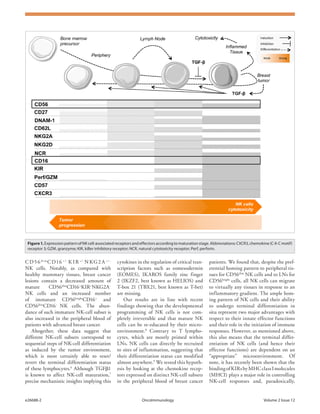
tus (Fig. 1). These patterns were initially
defined based on the expression of CD56
and CD16, and now also take into account
the expression levels of KIRs and killer cell
lectin-like receptor subfamily C, member
1 (KLRC1, best known as NKG2A). It
is well known that non-terminally dif-
ferentiated human NK cells collected
from non-reactive normal lymph nodes
(LNs) are mostly CD56bright
CD16−
KIR−
NKG2A+
cells, whereas activated NK cells
derived from normal but reactive/efferent
LNs or the blood comprise a majority of
CD56dim
CD16+
KIR+
NKG2A+/−
cells.5
The current belief is that immature
CD56bright
NK cells acquire the expres-
sion of CD16 and KIRs in the LNs
during inflammation and then circu-
late as CD56dim
CD16+
KIR+
NKG2A+/−
effector cells. Depending on the
anatomical location, the distur-
bance of the balance between effector
CD56dim
CD16+
KIR+
NKG2A+/−
and pre-
cursor CD56bright
CD16−
KIR-
NKG2A+
NK cells might thus constitute per se a
marker of ongoing immune response. If so,
inflamed tissues should be enriched in dif-
ferentiated CD56dim
CD16+
KIR+
NKG2A−
NK cells. However, when comparing
the NK-cell populations that infil-
trate malignant and healthy breast tis-
sues, things look more complicated
than expected and a mosaic of different
NK-cell subsets is found within breast
carcinomas, with variable proportions of
CD56bright
CD16+/−
KIR+/-
NKG2A+/−
and
*Correspondence to: Emilie Mamessier; Email: mamessier@ciml.univ-mrs.fr
Submitted: 10/01/2013; Accepted: 10/02/2013; Published Online: 10/22/2013
Citation: Mamessier E, Bourgin C, Olive D. When breast cancer cells start to fend the educational process of NK cells off. OncoImmunology 2013; 2:e26688;
http://dx.doi.org/10.4161/onci.26688
When breast cancer cells start to fend
the educational process of NK cells off
Emilie Mamessier*, Charlotte Bourgin, and Daniel Olive
INSERM UMR1068; Marseille, France
Keywords: NK cells, education, breast cancer, anti-tumor immunity, TGFβ
The notion of natural killer (NK)-cell education has recently emerged, and accumulating evidence indicates
that the terminal differentiation of NK cells can be achieved in the periphery. This means that the proper function of
these lymphocytes is dependent on their environment, opening a new door through which cancer cells can escape
immunosurveillance.
e26688-2	 OncoImmunology	 Volume 2 Issue 12
CD56 d i m
CD16 + / −
K IR + / -
N KG2 A + / −
NK cells. Notably, as compared with
healthy mammary tissues, breast cancer
lesions contain a decreased amount of
mature CD56dim
CD16+
KIR+
NKG2A−
NK cells and an increased number
of immature CD56bright
CD16+
and
CD56dim
CD16−
NK cells. The abun-
dance of such immature NK-cell subset is
also increased in the peripheral blood of
patients with advanced breast cancer.
Altogether, these data suggest that
different NK-cell subsets correspond to
sequential steps of NK-cell differentiation
as induced by the tumor environment,
which is most certainly able to reset/
revert the terminal differentiation status
of these lymphocytes.6
Although TGFβ1
is known to affect NK-cell maturation,7
precise mechanistic insights implying this
cytokines in the regulation of critical tran-
scription factors such as eomesodermin
(EOMES), IKAROS family zinc finger
2 (IKZF2, best known as HELIOS) and
T-box 21 (TBX21, best known as T-bet)
are missing.
Our results are in line with recent
findings showing that the developmental
programming of NK cells is not com-
pletely irreversible and that mature NK
cells can be re-educated by their micro-
environment.8
Contrary to T lympho-
cytes, which are mostly primed within
LNs, NK cells can directly be recruited
to sites of inflammation, suggesting that
their differentiation status can modified
almost anywhere.9
We tested this hypoth-
esis by looking at the chemokine recep-
tors expressed on distinct NK-cell subsets
in the peripheral blood of breast cancer
patients. We found that, despite the pref-
erential homing pattern to peripheral tis-
sues for CD56dim
NK cells and to LNs for
CD56bright
cells, all NK cells can migrate
to virtually any tissues in response to an
inflammatory gradient. The ample hom-
ing pattern of NK cells and their ability
to undergo terminal differentiation in
situ represent two major advantages with
respect to their innate effector functions
and their role in the initiation of immune
responses. However, as mentioned above,
this also means that the terminal differ-
entiation of NK cells (and hence their
effector functions) are dependent on an
“appropriate” microenvironment. Of
note, it has recently been shown that the
bindingofKIRsbyMHCclassImolecules
(MHCI) plays a major role in controlling
NK-cell responses and, paradoxically,
Figure 1. Expression pattern of NK cell-associated receptors and effectors according to maturation stage. Abbreviations: CXCR3, chemokine (C-X-C motif)
receptor 3; GZM, granzyme; KIR, killer inhibitory receptor; NCR, natural cytotoxicity receptor; Perf, perforin.
www.landesbioscience.com	OncoImmunology	 e26688-3
in maintaining NK cells in a state of
responsiveness to subsequent activation
events, a process referred to as “educa-
tion.”9
Interestingly, one of the most fre-
quent alterations manifested by (breast)
cancer cells is the downregulation of
MHC class I molecules. Initially, this
phenomenon was interpreted as a means
to escape adaptive immune responses,
but it may finally turn out to constitute
a major mechanism whereby malignant
cells escape NK cell-mediated antitumor
immunity as well.
In conclusion, advanced breast
cancers seem to harness a wide panel
of mechanisms to escape antitumor
immune responses. One well-known
molecule is quasi systematically involved
in almost all of them: TGFβ1.10
In light
of our data, blocking TGFβ1 signaling in
NK cells might constitute the bases for
the development of novel immunothera-
peutic strategies.
Disclosure of Potential Conflicts of Interest
No potential conflicts of interest were
disclosed.
References
1.	 Smyth MJ, Dunn GP, Schreiber RD. Cancer immu-
nosurveillance and immunoediting: the roles of
immunity in suppressing tumor development and
shaping tumor immunogenicity. Adv Immunol
2006; 90:1-50; PMID:16730260; http://dx.doi.
org/10.1016/S0065-2776(06)90001-7
2.	 Mamessier E, Sylvain A, Thibult ML, Houvenaeghel
G, Jacquemier J, Castellano R, Gonçalves A, André
P, Romagné F, Thibault G, et al. Human breast can-
cer cells enhance self tolerance by promoting evasion
from NK cell antitumor immunity. J Clin Invest
2011; 121:3609-22; PMID:21841316; http://dx.doi.
org/10.1172/JCI45816
3.	 Mamessier E, Sylvain A, Bertucci F, Castellano R,
Finetti P, Houvenaeghel G, Charaffe-Jaufret E,
Birnbaum D, Moretta A, Olive D. Human breast
tumor cells induce self-tolerance mechanisms to
avoid NKG2D-mediated and DNAM-mediated
NK cell recognition. Cancer Res 2011; 71:6621-32;
PMID:21937679; http://dx.doi.org/10.1158/0008-
5472.CAN-11-0792
4.	 Platonova S, Cherfils-Vicini J, Damotte D, Crozet
L, Vieillard V, Validire P, André P, Dieu-Nosjean
MC, Alifano M, Régnard JF, et al. Profound coor-
dinated alterations of intratumoral NK cell pheno-
type and function in lung carcinoma. Cancer Res
2011; 71:5412-22; PMID:21708957; http://dx.doi.
org/10.1158/0008-5472.CAN-10-4179
5.	 Romagnani C, Juelke K, Falco M, Morandi B,
D’Agostino A, Costa R, Ratto G, Forte G, Carrega P,
Lui G, et al. CD56brightCD16- killer Ig-like recep-
tor- NK cells display longer telomeres and acquire
features of CD56dim NK cells upon activation. J
Immunol 2007; 178:4947-55; PMID:17404276
6.	 Mamessier E, Pradel LC, Thibult ML, Drevet C,
Zouine A, Jacquemier J, Houvenaeghel G, Bertucci
F, Birnbaum D, Olive D. Peripheral blood NK
cells from breast cancer patients are tumor-induced
composite subsets. J Immunol 2013; 190:2424-
36; PMID:23359508; http://dx.doi.org/10.4049/
jimmunol.1200140
7.	 Flavell RA, Sanjabi S, Wrzesinski SH, Licona-Limón
P. The polarization of immune cells in the tumour
environment by TGFbeta. Nat Rev Immunol
2010; 10:554-67; PMID:20616810; http://dx.doi.
org/10.1038/nri2808
8.	 Joncker NT, Shifrin N, Delebecque F, Raulet DH.
Mature natural killer cells reset their responsiveness
when exposed to an altered MHC environment. J Exp
Med 2010; 207:2065-72; PMID:20819928; http://
dx.doi.org/10.1084/jem.20100570
9.	 Thomas LM, Peterson ME, Long EO. Cutting
Edge: NK Cell Licensing Modulates Adhesion
To Target Cells. J Immunol 2013; Forthcoming;
PMID:24038086; http://dx.doi.org/10.4049/
jimmunol.1301159
10.	 Arteaga CL, Hurd SD, Winnier AR, Johnson MD,
Fendly BM, Forbes JT. Anti-transforming growth
factor (TGF)-beta antibodies inhibit breast can-
cer cell tumorigenicity and increase mouse spleen
natural killer cell activity. Implications for a pos-
sible role of tumor cell/host TGF-beta interactions
in human breast cancer progression. J Clin Invest
1993; 92:2569-76; PMID:7504687; http://dx.doi.
org/10.1172/JCI116871

Nk e cancêr de mama

  • 1.
    Paper Type www.landesbioscience.com OncoImmunology e26688-1 OncoImmunology2:12, e26688; December 2013; © 2013 Landes Bioscience Author’s View The role of immune cells in suppressing the growth of malignant cells and shaping their immunogenicity has a direct impact on the prognosis of breast cancer patients.1 In particular, natural killer (NK) cells play a major part in breast cancer immu- nosurveillance. By analyzing invasive breast tumors in situ, we identified at least 3 different mechanisms whereby neoplas- tic cells can escape recognition (and hence lysis) by NK cells. These mechanisms are not mutually exclusive, but rather appear to be tightly interconnected. First, NK cells from breast cancer patients exhibit decreased activity and altered expression of surface receptors, i.e., they express limited amount of activating receptors and increased levels of inhibi- tory receptors, exception made for killer inhibitory receptors (KIRs). These altera- tions are induced by the tumor itself, most likely upon the local overproduction of transforming growth factor β1 (TGFβ1), because they were reversed in cancer patients undergoing long-term remission.2 Second, breast cancer cells modulate their immunogenicity by several mecha- nisms, including the expression of ligands for NK cell-inhibitory receptors, the downregulation of ligands for NK cell- activating receptors, and the release of immunosuppressive or decoy molecules such as TGFβ1, soluble MHC class I polypeptide-related sequence A (MICAs) or soluble interleukin-1β receptor (IL1βR). Breast cancers can thus stimu- late a state of immunological tolerance by rendering themselves invisible to NK cells and by synthesizing a dense magma of inhibitory molecules.3 These 2 types of alterations are frequently observed in solid malignancies.4 We recently reported a third pro- cess whereby malignant cells can escape immunosurveillance. In particular, we demonstrate that breast cancer cells can influence the terminal maturation of NK cells.2 While the absolute number of NK cells did not vary, we observed an increased proportion of poorly differenti- ated and non-cytotoxic NK-cell subsets in the peripheral blood, and even more so in the neoplastic lesions, of breast can- cer patients. This might explain, at least in part, the poor cytotoxic functions observed in these patients. In addition, this observation highlights the heterogene- ity and plasticity of the NK-cell compart- ment. The precise mechanisms involved in this phenomenon are still poorly defined. From what we know so far, NK cells usually show specific receptor expression patterns related to their maturation sta- tus (Fig. 1). These patterns were initially defined based on the expression of CD56 and CD16, and now also take into account the expression levels of KIRs and killer cell lectin-like receptor subfamily C, member 1 (KLRC1, best known as NKG2A). It is well known that non-terminally dif- ferentiated human NK cells collected from non-reactive normal lymph nodes (LNs) are mostly CD56bright CD16− KIR− NKG2A+ cells, whereas activated NK cells derived from normal but reactive/efferent LNs or the blood comprise a majority of CD56dim CD16+ KIR+ NKG2A+/− cells.5 The current belief is that immature CD56bright NK cells acquire the expres- sion of CD16 and KIRs in the LNs during inflammation and then circu- late as CD56dim CD16+ KIR+ NKG2A+/− effector cells. Depending on the anatomical location, the distur- bance of the balance between effector CD56dim CD16+ KIR+ NKG2A+/− and pre- cursor CD56bright CD16− KIR- NKG2A+ NK cells might thus constitute per se a marker of ongoing immune response. If so, inflamed tissues should be enriched in dif- ferentiated CD56dim CD16+ KIR+ NKG2A− NK cells. However, when comparing the NK-cell populations that infil- trate malignant and healthy breast tis- sues, things look more complicated than expected and a mosaic of different NK-cell subsets is found within breast carcinomas, with variable proportions of CD56bright CD16+/− KIR+/- NKG2A+/− and *Correspondence to: Emilie Mamessier; Email: mamessier@ciml.univ-mrs.fr Submitted: 10/01/2013; Accepted: 10/02/2013; Published Online: 10/22/2013 Citation: Mamessier E, Bourgin C, Olive D. When breast cancer cells start to fend the educational process of NK cells off. OncoImmunology 2013; 2:e26688; http://dx.doi.org/10.4161/onci.26688 When breast cancer cells start to fend the educational process of NK cells off Emilie Mamessier*, Charlotte Bourgin, and Daniel Olive INSERM UMR1068; Marseille, France Keywords: NK cells, education, breast cancer, anti-tumor immunity, TGFβ The notion of natural killer (NK)-cell education has recently emerged, and accumulating evidence indicates that the terminal differentiation of NK cells can be achieved in the periphery. This means that the proper function of these lymphocytes is dependent on their environment, opening a new door through which cancer cells can escape immunosurveillance.
  • 2.
    e26688-2 OncoImmunology Volume2 Issue 12 CD56 d i m CD16 + / − K IR + / - N KG2 A + / − NK cells. Notably, as compared with healthy mammary tissues, breast cancer lesions contain a decreased amount of mature CD56dim CD16+ KIR+ NKG2A− NK cells and an increased number of immature CD56bright CD16+ and CD56dim CD16− NK cells. The abun- dance of such immature NK-cell subset is also increased in the peripheral blood of patients with advanced breast cancer. Altogether, these data suggest that different NK-cell subsets correspond to sequential steps of NK-cell differentiation as induced by the tumor environment, which is most certainly able to reset/ revert the terminal differentiation status of these lymphocytes.6 Although TGFβ1 is known to affect NK-cell maturation,7 precise mechanistic insights implying this cytokines in the regulation of critical tran- scription factors such as eomesodermin (EOMES), IKAROS family zinc finger 2 (IKZF2, best known as HELIOS) and T-box 21 (TBX21, best known as T-bet) are missing. Our results are in line with recent findings showing that the developmental programming of NK cells is not com- pletely irreversible and that mature NK cells can be re-educated by their micro- environment.8 Contrary to T lympho- cytes, which are mostly primed within LNs, NK cells can directly be recruited to sites of inflammation, suggesting that their differentiation status can modified almost anywhere.9 We tested this hypoth- esis by looking at the chemokine recep- tors expressed on distinct NK-cell subsets in the peripheral blood of breast cancer patients. We found that, despite the pref- erential homing pattern to peripheral tis- sues for CD56dim NK cells and to LNs for CD56bright cells, all NK cells can migrate to virtually any tissues in response to an inflammatory gradient. The ample hom- ing pattern of NK cells and their ability to undergo terminal differentiation in situ represent two major advantages with respect to their innate effector functions and their role in the initiation of immune responses. However, as mentioned above, this also means that the terminal differ- entiation of NK cells (and hence their effector functions) are dependent on an “appropriate” microenvironment. Of note, it has recently been shown that the bindingofKIRsbyMHCclassImolecules (MHCI) plays a major role in controlling NK-cell responses and, paradoxically, Figure 1. Expression pattern of NK cell-associated receptors and effectors according to maturation stage. Abbreviations: CXCR3, chemokine (C-X-C motif) receptor 3; GZM, granzyme; KIR, killer inhibitory receptor; NCR, natural cytotoxicity receptor; Perf, perforin.
  • 3.
    www.landesbioscience.com OncoImmunology e26688-3 in maintainingNK cells in a state of responsiveness to subsequent activation events, a process referred to as “educa- tion.”9 Interestingly, one of the most fre- quent alterations manifested by (breast) cancer cells is the downregulation of MHC class I molecules. Initially, this phenomenon was interpreted as a means to escape adaptive immune responses, but it may finally turn out to constitute a major mechanism whereby malignant cells escape NK cell-mediated antitumor immunity as well. In conclusion, advanced breast cancers seem to harness a wide panel of mechanisms to escape antitumor immune responses. One well-known molecule is quasi systematically involved in almost all of them: TGFβ1.10 In light of our data, blocking TGFβ1 signaling in NK cells might constitute the bases for the development of novel immunothera- peutic strategies. Disclosure of Potential Conflicts of Interest No potential conflicts of interest were disclosed. References 1. Smyth MJ, Dunn GP, Schreiber RD. Cancer immu- nosurveillance and immunoediting: the roles of immunity in suppressing tumor development and shaping tumor immunogenicity. Adv Immunol 2006; 90:1-50; PMID:16730260; http://dx.doi. org/10.1016/S0065-2776(06)90001-7 2. Mamessier E, Sylvain A, Thibult ML, Houvenaeghel G, Jacquemier J, Castellano R, Gonçalves A, André P, Romagné F, Thibault G, et al. Human breast can- cer cells enhance self tolerance by promoting evasion from NK cell antitumor immunity. J Clin Invest 2011; 121:3609-22; PMID:21841316; http://dx.doi. org/10.1172/JCI45816 3. Mamessier E, Sylvain A, Bertucci F, Castellano R, Finetti P, Houvenaeghel G, Charaffe-Jaufret E, Birnbaum D, Moretta A, Olive D. Human breast tumor cells induce self-tolerance mechanisms to avoid NKG2D-mediated and DNAM-mediated NK cell recognition. Cancer Res 2011; 71:6621-32; PMID:21937679; http://dx.doi.org/10.1158/0008- 5472.CAN-11-0792 4. Platonova S, Cherfils-Vicini J, Damotte D, Crozet L, Vieillard V, Validire P, André P, Dieu-Nosjean MC, Alifano M, Régnard JF, et al. Profound coor- dinated alterations of intratumoral NK cell pheno- type and function in lung carcinoma. Cancer Res 2011; 71:5412-22; PMID:21708957; http://dx.doi. org/10.1158/0008-5472.CAN-10-4179 5. Romagnani C, Juelke K, Falco M, Morandi B, D’Agostino A, Costa R, Ratto G, Forte G, Carrega P, Lui G, et al. CD56brightCD16- killer Ig-like recep- tor- NK cells display longer telomeres and acquire features of CD56dim NK cells upon activation. J Immunol 2007; 178:4947-55; PMID:17404276 6. Mamessier E, Pradel LC, Thibult ML, Drevet C, Zouine A, Jacquemier J, Houvenaeghel G, Bertucci F, Birnbaum D, Olive D. Peripheral blood NK cells from breast cancer patients are tumor-induced composite subsets. J Immunol 2013; 190:2424- 36; PMID:23359508; http://dx.doi.org/10.4049/ jimmunol.1200140 7. Flavell RA, Sanjabi S, Wrzesinski SH, Licona-Limón P. The polarization of immune cells in the tumour environment by TGFbeta. Nat Rev Immunol 2010; 10:554-67; PMID:20616810; http://dx.doi. org/10.1038/nri2808 8. Joncker NT, Shifrin N, Delebecque F, Raulet DH. Mature natural killer cells reset their responsiveness when exposed to an altered MHC environment. J Exp Med 2010; 207:2065-72; PMID:20819928; http:// dx.doi.org/10.1084/jem.20100570 9. Thomas LM, Peterson ME, Long EO. Cutting Edge: NK Cell Licensing Modulates Adhesion To Target Cells. J Immunol 2013; Forthcoming; PMID:24038086; http://dx.doi.org/10.4049/ jimmunol.1301159 10. Arteaga CL, Hurd SD, Winnier AR, Johnson MD, Fendly BM, Forbes JT. Anti-transforming growth factor (TGF)-beta antibodies inhibit breast can- cer cell tumorigenicity and increase mouse spleen natural killer cell activity. Implications for a pos- sible role of tumor cell/host TGF-beta interactions in human breast cancer progression. J Clin Invest 1993; 92:2569-76; PMID:7504687; http://dx.doi. org/10.1172/JCI116871