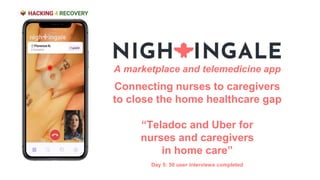
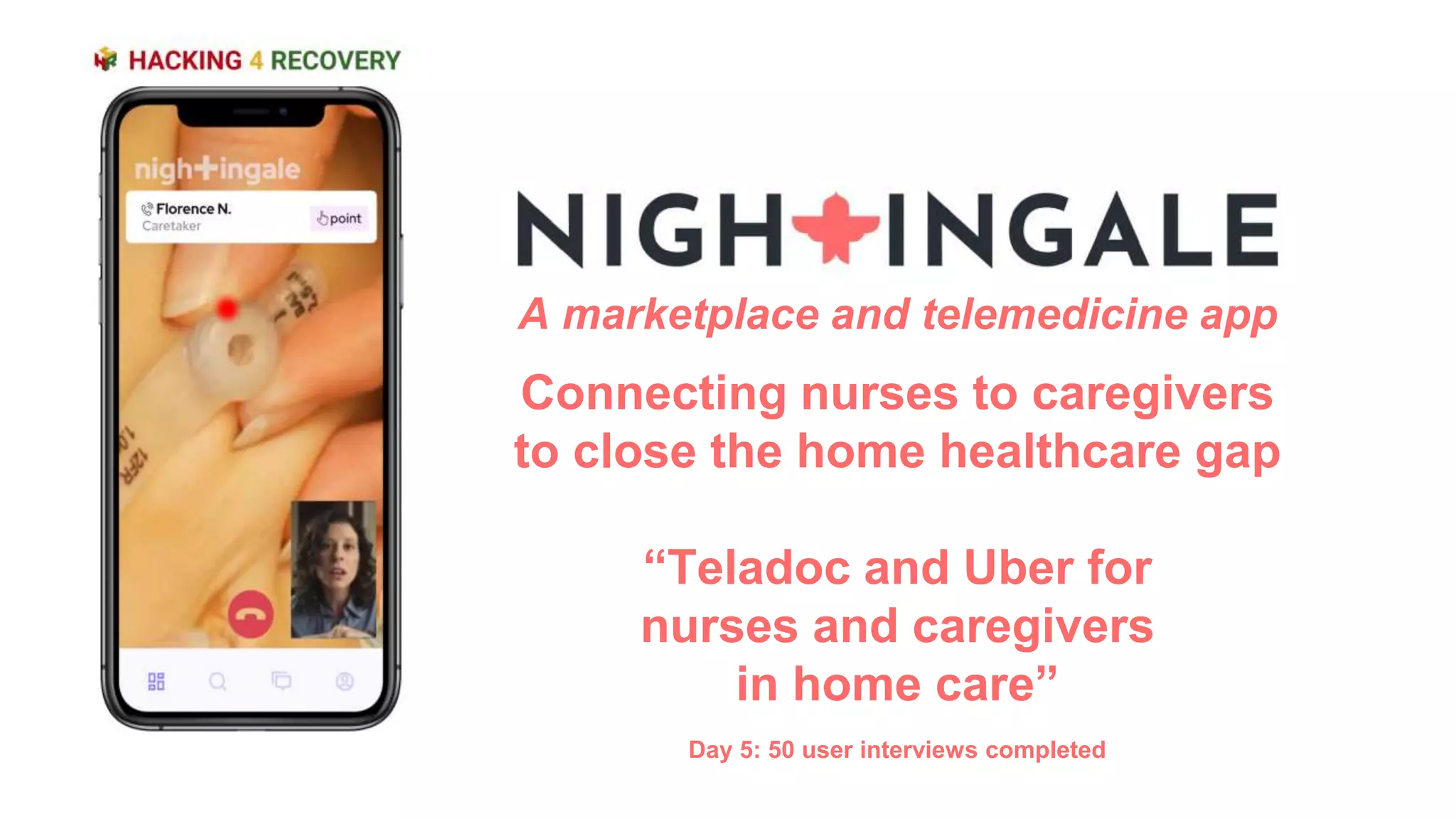
A marketplace and telemedicine app
Connecting nurses to caregivers
to close the home healthcare gap
“Teladoc and Uber for
nurses and caregivers
in home care”
Day 5: 50 user interviews completed
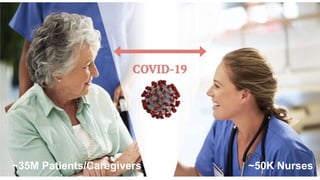
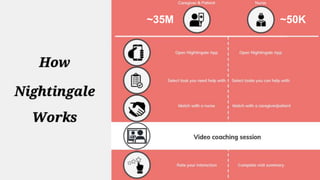
~35M Patients/Caregivers ~50K Nurses
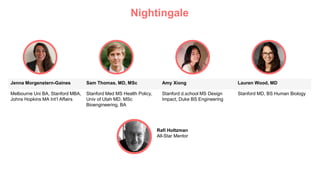
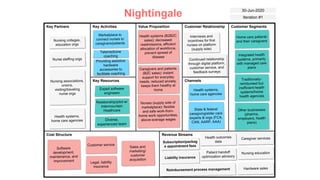
Nightingale
Jenna Morgenstern-Gaines Sam Thomas, MD, MSc Amy Xiong Lauren Wood, MD
Melbourne Uni BA, Stanford MBA,
Johns Hopkins MA Int’l Affairs
Stanford Med MS Health Policy,
Univ of Utah MD, MSc
Bioengineering, BA
Stanford d.school MS Design
Impact, Duke BS Engineering
Stanford MD, BS Human Biology
Rafi Holtzman
All-Star Mentor
~35M ~50K
Nightingale
Cost Structure Revenue Streams
Key Partners Key Activities
Key Resources
Value Proposition Customer Relationship
Channels
Customer Segments
30-Jun-2020
Iteration #1
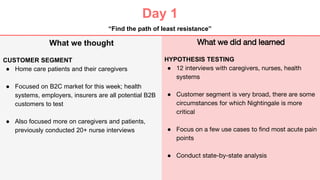
Day 1
What we did and learned
HYPOTHESIS TESTING
● 12 interviews with caregivers, nurses, health
systems
● Customer segment is very broad, there are some
circumstances for which Nightingale is more
critical
● Focus on a few use cases to find most acute pain
points
● Conduct state-by-state analysis
What we thought
CUSTOMER SEGMENT
● Home care patients and their caregivers
● Focused on B2C market for this week; health
systems, employers, insurers are all potential B2B
customers to test
● Also focused more on caregivers and patients,
previously conducted 20+ nurse interviews
“Find the path of least resistance”
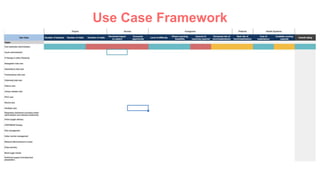
Use Case Framework
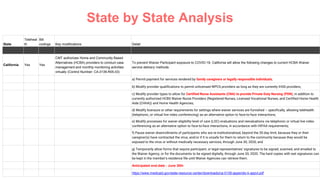
State
Teleheal
th
Bill
codings Key modifications Detail
California Yes Yes
CMT authorizes Home and Community Based
Alternatives (HCBA) providers to conduct case
management and monthly monitoring activities
virtually (Control Number: CA.0139.R05.03)
To prevent Waiver Participant exposure to COVID-19, California will allow the following changes to current HCBA Waiver
service delivery methods:
a) Permit payment for services rendered by family caregivers or legally responsible individuals;
b) Modify provider qualifications to permit unlicensed WPCS providers as long as they are currently IHSS providers;
c) Modify provider types to allow for Certified Nurse Assistants (CNA) to provide Private Duty Nursing (PDN), in addition to
currently authorized HCBS Waiver Nurse Providers (Registered Nurses, Licensed Vocational Nurses, and Certified Home Health
Aide (CHHA)) and Home Health Agencies;
d) Modify licensure or other requirements for settings where waiver services are furnished – specifically, allowing telehealth
(telephonic, or virtual live video conferencing) as an alternative option to face-to-face interactions;
e) Modify processes for waiver eligibility level of care (LOC) evaluations and reevaluations via telephonic or virtual live video
conferencing as an alternative option to face-to-face interactions, in accordance with HIPAA requirements;
f) Pause waiver disenrollments of participants who are re-institutionalized, beyond the 30-day limit, because they or their
caregiver(s) have contracted the virus, and/or if it is unsafe for them to return to the community because they would be
exposed to the virus or without medically necessary services, through June 30, 2020; and
g) Temporarily allow forms that require participant, or legal representatives’ signatures to be signed, scanned, and emailed to
the Waiver Agency, or for the documents to be signed digitally, through June 30, 2020. The hard copies with wet signatures can
be kept in the member’s residence file until Waiver Agencies can retrieve them.
Anticipated end-date : June 30th
https://www.medicaid.gov/state-resource-center/downloads/ca-0139-appendix-k-appvl.pdf
State by State Analysis
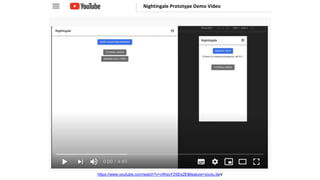
https://www.youtube.com/watch?v=cWsqY2SEs2E&feature=youtu.bev
Nightingale Prototype Demo Video
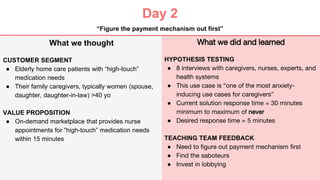
Day 2
What we did and learned
HYPOTHESIS TESTING
● 8 interviews with caregivers, nurses, experts, and
health systems
● This use case is “one of the most anxiety-
inducing use cases for caregivers”
● Current solution response time = 30 minutes
minimum to maximum of never
● Desired response time = 5 minutes
TEACHING TEAM FEEDBACK
● Need to figure out payment mechanism first
● Find the saboteurs
● Invest in lobbying
What we thought
CUSTOMER SEGMENT
● Elderly home care patients with “high-touch”
medication needs
● Their family caregivers, typically women (spouse,
daughter, daughter-in-law) >40 yo
VALUE PROPOSITION
● On-demand marketplace that provides nurse
appointments for “high-touch” medication needs
within 15 minutes
“Figure the payment mechanism out first”
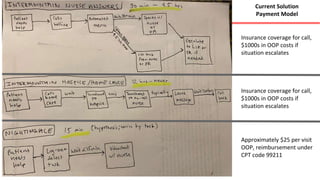
Insurance coverage for call,
$1000s in OOP costs if
situation escalates
Insurance coverage for call,
$1000s in OOP costs if
situation escalates
Approximately $25 per visit
OOP, reimbursement under
CPT code 99211
Current Solution
Payment Model
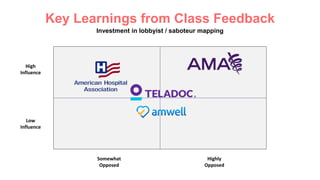
Key Learnings from Class Feedback
High
Influence
Low
Influence
Somewhat
Opposed
Highly
Opposed
Investment in lobbyist / saboteur mapping
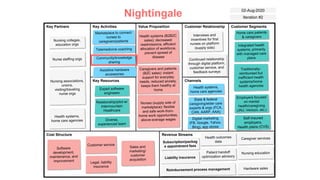
Nightingale
Cost Structure Revenue Streams
Key Partners Key Activities
Key Resources
Value Proposition Customer Relationship
Channels
Customer Segments
02-Aug-2020
Iteration #2
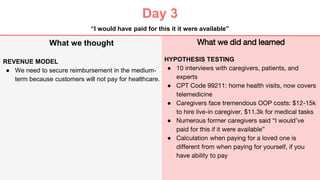
Day 3
What we did and learned
HYPOTHESIS TESTING
● 10 interviews with caregivers, patients, and
experts
● CPT Code 99211: home health visits, now covers
telemedicine
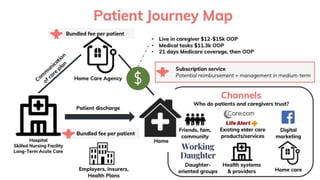
● Caregivers face tremendous OOP costs: $12-15k
to hire live-in caregiver, $11.3k for medical tasks
● Numerous former caregivers said “I would’ve
paid for this if it were available”
● Calculation when paying for a loved one is
different from when paying for yourself, if you
have ability to pay
What we thought
REVENUE MODEL
● We need to secure reimbursement in the medium-
term because customers will not pay for healthcare.
“I would have paid for this it it were available”
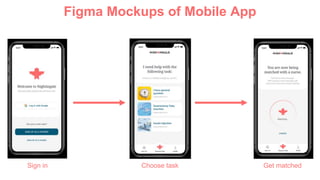
Figma Mockups of Mobile App
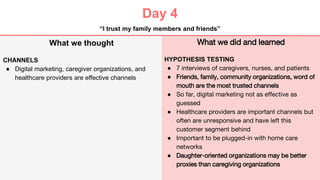
Sign in Choose task Get matched
Day 4
What we did and learned
HYPOTHESIS TESTING
● 7 interviews of caregivers, nurses, and patients
● Friends, family, community organizations, word of
mouth are the most trusted channels
● So far, digital marketing not as effective as
guessed
● Healthcare providers are important channels but
often are unresponsive and have left this
customer segment behind
● Important to be plugged-in with home care
networks
● Daughter-oriented organizations may be better
proxies than caregiving organizations
What we thought
CHANNELS
● Digital marketing, caregiver organizations, and
healthcare providers are effective channels
“I trust my family members and friends”
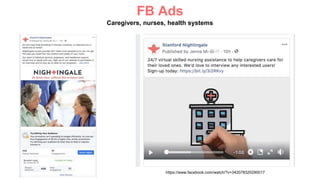
https://www.facebook.com/watch/?v=342078320290017
FB Ads
Caregivers, nurses, health systems
Nightingale
Cost Structure Revenue Streams
Key Partners Key Activities
Key Resources
Value Proposition Customer Relationship
Channels
Customer Segments
06-Aug-2020
Iteration #5
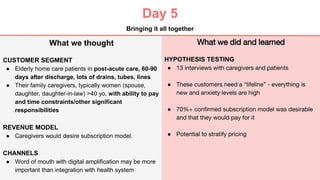
Day 5
What we did and learned
HYPOTHESIS TESTING
● 13 interviews with caregivers and patients
● These customers need a “lifeline” - everything is
new and anxiety levels are high
● 70%+ confirmed subscription model was desirable
and that they would pay for it
● Potential to stratify pricing
What we thought
CUSTOMER SEGMENT
● Elderly home care patients in post-acute care, 60-90
days after discharge, lots of drains, tubes, lines
● Their family caregivers, typically women (spouse,
daughter, daughter-in-law) >40 yo, with ability to pay
and time constraints/other significant
responsibilities
REVENUE MODEL
● Caregivers would desire subscription model.
CHANNELS
● Word of mouth with digital amplification may be more
important than integration with health system
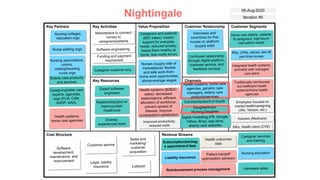
Bringing it all together
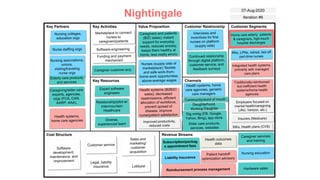
Nightingale
Cost Structure Revenue Streams
Key Partners Key Activities
Key Resources
Value Proposition Customer Relationship
Channels
Customer Segments
07-Aug-2020
Iteration #6
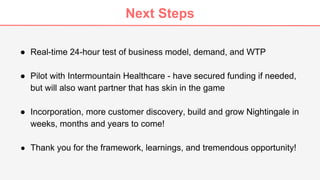
Next Steps
● Real-time 24-hour test of business model, demand, and WTP
● Pilot with Intermountain Healthcare - have secured funding if needed,
but will also want partner that has skin in the game
● Incorporation, more customer discovery, build and grow Nightingale in
weeks, months and years to come!
● Thank you for the framework, learnings, and tremendous opportunity!

Nightingale H4R Stanford 2020

  • 1.
    A marketplace andtelemedicine app Connecting nurses to caregivers to close the home healthcare gap “Teladoc and Uber for nurses and caregivers in home care” Day 5: 50 user interviews completed
  • 2.
  • 3.
    Nightingale Jenna Morgenstern-Gaines SamThomas, MD, MSc Amy Xiong Lauren Wood, MD Melbourne Uni BA, Stanford MBA, Johns Hopkins MA Int’l Affairs Stanford Med MS Health Policy, Univ of Utah MD, MSc Bioengineering, BA Stanford d.school MS Design Impact, Duke BS Engineering Stanford MD, BS Human Biology Rafi Holtzman All-Star Mentor
  • 4.
  • 5.
    Nightingale Cost Structure RevenueStreams Key Partners Key Activities Key Resources Value Proposition Customer Relationship Channels Customer Segments 30-Jun-2020 Iteration #1
  • 6.
    Day 1 What wedid and learned HYPOTHESIS TESTING ● 12 interviews with caregivers, nurses, health systems ● Customer segment is very broad, there are some circumstances for which Nightingale is more critical ● Focus on a few use cases to find most acute pain points ● Conduct state-by-state analysis What we thought CUSTOMER SEGMENT ● Home care patients and their caregivers ● Focused on B2C market for this week; health systems, employers, insurers are all potential B2B customers to test ● Also focused more on caregivers and patients, previously conducted 20+ nurse interviews “Find the path of least resistance”
  • 7.
  • 8.
    State Teleheal th Bill codings Key modificationsDetail California Yes Yes CMT authorizes Home and Community Based Alternatives (HCBA) providers to conduct case management and monthly monitoring activities virtually (Control Number: CA.0139.R05.03) To prevent Waiver Participant exposure to COVID-19, California will allow the following changes to current HCBA Waiver service delivery methods: a) Permit payment for services rendered by family caregivers or legally responsible individuals; b) Modify provider qualifications to permit unlicensed WPCS providers as long as they are currently IHSS providers; c) Modify provider types to allow for Certified Nurse Assistants (CNA) to provide Private Duty Nursing (PDN), in addition to currently authorized HCBS Waiver Nurse Providers (Registered Nurses, Licensed Vocational Nurses, and Certified Home Health Aide (CHHA)) and Home Health Agencies; d) Modify licensure or other requirements for settings where waiver services are furnished – specifically, allowing telehealth (telephonic, or virtual live video conferencing) as an alternative option to face-to-face interactions; e) Modify processes for waiver eligibility level of care (LOC) evaluations and reevaluations via telephonic or virtual live video conferencing as an alternative option to face-to-face interactions, in accordance with HIPAA requirements; f) Pause waiver disenrollments of participants who are re-institutionalized, beyond the 30-day limit, because they or their caregiver(s) have contracted the virus, and/or if it is unsafe for them to return to the community because they would be exposed to the virus or without medically necessary services, through June 30, 2020; and g) Temporarily allow forms that require participant, or legal representatives’ signatures to be signed, scanned, and emailed to the Waiver Agency, or for the documents to be signed digitally, through June 30, 2020. The hard copies with wet signatures can be kept in the member’s residence file until Waiver Agencies can retrieve them. Anticipated end-date : June 30th https://www.medicaid.gov/state-resource-center/downloads/ca-0139-appendix-k-appvl.pdf State by State Analysis
  • 9.
  • 10.
    Day 2 What wedid and learned HYPOTHESIS TESTING ● 8 interviews with caregivers, nurses, experts, and health systems ● This use case is “one of the most anxiety- inducing use cases for caregivers” ● Current solution response time = 30 minutes minimum to maximum of never ● Desired response time = 5 minutes TEACHING TEAM FEEDBACK ● Need to figure out payment mechanism first ● Find the saboteurs ● Invest in lobbying What we thought CUSTOMER SEGMENT ● Elderly home care patients with “high-touch” medication needs ● Their family caregivers, typically women (spouse, daughter, daughter-in-law) >40 yo VALUE PROPOSITION ● On-demand marketplace that provides nurse appointments for “high-touch” medication needs within 15 minutes “Figure the payment mechanism out first”
  • 11.
    Insurance coverage forcall, $1000s in OOP costs if situation escalates Insurance coverage for call, $1000s in OOP costs if situation escalates Approximately $25 per visit OOP, reimbursement under CPT code 99211 Current Solution Payment Model
  • 12.
    Key Learnings fromClass Feedback High Influence Low Influence Somewhat Opposed Highly Opposed Investment in lobbyist / saboteur mapping
  • 13.
    Nightingale Cost Structure RevenueStreams Key Partners Key Activities Key Resources Value Proposition Customer Relationship Channels Customer Segments 02-Aug-2020 Iteration #2
  • 14.
    Day 3 What wedid and learned HYPOTHESIS TESTING ● 10 interviews with caregivers, patients, and experts ● CPT Code 99211: home health visits, now covers telemedicine ● Caregivers face tremendous OOP costs: $12-15k to hire live-in caregiver, $11.3k for medical tasks ● Numerous former caregivers said “I would’ve paid for this if it were available” ● Calculation when paying for a loved one is different from when paying for yourself, if you have ability to pay What we thought REVENUE MODEL ● We need to secure reimbursement in the medium- term because customers will not pay for healthcare. “I would have paid for this it it were available”
  • 15.
    Figma Mockups ofMobile App Sign in Choose task Get matched
  • 16.
    Day 4 What wedid and learned HYPOTHESIS TESTING ● 7 interviews of caregivers, nurses, and patients ● Friends, family, community organizations, word of mouth are the most trusted channels ● So far, digital marketing not as effective as guessed ● Healthcare providers are important channels but often are unresponsive and have left this customer segment behind ● Important to be plugged-in with home care networks ● Daughter-oriented organizations may be better proxies than caregiving organizations What we thought CHANNELS ● Digital marketing, caregiver organizations, and healthcare providers are effective channels “I trust my family members and friends”
  • 18.
  • 19.
    Nightingale Cost Structure RevenueStreams Key Partners Key Activities Key Resources Value Proposition Customer Relationship Channels Customer Segments 06-Aug-2020 Iteration #5
  • 20.
    Day 5 What wedid and learned HYPOTHESIS TESTING ● 13 interviews with caregivers and patients ● These customers need a “lifeline” - everything is new and anxiety levels are high ● 70%+ confirmed subscription model was desirable and that they would pay for it ● Potential to stratify pricing What we thought CUSTOMER SEGMENT ● Elderly home care patients in post-acute care, 60-90 days after discharge, lots of drains, tubes, lines ● Their family caregivers, typically women (spouse, daughter, daughter-in-law) >40 yo, with ability to pay and time constraints/other significant responsibilities REVENUE MODEL ● Caregivers would desire subscription model. CHANNELS ● Word of mouth with digital amplification may be more important than integration with health system Bringing it all together
  • 21.
    Nightingale Cost Structure RevenueStreams Key Partners Key Activities Key Resources Value Proposition Customer Relationship Channels Customer Segments 07-Aug-2020 Iteration #6
  • 22.
    Next Steps ● Real-time24-hour test of business model, demand, and WTP ● Pilot with Intermountain Healthcare - have secured funding if needed, but will also want partner that has skin in the game ● Incorporation, more customer discovery, build and grow Nightingale in weeks, months and years to come! ● Thank you for the framework, learnings, and tremendous opportunity!