VOLUME 1: MASTER PLAN


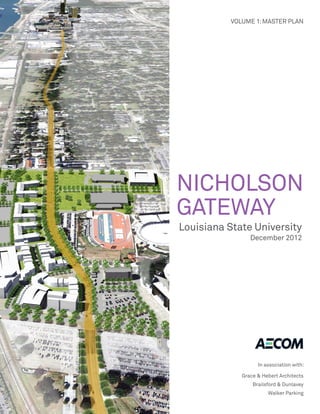
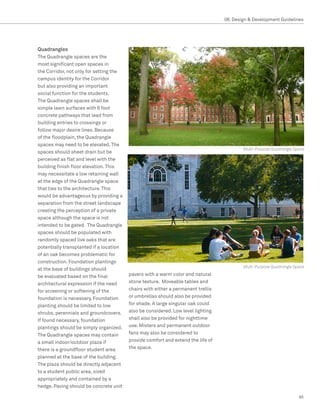
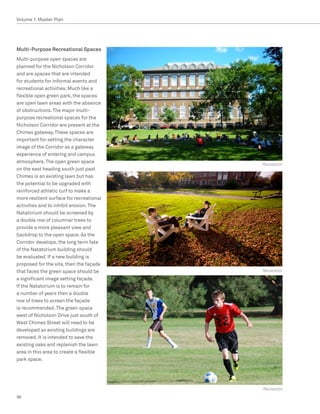
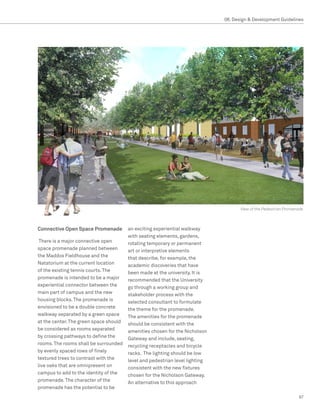
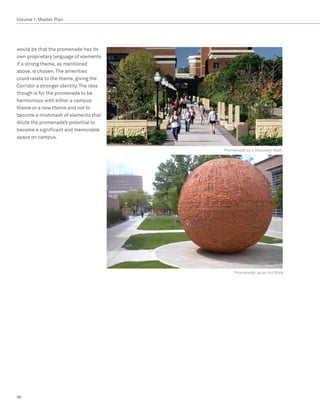
NICHOLSON
GATEWAY
Louisiana State University
                December 2012


                   In association with:

             Grace & Hebert Architects
                 Brailsford & Dunlavey
                       Walker Parking
Table of Contents  


VOLUME 1: MASTER DEVELOPMENT PLAN
01.	 Executive Summary.............................................................................................................. 1
02. 	 Planning Process  Influences.............................................................................................. 7
       a.	    Planning Process	             7
       b.	    Goals and Design Strategies	  9
       c.	    Planning Context	            10
       d.	    Site Analysis	               11
       e.	    Infrastructure	14

03. 	 Market Demand................................................................................................................... 19
       a.	    Mixed Use Market	                                                                                                        19
       b.	    Student Housing	                                                                                                         23

04.	 Parking: Issues and Best Practices..................................................................................... 29
       a.	    Introduction	29
       b.	    LSU Issues	     29
       c.	    Recommendations	31

05.	 Nicholson Corridor Framework Plan.................................................................................... 35
       a.	    Introduction	35
       b.	    Land Use and Organization	    36
       c.	    Design Concept and Character	 39
       d.	    Open Space Systems	           40
       e.	    Circulation Systems	          46

06.	 Nicholson Gateway Development Program......................................................................... 55
       a.	    Blocks and Zones	                                                                                                        55
       b.	    Building Use Organization	                                                                                               56

07.	   Campus Districts................................................................................................................. 61
       a.	    Introduction	61
       b.	    Mixed Use Center 	              63
       c.	    West Side Residential District	 68
       d.	    East Side District	             70

08. 	 Design  Development Guidelines...................................................................................... 77
       a.	    Urban Design Guidelines	                                                                                                 77
       b.	    Architectural Guidelines	                                                                                                80
       c.	    Surface Parking Guidelines	                                                                                              87
       d.	    Open Space and Landscape Guidelines	                                                                                     89
       e.	    Signage and Wayfinding Guidelines	                                                                                      100
       f.	    Sustainability Guidelines	                                                                                              102

09.	Implementation ................................................................................................................ 109
       a.	    Phasing	109
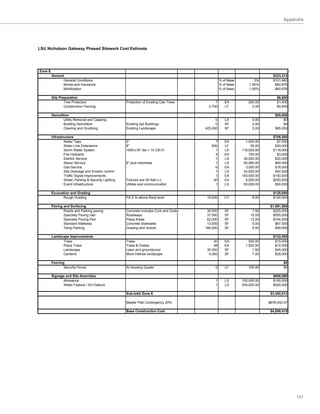
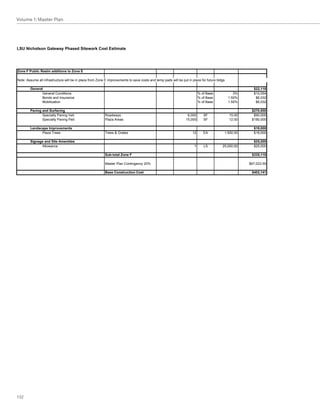
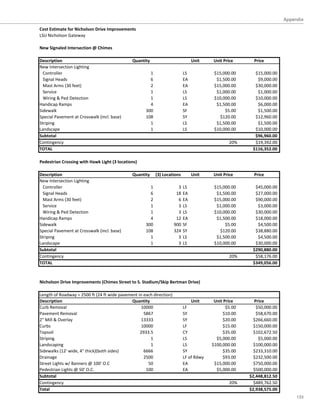
       b.	    Site Costing	                   109
       c.	    Funding	110
       d.	    Deal Structure Recommendations	 116
       e.	    Next Steps	                     119

10.	Acknowledgements........................................................................................................... 123

APPENDIX
	      Development Program
	      Site Cost Estimate
	      Financial Analysis Disclaimer

VOLUME 2: MIXED USE - MARKET AND FINANCIAL ANALYSIS
VOLUME 3: STUDENT HOUSING - MARKET AND FINANCIAL ANALYSIS
VOLUME 4: MEETING MINUTES
01   EXECUTIVE
     SUMMARY
01. Executive Summary


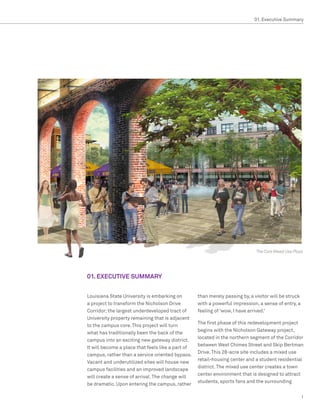
                                                                              The Core Mixed Use Plaza


01. EXECUTIVE SUMMARY


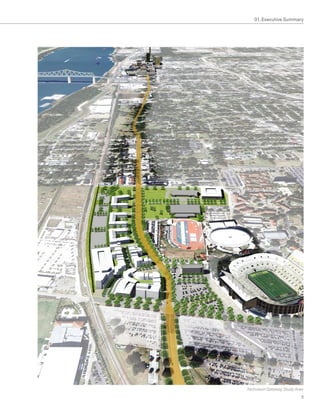
Louisiana State University is embarking on         than merely passing by, a visitor will be struck
a project to transform the Nicholson Drive         with a powerful impression, a sense of entry, a
Corridor; the largest underdeveloped tract of      feeling of ‘wow, I have arrived.’
University property remaining that is adjacent
                                                   The first phase of this redevelopment project
to the campus core. This project will turn
                                                   begins with the Nicholson Gateway project,
what has traditionally been the back of the
                                                   located in the northern segment of the Corridor
campus into an exciting new gateway district.
                                                   between West Chimes Street and Skip Bertman
It will become a place that feels like a part of
                                                   Drive. This 28-acre site includes a mixed use
campus, rather than a service oriented bypass.
                                                   retail-housing center and a student residential
Vacant and underutilized sites will house new
                                                   district. The mixed use center creates a town
campus facilities and an improved landscape
                                                   center environment that is designed to attract
will create a sense of arrival. The change will
                                                   students, sports fans and the surrounding
be dramatic. Upon entering the campus, rather

                                                                                                      1
Volume 1: Master Plan


community. Located across the street      and expands the campus amenities,
from Tiger Stadium, it draws from         and it upgrades an underperforming
the excitement and identity of LSU’s      tract of land and to provide for
rich football tradition, and is ideally   future campus growth. All of these
situated to draw in fans on their way     improvements will greatly improve
to the stadium. Its location also takes   the vitality and visual quality of
advantage of the drive-by traffic on      the Corridor, as well as to support
Nicholson Drive, and is within an easy    student recruitment and retention.
10-15 minute walk to most of the
                                          The Nicholson Gateway also plays
core campus. The center will offer an
                                          a strategic role in connecting
exciting active urban environment
                                          the campus with the community.
with shopping, restaurants and
                                          Building on the FuturEBR Plan, it
entertainment that complements
                                          creates a hub of activity that anchors
the traditional campus activities—a
                                          the entire Nicholson Corridor from
place to go for a bite to eat after the
                                          the LSU campus to downtown Baton
game, between classes, or on the way
                                          Rouge. It also connects the campus
to visit Mike the Tiger.
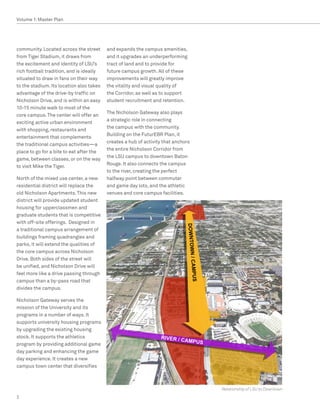
                                          to the river, creating the perfect
North of the mixed use center, a new      halfway point between commuter
residential district will replace the     and game day lots, and the athletic
old Nicholson Apartments. This new        venues and core campus facilities.
district will provide updated student
housing for upperclassmen and
graduate students that is competitive
with off-site offerings. Designed in
a traditional campus arrangement of
buildings framing quadrangles and
parks, it will extend the qualities of
the core campus across Nicholson
Drive. Both sides of the street will
be unified, and Nicholson Drive will
feel more like a drive passing through
campus than a by-pass road that
divides the campus.

Nicholson Gateway serves the
mission of the University and its
programs in a number of ways. It
supports university housing programs
by upgrading the existing housing
stock. It supports the athletics
program by providing additional game
day parking and enhancing the game
day experience. It creates a new
campus town center that diversifies


                                                                                   Relationship of LSU to Downtown
2
01. Executive Summary


Nicholson Gateway Study Area
                          3
PLANNING
02   PROCESS 
     INFLUENCES
02. Planning Process  Influences


                                                                             Working Group Meeting


02. PLANNING PROCESS  INFLUENCES


Planning Process
                                                  length of the campus property from West
In March 2012, Louisiana State University
                                                  Chimes Street to Burbank Drive. The eight
invited AECOM and its Design Team, including
                                                  month planning process began in March 2012,
Brailsford and Dunlavey (BD), Walker Parking,
                                                  concluded in December 2012, and consisted
and Grace and Hebert Architects, to develop
                                                  of four phases: the Market Assessment
a Master Development Plan for the Nicholson
                                                  and Programming phase, the Analysis and
Gateway. The purpose of the study was to
                                                  Discovery phase, the Concept Exploration
create specific recommendations for two key
                                                  phase, and the Final Documentation phase.
redevelopment sites within the Nicholson
Gateway: the former Alex Box Stadium site         To oversee the work, the University assembled
and the adjacent Nicholson Apartments.            a Steering Committee and Working Group
The study also considered more general            including representatives from LSU Senior
recommendations for the balance of the            Leadership, the LSU Foundation, Residential
Nicholson Corridor, stretching along the entire   Life, Student Groups, LSU Alumni Association,

                                                                                                  7
Volume 1: Master Plan


                                               the Facility Design and Development            The Market Assessment and
                                               Committee, Budget Planning and                 Programming phase consisted of a
                                               Accounting Services, Student Groups,           three-month study, which included
                                               Facility Services, Planning, Design            an analysis of of the local real
                                               and Construction, and the Tiger                estate market, identification of
                                               Athletics Foundation. During the               peer institution benchmarks and
                                               process, the Design Team met with a            comparable development projects,
                                               broad cross section of stakeholders in         and the development of the project’s
                                               a variety of formats, from small group         program of uses. Equipped with the
                                               meetings and work sessions to town             program findings, the Design Team
                                               hall style meetings that were open to          developed three alternative options.
                                               the entire campus and surrounding              These alternatives were explored
                                               community. Stakeholders included               on site in a series of work sessions
                                               city agencies, FuturEBR, local elected         using a physical model to test
                                               officials, local residents, LSU alumni,        different building and open space
                                               student groups, faculty and staff.             arrangements and explore various
                                               (For a full list of Nicholson Working          locations for the program elements.
                                               Group participants, please refer to            The best elements of these plans
                                               Acknowledgements Chapter 10).                  were then synthesized into the final
                                                                                              plan, which was further refined and
                                                                                              developed, including a cost estimate,
                                                                                              phasing plan and financial analysis.
      Three Alternatives Explored During the
                             Concept Phase


                                Three Physical Models with Interchangeable Pieces were Prepared as an Interactive Tool for the Working Groups
8
02. Planning Process  Influences


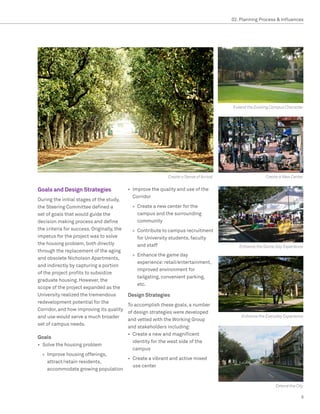
                                                                                          Extend the Existing Campus Character


                                                              Create a Sense of Arrival                   Create a New Center


Goals and Design Strategies                 •	 	 mprove the quality and use of the
                                               I
                                               Corridor
During the initial stages of the study,
the Steering Committee defined a              »» Create a new center for the
set of goals that would guide the                campus and the surrounding
decision making process and define               community
the criteria for success. Originally, the     »» Contribute to campus recruitment
impetus for the project was to solve             for University students, faculty
the housing problem, both directly               and staff                                   Enhance the Game Day Experience
through the replacement of the aging
                                              »» Enhance the game day
and obsolete Nicholson Apartments,
                                                 experience: retail/entertainment,
and indirectly by capturing a portion
                                                 improved environment for
of the project profits to subsidize
                                                 tailgating, convenient parking,
graduate housing. However, the
                                                 etc.
scope of the project expanded as the
University realized the tremendous          Design Strategies
redevelopment potential for the
                                            To accomplish these goals, a number
Corridor, and how improving its quality
                                            of design strategies were developed
and use would serve a much broader                                                            Enhance the Everyday Experience
                                            and vetted with the Working Group
set of campus needs.
                                            and stakeholders including:
                                            •	 Create a new and magnificent
Goals
                                               identity for the west side of the
•	 Solve the housing problem
                                               campus
  »» Improve housing offerings,
                                    •	 Create a vibrant and active mixed
     attract/retain residents,
                                       use center
     accommodate growing population


                                                                                                               Extend the City

                                                                                                                            9
Volume 1: Master Plan


•	 Improve connections across
   Nicholson Drive
•	 Design the architecture and
   landscape of the Corridor so that
   it fits within and complements the
   overall character of the campus
•	 Extend the quality of the campus
   core westward across Nicholson
   Drive
•	 Prioritize movement of pedestrians
   and bikes both regionally and
   locally
•	 Promote sustainable design
   strategies for buildings and sites
•	 Design for both the game day and
   the everyday experience
•	 Bring a human scale to the Corridor

Planning Context
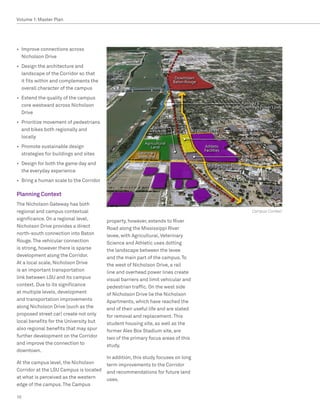
The Nicholson Gateway has both
regional and campus contextual                                                     Campus Context
significance. On a regional level,       property, however, extends to River
Nicholson Drive provides a direct        Road along the Mississippi River
north-south connection into Baton        levee, with Agricultural, Veterinary
Rouge. The vehicular connection          Science and Athletic uses dotting
is strong, however there is sparse       the landscape between the levee
development along the Corridor.          and the main part of the campus. To
At a local scale, Nicholson Drive        the west of Nicholson Drive, a rail
is an important transportation           line and overhead power lines create
link between LSU and its campus          visual barriers and limit vehicular and
context. Due to its significance         pedestrian traffic. On the west side
at multiple levels, development          of Nicholson Drive lie the Nicholson
and transportation improvements          Apartments, which have reached the
along Nicholson Drive (such as the       end of their useful life and are slated
proposed street car) create not only     for removal and replacement. This
local benefits for the University but    student housing site, as well as the
also regional benefits that may spur     former Alex Box Stadium site, are
further development on the Corridor      two of the primary focus areas of this
and improve the connection to            study.
downtown.
                                         In addition, this study focuses on long
At the campus level, the Nicholson       term improvements to the Corridor
Corridor at the LSU Campus is located    and recommendations for future land
at what is perceived as the western      uses.
edge of the campus. The Campus

10
02. Planning Process  Influences


Site Analysis

Prior to the creation of the
redevelopment proposal, a
comprehensive site analysis was
conducted to fully capture the current
opportunities and limitations of
the study area. Analysis included a
mapping of drainage issues, utilities,
and climatic factors such as sun and
wind. The existing live oaks within the
site boundaries were also mapped
and studied regarding their strong
visual effect.

Site Topography and Drainage
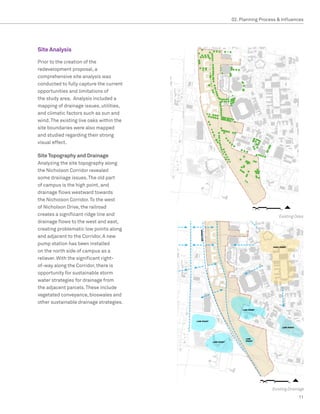
Analyzing the site topography along
the Nicholson Corridor revealed
some drainage issues. The old part
of campus is the high point, and
drainage flows westward towards
the Nicholson Corridor. To the west
of Nicholson Drive, the railroad
creates a significant ridge line and                                           Existing Oaks
drainage flows to the west and east,
creating problematic low points along
                                          Existing Oaks
and adjacent to the Corridor. A new
pump station has been installed
on the north side of campus as a
reliever. With the significant right-
of-way along the Corridor, there is
opportunity for sustainable storm
water strategies for drainage from
the adjacent parcels. These include
vegetated conveyance, bioswales and
other sustainable drainage strategies.


                                                                            Existing Drainage
                                                                                          11
Volume 1: Master Plan


Climatic Conditions
Because of extreme weather
conditions at the LSU Campus,
climatic comfort is something to be
considered in the development of
the project. Orienting buildings to
create shade in public places, and
locating narrow corridors to capture
breezes will go a long way to enhance
the comfort of the outdoor spaces on
campus.

Net Usable Land Area
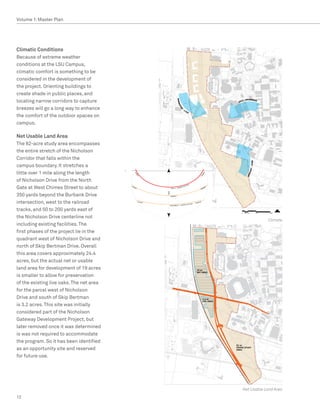
The 82-acre study area encompasses
the entire stretch of the Nicholson
Corridor that falls within the
campus boundary. It stretches a
little over 1 mile along the length
of Nicholson Drive from the North
Gate at West Chimes Street to about
350 yards beyond the Burbank Drive
intersection, west to the railroad
tracks, and 50 to 200 yards east of
the Nicholson Drive centerline not
                                                      Climate
including existing facilities. The
first phases of the project lie in the
quadrant west of Nicholson Drive and
north of Skip Bertman Drive. Overall
this area covers approximately 24.4
acres, but the actual net or usable
land area for development of 19 acres
is smaller to allow for preservation
of the existing live oaks. The net area
for the parcel west of Nicholson
Drive and south of Skip Bertman
is 3.2 acres. This site was initially
considered part of the Nicholson
Gateway Development Project, but
later removed once it was determined
is was not required to accommodate
the program. So it has been identified
as an opportunity site and reserved
for future use.


                                          Net Usable Land Area
12
02. Planning Process  Influences


Aesthetics and Views
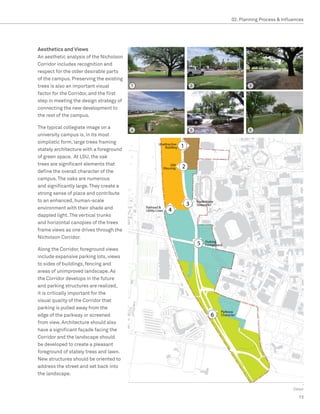
An aesthetic analysis of the Nicholson
Corridor includes recognition and
respect for the older desirable parts
of the campus. Preserving the existing
trees is also an important visual        1   2           3
factor for the Corridor, and the first
step in meeting the design strategy of
connecting the new development to
the rest of the campus.

The typical collegiate image on a
                                         4   5           6
university campus is, in its most
simplistic form, large trees framing
stately architecture with a foreground
of green space. At LSU, the oak
trees are significant elements that
define the overall character of the
campus. The oaks are numerous
and significantly large. They create a
strong sense of place and contribute
to an enhanced, human-scale
environment with their shade and
dappled light. The vertical trunks
and horizontal canopies of the trees
frame views as one drives through the
Nicholson Corridor.

Along the Corridor, foreground views
include expansive parking lots, views
to sides of buildings, fencing and
areas of unimproved landscape. As
the Corridor develops in the future
and parking structures are realized,
it is critically important for the
visual quality of the Corridor that
parking is pulled away from the
edge of the parkway or screened
from view. Architecture should also
have a significant façade facing the
Corridor and the landscape should
be developed to create a pleasant
foreground of stately trees and lawn.
New structures should be oriented to
address the street and set back into
the landscape.


                                                                             Views
                                                                               13
Volume 1: Master Plan


Infrastructure
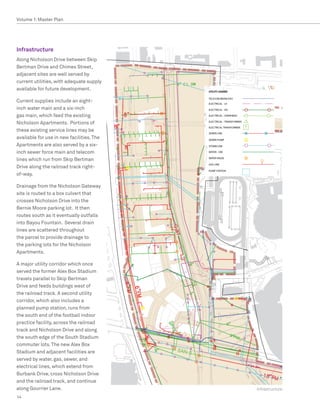
Along Nicholson Drive between Skip
Bertman Drive and Chimes Street,
adjacent sites are well served by
current utilities, with adequate supply
available for future development.

Current supplies include an eight-
inch water main and a six-inch
gas main, which feed the existing
Nicholson Apartments. Portions of
these existing service lines may be
available for use in new facilities. The
Apartments are also served by a six-
inch sewer force main and telecom
lines which run from Skip Bertman
Drive along the railroad track right-
of-way.

Drainage from the Nicholson Gateway
site is routed to a box culvert that
crosses Nicholson Drive into the
Bernie Moore parking lot. It then
routes south as it eventually outfalls
into Bayou Fountain. Several drain
lines are scattered throughout
the parcel to provide drainage to
the parking lots for the Nicholson
Apartments.

A major utility corridor which once
served the former Alex Box Stadium
travels parallel to Skip Bertman
Drive and feeds buildings west of
the railroad track. A second utility
corridor, which also includes a
planned pump station, runs from
the south end of the football indoor
practice facility, across the railroad
track and Nicholson Drive and along
the south edge of the South Stadium
commuter lots. The new Alex Box
Stadium and adjacent facilities are
served by water, gas, sewer, and
electrical lines, which extend from
Burbank Drive, cross Nicholson Drive
and the railroad track, and continue
along Gourrier Lane.                       Infrastructure
14
02. Planning Process  Influences


                              15
03   MARKET DEMAND
03. MARKET DEMAND


                  Undergraduate Student Enrollment                            Graduate Student Enrollment


03. MARKET DEMAND

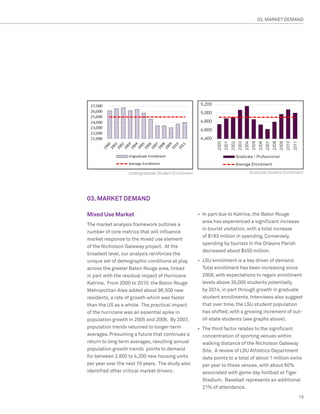
Mixed Use Market                                     •	 In part due to Katrina, the Baton Rouge
                                                        area has experienced a significant increase
The market analysis framework outlines a
                                                        in tourist visitation, with a total increase
number of core metrics that will influence
                                                        of $183 million in spending. Conversely,
market response to the mixed use element
                                                        spending by tourists in the Orleans Parish
of the Nicholson Gateway project. At the
                                                        decreased about $450 million.
broadest level, our analysis reinforces the
unique set of demographic conditions at play         •	 LSU enrollment is a key driver of demand.
across the greater Baton Rouge area, linked             Total enrollment has been increasing since
in part with the residual impact of Hurricane           2009, with expectations to regain enrollment
Katrina. From 2000 to 2010, the Baton Rouge             levels above 30,000 students potentially
Metropolitan Area added about 96,500 new                by 2014, in part through growth in graduate
residents, a rate of growth which was faster            student enrollments. Interviews also suggest
than the US as a whole. The practical impact            that over time, the LSU student population
of the hurricane was an essential spike in              has shifted, with a growing increment of out-
population growth in 2005 and 2006. By 2007,            of-state students (see graphs above).
population trends returned to longer-term            •	 The third factor relates to the significant
averages. Presuming a future that continues a           concentration of sporting venues within
return to long term averages, resulting annual          walking distance of the Nicholson Gateway
population growth trends points to demand               Site. A review of LSU Athletics Department
for between 2,600 to 4,200 new housing units            data points to a total of about 1 million visits
per year over the next 10 years. The study also         per year to these venues, with about 60%
identified other critical market drivers:               associated with game day football at Tiger
                                                        Stadium. Baseball represents an additional
                                                        21% of attendance.
                                                                                                      19
Volume 1: Master Plan


The analysis also highlights a clear
policy impact, which is that LSU
has stated their interest in seeing
the project be used to largely
meet university needs for student
apartments as well as for office
space. The one component that is
expected to be “market based” (and
therefore speculative) is retail.

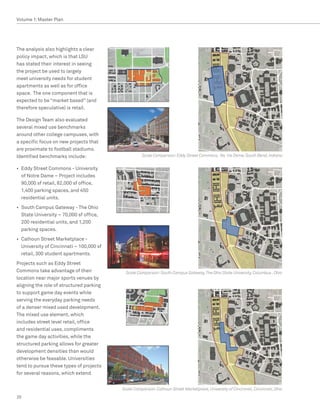
The Design Team also evaluated
several mixed use benchmarks
around other college campuses, with
a specific focus on new projects that
are proximate to football stadiums.
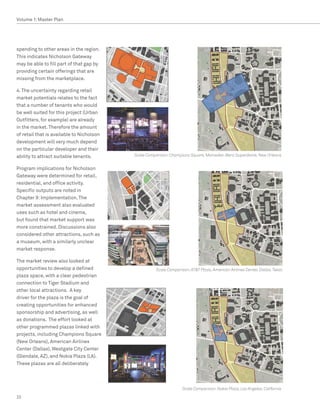
Identified benchmarks include:                       Scale Comparison: Eddy Street Commons, No tre Dame, South Bend, Indiana


•	 Eddy Street Commons - University
   of Notre Dame – Project includes
   90,000 sf retail, 82,000 sf office,
   1,400 parking spaces, and 450
   residential units.
•	 South Campus Gateway - The Ohio
   State University – 70,000 sf office,
   200 residential units, and 1,200
   parking spaces.
•	 Calhoun Street Marketplace -
   University of Cincinnati – 100,000 sf
   retail, 300 student apartments.
Projects such as Eddy Street
Commons take advantage of their              Scale Comparison: South Campus Gateway, The Ohio State University, Columbus , Ohio
location near major sports venues by
aligning the role of structured parking
to support game day events while
serving the everyday parking needs
of a denser mixed used development.
The mixed use element, which
includes street level retail, office
and residential uses, compliments
the game day activities, while the
structured parking allows for greater
development densities than would
otherwise be feasable. Universities
tend to pursue these types of projects
for several reasons, which extend


                                           Scale Comparison: Calhoun Street Marketplace, University of Cincinnati, Cincinnati, Ohio
20
03. MARKET DEMAND


beyond core questions of profitability:

•	 The need to revitalize and
   reposition campus edges
•	 The need to compete for students
   and grow endowments
•	 The need to maximize cost recovery
   and / or revenue capture from
   existing assets
Real estate market support for the
Mixed Use program also builds from
a review of real estate conditions
locally in residential, retail, and
office segments. From a residential
standpoint, the analysis reinforced
a broader market, which is in better
shape than the country as a whole.
Local real estate conditions show
continued residential activity over
the past several years, despite the
recession. Multi-family markets
are recovering from a surge in post-
Katrina construction (2005-2006),
with 2011 unit deliveries beginning to    context.                                   the potentials and challenges:
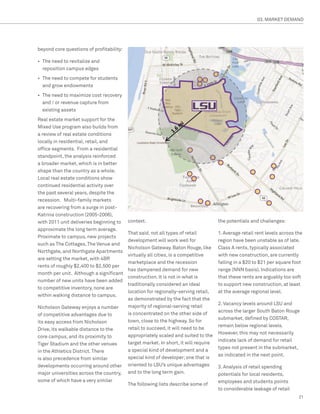
approximate the long term average.
                                          That said, not all types of retail         1. Average retail rent levels across the
Proximate to campus, new projects
                                          development will work well for             region have been unstable as of late.
such as The Cottages, The Venue and
                                          Nicholson Gateway. Baton Rouge, like       Class A rents, typically associated
Northgate, and Northgate Apartments
                                          virtually all cities, is a competitive     with new construction, are currently
are setting the market, with 4BR
                                          marketplace and the recession              falling in a $20 to $21 per square foot
rents of roughly $2,400 to $2,500 per
                                          has dampened demand for new                range (NNN basis). Indications are
month per unit. Although a significant
                                          construction. It is not in what is         that these rents are arguably too soft
number of new units have been added
                                          traditionally considered an ideal          to support new construction, at least
to competitive inventory, none are
                                          location for regionally-serving retail,    at the average regional level.
within walking distance to campus.
                                          as demonstrated by the fact that the
                                                                                     2. Vacancy levels around LSU and
Nicholson Gateway enjoys a number         majority of regional-serving retail
                                                                                     across the larger South Baton Rouge
of competitive advantages due to          is concentrated on the other side of
                                                                                     submarket, defined by COSTAR,
its easy access from Nicholson            town, close to the highway. So for
                                                                                     remain below regional levels.
Drive, its walkable distance to the       retail to succeed, it will need to be
                                                                                     However, this may not necessarily
core campus, and its proximity to         appropriately scaled and suited to the
                                                                                     indicate lack of demand for retail
Tiger Stadium and the other venues        target market. In short, it will require
                                                                                     types not present in the submarket,
in the Athletics District. There          a special kind of development and a
                                                                                     as indicated in the next point.
is also precedence from similar           special kind of developer; one that is
developments occurring around other       oriented to LSU’s unique advantages        3. Analysis of retail spending
major universities across the country,    and to the long term gain.                 potentials for local residents,
some of which have a very similar                                                    employees and students points
                                          The following lists describe some of
                                                                                     to considerable leakage of retail
                                                                                                                           21
Volume 1: Master Plan


spending to other areas in the region.
This indicates Nicholson Gateway
may be able to fill part of that gap by
providing certain offerings that are
missing from the marketplace.

4. The uncertainty regarding retail
market potentials relates to the fact
that a number of tenants who would
be well suited for this project (Urban
Outfitters, for example) are already
in the market. Therefore the amount
of retail that is available to Nicholson
development will very much depend
on the particular developer and their
ability to attract suitable tenants.       Scale Comparison: Champions Square, Mercedes-Benz Superdome, New Orleans


Program implications for Nicholson
Gateway were determined for retail,
residential, and office activity.
Specific outputs are noted in
Chapter 9: Implementation. The
market assessment also evaluated
uses such as hotel and cinema,
but found that market support was
more constrained. Discussions also
considered other attractions, such as
a museum, with a similarly unclear
market response.

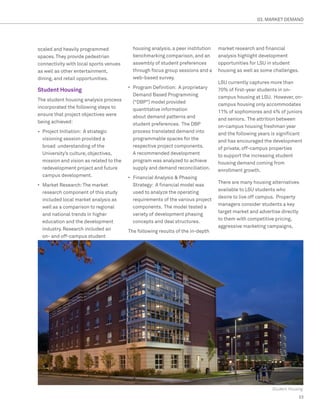
The market review also looked at
opportunities to develop a defined                   Scale Comparison: ATT Plaza, American Airlines Center, Dallas, Texas
plaza space, with a clear pedestrian
connection to Tiger Stadium and
other local attractions. A key
driver for the plaza is the goal of
creating opportunities for enhanced
sponsorship and advertising, as well
as donations. The effort looked at
other programmed plazas linked with
projects, including Champions Square
(New Orleans), American Airlines
Center (Dallas), Westgate City Center
(Glendale, AZ), and Nokia Plaza (LA).
These plazas are all deliberately


                                                                   Scale Comparison: Nokia Plaza, Los Angeles, California

22
03. MARKET DEMAND


scaled and heavily programmed               housing analysis, a peer institution   market research and financial
spaces. They provide pedestrian             benchmarking comparison, and an        analysis highlight development
connectivity with local sports venues       assembly of student preferences        opportunities for LSU in student
as well as other entertainment,             through focus group sessions and a     housing as well as some challenges.
dining, and retail opportunities.           web-based survey.
                                                                                   LSU currently captures more than
                                          •	 Program Definition: A proprietary
Student Housing                                                                    70% of first-year students in on-
                                             Demand Based Programming              campus housing at LSU. However, on-
The student housing analysis process         (“DBP”) model provided                campus housing only accommodates
incorporated the following steps to          quantitative information              11% of sophomores and 4% of juniors
ensure that project objectives were          about demand patterns and             and seniors. The attrition between
being achieved:                              student preferences. The DBP          on-campus housing freshman year
•	 Project Initiation: A strategic           process translated demand into        and the following years is significant
   visioning session provided a              programmable spaces for the           and has encouraged the development
   broad understanding of the                respective project components.        of private, off-campus properties
   University’s culture, objectives,         A recommended development             to support the increasing student
   mission and vision as related to the      program was analyzed to achieve       housing demand coming from
   redevelopment project and future          supply and demand reconciliation.     enrollment growth.
   campus development.                    •	 Financial Analysis  Phasing
                                                                                   There are many housing alternatives
•	 Market Research: The market               Strategy: A financial model was
                                                                                   available to LSU students who
   research component of this study          used to analyze the operating
                                                                                   desire to live off campus. Property
   included local market analysis as         requirements of the various project
                                                                                   managers consider students a key
   well as a comparison to regional          components. The model tested a
                                                                                   target market and advertise directly
   and national trends in higher             variety of development phasing
                                                                                   to them with competitive pricing,
   education and the development             concepts and deal structures.
                                                                                   aggressive marketing campaigns,
   industry. Research included an         The following results of the in-depth
   on- and off-campus student


                                                                                                           Student Housing
                                                                                                                        23
Volume 1: Master Plan


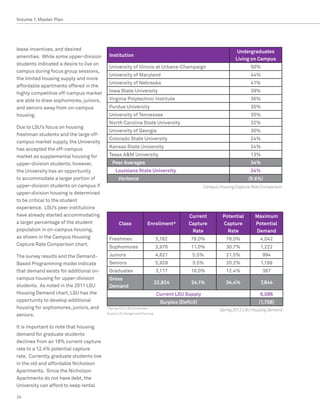
lease incentives, and desired                                                                                     Undergraduates
amenities. While some upper-division       Institution
                                                                                                                 Living on Campus
students indicated a desire to live on
                                           University of Illinois at Urbana-Champaign                                   50%
campus during focus group sessions,
                                           University of Maryland                                                       44%
the limited housing supply and more
                                           University of Nebraska                                                       41%
affordable apartments offered in the
highly competitive off-campus market       Iowa State University                                                        39%
are able to draw sophomores, juniors,      Virginia Polytechnic Institute                                               36%
and seniors away from on-campus            Purdue University                                                            35%
housing.                                   University of Tennessee                                                      35%
                                           North Carolina State University                                              32%
Due to LSU’s focus on housing
                                           University of Georgia                                                        30%
freshman students and the large off-
                                           Colorado State University                                                    24%
campus market supply, the University
has accepted the off-campus                Kansas State University                                                      24%
market as supplemental housing for         Texas AM University                                                         13%
upper-division students; however,            Peer Averages                                                              34%
the University has an opportunity              Louisiana State University                                               24%
to accommodate a larger portion of               Variance                                                              (9.6%)
upper-division students on campus if                                                              Campus Housing Capture Rate Comparison
upper-division housing is determined
to be critical to the student
experience. LSU’s peer institutions
have already started accommodating                                                         Current         Potential      Maximum
a larger percentage of the student                Class              Enrollment*           Capture         Capture        Potential
population in on-campus housing,                                                            Rate             Rate         Demand
as shown in the Campus Housing             Freshmen                         5,182           78.0%            78.0%           4,042
Capture Rate Comparison chart.
                                           Sophomores                       3,976           11.0%            30.7%           1,222
The survey results and the Demand-         Juniors                          4,621           5.5%             21.5%            994
Based Programming model indicate           Seniors                          5,928           3.5%            20.2%             1,199
that demand exists for additional on-      Graduates                        3,117           18.0%           12.4%             387
campus housing for upper-division          Gross
                                                                            22,824          24.1%           34.4%            7,844
students. As noted in the 2011 LSU         Demand
Housing Demand chart, LSU has the                                           Current LSU Supply                               6,086
opportunity to develop additional                                             Surplus (Deficit)                             (1,758)
housing for sophomores, juniors, and      *Spring 2012 LSU Enrollment
                                                                                                         Spring 2012 LSU Housing Demand
                                          Source: LSU Budget and Planning
seniors.

It is important to note that housing
demand for graduate students
declines from an 18% current capture
rate to a 12.4% potential capture
rate. Currently, graduate students live
in the old and affordable Nicholson
Apartments. Since the Nicholson
Apartments do not have debt, the
University can afford to keep rental

24
03. MARKET DEMAND


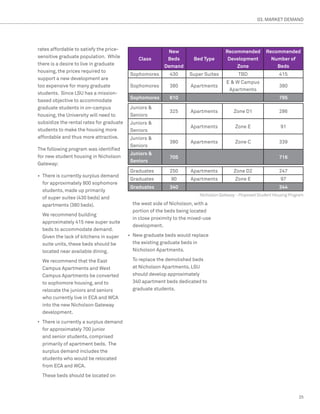
rates affordable to satisfy the price-                    New                        Recommended          Recommended
sensitive graduate population. While          Class       Beds        Bed Type        Development           Number of
there is a desire to live in graduate                    Demand                          Zone                 Beds
housing, the prices required to
                                          Sophomores       430      Super Suites            TBD                 415
support a new development are
                                                                                      E  W Campus
too expensive for many graduate           Sophomores       380      Apartments                                  380
                                                                                       Apartments
students. Since LSU has a mission-
                                          Sophomores       810                                                  795
based objective to accommodate
graduate students in on-campus            Juniors 
                                                           325      Apartments           Zone D1                286
housing, the University will need to      Seniors
subsidize the rental rates for graduate   Juniors 
                                                                    Apartments            Zone E                 91
students to make the housing more         Seniors
affordable and thus more attractive.      Juniors 
                                                           380      Apartments            Zone C                339
                                          Seniors
The following program was identified
                                          Juniors 
for new student housing in Nicholson                       705                                                  716
                                          Seniors
Gateway:
                                          Graduates        250      Apartments           Zone D2                247
•	 There is currently surplus demand
                                          Graduates         90      Apartments            Zone E                 97
   for approximately 800 sophomore
                                          Graduates        340                                                  344
   students, made up primarily
                                                                         Nicholson Gateway - Proposed Student Housing Program
   of super suites (430 beds) and
   apartments (380 beds).                  the west side of Nicholson, with a
                                           portion of the beds being located
  We recommend building
                                           in close proximity to the mixed-use
  approximately 415 new super suite
                                           development.
  beds to accommodate demand.
  Given the lack of kitchens in super     •	 New graduate beds would replace
  suite units, these beds should be          the existing graduate beds in
  located near available dining.             Nicholson Apartments.

  We recommend that the East               To replace the demolished beds
  Campus Apartments and West               at Nicholson Apartments, LSU
  Campus Apartments be converted           should develop approximately
  to sophomore housing, and to             340 apartment beds dedicated to
  relocate the juniors and seniors         graduate students.
  who currently live in ECA and WCA
  into the new Nicholson Gateway
  development.
•	 There is currently a surplus demand
   for approximately 700 junior
   and senior students, comprised
   primarily of apartment beds. The
   surplus demand includes the
   students who would be relocated
   from ECA and WCA.
  These beds should be located on


                                                                                                                          25
PARKING:
04   ISSUES  BEST
     PRACTICES
04. PARKING: ISSUES AND BEST PRACTICES


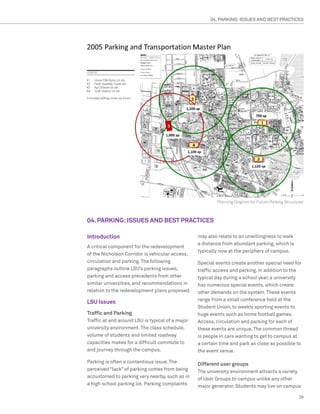
                                                          Planning Diagram for Future Parking Structures


04. PARKING: ISSUES AND BEST PRACTICES

Introduction                                      may also relate to an unwillingness to walk
                                                  a distance from abundant parking, which is
A critical component for the redevelopment
                                                  typically now at the periphery of campus.
of the Nicholson Corridor is vehicular access,
circulation and parking. The following            Special events create another special need for
paragraphs outline LSU’s parking issues,          traffic access and parking. In addition to the
parking and access precedents from other          typical day during a school year, a university
similar universities, and recommendations in      has numerous special events, which create
relation to the redevelopment plans proposed.     other demands on the system. These events
                                                  range from a small conference held at the
LSU Issues
                                                  Student Union, to weekly sporting events to
Traffic and Parking                               huge events such as home football games.
Traffic at and around LSU is typical of a major   Access, circulation and parking for each of
university environment. The class schedule,       these events are unique. The common thread
volume of students and limited roadway            is people in cars wanting to get to campus at
capacities makes for a difficult commute to       a certain time and park as close as possible to
and journey through the campus.                   the event venue.

Parking is often a contentious issue. The         Different user groups
perceived “lack” of parking comes from being      The university environment attracts a variety
accustomed to parking very nearby, such as in     of User Groups to campus unlike any other
a high school parking lot. Parking complaints     major generator. Students may live on campus

                                                                                                     29
Volume 1: Master Plan


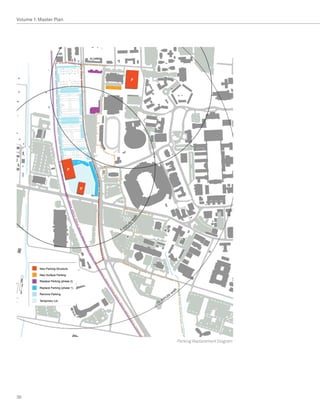
                        Parking Replacement Diagram


30
04. PARKING: ISSUES AND BEST PRACTICES


or off campus. They may walk, take         addition, the Corps of Engineers has       Developer agreement. While not
the shuttle, car pool, use a single        an active participation near campus        having 100% control of the parking
occupant vehicle or ride a bike. They      along the Mississippi River levee          asset, the University is assuming it’s
may have classes during the day or         system.                                    primacy through the development
night throughout the week.                                                            agreement, and under those terms
                                           Recommendations
                                                                                      can dictate what type of parking
Faculty and staff are very similar in      Parking associated with the                should be developed, what type of
their transportation characteristics       Nicholson Apartment complex will be        OM responsibilities each party will
as students. Their variable modes of       removed and replaced with parking to       have, and to what degree revenue will
access and need to be on campus are        support the new housing district. The      be shared between the developer and
beyond the typical 9 to 5 timeframe.       new parking will be located to the rear    the University.
                                           of the development, hidden from view
Administrators have some special
                                           and will serve as a buffer between the     Additionally, The Design Team
needs. They may have a typical office
                                           housing and the railroad tracks.           recommends a phased development
schedule, but also may have added
                                                                                      of parking facilities. As new
responsibilities for meetings and          Redeveloped lots that currently            development is built, parking is
coordination with departments,             support game day parking will be           displaced, and added as necessary
colleges, dignitaries and legislators.     replaced with structured parking. The      in new locations to accommodate
Their need to move about campus            game day spaces will ‘share’ parking       additional demands generated by
in a convenient way under time             normally designated for non-game           new development. This could also
constraints must be recognized.            day uses. This includes approximately      serve as a continuation of the general
                                           250 spaces of game day spaces              peripheral parking concept.
Visitors are also important to
                                           on long term lease, but not the
consider. From delivery people, to
                                           balance of the Alex Box Lot that is on     Access and revenue control needs
parents, business people dealing
                                           temporary lease and is scheduled to        to be thought through as the project
with University issues, to the general
                                           expire before the start of the project.    is more fully developed. Initial
public who may be “just visiting “, they
                                                                                      improvements to Nicholson and
too have needs for access, circulation     Structured parking within the              connections to adjacent streets
and parking.                               Nicholson Gateway, though not a            should incorporate access points
                                           revenue generator, will enable a           for new and future anticipated
The Community
                                           more intense redevelopment of the          development. In addition access
LSU is within the jurisdiction of
                                           site. The primary parking deck in the      and revenue control equipment
several local and state institutions
                                           Nicholson Gateway Development fits         needs to be explored to ensure
which govern day to day operations
                                           in with the 2003 LSU Master Plan,          the compatibility of university
of the community surrounding the
                                           which proposed 4 primary structures        wide systems as it relates to
campus. This includes the City and
                                           at the perimeter of the core campus        communication, control of access and
Parish of East Baton Rouge and
                                           to accommodate commuter parking            auditability or the fees generated by
the State DOTD (Department of
                                           displaced from the campus core,            the facilities.
Transportation and Development). It
                                           creating a new bank of game day
is critical to engage and coordinate
                                           parking that is proximate to the
with these agencies, especially as
                                           stadium and other venues in the
it relates to utilities, drainage and
                                           Athletics District.
roadway infrastructure that abuts or
penetrates the campus.                     Under the development scenario
                                           presented for the Nicholson Corridor
The CSX rail road is also a neighbor
                                           redevelopment, the Design Team’s
with active trackage along the
                                           recommendation would be a win /win
western border of campus. In
                                           for the university under the Master

                                                                                                                          31
NICHOLSON
05   CORRIDOR
     FRAMEWORK PLAN
W Chimes St


                                                              Dr
                                                        ium
                                                     tad
                                                   hS
                                             N ort


Skip B
      ertma
           n Dr


                                                        South
                                                                   Stadiu
                                                                          m Dr


                                                                   Nich
                                                                       olso
                                                                            n Dr
                                                                                 ive E
                                                                                       xt
                                      Ni
                                       ch
                                         ols
                                             on
                                              r D


                  Gourrier
                             Ln


                                                                                   Bu
                                                                                     rba
                                                                                            nk
                                                                                                 Dr


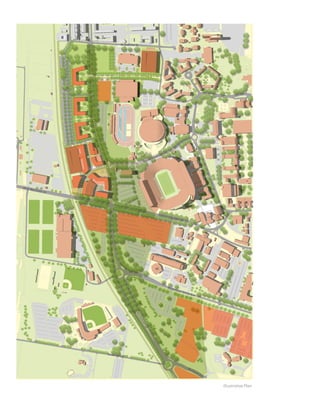
                                                                                                      Illustrative Plan
05. NICHOLSON CORRIDOR FRAMEWORK PLAN


05. NICHOLSON CORRIDOR FRAMEWORK PLAN


Introduction                                         Corridor and support the City’s overall vision
                                                     for Nicholson Drive.
The Nicholson Drive Corridor presents an
extraordinary opportunity for Louisiana State        For the purpose of the study, the Master
University to transform the under-utilized           Development Plan defines an 82 acre study
western portion of campus, which primarily           area that includes both sides of Nicholson
consists of large parking lots, obsolete             Drive, extending one mile from the North Gate
facilities, and a lackluster landscape, into an      at Chimes Street to just beyond the Burbank
attractive campus district that extends the          Drive intersection. The study area is bordered
qualities of the campus core. The character          by the railroad tracks to the west and extends
of Nicholson Drive itself can be transformed         approximately 600 feet from the centerline
from an auto-dominated highway that divides          of the road. Within this district, the primary
the two sides of the road, to a campus street        focus of the study is defined by the 24 acres
that feels like it is part of the campus; one that   on the west side of Nicholson Drive, bounded
unifies both sides of the street with improved       by the railroad tracks, Chimes Street, and
crossings and strong streetscape identity.           Skip Bertman. This area is called Nicholson
                                                     Gateway.
The Corridor also presents an extraordinary
opportunity for the City of Baton Rouge to           This chapter describes the rationale and
improve one of the primary routes connecting         proposed improvements for the Corridor study
the downtown to the campus. Redevelopment            area and Chapter 08 describes additional
plans are already in place under the FuturEBR        details for the improvements around Nicholson
to promote development and streetscape               Gateway.
improvements, and number of development
projects are either in place or in the planning
phases. The LSU redevelopment initiative
reinforces the City’s efforts to revitalize the

                                                                                                      35
Volume 1: Master Plan


Land Use and Organization                 Housing sites have also been reserved     stakeholder discussions include the
                                          on the east side of Nicholson, south of   following:
The Nicholson Corridor has been
                                          Skip Bertman Drive. These sites had
identified as having the potential                                                  1. The site adjacent to the Field House
                                          been identified in earlier studies due
to better serve the University by                                                   has the potential to significantly
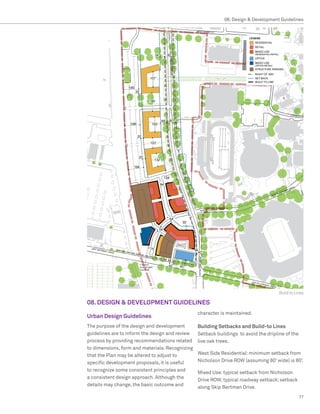
                                          to their proximity to the campus core.
improving the campus image along                                                    enhance the campus gateway
                                          Since student housing sites close
Nicholson Drive and identifying sites                                               experience and to strengthen the
                                          to the core campus are generally
that can accommodate future facility                                                connectivity between the Nicholson
                                          prioritized over commuter parking,
needs. The following uses were                                                      Gateway project and the core campus.
                                          some of these sites may necessitate
considered within the study area:                                                   This site could be suitable for a
                                          the displacement of commuter
                                                                                    number of different uses including
Parking                                   parking. The additional parking need
                                                                                    residential, athletic, student services,
Currently, surface parking is the         can be accommodated in nearby
                                                                                    or other university affiliated uses.
dominant land use within the Corridor     structured parking or in remote
                                                                                    Additional detail can be found in
study area. Parking serves a valuable     parking.
                                                                                    Chapter 7.
purpose for game day visitors and
                                          Mixed Use
commuters. It has a relatively low cost                                             2. The site on the south west corner
                                          The Nicholson Gateway project
and high return, and will continue                                                  of Nicholson Drive and Skip Bertman
                                          includes a mixed use core area
to be a valuable use in the Corridor.                                               Drive could be a candidate for uses
                                          consisting of retail, university
However, because of the Corridor’s                                                  such as a new sports or natural
                                          affiliated office, and student and
proximity to the campus core and                                                    history museum. These uses would
                                          university affiliated housing. Based
great access through Nicholson Drive,                                               have synergies with the mixed use
                                          on the program developed from the
certain sites are better suited for                                                 center across the street, however
                                          market analysis, approximately 10
facilities that support the campus                                                  they have not yet identified funding
                                          acres have been reserved for this use,
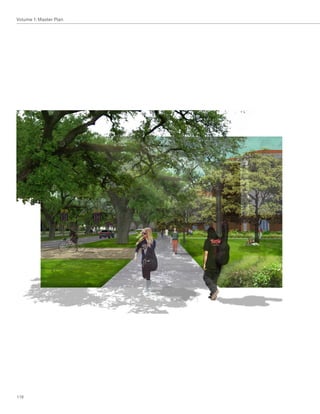
growth needs. This is especially                                                    or programming. This site would also
                                          which will be configured in a compact
true for the Nicholson Gateway                                                      need a strategy to accommodate
                                          town center style environment. The
redevelopment area.                                                                 displaced game day parking.
                                          location was selected because of
To accommodate these new uses, the        its prime location at the corner of       3. The site at the southern corner of
general approach for this study has       Nicholson Drive and Skip Bertman          Burbank Drive and Nicholson Drive
been to provide replacement game          Drive which provides excellent            could be a candidate for a future retail
day parking at a 1:1 ratio or better,     visibility and benefits from the          or visitor center.
with the exception of temporary lots      proximity to Tiger Stadium and game
such as the former Alex Box site.         day pedestrian traffic from the west      4. The site at the southeast corner of
Replacement parking will either be        campus parking lots.                      Nicholson Drive and Skip Bertman.
accommodated in parking structures                                                  It would become available once the
or in surface lots supporting new uses    Opportunity Sites                         large commuter deck behind it was
that are not required during game day     Four sites within the study area          completed and it could replace the
events.                                   are ‘opportunity sites’ due to their      displaced parking.
                                          location advantages and adequate
Residential                               parcel size. However since no
The northern portion of the Nicholson     specific or immediate need has been
Gateway project replaces the              identified, these sites can continue
obsolete graduate housing complex         to be used for parking or reserved
with new housing for graduates and        as open space until new facilities
upperclassmen.                            are required. Some possible uses
                                          that were suggested during the


36
05. NICHOLSON CORRIDOR FRAMEWORK PLAN


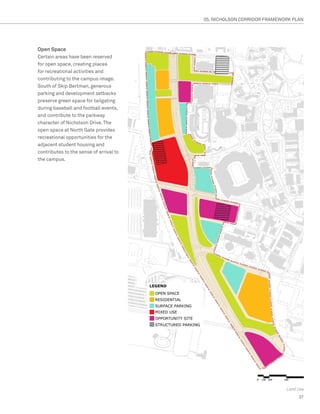
Open Space
Certain areas have been reserved
for open space, creating places
for recreational activities and
contributing to the campus image.
South of Skip Bertman, generous
parking and development setbacks
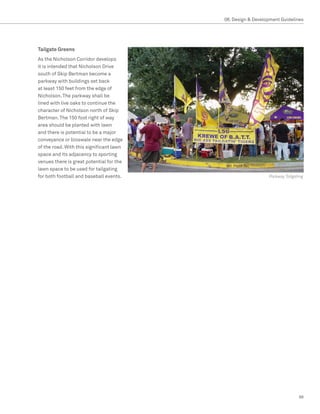
preserve green space for tailgating
during baseball and football events,
and contribute to the parkway
character of Nicholson Drive. The
open space at North Gate provides
recreational opportunities for the
adjacent student housing and
contributes to the sense of arrival to
the campus.


                                                                       Land Use
                                                                            37
Volume 1: Master Plan


                        Gateway Experience
38
05. NICHOLSON CORRIDOR FRAMEWORK PLAN


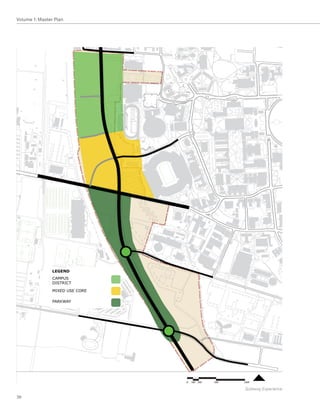
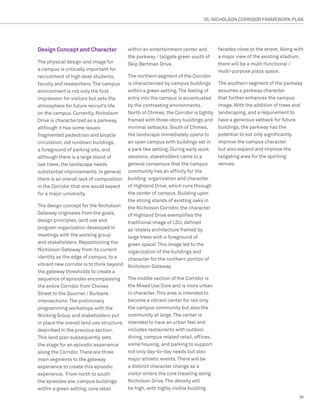
Design Concept and Character              within an entertainment center and        facades close to the street. Along with
                                          the parkway / tailgate green south of     a major view of the existing stadium,
The physical design and image for         Skip Bertman Drive.                       there will be a multi-functional /
a campus is critically important for                                                multi-purpose plaza space.
recruitment of high level students,      The northern segment of the Corridor
faculty and researchers. The campus      is characterized by campus buildings       The southern segment of the parkway
environment is not only the first        within a green setting. The feeling of     assumes a parkway character
impression for visitors but sets the     entry into the campus is accentuated       that further enhances the campus
atmosphere for future recruit’s life     by the contrasting environments.           image. With the addition of trees and
on the campus. Currently, Nicholson      North of Chimes, the Corridor is tightly   landscaping, and a requirement to
Drive is characterized as a parkway,     framed with three-story buildings and      have a generous setback for future
although it has some issues:             minimal setbacks. South of Chimes,         buildings, the parkway has the
fragmented pedestrian and bicycle        the landscape immediately opens to         potential to not only significantly
circulation, old rundown buildings,      an open campus with buildings set in       improve the campus character
a foreground of parking lots, and        a park like setting. During early work     but also expand and improve the
although there is a large stand of       sessions, stakeholders came to a           tailgating area for the sporting
oak trees, the landscape needs           general consensus that the campus          venues.
substantial improvements. In general     community has an affinity for the
there is an overall lack of composition  building organization and character
in the Corridor that one would expect    of Highland Drive, which runs through
for a major university.                  the center of campus. Building upon
                                         the strong stands of existing oaks in
The design concept for the Nicholson the Nicholson Corridor, the character
Gateway originates from the goals,       of Highland Drive exemplifies the
design principles, land use and          traditional image of LSU, defined
program organization developed in        as ‘stately architecture framed by
meetings with the working group          large trees with a foreground of
and stakeholders. Repositioning the      green space’. This image led to the
Nicholson Gateway from its current       organization of the buildings and
identity as the edge of campus, to a     character for the northern portion of
vibrant new corridor is to think beyond Nicholson Gateway.
the gateway thresholds to create a
sequence of episodes encompassing        The middle section of the Corridor is
the entire Corridor from Chimes          the Mixed Use Core and is more urban
Street to the Gourrier / Burbank         in character. This area is intended to
intersections. The preliminary           become a vibrant center for not only
programming workshops with the           the campus community but also the
Working Group and stakeholders put       community at large. The center is
in place the overall land use structure, intended to have an urban feel and
described in the previous section.       includes restaurants with outdoor
This land plan subsequently sets         dining, campus related retail, offices,
the stage for an episodic experience     some housing, and parking to support
along the Corridor. There are three      not only day-to-day needs but also
main segments to the gateway             major athletic events. There will be
experience to create this episodic       a distinct character change as a
experience. From north to south          visitor enters the core traveling along
the episodes are: campus buildings       Nicholson Drive. The density will
within a green setting, core retail      be high, with highly visible building
                                                                                                                        39
Volume 1: Master Plan


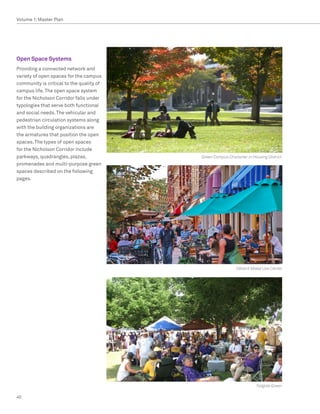
Open Space Systems
Providing a connected network and
variety of open spaces for the campus
community is critical to the quality of
campus life. The open space system
for the Nicholson Corridor falls under
typologies that serve both functional
and social needs. The vehicular and
pedestrian circulation systems along
with the building organizations are
the armatures that position the open
spaces. The types of open spaces
for the Nicholson Corridor include
parkways, quadrangles, plazas,            Green Campus Character in Housing District
promenades and multi-purpose green
spaces described on the following
pages.


                                                            Vibrant Mixed Use Center


                                                                      Tailgate Green

40
05. NICHOLSON CORRIDOR FRAMEWORK PLAN


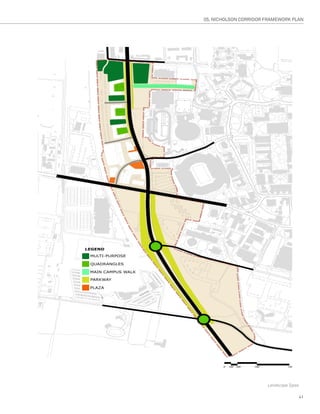
                       Landscape Types

                                         41
Volume 1: Master Plan


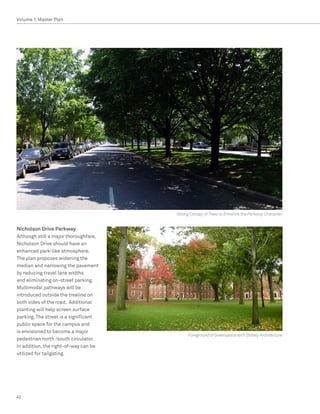
                                       Strong Canopy of Trees to Enhance the Parkway Character


Nicholson Drive Parkway
Although still a major thoroughfare,
Nicholson Drive should have an
enhanced park-like atmosphere.
The plan proposes widening the
median and narrowing the pavement
by reducing travel lane widths
and eliminating on-street parking.
Multimodal pathways will be
introduced outside the treeline on
both sides of the road. Additional
planting will help screen surface
parking. The street is a significant
public space for the campus and
is envisioned to become a major
                                             Foreground of Greenspace with Stately Architecture
pedestrian north /south circulator.
In addition, the right-of-way can be
utilized for tailgating.


42
05. NICHOLSON CORRIDOR FRAMEWORK PLAN


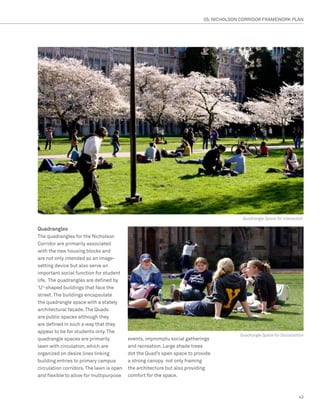
                                                                                         Quadrangle Space for Interaction

Quadrangles
The quadrangles for the Nicholson
Corridor are primarily associated
with the new housing blocks and
are not only intended as an image-
setting device but also serve an
important social function for student
life. The quadrangles are defined by
‘U’-shaped buildings that face the
street. The buildings encapsulate
the quadrangle space with a stately
architectural façade. The Quads
are public spaces although they
are defined in such a way that they
appear to be for students only. The
                                                                                        Quadrangle Space for Socialization
quadrangle spaces are primarily           events, impromptu social gatherings
lawn with circulation, which are          and recreation. Large shade trees
organized on desire lines linking         dot the Quad’s open space to provide
building entries to primary campus        a strong canopy not only framing
circulation corridors. The lawn is open   the architecture but also providing
and flexible to allow for multipurpose    comfort for the space.


                                                                                                                       43
Volume 1: Master Plan


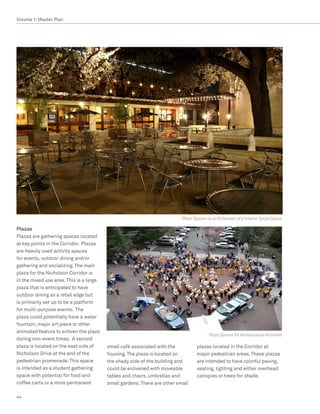
                                                                          Plaza Spaces as an Extension of a Interior Social Space

Plazas
Plazas are gathering spaces located
at key points in the Corridor. Plazas
are heavily used activity spaces
for events, outdoor dining and/or
gathering and socializing. The main
plaza for the Nicholson Corridor is
in the mixed use area. This is a large
plaza that is anticipated to have
outdoor dining as a retail edge but
is primarily set up to be a platform
for multi-purpose events. The
plaza could potentially have a water
fountain, major art piece or other
animated feature to enliven the plaza
                                                                                        Plaza Spaces for Multipurpose Activities
during non-event times. A second
plaza is located on the east side of     small café associated with the           plazas located in the Corridor at
Nicholson Drive at the end of the        housing. The plaza is located on         major pedestrian areas. These plazas
pedestrian promenade. This space         the shady side of the building and       are intended to have colorful paving,
is intended as a student gathering       could be enlivened with moveable         seating, lighting and either overhead
space with potential for food and        tables and chairs, umbrellas and         canopies or trees for shade.
coffee carts or a more permanent         small gardens. There are other small

44
05. NICHOLSON CORRIDOR FRAMEWORK PLAN


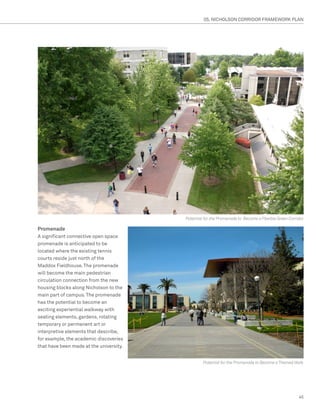
                                         Potential for the Promenade to Become a Flexible Green Corridor

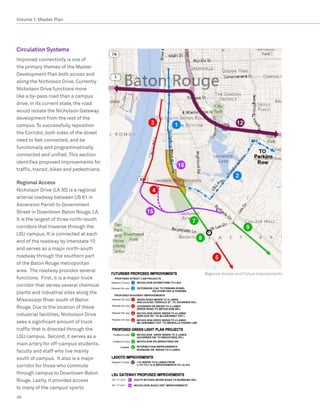
Promenade
A significant connective open space
promenade is anticipated to be
located where the existing tennis
courts reside just north of the
Maddox Fieldhouse. The promenade
will become the main pedestrian
circulation connection from the new
housing blocks along Nicholson to the
main part of campus. The promenade
has the potential to become an
exciting experiential walkway with
seating elements, gardens, rotating
temporary or permanent art or
interpretive elements that describe,
for example, the academic discoveries
that have been made at the university.


                                                  Potential for the Promenade to Become a Themed Walk


                                                                                                     45
Volume 1: Master Plan


Circulation Systems
Improved connectivity is one of
the primary themes of the Master
Development Plan both across and
along the Nicholson Drive. Currently
Nicholson Drive functions more
like a by-pass road than a campus
drive. In its current state, the road
would isolate the Nicholson Gateway
development from the rest of the
campus. To successfully reposition
the Corridor, both sides of the street
need to feel connected, and be
functionally and programmatically
connected and unified. This section
identifies proposed improvements for
traffic, transit, bikes and pedestrians.

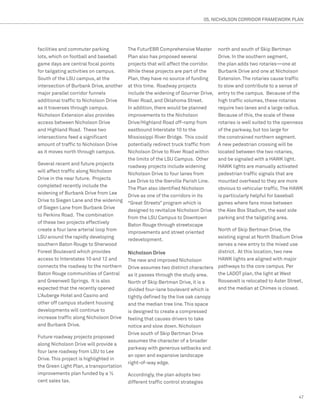
Regional Access
Nicholson Drive (LA 30) is a regional
arterial roadway between US 61 in
Ascension Parish to Government
Street in Downtown Baton Rouge, LA.
It is the largest of three north-south
corridors that traverse through the
LSU campus. It is connected at each
end of the roadway by Interstate 10
and serves as a major north-south
roadway through the southern part
of the Baton Rouge metropolitan
area. The roadway provides several
                                           Regional Access and Future Improvements
functions. First, it is a major truck
corridor that serves several chemical
plants and industrial sites along the
Mississippi River south of Baton
Rouge. Due to the location of these
industrial facilities, Nicholson Drive
sees a significant amount of truck
traffic that is directed through the
LSU campus. Second, it serves as a
main artery for off-campus students,
faculty and staff who live mainly
south of campus. It also is a major
corridor for those who commute
through campus to Downtown Baton
Rouge. Lastly, it provides access
to many of the campus’ sports
46
05. NICHOLSON CORRIDOR FRAMEWORK PLAN


facilities and commuter parking          The FuturEBR Comprehensive Master           north and south of Skip Bertman
lots, which on football and baseball     Plan also has proposed several              Drive. In the southern segment,
game days are central focal points       projects that will affect the corridor.     the plan adds two rotaries—one at
for tailgating activities on campus.     While these projects are part of the        Burbank Drive and one at Nicholson
South of the LSU campus, at the          Plan, they have no source of funding        Extension. The rotaries cause traffic
intersection of Burbank Drive, another   at this time. Roadway projects              to slow and contribute to a sense of
major parallel corridor funnels          include the widening of Gourrier Drive,     entry to the campus. Because of the
additional traffic to Nicholson Drive    River Road, and Oklahoma Street.            high traffic volumes, these rotaries
as it traverses through campus.          In addition, there would be planned         require two lanes and a large radius.
Nicholson Extension also provides        improvements to the Nicholson               Because of this, the scale of these
access between Nicholson Drive           Drive/Highland Road off-ramp from           rotaries is well suited to the openness
and Highland Road. These two             eastbound Interstate 10 to the              of the parkway, but too large for
intersections feed a significant         Mississippi River Bridge. This could        the constrained northern segment.
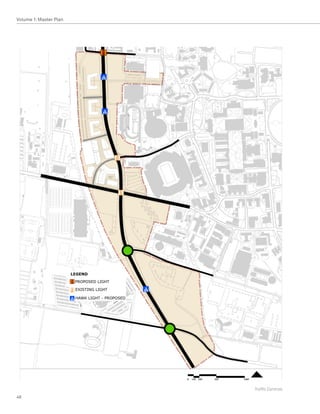
amount of traffic to Nicholson Drive     potentially redirect truck traffic from     A new pedestrian crossing will be
as it moves north through campus.        Nicholson Drive to River Road within        located between the two rotaries,
                                         the limits of the LSU Campus. Other         and be signaled with a HAWK light.
Several recent and future projects
                                         roadway projects include widening           HAWK lights are manually activated
will affect traffic along Nicholson
                                         Nicholson Drive to four lanes from          pedestrian traffic signals that are
Drive in the near future. Projects
                                         Lee Drive to the Iberville Parish Line.     mounted overhead to they are more
completed recently include the
                                         The Plan also identified Nicholson          obvious to vehicular traffic. The HAWK
widening of Burbank Drive from Lee
                                         Drive as one of the corridors in its        is particularly helpful for baseball
Drive to Siegen Lane and the widening
                                         “Great Streets” program which is            games where fans move between
of Siegen Lane from Burbank Drive
                                         designed to revitalize Nicholson Drive      the Alex Box Stadium, the east side
to Perkins Road. The combination
                                         from the LSU Campus to Downtown             parking and the tailgating area.
of these two projects effectively
                                         Baton Rouge through streetscape
create a four lane arterial loop from                                           North of Skip Bertman Drive, the
                                         improvements and street oriented
LSU around the rapidly developing                                               existing signal at North Stadium Drive
                                         redevelopment.
southern Baton Rouge to Sherwood                                                serves a new entry to the mixed use
Forest Boulevard which provides          Nicholson Drive                        district. At this location, two new
access to Interstates 10 and 12 and      The new and improved Nicholson         HAWK lights are aligned with major
connects the roadway to the northern     Drive assumes two distinct characters pathways to the core campus. Per
Baton Rouge communities of Central       as it passes through the study area.   the LADOT plan, the light at West
and Greenwell Springs. It is also        North of Skip Bertman Drive, it is a   Roosevelt is relocated to Aster Street,
expected that the recently opened        divided four-lane boulevard which is   and the median at Chimes is closed.
L’Auberge Hotel and Casino and           tightly defined by the live oak canopy
other off campus student housing         and the median tree line. This space
developments will continue to            is designed to create a compressed
increase traffic along Nicholson Drive   feeling that causes drivers to take
and Burbank Drive.                       notice and slow down. Nicholson
                                         Drive south of Skip Bertman Drive
Future roadway projects proposed
                                         assumes the character of a broader
along Nicholson Drive will provide a
                                         parkway with generous setbacks and
four lane roadway from LSU to Lee
                                         an open and expansive landscape
Drive. This project is highlighted in
                                         right-of-way edge.
the Green Light Plan, a transportation
improvements plan funded by a ½          Accordingly, the plan adopts two
cent sales tax.                          different traffic control strategies

                                                                                                                          47
Volume 1: Master Plan


                        Traffic Controls
48
05. NICHOLSON CORRIDOR FRAMEWORK PLAN


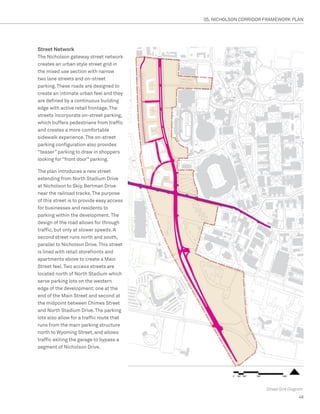
Street Network
The Nicholson gateway street network
creates an urban style street grid in
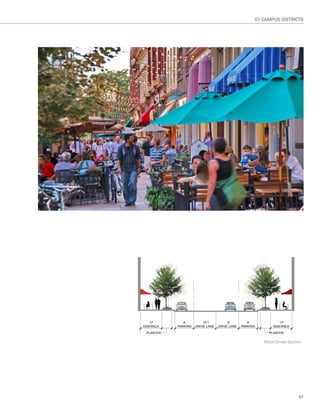
the mixed use section with narrow
two lane streets and on-street
parking. These roads are designed to
create an intimate urban feel and they
are defined by a continuous building
edge with active retail frontage. The
streets incorporate on-street parking,
which buffers pedestrians from traffic
and creates a more comfortable
sidewalk experience. The on-street
parking configuration also provides
“teaser” parking to draw in shoppers
looking for “front door” parking.

The plan introduces a new street
extending from North Stadium Drive
at Nicholson to Skip Bertman Drive
near the railroad tracks. The purpose
of this street is to provide easy access
for businesses and residents to
parking within the development. The
design of the road allows for through
traffic, but only at slower speeds. A
second street runs north and south,
parallel to Nicholson Drive. This street
is lined with retail storefronts and
apartments above to create a Main
Street feel. Two access streets are
located north of North Stadium which
serve parking lots on the western
edge of the development; one at the
end of the Main Street and second at
the midpoint between Chimes Street
and North Stadium Drive. The parking
lots also allow for a traffic route that
runs from the main parking structure
north to Wyoming Street, and allows
traffic exiting the garage to bypass a
segment of Nicholson Drive.


                                                                  Street Grid Diagram
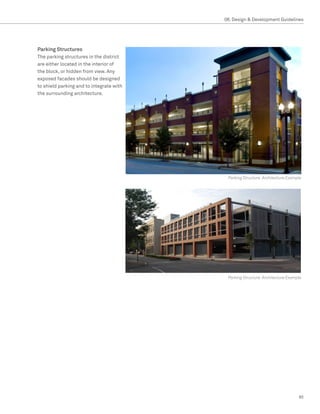
                                                                                  49
Volume 1: Master Plan


                                                           Center Median Street Car


                                                      Outside Traffic Lane Street Car   Proposed Street Car Route Through Campus

Transit                                  proposed redesign of Nicholson Drive
The LSU Tiger Trail System provides      is designed to accommodate the
convenient access between                streetcar either in the median or in a
Nicholson Gateway, West Campus           shared travel lane.
and Downtown Baton Rouge. The
Downtown/Vet trail route travels from
the School of Veterinary Medicine on
West Campus, along Skip Bertman
Drive and South Stadium Drive. It then
loops back on North Stadium Drive
and travels north along Nicholson
Drive to Downtown.

The FuturEBR plan proposes a
streetcar that would link Downtown
Baton Rouge to the LSU campus in the
first phase, with a future phase that
would extend the route eastward to
Perkins Rowe, a major retail shopping
area located on Perkins Street on
the east side of town. Although
the streetcar is not yet funded, the


50
05. NICHOLSON CORRIDOR FRAMEWORK PLAN


Bike Circulation
Twelve foot wide, multi-purpose
pathways will align on both sides
of Nicholson Drive, providing a
continuous connection along the
Corridor. South of Skip Bertman Drive,
an off-road regional bike trail will
connect the levee trail running along
River Road, east along Skip Bertman
Road and south down Nicholson
Drive to the Tigerland area. North
of Skip Bertman Drive, bike traffic
is anticipated to be more local and
casual in nature and will mix with
pedestrian traffic on the roadside
trails and other campus pathways.


Pedestrian Circulation
The Nicholson Drive roadside multi-
purpose trails will also provide a
continuous route north-south through
the Corridor. East-west pathways
will extend and improve existing trail
from the campus core, across the
signalized pedestrian crossings to
the Nicholson Gateway development.
Within the housing portion of the
development, the sidewalk network
follows the pattern of a traditional
campus quad, where paths are
oriented informally along desire lines.
In the mixed use center, sidewalks are
typically 16’ wide and run along both
sides of the street. In the southern
segment of Nicholson Drive, a new
pedestrian walkway extends from
the Alex Box stadium, across the                         Bike and Pedestrian Circulation

relocated rail crossing, and across
Nicholson Drive at the proposed
HAWK light pedestrian crossing.


                                                                                     51
Volume 1: Master Plan


52
NICHOLSON GATEWAY
06   DEVELOPMENT
     PROGRAM
East Side District


West Side
Residential District


Mixed Use Center


                       Blocks and Zones
06. Nicholson Gateway Development Program


06. NICHOLSON GATEWAY DEVELOPMENT PROGRAM


Blocks and Zones
The program for the Nicholson Gateway project, which includes the Mixed Use Center and West
Side Residential District, is broken down into zones as defined in the table below. Across the
street, the East Side District improvements would be developed separately by the University and
are not included in the program. A detailed listing of the program is included in the Appendix.


Phasing
Zones                                            Units

Zone C / D1 / D2 - Student Housing               870 Beds

Zone A / F - Office Space (Sq Ft)                110,100 SF

Zone E - Market Apartments                       89 Units

Zone E - Retail Space (Sq Ft)                    79,400 SF

Zone E / F- Parking                              1,894 spaces

Zone F: Retail Space                             58,300 SF

Zone E / F- Upper class Apartments               370 Beds


                                                                                             55
Volume 1: Master Plan


                                     Building Use Diagram


Building Use Organization

Building uses include mixed use
(residential over retail), office,
residential, and parking.


56
06. Nicholson Gateway Development Program


Retail


Office


Housing


Parking
                                                 57
07   CAMPUS
     DISTRICTS
East Side District


West Side
Residential
District


   Mixed Use Center


                                     Three Zones of Nicholson Gateway
07. CAMPUS DISTRICTS


                                                                                  Mixed Use Center


07. CAMPUS DISTRICTS

Introduction
The Nicholson Gateway development project          The East Side District includes
will be the first phase in the University’s        recommendations for the open spaces around
initiative to redevelop the Nicholson Corridor.    the Natatorium and Field House including
Located across the street from Tiger Stadium,      the tennis courts and tennis stadium, parking
the project limits are defined by Skip Bertman     lots, and lawn areas. These improvements
Drive to the south, the railroad tracks to the     are designed to complement the Nicholson
west, West Chimes Street to the north, and         Gateway Project by improving connectivity with
Nicholson Drive to the east, including the         the main campus and accommodating future
adjacent Nicholson Drive improvements. The         program needs. However, the program for this
project consists of two districts: the Mixed Use   area has not been determined and this district
Center which is located in the southern portion    is not part of the development project.
of the site where the former Alex Box Stadium
once stood; and the West Side Residential
District, which will replace the existing
Nicholson Apartments.


                                                                                                61
Volume 1: Master Plan


                                                    Mixed Use Plaza Rendering


                                               10’     10’
                              130’	-	160’     DRIVE	 DRIVE	            15’
                        MULTI-PURPOSE	PLAZA   LANE   LANE      8’   SIDEWALK


                                                     PARKING


                                                      Mixed Use Plaza Section
62
07. CAMPUS DISTRICTS


Mixed Use Center

The mixed use center creates a
new town center/university village


                                                                                                              Nic
on the west side of campus. It


                                                                                                                 hols
brings together a mix of retail,


                                                                                                                     on D
restaurants, and entertainment


                                                                                                                         rive
complemented by housing and                                   Parking


                                                                                    Main S
office space in a compact street


                                                Railroa
oriented environment. Development


                                                                                          treet
is organized around a simple street


                                                       d
network and central plaza, and
is designed to accommodate the                                                                          Central Plaza
anticipated program demand of
137,700 gross square feet of retail; 89
units of university affiliated housing
for faculty and staff; 110,100 gross
square feet of university affiliated
office space; and 369 student
apartment beds.                                                                    Parking


                                                                                                  Found
                                                                                                       ation B
                                                                                                              uilding


                                                                            Skip B
                                                                                  ertman
                                                                                         Drive


                                                                                                                          Mixed Use Center

                                          Central Plaza                             arcade which provides shade and
                                          The central plaza is the iconic heart     shelter from the elements. The plaza
                                          of Nicholson Gateway, bringing            is sized to accommodate a range of
                                          students, neighborhood residents,         events such as game day activities
                                          faculty, staff, visitors, and sports      or small concerts, while still feeling
                                          fans together into an exciting and        comfortable for non-programmed
                                          dynamic urban environment. The            everyday use. The entire plaza is
                                          plaza is framed on three sides with       paved to maximize flexibility and
                                          retail shops and restaurants, and         allow for a range of activities. The
                                          opens to the east with views to North     plaza could potentially have a water
                                          Stadium Drive and Tiger Stadium.          fountain, major art piece or other
                                          The plaza includes café-style seating     animated feature to enliven the space
                                          areas and is ringed by a continuous       during non event times.


                                                                                                                                       63
Volume 1: Master Plan


                                                                                                     Main Street Bird’s Eye


Foundation Building/South Block            accommodates visitor and VIP parking parking lots through the central plaza
Located prominently at the corner of       and doubles as a multi-functional      on their way to the core campus. A
Nicholson Drive and Skip Bertman           plaza space.                           400-car parking structure located
Drive, the Foundation Building                                                    in the interior of the block serves
                                           Adjacent to the Foundation Building,
anchors the southern end of the                                                   the adjacent housing, and can be
                                           a mixed use retail/housing building
project and creates a strong visual                                               accessed directly from Skip Bertman
                                           frames the edge of the block facing
marker from the southern approach.                                                Drive and from the new entry drive.
                                           Nicholson Drive and the southern
The four story building provides                                                  The façade of the parking structure
                                           edge of the central plaza, with a four
60,000 square feet of office space                                                facing Skip Bertman Drive is designed
                                           story building containing ground floor
for the University Foundation as well                                             to screen the cars and integrate
                                           retail with faculty/staff apartments
as other university affiliated users.                                             with the architecture of the adjacent
                                           above. A row of 3-story townhouse-
The building’s primary entrance is                                                Foundation Building.
                                           apartments frames the west end of
oriented towards Skip Bertman Drive
                                           the block which shields the parking
giving the building a distinct identity
                                           behind.
while remaining part of the overall
district. A small café or other retail     These townhouses provide an
use on the corner facing Nicholson         alternative apartment configuration
Drive capitalizes on the excellent         that helps to attract a broader
drive-by visibility, and provides active   housing market. The block curves
retail use that complement the other       towards Skip Bertman Drive in a
retail activity in the district. A small   gesture that invites and channels
parking court behind the building          pedestrian traffic from the western

64
07. CAMPUS DISTRICTS


    Vibrant Retail Street


      Mixed Use Center

                      65
Volume 1: Master Plan


                                                                                       Main Street Bird’s Eye


Main Street/Northern Blocks
North of the central plaza, a new          tracks with vehicular access points
“main street” extends the retail           from the north and south ends. The
activity northward, terminating at the     primary pedestrian access to the
campus residential district and the        parking is located along Main Street,
connection back to Nicholson Drive.        which channels pedestrian traffic
The street is framed on both sides         past the shops and restaurants on the
with four-story buildings with three       way to the Central Plaza.
levels of student apartments over
                                           South of the primary parking
ground floor retail. Storefronts will
                                           structure stands a second office
feature an array of activities including
                                           building containing approximately
restaurants, shops, and cultural
                                           50,000 sf of university affiliated office
facilities that contribute to a lively
                                           space over ground floor retail. Given
and interesting sidewalk experience.
                                           its less prominent location, it would
The tree-lined walks are wide enough
                                           be best suited for back office space,
to comfortably accommodate
                                           such as uses located in the campus
sidewalk cafés and public art
                                           core that can be better served on the
displays.
                                           periphery.
The primary parking structure is
located behind the main street
development, alongside the railroad


66
07. CAMPUS DISTRICTS


    17’       8’         10’1          0’         8’              17’
SIDEWALK   PARKING   DRIVE	LANE   DRIVE	LANE   PARKING        SIDEWALK

 PLANTER                                                   PLANTER

                                                         Retail Street Section


                                                                            67
Volume 1: Master Plan


                                                                                  West Side Residential District Eye Level Rendering

West Side District                       carefully sited to preserve them
The West Side Residential District       wherever possible.
replaces the existing Nicholson
                                         The quad spaces serve as outdoor
Apartment complex with a mix
                                         social spaces for students what will
of graduate and upperclassmen
                                         bring activity and visual vibrancy
apartments. Three “U” shaped
                                         to enhance the Corridor’s image.
courtyard buildings house a
                                         They contribute to the traditional
total of 870 beds. The residential
                                         collegiate feel of the district and
buildings are organized around large
                                         provide opportunities for recreational
quadrangle spaces facing Nicholson
                                         activities like pick up sports and
Drive creating a traditional campus
                                         volleyball, as well as being a general
open space arrangement that is much
                                         hang-out space for the residents.
like the campus core. The courtyards
contribute to the park-like setting of   A 640 space parking lot is located
the corridor, and create a welcoming     behind the housing away from view
gesture that makes the housing feel      from Nicholson Drive. The parking
more a part of the campus rather         provides convenient access to the
than a separate development. The         housing and provides a buffer to the
landscape draws on the distinctive       railroad tracks.
charm and character of the live
oak trees, and buildings have been


68
07. CAMPUS DISTRICTS


  West Side Residential Bird’s Eye View


Housing
              Nicholson Drive


                                Opportunity
                                   Site


 Housing


         g
   Housin


     West Side Residential District Plan
                                              69
Volume 1: Master Plan


                                                       Open Space Promenade


East Side District                    Promenade
                                      A new open space promenade
The East Side district includes the
                                      will replace the existing bank of
open spaces east of Nicholson
                                      tennis courts between the Maddox
Drive around the Natatorium and
                                      Fieldhouse and the Natatorium. The
Fieldhouse. Critically situated
                                      promenade will connect the campus
between the Core Campus and
                                      core with the West Side Residential
the Nicholson Drive Corridor, the
                                      District and will become an exciting
East Side District has tremendous
                                      experiential walkway with seating
potential to enhance the pedestrian
                                      elements, gardens, rotating temporary
connections while accommodating
                                      or permanent art, or interpretive
future programmatic needs.
                                      elements that describe, for example,
                                      the academic discoveries that have
                                      been made at the university.


70
07. CAMPUS DISTRICTS


                                                             View from above the West Side Housing looking east down the Promenade.


Parking
A new 1,200 car parking structure is
planned for the former softball site
behind the Natatorium. This parking
will accommodate existing parking
demand for residents, athletics,
commuters, and game day events,
while providing capacity for future
                                                                                          Natatorium
development.                                                                                                   Parking


                                                                                         Promenade


                                       Housing
                                                 Nicholson Drive


                                                                   Opportunity           Fieldhouse
                                                                      Site


                                       Housing


                                                                                                       East Side District, Detail Plan

                                                                                                                                   71
Volume 1: Master Plan


             View from North Gate looking south down Nicholson Drive. The yellow building on the left represents a potential future building site.


Opportunity Site
The lawn area west of the Maddox               • Create a continuous architectural
Field House presents an extraordinary          edge fronting the open space in front
future development site. Although              of the Natatorium
a specific program has not been
determined, this site is an excellent          • Capitalize on is strategic position
candidate for any number of uses due           at the end of the promenade,
to its proximity to the core campus,           by coordinating entries and
visibility from Nicholson Drive,               programming outdoor plaza spaces
and accessibility to parking once              in order to attract pedestrian activity
the parking structure is complete.             and create a destination.
Regardless of use, the building should         • Service entries and parking should
be designed to contribute to its               be located to the rear of building and
context by incorporating the following         away from the street.
considerations:

• Create a sense of threshold by
having architecture define both sides
of Nicholson Drive. The east side
architecture should complement the
scale and character of the west side
architecture.


72
07. CAMPUS DISTRICTS


Three scenarios were considered for
the East Side District Opportunity
Site: enhanced green space,
university housing, or university
affiliated.

The enhanced open space scenario,
replaces the lawn area and parking
in front of the Field House with a
new park that is framed by trees.
The landscape helps to mask
the unattractive architecture of
the Field House and enhance the
overall appearance of the corridor.
Because this option lacks the activity
generated by building entries, it is
                                           Scenario 1- Enhanced Open Space
designed to operate as a passive park
space.

The university housing scenario sites
a “U” shape residential building that
opens onto Nicholson Drive. This
configuration mirrors the west side
housing, which helps to unify the two
sides of the street, and to define the
open space in front of the Natatorium.
A four story residential building with
this configuration can accommodate
approximately 400 beds of student
housing.

The university affiliated scenario
tested the footprint for a larger              Scenario 2- University Housing
facility of undetermined use. The idea
is that a properly sited and designed
building can accommodate a number
of different uses while contributing to
the surrounding context. This option
illustrates a 60,000 sf building on 2
floors.


                                          Scenario 3- University Affiliated Use

                                                                                  73
DESIGN
08   DEVELOPMENT
     GUIDELINES
08. Design  Development Guidelines


                                                                                      Build to Lines

08. DESIGN  DEVELOPMENT GUIDELINES
                                                 character is maintained.
Urban Design Guidelines
The purpose of the design and development        Building Setbacks and Build-to Lines
guidelines are to inform the design and review   Setback buildings to avoid the dripline of the
process by providing recommendations related     live oak trees.
to dimensions, form and materials. Recognizing
that the Plan may be altered to adjust to        West Side Residential: minimum setback from
specific development proposals, it is useful     Nicholson Drive ROW (assuming 80’ wide) is 80’.
to recognize some consistent principles and
                                                 Mixed Use: typical setback from Nicholson
a consistent design approach. Although the
                                                 Drive ROW; typical roadway setback; setback
details may change, the basic outcome and
                                                 along Skip Bertman Drive.
                                                                                                  77
Volume 1: Master Plan


Building Heights
Buildings are high enough in the town
center portion to create a comfortably
scaled street.

In the West Side Residential, the 4
story scale is typical of most of the
campus architecture and tall enough
to define the quadrangle.

Generally, most buildings within the
Nicholson Gateway Development
are 4 stories high; however building
heights will vary since residential,
retail, and office require different
floor to floor heights. So, for instance
an office building at 4 stories might
average 60’ to top of parapet, while a
4 story apartment building might be
40’ to the top. Some variety in height
is attractive because it helps to break
down the massing of the block.

Landmark features can also be
created by introducing taller
architectural elements, often in
combination with special façade
accents that emphasize important
locations in the plan such as building
entries, street corners, and the
terminations of view corners.


                                           Building Height

78
08. Design  Development Guidelines


Building Entries and Orientation
Building fronts should be oriented to
address the street or public space
with primary facades and entries.
The diagram at the right provides
an example of appropriate building
locations, where retail entries
are located along the sidewalk or
public space along with residential
lobbies, with service entries to
the sides or rear where they can
be concealed from view along the
primary pedestrian routes. The actual
number and precise location will vary
depending on actual development
proposal.

Urban Street Types and Character
The streets for the Nicholson Corridor
fall into several types, not just in
terms of volume and width, but
also street character which is an
important contributor to the campus
image. The principal street type in the
Corridor is Nicholson Drive, which is a
major thoroughfare; it varies in width
and character as it flows through
campus. The second street type are
the retail streets in the core mixed-
use district and the third type are
the streets that access the housing
blocks.


                                                          Entries and Orientation

                                                                              79
Volume 1: Master Plan


                                                                                         View of Mixed Use Center Looking North


Architectural Guidelines                 expression, since the goal is to create   from a more progressive expression
                                         a more dynamic and urban experience       in order to set the district apart,
The architectural character of the
                                         that is quite distinct though             however a more traditional character
districts can draw from two equally
                                         complementary to the traditional          might also be preferred since it is
valid approaches, to emulate the
                                         campus experience. Also, the town         set in a more traditional campus
traditional architecture of the campus
                                         center district is new to the campus      environment and should feel a part
in the neo-traditional northern
                                         and will be unique to Nicholson           of the campus core. Either way, the
renaissance style, or to complement
                                         Gateway so it is appropriate to           housing on both sides of Nicholson
the campus with architecture that
                                         broaden the architectural vocabulary      should utilize the same general
is slightly more progressive while
                                         to draw from urban places as well as      expression to provide unity and
still being compatible with the
                                         campus places. But certain users          reinforce the impression of driving
overall architectural character of the
                                         may prefer the more traditional           through a district rather than between
campus. Because Nicholson Gateway
                                         aesthetic and because both                two districts.
is located on the campus periphery,
                                         approaches are compatible, it is
there is some degree of flexibility in                                             The following section provides
                                         possible to combine the two and still
terms of how closely the style and                                                 examples of architectural elements
                                         achieve an attractive and cohesive
character of the architecture needs                                                and materials that are appropriate for
                                         district. In fact, the combination can
to conform to the traditional campus                                               the building types found within the
                                         yield more variety and interest.
style and standards.                                                               district including: mixed use, office,
                                         The student apartments in the north       townhouse, student apartment, and
Generally, the mixed use core is
                                         and east districts may also benefit       parking structure.
better suited to a more contemporary


80
08. Design  Development Guidelines


Mixed Use
Mixed Use buildings are designed to
accommodate retail such as shops,
restaurants, small businesses,
galleries, and other uses; and upper
floors containing residential or
office space. Street level spaces
typically feature storefronts to
provide transparency to the ground
floor. Residential lobbies are
also integrated into the ground
floor to provide access to the
upper levels. Larger retailers will
require deeper footprints than the
residential buildings above, creating
                                                 Mixed Use Architecture Example
opportunities for roof terraces.


                                                Mixed Use Architecture Example


                                                 Mixed Use Architecture Example

                                                                            81
Volume 1: Master Plan


Town Houses
The town houses consist of 2 story
units stacked over 1 story ground
floor units, each with their own entry
to the exterior.


                                         Townhouse Architecture Example


                                         Townhouse Architecture Example


                                         Townhouse Architecture Example

82
08. Design  Development Guidelines


Student Apartments
Student apartments are typically 4
story walk-up buildings configured as
open “U” shaped courtyard buildings.
Each building is served by a primary
lobby with access from the front and
rear.


                                         Student Apartment Architecture Example


                                         Student Apartment Architecture Example


                                         Student Apartment Architecture Example

                                                                            83
Volume 1: Master Plan


Office
Office buildings are distinct from
mixed use because they have little to
no ground floor retail. They typically
have a single lobby and a single main
entry point. They typically have a
deeper footprint than residential
buildings.


                                         Office Architecture Example


                                         Office Architecture Example


                                         Office Architecture Example

84
08. Design  Development Guidelines


Parking Structures
The parking structures in the district
are either located in the interior of
the block, or hidden from view. Any
exposed facades should be designed
to shield parking and to integrate with
the surrounding architecture.


                                           Parking Structure Architecture Example


                                           Parking Structure Architecture Example


                                                                               85
Volume 1: Master Plan


Materials
The material palette of Nicholson
Gateway needs to maintain high
quality and durable materials
comparable with University
Standards.

•	 Roofs may be flat or sloped.
   Acceptable materials for sloped
   roofs include clay tile or standing
   metal seam.
•	 Walls should be warm sandstone or
   buff. Acceptable materials include:
                                           Stucco Wall Material Example
   stucco, brick, concrete and metal
   panels.
•	 Windows: clear, non-reflective
   glass.


                                         Roof, Wall and Window Example


                                         Warm Colors of Stucco and Brick

86
08. Design  Development Guidelines


Surface Parking Guidelines
The treatments for surface parking for
the Nicholson Corridor falls into two
categories; proposed new parking and
existing parking lot improvements.

New parking in the proposed Corridor
shall fall behind architecture so there
is an architectural façade and lawn
facing the Corridor at all times. To
have views across expansive parking
lots in the Corridor is extremely
discouraged because it does not
interface with the proposed new
image for the Nicholson Corridor                Parking Lot with a Strong Tree Canopy
or a campus image in general. New
parking lots shall have trees every 45’
on center to create a strong shade
canopy for not only environmental
comfort but to mitigate heat island
effects. The trees shall be in planted
islands with significant planting area
for the tree type, or if space is limited
curbed planters can be used that are
both planter and bumper stops. The
minimum planter size shall be 6’x6’
for a medium sized tree. Large trees
will need a significantly larger planter
in order to thrive unless silva cells
or some other pavement supported                                        Curbless Lot
system to create root volume area are
employed. Permeable paving systems
or curbless parking lots with bumper
stops that sheet drain to bioswale
cleansing systems are strongly
encouraged.

There are existing trees that are
being preserved in the parking area
behind the housing west of Nicholson.
The planting area for these trees
should be evaluated with the campus
arborist but the paving at a minimum
should not extend into the drip line of
the existing trees. The trees should
be protected and monitored by the
campus arborist during construction.
                                                                   Shady Parking Lot

                                                                                  87
Volume 1: Master Plan


For existing parking lots that will
be fixed for a long period of time,
adding tree plantings at 45 feet on
center should be evaluated with
new improvements or upgrades to
potentially improve the campus image
along the Corridor. At the very least
additional live oaks should be added
to the Nicholson edge of parking
areas along with a low, consistent
hedge or wall of approximately 3 feet
in height to screen foreground views
of parking areas.

Berming is discouraged although
there may be a case for berming and
landform in some instances.
                                        Potential to Transplant Large Oaks


88
08. Design  Development Guidelines


                                         Section View - Nicholson Character Between Chimes and North Stadium Drive
Open Space and Landscape
Guidelines
North Section of Nicholson Drive
Nicholson Drive between Chimes
and Skip Bertman is currently a
4-lane boulevard with segments of
parallel parking lanes on each side.
The drive is difficult for pedestrians
to cross and has heavy car and truck
traffic that tends to drive over the
speed limit. When one drives on
Nicholson through the campus there
is not a perception that you are on
a college campus that is rampant
with pedestrians and bicycles, which
makes safety a critical issue. The
guidelines for Nicholson Drive are not                                   Parkway Character with Buildings Set Back
only intended to set the character of
the Corridor creating an identity of
a drive that is on a college campus,
but also to make the drive safer to
cross. Although Nicholson Drive
carries the designation of a State
Highway, meetings with LDOT has
resulted in preliminary agreement
to make alterations. Nicholson
Drive through campus can be made
safer and slower by narrowing and
compressing the Corridor, removing
the parallel parking on both sides,
narrowing the drive lanes to 11 feet
in width, widening the median to
create a greener Corridor and adding
                                                                         Parkway Character with Buildings Set Back
                                                                                                               89
Volume 1: Master Plan


additional tree plantings. It has
been proven that by compressing
and creating a more residential
feel to the street space traffic will
inherently slow down. In addition,
highly visible signaled crossings with
textured walking surfaces will be
added at locations along Nicholson
which will slow traffic and provide
safer crossings for pedestrians. It is
anticipated that this new compressed
and green character will carry from
Chimes to North Stadium Drive
and then change to a more urban
character in association with the new
mixed use center.
                                                                                                                       Vibrant Street
Mixed-Use Section of Nicholson
Drive

At the Mixed-Use Center, Nicholson
will transition to not having a median
and it will become more open to retail,
athletic venues and activities. The
more urban and open atmosphere
will relate to an image of the center of
activity as intended. If budget allows,
colorful pedestrian pavers or colored
concrete used for the retail center
could extend across Nicholson, which
would further invigorate the image of
the center.
                                                                                                                        Vibrant Plaza


                                           Section - Nicholson Drive between Skip Bertman Drive and North Stadium Drive looking north


90
08. Design  Development Guidelines


Core Area Streets
The streets in the core mixed-
use area are intended to have the
vibrancy of an urban street with
on street parking, colorful paving,
architecturally distinctive lighting,
new amenities and street trees. The
streets will have two 11 foot lanes
with parallel parking lanes on each
side. The streets will have curb and
gutter for drainage and both the
pedestrian and vehicular paving are
intended to be colorful pavers or
colored concrete to create a strong
and vibrant identity for the district.
The lighting and amenities should
be consistent with the Nicholson
Drive amenities described. The street                                  Vibrant Core Area Street
trees should be a consistent light and
lacy textured urban tree with a high
canopy that contrasts with the oaks
and does not create a dense crown
that will screen the retail. The tree
openings shall be as large as possible
to provide air and water to the root
system but not impede pedestrian
flow. The tree pits could either be
covered with tree grates or have
a small curb to prevent trampling
and be planted with colorful and
flowering plant materials, although
the treatment should be consistent
throughout the Corridor.
                                                              Elements that Create Human Scale
The streets that connect the housing
blocks are simple streets that
connect from Nicholson Drive to
the parking on the west side of the
housing buildings. The streets are two
lanes with short term parallel parking
on each side. The streets will have
a detached pedestrian sidewalk on
both sides that connect to the main
                                                10.0   10.0
circulation paths on Nicholson Drive.     8.0                 8.0

The streets shall be lined with trees
that are light and lacy, in contrast to
the live oaks on Nicholson Drive.
                                                                         Section - Retail Street

                                                                                             91
Volume 1: Master Plan


           11’              11’                         		WIDTH	VARIES                          11’               11’
       DRIVE	LANE       DRIVE	LANE                      WIDENED	MEDIAN                      DRIVE	LANE        DRIVE	LANE


                                                                                                 Section - South Street Green


                                                                                                              Tailgate Green


Parkway / Tailgate Green Section of     of Nicholson Drive are designed to
Nicholson Drive                         not only slow traffic and facilitate
The southern segment of Nicholson       circulation, but also to add to the
Drive from Skip Bertman Drive to        campus image. The roundabouts have
the Burbank / Gourier intersection is   the potential to include gateway level
intended to have a parkway character.   monumentation (see signage section)
The street will include four traffic    and significant tree plantings that
lanes, a wide median, and significant   serve to promote and extend the LSU                                Multi-Modal Path
setbacks to development edges. It       campus image.
will be lined with strong stands of                                                location and width). The walkways
live oaks as a continuation of the      Nicholson Drive Pedestrian Paths           will be a minimum of 8’ wide, concrete
character in the northern segment of    Nicholson Drive is also intended to        and have curb depressions at all road
Nicholson Drive.                        have multi-modal (pedestrian and           crossing for disabled access. The
                                        bicycle) circulation set back from the     multi-modal path will be the armature
The the two new 2-lane roundabouts      street that parallels the Corridor (see    for connections to all the major
proposed for the southern segment       the circulation section for description,   Nicholson Drive pedestrian crossings.

92
08. Design  Development Guidelines


Nicholson Corridor Amenities
It is also critical that Nicholson Drive
have upgraded amenities to go along
with the new intended image for the
west side of the campus. This would
include street lighting with banner
hardware for advertising of events
and pageantry, pedestrian lighting to
bring a human scale to the Corridor as
well as pedestrian safety at night and
site furnishings including benches,
recycling receptacles and bicycle
racks. The amenities should have a
new contemporary look and bring a
proprietary language of elements that         Amenities with University Identification
are in harmony with the architectural
development of the Corridor. The
amenities could have both University
identification and donor recognition if
the University elects to raise funds by
donor funded amenities.


                                                                                   93
Volume 1: Master Plan


Open Space
Guidelines for the Nicholson Corridor
open spaces are intended to guide the
quality, use and feel of the proposed
open space types. The open space
typologies for the Nicholson Corridor
are the Quadrangles, Plazas, Multi-
Purpose Recreational Spaces, the
Tailgate Green and major connective
open spaces.
                                          Student Plaza

Plazas
Plazas are also an important open
space type for the Nicholson Corridor.
Plazas are intended to be intensive
use open spaces that need the
resilience of a hard surface to be
successful. Intended uses can be for
large events and formal gatherings
to informal and impromptu social
functions. Plaza spaces should have a
warm colored paving of either colored
concrete or pavers. Amenities should
be moveable tables and chairs to
allow for a variety of arrangements
from large gatherings to sitting alone.
Shade should be provided through
a strong tree canopy, permanent
                                          Student Plaza
trellises, fabric structures or shade
umbrellas. If the space is intended
for large events, the plaza should
be animated with water, lighting or
art features that make the space
feel comfortable during non-event
times, while being arranged to permit
large gatherings. Lighting should be
low-level or pedestrian-level to bring
human scale to the spaces. Carefully
select fixtures to avoid unpleasant
glare.


94
08. Design  Development Guidelines


Quadrangles
The Quadrangle spaces are the
most significant open spaces in
the Corridor, not only for setting the
campus identity for the Corridor
but also providing an important
social function for the students.
The Quadrangle spaces shall be
simple lawn surfaces with 6 foot
concrete pathways that lead from
building entries to crossings or
follow major desire lines. Because
of the floodplain, the Quadrangle
spaces may need to be elevated. The
                                                                                          Multi-Purpose Quadrangle Space
spaces should sheet drain but be
perceived as flat and level with the
building finish floor elevation. This
may necessitate a low retaining wall
at the edge of the Quadrangle space
that ties to the architecture. This
would be advantageous by providing a
separation from the street landscape
creating the perception of a private
space although the space is not
intended to be gated. The Quadrangle
spaces should be populated with
randomly spaced live oaks that are
potentially transplanted if a location
of an oak becomes problematic for
construction. Foundation plantings
                                                                                          Multi-Purpose Quadrangle Space
at the base of buildings should
be evaluated based on the final          pavers with a warm color and natural
architectural expression if the need     stone texture. Moveable tables and
for screening or softening of the        chairs with either a permanent trellis
foundation is necessary. Foundation      or umbrellas should also be provided
planting should be limited to low        for shade. A large singular oak could
shrubs, perennials and groundcovers.     also be considered. Low level lighting
If found necessary, foundation           shall also be provided for nighttime
plantings should be simply organized.    use. Misters and permanent outdoor
The Quadrangle spaces may contain        fans may also be considered to
a small indoor/outdoor plaza if          provide comfort and extend the life of
there is a groundfloor student area      the space.
planned at the base of the building.
The plaza should be directly adjacent
to a student public area, sized
appropriately and contained by a
hedge. Paving should be concrete unit

                                                                                                                     95
Volume 1: Master Plan


Multi-Purpose Recreational Spaces
Multi-purpose open spaces are
planned for the Nicholson Corridor
and are spaces that are intended
for students for informal events and
recreational activities. Much like a
flexible open green park, the spaces
are open lawn areas with the absence
of obstructions. The major multi-
purpose recreational spaces for the
Nicholson Corridor are present at the
Chimes gateway. These spaces are
important for setting the character
image of the Corridor as a gateway
experience of entering and campus
atmosphere. The open green space
                                          Recreation
on the east heading south just past
Chimes is an existing lawn but has
the potential to be upgraded with
reinforced athletic turf to make a
more resilient surface for recreational
activities and to inhibit erosion. The
Natatorium should be screened by
a double row of columnar trees to
provide a more pleasant view and
backdrop to the open space. As the
Corridor develops, the long term fate
of the Natatorium building should
be evaluated. If a new building is
proposed for the site, then the façade
that faces the green space should be      Recreation
a significant image setting façade.
If the Natatorium is to remain for
a number of years then a double
row of trees to screen the façade
is recommended. The green space
west of Nicholson Drive just south of
West Chimes Street will need to be
developed as existing buildings are
removed. It is intended to save the
existing oaks and replenish the lawn
area in this area to create a flexible
park space.


                                          Recreation
96
08. Design  Development Guidelines


                                                                                     View of the Pedestrian Promenade


Connective Open Space Promenade         an exciting experiential walkway
                                        with seating elements, gardens,
 There is a major connective open       rotating temporary or permanent
space promenade planned between         art or interpretive elements
the Maddox Fieldhouse and the           that describe, for example, the
Natatorium at the current location      academic discoveries that have
of the existing tennis courts. The      been made at the university. It is
promenade is intended to be a major     recommended that the University
experiential connector between the      go through a working group and
main part of campus and the new         stakeholder process with the
housing blocks. The promenade is        selected consultant to formulate
envisioned to be a double concrete      the theme for the promenade.
walkway separated by a green space      The amenities for the promenade
at the center. The green space should   should be consistent with the
be considered as rooms separated        amenities chosen for the Nicholson
by crossing pathways to define the      Gateway and include, seating,
rooms. The rooms shall be surrounded    recycling receptacles and bicycle
by evenly spaced rows of finely         racks. The lighting should be low
textured trees to contrast with the     level and pedestrian level lighting
live oaks that are omnipresent on       consistent with the new fixtures
campus to add to the identity of the    chosen for the Nicholson Gateway.
promenade. The character of the         An alternative to this approach
promenade has the potential to be
                                                                                                                  97
Volume 1: Master Plan


would be that the promenade has its
own proprietary language of elements
if a strong theme, as mentioned
above, is chosen. The amenities
could relate to the theme, giving the
Corridor a stronger identity. The idea
though is for the promenade to be
harmonious with either a campus
theme or a new theme and not to
become a mishmash of elements that
dilute the promenade’s potential to
become a significant and memorable
space on campus.

                                         Promenade as a Discovery Walk


                                              Promenade as an Art Walk


98
08. Design  Development Guidelines


Tailgate Greens
As the Nicholson Corridor develops
it is intended that Nicholson Drive
south of Skip Bertman become a
parkway with buildings set back
at least 150 feet from the edge of
Nicholson. The parkway shall be
lined with live oaks to continue the
character of Nicholson north of Skip
Bertman. The 150 foot right of way
area should be planted with lawn
and there is potential to be a major
conveyance or bioswale near the edge
of the road. With this significant lawn
space and its adjacency to sporting
venues there is great potential for the
lawn space to be used for tailgating
for both football and baseball events.                       Parkway Tailgating


                                                                            99
Volume 1: Master Plan


                                                                             LSU Campus Wayfinding Signage Guideline Excerpt


Signage and Wayfinding                 Large Format Digital Screens
Guidelines                             Large Format Digital Screens are
Signage is another element that can    exciting devices that are usually
add a layer to the Nicholson Gateway   associated with sporting venues
to further enhance the image. A        on college campuses. These large
well planned and designed signage      screens can enliven the campus
system has the potential to not only   through enthusiastic imagery related
solve directional communication        to athletic events such as replays
problems but be identity elements      of special athletic achievements,
that contribute to the overall campus upcoming contests and individual
aesthetic. The signage and wayfinding athlete’s profiles, for example. The
elements that are anticipated to fall  imagery can also be associated with
into the Nicholson Corridor fall into  advertising and can bring revenue
the following categories: Large Format to the University. In the Nicholson
Digital Screens, University Gateway    Gateway the core retail area is the
Identification Signage, Vehicular      only place for this kind of device. The
Wayfinding Signage and Pedestrian      screen would ideally be mounted at
Wayfinding Signage.                    the second level of a facade facing
                                       the main plaza.


100
08. Design  Development Guidelines


University Gateway, Vehicular and
Pedestrian Signage

In view of the fact that LSU is
ubiquitous with large beautiful oak
trees, it is recommended that to
contrast the verticality of the forest
of oak trunks that signage in the
                                           LSU Wayfinding Signage Guideline Excerpt
Corridor be low slung and horizontal
in character. The signs should be
stone or another high end material
that is consistent with the stateliness
of the University. Gateway signage
would be the most monumental,
followed by Vehicular signage
and Pedestrian. It is anticipated
that Gateway signage would be
associated with the new roundabouts,
particularly at the Gourrier / Burbank
intersection. The signs will be
oriented towards the approaching
roads and at an appropriate vehicular
scale. Vehicular wayfinding signage
would be at a scale appropriate for
vehicles as would pedestrian signage.
All signage should conform with the                     Large Format Digital Screen
LSU Campus Wayfinding Signage
Guidelines.


                                                                               101
Volume 1: Master Plan


                                           Constructed Wetlands


Sustainability Guidelines

The term “sustainable design” is
sometimes vague and misapplied.
Because of this, the focus should be
that sustainable design strategies
support the long-term success
of the University while engaging
LSU students and employees on a
personal level, making meaningful
connections between daily life
and larger issues of health, energy,
materials, community and water.
From the broad based planning level
to the small details, planning and
design moves should be evaluated
through the lens of physically, socially
and economically sustainable                          Bioswale
principles.

Sustainability is not just about
building, but creating a campus
community that fosters inherently

102
08. Design  Development Guidelines


more sustainable behavior; therefore
University residents will use fewer
resources, produce less waste and
pollution and make healthier choices
in their lives. The goal should be
to create multi-functional, high
performance systems that are holistic
and integrated rather than the
traditional single focused and myopic
discipline driven approach to planning
and design.

It is at the University’s discretion
whether projects should follow the
LEED rating system and apply for
certification. In any event, LEED
guidelines are a good checklist for
possibilities to make projects more
sustainable. LEED is a great resource
for buildings however LEED falls short
when it comes to site and landscape
issues, which are a significant portion
of the Nicholson Gateway. In this
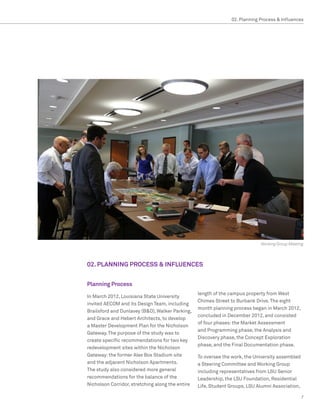
respect the American Society of
                                          Potential Stormwater Management for North Housing
Landscape Architect’s Sustainable
Sites Initiative Guidelines should be
referenced:

http://www.sustainablesites.org
These guidelines are more
comprehensive for site issues
and cover things like soils, water
and landscape maintenance more
significantly than LEED.

Here are some potential opportunities
for sustainable strategies for the
Nicholson Corridor beyond buildings
and from a site perspective that
                                                                               Bioretention
should be evaluated as the project
progresses:

•	 Recycling demolished building
   materials
•	 Minimizing impervious cover
•	 On site storm water management
   – BMP’s, surface treatments for

                                                                                       103
Volume 1: Master Plan


                                         Solar Parking Shelters

  stormwater runoff, permeable
  paving systems, improve water
  quality
•	 Reducing Heat Island through tree
   plantings
•	 Light pollution reduction
•	 Renewable energy – solar panel
   covering for parking bays
•	 Systems that expand rooting                       Silva Cell
   volume for trees in an urban
   situation
•	 Minimizing soils disturbance during
   construction and soil management
   plans to create healthy soil
•	 Water conserving water features
•	 A comprehensive maintenance
   program


104
08. Design  Development Guidelines


                                                                                  Optimize natural light and indoor air quality

Architectural Sustainability            •	 Protect and conserve water;
Sustainable design seeks to reduce      •	 Enhance indoor environmental
negative impacts on the environment,       quality; and
and the health and comfort of
                                        •	 Optimize operational and
building occupants, thereby
                                           maintenance practices.
improving building performance. The
basic objectives of sustainability      Building design should integrate best
are to reduce consumption of non-       practices for sustainability as defined
renewable resources, minimize           by ASHREA 198.1 or the USGBC LEED
waste, and create healthy, productive   standards for new construction.
environments.

Sustainable design principles include
the ability to:

•	 Optimize site potential;
•	 Minimize non-renewable energy
   consumption;
•	 Use environmentally preferable
   products;


                                                                                                                           105
09   IMPLEMENTATION
Phasing
09. Implementation


09. IMPLEMENTATION

Phasing                                            •	 Phase 4, opening in 2017 will complete
                                                      the construction of the west side student
The project implementation is broken into
                                                      housing including a third 290 bed student
multiple phases to facilitate staging and
                                                      apartment building [Zone C].
provide some flexibility for the market demand.
The project financials assume a build out to      •	 Phase 5, opening in 2017 will include the
be accomplished over the next five years from        completion of the mixed use center if it is not
2013 through 2017, though the actual timing          completed in Phase 3.
may vary based on market and university
housing demand, funding, and developer            Site Costing
interest.                                         The method for site costing began with
                                                  dividing the project areas up into phases and
•	 Phase 1, opening in 2016 will include the
                                                  developing site costs for each phase. Creating
   Foundation building [Zone A]. This will
                                                  the phasing was vetted with the University so
   proceed as an independent project and not
                                                  that demolition of old buildings works with the
   be a part of the Nicholson Gateway project
                                                  University’s plan to manage housing relocation
   financial model. Since design is already
                                                  and the construction of new buildings. The
   underway and the project will not require
                                                  estimates were for construction cost only and
   State or University funding, it is likely to
                                                  don not include escalation, administration,
   finish ahead of the rest of the project.
                                                  permits, design or engineering soft costs.
•	 Phase 2, opening in 2015 will include          The estimates do include for each phase a
   the demolition of a portion of Nicholson       percentage of construction cost for contractors
   Apartments and replacement with interim        General Conditions, Bonds  Insurance
   surface parking [Zone F] which can be          and Mobilization. At planning level a 20%
   utilized for game day events; as well as a new contingency for lack of detail was carried in the
   290 bed student apartment building [Zone       site costs for all phases. The costs included
   D2], and the demolition of existing housing    rough area takeoffs and industry standard
   structures Zone D1.                            unit costs for Site Preparation, Demolition,
•	 Phase 3, opening in 2016 will include a        Infrastructure, Excavation and Grading
   second 290 bed student apartment building      (including imported fill costs to bring the site
   [Zone D1] and the demolition of the student    out of the flood plain), Paving and Surfacing,
   apartments in Zone C. This phase might         Landscape Improvements, and allowances
   also include the construction of a 1,000 car   for Signage and Amenities. The estimate
   parking deck [Zone F] depending on State       spreadsheets are included in the appendix of
   Funding availability. Likewise, this phase     this document.
  might include either a portion or the entire
  mixed use center [Zone E and F] depending
  on developer interest and market demand.
  For the purposes of the project financial
  model, only the portion of the mixed use
  center in Zone E was assumed for this phase.


                                                                                                  109
Volume 1: Master Plan


Funding
Financial Implications
The financial program builds from the
following core market drivers:

•	 The student housing component
   has apparent demand with
   “relatively” low risk.
•	 The mixed use retail component has
   the clear potential to be successful,
   allowing for the timing of market
   response and tenant quality, both of
   which are project risks.
•	 The program includes a significant
   amount of office space, a majority
   of which is proposed for University
   identified needs.
•	 The program includes “University
   Affiliated / Market Rate
   Apartments” that would only be
   available for rent to University
   related personnel.
•	 The project’s parking strategy
   includes a mix of surface lots
   and parking structures. While
   surface lots have the potential
   to be revenue positive, higher
   densities will drive need for parking
   structures, which are generally
   more expensive to build and
   operate.
•	 With clear linkage between parking
   and game day income, the decision
   of who builds, owns, and operates
   these parking facilities is an
   important detail.


110
09. Implementation


As part of the planning effort for Nicholson Gateway, the The Design Team also
evaluated preliminary financial implications associated with the market-tested
program highlighted below.


Phasing                                 Units

Zone C / D1 / D2 - Student Housing      870 Beds

Zone A / F - Office Space (Sq Ft)       110,100 SF

Zone E - Market Apartments              89 Units

Zone E - Retail Space (Sq Ft)           79,400 SF

Zone E / F Parking                      1,894 spaces

Zone F: Retail Space                    58,300 SF

Zone E / F- Upper class Apartments      370 Beds


                                                                                               111
Volume 1: Master Plan


The modeling effort is based                •	 Current 2012 rents for retail,             partners.
on current decisions regarding                 office, and residential activities,      •	 The model includes an allowance
the development program and                    which are inflated to future years          for replacement reserves, which
assumptions. Given that several                of occurrence, based on proposed            begin in the 2nd year of occupancy
critical assumptions are still “in play”,      absorption.                                 for each component. The reserve is
this section of the report should be        •	 No allowances are made for                  assumed at 5% of gross revenue on
considered current as of December              developers who are “bought out”             an annual basis.
17, 2012. Changes made after this              during the 30-year holding period; a     •	 The model identifies the
date have not been incorporated.               long-term hold is presumed.                 need for either local or state
The financial model is conceptual           •	 Assumptions have been made for              financial capacity (incentives or
in nature, and subject to the Design           site infrastructure costs as well           appropriation) to fund specific
Team’s limiting terms and conditions.          as improvements to the Nicholson            infrastructure costs, related
It has been built from takeoffs                Corridor. Specific cost estimates           to public site improvements,
for gross floor area and site size,            shown on the following pages                enhancements to Nicholson, or
as defined in the evolving Master              generally include streetscape and           development of parking assets.
Development Plan. As such, precise             pedestrian improvements along               At present, the State of Louisiana
floor plans have not been developed,           Nicholson Drive, but do exclude             has not committed a specific
so the team has made assumptions               potential costs related to proposed         appropriation to this project.
for efficiency of building, unit, and          traffic rotaries.                   •	 The model makes no assumption
parking space layouts. Mixed use            •	 Mixed use construction costs are       for the use of New Markets Tax
program revenue assumptions were               assumed at a premium to single use     Credits, which if used, would
developed by the Design Team;                  (i.e. student housing) construction    otherwise reduce project equity
Student housing assumptions were               costs.                                 requirements.
developed by Brailsford  Dunlavey
                                            •	 The phase II retail program is           •	 The “market apartments” presume
(BD).
                                               speculative                                 that renters will be university
The financial model presumes a              •	 The Master Development Plan                 affiliated
generalized “master developer”                 includes a definitive pedestrian         •	 Year 1 of the project begins as of
ownership structure, with LSU                  connection from the mixed use               July 1, 2013
participating directly or indirectly           Plaza to North Stadium Drive. This       •	 A two year construction period is
(through a non-profit foundation),             pedestrian route creates ample              assumed for all project elements
along with one or more developers.             opportunities for sponsorship and
The intent of the model is simple              donation opportunities; these have
- to arrive at an estimate of net              not been calculated, but could
operating income after debt service            be significant to project financial
and assumed equity payouts to                  performance.
participating developers payable
                                            •	 The model presumes that a
to the University and / or a related
                                               developer will contribute equity and
non-profit entity. The analysis also
                                               debt to the project (25/75 split), and
stresses that the university may
                                               receive a return currently estimated
choose to move forward with this
                                               at 7% of invested project equity on
project for non-financial reasons,
                                               an annual basis over the forecast
which will be summarized below.
                                               period. Looking forward, this
A number of critical assumptions               percentage is a critical question,
shaped the effort:                             which will need to be negotiated
                                               with prospective developer

112
09. Implementation


Outputs                          2013     2014     2015     2016     2017        2018        2019

Absorption                       Year 1   Year 2   Year 3   Year 4   Year 5      Year 6      Year 7

Zone C/D1/D2 – Student Housing     0        0       290      580      870         870         870

Zone E/F - Apartments              0        0        0       203      203         369         369

Zone E/F - Apartments              0        0        0       89       89          89          89

Zone E/F – Office                  0        0        0        0        0        50,100      50,100

Zone E/F – Retail                  0        0        0      79,400   79,400     137,700     137,700

Zone E/F Parking                   0        0       468      842      842        1,426       1,426

                                                                     Baseline Model Absorption Summary


                                                                                                     113
Volume 1: Master Plan


                                                                                            2012 Project
                                                                    2012 Project Site                           2012 Project
 Scenario     Description                                                                    Nicholson
                                                                  Infrastructure Costs                       Development Costs
                                                                                         Improvement Costs

              No state appropriation, all infrastructure
              included btw Chimes  Skip Bertman, all
 Scenario 1   structured parking, Zone E as university                $12,423,392           $3,403,983         $198,091,925
              affiliated apts, deduct 250 parking spaces from
              parking cash flow for athletics


              Excludes East Side Project / no state
 Scenario 2                                                           $12,423,392           $3,403,983         $137,602,145
              appropriation / All infrastructure included


              Excludes East Side Project / Includes $25 million
 Scenario 3   state appropriation for Structured parking             $12,423,392               $0             $176,468,702
              75% of Nicholson Improvements


                                                                    Development Scenarios and Estimated Development Costs


The Design Team used the above              the South Alex Box Lot or elsewhere.
phasing program to develop                  To increase revenue, the 89 university
a baseline scenario and three               affiliated market rate housing units
alternatives; each is described below:      are converted to 267 beds of student
                                            housing- three beds per unit. No
Scenario 1: This option includes the
                                            state appropriation is assumed.
full build-out program including
                                            Replacement parking for football
structured parking as well as the
                                            parking (250 spaces) is assumed to
proposed Nicholson Drive streetscape
                                            cash flow to Athletics and so it is
and roadway improvements for the
                                            deducted from project revenue.
segment between West Chimes
Street and Skip Bertman Drive. No           Scenario 3: This option is the same
state appropriation is assumed.             as Scenario 1 except that it includes
Replacement parking for football            a state appropriation of $24,183,802
parking (250 spaces) is assumed to          which is applied to the Zone F
cash flow to Athletics and so it is         parking deck and Nicholson Drive
deducted from project revenue.              improvements. Replacement parking
                                            for football parking (250 spaces) is
Scenario 2: This option assumes all
                                            assumed to cash flow to Athletics and
surface parking and eliminates the
                                            so it is deducted from project revenue.
two parking structures as well as the
program located in zone E. Additional
parking would be required offsite in

114
09. Implementation


                            A. Debt Service Interest @ 5%                             B. Debt Service Interest @ 6%

                Year 10        Year 10                                    Year 10        Year 10
              Cumulative     Cumulative       Year 10        Year 10    Cumulative     Cumulative       Year 10        Year 10
              NOI Before      NOI After      Return on      Return on   NOI Before      NOI After      Return on      Return on
                Debt to        Debt to         Cost          Equity       Debt to        Debt to         Cost          Equity
                Project      University                                   Project      University


Scenario 1    $98,124,600    $3,992,969       46.3%           7.5%      $98,124,600    -$3,787,192      46.3%           -7.1%


Scenario 2    $81,427,500    $10,041,076      56.6%          27.9%      $81,427,500    $4,299,015       56.6%          12.0%


Scenario 3    $98,317,500    $10,894,273       52%           23.2%      $98,317,500    $3,847,740       52.3%           8.2%


                                                            Current Estimated Financial Outcomes from the Noted Scenarios


Cumulative Net Operating Income            return on cost reflects a return on
(NOI) before debt service reflects         the total cost of the project (NOI in
total project cash flow, before debt       relation to total project cost). The
service, replacement reserves, or          10-year return on equity reflects
equity payouts to developer partners.      total equity invested in relation to
Cumulative NOI after debt reflects         net operating income after debt
estimates of residual cashflow             service. The analysis shows the
payable to the university and /            financial impact of increasing debt
or its affiliates, after debt service,     service interest costs (from 5% to 6%
payments to project partners, and          on an annualized basis) which is an
replacement reserves. The 10-year          eventual likelihood.


                                                                                                                                115
Volume 1: Master Plan


Deal Structure                            •	 Amplify the game day experience           threshold of net operating income,
Recommendations                              and more importantly, increase            while another target could be to
                                             capture of game day revenues, in          achieve a specific percentage
As LSU plans for the revitalization of
                                             part by creating new opportunities        of upper class living on campus.
the Nicholson Corridor, discussions
                                             for sponsorship and advertising,          Other softer targets relate to the
regarding the ownership structure
                                             as well as provision of premium           revitalization of the Corridor and
that will be responsible for project
                                             parking facilities.                       improvement of campus image.
implementation move to center stage.
The discussion begins with broader        •	 Increase University endowment and       Potential Deal Structures
strategic considerations:                    enhance University recruitment          Although there are a variety of deal
                                          •	 Improve pedestrian connectivity         structures available in the market,
•	 Property Ownership: The Nicholson
                                             and safety across Nicholson             our experience points to four specific
   Corridor is located on state-owned
                                                                                     approaches for consideration that
   land that cannot be sold. The          •	 Alleviate space constraints at the
                                                                                     are most commonly associated with
   University should seek partners           core of campus, providing space
                                                                                     campus edge initiatives such as the
   that are comfortable with ground          for university functions that can be
                                                                                     Nicholson Gateway development.
   lease structures.                         relocated.
•	 Design  Program Standards:            Beyond the university’s identified         Self-Development: The Institution
   The University should seek             goals, the optimal ownership               can choose to self-develop the
   partners that recognize and can        structure will need to:                    project, being 100% responsible for
   demonstrate the importance                                                        achieving project financing, creating
                                          •	 Maximize University flexibility         design aesthetics, determining
   of blending project aesthetics
   with campus architecture. The          •	 Ensure the University’s                 construction quality, defining phasing
   University should view Nicholson          participation in project cash flows     and sequencing strategies, selecting
   as an extension of the campus that                                                a delivery method, and ultimately
                                          •	 Allow the Institution to maintain
   should transition to the campus                                                   delivering the projects. Additionally,
                                             effective project control
   edge with a “university feel.” As                                                 the Institution would receive 100%
                                          •	 Insulate the university from day to     of the benefits from any financial
   such, the University should have
                                             day project decisions and liability     profitability realized by each
   approval authority over the exterior
   design and landscape concepts for      Ultimately, our experience suggests        project. For this approach, while the
   the development.                       that two core questions will need to       University would have control and
                                          be answered by LSU leadership:             benefit over the entire project, the
•	 Affinity: The University should seek
                                                                                     University would also have 100% of
   a partner that values its mission      1.	The level of risk tolerance that        the financial commitment required to
   and hopes to further that mission         the University, its auxiliaries, and    implement these projects and 100%
   through this development and              related foundations are prepared to     of the risk associated with those
   partnership opportunity.                  accept in prioritizing the objectives   commitments. Our experience would
Considerations build from a clear            of the Nicholson Gateway                suggest that these realities have
understanding of University                  Corridor. Decisions, such as Risk       tended to discourage institutions
objectives:                                  versus Control, Mission versus          from choosing the Self Development
                                             Profitability, and Commitment           option, because the institution’s debt
•	 Generate incremental cash                 versus Partnership, will need to be     capacity and credit rating are subject
   flow from the Nicholson project           prioritized by LSU.                     to exposure with developments of
   to support graduate student
                                          2.	The level of risk tolerance relates     this size and scale. Most institutions
   enrollment growth.
                                             closely to judgment of what set of      choose to utilize credit ratings and
•	 Expand on-campus housing                  targets are used to define project      debt capacity for projects that are
   opportunities for upper class             success. For example, one target        more closely tied to the institution’s
   students.                                 could be defined as a specific          core mission.
116
09. Implementation


Developer Master: At the other            to the University is that it reduces       assume by allowing the University
extreme, the Institution can choose to    the development risk by sharing it         to maintain control. However, to the
outsource 100% of the development         with the third party developer. The        extent that the developer partners’
to a third party through a ground lease   disadvantage of this structure is that     risk is reduced by strong university
in exchange for an annual ground          it reduces the University’s long-term      linked demand, this challenge can
lease payment to be negotiated.           financial potential by sharing the         be balanced. The added challenge
The third party would control 100%        long-term return with the third party      with this approach is the extent to
of the project decisions, including       developer.                                 which the university is able to secure
design, construction quality, tenant                                                 funding for infrastructure projects
                                          Similarly, the Master Developer model
mix, and delivery method. The third                                                  from local and state sources.
                                          presumes the formation of an LLC
party would also be responsible for
                                          (either for profit or not-for-profit)      Recommended Structure
providing project financing. While the
                                          with defined roles for the Institution     The project team recommends
Institution would have the ability to
                                          and one or more developers, as             that LSU further evaluate the
shape some of the project concepts
                                          well as the possible role for a non-       Master Developer structure for the
and set some minimum project design
                                          profit foundation. Once formed, the        Nicholson Gateway development.
standards, the third party will resist
                                          Master Developer would have the            Our experience suggests that the
extensive requirements unless they
                                          option to self-develop or syndicate        University would likely need to
are matched by financial resources.
                                          individual parcels of land within the      assume responsibility for a share
This approach provides the lowest
                                          defined development zone, based            of infrastructure costs and parking.
risk for the University because it is
                                          on an array of considerations. While       Developer partners would need to
not as exposed to credit rating risk or
                                          the Institution typically maintains        bring additional equity to the table
debt capacity usage. However, this
                                          approval authority over final              to support development of individual
scenario provides the lowest control
                                          development concepts, details, and         projects. Within the Master Developer
for the University regarding the design
                                          project execution process, they are        structure, the key is how profits after
and implementation; it also limits the
                                          also expected to secure funding for        debt service are allocated between
University’s upside financial potential
                                          infrastructure improvements. The           partners.
once the project reaches stabilized
                                          nature of this deal structure can allow
occupancy.
                                          for funds from state appropriation,
Our experience shows that there are       local tax-increment financing (TIF), as
two alternative models that fit in        well as other incentives, particularly
between the extremes. These models        New Markets Tax Credits. While the
are defined as a Master Partnership       Master Developer structure presumes
or a Master Developer:                    a continued significant presence
                                          of the institution throughout the
The Master Partnership structure
                                          development process, this approach
requires the official formation of a
                                          is also typically flexible as to the level
development partnership between
                                          of support - financially, physically,
the institution and a third party.
                                          and strategically – required by
In this scenario, the institution
                                          the development partner(s) to
and the third party partner each
                                          successfully implement the project.
contribute equity toward the project
and a partnership LLC is officially       The risks associated with the Master
formed. In a Master Partnership, the      Developer approach relate to the
institution and the third party share     difficulty of making the individual
the design, construction, financing,      projects work financially because
and implementation responsibilities.      third party partners may expect a
The advantage of this structure           higher return for the exposure they
                                                                                                                        117
Volume 1: Master Plan


118
09. Implementation


Next Steps                                 3.	 Sustain internal conversations          d.	 Consider the engagement
                                               regarding the university’s role in          of a firm to provide program
LSU will need to move forward on a
                                               the Nicholson Project. Elements             management services.
number of work efforts to sustain
                                               include:                               4.	 As planning guidance is being
project momentum. Elements
include:                                    a.	 Conduct further research on               firmed up, and the roles of
                                                best practices regarding the role         state and local government are
1.	 Finalize the Master Development                                                       clarified, the University will need
                                                and structure of deals pursued
    Plan and build consensus with                                                         to engage with the development
                                                by universities around the US.
    state leadership regarding several                                                    community.
                                                Specific emphasis should be
    key questions:
                                                placed on the evaluation of            a.	 Continue conversations with a
 a.	 Reach decisions regarding                  ground lease mechanisms that               sample of developers (local and
     ownership / responsibility for             have been effective in balancing           national) to evaluate capabilities
     Nicholson Drive. Discussions               risk, control, and rewards.                and interest.
     had focused on this road being         b.	 Finalize internal thinking             b.	 Initiate a RFI / RFQ process
     conveyed from state to local               regarding:                                 to test concepts with the
     control. Identified project needs
                                             i.	 The level of University control           development community
     for streetscape and traffic
                                                 that will be needed as part of the    c.	 Initiate an RFP process
     calming adjustments along
                                                 overall deal structure.                   to identify one or more
     Nicholson Drive logically flow
     from these discussions. The             ii.	 University expectations for              development partners.
     anticipated outgrowth requires               project performance metrics,
                                                                                      Responsibilities
     further clarity regarding the                both policy and financial (for
                                                                                      Clearly, specific roles and
     scale, structure, timing, and use            example, what is an acceptable
                                                                                      responsibilities will evolve out of the
     of proposed state appropriation              rate of return and over what
                                                                                      noted work efforts, with the University
     for the Nicholson Project.                   duration).
                                                                                      in position to make key strategic
2.	 Connect with city officials to build     iii.	 Clarify how project revenues       decisions that will dictate project
    support for the Nicholson project:             (parking / game day) will be       outcomes.
                                                   allocated / shared internally.
 a.	 Assign roles and responsibilities
                                            c.	 Continue conversations with
     regarding improvements to
                                                University affiliated foundations
     Nicholson Drive
                                                to evaluate their potential
 b.	 Access to local incentives                 role, capacity, and interest in
     (including tax increment                   participating in the project.
     financing), linked with broader            While a foundation role is
     regional benefits. Need for                not critical to the process,
     local incentive support is clearly         the analysis does suggest
     linked with the outcome of                 that potential fundraising,
     conversations regarding state              sponsorship, and donation
     appropriation.                             opportunities need to be better
                                                understood.


                                                                                                                           119
10   ACKNOWLEDGEMENTS
10. Acknowledgements


10. ACKNOWLEDGEMENTS

Nicholson Working Group:                               AECOM
Steve Waller – Residential Life (PS)		                 Steve Wilson
Kurt Keppler – Student Life			                         Tim Anderson
Mary Miles – Planning, Design,  Construction (PS)     Chris Brewer
Jason Soileau – Planning, Design,                     Paul Moore
Construction (PS)		                                    Jonathan McDowell
Jason Tolliver – University Auxiliary Services (PS)	   Robert Schmidt
Eddie Nunez – Athletics (PS)	                          Han Oul-Joo
Frank Miller – Tiger Athletic Foundation		             Suzanne Serna
D’Ann Morris – Chancellor’s Office		                   Doug Tichenor
Heath Price – FAS (PS)		                               Kaia Nesbitt
Marie Frank – Purchasing			                            Tracy Flecky
Jane Cassidy – Academic Affairs			
Taylor Cox – Student Government, Pres		                Brailsford and Dunlavey
Kelsey LeBlanc – RHA, President			                     Peter Isaac
Jeff Darby – Family/Graduate Housing	                  Wilson Jones
Gary Graham – Parking, Traffic 
Transportation	 (PS)		
                                                       Grace and Haber
Tony Lombardo – Facility Services
                                                       Jerry Hebert
Gina Dugas-LSU Foundation (PS)
                                                       Adam Fishbein
                                                       David Hebert
LSU Senior Leadership
LSU Foundation                                         Walker Parking
Tiger Athletics Foundation                             Rick Mobley
LSU Alumni Association
Facility Design and Development Committee
Budget Planning and Accounting Services
LSU Athletics
LSU Residential Life
Student Groups
University Auxiliary Services, Dining
City and State Facility and Traffic Agencies
FuturEBR
Campus Stakeholders
Local Elected Officials


                                                                                              123
APPENDIX
Appendix

APPENDIX
Development Program

NICHOLSON GATEWAY ‐ DEVELOPMENT PROGRAM
  10/10/2012

Phase 1‐ Foundation Developed‐ not in project financials; complete summer 2014
                            BLDG A‐1                    BLDG FOOT AREA (SF) FLOOR                                          BLDG NET AREA (SF)                                             PARKING SUPPLY    PARKING NEED          PARKING NOTES

   ZONE A                               retail                                                    2,000                 1                            2,000                                                              8    on‐street parking
  27,400 SF                        office (2‐4 FL)                                              15,000                  3                          45,000                                                             180       4 per 1,000sf
                                    office (1 FL)                                               13,000                  1                          13,000                                                              52       4 per 1,000sf
                                       TOTAL                                                                            4                           60,000                                                            232

Phase 5‐ University Developed‐ not in project financials; complete 1017 contingent on tennis court parking deck
                             BLDG B‐1                        BLDG FOOT AREA                  FLOOR          BLDG NET AREA (SF)                 BED UNITS                                  PARKING SUPPLY    PARKING NEED                      PARKING NOTES
   ZONE B                                                                                                                                       310 SF/BED
 124,700 SF          Under Grad.Student housing                                     31,600              4                       126,400                      408                                                      326     0.8 sp/bed 
                               TOTAL                                                                     4                         
                                                                                                                                  126,400                       408                                                   326

Phase 3‐ demolish housing 2016; replace with housing 2017
                             BLDG C‐1                   BLDG FOOT AREA                                     FLOOR           BLDG NET AREA (SF)                    BED UNITS                PARKING SUPPLY    PARKING NEEDS                     PARKING NOTES
                                                                                                                                                                  420 SF/BED
  ZONE C 
                          Grad/undergrad apartments                                             30,450                 4                         121,800                           290                                209    0.72 sp/bed 
 316,200 SF
                               Surface Parking                                                                                                                                                        239
                                   TOTAL                                                                                                           
                                                                                                                                                  121,800                       290                   239             209    in surface parking

Phase 2‐ demolish housing 2015; replace with housing 2016
                             BLDG D‐1                   BLDG FOOT AREA                                     FLOOR           BLDG NET AREA (SF)                    BED UNITS               PARKING SUPPLY     PARKING NEEDS                     PARKING NOTES
                                                                                                                                                                  420 SF/BED
  ZONE D1 
                          Grad/undergrad apartments                                             30,450                 4                         121,800                           290                                209    0.72 sp/bed 
 157,900 SF 
                               Surface Parking                                                                                                                                                        203
                                   TOTAL                                                                                                           
                                                                                                                                                  121,800                       290                   203             209    in surface parking

Phase 1‐ demolish housing and replace with surface parking; complete summer 2014; replace housing 2015
                             BLDG D‐2                    BLDG FOOT AREA      FLOOR      BLDG NET AREA (SF)                                                       BED UNITS                PARKING SUPPLY    PARKING NEEDS                     PARKING NOTES
                                                                                                                                                                  420 SF/BED
  ZONE D2 
                          Grad/undergrad apartments                                             30,450                 4                         121,800                           290                                209    0.72 sp/bed  
 163,600 SF
                               Surface Parking                                                                                                                                                        206
                                   TOTAL                                                                                                           
                                                                                                                                                  121,800                       290                   206             209


Phase 2a‐  first portion of mix use discrict, 2016 or later  (depending on developer interest and available game day parking).
                                BLDG E‐1                       BLDG FOOT AREA       FLOOR      BLDG NET AREA (SF)      BED UNITS                                                                            PARKING NEED          PARKING NOTES
                                                                                                                                                                  400 SF/BED
                          Upperclassmen  Apartments                                             14,000                 3                             42,000                      105                                   84     0.8 sp/bed  (Zone F)
                                     retail                                                     21,100                 1                             21,100                      201                                   84       4 sp/1,000sf (Zone F)
                                    TOTAL                                                                                                            63,100                       306                                 168
                                   BLDG E‐2                              BLDG FOOT AREA                    FLOOR            BLDG NET AREA (SF)                   BED UNITS                                  PARKING NEED          PARKING NOTES
                                                                                                                                                                  400 SF/BED
                          Upperclassmen  Apartments                                             13,000                 3                             39,000                        98                                  78     0.8 sp/bed  (Zone F)
                                     retail                                                     21,300                 1                             21,300                      218                                   85       4 sp/1,000sf (Zone F)
                                    TOTAL                                                                                                            60,300                       632                                 163
                                   BLDG E‐3                              BLDG FOOT AREA                    FLOOR            BLDG NET AREA (SF) HOUSING UNIT                                                 PARKING NEED          PARKING NOTES
  ZONE E                                                                                                                                                         1200 SF/BED
 210,500 SF                       Market housing                                                27,700                 3                             83,100                        69                                 104     1.5 sp/unit (Zone E parking deck)
                                      retail                                                    37,000                 1                             37,000                      534                                  148       4 sp/1,000sf (Zone F)
                                     TOTAL                                                                                                         
                                                                                                                                                  120,100                    1,207                                    252
                                    BLDG E‐4                             BLDG FOOT AREA                    FLOOR            BLDG NET AREA (SF) HOUSING UNIT                                                 PARKING NEED          PARKING NOTES
                                                                                                                                                                 1200 SF/BED
                          Market housing‐ townhouse                                               8,000                3                             24,000                        20                                   30    1.5 sp/unit (Zone E parking deck)
                                    TOTAL                                                                                                          
                                                                                                                                                  144,100                         20                                  282
                          BLDG E‐5 Parking Structure*                    BLDG FOOT AREA                    LEVELS           BLDG NET AREA (SF)                                        PARKING SUPPLY         TOTAL NEED           PARKING NOTES

                               Structured Parking                                               27,000              4.5                          121,500                                              374
                                                                                                                                                                           134 Zone E‐ market housing demand
                                                                                                                                                                           232 Zone A‐ office parking demand
                                   TOTAL                                                                                  24,000                      374                  366
                  * Note: The E‐5 parking deck could be avoided if the majority of the office parking was accommodated across the street in the South Alex Box lot. A surface lot in place of the E‐5 deck 
                    and E‐4 townhouses would accommodate 140 cars, which would support the market housing (104 spaces) and a portion of the office (35 spaces).

Phase 1‐ demolish housing and replace with surface parking; complete summer 2014
   ZONE F               SURFACE PARKING                BLDG FOOT AREA (SF) FLOOR                        BLDG NET AREA (SF)                                                               PARKING SUPPLY   PARKING NEED             PARKING NOTES
  (surface              Surface parking lot                                    157,000              1                       157,000                                                                   468           480      for Zone E need‐ retail, student housing
  parking)                    TOTAL                                                                  1                   31,557,000                                                                   468
 188,200 SF


                                                                                                                                                                                                                                                                    127
Volume 1: Master Plan


 Phase 2b‐final portion of mixed use district; 2016 or later (depending on developer interest and available game day parking).
                               BLDG F‐1                    BLDG FOOT AREA (SF) FLOOR          BLDG NET AREA (SF)      BED UNITS                                                                                 PARKING NEED          PARKING NOTES
                                                                                                                                                                    450 SF/BED
                        Upperclassmen Apartment                                       15,000
                                                                                               3                          45,000                      100                                                                  80     0.8 sp/bed
                                  retail                                              21,300
                                                                                               1                          21,300                           ‐                                                               85       4 sp/1,000sf
                                  office                                                          ‐
                                                                                                ‐                                     ‐                           ‐                                                                 4 sp/1,000sf
                                 TOTAL                                                         4                           66,300                            ‐                                                            165    parks in zone F structure
                                BLDG F‐2                     BLDG FOOT AREA (SF) FLOOR            BLDG NET AREA (SF)                        BED UNITS                                                           PARKING NEED          PARKING NOTES
                                                                                                                                                                    450 SF/BED
                        Upperclassmen Apartment                                       10,000                       3                              30,000                        67                                         53     0.8 sp/bed
                                  retail                                              17,000                       1                              17,000                           ‐                                       68       4 sp/1,000sf
  ZONE F (full                    office                                                          ‐                 ‐                                        ‐                           ‐                                          4 sp/1,000sf
   build out)                    TOTAL                                                                                                            47,000                            ‐                                     121    parks in zone F structure
  188,200 SF                    BLDG F‐3                     BLDG FOOT AREA (SF)                       FLOOR             BLDG NET AREA (SF)                                                                     PARKING NEED          PARKING NOTES

                                  retail                                              20,000                       1                             20,000                                   ‐                                 80      4 sp/1,000sf
                                  office                                              16,700                       3                              50,100                                  ‐                               200       4 sp/1,000sf
                                 TOTAL                                                                                                            70,100                                                                  280    parks in zone F structure
                        BLDG F‐4 Parking Structure             BLDG FOOT AREA                          LEVELS            BLDG NET AREA (SF)                                                   PARKING SUPPLY     TOTAL NEED           PARKING NOTES

                     STRUCTURE PARKING ( for Zone F)                                   68,400                   5.0                           342,000                                                   1,052             567         Zone E parking demand
                                                                                                                                                                                                                          480         Zone F Parking demand
                            SURFACE PARKING
                                                     TOTAL                                                                                        50,100                                                1,052            1,047


                            Rate Assumptions                        gsf bldg/bed                      parking/bed
                  Graduate Apartment                                     450                                        1
                  Upper Classmen Apartment                               425                                        1
                  60/40 upperclass/grad mix                              420                                        1

                                                                   gsf bldg/unit                      parking/unit
                  market housing (1, 2 and 3 bed units)                1,200                                    1.5


128
Appendix


Site Cost Estimate
LSU Nicholson Gateway Phased Sitework Cost Estimate

  Refer to the phasing diagrams and other information in the implementation section to correlate the
  costing information with the zones.

Notes:
1.	The	following	estimate	is	for	construction	costs	only	and	does	not	include	preconstruction	administration,	permits,	soft	costs	inc.	design	or	engineering	costs.	
2. The cost estimate is intended as a tool for budgeting and fund raising

LSU Nicholson Gateway
Baton Rouge, LA
Phased Development Estimate


Item                                                                       Notes                                 Qty           Unit        $/Unit             Total

Zone C
         General                                                                                                                                                 $150,990
               General	Conditions                                                                                            %	of	Base             3%             $68,632
               Bonds	and	Insurance                                                                                           %	of	Base          1.50%             $41,179
               Mobilization                                                                                                  %	of	Base          1.50%             $41,179

         Site Preparation                                                                                                                                         $10,000
                 Tree	Protection                            Protection	and	Maintenance                                 20       EA              200.00             $4,000
                 Construction	Fencing                                                                               3,000       LF                2.00             $6,000

         Demolition                                                                                                                                              $266,240
                Utility	Removal	and	Capping                                                                             1       LS            5,000.00             $5,000
                Building	Demolition                         Existing	Apt	Buildings                                 86800        SF                2.00           $173,600
                Clearing	and	Grubbing                       Landscape	and	Paving                                  438,200       SF                0.20            $87,640

         Infrastructure                                                                                                                                          $451,500
                 Water	Taps                                 2	lines	plus	meter                                          2      EA           1,000.00              $2,000
                 Water	Line	Extensions                      8	                                                        100      LF              50.00              $5,000
                 Storm	Water	System                         600'x15	avg	dia.	PP	with	6	CB-01s                           1      LS          42,000.00             $42,000
                 Fire	Hydrants                                                                                           2      EA             750.00              $1,500
                 Fire	Service	Line                          8                                                           1      LS           2,000.00              $2,000
                 Electric	Service                                                                                        1      LS           5,000.00              $5,000
                 Sewer	Service                              8                                                           1      LS           6,000.00              $6,000
                 Gas	Service                                2                                                           1      LS           3,000.00              $3,000
                 Site	Drainage	and	Erosion	control          Above	ground	grading                                         1      LS          35,000.00             $35,000
                 Street,	Parking		Security	Lighting        Fixtures	ave	50	feet	o.c.                                   70      EA           5,000.00            $350,000

         Excavation and Grading                                                                                                                                   $64,000
               Rough	Grading                                Fill	2'		to	above	flood	level                           8,000       CY                8.00            $64,000

         Paving and Surfacing                                                                                                                                    $852,500
                Roads	and	Parking	paving                    Includes	Curb	and	Gutter                               97,000       SF                7.50           $727,500
                Specialty	Paving	Veh                        Crosswalks                                                  0       SF               15.00                 $0
                Specialty	Paving	Ped                        Plaza	Areas                                                 0       SF               12.00                 $0
                Standard	Walkway                            Concrete	Sidewalks                                     25,000       SF                5.00           $125,000

         Landscape Improvements                                                                                                                                  $427,500
               Trees                                        Trees                                                      50       EA              500.00            $25,000
               Plaza	Trees	                                 Trees		Grates                                              0       EA            1,500.00                 $0
               Landscape                                    Lawn	and	groundcover                                  217,000       SF                1.50           $325,500
               Gardens	                                     More	Intense	landscape                                 11,000       SF                7.00            $77,000

         Fencing                                                                                                                                                  $20,000
                Security	Fence                              At	Housing	Quads                                           200      LF              100.00            $20,000

         Signage and Site Amenities                                                                                                                               $45,000
               Allowance                                                                                                 1      LS          45,000.00             $45,000


                                                            Sub-total Zone C                                                                                   $2,287,730

                                                            Master	Plan	Contingency	20%                                                                      $457,546.04

                                                            Base Construction Cost                                                                             $2,745,276


                                                                                                                                                                            129
Volume 1: Master Plan


LSU Nicholson Gateway Phased Sitework Cost Estimate


Zones D1  D2
      General                                                                                                         145,798.42
              General	Conditions                                                             %	of	Base         3%       $66,272
              Bonds	and	Insurance                                                            %	of	Base      1.50%       $39,763
              Mobilization                                                                   %	of	Base      1.50%       $39,763

       Site Preparation                                                                                                  $6,000
               Tree	Protection                       Protection	and	Maintenance         10      EA         200.00        $2,000
               Construction	Fencing                                                  2,000      LF           2.00        $4,000

       Demolition                                                                                                      $123,120
              Utility	Removal	and	Capping                                                0      LS            0.00           $0
              Building	Demolition                    Existing	Apt	Buildings         44000       SF            2.00      $88,000
              Clearing	and	Grubbing                  Landscape	and	Paving          175,600      SF            0.20      $35,120

       Infrastructure                                                                                                  $463,250
               Water	Taps                            2	                                4       EA        1,000.00       $4,000
               Water	Line	Extensions                 8	                              100       LF           50.00       $5,000
               Storm	Water	System                    1250'x18dia	+	11	CB-01s           1       LS       90,750.00      $90,750
               Fire	Hydrants                                                            2       EA          750.00       $1,500
               Fire	Service	Line                     8                                 2       EA        2,000.00       $4,000
               Electric	Service                                                         2       EA        5,000.00      $10,000
               Sewer	Service                         8                                 2       EA        6,000.00      $12,000
               Gas	Service                                                              2       EA        3,000.00       $6,000
               Site	Drainage	and	Erosion	control                                        1       LS       30,000.00      $30,000
               Street,	Parking		Security	Lighting   Fixtures	ave	50	feet	o.c.         60       EA        5,000.00     $300,000

       Excavation and Grading                                                                                           $64,000
             Rough	Grading                           Fill	to	above	flood	level       8,000      CY            8.00      $64,000

       Paving and Surfacing                                                                                           $1,032,500
              Roads	and	Parking	paving               Includes	Curb	and	Gutter      121,000      SF           7.50      $907,500
              Specialty	Paving	Veh                   Crosswalks                          0      SF          15.00             $0
              Specialty	Paving	Ped                   Plaza	Areas                         0      SF          12.00             $0
              Standard	Walkway                       Concrete	Sidewalks             25,000      SF           5.00      $125,000

       Landscape Improvements                                                                                          $299,399
             Trees                                   Trees                              60      EA          500.00      $30,000
             Plaza	Trees	                            Trees		Grates                      0      EA        1,500.00           $0
             Landscape                               Lawn	and	groundcover          179,599      SF            1.50     $269,399
             Gardens	                                More	Intense	landscape         20,000      SF            7.00     $140,000

       Fencing                                                                                                          $30,000
              Security	Fence                         At	Housing	Quads                 300       LF         100.00       $30,000

       Signage and Site Amenities                                                                                       $45,000
             Allowance                                                                  1       LS       45,000.00      $45,000


                                                     Sub-total Zones D1  D2                                          $2,209,067

                                                     Master	Plan	Contingency	20%                                     $441,813.38

                                                     Base Construction Cost                                           $2,650,880


130
Appendix


LSU Nicholson Gateway Phased Sitework Cost Estimate


Zone E
         General                                                                                                                $223,213
               General	Conditions                                                                    %	of	Base          3%      $101,460
               Bonds	and	Insurance                                                                   %	of	Base       1.50%       $60,876
               Mobilization                                                                          %	of	Base       1.50%       $60,876

         Site Preparation                                                                                                         $6,800
                 Tree	Protection                       Protection	of	Existing	Oak	Trees          7      EA          200.00        $1,400
                 Construction	Fencing                                                        2,700      LF            2.00        $5,400

         Demolition                                                                                                              $85,000
                Utility	Removal	and	Capping                                                      0      LS             0.00           $0
                Building	Demolition                    Existing	Apt	Buildings                    0      SF             2.00           $0
                Clearing	and	Grubbing                  Existing	Landscape                  425,000      SF             0.20      $85,000

         Infrastructure                                                                                                         $708,500
                 Water	Taps                            2	                                      7       EA         1,000.00       $7,000
                 Water	Line	Extensions                 8	                                    600       LF            50.00      $30,000
                 Storm	Water	System                    1600'x18	dia	+	15	CB-01                 1       LS       118,000.00     $118,000
                 Fire	Hydrants                                                                  4       EA           750.00       $3,000
                 Electric	Service                                                               1       LS        30,000.00      $30,000
                 Sewer	Service                         8	plus	manholes                         1       LS        60,000.00      $60,000
                 Gas	Service                                                                    6       EA         3,000.00      $18,000
                 Site	Drainage	and	Erosion	control                                              1       LS        42,500.00      $42,500
                 Traffic	Signal	Improvements                                                    1       EA       150,000.00     $150,000
                 Street,	Parking		Security	Lighting   Fixtures	ave	50	feet	o.c.               40       EA         5,000.00     $200,000
                 Event	Infrastructure                  Utilites	and	communication               1       LS        50,000.00      $50,000

         Excavation and Grading                                                                                                 $120,000
               Rough	Grading                           Fill	2'	to	above	flood	level         15,000      CY             8.00     $120,000

         Paving and Surfacing                                                                                                  $1,591,500
                Roads	and	Parking	paving               Concrete	Includes	Curb	and	Gutter    30,000      SF            7.50      $225,000
                Specialty	Paving	Veh                   Roadways                             37,000      SF           15.00      $555,000
                Specialty	Paving	Ped                   Plaza	Areas                          62,000      SF           12.00      $744,000
                Standard	Walkway                       Concrete	Sidewalks                   13,500      SF            5.00        $67,500
                Temp	Parking                           Grading	and	Gravel                  180,000      SF            0.50        $90,000

         Landscape Improvements                                                                                                 $132,000
               Trees                                   Trees                                    30      EA           500.00      $15,000
               Plaza	Trees	                            Trees		Grates                           48      EA         1,500.00      $72,000
               Landscape                               Lawn	and	groundcover                 30,000      SF             1.50      $45,000
               Gardens	                                More	Intense	landscape                4,000      SF             7.00      $28,000

         Fencing                                                                                                                      $0
                Security	Fence                         At	Housing	Quads                         0       LF          100.00            $0

         Signage and Site Amenities                                                                                             $600,000
               Allowance                                                                        1       LS       100,000.00     $100,000
               Water	Feature	/	Art	Feature                                                      1       LS       500,000.00     $500,000

                                                       Sub-total Zone E                                                        $3,382,013

                                                       Master	Plan	Contingency	20%                                            $676,402.57

                                                       Base Construction Cost                                                  $4,058,415


                                                                                                                                            131
Volume 1: Master Plan


LSU Nicholson Gateway Phased Sitework Cost Estimate


Zone F Public Realm additions to Zone E

Note:	Assume	all	infrastructure	will	be	in	place	from	Zone	E	improvements	to	save	costs	and	temp	pads	will	be	put	in	place	for	future	bldgs

        General                                                                                                                                         $22,118
              General	Conditions                                                                                          %	of	Base              3%     $10,054
              Bonds	and	Insurance                                                                                         %	of	Base           1.50%      $6,032
              Mobilization                                                                                                %	of	Base           1.50%      $6,032

        Paving and Surfacing                                                                                                                           $270,000
               Specialty	Paving	Veh                       Roadways                                               6,000       SF               15.00     $90,000
               Specialty	Paving	Ped                       Plaza	Areas                                           15,000       SF               12.00    $180,000

        Landscape Improvements                                                                                                                          $18,000
              Plaza	Trees	                                Trees		Grates                                             12      EA           1,500.00      $18,000

        Signage and Site Amenities                                                                                                                      $25,000
              Allowance                                                                                               1      LS          25,000.00      $25,000

                                                          Sub-total Zone F                                                                             $335,118

                                                          Master	Plan	Contingency	20%                                                                 $67,023.55

                                                          Base Construction Cost                                                                       $402,141


132
Appendix

Cost Estimate for Nicholson Drive Improvements
LSU Nicholson Gateway

New Signaled Intersection @ Chimes

Description                                   Quantity                           Unit    Unit Price       Price
New Intersection Lighting
  Controller                                           1                    LS            $15,000.00      $15,000.00
  Signal Heads                                         6                    EA             $1,500.00       $9,000.00
  Mast Arms (30 feet)                                  2                    EA            $15,000.00      $30,000.00
  Service                                              1                    LS             $1,000.00       $1,000.00
  Wiring  Ped Detection                               1                    LS            $10,000.00      $10,000.00
Handicap Ramps                                         4                    EA             $1,500.00       $6,000.00
Sidewalk                                             300                    SF                 $5.00       $1,500.00
Special Pavement at Crosswalk (incl. base)           108                    SY              $120.00       $12,960.00
Striping                                               1                    LS             $1,500.00       $1,500.00
Landscape                                              1                    LS            $10,000.00      $10,000.00
Subtotal                                                                                                  $96,960.00
Contingency                                                                                      20%      $19,392.00
TOTAL                                                                                                    $116,352.00

Pedestrian Crossing with Hawk Light (3 locations)

Description                                   Quantity     (3) Locations         Unit    Unit Price       Price
New Intersection Lighting
  Controller                                           1                3   LS            $15,000.00      $45,000.00
  Signal Heads                                         6               18   EA             $1,500.00      $27,000.00
  Mast Arms (30 feet)                                  2                6   EA            $15,000.00      $90,000.00
  Service                                              1                3   LS             $1,000.00       $3,000.00
  Wiring  Ped Detection                               1                3   LS            $10,000.00      $30,000.00
Handicap Ramps                                         4               12   EA             $1,500.00      $18,000.00
Sidewalk                                             300              900   SF                 $5.00       $4,500.00
Special Pavement at Crosswalk (incl. base)           108              324   SY              $120.00       $38,880.00
Striping                                               1                3   LS             $1,500.00       $4,500.00
Landscape                                              1                3   LS            $10,000.00      $30,000.00
Subtotal                                                                                                 $290,880.00
Contingency                                                                                      20%      $58,176.00
TOTAL                                                                                                    $349,056.00


Nicholson Drive Improvements (Chimes Street to S. Stadium/Skip Bertman Drive)

Length of Roadway = 2500 ft (24 ft wide pavement in each direction)
Description                                   Quantity                          Unit      Unit Price      Price
Curb Removal                                       10000                    LF                  $5.00      $50,000.00
Pavement Removal                                    5867                    SY                $10.00       $58,670.00
2 Mill  Overlay                                  13333                    SY                $20.00      $266,660.00
Curbs                                              10000                    LF                $15.00      $150,000.00
Topsoil                                           2933.5                    CY                $35.00      $102,672.50
Striping                                               1                    LS             $5,000.00        $5,000.00
Landscaping                                            1                    LS           $100,000.00      $100,000.00
Sidewalks (12' wide, 4 thick)(both sides)          6666                    SY                $35.00      $233,310.00
Drainage                                            2500                    LF of Rdwy        $93.00      $232,500.00
Street Lights w/ Banners @ 100' O.C                   50                    EA            $15,000.00      $750,000.00
Pedestrian Lights @ 50' O.C.                         100                    EA             $5,000.00      $500,000.00
Subtotal                                                                                                $2,448,812.50
Contingency                                                                                      20%      $489,762.50
Total                                                                                                   $2,938,575.00
                                                                                                                             133
Volume 1: Master Plan


134
Appendix


Financial Analysis Disclaimer

GENERAL LIMITING CONDITIONS
AECOM devoted effort consistent with (i) the level of diligence ordinarily exercised by competent professionals practicing in the area under
the same or similar circumstances, and (ii) the time and budget available for its work, to ensure that the data contained in this report is
accurate as of the date of its preparation. This study is based on estimates, assumptions and other information developed by AECOM from
its independent research effort, general knowledge of the industry, and information provided by and consultations with the client and the
client’s representatives. No responsibility is assumed for inaccuracies in reporting by the Client, the Client’s agents and representatives,
or any third-party data source used in preparing or presenting this study. AECOM assumes no duty to update the information contained
herein unless it is separately retained to do so pursuant to a written agreement signed by AECOM and the Client.

 AECOM’s findings represent its professional judgment. Neither AECOM nor its parent corporation, nor their respective affiliates,
makes any warranty, expressed or implied, with respect to any information or methods disclosed in this document. Any recipient of this
document other than the Client, by their acceptance or use of this document, releases AECOM, its parent corporation, and its and their
affiliates from any liability for direct, indirect, consequential or special loss or damage whether arising in contract, warranty (express or
implied), tort or otherwise, and irrespective of fault, negligence and strict liability.

This report may not to be used in conjunction with any public or private offering of securities, debt, equity, or other similar purpose where
it may be relied upon to any degree by any person other than the Client. This study may not be used for purposes other than those for
which it was prepared or for which prior written consent has been obtained from AECOM.

Possession of this study does not carry with it the right of publication or the right to use the name of “AECOM” in any manner without the
prior written consent of AECOM. No party may abstract, excerpt or summarize this report without the prior written consent of AECOM.
AECOM has served solely in the capacity of consultant and has not rendered any expert opinions in connection with the subject matter
hereof. Any changes made to the study, or any use of the study not specifically identified in the agreement between the Client and AECOM
or otherwise expressly approved in writing by AECOM, shall be at the sole risk of the party making such changes or adopting such use.

This document was prepared solely for the use by the Client. No party may rely on this report except the Client or a party so authorized by
AECOM in writing (including, without limitation, in the form of a reliance letter). Any party who is entitled to rely on this document may do
so only on the document in its entirety and not on any excerpt or summary. Entitlement to rely upon this document is conditioned upon
the entitled party accepting full responsibility and not holding AECOM liable in any way for any impacts on the forecasts or the earnings
from (project name) resulting from changes in “external” factors such as changes in government policy, in the pricing of commodities and
materials, price levels generally, competitive alternatives to the project, the behaviour of consumers or competitors and changes in the
owners’ policies affecting the operation of their projects.

This document may include “forward-looking statements”. These statements relate to AECOM’s expectations, beliefs, intentions or
strategies regarding the future. These statements may be identified by the use of words like “anticipate,” “believe,” “estimate,” “expect,”
“intend,” “may,” “plan,” “project,” “will,” “should,” “seek,” and similar expressions. The forward-looking statements reflect AECOM’s views
and assumptions with respect to future events as of the date of this study and are subject to future economic conditions, and other risks
and uncertainties. Actual and future results and trends could differ materially from those set forth in such statements due to various
factors, including, without limitation, those discussed in this study. These factors are beyond AECOM’s ability to control or predict.
Accordingly, AECOM makes no warranty or representation that any of the projected values or results contained in this study will actually
be achieved.

This study is qualified in its entirety by, and should be considered in light of, these limitations, conditions and considerations.


                                                                                                                                            135

Nicholson gateway final 12 31 2012 a

  • 1.
    VOLUME 1: MASTERPLAN NICHOLSON GATEWAY Louisiana State University December 2012 In association with: Grace & Hebert Architects Brailsford & Dunlavey Walker Parking
  • 3.
    Table of Contents  VOLUME 1: MASTER DEVELOPMENT PLAN 01. Executive Summary.............................................................................................................. 1 02. Planning Process Influences.............................................................................................. 7 a. Planning Process 7 b. Goals and Design Strategies 9 c. Planning Context 10 d. Site Analysis 11 e. Infrastructure 14 03. Market Demand................................................................................................................... 19 a. Mixed Use Market 19 b. Student Housing 23 04. Parking: Issues and Best Practices..................................................................................... 29 a. Introduction 29 b. LSU Issues 29 c. Recommendations 31 05. Nicholson Corridor Framework Plan.................................................................................... 35 a. Introduction 35 b. Land Use and Organization 36 c. Design Concept and Character 39 d. Open Space Systems 40 e. Circulation Systems 46 06. Nicholson Gateway Development Program......................................................................... 55 a. Blocks and Zones 55 b. Building Use Organization 56 07. Campus Districts................................................................................................................. 61 a. Introduction 61 b. Mixed Use Center 63 c. West Side Residential District 68 d. East Side District 70 08. Design Development Guidelines...................................................................................... 77 a. Urban Design Guidelines 77 b. Architectural Guidelines 80 c. Surface Parking Guidelines 87 d. Open Space and Landscape Guidelines 89 e. Signage and Wayfinding Guidelines 100 f. Sustainability Guidelines 102 09. Implementation ................................................................................................................ 109 a. Phasing 109 b. Site Costing 109 c. Funding 110 d. Deal Structure Recommendations 116 e. Next Steps 119 10. Acknowledgements........................................................................................................... 123 APPENDIX Development Program Site Cost Estimate Financial Analysis Disclaimer VOLUME 2: MIXED USE - MARKET AND FINANCIAL ANALYSIS VOLUME 3: STUDENT HOUSING - MARKET AND FINANCIAL ANALYSIS VOLUME 4: MEETING MINUTES
  • 5.
    01 EXECUTIVE SUMMARY
  • 7.
    01. Executive Summary The Core Mixed Use Plaza 01. EXECUTIVE SUMMARY Louisiana State University is embarking on than merely passing by, a visitor will be struck a project to transform the Nicholson Drive with a powerful impression, a sense of entry, a Corridor; the largest underdeveloped tract of feeling of ‘wow, I have arrived.’ University property remaining that is adjacent The first phase of this redevelopment project to the campus core. This project will turn begins with the Nicholson Gateway project, what has traditionally been the back of the located in the northern segment of the Corridor campus into an exciting new gateway district. between West Chimes Street and Skip Bertman It will become a place that feels like a part of Drive. This 28-acre site includes a mixed use campus, rather than a service oriented bypass. retail-housing center and a student residential Vacant and underutilized sites will house new district. The mixed use center creates a town campus facilities and an improved landscape center environment that is designed to attract will create a sense of arrival. The change will students, sports fans and the surrounding be dramatic. Upon entering the campus, rather 1
  • 8.
    Volume 1: MasterPlan community. Located across the street and expands the campus amenities, from Tiger Stadium, it draws from and it upgrades an underperforming the excitement and identity of LSU’s tract of land and to provide for rich football tradition, and is ideally future campus growth. All of these situated to draw in fans on their way improvements will greatly improve to the stadium. Its location also takes the vitality and visual quality of advantage of the drive-by traffic on the Corridor, as well as to support Nicholson Drive, and is within an easy student recruitment and retention. 10-15 minute walk to most of the The Nicholson Gateway also plays core campus. The center will offer an a strategic role in connecting exciting active urban environment the campus with the community. with shopping, restaurants and Building on the FuturEBR Plan, it entertainment that complements creates a hub of activity that anchors the traditional campus activities—a the entire Nicholson Corridor from place to go for a bite to eat after the the LSU campus to downtown Baton game, between classes, or on the way Rouge. It also connects the campus to visit Mike the Tiger. to the river, creating the perfect North of the mixed use center, a new halfway point between commuter residential district will replace the and game day lots, and the athletic old Nicholson Apartments. This new venues and core campus facilities. district will provide updated student housing for upperclassmen and graduate students that is competitive with off-site offerings. Designed in a traditional campus arrangement of buildings framing quadrangles and parks, it will extend the qualities of the core campus across Nicholson Drive. Both sides of the street will be unified, and Nicholson Drive will feel more like a drive passing through campus than a by-pass road that divides the campus. Nicholson Gateway serves the mission of the University and its programs in a number of ways. It supports university housing programs by upgrading the existing housing stock. It supports the athletics program by providing additional game day parking and enhancing the game day experience. It creates a new campus town center that diversifies Relationship of LSU to Downtown 2
  • 9.
    01. Executive Summary NicholsonGateway Study Area 3
  • 11.
    PLANNING 02 PROCESS INFLUENCES
  • 13.
    02. Planning Process Influences Working Group Meeting 02. PLANNING PROCESS INFLUENCES Planning Process length of the campus property from West In March 2012, Louisiana State University Chimes Street to Burbank Drive. The eight invited AECOM and its Design Team, including month planning process began in March 2012, Brailsford and Dunlavey (BD), Walker Parking, concluded in December 2012, and consisted and Grace and Hebert Architects, to develop of four phases: the Market Assessment a Master Development Plan for the Nicholson and Programming phase, the Analysis and Gateway. The purpose of the study was to Discovery phase, the Concept Exploration create specific recommendations for two key phase, and the Final Documentation phase. redevelopment sites within the Nicholson Gateway: the former Alex Box Stadium site To oversee the work, the University assembled and the adjacent Nicholson Apartments. a Steering Committee and Working Group The study also considered more general including representatives from LSU Senior recommendations for the balance of the Leadership, the LSU Foundation, Residential Nicholson Corridor, stretching along the entire Life, Student Groups, LSU Alumni Association, 7
  • 14.
    Volume 1: MasterPlan the Facility Design and Development The Market Assessment and Committee, Budget Planning and Programming phase consisted of a Accounting Services, Student Groups, three-month study, which included Facility Services, Planning, Design an analysis of of the local real and Construction, and the Tiger estate market, identification of Athletics Foundation. During the peer institution benchmarks and process, the Design Team met with a comparable development projects, broad cross section of stakeholders in and the development of the project’s a variety of formats, from small group program of uses. Equipped with the meetings and work sessions to town program findings, the Design Team hall style meetings that were open to developed three alternative options. the entire campus and surrounding These alternatives were explored community. Stakeholders included on site in a series of work sessions city agencies, FuturEBR, local elected using a physical model to test officials, local residents, LSU alumni, different building and open space student groups, faculty and staff. arrangements and explore various (For a full list of Nicholson Working locations for the program elements. Group participants, please refer to The best elements of these plans Acknowledgements Chapter 10). were then synthesized into the final plan, which was further refined and developed, including a cost estimate, phasing plan and financial analysis. Three Alternatives Explored During the Concept Phase Three Physical Models with Interchangeable Pieces were Prepared as an Interactive Tool for the Working Groups 8
  • 15.
    02. Planning Process Influences Extend the Existing Campus Character Create a Sense of Arrival Create a New Center Goals and Design Strategies • mprove the quality and use of the I Corridor During the initial stages of the study, the Steering Committee defined a »» Create a new center for the set of goals that would guide the campus and the surrounding decision making process and define community the criteria for success. Originally, the »» Contribute to campus recruitment impetus for the project was to solve for University students, faculty the housing problem, both directly and staff Enhance the Game Day Experience through the replacement of the aging »» Enhance the game day and obsolete Nicholson Apartments, experience: retail/entertainment, and indirectly by capturing a portion improved environment for of the project profits to subsidize tailgating, convenient parking, graduate housing. However, the etc. scope of the project expanded as the University realized the tremendous Design Strategies redevelopment potential for the To accomplish these goals, a number Corridor, and how improving its quality of design strategies were developed and use would serve a much broader Enhance the Everyday Experience and vetted with the Working Group set of campus needs. and stakeholders including: • Create a new and magnificent Goals identity for the west side of the • Solve the housing problem campus »» Improve housing offerings, • Create a vibrant and active mixed attract/retain residents, use center accommodate growing population Extend the City 9
  • 16.
    Volume 1: MasterPlan • Improve connections across Nicholson Drive • Design the architecture and landscape of the Corridor so that it fits within and complements the overall character of the campus • Extend the quality of the campus core westward across Nicholson Drive • Prioritize movement of pedestrians and bikes both regionally and locally • Promote sustainable design strategies for buildings and sites • Design for both the game day and the everyday experience • Bring a human scale to the Corridor Planning Context The Nicholson Gateway has both regional and campus contextual Campus Context significance. On a regional level, property, however, extends to River Nicholson Drive provides a direct Road along the Mississippi River north-south connection into Baton levee, with Agricultural, Veterinary Rouge. The vehicular connection Science and Athletic uses dotting is strong, however there is sparse the landscape between the levee development along the Corridor. and the main part of the campus. To At a local scale, Nicholson Drive the west of Nicholson Drive, a rail is an important transportation line and overhead power lines create link between LSU and its campus visual barriers and limit vehicular and context. Due to its significance pedestrian traffic. On the west side at multiple levels, development of Nicholson Drive lie the Nicholson and transportation improvements Apartments, which have reached the along Nicholson Drive (such as the end of their useful life and are slated proposed street car) create not only for removal and replacement. This local benefits for the University but student housing site, as well as the also regional benefits that may spur former Alex Box Stadium site, are further development on the Corridor two of the primary focus areas of this and improve the connection to study. downtown. In addition, this study focuses on long At the campus level, the Nicholson term improvements to the Corridor Corridor at the LSU Campus is located and recommendations for future land at what is perceived as the western uses. edge of the campus. The Campus 10
  • 17.
    02. Planning Process Influences Site Analysis Prior to the creation of the redevelopment proposal, a comprehensive site analysis was conducted to fully capture the current opportunities and limitations of the study area. Analysis included a mapping of drainage issues, utilities, and climatic factors such as sun and wind. The existing live oaks within the site boundaries were also mapped and studied regarding their strong visual effect. Site Topography and Drainage Analyzing the site topography along the Nicholson Corridor revealed some drainage issues. The old part of campus is the high point, and drainage flows westward towards the Nicholson Corridor. To the west of Nicholson Drive, the railroad creates a significant ridge line and Existing Oaks drainage flows to the west and east, creating problematic low points along Existing Oaks and adjacent to the Corridor. A new pump station has been installed on the north side of campus as a reliever. With the significant right- of-way along the Corridor, there is opportunity for sustainable storm water strategies for drainage from the adjacent parcels. These include vegetated conveyance, bioswales and other sustainable drainage strategies. Existing Drainage 11
  • 18.
    Volume 1: MasterPlan Climatic Conditions Because of extreme weather conditions at the LSU Campus, climatic comfort is something to be considered in the development of the project. Orienting buildings to create shade in public places, and locating narrow corridors to capture breezes will go a long way to enhance the comfort of the outdoor spaces on campus. Net Usable Land Area The 82-acre study area encompasses the entire stretch of the Nicholson Corridor that falls within the campus boundary. It stretches a little over 1 mile along the length of Nicholson Drive from the North Gate at West Chimes Street to about 350 yards beyond the Burbank Drive intersection, west to the railroad tracks, and 50 to 200 yards east of the Nicholson Drive centerline not Climate including existing facilities. The first phases of the project lie in the quadrant west of Nicholson Drive and north of Skip Bertman Drive. Overall this area covers approximately 24.4 acres, but the actual net or usable land area for development of 19 acres is smaller to allow for preservation of the existing live oaks. The net area for the parcel west of Nicholson Drive and south of Skip Bertman is 3.2 acres. This site was initially considered part of the Nicholson Gateway Development Project, but later removed once it was determined is was not required to accommodate the program. So it has been identified as an opportunity site and reserved for future use. Net Usable Land Area 12
  • 19.
    02. Planning Process Influences Aesthetics and Views An aesthetic analysis of the Nicholson Corridor includes recognition and respect for the older desirable parts of the campus. Preserving the existing trees is also an important visual 1 2 3 factor for the Corridor, and the first step in meeting the design strategy of connecting the new development to the rest of the campus. The typical collegiate image on a 4 5 6 university campus is, in its most simplistic form, large trees framing stately architecture with a foreground of green space. At LSU, the oak trees are significant elements that define the overall character of the campus. The oaks are numerous and significantly large. They create a strong sense of place and contribute to an enhanced, human-scale environment with their shade and dappled light. The vertical trunks and horizontal canopies of the trees frame views as one drives through the Nicholson Corridor. Along the Corridor, foreground views include expansive parking lots, views to sides of buildings, fencing and areas of unimproved landscape. As the Corridor develops in the future and parking structures are realized, it is critically important for the visual quality of the Corridor that parking is pulled away from the edge of the parkway or screened from view. Architecture should also have a significant façade facing the Corridor and the landscape should be developed to create a pleasant foreground of stately trees and lawn. New structures should be oriented to address the street and set back into the landscape. Views 13
  • 20.
    Volume 1: MasterPlan Infrastructure Along Nicholson Drive between Skip Bertman Drive and Chimes Street, adjacent sites are well served by current utilities, with adequate supply available for future development. Current supplies include an eight- inch water main and a six-inch gas main, which feed the existing Nicholson Apartments. Portions of these existing service lines may be available for use in new facilities. The Apartments are also served by a six- inch sewer force main and telecom lines which run from Skip Bertman Drive along the railroad track right- of-way. Drainage from the Nicholson Gateway site is routed to a box culvert that crosses Nicholson Drive into the Bernie Moore parking lot. It then routes south as it eventually outfalls into Bayou Fountain. Several drain lines are scattered throughout the parcel to provide drainage to the parking lots for the Nicholson Apartments. A major utility corridor which once served the former Alex Box Stadium travels parallel to Skip Bertman Drive and feeds buildings west of the railroad track. A second utility corridor, which also includes a planned pump station, runs from the south end of the football indoor practice facility, across the railroad track and Nicholson Drive and along the south edge of the South Stadium commuter lots. The new Alex Box Stadium and adjacent facilities are served by water, gas, sewer, and electrical lines, which extend from Burbank Drive, cross Nicholson Drive and the railroad track, and continue along Gourrier Lane. Infrastructure 14
  • 21.
    02. Planning Process Influences 15
  • 23.
    03 MARKET DEMAND
  • 25.
    03. MARKET DEMAND Undergraduate Student Enrollment Graduate Student Enrollment 03. MARKET DEMAND Mixed Use Market • In part due to Katrina, the Baton Rouge area has experienced a significant increase The market analysis framework outlines a in tourist visitation, with a total increase number of core metrics that will influence of $183 million in spending. Conversely, market response to the mixed use element spending by tourists in the Orleans Parish of the Nicholson Gateway project. At the decreased about $450 million. broadest level, our analysis reinforces the unique set of demographic conditions at play • LSU enrollment is a key driver of demand. across the greater Baton Rouge area, linked Total enrollment has been increasing since in part with the residual impact of Hurricane 2009, with expectations to regain enrollment Katrina. From 2000 to 2010, the Baton Rouge levels above 30,000 students potentially Metropolitan Area added about 96,500 new by 2014, in part through growth in graduate residents, a rate of growth which was faster student enrollments. Interviews also suggest than the US as a whole. The practical impact that over time, the LSU student population of the hurricane was an essential spike in has shifted, with a growing increment of out- population growth in 2005 and 2006. By 2007, of-state students (see graphs above). population trends returned to longer-term • The third factor relates to the significant averages. Presuming a future that continues a concentration of sporting venues within return to long term averages, resulting annual walking distance of the Nicholson Gateway population growth trends points to demand Site. A review of LSU Athletics Department for between 2,600 to 4,200 new housing units data points to a total of about 1 million visits per year over the next 10 years. The study also per year to these venues, with about 60% identified other critical market drivers: associated with game day football at Tiger Stadium. Baseball represents an additional 21% of attendance. 19
  • 26.
    Volume 1: MasterPlan The analysis also highlights a clear policy impact, which is that LSU has stated their interest in seeing the project be used to largely meet university needs for student apartments as well as for office space. The one component that is expected to be “market based” (and therefore speculative) is retail. The Design Team also evaluated several mixed use benchmarks around other college campuses, with a specific focus on new projects that are proximate to football stadiums. Identified benchmarks include: Scale Comparison: Eddy Street Commons, No tre Dame, South Bend, Indiana • Eddy Street Commons - University of Notre Dame – Project includes 90,000 sf retail, 82,000 sf office, 1,400 parking spaces, and 450 residential units. • South Campus Gateway - The Ohio State University – 70,000 sf office, 200 residential units, and 1,200 parking spaces. • Calhoun Street Marketplace - University of Cincinnati – 100,000 sf retail, 300 student apartments. Projects such as Eddy Street Commons take advantage of their Scale Comparison: South Campus Gateway, The Ohio State University, Columbus , Ohio location near major sports venues by aligning the role of structured parking to support game day events while serving the everyday parking needs of a denser mixed used development. The mixed use element, which includes street level retail, office and residential uses, compliments the game day activities, while the structured parking allows for greater development densities than would otherwise be feasable. Universities tend to pursue these types of projects for several reasons, which extend Scale Comparison: Calhoun Street Marketplace, University of Cincinnati, Cincinnati, Ohio 20
  • 27.
    03. MARKET DEMAND beyondcore questions of profitability: • The need to revitalize and reposition campus edges • The need to compete for students and grow endowments • The need to maximize cost recovery and / or revenue capture from existing assets Real estate market support for the Mixed Use program also builds from a review of real estate conditions locally in residential, retail, and office segments. From a residential standpoint, the analysis reinforced a broader market, which is in better shape than the country as a whole. Local real estate conditions show continued residential activity over the past several years, despite the recession. Multi-family markets are recovering from a surge in post- Katrina construction (2005-2006), with 2011 unit deliveries beginning to context. the potentials and challenges: approximate the long term average. That said, not all types of retail 1. Average retail rent levels across the Proximate to campus, new projects development will work well for region have been unstable as of late. such as The Cottages, The Venue and Nicholson Gateway. Baton Rouge, like Class A rents, typically associated Northgate, and Northgate Apartments virtually all cities, is a competitive with new construction, are currently are setting the market, with 4BR marketplace and the recession falling in a $20 to $21 per square foot rents of roughly $2,400 to $2,500 per has dampened demand for new range (NNN basis). Indications are month per unit. Although a significant construction. It is not in what is that these rents are arguably too soft number of new units have been added traditionally considered an ideal to support new construction, at least to competitive inventory, none are location for regionally-serving retail, at the average regional level. within walking distance to campus. as demonstrated by the fact that the 2. Vacancy levels around LSU and Nicholson Gateway enjoys a number majority of regional-serving retail across the larger South Baton Rouge of competitive advantages due to is concentrated on the other side of submarket, defined by COSTAR, its easy access from Nicholson town, close to the highway. So for remain below regional levels. Drive, its walkable distance to the retail to succeed, it will need to be However, this may not necessarily core campus, and its proximity to appropriately scaled and suited to the indicate lack of demand for retail Tiger Stadium and the other venues target market. In short, it will require types not present in the submarket, in the Athletics District. There a special kind of development and a as indicated in the next point. is also precedence from similar special kind of developer; one that is developments occurring around other oriented to LSU’s unique advantages 3. Analysis of retail spending major universities across the country, and to the long term gain. potentials for local residents, some of which have a very similar employees and students points The following lists describe some of to considerable leakage of retail 21
  • 28.
    Volume 1: MasterPlan spending to other areas in the region. This indicates Nicholson Gateway may be able to fill part of that gap by providing certain offerings that are missing from the marketplace. 4. The uncertainty regarding retail market potentials relates to the fact that a number of tenants who would be well suited for this project (Urban Outfitters, for example) are already in the market. Therefore the amount of retail that is available to Nicholson development will very much depend on the particular developer and their ability to attract suitable tenants. Scale Comparison: Champions Square, Mercedes-Benz Superdome, New Orleans Program implications for Nicholson Gateway were determined for retail, residential, and office activity. Specific outputs are noted in Chapter 9: Implementation. The market assessment also evaluated uses such as hotel and cinema, but found that market support was more constrained. Discussions also considered other attractions, such as a museum, with a similarly unclear market response. The market review also looked at opportunities to develop a defined Scale Comparison: ATT Plaza, American Airlines Center, Dallas, Texas plaza space, with a clear pedestrian connection to Tiger Stadium and other local attractions. A key driver for the plaza is the goal of creating opportunities for enhanced sponsorship and advertising, as well as donations. The effort looked at other programmed plazas linked with projects, including Champions Square (New Orleans), American Airlines Center (Dallas), Westgate City Center (Glendale, AZ), and Nokia Plaza (LA). These plazas are all deliberately Scale Comparison: Nokia Plaza, Los Angeles, California 22
  • 29.
    03. MARKET DEMAND scaledand heavily programmed housing analysis, a peer institution market research and financial spaces. They provide pedestrian benchmarking comparison, and an analysis highlight development connectivity with local sports venues assembly of student preferences opportunities for LSU in student as well as other entertainment, through focus group sessions and a housing as well as some challenges. dining, and retail opportunities. web-based survey. LSU currently captures more than • Program Definition: A proprietary Student Housing 70% of first-year students in on- Demand Based Programming campus housing at LSU. However, on- The student housing analysis process (“DBP”) model provided campus housing only accommodates incorporated the following steps to quantitative information 11% of sophomores and 4% of juniors ensure that project objectives were about demand patterns and and seniors. The attrition between being achieved: student preferences. The DBP on-campus housing freshman year • Project Initiation: A strategic process translated demand into and the following years is significant visioning session provided a programmable spaces for the and has encouraged the development broad understanding of the respective project components. of private, off-campus properties University’s culture, objectives, A recommended development to support the increasing student mission and vision as related to the program was analyzed to achieve housing demand coming from redevelopment project and future supply and demand reconciliation. enrollment growth. campus development. • Financial Analysis Phasing There are many housing alternatives • Market Research: The market Strategy: A financial model was available to LSU students who research component of this study used to analyze the operating desire to live off campus. Property included local market analysis as requirements of the various project managers consider students a key well as a comparison to regional components. The model tested a target market and advertise directly and national trends in higher variety of development phasing to them with competitive pricing, education and the development concepts and deal structures. aggressive marketing campaigns, industry. Research included an The following results of the in-depth on- and off-campus student Student Housing 23
  • 30.
    Volume 1: MasterPlan lease incentives, and desired Undergraduates amenities. While some upper-division Institution Living on Campus students indicated a desire to live on University of Illinois at Urbana-Champaign 50% campus during focus group sessions, University of Maryland 44% the limited housing supply and more University of Nebraska 41% affordable apartments offered in the highly competitive off-campus market Iowa State University 39% are able to draw sophomores, juniors, Virginia Polytechnic Institute 36% and seniors away from on-campus Purdue University 35% housing. University of Tennessee 35% North Carolina State University 32% Due to LSU’s focus on housing University of Georgia 30% freshman students and the large off- Colorado State University 24% campus market supply, the University has accepted the off-campus Kansas State University 24% market as supplemental housing for Texas AM University 13% upper-division students; however, Peer Averages 34% the University has an opportunity Louisiana State University 24% to accommodate a larger portion of Variance (9.6%) upper-division students on campus if Campus Housing Capture Rate Comparison upper-division housing is determined to be critical to the student experience. LSU’s peer institutions have already started accommodating Current Potential Maximum a larger percentage of the student Class Enrollment* Capture Capture Potential population in on-campus housing, Rate Rate Demand as shown in the Campus Housing Freshmen 5,182 78.0% 78.0% 4,042 Capture Rate Comparison chart. Sophomores 3,976 11.0% 30.7% 1,222 The survey results and the Demand- Juniors 4,621 5.5% 21.5% 994 Based Programming model indicate Seniors 5,928 3.5% 20.2% 1,199 that demand exists for additional on- Graduates 3,117 18.0% 12.4% 387 campus housing for upper-division Gross 22,824 24.1% 34.4% 7,844 students. As noted in the 2011 LSU Demand Housing Demand chart, LSU has the Current LSU Supply 6,086 opportunity to develop additional Surplus (Deficit) (1,758) housing for sophomores, juniors, and *Spring 2012 LSU Enrollment Spring 2012 LSU Housing Demand Source: LSU Budget and Planning seniors. It is important to note that housing demand for graduate students declines from an 18% current capture rate to a 12.4% potential capture rate. Currently, graduate students live in the old and affordable Nicholson Apartments. Since the Nicholson Apartments do not have debt, the University can afford to keep rental 24
  • 31.
    03. MARKET DEMAND ratesaffordable to satisfy the price- New Recommended Recommended sensitive graduate population. While Class Beds Bed Type Development Number of there is a desire to live in graduate Demand Zone Beds housing, the prices required to Sophomores 430 Super Suites TBD 415 support a new development are E W Campus too expensive for many graduate Sophomores 380 Apartments 380 Apartments students. Since LSU has a mission- Sophomores 810 795 based objective to accommodate graduate students in on-campus Juniors 325 Apartments Zone D1 286 housing, the University will need to Seniors subsidize the rental rates for graduate Juniors Apartments Zone E 91 students to make the housing more Seniors affordable and thus more attractive. Juniors 380 Apartments Zone C 339 Seniors The following program was identified Juniors for new student housing in Nicholson 705 716 Seniors Gateway: Graduates 250 Apartments Zone D2 247 • There is currently surplus demand Graduates 90 Apartments Zone E 97 for approximately 800 sophomore Graduates 340 344 students, made up primarily Nicholson Gateway - Proposed Student Housing Program of super suites (430 beds) and apartments (380 beds). the west side of Nicholson, with a portion of the beds being located We recommend building in close proximity to the mixed-use approximately 415 new super suite development. beds to accommodate demand. Given the lack of kitchens in super • New graduate beds would replace suite units, these beds should be the existing graduate beds in located near available dining. Nicholson Apartments. We recommend that the East To replace the demolished beds Campus Apartments and West at Nicholson Apartments, LSU Campus Apartments be converted should develop approximately to sophomore housing, and to 340 apartment beds dedicated to relocate the juniors and seniors graduate students. who currently live in ECA and WCA into the new Nicholson Gateway development. • There is currently a surplus demand for approximately 700 junior and senior students, comprised primarily of apartment beds. The surplus demand includes the students who would be relocated from ECA and WCA. These beds should be located on 25
  • 33.
    PARKING: 04 ISSUES BEST PRACTICES
  • 35.
    04. PARKING: ISSUESAND BEST PRACTICES Planning Diagram for Future Parking Structures 04. PARKING: ISSUES AND BEST PRACTICES Introduction may also relate to an unwillingness to walk a distance from abundant parking, which is A critical component for the redevelopment typically now at the periphery of campus. of the Nicholson Corridor is vehicular access, circulation and parking. The following Special events create another special need for paragraphs outline LSU’s parking issues, traffic access and parking. In addition to the parking and access precedents from other typical day during a school year, a university similar universities, and recommendations in has numerous special events, which create relation to the redevelopment plans proposed. other demands on the system. These events range from a small conference held at the LSU Issues Student Union, to weekly sporting events to Traffic and Parking huge events such as home football games. Traffic at and around LSU is typical of a major Access, circulation and parking for each of university environment. The class schedule, these events are unique. The common thread volume of students and limited roadway is people in cars wanting to get to campus at capacities makes for a difficult commute to a certain time and park as close as possible to and journey through the campus. the event venue. Parking is often a contentious issue. The Different user groups perceived “lack” of parking comes from being The university environment attracts a variety accustomed to parking very nearby, such as in of User Groups to campus unlike any other a high school parking lot. Parking complaints major generator. Students may live on campus 29
  • 36.
    Volume 1: MasterPlan Parking Replacement Diagram 30
  • 37.
    04. PARKING: ISSUESAND BEST PRACTICES or off campus. They may walk, take addition, the Corps of Engineers has Developer agreement. While not the shuttle, car pool, use a single an active participation near campus having 100% control of the parking occupant vehicle or ride a bike. They along the Mississippi River levee asset, the University is assuming it’s may have classes during the day or system. primacy through the development night throughout the week. agreement, and under those terms Recommendations can dictate what type of parking Faculty and staff are very similar in Parking associated with the should be developed, what type of their transportation characteristics Nicholson Apartment complex will be OM responsibilities each party will as students. Their variable modes of removed and replaced with parking to have, and to what degree revenue will access and need to be on campus are support the new housing district. The be shared between the developer and beyond the typical 9 to 5 timeframe. new parking will be located to the rear the University. of the development, hidden from view Administrators have some special and will serve as a buffer between the Additionally, The Design Team needs. They may have a typical office housing and the railroad tracks. recommends a phased development schedule, but also may have added of parking facilities. As new responsibilities for meetings and Redeveloped lots that currently development is built, parking is coordination with departments, support game day parking will be displaced, and added as necessary colleges, dignitaries and legislators. replaced with structured parking. The in new locations to accommodate Their need to move about campus game day spaces will ‘share’ parking additional demands generated by in a convenient way under time normally designated for non-game new development. This could also constraints must be recognized. day uses. This includes approximately serve as a continuation of the general 250 spaces of game day spaces peripheral parking concept. Visitors are also important to on long term lease, but not the consider. From delivery people, to balance of the Alex Box Lot that is on Access and revenue control needs parents, business people dealing temporary lease and is scheduled to to be thought through as the project with University issues, to the general expire before the start of the project. is more fully developed. Initial public who may be “just visiting “, they improvements to Nicholson and too have needs for access, circulation Structured parking within the connections to adjacent streets and parking. Nicholson Gateway, though not a should incorporate access points revenue generator, will enable a for new and future anticipated The Community more intense redevelopment of the development. In addition access LSU is within the jurisdiction of site. The primary parking deck in the and revenue control equipment several local and state institutions Nicholson Gateway Development fits needs to be explored to ensure which govern day to day operations in with the 2003 LSU Master Plan, the compatibility of university of the community surrounding the which proposed 4 primary structures wide systems as it relates to campus. This includes the City and at the perimeter of the core campus communication, control of access and Parish of East Baton Rouge and to accommodate commuter parking auditability or the fees generated by the State DOTD (Department of displaced from the campus core, the facilities. Transportation and Development). It creating a new bank of game day is critical to engage and coordinate parking that is proximate to the with these agencies, especially as stadium and other venues in the it relates to utilities, drainage and Athletics District. roadway infrastructure that abuts or penetrates the campus. Under the development scenario presented for the Nicholson Corridor The CSX rail road is also a neighbor redevelopment, the Design Team’s with active trackage along the recommendation would be a win /win western border of campus. In for the university under the Master 31
  • 39.
    NICHOLSON 05 CORRIDOR FRAMEWORK PLAN
  • 40.
    W Chimes St Dr ium tad hS N ort Skip B ertma n Dr South Stadiu m Dr Nich olso n Dr ive E xt Ni ch ols on r D Gourrier Ln Bu rba nk Dr Illustrative Plan
  • 41.
    05. NICHOLSON CORRIDORFRAMEWORK PLAN 05. NICHOLSON CORRIDOR FRAMEWORK PLAN Introduction Corridor and support the City’s overall vision for Nicholson Drive. The Nicholson Drive Corridor presents an extraordinary opportunity for Louisiana State For the purpose of the study, the Master University to transform the under-utilized Development Plan defines an 82 acre study western portion of campus, which primarily area that includes both sides of Nicholson consists of large parking lots, obsolete Drive, extending one mile from the North Gate facilities, and a lackluster landscape, into an at Chimes Street to just beyond the Burbank attractive campus district that extends the Drive intersection. The study area is bordered qualities of the campus core. The character by the railroad tracks to the west and extends of Nicholson Drive itself can be transformed approximately 600 feet from the centerline from an auto-dominated highway that divides of the road. Within this district, the primary the two sides of the road, to a campus street focus of the study is defined by the 24 acres that feels like it is part of the campus; one that on the west side of Nicholson Drive, bounded unifies both sides of the street with improved by the railroad tracks, Chimes Street, and crossings and strong streetscape identity. Skip Bertman. This area is called Nicholson Gateway. The Corridor also presents an extraordinary opportunity for the City of Baton Rouge to This chapter describes the rationale and improve one of the primary routes connecting proposed improvements for the Corridor study the downtown to the campus. Redevelopment area and Chapter 08 describes additional plans are already in place under the FuturEBR details for the improvements around Nicholson to promote development and streetscape Gateway. improvements, and number of development projects are either in place or in the planning phases. The LSU redevelopment initiative reinforces the City’s efforts to revitalize the 35
  • 42.
    Volume 1: MasterPlan Land Use and Organization Housing sites have also been reserved stakeholder discussions include the on the east side of Nicholson, south of following: The Nicholson Corridor has been Skip Bertman Drive. These sites had identified as having the potential 1. The site adjacent to the Field House been identified in earlier studies due to better serve the University by has the potential to significantly to their proximity to the campus core. improving the campus image along enhance the campus gateway Since student housing sites close Nicholson Drive and identifying sites experience and to strengthen the to the core campus are generally that can accommodate future facility connectivity between the Nicholson prioritized over commuter parking, needs. The following uses were Gateway project and the core campus. some of these sites may necessitate considered within the study area: This site could be suitable for a the displacement of commuter number of different uses including Parking parking. The additional parking need residential, athletic, student services, Currently, surface parking is the can be accommodated in nearby or other university affiliated uses. dominant land use within the Corridor structured parking or in remote Additional detail can be found in study area. Parking serves a valuable parking. Chapter 7. purpose for game day visitors and Mixed Use commuters. It has a relatively low cost 2. The site on the south west corner The Nicholson Gateway project and high return, and will continue of Nicholson Drive and Skip Bertman includes a mixed use core area to be a valuable use in the Corridor. Drive could be a candidate for uses consisting of retail, university However, because of the Corridor’s such as a new sports or natural affiliated office, and student and proximity to the campus core and history museum. These uses would university affiliated housing. Based great access through Nicholson Drive, have synergies with the mixed use on the program developed from the certain sites are better suited for center across the street, however market analysis, approximately 10 facilities that support the campus they have not yet identified funding acres have been reserved for this use, growth needs. This is especially or programming. This site would also which will be configured in a compact true for the Nicholson Gateway need a strategy to accommodate town center style environment. The redevelopment area. displaced game day parking. location was selected because of To accommodate these new uses, the its prime location at the corner of 3. The site at the southern corner of general approach for this study has Nicholson Drive and Skip Bertman Burbank Drive and Nicholson Drive been to provide replacement game Drive which provides excellent could be a candidate for a future retail day parking at a 1:1 ratio or better, visibility and benefits from the or visitor center. with the exception of temporary lots proximity to Tiger Stadium and game such as the former Alex Box site. day pedestrian traffic from the west 4. The site at the southeast corner of Replacement parking will either be campus parking lots. Nicholson Drive and Skip Bertman. accommodated in parking structures It would become available once the or in surface lots supporting new uses Opportunity Sites large commuter deck behind it was that are not required during game day Four sites within the study area completed and it could replace the events. are ‘opportunity sites’ due to their displaced parking. location advantages and adequate Residential parcel size. However since no The northern portion of the Nicholson specific or immediate need has been Gateway project replaces the identified, these sites can continue obsolete graduate housing complex to be used for parking or reserved with new housing for graduates and as open space until new facilities upperclassmen. are required. Some possible uses that were suggested during the 36
  • 43.
    05. NICHOLSON CORRIDORFRAMEWORK PLAN Open Space Certain areas have been reserved for open space, creating places for recreational activities and contributing to the campus image. South of Skip Bertman, generous parking and development setbacks preserve green space for tailgating during baseball and football events, and contribute to the parkway character of Nicholson Drive. The open space at North Gate provides recreational opportunities for the adjacent student housing and contributes to the sense of arrival to the campus. Land Use 37
  • 44.
    Volume 1: MasterPlan Gateway Experience 38
  • 45.
    05. NICHOLSON CORRIDORFRAMEWORK PLAN Design Concept and Character within an entertainment center and facades close to the street. Along with the parkway / tailgate green south of a major view of the existing stadium, The physical design and image for Skip Bertman Drive. there will be a multi-functional / a campus is critically important for multi-purpose plaza space. recruitment of high level students, The northern segment of the Corridor faculty and researchers. The campus is characterized by campus buildings The southern segment of the parkway environment is not only the first within a green setting. The feeling of assumes a parkway character impression for visitors but sets the entry into the campus is accentuated that further enhances the campus atmosphere for future recruit’s life by the contrasting environments. image. With the addition of trees and on the campus. Currently, Nicholson North of Chimes, the Corridor is tightly landscaping, and a requirement to Drive is characterized as a parkway, framed with three-story buildings and have a generous setback for future although it has some issues: minimal setbacks. South of Chimes, buildings, the parkway has the fragmented pedestrian and bicycle the landscape immediately opens to potential to not only significantly circulation, old rundown buildings, an open campus with buildings set in improve the campus character a foreground of parking lots, and a park like setting. During early work but also expand and improve the although there is a large stand of sessions, stakeholders came to a tailgating area for the sporting oak trees, the landscape needs general consensus that the campus venues. substantial improvements. In general community has an affinity for the there is an overall lack of composition building organization and character in the Corridor that one would expect of Highland Drive, which runs through for a major university. the center of campus. Building upon the strong stands of existing oaks in The design concept for the Nicholson the Nicholson Corridor, the character Gateway originates from the goals, of Highland Drive exemplifies the design principles, land use and traditional image of LSU, defined program organization developed in as ‘stately architecture framed by meetings with the working group large trees with a foreground of and stakeholders. Repositioning the green space’. This image led to the Nicholson Gateway from its current organization of the buildings and identity as the edge of campus, to a character for the northern portion of vibrant new corridor is to think beyond Nicholson Gateway. the gateway thresholds to create a sequence of episodes encompassing The middle section of the Corridor is the entire Corridor from Chimes the Mixed Use Core and is more urban Street to the Gourrier / Burbank in character. This area is intended to intersections. The preliminary become a vibrant center for not only programming workshops with the the campus community but also the Working Group and stakeholders put community at large. The center is in place the overall land use structure, intended to have an urban feel and described in the previous section. includes restaurants with outdoor This land plan subsequently sets dining, campus related retail, offices, the stage for an episodic experience some housing, and parking to support along the Corridor. There are three not only day-to-day needs but also main segments to the gateway major athletic events. There will be experience to create this episodic a distinct character change as a experience. From north to south visitor enters the core traveling along the episodes are: campus buildings Nicholson Drive. The density will within a green setting, core retail be high, with highly visible building 39
  • 46.
    Volume 1: MasterPlan Open Space Systems Providing a connected network and variety of open spaces for the campus community is critical to the quality of campus life. The open space system for the Nicholson Corridor falls under typologies that serve both functional and social needs. The vehicular and pedestrian circulation systems along with the building organizations are the armatures that position the open spaces. The types of open spaces for the Nicholson Corridor include parkways, quadrangles, plazas, Green Campus Character in Housing District promenades and multi-purpose green spaces described on the following pages. Vibrant Mixed Use Center Tailgate Green 40
  • 47.
    05. NICHOLSON CORRIDORFRAMEWORK PLAN Landscape Types 41
  • 48.
    Volume 1: MasterPlan Strong Canopy of Trees to Enhance the Parkway Character Nicholson Drive Parkway Although still a major thoroughfare, Nicholson Drive should have an enhanced park-like atmosphere. The plan proposes widening the median and narrowing the pavement by reducing travel lane widths and eliminating on-street parking. Multimodal pathways will be introduced outside the treeline on both sides of the road. Additional planting will help screen surface parking. The street is a significant public space for the campus and is envisioned to become a major Foreground of Greenspace with Stately Architecture pedestrian north /south circulator. In addition, the right-of-way can be utilized for tailgating. 42
  • 49.
    05. NICHOLSON CORRIDORFRAMEWORK PLAN Quadrangle Space for Interaction Quadrangles The quadrangles for the Nicholson Corridor are primarily associated with the new housing blocks and are not only intended as an image- setting device but also serve an important social function for student life. The quadrangles are defined by ‘U’-shaped buildings that face the street. The buildings encapsulate the quadrangle space with a stately architectural façade. The Quads are public spaces although they are defined in such a way that they appear to be for students only. The Quadrangle Space for Socialization quadrangle spaces are primarily events, impromptu social gatherings lawn with circulation, which are and recreation. Large shade trees organized on desire lines linking dot the Quad’s open space to provide building entries to primary campus a strong canopy not only framing circulation corridors. The lawn is open the architecture but also providing and flexible to allow for multipurpose comfort for the space. 43
  • 50.
    Volume 1: MasterPlan Plaza Spaces as an Extension of a Interior Social Space Plazas Plazas are gathering spaces located at key points in the Corridor. Plazas are heavily used activity spaces for events, outdoor dining and/or gathering and socializing. The main plaza for the Nicholson Corridor is in the mixed use area. This is a large plaza that is anticipated to have outdoor dining as a retail edge but is primarily set up to be a platform for multi-purpose events. The plaza could potentially have a water fountain, major art piece or other animated feature to enliven the plaza Plaza Spaces for Multipurpose Activities during non-event times. A second plaza is located on the east side of small café associated with the plazas located in the Corridor at Nicholson Drive at the end of the housing. The plaza is located on major pedestrian areas. These plazas pedestrian promenade. This space the shady side of the building and are intended to have colorful paving, is intended as a student gathering could be enlivened with moveable seating, lighting and either overhead space with potential for food and tables and chairs, umbrellas and canopies or trees for shade. coffee carts or a more permanent small gardens. There are other small 44
  • 51.
    05. NICHOLSON CORRIDORFRAMEWORK PLAN Potential for the Promenade to Become a Flexible Green Corridor Promenade A significant connective open space promenade is anticipated to be located where the existing tennis courts reside just north of the Maddox Fieldhouse. The promenade will become the main pedestrian circulation connection from the new housing blocks along Nicholson to the main part of campus. The promenade has the potential to become an exciting experiential walkway with seating elements, gardens, rotating temporary or permanent art or interpretive elements that describe, for example, the academic discoveries that have been made at the university. Potential for the Promenade to Become a Themed Walk 45
  • 52.
    Volume 1: MasterPlan Circulation Systems Improved connectivity is one of the primary themes of the Master Development Plan both across and along the Nicholson Drive. Currently Nicholson Drive functions more like a by-pass road than a campus drive. In its current state, the road would isolate the Nicholson Gateway development from the rest of the campus. To successfully reposition the Corridor, both sides of the street need to feel connected, and be functionally and programmatically connected and unified. This section identifies proposed improvements for traffic, transit, bikes and pedestrians. Regional Access Nicholson Drive (LA 30) is a regional arterial roadway between US 61 in Ascension Parish to Government Street in Downtown Baton Rouge, LA. It is the largest of three north-south corridors that traverse through the LSU campus. It is connected at each end of the roadway by Interstate 10 and serves as a major north-south roadway through the southern part of the Baton Rouge metropolitan area. The roadway provides several Regional Access and Future Improvements functions. First, it is a major truck corridor that serves several chemical plants and industrial sites along the Mississippi River south of Baton Rouge. Due to the location of these industrial facilities, Nicholson Drive sees a significant amount of truck traffic that is directed through the LSU campus. Second, it serves as a main artery for off-campus students, faculty and staff who live mainly south of campus. It also is a major corridor for those who commute through campus to Downtown Baton Rouge. Lastly, it provides access to many of the campus’ sports 46
  • 53.
    05. NICHOLSON CORRIDORFRAMEWORK PLAN facilities and commuter parking The FuturEBR Comprehensive Master north and south of Skip Bertman lots, which on football and baseball Plan also has proposed several Drive. In the southern segment, game days are central focal points projects that will affect the corridor. the plan adds two rotaries—one at for tailgating activities on campus. While these projects are part of the Burbank Drive and one at Nicholson South of the LSU campus, at the Plan, they have no source of funding Extension. The rotaries cause traffic intersection of Burbank Drive, another at this time. Roadway projects to slow and contribute to a sense of major parallel corridor funnels include the widening of Gourrier Drive, entry to the campus. Because of the additional traffic to Nicholson Drive River Road, and Oklahoma Street. high traffic volumes, these rotaries as it traverses through campus. In addition, there would be planned require two lanes and a large radius. Nicholson Extension also provides improvements to the Nicholson Because of this, the scale of these access between Nicholson Drive Drive/Highland Road off-ramp from rotaries is well suited to the openness and Highland Road. These two eastbound Interstate 10 to the of the parkway, but too large for intersections feed a significant Mississippi River Bridge. This could the constrained northern segment. amount of traffic to Nicholson Drive potentially redirect truck traffic from A new pedestrian crossing will be as it moves north through campus. Nicholson Drive to River Road within located between the two rotaries, the limits of the LSU Campus. Other and be signaled with a HAWK light. Several recent and future projects roadway projects include widening HAWK lights are manually activated will affect traffic along Nicholson Nicholson Drive to four lanes from pedestrian traffic signals that are Drive in the near future. Projects Lee Drive to the Iberville Parish Line. mounted overhead to they are more completed recently include the The Plan also identified Nicholson obvious to vehicular traffic. The HAWK widening of Burbank Drive from Lee Drive as one of the corridors in its is particularly helpful for baseball Drive to Siegen Lane and the widening “Great Streets” program which is games where fans move between of Siegen Lane from Burbank Drive designed to revitalize Nicholson Drive the Alex Box Stadium, the east side to Perkins Road. The combination from the LSU Campus to Downtown parking and the tailgating area. of these two projects effectively Baton Rouge through streetscape create a four lane arterial loop from North of Skip Bertman Drive, the improvements and street oriented LSU around the rapidly developing existing signal at North Stadium Drive redevelopment. southern Baton Rouge to Sherwood serves a new entry to the mixed use Forest Boulevard which provides Nicholson Drive district. At this location, two new access to Interstates 10 and 12 and The new and improved Nicholson HAWK lights are aligned with major connects the roadway to the northern Drive assumes two distinct characters pathways to the core campus. Per Baton Rouge communities of Central as it passes through the study area. the LADOT plan, the light at West and Greenwell Springs. It is also North of Skip Bertman Drive, it is a Roosevelt is relocated to Aster Street, expected that the recently opened divided four-lane boulevard which is and the median at Chimes is closed. L’Auberge Hotel and Casino and tightly defined by the live oak canopy other off campus student housing and the median tree line. This space developments will continue to is designed to create a compressed increase traffic along Nicholson Drive feeling that causes drivers to take and Burbank Drive. notice and slow down. Nicholson Drive south of Skip Bertman Drive Future roadway projects proposed assumes the character of a broader along Nicholson Drive will provide a parkway with generous setbacks and four lane roadway from LSU to Lee an open and expansive landscape Drive. This project is highlighted in right-of-way edge. the Green Light Plan, a transportation improvements plan funded by a ½ Accordingly, the plan adopts two cent sales tax. different traffic control strategies 47
  • 54.
    Volume 1: MasterPlan Traffic Controls 48
  • 55.
    05. NICHOLSON CORRIDORFRAMEWORK PLAN Street Network The Nicholson gateway street network creates an urban style street grid in the mixed use section with narrow two lane streets and on-street parking. These roads are designed to create an intimate urban feel and they are defined by a continuous building edge with active retail frontage. The streets incorporate on-street parking, which buffers pedestrians from traffic and creates a more comfortable sidewalk experience. The on-street parking configuration also provides “teaser” parking to draw in shoppers looking for “front door” parking. The plan introduces a new street extending from North Stadium Drive at Nicholson to Skip Bertman Drive near the railroad tracks. The purpose of this street is to provide easy access for businesses and residents to parking within the development. The design of the road allows for through traffic, but only at slower speeds. A second street runs north and south, parallel to Nicholson Drive. This street is lined with retail storefronts and apartments above to create a Main Street feel. Two access streets are located north of North Stadium which serve parking lots on the western edge of the development; one at the end of the Main Street and second at the midpoint between Chimes Street and North Stadium Drive. The parking lots also allow for a traffic route that runs from the main parking structure north to Wyoming Street, and allows traffic exiting the garage to bypass a segment of Nicholson Drive. Street Grid Diagram 49
  • 56.
    Volume 1: MasterPlan Center Median Street Car Outside Traffic Lane Street Car Proposed Street Car Route Through Campus Transit proposed redesign of Nicholson Drive The LSU Tiger Trail System provides is designed to accommodate the convenient access between streetcar either in the median or in a Nicholson Gateway, West Campus shared travel lane. and Downtown Baton Rouge. The Downtown/Vet trail route travels from the School of Veterinary Medicine on West Campus, along Skip Bertman Drive and South Stadium Drive. It then loops back on North Stadium Drive and travels north along Nicholson Drive to Downtown. The FuturEBR plan proposes a streetcar that would link Downtown Baton Rouge to the LSU campus in the first phase, with a future phase that would extend the route eastward to Perkins Rowe, a major retail shopping area located on Perkins Street on the east side of town. Although the streetcar is not yet funded, the 50
  • 57.
    05. NICHOLSON CORRIDORFRAMEWORK PLAN Bike Circulation Twelve foot wide, multi-purpose pathways will align on both sides of Nicholson Drive, providing a continuous connection along the Corridor. South of Skip Bertman Drive, an off-road regional bike trail will connect the levee trail running along River Road, east along Skip Bertman Road and south down Nicholson Drive to the Tigerland area. North of Skip Bertman Drive, bike traffic is anticipated to be more local and casual in nature and will mix with pedestrian traffic on the roadside trails and other campus pathways. Pedestrian Circulation The Nicholson Drive roadside multi- purpose trails will also provide a continuous route north-south through the Corridor. East-west pathways will extend and improve existing trail from the campus core, across the signalized pedestrian crossings to the Nicholson Gateway development. Within the housing portion of the development, the sidewalk network follows the pattern of a traditional campus quad, where paths are oriented informally along desire lines. In the mixed use center, sidewalks are typically 16’ wide and run along both sides of the street. In the southern segment of Nicholson Drive, a new pedestrian walkway extends from the Alex Box stadium, across the Bike and Pedestrian Circulation relocated rail crossing, and across Nicholson Drive at the proposed HAWK light pedestrian crossing. 51
  • 58.
  • 59.
    NICHOLSON GATEWAY 06 DEVELOPMENT PROGRAM
  • 60.
    East Side District WestSide Residential District Mixed Use Center Blocks and Zones
  • 61.
    06. Nicholson GatewayDevelopment Program 06. NICHOLSON GATEWAY DEVELOPMENT PROGRAM Blocks and Zones The program for the Nicholson Gateway project, which includes the Mixed Use Center and West Side Residential District, is broken down into zones as defined in the table below. Across the street, the East Side District improvements would be developed separately by the University and are not included in the program. A detailed listing of the program is included in the Appendix. Phasing Zones Units Zone C / D1 / D2 - Student Housing 870 Beds Zone A / F - Office Space (Sq Ft) 110,100 SF Zone E - Market Apartments 89 Units Zone E - Retail Space (Sq Ft) 79,400 SF Zone E / F- Parking 1,894 spaces Zone F: Retail Space 58,300 SF Zone E / F- Upper class Apartments 370 Beds 55
  • 62.
    Volume 1: MasterPlan Building Use Diagram Building Use Organization Building uses include mixed use (residential over retail), office, residential, and parking. 56
  • 63.
    06. Nicholson GatewayDevelopment Program Retail Office Housing Parking 57
  • 65.
    07 CAMPUS DISTRICTS
  • 66.
    East Side District WestSide Residential District Mixed Use Center Three Zones of Nicholson Gateway
  • 67.
    07. CAMPUS DISTRICTS Mixed Use Center 07. CAMPUS DISTRICTS Introduction The Nicholson Gateway development project The East Side District includes will be the first phase in the University’s recommendations for the open spaces around initiative to redevelop the Nicholson Corridor. the Natatorium and Field House including Located across the street from Tiger Stadium, the tennis courts and tennis stadium, parking the project limits are defined by Skip Bertman lots, and lawn areas. These improvements Drive to the south, the railroad tracks to the are designed to complement the Nicholson west, West Chimes Street to the north, and Gateway Project by improving connectivity with Nicholson Drive to the east, including the the main campus and accommodating future adjacent Nicholson Drive improvements. The program needs. However, the program for this project consists of two districts: the Mixed Use area has not been determined and this district Center which is located in the southern portion is not part of the development project. of the site where the former Alex Box Stadium once stood; and the West Side Residential District, which will replace the existing Nicholson Apartments. 61
  • 68.
    Volume 1: MasterPlan Mixed Use Plaza Rendering 10’ 10’ 130’ - 160’ DRIVE DRIVE 15’ MULTI-PURPOSE PLAZA LANE LANE 8’ SIDEWALK PARKING Mixed Use Plaza Section 62
  • 69.
    07. CAMPUS DISTRICTS MixedUse Center The mixed use center creates a new town center/university village Nic on the west side of campus. It hols brings together a mix of retail, on D restaurants, and entertainment rive complemented by housing and Parking Main S office space in a compact street Railroa oriented environment. Development treet is organized around a simple street d network and central plaza, and is designed to accommodate the Central Plaza anticipated program demand of 137,700 gross square feet of retail; 89 units of university affiliated housing for faculty and staff; 110,100 gross square feet of university affiliated office space; and 369 student apartment beds. Parking Found ation B uilding Skip B ertman Drive Mixed Use Center Central Plaza arcade which provides shade and The central plaza is the iconic heart shelter from the elements. The plaza of Nicholson Gateway, bringing is sized to accommodate a range of students, neighborhood residents, events such as game day activities faculty, staff, visitors, and sports or small concerts, while still feeling fans together into an exciting and comfortable for non-programmed dynamic urban environment. The everyday use. The entire plaza is plaza is framed on three sides with paved to maximize flexibility and retail shops and restaurants, and allow for a range of activities. The opens to the east with views to North plaza could potentially have a water Stadium Drive and Tiger Stadium. fountain, major art piece or other The plaza includes café-style seating animated feature to enliven the space areas and is ringed by a continuous during non event times. 63
  • 70.
    Volume 1: MasterPlan Main Street Bird’s Eye Foundation Building/South Block accommodates visitor and VIP parking parking lots through the central plaza Located prominently at the corner of and doubles as a multi-functional on their way to the core campus. A Nicholson Drive and Skip Bertman plaza space. 400-car parking structure located Drive, the Foundation Building in the interior of the block serves Adjacent to the Foundation Building, anchors the southern end of the the adjacent housing, and can be a mixed use retail/housing building project and creates a strong visual accessed directly from Skip Bertman frames the edge of the block facing marker from the southern approach. Drive and from the new entry drive. Nicholson Drive and the southern The four story building provides The façade of the parking structure edge of the central plaza, with a four 60,000 square feet of office space facing Skip Bertman Drive is designed story building containing ground floor for the University Foundation as well to screen the cars and integrate retail with faculty/staff apartments as other university affiliated users. with the architecture of the adjacent above. A row of 3-story townhouse- The building’s primary entrance is Foundation Building. apartments frames the west end of oriented towards Skip Bertman Drive the block which shields the parking giving the building a distinct identity behind. while remaining part of the overall district. A small café or other retail These townhouses provide an use on the corner facing Nicholson alternative apartment configuration Drive capitalizes on the excellent that helps to attract a broader drive-by visibility, and provides active housing market. The block curves retail use that complement the other towards Skip Bertman Drive in a retail activity in the district. A small gesture that invites and channels parking court behind the building pedestrian traffic from the western 64
  • 71.
    07. CAMPUS DISTRICTS Vibrant Retail Street Mixed Use Center 65
  • 72.
    Volume 1: MasterPlan Main Street Bird’s Eye Main Street/Northern Blocks North of the central plaza, a new tracks with vehicular access points “main street” extends the retail from the north and south ends. The activity northward, terminating at the primary pedestrian access to the campus residential district and the parking is located along Main Street, connection back to Nicholson Drive. which channels pedestrian traffic The street is framed on both sides past the shops and restaurants on the with four-story buildings with three way to the Central Plaza. levels of student apartments over South of the primary parking ground floor retail. Storefronts will structure stands a second office feature an array of activities including building containing approximately restaurants, shops, and cultural 50,000 sf of university affiliated office facilities that contribute to a lively space over ground floor retail. Given and interesting sidewalk experience. its less prominent location, it would The tree-lined walks are wide enough be best suited for back office space, to comfortably accommodate such as uses located in the campus sidewalk cafés and public art core that can be better served on the displays. periphery. The primary parking structure is located behind the main street development, alongside the railroad 66
  • 73.
    07. CAMPUS DISTRICTS 17’ 8’ 10’1 0’ 8’ 17’ SIDEWALK PARKING DRIVE LANE DRIVE LANE PARKING SIDEWALK PLANTER PLANTER Retail Street Section 67
  • 74.
    Volume 1: MasterPlan West Side Residential District Eye Level Rendering West Side District carefully sited to preserve them The West Side Residential District wherever possible. replaces the existing Nicholson The quad spaces serve as outdoor Apartment complex with a mix social spaces for students what will of graduate and upperclassmen bring activity and visual vibrancy apartments. Three “U” shaped to enhance the Corridor’s image. courtyard buildings house a They contribute to the traditional total of 870 beds. The residential collegiate feel of the district and buildings are organized around large provide opportunities for recreational quadrangle spaces facing Nicholson activities like pick up sports and Drive creating a traditional campus volleyball, as well as being a general open space arrangement that is much hang-out space for the residents. like the campus core. The courtyards contribute to the park-like setting of A 640 space parking lot is located the corridor, and create a welcoming behind the housing away from view gesture that makes the housing feel from Nicholson Drive. The parking more a part of the campus rather provides convenient access to the than a separate development. The housing and provides a buffer to the landscape draws on the distinctive railroad tracks. charm and character of the live oak trees, and buildings have been 68
  • 75.
    07. CAMPUS DISTRICTS West Side Residential Bird’s Eye View Housing Nicholson Drive Opportunity Site Housing g Housin West Side Residential District Plan 69
  • 76.
    Volume 1: MasterPlan Open Space Promenade East Side District Promenade A new open space promenade The East Side district includes the will replace the existing bank of open spaces east of Nicholson tennis courts between the Maddox Drive around the Natatorium and Fieldhouse and the Natatorium. The Fieldhouse. Critically situated promenade will connect the campus between the Core Campus and core with the West Side Residential the Nicholson Drive Corridor, the District and will become an exciting East Side District has tremendous experiential walkway with seating potential to enhance the pedestrian elements, gardens, rotating temporary connections while accommodating or permanent art, or interpretive future programmatic needs. elements that describe, for example, the academic discoveries that have been made at the university. 70
  • 77.
    07. CAMPUS DISTRICTS View from above the West Side Housing looking east down the Promenade. Parking A new 1,200 car parking structure is planned for the former softball site behind the Natatorium. This parking will accommodate existing parking demand for residents, athletics, commuters, and game day events, while providing capacity for future Natatorium development. Parking Promenade Housing Nicholson Drive Opportunity Fieldhouse Site Housing East Side District, Detail Plan 71
  • 78.
    Volume 1: MasterPlan View from North Gate looking south down Nicholson Drive. The yellow building on the left represents a potential future building site. Opportunity Site The lawn area west of the Maddox • Create a continuous architectural Field House presents an extraordinary edge fronting the open space in front future development site. Although of the Natatorium a specific program has not been determined, this site is an excellent • Capitalize on is strategic position candidate for any number of uses due at the end of the promenade, to its proximity to the core campus, by coordinating entries and visibility from Nicholson Drive, programming outdoor plaza spaces and accessibility to parking once in order to attract pedestrian activity the parking structure is complete. and create a destination. Regardless of use, the building should • Service entries and parking should be designed to contribute to its be located to the rear of building and context by incorporating the following away from the street. considerations: • Create a sense of threshold by having architecture define both sides of Nicholson Drive. The east side architecture should complement the scale and character of the west side architecture. 72
  • 79.
    07. CAMPUS DISTRICTS Threescenarios were considered for the East Side District Opportunity Site: enhanced green space, university housing, or university affiliated. The enhanced open space scenario, replaces the lawn area and parking in front of the Field House with a new park that is framed by trees. The landscape helps to mask the unattractive architecture of the Field House and enhance the overall appearance of the corridor. Because this option lacks the activity generated by building entries, it is Scenario 1- Enhanced Open Space designed to operate as a passive park space. The university housing scenario sites a “U” shape residential building that opens onto Nicholson Drive. This configuration mirrors the west side housing, which helps to unify the two sides of the street, and to define the open space in front of the Natatorium. A four story residential building with this configuration can accommodate approximately 400 beds of student housing. The university affiliated scenario tested the footprint for a larger Scenario 2- University Housing facility of undetermined use. The idea is that a properly sited and designed building can accommodate a number of different uses while contributing to the surrounding context. This option illustrates a 60,000 sf building on 2 floors. Scenario 3- University Affiliated Use 73
  • 81.
    DESIGN 08 DEVELOPMENT GUIDELINES
  • 83.
    08. Design Development Guidelines Build to Lines 08. DESIGN DEVELOPMENT GUIDELINES character is maintained. Urban Design Guidelines The purpose of the design and development Building Setbacks and Build-to Lines guidelines are to inform the design and review Setback buildings to avoid the dripline of the process by providing recommendations related live oak trees. to dimensions, form and materials. Recognizing that the Plan may be altered to adjust to West Side Residential: minimum setback from specific development proposals, it is useful Nicholson Drive ROW (assuming 80’ wide) is 80’. to recognize some consistent principles and Mixed Use: typical setback from Nicholson a consistent design approach. Although the Drive ROW; typical roadway setback; setback details may change, the basic outcome and along Skip Bertman Drive. 77
  • 84.
    Volume 1: MasterPlan Building Heights Buildings are high enough in the town center portion to create a comfortably scaled street. In the West Side Residential, the 4 story scale is typical of most of the campus architecture and tall enough to define the quadrangle. Generally, most buildings within the Nicholson Gateway Development are 4 stories high; however building heights will vary since residential, retail, and office require different floor to floor heights. So, for instance an office building at 4 stories might average 60’ to top of parapet, while a 4 story apartment building might be 40’ to the top. Some variety in height is attractive because it helps to break down the massing of the block. Landmark features can also be created by introducing taller architectural elements, often in combination with special façade accents that emphasize important locations in the plan such as building entries, street corners, and the terminations of view corners. Building Height 78
  • 85.
    08. Design Development Guidelines Building Entries and Orientation Building fronts should be oriented to address the street or public space with primary facades and entries. The diagram at the right provides an example of appropriate building locations, where retail entries are located along the sidewalk or public space along with residential lobbies, with service entries to the sides or rear where they can be concealed from view along the primary pedestrian routes. The actual number and precise location will vary depending on actual development proposal. Urban Street Types and Character The streets for the Nicholson Corridor fall into several types, not just in terms of volume and width, but also street character which is an important contributor to the campus image. The principal street type in the Corridor is Nicholson Drive, which is a major thoroughfare; it varies in width and character as it flows through campus. The second street type are the retail streets in the core mixed- use district and the third type are the streets that access the housing blocks. Entries and Orientation 79
  • 86.
    Volume 1: MasterPlan View of Mixed Use Center Looking North Architectural Guidelines expression, since the goal is to create from a more progressive expression a more dynamic and urban experience in order to set the district apart, The architectural character of the that is quite distinct though however a more traditional character districts can draw from two equally complementary to the traditional might also be preferred since it is valid approaches, to emulate the campus experience. Also, the town set in a more traditional campus traditional architecture of the campus center district is new to the campus environment and should feel a part in the neo-traditional northern and will be unique to Nicholson of the campus core. Either way, the renaissance style, or to complement Gateway so it is appropriate to housing on both sides of Nicholson the campus with architecture that broaden the architectural vocabulary should utilize the same general is slightly more progressive while to draw from urban places as well as expression to provide unity and still being compatible with the campus places. But certain users reinforce the impression of driving overall architectural character of the may prefer the more traditional through a district rather than between campus. Because Nicholson Gateway aesthetic and because both two districts. is located on the campus periphery, approaches are compatible, it is there is some degree of flexibility in The following section provides possible to combine the two and still terms of how closely the style and examples of architectural elements achieve an attractive and cohesive character of the architecture needs and materials that are appropriate for district. In fact, the combination can to conform to the traditional campus the building types found within the yield more variety and interest. style and standards. district including: mixed use, office, The student apartments in the north townhouse, student apartment, and Generally, the mixed use core is and east districts may also benefit parking structure. better suited to a more contemporary 80
  • 87.
    08. Design Development Guidelines Mixed Use Mixed Use buildings are designed to accommodate retail such as shops, restaurants, small businesses, galleries, and other uses; and upper floors containing residential or office space. Street level spaces typically feature storefronts to provide transparency to the ground floor. Residential lobbies are also integrated into the ground floor to provide access to the upper levels. Larger retailers will require deeper footprints than the residential buildings above, creating Mixed Use Architecture Example opportunities for roof terraces. Mixed Use Architecture Example Mixed Use Architecture Example 81
  • 88.
    Volume 1: MasterPlan Town Houses The town houses consist of 2 story units stacked over 1 story ground floor units, each with their own entry to the exterior. Townhouse Architecture Example Townhouse Architecture Example Townhouse Architecture Example 82
  • 89.
    08. Design Development Guidelines Student Apartments Student apartments are typically 4 story walk-up buildings configured as open “U” shaped courtyard buildings. Each building is served by a primary lobby with access from the front and rear. Student Apartment Architecture Example Student Apartment Architecture Example Student Apartment Architecture Example 83
  • 90.
    Volume 1: MasterPlan Office Office buildings are distinct from mixed use because they have little to no ground floor retail. They typically have a single lobby and a single main entry point. They typically have a deeper footprint than residential buildings. Office Architecture Example Office Architecture Example Office Architecture Example 84
  • 91.
    08. Design Development Guidelines Parking Structures The parking structures in the district are either located in the interior of the block, or hidden from view. Any exposed facades should be designed to shield parking and to integrate with the surrounding architecture. Parking Structure Architecture Example Parking Structure Architecture Example 85
  • 92.
    Volume 1: MasterPlan Materials The material palette of Nicholson Gateway needs to maintain high quality and durable materials comparable with University Standards. • Roofs may be flat or sloped. Acceptable materials for sloped roofs include clay tile or standing metal seam. • Walls should be warm sandstone or buff. Acceptable materials include: Stucco Wall Material Example stucco, brick, concrete and metal panels. • Windows: clear, non-reflective glass. Roof, Wall and Window Example Warm Colors of Stucco and Brick 86
  • 93.
    08. Design Development Guidelines Surface Parking Guidelines The treatments for surface parking for the Nicholson Corridor falls into two categories; proposed new parking and existing parking lot improvements. New parking in the proposed Corridor shall fall behind architecture so there is an architectural façade and lawn facing the Corridor at all times. To have views across expansive parking lots in the Corridor is extremely discouraged because it does not interface with the proposed new image for the Nicholson Corridor Parking Lot with a Strong Tree Canopy or a campus image in general. New parking lots shall have trees every 45’ on center to create a strong shade canopy for not only environmental comfort but to mitigate heat island effects. The trees shall be in planted islands with significant planting area for the tree type, or if space is limited curbed planters can be used that are both planter and bumper stops. The minimum planter size shall be 6’x6’ for a medium sized tree. Large trees will need a significantly larger planter in order to thrive unless silva cells or some other pavement supported Curbless Lot system to create root volume area are employed. Permeable paving systems or curbless parking lots with bumper stops that sheet drain to bioswale cleansing systems are strongly encouraged. There are existing trees that are being preserved in the parking area behind the housing west of Nicholson. The planting area for these trees should be evaluated with the campus arborist but the paving at a minimum should not extend into the drip line of the existing trees. The trees should be protected and monitored by the campus arborist during construction. Shady Parking Lot 87
  • 94.
    Volume 1: MasterPlan For existing parking lots that will be fixed for a long period of time, adding tree plantings at 45 feet on center should be evaluated with new improvements or upgrades to potentially improve the campus image along the Corridor. At the very least additional live oaks should be added to the Nicholson edge of parking areas along with a low, consistent hedge or wall of approximately 3 feet in height to screen foreground views of parking areas. Berming is discouraged although there may be a case for berming and landform in some instances. Potential to Transplant Large Oaks 88
  • 95.
    08. Design Development Guidelines Section View - Nicholson Character Between Chimes and North Stadium Drive Open Space and Landscape Guidelines North Section of Nicholson Drive Nicholson Drive between Chimes and Skip Bertman is currently a 4-lane boulevard with segments of parallel parking lanes on each side. The drive is difficult for pedestrians to cross and has heavy car and truck traffic that tends to drive over the speed limit. When one drives on Nicholson through the campus there is not a perception that you are on a college campus that is rampant with pedestrians and bicycles, which makes safety a critical issue. The guidelines for Nicholson Drive are not Parkway Character with Buildings Set Back only intended to set the character of the Corridor creating an identity of a drive that is on a college campus, but also to make the drive safer to cross. Although Nicholson Drive carries the designation of a State Highway, meetings with LDOT has resulted in preliminary agreement to make alterations. Nicholson Drive through campus can be made safer and slower by narrowing and compressing the Corridor, removing the parallel parking on both sides, narrowing the drive lanes to 11 feet in width, widening the median to create a greener Corridor and adding Parkway Character with Buildings Set Back 89
  • 96.
    Volume 1: MasterPlan additional tree plantings. It has been proven that by compressing and creating a more residential feel to the street space traffic will inherently slow down. In addition, highly visible signaled crossings with textured walking surfaces will be added at locations along Nicholson which will slow traffic and provide safer crossings for pedestrians. It is anticipated that this new compressed and green character will carry from Chimes to North Stadium Drive and then change to a more urban character in association with the new mixed use center. Vibrant Street Mixed-Use Section of Nicholson Drive At the Mixed-Use Center, Nicholson will transition to not having a median and it will become more open to retail, athletic venues and activities. The more urban and open atmosphere will relate to an image of the center of activity as intended. If budget allows, colorful pedestrian pavers or colored concrete used for the retail center could extend across Nicholson, which would further invigorate the image of the center. Vibrant Plaza Section - Nicholson Drive between Skip Bertman Drive and North Stadium Drive looking north 90
  • 97.
    08. Design Development Guidelines Core Area Streets The streets in the core mixed- use area are intended to have the vibrancy of an urban street with on street parking, colorful paving, architecturally distinctive lighting, new amenities and street trees. The streets will have two 11 foot lanes with parallel parking lanes on each side. The streets will have curb and gutter for drainage and both the pedestrian and vehicular paving are intended to be colorful pavers or colored concrete to create a strong and vibrant identity for the district. The lighting and amenities should be consistent with the Nicholson Drive amenities described. The street Vibrant Core Area Street trees should be a consistent light and lacy textured urban tree with a high canopy that contrasts with the oaks and does not create a dense crown that will screen the retail. The tree openings shall be as large as possible to provide air and water to the root system but not impede pedestrian flow. The tree pits could either be covered with tree grates or have a small curb to prevent trampling and be planted with colorful and flowering plant materials, although the treatment should be consistent throughout the Corridor. Elements that Create Human Scale The streets that connect the housing blocks are simple streets that connect from Nicholson Drive to the parking on the west side of the housing buildings. The streets are two lanes with short term parallel parking on each side. The streets will have a detached pedestrian sidewalk on both sides that connect to the main 10.0 10.0 circulation paths on Nicholson Drive. 8.0 8.0 The streets shall be lined with trees that are light and lacy, in contrast to the live oaks on Nicholson Drive. Section - Retail Street 91
  • 98.
    Volume 1: MasterPlan 11’ 11’ WIDTH VARIES 11’ 11’ DRIVE LANE DRIVE LANE WIDENED MEDIAN DRIVE LANE DRIVE LANE Section - South Street Green Tailgate Green Parkway / Tailgate Green Section of of Nicholson Drive are designed to Nicholson Drive not only slow traffic and facilitate The southern segment of Nicholson circulation, but also to add to the Drive from Skip Bertman Drive to campus image. The roundabouts have the Burbank / Gourier intersection is the potential to include gateway level intended to have a parkway character. monumentation (see signage section) The street will include four traffic and significant tree plantings that lanes, a wide median, and significant serve to promote and extend the LSU Multi-Modal Path setbacks to development edges. It campus image. will be lined with strong stands of location and width). The walkways live oaks as a continuation of the Nicholson Drive Pedestrian Paths will be a minimum of 8’ wide, concrete character in the northern segment of Nicholson Drive is also intended to and have curb depressions at all road Nicholson Drive. have multi-modal (pedestrian and crossing for disabled access. The bicycle) circulation set back from the multi-modal path will be the armature The the two new 2-lane roundabouts street that parallels the Corridor (see for connections to all the major proposed for the southern segment the circulation section for description, Nicholson Drive pedestrian crossings. 92
  • 99.
    08. Design Development Guidelines Nicholson Corridor Amenities It is also critical that Nicholson Drive have upgraded amenities to go along with the new intended image for the west side of the campus. This would include street lighting with banner hardware for advertising of events and pageantry, pedestrian lighting to bring a human scale to the Corridor as well as pedestrian safety at night and site furnishings including benches, recycling receptacles and bicycle racks. The amenities should have a new contemporary look and bring a proprietary language of elements that Amenities with University Identification are in harmony with the architectural development of the Corridor. The amenities could have both University identification and donor recognition if the University elects to raise funds by donor funded amenities. 93
  • 100.
    Volume 1: MasterPlan Open Space Guidelines for the Nicholson Corridor open spaces are intended to guide the quality, use and feel of the proposed open space types. The open space typologies for the Nicholson Corridor are the Quadrangles, Plazas, Multi- Purpose Recreational Spaces, the Tailgate Green and major connective open spaces. Student Plaza Plazas Plazas are also an important open space type for the Nicholson Corridor. Plazas are intended to be intensive use open spaces that need the resilience of a hard surface to be successful. Intended uses can be for large events and formal gatherings to informal and impromptu social functions. Plaza spaces should have a warm colored paving of either colored concrete or pavers. Amenities should be moveable tables and chairs to allow for a variety of arrangements from large gatherings to sitting alone. Shade should be provided through a strong tree canopy, permanent Student Plaza trellises, fabric structures or shade umbrellas. If the space is intended for large events, the plaza should be animated with water, lighting or art features that make the space feel comfortable during non-event times, while being arranged to permit large gatherings. Lighting should be low-level or pedestrian-level to bring human scale to the spaces. Carefully select fixtures to avoid unpleasant glare. 94
  • 101.
    08. Design Development Guidelines Quadrangles The Quadrangle spaces are the most significant open spaces in the Corridor, not only for setting the campus identity for the Corridor but also providing an important social function for the students. The Quadrangle spaces shall be simple lawn surfaces with 6 foot concrete pathways that lead from building entries to crossings or follow major desire lines. Because of the floodplain, the Quadrangle spaces may need to be elevated. The Multi-Purpose Quadrangle Space spaces should sheet drain but be perceived as flat and level with the building finish floor elevation. This may necessitate a low retaining wall at the edge of the Quadrangle space that ties to the architecture. This would be advantageous by providing a separation from the street landscape creating the perception of a private space although the space is not intended to be gated. The Quadrangle spaces should be populated with randomly spaced live oaks that are potentially transplanted if a location of an oak becomes problematic for construction. Foundation plantings Multi-Purpose Quadrangle Space at the base of buildings should be evaluated based on the final pavers with a warm color and natural architectural expression if the need stone texture. Moveable tables and for screening or softening of the chairs with either a permanent trellis foundation is necessary. Foundation or umbrellas should also be provided planting should be limited to low for shade. A large singular oak could shrubs, perennials and groundcovers. also be considered. Low level lighting If found necessary, foundation shall also be provided for nighttime plantings should be simply organized. use. Misters and permanent outdoor The Quadrangle spaces may contain fans may also be considered to a small indoor/outdoor plaza if provide comfort and extend the life of there is a groundfloor student area the space. planned at the base of the building. The plaza should be directly adjacent to a student public area, sized appropriately and contained by a hedge. Paving should be concrete unit 95
  • 102.
    Volume 1: MasterPlan Multi-Purpose Recreational Spaces Multi-purpose open spaces are planned for the Nicholson Corridor and are spaces that are intended for students for informal events and recreational activities. Much like a flexible open green park, the spaces are open lawn areas with the absence of obstructions. The major multi- purpose recreational spaces for the Nicholson Corridor are present at the Chimes gateway. These spaces are important for setting the character image of the Corridor as a gateway experience of entering and campus atmosphere. The open green space Recreation on the east heading south just past Chimes is an existing lawn but has the potential to be upgraded with reinforced athletic turf to make a more resilient surface for recreational activities and to inhibit erosion. The Natatorium should be screened by a double row of columnar trees to provide a more pleasant view and backdrop to the open space. As the Corridor develops, the long term fate of the Natatorium building should be evaluated. If a new building is proposed for the site, then the façade that faces the green space should be Recreation a significant image setting façade. If the Natatorium is to remain for a number of years then a double row of trees to screen the façade is recommended. The green space west of Nicholson Drive just south of West Chimes Street will need to be developed as existing buildings are removed. It is intended to save the existing oaks and replenish the lawn area in this area to create a flexible park space. Recreation 96
  • 103.
    08. Design Development Guidelines View of the Pedestrian Promenade Connective Open Space Promenade an exciting experiential walkway with seating elements, gardens, There is a major connective open rotating temporary or permanent space promenade planned between art or interpretive elements the Maddox Fieldhouse and the that describe, for example, the Natatorium at the current location academic discoveries that have of the existing tennis courts. The been made at the university. It is promenade is intended to be a major recommended that the University experiential connector between the go through a working group and main part of campus and the new stakeholder process with the housing blocks. The promenade is selected consultant to formulate envisioned to be a double concrete the theme for the promenade. walkway separated by a green space The amenities for the promenade at the center. The green space should should be consistent with the be considered as rooms separated amenities chosen for the Nicholson by crossing pathways to define the Gateway and include, seating, rooms. The rooms shall be surrounded recycling receptacles and bicycle by evenly spaced rows of finely racks. The lighting should be low textured trees to contrast with the level and pedestrian level lighting live oaks that are omnipresent on consistent with the new fixtures campus to add to the identity of the chosen for the Nicholson Gateway. promenade. The character of the An alternative to this approach promenade has the potential to be 97
  • 104.
    Volume 1: MasterPlan would be that the promenade has its own proprietary language of elements if a strong theme, as mentioned above, is chosen. The amenities could relate to the theme, giving the Corridor a stronger identity. The idea though is for the promenade to be harmonious with either a campus theme or a new theme and not to become a mishmash of elements that dilute the promenade’s potential to become a significant and memorable space on campus. Promenade as a Discovery Walk Promenade as an Art Walk 98
  • 105.
    08. Design Development Guidelines Tailgate Greens As the Nicholson Corridor develops it is intended that Nicholson Drive south of Skip Bertman become a parkway with buildings set back at least 150 feet from the edge of Nicholson. The parkway shall be lined with live oaks to continue the character of Nicholson north of Skip Bertman. The 150 foot right of way area should be planted with lawn and there is potential to be a major conveyance or bioswale near the edge of the road. With this significant lawn space and its adjacency to sporting venues there is great potential for the lawn space to be used for tailgating for both football and baseball events. Parkway Tailgating 99
  • 106.
    Volume 1: MasterPlan LSU Campus Wayfinding Signage Guideline Excerpt Signage and Wayfinding Large Format Digital Screens Guidelines Large Format Digital Screens are Signage is another element that can exciting devices that are usually add a layer to the Nicholson Gateway associated with sporting venues to further enhance the image. A on college campuses. These large well planned and designed signage screens can enliven the campus system has the potential to not only through enthusiastic imagery related solve directional communication to athletic events such as replays problems but be identity elements of special athletic achievements, that contribute to the overall campus upcoming contests and individual aesthetic. The signage and wayfinding athlete’s profiles, for example. The elements that are anticipated to fall imagery can also be associated with into the Nicholson Corridor fall into advertising and can bring revenue the following categories: Large Format to the University. In the Nicholson Digital Screens, University Gateway Gateway the core retail area is the Identification Signage, Vehicular only place for this kind of device. The Wayfinding Signage and Pedestrian screen would ideally be mounted at Wayfinding Signage. the second level of a facade facing the main plaza. 100
  • 107.
    08. Design Development Guidelines University Gateway, Vehicular and Pedestrian Signage In view of the fact that LSU is ubiquitous with large beautiful oak trees, it is recommended that to contrast the verticality of the forest of oak trunks that signage in the LSU Wayfinding Signage Guideline Excerpt Corridor be low slung and horizontal in character. The signs should be stone or another high end material that is consistent with the stateliness of the University. Gateway signage would be the most monumental, followed by Vehicular signage and Pedestrian. It is anticipated that Gateway signage would be associated with the new roundabouts, particularly at the Gourrier / Burbank intersection. The signs will be oriented towards the approaching roads and at an appropriate vehicular scale. Vehicular wayfinding signage would be at a scale appropriate for vehicles as would pedestrian signage. All signage should conform with the Large Format Digital Screen LSU Campus Wayfinding Signage Guidelines. 101
  • 108.
    Volume 1: MasterPlan Constructed Wetlands Sustainability Guidelines The term “sustainable design” is sometimes vague and misapplied. Because of this, the focus should be that sustainable design strategies support the long-term success of the University while engaging LSU students and employees on a personal level, making meaningful connections between daily life and larger issues of health, energy, materials, community and water. From the broad based planning level to the small details, planning and design moves should be evaluated through the lens of physically, socially and economically sustainable Bioswale principles. Sustainability is not just about building, but creating a campus community that fosters inherently 102
  • 109.
    08. Design Development Guidelines more sustainable behavior; therefore University residents will use fewer resources, produce less waste and pollution and make healthier choices in their lives. The goal should be to create multi-functional, high performance systems that are holistic and integrated rather than the traditional single focused and myopic discipline driven approach to planning and design. It is at the University’s discretion whether projects should follow the LEED rating system and apply for certification. In any event, LEED guidelines are a good checklist for possibilities to make projects more sustainable. LEED is a great resource for buildings however LEED falls short when it comes to site and landscape issues, which are a significant portion of the Nicholson Gateway. In this respect the American Society of Potential Stormwater Management for North Housing Landscape Architect’s Sustainable Sites Initiative Guidelines should be referenced: http://www.sustainablesites.org These guidelines are more comprehensive for site issues and cover things like soils, water and landscape maintenance more significantly than LEED. Here are some potential opportunities for sustainable strategies for the Nicholson Corridor beyond buildings and from a site perspective that Bioretention should be evaluated as the project progresses: • Recycling demolished building materials • Minimizing impervious cover • On site storm water management – BMP’s, surface treatments for 103
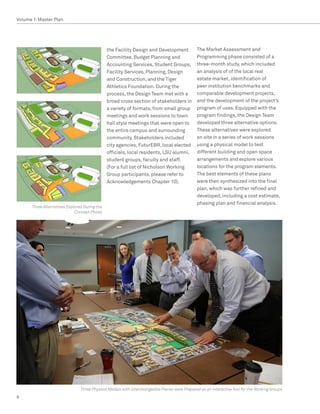
  • 110.
    Volume 1: MasterPlan Solar Parking Shelters stormwater runoff, permeable paving systems, improve water quality • Reducing Heat Island through tree plantings • Light pollution reduction • Renewable energy – solar panel covering for parking bays • Systems that expand rooting Silva Cell volume for trees in an urban situation • Minimizing soils disturbance during construction and soil management plans to create healthy soil • Water conserving water features • A comprehensive maintenance program 104
  • 111.
    08. Design Development Guidelines Optimize natural light and indoor air quality Architectural Sustainability • Protect and conserve water; Sustainable design seeks to reduce • Enhance indoor environmental negative impacts on the environment, quality; and and the health and comfort of • Optimize operational and building occupants, thereby maintenance practices. improving building performance. The basic objectives of sustainability Building design should integrate best are to reduce consumption of non- practices for sustainability as defined renewable resources, minimize by ASHREA 198.1 or the USGBC LEED waste, and create healthy, productive standards for new construction. environments. Sustainable design principles include the ability to: • Optimize site potential; • Minimize non-renewable energy consumption; • Use environmentally preferable products; 105
  • 113.
    09 IMPLEMENTATION
  • 114.
  • 115.
    09. Implementation 09. IMPLEMENTATION Phasing • Phase 4, opening in 2017 will complete the construction of the west side student The project implementation is broken into housing including a third 290 bed student multiple phases to facilitate staging and apartment building [Zone C]. provide some flexibility for the market demand. The project financials assume a build out to • Phase 5, opening in 2017 will include the be accomplished over the next five years from completion of the mixed use center if it is not 2013 through 2017, though the actual timing completed in Phase 3. may vary based on market and university housing demand, funding, and developer Site Costing interest. The method for site costing began with dividing the project areas up into phases and • Phase 1, opening in 2016 will include the developing site costs for each phase. Creating Foundation building [Zone A]. This will the phasing was vetted with the University so proceed as an independent project and not that demolition of old buildings works with the be a part of the Nicholson Gateway project University’s plan to manage housing relocation financial model. Since design is already and the construction of new buildings. The underway and the project will not require estimates were for construction cost only and State or University funding, it is likely to don not include escalation, administration, finish ahead of the rest of the project. permits, design or engineering soft costs. • Phase 2, opening in 2015 will include The estimates do include for each phase a the demolition of a portion of Nicholson percentage of construction cost for contractors Apartments and replacement with interim General Conditions, Bonds Insurance surface parking [Zone F] which can be and Mobilization. At planning level a 20% utilized for game day events; as well as a new contingency for lack of detail was carried in the 290 bed student apartment building [Zone site costs for all phases. The costs included D2], and the demolition of existing housing rough area takeoffs and industry standard structures Zone D1. unit costs for Site Preparation, Demolition, • Phase 3, opening in 2016 will include a Infrastructure, Excavation and Grading second 290 bed student apartment building (including imported fill costs to bring the site [Zone D1] and the demolition of the student out of the flood plain), Paving and Surfacing, apartments in Zone C. This phase might Landscape Improvements, and allowances also include the construction of a 1,000 car for Signage and Amenities. The estimate parking deck [Zone F] depending on State spreadsheets are included in the appendix of Funding availability. Likewise, this phase this document. might include either a portion or the entire mixed use center [Zone E and F] depending on developer interest and market demand. For the purposes of the project financial model, only the portion of the mixed use center in Zone E was assumed for this phase. 109

  • 116.
    Volume 1: MasterPlan Funding Financial Implications The financial program builds from the following core market drivers: • The student housing component has apparent demand with “relatively” low risk. • The mixed use retail component has the clear potential to be successful, allowing for the timing of market response and tenant quality, both of which are project risks. • The program includes a significant amount of office space, a majority of which is proposed for University identified needs. • The program includes “University Affiliated / Market Rate Apartments” that would only be available for rent to University related personnel. • The project’s parking strategy includes a mix of surface lots and parking structures. While surface lots have the potential to be revenue positive, higher densities will drive need for parking structures, which are generally more expensive to build and operate. • With clear linkage between parking and game day income, the decision of who builds, owns, and operates these parking facilities is an important detail. 110
  • 117.
    09. Implementation As partof the planning effort for Nicholson Gateway, the The Design Team also evaluated preliminary financial implications associated with the market-tested program highlighted below. Phasing Units Zone C / D1 / D2 - Student Housing 870 Beds Zone A / F - Office Space (Sq Ft) 110,100 SF Zone E - Market Apartments 89 Units Zone E - Retail Space (Sq Ft) 79,400 SF Zone E / F Parking 1,894 spaces Zone F: Retail Space 58,300 SF Zone E / F- Upper class Apartments 370 Beds 111
  • 118.
    Volume 1: MasterPlan The modeling effort is based • Current 2012 rents for retail, partners. on current decisions regarding office, and residential activities, • The model includes an allowance the development program and which are inflated to future years for replacement reserves, which assumptions. Given that several of occurrence, based on proposed begin in the 2nd year of occupancy critical assumptions are still “in play”, absorption. for each component. The reserve is this section of the report should be • No allowances are made for assumed at 5% of gross revenue on considered current as of December developers who are “bought out” an annual basis. 17, 2012. Changes made after this during the 30-year holding period; a • The model identifies the date have not been incorporated. long-term hold is presumed. need for either local or state The financial model is conceptual • Assumptions have been made for financial capacity (incentives or in nature, and subject to the Design site infrastructure costs as well appropriation) to fund specific Team’s limiting terms and conditions. as improvements to the Nicholson infrastructure costs, related It has been built from takeoffs Corridor. Specific cost estimates to public site improvements, for gross floor area and site size, shown on the following pages enhancements to Nicholson, or as defined in the evolving Master generally include streetscape and development of parking assets. Development Plan. As such, precise pedestrian improvements along At present, the State of Louisiana floor plans have not been developed, Nicholson Drive, but do exclude has not committed a specific so the team has made assumptions potential costs related to proposed appropriation to this project. for efficiency of building, unit, and traffic rotaries. • The model makes no assumption parking space layouts. Mixed use • Mixed use construction costs are for the use of New Markets Tax program revenue assumptions were assumed at a premium to single use Credits, which if used, would developed by the Design Team; (i.e. student housing) construction otherwise reduce project equity Student housing assumptions were costs. requirements. developed by Brailsford Dunlavey • The phase II retail program is • The “market apartments” presume (BD). speculative that renters will be university The financial model presumes a • The Master Development Plan affiliated generalized “master developer” includes a definitive pedestrian • Year 1 of the project begins as of ownership structure, with LSU connection from the mixed use July 1, 2013 participating directly or indirectly Plaza to North Stadium Drive. This • A two year construction period is (through a non-profit foundation), pedestrian route creates ample assumed for all project elements along with one or more developers. opportunities for sponsorship and The intent of the model is simple donation opportunities; these have - to arrive at an estimate of net not been calculated, but could operating income after debt service be significant to project financial and assumed equity payouts to performance. participating developers payable • The model presumes that a to the University and / or a related developer will contribute equity and non-profit entity. The analysis also debt to the project (25/75 split), and stresses that the university may receive a return currently estimated choose to move forward with this at 7% of invested project equity on project for non-financial reasons, an annual basis over the forecast which will be summarized below. period. Looking forward, this A number of critical assumptions percentage is a critical question, shaped the effort: which will need to be negotiated with prospective developer 112
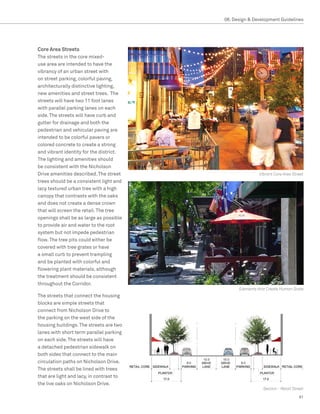
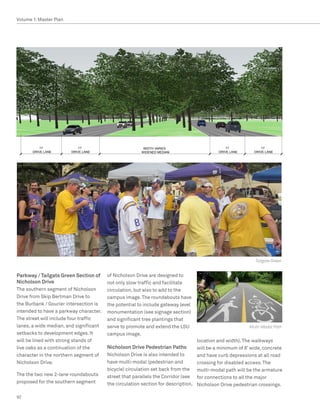
  • 119.
    09. Implementation Outputs 2013 2014 2015 2016 2017 2018 2019 Absorption Year 1 Year 2 Year 3 Year 4 Year 5 Year 6 Year 7 Zone C/D1/D2 – Student Housing 0 0 290 580 870 870 870 Zone E/F - Apartments 0 0 0 203 203 369 369 Zone E/F - Apartments 0 0 0 89 89 89 89 Zone E/F – Office 0 0 0 0 0 50,100 50,100 Zone E/F – Retail 0 0 0 79,400 79,400 137,700 137,700 Zone E/F Parking 0 0 468 842 842 1,426 1,426 Baseline Model Absorption Summary 113
  • 120.
    Volume 1: MasterPlan 2012 Project 2012 Project Site 2012 Project Scenario Description Nicholson Infrastructure Costs Development Costs Improvement Costs No state appropriation, all infrastructure included btw Chimes Skip Bertman, all Scenario 1 structured parking, Zone E as university $12,423,392 $3,403,983 $198,091,925 affiliated apts, deduct 250 parking spaces from parking cash flow for athletics Excludes East Side Project / no state Scenario 2 $12,423,392 $3,403,983 $137,602,145 appropriation / All infrastructure included Excludes East Side Project / Includes $25 million Scenario 3 state appropriation for Structured parking $12,423,392 $0 $176,468,702 75% of Nicholson Improvements Development Scenarios and Estimated Development Costs The Design Team used the above the South Alex Box Lot or elsewhere. phasing program to develop To increase revenue, the 89 university a baseline scenario and three affiliated market rate housing units alternatives; each is described below: are converted to 267 beds of student housing- three beds per unit. No Scenario 1: This option includes the state appropriation is assumed. full build-out program including Replacement parking for football structured parking as well as the parking (250 spaces) is assumed to proposed Nicholson Drive streetscape cash flow to Athletics and so it is and roadway improvements for the deducted from project revenue. segment between West Chimes Street and Skip Bertman Drive. No Scenario 3: This option is the same state appropriation is assumed. as Scenario 1 except that it includes Replacement parking for football a state appropriation of $24,183,802 parking (250 spaces) is assumed to which is applied to the Zone F cash flow to Athletics and so it is parking deck and Nicholson Drive deducted from project revenue. improvements. Replacement parking for football parking (250 spaces) is Scenario 2: This option assumes all assumed to cash flow to Athletics and surface parking and eliminates the so it is deducted from project revenue. two parking structures as well as the program located in zone E. Additional parking would be required offsite in 114
  • 121.
    09. Implementation A. Debt Service Interest @ 5% B. Debt Service Interest @ 6% Year 10 Year 10 Year 10 Year 10 Cumulative Cumulative Year 10 Year 10 Cumulative Cumulative Year 10 Year 10 NOI Before NOI After Return on Return on NOI Before NOI After Return on Return on Debt to Debt to Cost Equity Debt to Debt to Cost Equity Project University Project University Scenario 1 $98,124,600 $3,992,969 46.3% 7.5% $98,124,600 -$3,787,192 46.3% -7.1% Scenario 2 $81,427,500 $10,041,076 56.6% 27.9% $81,427,500 $4,299,015 56.6% 12.0% Scenario 3 $98,317,500 $10,894,273 52% 23.2% $98,317,500 $3,847,740 52.3% 8.2% Current Estimated Financial Outcomes from the Noted Scenarios Cumulative Net Operating Income return on cost reflects a return on (NOI) before debt service reflects the total cost of the project (NOI in total project cash flow, before debt relation to total project cost). The service, replacement reserves, or 10-year return on equity reflects equity payouts to developer partners. total equity invested in relation to Cumulative NOI after debt reflects net operating income after debt estimates of residual cashflow service. The analysis shows the payable to the university and / financial impact of increasing debt or its affiliates, after debt service, service interest costs (from 5% to 6% payments to project partners, and on an annualized basis) which is an replacement reserves. The 10-year eventual likelihood. 115
  • 122.
    Volume 1: MasterPlan Deal Structure • Amplify the game day experience threshold of net operating income, Recommendations and more importantly, increase while another target could be to capture of game day revenues, in achieve a specific percentage As LSU plans for the revitalization of part by creating new opportunities of upper class living on campus. the Nicholson Corridor, discussions for sponsorship and advertising, Other softer targets relate to the regarding the ownership structure as well as provision of premium revitalization of the Corridor and that will be responsible for project parking facilities. improvement of campus image. implementation move to center stage. The discussion begins with broader • Increase University endowment and Potential Deal Structures strategic considerations: enhance University recruitment Although there are a variety of deal • Improve pedestrian connectivity structures available in the market, • Property Ownership: The Nicholson and safety across Nicholson our experience points to four specific Corridor is located on state-owned approaches for consideration that land that cannot be sold. The • Alleviate space constraints at the are most commonly associated with University should seek partners core of campus, providing space campus edge initiatives such as the that are comfortable with ground for university functions that can be Nicholson Gateway development. lease structures. relocated. • Design Program Standards: Beyond the university’s identified Self-Development: The Institution The University should seek goals, the optimal ownership can choose to self-develop the partners that recognize and can structure will need to: project, being 100% responsible for demonstrate the importance achieving project financing, creating • Maximize University flexibility design aesthetics, determining of blending project aesthetics with campus architecture. The • Ensure the University’s construction quality, defining phasing University should view Nicholson participation in project cash flows and sequencing strategies, selecting as an extension of the campus that a delivery method, and ultimately • Allow the Institution to maintain should transition to the campus delivering the projects. Additionally, effective project control edge with a “university feel.” As the Institution would receive 100% • Insulate the university from day to of the benefits from any financial such, the University should have day project decisions and liability profitability realized by each approval authority over the exterior design and landscape concepts for Ultimately, our experience suggests project. For this approach, while the the development. that two core questions will need to University would have control and be answered by LSU leadership: benefit over the entire project, the • Affinity: The University should seek University would also have 100% of a partner that values its mission 1. The level of risk tolerance that the financial commitment required to and hopes to further that mission the University, its auxiliaries, and implement these projects and 100% through this development and related foundations are prepared to of the risk associated with those partnership opportunity. accept in prioritizing the objectives commitments. Our experience would Considerations build from a clear of the Nicholson Gateway suggest that these realities have understanding of University Corridor. Decisions, such as Risk tended to discourage institutions objectives: versus Control, Mission versus from choosing the Self Development Profitability, and Commitment option, because the institution’s debt • Generate incremental cash versus Partnership, will need to be capacity and credit rating are subject flow from the Nicholson project prioritized by LSU. to exposure with developments of to support graduate student 2. The level of risk tolerance relates this size and scale. Most institutions enrollment growth. closely to judgment of what set of choose to utilize credit ratings and • Expand on-campus housing targets are used to define project debt capacity for projects that are opportunities for upper class success. For example, one target more closely tied to the institution’s students. could be defined as a specific core mission. 116
  • 123.
    09. Implementation Developer Master:At the other to the University is that it reduces assume by allowing the University extreme, the Institution can choose to the development risk by sharing it to maintain control. However, to the outsource 100% of the development with the third party developer. The extent that the developer partners’ to a third party through a ground lease disadvantage of this structure is that risk is reduced by strong university in exchange for an annual ground it reduces the University’s long-term linked demand, this challenge can lease payment to be negotiated. financial potential by sharing the be balanced. The added challenge The third party would control 100% long-term return with the third party with this approach is the extent to of the project decisions, including developer. which the university is able to secure design, construction quality, tenant funding for infrastructure projects Similarly, the Master Developer model mix, and delivery method. The third from local and state sources. presumes the formation of an LLC party would also be responsible for (either for profit or not-for-profit) Recommended Structure providing project financing. While the with defined roles for the Institution The project team recommends Institution would have the ability to and one or more developers, as that LSU further evaluate the shape some of the project concepts well as the possible role for a non- Master Developer structure for the and set some minimum project design profit foundation. Once formed, the Nicholson Gateway development. standards, the third party will resist Master Developer would have the Our experience suggests that the extensive requirements unless they option to self-develop or syndicate University would likely need to are matched by financial resources. individual parcels of land within the assume responsibility for a share This approach provides the lowest defined development zone, based of infrastructure costs and parking. risk for the University because it is on an array of considerations. While Developer partners would need to not as exposed to credit rating risk or the Institution typically maintains bring additional equity to the table debt capacity usage. However, this approval authority over final to support development of individual scenario provides the lowest control development concepts, details, and projects. Within the Master Developer for the University regarding the design project execution process, they are structure, the key is how profits after and implementation; it also limits the also expected to secure funding for debt service are allocated between University’s upside financial potential infrastructure improvements. The partners. once the project reaches stabilized nature of this deal structure can allow occupancy. for funds from state appropriation, Our experience shows that there are local tax-increment financing (TIF), as two alternative models that fit in well as other incentives, particularly between the extremes. These models New Markets Tax Credits. While the are defined as a Master Partnership Master Developer structure presumes or a Master Developer: a continued significant presence of the institution throughout the The Master Partnership structure development process, this approach requires the official formation of a is also typically flexible as to the level development partnership between of support - financially, physically, the institution and a third party. and strategically – required by In this scenario, the institution the development partner(s) to and the third party partner each successfully implement the project. contribute equity toward the project and a partnership LLC is officially The risks associated with the Master formed. In a Master Partnership, the Developer approach relate to the institution and the third party share difficulty of making the individual the design, construction, financing, projects work financially because and implementation responsibilities. third party partners may expect a The advantage of this structure higher return for the exposure they 117
  • 124.
  • 125.
    09. Implementation Next Steps 3. Sustain internal conversations d. Consider the engagement regarding the university’s role in of a firm to provide program LSU will need to move forward on a the Nicholson Project. Elements management services. number of work efforts to sustain include: 4. As planning guidance is being project momentum. Elements include: a. Conduct further research on firmed up, and the roles of best practices regarding the role state and local government are 1. Finalize the Master Development clarified, the University will need and structure of deals pursued Plan and build consensus with to engage with the development by universities around the US. state leadership regarding several community. Specific emphasis should be key questions: placed on the evaluation of a. Continue conversations with a a. Reach decisions regarding ground lease mechanisms that sample of developers (local and ownership / responsibility for have been effective in balancing national) to evaluate capabilities Nicholson Drive. Discussions risk, control, and rewards. and interest. had focused on this road being b. Finalize internal thinking b. Initiate a RFI / RFQ process conveyed from state to local regarding: to test concepts with the control. Identified project needs i. The level of University control development community for streetscape and traffic that will be needed as part of the c. Initiate an RFP process calming adjustments along overall deal structure. to identify one or more Nicholson Drive logically flow from these discussions. The ii. University expectations for development partners. anticipated outgrowth requires project performance metrics, Responsibilities further clarity regarding the both policy and financial (for Clearly, specific roles and scale, structure, timing, and use example, what is an acceptable responsibilities will evolve out of the of proposed state appropriation rate of return and over what noted work efforts, with the University for the Nicholson Project. duration). in position to make key strategic 2. Connect with city officials to build iii. Clarify how project revenues decisions that will dictate project support for the Nicholson project: (parking / game day) will be outcomes. allocated / shared internally. a. Assign roles and responsibilities c. Continue conversations with regarding improvements to University affiliated foundations Nicholson Drive to evaluate their potential b. Access to local incentives role, capacity, and interest in (including tax increment participating in the project. financing), linked with broader While a foundation role is regional benefits. Need for not critical to the process, local incentive support is clearly the analysis does suggest linked with the outcome of that potential fundraising, conversations regarding state sponsorship, and donation appropriation. opportunities need to be better understood. 119
  • 127.
    10 ACKNOWLEDGEMENTS
  • 129.
    10. Acknowledgements 10. ACKNOWLEDGEMENTS NicholsonWorking Group: AECOM Steve Waller – Residential Life (PS) Steve Wilson Kurt Keppler – Student Life Tim Anderson Mary Miles – Planning, Design, Construction (PS) Chris Brewer Jason Soileau – Planning, Design, Paul Moore Construction (PS) Jonathan McDowell Jason Tolliver – University Auxiliary Services (PS) Robert Schmidt Eddie Nunez – Athletics (PS) Han Oul-Joo Frank Miller – Tiger Athletic Foundation Suzanne Serna D’Ann Morris – Chancellor’s Office Doug Tichenor Heath Price – FAS (PS) Kaia Nesbitt Marie Frank – Purchasing Tracy Flecky Jane Cassidy – Academic Affairs Taylor Cox – Student Government, Pres Brailsford and Dunlavey Kelsey LeBlanc – RHA, President Peter Isaac Jeff Darby – Family/Graduate Housing Wilson Jones Gary Graham – Parking, Traffic Transportation (PS) Grace and Haber Tony Lombardo – Facility Services Jerry Hebert Gina Dugas-LSU Foundation (PS) Adam Fishbein David Hebert LSU Senior Leadership LSU Foundation Walker Parking Tiger Athletics Foundation Rick Mobley LSU Alumni Association Facility Design and Development Committee Budget Planning and Accounting Services LSU Athletics LSU Residential Life Student Groups University Auxiliary Services, Dining City and State Facility and Traffic Agencies FuturEBR Campus Stakeholders Local Elected Officials 123
  • 131.
  • 133.
    Appendix APPENDIX Development Program NICHOLSON GATEWAY ‐ DEVELOPMENT PROGRAM 10/10/2012 Phase 1‐ Foundation Developed‐ not in project financials; complete summer 2014 BLDG A‐1 BLDG FOOT AREA (SF) FLOOR BLDG NET AREA (SF) PARKING SUPPLY PARKING NEED PARKING NOTES ZONE A  retail                             2,000              1                            2,000 8 on‐street parking 27,400 SF office (2‐4 FL)                           15,000              3                          45,000 180 4 per 1,000sf office (1 FL)                           13,000              1                          13,000 52 4 per 1,000sf TOTAL               4                           60,000 232 Phase 5‐ University Developed‐ not in project financials; complete 1017 contingent on tennis court parking deck BLDG B‐1 BLDG FOOT AREA FLOOR BLDG NET AREA (SF) BED UNITS PARKING SUPPLY PARKING NEED PARKING NOTES ZONE B  310 SF/BED 124,700 SF Under Grad.Student housing                           31,600              4                       126,400                      408 326 0.8 sp/bed  TOTAL               4                          126,400                       408 326 Phase 3‐ demolish housing 2016; replace with housing 2017 BLDG C‐1 BLDG FOOT AREA FLOOR BLDG NET AREA (SF) BED UNITS PARKING SUPPLY PARKING NEEDS PARKING NOTES 420 SF/BED ZONE C  Grad/undergrad apartments                           30,450              4                       121,800                      290 209 0.72 sp/bed  316,200 SF Surface Parking 239 TOTAL                          121,800                       290 239 209 in surface parking Phase 2‐ demolish housing 2015; replace with housing 2016 BLDG D‐1 BLDG FOOT AREA FLOOR BLDG NET AREA (SF) BED UNITS PARKING SUPPLY PARKING NEEDS PARKING NOTES 420 SF/BED ZONE D1  Grad/undergrad apartments                           30,450              4                       121,800                      290 209 0.72 sp/bed  157,900 SF  Surface Parking 203 TOTAL                          121,800                       290 203 209 in surface parking Phase 1‐ demolish housing and replace with surface parking; complete summer 2014; replace housing 2015 BLDG D‐2 BLDG FOOT AREA FLOOR BLDG NET AREA (SF) BED UNITS PARKING SUPPLY PARKING NEEDS PARKING NOTES 420 SF/BED ZONE D2  Grad/undergrad apartments                           30,450              4                       121,800                      290 209 0.72 sp/bed   163,600 SF Surface Parking 206 TOTAL                          121,800                       290 206 209 Phase 2a‐  first portion of mix use discrict, 2016 or later  (depending on developer interest and available game day parking). BLDG E‐1 BLDG FOOT AREA FLOOR BLDG NET AREA (SF) BED UNITS PARKING NEED PARKING NOTES 400 SF/BED Upperclassmen  Apartments                           14,000              3                          42,000                      105 84 0.8 sp/bed  (Zone F) retail                           21,100              1                          21,100                      201 84 4 sp/1,000sf (Zone F) TOTAL                           63,100                       306 168 BLDG E‐2 BLDG FOOT AREA FLOOR BLDG NET AREA (SF) BED UNITS PARKING NEED PARKING NOTES 400 SF/BED Upperclassmen  Apartments                           13,000              3                          39,000                        98 78 0.8 sp/bed  (Zone F) retail                           21,300              1                          21,300                      218 85 4 sp/1,000sf (Zone F) TOTAL                           60,300                       632 163 BLDG E‐3 BLDG FOOT AREA FLOOR BLDG NET AREA (SF) HOUSING UNIT PARKING NEED PARKING NOTES ZONE E  1200 SF/BED 210,500 SF Market housing                           27,700              3                          83,100                        69 104 1.5 sp/unit (Zone E parking deck) retail                           37,000              1                          37,000                      534 148 4 sp/1,000sf (Zone F) TOTAL                          120,100                    1,207 252 BLDG E‐4 BLDG FOOT AREA FLOOR BLDG NET AREA (SF) HOUSING UNIT PARKING NEED PARKING NOTES 1200 SF/BED Market housing‐ townhouse                             8,000              3                          24,000                        20 30 1.5 sp/unit (Zone E parking deck) TOTAL                          144,100                         20 282 BLDG E‐5 Parking Structure* BLDG FOOT AREA LEVELS BLDG NET AREA (SF) PARKING SUPPLY TOTAL NEED PARKING NOTES Structured Parking                            27,000           4.5                       121,500 374 134 Zone E‐ market housing demand 232 Zone A‐ office parking demand TOTAL                           24,000 374 366 * Note: The E‐5 parking deck could be avoided if the majority of the office parking was accommodated across the street in the South Alex Box lot. A surface lot in place of the E‐5 deck  and E‐4 townhouses would accommodate 140 cars, which would support the market housing (104 spaces) and a portion of the office (35 spaces). Phase 1‐ demolish housing and replace with surface parking; complete summer 2014 ZONE F  SURFACE PARKING BLDG FOOT AREA (SF) FLOOR BLDG NET AREA (SF) PARKING SUPPLY PARKING NEED PARKING NOTES (surface  Surface parking lot                         157,000              1                       157,000 468 480 for Zone E need‐ retail, student housing parking)  TOTAL               1                   31,557,000 468 188,200 SF 127
  • 134.
    Volume 1: MasterPlan Phase 2b‐final portion of mixed use district; 2016 or later (depending on developer interest and available game day parking). BLDG F‐1 BLDG FOOT AREA (SF) FLOOR BLDG NET AREA (SF) BED UNITS PARKING NEED PARKING NOTES 450 SF/BED Upperclassmen Apartment                          15,000              3                          45,000                      100 80 0.8 sp/bed retail                          21,300              1                          21,300                           ‐ 85 4 sp/1,000sf office                                      ‐               ‐                                     ‐                           ‐ 4 sp/1,000sf TOTAL               4                           66,300                            ‐ 165 parks in zone F structure BLDG F‐2 BLDG FOOT AREA (SF) FLOOR BLDG NET AREA (SF) BED UNITS PARKING NEED PARKING NOTES 450 SF/BED Upperclassmen Apartment                          10,000              3                          30,000                        67 53 0.8 sp/bed retail                          17,000              1                          17,000                           ‐ 68 4 sp/1,000sf ZONE F (full  office                                      ‐               ‐                                     ‐                           ‐ 4 sp/1,000sf build out)  TOTAL                           47,000                            ‐ 121 parks in zone F structure 188,200 SF BLDG F‐3 BLDG FOOT AREA (SF) FLOOR BLDG NET AREA (SF) PARKING NEED PARKING NOTES retail                          20,000              1                         20,000                           ‐ 80 4 sp/1,000sf office                          16,700              3                          50,100                           ‐ 200 4 sp/1,000sf TOTAL                           70,100 280 parks in zone F structure BLDG F‐4 Parking Structure BLDG FOOT AREA LEVELS BLDG NET AREA (SF) PARKING SUPPLY TOTAL NEED PARKING NOTES STRUCTURE PARKING ( for Zone F)                           68,400           5.0                       342,000 1,052 567 Zone E parking demand 480 Zone F Parking demand SURFACE PARKING TOTAL                           50,100 1,052 1,047 Rate Assumptions gsf bldg/bed parking/bed Graduate Apartment 450              1 Upper Classmen Apartment 425              1 60/40 upperclass/grad mix 420              1 gsf bldg/unit parking/unit market housing (1, 2 and 3 bed units) 1,200          1.5 128
  • 135.
    Appendix Site Cost Estimate LSUNicholson Gateway Phased Sitework Cost Estimate Refer to the phasing diagrams and other information in the implementation section to correlate the costing information with the zones. Notes: 1. The following estimate is for construction costs only and does not include preconstruction administration, permits, soft costs inc. design or engineering costs. 2. The cost estimate is intended as a tool for budgeting and fund raising LSU Nicholson Gateway Baton Rouge, LA Phased Development Estimate Item Notes Qty Unit $/Unit Total Zone C General $150,990 General Conditions % of Base 3% $68,632 Bonds and Insurance % of Base 1.50% $41,179 Mobilization % of Base 1.50% $41,179 Site Preparation $10,000 Tree Protection Protection and Maintenance 20 EA 200.00 $4,000 Construction Fencing 3,000 LF 2.00 $6,000 Demolition $266,240 Utility Removal and Capping 1 LS 5,000.00 $5,000 Building Demolition Existing Apt Buildings 86800 SF 2.00 $173,600 Clearing and Grubbing Landscape and Paving 438,200 SF 0.20 $87,640 Infrastructure $451,500 Water Taps 2 lines plus meter 2 EA 1,000.00 $2,000 Water Line Extensions 8 100 LF 50.00 $5,000 Storm Water System 600'x15 avg dia. PP with 6 CB-01s 1 LS 42,000.00 $42,000 Fire Hydrants 2 EA 750.00 $1,500 Fire Service Line 8 1 LS 2,000.00 $2,000 Electric Service 1 LS 5,000.00 $5,000 Sewer Service 8 1 LS 6,000.00 $6,000 Gas Service 2 1 LS 3,000.00 $3,000 Site Drainage and Erosion control Above ground grading 1 LS 35,000.00 $35,000 Street, Parking Security Lighting Fixtures ave 50 feet o.c. 70 EA 5,000.00 $350,000 Excavation and Grading $64,000 Rough Grading Fill 2' to above flood level 8,000 CY 8.00 $64,000 Paving and Surfacing $852,500 Roads and Parking paving Includes Curb and Gutter 97,000 SF 7.50 $727,500 Specialty Paving Veh Crosswalks 0 SF 15.00 $0 Specialty Paving Ped Plaza Areas 0 SF 12.00 $0 Standard Walkway Concrete Sidewalks 25,000 SF 5.00 $125,000 Landscape Improvements $427,500 Trees Trees 50 EA 500.00 $25,000 Plaza Trees Trees Grates 0 EA 1,500.00 $0 Landscape Lawn and groundcover 217,000 SF 1.50 $325,500 Gardens More Intense landscape 11,000 SF 7.00 $77,000 Fencing $20,000 Security Fence At Housing Quads 200 LF 100.00 $20,000 Signage and Site Amenities $45,000 Allowance 1 LS 45,000.00 $45,000 Sub-total Zone C $2,287,730 Master Plan Contingency 20% $457,546.04 Base Construction Cost $2,745,276 129
  • 136.
    Volume 1: MasterPlan LSU Nicholson Gateway Phased Sitework Cost Estimate Zones D1 D2 General 145,798.42 General Conditions % of Base 3% $66,272 Bonds and Insurance % of Base 1.50% $39,763 Mobilization % of Base 1.50% $39,763 Site Preparation $6,000 Tree Protection Protection and Maintenance 10 EA 200.00 $2,000 Construction Fencing 2,000 LF 2.00 $4,000 Demolition $123,120 Utility Removal and Capping 0 LS 0.00 $0 Building Demolition Existing Apt Buildings 44000 SF 2.00 $88,000 Clearing and Grubbing Landscape and Paving 175,600 SF 0.20 $35,120 Infrastructure $463,250 Water Taps 2 4 EA 1,000.00 $4,000 Water Line Extensions 8 100 LF 50.00 $5,000 Storm Water System 1250'x18dia + 11 CB-01s 1 LS 90,750.00 $90,750 Fire Hydrants 2 EA 750.00 $1,500 Fire Service Line 8 2 EA 2,000.00 $4,000 Electric Service 2 EA 5,000.00 $10,000 Sewer Service 8 2 EA 6,000.00 $12,000 Gas Service 2 EA 3,000.00 $6,000 Site Drainage and Erosion control 1 LS 30,000.00 $30,000 Street, Parking Security Lighting Fixtures ave 50 feet o.c. 60 EA 5,000.00 $300,000 Excavation and Grading $64,000 Rough Grading Fill to above flood level 8,000 CY 8.00 $64,000 Paving and Surfacing $1,032,500 Roads and Parking paving Includes Curb and Gutter 121,000 SF 7.50 $907,500 Specialty Paving Veh Crosswalks 0 SF 15.00 $0 Specialty Paving Ped Plaza Areas 0 SF 12.00 $0 Standard Walkway Concrete Sidewalks 25,000 SF 5.00 $125,000 Landscape Improvements $299,399 Trees Trees 60 EA 500.00 $30,000 Plaza Trees Trees Grates 0 EA 1,500.00 $0 Landscape Lawn and groundcover 179,599 SF 1.50 $269,399 Gardens More Intense landscape 20,000 SF 7.00 $140,000 Fencing $30,000 Security Fence At Housing Quads 300 LF 100.00 $30,000 Signage and Site Amenities $45,000 Allowance 1 LS 45,000.00 $45,000 Sub-total Zones D1 D2 $2,209,067 Master Plan Contingency 20% $441,813.38 Base Construction Cost $2,650,880 130
  • 137.
    Appendix LSU Nicholson GatewayPhased Sitework Cost Estimate Zone E General $223,213 General Conditions % of Base 3% $101,460 Bonds and Insurance % of Base 1.50% $60,876 Mobilization % of Base 1.50% $60,876 Site Preparation $6,800 Tree Protection Protection of Existing Oak Trees 7 EA 200.00 $1,400 Construction Fencing 2,700 LF 2.00 $5,400 Demolition $85,000 Utility Removal and Capping 0 LS 0.00 $0 Building Demolition Existing Apt Buildings 0 SF 2.00 $0 Clearing and Grubbing Existing Landscape 425,000 SF 0.20 $85,000 Infrastructure $708,500 Water Taps 2 7 EA 1,000.00 $7,000 Water Line Extensions 8 600 LF 50.00 $30,000 Storm Water System 1600'x18 dia + 15 CB-01 1 LS 118,000.00 $118,000 Fire Hydrants 4 EA 750.00 $3,000 Electric Service 1 LS 30,000.00 $30,000 Sewer Service 8 plus manholes 1 LS 60,000.00 $60,000 Gas Service 6 EA 3,000.00 $18,000 Site Drainage and Erosion control 1 LS 42,500.00 $42,500 Traffic Signal Improvements 1 EA 150,000.00 $150,000 Street, Parking Security Lighting Fixtures ave 50 feet o.c. 40 EA 5,000.00 $200,000 Event Infrastructure Utilites and communication 1 LS 50,000.00 $50,000 Excavation and Grading $120,000 Rough Grading Fill 2' to above flood level 15,000 CY 8.00 $120,000 Paving and Surfacing $1,591,500 Roads and Parking paving Concrete Includes Curb and Gutter 30,000 SF 7.50 $225,000 Specialty Paving Veh Roadways 37,000 SF 15.00 $555,000 Specialty Paving Ped Plaza Areas 62,000 SF 12.00 $744,000 Standard Walkway Concrete Sidewalks 13,500 SF 5.00 $67,500 Temp Parking Grading and Gravel 180,000 SF 0.50 $90,000 Landscape Improvements $132,000 Trees Trees 30 EA 500.00 $15,000 Plaza Trees Trees Grates 48 EA 1,500.00 $72,000 Landscape Lawn and groundcover 30,000 SF 1.50 $45,000 Gardens More Intense landscape 4,000 SF 7.00 $28,000 Fencing $0 Security Fence At Housing Quads 0 LF 100.00 $0 Signage and Site Amenities $600,000 Allowance 1 LS 100,000.00 $100,000 Water Feature / Art Feature 1 LS 500,000.00 $500,000 Sub-total Zone E $3,382,013 Master Plan Contingency 20% $676,402.57 Base Construction Cost $4,058,415 131
  • 138.
    Volume 1: MasterPlan LSU Nicholson Gateway Phased Sitework Cost Estimate Zone F Public Realm additions to Zone E Note: Assume all infrastructure will be in place from Zone E improvements to save costs and temp pads will be put in place for future bldgs General $22,118 General Conditions % of Base 3% $10,054 Bonds and Insurance % of Base 1.50% $6,032 Mobilization % of Base 1.50% $6,032 Paving and Surfacing $270,000 Specialty Paving Veh Roadways 6,000 SF 15.00 $90,000 Specialty Paving Ped Plaza Areas 15,000 SF 12.00 $180,000 Landscape Improvements $18,000 Plaza Trees Trees Grates 12 EA 1,500.00 $18,000 Signage and Site Amenities $25,000 Allowance 1 LS 25,000.00 $25,000 Sub-total Zone F $335,118 Master Plan Contingency 20% $67,023.55 Base Construction Cost $402,141 132
  • 139.
    Appendix Cost Estimate for Nicholson Drive Improvements LSU Nicholson Gateway New Signaled Intersection @ Chimes Description Quantity Unit Unit Price Price New Intersection Lighting Controller 1 LS $15,000.00 $15,000.00 Signal Heads 6 EA $1,500.00 $9,000.00 Mast Arms (30 feet) 2 EA $15,000.00 $30,000.00 Service 1 LS $1,000.00 $1,000.00 Wiring  Ped Detection 1 LS $10,000.00 $10,000.00 Handicap Ramps 4 EA $1,500.00 $6,000.00 Sidewalk 300 SF $5.00 $1,500.00 Special Pavement at Crosswalk (incl. base) 108 SY $120.00 $12,960.00 Striping 1 LS $1,500.00 $1,500.00 Landscape 1 LS $10,000.00 $10,000.00 Subtotal $96,960.00 Contingency 20% $19,392.00 TOTAL $116,352.00 Pedestrian Crossing with Hawk Light (3 locations) Description Quantity (3) Locations Unit Unit Price Price New Intersection Lighting Controller 1 3 LS $15,000.00 $45,000.00 Signal Heads 6 18 EA $1,500.00 $27,000.00 Mast Arms (30 feet) 2 6 EA $15,000.00 $90,000.00 Service 1 3 LS $1,000.00 $3,000.00 Wiring  Ped Detection 1 3 LS $10,000.00 $30,000.00 Handicap Ramps 4 12 EA $1,500.00 $18,000.00 Sidewalk 300 900 SF $5.00 $4,500.00 Special Pavement at Crosswalk (incl. base) 108 324 SY $120.00 $38,880.00 Striping 1 3 LS $1,500.00 $4,500.00 Landscape 1 3 LS $10,000.00 $30,000.00 Subtotal $290,880.00 Contingency 20% $58,176.00 TOTAL $349,056.00 Nicholson Drive Improvements (Chimes Street to S. Stadium/Skip Bertman Drive) Length of Roadway = 2500 ft (24 ft wide pavement in each direction) Description Quantity Unit Unit Price Price Curb Removal  10000 LF $5.00 $50,000.00 Pavement Removal 5867 SY $10.00 $58,670.00 2 Mill  Overlay 13333 SY $20.00 $266,660.00 Curbs 10000 LF $15.00 $150,000.00 Topsoil 2933.5 CY $35.00 $102,672.50 Striping 1 LS $5,000.00 $5,000.00 Landscaping 1 LS $100,000.00 $100,000.00 Sidewalks (12' wide, 4 thick)(both sides) 6666 SY $35.00 $233,310.00 Drainage 2500 LF of Rdwy $93.00 $232,500.00 Street Lights w/ Banners @ 100' O.C 50 EA $15,000.00 $750,000.00 Pedestrian Lights @ 50' O.C.  100 EA $5,000.00 $500,000.00 Subtotal $2,448,812.50 Contingency 20% $489,762.50 Total $2,938,575.00 133
  • 140.
  • 141.
    Appendix Financial Analysis Disclaimer GENERALLIMITING CONDITIONS AECOM devoted effort consistent with (i) the level of diligence ordinarily exercised by competent professionals practicing in the area under the same or similar circumstances, and (ii) the time and budget available for its work, to ensure that the data contained in this report is accurate as of the date of its preparation. This study is based on estimates, assumptions and other information developed by AECOM from its independent research effort, general knowledge of the industry, and information provided by and consultations with the client and the client’s representatives. No responsibility is assumed for inaccuracies in reporting by the Client, the Client’s agents and representatives, or any third-party data source used in preparing or presenting this study. AECOM assumes no duty to update the information contained herein unless it is separately retained to do so pursuant to a written agreement signed by AECOM and the Client. AECOM’s findings represent its professional judgment. Neither AECOM nor its parent corporation, nor their respective affiliates, makes any warranty, expressed or implied, with respect to any information or methods disclosed in this document. Any recipient of this document other than the Client, by their acceptance or use of this document, releases AECOM, its parent corporation, and its and their affiliates from any liability for direct, indirect, consequential or special loss or damage whether arising in contract, warranty (express or implied), tort or otherwise, and irrespective of fault, negligence and strict liability. This report may not to be used in conjunction with any public or private offering of securities, debt, equity, or other similar purpose where it may be relied upon to any degree by any person other than the Client. This study may not be used for purposes other than those for which it was prepared or for which prior written consent has been obtained from AECOM. Possession of this study does not carry with it the right of publication or the right to use the name of “AECOM” in any manner without the prior written consent of AECOM. No party may abstract, excerpt or summarize this report without the prior written consent of AECOM. AECOM has served solely in the capacity of consultant and has not rendered any expert opinions in connection with the subject matter hereof. Any changes made to the study, or any use of the study not specifically identified in the agreement between the Client and AECOM or otherwise expressly approved in writing by AECOM, shall be at the sole risk of the party making such changes or adopting such use. This document was prepared solely for the use by the Client. No party may rely on this report except the Client or a party so authorized by AECOM in writing (including, without limitation, in the form of a reliance letter). Any party who is entitled to rely on this document may do so only on the document in its entirety and not on any excerpt or summary. Entitlement to rely upon this document is conditioned upon the entitled party accepting full responsibility and not holding AECOM liable in any way for any impacts on the forecasts or the earnings from (project name) resulting from changes in “external” factors such as changes in government policy, in the pricing of commodities and materials, price levels generally, competitive alternatives to the project, the behaviour of consumers or competitors and changes in the owners’ policies affecting the operation of their projects. This document may include “forward-looking statements”. These statements relate to AECOM’s expectations, beliefs, intentions or strategies regarding the future. These statements may be identified by the use of words like “anticipate,” “believe,” “estimate,” “expect,” “intend,” “may,” “plan,” “project,” “will,” “should,” “seek,” and similar expressions. The forward-looking statements reflect AECOM’s views and assumptions with respect to future events as of the date of this study and are subject to future economic conditions, and other risks and uncertainties. Actual and future results and trends could differ materially from those set forth in such statements due to various factors, including, without limitation, those discussed in this study. These factors are beyond AECOM’s ability to control or predict. Accordingly, AECOM makes no warranty or representation that any of the projected values or results contained in this study will actually be achieved. This study is qualified in its entirety by, and should be considered in light of, these limitations, conditions and considerations. 135