

NATIONAL INITIATIVE FOR
ALLIED HEALTH SCIENCES
NATIONAL INITIATIVE FOR
ALLIED HEALTH SCIENCES
A STUDY TO AUGMENT THE
CAPACITY AND QUALITY
OF ALLIED HEALTH
PROFESSIONALS IN INDIA
��������������������������������������
A report commissioned by the
MINISTRY OF HEALTH AND FAMILYWELFARE
Government of India
������������� �������������� �����������
From ‘Paramedics’
to Allied Health
Professionals:
Landscaping the Journey andWay Forward
������������� �������������� �����������
ISBN 978-81-926145-3-3
9 788192 614533
Public Health Foundation of India
PHD House, Second Floor, 4/2, Sirifort Institutional Area, August Kranti Marg
New Delhi 110016, India
www.phfi.org
NATIONALINITIATIVEFOR
ALLIEDHEALTHSCIENCES
FROMPARAMEDICSTOALLIED
HEALTHPROESSIONALS
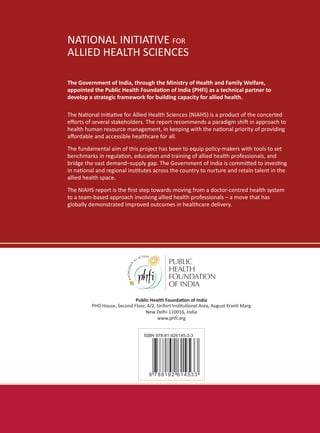
The Government of India, through the Ministry of Health and Family Welfare,
appointed the Public Health Foundation of India (PHFI) as a technical partner to
develop a strategic framework for building capacity for allied health.
The National Initiative for Allied Health Sciences (NIAHS) is a product of the concerted
efforts of several stakeholders. The report recommends a paradigm shift in approach to
health human resource management, in keeping with the national priority of providing
affordable and accessible healthcare for all.
The fundamental aim of this project has been to equip policy-makers with tools to set
benchmarks in regulation, education and training of allied health professionals, and
bridge the vast demand–supply gap. The Government of India is committed to investing
in national and regional institutes across the country to nurture and retain talent in the
allied health space.
The NIAHS report is the first step towards moving from a doctor-centred health system
to a team-based approach involving allied health professionals – a move that has
globally demonstrated improved outcomes in healthcare delivery.
NATIONAL INITIATIVE FOR
ALLIED HEALTH SCIENCES
1
From Paramedics to Allied Health Professionals: Landscaping the journey and way forward
2
3
From Paramedics to Allied Health Professionals: Landscaping the journey and way forward
4
Terms of Reference (ToRs)
i.	 Desk review of the paramedical training landscape, including
situational analysis, methodology of teaching, inputs and regulatory
framework for the paramedical disciplines;
ii.	 Content development, including training of trainer (ToT) protocols,
facilitationguidesforfaculty,andresourcereferencesandinstructional
kits for the NIAHS;
iii.	Overall recommendations, including a framework to augment the
availability of paramedical personnel, methodology of teaching,
inputs, protocols for certification, regulatory framework and national
standards, as well as benchmarking for accreditation;
iv.	 Recommendations for the National Institute of Paramedical Sciences
(NIPS) and the Regional Institute of Paramedical Sciences (RIPS),
including vision and mission statements, model for operations,
implementation plan, relationship matrix outlining the roles of
stakeholders, HR positioning, management arrangements, financial
protocols and budget, protocols for a pedagogical renewal process,
scope of alternate models of learning, framework for long-term
sustainability, creation and updating of training content and modules,
conducting regular in-service training and training on cutting-edge
technologies.
5
Introduction 			
Executive Summary 		
Chapter 1: The Allied Health Ecosystem
Chapter 2: Regulating the Allied Health Profession
Chapter3:EstimatingImbalancesintheAlliedHealthWorkforce
Chapter 4: Standardising the Allied Health Education
Process of Consultations
List of Experts
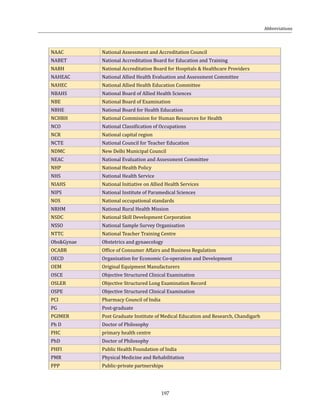
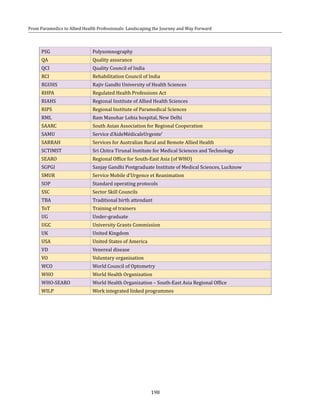
Abbreviations
Bibliography 	
1-2
3-10
11-44
45-68
69-132
133-172
173-204
Page Nos.
Table of Contents
From Paramedics to Allied Health Professionals: Landscaping the journey and way forward
6
In March 2011, the Ministry of Health and Family Welfare nominated the Public Health Foundation
of India (PHFI) as its technical partner and constituted the National Initiative for Allied Health
Sciences (NIAHS) secretariat with a mandate to develop a framework to improve allied health
training, education and regulation in the country.
Fundamental to the national initiative- undertaken by the health ministry- is the vision to bring
uniformity to teaching methodology, clarify protocols of certification and set national standards
for regulation of allied health sciences and professionals. The initiative comes at a time when the
Government of India- under the 12th five year plan- has set itself the target of providing affordable
and accessible healthcare to all citizens. India’s mandate for universal health coverage, to a great
extent, depends on the availability of qualified and adequate allied health professionals at primary,
secondary and tertiary levels in both private and public sector. Addressing shortages in human
resources is the first step towards expanding the reach of health services in underserved areas.
The terms of reference set by the health ministry directed the NIAHS secretariat to map the
allied health training landscape and the current regulatory framework for various allied health
disciplines. Over a period of 10 months the NIAHS secretariat conducted extensive desk review,
primary and secondary research to compile a detailed situational analysis of the existing allied
health space in India.
Central to the recommendations developed for reconfiguring and restructuring the allied
health space, is setting up of dedicated national and regional institutes with the objective of
nurturing talent, retaining allied health professionals and strengthening the health systems to
align it with the overarching goal of providing universal health coverage to Indians. Research by
the NIAHS secretariat has indicated vast inter and intra state differences with public and private
facilities struggling to cope with increasing human resources costs, shortages, uneven distribution
and skill-mix imbalances.
India has traditionally leaned towards a ‘doctor-centered’ healthcare delivery, with little
attention paid to specialization in allied health sciences. Investing in allied health professionals
has, at no point in history, been so crucial to reforms in public health sector. Corrections to bridge
demand and supply gaps – ensuring sustained availability of allied health professionals for future
generations — remains a cornerstone in India’s plans for healthcare reforms.
Population based human resource norms, for India’s health services, set as early as 1946
by the Bhore Committee, are yet to be achieved. The Bhore Committee had recommended one
INTRODUCTION
1
From Paramedics to Allied Health Professionals: Landscaping the Journey and Way Forward
nurse per 500 persons; one pharmacist per 2000 persons, one laboratory technicians per 30,000
persons; one health inspector per 20,000 persons (Chaddha committee); one male and female
health worker for 3000-3500 persons at primary level of care.
As India struggles with heavy disease burdens, with the emerging challenge of non-
communicable diseases superimposed on the urgency of achieving millennium development goals,
deficiencies in human resources- in terms of both skills and numbers- will be formidable barriers
to India’s health care sector reforms. It is of pivotal importance that these are overcome through
initiatives that address both the scale and quality of our health workforce.
The NIAHS secretariat has studied global best practices, especially models followed by other
low and middle income countries, while developing strategies relevant to the Indian context. To put
together this report, a dedicated project secretariat was established at the Health Systems Support
Unit of PHFI, which consulted over 300 experts while the project was in progress. The NIAHS
secretariat also gained immensely from their consultations with experts in the health ministry.
Thisreportisapioneeringinitiativebythehealthministrywhichaimstoaddressthechallenges
faced by allied health professionals, for the first time, as a national priority. We hope this report will
encourage public discourse and propel academicians, civil society and policy makers to collaborate
in designing and implementing targeted interventions for the much required corrections in all
aspects of the allied health professional space.
The NIAHS report provides an overarching framework to realign India’s human resources in
accordance with the growing demands of the health sector. This report is only the first step in a
journey that will require concerted efforts from all stake holders to turn the aspirational goal of
universal health coverage into a reality for India.
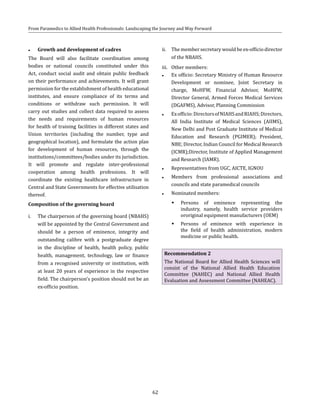
Prof. K Srinath Reddy
President, Public Health Foundation of India
2
In the past decade, a fundamental shift has occurred in
healthcare delivery, largely due to advances in science
and technology. There is now more recognition, than
at any time in the past, that health service delivery is
no longer just a prerogative of physicians and nurses.
It is now a team effort, drawing upon the expertise of
both clinicians and non-clinicians. These professionals
or health-service providers have been historically
identified as ‘paramedical staff’ or paraprofessionals
or health technicians.
Better appreciation and utilization of the whole
range of skills possessed by these paraprofessionals-
collectively termed as Allied Health Professionals
(AHPs)—is the key to health-sector reforms in India,
especially given the shortage of doctors and nurses in
semi-urban and rural areas of the country.
As the Indian government sets about reforming
the public health sector and making universal
health coverage a reality in India, the availability of
qualified human resources for health has emerged as
a significant challenge facing the healthcare delivery
mechanism. There is an urgent need for the Indian
government to plug policy gaps and ensure generation
of adequate and effective human resources for health
to provide quality care at primary, secondary and
tertiary levels of health delivery in the country. There
is a huge dearth of trained technologists/technicians
in the system; advancement in technology in recent
times demands trained individuals who can provide
reliable results in conjunction with patient safety.
Globally, the incidence of non-communicable
diseases (NCD) is steadily increasing and in India,
the heavy disease burden and the lack of access to
healthcare will see the public health system face an
NCD epidemic in the coming years. Public health
facilities in India are unprepared as there are not
enough specialists – clinicians and non-clinicians – to
serve the entire country. The government is planning
huge allocations for NCDs and for upgrading primary
health centres with a focus on training personnel at
this level to deal with future epidemics such as NCDs.
Technicians, technologists and therapists will thus be
required in huge numbers in the coming years.
A major problem is an overall human resource
shortage, which leaves gaps within the existing
infrastructure and services, both within and outside
the public sector. The types of human resource crunch
faced across the country vary due to factors like acute
shortages, imbalances arising out of geographical
distribution and low productivity amongst hired staff.
Acute shortage is commonly aggravated by a skewed
distribution within the country and movement of
health workers from rural to urban areas, from
public to private (for-profit and not-for-profit),
or to jobs outside the health sector. Contributing
factors include insufficient investment in pre-service
training, migration, work overload, inadequate
growth opportunities and work environment issues
(infrastructure, technical and safety, amongst others).
India, currently, has the world’s greatest burden
of maternal, newborn and child deaths. In 2008 alone,
India lost 68,000 mothers and 1.8 million children
under the age of five to maternal and child morbidity(3)
Thus, in addition to the tribal population, mothers,
infants and children constitute the majority of the
Executive Summary
Redefining India’s health service delivery
paradigm: from ‘Paramedics’ to ‘Allied
Health Professionals’
3
From Paramedics to Allied Health Professionals: Landscaping the Journey and Way Forward
underserved. There are other vulnerable populations
in India as well, such as the elderly and the disabled
who do not have ready access to healthcare services.
According to the most recent figures reported in
the World Health Statistics 2011, the density of doctors
in India is 6 for a population of 10,000, while that of
nurses and midwives is 13 per 10,000 population.
India has a doctor to population ratio of 0.5:1000 in
comparison to 0.3 in Thailand, 0.4 in Sri Lanka, 1.6
in China, 5.4 in the UK, and 5.5 in the United States
of America. A recent study undertaken by the Public
Health Foundation of India (PHFI) for the Ministry of
Health and Family Welfare (MoHFW) has indicated
a supply-demand gap of about 65 lakh allied health
professionals, when demand was calculated using
basic international norms.
These Human Resources for Health (HRH)
shortfalls have resulted in the uneven distribution
of all cadres of health workers, medical and nursing
colleges, nursing and ANM (Auxiliary Nurse and
Midwife) schools, and allied health institutions
across the states with wide disparity in the quality
of education. The uneven distribution of professional
colleges and schools has led to a severe health system
imbalance across the states, both in the production
capacity and in the quality of education and training,
leading to poor health outcomes.
The public health system in India suffers from
weak stewardship and oversight, HR shortages, weak
HR management and ineffective service delivery.
Doctors, nurses and allied health providers are in
short supply for the populations they serve. The ratio
is often skewed, resulting in fewer health providers
in rural areas (especially in primary health centre
settings), inefficient secondary services in smaller
towns and a high concentration of tertiary health care
services in urban cities. The skill mix, autonomy and
funding of the medical bureaucracy at the district
level need to be augmented, and initiatives for health
need to be coordinated with efforts to address social
determinants of health.
Many committees and experts have highlighted the
importance of paramedics (allied health) in healthcare
delivery in the past, including the National Knowledge
Commission, which placed more importance in
producing more AHPs over doctors, despite the
acknowledged scarcity of the latter:
“the opinion of 72 experts in the country over
40 years’ there is no need to increase the number of
doctors but instead improve the quality and orientation
of service provision towards better meeting the health
needs of the people’ and that, ‘there is a dire need to
focus on increasing the quantum and quality of human
resources for nursing and paramedical/allied health
services.”
Globally, there is mounting evidence that
healthcare as a composite whole can only be improved
if human resources for nursing and allied health
services are developed, nurtured and enhanced in
a systematic and planned manner. In India, there is
a significant lack of standardization across medical
education in general and in teaching advances in skills
and technologies that emerged in the past decade, in
particular.
In the case of AHPs, since the nomenclature for
different categories of health professionals varies
in different countries, there is a considerable lack
of clarity as to what constitutes a paramedical,
paraprofessional or allied health service. For example,
the term used for a person engaged in diagnosis and
consultation regarding management and intervention
of speech disorders differs in different countries.
Australia uses the term ‘speech pathologist’ whereas
the United States calls him or her a ‘speech language
pathologist’ and in the United Kingdom, he or she is
known simply as a ‘speech and language therapist’.
AHPs are woven into the fabric of public health in
India. They are in the vanguard of creating a service
based on people ‘being healthy’ rather than a service
based on ‘fixing ill-health’. There is ample international
evidence suggesting that empowered AHPs can be the
leaders of change, playing critical role in improving the
reach of health services in underserved areas.
With a vast variety of allied health professions
already present and with newer categories coming on
board each day, India too, faces a similar challenge as
4
Executive Summary
different states have been using different definitions to
describe this ever-growing field.
The breadth and scope of the allied health practice
encompasses the following:
●● The age span of human development from neonate
to old age;
●● Working with individuals with complex and
challenging problems resulting from multi-system
illnesses;
●● Working towards health promotion and injury
prevention, and the assessment, management and
evaluation of interventions;
●● Working in a broad range of settings from a
patient’s home to acute, primary and critical care
settings; and
●● Having an understanding of the healthcare issues
associated with diverse cultures within society.
The importance of these professionals has been
explained with an example by K.S. Reddy, Dean of
the Jawaharlal Institute of Post-Graduate Medical
Education and Research (JIPMER), Puducherry. He
noted that, ‘during the process of cardiac surgery, the
functions of the heart are taken over by a machine. The
person who handles this machine literally holds the
life of the person. Any mistake can be life-threatening.
This is why we now insist on trained staff to handle
such machines.’
Withadvancementsintechnologyoverthepastfew
decades,thequalityofmedicalcarehasvastlyimproved
across the world. This has thrown up fresh challenges
for the medical field. Today, there is an urgent need for
competent people who can handle highly sophisticated
medical machinery with competence. In fact, diagnosis
has become so dependent on technology that the role
of allied health staff has become vital in delivering
successful treatment.
There appears to be an increasing “health–illness–
medicine” complex in the society wherein people seek
medical solutions to various problems which are not
medical in nature and consider them as illnesses.
Functions that were once the domain of parents, clergy,
teachers, judges and social workers are now seen as
medical functions.
As American physician and educator, Leon Kass,
points out, “…all kinds of problems now roll to the
doctor’s door, from sagging anatomies to suicides,
from unwanted childlessness to unwanted pregnancy,
from marital difficulties to learning difficulties, from
genetic counselling to drug addiction, from laziness to
crime...’.
Several factors have contributed to the uneven
power balance between doctors and AHPs. Medical
dominancecoupledwithwhatiscalled“Medicalisation”
is considered to be a major reason.
Medicalisation, has not only broadened the scope
of medicine but also raised its status. It reinforces the
image of medical practitioners as being omniscient
and omnipotent and impels societies to allocate
continually growing proportions of gross domestic
product to their preferred healthcare services.
Closely linked with medicalisation is medical
dominance; they reinforce each other. According to
American academician and sociologist, Professor
Eliot Freidson, medical dominance has at least three
components:
●● Trust, faith and confidence by the public in the
medical profession;
●● A position of authority based on exclusive
command over a body of specialised knowledge;
and
●● Dominance in the division of labour, that is, control
over other health professions.
To these may be added the privilege of self-
regulation, whereby the profession regulates the
behaviour of its members and monopolises decision-
making and the use of resources.
Medical dominance of healthcare has traditionally
beentheorganisingprincipleinthehealthcaredelivery
system. Medical power is manifested through the
professional autonomy of doctors, their pivotal role in
the economics of the health services, their dominance
over allied health occupational groups, administrative
influence and the collective influence of medical
associations. The clear hierarchy of occupations
5
From Paramedics to Allied Health Professionals: Landscaping the Journey and Way Forward
established through the growth of hospital medicine is
attributed as a major contributor to the dominance of
medicine in the division of labour.
Thus, high medical domination has been
instrumental in lowering the status of AHPs in the
eyes of people and is one of the reasons for the low
morale and self-esteem among AHPs which needs to
be addressed immediately if they were to contribute
meaningfully to the well-being of people.
In many countries, notably the United States,
the United Kingdom, Canada and Australia, policy
rationalisations by their governments have facilitated
the release of AHPs from medical dominance. The Pew
Health Professions Commission report (1995), titled
‘Critical Challenges: Revitalizing the Health Professions
for the Twenty-first Century’ observed: ‘the needs of
the integrated systems will not be met simply by hiring
[new] public health professionals [but by] substantial
and ongoing retraining of nurses, physicians, allied
health personnel, and managers . . . [who are] required
to apply the skills in new contexts.’ The report calls for
creative and risk-accepting leadership in providing
training and education, a ‘renaissance’ in educating
public health professionals. Training and retraining for
public health should be based on competencies, that is,
the focus should be on what people should be able to
do, rather than what they should know.
Professor Donald M. Berwick, President and
Chief Executive Officer, Institute for Health Care
Improvement, and Clinical Professor of Paediatrics
and Health Care Policy, Harvard Medical School in the
Foreword of the book Managing and Leading in the
Allied Health Professions, makes a strong case for de-
medicalisation and eliminating medical dominance
when he raises and answers several pertinent
questions as follows.
●● ‘Allied to what?’: ‘...the continual pursuit to relieve
suffering for those we serve.’
●● ‘In what way “professional”?’: ‘In the willingness
to subordinate self-interest and prior assumptions
to the pursuit of continual improvement in
our effectiveness as a team, and to redraw the
boundaries in the status quo.’
●● ‘Why “health” and not “healthcare”?’: ‘To broaden
the base of our capacity to serve.’
●● ‘Are physicians, too, “allied health professionals”?’:
‘Of course. Why would you even bother to ask? We
are all on the same team.’
Effective delivery of healthcare services depends
largely on the nature of education, training and
appropriate orientation towards community health
of all categories of medical and health personnel,
and their capacity to function as an integrated team.
For instance in the UK, more than 84,000 AHPs, with
a range of skills and expertise, play key roles within
the National Health Service, working autonomously, in
multi-professional teams in various settings. Though
some of them may have a PhD and use the title ‘Dr’
(for example, psychologists), they are not medically
qualified. All of them are first-contact practitioners
and work across a wide range of locations and sectors
within acute, primary and community care. Australia’s
health system is managed not just by their doctors
and nurses, but also by the 90,000 university-trained,
autonomous AHPs vital to the system.
The recent modernisation of healthcare has
initiated a team-based healthcare delivery model
(Baker, et. al., 2006; Wagner, 2004). Medical teams
are usually ‘action teams’ due to their dynamic work
conditions, wherein teamwork and collaboration are
the pre-requisites for optimum results. The process
of teamwork is inherently interdisciplinary, requiring
a division of labour among the medical, nursing and
allied health fraternity. Poor teamwork skills have been
found to contribute to negative patient-care incidents.
Not only is this team approach important for
safe patient outcomes, it is also critical for efficient,
cost-effective operations. Let’s take a case in point
at the William Harvey Hospital, East Kent Hospitals
of the NHS Trust, where an accident and emergency
assessment team is made up of an occupational
therapist, a physiotherapist and a care manager.
The team provides a full functional and social care
assessment for frail elderly patients who arrive at the
Accident and Emergency department in Ashford. The
team’s immediate care package often allows patients
6
to return home immediately to more appropriate care,
with the support of an occupational therapist. The
impact of the team’s work has been to free up 12 extra
acute beds – the equivalent of 4,500 acute bed-days
per year. The service is also far quicker; the team can
often see patients within two hours, whereas earlier it
often took more than two days.
‘The team believes that patients have benefited
because the decision-making is better and faster. We
can now see the whole picture; our care is much more
holistic. As a team we have the most appropriate skills
to make the best decisions on whether a patient can go
home safely or should be admitted to hospital.’
Currently, due to the absence of a central
regulatory authority for allied health professionals
and courses in India, they are divided into smaller
groups, appearing to be ‘regulated’ by independent
professional bodies at national and state levels. For
instance, the rules or norms of professional practice
vary from extremely professional and well-organised
groups such as physiotherapists, optometrists and
speech and audiology professionals to diffused groups
such as operating room technicians and radiation
therapists.
For the allied health cadre to grow in the
healthcare system, these professional associations
need to be bound by a common authority that will help
the AHPs to flourish as a family rather than different
classes within the community of the healthcare
system. The role of regulating both the profession and
professionals cannot be an optional path but rather a
condition for participation in the profession.
It is therefore necessary to regulate these
professions by setting up councils on the lines of the
councils for pharmacy, nursing and other professions.
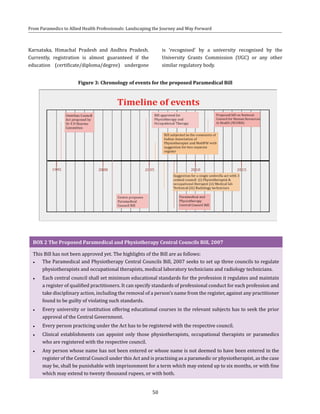
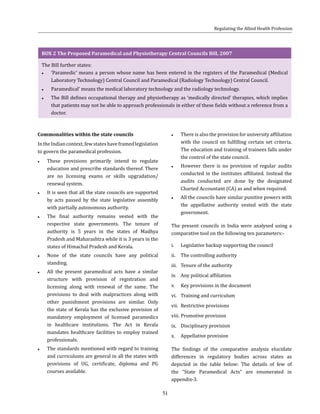
In 2007, the government of India proposed setting
upseparatecouncilsformedicallaboratorytechnicians,
radiology technicians, and physiotherapists/
occupational therapists. These councils would be
responsible, inter alia, for the maintenance of uniform
standards of education in the respective disciplines
and the registration of qualified personnel to practice
the profession.
A representative of the MoHFW apprised the
Parliamentary Standing Committee on Health
and Family Welfare about the circumstances that
necessitated the firming up of a Bill to set up the new
council. He pointed out the following problem areas,
which require regulation at the earliest:
●● Para-medical professions are not regulated;
●● Entry-level qualifications are different at different
levels;
●● Level of knowledge and skills is not uniform, since
the period of training differs from place to place
and has no uniformity;
●● Course curricula are not uniform;
●● Fee structure and facilities in these institutions
are not regulated; and
●● Ethical standards are not uniform and are not
being enforced.
The lack of planned courses and institutions, non-
uniform nomenclature for the existing courses, diverse
standards of practice and lack of qualified faculty
pose a threat to the quality of education and skills
of the AHP in India. Although there are professional
associations for certain AHPs, for example, the Indian
Optometric Association and the Indian Occupational
Therapy Association, the fruitful engagement of these
associations remains to be explored. Lack of definitive
and uniform criteria for faculty regarding essential
qualifications for their classification, nomenclature,
entry (direct versus lateral) and the absence of faculty
development programmes perpetuate the challenges
pertaining to the quantity and quality of AHPs.
The availability of educational resources such as
libraries, simulation centres and modern information
technology tools at various centres is also variable.
While established centres managed by large medical
institutions offer a reasonable level of facilities, the
educational resources are abysmal in stand-alone
centres or smaller set-ups.
TheConfederationofIndianIndustry(CII)believes
that ‘private partners can play a key role in capacity
building and training through PPP modes to better
utilise the infrastructure of government hospitals.
Executive Summary
7
From Paramedics to Allied Health Professionals: Landscaping the Journey and Way Forward
The government can encourage private sector interest
through initiatives such as provision of tax incentives,
and permits to corporates to undertake healthcare for
optimised use of resources. For example, a medical
college with a 500-bed capacity could produce 150
students annually, instead of the 100 as per the current
MCI norms.’ A CII policy paper points out that ‘capacity
building and training initiatives by the government
need sharpened focus not only for a quantitative
increase in trained manpower but also for improving
the effectiveness of existing methods in training’.
Extensive research by the PHFI team during
the course of 12 months indicates the need for an
overarching regulatory body for AHPs, excluding
doctors, nurses, dentists and pharmacists. The PHFI
team has recommended the establishment of national
and regional institutes for allied health sciences,
dedicated to nurturing and retaining talent in the
allied health space. In the absence of a Council, this
could be an interim multi-stakeholder body comprised
of experts from different allied health professions,
administrative leadership and even patients. This body
would be responsible for ensuring standardisation
of education and putting in place quality control
mechanisms for educational institutions, teaching
methods, clinical protocols, workforce management
and any other related issues.
Standards and acceptable terminologies for the
various professionals encompassing allied health
starting must be established; with the group being
referred to as Allied Health Professionals or AHPs
in lieu of ‘paramedics’. A definition put forth by the
PHFI team is thus: “Allied health professionals include
individuals involved with the delivery of health
or related services, with expertise in therapeutic,
diagnostic, curative, preventive and rehabilitative
interventions. They work in interdisciplinary health
teams including physicians, nurses and public health
officials to promote, protect, treat and/or manage
a person’s physical, mental, social, emotional and
environmental health and holistic well-being”
In addition, it is critical to undertake a complete
reorganisation of the various categories of AHPs based
on educational levels and specialty qualifications to
match international nomenclature and highlight their
importance as vital team players in the healthcare
delivery system. Standardised nomenclature is
also recommended for AHPs as part of their career
progression, so that promotional levels and associated
pay grades may be normalised accordingly.
Courses should follow international standards so
that they are widely accepted and receive worldwide
recognition. Students passing out from colleges should
be in great demand and get good jobs. The educational
methods should lead to a product that is worthy of
recruitment; therefore, it is very important to keep
abreast of knowledge and maintain good liaison with
the industry. Course delivery, practical training and
assessments should be standardised. Committees
should be formed to look into all aspects and
standardisation. Standardisation should incorporate
the demonstration of learning as well.
Each institution conducting courses on allied
health should analyse and keep a record of the
student base. This should consist of key statistics and
qualitative information such as demographics and
the type of applicants for each course, the number
that are selected, enrolled and those that ultimately
graduate, and the number of drop-outs each year by
specialty. This will help generate a better picture of the
supply demand issues for the future. Strategies should
be developed to create flexibility in course delivery
through alternative delivery modes, multiple locations
and timings. There is also a need to look at options for
fast education especially for persons with experience
but without adequate qualifications. Additionally,
short term educational programmes need to be put in
place for those who have a basic education such as a
B.Sc. degree in any science subject and want to pursue
a career in allied health sciences.
For each course, centres of excellence and globally
recognised institutions should be identified along
with hospitals with known good practices, which may
become possible training sites. Those institutions
willing to conduct courses or to become training
sites should be incentivised by the government. It is
8
important to motivate both government and private
institutions to conduct courses at various levels
(diploma to post-graduate and doctoral) depending on
their capacities, thus increasing the number of courses
in various streams and the students for each course.
However, if this is not possible, then they should be
motivated to at least become clinical training sites
rendering quality education to students.
All bottlenecks that may be related to regulatory or
financial issues that prevent institutions and hospitals
from serving as clinical sites for training should be
identified and efforts should be made to minimise
them. Solutions should be found for interactions
between educationists and potential employers to
assess the availability of clinical sites.
Quality improvement can be implemented
by establishing partnerships with international
institutions of excellence and PPPs to bring out the
best in the profession. The standards developed at the
centre and state levels should be in complete harmony
with each other. Emphasis on research activities
needs to be enhanced and the funding provided at
regular intervals either by the centre, state or foreign
direct investment, etc., which can be used for the
development of the research centres.
Alongwiththeapplicabilityofthedesiredmeansto
augment capacity, it is also essential to focus on quality
education. The Government will need to develop a
number of options to encourage flexibility in the allied
health sciences’ education without compromising
on its quality. Improvement in infrastructure and
availability of faculty is a challenge that needs to
be addressed, and the Government should provide
relevant support.
There is a need to define a pathway of an upgraded
lateral entry within the allied health educational
universe, such as for a diploma holder to enter a degree
programme. All avenues for each level of transition
should be defined. With respect to public awareness,
candidates should be well-versed with the difference
in opting for any degree or diploma programme.
Robust Public Private Partnership (PPP) models
need to be established for the training of faculty
and ensuring that the required numbers of students
graduate each year. Some incentive or financial
support should be provided to start these courses.
Strengthening community colleges in terms of proper
committees and faculty, and following standards is
essential. It is also necessary that recognition by the
Union Ministry of Human Resources Development and
the Directorate of Employment as well as training by
the respective State governments be carried out so
that the students from these colleges get national and
regional acceptance.
The Path Forward
The national initiative for allied health sciences aims
to go beyond prescribing basic project development
and management norms. It hopes to convert academic
arguments for strengthening allied health sciences
into politically articulate policies that help in capacity
building and value realization of allied health
professionals in the healthcare delivery system.
Nine premier institutions (eight RIAHS and
one NIAHS) will be the lead technical resources for
education and training of students. Moreover, to
provide education on such a scale assumed extensive
collaboration between various stakeholders at the
Centre, state and intra-state levels. The initiative may
be introduced in a phased manner. Activities will
include setting up National and Regional Institutes
of Allied Health Sciences (NIAHS and RIAHS),
establishing interim regulatory mechanisms in order
to standardize curricula, training programmes and
develop faculty across India in the allied health
streams, while engaging a network of institutions,
as indicated in Chapter 3. Thus, the implementation
arrangements would also require the establishment
of management structures at the national, state and
institutional levels.
There is also a need to form a task force for
curriculum development cells in existing universities,
which will be affiliated with project institutions and
spread best practices to non-project institutions. There
is a need to establish industry–institute partnership
promotion cells, along with sharing of best academic,
Executive Summary
9
From Paramedics to Allied Health Professionals: Landscaping the Journey and Way Forward
administrative and governance practices through
workshops and specific groups.
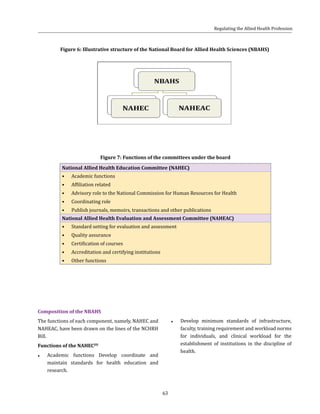
The NBAHS will be responsible for overall
monitoring of allied health education and practice in
thecountry,anditscoordinationwithotherMinistries/
Departments and the All India Council for Technical
Education (AICTE). The Board will be supported
by two committees under it; the National Allied
Health Education Committee (NAHEC) and National
Allied Health Evaluation and Assessment Committee
(NAHEAC) to ensure that standard and acceptable
terminologies are used for the various professionals in
allied health.
To conclude, Allied Health Professionals (AHPs)
constitute a vital part of the health system delivery,
both nationally and internationally. In the Indian
context, however, their significance and role has been
marginalised due to the prevalent culture of medical
dominance and the lack of a statutory body to give
prominence to their contributions and concerns.
Allied health workers are an untapped treasure,
critical to fixing the gaping holes in India’s health
workforce, particularly the severe shortage of
physicians and specialists. It would be a grave mistake
to not utilise the capacities of this resource at a time
when the government is bringing in critical reforms in
public health and aiming to improve access to health
by focussing on preventive, promotive, curative and
rehabilitative needs of the population.
While the government is considering strategies
to best utilize AHPs, the private sector has realised
their potential and established several institutions
and mechanisms to integrate these professions and
professionals into the organised healthcare sector.
However, the growing demand has resulted in the
mushrooming of big and small institutions claiming to
provide allied health education.
As the Ministry of Health and Family Welfare in
India gets ready to undertake a facelift for the entire
allied health workforce by establishing national and
regional institutes of excellence, the time is opportune
for the government to study this provider group in
detail; review existing inputs, processes and outputs;
standardise institutions, educational tools and
methods; revisit career paths and progression; and re-
introduce these professionals into the public system to
reap much-awaited rewards in the form of improved
health outcomes for the population.
10
11
1.	Introduction
Health is defined by the World Health Organization
(WHO) as a state of complete well-being, i.e. physical,
mental and social well-being, and not merely the
absence of disease. By that definition, all ‘people
engaged in the promotion, protection or improvement
of the health of the population are “health workers”’(1)
In the past decade, a fundamental shift has
occurredinhealthcaredelivery,largelyduetoadvances
in science and technology. There is more recognition
than at any time in the past that health service delivery
is no longer just a prerogative of physicians and nurses.
It is now a team effort, drawing upon the expertise of
both clinicians and non-clinicians. These professionals
or health-service providers have been historically
identified as paramedical staff or paraprofessionals or
health technicians.
Many committees and experts have highlighted the
importance of paramedics in healthcare delivery in the
past, including the National Knowledge Commission,
which placed more importance on producing more
paramedical professionals than doctors, despite the
acknowledged scarcity of the latter. Based on the
opinion of 72 experts in the country over the last 40
years, the paper on production and utilization of health
manpower towards improvement of health services in
India states that
‘there is no need to increase the number of
doctors but instead improve the quality and
orientation of service provision towards better
meeting the health needs of the people’ and
that, ‘there is a dire need to focus on increasing
the quantum and quality of human resources
for nursing and paramedical/allied health
services.’(2)
At present, the shortage of quality human
resources is one of the major challenges faced by the
public health domain in India. To redress the imbalance
in human resources, the Working Group on Medical
Education Training and Manpower Training of the
Planning Commission (1984) prioritised training of
paraprofessional and auxiliary personnel as follows:(3)
●● Training and development of auxiliary personnel
●● Training and development of paraprofessional
personnel
●● Basic and pre-service/induction training in public
health and health management;
●● Continuing education in health management and
public health
●● Undergraduate medical education; and
●● Postgraduate medical education
Acknowledging the shortage of clinicians, the
Mudaliar Committee,(4)
in 1962, underscored the need
for redesigning health service delivery with better
roles for auxiliary and paramedical personnel, leading
to better utilization of doctors and nurses. Fifty years
later, the recommendation still remains pertinent
to reforms in the Indian public health sector as
paramedics can reduce costs and augment the quality
of care. Better appreciation and utilization of the whole
range of skills possessed by these paraprofessionals–
collectively termed allied health professionals
(AHP)—is the key to healthsector reforms in India,
especially given the shortage of doctors and nurses in
the country.
Many new health occupations (physicians’
assistants, nurse practitioners, certified nurses) have
Chapter 1
The Allied Health Ecosystem
12
From Paramedics to Allied Health Professionals: Landscaping the Journey and Way Forward
emerged over the past several decades to assume
some of the work that doctors used to perform. Not
only is the work deskilled, but it is also increasingly
conducted without the doctor/physician’s control
and supervision as other professional workers seek
their own identity and autonomy. These processes
have received support from administrators who are
constantly searching for cheaper labour, apart from
the controlled trials revealing that AHPs can, in many
circumstances, do the same work just as effectively
and efficiently for those patients who must use them.
Preference for the term ‘allied health professional’
rather than ‘physician extender’ or ‘physician assistant’
reflects the promotion of this occupational division of
labour.
Service users are becoming more empowered
through the consumerism of health, which has resulted
in better access to information and user-consultation
in service development and delivery. Each of these
factors has the potential to influence the roles of
existing professional groups and presents a challenge
to workforce planners.
In India, students are not aware of all the allied
health courses available in the medical education
system. Their career choices are generally influenced
by their parents and peer groups, who themselves are
unawareoftheprospectsinthisarea.Byunderstanding
that an entry-level position is just a first step, youth
can realistically plan for their future and have a
better understanding of what is needed for long-term
success. This approach also benefits employers who
need a steady inflow of workers at all levels of their
organisation.
2.	 Who is an allied health
professional?
AHPs work in all areas of public health and social care.
They often provide the cross-boundary integration
needed to deliver seamless services to patients and
their caregivers, thus creating a model of social
solidarity. In some areas, AHPs offer open access
to their services, thus providing rapid responses to
patient needs in therapeutic fields where getting the
services of a general physician (GP) or consultant
invariably takes longer.
AHP-led services significantly reduce the cost
of similar services structured around a consultant
physician model.(5)
They play a supportive role in
providing personalised care in dealing with children
with communication difficulties, young offenders,
the elderly, cancer patients and those with long-
term conditions such as diabetes. AHPs also have
an important role to play in the treatment of those
with disability, such as those with vision problems,
amputees and others.
For some patients, such as stroke survivors, it
is the support of AHPs that greatly enhances their
rehabilitationandreturntonormallifeinthelongterm;
AHPs also play a significant part in the care and return
to well-being of patients who struggle with mental and
emotional challenges.
The above description of AHP functions is an
incomplete listing of the many categories of patients
and potential beneficiaries who are helped by the
personalised attention given by AHPs. The role of the
AHP has grown in knowledge and competence with
the evolution and specialisation of medical care.
3.	 Classification of AHPs
AHPs are typically divided into two categories:
technicians (assistants) and therapists/technologists.
Technicians are trained to perform procedures
and their education lasts for less than two years.
They work under the supervision of technologists or
therapists and include physical therapy assistants,
medical laboratory technicians, radiological
technicians, occupational therapy assistants,
recreation therapy assistants and respiratory therapy
technicians.
Therapists or technologists, on the other hand,
acquireproceduralskillsandlearntoevaluatepatients,
diagnose conditions, develop appropriate treatment
plans by judging potential side-effects, ascertain
13
therapy responses, and make appropriate decisions
about treatment continuation/modification.(6)
addition, there are multipurpose workers, both male
and female, and auxiliary nurse midwives (ANMs).
Peri-medical
They are general duty assistants, sweepers and
group C workers (clerks, accountants, storekeepers,
ward-masters) and non-medical technical hands. They
could play an important role in both preventive and
curative services.
4.	 Role of allied health
professionals
Allied health professionals play a range of roles from
health promotion, health improvement and early
intervention to the support of those with long-term
conditions, disability and those on palliative care.(7)
Mid-level practitioners (MLPs) have rendered care to
indigenouspopulationssincecolonialtimes.Atpresent,
they assist professionals or render care independently,
especially in areas with a scarcity or absence of
professionals such as therapists, doctors, dentists,
pharmacists and nurses. AHPs provide services both
in urban and rural areas, in primary-, secondary- and
tertiary-care institutions and in health centres.
Dr. Gauripada Dutta, senior member of State
Planning Board, Government of West Bengal has
offered an alternative classification of AHPs, as given
below:
Paraprofessional
These are voluntary workers from the community
who are not part of a structural organisation. These
voluntary activists receive training and some form of
recognition from the community and the local self-
government. Community health volunteers/guides
and traditional birth attendants were recruited with
this idea. Many state governments, for example,
Madhya Pradesh and Chhattisgarh, are initiating such
schemes in various towns. There is a need for a system
to objectively review their efficacy and sustainability
while retaining control of the community over them.
Paramedical
They are associated with preventive, promotive
and curative health procedures. They include nurses of
different categories, social welfare/extension officers,
pharmacists, computer workers, and technicians of
different categories (e.g. laboratory X-ray technicians,
ophthalmic assistants and physiotherapists). In
The Allied Health Ecosystem
The Pennsylvania Workforce Investment Board
summarises the main roles performed by AHPs under
the headings shown in table below:
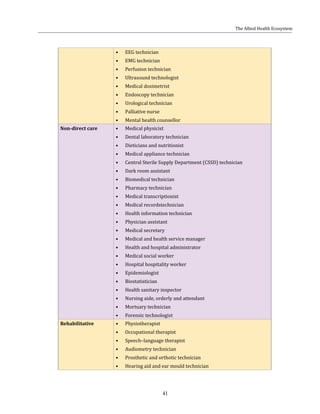
Diagnostic Cardiovascular technologists
Medical and clinical laboratory technicians
Radiological technologists and technicians
Medical services Dental assistants
Emergency medical technicians and paramedics
Medical assistants
Non-direct care Dental laboratory technicians
Medical appliance technicians
Pharmacy technicians
Rehabilitative Occupational therapists
Speech–language therapists
Respiratory therapists
14
From Paramedics to Allied Health Professionals: Landscaping the Journey and Way Forward
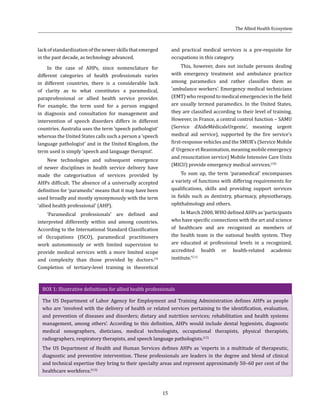
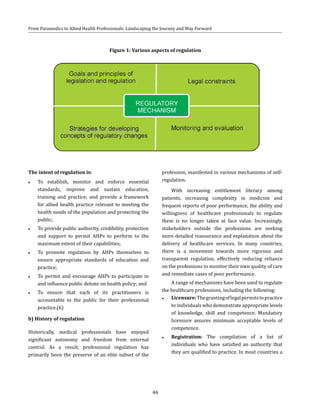
Figure 1: Areas of function of allied health professionals
An AHP needs to be skilled in various fields to
provide a particular expertise for patient care. With
the rise in various non-communicable diseases such as
heartdisease,stroke,cerebralpalsyanddevelopmental
disorders, there is a need for specialised care provided
by various members of the allied health team such as
physiotherapists, occupational therapists, speech–
language pathologists, podiatrists, psychologists and
dieticians, to name a few. Therefore, the role of an AHP
as a part of the multidisciplinary team is open-ended
and is projected to increase in the coming years.
The breadth and scope of allied health practice
encompasses the following:
●● The age span of human development from neonate
to old age;
●● Working with individuals with complex and
challenging problems resulting from multi-system
illnesses;
●● Working towards health promotion and injury
prevention, and the assessment, management and
evaluation of interventions;
●● Working in a broad range of settings from the
patient’s home to acute, primary and critical care
settings; and
●● Having an understanding of the healthcare issues
associated with diverse cultures within society.
The importance of these professionals has been
explained with an example by Dr K.S. Reddy, Dean
of the Jawaharlal Institute of Post-Graduate Medical
Education and Research (JIPMER), Puducherry:
‘During the process of cardiac surgery, the
functions of the heart are taken over by a
machine. The person who handles this machine
literally holds the life of the person. Any mistake
can be life-threatening. This is why we now
insist on trained staff to handle such machines.’
(8)
With advancements in technology over the past
few decades, the quality of medical care has vastly
improved across the world. This has thrown up fresh
challenges for the medical field. Today, there is an
urgent need for competent people who can handle
highly sophisticated medical machinery. In fact,
diagnosis has become so dependent on technology
that the role of allied health staff has become vital in
delivering successful treatment.
Training of AHPs is an important issue. However,
the Indian healthcare education system has centred on
medical, nursing and a few allied programmes. There
are hardly any institutes and systems to train other
cadres, except those offered through the executing
departments or their associated agencies.
Though structured training for AHPs is important,
no conscious efforts have been made for positioning
and mentoring of AHPs in India and, worse, they are
not directly part of the health directorate domain and
often do not come under the health system.
5.	 Placing AHPs in a global context
Internationally, there is mounting evidence that
healthcare as a composite whole can only be improved
if human resources for nursing and allied health
services are developed, nurtured and enhanced in a
systematic and planned manner. There is a significant
15
lackofstandardizationofthenewerskillsthatemerged
in the past decade, as technology advanced.
In the case of AHPs, since nomenclature for
different categories of health professionals varies
in different countries, there is a considerable lack
of clarity as to what constitutes a paramedical,
paraprofessional or allied health service provider.
For example, the term used for a person engaged
in diagnosis and consultation for management and
intervention of speech disorders differs in different
countries. Australia uses the term ‘speech pathologist’
whereas the United States calls such a person a ‘speech
language pathologist’ and in the United Kingdom, the
term used is simply ‘speech and language therapist’.
New technologies and subsequent emergence
of newer disciplines in health service delivery have
made the categorisation of services provided by
AHPs difficult. The absence of a universally accepted
definition for ‘paramedic’ means that it may have been
used broadly and mostly synonymously with the term
‘allied health professional’ (AHP).
‘Paramedical professionals’ are defined and
interpreted differently within and among countries.
According to the International Standard Classification
of Occupations (ISCO), paramedical practitioners
work autonomously or with limited supervision to
provide medical services with a more limited scope
and complexity than those provided by doctors.(9)
Completion of tertiary-level training in theoretical
and practical medical services is a pre-requisite for
occupations in this category.
This, however, does not include persons dealing
with emergency treatment and ambulance practice
among paramedics and rather classifies them as
‘ambulance workers’. Emergency medical technicians
(EMT) who respond to medical emergencies in the field
are usually termed paramedics. In the United States,
they are classified according to their level of training.
However, in France, a central control function – SAMU
(Service d’AideMédicaleUrgente’, meaning urgent
medical aid service), supported by the fire service’s
first-response vehicles and the SMUR’s (Service Mobile
d’ Urgence et Reanimation, meaning mobile emergency
and resuscitation service) Mobile Intensive Care Units
(MICU) provide emergency medical services.(10)
To sum up, the term ‘paramedical’ encompasses
a variety of functions with differing requirements for
qualifications, skills and providing support services
in fields such as dentistry, pharmacy, physiotherapy,
ophthalmology and others.
In March 2000, WHO defined AHPs as ‘participants
who have specific connections with the art and science
of healthcare and are recognized as members of
the health team in the national health system. They
are educated at professional levels in a recognized,
accredited health or health-related academic
institute.’(11)
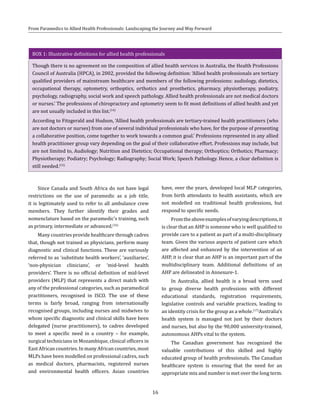
BOX 1: Illustrative definitions for allied health professionals
The US Department of Labor Agency for Employment and Training Administration defines AHPs as people
who are ‘involved with the delivery of health or related services pertaining to the identification, evaluation,
and prevention of diseases and disorders; dietary and nutrition services; rehabilitation and health systems
management, among others’. According to this definition, AHPs would include dental hygienists, diagnostic
medical sonographers, dieticians, medical technologists, occupational therapists, physical therapists,
radiographers, respiratory therapists, and speech language pathologists.(12)
The US Department of Health and Human Services defines AHPs as ‘experts in a multitude of therapeutic,
diagnostic and preventive intervention. These professionals are leaders in the degree and blend of clinical
and technical expertise they bring to their specialty areas and represent approximately 50–60 per cent of the
healthcare workforce.’(13)
The Allied Health Ecosystem
16
From Paramedics to Allied Health Professionals: Landscaping the Journey and Way Forward
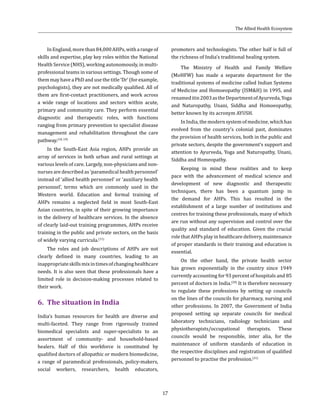
BOX 1: Illustrative definitions for allied health professionals
Though there is no agreement on the composition of allied health services in Australia, the Health Professions
Council of Australia (HPCA), in 2002, provided the following definition: ‘Allied health professionals are tertiary
qualified providers of mainstream healthcare and members of the following professions: audiology, dietetics,
occupational therapy, optometry, orthoptics, orthotics and prosthetics, pharmacy, physiotherapy, podiatry,
psychology, radiography, social work and speech pathology. Allied health professionals are not medical doctors
or nurses.’ The professions of chiropractory and optometry seem to fit most definitions of allied health and yet
are not usually included in this list.(14)
According to Fitzgerald and Hudson, ‘Allied health professionals are tertiary-trained health practitioners (who
are not doctors or nurses) from one of several individual professionals who have, for the purpose of presenting
a collaborative position, come together to work towards a common goal.’ Professions represented in any allied
health practitioner group vary depending on the goal of their collaborative effort. Professions may include, but
are not limited to, Audiology; Nutrition and Dietetics; Occupational therapy; Orthoptics; Orthotics; Pharmacy;
Physiotherapy; Podiatry; Psychology; Radiography; Social Work; Speech Pathology. Hence, a clear definition is
still needed.(15)
Since Canada and South Africa do not have legal
restrictions on the use of paramedic as a job title,
it is legitimately used to refer to all ambulance crew
members. They further identify their grades and
nomenclature based on the paramedic’s training, such
as primary, intermediate or advanced.(16)
Many countries provide healthcare through cadres
that, though not trained as physicians, perform many
diagnostic and clinical functions. These are variously
referred to as ‘substitute health workers’, ‘auxiliaries’,
‘non-physician clinicians’, or ‘mid-level health
providers’. There is no official definition of mid-level
providers (MLP) that represents a direct match with
any of the professional categories, such as paramedical
practitioners, recognised in ISCO. The use of these
terms is fairly broad, ranging from internationally
recognised groups, including nurses and midwives to
whom specific diagnostic and clinical skills have been
delegated (nurse practitioners), to cadres developed
to meet a specific need in a country – for example,
surgical technicians in Mozambique, clinical officers in
East African countries. In many African countries, most
MLPs have been modelled on professional cadres, such
as medical doctors, pharmacists, registered nurses
and environmental health officers. Asian countries
have, over the years, developed local MLP categories,
from birth attendants to health assistants, which are
not modelled on traditional health professions, but
respond to specific needs.
Fromtheaboveexamplesofvaryingdescriptions,it
is clear that an AHP is someone who is well qualified to
provide care to a patient as part of a multi-disciplinary
team. Given the various aspects of patient care which
are affected and enhanced by the intervention of an
AHP, it is clear that an AHP is an important part of the
multidisciplinary team. Additional definitions of an
AHP are delineated in Annexure-1.
In Australia, allied health is a broad term used
to group diverse health professions with different
educational standards, registration requirements,
legislative controls and variable practices, leading to
an identity crisis for the group as a whole.(17)
Australia’s
health system is managed not just by their doctors
and nurses, but also by the 90,000 university-trained,
autonomous AHPs vital to the system.
The Canadian government has recognized the
valuable contributions of this skilled and highly
educated group of health professionals. The Canadian
healthcare system is ensuring that the need for an
appropriate mix and number is met over the long term.
17
InEngland,morethan84,000AHPs,witharangeof
skills and expertise, play key roles within the National
Health Service (NHS), working autonomously, in multi-
professional teams in various settings. Though some of
them may have a PhD and use the title ‘Dr’ (for example,
psychologists), they are not medically qualified. All of
them are first-contact practitioners, and work across
a wide range of locations and sectors within acute,
primary and community care. They perform essential
diagnostic and therapeutic roles, with functions
ranging from primary prevention to specialist disease
management and rehabilitation throughout the care
pathway.(18, 19)
In the South-East Asia region, AHPs provide an
array of services in both urban and rural settings at
various levels of care. Largely, non-physicians and non-
nurses are described as ‘paramedical health personnel’
instead of ‘allied health personnel’ or ‘auxiliary health
personnel’, terms which are commonly used in the
Western world. Education and formal training of
AHPs remains a neglected field in most South-East
Asian countries, in spite of their growing importance
in the delivery of healthcare services. In the absence
of clearly laid-out training programmes, AHPs receive
training in the public and private sectors, on the basis
of widely varying curricula.(11)
The roles and job descriptions of AHPs are not
clearly defined in many countries, leading to an
inappropriateskillsmixintimesofchanginghealthcare
needs. It is also seen that these professionals have a
limited role in decision-making processes related to
their work.
6.	 The situation in India
India’s human resources for health are diverse and
multi-faceted. They range from rigorously trained
biomedical specialists and super-specialists to an
assortment of community- and household-based
healers. Half of this workforce is constituted by
qualified doctors of allopathic or modern biomedicine,
a range of paramedical professionals, policy-makers,
social workers, researchers, health educators,
promoters and technologists. The other half is full of
the richness of India’s traditional healing system.
The Ministry of Health and Family Welfare
(MoHFW) has made a separate department for the
traditional systems of medicine called Indian Systems
of Medicine and Homoeopathy (ISM&H) in 1995, and
renameditin2003astheDepartmentofAyurveda,Yoga
and Naturopathy, Unani, Siddha and Homoeopathy,
better known by its acronym AYUSH.
InIndia,themodernsystemofmedicine,whichhas
evolved from the country’s colonial past, dominates
the provision of health services, both in the public and
private sectors, despite the government’s support and
attention to Ayurveda, Yoga and Naturopathy, Unani,
Siddha and Homeopathy.
Keeping in mind these realities and to keep
pace with the advancement of medical science and
development of new diagnostic and therapeutic
techniques, there has been a quantum jump in
the demand for AHPs. This has resulted in the
establishment of a large number of institutions and
centres for training these professionals, many of which
are run without any supervision and control over the
quality and standard of education. Given the crucial
role that AHPs play in healthcare delivery, maintenance
of proper standards in their training and education is
essential.
On the other hand, the private health sector
has grown exponentially in the country since 1949
currently accounting for 93 percent of hospitals and 85
percent of doctors in India.(20)
It is therefore necessary
to regulate these professions by setting up councils
on the lines of the councils for pharmacy, nursing and
other professions. In 2007, the Government of India
proposed setting up separate councils for medical
laboratory technicians, radiology technicians and
physiotherapists/occupational therapists. These
councils would be responsible, inter alia, for the
maintenance of uniform standards of education in
the respective disciplines and registration of qualified
personnel to practise the profession.(21)
The Allied Health Ecosystem
18
From Paramedics to Allied Health Professionals: Landscaping the Journey and Way Forward
The MoHFW apprised the Parliamentary Standing
Committee on Health and Family Welfare about the
circumstances that necessitated the firming up of a Bill
to set up the new council. The following problem areas
that require regulation at the earliest were pointed
out:
●● Paramedical professions are not regulated
●● Entry-level qualifications are different at different
levels
●● The level of knowledge and skills is not uniform,
since the period of training differs from place to
place and has no uniformity
●● Course curricula are not uniform
●● Fee structure and facilities in these institutions
are not regulated
●● Ethical standards are not uniform and are not
being enforced
The government’s various policy documents
on AHPs club alternative health services (systems
of medicine), ambulance services and allied health
services under a single group. Although the Indian
Public Health Standards (IPHS) has not distinctly
defined a paramedic, the contents indicate inclusion
of two kinds of functionaries – those who directly
contribute to patients’ healthcare delivery and those
who maintain the health facilities.
The Madhya Pradesh Paramedical Council Act(22)
and the Himachal Pradesh Paramedical Council Act(23)
(both passed in 2003) cover professionals practising
traditional systems of medicine (Ayurveda, Unani or
Homeopathy) who are regulated by their own separate
councils at the central level. Since the central and state
laws are applicable to these professions, practitioners
inthesestateshavetoregisterthemselveswithboththe
councils. The Kerala Paramedical Council Bill describes
a paramedical technician as ‘an ECG technician, EEC
technician, EMG technician, X-ray technician, medical
laboratory technician or ophthalmic assistant, and
includes such other technicians as may be specified
and notified by the government as paramedical
technicians from time to time’.(24)
7.	 Challenges with the present
allied health education system
a)	 Training systems and institutions
Training for allied health services in India is conducted
by institutions ranging from government-affiliated
universities, distance-learning universities to
public and corporate hospitals, medical equipment
manufacturing firms and even pharmaceutical
companies.
The lack of planned courses and institutions, non-
uniform nomenclature for the existing courses, diverse
standards of practice and lack of qualified faculty pose
a threat to the quality of education and skills of the
AHP.
Although there are professional associations for
certain AHPs, for example, the Indian Optometric
Association and the All India Occupational Therapists’
Association, the fruitful engagement of these
associations remains to be explored. Lack of definitive
and uniform criteria regarding essential qualifications
for the classification of faculty, nomenclature for
faculty, entry of faculty (direct versus lateral entry)
and absence of faculty development programmes
perpetuate the challenges pertaining to the quantity
and quality of AHPs.
The availability of educational resources such as
libraries, simulation centres and modern information
technology tools at various centres is also variable.
While established centres managed by large medical
institutions offer a reasonable level of facilities, the
educational resources are abysmally poor in stand-
alone centres or smaller set-ups.
b)	 Infrastructure
A literature review and field visits indicate that most
institutions lack separate infrastructure and dedicated
teaching/learning aids for allied health services. Some
allied health schools have instituted modern methods.
For example, Manipal University has a common
simulation laboratory and library for all the students
pursuing healthcare sciences, the Johnson and Johnson
Ethicon Institute of Surgical Education has animated
19
laboratories across India for imparting hands-on
training to medical and allied health professionals.
The Post Graduate Institute of Medical Education and
Research (PGIMER), Chandigarh and Guru Gobind
Singh Medical College, Faridkot have learning resource
centres.
c)	 Training programmes and methods
The education and training courses for AHPs in India
range from short-term (up to three months) certificate
and diploma courses to graduate level, postgraduate
and even doctorate programmes.(11)
However, there
are discrepancies in the structure and content of
the same courses in different areas across India.
Some courses are well organised and are certified by
proper universities or associations but most are not
under the ambit of any university and have evolved
as demand for services grew. Therefore, there is a
need for standardisation of the course curricula and
regulations.
Availability of competent faculty is the key to
quality education. Most institutions in India do not
have a separate wing of teachers dedicated to allied
health sciences. The result is that the existing graduate
and postgraduate students do not get the right
training that would enable them to take up teaching
positions. There is an acute shortage of dedicated
faculty. Teaching in allied health is predominantly
done by medical specialists. No attention is paid to
faculty development to ensure uniformity in teaching
methods. Incentives that could motivate AHPs to take
up teaching jobs are inadequate. On top of that, the
best students are absorbed by the market with better
salary offers. Hence, there is a need to attract good
students in universities and institutions to take up
teaching as a career. There are no simple and quick-
fix solutions, as it takes several years of hard training
to groom a competent teacher in any branch of higher
learning.
The faculty development programmes or other
efforts to develop teaching capacity in medical
education need to look beyond ‘clinical competence’
and ‘scientific research skills’. They have to focus
specifically onprofessional skills development for
teaching among the faculty. Most institutions do not
have an orientation programme or training-of-trainer
protocol.
d)	Curricula
Central institutes such as the All India Institute
of Medical Sciences (AIIMS), New Delhi; PGIMER,
Chandigarh; and Jawaharlal Institute of Post-
graduate Medical Education and Research (JIPMER),
Puducherry, and autonomous institutes such as the
Manipal College of Allied Health Sciences (MCOAHS),
Karnataka and Christian Medical College (CMC),
Vellore run a variety of allied health programmes with
a structured curriculum. However, there is a lack of
uniformity in the existing curricula and standards of
training between these institutions.
For the same skills set, for example, medical
laboratory technology (MLT); a range of courses
exist at various institutions––a one-year course, a
certificate, a two-year diploma, and a three-year
degree programme.
There is wide variation within these courses with
regard to the content of the curriculum and type of
training. For example, for the BSc MLT programme
at the Armed Forces Medical College, Pune; 60 hours
of general management is included in the course
curriculum. However, this is excluded in most of the
other institutions running the degree programme.
The curricula of these courses vary even within
institutes affiliated to the same council. For example,
in Optometry, CMC Vellore has incorporated dissection
of the eyeball, which is not included in other similarly
affiliated institutions.
e)	 Fee structure
Given the wide diversity of institutional ownership, it
is not surprising that there is a lack of standardisation
in the fee structure of these courses. While structured
courses in government-run or reputed autonomous
institutions such as AIIMS, PGIMER and CMC have a
well-defined fee schedule with a nominal entry fee,
the fees payable at private institutes and smaller set-
ups are much higher as the fee schedule is designed
The Allied Health Ecosystem
20
From Paramedics to Allied Health Professionals: Landscaping the Journey and Way Forward
to generate profits for the institute. Ill-informed
candidates often get cheated by fly-by-night operators
marketing education for AHPs.
While some of the courses offer a token stipend to
the candidates in lieu of their supportive services in
running laboratories or departments, the remaining
courses have no such provision.(25)
BOX 2: Role of the private sector in shaping allied health services
The private sector has played a significant role in strengthening paramedical/allied health education in both
developed and developing countries.
According to the WHO, ‘Several countries have private human resources for health (HRH) pre-service training
schools and governments facilitate or stimulate investment by private sector pre-service training capacity to
alleviate public sector capacity limitations that otherwise constrain HRH scale-up. WHO advises governments to
streamline approvals and accreditation processes, offer tax breaks, or provide scholarship support for student
tuition payments and also seek partnerships with the private sector to encourage contributions to investments
in public institutions.’(26)
In USA, for example, the ‘California Hospital Association recommends creating an allied health initiative to
incentivize public private partnerships (PPPs) for allied health workforce education and training. This initiative
is to be modelled after the successful Nursing Education Initiative, which created a multi-agency task force to
address California’s critical shortage of registered nurses, wherein PPPs have proven very effective in addressing
the need to expand programs, increase faculty supply, and provide additional clinical training sites.’(27)
In India, realising the challenges of producing an adequate number of AHPs with appropriate competencies,
several private sector players have set up training institutions. In addition, the opening of super-specialty
hospitals has led to the incorporation of the latest technology and techniques in healthcare. This has encouraged
the private sector to get involved in pre-service education. Several groups in the private sector have introduced
simulation laboratories–a tool for accelerating skill-building of the allied health workforce by decreasing the
demand on clinical sites.
The Confederation of Indian Industry (CII) believes that ‘private partners can play a key role in capacity building
and training through PPP modes to better utilise the infrastructure of government hospitals. The government
can encourage private sector interest through initiatives such as provision of tax incentives, and permits
corporates to undertake healthcare for optimised use of resources’. For example, a medical college with a 500-
bed capacity could produce 150 students annually, instead of the 100 as per the current MCI norms. A CII policy
paper points out that ‘capacity building and training initiatives by the government need sharpened focus not
only for a quantitative increase in trained manpower but also for improving the effectiveness of existing methods
in training’.(28)
Focus group discussions with AHPs have revealed
that most of them work under the shadow of doctors
and they hardly get any recognition in society. People
go for these careers only when they have no other
options in the health sector. The profession of a
paramedic/AHP is not a coveted career choice for the
student pool in the country. Usually, only students
from the poor strata of the society join the allied health
professions. The middle and upper classes prefer to
join medical/engineering/management streams.(29)
8.	 Medical dominance and
medicalization: their effect on and
perception of AHPs
In India, there is a conspicuous lack of recognition in
the form of accreditation, quality control, career plan
and respectable pay scales for AHPs. That there is little
involvement of AHPs in policy development related
to their work highlights the doctor-centred nature of
medical services.
21
Physicians generally view AHPs as non-medical
staff. As a result, they seem unwilling to permit AHPs to
undertake tasks that they consider medical in nature.
Several factors have contributed to the uneven power
balance between doctors and AHPs. As American
physician and educator, Leon Kass, points out,
‘…all kinds of problems now roll to the doctor’s
door, from sagging anatomies to suicides,
from unwanted childlessness to unwanted
pregnancy, from marital difficulties to learning
difficulties, from genetic counselling to drug
addiction, from laziness to crime...’.(30)
According to American academician and
sociologist, Professor Eliot Freidson, medical
dominance has at least three components:(31)
●● Trust, faith and confidence by the public in the
medical profession;
●● A position of authority based on exclusive
command over a body of specialised knowledge;
and
●● Dominance in the division of labour, that is, control
over other health professions.
There appears to be an increasing ‘health–illness–
medicine’ complex in society, wherein people seek
medical solutions to various problems that are not
medical in nature and consider them as illnesses.
Medical dominance coupled with what is called
‘medicalisation’ is considered to be a major reason.
Medicalisation, therefore, has not only broadened the
scopeofmedicinebutalsoraiseditsstatus.Itreinforces
the image of medical practitioners as being omniscient
and omnipotent, and compels societies to allocate
continually growing proportions of gross domestic
product to their preferred healthcare services.(32)
To these may be added the privilege of self-
regulation, where by the profession regulates the
behaviour of its members and monopolises decision-
making and the use of resources. Medical dominance
of healthcare has traditionally been the organising
principle in the healthcare delivery system. Medical
power is manifested through the professional
autonomyofdoctors,theirpivotalroleintheeconomics
of the health services, their dominance over allied
health occupational groups, administrative influence
and the collective influence of medical associations.
The clear hierarchy of occupations established
through the growth of hospital medicine is attributed
to be a major contributor to the dominance of medicine
in the division of labour.
Thus, high medical domination has been
instrumental in lowering the status of AHPs in the
eyes of people and is the one of the reasons for the
low morale and self-esteem among AHPs. This needs
to be addressed immediately if they are to contribute
meaningfully to the well-being of the people.
Addressing medical dominance: viewpoints
In many countries, notably the United States, the
United Kingdom, Canada and Australia, policy
rationalisation by their governments have facilitated
the release of AHPs from medical dominance. The Pew
Health Professions Commission report (1995), titled
Critical challenges: revitalizing the health professions
for the twenty-first century, observed: ‘The needs of
the integrated systems will not be met simply by hiring
[new] public health professionals [but by] substantial
and ongoing retraining of nurses, physicians, allied
health personnel, and managers . . . [who are] required
to apply the skills in new contexts.’(33)
The report calls
for creative and risk-accepting leadership in providing
training and education, a ‘renaissance’ in educating
public health professionals. Training and re-training
for public health should be based on competencies,
that is, the focus should be on what people should be
able to do, rather than what they should know.(34)
Professor Donald M. Berwick, President and
Chief Executive Officer, Institute for Health Care
Improvement, and Clinical Professor of Pediatrics
and Health Care Policy, Harvard Medical School in the
Foreword of the book Managing and leading in the
allied health professions, makes a strong case for de-
medicalisation and eliminating medical dominance
when he raises and answers several pertinent
questions as follows:
The Allied Health Ecosystem
22
From Paramedics to Allied Health Professionals: Landscaping the Journey and Way Forward
●● ‘Allied to what?’: ‘...the continual pursuit to relieve
suffering for those we serve.’
●● ‘In what way “professional”?’: ‘In the willingness
to subordinate self-interest and prior assumptions
to the pursuit of continual improvement in
our effectiveness as a team, and to redraw the
boundaries in the status quo.’
●● ‘Why “health” and not “healthcare”?’: ‘To broaden
the base of our capacity to serve.’
●● ‘Are physicians, too, “allied health professionals”?’:
‘Of course. Why would you even bother to ask? We
are all on the same team.’
In India, too, the need and approach to address the
issue of medical dominance is well articulated in the
report of the Mudaliar Committee (1962), which made
some important recommendations regarding the
scope of utilisation of AHPs.(35)
●● TheinstitutionofaMasterofSciencedegree,which
will be available for graduates in science who
have taken up mathematics, physics, chemistry,
botany or zoology, is rewarded. There is a wide
field for useful employment of such graduates and
postgraduates for medical relief both in the public
health department and in many institutions; and
●● It is essential that a large number of technicians
be trained for multipurpose duties in the field of
medicine. It is felt that all district headquarter-
level hospitals and large hospitals with a bed-
strength of 200 can train these technicians. The
period of training may vary from one year to two
years, and persons to be taken on for training must
be those who have completed their school final or
equivalent course.
Presently, besides medical and nursing personnel,
medical auxiliaries are crucial for assisting doctors
and public health workers.
Acknowledging the medical bias, the Mudaliar report
notes that:
‘The growth and development of health
services and manpower over the Five-Year
Plan period reveals that health services and
health manpower have been developing in an
isolated and non-rational manner; and there
has been far less concern, almost amounting to
negligence, for the planning and production of
allied health professionals as compared to that
for medical manpower. Indeed, the primary
reason for this is the medical bias in the entire
process of health system planning and health
manpower development.’(35)
9.	 Relevance of defining allied
health professionals now: political
and social environment
AHPs are woven into the fabric of public health in
India. They are in the vanguard of creating a service
based on people ‘being healthy’ rather than a service
based on ‘fixing ill-health’. Empowered AHPs can be
the leaders of change.
With a vast variety of allied health professions
present today and with newer categories coming on
board each day, India too, faces a challengeas different
states have been using different definitions to describe
this ever-growing field.
There is a wide variation in the understanding of
the concept of paramedic in India. The nomenclature
and functions vary widely. No concerted initiative has
been taken to understand the roles and responsibilities
of AHPs, the governance and regulation issues of
the sector, and deployment strategies in the Indian
context. The roles and responsibilities conferred on
a paramedic are largely decided by the programme
under which she or he is employed.
There is a strong case to, therefore, standardise
a comprehensive definition of AHP for the overall
regulation, deployment and development of this
growing cadre (Figure 2).
23
Figure 2: Need to define allied health professions
BOX 3: Experiments and experiences in career planning
Results of a study by Thomson and others (1991) in Houston showed that only 8 per cent of respondents
expressed an interest in allied health as a career choice. Many were even unaware of what an AHP is. The results
of this study were consistent with other reports suggesting that new strategies must be employed to promote
greater participation in allied health, especially where there is under representation in these professions.
In 1996, the Association of American Medical Colleges launched the Health Professions Partnership Initiative
(HPPI) to increase the representation of minority communities in the health services. Under the HPPI, health
profession schools were to link with neighbouring colleges and schools to improve curricula in ways that would
attract students to health careers.
Among the many medical colleges to implement the HPPI was the Creighton School of Medicine. The overall
goal of the Creighton Collaborative Health Professions Partnership was to implement programmes in partner
institutions, which would increase the academic achievements and health career preparation of students
from the minority communities and ultimately translate into enrolment in the college’s health professionals’
programme.
Feedback surveys after the programme revealed changed perceptions. Students who earlier only identified
‘doctor’ and ‘nurse’ as medical professionals, now named more specialised choices, including many in the realm
of allied health after presentations from various AHPs.(36)
However, in India, career counselling generally does not include these options for students, nor are these courses
advertised in schools.
In the United States, ‘programs guiding youth through a pathway to employment in allied health occupations
take many forms…. Such programs can focus on in-school youth as early as middle school to point students in
the direction of allied health opportunities. In contrast, programs can be directed to older out-of-school youth
who require specific assistance to transition them through education and training and on to employment in an
allied health occupation or one leading to allied health. Job shadowing is an approach being used by the Lehigh
Valley, Pennsylvania Workforce Investment Board program and the ECHO program in Lafayette, Louisiana.’(10)
The Allied Health Ecosystem
24
From Paramedics to Allied Health Professionals: Landscaping the Journey and Way Forward
BOX 3: Experiments and experiences in career planning
According to the study titled Allied health access: how to develop programs for youth in allied health careers
published by the U.S. Department of Labor Employment and Training Administration, developing an allied
health programme for youth requires the inclusion of three principal partners:(10)
•	 The agencies responsible for recruiting, enrolling and supporting the youth on their career pathway;
•	 The institution responsible for training and/or educating the youth; and
•	 Health industry employers.
It further says, ‘In most situations, recruiting and enrolling the youth will be the responsibility of community-
based organisations. Training and education for allied health occupations is often provided by community
colleges but this can vary, based on the specific occupation. Employers are most often hospitals and other major
healthcare providers. Other partners can be included, such as agencies providing supportive services.’
10.	 Key issues and policy
considerations for augmenting
allied health capacity
The continuously changing health needs and service
requirements influence the allied health ecosystem
in terms of both service provision and education. In
today’s scenario, it is imperative to keep the right
balance between curative, preventive, promotive and
rehabilitative healthcare. AHPs play an important role
in providing all these levels of care and hence must
get their due recognition and status in the healthcare
sector.
In this era of globalisation, it is also essential to
prevent the brain drain of AHPs, besides ensuring
optimum utilisation of skilled human resources to
meet the service requirements of the healthcare
delivery system. Due to the intricate nature of the sub-
specialties and undefined work profiles within the
allied health professions, there is intense overlapping
of roles and responsibilities, leading to an unnecessary
work overload.
In order to have a defined career pathway for
AHPs, there should be an emphasis on developing
their managerial skills. Concerted efforts should also
be made to understand the relationship between
allied and other health professionals to overcome any
resistance and bias from the medical profession.
The cost of training and skills development
methods required to train professionals is on the
rise as is the cost of inputs such as physical facilities,
teaching and learning resources. This puts additional
pressure on attempts to upgrade the education, re-
training and other forms of continuing education
of trainers and trainees. Training has become more
commercialised and competitive with the increase in
recognition of institutes in the country and abroad,
and with local institutes being compared with their
foreign counterparts.
Thereisapressingneedforlicensing/accreditation
of training institutes. It is also important to reorient
the education at these institutes with new approaches,
introduce new methods for training and more self-
directed learning that emphasises learning processes
rather than content. This realisation has led to a
more vigorous training curriculum, with an increase
in the duration of training, improvements in entry
requirements and selection criteria, collaboration and
sharing of resources between the allied health services
and the education sectors.
25
11.	Recommendations
The wide variation in the understanding of the
concept of allied health professional, better known as
‘paramedic’, the nomenclature, and functions has led to
the poor image of allied health sciences. Despite a huge
demand for services from this sector, the allied health
sciences domain is highly fragmented. The government
currently has limited options for employment,
numbers for which need to be re-examined. It is hence
essential to address the issue of perception urgently.
The use of the word paramedic itself limits the
activities of AHPs in the system. Hence, it is imperative
to adequately compensate these professionals based
on their qualifications and specialities. There should
also be a defined career pathway, salary structure and
cadre formation to ensure their growth prospects.
Recommendation 1
Establish standards and acceptable terminologies
for the various professionals who form a part ofthe
allied health services, starting with the group being
referred to as allied health professionals (AHPs) in
lieu of ‘paramedics’.
a)	 Recommended change in terminology from
‘paramedics’ to ‘allied health professionals’
It is critical to undertake a complete reorganisation
of the various categories of AHPs based on
educational levels and specialty qualifications to
match international nomenclature and highlight their
importance as vital team players in the healthcare
delivery system. There is a need to bring clarity into the
way these health professionals will fit into the system
with other professions such as medical, nursing, etc.
Thus, we may define AHPs as follows:
‘Allied health professionals include individuals
involved in the delivery of health or related
services, with expertise in therapeutic,
diagnostic, curative, preventive and
rehabilitative interventions. They work in
interdisciplinary health teams including
physicians, nurses and public health officials
to promote, protect, treat and/or manage a
person’s physical, mental, social, emotional and
environmental health, and holistic well-being.’
Standardised nomenclature may improve the
overall perception and image of the allied health
sciences, as well as streamline career progression, so
that promotional levels and associated pay grades may
be standardised accordingly.
In view of the varied and inappropriate
terminologies used currently, a set of uniformly
accepted terminologies is hence recommended based
on the qualification of the personnel working in the
allied health cadre, as it has a bearing on the training
courses and on the jobs for AHPs.
Table 2: Recommended terminology
Qualification of the allied health personnel Recommended terminologies
Degree holders Allied health professionals
Diploma holders Allied health providers
Certificate holders Allied health workers
The Allied Health Ecosystem
26
From Paramedics to Allied Health Professionals: Landscaping the Journey and Way Forward
The Government of India should include more
occupations in their list, as allied health is a vast
field and encompasses every specialty in health- and
hospital-based services, including the community.
Hence, the courses should range from certificates to
diplomas, graduation, post-graduation and doctorate.
This would increase the scope of the work and
ultimately attract many more prospective students
A list has been compiled of 139 courses that fall
within the purview of existing, emerging and essential
cadres in the Indian healthcare system. This may
be revised as more professions emerge in the near
future spanning diagnostic, curative, non-direct,
rehabilitative and community-based care. (Refer to
Annexure-2 for the Recommended list of professions).
Currently, due to the absence of a central
regulatory authority for AHPs and courses, they are
divided into smaller groups, appearing to be ‘regulated’
by independent professional bodies at the national
and state levels. For instance, the rules or norms of
professional practice vary from extremely professional
and well-organised groups such as physiotherapists,
optometrists and speech and audiology professionals
to diffuse groups such as operating room technicians
and radiation therapists.
Forthealliedhealthcadretogrowinthehealthcare
system, these professional associations need to be
bound by a common authority that will help AHPs to
flourish as a family rather than different classes within
the community of the healthcare system. The role
of regulating both the profession and professionals
cannot be an optional path but rather a condition for
participation in the profession.
Considering the vast arena of these terminologies,
it is also very important to draw a definite line of
boundaries to define the task distribution for each,
along with other issues of task shifting or the pattern
of task sharing, etc. National and international
evidence suggests that doctors are overburdened due
to which the shift in healthcare is now increasingly
based on a team approach, with shifting tasks and care
by protocols, resulting in many tasks being delegated
to other levels. It is thus imperative to structure a
taskforce which would play an important role in
generating awareness and thereby improving the
perception and image of allied health sciences.
b)	 Formation of a specific multi-stakeholder
taskforce
A specific multi-stakeholder taskforce needs to be
formed comprising personnel from the Medical
Council of India (MCI), Allied Health Sciences (AHS),
Indian Nursing Council (INC), and the industry.
i.	 This taskforce should advocate for the important
role played by AHPs and also highlight the
advantages of all non-invasive and preparatory
work done by them. Clear roles and scope of
by choice. Each level of education in the field should
comply with University Grants Commission (UGC)
norms. This is essential to promote a uniform level of
education imparted across all institutes throughout
the country. Therefore, it is recommended that a
standard duration for each level of education in the
field be followed to promote uniformity.
Table 3: Levels of courses recommended for allied health personnel and their duration
Type of course Duration Internship
Certificate courses 1 year 3 months
Diploma courses 2 years 6 months
Graduate courses 3 years 1 year
PG Diploma 1 year 6 months
MSc courses 2 years 6 months (teaching/research)
27
AHPs should be chalked out so that their role
as important team members is well known. An
awareness campaign should be launched for AHS
based on the target audience–higher secondary
students, college students, parents and various
health councils.
ii.	 Career counselling should be promoted at the
school level to create awareness among candidates
on the options available in the allied healthcare
field, and they should choose their option rather
than face limited options elsewhere.
iii.	 The following activities can be undertaken to
increase awareness of the allied health sciences
among the general public so that more and more
persons want to join the profession:
ŠŠ Develop comprehensive information material
including details of the profession, institutions
conducting courses, career options at various
levels and lateral entry options, for use in
campaigns and awareness building.
ŠŠ Develop a film on the important roles of the
different allied health streams at various
levels.
ŠŠ Develop an awareness campaign for AHS
based on the target audience. For higher
secondary students, college students and
the general public, use various media and
forums that are popular among the youth
such as Facebook, blogs, videos on YouTube,
electronic and interactive media. For parents
and teachers, presentations during parent–
teacher meetings and the use of electronic
and print media can be productive. In all
institutions, workshops, seminars and events
should be carried out. Career counselling in
schools and colleges and career fairs should
include the various courses ion allied health
sciences.
ŠŠ Promote career exposure activities such
as volunteering, internships, summer
programmes and observation sessions in
various allied health occupations in clinical
settings, and opportunities for these should
be made available so that students get a good
exposure to the career before joining.
ŠŠ Involve all science schools, colleges, vocational
training institutes, community colleges
(especially those related to the Indira Gandhi
National Open University [IGNOU]) for wide
publicity.
Recommendation 2
Establish an overarching regulatory body for allied
health professionals (excluding doctors, nurses,
dentists and pharmacists).
We propose that a National Board for Allied Health
Sciences be set up as an interim measure to undertake
the work of capacity augmentation and reorganisation
forthisgroupofthehealthcareworkforce.Theproposed
regulatory structure would be responsible for ensuring
standardisation and putting in place quality control
mechanisms for educational institutions, teaching
methods, clinical protocols, workforce management
and any other related issues. (The NBAHS framework
has been modelled on the lines of the Bill NCHRH that
was recently presented in parliament.)
a)	 Development of standards
Courses should follow international standards so
that they are widely accepted and receive worldwide
recognition. Students passing out from the colleges
should be in great demand and get good jobs. The
pedagogy should hence lead to a recruitable product;
therefore, it is very important to keep abreast of
current knowledge and maintain good liaison with
the industry. Course delivery, practical training and
assessments should be standardised. Committees
should be formed to look into all aspects and
standardisation. Standardisation should incorporate
demonstration of learning as well.
b)	 Certification of courses
Degrees and certification should follow university
norms or technical education certification, as would be
mutually decided by the National Board of Education
(NBE), state governments and universities. This
is imperative to bring uniformity into educational
standards and a relatively standardized career
The Allied Health Ecosystem
28
From Paramedics to Allied Health Professionals: Landscaping the Journey and Way Forward
pathway for the AHPs (Annexure- 3).
Recommendation 3
Undertake reforms to address and correct the
varied supply–demand gaps in the allied health
workforce in both the public and private sectors,
with special consideration for geographical and
epidemiological needs.
Increasing the capacity of the public sector would
involve the creation of new AHP courses adaptable to a
modern health system in order to ensure task shifting
and resource maximisation of the otherwise short
supply of doctors and nurses. Ensuring standardised
accredited course curricula that are skills- and
competency-based, and engaging actively with the
private sector in a PPP model will greatly improve
employment opportunities and thus reduce the human
resource gap.
The allied health sciences education capacity in
the country requires overall expansion. Education
methods and techniques, over the years, have
undergone a sea change and these need to be
incorporated, including adult learning techniques.
The curricula need to incorporate several soft skills
and information technology (IT), besides introducing
a large number of courses relevant to the needs of
today. The availability of skilled AHP can be increased
through:
●● Increasing the intake capacity in various allied
health courses
●● Introducing new allied health courses (e.g.
phlebotomy)
●● Encouraging lateral entry in various allied health
courses
●● Encouraging institutions to institute degree-level
courses
●● Facilitating existing institutions to include allied
health sciences.
The 11th Five-Year Plan recommends that every
medical college should have a nursing college for
degree courses in nursing and every district hospital
should have a nursing school for certificate and
diploma courses in nursing.
i)	 Planning of allied health education should address
the careful projection of the need–availability gap
in the education/training capacity in the country
for various specialties. The expansion of training/
education capacity should be linked to career
planning, with the development of a live register
of AHPs, which should include disaggregated
data relating to the various specialties, level of
qualifications, availability of faculty, etc.
ii)	 Protocols should be developed for undertaking
education in new, cutting-edge courses and
disciplines for which the demand may be limited.
It is very important to ensure that there is no glut
in the number of AHPs available and that they are
gainfully employed in the country.
iii)	 The cost of education should be reduced or
students supported through the provision of low-
interest student loans, scholarships and bonds or
moratorium.
iv)	 Basic allied health education should be included
as a part of public health.
v)	 Basic allied health education should be provided
at the district level by setting up of allied health
sciences schools, which should be attached to the
district hospitals. A dedicated faculty similar to
those at ANM training centres should be in place.
vi)	 The faculty will have to be developed for the
district allied health institutes by imparting skills
for teaching to the district hospital personnel.
Incentives should be given to such persons to
motivate them to teach.
vii)	National and regional institutions of excellence
should be set up for allied health sciences
education.
The Government of India has approved the setting up
of national and regional institutions of excellence for
allied health sciences education. The National Institute
29
of Allied Health Sciences, which is being established at
Najafgarh in New Delhi, is mandated to be the prime
institution of excellence for allied health sciences
education. It is expected to discharge multiple roles
in the arena of building the allied health sciences pool
in the country. In order to create capacity for training
and opportunities for practical experience, the NIAHS
is mandated to develop affiliations with institutions
located at Delhi and other states. These affiliations may
develop in the form of off-campus sites, and affiliate
and satellite centres.
Maintaining the quality of institutions inspite
of competition and increasing commercialisation is
a great challenge. Due to commercialisation of the
education system, the cost of education has risen
considerably in the recent past, which has limited the
capacity of the population to access quality education
pertaining to the allied health sciences. The demand
for specialised services is also increasing and needs
to be kept in mind while addressing the shortage of
personnel.
In the context of the issues mentioned above,
there is a dire need to reduce the cost of education
and support students who project a willingness to
pursue these sciences. Our experts have suggested the
following measures to augment capacity.
a)	 Reducing the cost of education or supporting
students of allied health sciences
The shortage of personnel can be addressed by
encouraging students to enrol in allied health science
courses. Hence:
i.	 Provisions should be made for low-interest
student loans through negotiations with banks.
ii.	 Scholarships should be given to meritorious
students.
iii.	 Bonds or moratoriums should be instituted by the
government for students to work in specified hard-
to-reach areas, and for those students for whom
the government pays fees. For those persons
who default on their agreements, high penalties
commensurate to the fees sponsored should be
charged.
iv.	 Additional payments should also be considered
for the faculty working in institutions set up in
difficult areas.
v.	 Thescopeforpart-timeworkshouldbeconsidered
with the possibility of hiring people on an hourly
basis, as the willingness to work full time may vary.
This will be useful in supplementing the funds
available with students for completion of their
studies. Hence, avenues for ad-hoc arrangements
should be instituted.
b)	 Increasing allied health occupations in
government institutions
It is well known that government institutions,
especially tertiary hospitals, district hospitals, sub-
district hospitals and a large number of community
health centres (CHCs), are overloaded with patients.
There is a dearth of specialists and doctors are unable
to cope. It is also seen that there is an acute deficit
of allied health staff in the basic scope of services.
With the strengthening of district hospitals and
advancement of technology in areas such as echo
machines, pulmonary function tests laboratories, CT
scans, MRI and oncology services, the need for support
staff is large and people with appropriate skills have to
be available to facilitate services. Thus, it is essential to
undertake the following measures:
i.	 This problem can easily be addressed through
the recruitment of AHPs who can take care of the
primary needs and screening in every specialty of
healthcare, starting with the care of emergency
patients in the ambulance to writing down case
histories, taking the blood pressure, preparing
patients, doing the initial ophthalmic examination
including visual acuity, preparing equipment, etc.
ii.	 Hence, more AHPs need to be inducted in PHC up
to the tertiary-care levels.
iii.	 A detailed assessment of the scope of the AHP
needs to be carried out in each area.
iv.	 There is a need to induct a wider range of allied
The Allied Health Ecosystem
30
From Paramedics to Allied Health Professionals: Landscaping the Journey and Way Forward
health specialists than just medical laboratory
technicians, physiotherapists, ophthalmic
assistants, X-ray technicians, dental technicians,
etc. into the government healthcare system.
c)	 Recruitment of AHP
The first stage in engaging more AHPs is recruitment:
i.	 The recruitment process should be flexible, easy
and fast. The entire process, from advertisement to
selection, should not take long. Walk-in interviews
may be conducted to ease the process such as
those undertaken by the Haryana Government
to fill vacant Medical Officers’ posts in various
facilities. Advertisements for government jobs
should be attractive and various electronic media
should be used.
ii.	 The job description and remuneration should be
clearly spelt out. The pay scales should be the
same for the same qualifications. Those persons
willing to work in hard-to-reach or deprived areas
should be given additional allowances.
iii.	 Recruitment should begin at the time when
students are enrolled. Campus placements should
be instituted as is done at all premier institutions
in engineering and management. The government,
hospitals, research laboratories and the industry
should be encouraged to participate in campus
placements. This will encourage more students to
join the allied health sciences.
iv.	 Recruitment for future faculty programmes should
also be encouraged to develop an academic cadre.
v.	 District cadres should be created so that persons
are specifically employed in those areas and
cannot be posted elsewhere.
d)	Retention
Retention of AHPs needs to be seriously addressed. It
is well documented that a large number of personnel
leave the profession or migrate abroad or specialize
in other streams where there are better opportunities
and respect. Thus:
i.	 Retention strategies should be developed for
various levels in the careers of the personnel.
ii.	 Professional development strategies need to be in
place along with a clear career path. Continuing
education and options for higher education are
important mechanisms for retention.
iii.	 A good salary is very important for retaining
people. Other issues are related to security,
including social security, facilities for childcare,
etc.
iv.	 Incentives for preference in postgraduate
education, such as for doctors, are also attractive
options.
v.	 Personnel working in difficult areas should be
given the choice of their preferred place of posting
after five years of rural service.
e)	 Strengthening and expanding the capacity of
existing institutions of allied health sciences
education
The government has already operationalised a large
scheme for strengthening the existing allied health
sciences education capacity in the country through
a one-timegrant-in-aid to state medical colleges for
expanding education capacity. This grant may be used
for improving the infrastructure at the institutions
or adding faculty, teaching aids, etc. The government
may continue its efforts in this regard and also identify
institutions of excellence in the non-government
sector, which are engaged in allied health sciences
education and strengthen them as well.
f)	 Establishing new institutions for allied health
sciences training
This would remain the mainstay of the initiatives
of the government for the next few years. New
institutions for allied health sciences education and
training would need to be set up in all states. As far
as possible, all medical colleges must strive to set up
a parallel allied health sciences training institution.
The district hospitals in the country have become the
hubs for training nurses and ANMs, and are also being
31
considered for three-year training of rural doctors. The
large district hospitals may be identified as institutions
for allied health sciences education also. The patient
load at these facilities provides valuable training
opportunities, and undertaking standardised courses
in these institutions would expand the available allied
health sciences pool in the country while making
captive technical human resources available to the
hospitals after the first year of education in most
courses.
A mapping exercise of the geographical areas for
the presence of AHS should be undertaken for each
state. Institutions should be setup in difficult areas
and those regions where there is limited presence
or absence of educational institutions proving allied
health education.
In the initial phases, training will be taken up by
medical colleges, district general hospitals, and large
private hospitals through physicians, nursing, and
doctors in the preclinical and paraclinical fields. CII
is planning to develop a curriculum that will contain
standard instructions for the entire year, after which
the candidate will get a certificate on completion of
credit hours.
Multinational companies can take up training
skills required for certain disciplines through a
PPP model using the government curriculum with
the autonomy to regulate with the government.
Appropriate incentives/funding should be provided by
the government for institutions to take up the training.
g)	 Instituting basic allied health education as a
part of public health
Basic allied health education should be provided at
the district level by setting up institutes attached to
district hospitals and with a dedicated faculty, similar
to that available at ANM training centres. The faculty
will have to be developed for the district allied health
institutes by imparting skills for teaching to the district
hospital personnel. Incentives should be provided to
such persons to motivate them to teach.
h)	Strengthening community colleges for
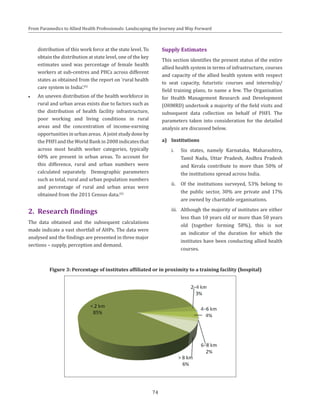
conducting allied health education
The community college is an alternative system of
education, which is aimed at empowerment of the
disadvantaged and underprivileged (urban poor, rural
poor, tribal poor and women) through appropriate
skills development leading to gainful employment.
These colleges work in collaboration with the
local industry and community to achieve skills for
employment and self-employability of these sections
of the society. The community college system has
the advantages of easy access, flexibility in teaching
methodology, cost effectiveness and equal opportunity.
BOX 4: Community Colleges
IGNOU has 128 affiliated community colleges at present, for which IGNOU has developed guidelines. IGNOU also
plans to set up 500 such community colleges, and ultimately in every panchayat. The community colleges are
regulated by IGNOU through committees, each of which has a representative from IGNOU.
A study should be conducted to assess issues that can lead to the strengthening of community colleges as
community colleges generally have a two-year curriculum that either leads to an associate degree for transfer
to an undergraduate college or to the students’ direct entry into any occupation or trade. NIAHS can work with
IGNOU in strengthening these colleges.
that training be carried out by the respective state
governments so that students are encouraged to get
an education at these colleges, which has national and
regional acceptance. It will also ensure the horizontal
mobility of students in terms of getting employment
all over the country.
Strengthening community colleges in terms of having
proper committees, faculty and standards is essential,
as this may address the gap in the rural healthcare
delivery system. It is also necessary that they gain
recognition by the Ministry of Human Resource
Development and the Directorate of Employment, and
The Allied Health Ecosystem
32
From Paramedics to Allied Health Professionals: Landscaping the Journey and Way Forward
i)	 Augmentingthecapacityofexistinginstitutions
and medical colleges in all states for quality
allied health sciences education
Thereareover350medicalcollegesandapproximately
940 stand-alone institutions based on desk review
research (listed in Appendix-1) in the country, of which
at least half can adopt a standard allied health sciences
education regimen with standardised curricula,
and entrance and exit examinations. The following
activities will need to be conducted for strengthening
these institutions:
i.	 Each state should map out all its allied health
sciences training institutions, including their
infrastructure, fee structure, courses conducted,
faculty, students, equipment, teaching/ learning
aids and other facilities. Based on this, efforts
should be made to develop their capacities and
move towards the standards set by the regulatory
body.
ii.	 Institutions should be supported in developing
their faculty and strategies formulated to
overcome the shortage of faculty.
iii.	 These may be knitted together with the Regional
Institutes of Allied Health Sciences (RIAHS) chain
into a large, multi centre group of institutions for
allied health sciences education. They may receive
a centralised mandate for certification under the
umbrella of the NIAHS. Medical college hospitals
associating with such institutions stand to gain
fromthefirstyearonwardsasthestudentsbecome
available to work in the hospital laboratories.
iv.	 Themedicalfacultyatthehospitalmayserveasthe
trigger faculty until sufficient students graduate
to feed the faculty cadres. Within the hospital,
the allied health sciences education institutions
should not create large space requirements, as the
facilities can be shared across various courses and
subjects.
v.	 There should be flexibility within the hospital to
adapt to the requirement of various courses. The
technical skills of the students should be honed
on simulation tools from the first year itself.
Simulation tools are a cheap, effective method of
building/evaluating the skills of students without
exposing patients to unethical risks.
j)	 Provisionofsupporttostand-aloneinstitutions
to make them financially sustainable
Institutions that do not have an attached hospital
or medical college (stand-alone institutions) find it
very difficult to be financially viable as they cannot
charge high fees from the students. A study should be
conducted to see how stand-alone institutions sustain
themselves. The government should provide special
grants and incentives to stand-alone institutions only
if they provide quality education.
As seen during our research on the institutes
in India, the path for a professional to move up the
career ladder is blurred. This situation is prevalent
in all specialties of the field. This long-ignored need
to standardise the cadre structure and growth ladder
has caused a great sense of dissatisfaction among
professionals. A defined career pathway will not only
help AHPs to excel in their respective fields but also
encourage lifelong learning and professionalism.
Recommendation 4
Establish a clearly defined cadre structure for
AHPs based on a combination of educational
qualifications and years of work experience with
a distinct career pathway for three tracks: clinical
practice, academic faculty and management.
a)	 Cadre reforms
There is an immediate need for cadre reforms for
AHPs. This will result in motivation of personnel and
also encourage large numbers to join the profession.
Cadres need to be created along the lines of the nursing
profession:
i.	 Qualifications should be specified for every level.
ii.	 No new unqualified people should be allowed to
enter technical work in the future. Existing people
33
should be certified through tests and assessments
to come at par. The time limit should be five years
for all persons to clear the exams. Bridge courses
should be organised to support such persons.
iii.	 Service and teaching cadres should be developed.
iv.	 Grades and staff levels need to be clearly spelt out
in terms of experience and qualifications in the
service cadre.
v.	 In the teaching cadre, the levels can be instructor,
lecturer, assistant professor, associate professor,
professor and head of department.
vi.	 Health provider teams at all levels from the
subcentre, primary health centre (PHC), CHC,
district hospital to medical colleges should be
defined. Peculiar inter-cadre relationships in India
may prevent the senior cadre from mentoring
even a closely related junior.
vii.	 A credit-based system similar to that in operation
in the US or UK model should be developed for all
allied health courses. This way, a student gathers
coursework credits that he/she can use to move
up the ladder in terms of promotion opportunities
or to get higher qualification.
b)	 Defined career path
A career path is an essential element in maintaining
the motivation levels of all personnel. Career paths for
every specialty in the allied health sciences should be
chalked out. There is a need to study each specialty and
address this issue. Diploma holders can do graduation,
then post-graduation and eventually a doctorate.
Personnel can remain in the clinical field or become
faculty or do both. They can enter research or become
hospital administrators or even enter the civil services.
A clear path for lateral movement, change in
specialty or multi-specialisation should also be
addressed with shorter bridge course options for those
professionals who may lack a higher-level qualification
but make up for it with extensive work experience.
c)	 Employment options
Huge opportunities exist for employment of AHPs both
in the government and private sector. The following
employment options are suggested by our expert
group:
Figure 3: Recommended career pathways
The Allied Health Ecosystem
34
From Paramedics to Allied Health Professionals: Landscaping the Journey and Way Forward
i.	 Medical colleges, allied health colleges, hospitals,
nursing homes, clinics, diagnostic and research
laboratories, wellness centres, spas, rehabilitation
centres, and the equipment industry all need AHPs
and their demand is increasing.
ii.	 It is necessary to define the qualifications of
personnel required for each level of health facility.
MSc degree holders should only be posted in
medical colleges, academic institutions, district
hospitals or research laboratories. At PHCs and
CHCs, graduates and diploma holders can be
posted.
iii.	 Part-time employment should be allowed
depending on the workload, and in the case of
women who have to look after their children.
iv.	 A national floor salary for each level and each
cadre should be designed.
v.	 No contract employment should be adopted by the
authorities and institutions, especially hospitals
and facilities, which are primarily a source of
employment for professionals.
d)	 Work norms and standards
The issue of work norms needs to be systematically
resolved. Some professionals, such as radiologists,
have clearly stated the number of clients they can
attend to. The other specialties too should examine the
number of clients / tests a professional can attend/
do in one hour and one day while maintaining quality.
Too many patients per day or too many tests per day
will definitely affect the quality of work. Calculations
relating to the ratio of tasks to staffstrength need a
separate consultation and comprehensive inputs from
cadre experts. This will also help in calculating staff
requirement. This exercise may be undertaken at a
later time.
e)	 Human resource (HR) policies
HR policies need to be streamlined for AHPs. Efforts
should be made to retain AHPs to prevent a large
number of personnel from leaving the profession
or migrating abroad or specialising in other streams
where there are better opportunities. Thus, retention
strategies should include professional development,
continuing education and options for higher
education, a good salary, social security, incentives for
postgraduate education, etc.
Recommendation 5
Build an allied health science knowledge
community through the creation of systems /
mechanisms for networking, information sharing,
real-time data capture and innovative research
which will be responsible for all knowledge
activities in allied health.
a)	 Establishment of an AHS information and
resource cell
An allied health sciences information and resource cell
should be established. This cell should be responsible
for collecting and filtering all the information for the
government, students, AHPs, the industry, etc. This
information should be hosted on a dynamic website
containing all allied health occupations, including
details of courses and training institutions, career
scope and options, job opportunities, research papers
and articles, resource material and information on
workshops or seminars or conferences. Discussion
forums through blogs and solution exchange should
be part of the website, besides providing counselling
online and motivating unemployed youth to join the
allied health sciences.
b)	 Developing a dynamic online database for each
AHP
An online database shall be maintained on each AHP.
Each person, on completing the course, should fill in
an online registration form. Once the form is filled, it
will generate a unique ID, a password and a printable
document. A system of updating the database can be
established by every individual using the unique ID
and password. Each training institute will also enter
all the details of individuals passing out on software
developed by the National Board of Allied Health
Sciences.
35
The online registration of individuals can be
correlated with the training institutions’ database
through online software developed by the National
Board or Council. The document should include all
the details related to the special competencies of
the individual, career history, training undertaken,
education and qualifications of the AHP. When an AHP
applies for a job, his/her history can be easily verified
as all records are online and computerised. The details
of each individual can be printed out if required. The
advantage of this document is that all records of AHPs
are available at one place, which will reduce time in
cross-checking records.
c)	 Earmark research funds for improving quality
standards for AHPs
Quality improvement can be implemented by
establishing partnerships with international
institutions of excellence and PPPs to bring out the
best in the profession. The standards developed at
the central and state levels should be in complete
harmony with each other. More emphasis should be
placed on research activities and funding provided at
regular intervals either by the Centre, state, or foreign
direct investment, etc., which can be used for the
development of the research centres.
Along with augmenting capacity, it is also essential
to focus on quality education. The government will
need to develop a number of options for encouraging
flexibility in allied health sciences education
without compromising on the quality of education.
Improvement in infrastructure and availability of
faculty is a challenge that needs to be addressed, and
the government should provide the required support.
12.	Conclusion
Allied health workers constitute a vital part of the
health system, both nationally and internationally. In
the Indian context, however, their significance and role
has been marginalised due to the prevalent culture of
medical dominance and lack of a statutory body to give
prominence to their contributions and concerns.
Allied health workers are an untapped treasure,
and are critical to fixing the gaping holes in India’s
health workforce, particularly the severe shortage of
physicians and specialists.
It would be a grave mistake to not utilise the
capacities of this resource at a time when the
government is bringing in critical reforms in public
health and aiming to improve access to health by
focusing on the preventive, promotive, curative and
rehabilitative needs of the population.
While the government is considering strategies
to best utilize AHPs, the private sector has realised
their potential, and established several institutions
and mechanisms to integrate these professions and
professionals into the organised healthcare sector.
However, the growing demand has resulted in the
mushrooming of big and small institutions claiming to
provide allied health education.
The need–availability gap is large but not
insurmountable. A careful plan to expand the training
capacity has to be drafted, which is discussed later in
this report. While designing education in the allied
health sciences in India, the changing demographical
patterns and epidemiological transitions need to be
kept in mind, besides globalisation, technological
developments and information technology.
Planning for allied health education should address
the following:
i.	 Carefully project the need–availability gap in the
education/training capacity in the country for
various specialties.
ii.	 Connect the expansion of training/education
capacity to career planning in the public system.
Thiswould,interalia,addressissuesofrecruitment
rules, cadre structures, remunerations,
promotions, continuous education, etc.
iii.	 Develop a live register of AHPs with disaggregated
data on the various specialties, level of
qualifications, availability of faculty, etc.
The Allied Health Ecosystem
36
From Paramedics to Allied Health Professionals: Landscaping the Journey and Way Forward
iv.	 Develop protocols for undertaking education in
new, cutting-edge courses and disciplines for
which demand may be limited.
v.	 Ensure that there is no glut in the number of AHPs
available and that they are gainfully employed in
the country.
As the MoHFW gets ready to undertake a facelift for
the entire allied health workforce by establishing
national and regional institutes of excellence, the time
is opportune for the government to study this provider
group in detail; review existing inputs, processes and
outputs; standardise institutions, educational tools
and methods; revisit career paths and progression;
and re-introduce these professionals into the public
system to reap much-awaited rewards in the form of
improved health outcomes for the population.
37
References
1. 	 Dal Poz M.R, Kinfu Y.,Dräger S. and Kunjumen T. Counting
health workers: definitions, data, methods and global
results. Geneva: Department for Human Resource for
Health. World Health Organisation 2007 Jan.
2. 	 Sahni A. Production and utilization of health manpower
towards improvement of health services in India Health
Administrator.XVII(1):1-3.
3. 	 Health Manpower: Planning, Production and
Management. Report of Expert Committee1987.
Available from: http://nrhm-mis.nic.in/ui/who/PDF/
4. 	 Mudaliar Committee. Report of the health survey and
planning committee1962; I. Available from: nihfw.org/
NDC/DocumentationServices/Reports/Mudalier Vol.
pdf
5.	 Summary Report for Medical Records and Health
Information Technicians. Available from: http://www.
onetonline.org/
6.	 Allied health professions overview14 September 2009.
Available from: http://explorehealthcareers.org/
7.	 A strategy for the allied health professions in Northern
Ireland: 2011-2016, Consultation DocumentJune 2011.
Available from: http://www.dhsspsni.gov.uk/ahp_
strategy__23_june_2011.pdf.
8.	 Yamunan S. Give this key healthcare component its due.
Available from: http://www.thehindu.com/education/
article512299.ece.
9.	 Aide, Home Health: Skills, Abilities and Interests.
National Institutes of Health - Office of Health Education:
LifeWorks; Available from: http://science-education.
nih.gov/LifeWorks.nsf/
10.	 Giroud M. SAMU - System of Emergency Medical
Assistance in France. Available from: http://www.
samu-de-france.fr/
11.	 Allied Health (Paramedical) Services and Education.
Report of an Intercountry Consultation. Bangkok,
Thailand: 2000 MArch, 2000. Report No.
12.	 Allied health access. How to develop programs for
youth in allied health careers: U.S. Department of Labor,
Employment and Training Administration; July 2010.
13.	 Ministry of health Samoa. Allied health council report.
Final project report. 2008 May 2008.
14. Lowe S, Adams R, O’Kane A. A Framework for the
Categorization of the Australian Health Professional
Workforce. In: Health SfARaRA, editor. australia2007.
15.	 Fitzgerald K, Hornsby D, Hudson L. A study of allied
health professionals in rural and remote Australia.
SARRAH. 2000.
16.	 Orthotists and Prosthetists: Education. National
Institutes of Health - Office of Health Education:
LifeWorks; Available from: http://science-education.
nih.gov.
17.	 Turnbull C, Grimmer-Somers K, Kumar S, May E, Law D,
Ashworth E. Allied, scientific and complementary health
professionals: a new model for Australian allied health.
Australian Health Review [Internet]. 2009; 33(1):[27-
37 pp.].
18.	 What are allied health professionals? . UK Department
of Health; 2010, Nov 17; Available from: http://www.
dh.gov.uk/
19.	 Glossary of allied health professionals. British Medical
Association; 2009, Mar 30; Available from: http://www.
bma.org.uk/
20.	 Khandekar S. Health care within the common man’s
reach. Prayas. 2011;01(21).
21.	 Thirty-first report on paramedical and physiotherapy
central councils Bill2007. Available from: www.
physiotherapyindia.org.
22.	 Madhya Pradesh Paramedical Council Bill2003.
Available from: http://www.prsindia.org/uploads/
media/Paramedical%20and%20Physiotherapy/
bill166_20080701166_THE_MADHYA_PRADESH_
PARAMEDICAL_COUNCIL_BILL__2003..pdf.
23.	 Himachal Pradesh paramedical council act, 2003,
(2003).
24.	 The Kerala Paramedical Council Bill2002. Available
from: http://www.keralalawsect.org/law_cms/index.
php/law-reforms-committee/132.
25.	 Sequeira R, Nayar U. Faculty Development in Medical
Education: International Perspectives. Available from:
http://www.ncme.in/ppt-pdf-doc/
26.	 Whatcountriescandonow:Twenty-nineactionstoscale-
up and improve the health workforce. 2009. Available
from: http://www.who.int/workforcealliance/
knowledge/
27.	 Martin C. Allied health: The hidden health care
workforce. . California Hospital Association; 2009, July;
Available from: http://www.calhospital.org/
28.	 Douglas HI, Drew C. Allied health professions.2004.
Available from: http://www.bahaistudies.net/asma/
alliedhealthprofessions.pdf.
29.	 Rao M, Rao K, Shiva Kumar A, Chatterjee M,
Sundararaman T. Human resources for health in India.
Lancet. 2011. Epub Jan 12.
30.	 Regarding the End of Medicine and the Pursuit of Health.
Thehbliclnterest. 1975;40(11).
31.	 Freidson E. Profession of Medicine: A Study of the
Sociology of Applied Knowledge1988, May 15.
32.	 Orthotists and Prosthetists: Skills, Abilities and
Interests National Institutes of Health - Office of Health
Education: LifeWorks; Available from: http://science-
education.nih.gov/
The Allied Health Ecosystem
38
From Paramedics to Allied Health Professionals: Landscaping the Journey and Way Forward
33.	 Critical challenges: revitalizing the health professions
for the twenty-first century. Pew Health Professions
Commission; 1995; Available from: http://www.
futurehealth.ucsf.edu/
34.	 Lane D, Ross V. The importance of defining physician’s
competencies: Lessons from preventive medicine. Acad
Med. 1994;69(12):972.
35.	 Padda G, editor. note for NIAHS. Landscape Workshop
for NIAHS; 26th April, 2010 NIHFW.
36.	 Houtz L, Kosoko-Lasaki O. Creighton Collaborative
Health Professions Partnership: Assessing impact
beyond the numbers. Journal of Higher Education
Outreach and Engagement. 2006;11(4):147.
39
1
Douglas HE III, Drew CR. Allied health professions. 2004. Available at: http://www.bahaistudies.net/asma/alliedhealthprofessions.pdf
2
http://democrats.senate.gov/pdfs/reform/patient-protection-affordable-care-act-as-passed.pdf Washington, January 2010
3
Medical staff bylaws, policies, and rules and regulations of Piedmont Newnan Hospital.Policy on allied health professionals. 2008. Available at: http://
www.piedmont.org/doc/Page.asp?PageID=DOC000755
Annexure– 1
Additional definitions of AHP
The American Medical Association in 1965 defined AHPs as ‘A large cluster of health-related personnel who fulfill
necessary roles in the healthcare system, including assisting, facilitating, and complementing the work of physicians
and other healthcare specialists’. 1
U.S. Division of Allied Health Manpower, in 1969 defined AHPs as ‘All those professional, technical, and
supportive workers in the field of patient care, community health, public health, environmental health and related
research who engage in activities that support, complement, or supplement the professional of administrators and
practitioners’.11
The Pew Advisory Panel for Allied Health in 1992 defined allied health as including all health-related
disciplinesexceptnursing,medicine,osteopathy,dentistry,veterinarymedicine,optometry,pharmacyandpodiatry.1
An AHP, as defined in section 799B(5)
of the Public Health Service Act (USA) (42 U.S.C. 295p (5)
) is anyone
who: (A) has graduated and received an allied health professions degree or certificate from an institution of higher
education;and(B)isemployedwithaFederal,State,localortribal publichealthagency,orinasettingwherepatients
might require healthcare services, including acute care facilities, ambulatory care facilities, personal residences, and
other settings located in health professional shortage areas, medically underserved areas, or medically underserved
populations, as recognized by the Secretary of Health and Human Services.
The Association of Schools of Allied Health Professionals defines AHPs as being involved with the delivery
of health or related services pertaining to the identification, evaluation and prevention of diseases and disorders;
dietary and nutrition services; rehabilitation and health systems management, among others.
In 2006, Services for Australian Rural and Remote Allied Health (SARRAH) members held a workshop to
define allied health to guide strategic action for the organization. This definition is contained within the SARRAH
Constitution: ‘SARRAH recognises that allied health professionals are – tertiary qualified health professionals who
apply their skills to restore optimal physical, sensory, psychological, cognitive and social function. They are aligned
to each other and their clients’AHPs mean individuals other than medical staff members who are authorized by law
and by the hospital to provide patient care services within the hospital.
The Allied Health Ecosystem
40
From Paramedics to Allied Health Professionals: Landscaping the Journey and Way Forward
Annexure – 2
List of allied health professions
Diagnostic •	 Cardiovascular technologist
•	 Medical and clinical laboratory technician
•	 Cytotechnologist
•	 Haematotechnologist
•	 Histopathologist
•	 Phlebotomist
•	 Molecular technologist
•	 Cytogenetic technologist
•	 Dermatology/STD/leprosy laboratory technician
•	 Radiological/imaging technician
•	 Diagnostic medical sonographer
•	 Blood bank technician
•	 Neuro-diagnostic laboratory technologist
•	 Sleep laboratory technician
Curative services •	 Radiotherapist
•	 Nuclear medicine therapist
•	 Anaesthesia technician
•	 Anaesthesia assistant
•	 Perfusion technician
•	 Neurophysiologist/END technologist
•	 Optometrist
•	 Ophthalmic assistant
•	 Emergency medical technician and paramedic
•	 Critical care technician
•	 Critically ill children technician
•	 Respiratory therapist
•	 Medical assistant
•	 OT technician
•	 ICU technician
•	 Dialysis technician
•	 Nursing assistant
•	 Dental assistant
•	 Dental hygienist
•	 ECG technician
41
•	 EEG technician
•	 EMG technician
•	 Perfusion technician
•	 Ultrasound technologist
•	 Medical dosimetrist
•	 Endoscopy technician
•	 Urological technician
•	 Palliative nurse
•	 Mental health counsellor
Non-direct care •	 Medical physicist
•	 Dental laboratory technician
•	 Dieticians and nutritionist
•	 Medical appliance technician
•	 Central Sterile Supply Department (CSSD) technician
•	 Dark room assistant
•	 Biomedical technician
•	 Pharmacy technician
•	 Medical transcriptionist
•	 Medical recordstechnician
•	 Health information technician
•	 Physician assistant
•	 Medical secretary
•	 Medical and health service manager
•	 Health and hospital administrator
•	 Medical social worker
•	 Hospital hospitality worker
•	 Epidemiologist
•	 Biostatistician
•	 Health sanitary inspector
•	 Nursing aide, orderly and attendant
•	 Mortuary technician
•	 Forensic technologist
Rehabilitative •	 Physiotherapist
•	 Occupational therapist
•	 Speech–language therapist
•	 Audiometry technician
•	 Prosthetic and orthotic technician
•	 Hearing aid and ear mould technician
The Allied Health Ecosystem
42
From Paramedics to Allied Health Professionals: Landscaping the Journey and Way Forward
Community related •	 Community-based rehabilitation therapist
•	 Multipurpose rehabilitation worker
•	 Home-based care worker/home aide
•	 Manager of community-based health programme
43
Annexure – 3
Protocols for certification of courses and quality control
(evaluation) of desirable skill sets
Admission, award of Degree/Diploma and Certification by NIAHS
NIAHS at its inception will not be a university to award degrees. It is proposed that as a stop-gap arrangement, the
National Board of Examinations will be the body for conducting entrance examinations, term-end examinations and
awarding degrees.
Entrance examination
To effect this, the prerequisites are as follows:
i.	 Notification to the NBE for starting an Allied Health Sciences wing for the purpose. This would be necessary to
protect any devaluation of their post-doctoral and PG programmes in medical education.
ii.	 The NBE will enter into an agreement or memorandum of understanding (MOU) with the NIAHS for conducting
examinations and will be paid for the assignment according to the agreed terms and conditions.
iii.	 The NBE will conduct entrance examinations for admission into the NIAHS and RIAHS centrally using an
electronic medium. The use of electronic media will facilitate deeper penetration into rural areas. The language
of the test can be optional.
iv.	 Such arrangements can be made on the lines of the Central Admission Test (CAT), BITS Pilani, etc.
v.	 The selection list will be posted on internet and published in the regional vernacular newspapers. The
reservation for entitled categories will be made as per Central Government rules on the subject.
vi.	 Choice of institution and stream will be done on merit cum availability.
Term End examination
i.	 The theory examination will be conducted by the NBE. The question bank will be provided by the NIAHS
and each institution will use different sets. Question papers will be printed and dispatched by the NBE to the
controller of examinations at the RIAHS and NIAHS.
ii.	 The concerned institutions will nominate external and internal examiners in advance from a pool already
created by them. Each set of examiners can continue for two years as per university rules.
External examiners will evaluate the answer sheets and conduct practical examinations, etc. The answer sheets
with evaluation rolls will be submitted to the NBE who will declare the results and subsequently award degrees
after satisfying itself that the candidate has fulfilled all other criteria for such an award as per the curriculum.
The Allied Health Ecosystem
44
From Paramedics to Allied Health Professionals: Landscaping the Journey and Way Forward
45
1. Introduction
Allied health professionals (AHPs) have long been
neglected in terms of education and career growth due
to several factors ranging from medical dominance
and policy gaps to lack of infrastructural support. This
has led to growing dissatisfaction among the huge
cadre of health professionals whose career prospects
remain uncertain despite an abundance of talent and
willingness to contribute.
The National Initiative on Allied Health Services
(NIAHS) Secretariat was instituted by the health
ministry to map gaps that require attention in
the regulatory system as a part of health reforms
undertaken during the Twelfth Five-Year Plan period. A
considerable regulatory gap in the allied health space
is attributed to the lack of a comprehensive regulatory
framework and absence of centres for excellence or
apex bodies for professional development and training
of AHPs. The objective of this endeavour is to ensure
the availability of quality human resources across the
country to fill the demand in the public and private
sector and reorient the medical conglomerate so that
they recognise AHPs as an integral part of the service
delivery mechanism.
Chapter 2
Regulating the Allied Health Profession
a) Definition of regulation
The prime objective of professional regulation in
the field of healthcare is to safeguard the health and
well-being of persons using or needing the services
of registrants.(1)
The key purposes of regulation are
to improve performance and quality; to provide
assurance that minimally acceptable standards are
achieved; and to provide accountability both for levels
of performance and value for money.(2)
The term ‘regulation’ can be defined in many ways.
According to Philip Selznick regulation is: ‘sustained
and focused control exercised by a public agency, on
the basis of a legislative mandate, over activities that
are valued by the society’, and more specifically in a
healthcare context as ‘any set of influences or rules
exterior to the practice or administration of medical
care that imposes rules of behaviour’.(3)
The Organisation for Economic Co-operation and
Development (OECD) has defined the term ‘regulation’
to include: the full range of legal instruments by which
governing institutions, at all levels of government,
impose obligations or constraints on private sector
behaviour. Constitutions, parliamentary laws,
subordinate legislation, decrees, orders, norms,
licences, plans, codes and even some forms of
administrative guidance can all be considered as
“regulation’’.(5)
46
From Paramedics to Allied Health Professionals: Landscaping the Journey and Way Forward
Figure 1: Various aspects of regulation
The intent of regulation is:
●● To establish, monitor and enforce essential
standards, improve and sustain education,
training and practice; and provide a framework
for allied health practice relevant to meeting the
health needs of the population and protecting the
public;
●● To provide public authority, credibility, protection
and support to permit AHPs to perform to the
maximum extent of their capabilities;
●● To promote regulation by AHPs themselves to
ensure appropriate standards of education and
practice;
●● To permit and encourage AHPs to participate in
and influence public debate on health policy; and
●● To ensure that each of its practitioners is
accountable to the public for their professional
practice.(6)
b) History of regulation
Historically, medical professionals have enjoyed
significant autonomy and freedom from external
control. As a result, professional regulation has
primarily been the preserve of an elite subset of the
profession, manifested in various mechanisms of self-
regulation.
With increasing entitlement literacy among
patients, increasing complexity in medicine and
frequent reports of poor performance, the ability and
willingness of healthcare professionals to regulate
them is no longer taken at face value. Increasingly,
stakeholders outside the professions are seeking
more detailed reassurance and explanation about the
delivery of healthcare services. In many countries,
there is a movement towards more rigorous and
transparent regulation, effectively reducing reliance
on the professions to monitor their own quality of care
and remediate cases of poor performance.
A range of mechanisms have been used to regulate
the healthcare professions, including the following:
●● Licensure:Thegrantingoflegalpermitstopractice
to individuals who demonstrate appropriate levels
of knowledge, skill and competence. Mandatory
licensure assures minimum acceptable levels of
competence.
●● Registration: The compilation of a list of
individuals who have satisfied an authority that
they are qualified to practice. In most countries a
47
medical register is maintained, either by state or
government departments.
●● Certification: An acknowledgement of a pre-
determined level of achievement or performance,
generally recognising achievements exceeding
those set as minimum acceptable standards (such
as those set for licensing purposes).
●● Revalidation and recertification: Processes
that require individual practitioners to maintain/
collect appropriate evidence to attest to the
standards of their practice and to demonstrate
their continuing competence. The use of these
interventions is increasing as it is acknowledged
that the validity of certificates and qualifications
erodes over time and that skills, knowledge and
competence require periodic reaffirmation.
●● Credentialing: The systematic collection, review
and verification of a practitioner’s professional
qualifications. This often includes using patient
data to attest to the clinical competence of an
individual in a particular activity (e.g. specific
surgical procedures).
●● Privileging: The granting of permission to
perform specific professional activities under
the jurisdiction of an organisation’s (usually a
hospital’s) authority.(7)
c) Regulation and the market
While India has an extensive legal and regulatory
framework for public health delivery, there is a lack of
a nuanced policy that nurtures human resources for
health.Thereisalsoadisconnectbetweenbureaucratic
approaches to regulation and the realities of a health
sector dominated by private players. There is an urgent
need to introduce a regulatory framework to address
the challenges of standardisation of care provided,
rational use of drugs, free structures, etc.
Healthcare markets generally require regulatory
interventions for the following reasons:
●● Managing competition: Regulators act to ensure
a ‘level playing field’ and allow market forces to
deliver efficiency by limiting concentration of
power in monopolies.
●● Patient protection: Regulators protect the
patient or the consumer by assessing the quality
of services. They ensure that robust grievance
and appeal procedures are in place to protect
confidential patient data.
●● Public accountability: Regulators ensure that
consumers are able to choose from among
the healthcare options available as per their
expectations of cost, outcomes and needs in
quality.Tobeabletomakesuchchoices,consumers
require accurate information about healthcare
services. Providers must also be held accountable
for the services they deliver to the masses.
●● Supply management: Through its expansion
around the entire healthcare sector, regulation
ensures that optimal conditions of participation
and availability of care are maintained throughout.
It also addresses the issues of over- and under-
supply of services and other necessities.
Regulatory interventions need to be introduced at
the institutional and professional levels along with
creating a level playing field for public facilities by
reining in the largely unregulated private market. The
following approach can be used for the purpose as
indicated in the figure 2.
Regulating the Allied Health Profession
48
From Paramedics to Allied Health Professionals: Landscaping the Journey and Way Forward
Figure 2: Types of regulatory interventions
During the desk review phase of the NIAHS project the
following key issues and concerns were identified:
●● Lack of understanding of the Acts and their
implications
●● Confusion regarding the definition of allied health
and who belongs to the profession
●● Uncertainty regarding the role and benefits of a
single Allied Health Council
●● Varied expectations of what the composition of
the Allied Health Council should be
●● Uncertainty regarding the implications of
registration and whether individuals would be
able to register
●● Defining a time frame of practice for staff returning
to the workforce after an absence
●● Need for a transitional period to enable staff
without minimum qualifications to gain
competencies that would enable full registration
●● Identifying a source for competency examinations
for those staff with extensive on-the-job training
but no formal qualification.
BOX 1 CASE IN POINT
Central institutions such as the(SGPGI, AIIMS, and JIPMER) follow their own criteria and procedures for
accreditation.Thestandardsofprofessionalpracticearenotavailable,andthereisnocentralregistrytoenroland
track the AHPs in the country. In the absence of a central database, the information on the available and required
number of AHPs is based on crude estimates, rather than the exact status and distribution. The comparatively
larger cadres such as Physiotherapy, Optometry, Radiology and Medical Laboratory Technology, among others,
who have stronger national associations, have been trying to push the agenda for formation of their professional
councils through the government machinery. It is to be noted that formation of separate councils for each and
every cadre will lead to confusion and conflict of powers, and encourage competition between the cadres, which
may not develop in a healthy way to promote the allied health profession.
49
2. Situation in India
a) India’s policy pipeline
AnumberofcouncilssuchastheMedicalCouncilofIndia
(MCI), Dental Council of India (DCI), Pharmacy Council
of India (PCI) and the Indian Nursing Council(INC)
have already been established by Government of
India for regulating the standards of education and
training, as well as the registration of practitioners
in these fields. The aim is to prevent unqualified
people from practising and also for maintaining the
standards of these professions. However, there is no
central regulatory mechanism for AHPs. Till date, only
the states of Madhya Pradesh, Himachal Pradesh and
Kerala have a statute governing the state paramedical
council which regulates education, recognises courses
and maintains registers. For education and training
of AHPs, there are a number of courses ranging from
short-term (up to 3 months), certificate, diploma and
graduation.
Attempts are being made to create a regulatory
framework on similar lines as the MCI and DCI. No
consensus has been reached at the highest level.
b) Regulation of AHP’s at national level
The absence of any statutory provision implies that the
regulatory function is not appropriate. Rapid strides in
medical technology have led to an increase in demand
of support staff with various skills, and large cohorts
of such on-the-job trained personnel have entered
the field. There is no set process for recognising
the new centres that offer training in various allied
health programmes except for programmes under the
Rehabilitation Council of India (RCI), MCI, INC and DCI.
Though the RCI lacks statutory support, it regulates
training programmes and training institutes in the
rehabilitation and disability sector.
In view of the desperate need for a comprehensive
regulatory framework to ensure uniform training,
employment and standardisation for allied health
services staff, the Paramedical Council Bill, 2007 was
drafted and subsequently proposed in the Parliament.
This Bill aimed to set up three councils to regulate
physiotherapists and occupational therapists, medical
laboratory technicians and radiology technicians, with
minimum educational and professional standards
for each. It mandated that every practising AHP be
registered with the council. It was also proposed that
all clinical establishments can only appoint those AHPs
who are registered with their respective councils.
Unfortunately, the Bill was pending and eventually
lapsed, leading to a void across the allied health cadres.
Professions with large cadres such as those for
physiotherapy, optometry, radiology and medical
laboratory technicians, which have stronger national
associations have, therefore, been trying to push the
agenda for the formation of their professional councils
through the government machinery. It is to be noted
that the formation of separate councils for each and
every cadre will lead to confusion and conflict of
powers, and encourage competition between them,
which may not develop in a healthy way to promote
the allied health profession.
Due to this absence of a standard-setting body in
the field, the following problems arise:
●● Lack of standardised entry-level qualifications
and examination procedures
●● Lack of national standards and benchmarks for
accreditation and regulation of paramedical
institutions
●● No certifying authority for paramedical courses
●● No grievance mechanism at the central level to
address issues
●● Lack of uniformity and enforcement of ethical
standards
●● Lack of a regulatory mechanism for skills
assessment in cases of upgradation of personnel.
c) Regulation of AHPs at state levels
At present, the RCI regulates training programmes and
training institutes in the rehabilitation and disability
sector. The Paramedical Council and Specialty Council
under state governments exist in certain states such
as Maharashtra, Madhya Pradesh, New Delhi, Kerala,
Regulating the Allied Health Profession
50
From Paramedics to Allied Health Professionals: Landscaping the Journey and Way Forward
Karnataka, Himachal Pradesh and Andhra Pradesh.
Currently, registration is almost guaranteed if the
education (certificate/diploma/degree) undergone
is ‘recognised’ by a university recognised by the
University Grants Commission (UGC) or any other
similar regulatory body.
Figure 3: Chronology of events for the proposed Paramedical Bill
BOX 2 The Proposed Paramedical and Physiotherapy Central Councils Bill, 2007
This Bill has not been approved yet. The highlights of the Bill are as follows:
●● The Paramedical and Physiotherapy Central Councils Bill, 2007 seeks to set up three councils to regulate
physiotherapists and occupational therapists, medical laboratory technicians and radiology technicians.
●● Each central council shall set minimum educational standards for the profession it regulates and maintain
a register of qualified practitioners. It can specify standards of professional conduct for each profession and
take disciplinary action, including the removal of a person’s name from the register, against any practitioner
found to be guilty of violating such standards.
●● Every university or institution offering educational courses in the relevant subjects has to seek the prior
approval of the Central Government.
●● Every person practicing under the Act has to be registered with the respective council.
●● Clinical establishments can appoint only those physiotherapists, occupational therapists or paramedics
who are registered with the respective council.
●● Any person whose name has not been entered or whose name is not deemed to have been entered in the
register of the Central Council under this Act and is practising as a paramedic or physiotherapist, as the case
may be, shall be punishable with imprisonment for a term which may extend up to six months, or with fine
which may extend to twenty thousand rupees, or with both.
51
BOX 2 The Proposed Paramedical and Physiotherapy Central Councils Bill, 2007
The Bill further states:
●● ‘Paramedic’ means a person whose name has been entered in the registers of the Paramedical (Medical
Laboratory Technology) Central Council and Paramedical (Radiology Technology) Central Council.
●● Paramedical’ means the medical laboratory technology and the radiology technology.
●● The Bill defines occupational therapy and physiotherapy as ‘medically directed’ therapies, which implies
that patients may not be able to approach professionals in either of these fields without a reference from a
doctor.
Commonalities within the state councils
IntheIndiancontext,fewstateshaveframedlegislation
to govern the paramedical profession.
●● These provisions primarily intend to regulate
education and prescribe standards thereof. There
are no licensing exams or skills upgradation/
renewal system.
●● It is seen that all the state councils are supported
by acts passed by the state legislative assembly
with partially autonomous authority.
●● The final authority remains vested with the
respective state governments. The tenure of
authority is 5 years in the states of Madhya
Pradesh and Maharashtra while it is 3 years in the
states of Himachal Pradesh and Kerala.
●● None of the state councils have any political
standing.
●● All the present paramedical acts have a similar
structure with provision of registration and
licensing along with renewal of the same. The
provisions to deal with malpractices along with
other punishment provisions are similar. Only
the state of Kerala has the exclusive provision of
mandatory employment of licensed paramedics
in healthcare institutions. The Act in Kerala
mandates healthcare facilities to employ trained
professionals.
●● The standards mentioned with regard to training
and curriculums are general in all the states with
provisions of UG, certificate, diploma and PG
courses available.
●● There is also the provision for university affiliation
with the council on fulfilling certain set criteria.
The education and training of trainees falls under
the control of the state council.
●● However there is no provision of regular audits
conducted in the institutes affiliated. Instead the
audits conducted are done by the designated
Charted Accountant (CA) as and when required.
●● All the councils have similar punitive powers with
the appellative authority vested with the state
government.
The present councils in India were analysed using a
comparative tool on the following ten parameters:-
i.	 Legislative backup supporting the council
ii.	 The controlling authority
iii.	 Tenure of the authority
iv.	 Any political affiliation
v.	 Key provisions in the document
vi.	 Training and curriculum
vii.	 Restrictive provisions
viii.	Promotive provision
ix.	 Disciplinary provision
x.	 Appellative provision
The findings of the comparative analysis elucidate
differences in regulatory bodies across states as
depicted in the table below: The details of few of
the “State Paramedical Acts” are enumerated in
appendix-3.
Regulating the Allied Health Profession
52
From Paramedics to Allied Health Professionals: Landscaping the Journey and Way ForwardTable1:Comparativeanalysisofregulatoryframeworkforstates
S.No.ParametersDetailsMadhya
Pradesh
Himachal
Pradesh
KeralaAndhra
Pradesh
Maharashtra
1Backbone
Statute/ActStatuteStatuteStatuteAct
Ordinance
PendingBill
AddontoexistingAct/BillorOrdinance
2
Controlling
authority
Fullyautonomous
PartiallyautonomousYYY
Governmentcontrol+peoplepartnership
FullycontrolledbyGovernment
3
TenureOf
authority
2years
3yearsYY
4years
5yearsormoreYY
4
Inclusionofany
politicalmember
Y/NNNNN
5Keyprovisions
Provisionforregistrationandlicensing(Y/N)YYYYY
Ifyes,whatistherenewalprocedure?YYYYY
Provisionofindependentpractice(Y/N)
Ifyes,whattrades?
ProvisionstodealwithmalpracticeYYYYY
OtherpunishmentprovisionspresentYY
Mandatoryemploymentoflicensed
paramedicinHealthCarefacility
NNYN
53
S.No.ParametersDetailsMadhya
Pradesh
Himachal
Pradesh
KeralaAndhra
Pradesh
Maharashtra
6
Trainingand
curriculum
Arestandards,subject-specificorgeneralGeneralGeneralGeneral
Isthereaninfrastructureprescribed?YYY
Isthereastandardstudent–trainerratio
prescribed?
YNNN
QualityReasoning(QR)forfacultyprescribedY
Provisionforcertificate/diploma/degree/PGYYYY
ProvisionforuniversityaffiliationYYYY
Exclusionlistofcoursesprovided(Y/N)NN
7
Restrictive
provision
Aretheseprovisionsforregularaudit?NNNYN
Ifyes,inspectionandauditmechanism
definedornot?
YYNYY
Ifyes,isitregular/periodicorneedbased/
forstart-upsonly?
Regular
As
required
PeriodicPeriodic
Restrictionfordisabled,etc.NNNNN
Anygender-specificrestrictionsNNNNN
Age-specificrestrictionNNNNN
Maximumstudentsv/sinfrastructure
restrictions
NNNN
8PromotiveProvisionofinclusionofnewdisciplinesYYYY
ProvisionforresearchY
9DisciplinaryroleDoestheauthorityhaveonlywatchdogrole?
Doesithavepunitivepowers?YYYY
Isprocessclearlydefined?YYYY
10AppellativeroleIsthereanauthoritydefined?Stategovt.Stategovt.Stategovt.
Isappealprocedureclearlydefined?YYY
Aremattersforappealclearlydefined?YYY
Regulating the Allied Health Profession
54
From Paramedics to Allied Health Professionals: Landscaping the Journey and Way Forward
3. Global context of regulation
A close scrutiny of regulatory frameworks applied
internationally indicates consistent patterns
emerging from developed and developing countries
to regulate AHPs. The regulatory process evolves
from standardising training and skills development
to controlling individual practice. Globally, there are
successful models with and without overarching
regulators in the healthcare arena. This section aims to
review international regulatory best practises, which
range from over-regulation in the United Kingdom to
self-regulation as seen in Australia.
Courses are usually recognised by a university,
government department, technical council or an AHP
council with legislative backing, while education
institutions are regulated by a different body. It is
seen that in developing countries, the emphasis is on
regulating the standards of training and education.
In developed nations, there is more emphasis
on monitoring the possession of appropriate skills
required for professions; the focus is on regulating
the profession by continuous monitoring of skills and
performance through a license renewal mechanism.
This, basically, includes principles of on-going
competence and separation of the registration process
from the disciplinary process. It is seen that having one
legislative framework allows consistent procedures
and terminologies across the professions.
Regulation of the allied health profession in the
United States is mainly consumer driven and its main
concern is ensuring consumer safety. It is based on
a stringent licensing system and individuals have to
pass tests and obtain scores to satisfy the standards.
The boards also specify training standards, pre-
licensing training and skill needs. Hence, training
is indirectly regulated. The focus is on monitoring
the quality of education with a view to ensure that
professionals, after undergoing the curriculum, would
be in possession of the necessary skills and attitude
to render services to the community with a minimum
risk of harm. In this system, the aspects of continuous
upgradation and aspiration are neglected.
Training parameters for every allied health
profession are prescribed but training institutions for
these are governed by the education department of
the country. This system clearly demarcates the areas
of jurisdiction and hence helps in avoiding a clash of
authoritiesbyprovidingclearrolesandresponsibilities
to the various stakeholders. This drastically reduces
overburdening of the regulatory bodies, which already
have the onerous task of standardisation, compliance
monitoring, etc.
The literature review across countries is
summarised in table 2.
4. Governance and regulation in
allied health system
Aliteraturereviewofregulatorypracticesindeveloping
countries has indicated an emphasis on regulating
the standards of training and education. Mostly,
registration is guaranteed if a degree/certificate is
obtained from ‘recognised’ institution. The authorities
have the power to de-register the institutions and/or
the professional in case of malpractice. There is not
much emphasis on skills mapping, skills upgradation
and registration renewal systems. The legislation and
subsequent regulation meet the purpose of dissuading
untrained people and quacks to some extent.
In developed countries, there is an over arching
‘super regulator’ over different councils which are
separately responsible for their specific allied health
professions.
Training parameters for every allied health
profession is prescribed but training institutions
for these are governed by the education department
of the country. This system clearly demarcates the
areas of jurisdiction from each other and hence
helps in avoiding a clash of the authorities and
defines clear roles and responsibilities of the various
stakeholders. This drastically reduces overburdening
of the regulatory bodies, which already have the
tasks of standardisation, compliance monitoring,
55
etc. Possession of a degree/certificate may be a pre-
requisite but it does not guarantee licensing. Skill and
competence levels are mapped on a regular basis.
The conduct and behaviour of the professional is
taken seriously and attracts penalty. The cost element
involved in the licensing system needs to be weighed
in perspective with the merits of imposing restrictions
for entering a profession and the urgent need to make
human resources with minimum skills available at
minimal cost.
a)	 Regulating the profession
In developed countries the focus is more on
regulating the profession by continuous monitoring
of skills and performance through a license renewal
mechanism. In addition, conduct and ethical issues are
addressed through disciplinary institutions integrated
into the system.
Regulation of professions comprises two parts
●● Accrediting the institutions (measuring them
against benchmarks)
●● Accrediting the programmes
Regulating the Allied Health Profession
56
From Paramedics to Allied Health Professionals: Landscaping the Journey and Way Forward
While the former is to guide students in selecting
a legitimate institution (which complies with the
accepted standards of inputs and resources), the latter
seeks to identify courses within the institution which
are measured against benchmarks. The third part of
regulation is certifying/licensing the practitioners of
the occupation. The final part of regulation addresses
the needs for practice of a vocation.
However, in developing countries, the focus is more
on monitoring the quality of education, with a view
to ensuring that professionals, after undergoing
curriculumtrainingandsuccessfullypassingtheexams
towards award of a certificate/diploma/degree, would
be in possession of the necessary skills and attitudes to
render services to the community with minimum risk
of harm. In this system, the elements of continuous up
gradation and aspiration get neglected. However, there
is a cost element involved in the licensing system. In
a developing economy, one has to weigh the merits of
over-restriction in the profession with that of making
available an abundant supply of professionals with the
minimum required skills at the least cost. Regulation
of professionals by peer-review mechanisms is also
common in the West.
b)	 Regulating education
Although education represents a fundamental element
for building workforce capacity, due to regulatory
(e.g. accreditation) and logistical (e.g. faculty
shortages) issues, academic healthcentres and other
institutions struggle to produce sufficient graduates
to meet the nation’s rising demand or need for health
professionals, especially for allied health. In exploring
the complexities of the regulatory, educational and
practice environments, the need for a structural
framework and an initiative at the national level
cannot be overstated. Much needs to be done at the
national and sub-national levels.
i.	 Indian context
The National Health Policy (NHP) 2002 recognises the
need for the establishment of statutory professional
councils for paramedical disciplines to register
practitioners, maintain standards of training and
monitor performance.
●● Universities are governed under the UGC Act, 1956
for post school-level education.
●● Universities give credence to qualifications from
the graduate level onwards.
●● The All India Council for Technical
Education(AICTE) has approved a number of
courses in the allied health professions.
●● There is no central council for recognising allied
health courses under the Ministry of Health.
ii.	 Stakeholders
●● State-run institutions
●● Private institutions
●● National Open School
●● Indira Gandhi National Open University (IGNOU)
●● Private medical colleges running selective courses
●● Private/corporate hospital
●● Military and paramilitary forces that have their
own institutions.
c)	 Governance of universities
Irrespective of the establishment of the university
under any legislation, central or state, each university
is intended to function as an autonomous institution,
with the freedom to organise and administer itself as
a corporate body in accordance with the law by which
it is established. The Act under which it is established
determines the nature and extent of its autonomy.
There are two major components in the management
of universities:
i.	 Functions and processes associated with
administrationoftheinstitution,suchaspersonnel
management, finance and infrastructure
ii.	 Academic management: teaching–learning
functions and their processes, such as curriculum
design, instructional system, teaching and student
assessment.
These two functions determine the governance of the
universities. Every university has two decision-making
bodies. The Executive Council (Board of Management
57
orSyndicate)dealswiththefirstcomponentmentioned
above, and the Academic Council (Senate) takes all
decisions pertaining to the academic management of
the system. Both the councils are expected to work
with mutual respect and in coordination for better
administration and management.
The important functions of the Executive Council are
as follows:
i.	 Making statutes and ordinances that govern the
system
ii.	 Controlling finances and properties
iii.	 Managing personnel
iv.	 Supervising the management of institutions
affiliated to the university
v.	 Grievance redressal
The Academic Council undertakes the functions of:
i.	 Laying down the academic policies of the
university
ii.	 Supervising the academic policies and providing
direction on the method of instruction, evaluation
of research and improvement in academic
standards
iii.	 Interfaculty coordination for joint programmes
and projects
iv.	 Recommending statutes and ordinances in
matters pertaining to academics.
d)	 Other models of governance
It was also seen that there are professional universities
of national importance which have a different pattern
of governance within the system, such as the Indian
Institutes of Technology(IITs). The Board of Governors
is responsible for the general superintendence,
direction and control of the affairs of each of the IITs. It
is constituted by the following members:
i.	 The Chairman Director Ex-officio
ii.	 One person representing each of the states
comprising the zone in which the institute is
situated, from among the reputed industrialists or
technologists within the system
iii.	 Four persons having special knowledge or
practical experience in engineering or science
education to be nominated by the Council
iv.	 Two professors of the institute, to be nominated
by the Senate.
Unlike universities, the Board does not have any
representation from political parties and bureaucrats.
Many innovative approaches have been taken in
institutes such as the IITs. These include creation of
posts of functional deans, such as for academic affairs,
research and development, student affairs, among
others. These have enabled these institutes to manage
the disciplines more effectively and comprehensively.
5. Policy issues for consideration
i.	 Entry-to-practice requirements should be
standardised and limited to competence
assessments for health professions to facilitate the
physical and professional mobility of the health
professions.
ii.	 Minimum standards should be adapted for
affiliation, institutional requirements, application
formats, evaluation procedures, and appellate and
adjudication procedures.
iii.	 Practice acts should be based on demonstrated
initial and continuing competence. This process
must allow and expect different professions to
share overlapping scopes of practice. Pathways
should be explored to allow all professionals to
provide services to the full extent of their current
knowledge, training, experience and skills.
iv.	 Health professional boards should be
redesigned and their functions should reflect
the interdisciplinary and public accountability
demands of the changing healthcare delivery
system.
Regulating the Allied Health Profession
58
From Paramedics to Allied Health Professionals: Landscaping the Journey and Way Forward
v.	 A framework should be created for quality
assurance and continuous improvement.
vi.	 Boards should educate consumers to assist them
in obtaining the information necessary to make
decisions about practitioners and to improve the
board’s public accountability.
vii.	 Boards should cooperate with other public
and private organisations in collecting data on
regulated health professions to support effective
workforce planning.
viii.	Standardised and understandable language
should be used for regulation of health professions
and their functions. These should be clearly
described for consumers, provider organisations,
businesses, and the professions.
59
6. Recommendations
Currently, due to the absence of a central regulatory
authority for AHPs and courses, smaller voluntary
associations have been created at the state and
national levels to fill the void of a regulatory body. For
instance, the rules or norms of professional practice
vary from extremely professional and well-organised
groups such as physiotherapists, optometrists, speech
and audiology professionals to diffuse groups such as
operating room technicians and radiation therapists.
Forthealliedhealthcadretogrowinthehealthcare
system, these professional associations need to be
bound by a common authority that will help AHPs to
flourish as a family rather than different classes within
the community of the healthcare system. The role of
regulating both the profession and the professionals
cannot be an optional path but rather a condition for
participation in the profession.
Presently, AHP education is fragmented, with
small institutions at one end and a systematic
education system in large medical institutions at the
other. In the absence of regulatory mechanisms to
control these categories, the mushrooming of these
training institutes has continued unabated and has
the potential to cause more damage to the clientele
of the medical profession. Lack of standards for
courses and institutions has led to an erosion of
quality which does not match the required industry
standards. A drastic regulation imposed suddenly may
be counterproductive, raise resistance and cause legal
complications. Hence, there is a need to start with a
graded approach.
Recommendation 1
Setting up a National Board for Allied Health
Sciences (NBAHS) - An interim arrangement for
the setting up of a National Board for Allied Health
Sciences is recommended, which can eventually
merge into an overarching council.
It is recommended that the umbrella model may
be adopted for regulation of allied health sciences.
Although the National Commission for Human
Resources for Health Bill, 2011(7)
has been currently
withdrawn from parliament, the bill provides a
good starting point from which an allied health
council framework may be derived. Realising that a
parliamentary approval to moving this critical agenda
may be rather a long drawn process with uncertain
outcomes we have recommended an interim board
structure that may be put into effect through an
executive order, if deemed appropriate and therefore
fast track the progress.
This system will function as the umbrella structure
Regulating the Allied Health Profession
60
From Paramedics to Allied Health Professionals: Landscaping the Journey and Way Forward
where every aspiring cadre will be represented
through its professional committee along with the
existing allied health professions councils under the
allied health umbrella.
Some key issues for consideration for the
establishment of the NBAHS
●● The NBAHS may be setup as a corporate body.
●● It should be formed as per the functions
envisioned for the National Board for Health
Figure 4: Proposed allied health regulatory structure
Education (NBHE) and National Evaluation
and Assessment Committee (NEAC), as per the
National Commission for Human Resources for
Health Bill with respect to allied health sciences
only.
●● The board can function from institutional
premises immediately with minimum staff.
The functioning of the board is independent of the
establishment of the NIAHS.
61
Figure 5: Functions of national board for allied health sciences (NBAHS)
Key functions of the NBAHS
●● Professional conduct
The Board will specify and enforce the standards of
professional conduct and etiquette to be observed
by professionals for each cadre and take disciplinary
action, including the removal of a person’s name from
the register, against any practitioner found to be guilty
of violating such standards. It will also communicate
the expected professional standards to professionals.
●● Creation and maintenance of live registers
A significant function of the board will be to maintain
and publish registers of health professionals across
the various cadres of allied health who meet the
standards set by the Board. The Board will enrol
persons with recognised qualifications on payment
of a prescribed fee and fulfilment of other criteria or
conditions as may be specified by the National Council,
for a specified period. Only after enrolment will the
person be considered fit to practise in the respective
discipline of allied health.
●● Standards-setting
The Board will take measures to determine, maintain
andcoordinatetheminimumstandardsofandpromote
human resources in discipline of health education and
training.
●● Advising the government
The Board will advise government bodies or the
appropriate statutory regulatory authority on any
policy matter concerning evaluation and assessment.
The Board will be responsible for the formulation of
the financial plan required for the creation of human
resources and subsequently make recommendations
on the measures to strengthen healthcare delivery,
operational efficiency and healthcare infrastructure.
●● Ethics and compliance manager
The Board will house the ethical function overseeing
research applications related to human subjects
and the compliance thereof. It will lay down and
communicate the code of conduct to be observed by
the personnel in each cadre. The Board will have the
responsibility to set up inquiries into such matters
related to ethical compliance.
●● Dispute resolution
The Board will function as an interim authority
to handle all kinds of disputes between national-
regional-level institutes.
Regulating the Allied Health Profession
62
From Paramedics to Allied Health Professionals: Landscaping the Journey and Way Forward
●● Growth and development of cadres
The Board will also facilitate coordination among
bodies or national councils constituted under this
Act, conduct social audit and obtain public feedback
on their performance and achievements. It will grant
permission for the establishment of health educational
institutes, and ensure compliance of its terms and
conditions or withdraw such permission. It will
carry out studies and collect data required to assess
the needs and requirements of human resources
for health of training facilities in different states and
Union territories (including the number, type and
geographical location), and formulate the action plan
for development of human resources, through the
institutions/committees/bodies under its jurisdiction.
It will promote and regulate inter-professional
cooperation among health professions. It will
coordinate the existing healthcare infrastructure in
Central and State Governments for effective utilisation
thereof.
Composition of the governing board
i.	 The chairperson of the governing board (NBAHS)
will be appointed by the Central Government and
should be a person of eminence, integrity and
outstanding calibre with a postgraduate degree
in the discipline of health, health policy, public
health, management, technology, law or finance
from a recognised university or institution, with
at least 20 years of experience in the respective
field. The chairperson’s position should not be an
ex-officio position.
ii.	 The member secretary would be ex-officio director
of the NBAHS.
iii.	 Other members:
●● Ex officio: Secretary Ministry of Human Resource
Development or nominee, Joint Secretary in
charge, MoHFW, Financial Advisor, MoHFW,
Director General, Armed Forces Medical Services
(DGAFMS), Advisor, Planning Commission
●● Exofficio:DirectorsofNIAHSandRIAHS;Directors,
All India Institute of Medical Sciences (AIIMS),
New Delhi and Post Graduate Institute of Medical
Education and Research (PGIMER); President,
NBE; Director, Indian Council for Medical Research
(ICMR);Director, Institute of Applied Management
and Research (IAMR).
●● Representatives from UGC, AICTE, IGNOU
●● Members from professional associations and
councils and state paramedical councils
●● Nominated members:
ŠŠ Persons of eminence representing the
industry, namely, health service providers
ororiginal equipment manufacturers (OEM)
ŠŠ Persons of eminence with experience in
the field of health administration, modern
medicine or public health.
Recommendation 2
The National Board for Allied Health Sciences will
consist of the National Allied Health Education
Committee (NAHEC) and National Allied Health
Evaluation and Assessment Committee (NAHEAC).
63
Figure 6: Illustrative structure of the National Board for Allied Health Sciences (NBAHS)
Figure 7: Functions of the committees under the board
National Allied Health Education Committee (NAHEC)
•	 Academic functions
•	 Affiliation related
•	 Advisory role to the National Commission for Human Resources for Health
•	 Coordinating role
•	 Publish journals, memoirs, transactions and other publications
National Allied Health Evaluation and Assessment Committee (NAHEAC)
•	 Standard setting for evaluation and assessment
•	 Quality assurance
•	 Certification of courses
•	 Accreditation and certifying institutions
•	 Other functions
Composition of the NBAHS
The functions of each component, namely, NAHEC and
NAHEAC, have been drawn on the lines of the NCHRH
Bill.
Functions of the NAHEC(8)
●● Academic functions Develop coordinate and
maintain standards for health education and
research.
●● Develop minimum standards of infrastructure,
faculty, training requirement and workload norms
for individuals, and clinical workload for the
establishment of institutions in the discipline of
health.
Regulating the Allied Health Profession
64
From Paramedics to Allied Health Professionals: Landscaping the Journey and Way Forward
●● Design and approve new courses of study as
recommended by institutes, hospitals, colleges or
universities for imparting allied health training
and conducting courses for these.
●● Lead the curriculum development for various
courses.
●● Organise seminars, trainings or conferences for
continuous medical education and such other
courses, workshops or programmes as may be
specified by regulations made by the Commission.
●● Undertake standards for faculty development
programmes.
●● Specify schedules of admissions to various courses
of study.
●● Specify calendars of examinations and scheme of
examinations.
●● Establish and implement the examination/
assessmentprocessforentrytoanyundergraduate,
postgraduate, doctoral, post-doctoral, super-
specialty or diploma courses, fellowship
examination and screening test (protocols
for certification mentioned in appendix-3 of
chapter-1.
●● Take such steps as may be desirable to improve the
standards of training and development of quality
health professionals.
●● Foster research in various aspects of allied health
sciences.
●● Specify parameters for equivalence between
academic qualifications granted by different
health institutions in the discipline of allied health
sciences, whether in India or abroad.
i.	 Affiliation related
●● Provide a framework for affiliation: minimum
standardsforaffiliation,institutionalrequirements,
application formats, evaluation procedures,
appellate and adjudication procedures.
●● Provide affiliation (recognition) to various allied
health science courses.
ii.	 Advisory role to the National Commission for
Human Resources for Health
●● Advice the Allied Health Sciences Central Cell in
the Ministry.
●● Advise the Commission on establishment of
laboratories, institutes and training centres for
continuous medical education in the allied health
sciences.
iii.	 Coordinating role
●● Coordinate with institutes, universities and
bodies at the international level for discharge of
its functions.
●● Coordinate between allied health scientific
academies, societies, professional
associations,various allied health councils,
institutions and government departments and
services.
●● Promote and maintain a liaison between MCI, INC,
DCI and PCI.
iv.	 Publish journals, memoirs, transactions and
other publications
Functions of the NAHEAC
i.	 Standard-setting for evaluation and
assessment
●● Specify standards, norms and processes for
registration of evaluation and assessment
agencies.
●● Undertake audit for adherence to the code of
ethics, including policies on obviating conflicts
of interest, disclosure of information, evolving
transparency in processes and procedures of
evaluation and assessment.
●● Develop methodologies of evaluation and
assessment in collaboration with other agencies
such as the NBE.
●● Promote research and innovation in evaluation
and assessment.
65
●● Scrutinise the report of the evaluation and
assessment agency on the applications for
consideration of grant of permission for
establishing of a college, institute or university
and make its recommendations to the Commission
ii.	 Quality assurance
●● Create a framework for quality assurance and
continuous improvement.
●● Recognise and encourage merit in all branches of
allied health sciences and technology.
●● Recommend improvement in academic quality.
●● Lay down policies for providing information to
the public with regard to all aspects of quality
and performance of institutions providing health
education and programmes conducted by them.
●● Specify and monitor standards for the selection
and training of experts for the purposes of
evaluation and assessment.
iii.	 Certification of courses
●● Conduct skills certification through NBE-like
protocols.
iv.	 Accreditation and certifying institutions
●● Lead a consortium of accrediting /regulatory
agencies which would certify skills while the
formal council is under development.
●● Approve and notify norms and standards of
maintenance of academic quality for accreditation
and benchmarking of education in recognised
health educational institutions imparting
approved courses in the discipline of health
throughout the period of accreditation.
●● Develop guidelines for accreditation and
accrediting institutions.
●● Monitor adherence to such norms, guidelines and
standards of academic quality, as may be specified
under any law for the time being in force by the
appropriate statutory regulatory authority, in
health educational institutions.
●● Collect, compile and disseminate information
regarding accreditation of health institutions and
programmes conducted by them to the public.
v.	 Perform such other functions as may be
assigned to it by the Commission.
Recommendation 3
Certification of allied health courses maybe
performed by the National Board of Examinations,
until a similar structure is established under the
NAHEC and accreditation of institutes conducting
such courses may be ordained to be performed
by the National Accreditation Bureau of Technical
Education (NABET) under the Quality Council of
India (QCI).
Quality should be in built right from the beginning. It
should be incorporated into all the aspects starting
with the infrastructure, teaching, course curriculum,
methodology, course delivery, training institutions,
faculty, assessments, examinations, internships,
mentoring and all other aspects, including governance.
Regularstudentperformance,andteacher-student
feedback are very good ways of quality improvement
and should be instituted in all institutions. A number
of partnerships will need to be established to achieve
quality across all programmes and institutions.
International partnerships will also need to be
established. A robust public–private partnership (PPP)
model will go a long way in ensuring quality. Research
is a very important aspect for establishing quality in
allied health sciences. Funding for research will have
to be earmarked.
Institutions can be accredited by the National
Accreditation Board for Education and Training
(NABET) in line with international standards and
guidelines. It functions under the Quality Council of
India (QCI) and has developed guidelines. Some of
the quality interventions include auditing of academic
training evaluation records at regular intervals by
internal and external auditors through the scrutiny of
attendance registers, teaching hours, unit planning,
Regulating the Allied Health Profession
66
From Paramedics to Allied Health Professionals: Landscaping the Journey and Way Forward
evaluation of internal assessments carried out, and
equipment maintenance.
NABET will be responsible for performing the
following functions:
i.	 Define criteria for accreditation of institutions for
training in terms of the human resources, patient
load (inpatient beds, outpatient department,
surgical and clinical procedures, investigations,
etc.), infrastructure and facilities, library, teaching
facilities, hostel facilities, etc.
ii.	 Specify the application format and guidelines for
institutions desirous of running courses, including
accreditation fees, etc.
iii.	 Specify criteria for identification of inspectors and
inspection format for inspectors.
iv.	 Set guidelines for the accreditation process
such as criteria for selection of members of the
accreditation committee, functional aspects,
notification, etc.
v.	 Establish mechanisms for periodic inspection to
ensure standards of training.
NBE, under the Board, can continue to conduct all
the courses in addition to new courses. It will be
responsible for conducting postgraduate examinations
for every allied health cadre. It will oversee the manner
of conducting examinations for entry to graduate,
postgraduate, doctoral, post-doctoral, super-specialty
or diploma courses and fellowship examinations by
the Board. It will provide common standards and
mechanisms of evaluation for the minimum level
of education required in the various allied health
educational streams and overall profession. Moreover,
intra-country and international comparison is
facilitated with the availability of a commonly accepted
evaluation mechanism.
Issues to be considered while designing the
regulatory framework:
i.	 Standardised and understandable language
should be used for regulation of health professions
and their functions to clearly describe them to
consumers, provider organisations, businesses,
and the professions.
ii.	 Entry-to-practice requirements should be
standardised and limited to competence
assessments of health professionals to facilitate
the physical and professional mobility of health
professionals.
iii.	 Practice acts should be based on demonstrated
initial and continuing competence. This process
must allow and expect different professions to
share overlapping scopes of practice. Pathways
should be explored to allow all professionals to
provide services to the full extent of their current
knowledge, training, experience and skills.
iv.	 Health professional boards should be
redesigned and their functions must reflect
the interdisciplinary and public accountability
demands of the changing healthcare delivery
system.
v.	 Boards should educate consumers to assist them
in obtaining the information necessary to make
decisions about practitioners and to improve the
board’s public accountability.
vi.	 Boards should cooperate with other public
and private organisations in collecting data on
regulated health professionals to support effective
workforce planning.
67
7. Conclusion
The primary role of a government should be to
protect patients’ welfare by instituting regulations
and rigorously monitoring their enforcement.
However, drawing up laws in a sector such as health
can be complex. The objective of regulations must
therefore be to increase awareness and create a sense
of accountability among providers regarding the
quality of patient care, and not a routine application
of a standard or a rule. Thus, supervision needs to
be supportive, and not prescriptive or fault-finding,
as the objective must not be to drive away providers
but to persuade them, through the judicious use of
carrots and sticks, of the need to adhere to quality and
ensure patient safety. Since health is a State subject
with the Centre having concurrent jurisdiction in only
a few areas, states have the liberty to legislate their
own laws. Given the wide variation across states, it is
necessary to undertake a comprehensive assessment
of the adequacy or otherwise of the existing laws,
identify gaps and come up with a package of public
health laws.
Regulations will need to effectively address
market failures that give rise to malpractices such
as fee-splitting, overmedication and poor adherence
to quality standards. They also need to ensure
ethical practices, transparency and dissemination
of information on prices and quality to consumers,
impose requirements for licensing and accreditation
of hospitals, protocols and prices.
Regulation is limited in what it can accomplish and
is not a solution to the various problems. And when
regulations remain unenforced, they count for little. It
is therefore equally important to develop the capacity
and social consent to enforce them. Enforcement
is expensive, requiring extensive data collection,
collation, analytical research and computerisation,
and trained persons to inspect, verify, correct and
monitor implementation of the contractual obligations.
Likewise, micro-planning, restructuring of health
provider markets, price-setting, etc. require patience,
negotiating skills and dialogue with various provider
associations.Thus,financialresourcesandmakinglaws
is only one part of the solution; having the required
human skills and technical capacity to enforce them
is another issue altogether that needs to be built up
immediately. Without this capacity, institutionalising
PPP is difficult to sustain.
The standards by which these programmes are
measured have generally been developed by the
professionals involved in each discipline and are
intended to reflect what a person needs to know
and be able to do to function successfully within
that profession. Accreditation in the health-related
disciplines also serves a very important public interest.
Along with certification and licensure, accreditation
is a tool intended to help assure a well-prepared and
qualified workforce for providing healthcare services.
Regulating the Allied Health Profession
68
From Paramedics to Allied Health Professionals: Landscaping the Journey and Way Forward
References
1.	 The Health Professional Order 2001: healthcare and
associated Profession, (2001).
2.	 Kim Sutherl and K, Leatherman, S. Regulation and
quality improvement. A review of the evidence. 2006.
3.	 Richard B. Saltman RBaEM. Regulating entrepreneurial
behaviour in European health care systems 2002.
4.	 Development of EC-oa. Recommendation of the Council
of the OECD on Improving the Quality of Government
Regulation. 1995.
5.	 Salvage J., Heijnen S. Nursing in Europe: A Resource
for Better Health. 1997. WHO regional publications.
European series, 0378-2255; no. 74.
6.	 Sutherl and K., Leatherman S. Regulation and quality
improvement: A review of the evidence. October 2006.
The Health Foundation, London.
7.	 National Council for Human Resource for Health Bill
2011, (2011).
8.	 Report of the Working Group on Medical Education.
New Delhi: National Knowledge Commission, 2005.
9.	 Sundstrom E, De Meuse K, Futrell D. Work teams:
applications and effectiveness. Am Psychol.
1990;45;120-33.
*Please refer to Bibliography for additional references (attached at the end of the document).
69
1.	Introduction
The task of addressing the shortage of human
resources starts with identifying the current
availability and quality of allied health personnel, and
then maximizing training efforts to fill the gap. Allied
health professionals (AHPs) are intrinsic to effective
healthcare delivery, especially in developing countries
which have a heavy disease burden and traditionally
widespread shortage of human resources in the
healthcare system.
As India’s health sector undergoes major policy
reforms during the 12th Five Year Plan (2012–
2017), this time is ideal for comprehensive, targeted
interventions to address the demand–supply
mismatch that plagues the allied health system in the
country. This chapter attempts to grasp the challenges
in training and retention of AHPs while creating a
conducive environment for encouraging more students
to consider allied health as a career option.
A look at the official estimates of the numbers
of the allied health workforce in India indicates the
extent of the problem. The table below indicates the
existing number and density (per 10,000 population)
of the allied health workforce in the system as per
the National Sample Survey Organisation (NSSO) and
Census of India estimates.
Chapter 3
Estimating Imbalances in the Allied Health
Workforce
Table 1: Number and density (per 10,000 population) of allied health professionals (AHPs)
Estimate NSSO Census
Category
NCO
Classification
Number
(per 10000
population)
Density NCO Classification
Number
(per 10000
population)
Density
Dietician &
nutritionist
Dietician &
nutritionist
260 0.002 Dietician & nutritionist 3587 0.03
Optician &
optometrist
Optician &
optometrist
3539 0.03 Optometrist 13678 0.12
Medical assistant
& technician
Medical assistant
& technician
168159 1.51 Medical equipment
operator
16240 0.15
Medical assistant 99010 0.89
Total 168159 1.51 Total 115250 1.03
Dental assistant Dental assistant 10002 0.09 Dental assistant 2658 0.02
Physiotherapist Physiotherapist Physiotherapist 7265 0.07
Modern health
associate
15396 0.14
Total Total 22662 0.20
Other hospital staff Other hospital staff 165753 1.49 Other hospital staff NA NA
All All health workers 515872 5 All health workers 295746 3
Sources:	 National Sample Survey Organisation 2004–05; Census of India 2001
70
From Paramedics to Allied Health Professionals: Landscaping the Journey and Way Forward
The national estimates mentioned above do not cover
all allied health cadres as listed in Annexure 2 of
Chapter 1. The present system lacks any live register/
record that covers the various AHPs. Hence, it was felt
necessary to conduct a needs assessment of human
resources based on the national requirement of the
population rather than on the positions available.
The Public Health Foundation of India (PHFI),
in partnership with General Electric (GE)’s Healthy
Imagination group, aimed to assess the present
situation of the allied health workforce along with the
current gaps in the system. A detailed study addressing
all the existing and emerging allied health cadres was
therefore undertaken.
Objectives
The study had the following objectives:
a)	 To review the structure and functions of
educational institutions in the country offering
allied health courses
b)	 To evaluate allied health courses in terms of the
number of professionals they produce per year
c)	 To calculate the number of degree, diploma and
certificate holders graduating each year
d)	 To assess allied health courses in terms of
educational methods and content
e)	 To compute the number of professionals needed
at every level of the healthcare delivery system
f)	 To calculate imbalances in the number of AHPs
and identify gaps/shortfalls among the following
ten major categories at the national and state
level:
i.	 Ophthalmology
ii.	 Rehabilitation
iii.	 Surgery and intervention
iv.	 Medical laboratory technology
v.	 Radiography and imaging technology
vi.	 Audiology and speech language pathology
vii.	 Medical technology
viii.	Dental assistance technology
ix.	 Surgery and anaesthesia
x.	 Miscellaneous
Strategy
A multi-pronged strategy was used to quantify the
national demand–supply gap. This consisted of the
following:
a)	 Data collection from over 350 educational
institutes in the country (using a questionnaire)
to obtain details on parameters under the ambit
of allied health such as the annual intake, course
duration, ratio of theory and practical components
and frequency of examinations, to name a few.
(The questionnaire is given at Appendix 5 and the
list of institutes is given at Appendix1). Figure 1
reflects a zone-wise distribution of institutions
sampled for the study.
b)	 Field visits for a first-hand view of infrastructure
and related aspects to the following twelve centres
of excellence which generate all levels of the allied
health workforce, and are benchmarked against
international standards:
i.	 All India Institute of Physical Medicine and
Rehabilitation (AIIPMR), Mumbai
ii.	 Amrita Institute of Medical Sciences (AIMS), Kochi
iii.	 Ali Yavar Jung National Institute for the Hearing
Handicapped (AYJNIHH), Mumbai
iv.	 Christian Medical College (CMC), Vellore
v.	 Institute of Public Health and Hygiene (IPHH),
New Delhi
vi.	 Jamshedjee Jeejeebhoy (JJ) Hospital, Mumbai
vii.	 Ethicon Institute of Surgical Education (EISE),
Johnson and Johnson(J&J), Delhi
viii.	King Edward Memorial (KEM) Hospital, Mumbai
ix.	 Post Graduate Institute of Medical Education and
Research (PGIMER), Chandigarh
71
x.	 Government Medical College (GMC), Chandigarh
xi.	 Safdarjung Hospital, New Delhi
xii.	 Sri Chitra Thirunal Institute of Medical Sciences &
Technology (SCTIMST), Kerala.
c)	 Focus group discussions to gauge perspectives
on the allied health situation in the country:
	 Twodifferentgroupsweretakenintoconsideration
– students (currently pursuing the allied health
course) and practicing professionals representing
various allied health cadres.
	 Questions included their reason for joining the
particular allied health specialty; perception of
the demand of their course both nationally and
globally; satisfaction with course modalities such
as faculty, infrastructure, facilities, equipment and
duration; perception on employment locations
and salaries; and suggestions to improve their
situation, to name a few.
d)	 Analysis of the shortfall in the number of AHPs
using all the data obtained:
Figure 1: Spread of sample institutions across India
	 To calculate the imbalance, an approach developed
by Zurn et al was used, in which the supply of these
professionals based on the current scenario was
compared to the demand for these professionals
based on targets set as per international health
standards for developing countries.(1)
	 The analysis was based on data and information
obtained from various published and unpublished
sources. We reviewed the literature in the English
language using PubMed, Google Scholar, Google
Search and institutional and government websites
such as World Health Organization (WHO),
Ministry of Health and Family Welfare (MoHFW)
and the US Department of Labor – Bureau of
Labor Statistics. Sources for statistics on AHPs for
calculation of the demand–supply imbalance are
given in Annexure 1.
	 We focused our search on issues related to human
resources for healthcare including shortage,
imbalance, retention and optimal need for all
specialization categories mentioned above. Grey
literature included Ministry of Health reports,
Estimating imbalances in the Allied Health Workforce
72
From Paramedics to Allied Health Professionals: Landscaping the Journey and Way Forward
health workforce planning documents and
capacity data from training institutions.
	 Various parameters used for demand–supply
analysis are given in Figure 2.
Adjustment for efficiency parameter
To account for differences in efficiency of care provided
by qualified professionals, trained unqualified
professionals and unqualified professionals, an
efficiency adjustment factor (0.28) was used to
adjust total numbers of both rural and urban
professionals(2)(3)
. This number was based on the
findings of a study that concluded that the likelihood of
recovery among patients visiting private doctors was
3.6 times greater than that among patients visiting
other types of doctors.(4)
Adjustment for access parameter
To account for differences in access, the number of
accessible and total practitioners was calculated using
the following formula(2)
Am
= (Tm
) (1/G)y
where Am
and Tm
denote the accessible and total
numbers of practitioners, respectively, in an area and
G is the geographical size of the area in square km. The
exponent ‘y’ captures the effect of geographical size on
the number of accessible practitioners; its magnitude
will be greater the poorer the state is of the transport
facilities.
The exponent factor ‘y’ was modelled in our case
using ‘transport infrastructure factor’. Two parameters
were used to estimate this: (i) road length per 100 sq
kmofarea,and(ii)roadlengthper1lakhofpopulation.
The above data were obtained from a report on basic
road statistics of India.(5)
The two numbers were then
multiplied together and the resultant number was
normalised on a scale of 0–1 (where 0 represents
states having good infrastructure, e.g. Delhi, while
1 represents states having poor infrastructure, e.g.
Jharkhand).
After obtaining the access and efficiency
parameters, the unadjusted supply numbers were
multiplied using, separately, the efficiency parameter
and the access parameter. Thus, there were totally
three estimates of supply numbers:
(i) 	 Unadjusted estimates;
(ii) 	Efficiency-adjusted estimates; and
(iii) Access-adjusted estimates. For final comparison
with demand numbers the following were
selected:
(a)	 Unadjusted supply numbers
(b)	 Minimum among efficiency-adjusted and access-
adjusted supply numbers.
Projection
Depending on data availability, a range of sources
including Indian or international health standards set
by the WHO or the US Bureau of Labor Statistics were
used in the analysis.
Figure 2: Various parameters used for demand–supply analysis
73
An optimal demand number was obtained for
each sub-category of the workforce. These demand
numbers were obtained through various sources in the
literature and government reports. In several cases,
numbers were estimated based on the US Bureau of
Labor Statistics numbers.
Shortfall
The final shortfall numbers were calculated based on
two methods:
(a)	 Unadjusted estimates: In this method, the supply
numbers were directly subtracted from demand
numbers to estimate the shortfall.
(b)	 Adjusted estimates: In this method, the supply
numbers were adjusted based on efficiency and
difficulty of access parameters. The adjusted
supply number was then subtracted from the
demand number to get the adjusted shortfall.
These methodological steps were used to obtain
shortfall across all states and union territories for all
the specialization categories.
Assumptions and limitations in the study
●● All the educational institutes contacted as part
of the data collection activity were as per the list
obtained from the website of the Medical Council
of India (MCI). These were assumed to be running
one allied health course or the other. However, it
was found that a sizeable number of institutes did
not conduct any allied health course.
●● Inconsistent, inadequate, incorrect (due to
misunderstood questions) responses, or absence
of responses to some variables, led to an
inconsistent sample size.
●● Logistic constraints and unwillingness of some
institutes to share information
●● Availability of supply and demand data for various
categories of specialization was unavailable by
state, and best available estimates from other
states or countries were used.
●● The number of workers retiring from the
workforce was not included in the analysis.
●● This analysis estimated a cross-sectional
scenario of the gaps. The longitudinal scenario
incorporating projections of population growth
and mortality are not included in the analysis.
●● Results for states/union territories with large
urban areas may not reflect the actual distribution
ofthealliedworkforce,astheresultsdependonthe
percentage of community health centres (CHCs)
+ primary health centres (PHCs) + sub-urban
centres present in the state. For example, states
such as Delhi and Chandigarh have fewer numbers
of CHCs and PHCs, so the current analysis shows a
relatively fewer number of health workers present
in large urban areas.
●● For certain categories of workforce, the supply
numbers were obtained using estimates of the
number of students admitted in the colleges and
the average number of years for which the college
had been in existence. Data obtained as part of the
supply analysis exercise indicated that the average
age of a college offering courses to train the allied
health workforce was 25 years. This number was
then multiplied by the students getting admitted
to the college to obtain the total such workforce
present in India. A correction factor of 0.6 was
applied on the calculated number based on
comparison with actual data for some categories.
●● To obtain the optimal number of the health
workforce in certain categories, it was assumed
that the ratio of the ideal number of the health
workforce to the Indian population would be
the same as the ratio of health workers to the US
population as presented in the US Bureau of Labor
Statistics.
●● The current method of estimating the number of
AHPs was based on a framework developed to
measure the shortage of doctors.(2)
It was assumed
that the framework developed for physicians
applied equally to AHPs.
●● The supply numbers for various categories of
the allied health workforce were obtained at the
country level. Not much data was available on the
Estimating imbalances in the Allied Health Workforce
74
From Paramedics to Allied Health Professionals: Landscaping the Journey and Way Forward
distribution of this work force at the state level. To
obtain the distribution at state level, one of the key
estimates used was percentage of female health
workers at sub-centres and PHCs across different
states as obtained from the report on ‘rural health
care system in India’.(6)
●● An uneven distribution of the health workforce in
rural and urban areas exists due to factors such as
the distribution of health facility infrastructure,
poor working and living conditions in rural
areas and the concentration of income-earning
opportunities in urban areas. A joint study done by
thePHFIandtheWorldBank in2008indicatesthat
across most health worker categories, typically
60% are present in urban areas. To account for
this difference, rural and urban numbers were
calculated separately. Demographic parameters
such as total, rural and urban population numbers
and percentage of rural and urban areas were
obtained from the 2011 Census data.(6)
2.	 Research findings
The data obtained and the subsequent calculations
made indicate a vast shortfall of AHPs. The data were
analysed and the findings are presented in three major
sections – supply, perception and demand.
Supply Estimates
This section identifies the present status of the entire
allied health system in terms of infrastructure, courses
and capacity of the allied health system with respect
to seat capacity, futuristic courses and internship/
field training plans, to name a few. The Organisation
for Health Management Research and Development
(OHMRD) undertook a majority of the field visits and
subsequent data collection on behalf of PHFI. The
parameters taken into consideration for the detailed
analysis are discussed below.
a)	Institutions
i.	 Six states, namely Karnataka, Maharashtra,
Tamil Nadu, Uttar Pradesh, Andhra Pradesh
and Kerala contribute to more than 50% of
the institutions spread across India.
ii.	 Of the institutions surveyed, 53% belong to
the public sector, 30% are private and 17%
are owned by charitable organisations.
iii.	 Although the majority of institutes are either
less than 10 years old or more than 50 years
old (together forming 58%), this is not
an indicator of the duration for which the
institutes have been conducting allied health
courses.
Figure 3: Percentage of institutes affiliated or in proximity to a training facility (hospital)
75
iv.	 An overwhelming majority of institutes are
in close proximity/affiliated to a teaching
hospital (Figure 3).
v.	 Seventy-one per cent of the institutes do not
have any separate infrastructure for allied
health courses and yet have a large number
of faculty members. The average number
of faculty members per institute without
exclusive infrastructure for allied health
courses is 89 (which includes the medical
faculty), compared to 48 for institutes with
exclusive infrastructure
b)	 Allied health courses
i.	 Of the 134 courses offered by various
institutes across the country, the top 10
most offered allied health courses (Figure 4)
constitute 49% of the total number of students
graduating each year. The other 124 courses
are run by less than 10% of the institutes. The
detailed list of courses being run by particular
institutes is given in Appendix 6.
ii.	 The majority of sampled colleges were
medical colleges as the list was obtained
from the MCI. A few of the allied health
colleges were also considered in the study
as they were identified through the snowball
technique in various regions. Of the complete
list, 109 colleges had no allied health course
running under their ambit. The list of
courses pertaining to allied health streams
that are not being conducted in any college
includes Bachelor of Rehabilitation Therapy,
postgraduate Diploma in Haematotechnology
and Diploma in Neuro Electrophysiology , to
name a few.
iii.	 Of the institutes surveyed, the most common
level of educational qualification offered is a
diploma. Educational qualifications higher
than the postgraduate level such as PhD and
MPhil are offered in courses such as Hearing
and Speech Language Pathology, Optometry
and Refraction Technique and Physiotherapy,
to name a few. The complete list of the levels
of educational qualification offered under
various streams is given in Annexure 2.
iv.	 More than 50% of the allied health workforce
produced annually graduate from only two
courses, namely Diploma in Sanitary/ Health
Inspector – 12,134 (39.30%) and Diploma
in Medical Laboratory Technology – 3,789
(12.27%).
	 A complete list of all the AHS courses
along with the numbers of the allied health
workforce produced annually is given in
Appendix 7.
Figure 4: Top ten allied health courses offered by 351colleges sampled across India
Estimating imbalances in the Allied Health Workforce
76
From Paramedics to Allied Health Professionals: Landscaping the Journey and Way Forward
BOX 1: High number of Sanitary Inspector graduates
It is pertinent to note that the Diploma in Sanitary Inspector is conducted by only five institutions. One of these
five institutions conducts this course through its 26 branches across India, producing around 12,000 allied
health workers annually. Figure 5 indicates the percentage distribution of workforce produced annually across
all allied health streams.
Figure 5: Percentage distribution of annual intake under various allied health streams
v.	 Profiling of more than 900 institutions through a
desktop literature review indicates the number
of courses available for major disciplines at each
level. The complete list of institutions is given in
Appendix 2.
vi.	 Only two courses, namely Sanitary/Health
Inspector and Medical Laboratory Technology
(MLT) are offered at the apprentice level.
vii.	 Overall, the average ratio of theory to practical
component for various allied health courses
is around 59:41, though it differs from course
to course. For example, some courses such as
the Diploma in Optometry devote a balanced
attention to theory and practical education
(45:55), whereas this differs for the Bachelor of
Optometry and Ophthalmic Technique course
(71:29). Students have to submit a project report
as one of the key requirements for 81% of courses.
The details are given in Appendix 8. Field training,
which is another essential component for skill
development of the students, is absent in 62%
of allied health courses. The complete list of
courses with field training component is given in
Appendix 9.
viii.	The study indicates that the course fee is usually
calculated on the following parameters:
•	 Cost per course in addition to operating cost
of the institution
•	 Affiliation fees charged by the university for
running courses
•	 Faculty-to-student ratio
77
BOX 2: Trends in teaching pattern
•	 At Ali Yavar Jang National Institute for the Hearing Handicapped (AYJNIHH), Mumbai, the practical sessions
include 4–5 hours of clinical exposure on a daily basis right from the first year. Supervision by the supervisor
is done through closed circuit television (CCTV) cameras.
•	 At Christian Medical College (CMC), Vellore the training is based on classroom teaching for about 3 hours a
day and clinical training for about 6 hours per day. A weekly workshop list is developed which is knowledge-
and skills-based. Regular seminars are organised where students do presentations.
•	 At Jamshetjee Jejeebhoy (JJ) Hospital, Mumbai practical sessions vary from 2–3 hours to 5–6 hours in a
week, depending on the load on the laboratory.
ix.	 The quality of institutes is determined by their
accreditation status, registration with a state
council or professional associations/boards and
status of affiliation. However, in the absence of
a single regulatory authority, the parameters of
quality education differ for all education institutes
offering allied health courses.
•	 Most of the colleges offering allied health
courses are affiliated with somebody or the
other, though these may not be particularly
affiliated for the course itself. Of these,
52% are affiliated to a university, 46% to a
board and 1% to a statutory body. Details of
affiliation are given in Appendix 10. The list
contains the names of councils (as mentioned
by the institutes) which register and recognise
courses at the state/national level. Many of
these are not paramedical (allied health)
councils.
•	 Only 25% of the institutes surveyed were
accredited. The accreditation bodies varied
widely and included the following:
●● International Organisation for
Standardisation (ISO)
●● National Accreditation Board for Education
and Training (NABET)
●● National Assessment and Accreditation
Council (NAAC)
●● Bharat SevaSamaj, Thiruvananthapuram
●● Jammu & Kashmir Government
●● Cochin University of Science and
Technology (CUSAT) Department of
Medical Education (DME)
●● Indira Gandhi National Open University
(IGNOU)
●● International Accreditation Organisation
(IAO)
●● Maharashtra Medical Council
●● Dental Council of India (DCI)
●● National Accreditation Board for Hospitals
and Healthcare Providers (NABH)
●● HomiBhabha National Institute
●● Para Medical Board, Hyderabad
●● Medical Council of India (MCI)
●● National Board of Examinations (NBE)
●● Rehabilitation Council of India (RCI).
Inthestrictsenseoftheterm,theabove-mentioned
institutes are not formal accreditation bodies for allied
health courses. However, the institutions understand
them as such and have responded accordingly.
c)	Teaching
i.	 Faculty
	 The following observations were made about the
faculty for allied health education during the field
visit study of centres of excellence identified by
the National Initiative for Allied Health Sciences
(NIAHS) secretariat:
•	 Generally, all institutes of excellence share
the faculty members between the medical
and allied health courses, and across various
departments functioning in the hospital.
Estimating imbalances in the Allied Health Workforce
78
From Paramedics to Allied Health Professionals: Landscaping the Journey and Way Forward
There is no separate faculty available in the
institutes for allied health courses, except
in the case of stand-alone institutes such as
AIIPMR, Mumbai and All India Institute of
Speech and Hearing (AIISH), Mysore to name
a few.
•	 Most of the faculty members are doctors who
teach their respective specialty or retired
professors from prestigious institutes like the
Armed Forces Medical College (AFMC). The
system also comprises allied health faculty
members, though the number of students
opting for the academic field after graduation
or post-graduation is relatively minimal.
There seems to be a good demand for quality
teaching and training faculty.
•	 A number of stand-alone institutes seek
visiting faculty from medical colleges on
subjects like anatomy, physiology, etc. as per
their need. Visiting faculty are mainly top
experts working in various hospitals who are
given a token fee and travel expenses.
•	 A permanent faculty is appointed only after an
advertisement laying down specific eligibility
criteria. The selection process includes
advertisement for the post, short-listing
and interview by an expert panel. Initially,
provisional selection is done after which the
selected candidate has to take a number of
demonstration classes. The selected candidate
is confirmed only after getting a positive
feedback from the students. At a number of
government institutes, one has to clear an
exam to be selected as a faculty.
•	 A newly inducted faculty member undergoes
a training of trainer (ToT) programme to
understand the expectations of students.
•	 Faculty knowledge upgradation schemes,
such as continuing medical education (CME)
in the case of medical courses, are largely
absent in allied health streams. Information
and knowledge transfer on new technologies
and techniques is imparted through various
seminars and is largely dependent on the
manufacturers from the industry.
ii.	 Teaching aids
	 The allied health courses are supported by
teaching/learning materials in various forms,
namely printed, audio-visual, counselling,
teleconferencing, practical sessions, clinical
supervision, radio programmes and interactive
sessions through telecommunications.
	 Planned quality assurance measures for allied
health courses as documented by a number of
institutes include an editorial committee for
development of materials, review by a core
committee, orientation of academic counsellors
(teachers at institutes), monitoring by the
respective board or university through surprise
visits and feedback from the academic counsellors
as well as students
BOX 3: Upgradation of course curricula
During the field visit to centres of excellence as identified by National Initiative for Allied Health Sciences
(NIAHS) secretariat, it was observed that
•	 AYJNIHH, Mumbai undertakes an annual process of upgradation of the course curricula;
•	 CMC revises the curricula every 4 years;
•	 IPHH upgrades their curricula every two years after consultation with the healthcare industry and obtaining
feedback from the hospitals where students are sent for practical training.
79
d)	 Allied health capacity
i.	 Enhancement in the present number of allied
health courses
	 A significant number of institutions are willing to
expand by adding additional allied health courses.
The total number of batches that these institutions
are willing to add is 435, covering 23 courses. The
most common courses that these institutions are
willing to add arethe courses for ECG Technician,
followed by Central Sterile Supply Department
(CSSD) Technician, Emergency Medical Assistant
and Dark Room Assistant. The maximum possible
increaseincapacityisforthecourseforEmergency
Medical Technicians, followed by the courses
for ECG Technicians, Anaesthesia Technicians,
Ventilator Technicians and CSSD Technicians. The
complete details are given in Annexure 3.
ii.	 Futuristic courses
	 The colleges were probed to identify the possible
courses that they would like to incorporate in the
near future. Addressing the need of the market in
terms of the technology advancement, colleges
identified the courses as indicated in Figure 6. The
course on Telemedicine is the most commonly
desired futuristic course by the institutions.
Figure 6: Possible futuristic courses
BOX 4: Futuristic courses
AIMS has suggested a course of Physician Assistant
(as a 3 years abbreviated course) to support the
physician. Along with the Emergency Medical
Technician (EMT) course, these can address the
shortage of doctors in remote areas. Similarly,
CMC, Vellore has indicated that persons with MSc
(Medical Physics) are needed in large numbers for
cancer centres.
iii.	 Available seat capacity
	 Given the abundance of data and the varied
quality of education imparted by various colleges
consideredforthestudy,itwasdecidedtocalculate
the intake capacity of only centres of excellence
identified by the NIAHS secretariat.
	 Based on our field visits and research findings,
the intake capacities of the following 18 centres of
excellence were calculated for various specialties
for the different levels of courses:
●● Post Graduate Institute of Medical Education
and Research(PGIMER), Chandigarh
●● GMC, Chandigarh
●● All India Institute of Medical Sciences (AIIMS),
New Delhi
●● Vardhaman Mahavir Medical College and
Safdarjung Hospital, New Delhi
●● Maulana Azad Medical College (MAMC), New
Delhi
Estimating imbalances in the Allied Health Workforce
80
From Paramedics to Allied Health Professionals: Landscaping the Journey and Way Forward
●● KEM Hospital, Mumbai
•	 Grant Medical College and JJ Hospital, Mumbai
•	 AIMS, Kerala
●● Jawaharlal Institute of Post Graduate
Medical Education and Research (JIPMER),
Pondicherry
●● CMC, Vellore
●● Sree Chitra Tirunal Institute for Medical
Sciences and Technology (SCTIMS),
Trivandrum
●● Sri Ramachandra Medical College and
Research Institute, Chennai
●● Manipal College of Allied Health Sciences
(MCOAHS), Karnataka
●● AIIPMR, Mumbai (only for the Rehab,
occupational therapy and physiotherapy and
audio/speech courses)
●● AYJNIHH, Mumbai (only for the audio/speech
courses)
●● All India Institute of Speech and Hearing
(AIISH), Mysore (only for the audio/speech
courses)
●● Sankara Nethralaya, Chennai (only for the
opthalmology courses)
●● DCI (only for the dental courses).
The results of this review are summarised in Table 2.
	 The complete details of seats available at each
institute are given in Annexure 4. Dental hygienists
and dental mechanics were estimated based on
the 22 recognised institutions as reflected in the
Dental Council of India website (www.dciindia.
org).
e)	 Professional partnerships and Placement
	 Most of the colleges lack placement cells, though
some colleges have MoUs with hospitals for
placement of their graduating candidates. It was
evident from the desk review that placement is
not a phase but a continuous process of rapport
building of such institutes with the market drivers
Table 2: Available seat capacities of the centres of excellence for various specialties
Sl. No Specialty
Certificate
Diploma
Degree
Masters
PGDiploma
Doctorate1. Optometry 5 8 104 6 0 10
2. Rehabilitation 0 0 35 4 0 0
3. Occupational Therapy and Physiotherapy 0 40 245 112 0 0
4. Audiology and Speech Language Pathology 0 453 177 166 20 8
5. Cardiothoracic Related Technology 3 5 47 27 16 0
6. Medical Laboratory Technology 37 52 77 252 12 10
7. Radiography & Imaging Technology 3 19 107 21 8 0
8. Medical Technology 0 12 10 25 12 2
9. Dental Assistance Related Technology 0 2009 0 0 0 0
10. Emergency Trauma & Critical Care Technology 48 6 55 0 0 0
11. Operation Theatre Related Technology 0 26 20 6 0 0
12. Administrative and Miscellaneous 23 28 96 121 73 39
Total number of seats – 4700
81
BOX 5: Placement in Allied Health training institutes
•	 At AIIPMR, Mumbai, students usually get placed in the hospital’s occupational therapy and physiotherapy
departments.
•	 AIMS hasregistered a s 100% placement of all graduates.
•	 CMC, Vellore alumni get jobs in the private sector, or go overseas.
•	 IPHH has signed memoranda of understanding (MoUs) with major hospitals in Delhi.
•	 The post-BSc courses at SCTIMST produce very few but highly skilled and specialised graduates; naturally,
traditional career paths for such students in these fields are almost non-existent.
Placement as faculty members
AIMS provide a stipend after the second year as
the students help in the hospital for cost effectivity.
Masters students at AIIPMR, Mumbai are absorbed in
the teaching disciplines in its own institutes and other
recently established educational institutions. Students
of AYJNIHH, Mumbai are encouraged by the Institute to
join as faculty members. After BSc, one can become a
tutor at CMC, Vellore. At PGIMER, teaching competence
is checked on the basis of student performance or spot
watching of the class by a senior faculty. Students who
complete MSc and PhD are spot watched for teaching
ability, and deployed.
Additionally, the following findings were specific
to the centres of excellence:
i.	 Tie-ups and partnerships
•	 Technology-driven partnership: EISE
and J&J have entered into an educational
partnership with the Federation of Obstetric
and Gynaecological Societies of India (FOGSI)
to link up 100 medical colleges in India using
the EDUSAT technology of the Indian Space
Research Organization (ISRO) for medical
education, primarily for the gynaecologists in
medical colleges across India. Presently the
programme is conducted in 10 colleges on the
fourth Sunday of every month.
•	 Skills development-based tie-ups: Students
from AIIPMR visit the departments in
Karamshi Jethabhai Somaiya Medical College,
Mumbai for subjects related to medical fields.
For the prosthetics and orthotics courses,
there is a requirement of skills in crafting,
leather work and basic engineering skills,
which they upgrade from the engineering
colleges in the vicinity of the Institute.
•	 Tie-ups and partnerships for endorsements:
Most of the courses conducted at EISE and J&J
are endorsed by prestigious surgical bodies.
•	 Employer tie-up: IPHH has signed MoUs with
major hospitals in the National Capital Region
(NCR) of Delhi such as New Delhi Municipal
Council (NDMC) Hospitals, Artemis, Fortis,
Max and Medicity, to name a few. These
hospitals are the major recruiters as well
as providers of inputs to the institutes for
improvements/changes in the curriculum as
per newer developments in the field/market
because of newer technology/demand. These
hospitals also provide practical training to the
students.
ii.	 Practical-driven courses: Practical sessions are
carried out in hospital so that the students get
hands-on experience.
iii.	 A feedback-based system is followed for
improvisation in the syllabus, courses, training
curricula, etc.
iv.	 Incorporation of the latest techniques in the
training modules as a regular feature
v.	 EISE, J&J, AIMS, CMC, etc. have launched a need-
driven course involving different stakeholders,
based on the competitive requirements.
Estimating imbalances in the Allied Health Workforce
82
From Paramedics to Allied Health Professionals: Landscaping the Journey and Way Forward
vi.	 Innovative systems: Students who are not
performing well are encouraged through the
following measures:
●● Hands-ontrainingonclinicaltrainingprogrammes,
carried out at three levels:
ŠŠ Observation
ŠŠ Carrying out procedures and processes
under strict supervision
ŠŠ Carrying out procedures and processes
under minimal supervision
●● Repeated posting in those areas where the
students need reinforcement, including individual
tutorials once a week.
Perceptions of Allied Health Professionals
As indicated in the methodology, interviews and focus
group discussions were conducted with students and
AHPs to identify the perceptions of the practising
cadre. The findings are enumerated below.
a)	 Review by students pursuing allied health
courses
	 When asked why they entered this profession,
57% of the students said that they wanted to be of
service to humankind, 26% said they wanted to be
associated with the medical profession and 17%
were taken up by the prospect of rehabilitation
and healing without medicines.
	 Although they echoed the feeling of being
neglected and felt that the situation was better
abroad, 77% of students felt that their profession
had sufficient demand in India. Forty-five per cent
felt that there was adequate demand, but due to
the lack of sufficient posts being created, most
of them remained unemployed. Overall, among
the issues raised, 85% felt that their profession
received inadequate salaries and 69% of them
demanded representation by a separate council.
	 Though a considerable section (60%) of students
undergoing physiotherapy courses thought
autonomy of the profession was a solution to most
of their problems, 40% suggested increased hiring
in government and multispecialty hospitals, and
felt that PHCs would address the employment gap
and needs.
BOX 6
Nine hours of work=no money. Do you think
anybody would be happy like this? Am working,
atleast pay me accordingly! Give me my right!’ –
Physiotherapy student
Otherissuesraisedbystudentsfromvariousspecialties
are given in the figures below.
BOX 7
‘I cannot recommend this course to anyone as I
myselfamnotsatisfiedwiththequalityofeducation
we are receiving.’ – Speech therapy student
Figure 7: Issues raised by speech therapy students
83
Figure 8: Issues raised by occupational therapy students
Figure 9: Issues among radiotherapy students
BOX 8
‘We integrate an individual in society considering his mental, social and psychological level and other aspects,
but what do we get in return? Decrementing status and a ‘Grade C’ tag in terms of pay, job opportunity, future
scope of the profession, respect and dignity.’ – Occupational therapy student
BOX 9
‘I just think it is better to do a professional course instead of studying.’ – Radiotherapy student
Facts gleaned from discussions with practising
allied health professionals
i	 Prosthetics and Orthotics
●● The course and all the colleges offering it are
completely managed by the Rehabilitation
Council of India (RCI) which falls under the
Ministry of Social Justice and Empowerment,
except Safdarjung Hospital, Delhi and All
India Institute of Physical Medicine and
Rehabilitation (AIIPMR), Mumbai which come
under the MoHFW.
●● The RCI recognises certificate and diploma
courses at the same level, which needs to be
rationalised.
●● The course has very few job openings in
both public and private healthcare delivery
systems.
●● University Grants Commission (UGC) scales
have not been defined despite the presence of
teaching cadres.
ii	 Medical Lab Technologists
●● This course is handled by a varied list of
regulatory bodies; hence no list of registered
professionals exists. Natures of duties have
not been updated since the early 1970’s.
●● The demand for enhancing risk allowance was
not acceded to. Those with technical skills end
up doing administrative work, which takes up
most of their time.
Estimating imbalances in the Allied Health Workforce
84
From Paramedics to Allied Health Professionals: Landscaping the Journey and Way Forward
●● Mostoftheprofessionalsdonotgetautomated
lab training.
iii	 Occupational Therapists
●● Occupational therapists are regulated by the
All India Occupational Therapists’ Association
(AIOTA) but it is not recognised by the Central
Government. Four national institution and 13
recognised courses exist in the country.
●● As per a court, they do not come under the
purview of the RCI.
●● Guidelines of World Council of Occupational
Therapy are followed in the other parts of the
world. In most places, the World Council of
Occupational Therapy guidelines are in use. As
per a court order, they do not come under the
purview of the RCI. The profession is gazetted
only in Bihar and Haryana. Jobs in this sector
do not pay much except for those in private
practice, since their charges are higher.
iv	Physiotherapists
●● This cadre is regulated by the Indian
Association of Physiotherapists (IAP), which
has 35,000 live registered practitioners in
place. There are many more who are not
registered with the Association.
●● The Government recruits those with a
bachelor’s qualification at the gazetted level,
while the UGC recruits those with a master’s
qualification as faculty.
●● Salaries for this sector have not been revised
after the 6th Pay Commission.
●● Courses are recognised by the respective
universities. There is no standardisation of
the curricula across the entire country.
v	Optometry
●● The World Council of Optometry (WCO)
classifies optometry as an independent
primary healthcare profession. The Council
defines optometrists as ‘primary healthcare
practitioners of the eye and visual system who
provide comprehensive eye and vision care,
which includes refraction and dispensing,
the detection/diagnosis and management of
diseases of the eye and the rehabilitation of
conditions of the visual system’. The entire
group suggested establishing a separate
council for this profession and stated that they
should not be considered under the ambit of
AHPs. Detailed documentation on optometry
as provided by Indian Optometry Federation
is given in Appendix 11.
vi	 Audiology/ Speech Language Pathology
●● The RCI maintains a live register of this
specialty.
●● Unregistered practising is illegal.
●● Audiology and Speech Language Pathology are
usually separate disciplines for the purpose of
specialisation, but this is not followed in the
Indian context.
●● Around 900 professionals graduate annually,
but posts are inadequate due to the absence
of designated posts in the government system.
Private sector employment opportunities are
more easily available and offer comparatively
better packages.
vii	 Radiology/Imaging Technology
●● Bhabha Atomic Research Centre (BARC) is the
regulatory body for this specialty. Colleges
are few, such as AIIMS, LokNayak Jai Prakash
Hospital in Delhi and PGIMER, Chandigarh.
vii	 Operation Theatre Technologists
●● The entry qualification is tenth standard with
two years of experience.
●● Barely any training is given and those in this
field are hired only on the basis of their prior
experience.
●● Most of the hospitals have their own in-house
training courses.
b)	 Demand for allied health professionals in the
country
The findings indicate an overallnational shortage
of approximately 64 lakh AHPs, with the highest
85
Figure 10: Heat map showing allied health workforce shortage (based on access and efficiency
adjustments) in India across different states
deficiencies being in the states of Uttar Pradesh, West
Bengal, Maharashtra, Bihar and Andhra Pradesh.
Figure 10 indicates the shortages based on access and
efficiency adjustments in India across various states.
Table 3: Estimates on shortfall of allied health human resources at the national level
Sl. No Health workforce category Demand Supply Unadjusted
gap
Efficiency and
access adjusted
gap
1 Ophthalmology related 145236 17678 127558 136,039
2 Rehabilitation related 1862584 40265 1822319 1841637
3 Surgical and intervention 205088 7215 197873 208618
4 Medical laboratory 76884 15214 61670 70603
5 Radiography and imaging 23649 4352 19297 20971
6 Audiology and speech language 10599 3263 7336 8901
7 Medical technology related 239657 3587 236070 237791
8 Dental assistance technology
related
2048391 6243 2042148 2045143
9 Surgery and anaesthesia 862193 4050 858143 860086
10 Miscellaneous 1074473 181511 892962 980045
Total
Estimating imbalances in the Allied Health Workforce
	 Shortfall at the national level
	 The national level estimates on the shortfall of
the various categories of AHPs are indicated in
Table 3.
86
From Paramedics to Allied Health Professionals: Landscaping the Journey and Way Forward
i	 Based on adjusted estimates, the largest gap of
about 23,000 ophthalmology professionals was
found in Uttar Pradesh followed by Maharashtra
(12,600) and a moderate gap of 10,300–12,000
workers in Bihar and West Bengal. Andhra
Pradesh was found to have the fifth-largest gap
based on adjusted estimates (9,100).
ii	 Thegapofrehabilitation-relatedprofessionalswas
the second largest among all the AHP categories
included in this analysis. Based on efficiency and
access adjustments, gaps were found in Uttar
Pradesh, Bihar, West Bengal, Maharashtra and
Andhra Pradesh in large numbers ranging from
2,40,800 to 1,08,100 workers per state.
iii	 Results based on adjusted indices showed the
largest gap of 34,600 workers for surgical and
intervention technologies in Uttar Pradesh.
Moderate gaps in the range of 18,000 to 19,300
were found in Maharashtra and Bihar. West Bengal
and Andhra Pradesh had gaps in the range of
14,400 to 15,700.
iv	Medical laboratory technicians are needed
mostly in Uttar Pradesh of the order of 12,200
professionals (adjusted). Adjusted estimates
obtained ranged from 6,500 to 4,500 for
Maharashtra and Bihar.
v	 Healthcare workers specialising in the fields of
radiology and imaging are one of the least needed
allied health cadrein India. The greatest need is in
Uttar Pradesh (adjusted estimate 3,600). Other
states with gaps are Maharashtra, Bihar, West
Bengal, Andhra Pradesh, Gujarat, Assam and Delhi.
vi	 Audiology- and speech-related professionals
account for the smallest gap among all types of
AHPs included in this analysis, with 1,500 needed
in Uttar Pradesh based on adjusted estimates.
Other states that have large gaps include
Maharashtra, Bihar, West Bengal, Tamil Nadu and
Andhra Pradesh.
vii	 A total of 39,300 medical technologists are needed
in Uttar Pradesh. The requirement in the states
of Maharashtra, Bihar, West Bengal and Andhra
Pradesh range between 16,500 and 22,000, taking
into account access and efficiency parameters.
viii	Dental technologists account for the largest gap
among all types of AHPs included in this analysis,
with the maximum need being in Uttar Pradesh
of about 3,37,400 (adjusted). The gaps in other
states like Maharashtra, Bihar, West Bengal and
Andhra Pradesh are significantly less than that in
Uttar Pradesh, ranging from 1,42,900 to 1,90,000
(adjusted).
ix	 Healthcare professionals helping in surgery and
anaesthesia also add significantly to the gap of
AHPs in India. Again, Uttar Pradesh has the largest
gap of 1,42,100. Other states of interest include
Maharashtra, Bihar, West Bengal and Andhra
Pradesh with gaps ranging from 60,000 to 80,000
based on adjusted estimates.
x	 The gap of miscellaneous technologists also
contributes to the gap of AHPs in India, specifically
in Uttar Pradesh (1,68,000 adjusted). The gap in
other states such as Maharashtra, Bihar, West
Bengal and Andhra Pradesh is less than 94,100,
taking into account the efficiency and access
adjustment factors.
c)	 Gaps at the state level
●● Figures 11 to 13 below show the top five states
where the gaps (adjusted and unadjusted) are
the largest. Results for all states by specialisation
categories are given in Annexure 5.
87
Figure 11: Shortfall of allied health professionals in Uttar Pradesh and Maharashtra
Figure 12: Shortfall of allied health professionals in Bihar and West Bengal
Surg & anaes- Surgery and Anaesthesia,
Opth - Ophthalmology
Surg & int tech-Surgica and intervention Technology
Med Labs- Medical lab Technology
Radio & imag- Radiography and imaging Technology
Audio & splang- Audiology and Speech language pathology
Med Tech- Medical Technology
Estimating imbalances in the Allied Health Workforce
88
From Paramedics to Allied Health Professionals: Landscaping the Journey and Way Forward
Figure 13: Shortfall of allied health professionals in Andhra Pradesh and Tamil Nadu
Figure 14: States with the largest gaps of allied health professionals
3. Policy issues for consideration
Based on the analysis using adjusted estimates, the
following recommendations were made to help
in informed decision-making for expanding the
infrastructure of healthcare training institutions:
●● For all categories of allied health specialisation,
there was a consistent gap found in five states in
the following order: Uttar Pradesh, Maharashtra,
Bihar, West Bengal and Andhra Pradesh (Figure
14). Hence, it is imperative to either set up
institutions or increase the number of seats in
existing colleges in all these five states so that
training for all types of allied health categories can
be covered.
89
●● The order of importance, based on the largest to
the smallest need from this gap analysis of AHPs,
is as follows:
1)	 Dental assistance-related technologist
2)	 Rehabilitation therapist
3)	 Miscellaneous (dietician)
4)	 Surgery and anaesthesia technician
5)	 Medical-related technician
6)	 Surgical and intervention-related technician
7)	 Ophthalmology technician
8)	 Medical laboratory technologist
9)	 Radiography and imaging technologist
10)	Audiology and speech language pathologist
4. Recommendations
The huge shortage of well-qualified human resources
in the health services is one of the major reasons for
the high rates of morbidity and mortality in India.
However, addressing this issue is not an easy task
because of the large number of stakeholders involved.
The section on situation analysis/findings of the study
gives an overview of the extent to which colleges
offering allied health courses have mushroomed
across India under undefined regulatory mechanisms.
A moratorium on further expansion of such colleges is
required till these commercial distortions and fall in
standards are adequately addressed.
A proposal was put forward in May 2010 to the
Cabinet for its decision to augment the supply of skilled
paramedical (allied health) human resources and to
promote the quality of paramedical (allied health)
training through standardisation of such education/
courses across the country.
It was decided to support human resource
development through support to state government
medical colleges in the form of a one-time grant; by
establishment of a National Institute of Paramedical
Sciences/National Institute of Allied Health Sciences
(NIPS/NIAHS); and by establishment of eight regional
institutes of paramedical sciences/regional institutes
of allied health sciences (RIPS/RIAHS).
In order to provide well-regulated quality
education in allied health streams, and to address the
allied health human resource shortages in the country,
some of the key recommendations for consideration
by the MoHFW are enumerated below.
Recommendation: 1
The decision by GoI to establish a National Institute
of Allied Health Sciences (NIAHS) with state-of-the-
art facilities, offering higher-order/postgraduate
courses in various allied health streams is timely
and should be implemented in a time-bound
manner. It should serve as a centre of excellence for
the allied health profession, educational practices
and associated institutions.
We have also recommended the functional and
administrative framework for the NIAHS to function
as a centre of excellence for allied health professions.
The National Institute for Allied Health Sciences will
be set up at Najafgarh, New Delhi, affiliated to a 100-
bedded hospital in the campus. The details are given
in Appendix 12.
a)	 Mandate of the NIAHS
	 The NIAHS is expected to perform the following
roles as a central body in the field of allied health
education:
i.	 Toserveastheseatoflearningforalimitednumber
of graduate and postgraduate programmes at its
location
ii.	 To perform a central coordinating role for running
off-site/long-distance programmes through long-
term sponsorships in different parts of the country
As described in the figure above, NIAHS should
undertake the following roles:
i.	 NIAHS as a best practices lab
●● NIAHS has the opportunity to function as a
test bed for developing a national strategy for
best practices in allied health sciences.
●● The best practices lab’s goal would be to
Estimating imbalances in the Allied Health Workforce
90
From Paramedics to Allied Health Professionals: Landscaping the Journey and Way Forward
Figure 15: Role of the National Institute of Allied Health Sciences (NIAHS)
enhance patient safety and quality of medical
care through the use of innovative, high-
impact training and research.
•	 These best practices can be systemwide
involving many domains, or focus on
innovations in an identified thrust area.
ii.	 NIAHS as a research body
●● The role of the NIAHS to promote and
accelerate research in allied health sciences is
critical for the future of the healthcare system
in India.
●● It is imperative that research and scientific
investigations should include a sustained
effort towards understanding the human
resource landscape of allied health sciences
and include a needs projection.	
●● The research will be funded by intramural
funds as well as funds from central, state and
international grants.
●● NIAHS will maintain and collate live registers
of all graduating students of different
specialties from all RIAHSs and timely update
information at the national level for further
research on the demand–supply gap and
analysis at the national and regional levels.
iii.	 NIAHS as an academic institute
●● As an academic institute, NIAHS should have
the roles of teaching and coordinating courses
at all levels.
●● NIAHSmaybemaderesponsiblefordesigning,
formulating and updating course curricula on
an ongoing basis.
●● It is recommended that NIAHS be recognised
for granting graduate, postgraduate and
doctorate degrees.
●● NIAHS should develop the capacities of
the RIAHSs and partners for skills training,
system-based practices and team training.
●● Career counselling, career path advancement,
and effective placement of the students may
be undertaken through the establishment of a
placement cell within NIAHS.
●● NIAHS should undertake ToT and faculty
development programmes for standardisation
of training across the country.
●● NIAHS should ensure that the evaluation
and assessment of students graduating from
NIAHS is done using the standards set by
the National Board of Allied Health Sciences
(NBAHS).
iv.	 NIAHS as a promoter
●● NIAHS should serve as a champion that
vigorously advocates for careers and
investment in allied health sciences.
●● NIAHS should also institute a communication,
promotion and advocacy division under the
office of the Director. The mandate of this
office would be to publish material for a
scientific audience, lay audience and policy-
makers on allied health services.
v.	 NIAHS as a networking body
●● NIAHS should develop formal relationships
with various local hospitals in the NCR for
91
participating in training programmes as per
their capacity, as well as with the national
centres of excellence for various specialties.
●● NIAHS should develop partnerships with
professional associations or networks such
as the RCI. NIAHS should constitute a national
pool of experts who will serve as a technical
resource base for the various functions of
NIAHS. Technical assistance may be sought
from development partners to constitute the
pool as well as orient it to good practices
followed in other parts of the world.
●● NIAHS should collaborate with the
departments of school education, regional
institutes and the industry. Meaningful
partnerships should be established for
development of the allied health sciences
curricula, which could be incorporated in
school education programmes, especially in
science courses.
●● NIAHS should develop a culture of affiliation
and collaboration with the private sector. The
industry can partner NIAHS to support the
allied health educational institutions through
provision of qualified and experienced allied
health staff as guest faculty on a regular basis.
It can also provide opportunities for faculty
and students to explore and practise the latest
updates on healthcare technologies.
Recommendation 2
The study also endorses the decision on the
establishment of eight Regional Institutes of Allied
Health Sciences (RIAHSs) that we envision will
serve as regional centres of excellence in allied
health and work in close collaboration with the
national institute of Allied Health sciences (NIAHS).
RIAHSs should primarily focus on undergraduate
degree, diploma and certificate programmes along
with postgraduate degrees and also leverage
existing specialty strengths of the various allied
health cadres in the region.
It is also imperative to establish regional centres on
the line of NIAHS in various regions of the country to
provide similar opportunities at multiple locations
across India. The government has therefore taken
the initiative to establish eight regional institutes.
However, the study indicates a need to review the
location of RIAHSs in order to address the currently
obtaining skewed distribution of these institutes.
Functional overview of RIAHSs
As shown in Figure 16 above, RIAHS should undertake
the following roles:
i.	 RIAHS as a research body
●● RIAHS should conduct state-of-the-
art research in allied health sciences,
especially with respect to emerging disease
patterns, technological trends, cultural and
Figure 16: Functional overview of RIAHS
Estimating imbalances in the Allied Health Workforce
92
From Paramedics to Allied Health Professionals: Landscaping the Journey and Way Forward
demographic shifts and local epidemiology
pertaining to their respective regions.
●● The research should be funded by intramural
funds as well as funds from central, state and
international grants.
ii.	 RIAHS as an academic institute
●● RIAHS should deliver courses in key allied
healthdisciplines,withafocusonpostgraduate
degrees, undergraduate degrees, diplomas
and certificate programmes. RIAHS should
provide technical support to NIAHS for
designing, formulating and updating course
curricula on an ongoing basis. These will be
directly related to those specialties that are
currently dominant in the region.
●● Ensuretheongoingevaluationandassessment
of students graduating from RIAHS using the
standards set by NBAHS.
iii.	 RIAHS as a faculty development and capacity-
building institute
●● RIAHS should identify and train faculty in
allied health sciences on an ongoing basis,
develop ToT protocols and build training
capacity.
●● RIAHS should undertake skills training,
system-based practices and team training.
●● RIAHS should provide technical experts
to NIAHS for ToT and faculty development
programmes at the national level.
iv.	 RIAHS as a promoter and placement agency
●● RIAHS should serve as a champion to
vigorously promote and advocate careers and
investment in allied health sciences, especially
in the local community.
●● RIAHSshouldmentorgraduatingstudentsand
help them to obtain high-quality internship
options and eventually long-term placements.
v.	 RIAHS as a networking body
●● RIAHS should continuously network with
regional/state medical and other institutions
as well as state health departments to ensure
a supply–demand balance and practical
training sites.
●● Develop formal relationships with various
local hospitals in the region for participating
in the training programmes as per their
capacity, as well as with national centres of
excellence for various specialties.
●● Developlinkageswithotherregionalinstitutes
of allied health sciences.
●● Together, all RIAHS to constitute and orient a
national pool of experts who shall serve as a
technical resource for the various functions of
RIAHS.
●● Collaborate with the departments of school
education, the regional institutes and the
industry in building meaningful partnerships
for development of the allied health sciences
curricula. This could be incorporated in school
education, especially in science courses.
●● RIAHS should develop a culture for affiliation
and collaboration with the private sector.
The industry can partner to support the
allied health educational institutions through
provision of qualified and experienced allied
health staff as guest faculty on a regular basis.
It can also provide opportunities for faculty
and students to explore and practise the latest
updates on healthcare technologies.
vi.	 RIAHS as a quality assurance enabler
●● RIAHS should maintain updated quality
assurance (QA) data on both certification of
courses and accreditation of institutions to be
fed to NIAHS and eventually to the NBAHS for
continuous QA.
●● RIAHS should provide support to other
institutions for instituting QA.
vii.	 RIAHS as an AHP record-keeper
●● RIAHSshould maintain live registers of all the
graduating students of different specialties
and feed the data to NIAHS to update
information at the national level, and for
further research on the demand–supply gap
in different regions.
93
Recommendation 3
The phasing plan of the regional institutes and
the planned seat capacity should be based on the
findings of a specialty-wise demand–supply gap
analysis for maximum reach and effectiveness.
Based on a modelling exercise that was conducted
in partnership with GE’s Healthy Imagination Group,
certain key gaps in specific specialty areas of the
allied health workforce came to light. It is desirable to
undertake a more detailed demand–supply analysis
in each of these states in conjunction with the state
health leadership before finalising the implementation
plan for the regional institutes.
The number of seats derived from various sources
were then compared with the need gap analysis (in
conjunction with GE) that estimated gaps per specialty
based on population growth trends over the next
ten years proportionally to the base number of seats
as indicated in the Cabinet note (Annexure 6). The
differencewascalculatedbothintermsofrealnumbers
as well as a ratio by finding the weighted average of
intake as well as need gap. A modifying factor was
introduced and multiplied with the difference between
the need gap and the intake number, to ensure that
in no case was the number of seats less than the gap
estimated.
The factor was also manipulated such that basic
ground rules for capacity building and GoI priority
areas for public sector post creation were adequately
represented (labs, radiology, audiology, etc.). Areas
in which there were large gaps as estimated by the
analysis such as rehab, surgery, anaesthesia related
courses and miscellaneous courseswere duly weighted
with a much higher average seat capacity. (Rehab
courses are inclusive of occupational and physical
therapy courses.)
The top five states with maximum deficiency for
each of the major specialties are indicated below. The
projected capacity of education which can be created
is outlined on the basis of the GE Report (annexure-7)
Table 4: States with maximum estimated deficiency of AHP
Specialization category States/union territories
Ophthalmology, Rehabilitation, Radiography
and Imaging, Surgical and Intervention, Medical
Technologies, Surgical and Anesthesia, Dental and
Miscellaneous
Uttar Pradesh, Maharashtra, Bihar, West Bengal, Andhra
Pradesh
MedicalLaboratoryandAudiologyandSpeechLanguage Uttar Pradesh, Maharashtra, Bihar, West Bengal, Tamil
Nadu
BOX 10: Growth of Allied Health courses in states
•	 For all categories of allied health specialisation except surgical and intervention, there was a significant gap
found in two states – Uttar Pradesh and Maharashtra. Thus, it may be recommended that training institutions
specialising in all categories of interest (except surgicaland intervention) are needed in both these states.
Courses in surgical and intervention are most needed in Madhya Pradesh and Orissa.
•	 Significant gaps of some AHPs were also found in Delhi and Tamil Nadu. Colleges focusing on training
courses for optometrists, blood bank technicians, radiotherapists, dental assistants and hygienists, pre-
hospital trauma technologists and public health education professionals could be set up to help reduce the
gaps in these healthcare areas in these two states.
•	 Training institutions offering courses in the area of rehabilitation such as psychologists, vocational
counsellors for the handicapped, social workers and community-based rehabilitation professionals are
needed the most in the union territories of Andaman and Nicobar, Dadra and Nagar Haveli, Lakshadweep,
Daman and Diu and Puducherry.
•	 Setting up colleges offering dietician-related courses could be of interest in Orissa and Tripura
Estimating imbalances in the Allied Health Workforce
94
From Paramedics to Allied Health Professionals: Landscaping the Journey and Way Forward
Based on the modelling exercise, seat capacity as given in Table 5 was calculated and presented to the MoHFW for
consideration.
Table 5: Recommended seat capacity by states based on data modelling study
Zone
HillRegionand
North
UttarPradesh&
Uttarakhand
NorthCentral
West
AP&Karnataka
South
East
Bihar/Jharkhand
NorthEast
Total
RIPS location
Chandigarh
Lucknow
Bhopal
Aurangabad
Hyderabad
Coimbatore
Bhubaneshwar
Patna
Aizawl
Ophthalmology 19 38 31 33 25 19 24 26 11 225
Rehab related 251 517 418 443 334 264 321 353 155 3057
Surgical intervention 28 58 47 50 38 30 36 40 18 345
Medical labs 10 20 16 17 13 10 12 14 6 117
Radiography/imaging 3 6 5 5 4 3 4 4 2 35
Audiology/speech related 1 3 2 2 2 1 2 2 1 15
Medical technology related 32 67 54 57 43 34 41 46 20 394
Dental related 278 572 463 491 370 292 355 391 172 3385
Surgery and anesthesia related 117 241 195 207 156 123 149 165 72 1424
Miscellaneous 134 274 222 235 177 140 170 188 82 1623
Total 874 1795 1453 1540 1161 916 1114 1228 539 10620
After the preliminary report was submitted to the MoHFW, NIAHS secretariat was asked to design a more equalised
distribution table across all the regional institutes and key specialties across the nation. The calculations also
considered the available seat capacity in the various centres of excellence, factoring it to reach to a reasonably well-
distributed seat capacity (Annexure 7). The modified seat capacity by regions is as given in Table 6
95
Table 6 Modified (adjusted) seat capacity by states based on seat capacity
Zone
HillRegionand
North
UttarPradesh&
Uttarakhand
NorthCentral
West
AP&Karnataka
South
East
Bihar/Jharkhand
NorthEast
Total
RIPS location Chandigarh
Lucknow
Bhopal
Aurangabad
Hyderabad
Coimbatore
Bhubaneshwar
Patna
Aizawl
Ophthalmology 43 89 72 77 58 46 55 61 27 529
Rehab related 216 443 359 380 287 226 275 303 133 2623
Surgical intervention 41 84 68 72 54 43 52 57 25 497
Medical labs 72 148 120 127 96 76 92 101 45 877
Radiography/Imaging 61 125 101 107 81 64 78 86 38 741
Audiology/speech related 57 117 95 100 76 60 72 80 35 691
Medical technology related 63 130 105 111 84 66 81 89 39 768
Dental related 113 233 188 200 151 119 144 159 70 1,377
Surgery and anesthesia related 105 215 174 185 139 110 133 147 65 1,272
Miscellaneous 102 211 171 181 136 107 131 144 63 1,246
Total 874 1,795 1,453 1,540 1,161 916 1,114 1,228 539 10,620
Courses also need to be conducted by specialty
at both the national and the regional institutes in a
phased manner based on the demand–supply gap
by region and by epidemiological needs. In addition,
the ability to successfully affiliate/partner with local
institutions of excellence and thus ensure faculty and
infrastructure availability will also determine the roll-
out of certain specialty courses.
Over a period of time, all the courses will be
conducted by NIAHS and RIAHSs, either directly by
them or through partner institutions. Phasing in of
courses will be based on the following concerns:
●● Immediate availability of resources (faculty, space,
lab, agreeability of the institute to do the course,
availability of the specialty within the facility or in
the partner institution and funds)
●● Standardisation of the courses by NIAHS
●● Availability of private institutions willing to
partner and undertake courses
●● Development of infrastructure of NIAHS and
RIAHSs as envisaged in the plan
Recommendation 4
We recommend that the operations of NIAHS be
carried out through a chain of off- site campus,
affiliatesandsatellitecentres.Therefore,theNIAHS
and RIAHS practise and affiliation management
committeesshouldempanel/recogniseinstitutions
based on the accredited list as derived from the
national board. This would enable the system to
leverage the existing teaching and training calibre
in allied health.
NIAHS should operate through a chain of off- site
campus, affiliates and satellite centres to reduce
the allied health human resource gap in the system.
These affiliations should be developed with existing
Estimating imbalances in the Allied Health Workforce
96
From Paramedics to Allied Health Professionals: Landscaping the Journey and Way Forward
institutions of excellence, and NIAHS should provide
overall leadership. NIAHS, Najafgarh should develop
the budget line to support these clusters of institutions
and also provide technology support as per the need.
The affiliations should be developed as shown in
Figure 17.
a)	 NIAHS off- site campus
	 Off-site campuses will be private or public
institutions which would mirror the NIAHS. An off-
site campus should be part of the NIAHS. It could
be located far from the Najafgarh centre, anywhere
across India. These sites will run specialised allied
health courses under the supervision of NIAHS.
Certification should be granted by the NIAHS.
NIAHS, Najafgarh will maintain constant online
contact with these sites and general subject classes
should be webcast to the various off-site campuses
as per pre-decided timetables. The facilities at off-
site campuses should be as recommended by the
NIAHS, Najafgarh.
	 The NIAHS budget line should provide funding
support to the off-site campuses. The overall
management of these institutions should continue
to be with the mother institutions. A detailed MoU
between NIAHS, Najafgarh and the concerned
institution can govern the administration of the
site.
	 To address the supply–demand gap immediately, it
will be feasible to leverage the capacity of existing
centres of excellence such as the AIISH for speech
and audiology-related courses, AIIPMR, Mumbai,
for rehabilitation-related courses and Sankara
Nethralaya for optometry-related courses, to name
a few. This will enable NIAHS to gain through the
existing capacities to bridge the gaps.
b)	 NIAHS affiliates
	 Affiliates will be private or public institutions
where allied health education courses are
presently being run. These would typically be the
medical colleges. The affiliate centre will adopt the
NIAHS approved education course, curricula and
teaching protocols and be a shadow NIAHS. The
affiliate will give certifications through the NIAHS.
	 NIAHS, Najafgarh will maintain online contact
with the affiliates. General subject classes should
be webcast to the various affiliates for optimum
utilisation of faculty. The NIAHS budget line should
provide funding at a pre-agreed rate to the affiliate.
A detailed MoU between NIAHS, Najafgarh and the
concerned institution can govern the affiliation.
	 NIAHS will gain through expanded capacity
and locus for practical, on-the-job training, e.g.
Vardhman Manhavir Medical College may be an
NIAHS affiliate and run courses on medical lab.
Ram ManoharLohia (RML) hospital, New Delhi,
JIPMER, Puducherry, CMC, Vellore, etc. may all be
NIAHS affiliates.
Figure 17 Models of association with NIAHS/RIAHS
97
c)	 NIAHS satellite centres
	 Satellite centres will be private or public
institutions where the low-end courses of NIAHS
could be run. These should be institutions where
undergraduate diploma courses will be run under
the supervision of the NIAHS. No degree courses
will be run at the satellite centres. These centres
will linkup with NIAHS (Najafgarh or its off-site
campus) or one of its affiliates for internships and
on-the-job training.
	 A satellite centre may not receive any direct
funding support from the NIAHS. It would only
receive accreditation as a satellite centre after due
verification and inspection. The satellite centre
will gain legitimacy through the affiliation. NIAHS
will gain capacity for low-end courses through
such engagements, e.g. private institutions such
as IPHH, Mahipalpur may be made into a NIAHS
satellite centre and run diploma courses as
governed by NIAHS.
	 The table in Annexure 8 delineates the potential
for partnerships with existing reputed institutions
offering various allied health courses across the
country. It is important to note that this list is
merely indicative and that the specific nature of
each partnership with each institution will have to
be worked out by the NIAHS Board.
	 One critical prerequisite of such collaboration will
be the establishment of basic standards for each
programme, including course curricula, nature
of examinations/assessment, practical versus
didactic teaching hours and hands-on experience
viainternships,allculminatinginspecificskillsand
competencies being checked prior to graduation.
d)	 Role of institutes affiliated with NIAHS and
RIAHSs
	 NIAHS and RIAHSs will have the power to affiliate
or recognise colleges and to withdraw such
affiliation or recognition. The need for a new
college is expected to be established on the basis
of rational consideration by the Practice and
Affiliation Management Committee. The affiliation
of colleges must vest only with the Practice
and Affiliation Management Committee and be
given on academic grounds alone; no extraneous
considerations should be allowed to come into
play. Functions of such institutes are:
ŠŠ Record-keeping and attendance
ŠŠ Duty roster for various work stations
ŠŠ Conduct of an adequate number of
procedures as prescribed in the training
guide issued by NIAHS
ŠŠ Log book inspections
ŠŠ Mid-term evaluation
ŠŠ Evaluation of assignments
ŠŠ Conduct of theory classes (special to stream)
ŠŠ Maintenance of discipline and conduct
ŠŠ Coordination of end-term evaluations.
Recommendation 5
NIAHS and RIAHS should be responsible for
continuously evaluating the job potential and need
for new courses and introducing, developing and
promoting such courses across the nation.
Our analysis also reveals that, given the fast-paced
growth in the healthcare sector, there is a potential for
developing cadres of several new and emerging fields
of AHPs.
As per the Cabinet note, 33 courses have been
enlisted under the purview of the allied health streams,
which were then bundled as indicated in Annexure 9.
NIAHS secretariat undertook the task of identifying
various other courses which come under the ambit
of the allied health system. Some streams in which
potential courses may be considered for roll-out in
NIAHS and RIAHS (in addition to the proposed eleven
streams) are as follows:
●● Physiotherapy
●● Occupational health
Estimating imbalances in the Allied Health Workforce
98
From Paramedics to Allied Health Professionals: Landscaping the Journey and Way Forward
●● Psychology and mental health counselling
●● Dietetics and nutrition
●● Physician assistance
●● Respiratory care
●● Home-based care/home aids
●● Statistical assistance
●● Hospital housekeeping/ front desk
management
●● General duty assistance
●● Phlebotomy
●● Technicians – ECG/EEG, ultrasonography,
paramedic, dispensing optics, cath lab, blood
bank, multi-rehabilitation worker, dark room
assistant, CSSD, etc.
Based on all of the criteria above, the following
courses may be prioritised for an immediate start-
up plan at the national and regional levels. This will
initially be done through the collaborative model (off-
campus, affiliate or satellite) and eventually be rolled
out through the regional and national institutes. The
NIAHS will accord priority for all postgraduate and
faculty development programmes, where applicable.
Leveraging the existing capacity of 4,700 seats as
mentioned above at Table 2, the list of priority courses
is as follows:
i.	 Bachelor of Prosthetics and Orthotics
ii.	 Diploma in Orthotics and Prosthetics
iii.	 Bachelor of Rehabilitation Therapy
iv.	 Diploma in Community-based Rehabilitation
v.	 Bachelor in Physiotherapy
vi.	 Bachelor in Occupational Therapy
vii.	 Masters in Occupational Therapy
viii.	 Masters in Physiotherapy
ix.	 Diploma in Dental Hygienist
x.	 Diploma in Dental Mechanics
xi.	 Diploma in Medical Records Technology
xii.	 BSc in Medical Records and Health Information
Technology
xiii.	 BSc Integrated Allied Health Sciences
xiv.	 Diploma in Dietetics and Human Nutrition
xv.	 PG Diploma in Dietetics and Human Nutrition
xvi.	 Diploma in Home Aid/Home-based care*
xvii.	 PG Diploma/BSc in Medical Counselling*
xviii. 	 Certificate in Home-Based Care Provider*
* Note. These courses are currently not running under any
centre of excellence, though there is a great need of these
cadres within the healthcare delivery system. It is therefore
imperative to start these courses at NIAHS/RIAHSs.
Recommendation 6
The capacity of public sector shoud be augmented
throughtheprovisionof employmentopportunities
at the state and Central Government institutions by
sanctioning new posts for the allied health cadre in
the healthcare delivery system.
One of the important factors for the success of the
allied health augmentation initiative across the nation
is the ability of the public sector to attract and retain
high-quality professionals in the system. As is evident
from all our research, the best AHPs emerge out of a
handful of national centres of excellence (as stated in
the previous section), but a negligible percentage of
those graduates actually end up working in the public
sector, either as professionals or as faculty.
This necessitates the creation of specific posts
across the public health system with clear job
descriptions, market-based salaries and benefits and
well-drawn-out career paths.
We compared each position to the latest norms
as prescribed by the Indian Public Health Standards
(2010) and recommended changes, where applicable,
inordertomeetthehealthcareneedsofthepopulation.
The summary is provided in Figure 18 below. The
details are given in Annexure 10
99
BOX 11: Impact of Phlebotomy on Health Systems
Approximately 500 million samples are collected every year in India. Majority of these (~80%) are done using
syringe and needle by personnel who have not been trained on safe and better practices. Studies have indicated
that nearly 68% of all errors in laboratory testing are associated with the pre-analytical phase – phlebotomy
(blood collection) being a major component of this phase(1)
.
Themajorpre-analyticalerrorsassociatedwithphlebotomyincludehemolysis,improperclotting,transcriptional
errors, insufficient volume to perform test, in adequate patient preparation, incorrect specimen collection time,
overfilling/under filling of specimen collection vials, contamination etc. In fact studies have estimated that every
minute:
1.	 25,000 – 30,000 patient samples are hemolyzed thereby leading to seriously erroneous results.
2.	 1500 samples have questionable identity.
3.	 40 patients need to be re-bled due to insufficient sample volume.
4.	 About 30 patient samples get contaminated leading to generation of doubtful results.
The primary reasons behind the magnitude of errors and unsafe practices associated with pre-analytical phase
are due to:
1.	 Extremely poor pre-analytical awareness.
2.	 Lack of phlebotomy training schools in the country.
3.	 Limited focus on phlebotomy as a discipline in medical technology and nursing schools with most of the
learning being on-job.
4.	 Lack of standardized phlebotomy guidelines as part of curricula in medical and para-medical institutions
across the country.
These professionals are important members of the health care team working with physicians, nurses, laboratory
staff, and patients. Their primary role is to collect blood for accurate and reliable laboratory testing. This is
usually accomplished by venipuncture or capillary collection. Training is designed to provide the student with
the theory and hands-on skills required for phlebotomy. They must be skilled in the collection, transportation,
and processing of laboratory specimens, customer service, and safety compliance.
The students of phlebotomy must also learn proper bedside manner which is extremely critical with exact
training on patient care. A phlebotomist must show an exact mixture of skill and empathy.
Reference:
Plebani M, Carraro P. Mistakes in a stat laboratory: types and frequency. ClinChem 1997; 43:1348-51
Figure 18 Percentage of posts recommended to be sanctioned
at all levels of the public healthcare delivery system
Estimating imbalances in the Allied Health Workforce
100
From Paramedics to Allied Health Professionals: Landscaping the Journey and Way Forward
5.	Conclusion
The widespread gaps in the availability of AHPs in
India, as discussed in this chapter, are indicative of a
critical shortfall of human resources for health in the
system. Even by the most conservative estimates of
AHPs per population norms, India has a massive gap
in human resources that needs to be addressed on a
priority basis.
As the government envisages providing universal
access to healthcare in the country during the 12th
Five-Year Plan period, the availability of skilled AHPs
will emerge as the cornerstone to the success of
India’s public sector health reforms. Globally, studies
conducted on human resources for health have
underlined the need to invest in AHPs. This is critical
to meet the current and future needs of healthcare in
India.
There is an opportunity for academicians,
government and researchers alike to contribute
towards enhancing and extending the roles of AHPs
by integrating them seamlessly within the healthcare
delivery mechanism. As this chapter has established,
plugging the gaps in the availability of the right
numbers of trained AHPs will address the healthcare
delivery challenges, especially in semi-urban and rural
settings, at minimal costs.
Establishing national- and regional-level institutes
dedicated to nurturing, training and retaining talent in
the allied health space is imperative to get affordable
and accessible healthcare within the reach of the
common man.
101
Annexure 1
Sources for statistics on allied health professionals for calculation of the demand–supply imbalance
Category Professionals Source of numbers
Demand Supply
Ophthalmology Ophthalmologists WHO SEARO targets +
calculations per state
Presentation -
Optometry in India by
Mr. Rajesh Wadhwa
Optometrists Report – The Role of
Optometry in Vision 2020
Census of India 2001
Report
Rehabilitation Clinical psychologists, rehabilitation
engineers and technicians,
specialised teachers for education
and training of the handicapped,
vocational counsellors, employment
officers and placement officers for
the handicapped, multipurpose
rehabilitation therapists, rehabilitation
psychologists, rehabilitation social
workers, rehabilitation practitioners
in mental retardation, orientation
and mobility specialists, community-
based rehabilitation professionals,
rehabilitation counsellors/
administrators, prosthetists and
orthotists, rehabilitation workshop
managers
IAMR Report on Projection of Human Resource
Requirement in the Field of Rehabilitation of
Persons with Disabilities
Surgical and
Intervention
Perfusion and cardiac care technologists US Bureau of Labor
Statistics
Estimates from
supply data obtained
Medical
Laboratory
Laboratory technicians Report - Rural Healthcare system in India
Cytotechnicians US Bureau of Labor
Statistics
Estimates from
supply data obtained
Radiology and
Imaging
Radio diagnosis technicians Report - Rural Healthcare system in India
Nuclear medicine technicians and
radiotherapists
US Bureau of Labor
Statistics
Estimates from
supply data obtained
Estimating imbalances in the Allied Health Workforce
102
From Paramedics to Allied Health Professionals: Landscaping the Journey and Way Forward
Audiology
and speech
language
Audiologists and speech therapists,
speech pathologists, hearing aid and
ear-mould technologists
IAMR Report on Projection
of Human Resource
Requirement in the
Field of Rehabilitation of
Persons with Disabilities
Estimates from
supply data obtained
Medical Dieticians US Bureau of Labor
Statistics
Census of India 2001
Report (table in
introduction)
Dental Dental technicians and dental hygienists US Bureau of Labor
Statistics
Estimates from
supply data obtained
Dental assistants US bureau of labor
statistics
Census of India 2001
report (table in
intro)
Surgical and
anaesthesia
Operation theatre technologists and
pre-hospital trauma technologists
US Bureau of Labor
Statistics
Estimates from
supply data obtained
Miscellaneous Public health educationists US Bureau of Labor
Statistics
Estimates from
supply data obtained
Sanitary inspectors US Bureau of Labor
Statistics
Estimates from
supply data obtained
Medical records/sanitary inspectors Community pharmacy
article on Wikipedia
Census of India 2001
Report (table in
introduction)
103
Annexure 2
Indicative list of the various levels of qualification offered in each discipline
S. No Discipline Level of qualification
Apprentice
Certificate
Diploma
PGDiploma
Degree–UG
Degree–PG
DegreePostPG
1. Burns & plastic surgery Technology √
2. Anaesthesia Technology √ √
3. Blood bank Technology √ √
4. Cardiac care Technology √ √ √
5. Cardiovascular & Thoracic Surgery √ √ √
6. Community Based Rehabilitation √
7. Central Sterile Supply Department √
8. CT Scan Technology √
9. Dental Hygiene √
10. Dental Mechanics √
11. Dialysis Technology √ √
12. Endoscopic Technology √
13. Hearing aid & ear mould Technology √ √
14. Hearing Language & Speech Language √ √ √ √
15. Intensive Care Unit Technology √
16. Medical Laboratory Technology √ √ √ √ √ √
17. Medical Records Technology √ √ √
18. MRI Technology √
19. Neuro electro Physiology √
20. Neuro Technology √ √
21. Neurosurgery Technology √
22. Operation Theatre Technology √ √ √ √
23. Optometry & Refraction Technique √ √ √ √
24. Orthotics and Prosthetics √ √
25. Physician Assistant √ √
26. Physiotherapy & Occupational Therapy √ √ √ √
27. Pre-hospital Trauma Technology √ √
28. Radiography Technology & Imaging Technology √ √ √ √
29. Radiotherapy √ √ √
30. Respiratory Therapy √ √
31. Sanitary/ health Inspectors √ √ √
Estimating imbalances in the Allied Health Workforce
104
From Paramedics to Allied Health Professionals: Landscaping the Journey and Way Forward
S. No Discipline Level of qualification
32. Medical information Technology √
33. Training young – deaf and hard Hearing √
34. Cytotechnology √
35. Hemato-technology √
36. Histotechnology √
37. Perfusion Technology √ √ √
38. Clinical linguistic for Speech Language Pathology √
39. Forensic speech Science & Technology √
40. Healthcare Assistant √ √
41. Medical Technology √
42. Renal Dialysis √
43. Blood Transfusion Technology √ √
44. Public health Education and Promotion √
45. Rehabilitation Therapy √ √
46. Orthopaedic assistant & plaster Technique √
47. Paramedical Technology √
48. Nuclear Medicine Technology √
49. Speech language Pathology √ √
Total 2 9 33 9 26 12 3
105
Annexure 3
Enhancement in the present number of allied health courses
S. No Discipline Number of Courses Proposed
number of
students
Cer Dip Deg Yes Total
1. ECG Technician 12 20 6 2 40 494
2. CSSD Technician 9 18 3 2 32 421
3. Emergency Medical Technician 2 19 9 0 30 509
4. Dark Room Assistant 13 12 4 1 30 293
5. Anaesthesia Technician 6 18 4 1 29 464
6. ECHO Technician 7 15 6 1 29 348
7. Ventilator Technician 7 12 5 1 25 426
8. EEG/ Neurology lab Technician 6 14 5 0 25 307
9. Dermatology/ STD/ Leprosy Technician 6 14 5 0 25 296
10. Laundry Technician 8 9 4 2 23 329
11. PFT Technician 10 9 1 2 22 247
12. Bio-Medical Technician 7 10 4 0 21 286
13. Nursing Orderly (NO) 5 11 1 2 19 406
14. Ophthalmic Therapist 4 8 6 0 18 230
15. Manifold Technician 7 8 2 0 17 240
16. Forensic Technician 2 11 2 1 16 223
17. Physician Assistant 3 8 3 1 15 300
18. Chemotherapy Technician 3 5 2 0 10 111
19. IVF & Reproductive Health Technician 2 5 0 0 7 100
20. Public Health Engineering 1 1 4 0 6 114
21. PET Scan Technician 1 2 1 0 4 54
22. Organ Transplant Technician 0 3 1 0 4 33
23. Nuclear Medicine Technician 1 1 1 0 3 39
1
Institutes that are willing to start a new course in the discipline but have not specified the level
Estimating imbalances in the Allied Health Workforce
106
From Paramedics to Allied Health Professionals: Landscaping the Journey and Way Forward
Annexure 5
GE analysis on shortfall of allied health workforce in India
Table 1: Ophthalmology
States Ophthalmologists Optometrists
Access–efficiency
adjusted
Unadjusted Access–efficiency
adjusted
Unadjusted
Arunachal Pradesh 23 19 124 110
Assam 516 432 2749 2464
Bihar 1979 1885 10048 9728
Jharkhand 591 525 3062 2836
Manipur 44 35 238 204
Meghalaya 51 43 268 241
Mizoram 15 9 86 65
Nagaland 31 22 168 139
Odisha/Orissa 760 686 3925 3672
Sikkim 9 7 51 42
Tripura 68 65 349 338
West Bengal 1686 1556 8651 8208
Goa 26 24 135 129
Gujarat 1139 1073 5803 5579
Maharashtra 2060 1882 10597 9986
Andhra Pradesh 1457 1231 7660 6885
Karnataka 1060 908 5556 5036
Kerala 614 581 3155 3041
Tamil Nadu 1329 1232 6825 6495
Chhattisgarh 479 448 2446 2341
Delhi 335 334 1673 1672
Haryana 459 413 2370 2213
Himachal Pradesh 119 101 624 563
Jammu and Kashmir 229 208 1180 1107
Madhya Pradesh 1310 1174 6775 6311
Punjab 511 470 2622 2484
Rajasthan 1201 1036 6277 5713
Uttar Pradesh 3783 3590 19243 18586
Uttarakhand 179 157 932 855
Andaman & Nicobar 5 3 30 23
Chandigarh 21 20 104 103
Dadra and Nagar Haveli 6 5 31 29
Lakshadweep 1 1 6 5
Daman and Diu 5 5 24 23
Puducherry 25 25 124 123
India 22126 20207 113913 107351
107
Table 2: Rehabilitation
States Clinical
Psychologists
Rehabilitation
Engineers and
Technicians
Specialised. Teachers for
Education and Training for
the Handicapped
Vocational Counsellors, Employment
Officers and Placement Officers for
the Handicapped
Access–
efficiency
adjusted
Unadjusted
Access–
efficiency
adjusted
Unadjusted
Access–
efficiency
adjusted
Unadjusted
Access–
efficiency
adjusted
Unadjusted
Arunachal Pradesh 3 3 1 1 1530 1496 871 871
Assam 68 58 30 22 34399 33675 854 839
Bihar 257 246 123 114 116824 116014 855 840
Jharkhand 77 69 36 30 36773 36201 860 849
Manipur 6 5 3 2 2998 2913 870 869
Meghalaya 7 6 3 2 3289 3219 871 869
Mizoram 2 1 1 0 1179 1125 871 870
Nagaland 4 3 2 1 2168 2096 870 869
Odisha/Orissa 99 91 46 39 46866 46223 859 846
Sikkim 1 1 1 0 664 642 872 871
Tripura 9 8 4 4 4116 4088 871 871
West Bengal 219 204 103 91 102321 101198 848 826
Goa 3 3 2 1 1626 1609 871 871
Gujarat 148 140 70 64 67850 67283 860 849
Maharashtra 268 248 126 109 125757 124207 840 810
Andhra Pradesh 191 165 86 65 93927 91961 832 793
Karnataka 139 121 63 49 67881 66562 844 818
Kerala 80 76 38 34 37382 37090 863 857
Tamil Nadu 173 162 81 72 80788 79949 853 836
Chhattisgarh 62 59 30 27 28676 28410 867 861
Delhi 43 43 21 21 18986 18983 872 872
Haryana 60 55 28 24 28320 27922 864 856
Himachal Pradesh 16 14 7 5 7615 7462 869 866
Jammu and Kashmir 30 27 14 12 14036 13851 868 865
Madhya Pradesh 171 155 79 67 81063 79886 848 825
Punjab 67 62 31 28 31028 30678 865 858
Rajasthan 157 138 72 57 76302 74871 843 815
Uttar Pradesh 491 469 234 217 224423 222755 836 804
Uttarakhand 23 21 11 9 11266 11071 868 864
Andaman & Nicobar 1 0 0 0 411 392 872 871
Chandigarh 3 3 1 1 1192 1190 872 872
Dadra and Nagar
Haveli Haveli Haveli
1 1 0 0 381 374 872 872
Lakshadweep 0 0 0 0 71 70 872 872
Daman and Diu 1 1 0 0 274 273 872 872
Puducherry 3 3 2 2 1409 1408 872 872
India 2884 2661 1347 1173 1353792 1337147 30166 29839
Estimating imbalances in the Allied Health Workforce
108
From Paramedics to Allied Health Professionals: Landscaping the Journey and Way Forward
Table 2: Rehabilitation cont’d
States Multipurpose
rehabilitation
therapists
Rehabilitation
Psychologists
Rehabilitation Social
workers
Rehabilitation Practitioners in
mental retardation
Access–
efficiency
adjusted
Unadjusted
Access–
efficiency
adjusted
Unadjusted
Access–
efficiency
adjusted
Unadjusted
Access–
efficiency
adjusted
Unadjusted
Arunachal Pradesh 5 4 2360 2359 4505 4505 0 0
Assam 105 97 2337 2318 4488 4474 8 4
Bihar 377 368 2339 2318 4490 4474 36 32
Jharkhand 116 109 2345 2331 4494 4483 10 7
Manipur 9 8 2359 2357 4504 4503 1 0
Meghalaya 10 9 2359 2357 4505 4503 1 0
Mizoram 3 3 2359 2358 4505 4504 0 0
Nagaland 6 6 2359 2357 4504 4503 0 0
Odisha/Orissa 148 141 2343 2326 4493 4480 13 10
Sikkim 2 2 2360 2360 4506 4505 0 0
Tripura 13 13 2360 2359 4505 4505 1 1
West Bengal 326 313 2329 2300 4482 4460 30 24
Goa 5 5 2360 2360 4505 4505 0 0
Gujarat 218 211 2345 2331 4494 4483 21 18
Maharashtra 400 382 2319 2278 4474 4444 36 29
Andhra Pradesh 292 269 2308 2256 4466 4428 23 14
Karnataka 211 196 2324 2290 4479 4453 17 11
Kerala 119 116 2349 2341 4497 4491 11 9
Tamil Nadu 257 248 2335 2313 4487 4471 23 19
Chhattisgarh 92 89 2354 2347 4501 4495 9 7
Delhi 62 62 2361 2361 4506 4506 6 6
Haryana 90 85 2350 2340 4498 4490 8 6
Himachal Pradesh 24 22 2357 2353 4503 4500 2 1
Jammu and Kashmir 45 42 2356 2351 4502 4499 4 3
Madhya Pradesh 256 243 2329 2298 4482 4459 22 17
Punjab 99 95 2351 2342 4499 4492 9 7
Rajasthan 239 222 2322 2285 4477 4449 20 13
Uttar Pradesh 722 703 2314 2270 4471 4438 69 61
Uttarakhand 35 33 2356 2351 4502 4498 3 2
Andaman & Nicobar 1 1 2360 2360 4506 4505 0 0
Chandigarh 4 4 2361 2361 4506 4506 0 0
Dadra and Nagar Haveli 1 1 2361 2361 4506 4506 0 0
Lakshadweep 0 0 2361 2361 4506 4506 0 0
Daman and Diu 1 1 2361 2361 4506 4506 0 0
Puducherry 5 5 2361 2361 4506 4506 0 0
India 4299 4109 82164 81730 157360 157036 384 305
109
Table 2: Rehabilitation cont’d
States Orientation
and mobility
specialists
Community based
rehabilitation
professionals
Rehabilitation
counsellors/
administrators
Prosthetists
and orthotists
Rehabilitation
workshop
managers
Access-
Efficiency
Adjusted
Unadjusted
Access-
Efficiency
Adjusted
Unadjusted
Access-
Efficiency
Adjusted
Unadjusted
Access-
Efficiency
Adjusted
Unadjusted
Access-
Efficiency
Adjusted
Unadjusted
Arunachal Pradesh 0 0 4119 4118 686 686 1 0 1125 1125
Assam 2 -2 4110 4103 681 677 31 6 1124 1123
Bihar 20 15 4111 4103 681 677 178 151 1124 1123
Jharkhand 4 1 4113 4108 683 680 45 26 1124 1124
Manipur 0 0 4118 4117 686 685 2 0 1125 1125
Meghalaya 0 0 4118 4118 686 685 3 1 1125 1125
Mizoram 0 0 4118 4118 686 685 0 -2 1125 1125
Nagaland 0 0 4118 4118 686 685 1 -1 1125 1125
Odisha/Orissa 6 3 4112 4106 682 679 60 39 1124 1123
Sikkim 0 0 4119 4119 686 686 0 0 1125 1125
Tripura 1 0 4119 4118 686 686 6 5 1125 1125
West Bengal 15 9 4107 4097 679 673 140 102 1124 1122
Goa 0 0 4119 4119 686 686 2 1 1125 1125
Gujarat 11 8 4113 4108 683 680 100 81 1124 1124
Maharashtra 18 9 4104 4089 677 668 169 117 1123 1121
Andhra Pradesh 9 -2 4100 4081 675 664 99 33 1123 1120
Karnataka 7 -1 4106 4093 678 671 74 30 1123 1122
Kerala 5 4 4115 4112 683 682 51 41 1124 1124
Tamil Nadu 12 7 4110 4102 681 676 110 82 1124 1123
Chhattisgarh 5 3 4116 4114 684 683 41 33 1125 1124
Delhi 4 4 4119 4119 686 686 33 33 1125 1125
Haryana 4 1 4115 4111 684 681 36 23 1125 1124
Himachal Pradesh 1 0 4118 4116 685 684 8 3 1125 1125
Jammu and Kashmir 2 1 4117 4115 685 684 19 12 1125 1125
Madhya Pradesh 10 4 4107 4096 679 673 103 63 1124 1122
Punjab 4 3 4115 4112 684 682 42 31 1125 1124
Rajasthan 8 0 4105 4091 678 670 86 38 1123 1121
Uttar Pradesh 37 28 4102 4086 676 667 335 279 1123 1121
Uttarakhand 1 0 4117 4115 685 684 13 7 1125 1125
Andaman & Nicobar 0 0 4119 4119 686 686 0 -1 1125 1125
Chandigarh 0 0 4119 4119 686 686 2 2 1125 1125
Dadra and Nagar
Haveli
0 0 4119 4119 686 686 0 0 1125 1125
Lakshadweep 0 0 4119 4119 686 686 0 0 1125 1125
Daman and Diu 0 0 4119 4119 686 686 0 0 1125 1125
Puducherry 0 0 4119 4119 686 686 2 2 1125 1125
India 186 93 143994 143835 23910 23818 1797 1239 3354 39334
Estimating imbalances in the Allied Health Workforce
110
From Paramedics to Allied Health Professionals: Landscaping the Journey and Way Forward
Table 3: Surgical and Intervention related technology
States Perfusion technology Cardiac care technology
Access-Efficiency
Adjusted
Unadjusted Access-Efficiency
Adjusted
Unadjusted
Arunachal Pradesh 223 221 12 -4
Assam 5014 4973 257 -148
Bihar 16827 16781 1197 27
Jharkhand 5325 5293 330 10
Manipur 438 433 22 -8
Meghalaya 478 474 27 -6
Mizoram 174 171 5 -3
Nagaland 318 314 14 -14
Odisha/Orissa 6780 6744 432 -40
Sikkim 97 96 4 -5
Tripura 594 593 40 5
West Bengal 14780 14717 980 296
Goa 235 235 15 12
Gujarat 9782 9750 680 399
Maharashtra 18176 18088 1188 736
Andhra Pradesh 13647 13536 771 -17
Karnataka 9857 9783 566 117
Kerala 5401 5385 356 107
Tamil Nadu 11671 11624 771 535
Chhattisgarh 4136 4121 284 49
Delhi 2723 2723 397 213
Haryana 4098 4075 260 64
Himachal Pradesh 1106 1097 64 -30
Jammu and Kashmir 2029 2019 132 23
Madhya Pradesh 11732 11665 740 126
Punjab 4482 4462 297 130
Rajasthan 11071 10990 651 -32
Uttar Pradesh 32342 32247 2272 532
Uttarakhand 1633 1622 99 6
Andaman & Nicobar 61 60 2 -3
Chandigarh 171 171 23 13
Dadra and Nagar Haveli 55 55 3 0
Lakshadweep 10 10 1 0
Daman and Diu 39 39 3 2
Puducherry 202 202 16 14
India 195710 194767 12908 3105
111
Table 4: Medical Laboratory
States Laboratory technician Cytotechnician
Access-efficiency
adjusted
Unadjusted Access-efficiency
adjusted
Unadjusted
Arunachal Pradesh 30 15 27 27
Assam 633 318 617 615
Bihar 3093 2741 2064 2062
Jharkhand 840 591 654 652
Manipur 53 16 54 54
Meghalaya 68 38 59 59
Mizoram 11 -12 22 21
Nagaland 32 1 39 39
Odisha/Orissa 1101 821 833 831
Sikkim 10 0 12 12
Tripura 103 90 73 73
West Bengal 2512 2023 1815 1811
Goa 37 30 29 29
Gujarat 1753 1506 1200 1198
Maharashtra 3039 2365 2232 2227
Andhra Pradesh 1932 1077 1679 1672
Karnataka 1422 849 1213 1208
Kerala 911 784 663 662
Tamil Nadu 1976 1611 1433 1430
Chhattisgarh 732 616 508 507
Delhi 556 555 334 334
Haryana 663 490 503 502
Himachal Pradesh 160 94 136 135
Jammu and Kashmir 336 256 249 249
Madhya Pradesh 1885 1373 1441 1437
Punjab 760 607 550 549
Rajasthan 1642 1019 1361 1356
Uttar Pradesh 5864 5138 3968 3963
Uttarakhand 249 164 201 200
Andaman & Nicobar 4 -4 7 7
Chandigarh 34 33 21 21
Dadra and Nagar Haveli 8 5 7 7
Lakshadweep 1 1 1 1
Daman and Diu 7 7 5 5
Puducherry 41 40 25 25
India 32498 25257 24038 23981
Estimating imbalances in the Allied Health Workforce
112
From Paramedics to Allied Health Professionals: Landscaping the Journey and Way Forward
Table 5: Radiology and imaging related technology
States Radio diagnosis Nuclear medicine Radiotherapist
Access-
efficiency
adjusted
Unadjusted Access-
efficiency
adjusted
Unadjusted Access-
efficiency
adjusted
Unadjusted
Arunachal Pradesh 21 19 2 2 -1 -3
Assam 466 433 48 46 -33 -77
Bihar 1677 1643 171 169 53 9
Jharkhand 512 488 53 51 -10 -41
Manipur 40 36 4 4 -4 -9
Meghalaya 45 42 5 4 -2 -6
Mizoram 15 12 2 1 -3 -6
Nagaland 28 25 3 3 -4 -8
Odisha/Orissa 656 630 67 65 -7 -42
Sikkim 9 8 1 1 -1 -3
Tripura 59 57 6 6 1 -1
West Bengal 1447 1399 148 144 8 -54
Goa 23 22 2 2 0 -1
Gujarat 969 945 99 97 22 -9
Maharashtra 1771 1707 182 176 -2 -86
Andhra Pradesh 1282 1201 133 126 -70 -176
Karnataka 931 876 96 92 -43 -116
Kerala 532 517 54 53 7 -13
Tamil Nadu 1144 1107 117 114 8 -40
Chhattisgarh 408 397 42 41 7 -7
Delhi 279 279 28 28 19 19
Haryana 396 380 41 39 -5 -26
Himachal Pradesh 104 98 11 10 -5 -13
Jammu and Kashmir 197 190 20 20 -1 -11
Madhya Pradesh 1132 1084 116 112 -16 -80
Punjab 438 424 45 44 2 -17
Rajasthan 1050 991 108 104 -42 -119
Uttar Pradesh 3214 3144 328 323 88 -4
Uttarakhand 156 148 16 15 -5 -15
Andaman & Nicobar 5 4 1 0 -1 -2
Chandigarh 17 17 2 2 1 1
Dadra and Nagar Haveli 5 5 1 1 0 -1
Lakshadweep 1 1 0 0 0 0
Daman and Diu 4 4 0 0 0 0
Puducherry 21 21 2 2 1 1
India 19053 18354 1956 1898 -38 -955
113
Table 6: Audiology and speech language
States Audiologists and speech
therapists
Speech pathologist Hearing aid and ear mould
technology
Access–
efficiency
adjusted
Unadjusted Access–
efficiency
adjusted
Unadjusted Access–
efficiency
adjusted
Unadjusted
Arunachal Pradesh 0 -3 6 6 3 3
Assam -14 -77 135 133 64 61
Bihar 153 82 453 451 224 220
Jharkhand 20 -30 143 142 70 67
Manipur -2 -9 12 12 6 5
Meghalaya 0 -6 13 13 6 6
Mizoram -3 -7 5 5 2 2
Nagaland -2 -9 9 8 4 4
Odisha/Orissa 32 -25 182 181 89 86
Sikkim -1 -3 3 3 1 1
Tripura 4 2 16 16 8 8
West Bengal 92 -7 397 395 195 190
Goa 1 -1 6 6 3 3
Gujarat 80 30 263 262 130 127
Maharashtra 103 -33 489 485 239 233
Andhra Pradesh 5 -167 366 362 177 169
Karnataka 9 -106 265 262 128 123
Kerala 32 7 145 145 71 70
Tamil Nadu 71 -2 314 312 154 150
Chhattisgarh 32 8 111 111 55 54
Delhi 36 36 73 73 37 37
Haryana 19 -16 110 109 54 52
Himachal Pradesh 1 -12 30 29 14 14
Jammu and Kashmir 11 -5 55 54 27 26
Madhya Pradesh 51 -53 315 313 154 149
Punjab 28 -3 121 120 59 58
Rajasthan 20 -106 297 294 144 138
Uttar Pradesh 278 131 870 867 429 423
Uttarakhand 4 -13 44 43 21 21
Andaman & Nicobar -1 -3 2 2 1 1
Chandigarh 2 2 5 5 2 2
Dadra and Nagar Haveli 0 -1 1 1 1 1
Lakshadweep 0 0 0 0 0 0
Daman and Diu 0 0 1 1 1 1
Puducherry 3 3 5 5 3 3
India 1065 -399 5261 5227 2575 2507
Estimating imbalances in the Allied Health Workforce
114
From Paramedics to Allied Health Professionals: Landscaping the Journey and Way Forward
Table 7: Medical technology
States Dietician
Access-Efficiency Adjusted Unadjusted
Arunachal Pradesh 270 266
Assam 6076 6001
Bihar 20469 20385
Jharkhand 6467 6408
Manipur 530 521
Meghalaya 580 572
Mizoram 210 204
Nagaland 384 377
Odisha/Orissa 8236 8170
Sikkim 118 115
Tripura 722 719
West Bengal 17963 17847
Goa 286 284
Gujarat 11896 11837
Maharashtra 22085 21925
Andhra Pradesh 16555 16351
Karnataka 11959 11823
Kerala 6564 6534
Tamil Nadu 14184 14097
Chhattisgarh 5029 5002
Delhi 3317 3317
Haryana 4977 4936
Himachal Pradesh 1342 1326
Jammu and Kashmir 2466 2446
Madhya Pradesh 14249 14128
Punjab 5447 5411
Rajasthan 13436 13288
Uttar Pradesh 39336 39163
Uttarakhand 1983 1962
Andaman & Nicobar 73 71
Chandigarh 209 208
Dadra and Nagar Haveli 67 66
Lakshadweep 13 12
Daman and Diu 48 48
Puducherry 246 246
India 237791 236070
115
Table 8: Dental related technology
States Dental technician Dental assistant Dental hygienist
Access–
efficiency
adjusted
Unadjusted Access–
efficiency
adjusted
Unadjusted Access–
efficiency
adjusted
Unadjusted
Arunachal Pradesh 207 205 1338 1335 789 787
Assam 4655 4614 30156 30101 17778 17745
Bihar 15633 15587 100604 100542 59312 59275
Jharkhand 4946 4913 31925 31881 18821 18795
Manipur 406 401 2633 2626 1552 1548
Meghalaya 444 440 2869 2864 1691 1688
Mizoram 162 158 1054 1049 621 619
Nagaland 295 291 1915 1909 1129 1126
Odisha/Orissa 6298 6261 40628 40578 23952 23922
Sikkim 90 89 587 586 346 345
Tripura 552 550 3557 3554 2097 2096
West Bengal 13730 13666 88494 88408 52172 52120
Goa 219 218 1412 1410 832 831
Gujarat 9088 9055 58513 58470 34497 34471
Maharashtra 16883 16795 108853 108735 64175 64103
Andhra Pradesh 12673 12561 81951 81800 48313 48223
Karnataka 9154 9079 59175 59074 34886 34825
Kerala 5017 5001 32343 32321 19068 19055
Tamil Nadu 10842 10794 69884 69820 41200 41162
Chhattisgarh 3843 3827 24747 24727 14590 14578
Delhi 2531 2530 16247 16246 9579 9578
Haryana 3806 3783 24555 24525 14476 14458
Himachal Pradesh 1027 1018 6637 6626 3913 3906
Jammu and Kashmir 1885 1874 12155 12141 7166 7158
Madhya Pradesh 10897 10830 70310 70220 41451 41397
Punjab 4164 4144 26838 26812 15823 15806
Rajasthan 10282 10200 66434 66324 39166 39100
Uttar Pradesh 30047 29952 193413 193285 114028 113951
Uttarakhand 1517 1506 9796 9781 5775 5766
Andaman & Nicobar 56 55 367 365 216 215
Chandigarh 159 159 1023 1022 603 603
Dadra and Nagar Haveli 51 51 332 331 196 195
Lakshadweep 10 10 62 62 37 37
Daman and Diu 37 37 235 235 139 139
Puducherry 188 188 1207 1207 711 711
India 181792 180842 1172248 1170973 691103 690333
Estimating imbalances in the Allied Health Workforce
116
From Paramedics to Allied Health Professionals: Landscaping the Journey and Way Forward
Table 9: Surgical and anesthesia related technology
States Operation theatre technology Pre-hospital trauma technology
Access–efficiency
adjusted
Unadjusted Access–efficiency
adjusted
Unadjusted
Arunachal Pradesh 25 21 956 955
Assam 547 475 21551 21538
Bihar 2043 1963 71813 71798
Jharkhand 617 560 22800 22790
Manipur 47 39 1882 1880
Meghalaya 54 47 2050 2048
Mizoram 17 11 754 753
Nagaland 33 26 1369 1368
Odisha/Orissa 792 729 29013 29002
Sikkim 10 8 420 420
Tripura 71 68 2539 2539
West Bengal 1750 1640 63186 63166
Goa 27 26 1008 1008
Gujarat 1178 1122 41772 41762
Maharashtra 2142 1989 77727 77699
Andhra Pradesh 1533 1339 58548 58512
Karnataka 1113 983 42274 42250
Kerala 638 609 23094 23089
Tamil Nadu 1381 1298 49899 49884
Chhattisgarh 496 470 17668 17663
Delhi 343 342 11592 11592
Haryana 478 439 17536 17528
Himachal Pradesh 125 110 4742 4739
Jammu and Kashmir 238 220 8680 8676
Madhya Pradesh 1366 1250 50212 50190
Punjab 531 496 19163 19157
Rajasthan 1259 1118 47456 47430
Uttar Pradesh 3910 3745 138068 138038
Uttarakhand 187 168 6997 6993
Andaman & Nicobar 6 4 263 262
Chandigarh 21 21 730 730
Dadra and Nagar Haveli
li
6 6 237 237
Lakshadweep 1 1 45 45
Daman and Diu 5 5 168 168
Puducherry 25 25 861 861
India 23015 21374 837071 836769
117
Table 10: Miscellaneous
States Medical records Public health education Sanitary inspector
Access–
efficiency
adjusted
Unadjusted Access–
efficiency
adjusted
Unadjusted Access–
efficiency
adjusted
Unadjusted
Arunachal Pradesh 785 782 300 300 -54 -229
Assam 17692 17626 6771 6767 -1674 -5392
Bihar 59127 59053 22563 22558 6047 1888
Jharkhand 18748 18695 7164 7160 238 -2699
Manipur 1544 1537 591 591 -176 -610
Meghalaya 1684 1678 644 644 -70 -425
Mizoram 617 612 237 237 -186 -467
Nagaland 1123 1116 430 430 -199 -567
Odisha/Orissa 23862 23803 9116 9112 683 -2618
Sikkim 344 342 132 132 -65 -181
Tripura 2090 2087 798 798 137 -11
West Bengal 51987 51885 19853 19846 2840 -2930
Goa 829 827 317 317 10 -75
Gujarat 34385 34333 13124 13121 2969 54
Maharashtra 63943 63801 24421 24413 2900 -5058
Andhra Pradesh 48102 47922 18395 18384 -2039 -12135
Karnataka 34736 34616 13282 13275 -1149 -7920
Kerala 19000 18973 7256 7254 950 -544
Tamil Nadu 41054 40977 15678 15673 2153 -2153
Chhattisgarh 14541 14517 5551 5550 1141 -224
Delhi 9555 9554 3642 3642 1651 1635
Haryana 14422 14385 5510 5507 386 -1658
Himachal Pradesh 3896 3882 1490 1489 -119 -906
Jammu and Kashmir 7140 7123 2727 2726 285 -666
Madhya Pradesh 41293 41186 15776 15770 944 -5099
Punjab 15767 15735 6021 6019 841 -960
Rajasthan 39002 38871 14910 14902 -757 -8106
Uttar Pradesh 113664 113512 43380 43371 10649 2084
Uttarakhand 5752 5734 2198 2197 -25 -1028
Andaman & Nicobar 215 213 82 82 -63 -161
Chandigarh 601 601 229 229 88 78
Dadra and Nagar Haveli 195 194 74 74 -4 -39
Lakshadweep 37 37 14 14 -2 -7
Daman and Diu 138 138 53 53 16 11
Puducherry 710 710 271 271 116 111
India 688578 687059 263002 262908 28466 -57005
Estimating imbalances in the Allied Health Workforce
118
From Paramedics to Allied Health Professionals: Landscaping the Journey and Way Forward
Annexure 6
Original seat capacity based on Cabinet note
S.No Zone / states States Population ('000)
as on 1st March
2010*
Location of RIPS /No.
of seats
No. of seats
available
as per
population
1 Hill Region and North Jammu & Kashmir 11568 Chandigarh (1,180) 155
2 Himachal Pradesh 6728 90
3 Haryana 25020 330
4 Punjab 27368 350
5 Chandigarh 1368 20
6 Delhi 17935 235
Zonetotal 89987 1180
7 Uttar Pradesh &
Uttarakhand
Uttar Pradesh 197271 Lucknow (1,180) 1120
8 Uttarakhand 9800 60
10 North Central Rajasthan 66750 Bhopal (1,180) 485
11 Madhya Pradesh 71050 520
12 Chattisgarh 23929 175
Zonetotal 368800 2360
13 West Maharashtra 111118 Maharashtra
(1,180)
755
14 Gujarat 58232 400
15 Goa 1714 15
16 Daman & Diu 259 5
17 Dadar& Nagar
Haveli
337 5
Zonetotal 171660 1180
18 AP & Karnataka Andhra Pradesh 83964 Hyderabad
(1,180)
690
19 Karnataka 58804 490
20 South Tamil Nadu 67012 Coimbatore (1,180) 765
21 Kerala 34317 390
22 Puducherry 1331 20
23 Lakshdweep 75 5
Zonetotal 245503 2360
24 East West Bengal 88669 Bhubaneshwar (1,180) 800
25 Orissa 40389 375
26 Andaman &
Nicobar Islands
480 5
27 Bihar / Jharkhand Bihar 96389 Patna (1,180) 890
28 Jharkhand 31040 290
Zonetotal 256967 2360
119
S.No Zone / states States Population ('000)
as on 1st March
2010*
Location of RIPS /No.
of seats
No. of seats
available
as per
population
29 North East Assam 30191 Aizawl(1180) 805
29 Meghalaya 2591 70
30 Manipur 2421 65
31 Tripura 3574 95
32 Mizoram 993 30
33 Nagaland 2223 60
34 Sikkim 605 20
35 Arunachal Pradesh 1227 35
Zonetotal 43825 1180
All India Total 1176742 10620
* Source: Census of India 2001 – Population Projection for India and States 2001–2026
Estimating imbalances in the Allied Health Workforce
120
From Paramedics to Allied Health Professionals: Landscaping the Journey and Way Forward
Annexure 8
Possible partnerships for conducting the allied health courses
S.No Course Off campus Affiliate Satellite
OPTOMETRY
1 Bachelor of
Optometry &
Ophthalmic
Technique
•	 Guru Nanak Eye
Hospital, Delhi
•	 Elite School of
Optometry - Sankara
Nethralaya, Chennai
•	 L V Prasad Eye
Institute
•	 Dr RP Centre for Ophthalmic Sciences, All
India Institute of Medical Sciences, New Delhi
•	 Vardaman Mahavir Medical College ,
Safdarjung Hospital , New Delhi
•	 Jawaharlal Institute of Postgraduate Medical
Education & Research (JIPMER), Puducherry
•	 PGIMER, Chandigarh
•	 Amrita Institute of Medical Sciences- Schools
and Research Centres , Kerala
•	 Birla Inst. Of Tech. & Sciences (BITS) , Pilani
•	 Sri Ramachandra College of Allied Health
Sciences, Chennai
•	 Dr RP Centre for Ophthalmic Sciences, All
India Institute of Medical Sciences, New Delhi
•	 Vardaman Mahavir Medical College ,
Safdarjung Hospital , New Delhi
•	 Jawaharlal Institute of Postgraduate Medical
Education & Research (JIPMER), Puducherry
•	 PGIMER, Chandigarh
•	 Amrita Institute of Medical Sciences- Schools
and Research Centres , Kerala
•	 Birla Inst. Of Tech. & Sciences (BITS) , Pilani
•	 Sri Ramachandra College of Allied Health
Sciences, Chennai
•	 All India
Institute of
Optometrical
Sciences,
West Bengal
•	 Nagar School
of Optometry,
Gujarat
•	 Lotus college
of Optometry,
Maharashtra
•	 Dr MGR
Medical
University ,
Tamil Nadu
2 Diploma in
Optometry
& Refraction
Technique
3 Diploma in
Ophthalmic
Technician/
Ophthalmic
Assistant
•	 Andhra Medical
College, Andhra
Pradesh
•	 Gandhi Medical
College, MP
•	 Elite School of
Optometry - Sankara
Nethralaya, Chennai
4 Certificate in
Dispensing
Optics
•	 Arvind Eye Hospital
& PG Institute of
Ophthalmology,
Madurai
•	 Elite School of
Optometry - Sankara
Nethralaya, Chennai
5 Certificate in
Contact Lens
Training
•	 Elite School of
Optometry - Sankara
Nethralaya, Chennai
121
S.No Course Off campus Affiliate Satellite
PROSTHETICS AND REHABILITATION
6 Bachelor of
Prosthetics &
Orthotics
•	 All Indian Institute of
Physical Medicine and
Rehabilitation , Mumbai
•	 Pt. DeendayalUpadhyay
Institute for the Physically
Handicapped
•	 National Institute
for Orthopaedically
Handicapped, West
Bengal
•	 Swami Vivekanand
National Institute of
Rehabilitation Training
and Research , Orissa
•	 Government Prosthetics
& Orthotics College,
Gujarat
7 Bachelor of
Rehabilitation
Therapy
•	 Institute for the Physically
Handicapped, New Delhi
•	 N.I.M.H. Northern Regional
Centre (NRC), New Delhi
•	 Spastic Society of Tamil
Nadu, Chennai
•	 Spastic Society of
Northern India, New
Delhi
•	 Holy Cross College,
Tamil Nadu
8 Diploma in
Community Based
Rehabilitation (CBR)
•	 MANOVIKAS, Special
School for Mentally
Handicapped
•	 Indian Institute of Cerebral
Palsy, Kolkata
•	 Shanta Memorial
Rehabilitation Centre,
Bhubaneshwar
•	 Sri Ramakrishna
Mission Vidyalaya,
Coimbatore
•	 Viklang Kendra Rural
Research Society,
Allahabad
9 Diploma in Orthotics
and Prosthetics
•	 Christian Medical
College(CMC) , Vellore
•	 Govt Institute of
Rehabilitation Medicine,
Chennai
•	 Department of
Rehabilitation,
Safdarjung Hospital
•	 Schieffeline Leprosy
Research and Training
Centre, Vellore
10 Bachelor in
Physiotherapy
•	 All Indian Institute of
Physical Medicine and
Rehabilitation , Mumbai
•	 Pt. DeendayalUpadhyay
Institute for the Physically
Handicapped
•	 JamiaHamdard Faculty of
Medicine
•	 CMC, Nellore
•	 Manipal College of Allied
Health Sciences
•	 Kasturba Medical
College, Karnataka
•	 Swami Vivekanand
National Institute of
Rehabilitation Training
and Research , Orissa
•	 Amar Jyoti Institute of
Physiotherapy
•	 Institute Of Post
Graduate Medical
Education and Research
, Kolkata
•	 Dr MGR Medical
University , Tamil Nadu
11 Masters in
Physiotherapy
•	 JamiaHamdard Faculty of
Medicine, New Delhi
•	 Manipal College of Allied
Health Sciences, Karnataka
•	 Sri Ramachandra College
of Physiotherapy, Chennai
•	 Padmashree Dr DY Patil
College of Physiotherapy,
Pune
•	 MGM Institute of Health
Sciences, Maharashtra
•	 Dr MGR Medical
University, Tamil Nadu
122
From Paramedics to Allied Health Professionals: Landscaping the Journey and Way Forward
S.No Course Off campus Affiliate Satellite
12 Bachelor in
Occupational
Therapy
•	 All Indian Institute of
Physical Medicine and
Rehabilitation, Mumbai
•	 Christian Medical College,
Vellore
•	 Manipal College of Allied
Health Sciences, Karnataka
•	 PtDeendayalUpadhyay
Institute for the Physically
Handicapped , New Delhi
•	 National Institute for
the Orthopaedically
Handicapped, West
Bengal
•	 Swami Vivekanand
National Institute
of Rehabilitation
Training and Research
(SVNIRTAR), Orissa
•	 King Edward Memorial
Hospital and Seth
GordhandasSunderdas
Medical College –
Mumbai
•	 Dr MGR Medical
University, Tamil Nadu
13 Master in
Occupational
Therapy
•	 All Indian Institute of
Physical Medicine and
Rehabilitation , Mumbai
•	 Manipal College of Allied
Health Sciences, Karnataka
•	 National Institute for
the Orthopaedically
Handicapped, West Bengal
•	 Swami Vivekanand
National Institute
of Rehabilitation
Training and Research
(SVNIRTAR), Orissa
•	 King Edward Memorial
Hospital and Seth
GordhandasSunderdas
Medical College, Mumbai
•	 LokmanyaTilak
Municipal Medical
College, Mumbai
•	 Dr MGR Medical
University, Tamil Nadu
CARDIOTHORACIC
14 Diploma in Cardiac
Care Technology
•	 Sree Chitra Tirunal
Institute for Medical
Sciences and Technology,
Kerala
•	 Dr.K.R.Adhikary College
of Optometry and
Paramedical Technology,
West Bengal
•	 Amrita Institute of
Medical Sciences-
Schools and Research
Centres , Kerala
•	 National Heart Institute,
New Delhi
•	 Fortis Escorts Heart
Institutes and Research
Centres
•	 Apollo Group of
Hospitals
•	 EMS Memorial Co-•	
EMS Memorial Co-
operative Hospital
and Research Centre,
Perinthalmanna
•	 Narayan Hrudayalaya
Institute of Cardiac
Sciences , Bengaluru
15 Bachelor in
Cardio-pulmonary
Perfusion
Technology
•	 Narayan Hrudayalaya
Institute of Cardiac
Sciences, Bengaluru
•	 Dr MGR Medical
University, Tamil Nadu
•	 National Heart Institute,
New Delhi
•	 Fortis Escorts Heart
Institutes and Research
Centres
•	 Amrita Institute of
Medical Sciences-
Schools and Research
Centres, Kerala
•	 Apollo Group of
Hospitals
•	 Malabar Institute of
Medical Sciences Ltd,
Kerala
123
S.No Course Off campus Affiliate Satellite
16 BSc in Respiratory
Technology
•	 Amrita Institute of Medical
Sciences- Schools and
Research Centres, Kerala
•	 Manipal College of Allied
Health Sciences, Karnataka
•	 Christian Medical
College, Vellore
•	 Nizam’s Institute of
Medical Sciences,
Hyderabad
•	 Symbiosis Department
of Health Sciences , Pune
MEDICAL LAB TECHNOLOGY
17 MSc Medical Lab
Technology
•	 Amrita Institute of Medical
Sciences- Schools and
Research Centres, Kerala
•	 Manipal College of Allied
Health Sciences, Karnataka
•	 Sri Ramachandra College
of Allied Health Sciences,
Chennai
•	 Christian Medical
College, Vellore
•	 PGIMER, Chandigarh
•	 Birsa Institute of
Technology (Trust),
Ranchi
•	 Dr MV Shetty College
of Medical Laboratory
Technology, Mangalore
18 Bachelor of Medical
Lab Technology
•	 Christian Medical College,
Vellore
•	 PGIMER, Chandigarh
•	 JIPMER , Puducherry
•	 Dr MGR Medical
University, Tamil Nadu
•	 Manipal College of
Allied Health Sciences,
Karnataka
•	 Government Medical
College, Chandigarh
•	 Religare
•	 Dr Lal Path Labs
•	 Birsa Institute of
Technology (Trust),
Ranchi
•	 EMS Memorial Co-
operative Hospital
and Research Centre,
Malappuram, Kerala
•	 Asian Institute of Health
Sciences, Maharashtra
19 Diploma in Medical
Lab Technology
•	 Manipal College of Allied
Health Sciences, Karnataka
•	 Vardaman Mahavir
Medical College,
Safdarjung Hospital, New
Delhi
•	 Christian Medical College,
Vellore
•	 King Edward Memorial
Hospital and Seth
GordhandasSunderdas
Medical College, Mumbai
•	 B J Medical College, Pune
•	 JJ Hospital, Mumbai
•	 Jaipur Golden Hospital,
New Delhi
•	 Narayan Hrudayalaya
Institute of Cardiac
Sciences, Bengaluru
•	 BhartiyaVidyapeeth
University, Pune
•	 Shri Mool Chand
Kharaiti Ram Hospital,
New Delhi
•	 New Delhi Tuberculosis
Centre, New Delhi
20 PG Diploma
Histotechnology
•	 Christian Medical College,
Vellore
•	 Maharashtra University
of Health Sciences
•	 Ruxmaniben Deepchand
Gardi Medical College,
Ujjain
•	 Apollo Institute of
Hospital Management &
Allied Sciences, Chennai
21 PG Diploma
Cytotechnology
•	 Tata Memorial Hospital,
Mumbai
•	 Christian Medical College,
Vellore
•	 Maharashtra University
of Health Sciences
•	 Apollo Institute of
Hospital Management &
Allied Sciences, Chennai
Estimating imbalances in the Allied Health Workforce
124
From Paramedics to Allied Health Professionals: Landscaping the Journey and Way Forward
S.No Course Off campus Affiliate Satellite
22 PG Diploma
Hematotechnology
•	 PGIMER, Chandigarh •	 Vardaman Mahavir
Medical College ,
Safdarjung Hospital ,
New Delhi
•	 King Edward Memorial
Hospital and Seth
GordhandasSunderdas
Medical College, Mumbai
•	 Maharashtra University
of Health Sciences
•	 Apollo Institute of
Hospital Management &
Allied Sciences, Chennai
23 PG Diploma
in Molecular
Diagnostic
Techniques
•	 Manipal university,
Karnataka
•	 Centre for Genetics
Disorders, Faculty of
Science, Banaras Hindu
University, Varanasi
•	 ApeejaySvran Institute
For Biosciences &
Clinical Research,
Gurgaon
•	 Bharathidasan
University,
Tiruchirappall, Tamil
Nadu
RADIOGRAPHY & IMAGING TECHNOLOGY
24 MSc Radiotherapy •	 PGIMER, Chandigarh •	 Amrita Institute of
Medical Sciences-
Schools and Research
Centre , Kerala
•	 Christian Medical
College, Ludhiyana
•	 Chatrapati Shahuji
Maharaj Medical
University, Lucknow
25 Bachelor of
Radiography &
Imaging technology
•	 PGIMER, Chandigarh
•	 AIIMS, New Delhi
•	 Amrita Institute of Medical
Sciences- Schools and
Research Centres, Kerala
•	 Dr MGR Medical
University, Tamil Nadu
•	 University College of
Medical Sciences and
GTB Hospital, New Delhi
•	 Nizam’s Institute of
Medical Sciences,
Hyderabad
•	 St. Thomas Hospital,
Kerala
•	 Dr. B R Ambedkar
Medical College
Hospital, Karnataka
26 Bachelor of
Radiotherapy
Technology
•	 Dr MGR Medical
University, Tamil Nadu
•	 St.John`s National
Academy of Health
Sciences, Karnataka
•	 JIPMER, Puducherry
•	 PGIMER, Chandigarh
•	 Guru Gobind Singh
Indraprastha University,
New Delhi
•	 AIIMS, New Delhi
•	 CMC, Vellore
•	 Rajeev Gandhi College,
Bhopal
•	 Tripura Institute of
Paramedical Sciences,
Agartala
•	 Symbiosis Department
of Health Sciences, Pune
•	 Dr NTR University of
Health Sciences, Andhra
Pradesh
27 Diploma in
Radiography
Technology &
Imaging Technology
•	 Christian Medical College,
Vellore
•	 King Edward Memorial
Hospital and Seth
GordhandasSunderdas
Medical College, Mumbai
•	 Sree Chitra Tirunal
Institute for Medical
Sciences and Technology,
Kerala
•	 Nizam`s Institute of
Medical Sciences,
Hyderabad
•	 Apollo Institute of
Hospital Management &
Allied Sciences, Chennai
125
S.No Course Off campus Affiliate Satellite
27 Diploma in
Radiography
Technology &
Imaging Technology
•	 Christian Medical College,
Vellore
•	 King Edward Memorial
Hospital and Seth
GordhandasSunderdas
Medical College, Mumbai
•	 Sree Chitra Tirunal
Institute for Medical
Sciences and Technology,
Kerala
•	 Nizam`s Institute of
Medical Sciences,
Hyderabad
•	 Apollo Institute of
Hospital Management &
Allied Sciences, Chennai
28 PG Diploma in
Radiotherapy &
Imaging technology
•	 Nizam`s Institute of
Medical Sciences,
Hyderabad
•	 Apollo Institute of Hospital
Management & Allied
Sciences, Chennai
•	 Dr MGR Medical
University , Tamil Nadu
•	 Lokmanya Institute of
Healthcare Technology,
New Delhi
•	 Madurai Kamraj
University, Tamil Nadu
AUDIOLOGY & SPEECH LANGUAGE PATHOLOGY
29 Bachelor of
Audiology & Speech
Language Pathology
•	 All India Institute of
Speech and Hearing
(AIISH), Mysore
•	 Ali Yavar Jung National
Institute for the Hearing
Handicapped (AYJNIHH),
Mumbai
•	 Kasturba Medical College,
Manipal, Karnataka
•	 Institute of Health
Sciences, Orissa
•	 Sri Ramachandra College
of Allied Health Sciences,
Chennai
•	 AWH Special College
(Association for Welfare
of the Handicapped
Special College),
Kozhikode (Kerala)
•	 Dr MV Shetty College
of Speech and Hearing,
Mangalore (Karnataka)
•	 CMC, Vellore
•	 PGIMER, Chandigarh
•	 Holy Cross College,
Tiruchirappalli (Tamil
Nadu)
•	 JM Institute of Speech
and Hearing, Patna
(Bihar)
•	 Naseema Institute of
Speech and Hearing
(NAISH Institute),
Bangalore (Karnataka)
•	 Sweekar Rehabilitation
Institute for
Handicapped,
Secunderabad (Andhra
Pradesh)
30 Diploma in Hearing
Aid and Ear Mould
Technology
•	 All India Institute of
Speech and Hearing
(AIISH), Mysore
- -
31 Diploma in Hearing
Language & Speech
•	 Ali Yavar Jung National
Institute for the Hearing
Handicapped (AYJNIHH),
Mumbai
•	 National Institute for the
Visually Handicapped
Regional Centre, Chennai,
Tamil Nadu
•	 Medical Trust Institute
of Medical Sciences,
Kochi (Kerala)
•	 Dr S R Chandrasekhar
Institute of Speech and
Hearing (Dr SRCISH)
Bangalore, Karnataka
•	 JM Institute of Speech
and Hearing, Patna
(Bihar)
•	 Holy Cross College,
Tiruchirappalli, Tamil
Nadu
Estimating imbalances in the Allied Health Workforce
126
From Paramedics to Allied Health Professionals: Landscaping the Journey and Way Forward
S.No Course Off campus Affiliate Satellite
MEDICAL TECHNOLOGY
32 Diploma in Dialysis
Technology
•	 Apollo Institute of Hospital
Management & Allied
Sciences, Chennai
•	 Amrita Institute of Medical
Sciences- Schools and
Research Centres(Amrita
School of Medicine), Kerala
•	 Institute of Post
Graduate Medical
Education And Research
(IPGMER), Kolkata
•	 Manipal College of
Allied Health Sciences,
Karnataka
•	 Sri Ramchandra Medical
College, Chennai
•	 Govt Medical College,
Kozhikode
•	 Lissie Medical &
Education Institute,
Kochi
•	 Govt Medical College,
Thiruvananthapuram
•	 Malabar Institute of
Medical Sciences Ltd,
Kerala
•	 Symbiosis Institute Of
Health Sciences (SIHS),
Pune
33 Diploma in Neuro
Electro Physiology
•	 Sree Chitra Tirunal
Institute for Medical
Sciences and Technology,
Kerala
•	 Bangur Institute of
Neurology, Kolkata
•	 CMC, Vellore
•	 Amrita Institute of
Medical Sciences-
Schools And Research
Centres(Amrita School
of Medicine), Kerala
•	 Sri Ramchandra Medical
College, Chennai
•	 Rabindranath Tagore
International Institute
of Cardiac Sciences
(RTIICS), Kolkata
DENTAL
34 Diploma in Dental
Hygienist
•	 Dr DY Patil Dental College
& Hospital, Mumbai and
Pune
•	 CMC, Vellore
•	 King George Medical
College, Lucknow
•	 Modern Dental College
and Research Centre,
Indore
•	 Sardar Patel Institute
of Dental and Medical
Science, Lucknow
•	 Jaipur Dental College,
Jaipur
•	 Santosh Dental College,
Ghaziabad
•	 Faculty of Dental
Sciences, Institute of
Medical Sciences, BHU,
Varanasi
35 Diploma in Dental
Mechanic
•	 Dr D Y Patil Dental College
& Hospital, Mumbai and
Pune
•	 Christian Dental College,
Ludhiana
•	 King George Medical
College, Lucknow
•	 Manipal College of Dental
Sciences, Manipal
•	 Amrita School of
Dentistry, Kerala
•	 Modern Dental College
And Research Centre,
Indore
•	 Sardar Patel Institute
of Dental and Medical
Science, Lucknow
•	 Jaipur Dental College,
Jaipur
•	 Santosh Dental College,
Ghaziabad
•	 Faculty of Dental
Sciences, Institute of
Medical Sciences, BHU,
Varanasi
•	 Seema Dental College,
Rishikesh
127
S.No Course Off campus Affiliate Satellite
EMERGENCY TRAUMA AND CRITICAL CARE
36 Certificate course
for Pre Hospital
Trauma Technology/
Certificate course
for Emergency
Trauma and Critical
Care Technology
(ETCT)
•	 Government Medical
College, Chandigarh
•	 Vardaman Mahavir
Medical College,
Safdarjung Hospital, New
Delhi
•	 Manipal College of
Allied Health Sciences,
Karnataka
•	 CMC, Vellore
•	 Sri Ramchandra Medical
College, Chennai
•	 Apollo Institute of
Hospital Management &
Allied Sciences, Chennai
•	 Department of Critical
Care and Emergency
Medicine, Sir Ganga Ram
Hospital, New Delhi
37 Diploma in Pre
Hospital Trauma
Technology
(PTT)/ Diploma in
Emergency Trauma
And Critical Care
Technology (ETCT)
•	 Apollo Institute of Hospital
Management & Allied
Sciences, Chennai
•	 Vardaman Mahavir
Medical College, New Delhi
•	 Dr. M G R University, Tamil
Nadu
•	 Chettinad Academy of
Research and Education
(CARE), Kanchipuram
•	 Symbiosis Institute of
Health Sciences, Pune
•	 Institute of Post
Graduate Medical
Education And Research
(IPGMER), Kolkata
•	 Department of Critical
Care and Emergency
Medicine, Sir Ganga Ram
Hospital, New Delhi
•	 RG Kar Medical College,
Kolkata
38 BSc in Critical Care
Therapy
•	 CMC, Vellore
•	 Sri Ramchandra Medical
College, Chennai
•	 Max Institute of Medical
Excellence
•	 School Of Emergency &
Trauma Care BijuPatnaik
Institute of Medical
Science & Research, Orissa
•	 Nizam’s Institute of
Medical Sciences,
Hyderabad
•	 Department of
Emergency and Trauma
Care Management,
Coimbatore (Tamil
Nadu)
•	 Madras Institute of
Orthopaedics and
Traumatology Academy
of Allied Health Sciences,
Chennai
•	 Rabindranath Tagore
International Institute
of Cardiac Sciences
(RTIICS), Kolkata
•	 Vinayak Mission
University , Tamil Nadu
OPERATION THEATRE
39 Diploma in OT
Technology
•	 Apollo Institute of Hospital
Management & Allied
Sciences, Chennai
•	 Sree Chitra Tirunal
Institute for Medical
Sciences and Technology,
Kerala
•	 The Sankara Nethralaya
Academy, Chennai
•	 NarayanaHrudayala
Institute of Medical
Sciences, Karnataka
•	 Max Institute of Medical
Excellence, New Delhi
•	 Lokmanya Institute of
Healthcare Technology,
New Delhi
•	 Sri Ramachandra College
of Allied Health Sciences,
Chennai
•	 Government Medical
College, Kozhikode
•	 J & J Ethicon Institute of
Surgical Education
•	 Amrita Institute of
Medical Sciences-
Schools and Research
Centres(Amrita School
of Medicine), Kerala
•	 PGIMER, Chandigarh
•	 Malabar Institute of
Medical Sciences, Calicut
Estimating imbalances in the Allied Health Workforce
128
From Paramedics to Allied Health Professionals: Landscaping the Journey and Way Forward
S.No Course Off campus Affiliate Satellite
40 BSc in OT
Technology
•	 Madras Institute of
Orthopaedics and
Traumatology Academy
of Allied Health Sciences,
Chennai
•	 PGIMER, Chandigarh
•	 Government Medical
College, Chandigarh
•	 Rajiv Gandhi University
of Health Sciences,
Bengaluru
•	 K S Hegde Medical
Academy, Mangalore
•	 Amrita Institute of
Medical Sciences-
Schools and Research
Centres(Amrita School
of Medicine), Kerala
•	 Apollo Institute of
Hospital Management &
Allied Sciences, Chennai
MISCELLANEOUS
41 Diploma in Medical
Records Technology
•	 Sree Chitra Tirunal
Institute for Medical
Sciences and Technology,
Kerala
•	 The Sankara Nethralaya
Academy, Chennai
•	 NarayanaHrudayala
Institute of Medical
Sciences, Karnataka
•	 Vardaman Mahavir
Medical College,
Safdarjung Hospital,
New Delhi
•	 Apollo Institute of
Hospital Management &
Allied Sciences, Chennai
•	 JamiaHamdard
University, New Delhi
•	 JIPMER, Puducherry
•	 The Tamil Nadu Dr MGR
Medical University ,
Tamil Nadu
•	 Indraprastha Apollo
Hospital, New Delhi
•	 Mysore Medical College
& Research Institute,
Karnataka
42 Bachelor Public
Health Education
Promotion
•	 Gandhigram Institute of
Rural & FW Trust, Tamil
Nadu
•	 Institute of Public Health,
Bangalore
•	 National Institute of
Health and Family
Welfare, New Delhi
•	 The Tamil Nadu Dr MGR
Medical University,
Tamil Nadu
•	 All India Institute of
Hygiene and Public
Health, West Bengal
•	 Central Health
Education Bureau, New
Delhi
43 Diploma Sanitary
Inspector
•	 All India Institute of Local
Self-Governance, Mumbai
•	 Industrial Training
Institute, New Delhi
•	 Madhya Pradesh
Paramedical Council
•	 Mysore Medical College
129
Annexure 9
Allied Health Course Bundling
SL
No
Course Duration
OPTOMETRY
1. Bachelor of Optometry & Ophthalmic Technique 3 years plus 6 months internship (semester system) + yearly
exam
2. Diploma in Optometry & Refraction Technique 2 years plus 6 months internship (yearly exam system)
PROSTHETICS AND REHABILITATION
3. Bachelor of Prosthetics & Orthotics 3 years plus 6 months internship (yearly exam system)
4. Bachelor of Rehabilitation Therapy 4 years plus 6 months internship
5. Diploma in Community Based Rehabilitation
(CBR)
1 year plus 2–3 months internship (yearly exam system)
6. Diploma in Orthotics and Prosthetics 2 years plus 6 months internship (yearly exam system)
SURGICAL & INTERVENTION TECHNOLOGY
7 Bachelor of Cardio-pulmonary Perfusion
Technology
3 years + 6 months internship (semester system)+ yearly exam
8 Diploma in Cardiac Care Technology 2 years + 6 months internship (semester system) + yearly exam
MEDICAL LAB TECHNOLOGY
9 MSc Medical Lab Technology 2 years + 6 months internship (semester system) + yearly exam
10 Bachelor of Medical Lab Technology 3 years + 1 year internship (semester system) + yearly exam
11 Diploma in Medical Lab Technology 2 years + 6 months internship
12 PG Diploma Histotechnology 1 year + 6 months internship
13 PG Diploma Cytotechnology 1 year +6 months internship
14 PG Diploma Hematotechnology 1 year + 6 months internship
15 PG Diploma in Molecular Diagnostic Techniques 1 year + 6 months internship
RADIOGRAPHY & IMAGING TECHNOLOGY
16 MSc Radiotherapy 2 years + yearly exam system
17 Bachelor of Radiography & Imaging Technology 3 years Semester system+ yearly exam+ 6 months internship
18 Bachelor of Radiotherapy Technology 3 years (6 months internship)(yearly exam system)
19 Diploma in Radiography Technology & Imaging
Technology
2 years (yearly exam system) 6 months internship
20 PG Diploma in Radiotherapy & Imaging
Technology
2 years, yearly exam system+ 6 months internship
AUDIOLOGY & SPEECH LANGUAGE PATHOLOGY
21 Bachelor of Audiology & Speech language
Pathology
3 years + 6 months internship (yearly exam system)
22 Diploma in Hearing Aid and Ear Mould
Technology
1 year
23 Diploma in Hearing Language & Speech 1 year yearly exam system
MEDICAL TECHNOLOGY
24 Diploma in Dialysis Technology 2 years + 6 months internship (yearly exam system)
25. Diploma in Neuro Electro Physiology 2 years + 6 months internship
Estimating imbalances in the Allied Health Workforce
130
From Paramedics to Allied Health Professionals: Landscaping the Journey and Way Forward
SL
No
Course Duration
DENTAL
26 Diploma in Dental Hygienist 2 years + yearly exam system
27 Diploma in Dental Mechanic 2 years + yearly exam system
SURGERY AND ANAESTHESIA
28 Diploma in OT Technology 2 years, 6 months internship
29 Diploma in pre hospital trauma technology (PTT) 2 years semester system with 6 months internship + yearly exam
30 Certificate Course for Pre Hospital Trauma
Technology
9 months 3 months internship + yearly exam
MISCELLANEOUS
31 Diploma in Medical Records Technology 2 years course, 6 months internship
32 Bachelor Public Health Education Promotion 3 years
33 Diploma Sanitary Inspectors 2 years (yearly exam system)
131
References*
1.	 Zurn P, Dal Poz M, Stilwell B, Adams O. Imbalances
in the health workforce. Geneva: World Health
Organization; 2002.
2. Katrak H. Measuring the shortage of medical
practitionersinruralandurbanareasindeveloping
countries: A simple framework and simulation
exercises with data from India. International
Journal of Health Planning and Management2008;
23:93-105.
3. 	 Deshpande K, Shankar R, Diwan V, Lonnroth K,
Mahadik VK, Chandorka RK. Spatial pattern of
private health care provision in Ujjain, India: A
provider survey processed and analysed with a
Geographical Information System. Health Policy
2004;68(2): 211–222.
4. 	 Ray AS, Bhaduri S. The political economy of rural
health care in India. New Delhi: Voluntary Health
Association of India; 2001.
5. 	 Ministry of Road Transport & Highways. [Internet],
2011 [cited 10 Jan 2012 ]
6. 	 National Rural Health Mission. Bulletin on Rural
Health Statistics in India. [Internet], 2012 [cited
10 Jan 2012 ]; Available from: http://www.
nrhmassam.in/pdf/guideline2
7. 	 HumanResourcesforHealthinIndia.India’sHealth
Workforce Size, Composition and Distribution.
[Internet], 2008 [cited 10 Jan 2012 ]; Available
from: http://www.hrhindia.org/assets/images/
Paper-I.pdf.
Estimating imbalances in the Allied Health Workforce
132
From Paramedics to Allied Health Professionals: Landscaping the Journey and Way Forward
133
Chapter 4
Standardising Allied Health Education
1.	Introduction
The education system in allied health has dramatically
evolved over the years. Recent advances in technology
are also driving the need for allied health educators
to become well versed with content-specific applied
pedagogical concepts. There have been changes in the
methods of instruction, processes of assessment, class
size and methods for preparation of class lectures.
These, coupled with lack of incentives for the faculty,
may result in faculty members themselves being the
primary barrier to change. In 2009, the World Health
Organization (WHO) report on the health workforce
underscored the importance of standardised formal
education in reforming healthcare delivery in
developing countries.(1)
A literature review indicates that many associated
factorsdrivethesustainabilityofinstitutionsimparting
higher education within the healthcare system. Some
of them are listed below:
i.	 The market
●● A growing number of single- and multi-
superspecialty tertiary-care hospitals
●● Rapid expansion of hospitals and medical colleges
all over India
●● Emerging technologies and development in
medical services such as emergency medicine,
clinical waste management to name a few, will
generate specific educational requirements, i.e.
education and training for allied health personnel.
ii.	 Customer expectations of quality healthcare
services
●● To bridge the gap, specialists in the allied health
sciences will become vital as the number of single-
and multi-superspecialty hospitals increases.
●● The necessary competencies required out of
graduates become explicit when the framework
for qualification and competence is defined and
made official.
Most of the successful models in the education
system are derived from the industrial concept and
thus they also give rise to alternate models of business
generation, which is essential for the long-term
sustainability of institutes.
Over a period of ten months, the National
Initiative for Allied Health Sciences (NIAHS)
secretariat attempted to catalogue discrepancies in
the formal education imparted to aspiring allied health
professionals (AHPs) by a literature review spanning
over more than 180 peer-reviewed publications.
The review indicates several lacunae in the present
education system.
In India, regulation of higher education is
fragmented, and done by several agencies. Higher
education falls within the jurisdiction of the University
GrantsCommission(UGC)andprofessionalinstitutions
are coordinated by the All India Council for Technical
Education (AICTE). Allied health education is, at
present, outside the ambit of regulatory bodies.
Over the years, the allied health professionals
experienced a transition from on-the-job training to
education in formal institutions such as colleges and
university settings, which led to the mushrooming of
such colleges across the nation. Many allied health
fields instituted additional and better training, and
have adopted educational requirements that include
formal academic degrees, although the entire system
lacks standardisation. The literature review indicates
134
From Paramedics to Allied Health Professionals: Landscaping the Journey and Way Forward
thatcontentandrevisionofcurriculahasbeensporadic
and the standard of education imparted has remained
unmonitored. The training and teaching methods
across medical colleges excludes non-medical public
health strategies and does not factor in the latest
technological advances in medicine. Furthermore, no
scientific study has been undertaken to determine
the exact numbers of service providers, teachers and
researchers that are required.(2)
There is also a marked difference between the
public and private sectors with respect to the training
offered in various allied health courses, as well as
the content of these courses. The private sector has
traditionally placed emphasis on revenue-producing
courses and those with a shorter duration, while public
sector institutions often provide hospital-oriented
courses on a need basis. There is a lack of standardised
evidence-based training. Most universities have
their own training programmes, which have been
fashioned on the need expressed by the health sector,
mainly hospitals. There are very few opportunities for
higher education in these fields and career paths are
poorly defined. The quality of the graduating students
depends largely on the entry-level qualification, type
of course delivery, exposure to practical work, faculty,
culture of the training organisation and system of
examination.
In the absence of a regulatory framework, non-
standardised curricula and indiscriminate awarding
of degrees have emerged as major impediments to
students seeking to pursue higher studies, according
to a recent Confederation of Indian Industry (CII)
study (conducted by Technopak).(3)
The ripple effect
of this ad-hoc education system makes it difficult for
the health sector to recruit a quality workforce with
uniform skills, leaving fresh crops of graduates to
fend for themselves or learn skills on-the-job. Thus, a
standardised course is required to equip professionals
with knowledge and skills before they are inducted
into the workforce.
BOX 1: Findings of the CII study by Technopak
•	 The absence of uniform standards and quality control mechanisms in paramedical (allied health)
practice has led to an inappropriate mix of health personnel.
•	 Mechanisms for the exchange of information on paramedical (allied health) education and training are
lacking.
•	 Ethics and standards are neither enforced nor uniform. Inadequate attention is given to the
development of technical expertise and soft skills. These roadblocks have led to a paramedical (allied
health) workforce with a varied perspective and understanding of their individual roles in a healthcare
set-up, which thereby poses a major challenge in maintaining a quality and effective healthcare delivery
environment.
•	 No specific data are available on the number of allied health workers as there is no council.
•	 Technopak estimates an immediate requirement of an additional 2,64,500 paramedics in the country
to meet the backlog and match the current global average of at least three paramedics (laboratory
health workers) per 10,000 persons. There is an approximate requirement of a 10-fold increase in the
current output, which can be met both by increasing the capacity of current institutions and by setting
up new ones.(3)
135
2.	 Current state of educational
framework in allied health sciences
The NIAHS secretariat, instituted by the Ministry of
Health and Family Welfare, is one of the first formalised
attempts by the Government of India to understand the
challenges plaguing this sector and develop a strategic
framework to augment the allied health capacity in
India. Our research on allied health system, including
a primary survey conducted via facility walk-throughs
and in-depth stakeholder consultations, indicates the
following finding in Table 1.
Table 1: Situation analysis of allied health education system
S.No. Components
PGI(Ch)
Safdarjung
KEM
IPHH
EISE(J&J)
AIIPMR
AYJNIHH
MCOAHS
CMC-Vellore
SCTIMST
GMC-(Ch)
JJHospital
SRU
1 Infrastructure
Attachment with
hospital /skills lab
√ √ √ √ √ √ √ √ √ √ √ √ √
Separate
infrastructure
for allied health
courses
× × × √ √ √ √ √ √ √ √ × √
Separate demo lab √ × √ √ √ √ √ √ √ √ - - √
Live registers × × × × × × × × × × × × ×
2 Inputs
Defined admission
criteria
√ √ √ √ - √ √ √ √ √ - √ √
Defined intake
capacity
- √ √ × - √ √ √ √ √ - √ √
Defined career
pathways
× × × × × × × × × × × × ×
Standardised
curricula
√ √ √ √ √ √ √ √ √ √ √ √ √
Curricula
upgradation
√ √ √ √ √ √ √ √ √ √ √ √ √
Standardised
training duration
(internship)
√ √ √ √ √ √ √ √ √ √ √ √ √
Technology-based
mode of teaching
√ √ √ √ √ √ √ √ √ √ √ √ √
Use of simulators × × × × √ √ √ √ × × × ×
Skills assessment - × - × - √ √ √ × × - - -
Dedicated
placement cell
- - - - - - - × × × - - -
Standardising allied health education
136
From Paramedics to Allied Health Professionals: Landscaping the Journey and Way Forward
S.No. Components
PGI(Ch)
Safdarjung
KEM
IPHH
EISE(J&J)
AIIPMR
AYJNIHH
MCOAHS
CMC-Vellore
SCTIMST
GMC-(Ch)
JJHospital
SRU
3 Faculty
Defined
qualification for
faculty
- √ × √ - √ √ √ - - - - √
Dedicated faculty
(AH specialists)
√ × × √ √ √ √ √ √ × × - √
Common faculty
(medical)
√ √ √ √ - × × √ √ √ - √ ×
Assessment
of teaching
competence
× × × × √ × - √ √ - - × √
Defined guidelines
for promotion (AH
faculty)
× × √ × × × √ √ √ - - × √
Faculty
development
programme
× √ √ × × √ √ √ √ - × - √
4 Regulation and management
Accreditation of
institution
× × × × √ - - × × × - × √
Certified courses √ √ √ √ √ √ √ √ √ √ √ √ √
Quality assurance
protocols
× × × × √ × × √ - - - - √
Registration and
licensing
× × × √ × × × × - × × × -
Central funding √ √ - - - √ √ - √ √ √ × -
State funding × × √ - - - - - × - × √ -
Private funding - - - √ √ - - √ - - - - -
Autonomous √ × × × × √ √ × √ √ √ × ×
State controlled × √ √ √ √ × × √ × × × √ ×
The literature search and field visits also indicate
that there are two streams of education in India;
well-established private institutes offering high-
quality as well as expensive education; and a vast
number of publicly financed institutes run by local
authorities, most of which offer affordable education
and hence the indifferent quality. Private institutes
suit urban candidates, whereas publicly financed
institutes remain the only option for both the urban
and rural poor, irrespective of the capability and
calibre of potential students. This divide in the access
to education has serious implications on the overall
social development of the country.
Thesuccessofthestand-alonemodelsofexcellence,
such as Indian Institutes of Technology (IITs), Indian
Institutes of Management (IIMs), Indian Institute of
Science (IISc), is associated with the determination
to provide exceptionally high-quality education to
137
the candidates. They have the advantage of being
associated with premier institutes; for example, four
out of five IITs in the 1950s were set up in collaboration
with the institutes in major industrialised nations such
as the USA, Germany, Russia and the UK, which enabled
them to absorb the best teaching methods, curriculum
offerings, experiences and practices across the world.
This exposure ensures that their programmes are
relevant to the need of the global economy and are
of a quality that is comparable with the best at the
international level.
However, the situation is gloomy when it comes
to the allied health institutes catering to the masses.
These are marked by indifferent quality, unrevised
curriculum contents and poor practices. The
inadequacy or underutilisation of resources such as
trained faculty and infrastructure are hindrances in the
pathwayofreforms.Infrastructuresuchaslaboratories
and high-end technologies still remain underutilised
due to multiple reasons in many institutions. Most of
the budget for higher education is spent on salaries
alone, which makes it mandatory to utilise the
human resource effectively. The majority of students
completing their education in these establishments
either end up unemployed or else are under qualified
as per the criteria of the job. This implies the existence
of huge gap between education and employment in
India. Moreover, the resistance to change and limited
freedom to innovate has been an issue in the academic
fraternity, though with the advent of the concept of the
autonomous institutes, this issue has been rectified to
an extent.
Based on the literature review and findings from
the field visits enumerated in Table 1, this chapter
identifies the following areas for consideration related
to the allied health educational framework:
a)	 Plethora of allied health courses
b)	Management and autonomy of institutes
running such courses
c)	Curricula and skills-based training
methodology
d)	 Importance of attachment to a tertiary-care
training facility
e)	 Faculty shortages and development
Marked differences were found in the duration of
courses offered and the work environment at hospitals
in rural and urban settings. Most of the courses have
been initiated on a ‘need basis’ for better employability
of students and for developing faculty.
As per the statistics from the human resource
department of the Ministry of Health and Family
Welfare (MoHFW), presently there are 355 medical
colleges (161 government and 194 private) providing
undergraduate and postgraduate training in India. As
per the Medical Council of India (MCI)’s Postgraduate
Medical Education Regulations of the year 2000,(4)
postgraduate courses require extra staff in the
departments of anatomy, physiology, biochemistry,
pharmacology, pathology, microbiology, community
medicine, radiodiagnosis, radiotherapy, anaesthesia
and forensic medicine (four additional teaching
faculty in each of these departments, in addition to
those required for undergraduate education). In most
medical colleges, doctors teach allied health sciences
while very few allied health staff are involved in
actual teaching. The paucity of qualified allied health
specialists overburdens the medical fraternity. This
creates a behavioural problem since doctors have been
seen to have a patronizing attitude towards AHPs.
a)	 Plethora of allied health courses
There are innumerable allied health courses, ranging
from short term (up to 3–6 months) to certificate,
diploma, graduate and postgraduate diplomas,
postgraduate degree or doctorate level. There are two
problems concerning the grouping of such occupations
into meaningful categories—standardisation
of occupational titles and the classification of
occupations.
The literature review indicates that the
nomenclature differs for similar courses across the
country. Various professions defined by different
sources have been compiled and delineated in
Appendix-1. A list of 139 courses of existing, emerging
and essential cadres in the Indian healthcare system
has also been compiled by NIAHS Secretariat, which
Standardising allied health education
138
High Level Expert Group Report on Universal Health Coverage for India
may be revised as more professions emerge in the near
future, spanning diagnostic, curative, non-direct care,
rehabilitative and community-based care. The details
are delineated in Appendix-2
TheabsenceofadefinedroleofanAHPintheIndian
healthcare setting makes it imperative to understand
the specific job description, competencies and skills
required, career opportunities and associated details
pertaining to each allied health cadre. In view of this,
NIAHS secretariat undertook an international review
of the various professions under the allied health
ambit.
Table 2 indicates the 28 professions and
professionals listed by the US Department of Labour.
A detailed description of all the professions is given in
Appendix-3.
The allied health profession may be uniquely
placed to work across the boundaries of health and
social care – and indeed more widely – to ensure an
integrated service to patients and service users.(5)
The literature review indicates that some universities
such as the Sri Ramachandra University (SRU) and
Maharashtra University of Health Sciences (MUHS)
have taken a step ahead to introduce an integrated
course to serve the need of the population. Various
courses conducted by the identified centres of
excellences are givenin Appendix-4.
Most of the degree and postgraduate courses were
started for better employability of the students and for
developingtrainedfaculty.Someinstitutionsexposethe
students to a wide range of experiences, from the most
modern hospitals to small hospitals in remote areas to
settings like rural region. Thus, the students are able
to work in basic hospitals and in advanced facilities,
in urban as well as rural conditions. Graduates thus
work in a wide range of settings, including public and
private hospitals, trauma centres, diagnostic centres,
rehabilitation centres, community health settings,
community home-care services, residential aged-care
facilities, to name a few.
b)	 Management and autonomy of allied health
colleges
Higher education worldwide achieves higher efficiency
gains by increasing institutional autonomy and
accountability for institutions imparting such courses.
Theliteraturesearchalsohighlightedtheimportanceof
autonomy for developing world class universities and
innovations.(6)
Autonomous bodies are set up whenever
it is felt that certain functions need to be discharged
outside the governmental set-up with some amount of
independence and flexibility, and without day-to-day
interference of the governmental machinery. These are
set up by the ministries/ departments concerned with
the subject matter and are funded through grants-in-
aid, either fully or partially, depending on the extent
to which such institutes generate internal resources of
their own. These grants are regulated by the Ministry
of Finance through their instructions as well as the
instructions relating to powers for creation of posts.
They are mostly registered as societies under the
Societies Registration Act and, in certain cases, they
have been set up as statutory institutions under the
provisions contained in various Acts.(7)
The UGC document on the XI Plan profile of higher
education in India clearly states that
‘The only safe and better way to improve the
quality of undergraduate education is to delink most
of the colleges from the affiliating structure. Colleges
with academic and operative freedom are doing better
and have more credibility. The financial support to
such colleges boosts the concept of autonomy.’(8)
139
Standardising allied health education
BOX 2: Role of central and state governments
In India, presently there are 16,885 colleges of higher education with 9.954 million students enrolled for various
courses offered by the Indian education system. The central government sets standards for higher education and
research institutes, and ensures that they are maintained and followed. It is also accountable for regulating all the
components of higher education. State governments are responsible for creating facilities for the establishment
of institutions, maintenance of established units and ensuring that higher education is accessible to all. The
education department of the state government is responsible for the administrative functions associated with
the universities in the concerned states (Figure 1).(9)
Figure 1: Components of standards for the higher education system in India
Along with running traditional courses, one of the
significant things that most autonomous colleges have
done is the introduction of new courses, which are in
demand in the employment market. Autonomy allows
thefreedomrequiredtodecidetheowncourseof action,
be it admissions, curriculum, hiring of faculty, starting
new programmes or closing old programmes, and so
on by the institute. Of course, autonomy can only be in
conjunction with accountability, where performance
assessment can be done in line with norms followed by
set guidelines of the higher academic authority. Briefly,
institute has the right to decide what to teach, how to
teach and whom to teach. Such ‘autonomous bodies’,
‘university-level institutions’, or even simply ‘other
central institutions’ exist in the present education
system of our country. Many of them are designated as
Institutes of National Importance (INI) and set by an
act of Parliament. They receive special recognition and
funding. The Department of Higher Education’s list
includes 39 such institutions(10)
. Details of INI(s) are
given in Appendix-5.
140
From Paramedics to Allied Health Professionals: Landscaping the Journey and Way Forward
BOX 3: Structure of universities
The typical pattern of a university in India is that of universities funded by state governments and supported
by the central government for developmental programmes through the UGC or AICTE. The other types of
universities in the existing education system are the central university; unitary, federal and affiliated university;
institute of national importance, deemed university and open universities. Institutes of higher education
comprise unidisciplinary and multidisciplinary universities, and institutes of national importance include those
such as AIIMS, Indian Institutes of Management (IIMs) and others.
Others include deemed universities such as Birla Institute of Technology and Science (BITS), Indian Institute of
Science (IISc) and specialised universities. There has been considerable growth of the university system in the
country since the Independence, with the number of universities increasing from 18 in the year 1947 to nearly
300 now.(11)
Universities of higher education in India fall under the following categories on the basis of their structural
patterns (Figure 2).
Figure 2: Type of universities on the basis of structural pattern
Source: Pillai C R , Murthy CRK, Sagar M, Ramanujam PR, Sudha Rao K. Management of higher education: institutional level. IGNOU [Internet].
2008 Oct 7.
141
i.	 Management of institutes
Field visits and the literature review indicate that
many institute management models exist across the
country, some of which are given below:
●● Medical colleges conducting certain courses
utilizing their existing infrastructure and
capacity in some of the departments, without
a formal structure of a separate college or
institution within their system:
In this model, medical colleges or some departments
such as laboratory, radiodiagnosis, operation theatre,
dental department, etc. conduct certificate/ diploma
Standardising allied health education
Universities can be further categorised according to their roles and functions. Figure 3 below depicts the various
types of universities categorised on the basis of their functions and roles.
Figure 3: Types of universities on the basis of their functions
Source: Pillai C R , Murthy CRK, Sagar M, Ramanujam PR, Sudha Rao K. Management of higher education: institutional level. IGNOU [Internet].
2008 Oct 7.
courses (six months to two years) offered by the
college. All private medical colleges and a number of
state medical colleges fall under this category. The
courses are directed by the respective department
heads and there is no formal institutional structure
dedicated to allied health education. In some cases, it
was noticed that a separate entity has been showcased
for allied health courses, but the organogram is skeletal
and the faculty are part-time office bearers from the
main medical college. The advantage in this model is
that some surplus capacity is utilised for allied health
education. The disadvantages are that quality checks
are not in place, the growth and development of the
142
From Paramedics to Allied Health Professionals: Landscaping the Journey and Way Forward
discipline remains undetermined and the entire
education is designed to produce people with just
enough skills to assist the physicians at minimum cost.
e.g. G.S. Medical College, Mumbai.
●● Multispecialty and superspecialty private
hospitals conducting specific courses:
This model mostly revolves around the agenda of
getting additional working hands in the hospital,
and also serves as a source of revenue. The faculty is
mostly part time. The quality of the courses varies,
with some of the bigger corporate hospitals producing
better-quality technicians. These courses usually offer
certificates or diplomas from the hospital. Since there
are no regulatory frameworks in most of the states,
the courses are autonomously run and managed, e.g.
Apollo Hospitals Education and Research Foundation.
●● Stand-alone allied health academies, utilizing
the hospital and medical college infrastructure
through MoUs or informal arrangements:
These institutes have been in existence for more than
two decades and, over the years, have developed
the reputation of being pioneers in the field. They
mostly produce personnel in the diagnostic fields
such as laboratory technicians and radiographers. A
certain percentage of people are trained in operating
machines,suchasthoseforECG,EEG,cardiopulmonary
machines, CT scan, MRI, haemodialysis, and so on.
They have in fact been filling up the demand as per
their own needs in their own way; e.g. Sardar Bhagwan
Singh Post Graduate Institute of Biomedical Sciences &
Research, Dehradun.
●● Stand-alone academies having no associated
hospital or medical college:
These are small institutions in large and small towns,
which mostly produce people in streams such as
laboratory technicians, radiographers, sanitary
inspectors, etc. The educational infrastructure is
skeletal and many have tie-ups with private hospitals
for on-the-job training, which is again without any
formal structure, e.g Institute of Public Health and
Hygiene, New Delhi.
●● Distance-learning mode with attached
programme study centres in large institutions,
as run by national open schools such as the
Indira Gandhi National Open University
(IGNOU):
In this model, the course is well defined, and the
practical training and contact programmes are
conducted in a proper manner in reputed institutions.
At the end of the course, a degree or diploma is offered.
●● A medical college or a university having an
institution for allied health sciences with
complete organisational infrastructure and
functional autonomy:
There are a number of highly advanced and well-
established institutions like Manipal College of Allied
Health Sciences (MCOAHS), Post Graduate Institute
of Medical Education and Research (PGI) Chandigarh,
Jawahar Institute of Postgraduate Medical Education
and Research (JIPMER), Sri Chitra Tirunal Institute for
Medical Sciences and Technology (SCTIMST), All India
Institute of Medical Sciences (AIIMS), in which state-
of-the-art technology is used for teaching and training.
BSc/MSc programmes are available, as well as PhD
programmes in a few cases.
ii.	 Financing of higher education in India
Financing for higher education in colleges and
universities is through multiple sources such as
fees, government grants, philanthropy, sale of
publications, among other sources. The central and
state governments ensure the availability of funds to
the universities through agencies such as the UGC and
AICTE for the development and maintenance of the
education system in the country. The types of grants
provided to the institutions / universities are depicted
in Figure 4 below.
143
Standardising allied health education
Issues with the funding mechanism
●● The literature review indicates that state
grants have multiple drawbacks such as
unequal distribution, non-specificity of rules
and regulations, inadequacy of the quantum of
assistance and lack of feedback on the utilisation
of grants.
●● The grants and funding provided by central
organisations are also incongruent. For example,
most of the fund flow by UGC provides for building
up of the physical facilities only. Many grants
are provided for conducting research activities
in several institutes, though there is no clear
mechanism to detect and avoid duplication and
overlapping of such studies.
●● The poor management system of universities and
institutes leads to underutilisation or misuse of
the available resources.
To sum up, central universities receive funds from the
UGC as development (plan) grants and maintenance
(non-plan) grants. Institutions of national importance
such as the IITs and IGNOU receive their grants
directly from the Ministry of Human Resource
Development (Department of Education), Government
of India. State universities are funded by the state
governments in the form of block/maintenance grants
as well as development grants. State universities also
receive development grants from the UGC, provided a
matching component is given by the respective state
government according to a prescribed formula. In
addition, universities also collect fees from students
and a few universities receive some financial support
from trusts, philanthropists and industry. Government
and private colleges receive funds from the respective
governments in the form of grants-in-aid for
maintenance and development purposes. The system
of grants-in-aid is mainly based on a flat percentage
increase on the previous year’s budget, and does not
take into account the changing academic and research
needs of the institution, or changes in the price of
supplies and increase in student enrolment. The role
of non-governmental sources in financing higher
education continues to be limited.
iii.	 Harnessing public–private partnerships(12)
Public–private partnership (PPP) is an approach
through which services are delivered by the private
sector (non-profit/for-profit organisations) while
the responsibility for providing the services rests
with the government. This arrangement requires the
government to either enter into a ‘contract’ with the
private partner or pay for the services (reimburse)
rendered by the private sector.
PPP provides an opportunity for private sector
participation in financing, designing, constructing, and
operating and maintaining public sector programmes
and projects. There are potentially four models that
could exist under PPP (Figure 5).
Figure 4: Types of grants to institutions and universities for higher education
Maintenancegrant
For day-to-day functioning of
the institutions
Norms vary across the states
Developmentgrant
To initiate new programmes and
activities
Provided through national agencies
such as UGC, AICTE
Can be one-time grant which is a
non -recurring expenditure such
as for construction of building,
procurement or recurring grant such
as salaries of staff
144
From Paramedics to Allied Health Professionals: Landscaping the Journey and Way Forward
Benefits
The potential benefits expected from PPP are
mentioned below with the underlying benefit being
‘increased professionalism’:
●● Cost-effectiveness through mobilizing public and
private capital – as selection of the developer/
service provider depends on competition or some
benchmarking; the project is generally more cost
effective than otherwise.
●● Higher productivity – by linking payments to
performance, productivity gains may be expected
within the programme / project.
●● Accelerateddelivery–sincethecontractsgenerally
have incentive and penalty clauses vis-a-vis
implementation of capital projects / programmes,
this leads to accelerated delivery of projects.
●● Clear customer focus – the shift in focus from
service input to output creates the scope for
innovation in service delivery and enhances
customer satisfaction.
●● Enhanced social service – social services to the
mentally ill, disabled children and delinquents,
Figure 5: Models of public–private partnership
etc. require a great deal of commitment rather
than sheer professionalism. In such cases, it is
community/voluntary organisations (VOs) with
dedicated volunteers who alone can provide the
requisite relief.
●● Recovery of user charges –innovative decisions
can be taken with greater flexibility on account of
decentralisation. Wherever there are possibilities
of recovering user charges, these can be imposed
in harmony with local conditions of governance
structures.
Disadvantages
●● Lack of trust and transparency –a lot of effort
is needed to make the entire engagement
transparent so that trust can be built on both sides
and the consumer is benefited. A lot of time and
effort goes into this, as clearly defined frameworks
donot exist and, each time, efforts are made to
evolve a PPP model. Once a PPP is formed, the
entire process should be transparent to all the
participating parties.
145
Standardising allied health education
●● People dependency – PPP frameworks should be
between the public entity and the private players
based on defined measurable, tangible and
intangible metrics that are jointly agreed to by an
independent third party.
●● Risk mitigation plans –there needs to be greater
public participation in a PPP model to reduce or
mitigate the ‘risk’ of ‘non-performing assets’. Poor
performance is largely due to the ‘monopolistic
characteristics’ of such activities.
●● Weak regulatory systems – these would prevent
competitive bidding or competitive negotiation
in the selection of the service provider and a
transparent monitoring and evaluation process to
ensure that ‘monopolistic’ trends do not percolate
the PPP.
c)	 Curricula and skills-based training
methodology
Curricula are based on problem solving, guiding
student’s learning through solving complex, real-
world problems, and by the effective use of simulators,
thereby also ensuring patient safety. Field visits to
premier institutes indicate that these colleges have
standardised curricula for allied health streams, some
of which are at par with international standards, and
conduct continuous curricula upgradation in a timely
fashion. However, the literature review points out that
the curricula of similar courses in most of the colleges
differ in content and structure across India. A detailed
list of books used in various courses and specialties
compiled by NIAHS secretariat is given in Appendix-6.
Table 3 shows some of the major shifts in trend of
various components of the education system over
time.(13)
Table 3: Shift in trend of components of the
education system
From To
Teacher-directed Learner-centred
Direct instruction Interactive exchange
Knowledge Skill
Content Applied skills
Basic skills Applied skills
Facts and principles Question and problems
Theory Practice
Curricula Projects
Time slotted On demand
One technique fits all Personalised
Competitive Collaborative
Classroom Global community
Text based Web based
Summative tests Formative evaluations
i.	 Shift to a skills-and competency-based
education system
While ‘skill’ is defined as the ability to perform a task
well and can be acquired through training or practice,
‘competency’ is usually a collection of skills and
attitudes required to perform a function to expected
standards.(14)
In competency-based training, learning
objectives are formulated based on competencies
and enable students to attain these competencies in
order to perform their tasks successfully. Therefore,
students cannot be promoted to a higher level till they
successfully demonstrate the required competency.(15)
Four essential components of competency-based
training have been described.(16)
146
From Paramedics to Allied Health Professionals: Landscaping the Journey and Way Forward
The competencies that are to be achieved
are carefully identified, verified and then widely
disseminated are given below:
●● Thecriteriaarefirmedup,includingtheconditions
under which these competencies will be assessed,
and are listed and made known to the assessors
and students.
●● The course curriculum includes the development
of competencies and training methodology.
●● Actualperformanceduringassessmentdetermines
the attainment of the specified competency.
●● Each student will develop the competencies at
his/her own pace.
Characteristics of competency-based training
programmes
●● Supporting theory is integrated with skill practice.
●● Detailed training materials are designed.
●● Participants’ knowledge and skills are assessed
as they enter the programme, and those with
satisfactory knowledge and skills or those who
have already attained competencies may by pass
training.
●● Learning is self-paced.
●● Flexible training approaches are used, including
large group methods, small group activities and
individual study.
●● A variety of support materials including print,
audiovisual and simulations (models) is used.
●● Satisfactory completion of training is based on
achievement of all specified competencies.
Management of health facilities remains a weak
component in both public and private sector hospitals.
Increasing patient literacy and newer technology has
made patients more demanding. While corporate
hospitals have introduced training in information
technology (IT) skills, communications and mobile
technology applications, the public sector is yet to gain
from advances in these areas.
Models and simulation laboratories play an
important role in competency-based training courses.
In this method, students in major disciplines first
practise cardiopulmonary resuscitation on a human
mannequin.
George H. Buck, after a historical review of the use
of simulators in 1991, said,
‘Given the developments in this technology within
the last 50 years, it is possible that the use of simulators
will increase in the future, should the need arise to
teach new concepts and procedures at set times to large
groups of individuals.’
Internationally, a competency-based approach
has increasingly become vital for undergraduate and
postgraduate training. The key to uniformity lies in
the standardisation of content which, in turn, is based
on standardisation of faculty development, frequent
assessment of student performance and assessment
of standard operating protocols. Patient encounters
are used for developing competencies and also for
evaluating performance. If there are any deficits, these
are addressed through audio-visual aids, teaching
sessions, observations and practice under supervision.
ii.	 Leveraging technology for skills building
Healthcare education and training is the backbone of
an efficient healthcare system and India’s education
infrastructure is yet to gain from the ongoing
international technological revolution. Our literature
review and in-depth interviews indicate that teaching
and learning of clinical skills occur at the patient’s
bedside or other clinical areas such as laboratories,
augmented by didactic teaching in classrooms and
lecture theatres. Though keeping up with the pace
of technological advancement, there has been a
paradigm shift to outcome-based education with
adoption of effective assessment patterns and demand
for demonstration of competence in some of the
institutions.
Our study indicates that some of the allied
health schools have instituted clinical skill centres,
laboratories and high-fidelity simulation laboratories
to enhance practice. Simulation is the replication
of part or all of a clinical encounter through the use
of mannequins, computer-assisted resources and
simulated patients. The use of simulators addresses
147
many issues such as suboptimal use of resources and
equipment by adequately training the manpower on
newer technologies, limitations for imparting practical
training in real-life scenarios, ineffective skills
assessment methodsamong others (Table 4).
Table 4: Clinical learning opportunities imparted
through the use of advanced techniques(17)
Teaching
modality
Learning opportunity examples
Patients Teach and assess in selected clinical
scenarios
Practise soft skills
Practise physical examination
Receive feedback on performance
Mannequins Perform acquired techniques
Practise basic procedural skills
Apply basic science understanding
to clinical problem solving
Simulators Practise teamwork and leadership
Perform cardiac and pulmonary
care skills
Apply basic science understanding
to clinical problem solving
Task under
trainers
Practise phlebotomy, lumbar
puncture, etc.
iii.	 Internship as a skills-building exercise
An internship is done after completion of the academic
cycle giving, for the first time, the aspiring health
personnelapracticalandhands-onlearningexperience
outside the classroom. During the internship, students
work with patients under a mentor. The most
significant reason for an internship period is to help
the students decide their area of expertise. However,
internships may or may not be compulsory, depending
on the institution conducting the course.
Under the guidance of a mentor, interns learn
to analyse and report patient conditions and refine
their skills. As interns require a lot of support from
team members and the hospital administration,
they are usually oriented before being placed in
Standardising allied health education
any department. Guidelines usually exist for their
supervision along with professional development
programmes. Thus, a successful internship programme
has clearly defined policies and procedures with
proper orientation programmes. Regular supervision
and feedback mechanisms should be in place along
with professional development activities.In India,
internship is not compulsory for the same course in a
number of institutions.
This situation exists due to lack of regulation. The
duration of internship and payment of an honorarium
during internship is also not uniform. Hence, the
employability and salary levels of the students are not
assured.
BOX 4: Apprenticeship models
The Ministry of Human Resources Development
(MHRD) has set up the Central Apprenticeship
Council for students to learn onthejob. Courses
related to the health sector are as follows:
Graduate and technician apprenticeship: medical
laboratory technology, biomedical engineering,
public health engineering, medical laboratory/
technology assistants, health worker, nursing,
child care and nutrition, health sanitary inspector,
hospital documentation, hospital housekeeping,
ophthalmic technician, physiotherapy and
occupational therapy, X-ray technician, multi-
rehabilitation worker, biomedical equipment and
technician, dental hygienist, dental technician,
multi-purpose health worker, pharmacist, ECG
and audiometry technician, nutrition and dietetics,
auxiliary nurse midwife (ANM) and primary health
worker.
In this model, the theoretical aspect of learning
is weak, and only the simplest skills are learnt,
resulting in low-quality products. These are
conducted under the aegis of the Central
Apprenticeship Council.
iv.	 Assessment to validate skills in graduating
professionals
Students undergo internal and external assessments,
in addition to a theory examination at the end of each
year or semester. The theory papers come from the
universities to which the institutions are affiliated.
148
From Paramedics to Allied Health Professionals: Landscaping the Journey and Way Forward
The semester system is not widely prevalent, though
MCOAHS is in the process of converting to the semester
system.
Internationally competency-based parameters
form part of the performance procedures of regulatory
organisations such as the General Medical Council
(GMC) of the United Kingdom. In India, this is not
embedded in the allied health education system. An
objective structured clinical examination (OSCE)
is used these days in a number of allied health
courses, e.g. orthotics, optometry, physiotherapy and
radiography to test the performance and competence
BOX 5: International Atomic Energy Agency (IAEA) training approach in radiopharmacy(18)
This training is designed to encourage local, national and regional empowerment. In most cases, local
professional bodies create a framework for assessment and take responsibility for the follow up. National or
regional nuclear medicine professional bodies set standards and accordingly assess the achievements of the
participants. The same bodies also provide guidance for nuclear physicians as supervisors on standardised
assessment requirements after three months. Three months on-the-job training and a practice diary under
supervision of a tutor are essential. Daily log book entries and self-assessments are an integral part of the IAEA
training in radiopharmacy practice. Each trainee is expected to prove a minimum level of competency after
completion of the training. In some cases, professional bodies have also taken note of trainees’ performances
immediately following the training with a series of open and carefully designed multiple choice questions.
The key elements of a follow up include:
Practical log book entry for at least three months; feedback from trainee and tutor; and method of final
assessment and certification In the practical logbook, not all elements have to be completed. However, an honest
assessment of application is essential. Regular dialogue between the trainee and supervisor is essential to keep
the process on track.
A periodic audit process of training should include reviews with trainees and progress reports following
training. The trainees should be encouraged to provide feedback, therefore helping todevelop a sustainable
culture of regular reviews, updates and change. Through regional projects, the IAEA can provide an external
review process to further strengthen the system
d)	 Importance of affiliation of allied health
institutes with tertiary-care hospitals/medical
colleges
Reputed courses are usually run in institutions
attached to tertiary-care hospitals. A skills-based
method of teaching as described above can only be
incorporated when students are able to practise their
newly acquired clinical skills in a real-life setting such
as a hospital or a high-tech simulation centre that will
provide commensurate learning opportunities.
in communication, clinical examination and medical
procedures/prescriptions.
For instance, in physiotherapy, orthotics and
occupational therapy, competency-based tests
involve exercise prescription and joint mobilisation/
manipulation techniques. In radiography, radiographic
positioning, radiographic image evaluation and
interpretation of results are tested. The basic
essential elements consist of functional analysis of
the occupational roles and assessment of trainees’
progress.
The advantage of a hospital is that the faculty is
available and can be shared in the subjects of anatomy,
physiology, biochemistry, pathology, microbiology,
pharmacology, forensic medicine and community
medicine—areas where there is generally a great
shortage. It is possible to share laboratory equipment,
especially sophisticated equipment, simulation
laboratories, models, classrooms and audiovisual aids.
Allied health institutions attached/affiliated to a
medical college or teaching hospital have many
advantages over those that stand alone, as enumerated
below:
149
Standardising allied health education
●● Since a large number of allied health services
normally exist in a medical college hospital, the
personnel there automatically become faculty in
their particular allied health specialty.
●● A medical college hospital has a heavy patient
load. This is considered a conducive learning
environment owing to the sheer exposure,
demonstration and hands-on experience, which
is not possible in places where the patient load is
lighter.
●● An affiliation with a medical college promotes
updation of knowledge and skills through regular
seminars and the culture of continuing medical
education. Peer-group learning is possible among
the allied health group, their seniors, and from
nursing and medical students. The potential to
acquire the skills to work in the entire gamut of
scenarios, from those which are very basic to
those which are sophisticated, is only possible in
medical colleges.
●● A larger number of students can be admitted per
course in a medical college-affiliated institution.
Since medical colleges work round-the-clock,
there is constant availability of patients and
mentors, and thus a variety of options are available
for the same course, for example, evening classes,
weekend classes and intensive contact sessions.
●● Career paths for the faculty can also be realised
in medical colleges, since there are possibilities
for starting new courses, including degree,
postgraduate diploma and doctorate courses,
which require faculty to teach them. The
possibilities for research in such institutions are
also great.
Moreover, it is difficult to sustain a stand-alone allied
health institution since the costs of running such an
institution are very high and the fees collected from
students are insufficient for the purpose. Hence, by
affiliating with medical college hospitals, allied health
institutions can stretch their budgets to levels of
sufficiency.
e)	 Faculty shortage and development
Faculty development programmes have a critical role
to play in promoting academic excellence and are
highly regarded in medical, technical and professional
education systems.
Such programmes are generally designed to
improve an individual’s knowledge and skills in
teaching, educational research and educational
administration.
BOX 6
Attachment with professional associations
or networks: some institutions have formed
partnerships with professional associations or
networks for credibility, expertise or faculty, e.g.
with organisations such as the Christian Medical
Association of India (CMAI) and Rehabilitation
Council of India (RCI). Some institutions have
formed partnerships with hospitals for practical
training, since they do not have their own hospitals.
Table 5: Estimation of faculty (National Commission for Macroeconomics and Health)(11)
Subject For UG education
Additional for PG
education
Total
No. of new faculty
required annually
Anatomy 2346 315 2661 89
Physiology 2346 315 2661 89
Biochemistry 1216 315 1531 51
Pathology 3476 315 3791 126
Microbiology 1273 315 1588 53
Pharmacology 1931 315 2246 75
Forensic Medicine 1230 315 1565 52
150
From Paramedics to Allied Health Professionals: Landscaping the Journey and Way Forward
Subject For UG education
Additional for PG
education
Total
No. of new faculty
required annually
Community
Medicine
2618 315 2933 98
General Medicine 2961 0 2961 99
General Surgery 2961 0 2961 99
Paediatrics 1545 0 1545 52
TB & Chest diseases 687 0 687 23
Skin and
venereology
687 0 687 23
Psychiatry 687 0 687 23
Orthopaedics 1545 0 1545 52
ENT 687 0 687 23
Ophthalmology 687 0 687 23
Obstetrics&
Gynaecology
2003 0 2003 67
Radiodiagnosis 1688 315 2003 67
Radiotherapy 744 315 1059 35
Anaesthesia 2575 315 2890 96
Physical medicine
and rehabilitation
959 0 959 32
Total 36852 3465 40317 1344
Table 5 indicates the number of subject-wise faculty
members required for undergraduate and post
graduate teaching in medical colleges.
There is an overall shortage of teachers, which
has an adverse impact on the quality of instruction.
The situation is so acute that even state governments
are compelled to undertake irregular practices, such
as mass transfer of teachers of different specialities
from one college to another on a temporary basis at
the time of inspection of the MCI. Field work by NIAHS
Secretariat has indicated an acute shortage of faculty
in anatomy, physiology, biochemistry, microbiology,
pathology, pharmacology, forensic medicine, and
preventive and social medicine.
Trainers or teachers perceive faculty development
programmes as a means to enable personal and
professional growth, such as an opportunity to
network with colleagues, and a platform for initial
positive experiences to promote ongoing involvement.
Institutes can either follow faculty development
programmes or recurrent training and orientation
sessions to improve the quality of teaching methods.
In India, there are few instances where conscious
efforts have been made to improve teaching skills
in the medical sciences. Some of them are listed in
Table 6.
151
Standardising allied health education
Table 6: Example of faculty development in India(19)
National teacher training
centres (NTTCs) and
medical education units
(MEUs)
First NTTC at JIPMER, Pondicherry, in March 1976
This was supported by WHO.
Three more centres established by the Ministry of Health and Family Welfare
(MoHFW) at Post Graduate Institute of Medical Education and Research (PGIMER),
Chandigarh; Banaras Hindu University (BHU), Varanasi; Maulana Azad Medical
College (MAMC), Delhi.
Six- to ten-day courses were conducted for medical college faculty.
These resulted in a large number of innovations and setting up of MEUs in medical
colleges.
K.L. Wig Centre for Medical
Education and Technology
(CMET)
K.L. Wig CMET set up at AIIMS, New Delhi in 1989–90
Support from governments of UK and New Zealand
Teachers sent to the UK
Organised a national conference in November 2007 with Foundation for
Advancement of International Medical Education and Research (FAIMER)
Consortium of Medical
Colleges (CoMC)
As part of a WHO-SEARO initiative, AIIMS, New Delhi, IMSBHU, JIPMER
Puducherry and CMC Vellore collaborated with the Medical Education department
at the University of Illinois, Chicago.
These institutions formed a consortium with 16 medical colleges.
They prepared a curriculum document with national consensus specifying a list
of essential skills, with ‘must know’ and ‘good to know’ categories, and outlining
integrated modules on topics of national health importance.
The consortium activities ended as it stopped receiving support from WHO-
SEARO.
Consortium of Medical
Institutions for Reform
of Medical Education
(CMIRME)
Formation of medical/health science universities to support medical colleges
and other health-related institutions for quality education, initiating faculty
development courses, promoting research
Six of these, Rajiv Gandhi University of Health Sciences (RGUHS), Karnataka; Dr
MGR University, Tamil Nadu; Manipal University, Karnataka and Maharashtra
University of Health Sciences (MUHS), Nashik, established curriculum
development units.
They conduct faculty development and training-of-trainers (TOT) programmes.
Consortium of Health
Science Universities (CHSU)
Foundation for Advancement of International Medical Education and Research
(FAIMER) (2001)
Foundation for
Advancement of
International Medical
Education and Research
(FAIMER) (2001)
FAIMER at Philadelphia is a non-profit organisation of the Educational
Commission for Foreign Medical Graduates (ECFMG), USA.
It supported faculty development through two-year part-time fellowship
programmes for the development of managerial and leadership skills.
FAIMER has formed regional institutes worldwide.
Three regional centres are located in India at Seth GS Medical College, Mumbai,
CMC Ludhiana and PSG, Coimbatore.
There appears to be a lack of commitment at the
central and state government levels towards faculty
development as seen by the meagre and irregular
grants given to the NTTC until 2002 and stopped
152
From Paramedics to Allied Health Professionals: Landscaping the Journey and Way Forward
altogether since then.(19)
The existing system of
recognition of institutions appears to be based solely
on criteria such as infrastructure, number of teachers,
number of students, among others, without specific
measures for quality of educational methods, periodic
review of teacher’s performance or accountability.
Our research also indicates that under the UGC,
although importance is increasingly being given to
faculty development, the health sector is yet to reap
its benefits.(20)
For instance, no grants were earmarked
for the teachers to attend workshops and seminars
in many institutes being reviewed for the situation
analysis study. Similarly, in central, eastern and north-
eastern India, the insignificant number of faculty
training institutions indicates regional variability in
faculty development efforts.
i.	 Transition of courses and development of
teaching capacity
Education in the allied health streams is largely
confined to hospitals and is encouraged in many
policy recommendations such as the Bhore Committee
Report and National Health Policy.(21, 22)
Transitioning
of courses from the limited hospital setting to
institutes and universities is a recent development
in the disciplines of allied health sciences and often
regarded as a response to increased demand for these
services and professionals.
The literature review indicates that in India,
successful initiatives to address the educational gap
in specialties such as audiology, speech pathology,
orthotics and prosthetics and other rehabilitation-
related disciplines, and regulating the courses through
professional associations have led to reforms in
the educational process through the formation of
structured syllabi for the respective courses. However,
much still needs to be done for other allied health
sciences courses, which function in the hospital and
diagnostic sectors.
The education and training of professionals in
well-known institutes are conducted by professionals
in their own disciplines, as well as others whose
expertisemayalsobenecessaryforprovidingcomplete
care to beneficiaries. Transitioning to institutional- and
university-based arrangements has helped to harness
teaching capacity in developing as well as developed
nations.
ii.	 Training models and guidelines for instructors
in various settings
Thereareseveralmechanismsforfacultydevelopment,
such as teacher-training courses, workshops,
conferences and seminars. Peer education, self-
learning, learning from the internet and mentorship
have been used for improving knowledge and practices
among teachers.
Checklists were developed by Steinert and Mann
in 2006, based on the cognitive development required
for imparting technical competencies, and these
methods were found to be much more effective than
the traditional ‘see one, do one, teach one’ approach.
Figure 6: Levels of training suggested by WHO
The WHO committee in 1965 suggested three levels of training
Educational specialists: Medical
and other health professionals who
have obtained training in education,
or professional educators familiar
with the health profession
Educational leaders: Medical and
other health professionals who
would acquire sufficient knowledge
of educational science to integrate
into programmes of study in
institutions
Educational practitioners: Medical
and other health professionals
whose training would be limited
to primarily improving their
competence as classroom teachers
or clinical teachers.
Source: Faculty development in medical education in India
In most cases, our literature search and interviews
indicate that there is no separate group of teachers
dedicated to teaching allied health sciences. Even in
reputed institutions across the country, the subject
is taught by medical specialists and not faculty
specializing in the allied health sciences.
153
Standardising allied health education
Among those who study allied health sciences, the
general career pattern has been to choose lucrative
clinical career paths over academic routes. As per
conservative estimates, there is acute shortage of
20–30 per cent of teachers in medical colleges in
the country.(19)
Research indicates that relying on
physicians to teach allied health sciences, given the
shortage of teaching physicians, has diluted teaching
quality in both branches of medicine.
In the absence of well-defined career paths and
physician-centred healthcare delivery, which results in
a lack of recognition of the AHP’s contribution, attrition
rates are high and retention of talent is emerging as a
serious concern. The sector does not nurture academic
talenttoturnthemintofuturefaculty.Acomprehensive
plan is therefore needed to train the existing graduate
and postgraduate students in various apex institutes
to enable them to take up teaching positions.
iii.	 Training of trainers
The concept of developing faculty dedicated to training
AHPs is yet to be embedded in the educational system.
Field visits to various allied health colleges imparting
such courses shows that trainers train on the basis of
experience gained on the job. This is largely because of
lack of certified faculty development courses for AHPs
in India.
Meanwhile, several options exist for training of faculty
in other streams, as listed below:
●● Continuing professional educational programmes;
●● Workshops related to teaching strategies, test
construction, evaluation or other issues;
●● Seminars and participation in conferences;
●● Community participation;
●● Departmental faculty development programmes;
●● Short-term courses;
●● Obtaining additional qualifications in other areas
related to their field such as administration,
leadership, management and professional
relationships;
●● Provision of sponsorship assistance for research;
●● Provision of ongoing support services;
●● Provision of latest teaching centres and research
offices; and
●● Mentoring programmes such as those followed in
the USA which include: advice and counsel, review
of course materials, observation of instructions,
assistance in processing evaluation data, bringing
innovative ideas or modifying programmes based
on evidence and data, conducting research-based
evaluation of programmes, their implementation,
and checking.
TheliteraturereviewandresearchbyNIAHSSecretariat
indicate that the current allied health faculty in India is
largely unprepared to assume the role of professional
academicians. The need for instituting a professional
development programme for prospective faculty in the
allied health sciences will enhance their effectiveness.
The first step in this regard would be to identify those
activities for which there is the greatest need for
faculty development.
3.	 Policy issues for consideration
Several key aspects required for a robust educational
programme are lacking. These include infrastructure
standards, human resource requirements,
qualifications and career path design for professionals,
licensing,continuousskillandcompetencyupgradation
through effective and supervised hands-on training,
links with potential public and private employers,
and modifications to existing policy guidelines on
recruitment and staffing in public health facilities.
International best practices indicate that an
effective faculty development programme seamlessly
brings together aspects such as mentorship, research
and continuous professional self-development
standards while imparting training. In India,
however, the quality and quantity of faculty is a major
impediment to the capacity building of faculty in allied
health sciences.
Budgetary allocations towards each of the issues
listed below, along with flexibility to hire the number
of allied health staff required by each level of the
public health system, would go a long way in spreading
154
From Paramedics to Allied Health Professionals: Landscaping the Journey and Way Forward
existing best practices in the allied health services.
●● Creating common educational platforms for
the various health workers:
A common educational platform for various health
workers should be created so that resources can be
optimally used and teamwork is promoted.
●● Expanding teaching capability and developing
faculty development programmes:
Qualified teachers need to be in place with adequate
qualifications and experience. There is a need to map
the levels of faculty present, from where additional
faculty can be sourced and where the faculty
development can take place. Based on this information,
a systematic plan needs to be in place for faculty and
its development, not only in technical issues but also
in teaching. Faculty should be adequately reimbursed
and a career path chalked out.
●● Integration of pre-service and in-service
education and training:
Pre-service curricula should incorporate lifelong
learning, relevant health issues and competencies to
prepare graduates adequately for in-service work.
Lifecycle and modular approaches to learning also
need to be incorporated. Lateral entry courses need
to be initiated at various entry points so that health
workers can join the workforce at different entry
points and thereby have access to career growth.
●● Developing quality institutions based on the
IIM and IIT models:
It is necessary to provide high-quality education
so that the allied health sciences become popular.
The education provided can be modelled on the
lines of premier institutes such as the IIMs and
IITs. Collaboration needs to be established with
premier national and international institutions and
the corporate sector and their teaching methods,
curriculum and practices incorporated. Twinning
with good institutions will bring in quality and create
opportunities for regular updation of knowledge,
teacher exchange and placement.
●● Continuous improvement and quality
assurance programme:
A systematic quality assurance programme should
be established, including development of protocols,
standards and benchmarks specific for allied health.
●● Retaining students and teachers and
addressing equity issues:
A study should be undertaken to look into the issues
related to high turnover of teachers and drop-out
among students. These issues need to be adequately
addressed. Gender differences too need to be studied
and addressed.
●● Promoting the development of policies:
National and institutional policies need to be in place
for PPP and faculty augmentation and development
through promoting the use of non-traditional teachers
from different backgrounds. This will increase the
availability of faculty. Incentives should be instituted
for those persons willing to join the faculty. Other
policy decisions include hiring part-time teachers
from the clinical sector, recruiting teachers from the
diaspora, conducting compulsory teacher training
with in-service learning and continuing education, and
introducing the semester system.
Allied health sciences constitute a wide variety
of professionals that complement the clinical team of
doctors and nurses. While standardising curricula and
practice guidelines, the vast differences between each
of these numerous cadres have to be kept in mind, and
guidelines customised for each group using subject
experts in the area.
It is also important to plan for scaling up
the workforce under each cadre based on the
epidemiological need in the respective regions. Factors
to consider for this purpose are geographical and
other access issues related to the population, duration
taken to upgrade the existing staff to the requisite
levels of competency, and the private sector hospitals
and outpatient centres that would also require these
services.
155
Standardising allied health education
4.	Recommendations
The recommendations for change in various elements
of the educational framework of the allied health
system have been formulated by NIAHS Secretariat,
and approved by the health ministry at the conclusion
of the National Initiative for Allied Health Sciences
project.
It may be noted that the recommendations are
made for initial implementation of future courses. Any
change that is not implemented may be integrated in
due course.
Recommendation 1
NIAHS should be an autonomous institute fully
funded by the Centre through a combination of
grants-in-aid and fees, and should serve as the
apex centre of excellence within the nation for
allied health services. We also recommend that the
institute be fashioned along the lines of national
institutes of excellence such as the Indian Institutes
of Management (IIMs) / Indian Institutes of
Technology (IITs) to ensure effective governance
and management.
The RIAHS should also follow an identical structure
at the regional level. It should be an autonomous
institute fully funded by the Centre and hosted in the
state premises, providing regional leadership to all
the surrounding states.
NIAHS should function as an apex technical institute
for allied health sciences, funded by the MoHFW for
the promotion of allied health sciences in the country
through education, training, research, evaluation,
consultancy and specialised services. A well thought-
out management structure may be put in place to
provide an overarching umbrella for the rapidly
growing private sector hospitals, public sector facilities
and technological advances. These require a relook
at human resources, changes in the organisational
structures, infrastructure and equipment.
Every college needs to formulate its vision,
mission and goals in terms of academic, social and
other objectives, and channel its personnel and
other resources towards optimum realisation of the
objectives. Thus, we recommend the following vision,
mission and values for NIAHS.
a)	 Vision statement of NIAHS
To be the centre of excellence for teaching, training and
research in allied health education and ensuring high
standards of education to facilitate human resource
development in allied health sciences to support
healthcare delivery in the country.
b)	 Mission of NIAHS
The mission statements of NIAHS aim at translating
the vision into action through:
i.	 Creating a stimulating academic environment
with excellent learning facilities
ii.	 Setting up standards for education, which include
curricula, development of faculty, and appropriate
technology with an inbuilt dynamic process
iii.	 Accreditation and regulation of programmes and
institutions
iv.	 Research and development
v.	 Acting as the think tank, catalyst andinnovator for
allied health sciences
vi.	 To become part of policy formulation and bean
advisory institution for allied health sciences
vii.	 Collaborating with institutions in India and abroad
to enhance allied health education and promote
institution building for quality, improvement and
sustenance
viii.	Creating opportunities for meaningful
employment.
c)	 Values at NIAHS
i.	 Service to humanity
ii.	Excellence
iii.	 Equity
iv.	Convergence
156
From Paramedics to Allied Health Professionals: Landscaping the Journey and Way Forward
v.	 Confluence
vi.	Integrity
vii.	Transparency
viii.	Interdisciplinary team spirit
ix.	Passion
x.	 Community orientation
xi.	 Catering to the dynamic needs of the industry
d)	 Composition of the governing body of NIAHS
The governing body would be responsible for all
decisions relating to the internal management of the
institute, management of finances and appointment
of the principal/dean and the teaching staff. The
recommended composition of the governing body is as
follows:
i.	 The Chairman shall be a person of eminence,
integrity and outstanding calibre with
apostgraduate degree in the discipline of health,
health policy, public health, management,
technology, law or finance from a recognised
university or institution with 20 years of
experience in the respective field (not an ex-officio
member but a full-time chairman)
ii.	 President, NBE
iii.	 Director, AIIMS
iv.	 Director, School of Paramedical Sciences, IGNOU
v.	 Director, IAMR
vi.	 Representatives from the MoHFW and Directorate
General of Health Services (DGHS)
vii.	 Representatives from the Government of the NCR
of Delhi
viii.	Representatives from the private sector
ix.	 Representative from the National Board of Allied
Health Sciences (NBAHS)
x.	 Representative heads from nominated affiliated
institutions
e)	 Composition of the governing body of RIAHS
The recommended composition of the governing body
of RIAHS is as follows:
i.	 The Chairman shall be a person of eminence,
integrity and outstanding calibrewith a post
graduate degree in the discipline of health, health
policy, public health, management, technology,
law or finance from a recognised university
or institution with 20 years of experience in
the respective field (not an ex-officio member
but a full-time chairman), preferably having
demonstrated leadership in healthcare for that
specific region.
ii.	 State Secretaries, Health and Medical Education
iii.	 State Directors of Health and Medical Education
iv.	Principal/dean of primary attached medical
college
v.	 Administrative representatives of all states of the
region
vi.	 RepresentativefromNIAHStoensurecoordination
and communication between NIAHS and RIAHS
vii.	 Faculty of specialised departments of affiliated/
satellite colleges
viii.	Representatives from the corporate sector/
private hospitals/private institutions
ix.	 Additional nominated members by the governing
board of RIAHS
x.	 Civil society
A suggested organogram for NIAHS and RIAHS is given
in Figure 7.
157
Standardising allied health education
Figure 7: Illustrative organogram of NIAHS and RIAHS
f)	 Administrative committees under NIAHS and
RIAHS
Appropriate organisational structures within the
colleges are crucial for effective management. The
simplest way to focus on a wide variety of activities will
be to group the activities and functions expected to be
performed on the college campus. Thus, the following
administrative committees are recommended to
ensure seamless operations at the national and
regional institutes (Figure 8).
Figure 8: Administrative committees
158
From Paramedics to Allied Health Professionals: Landscaping the Journey and Way Forward
i.	Planning and Operations Management
Committee
●● Planning and visioning for accurate assessment of
demand and future projections of demands on a
continuing basis
●● Faculty availability status and planning
for augmenting capacity for future faculty
development and production.
ii.	 Education and Training Committee
●● Developing curriculumframeworks and teaching/
learning material and providing resource support
to educators
●● Developing, promoting and imparting faculty
development programmes for conducting in-
service training programmes
●● Assessment of competency levels, development of
question banks, continuous and comprehensive
evaluation, and exit tests
●● Conducting programmes for preparation
of software and use of information and
communication technology (ICT) for quality
assurance and for teaching/learning
●● Starting allied health courses, especially
postgraduate and newer courses such as cardiac
perfusion technology, dialysis technology, cardiac
care technology, etc.
iii.	 Practice and Affiliation Management
Committee
●● Planning, monitoring, evaluation and research on
allied health education and service
●● Adherence to standards for certification of skills
and competency levels as approved by the board
●● Maintenance of live registers for regular updates
on the demand–supply situation to the board.
Recommendation 2
Considering that health is a state subject, to ensure
acceptability and successful integration of the new
national and regional centres for allied health, it is
proposed that both the NIAHS and RIAHS be fully
funded by the Centre on an ongoing basis.
Several long-term financial sustainability mechanisms
have been suggested below; however, it is highly
unlikely,giventheacademicnatureoftheseinstitutions,
that they will beable to operate with positive margins.
Thus, after bearing the initial set-up costs, the Centre
should at least fund the differential operating costs to
help the institutions to break even.
a)	 Financial management for assuring long-term
sustainability of NIAHS and RIAHS
Financial management of NIAHS and RIAHS will
require meticulous planning and implementation
under the following heads:
i.	 Needs analysis of funds for NIAHS and RIAHS
ii.	 Fund generation from different resources
iii.	 Forwarding of proposals forfund requirements
with approximate cost of different needs to NBAHS
iv.	 Approval of proposals from different training
institutes across the country. Compiling and
projecting the budget requirement of NIAHS and
RIAHSstotheMoHFWbudgetallocationbyNBAHS
after approval of vote of accounts by Parliament
under the Capital Head and Revenue Head
v.	 Fund utilisation as per standard policies and
procedures, financial regulations of central/state
government
vi.	 Forwarding of progress of expenditure as per
schedule issued by NBAHS (expenditure by each
quarter every financial year)
vii.	 Preparation of balance sheet, profit and loss
statement and financial audit by the chartered
accountant. Funds can be generated from tuition
fees, grant from the government, research grants,
technical assistance to other institutes, sharing
of faculty and providing services, projects for
implementation, etc.
For NIAHS and RIAHS, it is recommended that the
central government provide funds for capital and
recurring expenditure on an ongoing basis. Most states
do not incorporate new institutions and personnel in
their budgets; hence, the centre should support these
159
institutes. Grants-in-aid for regular courses should be
calculated on the basis of regular intake.
NIAHS and RIAHS should work on improving their
resources through tuition fees, services offered, funded
projects and others. Funds will be spent or allocated as
per the following heads:
●● Academic
●● Services
●● Research
Institutes should adopt a policy of rational fixation of
fees for basic and in-service courses so as to recover
50–60 percent of the costs incurred. This could be
achieved by the following options:
●● Running open courses (government and private
sector) such as in the case of Sikkim Manipal
University and IGNOU
●● Accepting international participants from South
Asian Association for Regional Cooperation
(SAARC)/South-East Asian countries
●● Sale of learning resources
●● Bidding for research projects
●● Recovering a fixed portion through fees from:
ŠŠ Resident students at nominal rates
ŠŠ Non-resident students who may be charged
a fee based on international/private /market
rate, which will provide cross-subsidisation.
b)	 Public–private partnership
The observations from the study conducted by
KPMG and CII indicate six major thrust areas where
a PPP could be evolved. This synergistic model
would combine both the social objective of universal
healthcareaccessandthebusinessobjectiveofrunning
a profitable healthcare facility.
The six areas where private sector contribution
can prove very beneficial are as follows:
i.	 Infrastructure development:
Development and strengthening of healthcare
infrastructure that is evenly distributed geographically
and at all levels of care
Standardising allied health education
ii.	 Management and operations:
Management and operation of healthcare facilities for
technical efficiency, operational economy and quality
iii.	 Capacity building and training:
Capacity building for formal, informal and continuing
education of professional, paraprofessional and
ancillary staff engaged in the delivery of healthcare
iv.	 Financing mechanism:
Creation of voluntary as well as mandated third-party
financing mechanisms
v.	 IT infrastructure:
Establishment of national and regional IT backbones
and health data repositories for ready access to clinical
information
vi.	 Materials management:
Development of a maintenance and supply chain
for ready availability of serviceable equipment and
appliances, and medical supplies and sundries at the
point of care.
In the reverse outsourcing model, foreign
educational institutions can set up campuses in India
and deliver lectures to students in India remotely.
The public funding pattern could be norm-based under
three broad categories:
i.	 Mandatory norms for minimum substantive grants
to all universities;
ii.	 Provision of maintenance grants to all universities
based on transparent and objective criteria; and
iii.	Performance-linked incentive grants based on
assessable outcomes.
Generation of funds: funds can be derived from
many sources; however, the Central authorities must
ensure availability of funds in the initial phases of
establishment. Fee sharing, affiliation and funds
generated through affiliation are some of the sources.
160
From Paramedics to Allied Health Professionals: Landscaping the Journey and Way Forward
Recommendation 3
A 100-bedded hospital has been recommended
(as per the Cabinet note) in Najafgarh which shall
eventuallyserveasapracticesiteforthegraduating
students of NIAHS, in addition to serving the needs
of this populous West Delhi community.
NIAHS is to be located at Najafgarh with an attachment
to a 100-bedded hospital. This hospital will be
equivalent to an upgraded community health centre
(CHC) or a sub-district hospital. There will be no super
specialties in this hospital. Since the mandate of NIAHS
is to conduct postgraduate and special courses, it is
essential that a multispecialty hospital be linked to
provide training. It has been identified that the hospital
currently functional at Najafgarh is a 30-bedded
hospital, which will take time to be upgraded to a
100-bedded facility with high-end diagnostics and
treatment facilities such as an intensive care unit, neo-
natal intensive care unit, etc.
The recommended details pertaining to the
100-bedded hospital structure are given in
Appendix-7.
Advantages of affiliation to a medical college and
teaching hospital
There are many advantages in having an allied health
institution attached/affiliated to a medical college and
a teaching hospital rather than having a stand-alone
institution.
i.	 Sharing of resources:
●● Sharing faculty in the subjects of Anatomy,
Physiology, Biochemistry, Pathology, Microbiology,
Pharmacology, Forensic Medicine and Community
Medicine, in which there are usually huge
shortages
●● Sharing of laboratory equipment, especially
sophisticated equipment, simulation laboratories,
models, classrooms, audio-visual aids.
ii.	 Since a large number of allied health services are
normally present in a medical college hospital, the
personnel there automatically become faculty in
that allied health specialty.
iii.	 Development of teamwork: In an affiliated
institution, students learn how to work in teams.
iv.	 A medical college hospital has a huge load
of patients with all types of problems. This
is conducive to learning through exposure,
demonstration and hands-on experience, which
is not possible in places where the patient load is
less.
v.	 The opportunity of learning from working in very
basic set-ups to sophisticated set-ups is possible
only at a medical college.
vi.	 An affiliation with a medical college promotes
updation of knowledge and skills through regular
seminars and the culture of continuing medical
education (CME).
vii.	 Peer group learning is possible among the allied
health group, their seniors and from nursing and
medical students.
viii.	A larger number of students can be admitted per
course in a medical college-affiliated set-up.
ix.	 A defined career path can be actualised in a
medical college set-up, as initiating a large number
of new courses and starting degree, postgraduate
diploma and degree courses, and doctorate
programme is possible, along with faculty to teach
in these institutions.
x.	 In an affiliated set-up, it is possible to have a
variety of options for the same course, e.g. evening
classes, weekend classes and intensive contact
sessions, as medical college hospitals work round
the clock. This ensures the availability of patients,
hands-on experience and mentoring.
xi.	Financial aspects: sustaining a stand-alone
allied health institution is difficult, as the costs
of running the institution are very high. The fees
collected from students are insufficient. Allied
health institutions can be sustained through
medical college hospital budgets for medical and
nursing education.
The situational review showed that universities/
institutions which have a functional organisation and
161
share infrastructure with medical colleges have the
best curricula and learning culture.
Recommendation 4
It is recommended that expert committees for
individual subjects be constituted to revise
curricula. Expert committees should be constituted
to revisit each subject and make modifications to
the syllabus based on criteria such as:
●● Skills and competency focus
●● Bedside manner, patient communication and
other soft skills
●● Application of current technical knowledge
and technological advancements
●● Employability in both the public and private
sectors
●● Ability to choose either a practice, academic or
management track in the field
●● Adhering to national and international best
practices
Standard teaching techniques have established that
academic and professional excellence of the faculty
is a critical component of the learning conditions for
students to achieve educational and professional goals.
The faculty needs to be looked at as crucial mediating
agents through whom learning is transacted.
NIAHS should conduct research that documents
practices reflectively and analytically on the quality
and effectiveness of the present curricula. The first
step towards this is to establish an expert committee
of academicians which will review the curricula as
well as propose national curricula for various courses
on the basis of set criteria. In addition, frequent and
periodic review of course curricula for each existing
and emerging course should be undertaken by NIAHS
and RIAHS to ensure relevance and a competitive edge
in the market for allied health graduates.
a)	 Establishment of an education and training
committee at NIAHS
It is recommended that NIAHS establish an education
and training committee to be overseen by the assistant
director of the education and training committee,
under which sub-committees may be formed for each
specialty course.
The functions of each of the sub-committees shall
include framing the syllabi for various courses,
reviewing and updating curricula periodically,
determining the details for continuous assessment,
recommending panels of examiners, and evaluating
and recommending methods of teaching. The
composition and functions of the sub-committees can
be summarised as follows.
Composition
i.	 Head of the department from NIAHS/ RIAHS
(Chairman)*
ii.	 Selected faculty from each discipline to be
nominated from NIAHS and each RIAHS
iii.	 External experts in the subject from premier
institutes such as AIIMS to be nominated by the
Director, NIAHS
iv.	 One technical representative from end-users such
as industry/corporate sector/allied area
v.	 Expert from affiliated institutions where these
courses are conducted.
*If there is more than one institute running the same
courses, a rotation policy of three years can be used
for nominating the chairman and members. Not more
than 13 members are proposed for each committee
per sub-group.
Term
The term of the nominated members can be of three
(3)
years.
Meeting
Meetings may be scheduled as and when necessary,
but should be held at least once a year. Group e-mail
communication is proposed between meetings to
discuss issues.
Standardising allied health education
162
From Paramedics to Allied Health Professionals: Landscaping the Journey and Way Forward
Functions
The committees shall:
i.	 Identify the core competency for each job function
and prepare syllabi and content for various
courses, keeping in view the course objectives
and national requirement, for consideration and
approval of the Director, NIAHS;
ii.	 Suggest methodologies for innovative teaching
and evaluation techniques;
iii.	 Suggest a panel of names for the appointment of
examiners; and
iv.	Coordinate research, teaching, extension and
other academic activities in the various RIAHS/
affiliated institutes/satellite centres.
Research on educational methods
The main goals of research on educational methods
should be:
i.	 To describe and document patterns of classroom
educational methods;
The situation analysis indicates that there is a need to
create a new curricula framework in consonance with
the changes that have taken place in different spheres
of knowledge and practices in the field of allied health
ii.	 To measure the impact of pedagogical practices on
student outcomes;
iii.	 Todesignandstudylearningenvironmentsthatuse
innovative technological tools and accommodate
individual differences among students;
iv.	 To identify effective intervention strategies that
improve classroom teaching and learning; and
v.	 To identify and explore alternate models of
learning in the field of allied health sciences to
meet the current challenges of education.
This can be undertaken by:
●● Self-assessment through pre- and post-test
questionnaires at the end of each module;
●● Exit interviews at the end of the final examination;
and
●● Online surveys of ex-students or professionals in
the allied health fields.
The organogram in Figure 9 depicts the functioning
cells under the Education and Training Committee
headed by an Assistant Director.
Figure 9: Organogram of the Education and Training Committee
sciences worldwide. Moreover, there is an urgent need
to develop curricula that focus on the competencies of
professionals rather than mere book learning.
163
b)	 A competency-based approach to curriculum
re-designing
A quality education includes assessing the student
not only on knowledge but on the competencies the
student has acquired. Hence, focus should be placed on
competence-based learning in which, till the student
is not competent on one skill, he/she cannot progress
to the next level. There is, therefore, an urgent need
to develop competencies not only for knowledge and
technical skills but also in IT and soft skills like bedside
etiquette, conflict resolution, communication, etc.
Competencies should be part of the performance
procedures for selection of personnel. The basic
essential elements consist of functional analysis of
the occupational roles, translation of these roles
(‘competencies’) into outcomes, and assessment of
trainees’ progress in these outcomes on the basis of
demonstrated performance. Progress is defined solely
by the competencies achieved and not the underlying
processes or time served in formal educational
settings.
Competencies should be developed through the
joint involvement of subject and technical experts,
industry and professional associations, along with
the National Skills Development Corporation (NSDC),
asit is in the process of setting National Occupational
Standards (NOS). The NSDC is setting up Sector Skill
Standardising allied health education
Councils (SSCs) which are, in turn, defining standards
for accreditation. The prerequisites for setting up
these standards include a clearly defined standard of
performance for each set of personnel and avoiding
underestimation of the kind of jobs/functions that
even the lowest rung of personnel need to do.
NOS can best be defined by the employers
themselves, hence these need to be developed by
involvingnotonlyexpertsbutalsoemployers,including
those in the corporate sector. Occupational analysis
should be carried out to develop the NOS. After that,
a review of the existing definitions is necessary, then
identifying gaps and further defining the remaining
occupations. The next step would be to define core
skills which could be cross-sectoral, and then moving
on to define skills specific to that sector.
As a part of occupational analysis, mapping is an
essential step that helps to decide priorities. The first
step is to conduct a needs assessment to identify where
the need is critical or where the need has already been
addressed and requires improvement. The second
step is to identify the gap in the skill requirement.
Each NOS would have a unique reference number
(based on the sector, sub-sector and NOS number), an
NOS title (referring to the exact occupation), overview,
knowledge and understanding, and performance
criteria.
c)	 Admission policy
Figure 10: Recommended admission policy at national and regional levels
164
From Paramedics to Allied Health Professionals: Landscaping the Journey and Way Forward
RIAHS will communicate the result of the regional
examination and admission intake information by
specialty to NIAHS.
NIAHS will conduct entrance examinations only
for postgraduate courses in allied health through
a common entrance test at the national level. This
will help NIAHS to update the live register as well as
continuously manage the demand–supply gap. The
nodal regional institute will be responsible for the
overall seat matrix for all institutions in theregion.
Priority for allocation of seats by specialty should be
reviewed on an ongoing basis to address and adjust
the dynamic demand–supply equation in both the
private and public sectors. In addition, changing
epidemiological profiles and disease dynamics in each
region should also be considered while planning a
specialty-based seat matrix.
Recommendation 5
It is proposed that the current teaching and
training methodologies be reviewed for relevance,
applicability, scalability, practicality and ability
to translate didactic knowledge into skills and
competencies for the students. It is therefore
essential to adopt modern methods of teaching and
training, including cutting-edge technologies such as
simulation-based training in a team-based learning
approach for effective skill building.
It is recommended that traditional learning methods
be complemented with newer techniques to impart
education. Use of demonstrative methods such as the
mass media, simulation laboratories and webinars will
not only increase student interest but also reinforce
memory retention, as they provide connections
between facts and real-world applications of those
facts.
Concerted efforts need to be made so that
institutions provide excellent and uniform training.
Methods like e-learning offer tremendous freedom
and flexibility and are, thus, are ideally suited to a
wide range of health-related careers. Massage therapy,
nursing and hospital administration, for example, are
all popular programmes within the distance education
sphere. Webinars are becoming increasingly popular,
especially in the corporate sector, and are being used
for CMEs in the US. Webinar as a learning technology
will offer a platform to overcome the educational
divide in allied health education and will help students
get acquainted with the latest developments. Webinar
has an edge in terms of its greater reach to audiences
and ability to overcome geographical boundaries, and
hence can be of tremendous use in rural and suburban
set-ups.
It is recommended that degree programmes and
individual courses be offered in the evenings. NIAHS
can start weekend courses with the aim of helping
working professionals and students who do not have
the time to undertake regular training courses on
working days.
It is recommended that internships be compulsory
for all the courses, especially diploma and graduate
courses. The duration of the internship needs to be
standardised and the practice of paying stipends be
followed to encourage and motivate students.
Conducting regular in-service training
A major pre-requisite for providing quality
healthcare services is to upgrade the skills and
knowledge of all health personnel. It is recommended
that NIAHS develop a national training strategy
detailing various pre- and in-service and refresher
training courses and their frequency for the allied
health force in the country.
Recommendation 6:
It is proposed to introduce an integrated 3-year
BSc course in Allied Health Sciences.
It is proposed to introduce the integrated 3-year BSC
in Allied Health Sciences, which consists of a common
course for first-year students called the Bachelor in
Para Medical Training (BPMT). In the second and
third years, the students study the subjects they were
enrolled for. The Sri Ramachandra University and
Maharashtra University of Health Sciences model
may be used. In the first year, the common courses
are Anatomy, Physiology, Biochemistry, Microbiology,
Pathology, Forensic medicine, Pharmacology, Medical
165
& Surgical Nursing, Preventive and Social medicine,
and basics of IT. The teaching hours and practical
sessions will be standardised accordingly. These
students could be recruited as general duty assistants
(GDAs) through the creation and promotion of such a
cadre in the public system.
As early as 1998, Hamdard University took the
lead in conducting specialised courses for AHPs
by starting postgraduate courses inphysiotherapy
and occupational therapy. At present, Max hospital,
Symbiosis and SRU are among the colleges offering
three-year BSc courses in allied health sciences.
Another model of specialised training is to have
a common course for first-year students such as the
BPMT started by MUHS. The students go on specialise
in chosen areas in the second and third years of study.
Nineteen Bachelor courses have come under this
ambit:
Laboratory technician, radiographic technician,
radiotherapy technician, cardiology technician,
neurology technician, blood transfusion technician,
optometry technician, plaster technician, anaesthesia
technician, perfusionist, operation theatre
technician, medical transcriptionist, cyto-technician,
histopathology technician, transfusion medicine
technician,clinicalpsychologist,communitymedicine/
health inspector/emergency medical services and
forensic medicine.
According to the data available with MUHS, the total
teaching hours in the first year are 690 hours of theory
and practicals, including 64 hours of educational visits
over 240 days.
Recommendation 7
It is proposed that NIAHS house and promote
the concept of simulation-based training by
establishing a world-class simulation centre called
the Centre for Advanced Medical Education and
Learning (CAMEL) and a fleet of mobile simulation
units called CAMEL CARAVAN to offer high-fidelity
skills training for healthcare professionals.
The goals of such a simulation centre would be:
i.	 To increase the safety, efficacy and effectiveness of
patient care through innovative, interdisciplinary
training;
ii.	 To allow for learning in a safe, non-threatening
and controlled environment;
iii.	 To teach basic and advanced practical skills in
patient management;
iv.	 To build confidence and enhance the performance
of clinicians;
v.	 To increase exposure to critical, yet low-frequency,
patient encounters in order to minimise the risk to
patients;
vi.	 To increase effective communication among all
members of the healthcare team;
vii.	 To develop simulation as a tool for the assessment
of clinical skills;
viii.	To use focused, methodologically sound research
to measure the impact of simulation activities on
learning and, ultimately, clinical practice;
ix.	 To significantly enhance quality improvement
initiatives using simulation activities;
x.	To provide hands-on experience for the
implementation of best practices and
consolidatethe process of continuous
measurement and improvement; and
xi.	 To provide opportunities for remote learning and
distance education through state-of-the-art IT
tools.
The goal of delivering high-quality training and
education to the healthcare workforce across rural
and urban areas in an efficient manner can be realised
by an integrated approach to using technology for
medical education and skills training for physicians,
nurses, allied health professionals and those in other
disciplines of healthcare. There are four focus areas
of advanced medical education and learning where
technology can play an important role and address
gaps in the training capacity.
Standardising allied health education
166
From Paramedics to Allied Health Professionals: Landscaping the Journey and Way Forward
The first focus area lies in delivering practical
training and skills assessment to the healthcare
workforce. Skills such as IV insertion, suturing wounds,
central venous catheter placement, cardiac stent
placement, endoscopy, advanced cardiac life support,
basic life support, taking the blood pressure and ECG
monitoring, to name a few, are the basis of modern-
day medical practice. Practising these skills require a
considerable amount of time and resources. Many of
these skills are actually team skills that require the
healthcare workforce to function efficiently as a team.
Traditionally, these skills are practised on patients,
which is an extremely unsafe and inefficient method
of acquiring such skills. Fortunately, technology has
been developed which allows for practising such skills
repeatedly in a safe environment. Technology is also
available for providing skills training on rare skills
and treatments that enable the healthcare workforce
to be prepared for any eventuality, including disaster
management.
There are also provisions in technology for
quantitative evaluation of skills. These allow for the
development of benchmarks in examination and
competency-based training. This is critical in ensuring
high-quality healthcare to the masses. Such technology,
centred on the core idea of medical simulation, has
matured rapidly in the past few decades and has
been shown to result in a marked improvement
in clinical skills and quality of care. (2, 23-40)
Medical
simulation refers to a suite of technologies available
for healthcare professionals to practise skills in a
variety of disciplines, both individually and as a team.
It is imperative to develop a coordinated approach to
including simulation-based training in the medical
education and training infrastructure in India.
The second focus area lies in employing
technology for remote education and monitoring.
A key element of training the healthcare workforce
is to contextualise training to the socio-technical
condition of the environment. Traditionally, this has
been hard as such efforts require establishment of
local infrastructure and support systems, which is
expensive. With the development of the ICT backbone,
it is now possible to deliver didactic content and
training, and conduct examinations remotely. The
National Knowledge Network (http://www.nkn.in/)
is an example of such efforts in leveraging ICT for
education. In a similar vein, we can deliver medical
education and training remotely. There are, however,
two additional opportunities that lie in further
strengthening the mission of remote education
and monitoring. The first lies in developing remote
practice environments such as the skills training
systems described above, so practical skills in addition
to didactic material can be taught remotely. This is
again possible with the technology of motion tracking,
motion-based computing and virtual reality. The
second lies in using technology environments to create
personalised training modules that are consistent with
the practices of a region and its requirements. This can
again be done through personalised content delivery
and by employing mobile units that deliver training
through mobile systems.
The third focus area lies in delivering best
practices in design, implementation and training.
Best practices imbibed through guidelines, procedure
checklists and decision-making algorithms have
become the cornerstone of the quality drive in the
medical profession.(41)
Training for best practices
and implementing and designing best practices are,
however, not trivial. Simple didactic training for best
practices is not enough and there is a need for a safe
environment to practise implementation of best
practices and adapting best practices to a particular
socio-technical system. There is also a need for a safe
environment to design best practices. System wide
best practices and procedures can be designed and
tested in a simulation environment and such efforts
have been shown to have a highly positive impact in
improving clinical practice, which is more significant
than simple didactic training.(42)
This is a golden
opportunity for creating a culture of quality and safety
in a systemwide manner.
The fourth focus area lies in practical training to
ensure the optimal use of equipment and resources
for quality healthcare. An important part of training
is in using medical equipment, drug administration
167
protocolsandmakingoptimaluseofexistingresources.
Traditional training only serves as an orientation
but does not allow for advanced usage. There are
many features of equipment such as ECG monitors
that are not used efficiently due to lack of training.
Simulation environments allow interfacing of medical
simulators with equipment and provide the capability
for designing training scenarios where equipment and
resource usage can be taught.
Additional details of CAMEL are provided in
Appendix-8.
Recommendation 8
It is proposed that a robust and on-going faculty
traininganddevelopmentprogrammebeinstituted
as part of the culture and framework of NIAHS and
RIAHS.
Our experts were of the view that this investment by
the MoHFW would be one of the most crucial drivers
in changing the paradigm of allied and medical health
education in the country and contribute immensely to
augmenting the allied health workforce.
The establishment of NIAHS and RIAHS and
expansion of training institutions for allied health
specifically indicate the need for comprehensive
teacher guidelines and facilitation guides for the
faculty in the regional institutes, especially for those
disciplines where the institutes have not formalised
protocols for training of their faculty. There is a need
to attract students in universities and institutions to
take up teaching as a career. In fact, as part of cadre
reforms, our experts have suggested three distinct
tracks for AHPs – academics, clinical practitioners and
managers.
The faculty development programmes to develop
teaching capacity in medical/health education
look beyond ‘clinical competence’ and ‘scientific
research skills’ and look forward at professional skills
development for teaching among the faculty.	
a.	 Support for faculty development
Periodic teacher training courses should be organised,
which should form an essential requirement for
career development, promotion and empanelment as
examiners. Teachers should be encouraged to attend
faculty development programmes by offering leave
of absence, travel grants or such other facilities to
attend workshops and conferences. There should
be continuous dialogue with the central and state
governments, health sciences universities, MCI and
NBE, and support should be provided so that they
play a proactive role, identify active medical units and
support them in developing faculty. Faculty in-service
and induction training programmes should also be
developed.
b.	 Revivalofthevariousinitiativesoperationalised
earlier for faculty development
The National Teachers Training Colleges (NTTCs),
Medical Education Units (MEUs), Consortium of
Medical Institutions for Reform in Medical Education
(CMIRME), the Foundation for Advancement of
International Medical Education and Research
(FAIMER) Initiative, and the culture of providing
fellowships and travel grants should be revived with
support from the MoHFW and international agencies,
along with the establishment of many more centres of
excellence for faculty training.
There is a need to strengthen the curriculum
development units at Rajiv Gandhi University of Health
Sciences, Karnataka, Bangalore; Dr M.G.R. Medical
University, Chennai, Tamil Nadu; and Maharashtra
University of Health Sciences, Nashik. In the other
health universities, departments of medical education
and technology need to be established.
c.	 Teachers’ training curriculum
The teachers’ training curriculum should be designed
keeping in mind the changing scenario and multiple
rolesofteachers,apartfromteaching.Asfaraspossible,
faculty development should be integrated with the
educational programmes themselves. Separate sets
of activities are also required. Incorporation of skills
and competencies of diverse learning styles in teacher
training programmes should include adult learning
principles, student autonomy and self-learning,
experiential and reflective learning, and computer-
assisted learning, including the use of computers, the
internet, distance learning, e-learning as well as skills-
Standardising allied health education
168
From Paramedics to Allied Health Professionals: Landscaping the Journey and Way Forward
learninglaboratories–models,simulationlaboratories
and wet laboratories.
d.	 Teachers’ training course content
Instructional improvement, organisational
development, development of professional academic
skills and teaching of specific disciplines should be
part of the course content. Other important issues to
be incorporated are ethics, management of services,
computer and IT skills, use of skill laboratories
including simulation laboratories.
e.	Developing and using new assessment
methods and tools
Several new methods and tools are now available, the
use of which requires special training. Some of these
are given below:
●● Objective Structured Clinical Examination(OSCE),
Objective Structured Clinical Examination
(OSPE), Objective Structured Long Examination
Record(OSLER)
●● Mini Case Evaluation Exercise(CEX)
●● Case-based discussion(CbD)
●● Direct observation of procedures(DOPs)
●● Portfolio
●● Multi-source feedback
●● Patient satisfaction questionnaire
The focus of student assessment has shifted to the
use of multiple methods for testing a wide gamut of
learning outcomes, such as higher cognitive abilities,
communication skills, IT skills and professionalism,
including ethical behaviour.
Many of the methods lay emphasis on
frequent assessment of learning outcomes through
predetermined, agreed assessment criteria, using
observation check-lists or rating scales for scoring. It is
therefore essential for teachers be aware of these new
developments and suitably adopt them in the allied
health education system.
f.	 Developing norms and standards for faculty
Norms and standards for faculty at all levels should
be developed with the involvement of the NCTE. The
main objective of the NCTE is to achieve planned and
coordinated development of the teacher education
system throughout the country, regulation and proper
maintenance of norms and standards in the teacher
education system, and for matters connected with
these.
g.	Developing an allied health faculty
development resource centre
The resource centre should develop a database of
persons who can become faculty and evolve strategies
for attracting younger professionals and support
various institutions in this process. A website and
a blog for the AHS faculty should be developed for
healthy discussions, sharing and learning.
h.	Formulating strategies and supporting
institutions in developing incentives for faculty
Recognition and encouragement are important factors
in motivation.
●● Teachers who have introduced innovations or
contributed to improvement in medical education
should be duly recognised and rewarded. There
should be a mechanism for periodic review of the
performance of teachers. Teachers should become
accountable.
●● Develop the concept of faculty governance where
all members of the faculty play an important
role in administering the diverse academic and
non-academic activities of the institute. The
empowerment of the faculty will become the
propelling force behind the high quality of learning
experience at various institutions.
●● Foster close connections with industry in India
and abroad through:
ŠŠ Consulting and customised training with
organisations
ŠŠ Placements with corporate hospitals around
the world
ŠŠ Participation of alumni in institute activities
ŠŠ Sponsorship of industry in research activities
ŠŠ Professorial chairs in the institute and others
ŠŠ Conducting the management development
programmes for corporate hospitals.
169
●● Paid summer internships should be made
available in well-known corporate hospitals in
India and abroad for junior faculty to gain first-
hand corporate experience.
●● Faculty exchange programmes can be held with a
large number of institutions in India and abroad.
i.	 In addition, the following principles/tactical
approaches should be considered in faculty
development:
●● Initiate training programmes for lateral entry to
promote enhancement of qualifications to become
faculty;
●● Develop a database of persons who can become
faculty;
●● Tie-up with institutions conducting faculty
development training programmes so that the
faculty is trained in various styles of teaching;
●● Initiate CMEs and participation in seminars and
conferences for updation of knowledge;
●● Tie-ups with institutions such as CMC and other
national institutes of excellence for faculty to be
posted to gain hands-on experience in teaching,
methodology of mentoring, assessments and
review meetings;
●● Develop checklists, self-assessment tools, student
feedback formats and standard operating
procedures (SOPs);
●● Institute review meetings for improvement in the
quality of teaching;
●● Develop a work culture of quality so that this
is passed down to students who will actually
benefit through getting placements in premier
institutions; and
●● Evolve strategies for attracting younger
professionals and support various institutions in
this process.
5.	Conclusion
The following summary describes in brief the
recommendations for the various components of the
education system under the ambit of NIAHS and RIAHS
based on our situation analysis.
a)	 NIAHS should be an autonomous institute, fully
funded by the Centre on an ongoing basis through
a combination of grants-in-aid and fees, to ensure
long-term financial sustainability.
b)	 Formulate subject expert committees to review
the curricula of 10 proposed specialty areas, based
on specific criteria and propose national curricula
to be followed across the country in various
institutions of allied health. In addition, conduct
frequent and periodic review of course curricula
for each existing and emerging course to ensure
relevance and a competitive edge in the market for
allied health graduates.
c)	 Adopt modern methods of teaching and training,
including cutting-edge technology for effective
skills building.
d)	 NIAHS willhouse and promote the concept of
simulation-based training to offer high-fidelity
skills training for healthcare professionals.
e)	 Institute robust and ongoing faculty training and
development programmes as part of the culture
and framework of NIAHS and RIAHS.
f)	 Courses willbe conducted by specialty at both
the national and regional institutes in a phased
manner, keeping in mind the demand–supply gap
by region and by epidemiological need.
The expansion of technology for practice increasesthe
content that healthcare programmes, such as
allied health courses, must cover. Advancement in
educational technologies provides opportunities for
new approaches in education delivery, including a
shift to student-centred, active learning based on
competencies and skills enhancement. The various
suggested methodologies and techniques to be used
by educators within several allied health programmes
will ensure active learning and encourage students to
deliver quality care. The MoHFW, thus, should consider
how to best incorporate these active strategies into the
allied health education system.
Standardising allied health education
170
From Paramedics to Allied Health Professionals: Landscaping the Journey and Way Forward
References
1. 	 What countries can do now: Twenty-nine actions
to scale-up and improve the health workforce.
2009. Available from: http://www.who.int/
workforcealliance/knowledge/resources/rrt_
whatcountriescandonow/en/index.html.
2.	 Aggarwal R, Black SA, Hance JR, Darzi A, Cheshire
NJW. Virtual Reality Simulation Training can
Improve Inexperienced Surgeons’ Endovascular
Skills. European Journal of Vascular and
Endovascular Surgery. 2006;31(6):588-93.
3. 	Linking Education to Employability. Case for
Setting Up Sector Skill Councils in India. CII
National Conference on Education2009.
4.	Medical council of India. Salient features
of postgraduate medical education
regulations.2000. Available from: http://
www.mciindia.org/RulesandRegulations/
PGMedicalEducationRegulations2000.aspx
5.	 National Health Service.Meeting the challenge:a
strategy for the allied health professions.
2000. Available from: www.doh.gov.uk/
meetingthechallenge.
6.	 World Bank .Managing public higher education.
Available from: http://siteresources.worldbank.
org/EASTASIAPACIFICEXT/rces/226300-
1279680449418/7267211-1318449387306/
EAP_higher_education_chapter5.pdf
7.	Autonomous bodies under DC (MSME).
Development Commisssioner (MSME); Available
from: http://www.dcmsme.gov.in/sido/absido.
htm
8.	 UGC. Guidelines for autonomous colleges during
the eleventh plan period (2007-2012). Available
from: http://www.ugc.ac.in/oldpdf/xiplanpdf/
revisedautonomous240709.pdf
9.	 Nimbalkar S.T, Varadkar N.K and Belose R.V.
Economics of higher education in India Oct 2011;
1(IV). Available from: http://www.aygrt.net/
oct/2011/Research_Paper_economics_of_higher_
education_in_india.aspx
10. MHRD. Institutions of National Importance
Available from: http://mhrd.gov.in/sites/upload_
files/mhrd/files/Institutionsnationalimportance.
pdf
11.	MoHFW.Report of the national commission of
macroeconomics and health Sept 2005.
12.	 Task Force for Scaling Up Education and Training
for Health Workers:How to Build Strong Education
	 and Training Systems. Available from: http://
www.who.int/workforcealliance/GHWA%20
TF%20ET%20presentation.pdf.
13.	Krishna SV.The use of technology to build 21st
century skills in formal education. Available
from: http://linc.mit.edu/linc2010/proceedings/
session9KRISHNA.pdf.
14.	 Tony Bush. Theories of educational management.
Epub 15 Sep 2006.
15.	 Building the future of allied health : report of
the implementation task force of the National
Commission on Allied Health 1999. Available
from: http://www.eric.ed.gov/PDFS/ED451387.
pdf
16.	Sullivan RS. The competency based approach
to training1995. Available from: http://
www.rhrc.org/resources/general_fieldtools/
toolkit/51b%20CBT.pdf.
17.	AAMC. Recommendations for clinical skills
curricula for undergraduate medical education
2008. Available from: https://www.aamc.org/
download/130608/data/clinicalskills_oct09.qxd.
pdf.pdf.
18.	Competency based Hospital Radiopharmacy
Training2010. Available from: http://www-pub.
iaea.org/MTCD/publications/PDF/TCS-39_web.
pdf.
171
19.	Srinivas D, Adkoli B. Faculty Development in
medical Education in India: The Need of the Day.
Al Ammen J Med Sci [Internet]. 2009; 2:[6-13 pp.].
Available from: http://ajms.alameenmedical.org/
articel_vol2-no1/AJMS3.6-13.pdf.
20.	UGC. Guidelines for the special scheme of
faculty development programme for colleges
for the eleventh plan (2007-2012). Available
from: http://www.ugc.ac.in/oldpdf/xiplanpdf/
facultydevelopmentamendedon9feb10.pdf
21.	Bhore Committee.Report of the Health Survey
and Devlopment Committee1946. Available from:
http://nihfw.org/NDC/DocumentationServices/
Reports/bhore%20Committee%20Report%20
VOL-1%20.pdf
22.	MoHFW. National Health Policy.2002. Available
from:http://www.mohfw.nic.in/NRHM/
Documents/National_Health_policy_2002.pdf
23. Anastakis DJ, Regehr G, Reznick RK, Cusimano
M, Murnaghan J, Brown M, et al. Assessment of
technical skills transfer from the bench training
model to the human model. American journal of
surgery. 1999;177(2):167-70.
24. Broe D, Ridgway P, Johnson S, Tierney S, Conlon
K. Construct validation of a novel hybrid surgical
simulator. Surgical Endoscopy. 2006;20(6):900-4.
25. Brydges R, Kurahashi A, Brümmer V, Satterthwaite
L, Classen R, Dubrowski A. Developing Criteria for
Proficiency-Based Training of Surgical Technical
Skills Using Simulation: Changes in Performances
as a Function of Training Year. Journal of the
American College of Surgeons. 2008;206(2):205
- 11.
26. Buzink S, Koch A, Heemskerk J, Botden S, Goossens
R, de Ridder H, et al. Acquiring basic endoscopy
skills by training on the GI Mentor II. Surgical
Endoscopy. 2007;21(11):1996-2003.
27. Fernandez R, Parker D, Kalus JS, Miller D, Compton
S. Using a Human Patient Simulation Mannequin
to Teach Interdisciplinary Team Skills to Pharmacy
Students. American Journal of Pharmaceutical
Education. 2007;71(3):1-7.
28. Fitch MT. Using high-fidelity emergency simulation
with large groups of preclinical medical students
in a basic science course. Medical Teacher.
2007;29(2/3):261-3 %U http://login.ezproxy1.
lib.asu.edu/login?url=http://search.ebscohost.
com/login.aspx?direct=true&db=aph&AN=26205
736&site=ehost-live.
29. Grantcharov TP, Bardram L, Funch-Jensen P,
Rosenberg J. Learning curves and impact of
previous operative experience on performance
on a virtual reality simulator to test laparoscopic
surgical skills. The American Journal of Surgery.
2003;185(2):146-9.
30. Griner PF, Danoff D. Sustaining Change in Medical
Education. JAMA. 2000;283(18):2429-31.
31. Hravnak M, Beach M, Tuite P. Simulator Technology
as a Tool for Education in Cardiac Care.
Cardiovascular Nursiing. 2007;22(1):16-24.
32. Hutton IA, Kenealy H, Wong C. Using Simulation
Models to Teach Junior Doctors How to Insert
Chest Tubes: a Brief and Effective Teaching
Module. Internal Medicine Journal. 2008:1-5.
33. Johnson L, Patterson MD. Simulation Education in
Emergency Medical Services for Children. Clinical
Pediatric Emergency Medicine. 2006;7(2):121-7.
34. Lathrop A, Winningham B, VandeVusse L.
Simulation-Based Learning for Midwives:
Background and Pilot Implementation. Journal of
Midwifery & Women’s Health. 2007;52(5):492-8.
35.	 Pugh CM, Heinrichs WL, Dev P, Srivastava S,
Krummel TM. Use of a Mechanical Simulator
to Assess Pelvic Examination Skills. JAMA.
2001;286(9):1021-a-3.
36. Stolz JL, Friedman AK, Arger PH. Breast carcinoma
simulation. Mammography in congestive heart
failure mimics acute mastitis and advanced
carcinoma. JAMA. 1974;229(6):682-3.
Standardising allied health education
172
From Paramedics to Allied Health Professionals: Landscaping the Journey and Way Forward
37. Voelker R. Virtual Patients Help Medical Students
Link Basic Science With Clinical Care. JAMA.
2003;290(13):1700-1.
38. Wheeler DW, Degnan BA, Murray LJ, Dunling CP,
Whittlestone KD, Wood DF, et al. Retention of
drug administration skills after intensive teaching.
Anaesthesia. 2008;63(4):379 – 84
39. Wright S, Lindsell C, Hinckley W, Williams A,
Holland C, Lewis C, et al. High fidelity medical
simulation in the difficult environment of a
helicopter: feasibility, self-efficacy and cost. BMC
Medical Education. 2006;6(1):49.
40. Young JS, DuBose JE, Hedrick TL, Conaway MR,
Nolley B. The Use of “War Games” to Evaluate
Performance of Students and Residents in
Basic Clinical Scenarios: A Disturbing Analysis.
2007;63(3):556 - 64.
41. Gorter S, Rethans J-J, Scherpbier A, Heijde Dvd,
Houben H, Vleuten Cvd, et al. Developing Case-
specific Checklists for Standardized-patient-Based
Assessments in Internal Medicine: A Review
of the Literature. Academic Medicine. 2000;
75(11):1130-7.
42. Rosen MA, Salas E, Wilson KA, King HB, Salisbury
M, Augenstein JS, et al. Measuring Team
Performance in Simulation-Based Training:
Adopting Best Practices for Healthcare. Simulation
in Healthcare. 2008;3 (1):33-41 10.1097/
SIH.0b013e3181626276.
* Please refer to Bibliography for additional references (attached at the end of the document).
173
The Public Health Foundation of India (PHFI) was
awarded a project for undertaking a situational
analysis for the National Initiative on Allied Health
Services (NIAHS) ‘Augmenting Paramedical Services’
on 28 March 2011; vide appropriate notification from
the Ministry of Health and Family Welfare, Government
of India.
This national initiative undertaken by the Ministry of
Health and Family Welfare, Government of India, is an
historical opportunity to improve the health system
landscape of India. The country’s health systems
cannot be strengthened without the availability of
human resources for health (HRH). Since ‘allied health
professionals’ (AHPs) perform an essential service role
in any health care delivery system,(1)
they are needed
for increased access to and better quality of healthcare
services.
In early April, a dedicated project secretariat was
established at the Health Systems Support Unit of PHFI.
By the end of May 2011, a large amount of knowledge
had been accumulated. Diverse sources were visited
and sifted to create a large bank of information on
the concepts relating to allied health providers, their
education, training, career planning and regulation.
Diverse interest groups were consulted and the
transactions documented.
This chapter aims to capture the highlights of our
findings and the learning that emerged from each of
the specific activities.
Terms of reference for the project
i.	 Deskreviewoftheparamedicaltraininglandscape,
including situational analysis, methodology of
teaching, inputs and regulatory framework for the
paramedical disciplines;
ii.	 Content development, including training of trainer
(ToT) protocols, facilitation guides for faculty, and
resource references and instructional kits for the
NIAHS;
iii.	 Overall recommendations, including a framework
to augment the availability of paramedical
personnel, methodology of teaching, inputs,
protocols for certification, regulatory framework
and national standards, as well as benchmarking
for accreditation;
iv.	 Recommendations for the National Institute of
Paramedical Sciences (NIPS) and the Regional
Institute of Paramedical Sciences (RIPS),
including vision and mission statements, model
for operations, implementation plan, relationship
matrix outlining the roles of stakeholders, HR
positioning, management arrangements, financial
protocols and budget, protocols for a pedagogical
renewal process, scope of alternate models of
learning, framework for long-term sustainability,
creation and updating of training content and
modules, conducting regular in-service training
and training on cutting-edge technologies.
Process of consultations
1
Centre for Health Workforce Studies. State Responses to Health Worker Shortages: Results of 2002 Survey of States. Albany, NY: School of Public
Health, State University of New York, November 2002.
174
From Paramedics to Allied Health Professionals: Landscaping the Journey and Way Forward
Key activities undertaken as part of
the analysis
The activities took place in four phases:
Phase 1: Consultations and extensive desk review
of national and international institutions, curricula,
teaching methods, regulatory frameworks, business
models and educational methods were conducted.
Phase 2: Aggregation and organisation of information
collected from phase 1 during a desk review workshop
held in Manipal, Karnataka.
Phase 3: Recommendation-writing workshop based
on the findings from phases 1 and 2, which were
appropriately shared with experts.
Phase 4: Completion of data collection and analysis
from 276 national institutions and modelling of
projected allied workforce requirements based on the
supply-side data obtained.
Besides these four distinct phases, the last and final
deliverable is a comprehensive report that captures
the details of the findings in each phase of the project
which was presented to the health ministry in January
2012
The major activities undertaken during the course of
time are mentioned hereby:
1.	 Knowledge collation workshop
	 (15 April 2011 at the Sir J.J. Hospital, Mumbai,
Maharashtra)
Participants (external) included Prof. R. Rangasayee,
G. Mukhiyadan, Dr B. D. Athani, Dr M. V. Jagade, Dr G.
D’Costa, Dr Ameeta Joshi, Dr (Col) K. Srikar and Dr
Sammita Jadhav.
Participants (internal) included Dr Tarun Seem,
General M. Srivastava, Dr Subhash Salunke and Ms
Natasha D’Lima. Leaders and faculty were also present
from renowned educational institutions in allied
health services such as the Ali Yawar Jung Institute,
Maharashtra University of Health Sciences, All India
Institute of Physical Medicine and Rehabilitation,
Armed Forces Medical College, J.J. Hospital and
Symbiosis Institute.
Highlights of the discussions
The group agreed that ‘allied health’ required a diverse
group of professionals to be incorporated under a
common umbrella. For each specialty, standardisation
of various components was necessary such as course
duration and curricula among colleges.
Barring a few subjects, lack of qualified personnel
was seen across the sector. Hence, it was deemed
necessary to conduct a ‘needs assessment’ of HR based
on the national requirements of the population rather
than the positions available. The group decided on
key institutes to be included in this programme such
as Postgraduate Institute of Medical Education and
Research (PGIMER), Chandigarh; Christian Medical
College (CMC), Vellore; Manipal University; Armed
Forces Medical College (AFMC), Pune and Institute of
Paramedical Sciences, Lucknow, among others. They
would also help to indicate institutions and the contact
points of those whose opinions could contribute
positively to this initiative. Suggestions were made to
include courses for podiatry and Central Sterile Supply
Department (CSSD) technicians.
2.	 Brainstorming session on methods and
overall landscape of the project with PHFI
leadership
	 (19 April 2011 at the Institute forStudies in
Industrial Development (ISID) campus, New Delhi
under the chairmanship of Dr Srinath Reddy,
President PHFI )
Participants included all the senior leaders of the PHFI;
Directors of the Indian Institutes of Public Health, Delhi
and Hyderabad, Dr Sanjay Zodpey and Dr G V Murthy;
senior advisors Dr Aiyagiri Rao, Dr Jay Satia and Dr
Subhash Salunke, Head of Training Dr Abhay Saraf,
Head of Human Resources Ms Kalpana Swamy, Head of
Operations Mr Suresh Kumar and Head of Finance Mr
Amit Chaturvedi. The presentations were made by Dr
Tarun Seem, Head, Health Systems Support Unit and
Ms Kavita Narayan, Associate Head Health Systems.
175
public–privatepartnership(PPP)modelwassuggested
due to shortages in the government sector.
ii.	 Educational methods
It was suggested that uniformity in the nomenclature
of courses needs to be maintained, which should be
decided before collaboration of the NIAHS and RIAHS
is initiated with the University Grants Commission
(UGC) or any other professional body. Standardisation
of curriculum design and duration of courses was
also recommended, which would be feasible with the
advent of the Paramedical Council, NIAHS and RIAHS.
iii.	Regulation
The group suggested that goals and principles of
regulation of professional cadres to be developed.
Networking should be attempted among the
functioning councils so as to improve the coordination
between them. Governance models of the Indian
Institutes of Management (IIMs) and Indian Institutes
of Technology (IITs) can be studied for this purpose.
The group further considered three models for the
regulatory structure, keeping in view the overall
scenario:
●● A single umbrella model
●● A single paramedical council
●● Dissociating physiotherapy from the proposed
paramedical council bill since physiotherapy as
a discipline under the Paramedical Council has
been the subject of debate for quite some time and
consensus has yet not been reached.
iv.	 Management model
The group suggested that the management model
of NIAHS and RIAHS should have the following
characteristics: sustainability, viability, flexibility and
light-weight to enable ease of implementation within
the existing system. It was stated that the existence
of RIAHS as a separate entity or a department within
well-established medical colleges is questionable and
a cause for concern.
3.	 Landscape workshop on augmenting
paramedical training capacity
	 (26 and 27 April 2011 at the National Institute of
Health and Family Welfare (NIHFW) campus, New
Delhi)
Participants included (external) Ms Aparna Sharma,
Prof. Gouripada Dutta, Dr Ananthanarayanan P.H., Dr
R. Chandrashekhar, Prof. Deoki Nandan, Dr D Thamma
Rao, Dr Sita Naik, Dr R. P. Pai, Maj. Gen. (Dr) S. K. Biswas,
Dr B. Rajashekhar, Col Anurag Salwan, Mr S. K. Kalra,
Col. K. Srikar, Dr Sammita Jadhav, Dr B. B. Thukral, Dr
A. K. Mukhopadhyaya, Dr Lalit, Mr J P Mishra, Dr S. B.
Arora, Dr (Mrs) Naseem Shah, Dr Ritu Duggal, Prof.
Dr Sangeeta Sharma, Dr Arvind Rajwanshi, Prof. Dr
George Tharion, Dr Bipin Batra, Mr Sameer Mehta,
Dr B. D. Athani, Dr Niranjan D. Khambete, Ms Lalita
Shankar, Dr Sanjay Sarin, Dr Ameeta Joshi, Mr. Basab
Banerjee, Dr Tapan K. Jena, Dr Raj Shekhar, Mr. Gulshan
Baweja, Dr J S Dhupia, Dr Sanjay Aggarwal, Dr Adarsh
Singh, Dr Anita Singh, Dr Supriyo Ghosh, Dr Shubnum
Singh, Dr Somil Nagpal, Dr T Sundararaman, Dr Gowri
N Sengupta, Dr K. S. Prema, Dr V. P. Sah and Mr Vivek
Adhil.
Highlights of the discussions:
The participants were divided into five groups for
considering five major terms of reference (TORs):
physical inputs, educational methods, regulation,
managementmodels,andToTprotocolsandfacilitation
guides, which were under the purview of this project.
The major highlights of the discussions are as follows:
i.	 Physical inputs
Thegroupcametoaconsensusthatproducingtheright
number of allied health personnel would not serve the
purpose; the impetus needs to be on quality in training
and skills acquisition must be the priority. In view
of the term ‘paramedical personnel’ being deemed
inappropriate by the expert group, it was suggested
that the NIPS and RIPS be rechristened as the National
Institute of Allied Health Sciences (NIAHS) and
Regional Institute of Allied Health Sciences (RIAHS).
For procurement of adequate staff and equipment, a
Process of consultations
176
From Paramedics to Allied Health Professionals: Landscaping the Journey and Way Forward
v.	 ToT protocols and facilitation guides
The group emphasised that the scope of training
specifications for the allied health services is huge,
thus it might not be possible to think about ToT
protocols for all courses.
The group, while discussing the methodology for
preparing the protocols and guidelines, suggested that
the existing curriculum be reviewed in the institutions
identified as regional institutes. The protocols would
then be based on the gaps identified in these protocols
or facilitation guides, if any. The group also collated a
list of institutions that are known for their contribution
to the field of paramedical and allied health services.
4.	 Exploratory work shop with paramedics
	 (2 May 2011 at CMET-AIIMS, New Delhi)
A knowledge-collation workshop was held with
leading allied health service providers/practitioners
of more than ten different specialties at the K.L Wig
Centre for Medical Education and Technology (CMET),
AIIMS, New Delhi under the chairmanship of Dr K.K.
Deepak and Dr Adkoli.
Participants included Mr Vijay Aggarwal, Mr Pawan
Kumar Popli, Mr Ramesh Sharma, Mr Baban Mohankar,
Mr Pintu Kumar, Mr Prabhat Ranjan, Mr Rajeev
Aggarwal, Mr A.S. Moorthy, Ms Poonam Mishra, Mr
Harpreet Singh, Mr Yogesh Kumar, Dr Alka Mohan
Chutani and Dr Sita Naik.
Highlights of the discussions
The group decided to have uniform entry criteria for
AHPs and to keep options open for higher education.
According to them, the credit system could be
used to standardise assessments. They felt that
cadre structures needed to be clearly defined and
promotions should be assessment-based. Titles should
be reserved for those with different degrees. The need
for a certificate course was debated, as was the need
for salary grades to reflect specialised training.
5.	 Workshop with NSDC and CII
	 (18 May 2011 at CII HQ)
A collaborative discussion was held with the National
Skills Development Corporation (NSDC) and the
Confederation of Indian Industries (CII) on the need
for the establishment of a distinct sector skills council
in healthcare, emerging from the issues related to
paramedical capacity building.
Participants included Dr Naresh Trehan, Dr Shubnum
Singh, Mr Basab Banerjee, Ms Anagha Khot, Mr
Naveen Trehan, Mr Anoop Rawat, Col Badal Verma, Dr
Nipun Choudhry, Dr Mahesh Reddy, Dr A K Sood, Mr
Gulshan Baweja, Mr Rajesh Gopal, Mr Nakul Verma,
Mr J Sunderajan, Ms Roshni Datta, Mr Jonathan Lance,
Mr Joby George, Mr Marut Sen Gupta, Mr Ashwariya
Kumar Doval, Ms Elizabeth Jose, Ms Vaishali Srivastava
and Ms Cynthia Lobo.
Highlights of the discussions
The group proposed to analyse the human resource
gaps in the areas of postgraduate/graduate, nursing
and allied health to estimate the qualitative and
quantitative demand and to plan for HR requirements
accordinglytokeepupwiththeindustrygrowth(15%).
The Sector Skill Council (SSC) was to use uniform
National Occupation Standards (NOS) guidelines to
obtain a common training certificate and to include the
National Vocational Qualification (NVQs) Framework
to enable the work force to enhance skills and obtain
higher qualifications. All healthcare stakeholders were
to be represented by a single SSC that would have a
placement cell to facilitate employment. The group felt
that they could start with pilot project courses having
the highest employability factor and include others
subsequently.
6.	 Detailed meeting with paramedics,
	 (21 May 2011 at G.B. Pant Hospital, New Delhi)
A workshop was held on the subject with AHPs
belonging to existing formalised associations/other
structures for governance.
177
Participants included the staff of G. B. Pant Hospital:
Ashok Kumar, Rajkumar Goel, Anil Kumar, Niroosh
Sharma, Jyotsna Gupta, Shashi Bhushan, Sanjeev
Kumar, Prashant Kumar, Biswajit Das, Alka Sharma,
Raj Kumar, Rattan Chand Kaushal, Mulkh Raj, Radhey
Shyam, Deepa Arora, Swati Tyagi, Suman Kamra, G. B.
Sharma, R. P. Gupta, Suman Gupta, K. Subbalakshmi
Rao, Ajumi M. Noohu, Devendra Singh, Ramesh Kamra,
Sudhir Kumar, Alice Kunjman, Savita Sharma, Rema
Gopinathan, Thankamani Amma, Pramod Tripathi,
Anjali Bhatnagar, Taruna Mathur, Neeraj Mishra, Anju
Jain, Rajesh Kumar and U. S. Negi
Highlights of the discussions
The group raised issues related to the allied health
cadre, such as ambiguity in nomenclature of positions,
hierarchy, no autonomy in the execution of services,
and a poorly standardised education system. They
also highlighted the fact that there is no distinction
in the remuneration and job, irrespective of the
education level of the candidates. The group shared
their concerns on a regulatory mechanism and career
progression process also.
7.	 Detailed meeting with NSDC and CII,
	 (24 May 2011 at PHFI, New Delhi)
This was a follow-up discussion with the NSDC, CII and
industry leaders representing leading hospital chains,
device and equipment manufacturers, and technology
solution providers on the importance of defining ‘skills
and competencies’ as the basis for curriculum design,
training and capacity building.
Participants included Ranjani Vaidyanathan, Naveen
Trehan, Dr Anita Singh, Dr A. K. Sood, Rohit Chandra,
Nakul Verma, Parag Varshney, Vaishali Srivastava,
Ashok Chandavarkar, Lt Gen. Narayan Chatterjee and
Jonathan Lance.
Highlights of the discussions
The SSCs were to define the National Occupational
Standards(NOS) to aid self-improvement as they
would include a clearly defined performance standard
for all personnel and would provide clarity to all
stakeholders. To design the bridge courses that would
bring the existing workforce at par with the standard
requirements, the core functions and performance
outcomes were to be decided before building upon the
expected occupations. Sustainability would be decided
onwhethertheregulatorybodywouldbetheSSCorthe
paramedical council, while return on investment (by
placement) would ensure the continued functioning of
an institute.
8.	 Meetings with the paramedics group
	 (23–28 May 2011 at PHFI, New Delhi)
Individual specialty/cadre consultations were
conducted with optometrists, physical therapists,
speech therapists, operation theatre (OT) technicians,
radiographers, radiotherapists, occupational
therapists, laboratory technicians and audiologists.
Highlights of the viewpoints shared by each of these
groups of professionals are included in Chapter 3.
Participants included: a host of poeple encompassing
the various specialties from among major institutions
such as the G.B. Pant Hospital, Delhi; PGIMER,
Chandigarh; AIIMS, Delhi; LNJP Hospital, Delhi and
Safdarjung Hospital, Delhi, among others.
9.	 Workshop of regulatory bodies
	 (30 May 2011 at NIHFW, New Delhi)
A consultation was held with key regulatory agencies
such as the existing state paramedical councils,
Dental Council of India, Indian Nursing Council,
Rehabilitation Council of India and Pharmacy Council
of India, and accrediting agencies such as the NABL
and QCI, autonomous educational/training institutes
such as AIIMS, NIHFW, NBE, AICTE and IGNOU,
industry leaders such as Dr Lal Path Labs, and leading
development partners such as WHO and DFID, among
others.
Participants included Dr R.K. Srivastava, Ms Aparna
Sharma, Dr Maheshanand Bhardwaj, Dr Pankaj Kumar
Ghosh, Dr R. N. Rai, Dr K. P. Aravindan, Dr Arvind
Process of consultations
178
From Paramedics to Allied Health Professionals: Landscaping the Journey and Way Forward
Theragaonkar, Dr A. K. Sood, Ms Anagha Khot, Maj.
Gen. I. Cardozo, Billy Stewart, Archna Mudgal, Dr
Punam Bajaj, Dr Bhawna Gulati, Dr Bipin Batra, Dr
T. Dileep Kumar, Dr S. B. Arora,Brig. (Dr) Arvind Lal,
Prof. Deoki Nandan, Dr D. M.Thorat, Prof. Rajvardhan
Azad, Dr Kamlesh Kumar, Mr Shreekant Ranjan, Mr D.
K. Ojha, Mr R. Das, Mr Sunil Nandraj, and Prof. Sanjay
Shrivastava.
Highlights of the discussions
The group stated that currently, there are neither
the data nor organised systems to manage the allied
health workforce in India. There is no existing system
for renewal of licenses, both for nurses as well as
physicians (live register). When the national and
state institutions have similar roles, the duplication
causes conflicts of interest. The roles of the NIAHS
and RIAHS should be clearly demarcated to avoid such
hassles. NIAHS should have the primary responsibility
for recognizing institutions while the states should
recognise courses. In the long term, the NIAHS should
be the overarching university once it establishes the
requisite number of beds and capacity to provide
training. Each RIAHS could be linked with the NIAHS.
Once the NIAHS gets national recognition there could
also be linkages with the six AIIMS-like institutions
that are proposed, where possible.
10.	Industry consultation
	 (7 June 2011, ISID campus, Vasant Kunj)
A national consultation was held on 7 June 2011 with
industry on the National Initiative for Allied Health
Services for Augmenting the Paramedical Training
Capacity in India to involve industrial leaders in setting
standards for training of paramedical personnel.
Participants included Himanshu Roy, Vineet Kumar,
Pavan Choudary, Sundar R.K., Dr Ashok Moharana, Dr
Anita Singh, Joby George, Sunith George, Dr Karthik
Anantharaman, Aditya Singh, Dr Tamorish Kole, Dr
Talat Halim, Capt. Indira Rani, Ranjani Vaidyanathan,
Rajesh Radhakrishnan, Dr Punita Raheja, Prashant
Mohan, Shivkumar Hurdale, Gulshan Baweja, Neha
Daing, Chandrika Pasricha, Dr Asha Bakshi, Richa
Gandhi and Vaibhav Gujral.
The discussions held wereabout course design,
curriculum, perceived status gaps in the profession
and other issues such as cadre restructuring, linguistic
training, etc.
11.	Field visits to major institutes
Institutes that are currently centres of excellence
in these fields such as PGIMER Chandigarh, GMCH
Chandigarh, CMC Vellore, Amrita Institute, Manipal
College of Allied Health Sciences, Sree Chitra Tirunal
Institute, J&J Ethicon Institute of Surgical Education
New Delhi, Safdarjung Hospital, G.B. Pant Hospital,
K.E.M. hospital, J.J. Hospital, IPHH, Ali Yavar Jung
institute, AIIPMR, among others, were undertaken
by the PHFI secretariat. Details on inputs such as
infrastructure, faculty, student ratios, teaching
methods and highlights of the curricula were examined
in detail, in addition to management issues such as
organisational structure, mission, vision and values, as
well as financial sustainability models, if present. The
details of these visits are summarised in Chapter 3 of
this report.
12.	National data mapping
Questionnaires were dispatched to all the medical
colleges across India under the notification of the
Ministry of Health and Family Welfare. Out of 339
questionnaires sent, responses were received from
276 colleges across India. Data analysis of the
questionnaires was undertaken by the Organisation for
Health Management and Rural Development (OHMRD)
assisting PHFI in this initiative. The objectives were as
follows:
●● To review the structure and functions of the
educational institutions offering any allied health
course;
●● To evaluate the allied health courses in terms
of their ability to produce degree, diploma and
certificate holders with the expected knowledge
and skills;
179
●● To assess the quality of allied health courses in
terms of training pedagogy and content.
Twenty experts divided in five teams covered all five
regions of the country to complete the data collection
on the basis of the questionnaire sent by PHFI. The
details pertaining to the process and the results are
indicated in Chapter 3 of this report
13.	Situational review report writing
workshop
A three-day situational review report writing
workshop was organised between 4 and 6 July 2011
by the Manipal College of Allied Health Sciences
(MCOAHS). The faculty from MCOAHS and Medical
College participated actively and undertook the
majority of the writing work.
External experts and those from the MoHFW included
Ms Aparna Sharma, Mr Aditya Goyal, Mr Ajeet
Bharadwaj, Dr Prema K. S., Dr Sammita Jadhav, Dr
Anita Singh, Mr Vineet Kumar, Dr K. P. Aravindan, Dr
Pritish J. K., Dr Ameeta Joshi, Col K Srikar, Mr Ashok
Chandavarkar, Capt. Indira Rani ,Dr J.P. Mishra, Dr
Bipin Batra, B. Paul Ravindran and Col Anurag Salwan.
Representatives from Manipal included the Dean, Dr
V. Rajshekhar, Pro-Vice Chancellor Dr Vinod Bhat and
Medical Superintendent Dr Pulgaonkar, Dr Kaushik
Sau, Dr Shivanand Bhushan, Mr T. Sri Harsha, Dr R.
P. Pai, Dr Shashidhar Rao, Dr Rajesh Sinha, Mr Avik
Ray, Mr Noushad, Dr Ramesh Unnikrishnan, Dr Ayas
Muhammed K.P., Dr Vivek Raghavan M., Dr Sabu
K.M., Dr Abraham Samuel Babu, Dr Krishna Y., Dr Sibi
Oommen, Dr Sunila John, Ms Nilna Narayanan, Ms
SebestinaD’souza, Ms Srinidhi G.C., N. Manikandan,
G. Ranganath, John Solomon M., Veena N.K., Megha,
Saumy Johnson and Ms Dolha Saha.
A comprehensive situational analysis document was
developed which provided the details of the major
courses discussed, competency and skills-based
models, ideal infrastructure requirements to run a
world-class allied health sciences institution, as well
as the use of simulation centres in scaling up these
professionals.
The major contours of the infrastructure discussion
for the national and regional institutes as well as
the hospital in Najafgarh emerged after detailed
brainstorming by Col Anuraag Salwaan, Col Srikar, Dr
Kanav Kahol and Col Sajal Sen.
14.	Final Recommendation writing workshop
(15–16 September 2011, Bristol Hotel, Gurgaon)
i.	 Overall ecosystem
The group comprised the following representatives:
Ms Bhan, Dr Sita Naik, Dr Yogeshwar, Mr Pawan
Choudhary, Dr Prem Nair, Ms Monica Choudhary, Dr
Dileep Mavlankar, Dr Kanav Kahol (post lunch), and Dr
Tarun Seem.
Highlights of the discussions
It was decided that the courses coming under the
ambit of allied health will be called allied health
sciences and practitioners will be called allied health
professionals (4-year degree holders), allied health
providers (diploma holders) and allied health workers
(certificate holders).
Human resources for AHPs: The experts were of the
view that, given the paucity of availability of AHPs,
it is necessary to look at various models to augment
the supply of medical and paramedical professionals
such as PPP models, etc. The scope of deployment of
the health cadre varies due to geographical diversity.
It is, therefore, necessary to look at augmentation of
medical professionals at primary and secondary health
facilities with trained AHPs.
Methodology of training: Experts felt an urgent
need to focus on faculty development and linking
paramedical training to district general hospitals
and medical colleges. Recommendations reflected
in Chapters 3 and 4 have details pertaining to issues
regarding methodology.
Quality improvement: Research funding and
establishment of research centres of excellence
(regional) should be done by ISRO, which should
allocate funding yearly for promoting research
Process of consultations
180
From Paramedics to Allied Health Professionals: Landscaping the Journey and Way Forward
activities in allied health disciplines. In order to
maintain quality, a central umbrella council needs to be
created, and existing councils have to be harmonised
with national standards.
Mainstreaming existing professionals: Most of the
courses should be of diploma level; some specialised
ones such as physiotherapy, occupational therapy can
be for 4 years. Existing council-regulated disciplines
such as nursing, pharmacy, to name a few, may not be
included within the purview of AHPs. Details of the
topic are reflected in Chapter 1.
Cadres may be created as in case of nursing and a
distinction between diploma /degree holders can
also be adopted from the nursing cadre. In the case
of teaching, it should be replicated as in any other
teaching cadre.
ii.	 NIAHS and RIAHS
The group comprised the following representatives:
Dr Shyam Ashtekar, Dr Athani, Dr Rajwanshi, Dr
Prathapan Nair, Dr A. K. Mukhopadhyayaand Dr
Kumkum.
Highlights of the discussions
The group decided that the NIAHS and RIAHS should
evolve as autonomous centres of excellence mandated
by an Act of Parliament, funded by the Central
Government, including all the recurring expenses of
the NIAHS and RIAHS. The centres would undertake
teaching, training and research in allied health
education. The mission, vision, governing structure
and scope of activities are detailed in Chapter 4.
iii.	 Management of NIAHS and RIAHS
The group comprised the following representatives:
Lt Gen. Narayan Chatterjee, Dr Krishna Y., Mrs Praniti
Batra, Mr Vijay Kumar, Mr M. P. Singh, Mr Anil Sharma
and Dr Anita Singh.
Highlights of the discussions
Initially, a ToT programme should be institutionalised
and subsequently, the faculty development (FD)
programme should be put in place. The FD programme
may be placed under the management of human
resources and prospects of new courses to be started
have to be debated in the house of the regulatory wing,
the communication and research wing of the NIAHS.
iv.	 Inputs and educational methods
The group comprised the following representatives:
Col Srikar, Dr S.K. Sharma, DrK.P. Aravindan, Dr J.M.
Tharakan, Dr Paul Ravindran, Dr Uma Nambiar, Dr B.
V. Adkoli and Dr Nilesh Kokane.
Highlights of the discussions
It was decided that the course duration should be
based on the content of the course. The duration of
a bachelors’ course should be 3 years + 1 year paid
internship. A Masters’ internship should be research-
based or teaching-based. Provisions for lateral entry
should be made. It was decided that the basic courses
taught in the first 6 months should be common
with appropriate additions made subject-wise, and
periodic updation of curricula to be conducted by
relevant experts. The HR requirements, management
models for sustainability of the NIAHS and RIAHS, and
alternative and assessment methods were discussed.
Additional details of the discussions may be found in
the recommendations section of Chapters 1 and 4.
v.	 Regulatory framework
The group comprised the following representatives:
Dr S. Salunke, Dr Col Sajal Sen, Dr J. P. Mishra, Maj. Gen.
I. Cardozo and Dr Bipin Batra.
Highlights of the discussions
Management of NIAHS and RIAHS
Role delineation
It was decided that the NIAHS would take on the
responsibility for imparting education, promoting
research, developing faculty and providing technical
support for administration, affiliation and AHS
education itself, and through the nine institutions.
For the purpose of regulating education and grant of
affiliation, a National Board of Allied Health Sciences
is to be conceived.
181
of Allied Health Sciences. As additional data were
called for by the JS during this meeting, which would
involve data collection and analysis from all medical
colleges across the country, PHFI requested for an
extension of the project up to December 2011 at no
additional cost for completing all activities identified
under the contract agreement with the MoHFW.
16.	Modelling exercise to project future needs
for producing allied health professionals by
specialty and region across the nation
A model was developed to estimate allied workforce
requirements. The questions for modelling helped to
determine the following:
Data sources used in the study were (a) databases
provided by PHFI, and (b) literature estimates. Review
of the literature estimates was undertaken to analyse
the different measures that have been used historically
to determine the shortage of medical practitioners in
developing countries.
Data requirements will be as follows:	
a.	 Excel-based models developed for certain types of
human resources by their individual organisations
b.	 Results from the survey conducted by PHFI on
existing training institutes
c.	 List of health facilities mapped to each allied
health workforce category
d.	 Any data on the ‘ideal’ staffing level of public
health facilities
e.	 Data on installed/working public health facilities
where the allied workforce are likely to be present
f.	 Any data on an existing installed database of
private health facilities, either actual or projected
g.	 2011 Census data
h.	 Burden of various diseases across the country
i.	 India/developing country-specific projections for
required number of health workers per patient
The study aimed to answer the following questions:
‘What allied health human resources are required?’,
Process of consultations
Management board composition and functions (NIAHS
and RIAHS)
There will be a common governing board known as the
National Board of Allied Health Sciences for all the 9
institutions with a rotating chair to avoid the hierarchy
control of the Government of India on the institutions.
The function of the board and NIAHS should be
separate; the NIAHS may function as the secretariat for
the governing board that will act as a regulatory and
recognition body for all.
Options for structuring the AHS regulator
It was proposed to have an umbrella structure model
of the AHP regulator, which would cover all the
unregulated allied health professions. The function of
the overarching councils will be setting and enforcing
standards of professional conduct, live registers,
growth and development of cadres, and dispute
resolution within and among constituent councils.
The subject is dealt with in greater detail in Chapter 3.
15.	Presentation of preliminary
recommendations and draft report to the
Ministry of Health and Family Welfare and
offices of Directorate General of Health
Services
A meeting was convened by the JS (HR) Mr Debashish
Panda at 2 pm on 28 September 2011 in his chamber.
The aim was to review the progress of the consultancy
being provided by the PHFI under the scheme on
establishment ofthe NIAHS and RIAHS and supporting
HR development in government medical colleges
for running paramedical courses through a one-time
grant. The following people attended the meeting:
●● Dr Arvind Thergaonkar, DDG(P), DGHS
●● Ms Aparna Sharma, Director (PMS)
●● Dr S. Salunke, Advisor, PHFI	
●● Dr Tarun Seem, Head, Health Systems Support
Unit, PHFI
●● Dr D.M. Thorat, ADG(P), DGHS
The draft report was submitted in two volumes: Allied
Health Ecosystem in India and Establishing Institutes
182
From Paramedics to Allied Health Professionals: Landscaping the Journey and Way Forward
and ‘Where are these human resources required
geographically for efficient delivery of care?’
17.	Final report compilation followed by
dissemination of recommendations to key
stakeholder groups
The final report was submitted in January 2012 and
presented to the Consulting Monitoring Committee.
The health ministry formally conveyed acceptance of
the report in September 2012 and directed PHFI to
undertake steps for production and dissemination of
the final report in Decemeber 2012.
183
External expert contributors
1. 	 Maj. Gen S. K. Biswas, Academy of Hospital Administration (AHA)
2. 	 Dr V. P. Sah, Ali Yavar Jung National Institute for the Hearing Handicapped (AYJNIHH)
3. 	 Dr S. S. Mantha, All India Council for Technical Education (AICTE)
4. 	 Dr Hari Parkash , All India Institute of Medical Sciences – Centre for Dental Education and Research, New Delhi
5. 	 Dr Naseem Shah, All India Institute of Medical Sciences – Centre for Dental Education and Research, New Delhi
6. 	 Dr Rajesh Sinha, All India Institute of Medical Sciences–Dr R. P. Centre for Ophthalmic Sciences (AIIMS-RPC),
New Delhi
7. 	 Dr Alok K. Ravi, All India Institute of Medical Sciences–Dr R. P. Centre for Ophthalmic Sciences (AIIMS-RPC),
New Delhi
8. 	 Dr Lalit Mohan, All India Institute of Medical Sciences–Dr R. P. Centre for Ophthalmic Sciences (AIIMS-RPC),
New Delhi
9. 	 Prof. (Dr) Supriyo Ghose, All India Institute of Medical Sciences–Dr R. P. Centre for Ophthalmic Sciences (AIIMS-
RPC), New Delhi
10. Dr B. V. Adkoli, All India Institute of Medical Sciences–K L Wig Centre for Medical Education & Technology
(AIIMS-CMET), New Delhi
11. Mr Yogesh Kumar, All India Institute of Medical Sciences–K L Wig Centre for Medical Education & Technology
(AIIMS-CMET), New Delhi
12. Dr A. K. Mukhopadhyaya, All India Institute of Medical Sciences (AIIMS), New Delhi
13. Mr A. S. Moorthy, All India Institute of Medical Sciences (AIIMS), New Delhi
14. Dr Alka Mohan Chutani, All India Institute of Medical Sciences (AIIMS), New Delhi
15. Mr Baban Mohankar, All India Institute of Medical Sciences (AIIMS), New Delhi
16. Mr Harpreet Singh, All India Institute of Medical Sciences (AIIMS), New Delhi
17. Mr Pawan Kumar Popli, All India Institute of Medical Sciences (AIIMS), New Delhi
18. Mr Pintu Kumar, All India Institute of Medical Sciences (AIIMS), New Delhi
19. Ms Poonam Mishra, All India Institute of Medical Sciences (AIIMS), New Delhi
20. Mr Prabhat Ranjan, All India Institute of Medical Sciences (AIIMS), New Delhi
21. Dr R. C. Deka, All India Institute of Medical Sciences (AIIMS), New Delhi
22. Mr Rajeev Aggarwal, All India Institute of Medical Sciences (AIIMS), New Delhi
23. Prof. Rajvardhan Azad, All India Institute of Medical Sciences (AIIMS), New Delhi
List of experts
184
From Paramedics to Allied Health Professionals: Landscaping the Journey and Way Forward
24. Mr Ramesh Sharma, All India Institute of Medical Sciences (AIIMS), New Delhi
25. Dr Sanjay Agarwal, All India Institute of Medical Sciences (AIIMS), New Delhi
26. Mr Vijay Aggarwal, All India Institute of Medical Sciences (AIIMS), New Delhi
27. Prof Vinod Paul, All India Institute of Medical Sciences (AIIMS), New Delhi
28. Dr B. D. Athani, All India Institute of Physical Medicine and Rehabilitation (AIIPMR), Mumbai
29. Dr K. S. Prema, All India Institute of Speech & Hearing (AIISH), Mysore
30. Dr Ajit Nagpal, Amity University, Gurgaon
31. Dr Gaurav Bharadwaj, Amity University, Gurgaon
32. Dr Hariman Kaur, Amity University, Gurgaon
33. Dr Kamini Tanwar, Amity University, Gurgaon
34. Ms Monica Chaudhary, Amity University, Gurgaon
35. Ms Pranati Barua, Amity University, Gurgaon
36. Prof R. Bhan, Amity University, Gurgaon
37. Mr Vijay Kumar, Amity University, Gurgaon
38. Dr Vikas Majumdar, Amity University, Gurgaon
39. Dr Prathapan Nair, Amrita School of Medicine, Kerala
40. Dr Prem Nair, Amrita School of Medicine, Kerala
41. Mr B. N. S. Kumar, Andhra Pradesh Paramedical Council
42. Ms Sangita Reddy, Apollo Group of Hospitals
43. Brg. Sanjeev Chopra, Armed Forces Medical College (AFMC), Pune
44. Col. K. Srikar, Armed Forces Medical College (AFMC), Pune
45. Mr Ajeet Bhardwaj, Asia-Pacific Council of Optometry; World Council of Optometry
46. Mr Jonathan Lance, Aspiron Consulting Pvt. Ltd.
47. Mr S. S. Bajaj, Atomic Energy Regulatory Board
48. Mr Anish Bafna, Baxter (India) Private Limited
49. Dr Ashok Moharana, Baxter (India) Private Limited
50. Dr Adrash Pal Singh, Becton, Dickinson and Company (BD)
51. Ms Lalita Shankar, Becton, Dickinson and Company (BD)
52. Mr Manoj Gopalakrishna, Becton, Dickinson and Company (BD)
53. Dr Ritu Duggal, Becton, Dickinson and Company (BD)
54. Dr Anita Singh, Becton, Dickinson and Company (BD), India
55. Dr Shyam Ashtekar, Bharat Vaidyaka Sanstha
56. Mr Subodh K Khanduri, Central Government Health Scheme (CGHS)
185
57. Dr Gowri N. Sengupta, Central Health Education Bureau
58. Dr Rita Nagpal, Central Health Education Bureau
59. Dr S. C. Pradhan, Central Health Education Bureau
60. Dr George Tharion, Christian Medical College Hospital, Vellore
61. Dr George Mathew, Christian Medical College, Vellore
62. Dr Paul Ravindran, Christian Medical College, Vellore
63. Dr Pritish J. K., Christian Medical College, Vellore
64. Ms Vaishali Srivastava, Confederation of Indian Industry (CII)
65. Mr Rohit Chandra, Confederation of Indian Industry (CII) - Global Peers Management Group
66. Mr Bharat Bhushan, Deen Dayal Upadhyay Hospital
67. Mr Ramesh Kamra, Delhi Medical Technicians Employees Association, Delhi.
68. Mr A. K. Tyagi, Delhi Optometrists Association
69. Dr Dibyendu Mazumder, Dental Council of India
70. Dr Billy Stewart, Department for International Development (DFID), India
71. Dr Vikas Gupta, Distance Education Council (DEC)
72. Brig. Dr Arvind Lal, Dr Lal Path Labs Privated Limited
73. Mr Prem Kumar Singh, Dr Shroff’s Charity Eye Hospital
74. Dr Ishwar C. Premsagar, Dr Ram Manohar Lohia Hospital, Delhi
75. Mr K. S. Jain, Dr Ram Manohar Lohia Hospital, Delhi
76. Dr Mridula Powar, Dr Ram Manohar Lohia Hospital, Delhi
77. Mr Pankaj Dubey, Dr Ram Manohar Lohia Hospital, Delhi
78. Dr Rajbala Yadav, Dr Ram Manohar Lohia Hospital, Delhi
79. Dr Shyam Sunder, Dr Ram Manohar Lohia Hospital, Delhi
80. Dr Anjan Prakash, Dr Ram Manohar Lohia Hospital, New Delhi
81. Dr Krishna Kumar, Elite School of Optometry
82. Mr Prashant Kumar, ESI Hospital, Okhla
83. Mr Gulshan Baweja, Everonn Medical Education
84. Mr Sameer Mehta, Everonn Medical Education
85. Prof Deepti Gogate, Ex. School of Optometry, Bharati Vidya peeth, Pune University.
86. Mr Shivinder M. Singh, Fortis Healthcare Limited
87. Dr Uma Nambiar, Fortis Healthcare Limited
88. Mr Ashok Kakkar, GE Healthcare Private Limited
89. Mr Chaitanya Sarawate, GE Healthcare Private Limited
List of experts
186
From Paramedics to Allied Health Professionals: Landscaping the Journey and Way Forward
90. Mr Parag Varshney, GE Healthcare Private Limited
91. Ms Prina Donga, GE Healthcare Private Limited
92. Dr Punita Raheja, GE Healthcare Private Limited
93. Mr Sumit Sharan, GE Healthcare Private Limited
94. Mr Sundar R. K., GE Healthcare Private Limited
95. Mr Sunith George, GE Healthcare Private Limited
96. Dr S. Hiremath, Government Dental College, Bangalore
97. Mr R. S. Berwal, Government of Haryana
98. Prof. (Dr) Gouripada Dutta, Government of West Bengal
99. Mr Dhiren Joshi, Government Prosthetics and Orthotics college
100. Ms Alice Kunjman, Govind Ballabh Pant Hospital, New Delhi
101. Dr Amit Banerjee, Govind Ballabh Pant Hospital, New Delhi
102. Ms Anjali Bhatnagar, Govind Ballabh Pant Hospital, New Delhi
103. Ms Anju Jain, Govind Ballabh Pant Hospital, New Delhi
104. Ms Deepa Arora, Govind Ballabh Pant Hospital, New Delhi
105. Mr Devendra Singh, Govind Ballabh Pant Hospital, New Delhi
106. Mr Gyaneshwar Tiwari, Govind Ballabh Pant Hospital, New Delhi
107. Ms Jyotsna Gupta, Govind Ballabh Pant Hospital, New Delhi
108. Ms K. Subbalakshmi Rao, Govind Ballabh Pant Hospital, New Delhi
109. Mr M. S. Rane, Govind Ballabh Pant Hospital, New Delhi
110. Mr Mulkh Raj, Govind Ballabh Pant Hospital, New Delhi
111. Mr Neeraj Mishra, Govind Ballabh Pant Hospital, New Delhi
112. Dr Nilesh Kokane, Govind Ballabh Pant Hospital, New Delhi
113. Mr Niroosh Sharma, Govind Ballabh Pant Hospital, New Delhi
114. Mr Pramod Tripathi, Govind Ballabh Pant Hospital, New Delhi
115. Mr Raj Kumar, Govind Ballabh Pant Hospital, New Delhi
116. Mr Rajesh Kumar, Govind Ballabh Pant Hospital, New Delhi
117. Mr Ramesh Arya, Govind Ballabh Pant Hospital, New Delhi
118. Mr Rattan Chand Kaushal, Govind Ballabh Pant Hospital, New Delhi
119. Ms Rema Gopinathan, Govind Ballabh Pant Hospital, New Delhi
120. Ms Savita Sharma, Govind Ballabh Pant Hospital, New Delhi
121. Mr Shashi Bhushan, Govind Ballabh Pant Hospital, New Delhi
122. Mr Sudhir Kumar, Govind Ballabh Pant Hospital, New Delhi
187
123. Ms Suman Gupta, Govind Ballabh Pant Hospital, New Delhi
124. Ms Suman Kamra, Govind Ballabh Pant Hospital, New Delhi
125. Ms Swati Tyagi, Govind Ballabh Pant Hospital, New Delhi
126. Ms Taruna Mathur, Govind Ballabh Pant Hospital, New Delhi
127. Mr Thankamani Amma, Govind Ballabh Pant Hospital, New Delhi
128. Mr U. S. Negi, Govind Ballabh Pant Hospital, New Delhi
129. Mr Manoj Kumar Nirala, Guru Teg Bahadur Hospital and University College of Medical Sciences
130. Dr Maheshanand Bhardwaj, Himachal Pradesh Paramedical Council
131. Mr Amar Jeet, Hindu Rao Hospital
132. Col Anurag Salwan, HLL Lifecare Limited
133. Mr Prashant Mohan, HL LLifecare Limited
134. Mr S. K. Kalra, HLL Lifecare Limited
135. Mr Naveen Trehan, IFAN Global
136. Dr N. K. Arora, INCLEN Trust International
137. Ms Vandana Bhardwaj, Independent Physiotherapist
138. Dr T. Dileep Kumar, Indian Nursing Council (INC)
139. Mr Gaurav Anand, Indian Optometrists Association (IOA)
140. Mr Rajesh Wadhwa, Indian Optometry Federation (IOF)
141. Mr Kshitij Chandra Vishal, Indian Spinal Injuries Centre (ISIC)
142. Mr Ranjeet Kumar, Indian Spinal Injuries Centre (ISIC)
143. Ms Monica Chaudhry, Indira Gandhi National Open University (IGNOU)
144. Dr S. B. Arora, Indira Gandhi National Open University (IGNOU)
145. Prof V. N. Rajasekharan Pillai, Indira Gandhi National Open University (IGNOU)
146. Mr Anil Sharma, Institute of Public Health and Hygiene (IPHH), New Delhi
147. Dr Anita Mukherjee, Institute of Public Health and Hygiene (IPHH), New Delhi
148. Mr M. P. Singh, Institute of Public Health and Hygiene (IPHH), New Delhi
149. Dr Pankaj Kumar Ghosh, Integrated Institute of Technology, Dwarka
150. Mr Ashok Chandavarkar, Intel Technology India Private Limited
151. Dr Ameeta Joshi, J J Hospital, Mumbai
152. Ms Majumi M. Noohu, Jamia Millia Islamia - Centre for Physiotherapy and Rehabilitation sciences
153. Mr Apurv Mehta, Janak Health Care Pvt Ltd
154. Dr Ananthanarayanan P.H., Jawaharlal Institute of Postgraduate Medical Education & Research (JIPMER),
Pondicherry
List of experts
188
From Paramedics to Allied Health Professionals: Landscaping the Journey and Way Forward
155. Dr K. S. Reddy, Jawaharlal Institute of Postgraduate Medical Education & Research (JIPMER), Pondicherry
156. Mr Himanshu Roy, Johnson and Johnson Medical India
157. Mr Manish Jain, Johnson and Johnson Medical India
158. Ms T. E. Mercy Bai, Kerala Paramedical Council
159. Mr Amit Dikshit, Lok Nayak Jai Prakash Narayan Hospital
160. Mr Biswajit Das, Lok Nayak Jai Prakash Narayan Hospital
161. Mr G. B. Sharma, Lok Nayak Jai Prakash Narayan Hospital
162. Mr R. P. Gupta, Lok Nayak Jai Prakash Narayan Hospital
163. Mr Sanjeev Kumar, Lok Nayak Jai Prakash Narayan Hospital
164. Dr R. K. Chaurasia, Madhya Pradesh Paramedical Council, Bhopal
165. Mr Abraham Samuel Babu, Manipal College for Allied Health Sciences (MCOAHS)
166. Mr Avik Ray, Manipal College for Allied Health Sciences (MCOAHS)
167. Mr Babu Noushad P., Manipal College for Allied Health Sciences (MCOAHS)
168. Ms Dolha Saha, Manipal College for Allied Health Sciences (MCOAHS)
169. Mr G. Ranganath, Manipal College for Allied Health Sciences (MCOAHS)
170. Mr John Solomon M., Manipal College for Allied Health Sciences (MCOAHS)
171. Mr Kaushik Sau, Manipal College for Allied Health Sciences (MCOAHS)
172. Dr Krishna Y., Manipal College for Allied Health Sciences (MCOAHS)
173. Ms Megha, Manipal College for Allied Health Sciences (MCOAHS)
174. Mr Muhammed Ayas K. P., Manipal College for Allied Health Sciences (MCOAHS)
175. Mr N. Manikandan, Manipal College for Allied Health Sciences (MCOAHS)
176. Ms Nilna Narayanan, Manipal College for Allied Health Sciences (MCOAHS)
177. Dr R. P. Pai, Manipal College for Allied Health Sciences (MCOAHS)
178. Mr Rajesh Sinha , Manipal College for Allied Health Sciences (MCOAHS)
179. Mr Ramesh Unnikrishnan, Manipal College for Allied Health Sciences (MCOAHS)
180. Dr Sabu K. M., Manipal College for Allied Health Sciences (MCOAHS)
181. Ms Saumy Johnson, Manipal College for Allied Health Sciences (MCOAHS)
182. Ms Sebestina Anita D’Souza, Manipal College for Allied Health Sciences (MCOAHS)
183. Mr Shashidhar Rao, Manipal College for Allied Health Sciences (MCOAHS)
184. Dr Shivanand Bhushan, Manipal College for Allied Health Sciences (MCOAHS)
185. Ms Sibi Oommen, Manipal College for Allied Health Sciences (MCOAHS)
186. Mr Srinidhi G. Chandraguthi, Manipal College for Allied Health Sciences (MCOAHS)
187. Ms Sunila John, Manipal College for Allied Health Sciences (MCOAHS)
189
188. Mr T. Sri Harsha, Manipal College for Allied Health Sciences (MCOAHS)
189. Ms Veena N. K., Manipal College for Allied Health Sciences (MCOAHS)
190. Mr Vivek Raghavan M., Manipal College for Allied Health Sciences (MCOAHS)
191. Dr B. Rajashekar, Manipal College for Allied Health Sciences (MCOAHS)
192. Dr Mahesh Kumar, Maulana Azad Institute of Dental Sciences
193. Mr Radhey Shyam, Maulana Azad Institute of Medical Sciences
194. Ms Alka Sharma, Maulana Azad Medical College (MAMC)
195. Mr Anil Kumar, Maulana Azad Medical College (MAMC)
196. Mr Ashok Kumar, Maulana Azad Medical College (MAMC)
197. Mr Rajkumar Goel, Maulana Azad Medical College (MAMC)
198. Mr Rohitashwa Singh, Maulana Azad Medical College (MAMC)
199. Capt. Indira Rani, Max Healthcare
200. Mr Joby George, Max Healthcare
201. Dr Shubnum Singh, Max Healthcare
202. Dr Talat Halim, Max Healthcare
203. Dr Tamorish Kole, Max Healthcare
204. Mr Analjit Singh, Max India Limited
205. Ms Neha Daing, Max India Limited
206. Ms Chandrika Pasricha, Mckinsey and Company
207. Prof K. K. Talwar, Medical Council of India (MCI)
208. Prof. (Dr) Sangeeta Sharma, Medical Council of India (MCI)
209. Prof. Sanjay Shrivastava, Medical Council of India (MCI)
210. Dr Shiv Sarin, Medical Council of India (MCI)
211. Dr Sita Naik, Medical Council of India (MCI)
212. Mr Rajesh Radhakrishnan, Medtronic
213. Mr Shivkumar Hurdale, Medtronic
214. Dr Asha Bakshi, MQure
215. Ms Richa Gandhi, MQure
216. Mr Vaibhav Gujral, MQure
217. Dr Bhawna Gulati, National Accreditation Board for Hospitals & Healthcare Providers (NABH)
218. Dr Punam Bajaj, National Accreditation Board for Testing and Calibration Laboratories (NABL)
219. Mr Anil Relia, National Accreditation Board for Testing and Calibration Laboratories (NABL)
220. Prof Goverdhan Mehta, National Assessment and Accreditation Council (NAAC)
List of experts
190
From Paramedics to Allied Health Professionals: Landscaping the Journey and Way Forward
221. Dr Bipin Batra, National Board of Examinations (NBE)
222. Dr J. N. Sahay, National Health Systems Resource Centre (NHSRC)
223. Dr T. Sundararaman, National Health Systems Resource Centre (NHSRC)
224. Dr A. K. Sood, National Institute of Health and Family Welfare (NIHFW)
225. Prof Deoki Nandan, National Institute of Health and Family Welfare (NIHFW)
226. Dr N. K. Sethi , National Institute of Health and Family Welfare (NIHFW)
227. Mr Vivek Adhil, National Institute of Health and Family Welfare (NIHFW)
228. Mr Basab Banerjee, National Skill Development Corporation (NSDC)
229. Ms Ranjani Vaidyanathan, National Skill Development Corporation (NSDC)
230. Dr C. Siddappagowrav, Osmania Medical College (OMC)
231. Dr A. R. Aruna, Paramedical Board, Karnataka
232. Ms Archna Mudgal, Pharmacy Council of India (PCI)
233. Prof B. Suresh, Pharmacy Council of India (PCI)
234. Dr Arvind Rajwanshi, Post Graduate Institute of Medical Education and Research (PGIMER), Chandigarh
235. Mr Naresh Virdi, Post Graduate Institute of Medical Education and Research (PGIMER), Chandigarh
236. Dr S. K. Sharma, Post Graduate Institute of Medical Education and Research (PGIMER), Chandigarh
237. Prof. Vinay Sakhuja, Post Graduate Institute of Medical Education and Research (PGIMER), Chandigarh
238. Mr S. C. Bansal, Post Graduate Institute of Medical Education and Research (PGIMER), Chandigarh
239. Maj. Gen Ian Cardozo, Rehabilitation Council of India (RCI)
240. Dr R. N. Rai, Rural Health Training Centre (RHTC), Najafgarh
241. Dr B. B. Thukral, Safdarjung Hospital and Vardhman Mahavir Medical College, New Delhi
242. Mr Sohan Pal, Safdarjung Hospital and Vardhman Mahavir Medical College, New Delhi
243. Dr Ajit Sinha, Safdarjung Hospital, New Delhi
244. Dr Anup Raj Gogia, Safdarjung Hospital, New Delhi
245. Mr D. Kumar, Safdarjung Hospital, New Delhi
246. Dr H. S. Issar, Safdarjung Hospital, New Delhi
247. Dr J. S. Dhupia, Safdarjung Hospital, New Delhi
248. Dr N. Das, Safdarjung Hospital, New Delhi
249. Mr R. K. Sharma, Safdarjung Hospital, New Delhi
250. Dr Sunita Saluja, Safdarjung Hospital, New Delhi
251. Mr Aditya Goyal, Sankara College of Optometry
252. Dr Jaganmohan A. Tharakan, Sree Chitra Tirunal Institute for Medical Sciences and Technology (SCTIMST)
253. Dr Niranjan D. Khambete, Sree Chitra Tirunal Institute for Medical Sciences and Technology (SCTIMST)
191
254. Mr J. P. Misra, State Health Resource Centre (SHRC), Chattisgarh
255. Mr Ajay Pitre, Sushrut Surgical Private Limited
256. Dr Rajiv Yeravdekar, Symbiosis Institute of Health Sciences (SIHS)
257. Dr Sammita Jadhav, Symbiosis Institute of Health Sciences (SIHS)
258. Dr K. P. Aravindan, T D Medical College; Kerala Paramedical Council
259. Dr N. A. Kazmi, University Grants Commission (UGC)
260. Prof. Ved Prakash, University Grants Commission (UGC)
261. Mr Padmashree Vipin Buckshey, Visual Aids Centre
262. Mr Pavan Choudary, Vygon India Private Limited
263. Mr Vineet Kumar, Vygon India Private Limited
264. Mr Nakul Verma, Wipro GE Health Care
265. Mr Aditya Singh, Wipro GE Healthcare
266. Dr Karthik Anantharaman, Wipro GE Healthcare
267. Dr Somil Nagpal, World Bank
268. Ms Anagha Khot, USAID (Formerly World Health Organization)
269. Dr Sunil Nandraj, Advisor, Ministry of Health and Family Welfare (MoHFW) (Formerly World Health
Organization)
270. Dr Madhur Gupta, World Health Organization (WHO) – India Country Office
Expert contributions from the Government of India
Directorate General of Health Services (DGHS)
1. Dr R. K. Srivastava, Former Director General
2. Prof. (Dr) Jagdish Prasad, Director General
3. Dr R. Chandrashekhar, Chief Architect, Central Design bureau (CDB)
4. Dr D. M. Thorat, ADG (DMT)
5. Dr Arvind Thergaonkar, DDG (P)
6. Dr G K Sharma, DDG (M)
7. Dr Mangala Kohli, ADG (ME) and CPIO
Ministry of Health and Family Welfare (MoHFW)
1. Mr R Chandra Mouli, Former Secretary
2. Mr P K Pradhan, Secretary
3. Mr Keshav Desiraju, Special Secretary
4. Mr Debashish Panda, Principal Secrretary, Agriculture, UP Govt., Former JS (HR, MoHFW)
List of experts
192
From Paramedics to Allied Health Professionals: Landscaping the Journey and Way Forward
5. Dr Vishwas Mehta, Joint Secretary
6. Ms Aparna Sharma, Director
7. Mr Sube Singh, Deputy Secretary
Expert contributions from PHFI staff
1.	 Prof K. Srinath Reddy, President
2.	 Dr V. Rao Aiyagari, Senior Advisor – Research Development and Scientific Operations
3.	 Lt Gen. Narayan Chatterjee (Retd), Special Advisor – Government and NGO Relations
4.	 Dr Thamma Rao Damisetti, Senior Advisor
5.	 Prof Jay K. Satia, Senior Vice President – Management and Coordination; Chair of Academic Management
Committee
6.	 Prof. Ramanan Laxminarayan, Vice President - Research and Policy
7.	 Dr Sanjay Zodpey, Vice President – North Region and Director – Indian Institute of Public Health, Delhi
8.	 DrDileepMavalankar,VicePresident–WestRegionandDirector–IndianInstituteofPublicHealth,Gandhinagar
9.	 Dr Abhay Saraf, Director – Training and Health Systems Support Unit
10.	 Dr Subhadra Menon, Director – Health Communication
11.	 Dr Kanav Kahol, Team leader – Affordable Health Technologies Division
12.	 Dr Hanimi Reddy, Senior Social Scientist, South Asia Network for Chronic Disease
13.	 Dr Himanshu Negandhi, Assistant Professor – Indian Institute of Public Health, Delhi
14.	 Dr Kabir Sheikh, Assistant Professor – Indian Institute of Public Health, Delhi
PHFI – NIAHS secretariat
1.	 Dr Subhash Salunke, Senior Advisor, PHFI
2.	 Ms Kavita Narayan, Project Director
3.	 Ms Shivangini Kar, Project Lead – 1
4.	 Ms Namita Gupta, Project Lead – 2
5.	 Ms Natasha D’Lima, Project Associate
6.	 Dr Tarun Seem, Former Project Co-ordinator and Head–Health Systems Support Unit
7.	 Ms Ruchi Mishra
8.	 Dr Amar Nawkar
9.	 Ms Nirmala Mishra
10.	 Dr Yogeshwar Gupta
11.	 Mr Divya Prakash
12.	 Dr Parmeshwar Kumar
193
13.	 Mr Kaushal Kumar
14.	 Dr Kumkum Srivastava- external consultant
15.	 Dr Sajal Sen- external consultant
16.	 Dr Ashish Gupta- external consultant
17. Ms Vidya Krishnan- editing consultant
List of experts
194
From Paramedics to Allied Health Professionals: Landscaping the Journey and Way Forward
AFMC Armed Forces Medical College
AHP Allied Health Professional
AHS Allied Health Science
AICTE All India Council for Technical Education
AIIMS All India Institute of Medical Sciences
AIISH All India Institute of Speech and Hearing
AIMS Amrita Institute of Medical Sciences
AIOTA All India Occupational Therapist's Association
ANM Auxiliary nurse midwives
AYJNIHH Ali Yavar Jung National Institute for the Hearing Handicapped
AYUSH Ayurveda, Yoga and Naturopathy, Unani, Siddha and Homeopathy
BARC Bhabha Atomic Research Centre
BHU Banaras Hindu University
BITS Birla Institute of Technology and Sciences
BMJ British Medical Journal
BPMT Bachelor in Paramedical Technology
BSc Bachelor of Science
CA Charted Accountant
CAMEL Centre for Advanced Medical Education and Learning
CbD Case-based discussion
CCTV Closed Circuit Television
CEO Chief Executive Officer
CET Common entrance test
CEX Case evaluation exercise
CHC Community health centre
CHSU Consortium of Health Science Universities
CHV/G Community health volunteer/guide
CII Confederation of Indian Industry
CMAI Christian Medical Association of India
CMC Christian Medical College
CMET Centre for Medical Education and Technology
CMIRME Consortium of Medical Institutions for Reform of Medical Education
CMOC Common minimum optometry curriculum
CoMC Consortium of Medical Colleges
CRHE Council for Healthcare Regulatory Excellence
ABBREVIATIONS
195
Abbreviations
CSSD Central Sterile Supply Department
CT Cytotechnologist
CUSAT Cochin University of Science and Technology
DCI Dental Council of India
DEC Distance Education Council
DGAFMS Director General, Armed Forces Medical Services
DGHS Directorate General of Health Services
DME Department of Medical Education
DOP Direct observation of procedures
ECFMG Educational Commission for Foreign Medical Graduates
ECG Electrocardiography
ECHO Exploring careers in health occupations
EDUSAT Education Satellite
EEC Electroencephalography
EEG Electroencephalography
EISE Ethicon Institute of Surgical Education
EKG/ECG Electrocardiogram
EL e-learning
EMG Electromyography
EMT Emergency Medical Technician
FAIMER Foundation for Advancement of International Medical Education and Research
FOGSI Federation of Obstetric and Gynaecological Societies of India
GE General Electric
GMC Government Medical College ,Chandigarh
GoI Government of India
GP General physician
HCPC Health and Care Professional Council
HPCA Health Professions Council of Australia
HPCAA Health Practitioner’s Competence Assurance Act
HPPI Health Professions Partnership Initiative
HRH Human resources for health
IAEA International Atomic Energy Agency
IAMR Institute of Applied Manpower Research
IAO International Accreditation Organisation
IAP Indian Association of Physiotherapist
ICMR Indian Council of Medical Research
ICSSR Indian Council of Social Science Research
ICT Information Communication Technology
196
From Paramedics to Allied Health Professionals: Landscaping the Journey and Way Forward
IGNOU Indira Gandhi National Open University
IIM Indian Institute of Management
IISC Indian Institute of Science
IIT Indian Institute of Technology
IMSBHU Institute of Medical Sciences- Banaras Hindu University
INC Indian Nursing Council
INI Institutes of National Importance
INR Indian national rupee [singular]
IPHH Institute of Public Health and Hygiene
IPHS Indian Public Health Standards
ISCO International Standard Classification of Occupations
ISM&H Indian Systems of Medicine and Homoeopathy
ISO International Organisation for Standardisation
ISRO Indian space research organization
IT Information technology
J&J-EISE Johnson and Johnson Ethicon Institute of Surgical Education
JIPMER Jawaharlal Institute of Post Graduate Medical Education and Research
JJ Jamshetjee Jejeebhoy
JSR Jan Swasthya Rakshak
KEM King Edwards Memorial Hospital, Mumbai
KPMG Klynveld Peat Marwick Goerdeler
M.Phil Master of Philosophy
MAMC Maulana Azad Medical College
MBBS Bachelor of Medicine and Bachelor of Surgery
MCI Medical Council of India
MCOAHS Manipal College of Allied Health Sciences
MD Doctor of medicine
MEU Medical education unit
MGR M.G. Ramachandra university
MHRD Ministry of Human Resources Development
MICU Mobile intensive care unit
MLP Mid-level provider
MLT Medical laboratory technology
MMS Mini mental state examination
MoHFW Ministry of Health and Family Welfare
MoU Memorandum of understanding
MRI Magnetic resonance imaging
MSc Master of science
MUHS Manipal University of Health Sciences
197
NAAC National Assessment and Accreditation Council
NABET National Accreditation Board for Education and Training
NABH National Accreditation Board for Hospitals & Healthcare Providers
NAHEAC National Allied Health Evaluation and Assessment Committee
NAHEC National Allied Health Education Committee
NBAHS National Board of Allied Health Sciences
NBE National Board of Examination
NBHE National Board for Health Education
NCHRH National Commission for Human Resources for Health
NCO National Classification of Occupations
NCR National capital region
NCTE National Council for Teacher Education
NDMC New Delhi Municipal Council
NEAC National Evaluation and Assessment Committee
NHP National Health Policy
NHS National Health Service
NIAHS National Initiative on Allied Health Services
NIPS National Institute of Paramedical Sciences
NOS National occupational standards
NRHM National Rural Health Mission
NSDC National Skill Development Corporation
NSSO National Sample Survey Organisation
NTTC National Teacher Training Centre
Obs&Gynae Obstetrics and gynaecology
OCABR Office of Consumer Affairs and Business Regulation
OECD Organisation for Economic Co-operation and Development
OEM Original Equipment Manufacturers
OSCE Objective Structured Clinical Examination
OSLER Objective Structured Long Examination Record
OSPE Objective Structured Clinical Examination
PCI Pharmacy Council of India
PG Post-graduate
PGIMER Post Graduate Institute of Medical Education and Research, Chandigarh
Ph D Doctor of Philosophy
PHC primary health centre
PhD Doctor of Philosophy
PHFI Public Health Foundation of India
PMR Physical Medicine and Rehabilitation
PPP Public-private partnerships
Abbreviations
198
From Paramedics to Allied Health Professionals: Landscaping the Journey and Way Forward
PSG Polysomnography
QA Quality assurance
QCI Quality Council of India
RCI Rehabilitation Council of India
RGUHS Rajiv Gandhi University of Health Sciences
RHPA Regulated Health Professions Act
RIAHS Regional Institute of Allied Health Sciences
RIPS Regional Institute of Paramedical Sciences
RML Ram Manohar Lohia hospital, New Delhi
SAARC South Asian Association for Regional Cooperation
SAMU Service d'AideMédicaleUrgente'
SARRAH Services for Australian Rural and Remote Allied Health
SCTIMST Sri Chitra Tirunal Institute for Medical Sciences and Technology
SEARO Regional Office for South-East Asia (of WHO)
SGPGI Sanjay Gandhi Postgraduate Institute of Medical Sciences, Lucknow
SMUR Service Mobile d'Urgence et Reanimation
SOP Standard operating protocols
SSC Sector Skill Councils
TBA Traditional birth attendant
ToT Training of trainers
UG Under-graduate
UGC University Grants Commission
UK United Kingdom
USA United States of America
VD Venereal disease
VO Voluntary organisation
WCO World Council of Optometry
WHO World Health Organization
WHO-SEARO World Health Organization – South-East Asia Regional Office
WILP Work integrated linked programmes
199
1. 	 A Global Competency-based Model of Scope of Practice
in Optometry2008. Available from: http://www.hkspo.
org.hk/wco_upload/261201285975.pdf.
2. 	 A M. The Regulation of Public and Private Health Care
Markets. 1982.
3. 	 Abhay Bang MC, Jashodhra Dasgupta, Anu Garg, Yogesh
Jain, A. K. Shiva Kumar , Nachiket Mor, Vinod Paul, P.
K. Pradhan, M. Govinda Rao, K. Srinath Reddy (Chair),
Gita Sen, N. K. Sethi (Convenor), Amarjeet Sinha, Leila
Caleb Varkey. High level Expert Group Report on
Universal health Coverage of India. New Delhi: Planning
commission of India, 2011.
4. 	 About National Institute of Health and Family Welfare
[cited 2011]; Available from: http://www.nihfw.org
5. 	 Adams B, Orvill D, Poz M, Shengelia B, Kwankam S,
Issakov A, et al. Human, Physical, and Intellectual
Resource Generation: Proposals for Monitoring in
Murray, C.J.L and Evans, D. (eds) Health Systems
Performance Assessment: Debates, Methods and
Empiricism. Geneva: World Health Organization; 2003.
p. 273-87.
6. 	 AICTE : Approval process handbook 2011-2012.
Available from: http://www.opesaodisha.org/final_
approval_process_241210.pdf.
7. 	 Allied Health Professional- CBR-259.; Available from:
http://www.lawlib.state.ma.us.
8. 	 Allied health professionals key to improving access.
Canadian Health Professionals Secretariat; 2004,
Dec 16; Available from: www.nupge.ca/news_2004/
n16de04b.htm.
9. 	 Allied health professions overview14 September
10. 	Allied health professions. Wikipedia; 2011; Available
from: http://en.wikipedia.org/wiki/Allied_health_
professions.
11. 	 Anderson J, Gale J, Tomlinson RWS. Training of medical
teachers The Lancet. 304(7880):566-8. Epub 7
September 1974.
12. 	Antia NH, Dutta GP, Kasbekar AB. Health and Medical
Care: A People’s Movement. FRCH. 2000.
13. 	Australia THPCo. The Allied Health Professional
Workforce in Australia: Challenges and Opportunities.
14.	 Available from: http://www.healthforceontario.ca.
15.	 Bachelor of audiology and speech language pathology.
Available from: http://baslp.freehostia.com/evolution_
of_baslp.html.
16. 	Bajaj Committee Report1987. Available from: http://
www.nihfw.org/NDC/DocumentationServices/
Reports/Bajaj%20Committee%20report.pdf.
BIBLIOGRAPHY
17. 	Baker D, Day R, Salas E. Teamwork as an essential
component of high reliability organisations. Health
Services Research. 2006;41(4):1576-98.
18. 	 Bhutan Medical Council Regulations (Revised). Bhutan
Medical Council, (2010).
19.	Blood bank technology specialist: overview.
Explore Health Careers; Available from: http://
explorehealthcareers.org
20. 	 Blood Banking Specialist. National Institutes of Health -
Office of Health Education: Life Works; Available from:
http://science-education.nih.gov
21. 	 Blood Banking. Available from: http://www.bloodbook.
com/banking.html.
22. 	 Brief history PGIMER Available from: http://pgimer.nic.
in/code/history.htm
23. 	Broe D, Ridgway P, Johnson S, Tierney S, Conlon K.
Construct validation of a novel hybrid surgical simulator.
Surgical Endoscopy. 2006; 20(6):900-4.
24. 	Brook N. Allied Health Professions - Essential Guides,
Managing and Leading in the Allied Health Professions.
Seattle: Radcliffe Publishing; 2006.
25. 	Building the future of allied health: Report of the
Implementation Task Force of the National Commission
on Allied Health: U.S. Department of Health and Human
Services; 2000
26. 	Bureau of labor statistics Available from: http://www.
bls.gov.
27. 	Canada Go. Health for Ontario. 2006; Available from:
http://www.healthforceontario.ca.
28. 	Careers in Health Care, Health care income ranges.
Available from: www.ama-assn.org/go/hpsalary.
29.	Chagama M. Business model development Available
from: http://www.jatropha.pro/PDF%20bestanden/5.
University_DAR_business_model_development.pdf.
30. 	Chiropractic. Available from: http://en.wikipedia.org/
wiki/Chiropractic.
31.	 Chiropractor: Skills, Abilities and Interests. National
Institutes of Health - Office of Health Education: Life
Works; Available from: http://science-education.nih.
gov
32.	 Clarke D sRaAM. Consultancy report on the regulation
of allied health professions (AHPS) in ECSA region.
Commonwealth regional health community secretariat
for east, central and southern Africa, April, 2003.
33.	 Commonwealth Regional Health Community Secretariat
for East CSA. Consultancy report on the regulation of
allied health professions (AHPs) In ECSA region. 2003
April 2003.
200
From Paramedics to Allied Health Professionals: Landscaping the Journey and Way Forward
34. 	Consultancy report on the regulation of allied health
professions (AHPs) In ECSA region. Commonwealth
Regional Health Community Secretariat for East, Central
and Southern Africa. 2003 April 2003.
35. 	 Council for health regulatory excellence Available from:
http://www.chre.org.uk/.
36. 	David I. Muthaka, Diana N. Kimani, Stephen Mwaura,
Damiano K. Manda. A Review of the Regulatory
Framework for Private Healthcare Services in Kenya.
KIPPRA Discussion Paper March 2004; Kenya2004.
37. 	Deighton-Smith R, Harris B, Pearson K. Reforming the
Regulation of the Professions. National Competition
Council; May, 2001; Canberra2001.
38. 	 Delegated legislation. Wikipedia; 2010; Available from:
en.wikipedia.org/wiki/Regulation_ (law).
39. 	 Delwiche F. Mapping the literature of clinical laboratory
science. Journal of Medical Library Association.
2003;91: 303-10.
40. 	 Developing effective teams, Delivering Effective services
(Executive summary)2006, Oct. Available from: http://
www.rcn.org.uk
41. 	Diallo K, Zurn P, Gupta N, Dal PM. Monitoring
and evaluation of human resources for health: an
international perspective. Human Resources for Health.
2003:1-3.
42. 	Dolfman M, Holland B, Rogers F. Physicians and allied
health manpower. Bull N Y Acad Med. 1975;51.
43. 	Dutta GP, Narayan R. Perspective in Health Human
Power Development in India--Medical, Nursing, and
Paramedical Education.
44. 	 Dutta K, cartographer Public health workforce in India:
career pathways for public health personnel2009.
45. 	Evolution of Health, Education, Health Promotion, and
Wellness Programs2006:[10 p.]. Available from: http://
www.jblearning.com
46. 	Facts About Anesthesiologist Assistants. American
Academy of Anesthesiologist Assistants; 2012; Available
from: http://www.anesthetist.org
47. 	Fernandez R, Parker D, Kalus JS, Miller D, Compton S.
Using a Human Patient Simulation Mannequin to Teach
Interdisciplinary Team Skills to Pharmacy Students.
American Journal of Pharmaceutical Education.
2007;71(3):1-7.
48. 	 Force BRT. Principals of Good Regulation. 1997.
49. 	Government of India PC. Clinical Establishments,
Professional Services Regulation and Accreditation of
Health Care Infrastructure India: Planning Commission.
50.	 Grantcharov TP, Bardram L, Funch-Jensen P, Rosenberg
J. Learning curves and impact of previous operative
experienceonperformanceonavirtualrealitysimulator
to test laparoscopic surgical skills. The American Journal
of Surgery. 2003; 185(2):146-9.
51.	 Grumbach K, Bodenheimer T. Can health care teams
improve primary health care practice? . Journal of the
American Medical Association. 2004; 296(10):1246-51.
52.	Health Care Careers Directory: Cardiovascular
Technologist2010–2011. Available from: http://www.
ama-assn.org/resources/doc/med-ed-products/ah04-
cardiovascular-technologist.pdf.
53. 	Health for All: An alternative strategy. Report of a
Study Group. ICSSR, New Delhi: Indian Council of Social
Science Research (ICSSR) and Indian Council of Medical
Research (ICMR); 1980.
54. 	 Health Samao. Allied health council report. Final project
report. 2008 May 2008.
55.	 History of Indian Institutes of Technology Wikipedia;
Available from: http://en.wikipedia.org/wiki/History_
of_Indian_Institutes_of_Technology.
56. 	Hitchcock M, Stritter F, Bland C. Faculty development
in the health professions: Conclusions and
recommendations. Med Teach. 1992; 14:295–309.
57. 	HPC. Continuing professional development annual
report. 2008-09.
58.	 ICF: International classification of functioning, disability
and health. Geneva: World Health Organization; 2001.
59.	 Improvingthequalityoflawsandregulations:economic,
legal and managerial techniques; The Organization
for Economic Co-operation and Development (OECD).
Paris. 1994.
60. 	 India RGo. Census of India 2011- Demographic Profile of
India. New Delhi: Ministry of Home Affairs, 2011.
61. 	 Industry partnerships IIM Ahmedabad; Available from:
http://www.iimahd.ernet.in
62. 	 Introduction AIIMS; Available from: http://www.aiims.
edu/aiims/aboutaiimsintro.htm
63. 	 Jones R, Jenkins F. Allied Health Professions - Essential
Guides. Managing and leading in the allied health
professions. 2006. Available from: http://www.
radcliffe-oxford.com/books
64.	Kegels BMG. Health workforce imbalances in
times of globalisation: brain drain or professional
mobility2003. Available from: http://www.
strengtheninghealthsystems.be
65. 	 Kerala paramedical council act, 2007, (2007).
66. 	King M. Clinical nurse specialist collaboration with
physicians. . Clinical Nurse Specialist. 1990;4:172-7.
67. 	Kohn L, Corrigan J, Donaldson M. To err is human:
building a safer health system. Washington, DC: National
Academy Press; 1999.
68. 	 Krishna SV. The use of technology to build 21st century
skills in formal education. Available from: http://linc.
mit.edu/linc2010/proceedings/session9KRISHNA.pdf.
201
69. 	 Kumar N. Optometry in India. Optician.
70. 	 Linking Education to Employability. Case for Setting Up
Sector Skill Councils in India. CII National Conference
on Education2009.
71. 	 List of population research centres in India. . Available
from: http://www.ihs.org.in/PRCsinIndia.PDF.
72. 	 M R. National Health Systems of the World 1993.
73. 	 Managing and leading in the health care professions. In:
Robert jones FJ, editor.
74. 	 Matthur SC. State Institutes of Health & Family Welfare
and Growth of Public Health in India. Medico Friend
Circle Bulletin. July-September 2007;323-324. Epub Sep
16, 2007. Medico friendly circle on eSocial Science.
75. 	 Maynard A.The Regulation of Public and Private Health
Care Markets. 1982.
76.	 McKay D. Occupational Therapist; Career Information.
Available from: http://careerplanning.about.com
77. 	McLeod P, Steinert Y, Trudel J, Gottesman R. Seven
principles for teaching procedural and technical skills.
Acad Med [Internet]. 2001; 76. Available from: http://
www.ncbi.nlm.nih.gov/pubmed
78.	 MCRDCE. The impact and prospects for the Community
College System in India2003. Available from: http://
planningcommission.nic.in/reports/sereport/ser/
stdy_commty.pdf.
79. 	Medical and Health Council Act 2002, Kingdom Of
Bhutan2002.
80. 	Medical Research Council Cognitive Function and
Ageing Study Profile of disability in elderly people:
estimates from a longitudinal population study. . BMJ.
1999;318(1108-11).
81.	 Medical staff bylaws, policies, and rules and regulations
of Piedmont Newnan Hospital. Policy on allied health
professionals2008. Available from: http://www.
piedmont.org
82. 	 Miller R, editor. Human performance and patient safety.
6 ed2004.
83. 	Ministry of health Samoa. Allied health council report.
Final project report. 2008 May 2008.
84. 	 Mosby’s Medical Dictionary. Elsevier. 2009;8th edition.
85. 	NIHFW : Organisation chart. [cited 2011]; Available
from: http://www.nihfw.org/About_Us/orgChart.html
86. 	NIHFW. Status report of state institutes of health and
family welfare 2009-2010. New Delhi
87. 	 NIPER: An institution of national importance Available
from: http://pharmacrunch.net/archives/2011/05/27
88.	 Not enough here… too many there…Health Workforce
in India2007. Available from: http://www.whoindia.
org/LinkFiles/Human_Resources_Health_Workforce_
in_India_-_Apr07.pdf.
89. 	Occupational Outlook Handbook. Bureau of Labor
Statistics, U.S. Department of Labor; 2010–11 Edition:
Audiologists:[Available from: http://www.bls.gov/oco/
ocos085.htm.
90.	 Organization WHO. Country health profile. Sri Lanka.;
Available from: http://www.searo.who.int.
91.	 Organization WHO. WHO Policy Papers on Health Nepal.
December, 2003.
92.	 Organization WHO. World Health Report. Geneva: World
Health Organization, 2006.
93. 	Organization WHO. World Health Statistics Report
2011. France: World Health Organization.
94.	 Osterwalder A & Pigneur Y. Business model generation
Amsterdam: Alexander Osterwalder & Yves Pigneur(self
piublished); 2010. Available from: http://www.scribd.
com/doc/25042499/Business-Model-Generation-
Preview
95.	P Balram. Indian Institute of Science- General Info
Available from: http://www.iisc.ernet.in/content_
Aboutiisc.html
96. 	P BRKRKPLSMRS. Quality of care. A process of for
making strategic choices in health systems: World
Health Organization; 2006.
97.	 Physician, Audiologist: Skills, Abilities and Interests.
National Institutes of Health - Office of Health Education:
Life Works; Available from: http://science.education.
nih.gov
98.	Physician, Audiologist: Summary. National Institutes
of Health - Office of Health Education: Life Works;
Available from: http://science.education.nih.gov
99.	 Population research centres in India. Institute of Health
Systems; Available from: http://www.ihs.org.in/
PopulationResearch.htm
100. Principles of Good Regulation. Better Regulation Task
Force.
101. Priya R. Public Health Education in India. Medico-Friend
Circle Bulletin [Internet]. Available from: http://www.
mfcindia.org/mfcpdfs/MFC320-321.pdf.
102. Public Consultation Paper Allied Health Professions Bill
Singapore Available from: http://www.moh.gov.sg/
103. Quan K. Orthotists and Prosthetists.
104. Raghav Gupta SM, Luv Jasuja. Case for Setting up Sector
Skill Councils in India. New Delhi: Confederation of
Indian Industries, Technopak, 2009.
105. Recommendation of the Council of the OECD on
Improving the Quality of Government Regulation.
Organisation for Economic Co-operation and
Development. 1995.
106. Regulation, Control and Auditing.
107. Report Of The Taskforce On Health Care Workforce
Regulation. Reforming the health care work force
regulation. Policy Considerations for the 21st Century.
Pew Health Professions Commission. 1995.
108.ReportoftheWorkingGrouponMedicalEducation2005.
Available from: http://www.knowledgecommission.
gov.in/downloads/documents/wg_med.pdf.
Bibliography
202
From Paramedics to Allied Health Professionals: Landscaping the Journey and Way Forward
109.ReportontheWorkingGrouponClinicalEstablishments,
Professional Services Regulation and Accreditation
of Health Care Infrastructure for the 11th Five-Year
Plan. Planning Commission Available from: http://
www.planningcommission.nic.in/aboutus/committee/
wrkgrp11/wg11_hclinic.pdf.
110. Review of the Regulation of Public Health Professionals,
department of health2010.
111. Right-touch regulation, (2010).
112. Robert jones, Fiona Jenkins. Managing and leading in
the health care professions.
113. Runicman W, Sellen A, Webb R, Williamson J, Currie
J, Morgan C, et al. Errors, incidents and accidents in
anaesthetic practice. . Anaesthesia and Intensive Care.
1993;21(5):684-94.
114. Salary Survey Calculator. Available from: http://
salarysurveycalculator.com
115. Scaling up health workforce production: a concept
paper towards the implementation of World Health
Assembly resolution.
116. Sciences IIfP. National Family Health Survey, India.
Mumbai: International Institute for Population Sciences,
2005.
117. September 2010; Available from: http://en.wikipedia.
org/wiki/Regulation_(law)
118.SicotteC,PineaultR,LambertJ.Medicalinterdependence
as a determinant of use of clinical resources. Health
Services Research. 1993;28(5):599-609.
119. 	 Sree Chitra Tirunal Institute of Medical Sciences
and Technology Available from: http://www.sctimst.
ac.in/.
120. 	 Starr P. The Social Transformation of American
Medicine. Available from: http://faculty.washington.
edu/jwilker/382/starr.pdf.
121. 	 Statistics UBoL. United States Department of
Labour_ US Bureau of labour Statistics. 2010; Available
from: http://www.bls.gov.
122. Steinert Y, Mann K. Faculty development: Principles
and Practices. J Vet Med Edu [Internet]. 2006; 33(24).
Available from: http://utpjournals.metapress.com/
content/63qm878121625426/.
123. Stolz JL, Friedman AK, Arger PH. Breast carcinoma
simulation. Mammography in congestive heart failure
mimics acute mastitis and advanced carcinoma. JAMA.
1974;229(6):682-3.
124. Summary Report for Physical Therapists. Available
from: http://www.onetonline.org/link/summary
125. Summary Report for Physician Assistants. Available
from: http://www.onetonline.org/link/summary
126.TM.Teamworkandpatientsafetyindynamicdomainsof
healthcare: a review of the literature. Acta Anaesthesiol
Scand. 2008;53:143-51.
127.	Technician or Technologist, Histotechnician-
technologist: Summary. National Institutes of Health -
Office of Health Education: Life Works; Available from:
http://science-education.nih.gov
128. Technologist, Cytotechnologist: Skills, Abilities and
Interests. National Institutes of Health - Office of Health
Education: Life Works; Available from: http://science-
education.nih.gov.
129. Technologist, Cytotechnologist: Summary. National
Institutes of Health - Office of Health Education: Life
Works; Available from: http://science-education.nih.
gov.
130. The allied health professional workforce in Australia:
Challenges and Opportunities. The Health Professions
Council of Australia
131. The case method IIM Ahmedabad; Available from:
http://www.iimahd.ernet.in/institute
132. The health professions act 2009, (2009).
133. The Medical and Allied Professions Act Available
from: http://www.parliament.gov.zm/downloads/
VOLUME%2017.pdf.
134. The Patient Protection and Affordable Care Act.
Washington2010, 5th Jan.
135. Thomson W, Miller L, Shargey B, Smith Q, Denk J. A
follow-up study of allied health educational and career
interests of graduates of a high school for health
professions. Journal of Allied Health. 1991;20(4):233-
44.
136. Towards Health-Equitable Globalisation: Rights,
Regulation and Redistribution Final Report to the
Commission on Social Determinants of Health.
137. Uganda: Laws of Uganda. Uganda legal information
institute; Available from: http://www.ulii.org/ug/legis
138. UGC. Guidelines for autonomous colleges during
the eleventh plan period (2007-2012). Available
from: http://www.ugc.ac.in/oldpdf/xiplanpdf/
revisedautonomous240709.pdf
139.	UGC. Guidelines for the special scheme of
faculty development programme for colleges
for the eleventh plan (2007-2012). Available
from: http://www.ugc.ac.in/oldpdf/xiplanpdf/
facultydevelopmentamendedon9feb10.pdf
140. UGC: Model Act for Universities. Available from: http://
www.ugc.ac.in/policy/model_parti.html.
141. Upgradation of training of community-based health
workers within the context of revitalization of PHC.
Report of the regional meeting Paro, Bhutan India WHO,
Regional office of South East Asia June 2010.
142. Wagner E. Effective teamwork and quality of care. .
Medical Care. 2004; 42(11):1037-9.
143. Warner M, Ford-Gilboe M, Laforet- Fliesser Y, Olson J,
Ward-Griffin C. The teamwork project: A collaborative
approach to learning to nurse families. . Journal of
Nursing Education. 1994; 33:5-12.
203
144. Wolfe K. The history of surgical technology. Available
from: http://ezinearticles.com/?The-History-of-
Surgical-Technology&id=4614714.
145.	World Population Prospects: The 2008 Revision.
Highlights. New York: Population Division of the
Department of Economic and Social Affairs of the United
Nations Secretariat; 2009.
146. Wright S, Lindsell C, Hinckley W, Williams A, Holland
C, Lewis C, et al. High fidelity medical simulation in the
difficult environment of a helicopter: feasibility, self-
efficacy and cost. BMC Medical Education. 2006;6(1):49.
147. Zambia HPCo. Background on the Health Professions
Council of Zambia. Available from: http://www.hpcz.
org.zm/
Bibliography
204
From Paramedics to Allied Health Professionals: Landscaping the Journey and Way Forward
NATIONAL INITIATIVE FOR
ALLIED HEALTH SCIENCES
NATIONAL INITIATIVE FOR
ALLIED HEALTH SCIENCES
A STUDY TO AUGMENT THE
CAPACITY AND QUALITY
OF ALLIED HEALTH
PROFESSIONALS IN INDIA
��������������������������������������
A report commissioned by the
MINISTRY OF HEALTH AND FAMILYWELFARE
Government of India
������������� �������������� �����������
From ‘Paramedics’
to Allied Health
Professionals:
Landscaping the Journey andWay Forward
������������� �������������� �����������
ISBN 978-81-926145-3-3
9 788192 614533
Public Health Foundation of India
PHD House, Second Floor, 4/2, Sirifort Institutional Area, August Kranti Marg
New Delhi 110016, India
www.phfi.org
NATIONALINITIATIVEFOR
ALLIEDHEALTHSCIENCES
FROMPARAMEDICSTOALLIED
HEALTHPROESSIONALS
The Government of India, through the Ministry of Health and Family Welfare,
appointed the Public Health Foundation of India (PHFI) as a technical partner to
develop a strategic framework for building capacity for allied health.
The National Initiative for Allied Health Sciences (NIAHS) is a product of the concerted
efforts of several stakeholders. The report recommends a paradigm shift in approach to
health human resource management, in keeping with the national priority of providing
affordable and accessible healthcare for all.
The fundamental aim of this project has been to equip policy-makers with tools to set
benchmarks in regulation, education and training of allied health professionals, and
bridge the vast demand–supply gap. The Government of India is committed to investing
in national and regional institutes across the country to nurture and retain talent in the
allied health space.
The NIAHS report is the first step towards moving from a doctor-centred health system
to a team-based approach involving allied health professionals – a move that has
globally demonstrated improved outcomes in healthcare delivery.
NATIONAL INITIATIVE FOR
ALLIED HEALTH SCIENCES

NIAHS report

  • 1.
    NATIONAL INITIATIVE FOR ALLIEDHEALTH SCIENCES NATIONAL INITIATIVE FOR ALLIED HEALTH SCIENCES A STUDY TO AUGMENT THE CAPACITY AND QUALITY OF ALLIED HEALTH PROFESSIONALS IN INDIA �������������������������������������� A report commissioned by the MINISTRY OF HEALTH AND FAMILYWELFARE Government of India ������������� �������������� ����������� From ‘Paramedics’ to Allied Health Professionals: Landscaping the Journey andWay Forward ������������� �������������� ����������� ISBN 978-81-926145-3-3 9 788192 614533 Public Health Foundation of India PHD House, Second Floor, 4/2, Sirifort Institutional Area, August Kranti Marg New Delhi 110016, India www.phfi.org NATIONALINITIATIVEFOR ALLIEDHEALTHSCIENCES FROMPARAMEDICSTOALLIED HEALTHPROESSIONALS The Government of India, through the Ministry of Health and Family Welfare, appointed the Public Health Foundation of India (PHFI) as a technical partner to develop a strategic framework for building capacity for allied health. The National Initiative for Allied Health Sciences (NIAHS) is a product of the concerted efforts of several stakeholders. The report recommends a paradigm shift in approach to health human resource management, in keeping with the national priority of providing affordable and accessible healthcare for all. The fundamental aim of this project has been to equip policy-makers with tools to set benchmarks in regulation, education and training of allied health professionals, and bridge the vast demand–supply gap. The Government of India is committed to investing in national and regional institutes across the country to nurture and retain talent in the allied health space. The NIAHS report is the first step towards moving from a doctor-centred health system to a team-based approach involving allied health professionals – a move that has globally demonstrated improved outcomes in healthcare delivery. NATIONAL INITIATIVE FOR ALLIED HEALTH SCIENCES
  • 4.
  • 5.
    From Paramedics toAllied Health Professionals: Landscaping the journey and way forward 2
  • 6.
  • 7.
    From Paramedics toAllied Health Professionals: Landscaping the journey and way forward 4 Terms of Reference (ToRs) i. Desk review of the paramedical training landscape, including situational analysis, methodology of teaching, inputs and regulatory framework for the paramedical disciplines; ii. Content development, including training of trainer (ToT) protocols, facilitationguidesforfaculty,andresourcereferencesandinstructional kits for the NIAHS; iii. Overall recommendations, including a framework to augment the availability of paramedical personnel, methodology of teaching, inputs, protocols for certification, regulatory framework and national standards, as well as benchmarking for accreditation; iv. Recommendations for the National Institute of Paramedical Sciences (NIPS) and the Regional Institute of Paramedical Sciences (RIPS), including vision and mission statements, model for operations, implementation plan, relationship matrix outlining the roles of stakeholders, HR positioning, management arrangements, financial protocols and budget, protocols for a pedagogical renewal process, scope of alternate models of learning, framework for long-term sustainability, creation and updating of training content and modules, conducting regular in-service training and training on cutting-edge technologies.
  • 8.
    5 Introduction Executive Summary Chapter 1: The Allied Health Ecosystem Chapter 2: Regulating the Allied Health Profession Chapter3:EstimatingImbalancesintheAlliedHealthWorkforce Chapter 4: Standardising the Allied Health Education Process of Consultations List of Experts Abbreviations Bibliography 1-2 3-10 11-44 45-68 69-132 133-172 173-204 Page Nos. Table of Contents
  • 9.
    From Paramedics toAllied Health Professionals: Landscaping the journey and way forward 6
  • 10.
    In March 2011,the Ministry of Health and Family Welfare nominated the Public Health Foundation of India (PHFI) as its technical partner and constituted the National Initiative for Allied Health Sciences (NIAHS) secretariat with a mandate to develop a framework to improve allied health training, education and regulation in the country. Fundamental to the national initiative- undertaken by the health ministry- is the vision to bring uniformity to teaching methodology, clarify protocols of certification and set national standards for regulation of allied health sciences and professionals. The initiative comes at a time when the Government of India- under the 12th five year plan- has set itself the target of providing affordable and accessible healthcare to all citizens. India’s mandate for universal health coverage, to a great extent, depends on the availability of qualified and adequate allied health professionals at primary, secondary and tertiary levels in both private and public sector. Addressing shortages in human resources is the first step towards expanding the reach of health services in underserved areas. The terms of reference set by the health ministry directed the NIAHS secretariat to map the allied health training landscape and the current regulatory framework for various allied health disciplines. Over a period of 10 months the NIAHS secretariat conducted extensive desk review, primary and secondary research to compile a detailed situational analysis of the existing allied health space in India. Central to the recommendations developed for reconfiguring and restructuring the allied health space, is setting up of dedicated national and regional institutes with the objective of nurturing talent, retaining allied health professionals and strengthening the health systems to align it with the overarching goal of providing universal health coverage to Indians. Research by the NIAHS secretariat has indicated vast inter and intra state differences with public and private facilities struggling to cope with increasing human resources costs, shortages, uneven distribution and skill-mix imbalances. India has traditionally leaned towards a ‘doctor-centered’ healthcare delivery, with little attention paid to specialization in allied health sciences. Investing in allied health professionals has, at no point in history, been so crucial to reforms in public health sector. Corrections to bridge demand and supply gaps – ensuring sustained availability of allied health professionals for future generations — remains a cornerstone in India’s plans for healthcare reforms. Population based human resource norms, for India’s health services, set as early as 1946 by the Bhore Committee, are yet to be achieved. The Bhore Committee had recommended one INTRODUCTION 1
  • 11.
    From Paramedics toAllied Health Professionals: Landscaping the Journey and Way Forward nurse per 500 persons; one pharmacist per 2000 persons, one laboratory technicians per 30,000 persons; one health inspector per 20,000 persons (Chaddha committee); one male and female health worker for 3000-3500 persons at primary level of care. As India struggles with heavy disease burdens, with the emerging challenge of non- communicable diseases superimposed on the urgency of achieving millennium development goals, deficiencies in human resources- in terms of both skills and numbers- will be formidable barriers to India’s health care sector reforms. It is of pivotal importance that these are overcome through initiatives that address both the scale and quality of our health workforce. The NIAHS secretariat has studied global best practices, especially models followed by other low and middle income countries, while developing strategies relevant to the Indian context. To put together this report, a dedicated project secretariat was established at the Health Systems Support Unit of PHFI, which consulted over 300 experts while the project was in progress. The NIAHS secretariat also gained immensely from their consultations with experts in the health ministry. Thisreportisapioneeringinitiativebythehealthministrywhichaimstoaddressthechallenges faced by allied health professionals, for the first time, as a national priority. We hope this report will encourage public discourse and propel academicians, civil society and policy makers to collaborate in designing and implementing targeted interventions for the much required corrections in all aspects of the allied health professional space. The NIAHS report provides an overarching framework to realign India’s human resources in accordance with the growing demands of the health sector. This report is only the first step in a journey that will require concerted efforts from all stake holders to turn the aspirational goal of universal health coverage into a reality for India. Prof. K Srinath Reddy President, Public Health Foundation of India 2
  • 12.
    In the pastdecade, a fundamental shift has occurred in healthcare delivery, largely due to advances in science and technology. There is now more recognition, than at any time in the past, that health service delivery is no longer just a prerogative of physicians and nurses. It is now a team effort, drawing upon the expertise of both clinicians and non-clinicians. These professionals or health-service providers have been historically identified as ‘paramedical staff’ or paraprofessionals or health technicians. Better appreciation and utilization of the whole range of skills possessed by these paraprofessionals- collectively termed as Allied Health Professionals (AHPs)—is the key to health-sector reforms in India, especially given the shortage of doctors and nurses in semi-urban and rural areas of the country. As the Indian government sets about reforming the public health sector and making universal health coverage a reality in India, the availability of qualified human resources for health has emerged as a significant challenge facing the healthcare delivery mechanism. There is an urgent need for the Indian government to plug policy gaps and ensure generation of adequate and effective human resources for health to provide quality care at primary, secondary and tertiary levels of health delivery in the country. There is a huge dearth of trained technologists/technicians in the system; advancement in technology in recent times demands trained individuals who can provide reliable results in conjunction with patient safety. Globally, the incidence of non-communicable diseases (NCD) is steadily increasing and in India, the heavy disease burden and the lack of access to healthcare will see the public health system face an NCD epidemic in the coming years. Public health facilities in India are unprepared as there are not enough specialists – clinicians and non-clinicians – to serve the entire country. The government is planning huge allocations for NCDs and for upgrading primary health centres with a focus on training personnel at this level to deal with future epidemics such as NCDs. Technicians, technologists and therapists will thus be required in huge numbers in the coming years. A major problem is an overall human resource shortage, which leaves gaps within the existing infrastructure and services, both within and outside the public sector. The types of human resource crunch faced across the country vary due to factors like acute shortages, imbalances arising out of geographical distribution and low productivity amongst hired staff. Acute shortage is commonly aggravated by a skewed distribution within the country and movement of health workers from rural to urban areas, from public to private (for-profit and not-for-profit), or to jobs outside the health sector. Contributing factors include insufficient investment in pre-service training, migration, work overload, inadequate growth opportunities and work environment issues (infrastructure, technical and safety, amongst others). India, currently, has the world’s greatest burden of maternal, newborn and child deaths. In 2008 alone, India lost 68,000 mothers and 1.8 million children under the age of five to maternal and child morbidity(3) Thus, in addition to the tribal population, mothers, infants and children constitute the majority of the Executive Summary Redefining India’s health service delivery paradigm: from ‘Paramedics’ to ‘Allied Health Professionals’ 3
  • 13.
    From Paramedics toAllied Health Professionals: Landscaping the Journey and Way Forward underserved. There are other vulnerable populations in India as well, such as the elderly and the disabled who do not have ready access to healthcare services. According to the most recent figures reported in the World Health Statistics 2011, the density of doctors in India is 6 for a population of 10,000, while that of nurses and midwives is 13 per 10,000 population. India has a doctor to population ratio of 0.5:1000 in comparison to 0.3 in Thailand, 0.4 in Sri Lanka, 1.6 in China, 5.4 in the UK, and 5.5 in the United States of America. A recent study undertaken by the Public Health Foundation of India (PHFI) for the Ministry of Health and Family Welfare (MoHFW) has indicated a supply-demand gap of about 65 lakh allied health professionals, when demand was calculated using basic international norms. These Human Resources for Health (HRH) shortfalls have resulted in the uneven distribution of all cadres of health workers, medical and nursing colleges, nursing and ANM (Auxiliary Nurse and Midwife) schools, and allied health institutions across the states with wide disparity in the quality of education. The uneven distribution of professional colleges and schools has led to a severe health system imbalance across the states, both in the production capacity and in the quality of education and training, leading to poor health outcomes. The public health system in India suffers from weak stewardship and oversight, HR shortages, weak HR management and ineffective service delivery. Doctors, nurses and allied health providers are in short supply for the populations they serve. The ratio is often skewed, resulting in fewer health providers in rural areas (especially in primary health centre settings), inefficient secondary services in smaller towns and a high concentration of tertiary health care services in urban cities. The skill mix, autonomy and funding of the medical bureaucracy at the district level need to be augmented, and initiatives for health need to be coordinated with efforts to address social determinants of health. Many committees and experts have highlighted the importance of paramedics (allied health) in healthcare delivery in the past, including the National Knowledge Commission, which placed more importance in producing more AHPs over doctors, despite the acknowledged scarcity of the latter: “the opinion of 72 experts in the country over 40 years’ there is no need to increase the number of doctors but instead improve the quality and orientation of service provision towards better meeting the health needs of the people’ and that, ‘there is a dire need to focus on increasing the quantum and quality of human resources for nursing and paramedical/allied health services.” Globally, there is mounting evidence that healthcare as a composite whole can only be improved if human resources for nursing and allied health services are developed, nurtured and enhanced in a systematic and planned manner. In India, there is a significant lack of standardization across medical education in general and in teaching advances in skills and technologies that emerged in the past decade, in particular. In the case of AHPs, since the nomenclature for different categories of health professionals varies in different countries, there is a considerable lack of clarity as to what constitutes a paramedical, paraprofessional or allied health service. For example, the term used for a person engaged in diagnosis and consultation regarding management and intervention of speech disorders differs in different countries. Australia uses the term ‘speech pathologist’ whereas the United States calls him or her a ‘speech language pathologist’ and in the United Kingdom, he or she is known simply as a ‘speech and language therapist’. AHPs are woven into the fabric of public health in India. They are in the vanguard of creating a service based on people ‘being healthy’ rather than a service based on ‘fixing ill-health’. There is ample international evidence suggesting that empowered AHPs can be the leaders of change, playing critical role in improving the reach of health services in underserved areas. With a vast variety of allied health professions already present and with newer categories coming on board each day, India too, faces a similar challenge as 4
  • 14.
    Executive Summary different stateshave been using different definitions to describe this ever-growing field. The breadth and scope of the allied health practice encompasses the following: ●● The age span of human development from neonate to old age; ●● Working with individuals with complex and challenging problems resulting from multi-system illnesses; ●● Working towards health promotion and injury prevention, and the assessment, management and evaluation of interventions; ●● Working in a broad range of settings from a patient’s home to acute, primary and critical care settings; and ●● Having an understanding of the healthcare issues associated with diverse cultures within society. The importance of these professionals has been explained with an example by K.S. Reddy, Dean of the Jawaharlal Institute of Post-Graduate Medical Education and Research (JIPMER), Puducherry. He noted that, ‘during the process of cardiac surgery, the functions of the heart are taken over by a machine. The person who handles this machine literally holds the life of the person. Any mistake can be life-threatening. This is why we now insist on trained staff to handle such machines.’ Withadvancementsintechnologyoverthepastfew decades,thequalityofmedicalcarehasvastlyimproved across the world. This has thrown up fresh challenges for the medical field. Today, there is an urgent need for competent people who can handle highly sophisticated medical machinery with competence. In fact, diagnosis has become so dependent on technology that the role of allied health staff has become vital in delivering successful treatment. There appears to be an increasing “health–illness– medicine” complex in the society wherein people seek medical solutions to various problems which are not medical in nature and consider them as illnesses. Functions that were once the domain of parents, clergy, teachers, judges and social workers are now seen as medical functions. As American physician and educator, Leon Kass, points out, “…all kinds of problems now roll to the doctor’s door, from sagging anatomies to suicides, from unwanted childlessness to unwanted pregnancy, from marital difficulties to learning difficulties, from genetic counselling to drug addiction, from laziness to crime...’. Several factors have contributed to the uneven power balance between doctors and AHPs. Medical dominancecoupledwithwhatiscalled“Medicalisation” is considered to be a major reason. Medicalisation, has not only broadened the scope of medicine but also raised its status. It reinforces the image of medical practitioners as being omniscient and omnipotent and impels societies to allocate continually growing proportions of gross domestic product to their preferred healthcare services. Closely linked with medicalisation is medical dominance; they reinforce each other. According to American academician and sociologist, Professor Eliot Freidson, medical dominance has at least three components: ●● Trust, faith and confidence by the public in the medical profession; ●● A position of authority based on exclusive command over a body of specialised knowledge; and ●● Dominance in the division of labour, that is, control over other health professions. To these may be added the privilege of self- regulation, whereby the profession regulates the behaviour of its members and monopolises decision- making and the use of resources. Medical dominance of healthcare has traditionally beentheorganisingprincipleinthehealthcaredelivery system. Medical power is manifested through the professional autonomy of doctors, their pivotal role in the economics of the health services, their dominance over allied health occupational groups, administrative influence and the collective influence of medical associations. The clear hierarchy of occupations 5
  • 15.
    From Paramedics toAllied Health Professionals: Landscaping the Journey and Way Forward established through the growth of hospital medicine is attributed as a major contributor to the dominance of medicine in the division of labour. Thus, high medical domination has been instrumental in lowering the status of AHPs in the eyes of people and is one of the reasons for the low morale and self-esteem among AHPs which needs to be addressed immediately if they were to contribute meaningfully to the well-being of people. In many countries, notably the United States, the United Kingdom, Canada and Australia, policy rationalisations by their governments have facilitated the release of AHPs from medical dominance. The Pew Health Professions Commission report (1995), titled ‘Critical Challenges: Revitalizing the Health Professions for the Twenty-first Century’ observed: ‘the needs of the integrated systems will not be met simply by hiring [new] public health professionals [but by] substantial and ongoing retraining of nurses, physicians, allied health personnel, and managers . . . [who are] required to apply the skills in new contexts.’ The report calls for creative and risk-accepting leadership in providing training and education, a ‘renaissance’ in educating public health professionals. Training and retraining for public health should be based on competencies, that is, the focus should be on what people should be able to do, rather than what they should know. Professor Donald M. Berwick, President and Chief Executive Officer, Institute for Health Care Improvement, and Clinical Professor of Paediatrics and Health Care Policy, Harvard Medical School in the Foreword of the book Managing and Leading in the Allied Health Professions, makes a strong case for de- medicalisation and eliminating medical dominance when he raises and answers several pertinent questions as follows. ●● ‘Allied to what?’: ‘...the continual pursuit to relieve suffering for those we serve.’ ●● ‘In what way “professional”?’: ‘In the willingness to subordinate self-interest and prior assumptions to the pursuit of continual improvement in our effectiveness as a team, and to redraw the boundaries in the status quo.’ ●● ‘Why “health” and not “healthcare”?’: ‘To broaden the base of our capacity to serve.’ ●● ‘Are physicians, too, “allied health professionals”?’: ‘Of course. Why would you even bother to ask? We are all on the same team.’ Effective delivery of healthcare services depends largely on the nature of education, training and appropriate orientation towards community health of all categories of medical and health personnel, and their capacity to function as an integrated team. For instance in the UK, more than 84,000 AHPs, with a range of skills and expertise, play key roles within the National Health Service, working autonomously, in multi-professional teams in various settings. Though some of them may have a PhD and use the title ‘Dr’ (for example, psychologists), they are not medically qualified. All of them are first-contact practitioners and work across a wide range of locations and sectors within acute, primary and community care. Australia’s health system is managed not just by their doctors and nurses, but also by the 90,000 university-trained, autonomous AHPs vital to the system. The recent modernisation of healthcare has initiated a team-based healthcare delivery model (Baker, et. al., 2006; Wagner, 2004). Medical teams are usually ‘action teams’ due to their dynamic work conditions, wherein teamwork and collaboration are the pre-requisites for optimum results. The process of teamwork is inherently interdisciplinary, requiring a division of labour among the medical, nursing and allied health fraternity. Poor teamwork skills have been found to contribute to negative patient-care incidents. Not only is this team approach important for safe patient outcomes, it is also critical for efficient, cost-effective operations. Let’s take a case in point at the William Harvey Hospital, East Kent Hospitals of the NHS Trust, where an accident and emergency assessment team is made up of an occupational therapist, a physiotherapist and a care manager. The team provides a full functional and social care assessment for frail elderly patients who arrive at the Accident and Emergency department in Ashford. The team’s immediate care package often allows patients 6
  • 16.
    to return homeimmediately to more appropriate care, with the support of an occupational therapist. The impact of the team’s work has been to free up 12 extra acute beds – the equivalent of 4,500 acute bed-days per year. The service is also far quicker; the team can often see patients within two hours, whereas earlier it often took more than two days. ‘The team believes that patients have benefited because the decision-making is better and faster. We can now see the whole picture; our care is much more holistic. As a team we have the most appropriate skills to make the best decisions on whether a patient can go home safely or should be admitted to hospital.’ Currently, due to the absence of a central regulatory authority for allied health professionals and courses in India, they are divided into smaller groups, appearing to be ‘regulated’ by independent professional bodies at national and state levels. For instance, the rules or norms of professional practice vary from extremely professional and well-organised groups such as physiotherapists, optometrists and speech and audiology professionals to diffused groups such as operating room technicians and radiation therapists. For the allied health cadre to grow in the healthcare system, these professional associations need to be bound by a common authority that will help the AHPs to flourish as a family rather than different classes within the community of the healthcare system. The role of regulating both the profession and professionals cannot be an optional path but rather a condition for participation in the profession. It is therefore necessary to regulate these professions by setting up councils on the lines of the councils for pharmacy, nursing and other professions. In 2007, the government of India proposed setting upseparatecouncilsformedicallaboratorytechnicians, radiology technicians, and physiotherapists/ occupational therapists. These councils would be responsible, inter alia, for the maintenance of uniform standards of education in the respective disciplines and the registration of qualified personnel to practice the profession. A representative of the MoHFW apprised the Parliamentary Standing Committee on Health and Family Welfare about the circumstances that necessitated the firming up of a Bill to set up the new council. He pointed out the following problem areas, which require regulation at the earliest: ●● Para-medical professions are not regulated; ●● Entry-level qualifications are different at different levels; ●● Level of knowledge and skills is not uniform, since the period of training differs from place to place and has no uniformity; ●● Course curricula are not uniform; ●● Fee structure and facilities in these institutions are not regulated; and ●● Ethical standards are not uniform and are not being enforced. The lack of planned courses and institutions, non- uniform nomenclature for the existing courses, diverse standards of practice and lack of qualified faculty pose a threat to the quality of education and skills of the AHP in India. Although there are professional associations for certain AHPs, for example, the Indian Optometric Association and the Indian Occupational Therapy Association, the fruitful engagement of these associations remains to be explored. Lack of definitive and uniform criteria for faculty regarding essential qualifications for their classification, nomenclature, entry (direct versus lateral) and the absence of faculty development programmes perpetuate the challenges pertaining to the quantity and quality of AHPs. The availability of educational resources such as libraries, simulation centres and modern information technology tools at various centres is also variable. While established centres managed by large medical institutions offer a reasonable level of facilities, the educational resources are abysmal in stand-alone centres or smaller set-ups. TheConfederationofIndianIndustry(CII)believes that ‘private partners can play a key role in capacity building and training through PPP modes to better utilise the infrastructure of government hospitals. Executive Summary 7
  • 17.
    From Paramedics toAllied Health Professionals: Landscaping the Journey and Way Forward The government can encourage private sector interest through initiatives such as provision of tax incentives, and permits to corporates to undertake healthcare for optimised use of resources. For example, a medical college with a 500-bed capacity could produce 150 students annually, instead of the 100 as per the current MCI norms.’ A CII policy paper points out that ‘capacity building and training initiatives by the government need sharpened focus not only for a quantitative increase in trained manpower but also for improving the effectiveness of existing methods in training’. Extensive research by the PHFI team during the course of 12 months indicates the need for an overarching regulatory body for AHPs, excluding doctors, nurses, dentists and pharmacists. The PHFI team has recommended the establishment of national and regional institutes for allied health sciences, dedicated to nurturing and retaining talent in the allied health space. In the absence of a Council, this could be an interim multi-stakeholder body comprised of experts from different allied health professions, administrative leadership and even patients. This body would be responsible for ensuring standardisation of education and putting in place quality control mechanisms for educational institutions, teaching methods, clinical protocols, workforce management and any other related issues. Standards and acceptable terminologies for the various professionals encompassing allied health starting must be established; with the group being referred to as Allied Health Professionals or AHPs in lieu of ‘paramedics’. A definition put forth by the PHFI team is thus: “Allied health professionals include individuals involved with the delivery of health or related services, with expertise in therapeutic, diagnostic, curative, preventive and rehabilitative interventions. They work in interdisciplinary health teams including physicians, nurses and public health officials to promote, protect, treat and/or manage a person’s physical, mental, social, emotional and environmental health and holistic well-being” In addition, it is critical to undertake a complete reorganisation of the various categories of AHPs based on educational levels and specialty qualifications to match international nomenclature and highlight their importance as vital team players in the healthcare delivery system. Standardised nomenclature is also recommended for AHPs as part of their career progression, so that promotional levels and associated pay grades may be normalised accordingly. Courses should follow international standards so that they are widely accepted and receive worldwide recognition. Students passing out from colleges should be in great demand and get good jobs. The educational methods should lead to a product that is worthy of recruitment; therefore, it is very important to keep abreast of knowledge and maintain good liaison with the industry. Course delivery, practical training and assessments should be standardised. Committees should be formed to look into all aspects and standardisation. Standardisation should incorporate the demonstration of learning as well. Each institution conducting courses on allied health should analyse and keep a record of the student base. This should consist of key statistics and qualitative information such as demographics and the type of applicants for each course, the number that are selected, enrolled and those that ultimately graduate, and the number of drop-outs each year by specialty. This will help generate a better picture of the supply demand issues for the future. Strategies should be developed to create flexibility in course delivery through alternative delivery modes, multiple locations and timings. There is also a need to look at options for fast education especially for persons with experience but without adequate qualifications. Additionally, short term educational programmes need to be put in place for those who have a basic education such as a B.Sc. degree in any science subject and want to pursue a career in allied health sciences. For each course, centres of excellence and globally recognised institutions should be identified along with hospitals with known good practices, which may become possible training sites. Those institutions willing to conduct courses or to become training sites should be incentivised by the government. It is 8
  • 18.
    important to motivateboth government and private institutions to conduct courses at various levels (diploma to post-graduate and doctoral) depending on their capacities, thus increasing the number of courses in various streams and the students for each course. However, if this is not possible, then they should be motivated to at least become clinical training sites rendering quality education to students. All bottlenecks that may be related to regulatory or financial issues that prevent institutions and hospitals from serving as clinical sites for training should be identified and efforts should be made to minimise them. Solutions should be found for interactions between educationists and potential employers to assess the availability of clinical sites. Quality improvement can be implemented by establishing partnerships with international institutions of excellence and PPPs to bring out the best in the profession. The standards developed at the centre and state levels should be in complete harmony with each other. Emphasis on research activities needs to be enhanced and the funding provided at regular intervals either by the centre, state or foreign direct investment, etc., which can be used for the development of the research centres. Alongwiththeapplicabilityofthedesiredmeansto augment capacity, it is also essential to focus on quality education. The Government will need to develop a number of options to encourage flexibility in the allied health sciences’ education without compromising on its quality. Improvement in infrastructure and availability of faculty is a challenge that needs to be addressed, and the Government should provide relevant support. There is a need to define a pathway of an upgraded lateral entry within the allied health educational universe, such as for a diploma holder to enter a degree programme. All avenues for each level of transition should be defined. With respect to public awareness, candidates should be well-versed with the difference in opting for any degree or diploma programme. Robust Public Private Partnership (PPP) models need to be established for the training of faculty and ensuring that the required numbers of students graduate each year. Some incentive or financial support should be provided to start these courses. Strengthening community colleges in terms of proper committees and faculty, and following standards is essential. It is also necessary that recognition by the Union Ministry of Human Resources Development and the Directorate of Employment as well as training by the respective State governments be carried out so that the students from these colleges get national and regional acceptance. The Path Forward The national initiative for allied health sciences aims to go beyond prescribing basic project development and management norms. It hopes to convert academic arguments for strengthening allied health sciences into politically articulate policies that help in capacity building and value realization of allied health professionals in the healthcare delivery system. Nine premier institutions (eight RIAHS and one NIAHS) will be the lead technical resources for education and training of students. Moreover, to provide education on such a scale assumed extensive collaboration between various stakeholders at the Centre, state and intra-state levels. The initiative may be introduced in a phased manner. Activities will include setting up National and Regional Institutes of Allied Health Sciences (NIAHS and RIAHS), establishing interim regulatory mechanisms in order to standardize curricula, training programmes and develop faculty across India in the allied health streams, while engaging a network of institutions, as indicated in Chapter 3. Thus, the implementation arrangements would also require the establishment of management structures at the national, state and institutional levels. There is also a need to form a task force for curriculum development cells in existing universities, which will be affiliated with project institutions and spread best practices to non-project institutions. There is a need to establish industry–institute partnership promotion cells, along with sharing of best academic, Executive Summary 9
  • 19.
    From Paramedics toAllied Health Professionals: Landscaping the Journey and Way Forward administrative and governance practices through workshops and specific groups. The NBAHS will be responsible for overall monitoring of allied health education and practice in thecountry,anditscoordinationwithotherMinistries/ Departments and the All India Council for Technical Education (AICTE). The Board will be supported by two committees under it; the National Allied Health Education Committee (NAHEC) and National Allied Health Evaluation and Assessment Committee (NAHEAC) to ensure that standard and acceptable terminologies are used for the various professionals in allied health. To conclude, Allied Health Professionals (AHPs) constitute a vital part of the health system delivery, both nationally and internationally. In the Indian context, however, their significance and role has been marginalised due to the prevalent culture of medical dominance and the lack of a statutory body to give prominence to their contributions and concerns. Allied health workers are an untapped treasure, critical to fixing the gaping holes in India’s health workforce, particularly the severe shortage of physicians and specialists. It would be a grave mistake to not utilise the capacities of this resource at a time when the government is bringing in critical reforms in public health and aiming to improve access to health by focussing on preventive, promotive, curative and rehabilitative needs of the population. While the government is considering strategies to best utilize AHPs, the private sector has realised their potential and established several institutions and mechanisms to integrate these professions and professionals into the organised healthcare sector. However, the growing demand has resulted in the mushrooming of big and small institutions claiming to provide allied health education. As the Ministry of Health and Family Welfare in India gets ready to undertake a facelift for the entire allied health workforce by establishing national and regional institutes of excellence, the time is opportune for the government to study this provider group in detail; review existing inputs, processes and outputs; standardise institutions, educational tools and methods; revisit career paths and progression; and re- introduce these professionals into the public system to reap much-awaited rewards in the form of improved health outcomes for the population. 10
  • 21.
    11 1. Introduction Health is definedby the World Health Organization (WHO) as a state of complete well-being, i.e. physical, mental and social well-being, and not merely the absence of disease. By that definition, all ‘people engaged in the promotion, protection or improvement of the health of the population are “health workers”’(1) In the past decade, a fundamental shift has occurredinhealthcaredelivery,largelyduetoadvances in science and technology. There is more recognition than at any time in the past that health service delivery is no longer just a prerogative of physicians and nurses. It is now a team effort, drawing upon the expertise of both clinicians and non-clinicians. These professionals or health-service providers have been historically identified as paramedical staff or paraprofessionals or health technicians. Many committees and experts have highlighted the importance of paramedics in healthcare delivery in the past, including the National Knowledge Commission, which placed more importance on producing more paramedical professionals than doctors, despite the acknowledged scarcity of the latter. Based on the opinion of 72 experts in the country over the last 40 years, the paper on production and utilization of health manpower towards improvement of health services in India states that ‘there is no need to increase the number of doctors but instead improve the quality and orientation of service provision towards better meeting the health needs of the people’ and that, ‘there is a dire need to focus on increasing the quantum and quality of human resources for nursing and paramedical/allied health services.’(2) At present, the shortage of quality human resources is one of the major challenges faced by the public health domain in India. To redress the imbalance in human resources, the Working Group on Medical Education Training and Manpower Training of the Planning Commission (1984) prioritised training of paraprofessional and auxiliary personnel as follows:(3) ●● Training and development of auxiliary personnel ●● Training and development of paraprofessional personnel ●● Basic and pre-service/induction training in public health and health management; ●● Continuing education in health management and public health ●● Undergraduate medical education; and ●● Postgraduate medical education Acknowledging the shortage of clinicians, the Mudaliar Committee,(4) in 1962, underscored the need for redesigning health service delivery with better roles for auxiliary and paramedical personnel, leading to better utilization of doctors and nurses. Fifty years later, the recommendation still remains pertinent to reforms in the Indian public health sector as paramedics can reduce costs and augment the quality of care. Better appreciation and utilization of the whole range of skills possessed by these paraprofessionals– collectively termed allied health professionals (AHP)—is the key to healthsector reforms in India, especially given the shortage of doctors and nurses in the country. Many new health occupations (physicians’ assistants, nurse practitioners, certified nurses) have Chapter 1 The Allied Health Ecosystem
  • 22.
    12 From Paramedics toAllied Health Professionals: Landscaping the Journey and Way Forward emerged over the past several decades to assume some of the work that doctors used to perform. Not only is the work deskilled, but it is also increasingly conducted without the doctor/physician’s control and supervision as other professional workers seek their own identity and autonomy. These processes have received support from administrators who are constantly searching for cheaper labour, apart from the controlled trials revealing that AHPs can, in many circumstances, do the same work just as effectively and efficiently for those patients who must use them. Preference for the term ‘allied health professional’ rather than ‘physician extender’ or ‘physician assistant’ reflects the promotion of this occupational division of labour. Service users are becoming more empowered through the consumerism of health, which has resulted in better access to information and user-consultation in service development and delivery. Each of these factors has the potential to influence the roles of existing professional groups and presents a challenge to workforce planners. In India, students are not aware of all the allied health courses available in the medical education system. Their career choices are generally influenced by their parents and peer groups, who themselves are unawareoftheprospectsinthisarea.Byunderstanding that an entry-level position is just a first step, youth can realistically plan for their future and have a better understanding of what is needed for long-term success. This approach also benefits employers who need a steady inflow of workers at all levels of their organisation. 2. Who is an allied health professional? AHPs work in all areas of public health and social care. They often provide the cross-boundary integration needed to deliver seamless services to patients and their caregivers, thus creating a model of social solidarity. In some areas, AHPs offer open access to their services, thus providing rapid responses to patient needs in therapeutic fields where getting the services of a general physician (GP) or consultant invariably takes longer. AHP-led services significantly reduce the cost of similar services structured around a consultant physician model.(5) They play a supportive role in providing personalised care in dealing with children with communication difficulties, young offenders, the elderly, cancer patients and those with long- term conditions such as diabetes. AHPs also have an important role to play in the treatment of those with disability, such as those with vision problems, amputees and others. For some patients, such as stroke survivors, it is the support of AHPs that greatly enhances their rehabilitationandreturntonormallifeinthelongterm; AHPs also play a significant part in the care and return to well-being of patients who struggle with mental and emotional challenges. The above description of AHP functions is an incomplete listing of the many categories of patients and potential beneficiaries who are helped by the personalised attention given by AHPs. The role of the AHP has grown in knowledge and competence with the evolution and specialisation of medical care. 3. Classification of AHPs AHPs are typically divided into two categories: technicians (assistants) and therapists/technologists. Technicians are trained to perform procedures and their education lasts for less than two years. They work under the supervision of technologists or therapists and include physical therapy assistants, medical laboratory technicians, radiological technicians, occupational therapy assistants, recreation therapy assistants and respiratory therapy technicians. Therapists or technologists, on the other hand, acquireproceduralskillsandlearntoevaluatepatients, diagnose conditions, develop appropriate treatment plans by judging potential side-effects, ascertain
  • 23.
    13 therapy responses, andmake appropriate decisions about treatment continuation/modification.(6) addition, there are multipurpose workers, both male and female, and auxiliary nurse midwives (ANMs). Peri-medical They are general duty assistants, sweepers and group C workers (clerks, accountants, storekeepers, ward-masters) and non-medical technical hands. They could play an important role in both preventive and curative services. 4. Role of allied health professionals Allied health professionals play a range of roles from health promotion, health improvement and early intervention to the support of those with long-term conditions, disability and those on palliative care.(7) Mid-level practitioners (MLPs) have rendered care to indigenouspopulationssincecolonialtimes.Atpresent, they assist professionals or render care independently, especially in areas with a scarcity or absence of professionals such as therapists, doctors, dentists, pharmacists and nurses. AHPs provide services both in urban and rural areas, in primary-, secondary- and tertiary-care institutions and in health centres. Dr. Gauripada Dutta, senior member of State Planning Board, Government of West Bengal has offered an alternative classification of AHPs, as given below: Paraprofessional These are voluntary workers from the community who are not part of a structural organisation. These voluntary activists receive training and some form of recognition from the community and the local self- government. Community health volunteers/guides and traditional birth attendants were recruited with this idea. Many state governments, for example, Madhya Pradesh and Chhattisgarh, are initiating such schemes in various towns. There is a need for a system to objectively review their efficacy and sustainability while retaining control of the community over them. Paramedical They are associated with preventive, promotive and curative health procedures. They include nurses of different categories, social welfare/extension officers, pharmacists, computer workers, and technicians of different categories (e.g. laboratory X-ray technicians, ophthalmic assistants and physiotherapists). In The Allied Health Ecosystem The Pennsylvania Workforce Investment Board summarises the main roles performed by AHPs under the headings shown in table below: Diagnostic Cardiovascular technologists Medical and clinical laboratory technicians Radiological technologists and technicians Medical services Dental assistants Emergency medical technicians and paramedics Medical assistants Non-direct care Dental laboratory technicians Medical appliance technicians Pharmacy technicians Rehabilitative Occupational therapists Speech–language therapists Respiratory therapists
  • 24.
    14 From Paramedics toAllied Health Professionals: Landscaping the Journey and Way Forward Figure 1: Areas of function of allied health professionals An AHP needs to be skilled in various fields to provide a particular expertise for patient care. With the rise in various non-communicable diseases such as heartdisease,stroke,cerebralpalsyanddevelopmental disorders, there is a need for specialised care provided by various members of the allied health team such as physiotherapists, occupational therapists, speech– language pathologists, podiatrists, psychologists and dieticians, to name a few. Therefore, the role of an AHP as a part of the multidisciplinary team is open-ended and is projected to increase in the coming years. The breadth and scope of allied health practice encompasses the following: ●● The age span of human development from neonate to old age; ●● Working with individuals with complex and challenging problems resulting from multi-system illnesses; ●● Working towards health promotion and injury prevention, and the assessment, management and evaluation of interventions; ●● Working in a broad range of settings from the patient’s home to acute, primary and critical care settings; and ●● Having an understanding of the healthcare issues associated with diverse cultures within society. The importance of these professionals has been explained with an example by Dr K.S. Reddy, Dean of the Jawaharlal Institute of Post-Graduate Medical Education and Research (JIPMER), Puducherry: ‘During the process of cardiac surgery, the functions of the heart are taken over by a machine. The person who handles this machine literally holds the life of the person. Any mistake can be life-threatening. This is why we now insist on trained staff to handle such machines.’ (8) With advancements in technology over the past few decades, the quality of medical care has vastly improved across the world. This has thrown up fresh challenges for the medical field. Today, there is an urgent need for competent people who can handle highly sophisticated medical machinery. In fact, diagnosis has become so dependent on technology that the role of allied health staff has become vital in delivering successful treatment. Training of AHPs is an important issue. However, the Indian healthcare education system has centred on medical, nursing and a few allied programmes. There are hardly any institutes and systems to train other cadres, except those offered through the executing departments or their associated agencies. Though structured training for AHPs is important, no conscious efforts have been made for positioning and mentoring of AHPs in India and, worse, they are not directly part of the health directorate domain and often do not come under the health system. 5. Placing AHPs in a global context Internationally, there is mounting evidence that healthcare as a composite whole can only be improved if human resources for nursing and allied health services are developed, nurtured and enhanced in a systematic and planned manner. There is a significant
  • 25.
    15 lackofstandardizationofthenewerskillsthatemerged in the pastdecade, as technology advanced. In the case of AHPs, since nomenclature for different categories of health professionals varies in different countries, there is a considerable lack of clarity as to what constitutes a paramedical, paraprofessional or allied health service provider. For example, the term used for a person engaged in diagnosis and consultation for management and intervention of speech disorders differs in different countries. Australia uses the term ‘speech pathologist’ whereas the United States calls such a person a ‘speech language pathologist’ and in the United Kingdom, the term used is simply ‘speech and language therapist’. New technologies and subsequent emergence of newer disciplines in health service delivery have made the categorisation of services provided by AHPs difficult. The absence of a universally accepted definition for ‘paramedic’ means that it may have been used broadly and mostly synonymously with the term ‘allied health professional’ (AHP). ‘Paramedical professionals’ are defined and interpreted differently within and among countries. According to the International Standard Classification of Occupations (ISCO), paramedical practitioners work autonomously or with limited supervision to provide medical services with a more limited scope and complexity than those provided by doctors.(9) Completion of tertiary-level training in theoretical and practical medical services is a pre-requisite for occupations in this category. This, however, does not include persons dealing with emergency treatment and ambulance practice among paramedics and rather classifies them as ‘ambulance workers’. Emergency medical technicians (EMT) who respond to medical emergencies in the field are usually termed paramedics. In the United States, they are classified according to their level of training. However, in France, a central control function – SAMU (Service d’AideMédicaleUrgente’, meaning urgent medical aid service), supported by the fire service’s first-response vehicles and the SMUR’s (Service Mobile d’ Urgence et Reanimation, meaning mobile emergency and resuscitation service) Mobile Intensive Care Units (MICU) provide emergency medical services.(10) To sum up, the term ‘paramedical’ encompasses a variety of functions with differing requirements for qualifications, skills and providing support services in fields such as dentistry, pharmacy, physiotherapy, ophthalmology and others. In March 2000, WHO defined AHPs as ‘participants who have specific connections with the art and science of healthcare and are recognized as members of the health team in the national health system. They are educated at professional levels in a recognized, accredited health or health-related academic institute.’(11) BOX 1: Illustrative definitions for allied health professionals The US Department of Labor Agency for Employment and Training Administration defines AHPs as people who are ‘involved with the delivery of health or related services pertaining to the identification, evaluation, and prevention of diseases and disorders; dietary and nutrition services; rehabilitation and health systems management, among others’. According to this definition, AHPs would include dental hygienists, diagnostic medical sonographers, dieticians, medical technologists, occupational therapists, physical therapists, radiographers, respiratory therapists, and speech language pathologists.(12) The US Department of Health and Human Services defines AHPs as ‘experts in a multitude of therapeutic, diagnostic and preventive intervention. These professionals are leaders in the degree and blend of clinical and technical expertise they bring to their specialty areas and represent approximately 50–60 per cent of the healthcare workforce.’(13) The Allied Health Ecosystem
  • 26.
    16 From Paramedics toAllied Health Professionals: Landscaping the Journey and Way Forward BOX 1: Illustrative definitions for allied health professionals Though there is no agreement on the composition of allied health services in Australia, the Health Professions Council of Australia (HPCA), in 2002, provided the following definition: ‘Allied health professionals are tertiary qualified providers of mainstream healthcare and members of the following professions: audiology, dietetics, occupational therapy, optometry, orthoptics, orthotics and prosthetics, pharmacy, physiotherapy, podiatry, psychology, radiography, social work and speech pathology. Allied health professionals are not medical doctors or nurses.’ The professions of chiropractory and optometry seem to fit most definitions of allied health and yet are not usually included in this list.(14) According to Fitzgerald and Hudson, ‘Allied health professionals are tertiary-trained health practitioners (who are not doctors or nurses) from one of several individual professionals who have, for the purpose of presenting a collaborative position, come together to work towards a common goal.’ Professions represented in any allied health practitioner group vary depending on the goal of their collaborative effort. Professions may include, but are not limited to, Audiology; Nutrition and Dietetics; Occupational therapy; Orthoptics; Orthotics; Pharmacy; Physiotherapy; Podiatry; Psychology; Radiography; Social Work; Speech Pathology. Hence, a clear definition is still needed.(15) Since Canada and South Africa do not have legal restrictions on the use of paramedic as a job title, it is legitimately used to refer to all ambulance crew members. They further identify their grades and nomenclature based on the paramedic’s training, such as primary, intermediate or advanced.(16) Many countries provide healthcare through cadres that, though not trained as physicians, perform many diagnostic and clinical functions. These are variously referred to as ‘substitute health workers’, ‘auxiliaries’, ‘non-physician clinicians’, or ‘mid-level health providers’. There is no official definition of mid-level providers (MLP) that represents a direct match with any of the professional categories, such as paramedical practitioners, recognised in ISCO. The use of these terms is fairly broad, ranging from internationally recognised groups, including nurses and midwives to whom specific diagnostic and clinical skills have been delegated (nurse practitioners), to cadres developed to meet a specific need in a country – for example, surgical technicians in Mozambique, clinical officers in East African countries. In many African countries, most MLPs have been modelled on professional cadres, such as medical doctors, pharmacists, registered nurses and environmental health officers. Asian countries have, over the years, developed local MLP categories, from birth attendants to health assistants, which are not modelled on traditional health professions, but respond to specific needs. Fromtheaboveexamplesofvaryingdescriptions,it is clear that an AHP is someone who is well qualified to provide care to a patient as part of a multi-disciplinary team. Given the various aspects of patient care which are affected and enhanced by the intervention of an AHP, it is clear that an AHP is an important part of the multidisciplinary team. Additional definitions of an AHP are delineated in Annexure-1. In Australia, allied health is a broad term used to group diverse health professions with different educational standards, registration requirements, legislative controls and variable practices, leading to an identity crisis for the group as a whole.(17) Australia’s health system is managed not just by their doctors and nurses, but also by the 90,000 university-trained, autonomous AHPs vital to the system. The Canadian government has recognized the valuable contributions of this skilled and highly educated group of health professionals. The Canadian healthcare system is ensuring that the need for an appropriate mix and number is met over the long term.
  • 27.
    17 InEngland,morethan84,000AHPs,witharangeof skills and expertise,play key roles within the National Health Service (NHS), working autonomously, in multi- professional teams in various settings. Though some of them may have a PhD and use the title ‘Dr’ (for example, psychologists), they are not medically qualified. All of them are first-contact practitioners, and work across a wide range of locations and sectors within acute, primary and community care. They perform essential diagnostic and therapeutic roles, with functions ranging from primary prevention to specialist disease management and rehabilitation throughout the care pathway.(18, 19) In the South-East Asia region, AHPs provide an array of services in both urban and rural settings at various levels of care. Largely, non-physicians and non- nurses are described as ‘paramedical health personnel’ instead of ‘allied health personnel’ or ‘auxiliary health personnel’, terms which are commonly used in the Western world. Education and formal training of AHPs remains a neglected field in most South-East Asian countries, in spite of their growing importance in the delivery of healthcare services. In the absence of clearly laid-out training programmes, AHPs receive training in the public and private sectors, on the basis of widely varying curricula.(11) The roles and job descriptions of AHPs are not clearly defined in many countries, leading to an inappropriateskillsmixintimesofchanginghealthcare needs. It is also seen that these professionals have a limited role in decision-making processes related to their work. 6. The situation in India India’s human resources for health are diverse and multi-faceted. They range from rigorously trained biomedical specialists and super-specialists to an assortment of community- and household-based healers. Half of this workforce is constituted by qualified doctors of allopathic or modern biomedicine, a range of paramedical professionals, policy-makers, social workers, researchers, health educators, promoters and technologists. The other half is full of the richness of India’s traditional healing system. The Ministry of Health and Family Welfare (MoHFW) has made a separate department for the traditional systems of medicine called Indian Systems of Medicine and Homoeopathy (ISM&H) in 1995, and renameditin2003astheDepartmentofAyurveda,Yoga and Naturopathy, Unani, Siddha and Homoeopathy, better known by its acronym AYUSH. InIndia,themodernsystemofmedicine,whichhas evolved from the country’s colonial past, dominates the provision of health services, both in the public and private sectors, despite the government’s support and attention to Ayurveda, Yoga and Naturopathy, Unani, Siddha and Homeopathy. Keeping in mind these realities and to keep pace with the advancement of medical science and development of new diagnostic and therapeutic techniques, there has been a quantum jump in the demand for AHPs. This has resulted in the establishment of a large number of institutions and centres for training these professionals, many of which are run without any supervision and control over the quality and standard of education. Given the crucial role that AHPs play in healthcare delivery, maintenance of proper standards in their training and education is essential. On the other hand, the private health sector has grown exponentially in the country since 1949 currently accounting for 93 percent of hospitals and 85 percent of doctors in India.(20) It is therefore necessary to regulate these professions by setting up councils on the lines of the councils for pharmacy, nursing and other professions. In 2007, the Government of India proposed setting up separate councils for medical laboratory technicians, radiology technicians and physiotherapists/occupational therapists. These councils would be responsible, inter alia, for the maintenance of uniform standards of education in the respective disciplines and registration of qualified personnel to practise the profession.(21) The Allied Health Ecosystem
  • 28.
    18 From Paramedics toAllied Health Professionals: Landscaping the Journey and Way Forward The MoHFW apprised the Parliamentary Standing Committee on Health and Family Welfare about the circumstances that necessitated the firming up of a Bill to set up the new council. The following problem areas that require regulation at the earliest were pointed out: ●● Paramedical professions are not regulated ●● Entry-level qualifications are different at different levels ●● The level of knowledge and skills is not uniform, since the period of training differs from place to place and has no uniformity ●● Course curricula are not uniform ●● Fee structure and facilities in these institutions are not regulated ●● Ethical standards are not uniform and are not being enforced The government’s various policy documents on AHPs club alternative health services (systems of medicine), ambulance services and allied health services under a single group. Although the Indian Public Health Standards (IPHS) has not distinctly defined a paramedic, the contents indicate inclusion of two kinds of functionaries – those who directly contribute to patients’ healthcare delivery and those who maintain the health facilities. The Madhya Pradesh Paramedical Council Act(22) and the Himachal Pradesh Paramedical Council Act(23) (both passed in 2003) cover professionals practising traditional systems of medicine (Ayurveda, Unani or Homeopathy) who are regulated by their own separate councils at the central level. Since the central and state laws are applicable to these professions, practitioners inthesestateshavetoregisterthemselveswithboththe councils. The Kerala Paramedical Council Bill describes a paramedical technician as ‘an ECG technician, EEC technician, EMG technician, X-ray technician, medical laboratory technician or ophthalmic assistant, and includes such other technicians as may be specified and notified by the government as paramedical technicians from time to time’.(24) 7. Challenges with the present allied health education system a) Training systems and institutions Training for allied health services in India is conducted by institutions ranging from government-affiliated universities, distance-learning universities to public and corporate hospitals, medical equipment manufacturing firms and even pharmaceutical companies. The lack of planned courses and institutions, non- uniform nomenclature for the existing courses, diverse standards of practice and lack of qualified faculty pose a threat to the quality of education and skills of the AHP. Although there are professional associations for certain AHPs, for example, the Indian Optometric Association and the All India Occupational Therapists’ Association, the fruitful engagement of these associations remains to be explored. Lack of definitive and uniform criteria regarding essential qualifications for the classification of faculty, nomenclature for faculty, entry of faculty (direct versus lateral entry) and absence of faculty development programmes perpetuate the challenges pertaining to the quantity and quality of AHPs. The availability of educational resources such as libraries, simulation centres and modern information technology tools at various centres is also variable. While established centres managed by large medical institutions offer a reasonable level of facilities, the educational resources are abysmally poor in stand- alone centres or smaller set-ups. b) Infrastructure A literature review and field visits indicate that most institutions lack separate infrastructure and dedicated teaching/learning aids for allied health services. Some allied health schools have instituted modern methods. For example, Manipal University has a common simulation laboratory and library for all the students pursuing healthcare sciences, the Johnson and Johnson Ethicon Institute of Surgical Education has animated
  • 29.
    19 laboratories across Indiafor imparting hands-on training to medical and allied health professionals. The Post Graduate Institute of Medical Education and Research (PGIMER), Chandigarh and Guru Gobind Singh Medical College, Faridkot have learning resource centres. c) Training programmes and methods The education and training courses for AHPs in India range from short-term (up to three months) certificate and diploma courses to graduate level, postgraduate and even doctorate programmes.(11) However, there are discrepancies in the structure and content of the same courses in different areas across India. Some courses are well organised and are certified by proper universities or associations but most are not under the ambit of any university and have evolved as demand for services grew. Therefore, there is a need for standardisation of the course curricula and regulations. Availability of competent faculty is the key to quality education. Most institutions in India do not have a separate wing of teachers dedicated to allied health sciences. The result is that the existing graduate and postgraduate students do not get the right training that would enable them to take up teaching positions. There is an acute shortage of dedicated faculty. Teaching in allied health is predominantly done by medical specialists. No attention is paid to faculty development to ensure uniformity in teaching methods. Incentives that could motivate AHPs to take up teaching jobs are inadequate. On top of that, the best students are absorbed by the market with better salary offers. Hence, there is a need to attract good students in universities and institutions to take up teaching as a career. There are no simple and quick- fix solutions, as it takes several years of hard training to groom a competent teacher in any branch of higher learning. The faculty development programmes or other efforts to develop teaching capacity in medical education need to look beyond ‘clinical competence’ and ‘scientific research skills’. They have to focus specifically onprofessional skills development for teaching among the faculty. Most institutions do not have an orientation programme or training-of-trainer protocol. d) Curricula Central institutes such as the All India Institute of Medical Sciences (AIIMS), New Delhi; PGIMER, Chandigarh; and Jawaharlal Institute of Post- graduate Medical Education and Research (JIPMER), Puducherry, and autonomous institutes such as the Manipal College of Allied Health Sciences (MCOAHS), Karnataka and Christian Medical College (CMC), Vellore run a variety of allied health programmes with a structured curriculum. However, there is a lack of uniformity in the existing curricula and standards of training between these institutions. For the same skills set, for example, medical laboratory technology (MLT); a range of courses exist at various institutions––a one-year course, a certificate, a two-year diploma, and a three-year degree programme. There is wide variation within these courses with regard to the content of the curriculum and type of training. For example, for the BSc MLT programme at the Armed Forces Medical College, Pune; 60 hours of general management is included in the course curriculum. However, this is excluded in most of the other institutions running the degree programme. The curricula of these courses vary even within institutes affiliated to the same council. For example, in Optometry, CMC Vellore has incorporated dissection of the eyeball, which is not included in other similarly affiliated institutions. e) Fee structure Given the wide diversity of institutional ownership, it is not surprising that there is a lack of standardisation in the fee structure of these courses. While structured courses in government-run or reputed autonomous institutions such as AIIMS, PGIMER and CMC have a well-defined fee schedule with a nominal entry fee, the fees payable at private institutes and smaller set- ups are much higher as the fee schedule is designed The Allied Health Ecosystem
  • 30.
    20 From Paramedics toAllied Health Professionals: Landscaping the Journey and Way Forward to generate profits for the institute. Ill-informed candidates often get cheated by fly-by-night operators marketing education for AHPs. While some of the courses offer a token stipend to the candidates in lieu of their supportive services in running laboratories or departments, the remaining courses have no such provision.(25) BOX 2: Role of the private sector in shaping allied health services The private sector has played a significant role in strengthening paramedical/allied health education in both developed and developing countries. According to the WHO, ‘Several countries have private human resources for health (HRH) pre-service training schools and governments facilitate or stimulate investment by private sector pre-service training capacity to alleviate public sector capacity limitations that otherwise constrain HRH scale-up. WHO advises governments to streamline approvals and accreditation processes, offer tax breaks, or provide scholarship support for student tuition payments and also seek partnerships with the private sector to encourage contributions to investments in public institutions.’(26) In USA, for example, the ‘California Hospital Association recommends creating an allied health initiative to incentivize public private partnerships (PPPs) for allied health workforce education and training. This initiative is to be modelled after the successful Nursing Education Initiative, which created a multi-agency task force to address California’s critical shortage of registered nurses, wherein PPPs have proven very effective in addressing the need to expand programs, increase faculty supply, and provide additional clinical training sites.’(27) In India, realising the challenges of producing an adequate number of AHPs with appropriate competencies, several private sector players have set up training institutions. In addition, the opening of super-specialty hospitals has led to the incorporation of the latest technology and techniques in healthcare. This has encouraged the private sector to get involved in pre-service education. Several groups in the private sector have introduced simulation laboratories–a tool for accelerating skill-building of the allied health workforce by decreasing the demand on clinical sites. The Confederation of Indian Industry (CII) believes that ‘private partners can play a key role in capacity building and training through PPP modes to better utilise the infrastructure of government hospitals. The government can encourage private sector interest through initiatives such as provision of tax incentives, and permits corporates to undertake healthcare for optimised use of resources’. For example, a medical college with a 500- bed capacity could produce 150 students annually, instead of the 100 as per the current MCI norms. A CII policy paper points out that ‘capacity building and training initiatives by the government need sharpened focus not only for a quantitative increase in trained manpower but also for improving the effectiveness of existing methods in training’.(28) Focus group discussions with AHPs have revealed that most of them work under the shadow of doctors and they hardly get any recognition in society. People go for these careers only when they have no other options in the health sector. The profession of a paramedic/AHP is not a coveted career choice for the student pool in the country. Usually, only students from the poor strata of the society join the allied health professions. The middle and upper classes prefer to join medical/engineering/management streams.(29) 8. Medical dominance and medicalization: their effect on and perception of AHPs In India, there is a conspicuous lack of recognition in the form of accreditation, quality control, career plan and respectable pay scales for AHPs. That there is little involvement of AHPs in policy development related to their work highlights the doctor-centred nature of medical services.
  • 31.
    21 Physicians generally viewAHPs as non-medical staff. As a result, they seem unwilling to permit AHPs to undertake tasks that they consider medical in nature. Several factors have contributed to the uneven power balance between doctors and AHPs. As American physician and educator, Leon Kass, points out, ‘…all kinds of problems now roll to the doctor’s door, from sagging anatomies to suicides, from unwanted childlessness to unwanted pregnancy, from marital difficulties to learning difficulties, from genetic counselling to drug addiction, from laziness to crime...’.(30) According to American academician and sociologist, Professor Eliot Freidson, medical dominance has at least three components:(31) ●● Trust, faith and confidence by the public in the medical profession; ●● A position of authority based on exclusive command over a body of specialised knowledge; and ●● Dominance in the division of labour, that is, control over other health professions. There appears to be an increasing ‘health–illness– medicine’ complex in society, wherein people seek medical solutions to various problems that are not medical in nature and consider them as illnesses. Medical dominance coupled with what is called ‘medicalisation’ is considered to be a major reason. Medicalisation, therefore, has not only broadened the scopeofmedicinebutalsoraiseditsstatus.Itreinforces the image of medical practitioners as being omniscient and omnipotent, and compels societies to allocate continually growing proportions of gross domestic product to their preferred healthcare services.(32) To these may be added the privilege of self- regulation, where by the profession regulates the behaviour of its members and monopolises decision- making and the use of resources. Medical dominance of healthcare has traditionally been the organising principle in the healthcare delivery system. Medical power is manifested through the professional autonomyofdoctors,theirpivotalroleintheeconomics of the health services, their dominance over allied health occupational groups, administrative influence and the collective influence of medical associations. The clear hierarchy of occupations established through the growth of hospital medicine is attributed to be a major contributor to the dominance of medicine in the division of labour. Thus, high medical domination has been instrumental in lowering the status of AHPs in the eyes of people and is the one of the reasons for the low morale and self-esteem among AHPs. This needs to be addressed immediately if they are to contribute meaningfully to the well-being of the people. Addressing medical dominance: viewpoints In many countries, notably the United States, the United Kingdom, Canada and Australia, policy rationalisation by their governments have facilitated the release of AHPs from medical dominance. The Pew Health Professions Commission report (1995), titled Critical challenges: revitalizing the health professions for the twenty-first century, observed: ‘The needs of the integrated systems will not be met simply by hiring [new] public health professionals [but by] substantial and ongoing retraining of nurses, physicians, allied health personnel, and managers . . . [who are] required to apply the skills in new contexts.’(33) The report calls for creative and risk-accepting leadership in providing training and education, a ‘renaissance’ in educating public health professionals. Training and re-training for public health should be based on competencies, that is, the focus should be on what people should be able to do, rather than what they should know.(34) Professor Donald M. Berwick, President and Chief Executive Officer, Institute for Health Care Improvement, and Clinical Professor of Pediatrics and Health Care Policy, Harvard Medical School in the Foreword of the book Managing and leading in the allied health professions, makes a strong case for de- medicalisation and eliminating medical dominance when he raises and answers several pertinent questions as follows: The Allied Health Ecosystem
  • 32.
    22 From Paramedics toAllied Health Professionals: Landscaping the Journey and Way Forward ●● ‘Allied to what?’: ‘...the continual pursuit to relieve suffering for those we serve.’ ●● ‘In what way “professional”?’: ‘In the willingness to subordinate self-interest and prior assumptions to the pursuit of continual improvement in our effectiveness as a team, and to redraw the boundaries in the status quo.’ ●● ‘Why “health” and not “healthcare”?’: ‘To broaden the base of our capacity to serve.’ ●● ‘Are physicians, too, “allied health professionals”?’: ‘Of course. Why would you even bother to ask? We are all on the same team.’ In India, too, the need and approach to address the issue of medical dominance is well articulated in the report of the Mudaliar Committee (1962), which made some important recommendations regarding the scope of utilisation of AHPs.(35) ●● TheinstitutionofaMasterofSciencedegree,which will be available for graduates in science who have taken up mathematics, physics, chemistry, botany or zoology, is rewarded. There is a wide field for useful employment of such graduates and postgraduates for medical relief both in the public health department and in many institutions; and ●● It is essential that a large number of technicians be trained for multipurpose duties in the field of medicine. It is felt that all district headquarter- level hospitals and large hospitals with a bed- strength of 200 can train these technicians. The period of training may vary from one year to two years, and persons to be taken on for training must be those who have completed their school final or equivalent course. Presently, besides medical and nursing personnel, medical auxiliaries are crucial for assisting doctors and public health workers. Acknowledging the medical bias, the Mudaliar report notes that: ‘The growth and development of health services and manpower over the Five-Year Plan period reveals that health services and health manpower have been developing in an isolated and non-rational manner; and there has been far less concern, almost amounting to negligence, for the planning and production of allied health professionals as compared to that for medical manpower. Indeed, the primary reason for this is the medical bias in the entire process of health system planning and health manpower development.’(35) 9. Relevance of defining allied health professionals now: political and social environment AHPs are woven into the fabric of public health in India. They are in the vanguard of creating a service based on people ‘being healthy’ rather than a service based on ‘fixing ill-health’. Empowered AHPs can be the leaders of change. With a vast variety of allied health professions present today and with newer categories coming on board each day, India too, faces a challengeas different states have been using different definitions to describe this ever-growing field. There is a wide variation in the understanding of the concept of paramedic in India. The nomenclature and functions vary widely. No concerted initiative has been taken to understand the roles and responsibilities of AHPs, the governance and regulation issues of the sector, and deployment strategies in the Indian context. The roles and responsibilities conferred on a paramedic are largely decided by the programme under which she or he is employed. There is a strong case to, therefore, standardise a comprehensive definition of AHP for the overall regulation, deployment and development of this growing cadre (Figure 2).
  • 33.
    23 Figure 2: Needto define allied health professions BOX 3: Experiments and experiences in career planning Results of a study by Thomson and others (1991) in Houston showed that only 8 per cent of respondents expressed an interest in allied health as a career choice. Many were even unaware of what an AHP is. The results of this study were consistent with other reports suggesting that new strategies must be employed to promote greater participation in allied health, especially where there is under representation in these professions. In 1996, the Association of American Medical Colleges launched the Health Professions Partnership Initiative (HPPI) to increase the representation of minority communities in the health services. Under the HPPI, health profession schools were to link with neighbouring colleges and schools to improve curricula in ways that would attract students to health careers. Among the many medical colleges to implement the HPPI was the Creighton School of Medicine. The overall goal of the Creighton Collaborative Health Professions Partnership was to implement programmes in partner institutions, which would increase the academic achievements and health career preparation of students from the minority communities and ultimately translate into enrolment in the college’s health professionals’ programme. Feedback surveys after the programme revealed changed perceptions. Students who earlier only identified ‘doctor’ and ‘nurse’ as medical professionals, now named more specialised choices, including many in the realm of allied health after presentations from various AHPs.(36) However, in India, career counselling generally does not include these options for students, nor are these courses advertised in schools. In the United States, ‘programs guiding youth through a pathway to employment in allied health occupations take many forms…. Such programs can focus on in-school youth as early as middle school to point students in the direction of allied health opportunities. In contrast, programs can be directed to older out-of-school youth who require specific assistance to transition them through education and training and on to employment in an allied health occupation or one leading to allied health. Job shadowing is an approach being used by the Lehigh Valley, Pennsylvania Workforce Investment Board program and the ECHO program in Lafayette, Louisiana.’(10) The Allied Health Ecosystem
  • 34.
    24 From Paramedics toAllied Health Professionals: Landscaping the Journey and Way Forward BOX 3: Experiments and experiences in career planning According to the study titled Allied health access: how to develop programs for youth in allied health careers published by the U.S. Department of Labor Employment and Training Administration, developing an allied health programme for youth requires the inclusion of three principal partners:(10) • The agencies responsible for recruiting, enrolling and supporting the youth on their career pathway; • The institution responsible for training and/or educating the youth; and • Health industry employers. It further says, ‘In most situations, recruiting and enrolling the youth will be the responsibility of community- based organisations. Training and education for allied health occupations is often provided by community colleges but this can vary, based on the specific occupation. Employers are most often hospitals and other major healthcare providers. Other partners can be included, such as agencies providing supportive services.’ 10. Key issues and policy considerations for augmenting allied health capacity The continuously changing health needs and service requirements influence the allied health ecosystem in terms of both service provision and education. In today’s scenario, it is imperative to keep the right balance between curative, preventive, promotive and rehabilitative healthcare. AHPs play an important role in providing all these levels of care and hence must get their due recognition and status in the healthcare sector. In this era of globalisation, it is also essential to prevent the brain drain of AHPs, besides ensuring optimum utilisation of skilled human resources to meet the service requirements of the healthcare delivery system. Due to the intricate nature of the sub- specialties and undefined work profiles within the allied health professions, there is intense overlapping of roles and responsibilities, leading to an unnecessary work overload. In order to have a defined career pathway for AHPs, there should be an emphasis on developing their managerial skills. Concerted efforts should also be made to understand the relationship between allied and other health professionals to overcome any resistance and bias from the medical profession. The cost of training and skills development methods required to train professionals is on the rise as is the cost of inputs such as physical facilities, teaching and learning resources. This puts additional pressure on attempts to upgrade the education, re- training and other forms of continuing education of trainers and trainees. Training has become more commercialised and competitive with the increase in recognition of institutes in the country and abroad, and with local institutes being compared with their foreign counterparts. Thereisapressingneedforlicensing/accreditation of training institutes. It is also important to reorient the education at these institutes with new approaches, introduce new methods for training and more self- directed learning that emphasises learning processes rather than content. This realisation has led to a more vigorous training curriculum, with an increase in the duration of training, improvements in entry requirements and selection criteria, collaboration and sharing of resources between the allied health services and the education sectors.
  • 35.
    25 11. Recommendations The wide variationin the understanding of the concept of allied health professional, better known as ‘paramedic’, the nomenclature, and functions has led to the poor image of allied health sciences. Despite a huge demand for services from this sector, the allied health sciences domain is highly fragmented. The government currently has limited options for employment, numbers for which need to be re-examined. It is hence essential to address the issue of perception urgently. The use of the word paramedic itself limits the activities of AHPs in the system. Hence, it is imperative to adequately compensate these professionals based on their qualifications and specialities. There should also be a defined career pathway, salary structure and cadre formation to ensure their growth prospects. Recommendation 1 Establish standards and acceptable terminologies for the various professionals who form a part ofthe allied health services, starting with the group being referred to as allied health professionals (AHPs) in lieu of ‘paramedics’. a) Recommended change in terminology from ‘paramedics’ to ‘allied health professionals’ It is critical to undertake a complete reorganisation of the various categories of AHPs based on educational levels and specialty qualifications to match international nomenclature and highlight their importance as vital team players in the healthcare delivery system. There is a need to bring clarity into the way these health professionals will fit into the system with other professions such as medical, nursing, etc. Thus, we may define AHPs as follows: ‘Allied health professionals include individuals involved in the delivery of health or related services, with expertise in therapeutic, diagnostic, curative, preventive and rehabilitative interventions. They work in interdisciplinary health teams including physicians, nurses and public health officials to promote, protect, treat and/or manage a person’s physical, mental, social, emotional and environmental health, and holistic well-being.’ Standardised nomenclature may improve the overall perception and image of the allied health sciences, as well as streamline career progression, so that promotional levels and associated pay grades may be standardised accordingly. In view of the varied and inappropriate terminologies used currently, a set of uniformly accepted terminologies is hence recommended based on the qualification of the personnel working in the allied health cadre, as it has a bearing on the training courses and on the jobs for AHPs. Table 2: Recommended terminology Qualification of the allied health personnel Recommended terminologies Degree holders Allied health professionals Diploma holders Allied health providers Certificate holders Allied health workers The Allied Health Ecosystem
  • 36.
    26 From Paramedics toAllied Health Professionals: Landscaping the Journey and Way Forward The Government of India should include more occupations in their list, as allied health is a vast field and encompasses every specialty in health- and hospital-based services, including the community. Hence, the courses should range from certificates to diplomas, graduation, post-graduation and doctorate. This would increase the scope of the work and ultimately attract many more prospective students A list has been compiled of 139 courses that fall within the purview of existing, emerging and essential cadres in the Indian healthcare system. This may be revised as more professions emerge in the near future spanning diagnostic, curative, non-direct, rehabilitative and community-based care. (Refer to Annexure-2 for the Recommended list of professions). Currently, due to the absence of a central regulatory authority for AHPs and courses, they are divided into smaller groups, appearing to be ‘regulated’ by independent professional bodies at the national and state levels. For instance, the rules or norms of professional practice vary from extremely professional and well-organised groups such as physiotherapists, optometrists and speech and audiology professionals to diffuse groups such as operating room technicians and radiation therapists. Forthealliedhealthcadretogrowinthehealthcare system, these professional associations need to be bound by a common authority that will help AHPs to flourish as a family rather than different classes within the community of the healthcare system. The role of regulating both the profession and professionals cannot be an optional path but rather a condition for participation in the profession. Considering the vast arena of these terminologies, it is also very important to draw a definite line of boundaries to define the task distribution for each, along with other issues of task shifting or the pattern of task sharing, etc. National and international evidence suggests that doctors are overburdened due to which the shift in healthcare is now increasingly based on a team approach, with shifting tasks and care by protocols, resulting in many tasks being delegated to other levels. It is thus imperative to structure a taskforce which would play an important role in generating awareness and thereby improving the perception and image of allied health sciences. b) Formation of a specific multi-stakeholder taskforce A specific multi-stakeholder taskforce needs to be formed comprising personnel from the Medical Council of India (MCI), Allied Health Sciences (AHS), Indian Nursing Council (INC), and the industry. i. This taskforce should advocate for the important role played by AHPs and also highlight the advantages of all non-invasive and preparatory work done by them. Clear roles and scope of by choice. Each level of education in the field should comply with University Grants Commission (UGC) norms. This is essential to promote a uniform level of education imparted across all institutes throughout the country. Therefore, it is recommended that a standard duration for each level of education in the field be followed to promote uniformity. Table 3: Levels of courses recommended for allied health personnel and their duration Type of course Duration Internship Certificate courses 1 year 3 months Diploma courses 2 years 6 months Graduate courses 3 years 1 year PG Diploma 1 year 6 months MSc courses 2 years 6 months (teaching/research)
  • 37.
    27 AHPs should bechalked out so that their role as important team members is well known. An awareness campaign should be launched for AHS based on the target audience–higher secondary students, college students, parents and various health councils. ii. Career counselling should be promoted at the school level to create awareness among candidates on the options available in the allied healthcare field, and they should choose their option rather than face limited options elsewhere. iii. The following activities can be undertaken to increase awareness of the allied health sciences among the general public so that more and more persons want to join the profession: ŠŠ Develop comprehensive information material including details of the profession, institutions conducting courses, career options at various levels and lateral entry options, for use in campaigns and awareness building. ŠŠ Develop a film on the important roles of the different allied health streams at various levels. ŠŠ Develop an awareness campaign for AHS based on the target audience. For higher secondary students, college students and the general public, use various media and forums that are popular among the youth such as Facebook, blogs, videos on YouTube, electronic and interactive media. For parents and teachers, presentations during parent– teacher meetings and the use of electronic and print media can be productive. In all institutions, workshops, seminars and events should be carried out. Career counselling in schools and colleges and career fairs should include the various courses ion allied health sciences. ŠŠ Promote career exposure activities such as volunteering, internships, summer programmes and observation sessions in various allied health occupations in clinical settings, and opportunities for these should be made available so that students get a good exposure to the career before joining. ŠŠ Involve all science schools, colleges, vocational training institutes, community colleges (especially those related to the Indira Gandhi National Open University [IGNOU]) for wide publicity. Recommendation 2 Establish an overarching regulatory body for allied health professionals (excluding doctors, nurses, dentists and pharmacists). We propose that a National Board for Allied Health Sciences be set up as an interim measure to undertake the work of capacity augmentation and reorganisation forthisgroupofthehealthcareworkforce.Theproposed regulatory structure would be responsible for ensuring standardisation and putting in place quality control mechanisms for educational institutions, teaching methods, clinical protocols, workforce management and any other related issues. (The NBAHS framework has been modelled on the lines of the Bill NCHRH that was recently presented in parliament.) a) Development of standards Courses should follow international standards so that they are widely accepted and receive worldwide recognition. Students passing out from the colleges should be in great demand and get good jobs. The pedagogy should hence lead to a recruitable product; therefore, it is very important to keep abreast of current knowledge and maintain good liaison with the industry. Course delivery, practical training and assessments should be standardised. Committees should be formed to look into all aspects and standardisation. Standardisation should incorporate demonstration of learning as well. b) Certification of courses Degrees and certification should follow university norms or technical education certification, as would be mutually decided by the National Board of Education (NBE), state governments and universities. This is imperative to bring uniformity into educational standards and a relatively standardized career The Allied Health Ecosystem
  • 38.
    28 From Paramedics toAllied Health Professionals: Landscaping the Journey and Way Forward pathway for the AHPs (Annexure- 3). Recommendation 3 Undertake reforms to address and correct the varied supply–demand gaps in the allied health workforce in both the public and private sectors, with special consideration for geographical and epidemiological needs. Increasing the capacity of the public sector would involve the creation of new AHP courses adaptable to a modern health system in order to ensure task shifting and resource maximisation of the otherwise short supply of doctors and nurses. Ensuring standardised accredited course curricula that are skills- and competency-based, and engaging actively with the private sector in a PPP model will greatly improve employment opportunities and thus reduce the human resource gap. The allied health sciences education capacity in the country requires overall expansion. Education methods and techniques, over the years, have undergone a sea change and these need to be incorporated, including adult learning techniques. The curricula need to incorporate several soft skills and information technology (IT), besides introducing a large number of courses relevant to the needs of today. The availability of skilled AHP can be increased through: ●● Increasing the intake capacity in various allied health courses ●● Introducing new allied health courses (e.g. phlebotomy) ●● Encouraging lateral entry in various allied health courses ●● Encouraging institutions to institute degree-level courses ●● Facilitating existing institutions to include allied health sciences. The 11th Five-Year Plan recommends that every medical college should have a nursing college for degree courses in nursing and every district hospital should have a nursing school for certificate and diploma courses in nursing. i) Planning of allied health education should address the careful projection of the need–availability gap in the education/training capacity in the country for various specialties. The expansion of training/ education capacity should be linked to career planning, with the development of a live register of AHPs, which should include disaggregated data relating to the various specialties, level of qualifications, availability of faculty, etc. ii) Protocols should be developed for undertaking education in new, cutting-edge courses and disciplines for which the demand may be limited. It is very important to ensure that there is no glut in the number of AHPs available and that they are gainfully employed in the country. iii) The cost of education should be reduced or students supported through the provision of low- interest student loans, scholarships and bonds or moratorium. iv) Basic allied health education should be included as a part of public health. v) Basic allied health education should be provided at the district level by setting up of allied health sciences schools, which should be attached to the district hospitals. A dedicated faculty similar to those at ANM training centres should be in place. vi) The faculty will have to be developed for the district allied health institutes by imparting skills for teaching to the district hospital personnel. Incentives should be given to such persons to motivate them to teach. vii) National and regional institutions of excellence should be set up for allied health sciences education. The Government of India has approved the setting up of national and regional institutions of excellence for allied health sciences education. The National Institute
  • 39.
    29 of Allied HealthSciences, which is being established at Najafgarh in New Delhi, is mandated to be the prime institution of excellence for allied health sciences education. It is expected to discharge multiple roles in the arena of building the allied health sciences pool in the country. In order to create capacity for training and opportunities for practical experience, the NIAHS is mandated to develop affiliations with institutions located at Delhi and other states. These affiliations may develop in the form of off-campus sites, and affiliate and satellite centres. Maintaining the quality of institutions inspite of competition and increasing commercialisation is a great challenge. Due to commercialisation of the education system, the cost of education has risen considerably in the recent past, which has limited the capacity of the population to access quality education pertaining to the allied health sciences. The demand for specialised services is also increasing and needs to be kept in mind while addressing the shortage of personnel. In the context of the issues mentioned above, there is a dire need to reduce the cost of education and support students who project a willingness to pursue these sciences. Our experts have suggested the following measures to augment capacity. a) Reducing the cost of education or supporting students of allied health sciences The shortage of personnel can be addressed by encouraging students to enrol in allied health science courses. Hence: i. Provisions should be made for low-interest student loans through negotiations with banks. ii. Scholarships should be given to meritorious students. iii. Bonds or moratoriums should be instituted by the government for students to work in specified hard- to-reach areas, and for those students for whom the government pays fees. For those persons who default on their agreements, high penalties commensurate to the fees sponsored should be charged. iv. Additional payments should also be considered for the faculty working in institutions set up in difficult areas. v. Thescopeforpart-timeworkshouldbeconsidered with the possibility of hiring people on an hourly basis, as the willingness to work full time may vary. This will be useful in supplementing the funds available with students for completion of their studies. Hence, avenues for ad-hoc arrangements should be instituted. b) Increasing allied health occupations in government institutions It is well known that government institutions, especially tertiary hospitals, district hospitals, sub- district hospitals and a large number of community health centres (CHCs), are overloaded with patients. There is a dearth of specialists and doctors are unable to cope. It is also seen that there is an acute deficit of allied health staff in the basic scope of services. With the strengthening of district hospitals and advancement of technology in areas such as echo machines, pulmonary function tests laboratories, CT scans, MRI and oncology services, the need for support staff is large and people with appropriate skills have to be available to facilitate services. Thus, it is essential to undertake the following measures: i. This problem can easily be addressed through the recruitment of AHPs who can take care of the primary needs and screening in every specialty of healthcare, starting with the care of emergency patients in the ambulance to writing down case histories, taking the blood pressure, preparing patients, doing the initial ophthalmic examination including visual acuity, preparing equipment, etc. ii. Hence, more AHPs need to be inducted in PHC up to the tertiary-care levels. iii. A detailed assessment of the scope of the AHP needs to be carried out in each area. iv. There is a need to induct a wider range of allied The Allied Health Ecosystem
  • 40.
    30 From Paramedics toAllied Health Professionals: Landscaping the Journey and Way Forward health specialists than just medical laboratory technicians, physiotherapists, ophthalmic assistants, X-ray technicians, dental technicians, etc. into the government healthcare system. c) Recruitment of AHP The first stage in engaging more AHPs is recruitment: i. The recruitment process should be flexible, easy and fast. The entire process, from advertisement to selection, should not take long. Walk-in interviews may be conducted to ease the process such as those undertaken by the Haryana Government to fill vacant Medical Officers’ posts in various facilities. Advertisements for government jobs should be attractive and various electronic media should be used. ii. The job description and remuneration should be clearly spelt out. The pay scales should be the same for the same qualifications. Those persons willing to work in hard-to-reach or deprived areas should be given additional allowances. iii. Recruitment should begin at the time when students are enrolled. Campus placements should be instituted as is done at all premier institutions in engineering and management. The government, hospitals, research laboratories and the industry should be encouraged to participate in campus placements. This will encourage more students to join the allied health sciences. iv. Recruitment for future faculty programmes should also be encouraged to develop an academic cadre. v. District cadres should be created so that persons are specifically employed in those areas and cannot be posted elsewhere. d) Retention Retention of AHPs needs to be seriously addressed. It is well documented that a large number of personnel leave the profession or migrate abroad or specialize in other streams where there are better opportunities and respect. Thus: i. Retention strategies should be developed for various levels in the careers of the personnel. ii. Professional development strategies need to be in place along with a clear career path. Continuing education and options for higher education are important mechanisms for retention. iii. A good salary is very important for retaining people. Other issues are related to security, including social security, facilities for childcare, etc. iv. Incentives for preference in postgraduate education, such as for doctors, are also attractive options. v. Personnel working in difficult areas should be given the choice of their preferred place of posting after five years of rural service. e) Strengthening and expanding the capacity of existing institutions of allied health sciences education The government has already operationalised a large scheme for strengthening the existing allied health sciences education capacity in the country through a one-timegrant-in-aid to state medical colleges for expanding education capacity. This grant may be used for improving the infrastructure at the institutions or adding faculty, teaching aids, etc. The government may continue its efforts in this regard and also identify institutions of excellence in the non-government sector, which are engaged in allied health sciences education and strengthen them as well. f) Establishing new institutions for allied health sciences training This would remain the mainstay of the initiatives of the government for the next few years. New institutions for allied health sciences education and training would need to be set up in all states. As far as possible, all medical colleges must strive to set up a parallel allied health sciences training institution. The district hospitals in the country have become the hubs for training nurses and ANMs, and are also being
  • 41.
    31 considered for three-yeartraining of rural doctors. The large district hospitals may be identified as institutions for allied health sciences education also. The patient load at these facilities provides valuable training opportunities, and undertaking standardised courses in these institutions would expand the available allied health sciences pool in the country while making captive technical human resources available to the hospitals after the first year of education in most courses. A mapping exercise of the geographical areas for the presence of AHS should be undertaken for each state. Institutions should be setup in difficult areas and those regions where there is limited presence or absence of educational institutions proving allied health education. In the initial phases, training will be taken up by medical colleges, district general hospitals, and large private hospitals through physicians, nursing, and doctors in the preclinical and paraclinical fields. CII is planning to develop a curriculum that will contain standard instructions for the entire year, after which the candidate will get a certificate on completion of credit hours. Multinational companies can take up training skills required for certain disciplines through a PPP model using the government curriculum with the autonomy to regulate with the government. Appropriate incentives/funding should be provided by the government for institutions to take up the training. g) Instituting basic allied health education as a part of public health Basic allied health education should be provided at the district level by setting up institutes attached to district hospitals and with a dedicated faculty, similar to that available at ANM training centres. The faculty will have to be developed for the district allied health institutes by imparting skills for teaching to the district hospital personnel. Incentives should be provided to such persons to motivate them to teach. h) Strengthening community colleges for conducting allied health education The community college is an alternative system of education, which is aimed at empowerment of the disadvantaged and underprivileged (urban poor, rural poor, tribal poor and women) through appropriate skills development leading to gainful employment. These colleges work in collaboration with the local industry and community to achieve skills for employment and self-employability of these sections of the society. The community college system has the advantages of easy access, flexibility in teaching methodology, cost effectiveness and equal opportunity. BOX 4: Community Colleges IGNOU has 128 affiliated community colleges at present, for which IGNOU has developed guidelines. IGNOU also plans to set up 500 such community colleges, and ultimately in every panchayat. The community colleges are regulated by IGNOU through committees, each of which has a representative from IGNOU. A study should be conducted to assess issues that can lead to the strengthening of community colleges as community colleges generally have a two-year curriculum that either leads to an associate degree for transfer to an undergraduate college or to the students’ direct entry into any occupation or trade. NIAHS can work with IGNOU in strengthening these colleges. that training be carried out by the respective state governments so that students are encouraged to get an education at these colleges, which has national and regional acceptance. It will also ensure the horizontal mobility of students in terms of getting employment all over the country. Strengthening community colleges in terms of having proper committees, faculty and standards is essential, as this may address the gap in the rural healthcare delivery system. It is also necessary that they gain recognition by the Ministry of Human Resource Development and the Directorate of Employment, and The Allied Health Ecosystem
  • 42.
    32 From Paramedics toAllied Health Professionals: Landscaping the Journey and Way Forward i) Augmentingthecapacityofexistinginstitutions and medical colleges in all states for quality allied health sciences education Thereareover350medicalcollegesandapproximately 940 stand-alone institutions based on desk review research (listed in Appendix-1) in the country, of which at least half can adopt a standard allied health sciences education regimen with standardised curricula, and entrance and exit examinations. The following activities will need to be conducted for strengthening these institutions: i. Each state should map out all its allied health sciences training institutions, including their infrastructure, fee structure, courses conducted, faculty, students, equipment, teaching/ learning aids and other facilities. Based on this, efforts should be made to develop their capacities and move towards the standards set by the regulatory body. ii. Institutions should be supported in developing their faculty and strategies formulated to overcome the shortage of faculty. iii. These may be knitted together with the Regional Institutes of Allied Health Sciences (RIAHS) chain into a large, multi centre group of institutions for allied health sciences education. They may receive a centralised mandate for certification under the umbrella of the NIAHS. Medical college hospitals associating with such institutions stand to gain fromthefirstyearonwardsasthestudentsbecome available to work in the hospital laboratories. iv. Themedicalfacultyatthehospitalmayserveasthe trigger faculty until sufficient students graduate to feed the faculty cadres. Within the hospital, the allied health sciences education institutions should not create large space requirements, as the facilities can be shared across various courses and subjects. v. There should be flexibility within the hospital to adapt to the requirement of various courses. The technical skills of the students should be honed on simulation tools from the first year itself. Simulation tools are a cheap, effective method of building/evaluating the skills of students without exposing patients to unethical risks. j) Provisionofsupporttostand-aloneinstitutions to make them financially sustainable Institutions that do not have an attached hospital or medical college (stand-alone institutions) find it very difficult to be financially viable as they cannot charge high fees from the students. A study should be conducted to see how stand-alone institutions sustain themselves. The government should provide special grants and incentives to stand-alone institutions only if they provide quality education. As seen during our research on the institutes in India, the path for a professional to move up the career ladder is blurred. This situation is prevalent in all specialties of the field. This long-ignored need to standardise the cadre structure and growth ladder has caused a great sense of dissatisfaction among professionals. A defined career pathway will not only help AHPs to excel in their respective fields but also encourage lifelong learning and professionalism. Recommendation 4 Establish a clearly defined cadre structure for AHPs based on a combination of educational qualifications and years of work experience with a distinct career pathway for three tracks: clinical practice, academic faculty and management. a) Cadre reforms There is an immediate need for cadre reforms for AHPs. This will result in motivation of personnel and also encourage large numbers to join the profession. Cadres need to be created along the lines of the nursing profession: i. Qualifications should be specified for every level. ii. No new unqualified people should be allowed to enter technical work in the future. Existing people
  • 43.
    33 should be certifiedthrough tests and assessments to come at par. The time limit should be five years for all persons to clear the exams. Bridge courses should be organised to support such persons. iii. Service and teaching cadres should be developed. iv. Grades and staff levels need to be clearly spelt out in terms of experience and qualifications in the service cadre. v. In the teaching cadre, the levels can be instructor, lecturer, assistant professor, associate professor, professor and head of department. vi. Health provider teams at all levels from the subcentre, primary health centre (PHC), CHC, district hospital to medical colleges should be defined. Peculiar inter-cadre relationships in India may prevent the senior cadre from mentoring even a closely related junior. vii. A credit-based system similar to that in operation in the US or UK model should be developed for all allied health courses. This way, a student gathers coursework credits that he/she can use to move up the ladder in terms of promotion opportunities or to get higher qualification. b) Defined career path A career path is an essential element in maintaining the motivation levels of all personnel. Career paths for every specialty in the allied health sciences should be chalked out. There is a need to study each specialty and address this issue. Diploma holders can do graduation, then post-graduation and eventually a doctorate. Personnel can remain in the clinical field or become faculty or do both. They can enter research or become hospital administrators or even enter the civil services. A clear path for lateral movement, change in specialty or multi-specialisation should also be addressed with shorter bridge course options for those professionals who may lack a higher-level qualification but make up for it with extensive work experience. c) Employment options Huge opportunities exist for employment of AHPs both in the government and private sector. The following employment options are suggested by our expert group: Figure 3: Recommended career pathways The Allied Health Ecosystem
  • 44.
    34 From Paramedics toAllied Health Professionals: Landscaping the Journey and Way Forward i. Medical colleges, allied health colleges, hospitals, nursing homes, clinics, diagnostic and research laboratories, wellness centres, spas, rehabilitation centres, and the equipment industry all need AHPs and their demand is increasing. ii. It is necessary to define the qualifications of personnel required for each level of health facility. MSc degree holders should only be posted in medical colleges, academic institutions, district hospitals or research laboratories. At PHCs and CHCs, graduates and diploma holders can be posted. iii. Part-time employment should be allowed depending on the workload, and in the case of women who have to look after their children. iv. A national floor salary for each level and each cadre should be designed. v. No contract employment should be adopted by the authorities and institutions, especially hospitals and facilities, which are primarily a source of employment for professionals. d) Work norms and standards The issue of work norms needs to be systematically resolved. Some professionals, such as radiologists, have clearly stated the number of clients they can attend to. The other specialties too should examine the number of clients / tests a professional can attend/ do in one hour and one day while maintaining quality. Too many patients per day or too many tests per day will definitely affect the quality of work. Calculations relating to the ratio of tasks to staffstrength need a separate consultation and comprehensive inputs from cadre experts. This will also help in calculating staff requirement. This exercise may be undertaken at a later time. e) Human resource (HR) policies HR policies need to be streamlined for AHPs. Efforts should be made to retain AHPs to prevent a large number of personnel from leaving the profession or migrating abroad or specialising in other streams where there are better opportunities. Thus, retention strategies should include professional development, continuing education and options for higher education, a good salary, social security, incentives for postgraduate education, etc. Recommendation 5 Build an allied health science knowledge community through the creation of systems / mechanisms for networking, information sharing, real-time data capture and innovative research which will be responsible for all knowledge activities in allied health. a) Establishment of an AHS information and resource cell An allied health sciences information and resource cell should be established. This cell should be responsible for collecting and filtering all the information for the government, students, AHPs, the industry, etc. This information should be hosted on a dynamic website containing all allied health occupations, including details of courses and training institutions, career scope and options, job opportunities, research papers and articles, resource material and information on workshops or seminars or conferences. Discussion forums through blogs and solution exchange should be part of the website, besides providing counselling online and motivating unemployed youth to join the allied health sciences. b) Developing a dynamic online database for each AHP An online database shall be maintained on each AHP. Each person, on completing the course, should fill in an online registration form. Once the form is filled, it will generate a unique ID, a password and a printable document. A system of updating the database can be established by every individual using the unique ID and password. Each training institute will also enter all the details of individuals passing out on software developed by the National Board of Allied Health Sciences.
  • 45.
    35 The online registrationof individuals can be correlated with the training institutions’ database through online software developed by the National Board or Council. The document should include all the details related to the special competencies of the individual, career history, training undertaken, education and qualifications of the AHP. When an AHP applies for a job, his/her history can be easily verified as all records are online and computerised. The details of each individual can be printed out if required. The advantage of this document is that all records of AHPs are available at one place, which will reduce time in cross-checking records. c) Earmark research funds for improving quality standards for AHPs Quality improvement can be implemented by establishing partnerships with international institutions of excellence and PPPs to bring out the best in the profession. The standards developed at the central and state levels should be in complete harmony with each other. More emphasis should be placed on research activities and funding provided at regular intervals either by the Centre, state, or foreign direct investment, etc., which can be used for the development of the research centres. Along with augmenting capacity, it is also essential to focus on quality education. The government will need to develop a number of options for encouraging flexibility in allied health sciences education without compromising on the quality of education. Improvement in infrastructure and availability of faculty is a challenge that needs to be addressed, and the government should provide the required support. 12. Conclusion Allied health workers constitute a vital part of the health system, both nationally and internationally. In the Indian context, however, their significance and role has been marginalised due to the prevalent culture of medical dominance and lack of a statutory body to give prominence to their contributions and concerns. Allied health workers are an untapped treasure, and are critical to fixing the gaping holes in India’s health workforce, particularly the severe shortage of physicians and specialists. It would be a grave mistake to not utilise the capacities of this resource at a time when the government is bringing in critical reforms in public health and aiming to improve access to health by focusing on the preventive, promotive, curative and rehabilitative needs of the population. While the government is considering strategies to best utilize AHPs, the private sector has realised their potential, and established several institutions and mechanisms to integrate these professions and professionals into the organised healthcare sector. However, the growing demand has resulted in the mushrooming of big and small institutions claiming to provide allied health education. The need–availability gap is large but not insurmountable. A careful plan to expand the training capacity has to be drafted, which is discussed later in this report. While designing education in the allied health sciences in India, the changing demographical patterns and epidemiological transitions need to be kept in mind, besides globalisation, technological developments and information technology. Planning for allied health education should address the following: i. Carefully project the need–availability gap in the education/training capacity in the country for various specialties. ii. Connect the expansion of training/education capacity to career planning in the public system. Thiswould,interalia,addressissuesofrecruitment rules, cadre structures, remunerations, promotions, continuous education, etc. iii. Develop a live register of AHPs with disaggregated data on the various specialties, level of qualifications, availability of faculty, etc. The Allied Health Ecosystem
  • 46.
    36 From Paramedics toAllied Health Professionals: Landscaping the Journey and Way Forward iv. Develop protocols for undertaking education in new, cutting-edge courses and disciplines for which demand may be limited. v. Ensure that there is no glut in the number of AHPs available and that they are gainfully employed in the country. As the MoHFW gets ready to undertake a facelift for the entire allied health workforce by establishing national and regional institutes of excellence, the time is opportune for the government to study this provider group in detail; review existing inputs, processes and outputs; standardise institutions, educational tools and methods; revisit career paths and progression; and re-introduce these professionals into the public system to reap much-awaited rewards in the form of improved health outcomes for the population.
  • 47.
    37 References 1. DalPoz M.R, Kinfu Y.,Dräger S. and Kunjumen T. Counting health workers: definitions, data, methods and global results. Geneva: Department for Human Resource for Health. World Health Organisation 2007 Jan. 2. Sahni A. Production and utilization of health manpower towards improvement of health services in India Health Administrator.XVII(1):1-3. 3. Health Manpower: Planning, Production and Management. Report of Expert Committee1987. Available from: http://nrhm-mis.nic.in/ui/who/PDF/ 4. Mudaliar Committee. Report of the health survey and planning committee1962; I. Available from: nihfw.org/ NDC/DocumentationServices/Reports/Mudalier Vol. pdf 5. Summary Report for Medical Records and Health Information Technicians. Available from: http://www. onetonline.org/ 6. Allied health professions overview14 September 2009. Available from: http://explorehealthcareers.org/ 7. A strategy for the allied health professions in Northern Ireland: 2011-2016, Consultation DocumentJune 2011. Available from: http://www.dhsspsni.gov.uk/ahp_ strategy__23_june_2011.pdf. 8. Yamunan S. Give this key healthcare component its due. Available from: http://www.thehindu.com/education/ article512299.ece. 9. Aide, Home Health: Skills, Abilities and Interests. National Institutes of Health - Office of Health Education: LifeWorks; Available from: http://science-education. nih.gov/LifeWorks.nsf/ 10. Giroud M. SAMU - System of Emergency Medical Assistance in France. Available from: http://www. samu-de-france.fr/ 11. Allied Health (Paramedical) Services and Education. Report of an Intercountry Consultation. Bangkok, Thailand: 2000 MArch, 2000. Report No. 12. Allied health access. How to develop programs for youth in allied health careers: U.S. Department of Labor, Employment and Training Administration; July 2010. 13. Ministry of health Samoa. Allied health council report. Final project report. 2008 May 2008. 14. Lowe S, Adams R, O’Kane A. A Framework for the Categorization of the Australian Health Professional Workforce. In: Health SfARaRA, editor. australia2007. 15. Fitzgerald K, Hornsby D, Hudson L. A study of allied health professionals in rural and remote Australia. SARRAH. 2000. 16. Orthotists and Prosthetists: Education. National Institutes of Health - Office of Health Education: LifeWorks; Available from: http://science-education. nih.gov. 17. Turnbull C, Grimmer-Somers K, Kumar S, May E, Law D, Ashworth E. Allied, scientific and complementary health professionals: a new model for Australian allied health. Australian Health Review [Internet]. 2009; 33(1):[27- 37 pp.]. 18. What are allied health professionals? . UK Department of Health; 2010, Nov 17; Available from: http://www. dh.gov.uk/ 19. Glossary of allied health professionals. British Medical Association; 2009, Mar 30; Available from: http://www. bma.org.uk/ 20. Khandekar S. Health care within the common man’s reach. Prayas. 2011;01(21). 21. Thirty-first report on paramedical and physiotherapy central councils Bill2007. Available from: www. physiotherapyindia.org. 22. Madhya Pradesh Paramedical Council Bill2003. Available from: http://www.prsindia.org/uploads/ media/Paramedical%20and%20Physiotherapy/ bill166_20080701166_THE_MADHYA_PRADESH_ PARAMEDICAL_COUNCIL_BILL__2003..pdf. 23. Himachal Pradesh paramedical council act, 2003, (2003). 24. The Kerala Paramedical Council Bill2002. Available from: http://www.keralalawsect.org/law_cms/index. php/law-reforms-committee/132. 25. Sequeira R, Nayar U. Faculty Development in Medical Education: International Perspectives. Available from: http://www.ncme.in/ppt-pdf-doc/ 26. Whatcountriescandonow:Twenty-nineactionstoscale- up and improve the health workforce. 2009. Available from: http://www.who.int/workforcealliance/ knowledge/ 27. Martin C. Allied health: The hidden health care workforce. . California Hospital Association; 2009, July; Available from: http://www.calhospital.org/ 28. Douglas HI, Drew C. Allied health professions.2004. Available from: http://www.bahaistudies.net/asma/ alliedhealthprofessions.pdf. 29. Rao M, Rao K, Shiva Kumar A, Chatterjee M, Sundararaman T. Human resources for health in India. Lancet. 2011. Epub Jan 12. 30. Regarding the End of Medicine and the Pursuit of Health. Thehbliclnterest. 1975;40(11). 31. Freidson E. Profession of Medicine: A Study of the Sociology of Applied Knowledge1988, May 15. 32. Orthotists and Prosthetists: Skills, Abilities and Interests National Institutes of Health - Office of Health Education: LifeWorks; Available from: http://science- education.nih.gov/ The Allied Health Ecosystem
  • 48.
    38 From Paramedics toAllied Health Professionals: Landscaping the Journey and Way Forward 33. Critical challenges: revitalizing the health professions for the twenty-first century. Pew Health Professions Commission; 1995; Available from: http://www. futurehealth.ucsf.edu/ 34. Lane D, Ross V. The importance of defining physician’s competencies: Lessons from preventive medicine. Acad Med. 1994;69(12):972. 35. Padda G, editor. note for NIAHS. Landscape Workshop for NIAHS; 26th April, 2010 NIHFW. 36. Houtz L, Kosoko-Lasaki O. Creighton Collaborative Health Professions Partnership: Assessing impact beyond the numbers. Journal of Higher Education Outreach and Engagement. 2006;11(4):147.
  • 49.
    39 1 Douglas HE III,Drew CR. Allied health professions. 2004. Available at: http://www.bahaistudies.net/asma/alliedhealthprofessions.pdf 2 http://democrats.senate.gov/pdfs/reform/patient-protection-affordable-care-act-as-passed.pdf Washington, January 2010 3 Medical staff bylaws, policies, and rules and regulations of Piedmont Newnan Hospital.Policy on allied health professionals. 2008. Available at: http:// www.piedmont.org/doc/Page.asp?PageID=DOC000755 Annexure– 1 Additional definitions of AHP The American Medical Association in 1965 defined AHPs as ‘A large cluster of health-related personnel who fulfill necessary roles in the healthcare system, including assisting, facilitating, and complementing the work of physicians and other healthcare specialists’. 1 U.S. Division of Allied Health Manpower, in 1969 defined AHPs as ‘All those professional, technical, and supportive workers in the field of patient care, community health, public health, environmental health and related research who engage in activities that support, complement, or supplement the professional of administrators and practitioners’.11 The Pew Advisory Panel for Allied Health in 1992 defined allied health as including all health-related disciplinesexceptnursing,medicine,osteopathy,dentistry,veterinarymedicine,optometry,pharmacyandpodiatry.1 An AHP, as defined in section 799B(5) of the Public Health Service Act (USA) (42 U.S.C. 295p (5) ) is anyone who: (A) has graduated and received an allied health professions degree or certificate from an institution of higher education;and(B)isemployedwithaFederal,State,localortribal publichealthagency,orinasettingwherepatients might require healthcare services, including acute care facilities, ambulatory care facilities, personal residences, and other settings located in health professional shortage areas, medically underserved areas, or medically underserved populations, as recognized by the Secretary of Health and Human Services. The Association of Schools of Allied Health Professionals defines AHPs as being involved with the delivery of health or related services pertaining to the identification, evaluation and prevention of diseases and disorders; dietary and nutrition services; rehabilitation and health systems management, among others. In 2006, Services for Australian Rural and Remote Allied Health (SARRAH) members held a workshop to define allied health to guide strategic action for the organization. This definition is contained within the SARRAH Constitution: ‘SARRAH recognises that allied health professionals are – tertiary qualified health professionals who apply their skills to restore optimal physical, sensory, psychological, cognitive and social function. They are aligned to each other and their clients’AHPs mean individuals other than medical staff members who are authorized by law and by the hospital to provide patient care services within the hospital. The Allied Health Ecosystem
  • 50.
    40 From Paramedics toAllied Health Professionals: Landscaping the Journey and Way Forward Annexure – 2 List of allied health professions Diagnostic • Cardiovascular technologist • Medical and clinical laboratory technician • Cytotechnologist • Haematotechnologist • Histopathologist • Phlebotomist • Molecular technologist • Cytogenetic technologist • Dermatology/STD/leprosy laboratory technician • Radiological/imaging technician • Diagnostic medical sonographer • Blood bank technician • Neuro-diagnostic laboratory technologist • Sleep laboratory technician Curative services • Radiotherapist • Nuclear medicine therapist • Anaesthesia technician • Anaesthesia assistant • Perfusion technician • Neurophysiologist/END technologist • Optometrist • Ophthalmic assistant • Emergency medical technician and paramedic • Critical care technician • Critically ill children technician • Respiratory therapist • Medical assistant • OT technician • ICU technician • Dialysis technician • Nursing assistant • Dental assistant • Dental hygienist • ECG technician
  • 51.
    41 • EEG technician • EMG technician • Perfusion technician • Ultrasound technologist • Medical dosimetrist • Endoscopy technician • Urological technician • Palliative nurse • Mental health counsellor Non-direct care • Medical physicist • Dental laboratory technician • Dieticians and nutritionist • Medical appliance technician • Central Sterile Supply Department (CSSD) technician • Dark room assistant • Biomedical technician • Pharmacy technician • Medical transcriptionist • Medical recordstechnician • Health information technician • Physician assistant • Medical secretary • Medical and health service manager • Health and hospital administrator • Medical social worker • Hospital hospitality worker • Epidemiologist • Biostatistician • Health sanitary inspector • Nursing aide, orderly and attendant • Mortuary technician • Forensic technologist Rehabilitative • Physiotherapist • Occupational therapist • Speech–language therapist • Audiometry technician • Prosthetic and orthotic technician • Hearing aid and ear mould technician The Allied Health Ecosystem
  • 52.
    42 From Paramedics toAllied Health Professionals: Landscaping the Journey and Way Forward Community related • Community-based rehabilitation therapist • Multipurpose rehabilitation worker • Home-based care worker/home aide • Manager of community-based health programme
  • 53.
    43 Annexure – 3 Protocolsfor certification of courses and quality control (evaluation) of desirable skill sets Admission, award of Degree/Diploma and Certification by NIAHS NIAHS at its inception will not be a university to award degrees. It is proposed that as a stop-gap arrangement, the National Board of Examinations will be the body for conducting entrance examinations, term-end examinations and awarding degrees. Entrance examination To effect this, the prerequisites are as follows: i. Notification to the NBE for starting an Allied Health Sciences wing for the purpose. This would be necessary to protect any devaluation of their post-doctoral and PG programmes in medical education. ii. The NBE will enter into an agreement or memorandum of understanding (MOU) with the NIAHS for conducting examinations and will be paid for the assignment according to the agreed terms and conditions. iii. The NBE will conduct entrance examinations for admission into the NIAHS and RIAHS centrally using an electronic medium. The use of electronic media will facilitate deeper penetration into rural areas. The language of the test can be optional. iv. Such arrangements can be made on the lines of the Central Admission Test (CAT), BITS Pilani, etc. v. The selection list will be posted on internet and published in the regional vernacular newspapers. The reservation for entitled categories will be made as per Central Government rules on the subject. vi. Choice of institution and stream will be done on merit cum availability. Term End examination i. The theory examination will be conducted by the NBE. The question bank will be provided by the NIAHS and each institution will use different sets. Question papers will be printed and dispatched by the NBE to the controller of examinations at the RIAHS and NIAHS. ii. The concerned institutions will nominate external and internal examiners in advance from a pool already created by them. Each set of examiners can continue for two years as per university rules. External examiners will evaluate the answer sheets and conduct practical examinations, etc. The answer sheets with evaluation rolls will be submitted to the NBE who will declare the results and subsequently award degrees after satisfying itself that the candidate has fulfilled all other criteria for such an award as per the curriculum. The Allied Health Ecosystem
  • 54.
    44 From Paramedics toAllied Health Professionals: Landscaping the Journey and Way Forward
  • 56.
    45 1. Introduction Allied healthprofessionals (AHPs) have long been neglected in terms of education and career growth due to several factors ranging from medical dominance and policy gaps to lack of infrastructural support. This has led to growing dissatisfaction among the huge cadre of health professionals whose career prospects remain uncertain despite an abundance of talent and willingness to contribute. The National Initiative on Allied Health Services (NIAHS) Secretariat was instituted by the health ministry to map gaps that require attention in the regulatory system as a part of health reforms undertaken during the Twelfth Five-Year Plan period. A considerable regulatory gap in the allied health space is attributed to the lack of a comprehensive regulatory framework and absence of centres for excellence or apex bodies for professional development and training of AHPs. The objective of this endeavour is to ensure the availability of quality human resources across the country to fill the demand in the public and private sector and reorient the medical conglomerate so that they recognise AHPs as an integral part of the service delivery mechanism. Chapter 2 Regulating the Allied Health Profession a) Definition of regulation The prime objective of professional regulation in the field of healthcare is to safeguard the health and well-being of persons using or needing the services of registrants.(1) The key purposes of regulation are to improve performance and quality; to provide assurance that minimally acceptable standards are achieved; and to provide accountability both for levels of performance and value for money.(2) The term ‘regulation’ can be defined in many ways. According to Philip Selznick regulation is: ‘sustained and focused control exercised by a public agency, on the basis of a legislative mandate, over activities that are valued by the society’, and more specifically in a healthcare context as ‘any set of influences or rules exterior to the practice or administration of medical care that imposes rules of behaviour’.(3) The Organisation for Economic Co-operation and Development (OECD) has defined the term ‘regulation’ to include: the full range of legal instruments by which governing institutions, at all levels of government, impose obligations or constraints on private sector behaviour. Constitutions, parliamentary laws, subordinate legislation, decrees, orders, norms, licences, plans, codes and even some forms of administrative guidance can all be considered as “regulation’’.(5)
  • 57.
    46 From Paramedics toAllied Health Professionals: Landscaping the Journey and Way Forward Figure 1: Various aspects of regulation The intent of regulation is: ●● To establish, monitor and enforce essential standards, improve and sustain education, training and practice; and provide a framework for allied health practice relevant to meeting the health needs of the population and protecting the public; ●● To provide public authority, credibility, protection and support to permit AHPs to perform to the maximum extent of their capabilities; ●● To promote regulation by AHPs themselves to ensure appropriate standards of education and practice; ●● To permit and encourage AHPs to participate in and influence public debate on health policy; and ●● To ensure that each of its practitioners is accountable to the public for their professional practice.(6) b) History of regulation Historically, medical professionals have enjoyed significant autonomy and freedom from external control. As a result, professional regulation has primarily been the preserve of an elite subset of the profession, manifested in various mechanisms of self- regulation. With increasing entitlement literacy among patients, increasing complexity in medicine and frequent reports of poor performance, the ability and willingness of healthcare professionals to regulate them is no longer taken at face value. Increasingly, stakeholders outside the professions are seeking more detailed reassurance and explanation about the delivery of healthcare services. In many countries, there is a movement towards more rigorous and transparent regulation, effectively reducing reliance on the professions to monitor their own quality of care and remediate cases of poor performance. A range of mechanisms have been used to regulate the healthcare professions, including the following: ●● Licensure:Thegrantingoflegalpermitstopractice to individuals who demonstrate appropriate levels of knowledge, skill and competence. Mandatory licensure assures minimum acceptable levels of competence. ●● Registration: The compilation of a list of individuals who have satisfied an authority that they are qualified to practice. In most countries a
  • 58.
    47 medical register ismaintained, either by state or government departments. ●● Certification: An acknowledgement of a pre- determined level of achievement or performance, generally recognising achievements exceeding those set as minimum acceptable standards (such as those set for licensing purposes). ●● Revalidation and recertification: Processes that require individual practitioners to maintain/ collect appropriate evidence to attest to the standards of their practice and to demonstrate their continuing competence. The use of these interventions is increasing as it is acknowledged that the validity of certificates and qualifications erodes over time and that skills, knowledge and competence require periodic reaffirmation. ●● Credentialing: The systematic collection, review and verification of a practitioner’s professional qualifications. This often includes using patient data to attest to the clinical competence of an individual in a particular activity (e.g. specific surgical procedures). ●● Privileging: The granting of permission to perform specific professional activities under the jurisdiction of an organisation’s (usually a hospital’s) authority.(7) c) Regulation and the market While India has an extensive legal and regulatory framework for public health delivery, there is a lack of a nuanced policy that nurtures human resources for health.Thereisalsoadisconnectbetweenbureaucratic approaches to regulation and the realities of a health sector dominated by private players. There is an urgent need to introduce a regulatory framework to address the challenges of standardisation of care provided, rational use of drugs, free structures, etc. Healthcare markets generally require regulatory interventions for the following reasons: ●● Managing competition: Regulators act to ensure a ‘level playing field’ and allow market forces to deliver efficiency by limiting concentration of power in monopolies. ●● Patient protection: Regulators protect the patient or the consumer by assessing the quality of services. They ensure that robust grievance and appeal procedures are in place to protect confidential patient data. ●● Public accountability: Regulators ensure that consumers are able to choose from among the healthcare options available as per their expectations of cost, outcomes and needs in quality.Tobeabletomakesuchchoices,consumers require accurate information about healthcare services. Providers must also be held accountable for the services they deliver to the masses. ●● Supply management: Through its expansion around the entire healthcare sector, regulation ensures that optimal conditions of participation and availability of care are maintained throughout. It also addresses the issues of over- and under- supply of services and other necessities. Regulatory interventions need to be introduced at the institutional and professional levels along with creating a level playing field for public facilities by reining in the largely unregulated private market. The following approach can be used for the purpose as indicated in the figure 2. Regulating the Allied Health Profession
  • 59.
    48 From Paramedics toAllied Health Professionals: Landscaping the Journey and Way Forward Figure 2: Types of regulatory interventions During the desk review phase of the NIAHS project the following key issues and concerns were identified: ●● Lack of understanding of the Acts and their implications ●● Confusion regarding the definition of allied health and who belongs to the profession ●● Uncertainty regarding the role and benefits of a single Allied Health Council ●● Varied expectations of what the composition of the Allied Health Council should be ●● Uncertainty regarding the implications of registration and whether individuals would be able to register ●● Defining a time frame of practice for staff returning to the workforce after an absence ●● Need for a transitional period to enable staff without minimum qualifications to gain competencies that would enable full registration ●● Identifying a source for competency examinations for those staff with extensive on-the-job training but no formal qualification. BOX 1 CASE IN POINT Central institutions such as the(SGPGI, AIIMS, and JIPMER) follow their own criteria and procedures for accreditation.Thestandardsofprofessionalpracticearenotavailable,andthereisnocentralregistrytoenroland track the AHPs in the country. In the absence of a central database, the information on the available and required number of AHPs is based on crude estimates, rather than the exact status and distribution. The comparatively larger cadres such as Physiotherapy, Optometry, Radiology and Medical Laboratory Technology, among others, who have stronger national associations, have been trying to push the agenda for formation of their professional councils through the government machinery. It is to be noted that formation of separate councils for each and every cadre will lead to confusion and conflict of powers, and encourage competition between the cadres, which may not develop in a healthy way to promote the allied health profession.
  • 60.
    49 2. Situation inIndia a) India’s policy pipeline AnumberofcouncilssuchastheMedicalCouncilofIndia (MCI), Dental Council of India (DCI), Pharmacy Council of India (PCI) and the Indian Nursing Council(INC) have already been established by Government of India for regulating the standards of education and training, as well as the registration of practitioners in these fields. The aim is to prevent unqualified people from practising and also for maintaining the standards of these professions. However, there is no central regulatory mechanism for AHPs. Till date, only the states of Madhya Pradesh, Himachal Pradesh and Kerala have a statute governing the state paramedical council which regulates education, recognises courses and maintains registers. For education and training of AHPs, there are a number of courses ranging from short-term (up to 3 months), certificate, diploma and graduation. Attempts are being made to create a regulatory framework on similar lines as the MCI and DCI. No consensus has been reached at the highest level. b) Regulation of AHP’s at national level The absence of any statutory provision implies that the regulatory function is not appropriate. Rapid strides in medical technology have led to an increase in demand of support staff with various skills, and large cohorts of such on-the-job trained personnel have entered the field. There is no set process for recognising the new centres that offer training in various allied health programmes except for programmes under the Rehabilitation Council of India (RCI), MCI, INC and DCI. Though the RCI lacks statutory support, it regulates training programmes and training institutes in the rehabilitation and disability sector. In view of the desperate need for a comprehensive regulatory framework to ensure uniform training, employment and standardisation for allied health services staff, the Paramedical Council Bill, 2007 was drafted and subsequently proposed in the Parliament. This Bill aimed to set up three councils to regulate physiotherapists and occupational therapists, medical laboratory technicians and radiology technicians, with minimum educational and professional standards for each. It mandated that every practising AHP be registered with the council. It was also proposed that all clinical establishments can only appoint those AHPs who are registered with their respective councils. Unfortunately, the Bill was pending and eventually lapsed, leading to a void across the allied health cadres. Professions with large cadres such as those for physiotherapy, optometry, radiology and medical laboratory technicians, which have stronger national associations have, therefore, been trying to push the agenda for the formation of their professional councils through the government machinery. It is to be noted that the formation of separate councils for each and every cadre will lead to confusion and conflict of powers, and encourage competition between them, which may not develop in a healthy way to promote the allied health profession. Due to this absence of a standard-setting body in the field, the following problems arise: ●● Lack of standardised entry-level qualifications and examination procedures ●● Lack of national standards and benchmarks for accreditation and regulation of paramedical institutions ●● No certifying authority for paramedical courses ●● No grievance mechanism at the central level to address issues ●● Lack of uniformity and enforcement of ethical standards ●● Lack of a regulatory mechanism for skills assessment in cases of upgradation of personnel. c) Regulation of AHPs at state levels At present, the RCI regulates training programmes and training institutes in the rehabilitation and disability sector. The Paramedical Council and Specialty Council under state governments exist in certain states such as Maharashtra, Madhya Pradesh, New Delhi, Kerala, Regulating the Allied Health Profession
  • 61.
    50 From Paramedics toAllied Health Professionals: Landscaping the Journey and Way Forward Karnataka, Himachal Pradesh and Andhra Pradesh. Currently, registration is almost guaranteed if the education (certificate/diploma/degree) undergone is ‘recognised’ by a university recognised by the University Grants Commission (UGC) or any other similar regulatory body. Figure 3: Chronology of events for the proposed Paramedical Bill BOX 2 The Proposed Paramedical and Physiotherapy Central Councils Bill, 2007 This Bill has not been approved yet. The highlights of the Bill are as follows: ●● The Paramedical and Physiotherapy Central Councils Bill, 2007 seeks to set up three councils to regulate physiotherapists and occupational therapists, medical laboratory technicians and radiology technicians. ●● Each central council shall set minimum educational standards for the profession it regulates and maintain a register of qualified practitioners. It can specify standards of professional conduct for each profession and take disciplinary action, including the removal of a person’s name from the register, against any practitioner found to be guilty of violating such standards. ●● Every university or institution offering educational courses in the relevant subjects has to seek the prior approval of the Central Government. ●● Every person practicing under the Act has to be registered with the respective council. ●● Clinical establishments can appoint only those physiotherapists, occupational therapists or paramedics who are registered with the respective council. ●● Any person whose name has not been entered or whose name is not deemed to have been entered in the register of the Central Council under this Act and is practising as a paramedic or physiotherapist, as the case may be, shall be punishable with imprisonment for a term which may extend up to six months, or with fine which may extend to twenty thousand rupees, or with both.
  • 62.
    51 BOX 2 TheProposed Paramedical and Physiotherapy Central Councils Bill, 2007 The Bill further states: ●● ‘Paramedic’ means a person whose name has been entered in the registers of the Paramedical (Medical Laboratory Technology) Central Council and Paramedical (Radiology Technology) Central Council. ●● Paramedical’ means the medical laboratory technology and the radiology technology. ●● The Bill defines occupational therapy and physiotherapy as ‘medically directed’ therapies, which implies that patients may not be able to approach professionals in either of these fields without a reference from a doctor. Commonalities within the state councils IntheIndiancontext,fewstateshaveframedlegislation to govern the paramedical profession. ●● These provisions primarily intend to regulate education and prescribe standards thereof. There are no licensing exams or skills upgradation/ renewal system. ●● It is seen that all the state councils are supported by acts passed by the state legislative assembly with partially autonomous authority. ●● The final authority remains vested with the respective state governments. The tenure of authority is 5 years in the states of Madhya Pradesh and Maharashtra while it is 3 years in the states of Himachal Pradesh and Kerala. ●● None of the state councils have any political standing. ●● All the present paramedical acts have a similar structure with provision of registration and licensing along with renewal of the same. The provisions to deal with malpractices along with other punishment provisions are similar. Only the state of Kerala has the exclusive provision of mandatory employment of licensed paramedics in healthcare institutions. The Act in Kerala mandates healthcare facilities to employ trained professionals. ●● The standards mentioned with regard to training and curriculums are general in all the states with provisions of UG, certificate, diploma and PG courses available. ●● There is also the provision for university affiliation with the council on fulfilling certain set criteria. The education and training of trainees falls under the control of the state council. ●● However there is no provision of regular audits conducted in the institutes affiliated. Instead the audits conducted are done by the designated Charted Accountant (CA) as and when required. ●● All the councils have similar punitive powers with the appellative authority vested with the state government. The present councils in India were analysed using a comparative tool on the following ten parameters:- i. Legislative backup supporting the council ii. The controlling authority iii. Tenure of the authority iv. Any political affiliation v. Key provisions in the document vi. Training and curriculum vii. Restrictive provisions viii. Promotive provision ix. Disciplinary provision x. Appellative provision The findings of the comparative analysis elucidate differences in regulatory bodies across states as depicted in the table below: The details of few of the “State Paramedical Acts” are enumerated in appendix-3. Regulating the Allied Health Profession
  • 63.
    52 From Paramedics toAllied Health Professionals: Landscaping the Journey and Way ForwardTable1:Comparativeanalysisofregulatoryframeworkforstates S.No.ParametersDetailsMadhya Pradesh Himachal Pradesh KeralaAndhra Pradesh Maharashtra 1Backbone Statute/ActStatuteStatuteStatuteAct Ordinance PendingBill AddontoexistingAct/BillorOrdinance 2 Controlling authority Fullyautonomous PartiallyautonomousYYY Governmentcontrol+peoplepartnership FullycontrolledbyGovernment 3 TenureOf authority 2years 3yearsYY 4years 5yearsormoreYY 4 Inclusionofany politicalmember Y/NNNNN 5Keyprovisions Provisionforregistrationandlicensing(Y/N)YYYYY Ifyes,whatistherenewalprocedure?YYYYY Provisionofindependentpractice(Y/N) Ifyes,whattrades? ProvisionstodealwithmalpracticeYYYYY OtherpunishmentprovisionspresentYY Mandatoryemploymentoflicensed paramedicinHealthCarefacility NNYN
  • 64.
    53 S.No.ParametersDetailsMadhya Pradesh Himachal Pradesh KeralaAndhra Pradesh Maharashtra 6 Trainingand curriculum Arestandards,subject-specificorgeneralGeneralGeneralGeneral Isthereaninfrastructureprescribed?YYY Isthereastandardstudent–trainerratio prescribed? YNNN QualityReasoning(QR)forfacultyprescribedY Provisionforcertificate/diploma/degree/PGYYYY ProvisionforuniversityaffiliationYYYY Exclusionlistofcoursesprovided(Y/N)NN 7 Restrictive provision Aretheseprovisionsforregularaudit?NNNYN Ifyes,inspectionandauditmechanism definedornot? YYNYY Ifyes,isitregular/periodicorneedbased/ forstart-upsonly? Regular As required PeriodicPeriodic Restrictionfordisabled,etc.NNNNN Anygender-specificrestrictionsNNNNN Age-specificrestrictionNNNNN Maximumstudentsv/sinfrastructure restrictions NNNN 8PromotiveProvisionofinclusionofnewdisciplinesYYYY ProvisionforresearchY 9DisciplinaryroleDoestheauthorityhaveonlywatchdogrole? Doesithavepunitivepowers?YYYY Isprocessclearlydefined?YYYY 10AppellativeroleIsthereanauthoritydefined?Stategovt.Stategovt.Stategovt. Isappealprocedureclearlydefined?YYY Aremattersforappealclearlydefined?YYY Regulating the AlliedHealth Profession
  • 65.
    54 From Paramedics toAllied Health Professionals: Landscaping the Journey and Way Forward 3. Global context of regulation A close scrutiny of regulatory frameworks applied internationally indicates consistent patterns emerging from developed and developing countries to regulate AHPs. The regulatory process evolves from standardising training and skills development to controlling individual practice. Globally, there are successful models with and without overarching regulators in the healthcare arena. This section aims to review international regulatory best practises, which range from over-regulation in the United Kingdom to self-regulation as seen in Australia. Courses are usually recognised by a university, government department, technical council or an AHP council with legislative backing, while education institutions are regulated by a different body. It is seen that in developing countries, the emphasis is on regulating the standards of training and education. In developed nations, there is more emphasis on monitoring the possession of appropriate skills required for professions; the focus is on regulating the profession by continuous monitoring of skills and performance through a license renewal mechanism. This, basically, includes principles of on-going competence and separation of the registration process from the disciplinary process. It is seen that having one legislative framework allows consistent procedures and terminologies across the professions. Regulation of the allied health profession in the United States is mainly consumer driven and its main concern is ensuring consumer safety. It is based on a stringent licensing system and individuals have to pass tests and obtain scores to satisfy the standards. The boards also specify training standards, pre- licensing training and skill needs. Hence, training is indirectly regulated. The focus is on monitoring the quality of education with a view to ensure that professionals, after undergoing the curriculum, would be in possession of the necessary skills and attitude to render services to the community with a minimum risk of harm. In this system, the aspects of continuous upgradation and aspiration are neglected. Training parameters for every allied health profession are prescribed but training institutions for these are governed by the education department of the country. This system clearly demarcates the areas of jurisdiction and hence helps in avoiding a clash of authoritiesbyprovidingclearrolesandresponsibilities to the various stakeholders. This drastically reduces overburdening of the regulatory bodies, which already have the onerous task of standardisation, compliance monitoring, etc. The literature review across countries is summarised in table 2. 4. Governance and regulation in allied health system Aliteraturereviewofregulatorypracticesindeveloping countries has indicated an emphasis on regulating the standards of training and education. Mostly, registration is guaranteed if a degree/certificate is obtained from ‘recognised’ institution. The authorities have the power to de-register the institutions and/or the professional in case of malpractice. There is not much emphasis on skills mapping, skills upgradation and registration renewal systems. The legislation and subsequent regulation meet the purpose of dissuading untrained people and quacks to some extent. In developed countries, there is an over arching ‘super regulator’ over different councils which are separately responsible for their specific allied health professions. Training parameters for every allied health profession is prescribed but training institutions for these are governed by the education department of the country. This system clearly demarcates the areas of jurisdiction from each other and hence helps in avoiding a clash of the authorities and defines clear roles and responsibilities of the various stakeholders. This drastically reduces overburdening of the regulatory bodies, which already have the tasks of standardisation, compliance monitoring,
  • 66.
    55 etc. Possession ofa degree/certificate may be a pre- requisite but it does not guarantee licensing. Skill and competence levels are mapped on a regular basis. The conduct and behaviour of the professional is taken seriously and attracts penalty. The cost element involved in the licensing system needs to be weighed in perspective with the merits of imposing restrictions for entering a profession and the urgent need to make human resources with minimum skills available at minimal cost. a) Regulating the profession In developed countries the focus is more on regulating the profession by continuous monitoring of skills and performance through a license renewal mechanism. In addition, conduct and ethical issues are addressed through disciplinary institutions integrated into the system. Regulation of professions comprises two parts ●● Accrediting the institutions (measuring them against benchmarks) ●● Accrediting the programmes Regulating the Allied Health Profession
  • 67.
    56 From Paramedics toAllied Health Professionals: Landscaping the Journey and Way Forward While the former is to guide students in selecting a legitimate institution (which complies with the accepted standards of inputs and resources), the latter seeks to identify courses within the institution which are measured against benchmarks. The third part of regulation is certifying/licensing the practitioners of the occupation. The final part of regulation addresses the needs for practice of a vocation. However, in developing countries, the focus is more on monitoring the quality of education, with a view to ensuring that professionals, after undergoing curriculumtrainingandsuccessfullypassingtheexams towards award of a certificate/diploma/degree, would be in possession of the necessary skills and attitudes to render services to the community with minimum risk of harm. In this system, the elements of continuous up gradation and aspiration get neglected. However, there is a cost element involved in the licensing system. In a developing economy, one has to weigh the merits of over-restriction in the profession with that of making available an abundant supply of professionals with the minimum required skills at the least cost. Regulation of professionals by peer-review mechanisms is also common in the West. b) Regulating education Although education represents a fundamental element for building workforce capacity, due to regulatory (e.g. accreditation) and logistical (e.g. faculty shortages) issues, academic healthcentres and other institutions struggle to produce sufficient graduates to meet the nation’s rising demand or need for health professionals, especially for allied health. In exploring the complexities of the regulatory, educational and practice environments, the need for a structural framework and an initiative at the national level cannot be overstated. Much needs to be done at the national and sub-national levels. i. Indian context The National Health Policy (NHP) 2002 recognises the need for the establishment of statutory professional councils for paramedical disciplines to register practitioners, maintain standards of training and monitor performance. ●● Universities are governed under the UGC Act, 1956 for post school-level education. ●● Universities give credence to qualifications from the graduate level onwards. ●● The All India Council for Technical Education(AICTE) has approved a number of courses in the allied health professions. ●● There is no central council for recognising allied health courses under the Ministry of Health. ii. Stakeholders ●● State-run institutions ●● Private institutions ●● National Open School ●● Indira Gandhi National Open University (IGNOU) ●● Private medical colleges running selective courses ●● Private/corporate hospital ●● Military and paramilitary forces that have their own institutions. c) Governance of universities Irrespective of the establishment of the university under any legislation, central or state, each university is intended to function as an autonomous institution, with the freedom to organise and administer itself as a corporate body in accordance with the law by which it is established. The Act under which it is established determines the nature and extent of its autonomy. There are two major components in the management of universities: i. Functions and processes associated with administrationoftheinstitution,suchaspersonnel management, finance and infrastructure ii. Academic management: teaching–learning functions and their processes, such as curriculum design, instructional system, teaching and student assessment. These two functions determine the governance of the universities. Every university has two decision-making bodies. The Executive Council (Board of Management
  • 68.
    57 orSyndicate)dealswiththefirstcomponentmentioned above, and theAcademic Council (Senate) takes all decisions pertaining to the academic management of the system. Both the councils are expected to work with mutual respect and in coordination for better administration and management. The important functions of the Executive Council are as follows: i. Making statutes and ordinances that govern the system ii. Controlling finances and properties iii. Managing personnel iv. Supervising the management of institutions affiliated to the university v. Grievance redressal The Academic Council undertakes the functions of: i. Laying down the academic policies of the university ii. Supervising the academic policies and providing direction on the method of instruction, evaluation of research and improvement in academic standards iii. Interfaculty coordination for joint programmes and projects iv. Recommending statutes and ordinances in matters pertaining to academics. d) Other models of governance It was also seen that there are professional universities of national importance which have a different pattern of governance within the system, such as the Indian Institutes of Technology(IITs). The Board of Governors is responsible for the general superintendence, direction and control of the affairs of each of the IITs. It is constituted by the following members: i. The Chairman Director Ex-officio ii. One person representing each of the states comprising the zone in which the institute is situated, from among the reputed industrialists or technologists within the system iii. Four persons having special knowledge or practical experience in engineering or science education to be nominated by the Council iv. Two professors of the institute, to be nominated by the Senate. Unlike universities, the Board does not have any representation from political parties and bureaucrats. Many innovative approaches have been taken in institutes such as the IITs. These include creation of posts of functional deans, such as for academic affairs, research and development, student affairs, among others. These have enabled these institutes to manage the disciplines more effectively and comprehensively. 5. Policy issues for consideration i. Entry-to-practice requirements should be standardised and limited to competence assessments for health professions to facilitate the physical and professional mobility of the health professions. ii. Minimum standards should be adapted for affiliation, institutional requirements, application formats, evaluation procedures, and appellate and adjudication procedures. iii. Practice acts should be based on demonstrated initial and continuing competence. This process must allow and expect different professions to share overlapping scopes of practice. Pathways should be explored to allow all professionals to provide services to the full extent of their current knowledge, training, experience and skills. iv. Health professional boards should be redesigned and their functions should reflect the interdisciplinary and public accountability demands of the changing healthcare delivery system. Regulating the Allied Health Profession
  • 69.
    58 From Paramedics toAllied Health Professionals: Landscaping the Journey and Way Forward v. A framework should be created for quality assurance and continuous improvement. vi. Boards should educate consumers to assist them in obtaining the information necessary to make decisions about practitioners and to improve the board’s public accountability. vii. Boards should cooperate with other public and private organisations in collecting data on regulated health professions to support effective workforce planning. viii. Standardised and understandable language should be used for regulation of health professions and their functions. These should be clearly described for consumers, provider organisations, businesses, and the professions.
  • 70.
    59 6. Recommendations Currently, dueto the absence of a central regulatory authority for AHPs and courses, smaller voluntary associations have been created at the state and national levels to fill the void of a regulatory body. For instance, the rules or norms of professional practice vary from extremely professional and well-organised groups such as physiotherapists, optometrists, speech and audiology professionals to diffuse groups such as operating room technicians and radiation therapists. Forthealliedhealthcadretogrowinthehealthcare system, these professional associations need to be bound by a common authority that will help AHPs to flourish as a family rather than different classes within the community of the healthcare system. The role of regulating both the profession and the professionals cannot be an optional path but rather a condition for participation in the profession. Presently, AHP education is fragmented, with small institutions at one end and a systematic education system in large medical institutions at the other. In the absence of regulatory mechanisms to control these categories, the mushrooming of these training institutes has continued unabated and has the potential to cause more damage to the clientele of the medical profession. Lack of standards for courses and institutions has led to an erosion of quality which does not match the required industry standards. A drastic regulation imposed suddenly may be counterproductive, raise resistance and cause legal complications. Hence, there is a need to start with a graded approach. Recommendation 1 Setting up a National Board for Allied Health Sciences (NBAHS) - An interim arrangement for the setting up of a National Board for Allied Health Sciences is recommended, which can eventually merge into an overarching council. It is recommended that the umbrella model may be adopted for regulation of allied health sciences. Although the National Commission for Human Resources for Health Bill, 2011(7) has been currently withdrawn from parliament, the bill provides a good starting point from which an allied health council framework may be derived. Realising that a parliamentary approval to moving this critical agenda may be rather a long drawn process with uncertain outcomes we have recommended an interim board structure that may be put into effect through an executive order, if deemed appropriate and therefore fast track the progress. This system will function as the umbrella structure Regulating the Allied Health Profession
  • 71.
    60 From Paramedics toAllied Health Professionals: Landscaping the Journey and Way Forward where every aspiring cadre will be represented through its professional committee along with the existing allied health professions councils under the allied health umbrella. Some key issues for consideration for the establishment of the NBAHS ●● The NBAHS may be setup as a corporate body. ●● It should be formed as per the functions envisioned for the National Board for Health Figure 4: Proposed allied health regulatory structure Education (NBHE) and National Evaluation and Assessment Committee (NEAC), as per the National Commission for Human Resources for Health Bill with respect to allied health sciences only. ●● The board can function from institutional premises immediately with minimum staff. The functioning of the board is independent of the establishment of the NIAHS.
  • 72.
    61 Figure 5: Functionsof national board for allied health sciences (NBAHS) Key functions of the NBAHS ●● Professional conduct The Board will specify and enforce the standards of professional conduct and etiquette to be observed by professionals for each cadre and take disciplinary action, including the removal of a person’s name from the register, against any practitioner found to be guilty of violating such standards. It will also communicate the expected professional standards to professionals. ●● Creation and maintenance of live registers A significant function of the board will be to maintain and publish registers of health professionals across the various cadres of allied health who meet the standards set by the Board. The Board will enrol persons with recognised qualifications on payment of a prescribed fee and fulfilment of other criteria or conditions as may be specified by the National Council, for a specified period. Only after enrolment will the person be considered fit to practise in the respective discipline of allied health. ●● Standards-setting The Board will take measures to determine, maintain andcoordinatetheminimumstandardsofandpromote human resources in discipline of health education and training. ●● Advising the government The Board will advise government bodies or the appropriate statutory regulatory authority on any policy matter concerning evaluation and assessment. The Board will be responsible for the formulation of the financial plan required for the creation of human resources and subsequently make recommendations on the measures to strengthen healthcare delivery, operational efficiency and healthcare infrastructure. ●● Ethics and compliance manager The Board will house the ethical function overseeing research applications related to human subjects and the compliance thereof. It will lay down and communicate the code of conduct to be observed by the personnel in each cadre. The Board will have the responsibility to set up inquiries into such matters related to ethical compliance. ●● Dispute resolution The Board will function as an interim authority to handle all kinds of disputes between national- regional-level institutes. Regulating the Allied Health Profession
  • 73.
    62 From Paramedics toAllied Health Professionals: Landscaping the Journey and Way Forward ●● Growth and development of cadres The Board will also facilitate coordination among bodies or national councils constituted under this Act, conduct social audit and obtain public feedback on their performance and achievements. It will grant permission for the establishment of health educational institutes, and ensure compliance of its terms and conditions or withdraw such permission. It will carry out studies and collect data required to assess the needs and requirements of human resources for health of training facilities in different states and Union territories (including the number, type and geographical location), and formulate the action plan for development of human resources, through the institutions/committees/bodies under its jurisdiction. It will promote and regulate inter-professional cooperation among health professions. It will coordinate the existing healthcare infrastructure in Central and State Governments for effective utilisation thereof. Composition of the governing board i. The chairperson of the governing board (NBAHS) will be appointed by the Central Government and should be a person of eminence, integrity and outstanding calibre with a postgraduate degree in the discipline of health, health policy, public health, management, technology, law or finance from a recognised university or institution, with at least 20 years of experience in the respective field. The chairperson’s position should not be an ex-officio position. ii. The member secretary would be ex-officio director of the NBAHS. iii. Other members: ●● Ex officio: Secretary Ministry of Human Resource Development or nominee, Joint Secretary in charge, MoHFW, Financial Advisor, MoHFW, Director General, Armed Forces Medical Services (DGAFMS), Advisor, Planning Commission ●● Exofficio:DirectorsofNIAHSandRIAHS;Directors, All India Institute of Medical Sciences (AIIMS), New Delhi and Post Graduate Institute of Medical Education and Research (PGIMER); President, NBE; Director, Indian Council for Medical Research (ICMR);Director, Institute of Applied Management and Research (IAMR). ●● Representatives from UGC, AICTE, IGNOU ●● Members from professional associations and councils and state paramedical councils ●● Nominated members: ŠŠ Persons of eminence representing the industry, namely, health service providers ororiginal equipment manufacturers (OEM) ŠŠ Persons of eminence with experience in the field of health administration, modern medicine or public health. Recommendation 2 The National Board for Allied Health Sciences will consist of the National Allied Health Education Committee (NAHEC) and National Allied Health Evaluation and Assessment Committee (NAHEAC).
  • 74.
    63 Figure 6: Illustrativestructure of the National Board for Allied Health Sciences (NBAHS) Figure 7: Functions of the committees under the board National Allied Health Education Committee (NAHEC) • Academic functions • Affiliation related • Advisory role to the National Commission for Human Resources for Health • Coordinating role • Publish journals, memoirs, transactions and other publications National Allied Health Evaluation and Assessment Committee (NAHEAC) • Standard setting for evaluation and assessment • Quality assurance • Certification of courses • Accreditation and certifying institutions • Other functions Composition of the NBAHS The functions of each component, namely, NAHEC and NAHEAC, have been drawn on the lines of the NCHRH Bill. Functions of the NAHEC(8) ●● Academic functions Develop coordinate and maintain standards for health education and research. ●● Develop minimum standards of infrastructure, faculty, training requirement and workload norms for individuals, and clinical workload for the establishment of institutions in the discipline of health. Regulating the Allied Health Profession
  • 75.
    64 From Paramedics toAllied Health Professionals: Landscaping the Journey and Way Forward ●● Design and approve new courses of study as recommended by institutes, hospitals, colleges or universities for imparting allied health training and conducting courses for these. ●● Lead the curriculum development for various courses. ●● Organise seminars, trainings or conferences for continuous medical education and such other courses, workshops or programmes as may be specified by regulations made by the Commission. ●● Undertake standards for faculty development programmes. ●● Specify schedules of admissions to various courses of study. ●● Specify calendars of examinations and scheme of examinations. ●● Establish and implement the examination/ assessmentprocessforentrytoanyundergraduate, postgraduate, doctoral, post-doctoral, super- specialty or diploma courses, fellowship examination and screening test (protocols for certification mentioned in appendix-3 of chapter-1. ●● Take such steps as may be desirable to improve the standards of training and development of quality health professionals. ●● Foster research in various aspects of allied health sciences. ●● Specify parameters for equivalence between academic qualifications granted by different health institutions in the discipline of allied health sciences, whether in India or abroad. i. Affiliation related ●● Provide a framework for affiliation: minimum standardsforaffiliation,institutionalrequirements, application formats, evaluation procedures, appellate and adjudication procedures. ●● Provide affiliation (recognition) to various allied health science courses. ii. Advisory role to the National Commission for Human Resources for Health ●● Advice the Allied Health Sciences Central Cell in the Ministry. ●● Advise the Commission on establishment of laboratories, institutes and training centres for continuous medical education in the allied health sciences. iii. Coordinating role ●● Coordinate with institutes, universities and bodies at the international level for discharge of its functions. ●● Coordinate between allied health scientific academies, societies, professional associations,various allied health councils, institutions and government departments and services. ●● Promote and maintain a liaison between MCI, INC, DCI and PCI. iv. Publish journals, memoirs, transactions and other publications Functions of the NAHEAC i. Standard-setting for evaluation and assessment ●● Specify standards, norms and processes for registration of evaluation and assessment agencies. ●● Undertake audit for adherence to the code of ethics, including policies on obviating conflicts of interest, disclosure of information, evolving transparency in processes and procedures of evaluation and assessment. ●● Develop methodologies of evaluation and assessment in collaboration with other agencies such as the NBE. ●● Promote research and innovation in evaluation and assessment.
  • 76.
    65 ●● Scrutinise thereport of the evaluation and assessment agency on the applications for consideration of grant of permission for establishing of a college, institute or university and make its recommendations to the Commission ii. Quality assurance ●● Create a framework for quality assurance and continuous improvement. ●● Recognise and encourage merit in all branches of allied health sciences and technology. ●● Recommend improvement in academic quality. ●● Lay down policies for providing information to the public with regard to all aspects of quality and performance of institutions providing health education and programmes conducted by them. ●● Specify and monitor standards for the selection and training of experts for the purposes of evaluation and assessment. iii. Certification of courses ●● Conduct skills certification through NBE-like protocols. iv. Accreditation and certifying institutions ●● Lead a consortium of accrediting /regulatory agencies which would certify skills while the formal council is under development. ●● Approve and notify norms and standards of maintenance of academic quality for accreditation and benchmarking of education in recognised health educational institutions imparting approved courses in the discipline of health throughout the period of accreditation. ●● Develop guidelines for accreditation and accrediting institutions. ●● Monitor adherence to such norms, guidelines and standards of academic quality, as may be specified under any law for the time being in force by the appropriate statutory regulatory authority, in health educational institutions. ●● Collect, compile and disseminate information regarding accreditation of health institutions and programmes conducted by them to the public. v. Perform such other functions as may be assigned to it by the Commission. Recommendation 3 Certification of allied health courses maybe performed by the National Board of Examinations, until a similar structure is established under the NAHEC and accreditation of institutes conducting such courses may be ordained to be performed by the National Accreditation Bureau of Technical Education (NABET) under the Quality Council of India (QCI). Quality should be in built right from the beginning. It should be incorporated into all the aspects starting with the infrastructure, teaching, course curriculum, methodology, course delivery, training institutions, faculty, assessments, examinations, internships, mentoring and all other aspects, including governance. Regularstudentperformance,andteacher-student feedback are very good ways of quality improvement and should be instituted in all institutions. A number of partnerships will need to be established to achieve quality across all programmes and institutions. International partnerships will also need to be established. A robust public–private partnership (PPP) model will go a long way in ensuring quality. Research is a very important aspect for establishing quality in allied health sciences. Funding for research will have to be earmarked. Institutions can be accredited by the National Accreditation Board for Education and Training (NABET) in line with international standards and guidelines. It functions under the Quality Council of India (QCI) and has developed guidelines. Some of the quality interventions include auditing of academic training evaluation records at regular intervals by internal and external auditors through the scrutiny of attendance registers, teaching hours, unit planning, Regulating the Allied Health Profession
  • 77.
    66 From Paramedics toAllied Health Professionals: Landscaping the Journey and Way Forward evaluation of internal assessments carried out, and equipment maintenance. NABET will be responsible for performing the following functions: i. Define criteria for accreditation of institutions for training in terms of the human resources, patient load (inpatient beds, outpatient department, surgical and clinical procedures, investigations, etc.), infrastructure and facilities, library, teaching facilities, hostel facilities, etc. ii. Specify the application format and guidelines for institutions desirous of running courses, including accreditation fees, etc. iii. Specify criteria for identification of inspectors and inspection format for inspectors. iv. Set guidelines for the accreditation process such as criteria for selection of members of the accreditation committee, functional aspects, notification, etc. v. Establish mechanisms for periodic inspection to ensure standards of training. NBE, under the Board, can continue to conduct all the courses in addition to new courses. It will be responsible for conducting postgraduate examinations for every allied health cadre. It will oversee the manner of conducting examinations for entry to graduate, postgraduate, doctoral, post-doctoral, super-specialty or diploma courses and fellowship examinations by the Board. It will provide common standards and mechanisms of evaluation for the minimum level of education required in the various allied health educational streams and overall profession. Moreover, intra-country and international comparison is facilitated with the availability of a commonly accepted evaluation mechanism. Issues to be considered while designing the regulatory framework: i. Standardised and understandable language should be used for regulation of health professions and their functions to clearly describe them to consumers, provider organisations, businesses, and the professions. ii. Entry-to-practice requirements should be standardised and limited to competence assessments of health professionals to facilitate the physical and professional mobility of health professionals. iii. Practice acts should be based on demonstrated initial and continuing competence. This process must allow and expect different professions to share overlapping scopes of practice. Pathways should be explored to allow all professionals to provide services to the full extent of their current knowledge, training, experience and skills. iv. Health professional boards should be redesigned and their functions must reflect the interdisciplinary and public accountability demands of the changing healthcare delivery system. v. Boards should educate consumers to assist them in obtaining the information necessary to make decisions about practitioners and to improve the board’s public accountability. vi. Boards should cooperate with other public and private organisations in collecting data on regulated health professionals to support effective workforce planning.
  • 78.
    67 7. Conclusion The primaryrole of a government should be to protect patients’ welfare by instituting regulations and rigorously monitoring their enforcement. However, drawing up laws in a sector such as health can be complex. The objective of regulations must therefore be to increase awareness and create a sense of accountability among providers regarding the quality of patient care, and not a routine application of a standard or a rule. Thus, supervision needs to be supportive, and not prescriptive or fault-finding, as the objective must not be to drive away providers but to persuade them, through the judicious use of carrots and sticks, of the need to adhere to quality and ensure patient safety. Since health is a State subject with the Centre having concurrent jurisdiction in only a few areas, states have the liberty to legislate their own laws. Given the wide variation across states, it is necessary to undertake a comprehensive assessment of the adequacy or otherwise of the existing laws, identify gaps and come up with a package of public health laws. Regulations will need to effectively address market failures that give rise to malpractices such as fee-splitting, overmedication and poor adherence to quality standards. They also need to ensure ethical practices, transparency and dissemination of information on prices and quality to consumers, impose requirements for licensing and accreditation of hospitals, protocols and prices. Regulation is limited in what it can accomplish and is not a solution to the various problems. And when regulations remain unenforced, they count for little. It is therefore equally important to develop the capacity and social consent to enforce them. Enforcement is expensive, requiring extensive data collection, collation, analytical research and computerisation, and trained persons to inspect, verify, correct and monitor implementation of the contractual obligations. Likewise, micro-planning, restructuring of health provider markets, price-setting, etc. require patience, negotiating skills and dialogue with various provider associations.Thus,financialresourcesandmakinglaws is only one part of the solution; having the required human skills and technical capacity to enforce them is another issue altogether that needs to be built up immediately. Without this capacity, institutionalising PPP is difficult to sustain. The standards by which these programmes are measured have generally been developed by the professionals involved in each discipline and are intended to reflect what a person needs to know and be able to do to function successfully within that profession. Accreditation in the health-related disciplines also serves a very important public interest. Along with certification and licensure, accreditation is a tool intended to help assure a well-prepared and qualified workforce for providing healthcare services. Regulating the Allied Health Profession
  • 79.
    68 From Paramedics toAllied Health Professionals: Landscaping the Journey and Way Forward References 1. The Health Professional Order 2001: healthcare and associated Profession, (2001). 2. Kim Sutherl and K, Leatherman, S. Regulation and quality improvement. A review of the evidence. 2006. 3. Richard B. Saltman RBaEM. Regulating entrepreneurial behaviour in European health care systems 2002. 4. Development of EC-oa. Recommendation of the Council of the OECD on Improving the Quality of Government Regulation. 1995. 5. Salvage J., Heijnen S. Nursing in Europe: A Resource for Better Health. 1997. WHO regional publications. European series, 0378-2255; no. 74. 6. Sutherl and K., Leatherman S. Regulation and quality improvement: A review of the evidence. October 2006. The Health Foundation, London. 7. National Council for Human Resource for Health Bill 2011, (2011). 8. Report of the Working Group on Medical Education. New Delhi: National Knowledge Commission, 2005. 9. Sundstrom E, De Meuse K, Futrell D. Work teams: applications and effectiveness. Am Psychol. 1990;45;120-33. *Please refer to Bibliography for additional references (attached at the end of the document).
  • 81.
    69 1. Introduction The task ofaddressing the shortage of human resources starts with identifying the current availability and quality of allied health personnel, and then maximizing training efforts to fill the gap. Allied health professionals (AHPs) are intrinsic to effective healthcare delivery, especially in developing countries which have a heavy disease burden and traditionally widespread shortage of human resources in the healthcare system. As India’s health sector undergoes major policy reforms during the 12th Five Year Plan (2012– 2017), this time is ideal for comprehensive, targeted interventions to address the demand–supply mismatch that plagues the allied health system in the country. This chapter attempts to grasp the challenges in training and retention of AHPs while creating a conducive environment for encouraging more students to consider allied health as a career option. A look at the official estimates of the numbers of the allied health workforce in India indicates the extent of the problem. The table below indicates the existing number and density (per 10,000 population) of the allied health workforce in the system as per the National Sample Survey Organisation (NSSO) and Census of India estimates. Chapter 3 Estimating Imbalances in the Allied Health Workforce Table 1: Number and density (per 10,000 population) of allied health professionals (AHPs) Estimate NSSO Census Category NCO Classification Number (per 10000 population) Density NCO Classification Number (per 10000 population) Density Dietician & nutritionist Dietician & nutritionist 260 0.002 Dietician & nutritionist 3587 0.03 Optician & optometrist Optician & optometrist 3539 0.03 Optometrist 13678 0.12 Medical assistant & technician Medical assistant & technician 168159 1.51 Medical equipment operator 16240 0.15 Medical assistant 99010 0.89 Total 168159 1.51 Total 115250 1.03 Dental assistant Dental assistant 10002 0.09 Dental assistant 2658 0.02 Physiotherapist Physiotherapist Physiotherapist 7265 0.07 Modern health associate 15396 0.14 Total Total 22662 0.20 Other hospital staff Other hospital staff 165753 1.49 Other hospital staff NA NA All All health workers 515872 5 All health workers 295746 3 Sources: National Sample Survey Organisation 2004–05; Census of India 2001
  • 82.
    70 From Paramedics toAllied Health Professionals: Landscaping the Journey and Way Forward The national estimates mentioned above do not cover all allied health cadres as listed in Annexure 2 of Chapter 1. The present system lacks any live register/ record that covers the various AHPs. Hence, it was felt necessary to conduct a needs assessment of human resources based on the national requirement of the population rather than on the positions available. The Public Health Foundation of India (PHFI), in partnership with General Electric (GE)’s Healthy Imagination group, aimed to assess the present situation of the allied health workforce along with the current gaps in the system. A detailed study addressing all the existing and emerging allied health cadres was therefore undertaken. Objectives The study had the following objectives: a) To review the structure and functions of educational institutions in the country offering allied health courses b) To evaluate allied health courses in terms of the number of professionals they produce per year c) To calculate the number of degree, diploma and certificate holders graduating each year d) To assess allied health courses in terms of educational methods and content e) To compute the number of professionals needed at every level of the healthcare delivery system f) To calculate imbalances in the number of AHPs and identify gaps/shortfalls among the following ten major categories at the national and state level: i. Ophthalmology ii. Rehabilitation iii. Surgery and intervention iv. Medical laboratory technology v. Radiography and imaging technology vi. Audiology and speech language pathology vii. Medical technology viii. Dental assistance technology ix. Surgery and anaesthesia x. Miscellaneous Strategy A multi-pronged strategy was used to quantify the national demand–supply gap. This consisted of the following: a) Data collection from over 350 educational institutes in the country (using a questionnaire) to obtain details on parameters under the ambit of allied health such as the annual intake, course duration, ratio of theory and practical components and frequency of examinations, to name a few. (The questionnaire is given at Appendix 5 and the list of institutes is given at Appendix1). Figure 1 reflects a zone-wise distribution of institutions sampled for the study. b) Field visits for a first-hand view of infrastructure and related aspects to the following twelve centres of excellence which generate all levels of the allied health workforce, and are benchmarked against international standards: i. All India Institute of Physical Medicine and Rehabilitation (AIIPMR), Mumbai ii. Amrita Institute of Medical Sciences (AIMS), Kochi iii. Ali Yavar Jung National Institute for the Hearing Handicapped (AYJNIHH), Mumbai iv. Christian Medical College (CMC), Vellore v. Institute of Public Health and Hygiene (IPHH), New Delhi vi. Jamshedjee Jeejeebhoy (JJ) Hospital, Mumbai vii. Ethicon Institute of Surgical Education (EISE), Johnson and Johnson(J&J), Delhi viii. King Edward Memorial (KEM) Hospital, Mumbai ix. Post Graduate Institute of Medical Education and Research (PGIMER), Chandigarh
  • 83.
    71 x. Government MedicalCollege (GMC), Chandigarh xi. Safdarjung Hospital, New Delhi xii. Sri Chitra Thirunal Institute of Medical Sciences & Technology (SCTIMST), Kerala. c) Focus group discussions to gauge perspectives on the allied health situation in the country: Twodifferentgroupsweretakenintoconsideration – students (currently pursuing the allied health course) and practicing professionals representing various allied health cadres. Questions included their reason for joining the particular allied health specialty; perception of the demand of their course both nationally and globally; satisfaction with course modalities such as faculty, infrastructure, facilities, equipment and duration; perception on employment locations and salaries; and suggestions to improve their situation, to name a few. d) Analysis of the shortfall in the number of AHPs using all the data obtained: Figure 1: Spread of sample institutions across India To calculate the imbalance, an approach developed by Zurn et al was used, in which the supply of these professionals based on the current scenario was compared to the demand for these professionals based on targets set as per international health standards for developing countries.(1) The analysis was based on data and information obtained from various published and unpublished sources. We reviewed the literature in the English language using PubMed, Google Scholar, Google Search and institutional and government websites such as World Health Organization (WHO), Ministry of Health and Family Welfare (MoHFW) and the US Department of Labor – Bureau of Labor Statistics. Sources for statistics on AHPs for calculation of the demand–supply imbalance are given in Annexure 1. We focused our search on issues related to human resources for healthcare including shortage, imbalance, retention and optimal need for all specialization categories mentioned above. Grey literature included Ministry of Health reports, Estimating imbalances in the Allied Health Workforce
  • 84.
    72 From Paramedics toAllied Health Professionals: Landscaping the Journey and Way Forward health workforce planning documents and capacity data from training institutions. Various parameters used for demand–supply analysis are given in Figure 2. Adjustment for efficiency parameter To account for differences in efficiency of care provided by qualified professionals, trained unqualified professionals and unqualified professionals, an efficiency adjustment factor (0.28) was used to adjust total numbers of both rural and urban professionals(2)(3) . This number was based on the findings of a study that concluded that the likelihood of recovery among patients visiting private doctors was 3.6 times greater than that among patients visiting other types of doctors.(4) Adjustment for access parameter To account for differences in access, the number of accessible and total practitioners was calculated using the following formula(2) Am = (Tm ) (1/G)y where Am and Tm denote the accessible and total numbers of practitioners, respectively, in an area and G is the geographical size of the area in square km. The exponent ‘y’ captures the effect of geographical size on the number of accessible practitioners; its magnitude will be greater the poorer the state is of the transport facilities. The exponent factor ‘y’ was modelled in our case using ‘transport infrastructure factor’. Two parameters were used to estimate this: (i) road length per 100 sq kmofarea,and(ii)roadlengthper1lakhofpopulation. The above data were obtained from a report on basic road statistics of India.(5) The two numbers were then multiplied together and the resultant number was normalised on a scale of 0–1 (where 0 represents states having good infrastructure, e.g. Delhi, while 1 represents states having poor infrastructure, e.g. Jharkhand). After obtaining the access and efficiency parameters, the unadjusted supply numbers were multiplied using, separately, the efficiency parameter and the access parameter. Thus, there were totally three estimates of supply numbers: (i) Unadjusted estimates; (ii) Efficiency-adjusted estimates; and (iii) Access-adjusted estimates. For final comparison with demand numbers the following were selected: (a) Unadjusted supply numbers (b) Minimum among efficiency-adjusted and access- adjusted supply numbers. Projection Depending on data availability, a range of sources including Indian or international health standards set by the WHO or the US Bureau of Labor Statistics were used in the analysis. Figure 2: Various parameters used for demand–supply analysis
  • 85.
    73 An optimal demandnumber was obtained for each sub-category of the workforce. These demand numbers were obtained through various sources in the literature and government reports. In several cases, numbers were estimated based on the US Bureau of Labor Statistics numbers. Shortfall The final shortfall numbers were calculated based on two methods: (a) Unadjusted estimates: In this method, the supply numbers were directly subtracted from demand numbers to estimate the shortfall. (b) Adjusted estimates: In this method, the supply numbers were adjusted based on efficiency and difficulty of access parameters. The adjusted supply number was then subtracted from the demand number to get the adjusted shortfall. These methodological steps were used to obtain shortfall across all states and union territories for all the specialization categories. Assumptions and limitations in the study ●● All the educational institutes contacted as part of the data collection activity were as per the list obtained from the website of the Medical Council of India (MCI). These were assumed to be running one allied health course or the other. However, it was found that a sizeable number of institutes did not conduct any allied health course. ●● Inconsistent, inadequate, incorrect (due to misunderstood questions) responses, or absence of responses to some variables, led to an inconsistent sample size. ●● Logistic constraints and unwillingness of some institutes to share information ●● Availability of supply and demand data for various categories of specialization was unavailable by state, and best available estimates from other states or countries were used. ●● The number of workers retiring from the workforce was not included in the analysis. ●● This analysis estimated a cross-sectional scenario of the gaps. The longitudinal scenario incorporating projections of population growth and mortality are not included in the analysis. ●● Results for states/union territories with large urban areas may not reflect the actual distribution ofthealliedworkforce,astheresultsdependonthe percentage of community health centres (CHCs) + primary health centres (PHCs) + sub-urban centres present in the state. For example, states such as Delhi and Chandigarh have fewer numbers of CHCs and PHCs, so the current analysis shows a relatively fewer number of health workers present in large urban areas. ●● For certain categories of workforce, the supply numbers were obtained using estimates of the number of students admitted in the colleges and the average number of years for which the college had been in existence. Data obtained as part of the supply analysis exercise indicated that the average age of a college offering courses to train the allied health workforce was 25 years. This number was then multiplied by the students getting admitted to the college to obtain the total such workforce present in India. A correction factor of 0.6 was applied on the calculated number based on comparison with actual data for some categories. ●● To obtain the optimal number of the health workforce in certain categories, it was assumed that the ratio of the ideal number of the health workforce to the Indian population would be the same as the ratio of health workers to the US population as presented in the US Bureau of Labor Statistics. ●● The current method of estimating the number of AHPs was based on a framework developed to measure the shortage of doctors.(2) It was assumed that the framework developed for physicians applied equally to AHPs. ●● The supply numbers for various categories of the allied health workforce were obtained at the country level. Not much data was available on the Estimating imbalances in the Allied Health Workforce
  • 86.
    74 From Paramedics toAllied Health Professionals: Landscaping the Journey and Way Forward distribution of this work force at the state level. To obtain the distribution at state level, one of the key estimates used was percentage of female health workers at sub-centres and PHCs across different states as obtained from the report on ‘rural health care system in India’.(6) ●● An uneven distribution of the health workforce in rural and urban areas exists due to factors such as the distribution of health facility infrastructure, poor working and living conditions in rural areas and the concentration of income-earning opportunities in urban areas. A joint study done by thePHFIandtheWorldBank in2008indicatesthat across most health worker categories, typically 60% are present in urban areas. To account for this difference, rural and urban numbers were calculated separately. Demographic parameters such as total, rural and urban population numbers and percentage of rural and urban areas were obtained from the 2011 Census data.(6) 2. Research findings The data obtained and the subsequent calculations made indicate a vast shortfall of AHPs. The data were analysed and the findings are presented in three major sections – supply, perception and demand. Supply Estimates This section identifies the present status of the entire allied health system in terms of infrastructure, courses and capacity of the allied health system with respect to seat capacity, futuristic courses and internship/ field training plans, to name a few. The Organisation for Health Management Research and Development (OHMRD) undertook a majority of the field visits and subsequent data collection on behalf of PHFI. The parameters taken into consideration for the detailed analysis are discussed below. a) Institutions i. Six states, namely Karnataka, Maharashtra, Tamil Nadu, Uttar Pradesh, Andhra Pradesh and Kerala contribute to more than 50% of the institutions spread across India. ii. Of the institutions surveyed, 53% belong to the public sector, 30% are private and 17% are owned by charitable organisations. iii. Although the majority of institutes are either less than 10 years old or more than 50 years old (together forming 58%), this is not an indicator of the duration for which the institutes have been conducting allied health courses. Figure 3: Percentage of institutes affiliated or in proximity to a training facility (hospital)
  • 87.
    75 iv. An overwhelmingmajority of institutes are in close proximity/affiliated to a teaching hospital (Figure 3). v. Seventy-one per cent of the institutes do not have any separate infrastructure for allied health courses and yet have a large number of faculty members. The average number of faculty members per institute without exclusive infrastructure for allied health courses is 89 (which includes the medical faculty), compared to 48 for institutes with exclusive infrastructure b) Allied health courses i. Of the 134 courses offered by various institutes across the country, the top 10 most offered allied health courses (Figure 4) constitute 49% of the total number of students graduating each year. The other 124 courses are run by less than 10% of the institutes. The detailed list of courses being run by particular institutes is given in Appendix 6. ii. The majority of sampled colleges were medical colleges as the list was obtained from the MCI. A few of the allied health colleges were also considered in the study as they were identified through the snowball technique in various regions. Of the complete list, 109 colleges had no allied health course running under their ambit. The list of courses pertaining to allied health streams that are not being conducted in any college includes Bachelor of Rehabilitation Therapy, postgraduate Diploma in Haematotechnology and Diploma in Neuro Electrophysiology , to name a few. iii. Of the institutes surveyed, the most common level of educational qualification offered is a diploma. Educational qualifications higher than the postgraduate level such as PhD and MPhil are offered in courses such as Hearing and Speech Language Pathology, Optometry and Refraction Technique and Physiotherapy, to name a few. The complete list of the levels of educational qualification offered under various streams is given in Annexure 2. iv. More than 50% of the allied health workforce produced annually graduate from only two courses, namely Diploma in Sanitary/ Health Inspector – 12,134 (39.30%) and Diploma in Medical Laboratory Technology – 3,789 (12.27%). A complete list of all the AHS courses along with the numbers of the allied health workforce produced annually is given in Appendix 7. Figure 4: Top ten allied health courses offered by 351colleges sampled across India Estimating imbalances in the Allied Health Workforce
  • 88.
    76 From Paramedics toAllied Health Professionals: Landscaping the Journey and Way Forward BOX 1: High number of Sanitary Inspector graduates It is pertinent to note that the Diploma in Sanitary Inspector is conducted by only five institutions. One of these five institutions conducts this course through its 26 branches across India, producing around 12,000 allied health workers annually. Figure 5 indicates the percentage distribution of workforce produced annually across all allied health streams. Figure 5: Percentage distribution of annual intake under various allied health streams v. Profiling of more than 900 institutions through a desktop literature review indicates the number of courses available for major disciplines at each level. The complete list of institutions is given in Appendix 2. vi. Only two courses, namely Sanitary/Health Inspector and Medical Laboratory Technology (MLT) are offered at the apprentice level. vii. Overall, the average ratio of theory to practical component for various allied health courses is around 59:41, though it differs from course to course. For example, some courses such as the Diploma in Optometry devote a balanced attention to theory and practical education (45:55), whereas this differs for the Bachelor of Optometry and Ophthalmic Technique course (71:29). Students have to submit a project report as one of the key requirements for 81% of courses. The details are given in Appendix 8. Field training, which is another essential component for skill development of the students, is absent in 62% of allied health courses. The complete list of courses with field training component is given in Appendix 9. viii. The study indicates that the course fee is usually calculated on the following parameters: • Cost per course in addition to operating cost of the institution • Affiliation fees charged by the university for running courses • Faculty-to-student ratio
  • 89.
    77 BOX 2: Trendsin teaching pattern • At Ali Yavar Jang National Institute for the Hearing Handicapped (AYJNIHH), Mumbai, the practical sessions include 4–5 hours of clinical exposure on a daily basis right from the first year. Supervision by the supervisor is done through closed circuit television (CCTV) cameras. • At Christian Medical College (CMC), Vellore the training is based on classroom teaching for about 3 hours a day and clinical training for about 6 hours per day. A weekly workshop list is developed which is knowledge- and skills-based. Regular seminars are organised where students do presentations. • At Jamshetjee Jejeebhoy (JJ) Hospital, Mumbai practical sessions vary from 2–3 hours to 5–6 hours in a week, depending on the load on the laboratory. ix. The quality of institutes is determined by their accreditation status, registration with a state council or professional associations/boards and status of affiliation. However, in the absence of a single regulatory authority, the parameters of quality education differ for all education institutes offering allied health courses. • Most of the colleges offering allied health courses are affiliated with somebody or the other, though these may not be particularly affiliated for the course itself. Of these, 52% are affiliated to a university, 46% to a board and 1% to a statutory body. Details of affiliation are given in Appendix 10. The list contains the names of councils (as mentioned by the institutes) which register and recognise courses at the state/national level. Many of these are not paramedical (allied health) councils. • Only 25% of the institutes surveyed were accredited. The accreditation bodies varied widely and included the following: ●● International Organisation for Standardisation (ISO) ●● National Accreditation Board for Education and Training (NABET) ●● National Assessment and Accreditation Council (NAAC) ●● Bharat SevaSamaj, Thiruvananthapuram ●● Jammu & Kashmir Government ●● Cochin University of Science and Technology (CUSAT) Department of Medical Education (DME) ●● Indira Gandhi National Open University (IGNOU) ●● International Accreditation Organisation (IAO) ●● Maharashtra Medical Council ●● Dental Council of India (DCI) ●● National Accreditation Board for Hospitals and Healthcare Providers (NABH) ●● HomiBhabha National Institute ●● Para Medical Board, Hyderabad ●● Medical Council of India (MCI) ●● National Board of Examinations (NBE) ●● Rehabilitation Council of India (RCI). Inthestrictsenseoftheterm,theabove-mentioned institutes are not formal accreditation bodies for allied health courses. However, the institutions understand them as such and have responded accordingly. c) Teaching i. Faculty The following observations were made about the faculty for allied health education during the field visit study of centres of excellence identified by the National Initiative for Allied Health Sciences (NIAHS) secretariat: • Generally, all institutes of excellence share the faculty members between the medical and allied health courses, and across various departments functioning in the hospital. Estimating imbalances in the Allied Health Workforce
  • 90.
    78 From Paramedics toAllied Health Professionals: Landscaping the Journey and Way Forward There is no separate faculty available in the institutes for allied health courses, except in the case of stand-alone institutes such as AIIPMR, Mumbai and All India Institute of Speech and Hearing (AIISH), Mysore to name a few. • Most of the faculty members are doctors who teach their respective specialty or retired professors from prestigious institutes like the Armed Forces Medical College (AFMC). The system also comprises allied health faculty members, though the number of students opting for the academic field after graduation or post-graduation is relatively minimal. There seems to be a good demand for quality teaching and training faculty. • A number of stand-alone institutes seek visiting faculty from medical colleges on subjects like anatomy, physiology, etc. as per their need. Visiting faculty are mainly top experts working in various hospitals who are given a token fee and travel expenses. • A permanent faculty is appointed only after an advertisement laying down specific eligibility criteria. The selection process includes advertisement for the post, short-listing and interview by an expert panel. Initially, provisional selection is done after which the selected candidate has to take a number of demonstration classes. The selected candidate is confirmed only after getting a positive feedback from the students. At a number of government institutes, one has to clear an exam to be selected as a faculty. • A newly inducted faculty member undergoes a training of trainer (ToT) programme to understand the expectations of students. • Faculty knowledge upgradation schemes, such as continuing medical education (CME) in the case of medical courses, are largely absent in allied health streams. Information and knowledge transfer on new technologies and techniques is imparted through various seminars and is largely dependent on the manufacturers from the industry. ii. Teaching aids The allied health courses are supported by teaching/learning materials in various forms, namely printed, audio-visual, counselling, teleconferencing, practical sessions, clinical supervision, radio programmes and interactive sessions through telecommunications. Planned quality assurance measures for allied health courses as documented by a number of institutes include an editorial committee for development of materials, review by a core committee, orientation of academic counsellors (teachers at institutes), monitoring by the respective board or university through surprise visits and feedback from the academic counsellors as well as students BOX 3: Upgradation of course curricula During the field visit to centres of excellence as identified by National Initiative for Allied Health Sciences (NIAHS) secretariat, it was observed that • AYJNIHH, Mumbai undertakes an annual process of upgradation of the course curricula; • CMC revises the curricula every 4 years; • IPHH upgrades their curricula every two years after consultation with the healthcare industry and obtaining feedback from the hospitals where students are sent for practical training.
  • 91.
    79 d) Allied healthcapacity i. Enhancement in the present number of allied health courses A significant number of institutions are willing to expand by adding additional allied health courses. The total number of batches that these institutions are willing to add is 435, covering 23 courses. The most common courses that these institutions are willing to add arethe courses for ECG Technician, followed by Central Sterile Supply Department (CSSD) Technician, Emergency Medical Assistant and Dark Room Assistant. The maximum possible increaseincapacityisforthecourseforEmergency Medical Technicians, followed by the courses for ECG Technicians, Anaesthesia Technicians, Ventilator Technicians and CSSD Technicians. The complete details are given in Annexure 3. ii. Futuristic courses The colleges were probed to identify the possible courses that they would like to incorporate in the near future. Addressing the need of the market in terms of the technology advancement, colleges identified the courses as indicated in Figure 6. The course on Telemedicine is the most commonly desired futuristic course by the institutions. Figure 6: Possible futuristic courses BOX 4: Futuristic courses AIMS has suggested a course of Physician Assistant (as a 3 years abbreviated course) to support the physician. Along with the Emergency Medical Technician (EMT) course, these can address the shortage of doctors in remote areas. Similarly, CMC, Vellore has indicated that persons with MSc (Medical Physics) are needed in large numbers for cancer centres. iii. Available seat capacity Given the abundance of data and the varied quality of education imparted by various colleges consideredforthestudy,itwasdecidedtocalculate the intake capacity of only centres of excellence identified by the NIAHS secretariat. Based on our field visits and research findings, the intake capacities of the following 18 centres of excellence were calculated for various specialties for the different levels of courses: ●● Post Graduate Institute of Medical Education and Research(PGIMER), Chandigarh ●● GMC, Chandigarh ●● All India Institute of Medical Sciences (AIIMS), New Delhi ●● Vardhaman Mahavir Medical College and Safdarjung Hospital, New Delhi ●● Maulana Azad Medical College (MAMC), New Delhi Estimating imbalances in the Allied Health Workforce
  • 92.
    80 From Paramedics toAllied Health Professionals: Landscaping the Journey and Way Forward ●● KEM Hospital, Mumbai • Grant Medical College and JJ Hospital, Mumbai • AIMS, Kerala ●● Jawaharlal Institute of Post Graduate Medical Education and Research (JIPMER), Pondicherry ●● CMC, Vellore ●● Sree Chitra Tirunal Institute for Medical Sciences and Technology (SCTIMS), Trivandrum ●● Sri Ramachandra Medical College and Research Institute, Chennai ●● Manipal College of Allied Health Sciences (MCOAHS), Karnataka ●● AIIPMR, Mumbai (only for the Rehab, occupational therapy and physiotherapy and audio/speech courses) ●● AYJNIHH, Mumbai (only for the audio/speech courses) ●● All India Institute of Speech and Hearing (AIISH), Mysore (only for the audio/speech courses) ●● Sankara Nethralaya, Chennai (only for the opthalmology courses) ●● DCI (only for the dental courses). The results of this review are summarised in Table 2. The complete details of seats available at each institute are given in Annexure 4. Dental hygienists and dental mechanics were estimated based on the 22 recognised institutions as reflected in the Dental Council of India website (www.dciindia. org). e) Professional partnerships and Placement Most of the colleges lack placement cells, though some colleges have MoUs with hospitals for placement of their graduating candidates. It was evident from the desk review that placement is not a phase but a continuous process of rapport building of such institutes with the market drivers Table 2: Available seat capacities of the centres of excellence for various specialties Sl. No Specialty Certificate Diploma Degree Masters PGDiploma Doctorate1. Optometry 5 8 104 6 0 10 2. Rehabilitation 0 0 35 4 0 0 3. Occupational Therapy and Physiotherapy 0 40 245 112 0 0 4. Audiology and Speech Language Pathology 0 453 177 166 20 8 5. Cardiothoracic Related Technology 3 5 47 27 16 0 6. Medical Laboratory Technology 37 52 77 252 12 10 7. Radiography & Imaging Technology 3 19 107 21 8 0 8. Medical Technology 0 12 10 25 12 2 9. Dental Assistance Related Technology 0 2009 0 0 0 0 10. Emergency Trauma & Critical Care Technology 48 6 55 0 0 0 11. Operation Theatre Related Technology 0 26 20 6 0 0 12. Administrative and Miscellaneous 23 28 96 121 73 39 Total number of seats – 4700
  • 93.
    81 BOX 5: Placementin Allied Health training institutes • At AIIPMR, Mumbai, students usually get placed in the hospital’s occupational therapy and physiotherapy departments. • AIMS hasregistered a s 100% placement of all graduates. • CMC, Vellore alumni get jobs in the private sector, or go overseas. • IPHH has signed memoranda of understanding (MoUs) with major hospitals in Delhi. • The post-BSc courses at SCTIMST produce very few but highly skilled and specialised graduates; naturally, traditional career paths for such students in these fields are almost non-existent. Placement as faculty members AIMS provide a stipend after the second year as the students help in the hospital for cost effectivity. Masters students at AIIPMR, Mumbai are absorbed in the teaching disciplines in its own institutes and other recently established educational institutions. Students of AYJNIHH, Mumbai are encouraged by the Institute to join as faculty members. After BSc, one can become a tutor at CMC, Vellore. At PGIMER, teaching competence is checked on the basis of student performance or spot watching of the class by a senior faculty. Students who complete MSc and PhD are spot watched for teaching ability, and deployed. Additionally, the following findings were specific to the centres of excellence: i. Tie-ups and partnerships • Technology-driven partnership: EISE and J&J have entered into an educational partnership with the Federation of Obstetric and Gynaecological Societies of India (FOGSI) to link up 100 medical colleges in India using the EDUSAT technology of the Indian Space Research Organization (ISRO) for medical education, primarily for the gynaecologists in medical colleges across India. Presently the programme is conducted in 10 colleges on the fourth Sunday of every month. • Skills development-based tie-ups: Students from AIIPMR visit the departments in Karamshi Jethabhai Somaiya Medical College, Mumbai for subjects related to medical fields. For the prosthetics and orthotics courses, there is a requirement of skills in crafting, leather work and basic engineering skills, which they upgrade from the engineering colleges in the vicinity of the Institute. • Tie-ups and partnerships for endorsements: Most of the courses conducted at EISE and J&J are endorsed by prestigious surgical bodies. • Employer tie-up: IPHH has signed MoUs with major hospitals in the National Capital Region (NCR) of Delhi such as New Delhi Municipal Council (NDMC) Hospitals, Artemis, Fortis, Max and Medicity, to name a few. These hospitals are the major recruiters as well as providers of inputs to the institutes for improvements/changes in the curriculum as per newer developments in the field/market because of newer technology/demand. These hospitals also provide practical training to the students. ii. Practical-driven courses: Practical sessions are carried out in hospital so that the students get hands-on experience. iii. A feedback-based system is followed for improvisation in the syllabus, courses, training curricula, etc. iv. Incorporation of the latest techniques in the training modules as a regular feature v. EISE, J&J, AIMS, CMC, etc. have launched a need- driven course involving different stakeholders, based on the competitive requirements. Estimating imbalances in the Allied Health Workforce
  • 94.
    82 From Paramedics toAllied Health Professionals: Landscaping the Journey and Way Forward vi. Innovative systems: Students who are not performing well are encouraged through the following measures: ●● Hands-ontrainingonclinicaltrainingprogrammes, carried out at three levels: ŠŠ Observation ŠŠ Carrying out procedures and processes under strict supervision ŠŠ Carrying out procedures and processes under minimal supervision ●● Repeated posting in those areas where the students need reinforcement, including individual tutorials once a week. Perceptions of Allied Health Professionals As indicated in the methodology, interviews and focus group discussions were conducted with students and AHPs to identify the perceptions of the practising cadre. The findings are enumerated below. a) Review by students pursuing allied health courses When asked why they entered this profession, 57% of the students said that they wanted to be of service to humankind, 26% said they wanted to be associated with the medical profession and 17% were taken up by the prospect of rehabilitation and healing without medicines. Although they echoed the feeling of being neglected and felt that the situation was better abroad, 77% of students felt that their profession had sufficient demand in India. Forty-five per cent felt that there was adequate demand, but due to the lack of sufficient posts being created, most of them remained unemployed. Overall, among the issues raised, 85% felt that their profession received inadequate salaries and 69% of them demanded representation by a separate council. Though a considerable section (60%) of students undergoing physiotherapy courses thought autonomy of the profession was a solution to most of their problems, 40% suggested increased hiring in government and multispecialty hospitals, and felt that PHCs would address the employment gap and needs. BOX 6 Nine hours of work=no money. Do you think anybody would be happy like this? Am working, atleast pay me accordingly! Give me my right!’ – Physiotherapy student Otherissuesraisedbystudentsfromvariousspecialties are given in the figures below. BOX 7 ‘I cannot recommend this course to anyone as I myselfamnotsatisfiedwiththequalityofeducation we are receiving.’ – Speech therapy student Figure 7: Issues raised by speech therapy students
  • 95.
    83 Figure 8: Issuesraised by occupational therapy students Figure 9: Issues among radiotherapy students BOX 8 ‘We integrate an individual in society considering his mental, social and psychological level and other aspects, but what do we get in return? Decrementing status and a ‘Grade C’ tag in terms of pay, job opportunity, future scope of the profession, respect and dignity.’ – Occupational therapy student BOX 9 ‘I just think it is better to do a professional course instead of studying.’ – Radiotherapy student Facts gleaned from discussions with practising allied health professionals i Prosthetics and Orthotics ●● The course and all the colleges offering it are completely managed by the Rehabilitation Council of India (RCI) which falls under the Ministry of Social Justice and Empowerment, except Safdarjung Hospital, Delhi and All India Institute of Physical Medicine and Rehabilitation (AIIPMR), Mumbai which come under the MoHFW. ●● The RCI recognises certificate and diploma courses at the same level, which needs to be rationalised. ●● The course has very few job openings in both public and private healthcare delivery systems. ●● University Grants Commission (UGC) scales have not been defined despite the presence of teaching cadres. ii Medical Lab Technologists ●● This course is handled by a varied list of regulatory bodies; hence no list of registered professionals exists. Natures of duties have not been updated since the early 1970’s. ●● The demand for enhancing risk allowance was not acceded to. Those with technical skills end up doing administrative work, which takes up most of their time. Estimating imbalances in the Allied Health Workforce
  • 96.
    84 From Paramedics toAllied Health Professionals: Landscaping the Journey and Way Forward ●● Mostoftheprofessionalsdonotgetautomated lab training. iii Occupational Therapists ●● Occupational therapists are regulated by the All India Occupational Therapists’ Association (AIOTA) but it is not recognised by the Central Government. Four national institution and 13 recognised courses exist in the country. ●● As per a court, they do not come under the purview of the RCI. ●● Guidelines of World Council of Occupational Therapy are followed in the other parts of the world. In most places, the World Council of Occupational Therapy guidelines are in use. As per a court order, they do not come under the purview of the RCI. The profession is gazetted only in Bihar and Haryana. Jobs in this sector do not pay much except for those in private practice, since their charges are higher. iv Physiotherapists ●● This cadre is regulated by the Indian Association of Physiotherapists (IAP), which has 35,000 live registered practitioners in place. There are many more who are not registered with the Association. ●● The Government recruits those with a bachelor’s qualification at the gazetted level, while the UGC recruits those with a master’s qualification as faculty. ●● Salaries for this sector have not been revised after the 6th Pay Commission. ●● Courses are recognised by the respective universities. There is no standardisation of the curricula across the entire country. v Optometry ●● The World Council of Optometry (WCO) classifies optometry as an independent primary healthcare profession. The Council defines optometrists as ‘primary healthcare practitioners of the eye and visual system who provide comprehensive eye and vision care, which includes refraction and dispensing, the detection/diagnosis and management of diseases of the eye and the rehabilitation of conditions of the visual system’. The entire group suggested establishing a separate council for this profession and stated that they should not be considered under the ambit of AHPs. Detailed documentation on optometry as provided by Indian Optometry Federation is given in Appendix 11. vi Audiology/ Speech Language Pathology ●● The RCI maintains a live register of this specialty. ●● Unregistered practising is illegal. ●● Audiology and Speech Language Pathology are usually separate disciplines for the purpose of specialisation, but this is not followed in the Indian context. ●● Around 900 professionals graduate annually, but posts are inadequate due to the absence of designated posts in the government system. Private sector employment opportunities are more easily available and offer comparatively better packages. vii Radiology/Imaging Technology ●● Bhabha Atomic Research Centre (BARC) is the regulatory body for this specialty. Colleges are few, such as AIIMS, LokNayak Jai Prakash Hospital in Delhi and PGIMER, Chandigarh. vii Operation Theatre Technologists ●● The entry qualification is tenth standard with two years of experience. ●● Barely any training is given and those in this field are hired only on the basis of their prior experience. ●● Most of the hospitals have their own in-house training courses. b) Demand for allied health professionals in the country The findings indicate an overallnational shortage of approximately 64 lakh AHPs, with the highest
  • 97.
    85 Figure 10: Heatmap showing allied health workforce shortage (based on access and efficiency adjustments) in India across different states deficiencies being in the states of Uttar Pradesh, West Bengal, Maharashtra, Bihar and Andhra Pradesh. Figure 10 indicates the shortages based on access and efficiency adjustments in India across various states. Table 3: Estimates on shortfall of allied health human resources at the national level Sl. No Health workforce category Demand Supply Unadjusted gap Efficiency and access adjusted gap 1 Ophthalmology related 145236 17678 127558 136,039 2 Rehabilitation related 1862584 40265 1822319 1841637 3 Surgical and intervention 205088 7215 197873 208618 4 Medical laboratory 76884 15214 61670 70603 5 Radiography and imaging 23649 4352 19297 20971 6 Audiology and speech language 10599 3263 7336 8901 7 Medical technology related 239657 3587 236070 237791 8 Dental assistance technology related 2048391 6243 2042148 2045143 9 Surgery and anaesthesia 862193 4050 858143 860086 10 Miscellaneous 1074473 181511 892962 980045 Total Estimating imbalances in the Allied Health Workforce Shortfall at the national level The national level estimates on the shortfall of the various categories of AHPs are indicated in Table 3.
  • 98.
    86 From Paramedics toAllied Health Professionals: Landscaping the Journey and Way Forward i Based on adjusted estimates, the largest gap of about 23,000 ophthalmology professionals was found in Uttar Pradesh followed by Maharashtra (12,600) and a moderate gap of 10,300–12,000 workers in Bihar and West Bengal. Andhra Pradesh was found to have the fifth-largest gap based on adjusted estimates (9,100). ii Thegapofrehabilitation-relatedprofessionalswas the second largest among all the AHP categories included in this analysis. Based on efficiency and access adjustments, gaps were found in Uttar Pradesh, Bihar, West Bengal, Maharashtra and Andhra Pradesh in large numbers ranging from 2,40,800 to 1,08,100 workers per state. iii Results based on adjusted indices showed the largest gap of 34,600 workers for surgical and intervention technologies in Uttar Pradesh. Moderate gaps in the range of 18,000 to 19,300 were found in Maharashtra and Bihar. West Bengal and Andhra Pradesh had gaps in the range of 14,400 to 15,700. iv Medical laboratory technicians are needed mostly in Uttar Pradesh of the order of 12,200 professionals (adjusted). Adjusted estimates obtained ranged from 6,500 to 4,500 for Maharashtra and Bihar. v Healthcare workers specialising in the fields of radiology and imaging are one of the least needed allied health cadrein India. The greatest need is in Uttar Pradesh (adjusted estimate 3,600). Other states with gaps are Maharashtra, Bihar, West Bengal, Andhra Pradesh, Gujarat, Assam and Delhi. vi Audiology- and speech-related professionals account for the smallest gap among all types of AHPs included in this analysis, with 1,500 needed in Uttar Pradesh based on adjusted estimates. Other states that have large gaps include Maharashtra, Bihar, West Bengal, Tamil Nadu and Andhra Pradesh. vii A total of 39,300 medical technologists are needed in Uttar Pradesh. The requirement in the states of Maharashtra, Bihar, West Bengal and Andhra Pradesh range between 16,500 and 22,000, taking into account access and efficiency parameters. viii Dental technologists account for the largest gap among all types of AHPs included in this analysis, with the maximum need being in Uttar Pradesh of about 3,37,400 (adjusted). The gaps in other states like Maharashtra, Bihar, West Bengal and Andhra Pradesh are significantly less than that in Uttar Pradesh, ranging from 1,42,900 to 1,90,000 (adjusted). ix Healthcare professionals helping in surgery and anaesthesia also add significantly to the gap of AHPs in India. Again, Uttar Pradesh has the largest gap of 1,42,100. Other states of interest include Maharashtra, Bihar, West Bengal and Andhra Pradesh with gaps ranging from 60,000 to 80,000 based on adjusted estimates. x The gap of miscellaneous technologists also contributes to the gap of AHPs in India, specifically in Uttar Pradesh (1,68,000 adjusted). The gap in other states such as Maharashtra, Bihar, West Bengal and Andhra Pradesh is less than 94,100, taking into account the efficiency and access adjustment factors. c) Gaps at the state level ●● Figures 11 to 13 below show the top five states where the gaps (adjusted and unadjusted) are the largest. Results for all states by specialisation categories are given in Annexure 5.
  • 99.
    87 Figure 11: Shortfallof allied health professionals in Uttar Pradesh and Maharashtra Figure 12: Shortfall of allied health professionals in Bihar and West Bengal Surg & anaes- Surgery and Anaesthesia, Opth - Ophthalmology Surg & int tech-Surgica and intervention Technology Med Labs- Medical lab Technology Radio & imag- Radiography and imaging Technology Audio & splang- Audiology and Speech language pathology Med Tech- Medical Technology Estimating imbalances in the Allied Health Workforce
  • 100.
    88 From Paramedics toAllied Health Professionals: Landscaping the Journey and Way Forward Figure 13: Shortfall of allied health professionals in Andhra Pradesh and Tamil Nadu Figure 14: States with the largest gaps of allied health professionals 3. Policy issues for consideration Based on the analysis using adjusted estimates, the following recommendations were made to help in informed decision-making for expanding the infrastructure of healthcare training institutions: ●● For all categories of allied health specialisation, there was a consistent gap found in five states in the following order: Uttar Pradesh, Maharashtra, Bihar, West Bengal and Andhra Pradesh (Figure 14). Hence, it is imperative to either set up institutions or increase the number of seats in existing colleges in all these five states so that training for all types of allied health categories can be covered.
  • 101.
    89 ●● The orderof importance, based on the largest to the smallest need from this gap analysis of AHPs, is as follows: 1) Dental assistance-related technologist 2) Rehabilitation therapist 3) Miscellaneous (dietician) 4) Surgery and anaesthesia technician 5) Medical-related technician 6) Surgical and intervention-related technician 7) Ophthalmology technician 8) Medical laboratory technologist 9) Radiography and imaging technologist 10) Audiology and speech language pathologist 4. Recommendations The huge shortage of well-qualified human resources in the health services is one of the major reasons for the high rates of morbidity and mortality in India. However, addressing this issue is not an easy task because of the large number of stakeholders involved. The section on situation analysis/findings of the study gives an overview of the extent to which colleges offering allied health courses have mushroomed across India under undefined regulatory mechanisms. A moratorium on further expansion of such colleges is required till these commercial distortions and fall in standards are adequately addressed. A proposal was put forward in May 2010 to the Cabinet for its decision to augment the supply of skilled paramedical (allied health) human resources and to promote the quality of paramedical (allied health) training through standardisation of such education/ courses across the country. It was decided to support human resource development through support to state government medical colleges in the form of a one-time grant; by establishment of a National Institute of Paramedical Sciences/National Institute of Allied Health Sciences (NIPS/NIAHS); and by establishment of eight regional institutes of paramedical sciences/regional institutes of allied health sciences (RIPS/RIAHS). In order to provide well-regulated quality education in allied health streams, and to address the allied health human resource shortages in the country, some of the key recommendations for consideration by the MoHFW are enumerated below. Recommendation: 1 The decision by GoI to establish a National Institute of Allied Health Sciences (NIAHS) with state-of-the- art facilities, offering higher-order/postgraduate courses in various allied health streams is timely and should be implemented in a time-bound manner. It should serve as a centre of excellence for the allied health profession, educational practices and associated institutions. We have also recommended the functional and administrative framework for the NIAHS to function as a centre of excellence for allied health professions. The National Institute for Allied Health Sciences will be set up at Najafgarh, New Delhi, affiliated to a 100- bedded hospital in the campus. The details are given in Appendix 12. a) Mandate of the NIAHS The NIAHS is expected to perform the following roles as a central body in the field of allied health education: i. Toserveastheseatoflearningforalimitednumber of graduate and postgraduate programmes at its location ii. To perform a central coordinating role for running off-site/long-distance programmes through long- term sponsorships in different parts of the country As described in the figure above, NIAHS should undertake the following roles: i. NIAHS as a best practices lab ●● NIAHS has the opportunity to function as a test bed for developing a national strategy for best practices in allied health sciences. ●● The best practices lab’s goal would be to Estimating imbalances in the Allied Health Workforce
  • 102.
    90 From Paramedics toAllied Health Professionals: Landscaping the Journey and Way Forward Figure 15: Role of the National Institute of Allied Health Sciences (NIAHS) enhance patient safety and quality of medical care through the use of innovative, high- impact training and research. • These best practices can be systemwide involving many domains, or focus on innovations in an identified thrust area. ii. NIAHS as a research body ●● The role of the NIAHS to promote and accelerate research in allied health sciences is critical for the future of the healthcare system in India. ●● It is imperative that research and scientific investigations should include a sustained effort towards understanding the human resource landscape of allied health sciences and include a needs projection. ●● The research will be funded by intramural funds as well as funds from central, state and international grants. ●● NIAHS will maintain and collate live registers of all graduating students of different specialties from all RIAHSs and timely update information at the national level for further research on the demand–supply gap and analysis at the national and regional levels. iii. NIAHS as an academic institute ●● As an academic institute, NIAHS should have the roles of teaching and coordinating courses at all levels. ●● NIAHSmaybemaderesponsiblefordesigning, formulating and updating course curricula on an ongoing basis. ●● It is recommended that NIAHS be recognised for granting graduate, postgraduate and doctorate degrees. ●● NIAHS should develop the capacities of the RIAHSs and partners for skills training, system-based practices and team training. ●● Career counselling, career path advancement, and effective placement of the students may be undertaken through the establishment of a placement cell within NIAHS. ●● NIAHS should undertake ToT and faculty development programmes for standardisation of training across the country. ●● NIAHS should ensure that the evaluation and assessment of students graduating from NIAHS is done using the standards set by the National Board of Allied Health Sciences (NBAHS). iv. NIAHS as a promoter ●● NIAHS should serve as a champion that vigorously advocates for careers and investment in allied health sciences. ●● NIAHS should also institute a communication, promotion and advocacy division under the office of the Director. The mandate of this office would be to publish material for a scientific audience, lay audience and policy- makers on allied health services. v. NIAHS as a networking body ●● NIAHS should develop formal relationships with various local hospitals in the NCR for
  • 103.
    91 participating in trainingprogrammes as per their capacity, as well as with the national centres of excellence for various specialties. ●● NIAHS should develop partnerships with professional associations or networks such as the RCI. NIAHS should constitute a national pool of experts who will serve as a technical resource base for the various functions of NIAHS. Technical assistance may be sought from development partners to constitute the pool as well as orient it to good practices followed in other parts of the world. ●● NIAHS should collaborate with the departments of school education, regional institutes and the industry. Meaningful partnerships should be established for development of the allied health sciences curricula, which could be incorporated in school education programmes, especially in science courses. ●● NIAHS should develop a culture of affiliation and collaboration with the private sector. The industry can partner NIAHS to support the allied health educational institutions through provision of qualified and experienced allied health staff as guest faculty on a regular basis. It can also provide opportunities for faculty and students to explore and practise the latest updates on healthcare technologies. Recommendation 2 The study also endorses the decision on the establishment of eight Regional Institutes of Allied Health Sciences (RIAHSs) that we envision will serve as regional centres of excellence in allied health and work in close collaboration with the national institute of Allied Health sciences (NIAHS). RIAHSs should primarily focus on undergraduate degree, diploma and certificate programmes along with postgraduate degrees and also leverage existing specialty strengths of the various allied health cadres in the region. It is also imperative to establish regional centres on the line of NIAHS in various regions of the country to provide similar opportunities at multiple locations across India. The government has therefore taken the initiative to establish eight regional institutes. However, the study indicates a need to review the location of RIAHSs in order to address the currently obtaining skewed distribution of these institutes. Functional overview of RIAHSs As shown in Figure 16 above, RIAHS should undertake the following roles: i. RIAHS as a research body ●● RIAHS should conduct state-of-the- art research in allied health sciences, especially with respect to emerging disease patterns, technological trends, cultural and Figure 16: Functional overview of RIAHS Estimating imbalances in the Allied Health Workforce
  • 104.
    92 From Paramedics toAllied Health Professionals: Landscaping the Journey and Way Forward demographic shifts and local epidemiology pertaining to their respective regions. ●● The research should be funded by intramural funds as well as funds from central, state and international grants. ii. RIAHS as an academic institute ●● RIAHS should deliver courses in key allied healthdisciplines,withafocusonpostgraduate degrees, undergraduate degrees, diplomas and certificate programmes. RIAHS should provide technical support to NIAHS for designing, formulating and updating course curricula on an ongoing basis. These will be directly related to those specialties that are currently dominant in the region. ●● Ensuretheongoingevaluationandassessment of students graduating from RIAHS using the standards set by NBAHS. iii. RIAHS as a faculty development and capacity- building institute ●● RIAHS should identify and train faculty in allied health sciences on an ongoing basis, develop ToT protocols and build training capacity. ●● RIAHS should undertake skills training, system-based practices and team training. ●● RIAHS should provide technical experts to NIAHS for ToT and faculty development programmes at the national level. iv. RIAHS as a promoter and placement agency ●● RIAHS should serve as a champion to vigorously promote and advocate careers and investment in allied health sciences, especially in the local community. ●● RIAHSshouldmentorgraduatingstudentsand help them to obtain high-quality internship options and eventually long-term placements. v. RIAHS as a networking body ●● RIAHS should continuously network with regional/state medical and other institutions as well as state health departments to ensure a supply–demand balance and practical training sites. ●● Develop formal relationships with various local hospitals in the region for participating in the training programmes as per their capacity, as well as with national centres of excellence for various specialties. ●● Developlinkageswithotherregionalinstitutes of allied health sciences. ●● Together, all RIAHS to constitute and orient a national pool of experts who shall serve as a technical resource for the various functions of RIAHS. ●● Collaborate with the departments of school education, the regional institutes and the industry in building meaningful partnerships for development of the allied health sciences curricula. This could be incorporated in school education, especially in science courses. ●● RIAHS should develop a culture for affiliation and collaboration with the private sector. The industry can partner to support the allied health educational institutions through provision of qualified and experienced allied health staff as guest faculty on a regular basis. It can also provide opportunities for faculty and students to explore and practise the latest updates on healthcare technologies. vi. RIAHS as a quality assurance enabler ●● RIAHS should maintain updated quality assurance (QA) data on both certification of courses and accreditation of institutions to be fed to NIAHS and eventually to the NBAHS for continuous QA. ●● RIAHS should provide support to other institutions for instituting QA. vii. RIAHS as an AHP record-keeper ●● RIAHSshould maintain live registers of all the graduating students of different specialties and feed the data to NIAHS to update information at the national level, and for further research on the demand–supply gap in different regions.
  • 105.
    93 Recommendation 3 The phasingplan of the regional institutes and the planned seat capacity should be based on the findings of a specialty-wise demand–supply gap analysis for maximum reach and effectiveness. Based on a modelling exercise that was conducted in partnership with GE’s Healthy Imagination Group, certain key gaps in specific specialty areas of the allied health workforce came to light. It is desirable to undertake a more detailed demand–supply analysis in each of these states in conjunction with the state health leadership before finalising the implementation plan for the regional institutes. The number of seats derived from various sources were then compared with the need gap analysis (in conjunction with GE) that estimated gaps per specialty based on population growth trends over the next ten years proportionally to the base number of seats as indicated in the Cabinet note (Annexure 6). The differencewascalculatedbothintermsofrealnumbers as well as a ratio by finding the weighted average of intake as well as need gap. A modifying factor was introduced and multiplied with the difference between the need gap and the intake number, to ensure that in no case was the number of seats less than the gap estimated. The factor was also manipulated such that basic ground rules for capacity building and GoI priority areas for public sector post creation were adequately represented (labs, radiology, audiology, etc.). Areas in which there were large gaps as estimated by the analysis such as rehab, surgery, anaesthesia related courses and miscellaneous courseswere duly weighted with a much higher average seat capacity. (Rehab courses are inclusive of occupational and physical therapy courses.) The top five states with maximum deficiency for each of the major specialties are indicated below. The projected capacity of education which can be created is outlined on the basis of the GE Report (annexure-7) Table 4: States with maximum estimated deficiency of AHP Specialization category States/union territories Ophthalmology, Rehabilitation, Radiography and Imaging, Surgical and Intervention, Medical Technologies, Surgical and Anesthesia, Dental and Miscellaneous Uttar Pradesh, Maharashtra, Bihar, West Bengal, Andhra Pradesh MedicalLaboratoryandAudiologyandSpeechLanguage Uttar Pradesh, Maharashtra, Bihar, West Bengal, Tamil Nadu BOX 10: Growth of Allied Health courses in states • For all categories of allied health specialisation except surgical and intervention, there was a significant gap found in two states – Uttar Pradesh and Maharashtra. Thus, it may be recommended that training institutions specialising in all categories of interest (except surgicaland intervention) are needed in both these states. Courses in surgical and intervention are most needed in Madhya Pradesh and Orissa. • Significant gaps of some AHPs were also found in Delhi and Tamil Nadu. Colleges focusing on training courses for optometrists, blood bank technicians, radiotherapists, dental assistants and hygienists, pre- hospital trauma technologists and public health education professionals could be set up to help reduce the gaps in these healthcare areas in these two states. • Training institutions offering courses in the area of rehabilitation such as psychologists, vocational counsellors for the handicapped, social workers and community-based rehabilitation professionals are needed the most in the union territories of Andaman and Nicobar, Dadra and Nagar Haveli, Lakshadweep, Daman and Diu and Puducherry. • Setting up colleges offering dietician-related courses could be of interest in Orissa and Tripura Estimating imbalances in the Allied Health Workforce
  • 106.
    94 From Paramedics toAllied Health Professionals: Landscaping the Journey and Way Forward Based on the modelling exercise, seat capacity as given in Table 5 was calculated and presented to the MoHFW for consideration. Table 5: Recommended seat capacity by states based on data modelling study Zone HillRegionand North UttarPradesh& Uttarakhand NorthCentral West AP&Karnataka South East Bihar/Jharkhand NorthEast Total RIPS location Chandigarh Lucknow Bhopal Aurangabad Hyderabad Coimbatore Bhubaneshwar Patna Aizawl Ophthalmology 19 38 31 33 25 19 24 26 11 225 Rehab related 251 517 418 443 334 264 321 353 155 3057 Surgical intervention 28 58 47 50 38 30 36 40 18 345 Medical labs 10 20 16 17 13 10 12 14 6 117 Radiography/imaging 3 6 5 5 4 3 4 4 2 35 Audiology/speech related 1 3 2 2 2 1 2 2 1 15 Medical technology related 32 67 54 57 43 34 41 46 20 394 Dental related 278 572 463 491 370 292 355 391 172 3385 Surgery and anesthesia related 117 241 195 207 156 123 149 165 72 1424 Miscellaneous 134 274 222 235 177 140 170 188 82 1623 Total 874 1795 1453 1540 1161 916 1114 1228 539 10620 After the preliminary report was submitted to the MoHFW, NIAHS secretariat was asked to design a more equalised distribution table across all the regional institutes and key specialties across the nation. The calculations also considered the available seat capacity in the various centres of excellence, factoring it to reach to a reasonably well- distributed seat capacity (Annexure 7). The modified seat capacity by regions is as given in Table 6
  • 107.
    95 Table 6 Modified(adjusted) seat capacity by states based on seat capacity Zone HillRegionand North UttarPradesh& Uttarakhand NorthCentral West AP&Karnataka South East Bihar/Jharkhand NorthEast Total RIPS location Chandigarh Lucknow Bhopal Aurangabad Hyderabad Coimbatore Bhubaneshwar Patna Aizawl Ophthalmology 43 89 72 77 58 46 55 61 27 529 Rehab related 216 443 359 380 287 226 275 303 133 2623 Surgical intervention 41 84 68 72 54 43 52 57 25 497 Medical labs 72 148 120 127 96 76 92 101 45 877 Radiography/Imaging 61 125 101 107 81 64 78 86 38 741 Audiology/speech related 57 117 95 100 76 60 72 80 35 691 Medical technology related 63 130 105 111 84 66 81 89 39 768 Dental related 113 233 188 200 151 119 144 159 70 1,377 Surgery and anesthesia related 105 215 174 185 139 110 133 147 65 1,272 Miscellaneous 102 211 171 181 136 107 131 144 63 1,246 Total 874 1,795 1,453 1,540 1,161 916 1,114 1,228 539 10,620 Courses also need to be conducted by specialty at both the national and the regional institutes in a phased manner based on the demand–supply gap by region and by epidemiological needs. In addition, the ability to successfully affiliate/partner with local institutions of excellence and thus ensure faculty and infrastructure availability will also determine the roll- out of certain specialty courses. Over a period of time, all the courses will be conducted by NIAHS and RIAHSs, either directly by them or through partner institutions. Phasing in of courses will be based on the following concerns: ●● Immediate availability of resources (faculty, space, lab, agreeability of the institute to do the course, availability of the specialty within the facility or in the partner institution and funds) ●● Standardisation of the courses by NIAHS ●● Availability of private institutions willing to partner and undertake courses ●● Development of infrastructure of NIAHS and RIAHSs as envisaged in the plan Recommendation 4 We recommend that the operations of NIAHS be carried out through a chain of off- site campus, affiliatesandsatellitecentres.Therefore,theNIAHS and RIAHS practise and affiliation management committeesshouldempanel/recogniseinstitutions based on the accredited list as derived from the national board. This would enable the system to leverage the existing teaching and training calibre in allied health. NIAHS should operate through a chain of off- site campus, affiliates and satellite centres to reduce the allied health human resource gap in the system. These affiliations should be developed with existing Estimating imbalances in the Allied Health Workforce
  • 108.
    96 From Paramedics toAllied Health Professionals: Landscaping the Journey and Way Forward institutions of excellence, and NIAHS should provide overall leadership. NIAHS, Najafgarh should develop the budget line to support these clusters of institutions and also provide technology support as per the need. The affiliations should be developed as shown in Figure 17. a) NIAHS off- site campus Off-site campuses will be private or public institutions which would mirror the NIAHS. An off- site campus should be part of the NIAHS. It could be located far from the Najafgarh centre, anywhere across India. These sites will run specialised allied health courses under the supervision of NIAHS. Certification should be granted by the NIAHS. NIAHS, Najafgarh will maintain constant online contact with these sites and general subject classes should be webcast to the various off-site campuses as per pre-decided timetables. The facilities at off- site campuses should be as recommended by the NIAHS, Najafgarh. The NIAHS budget line should provide funding support to the off-site campuses. The overall management of these institutions should continue to be with the mother institutions. A detailed MoU between NIAHS, Najafgarh and the concerned institution can govern the administration of the site. To address the supply–demand gap immediately, it will be feasible to leverage the capacity of existing centres of excellence such as the AIISH for speech and audiology-related courses, AIIPMR, Mumbai, for rehabilitation-related courses and Sankara Nethralaya for optometry-related courses, to name a few. This will enable NIAHS to gain through the existing capacities to bridge the gaps. b) NIAHS affiliates Affiliates will be private or public institutions where allied health education courses are presently being run. These would typically be the medical colleges. The affiliate centre will adopt the NIAHS approved education course, curricula and teaching protocols and be a shadow NIAHS. The affiliate will give certifications through the NIAHS. NIAHS, Najafgarh will maintain online contact with the affiliates. General subject classes should be webcast to the various affiliates for optimum utilisation of faculty. The NIAHS budget line should provide funding at a pre-agreed rate to the affiliate. A detailed MoU between NIAHS, Najafgarh and the concerned institution can govern the affiliation. NIAHS will gain through expanded capacity and locus for practical, on-the-job training, e.g. Vardhman Manhavir Medical College may be an NIAHS affiliate and run courses on medical lab. Ram ManoharLohia (RML) hospital, New Delhi, JIPMER, Puducherry, CMC, Vellore, etc. may all be NIAHS affiliates. Figure 17 Models of association with NIAHS/RIAHS
  • 109.
    97 c) NIAHS satellitecentres Satellite centres will be private or public institutions where the low-end courses of NIAHS could be run. These should be institutions where undergraduate diploma courses will be run under the supervision of the NIAHS. No degree courses will be run at the satellite centres. These centres will linkup with NIAHS (Najafgarh or its off-site campus) or one of its affiliates for internships and on-the-job training. A satellite centre may not receive any direct funding support from the NIAHS. It would only receive accreditation as a satellite centre after due verification and inspection. The satellite centre will gain legitimacy through the affiliation. NIAHS will gain capacity for low-end courses through such engagements, e.g. private institutions such as IPHH, Mahipalpur may be made into a NIAHS satellite centre and run diploma courses as governed by NIAHS. The table in Annexure 8 delineates the potential for partnerships with existing reputed institutions offering various allied health courses across the country. It is important to note that this list is merely indicative and that the specific nature of each partnership with each institution will have to be worked out by the NIAHS Board. One critical prerequisite of such collaboration will be the establishment of basic standards for each programme, including course curricula, nature of examinations/assessment, practical versus didactic teaching hours and hands-on experience viainternships,allculminatinginspecificskillsand competencies being checked prior to graduation. d) Role of institutes affiliated with NIAHS and RIAHSs NIAHS and RIAHSs will have the power to affiliate or recognise colleges and to withdraw such affiliation or recognition. The need for a new college is expected to be established on the basis of rational consideration by the Practice and Affiliation Management Committee. The affiliation of colleges must vest only with the Practice and Affiliation Management Committee and be given on academic grounds alone; no extraneous considerations should be allowed to come into play. Functions of such institutes are: ŠŠ Record-keeping and attendance ŠŠ Duty roster for various work stations ŠŠ Conduct of an adequate number of procedures as prescribed in the training guide issued by NIAHS ŠŠ Log book inspections ŠŠ Mid-term evaluation ŠŠ Evaluation of assignments ŠŠ Conduct of theory classes (special to stream) ŠŠ Maintenance of discipline and conduct ŠŠ Coordination of end-term evaluations. Recommendation 5 NIAHS and RIAHS should be responsible for continuously evaluating the job potential and need for new courses and introducing, developing and promoting such courses across the nation. Our analysis also reveals that, given the fast-paced growth in the healthcare sector, there is a potential for developing cadres of several new and emerging fields of AHPs. As per the Cabinet note, 33 courses have been enlisted under the purview of the allied health streams, which were then bundled as indicated in Annexure 9. NIAHS secretariat undertook the task of identifying various other courses which come under the ambit of the allied health system. Some streams in which potential courses may be considered for roll-out in NIAHS and RIAHS (in addition to the proposed eleven streams) are as follows: ●● Physiotherapy ●● Occupational health Estimating imbalances in the Allied Health Workforce
  • 110.
    98 From Paramedics toAllied Health Professionals: Landscaping the Journey and Way Forward ●● Psychology and mental health counselling ●● Dietetics and nutrition ●● Physician assistance ●● Respiratory care ●● Home-based care/home aids ●● Statistical assistance ●● Hospital housekeeping/ front desk management ●● General duty assistance ●● Phlebotomy ●● Technicians – ECG/EEG, ultrasonography, paramedic, dispensing optics, cath lab, blood bank, multi-rehabilitation worker, dark room assistant, CSSD, etc. Based on all of the criteria above, the following courses may be prioritised for an immediate start- up plan at the national and regional levels. This will initially be done through the collaborative model (off- campus, affiliate or satellite) and eventually be rolled out through the regional and national institutes. The NIAHS will accord priority for all postgraduate and faculty development programmes, where applicable. Leveraging the existing capacity of 4,700 seats as mentioned above at Table 2, the list of priority courses is as follows: i. Bachelor of Prosthetics and Orthotics ii. Diploma in Orthotics and Prosthetics iii. Bachelor of Rehabilitation Therapy iv. Diploma in Community-based Rehabilitation v. Bachelor in Physiotherapy vi. Bachelor in Occupational Therapy vii. Masters in Occupational Therapy viii. Masters in Physiotherapy ix. Diploma in Dental Hygienist x. Diploma in Dental Mechanics xi. Diploma in Medical Records Technology xii. BSc in Medical Records and Health Information Technology xiii. BSc Integrated Allied Health Sciences xiv. Diploma in Dietetics and Human Nutrition xv. PG Diploma in Dietetics and Human Nutrition xvi. Diploma in Home Aid/Home-based care* xvii. PG Diploma/BSc in Medical Counselling* xviii. Certificate in Home-Based Care Provider* * Note. These courses are currently not running under any centre of excellence, though there is a great need of these cadres within the healthcare delivery system. It is therefore imperative to start these courses at NIAHS/RIAHSs. Recommendation 6 The capacity of public sector shoud be augmented throughtheprovisionof employmentopportunities at the state and Central Government institutions by sanctioning new posts for the allied health cadre in the healthcare delivery system. One of the important factors for the success of the allied health augmentation initiative across the nation is the ability of the public sector to attract and retain high-quality professionals in the system. As is evident from all our research, the best AHPs emerge out of a handful of national centres of excellence (as stated in the previous section), but a negligible percentage of those graduates actually end up working in the public sector, either as professionals or as faculty. This necessitates the creation of specific posts across the public health system with clear job descriptions, market-based salaries and benefits and well-drawn-out career paths. We compared each position to the latest norms as prescribed by the Indian Public Health Standards (2010) and recommended changes, where applicable, inordertomeetthehealthcareneedsofthepopulation. The summary is provided in Figure 18 below. The details are given in Annexure 10
  • 111.
    99 BOX 11: Impactof Phlebotomy on Health Systems Approximately 500 million samples are collected every year in India. Majority of these (~80%) are done using syringe and needle by personnel who have not been trained on safe and better practices. Studies have indicated that nearly 68% of all errors in laboratory testing are associated with the pre-analytical phase – phlebotomy (blood collection) being a major component of this phase(1) . Themajorpre-analyticalerrorsassociatedwithphlebotomyincludehemolysis,improperclotting,transcriptional errors, insufficient volume to perform test, in adequate patient preparation, incorrect specimen collection time, overfilling/under filling of specimen collection vials, contamination etc. In fact studies have estimated that every minute: 1. 25,000 – 30,000 patient samples are hemolyzed thereby leading to seriously erroneous results. 2. 1500 samples have questionable identity. 3. 40 patients need to be re-bled due to insufficient sample volume. 4. About 30 patient samples get contaminated leading to generation of doubtful results. The primary reasons behind the magnitude of errors and unsafe practices associated with pre-analytical phase are due to: 1. Extremely poor pre-analytical awareness. 2. Lack of phlebotomy training schools in the country. 3. Limited focus on phlebotomy as a discipline in medical technology and nursing schools with most of the learning being on-job. 4. Lack of standardized phlebotomy guidelines as part of curricula in medical and para-medical institutions across the country. These professionals are important members of the health care team working with physicians, nurses, laboratory staff, and patients. Their primary role is to collect blood for accurate and reliable laboratory testing. This is usually accomplished by venipuncture or capillary collection. Training is designed to provide the student with the theory and hands-on skills required for phlebotomy. They must be skilled in the collection, transportation, and processing of laboratory specimens, customer service, and safety compliance. The students of phlebotomy must also learn proper bedside manner which is extremely critical with exact training on patient care. A phlebotomist must show an exact mixture of skill and empathy. Reference: Plebani M, Carraro P. Mistakes in a stat laboratory: types and frequency. ClinChem 1997; 43:1348-51 Figure 18 Percentage of posts recommended to be sanctioned at all levels of the public healthcare delivery system Estimating imbalances in the Allied Health Workforce
  • 112.
    100 From Paramedics toAllied Health Professionals: Landscaping the Journey and Way Forward 5. Conclusion The widespread gaps in the availability of AHPs in India, as discussed in this chapter, are indicative of a critical shortfall of human resources for health in the system. Even by the most conservative estimates of AHPs per population norms, India has a massive gap in human resources that needs to be addressed on a priority basis. As the government envisages providing universal access to healthcare in the country during the 12th Five-Year Plan period, the availability of skilled AHPs will emerge as the cornerstone to the success of India’s public sector health reforms. Globally, studies conducted on human resources for health have underlined the need to invest in AHPs. This is critical to meet the current and future needs of healthcare in India. There is an opportunity for academicians, government and researchers alike to contribute towards enhancing and extending the roles of AHPs by integrating them seamlessly within the healthcare delivery mechanism. As this chapter has established, plugging the gaps in the availability of the right numbers of trained AHPs will address the healthcare delivery challenges, especially in semi-urban and rural settings, at minimal costs. Establishing national- and regional-level institutes dedicated to nurturing, training and retaining talent in the allied health space is imperative to get affordable and accessible healthcare within the reach of the common man.
  • 113.
    101 Annexure 1 Sources forstatistics on allied health professionals for calculation of the demand–supply imbalance Category Professionals Source of numbers Demand Supply Ophthalmology Ophthalmologists WHO SEARO targets + calculations per state Presentation - Optometry in India by Mr. Rajesh Wadhwa Optometrists Report – The Role of Optometry in Vision 2020 Census of India 2001 Report Rehabilitation Clinical psychologists, rehabilitation engineers and technicians, specialised teachers for education and training of the handicapped, vocational counsellors, employment officers and placement officers for the handicapped, multipurpose rehabilitation therapists, rehabilitation psychologists, rehabilitation social workers, rehabilitation practitioners in mental retardation, orientation and mobility specialists, community- based rehabilitation professionals, rehabilitation counsellors/ administrators, prosthetists and orthotists, rehabilitation workshop managers IAMR Report on Projection of Human Resource Requirement in the Field of Rehabilitation of Persons with Disabilities Surgical and Intervention Perfusion and cardiac care technologists US Bureau of Labor Statistics Estimates from supply data obtained Medical Laboratory Laboratory technicians Report - Rural Healthcare system in India Cytotechnicians US Bureau of Labor Statistics Estimates from supply data obtained Radiology and Imaging Radio diagnosis technicians Report - Rural Healthcare system in India Nuclear medicine technicians and radiotherapists US Bureau of Labor Statistics Estimates from supply data obtained Estimating imbalances in the Allied Health Workforce
  • 114.
    102 From Paramedics toAllied Health Professionals: Landscaping the Journey and Way Forward Audiology and speech language Audiologists and speech therapists, speech pathologists, hearing aid and ear-mould technologists IAMR Report on Projection of Human Resource Requirement in the Field of Rehabilitation of Persons with Disabilities Estimates from supply data obtained Medical Dieticians US Bureau of Labor Statistics Census of India 2001 Report (table in introduction) Dental Dental technicians and dental hygienists US Bureau of Labor Statistics Estimates from supply data obtained Dental assistants US bureau of labor statistics Census of India 2001 report (table in intro) Surgical and anaesthesia Operation theatre technologists and pre-hospital trauma technologists US Bureau of Labor Statistics Estimates from supply data obtained Miscellaneous Public health educationists US Bureau of Labor Statistics Estimates from supply data obtained Sanitary inspectors US Bureau of Labor Statistics Estimates from supply data obtained Medical records/sanitary inspectors Community pharmacy article on Wikipedia Census of India 2001 Report (table in introduction)
  • 115.
    103 Annexure 2 Indicative listof the various levels of qualification offered in each discipline S. No Discipline Level of qualification Apprentice Certificate Diploma PGDiploma Degree–UG Degree–PG DegreePostPG 1. Burns & plastic surgery Technology √ 2. Anaesthesia Technology √ √ 3. Blood bank Technology √ √ 4. Cardiac care Technology √ √ √ 5. Cardiovascular & Thoracic Surgery √ √ √ 6. Community Based Rehabilitation √ 7. Central Sterile Supply Department √ 8. CT Scan Technology √ 9. Dental Hygiene √ 10. Dental Mechanics √ 11. Dialysis Technology √ √ 12. Endoscopic Technology √ 13. Hearing aid & ear mould Technology √ √ 14. Hearing Language & Speech Language √ √ √ √ 15. Intensive Care Unit Technology √ 16. Medical Laboratory Technology √ √ √ √ √ √ 17. Medical Records Technology √ √ √ 18. MRI Technology √ 19. Neuro electro Physiology √ 20. Neuro Technology √ √ 21. Neurosurgery Technology √ 22. Operation Theatre Technology √ √ √ √ 23. Optometry & Refraction Technique √ √ √ √ 24. Orthotics and Prosthetics √ √ 25. Physician Assistant √ √ 26. Physiotherapy & Occupational Therapy √ √ √ √ 27. Pre-hospital Trauma Technology √ √ 28. Radiography Technology & Imaging Technology √ √ √ √ 29. Radiotherapy √ √ √ 30. Respiratory Therapy √ √ 31. Sanitary/ health Inspectors √ √ √ Estimating imbalances in the Allied Health Workforce
  • 116.
    104 From Paramedics toAllied Health Professionals: Landscaping the Journey and Way Forward S. No Discipline Level of qualification 32. Medical information Technology √ 33. Training young – deaf and hard Hearing √ 34. Cytotechnology √ 35. Hemato-technology √ 36. Histotechnology √ 37. Perfusion Technology √ √ √ 38. Clinical linguistic for Speech Language Pathology √ 39. Forensic speech Science & Technology √ 40. Healthcare Assistant √ √ 41. Medical Technology √ 42. Renal Dialysis √ 43. Blood Transfusion Technology √ √ 44. Public health Education and Promotion √ 45. Rehabilitation Therapy √ √ 46. Orthopaedic assistant & plaster Technique √ 47. Paramedical Technology √ 48. Nuclear Medicine Technology √ 49. Speech language Pathology √ √ Total 2 9 33 9 26 12 3
  • 117.
    105 Annexure 3 Enhancement inthe present number of allied health courses S. No Discipline Number of Courses Proposed number of students Cer Dip Deg Yes Total 1. ECG Technician 12 20 6 2 40 494 2. CSSD Technician 9 18 3 2 32 421 3. Emergency Medical Technician 2 19 9 0 30 509 4. Dark Room Assistant 13 12 4 1 30 293 5. Anaesthesia Technician 6 18 4 1 29 464 6. ECHO Technician 7 15 6 1 29 348 7. Ventilator Technician 7 12 5 1 25 426 8. EEG/ Neurology lab Technician 6 14 5 0 25 307 9. Dermatology/ STD/ Leprosy Technician 6 14 5 0 25 296 10. Laundry Technician 8 9 4 2 23 329 11. PFT Technician 10 9 1 2 22 247 12. Bio-Medical Technician 7 10 4 0 21 286 13. Nursing Orderly (NO) 5 11 1 2 19 406 14. Ophthalmic Therapist 4 8 6 0 18 230 15. Manifold Technician 7 8 2 0 17 240 16. Forensic Technician 2 11 2 1 16 223 17. Physician Assistant 3 8 3 1 15 300 18. Chemotherapy Technician 3 5 2 0 10 111 19. IVF & Reproductive Health Technician 2 5 0 0 7 100 20. Public Health Engineering 1 1 4 0 6 114 21. PET Scan Technician 1 2 1 0 4 54 22. Organ Transplant Technician 0 3 1 0 4 33 23. Nuclear Medicine Technician 1 1 1 0 3 39 1 Institutes that are willing to start a new course in the discipline but have not specified the level Estimating imbalances in the Allied Health Workforce
  • 118.
    106 From Paramedics toAllied Health Professionals: Landscaping the Journey and Way Forward Annexure 5 GE analysis on shortfall of allied health workforce in India Table 1: Ophthalmology States Ophthalmologists Optometrists Access–efficiency adjusted Unadjusted Access–efficiency adjusted Unadjusted Arunachal Pradesh 23 19 124 110 Assam 516 432 2749 2464 Bihar 1979 1885 10048 9728 Jharkhand 591 525 3062 2836 Manipur 44 35 238 204 Meghalaya 51 43 268 241 Mizoram 15 9 86 65 Nagaland 31 22 168 139 Odisha/Orissa 760 686 3925 3672 Sikkim 9 7 51 42 Tripura 68 65 349 338 West Bengal 1686 1556 8651 8208 Goa 26 24 135 129 Gujarat 1139 1073 5803 5579 Maharashtra 2060 1882 10597 9986 Andhra Pradesh 1457 1231 7660 6885 Karnataka 1060 908 5556 5036 Kerala 614 581 3155 3041 Tamil Nadu 1329 1232 6825 6495 Chhattisgarh 479 448 2446 2341 Delhi 335 334 1673 1672 Haryana 459 413 2370 2213 Himachal Pradesh 119 101 624 563 Jammu and Kashmir 229 208 1180 1107 Madhya Pradesh 1310 1174 6775 6311 Punjab 511 470 2622 2484 Rajasthan 1201 1036 6277 5713 Uttar Pradesh 3783 3590 19243 18586 Uttarakhand 179 157 932 855 Andaman & Nicobar 5 3 30 23 Chandigarh 21 20 104 103 Dadra and Nagar Haveli 6 5 31 29 Lakshadweep 1 1 6 5 Daman and Diu 5 5 24 23 Puducherry 25 25 124 123 India 22126 20207 113913 107351
  • 119.
    107 Table 2: Rehabilitation StatesClinical Psychologists Rehabilitation Engineers and Technicians Specialised. Teachers for Education and Training for the Handicapped Vocational Counsellors, Employment Officers and Placement Officers for the Handicapped Access– efficiency adjusted Unadjusted Access– efficiency adjusted Unadjusted Access– efficiency adjusted Unadjusted Access– efficiency adjusted Unadjusted Arunachal Pradesh 3 3 1 1 1530 1496 871 871 Assam 68 58 30 22 34399 33675 854 839 Bihar 257 246 123 114 116824 116014 855 840 Jharkhand 77 69 36 30 36773 36201 860 849 Manipur 6 5 3 2 2998 2913 870 869 Meghalaya 7 6 3 2 3289 3219 871 869 Mizoram 2 1 1 0 1179 1125 871 870 Nagaland 4 3 2 1 2168 2096 870 869 Odisha/Orissa 99 91 46 39 46866 46223 859 846 Sikkim 1 1 1 0 664 642 872 871 Tripura 9 8 4 4 4116 4088 871 871 West Bengal 219 204 103 91 102321 101198 848 826 Goa 3 3 2 1 1626 1609 871 871 Gujarat 148 140 70 64 67850 67283 860 849 Maharashtra 268 248 126 109 125757 124207 840 810 Andhra Pradesh 191 165 86 65 93927 91961 832 793 Karnataka 139 121 63 49 67881 66562 844 818 Kerala 80 76 38 34 37382 37090 863 857 Tamil Nadu 173 162 81 72 80788 79949 853 836 Chhattisgarh 62 59 30 27 28676 28410 867 861 Delhi 43 43 21 21 18986 18983 872 872 Haryana 60 55 28 24 28320 27922 864 856 Himachal Pradesh 16 14 7 5 7615 7462 869 866 Jammu and Kashmir 30 27 14 12 14036 13851 868 865 Madhya Pradesh 171 155 79 67 81063 79886 848 825 Punjab 67 62 31 28 31028 30678 865 858 Rajasthan 157 138 72 57 76302 74871 843 815 Uttar Pradesh 491 469 234 217 224423 222755 836 804 Uttarakhand 23 21 11 9 11266 11071 868 864 Andaman & Nicobar 1 0 0 0 411 392 872 871 Chandigarh 3 3 1 1 1192 1190 872 872 Dadra and Nagar Haveli Haveli Haveli 1 1 0 0 381 374 872 872 Lakshadweep 0 0 0 0 71 70 872 872 Daman and Diu 1 1 0 0 274 273 872 872 Puducherry 3 3 2 2 1409 1408 872 872 India 2884 2661 1347 1173 1353792 1337147 30166 29839 Estimating imbalances in the Allied Health Workforce
  • 120.
    108 From Paramedics toAllied Health Professionals: Landscaping the Journey and Way Forward Table 2: Rehabilitation cont’d States Multipurpose rehabilitation therapists Rehabilitation Psychologists Rehabilitation Social workers Rehabilitation Practitioners in mental retardation Access– efficiency adjusted Unadjusted Access– efficiency adjusted Unadjusted Access– efficiency adjusted Unadjusted Access– efficiency adjusted Unadjusted Arunachal Pradesh 5 4 2360 2359 4505 4505 0 0 Assam 105 97 2337 2318 4488 4474 8 4 Bihar 377 368 2339 2318 4490 4474 36 32 Jharkhand 116 109 2345 2331 4494 4483 10 7 Manipur 9 8 2359 2357 4504 4503 1 0 Meghalaya 10 9 2359 2357 4505 4503 1 0 Mizoram 3 3 2359 2358 4505 4504 0 0 Nagaland 6 6 2359 2357 4504 4503 0 0 Odisha/Orissa 148 141 2343 2326 4493 4480 13 10 Sikkim 2 2 2360 2360 4506 4505 0 0 Tripura 13 13 2360 2359 4505 4505 1 1 West Bengal 326 313 2329 2300 4482 4460 30 24 Goa 5 5 2360 2360 4505 4505 0 0 Gujarat 218 211 2345 2331 4494 4483 21 18 Maharashtra 400 382 2319 2278 4474 4444 36 29 Andhra Pradesh 292 269 2308 2256 4466 4428 23 14 Karnataka 211 196 2324 2290 4479 4453 17 11 Kerala 119 116 2349 2341 4497 4491 11 9 Tamil Nadu 257 248 2335 2313 4487 4471 23 19 Chhattisgarh 92 89 2354 2347 4501 4495 9 7 Delhi 62 62 2361 2361 4506 4506 6 6 Haryana 90 85 2350 2340 4498 4490 8 6 Himachal Pradesh 24 22 2357 2353 4503 4500 2 1 Jammu and Kashmir 45 42 2356 2351 4502 4499 4 3 Madhya Pradesh 256 243 2329 2298 4482 4459 22 17 Punjab 99 95 2351 2342 4499 4492 9 7 Rajasthan 239 222 2322 2285 4477 4449 20 13 Uttar Pradesh 722 703 2314 2270 4471 4438 69 61 Uttarakhand 35 33 2356 2351 4502 4498 3 2 Andaman & Nicobar 1 1 2360 2360 4506 4505 0 0 Chandigarh 4 4 2361 2361 4506 4506 0 0 Dadra and Nagar Haveli 1 1 2361 2361 4506 4506 0 0 Lakshadweep 0 0 2361 2361 4506 4506 0 0 Daman and Diu 1 1 2361 2361 4506 4506 0 0 Puducherry 5 5 2361 2361 4506 4506 0 0 India 4299 4109 82164 81730 157360 157036 384 305
  • 121.
    109 Table 2: Rehabilitationcont’d States Orientation and mobility specialists Community based rehabilitation professionals Rehabilitation counsellors/ administrators Prosthetists and orthotists Rehabilitation workshop managers Access- Efficiency Adjusted Unadjusted Access- Efficiency Adjusted Unadjusted Access- Efficiency Adjusted Unadjusted Access- Efficiency Adjusted Unadjusted Access- Efficiency Adjusted Unadjusted Arunachal Pradesh 0 0 4119 4118 686 686 1 0 1125 1125 Assam 2 -2 4110 4103 681 677 31 6 1124 1123 Bihar 20 15 4111 4103 681 677 178 151 1124 1123 Jharkhand 4 1 4113 4108 683 680 45 26 1124 1124 Manipur 0 0 4118 4117 686 685 2 0 1125 1125 Meghalaya 0 0 4118 4118 686 685 3 1 1125 1125 Mizoram 0 0 4118 4118 686 685 0 -2 1125 1125 Nagaland 0 0 4118 4118 686 685 1 -1 1125 1125 Odisha/Orissa 6 3 4112 4106 682 679 60 39 1124 1123 Sikkim 0 0 4119 4119 686 686 0 0 1125 1125 Tripura 1 0 4119 4118 686 686 6 5 1125 1125 West Bengal 15 9 4107 4097 679 673 140 102 1124 1122 Goa 0 0 4119 4119 686 686 2 1 1125 1125 Gujarat 11 8 4113 4108 683 680 100 81 1124 1124 Maharashtra 18 9 4104 4089 677 668 169 117 1123 1121 Andhra Pradesh 9 -2 4100 4081 675 664 99 33 1123 1120 Karnataka 7 -1 4106 4093 678 671 74 30 1123 1122 Kerala 5 4 4115 4112 683 682 51 41 1124 1124 Tamil Nadu 12 7 4110 4102 681 676 110 82 1124 1123 Chhattisgarh 5 3 4116 4114 684 683 41 33 1125 1124 Delhi 4 4 4119 4119 686 686 33 33 1125 1125 Haryana 4 1 4115 4111 684 681 36 23 1125 1124 Himachal Pradesh 1 0 4118 4116 685 684 8 3 1125 1125 Jammu and Kashmir 2 1 4117 4115 685 684 19 12 1125 1125 Madhya Pradesh 10 4 4107 4096 679 673 103 63 1124 1122 Punjab 4 3 4115 4112 684 682 42 31 1125 1124 Rajasthan 8 0 4105 4091 678 670 86 38 1123 1121 Uttar Pradesh 37 28 4102 4086 676 667 335 279 1123 1121 Uttarakhand 1 0 4117 4115 685 684 13 7 1125 1125 Andaman & Nicobar 0 0 4119 4119 686 686 0 -1 1125 1125 Chandigarh 0 0 4119 4119 686 686 2 2 1125 1125 Dadra and Nagar Haveli 0 0 4119 4119 686 686 0 0 1125 1125 Lakshadweep 0 0 4119 4119 686 686 0 0 1125 1125 Daman and Diu 0 0 4119 4119 686 686 0 0 1125 1125 Puducherry 0 0 4119 4119 686 686 2 2 1125 1125 India 186 93 143994 143835 23910 23818 1797 1239 3354 39334 Estimating imbalances in the Allied Health Workforce
  • 122.
    110 From Paramedics toAllied Health Professionals: Landscaping the Journey and Way Forward Table 3: Surgical and Intervention related technology States Perfusion technology Cardiac care technology Access-Efficiency Adjusted Unadjusted Access-Efficiency Adjusted Unadjusted Arunachal Pradesh 223 221 12 -4 Assam 5014 4973 257 -148 Bihar 16827 16781 1197 27 Jharkhand 5325 5293 330 10 Manipur 438 433 22 -8 Meghalaya 478 474 27 -6 Mizoram 174 171 5 -3 Nagaland 318 314 14 -14 Odisha/Orissa 6780 6744 432 -40 Sikkim 97 96 4 -5 Tripura 594 593 40 5 West Bengal 14780 14717 980 296 Goa 235 235 15 12 Gujarat 9782 9750 680 399 Maharashtra 18176 18088 1188 736 Andhra Pradesh 13647 13536 771 -17 Karnataka 9857 9783 566 117 Kerala 5401 5385 356 107 Tamil Nadu 11671 11624 771 535 Chhattisgarh 4136 4121 284 49 Delhi 2723 2723 397 213 Haryana 4098 4075 260 64 Himachal Pradesh 1106 1097 64 -30 Jammu and Kashmir 2029 2019 132 23 Madhya Pradesh 11732 11665 740 126 Punjab 4482 4462 297 130 Rajasthan 11071 10990 651 -32 Uttar Pradesh 32342 32247 2272 532 Uttarakhand 1633 1622 99 6 Andaman & Nicobar 61 60 2 -3 Chandigarh 171 171 23 13 Dadra and Nagar Haveli 55 55 3 0 Lakshadweep 10 10 1 0 Daman and Diu 39 39 3 2 Puducherry 202 202 16 14 India 195710 194767 12908 3105
  • 123.
    111 Table 4: MedicalLaboratory States Laboratory technician Cytotechnician Access-efficiency adjusted Unadjusted Access-efficiency adjusted Unadjusted Arunachal Pradesh 30 15 27 27 Assam 633 318 617 615 Bihar 3093 2741 2064 2062 Jharkhand 840 591 654 652 Manipur 53 16 54 54 Meghalaya 68 38 59 59 Mizoram 11 -12 22 21 Nagaland 32 1 39 39 Odisha/Orissa 1101 821 833 831 Sikkim 10 0 12 12 Tripura 103 90 73 73 West Bengal 2512 2023 1815 1811 Goa 37 30 29 29 Gujarat 1753 1506 1200 1198 Maharashtra 3039 2365 2232 2227 Andhra Pradesh 1932 1077 1679 1672 Karnataka 1422 849 1213 1208 Kerala 911 784 663 662 Tamil Nadu 1976 1611 1433 1430 Chhattisgarh 732 616 508 507 Delhi 556 555 334 334 Haryana 663 490 503 502 Himachal Pradesh 160 94 136 135 Jammu and Kashmir 336 256 249 249 Madhya Pradesh 1885 1373 1441 1437 Punjab 760 607 550 549 Rajasthan 1642 1019 1361 1356 Uttar Pradesh 5864 5138 3968 3963 Uttarakhand 249 164 201 200 Andaman & Nicobar 4 -4 7 7 Chandigarh 34 33 21 21 Dadra and Nagar Haveli 8 5 7 7 Lakshadweep 1 1 1 1 Daman and Diu 7 7 5 5 Puducherry 41 40 25 25 India 32498 25257 24038 23981 Estimating imbalances in the Allied Health Workforce
  • 124.
    112 From Paramedics toAllied Health Professionals: Landscaping the Journey and Way Forward Table 5: Radiology and imaging related technology States Radio diagnosis Nuclear medicine Radiotherapist Access- efficiency adjusted Unadjusted Access- efficiency adjusted Unadjusted Access- efficiency adjusted Unadjusted Arunachal Pradesh 21 19 2 2 -1 -3 Assam 466 433 48 46 -33 -77 Bihar 1677 1643 171 169 53 9 Jharkhand 512 488 53 51 -10 -41 Manipur 40 36 4 4 -4 -9 Meghalaya 45 42 5 4 -2 -6 Mizoram 15 12 2 1 -3 -6 Nagaland 28 25 3 3 -4 -8 Odisha/Orissa 656 630 67 65 -7 -42 Sikkim 9 8 1 1 -1 -3 Tripura 59 57 6 6 1 -1 West Bengal 1447 1399 148 144 8 -54 Goa 23 22 2 2 0 -1 Gujarat 969 945 99 97 22 -9 Maharashtra 1771 1707 182 176 -2 -86 Andhra Pradesh 1282 1201 133 126 -70 -176 Karnataka 931 876 96 92 -43 -116 Kerala 532 517 54 53 7 -13 Tamil Nadu 1144 1107 117 114 8 -40 Chhattisgarh 408 397 42 41 7 -7 Delhi 279 279 28 28 19 19 Haryana 396 380 41 39 -5 -26 Himachal Pradesh 104 98 11 10 -5 -13 Jammu and Kashmir 197 190 20 20 -1 -11 Madhya Pradesh 1132 1084 116 112 -16 -80 Punjab 438 424 45 44 2 -17 Rajasthan 1050 991 108 104 -42 -119 Uttar Pradesh 3214 3144 328 323 88 -4 Uttarakhand 156 148 16 15 -5 -15 Andaman & Nicobar 5 4 1 0 -1 -2 Chandigarh 17 17 2 2 1 1 Dadra and Nagar Haveli 5 5 1 1 0 -1 Lakshadweep 1 1 0 0 0 0 Daman and Diu 4 4 0 0 0 0 Puducherry 21 21 2 2 1 1 India 19053 18354 1956 1898 -38 -955
  • 125.
    113 Table 6: Audiologyand speech language States Audiologists and speech therapists Speech pathologist Hearing aid and ear mould technology Access– efficiency adjusted Unadjusted Access– efficiency adjusted Unadjusted Access– efficiency adjusted Unadjusted Arunachal Pradesh 0 -3 6 6 3 3 Assam -14 -77 135 133 64 61 Bihar 153 82 453 451 224 220 Jharkhand 20 -30 143 142 70 67 Manipur -2 -9 12 12 6 5 Meghalaya 0 -6 13 13 6 6 Mizoram -3 -7 5 5 2 2 Nagaland -2 -9 9 8 4 4 Odisha/Orissa 32 -25 182 181 89 86 Sikkim -1 -3 3 3 1 1 Tripura 4 2 16 16 8 8 West Bengal 92 -7 397 395 195 190 Goa 1 -1 6 6 3 3 Gujarat 80 30 263 262 130 127 Maharashtra 103 -33 489 485 239 233 Andhra Pradesh 5 -167 366 362 177 169 Karnataka 9 -106 265 262 128 123 Kerala 32 7 145 145 71 70 Tamil Nadu 71 -2 314 312 154 150 Chhattisgarh 32 8 111 111 55 54 Delhi 36 36 73 73 37 37 Haryana 19 -16 110 109 54 52 Himachal Pradesh 1 -12 30 29 14 14 Jammu and Kashmir 11 -5 55 54 27 26 Madhya Pradesh 51 -53 315 313 154 149 Punjab 28 -3 121 120 59 58 Rajasthan 20 -106 297 294 144 138 Uttar Pradesh 278 131 870 867 429 423 Uttarakhand 4 -13 44 43 21 21 Andaman & Nicobar -1 -3 2 2 1 1 Chandigarh 2 2 5 5 2 2 Dadra and Nagar Haveli 0 -1 1 1 1 1 Lakshadweep 0 0 0 0 0 0 Daman and Diu 0 0 1 1 1 1 Puducherry 3 3 5 5 3 3 India 1065 -399 5261 5227 2575 2507 Estimating imbalances in the Allied Health Workforce
  • 126.
    114 From Paramedics toAllied Health Professionals: Landscaping the Journey and Way Forward Table 7: Medical technology States Dietician Access-Efficiency Adjusted Unadjusted Arunachal Pradesh 270 266 Assam 6076 6001 Bihar 20469 20385 Jharkhand 6467 6408 Manipur 530 521 Meghalaya 580 572 Mizoram 210 204 Nagaland 384 377 Odisha/Orissa 8236 8170 Sikkim 118 115 Tripura 722 719 West Bengal 17963 17847 Goa 286 284 Gujarat 11896 11837 Maharashtra 22085 21925 Andhra Pradesh 16555 16351 Karnataka 11959 11823 Kerala 6564 6534 Tamil Nadu 14184 14097 Chhattisgarh 5029 5002 Delhi 3317 3317 Haryana 4977 4936 Himachal Pradesh 1342 1326 Jammu and Kashmir 2466 2446 Madhya Pradesh 14249 14128 Punjab 5447 5411 Rajasthan 13436 13288 Uttar Pradesh 39336 39163 Uttarakhand 1983 1962 Andaman & Nicobar 73 71 Chandigarh 209 208 Dadra and Nagar Haveli 67 66 Lakshadweep 13 12 Daman and Diu 48 48 Puducherry 246 246 India 237791 236070
  • 127.
    115 Table 8: Dentalrelated technology States Dental technician Dental assistant Dental hygienist Access– efficiency adjusted Unadjusted Access– efficiency adjusted Unadjusted Access– efficiency adjusted Unadjusted Arunachal Pradesh 207 205 1338 1335 789 787 Assam 4655 4614 30156 30101 17778 17745 Bihar 15633 15587 100604 100542 59312 59275 Jharkhand 4946 4913 31925 31881 18821 18795 Manipur 406 401 2633 2626 1552 1548 Meghalaya 444 440 2869 2864 1691 1688 Mizoram 162 158 1054 1049 621 619 Nagaland 295 291 1915 1909 1129 1126 Odisha/Orissa 6298 6261 40628 40578 23952 23922 Sikkim 90 89 587 586 346 345 Tripura 552 550 3557 3554 2097 2096 West Bengal 13730 13666 88494 88408 52172 52120 Goa 219 218 1412 1410 832 831 Gujarat 9088 9055 58513 58470 34497 34471 Maharashtra 16883 16795 108853 108735 64175 64103 Andhra Pradesh 12673 12561 81951 81800 48313 48223 Karnataka 9154 9079 59175 59074 34886 34825 Kerala 5017 5001 32343 32321 19068 19055 Tamil Nadu 10842 10794 69884 69820 41200 41162 Chhattisgarh 3843 3827 24747 24727 14590 14578 Delhi 2531 2530 16247 16246 9579 9578 Haryana 3806 3783 24555 24525 14476 14458 Himachal Pradesh 1027 1018 6637 6626 3913 3906 Jammu and Kashmir 1885 1874 12155 12141 7166 7158 Madhya Pradesh 10897 10830 70310 70220 41451 41397 Punjab 4164 4144 26838 26812 15823 15806 Rajasthan 10282 10200 66434 66324 39166 39100 Uttar Pradesh 30047 29952 193413 193285 114028 113951 Uttarakhand 1517 1506 9796 9781 5775 5766 Andaman & Nicobar 56 55 367 365 216 215 Chandigarh 159 159 1023 1022 603 603 Dadra and Nagar Haveli 51 51 332 331 196 195 Lakshadweep 10 10 62 62 37 37 Daman and Diu 37 37 235 235 139 139 Puducherry 188 188 1207 1207 711 711 India 181792 180842 1172248 1170973 691103 690333 Estimating imbalances in the Allied Health Workforce
  • 128.
    116 From Paramedics toAllied Health Professionals: Landscaping the Journey and Way Forward Table 9: Surgical and anesthesia related technology States Operation theatre technology Pre-hospital trauma technology Access–efficiency adjusted Unadjusted Access–efficiency adjusted Unadjusted Arunachal Pradesh 25 21 956 955 Assam 547 475 21551 21538 Bihar 2043 1963 71813 71798 Jharkhand 617 560 22800 22790 Manipur 47 39 1882 1880 Meghalaya 54 47 2050 2048 Mizoram 17 11 754 753 Nagaland 33 26 1369 1368 Odisha/Orissa 792 729 29013 29002 Sikkim 10 8 420 420 Tripura 71 68 2539 2539 West Bengal 1750 1640 63186 63166 Goa 27 26 1008 1008 Gujarat 1178 1122 41772 41762 Maharashtra 2142 1989 77727 77699 Andhra Pradesh 1533 1339 58548 58512 Karnataka 1113 983 42274 42250 Kerala 638 609 23094 23089 Tamil Nadu 1381 1298 49899 49884 Chhattisgarh 496 470 17668 17663 Delhi 343 342 11592 11592 Haryana 478 439 17536 17528 Himachal Pradesh 125 110 4742 4739 Jammu and Kashmir 238 220 8680 8676 Madhya Pradesh 1366 1250 50212 50190 Punjab 531 496 19163 19157 Rajasthan 1259 1118 47456 47430 Uttar Pradesh 3910 3745 138068 138038 Uttarakhand 187 168 6997 6993 Andaman & Nicobar 6 4 263 262 Chandigarh 21 21 730 730 Dadra and Nagar Haveli li 6 6 237 237 Lakshadweep 1 1 45 45 Daman and Diu 5 5 168 168 Puducherry 25 25 861 861 India 23015 21374 837071 836769
  • 129.
    117 Table 10: Miscellaneous StatesMedical records Public health education Sanitary inspector Access– efficiency adjusted Unadjusted Access– efficiency adjusted Unadjusted Access– efficiency adjusted Unadjusted Arunachal Pradesh 785 782 300 300 -54 -229 Assam 17692 17626 6771 6767 -1674 -5392 Bihar 59127 59053 22563 22558 6047 1888 Jharkhand 18748 18695 7164 7160 238 -2699 Manipur 1544 1537 591 591 -176 -610 Meghalaya 1684 1678 644 644 -70 -425 Mizoram 617 612 237 237 -186 -467 Nagaland 1123 1116 430 430 -199 -567 Odisha/Orissa 23862 23803 9116 9112 683 -2618 Sikkim 344 342 132 132 -65 -181 Tripura 2090 2087 798 798 137 -11 West Bengal 51987 51885 19853 19846 2840 -2930 Goa 829 827 317 317 10 -75 Gujarat 34385 34333 13124 13121 2969 54 Maharashtra 63943 63801 24421 24413 2900 -5058 Andhra Pradesh 48102 47922 18395 18384 -2039 -12135 Karnataka 34736 34616 13282 13275 -1149 -7920 Kerala 19000 18973 7256 7254 950 -544 Tamil Nadu 41054 40977 15678 15673 2153 -2153 Chhattisgarh 14541 14517 5551 5550 1141 -224 Delhi 9555 9554 3642 3642 1651 1635 Haryana 14422 14385 5510 5507 386 -1658 Himachal Pradesh 3896 3882 1490 1489 -119 -906 Jammu and Kashmir 7140 7123 2727 2726 285 -666 Madhya Pradesh 41293 41186 15776 15770 944 -5099 Punjab 15767 15735 6021 6019 841 -960 Rajasthan 39002 38871 14910 14902 -757 -8106 Uttar Pradesh 113664 113512 43380 43371 10649 2084 Uttarakhand 5752 5734 2198 2197 -25 -1028 Andaman & Nicobar 215 213 82 82 -63 -161 Chandigarh 601 601 229 229 88 78 Dadra and Nagar Haveli 195 194 74 74 -4 -39 Lakshadweep 37 37 14 14 -2 -7 Daman and Diu 138 138 53 53 16 11 Puducherry 710 710 271 271 116 111 India 688578 687059 263002 262908 28466 -57005 Estimating imbalances in the Allied Health Workforce
  • 130.
    118 From Paramedics toAllied Health Professionals: Landscaping the Journey and Way Forward Annexure 6 Original seat capacity based on Cabinet note S.No Zone / states States Population ('000) as on 1st March 2010* Location of RIPS /No. of seats No. of seats available as per population 1 Hill Region and North Jammu & Kashmir 11568 Chandigarh (1,180) 155 2 Himachal Pradesh 6728 90 3 Haryana 25020 330 4 Punjab 27368 350 5 Chandigarh 1368 20 6 Delhi 17935 235 Zonetotal 89987 1180 7 Uttar Pradesh & Uttarakhand Uttar Pradesh 197271 Lucknow (1,180) 1120 8 Uttarakhand 9800 60 10 North Central Rajasthan 66750 Bhopal (1,180) 485 11 Madhya Pradesh 71050 520 12 Chattisgarh 23929 175 Zonetotal 368800 2360 13 West Maharashtra 111118 Maharashtra (1,180) 755 14 Gujarat 58232 400 15 Goa 1714 15 16 Daman & Diu 259 5 17 Dadar& Nagar Haveli 337 5 Zonetotal 171660 1180 18 AP & Karnataka Andhra Pradesh 83964 Hyderabad (1,180) 690 19 Karnataka 58804 490 20 South Tamil Nadu 67012 Coimbatore (1,180) 765 21 Kerala 34317 390 22 Puducherry 1331 20 23 Lakshdweep 75 5 Zonetotal 245503 2360 24 East West Bengal 88669 Bhubaneshwar (1,180) 800 25 Orissa 40389 375 26 Andaman & Nicobar Islands 480 5 27 Bihar / Jharkhand Bihar 96389 Patna (1,180) 890 28 Jharkhand 31040 290 Zonetotal 256967 2360
  • 131.
    119 S.No Zone /states States Population ('000) as on 1st March 2010* Location of RIPS /No. of seats No. of seats available as per population 29 North East Assam 30191 Aizawl(1180) 805 29 Meghalaya 2591 70 30 Manipur 2421 65 31 Tripura 3574 95 32 Mizoram 993 30 33 Nagaland 2223 60 34 Sikkim 605 20 35 Arunachal Pradesh 1227 35 Zonetotal 43825 1180 All India Total 1176742 10620 * Source: Census of India 2001 – Population Projection for India and States 2001–2026 Estimating imbalances in the Allied Health Workforce
  • 132.
    120 From Paramedics toAllied Health Professionals: Landscaping the Journey and Way Forward Annexure 8 Possible partnerships for conducting the allied health courses S.No Course Off campus Affiliate Satellite OPTOMETRY 1 Bachelor of Optometry & Ophthalmic Technique • Guru Nanak Eye Hospital, Delhi • Elite School of Optometry - Sankara Nethralaya, Chennai • L V Prasad Eye Institute • Dr RP Centre for Ophthalmic Sciences, All India Institute of Medical Sciences, New Delhi • Vardaman Mahavir Medical College , Safdarjung Hospital , New Delhi • Jawaharlal Institute of Postgraduate Medical Education & Research (JIPMER), Puducherry • PGIMER, Chandigarh • Amrita Institute of Medical Sciences- Schools and Research Centres , Kerala • Birla Inst. Of Tech. & Sciences (BITS) , Pilani • Sri Ramachandra College of Allied Health Sciences, Chennai • Dr RP Centre for Ophthalmic Sciences, All India Institute of Medical Sciences, New Delhi • Vardaman Mahavir Medical College , Safdarjung Hospital , New Delhi • Jawaharlal Institute of Postgraduate Medical Education & Research (JIPMER), Puducherry • PGIMER, Chandigarh • Amrita Institute of Medical Sciences- Schools and Research Centres , Kerala • Birla Inst. Of Tech. & Sciences (BITS) , Pilani • Sri Ramachandra College of Allied Health Sciences, Chennai • All India Institute of Optometrical Sciences, West Bengal • Nagar School of Optometry, Gujarat • Lotus college of Optometry, Maharashtra • Dr MGR Medical University , Tamil Nadu 2 Diploma in Optometry & Refraction Technique 3 Diploma in Ophthalmic Technician/ Ophthalmic Assistant • Andhra Medical College, Andhra Pradesh • Gandhi Medical College, MP • Elite School of Optometry - Sankara Nethralaya, Chennai 4 Certificate in Dispensing Optics • Arvind Eye Hospital & PG Institute of Ophthalmology, Madurai • Elite School of Optometry - Sankara Nethralaya, Chennai 5 Certificate in Contact Lens Training • Elite School of Optometry - Sankara Nethralaya, Chennai
  • 133.
    121 S.No Course Offcampus Affiliate Satellite PROSTHETICS AND REHABILITATION 6 Bachelor of Prosthetics & Orthotics • All Indian Institute of Physical Medicine and Rehabilitation , Mumbai • Pt. DeendayalUpadhyay Institute for the Physically Handicapped • National Institute for Orthopaedically Handicapped, West Bengal • Swami Vivekanand National Institute of Rehabilitation Training and Research , Orissa • Government Prosthetics & Orthotics College, Gujarat 7 Bachelor of Rehabilitation Therapy • Institute for the Physically Handicapped, New Delhi • N.I.M.H. Northern Regional Centre (NRC), New Delhi • Spastic Society of Tamil Nadu, Chennai • Spastic Society of Northern India, New Delhi • Holy Cross College, Tamil Nadu 8 Diploma in Community Based Rehabilitation (CBR) • MANOVIKAS, Special School for Mentally Handicapped • Indian Institute of Cerebral Palsy, Kolkata • Shanta Memorial Rehabilitation Centre, Bhubaneshwar • Sri Ramakrishna Mission Vidyalaya, Coimbatore • Viklang Kendra Rural Research Society, Allahabad 9 Diploma in Orthotics and Prosthetics • Christian Medical College(CMC) , Vellore • Govt Institute of Rehabilitation Medicine, Chennai • Department of Rehabilitation, Safdarjung Hospital • Schieffeline Leprosy Research and Training Centre, Vellore 10 Bachelor in Physiotherapy • All Indian Institute of Physical Medicine and Rehabilitation , Mumbai • Pt. DeendayalUpadhyay Institute for the Physically Handicapped • JamiaHamdard Faculty of Medicine • CMC, Nellore • Manipal College of Allied Health Sciences • Kasturba Medical College, Karnataka • Swami Vivekanand National Institute of Rehabilitation Training and Research , Orissa • Amar Jyoti Institute of Physiotherapy • Institute Of Post Graduate Medical Education and Research , Kolkata • Dr MGR Medical University , Tamil Nadu 11 Masters in Physiotherapy • JamiaHamdard Faculty of Medicine, New Delhi • Manipal College of Allied Health Sciences, Karnataka • Sri Ramachandra College of Physiotherapy, Chennai • Padmashree Dr DY Patil College of Physiotherapy, Pune • MGM Institute of Health Sciences, Maharashtra • Dr MGR Medical University, Tamil Nadu
  • 134.
    122 From Paramedics toAllied Health Professionals: Landscaping the Journey and Way Forward S.No Course Off campus Affiliate Satellite 12 Bachelor in Occupational Therapy • All Indian Institute of Physical Medicine and Rehabilitation, Mumbai • Christian Medical College, Vellore • Manipal College of Allied Health Sciences, Karnataka • PtDeendayalUpadhyay Institute for the Physically Handicapped , New Delhi • National Institute for the Orthopaedically Handicapped, West Bengal • Swami Vivekanand National Institute of Rehabilitation Training and Research (SVNIRTAR), Orissa • King Edward Memorial Hospital and Seth GordhandasSunderdas Medical College – Mumbai • Dr MGR Medical University, Tamil Nadu 13 Master in Occupational Therapy • All Indian Institute of Physical Medicine and Rehabilitation , Mumbai • Manipal College of Allied Health Sciences, Karnataka • National Institute for the Orthopaedically Handicapped, West Bengal • Swami Vivekanand National Institute of Rehabilitation Training and Research (SVNIRTAR), Orissa • King Edward Memorial Hospital and Seth GordhandasSunderdas Medical College, Mumbai • LokmanyaTilak Municipal Medical College, Mumbai • Dr MGR Medical University, Tamil Nadu CARDIOTHORACIC 14 Diploma in Cardiac Care Technology • Sree Chitra Tirunal Institute for Medical Sciences and Technology, Kerala • Dr.K.R.Adhikary College of Optometry and Paramedical Technology, West Bengal • Amrita Institute of Medical Sciences- Schools and Research Centres , Kerala • National Heart Institute, New Delhi • Fortis Escorts Heart Institutes and Research Centres • Apollo Group of Hospitals • EMS Memorial Co-• EMS Memorial Co- operative Hospital and Research Centre, Perinthalmanna • Narayan Hrudayalaya Institute of Cardiac Sciences , Bengaluru 15 Bachelor in Cardio-pulmonary Perfusion Technology • Narayan Hrudayalaya Institute of Cardiac Sciences, Bengaluru • Dr MGR Medical University, Tamil Nadu • National Heart Institute, New Delhi • Fortis Escorts Heart Institutes and Research Centres • Amrita Institute of Medical Sciences- Schools and Research Centres, Kerala • Apollo Group of Hospitals • Malabar Institute of Medical Sciences Ltd, Kerala
  • 135.
    123 S.No Course Offcampus Affiliate Satellite 16 BSc in Respiratory Technology • Amrita Institute of Medical Sciences- Schools and Research Centres, Kerala • Manipal College of Allied Health Sciences, Karnataka • Christian Medical College, Vellore • Nizam’s Institute of Medical Sciences, Hyderabad • Symbiosis Department of Health Sciences , Pune MEDICAL LAB TECHNOLOGY 17 MSc Medical Lab Technology • Amrita Institute of Medical Sciences- Schools and Research Centres, Kerala • Manipal College of Allied Health Sciences, Karnataka • Sri Ramachandra College of Allied Health Sciences, Chennai • Christian Medical College, Vellore • PGIMER, Chandigarh • Birsa Institute of Technology (Trust), Ranchi • Dr MV Shetty College of Medical Laboratory Technology, Mangalore 18 Bachelor of Medical Lab Technology • Christian Medical College, Vellore • PGIMER, Chandigarh • JIPMER , Puducherry • Dr MGR Medical University, Tamil Nadu • Manipal College of Allied Health Sciences, Karnataka • Government Medical College, Chandigarh • Religare • Dr Lal Path Labs • Birsa Institute of Technology (Trust), Ranchi • EMS Memorial Co- operative Hospital and Research Centre, Malappuram, Kerala • Asian Institute of Health Sciences, Maharashtra 19 Diploma in Medical Lab Technology • Manipal College of Allied Health Sciences, Karnataka • Vardaman Mahavir Medical College, Safdarjung Hospital, New Delhi • Christian Medical College, Vellore • King Edward Memorial Hospital and Seth GordhandasSunderdas Medical College, Mumbai • B J Medical College, Pune • JJ Hospital, Mumbai • Jaipur Golden Hospital, New Delhi • Narayan Hrudayalaya Institute of Cardiac Sciences, Bengaluru • BhartiyaVidyapeeth University, Pune • Shri Mool Chand Kharaiti Ram Hospital, New Delhi • New Delhi Tuberculosis Centre, New Delhi 20 PG Diploma Histotechnology • Christian Medical College, Vellore • Maharashtra University of Health Sciences • Ruxmaniben Deepchand Gardi Medical College, Ujjain • Apollo Institute of Hospital Management & Allied Sciences, Chennai 21 PG Diploma Cytotechnology • Tata Memorial Hospital, Mumbai • Christian Medical College, Vellore • Maharashtra University of Health Sciences • Apollo Institute of Hospital Management & Allied Sciences, Chennai Estimating imbalances in the Allied Health Workforce
  • 136.
    124 From Paramedics toAllied Health Professionals: Landscaping the Journey and Way Forward S.No Course Off campus Affiliate Satellite 22 PG Diploma Hematotechnology • PGIMER, Chandigarh • Vardaman Mahavir Medical College , Safdarjung Hospital , New Delhi • King Edward Memorial Hospital and Seth GordhandasSunderdas Medical College, Mumbai • Maharashtra University of Health Sciences • Apollo Institute of Hospital Management & Allied Sciences, Chennai 23 PG Diploma in Molecular Diagnostic Techniques • Manipal university, Karnataka • Centre for Genetics Disorders, Faculty of Science, Banaras Hindu University, Varanasi • ApeejaySvran Institute For Biosciences & Clinical Research, Gurgaon • Bharathidasan University, Tiruchirappall, Tamil Nadu RADIOGRAPHY & IMAGING TECHNOLOGY 24 MSc Radiotherapy • PGIMER, Chandigarh • Amrita Institute of Medical Sciences- Schools and Research Centre , Kerala • Christian Medical College, Ludhiyana • Chatrapati Shahuji Maharaj Medical University, Lucknow 25 Bachelor of Radiography & Imaging technology • PGIMER, Chandigarh • AIIMS, New Delhi • Amrita Institute of Medical Sciences- Schools and Research Centres, Kerala • Dr MGR Medical University, Tamil Nadu • University College of Medical Sciences and GTB Hospital, New Delhi • Nizam’s Institute of Medical Sciences, Hyderabad • St. Thomas Hospital, Kerala • Dr. B R Ambedkar Medical College Hospital, Karnataka 26 Bachelor of Radiotherapy Technology • Dr MGR Medical University, Tamil Nadu • St.John`s National Academy of Health Sciences, Karnataka • JIPMER, Puducherry • PGIMER, Chandigarh • Guru Gobind Singh Indraprastha University, New Delhi • AIIMS, New Delhi • CMC, Vellore • Rajeev Gandhi College, Bhopal • Tripura Institute of Paramedical Sciences, Agartala • Symbiosis Department of Health Sciences, Pune • Dr NTR University of Health Sciences, Andhra Pradesh 27 Diploma in Radiography Technology & Imaging Technology • Christian Medical College, Vellore • King Edward Memorial Hospital and Seth GordhandasSunderdas Medical College, Mumbai • Sree Chitra Tirunal Institute for Medical Sciences and Technology, Kerala • Nizam`s Institute of Medical Sciences, Hyderabad • Apollo Institute of Hospital Management & Allied Sciences, Chennai
  • 137.
    125 S.No Course Offcampus Affiliate Satellite 27 Diploma in Radiography Technology & Imaging Technology • Christian Medical College, Vellore • King Edward Memorial Hospital and Seth GordhandasSunderdas Medical College, Mumbai • Sree Chitra Tirunal Institute for Medical Sciences and Technology, Kerala • Nizam`s Institute of Medical Sciences, Hyderabad • Apollo Institute of Hospital Management & Allied Sciences, Chennai 28 PG Diploma in Radiotherapy & Imaging technology • Nizam`s Institute of Medical Sciences, Hyderabad • Apollo Institute of Hospital Management & Allied Sciences, Chennai • Dr MGR Medical University , Tamil Nadu • Lokmanya Institute of Healthcare Technology, New Delhi • Madurai Kamraj University, Tamil Nadu AUDIOLOGY & SPEECH LANGUAGE PATHOLOGY 29 Bachelor of Audiology & Speech Language Pathology • All India Institute of Speech and Hearing (AIISH), Mysore • Ali Yavar Jung National Institute for the Hearing Handicapped (AYJNIHH), Mumbai • Kasturba Medical College, Manipal, Karnataka • Institute of Health Sciences, Orissa • Sri Ramachandra College of Allied Health Sciences, Chennai • AWH Special College (Association for Welfare of the Handicapped Special College), Kozhikode (Kerala) • Dr MV Shetty College of Speech and Hearing, Mangalore (Karnataka) • CMC, Vellore • PGIMER, Chandigarh • Holy Cross College, Tiruchirappalli (Tamil Nadu) • JM Institute of Speech and Hearing, Patna (Bihar) • Naseema Institute of Speech and Hearing (NAISH Institute), Bangalore (Karnataka) • Sweekar Rehabilitation Institute for Handicapped, Secunderabad (Andhra Pradesh) 30 Diploma in Hearing Aid and Ear Mould Technology • All India Institute of Speech and Hearing (AIISH), Mysore - - 31 Diploma in Hearing Language & Speech • Ali Yavar Jung National Institute for the Hearing Handicapped (AYJNIHH), Mumbai • National Institute for the Visually Handicapped Regional Centre, Chennai, Tamil Nadu • Medical Trust Institute of Medical Sciences, Kochi (Kerala) • Dr S R Chandrasekhar Institute of Speech and Hearing (Dr SRCISH) Bangalore, Karnataka • JM Institute of Speech and Hearing, Patna (Bihar) • Holy Cross College, Tiruchirappalli, Tamil Nadu Estimating imbalances in the Allied Health Workforce
  • 138.
    126 From Paramedics toAllied Health Professionals: Landscaping the Journey and Way Forward S.No Course Off campus Affiliate Satellite MEDICAL TECHNOLOGY 32 Diploma in Dialysis Technology • Apollo Institute of Hospital Management & Allied Sciences, Chennai • Amrita Institute of Medical Sciences- Schools and Research Centres(Amrita School of Medicine), Kerala • Institute of Post Graduate Medical Education And Research (IPGMER), Kolkata • Manipal College of Allied Health Sciences, Karnataka • Sri Ramchandra Medical College, Chennai • Govt Medical College, Kozhikode • Lissie Medical & Education Institute, Kochi • Govt Medical College, Thiruvananthapuram • Malabar Institute of Medical Sciences Ltd, Kerala • Symbiosis Institute Of Health Sciences (SIHS), Pune 33 Diploma in Neuro Electro Physiology • Sree Chitra Tirunal Institute for Medical Sciences and Technology, Kerala • Bangur Institute of Neurology, Kolkata • CMC, Vellore • Amrita Institute of Medical Sciences- Schools And Research Centres(Amrita School of Medicine), Kerala • Sri Ramchandra Medical College, Chennai • Rabindranath Tagore International Institute of Cardiac Sciences (RTIICS), Kolkata DENTAL 34 Diploma in Dental Hygienist • Dr DY Patil Dental College & Hospital, Mumbai and Pune • CMC, Vellore • King George Medical College, Lucknow • Modern Dental College and Research Centre, Indore • Sardar Patel Institute of Dental and Medical Science, Lucknow • Jaipur Dental College, Jaipur • Santosh Dental College, Ghaziabad • Faculty of Dental Sciences, Institute of Medical Sciences, BHU, Varanasi 35 Diploma in Dental Mechanic • Dr D Y Patil Dental College & Hospital, Mumbai and Pune • Christian Dental College, Ludhiana • King George Medical College, Lucknow • Manipal College of Dental Sciences, Manipal • Amrita School of Dentistry, Kerala • Modern Dental College And Research Centre, Indore • Sardar Patel Institute of Dental and Medical Science, Lucknow • Jaipur Dental College, Jaipur • Santosh Dental College, Ghaziabad • Faculty of Dental Sciences, Institute of Medical Sciences, BHU, Varanasi • Seema Dental College, Rishikesh
  • 139.
    127 S.No Course Offcampus Affiliate Satellite EMERGENCY TRAUMA AND CRITICAL CARE 36 Certificate course for Pre Hospital Trauma Technology/ Certificate course for Emergency Trauma and Critical Care Technology (ETCT) • Government Medical College, Chandigarh • Vardaman Mahavir Medical College, Safdarjung Hospital, New Delhi • Manipal College of Allied Health Sciences, Karnataka • CMC, Vellore • Sri Ramchandra Medical College, Chennai • Apollo Institute of Hospital Management & Allied Sciences, Chennai • Department of Critical Care and Emergency Medicine, Sir Ganga Ram Hospital, New Delhi 37 Diploma in Pre Hospital Trauma Technology (PTT)/ Diploma in Emergency Trauma And Critical Care Technology (ETCT) • Apollo Institute of Hospital Management & Allied Sciences, Chennai • Vardaman Mahavir Medical College, New Delhi • Dr. M G R University, Tamil Nadu • Chettinad Academy of Research and Education (CARE), Kanchipuram • Symbiosis Institute of Health Sciences, Pune • Institute of Post Graduate Medical Education And Research (IPGMER), Kolkata • Department of Critical Care and Emergency Medicine, Sir Ganga Ram Hospital, New Delhi • RG Kar Medical College, Kolkata 38 BSc in Critical Care Therapy • CMC, Vellore • Sri Ramchandra Medical College, Chennai • Max Institute of Medical Excellence • School Of Emergency & Trauma Care BijuPatnaik Institute of Medical Science & Research, Orissa • Nizam’s Institute of Medical Sciences, Hyderabad • Department of Emergency and Trauma Care Management, Coimbatore (Tamil Nadu) • Madras Institute of Orthopaedics and Traumatology Academy of Allied Health Sciences, Chennai • Rabindranath Tagore International Institute of Cardiac Sciences (RTIICS), Kolkata • Vinayak Mission University , Tamil Nadu OPERATION THEATRE 39 Diploma in OT Technology • Apollo Institute of Hospital Management & Allied Sciences, Chennai • Sree Chitra Tirunal Institute for Medical Sciences and Technology, Kerala • The Sankara Nethralaya Academy, Chennai • NarayanaHrudayala Institute of Medical Sciences, Karnataka • Max Institute of Medical Excellence, New Delhi • Lokmanya Institute of Healthcare Technology, New Delhi • Sri Ramachandra College of Allied Health Sciences, Chennai • Government Medical College, Kozhikode • J & J Ethicon Institute of Surgical Education • Amrita Institute of Medical Sciences- Schools and Research Centres(Amrita School of Medicine), Kerala • PGIMER, Chandigarh • Malabar Institute of Medical Sciences, Calicut Estimating imbalances in the Allied Health Workforce
  • 140.
    128 From Paramedics toAllied Health Professionals: Landscaping the Journey and Way Forward S.No Course Off campus Affiliate Satellite 40 BSc in OT Technology • Madras Institute of Orthopaedics and Traumatology Academy of Allied Health Sciences, Chennai • PGIMER, Chandigarh • Government Medical College, Chandigarh • Rajiv Gandhi University of Health Sciences, Bengaluru • K S Hegde Medical Academy, Mangalore • Amrita Institute of Medical Sciences- Schools and Research Centres(Amrita School of Medicine), Kerala • Apollo Institute of Hospital Management & Allied Sciences, Chennai MISCELLANEOUS 41 Diploma in Medical Records Technology • Sree Chitra Tirunal Institute for Medical Sciences and Technology, Kerala • The Sankara Nethralaya Academy, Chennai • NarayanaHrudayala Institute of Medical Sciences, Karnataka • Vardaman Mahavir Medical College, Safdarjung Hospital, New Delhi • Apollo Institute of Hospital Management & Allied Sciences, Chennai • JamiaHamdard University, New Delhi • JIPMER, Puducherry • The Tamil Nadu Dr MGR Medical University , Tamil Nadu • Indraprastha Apollo Hospital, New Delhi • Mysore Medical College & Research Institute, Karnataka 42 Bachelor Public Health Education Promotion • Gandhigram Institute of Rural & FW Trust, Tamil Nadu • Institute of Public Health, Bangalore • National Institute of Health and Family Welfare, New Delhi • The Tamil Nadu Dr MGR Medical University, Tamil Nadu • All India Institute of Hygiene and Public Health, West Bengal • Central Health Education Bureau, New Delhi 43 Diploma Sanitary Inspector • All India Institute of Local Self-Governance, Mumbai • Industrial Training Institute, New Delhi • Madhya Pradesh Paramedical Council • Mysore Medical College
  • 141.
    129 Annexure 9 Allied HealthCourse Bundling SL No Course Duration OPTOMETRY 1. Bachelor of Optometry & Ophthalmic Technique 3 years plus 6 months internship (semester system) + yearly exam 2. Diploma in Optometry & Refraction Technique 2 years plus 6 months internship (yearly exam system) PROSTHETICS AND REHABILITATION 3. Bachelor of Prosthetics & Orthotics 3 years plus 6 months internship (yearly exam system) 4. Bachelor of Rehabilitation Therapy 4 years plus 6 months internship 5. Diploma in Community Based Rehabilitation (CBR) 1 year plus 2–3 months internship (yearly exam system) 6. Diploma in Orthotics and Prosthetics 2 years plus 6 months internship (yearly exam system) SURGICAL & INTERVENTION TECHNOLOGY 7 Bachelor of Cardio-pulmonary Perfusion Technology 3 years + 6 months internship (semester system)+ yearly exam 8 Diploma in Cardiac Care Technology 2 years + 6 months internship (semester system) + yearly exam MEDICAL LAB TECHNOLOGY 9 MSc Medical Lab Technology 2 years + 6 months internship (semester system) + yearly exam 10 Bachelor of Medical Lab Technology 3 years + 1 year internship (semester system) + yearly exam 11 Diploma in Medical Lab Technology 2 years + 6 months internship 12 PG Diploma Histotechnology 1 year + 6 months internship 13 PG Diploma Cytotechnology 1 year +6 months internship 14 PG Diploma Hematotechnology 1 year + 6 months internship 15 PG Diploma in Molecular Diagnostic Techniques 1 year + 6 months internship RADIOGRAPHY & IMAGING TECHNOLOGY 16 MSc Radiotherapy 2 years + yearly exam system 17 Bachelor of Radiography & Imaging Technology 3 years Semester system+ yearly exam+ 6 months internship 18 Bachelor of Radiotherapy Technology 3 years (6 months internship)(yearly exam system) 19 Diploma in Radiography Technology & Imaging Technology 2 years (yearly exam system) 6 months internship 20 PG Diploma in Radiotherapy & Imaging Technology 2 years, yearly exam system+ 6 months internship AUDIOLOGY & SPEECH LANGUAGE PATHOLOGY 21 Bachelor of Audiology & Speech language Pathology 3 years + 6 months internship (yearly exam system) 22 Diploma in Hearing Aid and Ear Mould Technology 1 year 23 Diploma in Hearing Language & Speech 1 year yearly exam system MEDICAL TECHNOLOGY 24 Diploma in Dialysis Technology 2 years + 6 months internship (yearly exam system) 25. Diploma in Neuro Electro Physiology 2 years + 6 months internship Estimating imbalances in the Allied Health Workforce
  • 142.
    130 From Paramedics toAllied Health Professionals: Landscaping the Journey and Way Forward SL No Course Duration DENTAL 26 Diploma in Dental Hygienist 2 years + yearly exam system 27 Diploma in Dental Mechanic 2 years + yearly exam system SURGERY AND ANAESTHESIA 28 Diploma in OT Technology 2 years, 6 months internship 29 Diploma in pre hospital trauma technology (PTT) 2 years semester system with 6 months internship + yearly exam 30 Certificate Course for Pre Hospital Trauma Technology 9 months 3 months internship + yearly exam MISCELLANEOUS 31 Diploma in Medical Records Technology 2 years course, 6 months internship 32 Bachelor Public Health Education Promotion 3 years 33 Diploma Sanitary Inspectors 2 years (yearly exam system)
  • 143.
    131 References* 1. Zurn P,Dal Poz M, Stilwell B, Adams O. Imbalances in the health workforce. Geneva: World Health Organization; 2002. 2. Katrak H. Measuring the shortage of medical practitionersinruralandurbanareasindeveloping countries: A simple framework and simulation exercises with data from India. International Journal of Health Planning and Management2008; 23:93-105. 3. Deshpande K, Shankar R, Diwan V, Lonnroth K, Mahadik VK, Chandorka RK. Spatial pattern of private health care provision in Ujjain, India: A provider survey processed and analysed with a Geographical Information System. Health Policy 2004;68(2): 211–222. 4. Ray AS, Bhaduri S. The political economy of rural health care in India. New Delhi: Voluntary Health Association of India; 2001. 5. Ministry of Road Transport & Highways. [Internet], 2011 [cited 10 Jan 2012 ] 6. National Rural Health Mission. Bulletin on Rural Health Statistics in India. [Internet], 2012 [cited 10 Jan 2012 ]; Available from: http://www. nrhmassam.in/pdf/guideline2 7. HumanResourcesforHealthinIndia.India’sHealth Workforce Size, Composition and Distribution. [Internet], 2008 [cited 10 Jan 2012 ]; Available from: http://www.hrhindia.org/assets/images/ Paper-I.pdf. Estimating imbalances in the Allied Health Workforce
  • 144.
    132 From Paramedics toAllied Health Professionals: Landscaping the Journey and Way Forward
  • 146.
    133 Chapter 4 Standardising AlliedHealth Education 1. Introduction The education system in allied health has dramatically evolved over the years. Recent advances in technology are also driving the need for allied health educators to become well versed with content-specific applied pedagogical concepts. There have been changes in the methods of instruction, processes of assessment, class size and methods for preparation of class lectures. These, coupled with lack of incentives for the faculty, may result in faculty members themselves being the primary barrier to change. In 2009, the World Health Organization (WHO) report on the health workforce underscored the importance of standardised formal education in reforming healthcare delivery in developing countries.(1) A literature review indicates that many associated factorsdrivethesustainabilityofinstitutionsimparting higher education within the healthcare system. Some of them are listed below: i. The market ●● A growing number of single- and multi- superspecialty tertiary-care hospitals ●● Rapid expansion of hospitals and medical colleges all over India ●● Emerging technologies and development in medical services such as emergency medicine, clinical waste management to name a few, will generate specific educational requirements, i.e. education and training for allied health personnel. ii. Customer expectations of quality healthcare services ●● To bridge the gap, specialists in the allied health sciences will become vital as the number of single- and multi-superspecialty hospitals increases. ●● The necessary competencies required out of graduates become explicit when the framework for qualification and competence is defined and made official. Most of the successful models in the education system are derived from the industrial concept and thus they also give rise to alternate models of business generation, which is essential for the long-term sustainability of institutes. Over a period of ten months, the National Initiative for Allied Health Sciences (NIAHS) secretariat attempted to catalogue discrepancies in the formal education imparted to aspiring allied health professionals (AHPs) by a literature review spanning over more than 180 peer-reviewed publications. The review indicates several lacunae in the present education system. In India, regulation of higher education is fragmented, and done by several agencies. Higher education falls within the jurisdiction of the University GrantsCommission(UGC)andprofessionalinstitutions are coordinated by the All India Council for Technical Education (AICTE). Allied health education is, at present, outside the ambit of regulatory bodies. Over the years, the allied health professionals experienced a transition from on-the-job training to education in formal institutions such as colleges and university settings, which led to the mushrooming of such colleges across the nation. Many allied health fields instituted additional and better training, and have adopted educational requirements that include formal academic degrees, although the entire system lacks standardisation. The literature review indicates
  • 147.
    134 From Paramedics toAllied Health Professionals: Landscaping the Journey and Way Forward thatcontentandrevisionofcurriculahasbeensporadic and the standard of education imparted has remained unmonitored. The training and teaching methods across medical colleges excludes non-medical public health strategies and does not factor in the latest technological advances in medicine. Furthermore, no scientific study has been undertaken to determine the exact numbers of service providers, teachers and researchers that are required.(2) There is also a marked difference between the public and private sectors with respect to the training offered in various allied health courses, as well as the content of these courses. The private sector has traditionally placed emphasis on revenue-producing courses and those with a shorter duration, while public sector institutions often provide hospital-oriented courses on a need basis. There is a lack of standardised evidence-based training. Most universities have their own training programmes, which have been fashioned on the need expressed by the health sector, mainly hospitals. There are very few opportunities for higher education in these fields and career paths are poorly defined. The quality of the graduating students depends largely on the entry-level qualification, type of course delivery, exposure to practical work, faculty, culture of the training organisation and system of examination. In the absence of a regulatory framework, non- standardised curricula and indiscriminate awarding of degrees have emerged as major impediments to students seeking to pursue higher studies, according to a recent Confederation of Indian Industry (CII) study (conducted by Technopak).(3) The ripple effect of this ad-hoc education system makes it difficult for the health sector to recruit a quality workforce with uniform skills, leaving fresh crops of graduates to fend for themselves or learn skills on-the-job. Thus, a standardised course is required to equip professionals with knowledge and skills before they are inducted into the workforce. BOX 1: Findings of the CII study by Technopak • The absence of uniform standards and quality control mechanisms in paramedical (allied health) practice has led to an inappropriate mix of health personnel. • Mechanisms for the exchange of information on paramedical (allied health) education and training are lacking. • Ethics and standards are neither enforced nor uniform. Inadequate attention is given to the development of technical expertise and soft skills. These roadblocks have led to a paramedical (allied health) workforce with a varied perspective and understanding of their individual roles in a healthcare set-up, which thereby poses a major challenge in maintaining a quality and effective healthcare delivery environment. • No specific data are available on the number of allied health workers as there is no council. • Technopak estimates an immediate requirement of an additional 2,64,500 paramedics in the country to meet the backlog and match the current global average of at least three paramedics (laboratory health workers) per 10,000 persons. There is an approximate requirement of a 10-fold increase in the current output, which can be met both by increasing the capacity of current institutions and by setting up new ones.(3)
  • 148.
    135 2. Current stateof educational framework in allied health sciences The NIAHS secretariat, instituted by the Ministry of Health and Family Welfare, is one of the first formalised attempts by the Government of India to understand the challenges plaguing this sector and develop a strategic framework to augment the allied health capacity in India. Our research on allied health system, including a primary survey conducted via facility walk-throughs and in-depth stakeholder consultations, indicates the following finding in Table 1. Table 1: Situation analysis of allied health education system S.No. Components PGI(Ch) Safdarjung KEM IPHH EISE(J&J) AIIPMR AYJNIHH MCOAHS CMC-Vellore SCTIMST GMC-(Ch) JJHospital SRU 1 Infrastructure Attachment with hospital /skills lab √ √ √ √ √ √ √ √ √ √ √ √ √ Separate infrastructure for allied health courses × × × √ √ √ √ √ √ √ √ × √ Separate demo lab √ × √ √ √ √ √ √ √ √ - - √ Live registers × × × × × × × × × × × × × 2 Inputs Defined admission criteria √ √ √ √ - √ √ √ √ √ - √ √ Defined intake capacity - √ √ × - √ √ √ √ √ - √ √ Defined career pathways × × × × × × × × × × × × × Standardised curricula √ √ √ √ √ √ √ √ √ √ √ √ √ Curricula upgradation √ √ √ √ √ √ √ √ √ √ √ √ √ Standardised training duration (internship) √ √ √ √ √ √ √ √ √ √ √ √ √ Technology-based mode of teaching √ √ √ √ √ √ √ √ √ √ √ √ √ Use of simulators × × × × √ √ √ √ × × × × Skills assessment - × - × - √ √ √ × × - - - Dedicated placement cell - - - - - - - × × × - - - Standardising allied health education
  • 149.
    136 From Paramedics toAllied Health Professionals: Landscaping the Journey and Way Forward S.No. Components PGI(Ch) Safdarjung KEM IPHH EISE(J&J) AIIPMR AYJNIHH MCOAHS CMC-Vellore SCTIMST GMC-(Ch) JJHospital SRU 3 Faculty Defined qualification for faculty - √ × √ - √ √ √ - - - - √ Dedicated faculty (AH specialists) √ × × √ √ √ √ √ √ × × - √ Common faculty (medical) √ √ √ √ - × × √ √ √ - √ × Assessment of teaching competence × × × × √ × - √ √ - - × √ Defined guidelines for promotion (AH faculty) × × √ × × × √ √ √ - - × √ Faculty development programme × √ √ × × √ √ √ √ - × - √ 4 Regulation and management Accreditation of institution × × × × √ - - × × × - × √ Certified courses √ √ √ √ √ √ √ √ √ √ √ √ √ Quality assurance protocols × × × × √ × × √ - - - - √ Registration and licensing × × × √ × × × × - × × × - Central funding √ √ - - - √ √ - √ √ √ × - State funding × × √ - - - - - × - × √ - Private funding - - - √ √ - - √ - - - - - Autonomous √ × × × × √ √ × √ √ √ × × State controlled × √ √ √ √ × × √ × × × √ × The literature search and field visits also indicate that there are two streams of education in India; well-established private institutes offering high- quality as well as expensive education; and a vast number of publicly financed institutes run by local authorities, most of which offer affordable education and hence the indifferent quality. Private institutes suit urban candidates, whereas publicly financed institutes remain the only option for both the urban and rural poor, irrespective of the capability and calibre of potential students. This divide in the access to education has serious implications on the overall social development of the country. Thesuccessofthestand-alonemodelsofexcellence, such as Indian Institutes of Technology (IITs), Indian Institutes of Management (IIMs), Indian Institute of Science (IISc), is associated with the determination to provide exceptionally high-quality education to
  • 150.
    137 the candidates. Theyhave the advantage of being associated with premier institutes; for example, four out of five IITs in the 1950s were set up in collaboration with the institutes in major industrialised nations such as the USA, Germany, Russia and the UK, which enabled them to absorb the best teaching methods, curriculum offerings, experiences and practices across the world. This exposure ensures that their programmes are relevant to the need of the global economy and are of a quality that is comparable with the best at the international level. However, the situation is gloomy when it comes to the allied health institutes catering to the masses. These are marked by indifferent quality, unrevised curriculum contents and poor practices. The inadequacy or underutilisation of resources such as trained faculty and infrastructure are hindrances in the pathwayofreforms.Infrastructuresuchaslaboratories and high-end technologies still remain underutilised due to multiple reasons in many institutions. Most of the budget for higher education is spent on salaries alone, which makes it mandatory to utilise the human resource effectively. The majority of students completing their education in these establishments either end up unemployed or else are under qualified as per the criteria of the job. This implies the existence of huge gap between education and employment in India. Moreover, the resistance to change and limited freedom to innovate has been an issue in the academic fraternity, though with the advent of the concept of the autonomous institutes, this issue has been rectified to an extent. Based on the literature review and findings from the field visits enumerated in Table 1, this chapter identifies the following areas for consideration related to the allied health educational framework: a) Plethora of allied health courses b) Management and autonomy of institutes running such courses c) Curricula and skills-based training methodology d) Importance of attachment to a tertiary-care training facility e) Faculty shortages and development Marked differences were found in the duration of courses offered and the work environment at hospitals in rural and urban settings. Most of the courses have been initiated on a ‘need basis’ for better employability of students and for developing faculty. As per the statistics from the human resource department of the Ministry of Health and Family Welfare (MoHFW), presently there are 355 medical colleges (161 government and 194 private) providing undergraduate and postgraduate training in India. As per the Medical Council of India (MCI)’s Postgraduate Medical Education Regulations of the year 2000,(4) postgraduate courses require extra staff in the departments of anatomy, physiology, biochemistry, pharmacology, pathology, microbiology, community medicine, radiodiagnosis, radiotherapy, anaesthesia and forensic medicine (four additional teaching faculty in each of these departments, in addition to those required for undergraduate education). In most medical colleges, doctors teach allied health sciences while very few allied health staff are involved in actual teaching. The paucity of qualified allied health specialists overburdens the medical fraternity. This creates a behavioural problem since doctors have been seen to have a patronizing attitude towards AHPs. a) Plethora of allied health courses There are innumerable allied health courses, ranging from short term (up to 3–6 months) to certificate, diploma, graduate and postgraduate diplomas, postgraduate degree or doctorate level. There are two problems concerning the grouping of such occupations into meaningful categories—standardisation of occupational titles and the classification of occupations. The literature review indicates that the nomenclature differs for similar courses across the country. Various professions defined by different sources have been compiled and delineated in Appendix-1. A list of 139 courses of existing, emerging and essential cadres in the Indian healthcare system has also been compiled by NIAHS Secretariat, which Standardising allied health education
  • 151.
    138 High Level ExpertGroup Report on Universal Health Coverage for India may be revised as more professions emerge in the near future, spanning diagnostic, curative, non-direct care, rehabilitative and community-based care. The details are delineated in Appendix-2 TheabsenceofadefinedroleofanAHPintheIndian healthcare setting makes it imperative to understand the specific job description, competencies and skills required, career opportunities and associated details pertaining to each allied health cadre. In view of this, NIAHS secretariat undertook an international review of the various professions under the allied health ambit. Table 2 indicates the 28 professions and professionals listed by the US Department of Labour. A detailed description of all the professions is given in Appendix-3. The allied health profession may be uniquely placed to work across the boundaries of health and social care – and indeed more widely – to ensure an integrated service to patients and service users.(5) The literature review indicates that some universities such as the Sri Ramachandra University (SRU) and Maharashtra University of Health Sciences (MUHS) have taken a step ahead to introduce an integrated course to serve the need of the population. Various courses conducted by the identified centres of excellences are givenin Appendix-4. Most of the degree and postgraduate courses were started for better employability of the students and for developingtrainedfaculty.Someinstitutionsexposethe students to a wide range of experiences, from the most modern hospitals to small hospitals in remote areas to settings like rural region. Thus, the students are able to work in basic hospitals and in advanced facilities, in urban as well as rural conditions. Graduates thus work in a wide range of settings, including public and private hospitals, trauma centres, diagnostic centres, rehabilitation centres, community health settings, community home-care services, residential aged-care facilities, to name a few. b) Management and autonomy of allied health colleges Higher education worldwide achieves higher efficiency gains by increasing institutional autonomy and accountability for institutions imparting such courses. Theliteraturesearchalsohighlightedtheimportanceof autonomy for developing world class universities and innovations.(6) Autonomous bodies are set up whenever it is felt that certain functions need to be discharged outside the governmental set-up with some amount of independence and flexibility, and without day-to-day interference of the governmental machinery. These are set up by the ministries/ departments concerned with the subject matter and are funded through grants-in- aid, either fully or partially, depending on the extent to which such institutes generate internal resources of their own. These grants are regulated by the Ministry of Finance through their instructions as well as the instructions relating to powers for creation of posts. They are mostly registered as societies under the Societies Registration Act and, in certain cases, they have been set up as statutory institutions under the provisions contained in various Acts.(7) The UGC document on the XI Plan profile of higher education in India clearly states that ‘The only safe and better way to improve the quality of undergraduate education is to delink most of the colleges from the affiliating structure. Colleges with academic and operative freedom are doing better and have more credibility. The financial support to such colleges boosts the concept of autonomy.’(8)
  • 152.
    139 Standardising allied healtheducation BOX 2: Role of central and state governments In India, presently there are 16,885 colleges of higher education with 9.954 million students enrolled for various courses offered by the Indian education system. The central government sets standards for higher education and research institutes, and ensures that they are maintained and followed. It is also accountable for regulating all the components of higher education. State governments are responsible for creating facilities for the establishment of institutions, maintenance of established units and ensuring that higher education is accessible to all. The education department of the state government is responsible for the administrative functions associated with the universities in the concerned states (Figure 1).(9) Figure 1: Components of standards for the higher education system in India Along with running traditional courses, one of the significant things that most autonomous colleges have done is the introduction of new courses, which are in demand in the employment market. Autonomy allows thefreedomrequiredtodecidetheowncourseof action, be it admissions, curriculum, hiring of faculty, starting new programmes or closing old programmes, and so on by the institute. Of course, autonomy can only be in conjunction with accountability, where performance assessment can be done in line with norms followed by set guidelines of the higher academic authority. Briefly, institute has the right to decide what to teach, how to teach and whom to teach. Such ‘autonomous bodies’, ‘university-level institutions’, or even simply ‘other central institutions’ exist in the present education system of our country. Many of them are designated as Institutes of National Importance (INI) and set by an act of Parliament. They receive special recognition and funding. The Department of Higher Education’s list includes 39 such institutions(10) . Details of INI(s) are given in Appendix-5.
  • 153.
    140 From Paramedics toAllied Health Professionals: Landscaping the Journey and Way Forward BOX 3: Structure of universities The typical pattern of a university in India is that of universities funded by state governments and supported by the central government for developmental programmes through the UGC or AICTE. The other types of universities in the existing education system are the central university; unitary, federal and affiliated university; institute of national importance, deemed university and open universities. Institutes of higher education comprise unidisciplinary and multidisciplinary universities, and institutes of national importance include those such as AIIMS, Indian Institutes of Management (IIMs) and others. Others include deemed universities such as Birla Institute of Technology and Science (BITS), Indian Institute of Science (IISc) and specialised universities. There has been considerable growth of the university system in the country since the Independence, with the number of universities increasing from 18 in the year 1947 to nearly 300 now.(11) Universities of higher education in India fall under the following categories on the basis of their structural patterns (Figure 2). Figure 2: Type of universities on the basis of structural pattern Source: Pillai C R , Murthy CRK, Sagar M, Ramanujam PR, Sudha Rao K. Management of higher education: institutional level. IGNOU [Internet]. 2008 Oct 7.
  • 154.
    141 i. Management ofinstitutes Field visits and the literature review indicate that many institute management models exist across the country, some of which are given below: ●● Medical colleges conducting certain courses utilizing their existing infrastructure and capacity in some of the departments, without a formal structure of a separate college or institution within their system: In this model, medical colleges or some departments such as laboratory, radiodiagnosis, operation theatre, dental department, etc. conduct certificate/ diploma Standardising allied health education Universities can be further categorised according to their roles and functions. Figure 3 below depicts the various types of universities categorised on the basis of their functions and roles. Figure 3: Types of universities on the basis of their functions Source: Pillai C R , Murthy CRK, Sagar M, Ramanujam PR, Sudha Rao K. Management of higher education: institutional level. IGNOU [Internet]. 2008 Oct 7. courses (six months to two years) offered by the college. All private medical colleges and a number of state medical colleges fall under this category. The courses are directed by the respective department heads and there is no formal institutional structure dedicated to allied health education. In some cases, it was noticed that a separate entity has been showcased for allied health courses, but the organogram is skeletal and the faculty are part-time office bearers from the main medical college. The advantage in this model is that some surplus capacity is utilised for allied health education. The disadvantages are that quality checks are not in place, the growth and development of the
  • 155.
    142 From Paramedics toAllied Health Professionals: Landscaping the Journey and Way Forward discipline remains undetermined and the entire education is designed to produce people with just enough skills to assist the physicians at minimum cost. e.g. G.S. Medical College, Mumbai. ●● Multispecialty and superspecialty private hospitals conducting specific courses: This model mostly revolves around the agenda of getting additional working hands in the hospital, and also serves as a source of revenue. The faculty is mostly part time. The quality of the courses varies, with some of the bigger corporate hospitals producing better-quality technicians. These courses usually offer certificates or diplomas from the hospital. Since there are no regulatory frameworks in most of the states, the courses are autonomously run and managed, e.g. Apollo Hospitals Education and Research Foundation. ●● Stand-alone allied health academies, utilizing the hospital and medical college infrastructure through MoUs or informal arrangements: These institutes have been in existence for more than two decades and, over the years, have developed the reputation of being pioneers in the field. They mostly produce personnel in the diagnostic fields such as laboratory technicians and radiographers. A certain percentage of people are trained in operating machines,suchasthoseforECG,EEG,cardiopulmonary machines, CT scan, MRI, haemodialysis, and so on. They have in fact been filling up the demand as per their own needs in their own way; e.g. Sardar Bhagwan Singh Post Graduate Institute of Biomedical Sciences & Research, Dehradun. ●● Stand-alone academies having no associated hospital or medical college: These are small institutions in large and small towns, which mostly produce people in streams such as laboratory technicians, radiographers, sanitary inspectors, etc. The educational infrastructure is skeletal and many have tie-ups with private hospitals for on-the-job training, which is again without any formal structure, e.g Institute of Public Health and Hygiene, New Delhi. ●● Distance-learning mode with attached programme study centres in large institutions, as run by national open schools such as the Indira Gandhi National Open University (IGNOU): In this model, the course is well defined, and the practical training and contact programmes are conducted in a proper manner in reputed institutions. At the end of the course, a degree or diploma is offered. ●● A medical college or a university having an institution for allied health sciences with complete organisational infrastructure and functional autonomy: There are a number of highly advanced and well- established institutions like Manipal College of Allied Health Sciences (MCOAHS), Post Graduate Institute of Medical Education and Research (PGI) Chandigarh, Jawahar Institute of Postgraduate Medical Education and Research (JIPMER), Sri Chitra Tirunal Institute for Medical Sciences and Technology (SCTIMST), All India Institute of Medical Sciences (AIIMS), in which state- of-the-art technology is used for teaching and training. BSc/MSc programmes are available, as well as PhD programmes in a few cases. ii. Financing of higher education in India Financing for higher education in colleges and universities is through multiple sources such as fees, government grants, philanthropy, sale of publications, among other sources. The central and state governments ensure the availability of funds to the universities through agencies such as the UGC and AICTE for the development and maintenance of the education system in the country. The types of grants provided to the institutions / universities are depicted in Figure 4 below.
  • 156.
    143 Standardising allied healtheducation Issues with the funding mechanism ●● The literature review indicates that state grants have multiple drawbacks such as unequal distribution, non-specificity of rules and regulations, inadequacy of the quantum of assistance and lack of feedback on the utilisation of grants. ●● The grants and funding provided by central organisations are also incongruent. For example, most of the fund flow by UGC provides for building up of the physical facilities only. Many grants are provided for conducting research activities in several institutes, though there is no clear mechanism to detect and avoid duplication and overlapping of such studies. ●● The poor management system of universities and institutes leads to underutilisation or misuse of the available resources. To sum up, central universities receive funds from the UGC as development (plan) grants and maintenance (non-plan) grants. Institutions of national importance such as the IITs and IGNOU receive their grants directly from the Ministry of Human Resource Development (Department of Education), Government of India. State universities are funded by the state governments in the form of block/maintenance grants as well as development grants. State universities also receive development grants from the UGC, provided a matching component is given by the respective state government according to a prescribed formula. In addition, universities also collect fees from students and a few universities receive some financial support from trusts, philanthropists and industry. Government and private colleges receive funds from the respective governments in the form of grants-in-aid for maintenance and development purposes. The system of grants-in-aid is mainly based on a flat percentage increase on the previous year’s budget, and does not take into account the changing academic and research needs of the institution, or changes in the price of supplies and increase in student enrolment. The role of non-governmental sources in financing higher education continues to be limited. iii. Harnessing public–private partnerships(12) Public–private partnership (PPP) is an approach through which services are delivered by the private sector (non-profit/for-profit organisations) while the responsibility for providing the services rests with the government. This arrangement requires the government to either enter into a ‘contract’ with the private partner or pay for the services (reimburse) rendered by the private sector. PPP provides an opportunity for private sector participation in financing, designing, constructing, and operating and maintaining public sector programmes and projects. There are potentially four models that could exist under PPP (Figure 5). Figure 4: Types of grants to institutions and universities for higher education Maintenancegrant For day-to-day functioning of the institutions Norms vary across the states Developmentgrant To initiate new programmes and activities Provided through national agencies such as UGC, AICTE Can be one-time grant which is a non -recurring expenditure such as for construction of building, procurement or recurring grant such as salaries of staff
  • 157.
    144 From Paramedics toAllied Health Professionals: Landscaping the Journey and Way Forward Benefits The potential benefits expected from PPP are mentioned below with the underlying benefit being ‘increased professionalism’: ●● Cost-effectiveness through mobilizing public and private capital – as selection of the developer/ service provider depends on competition or some benchmarking; the project is generally more cost effective than otherwise. ●● Higher productivity – by linking payments to performance, productivity gains may be expected within the programme / project. ●● Accelerateddelivery–sincethecontractsgenerally have incentive and penalty clauses vis-a-vis implementation of capital projects / programmes, this leads to accelerated delivery of projects. ●● Clear customer focus – the shift in focus from service input to output creates the scope for innovation in service delivery and enhances customer satisfaction. ●● Enhanced social service – social services to the mentally ill, disabled children and delinquents, Figure 5: Models of public–private partnership etc. require a great deal of commitment rather than sheer professionalism. In such cases, it is community/voluntary organisations (VOs) with dedicated volunteers who alone can provide the requisite relief. ●● Recovery of user charges –innovative decisions can be taken with greater flexibility on account of decentralisation. Wherever there are possibilities of recovering user charges, these can be imposed in harmony with local conditions of governance structures. Disadvantages ●● Lack of trust and transparency –a lot of effort is needed to make the entire engagement transparent so that trust can be built on both sides and the consumer is benefited. A lot of time and effort goes into this, as clearly defined frameworks donot exist and, each time, efforts are made to evolve a PPP model. Once a PPP is formed, the entire process should be transparent to all the participating parties.
  • 158.
    145 Standardising allied healtheducation ●● People dependency – PPP frameworks should be between the public entity and the private players based on defined measurable, tangible and intangible metrics that are jointly agreed to by an independent third party. ●● Risk mitigation plans –there needs to be greater public participation in a PPP model to reduce or mitigate the ‘risk’ of ‘non-performing assets’. Poor performance is largely due to the ‘monopolistic characteristics’ of such activities. ●● Weak regulatory systems – these would prevent competitive bidding or competitive negotiation in the selection of the service provider and a transparent monitoring and evaluation process to ensure that ‘monopolistic’ trends do not percolate the PPP. c) Curricula and skills-based training methodology Curricula are based on problem solving, guiding student’s learning through solving complex, real- world problems, and by the effective use of simulators, thereby also ensuring patient safety. Field visits to premier institutes indicate that these colleges have standardised curricula for allied health streams, some of which are at par with international standards, and conduct continuous curricula upgradation in a timely fashion. However, the literature review points out that the curricula of similar courses in most of the colleges differ in content and structure across India. A detailed list of books used in various courses and specialties compiled by NIAHS secretariat is given in Appendix-6. Table 3 shows some of the major shifts in trend of various components of the education system over time.(13) Table 3: Shift in trend of components of the education system From To Teacher-directed Learner-centred Direct instruction Interactive exchange Knowledge Skill Content Applied skills Basic skills Applied skills Facts and principles Question and problems Theory Practice Curricula Projects Time slotted On demand One technique fits all Personalised Competitive Collaborative Classroom Global community Text based Web based Summative tests Formative evaluations i. Shift to a skills-and competency-based education system While ‘skill’ is defined as the ability to perform a task well and can be acquired through training or practice, ‘competency’ is usually a collection of skills and attitudes required to perform a function to expected standards.(14) In competency-based training, learning objectives are formulated based on competencies and enable students to attain these competencies in order to perform their tasks successfully. Therefore, students cannot be promoted to a higher level till they successfully demonstrate the required competency.(15) Four essential components of competency-based training have been described.(16)
  • 159.
    146 From Paramedics toAllied Health Professionals: Landscaping the Journey and Way Forward The competencies that are to be achieved are carefully identified, verified and then widely disseminated are given below: ●● Thecriteriaarefirmedup,includingtheconditions under which these competencies will be assessed, and are listed and made known to the assessors and students. ●● The course curriculum includes the development of competencies and training methodology. ●● Actualperformanceduringassessmentdetermines the attainment of the specified competency. ●● Each student will develop the competencies at his/her own pace. Characteristics of competency-based training programmes ●● Supporting theory is integrated with skill practice. ●● Detailed training materials are designed. ●● Participants’ knowledge and skills are assessed as they enter the programme, and those with satisfactory knowledge and skills or those who have already attained competencies may by pass training. ●● Learning is self-paced. ●● Flexible training approaches are used, including large group methods, small group activities and individual study. ●● A variety of support materials including print, audiovisual and simulations (models) is used. ●● Satisfactory completion of training is based on achievement of all specified competencies. Management of health facilities remains a weak component in both public and private sector hospitals. Increasing patient literacy and newer technology has made patients more demanding. While corporate hospitals have introduced training in information technology (IT) skills, communications and mobile technology applications, the public sector is yet to gain from advances in these areas. Models and simulation laboratories play an important role in competency-based training courses. In this method, students in major disciplines first practise cardiopulmonary resuscitation on a human mannequin. George H. Buck, after a historical review of the use of simulators in 1991, said, ‘Given the developments in this technology within the last 50 years, it is possible that the use of simulators will increase in the future, should the need arise to teach new concepts and procedures at set times to large groups of individuals.’ Internationally, a competency-based approach has increasingly become vital for undergraduate and postgraduate training. The key to uniformity lies in the standardisation of content which, in turn, is based on standardisation of faculty development, frequent assessment of student performance and assessment of standard operating protocols. Patient encounters are used for developing competencies and also for evaluating performance. If there are any deficits, these are addressed through audio-visual aids, teaching sessions, observations and practice under supervision. ii. Leveraging technology for skills building Healthcare education and training is the backbone of an efficient healthcare system and India’s education infrastructure is yet to gain from the ongoing international technological revolution. Our literature review and in-depth interviews indicate that teaching and learning of clinical skills occur at the patient’s bedside or other clinical areas such as laboratories, augmented by didactic teaching in classrooms and lecture theatres. Though keeping up with the pace of technological advancement, there has been a paradigm shift to outcome-based education with adoption of effective assessment patterns and demand for demonstration of competence in some of the institutions. Our study indicates that some of the allied health schools have instituted clinical skill centres, laboratories and high-fidelity simulation laboratories to enhance practice. Simulation is the replication of part or all of a clinical encounter through the use of mannequins, computer-assisted resources and simulated patients. The use of simulators addresses
  • 160.
    147 many issues suchas suboptimal use of resources and equipment by adequately training the manpower on newer technologies, limitations for imparting practical training in real-life scenarios, ineffective skills assessment methodsamong others (Table 4). Table 4: Clinical learning opportunities imparted through the use of advanced techniques(17) Teaching modality Learning opportunity examples Patients Teach and assess in selected clinical scenarios Practise soft skills Practise physical examination Receive feedback on performance Mannequins Perform acquired techniques Practise basic procedural skills Apply basic science understanding to clinical problem solving Simulators Practise teamwork and leadership Perform cardiac and pulmonary care skills Apply basic science understanding to clinical problem solving Task under trainers Practise phlebotomy, lumbar puncture, etc. iii. Internship as a skills-building exercise An internship is done after completion of the academic cycle giving, for the first time, the aspiring health personnelapracticalandhands-onlearningexperience outside the classroom. During the internship, students work with patients under a mentor. The most significant reason for an internship period is to help the students decide their area of expertise. However, internships may or may not be compulsory, depending on the institution conducting the course. Under the guidance of a mentor, interns learn to analyse and report patient conditions and refine their skills. As interns require a lot of support from team members and the hospital administration, they are usually oriented before being placed in Standardising allied health education any department. Guidelines usually exist for their supervision along with professional development programmes. Thus, a successful internship programme has clearly defined policies and procedures with proper orientation programmes. Regular supervision and feedback mechanisms should be in place along with professional development activities.In India, internship is not compulsory for the same course in a number of institutions. This situation exists due to lack of regulation. The duration of internship and payment of an honorarium during internship is also not uniform. Hence, the employability and salary levels of the students are not assured. BOX 4: Apprenticeship models The Ministry of Human Resources Development (MHRD) has set up the Central Apprenticeship Council for students to learn onthejob. Courses related to the health sector are as follows: Graduate and technician apprenticeship: medical laboratory technology, biomedical engineering, public health engineering, medical laboratory/ technology assistants, health worker, nursing, child care and nutrition, health sanitary inspector, hospital documentation, hospital housekeeping, ophthalmic technician, physiotherapy and occupational therapy, X-ray technician, multi- rehabilitation worker, biomedical equipment and technician, dental hygienist, dental technician, multi-purpose health worker, pharmacist, ECG and audiometry technician, nutrition and dietetics, auxiliary nurse midwife (ANM) and primary health worker. In this model, the theoretical aspect of learning is weak, and only the simplest skills are learnt, resulting in low-quality products. These are conducted under the aegis of the Central Apprenticeship Council. iv. Assessment to validate skills in graduating professionals Students undergo internal and external assessments, in addition to a theory examination at the end of each year or semester. The theory papers come from the universities to which the institutions are affiliated.
  • 161.
    148 From Paramedics toAllied Health Professionals: Landscaping the Journey and Way Forward The semester system is not widely prevalent, though MCOAHS is in the process of converting to the semester system. Internationally competency-based parameters form part of the performance procedures of regulatory organisations such as the General Medical Council (GMC) of the United Kingdom. In India, this is not embedded in the allied health education system. An objective structured clinical examination (OSCE) is used these days in a number of allied health courses, e.g. orthotics, optometry, physiotherapy and radiography to test the performance and competence BOX 5: International Atomic Energy Agency (IAEA) training approach in radiopharmacy(18) This training is designed to encourage local, national and regional empowerment. In most cases, local professional bodies create a framework for assessment and take responsibility for the follow up. National or regional nuclear medicine professional bodies set standards and accordingly assess the achievements of the participants. The same bodies also provide guidance for nuclear physicians as supervisors on standardised assessment requirements after three months. Three months on-the-job training and a practice diary under supervision of a tutor are essential. Daily log book entries and self-assessments are an integral part of the IAEA training in radiopharmacy practice. Each trainee is expected to prove a minimum level of competency after completion of the training. In some cases, professional bodies have also taken note of trainees’ performances immediately following the training with a series of open and carefully designed multiple choice questions. The key elements of a follow up include: Practical log book entry for at least three months; feedback from trainee and tutor; and method of final assessment and certification In the practical logbook, not all elements have to be completed. However, an honest assessment of application is essential. Regular dialogue between the trainee and supervisor is essential to keep the process on track. A periodic audit process of training should include reviews with trainees and progress reports following training. The trainees should be encouraged to provide feedback, therefore helping todevelop a sustainable culture of regular reviews, updates and change. Through regional projects, the IAEA can provide an external review process to further strengthen the system d) Importance of affiliation of allied health institutes with tertiary-care hospitals/medical colleges Reputed courses are usually run in institutions attached to tertiary-care hospitals. A skills-based method of teaching as described above can only be incorporated when students are able to practise their newly acquired clinical skills in a real-life setting such as a hospital or a high-tech simulation centre that will provide commensurate learning opportunities. in communication, clinical examination and medical procedures/prescriptions. For instance, in physiotherapy, orthotics and occupational therapy, competency-based tests involve exercise prescription and joint mobilisation/ manipulation techniques. In radiography, radiographic positioning, radiographic image evaluation and interpretation of results are tested. The basic essential elements consist of functional analysis of the occupational roles and assessment of trainees’ progress. The advantage of a hospital is that the faculty is available and can be shared in the subjects of anatomy, physiology, biochemistry, pathology, microbiology, pharmacology, forensic medicine and community medicine—areas where there is generally a great shortage. It is possible to share laboratory equipment, especially sophisticated equipment, simulation laboratories, models, classrooms and audiovisual aids. Allied health institutions attached/affiliated to a medical college or teaching hospital have many advantages over those that stand alone, as enumerated below:
  • 162.
    149 Standardising allied healtheducation ●● Since a large number of allied health services normally exist in a medical college hospital, the personnel there automatically become faculty in their particular allied health specialty. ●● A medical college hospital has a heavy patient load. This is considered a conducive learning environment owing to the sheer exposure, demonstration and hands-on experience, which is not possible in places where the patient load is lighter. ●● An affiliation with a medical college promotes updation of knowledge and skills through regular seminars and the culture of continuing medical education. Peer-group learning is possible among the allied health group, their seniors, and from nursing and medical students. The potential to acquire the skills to work in the entire gamut of scenarios, from those which are very basic to those which are sophisticated, is only possible in medical colleges. ●● A larger number of students can be admitted per course in a medical college-affiliated institution. Since medical colleges work round-the-clock, there is constant availability of patients and mentors, and thus a variety of options are available for the same course, for example, evening classes, weekend classes and intensive contact sessions. ●● Career paths for the faculty can also be realised in medical colleges, since there are possibilities for starting new courses, including degree, postgraduate diploma and doctorate courses, which require faculty to teach them. The possibilities for research in such institutions are also great. Moreover, it is difficult to sustain a stand-alone allied health institution since the costs of running such an institution are very high and the fees collected from students are insufficient for the purpose. Hence, by affiliating with medical college hospitals, allied health institutions can stretch their budgets to levels of sufficiency. e) Faculty shortage and development Faculty development programmes have a critical role to play in promoting academic excellence and are highly regarded in medical, technical and professional education systems. Such programmes are generally designed to improve an individual’s knowledge and skills in teaching, educational research and educational administration. BOX 6 Attachment with professional associations or networks: some institutions have formed partnerships with professional associations or networks for credibility, expertise or faculty, e.g. with organisations such as the Christian Medical Association of India (CMAI) and Rehabilitation Council of India (RCI). Some institutions have formed partnerships with hospitals for practical training, since they do not have their own hospitals. Table 5: Estimation of faculty (National Commission for Macroeconomics and Health)(11) Subject For UG education Additional for PG education Total No. of new faculty required annually Anatomy 2346 315 2661 89 Physiology 2346 315 2661 89 Biochemistry 1216 315 1531 51 Pathology 3476 315 3791 126 Microbiology 1273 315 1588 53 Pharmacology 1931 315 2246 75 Forensic Medicine 1230 315 1565 52
  • 163.
    150 From Paramedics toAllied Health Professionals: Landscaping the Journey and Way Forward Subject For UG education Additional for PG education Total No. of new faculty required annually Community Medicine 2618 315 2933 98 General Medicine 2961 0 2961 99 General Surgery 2961 0 2961 99 Paediatrics 1545 0 1545 52 TB & Chest diseases 687 0 687 23 Skin and venereology 687 0 687 23 Psychiatry 687 0 687 23 Orthopaedics 1545 0 1545 52 ENT 687 0 687 23 Ophthalmology 687 0 687 23 Obstetrics& Gynaecology 2003 0 2003 67 Radiodiagnosis 1688 315 2003 67 Radiotherapy 744 315 1059 35 Anaesthesia 2575 315 2890 96 Physical medicine and rehabilitation 959 0 959 32 Total 36852 3465 40317 1344 Table 5 indicates the number of subject-wise faculty members required for undergraduate and post graduate teaching in medical colleges. There is an overall shortage of teachers, which has an adverse impact on the quality of instruction. The situation is so acute that even state governments are compelled to undertake irregular practices, such as mass transfer of teachers of different specialities from one college to another on a temporary basis at the time of inspection of the MCI. Field work by NIAHS Secretariat has indicated an acute shortage of faculty in anatomy, physiology, biochemistry, microbiology, pathology, pharmacology, forensic medicine, and preventive and social medicine. Trainers or teachers perceive faculty development programmes as a means to enable personal and professional growth, such as an opportunity to network with colleagues, and a platform for initial positive experiences to promote ongoing involvement. Institutes can either follow faculty development programmes or recurrent training and orientation sessions to improve the quality of teaching methods. In India, there are few instances where conscious efforts have been made to improve teaching skills in the medical sciences. Some of them are listed in Table 6.
  • 164.
    151 Standardising allied healtheducation Table 6: Example of faculty development in India(19) National teacher training centres (NTTCs) and medical education units (MEUs) First NTTC at JIPMER, Pondicherry, in March 1976 This was supported by WHO. Three more centres established by the Ministry of Health and Family Welfare (MoHFW) at Post Graduate Institute of Medical Education and Research (PGIMER), Chandigarh; Banaras Hindu University (BHU), Varanasi; Maulana Azad Medical College (MAMC), Delhi. Six- to ten-day courses were conducted for medical college faculty. These resulted in a large number of innovations and setting up of MEUs in medical colleges. K.L. Wig Centre for Medical Education and Technology (CMET) K.L. Wig CMET set up at AIIMS, New Delhi in 1989–90 Support from governments of UK and New Zealand Teachers sent to the UK Organised a national conference in November 2007 with Foundation for Advancement of International Medical Education and Research (FAIMER) Consortium of Medical Colleges (CoMC) As part of a WHO-SEARO initiative, AIIMS, New Delhi, IMSBHU, JIPMER Puducherry and CMC Vellore collaborated with the Medical Education department at the University of Illinois, Chicago. These institutions formed a consortium with 16 medical colleges. They prepared a curriculum document with national consensus specifying a list of essential skills, with ‘must know’ and ‘good to know’ categories, and outlining integrated modules on topics of national health importance. The consortium activities ended as it stopped receiving support from WHO- SEARO. Consortium of Medical Institutions for Reform of Medical Education (CMIRME) Formation of medical/health science universities to support medical colleges and other health-related institutions for quality education, initiating faculty development courses, promoting research Six of these, Rajiv Gandhi University of Health Sciences (RGUHS), Karnataka; Dr MGR University, Tamil Nadu; Manipal University, Karnataka and Maharashtra University of Health Sciences (MUHS), Nashik, established curriculum development units. They conduct faculty development and training-of-trainers (TOT) programmes. Consortium of Health Science Universities (CHSU) Foundation for Advancement of International Medical Education and Research (FAIMER) (2001) Foundation for Advancement of International Medical Education and Research (FAIMER) (2001) FAIMER at Philadelphia is a non-profit organisation of the Educational Commission for Foreign Medical Graduates (ECFMG), USA. It supported faculty development through two-year part-time fellowship programmes for the development of managerial and leadership skills. FAIMER has formed regional institutes worldwide. Three regional centres are located in India at Seth GS Medical College, Mumbai, CMC Ludhiana and PSG, Coimbatore. There appears to be a lack of commitment at the central and state government levels towards faculty development as seen by the meagre and irregular grants given to the NTTC until 2002 and stopped
  • 165.
    152 From Paramedics toAllied Health Professionals: Landscaping the Journey and Way Forward altogether since then.(19) The existing system of recognition of institutions appears to be based solely on criteria such as infrastructure, number of teachers, number of students, among others, without specific measures for quality of educational methods, periodic review of teacher’s performance or accountability. Our research also indicates that under the UGC, although importance is increasingly being given to faculty development, the health sector is yet to reap its benefits.(20) For instance, no grants were earmarked for the teachers to attend workshops and seminars in many institutes being reviewed for the situation analysis study. Similarly, in central, eastern and north- eastern India, the insignificant number of faculty training institutions indicates regional variability in faculty development efforts. i. Transition of courses and development of teaching capacity Education in the allied health streams is largely confined to hospitals and is encouraged in many policy recommendations such as the Bhore Committee Report and National Health Policy.(21, 22) Transitioning of courses from the limited hospital setting to institutes and universities is a recent development in the disciplines of allied health sciences and often regarded as a response to increased demand for these services and professionals. The literature review indicates that in India, successful initiatives to address the educational gap in specialties such as audiology, speech pathology, orthotics and prosthetics and other rehabilitation- related disciplines, and regulating the courses through professional associations have led to reforms in the educational process through the formation of structured syllabi for the respective courses. However, much still needs to be done for other allied health sciences courses, which function in the hospital and diagnostic sectors. The education and training of professionals in well-known institutes are conducted by professionals in their own disciplines, as well as others whose expertisemayalsobenecessaryforprovidingcomplete care to beneficiaries. Transitioning to institutional- and university-based arrangements has helped to harness teaching capacity in developing as well as developed nations. ii. Training models and guidelines for instructors in various settings Thereareseveralmechanismsforfacultydevelopment, such as teacher-training courses, workshops, conferences and seminars. Peer education, self- learning, learning from the internet and mentorship have been used for improving knowledge and practices among teachers. Checklists were developed by Steinert and Mann in 2006, based on the cognitive development required for imparting technical competencies, and these methods were found to be much more effective than the traditional ‘see one, do one, teach one’ approach. Figure 6: Levels of training suggested by WHO The WHO committee in 1965 suggested three levels of training Educational specialists: Medical and other health professionals who have obtained training in education, or professional educators familiar with the health profession Educational leaders: Medical and other health professionals who would acquire sufficient knowledge of educational science to integrate into programmes of study in institutions Educational practitioners: Medical and other health professionals whose training would be limited to primarily improving their competence as classroom teachers or clinical teachers. Source: Faculty development in medical education in India In most cases, our literature search and interviews indicate that there is no separate group of teachers dedicated to teaching allied health sciences. Even in reputed institutions across the country, the subject is taught by medical specialists and not faculty specializing in the allied health sciences.
  • 166.
    153 Standardising allied healtheducation Among those who study allied health sciences, the general career pattern has been to choose lucrative clinical career paths over academic routes. As per conservative estimates, there is acute shortage of 20–30 per cent of teachers in medical colleges in the country.(19) Research indicates that relying on physicians to teach allied health sciences, given the shortage of teaching physicians, has diluted teaching quality in both branches of medicine. In the absence of well-defined career paths and physician-centred healthcare delivery, which results in a lack of recognition of the AHP’s contribution, attrition rates are high and retention of talent is emerging as a serious concern. The sector does not nurture academic talenttoturnthemintofuturefaculty.Acomprehensive plan is therefore needed to train the existing graduate and postgraduate students in various apex institutes to enable them to take up teaching positions. iii. Training of trainers The concept of developing faculty dedicated to training AHPs is yet to be embedded in the educational system. Field visits to various allied health colleges imparting such courses shows that trainers train on the basis of experience gained on the job. This is largely because of lack of certified faculty development courses for AHPs in India. Meanwhile, several options exist for training of faculty in other streams, as listed below: ●● Continuing professional educational programmes; ●● Workshops related to teaching strategies, test construction, evaluation or other issues; ●● Seminars and participation in conferences; ●● Community participation; ●● Departmental faculty development programmes; ●● Short-term courses; ●● Obtaining additional qualifications in other areas related to their field such as administration, leadership, management and professional relationships; ●● Provision of sponsorship assistance for research; ●● Provision of ongoing support services; ●● Provision of latest teaching centres and research offices; and ●● Mentoring programmes such as those followed in the USA which include: advice and counsel, review of course materials, observation of instructions, assistance in processing evaluation data, bringing innovative ideas or modifying programmes based on evidence and data, conducting research-based evaluation of programmes, their implementation, and checking. TheliteraturereviewandresearchbyNIAHSSecretariat indicate that the current allied health faculty in India is largely unprepared to assume the role of professional academicians. The need for instituting a professional development programme for prospective faculty in the allied health sciences will enhance their effectiveness. The first step in this regard would be to identify those activities for which there is the greatest need for faculty development. 3. Policy issues for consideration Several key aspects required for a robust educational programme are lacking. These include infrastructure standards, human resource requirements, qualifications and career path design for professionals, licensing,continuousskillandcompetencyupgradation through effective and supervised hands-on training, links with potential public and private employers, and modifications to existing policy guidelines on recruitment and staffing in public health facilities. International best practices indicate that an effective faculty development programme seamlessly brings together aspects such as mentorship, research and continuous professional self-development standards while imparting training. In India, however, the quality and quantity of faculty is a major impediment to the capacity building of faculty in allied health sciences. Budgetary allocations towards each of the issues listed below, along with flexibility to hire the number of allied health staff required by each level of the public health system, would go a long way in spreading
  • 167.
    154 From Paramedics toAllied Health Professionals: Landscaping the Journey and Way Forward existing best practices in the allied health services. ●● Creating common educational platforms for the various health workers: A common educational platform for various health workers should be created so that resources can be optimally used and teamwork is promoted. ●● Expanding teaching capability and developing faculty development programmes: Qualified teachers need to be in place with adequate qualifications and experience. There is a need to map the levels of faculty present, from where additional faculty can be sourced and where the faculty development can take place. Based on this information, a systematic plan needs to be in place for faculty and its development, not only in technical issues but also in teaching. Faculty should be adequately reimbursed and a career path chalked out. ●● Integration of pre-service and in-service education and training: Pre-service curricula should incorporate lifelong learning, relevant health issues and competencies to prepare graduates adequately for in-service work. Lifecycle and modular approaches to learning also need to be incorporated. Lateral entry courses need to be initiated at various entry points so that health workers can join the workforce at different entry points and thereby have access to career growth. ●● Developing quality institutions based on the IIM and IIT models: It is necessary to provide high-quality education so that the allied health sciences become popular. The education provided can be modelled on the lines of premier institutes such as the IIMs and IITs. Collaboration needs to be established with premier national and international institutions and the corporate sector and their teaching methods, curriculum and practices incorporated. Twinning with good institutions will bring in quality and create opportunities for regular updation of knowledge, teacher exchange and placement. ●● Continuous improvement and quality assurance programme: A systematic quality assurance programme should be established, including development of protocols, standards and benchmarks specific for allied health. ●● Retaining students and teachers and addressing equity issues: A study should be undertaken to look into the issues related to high turnover of teachers and drop-out among students. These issues need to be adequately addressed. Gender differences too need to be studied and addressed. ●● Promoting the development of policies: National and institutional policies need to be in place for PPP and faculty augmentation and development through promoting the use of non-traditional teachers from different backgrounds. This will increase the availability of faculty. Incentives should be instituted for those persons willing to join the faculty. Other policy decisions include hiring part-time teachers from the clinical sector, recruiting teachers from the diaspora, conducting compulsory teacher training with in-service learning and continuing education, and introducing the semester system. Allied health sciences constitute a wide variety of professionals that complement the clinical team of doctors and nurses. While standardising curricula and practice guidelines, the vast differences between each of these numerous cadres have to be kept in mind, and guidelines customised for each group using subject experts in the area. It is also important to plan for scaling up the workforce under each cadre based on the epidemiological need in the respective regions. Factors to consider for this purpose are geographical and other access issues related to the population, duration taken to upgrade the existing staff to the requisite levels of competency, and the private sector hospitals and outpatient centres that would also require these services.
  • 168.
    155 Standardising allied healtheducation 4. Recommendations The recommendations for change in various elements of the educational framework of the allied health system have been formulated by NIAHS Secretariat, and approved by the health ministry at the conclusion of the National Initiative for Allied Health Sciences project. It may be noted that the recommendations are made for initial implementation of future courses. Any change that is not implemented may be integrated in due course. Recommendation 1 NIAHS should be an autonomous institute fully funded by the Centre through a combination of grants-in-aid and fees, and should serve as the apex centre of excellence within the nation for allied health services. We also recommend that the institute be fashioned along the lines of national institutes of excellence such as the Indian Institutes of Management (IIMs) / Indian Institutes of Technology (IITs) to ensure effective governance and management. The RIAHS should also follow an identical structure at the regional level. It should be an autonomous institute fully funded by the Centre and hosted in the state premises, providing regional leadership to all the surrounding states. NIAHS should function as an apex technical institute for allied health sciences, funded by the MoHFW for the promotion of allied health sciences in the country through education, training, research, evaluation, consultancy and specialised services. A well thought- out management structure may be put in place to provide an overarching umbrella for the rapidly growing private sector hospitals, public sector facilities and technological advances. These require a relook at human resources, changes in the organisational structures, infrastructure and equipment. Every college needs to formulate its vision, mission and goals in terms of academic, social and other objectives, and channel its personnel and other resources towards optimum realisation of the objectives. Thus, we recommend the following vision, mission and values for NIAHS. a) Vision statement of NIAHS To be the centre of excellence for teaching, training and research in allied health education and ensuring high standards of education to facilitate human resource development in allied health sciences to support healthcare delivery in the country. b) Mission of NIAHS The mission statements of NIAHS aim at translating the vision into action through: i. Creating a stimulating academic environment with excellent learning facilities ii. Setting up standards for education, which include curricula, development of faculty, and appropriate technology with an inbuilt dynamic process iii. Accreditation and regulation of programmes and institutions iv. Research and development v. Acting as the think tank, catalyst andinnovator for allied health sciences vi. To become part of policy formulation and bean advisory institution for allied health sciences vii. Collaborating with institutions in India and abroad to enhance allied health education and promote institution building for quality, improvement and sustenance viii. Creating opportunities for meaningful employment. c) Values at NIAHS i. Service to humanity ii. Excellence iii. Equity iv. Convergence
  • 169.
    156 From Paramedics toAllied Health Professionals: Landscaping the Journey and Way Forward v. Confluence vi. Integrity vii. Transparency viii. Interdisciplinary team spirit ix. Passion x. Community orientation xi. Catering to the dynamic needs of the industry d) Composition of the governing body of NIAHS The governing body would be responsible for all decisions relating to the internal management of the institute, management of finances and appointment of the principal/dean and the teaching staff. The recommended composition of the governing body is as follows: i. The Chairman shall be a person of eminence, integrity and outstanding calibre with apostgraduate degree in the discipline of health, health policy, public health, management, technology, law or finance from a recognised university or institution with 20 years of experience in the respective field (not an ex-officio member but a full-time chairman) ii. President, NBE iii. Director, AIIMS iv. Director, School of Paramedical Sciences, IGNOU v. Director, IAMR vi. Representatives from the MoHFW and Directorate General of Health Services (DGHS) vii. Representatives from the Government of the NCR of Delhi viii. Representatives from the private sector ix. Representative from the National Board of Allied Health Sciences (NBAHS) x. Representative heads from nominated affiliated institutions e) Composition of the governing body of RIAHS The recommended composition of the governing body of RIAHS is as follows: i. The Chairman shall be a person of eminence, integrity and outstanding calibrewith a post graduate degree in the discipline of health, health policy, public health, management, technology, law or finance from a recognised university or institution with 20 years of experience in the respective field (not an ex-officio member but a full-time chairman), preferably having demonstrated leadership in healthcare for that specific region. ii. State Secretaries, Health and Medical Education iii. State Directors of Health and Medical Education iv. Principal/dean of primary attached medical college v. Administrative representatives of all states of the region vi. RepresentativefromNIAHStoensurecoordination and communication between NIAHS and RIAHS vii. Faculty of specialised departments of affiliated/ satellite colleges viii. Representatives from the corporate sector/ private hospitals/private institutions ix. Additional nominated members by the governing board of RIAHS x. Civil society A suggested organogram for NIAHS and RIAHS is given in Figure 7.
  • 170.
    157 Standardising allied healtheducation Figure 7: Illustrative organogram of NIAHS and RIAHS f) Administrative committees under NIAHS and RIAHS Appropriate organisational structures within the colleges are crucial for effective management. The simplest way to focus on a wide variety of activities will be to group the activities and functions expected to be performed on the college campus. Thus, the following administrative committees are recommended to ensure seamless operations at the national and regional institutes (Figure 8). Figure 8: Administrative committees
  • 171.
    158 From Paramedics toAllied Health Professionals: Landscaping the Journey and Way Forward i. Planning and Operations Management Committee ●● Planning and visioning for accurate assessment of demand and future projections of demands on a continuing basis ●● Faculty availability status and planning for augmenting capacity for future faculty development and production. ii. Education and Training Committee ●● Developing curriculumframeworks and teaching/ learning material and providing resource support to educators ●● Developing, promoting and imparting faculty development programmes for conducting in- service training programmes ●● Assessment of competency levels, development of question banks, continuous and comprehensive evaluation, and exit tests ●● Conducting programmes for preparation of software and use of information and communication technology (ICT) for quality assurance and for teaching/learning ●● Starting allied health courses, especially postgraduate and newer courses such as cardiac perfusion technology, dialysis technology, cardiac care technology, etc. iii. Practice and Affiliation Management Committee ●● Planning, monitoring, evaluation and research on allied health education and service ●● Adherence to standards for certification of skills and competency levels as approved by the board ●● Maintenance of live registers for regular updates on the demand–supply situation to the board. Recommendation 2 Considering that health is a state subject, to ensure acceptability and successful integration of the new national and regional centres for allied health, it is proposed that both the NIAHS and RIAHS be fully funded by the Centre on an ongoing basis. Several long-term financial sustainability mechanisms have been suggested below; however, it is highly unlikely,giventheacademicnatureoftheseinstitutions, that they will beable to operate with positive margins. Thus, after bearing the initial set-up costs, the Centre should at least fund the differential operating costs to help the institutions to break even. a) Financial management for assuring long-term sustainability of NIAHS and RIAHS Financial management of NIAHS and RIAHS will require meticulous planning and implementation under the following heads: i. Needs analysis of funds for NIAHS and RIAHS ii. Fund generation from different resources iii. Forwarding of proposals forfund requirements with approximate cost of different needs to NBAHS iv. Approval of proposals from different training institutes across the country. Compiling and projecting the budget requirement of NIAHS and RIAHSstotheMoHFWbudgetallocationbyNBAHS after approval of vote of accounts by Parliament under the Capital Head and Revenue Head v. Fund utilisation as per standard policies and procedures, financial regulations of central/state government vi. Forwarding of progress of expenditure as per schedule issued by NBAHS (expenditure by each quarter every financial year) vii. Preparation of balance sheet, profit and loss statement and financial audit by the chartered accountant. Funds can be generated from tuition fees, grant from the government, research grants, technical assistance to other institutes, sharing of faculty and providing services, projects for implementation, etc. For NIAHS and RIAHS, it is recommended that the central government provide funds for capital and recurring expenditure on an ongoing basis. Most states do not incorporate new institutions and personnel in their budgets; hence, the centre should support these
  • 172.
    159 institutes. Grants-in-aid forregular courses should be calculated on the basis of regular intake. NIAHS and RIAHS should work on improving their resources through tuition fees, services offered, funded projects and others. Funds will be spent or allocated as per the following heads: ●● Academic ●● Services ●● Research Institutes should adopt a policy of rational fixation of fees for basic and in-service courses so as to recover 50–60 percent of the costs incurred. This could be achieved by the following options: ●● Running open courses (government and private sector) such as in the case of Sikkim Manipal University and IGNOU ●● Accepting international participants from South Asian Association for Regional Cooperation (SAARC)/South-East Asian countries ●● Sale of learning resources ●● Bidding for research projects ●● Recovering a fixed portion through fees from: ŠŠ Resident students at nominal rates ŠŠ Non-resident students who may be charged a fee based on international/private /market rate, which will provide cross-subsidisation. b) Public–private partnership The observations from the study conducted by KPMG and CII indicate six major thrust areas where a PPP could be evolved. This synergistic model would combine both the social objective of universal healthcareaccessandthebusinessobjectiveofrunning a profitable healthcare facility. The six areas where private sector contribution can prove very beneficial are as follows: i. Infrastructure development: Development and strengthening of healthcare infrastructure that is evenly distributed geographically and at all levels of care Standardising allied health education ii. Management and operations: Management and operation of healthcare facilities for technical efficiency, operational economy and quality iii. Capacity building and training: Capacity building for formal, informal and continuing education of professional, paraprofessional and ancillary staff engaged in the delivery of healthcare iv. Financing mechanism: Creation of voluntary as well as mandated third-party financing mechanisms v. IT infrastructure: Establishment of national and regional IT backbones and health data repositories for ready access to clinical information vi. Materials management: Development of a maintenance and supply chain for ready availability of serviceable equipment and appliances, and medical supplies and sundries at the point of care. In the reverse outsourcing model, foreign educational institutions can set up campuses in India and deliver lectures to students in India remotely. The public funding pattern could be norm-based under three broad categories: i. Mandatory norms for minimum substantive grants to all universities; ii. Provision of maintenance grants to all universities based on transparent and objective criteria; and iii. Performance-linked incentive grants based on assessable outcomes. Generation of funds: funds can be derived from many sources; however, the Central authorities must ensure availability of funds in the initial phases of establishment. Fee sharing, affiliation and funds generated through affiliation are some of the sources.
  • 173.
    160 From Paramedics toAllied Health Professionals: Landscaping the Journey and Way Forward Recommendation 3 A 100-bedded hospital has been recommended (as per the Cabinet note) in Najafgarh which shall eventuallyserveasapracticesiteforthegraduating students of NIAHS, in addition to serving the needs of this populous West Delhi community. NIAHS is to be located at Najafgarh with an attachment to a 100-bedded hospital. This hospital will be equivalent to an upgraded community health centre (CHC) or a sub-district hospital. There will be no super specialties in this hospital. Since the mandate of NIAHS is to conduct postgraduate and special courses, it is essential that a multispecialty hospital be linked to provide training. It has been identified that the hospital currently functional at Najafgarh is a 30-bedded hospital, which will take time to be upgraded to a 100-bedded facility with high-end diagnostics and treatment facilities such as an intensive care unit, neo- natal intensive care unit, etc. The recommended details pertaining to the 100-bedded hospital structure are given in Appendix-7. Advantages of affiliation to a medical college and teaching hospital There are many advantages in having an allied health institution attached/affiliated to a medical college and a teaching hospital rather than having a stand-alone institution. i. Sharing of resources: ●● Sharing faculty in the subjects of Anatomy, Physiology, Biochemistry, Pathology, Microbiology, Pharmacology, Forensic Medicine and Community Medicine, in which there are usually huge shortages ●● Sharing of laboratory equipment, especially sophisticated equipment, simulation laboratories, models, classrooms, audio-visual aids. ii. Since a large number of allied health services are normally present in a medical college hospital, the personnel there automatically become faculty in that allied health specialty. iii. Development of teamwork: In an affiliated institution, students learn how to work in teams. iv. A medical college hospital has a huge load of patients with all types of problems. This is conducive to learning through exposure, demonstration and hands-on experience, which is not possible in places where the patient load is less. v. The opportunity of learning from working in very basic set-ups to sophisticated set-ups is possible only at a medical college. vi. An affiliation with a medical college promotes updation of knowledge and skills through regular seminars and the culture of continuing medical education (CME). vii. Peer group learning is possible among the allied health group, their seniors and from nursing and medical students. viii. A larger number of students can be admitted per course in a medical college-affiliated set-up. ix. A defined career path can be actualised in a medical college set-up, as initiating a large number of new courses and starting degree, postgraduate diploma and degree courses, and doctorate programme is possible, along with faculty to teach in these institutions. x. In an affiliated set-up, it is possible to have a variety of options for the same course, e.g. evening classes, weekend classes and intensive contact sessions, as medical college hospitals work round the clock. This ensures the availability of patients, hands-on experience and mentoring. xi. Financial aspects: sustaining a stand-alone allied health institution is difficult, as the costs of running the institution are very high. The fees collected from students are insufficient. Allied health institutions can be sustained through medical college hospital budgets for medical and nursing education. The situational review showed that universities/ institutions which have a functional organisation and
  • 174.
    161 share infrastructure withmedical colleges have the best curricula and learning culture. Recommendation 4 It is recommended that expert committees for individual subjects be constituted to revise curricula. Expert committees should be constituted to revisit each subject and make modifications to the syllabus based on criteria such as: ●● Skills and competency focus ●● Bedside manner, patient communication and other soft skills ●● Application of current technical knowledge and technological advancements ●● Employability in both the public and private sectors ●● Ability to choose either a practice, academic or management track in the field ●● Adhering to national and international best practices Standard teaching techniques have established that academic and professional excellence of the faculty is a critical component of the learning conditions for students to achieve educational and professional goals. The faculty needs to be looked at as crucial mediating agents through whom learning is transacted. NIAHS should conduct research that documents practices reflectively and analytically on the quality and effectiveness of the present curricula. The first step towards this is to establish an expert committee of academicians which will review the curricula as well as propose national curricula for various courses on the basis of set criteria. In addition, frequent and periodic review of course curricula for each existing and emerging course should be undertaken by NIAHS and RIAHS to ensure relevance and a competitive edge in the market for allied health graduates. a) Establishment of an education and training committee at NIAHS It is recommended that NIAHS establish an education and training committee to be overseen by the assistant director of the education and training committee, under which sub-committees may be formed for each specialty course. The functions of each of the sub-committees shall include framing the syllabi for various courses, reviewing and updating curricula periodically, determining the details for continuous assessment, recommending panels of examiners, and evaluating and recommending methods of teaching. The composition and functions of the sub-committees can be summarised as follows. Composition i. Head of the department from NIAHS/ RIAHS (Chairman)* ii. Selected faculty from each discipline to be nominated from NIAHS and each RIAHS iii. External experts in the subject from premier institutes such as AIIMS to be nominated by the Director, NIAHS iv. One technical representative from end-users such as industry/corporate sector/allied area v. Expert from affiliated institutions where these courses are conducted. *If there is more than one institute running the same courses, a rotation policy of three years can be used for nominating the chairman and members. Not more than 13 members are proposed for each committee per sub-group. Term The term of the nominated members can be of three (3) years. Meeting Meetings may be scheduled as and when necessary, but should be held at least once a year. Group e-mail communication is proposed between meetings to discuss issues. Standardising allied health education
  • 175.
    162 From Paramedics toAllied Health Professionals: Landscaping the Journey and Way Forward Functions The committees shall: i. Identify the core competency for each job function and prepare syllabi and content for various courses, keeping in view the course objectives and national requirement, for consideration and approval of the Director, NIAHS; ii. Suggest methodologies for innovative teaching and evaluation techniques; iii. Suggest a panel of names for the appointment of examiners; and iv. Coordinate research, teaching, extension and other academic activities in the various RIAHS/ affiliated institutes/satellite centres. Research on educational methods The main goals of research on educational methods should be: i. To describe and document patterns of classroom educational methods; The situation analysis indicates that there is a need to create a new curricula framework in consonance with the changes that have taken place in different spheres of knowledge and practices in the field of allied health ii. To measure the impact of pedagogical practices on student outcomes; iii. Todesignandstudylearningenvironmentsthatuse innovative technological tools and accommodate individual differences among students; iv. To identify effective intervention strategies that improve classroom teaching and learning; and v. To identify and explore alternate models of learning in the field of allied health sciences to meet the current challenges of education. This can be undertaken by: ●● Self-assessment through pre- and post-test questionnaires at the end of each module; ●● Exit interviews at the end of the final examination; and ●● Online surveys of ex-students or professionals in the allied health fields. The organogram in Figure 9 depicts the functioning cells under the Education and Training Committee headed by an Assistant Director. Figure 9: Organogram of the Education and Training Committee sciences worldwide. Moreover, there is an urgent need to develop curricula that focus on the competencies of professionals rather than mere book learning.
  • 176.
    163 b) A competency-basedapproach to curriculum re-designing A quality education includes assessing the student not only on knowledge but on the competencies the student has acquired. Hence, focus should be placed on competence-based learning in which, till the student is not competent on one skill, he/she cannot progress to the next level. There is, therefore, an urgent need to develop competencies not only for knowledge and technical skills but also in IT and soft skills like bedside etiquette, conflict resolution, communication, etc. Competencies should be part of the performance procedures for selection of personnel. The basic essential elements consist of functional analysis of the occupational roles, translation of these roles (‘competencies’) into outcomes, and assessment of trainees’ progress in these outcomes on the basis of demonstrated performance. Progress is defined solely by the competencies achieved and not the underlying processes or time served in formal educational settings. Competencies should be developed through the joint involvement of subject and technical experts, industry and professional associations, along with the National Skills Development Corporation (NSDC), asit is in the process of setting National Occupational Standards (NOS). The NSDC is setting up Sector Skill Standardising allied health education Councils (SSCs) which are, in turn, defining standards for accreditation. The prerequisites for setting up these standards include a clearly defined standard of performance for each set of personnel and avoiding underestimation of the kind of jobs/functions that even the lowest rung of personnel need to do. NOS can best be defined by the employers themselves, hence these need to be developed by involvingnotonlyexpertsbutalsoemployers,including those in the corporate sector. Occupational analysis should be carried out to develop the NOS. After that, a review of the existing definitions is necessary, then identifying gaps and further defining the remaining occupations. The next step would be to define core skills which could be cross-sectoral, and then moving on to define skills specific to that sector. As a part of occupational analysis, mapping is an essential step that helps to decide priorities. The first step is to conduct a needs assessment to identify where the need is critical or where the need has already been addressed and requires improvement. The second step is to identify the gap in the skill requirement. Each NOS would have a unique reference number (based on the sector, sub-sector and NOS number), an NOS title (referring to the exact occupation), overview, knowledge and understanding, and performance criteria. c) Admission policy Figure 10: Recommended admission policy at national and regional levels
  • 177.
    164 From Paramedics toAllied Health Professionals: Landscaping the Journey and Way Forward RIAHS will communicate the result of the regional examination and admission intake information by specialty to NIAHS. NIAHS will conduct entrance examinations only for postgraduate courses in allied health through a common entrance test at the national level. This will help NIAHS to update the live register as well as continuously manage the demand–supply gap. The nodal regional institute will be responsible for the overall seat matrix for all institutions in theregion. Priority for allocation of seats by specialty should be reviewed on an ongoing basis to address and adjust the dynamic demand–supply equation in both the private and public sectors. In addition, changing epidemiological profiles and disease dynamics in each region should also be considered while planning a specialty-based seat matrix. Recommendation 5 It is proposed that the current teaching and training methodologies be reviewed for relevance, applicability, scalability, practicality and ability to translate didactic knowledge into skills and competencies for the students. It is therefore essential to adopt modern methods of teaching and training, including cutting-edge technologies such as simulation-based training in a team-based learning approach for effective skill building. It is recommended that traditional learning methods be complemented with newer techniques to impart education. Use of demonstrative methods such as the mass media, simulation laboratories and webinars will not only increase student interest but also reinforce memory retention, as they provide connections between facts and real-world applications of those facts. Concerted efforts need to be made so that institutions provide excellent and uniform training. Methods like e-learning offer tremendous freedom and flexibility and are, thus, are ideally suited to a wide range of health-related careers. Massage therapy, nursing and hospital administration, for example, are all popular programmes within the distance education sphere. Webinars are becoming increasingly popular, especially in the corporate sector, and are being used for CMEs in the US. Webinar as a learning technology will offer a platform to overcome the educational divide in allied health education and will help students get acquainted with the latest developments. Webinar has an edge in terms of its greater reach to audiences and ability to overcome geographical boundaries, and hence can be of tremendous use in rural and suburban set-ups. It is recommended that degree programmes and individual courses be offered in the evenings. NIAHS can start weekend courses with the aim of helping working professionals and students who do not have the time to undertake regular training courses on working days. It is recommended that internships be compulsory for all the courses, especially diploma and graduate courses. The duration of the internship needs to be standardised and the practice of paying stipends be followed to encourage and motivate students. Conducting regular in-service training A major pre-requisite for providing quality healthcare services is to upgrade the skills and knowledge of all health personnel. It is recommended that NIAHS develop a national training strategy detailing various pre- and in-service and refresher training courses and their frequency for the allied health force in the country. Recommendation 6: It is proposed to introduce an integrated 3-year BSc course in Allied Health Sciences. It is proposed to introduce the integrated 3-year BSC in Allied Health Sciences, which consists of a common course for first-year students called the Bachelor in Para Medical Training (BPMT). In the second and third years, the students study the subjects they were enrolled for. The Sri Ramachandra University and Maharashtra University of Health Sciences model may be used. In the first year, the common courses are Anatomy, Physiology, Biochemistry, Microbiology, Pathology, Forensic medicine, Pharmacology, Medical
  • 178.
    165 & Surgical Nursing,Preventive and Social medicine, and basics of IT. The teaching hours and practical sessions will be standardised accordingly. These students could be recruited as general duty assistants (GDAs) through the creation and promotion of such a cadre in the public system. As early as 1998, Hamdard University took the lead in conducting specialised courses for AHPs by starting postgraduate courses inphysiotherapy and occupational therapy. At present, Max hospital, Symbiosis and SRU are among the colleges offering three-year BSc courses in allied health sciences. Another model of specialised training is to have a common course for first-year students such as the BPMT started by MUHS. The students go on specialise in chosen areas in the second and third years of study. Nineteen Bachelor courses have come under this ambit: Laboratory technician, radiographic technician, radiotherapy technician, cardiology technician, neurology technician, blood transfusion technician, optometry technician, plaster technician, anaesthesia technician, perfusionist, operation theatre technician, medical transcriptionist, cyto-technician, histopathology technician, transfusion medicine technician,clinicalpsychologist,communitymedicine/ health inspector/emergency medical services and forensic medicine. According to the data available with MUHS, the total teaching hours in the first year are 690 hours of theory and practicals, including 64 hours of educational visits over 240 days. Recommendation 7 It is proposed that NIAHS house and promote the concept of simulation-based training by establishing a world-class simulation centre called the Centre for Advanced Medical Education and Learning (CAMEL) and a fleet of mobile simulation units called CAMEL CARAVAN to offer high-fidelity skills training for healthcare professionals. The goals of such a simulation centre would be: i. To increase the safety, efficacy and effectiveness of patient care through innovative, interdisciplinary training; ii. To allow for learning in a safe, non-threatening and controlled environment; iii. To teach basic and advanced practical skills in patient management; iv. To build confidence and enhance the performance of clinicians; v. To increase exposure to critical, yet low-frequency, patient encounters in order to minimise the risk to patients; vi. To increase effective communication among all members of the healthcare team; vii. To develop simulation as a tool for the assessment of clinical skills; viii. To use focused, methodologically sound research to measure the impact of simulation activities on learning and, ultimately, clinical practice; ix. To significantly enhance quality improvement initiatives using simulation activities; x. To provide hands-on experience for the implementation of best practices and consolidatethe process of continuous measurement and improvement; and xi. To provide opportunities for remote learning and distance education through state-of-the-art IT tools. The goal of delivering high-quality training and education to the healthcare workforce across rural and urban areas in an efficient manner can be realised by an integrated approach to using technology for medical education and skills training for physicians, nurses, allied health professionals and those in other disciplines of healthcare. There are four focus areas of advanced medical education and learning where technology can play an important role and address gaps in the training capacity. Standardising allied health education
  • 179.
    166 From Paramedics toAllied Health Professionals: Landscaping the Journey and Way Forward The first focus area lies in delivering practical training and skills assessment to the healthcare workforce. Skills such as IV insertion, suturing wounds, central venous catheter placement, cardiac stent placement, endoscopy, advanced cardiac life support, basic life support, taking the blood pressure and ECG monitoring, to name a few, are the basis of modern- day medical practice. Practising these skills require a considerable amount of time and resources. Many of these skills are actually team skills that require the healthcare workforce to function efficiently as a team. Traditionally, these skills are practised on patients, which is an extremely unsafe and inefficient method of acquiring such skills. Fortunately, technology has been developed which allows for practising such skills repeatedly in a safe environment. Technology is also available for providing skills training on rare skills and treatments that enable the healthcare workforce to be prepared for any eventuality, including disaster management. There are also provisions in technology for quantitative evaluation of skills. These allow for the development of benchmarks in examination and competency-based training. This is critical in ensuring high-quality healthcare to the masses. Such technology, centred on the core idea of medical simulation, has matured rapidly in the past few decades and has been shown to result in a marked improvement in clinical skills and quality of care. (2, 23-40) Medical simulation refers to a suite of technologies available for healthcare professionals to practise skills in a variety of disciplines, both individually and as a team. It is imperative to develop a coordinated approach to including simulation-based training in the medical education and training infrastructure in India. The second focus area lies in employing technology for remote education and monitoring. A key element of training the healthcare workforce is to contextualise training to the socio-technical condition of the environment. Traditionally, this has been hard as such efforts require establishment of local infrastructure and support systems, which is expensive. With the development of the ICT backbone, it is now possible to deliver didactic content and training, and conduct examinations remotely. The National Knowledge Network (http://www.nkn.in/) is an example of such efforts in leveraging ICT for education. In a similar vein, we can deliver medical education and training remotely. There are, however, two additional opportunities that lie in further strengthening the mission of remote education and monitoring. The first lies in developing remote practice environments such as the skills training systems described above, so practical skills in addition to didactic material can be taught remotely. This is again possible with the technology of motion tracking, motion-based computing and virtual reality. The second lies in using technology environments to create personalised training modules that are consistent with the practices of a region and its requirements. This can again be done through personalised content delivery and by employing mobile units that deliver training through mobile systems. The third focus area lies in delivering best practices in design, implementation and training. Best practices imbibed through guidelines, procedure checklists and decision-making algorithms have become the cornerstone of the quality drive in the medical profession.(41) Training for best practices and implementing and designing best practices are, however, not trivial. Simple didactic training for best practices is not enough and there is a need for a safe environment to practise implementation of best practices and adapting best practices to a particular socio-technical system. There is also a need for a safe environment to design best practices. System wide best practices and procedures can be designed and tested in a simulation environment and such efforts have been shown to have a highly positive impact in improving clinical practice, which is more significant than simple didactic training.(42) This is a golden opportunity for creating a culture of quality and safety in a systemwide manner. The fourth focus area lies in practical training to ensure the optimal use of equipment and resources for quality healthcare. An important part of training is in using medical equipment, drug administration
  • 180.
    167 protocolsandmakingoptimaluseofexistingresources. Traditional training onlyserves as an orientation but does not allow for advanced usage. There are many features of equipment such as ECG monitors that are not used efficiently due to lack of training. Simulation environments allow interfacing of medical simulators with equipment and provide the capability for designing training scenarios where equipment and resource usage can be taught. Additional details of CAMEL are provided in Appendix-8. Recommendation 8 It is proposed that a robust and on-going faculty traininganddevelopmentprogrammebeinstituted as part of the culture and framework of NIAHS and RIAHS. Our experts were of the view that this investment by the MoHFW would be one of the most crucial drivers in changing the paradigm of allied and medical health education in the country and contribute immensely to augmenting the allied health workforce. The establishment of NIAHS and RIAHS and expansion of training institutions for allied health specifically indicate the need for comprehensive teacher guidelines and facilitation guides for the faculty in the regional institutes, especially for those disciplines where the institutes have not formalised protocols for training of their faculty. There is a need to attract students in universities and institutions to take up teaching as a career. In fact, as part of cadre reforms, our experts have suggested three distinct tracks for AHPs – academics, clinical practitioners and managers. The faculty development programmes to develop teaching capacity in medical/health education look beyond ‘clinical competence’ and ‘scientific research skills’ and look forward at professional skills development for teaching among the faculty. a. Support for faculty development Periodic teacher training courses should be organised, which should form an essential requirement for career development, promotion and empanelment as examiners. Teachers should be encouraged to attend faculty development programmes by offering leave of absence, travel grants or such other facilities to attend workshops and conferences. There should be continuous dialogue with the central and state governments, health sciences universities, MCI and NBE, and support should be provided so that they play a proactive role, identify active medical units and support them in developing faculty. Faculty in-service and induction training programmes should also be developed. b. Revivalofthevariousinitiativesoperationalised earlier for faculty development The National Teachers Training Colleges (NTTCs), Medical Education Units (MEUs), Consortium of Medical Institutions for Reform in Medical Education (CMIRME), the Foundation for Advancement of International Medical Education and Research (FAIMER) Initiative, and the culture of providing fellowships and travel grants should be revived with support from the MoHFW and international agencies, along with the establishment of many more centres of excellence for faculty training. There is a need to strengthen the curriculum development units at Rajiv Gandhi University of Health Sciences, Karnataka, Bangalore; Dr M.G.R. Medical University, Chennai, Tamil Nadu; and Maharashtra University of Health Sciences, Nashik. In the other health universities, departments of medical education and technology need to be established. c. Teachers’ training curriculum The teachers’ training curriculum should be designed keeping in mind the changing scenario and multiple rolesofteachers,apartfromteaching.Asfaraspossible, faculty development should be integrated with the educational programmes themselves. Separate sets of activities are also required. Incorporation of skills and competencies of diverse learning styles in teacher training programmes should include adult learning principles, student autonomy and self-learning, experiential and reflective learning, and computer- assisted learning, including the use of computers, the internet, distance learning, e-learning as well as skills- Standardising allied health education
  • 181.
    168 From Paramedics toAllied Health Professionals: Landscaping the Journey and Way Forward learninglaboratories–models,simulationlaboratories and wet laboratories. d. Teachers’ training course content Instructional improvement, organisational development, development of professional academic skills and teaching of specific disciplines should be part of the course content. Other important issues to be incorporated are ethics, management of services, computer and IT skills, use of skill laboratories including simulation laboratories. e. Developing and using new assessment methods and tools Several new methods and tools are now available, the use of which requires special training. Some of these are given below: ●● Objective Structured Clinical Examination(OSCE), Objective Structured Clinical Examination (OSPE), Objective Structured Long Examination Record(OSLER) ●● Mini Case Evaluation Exercise(CEX) ●● Case-based discussion(CbD) ●● Direct observation of procedures(DOPs) ●● Portfolio ●● Multi-source feedback ●● Patient satisfaction questionnaire The focus of student assessment has shifted to the use of multiple methods for testing a wide gamut of learning outcomes, such as higher cognitive abilities, communication skills, IT skills and professionalism, including ethical behaviour. Many of the methods lay emphasis on frequent assessment of learning outcomes through predetermined, agreed assessment criteria, using observation check-lists or rating scales for scoring. It is therefore essential for teachers be aware of these new developments and suitably adopt them in the allied health education system. f. Developing norms and standards for faculty Norms and standards for faculty at all levels should be developed with the involvement of the NCTE. The main objective of the NCTE is to achieve planned and coordinated development of the teacher education system throughout the country, regulation and proper maintenance of norms and standards in the teacher education system, and for matters connected with these. g. Developing an allied health faculty development resource centre The resource centre should develop a database of persons who can become faculty and evolve strategies for attracting younger professionals and support various institutions in this process. A website and a blog for the AHS faculty should be developed for healthy discussions, sharing and learning. h. Formulating strategies and supporting institutions in developing incentives for faculty Recognition and encouragement are important factors in motivation. ●● Teachers who have introduced innovations or contributed to improvement in medical education should be duly recognised and rewarded. There should be a mechanism for periodic review of the performance of teachers. Teachers should become accountable. ●● Develop the concept of faculty governance where all members of the faculty play an important role in administering the diverse academic and non-academic activities of the institute. The empowerment of the faculty will become the propelling force behind the high quality of learning experience at various institutions. ●● Foster close connections with industry in India and abroad through: ŠŠ Consulting and customised training with organisations ŠŠ Placements with corporate hospitals around the world ŠŠ Participation of alumni in institute activities ŠŠ Sponsorship of industry in research activities ŠŠ Professorial chairs in the institute and others ŠŠ Conducting the management development programmes for corporate hospitals.
  • 182.
    169 ●● Paid summerinternships should be made available in well-known corporate hospitals in India and abroad for junior faculty to gain first- hand corporate experience. ●● Faculty exchange programmes can be held with a large number of institutions in India and abroad. i. In addition, the following principles/tactical approaches should be considered in faculty development: ●● Initiate training programmes for lateral entry to promote enhancement of qualifications to become faculty; ●● Develop a database of persons who can become faculty; ●● Tie-up with institutions conducting faculty development training programmes so that the faculty is trained in various styles of teaching; ●● Initiate CMEs and participation in seminars and conferences for updation of knowledge; ●● Tie-ups with institutions such as CMC and other national institutes of excellence for faculty to be posted to gain hands-on experience in teaching, methodology of mentoring, assessments and review meetings; ●● Develop checklists, self-assessment tools, student feedback formats and standard operating procedures (SOPs); ●● Institute review meetings for improvement in the quality of teaching; ●● Develop a work culture of quality so that this is passed down to students who will actually benefit through getting placements in premier institutions; and ●● Evolve strategies for attracting younger professionals and support various institutions in this process. 5. Conclusion The following summary describes in brief the recommendations for the various components of the education system under the ambit of NIAHS and RIAHS based on our situation analysis. a) NIAHS should be an autonomous institute, fully funded by the Centre on an ongoing basis through a combination of grants-in-aid and fees, to ensure long-term financial sustainability. b) Formulate subject expert committees to review the curricula of 10 proposed specialty areas, based on specific criteria and propose national curricula to be followed across the country in various institutions of allied health. In addition, conduct frequent and periodic review of course curricula for each existing and emerging course to ensure relevance and a competitive edge in the market for allied health graduates. c) Adopt modern methods of teaching and training, including cutting-edge technology for effective skills building. d) NIAHS willhouse and promote the concept of simulation-based training to offer high-fidelity skills training for healthcare professionals. e) Institute robust and ongoing faculty training and development programmes as part of the culture and framework of NIAHS and RIAHS. f) Courses willbe conducted by specialty at both the national and regional institutes in a phased manner, keeping in mind the demand–supply gap by region and by epidemiological need. The expansion of technology for practice increasesthe content that healthcare programmes, such as allied health courses, must cover. Advancement in educational technologies provides opportunities for new approaches in education delivery, including a shift to student-centred, active learning based on competencies and skills enhancement. The various suggested methodologies and techniques to be used by educators within several allied health programmes will ensure active learning and encourage students to deliver quality care. The MoHFW, thus, should consider how to best incorporate these active strategies into the allied health education system. Standardising allied health education
  • 183.
    170 From Paramedics toAllied Health Professionals: Landscaping the Journey and Way Forward References 1. What countries can do now: Twenty-nine actions to scale-up and improve the health workforce. 2009. Available from: http://www.who.int/ workforcealliance/knowledge/resources/rrt_ whatcountriescandonow/en/index.html. 2. Aggarwal R, Black SA, Hance JR, Darzi A, Cheshire NJW. Virtual Reality Simulation Training can Improve Inexperienced Surgeons’ Endovascular Skills. European Journal of Vascular and Endovascular Surgery. 2006;31(6):588-93. 3. Linking Education to Employability. Case for Setting Up Sector Skill Councils in India. CII National Conference on Education2009. 4. Medical council of India. Salient features of postgraduate medical education regulations.2000. Available from: http:// www.mciindia.org/RulesandRegulations/ PGMedicalEducationRegulations2000.aspx 5. National Health Service.Meeting the challenge:a strategy for the allied health professions. 2000. Available from: www.doh.gov.uk/ meetingthechallenge. 6. World Bank .Managing public higher education. Available from: http://siteresources.worldbank. org/EASTASIAPACIFICEXT/rces/226300- 1279680449418/7267211-1318449387306/ EAP_higher_education_chapter5.pdf 7. Autonomous bodies under DC (MSME). Development Commisssioner (MSME); Available from: http://www.dcmsme.gov.in/sido/absido. htm 8. UGC. Guidelines for autonomous colleges during the eleventh plan period (2007-2012). Available from: http://www.ugc.ac.in/oldpdf/xiplanpdf/ revisedautonomous240709.pdf 9. Nimbalkar S.T, Varadkar N.K and Belose R.V. Economics of higher education in India Oct 2011; 1(IV). Available from: http://www.aygrt.net/ oct/2011/Research_Paper_economics_of_higher_ education_in_india.aspx 10. MHRD. Institutions of National Importance Available from: http://mhrd.gov.in/sites/upload_ files/mhrd/files/Institutionsnationalimportance. pdf 11. MoHFW.Report of the national commission of macroeconomics and health Sept 2005. 12. Task Force for Scaling Up Education and Training for Health Workers:How to Build Strong Education and Training Systems. Available from: http:// www.who.int/workforcealliance/GHWA%20 TF%20ET%20presentation.pdf. 13. Krishna SV.The use of technology to build 21st century skills in formal education. Available from: http://linc.mit.edu/linc2010/proceedings/ session9KRISHNA.pdf. 14. Tony Bush. Theories of educational management. Epub 15 Sep 2006. 15. Building the future of allied health : report of the implementation task force of the National Commission on Allied Health 1999. Available from: http://www.eric.ed.gov/PDFS/ED451387. pdf 16. Sullivan RS. The competency based approach to training1995. Available from: http:// www.rhrc.org/resources/general_fieldtools/ toolkit/51b%20CBT.pdf. 17. AAMC. Recommendations for clinical skills curricula for undergraduate medical education 2008. Available from: https://www.aamc.org/ download/130608/data/clinicalskills_oct09.qxd. pdf.pdf. 18. Competency based Hospital Radiopharmacy Training2010. Available from: http://www-pub. iaea.org/MTCD/publications/PDF/TCS-39_web. pdf.
  • 184.
    171 19. Srinivas D, AdkoliB. Faculty Development in medical Education in India: The Need of the Day. Al Ammen J Med Sci [Internet]. 2009; 2:[6-13 pp.]. Available from: http://ajms.alameenmedical.org/ articel_vol2-no1/AJMS3.6-13.pdf. 20. UGC. Guidelines for the special scheme of faculty development programme for colleges for the eleventh plan (2007-2012). Available from: http://www.ugc.ac.in/oldpdf/xiplanpdf/ facultydevelopmentamendedon9feb10.pdf 21. Bhore Committee.Report of the Health Survey and Devlopment Committee1946. Available from: http://nihfw.org/NDC/DocumentationServices/ Reports/bhore%20Committee%20Report%20 VOL-1%20.pdf 22. MoHFW. National Health Policy.2002. Available from:http://www.mohfw.nic.in/NRHM/ Documents/National_Health_policy_2002.pdf 23. Anastakis DJ, Regehr G, Reznick RK, Cusimano M, Murnaghan J, Brown M, et al. Assessment of technical skills transfer from the bench training model to the human model. American journal of surgery. 1999;177(2):167-70. 24. Broe D, Ridgway P, Johnson S, Tierney S, Conlon K. Construct validation of a novel hybrid surgical simulator. Surgical Endoscopy. 2006;20(6):900-4. 25. Brydges R, Kurahashi A, Brümmer V, Satterthwaite L, Classen R, Dubrowski A. Developing Criteria for Proficiency-Based Training of Surgical Technical Skills Using Simulation: Changes in Performances as a Function of Training Year. Journal of the American College of Surgeons. 2008;206(2):205 - 11. 26. Buzink S, Koch A, Heemskerk J, Botden S, Goossens R, de Ridder H, et al. Acquiring basic endoscopy skills by training on the GI Mentor II. Surgical Endoscopy. 2007;21(11):1996-2003. 27. Fernandez R, Parker D, Kalus JS, Miller D, Compton S. Using a Human Patient Simulation Mannequin to Teach Interdisciplinary Team Skills to Pharmacy Students. American Journal of Pharmaceutical Education. 2007;71(3):1-7. 28. Fitch MT. Using high-fidelity emergency simulation with large groups of preclinical medical students in a basic science course. Medical Teacher. 2007;29(2/3):261-3 %U http://login.ezproxy1. lib.asu.edu/login?url=http://search.ebscohost. com/login.aspx?direct=true&db=aph&AN=26205 736&site=ehost-live. 29. Grantcharov TP, Bardram L, Funch-Jensen P, Rosenberg J. Learning curves and impact of previous operative experience on performance on a virtual reality simulator to test laparoscopic surgical skills. The American Journal of Surgery. 2003;185(2):146-9. 30. Griner PF, Danoff D. Sustaining Change in Medical Education. JAMA. 2000;283(18):2429-31. 31. Hravnak M, Beach M, Tuite P. Simulator Technology as a Tool for Education in Cardiac Care. Cardiovascular Nursiing. 2007;22(1):16-24. 32. Hutton IA, Kenealy H, Wong C. Using Simulation Models to Teach Junior Doctors How to Insert Chest Tubes: a Brief and Effective Teaching Module. Internal Medicine Journal. 2008:1-5. 33. Johnson L, Patterson MD. Simulation Education in Emergency Medical Services for Children. Clinical Pediatric Emergency Medicine. 2006;7(2):121-7. 34. Lathrop A, Winningham B, VandeVusse L. Simulation-Based Learning for Midwives: Background and Pilot Implementation. Journal of Midwifery & Women’s Health. 2007;52(5):492-8. 35. Pugh CM, Heinrichs WL, Dev P, Srivastava S, Krummel TM. Use of a Mechanical Simulator to Assess Pelvic Examination Skills. JAMA. 2001;286(9):1021-a-3. 36. Stolz JL, Friedman AK, Arger PH. Breast carcinoma simulation. Mammography in congestive heart failure mimics acute mastitis and advanced carcinoma. JAMA. 1974;229(6):682-3. Standardising allied health education
  • 185.
    172 From Paramedics toAllied Health Professionals: Landscaping the Journey and Way Forward 37. Voelker R. Virtual Patients Help Medical Students Link Basic Science With Clinical Care. JAMA. 2003;290(13):1700-1. 38. Wheeler DW, Degnan BA, Murray LJ, Dunling CP, Whittlestone KD, Wood DF, et al. Retention of drug administration skills after intensive teaching. Anaesthesia. 2008;63(4):379 – 84 39. Wright S, Lindsell C, Hinckley W, Williams A, Holland C, Lewis C, et al. High fidelity medical simulation in the difficult environment of a helicopter: feasibility, self-efficacy and cost. BMC Medical Education. 2006;6(1):49. 40. Young JS, DuBose JE, Hedrick TL, Conaway MR, Nolley B. The Use of “War Games” to Evaluate Performance of Students and Residents in Basic Clinical Scenarios: A Disturbing Analysis. 2007;63(3):556 - 64. 41. Gorter S, Rethans J-J, Scherpbier A, Heijde Dvd, Houben H, Vleuten Cvd, et al. Developing Case- specific Checklists for Standardized-patient-Based Assessments in Internal Medicine: A Review of the Literature. Academic Medicine. 2000; 75(11):1130-7. 42. Rosen MA, Salas E, Wilson KA, King HB, Salisbury M, Augenstein JS, et al. Measuring Team Performance in Simulation-Based Training: Adopting Best Practices for Healthcare. Simulation in Healthcare. 2008;3 (1):33-41 10.1097/ SIH.0b013e3181626276. * Please refer to Bibliography for additional references (attached at the end of the document).
  • 186.
    173 The Public HealthFoundation of India (PHFI) was awarded a project for undertaking a situational analysis for the National Initiative on Allied Health Services (NIAHS) ‘Augmenting Paramedical Services’ on 28 March 2011; vide appropriate notification from the Ministry of Health and Family Welfare, Government of India. This national initiative undertaken by the Ministry of Health and Family Welfare, Government of India, is an historical opportunity to improve the health system landscape of India. The country’s health systems cannot be strengthened without the availability of human resources for health (HRH). Since ‘allied health professionals’ (AHPs) perform an essential service role in any health care delivery system,(1) they are needed for increased access to and better quality of healthcare services. In early April, a dedicated project secretariat was established at the Health Systems Support Unit of PHFI. By the end of May 2011, a large amount of knowledge had been accumulated. Diverse sources were visited and sifted to create a large bank of information on the concepts relating to allied health providers, their education, training, career planning and regulation. Diverse interest groups were consulted and the transactions documented. This chapter aims to capture the highlights of our findings and the learning that emerged from each of the specific activities. Terms of reference for the project i. Deskreviewoftheparamedicaltraininglandscape, including situational analysis, methodology of teaching, inputs and regulatory framework for the paramedical disciplines; ii. Content development, including training of trainer (ToT) protocols, facilitation guides for faculty, and resource references and instructional kits for the NIAHS; iii. Overall recommendations, including a framework to augment the availability of paramedical personnel, methodology of teaching, inputs, protocols for certification, regulatory framework and national standards, as well as benchmarking for accreditation; iv. Recommendations for the National Institute of Paramedical Sciences (NIPS) and the Regional Institute of Paramedical Sciences (RIPS), including vision and mission statements, model for operations, implementation plan, relationship matrix outlining the roles of stakeholders, HR positioning, management arrangements, financial protocols and budget, protocols for a pedagogical renewal process, scope of alternate models of learning, framework for long-term sustainability, creation and updating of training content and modules, conducting regular in-service training and training on cutting-edge technologies. Process of consultations 1 Centre for Health Workforce Studies. State Responses to Health Worker Shortages: Results of 2002 Survey of States. Albany, NY: School of Public Health, State University of New York, November 2002.
  • 187.
    174 From Paramedics toAllied Health Professionals: Landscaping the Journey and Way Forward Key activities undertaken as part of the analysis The activities took place in four phases: Phase 1: Consultations and extensive desk review of national and international institutions, curricula, teaching methods, regulatory frameworks, business models and educational methods were conducted. Phase 2: Aggregation and organisation of information collected from phase 1 during a desk review workshop held in Manipal, Karnataka. Phase 3: Recommendation-writing workshop based on the findings from phases 1 and 2, which were appropriately shared with experts. Phase 4: Completion of data collection and analysis from 276 national institutions and modelling of projected allied workforce requirements based on the supply-side data obtained. Besides these four distinct phases, the last and final deliverable is a comprehensive report that captures the details of the findings in each phase of the project which was presented to the health ministry in January 2012 The major activities undertaken during the course of time are mentioned hereby: 1. Knowledge collation workshop (15 April 2011 at the Sir J.J. Hospital, Mumbai, Maharashtra) Participants (external) included Prof. R. Rangasayee, G. Mukhiyadan, Dr B. D. Athani, Dr M. V. Jagade, Dr G. D’Costa, Dr Ameeta Joshi, Dr (Col) K. Srikar and Dr Sammita Jadhav. Participants (internal) included Dr Tarun Seem, General M. Srivastava, Dr Subhash Salunke and Ms Natasha D’Lima. Leaders and faculty were also present from renowned educational institutions in allied health services such as the Ali Yawar Jung Institute, Maharashtra University of Health Sciences, All India Institute of Physical Medicine and Rehabilitation, Armed Forces Medical College, J.J. Hospital and Symbiosis Institute. Highlights of the discussions The group agreed that ‘allied health’ required a diverse group of professionals to be incorporated under a common umbrella. For each specialty, standardisation of various components was necessary such as course duration and curricula among colleges. Barring a few subjects, lack of qualified personnel was seen across the sector. Hence, it was deemed necessary to conduct a ‘needs assessment’ of HR based on the national requirements of the population rather than the positions available. The group decided on key institutes to be included in this programme such as Postgraduate Institute of Medical Education and Research (PGIMER), Chandigarh; Christian Medical College (CMC), Vellore; Manipal University; Armed Forces Medical College (AFMC), Pune and Institute of Paramedical Sciences, Lucknow, among others. They would also help to indicate institutions and the contact points of those whose opinions could contribute positively to this initiative. Suggestions were made to include courses for podiatry and Central Sterile Supply Department (CSSD) technicians. 2. Brainstorming session on methods and overall landscape of the project with PHFI leadership (19 April 2011 at the Institute forStudies in Industrial Development (ISID) campus, New Delhi under the chairmanship of Dr Srinath Reddy, President PHFI ) Participants included all the senior leaders of the PHFI; Directors of the Indian Institutes of Public Health, Delhi and Hyderabad, Dr Sanjay Zodpey and Dr G V Murthy; senior advisors Dr Aiyagiri Rao, Dr Jay Satia and Dr Subhash Salunke, Head of Training Dr Abhay Saraf, Head of Human Resources Ms Kalpana Swamy, Head of Operations Mr Suresh Kumar and Head of Finance Mr Amit Chaturvedi. The presentations were made by Dr Tarun Seem, Head, Health Systems Support Unit and Ms Kavita Narayan, Associate Head Health Systems.
  • 188.
    175 public–privatepartnership(PPP)modelwassuggested due to shortagesin the government sector. ii. Educational methods It was suggested that uniformity in the nomenclature of courses needs to be maintained, which should be decided before collaboration of the NIAHS and RIAHS is initiated with the University Grants Commission (UGC) or any other professional body. Standardisation of curriculum design and duration of courses was also recommended, which would be feasible with the advent of the Paramedical Council, NIAHS and RIAHS. iii. Regulation The group suggested that goals and principles of regulation of professional cadres to be developed. Networking should be attempted among the functioning councils so as to improve the coordination between them. Governance models of the Indian Institutes of Management (IIMs) and Indian Institutes of Technology (IITs) can be studied for this purpose. The group further considered three models for the regulatory structure, keeping in view the overall scenario: ●● A single umbrella model ●● A single paramedical council ●● Dissociating physiotherapy from the proposed paramedical council bill since physiotherapy as a discipline under the Paramedical Council has been the subject of debate for quite some time and consensus has yet not been reached. iv. Management model The group suggested that the management model of NIAHS and RIAHS should have the following characteristics: sustainability, viability, flexibility and light-weight to enable ease of implementation within the existing system. It was stated that the existence of RIAHS as a separate entity or a department within well-established medical colleges is questionable and a cause for concern. 3. Landscape workshop on augmenting paramedical training capacity (26 and 27 April 2011 at the National Institute of Health and Family Welfare (NIHFW) campus, New Delhi) Participants included (external) Ms Aparna Sharma, Prof. Gouripada Dutta, Dr Ananthanarayanan P.H., Dr R. Chandrashekhar, Prof. Deoki Nandan, Dr D Thamma Rao, Dr Sita Naik, Dr R. P. Pai, Maj. Gen. (Dr) S. K. Biswas, Dr B. Rajashekhar, Col Anurag Salwan, Mr S. K. Kalra, Col. K. Srikar, Dr Sammita Jadhav, Dr B. B. Thukral, Dr A. K. Mukhopadhyaya, Dr Lalit, Mr J P Mishra, Dr S. B. Arora, Dr (Mrs) Naseem Shah, Dr Ritu Duggal, Prof. Dr Sangeeta Sharma, Dr Arvind Rajwanshi, Prof. Dr George Tharion, Dr Bipin Batra, Mr Sameer Mehta, Dr B. D. Athani, Dr Niranjan D. Khambete, Ms Lalita Shankar, Dr Sanjay Sarin, Dr Ameeta Joshi, Mr. Basab Banerjee, Dr Tapan K. Jena, Dr Raj Shekhar, Mr. Gulshan Baweja, Dr J S Dhupia, Dr Sanjay Aggarwal, Dr Adarsh Singh, Dr Anita Singh, Dr Supriyo Ghosh, Dr Shubnum Singh, Dr Somil Nagpal, Dr T Sundararaman, Dr Gowri N Sengupta, Dr K. S. Prema, Dr V. P. Sah and Mr Vivek Adhil. Highlights of the discussions: The participants were divided into five groups for considering five major terms of reference (TORs): physical inputs, educational methods, regulation, managementmodels,andToTprotocolsandfacilitation guides, which were under the purview of this project. The major highlights of the discussions are as follows: i. Physical inputs Thegroupcametoaconsensusthatproducingtheright number of allied health personnel would not serve the purpose; the impetus needs to be on quality in training and skills acquisition must be the priority. In view of the term ‘paramedical personnel’ being deemed inappropriate by the expert group, it was suggested that the NIPS and RIPS be rechristened as the National Institute of Allied Health Sciences (NIAHS) and Regional Institute of Allied Health Sciences (RIAHS). For procurement of adequate staff and equipment, a Process of consultations
  • 189.
    176 From Paramedics toAllied Health Professionals: Landscaping the Journey and Way Forward v. ToT protocols and facilitation guides The group emphasised that the scope of training specifications for the allied health services is huge, thus it might not be possible to think about ToT protocols for all courses. The group, while discussing the methodology for preparing the protocols and guidelines, suggested that the existing curriculum be reviewed in the institutions identified as regional institutes. The protocols would then be based on the gaps identified in these protocols or facilitation guides, if any. The group also collated a list of institutions that are known for their contribution to the field of paramedical and allied health services. 4. Exploratory work shop with paramedics (2 May 2011 at CMET-AIIMS, New Delhi) A knowledge-collation workshop was held with leading allied health service providers/practitioners of more than ten different specialties at the K.L Wig Centre for Medical Education and Technology (CMET), AIIMS, New Delhi under the chairmanship of Dr K.K. Deepak and Dr Adkoli. Participants included Mr Vijay Aggarwal, Mr Pawan Kumar Popli, Mr Ramesh Sharma, Mr Baban Mohankar, Mr Pintu Kumar, Mr Prabhat Ranjan, Mr Rajeev Aggarwal, Mr A.S. Moorthy, Ms Poonam Mishra, Mr Harpreet Singh, Mr Yogesh Kumar, Dr Alka Mohan Chutani and Dr Sita Naik. Highlights of the discussions The group decided to have uniform entry criteria for AHPs and to keep options open for higher education. According to them, the credit system could be used to standardise assessments. They felt that cadre structures needed to be clearly defined and promotions should be assessment-based. Titles should be reserved for those with different degrees. The need for a certificate course was debated, as was the need for salary grades to reflect specialised training. 5. Workshop with NSDC and CII (18 May 2011 at CII HQ) A collaborative discussion was held with the National Skills Development Corporation (NSDC) and the Confederation of Indian Industries (CII) on the need for the establishment of a distinct sector skills council in healthcare, emerging from the issues related to paramedical capacity building. Participants included Dr Naresh Trehan, Dr Shubnum Singh, Mr Basab Banerjee, Ms Anagha Khot, Mr Naveen Trehan, Mr Anoop Rawat, Col Badal Verma, Dr Nipun Choudhry, Dr Mahesh Reddy, Dr A K Sood, Mr Gulshan Baweja, Mr Rajesh Gopal, Mr Nakul Verma, Mr J Sunderajan, Ms Roshni Datta, Mr Jonathan Lance, Mr Joby George, Mr Marut Sen Gupta, Mr Ashwariya Kumar Doval, Ms Elizabeth Jose, Ms Vaishali Srivastava and Ms Cynthia Lobo. Highlights of the discussions The group proposed to analyse the human resource gaps in the areas of postgraduate/graduate, nursing and allied health to estimate the qualitative and quantitative demand and to plan for HR requirements accordinglytokeepupwiththeindustrygrowth(15%). The Sector Skill Council (SSC) was to use uniform National Occupation Standards (NOS) guidelines to obtain a common training certificate and to include the National Vocational Qualification (NVQs) Framework to enable the work force to enhance skills and obtain higher qualifications. All healthcare stakeholders were to be represented by a single SSC that would have a placement cell to facilitate employment. The group felt that they could start with pilot project courses having the highest employability factor and include others subsequently. 6. Detailed meeting with paramedics, (21 May 2011 at G.B. Pant Hospital, New Delhi) A workshop was held on the subject with AHPs belonging to existing formalised associations/other structures for governance.
  • 190.
    177 Participants included thestaff of G. B. Pant Hospital: Ashok Kumar, Rajkumar Goel, Anil Kumar, Niroosh Sharma, Jyotsna Gupta, Shashi Bhushan, Sanjeev Kumar, Prashant Kumar, Biswajit Das, Alka Sharma, Raj Kumar, Rattan Chand Kaushal, Mulkh Raj, Radhey Shyam, Deepa Arora, Swati Tyagi, Suman Kamra, G. B. Sharma, R. P. Gupta, Suman Gupta, K. Subbalakshmi Rao, Ajumi M. Noohu, Devendra Singh, Ramesh Kamra, Sudhir Kumar, Alice Kunjman, Savita Sharma, Rema Gopinathan, Thankamani Amma, Pramod Tripathi, Anjali Bhatnagar, Taruna Mathur, Neeraj Mishra, Anju Jain, Rajesh Kumar and U. S. Negi Highlights of the discussions The group raised issues related to the allied health cadre, such as ambiguity in nomenclature of positions, hierarchy, no autonomy in the execution of services, and a poorly standardised education system. They also highlighted the fact that there is no distinction in the remuneration and job, irrespective of the education level of the candidates. The group shared their concerns on a regulatory mechanism and career progression process also. 7. Detailed meeting with NSDC and CII, (24 May 2011 at PHFI, New Delhi) This was a follow-up discussion with the NSDC, CII and industry leaders representing leading hospital chains, device and equipment manufacturers, and technology solution providers on the importance of defining ‘skills and competencies’ as the basis for curriculum design, training and capacity building. Participants included Ranjani Vaidyanathan, Naveen Trehan, Dr Anita Singh, Dr A. K. Sood, Rohit Chandra, Nakul Verma, Parag Varshney, Vaishali Srivastava, Ashok Chandavarkar, Lt Gen. Narayan Chatterjee and Jonathan Lance. Highlights of the discussions The SSCs were to define the National Occupational Standards(NOS) to aid self-improvement as they would include a clearly defined performance standard for all personnel and would provide clarity to all stakeholders. To design the bridge courses that would bring the existing workforce at par with the standard requirements, the core functions and performance outcomes were to be decided before building upon the expected occupations. Sustainability would be decided onwhethertheregulatorybodywouldbetheSSCorthe paramedical council, while return on investment (by placement) would ensure the continued functioning of an institute. 8. Meetings with the paramedics group (23–28 May 2011 at PHFI, New Delhi) Individual specialty/cadre consultations were conducted with optometrists, physical therapists, speech therapists, operation theatre (OT) technicians, radiographers, radiotherapists, occupational therapists, laboratory technicians and audiologists. Highlights of the viewpoints shared by each of these groups of professionals are included in Chapter 3. Participants included: a host of poeple encompassing the various specialties from among major institutions such as the G.B. Pant Hospital, Delhi; PGIMER, Chandigarh; AIIMS, Delhi; LNJP Hospital, Delhi and Safdarjung Hospital, Delhi, among others. 9. Workshop of regulatory bodies (30 May 2011 at NIHFW, New Delhi) A consultation was held with key regulatory agencies such as the existing state paramedical councils, Dental Council of India, Indian Nursing Council, Rehabilitation Council of India and Pharmacy Council of India, and accrediting agencies such as the NABL and QCI, autonomous educational/training institutes such as AIIMS, NIHFW, NBE, AICTE and IGNOU, industry leaders such as Dr Lal Path Labs, and leading development partners such as WHO and DFID, among others. Participants included Dr R.K. Srivastava, Ms Aparna Sharma, Dr Maheshanand Bhardwaj, Dr Pankaj Kumar Ghosh, Dr R. N. Rai, Dr K. P. Aravindan, Dr Arvind Process of consultations
  • 191.
    178 From Paramedics toAllied Health Professionals: Landscaping the Journey and Way Forward Theragaonkar, Dr A. K. Sood, Ms Anagha Khot, Maj. Gen. I. Cardozo, Billy Stewart, Archna Mudgal, Dr Punam Bajaj, Dr Bhawna Gulati, Dr Bipin Batra, Dr T. Dileep Kumar, Dr S. B. Arora,Brig. (Dr) Arvind Lal, Prof. Deoki Nandan, Dr D. M.Thorat, Prof. Rajvardhan Azad, Dr Kamlesh Kumar, Mr Shreekant Ranjan, Mr D. K. Ojha, Mr R. Das, Mr Sunil Nandraj, and Prof. Sanjay Shrivastava. Highlights of the discussions The group stated that currently, there are neither the data nor organised systems to manage the allied health workforce in India. There is no existing system for renewal of licenses, both for nurses as well as physicians (live register). When the national and state institutions have similar roles, the duplication causes conflicts of interest. The roles of the NIAHS and RIAHS should be clearly demarcated to avoid such hassles. NIAHS should have the primary responsibility for recognizing institutions while the states should recognise courses. In the long term, the NIAHS should be the overarching university once it establishes the requisite number of beds and capacity to provide training. Each RIAHS could be linked with the NIAHS. Once the NIAHS gets national recognition there could also be linkages with the six AIIMS-like institutions that are proposed, where possible. 10. Industry consultation (7 June 2011, ISID campus, Vasant Kunj) A national consultation was held on 7 June 2011 with industry on the National Initiative for Allied Health Services for Augmenting the Paramedical Training Capacity in India to involve industrial leaders in setting standards for training of paramedical personnel. Participants included Himanshu Roy, Vineet Kumar, Pavan Choudary, Sundar R.K., Dr Ashok Moharana, Dr Anita Singh, Joby George, Sunith George, Dr Karthik Anantharaman, Aditya Singh, Dr Tamorish Kole, Dr Talat Halim, Capt. Indira Rani, Ranjani Vaidyanathan, Rajesh Radhakrishnan, Dr Punita Raheja, Prashant Mohan, Shivkumar Hurdale, Gulshan Baweja, Neha Daing, Chandrika Pasricha, Dr Asha Bakshi, Richa Gandhi and Vaibhav Gujral. The discussions held wereabout course design, curriculum, perceived status gaps in the profession and other issues such as cadre restructuring, linguistic training, etc. 11. Field visits to major institutes Institutes that are currently centres of excellence in these fields such as PGIMER Chandigarh, GMCH Chandigarh, CMC Vellore, Amrita Institute, Manipal College of Allied Health Sciences, Sree Chitra Tirunal Institute, J&J Ethicon Institute of Surgical Education New Delhi, Safdarjung Hospital, G.B. Pant Hospital, K.E.M. hospital, J.J. Hospital, IPHH, Ali Yavar Jung institute, AIIPMR, among others, were undertaken by the PHFI secretariat. Details on inputs such as infrastructure, faculty, student ratios, teaching methods and highlights of the curricula were examined in detail, in addition to management issues such as organisational structure, mission, vision and values, as well as financial sustainability models, if present. The details of these visits are summarised in Chapter 3 of this report. 12. National data mapping Questionnaires were dispatched to all the medical colleges across India under the notification of the Ministry of Health and Family Welfare. Out of 339 questionnaires sent, responses were received from 276 colleges across India. Data analysis of the questionnaires was undertaken by the Organisation for Health Management and Rural Development (OHMRD) assisting PHFI in this initiative. The objectives were as follows: ●● To review the structure and functions of the educational institutions offering any allied health course; ●● To evaluate the allied health courses in terms of their ability to produce degree, diploma and certificate holders with the expected knowledge and skills;
  • 192.
    179 ●● To assessthe quality of allied health courses in terms of training pedagogy and content. Twenty experts divided in five teams covered all five regions of the country to complete the data collection on the basis of the questionnaire sent by PHFI. The details pertaining to the process and the results are indicated in Chapter 3 of this report 13. Situational review report writing workshop A three-day situational review report writing workshop was organised between 4 and 6 July 2011 by the Manipal College of Allied Health Sciences (MCOAHS). The faculty from MCOAHS and Medical College participated actively and undertook the majority of the writing work. External experts and those from the MoHFW included Ms Aparna Sharma, Mr Aditya Goyal, Mr Ajeet Bharadwaj, Dr Prema K. S., Dr Sammita Jadhav, Dr Anita Singh, Mr Vineet Kumar, Dr K. P. Aravindan, Dr Pritish J. K., Dr Ameeta Joshi, Col K Srikar, Mr Ashok Chandavarkar, Capt. Indira Rani ,Dr J.P. Mishra, Dr Bipin Batra, B. Paul Ravindran and Col Anurag Salwan. Representatives from Manipal included the Dean, Dr V. Rajshekhar, Pro-Vice Chancellor Dr Vinod Bhat and Medical Superintendent Dr Pulgaonkar, Dr Kaushik Sau, Dr Shivanand Bhushan, Mr T. Sri Harsha, Dr R. P. Pai, Dr Shashidhar Rao, Dr Rajesh Sinha, Mr Avik Ray, Mr Noushad, Dr Ramesh Unnikrishnan, Dr Ayas Muhammed K.P., Dr Vivek Raghavan M., Dr Sabu K.M., Dr Abraham Samuel Babu, Dr Krishna Y., Dr Sibi Oommen, Dr Sunila John, Ms Nilna Narayanan, Ms SebestinaD’souza, Ms Srinidhi G.C., N. Manikandan, G. Ranganath, John Solomon M., Veena N.K., Megha, Saumy Johnson and Ms Dolha Saha. A comprehensive situational analysis document was developed which provided the details of the major courses discussed, competency and skills-based models, ideal infrastructure requirements to run a world-class allied health sciences institution, as well as the use of simulation centres in scaling up these professionals. The major contours of the infrastructure discussion for the national and regional institutes as well as the hospital in Najafgarh emerged after detailed brainstorming by Col Anuraag Salwaan, Col Srikar, Dr Kanav Kahol and Col Sajal Sen. 14. Final Recommendation writing workshop (15–16 September 2011, Bristol Hotel, Gurgaon) i. Overall ecosystem The group comprised the following representatives: Ms Bhan, Dr Sita Naik, Dr Yogeshwar, Mr Pawan Choudhary, Dr Prem Nair, Ms Monica Choudhary, Dr Dileep Mavlankar, Dr Kanav Kahol (post lunch), and Dr Tarun Seem. Highlights of the discussions It was decided that the courses coming under the ambit of allied health will be called allied health sciences and practitioners will be called allied health professionals (4-year degree holders), allied health providers (diploma holders) and allied health workers (certificate holders). Human resources for AHPs: The experts were of the view that, given the paucity of availability of AHPs, it is necessary to look at various models to augment the supply of medical and paramedical professionals such as PPP models, etc. The scope of deployment of the health cadre varies due to geographical diversity. It is, therefore, necessary to look at augmentation of medical professionals at primary and secondary health facilities with trained AHPs. Methodology of training: Experts felt an urgent need to focus on faculty development and linking paramedical training to district general hospitals and medical colleges. Recommendations reflected in Chapters 3 and 4 have details pertaining to issues regarding methodology. Quality improvement: Research funding and establishment of research centres of excellence (regional) should be done by ISRO, which should allocate funding yearly for promoting research Process of consultations
  • 193.
    180 From Paramedics toAllied Health Professionals: Landscaping the Journey and Way Forward activities in allied health disciplines. In order to maintain quality, a central umbrella council needs to be created, and existing councils have to be harmonised with national standards. Mainstreaming existing professionals: Most of the courses should be of diploma level; some specialised ones such as physiotherapy, occupational therapy can be for 4 years. Existing council-regulated disciplines such as nursing, pharmacy, to name a few, may not be included within the purview of AHPs. Details of the topic are reflected in Chapter 1. Cadres may be created as in case of nursing and a distinction between diploma /degree holders can also be adopted from the nursing cadre. In the case of teaching, it should be replicated as in any other teaching cadre. ii. NIAHS and RIAHS The group comprised the following representatives: Dr Shyam Ashtekar, Dr Athani, Dr Rajwanshi, Dr Prathapan Nair, Dr A. K. Mukhopadhyayaand Dr Kumkum. Highlights of the discussions The group decided that the NIAHS and RIAHS should evolve as autonomous centres of excellence mandated by an Act of Parliament, funded by the Central Government, including all the recurring expenses of the NIAHS and RIAHS. The centres would undertake teaching, training and research in allied health education. The mission, vision, governing structure and scope of activities are detailed in Chapter 4. iii. Management of NIAHS and RIAHS The group comprised the following representatives: Lt Gen. Narayan Chatterjee, Dr Krishna Y., Mrs Praniti Batra, Mr Vijay Kumar, Mr M. P. Singh, Mr Anil Sharma and Dr Anita Singh. Highlights of the discussions Initially, a ToT programme should be institutionalised and subsequently, the faculty development (FD) programme should be put in place. The FD programme may be placed under the management of human resources and prospects of new courses to be started have to be debated in the house of the regulatory wing, the communication and research wing of the NIAHS. iv. Inputs and educational methods The group comprised the following representatives: Col Srikar, Dr S.K. Sharma, DrK.P. Aravindan, Dr J.M. Tharakan, Dr Paul Ravindran, Dr Uma Nambiar, Dr B. V. Adkoli and Dr Nilesh Kokane. Highlights of the discussions It was decided that the course duration should be based on the content of the course. The duration of a bachelors’ course should be 3 years + 1 year paid internship. A Masters’ internship should be research- based or teaching-based. Provisions for lateral entry should be made. It was decided that the basic courses taught in the first 6 months should be common with appropriate additions made subject-wise, and periodic updation of curricula to be conducted by relevant experts. The HR requirements, management models for sustainability of the NIAHS and RIAHS, and alternative and assessment methods were discussed. Additional details of the discussions may be found in the recommendations section of Chapters 1 and 4. v. Regulatory framework The group comprised the following representatives: Dr S. Salunke, Dr Col Sajal Sen, Dr J. P. Mishra, Maj. Gen. I. Cardozo and Dr Bipin Batra. Highlights of the discussions Management of NIAHS and RIAHS Role delineation It was decided that the NIAHS would take on the responsibility for imparting education, promoting research, developing faculty and providing technical support for administration, affiliation and AHS education itself, and through the nine institutions. For the purpose of regulating education and grant of affiliation, a National Board of Allied Health Sciences is to be conceived.
  • 194.
    181 of Allied HealthSciences. As additional data were called for by the JS during this meeting, which would involve data collection and analysis from all medical colleges across the country, PHFI requested for an extension of the project up to December 2011 at no additional cost for completing all activities identified under the contract agreement with the MoHFW. 16. Modelling exercise to project future needs for producing allied health professionals by specialty and region across the nation A model was developed to estimate allied workforce requirements. The questions for modelling helped to determine the following: Data sources used in the study were (a) databases provided by PHFI, and (b) literature estimates. Review of the literature estimates was undertaken to analyse the different measures that have been used historically to determine the shortage of medical practitioners in developing countries. Data requirements will be as follows: a. Excel-based models developed for certain types of human resources by their individual organisations b. Results from the survey conducted by PHFI on existing training institutes c. List of health facilities mapped to each allied health workforce category d. Any data on the ‘ideal’ staffing level of public health facilities e. Data on installed/working public health facilities where the allied workforce are likely to be present f. Any data on an existing installed database of private health facilities, either actual or projected g. 2011 Census data h. Burden of various diseases across the country i. India/developing country-specific projections for required number of health workers per patient The study aimed to answer the following questions: ‘What allied health human resources are required?’, Process of consultations Management board composition and functions (NIAHS and RIAHS) There will be a common governing board known as the National Board of Allied Health Sciences for all the 9 institutions with a rotating chair to avoid the hierarchy control of the Government of India on the institutions. The function of the board and NIAHS should be separate; the NIAHS may function as the secretariat for the governing board that will act as a regulatory and recognition body for all. Options for structuring the AHS regulator It was proposed to have an umbrella structure model of the AHP regulator, which would cover all the unregulated allied health professions. The function of the overarching councils will be setting and enforcing standards of professional conduct, live registers, growth and development of cadres, and dispute resolution within and among constituent councils. The subject is dealt with in greater detail in Chapter 3. 15. Presentation of preliminary recommendations and draft report to the Ministry of Health and Family Welfare and offices of Directorate General of Health Services A meeting was convened by the JS (HR) Mr Debashish Panda at 2 pm on 28 September 2011 in his chamber. The aim was to review the progress of the consultancy being provided by the PHFI under the scheme on establishment ofthe NIAHS and RIAHS and supporting HR development in government medical colleges for running paramedical courses through a one-time grant. The following people attended the meeting: ●● Dr Arvind Thergaonkar, DDG(P), DGHS ●● Ms Aparna Sharma, Director (PMS) ●● Dr S. Salunke, Advisor, PHFI ●● Dr Tarun Seem, Head, Health Systems Support Unit, PHFI ●● Dr D.M. Thorat, ADG(P), DGHS The draft report was submitted in two volumes: Allied Health Ecosystem in India and Establishing Institutes
  • 195.
    182 From Paramedics toAllied Health Professionals: Landscaping the Journey and Way Forward and ‘Where are these human resources required geographically for efficient delivery of care?’ 17. Final report compilation followed by dissemination of recommendations to key stakeholder groups The final report was submitted in January 2012 and presented to the Consulting Monitoring Committee. The health ministry formally conveyed acceptance of the report in September 2012 and directed PHFI to undertake steps for production and dissemination of the final report in Decemeber 2012.
  • 196.
    183 External expert contributors 1. Maj. Gen S. K. Biswas, Academy of Hospital Administration (AHA) 2. Dr V. P. Sah, Ali Yavar Jung National Institute for the Hearing Handicapped (AYJNIHH) 3. Dr S. S. Mantha, All India Council for Technical Education (AICTE) 4. Dr Hari Parkash , All India Institute of Medical Sciences – Centre for Dental Education and Research, New Delhi 5. Dr Naseem Shah, All India Institute of Medical Sciences – Centre for Dental Education and Research, New Delhi 6. Dr Rajesh Sinha, All India Institute of Medical Sciences–Dr R. P. Centre for Ophthalmic Sciences (AIIMS-RPC), New Delhi 7. Dr Alok K. Ravi, All India Institute of Medical Sciences–Dr R. P. Centre for Ophthalmic Sciences (AIIMS-RPC), New Delhi 8. Dr Lalit Mohan, All India Institute of Medical Sciences–Dr R. P. Centre for Ophthalmic Sciences (AIIMS-RPC), New Delhi 9. Prof. (Dr) Supriyo Ghose, All India Institute of Medical Sciences–Dr R. P. Centre for Ophthalmic Sciences (AIIMS- RPC), New Delhi 10. Dr B. V. Adkoli, All India Institute of Medical Sciences–K L Wig Centre for Medical Education & Technology (AIIMS-CMET), New Delhi 11. Mr Yogesh Kumar, All India Institute of Medical Sciences–K L Wig Centre for Medical Education & Technology (AIIMS-CMET), New Delhi 12. Dr A. K. Mukhopadhyaya, All India Institute of Medical Sciences (AIIMS), New Delhi 13. Mr A. S. Moorthy, All India Institute of Medical Sciences (AIIMS), New Delhi 14. Dr Alka Mohan Chutani, All India Institute of Medical Sciences (AIIMS), New Delhi 15. Mr Baban Mohankar, All India Institute of Medical Sciences (AIIMS), New Delhi 16. Mr Harpreet Singh, All India Institute of Medical Sciences (AIIMS), New Delhi 17. Mr Pawan Kumar Popli, All India Institute of Medical Sciences (AIIMS), New Delhi 18. Mr Pintu Kumar, All India Institute of Medical Sciences (AIIMS), New Delhi 19. Ms Poonam Mishra, All India Institute of Medical Sciences (AIIMS), New Delhi 20. Mr Prabhat Ranjan, All India Institute of Medical Sciences (AIIMS), New Delhi 21. Dr R. C. Deka, All India Institute of Medical Sciences (AIIMS), New Delhi 22. Mr Rajeev Aggarwal, All India Institute of Medical Sciences (AIIMS), New Delhi 23. Prof. Rajvardhan Azad, All India Institute of Medical Sciences (AIIMS), New Delhi List of experts
  • 197.
    184 From Paramedics toAllied Health Professionals: Landscaping the Journey and Way Forward 24. Mr Ramesh Sharma, All India Institute of Medical Sciences (AIIMS), New Delhi 25. Dr Sanjay Agarwal, All India Institute of Medical Sciences (AIIMS), New Delhi 26. Mr Vijay Aggarwal, All India Institute of Medical Sciences (AIIMS), New Delhi 27. Prof Vinod Paul, All India Institute of Medical Sciences (AIIMS), New Delhi 28. Dr B. D. Athani, All India Institute of Physical Medicine and Rehabilitation (AIIPMR), Mumbai 29. Dr K. S. Prema, All India Institute of Speech & Hearing (AIISH), Mysore 30. Dr Ajit Nagpal, Amity University, Gurgaon 31. Dr Gaurav Bharadwaj, Amity University, Gurgaon 32. Dr Hariman Kaur, Amity University, Gurgaon 33. Dr Kamini Tanwar, Amity University, Gurgaon 34. Ms Monica Chaudhary, Amity University, Gurgaon 35. Ms Pranati Barua, Amity University, Gurgaon 36. Prof R. Bhan, Amity University, Gurgaon 37. Mr Vijay Kumar, Amity University, Gurgaon 38. Dr Vikas Majumdar, Amity University, Gurgaon 39. Dr Prathapan Nair, Amrita School of Medicine, Kerala 40. Dr Prem Nair, Amrita School of Medicine, Kerala 41. Mr B. N. S. Kumar, Andhra Pradesh Paramedical Council 42. Ms Sangita Reddy, Apollo Group of Hospitals 43. Brg. Sanjeev Chopra, Armed Forces Medical College (AFMC), Pune 44. Col. K. Srikar, Armed Forces Medical College (AFMC), Pune 45. Mr Ajeet Bhardwaj, Asia-Pacific Council of Optometry; World Council of Optometry 46. Mr Jonathan Lance, Aspiron Consulting Pvt. Ltd. 47. Mr S. S. Bajaj, Atomic Energy Regulatory Board 48. Mr Anish Bafna, Baxter (India) Private Limited 49. Dr Ashok Moharana, Baxter (India) Private Limited 50. Dr Adrash Pal Singh, Becton, Dickinson and Company (BD) 51. Ms Lalita Shankar, Becton, Dickinson and Company (BD) 52. Mr Manoj Gopalakrishna, Becton, Dickinson and Company (BD) 53. Dr Ritu Duggal, Becton, Dickinson and Company (BD) 54. Dr Anita Singh, Becton, Dickinson and Company (BD), India 55. Dr Shyam Ashtekar, Bharat Vaidyaka Sanstha 56. Mr Subodh K Khanduri, Central Government Health Scheme (CGHS)
  • 198.
    185 57. Dr GowriN. Sengupta, Central Health Education Bureau 58. Dr Rita Nagpal, Central Health Education Bureau 59. Dr S. C. Pradhan, Central Health Education Bureau 60. Dr George Tharion, Christian Medical College Hospital, Vellore 61. Dr George Mathew, Christian Medical College, Vellore 62. Dr Paul Ravindran, Christian Medical College, Vellore 63. Dr Pritish J. K., Christian Medical College, Vellore 64. Ms Vaishali Srivastava, Confederation of Indian Industry (CII) 65. Mr Rohit Chandra, Confederation of Indian Industry (CII) - Global Peers Management Group 66. Mr Bharat Bhushan, Deen Dayal Upadhyay Hospital 67. Mr Ramesh Kamra, Delhi Medical Technicians Employees Association, Delhi. 68. Mr A. K. Tyagi, Delhi Optometrists Association 69. Dr Dibyendu Mazumder, Dental Council of India 70. Dr Billy Stewart, Department for International Development (DFID), India 71. Dr Vikas Gupta, Distance Education Council (DEC) 72. Brig. Dr Arvind Lal, Dr Lal Path Labs Privated Limited 73. Mr Prem Kumar Singh, Dr Shroff’s Charity Eye Hospital 74. Dr Ishwar C. Premsagar, Dr Ram Manohar Lohia Hospital, Delhi 75. Mr K. S. Jain, Dr Ram Manohar Lohia Hospital, Delhi 76. Dr Mridula Powar, Dr Ram Manohar Lohia Hospital, Delhi 77. Mr Pankaj Dubey, Dr Ram Manohar Lohia Hospital, Delhi 78. Dr Rajbala Yadav, Dr Ram Manohar Lohia Hospital, Delhi 79. Dr Shyam Sunder, Dr Ram Manohar Lohia Hospital, Delhi 80. Dr Anjan Prakash, Dr Ram Manohar Lohia Hospital, New Delhi 81. Dr Krishna Kumar, Elite School of Optometry 82. Mr Prashant Kumar, ESI Hospital, Okhla 83. Mr Gulshan Baweja, Everonn Medical Education 84. Mr Sameer Mehta, Everonn Medical Education 85. Prof Deepti Gogate, Ex. School of Optometry, Bharati Vidya peeth, Pune University. 86. Mr Shivinder M. Singh, Fortis Healthcare Limited 87. Dr Uma Nambiar, Fortis Healthcare Limited 88. Mr Ashok Kakkar, GE Healthcare Private Limited 89. Mr Chaitanya Sarawate, GE Healthcare Private Limited List of experts
  • 199.
    186 From Paramedics toAllied Health Professionals: Landscaping the Journey and Way Forward 90. Mr Parag Varshney, GE Healthcare Private Limited 91. Ms Prina Donga, GE Healthcare Private Limited 92. Dr Punita Raheja, GE Healthcare Private Limited 93. Mr Sumit Sharan, GE Healthcare Private Limited 94. Mr Sundar R. K., GE Healthcare Private Limited 95. Mr Sunith George, GE Healthcare Private Limited 96. Dr S. Hiremath, Government Dental College, Bangalore 97. Mr R. S. Berwal, Government of Haryana 98. Prof. (Dr) Gouripada Dutta, Government of West Bengal 99. Mr Dhiren Joshi, Government Prosthetics and Orthotics college 100. Ms Alice Kunjman, Govind Ballabh Pant Hospital, New Delhi 101. Dr Amit Banerjee, Govind Ballabh Pant Hospital, New Delhi 102. Ms Anjali Bhatnagar, Govind Ballabh Pant Hospital, New Delhi 103. Ms Anju Jain, Govind Ballabh Pant Hospital, New Delhi 104. Ms Deepa Arora, Govind Ballabh Pant Hospital, New Delhi 105. Mr Devendra Singh, Govind Ballabh Pant Hospital, New Delhi 106. Mr Gyaneshwar Tiwari, Govind Ballabh Pant Hospital, New Delhi 107. Ms Jyotsna Gupta, Govind Ballabh Pant Hospital, New Delhi 108. Ms K. Subbalakshmi Rao, Govind Ballabh Pant Hospital, New Delhi 109. Mr M. S. Rane, Govind Ballabh Pant Hospital, New Delhi 110. Mr Mulkh Raj, Govind Ballabh Pant Hospital, New Delhi 111. Mr Neeraj Mishra, Govind Ballabh Pant Hospital, New Delhi 112. Dr Nilesh Kokane, Govind Ballabh Pant Hospital, New Delhi 113. Mr Niroosh Sharma, Govind Ballabh Pant Hospital, New Delhi 114. Mr Pramod Tripathi, Govind Ballabh Pant Hospital, New Delhi 115. Mr Raj Kumar, Govind Ballabh Pant Hospital, New Delhi 116. Mr Rajesh Kumar, Govind Ballabh Pant Hospital, New Delhi 117. Mr Ramesh Arya, Govind Ballabh Pant Hospital, New Delhi 118. Mr Rattan Chand Kaushal, Govind Ballabh Pant Hospital, New Delhi 119. Ms Rema Gopinathan, Govind Ballabh Pant Hospital, New Delhi 120. Ms Savita Sharma, Govind Ballabh Pant Hospital, New Delhi 121. Mr Shashi Bhushan, Govind Ballabh Pant Hospital, New Delhi 122. Mr Sudhir Kumar, Govind Ballabh Pant Hospital, New Delhi
  • 200.
    187 123. Ms SumanGupta, Govind Ballabh Pant Hospital, New Delhi 124. Ms Suman Kamra, Govind Ballabh Pant Hospital, New Delhi 125. Ms Swati Tyagi, Govind Ballabh Pant Hospital, New Delhi 126. Ms Taruna Mathur, Govind Ballabh Pant Hospital, New Delhi 127. Mr Thankamani Amma, Govind Ballabh Pant Hospital, New Delhi 128. Mr U. S. Negi, Govind Ballabh Pant Hospital, New Delhi 129. Mr Manoj Kumar Nirala, Guru Teg Bahadur Hospital and University College of Medical Sciences 130. Dr Maheshanand Bhardwaj, Himachal Pradesh Paramedical Council 131. Mr Amar Jeet, Hindu Rao Hospital 132. Col Anurag Salwan, HLL Lifecare Limited 133. Mr Prashant Mohan, HL LLifecare Limited 134. Mr S. K. Kalra, HLL Lifecare Limited 135. Mr Naveen Trehan, IFAN Global 136. Dr N. K. Arora, INCLEN Trust International 137. Ms Vandana Bhardwaj, Independent Physiotherapist 138. Dr T. Dileep Kumar, Indian Nursing Council (INC) 139. Mr Gaurav Anand, Indian Optometrists Association (IOA) 140. Mr Rajesh Wadhwa, Indian Optometry Federation (IOF) 141. Mr Kshitij Chandra Vishal, Indian Spinal Injuries Centre (ISIC) 142. Mr Ranjeet Kumar, Indian Spinal Injuries Centre (ISIC) 143. Ms Monica Chaudhry, Indira Gandhi National Open University (IGNOU) 144. Dr S. B. Arora, Indira Gandhi National Open University (IGNOU) 145. Prof V. N. Rajasekharan Pillai, Indira Gandhi National Open University (IGNOU) 146. Mr Anil Sharma, Institute of Public Health and Hygiene (IPHH), New Delhi 147. Dr Anita Mukherjee, Institute of Public Health and Hygiene (IPHH), New Delhi 148. Mr M. P. Singh, Institute of Public Health and Hygiene (IPHH), New Delhi 149. Dr Pankaj Kumar Ghosh, Integrated Institute of Technology, Dwarka 150. Mr Ashok Chandavarkar, Intel Technology India Private Limited 151. Dr Ameeta Joshi, J J Hospital, Mumbai 152. Ms Majumi M. Noohu, Jamia Millia Islamia - Centre for Physiotherapy and Rehabilitation sciences 153. Mr Apurv Mehta, Janak Health Care Pvt Ltd 154. Dr Ananthanarayanan P.H., Jawaharlal Institute of Postgraduate Medical Education & Research (JIPMER), Pondicherry List of experts
  • 201.
    188 From Paramedics toAllied Health Professionals: Landscaping the Journey and Way Forward 155. Dr K. S. Reddy, Jawaharlal Institute of Postgraduate Medical Education & Research (JIPMER), Pondicherry 156. Mr Himanshu Roy, Johnson and Johnson Medical India 157. Mr Manish Jain, Johnson and Johnson Medical India 158. Ms T. E. Mercy Bai, Kerala Paramedical Council 159. Mr Amit Dikshit, Lok Nayak Jai Prakash Narayan Hospital 160. Mr Biswajit Das, Lok Nayak Jai Prakash Narayan Hospital 161. Mr G. B. Sharma, Lok Nayak Jai Prakash Narayan Hospital 162. Mr R. P. Gupta, Lok Nayak Jai Prakash Narayan Hospital 163. Mr Sanjeev Kumar, Lok Nayak Jai Prakash Narayan Hospital 164. Dr R. K. Chaurasia, Madhya Pradesh Paramedical Council, Bhopal 165. Mr Abraham Samuel Babu, Manipal College for Allied Health Sciences (MCOAHS) 166. Mr Avik Ray, Manipal College for Allied Health Sciences (MCOAHS) 167. Mr Babu Noushad P., Manipal College for Allied Health Sciences (MCOAHS) 168. Ms Dolha Saha, Manipal College for Allied Health Sciences (MCOAHS) 169. Mr G. Ranganath, Manipal College for Allied Health Sciences (MCOAHS) 170. Mr John Solomon M., Manipal College for Allied Health Sciences (MCOAHS) 171. Mr Kaushik Sau, Manipal College for Allied Health Sciences (MCOAHS) 172. Dr Krishna Y., Manipal College for Allied Health Sciences (MCOAHS) 173. Ms Megha, Manipal College for Allied Health Sciences (MCOAHS) 174. Mr Muhammed Ayas K. P., Manipal College for Allied Health Sciences (MCOAHS) 175. Mr N. Manikandan, Manipal College for Allied Health Sciences (MCOAHS) 176. Ms Nilna Narayanan, Manipal College for Allied Health Sciences (MCOAHS) 177. Dr R. P. Pai, Manipal College for Allied Health Sciences (MCOAHS) 178. Mr Rajesh Sinha , Manipal College for Allied Health Sciences (MCOAHS) 179. Mr Ramesh Unnikrishnan, Manipal College for Allied Health Sciences (MCOAHS) 180. Dr Sabu K. M., Manipal College for Allied Health Sciences (MCOAHS) 181. Ms Saumy Johnson, Manipal College for Allied Health Sciences (MCOAHS) 182. Ms Sebestina Anita D’Souza, Manipal College for Allied Health Sciences (MCOAHS) 183. Mr Shashidhar Rao, Manipal College for Allied Health Sciences (MCOAHS) 184. Dr Shivanand Bhushan, Manipal College for Allied Health Sciences (MCOAHS) 185. Ms Sibi Oommen, Manipal College for Allied Health Sciences (MCOAHS) 186. Mr Srinidhi G. Chandraguthi, Manipal College for Allied Health Sciences (MCOAHS) 187. Ms Sunila John, Manipal College for Allied Health Sciences (MCOAHS)
  • 202.
    189 188. Mr T.Sri Harsha, Manipal College for Allied Health Sciences (MCOAHS) 189. Ms Veena N. K., Manipal College for Allied Health Sciences (MCOAHS) 190. Mr Vivek Raghavan M., Manipal College for Allied Health Sciences (MCOAHS) 191. Dr B. Rajashekar, Manipal College for Allied Health Sciences (MCOAHS) 192. Dr Mahesh Kumar, Maulana Azad Institute of Dental Sciences 193. Mr Radhey Shyam, Maulana Azad Institute of Medical Sciences 194. Ms Alka Sharma, Maulana Azad Medical College (MAMC) 195. Mr Anil Kumar, Maulana Azad Medical College (MAMC) 196. Mr Ashok Kumar, Maulana Azad Medical College (MAMC) 197. Mr Rajkumar Goel, Maulana Azad Medical College (MAMC) 198. Mr Rohitashwa Singh, Maulana Azad Medical College (MAMC) 199. Capt. Indira Rani, Max Healthcare 200. Mr Joby George, Max Healthcare 201. Dr Shubnum Singh, Max Healthcare 202. Dr Talat Halim, Max Healthcare 203. Dr Tamorish Kole, Max Healthcare 204. Mr Analjit Singh, Max India Limited 205. Ms Neha Daing, Max India Limited 206. Ms Chandrika Pasricha, Mckinsey and Company 207. Prof K. K. Talwar, Medical Council of India (MCI) 208. Prof. (Dr) Sangeeta Sharma, Medical Council of India (MCI) 209. Prof. Sanjay Shrivastava, Medical Council of India (MCI) 210. Dr Shiv Sarin, Medical Council of India (MCI) 211. Dr Sita Naik, Medical Council of India (MCI) 212. Mr Rajesh Radhakrishnan, Medtronic 213. Mr Shivkumar Hurdale, Medtronic 214. Dr Asha Bakshi, MQure 215. Ms Richa Gandhi, MQure 216. Mr Vaibhav Gujral, MQure 217. Dr Bhawna Gulati, National Accreditation Board for Hospitals & Healthcare Providers (NABH) 218. Dr Punam Bajaj, National Accreditation Board for Testing and Calibration Laboratories (NABL) 219. Mr Anil Relia, National Accreditation Board for Testing and Calibration Laboratories (NABL) 220. Prof Goverdhan Mehta, National Assessment and Accreditation Council (NAAC) List of experts
  • 203.
    190 From Paramedics toAllied Health Professionals: Landscaping the Journey and Way Forward 221. Dr Bipin Batra, National Board of Examinations (NBE) 222. Dr J. N. Sahay, National Health Systems Resource Centre (NHSRC) 223. Dr T. Sundararaman, National Health Systems Resource Centre (NHSRC) 224. Dr A. K. Sood, National Institute of Health and Family Welfare (NIHFW) 225. Prof Deoki Nandan, National Institute of Health and Family Welfare (NIHFW) 226. Dr N. K. Sethi , National Institute of Health and Family Welfare (NIHFW) 227. Mr Vivek Adhil, National Institute of Health and Family Welfare (NIHFW) 228. Mr Basab Banerjee, National Skill Development Corporation (NSDC) 229. Ms Ranjani Vaidyanathan, National Skill Development Corporation (NSDC) 230. Dr C. Siddappagowrav, Osmania Medical College (OMC) 231. Dr A. R. Aruna, Paramedical Board, Karnataka 232. Ms Archna Mudgal, Pharmacy Council of India (PCI) 233. Prof B. Suresh, Pharmacy Council of India (PCI) 234. Dr Arvind Rajwanshi, Post Graduate Institute of Medical Education and Research (PGIMER), Chandigarh 235. Mr Naresh Virdi, Post Graduate Institute of Medical Education and Research (PGIMER), Chandigarh 236. Dr S. K. Sharma, Post Graduate Institute of Medical Education and Research (PGIMER), Chandigarh 237. Prof. Vinay Sakhuja, Post Graduate Institute of Medical Education and Research (PGIMER), Chandigarh 238. Mr S. C. Bansal, Post Graduate Institute of Medical Education and Research (PGIMER), Chandigarh 239. Maj. Gen Ian Cardozo, Rehabilitation Council of India (RCI) 240. Dr R. N. Rai, Rural Health Training Centre (RHTC), Najafgarh 241. Dr B. B. Thukral, Safdarjung Hospital and Vardhman Mahavir Medical College, New Delhi 242. Mr Sohan Pal, Safdarjung Hospital and Vardhman Mahavir Medical College, New Delhi 243. Dr Ajit Sinha, Safdarjung Hospital, New Delhi 244. Dr Anup Raj Gogia, Safdarjung Hospital, New Delhi 245. Mr D. Kumar, Safdarjung Hospital, New Delhi 246. Dr H. S. Issar, Safdarjung Hospital, New Delhi 247. Dr J. S. Dhupia, Safdarjung Hospital, New Delhi 248. Dr N. Das, Safdarjung Hospital, New Delhi 249. Mr R. K. Sharma, Safdarjung Hospital, New Delhi 250. Dr Sunita Saluja, Safdarjung Hospital, New Delhi 251. Mr Aditya Goyal, Sankara College of Optometry 252. Dr Jaganmohan A. Tharakan, Sree Chitra Tirunal Institute for Medical Sciences and Technology (SCTIMST) 253. Dr Niranjan D. Khambete, Sree Chitra Tirunal Institute for Medical Sciences and Technology (SCTIMST)
  • 204.
    191 254. Mr J.P. Misra, State Health Resource Centre (SHRC), Chattisgarh 255. Mr Ajay Pitre, Sushrut Surgical Private Limited 256. Dr Rajiv Yeravdekar, Symbiosis Institute of Health Sciences (SIHS) 257. Dr Sammita Jadhav, Symbiosis Institute of Health Sciences (SIHS) 258. Dr K. P. Aravindan, T D Medical College; Kerala Paramedical Council 259. Dr N. A. Kazmi, University Grants Commission (UGC) 260. Prof. Ved Prakash, University Grants Commission (UGC) 261. Mr Padmashree Vipin Buckshey, Visual Aids Centre 262. Mr Pavan Choudary, Vygon India Private Limited 263. Mr Vineet Kumar, Vygon India Private Limited 264. Mr Nakul Verma, Wipro GE Health Care 265. Mr Aditya Singh, Wipro GE Healthcare 266. Dr Karthik Anantharaman, Wipro GE Healthcare 267. Dr Somil Nagpal, World Bank 268. Ms Anagha Khot, USAID (Formerly World Health Organization) 269. Dr Sunil Nandraj, Advisor, Ministry of Health and Family Welfare (MoHFW) (Formerly World Health Organization) 270. Dr Madhur Gupta, World Health Organization (WHO) – India Country Office Expert contributions from the Government of India Directorate General of Health Services (DGHS) 1. Dr R. K. Srivastava, Former Director General 2. Prof. (Dr) Jagdish Prasad, Director General 3. Dr R. Chandrashekhar, Chief Architect, Central Design bureau (CDB) 4. Dr D. M. Thorat, ADG (DMT) 5. Dr Arvind Thergaonkar, DDG (P) 6. Dr G K Sharma, DDG (M) 7. Dr Mangala Kohli, ADG (ME) and CPIO Ministry of Health and Family Welfare (MoHFW) 1. Mr R Chandra Mouli, Former Secretary 2. Mr P K Pradhan, Secretary 3. Mr Keshav Desiraju, Special Secretary 4. Mr Debashish Panda, Principal Secrretary, Agriculture, UP Govt., Former JS (HR, MoHFW) List of experts
  • 205.
    192 From Paramedics toAllied Health Professionals: Landscaping the Journey and Way Forward 5. Dr Vishwas Mehta, Joint Secretary 6. Ms Aparna Sharma, Director 7. Mr Sube Singh, Deputy Secretary Expert contributions from PHFI staff 1. Prof K. Srinath Reddy, President 2. Dr V. Rao Aiyagari, Senior Advisor – Research Development and Scientific Operations 3. Lt Gen. Narayan Chatterjee (Retd), Special Advisor – Government and NGO Relations 4. Dr Thamma Rao Damisetti, Senior Advisor 5. Prof Jay K. Satia, Senior Vice President – Management and Coordination; Chair of Academic Management Committee 6. Prof. Ramanan Laxminarayan, Vice President - Research and Policy 7. Dr Sanjay Zodpey, Vice President – North Region and Director – Indian Institute of Public Health, Delhi 8. DrDileepMavalankar,VicePresident–WestRegionandDirector–IndianInstituteofPublicHealth,Gandhinagar 9. Dr Abhay Saraf, Director – Training and Health Systems Support Unit 10. Dr Subhadra Menon, Director – Health Communication 11. Dr Kanav Kahol, Team leader – Affordable Health Technologies Division 12. Dr Hanimi Reddy, Senior Social Scientist, South Asia Network for Chronic Disease 13. Dr Himanshu Negandhi, Assistant Professor – Indian Institute of Public Health, Delhi 14. Dr Kabir Sheikh, Assistant Professor – Indian Institute of Public Health, Delhi PHFI – NIAHS secretariat 1. Dr Subhash Salunke, Senior Advisor, PHFI 2. Ms Kavita Narayan, Project Director 3. Ms Shivangini Kar, Project Lead – 1 4. Ms Namita Gupta, Project Lead – 2 5. Ms Natasha D’Lima, Project Associate 6. Dr Tarun Seem, Former Project Co-ordinator and Head–Health Systems Support Unit 7. Ms Ruchi Mishra 8. Dr Amar Nawkar 9. Ms Nirmala Mishra 10. Dr Yogeshwar Gupta 11. Mr Divya Prakash 12. Dr Parmeshwar Kumar
  • 206.
    193 13. Mr KaushalKumar 14. Dr Kumkum Srivastava- external consultant 15. Dr Sajal Sen- external consultant 16. Dr Ashish Gupta- external consultant 17. Ms Vidya Krishnan- editing consultant List of experts
  • 207.
    194 From Paramedics toAllied Health Professionals: Landscaping the Journey and Way Forward AFMC Armed Forces Medical College AHP Allied Health Professional AHS Allied Health Science AICTE All India Council for Technical Education AIIMS All India Institute of Medical Sciences AIISH All India Institute of Speech and Hearing AIMS Amrita Institute of Medical Sciences AIOTA All India Occupational Therapist's Association ANM Auxiliary nurse midwives AYJNIHH Ali Yavar Jung National Institute for the Hearing Handicapped AYUSH Ayurveda, Yoga and Naturopathy, Unani, Siddha and Homeopathy BARC Bhabha Atomic Research Centre BHU Banaras Hindu University BITS Birla Institute of Technology and Sciences BMJ British Medical Journal BPMT Bachelor in Paramedical Technology BSc Bachelor of Science CA Charted Accountant CAMEL Centre for Advanced Medical Education and Learning CbD Case-based discussion CCTV Closed Circuit Television CEO Chief Executive Officer CET Common entrance test CEX Case evaluation exercise CHC Community health centre CHSU Consortium of Health Science Universities CHV/G Community health volunteer/guide CII Confederation of Indian Industry CMAI Christian Medical Association of India CMC Christian Medical College CMET Centre for Medical Education and Technology CMIRME Consortium of Medical Institutions for Reform of Medical Education CMOC Common minimum optometry curriculum CoMC Consortium of Medical Colleges CRHE Council for Healthcare Regulatory Excellence ABBREVIATIONS
  • 208.
    195 Abbreviations CSSD Central SterileSupply Department CT Cytotechnologist CUSAT Cochin University of Science and Technology DCI Dental Council of India DEC Distance Education Council DGAFMS Director General, Armed Forces Medical Services DGHS Directorate General of Health Services DME Department of Medical Education DOP Direct observation of procedures ECFMG Educational Commission for Foreign Medical Graduates ECG Electrocardiography ECHO Exploring careers in health occupations EDUSAT Education Satellite EEC Electroencephalography EEG Electroencephalography EISE Ethicon Institute of Surgical Education EKG/ECG Electrocardiogram EL e-learning EMG Electromyography EMT Emergency Medical Technician FAIMER Foundation for Advancement of International Medical Education and Research FOGSI Federation of Obstetric and Gynaecological Societies of India GE General Electric GMC Government Medical College ,Chandigarh GoI Government of India GoI Government of India GP General physician HCPC Health and Care Professional Council HPCA Health Professions Council of Australia HPCAA Health Practitioner’s Competence Assurance Act HPPI Health Professions Partnership Initiative HRH Human resources for health IAEA International Atomic Energy Agency IAMR Institute of Applied Manpower Research IAO International Accreditation Organisation IAP Indian Association of Physiotherapist ICMR Indian Council of Medical Research ICSSR Indian Council of Social Science Research ICT Information Communication Technology
  • 209.
    196 From Paramedics toAllied Health Professionals: Landscaping the Journey and Way Forward IGNOU Indira Gandhi National Open University IIM Indian Institute of Management IISC Indian Institute of Science IIT Indian Institute of Technology IMSBHU Institute of Medical Sciences- Banaras Hindu University INC Indian Nursing Council INI Institutes of National Importance INR Indian national rupee [singular] IPHH Institute of Public Health and Hygiene IPHS Indian Public Health Standards ISCO International Standard Classification of Occupations ISM&H Indian Systems of Medicine and Homoeopathy ISO International Organisation for Standardisation ISRO Indian space research organization IT Information technology J&J-EISE Johnson and Johnson Ethicon Institute of Surgical Education JIPMER Jawaharlal Institute of Post Graduate Medical Education and Research JJ Jamshetjee Jejeebhoy JSR Jan Swasthya Rakshak KEM King Edwards Memorial Hospital, Mumbai KPMG Klynveld Peat Marwick Goerdeler M.Phil Master of Philosophy MAMC Maulana Azad Medical College MBBS Bachelor of Medicine and Bachelor of Surgery MCI Medical Council of India MCOAHS Manipal College of Allied Health Sciences MD Doctor of medicine MEU Medical education unit MGR M.G. Ramachandra university MHRD Ministry of Human Resources Development MICU Mobile intensive care unit MLP Mid-level provider MLT Medical laboratory technology MMS Mini mental state examination MoHFW Ministry of Health and Family Welfare MoU Memorandum of understanding MRI Magnetic resonance imaging MSc Master of science MUHS Manipal University of Health Sciences
  • 210.
    197 NAAC National Assessmentand Accreditation Council NABET National Accreditation Board for Education and Training NABH National Accreditation Board for Hospitals & Healthcare Providers NAHEAC National Allied Health Evaluation and Assessment Committee NAHEC National Allied Health Education Committee NBAHS National Board of Allied Health Sciences NBE National Board of Examination NBHE National Board for Health Education NCHRH National Commission for Human Resources for Health NCO National Classification of Occupations NCR National capital region NCTE National Council for Teacher Education NDMC New Delhi Municipal Council NEAC National Evaluation and Assessment Committee NHP National Health Policy NHS National Health Service NIAHS National Initiative on Allied Health Services NIPS National Institute of Paramedical Sciences NOS National occupational standards NRHM National Rural Health Mission NSDC National Skill Development Corporation NSSO National Sample Survey Organisation NTTC National Teacher Training Centre Obs&Gynae Obstetrics and gynaecology OCABR Office of Consumer Affairs and Business Regulation OECD Organisation for Economic Co-operation and Development OEM Original Equipment Manufacturers OSCE Objective Structured Clinical Examination OSLER Objective Structured Long Examination Record OSPE Objective Structured Clinical Examination PCI Pharmacy Council of India PG Post-graduate PGIMER Post Graduate Institute of Medical Education and Research, Chandigarh Ph D Doctor of Philosophy PHC primary health centre PhD Doctor of Philosophy PHFI Public Health Foundation of India PMR Physical Medicine and Rehabilitation PPP Public-private partnerships Abbreviations
  • 211.
    198 From Paramedics toAllied Health Professionals: Landscaping the Journey and Way Forward PSG Polysomnography QA Quality assurance QCI Quality Council of India RCI Rehabilitation Council of India RGUHS Rajiv Gandhi University of Health Sciences RHPA Regulated Health Professions Act RIAHS Regional Institute of Allied Health Sciences RIPS Regional Institute of Paramedical Sciences RML Ram Manohar Lohia hospital, New Delhi SAARC South Asian Association for Regional Cooperation SAMU Service d'AideMédicaleUrgente' SARRAH Services for Australian Rural and Remote Allied Health SCTIMST Sri Chitra Tirunal Institute for Medical Sciences and Technology SEARO Regional Office for South-East Asia (of WHO) SGPGI Sanjay Gandhi Postgraduate Institute of Medical Sciences, Lucknow SMUR Service Mobile d'Urgence et Reanimation SOP Standard operating protocols SSC Sector Skill Councils TBA Traditional birth attendant ToT Training of trainers UG Under-graduate UGC University Grants Commission UK United Kingdom USA United States of America VD Venereal disease VO Voluntary organisation WCO World Council of Optometry WHO World Health Organization WHO-SEARO World Health Organization – South-East Asia Regional Office WILP Work integrated linked programmes
  • 212.
    199 1. AGlobal Competency-based Model of Scope of Practice in Optometry2008. Available from: http://www.hkspo. org.hk/wco_upload/261201285975.pdf. 2. A M. The Regulation of Public and Private Health Care Markets. 1982. 3. Abhay Bang MC, Jashodhra Dasgupta, Anu Garg, Yogesh Jain, A. K. Shiva Kumar , Nachiket Mor, Vinod Paul, P. K. Pradhan, M. Govinda Rao, K. Srinath Reddy (Chair), Gita Sen, N. K. Sethi (Convenor), Amarjeet Sinha, Leila Caleb Varkey. High level Expert Group Report on Universal health Coverage of India. New Delhi: Planning commission of India, 2011. 4. About National Institute of Health and Family Welfare [cited 2011]; Available from: http://www.nihfw.org 5. Adams B, Orvill D, Poz M, Shengelia B, Kwankam S, Issakov A, et al. Human, Physical, and Intellectual Resource Generation: Proposals for Monitoring in Murray, C.J.L and Evans, D. (eds) Health Systems Performance Assessment: Debates, Methods and Empiricism. Geneva: World Health Organization; 2003. p. 273-87. 6. AICTE : Approval process handbook 2011-2012. Available from: http://www.opesaodisha.org/final_ approval_process_241210.pdf. 7. Allied Health Professional- CBR-259.; Available from: http://www.lawlib.state.ma.us. 8. Allied health professionals key to improving access. Canadian Health Professionals Secretariat; 2004, Dec 16; Available from: www.nupge.ca/news_2004/ n16de04b.htm. 9. Allied health professions overview14 September 10. Allied health professions. Wikipedia; 2011; Available from: http://en.wikipedia.org/wiki/Allied_health_ professions. 11. Anderson J, Gale J, Tomlinson RWS. Training of medical teachers The Lancet. 304(7880):566-8. Epub 7 September 1974. 12. Antia NH, Dutta GP, Kasbekar AB. Health and Medical Care: A People’s Movement. FRCH. 2000. 13. Australia THPCo. The Allied Health Professional Workforce in Australia: Challenges and Opportunities. 14. Available from: http://www.healthforceontario.ca. 15. Bachelor of audiology and speech language pathology. Available from: http://baslp.freehostia.com/evolution_ of_baslp.html. 16. Bajaj Committee Report1987. Available from: http:// www.nihfw.org/NDC/DocumentationServices/ Reports/Bajaj%20Committee%20report.pdf. BIBLIOGRAPHY 17. Baker D, Day R, Salas E. Teamwork as an essential component of high reliability organisations. Health Services Research. 2006;41(4):1576-98. 18. Bhutan Medical Council Regulations (Revised). Bhutan Medical Council, (2010). 19. Blood bank technology specialist: overview. Explore Health Careers; Available from: http:// explorehealthcareers.org 20. Blood Banking Specialist. National Institutes of Health - Office of Health Education: Life Works; Available from: http://science-education.nih.gov 21. Blood Banking. Available from: http://www.bloodbook. com/banking.html. 22. Brief history PGIMER Available from: http://pgimer.nic. in/code/history.htm 23. Broe D, Ridgway P, Johnson S, Tierney S, Conlon K. Construct validation of a novel hybrid surgical simulator. Surgical Endoscopy. 2006; 20(6):900-4. 24. Brook N. Allied Health Professions - Essential Guides, Managing and Leading in the Allied Health Professions. Seattle: Radcliffe Publishing; 2006. 25. Building the future of allied health: Report of the Implementation Task Force of the National Commission on Allied Health: U.S. Department of Health and Human Services; 2000 26. Bureau of labor statistics Available from: http://www. bls.gov. 27. Canada Go. Health for Ontario. 2006; Available from: http://www.healthforceontario.ca. 28. Careers in Health Care, Health care income ranges. Available from: www.ama-assn.org/go/hpsalary. 29. Chagama M. Business model development Available from: http://www.jatropha.pro/PDF%20bestanden/5. University_DAR_business_model_development.pdf. 30. Chiropractic. Available from: http://en.wikipedia.org/ wiki/Chiropractic. 31. Chiropractor: Skills, Abilities and Interests. National Institutes of Health - Office of Health Education: Life Works; Available from: http://science-education.nih. gov 32. Clarke D sRaAM. Consultancy report on the regulation of allied health professions (AHPS) in ECSA region. Commonwealth regional health community secretariat for east, central and southern Africa, April, 2003. 33. Commonwealth Regional Health Community Secretariat for East CSA. Consultancy report on the regulation of allied health professions (AHPs) In ECSA region. 2003 April 2003.
  • 213.
    200 From Paramedics toAllied Health Professionals: Landscaping the Journey and Way Forward 34. Consultancy report on the regulation of allied health professions (AHPs) In ECSA region. Commonwealth Regional Health Community Secretariat for East, Central and Southern Africa. 2003 April 2003. 35. Council for health regulatory excellence Available from: http://www.chre.org.uk/. 36. David I. Muthaka, Diana N. Kimani, Stephen Mwaura, Damiano K. Manda. A Review of the Regulatory Framework for Private Healthcare Services in Kenya. KIPPRA Discussion Paper March 2004; Kenya2004. 37. Deighton-Smith R, Harris B, Pearson K. Reforming the Regulation of the Professions. National Competition Council; May, 2001; Canberra2001. 38. Delegated legislation. Wikipedia; 2010; Available from: en.wikipedia.org/wiki/Regulation_ (law). 39. Delwiche F. Mapping the literature of clinical laboratory science. Journal of Medical Library Association. 2003;91: 303-10. 40. Developing effective teams, Delivering Effective services (Executive summary)2006, Oct. Available from: http:// www.rcn.org.uk 41. Diallo K, Zurn P, Gupta N, Dal PM. Monitoring and evaluation of human resources for health: an international perspective. Human Resources for Health. 2003:1-3. 42. Dolfman M, Holland B, Rogers F. Physicians and allied health manpower. Bull N Y Acad Med. 1975;51. 43. Dutta GP, Narayan R. Perspective in Health Human Power Development in India--Medical, Nursing, and Paramedical Education. 44. Dutta K, cartographer Public health workforce in India: career pathways for public health personnel2009. 45. Evolution of Health, Education, Health Promotion, and Wellness Programs2006:[10 p.]. Available from: http:// www.jblearning.com 46. Facts About Anesthesiologist Assistants. American Academy of Anesthesiologist Assistants; 2012; Available from: http://www.anesthetist.org 47. Fernandez R, Parker D, Kalus JS, Miller D, Compton S. Using a Human Patient Simulation Mannequin to Teach Interdisciplinary Team Skills to Pharmacy Students. American Journal of Pharmaceutical Education. 2007;71(3):1-7. 48. Force BRT. Principals of Good Regulation. 1997. 49. Government of India PC. Clinical Establishments, Professional Services Regulation and Accreditation of Health Care Infrastructure India: Planning Commission. 50. Grantcharov TP, Bardram L, Funch-Jensen P, Rosenberg J. Learning curves and impact of previous operative experienceonperformanceonavirtualrealitysimulator to test laparoscopic surgical skills. The American Journal of Surgery. 2003; 185(2):146-9. 51. Grumbach K, Bodenheimer T. Can health care teams improve primary health care practice? . Journal of the American Medical Association. 2004; 296(10):1246-51. 52. Health Care Careers Directory: Cardiovascular Technologist2010–2011. Available from: http://www. ama-assn.org/resources/doc/med-ed-products/ah04- cardiovascular-technologist.pdf. 53. Health for All: An alternative strategy. Report of a Study Group. ICSSR, New Delhi: Indian Council of Social Science Research (ICSSR) and Indian Council of Medical Research (ICMR); 1980. 54. Health Samao. Allied health council report. Final project report. 2008 May 2008. 55. History of Indian Institutes of Technology Wikipedia; Available from: http://en.wikipedia.org/wiki/History_ of_Indian_Institutes_of_Technology. 56. Hitchcock M, Stritter F, Bland C. Faculty development in the health professions: Conclusions and recommendations. Med Teach. 1992; 14:295–309. 57. HPC. Continuing professional development annual report. 2008-09. 58. ICF: International classification of functioning, disability and health. Geneva: World Health Organization; 2001. 59. Improvingthequalityoflawsandregulations:economic, legal and managerial techniques; The Organization for Economic Co-operation and Development (OECD). Paris. 1994. 60. India RGo. Census of India 2011- Demographic Profile of India. New Delhi: Ministry of Home Affairs, 2011. 61. Industry partnerships IIM Ahmedabad; Available from: http://www.iimahd.ernet.in 62. Introduction AIIMS; Available from: http://www.aiims. edu/aiims/aboutaiimsintro.htm 63. Jones R, Jenkins F. Allied Health Professions - Essential Guides. Managing and leading in the allied health professions. 2006. Available from: http://www. radcliffe-oxford.com/books 64. Kegels BMG. Health workforce imbalances in times of globalisation: brain drain or professional mobility2003. Available from: http://www. strengtheninghealthsystems.be 65. Kerala paramedical council act, 2007, (2007). 66. King M. Clinical nurse specialist collaboration with physicians. . Clinical Nurse Specialist. 1990;4:172-7. 67. Kohn L, Corrigan J, Donaldson M. To err is human: building a safer health system. Washington, DC: National Academy Press; 1999. 68. Krishna SV. The use of technology to build 21st century skills in formal education. Available from: http://linc. mit.edu/linc2010/proceedings/session9KRISHNA.pdf.
  • 214.
    201 69. KumarN. Optometry in India. Optician. 70. Linking Education to Employability. Case for Setting Up Sector Skill Councils in India. CII National Conference on Education2009. 71. List of population research centres in India. . Available from: http://www.ihs.org.in/PRCsinIndia.PDF. 72. M R. National Health Systems of the World 1993. 73. Managing and leading in the health care professions. In: Robert jones FJ, editor. 74. Matthur SC. State Institutes of Health & Family Welfare and Growth of Public Health in India. Medico Friend Circle Bulletin. July-September 2007;323-324. Epub Sep 16, 2007. Medico friendly circle on eSocial Science. 75. Maynard A.The Regulation of Public and Private Health Care Markets. 1982. 76. McKay D. Occupational Therapist; Career Information. Available from: http://careerplanning.about.com 77. McLeod P, Steinert Y, Trudel J, Gottesman R. Seven principles for teaching procedural and technical skills. Acad Med [Internet]. 2001; 76. Available from: http:// www.ncbi.nlm.nih.gov/pubmed 78. MCRDCE. The impact and prospects for the Community College System in India2003. Available from: http:// planningcommission.nic.in/reports/sereport/ser/ stdy_commty.pdf. 79. Medical and Health Council Act 2002, Kingdom Of Bhutan2002. 80. Medical Research Council Cognitive Function and Ageing Study Profile of disability in elderly people: estimates from a longitudinal population study. . BMJ. 1999;318(1108-11). 81. Medical staff bylaws, policies, and rules and regulations of Piedmont Newnan Hospital. Policy on allied health professionals2008. Available from: http://www. piedmont.org 82. Miller R, editor. Human performance and patient safety. 6 ed2004. 83. Ministry of health Samoa. Allied health council report. Final project report. 2008 May 2008. 84. Mosby’s Medical Dictionary. Elsevier. 2009;8th edition. 85. NIHFW : Organisation chart. [cited 2011]; Available from: http://www.nihfw.org/About_Us/orgChart.html 86. NIHFW. Status report of state institutes of health and family welfare 2009-2010. New Delhi 87. NIPER: An institution of national importance Available from: http://pharmacrunch.net/archives/2011/05/27 88. Not enough here… too many there…Health Workforce in India2007. Available from: http://www.whoindia. org/LinkFiles/Human_Resources_Health_Workforce_ in_India_-_Apr07.pdf. 89. Occupational Outlook Handbook. Bureau of Labor Statistics, U.S. Department of Labor; 2010–11 Edition: Audiologists:[Available from: http://www.bls.gov/oco/ ocos085.htm. 90. Organization WHO. Country health profile. Sri Lanka.; Available from: http://www.searo.who.int. 91. Organization WHO. WHO Policy Papers on Health Nepal. December, 2003. 92. Organization WHO. World Health Report. Geneva: World Health Organization, 2006. 93. Organization WHO. World Health Statistics Report 2011. France: World Health Organization. 94. Osterwalder A & Pigneur Y. Business model generation Amsterdam: Alexander Osterwalder & Yves Pigneur(self piublished); 2010. Available from: http://www.scribd. com/doc/25042499/Business-Model-Generation- Preview 95. P Balram. Indian Institute of Science- General Info Available from: http://www.iisc.ernet.in/content_ Aboutiisc.html 96. P BRKRKPLSMRS. Quality of care. A process of for making strategic choices in health systems: World Health Organization; 2006. 97. Physician, Audiologist: Skills, Abilities and Interests. National Institutes of Health - Office of Health Education: Life Works; Available from: http://science.education. nih.gov 98. Physician, Audiologist: Summary. National Institutes of Health - Office of Health Education: Life Works; Available from: http://science.education.nih.gov 99. Population research centres in India. Institute of Health Systems; Available from: http://www.ihs.org.in/ PopulationResearch.htm 100. Principles of Good Regulation. Better Regulation Task Force. 101. Priya R. Public Health Education in India. Medico-Friend Circle Bulletin [Internet]. Available from: http://www. mfcindia.org/mfcpdfs/MFC320-321.pdf. 102. Public Consultation Paper Allied Health Professions Bill Singapore Available from: http://www.moh.gov.sg/ 103. Quan K. Orthotists and Prosthetists. 104. Raghav Gupta SM, Luv Jasuja. Case for Setting up Sector Skill Councils in India. New Delhi: Confederation of Indian Industries, Technopak, 2009. 105. Recommendation of the Council of the OECD on Improving the Quality of Government Regulation. Organisation for Economic Co-operation and Development. 1995. 106. Regulation, Control and Auditing. 107. Report Of The Taskforce On Health Care Workforce Regulation. Reforming the health care work force regulation. Policy Considerations for the 21st Century. Pew Health Professions Commission. 1995. 108.ReportoftheWorkingGrouponMedicalEducation2005. Available from: http://www.knowledgecommission. gov.in/downloads/documents/wg_med.pdf. Bibliography
  • 215.
    202 From Paramedics toAllied Health Professionals: Landscaping the Journey and Way Forward 109.ReportontheWorkingGrouponClinicalEstablishments, Professional Services Regulation and Accreditation of Health Care Infrastructure for the 11th Five-Year Plan. Planning Commission Available from: http:// www.planningcommission.nic.in/aboutus/committee/ wrkgrp11/wg11_hclinic.pdf. 110. Review of the Regulation of Public Health Professionals, department of health2010. 111. Right-touch regulation, (2010). 112. Robert jones, Fiona Jenkins. Managing and leading in the health care professions. 113. Runicman W, Sellen A, Webb R, Williamson J, Currie J, Morgan C, et al. Errors, incidents and accidents in anaesthetic practice. . Anaesthesia and Intensive Care. 1993;21(5):684-94. 114. Salary Survey Calculator. Available from: http:// salarysurveycalculator.com 115. Scaling up health workforce production: a concept paper towards the implementation of World Health Assembly resolution. 116. Sciences IIfP. National Family Health Survey, India. Mumbai: International Institute for Population Sciences, 2005. 117. September 2010; Available from: http://en.wikipedia. org/wiki/Regulation_(law) 118.SicotteC,PineaultR,LambertJ.Medicalinterdependence as a determinant of use of clinical resources. Health Services Research. 1993;28(5):599-609. 119. Sree Chitra Tirunal Institute of Medical Sciences and Technology Available from: http://www.sctimst. ac.in/. 120. Starr P. The Social Transformation of American Medicine. Available from: http://faculty.washington. edu/jwilker/382/starr.pdf. 121. Statistics UBoL. United States Department of Labour_ US Bureau of labour Statistics. 2010; Available from: http://www.bls.gov. 122. Steinert Y, Mann K. Faculty development: Principles and Practices. J Vet Med Edu [Internet]. 2006; 33(24). Available from: http://utpjournals.metapress.com/ content/63qm878121625426/. 123. Stolz JL, Friedman AK, Arger PH. Breast carcinoma simulation. Mammography in congestive heart failure mimics acute mastitis and advanced carcinoma. JAMA. 1974;229(6):682-3. 124. Summary Report for Physical Therapists. Available from: http://www.onetonline.org/link/summary 125. Summary Report for Physician Assistants. Available from: http://www.onetonline.org/link/summary 126.TM.Teamworkandpatientsafetyindynamicdomainsof healthcare: a review of the literature. Acta Anaesthesiol Scand. 2008;53:143-51. 127. Technician or Technologist, Histotechnician- technologist: Summary. National Institutes of Health - Office of Health Education: Life Works; Available from: http://science-education.nih.gov 128. Technologist, Cytotechnologist: Skills, Abilities and Interests. National Institutes of Health - Office of Health Education: Life Works; Available from: http://science- education.nih.gov. 129. Technologist, Cytotechnologist: Summary. National Institutes of Health - Office of Health Education: Life Works; Available from: http://science-education.nih. gov. 130. The allied health professional workforce in Australia: Challenges and Opportunities. The Health Professions Council of Australia 131. The case method IIM Ahmedabad; Available from: http://www.iimahd.ernet.in/institute 132. The health professions act 2009, (2009). 133. The Medical and Allied Professions Act Available from: http://www.parliament.gov.zm/downloads/ VOLUME%2017.pdf. 134. The Patient Protection and Affordable Care Act. Washington2010, 5th Jan. 135. Thomson W, Miller L, Shargey B, Smith Q, Denk J. A follow-up study of allied health educational and career interests of graduates of a high school for health professions. Journal of Allied Health. 1991;20(4):233- 44. 136. Towards Health-Equitable Globalisation: Rights, Regulation and Redistribution Final Report to the Commission on Social Determinants of Health. 137. Uganda: Laws of Uganda. Uganda legal information institute; Available from: http://www.ulii.org/ug/legis 138. UGC. Guidelines for autonomous colleges during the eleventh plan period (2007-2012). Available from: http://www.ugc.ac.in/oldpdf/xiplanpdf/ revisedautonomous240709.pdf 139. UGC. Guidelines for the special scheme of faculty development programme for colleges for the eleventh plan (2007-2012). Available from: http://www.ugc.ac.in/oldpdf/xiplanpdf/ facultydevelopmentamendedon9feb10.pdf 140. UGC: Model Act for Universities. Available from: http:// www.ugc.ac.in/policy/model_parti.html. 141. Upgradation of training of community-based health workers within the context of revitalization of PHC. Report of the regional meeting Paro, Bhutan India WHO, Regional office of South East Asia June 2010. 142. Wagner E. Effective teamwork and quality of care. . Medical Care. 2004; 42(11):1037-9. 143. Warner M, Ford-Gilboe M, Laforet- Fliesser Y, Olson J, Ward-Griffin C. The teamwork project: A collaborative approach to learning to nurse families. . Journal of Nursing Education. 1994; 33:5-12.
  • 216.
    203 144. Wolfe K.The history of surgical technology. Available from: http://ezinearticles.com/?The-History-of- Surgical-Technology&id=4614714. 145. World Population Prospects: The 2008 Revision. Highlights. New York: Population Division of the Department of Economic and Social Affairs of the United Nations Secretariat; 2009. 146. Wright S, Lindsell C, Hinckley W, Williams A, Holland C, Lewis C, et al. High fidelity medical simulation in the difficult environment of a helicopter: feasibility, self- efficacy and cost. BMC Medical Education. 2006;6(1):49. 147. Zambia HPCo. Background on the Health Professions Council of Zambia. Available from: http://www.hpcz. org.zm/ Bibliography
  • 217.
    204 From Paramedics toAllied Health Professionals: Landscaping the Journey and Way Forward
  • 218.
    NATIONAL INITIATIVE FOR ALLIEDHEALTH SCIENCES NATIONAL INITIATIVE FOR ALLIED HEALTH SCIENCES A STUDY TO AUGMENT THE CAPACITY AND QUALITY OF ALLIED HEALTH PROFESSIONALS IN INDIA �������������������������������������� A report commissioned by the MINISTRY OF HEALTH AND FAMILYWELFARE Government of India ������������� �������������� ����������� From ‘Paramedics’ to Allied Health Professionals: Landscaping the Journey andWay Forward ������������� �������������� ����������� ISBN 978-81-926145-3-3 9 788192 614533 Public Health Foundation of India PHD House, Second Floor, 4/2, Sirifort Institutional Area, August Kranti Marg New Delhi 110016, India www.phfi.org NATIONALINITIATIVEFOR ALLIEDHEALTHSCIENCES FROMPARAMEDICSTOALLIED HEALTHPROESSIONALS The Government of India, through the Ministry of Health and Family Welfare, appointed the Public Health Foundation of India (PHFI) as a technical partner to develop a strategic framework for building capacity for allied health. The National Initiative for Allied Health Sciences (NIAHS) is a product of the concerted efforts of several stakeholders. The report recommends a paradigm shift in approach to health human resource management, in keeping with the national priority of providing affordable and accessible healthcare for all. The fundamental aim of this project has been to equip policy-makers with tools to set benchmarks in regulation, education and training of allied health professionals, and bridge the vast demand–supply gap. The Government of India is committed to investing in national and regional institutes across the country to nurture and retain talent in the allied health space. The NIAHS report is the first step towards moving from a doctor-centred health system to a team-based approach involving allied health professionals – a move that has globally demonstrated improved outcomes in healthcare delivery. NATIONAL INITIATIVE FOR ALLIED HEALTH SCIENCES