Islington
Clinical Commissioning Group
www.islingtonccg.nhs.uk
Islington CCG
Yearly review 2014 /2015
Islington CCG Yearly Review 2014 /2015
3
Islington CCG Yearly Review 2014 /2015
2
Our communityIslington – Our people
Islington is the most densely populated
borough in the UK. A quarter of a million
people live and work in an area of less
than six square miles and our population
continues to grow.
Some of London’s most wealthy and influential
people live in Islington, but it is also one of the most
deprived areas in the country. This affects the health
of our residents.
London’s fifth most deprived
borough (the 14th most
deprived in England)
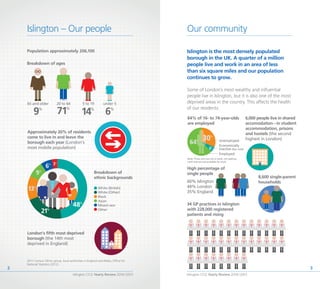
Breakdown of ages
20 to 6465 and older under 55 to 19
Approximately 20% of residents
come to live in and leave the
borough each year (London’s
most mobile population)
34 GP practices in Islington
with 228,000 registered
patients and rising
High percentage of
single people
60% Islington
44% London
35% England
6,000 people live in shared
accomodation–in student
accommodation, prisons
and hostels (the second
highest in London)
64% of 16- to 74-year-olds
are employed
Economically
inactive (See note)
Unemployed
Employed
Note: Those who are not in work, not seeking
work and are not available for work.
8,600 single-parent
households
Breakdown of
ethnic backgrounds
White (British)
White (Other)
Black
Asian
Mixed race
Other
Population approximately 206,100
2011 Census: Ethnic group, local authorities in England and Wales, Office for
National Statistics (2012).
Islington CCG Yearly Review 2014 /2015
5
Islington–Health and wellbeing Working together for
better healthcare
We are Islington Clinical Commissioning
Group (CCG) and we plan, buy and monitor
local health services. We are made up of GPs
from 34 local practices and we’re working
closely with a variety of partners, patients
and local people to improve the health of
everyone in Islington.
We’re known as an ‘integrated care pioneer’ which
means we’re working with Islington Council to link
healthcare and social care, to make life easier for
patients and take better care of them.
People’s health is affected by many different things,
including whether or not they are employed. In
Islington there are more jobs than people, but
unemployment is still high. We’re working with
different partners to help get more people into work.
Islington’s Employment Commission is helping to
train and motivate people for a variety of jobs, while
Hillside Clubhouse is helping people return to work
after experiencing mental ill health.
We are also working with clinical commissioning
groups in other boroughs. This year we’re talking to
GPs in Barnet, Camden, Enfield and Haringey about
how we can give patients better primary care. One
project is to improve the NHS 111 and out-of-hours
service.
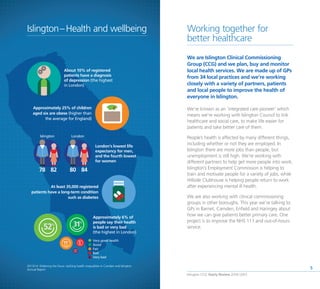
Approximately 25% of children
aged six are obese (higher than
the average for England)
About 10% of registered
patients have a diagnosis
of depression (the highest
in London)
At least 35,000 registered
patients have a long-term condition
such as diabetes
Approximately 6% of
people say their health
is bad or very bad
(the highest in London)
Very good health
Good
Fair
Bad
Very bad
London’s lowest life
expectancy for men,
and the fourth lowest
for women
Islington
78 82
London
80 84
2013/14: Widening the focus: tackling health inequalities in Camden and Islington
Annual Report
Islington CCG Yearly Review 2014 /2015
7
Islington CCG Yearly Review 2014 /2015
6
Working with our partners, patients and
local people, we have improved our services
in many different areas. We’ve helped
people get care more quickly and introduced
new ways of caring for them.
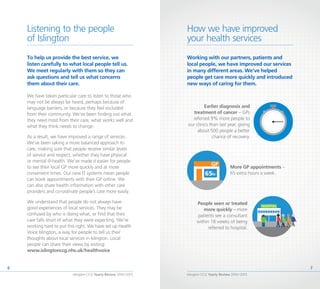
Earlier diagnosis and
treatment of cancer – GPs
referred 9% more people to
our clinics than last year, giving
about 500 people a better
chance of recovery.
More GP appointments –
65 extra hours a week.
People seen or treated
more quickly – more
patients see a consultant
within 18 weeks of being
referred to hospital.
How we have improved
your health services
Listening to the people
of Islington
To help us provide the best service, we
listen carefully to what local people tell us.
We meet regularly with them so they can
ask questions and tell us what concerns
them about their care.
We have taken particular care to listen to those who
may not be always be heard, perhaps because of
language barriers, or because they feel excluded
from their community. We’ve been finding out what
they need most from their care, what works well and
what they think needs to change.
As a result, we have improved a range of services.
We’ve been taking a more balanced approach to
care, making sure that people receive similar levels
of service and respect, whether they have physical
or mental ill-health. We’ve made it easier for people
to see their local GP more quickly and at more
convenient times. Our new IT systems mean people
can book appointments with their GP online. We
can also share health information with other care
providers and co-ordinate people’s care more easily.
We understand that people do not always have
good experiences of local services. They may be
confused by who is doing what, or find that their
care falls short of what they were expecting. We’re
working hard to put this right. We have set up Health
Voice Islington, a way for people to tell us their
thoughts about local services in Islington. Local
people can share their views by visiting:
www.islingtonccg.nhs.uk/healthvoice
Islington CCG Yearly Review 2014 /2015
9
Islington CCG Yearly Review 2014 /2015
8
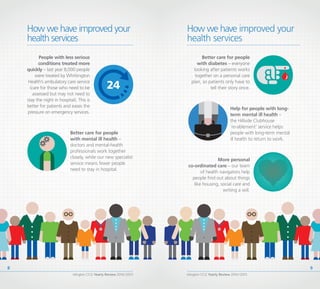
People with less serious
conditions treated more
quickly – last year 8,000 people
were treated by Whittington
Health’s ambulatory care service
(care for those who need to be
assessed but may not need to
stay the night in hospital). This is
better for patients and eases the
pressure on emergency services.
Better care for people
with mental ill health –
doctors and mental-health
professionals work together
closely, while our new specialist
service means fewer people
need to stay in hospital.
Better care for people
with diabetes – everyone
looking after patients works
together on a personal care
plan, so patients only have to
tell their story once.
Help for people with long-
term mental ill health –
the Hillside Clubhouse
‘re-ablement’ service helps
people with long-term mental
ill health to return to work.
More personal
co-ordinated care – our team
of health navigators help
people find out about things
like housing, social care and
writing a will.
How we have improved your
health services
How we have improved your
health services
Islington CCG Yearly Review 2014 /2015
11
Where the money goesWhere the money goes
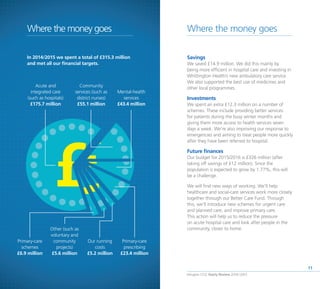
In 2014/2015 we spent a total of £315.3 million
and met all our financial targets.
Other (such as
voluntary and
community
projects)
£5.6 million
Our running
costs
£5.2 million
Acute and
integrated care
(such as hospitals)
£175.7 million
Mental-health
services
£43.4 million
Community
services (such as
district nurses)
£55.1 million
Primary-care
prescribing
£23.4 million
Primary-care
schemes
£6.9 million
Savings
We saved £14.9 million. We did this mainly by
being more efficient in hospital care and investing in
Whittington Health’s new ambulatory care service.
We also supported the best use of medicines and
other local programmes.
Investments
We spent an extra £12.3 million on a number of
schemes. These include providing better services
for patients during the busy winter months and
giving them more access to health services seven
days a week. We’re also improving our response to
emergencies and aiming to treat people more quickly
after they have been referred to hospital.
Future finances
Our budget for 2015/2016 is £326 million (after
taking off savings of £12 million). Since the
population is expected to grow by 1.77%, this will
be a challenge.
We will find new ways of working. We’ll help
healthcare and social-care services work more closely
together through our Better Care Fund. Through
this, we’ll introduce new schemes for urgent care
and planned care, and improve primary care.
This action will help us to reduce the pressure
on acute hospital care and look after people in the
community, closer to home.
Islington CCG Yearly Review 2014 /2015
13
Islington CCG Yearly Review 2014 /2015
12
How we plan to achieve
our goals
The next five years –
What we want to achieve
We want to provide better health and social
care for everyone in Islington.
To do this, we will continue to:
•	 help prevent people from becoming ill;
•	 work with our partners and local people to
provide new services;
•	 improve access to GPs and provide better
primary care;
•	 make GP practices the centre of co-ordinated
health and social care;
•	 manage care better by planning ahead and giving
people a single point of contact; and
•	 help people to manage their own care.
We’ve set up programmes to improve
primary care, integrated care, urgent care
and planned care across the borough. We
plan to keep using our resources in a way
that brings most benefit to the community.
Finding new ways of working
We will take services to people in their local
communities or homes and provide new services
in hospitals. We’ll help hospitals and community
services take advantage of technology such as
smartphones, emails and the internet.
Providing value for money
Islington provides some of the safest and
highest-quality health services in the country. We aim
to maintain our high standards and improve where
we need to, giving people services that provide
the best value. We won’t charge people for any
services (except those they already pay for, such as
prescriptions and the dentist).
Working together
We’ll continue to build our relationships with
other clinical commissioning groups, Islington
Council, hospitals, community partners and the
voluntary sector.
We are proud of what we’ve achieved in our first
two years and we look forward to working with our
partners and the people of Islington to improve the
health and wellbeing of all our residents in the
years ahead.
Islington CCG Yearly Review 2014 /2015
14
Our priorities
Islington CCG – Who we
are and what we do
We, Islington Clinical Commissioning Group
(CCG), were launched in April 2013. We are
part of an NHS plan to give local doctors and
local people more say in organising their
own health services.
We are chaired by Islington GP Dr Gillian
Greenhough, and supported by a governing
body of GPs, members of the public, nurses and
other professionals.
We work closely with other clinical commissioning
groups across London, as well as Islington
Council, NHS England (the new central body) and
local people.
We buy in a wide range of services. These include
planned hospital care, rehabilitation services, urgent
and emergency care (including 111 and out-of-hours
services), most community health services (such as
podiatry, district nursing and physiotherapy) and
mental-health and learning-disability services.
Many of these services are provided by local NHS
organisations – Whittington Health, Camden and
Islington Foundation Trust, University College London
Hospitals and The Royal Free. We also buy services
from not-for-profit organisations based in the
local community.
Together with Islington Council, our four
priorities are:
•	 to make sure every child has the best start in life;
•	 to prevent and manage long-term conditions to
extend the length and quality of life, and reduce
health inequalities;
•	 to improve mental health and wellbeing; and
•	 to provide high-quality, efficient services within
the resources available.
What do you think about health services in Islington?
Tell us your thoughts at
www.islingtonccg.nhs.uk/healthvoice

NHS-Islington-CCG-yearly-review-2014-15

  • 1.
  • 2.
    Islington CCG YearlyReview 2014 /2015 3 Islington CCG Yearly Review 2014 /2015 2 Our communityIslington – Our people Islington is the most densely populated borough in the UK. A quarter of a million people live and work in an area of less than six square miles and our population continues to grow. Some of London’s most wealthy and influential people live in Islington, but it is also one of the most deprived areas in the country. This affects the health of our residents. London’s fifth most deprived borough (the 14th most deprived in England) Breakdown of ages 20 to 6465 and older under 55 to 19 Approximately 20% of residents come to live in and leave the borough each year (London’s most mobile population) 34 GP practices in Islington with 228,000 registered patients and rising High percentage of single people 60% Islington 44% London 35% England 6,000 people live in shared accomodation–in student accommodation, prisons and hostels (the second highest in London) 64% of 16- to 74-year-olds are employed Economically inactive (See note) Unemployed Employed Note: Those who are not in work, not seeking work and are not available for work. 8,600 single-parent households Breakdown of ethnic backgrounds White (British) White (Other) Black Asian Mixed race Other Population approximately 206,100 2011 Census: Ethnic group, local authorities in England and Wales, Office for National Statistics (2012).
  • 3.
    Islington CCG YearlyReview 2014 /2015 5 Islington–Health and wellbeing Working together for better healthcare We are Islington Clinical Commissioning Group (CCG) and we plan, buy and monitor local health services. We are made up of GPs from 34 local practices and we’re working closely with a variety of partners, patients and local people to improve the health of everyone in Islington. We’re known as an ‘integrated care pioneer’ which means we’re working with Islington Council to link healthcare and social care, to make life easier for patients and take better care of them. People’s health is affected by many different things, including whether or not they are employed. In Islington there are more jobs than people, but unemployment is still high. We’re working with different partners to help get more people into work. Islington’s Employment Commission is helping to train and motivate people for a variety of jobs, while Hillside Clubhouse is helping people return to work after experiencing mental ill health. We are also working with clinical commissioning groups in other boroughs. This year we’re talking to GPs in Barnet, Camden, Enfield and Haringey about how we can give patients better primary care. One project is to improve the NHS 111 and out-of-hours service. Approximately 25% of children aged six are obese (higher than the average for England) About 10% of registered patients have a diagnosis of depression (the highest in London) At least 35,000 registered patients have a long-term condition such as diabetes Approximately 6% of people say their health is bad or very bad (the highest in London) Very good health Good Fair Bad Very bad London’s lowest life expectancy for men, and the fourth lowest for women Islington 78 82 London 80 84 2013/14: Widening the focus: tackling health inequalities in Camden and Islington Annual Report
  • 4.
    Islington CCG YearlyReview 2014 /2015 7 Islington CCG Yearly Review 2014 /2015 6 Working with our partners, patients and local people, we have improved our services in many different areas. We’ve helped people get care more quickly and introduced new ways of caring for them. Earlier diagnosis and treatment of cancer – GPs referred 9% more people to our clinics than last year, giving about 500 people a better chance of recovery. More GP appointments – 65 extra hours a week. People seen or treated more quickly – more patients see a consultant within 18 weeks of being referred to hospital. How we have improved your health services Listening to the people of Islington To help us provide the best service, we listen carefully to what local people tell us. We meet regularly with them so they can ask questions and tell us what concerns them about their care. We have taken particular care to listen to those who may not be always be heard, perhaps because of language barriers, or because they feel excluded from their community. We’ve been finding out what they need most from their care, what works well and what they think needs to change. As a result, we have improved a range of services. We’ve been taking a more balanced approach to care, making sure that people receive similar levels of service and respect, whether they have physical or mental ill-health. We’ve made it easier for people to see their local GP more quickly and at more convenient times. Our new IT systems mean people can book appointments with their GP online. We can also share health information with other care providers and co-ordinate people’s care more easily. We understand that people do not always have good experiences of local services. They may be confused by who is doing what, or find that their care falls short of what they were expecting. We’re working hard to put this right. We have set up Health Voice Islington, a way for people to tell us their thoughts about local services in Islington. Local people can share their views by visiting: www.islingtonccg.nhs.uk/healthvoice
  • 5.
    Islington CCG YearlyReview 2014 /2015 9 Islington CCG Yearly Review 2014 /2015 8 People with less serious conditions treated more quickly – last year 8,000 people were treated by Whittington Health’s ambulatory care service (care for those who need to be assessed but may not need to stay the night in hospital). This is better for patients and eases the pressure on emergency services. Better care for people with mental ill health – doctors and mental-health professionals work together closely, while our new specialist service means fewer people need to stay in hospital. Better care for people with diabetes – everyone looking after patients works together on a personal care plan, so patients only have to tell their story once. Help for people with long- term mental ill health – the Hillside Clubhouse ‘re-ablement’ service helps people with long-term mental ill health to return to work. More personal co-ordinated care – our team of health navigators help people find out about things like housing, social care and writing a will. How we have improved your health services How we have improved your health services
  • 6.
    Islington CCG YearlyReview 2014 /2015 11 Where the money goesWhere the money goes In 2014/2015 we spent a total of £315.3 million and met all our financial targets. Other (such as voluntary and community projects) £5.6 million Our running costs £5.2 million Acute and integrated care (such as hospitals) £175.7 million Mental-health services £43.4 million Community services (such as district nurses) £55.1 million Primary-care prescribing £23.4 million Primary-care schemes £6.9 million Savings We saved £14.9 million. We did this mainly by being more efficient in hospital care and investing in Whittington Health’s new ambulatory care service. We also supported the best use of medicines and other local programmes. Investments We spent an extra £12.3 million on a number of schemes. These include providing better services for patients during the busy winter months and giving them more access to health services seven days a week. We’re also improving our response to emergencies and aiming to treat people more quickly after they have been referred to hospital. Future finances Our budget for 2015/2016 is £326 million (after taking off savings of £12 million). Since the population is expected to grow by 1.77%, this will be a challenge. We will find new ways of working. We’ll help healthcare and social-care services work more closely together through our Better Care Fund. Through this, we’ll introduce new schemes for urgent care and planned care, and improve primary care. This action will help us to reduce the pressure on acute hospital care and look after people in the community, closer to home.
  • 7.
    Islington CCG YearlyReview 2014 /2015 13 Islington CCG Yearly Review 2014 /2015 12 How we plan to achieve our goals The next five years – What we want to achieve We want to provide better health and social care for everyone in Islington. To do this, we will continue to: • help prevent people from becoming ill; • work with our partners and local people to provide new services; • improve access to GPs and provide better primary care; • make GP practices the centre of co-ordinated health and social care; • manage care better by planning ahead and giving people a single point of contact; and • help people to manage their own care. We’ve set up programmes to improve primary care, integrated care, urgent care and planned care across the borough. We plan to keep using our resources in a way that brings most benefit to the community. Finding new ways of working We will take services to people in their local communities or homes and provide new services in hospitals. We’ll help hospitals and community services take advantage of technology such as smartphones, emails and the internet. Providing value for money Islington provides some of the safest and highest-quality health services in the country. We aim to maintain our high standards and improve where we need to, giving people services that provide the best value. We won’t charge people for any services (except those they already pay for, such as prescriptions and the dentist). Working together We’ll continue to build our relationships with other clinical commissioning groups, Islington Council, hospitals, community partners and the voluntary sector. We are proud of what we’ve achieved in our first two years and we look forward to working with our partners and the people of Islington to improve the health and wellbeing of all our residents in the years ahead.
  • 8.
    Islington CCG YearlyReview 2014 /2015 14 Our priorities Islington CCG – Who we are and what we do We, Islington Clinical Commissioning Group (CCG), were launched in April 2013. We are part of an NHS plan to give local doctors and local people more say in organising their own health services. We are chaired by Islington GP Dr Gillian Greenhough, and supported by a governing body of GPs, members of the public, nurses and other professionals. We work closely with other clinical commissioning groups across London, as well as Islington Council, NHS England (the new central body) and local people. We buy in a wide range of services. These include planned hospital care, rehabilitation services, urgent and emergency care (including 111 and out-of-hours services), most community health services (such as podiatry, district nursing and physiotherapy) and mental-health and learning-disability services. Many of these services are provided by local NHS organisations – Whittington Health, Camden and Islington Foundation Trust, University College London Hospitals and The Royal Free. We also buy services from not-for-profit organisations based in the local community. Together with Islington Council, our four priorities are: • to make sure every child has the best start in life; • to prevent and manage long-term conditions to extend the length and quality of life, and reduce health inequalities; • to improve mental health and wellbeing; and • to provide high-quality, efficient services within the resources available.
  • 9.
    What do youthink about health services in Islington? Tell us your thoughts at www.islingtonccg.nhs.uk/healthvoice