PRESENTED BY:
SUNIL KUMAR
ASST PROFESSOR
MCA
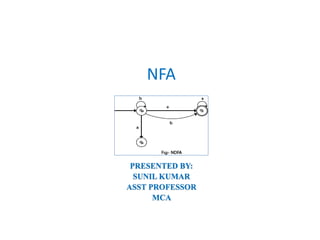
NFA
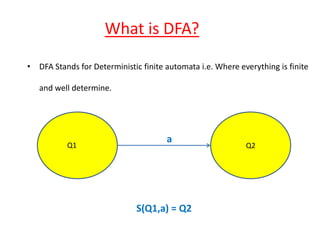
What is DFA?
• DFA Stands for Deterministic finite automata i.e. Where everything is finite
and well determine.
Q2Q1
S(Q1,a) = Q2
a
What is NFA?
Q2
Q1
Q3
• N-DFA Stands Non-Deterministic finite automata i.e. it contains multiple next states.
S(Q1,a) = (Q1,Q2)
a
a
Why we are studying N-DFA?
• We study it because it is easy to design as compared to DFA, but is not practically
implemented.
NFA
DFA
MDFA
NFA formal Definition
• NFA consist of 5 Tuple: N-DFA = (Q,∑ ,q0, F, δ)
• Q: finite set of states
• ∑: finite set of the input symbol
• q0: initial state
• F: final state
• δ: Transition function
• δ: Q x ∑ →2Q (Power Set)
Total states = (q1,q2)
{q0,q1}= (^,q0,q1,{q0,q1})
22 =4
Thank You

Nfa

  • 1.
  • 2.
    What is DFA? •DFA Stands for Deterministic finite automata i.e. Where everything is finite and well determine. Q2Q1 S(Q1,a) = Q2 a
  • 3.
    What is NFA? Q2 Q1 Q3 •N-DFA Stands Non-Deterministic finite automata i.e. it contains multiple next states. S(Q1,a) = (Q1,Q2) a a
  • 4.
    Why we arestudying N-DFA? • We study it because it is easy to design as compared to DFA, but is not practically implemented. NFA DFA MDFA
  • 5.
    NFA formal Definition •NFA consist of 5 Tuple: N-DFA = (Q,∑ ,q0, F, δ) • Q: finite set of states • ∑: finite set of the input symbol • q0: initial state • F: final state • δ: Transition function • δ: Q x ∑ →2Q (Power Set) Total states = (q1,q2) {q0,q1}= (^,q0,q1,{q0,q1}) 22 =4
  • 6.