NEW YORK
PROBATE PROCESS
To Understand Why So Many People Include
Probate Avoidance Strategies in their Estate Plan
Though You Need to Have at Least a Rudimentary
Understanding of the Probate Process in New York
SAUL KOBRICK & ANTHONY MOCCIA
NEW YORK ESTATE PLANNING ATTORNEYS
SERVING NASSAU COUNTY, SUFFOLK COUNTY, AND WESTCHESTER COUNTY
New York Probate Process www.kobricklaw.com 2
When you sit down to create your estate plan the primary objective will be to provide the
framework by which your estate assets will be divided up when you die. If you are like
most people, however, you will also include additional goals and objectives in your estate
plan. One of the most common secondarygoals of a comprehensive estate plan is probate
avoidance. To understand why so many people include probate avoidance strategies in
their estate plan though you need to have at least a rudimentary understanding of the
probate process in New York. Only an experienced estate planning attorney can answer
specific questions regarding how your estate will be handled during probate and how best
to implement probateavoidance strategies into your estate plan; however, the following
general information about the New York probate process may be helpful in the meantime.
WHAT IS PROBATE AND WHY IS IT NECESSARY?
Probate is the legal process that is required by law following the death of an individual.
When you die you will leave
behind an estate. Your estate
could be minimal, consisting of
nothing more than personal
effects and cash on hand or your
estate could be valuable and
include complex assets such as
real property, investments, and
business interests. One purpose
of probate is to identify and
appraise all of the assets you
leave behind. Identifying all of
your estate assets ensures that they are all passed down to the intended beneficiaries or
New York Probate Process www.kobricklaw.com 3
legal heirs; however, it also ensures that Uncle Sam receives any taxes due on the value
of those assets.
TESTATE VS. INTESTATE ESTATES
The manner in which your estate is handled, from a legal standpoint, will depend on
whether you died testate or
intestate. If a decedent
leaves behind a valid Last
Will and Testament the
decedent is said to have
died “testate”. If a
decedent fails to execute a
Will prior to death the
decedent is said to have
died “intestate”. In a
testate estate the terms of
the Will, along with any other estate planning documents, dictate how the estate assets
are distributed after the death of the testator. In an intestate estate, the New York intestate
successionlaws will determine who receives the decedent’s estate assets. The existence
or absence of a Will has an impact on the probate process in a number of significant
ways. As a general rule, it takes longer to probatean intestate estate because the court
must first identify and locate all potential heirs to the estate. In addition, estate assets may
need to be sold in order to provide for the proper distribution of funds according to the
intestate successionlaws.
New York Probate Process www.kobricklaw.com 4
DO ALL ESTATES GO THROUGH PROBATE?
New York, like most states, offers alternatives to formal probatefor small estates. If the
estate does not contain any real estate and
the total value is under $30,000
(exclusive of certain types of property) a
small estate proceeding may be used in
lieu of formal probate. This option can be
used for both testate and intestate estates.
If, on the other hand, the only property
left behind by the decedent is real property it may also be possibleto avoid formal
probate if you are the legal heir to the property and the decedent died intestate. In all
other situations, formal probate is required.
AN OVERVIEW OF THE FORMAL PROBATE PROCESS
For an estate that requires
formal probate the process
begins by submitting the
decedent’s Last Will and
Testament (if one is found),
along with additional legal
documents, to the appropriate
Surrogate’s Court in New
York. Typically, the person
named as the Executor in the
Will handles the opening of probate. If no Will was left behind a family member or loved
usually begins the probateprocess and asks to be appointed the Administrator of the
New York Probate Process www.kobricklaw.com 5
estate. If no one steps forward and volunteers to be the Administrator in an intestate
estate, the court will appoint someone to fill the position. Collectively, the job of
Executor or Administrator is referred to as the “PersonalRepresentative”, or PR. Because
the probate process canbe confusing and may require legal knowledge in various areas of
the law, the PR customarily retains the
services of an estate planning attorney to
assist throughout the probate process.
After opening the probate the PR must
identify, locate, and value all of the
decedent’s assets. An inventory may need
to be filed with court. Often, the PR utilizes
the services of professionalappraisers to
ensure a proper date of death value for all
estate assets. Creditors of the estate must
then be notified that the estate is being
probated. This is accomplished by
publication in a local newspaper. Creditors
then have a specific period of time to file
claims against the estate.
Thoseclaims are then reviewed by the PR and either paid out of estate assets or denied. If
a claim is denied the creditor may appeal the court. If the decedent’s Will is challenged
by filing a Will contest the PR must defend the Will throughout the ensuing litigation.
The PR must also prepare and file personal and estate tax returns and pay any taxes due.
Only after all assets have been accounted for, claims reviewed and paid, litigation
concluded, and taxes paid can the remaining estate assets finally be transferred to the
intended beneficiaries or legal heirs of the estate.
New York Probate Process www.kobricklaw.com 6
THE COST OF PROBATE
The probateprocess can be costly, both in terms of dollars and cents and in time. Even a
fairly simple probatecan take a year or more to conclude. The more complex the estate
assets are the longer it will take to conclude the probate of an estate as a general rule.
Almost everyone involved in the probate process is entitled to a fee for their services,
including the PR, the estate planning attorney, accountants, and appraisers. The longer
the probate process takes the more estate assets are lost to the process itself, leaving less
for loved ones. Along with the direct financial costof probate, there are also indirect
costs. Loved ones often do not have access to estate assets until the probate process
comes to a conclusion. This can take both an emotional and financial toll on loved ones.
Careful estate planning ahead of time, however, can prevent almost all of the negative
consequences of the probate process.
PROBATE AVOIDANCE STRATEGIES
By now it should be clear
why probate avoidance is
such a popular estate
planning goal. The key to
avoiding probate is to
remove assets from your
estate prior to your death
and/or to leave behind
assets that are not
required to go through the
probate process.Someof
the more commonly used probate avoidance strategies include:
New York Probate Process www.kobricklaw.com 7
Life Insurance – life insurance proceeds are considered a non-probate asset
because they belong to the beneficiary at the time of your death. Creative use of
life insurance proceeds caneven accomplish things like funding your funeral by
naming a funeral trust as the beneficiary of an insurance policy.
Joint Ownership –by titling property as joint tenants with rights of survivorship
your interest in the property will pass directly to the other owner(s) outside of the
probate process.
POD/TOD Accounts –“Payableon Death” and “Transfer on Death” account
designations can be used for financial accounts, retirement accounts, and securities
in most states. Choosing this account designation allows the assets to be transferred
upon your death to a designated beneficiary without the need for the asset to go
through probate. Unlike a joint account, the beneficiary has no ownership interest
in the account/assetwhile you are alive but becomes the owner upon your death.
Trusts –assets transferred into an irrevocable trust are no longer part of your
estate. Therefore, they are not included in the probate of your estate.
Now that you have a better understanding of the probateprocess it should be easier to see
why people often include probate avoidance strategies in their overall estate plan. Consult
with your New York estate planning attorney to determine which probateavoidance
techniques will work best for your estate plan.
New York Courts.gov, Frequently Asked Questions
Pace University, Probate Law
New York Probate Process www.kobricklaw.com 8
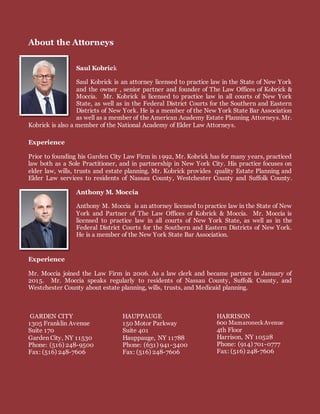
About the Attorneys
Saul Kobrick
Saul Kobrick is an attorney licensed to practice law in the State of New York
and the owner , senior partner and founder of The Law Offices of Kobrick &
Moccia. Mr. Kobrick is licensed to practice law in all courts of New York
State, as well as in the Federal District Courts for the Southern and Eastern
Districts of New York. He is a member of the New York State Bar Association
as well as a member of the American Academy Estate Planning Attorneys. Mr.
Kobrick is also a member of the National Academy of Elder Law Attorneys.
Experience
Prior to founding his Garden City Law Firm in 1992, Mr. Kobrick has for many years, practiced
law both as a Sole Practitioner, and in partnership in New York City. His practice focuses on
elder law, wills, trusts and estate planning. Mr. Kobrick provides quality Estate Planning and
Elder Law services to residents of Nassau County, Westchester County and Suffolk County.
Anthony M. Moccia
Anthony M. Moccia is an attorney licensed to practice law in the State of New
York and Partner of The Law Offices of Kobrick & Moccia. Mr. Moccia is
licensed to practice law in all courts of New York State, as well as in the
Federal District Courts for the Southern and Eastern Districts of New York.
He is a member of the New York State Bar Association.
Experience
Mr. Moccia joined the Law Firm in 2006. As a law clerk and became partner in January of
2015. Mr. Moccia speaks regularly to residents of Nassau County, Suffolk County, and
Westchester County about estate planning, wills, trusts, and Medicaid planning.
GARDEN CITY
1305 Franklin Avenue
Suite 170
Garden City, NY 11530
Phone: (516) 248-9500
Fax: (516) 248-7606
HAUPPAUGE
150 Motor Parkway
Suite 401
Hauppauge, NY 11788
Phone: (631) 941-3400
Fax: (516) 248-7606
HARRISON
600 MamaroneckAvenue
4th Floor
Harrison, NY 10528
Phone: (914) 701-0777
Fax: (516) 248-7606

New York Probate Process

  • 1.
    NEW YORK PROBATE PROCESS ToUnderstand Why So Many People Include Probate Avoidance Strategies in their Estate Plan Though You Need to Have at Least a Rudimentary Understanding of the Probate Process in New York SAUL KOBRICK & ANTHONY MOCCIA NEW YORK ESTATE PLANNING ATTORNEYS SERVING NASSAU COUNTY, SUFFOLK COUNTY, AND WESTCHESTER COUNTY
  • 2.
    New York ProbateProcess www.kobricklaw.com 2 When you sit down to create your estate plan the primary objective will be to provide the framework by which your estate assets will be divided up when you die. If you are like most people, however, you will also include additional goals and objectives in your estate plan. One of the most common secondarygoals of a comprehensive estate plan is probate avoidance. To understand why so many people include probate avoidance strategies in their estate plan though you need to have at least a rudimentary understanding of the probate process in New York. Only an experienced estate planning attorney can answer specific questions regarding how your estate will be handled during probate and how best to implement probateavoidance strategies into your estate plan; however, the following general information about the New York probate process may be helpful in the meantime. WHAT IS PROBATE AND WHY IS IT NECESSARY? Probate is the legal process that is required by law following the death of an individual. When you die you will leave behind an estate. Your estate could be minimal, consisting of nothing more than personal effects and cash on hand or your estate could be valuable and include complex assets such as real property, investments, and business interests. One purpose of probate is to identify and appraise all of the assets you leave behind. Identifying all of your estate assets ensures that they are all passed down to the intended beneficiaries or
  • 3.
    New York ProbateProcess www.kobricklaw.com 3 legal heirs; however, it also ensures that Uncle Sam receives any taxes due on the value of those assets. TESTATE VS. INTESTATE ESTATES The manner in which your estate is handled, from a legal standpoint, will depend on whether you died testate or intestate. If a decedent leaves behind a valid Last Will and Testament the decedent is said to have died “testate”. If a decedent fails to execute a Will prior to death the decedent is said to have died “intestate”. In a testate estate the terms of the Will, along with any other estate planning documents, dictate how the estate assets are distributed after the death of the testator. In an intestate estate, the New York intestate successionlaws will determine who receives the decedent’s estate assets. The existence or absence of a Will has an impact on the probate process in a number of significant ways. As a general rule, it takes longer to probatean intestate estate because the court must first identify and locate all potential heirs to the estate. In addition, estate assets may need to be sold in order to provide for the proper distribution of funds according to the intestate successionlaws.
  • 4.
    New York ProbateProcess www.kobricklaw.com 4 DO ALL ESTATES GO THROUGH PROBATE? New York, like most states, offers alternatives to formal probatefor small estates. If the estate does not contain any real estate and the total value is under $30,000 (exclusive of certain types of property) a small estate proceeding may be used in lieu of formal probate. This option can be used for both testate and intestate estates. If, on the other hand, the only property left behind by the decedent is real property it may also be possibleto avoid formal probate if you are the legal heir to the property and the decedent died intestate. In all other situations, formal probate is required. AN OVERVIEW OF THE FORMAL PROBATE PROCESS For an estate that requires formal probate the process begins by submitting the decedent’s Last Will and Testament (if one is found), along with additional legal documents, to the appropriate Surrogate’s Court in New York. Typically, the person named as the Executor in the Will handles the opening of probate. If no Will was left behind a family member or loved usually begins the probateprocess and asks to be appointed the Administrator of the
  • 5.
    New York ProbateProcess www.kobricklaw.com 5 estate. If no one steps forward and volunteers to be the Administrator in an intestate estate, the court will appoint someone to fill the position. Collectively, the job of Executor or Administrator is referred to as the “PersonalRepresentative”, or PR. Because the probate process canbe confusing and may require legal knowledge in various areas of the law, the PR customarily retains the services of an estate planning attorney to assist throughout the probate process. After opening the probate the PR must identify, locate, and value all of the decedent’s assets. An inventory may need to be filed with court. Often, the PR utilizes the services of professionalappraisers to ensure a proper date of death value for all estate assets. Creditors of the estate must then be notified that the estate is being probated. This is accomplished by publication in a local newspaper. Creditors then have a specific period of time to file claims against the estate. Thoseclaims are then reviewed by the PR and either paid out of estate assets or denied. If a claim is denied the creditor may appeal the court. If the decedent’s Will is challenged by filing a Will contest the PR must defend the Will throughout the ensuing litigation. The PR must also prepare and file personal and estate tax returns and pay any taxes due. Only after all assets have been accounted for, claims reviewed and paid, litigation concluded, and taxes paid can the remaining estate assets finally be transferred to the intended beneficiaries or legal heirs of the estate.
  • 6.
    New York ProbateProcess www.kobricklaw.com 6 THE COST OF PROBATE The probateprocess can be costly, both in terms of dollars and cents and in time. Even a fairly simple probatecan take a year or more to conclude. The more complex the estate assets are the longer it will take to conclude the probate of an estate as a general rule. Almost everyone involved in the probate process is entitled to a fee for their services, including the PR, the estate planning attorney, accountants, and appraisers. The longer the probate process takes the more estate assets are lost to the process itself, leaving less for loved ones. Along with the direct financial costof probate, there are also indirect costs. Loved ones often do not have access to estate assets until the probate process comes to a conclusion. This can take both an emotional and financial toll on loved ones. Careful estate planning ahead of time, however, can prevent almost all of the negative consequences of the probate process. PROBATE AVOIDANCE STRATEGIES By now it should be clear why probate avoidance is such a popular estate planning goal. The key to avoiding probate is to remove assets from your estate prior to your death and/or to leave behind assets that are not required to go through the probate process.Someof the more commonly used probate avoidance strategies include:
  • 7.
    New York ProbateProcess www.kobricklaw.com 7 Life Insurance – life insurance proceeds are considered a non-probate asset because they belong to the beneficiary at the time of your death. Creative use of life insurance proceeds caneven accomplish things like funding your funeral by naming a funeral trust as the beneficiary of an insurance policy. Joint Ownership –by titling property as joint tenants with rights of survivorship your interest in the property will pass directly to the other owner(s) outside of the probate process. POD/TOD Accounts –“Payableon Death” and “Transfer on Death” account designations can be used for financial accounts, retirement accounts, and securities in most states. Choosing this account designation allows the assets to be transferred upon your death to a designated beneficiary without the need for the asset to go through probate. Unlike a joint account, the beneficiary has no ownership interest in the account/assetwhile you are alive but becomes the owner upon your death. Trusts –assets transferred into an irrevocable trust are no longer part of your estate. Therefore, they are not included in the probate of your estate. Now that you have a better understanding of the probateprocess it should be easier to see why people often include probate avoidance strategies in their overall estate plan. Consult with your New York estate planning attorney to determine which probateavoidance techniques will work best for your estate plan. New York Courts.gov, Frequently Asked Questions Pace University, Probate Law
  • 8.
    New York ProbateProcess www.kobricklaw.com 8 About the Attorneys Saul Kobrick Saul Kobrick is an attorney licensed to practice law in the State of New York and the owner , senior partner and founder of The Law Offices of Kobrick & Moccia. Mr. Kobrick is licensed to practice law in all courts of New York State, as well as in the Federal District Courts for the Southern and Eastern Districts of New York. He is a member of the New York State Bar Association as well as a member of the American Academy Estate Planning Attorneys. Mr. Kobrick is also a member of the National Academy of Elder Law Attorneys. Experience Prior to founding his Garden City Law Firm in 1992, Mr. Kobrick has for many years, practiced law both as a Sole Practitioner, and in partnership in New York City. His practice focuses on elder law, wills, trusts and estate planning. Mr. Kobrick provides quality Estate Planning and Elder Law services to residents of Nassau County, Westchester County and Suffolk County. Anthony M. Moccia Anthony M. Moccia is an attorney licensed to practice law in the State of New York and Partner of The Law Offices of Kobrick & Moccia. Mr. Moccia is licensed to practice law in all courts of New York State, as well as in the Federal District Courts for the Southern and Eastern Districts of New York. He is a member of the New York State Bar Association. Experience Mr. Moccia joined the Law Firm in 2006. As a law clerk and became partner in January of 2015. Mr. Moccia speaks regularly to residents of Nassau County, Suffolk County, and Westchester County about estate planning, wills, trusts, and Medicaid planning. GARDEN CITY 1305 Franklin Avenue Suite 170 Garden City, NY 11530 Phone: (516) 248-9500 Fax: (516) 248-7606 HAUPPAUGE 150 Motor Parkway Suite 401 Hauppauge, NY 11788 Phone: (631) 941-3400 Fax: (516) 248-7606 HARRISON 600 MamaroneckAvenue 4th Floor Harrison, NY 10528 Phone: (914) 701-0777 Fax: (516) 248-7606