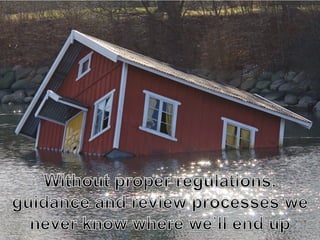
New Swedish building regulations and a
 framework for fire safety engineering
 Caroline Cronsioe, The National board of building,
   housing and planning
 Michael Strömgren, SP Fire technology
 David Tonegran, Tyréns
 Henrik Bjelland, University of Stavanger
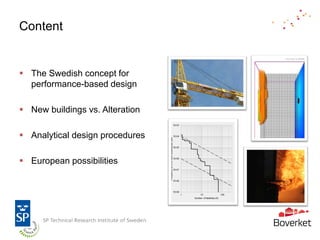
Content


 The Swedish concept for
  performance-based design

 New buildings vs. Alteration

 Analytical design procedures

 European possibilities
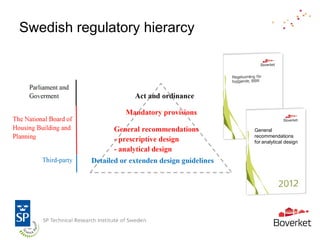
Swedish regulatory hierarcy


                              General
                              recommendations
                              for analytical design
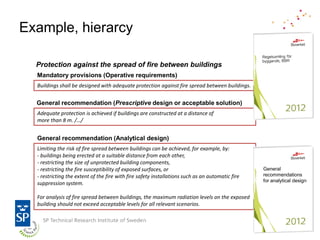
Example, hierarcy

  Protection against the spread of fire between buildings
  Mandatory provisions (Operative requirements)
  Buildings shall be designed with adequate protection against fire spread between buildings.


  General recommendation (Prescriptive design or acceptable solution)
  Adequate protection is achieved if buildings are constructed at a distance of
  more than 8 m. /…/


  General recommendation (Analytical design)
  Limiting the risk of fire spread between buildings can be achieved, for example, by:
  - buildings being erected at a suitable distance from each other,
  - restricting the size of unprotected building components,
  - restricting the fire susceptibility of exposed surfaces, or                                   General
  - restricting the extent of the fire with fire safety installations such as an automatic fire   recommendations
                                                                                                  for analytical design
  suppression system.

  For analysis of fire spread between buildings, the maximum radiation levels on the exposed
  building should not exceed acceptable levels for all relevant scenarios.
Foto: Otto Ryding
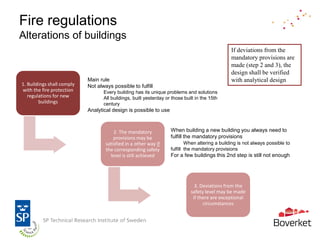
Fire regulations
Alterations of buildings
                                                                                                 If deviations from the
                                                                                                 mandatory provisions are
                                                                                                 made (step 2 and 3), the
                                                                                                 design shall be verified
                            Main rule                                                            with analytical design
1. Buildings shall comply   Not always possible to fulfill
with the fire protection           Every building has its unique problems and solutions
   regulations for new             All buildings, built yesterday or those built in the 15th
        buildings                  century
                            Analytical design is possible to use


                                        2. The mandatory            When building a new building you always need to
                                        provisions may be           fulfill the mandatory provisions
                                    satisfied in a other way if             When altering a building is not always possible to
                                    the corresponding safety        fulfill the mandatory provisions
                                      level is still achieved       For a few buildings this 2nd step is still not enough


                                                                                3. Deviations from the
                                                                              safety level may be made
                                                                               if there are exceptional
                                                                                    circumstances
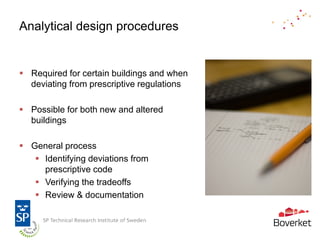
Analytical design procedures


 Required for certain buildings and when
  deviating from prescriptive regulations

 Possible for both new and altered
  buildings

 General process
    Identifying deviations from
     prescriptive code
    Verifying the tradeoffs
    Review & documentation
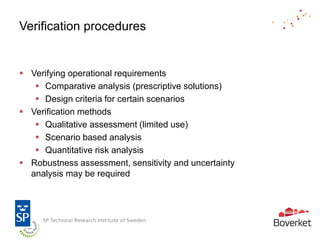
Verification procedures


 Verifying operational requirements
    Comparative analysis (prescriptive solutions)
    Design criteria for certain scenarios
 Verification methods
    Qualitative assessment (limited use)
    Scenario based analysis
    Quantitative risk analysis
 Robustness assessment, sensitivity and uncertainty
  analysis may be required
Example: Verifying means of escape by
scenario analysis
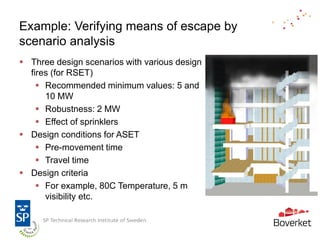
 Three design scenarios with various design
  fires (for RSET)
     Recommended minimum values: 5 and
      10 MW
     Robustness: 2 MW
     Effect of sprinklers
 Design conditions for ASET
     Pre-movement time
     Travel time
 Design criteria
     For example, 80C Temperature, 5 m
      visibility etc.
Status of FSE in Europe


 Most countries use prescriptive
  regulations as a base for FSE
 Competence levels among
  practitions vary
 Regulatory support and methods
  for FSE is lacking
 However, complex buildings
  deviating from prescriptive
  regulations are built any way
Challenges for Europe

 Need for FSE tools and harmonisation

 Account must be taken for differences in
    Legal and regulatory structures
    Review & control processes
    Competence levels among practitioners

 Work is going on in European
  standardization and in SFPE Europe
Conclusions


 Balance between flexibility and societal risk control

 Need for risk calibration and risk criteria – these
  should be set nationally…

 … and the risk level of prescriptive regulations is a
  good start

 European countries should adopt a common method
  and approach to FSE
New swedish regulations and a framework for fire safety engineering 2012 - PRESENTATION

New swedish regulations and a framework for fire safety engineering 2012 - PRESENTATION

  • 1.
    New Swedish buildingregulations and a framework for fire safety engineering Caroline Cronsioe, The National board of building, housing and planning Michael Strömgren, SP Fire technology David Tonegran, Tyréns Henrik Bjelland, University of Stavanger
  • 2.
    Content  The Swedishconcept for performance-based design  New buildings vs. Alteration  Analytical design procedures  European possibilities
  • 3.
    Swedish regulatory hierarcy General recommendations for analytical design
  • 4.
    Example, hierarcy Protection against the spread of fire between buildings Mandatory provisions (Operative requirements) Buildings shall be designed with adequate protection against fire spread between buildings. General recommendation (Prescriptive design or acceptable solution) Adequate protection is achieved if buildings are constructed at a distance of more than 8 m. /…/ General recommendation (Analytical design) Limiting the risk of fire spread between buildings can be achieved, for example, by: - buildings being erected at a suitable distance from each other, - restricting the size of unprotected building components, - restricting the fire susceptibility of exposed surfaces, or General - restricting the extent of the fire with fire safety installations such as an automatic fire recommendations for analytical design suppression system. For analysis of fire spread between buildings, the maximum radiation levels on the exposed building should not exceed acceptable levels for all relevant scenarios.
  • 5.
  • 6.
    Fire regulations Alterations ofbuildings If deviations from the mandatory provisions are made (step 2 and 3), the design shall be verified Main rule with analytical design 1. Buildings shall comply Not always possible to fulfill with the fire protection Every building has its unique problems and solutions regulations for new All buildings, built yesterday or those built in the 15th buildings century Analytical design is possible to use 2. The mandatory When building a new building you always need to provisions may be fulfill the mandatory provisions satisfied in a other way if When altering a building is not always possible to the corresponding safety fulfill the mandatory provisions level is still achieved For a few buildings this 2nd step is still not enough 3. Deviations from the safety level may be made if there are exceptional circumstances
  • 7.
    Analytical design procedures Required for certain buildings and when deviating from prescriptive regulations  Possible for both new and altered buildings  General process  Identifying deviations from prescriptive code  Verifying the tradeoffs  Review & documentation
  • 8.
    Verification procedures  Verifyingoperational requirements  Comparative analysis (prescriptive solutions)  Design criteria for certain scenarios  Verification methods  Qualitative assessment (limited use)  Scenario based analysis  Quantitative risk analysis  Robustness assessment, sensitivity and uncertainty analysis may be required
  • 9.
    Example: Verifying meansof escape by scenario analysis  Three design scenarios with various design fires (for RSET)  Recommended minimum values: 5 and 10 MW  Robustness: 2 MW  Effect of sprinklers  Design conditions for ASET  Pre-movement time  Travel time  Design criteria  For example, 80C Temperature, 5 m visibility etc.
  • 10.
    Status of FSEin Europe  Most countries use prescriptive regulations as a base for FSE  Competence levels among practitions vary  Regulatory support and methods for FSE is lacking  However, complex buildings deviating from prescriptive regulations are built any way
  • 11.
    Challenges for Europe Need for FSE tools and harmonisation  Account must be taken for differences in  Legal and regulatory structures  Review & control processes  Competence levels among practitioners  Work is going on in European standardization and in SFPE Europe
  • 12.
    Conclusions  Balance betweenflexibility and societal risk control  Need for risk calibration and risk criteria – these should be set nationally…  … and the risk level of prescriptive regulations is a good start  European countries should adopt a common method and approach to FSE