New Space Economy: Technology, Markets & Trends
Raffaele Mauro
General Partner
Primo Space
Schmidt Futures EIR
August 2020
3
4
Humans in space
• ~ 558 Astronauts since 1961
= Going beyond the Kármán line altitude of + 100 Km
• Longest continuous
permanence: 438 Days
• Younger: 25 - Older: 77
• Beyond Earth’s orbit: 24
• Went to / across the Moon: 12
5
From Government …..
6
…. To Private Sector
7
The New Space Economy
• Space Economy - Market Size: $ 430Bn
• Enabler for other industries -> Like Internet 30yrs ago
• Relevant for “everyday” technologies: mobile phones, TVs
weather forecasts, automotive & airplane navigation , etc.
8
Significant reduction in launch costs
• Easier access to space for commercial industries
• A Moore’s law in SpaceTech ? (Yes & No)
9
Upstream / Space Flight & Architecture
10
International Space Station
• Global Collaboration: US, Europe, Russia, Canada, Japan
• Capability: 6 people - 239 Astronauts since 2000
• Considered the most ambitious engineering megaproject
ever made …. and most costly (~ $150 Bn)
11
Space Exploration
• Increasing role of automation, robotics & AI
• Less costs, risks and complexity
• More technological readiness
12
New Launchers & Reusable Rockets
• Reusable launch systems indispensable for the growth
and financial sustainability of the space private sector
• Image: Falcon Heavy landing in Cape Canaveral - 2018
13
New Vehicles / Crew Capsules
14
Satellites
• ~ 9k Satellites launched since 1957
• 5k still in orbit, ~ 2k fully operational
• Functions (examples): Earth observation, navigation,
communication, weather prediction, scientific research,
military intelligence.
• Trend: From large custom made satellites to nanosatellites
15
Cubesats
• Weight Max 1,3 Kg of - Standard dimensions: 10 cm sides
• Very low cost - Often launched in swarms
• Sometimes built with commercial smartphone hardware
16
Downstream / Space Applications
Satellite data increasingly relevant to several industries:
telecommunications, agriculture, meteorology, logistics, etc.
17
Telecommunication
• Established industry / One of the oldest space applications
• Examples: Telephone, Television, Radio Broadcasting, Amateur
Radio, Internet Access, Military communications
18
Enabling the digital economy
Example: Internet Services with LOE Satellites
• Amazon: Kuiper Project LOE Satellites
• SpaceX: Starlink Program
• Facebook: Athena Project
• OneWeb: Satellite Constellation
19
Observation & Mapping
• Applications: Mapping, Meteorology, Environmental
Monitoring, Agriculture, Intelligence / Spy saltellites
20
Navigation / Positioning / Logistics
• Fully operational Global navigation satellite systems (GNSS):
• United States' Global Positioning System (GPS)
• Russia's Global Navigation Satellite System (GLONASS)
• China's BeiDou Navigation Satellite System (BDS)
• Future ones:
• European Union's Galileo
• Japan's Quasi-Zenith Satellite System (QZSS)
• Indian Regional Navigation Satellite System (IRNSS)
21
Scientific Research: Space Probes
• 50+ operating across the Solar System: Sun, Moon,
planets, natural satellites, comets and asteroids
• 5 Space probes in interstellar travel: 2 in interstellar
space and 3 in interstellar trajectory
22
Scientific Research: Space Telescopes
• Hubble, launched in 1990, is the most well known project
• Multiple devices for detection of gamma ray, x-ray, ultraviolet,
visible, infrared, microwave and radio frequencies.
• +110 Launched since 1965 and more to be launched
23
Positive impact of space applications
• Spin offs and “terrestrial tech” from space research
• Climate change monitoring / air quality observation
• Prevention of natural disasters
• Internet / Information / Education
• Biomedical research
• High quality jobs
24
Military Intelligence & Space Warfare
• Earth to Space: Anti-satellite missiles
• Space to Space: Defence in ballistic nuclear warfare, Electronic
warfare / satellite jamming, Satellite 2 Satellite weapons
• Space to Earth: Surveillance, Space lasers
25
SpaceTech as a meta-industry
• SpaceTech for the New Space Economy (or “Space 2.0” or
“NewSpace”) is intrinsically multidisciplinary
• Need for cross-boundary collaboration
26
Space Robotics & AI
Examples: Automation of control and navigation systems,
exploration (landers and rovers), support for on-orbit
services (docking, reparation, etc.), transportation,
assistance to astronauts, debris removal, etc.
27
Space Biomedical and Pharma research
Pharma:
• Drug discovery
• Vaccines development
Microbiology:
• Bacteria virulence
• Antibiotic resistance
• Bioflim
Medical Research:
• Degenerative diseases
• Aging related disease
• Osteoporosis
• Immunology
• Cancer
MedTech:
• Rehabilitation & Orthopedic Devices
• Muscle Stimulation
• Sensors and Personal Alert Systems
• Medical Imaging
• Indirect impact: defibrillators,
pacemakers, dialysis machines.
28
Large Companies
29
Spacetech Startups
30
Spacetech Startups: Italy (Examples)
31
Axiom Space picks Thales Alenia to build
commercial space station modules
32
Space Barons
33
Space Barons: Blue Origin
• Reusable launch vehicles: New Shepard (sub-orbital) and
New Glenn (Orbital)
• Moon cargo lander and Human landing system
• Funding / Valuation: TBD (Bezos pocket !)
• Founded in 2000 , now 2500 Employees
34
Space Barons: Virgin Galactic
• Sub-orbital space flight systems and tourism
• Supersonic flights for small # of passengers
• Market cap: $ 3,6 Bn
• Founded in 2004 , now 721 Employees
35
Space Barons: SpaceX - Vehicles
• Valuation: $ 46 Bn
• Funding: $ 5,4 Bn
• Founded in 2002 , now 8000 Employees
• Products - 1: Dragon 2 Spacecraft, 7 astronauts (crew
+ passengers)
36
Space Barons: SpaceX – Launchers
• Falcon 1: Small lift launch vehicle
• Falcon 9: Medium lift launch vehicle, reusable
• Falcon Heavy: 20 to 50 metric tons into low Earth orbit
(LEO, 300-1000 Km of altitude), reusable
37
Space Barons: SpaceX – Heavy Launchers
• Starship / Starhopper: Super-heavy, reusable
• Potentially 100 metric tonnes to Earth orbit (image is a prototype)
• Designed for human missions to the Moon and Mars
38
Start-ups / «Entrepreneurial Space Age»
• Not only SpaceX ….
• Small teams testing new technologies (i.e. orbital 3D
Printing) and low cost products (software, cubesats,
components, new materials, etc.)
• Growing VC investments & valuations
39
Top VCs investing in SpaceTech
• $ 4bn in 2019, +100% on 2018
• 10+ Years of constant growth
40
Most Active SpaceTech VC funds
Source: Bryce, «Startup Space», 2020
41
Other capital sources
Source: Bryce, «Startup Space», 2020
42
Average Number of Investments
Source: Bryce, «Startup Space», 2020
43
Astropolitik
• Historical relevance of SpaceTech for national pride & military
applications, mainly surveillance and nuclear defence
• Government spending boosts investments + generate capability
(especially launch systems)
• New space race with Chinese, Indian, Russian, European, Japanese
and Israeli investments and missions
44
Space Force
• Created in December 2019, yearly budget $15 billion
• Personnel: 16,000 (mostly former airmen)
• Role: Space domain awareness, information mobility, space
logistics, space security, space power projection and combat
45
Or…. «Space Force»
46
China Space Programs
• Space Labs: Tiangong 1 in 2011 and Tiangong 2 in
2016
• Large Modular Space Station in 2022
• Next: Crewed missions to the Moon and Lunar base
China: Micius Satellite
• Satellite for space-to-ground quantum communication
• Quantum cryptography / entanglement-based quantum key
distribution
• Micius generates pairs of entangled photons directed at two
ground stations
• First intercontinental secure quantum video call in 2017
• In 2020 reached 1,200 Km distance milestone
47
48
The Future: Space Tourism
• 7 Astro-tourists until now, with the Soyuz capsule and the
company Space Adventures (ticket $ 20-25M)
• Sub-orbital tourism: Planned by Virgin Galactic and Blue
Origin – The former with 600/700 pre-orders (ticket $
250k pre-order / $ 350k ordinary)
• Orbital Tourism: Axiom Space, Space Adventures, Boeing,
SpaceX, Aurora Space Station
49
The Future: Space Manufacturing
• Special conditions because of
microgravity and / or vacuum
• Enabling manufacturing
techniques impossible or too
risky on Earth
• Potentially raw materials from
celestial bodies
• Business case for spare parts
and space architecture
• Experiments at the ISS
50
The Future: Space Mining
• Precious metals to Earth: Gold, silver, platinum
• Iron group metals (iron, cobalt, and nickel) for space
architecture
• Companies: Planetary Resources, Deep Space
Industries (…. Both defunct)
51
The Future: Moon
• US: Artemis Program (with EU, Canada, Japan, Australia)
• China Lunar Exploration Program
• Other announcements from Russia, India,
• Capability efforts by private space companies
• Non-Profit: Open Lunar Foundation
52
The Future: Mars ?
53
Dreaming
54
Books / Popular science & Business
55
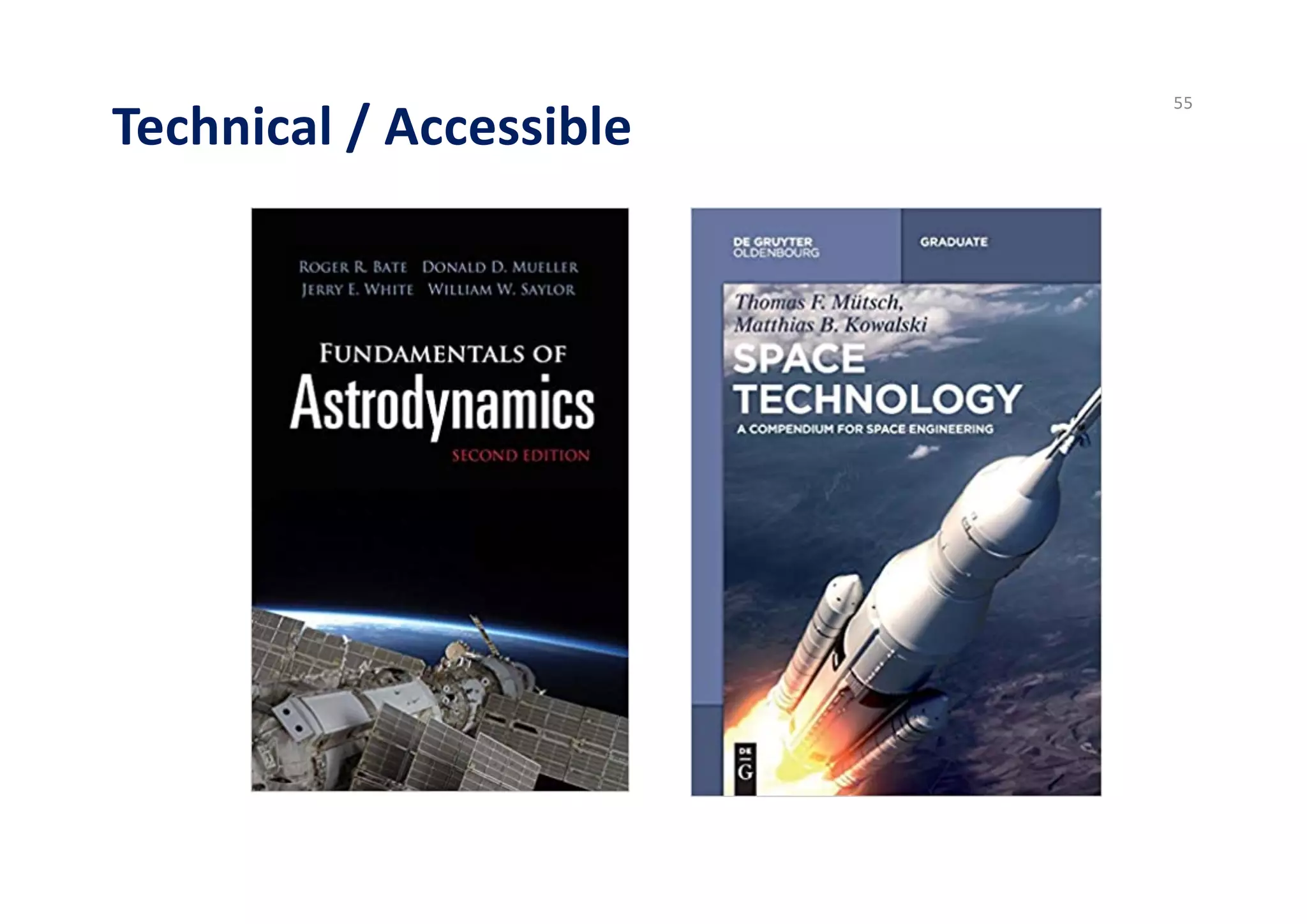
Technical / Accessible
56
Objects of desire !
Thank you !
Raffaele Mauro
Raffaele Mauro is passionate about technology, policy and global finance.
He is Co-founder and General Partner at Primo Space, a venture capital fund focused on the new
space economy. Previously he was Managing Director at Endeavor Italy, a global organization
that provides access to smart capital, talent and markets to scale-up companies, Head of Finance
for Innovation & Entrepreneurship at Intesa Sanpaolo and worked at venture capital funds such
as United Ventures (formerly Annapurna Ventures), P101 and OltreVenture.
Raffaele holds an MPA from Harvard University, a Ph.D. from Bocconi and attended the
Singularity University Graduate Studies Program at NASA Ames. Raffaele is a member of the
Kauffman Society of Fellows, the “Young European Leaders – 40 under 40” network, the Aspen
Junior Fellows group and the Young Leaders group of the US-Italy Council.
He is also mentor at TechStars and Mentors4U, member of the executive committee at the
Global Shapers Hub - Milano, a World Economic Forum community, and invested in high growth
companies such as Multiply Labs (YC 2016) and Strive School (YC 2020). Raffaele authored the
books “Hacking Finance” and “Quantum Computing”.
Twitter: @rafr
58

New Space economy: Technology, Markets & Trends

  • 1.
    New Space Economy:Technology, Markets & Trends Raffaele Mauro General Partner Primo Space Schmidt Futures EIR August 2020
  • 3.
  • 4.
    4 Humans in space •~ 558 Astronauts since 1961 = Going beyond the Kármán line altitude of + 100 Km • Longest continuous permanence: 438 Days • Younger: 25 - Older: 77 • Beyond Earth’s orbit: 24 • Went to / across the Moon: 12
  • 5.
  • 6.
  • 7.
    7 The New SpaceEconomy • Space Economy - Market Size: $ 430Bn • Enabler for other industries -> Like Internet 30yrs ago • Relevant for “everyday” technologies: mobile phones, TVs weather forecasts, automotive & airplane navigation , etc.
  • 8.
    8 Significant reduction inlaunch costs • Easier access to space for commercial industries • A Moore’s law in SpaceTech ? (Yes & No)
  • 9.
    9 Upstream / SpaceFlight & Architecture
  • 10.
    10 International Space Station •Global Collaboration: US, Europe, Russia, Canada, Japan • Capability: 6 people - 239 Astronauts since 2000 • Considered the most ambitious engineering megaproject ever made …. and most costly (~ $150 Bn)
  • 11.
    11 Space Exploration • Increasingrole of automation, robotics & AI • Less costs, risks and complexity • More technological readiness
  • 12.
    12 New Launchers &Reusable Rockets • Reusable launch systems indispensable for the growth and financial sustainability of the space private sector • Image: Falcon Heavy landing in Cape Canaveral - 2018
  • 13.
    13 New Vehicles /Crew Capsules
  • 14.
    14 Satellites • ~ 9kSatellites launched since 1957 • 5k still in orbit, ~ 2k fully operational • Functions (examples): Earth observation, navigation, communication, weather prediction, scientific research, military intelligence. • Trend: From large custom made satellites to nanosatellites
  • 15.
    15 Cubesats • Weight Max1,3 Kg of - Standard dimensions: 10 cm sides • Very low cost - Often launched in swarms • Sometimes built with commercial smartphone hardware
  • 16.
    16 Downstream / SpaceApplications Satellite data increasingly relevant to several industries: telecommunications, agriculture, meteorology, logistics, etc.
  • 17.
    17 Telecommunication • Established industry/ One of the oldest space applications • Examples: Telephone, Television, Radio Broadcasting, Amateur Radio, Internet Access, Military communications
  • 18.
    18 Enabling the digitaleconomy Example: Internet Services with LOE Satellites • Amazon: Kuiper Project LOE Satellites • SpaceX: Starlink Program • Facebook: Athena Project • OneWeb: Satellite Constellation
  • 19.
    19 Observation & Mapping •Applications: Mapping, Meteorology, Environmental Monitoring, Agriculture, Intelligence / Spy saltellites
  • 20.
    20 Navigation / Positioning/ Logistics • Fully operational Global navigation satellite systems (GNSS): • United States' Global Positioning System (GPS) • Russia's Global Navigation Satellite System (GLONASS) • China's BeiDou Navigation Satellite System (BDS) • Future ones: • European Union's Galileo • Japan's Quasi-Zenith Satellite System (QZSS) • Indian Regional Navigation Satellite System (IRNSS)
  • 21.
    21 Scientific Research: SpaceProbes • 50+ operating across the Solar System: Sun, Moon, planets, natural satellites, comets and asteroids • 5 Space probes in interstellar travel: 2 in interstellar space and 3 in interstellar trajectory
  • 22.
    22 Scientific Research: SpaceTelescopes • Hubble, launched in 1990, is the most well known project • Multiple devices for detection of gamma ray, x-ray, ultraviolet, visible, infrared, microwave and radio frequencies. • +110 Launched since 1965 and more to be launched
  • 23.
    23 Positive impact ofspace applications • Spin offs and “terrestrial tech” from space research • Climate change monitoring / air quality observation • Prevention of natural disasters • Internet / Information / Education • Biomedical research • High quality jobs
  • 24.
    24 Military Intelligence &Space Warfare • Earth to Space: Anti-satellite missiles • Space to Space: Defence in ballistic nuclear warfare, Electronic warfare / satellite jamming, Satellite 2 Satellite weapons • Space to Earth: Surveillance, Space lasers
  • 25.
    25 SpaceTech as ameta-industry • SpaceTech for the New Space Economy (or “Space 2.0” or “NewSpace”) is intrinsically multidisciplinary • Need for cross-boundary collaboration
  • 26.
    26 Space Robotics &AI Examples: Automation of control and navigation systems, exploration (landers and rovers), support for on-orbit services (docking, reparation, etc.), transportation, assistance to astronauts, debris removal, etc.
  • 27.
    27 Space Biomedical andPharma research Pharma: • Drug discovery • Vaccines development Microbiology: • Bacteria virulence • Antibiotic resistance • Bioflim Medical Research: • Degenerative diseases • Aging related disease • Osteoporosis • Immunology • Cancer MedTech: • Rehabilitation & Orthopedic Devices • Muscle Stimulation • Sensors and Personal Alert Systems • Medical Imaging • Indirect impact: defibrillators, pacemakers, dialysis machines.
  • 28.
  • 29.
  • 30.
  • 31.
    31 Axiom Space picksThales Alenia to build commercial space station modules
  • 32.
  • 33.
    33 Space Barons: BlueOrigin • Reusable launch vehicles: New Shepard (sub-orbital) and New Glenn (Orbital) • Moon cargo lander and Human landing system • Funding / Valuation: TBD (Bezos pocket !) • Founded in 2000 , now 2500 Employees
  • 34.
    34 Space Barons: VirginGalactic • Sub-orbital space flight systems and tourism • Supersonic flights for small # of passengers • Market cap: $ 3,6 Bn • Founded in 2004 , now 721 Employees
  • 35.
    35 Space Barons: SpaceX- Vehicles • Valuation: $ 46 Bn • Funding: $ 5,4 Bn • Founded in 2002 , now 8000 Employees • Products - 1: Dragon 2 Spacecraft, 7 astronauts (crew + passengers)
  • 36.
    36 Space Barons: SpaceX– Launchers • Falcon 1: Small lift launch vehicle • Falcon 9: Medium lift launch vehicle, reusable • Falcon Heavy: 20 to 50 metric tons into low Earth orbit (LEO, 300-1000 Km of altitude), reusable
  • 37.
    37 Space Barons: SpaceX– Heavy Launchers • Starship / Starhopper: Super-heavy, reusable • Potentially 100 metric tonnes to Earth orbit (image is a prototype) • Designed for human missions to the Moon and Mars
  • 38.
    38 Start-ups / «EntrepreneurialSpace Age» • Not only SpaceX …. • Small teams testing new technologies (i.e. orbital 3D Printing) and low cost products (software, cubesats, components, new materials, etc.) • Growing VC investments & valuations
  • 39.
    39 Top VCs investingin SpaceTech • $ 4bn in 2019, +100% on 2018 • 10+ Years of constant growth
  • 40.
    40 Most Active SpaceTechVC funds Source: Bryce, «Startup Space», 2020
  • 41.
    41 Other capital sources Source:Bryce, «Startup Space», 2020
  • 42.
    42 Average Number ofInvestments Source: Bryce, «Startup Space», 2020
  • 43.
    43 Astropolitik • Historical relevanceof SpaceTech for national pride & military applications, mainly surveillance and nuclear defence • Government spending boosts investments + generate capability (especially launch systems) • New space race with Chinese, Indian, Russian, European, Japanese and Israeli investments and missions
  • 44.
    44 Space Force • Createdin December 2019, yearly budget $15 billion • Personnel: 16,000 (mostly former airmen) • Role: Space domain awareness, information mobility, space logistics, space security, space power projection and combat
  • 45.
  • 46.
    46 China Space Programs •Space Labs: Tiangong 1 in 2011 and Tiangong 2 in 2016 • Large Modular Space Station in 2022 • Next: Crewed missions to the Moon and Lunar base
  • 47.
    China: Micius Satellite •Satellite for space-to-ground quantum communication • Quantum cryptography / entanglement-based quantum key distribution • Micius generates pairs of entangled photons directed at two ground stations • First intercontinental secure quantum video call in 2017 • In 2020 reached 1,200 Km distance milestone 47
  • 48.
    48 The Future: SpaceTourism • 7 Astro-tourists until now, with the Soyuz capsule and the company Space Adventures (ticket $ 20-25M) • Sub-orbital tourism: Planned by Virgin Galactic and Blue Origin – The former with 600/700 pre-orders (ticket $ 250k pre-order / $ 350k ordinary) • Orbital Tourism: Axiom Space, Space Adventures, Boeing, SpaceX, Aurora Space Station
  • 49.
    49 The Future: SpaceManufacturing • Special conditions because of microgravity and / or vacuum • Enabling manufacturing techniques impossible or too risky on Earth • Potentially raw materials from celestial bodies • Business case for spare parts and space architecture • Experiments at the ISS
  • 50.
    50 The Future: SpaceMining • Precious metals to Earth: Gold, silver, platinum • Iron group metals (iron, cobalt, and nickel) for space architecture • Companies: Planetary Resources, Deep Space Industries (…. Both defunct)
  • 51.
    51 The Future: Moon •US: Artemis Program (with EU, Canada, Japan, Australia) • China Lunar Exploration Program • Other announcements from Russia, India, • Capability efforts by private space companies • Non-Profit: Open Lunar Foundation
  • 52.
  • 53.
  • 54.
    54 Books / Popularscience & Business
  • 55.
  • 56.
  • 57.
  • 58.
    Raffaele Mauro Raffaele Maurois passionate about technology, policy and global finance. He is Co-founder and General Partner at Primo Space, a venture capital fund focused on the new space economy. Previously he was Managing Director at Endeavor Italy, a global organization that provides access to smart capital, talent and markets to scale-up companies, Head of Finance for Innovation & Entrepreneurship at Intesa Sanpaolo and worked at venture capital funds such as United Ventures (formerly Annapurna Ventures), P101 and OltreVenture. Raffaele holds an MPA from Harvard University, a Ph.D. from Bocconi and attended the Singularity University Graduate Studies Program at NASA Ames. Raffaele is a member of the Kauffman Society of Fellows, the “Young European Leaders – 40 under 40” network, the Aspen Junior Fellows group and the Young Leaders group of the US-Italy Council. He is also mentor at TechStars and Mentors4U, member of the executive committee at the Global Shapers Hub - Milano, a World Economic Forum community, and invested in high growth companies such as Multiply Labs (YC 2016) and Strive School (YC 2020). Raffaele authored the books “Hacking Finance” and “Quantum Computing”. Twitter: @rafr 58