From Crypto Equity to Crypto Commons:
Shared Ownership on the Blockchain
Raffaele Mauro
Intesa Sanpaolo
Corporate & Investment Banking Division
Primavera De Filippi
Harvard University
Berkman Centre for Internet & Society
Deutsche Bundesbank – January 2015
1
Background
• This is a preliminary work -> looking for inputs
& brainstorming
• On-going research topics: Crypto-equity,
crypto-crowdfunding and crypto commons
• Early research performed at the HKS, HLS and
the Berkman Center for Internet & Society
2
What is Cryptoequity
• Cryptoequity:
– Secure and tradable tokens via distributed
networks
• Current form:
– Blockchain-based ownership shares -> beyond
currency applications
• Different potential technical implementations
• New regulatory challenge
3
Cryptoequity typologies
1. Shares in a project that serve as a function similar to
stock, allowing participation in the decision making
and participation in financial upside (i.e. BitShares)
2. Tokens which represent ownership in something
other than a company, for example intellectual
property (i.e. CommonAccord)
3. Product tokens which are redeemable for some
product, perhaps one consumable in the context of a
decentralized technology (i.e. Ethereum)
4. Access tokens which provide access to a particular set
of benefits within a network, similar to a membership
(i.e. Swarm)
4
Building blocks 1: The cryptoledger
Distributed public ledger
A network of communicating nodes sharing a public
transaction database
5
Building blocks 2: The Blockchain
• Aimed at proving
transactions
• Contains all
transaction history
• Blocks record
recent
transactions +
connected linearly
• Longest chain
enables
verification / trust
• Robust & resilient
6
Building blocks 3: Smart Contracts
• Algorithmically based contract settlement
• Self-executing & Self enforcing
• Independent / Non relying on third parties
• Not based on traditional legal
systems/institutions
• Examples of applications: notary, company
formation, insurance, voting, shared
ownership
7
Building Block 4:
Decentralized Organizations,
Corporations & Applications
• Redistribute digital assets & privileges – coins,
equity, coupons, voting power, revenues -
according to a binding set of rules
• Open source and autonomous
• Based on a public, decentralized blockchain
• Data and operations cryptographically stored
• Flexible, transparent and resilient nature
8
Example of a technical frame
• Cryptoequity = Coin + Smart contract + Enterprise
• How:
1. Registering a tailor-made cryptocoin
2. Generate a smart contract on the blockchain which
links each coin with a set of rights (for instance,
revenue streams from a commercial activity)
3. Set up a corporation (or NGO, project, etc.)
4. Distribute the equity stakes (= the coins) according to
a set of pre-determined rules
9
Funding platforms
(examples)
10
-
Swarm.fund
• Crwdfunding platform with crypto-based equity shares
and collective due diligence
Koinify
• Crypto-funding platform for the creation of Smart
Corporations
Bitshares
• Platform for the creation of Decentralized
Autonomous Corporations
Protocol & Infrastructure platforms
(examples)
11
-
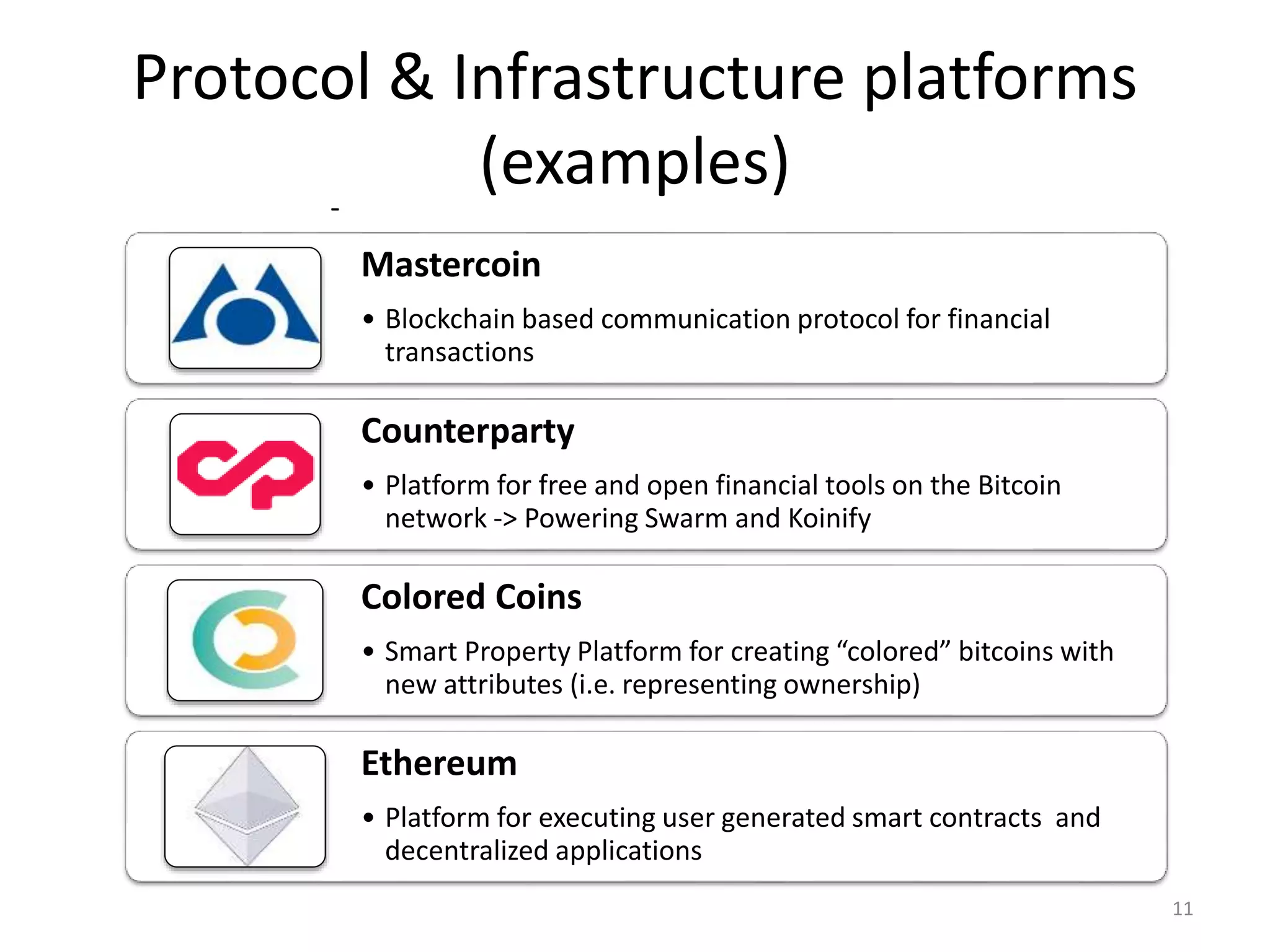
Mastercoin
• Blockchain based communication protocol for financial
transactions
Counterparty
• Platform for free and open financial tools on the Bitcoin
network -> Powering Swarm and Koinify
Colored Coins
• Smart Property Platform for creating “colored” bitcoins with
new attributes (i.e. representing ownership)
Ethereum
• Platform for executing user generated smart contracts and
decentralized applications
Cryptoequity as a component of the
new wave of “2.0” blockchain projects
12
Cryptoequity benefits 1:
Effects of the blockchain on the Bitcoin
• Decentralized, peer to peer trustless system
• Full transparency + pseudonomity
• Cryptographically secure
• Not dependent central banks / governments
• Resilience to marketplace failures
• Viral growth
• … But other limitations: 51% attack vulnerability,
high Gini coefficient, rigid monetary policy,
extreme volatility, third parties still relevant
13
Cryptoequity benefits 2:
Lower transaction costs
• In principle: free from bureaucratic and
regulatory burdens
– Speed
– Cost
– Data disclosure
– Complexity
• In fact: at scale, some form of regulation likely to
be implemented
• Nowadays: Significant regulatory challenge -
Trading legal rights with cryptotokens
14
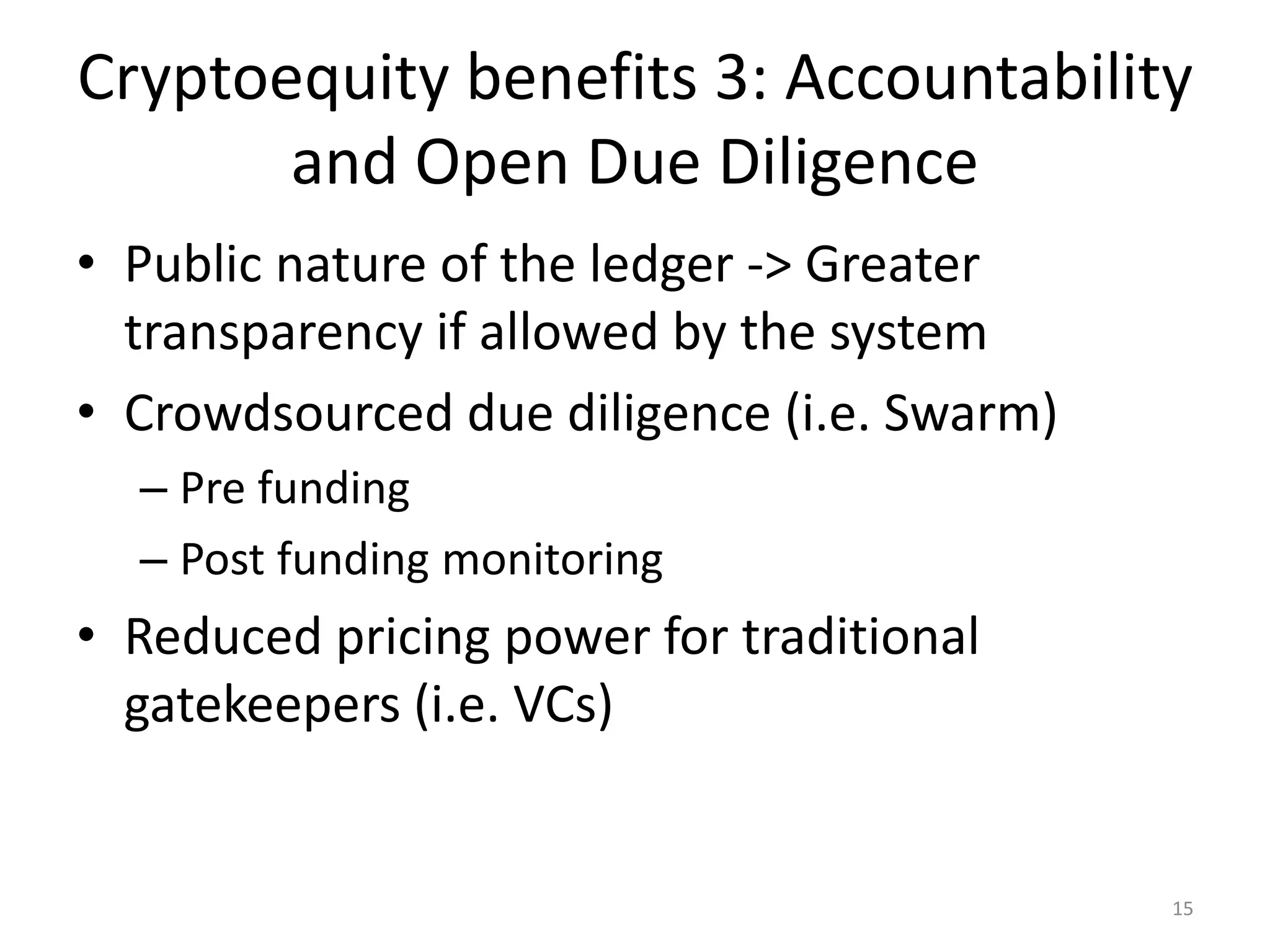
Cryptoequity benefits 3: Accountability
and Open Due Diligence
• Public nature of the ledger -> Greater
transparency if allowed by the system
• Crowdsourced due diligence (i.e. Swarm)
– Pre funding
– Post funding monitoring
• Reduced pricing power for traditional
gatekeepers (i.e. VCs)
15
Cryptoequity benefits 4:
Flexibility
• Dynamic allocation of privileges and duties
(harder with traditional contracts)
• Tailored evaluation, management and
monitoring
• Faster deals
• Expansion of:
– Deal types
– Potential sets of backers/investors
– Fundable project/corporation typologies
16
Potential applications
• Crowdfunding
• Venture Capital & Angel Investing
• IPOs
• Digital asset exchanges
• Other secondary markets
• Collective ownership & Commons
• Other
17
Criticism
• Cryptoequity not related to “real”, legally
approved, corporate equity stakes
• Diverting resources from the improvement of
the core Bitcoin network
• Likely regulatory backlash
18
Regulatory issues
• “Contract” Vs “security” ambiguity
• Disconnection from official corporate registration
systems
• Transnational nature and money laundering regulation
• Identification / Anonymity
• Taxation
• Litigation
On-going research:
Legal workshop on “Crypto-Equity & the Law”
at the Berkman Center, Harvard University
19
What are cryptocommons
• Crypto-commons are the application of
DAPPs, DAOs and CryptoEquity schemes to
shared resources
• Resource management, monitoring and
distribution are set up with algorithmically
binding rules
• Rules implemented on a publicly auditable
open-source software
20
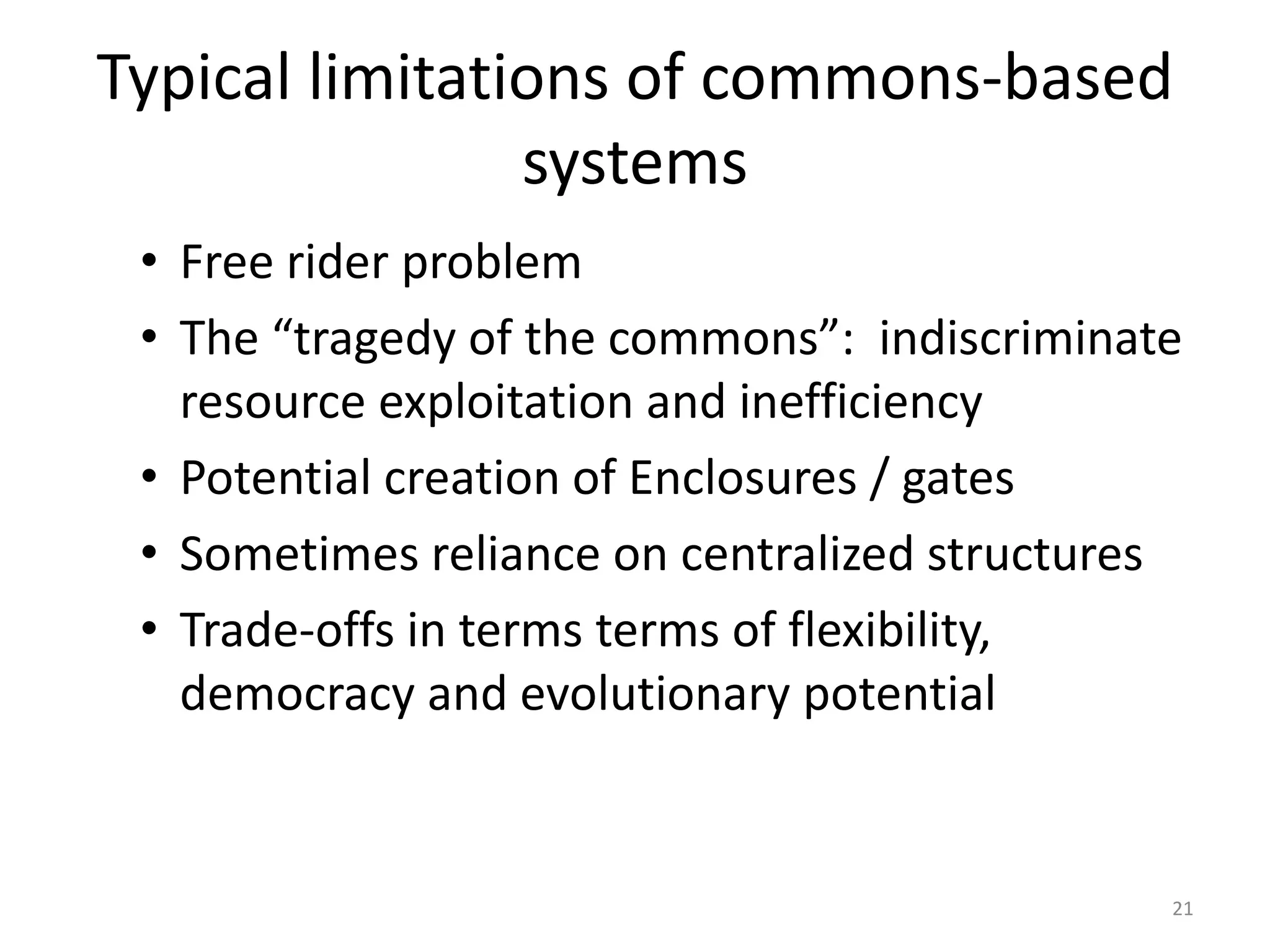
Typical limitations of commons-based
systems
• Free rider problem
• The “tragedy of the commons”: indiscriminate
resource exploitation and inefficiency
• Potential creation of Enclosures / gates
• Sometimes reliance on centralized structures
• Trade-offs in terms terms of flexibility,
democracy and evolutionary potential
21
Why cryptocommons
• Need for robust “non-hierarchical governance”
with intelligence spread on the edges
• Simple P2P networks are not enough in terms of
security and network IQ
• Decentralized blockchain technology brings
intelligence, trust and coordination to shared
resource pools
• Reversing the size problem: “big” commons are
harder to coordinate than smaller ones => with
Distributed Smart Governance bigger size equals
a bigger “brain” and an increased network IQ
22
Cryptocommons typologies
1. Equity-based:
• Collective ownership of crypto-assets
2. Contract based:
• Set of smart contracts with sharing/coordination rights
& duties
• Single smart contract with collective participation
3. Token-based:
• Crypto-coins with embedded collective ownership
4. App-based:
• Decentralized apps focused on resource sharing
23
Future research
• Cryptoequity regulation & law
• Cryptocommons software & applications
• Decentralized Autonomous Organizations
design and implementation
• Creations of standards and protocols for smart
contracts
• Service design for consumer applications
24
Thank you !
rmauro@post.harvard.edu
pdefilippi@cyber.law.harvard.edu

From Cryptoequity to Cryptocommons

  • 1.
    From Crypto Equityto Crypto Commons: Shared Ownership on the Blockchain Raffaele Mauro Intesa Sanpaolo Corporate & Investment Banking Division Primavera De Filippi Harvard University Berkman Centre for Internet & Society Deutsche Bundesbank – January 2015 1
  • 2.
    Background • This isa preliminary work -> looking for inputs & brainstorming • On-going research topics: Crypto-equity, crypto-crowdfunding and crypto commons • Early research performed at the HKS, HLS and the Berkman Center for Internet & Society 2
  • 3.
    What is Cryptoequity •Cryptoequity: – Secure and tradable tokens via distributed networks • Current form: – Blockchain-based ownership shares -> beyond currency applications • Different potential technical implementations • New regulatory challenge 3
  • 4.
    Cryptoequity typologies 1. Sharesin a project that serve as a function similar to stock, allowing participation in the decision making and participation in financial upside (i.e. BitShares) 2. Tokens which represent ownership in something other than a company, for example intellectual property (i.e. CommonAccord) 3. Product tokens which are redeemable for some product, perhaps one consumable in the context of a decentralized technology (i.e. Ethereum) 4. Access tokens which provide access to a particular set of benefits within a network, similar to a membership (i.e. Swarm) 4
  • 5.
    Building blocks 1:The cryptoledger Distributed public ledger A network of communicating nodes sharing a public transaction database 5
  • 6.
    Building blocks 2:The Blockchain • Aimed at proving transactions • Contains all transaction history • Blocks record recent transactions + connected linearly • Longest chain enables verification / trust • Robust & resilient 6
  • 7.
    Building blocks 3:Smart Contracts • Algorithmically based contract settlement • Self-executing & Self enforcing • Independent / Non relying on third parties • Not based on traditional legal systems/institutions • Examples of applications: notary, company formation, insurance, voting, shared ownership 7
  • 8.
    Building Block 4: DecentralizedOrganizations, Corporations & Applications • Redistribute digital assets & privileges – coins, equity, coupons, voting power, revenues - according to a binding set of rules • Open source and autonomous • Based on a public, decentralized blockchain • Data and operations cryptographically stored • Flexible, transparent and resilient nature 8
  • 9.
    Example of atechnical frame • Cryptoequity = Coin + Smart contract + Enterprise • How: 1. Registering a tailor-made cryptocoin 2. Generate a smart contract on the blockchain which links each coin with a set of rights (for instance, revenue streams from a commercial activity) 3. Set up a corporation (or NGO, project, etc.) 4. Distribute the equity stakes (= the coins) according to a set of pre-determined rules 9
  • 10.
    Funding platforms (examples) 10 - Swarm.fund • Crwdfundingplatform with crypto-based equity shares and collective due diligence Koinify • Crypto-funding platform for the creation of Smart Corporations Bitshares • Platform for the creation of Decentralized Autonomous Corporations
  • 11.
    Protocol & Infrastructureplatforms (examples) 11 - Mastercoin • Blockchain based communication protocol for financial transactions Counterparty • Platform for free and open financial tools on the Bitcoin network -> Powering Swarm and Koinify Colored Coins • Smart Property Platform for creating “colored” bitcoins with new attributes (i.e. representing ownership) Ethereum • Platform for executing user generated smart contracts and decentralized applications
  • 12.
    Cryptoequity as acomponent of the new wave of “2.0” blockchain projects 12
  • 13.
    Cryptoequity benefits 1: Effectsof the blockchain on the Bitcoin • Decentralized, peer to peer trustless system • Full transparency + pseudonomity • Cryptographically secure • Not dependent central banks / governments • Resilience to marketplace failures • Viral growth • … But other limitations: 51% attack vulnerability, high Gini coefficient, rigid monetary policy, extreme volatility, third parties still relevant 13
  • 14.
    Cryptoequity benefits 2: Lowertransaction costs • In principle: free from bureaucratic and regulatory burdens – Speed – Cost – Data disclosure – Complexity • In fact: at scale, some form of regulation likely to be implemented • Nowadays: Significant regulatory challenge - Trading legal rights with cryptotokens 14
  • 15.
    Cryptoequity benefits 3:Accountability and Open Due Diligence • Public nature of the ledger -> Greater transparency if allowed by the system • Crowdsourced due diligence (i.e. Swarm) – Pre funding – Post funding monitoring • Reduced pricing power for traditional gatekeepers (i.e. VCs) 15
  • 16.
    Cryptoequity benefits 4: Flexibility •Dynamic allocation of privileges and duties (harder with traditional contracts) • Tailored evaluation, management and monitoring • Faster deals • Expansion of: – Deal types – Potential sets of backers/investors – Fundable project/corporation typologies 16
  • 17.
    Potential applications • Crowdfunding •Venture Capital & Angel Investing • IPOs • Digital asset exchanges • Other secondary markets • Collective ownership & Commons • Other 17
  • 18.
    Criticism • Cryptoequity notrelated to “real”, legally approved, corporate equity stakes • Diverting resources from the improvement of the core Bitcoin network • Likely regulatory backlash 18
  • 19.
    Regulatory issues • “Contract”Vs “security” ambiguity • Disconnection from official corporate registration systems • Transnational nature and money laundering regulation • Identification / Anonymity • Taxation • Litigation On-going research: Legal workshop on “Crypto-Equity & the Law” at the Berkman Center, Harvard University 19
  • 20.
    What are cryptocommons •Crypto-commons are the application of DAPPs, DAOs and CryptoEquity schemes to shared resources • Resource management, monitoring and distribution are set up with algorithmically binding rules • Rules implemented on a publicly auditable open-source software 20
  • 21.
    Typical limitations ofcommons-based systems • Free rider problem • The “tragedy of the commons”: indiscriminate resource exploitation and inefficiency • Potential creation of Enclosures / gates • Sometimes reliance on centralized structures • Trade-offs in terms terms of flexibility, democracy and evolutionary potential 21
  • 22.
    Why cryptocommons • Needfor robust “non-hierarchical governance” with intelligence spread on the edges • Simple P2P networks are not enough in terms of security and network IQ • Decentralized blockchain technology brings intelligence, trust and coordination to shared resource pools • Reversing the size problem: “big” commons are harder to coordinate than smaller ones => with Distributed Smart Governance bigger size equals a bigger “brain” and an increased network IQ 22
  • 23.
    Cryptocommons typologies 1. Equity-based: •Collective ownership of crypto-assets 2. Contract based: • Set of smart contracts with sharing/coordination rights & duties • Single smart contract with collective participation 3. Token-based: • Crypto-coins with embedded collective ownership 4. App-based: • Decentralized apps focused on resource sharing 23
  • 24.
    Future research • Cryptoequityregulation & law • Cryptocommons software & applications • Decentralized Autonomous Organizations design and implementation • Creations of standards and protocols for smart contracts • Service design for consumer applications 24
  • 25.