Emergency Medical Care in the
Rockaways
“Where you live should not determine
whether you live.”
Not all hospitals are the same!
• The Rockaway peninsula has natural and urban
geographic barriers and has only hospital on the
peninsula.
• St John’s Episcopal is a community hospital but it
does not provide the same level of care as
Jamaica Hospital, a Level I Trauma Center (LITC).
• Rockaway does not have these services:
• Advanced Trauma Care
• Emergency Interventional Cardiac Catheter Care (EICC)
• Pediatric Intensive Care
Why is this improtant?
• Serious trauma, multiple fracture , bleeding,
head injuries, stabbing, and gun shot wounds
preferably should be treated in LITC
– LITC care offers the best chance for survival if
treated within 60 minutes, the “golden hour”.
– A significant heart attach (MI) once identified
needs to be treated at a EICC hospital
• Rockway has neither LITC of EICC!
How much time does it take to get
LITC of EICC for Rockaway?
• There is no public data available estimating the
distance and the travel time to access to a LITC or EICC
for the Rockaways
• Since the time to LITC was not previously reported in
the literature the Center Studying Health Care Delivery
(CSHCD) developed a method to estimate the time to
LITCs.
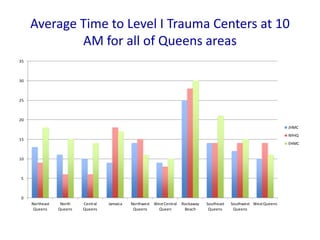
• Method: Google Maps directions application was used
to collect the time and distance to travel between the
five Rockaway zip codes and four proximal LITC at 10
AM and 6 PM compared to the other nine other
geographic neighbors in Queens.
Findings
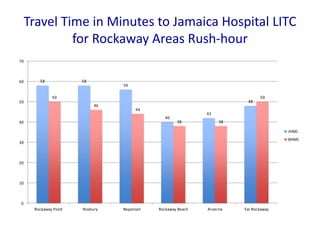
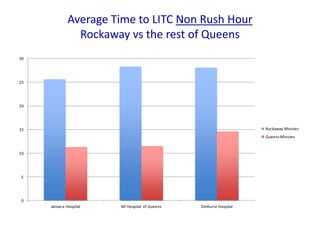
• The median time to Jamaica Hospital the closest Level I Trauma
Center to the Rockaways is 48 minutes at rush-hour (RH) and 26
minutes during non-rush-hour (NRH) compared to 22/12 minutes
for rest of Queens.
• At times Jamaica Hospital will be put on diversion and the next
closest LITC is New York Hospital of Queens that is 52 minutes
during RH and 29 minutes during NRN
• The next closest LITC Elmhurst Hospital that is 55 minutes during
RH and 35 minutes
• Due to it proximity Brookdale Hospital in Brooklyn is a Level I
Trauma Center is an alternative with the median time is 45
minutes during rush-hour and 23.5 minutes at other times.
Travel Time in Minutes to Jamaica Hospital LITC
for Rockaway Areas Rush-hour
58 58
56
40
42
48
50
46
44
38 38
50
0
10
20
30
40
50
60
70
Rockaway Point Roxbury Neponset Rockaway Beach Arverne Far Rockaway
JHMC
BHMC
Average Time to LITC Non Rush Hour
Rockaway vs the rest of Queens
0
5
10
15
20
25
30
Jamaica Hospital NY Hospital of Queens Elmhurst Hospital
Rockaway Minutes
QueensMinutes
Average Time to Level I Trauma Centers at 10
AM for all of Queens areas
0
5
10
15
20
25
30
35
Northeast
Queens
North
Queens
Central
Queens
Jamaica Northwest
Queens
WestCentral
Queen
Rockaway
Beach
Southeast
Queens
Southwest
Queens
WestQueens
JHMC
NYHQ
EHMC
What can be done?
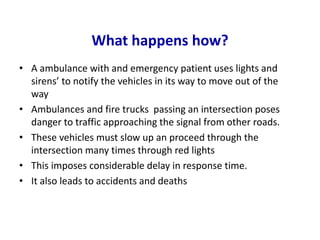
What happens how?
• A ambulance with and emergency patient uses lights and
sirens’ to notify the vehicles in its way to move out of the
way
• Ambulances and fire trucks passing an intersection poses
danger to traffic approaching the signal from other roads.
• These vehicles must slow up an proceed through the
intersection many times through red lights
• This imposes considerable delay in response time.
• It also leads to accidents and deaths
What can be done to improve time to
LITC in the Rockaways?
• Traffic Signal Preemption is a practical solution
to improve time to LITC for the Rockaways
• Reducing delay and increasing response time
and road safety with minimum cost.
Common Traffic Preemption Devices
• Acoustic devices
– Audio sensors to detect the pattern of waves from the siren of an
emergency vehicle.
– Disadvantage of this system is that traffic preemption can be easily
triggered in the wrong direction or at the wrong intersection
• Line of sight
– Emit a fine beam of infrared light towards traffic signal in front of the
vehicle. Sensors at the intersection detect the beam.
– The additional cost hardware in both the ambulance and the intersection is
high. The system is insecure and hardware to trigger preemption illegally can
be easily forged.
• Localized radio signals
– Use radio signals to trigger preemption
– Hardware is still a major expense
– The most reliable system
ROCKAWAY BEACH PILOT PROGRAM
FOR TRAFFIC SIGNAL PREEMPTION
USING GLOBAL POSITIONING
SYSTEM (GPS)
What is a Traffic Signal Preemption using GPS ?
• The proposed model will use GPS hardware,
already existing in most smart phones, to
receive transmit GPS signals.
• These signals are transmitted to a central
server which can communicate to traffic signal
controllers via Internet.
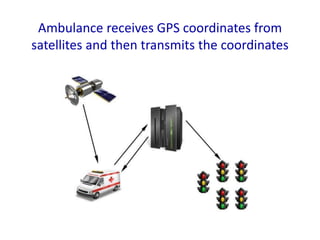
The model consists of 3 main
components
1. An Arduino Microcontroller at each traffic intersection
with an Ethernet Shield to enable it to connect to the
Internet.
2. Android Application for an Android Smartphone will
have to be carried by the staff of each ambulance.
This app will receive GPS coordinates and transmit the
same to a web server.
3. A web server which receives GPS coordinates of the
emergency vehicles and then sends preemption
signals to traffic signal controllers accordingly.
Ambulance receives GPS coordinates from
satellites and then transmits the coordinates
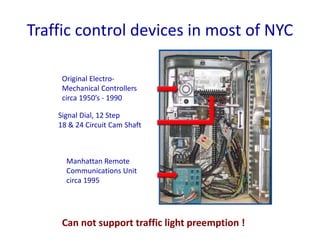
Traffic control devices in most of NYC
Manhattan Remote
Communications Unit
circa 1995
Can not support traffic light preemption !
Original Electro-
Mechanical Controllers
circa 1950’s - 1990
Signal Dial, 12 Step
18 & 24 Circuit Cam Shaft
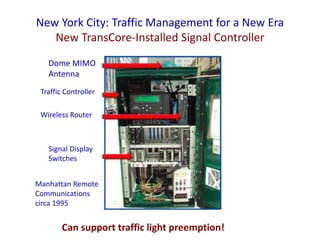
New York City: Traffic Management for a New Era
New TransCore-Installed Signal Controller
Manhattan Remote
Communications
circa 1995
The new systemDome MIMO
Antenna
Wireless Router
Traffic Controller
Signal Display
Switches
Can support traffic light preemption!
First Steps
• The Center for Studying Health Care Delivery is
championing the need to improve time to LITC for this
community.
• What is needed now:
– Seek data from FYND to support the issue of delays to LITC
and EICC.
– Seek permission from the NYC DOT to design a pilot trial to
set up on route to Jamaica Hospital from the Rockaways.
• The Center for Studying Health Care Delivery to design
and implement this pilot route to Jamaica Hospital.
Rockaways Major Health Care Issues
What is the differences in mortality comparing
Rockaway with the other Queens?
• This data is from a NYS DOH 2010 report
published in 2011
• This data helped the CSHD begin our first
effort to understand and reduce the mortality
differences between the Rockaways and the
rest of Queens.
• What are the differences in mortality for
Rockaway and the rest of Queens?
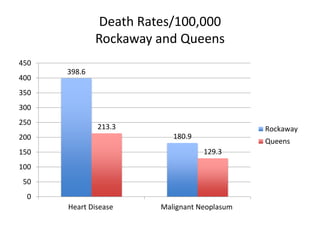
Death Rates/100,000
Rockaway and Queens
398.6
180.9
213.3
129.3
0
50
100
150
200
250
300
350
400
450
Heart Disease Malignant Neoplasum
Rockaway
Queens
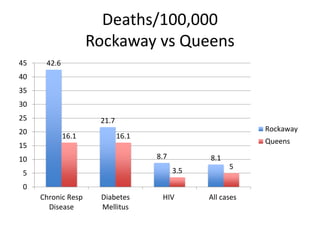
Deaths/100,000
Rockaway vs Queens
42.6
21.7
8.7 8.1
16.1 16.1
3.5
5
0
5
10
15
20
25
30
35
40
45
Chronic Resp
Disease
Diabetes
Mellitus
HIV All cases
Rockaway
Queens
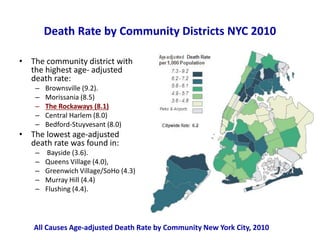
Death Rate by Community Districts NYC 2010
• The community district with
the highest age- adjusted
death rate:
– Brownsville (9.2).
– Morissania (8.5)
– The Rockaways (8.1)
– Central Harlem (8.0)
– Bedford-Stuyvesant (8.0)
• The lowest age-adjusted
death rate was found in:
– Bayside (3.6).
– Queens Village (4.0),
– Greenwich Village/SoHo (4.3)
– Murray Hill (4.4)
– Flushing (4.4).
All Causes Age-adjusted Death Rate by Community New York City, 2010
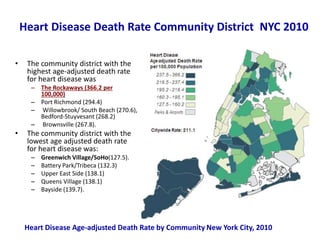
Heart Disease Death Rate Community District NYC 2010
• The community district with the
highest age-adjusted death rate
for heart disease was
– The Rockaways (366.2 per
100,000)
– Port Richmond (294.4)
– Willowbrook/ South Beach (270.6),
Bedford-Stuyvesant (268.2)
– Brownsville (267.8).
• The community district with the
lowest age adjusted death rate
for heart disease was:
– Greenwich Village/SoHo(127.5).
– Battery Park/Tribeca (132.3)
– Upper East Side (138.1)
– Queens Village (138.1)
– Bayside (139.7).
Heart Disease Age-adjusted Death Rate by Community New York City, 2010
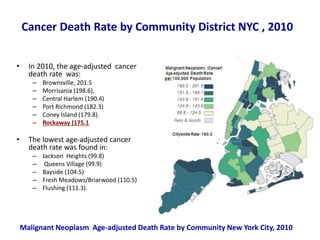
Cancer Death Rate by Community District NYC , 2010
• In 2010, the age-adjusted cancer
death rate was:
– Brownsville, 201.5
– Morrisania (198.6),
– Central Harlem (190.4)
– Port Richmond (182.3)
– Coney Island (179.8).
– Rockaway (175.1
• The lowest age-adjusted cancer
death rate was found in:
– Jackson Heights (99.8)
– Queens Village (99.9)
– Bayside (104.5)
– Fresh Meadows/Briarwood (110.5)
– Flushing (111.3).
Malignant Neoplasm Age-adjusted Death Rate by Community New York City, 2010
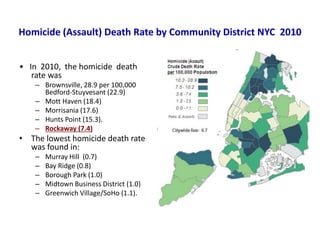
Homicide (Assault) Death Rate by Community District NYC 2010
• In 2010, the homicide death
rate was
– Brownsville, 28.9 per 100,000
Bedford-Stuyvesant (22.9)
– Mott Haven (18.4)
– Morrisania (17.6)
– Hunts Point (15.3).
– Rockaway (7.4)
• The lowest homicide death rate
was found in:
– Murray Hill (0.7)
– Bay Ridge (0.8)
– Borough Park (1.0)
– Midtown Business District (1.0)
– Greenwich Village/SoHo (1.1).
Center Studying Health Care Deliver (CSHD)
• After Hurricane Sandy we both observed while
commuting from home to work and back the major
geographic disadvantages the Rockaway Peninsula
faces in terms of rapid access to emergency care.
• The CSHD was started by Dennis and Catherine Graham
who have over 70 years of combined health care
experience.
• Since Hurricane Sandy we have been studying the
deficiencies in Health Care Services for the people of
the Rockaways.
• In our first study we measured the time to Level I
Trauma Care and emergency cardiac care for the
people living in Rockaways.

New rockaway health

  • 1.
    Emergency Medical Carein the Rockaways “Where you live should not determine whether you live.”
  • 2.
    Not all hospitalsare the same! • The Rockaway peninsula has natural and urban geographic barriers and has only hospital on the peninsula. • St John’s Episcopal is a community hospital but it does not provide the same level of care as Jamaica Hospital, a Level I Trauma Center (LITC). • Rockaway does not have these services: • Advanced Trauma Care • Emergency Interventional Cardiac Catheter Care (EICC) • Pediatric Intensive Care
  • 3.
    Why is thisimprotant? • Serious trauma, multiple fracture , bleeding, head injuries, stabbing, and gun shot wounds preferably should be treated in LITC – LITC care offers the best chance for survival if treated within 60 minutes, the “golden hour”. – A significant heart attach (MI) once identified needs to be treated at a EICC hospital • Rockway has neither LITC of EICC!
  • 4.
    How much timedoes it take to get LITC of EICC for Rockaway? • There is no public data available estimating the distance and the travel time to access to a LITC or EICC for the Rockaways • Since the time to LITC was not previously reported in the literature the Center Studying Health Care Delivery (CSHCD) developed a method to estimate the time to LITCs. • Method: Google Maps directions application was used to collect the time and distance to travel between the five Rockaway zip codes and four proximal LITC at 10 AM and 6 PM compared to the other nine other geographic neighbors in Queens.
  • 5.
    Findings • The mediantime to Jamaica Hospital the closest Level I Trauma Center to the Rockaways is 48 minutes at rush-hour (RH) and 26 minutes during non-rush-hour (NRH) compared to 22/12 minutes for rest of Queens. • At times Jamaica Hospital will be put on diversion and the next closest LITC is New York Hospital of Queens that is 52 minutes during RH and 29 minutes during NRN • The next closest LITC Elmhurst Hospital that is 55 minutes during RH and 35 minutes • Due to it proximity Brookdale Hospital in Brooklyn is a Level I Trauma Center is an alternative with the median time is 45 minutes during rush-hour and 23.5 minutes at other times.
  • 6.
    Travel Time inMinutes to Jamaica Hospital LITC for Rockaway Areas Rush-hour 58 58 56 40 42 48 50 46 44 38 38 50 0 10 20 30 40 50 60 70 Rockaway Point Roxbury Neponset Rockaway Beach Arverne Far Rockaway JHMC BHMC
  • 7.
    Average Time toLITC Non Rush Hour Rockaway vs the rest of Queens 0 5 10 15 20 25 30 Jamaica Hospital NY Hospital of Queens Elmhurst Hospital Rockaway Minutes QueensMinutes
  • 8.
    Average Time toLevel I Trauma Centers at 10 AM for all of Queens areas 0 5 10 15 20 25 30 35 Northeast Queens North Queens Central Queens Jamaica Northwest Queens WestCentral Queen Rockaway Beach Southeast Queens Southwest Queens WestQueens JHMC NYHQ EHMC
  • 9.
  • 10.
    What happens how? •A ambulance with and emergency patient uses lights and sirens’ to notify the vehicles in its way to move out of the way • Ambulances and fire trucks passing an intersection poses danger to traffic approaching the signal from other roads. • These vehicles must slow up an proceed through the intersection many times through red lights • This imposes considerable delay in response time. • It also leads to accidents and deaths
  • 13.
    What can bedone to improve time to LITC in the Rockaways? • Traffic Signal Preemption is a practical solution to improve time to LITC for the Rockaways • Reducing delay and increasing response time and road safety with minimum cost.
  • 14.
    Common Traffic PreemptionDevices • Acoustic devices – Audio sensors to detect the pattern of waves from the siren of an emergency vehicle. – Disadvantage of this system is that traffic preemption can be easily triggered in the wrong direction or at the wrong intersection • Line of sight – Emit a fine beam of infrared light towards traffic signal in front of the vehicle. Sensors at the intersection detect the beam. – The additional cost hardware in both the ambulance and the intersection is high. The system is insecure and hardware to trigger preemption illegally can be easily forged. • Localized radio signals – Use radio signals to trigger preemption – Hardware is still a major expense – The most reliable system
  • 15.
    ROCKAWAY BEACH PILOTPROGRAM FOR TRAFFIC SIGNAL PREEMPTION USING GLOBAL POSITIONING SYSTEM (GPS)
  • 16.
    What is aTraffic Signal Preemption using GPS ? • The proposed model will use GPS hardware, already existing in most smart phones, to receive transmit GPS signals. • These signals are transmitted to a central server which can communicate to traffic signal controllers via Internet.
  • 17.
    The model consistsof 3 main components 1. An Arduino Microcontroller at each traffic intersection with an Ethernet Shield to enable it to connect to the Internet. 2. Android Application for an Android Smartphone will have to be carried by the staff of each ambulance. This app will receive GPS coordinates and transmit the same to a web server. 3. A web server which receives GPS coordinates of the emergency vehicles and then sends preemption signals to traffic signal controllers accordingly.
  • 18.
    Ambulance receives GPScoordinates from satellites and then transmits the coordinates
  • 19.
    Traffic control devicesin most of NYC Manhattan Remote Communications Unit circa 1995 Can not support traffic light preemption ! Original Electro- Mechanical Controllers circa 1950’s - 1990 Signal Dial, 12 Step 18 & 24 Circuit Cam Shaft
  • 20.
    New York City:Traffic Management for a New Era New TransCore-Installed Signal Controller Manhattan Remote Communications circa 1995 The new systemDome MIMO Antenna Wireless Router Traffic Controller Signal Display Switches Can support traffic light preemption!
  • 21.
    First Steps • TheCenter for Studying Health Care Delivery is championing the need to improve time to LITC for this community. • What is needed now: – Seek data from FYND to support the issue of delays to LITC and EICC. – Seek permission from the NYC DOT to design a pilot trial to set up on route to Jamaica Hospital from the Rockaways. • The Center for Studying Health Care Delivery to design and implement this pilot route to Jamaica Hospital.
  • 22.
  • 23.
    What is thedifferences in mortality comparing Rockaway with the other Queens? • This data is from a NYS DOH 2010 report published in 2011 • This data helped the CSHD begin our first effort to understand and reduce the mortality differences between the Rockaways and the rest of Queens. • What are the differences in mortality for Rockaway and the rest of Queens?
  • 24.
    Death Rates/100,000 Rockaway andQueens 398.6 180.9 213.3 129.3 0 50 100 150 200 250 300 350 400 450 Heart Disease Malignant Neoplasum Rockaway Queens
  • 25.
    Deaths/100,000 Rockaway vs Queens 42.6 21.7 8.78.1 16.1 16.1 3.5 5 0 5 10 15 20 25 30 35 40 45 Chronic Resp Disease Diabetes Mellitus HIV All cases Rockaway Queens
  • 26.
    Death Rate byCommunity Districts NYC 2010 • The community district with the highest age- adjusted death rate: – Brownsville (9.2). – Morissania (8.5) – The Rockaways (8.1) – Central Harlem (8.0) – Bedford-Stuyvesant (8.0) • The lowest age-adjusted death rate was found in: – Bayside (3.6). – Queens Village (4.0), – Greenwich Village/SoHo (4.3) – Murray Hill (4.4) – Flushing (4.4). All Causes Age-adjusted Death Rate by Community New York City, 2010
  • 27.
    Heart Disease DeathRate Community District NYC 2010 • The community district with the highest age-adjusted death rate for heart disease was – The Rockaways (366.2 per 100,000) – Port Richmond (294.4) – Willowbrook/ South Beach (270.6), Bedford-Stuyvesant (268.2) – Brownsville (267.8). • The community district with the lowest age adjusted death rate for heart disease was: – Greenwich Village/SoHo(127.5). – Battery Park/Tribeca (132.3) – Upper East Side (138.1) – Queens Village (138.1) – Bayside (139.7). Heart Disease Age-adjusted Death Rate by Community New York City, 2010
  • 28.
    Cancer Death Rateby Community District NYC , 2010 • In 2010, the age-adjusted cancer death rate was: – Brownsville, 201.5 – Morrisania (198.6), – Central Harlem (190.4) – Port Richmond (182.3) – Coney Island (179.8). – Rockaway (175.1 • The lowest age-adjusted cancer death rate was found in: – Jackson Heights (99.8) – Queens Village (99.9) – Bayside (104.5) – Fresh Meadows/Briarwood (110.5) – Flushing (111.3). Malignant Neoplasm Age-adjusted Death Rate by Community New York City, 2010
  • 29.
    Homicide (Assault) DeathRate by Community District NYC 2010 • In 2010, the homicide death rate was – Brownsville, 28.9 per 100,000 Bedford-Stuyvesant (22.9) – Mott Haven (18.4) – Morrisania (17.6) – Hunts Point (15.3). – Rockaway (7.4) • The lowest homicide death rate was found in: – Murray Hill (0.7) – Bay Ridge (0.8) – Borough Park (1.0) – Midtown Business District (1.0) – Greenwich Village/SoHo (1.1).
  • 30.
    Center Studying HealthCare Deliver (CSHD) • After Hurricane Sandy we both observed while commuting from home to work and back the major geographic disadvantages the Rockaway Peninsula faces in terms of rapid access to emergency care. • The CSHD was started by Dennis and Catherine Graham who have over 70 years of combined health care experience. • Since Hurricane Sandy we have been studying the deficiencies in Health Care Services for the people of the Rockaways. • In our first study we measured the time to Level I Trauma Care and emergency cardiac care for the people living in Rockaways.