Failure
What is Failure?
• State of not meeting a desirable or intended
objective or expectation
• Setting a goal but not achieving it.
• Can be embarrassing and painful to experience
• Fear of damaging reputation/ relationships etc.
• Challenges our self worth , self esteem and self
acceptance
What is Failure?
• Natural tendency to avoid challenges that could lead to failure.
• Subjectivity in assessing failures/reading too much into failure.
• Criteria of failure depends on: Context
Observer
Belief system
Causes of failures
• Lack of desire/ambitions
• Poor planning/scheduling
• Lack of passion/ concentration/hard work
• Indecision /Procrastination
• Unrealistic expectations
• Lack of persistence
Causes of failures
• Lack of self discipline
• Poor self esteem
• Fatalistic attitude/luck
• Over caution/No risk taking
• Dismissal of past mistakes
• Rationalization/excuses
Causes of failures
• Hereditary backgrounds
• Unfavourable environment influences
• Insufficient resources.
• Negative attitudes and personality
• Fear /Lack of confidence
• Ego and Vanity.
EVERY SUCCESS STORY IS A STORY OF GREAT
FAILURES
• There was a man
-- who failed in business at the age of 21
-- who was defeated in legislative race at 22
--who lost his love at 26
-- had a nervous breakdown at 27
-- lost a congressional race at 34
-- lost another congressional race at 45
--failed to become Vice President at 47
Redefining the word Failure
• “ Failure is a project that has not succeeded yet, an initiative
that teaches us something at the same time”
• “ Failures that don't kill us make us bolder to try harder
since we have more experiences to fall back on”
LEARNING THROUGH FAILURES
• Value and appreciate failure as unavoidable/be prepared for
failures/ expect mistakes
• Realise failure is not objective, single event, stigma, enemy or
final.
• Examine whether all information was available
• Assess decisions taken .
• Judge the systemic errors committed in underestimating or
overestimating difficulties and resources
LEARNING THROUGH FAILURES
• Investigate what successes are contained in your failure
• Plan to obtain more information for future decisions.
• Use the experience to build and work from strengths.
• Evaluations based on ‘why’ and ‘how’ rather then ‘what’
COPING WITH FAILURES
• Honest communications
• Critical reflection/ understand processes not just outcomes
• Facts and figures provide hope.
• Stories motivate.
• Social Learning / models
COPING WITH FAILURES
• Remind yourself you are good enough/count
your blessings
• Remain calm /channel your emotions
• Clear your head of all negative thoughts
• Laugh /celebrate your way through your
failure
• Forget about how others perceive you
COPING WITH FAILURES
• Do not internalize the hurt
• Do not rationalise the failure
• Do not displace the anger and frustration/ ego defense
mechanisms
• Have a catharsis/ ventilation session/ communicate
• Confidence building measures/ avoid the consistent ‘fear of
failure’(Atychiphobia)
To future celebrations of our failures
Transferring failure into success
TRANSFERRING FAILURES
INTO SUCCESS
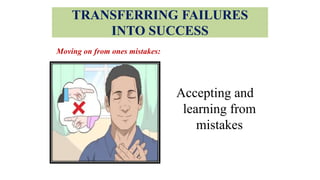
Moving on from ones mistakes:
Accepting and
learning from
mistakes
TRANSFERRING FAILURES INTO SUCCESS
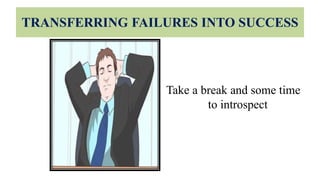
Take a break and some time
to introspect
TRANSFERRING FAILURES INTO SUCCESS
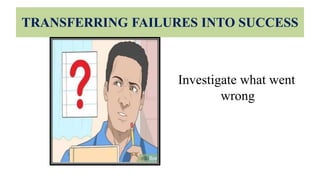
Investigate what went
wrong
TRANSFERRING FAILURES INTO SUCCESS
Evaluate what worked and
what did not.
TRANSFERRING FAILURES INTO SUCCESS
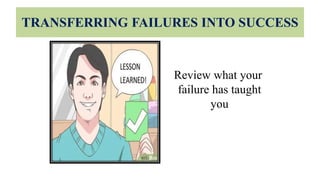
Review what your
failure has taught
you
TRANSFERRING FAILURES INTO SUCCESS
Making improvements:
Envision a new beginning / an
exciting opportunity.
TRANSFERRING FAILURES INTO SUCCESS
Seek guidance from those you
trust
TRANSFERRING FAILURES INTO SUCCESS
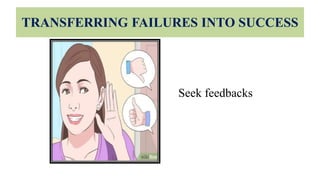
Seek feedbacks
TRANSFERRING FAILURES INTO SUCCESS
Look for alternative
solutions.
TRANSFERRING FAILURES INTO SUCCESS
Try new ideas/
creative
perspectives
TRANSFERRING FAILURES INTO SUCCESS
Reframing your failure:
Viewing failure as a
part of success
TRANSFERRING FAILURES
INTO SUCCESS
Stop perceiving failure
as a measure of your
self worth
TRANSFERRING FAILURES INTO SUCCESS
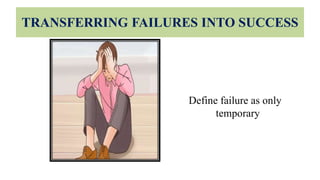
Define failure as only
temporary
TRANSFERRING FAILURES INTO SUCCESS
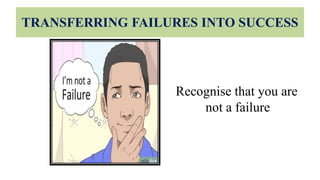
Recognise that you are
not a failure
TRANSFERRING FAILURES INTO SUCCESS
Perceive yourself as a
risk taker
TRANSFERRING FAILURES INTO SUCCESS
Celebrate your failures
TRANSFERRING FAILURES INTO SUCCESS
Failure as an
inspiration
TRANSFERRING FAILURES INTO SUCCESS
Focus on future
rather then the
past
Thank You

New Microsoft PowerPoint Presentation.pptx

  • 1.
  • 2.
    What is Failure? •State of not meeting a desirable or intended objective or expectation • Setting a goal but not achieving it. • Can be embarrassing and painful to experience • Fear of damaging reputation/ relationships etc. • Challenges our self worth , self esteem and self acceptance
  • 3.
    What is Failure? •Natural tendency to avoid challenges that could lead to failure. • Subjectivity in assessing failures/reading too much into failure. • Criteria of failure depends on: Context Observer Belief system
  • 4.
    Causes of failures •Lack of desire/ambitions • Poor planning/scheduling • Lack of passion/ concentration/hard work • Indecision /Procrastination • Unrealistic expectations • Lack of persistence
  • 5.
    Causes of failures •Lack of self discipline • Poor self esteem • Fatalistic attitude/luck • Over caution/No risk taking • Dismissal of past mistakes • Rationalization/excuses
  • 6.
    Causes of failures •Hereditary backgrounds • Unfavourable environment influences • Insufficient resources. • Negative attitudes and personality • Fear /Lack of confidence • Ego and Vanity.
  • 7.
    EVERY SUCCESS STORYIS A STORY OF GREAT FAILURES • There was a man -- who failed in business at the age of 21 -- who was defeated in legislative race at 22 --who lost his love at 26 -- had a nervous breakdown at 27 -- lost a congressional race at 34 -- lost another congressional race at 45 --failed to become Vice President at 47
  • 9.
    Redefining the wordFailure • “ Failure is a project that has not succeeded yet, an initiative that teaches us something at the same time” • “ Failures that don't kill us make us bolder to try harder since we have more experiences to fall back on”
  • 10.
    LEARNING THROUGH FAILURES •Value and appreciate failure as unavoidable/be prepared for failures/ expect mistakes • Realise failure is not objective, single event, stigma, enemy or final. • Examine whether all information was available • Assess decisions taken . • Judge the systemic errors committed in underestimating or overestimating difficulties and resources
  • 11.
    LEARNING THROUGH FAILURES •Investigate what successes are contained in your failure • Plan to obtain more information for future decisions. • Use the experience to build and work from strengths. • Evaluations based on ‘why’ and ‘how’ rather then ‘what’
  • 12.
    COPING WITH FAILURES •Honest communications • Critical reflection/ understand processes not just outcomes • Facts and figures provide hope. • Stories motivate. • Social Learning / models
  • 13.
    COPING WITH FAILURES •Remind yourself you are good enough/count your blessings • Remain calm /channel your emotions • Clear your head of all negative thoughts • Laugh /celebrate your way through your failure • Forget about how others perceive you
  • 14.
    COPING WITH FAILURES •Do not internalize the hurt • Do not rationalise the failure • Do not displace the anger and frustration/ ego defense mechanisms • Have a catharsis/ ventilation session/ communicate • Confidence building measures/ avoid the consistent ‘fear of failure’(Atychiphobia)
  • 15.
    To future celebrationsof our failures
  • 16.
  • 17.
    TRANSFERRING FAILURES INTO SUCCESS Movingon from ones mistakes: Accepting and learning from mistakes
  • 18.
    TRANSFERRING FAILURES INTOSUCCESS Take a break and some time to introspect
  • 19.
    TRANSFERRING FAILURES INTOSUCCESS Investigate what went wrong
  • 20.
    TRANSFERRING FAILURES INTOSUCCESS Evaluate what worked and what did not.
  • 21.
    TRANSFERRING FAILURES INTOSUCCESS Review what your failure has taught you
  • 22.
    TRANSFERRING FAILURES INTOSUCCESS Making improvements: Envision a new beginning / an exciting opportunity.
  • 23.
    TRANSFERRING FAILURES INTOSUCCESS Seek guidance from those you trust
  • 24.
    TRANSFERRING FAILURES INTOSUCCESS Seek feedbacks
  • 25.
    TRANSFERRING FAILURES INTOSUCCESS Look for alternative solutions.
  • 26.
    TRANSFERRING FAILURES INTOSUCCESS Try new ideas/ creative perspectives
  • 27.
    TRANSFERRING FAILURES INTOSUCCESS Reframing your failure: Viewing failure as a part of success
  • 28.
    TRANSFERRING FAILURES INTO SUCCESS Stopperceiving failure as a measure of your self worth
  • 29.
    TRANSFERRING FAILURES INTOSUCCESS Define failure as only temporary
  • 30.
    TRANSFERRING FAILURES INTOSUCCESS Recognise that you are not a failure
  • 31.
    TRANSFERRING FAILURES INTOSUCCESS Perceive yourself as a risk taker
  • 32.
    TRANSFERRING FAILURES INTOSUCCESS Celebrate your failures
  • 33.
    TRANSFERRING FAILURES INTOSUCCESS Failure as an inspiration
  • 34.
    TRANSFERRING FAILURES INTOSUCCESS Focus on future rather then the past
  • 35.