EFFECTS OF GAMING ON HUMAN LIFES
Gaming an aid to learning
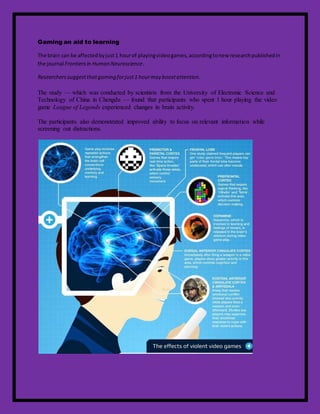
The brain can be affectedbyjust1 hourof playingvideogames,accordingtonew researchpublishedin
the journal Frontiersin Human Neuroscience.
Researcherssuggest thatgaming forjust1 hourmay boostattention.
The study — which was conducted by scientists from the University of Electronic Science and
Technology of China in Chengdu — found that participants who spent 1 hour playing the video
game League of Legends experienced changes in brain activity.
The participants also demonstrated improved ability to focus on relevant information while
screening out distractions.
The researchers recruited 29 male students to participate in the study. One group had at least 2
years of playing action video games and the other group had fewer than 6 months of experience
playing these video games.
The group with the most experience, or the "experts," were ranked in the top 7 percent of League
of Legends players. The "non-experts," meanwhile, were ranked in the bottom 11 percent.
The players' "visual selective attention" was assessed by the researchers before and after playing
League of Legends.
Visual selective attention is how scientists refer to the brain's ability to focus while
simultaneously disregarding less relevant information.
Focusing on relevant information in this way uses up brain power, so scientists tend to believe
that people who are very good at focusing their attention while filtering out distractions show a
very efficient use of their brains.
Video game boosted brain activity, attention
The study authors measured visual selective attention with a test involving squares that flashed
on different parts of a computer screen.
First, participants were briefly shown a square in the center of the screen, which was followed by
a square flashing elsewhere on the screen. The participants had to then tell the scientists where
on the screen the second square was, relative to the first square.
The participants' brain activity was also monitored during the visual selective attention test using
an electroencephalogram (EEG) machine.
Before playing the video game, the expert participants were found to have stronger visual
selective attention than the non-experts, and their EEG results showed more attention-related
brain activity.
After playing League of Legends for 1 hour, both groups demonstrated improved visual selective
attention, even reporting similar scores in the post-game test.
Not only that, but the researchers found that the brain activity of the non-experts increased
after playing the game, to the extent that levels of brain activity between experts and non-
experts were now comparable.
Although the findings demonstrate a measurable increase in both brain activity and visual
selective attention scores in participants after playing a video game for 1 hour, the authors
explain that their findings do not tell us about how long these effects might last. They therefore
suggest that more studies are needed in this regard.
It is worth noting, as well, that this study was conducted in a very small group of participants —
just 29 men — so its results should be interpreted with caution.
New findings add to growing evidence
e
Some previous studies have also found that action video games such as Halo and Call of Duty
may improve visual attention.
A 2010 review of the available research, for example, suggested that playing video games may
be beneficial for improving focus in military training and education.
As Bjorn Hubert-Wallander, the lead author of that review, explained, "Visual attention is crucial
to preventing sensory overload, since the brain is constantly faced with an overwhelming amount
of visual information."
"It's an ability," he said, "that is especially emphasized during visually demanding activities such
as driving a car or searching for a friend's face in a crowd, so it is not surprising that scientists
have long been interested in ways to modify, extend, and enhance the different facets of visual
attention."
Videogamingisclearlyapopularformof entertainment,withvideogamerscollectivelyspending3
billionhoursperweekinfrontof theirscreens.Due totheirwidespreaduse,scientistshave researched
howvideogamesaffectthe brainandbehavior.Are these effectspositiveornegative?We examinethe
evidence.
There is increasing research focused on theimpact of video gaming on the brain.
At a glance, more than 150 million people in the United States play video games regularly, or for
at least 3 hours per week. The average American gamer is a 35-year-old adult, with 72 percent of
gamers aged 18 or older. For video game use by children, most parents - 71 percent - indicate
that video games have a positive influence on their child's life.
Video game sales continue to increase year on year. In 2016, the video game industry sold more
than 24.5 billion games - up from 23.2 billion in 2015, and 21.4 billion in 2014.
The top three best-selling video games of 2016 were Call of Duty: Infinite Warfare, Battlefield 1,
and Grand Theft Auto V. These games fall into the first-person shooter or action-adventure
genres - the top two genres, accounting for 27.5 percent and 22.5 percent of sales, respectively.
First-person shooter and action genres often stand accused of stirring aggression and causing
violence and addiction.
Decades of research examining video gaming and violence have failed to reach consensus among
scientists. Scientists have been unable to find a causal link between playing video games and acts
of violence in the real world.
Action games' effect on brain
The current study stems from two considerations. First, the researchers noted that action video
games - which are defined as "first- and third-person shooting games" - are sometimes
recommended by specialists to increase the visual attention of children and adults.
Secondly, according to previous research conducted by Dr. West, action video game players
employ a particular kind of navigational strategy called "response learning," which is based on
forming a navigational "habit" and relying on it.
Response learning is also associated with a decrease in the gray matter of the hippocampus,
which is a part of the brain linked to episodic memory and orientation. A low amount of gray
matter in this brain area is related to Alzheimer's disease, depression, and post-traumatic stress
disorder.
In looking at the effects of action video games on the hippocampus, Dr. West and his colleagues
also took into account any links with the striatum, which is a brain area that receives signals from
the hippocampus.
The striatum also contains the caudate nucleus, which plays an important role in the formation of
habits and procedural memory - that is, the kind of memory that we rely on to know how to
walk, swim, or ride a bicycle.
According to existing research, Dr. West and his colleagues note that "the caudate nucleus shares
an inverse relationship with the hippocampus."
This means that if we rely too much on habit and procedural memory, we end up underusing the
active learning capacities promoted by the hippocampus. This may cause the hippocampus to
atrophy, leading to an unhealthy brain structure overall.
"That's why we decided to do a full neuro-imaging study, [...] and what we saw was less gray
matter in the hippocampus of habitual players. We then followed that up with two longitudinal
studies to establish causality, and we found that it was indeed the gaming that led to changes in
the brain."
Dr. Gregory West
Fifty-one male and 46 female gamers were recruited for the current research and were eventually
tasked with playing either action video games - which, in this case, were shooter games such as
Call of Duty - or 3-D platform video games from the Super Mario series.
Response learners lose gray matter
The participants were first tested to see whether they were "spatial learners," relying on visual
clues and landmarks to make their way through a particular environment, or "response learners,"
relying on acquired habits to navigate. Spatial learners have a more active hippocampus, whereas
response learners tend to underuse it.
For this test, the researchers developed a "4 on 8 virtual maze," which is a task that encourages
the players to come up with a navigational strategy that links to either the hippocampus or the
caudate nucleus.
"The virtual reality task consists of an eight-arm radial maze situated in an enriched
environment. The environment contains both distal [far from the player's perspective] and
proximal [close to the player's perspective] landmarks: two trees, a rock, and mountains," the
researchers explain.
After establishing which players were response learners and which were spatial learners, the
researchers asked them to play the action and 3-D platform video games.
It was found that the same amount of time (90 hours) dedicated to gaming had different
effects depending on the kind of game that was involved: action games led to hippocampal
atrophy, whereas platform games increased the volume of gray matter.
The researchers believe that response learners might be able to increase their gray matter volume
by "be[ing] encouraged to use spatial strategies" instead. Dr. West and his colleagues also
suggest that game developers might even be able to prevent action games from leading to the
atrophy of the hippocampus by changing the games' design.
Action games, they say, "[...] often include an overlaid head-up display which displays an in-
game GPS [global positioning system] to direct players to their next location or event,"
discouraging players from actively employing spatial strategies. Without this, the researchers
suggest, the games' negative effect on the brain might be avoided.
Considering these findings, Dr. West and his colleagues advise caution in "prescribing"
action video games to young players, as they might end up doing more harm than good.
However, the researchers suggest that game training must be adapted to the necessities of
the individuals involved.
"For example," they say, "patients with Parkinson's disease who also present with dementia and
patients with Alzheimer's disease, schizophrenia, depression, and post-traumatic stress disorder"
should not be exposed to action video games, as they already have lower volumes of gray matter.
"In contrast," the researchers add, "patients with Parkinson's disease without dementia do display
dysfunction in the basal ganglia, and may benefit from action video game training."
Playing video games may 'enhance learning'
In a learning test, people who play video games performed better than those who don't, and their
brains appeared to be more active in regions linked to learning and memory.
So concludes a study from Ruhr-University Bochum in Germany that was published in the
journal Behavioural Brain Research.
The researchers explain that recent studies have suggestedthat playing video games may
benefit cognition. However, the brain mechanisms involved are poorly understood.
They focused on "a widely unexplored area in gaming
research" called "probabilistic category learning." This type
of learning concerns acquiring and classifying knowledge
and using it to predWeather prediction task
A traditional way of testing probabilistic category learning is the so-called weather prediction
task, which researchers use to gain "insight into implicit forms of learning, cognitive flexibility,
and the use of feedback signals in the brain."
For their investigation, the team recruited 17 video gamers and 17 non-gamers. They recruited
the video gamers on the basis that they spent at least 15 hours per week playing action-based
video games. The non-gamers either did not play at all or did so only infrequently.
Both groups played the weather prediction task. As they completed it, the researchers used MRI
to record their brain activity.
To complete the task, the participants had to look at three cue cards with different patterns
on them and then predict the weather. They were asked, "Will there be sun or rain?" They
were then told straight away whether their answer was right or wrong.
As each card is only a partially accurate predictor of the weather, the correct answer is
determined by the probability predicted by the combination.
For example, a combination of cue cards might contain: a card whose pattern means a 20 percent
chance of rain and 80 percent chance of sun; a second card that means 80 percent chance of rain
and 20 percent chance of sun; and a third that means 60 percent chance of rain and 40 percent
chance of sun. The outcome of this combination would be rain.
'Gaming trains the hippocampus'
Analysis of the MRI scans revealed that both gamers and non-gamers showed the same level of
activity in brain areas that are linked to "attention and executive function" and certain "memory-
associated regions."
However, the scans also showed notable brain differences between gamers and non-gamers. For
example, the gamers showed stronger activity in the hippocampus and other brain areas that are
important for "semantic memory, visual imagery, and cognitive control."
"We think that playing video games trains certain brain regions like the hippocampus,"
says first study author Sabrina Schenk.
The study's findings are likely to be significant not only for young people, but also for older
generations, because reduction in memory is linked to changes in the hippocampus.
"Maybe we can treat that with video games in the future," suggests Schenk.

effects of gaming on human lifes

  • 1.
    EFFECTS OF GAMINGON HUMAN LIFES
  • 2.
    Gaming an aidto learning The brain can be affectedbyjust1 hourof playingvideogames,accordingtonew researchpublishedin the journal Frontiersin Human Neuroscience. Researcherssuggest thatgaming forjust1 hourmay boostattention. The study — which was conducted by scientists from the University of Electronic Science and Technology of China in Chengdu — found that participants who spent 1 hour playing the video game League of Legends experienced changes in brain activity. The participants also demonstrated improved ability to focus on relevant information while screening out distractions.
  • 3.
    The researchers recruited29 male students to participate in the study. One group had at least 2 years of playing action video games and the other group had fewer than 6 months of experience playing these video games. The group with the most experience, or the "experts," were ranked in the top 7 percent of League of Legends players. The "non-experts," meanwhile, were ranked in the bottom 11 percent. The players' "visual selective attention" was assessed by the researchers before and after playing League of Legends. Visual selective attention is how scientists refer to the brain's ability to focus while simultaneously disregarding less relevant information. Focusing on relevant information in this way uses up brain power, so scientists tend to believe that people who are very good at focusing their attention while filtering out distractions show a very efficient use of their brains. Video game boosted brain activity, attention The study authors measured visual selective attention with a test involving squares that flashed on different parts of a computer screen. First, participants were briefly shown a square in the center of the screen, which was followed by a square flashing elsewhere on the screen. The participants had to then tell the scientists where on the screen the second square was, relative to the first square. The participants' brain activity was also monitored during the visual selective attention test using an electroencephalogram (EEG) machine.
  • 4.
    Before playing thevideo game, the expert participants were found to have stronger visual selective attention than the non-experts, and their EEG results showed more attention-related brain activity. After playing League of Legends for 1 hour, both groups demonstrated improved visual selective attention, even reporting similar scores in the post-game test. Not only that, but the researchers found that the brain activity of the non-experts increased after playing the game, to the extent that levels of brain activity between experts and non- experts were now comparable. Although the findings demonstrate a measurable increase in both brain activity and visual selective attention scores in participants after playing a video game for 1 hour, the authors explain that their findings do not tell us about how long these effects might last. They therefore suggest that more studies are needed in this regard. It is worth noting, as well, that this study was conducted in a very small group of participants — just 29 men — so its results should be interpreted with caution. New findings add to growing evidence e
  • 5.
    Some previous studieshave also found that action video games such as Halo and Call of Duty may improve visual attention. A 2010 review of the available research, for example, suggested that playing video games may be beneficial for improving focus in military training and education. As Bjorn Hubert-Wallander, the lead author of that review, explained, "Visual attention is crucial to preventing sensory overload, since the brain is constantly faced with an overwhelming amount of visual information." "It's an ability," he said, "that is especially emphasized during visually demanding activities such as driving a car or searching for a friend's face in a crowd, so it is not surprising that scientists have long been interested in ways to modify, extend, and enhance the different facets of visual attention." Videogamingisclearlyapopularformof entertainment,withvideogamerscollectivelyspending3 billionhoursperweekinfrontof theirscreens.Due totheirwidespreaduse,scientistshave researched howvideogamesaffectthe brainandbehavior.Are these effectspositiveornegative?We examinethe evidence.
  • 6.
    There is increasingresearch focused on theimpact of video gaming on the brain. At a glance, more than 150 million people in the United States play video games regularly, or for at least 3 hours per week. The average American gamer is a 35-year-old adult, with 72 percent of gamers aged 18 or older. For video game use by children, most parents - 71 percent - indicate that video games have a positive influence on their child's life. Video game sales continue to increase year on year. In 2016, the video game industry sold more than 24.5 billion games - up from 23.2 billion in 2015, and 21.4 billion in 2014. The top three best-selling video games of 2016 were Call of Duty: Infinite Warfare, Battlefield 1, and Grand Theft Auto V. These games fall into the first-person shooter or action-adventure genres - the top two genres, accounting for 27.5 percent and 22.5 percent of sales, respectively. First-person shooter and action genres often stand accused of stirring aggression and causing violence and addiction. Decades of research examining video gaming and violence have failed to reach consensus among scientists. Scientists have been unable to find a causal link between playing video games and acts of violence in the real world. Action games' effect on brain
  • 7.
    The current studystems from two considerations. First, the researchers noted that action video games - which are defined as "first- and third-person shooting games" - are sometimes recommended by specialists to increase the visual attention of children and adults. Secondly, according to previous research conducted by Dr. West, action video game players employ a particular kind of navigational strategy called "response learning," which is based on forming a navigational "habit" and relying on it. Response learning is also associated with a decrease in the gray matter of the hippocampus, which is a part of the brain linked to episodic memory and orientation. A low amount of gray matter in this brain area is related to Alzheimer's disease, depression, and post-traumatic stress disorder. In looking at the effects of action video games on the hippocampus, Dr. West and his colleagues also took into account any links with the striatum, which is a brain area that receives signals from the hippocampus. The striatum also contains the caudate nucleus, which plays an important role in the formation of habits and procedural memory - that is, the kind of memory that we rely on to know how to walk, swim, or ride a bicycle. According to existing research, Dr. West and his colleagues note that "the caudate nucleus shares an inverse relationship with the hippocampus." This means that if we rely too much on habit and procedural memory, we end up underusing the active learning capacities promoted by the hippocampus. This may cause the hippocampus to atrophy, leading to an unhealthy brain structure overall. "That's why we decided to do a full neuro-imaging study, [...] and what we saw was less gray matter in the hippocampus of habitual players. We then followed that up with two longitudinal studies to establish causality, and we found that it was indeed the gaming that led to changes in the brain." Dr. Gregory West Fifty-one male and 46 female gamers were recruited for the current research and were eventually tasked with playing either action video games - which, in this case, were shooter games such as Call of Duty - or 3-D platform video games from the Super Mario series. Response learners lose gray matter
  • 8.
    The participants werefirst tested to see whether they were "spatial learners," relying on visual clues and landmarks to make their way through a particular environment, or "response learners," relying on acquired habits to navigate. Spatial learners have a more active hippocampus, whereas response learners tend to underuse it. For this test, the researchers developed a "4 on 8 virtual maze," which is a task that encourages the players to come up with a navigational strategy that links to either the hippocampus or the caudate nucleus. "The virtual reality task consists of an eight-arm radial maze situated in an enriched environment. The environment contains both distal [far from the player's perspective] and proximal [close to the player's perspective] landmarks: two trees, a rock, and mountains," the researchers explain. After establishing which players were response learners and which were spatial learners, the researchers asked them to play the action and 3-D platform video games. It was found that the same amount of time (90 hours) dedicated to gaming had different effects depending on the kind of game that was involved: action games led to hippocampal atrophy, whereas platform games increased the volume of gray matter. The researchers believe that response learners might be able to increase their gray matter volume by "be[ing] encouraged to use spatial strategies" instead. Dr. West and his colleagues also suggest that game developers might even be able to prevent action games from leading to the atrophy of the hippocampus by changing the games' design.
  • 9.
    Action games, theysay, "[...] often include an overlaid head-up display which displays an in- game GPS [global positioning system] to direct players to their next location or event," discouraging players from actively employing spatial strategies. Without this, the researchers suggest, the games' negative effect on the brain might be avoided. Considering these findings, Dr. West and his colleagues advise caution in "prescribing" action video games to young players, as they might end up doing more harm than good. However, the researchers suggest that game training must be adapted to the necessities of the individuals involved. "For example," they say, "patients with Parkinson's disease who also present with dementia and patients with Alzheimer's disease, schizophrenia, depression, and post-traumatic stress disorder" should not be exposed to action video games, as they already have lower volumes of gray matter. "In contrast," the researchers add, "patients with Parkinson's disease without dementia do display dysfunction in the basal ganglia, and may benefit from action video game training."
  • 10.
    Playing video gamesmay 'enhance learning' In a learning test, people who play video games performed better than those who don't, and their brains appeared to be more active in regions linked to learning and memory. So concludes a study from Ruhr-University Bochum in Germany that was published in the journal Behavioural Brain Research. The researchers explain that recent studies have suggestedthat playing video games may benefit cognition. However, the brain mechanisms involved are poorly understood. They focused on "a widely unexplored area in gaming research" called "probabilistic category learning." This type of learning concerns acquiring and classifying knowledge and using it to predWeather prediction task
  • 11.
    A traditional wayof testing probabilistic category learning is the so-called weather prediction task, which researchers use to gain "insight into implicit forms of learning, cognitive flexibility, and the use of feedback signals in the brain." For their investigation, the team recruited 17 video gamers and 17 non-gamers. They recruited the video gamers on the basis that they spent at least 15 hours per week playing action-based video games. The non-gamers either did not play at all or did so only infrequently. Both groups played the weather prediction task. As they completed it, the researchers used MRI to record their brain activity. To complete the task, the participants had to look at three cue cards with different patterns on them and then predict the weather. They were asked, "Will there be sun or rain?" They were then told straight away whether their answer was right or wrong. As each card is only a partially accurate predictor of the weather, the correct answer is determined by the probability predicted by the combination. For example, a combination of cue cards might contain: a card whose pattern means a 20 percent chance of rain and 80 percent chance of sun; a second card that means 80 percent chance of rain
  • 12.
    and 20 percentchance of sun; and a third that means 60 percent chance of rain and 40 percent chance of sun. The outcome of this combination would be rain. 'Gaming trains the hippocampus' Analysis of the MRI scans revealed that both gamers and non-gamers showed the same level of activity in brain areas that are linked to "attention and executive function" and certain "memory- associated regions." However, the scans also showed notable brain differences between gamers and non-gamers. For example, the gamers showed stronger activity in the hippocampus and other brain areas that are important for "semantic memory, visual imagery, and cognitive control." "We think that playing video games trains certain brain regions like the hippocampus," says first study author Sabrina Schenk. The study's findings are likely to be significant not only for young people, but also for older generations, because reduction in memory is linked to changes in the hippocampus. "Maybe we can treat that with video games in the future," suggests Schenk.