G.Lkhagvaa Prof. D.Sc. Mongolian University of Science and Technology NEW CONCEPTS IN HUMAN AND THEIR DEVELOPMENT
In our review of the emergence of human and their existence, typical traits, and for its development is the energy an important role. On this basis we have formulated the law of Human Existence. THE GENERAL  LAW OF HUMAN EXISTENCE “ The human consists from the energy and physical bodies.  The consciousness  or energy body would take until 70   of the human,  and belongs to the Laws of Energy and Thermodynamics.  The physical body has a part of 30 to 41    in the human and belongs to the genes and cell” .
From the  Law of Human Existence  could be derived the following  Rules : No one emerged from chimpanzee, but from the energy.  The human consists until 70   from energy, and belongs to the Laws of Energy and Thermodynamics. The main characteristics of human will be determined by their energy. The physical body is not able to represent a human, and belongs to the genes and cells, which transferred from father and mother.
The brain is the main course for the development of physical body, but for human development is their energy development main course. Therefore, the human development could be targeted to the developing of brain to the development of energy. There is very need  to orientate the food processing to  feed the consciousness.
THE ENERGY LAWS OF HUMAN BODY AND  NEW CONCEPTS IN HUMAN NUTRITION
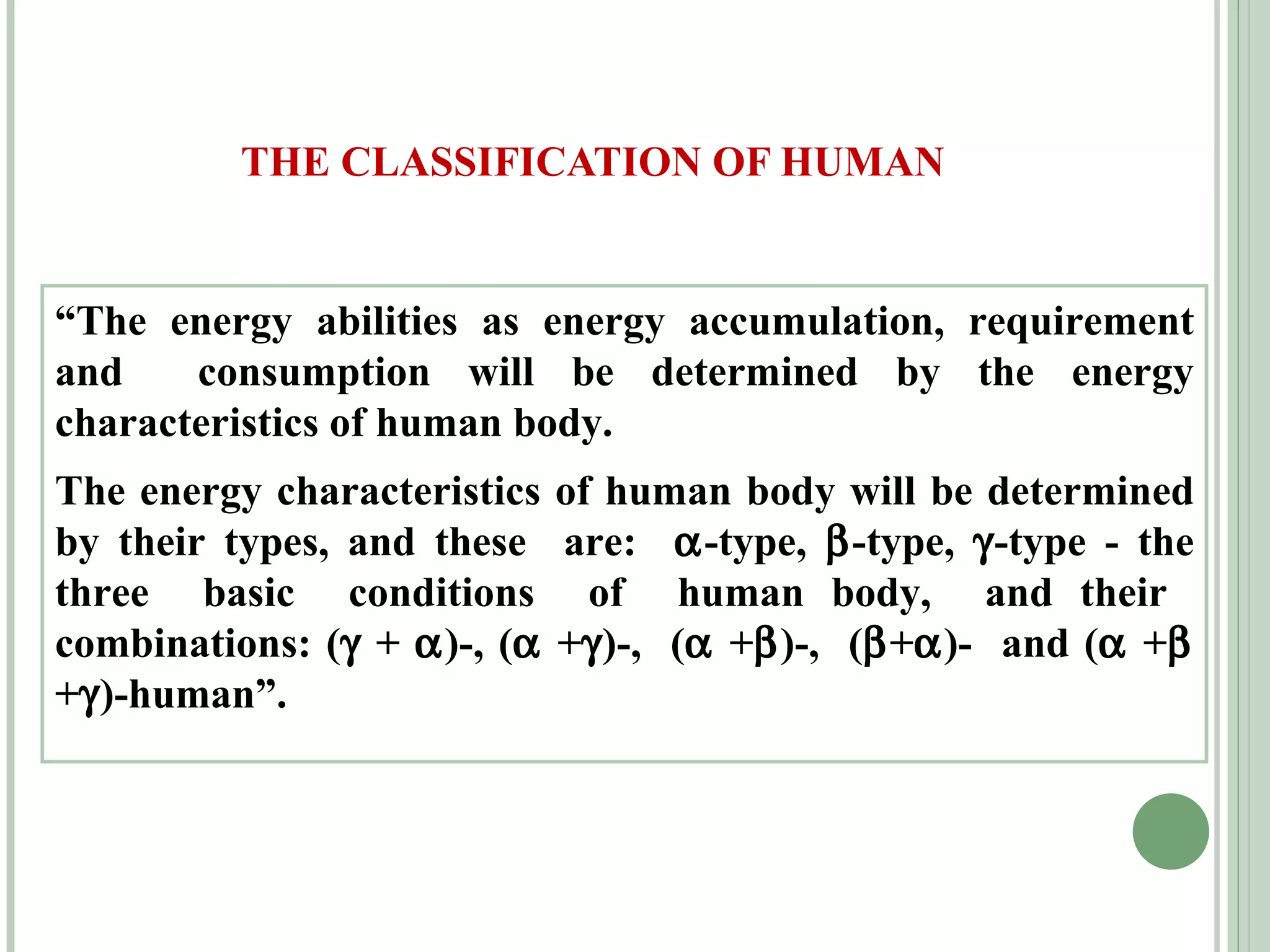
THE CLASSIFICATION OF HUMAN “ The energy abilities as energy accumulation, requirement and  consumption will be determined by the energy characteristics of human body.  The energy characteristics of human body will be determined by their types, and these  are:   -type,   -type,   -type - the three  basic  conditions  of  human body,  and their  combinations: (   +   )-, (   +  )-,  (   +  )-,  (  +  )-  and (   +   +  )-human”.
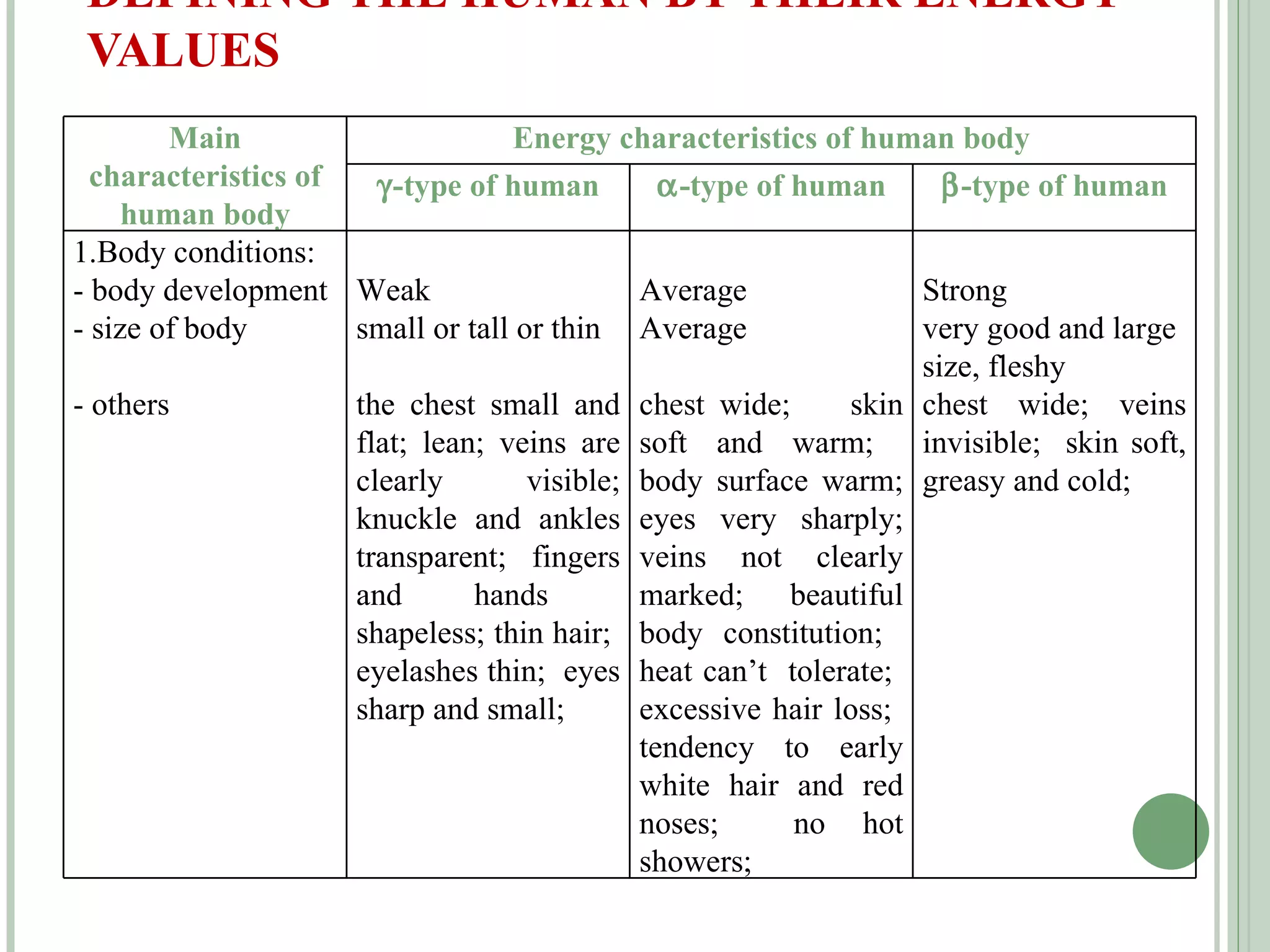
DEFINING THE HUMAN BY THEIR ENERGY VALUES Main characteristics of human body Energy characteristics of human body  -type of human  -type of human  -type of human 1.Body conditions: - body development - size of body - others Weak small or tall or thin the chest small and flat; lean; veins are clearly visible; knuckle and ankles transparent;  fingers and hands  shapeless; thin hair;  eyelashes thin;  eyes sharp and small;  Average Average chest wide;  skin soft and warm;  body surface warm; eyes very sharply; veins not clearly marked;  beautiful body constitution;  heat can’t  tolerate;  excessive hair loss;  tendency to early white hair and red noses;  no hot showers;  Strong very good and large size, fleshy chest wide; veins invisible;  skin soft, greasy and cold;
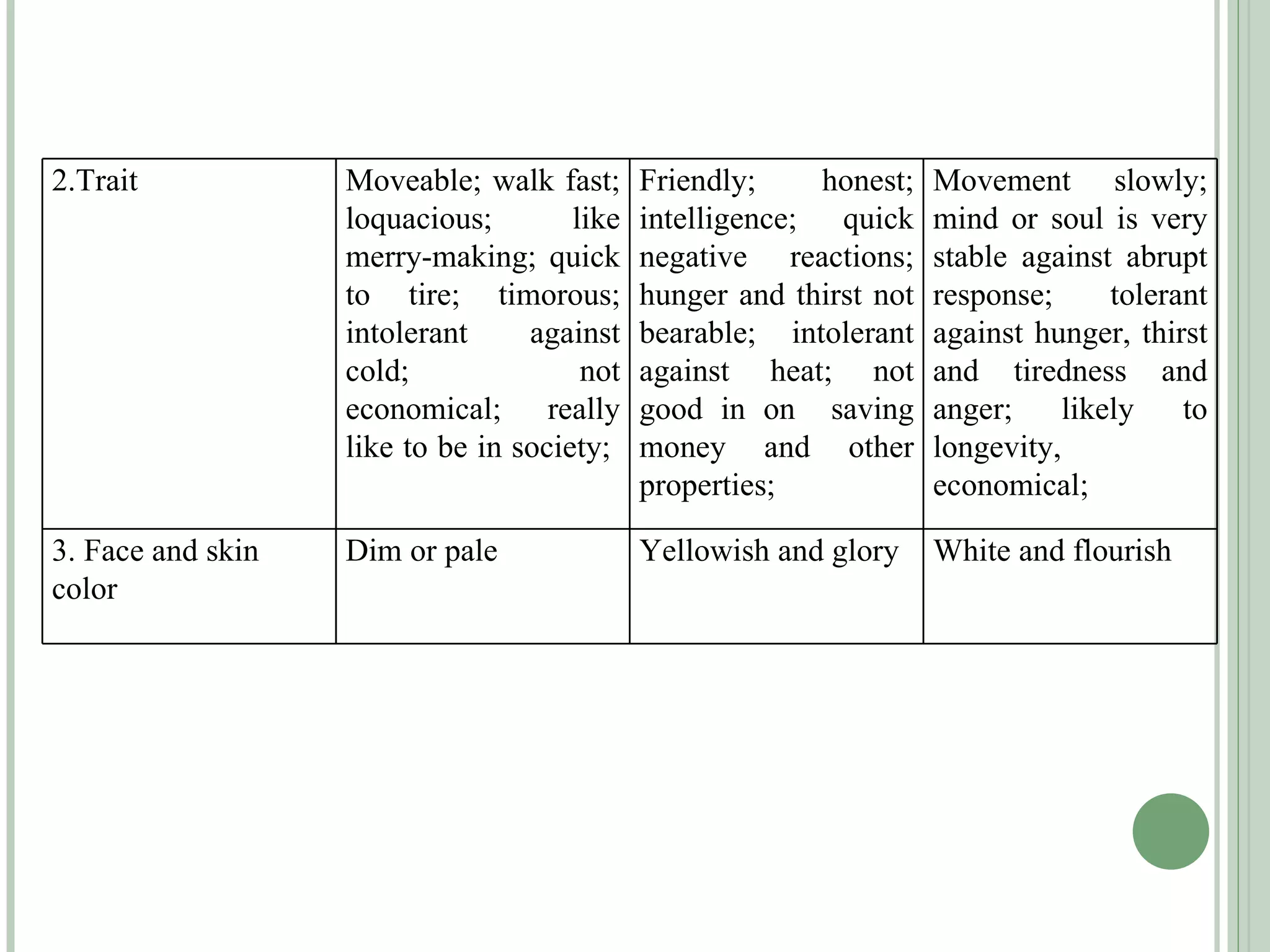
2.Trait Moveable; walk fast; loquacious; like merry-making; quick to tire; timorous; intolerant against cold; not economical; really like to be in society;  Friendly; honest; intelligence; quick negative reactions; hunger and thirst not bearable; intolerant against heat; not good in on  saving money and other properties; Movement slowly; mind or soul is very stable against abrupt response;  tolerant against hunger, thirst and tiredness and anger; likely to longevity, economical; 3. Face and skin color Dim or pale Yellowish and glory White and flourish
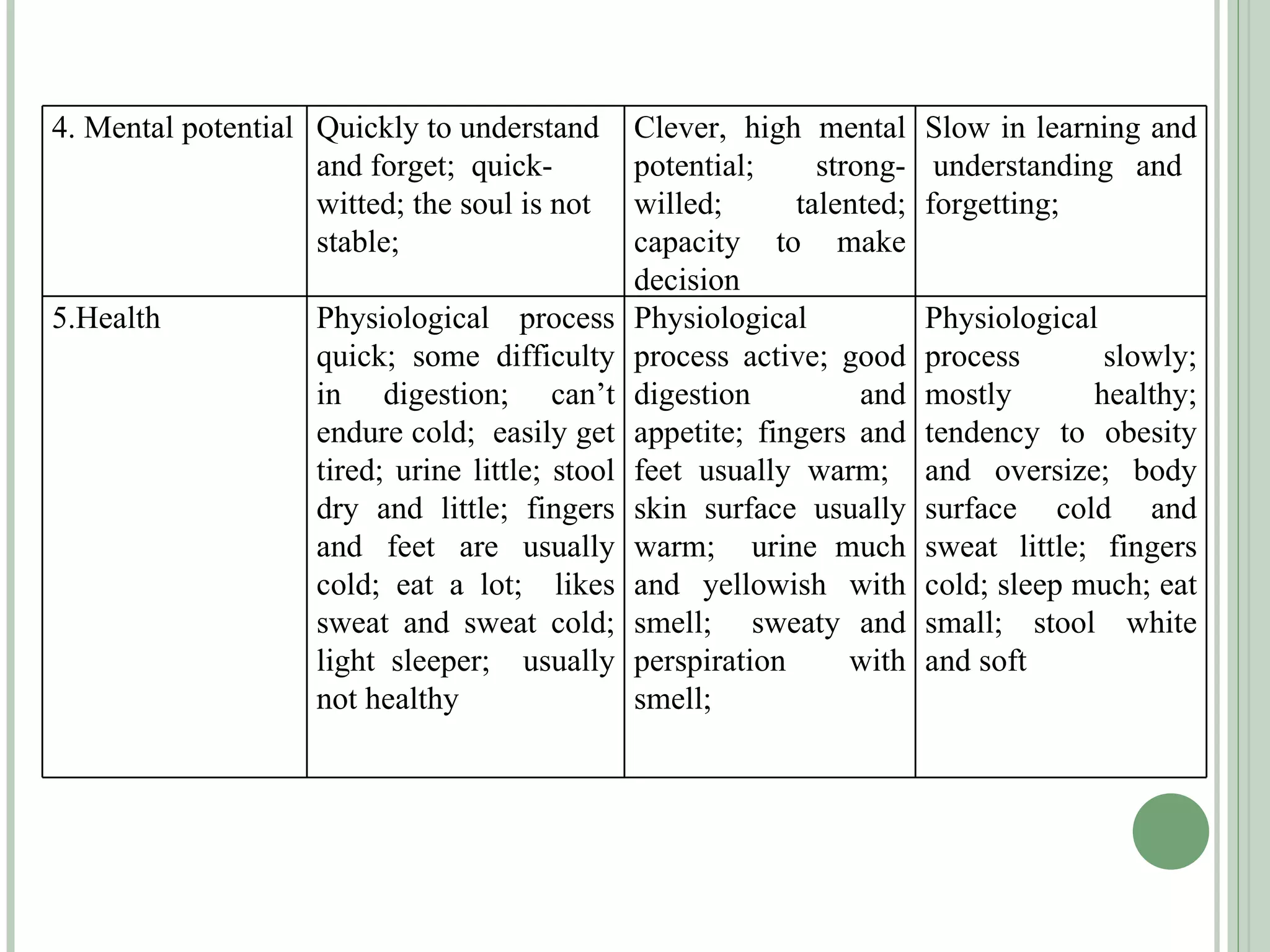
4. Mental potential Quickly to understand and forget;  quick-witted; the soul is not stable;  Clever, high mental potential; strong-willed; talented; capacity to make decision Slow in learning and  understanding and forgetting; 5.Health Physiological process quick; some difficulty in  digestion;  can’t endure cold;  easily get tired; urine little; stool dry and little; fingers and feet are usually cold; eat a lot;  likes sweat and sweat cold; light sleeper;  usually not healthy Physiological process active; good digestion and appetite; fingers and feet usually warm;  skin surface usually warm;  urine much and yellowish with smell;  sweaty and perspiration with smell;  Physiological process slowly; mostly healthy; tendency to obesity and oversize; body surface cold and sweat little; fingers cold; sleep much; eat small; stool white and soft
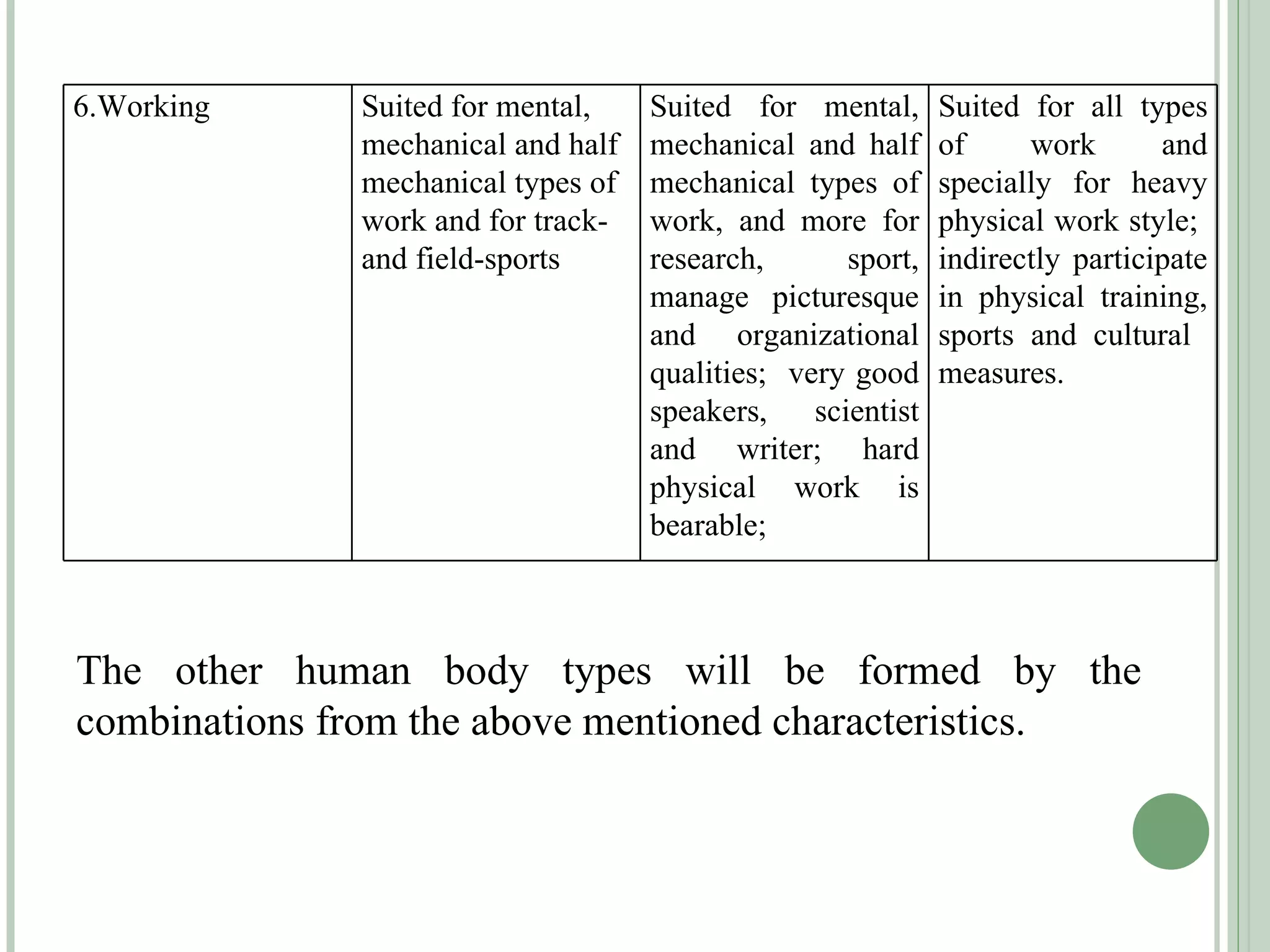
The other human body types will be formed by the combinations from the above mentioned characteristics. 6.Working Suited for mental, mechanical and half mechanical types of work and for track-and field-sports Suited for mental, mechanical and half mechanical types of work, and more for research, sport, manage picturesque and organizational qualities;  very good speakers, scientist and writer; hard physical work is bearable; Suited for all types of work and specially for heavy physical work style;  indirectly participate in physical training, sports and cultural  measures.
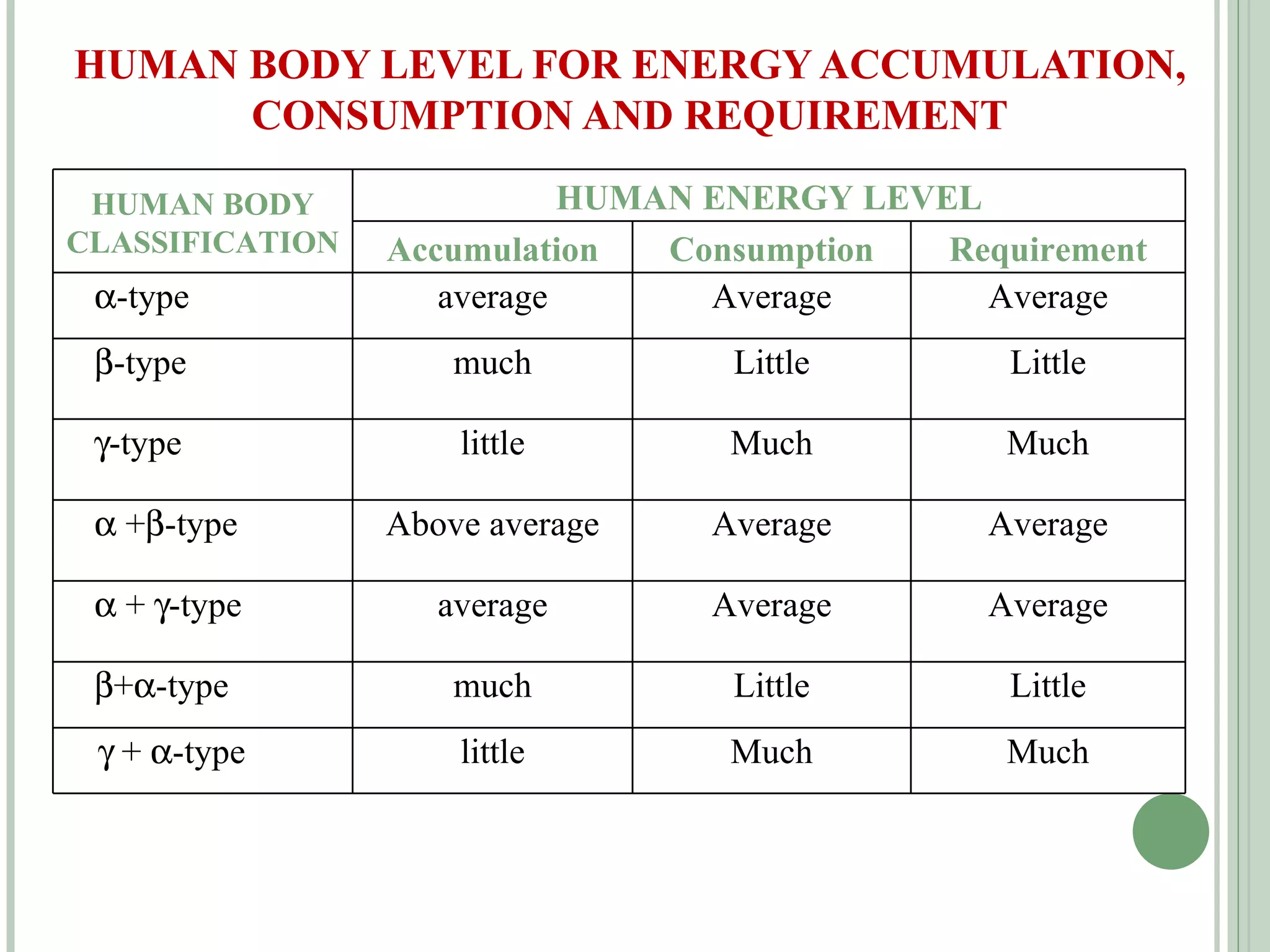
HUMAN BODY LEVEL FOR ENERGY ACCUMULATION, CONSUMPTION AND REQUIREMENT HUMAN BODY CLASSIFICATION HUMAN ENERGY LEVEL Accumulation Consumption Requirement  -type  average Average Average  -type  much Little Little  -type  little Much Much    +  -type Above average Average Average    +   -type average Average Average  +  -type much Little Little    +   -type little Much Much
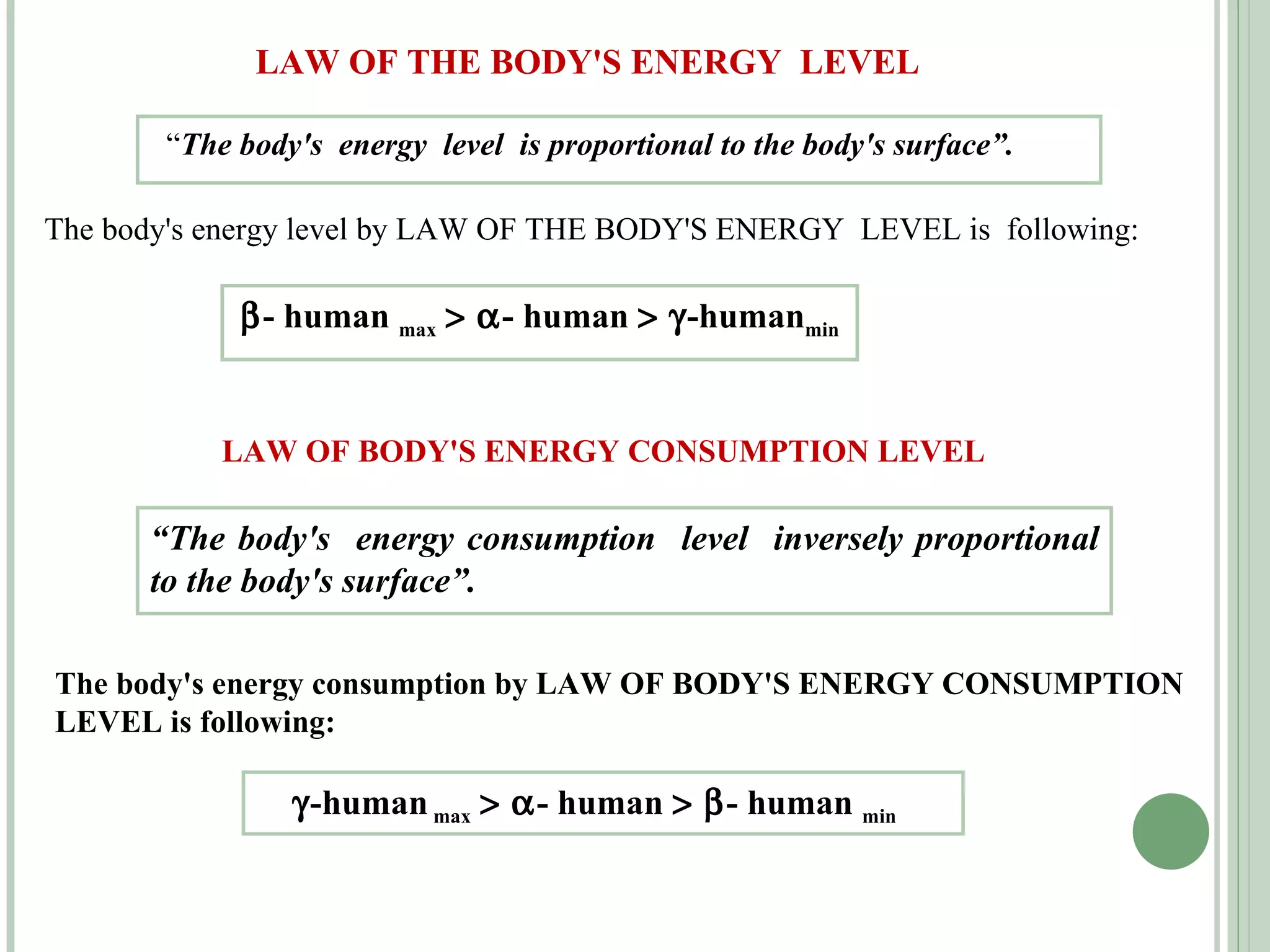
LAW OF THE BODY'S ENERGY  LEVEL “ The body's  energy  level  is proportional to the body's surface”. The body's energy level by LAW OF THE BODY'S ENERGY  LEVEL is  following:  - human  max       - human      -human min LAW OF BODY'S ENERGY CONSUMPTION LEVEL “ The body's  energy consumption  level  inversely proportional to the body's surface”. The body's energy consumption by LAW OF BODY'S ENERGY CONSUMPTION LEVEL is following:  -human  max       - human      - human  min
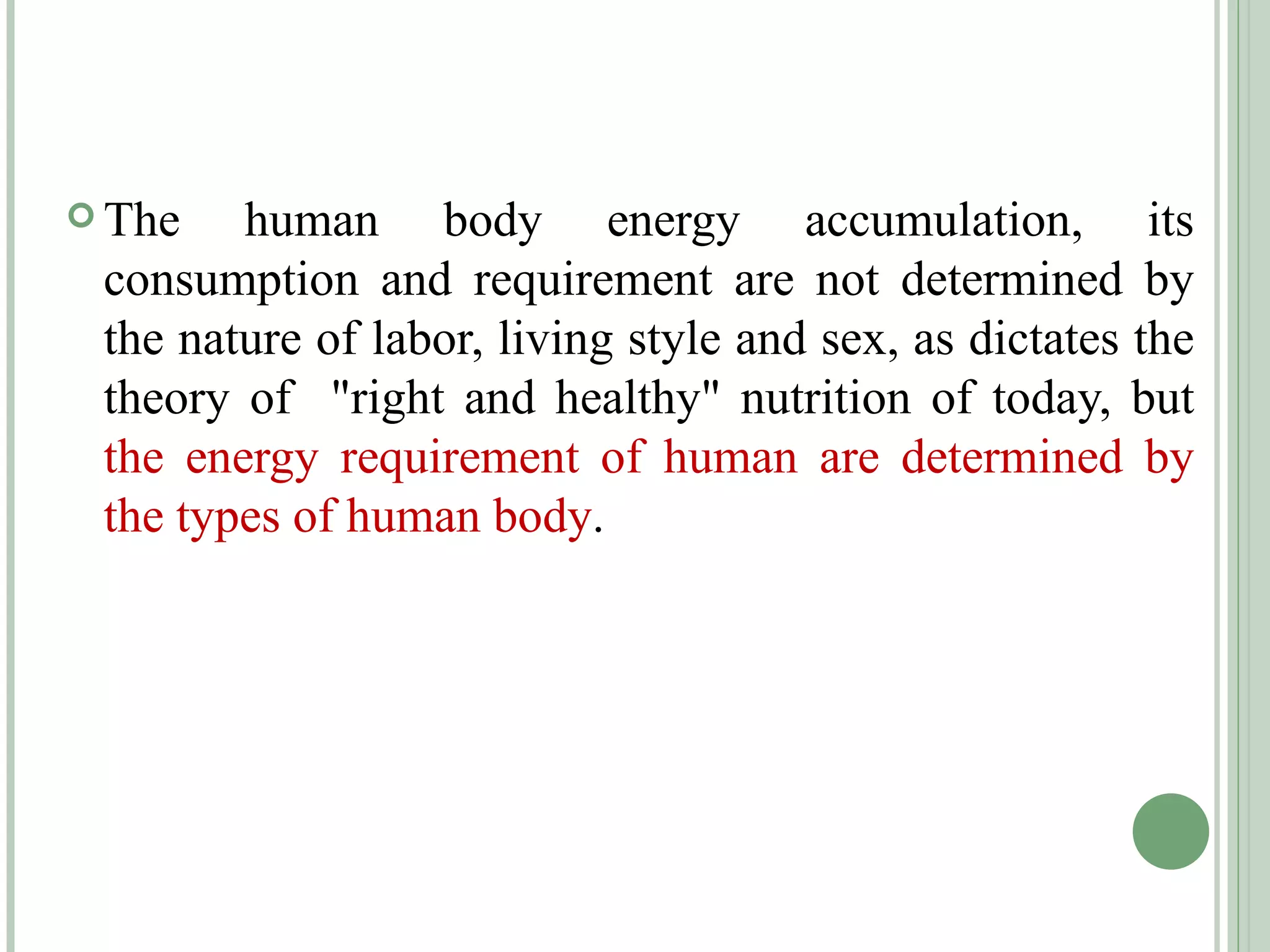
The human body energy accumulation, its consumption and requirement are not determined by the nature of labor, living style and sex, as dictates the theory of  "right and healthy" nutrition of today, but  the energy requirement of human are determined by the types of human body .
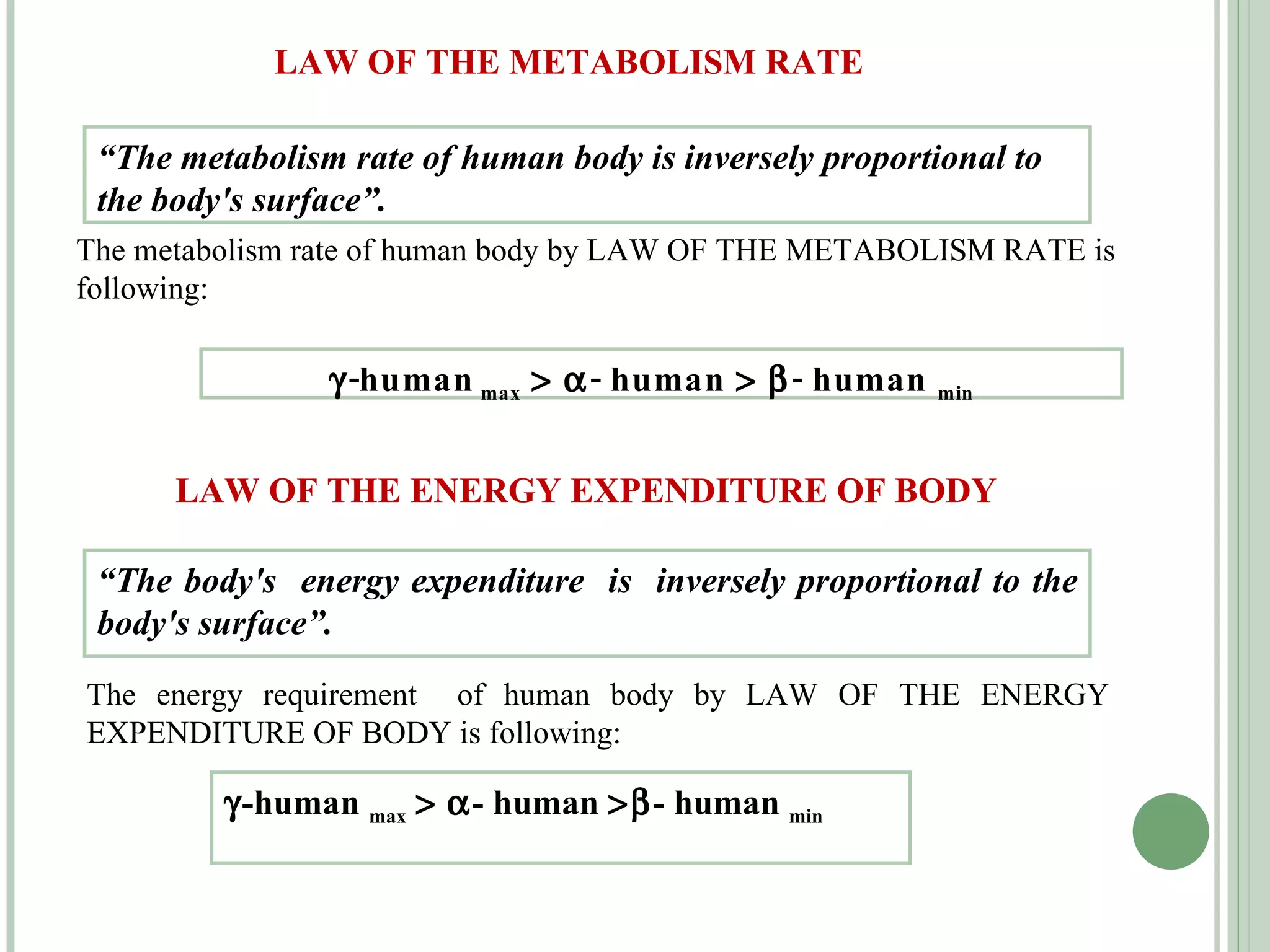
LAW OF THE METABOLISM RATE “ The metabolism rate of human body is inversely proportional to the body's surface”.  The metabolism rate of human body by LAW OF THE METABOLISM RATE is following:    -human  max       - human      - human  min   LAW OF THE ENERGY EXPENDITURE OF BODY “ The body's  energy expenditure  is  inversely proportional to the body's surface”. The energy requirement  of human body by LAW OF THE ENERGY EXPENDITURE OF BODY is following:    -human  max       - human   - human  min
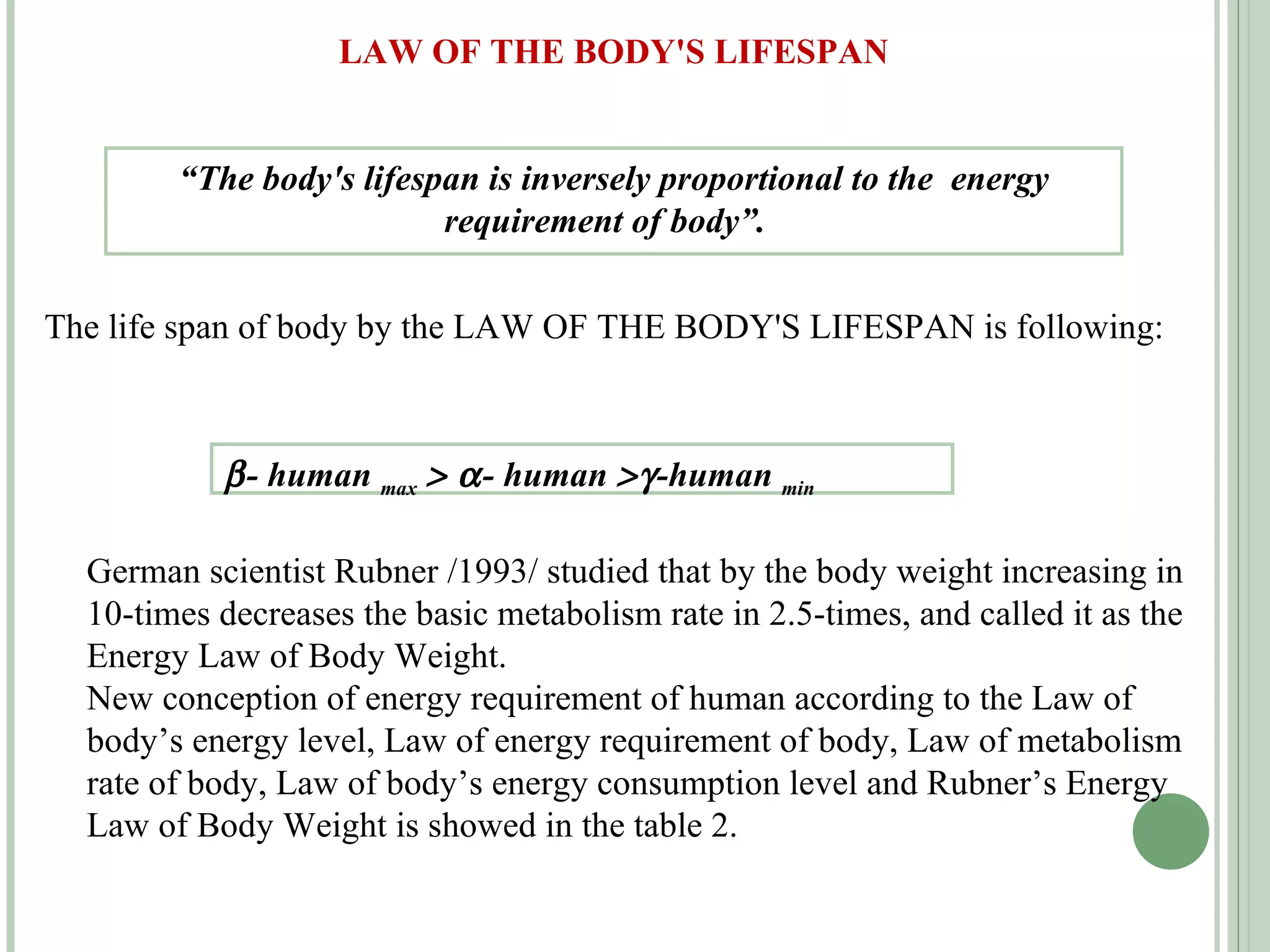
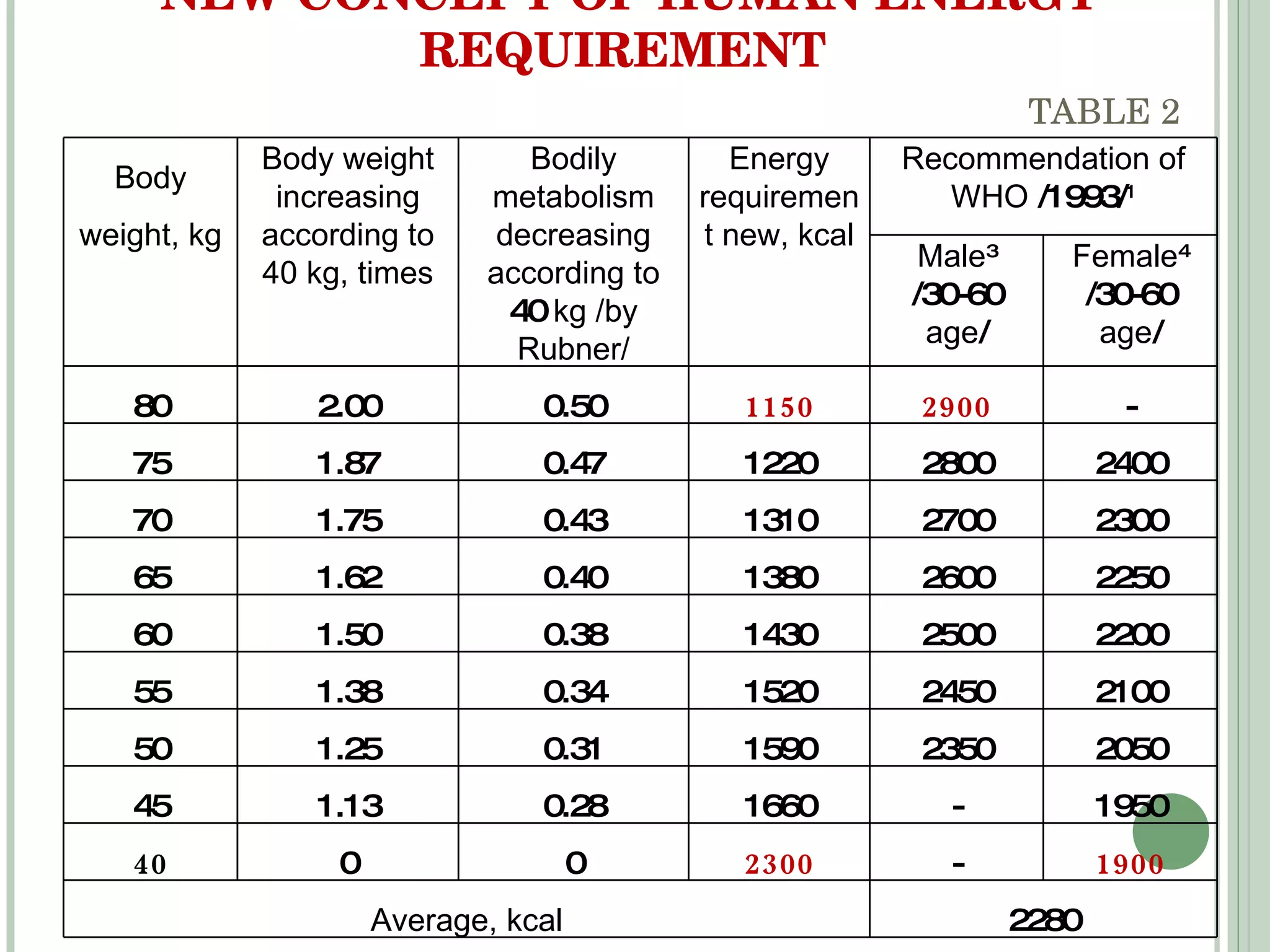
LAW OF THE BODY'S LIFESPAN “ The body's lifespan is inversely proportional to the  energy requirement of body”.  The life span of body by the LAW OF THE BODY'S LIFESPAN is following:  - human  max       - human   -human  min   German scientist Rubner /1993/ studied that by the body weight increasing in 10-times decreases the basic metabolism rate in 2.5-times, and called it as the Energy Law of Body Weight. New conception of energy requirement of human according to the   Law of body’s energy level, Law of energy requirement of body, Law of metabolism rate of body, Law of body’s energy consumption level and Rubner’s Energy Law of Body Weight is showed in the table 2.
NEW CONCEPT OF HUMAN ENERGY REQUIREMENT    TABLE 2 Body weight, kg Body weight increasing according to 40 kg, times Bodily metabolism decreasing according to  40  kg   / by Rubner / Energy requirement new, kcal Recommendation of WHO  /1993/ 1 Male 3 /30-60  age / Female 4 /30-60  age / 80 2.00 0.50 1150 2900 - 75 1.87 0.47 1220 2800 2400 70 1.75 0.43 1310 2700 2300 65 1.62 0.40 1380 2600 2250 60 1.50 0.38 1430 2500 2200 55 1.38 0.34 1520 2450 2100 50 1.25 0.31 1590 2350 2050 45 1.13 0.28 1660 - 1950 40 0 0 2300 - 1900 Average, kcal 2280
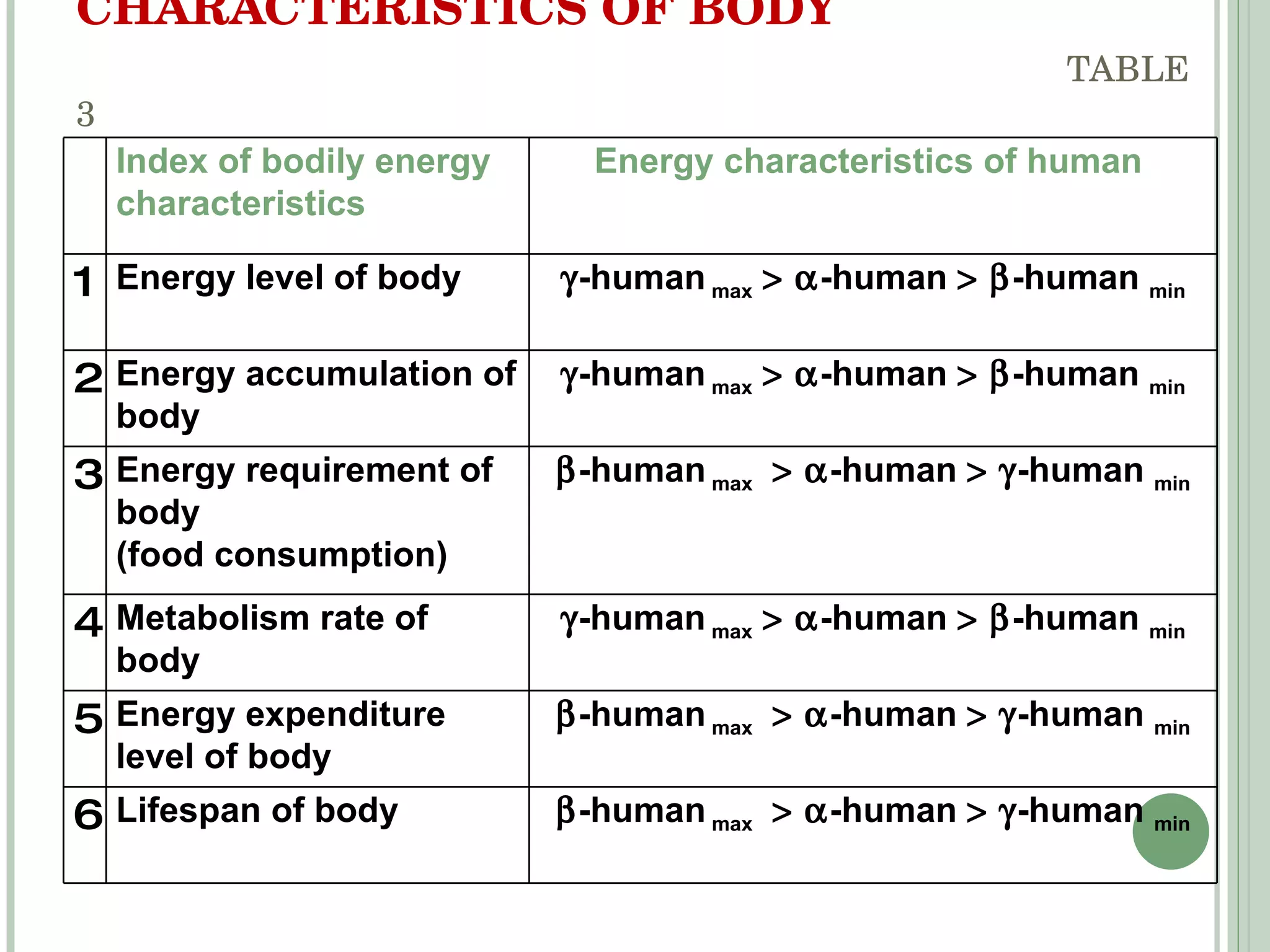
THE QUALITY INDEX OF ENERGY CHARACTERISTICS OF BODY   TABLE  3 Index of bodily energy characteristics Energy characteristics of human  1 Energy level of body  -human  max       -human      -human  min 2 Energy accumulation of body  -human  max       -human      -human  min 3 Energy requirement of body  (food consumption)  -human  max       -human      -human  min 4 Metabolism rate of body  -human  max       -human      -human  min 5 Energy expenditure level of body  -human  max       -human      -human  min 6 Lifespan of body  -human  max       -human      -human  min
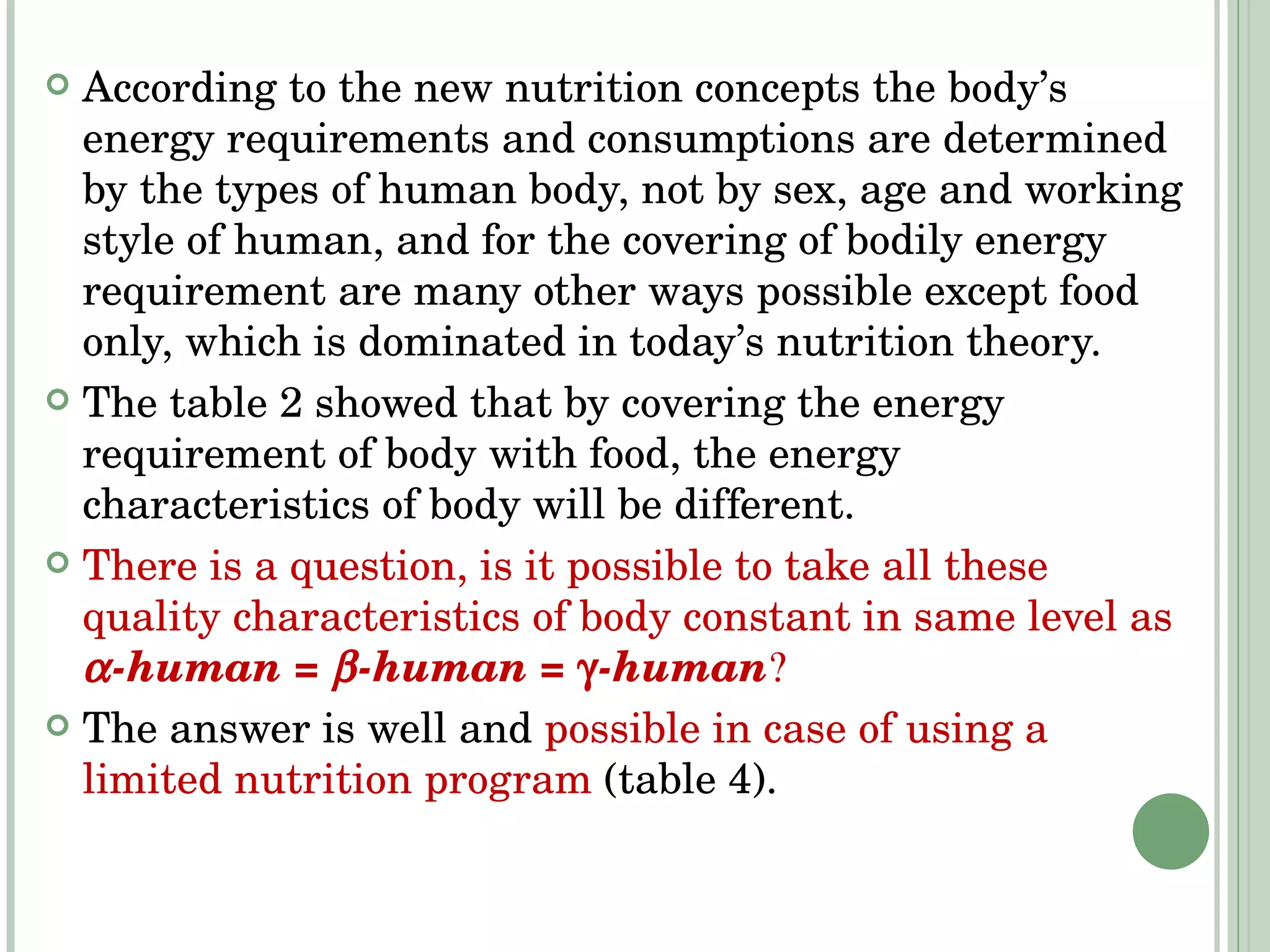
According to the new nutrition concepts the body’s energy requirements and consumptions are determined by the types of human body, not by sex, age and working style of human, and for   the covering of bodily energy requirement   are many other ways possible except food only, which is dominated in today’s nutrition theory. The table 2 showed that by covering the energy requirement of body with food, the energy characteristics of body will be different. There is a question, is it possible to take all these quality characteristics of body constant in same level as   -human =   -human =   -human  The answer is well and  possible in case of using a limited nutrition program  (table 4).
THE IMPROVING POSSIBILITIES OF ENERGY CHARACTERISTICS OF HUMAN BODY   TABLE 4 Results from limited nutrition programs Energy characteristics of human body Food consumption requirement / new program Energy level Metabolism rate Energy consumption Energy accumulation Life span 1 Mobilizing of inner energy of body and their transfer into useful work 50%   Taking energy from food  50%        2 Maintenance  of first nutrients from food: second nutrients from  intestinal microflora  50:50%   :  by  protein 1:1 (L.S.Vasilevskaya ,  L.G.Ohnyanskaya , 2002 )     
3 Specific thermal dynamic function of protein 50%        5 Metabolism rate to 20-40 %     ( B.I.Smolyar , 1991)      6 Differentiation of cells      ( Yu.A.Andreev  1995,  G.P.Malahov  1996)   
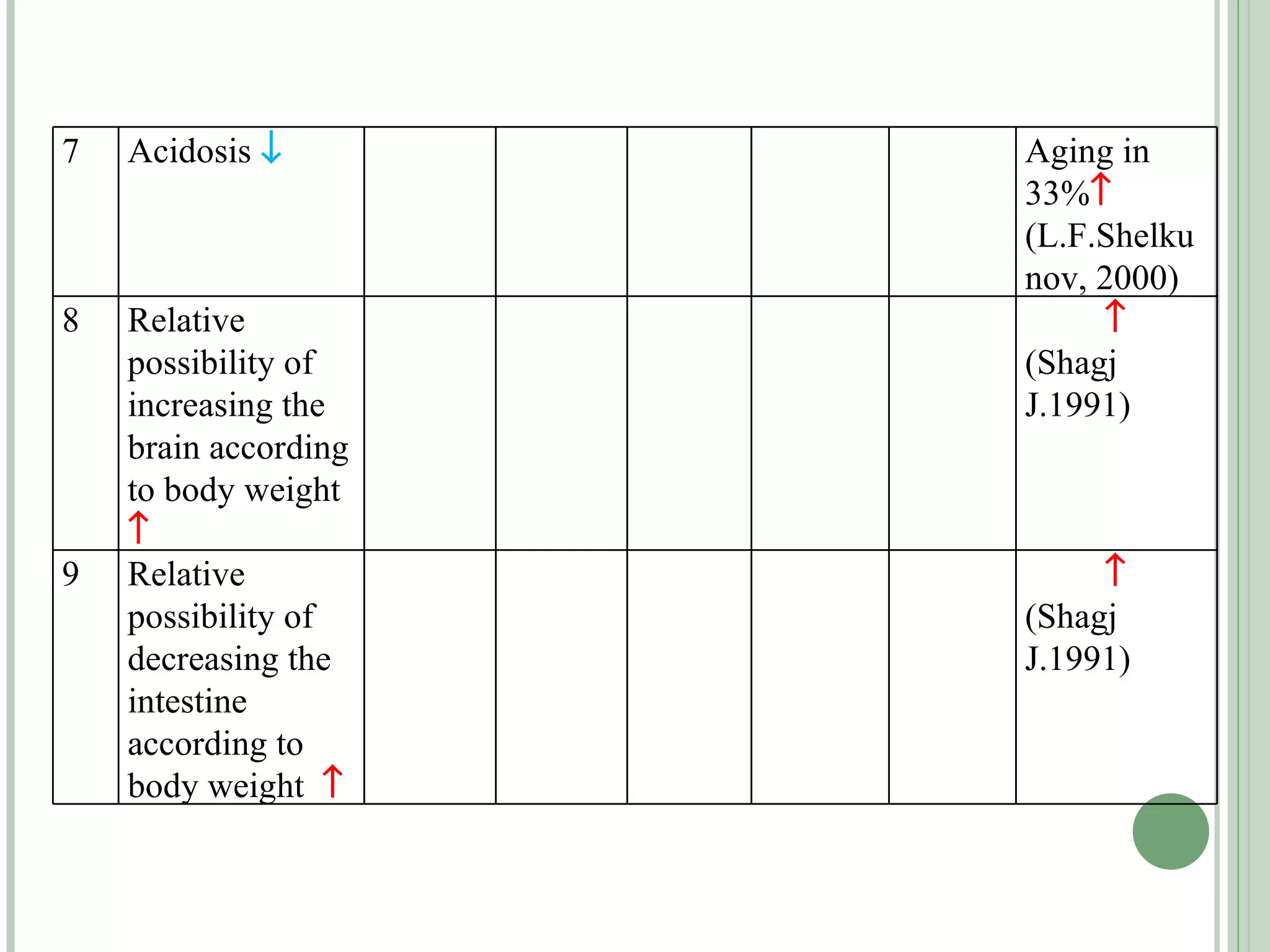
7 Acidosis      Aging in  33 %    ( L . F . Shelkunov , 2000 ) 8 Relative  possibility of increasing the brain  according to body weight    (Shagj J.1991) 9 Relative  possibility of decreasing the intestine  according to body weight    (Shagj J.1991)
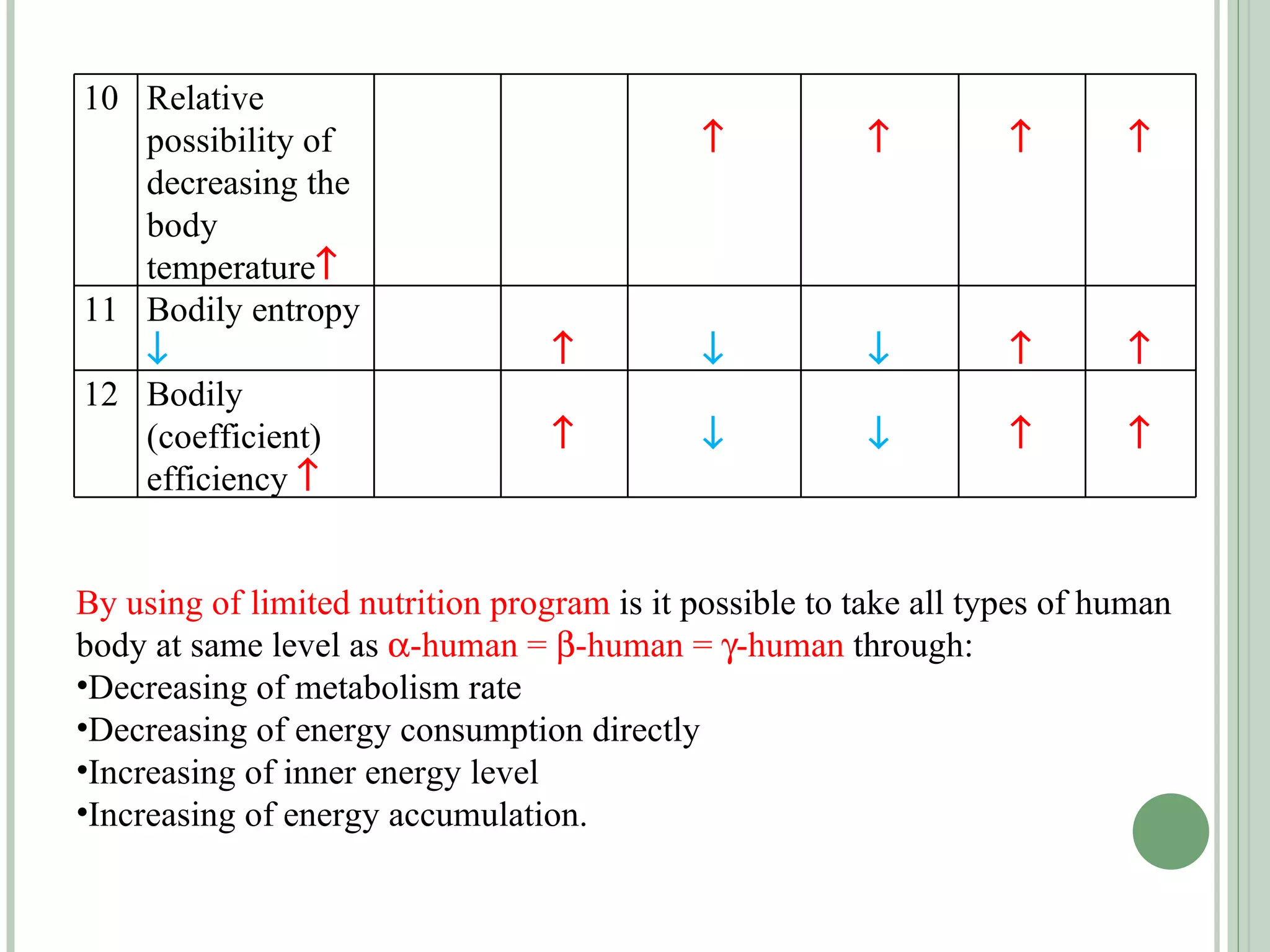
By using of limited nutrition program  is it possible to take all types of human body at same level as    -human =   -human =   -human   through: Decreasing of metabolism rate Decreasing of energy consumption directly Increasing of inner energy level Increasing of energy accumulation.  10 Relative  possibility of decreasing the body temperature      11 Bodily entropy        12 Bodily (coefficient) efficiency       
THANK YOU FOR YOUR ATTENTION
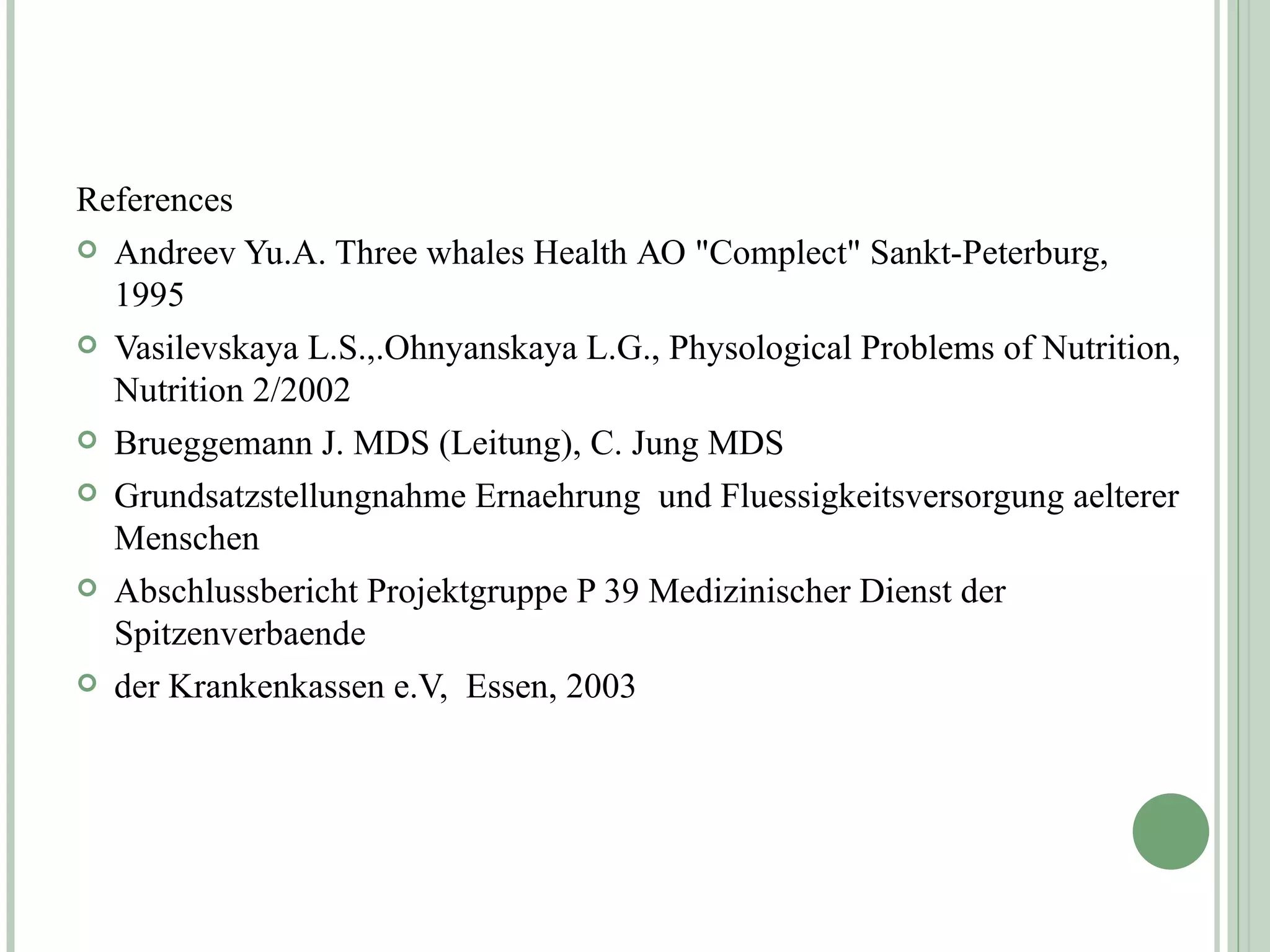
References Andreev Yu.A. Three whales Health  АО " Complect "  Sankt-Peterburg,  1995 Vasilevskaya L.S. , .Ohnyanskaya L.G., Physological Problems of Nutrition, Nutrition 2/2002 Brueggemann J. MDS (Leitung), C. Jung MDS Grundsatzstellungnahme Ernaehrung  und Fluessigkeitsversorgung aelterer Menschen Abschlussbericht Projektgruppe P 39 Medizinischer Dienst der Spitzenverbaende der Krankenkassen e.V,  Essen, 2003
Lkhagvaa G. Energy Law of Humankind, University Publishing, Ulaanbaatar, 2005 Lkhagvaa G. New Concepts about Human and Their Development, “Munhiin Useg Group” Publishing, Ulaanbaatar, 2010  Malahov G.P., Tutorial for Starvation, Feniko, Rostov-na-Donu , 1996  Серия технических докладов 797 ВОЗ „Рацион, питание и предупреждение хронических заболеваний“, Женева, 1993 Sukhbaatar H. The mathematical Model of a Family, Scientific Book, Ulaanbaatar , 2006, Smolyar B.I., Right Nutrition, Kiev, Publishing Naukov Dumka, 1991  Shagj J.,  Heat production effect  in large intestine of  mammalian and human, Doctor’s dissertation, Moscow, 1991 Shelkunov L . F . , Nutrition, Health and Signs Zodaika  О dessa,  2000

New concepts in human

  • 1.
    G.Lkhagvaa Prof. D.Sc.Mongolian University of Science and Technology NEW CONCEPTS IN HUMAN AND THEIR DEVELOPMENT
  • 2.
    In our reviewof the emergence of human and their existence, typical traits, and for its development is the energy an important role. On this basis we have formulated the law of Human Existence. THE GENERAL LAW OF HUMAN EXISTENCE “ The human consists from the energy and physical bodies. The consciousness or energy body would take until 70  of the human, and belongs to the Laws of Energy and Thermodynamics. The physical body has a part of 30 to 41  in the human and belongs to the genes and cell” .
  • 3.
    From the Law of Human Existence could be derived the following Rules : No one emerged from chimpanzee, but from the energy. The human consists until 70  from energy, and belongs to the Laws of Energy and Thermodynamics. The main characteristics of human will be determined by their energy. The physical body is not able to represent a human, and belongs to the genes and cells, which transferred from father and mother.
  • 4.
    The brain isthe main course for the development of physical body, but for human development is their energy development main course. Therefore, the human development could be targeted to the developing of brain to the development of energy. There is very need to orientate the food processing to feed the consciousness.
  • 5.
    THE ENERGY LAWSOF HUMAN BODY AND NEW CONCEPTS IN HUMAN NUTRITION
  • 6.
    THE CLASSIFICATION OFHUMAN “ The energy abilities as energy accumulation, requirement and consumption will be determined by the energy characteristics of human body. The energy characteristics of human body will be determined by their types, and these are:  -type,  -type,  -type - the three basic conditions of human body, and their combinations: (  +  )-, (  +  )-, (  +  )-, (  +  )- and (  +  +  )-human”.
  • 7.
    DEFINING THE HUMANBY THEIR ENERGY VALUES Main characteristics of human body Energy characteristics of human body  -type of human  -type of human  -type of human 1.Body conditions: - body development - size of body - others Weak small or tall or thin the chest small and flat; lean; veins are clearly visible; knuckle and ankles transparent; fingers and hands shapeless; thin hair; eyelashes thin; eyes sharp and small; Average Average chest wide; skin soft and warm; body surface warm; eyes very sharply; veins not clearly marked; beautiful body constitution; heat can’t tolerate; excessive hair loss; tendency to early white hair and red noses; no hot showers; Strong very good and large size, fleshy chest wide; veins invisible; skin soft, greasy and cold;
  • 8.
    2.Trait Moveable; walkfast; loquacious; like merry-making; quick to tire; timorous; intolerant against cold; not economical; really like to be in society; Friendly; honest; intelligence; quick negative reactions; hunger and thirst not bearable; intolerant against heat; not good in on saving money and other properties; Movement slowly; mind or soul is very stable against abrupt response; tolerant against hunger, thirst and tiredness and anger; likely to longevity, economical; 3. Face and skin color Dim or pale Yellowish and glory White and flourish
  • 9.
    4. Mental potentialQuickly to understand and forget; quick-witted; the soul is not stable; Clever, high mental potential; strong-willed; talented; capacity to make decision Slow in learning and understanding and forgetting; 5.Health Physiological process quick; some difficulty in digestion; can’t endure cold; easily get tired; urine little; stool dry and little; fingers and feet are usually cold; eat a lot; likes sweat and sweat cold; light sleeper; usually not healthy Physiological process active; good digestion and appetite; fingers and feet usually warm; skin surface usually warm; urine much and yellowish with smell; sweaty and perspiration with smell; Physiological process slowly; mostly healthy; tendency to obesity and oversize; body surface cold and sweat little; fingers cold; sleep much; eat small; stool white and soft
  • 10.
    The other humanbody types will be formed by the combinations from the above mentioned characteristics. 6.Working Suited for mental, mechanical and half mechanical types of work and for track-and field-sports Suited for mental, mechanical and half mechanical types of work, and more for research, sport, manage picturesque and organizational qualities; very good speakers, scientist and writer; hard physical work is bearable; Suited for all types of work and specially for heavy physical work style; indirectly participate in physical training, sports and cultural measures.
  • 11.
    HUMAN BODY LEVELFOR ENERGY ACCUMULATION, CONSUMPTION AND REQUIREMENT HUMAN BODY CLASSIFICATION HUMAN ENERGY LEVEL Accumulation Consumption Requirement  -type average Average Average  -type much Little Little  -type little Much Much  +  -type Above average Average Average  +  -type average Average Average  +  -type much Little Little  +  -type little Much Much
  • 12.
    LAW OF THEBODY'S ENERGY LEVEL “ The body's energy level is proportional to the body's surface”. The body's energy level by LAW OF THE BODY'S ENERGY LEVEL is following:  - human max   - human   -human min LAW OF BODY'S ENERGY CONSUMPTION LEVEL “ The body's energy consumption level inversely proportional to the body's surface”. The body's energy consumption by LAW OF BODY'S ENERGY CONSUMPTION LEVEL is following:  -human max   - human   - human min
  • 13.
    The human bodyenergy accumulation, its consumption and requirement are not determined by the nature of labor, living style and sex, as dictates the theory of "right and healthy" nutrition of today, but the energy requirement of human are determined by the types of human body .
  • 14.
    LAW OF THEMETABOLISM RATE “ The metabolism rate of human body is inversely proportional to the body's surface”. The metabolism rate of human body by LAW OF THE METABOLISM RATE is following:  -human max   - human   - human min LAW OF THE ENERGY EXPENDITURE OF BODY “ The body's energy expenditure is inversely proportional to the body's surface”. The energy requirement of human body by LAW OF THE ENERGY EXPENDITURE OF BODY is following:  -human max   - human  - human min
  • 15.
    LAW OF THEBODY'S LIFESPAN “ The body's lifespan is inversely proportional to the energy requirement of body”. The life span of body by the LAW OF THE BODY'S LIFESPAN is following:  - human max   - human  -human min German scientist Rubner /1993/ studied that by the body weight increasing in 10-times decreases the basic metabolism rate in 2.5-times, and called it as the Energy Law of Body Weight. New conception of energy requirement of human according to the Law of body’s energy level, Law of energy requirement of body, Law of metabolism rate of body, Law of body’s energy consumption level and Rubner’s Energy Law of Body Weight is showed in the table 2.
  • 16.
    NEW CONCEPT OFHUMAN ENERGY REQUIREMENT TABLE 2 Body weight, kg Body weight increasing according to 40 kg, times Bodily metabolism decreasing according to 40 kg / by Rubner / Energy requirement new, kcal Recommendation of WHO /1993/ 1 Male 3 /30-60 age / Female 4 /30-60 age / 80 2.00 0.50 1150 2900 - 75 1.87 0.47 1220 2800 2400 70 1.75 0.43 1310 2700 2300 65 1.62 0.40 1380 2600 2250 60 1.50 0.38 1430 2500 2200 55 1.38 0.34 1520 2450 2100 50 1.25 0.31 1590 2350 2050 45 1.13 0.28 1660 - 1950 40 0 0 2300 - 1900 Average, kcal 2280
  • 17.
    THE QUALITY INDEXOF ENERGY CHARACTERISTICS OF BODY TABLE 3 Index of bodily energy characteristics Energy characteristics of human 1 Energy level of body  -human max   -human   -human min 2 Energy accumulation of body  -human max   -human   -human min 3 Energy requirement of body (food consumption)  -human max   -human   -human min 4 Metabolism rate of body  -human max   -human   -human min 5 Energy expenditure level of body  -human max   -human   -human min 6 Lifespan of body  -human max   -human   -human min
  • 18.
    According to thenew nutrition concepts the body’s energy requirements and consumptions are determined by the types of human body, not by sex, age and working style of human, and for the covering of bodily energy requirement are many other ways possible except food only, which is dominated in today’s nutrition theory. The table 2 showed that by covering the energy requirement of body with food, the energy characteristics of body will be different. There is a question, is it possible to take all these quality characteristics of body constant in same level as  -human =  -human =  -human  The answer is well and possible in case of using a limited nutrition program (table 4).
  • 19.
    THE IMPROVING POSSIBILITIESOF ENERGY CHARACTERISTICS OF HUMAN BODY TABLE 4 Results from limited nutrition programs Energy characteristics of human body Food consumption requirement / new program Energy level Metabolism rate Energy consumption Energy accumulation Life span 1 Mobilizing of inner energy of body and their transfer into useful work 50%  Taking energy from food 50%       2 Maintenance of first nutrients from food: second nutrients from intestinal microflora 50:50%  :  by protein 1:1 (L.S.Vasilevskaya , L.G.Ohnyanskaya , 2002 )     
  • 20.
    3 Specific thermaldynamic function of protein 50%       5 Metabolism rate to 20-40 %  ( B.I.Smolyar , 1991)      6 Differentiation of cells  ( Yu.A.Andreev 1995, G.P.Malahov 1996)   
  • 21.
    7 Acidosis  Aging in 33 %  ( L . F . Shelkunov , 2000 ) 8 Relative possibility of increasing the brain according to body weight   (Shagj J.1991) 9 Relative possibility of decreasing the intestine according to body weight   (Shagj J.1991)
  • 22.
    By using oflimited nutrition program is it possible to take all types of human body at same level as  -human =  -human =  -human through: Decreasing of metabolism rate Decreasing of energy consumption directly Increasing of inner energy level Increasing of energy accumulation. 10 Relative possibility of decreasing the body temperature      11 Bodily entropy       12 Bodily (coefficient) efficiency      
  • 23.
    THANK YOU FORYOUR ATTENTION
  • 24.
    References Andreev Yu.A.Three whales Health АО " Complect " Sankt-Peterburg, 1995 Vasilevskaya L.S. , .Ohnyanskaya L.G., Physological Problems of Nutrition, Nutrition 2/2002 Brueggemann J. MDS (Leitung), C. Jung MDS Grundsatzstellungnahme Ernaehrung und Fluessigkeitsversorgung aelterer Menschen Abschlussbericht Projektgruppe P 39 Medizinischer Dienst der Spitzenverbaende der Krankenkassen e.V, Essen, 2003
  • 25.
    Lkhagvaa G. EnergyLaw of Humankind, University Publishing, Ulaanbaatar, 2005 Lkhagvaa G. New Concepts about Human and Their Development, “Munhiin Useg Group” Publishing, Ulaanbaatar, 2010 Malahov G.P., Tutorial for Starvation, Feniko, Rostov-na-Donu , 1996 Серия технических докладов 797 ВОЗ „Рацион, питание и предупреждение хронических заболеваний“, Женева, 1993 Sukhbaatar H. The mathematical Model of a Family, Scientific Book, Ulaanbaatar , 2006, Smolyar B.I., Right Nutrition, Kiev, Publishing Naukov Dumka, 1991 Shagj J., Heat production effect in large intestine of mammalian and human, Doctor’s dissertation, Moscow, 1991 Shelkunov L . F . , Nutrition, Health and Signs Zodaika О dessa, 2000