Nonlinear Programming
In this handout
•Gradient Search for Multivariable
Unconstrained Optimization
•KKT Conditions for Optimality of
Constrained Optimization
•Algorithms for solving Convex Programs
Multivariable Unconstraint
Optimization
max f(x1,…,xn)
No functional constraints.
Consider the case when f is concave.
The necessary and sufficient condition for
optimality is that all the partial derivatives are 0.
But in most cases, the system of equations
obtained that way can’t be solved analytically.
Then a numerical search procedure must be used.
The Gradient Search Procedure
The gradient at a specific point x=x’
The rate at which f increases is maximized in the
direction of the gradient.
Keep moving in the direction of the gradient until f
stops increasing.
Examples on the board.
Constrained Optimization
max f(x1,…,xn)
subject to gi(x1,…,xn) ≤ bi
x1,…,xn ≥ 0
The necessary conditions for optimality are called
the Karush-Kuhn-Tucker conditions (or KKT
conditions), because they were derived
independently by Karush (1939) and by Kuhn and
Tucker (1951).
KKT conditions
The conditions are also sufficient for optimality if f is concave
and gi’s are convex.
Connection of KKT conditions for NLP to
Complementary Slackness Conditions for LP
KKT conditions
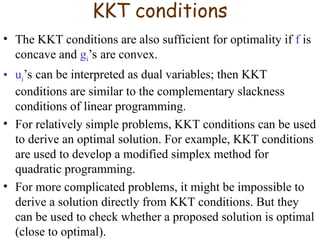
• The KKT conditions are also sufficient for optimality if f is
concave and gi’s are convex.
• ui’s can be interpreted as dual variables; then KKT
conditions are similar to the complementary slackness
conditions of linear programming.
• For relatively simple problems, KKT conditions can be used
to derive an optimal solution. For example, KKT conditions
are used to develop a modified simplex method for
quadratic programming.
• For more complicated problems, it might be impossible to
derive a solution directly from KKT conditions. But they
can be used to check whether a proposed solution is optimal
(close to optimal).
Algorithms for solving Convex
Programming problems
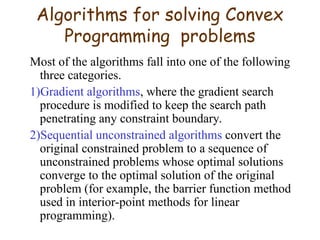
Most of the algorithms fall into one of the following
three categories.
1)Gradient algorithms, where the gradient search
procedure is modified to keep the search path
penetrating any constraint boundary.
2)Sequential unconstrained algorithms convert the
original constrained problem to a sequence of
unconstrained problems whose optimal solutions
converge to the optimal solution of the original
problem (for example, the barrier function method
used in interior-point methods for linear
programming).
Algorithms for solving Convex
Programming problems (cont.)
3) Sequential-approximation algorithms. These
algorithms replace the nonlinear objective function
by a succession of linear or quadratic
approximations. Particularly suitable for linearly
constrained optimization problems.
One example is Frank-Wolfe algorithm for the case
of linearly constrained convex programming.

Neural network P algorithms powerpoint presentation

  • 1.
    Nonlinear Programming In thishandout •Gradient Search for Multivariable Unconstrained Optimization •KKT Conditions for Optimality of Constrained Optimization •Algorithms for solving Convex Programs
  • 2.
    Multivariable Unconstraint Optimization max f(x1,…,xn) Nofunctional constraints. Consider the case when f is concave. The necessary and sufficient condition for optimality is that all the partial derivatives are 0. But in most cases, the system of equations obtained that way can’t be solved analytically. Then a numerical search procedure must be used.
  • 3.
    The Gradient SearchProcedure The gradient at a specific point x=x’ The rate at which f increases is maximized in the direction of the gradient. Keep moving in the direction of the gradient until f stops increasing.
  • 4.
  • 5.
    Constrained Optimization max f(x1,…,xn) subjectto gi(x1,…,xn) ≤ bi x1,…,xn ≥ 0 The necessary conditions for optimality are called the Karush-Kuhn-Tucker conditions (or KKT conditions), because they were derived independently by Karush (1939) and by Kuhn and Tucker (1951).
  • 6.
    KKT conditions The conditionsare also sufficient for optimality if f is concave and gi’s are convex.
  • 7.
    Connection of KKTconditions for NLP to Complementary Slackness Conditions for LP
  • 8.
    KKT conditions • TheKKT conditions are also sufficient for optimality if f is concave and gi’s are convex. • ui’s can be interpreted as dual variables; then KKT conditions are similar to the complementary slackness conditions of linear programming. • For relatively simple problems, KKT conditions can be used to derive an optimal solution. For example, KKT conditions are used to develop a modified simplex method for quadratic programming. • For more complicated problems, it might be impossible to derive a solution directly from KKT conditions. But they can be used to check whether a proposed solution is optimal (close to optimal).
  • 9.
    Algorithms for solvingConvex Programming problems Most of the algorithms fall into one of the following three categories. 1)Gradient algorithms, where the gradient search procedure is modified to keep the search path penetrating any constraint boundary. 2)Sequential unconstrained algorithms convert the original constrained problem to a sequence of unconstrained problems whose optimal solutions converge to the optimal solution of the original problem (for example, the barrier function method used in interior-point methods for linear programming).
  • 10.
    Algorithms for solvingConvex Programming problems (cont.) 3) Sequential-approximation algorithms. These algorithms replace the nonlinear objective function by a succession of linear or quadratic approximations. Particularly suitable for linearly constrained optimization problems. One example is Frank-Wolfe algorithm for the case of linearly constrained convex programming.