Chapter 1 Dr. Ali Al-Hamdi 1
Chapter 1
Introduction
Part I: Overview
Chapter 1 Dr. Ali Al-Hamdi 2
 Data Communications roles in our life
 Business point of view and the way we live.
 Chapter topics
 Definitions, characteristics, components, and types of data
representations and exchange.
 Networks, their elements, criteria, and topologies.
 Different types of nets. and concept of switching.
 Internet history.
 Standards and their organizations.
Lead-in
Chapter 1 Dr. Ali Al-Hamdi 3
 1.1.1 Defintions and characteristics
 Communication
 Telecommunication
 Data
 Data communication
 DCS characteristics (effectiveness-based)
 Delivery
 Accuracy
 Timeliness
 Jitter
1.1 Data Communications
Chapter 1 Dr. Ali Al-Hamdi 4
 1.1.2 Components
1.1 Data Communications
Chapter 1 Dr. Ali Al-Hamdi 5
 1.1.3 Data Representation
 Text
 Numbers
 Images
 Audio
 Video
1.1 Data Communications
Chapter 1 Dr. Ali Al-Hamdi 6
 1.1.4 Data Flow (Types)
 Simplex
 Example
 Channel capacity
 ½ Duplex
 Example
 Channel capacity
 Full-duplex
 Example
 Channel capacity
1.1 Data Communications
Chapter 1 Dr. Ali Al-Hamdi 7
 1.2.1 Defintions
 Network
 Network Elements
 1.2.2 Netwrork Criteria
 Performance
 Performance measures: (transit time + response time) which depend
on a number of factors.
 Performance evaluated by 2metrics : throughput and Delay.
 Reliability
 Security
1.2 Networks
Chapter 1 Dr. Ali Al-Hamdi 8
 1.2.3 Physical Structure
 Types of connections
 Point-to-point: definition, examples.
 Multipoint (multidrop): definition, examples, and sharing methods
(spatial and temporal)
1.2 Networks
Chapter 1 Dr. Ali Al-Hamdi 9
 1.2.3 Physical Structure: Topology
 Definition: physical topology + network topology.
 Types: 3
 Mesh topology
 Type of connection
 Advantages
 Disadvantages
 Example of application
1.2 Networks
Chapter 1 Dr. Ali Al-Hamdi 10
 1.2.3 Physical Structure: Topologies
 Star topology
 Type of connection
 Advantages
 Disadvantages
 Example of application
1.2 Networks
Chapter 1 Dr. Ali Al-Hamdi 11
 1.2.3 Physical Structure: Topologies
 Bus topology
 Type of connection
 Advantages
 Disadvantages
 Example of application
1.2 Networks
Chapter 1 Dr. Ali Al-Hamdi 12
 1.2.3 Physical Structure: Topologies
 Ring topology
 Type of connection
 Advantages
 Disadvantages
 Example of application
1.2 Networks
Chapter 1 Dr. Ali Al-Hamdi 13
 1.3.1 Difficulty of distinguishing the criteria of
net. types?
 1.3.2 LAN
 Definition
 Topologies used
 Relation to other types
1.3 Network Types
Chapter 1 Dr. Ali Al-Hamdi 14
 1.3.3 WAN
 Definition
 Types
 Point-to-Point WAN
 Switched WAN
1.3 Network Types
Chapter 1 Dr. Ali Al-Hamdi 15
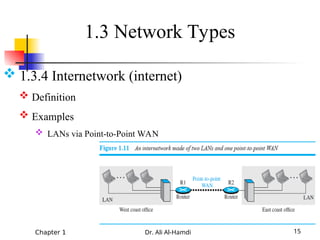
 1.3.4 Internetwork (internet)
 Definition
 Examples
 LANs via Point-to-Point WAN
1.3 Network Types
Chapter 1 Dr. Ali Al-Hamdi 16
 1.3.4 Internetwork (internet)
 Examples
 ? WANs and ? LANs
1.3 Network Types
Chapter 1 Dr. Ali Al-Hamdi 17
 1.3.5 Switching
 Definition (internet?)
 Types
 Circuit-Switched Net.
 Packet-Switched Net.
Comparison
1.3 Network Types
Chapter 1 Dr. Ali Al-Hamdi 18
 1.3.6 The Internet
 Definition (Internet)
 Backbones Ownership
 Sprint,
 Verizon (MCI),
 AT&T and
 NNT
1.3 Network Types
Chapter 1 Dr. Ali Al-Hamdi 19
 1.3.7 Accessing the Internet
 Using Telephone Networks
 Dial-up service
 DSL Service
 Using TV Cable Networks
 Using Wireless Networks
 Direct Connection to the Internet
1.3 Network Types
Chapter 1 Dr. Ali Al-Hamdi 20
 1.4.1 Early History
 Communication Nets. (telegraph and telephone) before 1960,
 Birth of packet-switched Networks theories (1961) at MIT (US)
and NPL (UK) at the same time,
 ARPA idea of finding a way to connect mainframe computers
(mid 1960) at DOD,
 In1967, at ACM, ARPA presented its idea, a small net. to connect
computers (ARPANET) using IMP (Interface Message Processor),
 By 1969, ARPANET was in reality, 4 USA universities was
connected by IMP and their communications were controlled by a
NCP (Network Control Protocol) S/W.
1.4 Internet History
Chapter 1 Dr. Ali Al-Hamdi 21
 1.4.2 Birth of the Internet
 Gateway idea as an intermediary H/W to transfer data
from one net. to another (dissimilar nets.) in 1972.
 TCP/IP evolution
 In 1973, idea of achieving end-to-end data delivery protocols.
So, TCP net. version of NCP including encapsulation, the
datagram, the functions of a gateway, and error correction.
ARPANET responsibility was handed over to the Defense
Communication Agency (DCA).
 In 1977, an internet consisting of three different networks
(ARPANET, packet radio, and packet satellite) was
successfully demonstrated.
1.4 Internet History
Chapter 1 Dr. Ali Al-Hamdi 22
 1.4.2 Birth of the Internet
 TCP/IP evolution
 Shortly thereafter, a decision was made to split TCP into two
protocols: (TCP) for segmentation, reassembly, and error
detection and (IP) for datagram routing. Birth of TCP/IP.
 In 1981, under a Defence Department contract, UC Berkeley
upgraded the UNIX operating system to include TCP/IP giving
much for the popularity of internetworking.
 In 1983, TCP/IP became the official protocol for the
ARPANET.
1.4 Internet History
Chapter 1 Dr. Ali Al-Hamdi 23
 1.4.2 Birth of the Internet
 MILNET (1983): ARPANET split into two networks: Military
Network (MILNET) and ARPANET as nonmilitary.
 CSNET (1981) was created for scientific purposes and sponsored
by (NSF). Mid 1980s, most U.S. universities with computer
science departments were part of CSNET.
 NSFNET
In 1986, NSF sponsored NSFNET, a backbone that connected
5 supercomputer centers throughout the US, via T-line
(1.544Mbps).
1.4 Internet History
Chapter 1 Dr. Ali Al-Hamdi 24
 1.4.2 Birth of the Internet
 NSFNET
 In 1990, ARPANET was officially retired and replaced by
NSFNET,
 In 1995, NSFNET reverted back to its original concept of a
research network..
 In 1991: a high-speed Internet backbone called Advanced Network
Services Network (ANSNET) was built by 3 companies IBM,
Merit, and Verizon, forming a nonprofit organization called
Advanced Network & Services (ANS), that replaced NSFNET.
 Internet responsibility moved from USA government to NPOs.
1.4 Internet History
Chapter 1 Dr. Ali Al-Hamdi 25
 1.4.3 Internet Today
 WWW (1990)
 Invented at CERN by Tim Berners-Lee.
The commercial applications were added to the
Internet.
Multimedia (Voice over IP, Video over IP (Skype), view
sharing (YouTube), TV over IP (PPLive)).
 P2P applications
 Recently?!
1.4 Internet History
Chapter 1 Dr. Ali Al-Hamdi 26
 1.5.1 Internet Standards
 Definition
 IS development Procedure
 Internet draft
 Request For Comments (RFCs)
 RFC Maturity Levels
1.5 Standards and Administration
Chapter 1 Dr. Ali Al-Hamdi 27
 1.5.1 Internet Standards
 RFC Maturity Levels
 Proposed Standard: is a specification that is stable, well
understood, and usually tested and implemented by several
different groups.
 Draft Standard: A proposed standard is elevated to draft
standard status after at least two successful independent and
interoperable implementations.
 Internet Standard: A draft standard reaches Internet standard
status after demonstrations of successful implementation.
1.5 Standards and Administration
Chapter 1 Dr. Ali Al-Hamdi 28
 1.5.1 Internet Standards
 RFC Maturity Levels
 Historic: The historic RFCs either have been superseded by
later specifications or have never passed the necessary
maturity levels to become an Internet standard.
 Experimental: An RFC classified as experimental describes
work related to an experimental situation that does not affect
the operation of the Internet.
 Informational: An RFC classified as informational contains
general, historical, or tutorial information related to the
Internet.
1.5 Standards and Administration
Chapter 1 Dr. Ali Al-Hamdi 29
 1.5.1 Internet Standards
 Requirements Levels
 Required: An RFC must be implemented by all Internet systems to
achieve minimum conformance. For example, IP and ICMP are required
protocol.
 Recommended: An RFC is not required for minimum conformance. For
example, FTP and TELNET are recommended protocols.
 Elective: An RFC is not required and not recommended. However, a
system can use it for its own benefit.
1.5 Standards and Administration
Chapter 1 Dr. Ali Al-Hamdi 30
 1.5.1 Internet Standards
 Requirements Levels
 Limited use: An RFC should be used only in limited situations. Most of
the experimental RFCs fall under this category.
 Not Recommended: An RFC use should be used only in limited
situations. Most of the experimental RFCs fall under this category.
1.5 Standards and Administration
Chapter 1 Dr. Ali Al-Hamdi 31
 1.5.2 Internet Administration
 IA Origins?
 ISOC
 Formed in 1992, as an international NPO,
 Provides support for Internet standads process,
 Supporting internet bodies such as IAB, IRTF, and IETF.
 Promotes research and other activities related to the Internet.
1.5 Standards and Administration
Chapter 1 Dr. Ali Al-Hamdi 32
 1.5.2 Internet Administration
 ISOC Bodies
 Internet Architecture Board (IAB) Technical
advisor to ISOC for TCP/IP and Int. community.
 IETF: managed by IESG
 IRTF: managed by IRSG
1.5 Standards and Administration

Networking and data communication presentation slides

  • 1.
    Chapter 1 Dr.Ali Al-Hamdi 1 Chapter 1 Introduction Part I: Overview
  • 2.
    Chapter 1 Dr.Ali Al-Hamdi 2  Data Communications roles in our life  Business point of view and the way we live.  Chapter topics  Definitions, characteristics, components, and types of data representations and exchange.  Networks, their elements, criteria, and topologies.  Different types of nets. and concept of switching.  Internet history.  Standards and their organizations. Lead-in
  • 3.
    Chapter 1 Dr.Ali Al-Hamdi 3  1.1.1 Defintions and characteristics  Communication  Telecommunication  Data  Data communication  DCS characteristics (effectiveness-based)  Delivery  Accuracy  Timeliness  Jitter 1.1 Data Communications
  • 4.
    Chapter 1 Dr.Ali Al-Hamdi 4  1.1.2 Components 1.1 Data Communications
  • 5.
    Chapter 1 Dr.Ali Al-Hamdi 5  1.1.3 Data Representation  Text  Numbers  Images  Audio  Video 1.1 Data Communications
  • 6.
    Chapter 1 Dr.Ali Al-Hamdi 6  1.1.4 Data Flow (Types)  Simplex  Example  Channel capacity  ½ Duplex  Example  Channel capacity  Full-duplex  Example  Channel capacity 1.1 Data Communications
  • 7.
    Chapter 1 Dr.Ali Al-Hamdi 7  1.2.1 Defintions  Network  Network Elements  1.2.2 Netwrork Criteria  Performance  Performance measures: (transit time + response time) which depend on a number of factors.  Performance evaluated by 2metrics : throughput and Delay.  Reliability  Security 1.2 Networks
  • 8.
    Chapter 1 Dr.Ali Al-Hamdi 8  1.2.3 Physical Structure  Types of connections  Point-to-point: definition, examples.  Multipoint (multidrop): definition, examples, and sharing methods (spatial and temporal) 1.2 Networks
  • 9.
    Chapter 1 Dr.Ali Al-Hamdi 9  1.2.3 Physical Structure: Topology  Definition: physical topology + network topology.  Types: 3  Mesh topology  Type of connection  Advantages  Disadvantages  Example of application 1.2 Networks
  • 10.
    Chapter 1 Dr.Ali Al-Hamdi 10  1.2.3 Physical Structure: Topologies  Star topology  Type of connection  Advantages  Disadvantages  Example of application 1.2 Networks
  • 11.
    Chapter 1 Dr.Ali Al-Hamdi 11  1.2.3 Physical Structure: Topologies  Bus topology  Type of connection  Advantages  Disadvantages  Example of application 1.2 Networks
  • 12.
    Chapter 1 Dr.Ali Al-Hamdi 12  1.2.3 Physical Structure: Topologies  Ring topology  Type of connection  Advantages  Disadvantages  Example of application 1.2 Networks
  • 13.
    Chapter 1 Dr.Ali Al-Hamdi 13  1.3.1 Difficulty of distinguishing the criteria of net. types?  1.3.2 LAN  Definition  Topologies used  Relation to other types 1.3 Network Types
  • 14.
    Chapter 1 Dr.Ali Al-Hamdi 14  1.3.3 WAN  Definition  Types  Point-to-Point WAN  Switched WAN 1.3 Network Types
  • 15.
    Chapter 1 Dr.Ali Al-Hamdi 15  1.3.4 Internetwork (internet)  Definition  Examples  LANs via Point-to-Point WAN 1.3 Network Types
  • 16.
    Chapter 1 Dr.Ali Al-Hamdi 16  1.3.4 Internetwork (internet)  Examples  ? WANs and ? LANs 1.3 Network Types
  • 17.
    Chapter 1 Dr.Ali Al-Hamdi 17  1.3.5 Switching  Definition (internet?)  Types  Circuit-Switched Net.  Packet-Switched Net. Comparison 1.3 Network Types
  • 18.
    Chapter 1 Dr.Ali Al-Hamdi 18  1.3.6 The Internet  Definition (Internet)  Backbones Ownership  Sprint,  Verizon (MCI),  AT&T and  NNT 1.3 Network Types
  • 19.
    Chapter 1 Dr.Ali Al-Hamdi 19  1.3.7 Accessing the Internet  Using Telephone Networks  Dial-up service  DSL Service  Using TV Cable Networks  Using Wireless Networks  Direct Connection to the Internet 1.3 Network Types
  • 20.
    Chapter 1 Dr.Ali Al-Hamdi 20  1.4.1 Early History  Communication Nets. (telegraph and telephone) before 1960,  Birth of packet-switched Networks theories (1961) at MIT (US) and NPL (UK) at the same time,  ARPA idea of finding a way to connect mainframe computers (mid 1960) at DOD,  In1967, at ACM, ARPA presented its idea, a small net. to connect computers (ARPANET) using IMP (Interface Message Processor),  By 1969, ARPANET was in reality, 4 USA universities was connected by IMP and their communications were controlled by a NCP (Network Control Protocol) S/W. 1.4 Internet History
  • 21.
    Chapter 1 Dr.Ali Al-Hamdi 21  1.4.2 Birth of the Internet  Gateway idea as an intermediary H/W to transfer data from one net. to another (dissimilar nets.) in 1972.  TCP/IP evolution  In 1973, idea of achieving end-to-end data delivery protocols. So, TCP net. version of NCP including encapsulation, the datagram, the functions of a gateway, and error correction. ARPANET responsibility was handed over to the Defense Communication Agency (DCA).  In 1977, an internet consisting of three different networks (ARPANET, packet radio, and packet satellite) was successfully demonstrated. 1.4 Internet History
  • 22.
    Chapter 1 Dr.Ali Al-Hamdi 22  1.4.2 Birth of the Internet  TCP/IP evolution  Shortly thereafter, a decision was made to split TCP into two protocols: (TCP) for segmentation, reassembly, and error detection and (IP) for datagram routing. Birth of TCP/IP.  In 1981, under a Defence Department contract, UC Berkeley upgraded the UNIX operating system to include TCP/IP giving much for the popularity of internetworking.  In 1983, TCP/IP became the official protocol for the ARPANET. 1.4 Internet History
  • 23.
    Chapter 1 Dr.Ali Al-Hamdi 23  1.4.2 Birth of the Internet  MILNET (1983): ARPANET split into two networks: Military Network (MILNET) and ARPANET as nonmilitary.  CSNET (1981) was created for scientific purposes and sponsored by (NSF). Mid 1980s, most U.S. universities with computer science departments were part of CSNET.  NSFNET In 1986, NSF sponsored NSFNET, a backbone that connected 5 supercomputer centers throughout the US, via T-line (1.544Mbps). 1.4 Internet History
  • 24.
    Chapter 1 Dr.Ali Al-Hamdi 24  1.4.2 Birth of the Internet  NSFNET  In 1990, ARPANET was officially retired and replaced by NSFNET,  In 1995, NSFNET reverted back to its original concept of a research network..  In 1991: a high-speed Internet backbone called Advanced Network Services Network (ANSNET) was built by 3 companies IBM, Merit, and Verizon, forming a nonprofit organization called Advanced Network & Services (ANS), that replaced NSFNET.  Internet responsibility moved from USA government to NPOs. 1.4 Internet History
  • 25.
    Chapter 1 Dr.Ali Al-Hamdi 25  1.4.3 Internet Today  WWW (1990)  Invented at CERN by Tim Berners-Lee. The commercial applications were added to the Internet. Multimedia (Voice over IP, Video over IP (Skype), view sharing (YouTube), TV over IP (PPLive)).  P2P applications  Recently?! 1.4 Internet History
  • 26.
    Chapter 1 Dr.Ali Al-Hamdi 26  1.5.1 Internet Standards  Definition  IS development Procedure  Internet draft  Request For Comments (RFCs)  RFC Maturity Levels 1.5 Standards and Administration
  • 27.
    Chapter 1 Dr.Ali Al-Hamdi 27  1.5.1 Internet Standards  RFC Maturity Levels  Proposed Standard: is a specification that is stable, well understood, and usually tested and implemented by several different groups.  Draft Standard: A proposed standard is elevated to draft standard status after at least two successful independent and interoperable implementations.  Internet Standard: A draft standard reaches Internet standard status after demonstrations of successful implementation. 1.5 Standards and Administration
  • 28.
    Chapter 1 Dr.Ali Al-Hamdi 28  1.5.1 Internet Standards  RFC Maturity Levels  Historic: The historic RFCs either have been superseded by later specifications or have never passed the necessary maturity levels to become an Internet standard.  Experimental: An RFC classified as experimental describes work related to an experimental situation that does not affect the operation of the Internet.  Informational: An RFC classified as informational contains general, historical, or tutorial information related to the Internet. 1.5 Standards and Administration
  • 29.
    Chapter 1 Dr.Ali Al-Hamdi 29  1.5.1 Internet Standards  Requirements Levels  Required: An RFC must be implemented by all Internet systems to achieve minimum conformance. For example, IP and ICMP are required protocol.  Recommended: An RFC is not required for minimum conformance. For example, FTP and TELNET are recommended protocols.  Elective: An RFC is not required and not recommended. However, a system can use it for its own benefit. 1.5 Standards and Administration
  • 30.
    Chapter 1 Dr.Ali Al-Hamdi 30  1.5.1 Internet Standards  Requirements Levels  Limited use: An RFC should be used only in limited situations. Most of the experimental RFCs fall under this category.  Not Recommended: An RFC use should be used only in limited situations. Most of the experimental RFCs fall under this category. 1.5 Standards and Administration
  • 31.
    Chapter 1 Dr.Ali Al-Hamdi 31  1.5.2 Internet Administration  IA Origins?  ISOC  Formed in 1992, as an international NPO,  Provides support for Internet standads process,  Supporting internet bodies such as IAB, IRTF, and IETF.  Promotes research and other activities related to the Internet. 1.5 Standards and Administration
  • 32.
    Chapter 1 Dr.Ali Al-Hamdi 32  1.5.2 Internet Administration  ISOC Bodies  Internet Architecture Board (IAB) Technical advisor to ISOC for TCP/IP and Int. community.  IETF: managed by IESG  IRTF: managed by IRSG 1.5 Standards and Administration