Network Security
Message Authentication
UNIT-2
Topics
Basic concepts
Authentication Methods
Message Digest
Authentication Service
Message Authentication
Message authentication is the process of verifying the integrity and authenticity
of a message. In other words, it ensures that:
1.Integrity: The message has not been altered or tampered with during
transmission.
2.Authenticity: The message indeed comes from the claimed sender (i.e., it is
not spoofed).
Message Authentication
To achieve message authentication, cryptographic methods such as Message
Authentication Codes (MACs) or digital signatures are commonly used.
These methods rely on shared secrets, private keys, or public-key infrastructure
to verify that the data has not been changed and that it originates from the
correct source.
Message Authentication Code
(MAC)
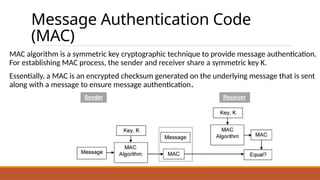
MAC algorithm is a symmetric key cryptographic technique to provide message authentication.
For establishing MAC process, the sender and receiver share a symmetric key K.
Essentially, a MAC is an encrypted checksum generated on the underlying message that is sent
along with a message to ensure message authentication.
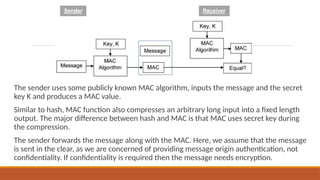
The sender uses some publicly known MAC algorithm, inputs the message and the secret
key K and produces a MAC value.
Similar to hash, MAC function also compresses an arbitrary long input into a fixed length
output. The major difference between hash and MAC is that MAC uses secret key during
the compression.
The sender forwards the message along with the MAC. Here, we assume that the message
is sent in the clear, as we are concerned of providing message origin authentication, not
confidentiality. If confidentiality is required then the message needs encryption.
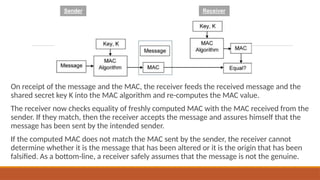
On receipt of the message and the MAC, the receiver feeds the received message and the
shared secret key K into the MAC algorithm and re-computes the MAC value.
The receiver now checks equality of freshly computed MAC with the MAC received from the
sender. If they match, then the receiver accepts the message and assures himself that the
message has been sent by the intended sender.
If the computed MAC does not match the MAC sent by the sender, the receiver cannot
determine whether it is the message that has been altered or it is the origin that has been
falsified. As a bottom-line, a receiver safely assumes that the message is not the genuine.
Limitations of MAC
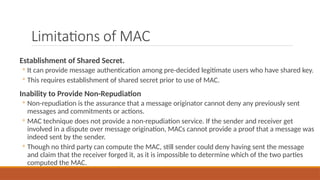
Establishment of Shared Secret.
◦ It can provide message authentication among pre-decided legitimate users who have shared key.
◦ This requires establishment of shared secret prior to use of MAC.
Inability to Provide Non-Repudiation
◦ Non-repudiation is the assurance that a message originator cannot deny any previously sent
messages and commitments or actions.
◦ MAC technique does not provide a non-repudiation service. If the sender and receiver get
involved in a dispute over message origination, MACs cannot provide a proof that a message was
indeed sent by the sender.
◦ Though no third party can compute the MAC, still sender could deny having sent the message
and claim that the receiver forged it, as it is impossible to determine which of the two parties
computed the MAC.
Digital Signatures
Digital signatures are the public-key primitives of message authentication. In the
physical world, it is common to use handwritten signatures on handwritten or
typed messages. They are used to bind signatory to the message.
Similarly, a digital signature is a technique that binds a person/entity to the
digital data. This binding can be independently verified by receiver as well as any
third party.
Digital signature is a cryptographic value that is calculated from the data and a
secret key known only by the signer.
In real world, the receiver of message needs assurance that the message
belongs to the sender and he should not be able to repudiate the origination of
that message. This requirement is very crucial in business applications, since
likelihood of a dispute over exchanged data is very high.
Model of digital signature
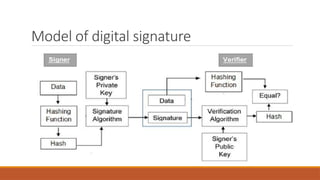
Each person adopting this scheme has a public-private key pair.
Generally, the key pairs used for encryption/decryption and signing/verifying are
different. The private key used for signing is referred to as the signature key and the
public key as the verification key.
Signer feeds data to the hash function and generates hash of data.
Hash value and signature key are then fed to the signature algorithm which produces the
digital signature on given hash. Signature is appended to the data and then both are sent
to the verifier.
Model of digital signature
Verifier feeds the digital signature and the verification key into the verification
algorithm. The verification algorithm gives some value as output.
Verifier also runs same hash function on received data to generate hash value.
For verification, this hash value and output of verification algorithm are
compared. Based on the comparison result, verifier decides whether the digital
signature is valid.
Since digital signature is created by ‘private’ key of signer and no one else can
have this key; the signer cannot repudiate signing the data in future.
Importance of digital signature
Message authentication − When the verifier validates the digital signature using
public key of a sender, he is assured that signature has been created only by
sender who possess the corresponding secret private key and no one else.
Data Integrity − In case an attacker has access to the data and modifies it, the
digital signature verification at receiver end fails. The hash of modified data and
the output provided by the verification algorithm will not match. Hence, receiver
can safely deny the message assuming that data integrity has been breached.
Non-repudiation − Since it is assumed that only the signer has the knowledge of
the signature key, he can only create unique signature on a given data. Thus the
receiver can present data and the digital signature to a third party as evidence if
any dispute arises in the future.
Encryption with Digital Signature
In many digital communications, it is desirable to exchange an encrypted
messages than plaintext to achieve confidentiality.
In public key encryption scheme, a public (encryption) key of sender is available
in open domain, and hence anyone can spoof his identity and send any
encrypted message to the receiver.
This makes it essential for users employing PKC for encryption to seek digital
signatures along with encrypted data to be assured of message authentication
and non-repudiation.
This can achived by combining digital signatures with encryption scheme. There
are two possibilities, sign-then-encrypt and encrypt-then-sign.
Encryption with Digital Signature
However, the crypto system based on sign-then-encrypt can be exploited by receiver to
spoof identity of sender and sent that data to third party. Hence, this method is not
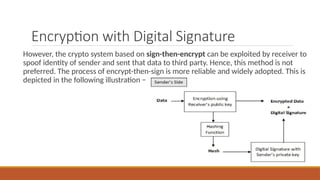
preferred. The process of encrypt-then-sign is more reliable and widely adopted. This is
depicted in the following illustration −
Encryption with Digital Signature
The receiver after receiving the encrypted data and signature on it, first verifies
the signature using sender’s public key.
After ensuring the validity of the signature, he then retrieves the data through
decryption using his private key.
Public Key Infrastructure
The most distinct feature of Public Key Infrastructure (PKI) is that it uses a pair of
keys to achieve the underlying security service.
The key pair comprises of private key and public key.
Since the public keys are in open domain, they are likely to be abused.
It is, thus, necessary to establish and maintain some kind of trusted
infrastructure to manage these keys.
Key Management
The security of any cryptosystem depends upon how securely its keys are
managed.
Without secure procedures for the handling of cryptographic keys, the benefits
of the use of strong cryptographic schemes are potentially lost.
It is observed that cryptographic schemes are rarely compromised through
weaknesses in their design. However, they are often compromised through poor
key management.
There are some important aspects of key management which are as follows −
1. Cryptographic keys are nothing but special pieces of data. Key management
refers to the secure administration of cryptographic keys.
Key Management
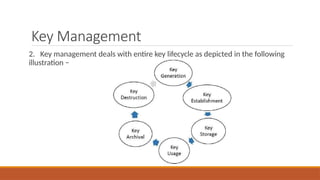
2. Key management deals with entire key lifecycle as depicted in the following
illustration −
Key Management
There are two specific requirements of key management for public key
cryptography.
◦ Secrecy of private keys. Throughout the key lifecycle, secret keys must remain
secret from all parties except those who are owner and are authorized to use
them.
◦ Assurance of public keys. In public key cryptography, the public keys are in open
domain and seen as public pieces of data. By default there are no assurances of
whether a public key is correct, with whom it can be associated, or what it can
be used for. Thus key management of public keys needs to focus much more
explicitly on assurance of purpose of public keys.
Public Key Infrastructure (PKI)
The most crucial requirement of ‘assurance of public key’ can be achieved
through the public-key infrastructure (PKI), a key management systems for
supporting public-key cryptography.
PKI Components are:
1. Public Key Certificate, commonly referred to as ‘digital certificate’.
2. Private Key tokens.
3. Certification Authority.
4. Registration Authority.
5. Certificate Management System.
Digital Certificate
People use ID cards such as a driver's license, passport to prove their identity.
A digital certificate does the same basic thing in the electronic world, but with
one difference.
Digital Certificates are not only issued to people but they can be issued to
computers, software packages or anything else that need to prove the identity
in the electronic world.
Digital Certificate
Digital certificates are based on the ITU standard X.509 which defines a standard
certificate format for public key certificates and certification validation. Hence digital
certificates are sometimes also referred to as X.509 certificates.
Public key pertaining to the user client is stored in digital certificates by The
Certification Authority (CA) along with other relevant information such as client
information, expiration date, usage, issuer etc.
CA digitally signs this entire information and includes digital signature in the
certificate.
Anyone who needs the assurance about the public key and associated information of
client, he carries out the signature validation process using CA’s public key. Successful
validation assures that the public key given in the certificate belongs to the person
whose details are given in the certificate.
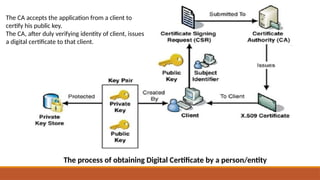
The process of obtaining Digital Certificate by a person/entity
The CA accepts the application from a client to
certify his public key.
The CA, after duly verifying identity of client, issues
a digital certificate to that client.
Certifying Authority (CA)
The CA issues certificate to a client and assist other users to verify the certificate.
The CA takes responsibility for identifying correctly the identity of the client asking
for a certificate to be issued and ensures that the information contained within the
certificate is correct and digitally signs it.
Key functions of CA
•Generating key pairs − The CA may generate a key pair independently or jointly with the client.
•Issuing digital certificates − The CA could be thought of as the PKI equivalent of a passport agency −
the CA issues a certificate after client provides the credentials to confirm his identity. The CA then
signs the certificate to prevent modification of the details contained in the certificate.
•Publishing Certificates − The CA need to publish certificates so that users can find them. There are
two ways of achieving this. One is to publish certificates in the equivalent of an electronic telephone
directory. The other is to send your certificate out to those people you think might need it by one
means or another.
•Verifying Certificates − The CA makes its public key available in environment to assist verification of
his signature on clients’ digital certificate.
•Revocation of Certificates − At times, CA revokes the certificate issued due to some reason such as
compromise of private key by user or loss of trust in the client. After revocation, CA maintains the
list of all revoked certificate that is available to the environment.
Classes of certificates
Class 1 − These certificates can be easily acquired by supplying an email address.
Class 2 − These certificates require additional personal information to be
supplied.
Class 3 − These certificates can only be purchased after checks have been made
about the requestor’s identity.
Class 4 − They may be used by governments and financial organizations needing
very high levels of trust.
Registration Authority (RA)
CA may use a third-party Registration Authority (RA) to perform the necessary
checks on the person or company requesting the certificate to confirm their
identity.
The RA may appear to the client as a CA, but they do not actually sign the
certificate that is issued.
Certificate Management System (CMS)
It is the management system through which certificates are published,
temporarily or permanently suspended, renewed, or revoked.
Certificate management systems do not normally delete certificates because it
may be necessary to prove their status at a point in time, perhaps for legal
reasons.
A CA along with associated RA runs certificate management systems to be able
to track their responsibilities and liabilities.
Private Key Tokens
While the public key of a client is stored on the certificate, the associated secret
private key can be stored on the key owner’s computer. This method is generally
not adopted.
If an attacker gains access to the computer, he can easily gain access to private
key. For this reason, a private key is stored on secure removable storage token
access to which is protected through a password.
Different vendors often use different and sometimes proprietary storage formats
for storing keys. For example, Entrust uses the proprietary .epf format, while
Verisign, GlobalSign, and Baltimore use the standard .p12 format.
Hierarchy of CA
With vast networks and requirements of global communications, it is practically
not feasible to have only one trusted CA from whom all users obtain their
certificates.
Secondly, availability of only one CA may lead to difficulties if CA is
compromised.
In such case, the hierarchical certification model is of interest since it allows
public key certificates to be used in environments where two communicating
parties do not have trust relationships with the same CA.
Hierarchy of CA
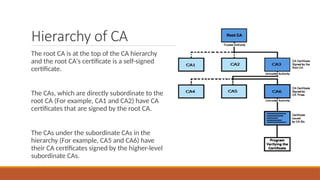
The root CA is at the top of the CA hierarchy
and the root CA's certificate is a self-signed
certificate.
The CAs, which are directly subordinate to the
root CA (For example, CA1 and CA2) have CA
certificates that are signed by the root CA.
The CAs under the subordinate CAs in the
hierarchy (For example, CA5 and CA6) have
their CA certificates signed by the higher-level
subordinate CAs.
Hierarchy of CA
A client whose authenticity is being verified supplies his certificate, generally
along with the chain of certificates up to Root CA.
Verifier takes the certificate and validates by using public key of issuer. The
issuer’s public key is found in the issuer’s certificate which is in the chain next to
client’s certificate.
Now if the higher CA who has signed the issuer’s certificate, is trusted by the
verifier, verification is successful and stops here.
Else, the issuer's certificate is verified in a similar manner as done for client in
above steps. This process continues till either trusted CA is found in between or
else it continues till Root CA.


Network Security Unit-2 topic Part-1.pptx

  • 1.
  • 2.
  • 3.
  • 4.
    Message Authentication Message authenticationis the process of verifying the integrity and authenticity of a message. In other words, it ensures that: 1.Integrity: The message has not been altered or tampered with during transmission. 2.Authenticity: The message indeed comes from the claimed sender (i.e., it is not spoofed).
  • 5.
    Message Authentication To achievemessage authentication, cryptographic methods such as Message Authentication Codes (MACs) or digital signatures are commonly used. These methods rely on shared secrets, private keys, or public-key infrastructure to verify that the data has not been changed and that it originates from the correct source.
  • 6.
    Message Authentication Code (MAC) MACalgorithm is a symmetric key cryptographic technique to provide message authentication. For establishing MAC process, the sender and receiver share a symmetric key K. Essentially, a MAC is an encrypted checksum generated on the underlying message that is sent along with a message to ensure message authentication.
  • 7.
    The sender usessome publicly known MAC algorithm, inputs the message and the secret key K and produces a MAC value. Similar to hash, MAC function also compresses an arbitrary long input into a fixed length output. The major difference between hash and MAC is that MAC uses secret key during the compression. The sender forwards the message along with the MAC. Here, we assume that the message is sent in the clear, as we are concerned of providing message origin authentication, not confidentiality. If confidentiality is required then the message needs encryption.
  • 8.
    On receipt ofthe message and the MAC, the receiver feeds the received message and the shared secret key K into the MAC algorithm and re-computes the MAC value. The receiver now checks equality of freshly computed MAC with the MAC received from the sender. If they match, then the receiver accepts the message and assures himself that the message has been sent by the intended sender. If the computed MAC does not match the MAC sent by the sender, the receiver cannot determine whether it is the message that has been altered or it is the origin that has been falsified. As a bottom-line, a receiver safely assumes that the message is not the genuine.
  • 9.
    Limitations of MAC Establishmentof Shared Secret. ◦ It can provide message authentication among pre-decided legitimate users who have shared key. ◦ This requires establishment of shared secret prior to use of MAC. Inability to Provide Non-Repudiation ◦ Non-repudiation is the assurance that a message originator cannot deny any previously sent messages and commitments or actions. ◦ MAC technique does not provide a non-repudiation service. If the sender and receiver get involved in a dispute over message origination, MACs cannot provide a proof that a message was indeed sent by the sender. ◦ Though no third party can compute the MAC, still sender could deny having sent the message and claim that the receiver forged it, as it is impossible to determine which of the two parties computed the MAC.
  • 10.
    Digital Signatures Digital signaturesare the public-key primitives of message authentication. In the physical world, it is common to use handwritten signatures on handwritten or typed messages. They are used to bind signatory to the message. Similarly, a digital signature is a technique that binds a person/entity to the digital data. This binding can be independently verified by receiver as well as any third party. Digital signature is a cryptographic value that is calculated from the data and a secret key known only by the signer. In real world, the receiver of message needs assurance that the message belongs to the sender and he should not be able to repudiate the origination of that message. This requirement is very crucial in business applications, since likelihood of a dispute over exchanged data is very high.
  • 11.
  • 12.
    Model of digitalsignature Each person adopting this scheme has a public-private key pair. Generally, the key pairs used for encryption/decryption and signing/verifying are different. The private key used for signing is referred to as the signature key and the public key as the verification key. Signer feeds data to the hash function and generates hash of data. Hash value and signature key are then fed to the signature algorithm which produces the digital signature on given hash. Signature is appended to the data and then both are sent to the verifier.
  • 13.
    Model of digitalsignature Verifier feeds the digital signature and the verification key into the verification algorithm. The verification algorithm gives some value as output. Verifier also runs same hash function on received data to generate hash value. For verification, this hash value and output of verification algorithm are compared. Based on the comparison result, verifier decides whether the digital signature is valid. Since digital signature is created by ‘private’ key of signer and no one else can have this key; the signer cannot repudiate signing the data in future.
  • 14.
    Importance of digitalsignature Message authentication − When the verifier validates the digital signature using public key of a sender, he is assured that signature has been created only by sender who possess the corresponding secret private key and no one else. Data Integrity − In case an attacker has access to the data and modifies it, the digital signature verification at receiver end fails. The hash of modified data and the output provided by the verification algorithm will not match. Hence, receiver can safely deny the message assuming that data integrity has been breached. Non-repudiation − Since it is assumed that only the signer has the knowledge of the signature key, he can only create unique signature on a given data. Thus the receiver can present data and the digital signature to a third party as evidence if any dispute arises in the future.
  • 15.
    Encryption with DigitalSignature In many digital communications, it is desirable to exchange an encrypted messages than plaintext to achieve confidentiality. In public key encryption scheme, a public (encryption) key of sender is available in open domain, and hence anyone can spoof his identity and send any encrypted message to the receiver. This makes it essential for users employing PKC for encryption to seek digital signatures along with encrypted data to be assured of message authentication and non-repudiation. This can achived by combining digital signatures with encryption scheme. There are two possibilities, sign-then-encrypt and encrypt-then-sign.
  • 16.
    Encryption with DigitalSignature However, the crypto system based on sign-then-encrypt can be exploited by receiver to spoof identity of sender and sent that data to third party. Hence, this method is not preferred. The process of encrypt-then-sign is more reliable and widely adopted. This is depicted in the following illustration −
  • 17.
    Encryption with DigitalSignature The receiver after receiving the encrypted data and signature on it, first verifies the signature using sender’s public key. After ensuring the validity of the signature, he then retrieves the data through decryption using his private key.
  • 18.
    Public Key Infrastructure Themost distinct feature of Public Key Infrastructure (PKI) is that it uses a pair of keys to achieve the underlying security service. The key pair comprises of private key and public key. Since the public keys are in open domain, they are likely to be abused. It is, thus, necessary to establish and maintain some kind of trusted infrastructure to manage these keys.
  • 19.
    Key Management The securityof any cryptosystem depends upon how securely its keys are managed. Without secure procedures for the handling of cryptographic keys, the benefits of the use of strong cryptographic schemes are potentially lost. It is observed that cryptographic schemes are rarely compromised through weaknesses in their design. However, they are often compromised through poor key management. There are some important aspects of key management which are as follows − 1. Cryptographic keys are nothing but special pieces of data. Key management refers to the secure administration of cryptographic keys.
  • 20.
    Key Management 2. Keymanagement deals with entire key lifecycle as depicted in the following illustration −
  • 21.
    Key Management There aretwo specific requirements of key management for public key cryptography. ◦ Secrecy of private keys. Throughout the key lifecycle, secret keys must remain secret from all parties except those who are owner and are authorized to use them. ◦ Assurance of public keys. In public key cryptography, the public keys are in open domain and seen as public pieces of data. By default there are no assurances of whether a public key is correct, with whom it can be associated, or what it can be used for. Thus key management of public keys needs to focus much more explicitly on assurance of purpose of public keys.
  • 22.
    Public Key Infrastructure(PKI) The most crucial requirement of ‘assurance of public key’ can be achieved through the public-key infrastructure (PKI), a key management systems for supporting public-key cryptography. PKI Components are: 1. Public Key Certificate, commonly referred to as ‘digital certificate’. 2. Private Key tokens. 3. Certification Authority. 4. Registration Authority. 5. Certificate Management System.
  • 23.
    Digital Certificate People useID cards such as a driver's license, passport to prove their identity. A digital certificate does the same basic thing in the electronic world, but with one difference. Digital Certificates are not only issued to people but they can be issued to computers, software packages or anything else that need to prove the identity in the electronic world.
  • 24.
    Digital Certificate Digital certificatesare based on the ITU standard X.509 which defines a standard certificate format for public key certificates and certification validation. Hence digital certificates are sometimes also referred to as X.509 certificates. Public key pertaining to the user client is stored in digital certificates by The Certification Authority (CA) along with other relevant information such as client information, expiration date, usage, issuer etc. CA digitally signs this entire information and includes digital signature in the certificate. Anyone who needs the assurance about the public key and associated information of client, he carries out the signature validation process using CA’s public key. Successful validation assures that the public key given in the certificate belongs to the person whose details are given in the certificate.
  • 25.
    The process ofobtaining Digital Certificate by a person/entity The CA accepts the application from a client to certify his public key. The CA, after duly verifying identity of client, issues a digital certificate to that client.
  • 26.
    Certifying Authority (CA) TheCA issues certificate to a client and assist other users to verify the certificate. The CA takes responsibility for identifying correctly the identity of the client asking for a certificate to be issued and ensures that the information contained within the certificate is correct and digitally signs it.
  • 27.
    Key functions ofCA •Generating key pairs − The CA may generate a key pair independently or jointly with the client. •Issuing digital certificates − The CA could be thought of as the PKI equivalent of a passport agency − the CA issues a certificate after client provides the credentials to confirm his identity. The CA then signs the certificate to prevent modification of the details contained in the certificate. •Publishing Certificates − The CA need to publish certificates so that users can find them. There are two ways of achieving this. One is to publish certificates in the equivalent of an electronic telephone directory. The other is to send your certificate out to those people you think might need it by one means or another. •Verifying Certificates − The CA makes its public key available in environment to assist verification of his signature on clients’ digital certificate. •Revocation of Certificates − At times, CA revokes the certificate issued due to some reason such as compromise of private key by user or loss of trust in the client. After revocation, CA maintains the list of all revoked certificate that is available to the environment.
  • 28.
    Classes of certificates Class1 − These certificates can be easily acquired by supplying an email address. Class 2 − These certificates require additional personal information to be supplied. Class 3 − These certificates can only be purchased after checks have been made about the requestor’s identity. Class 4 − They may be used by governments and financial organizations needing very high levels of trust.
  • 29.
    Registration Authority (RA) CAmay use a third-party Registration Authority (RA) to perform the necessary checks on the person or company requesting the certificate to confirm their identity. The RA may appear to the client as a CA, but they do not actually sign the certificate that is issued.
  • 30.
    Certificate Management System(CMS) It is the management system through which certificates are published, temporarily or permanently suspended, renewed, or revoked. Certificate management systems do not normally delete certificates because it may be necessary to prove their status at a point in time, perhaps for legal reasons. A CA along with associated RA runs certificate management systems to be able to track their responsibilities and liabilities.
  • 31.
    Private Key Tokens Whilethe public key of a client is stored on the certificate, the associated secret private key can be stored on the key owner’s computer. This method is generally not adopted. If an attacker gains access to the computer, he can easily gain access to private key. For this reason, a private key is stored on secure removable storage token access to which is protected through a password. Different vendors often use different and sometimes proprietary storage formats for storing keys. For example, Entrust uses the proprietary .epf format, while Verisign, GlobalSign, and Baltimore use the standard .p12 format.
  • 32.
    Hierarchy of CA Withvast networks and requirements of global communications, it is practically not feasible to have only one trusted CA from whom all users obtain their certificates. Secondly, availability of only one CA may lead to difficulties if CA is compromised. In such case, the hierarchical certification model is of interest since it allows public key certificates to be used in environments where two communicating parties do not have trust relationships with the same CA.
  • 33.
    Hierarchy of CA Theroot CA is at the top of the CA hierarchy and the root CA's certificate is a self-signed certificate. The CAs, which are directly subordinate to the root CA (For example, CA1 and CA2) have CA certificates that are signed by the root CA. The CAs under the subordinate CAs in the hierarchy (For example, CA5 and CA6) have their CA certificates signed by the higher-level subordinate CAs.
  • 34.
    Hierarchy of CA Aclient whose authenticity is being verified supplies his certificate, generally along with the chain of certificates up to Root CA. Verifier takes the certificate and validates by using public key of issuer. The issuer’s public key is found in the issuer’s certificate which is in the chain next to client’s certificate. Now if the higher CA who has signed the issuer’s certificate, is trusted by the verifier, verification is successful and stops here. Else, the issuer's certificate is verified in a similar manner as done for client in above steps. This process continues till either trusted CA is found in between or else it continues till Root CA.