
SEMINAR ON
PARALLEL COMPUTING
   Niranjana Ambadi
      B090404EC
What does “parallel” mean?

ACCORDING TO WEBSTER, PARALLEL IS
“AN ARRANGEMENT OR STATE THAT
PERMITS SEVERAL OPERATIONS OR
TASKS TO BE PERFORMED
SIMULTANEOUSLY RATHER THAN
CONSECUTIVELY.”
What is a parallel computer?

“A LARGE COLLECTION OF
PROCESSING ELEMENTS THAT CAN
COMMUNICATE AND COOPERATE
TO SOLVE LARGE PROBLEMS FAST.”
PARALLELISM
• Parallel computing -form of computation in which
  many calculations are carried out simultaneously.
• Parallel computers can be roughly classified according
  to the level at which the hardware supports
  parallelism.
• Multi-core and Multi-processor computers have
  multiple processing elements within a single
  machine;clusters and grids use multiple computers to
  work on the same task. Specialized parallel computer
  architectures are used alongside traditional processors,
  for accelerating specific tasks,eg GPUs.
Flynn’s taxonomy

 SISD(Single Instruction Single Data)
 SIMD(Single Instruction Multiple Data)-
  available on CPU enables single op on multiple
  data at once.
 MISD(Multiple Instruction Single Data)
 MIMD(Multiple Instruction Multiple Data)-
  several cores on a single die
Parallelism-How?
• Task parallelism
• Data parallelism
• Recent CPU-several parallelisation techniques-
  branch prediction,out of order
  execution,superscalar
• These increase complexity,limiting the number of
  CPUs on a single chip.
• GPU each processing unit is simple,but large
  number on a single chip
Parallel Architectures
Three popular:
1. Shared memory (uniform memory access and
   symmetric multiprocessing),
2. Distributed memory (clusters and network of
   workstations), and
3. Shared Distributed (non-uniform memory
   access)
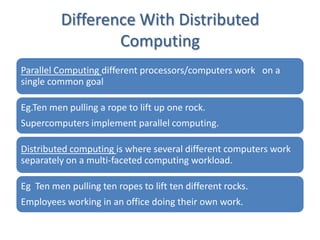
Difference With Distributed
                  Computing
Parallel Computing different processors/computers work on a
single common goal

Eg.Ten men pulling a rope to lift up one rock.
Supercomputers implement parallel computing.

Distributed computing is where several different computers work
separately on a multi-faceted computing workload.

Eg Ten men pulling ten ropes to lift ten different rocks.
Employees working in an office doing their own work.
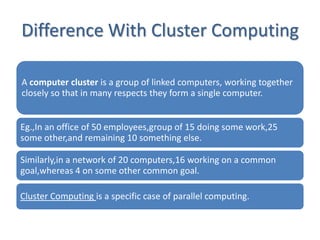
Difference With Cluster Computing

A computer cluster is a group of linked computers, working together
closely so that in many respects they form a single computer.


Eg.,In an office of 50 employees,group of 15 doing some work,25
some other,and remaining 10 something else.

Similarly,in a network of 20 computers,16 working on a common
goal,whereas 4 on some other common goal.

Cluster Computing is a specific case of parallel computing.
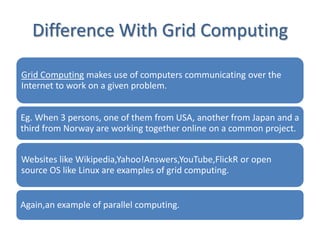
Difference With Grid Computing

Grid Computing makes use of computers communicating over the
Internet to work on a given problem.


Eg. When 3 persons, one of them from USA, another from Japan and a
third from Norway are working together online on a common project.


Websites like Wikipedia,Yahoo!Answers,YouTube,FlickR or open
source OS like Linux are examples of grid computing.


Again,an example of parallel computing.
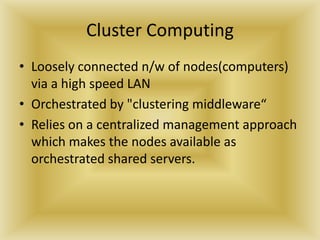
Cluster Computing
• Loosely connected n/w of nodes(computers)
  via a high speed LAN
• Orchestrated by "clustering middleware“
• Relies on a centralized management approach
  which makes the nodes available as
  orchestrated shared servers.
GPU-Graphics Processing Unit
• the dominant , massively parallel architecture
  available to the masses.
• simple yet energy-efficient computational
cores,
• thousands of simultaneously active fine-
  grained threads, and
Where are GPUs used?
Designed for a particular class of applications
 with the following characteristics:

Computational requirements are large.
Parallelism is substantial.
Throughput is more important than latency.
Fixed function GPUs
• The hardware in any given stage could exploit
  data parallelism within that stage, processing
  multiple elements at the same time.
• Each stage’s hardware customized for its given
  task
• a lengthy, feed-forward GPU pipeline with many
  stages, each typically accelerated by special
  purpose parallel hardware.
• Advantage-High throughput
• Disadvantage-Load balancing
GPU evolution
6 years ago                      Today
• A fixed-function processor     • a full fledge parallel
• built around the graphics        programmable processor
   pipeline                      • both application
• Best described as additions      programming interface
   of programmability to fixed     (APIs) and hardware
   function pipeline             • increasingly focusing on the
                                   programmable aspects of
                                   the GPU-vertex pgms &
                                   fragment pgms
Remote Sensing Processing

• On-the-flow processing: part by part
• Most algorithm do not consider neighborhood
  of each pixel
• Development of languages like CUDA and
  OpenCL motivated programmers to
  heterogenous processing platforms
Challenges for parallel-computing
                 chips
1. Power supply voltage scaling diminishing
2. memory bandwidth improvements is slowing
   down
3. Programmability
  – Memory model
  – Degree of parallelism
  – Heterogeneity
4. Research still going strong in parallel
   computing
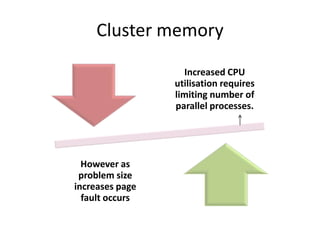
Cluster memory
                   Increased CPU
                 utilisation requires
                 limiting number of
                 parallel processes.


  However as
 problem size
increases page
  fault occurs
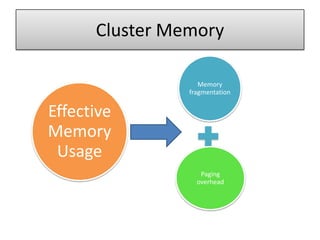
Cluster Memory

                   Memory
                fragmentation


Effective
Memory
 Usage
                   Paging
                  overhead
.

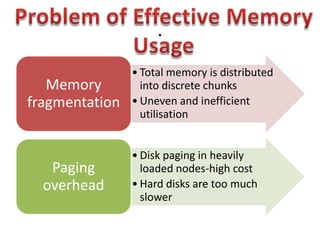
                • Total memory is distributed
   Memory         into discrete chunks
fragmentation   • Uneven and inefficient
                  utilisation


                • Disk paging in heavily
   Paging         loaded nodes-high cost
  overhead      • Hard disks are too much
                  slower
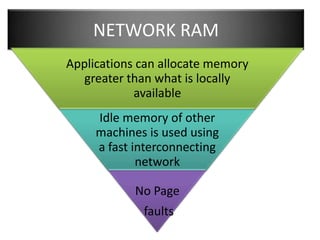
NETWORK RAM
Applications can allocate memory
   greater than what is locally
            available
     Idle memory of other
     machines is used using
     a fast interconnecting
             network

            No Page
             faults
.


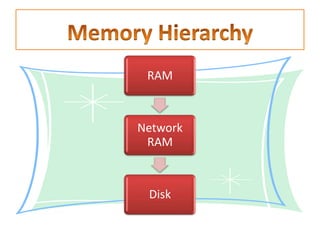
 RAM


Network
 RAM


 Disk
Disadvantages of existing NRAM
• Parallel job divides into processes which needs
  to be synchronised regularly.
• Nodes seek NRAM independently, uneven
  amount maybe granted-processes run at
  different speeds
• The whole job is limited by speed of the
  slowest process
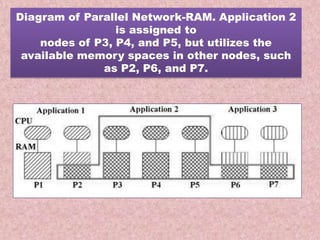
Diagram of Parallel Network-RAM. Application 2
                 is assigned to
    nodes of P3, P4, and P5, but utilizes the
 available memory spaces in other nodes, such
              as P2, P6, and P7.
Generic Description
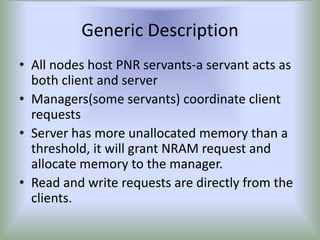
• All nodes host PNR servants-a servant acts as
  both client and server
• Managers(some servants) coordinate client
  requests
• Server has more unallocated memory than a
  threshold, it will grant NRAM request and
  allocate memory to the manager.
• Read and write requests are directly from the
  clients.
Generic Description


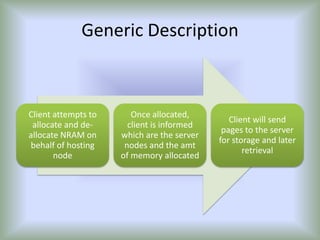
Client attempts to      Once allocated,
                                               Client will send
 allocate and de-      client is informed
                                             pages to the server
allocate NRAM on     which are the server
                                            for storage and later
behalf of hosting     nodes and the amt
                                                   retrieval
       node          of memory allocated
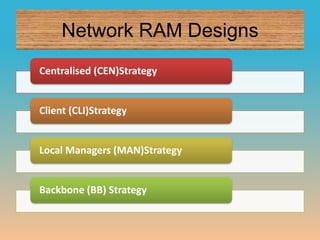
Network RAM Designs
Centralised (CEN)Strategy


Client (CLI)Strategy


Local Managers (MAN)Strategy


Backbone (BB) Strategy
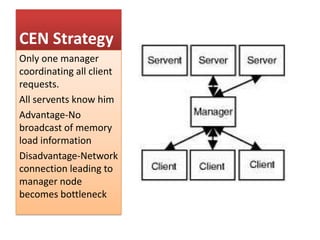
CEN Strategy
Only one manager
coordinating all client
requests.
All servents know him
Advantage-No
broadcast of memory
load information
Disadvantage-Network
connection leading to
manager node
becomes bottleneck
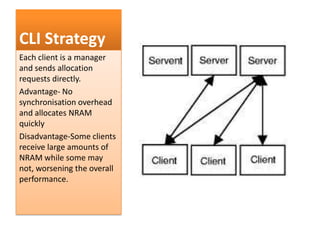
CLI Strategy
Each client is a manager
and sends allocation
requests directly.
Advantage- No
synchronisation overhead
and allocates NRAM
quickly
Disadvantage-Some clients
receive large amounts of
NRAM while some may
not, worsening the overall
performance.
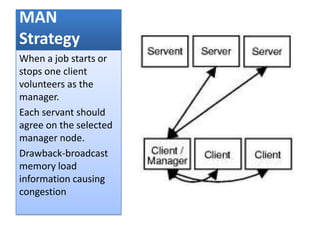
MAN
Strategy
When a job starts or
stops one client
volunteers as the
manager.
Each servant should
agree on the selected
manager node.
Drawback-broadcast
memory load
information causing
congestion
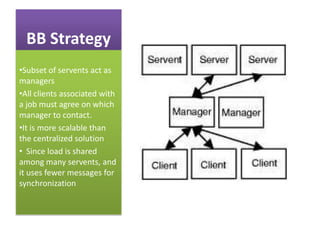
BB Strategy
•Subset of servents act as
managers
•All clients associated with
a job must agree on which
manager to contact.
•It is more scalable than
the centralized solution
• Since load is shared
among many servents, and
it uses fewer messages for
synchronization
Models
• Each node-33 MHz,32 MB local RAM,hard
  disk with seek time=9ms transfer rate 50
  MB/s
• Ethernet 100 Mbps star topology
• Each link latency 50 ns,central switch
  processing delay 80 microsec.
• No collisions
• System tasks by separate dedicated
  processors
• One centralised scheduler for the system
• Cache hit ratio of 50% ,memory access every
  4 clock cycles is assumed.
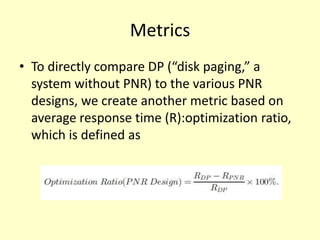
Metrics
• To directly compare DP (“disk paging,” a
  system without PNR) to the various PNR
  designs, we create another metric based on
  average response time (R):optimization ratio,
  which is defined as
Experimental set up
• We evaluate the performance of PNRAM
  under the following situations:
1. Varying memory loads
2. Varying network speeds
3. Different network topologies
4. Different scheduling strategies
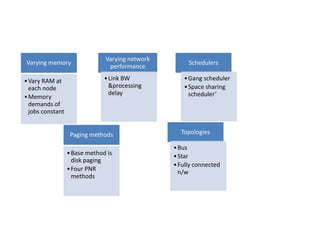
Varying network
Varying memory                                        Schedulers
                                performance

• Vary RAM at                  • Link BW            • Gang scheduler
  each node                      &processing        • Space sharing
                                 delay                scheduler’
• Memory
  demands of
  jobs constant


                   Paging methods                  Topologies

                                                 • Bus
                  • Base method is               • Star
                    disk paging
                                                 • Fully connected
                  • Four PNR                       n/w
                    methods
Results-1
• As memory load increases,PNR and DP tend to
  infinite response times
• As memory load decreases,the response time
  converges to a constant number
• Adding PNR to systems loaded within some
  bounds (and adequate communication links)
  lead to performance benefit
Results-2
• PNR is very sensitive to network performance
• PNR response time tends to infinity as
  network service time is increased and
  converges to a constant number when service
  time is decreased
• DP does not follow this model
• PNR cannot be considered with low
  BW/comm bottlenecks
Result-3
• In space sharing system,only one process is
  allowed on a node at a time.
• In low load case ,CLI is the best choice
• Under heavy load,NRAM allocation
  coordination is a limiting factor
• In gang scheduling,n/w performance is crucial
• Lighter load OR-12%,heavier load OR>90%
Future work
• For some exps,PNR memory usage was even
  more non uniform than DP’s.
• More work needed to ensure that PNR itself
  doesnot create more overloaded nodes
• Coordination of allocation of memory
  resources and communication overhead
  needs to be taken care of.
CONCLUSION
• Using a coordinating PNR method under heavier loads
  is essential for good performance.
• Coordinating PNR methods offer the best performance
  enhancement when under moderate load.
• Performance gains can be as high as 100 percent.
• CLI can provide acceptable or superior results under
  light load only.
• All PNR methods offer little benefit under very heavy
  or very light loads.
• Good network performance is crucial for good PNR
  performance.
network ram parallel computing

network ram parallel computing

  • 1.
    SEMINAR ON PARALLEL COMPUTING Niranjana Ambadi B090404EC
  • 2.
    What does “parallel”mean? ACCORDING TO WEBSTER, PARALLEL IS “AN ARRANGEMENT OR STATE THAT PERMITS SEVERAL OPERATIONS OR TASKS TO BE PERFORMED SIMULTANEOUSLY RATHER THAN CONSECUTIVELY.”
  • 3.
    What is aparallel computer? “A LARGE COLLECTION OF PROCESSING ELEMENTS THAT CAN COMMUNICATE AND COOPERATE TO SOLVE LARGE PROBLEMS FAST.”
  • 4.
    PARALLELISM • Parallel computing-form of computation in which many calculations are carried out simultaneously. • Parallel computers can be roughly classified according to the level at which the hardware supports parallelism. • Multi-core and Multi-processor computers have multiple processing elements within a single machine;clusters and grids use multiple computers to work on the same task. Specialized parallel computer architectures are used alongside traditional processors, for accelerating specific tasks,eg GPUs.
  • 5.
    Flynn’s taxonomy  SISD(SingleInstruction Single Data)  SIMD(Single Instruction Multiple Data)- available on CPU enables single op on multiple data at once.  MISD(Multiple Instruction Single Data)  MIMD(Multiple Instruction Multiple Data)- several cores on a single die
  • 6.
    Parallelism-How? • Task parallelism •Data parallelism • Recent CPU-several parallelisation techniques- branch prediction,out of order execution,superscalar • These increase complexity,limiting the number of CPUs on a single chip. • GPU each processing unit is simple,but large number on a single chip
  • 7.
    Parallel Architectures Three popular: 1.Shared memory (uniform memory access and symmetric multiprocessing), 2. Distributed memory (clusters and network of workstations), and 3. Shared Distributed (non-uniform memory access)
  • 8.
    Difference With Distributed Computing Parallel Computing different processors/computers work on a single common goal Eg.Ten men pulling a rope to lift up one rock. Supercomputers implement parallel computing. Distributed computing is where several different computers work separately on a multi-faceted computing workload. Eg Ten men pulling ten ropes to lift ten different rocks. Employees working in an office doing their own work.
  • 9.
    Difference With ClusterComputing A computer cluster is a group of linked computers, working together closely so that in many respects they form a single computer. Eg.,In an office of 50 employees,group of 15 doing some work,25 some other,and remaining 10 something else. Similarly,in a network of 20 computers,16 working on a common goal,whereas 4 on some other common goal. Cluster Computing is a specific case of parallel computing.
  • 10.
    Difference With GridComputing Grid Computing makes use of computers communicating over the Internet to work on a given problem. Eg. When 3 persons, one of them from USA, another from Japan and a third from Norway are working together online on a common project. Websites like Wikipedia,Yahoo!Answers,YouTube,FlickR or open source OS like Linux are examples of grid computing. Again,an example of parallel computing.
  • 11.
    Cluster Computing • Looselyconnected n/w of nodes(computers) via a high speed LAN • Orchestrated by "clustering middleware“ • Relies on a centralized management approach which makes the nodes available as orchestrated shared servers.
  • 12.
    GPU-Graphics Processing Unit •the dominant , massively parallel architecture available to the masses. • simple yet energy-efficient computational cores, • thousands of simultaneously active fine- grained threads, and
  • 13.
    Where are GPUsused? Designed for a particular class of applications with the following characteristics: Computational requirements are large. Parallelism is substantial. Throughput is more important than latency.
  • 14.
    Fixed function GPUs •The hardware in any given stage could exploit data parallelism within that stage, processing multiple elements at the same time. • Each stage’s hardware customized for its given task • a lengthy, feed-forward GPU pipeline with many stages, each typically accelerated by special purpose parallel hardware. • Advantage-High throughput • Disadvantage-Load balancing
  • 15.
    GPU evolution 6 yearsago Today • A fixed-function processor • a full fledge parallel • built around the graphics programmable processor pipeline • both application • Best described as additions programming interface of programmability to fixed (APIs) and hardware function pipeline • increasingly focusing on the programmable aspects of the GPU-vertex pgms & fragment pgms
  • 16.
    Remote Sensing Processing •On-the-flow processing: part by part • Most algorithm do not consider neighborhood of each pixel • Development of languages like CUDA and OpenCL motivated programmers to heterogenous processing platforms
  • 17.
    Challenges for parallel-computing chips 1. Power supply voltage scaling diminishing 2. memory bandwidth improvements is slowing down 3. Programmability – Memory model – Degree of parallelism – Heterogeneity 4. Research still going strong in parallel computing
  • 18.
    Cluster memory Increased CPU utilisation requires limiting number of parallel processes. However as problem size increases page fault occurs
  • 19.
    Cluster Memory Memory fragmentation Effective Memory Usage Paging overhead
  • 20.
    . • Total memory is distributed Memory into discrete chunks fragmentation • Uneven and inefficient utilisation • Disk paging in heavily Paging loaded nodes-high cost overhead • Hard disks are too much slower
  • 21.
    NETWORK RAM Applications canallocate memory greater than what is locally available Idle memory of other machines is used using a fast interconnecting network No Page faults
  • 22.
  • 23.
    Disadvantages of existingNRAM • Parallel job divides into processes which needs to be synchronised regularly. • Nodes seek NRAM independently, uneven amount maybe granted-processes run at different speeds • The whole job is limited by speed of the slowest process
  • 24.
    Diagram of ParallelNetwork-RAM. Application 2 is assigned to nodes of P3, P4, and P5, but utilizes the available memory spaces in other nodes, such as P2, P6, and P7.
  • 25.
    Generic Description • Allnodes host PNR servants-a servant acts as both client and server • Managers(some servants) coordinate client requests • Server has more unallocated memory than a threshold, it will grant NRAM request and allocate memory to the manager. • Read and write requests are directly from the clients.
  • 26.
    Generic Description Client attemptsto Once allocated, Client will send allocate and de- client is informed pages to the server allocate NRAM on which are the server for storage and later behalf of hosting nodes and the amt retrieval node of memory allocated
  • 27.
    Network RAM Designs Centralised(CEN)Strategy Client (CLI)Strategy Local Managers (MAN)Strategy Backbone (BB) Strategy
  • 28.
    CEN Strategy Only onemanager coordinating all client requests. All servents know him Advantage-No broadcast of memory load information Disadvantage-Network connection leading to manager node becomes bottleneck
  • 29.
    CLI Strategy Each clientis a manager and sends allocation requests directly. Advantage- No synchronisation overhead and allocates NRAM quickly Disadvantage-Some clients receive large amounts of NRAM while some may not, worsening the overall performance.
  • 30.
    MAN Strategy When a jobstarts or stops one client volunteers as the manager. Each servant should agree on the selected manager node. Drawback-broadcast memory load information causing congestion
  • 31.
    BB Strategy •Subset ofservents act as managers •All clients associated with a job must agree on which manager to contact. •It is more scalable than the centralized solution • Since load is shared among many servents, and it uses fewer messages for synchronization
  • 32.
    Models • Each node-33MHz,32 MB local RAM,hard disk with seek time=9ms transfer rate 50 MB/s • Ethernet 100 Mbps star topology • Each link latency 50 ns,central switch processing delay 80 microsec. • No collisions • System tasks by separate dedicated processors • One centralised scheduler for the system • Cache hit ratio of 50% ,memory access every 4 clock cycles is assumed.
  • 33.
    Metrics • To directlycompare DP (“disk paging,” a system without PNR) to the various PNR designs, we create another metric based on average response time (R):optimization ratio, which is defined as
  • 34.
    Experimental set up •We evaluate the performance of PNRAM under the following situations: 1. Varying memory loads 2. Varying network speeds 3. Different network topologies 4. Different scheduling strategies
  • 35.
    Varying network Varying memory Schedulers performance • Vary RAM at • Link BW • Gang scheduler each node &processing • Space sharing delay scheduler’ • Memory demands of jobs constant Paging methods Topologies • Bus • Base method is • Star disk paging • Fully connected • Four PNR n/w methods
  • 36.
    Results-1 • As memoryload increases,PNR and DP tend to infinite response times • As memory load decreases,the response time converges to a constant number • Adding PNR to systems loaded within some bounds (and adequate communication links) lead to performance benefit
  • 37.
    Results-2 • PNR isvery sensitive to network performance • PNR response time tends to infinity as network service time is increased and converges to a constant number when service time is decreased • DP does not follow this model • PNR cannot be considered with low BW/comm bottlenecks
  • 38.
    Result-3 • In spacesharing system,only one process is allowed on a node at a time. • In low load case ,CLI is the best choice • Under heavy load,NRAM allocation coordination is a limiting factor • In gang scheduling,n/w performance is crucial • Lighter load OR-12%,heavier load OR>90%
  • 39.
    Future work • Forsome exps,PNR memory usage was even more non uniform than DP’s. • More work needed to ensure that PNR itself doesnot create more overloaded nodes • Coordination of allocation of memory resources and communication overhead needs to be taken care of.
  • 40.
    CONCLUSION • Using acoordinating PNR method under heavier loads is essential for good performance. • Coordinating PNR methods offer the best performance enhancement when under moderate load. • Performance gains can be as high as 100 percent. • CLI can provide acceptable or superior results under light load only. • All PNR methods offer little benefit under very heavy or very light loads. • Good network performance is crucial for good PNR performance.