Lisbon 18, January 2016
JOSE CABRERA
@cabreramc
NETARCHY
BEYOND	HIERARCHY
2
A new type of society, which has its origins in global networks present
everywhere
Global
Digital
Complex
interconnected
Everything that can be connected, will end up being connected
A Networked Society
3
New technological wave
Cloud
Computing
Social
Technologies
Bigdata Internet of
Things
4 4
Exponential Technologies
5
The new normal
A	world	of	accelerated	change
The	windows	of	opportunity	are	popping	up,	opening	
and	closing	faster	than	ever
Disruptive	technologies	changing	society
Social	technologies,	mobile	internet,	network	services,	internet	of	
things,	advanced	robotics,	3D	printing	...
Increasing	Complexity	and	uncertainty	
Exponential	speed	of	changes,	trends	and	multiple	technologies	with	
interrelated	effects,	deep	discontinuities,	unpredictable	scenarios
6
A world of Black Swans
7
How to live in uncertainty?
8
"To manage the present, what
is important is what we
know, to manage the future,
what is important is what
we do not know"
Nassim Taleb – The Black Swan
The need for new maps
9
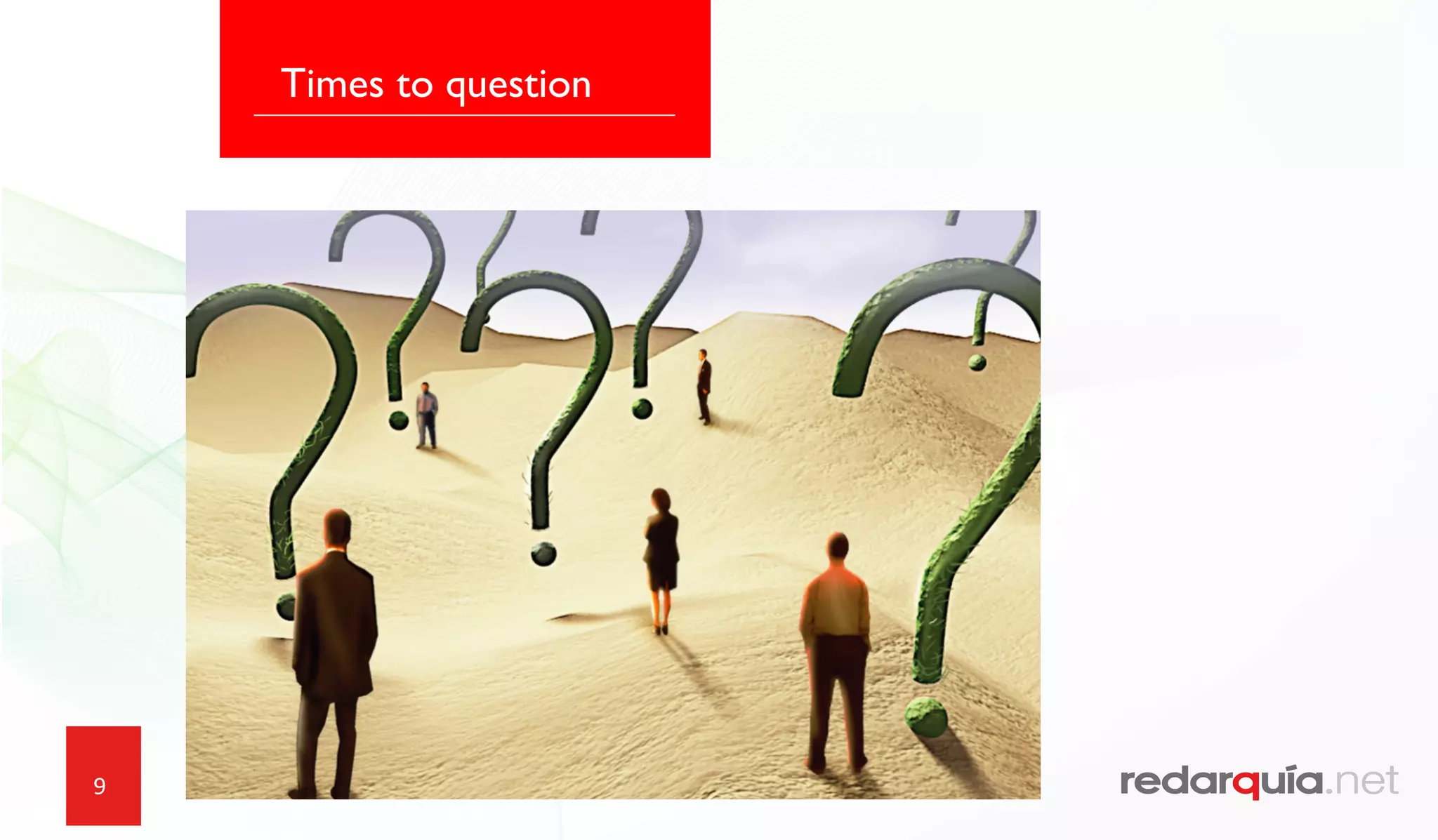
Times to question
10
¿Are our organizations
prepared to respond
quickly enough and be
adaptive in a world of
accelerating change?
11
¿Are our organizations
prepared to respond
quickly enough and be
agile in a world of
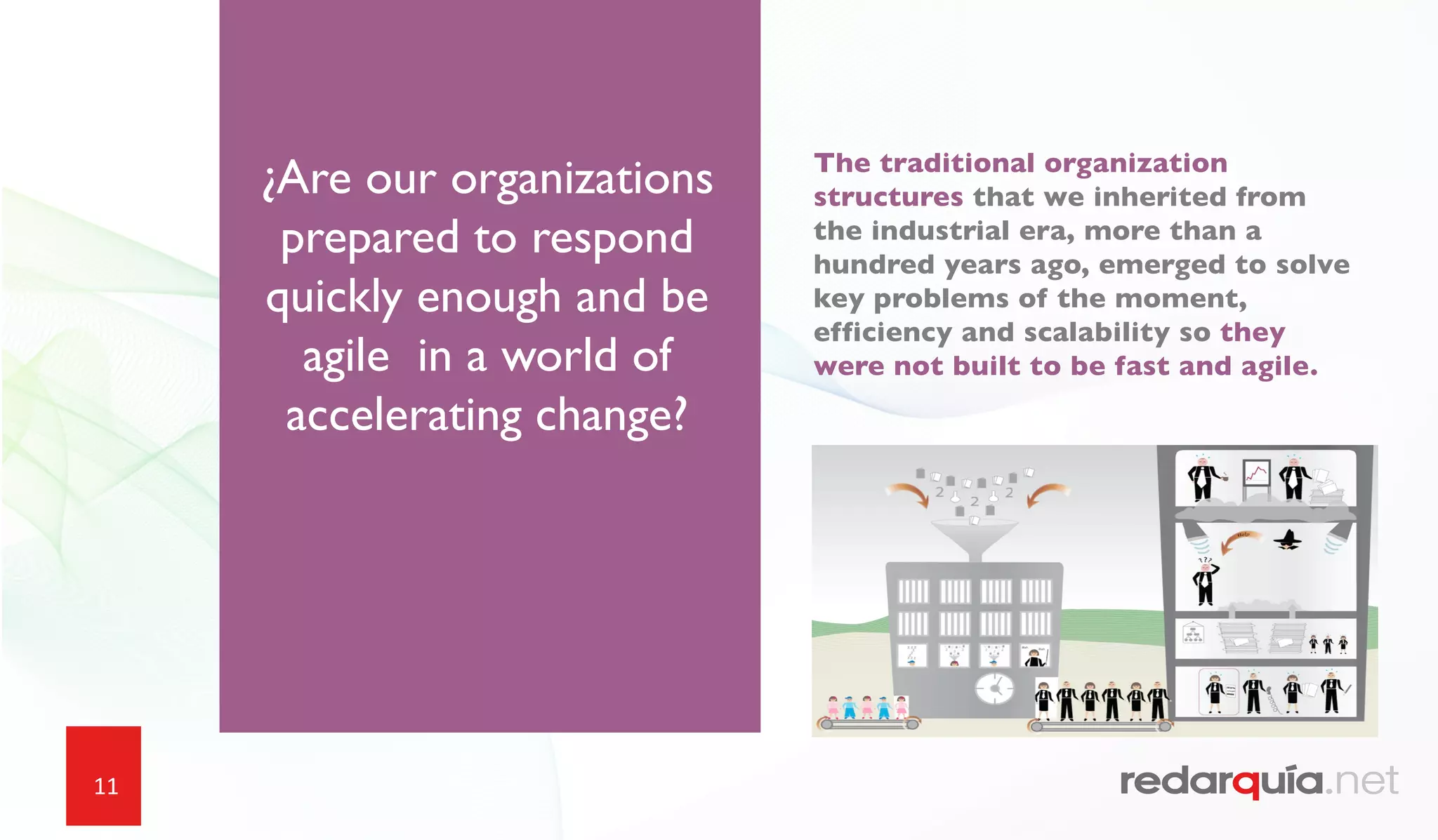
accelerating change?
The traditional organization
structures that we inherited from
the industrial era, more than a
hundred years ago, emerged to solve
key problems of the moment,
efficiency and scalability so they
were not built to be fast and agile.
12
6X Significant gaps
1. Cultural DNA: transparency, trust and
collaboration
2. Agility, speed and operational flexibility
3. The need for collective Intelligence
4. The imperative of disruptive innovation
5. The development of collaborative leaders
6. The arrival of the new Digital Talent
13
The digital talent
• They live connected.They are
collaborative.
• They are interactive and fast in the
use of new technologies.
• The Social Web is their "operating
system".
• Ideas compete on equal terms.
• The contribution counts more than
the
14
The new	citiziens
Transparency
Community
Participation
Collaboration
Simplicicity
Movility
15
Time to change?
Frederick W.Taylor (1856-1915)
Specialization
Standardization
Efficiency
Hierarchy
Burocracy
Tasks
Control
16
"The hierarchical structures and
organizational processes that
have been used for decades to
manage and improve our
businesses are no longer up to
the challenges we face in a
world of accelerating change"
John	P.	Kotter- Harvard	Business	School,
The speed at which our world changes is increasing, but our
ability to follow the changes is not.
The need for a new structure
17
Organizations as
machines
Organizations as
live systems
The need for a new metaphor
A	new	balance	between	the	needs	of	companies	for	productivity	and	
results;	and	people's	needs	for	purpose,	freedom	and	autonomy.
18
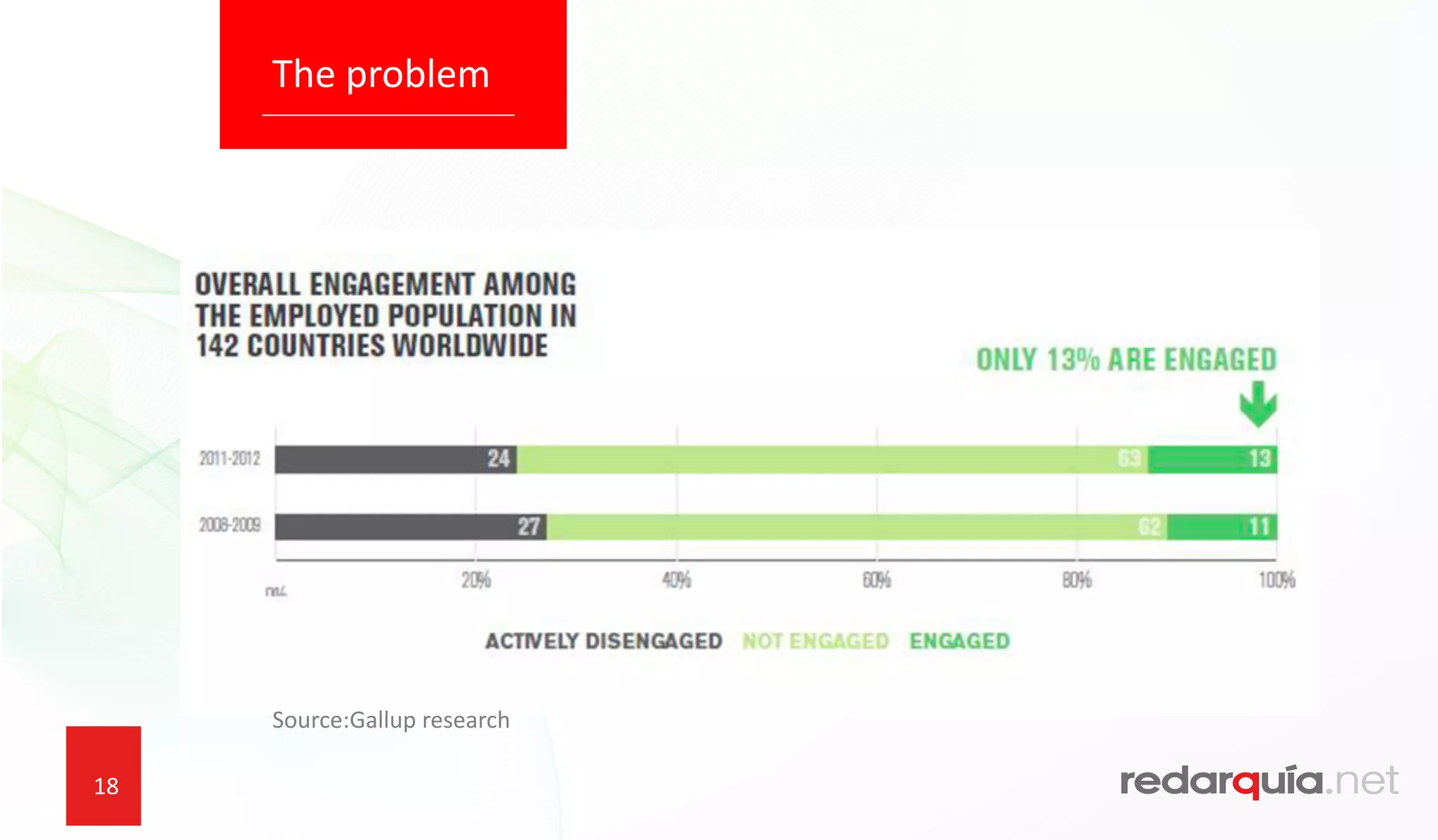
The problem
Source:Gallup research
19
The opportunity
Diligence
Intellect
Initiative
Creativity
Obedience
Passion
Fuente: Gary Hamel
Purpose
Trust
Transparency
Authenticity
20
¿Is the hierarchy the
natural structure in a
connected world?
21
ØBarriers to creativity
ØBarriers to collaboration
ØBarriers to transparency
ØBarriers to responsiveness
ØBarriers to participation
ØBarriers to visibility
ØBarriers to adaptive change
ØBarriers to passion
ØBarriers to responsiveness
ØBarriers to motivation
ØBarriers to engagement
Ø…
Too many barriers to innovation
22
¿What is the natural
order in collaborative
networks?
23
“A new emerging order, not necessarily based on the power and
authority of the formal hierarchy, but on the relationships of
participation and the flows of activity that naturally arise in
collaborative networks, based on knowledge, credibility, and
trust “
A	new	emerging order
24
Hierarchy
Noun
System in which members of an organization are
ranked according to relative status or authority.
Netarchy
Noun
System in which members of an organization are
ranked according to reputation, social value, and
influence exercised through collaborative networks.
Definitions
25
26
Two different worlds
The world of hierarchy is vertical, its way of thinking
is command-control.The strategy is fixed at the top,
power is distributed top down. People compete for
promotion, compensation correlates with position.
Tasks are assigned, bosses evaluate performance.
Rules limit creativity.
The purpose of the hierarchy is to ensure
operational results, scalability and maximize
shareholder benefits, including top executives.
Their values are effectiveness, reliability, scalability
and predictability, their behavior is conservative, risk
aversion and people do not find purpose or feel
involved in what they do. Its focus is to preserve the
achievements of the past, so it is difficult to
innovate.
27
Two different worlds
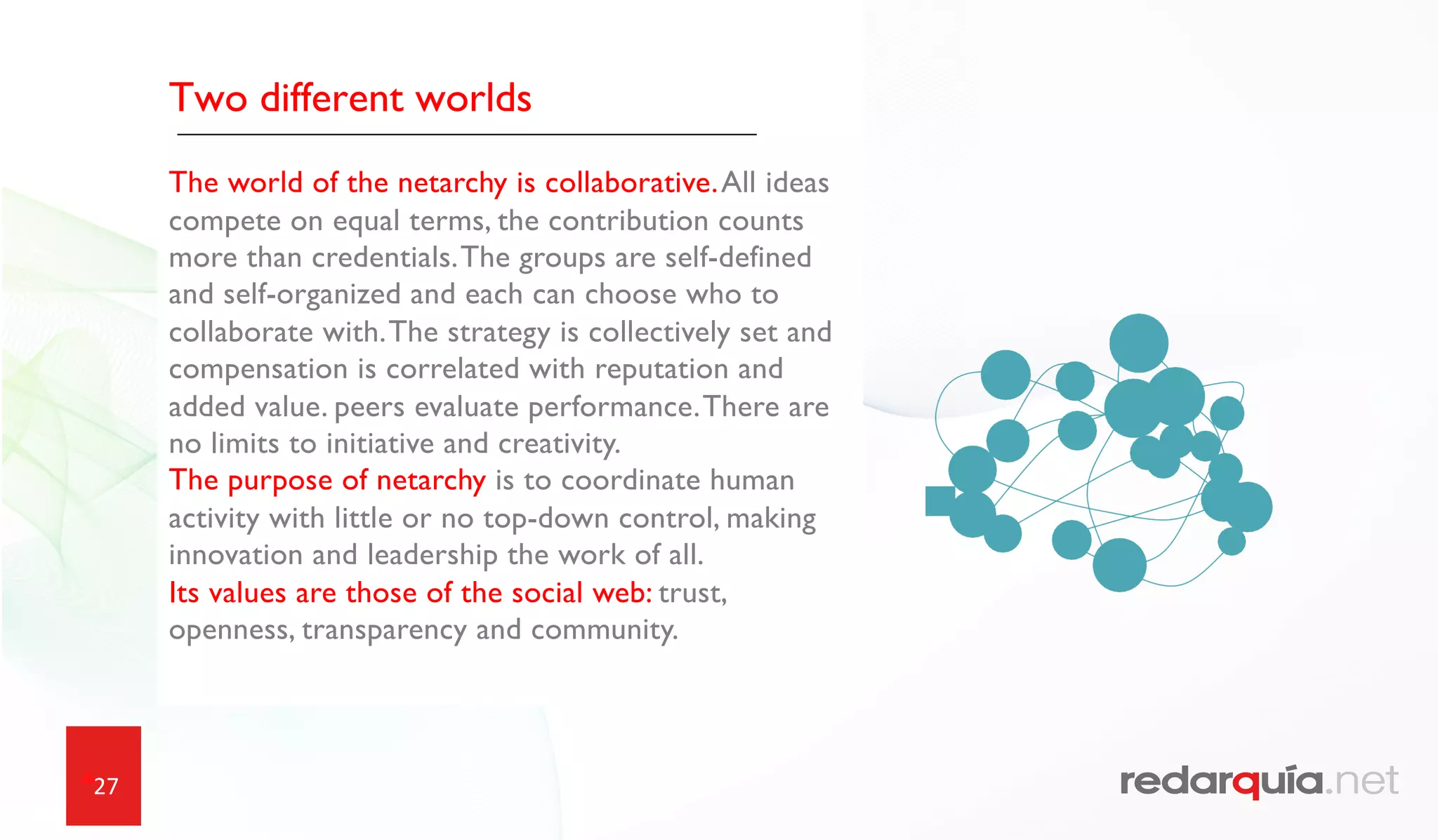
The world of the netarchy is collaborative.All ideas
compete on equal terms, the contribution counts
more than credentials.The groups are self-defined
and self-organized and each can choose who to
collaborate with.The strategy is collectively set and
compensation is correlated with reputation and
added value. peers evaluate performance.There are
no limits to initiative and creativity.
The purpose of netarchy is to coordinate human
activity with little or no top-down control, making
innovation and leadership the work of all.
Its values are those of the social web: trust,
openness, transparency and community.
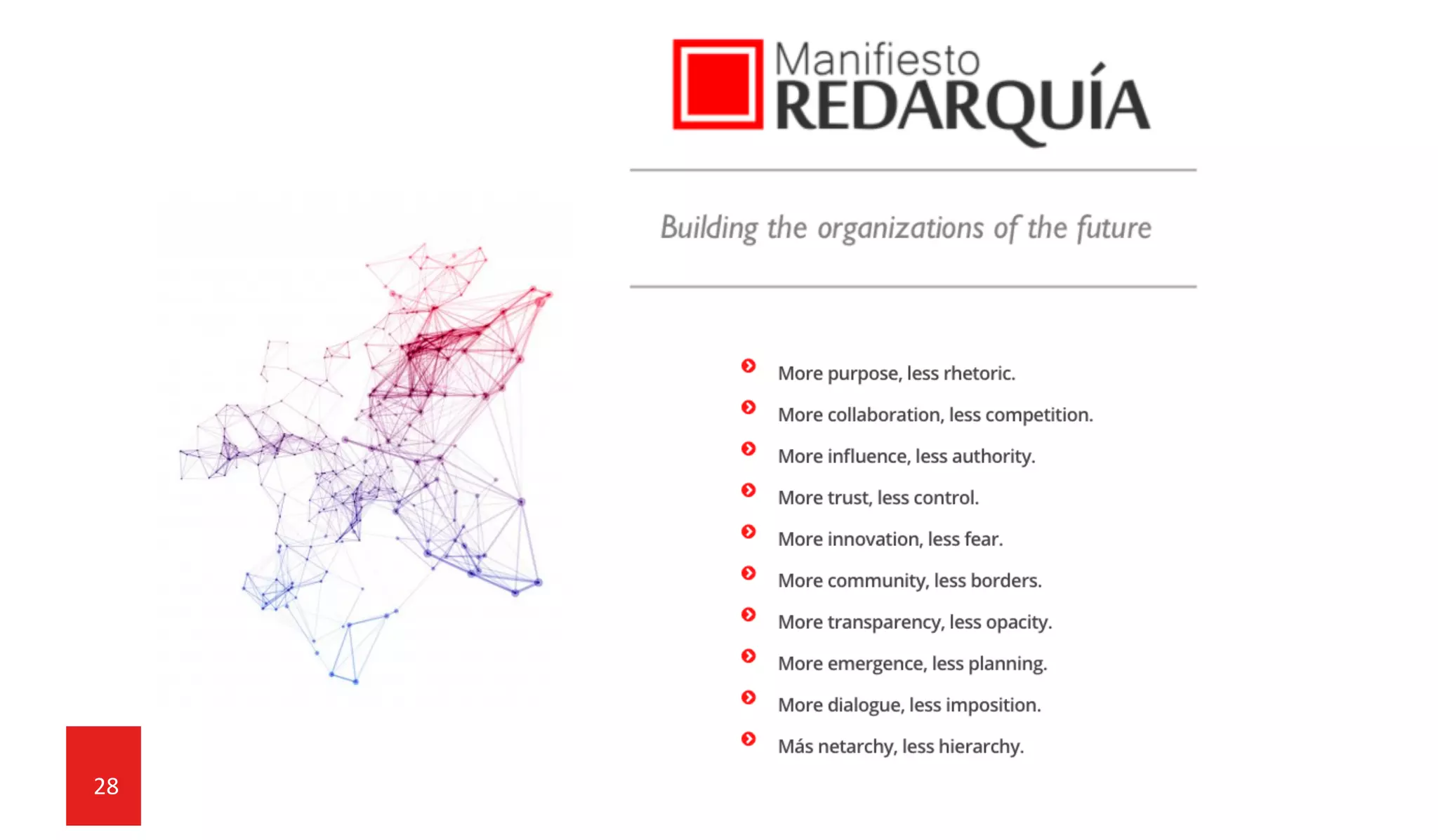
28
29
¿How can we remain
competitive when
change is accelerating
and the future is less
and less an
extrapolation of the
past?
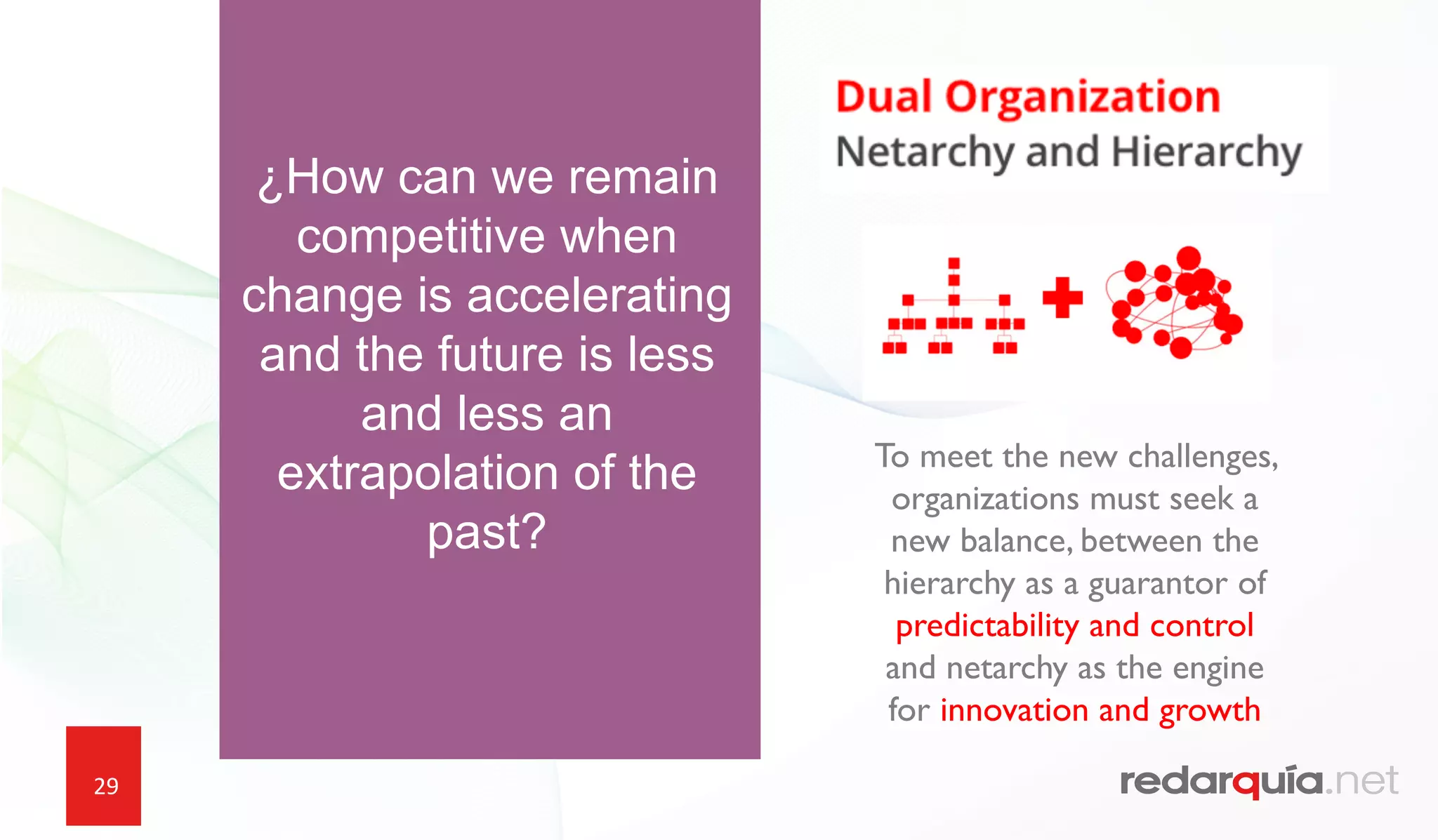
To meet the new challenges,
organizations must seek a
new balance, between the
hierarchy as a guarantor of
predictability and control
and netarchy as the engine
for innovation and growth
30
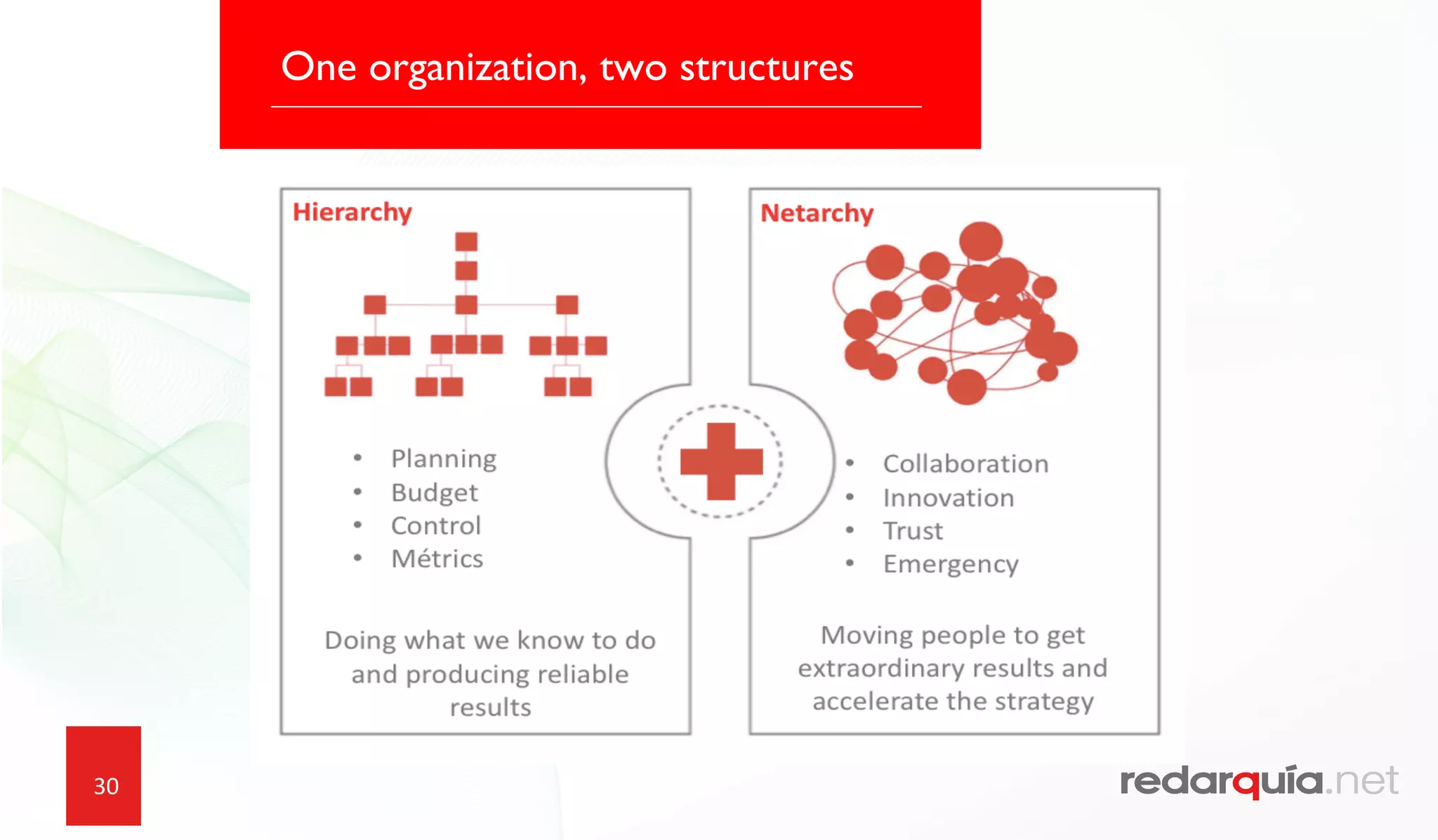
One organization, two structures
31
Management by ContextManagement by Control
Modelo	#1 Modelo	#2
Command and control
Information.
Participation
Social
Behaviors
Collaborative
TrainingTraining
Top down
One organization, two management systems
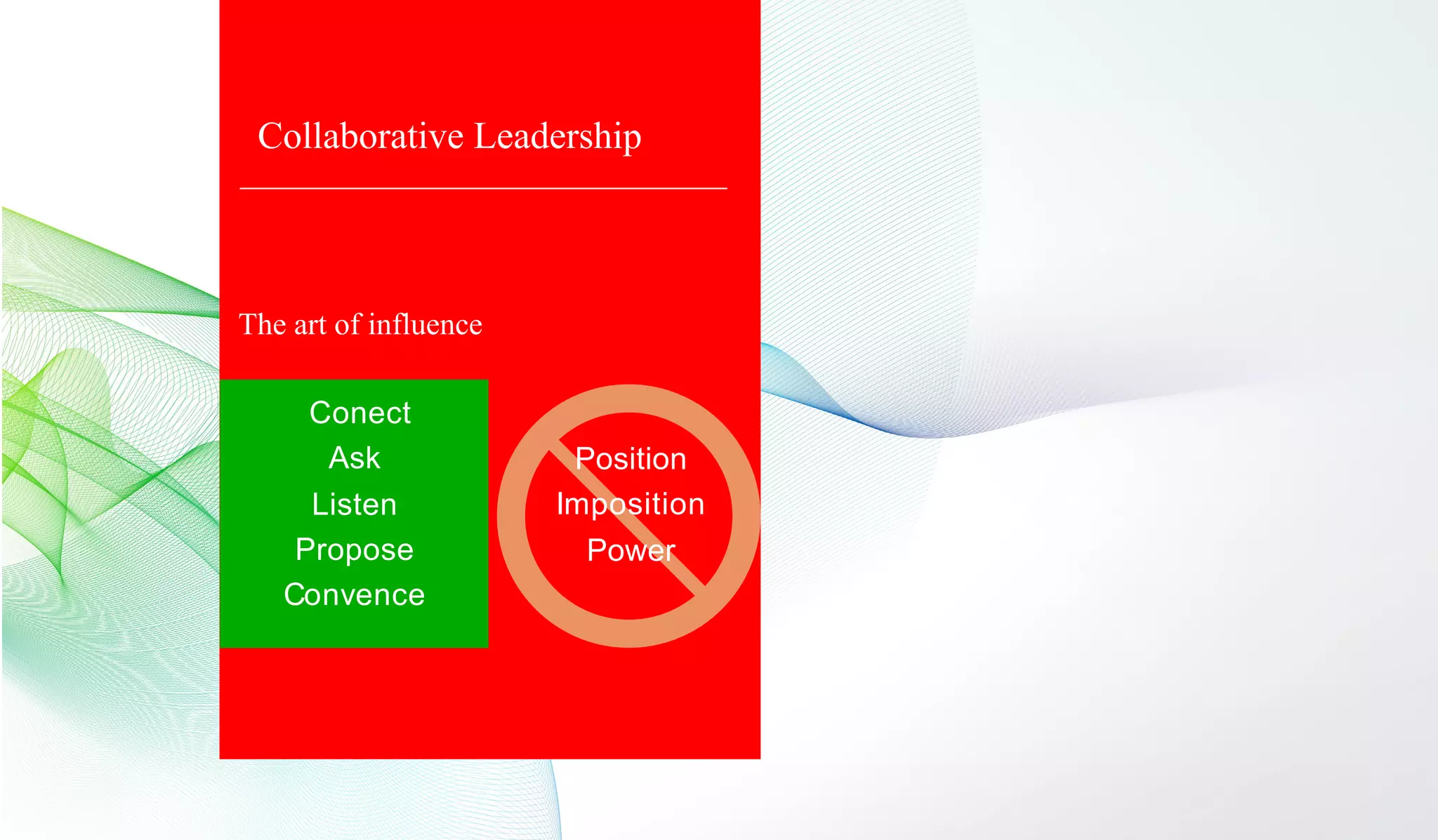
Collaborative Leadership
Conect
Ask
Listen
Propose
Convence
Position
Imposition
Power
The art of influence
33 3
3
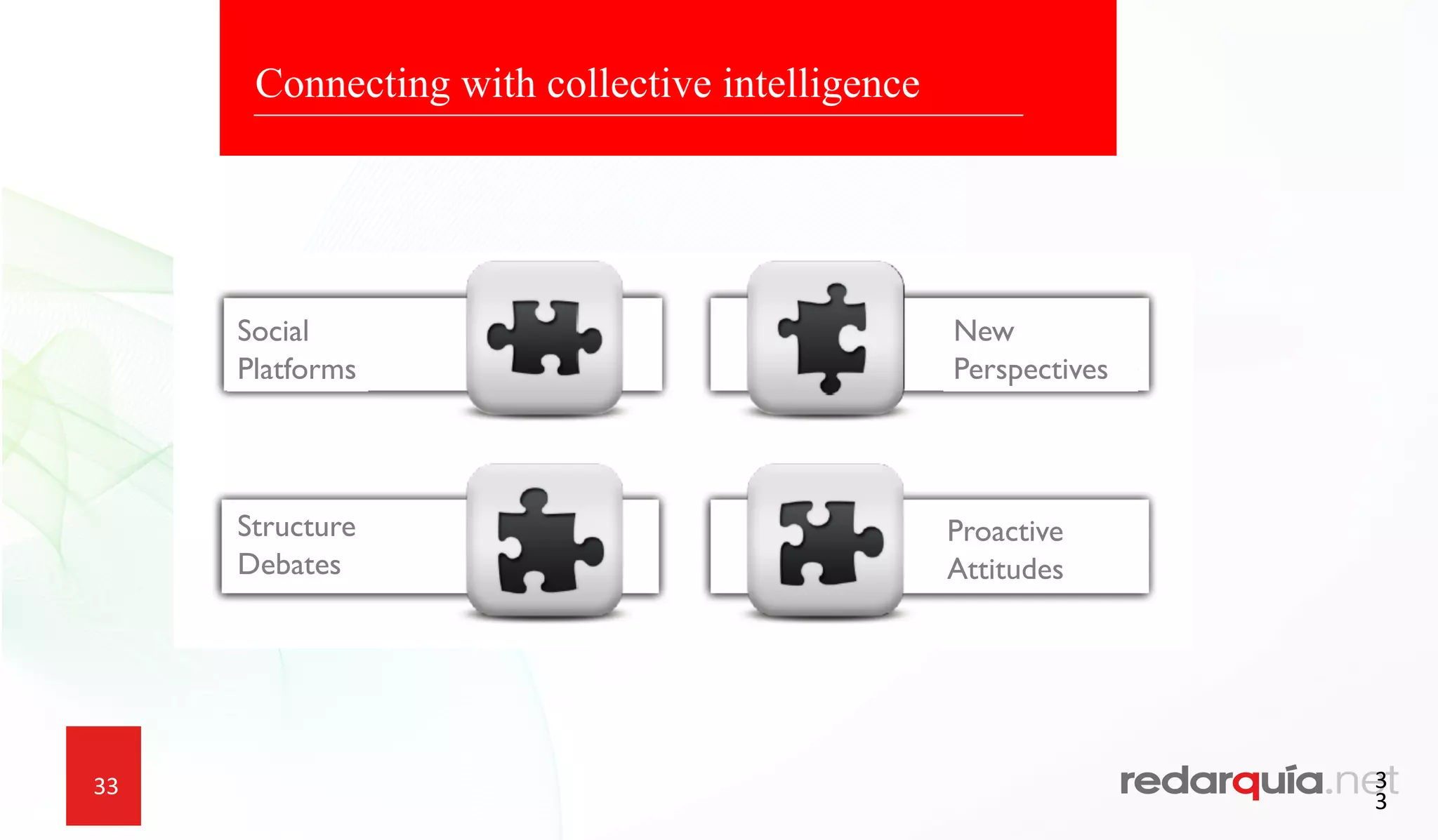
Connecting with collective intelligence
Social
Platforms
Proactive
Attitudes
Structure
Debates
New
Perspectives
34
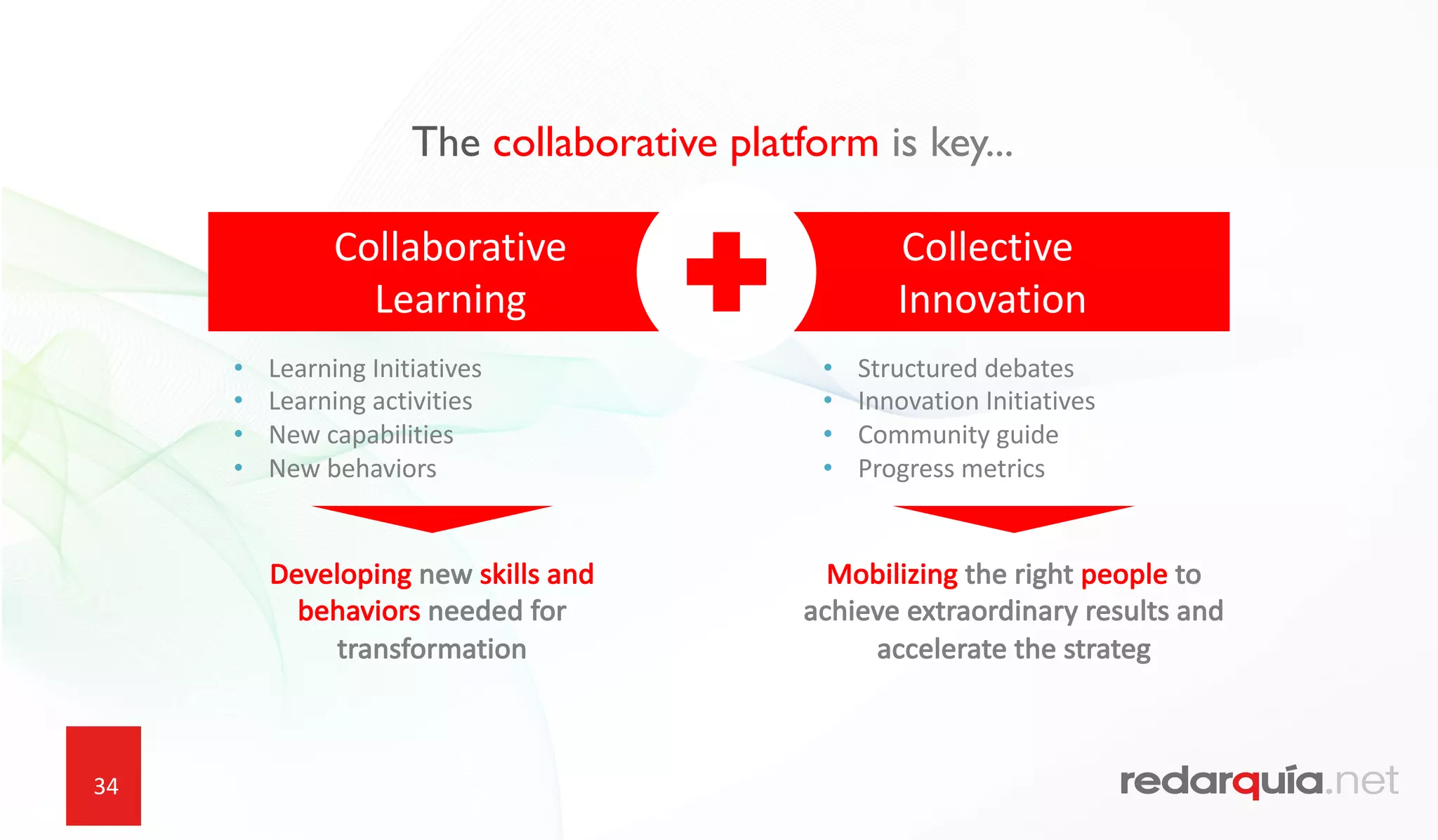
The collaborative platform is key...
• Learning	Initiatives
• Learning	activities
• New	capabilities
• New	behaviors
Developing	new	skills	and	
behaviors	needed	for	
transformation
Mobilizing	the	right	people	to	
achieve	extraordinary	results	and	
accelerate	the	strateg
Collaborative
Learning
Collective
Innovation
• Structured	debates
• Innovation	Initiatives
• Community	guide
• Progress	metrics
35
36
Ø The Network teaches us every day that sharing creates value.
Ø The benefits of collaboration are real and measurable.
Ø Collaboration is only possible in a culture of trust.
Ø The Collaboration DNA will determine whether an organization
will survive and thrive in a world of accelerated changes.
Collaboration:	Impossible	mission?
37

Netarchy_Beyond_Hierarchy