Workplace Stress &
Fatigue Management
Monthly HSE Awareness
session & Quiz
What is Workplace Stress & Fatigue?
Aspect Stress Fatigue
Definition
Emotional and
mental pressure
from demands
Physical and
mental
exhaustion
Causes
Workload,
pressure,
conflicts,
uncertainty
Long working
hours, lack of
rest, manual work
Impact
Anxiety, burnout,
low focus
Slow reflexes,
body pain,
mistakes
Signs and Symptoms – Office vs Site Staff:
 Office Employees:
• Experience eye strain, frequent headaches, and
increased irritability
• Struggle with managing time, forget important
tasks, and feel mentally drained
• Often overwhelmed by constant notifications,
emails, and tight deadlines
 Site Employees:
• Show signs of physical exhaustion like muscle
fatigue and frequent yawning
• Respond slowly to alarms or standard procedures
due to reduced alertness
• May neglect PPE use or take unsafe shortcuts
when energy levels are low
 Common Behavioral Signs: Increased
absenteeism, social withdrawal, and recurring
mistakes
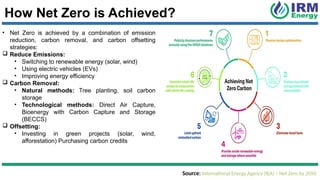
How Net Zero is Achieved?
• Net Zero is achieved by a combination of emission
reduction, carbon removal, and carbon offsetting
strategies:
 Reduce Emissions:
• Switching to renewable energy (solar, wind)
• Using electric vehicles (EVs)
• Improving energy efficiency
 Carbon Removal:
• Natural methods: Tree planting, soil carbon
storage
• Technological methods: Direct Air Capture,
Bioenergy with Carbon Capture and Storage
(BECCS)
 Offsetting:
• Investing in green projects (solar, wind,
afforestation) Purchasing carbon credits
Source: International Energy Agency (IEA) – Net Zero by 2050
Sectors Driving Net Zero:
 Different sectors contribute differently to emissions. Each sector
needs tailored strategies for Net Zero.
 Energy Sector:
• Phasing out coal, oil, and gas
• Scaling up renewables
 Transport Sector:
• Electric vehicles (EVs)
• Public transportation
• Hydrogen fuels
 Industry:
• Green manufacturing
• Process redesign
• Use of sustainable materials
 Buildings:
• Energy-efficient construction
• Green retrofitting existing structures
 Agriculture:
• Reduced methane emissions
• Climate-smart farming
• Improved soil management
Source: World Resources Institute (WRI) – Net Zero Sector Pathways
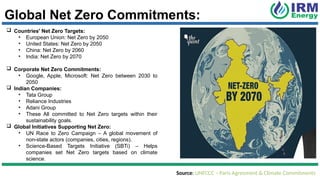
Global Net Zero Commitments:
 Countries' Net Zero Targets:
• European Union: Net Zero by 2050
• United States: Net Zero by 2050
• China: Net Zero by 2060
• India: Net Zero by 2070
 Corporate Net Zero Commitments:
• Google, Apple, Microsoft: Net Zero between 2030 to
2050
 Indian Companies:
• Tata Group
• Reliance Industries
• Adani Group
• These All committed to Net Zero targets within their
sustainability goals.
 Global Initiatives Supporting Net Zero:
• UN Race to Zero Campaign – A global movement of
non-state actors (companies, cities, regions).
• Science-Based Targets Initiative (SBTi) – Helps
companies set Net Zero targets based on climate
science.
Source: UNFCCC – Paris Agreement & Climate Commitments
Challenges to Net Zero:
 While Net Zero is crucial, it comes with several
challenges at technical, financial, and policy levels.
 Technological Barriers:
• Carbon capture and storage still expensive and not
widely deployed.
 Financial Challenges:
• High investment needed for clean energy transition.
 Policy Gaps:
• Weak climate policies in many countries.
• Lack of carbon pricing.
 Behavioral Challenges:
• Public resistance to lifestyle changes.
• Industry reluctance to adopt new models.
Source: IPCC Sixth Assessment Report – Mitigation of Climate Change
Net Zero in India:
 India announced its Net Zero target for 2070 during
COP26. It has set clear milestones.
 Key Targets:
• 500 GW of non-fossil electricity capacity by 2030
• 50% energy from renewables by 2030
• Reducing carbon intensity by 45% (compared to 2005
levels)
• Total Net Zero by 2070
 Initiatives:
• National Green Hydrogen Mission
• Solar India Projects (One Sun, One World, One Grid)
• EV Mobility Plans
Source: Press Information Bureau (PIB) – India’s Net Zero by 2070 Announcement
The Future of Net Zero – Global Outlook:
 The path towards Net Zero will bring innovation, policy
reforms, and global cooperation.
 Innovation:
• AI-driven energy systems
• Next-gen battery storage
• Green fuels
 Collaboration:
• Public-private partnerships
• International funding mechanisms (Green Climate
Fund)
 Individual Role:
• Reducing energy use
• Using public transport
• Supporting green products and policies
Source: IEA – Net Zero by 2050: A Roadmap for the Global Energy Sector
Initiatives to reduce GHG Emissions at IRMEL:
 Renewable Energy Initiatives & Investments
• Commissioned a 3.123 MW solar plant in FY 2023–24, powering 23 CNG stations in
Banaskantha GA, reducing grid dependency. Further solar projects are planned in
Banaskantha and Diu & Gir-Somnath GA by FY 2025–26 to strengthen renewable energy
adoption and reduce emissions.
 Sustainable Transport Initiatives:
• Diesel based HCVs converted to CNG reducing emissions significantly.
• IRMEL has started procuring new CNG-based HCVs to further strengthen its green mobility
fleet and reduce reliance on fossil fuels.
 Electric Mobility Support:
• 2 EV charging stations installed, encouraging the transition to zero-emission vehicles.
GHG – Green House Gases
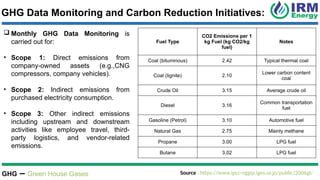
GHG Data Monitoring and Carbon Reduction Initiatives:
 Monthly GHG Data Monitoring is
carried out for:
• Scope 1: Direct emissions from
company-owned assets (e.g.,CNG
compressors, company vehicles).
• Scope 2: Indirect emissions from
purchased electricity consumption.
• Scope 3: Other indirect emissions
including upstream and downstream
activities like employee travel, third-
party logistics, and vendor-related
emissions.
Fuel Type
CO2 Emissions per 1
kg Fuel (kg CO2/kg
fuel)
Notes
Coal (bituminous) 2.42 Typical thermal coal
Coal (lignite) 2.10
Lower carbon content
coal
Crude Oil 3.15 Average crude oil
Diesel 3.16
Common transportation
fuel
Gasoline (Petrol) 3.10 Automotive fuel
Natural Gas 2.75 Mainly methane
Propane 3.00 LPG fuel
Butane 3.02 LPG fuel
Source : https://www.ipcc-nggip.iges.or.jp/public/2006gl/
GHG – Green House Gases
Recommendations to reduce GHG Emissions at IRMEL:
• IRMEL Shifting CNG stations from Daughter Booster to Online Mode directly eliminates the
need for frequent gas transportation through cascades, which typically involves diesel or CNG-
fueled vehicles.
• At IRMEL, by reducing electricity consumption through energy-efficient practices, optimized
equipment operations, and digital monitoring, we can directly reduce CO emissions, as grid
₂
electricity is largely generated from fossil fuels; this supports lowering Scope 2 emissions and
achieving our sustainability goals.
• At IRMEL, by planning and executing preventive maintenance effectively, we can minimize
unplanned shutdowns, equipment failures, and avoid unnecessary gas venting during operations.
This directly contributes to reducing methane emissions (a high-impact greenhouse gas) and CO₂
equivalent emissions, supporting our commitment to lower our carbon footprint.
• As part of our environmental commitment, we organize tree plantation drives on Environment Day
every year to further offset our carbon footprint.
Note : If 1 kg of methane is vented unburned, it causes 25 kg CO emissions.
₂
GHG – Green House Gases Source :IPCC AR5 (2013) — Climate Change 2013: The Physical Science Basis
Link for quiz:
Click on the below link or scan QR code to appear for the assessment test.
https://forms.gle/Txf3oikwMfbnkoMz6
NET ZERO - JULY.pptx presentation on NET

NET ZERO - JULY.pptx presentation on NET

  • 1.
    Workplace Stress & FatigueManagement Monthly HSE Awareness session & Quiz
  • 2.
    What is WorkplaceStress & Fatigue? Aspect Stress Fatigue Definition Emotional and mental pressure from demands Physical and mental exhaustion Causes Workload, pressure, conflicts, uncertainty Long working hours, lack of rest, manual work Impact Anxiety, burnout, low focus Slow reflexes, body pain, mistakes
  • 3.
    Signs and Symptoms– Office vs Site Staff:  Office Employees: • Experience eye strain, frequent headaches, and increased irritability • Struggle with managing time, forget important tasks, and feel mentally drained • Often overwhelmed by constant notifications, emails, and tight deadlines  Site Employees: • Show signs of physical exhaustion like muscle fatigue and frequent yawning • Respond slowly to alarms or standard procedures due to reduced alertness • May neglect PPE use or take unsafe shortcuts when energy levels are low  Common Behavioral Signs: Increased absenteeism, social withdrawal, and recurring mistakes
  • 4.
    How Net Zerois Achieved? • Net Zero is achieved by a combination of emission reduction, carbon removal, and carbon offsetting strategies:  Reduce Emissions: • Switching to renewable energy (solar, wind) • Using electric vehicles (EVs) • Improving energy efficiency  Carbon Removal: • Natural methods: Tree planting, soil carbon storage • Technological methods: Direct Air Capture, Bioenergy with Carbon Capture and Storage (BECCS)  Offsetting: • Investing in green projects (solar, wind, afforestation) Purchasing carbon credits Source: International Energy Agency (IEA) – Net Zero by 2050
  • 5.
    Sectors Driving NetZero:  Different sectors contribute differently to emissions. Each sector needs tailored strategies for Net Zero.  Energy Sector: • Phasing out coal, oil, and gas • Scaling up renewables  Transport Sector: • Electric vehicles (EVs) • Public transportation • Hydrogen fuels  Industry: • Green manufacturing • Process redesign • Use of sustainable materials  Buildings: • Energy-efficient construction • Green retrofitting existing structures  Agriculture: • Reduced methane emissions • Climate-smart farming • Improved soil management Source: World Resources Institute (WRI) – Net Zero Sector Pathways
  • 6.
    Global Net ZeroCommitments:  Countries' Net Zero Targets: • European Union: Net Zero by 2050 • United States: Net Zero by 2050 • China: Net Zero by 2060 • India: Net Zero by 2070  Corporate Net Zero Commitments: • Google, Apple, Microsoft: Net Zero between 2030 to 2050  Indian Companies: • Tata Group • Reliance Industries • Adani Group • These All committed to Net Zero targets within their sustainability goals.  Global Initiatives Supporting Net Zero: • UN Race to Zero Campaign – A global movement of non-state actors (companies, cities, regions). • Science-Based Targets Initiative (SBTi) – Helps companies set Net Zero targets based on climate science. Source: UNFCCC – Paris Agreement & Climate Commitments
  • 7.
    Challenges to NetZero:  While Net Zero is crucial, it comes with several challenges at technical, financial, and policy levels.  Technological Barriers: • Carbon capture and storage still expensive and not widely deployed.  Financial Challenges: • High investment needed for clean energy transition.  Policy Gaps: • Weak climate policies in many countries. • Lack of carbon pricing.  Behavioral Challenges: • Public resistance to lifestyle changes. • Industry reluctance to adopt new models. Source: IPCC Sixth Assessment Report – Mitigation of Climate Change
  • 8.
    Net Zero inIndia:  India announced its Net Zero target for 2070 during COP26. It has set clear milestones.  Key Targets: • 500 GW of non-fossil electricity capacity by 2030 • 50% energy from renewables by 2030 • Reducing carbon intensity by 45% (compared to 2005 levels) • Total Net Zero by 2070  Initiatives: • National Green Hydrogen Mission • Solar India Projects (One Sun, One World, One Grid) • EV Mobility Plans Source: Press Information Bureau (PIB) – India’s Net Zero by 2070 Announcement
  • 9.
    The Future ofNet Zero – Global Outlook:  The path towards Net Zero will bring innovation, policy reforms, and global cooperation.  Innovation: • AI-driven energy systems • Next-gen battery storage • Green fuels  Collaboration: • Public-private partnerships • International funding mechanisms (Green Climate Fund)  Individual Role: • Reducing energy use • Using public transport • Supporting green products and policies Source: IEA – Net Zero by 2050: A Roadmap for the Global Energy Sector
  • 10.
    Initiatives to reduceGHG Emissions at IRMEL:  Renewable Energy Initiatives & Investments • Commissioned a 3.123 MW solar plant in FY 2023–24, powering 23 CNG stations in Banaskantha GA, reducing grid dependency. Further solar projects are planned in Banaskantha and Diu & Gir-Somnath GA by FY 2025–26 to strengthen renewable energy adoption and reduce emissions.  Sustainable Transport Initiatives: • Diesel based HCVs converted to CNG reducing emissions significantly. • IRMEL has started procuring new CNG-based HCVs to further strengthen its green mobility fleet and reduce reliance on fossil fuels.  Electric Mobility Support: • 2 EV charging stations installed, encouraging the transition to zero-emission vehicles. GHG – Green House Gases
  • 11.
    GHG Data Monitoringand Carbon Reduction Initiatives:  Monthly GHG Data Monitoring is carried out for: • Scope 1: Direct emissions from company-owned assets (e.g.,CNG compressors, company vehicles). • Scope 2: Indirect emissions from purchased electricity consumption. • Scope 3: Other indirect emissions including upstream and downstream activities like employee travel, third- party logistics, and vendor-related emissions. Fuel Type CO2 Emissions per 1 kg Fuel (kg CO2/kg fuel) Notes Coal (bituminous) 2.42 Typical thermal coal Coal (lignite) 2.10 Lower carbon content coal Crude Oil 3.15 Average crude oil Diesel 3.16 Common transportation fuel Gasoline (Petrol) 3.10 Automotive fuel Natural Gas 2.75 Mainly methane Propane 3.00 LPG fuel Butane 3.02 LPG fuel Source : https://www.ipcc-nggip.iges.or.jp/public/2006gl/ GHG – Green House Gases
  • 12.
    Recommendations to reduceGHG Emissions at IRMEL: • IRMEL Shifting CNG stations from Daughter Booster to Online Mode directly eliminates the need for frequent gas transportation through cascades, which typically involves diesel or CNG- fueled vehicles. • At IRMEL, by reducing electricity consumption through energy-efficient practices, optimized equipment operations, and digital monitoring, we can directly reduce CO emissions, as grid ₂ electricity is largely generated from fossil fuels; this supports lowering Scope 2 emissions and achieving our sustainability goals. • At IRMEL, by planning and executing preventive maintenance effectively, we can minimize unplanned shutdowns, equipment failures, and avoid unnecessary gas venting during operations. This directly contributes to reducing methane emissions (a high-impact greenhouse gas) and CO₂ equivalent emissions, supporting our commitment to lower our carbon footprint. • As part of our environmental commitment, we organize tree plantation drives on Environment Day every year to further offset our carbon footprint. Note : If 1 kg of methane is vented unburned, it causes 25 kg CO emissions. ₂ GHG – Green House Gases Source :IPCC AR5 (2013) — Climate Change 2013: The Physical Science Basis
  • 13.
    Link for quiz: Clickon the below link or scan QR code to appear for the assessment test. https://forms.gle/Txf3oikwMfbnkoMz6