




















THE FLU AND YOU

           Nick Karapasas, D.C.
                    Staff Physician
        (Chiropractic and Functional Medicine)
                   The Raya Clinic
Introduction


What is “the flu”
What are the risks?
What can I do?
What is influenza?
What is influenza?

The term “influenza”
What is influenza?

The term “influenza”
  (taken from the Italian word for “occult or astral
  influence”)
What is influenza?

The term “influenza”
  (taken from the Italian word for “occult or astral
  influence”)
Influenza is a virus (over 10,000 strains)
What is influenza?

The term “influenza”
  (taken from the Italian word for “occult or astral
  influence”)
Influenza is a virus (over 10,000 strains)
The flu is different than “upper respiratory tract
infections” or “flu like illness”
What is influenza?
What is influenza?


Estimated mortality
What is influenza?


Estimated mortality
  36,000 people per year in the USA
What is influenza?


Estimated mortality
  36,000 people per year in the USA
  500,000 worldwide
Differential Diagnosis


Signs and Symptoms:
Differential Diagnosis


Signs and Symptoms:
  Runny nose, fever, malaise, etc...
Differential Diagnosis


Signs and Symptoms:
  Runny nose, fever, malaise, etc...
  Same as URTI and FLI
Differential Diagnosis
More than 200 known viruses and other pathogens can
cause the suite of symptoms known as “influenza-like
illness”
Differential Diagnosis
More than 200 known viruses and other pathogens can
cause the suite of symptoms known as “influenza-like
illness”
respiratory syncytial virus, bocavirus, coronavirus, and
rhinovirus
Differential Diagnosis
More than 200 known viruses and other pathogens can
cause the suite of symptoms known as “influenza-like
illness”
respiratory syncytial virus, bocavirus, coronavirus, and
rhinovirus
Depending on the season, in up to two-thirds of the
cases of flu-like illness, no cause at all can be found.
Differential Diagnosis


Severity of illness is not indicative of flu
Differential Diagnosis


Severity of illness is not indicative of flu
Diagnosis can only be confirmed with testing
Differential Diagnosis
Testing
  Blood Test
  Throat swab
Differential Diagnosis
Testing
  Blood Test
  Throat swab
Last year only 1%-3% of samples tested came back
positive for influenza
Differential Diagnosis
Testing
  Blood Test
  Throat swab
Last year only 1%-3% of samples tested came back
positive for influenza
Most people will have antibodies to influenza by the
end of the year regardless of presence or severity of
symptoms
Epidemics
Epidemics
Worst
Epidemics
Worst
 “Spanish Flu” 1918-1919
Epidemics
Worst
 “Spanish Flu” 1918-1919
   30% of the world was infected
Epidemics
Worst
 “Spanish Flu” 1918-1919
   30% of the world was infected
   40 - 100 million dead
Epidemics
Worst
 “Spanish Flu” 1918-1919
    30% of the world was infected
    40 - 100 million dead
Others?
Epidemics
Worst
 “Spanish Flu” 1918-1919
    30% of the world was infected
    40 - 100 million dead
Others?
  1957 & 1968 (not particularly lethal)
Predictions?
Predictions?

H1N1
Predictions?

H1N1
 Predicted to infect up to 50% of the US population
Predictions?

H1N1
 Predicted to infect up to 50% of the US population
 “could kill up to 90,000”
Predictions?

H1N1
 Predicted to infect up to 50% of the US population
 “could kill up to 90,000”
 Reports from South America
Predictions?

H1N1
 Predicted to infect up to 50% of the US population
 “could kill up to 90,000”
 Reports from South America
   Highly infectious, not particularly lethal
Predictions?
Predictions?
Australia
Predictions?
Australia
  ...will finish winter with under 1000 deaths
Predictions?
Australia
  ...will finish winter with under 1000 deaths
  fewer than the usual 1500 - 3000 from “seasonal flu”
Predictions?
Australia
  ...will finish winter with under 1000 deaths
  fewer than the usual 1500 - 3000 from “seasonal flu”
US
Predictions?
Australia
  ...will finish winter with under 1000 deaths
  fewer than the usual 1500 - 3000 from “seasonal flu”
US
  70% of deaths from “flu” were from those already
  suffering from other conditions
Predictions?
Australia
  ...will finish winter with under 1000 deaths
  fewer than the usual 1500 - 3000 from “seasonal flu”
US
  70% of deaths from “flu” were from those already
  suffering from other conditions
  cerebral palsy / cancer / asthma / AIDS
Vaccination

Public health officials consider vaccine the most
formidable defense.
Success
  polio / smallpox / measles / mumps
Well... what about flu?

impact is harder to determine
  flu comes and goes with seasons
  often does not kill people directly
  makes body more susceptible to secondary infections
Well... what about flu?


So... researchers study the impact by looking at
deaths from all causes during flu season
Well... what about flu?


So... researchers study the impact by looking at
deaths from all causes during flu season
then... compare the vacciated and unvaccinated
populations
Well... what about flu?

Dramatic difference between the two populations
Well... what about flu?

Dramatic difference between the two populations
  people who get a flu shot in the fall are about 50%
  less likely to die that winter
Well... what about flu?

Dramatic difference between the two populations
  people who get a flu shot in the fall are about 50%
  less likely to die that winter
    ... from ANY cause.
Yay!! Sign me up!!
Hold on a second...
Hold on a second...


Influenza causes only a small minority of all deaths in
the USA, even among senior citizens, and even after
adding in the deaths to which flu might have
contributed indirectly.
Hold on a second...

When researchers from the National Institute of
Allergy and Infectious Diseases included all deaths
from illnesses that flu aggravates, like lung disease or
chronic heart failure, they found that flu accounts for,
at most, 10 percent of winter deaths among the elderly.
Wait... then how do you
  reduce deaths by half ?

“For a vaccine to reduce mortality by 50 percent and up
to 90 percent in some studies means it has to prevent
deaths not just from influenza, but also from falls, fires,
heart disease, strokes, and car accidents. That’s not a
vaccine, that’s a miracle.”
  -Tom Jefferson, M.D. (Head of the Vaccines Field at the Cochrane Collaboration)
Wait... then how do you
reduce deaths by half ?
Wait... then how do you
 reduce deaths by half ?
“cohort studies” compare death rates in large groups
Wait... then how do you
 reduce deaths by half ?
“cohort studies” compare death rates in large groups
Education, lifestyle, income, and many other
“confounding” factors can come into play
Wait... then how do you
 reduce deaths by half ?
“cohort studies” compare death rates in large groups
Education, lifestyle, income, and many other
“confounding” factors can come into play
...and as a result, cohort studies are notoriously prone
to bias.
2001 season
2001 season
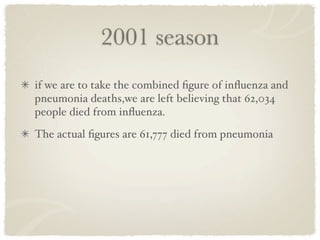
if we are to take the combined figure of influenza and
pneumonia deaths,we are left believing that 62,034
people died from influenza.
2001 season
if we are to take the combined figure of influenza and
pneumonia deaths,we are left believing that 62,034
people died from influenza.
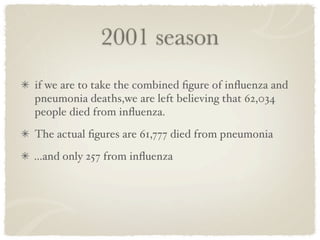
The actual figures are 61,777 died from pneumonia
2001 season
if we are to take the combined figure of influenza and
pneumonia deaths,we are left believing that 62,034
people died from influenza.
The actual figures are 61,777 died from pneumonia
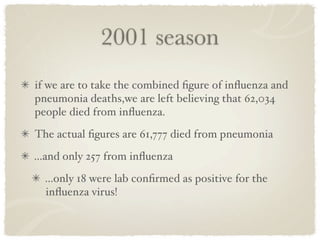
...and only 257 from influenza
2001 season
if we are to take the combined figure of influenza and
pneumonia deaths,we are left believing that 62,034
people died from influenza.
The actual figures are 61,777 died from pneumonia
...and only 257 from influenza
  ...only 18 were lab confirmed as positive for the
  influenza virus!
What about today?
What about today?
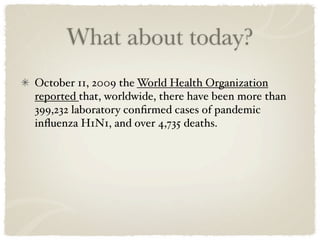
October 11, 2009 the World Health Organization
reported that, worldwide, there have been more than
399,232 laboratory confirmed cases of pandemic
influenza H1N1, and over 4,735 deaths.
What about today?
October 11, 2009 the World Health Organization
reported that, worldwide, there have been more than
399,232 laboratory confirmed cases of pandemic
influenza H1N1, and over 4,735 deaths.
Folks, that is 4,735 deaths in the ENTIRE world, not
just the US!
What about today?
October 11, 2009 the World Health Organization
reported that, worldwide, there have been more than
399,232 laboratory confirmed cases of pandemic
influenza H1N1, and over 4,735 deaths.
Folks, that is 4,735 deaths in the ENTIRE world, not
just the US!
Most of these deaths were immunocompromised
individuals.
What about today?
October 11, 2009 the World Health Organization
reported that, worldwide, there have been more than
399,232 laboratory confirmed cases of pandemic
influenza H1N1, and over 4,735 deaths.
Folks, that is 4,735 deaths in the ENTIRE world, not
just the US!
Most of these deaths were immunocompromised
individuals.
What about today?
What about today?

Perspective
  Malaria kills ONE MILLION people EVERY
  YEAR, worldwide.
  Death is a direct result of the malaria infection.
What about today?
What about today?

Every day
What about today?

Every day
  2740 deaths from malaria
What about today?

Every day
  2740 deaths from malaria
  13 deaths from H1N1
What about today?

Every day
  2740 deaths from malaria
  13 deaths from H1N1
    ...if you disregard that most of those died from
    secondary infections and complications.
Other studies
Other studies

“healthy user” phenomenon
Other studies

“healthy user” phenomenon
  people who get vaccines are more likely to have
  health care
Other studies

“healthy user” phenomenon
  people who get vaccines are more likely to have
  health care
  people who don’t get vaccinated are generally older,
  sicker, bedridden, more serious issues
Jackson, et al
Jackson, et al


eight years of data (72,000+ people 65 and older)
  who got flu shots and who didn’t
  which group’s members were more likely to die of
  any cause when it was not flu season.
Jackson, et al
Jackson, et al

outside of flu season, the baseline risk of death among
people who did not get vaccinated was approximately
60 percent higher than among those who did
Jackson, et al

outside of flu season, the baseline risk of death among
people who did not get vaccinated was approximately
60 percent higher than among those who did
...supports the hypothesis that on average, healthy
people chose to get the vaccine, while the “frail elderly”
didn’t or couldn’t.
Jackson, et al

outside of flu season, the baseline risk of death among
people who did not get vaccinated was approximately
60 percent higher than among those who did
...supports the hypothesis that on average, healthy
people chose to get the vaccine, while the “frail elderly”
didn’t or couldn’t.
explained the entire benefit that other researchers were
attributing to flu vaccine, suggesting that the vaccine
itself might not reduce mortality at all
What else?
What else?

2004
 vaccine production fell behind, causing a 40% drop
 in immunization rates
 NO increase in mortality
What else?
What else?

1968 & 1997
  Vaccine “mismatches”
    (in effect, no one was vaccinated)
 ...death rates from all causes, including flu and the
 various illnesses it can exacerbate, did not change
Majumdar, M.D.


researcher and physician @ U of Albert
Rising rates of vaccination of the elderly over the past
two decades have not coincided with a lower overall
mortality rate.
Majumdar, M.D.
1989
  15% of patients over 65 were vaccinated (USA and
  Canada)
Today
  65% of the same population are immunized
Death rates have INCREASED, not decreased
Immune response

Immunization
 antibodies
   higher response in young, healthy immune systems
   lower response in older, immune compromised
   systems
so far...


as of August 8
  36 deaths among children in the US from H1N1
    most with multiple, severe health disorders
Immunization doctrine


Double blind studies and ethics
Tamiflu / Relenza resistance
Weird conspiracy moment...
 USA began stockpiling Tamiflu and Relenza in 2005
Weird conspiracy moment...
 USA began stockpiling Tamiflu and Relenza in 2005
 11/1/05: GWB pronounced pandemic flu a “danger to
 our homeland”
Weird conspiracy moment...
 USA began stockpiling Tamiflu and Relenza in 2005
 11/1/05: GWB pronounced pandemic flu a “danger to
 our homeland”
   $2.8 billion approved for military stockpile
Weird conspiracy moment...
 USA began stockpiling Tamiflu and Relenza in 2005
 11/1/05: GWB pronounced pandemic flu a “danger to
 our homeland”
   $2.8 billion approved for military stockpile
 The patent for Tamiflu is held by Gilead Sciences
Weird conspiracy moment...
 USA began stockpiling Tamiflu and Relenza in 2005
 11/1/05: GWB pronounced pandemic flu a “danger to
 our homeland”
   $2.8 billion approved for military stockpile
 The patent for Tamiflu is held by Gilead Sciences
 before joining the Bush cabinet, SecDef Donald
 Rumsfeld was chairman of Gilead Sciences
Tamiflu
Tamiflu
cuts the duration of flu symptoms by 24 hours in
otherwise healthy individuals
Tamiflu
cuts the duration of flu symptoms by 24 hours in
otherwise healthy individuals
1 in 5 will experience nausea and vomiting
Tamiflu
cuts the duration of flu symptoms by 24 hours in
otherwise healthy individuals
1 in 5 will experience nausea and vomiting
1 in 5 children will experience neuropsychiatric side
effects (possibly including anxiety and suicidal
behavior)
Tamiflu
cuts the duration of flu symptoms by 24 hours in
otherwise healthy individuals
1 in 5 will experience nausea and vomiting
1 in 5 children will experience neuropsychiatric side
effects (possibly including anxiety and suicidal
behavior)
Japan: possibly 50 deaths due to cardiopulmonary
arrest
Tamiflu
Tamiflu

Tamiflu Website
 “Tamiflu has not been proven to have a positive
 impact on the potential consequences (such as
 hospitalizations, mortality, or economic impact) of
 seasonal, avian, or pandemic influenza.”
Health care workers?

Letter to Neurologists from Gov’t Health Service in
Great Britain
  Watch for increase in GBS after immunization with
  Swine flu vaccine
  similar to outbreak in 1976
  The Daily Mail, 8/15/2009
Double Blind Studies??

This is the first year mock vaccines have been used to
gain FDA approval. The vaccines that have been tested
are not the same vaccines your children will be given.
Double Blind Studies??

This is the first year mock vaccines have been used to
gain FDA approval. The vaccines that have been tested
are not the same vaccines your children will be given.
Ethics and double blind studies (when it is the
“standard of care”
more...
more...

First of all, nearly all of the swine flu vaccines that will
be made available in October will be a nasal spray type
that contains live virus’, which is not recommended for
pregnant women, people over 50, or those with asthma,
heart disease or several other health problems,
according to the Centers for Disease Control and
Prevention (CDC).
more...
more...
The nasal spray causes a much greater immune
reaction, and since it contains live virus’ they may
multiply too quickly if your immune system is already
compromised.
more...
The nasal spray causes a much greater immune
reaction, and since it contains live virus’ they may
multiply too quickly if your immune system is already
compromised.
The injectable vaccine will supposedly contain only
killed and fragmented virus components, but in order
to “make it more effective” it also contains adjuvants;
ingredients designed to cause a greater immune
reaction by lowering your immune function.
more...
more...
Some of these adjuvants, such as squalene, have already
been shown to carry considerable health risks.
Thimerosal, a preservative, is also being added to the
non attenuated vaccines. 
more...
Some of these adjuvants, such as squalene, have already
been shown to carry considerable health risks.
Thimerosal, a preservative, is also being added to the
non attenuated vaccines. 
none of the coming vaccines have undergone any form
of safety testing?
more...
Some of these adjuvants, such as squalene, have already
been shown to carry considerable health risks.
Thimerosal, a preservative, is also being added to the
non attenuated vaccines. 
none of the coming vaccines have undergone any form
of safety testing?
Some media reports have stated vaccines will be
approved following a five-day safety review.
more...
more...

Interestingly, despite the fact that health authorities
around the world were “shocked” at the emergence of
this never-before-seen hybrid flu strain, Baxter had
patented a flu vaccine covering these now infamous
strains
more...

Interestingly, despite the fact that health authorities
around the world were “shocked” at the emergence of
this never-before-seen hybrid flu strain, Baxter had
patented a flu vaccine covering these now infamous
strains
  ...on August 28, 2008.
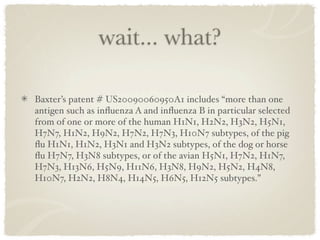
wait... what?

Baxter’s patent # US20090060950A1 includes “more than one
antigen such as influenza A and influenza B in particular selected
from of one or more of the human H1N1, H2N2, H3N2, H5N1,
H7N7, H1N2, H9N2, H7N2, H7N3, H10N7 subtypes, of the pig
flu H1N1, H1N2, H3N1 and H3N2 subtypes, of the dog or horse
flu H7N7, H3N8 subtypes, or of the avian H5N1, H7N2, H1N7,
H7N3, H13N6, H5N9, H11N6, H3N8, H9N2, H5N2, H4N8,
H10N7, H2N2, H8N4, H14N5, H6N5, H12N5 subtypes.”
What else can I do?
Vitamin D

Vitamin D deficiency
  Therapeutic level [50-65 ng/ml]
if you are coming down with symptoms
  if NOT supplementing with vitamin D
    50,000 IU / day for 3 days
what else?
what else?
Sleep / Rest
what else?
Sleep / Rest

Avoid sugar and processed foods
what else?
Sleep / Rest

Avoid sugar and processed foods

reduce stress
what else?
Sleep / Rest

Avoid sugar and processed foods

reduce stress

Exercise
what else?
Sleep / Rest

Avoid sugar and processed foods

reduce stress

Exercise

Omega 3
what else?
Sleep / Rest

Avoid sugar and processed foods

reduce stress

Exercise

Omega 3

Garlic
what else?
Sleep / Rest

Avoid sugar and processed foods

reduce stress

Exercise

Omega 3

Garlic

Vitamin C
Q&A
Q&A
Q: How can I tell if my symptoms are from the flu or a
cold?
Q&A
Q: How can I tell if my symptoms are from the flu or a
cold?
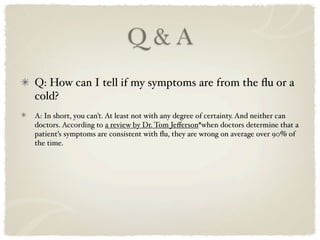
A: In short, you can’t. At least not with any degree of certainty. And neither can
doctors. According to a review by Dr. Tom Jefferson*when doctors determine that a
patient’s symptoms are consistent with flu, they are wrong on average over 90% of
the time.
Q&A
Q: How can I tell if my symptoms are from the flu or a
cold?
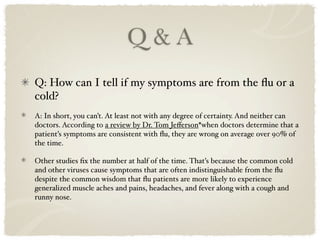
A: In short, you can’t. At least not with any degree of certainty. And neither can
doctors. According to a review by Dr. Tom Jefferson*when doctors determine that a
patient’s symptoms are consistent with flu, they are wrong on average over 90% of
the time.

Other studies fix the number at half of the time. That’s because the common cold
and other viruses cause symptoms that are often indistinguishable from the flu
despite the common wisdom that flu patients are more likely to experience
generalized muscle aches and pains, headaches, and fever along with a cough and
runny nose.
Q&A
Q&A
Q: If symptoms aren’t reliable indicators, how can my
doctor tell if I have swine flu?
Q&A
Q: If symptoms aren’t reliable indicators, how can my
doctor tell if I have swine flu?
A: The only way to make a definite diagnosis of the 2009 H1N1 flu (previously
known as swine flu) is to do a nasal swab or blood tests. The rapid tests are highly
inaccurate; for example the rapid influenza detection test (RIDT) is completed in
30 minutes but only picks up 10-70% of influenza A viruses and can’t distinguish
between swine flu and other types of influenza A viruses. Viral cultures or RNA
amplification tests are more accurate but take from 2 to 10 days to get results,
making them irrelevant for decision-making regarding antiviral drugs, for example,
which are supposed to be started within 36 hours of the onset of symptoms. The
Centers for Disease Control and Prevention currently recommends testing only in
limited circumstances.
Q&A
Q: If symptoms aren’t reliable indicators, how can my
doctor tell if I have swine flu?
A: The only way to make a definite diagnosis of the 2009 H1N1 flu (previously
known as swine flu) is to do a nasal swab or blood tests. The rapid tests are highly
inaccurate; for example the rapid influenza detection test (RIDT) is completed in
30 minutes but only picks up 10-70% of influenza A viruses and can’t distinguish
between swine flu and other types of influenza A viruses. Viral cultures or RNA
amplification tests are more accurate but take from 2 to 10 days to get results,
making them irrelevant for decision-making regarding antiviral drugs, for example,
which are supposed to be started within 36 hours of the onset of symptoms. The
Centers for Disease Control and Prevention currently recommends testing only in
limited circumstances.
Q&A
Q&A
Q: What’s known about the risks of flu shots?
Q&A
Q: What’s known about the risks of flu shots?
A: Risks are considered by most experts to be very low and limited largely to local
pain and swelling at the site of injection with rare instances (1 in 1 million) of a
paralyzing condition known as Guillian-Barre Syndrome (that rate was higher
during the previous swine flu outbreak in 1976 when the incidence was estimated at
1 in 100,000). According to the CDC, none of the shots approved for use in the
U.S. will contain adjuvants (substances that enhance immune reactions) such as
squalene. Vaccines containing adjuvants have been approved in Europe. However,
injected flu vaccines may contain thimerosal, a mercury-containing preservative,
which many doctors believe is safe but others believe may be responsible for effects
on the brain and nervous system. For people who want to take the vaccine but
avoid the mercury, they can ask for single-dose vaccines.
Q&A
Q: What’s known about the risks of flu shots?
A: Risks are considered by most experts to be very low and limited largely to local
pain and swelling at the site of injection with rare instances (1 in 1 million) of a
paralyzing condition known as Guillian-Barre Syndrome (that rate was higher
during the previous swine flu outbreak in 1976 when the incidence was estimated at
1 in 100,000). According to the CDC, none of the shots approved for use in the
U.S. will contain adjuvants (substances that enhance immune reactions) such as
squalene. Vaccines containing adjuvants have been approved in Europe. However,
injected flu vaccines may contain thimerosal, a mercury-containing preservative,
which many doctors believe is safe but others believe may be responsible for effects
on the brain and nervous system. For people who want to take the vaccine but
avoid the mercury, they can ask for single-dose vaccines.
Q&A
Q&A


Q: How dangerous is swine flu?
Q&A


Q: How dangerous is swine flu?
A: At this point, it is proving to be relatively mild and less fatal than the average flu,
according to data from some countries in the Southern Hemisphere that already
experienced their winter flu season. Unless the virus mutates, it appears that the
most serious threat is largely to people with underlying health problems.
Q&A
Q&A

Q: I see studies that say the flu vaccine is highly
effective. Why is there any question?
Q&A

Q: I see studies that say the flu vaccine is highly
effective. Why is there any question?
A: Effectiveness is often measured by showing that people who get the vaccine
develop antibodies in response to the vaccine. Those antibodies can be helpful in
fighting off future bouts of that year’s flu. The problem is that young, healthy
people are very good at developing antibodies but they are not the people who tend
to develop pneumonia or die, while older people and people with immune
disorders, who are most likely to die, don’t develop protective antibodies as well.
This has led to the question, “Is it necessary for those whom it helps, and will it
help those for whom it’s necessary?”
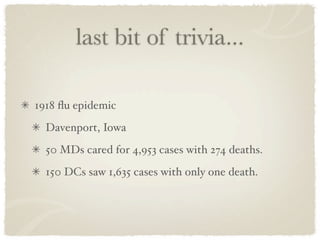
last bit of trivia...

1918 flu epidemic
last bit of trivia...

1918 flu epidemic
  Davenport, Iowa
last bit of trivia...

1918 flu epidemic
  Davenport, Iowa
  50 MDs cared for 4,953 cases with 274 deaths.
last bit of trivia...

1918 flu epidemic
  Davenport, Iowa
  50 MDs cared for 4,953 cases with 274 deaths.
  150 DCs saw 1,635 cases with only one death.
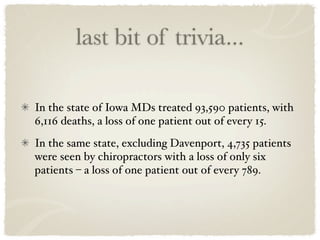
last bit of trivia...

In the state of Iowa MDs treated 93,590 patients, with
6,116 deaths, a loss of one patient out of every 15.
In the same state, excluding Davenport, 4,735 patients
were seen by chiropractors with a loss of only six
patients – a loss of one patient out of every 789.
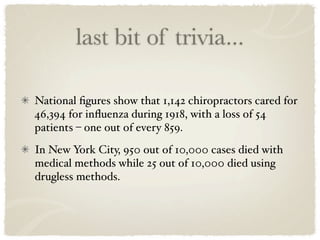
last bit of trivia...

National figures show that 1,142 chiropractors cared for
46,394 for influenza during 1918, with a loss of 54
patients – one out of every 859.
In New York City, 950 out of 10,000 cases died with
medical methods while 25 out of 10,000 died using
drugless methods.
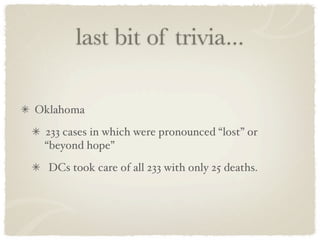
last bit of trivia...

Oklahoma
 233 cases in which were pronounced “lost” or
 “beyond hope”
  DCs took care of all 233 with only 25 deaths.
QUESTIONS?

nerf

  • 1.
    THE FLU ANDYOU Nick Karapasas, D.C. Staff Physician (Chiropractic and Functional Medicine) The Raya Clinic
  • 2.
    Introduction What is “theflu” What are the risks? What can I do?
  • 3.
  • 4.
    What is influenza? Theterm “influenza”
  • 5.
    What is influenza? Theterm “influenza” (taken from the Italian word for “occult or astral influence”)
  • 6.
    What is influenza? Theterm “influenza” (taken from the Italian word for “occult or astral influence”) Influenza is a virus (over 10,000 strains)
  • 7.
    What is influenza? Theterm “influenza” (taken from the Italian word for “occult or astral influence”) Influenza is a virus (over 10,000 strains) The flu is different than “upper respiratory tract infections” or “flu like illness”
  • 8.
  • 9.
  • 10.
    What is influenza? Estimatedmortality 36,000 people per year in the USA
  • 11.
    What is influenza? Estimatedmortality 36,000 people per year in the USA 500,000 worldwide
  • 12.
  • 13.
  • 14.
    Differential Diagnosis Signs andSymptoms: Runny nose, fever, malaise, etc...
  • 15.
    Differential Diagnosis Signs andSymptoms: Runny nose, fever, malaise, etc... Same as URTI and FLI
  • 16.
  • 17.
    Differential Diagnosis More than200 known viruses and other pathogens can cause the suite of symptoms known as “influenza-like illness”
  • 18.
    Differential Diagnosis More than200 known viruses and other pathogens can cause the suite of symptoms known as “influenza-like illness” respiratory syncytial virus, bocavirus, coronavirus, and rhinovirus
  • 19.
    Differential Diagnosis More than200 known viruses and other pathogens can cause the suite of symptoms known as “influenza-like illness” respiratory syncytial virus, bocavirus, coronavirus, and rhinovirus Depending on the season, in up to two-thirds of the cases of flu-like illness, no cause at all can be found.
  • 20.
  • 21.
    Differential Diagnosis Severity ofillness is not indicative of flu
  • 22.
    Differential Diagnosis Severity ofillness is not indicative of flu Diagnosis can only be confirmed with testing
  • 23.
  • 24.
    Differential Diagnosis Testing Blood Test Throat swab
  • 25.
    Differential Diagnosis Testing Blood Test Throat swab Last year only 1%-3% of samples tested came back positive for influenza
  • 26.
    Differential Diagnosis Testing Blood Test Throat swab Last year only 1%-3% of samples tested came back positive for influenza Most people will have antibodies to influenza by the end of the year regardless of presence or severity of symptoms
  • 27.
  • 28.
  • 29.
  • 30.
    Epidemics Worst “Spanish Flu”1918-1919 30% of the world was infected
  • 31.
    Epidemics Worst “Spanish Flu”1918-1919 30% of the world was infected 40 - 100 million dead
  • 32.
    Epidemics Worst “Spanish Flu”1918-1919 30% of the world was infected 40 - 100 million dead Others?
  • 33.
    Epidemics Worst “Spanish Flu”1918-1919 30% of the world was infected 40 - 100 million dead Others? 1957 & 1968 (not particularly lethal)
  • 34.
  • 35.
  • 36.
    Predictions? H1N1 Predicted toinfect up to 50% of the US population
  • 37.
    Predictions? H1N1 Predicted toinfect up to 50% of the US population “could kill up to 90,000”
  • 38.
    Predictions? H1N1 Predicted toinfect up to 50% of the US population “could kill up to 90,000” Reports from South America
  • 39.
    Predictions? H1N1 Predicted toinfect up to 50% of the US population “could kill up to 90,000” Reports from South America Highly infectious, not particularly lethal
  • 40.
  • 41.
  • 42.
    Predictions? Australia ...willfinish winter with under 1000 deaths
  • 43.
    Predictions? Australia ...willfinish winter with under 1000 deaths fewer than the usual 1500 - 3000 from “seasonal flu”
  • 44.
    Predictions? Australia ...willfinish winter with under 1000 deaths fewer than the usual 1500 - 3000 from “seasonal flu” US
  • 45.
    Predictions? Australia ...willfinish winter with under 1000 deaths fewer than the usual 1500 - 3000 from “seasonal flu” US 70% of deaths from “flu” were from those already suffering from other conditions
  • 46.
    Predictions? Australia ...willfinish winter with under 1000 deaths fewer than the usual 1500 - 3000 from “seasonal flu” US 70% of deaths from “flu” were from those already suffering from other conditions cerebral palsy / cancer / asthma / AIDS
  • 47.
    Vaccination Public health officialsconsider vaccine the most formidable defense. Success polio / smallpox / measles / mumps
  • 48.
    Well... what aboutflu? impact is harder to determine flu comes and goes with seasons often does not kill people directly makes body more susceptible to secondary infections
  • 49.
  • 50.
    Well... what aboutflu? So... researchers study the impact by looking at deaths from all causes during flu season
  • 51.
    Well... what aboutflu? So... researchers study the impact by looking at deaths from all causes during flu season then... compare the vacciated and unvaccinated populations
  • 52.
  • 53.
    Well... what aboutflu? Dramatic difference between the two populations
  • 54.
    Well... what aboutflu? Dramatic difference between the two populations people who get a flu shot in the fall are about 50% less likely to die that winter
  • 55.
    Well... what aboutflu? Dramatic difference between the two populations people who get a flu shot in the fall are about 50% less likely to die that winter ... from ANY cause.
  • 56.
  • 57.
    Hold on asecond...
  • 58.
    Hold on asecond... Influenza causes only a small minority of all deaths in the USA, even among senior citizens, and even after adding in the deaths to which flu might have contributed indirectly.
  • 59.
    Hold on asecond... When researchers from the National Institute of Allergy and Infectious Diseases included all deaths from illnesses that flu aggravates, like lung disease or chronic heart failure, they found that flu accounts for, at most, 10 percent of winter deaths among the elderly.
  • 60.
    Wait... then howdo you reduce deaths by half ? “For a vaccine to reduce mortality by 50 percent and up to 90 percent in some studies means it has to prevent deaths not just from influenza, but also from falls, fires, heart disease, strokes, and car accidents. That’s not a vaccine, that’s a miracle.” -Tom Jefferson, M.D. (Head of the Vaccines Field at the Cochrane Collaboration)
  • 61.
    Wait... then howdo you reduce deaths by half ?
  • 62.
    Wait... then howdo you reduce deaths by half ? “cohort studies” compare death rates in large groups
  • 63.
    Wait... then howdo you reduce deaths by half ? “cohort studies” compare death rates in large groups Education, lifestyle, income, and many other “confounding” factors can come into play
  • 64.
    Wait... then howdo you reduce deaths by half ? “cohort studies” compare death rates in large groups Education, lifestyle, income, and many other “confounding” factors can come into play ...and as a result, cohort studies are notoriously prone to bias.
  • 65.
  • 66.
    2001 season if weare to take the combined figure of influenza and pneumonia deaths,we are left believing that 62,034 people died from influenza.
  • 67.
    2001 season if weare to take the combined figure of influenza and pneumonia deaths,we are left believing that 62,034 people died from influenza. The actual figures are 61,777 died from pneumonia
  • 68.
    2001 season if weare to take the combined figure of influenza and pneumonia deaths,we are left believing that 62,034 people died from influenza. The actual figures are 61,777 died from pneumonia ...and only 257 from influenza
  • 69.
    2001 season if weare to take the combined figure of influenza and pneumonia deaths,we are left believing that 62,034 people died from influenza. The actual figures are 61,777 died from pneumonia ...and only 257 from influenza ...only 18 were lab confirmed as positive for the influenza virus!
  • 70.
  • 71.
    What about today? October11, 2009 the World Health Organization reported that, worldwide, there have been more than 399,232 laboratory confirmed cases of pandemic influenza H1N1, and over 4,735 deaths.
  • 72.
    What about today? October11, 2009 the World Health Organization reported that, worldwide, there have been more than 399,232 laboratory confirmed cases of pandemic influenza H1N1, and over 4,735 deaths. Folks, that is 4,735 deaths in the ENTIRE world, not just the US!
  • 73.
    What about today? October11, 2009 the World Health Organization reported that, worldwide, there have been more than 399,232 laboratory confirmed cases of pandemic influenza H1N1, and over 4,735 deaths. Folks, that is 4,735 deaths in the ENTIRE world, not just the US! Most of these deaths were immunocompromised individuals.
  • 74.
    What about today? October11, 2009 the World Health Organization reported that, worldwide, there have been more than 399,232 laboratory confirmed cases of pandemic influenza H1N1, and over 4,735 deaths. Folks, that is 4,735 deaths in the ENTIRE world, not just the US! Most of these deaths were immunocompromised individuals.
  • 75.
  • 76.
    What about today? Perspective Malaria kills ONE MILLION people EVERY YEAR, worldwide. Death is a direct result of the malaria infection.
  • 77.
  • 78.
  • 79.
    What about today? Everyday 2740 deaths from malaria
  • 80.
    What about today? Everyday 2740 deaths from malaria 13 deaths from H1N1
  • 81.
    What about today? Everyday 2740 deaths from malaria 13 deaths from H1N1 ...if you disregard that most of those died from secondary infections and complications.
  • 82.
  • 83.
  • 84.
    Other studies “healthy user”phenomenon people who get vaccines are more likely to have health care
  • 85.
    Other studies “healthy user”phenomenon people who get vaccines are more likely to have health care people who don’t get vaccinated are generally older, sicker, bedridden, more serious issues
  • 86.
  • 87.
    Jackson, et al eightyears of data (72,000+ people 65 and older) who got flu shots and who didn’t which group’s members were more likely to die of any cause when it was not flu season.
  • 88.
  • 89.
    Jackson, et al outsideof flu season, the baseline risk of death among people who did not get vaccinated was approximately 60 percent higher than among those who did
  • 90.
    Jackson, et al outsideof flu season, the baseline risk of death among people who did not get vaccinated was approximately 60 percent higher than among those who did ...supports the hypothesis that on average, healthy people chose to get the vaccine, while the “frail elderly” didn’t or couldn’t.
  • 91.
    Jackson, et al outsideof flu season, the baseline risk of death among people who did not get vaccinated was approximately 60 percent higher than among those who did ...supports the hypothesis that on average, healthy people chose to get the vaccine, while the “frail elderly” didn’t or couldn’t. explained the entire benefit that other researchers were attributing to flu vaccine, suggesting that the vaccine itself might not reduce mortality at all
  • 92.
  • 93.
    What else? 2004 vaccineproduction fell behind, causing a 40% drop in immunization rates NO increase in mortality
  • 94.
  • 95.
    What else? 1968 &1997 Vaccine “mismatches” (in effect, no one was vaccinated) ...death rates from all causes, including flu and the various illnesses it can exacerbate, did not change
  • 96.
    Majumdar, M.D. researcher andphysician @ U of Albert Rising rates of vaccination of the elderly over the past two decades have not coincided with a lower overall mortality rate.
  • 97.
    Majumdar, M.D. 1989 15% of patients over 65 were vaccinated (USA and Canada) Today 65% of the same population are immunized Death rates have INCREASED, not decreased
  • 98.
    Immune response Immunization antibodies higher response in young, healthy immune systems lower response in older, immune compromised systems
  • 99.
    so far... as ofAugust 8 36 deaths among children in the US from H1N1 most with multiple, severe health disorders
  • 100.
    Immunization doctrine Double blindstudies and ethics Tamiflu / Relenza resistance
  • 101.
  • 102.
    Weird conspiracy moment... USA began stockpiling Tamiflu and Relenza in 2005
  • 103.
    Weird conspiracy moment... USA began stockpiling Tamiflu and Relenza in 2005 11/1/05: GWB pronounced pandemic flu a “danger to our homeland”
  • 104.
    Weird conspiracy moment... USA began stockpiling Tamiflu and Relenza in 2005 11/1/05: GWB pronounced pandemic flu a “danger to our homeland” $2.8 billion approved for military stockpile
  • 105.
    Weird conspiracy moment... USA began stockpiling Tamiflu and Relenza in 2005 11/1/05: GWB pronounced pandemic flu a “danger to our homeland” $2.8 billion approved for military stockpile The patent for Tamiflu is held by Gilead Sciences
  • 106.
    Weird conspiracy moment... USA began stockpiling Tamiflu and Relenza in 2005 11/1/05: GWB pronounced pandemic flu a “danger to our homeland” $2.8 billion approved for military stockpile The patent for Tamiflu is held by Gilead Sciences before joining the Bush cabinet, SecDef Donald Rumsfeld was chairman of Gilead Sciences
  • 107.
  • 108.
    Tamiflu cuts the durationof flu symptoms by 24 hours in otherwise healthy individuals
  • 109.
    Tamiflu cuts the durationof flu symptoms by 24 hours in otherwise healthy individuals 1 in 5 will experience nausea and vomiting
  • 110.
    Tamiflu cuts the durationof flu symptoms by 24 hours in otherwise healthy individuals 1 in 5 will experience nausea and vomiting 1 in 5 children will experience neuropsychiatric side effects (possibly including anxiety and suicidal behavior)
  • 111.
    Tamiflu cuts the durationof flu symptoms by 24 hours in otherwise healthy individuals 1 in 5 will experience nausea and vomiting 1 in 5 children will experience neuropsychiatric side effects (possibly including anxiety and suicidal behavior) Japan: possibly 50 deaths due to cardiopulmonary arrest
  • 112.
  • 113.
    Tamiflu Tamiflu Website “Tamifluhas not been proven to have a positive impact on the potential consequences (such as hospitalizations, mortality, or economic impact) of seasonal, avian, or pandemic influenza.”
  • 114.
    Health care workers? Letterto Neurologists from Gov’t Health Service in Great Britain Watch for increase in GBS after immunization with Swine flu vaccine similar to outbreak in 1976 The Daily Mail, 8/15/2009
  • 115.
  • 116.
    Double Blind Studies?? Thisis the first year mock vaccines have been used to gain FDA approval. The vaccines that have been tested are not the same vaccines your children will be given.
  • 117.
    Double Blind Studies?? Thisis the first year mock vaccines have been used to gain FDA approval. The vaccines that have been tested are not the same vaccines your children will be given. Ethics and double blind studies (when it is the “standard of care”
  • 118.
  • 119.
    more... First of all,nearly all of the swine flu vaccines that will be made available in October will be a nasal spray type that contains live virus’, which is not recommended for pregnant women, people over 50, or those with asthma, heart disease or several other health problems, according to the Centers for Disease Control and Prevention (CDC).
  • 120.
  • 121.
    more... The nasal spraycauses a much greater immune reaction, and since it contains live virus’ they may multiply too quickly if your immune system is already compromised.
  • 122.
    more... The nasal spraycauses a much greater immune reaction, and since it contains live virus’ they may multiply too quickly if your immune system is already compromised. The injectable vaccine will supposedly contain only killed and fragmented virus components, but in order to “make it more effective” it also contains adjuvants; ingredients designed to cause a greater immune reaction by lowering your immune function.
  • 123.
  • 124.
    more... Some of theseadjuvants, such as squalene, have already been shown to carry considerable health risks. Thimerosal, a preservative, is also being added to the non attenuated vaccines. 
  • 125.
    more... Some of theseadjuvants, such as squalene, have already been shown to carry considerable health risks. Thimerosal, a preservative, is also being added to the non attenuated vaccines.  none of the coming vaccines have undergone any form of safety testing?
  • 126.
    more... Some of theseadjuvants, such as squalene, have already been shown to carry considerable health risks. Thimerosal, a preservative, is also being added to the non attenuated vaccines.  none of the coming vaccines have undergone any form of safety testing? Some media reports have stated vaccines will be approved following a five-day safety review.
  • 127.
  • 128.
    more... Interestingly, despite thefact that health authorities around the world were “shocked” at the emergence of this never-before-seen hybrid flu strain, Baxter had patented a flu vaccine covering these now infamous strains
  • 129.
    more... Interestingly, despite thefact that health authorities around the world were “shocked” at the emergence of this never-before-seen hybrid flu strain, Baxter had patented a flu vaccine covering these now infamous strains ...on August 28, 2008.
  • 130.
    wait... what? Baxter’s patent# US20090060950A1 includes “more than one antigen such as influenza A and influenza B in particular selected from of one or more of the human H1N1, H2N2, H3N2, H5N1, H7N7, H1N2, H9N2, H7N2, H7N3, H10N7 subtypes, of the pig flu H1N1, H1N2, H3N1 and H3N2 subtypes, of the dog or horse flu H7N7, H3N8 subtypes, or of the avian H5N1, H7N2, H1N7, H7N3, H13N6, H5N9, H11N6, H3N8, H9N2, H5N2, H4N8, H10N7, H2N2, H8N4, H14N5, H6N5, H12N5 subtypes.”
  • 131.
  • 132.
    Vitamin D Vitamin Ddeficiency Therapeutic level [50-65 ng/ml] if you are coming down with symptoms if NOT supplementing with vitamin D 50,000 IU / day for 3 days
  • 133.
  • 134.
  • 135.
    what else? Sleep /Rest Avoid sugar and processed foods
  • 136.
    what else? Sleep /Rest Avoid sugar and processed foods reduce stress
  • 137.
    what else? Sleep /Rest Avoid sugar and processed foods reduce stress Exercise
  • 138.
    what else? Sleep /Rest Avoid sugar and processed foods reduce stress Exercise Omega 3
  • 139.
    what else? Sleep /Rest Avoid sugar and processed foods reduce stress Exercise Omega 3 Garlic
  • 140.
    what else? Sleep /Rest Avoid sugar and processed foods reduce stress Exercise Omega 3 Garlic Vitamin C
  • 141.
  • 142.
    Q&A Q: How canI tell if my symptoms are from the flu or a cold?
  • 143.
    Q&A Q: How canI tell if my symptoms are from the flu or a cold? A: In short, you can’t. At least not with any degree of certainty. And neither can doctors. According to a review by Dr. Tom Jefferson*when doctors determine that a patient’s symptoms are consistent with flu, they are wrong on average over 90% of the time.
  • 144.
    Q&A Q: How canI tell if my symptoms are from the flu or a cold? A: In short, you can’t. At least not with any degree of certainty. And neither can doctors. According to a review by Dr. Tom Jefferson*when doctors determine that a patient’s symptoms are consistent with flu, they are wrong on average over 90% of the time. Other studies fix the number at half of the time. That’s because the common cold and other viruses cause symptoms that are often indistinguishable from the flu despite the common wisdom that flu patients are more likely to experience generalized muscle aches and pains, headaches, and fever along with a cough and runny nose.
  • 145.
  • 146.
    Q&A Q: If symptomsaren’t reliable indicators, how can my doctor tell if I have swine flu?
  • 147.
    Q&A Q: If symptomsaren’t reliable indicators, how can my doctor tell if I have swine flu? A: The only way to make a definite diagnosis of the 2009 H1N1 flu (previously known as swine flu) is to do a nasal swab or blood tests. The rapid tests are highly inaccurate; for example the rapid influenza detection test (RIDT) is completed in 30 minutes but only picks up 10-70% of influenza A viruses and can’t distinguish between swine flu and other types of influenza A viruses. Viral cultures or RNA amplification tests are more accurate but take from 2 to 10 days to get results, making them irrelevant for decision-making regarding antiviral drugs, for example, which are supposed to be started within 36 hours of the onset of symptoms. The Centers for Disease Control and Prevention currently recommends testing only in limited circumstances.
  • 148.
    Q&A Q: If symptomsaren’t reliable indicators, how can my doctor tell if I have swine flu? A: The only way to make a definite diagnosis of the 2009 H1N1 flu (previously known as swine flu) is to do a nasal swab or blood tests. The rapid tests are highly inaccurate; for example the rapid influenza detection test (RIDT) is completed in 30 minutes but only picks up 10-70% of influenza A viruses and can’t distinguish between swine flu and other types of influenza A viruses. Viral cultures or RNA amplification tests are more accurate but take from 2 to 10 days to get results, making them irrelevant for decision-making regarding antiviral drugs, for example, which are supposed to be started within 36 hours of the onset of symptoms. The Centers for Disease Control and Prevention currently recommends testing only in limited circumstances.
  • 149.
  • 150.
    Q&A Q: What’s knownabout the risks of flu shots?
  • 151.
    Q&A Q: What’s knownabout the risks of flu shots? A: Risks are considered by most experts to be very low and limited largely to local pain and swelling at the site of injection with rare instances (1 in 1 million) of a paralyzing condition known as Guillian-Barre Syndrome (that rate was higher during the previous swine flu outbreak in 1976 when the incidence was estimated at 1 in 100,000). According to the CDC, none of the shots approved for use in the U.S. will contain adjuvants (substances that enhance immune reactions) such as squalene. Vaccines containing adjuvants have been approved in Europe. However, injected flu vaccines may contain thimerosal, a mercury-containing preservative, which many doctors believe is safe but others believe may be responsible for effects on the brain and nervous system. For people who want to take the vaccine but avoid the mercury, they can ask for single-dose vaccines.
  • 152.
    Q&A Q: What’s knownabout the risks of flu shots? A: Risks are considered by most experts to be very low and limited largely to local pain and swelling at the site of injection with rare instances (1 in 1 million) of a paralyzing condition known as Guillian-Barre Syndrome (that rate was higher during the previous swine flu outbreak in 1976 when the incidence was estimated at 1 in 100,000). According to the CDC, none of the shots approved for use in the U.S. will contain adjuvants (substances that enhance immune reactions) such as squalene. Vaccines containing adjuvants have been approved in Europe. However, injected flu vaccines may contain thimerosal, a mercury-containing preservative, which many doctors believe is safe but others believe may be responsible for effects on the brain and nervous system. For people who want to take the vaccine but avoid the mercury, they can ask for single-dose vaccines.
  • 153.
  • 154.
    Q&A Q: How dangerousis swine flu?
  • 155.
    Q&A Q: How dangerousis swine flu? A: At this point, it is proving to be relatively mild and less fatal than the average flu, according to data from some countries in the Southern Hemisphere that already experienced their winter flu season. Unless the virus mutates, it appears that the most serious threat is largely to people with underlying health problems.
  • 156.
  • 157.
    Q&A Q: I seestudies that say the flu vaccine is highly effective. Why is there any question?
  • 158.
    Q&A Q: I seestudies that say the flu vaccine is highly effective. Why is there any question? A: Effectiveness is often measured by showing that people who get the vaccine develop antibodies in response to the vaccine. Those antibodies can be helpful in fighting off future bouts of that year’s flu. The problem is that young, healthy people are very good at developing antibodies but they are not the people who tend to develop pneumonia or die, while older people and people with immune disorders, who are most likely to die, don’t develop protective antibodies as well. This has led to the question, “Is it necessary for those whom it helps, and will it help those for whom it’s necessary?”
  • 159.
    last bit oftrivia...
  • 160.
    last bit oftrivia... 1918 flu epidemic
  • 161.
    last bit oftrivia... 1918 flu epidemic Davenport, Iowa
  • 162.
    last bit oftrivia... 1918 flu epidemic Davenport, Iowa 50 MDs cared for 4,953 cases with 274 deaths.
  • 163.
    last bit oftrivia... 1918 flu epidemic Davenport, Iowa 50 MDs cared for 4,953 cases with 274 deaths. 150 DCs saw 1,635 cases with only one death.
  • 164.
    last bit oftrivia... In the state of Iowa MDs treated 93,590 patients, with 6,116 deaths, a loss of one patient out of every 15. In the same state, excluding Davenport, 4,735 patients were seen by chiropractors with a loss of only six patients – a loss of one patient out of every 789.
  • 165.
    last bit oftrivia... National figures show that 1,142 chiropractors cared for 46,394 for influenza during 1918, with a loss of 54 patients – one out of every 859. In New York City, 950 out of 10,000 cases died with medical methods while 25 out of 10,000 died using drugless methods.
  • 166.
    last bit oftrivia... Oklahoma 233 cases in which were pronounced “lost” or “beyond hope” DCs took care of all 233 with only 25 deaths.
  • 167.