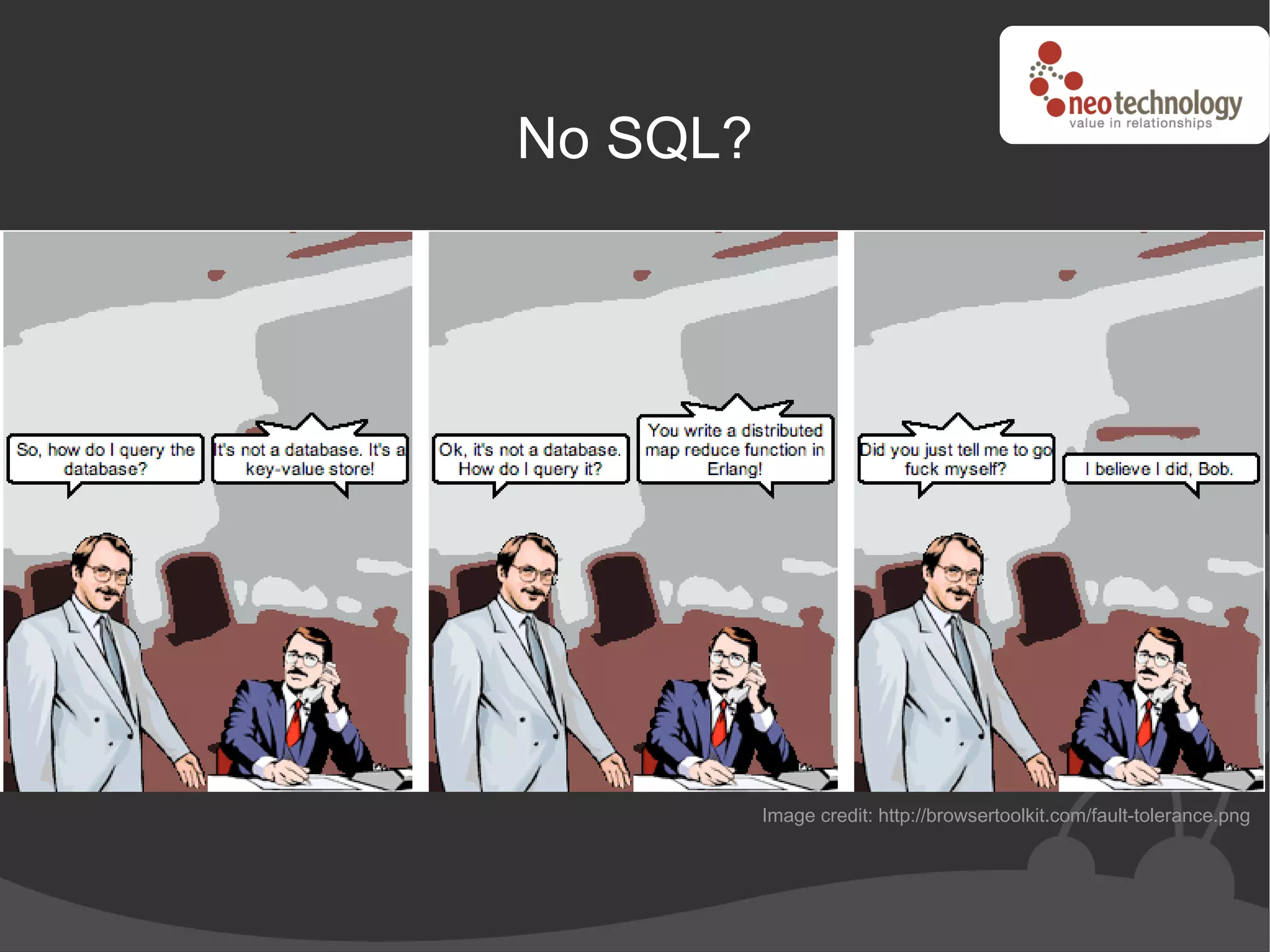
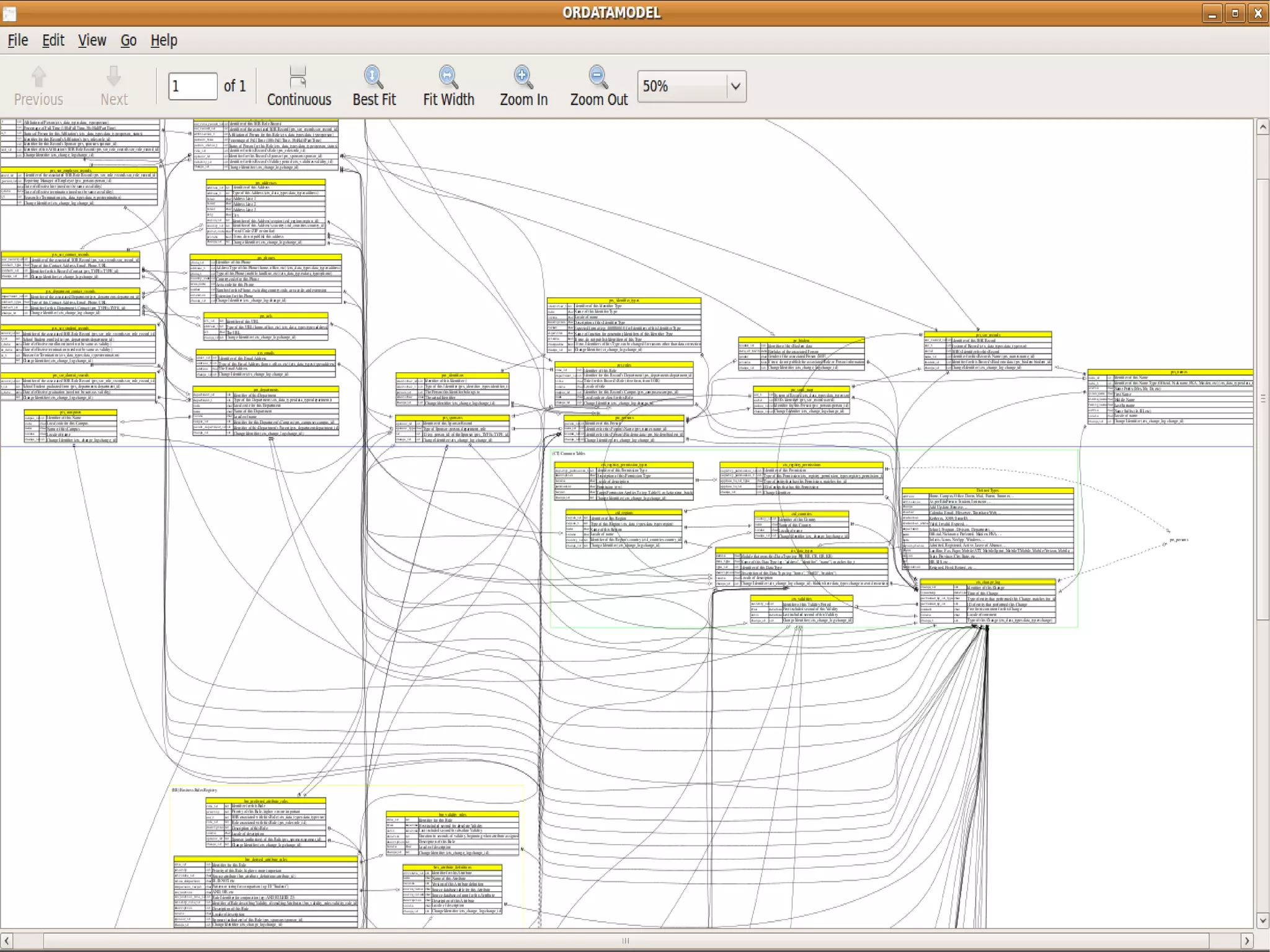
No SQL?


          Image credit: http://browsertoolkit.com/fault-tolerance.png
Neo4j   the benefits of
                graph databases


                                   #neo4j
Peter Neubauer                     @peterneubauer
COO, Neo Technology                peter@neotechnology.com
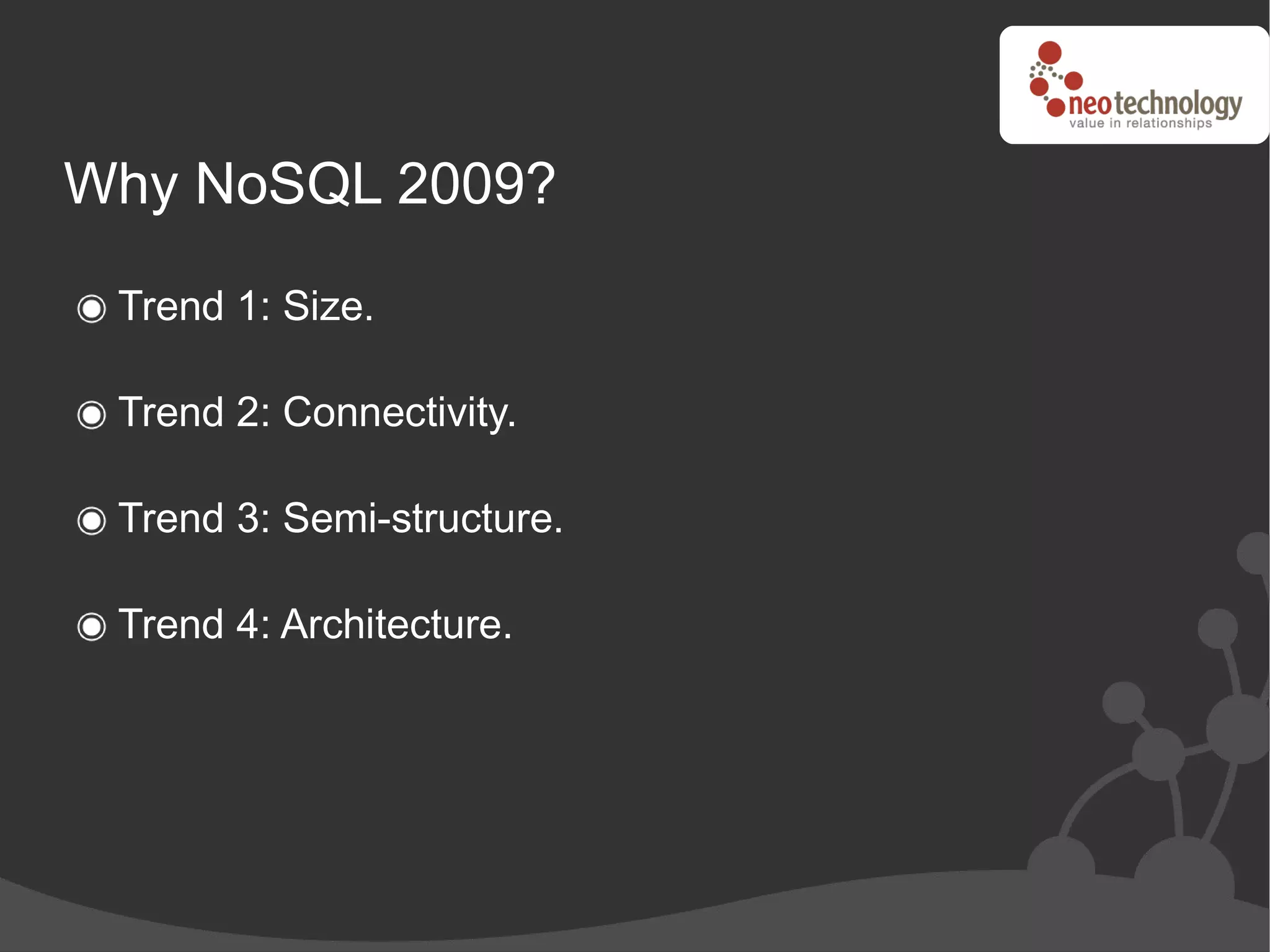
Why NoSQL 2009?

 Trend 1: Size.

 Trend 2: Connectivity.

 Trend 3: Semi-structure.

 Trend 4: Architecture.
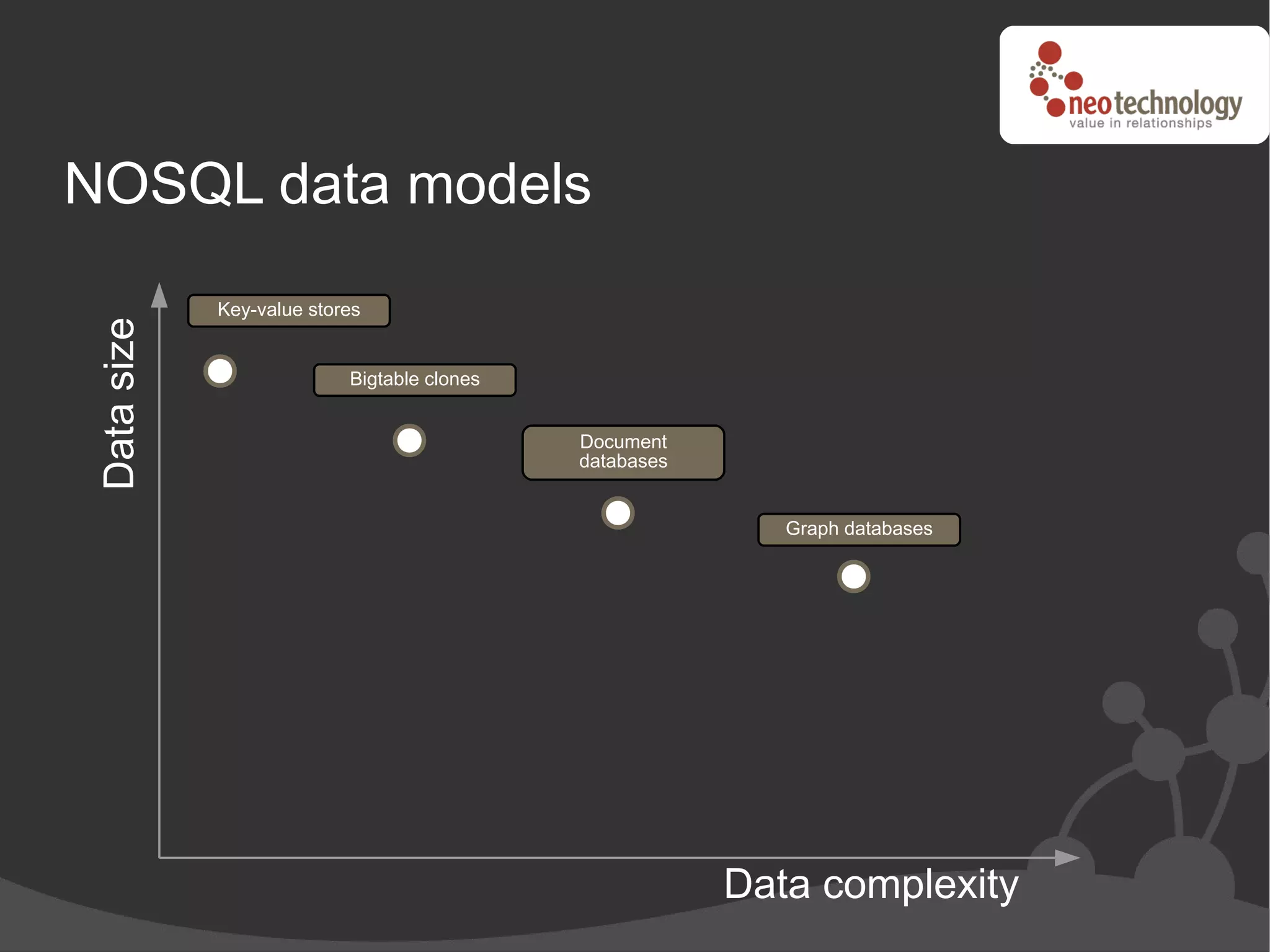
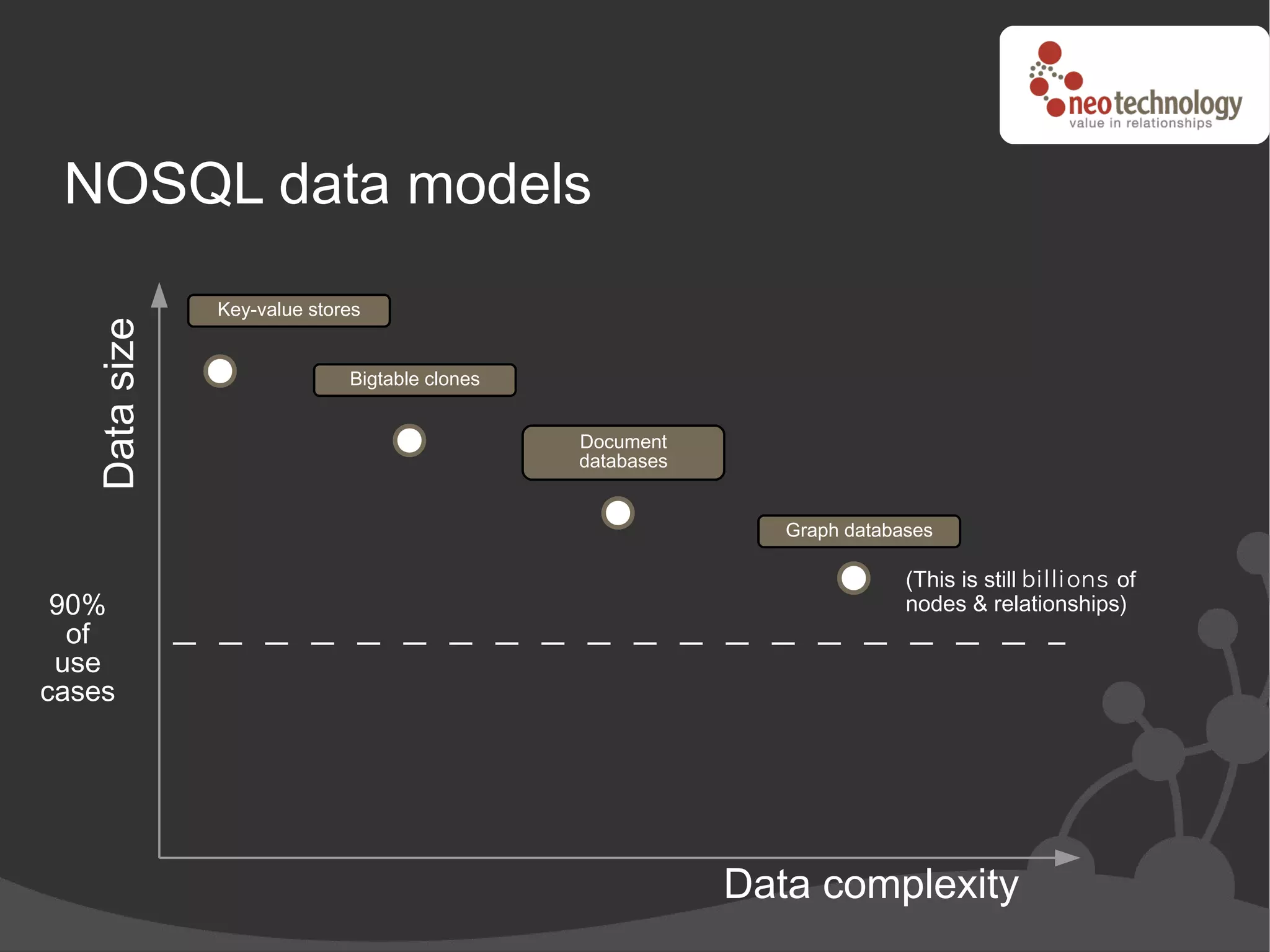
NOSQL data models
            Key-value stores
Data size


                          Bigtable clones


                                            Document
                                            databases


                                                           Graph databases


                                                        Data complexity
NOSQL data models
               Key-value stores
   Data size


                             Bigtable clones


                                               Document
                                               databases


                                                              Graph databases

                                                                          (This is still b i l l i on s of
 90%                                                                      nodes & relationships)
  of
 use
cases


                                                           Data complexity
Graph DBs
& Neo4j intro
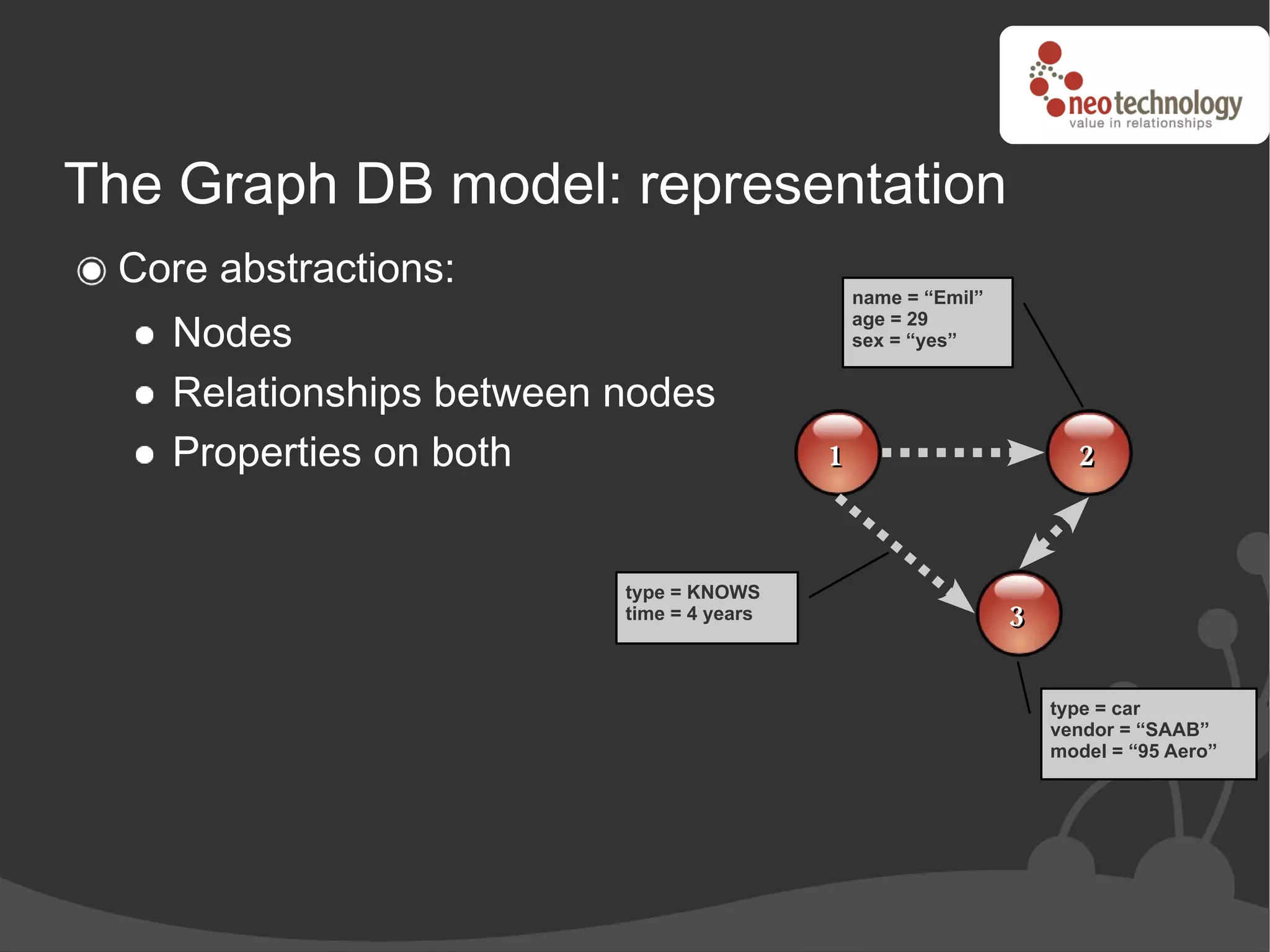
The Graph DB model: representation
 Core abstractions:
                                              name = “Emil”

   Nodes
                                              age = 29
                                              sex = “yes”


   Relationships between nodes
   Properties on both                     1                         2


                         type = KNOWS
                         time = 4 years                       3

                                                                  type = car
                                                                  vendor = “SAAB”
                                                                  model = “95 Aero”
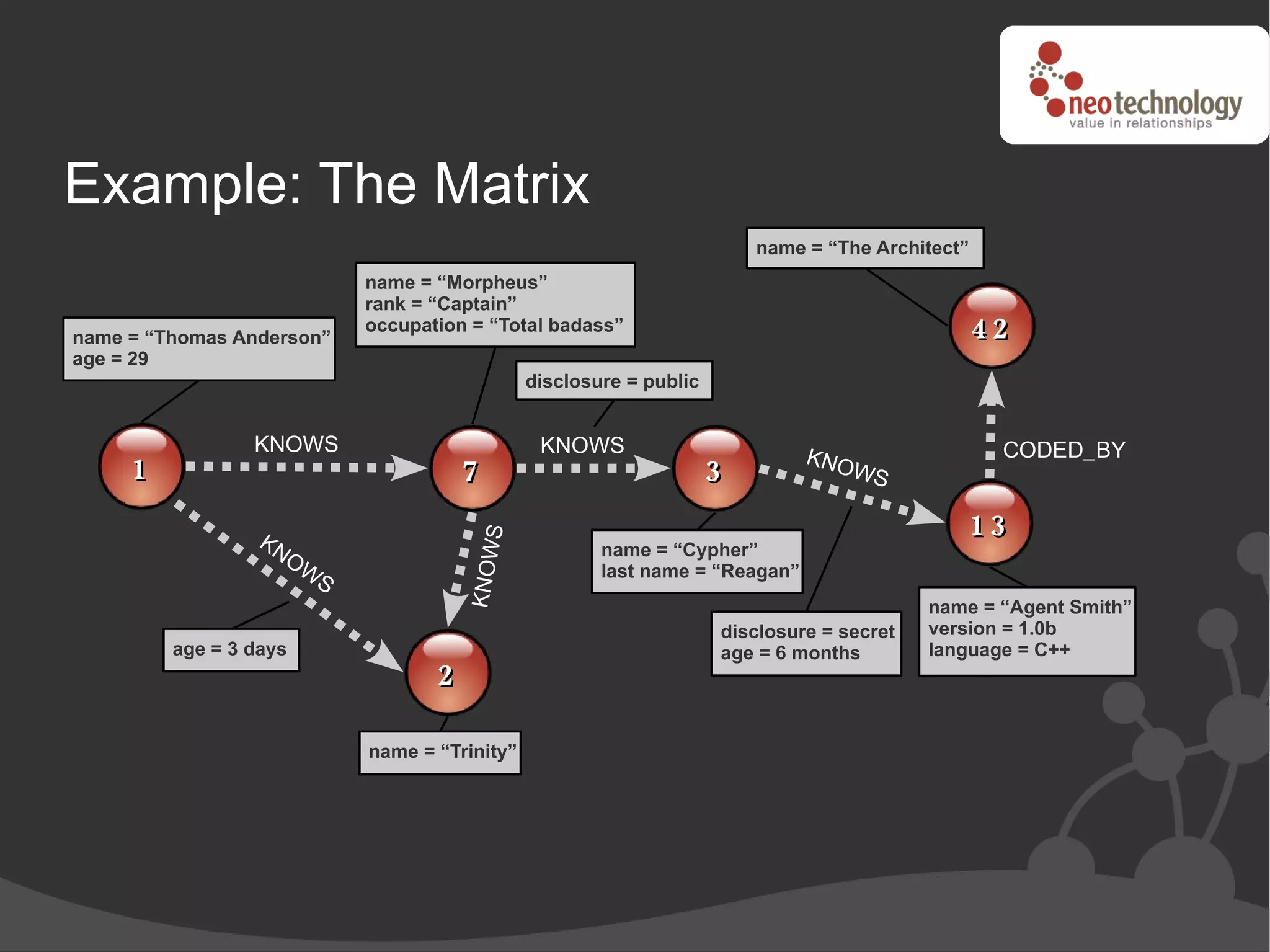
Example: The Matrix
                                                                           name = “The Architect”
                             name = “Morpheus”
                             rank = “Captain”
name = “Thomas Anderson”
                             occupation = “Total badass”                                            42
age = 29
                                                 disclosure = public


                 KNOWS                            KNOWS                                              CODED_BY
                                                                                KNO
     1                                  7                              3           W   S

                 KN
                                                                                                13
                                             S

                    OW                                   name = “Cypher”
                                        KNOW


                         S                               last name = “Reagan”
                                                                                             name = “Agent Smith”
                                                                       disclosure = secret   version = 1.0b
         age = 3 days                                                  age = 6 months        language = C++
                                    2

                             name = “Trinity”
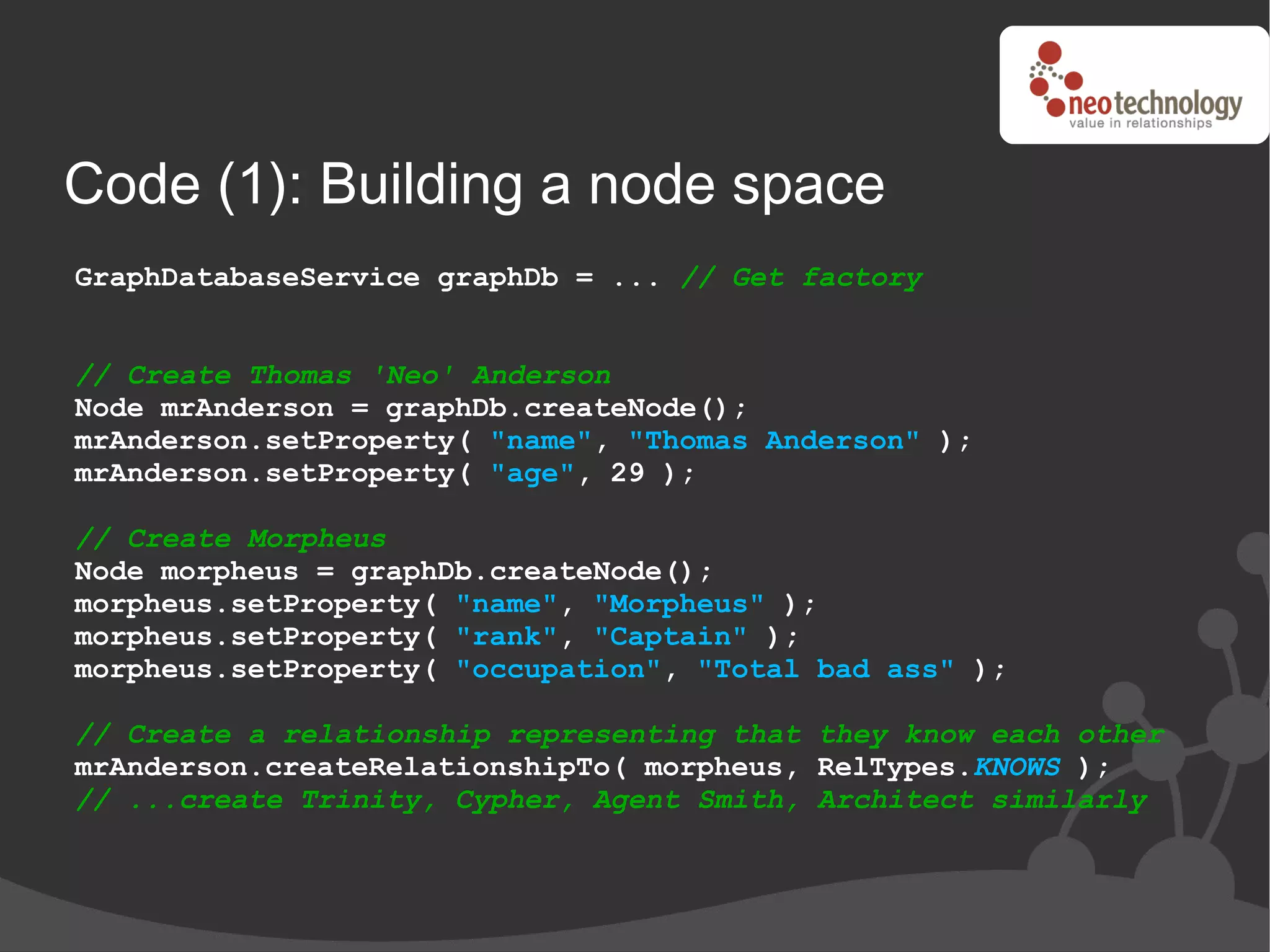
Code (1): Building a node space
GraphDatabaseService graphDb = ... // Get factory


// Create Thomas 'Neo' Anderson
Node mrAnderson = graphDb.createNode();
mrAnderson.setProperty( "name", "Thomas Anderson" );
mrAnderson.setProperty( "age", 29 );

// Create Morpheus
Node morpheus = graphDb.createNode();
morpheus.setProperty( "name", "Morpheus" );
morpheus.setProperty( "rank", "Captain" );
morpheus.setProperty( "occupation", "Total bad ass" );

// Create a relationship representing that they know each other
mrAnderson.createRelationshipTo( morpheus, RelTypes.KNOWS );
// ...create Trinity, Cypher, Agent Smith, Architect similarly
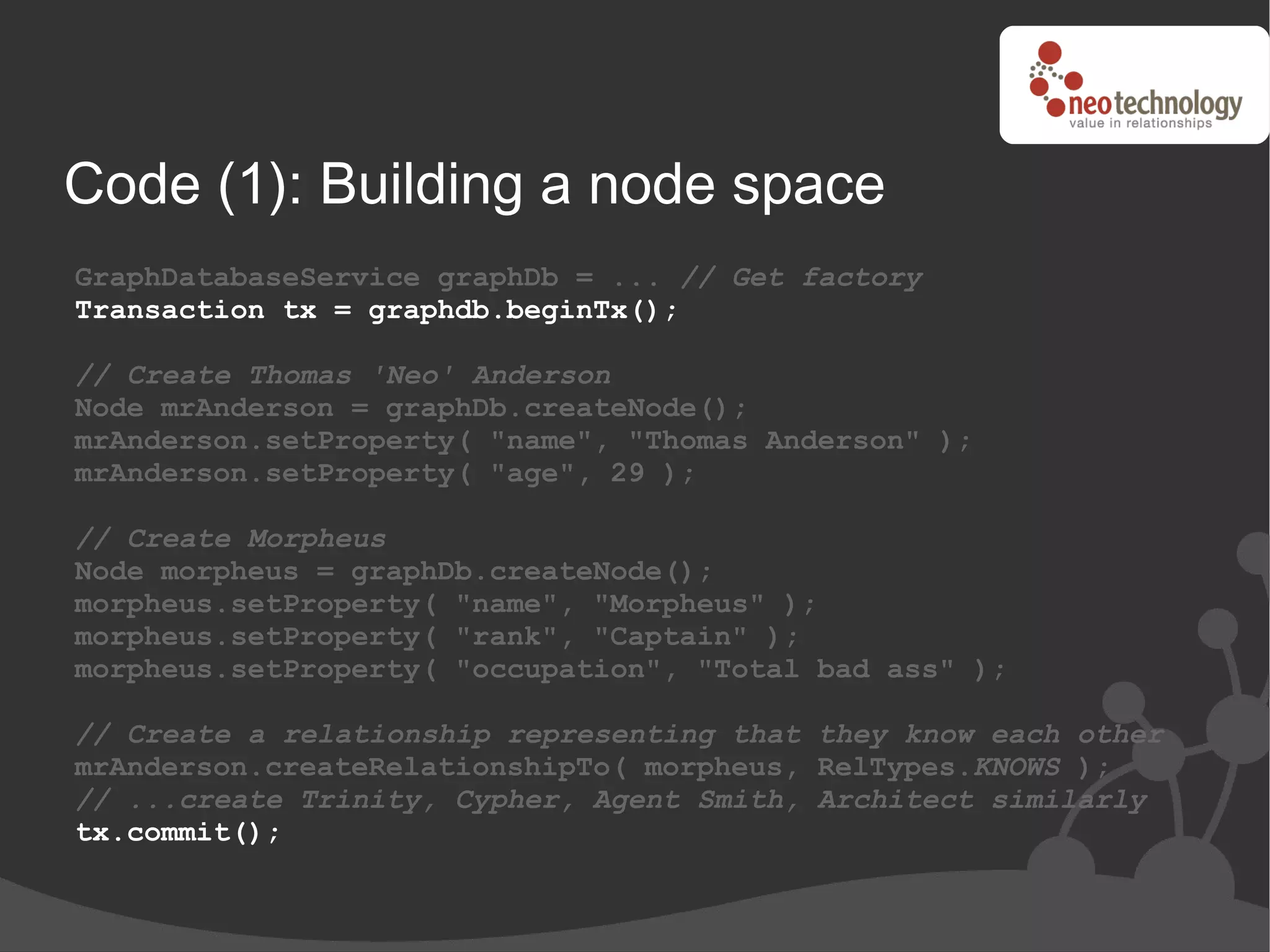
Code (1): Building a node space
GraphDatabaseService graphDb = ... // Get factory
Transaction tx = graphdb.beginTx();

// Create Thomas 'Neo' Anderson
Node mrAnderson = graphDb.createNode();
mrAnderson.setProperty( "name", "Thomas Anderson" );
mrAnderson.setProperty( "age", 29 );

// Create Morpheus
Node morpheus = graphDb.createNode();
morpheus.setProperty( "name", "Morpheus" );
morpheus.setProperty( "rank", "Captain" );
morpheus.setProperty( "occupation", "Total bad ass" );

// Create a relationship representing that they know each other
mrAnderson.createRelationshipTo( morpheus, RelTypes.KNOWS );
// ...create Trinity, Cypher, Agent Smith, Architect similarly
tx.commit();
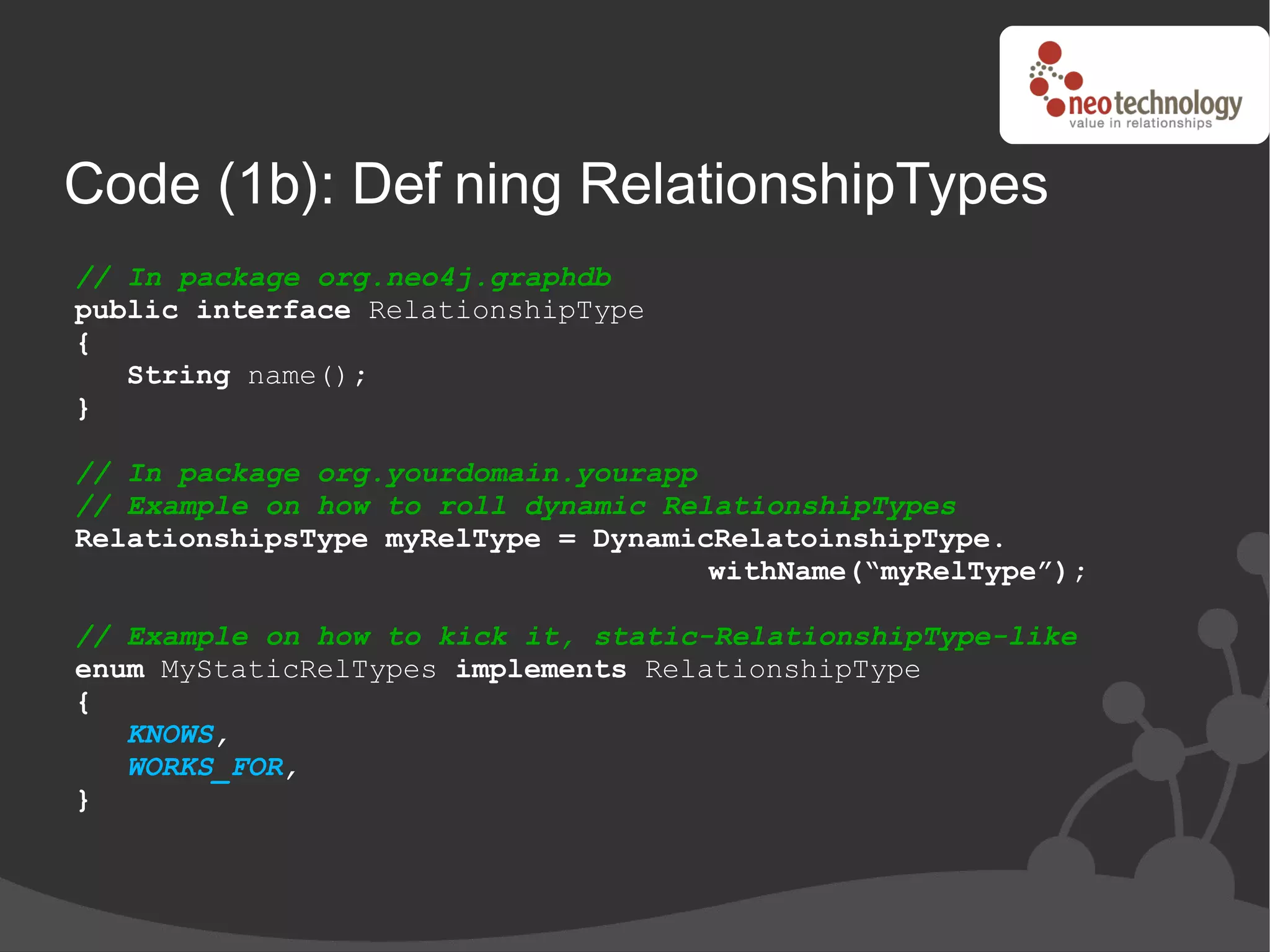
Code (1b): Def ning RelationshipTypes
             i
// In package org.neo4j.graphdb
public interface RelationshipType
{
   String name();
}

// In package org.yourdomain.yourapp
// Example on how to roll dynamic RelationshipTypes
RelationshipsType myRelType = DynamicRelatoinshipType.
                                     withName(“myRelType”);

// Example on how to kick it, static-RelationshipType-like
enum MyStaticRelTypes implements RelationshipType
{
   KNOWS,
   WORKS_FOR,
}
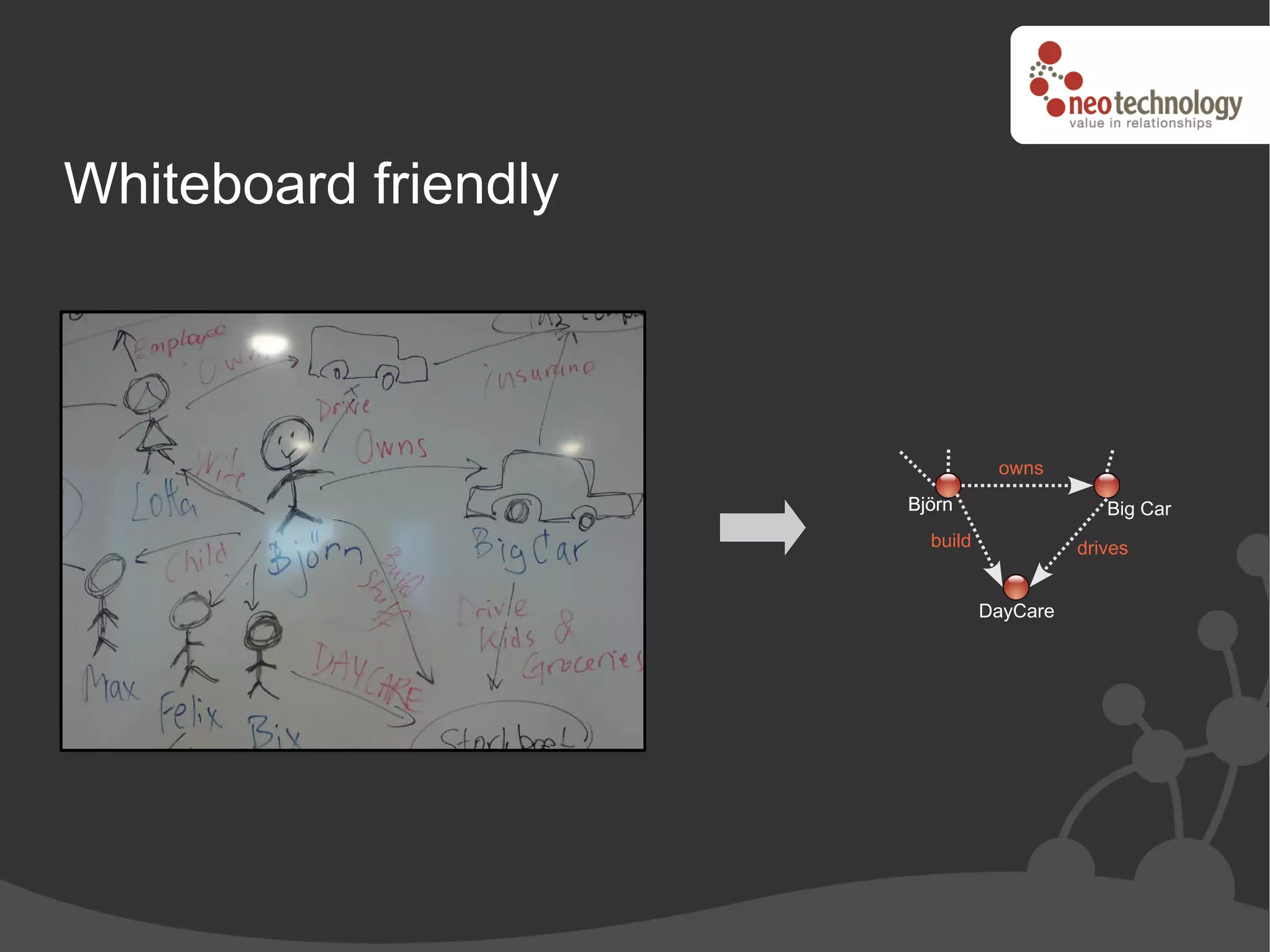
Whiteboard friendly


                                 owns
                      Björn                  Big Car
                        build             drives


                                DayCare
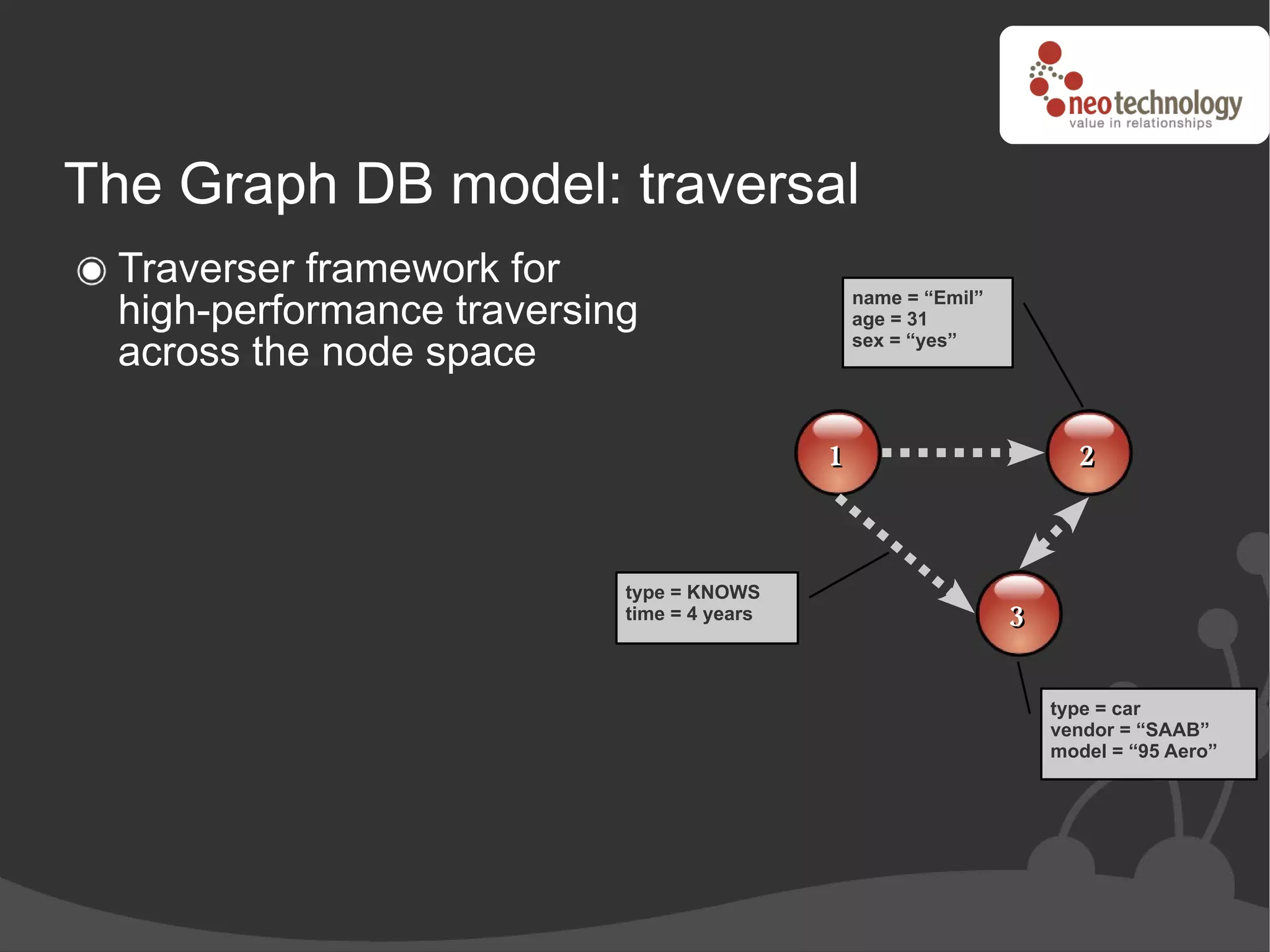
The Graph DB model: traversal
 Traverser framework for
 high-performance traversing                    name = “Emil”
                                                age = 31

 across the node space                          sex = “yes”


                                            1                         2


                           type = KNOWS
                           time = 4 years                       3

                                                                    type = car
                                                                    vendor = “SAAB”
                                                                    model = “95 Aero”
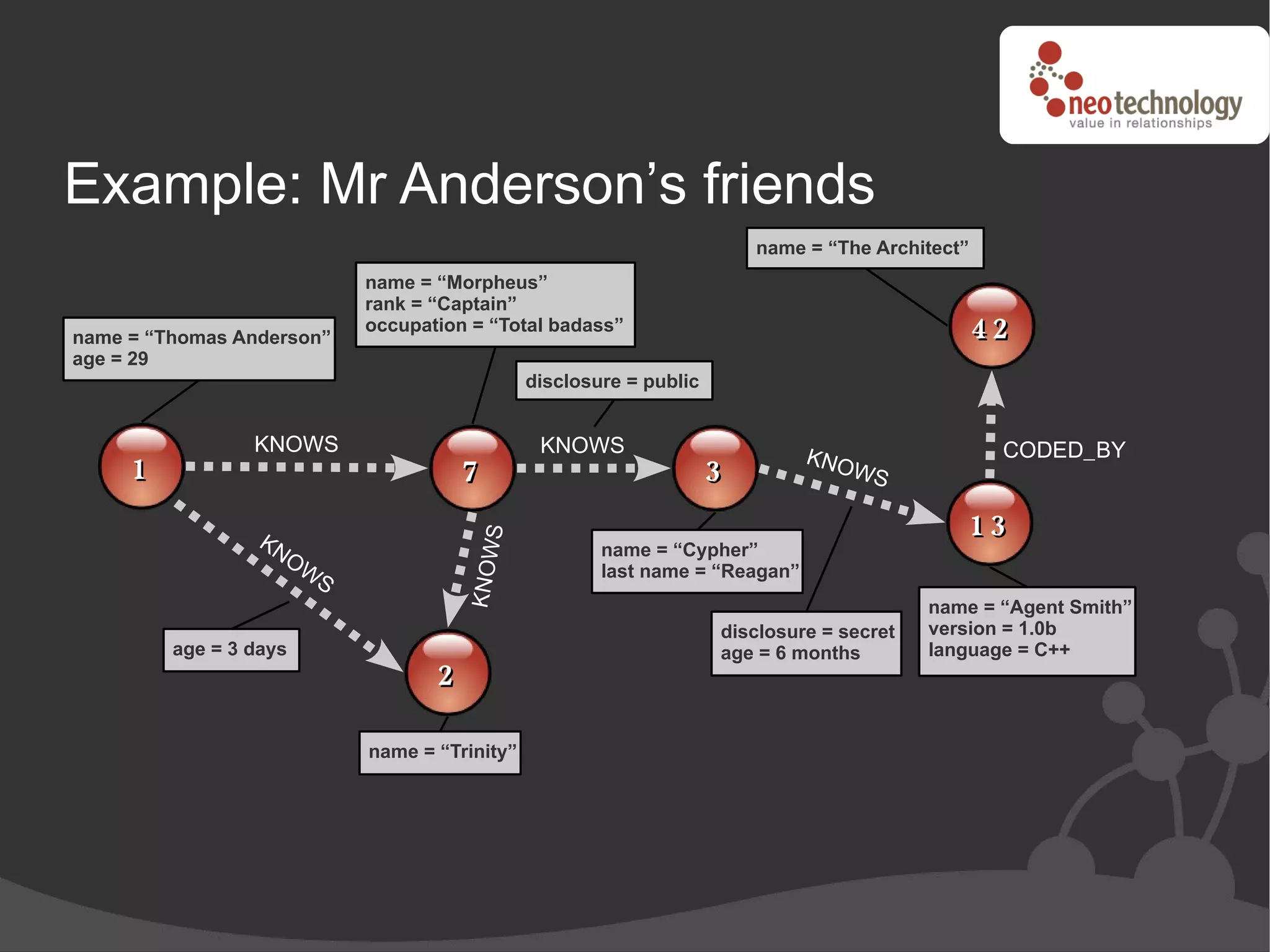
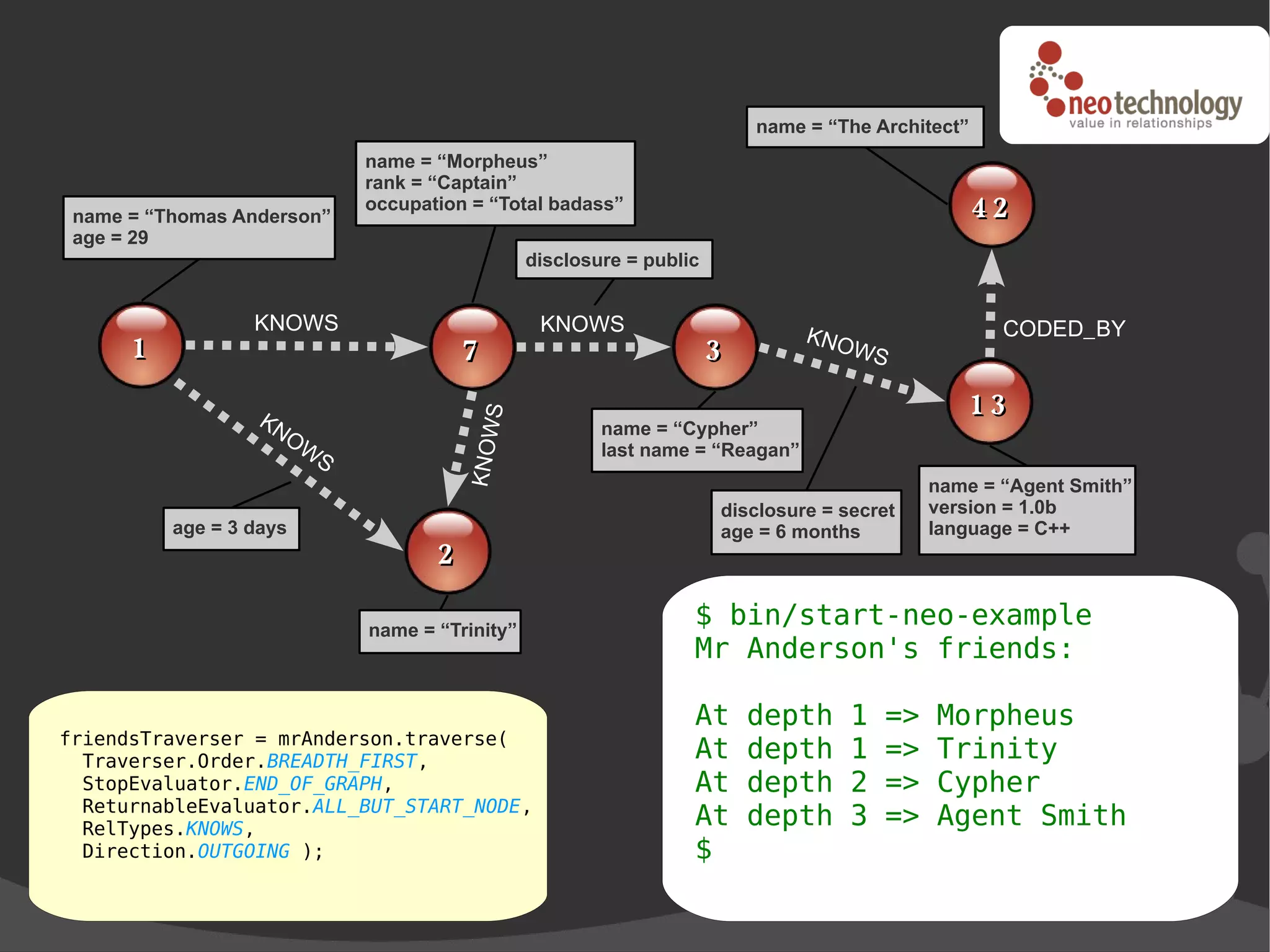
Example: Mr Anderson’s friends
                                                                           name = “The Architect”
                             name = “Morpheus”
                             rank = “Captain”
name = “Thomas Anderson”
                             occupation = “Total badass”                                            42
age = 29
                                                 disclosure = public


                 KNOWS                            KNOWS                                              CODED_BY
                                                                                KNO
     1                                  7                              3           W   S

                 KN
                                                                                                13
                                             S

                    OW                                   name = “Cypher”
                                        KNOW


                         S                               last name = “Reagan”
                                                                                             name = “Agent Smith”
                                                                       disclosure = secret   version = 1.0b
         age = 3 days                                                  age = 6 months        language = C++
                                    2

                             name = “Trinity”
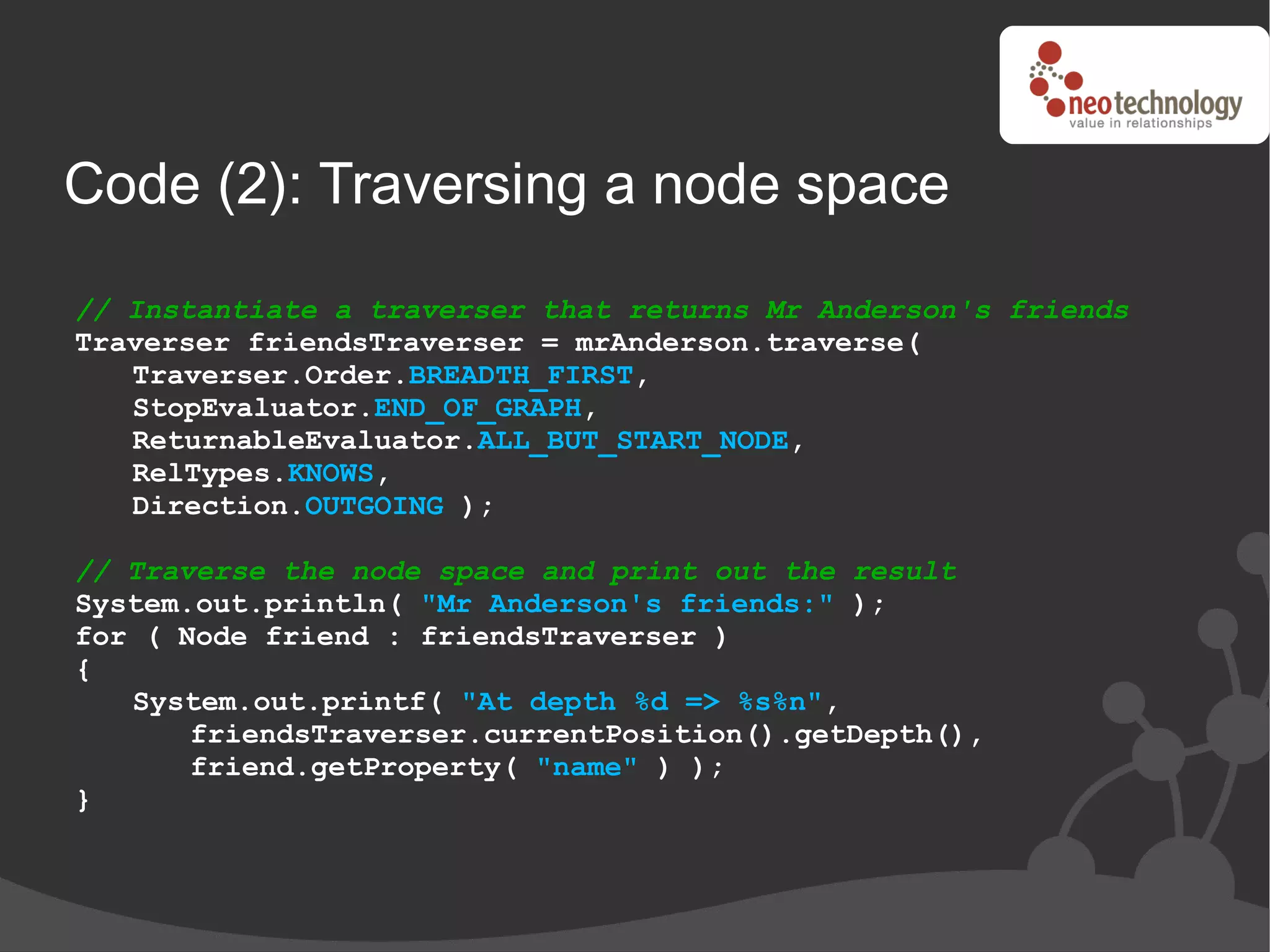
Code (2): Traversing a node space
// Instantiate a traverser that returns Mr Anderson's friends
Traverser friendsTraverser = mrAnderson.traverse(
   Traverser.Order.BREADTH_FIRST,
   StopEvaluator.END_OF_GRAPH,
   ReturnableEvaluator.ALL_BUT_START_NODE,
   RelTypes.KNOWS,
   Direction.OUTGOING );

// Traverse the node space and print out the result
System.out.println( "Mr Anderson's friends:" );
for ( Node friend : friendsTraverser )
{
   System.out.printf( "At depth %d => %s%n",
       friendsTraverser.currentPosition().getDepth(),
       friend.getProperty( "name" ) );
}
name = “The Architect”
                              name = “Morpheus”
                              rank = “Captain”
 name = “Thomas Anderson”
                              occupation = “Total badass”                                            42
 age = 29
                                                  disclosure = public


                  KNOWS                            KNOWS                                              CODED_BY
                                                                                 KNO
      1                                  7                              3           W     S

                  KN                                                                              13

                                              S
                     OW                                   name = “Cypher”

                                         KNOW
                          S                               last name = “Reagan”
                                                                                               name = “Agent Smith”
                                                                        disclosure = secret    version = 1.0b
          age = 3 days                                                  age = 6 months         language = C++
                                     2

                              name = “Trinity”
                                                                    $ bin/start-neo-example
                                                                    Mr Anderson's friends:

                                                                    At      depth     1   =>   Morpheus
friendsTraverser = mrAnderson.traverse(
  Traverser.Order.BREADTH_FIRST,                                    At      depth     1   =>   Trinity
  StopEvaluator.END_OF_GRAPH,                                       At      depth     2   =>   Cypher
  ReturnableEvaluator.ALL_BUT_START_NODE,
  RelTypes.KNOWS,
                                                                    At      depth     3   =>   Agent Smith
  Direction.OUTGOING );                                             $
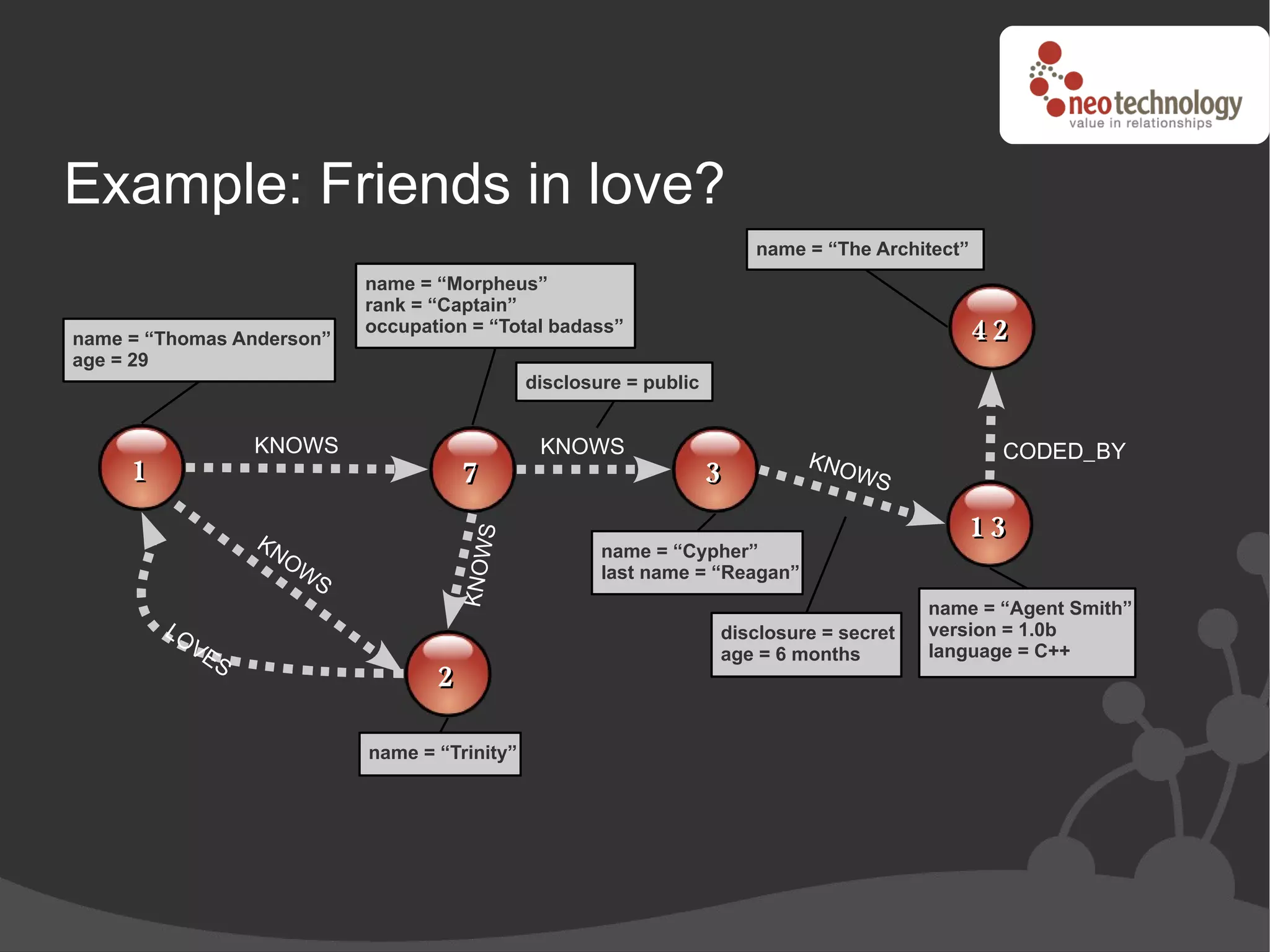
Example: Friends in love?
                                                                             name = “The Architect”
                               name = “Morpheus”
                               rank = “Captain”
name = “Thomas Anderson”
                               occupation = “Total badass”                                            42
age = 29
                                                   disclosure = public


                   KNOWS                            KNOWS                                              CODED_BY
                                                                                  KNO
     1                                    7                              3           W   S

                   KN                                                                             13
                                               S
                                          KNOW


                      OW                                   name = “Cypher”
                           S                               last name = “Reagan”
                                                                                               name = “Agent Smith”
         LO                                                              disclosure = secret   version = 1.0b
            VE                                                           age = 6 months        language = C++
               S
                                      2

                               name = “Trinity”
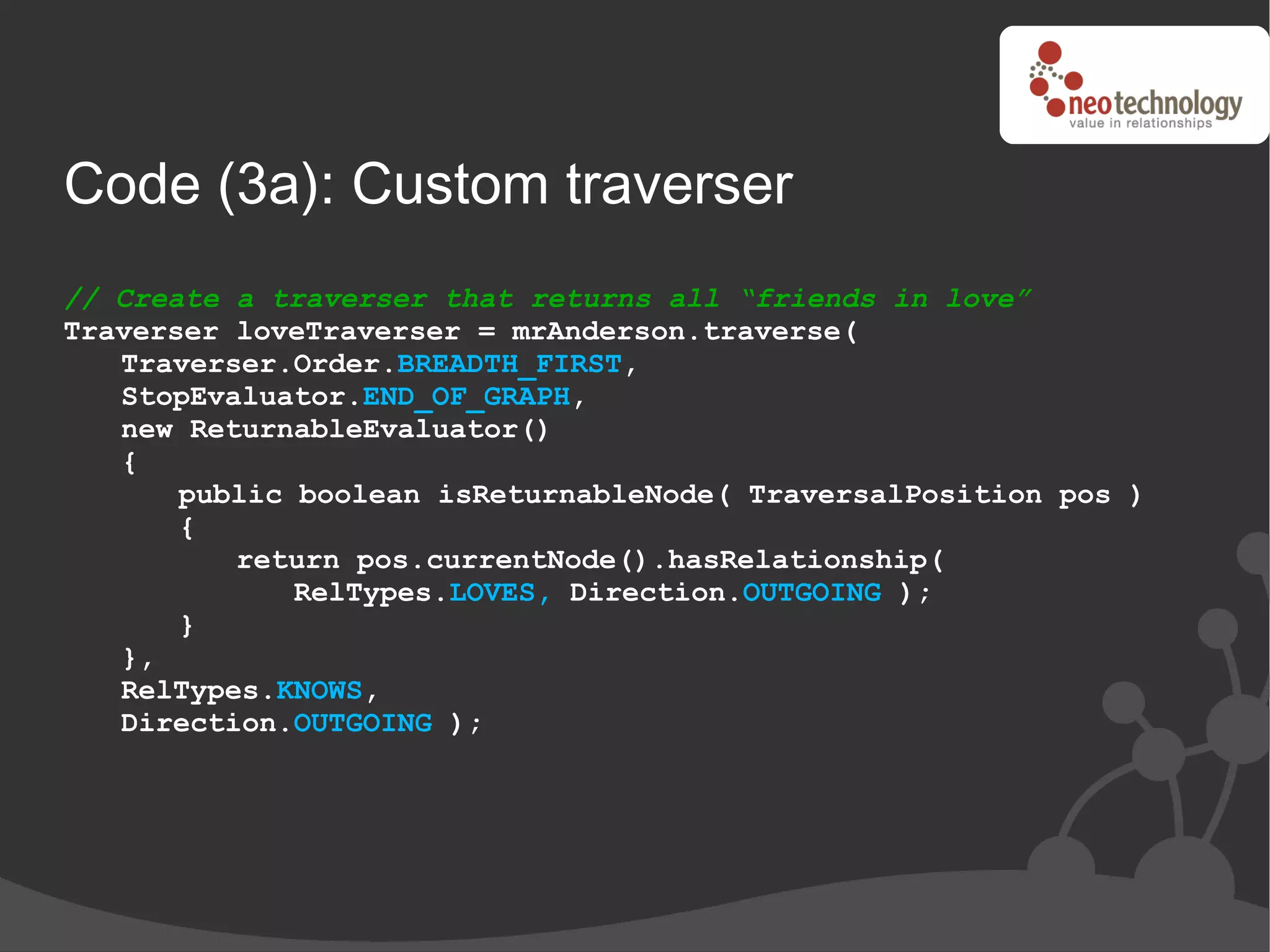
Code (3a): Custom traverser
// Create a traverser that returns all “friends in love”
Traverser loveTraverser = mrAnderson.traverse(
   Traverser.Order.BREADTH_FIRST,
   StopEvaluator.END_OF_GRAPH,
   new ReturnableEvaluator()
   {
       public boolean isReturnableNode( TraversalPosition pos )
       {
          return pos.currentNode().hasRelationship(
              RelTypes.LOVES, Direction.OUTGOING );
       }
   },
   RelTypes.KNOWS,
   Direction.OUTGOING );
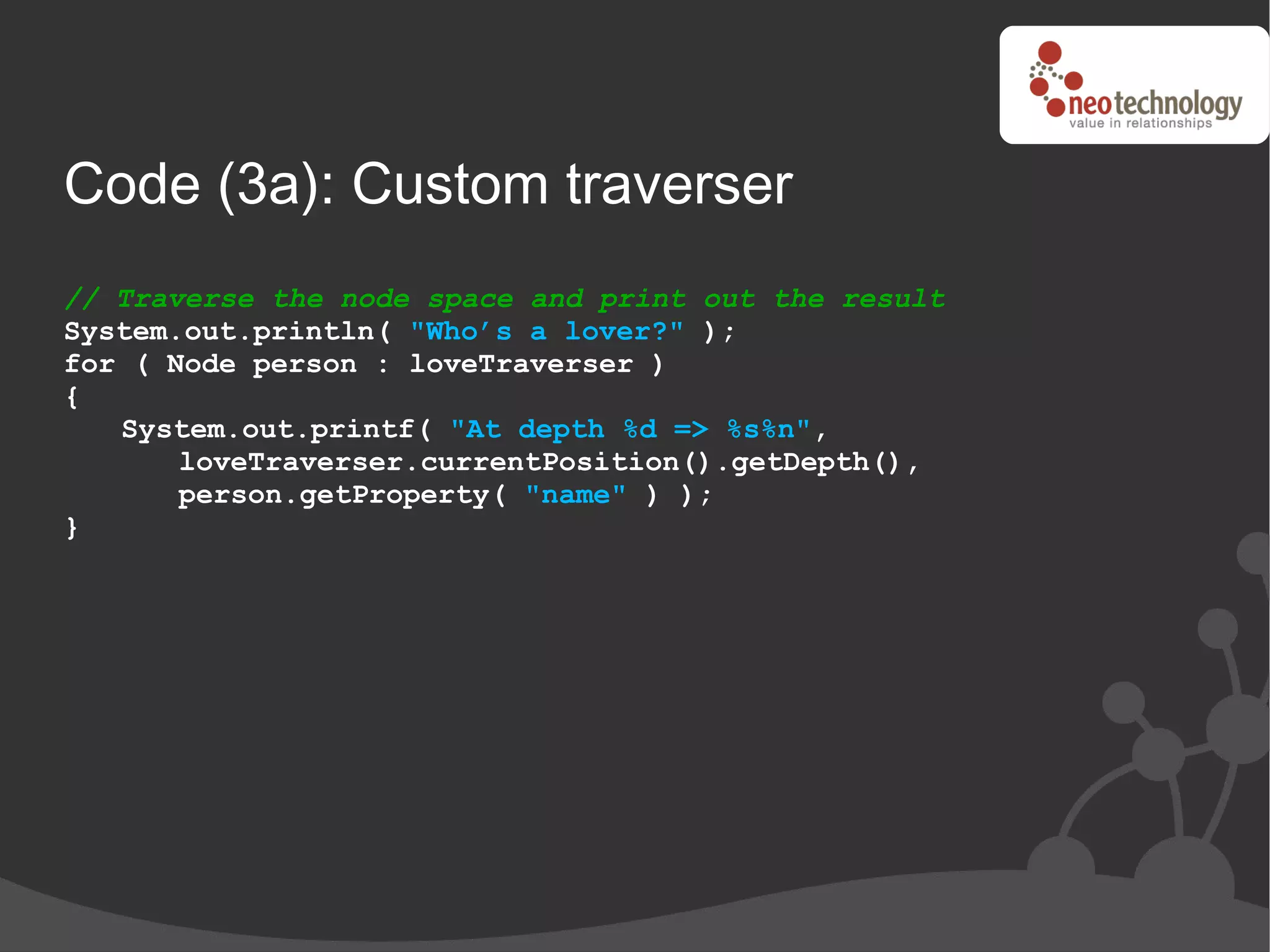
Code (3a): Custom traverser
// Traverse the node space and print out the result
System.out.println( "Who’s a lover?" );
for ( Node person : loveTraverser )
{
   System.out.printf( "At depth %d => %s%n",
       loveTraverser.currentPosition().getDepth(),
       person.getProperty( "name" ) );
}
name = “The Architect”
                                name = “Morpheus”
                                rank = “Captain”
 name = “Thomas Anderson”
                                occupation = “Total badass”                                            42
 age = 29
                                                    disclosure = public


                    KNOWS                            KNOWS                         KNO                  CODED_BY
      1                                    7                              3           W   S

                    KN                                                                             13

                                                S
                                                            name = “Cypher”

                                           KNOW
                       OW
                            S                               last name = “Reagan”
                                                                                                name = “Agent Smith”
          LO                                                              disclosure = secret   version = 1.0b
             VE                                                           age = 6 months        language = C++
                S
                                       2

                                name = “Trinity”
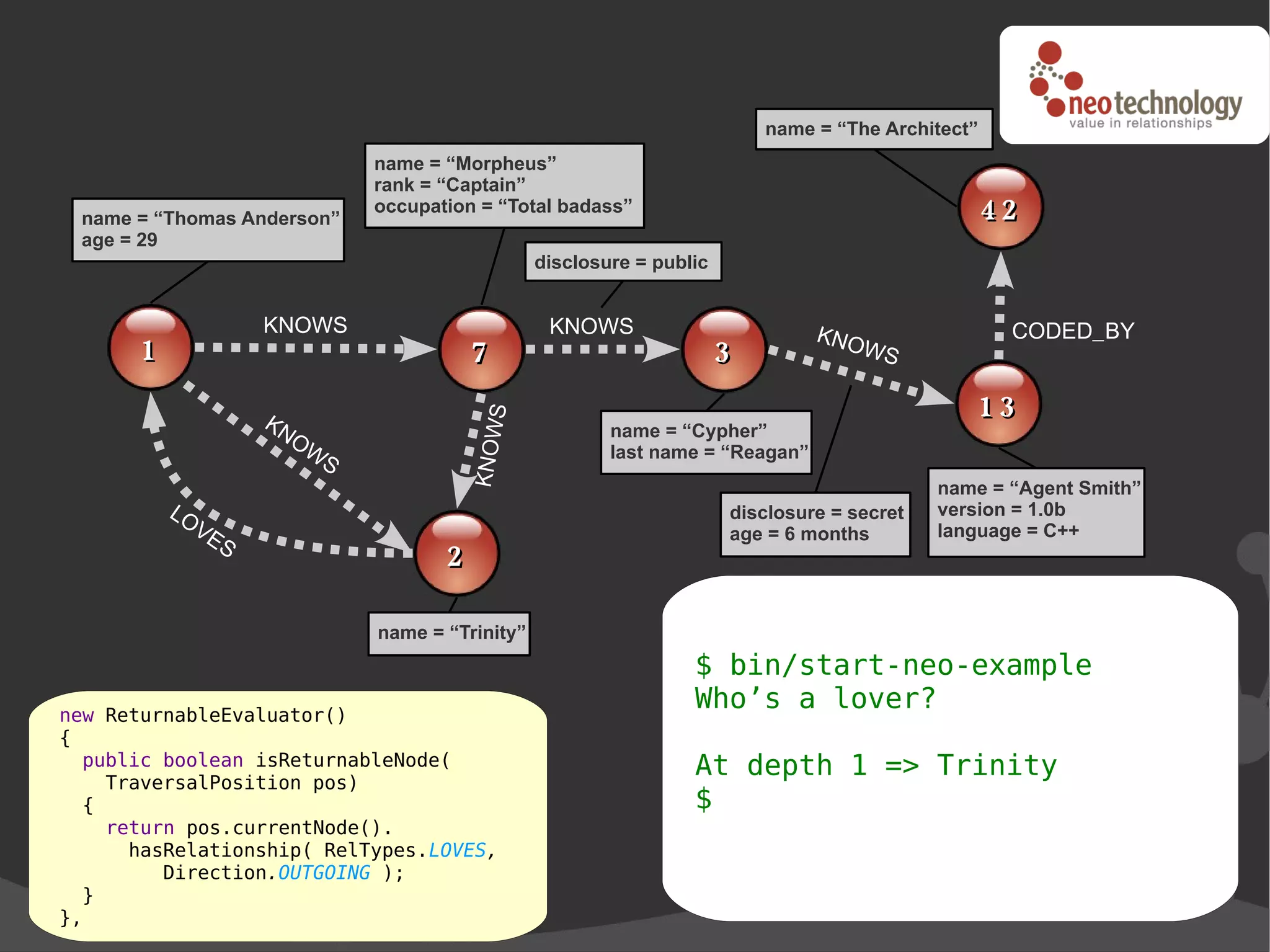
                                                                     $ bin/start-neo-example
new ReturnableEvaluator()
                                                                     Who’s a lover?
{
  public boolean isReturnableNode(
    TraversalPosition pos)
                                                                     At depth 1 => Trinity
  {                                                                  $
    return pos.currentNode().
      hasRelationship( RelTypes.LOVES,
         Direction.OUTGOING );
  }
},
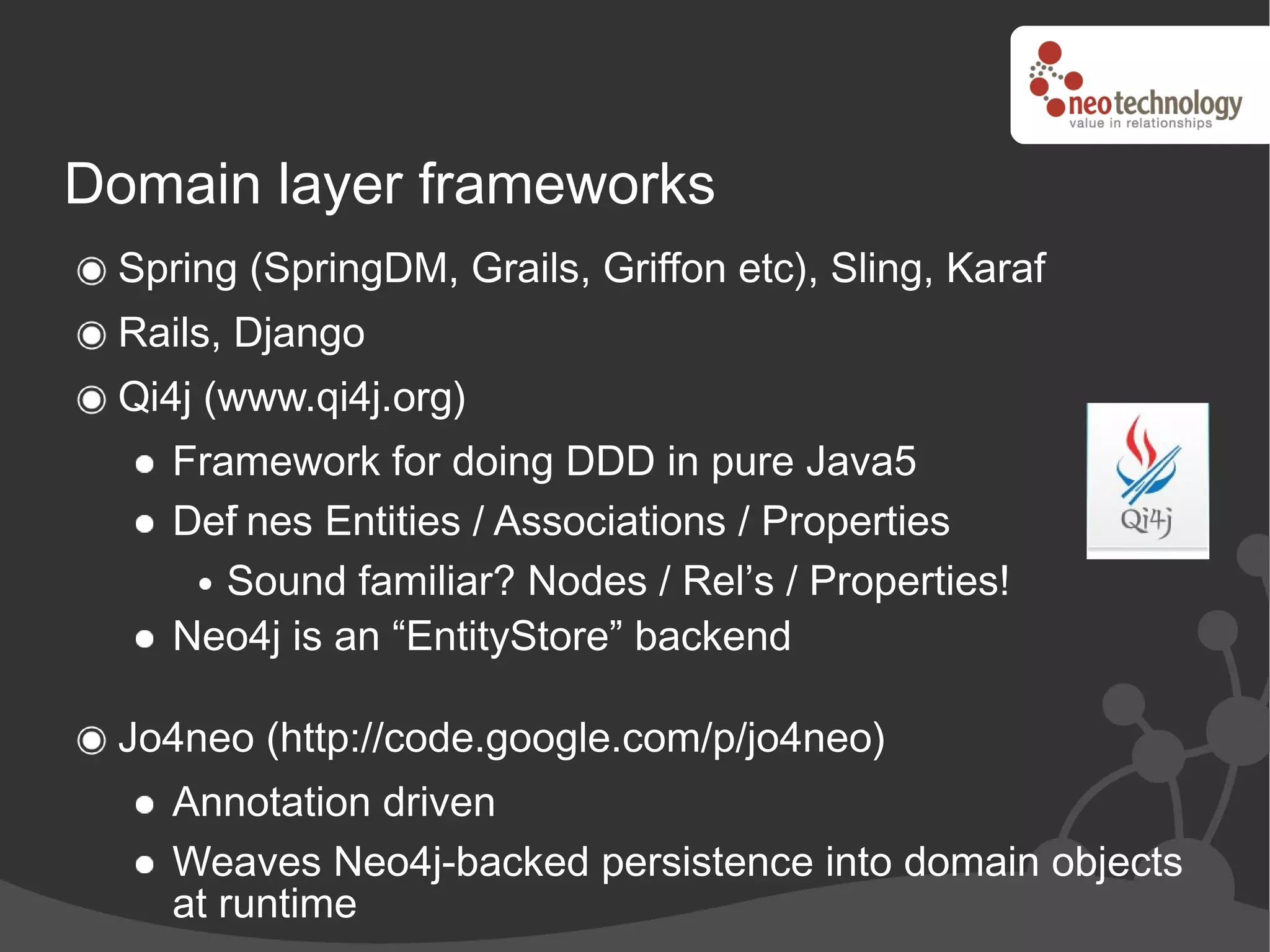
Domain layer frameworks
 Spring (SpringDM, Grails, Griffon etc), Sling, Karaf
 Rails, Django
 Qi4j (www.qi4j.org)
    Framework for doing DDD in pure Java5
    Def nes Entities / Associations / Properties
       i
       Sound familiar? Nodes / Rel’s / Properties!
    Neo4j is an “EntityStore” backend

 Jo4neo (http://code.google.com/p/jo4neo)
    Annotation driven
    Weaves Neo4j-backed persistence into domain objects
    at runtime
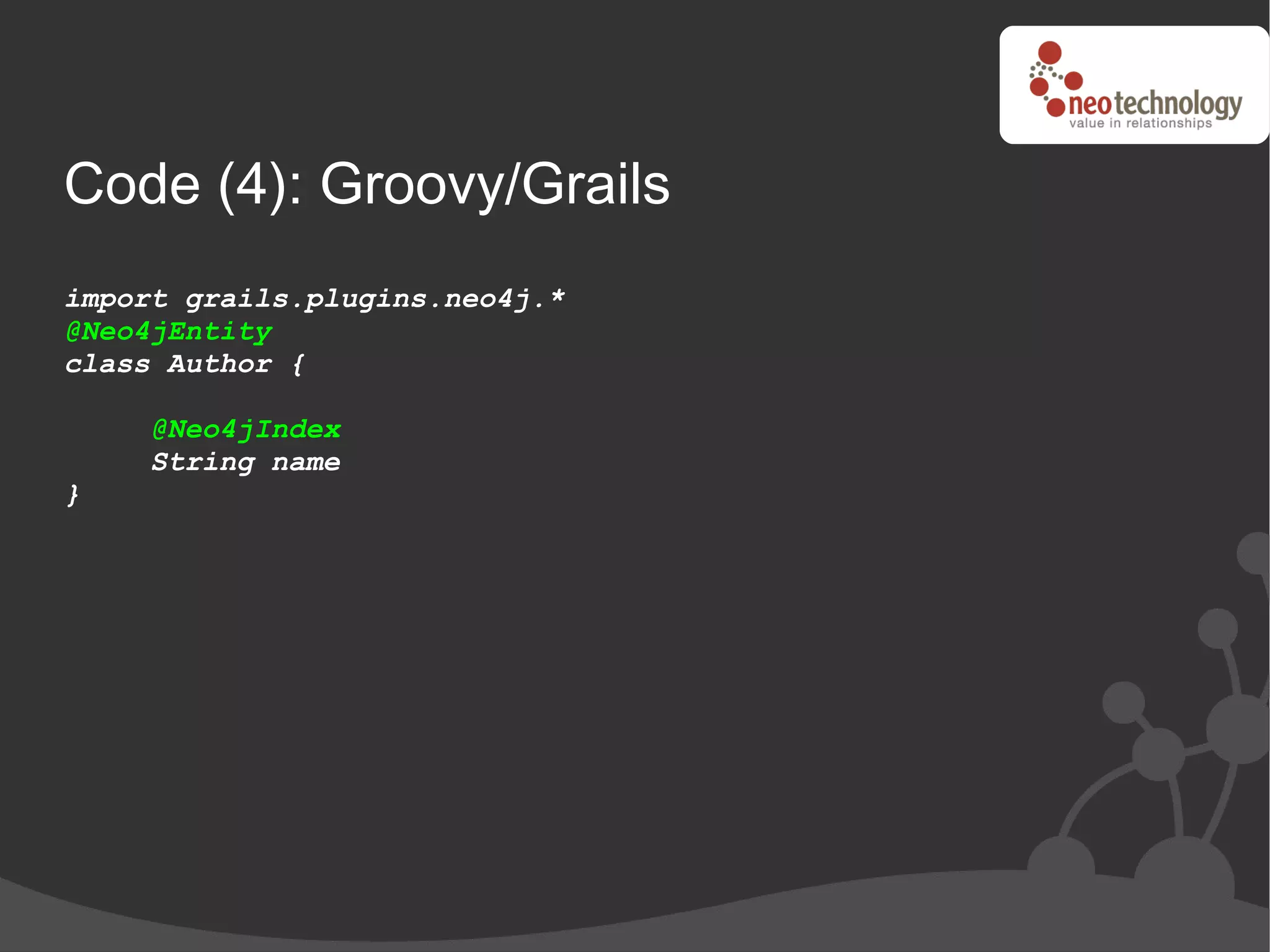
Code (4): Groovy/Grails
import grails.plugins.neo4j.*
@Neo4jEntity
class Author {

    @Neo4jIndex
    String name
}
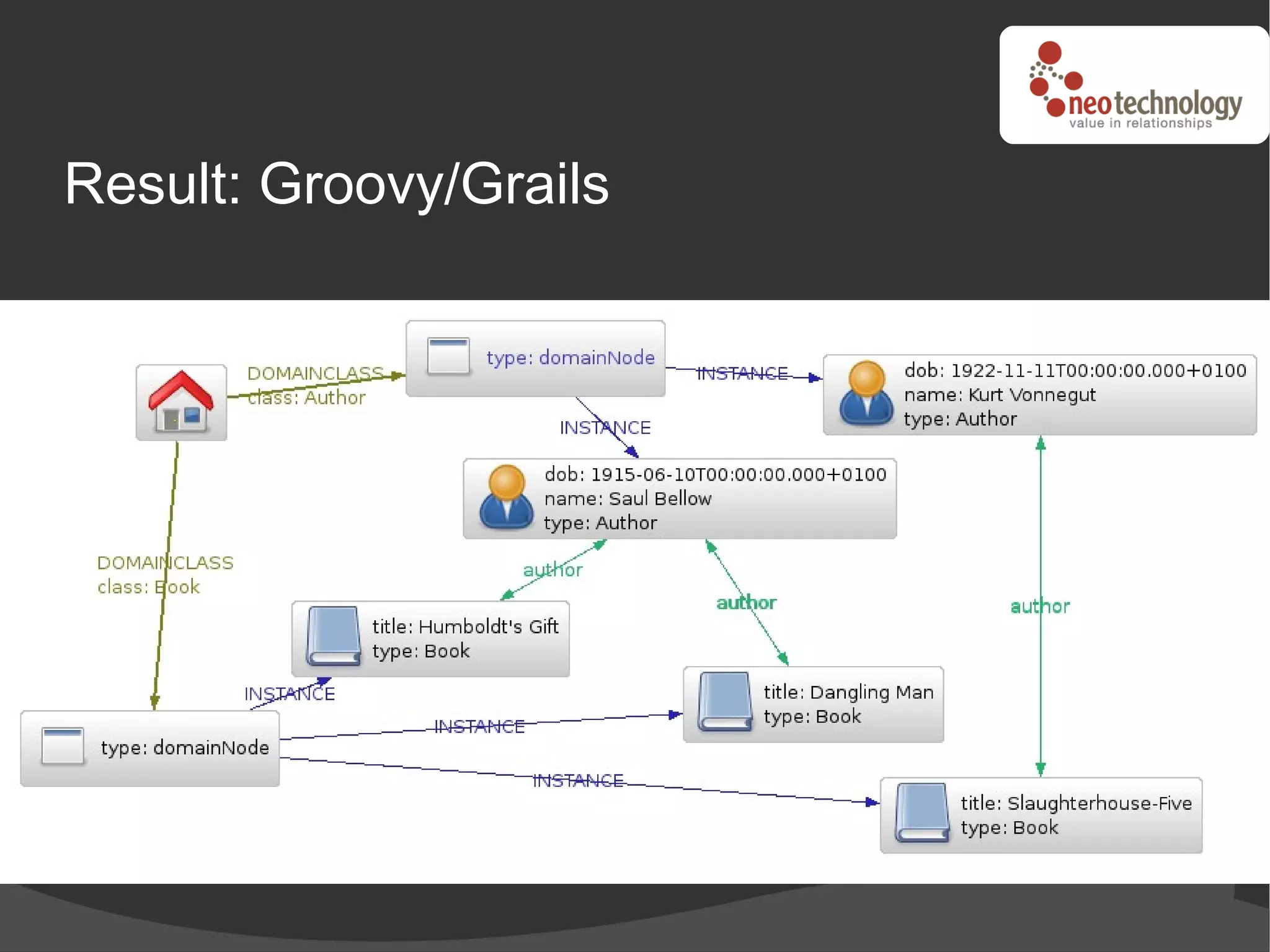
Result: Groovy/Grails
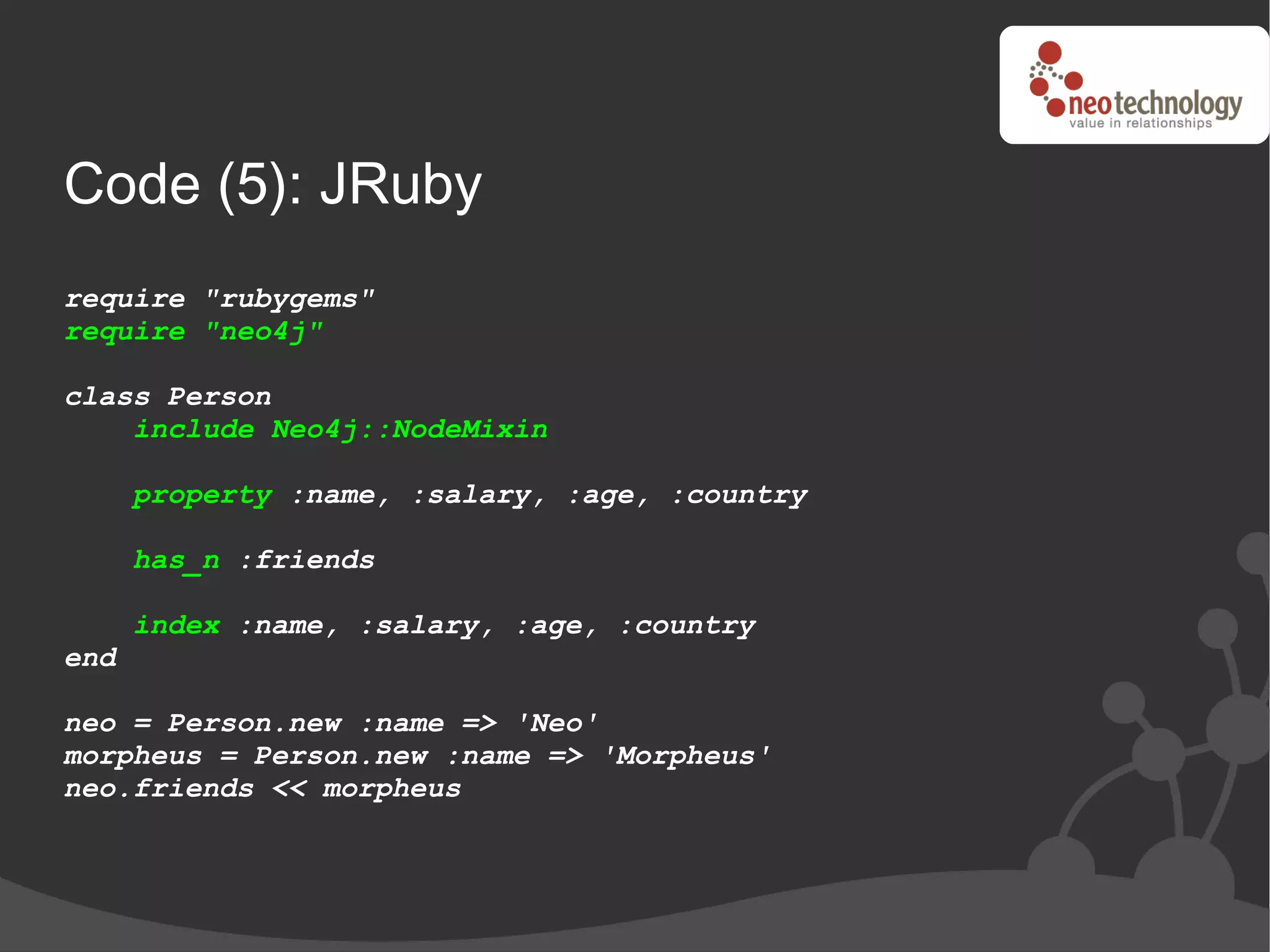
Code (5): JRuby
require "rubygems"
require "neo4j"

class Person
    include Neo4j::NodeMixin

      property :name, :salary, :age, :country

      has_n :friends

      index :name, :salary, :age, :country
end

neo = Person.new :name => 'Neo'
morpheus = Person.new :name => 'Morpheus'
neo.friends << morpheus
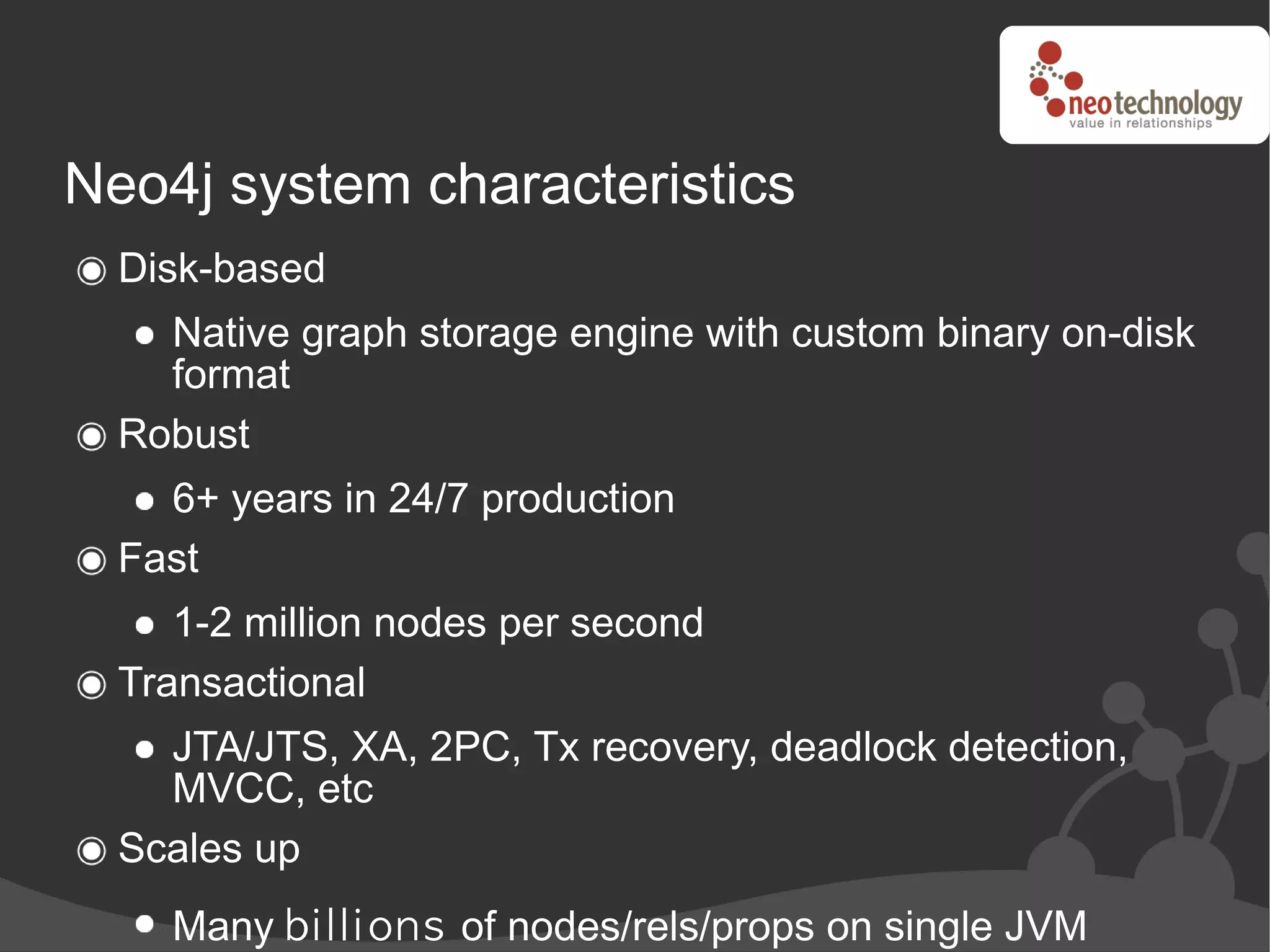
Neo4j system characteristics
  Disk-based
    Native graph storage engine with custom binary on-disk
    format
  Robust
    6+ years in 24/7 production
  Fast
     1-2 million nodes per second
  Transactional
    JTA/JTS, XA, 2PC, Tx recovery, deadlock detection,
    MVCC, etc
  Scales up
    Many b i l l i on s of nodes/rels/props on single JVM
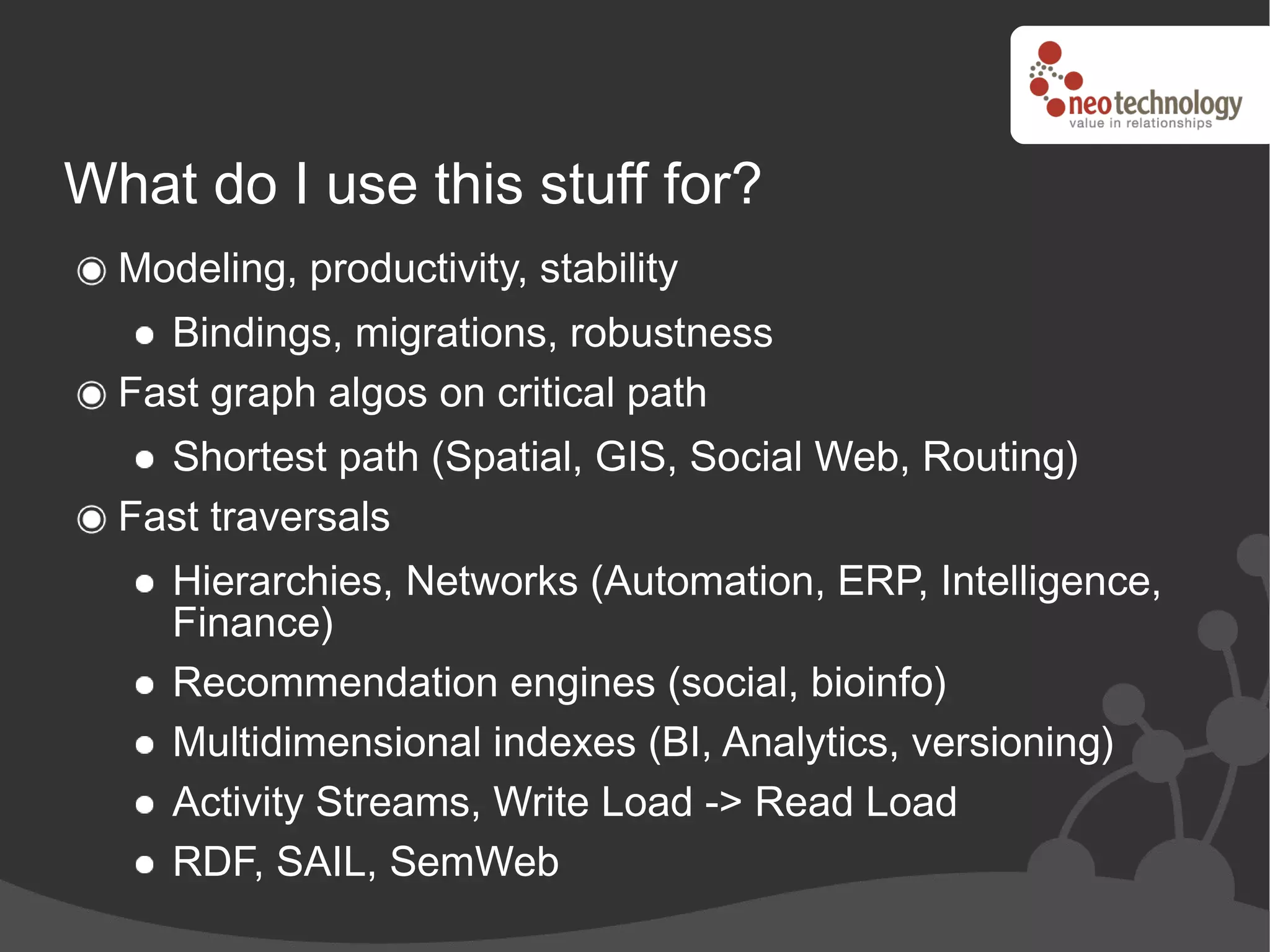
What do I use this stuff for?
  Modeling, productivity, stability
    Bindings, migrations, robustness
  Fast graph algos on critical path
    Shortest path (Spatial, GIS, Social Web, Routing)
  Fast traversals
     Hierarchies, Networks (Automation, ERP, Intelligence,
     Finance)
     Recommendation engines (social, bioinfo)
     Multidimensional indexes (BI, Analytics, versioning)
     Activity Streams, Write Load -> Read Load
     RDF, SAIL, SemWeb
Query languages
 SPARQL – “SQL for linked data”
    Ex: ”SELECT ?person WHERE {
          ?person neo4j:KNOWS ?friend .
          ?friend neo4j:KNOWS ?foe .
          ?foe neo4j:name “Larry Ellison” .
     }”


 Gremlin – “perl for graphs”
    Ex: ”./outE[@label='KNOWS']/inV[@age   > 30]/@name”
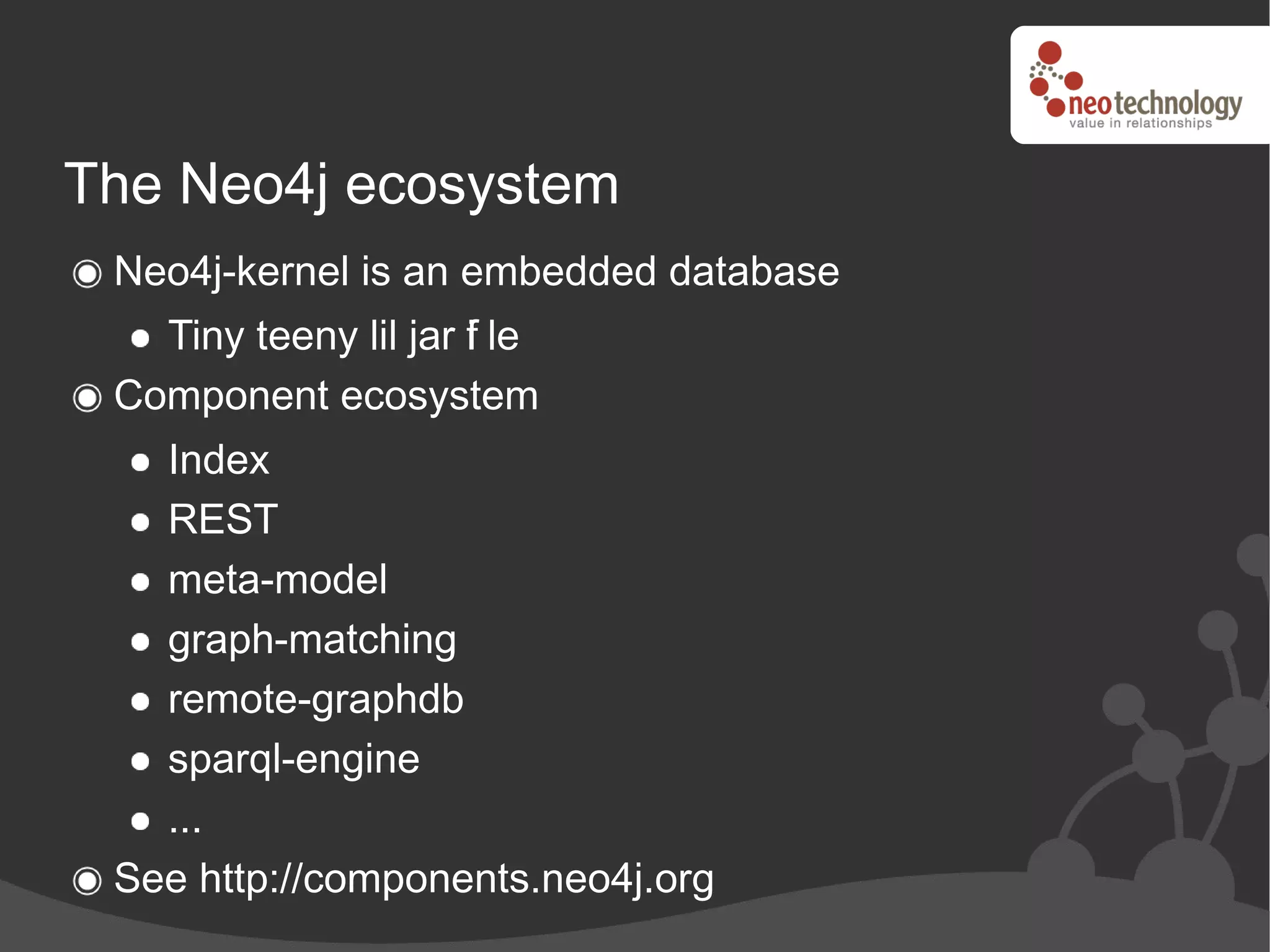
The Neo4j ecosystem
 Neo4j-kernel is an embedded database
   Tiny teeny lil jar f le
                      i
 Component ecosystem
   Index
   REST
   meta-model
   graph-matching
   remote-graphdb
   sparql-engine
   ...
 See http://components.neo4j.org
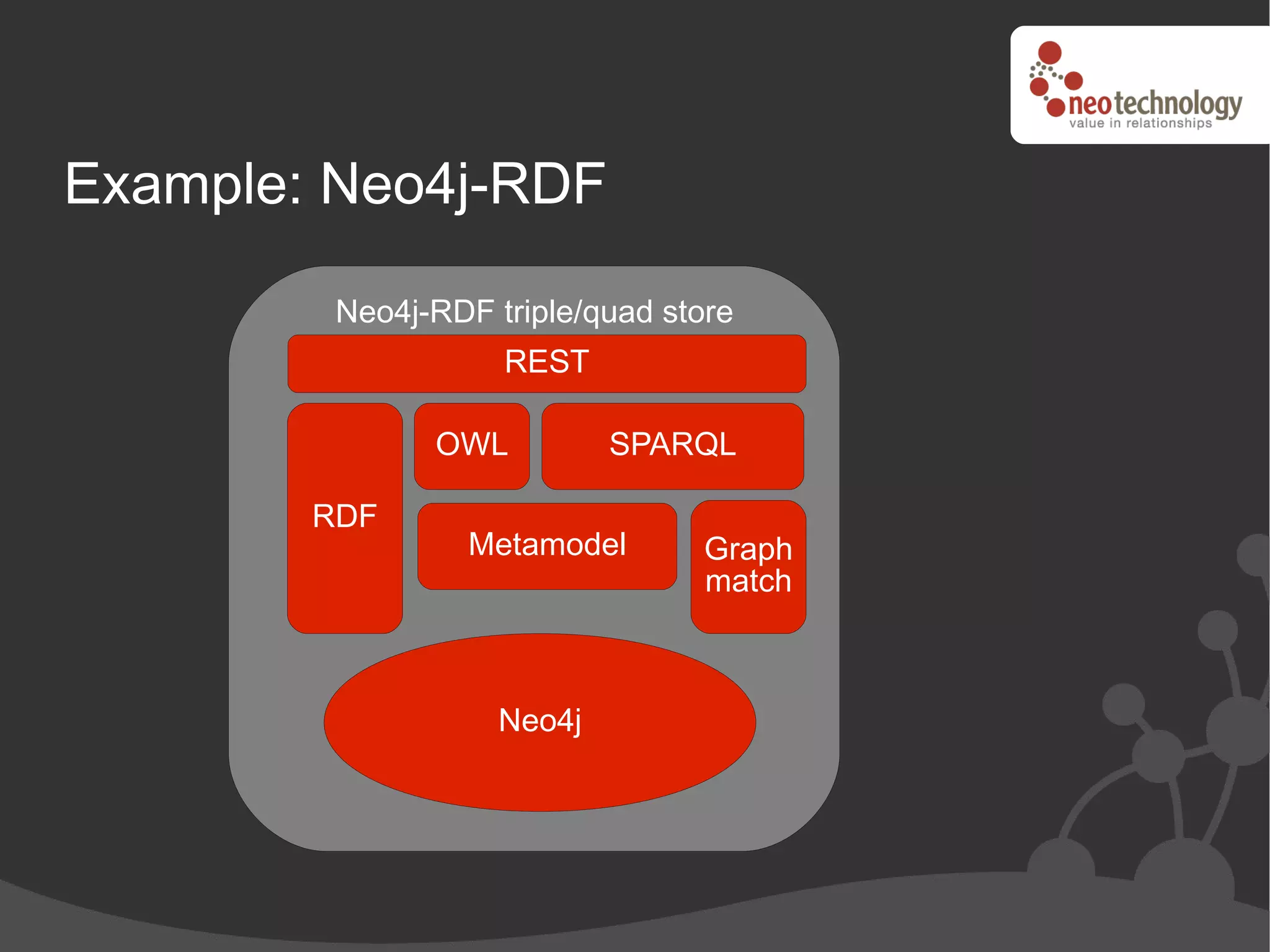
Example: Neo4j-RDF

         Neo4j-RDF triple/quad store
                    REST

               OWL          SPARQL

        RDF
                  Metamodel       Graph
                                  match


                    Neo4j
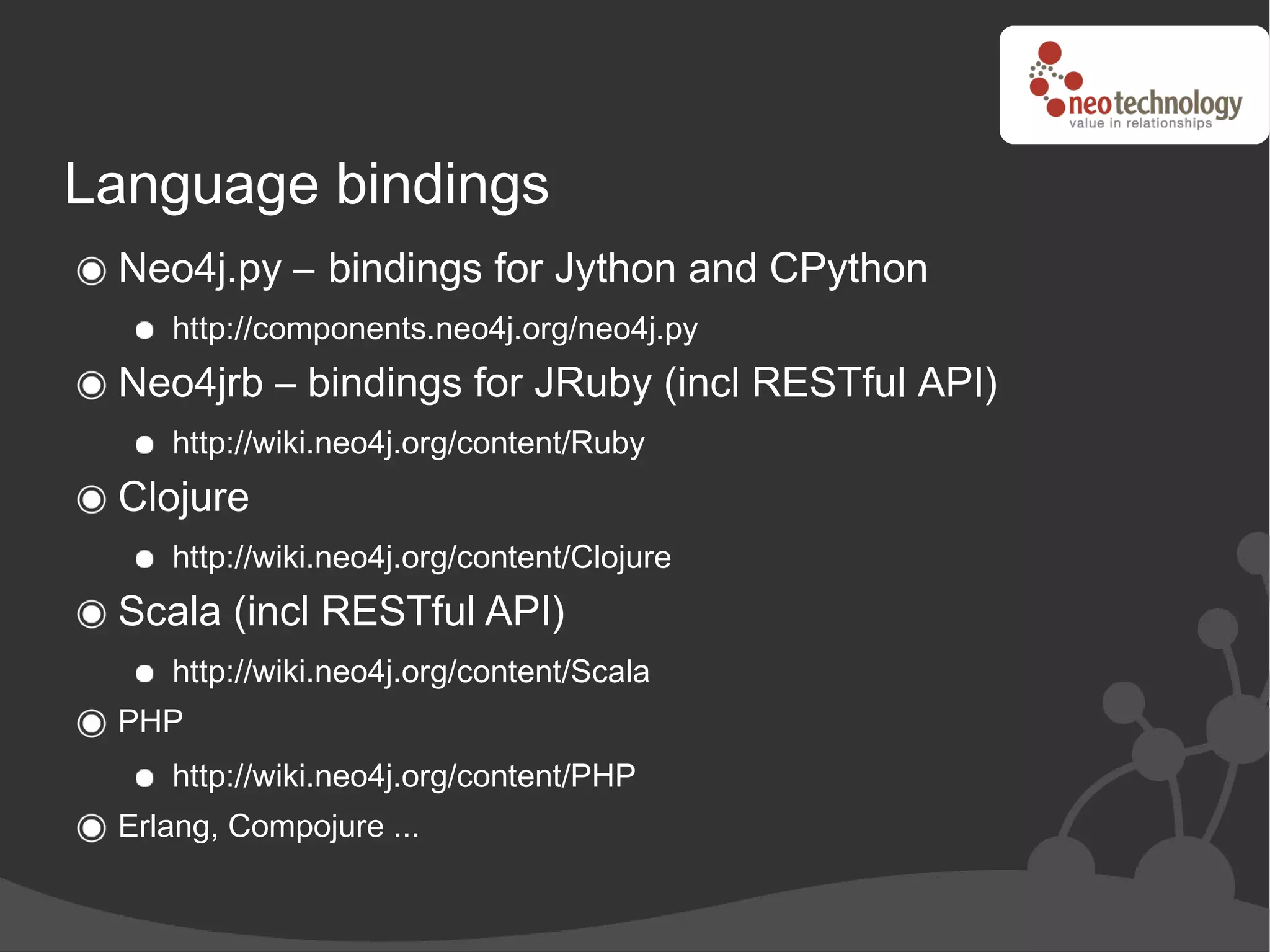
Language bindings
 Neo4j.py – bindings for Jython and CPython
    http://components.neo4j.org/neo4j.py
 Neo4jrb – bindings for JRuby (incl RESTful API)
    http://wiki.neo4j.org/content/Ruby
 Clojure
    http://wiki.neo4j.org/content/Clojure
 Scala (incl RESTful API)
    http://wiki.neo4j.org/content/Scala
 PHP
    http://wiki.neo4j.org/content/PHP
 Erlang, Compojure ...
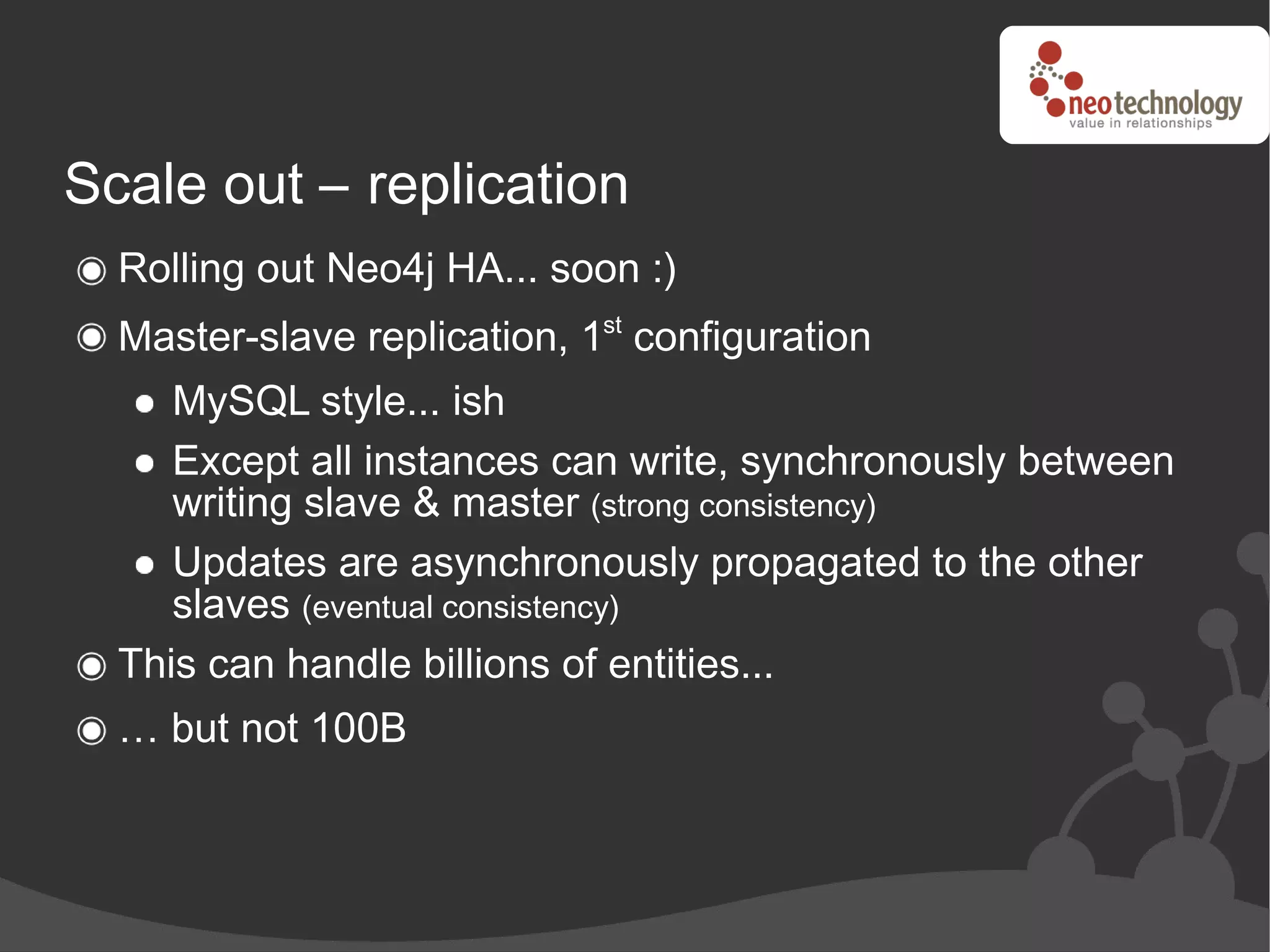
Scale out – replication
  Rolling out Neo4j HA... soon :)
  Master-slave replication, 1st configuration
     MySQL style... ish
     Except all instances can write, synchronously between
     writing slave & master (strong consistency)
     Updates are asynchronously propagated to the other
     slaves (eventual consistency)
  This can handle billions of entities...
  … but not 100B
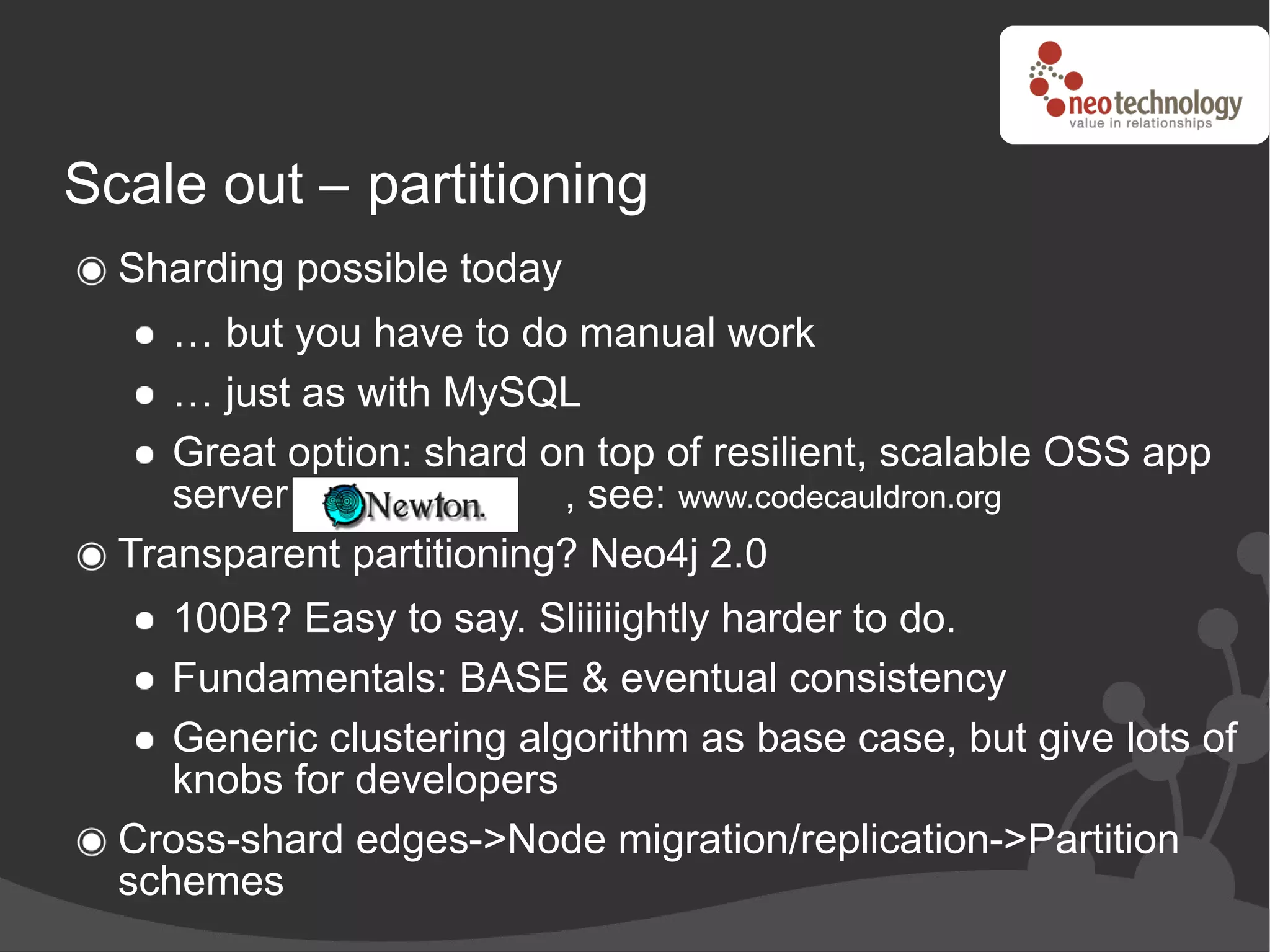
Scale out – partitioning
  Sharding possible today
     … but you have to do manual work
     … just as with MySQL
     Great option: shard on top of resilient, scalable OSS app
     server               , see: www.codecauldron.org
  Transparent partitioning? Neo4j 2.0
     100B? Easy to say. Sliiiiightly harder to do.
     Fundamentals: BASE & eventual consistency
     Generic clustering algorithm as base case, but give lots of
     knobs for developers
  Cross-shard edges->Node migration/replication->Partition
  schemes
Conclusion
 Graphs && Neo4j => teh awesome!
 Available NOW under AGPLv3 / commercial license
   AGPLv3: “if you’re open source, we’re open source”
   If you have proprietary software? Must buy a commercial
   license
   But the first one is free!
 Download
   http://neo4j.org
 Feedback
   http://lists.neo4j.org
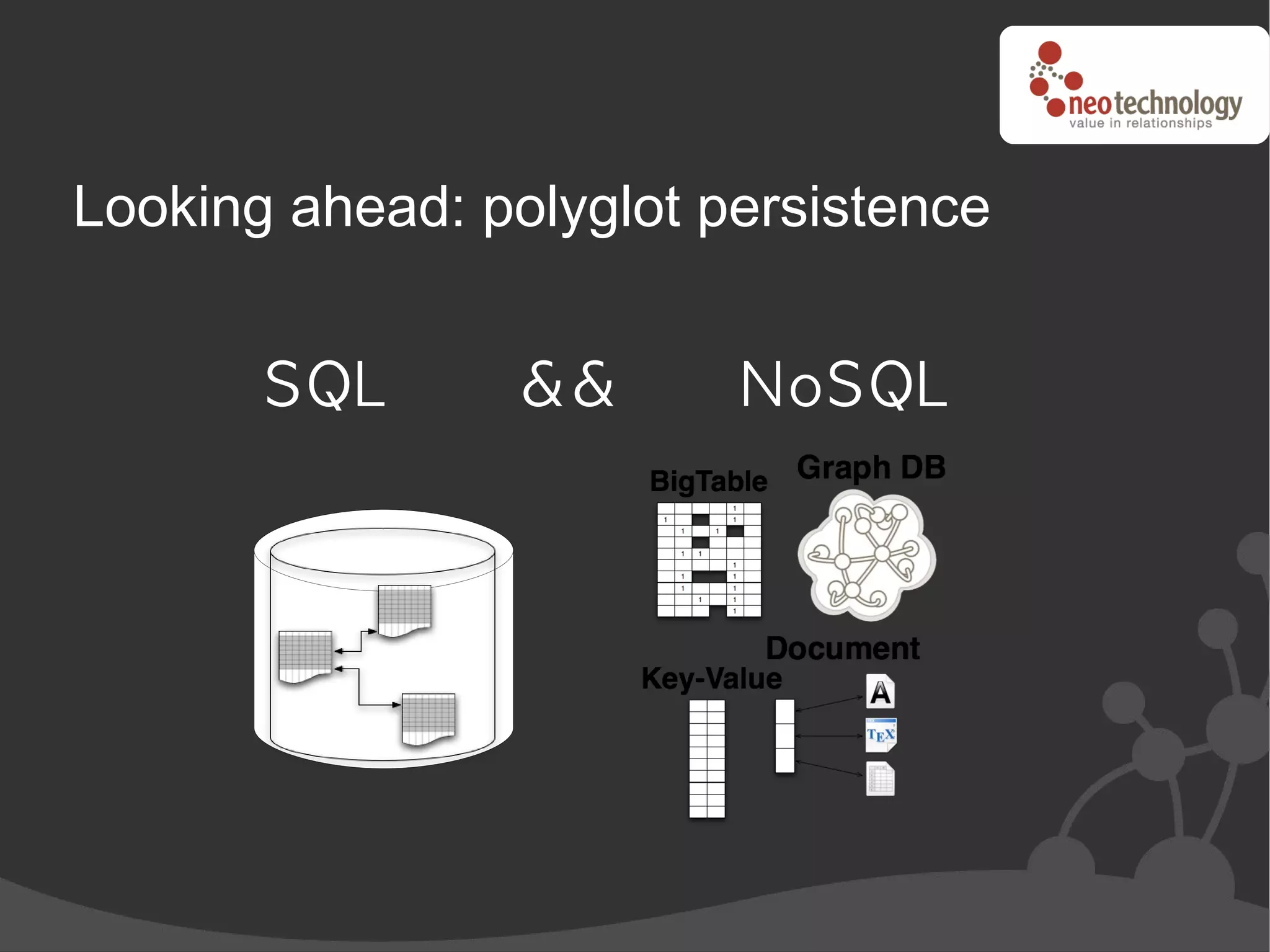
Looking ahead: polyglot persistence


       SQL       &&      N oSQL
Questions?


             Image credit: lost again! Sorry :(
http://neotechnology.com

Neo4j Nosqllive

  • 2.
    No SQL? Image credit: http://browsertoolkit.com/fault-tolerance.png
  • 3.
    Neo4j the benefits of graph databases #neo4j Peter Neubauer @peterneubauer COO, Neo Technology peter@neotechnology.com
  • 4.
    Why NoSQL 2009? Trend 1: Size. Trend 2: Connectivity. Trend 3: Semi-structure. Trend 4: Architecture.
  • 5.
    NOSQL data models Key-value stores Data size Bigtable clones Document databases Graph databases Data complexity
  • 6.
    NOSQL data models Key-value stores Data size Bigtable clones Document databases Graph databases (This is still b i l l i on s of 90% nodes & relationships) of use cases Data complexity
  • 7.
  • 8.
    The Graph DBmodel: representation Core abstractions: name = “Emil” Nodes age = 29 sex = “yes” Relationships between nodes Properties on both 1 2 type = KNOWS time = 4 years 3 type = car vendor = “SAAB” model = “95 Aero”
  • 9.
    Example: The Matrix name = “The Architect” name = “Morpheus” rank = “Captain” name = “Thomas Anderson” occupation = “Total badass” 42 age = 29 disclosure = public KNOWS KNOWS CODED_BY KNO 1 7 3 W S KN 13 S OW name = “Cypher” KNOW S last name = “Reagan” name = “Agent Smith” disclosure = secret version = 1.0b age = 3 days age = 6 months language = C++ 2 name = “Trinity”
  • 10.
    Code (1): Buildinga node space GraphDatabaseService graphDb = ... // Get factory // Create Thomas 'Neo' Anderson Node mrAnderson = graphDb.createNode(); mrAnderson.setProperty( "name", "Thomas Anderson" ); mrAnderson.setProperty( "age", 29 ); // Create Morpheus Node morpheus = graphDb.createNode(); morpheus.setProperty( "name", "Morpheus" ); morpheus.setProperty( "rank", "Captain" ); morpheus.setProperty( "occupation", "Total bad ass" ); // Create a relationship representing that they know each other mrAnderson.createRelationshipTo( morpheus, RelTypes.KNOWS ); // ...create Trinity, Cypher, Agent Smith, Architect similarly
  • 11.
    Code (1): Buildinga node space GraphDatabaseService graphDb = ... // Get factory Transaction tx = graphdb.beginTx(); // Create Thomas 'Neo' Anderson Node mrAnderson = graphDb.createNode(); mrAnderson.setProperty( "name", "Thomas Anderson" ); mrAnderson.setProperty( "age", 29 ); // Create Morpheus Node morpheus = graphDb.createNode(); morpheus.setProperty( "name", "Morpheus" ); morpheus.setProperty( "rank", "Captain" ); morpheus.setProperty( "occupation", "Total bad ass" ); // Create a relationship representing that they know each other mrAnderson.createRelationshipTo( morpheus, RelTypes.KNOWS ); // ...create Trinity, Cypher, Agent Smith, Architect similarly tx.commit();
  • 12.
    Code (1b): Defning RelationshipTypes i // In package org.neo4j.graphdb public interface RelationshipType { String name(); } // In package org.yourdomain.yourapp // Example on how to roll dynamic RelationshipTypes RelationshipsType myRelType = DynamicRelatoinshipType. withName(“myRelType”); // Example on how to kick it, static-RelationshipType-like enum MyStaticRelTypes implements RelationshipType { KNOWS, WORKS_FOR, }
  • 13.
    Whiteboard friendly owns Björn Big Car build drives DayCare
  • 15.
    The Graph DBmodel: traversal Traverser framework for high-performance traversing name = “Emil” age = 31 across the node space sex = “yes” 1 2 type = KNOWS time = 4 years 3 type = car vendor = “SAAB” model = “95 Aero”
  • 16.
    Example: Mr Anderson’sfriends name = “The Architect” name = “Morpheus” rank = “Captain” name = “Thomas Anderson” occupation = “Total badass” 42 age = 29 disclosure = public KNOWS KNOWS CODED_BY KNO 1 7 3 W S KN 13 S OW name = “Cypher” KNOW S last name = “Reagan” name = “Agent Smith” disclosure = secret version = 1.0b age = 3 days age = 6 months language = C++ 2 name = “Trinity”
  • 17.
    Code (2): Traversinga node space // Instantiate a traverser that returns Mr Anderson's friends Traverser friendsTraverser = mrAnderson.traverse( Traverser.Order.BREADTH_FIRST, StopEvaluator.END_OF_GRAPH, ReturnableEvaluator.ALL_BUT_START_NODE, RelTypes.KNOWS, Direction.OUTGOING ); // Traverse the node space and print out the result System.out.println( "Mr Anderson's friends:" ); for ( Node friend : friendsTraverser ) { System.out.printf( "At depth %d => %s%n", friendsTraverser.currentPosition().getDepth(), friend.getProperty( "name" ) ); }
  • 18.
    name = “TheArchitect” name = “Morpheus” rank = “Captain” name = “Thomas Anderson” occupation = “Total badass” 42 age = 29 disclosure = public KNOWS KNOWS CODED_BY KNO 1 7 3 W S KN 13 S OW name = “Cypher” KNOW S last name = “Reagan” name = “Agent Smith” disclosure = secret version = 1.0b age = 3 days age = 6 months language = C++ 2 name = “Trinity” $ bin/start-neo-example Mr Anderson's friends: At depth 1 => Morpheus friendsTraverser = mrAnderson.traverse( Traverser.Order.BREADTH_FIRST, At depth 1 => Trinity StopEvaluator.END_OF_GRAPH, At depth 2 => Cypher ReturnableEvaluator.ALL_BUT_START_NODE, RelTypes.KNOWS, At depth 3 => Agent Smith Direction.OUTGOING ); $
  • 19.
    Example: Friends inlove? name = “The Architect” name = “Morpheus” rank = “Captain” name = “Thomas Anderson” occupation = “Total badass” 42 age = 29 disclosure = public KNOWS KNOWS CODED_BY KNO 1 7 3 W S KN 13 S KNOW OW name = “Cypher” S last name = “Reagan” name = “Agent Smith” LO disclosure = secret version = 1.0b VE age = 6 months language = C++ S 2 name = “Trinity”
  • 20.
    Code (3a): Customtraverser // Create a traverser that returns all “friends in love” Traverser loveTraverser = mrAnderson.traverse( Traverser.Order.BREADTH_FIRST, StopEvaluator.END_OF_GRAPH, new ReturnableEvaluator() { public boolean isReturnableNode( TraversalPosition pos ) { return pos.currentNode().hasRelationship( RelTypes.LOVES, Direction.OUTGOING ); } }, RelTypes.KNOWS, Direction.OUTGOING );
  • 21.
    Code (3a): Customtraverser // Traverse the node space and print out the result System.out.println( "Who’s a lover?" ); for ( Node person : loveTraverser ) { System.out.printf( "At depth %d => %s%n", loveTraverser.currentPosition().getDepth(), person.getProperty( "name" ) ); }
  • 22.
    name = “TheArchitect” name = “Morpheus” rank = “Captain” name = “Thomas Anderson” occupation = “Total badass” 42 age = 29 disclosure = public KNOWS KNOWS KNO CODED_BY 1 7 3 W S KN 13 S name = “Cypher” KNOW OW S last name = “Reagan” name = “Agent Smith” LO disclosure = secret version = 1.0b VE age = 6 months language = C++ S 2 name = “Trinity” $ bin/start-neo-example new ReturnableEvaluator() Who’s a lover? { public boolean isReturnableNode( TraversalPosition pos) At depth 1 => Trinity { $ return pos.currentNode(). hasRelationship( RelTypes.LOVES, Direction.OUTGOING ); } },
  • 23.
    Domain layer frameworks Spring (SpringDM, Grails, Griffon etc), Sling, Karaf Rails, Django Qi4j (www.qi4j.org) Framework for doing DDD in pure Java5 Def nes Entities / Associations / Properties i Sound familiar? Nodes / Rel’s / Properties! Neo4j is an “EntityStore” backend Jo4neo (http://code.google.com/p/jo4neo) Annotation driven Weaves Neo4j-backed persistence into domain objects at runtime
  • 24.
    Code (4): Groovy/Grails importgrails.plugins.neo4j.* @Neo4jEntity class Author { @Neo4jIndex String name }
  • 25.
  • 26.
    Code (5): JRuby require"rubygems" require "neo4j" class Person include Neo4j::NodeMixin property :name, :salary, :age, :country has_n :friends index :name, :salary, :age, :country end neo = Person.new :name => 'Neo' morpheus = Person.new :name => 'Morpheus' neo.friends << morpheus
  • 27.
    Neo4j system characteristics Disk-based Native graph storage engine with custom binary on-disk format Robust 6+ years in 24/7 production Fast 1-2 million nodes per second Transactional JTA/JTS, XA, 2PC, Tx recovery, deadlock detection, MVCC, etc Scales up Many b i l l i on s of nodes/rels/props on single JVM
  • 28.
    What do Iuse this stuff for? Modeling, productivity, stability Bindings, migrations, robustness Fast graph algos on critical path Shortest path (Spatial, GIS, Social Web, Routing) Fast traversals Hierarchies, Networks (Automation, ERP, Intelligence, Finance) Recommendation engines (social, bioinfo) Multidimensional indexes (BI, Analytics, versioning) Activity Streams, Write Load -> Read Load RDF, SAIL, SemWeb
  • 29.
    Query languages SPARQL– “SQL for linked data” Ex: ”SELECT ?person WHERE { ?person neo4j:KNOWS ?friend . ?friend neo4j:KNOWS ?foe . ?foe neo4j:name “Larry Ellison” . }” Gremlin – “perl for graphs” Ex: ”./outE[@label='KNOWS']/inV[@age > 30]/@name”
  • 30.
    The Neo4j ecosystem Neo4j-kernel is an embedded database Tiny teeny lil jar f le i Component ecosystem Index REST meta-model graph-matching remote-graphdb sparql-engine ... See http://components.neo4j.org
  • 31.
    Example: Neo4j-RDF Neo4j-RDF triple/quad store REST OWL SPARQL RDF Metamodel Graph match Neo4j
  • 32.
    Language bindings Neo4j.py– bindings for Jython and CPython http://components.neo4j.org/neo4j.py Neo4jrb – bindings for JRuby (incl RESTful API) http://wiki.neo4j.org/content/Ruby Clojure http://wiki.neo4j.org/content/Clojure Scala (incl RESTful API) http://wiki.neo4j.org/content/Scala PHP http://wiki.neo4j.org/content/PHP Erlang, Compojure ...
  • 33.
    Scale out –replication Rolling out Neo4j HA... soon :) Master-slave replication, 1st configuration MySQL style... ish Except all instances can write, synchronously between writing slave & master (strong consistency) Updates are asynchronously propagated to the other slaves (eventual consistency) This can handle billions of entities... … but not 100B
  • 34.
    Scale out –partitioning Sharding possible today … but you have to do manual work … just as with MySQL Great option: shard on top of resilient, scalable OSS app server , see: www.codecauldron.org Transparent partitioning? Neo4j 2.0 100B? Easy to say. Sliiiiightly harder to do. Fundamentals: BASE & eventual consistency Generic clustering algorithm as base case, but give lots of knobs for developers Cross-shard edges->Node migration/replication->Partition schemes
  • 35.
    Conclusion Graphs &&Neo4j => teh awesome! Available NOW under AGPLv3 / commercial license AGPLv3: “if you’re open source, we’re open source” If you have proprietary software? Must buy a commercial license But the first one is free! Download http://neo4j.org Feedback http://lists.neo4j.org
  • 36.
    Looking ahead: polyglotpersistence SQL && N oSQL
  • 37.
    Questions? Image credit: lost again! Sorry :(
  • 38.