NEGOTIATION
NEGOTIATION
● WHAT?
● FACTORS:
1. Power
2. Concession
3. Leverage
4. Resources
5. Attitude
CASE 1: BUSINESS
Mark needs a car and is negotiating with Tom to purchase his car. Tom offers to sell his car to Mark for $10,000. Mark
scours through Craigslist and finds a similar car to which he assigns a value of $7,500. Mark’s BATNA is $7,500 – if
Tom does not offer a price lower than $7,500, Mark will consider his best alternative to a negotiated agreement. Mark is
willing to pay up to $7,500 for the car but would ideally want to pay $5,000 only.
If Tom demands a price higher than $7,500, Mark will take his business elsewhere. In the example, we are not provided
with Tom’s BATNA. If we assume that Tom can sell his car to someone else for $8,000, then $8,000 is Tom’s BATNA. In
such a scenario, an agreement will not be made, as Tom is only willing to sell for a minimum of $8,000, while Mark is
only willing to purchase at a maximum of $7,500.
If Tom’s best alternative to the deal is selling the car to a dealership, which would offer him $6,000, then both parties can
come to an agreement because Tom’s reservation point would be $6,000. In this case, there is a zone of potential
agreement – $6,000 to $7,500. Somewhere within this range, the two parties should be able to come to an agreement.
CASE 1: BUSINESS
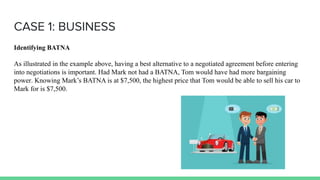
Identifying BATNA
As illustrated in the example above, having a best alternative to a negotiated agreement before entering
into negotiations is important. Had Mark not had a BATNA, Tom would have had more bargaining
power. Knowing Mark’s BATNA is at $7,500, the highest price that Tom would be able to sell his car to
Mark for is $7,500.
CASE 2: HR and EMPLOYEE
When you think of a “very large regulatory enforcement agency,” words that come to mind include bureaucracy, red tape, tiered
compensation levels, and politics. True to form, Derek’s situation did not disappoint.
Not only was Employee moving from one government-like agency to another, but he was also moving across the country. His
experience meant that he would be either a “Level 9” or “Level 11,” and on the initial application, they asked what the lowest “level”
he would take. (For context, a level 9 paid between $63,000 and $96,000, while Level 11 paid between $73,000 and $125,000).Since it
gives more room for raises and promotions, so he said Level 9.
He told me, “Resumes just get swooped up in a big search, so I always put the lowest level to try to get my foot in the door, thinking I
would start at the higher end of the 9 range if that’s what they give me.” But during the course of their talk, HR agreed that his
experience would definitely put him into the Level 11 category.
When Derek finally received an offer, he was shocked. They put him at a Level 9, offering a salary of just $70,000 with 15 days
vacation. This didn’t make any sense at all since HR said he was a Level 11, they knew he was making $80,000 to $90,000, and he
currently had 20 days of vacation.
CASE 2
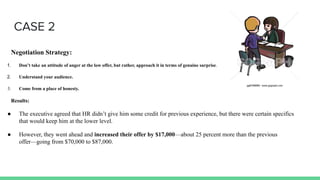
Negotiation Strategy:
1. Don’t take an attitude of anger at the low offer, but rather, approach it in terms of genuine surprise.
2. Understand your audience.
3. Come from a place of honesty.
Results:
● The executive agreed that HR didn’t give him some credit for previous experience, but there were certain specifics
that would keep him at the lower level.
● However, they went ahead and increased their offer by $17,000—about 25 percent more than the previous
offer—going from $70,000 to $87,000.
CASE 3: BUSINESS
Back on September 3, 2013, Microsoft announced a deal to acquire Finnish mobile phone company Nokia’s handset and
services business for $7.2 billion, the New York Times reported. The agreement marked a belated but bold move by Microsoft
to upgrade its presence in handheld devices and signals an end to Nokia’s long struggle to enter the hyper-competitive (and
extremely lucrative) smartphone market.
What negotiating skills brought negotiators to an agreement in one of the tech industry’s largest acquisitions and what
bargaining strategies can business negotiators use to bring competitors to a negotiated agreement in similar negotiation
scenarios?
CASE 3: BUSINESS
Both sides had strong incentives to join forces. Nokia had lost significant ground in recent years to smartphone manufacturers, most
notably Samsung and Apple, by failing to keep up with innovations such as touch screens.
Having shed its underperforming handset business, Nokia planned to focus on telecommunications equipment, mapping business, and
patent portfolio. Ballmer first approached Nokia CEO Stephen Elop about a possible acquisition during the Mobile World Congress
industry conference in Barcelona. Ballmer and Nokia chairman Riisto Siilasmaa conducted methodical, discreet negotiations across the
globe in 2013.

Negotiation

  • 1.
  • 2.
    NEGOTIATION ● WHAT? ● FACTORS: 1.Power 2. Concession 3. Leverage 4. Resources 5. Attitude
  • 3.
    CASE 1: BUSINESS Markneeds a car and is negotiating with Tom to purchase his car. Tom offers to sell his car to Mark for $10,000. Mark scours through Craigslist and finds a similar car to which he assigns a value of $7,500. Mark’s BATNA is $7,500 – if Tom does not offer a price lower than $7,500, Mark will consider his best alternative to a negotiated agreement. Mark is willing to pay up to $7,500 for the car but would ideally want to pay $5,000 only. If Tom demands a price higher than $7,500, Mark will take his business elsewhere. In the example, we are not provided with Tom’s BATNA. If we assume that Tom can sell his car to someone else for $8,000, then $8,000 is Tom’s BATNA. In such a scenario, an agreement will not be made, as Tom is only willing to sell for a minimum of $8,000, while Mark is only willing to purchase at a maximum of $7,500. If Tom’s best alternative to the deal is selling the car to a dealership, which would offer him $6,000, then both parties can come to an agreement because Tom’s reservation point would be $6,000. In this case, there is a zone of potential agreement – $6,000 to $7,500. Somewhere within this range, the two parties should be able to come to an agreement.
  • 4.
    CASE 1: BUSINESS IdentifyingBATNA As illustrated in the example above, having a best alternative to a negotiated agreement before entering into negotiations is important. Had Mark not had a BATNA, Tom would have had more bargaining power. Knowing Mark’s BATNA is at $7,500, the highest price that Tom would be able to sell his car to Mark for is $7,500.
  • 5.
    CASE 2: HRand EMPLOYEE When you think of a “very large regulatory enforcement agency,” words that come to mind include bureaucracy, red tape, tiered compensation levels, and politics. True to form, Derek’s situation did not disappoint. Not only was Employee moving from one government-like agency to another, but he was also moving across the country. His experience meant that he would be either a “Level 9” or “Level 11,” and on the initial application, they asked what the lowest “level” he would take. (For context, a level 9 paid between $63,000 and $96,000, while Level 11 paid between $73,000 and $125,000).Since it gives more room for raises and promotions, so he said Level 9. He told me, “Resumes just get swooped up in a big search, so I always put the lowest level to try to get my foot in the door, thinking I would start at the higher end of the 9 range if that’s what they give me.” But during the course of their talk, HR agreed that his experience would definitely put him into the Level 11 category. When Derek finally received an offer, he was shocked. They put him at a Level 9, offering a salary of just $70,000 with 15 days vacation. This didn’t make any sense at all since HR said he was a Level 11, they knew he was making $80,000 to $90,000, and he currently had 20 days of vacation.
  • 6.
    CASE 2 Negotiation Strategy: 1.Don’t take an attitude of anger at the low offer, but rather, approach it in terms of genuine surprise. 2. Understand your audience. 3. Come from a place of honesty. Results: ● The executive agreed that HR didn’t give him some credit for previous experience, but there were certain specifics that would keep him at the lower level. ● However, they went ahead and increased their offer by $17,000—about 25 percent more than the previous offer—going from $70,000 to $87,000.
  • 7.
    CASE 3: BUSINESS Backon September 3, 2013, Microsoft announced a deal to acquire Finnish mobile phone company Nokia’s handset and services business for $7.2 billion, the New York Times reported. The agreement marked a belated but bold move by Microsoft to upgrade its presence in handheld devices and signals an end to Nokia’s long struggle to enter the hyper-competitive (and extremely lucrative) smartphone market. What negotiating skills brought negotiators to an agreement in one of the tech industry’s largest acquisitions and what bargaining strategies can business negotiators use to bring competitors to a negotiated agreement in similar negotiation scenarios?
  • 8.
    CASE 3: BUSINESS Bothsides had strong incentives to join forces. Nokia had lost significant ground in recent years to smartphone manufacturers, most notably Samsung and Apple, by failing to keep up with innovations such as touch screens. Having shed its underperforming handset business, Nokia planned to focus on telecommunications equipment, mapping business, and patent portfolio. Ballmer first approached Nokia CEO Stephen Elop about a possible acquisition during the Mobile World Congress industry conference in Barcelona. Ballmer and Nokia chairman Riisto Siilasmaa conducted methodical, discreet negotiations across the globe in 2013.