Andrew Lambert, Rui He, Isaac Piller, James Mohr
Understanding the Practices & Needs of
Personal Fabricators
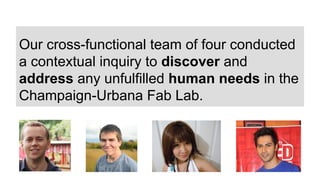
Our cross-functional team of four conducted
a contextual inquiry to discover and
address any unfulfilled human needs in the
Champaign-Urbana Fab Lab.
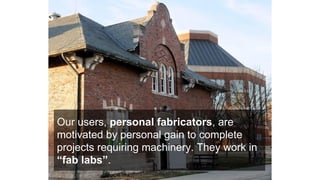
Our users, personal fabricators, are
motivated by personal gain to complete
projects requiring machinery. They work in
“fab labs”.
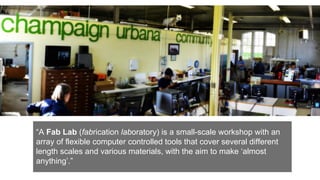
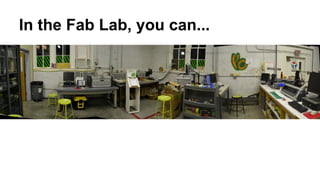
“A Fab Lab (fabrication laboratory) is a small-scale workshop with an
array of flexible computer controlled tools that cover several different
length scales and various materials, with the aim to make ‘almost
anything’.”
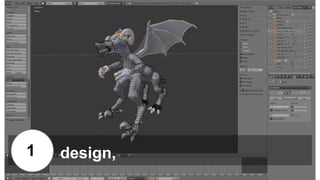
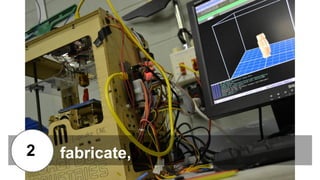
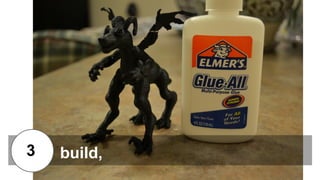
In the Fab Lab, you can...
design,1
fabricate,2
build,3
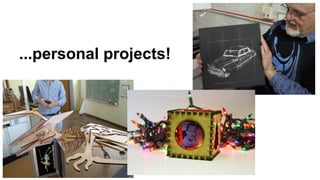
...personal projects!
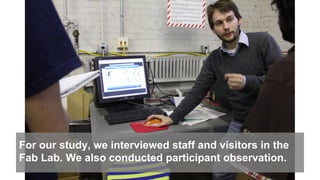
For our study, we interviewed staff and visitors in the
Fab Lab. We also conducted participant observation.
We noticed that kids and their
parents--a target audience--were
mysteriously missing.
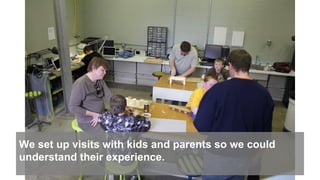
We set up visits with kids and parents so we could
understand their experience.
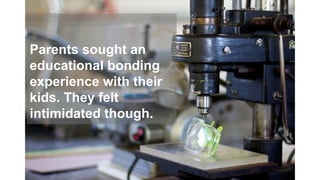
Parents sought an
educational bonding
experience with their
kids. They felt
intimidated though.
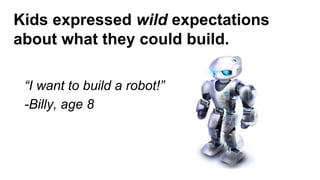
Kids expressed wild expectations
about what they could build.
“I want to build a robot!”
-Billy, age 8
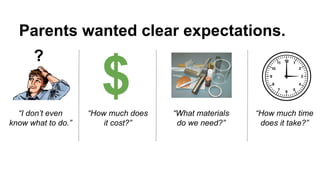
Parents wanted clear expectations.
“How much does
it cost?”
$ “How much time
does it take?”
“What materials
do we need?”
“I don’t even
know what to do.”
?
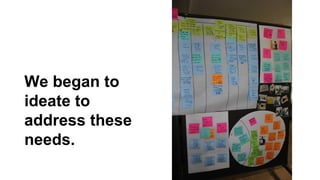
We began to
ideate to
address these
needs.
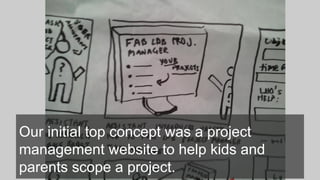
Our initial top concept was a project
management website to help kids and
parents scope a project.
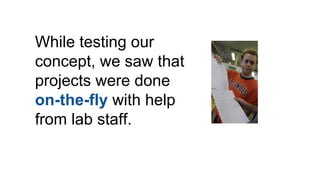
While testing our
concept, we saw that
projects were done
on-the-fly with help
from lab staff.
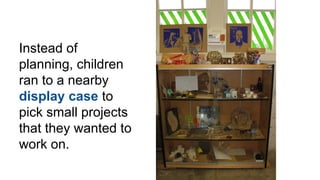
Instead of
planning, children
ran to a nearby
display case to
pick small projects
that they wanted to
work on.
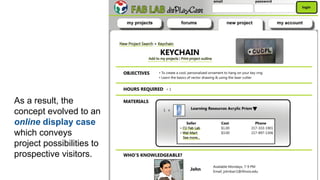
As a result, the
concept evolved to an
online display case
which conveys
project possibilities to
prospective visitors.
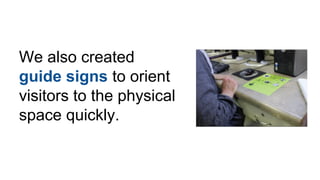
We also created
guide signs to orient
visitors to the physical
space quickly.
Additional Deliverables
High fidelity mockups of DISPLAYKASE
Project poster
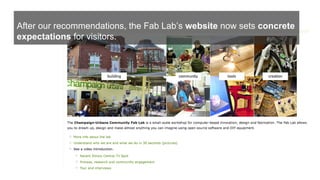
After our recommendations, the Fab Lab’s website now sets concrete
expectations for visitors.
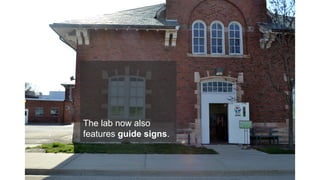
The lab now also
features guide signs.
Reflection
● Challenge: teamwork
○ Teammate who contributed early, but became non-responsive
● Design is a highly collaborative process, extremely beneficial to have
others to bounce ideas off of
● Grad school: qual research is iterative, flexible, key is context

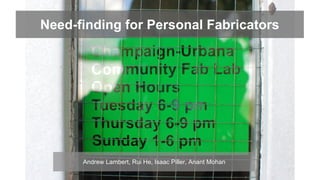
Need-finding for Personal Fabricators

  • 1.
    Andrew Lambert, RuiHe, Isaac Piller, James Mohr Understanding the Practices & Needs of Personal Fabricators
  • 2.
    Our cross-functional teamof four conducted a contextual inquiry to discover and address any unfulfilled human needs in the Champaign-Urbana Fab Lab.
  • 3.
    Our users, personalfabricators, are motivated by personal gain to complete projects requiring machinery. They work in “fab labs”.
  • 4.
    “A Fab Lab(fabrication laboratory) is a small-scale workshop with an array of flexible computer controlled tools that cover several different length scales and various materials, with the aim to make ‘almost anything’.”
  • 5.
    In the FabLab, you can...
  • 6.
  • 7.
  • 8.
  • 9.
  • 10.
    For our study,we interviewed staff and visitors in the Fab Lab. We also conducted participant observation.
  • 11.
    We noticed thatkids and their parents--a target audience--were mysteriously missing.
  • 12.
    We set upvisits with kids and parents so we could understand their experience.
  • 13.
    Parents sought an educationalbonding experience with their kids. They felt intimidated though.
  • 14.
    Kids expressed wildexpectations about what they could build. “I want to build a robot!” -Billy, age 8
  • 15.
    Parents wanted clearexpectations. “How much does it cost?” $ “How much time does it take?” “What materials do we need?” “I don’t even know what to do.” ?
  • 16.
    We began to ideateto address these needs.
  • 17.
    Our initial topconcept was a project management website to help kids and parents scope a project.
  • 19.
    While testing our concept,we saw that projects were done on-the-fly with help from lab staff.
  • 20.
    Instead of planning, children ranto a nearby display case to pick small projects that they wanted to work on.
  • 21.
    As a result,the concept evolved to an online display case which conveys project possibilities to prospective visitors.
  • 22.
    We also created guidesigns to orient visitors to the physical space quickly.
  • 23.
    Additional Deliverables High fidelitymockups of DISPLAYKASE Project poster
  • 24.
    After our recommendations,the Fab Lab’s website now sets concrete expectations for visitors.
  • 25.
    The lab nowalso features guide signs.
  • 26.
    Reflection ● Challenge: teamwork ○Teammate who contributed early, but became non-responsive ● Design is a highly collaborative process, extremely beneficial to have others to bounce ideas off of ● Grad school: qual research is iterative, flexible, key is context